February 28, 1944 Test Pilot

In her 1951 memoir “Fliegen – mein leben”, (Flying is my life), Hannah Reitsch offers no moral judgement one way or the other, on Hitler or the Third Reich.

Hannah Reitsch wanted to fly.  Born March 29, 1912 into an upper-middle-class family in Hirschberg, Silesia, it’s all she ever thought about. At the age of four, she tried to jump off the family balcony, to experience flight.  In her 1955 autobiography The Sky my Kingdom, Reitsch wrote:  ‘The longing grew in me, grew with every bird I saw go flying across the azure summer sky, with every cloud that sailed past me on the wind, till it turned to a deep, insistent homesickness, a yearning that went with me everywhere and could never be stilled.

94329f643cf875a2a36889aec9d1162c--hanna-reitsch-medical-schoolReitsch began flying gliders in 1932, as the treaty of Versailles prohibited anyone flying “war planes” in Germany. In 1934, she broke the world’s altitude record for women (9,184 feet).  In 1936, Reitsch was working on developing dive brakes for gliders, when she was awarded the honorary rank of Flugkapitän, the first woman ever so honored. In 1937 she became a Luftwaffe civilian test pilot.  She would hold the position until the end of WW2.

A German Nationalist who believed she owed her allegiance to the Fatherland more than to any party, Reitsch was patriotic and loyal, and more than a little politically naive.  Her work brought her into contact with the highest levels of Nazi party officialdom.  Like the victims of Soviet purges who went to their death believing that it would all stop “if only Stalin knew”, Reitsch refused to believe that Hitler had anything to do with events such as the Kristallnacht pogrom.  She dismissed any talk of concentration camps, as “mere propaganda”.
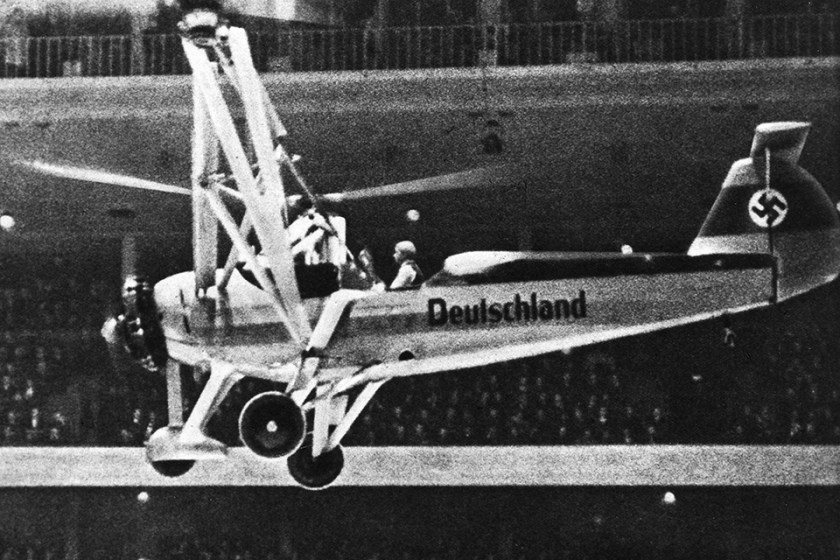
Hubschrauber Focke-Wulf FW 61 V1 in Berliner Deutschlandhalle 1938
In February 1938, Hannah Reitsch became the first person of either sex to fly a helicopter, the Focke-Achgelis Fa-61, inside a building, Berlin’s Deutschlandhalle. (ullstein bild via Getty Images)

As a test pilot, Reitsch won an Iron Cross, Second Class, for risking her life in an attempt to cut British barrage-balloon cables. On one test flight of the rocket powered Messerschmitt 163 Komet in 1942, she flew the thing at speeds of 500 mph, a speed nearly unheard of at the time. She spun out of control and crash-landed on her 5th flight, leaving her with severe injuries.  Her nose was all but torn off, her skull fractured in four places.  Two facial bones were broken, and her upper and lower jaws out of alignment.  Even then, she managed to write down what had happened, before she collapsed.

Hannah ReitschDoctors did not expect her to live, let alone fly again.  She spent five months in hospital, and suffered from debilitating dizzy spells.  She put herself on a program of climbing trees and rooftops, to regain her sense of balance.  Soon, she was test flying again.

On this day in 1944, Reichsmarshall Hermann Göring awarded her a special diamond-encrusted version of the Gold Medal for Military Flying. Adolf Hitler personally awarded her an Iron Cross, First Class, the first and only woman in German history, so honored.

It was while receiving this second Iron Cross in Berchtesgaden, that Reitsch suggested the creation of a Luftwaffe suicide squad, “Operation Self Sacrifice”.

Hanna-Reitsch-2Hitler was initially put off by the idea, though she finally persuaded him to look into modifying a Messerschmitt Me-328B fighter for the purpose. Reitsch put together a suicide group, becoming the first to take the pledge, though the idea would never take shape. The pledge read, in part: “I hereby voluntarily apply to be enrolled in the suicide group as a pilot of a human glider-bomb. I fully understand that employment in this capacity will entail my own death.”

The plan came to an abrupt halt when an Allied bombing raid wiped out the factory in which the prototype Me-328s were being built.

In the last days of the war, Hitler dismissed his designated successor Hermann Göring, over a telegram in which the Luftwaffe head requested permission to take control of the crumbling third Reich.  Hitler appointed Generaloberst Robert Ritter von Greim, ordering Hannah to take him out of Berlin and giving each a vial of cyanide, to be used in the event of capture.   The Arado Ar 96 left the improvised airstrip on the evening of April 28, under small arms fire from Soviet troops.  It was the last plane to leave Berlin.  Two days later, Adolf Hitler was dead.

Taken into American custody on May 9, Reitsch and von Greim repeated the same statement to American interrogators: “It was the blackest day when we could not die at our Führer’s side.” She spent 15 months in prison, giving detailed testimony as to the “complete disintegration’ of Hitler’s personality, during the last months of his life.  She was found not guilty of war crimes, and released in 1946. Von Greim committed suicide, in prison.
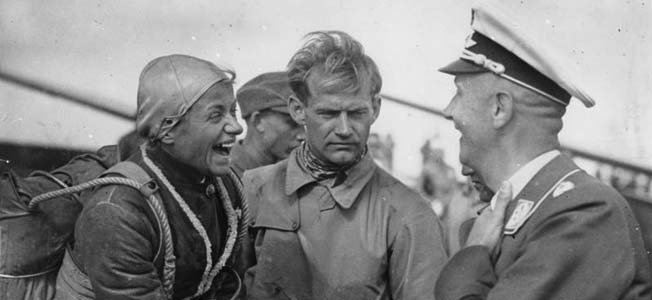
Hanna-Reitsch

In her 1951 memoir “Fliegen – mein leben”, (Flying is my life), Reitsch offers no moral judgement one way or the other, on Hitler or the Third Reich.

She resumed flying competitions in 1954, opening a gliding school in Ghana in 1962.  She later traveled to the United States, where she met Igor Sikorsky and Neil Armstrong, and even John F. Kennedy.

Hannah Reitsch remained a controversial figure, due to her ties with the Third Reich.  Shortly before her death in 1979, she responded to a description someone had written of her, as `Hitler’s girlfriend’.  “I had been picked for this mission” she wrote, “because I was a pilot…I can only assume that the inventor of these accounts did not realize what the consequences would be for my life.  Ever since then I have been accused of many things in connection with the Third Reich”.

592644327Toward the end of her life, she was interviewed by the Jewish-American photo-journalist, Ron Laytner. Even then she was defiant:  “And what have we now in Germany? A land of bankers and car-makers. Even our great army has gone soft. Soldiers wear beards and question orders. I am not ashamed to say I believed in National Socialism. I still wear the Iron Cross with diamonds Hitler gave me. But today in all Germany you can’t find a single person who voted Adolf Hitler into power … Many Germans feel guilty about the war. But they don’t explain the real guilt we share – that we lost“.

Hannah Reitsch died in Frankfurt on August 24, 1979, of an apparent heart attack.  Former British test pilot and Royal Navy officer Eric Brown received a letter from her earlier that month, in which she wrote, “It began in the bunker, there it shall end.”  There was no autopsy, or at least there’s no report of one.  Brown, for one, believes that after all those years, she may have finally taken that cyanide capsule.

February 24, 1917  The Zimmermann Telegram

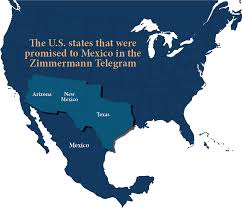
“We intend to begin on the first of February unrestricted submarine warfare. We shall endeavor in spite of this to keep the United States of America neutral. In the event of this not succeeding, we make Mexico a proposal of alliance on the following basis: make war together, make peace together, generous financial support and an understanding on our part that Mexico is to reconquer the lost territory in Texas, New Mexico, and Arizona”.

On May 10, 1915, President Woodrow Wilson gave what came to be known as his “Too Proud to Fight Speech” in which he said:  “The example of America must be the example not merely of peace because it will not fight, but of peace because peace is the healing and elevating influence of the world and strife is not. There is such a thing as a man being so right it does not need to convince others by force that it is right”.

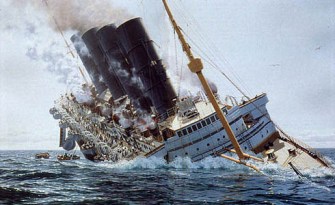
Lusitania sinkingThough Wilson didn’t mention it directly, HMS Lusitania had been torpedoed only three days earlier with the loss of 1,198, 128 of whom were Americans.

No one doubted that the attack on the civilian liner was foremost on the President’s mind.  Back in February, Imperial Germany had declared a naval blockade against Great Britain, warning that “On and after February 18th every enemy merchant vessel found in this region will be destroyed, without its always being possible to warn the crews or passengers of the dangers threatening“.  “Neutral ships” the announcement continued, “will also incur danger in the war region“.

Lusitania warningThe reaction to the Lusitania sinking was immediate and vehement, portraying the attack as the act of barbarians and huns and demanding a German return to “prize rules”, requiring submarines to surface and search merchantmen while placing crews and passengers in “a place of safety”.
Imperial Germany protested that Lusitania was fair game, as she was illegally transporting munitions intended to kill German boys on European battlefields. Furthermore, the embassy pointed out that ads had been taken out in the New York Times and other newspapers, specifically warning that the liner was subject to attack.

Nevertheless, the German policy of unrestricted submarine warfare was suspended for a time, for fear of bringing the US into the war against Germany.

President Wilson was elected back in 1912, talking about the sort of agrarian utopia favored by Thomas Jefferson.  In 1916, the election was about war and peace.  Wilson won re-election on the slogan “He kept us out of war”, but it hadn’t been easy.  In Europe, WWI was in its second year while, to our south, Mexico was going through a full-blown revolution.  Public opinion had shifted in favor of England and France by this time.  The German resumption of unrestricted submarine warfare, threatened to tip the balance.

With Great Britain holding naval superiority on the surface, Germany had to do something to starve the British war effort.  In early 1917, chief of the Admiralty Staff Admiral Henning von Holtzendorff argued successfully for the resumption of unrestricted submarine warfare, the policy to take effect on February 1.

Anticipating the results of such a move, German Foreign Secretary Arthur Zimmermann dispatched a telegram to German ambassador to Mexico Heinrich von Eckardt on January 19, authorizing the ambassador to propose a military alliance with Mexico, in the event of American entry into the war.  “We intend to begin on the first of February unrestricted submarine warfare. We shall endeavor in spite of this to keep the United States of America neutral. In the event of this not succeeding, we make Mexico a proposal of alliance on the following basis: make war together, make peace together, generous financial support and an understanding on our part that Mexico is to reconquer the lost territory in Texas, New Mexico, and Arizona”.

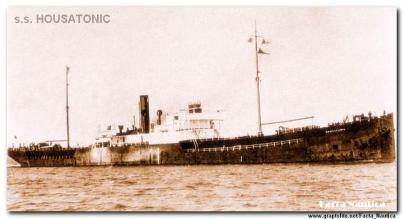
housatonic-4-facta-nautica-1000x544The American cargo vessel SS Housatonic was stopped off the southwest coast of England on February 3, and boarded by German submarine U-53.  Captain Thomas Ensor was interviewed by Kapitänleutnant Hans Rose, who explained he was sorry, but Housatonic was “carrying food supplies to the enemy of my country”.  She would be destroyed.  The American Captain and crew were allowed to launch lifeboats and abandon ship, while German sailors raided the American’s soap supplies.  Apparently, WWI-vintage German subs were short on soap.
Housatonic was sunk with a single torpedo, the U-Boat towing the now-stranded Americans toward the English coast.  Sighting the trawler Salvator, Rose fired his deck guns to be sure they’d been spotted, and then slipped away.  It was February 3, 1917.

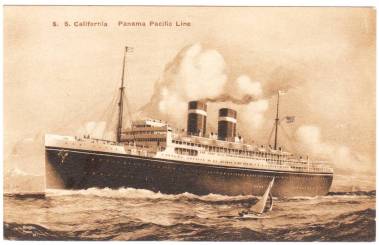
SS_CaliforniaPresident Woodrow Wilson retaliated, breaking off diplomatic relations with Germany the following day. Three days later, a German U-boat fired two torpedoes at the SS California, off the Irish coast. One missed, but the second tore into the port side of the 470-foot, 9,000-ton steamer. California sank in nine minutes, killing 43 of her 205 passengers and crew.
In Mexico, a military commission convened by President Venustiano Carranza quickly concluded that the German proposal was unviable, but the damage was done.  British code breakers intercepted the Zimmermann telegram, divulging the contents to the American government on February 24.

images (22)The contents of Zimmermann’s note were published in the American media on March 1.  Even then, there was considerable antipathy toward the British side, particularly among Americans of German and Irish ethnicity.  “Who says this thing is genuine, anyway”, they might have said.  “Maybe it’s a British forgery”.
Zimmermann himself put an end to such speculation two days later, telling an American journalist, “I cannot deny it. It is true.” What Zimmermann had hoped that Americans would see as mere contingency, public opinion in the US saw as an unforgivable betrayal of American neutrality.

The combination of events was the last straw.  Wilson’s War Cabinet voted unanimously for a declaration of war on March 20.  The President himself delivered his war address before a joint session of Congress, two weeks later.  The United States entered the “war to end all wars”, on April 6.

Afterward

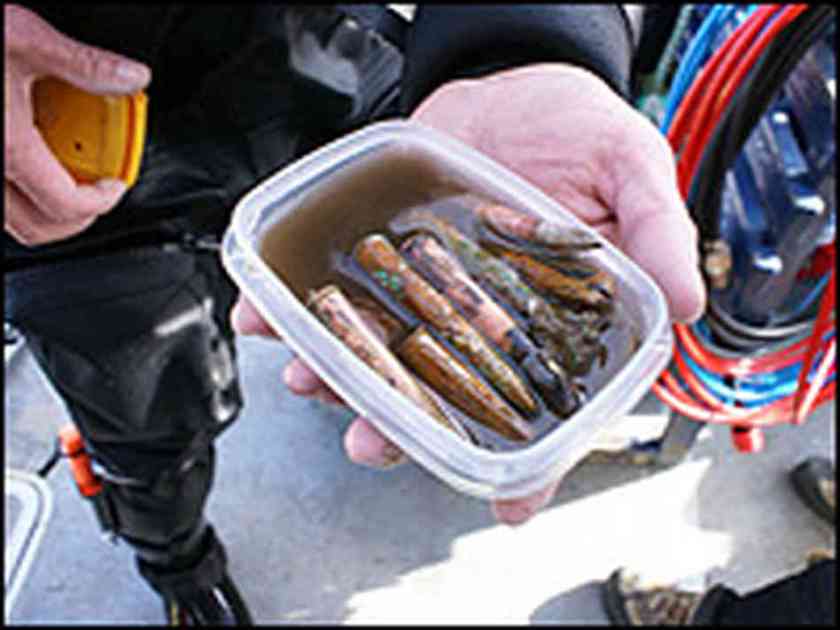
At the time, the German claim that Lusitania carried contraband munitions seemed to be supported by survivors’ reports of secondary explosions within the stricken liner’s hull. In 2008, the UK Daily Mail reported that dive teams had reached the wreck, lying at a depth of 300′. Divers reported finding tons of US manufactured Remington .303 ammunition, about 4 million rounds, stored in unrefrigerated cargo holds in cases marked “Cheese”, “Butter”, and “Oysters”.

Lusitania, ammunition

February 23, 1836  The Lexington of Texas

“If my countrymen do not rally to my relief, I am determined to perish in the defense of this place, and my bones shall reproach my country for her neglect.”

Following the Mexican War of Independence with Spain, (1810 – 1821), Texas became a part of Mexico.  In 1831, Mexican authorities gave the settlers of Gonzales a small swivel cannon, a defense against the raids of the Comanche.  The political situation deteriorated in the following years.  By 1835, several Mexican states were in open revolt.  That September, commander of “Centralist” (Mexican) troops in Texas Colonel Domingo de Ugartechea, came to take it back.

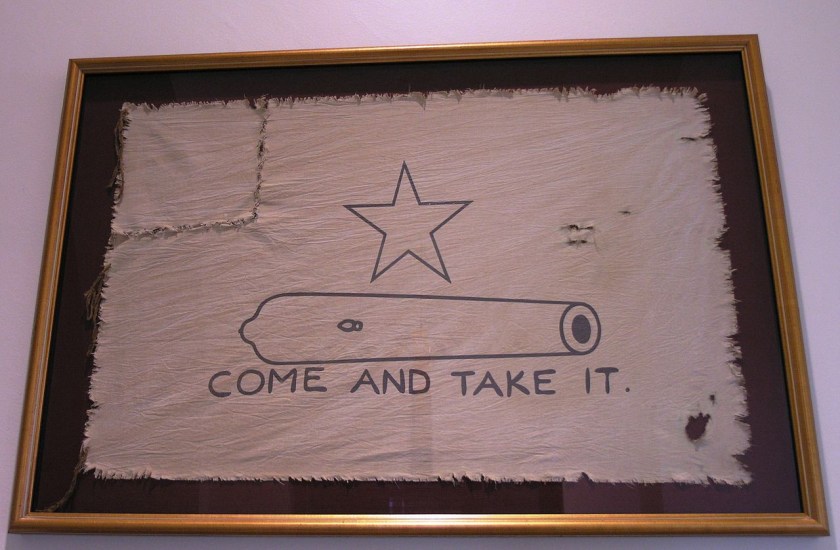
Dissatisfied with the increasingly dictatorial policies of President and General Antonio Lopez de Santa Anna, the colonists had no intention of handing over that cannon.  One excuse was given after another to keep the Mexican dragoons out of Gonzalez, while secret pleas for help went out to surrounding communities.  Within two days, 140 “Texians” had gathered in Gonzalez, fashioning a flag that echoed some 2,315 years through history, King Leonidas’ defiant response to the Persian tyrant, Xerxes:   “Come and Take it.”

1_w8rDKtbIBYgc6dg2Nn9t1g

Militarily, the skirmish of October 2 had little significance, much the same as the early battles in the Massachusetts colony, some sixty years earlier.  Politically, the “Lexington of Texas” marked a break between Texian settlers, and the Mexican government.

Settlers continued to gather, electing the well-respected local and former legislator of the Missouri territory Stephen F. Austin, as their leader.  Santa Anna sent his brother-in-law, General Martin Perfecto de Cos to reinforce the settlement of San Antonio de Béxar, near the modern city of San Antonio.  On the 13th, Austin led his Federalist army of Texians and their Tejano allies to Béxar, to confront the garrison.  Austin’s forces captured the town that December, following a prolonged siege. It was only a matter of time before Santa Anna himself came to take it back.

Two forts – more like lonely outposts – blocked the only approaches from the Mexican interior into Texas: Presidio La Bahía (Nuestra Señora de Loreto Presidio) at Goliad and the Alamo at San Antonio de Béxar.  That December, a group of volunteers led by George Collinsworth and Benjamin Milam overwhelmed the Mexican garrison at the Alamo, and captured the fort  The Mexican President arrived on February 23 at the head of an army of 3,000, demanding its surrender.  Lieutenant Colonel William Barret “Buck” Travis, responded with a cannon ball.

Knowing that his small force couldn’t hold for long against such an army, Travis sent out a series of pleas for help and reinforcement, writing “If my countrymen do not rally to my relief, I am determined to perish in the defense of this place, and my bones shall reproach my country for her neglect.” 32 troops attached to Lt. George Kimbell’s Gonzales ranging company made their way through the enemy cordon and into the Alamo on March 1. There would be no more.

Alamo-Weight-Loss-Motivation-2Estimates of the Alamo garrison have ranged between 189 and 257 at this stage, but current sources indicate that defenders never numbered more than 200.
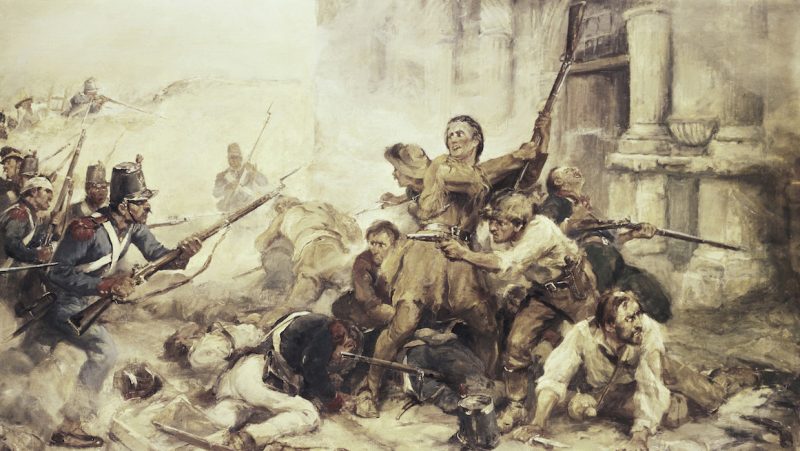
On March 2, 1836, the interim government of Texas signed the Texas Declaration of Independence.  The final assault on the Alamo began at 5:00am, four days later. 1,800 troops attacked from four directions.  600 to 1,600 were killed from concentrated artillery fire and close combat, but the numbers were overwhelming. Hand to hand fighting moved to the barracks after the walls were breached, and ended in the chapel.

Remember-the-Alamo-3-6-17-e1488801582528-800x451

As many as seven defenders still lived when it was over, many believe that former Congressman Davy Crockett was among them. Santa Anna ordered them summarily executed. By 8:00am there were no survivors, except for a handful of noncombatant women, children, and slaves, slowly emerging from the smoking ruins. These were provided with blankets and two dollars apiece, and given safe passage through Mexican lines with the warning:  a similar fate awaited any Texan who continued in their revolt.

Three weeks later following the Battle of Coleto, 350 Texian prisoners were murdered by the Mexican army under direct orders from Santa Anna, an event remembered as the Goliad massacre.

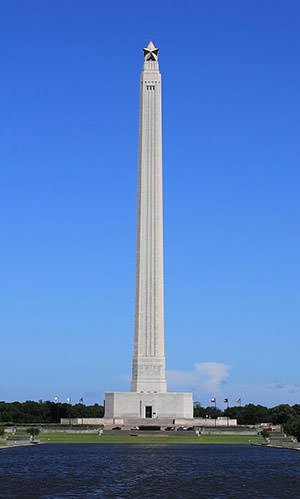
San-Jacinto-Monument
Measuring 570′, the San Jacinto Monument is the world’s longest masonry column

The ranks of Sam Houston’s unit swelled with volunteers, as Houston’s army retreated eastward, along with the provisional government and hordes of civilians.  Houston’s green and inexperienced force of 1,400, were now all that stood on the side of Texan independence.

On April 21, a force of some 900 Texans shouting “Remember the Alamo!” & “Remember Goliad!” and led by Sam Houston defeated Santa Anna’s force of some 1,300 at San Jacinto, near modern day Houston.  In “one of the most one-sided victories in history” 650 Mexican soldiers were killed in eighteen minutes and another 300 captured, compared with 11 Texians dead and another 30 wounded, including Houston itself.    Mexican troops occupying San Antonio were ordered to withdraw, by May.

Intermittent conflicts continued into the 1840s between Texas and Mexico, but the outcome was never again placed in doubt.  Texas became the 28th state of the United States on December 29, 1845.

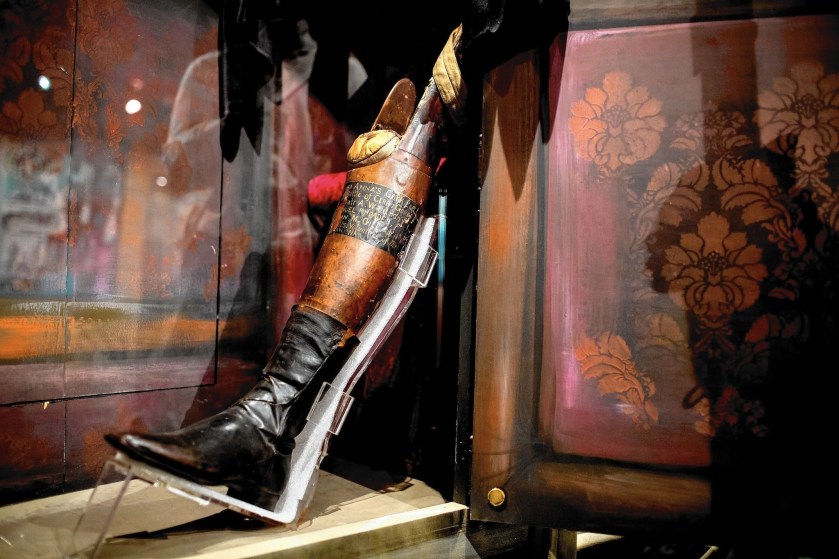
As for Santa Anna, he went on to lose a leg to a cannon ball two years later, fighting the French at the Battle of Veracruz. Following amputation, the leg spent four years buried at Santa Anna’s hacienda, Manga de Clavo. When Santa Anna resumed the presidency in late 1841, he had the leg dug up and placed in a crystal vase, brought amidst a full military dress parade to Mexico City and escorted by the Presidential bodyguard, the army, and cadets from the military academy. This guy was nothing if not a self-promoter.

The leg was reburied in an elaborate ceremony in 1842, including cannon salvos, speeches, and poetry read in the General’s honor. The state funeral for Santa Anna’s leg was attended by his entire cabinet, the diplomatic corps, and the Congress.

ct-santa-anna-leg-dispute-illinois-texas-edit-20161111

Antonio Lopez de Santa Anna served 11 non-consecutive terms as Mexican President, spending most of his later years in exile in Jamaica, Cuba, the United States, Colombia, and St. Thomas. In 1869, the 74-year-old former President was living in Staten Island, trying to raise money for an army to return and take over Mexico City. Santa Anna is credited with bringing the first shipments of chicle to America, a gum-like substance made from the tree species, Manilkara chicle, and trying to use the stuff as rubber on carriage tires.

Thomas Adams, the American assigned to aid Santa Anna while he was in the US, also experimented with chicle as a substitute for rubber. He bought a ton of the stuff from the General, but his experiments would likewise prove unsuccessful. Instead, Adams helped to found the American chewing gum industry with a product called “Chiclets”.

If you enjoyed this “Today in History”, please feel free to re-blog, “like” & share on social media, so that others may find and enjoy it as well. Please click the “follow” button on the right, to receive email updates on new articles.  Thank you for your interest, in the history we all share.

February 20, 1974 Holdout

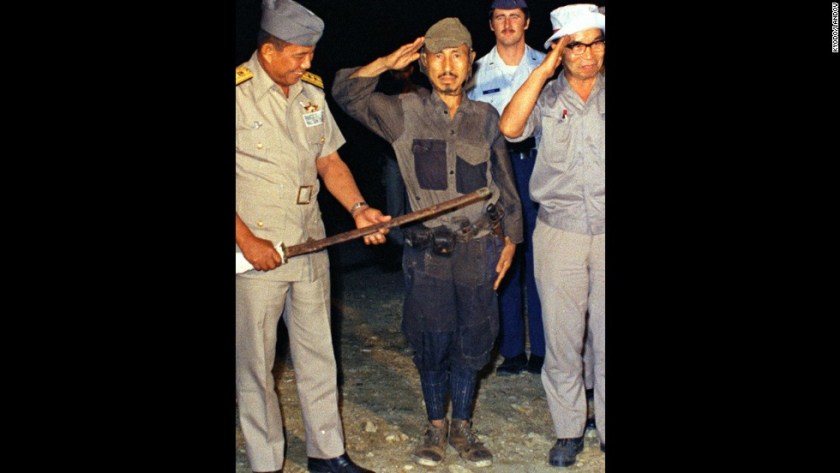
Thus properly relieved of duty, Onada surrendered, turning over his sword, his rifle, 500 rounds of ammunition and a number of hand grenades, along with the dagger his mother had given him, to kill himself if he were ever captured.  It was March 9, 1974. 

On December 7, 1941, Imperial Japanese air forces attacked the US Pacific Naval anchorage at Pearl Harbor.

President Franklin Delano Roosevelt appeared before a joint session of Congress the following day, asking for a declaration of war.  Little did they know, the war with 450px-Shigemitsu-signs-surrenderImperial Japan would rage for another 33 years.
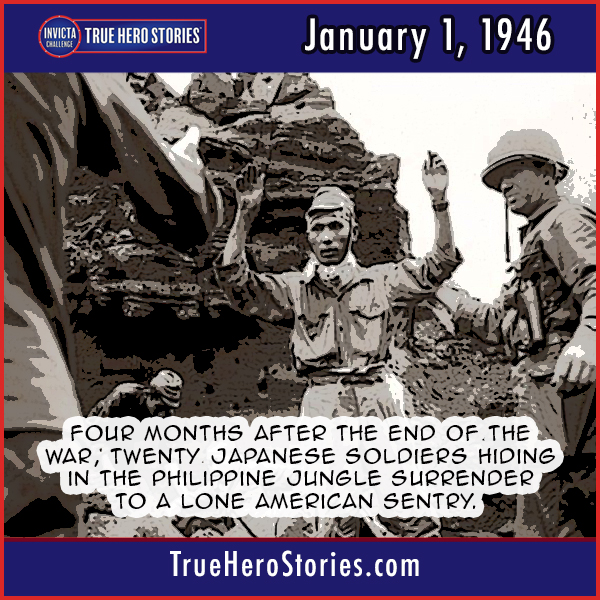
Alright, not really. Representatives of the Empire of Japan signed the instruments of surrender aboard the USS Missouri on September 2, 1945, formally ending the war in the Pacific.  Except, there were those who didn’t get the message.

Following the Battle of Saipan, June 15 – July 9, 1944, Captain Sakae Ōba and a company of 46 men took to carrying out guerrilla actions against American troops.  The company surrendered on December 1, 1945, three months after the end of the war.

Jan-1-Japanese-Holdouts-Surrender-On-Philippines-Five-Months-After-End-Of-War-2

Navy Lieutenant Hideo Horiuchi was arrested on August 13, 1946, while recovering from wounds received in a battle with Dutch troops.

Lieutenant Ei Yamaguchi led 33 soldiers in an attack on an American Marine Corps detachment on Peleliu in March, 1947. Reinforcements were sent in, including a Japanese admiral who finally convinced these guys that the war was over. The group surrendered in April.

Two machine gunners from the Imperial Japanese Navy surrendered on Iwo Jima, on January 6, 1949.

japanese-holdouts-of-wwii-5-728Several went on to fight for the Viet Minh against French troops in Indochina.
Seaman Noburo Kinoshita hanged himself in the Luzon jungle, in 1955.  Kinoshita had vowed never to “return to Japan in defeat”.  I guess he meant it.

Private Bunzō Minagawa held out until May 1960, on the American territory of Guam.  Minagawa’s immediate superior, Sergeant Masashi Itō, surrendered a few days later.  Corporal Shoichi Yokoi, who also served under Itō, was captured twelve years later.

After the war, 2nd Lieutenant Hirō Onoda took to the mountains of Lubang Island in the Philippines, along with Private Yūichi Akatsu, Corporal Shōichi Shimada and Private First Class Kinshichi Kozuka, carrying out guerilla actions and engaging in shootouts with local police.  Akatsu left the other three in 1949, and surrendered six months later.  Shimada was killed by a search party in 1954.  Kozuka was shot and killed by local police in 1972, while burning rice collected by farmers.

Onoda-suzuki
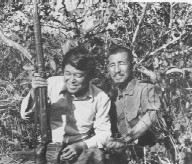
Suzuki returned to Japan with this photograph in February 1974, as proof of his encounter with Onada.

Two years later, the Japanese explorer and adventurer Norio Suzuki set out, looking for “Lieutenant Onoda, a wild panda, and the Abominable Snowman, in that order”.  The pair met on February 20, 1974 when Suzuki nearly got shot for his troubles, but he was quick.  “Onoda-san, the emperor and the people of Japan are worried about you.”

“I am a soldier” he said, “and remain true to my duties.” Onada would surrender when ordered to do so, by a superior officer.  Suzuki returned to Japan and located Onoda’s commanding officer, Major Yoshimi Taniguchi, who was working in a book store. The pair flew to Lubang, where Taniguchi issued the following orders:

In accordance with the Imperial command, the Fourteenth Area Army has ceased all combat activity.
In accordance with military Headquarters Command No. A-2003, the Special Squadron of Staff’s Headquarters is relieved of all military duties.
Units and individuals under the command of Special Squadron are to cease military activities and operations immediately and place themselves under the command of the nearest superior officer. When no officer can be found, they are to communicate with the American or Philippine forces and follow their directives.

Thus properly relieved of duty, Onada surrendered, turning over his sword, his rifle, 500 rounds of ammunition and a number of hand grenades, along with his kaiken, the dagger his mother had given him, to kill himself if he were ever captured.  It was March 9, 1974.

140117080502-01-hiroo-onoda-restricted-horizontal-large-gallery

Private Teruo Nakamura, born Attun Palalin to the aboriginal Amis people of Taiwan, was the last confirmed holdout of WW2.  Nakamura, who spoke neither Japanese nor Chinese, was discovered by the Indonesian Air Force on Morotai, surrendering to a search patrol on December 18, 1974.  The war was over. 29 years, 3 months, and 16 days after the Japanese Instrument of Surrender.

Years later, Hirō Onada described that first encounter:  “This hippie boy Suzuki came to the island to listen to the feelings of a Japanese soldier. Suzuki asked me why I would not come out…”  Norio Suzuki had found his Onada, and the wild panda was soon to follow.  The explorer died in a Himalayan avalanche at age 37, still searching for the Abominable Snowman.

If you enjoyed this “Today in History”, please feel free to re-blog, “like” & share on social media, so that others may find and enjoy it as well. Please click the “follow” button on the right, to receive email updates on new articles.  Thank you for your interest, in the history we all share.

February 19, 1945 The Crocodiles of Ramree

To the human participants in this story, this is a tale of four weeks’ combat for a tropical island.  For the apex predator of the mangrove swamp, it was little more than a dinner bell.

500 ft. off the coast of Myanmar (formerly Burma), and across the Bay of Bengal from the Indian sub-continent, there lies the island of Ramree, about a third the size of New York’s Long Island.

In 1942, the Imperial Japanese Army aided by Thai forces and Burmese insurgents drove the British Empire and Chinese forces out of Burma, occupying much of the Burmese peninsula and with it, Ramree island. In January 1945, the allies came to take it back.

356-Squadron-RAF-after-bombing-Japanese-positions-on-Ramree-Island
RAF 356 Squadron after bombing Japanese positions on Ramree Island

The battle started out with Operation Matador on January 14, an amphibious assault designed to capture the strategic port of Kyaupyu, and it’s nearby airfield.

By early February, a mixed force of British Royal Marines and their Indian allies dislodged a force of some 980 Japanese defenders, who abandoned their base and marched inland to join a larger regiment of Japanese soldiers across the island.

The route took the retreating Japanese across 10 miles of marsh and mangrove swamp. Bogged down and trapped in the mire, the soldiers soon found themselves cut off and surrounded, alone with the snakes, the mosquitoes and the scorpions, of Ramree island.

ramree-island2On February 7, the 71st Infantry and supporting tanks reached Ramree town where they found determined Japanese resistance, the town falling two days later. Naval forces blockaded small tributaries called “chaungs”, which the retreating Japanese used in their flight to the mainland. A Japanese air raid damaged an allied destroyer on the 11th as a flotilla of small craft crossed the strait, to rescue survivors of the garrison. By February 17, Japanese resistance had come to an end.
Throughout the four-week battle for Ramree Island, the allied blockade inflicted heavy casualties on Japanese forces.  The thousand men cut off in the swamp, had more immediate concerns.

article-2013816-0CF9D84B00000578-348_468x559
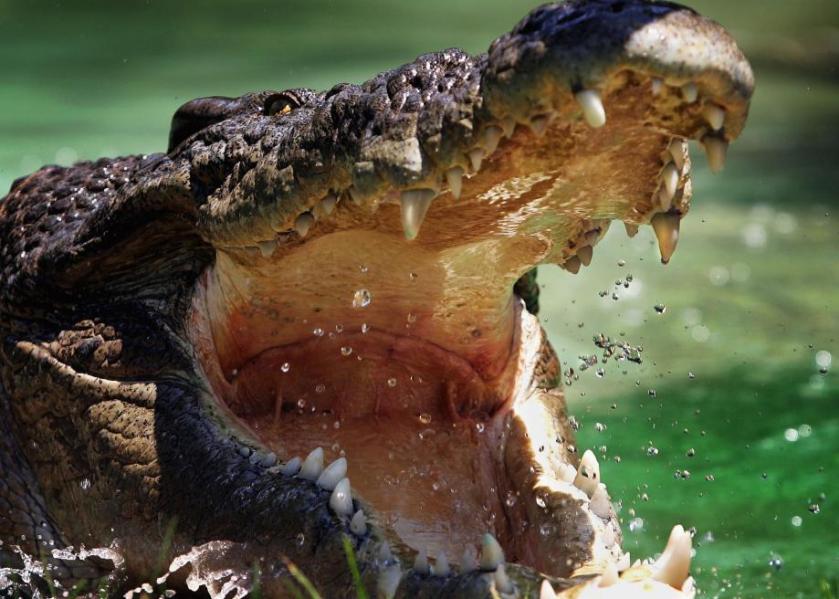
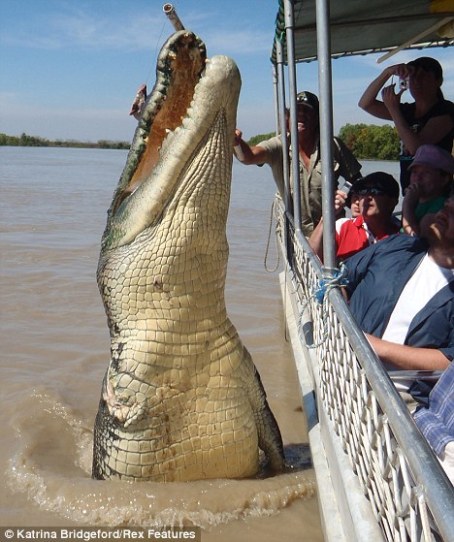
:Lured by a tour guide dangling kangaroo meat from a pole, the 18ft, two-ton monster was, er, snapped by photographer Katrina Bridgeford, who was on the Adelaide River cruise with her family”. Tip of the Hat for this image, to the UK Daily Mail Note the missing right arm on this monster – probably eaten by one of his own kind.

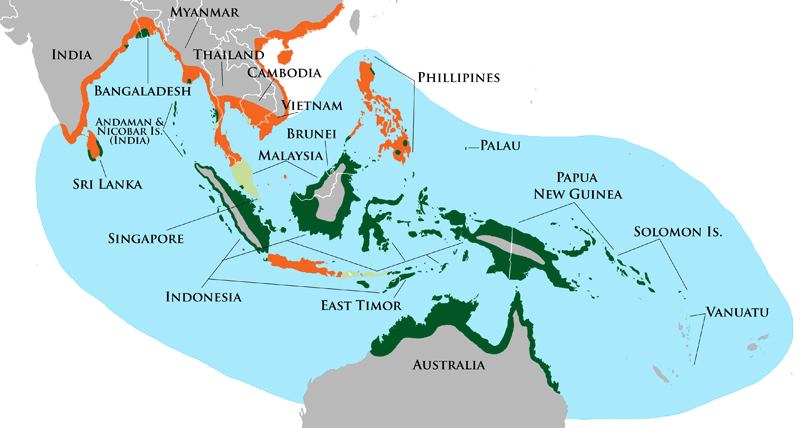
NationalGeographic.com describes the Japanese’ problem, the nightmare predator,  Crocodylus porosus:  “Earth’s largest living crocodilian—and, some say, the animal most likely to eat a human—is the saltwater or estuarine crocodile. Average-size males reach 17 feet and 1,000 pounds, but specimens 23 feet long and weighing 2,200 pounds are not uncommon.

Classic opportunistic predators, they lurk patiently beneath the surface near the water’s edge, waiting for potential prey to stop for a sip of water. They’ll feed on anything they can get their jaws on, including water buffalo, monkeys, wild boar, and even sharks. Without warning, they explode from the water with a thrash of their powerful tails, grasp their victim, and drag it back in, holding it under until the animal drowns.

ramree-island

British naturalist Bruce Stanley Wright participated in the battle for Ramree, and gave the following account in his book, Wildlife Sketches Near and Far, published in 1962:

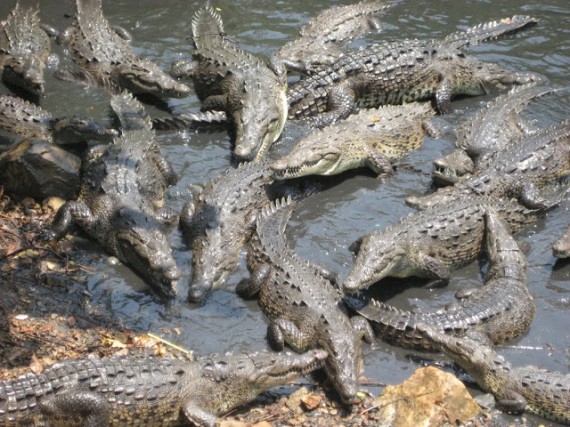
“That night [February 19, 1945] was the most horrible that any member of the M.L. [marine launch] crews ever experienced. The crocodiles, alerted by the din of warfare and the smell of blood, gathered among the mangroves, lying with their eyes above water, watchfully alert for their next meal. With the ebb of the tide, the crocodiles moved in on the dead, wounded, and uninjured men who had become mired in the mud.

The scattered rifle shots in the pitch black swamp punctured by the screams of wounded men crushed in the jaws of huge reptiles, and the blurred worrying sound of spinning crocodiles made a cacophony of hell that has rarely been duplicated on earth. At dawn the vultures arrived to clean up what the crocodiles had left…Of about 1,000 Japanese soldiers that entered the swamps of Ramree, only about 20 were found alive.

The crocodile attacks of Ramree are well documented, but there are those who question the numbers.  Some accounts indicate as many as 400 escaping the swamp, while the Guinness Book of World Records credits the incident with the “Most Number of Fatalities in a Crocodile Attack.”  Could there be so many of these creatures, as to wipe out nearly a thousand men?  What was there to eat, to support such a large population?

map_cpor_800b
Current Distribution – Saltwater or Estuarine Crocodile (Crocodylus porosus)

The actual numbers can never be known, but consider this:  Saltwater crocodiles are excellent swimmers, and are regularly spotted miles out to sea.  Individuals have even been discovered in the relatively frigid Sea of Japan – thousands of miles from their native habitat.  In 2016, Australian Rangers counted 120 “salties” in a 6-kilometer (3.7 mile) stretch of the East Alligator River, in the Northern Territory.

To the human participants in this story, this is a tale of four weeks’ combat for a tropical island.  For the apex predator of the mangrove swamp, it was little more than a dinner bell.

56714641-saltwater-crocodile-is-pictured-at-the-australian.jpg.CROP.promo-large2

If you enjoyed this “Today in History”, please feel free to re-blog, “like” & share on social media, so that others may find and enjoy it as well. Please click the “follow” button on the right, to receive email updates on new articles.  Thank you for your interest, in the history we all share.


February 18, 1977 Plain of Jars

A map of the world is dotted with such ancient stone megaliths, from Easter Island in the South Pacific to the Carnac Stones of France, and the stone spheres of Costa Rica.  Among all of them, there is no story more mysterious, or more tragic, than the Plain of Jars.

Yonaguni Island, the westernmost inhabited island of the Japanese archipelago, lies about 60 miles across the straits of Taiwan.  The place is a popular dive destination, due to (or possibly despite) a large population of hammerhead sharks.

Yonaguni

In 1987, divers discovered an enormous stone formation, with angles and straight lines seemingly too perfect to have been formed by nature.   If this “Yonaguni Monument” is in fact a prehistoric stone megalith, it would have to have been carved 8,000 to 10,000 years ago when the area was last dry,  radically changing current ideas about prehistoric construction.

A map of the world is dotted with such ancient stone megaliths, from Easter Island in the South Pacific to the Carnac Stones of France, and the stone spheres of Costa Rica.  Among all of them, there is no story more mysterious, or more tragic, than the Plain of Jars.

V94NuPT

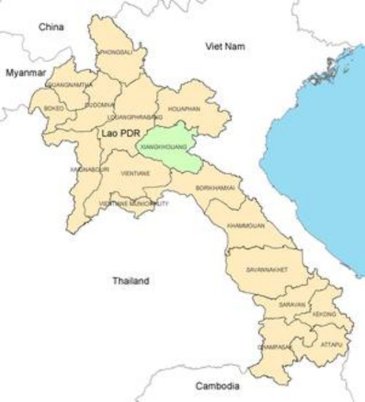
Deep in the heart of the Indochinese peninsula of mainland Southeast Asia lies the Lao People’s Democratic Republic, (LPDR), informally known as Muang Lao or just Laos.  To the north of the country lies the Xiangkhouang Plateau, known in French as Plateau du Tran-Ninh, situated between the Luang Prabang mountain range separating Laos from Thailand, and the Annamite Range along the Vietnamese border.

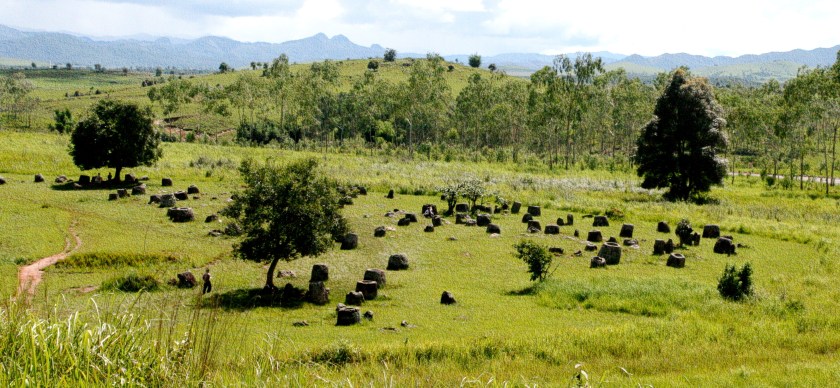
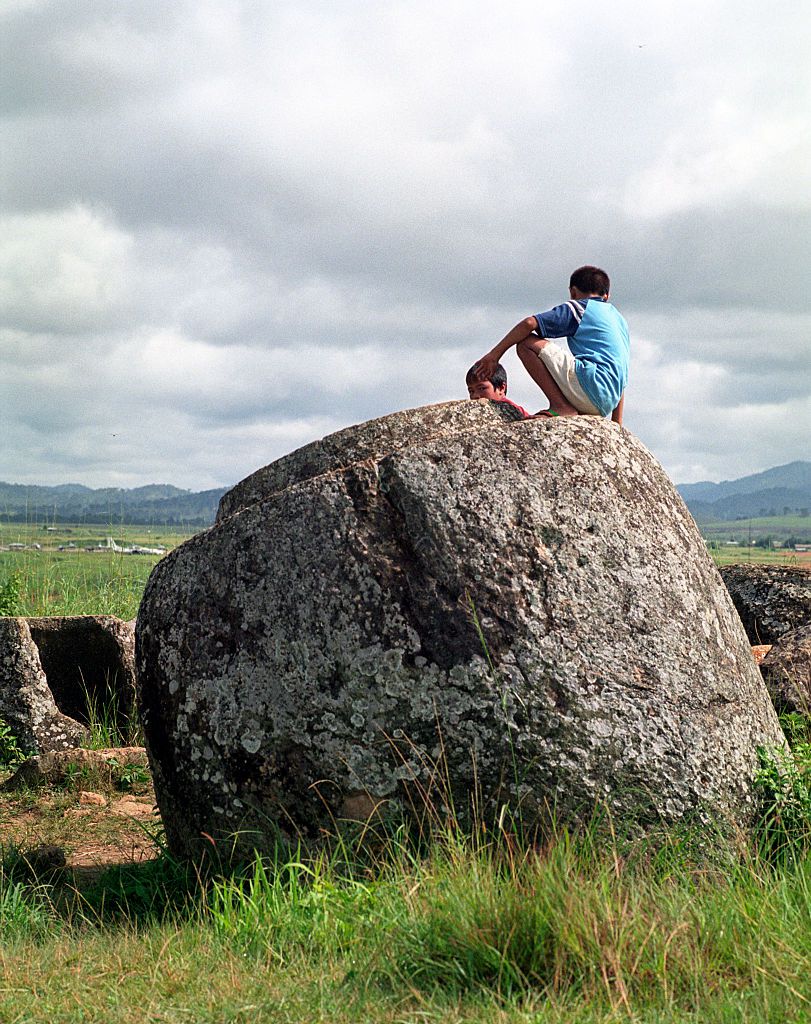
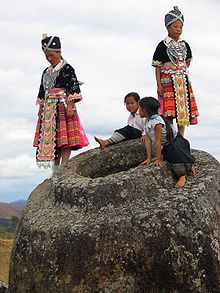
Twenty-five hundred to fifteen-hundred years ago, a now-vanished race of bronze and iron age craftsmen carved stone jars out of solid rock, ranging in size from 3 ft. to 9 ft. or more.  There are thousands of these jars, located at 90 separate sites and containing between one and four hundred apiece.

GettyImages-543867296-57eb5c1c3df78c690f639463

Most of these jars have carved rims but few have lids, leading researchers to speculate that lids were formed from organic material such as wood or leather.

Lao legend has it that the jars belonged to a race of giants, who chiseled them out of sandstone, granite, conglomerate, limestone and breccia to hold “lau hai”, or rice beer.  More likely they were part of some ancient funerary rite, where the dead and the about-to-die were inserted along with personal goods and ornaments such as beads made of glass and carnelian, cowrie shells and bronze bracelets and bells.  There the deceased were “distilled” in a sitting position, later to be removed and cremated, their remains then going through secondary burial.

laosmap
Map of Laos showing Xieng Khouang province, location of the Plain of Jars

These “Plain of Jars” sites might be some of the oldest burial grounds in the world, but be careful if you go there.  The place is the most dangerous archaeological site, on earth.

With the final French stand at Dien Bien Phu a short five months in the future, France signed the Franco–Lao Treaty of Amity and Association in 1953, establishing Laos as an independent member of the French Union. The Laotian Civil War broke out that same year between the Communist Pathet Lao and the Royal Lao Government, becoming a “proxy war” where both sides received heavy support from the global Cold War superpowers.

Concerned about a “domino effect” in Southeast Asia, US direct foreign aid to Laos began as early as 1950.  Five years later the country suffered a catastrophic rice crop failure.  The CIA-operated Civil Air Transport (CAT) flew over 200 missions to 25 drop zones, delivering 1,000 tons of emergency food.  By 1959, the CIA “air proprietary” was operating fixed and rotary wing aircraft in Laos, under the renamed “Air America”.

220px-Plainofjars_1The Geneva Convention of 1954 partitioned Vietnam at the 17th parallel, and guaranteed Laotian neutrality.  North Vietnamese communists had no intention of withdrawing from the country or abandoning their Laotian communist allies, any more than they were going to abandon the drive for military reunification, with the south.
Chief of Naval Operations Admiral Arleigh Burke warned the Joint Chiefs of Staff, “If we lose Laos, we will probably lose Thailand and the rest of Southeast Asia. We will have demonstrated to the world that we cannot or will not stand when challenged”.

As the American war ramped up in Vietnam, the CIA fought a “Secret War” in Laos, in support of a growing force of Laotian highland tribesmen called the Hmong, fighting the leftist Pathet Lao and North Vietnamese communists.

Primitive footpaths had existed for centuries along the Laotian border with Vietnam, facilitating trade and travel.  In 1959, Hanoi established the 559th Transportation Group under Colonel Võ Bẩm, improving these trails into a logistical system connecting the Democratic Republic of Vietnam in the north, to the Republic of Vietnam in the south.  At first just a means of infiltrating manpower, this “Hồ Chí Minh trail” through Laos and Cambodia soon morphed into a major logistical supply line.

In the last months of his life, President John F. Kennedy authorized the CIA to increase the size of the Hmong army.  As many as 20,000 Highlanders took arms against far larger communist forces, acting as guerrillas, blowing up NVA supply depots, ambushing trucks and mining roads.  The response was genocidal.  As many as 18,000 – 20,000 Hmong tribesman were hunted down and murdered by Vietnamese and Laotian communists.

Air America helicopter pilot Dick Casterlin wrote to his parents that November, “The war is going great guns now. Don’t be misled [by reports] that I am only carrying rice on my missions as wars aren’t won by rice.”

laos

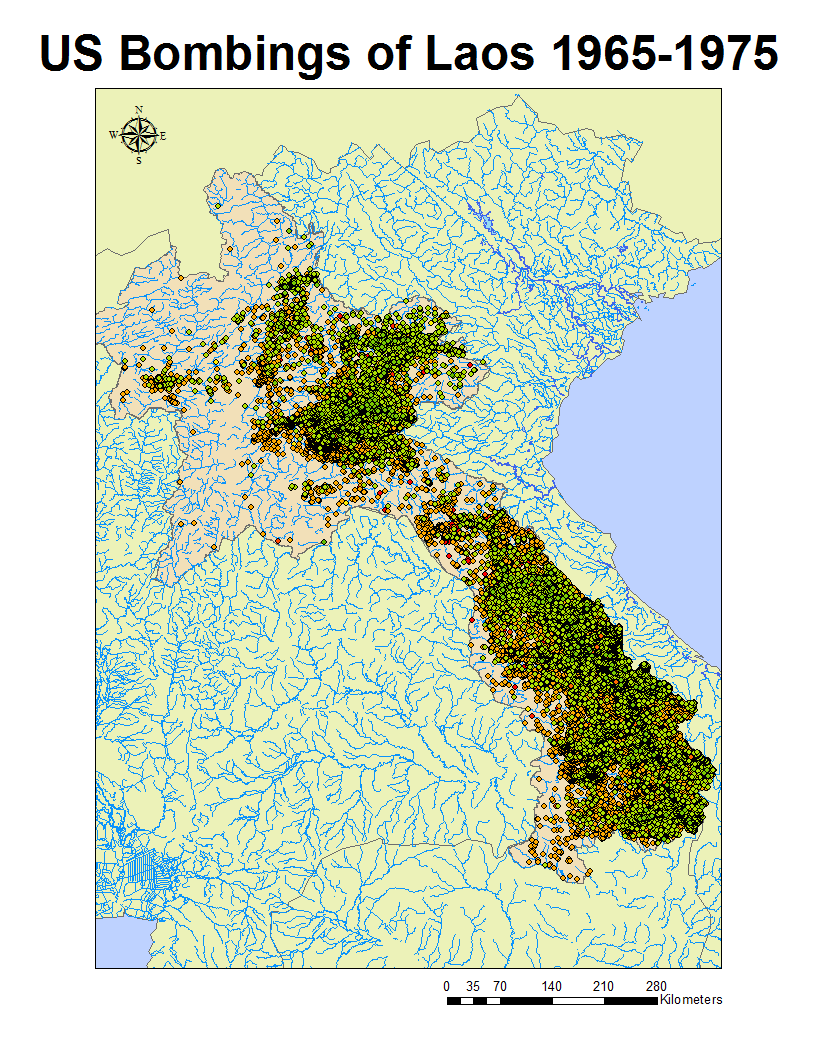
The proxy war in Laos reached a new high in 1964, in what the agency itself calls “the largest paramilitary operations ever undertaken by the CIA.”  In the period 1964-’73, the US flew some 580,344 bombing missions over the Hồ Chí Minh trail and Plain of Jars, dropping an estimated 262 million bomb.  Two million tons, equivalent to a B-52 bomber full of bombs every eight minutes, 24 hours a day, for nine years.  More bombs than US Army Air Forces dropped in all of WW2, making Laos the most heavily bombed country, per capita, in history.

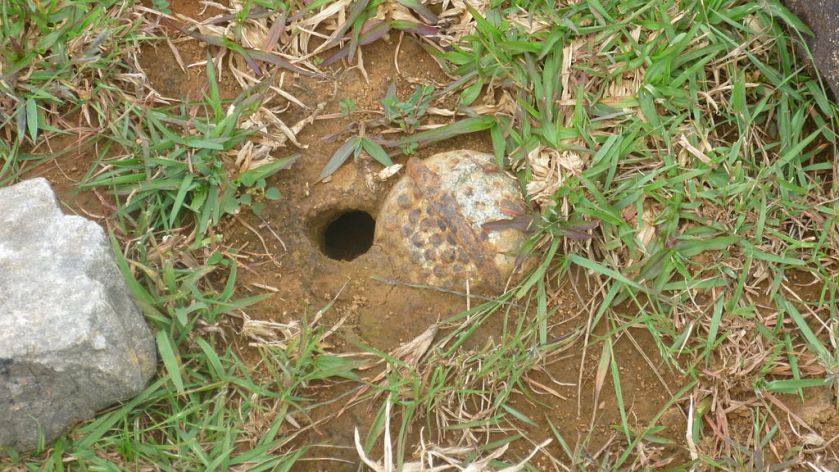
Most were “cluster munitions”, bomb shells designed to open in flight, showering the earth with hundreds of “bomblets” intended to kill people and destroy vehicles.  It’s been estimated that 30% of these munitions failed to explode, 80 million of them, (the locals call them “bombies”), set to go off with the weight of a foot, or a wheel, or the touch of a garden hoe.

1024px-BLU-26_cluster_sub-munition
Unexploded cluster sub-munition, probably a BLU-26 type. Plain of Jars, Laos

Since the end of the war, some 20,000 civilians have been killed or maimed by unexploded ordnance, called “UXO”.  Four in ten of those, are children.

Removal of such vast quantities of UXO is an effort requiring considerable time and money and no small amount of personal risk.  The American Mennonite community became pioneers in the effort in the years following the war, one of the few international Non-Governmental Organizations (NGO’s) trusted by the habitually suspicious communist leadership of the LPDR.

urnOn February 18, 1977, Murray Hiebert, now senior associate of the Southeast Asia Program at the Center for Strategic and International Studies (CSIS) in Washington, D.C.  summed up the situation in a letter to the Mennonite Central Committee, US:  “…a formerly prosperous people still stunned and demoralized by the destruction of their villages, the annihilation of their livestock, the cratering of their fields, and the realization that every stroke of their hoes is potentially fatal.”

Years later, Unesco archaeologists worked to unlock the secrets of the Plain of Jars, working side by side with ordnance removal teams.

In 1996, United States Special Forces began a “train the trainer” program in UXO removal, at the invitation of the LPDR government. Even so, Western Embassy officials in the Laotian capitol of Vientiane believed that, at the current pace, total removal will take “several hundred years”.

In 2004, bomb metal fetched 7.5 Pence Sterling, per kilogram.  That’s eleven cents, for just over two pounds.  Unexploded ordnance brought in 50 Pence per kilogram in the communist state, inviting young and old alike to attempt the dismantling of an endless supply of BLU-26 cluster bomblets.  For seventy cents apiece.

If you enjoyed this “Today in History”, please feel free to re-blog, “like” & share on social media, so that others may find and enjoy it as well. Please click the “follow” button on the right, to receive email updates on new articles.  Thank you for your interest, in the history we all share.


February 16, 1804  The Most Daring Act of the Age

Even a former adversary couldn’t help but admire the feat.  Days later, British Vice Admiral Lord Horatio Nelson called Decatur’s raid the “most bold and daring act of the age.”

Historic accounts differ as to the early success of the Islamic conquests.  Contemporary Christian sources saw them as God’s punishment for the sins of fellow Christians.  Early Muslim sources describe the rising empire as evidence of divine favor, reflections of the religious zeal of the conquerors.

Be that is it may, Islamic expansion enveloped the Arabian Peninsula in the last ten years of the life of Muhammad (622-632), at the expense of the Roman Byzantines and the Sassanid Empire of the Persians.  Syria fell in 634, followed by Egypt, Mesopotamia and Persia.  By 750, the Umayyad Caliphs had subjugated much of the Balkan states, part of the Indian sub-continent, all of North Africa, most of Spain, and parts of Southern France and Sicily.  By the age of Columbus, the Mediterranean was a place where you traveled at your own risk.

Those of us of European ancestry owe our heritage, if not our existence, to the Christian warriors who defeated the Jihadist time after time. There was Pelagius, who stopped a military force of the Umayyad Caliphate at Covadonga in 722, without which there would be no Reconquista, no Ferdinand and Isabella, and we wouldn’t know the name of Christopher Columbus.

The father of Charlemagne, Charles “The Hammer” Martel, blocked the Muslim advance into Western Europe at the Battle of Tours, in 732.

charles-martel-c688-741-granger

If Marcantonio Bragadin is remembered at all, it is for being betrayed, tortured and skinned alive by Lala Mustafa Pasha. Yet, it is Bragadin’s stubborn defense of the eastern Mediterranean outpost of Famagusta in 1571, which gave European principalities time to assemble naval forces in numbers sufficient to defend the European coast, near a place called Lepanto.

The 1683 Siege of Vienna, at the crossroads of eastern and western Europe, was a hard fought contest which could have gone either way, until the arrival of a Polish army under King Jan Sobieski. The Ottomans were defeated and turned back from the conquest of Eastern Europe by the largest cavalry charge in all of history, 18,000 horsemen of the Polish King and the Holy Roman Emperor, thundering down the hill and into the lines of Mustafa Pasha.

reversing

Throughout the period, “Saracens” plundered everything that could be carried away: animals, provisions, fabrics, precious metals and money:  especially men, women and children who could be sold for a good price at the slave markets.  Redemption of captives being among the corporal works of mercy, the “Mathurins” Order of the Holy Trinity was founded in 1198 for the purpose of paying the ransom of Christians held captive by non-Christians, as a consequence of crusading and pirating along the southern European coastline.

Even Ireland, with its northern latitude, wasn’t immune to such raids. The renegade Dutchman-turned Barbary pirate Murat Reis attacked the village of Baltimore in County Cork, in 1631. With him were pirates from Algiers and armed troops of the Ottoman Empire, who captured all the villagers they could find, taking 107 away to the slave markets of North Africa.  Years later, three women were ransomed and returned to Ireland.  The rest lived out their lives as slaves, or locked away in harems or inside the walls of the sultan’s palace.

From-Baltimore-to-Barbary-the-1631-sack-of-Baltimore-2
“Engraving of a Moorish slave auction from Pierre Dan’s Historie van Barbaryan en des zelfs Zee-Roovers (Amsterdam, 1684). There they were paraded, chained and nearly naked, while prospective buyers inspected the merchandise”. H/T Historyireland.com

Sidi Muhammad ibn Abdallah, Sultan of Morocco, opened his ports to trade with the fledgling United States in 1777, making Morocco the first country whose head of state publicly recognized the United States.  Abdallah saw the future for his country in foreign trade, and actively sought a treaty relationship with the US, well before war ended with Great Britain.  The treaty signed by Thomas Barclay and Sultan Muhammad III in 1786 and ratified by the Confederation Congress the following July is still in effect today, the longest continuous treaty relationship in United States history.

Diplomacy had succeeded with Morocco, but not with Algiers, Tunis or Tripoli, each of which demanded $660,000 in tribute.

Algeria captured the schooners Maria and Dauphin in 1785, the captured crews held in conditions of slavery for over a decade. The sum negotiated for their release exceeded $1 million, more than 1/6th the entire budget of the United States.  Eleven American ships were captured in 1793 alone, their crews and stores held for ransom.

Yusuf Karamanli, Pasha of Tripoli, demanded $225,000 in tribute on President Jefferson’s inauguration, in 1801.  At this time, Federal revenues were barely over $10 million.  Jefferson refused, resulting in the first Barbary War, a conflict memorialized in a line from the Marine Corps Hymn “From the Halls of Montezuma to the Shores of Tripoli”.

USS-Enterprise-barbary-war
USS Enterprise, Barbary war

Limited to small confrontations for the first two years, more sustained combat began in June 1803 when a small American force attacked Tripoli Harbor in modern Libya.

While giving chase and firing on a pirate vessel, USS Philadelphia ran aground on an uncharted reef, two miles outside of Tripoli.  Fearing the 1,240 ton, 36-gun frigate would be captured and added to the Tripolitan navy, Lieutenant Stephen Decatur led a daring expedition into Tripoli harbor to destroy the captured vessel.

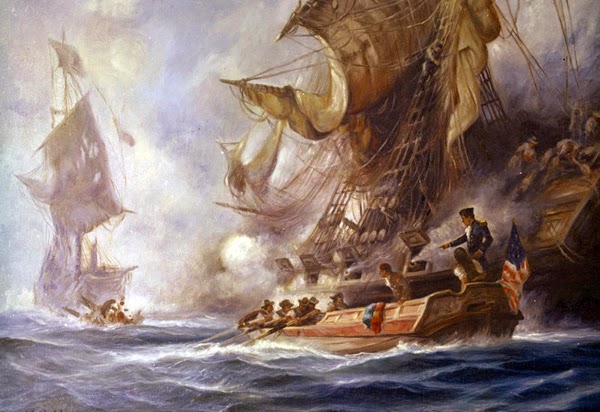
hqdefaultOn the evening of February 16, 1804, Decatur entered Tripoli Harbor with a force of 74 Marines.  With them were five Sicilian volunteers, including pilot Salvador Catalano, who spoke fluent Arabic.  Disguised as Maltese sailors and careful not to draw fire from shore batteries, Decatur’s force boarded the frigate, killing or capturing all but two of its Tripolitan crew.  Decatur and his marines had hoped to sail Philadelphia out of harbor, but soon found she was in no condition to leave.  Setting combustibles about the deck, they set the frigate ablaze.  Ropes burned off, setting the Philadelphia adrift in the harbor.  Loaded cannon cooked off as the blaze spread, firing random balls into the town. It must have been a sight, when gunpowder stores ignited and the entire ship exploded.

By that time Decatur and his men had slipped away, without the loss of a single man.  Even a former adversary couldn’t help but admire the feat.  Days later, British Vice Admiral Lord Horatio Nelson called Decatur’s raid the “most bold and daring act of the age.”

February 9, 1945 Operation Caesar

The most unusual confrontation of WW2 occurred on this day in 1945, in the form of a combat action between two submerged submarines.

In 1939, the impending Nazi invasion of Poland was an open secret.  That August, representatives of Nazi Germany and the Soviet Union signed the Nazi-Soviet Pact, pledging mutual non-aggression for a period of two years.

Two days later, representatives of the United Kingdom signed the Agreement of Mutual Assistance with Poland, aligning Great Britain with the Franco-Polish Military Alliance.  Should Poland be invaded by a foreign power, England and France were now committed to intervene.

The first fourteen “Unterseeboots” (U-boats) left their bases, fanning out across the North Atlantic.  Hitler’s invasion of Poland, began, three weeks later. Even then, Hitler believed that war with England and France could still be avoided.  The “Kriegsmarine” was under strict orders to follow the “Prize Regulations” of 1936.

how-hitler-tried-to-terrorize-the-seas-with-u-boats-during-world-war-ii

England and France declared war on Nazi Germany on Septemebr 3. Hours later, U-30 Oberleutnant Fritz Julius Lemp fired a torpedo into the British liner SS Athenia. Lemp had mistakenly believed it to be an armed merchant vessel and fair game under Prize Regulations, but the damage was done. The longest and most complex naval battle in history, had begun.

As in WWI, both England and Germany were quick to implement blockades on one another. For good reason. By the time that WWII was in full swing, England alone would require over a million tons a week of imported goods, in order to continue the fight.

convoy_thumbThe “Battle of the Atlantic” lasted 5 years, 8 months and 5 days, ranging from the Irish Sea to the Gulf of Mexico, from the Caribbean to the Arctic Ocean. Winston Churchill would describe this as “the dominating factor all through the war.  Never for a moment could we forget that everything happening elsewhere, on land, at sea or in the air depended ultimately on its outcome”.

Thousands of ships were involved in more than a hundred convoy battles, with over 1,000 single ship encounters unfolding across a theater thousands of miles wide. According to http://www.usmm.org, the United States Merchant Marine suffered the highest percentage of fatalities of any service branch, at 1 in 26 compared to one in 38, 44, 114 and 421 respectively, for the Marine Corps, Army, Navy and Coast Guard.

800px-Atlantic_Merchant_CasualtyNew weapons and tactics would shift the balance first in favor of one side, and then to the other. In the end over 3,500 merchant ships and 175 warships would be sunk to the bottom of the ocean, compared with the loss of 783 U-boats.

The most unusual confrontation of the war occurred on this day in 1945, in the form of a combat action between two submerged submarines. Submarines operate in 3-dimensional space, but their most effective weapon does not. The torpedo is a surface weapon, operating in two-dimensional space: left, right and forward. Firing at a submerged target requires that the torpedo be converted to neutral buoyancy, introducing near-insurmountable complexity into firing calculations.

U-864
U-864

The war was going badly for the Axis Powers in 1945, the allies enjoying near-uncontested supremacy over the world’s shipping lanes. At this time, any surface delivery between Nazi Germany and Imperial Japan was likely to be detected and stopped. The maiden voyage of the 287’, 1,799 ton German submarine U-864 departed on “Operation Caesar” on December 5, delivering Messerschmitt jet engine parts, V-2 missile guidance systems, and 65 tons of mercury to the Imperial Japanese war production industry.

2655041787_639d9fb20a_b
WW2 U-boat pens, Bergen, Norway

The mission was a failure, U-864 having to retreat to the submarine pens in Bergen, Norway, for repairs after running aground in the Kiel Canal. The sub was able to clear the island of Fedje off the Norway coast undetected on February 6. By this time British MI6 had broken the German Enigma code. They were well aware of Operation Caesar.

The British submarine Venturer, commanded by 25-year-old Lieutenant Jimmy Launders, was dispatched from the Shetland Islands, to intercept and destroy U-864.

6868162_f496
A four dimensional firing solution accounting for time, distance, bearing and target depth was theoretically possible, but had rarely been attempted under combat conditions.

ASDIC, an early name for sonar, would have been far more helpful in locating U-864, but at a price. That familiar “ping” would have been heard by both sides, alerting the German commander that he was being hunted. Launders opted for hydrophones, a passive listening device which could alert him to external noises. Calculating his adversary’s direction, depth and speed was vastly more complicated without ASDIC, but the need for stealth won out.

Developing an engine noise which he feared might give him away, U-864’s commander, Ralf-Reimar Wolfram decided to return to Bergen for repairs. German submarines of the age were equipped with “snorkels”, heavy tubes which broke the surface, enabling diesel engines U-864 locationand crews to breathe while running submerged. Venturer was on batteries when the first sounds were detected, giving the British sub the stealth advantage but sharply limiting the time frame in which it could act.

A four dimensional firing solution accounting for time, distance, bearing and target depth was theoretically possible, but had rarely been attempted under combat conditions. Plus, there were unknown factors which could only be approximated.

A fast attack sub, Venturer only carried four torpedo tubes, far fewer than her much larger adversary. Launders calculated his firing solution, ordering all four tubes firing with a 17½ second delay between each pair.

U-864 WreckWith four incoming at as many depths, the German sub didn’t have time to react. Wolfram was only just retrieving his snorkel and converting to electric, when the #4 torpedo struck. U-864 imploded and sank, instantly killing all 73 aboard.

Surface actions were common enough between all manner of vessels, but a fully submerged submarine to submarine kill occurred only once in WWI, on October 18, 1914, when the German U-27 torpedoed and sank the British sub HMS E3 with the loss of all 28 aboard. To my knowledge, such an action occurred only this one time, in all of WWII.


If you enjoyed this “Today in History”, please feel free to re-blog, “like” & share on social media, so that others may find and enjoy it too. Please click the “follow” button on the right, to receive email updates on new articles.  Thank you for your interest, in the history we all share.

February 8, 1960 Of Dogs and Dolls

If you’ve ever loved a dog, I need not explain the final stanza.

At 256 tons with a barrel of 111′ 7″, the German super gun hurled 38″ shells into the city of Paris, from a range of 75 miles. If you were there in 1918, you may never have heard of the “Paris gun”. You’d have been well aware of the damage it caused.  You never knew you were under attack from this thing, until the explosion. The lucky ones were those who lived to see the 4’ deep, 10’-12’ wide crater.

Paris Gun
“Paris Gun”, 1918

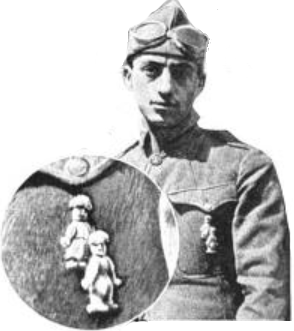
image1361Parisian children made little good luck charms, as “protection” from the Paris gun. They were tiny pairs of handmade dolls, joined together by scraps of yarn.  Their names were Nénette and Rintintin

The dolls were said to provide protection for their owners, but only under certain circumstances. You couldn’t make your own and you couldn’t buy them, they had to be given to you, as a gift. They also had to remain attached, or else the little dolls would lose their protective powers.

That July, one observer noted: “It is taking a long chance in these wild days of war . . . to go about unprotected by a Nénette and Rintintin. Curious little mascot dolls they are, that have taken Paris by storm. . . . But their charm is not to be purchased. Until you have been presented with a Nénette and Rintintin, you have not their sweet protection; and if you have the one without the other, the charm is broken.”

42ffc2cfe8f593f96a1bd77e07dcfc8cUS Army Air Service Corporal Lee Duncan was in Paris at this time, with the 135th Aero Squadron. Duncan was aware of the custom, he may even have been given such a talisman himself.

In the wake of the Battle of Saint-Mihiel, Corporal Duncan was sent forward to the small village of Flirey, to check out the area’s suitability for an airfield. The village was heavily damaged by shellfire, and Duncan came upon the shattered remains of a dog pound. Once, this kennel had provided Alsatians (German Shepherd Dogs) to the Imperial German Army. Now, the only dogs left alive were a starving mother and five nursing puppies, so young that their eyes were still closed.

Corporal Duncan cared for them, selling several once the puppies were weaned. He sold the mother to an officer and three puppies to fellow airmen, keeping two for himself. Like those little yarn dolls, Duncan felt those two puppies were his good luck charms. He called them Nanette and Rin Tin Tin.

Returning home after the war, Duncan placed the dogs with a police dog breeder and trainer in Long Island. Nanette contracted pneumonia and died, the breeder giving Duncan a female puppy, “Nanette II”, to replace her.

6388077243_307a5d1bbc_b

Etzel von Oeringen was born on October 1, 1917 in Quedlinburg Germany, trained as a police dog and serving in the German Red Cross, during WW1.  Left impoverished after the war and unable to support even a dog, his owner declined larger offers in preference to the most humane option, selling him to a friend in White Plains, New York.

Rin Tin Tin signed photoBetter known as “Strongheart”, Etzel appeared in silent films throughout the ’20s, becoming the first major canine film star and credited with enormously increasing the popularity of the breed.
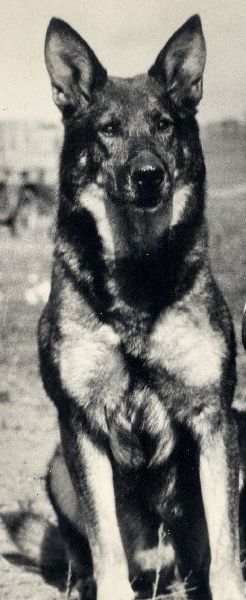
A friend of silent film actor Eugene Pallete, Duncan became convinced that Rin Tin Tin could become the next canine movie star.  “I was so excited over the motion-picture idea”, Duncan wrote, “that I found myself thinking of it night and day.”

Walking his dog on “Poverty Row”, 1920s slang for B movie studios, did the trick. Rin Tin Tin got his first film break in 1922, replacing a camera shy wolf in “The Man from Hell’s River”. His first starring role in the 1923 “Where the North Begins”, is credited with saving Warner Brothers Studios from bankruptcy.

Rin Tin Tin
Rin Tin Tin

Between-the-scenes silent film “intertitles” were easily changed from one language to another, and Rin Tin Tin films enjoyed international distribution. In 1927, Rin Tin Tin was voted Most Popular Actor by Berlin audiences.

There’s a Hollywood legend that may or may not be true, that Rin Tin Tin received the most votes for Best Actor at the 1st Academy Awards, in 1929.  Inclined to take themselves oh-so seriously and wanting a human actor, the Academy threw out the ballots. German actor Emil Jannings got Best Actor on the 2nd ballot.

Rin Tin Tin appeared in 27 feature length silent films, 4 “talkies”, and countless commercials and short films. Regular programming was interrupted to announce his passing on August 10, 1932, at the age of 13.

An hour-long program about his life was broadcast the following day.

Suffering from the Great Depression like so many others, Duncan couldn’t afford a fancy funeral. By this time, he couldn’t even afford the house he lived in.

Duncan sold the house and returned the body of his beloved German Shepherd to the country of his birth, where Rin Tin Tin was buried in the Cimetière des Chiens et Autres Animaux Domestiques, in the Parisian suburb of Asnières-sur-Seine.

K9_unit
WW2 K-9 Recruiting poster, featuring Rin Tin Tin III

Duncan continued breeding the line, careful to preserve the physical qualities and intelligence of the original, while avoiding the less desirable traits that crept into other GSD bloodlines.

Duncan may have been obsessive about it, at least according to Mrs. Duncan. When she filed for divorce, she named Rin Tin Tin as co-respondent.

Rin Tin Tin and Nanette II produced at least 48 puppies.

Unique among the belligerents of WW1, the United States was the only country with no service dogs among its military forces.  The next war, was a different story.  The United States Armed Forces had an extensive K-9 program in WW2, when private citizens were asked to donate their dogs to the war effort.

One such dog was “Chips”, the most decorated K-9 of the war.  Rin Tin Tin III, reputed to be grandson to the original but likely a more distant relation, helped to promote the program.

Rin Tin Tin was awarded his own star on the Hollywood Walk of Fame on February 8, 1960. Lee Duncan passed away later that same year.

At some point, Duncan had written a poem, one man’s tribute to a beloved companion animal, who was no more.

ap580923087_custom-5ca70bd1b125030809eeff742ae70fabb486c74a-s400-c85
“Lee Duncan, 67, holds a pair of Rin Tin Tin’s descendants, Rin Tin Tin 5 and 6, in 1958”. H/T NPR.org, for this image

If you’ve ever loved a dog, I need not explain his final stanza.

“…A real unselfish love like yours, old pal,
Is something I shall never know again;
And I must always be a better man,
Because you loved me greatly, Rin Tin Tin”.


If you enjoyed this “Today in History”, please feel free to re-blog, “like” & share on social media, so that others may find and enjoy it too. Please click the “follow” button on the right, to receive email updates on new articles.  Thank you for your interest, in the history we all share.

poem-rin-tin-tin-by-lee-duncan-master-and-friend-001_custom-dfe6a0281b0372578daa7875c277af29fef78397-s800-c85

February 3, 1943  Greater Love Hath No Man Than This

As the ship upended and went down by the bow, survivors floating nearby could see the four chaplains.  With arms linked and leaning against the slanting deck, their voices offered prayers and sang hymns for the dead and for those about to die.

The Troop Transport USAT Dorchester sailed out of New York Harbor on January 23, 1943, carrying 904 service members, merchant seamen and civilian workers.  They were headed for the  the Army Command Base at Narsarsuaq in southern Greenland, part of a six-ship convoy designated SG-19, together with two merchant ships and escorted by the Coast Guard Cutters Comanche, Escanaba and Tampa.

Built as a coastal liner in 1926, Dorchester was anything but graceful, bouncing and shuddering her way through the rough seas of the North Atlantic.

German U-Boats had already sunk several ships in these waters.  One of the Cutters detected a submarine late on February 2, flashing the light signal “we’re being followed”.  Dorchester Captain Hans Danielson ordered his ship on high alert that night.  Men were ordered to sleep in their clothes with their life jackets on, but many disregarded the order.  It was too hot down there in the holds, and those life jackets were anything but comfortable.

Dorchester-facta-nautica-1000

Some of those off-duty tried to sleep that night, while others played cards or threw dice, well into the night.  Nerves were understandably on edge, especially among new recruits, as four Army chaplains passed among them with words of encouragement.

They were the Jewish rabbi Alexander David Goode, the Catholic priest John Patrick Washington, the Reformed Church in America (RCA) minister Clark Vandersail Poling, and the Methodist minister George Lansing Fox.

At 12:55am on February 3rd, the German submarine U-223 fired a spread of three torpedoes.  One struck Dorchester amidships, deep below the water line.  A hundred or more were killed in the blast, or in the clouds of steam and ammonia vapor billowing from ruptured boilers.  Suddenly pitched into darkness, untold numbers were trapped below decks.  With boiler power lost, there was no longer enough steam to blow the full 6 whistle signal to abandon ship, while loss of power prevented a radio distress signal.  For reasons not entirely clear, there never were any signal flares.

druidartThose who could escape scrambled onto the deck, injured, disoriented, many still in their underwear as they emerged into the cold and darkness.

The four chaplains must have been a welcome sight, guiding the disoriented and the wounded, offering prayers and words of courage.  They opened a storage locker and handed out life preservers, until there were no more.  “Padre,” said one young soldier, “I’ve lost my life jacket and I can’t swim!”  Witnesses differ as to which of the four it was who gave this man his life jacket, but they all followed suit.  One survivor, John Ladd, said “It was the finest thing I have seen or hope to see this side of heaven.” Rabbi Goode gave his gloves to Petty Officer John Mahoney, saying “Never mind.  I have two pairs”.  It was only later that Mahoney realized, Rabbi Goode intended to stay with the ship.

size0Dorchester was listing hard to starboard and taking on water fast, with only 20 minutes to live.  Port side lifeboats were inoperable due to the ship’s angle.  Men jumped across the void into those on the starboard side, overcrowding them to the point of capsize.  Only two of fourteen lifeboats launched successfully.

Private William Bednar found himself floating in 34° water, surrounded by dead bodies and debris. “I could hear men crying, pleading, praying,” he recalled. “I could also hear the chaplains preaching courage. Their voices were the only thing that kept me going.”

As the ship upended and went down by the bow, survivors floating nearby could see the four chaplains.  With arms linked and leaning against the slanting deck, their voices offered prayers and sang hymns for the dead and for those about to die.

images (17)Rushing back to the scene, coast guard cutters found themselves in a sea of bobbing red lights, the water-activated emergency strobe lights of individual life jackets.  Most marked the location of corpses.  Of the 904 on board, the Coast Guard plucked 230 from the water, alive.

The United States Congress attempted to confer the Medal of Honor on the four chaplains for their selfless act of courage, but strict requirements for “heroism under fire” prevented it from doing so.  Congress authorized a one time, posthumous “Chaplain’s Medal for Heroism”, awarded to the next of kin by Secretary of the Army Wilber M. Brucker at Fort Myer, Virginia on January 18, 1961.

chaplains_medalJohn 15:13 says “Greater love hath no man than this, that a man lay down his life for his friends”.  Rabbi Goode did not call out for a Jew when he gave away his only hope for survival, Father Washington did not ask for a Catholic. Neither minister Fox nor Poling asked for a Protestant.  Each gave his life jacket to the nearest man.

Carl Sandburg once said that “Valor is a gift.  Those having it never know for sure whether they have it until the test comes.”  If I were ever so tested, I hope that I would prove myself half the man, as any of those four chaplains.

four-chaplainsUSSDorchester