Over fifty years, Schulz drew nearly 18,000 strips, taking vacation only once in 1997, to celebrate his 75th birthday. In all that time, that five-week stretch was the only time the papers ever had Peanuts reruns.
Charles Monroe Schulz was one of the brighter kids at Central High School in Saint Paul, Minnesota, but that didn’t help his social life. He was already a shy boy and skipped two half-grades, graduating as the youngest student in the class of 1940.
The boy loved to draw. He was good at it, too. The family once owned a hunting dog called “Spike”, with the cringe-worthy habit of eating sharp objects. It didn’t seem to bother him much, and the boy sent a drawing to Ripley’s Believe It or Not! who ran it, complete with a description of Spikes unusual predilections.
The drawing was signed, “Sparky”. Even with Schulz later celebrity, you could always weed out those who merely claimed to know him, if they called him “Charles”, or “Chuck”. Schulz’ uncle called him “Sparky” as a boy, after the horse Spark Plug in Billy DeBeck’s comic strip, Barney Google. He always signed the strip “Schulz”, but friends and family knew him as Sparky, until the day he died.
Schulz was drafted into the Army in 1943, a Staff Sergeant with the 20th Armored Division in Europe and squad leader on a .50-caliber machine gun team.
He never got a chance to fire his weapon, though he did come face-to-face with a Wehrmacht soldier, once. His blood must’ve turned cold in his veins when he realized he’d forgotten to load, but the man he faced was no Nazi fanatic. This was just a guy, who wanted to go home. The German surrendered, happily. I hope he did get to go home.
Schulz returned to Minneapolis after the war where he did lettering for a Catholic comic magazine, Timeless Topix. He took a job in 1946 at Art Instruction, Inc., reviewing and grading lessons submitted by students, a job he held for several years while developing his talents as comic creator.
Charlie Brown, that little boy who was always close but never quite succeeded, first appeared in a series of single-panel jokes called “Li’l Folks“, along with a dog who looked something like Snoopy. It was published in the local papers from June 1947 to January ’50, and later syndicated. The first strip was published in seven newspapers on October 2, 1950, but United Features thought the name was too close to two strips already in syndication, Li’l Abner, and “Little Folks“.
They called it “Peanuts” after the peanut gallery of the old Vaudeville days, the cheapest and rowdiest seats in the theater. Schulz didn’t like the name, saying it “made it sound too insignificant,” but the name, stuck.
Schulz took pride in his service during the war, and his strip paid tribute to Rosie the Riveter and Ernie Pyle. More than any other, he’d honor “Willy & Joe”, those two GIs from the imagination of war correspondent and cartoonist Bill Mauldin, a man to whom Schulz always referred as “My Hero”. Over the years, Snoopy visited with Willie & Joe no fewer than 17 times. Always on Veterans Day.
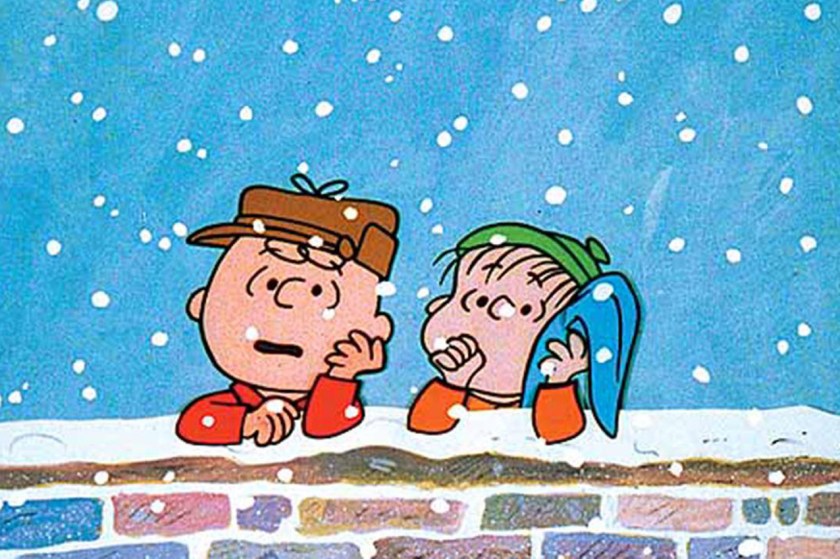
A Charlie Brown Christmas has been a staple of the Christmas season since 1965, but Linus almost didn’t get to tell his famous story of the baby Jesus. ABC executives thought Linus’ recitation of the birth of Christ too overtly religious. They wanted a laugh track too, but Schulz refused. “If we don’t do it, who will?” So it was that the scene remained, perhaps the most memorable moment in cartoon history. The laugh track version was produced, but never aired.
Charlie Brown’s love interest in some of the TV specials, the “Little Red-Haired Girl”, was based on an accountant from that old job at Art Instruction, Donna Mae Johnson. The two had an office romance, but she turned him down when he proposed they marry.
She wasn’t the only character based on a real person. Linus and Shermy were patterned after Schulz’ close friends Linus Maurer and Sherman Plepler. Peppermint Patty was inspired by a cousin on his mother’s side, Patricia Swanson. Snoopy himself resembles that old family dog Spike, though he was a Pointer, not a Beagle.
American opinion polls showed a sharp drop in support for the war in Vietnam over 1967. 1968 was a wretched year in American politics, beginning with the Tet Offensive in January. Media reporting turned the American military victory over the Vietnamese New Year, into a thing of despair. President Johnson withdrew from the Presidential election, that March. Martin Luther King, Jr. was assassinated in April and riots swept through cities across the country. Robert F. Kennedy was assassinated that June, after winning the critical California primary. The Democratic National Convention that August more closely resembled a riot, than a political convention.
Franklin Armstrong
Race relations were particularly vile, when Los Angeles schoolteacher Harriet Glickman wrote to the cartoonist, asking if he could add a black character. Glickman never expected a response from the now-famous Charles M. Schulz, but respond he did. He said he liked the idea, but expressed a concern about seeming “condescending”, to black families. With Schulz’ permission, Glickman asked friends of African ancestry, how to make such a character “more relatable”.
Franklin Armstrong made his first appearance on July 31, 1968. What was remarkable for the time, was how unremarkable, he was. Just another little boy, at first confused about the strange stuff in Charlie Brown’s neighborhood. Particularly Linus’ obsession with the ‘Great Pumpkin’. Franklin first met Charlie Brown on a beach. He said his father was a soldier, off fighting in Vietnam. “My dad’s a barber,” said Charlie Brown. “He was in a war too, but I don’t know which one.”
One newspaper editor wrote saying he didn’t mind a “negro” character, but please don’t show them in school together. Schulz didn’t bother to respond.
I wonder if Donna Mae Johnson ever regretted turning down that marriage proposal. Peanuts went on to become a pop culture phenomenon, with countless animated specials combining with merchandise sales to produce revenues in the Billions. At it’s peak, Peanuts ran in 2,600 papers in 75 countries and 21 languages. Schulz himself is estimated to have earned $30 to $40 million, a year.
The command module for the 1969 Apollo 11 mission to the moon was named Charlie Brown and the lunar module, Snoopy. President Ronald Reagan was a fan, and once wrote to Schulz that he identified with Charlie Brown.
Over fifty years, Schulz drew nearly 18,000 strips, taking vacation only once in 1997, to celebrate his 75th birthday. In all that time, that one five-week stretch was the only time the papers ever had Peanuts reruns.
Stephen Shea, H/T Huffington Post
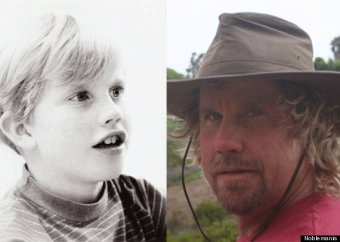
Fun fact: Former child actor Stephen Shea inherited the speaking role for Linus van Pelt when his older brother Chris’ voice changed, and went on to perform in eight animated specials. Chris went to summer camp with a boy who happened to be President of The Doors fan club. It turns out that Jim Morrison was a big Peanuts fan, and invited Chris and his father to be his special guests, at a concert.
Schulz’ health began to deteriorate in the late 1990s, his once-firm hand, now developing a tremor. He never really recovered from the stroke that hit him in November 1999 and announced his intention to retire, on December 14. The last original Peanuts strip was published on January 3, 2000. This son of a barber and a housewife, just like Charlie Brown himself, passed away just over a month later, a victim of colon cancer.
There will never be another.
If you enjoyed this “Today in History”, please feel free to re-blog, “like” & share on social media, so that others may find and enjoy it as well. Please click the “follow” button on the right, to receive email updates on new articles. Thank you for your interest, in the history we all share.
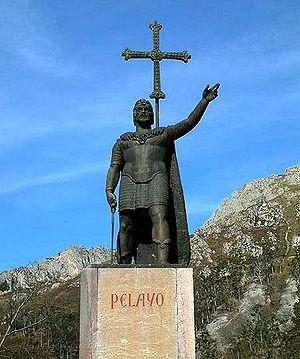
A Christian military force under Pelagius,(aka “Pelayo”), the future first King of Asturias, met the invaders at “Covadonga”, meaning “Cavern of the Lady”. The Arabic name for the place is “Sakhrat Bilāy” “the Rock of the Affliction”. The two names tell the tale about the outcome, of the battle.
The manner by which Roderic ascended to the throne of the Visigothic Empire is unclear. His history as any other, was written by the victors. Unbiased contemporary sources do not appear to exist. What Is known is that someone in the early 8th century Iberian Peninsula, thought Roderic an illegitimate King.
That someone appears to have gone to Mecca looking for help from the BanūʾUmayya, the “Sons of Umayya”, the second such center of Islamic power since the time of Muhammad and known to history as the Umayyad Caliphate.
In 711AD, a force of some 1,700 Arab and North African horsemen, the Berbers, landed on the Iberian Peninsula led by Tariq Ibn Ziyad. 384 years before the first Christian Crusade, the Umayyad conquest of Hispania was on. Within ten years, most of what we now know as Portugal and Spain had become “al-Andalus”; five administrative districts under Muslim rule, save for the fringes of the Pyrenean mountains, and the highlands along the northwest coastline.
The first significant Christian victory and what may constitute the beginning of reconquest, “La Reconquista”, took place along that northern fringe. That sliver of Christianity was the Kingdom of Asturias. The refusal to pay the Jizya, the Muslim tax on “unbelievers”, brought them into conflict with an Umayyad force in the summer of 722.
A Christian military force under Pelagius, (aka “Pelayo”), the future first King of Asturias, met the invaders at a place called “Covadonga”, meaning “Cavern of the Lady”. The Arabic name for the place is “Sakhrat Bilāy” “the Rock of the Affliction”. The two names tell a tale about the outcome, of the battle.
Covadonga
The Arab chronicles record Covadonga as a small skirmish while the Spanish record a great victory, but two things are near certain. In 770 years, no Muslims force ever returned to Asturias. Without Pelagius’ victory at Covadonga, we’d almost certainly never have heard of Ferdinand and Isabella, let alone a certain Italian explorer whom the pair sent off in 1492, in search of a sea route to China.
It was close to 400 years before the crusading knights of Europe came to the aid of the Iberian Kings. With help from the Knights Templar and Hospitaller. Alfonso VI captured Toledo in 1085, beginning a long period of gradual Muslim decline.
The Portuguese nation was a mere county in the early 12th century, dependent on the Crown of León and Castile, one Alfonso VII. His cousin, three year old Alfonso Henriques, followed his father as the Count of Portugal in 1122.
At the age of 14, the age of majority in the 12th century, the boy proclaimed himself a knight and raised an army against his cousin. The county’s people, church and nobles were demanding independence when, his cousin vanquished, Alfonso Henriques declared himself Prince of Portugal. Following ten years of near-constant fighting against Moors and rival Christian Kingdoms alike, Alfonso was unanimously proclaimed the King of an Independent Portugal on July 25, 1139.
Portugal would be annexed to Spain in 1580, regaining its independence sixty years later and leading many to believe that Portugal is the younger between the two countries. It isn’t so. Portugal was an independent, self-governing nation, more that 350 years before her Spanish neighbor.
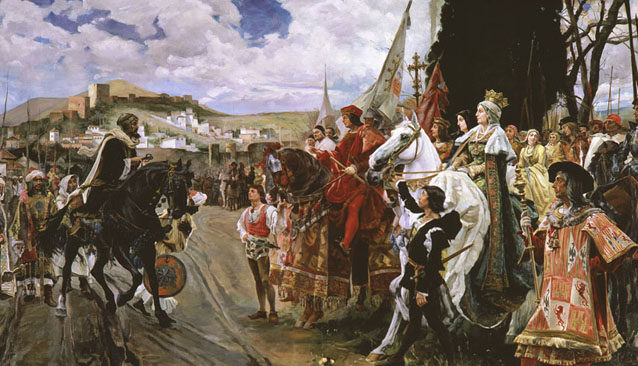
Following the Christian re-conquest of Córdoba in 1236, the Emirate of Granada was all that was left of al-Andalus. Granada became a tributary state to the Kingdom of Castile two years later. Finally, on this day in 1492, Emir Muhammad XII surrendered the Emirate of Granada to Queen Isabella I of Castile, and her husband King Ferdinand II of Aragon.
Ferdinand & Isabella. March 31, 1492 Edict of Expulsion
For the six years I’ve written “Today in History”, the first thing I do is search on a date, and select an interesting topic from the list. To date, I’ve written about seven hundred.
As I review these lists, I am perpetually surprised and not a little horrified, at the never ending recurrence of barbarity against the Jews of the world. It’s not the pogroms and the massacres which surprise me, but rather their appalling frequency, over 2,000 years.
The paroxysm of cruelty and paranoia now known as the Spanish Inquisition begun in 1478, was not a standalone event. In part, this passion for religious unity was the result of 700+ years of Muslim domination of the Iberian Peninsula. One of the early results of this manic drive for ideological purity was the Edict of Expulsion of 1492, resulting in the forced conversion of some quarter-million Spanish Jews, the “conversos“, and the expulsion of as many as 100,000 more.
Untold numbers lived lives of “marranos” (from the Hebrew marit ayin: “the appearance of the eye”), secretly practicing Jews forced on pain of death, to adopt the outward signs of Christianity.
This date, originally selected to signify Ferdinand and Isabella’s final defeat of the Islamic conquest of Spain, has yet another significance. It is only within living memory that descendants of Spanish Jews, the Sephardim, have returned in any significant numbers to their homeland. The first native Jewish child born in Spain since Christopher Columbus discovered America, was born on this day, January 2, 1966.
If you enjoyed this “Today in History”, please feel free to re-blog, “like” & share on social media, so that others may find and enjoy it as well. Please click the “follow” button on the right, to receive email updates on new articles. Thank you for your interest, in the history we all share.
A time ball is a marine time signaling device, a large painted ball which is dropped at a predetermined rate, enabling mariners to synchronize shipboard marine chronometers for purposes of navigation. The first one was built in 1829 in Portsmouth, England, by Robert Wauchope, a Captain in the Royal Navy. Time balls were obsolete technology by the 20th century, but it fit the Times’ purposes.
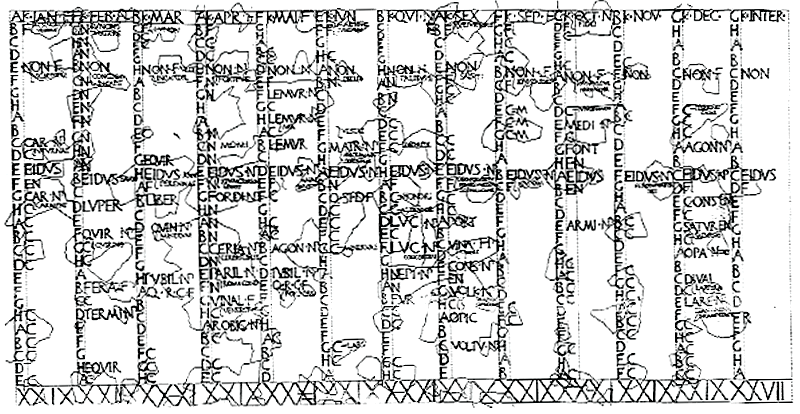
From the 7th century BC, the Roman calendar attempted to follow the cycles of the moon. The method frequently fell out of phase with the change of seasons, requiring the random addition of days. The Pontifices, the Roman body charged with overseeing the calendar, made matters worse. They were known to add days to extend political terms, and to interfere with elections. Military campaigns were won or lost due to confusion over dates. By the time of Julius Caesar, things needed to change.
When Caesar went to Egypt in 48BC, he was impressed with the way the Egyptians handled their calendar. Caesar hired the Alexandrian astronomer Sosigenes to help straighten things out. The astronomer calculated that a proper year was 365¼ days, which more accurately tracked the solar, and not the lunar year. “Do like the Egyptians”, he might have said, the new “Julian” calendar going into effect in 46BC. Caesar decreed that 67 days be added that year, moving the New Year’s start from March to January 1. The first new year of the new calendar was January 1, 45BC.
Caesar synchronized his calendar with the sun by adding a day to every February, and changed the name of the seventh month from Quintilis to Julius, to honor himself. Rank hath its privileges.
Not to be outdone, Caesar’s successor changed the 8th month from Sextilis to Augustus. As we embark on the third millennium, we still have July and August.
Roman Calendar
Sosigenes was close with his 365¼ day long year, but not quite there. The correct value of a solar year is 365.242199 days. By the year 1000, that 11 minute error had added seven days. To fix the problem, Pope Gregory XIII commissioned Jesuit astronomer Christopher Clavius to come up with yet another calendar. The Gregorian calendar was implemented in 1582, omitting ten days and adding a day on every fourth February.
Most of the non-Catholic world took 170 years to adopt the Gregorian calendar. Britain and its American colonies “lost” 11 days synchronizing with it in 1752. The last holdout, Greece, would formally adopt the Gregorian calendar in 1923. Since then, we’ve all gathered to celebrate New Year’s Day on the 1st of January.
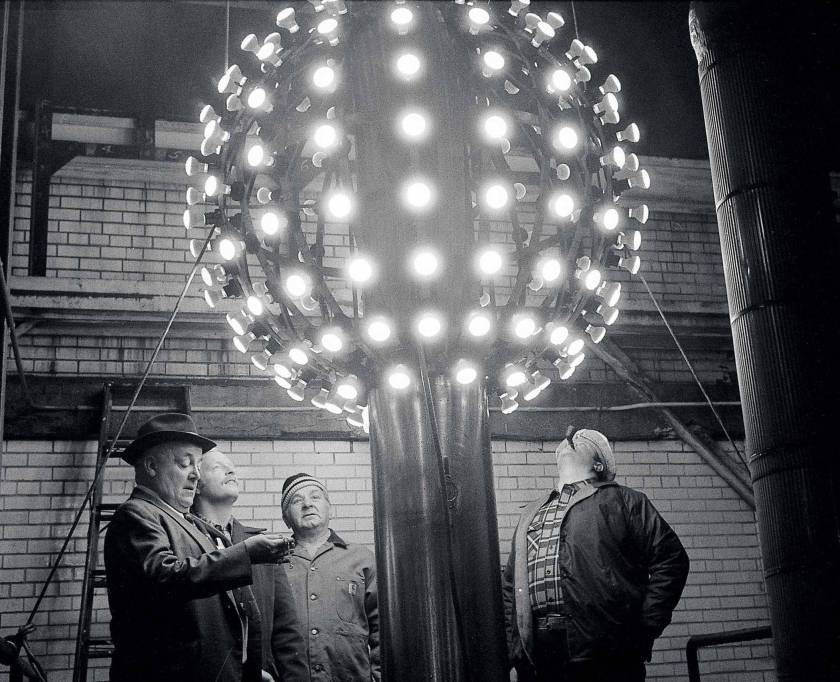
The NY Times Newspaper moved into “Longacre Square” just after the turn of the 20th century. For years, New Years’ eve celebrations had been held at Trinity Church. Times owner Adolph Ochs held his first fireworks celebration on December 31, 1903, with almost 200,000 people attending the event. Four years later, Ochs wanted a bigger spectacle to draw attention to the newly renamed Times Square. He asked the newspaper’s chief electrician, Walter F. Painer for an idea. Painer suggested a time ball.
A time ball is a marine time signaling device, a large painted ball which is dropped at a predetermined rate, enabling mariners to synchronize shipboard marine chronometers for purposes of navigation. The first one was built in 1829 in Portsmouth, England, by Robert Wauchope, a Captain in the Royal Navy. Time balls were obsolete technology by the 20th century, but it fit the Times’ purposes.
The Artkraft Strauss sign company designed a 5′ wide, 700lb ball covered with incandescent bulbs. The ball was hoist up the flagpole by five men on December 31, 1907. Once it hit the roof of the building, the ball completed an electric circuit, lighting up a sign and touching off a fireworks display.
The newspaper no longer occupies the building at 1 Times Square, but the tradition continues. The ball used the last few years is 12′ wide, weighing 11,875lbs; a great sphere of 2,688 Waterford Crystal triangles, illuminated by 32,256 Philips Luxeon Rebel LED bulbs and producing more than 16 million colors. It used to be that the ball only came out for New Year. The last few years, you can see the thing, any time you like.
In most English speaking countries, the traditional New Year’s celebration ends with the singing of “Auld Lang Syne”, a poem written by Robert Burns in 1788 and set to the tune of an old pentatonic Scots folk melody. The original verse, phonetically spelled as a Scots speaker would pronounce it, sounds something like this:
“Shid ald akwentans bee firgot, an nivir brocht ti mynd? Shid ald akwentans bee firgot, an ald lang syn? CHORUS “Fir ald lang syn, ma jo, fir ald lang syn, wil tak a cup o kyndnes yet, fir ald lang syn. An sheerly yil bee yur pynt-staup! an sheerly al bee myn! An will tak a cup o kyndnes yet, fir ald lang syn”. “We twa hay rin aboot the braes, an pood the gowans fyn; Bit weev wandert monae a weery fet, sin ald lang syn”. CHORUS “We twa hay pedilt in the burn, fray mornin sun til dyn; But seas between us bred hay roard sin ald lang syn”. CHORUS “An thers a han, my trustee feer! an gees a han o thyn! And we’ll tak a richt gude-willie-waucht, fir ald lang syn”.
If you enjoyed this “Today in History”, please feel free to re-blog, “like” & share on social media, so that others may find and enjoy it as well. Please click the “follow” button on the right, to receive email updates on new articles. Thank you for your interest, in the history we all share. Happy New Year
Captain Phillips was too much of an imp, to miss out on the navigational freak of a lifetime. Course was adjusted and speed fine-tuned, bringing the Warrimoo to just the right place and time.
“Warrimoo.” The word seems to come from the Aboriginal Ladjiladji people along the border land of New South Wales and Victoria in South Australia, and translating as ‘Eagle’, or ‘Place of Eagles’.
The SS Warrimoo was a passenger steamer, launched in 1892 to serve the Trans-Tasman route between Australia and New Zealand. Later assigned to a Canada-to-Australia passenger route, she would be taken into service as a troop ship with the advent of the Great War, in 1914.
The first Maori detachment destined for the disastrous Gallipoli campaign of 1915 departed Wellington aboard the SS Warrimoo that February, its motto ‘Te Hokowhitu a Tū’ (the seventy twice-told warriors of the war god).
A list of WW1 troop ship departures from New Zealand shows 113 such passages, on which the Warrimoo appears, three times.
The troop ship met its end on May 17, 1918 on a convoy from Tunisia to Marseille. Warrimoo collided with the escorting French warship Catapulte, dislodging the destroyer’s depth charges and blowing out the bottom plates of both vessels. SS Warrimoo and Catapulte went down together with loss of life, yet this is not why the troop ship is remembered.
Nineteen years earlier, the “War to End all Wars” was part of some unknown and unknowable future. A century begun with the Napoleonic Wars and President Thomas Jefferson’s Corps of Discovery, (better known as the Lewis and Clark Expedition), was drawing to a close on the tranquil, moonlit waters of the world’s largest and deepest Ocean.
A simplified illustration of the relation between date line, date and time of day. Each color represents a different date. H/T, Wikipedia
On this day in 1899, SS Warrimoo plied the waters of the central Pacific, in transit from Vancouver to Brisbane.
It was warm and clear with the approach of midnight, the Warrimoo’s position LAT 00 31′ N and LON 179 30′ W. Captain John Phillips quietly puffed on a cigar as 1st Mate Payton, broke into his reverie. “Know what this means? We’re only a few miles from the intersection of the Equator and the International Date Line“.
Captain Phillips called his navigators to check the position, and then check it again. It was true.
Captain Phillips was too much of an imp, to miss out on the navigational freak of a lifetime. Course was adjusted and speed fine-tuned, bringing the Warrimoo to just the right place and time.
At precisely midnight on December 31, 1899, the steamer passed through that imaginary point where the international dateline, meets the equator.
The bow of the ship was in the Southern Hemisphere, where it was the middle of summer. The stern was still in the Northern Hemisphere, where it was the middle of winter. The date on the starboard side of the ship was January 1, 1900. On the port side, it was still December 31, 1899.
For that one moment in time, the SS Warrimoo was in two different days, two different months, two different years, two different seasons, and two different centuries. All at the same time.
All the best from the Long family to yours, for a healthy and prosperous New Year. May this be the first of many more.
If you enjoyed this “Today in History”, please feel free to re-blog, “like” & share on social media, so that others may find and enjoy it as well. Please click the “follow” button on the right, to receive email updates on new articles. Thank you for your interest, in the history we all share.
Sinbad’s breed was best described as “liberty-rum-chow-hound, with a bit of Bulldog, Doberman, Pinscher, and what-not. Mostly what-not”- Martin Sheridan Life Magazine, December 1943.
In times of peace, the United States Coast Guard is charged with protecting the security of the nation’s borders, maritime law enforcement and rescue operations. One of seven uniformed military service branches, Coast Guard operations may be expanded in time of conflict, or by order of the Commander-in-Chief.
During WW2, the Coast Guard operated hundreds of vessels from patrol frigates to troop ships, performing convoy escort, anti-submarine and replenishment operations. Many of the landing craft used in amphibious operations were operated by Coast Guardsmen. There may be no group in the employ of the United States government, better qualified to navigate the shoals, surf and strong currents encountered by small boats, in shallow water.
Semper Paratus. Always Ready.
In the winter of 1937, the Coast Guard cutter USCGC George W. Campell steamed out of New York harbor, patrolling the east coast with a mission of life-saving and national defense. The night before, Chief Boatswain’s Mate A. A. “Blackie” Roth (the name is also given as “Rother”) had given his girlfriend, a puppy. She couldn’t keep him, the landlord wouldn’t allow it. No other crewman could take the small dog. It was either leave him astray and hope for the best, or smuggle the puppy on board.
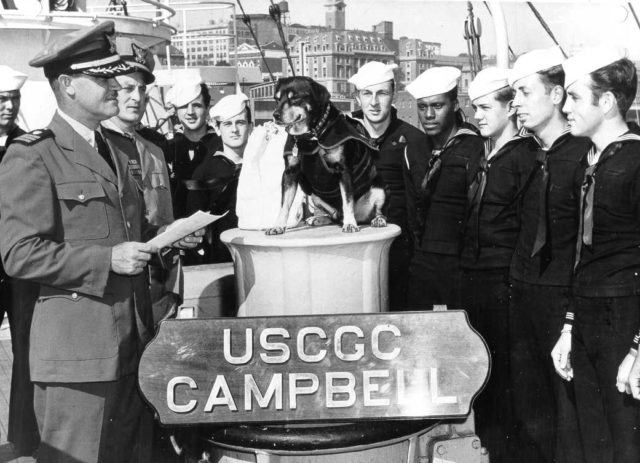
The Captain addressed the assembled crew on the first day of the cruise. Oh, to have been a fly on the wall, when one of them, barked back.
They called him “Sinbad”, and gave him a uniform, a service record and a rank. Dog, 1st class.
Sinbad quickly learned ship’s routine, and often “racked” with other sailors. He could always be found near the galley knowing that’s where the food comes from, and he loved himself a cup of black coffee.
Sinbad’s favorite toys were the large metal washers which he’d hide, until someone came to play with him. They even built him a hammock, much more comfy to sleep in, in those long Atlantic swells.
Sinbad was possessed of the best qualities of the sailor and of his own kind, and of the worst. In 1940, he nearly set off an international incident.
With the dark clouds of WW2 already over Europe, Denmark was overrun and occupied, by Nazis. Greenland was once a Danish territory, and the allies hoped to keep the place out of German hands. Campbell was sent to secure diplomatic ties with the Danes and the Greenlanders, who lived there.
Greenland is thinly populated, a place where locals mainly fish and raise sheep, for a living. On shore for a week, Sinbad was quick to discover the pastures and the great fun of chasing sheep. The sheep themselves were not amused and some died of exhaustion. Others became too nervous to go out and eat. The owners weren’t amused either, and one demanded that Sinbad be shot.
The captain thought that too severe a punishment and Sinbad was banished, never to set foot on Greenland, again. There was no end of amusement among the crew of the Campbell, that Sinbad had been brought before a Captain’s mast. It would not be his last.
Sinbad was awarded the American Defense Service Medal, American Campaign Medal, European-African-Middle-Eastern Campaign Medal, Asiatic-Pacific Campaign Medal, World War II Victory Medal and Navy Occupation Service Medal, which he wore, attached to his collar.
When war came, the cutter was transferred to the Navy, and the patrols became longer.
“Sinbad’s statue in Campbell’s mess hall watching over the ship. Captain James Hirschfield believed the WWII Campbell would survive after being disabled in combat so long as Sinbad stayed aboard”.
In the winter of 1943, Campbell was assigned to convoy protection, defending the vital north Atlantic supply route from roving “wolf packs” of German submarines. Sinbad never did get used to the sound of gunfire or depth charges, and would hide below decks, his paws over his ears. On February 22, the German submarine U-606 unleashed a barrage of torpedoes, against an allied convoy.
A day-long game of cat & mouse ensued in which the sub would pop up for another attack, only to be swarmed and driven into yet another crash dive. A periscope was spotted at 7:26 pm and Campbell charged in with a string of depth charges, colliding with the sub at the end of the run. U-606 was destroyed and Campbell badly damaged, disabled and without power, due to flooding.
All but “essential personnel” were evacuated. Captain James Hirschfield felt that Sinbad was good luck. No harm could befall the cutter while he was on board, and so he remained, essential personnel, taken under tow for repairs by the Polish destroyer, Burza. Sinbad had remained on deck with “his boys”, throughout the action.
Sinbad’s breed was best described as “liberty-rum-chow-hound, with a bit of Bulldog, Doberman, Pinscher, and what-not. Mostly what-not”- Martin Sheridan Life Magazine, December 1943.
Sinbad was promoted in 1943 to the rank of K9C, “Chief Dog” – equivalent to Chief Petty Officer – the second of only two dogs to be classified as non-commissioned officers. Since that time, ‘regulations’ have transformed all subsequent animals into “property” rather than personnel.
Fun fact: The first was Sergeant Stubby, the Staffordshire Terrier who was smuggled “over there” during the Great War, and once caught a German spy by the arse while he was prowling about allied trenches.
Campbell served the duration of WW2, with Sinbad on board, the entire time. In 1948, he was ready to retire. Sinbad had been at sea for eleven years. He was finally ready for shore detail.
After eleven years at sea, Sinbad was “retired” to enjoy the comfortable life of a mascot, at the Barnegat shore station.,
The assembled media and photographers were too much that day, and Sinbad bolted across the gang plank, and down the dock. To be AWOL from a United States Coast Guard cutter is a serious offense, and Sinbad was busted in rank, back to Dog, 1st class. He was probably just as happy to be back with the enlisted guys.
Sinbad was transferred to the Barnegat Light Small Boat Station in New Jersey, where he served as station mascot for the duration of his military career.
Sinbad is welcomed aboard by the crew of the Barnegat light station
Chief Dog Sinbad served all of his fourteen years with the United States Coast Guard. He passed away on this day in 1951 at the Barnegat light station and is buried there, at the base of the flagpole. A sailor always, Sinbad could drink with the best of them, and always enjoyed that cuppa black coffee. Irrespective of his latest rank, he was many years, a media celebrity. Life magazine may have said it best: “An Old Sea Dog Has Favorite Bars and Plenty of Girls in Every Port.”
Throughout her 46 years of service, USCGC Campbell was referred to as “The Queen of the Seas”. She was sunk as a training target in November 1984, a single harpoon missile leaving her nearly intact, as she went out of sight. The final radio message, broadcast as she disappeared beneath the waves: The Queen is dead. Long live the Queen.
Today, the USCGC Campbell (WMEC-909) patrols the east coast out of the Portsmouth Naval Shipyard in Kittery, Maine, the sixth Coast Guard Cutter to bear the name.
If you enjoyed this “Today in History”, please feel free to re-blog, “like” & share on social media, so that others may find and enjoy it as well. Please click the “follow” button on the right, to receive email updates on new articles. Thank you for your interest, in the history we all share.
For the Americans and their allies, the frontal assault of October 9 was one of the bloodiest engagements, of the Revolution. It could have been worse. As battered American and French soldiers fell back, 500 free men of color known as the Chasseurs Volontaires de Saint-Domingue stepped up, to cover their retreat.
Many of these Haitian soldiers went on to win their own war of independence, and credited their military experience, to Savannah.
As 1778 drew to a close, British military planners could look back on five years of trying to suppress rebellion in the American colonies, with little to show for it. In March of that year, the British defeat at Saratoga had brought France into the war, on the side of the Rebels.
Two years of open warfare had centered mostly on the north. Now, a “southern strategy” was devised to conquer rebellious colonies in the south, while isolating those to the north. Key to the Southern Strategy was Georgia and the colonial capital at Savannah, the southernmost commercial port of the thirteen Colonies.
General sir Henry Clinton dispatched a force of some 3,100 from New York under Lieutenant Colonel Archibald Campbell, along with an unknown quantity of artillery. Campbell arrived outside Tybee Island on December 23.
Georgia was defended by two separate forces at this time, units of the Continental Army under the command of General Robert Howe, and state militia under the command of Governor John Houstoun. The two men had a history of squabbling for control and most of their troops, had yet to be tried.
Lieutenant Colonel Archibald Campbell, British commander at the capture of Savannah in December 1778
The 850 under General Howe never really had a chance, against the battle hardened Regulars, Hessian auxiliaries and Loyalist militia, coming ashore on December 29. Defeat turned to rout when Howe’s forces threw down their weapons and ran. Campbell reported that “It was scarcely possible to come up with them, their retreat was rapid beyond conception.
Patriot forces suffered 83 killed, 11 wounded and 453 captured. Campbell suffered 7 killed and 17 wounded.
Howe was court-marshaled for the disaster, while Campbell bragged about being “the first British officer to [rend] a star and stripe from the flag of Congress“
Brigadier General Augustine Prevost arrived from St. Augustine Florida two weeks later, with a mixed force of Regulars and Creek and Cherokee allies. Campbell and a force of 1,000 would take the provisional capital at Augusta that February but soon retreated to Savannah, citing insufficient support among Loyalist and Native American populations.
American hopes soon fell back on their new-found alliance with France. During the following summer, French Admiral Count Charles-Hector Theodat d’Estaing captured St. Vincent and Grenada in the British West Indies, clearing the way to the Georgia coast. The powerful 47-ship French fleet arrived with 4,000 troops on September 1, surprising and capturing several British ships outside the mouth of the Savannah River.
D’Estaing sent an ultimatum to British Commander Augustine Prevost on September 16, 1779. He was to surrender the city “To the arms of his Majesty the King of France”, or he would be personally answerable for what was about to happen. It could not have pleased General Benjamin Lincoln or his Patriot allies when d’Estaing added “I have not been able to refuse the army of the United States uniting itself with that of the King. The junction will probably be effected this day. If I have not an answer therefore immediately, you must confer with General Lincoln and me”.
“Bullet Head Prevost”, so called because of a circular scar on his temple, stalled for 24 hours, using the time in furiously building up his defenses and calling up 800 reinforcements from South Carolina.
Lincoln joined d’Estaing on September 23 with an army of 3,000 militia and Continental soldiers, laying siege to Savannah and the 2,500 British and Loyalist troops in occupation.
On October 1, a British relief column under one Captain French was coming to the city’s aid, camped on the banks of the Ogeechee River. Georgia Continental Colonel John White had two officers, a sergeant and three privates with him, when he tricked French into surrendering. These guys ran through the woods lighting so many fires that the British thought the entire continental Army was bivouacked around them. Captain French was unavailable for comment but, it must be a special feeling, knowing that you just surrendered 111 guys to six, without firing a shot.
View of the siege works against the town at the Siege of Savannah September and October 1779 in the American Revolutionary War: contemporary picture by a French officer
Lack of horses and artillery carriages delayed the allies’ moving their cannon ashore, so French warships bombarded the city from the sea. At one point shortly after Midnight on October 3, with rum rations flowing far too freely, fire from French gunners became more dangerous to themselves than to the city itself.
For the Americans and their allies, the frontal assault of October 9 was one of the bloodiest engagements, of the Revolution. It could have been worse. As battered American and French soldiers fell back, 500 free men of color known as the Chasseurs Volontaires de Saint-Domingue stepped up, to cover their retreat.
Many of these Haitian soldiers went on to win their own war of independence, and credited their military experience, to Savannah.
Franklin Square Monument remembers the contributions of the Haitian militia, in the Siege of Savannah
The siege of Savannah inflicted untold misery among the population, but Patriot forces and their French allies, never did break the city’s defenses. The siege broke a short time later, amidst recriminations on both sides. D’Estaing returned to France, where he lost his head to the guillotine in 1794.
Savannah would remain in British hands until the end of the war, finally evacuated on July 11, 1782. A coquina marker in a small Savannah park; that soft, seashell limestone common throughout the Caribbean basin to Florida and beyond, bears a small brass plaque, darkened with the patina of age.
COMMEMORATIVE OF THE BRITISH EVACUATION OF SAVANNAH 1782
PRESENTED TO THE CITY OF SAVANNAH
BY THE
LACHLAN McINTOSH CHAPTER
DAUGHTERS OF THE AMERICAN REVOLUTION
1904
Attack of 2nd South Carolina Continentals on the Spring Hill Redoubt at the Siege of Savannah on 9th October 1779 in the American Revolutionary War: picture by A.I. Keller
In Spanish speaking countries, newspapers and television stations do gag stories on December 28. A few years ago, headlines read that Kate Middleton was leaving Prince William for Mexican soccer star Chicharito.
In 1983, Boston University history professor Joseph Boskin explained the custom of ‘April Fools Day’ goes back to the Roman Emperor Constantine. A group of jesters and fools informed the Emperor, that they could do his job, better. Amused, Constantine appointed a jester named Kugel, ‘King for a Day’.
Professor Boskin went on to explain. “In a way,” he said, “it was a very serious day. In those times fools were really wise men. It was the role of jesters to put things in perspective with humor.” The Associated Press picked up the story, and newspapers ran it, across the country.
It took AP a couple weeks to realize, the professor had made the whole thing up. April fools.
In one translation of Chaucer’s Canterbury Tales, “March 32” in the year 1392 is the day the vain cock Chauntecleer was tricked by a fox. The fox appealed to the rooster’s vanity by insisting he would love to hear Chauntecleer crow, just as his amazing father did. Standing on tiptoe with neck outstretched and eyes closed. The rooster obliged, with unfortunate, if not unpredictable results.
In most of the west, March 32 is that minor holiday on which we love to play pranks. In Scotland, April Fools’ Day is called Hunt-the-Gowk Day. Although the term has fallen into disuse, a “gowk” is a cuckoo or a foolish person. The prank consists of asking someone to deliver a sealed message requesting some sort of help. The message reads “Dinna laugh, dinna smile. Hunt the gowk another mile”. On reading the message, the recipient will explain that to help, he’ll first need to contact another person, sending the victim to another person with the same message.
On April 1, 1698, citizens were invited to the Tower of London to witness the “Washing of the Lions” in the tower moat. Quite a few were sucked in. The April 2 edition of Dawks’ News-Letter reported that “Yesterday being the first of April, several persons were sent to the Tower Ditch to see the Lions washed.” The “annual ceremony of washing the lions,” lasted throughout the 18th & 19th centuries, always held on April 1st.
There is no “White Gate”, at the tower of London
In 1957, (you can guess the date), the BBC reported the delightful news that mild winter weather had virtually eradicated the dread spaghetti weevil of Switzerland, and that Swiss farmers were now happily anticipating a bumper crop of spaghetti. Footage showed smiling Swiss peasants, pulling strands of spaghetti down from trees. Apparently, an embarrassingly large number of viewers were fooled. Many called BBC offices, asking how to grow their own spaghetti tree. “Place a piece of spaghetti in a tin of tomato sauce”, callers were told, “and hope for the best.”
In Mexico as well as Spain and most Latin countries, pranksters practice their craft not on April 1 but on December 28. The custom goes back to the biblical story of King Herod, who is said to have killed all the baby boys in Bethlehem, to rid himself of the future ‘King of the Jews. The “Massacre of the Innocents” is a sad story but the ‘joke’ was on Herod. Mary and Joseph had taken the baby Jesus away, to Egypt.
So it is that el Día de los Santos Inocentes (Day of the Holy Innocents) is observed in Spanish speaking countries, on December 28. In a sort of gallows humor, the butt of the joke is the “¡Inocente!” or “Innocent one”.
Newspapers and television stations run gag stories on December 28. A few years ago, headlines read that Kate Middleton was leaving Prince William for Mexican soccer star Chicharito.
For two-hundred years now, the citizens of Ibi, Alicante on the Spanish Mediterranean coast have celebrated December 28, with a giant food fight. The practice was suspended for a time following the Spanish Civil War but revived, in 1981. Now, it’s a big tourist attraction, and the event makes a ton of money, for charity.
Who needs to run with bulls when you have la fiesta de Los Enharinados. “The Fiesta of the Flour-Covered Ones.”
Participants are covered with flour at the fiesta of Los Enharinados in Ibi, Spain. Fotógrafo Ibi/Creative Commons ASA 4.0 International.
Feature image, top of page: Food fight participants are at the fiesta of Los Enharinados in Ibi, Spain.
If you enjoyed this “Today in History”, please feel free to re-blog, “like” & share on social media, so that others may find and enjoy it as well. Please click the “follow” button on the right, to receive email updates on new articles. Thank you for your interest, in the history we all share.
“In our civilization, and under our republican form of government, intelligence is so highly honored that it is rewarded by exemption from the cares of office”.
Ambrose Bierce
Ambrose Gwinnett Bierce first appeared in Horse Cave Creek, Ohio, the 10th of 13 children born to Marcus Aurelius and Laura Sherwood Bierce, all with names beginning with the letter “A”.
Marcus and Laura never had much money, but were both inveterate readers who instilled a lifelong love of books in their young son, Ambrose. At 15, Bierce left home to become a “printer’s devil”, fetching type and mixing ink, following in the footsteps of Benjamin Franklin, Thomas Jefferson, and his own contemporary, Mark Twain.
Bierce enlisted with the 9th Indiana Regiment at the outbreak of the Civil War, where he developed map making skills. Bierce would frequently find himself in the hottest part of the front lines, while he drew out and mapped some complicated terrain feature. He would later say of the experience that “War is God’s way of teaching Americans geography”.
For Ambrose Bierce, the Civil War ended at Kennesaw Mountain, Georgia, when a severe head wound took him out of the war, for good. He later headed west, making the first usable maps of the Black Hills, before winding up in San Francisco.
Long hours spent in a boring job at the San Francisco mint gave my favorite “curmudgeon” plenty of time to read up on the classics, and brush up on his writing skills. He soon found himself in the newspaper business, one of the top columnists in San Francisco.
Today, any writer who wants to be the least bit controversial had better keep his lawyer’s number on speed dial. In Bierce’s day, he’d better carry a gun. Ambrose Bierce didn’t shy away from politics, he jumped right in, often employing a mock dictionary definition to lampoon his targets. One example and my personal favorite: “Politics: A strife of interests masquerading as a contest of principles. The conduct of public affairs for private advantage”.
Bierce worked for the Hearst Newspaper San Francisco Examiner in 1896, when he was sent to Washington to cover a railroad bill at that time, working its way through Congress.
The Union and Pacific Railroad received $130 million taxpayer dollars (about $3 billion in today’s money) laundered through the Federal Government and lent to the railroad on extremely favorable terms. One of the Union & Pacific’s builders, Collis P. Huntington, had persuaded a malleable congressman to forgive the loan altogether, if only they could keep the measure quiet.
Bierce lampooned crony capitalist and politician alike. The offending bill was anything but quiet when an infuriated Huntington confronted Bierce on the Capital steps. When asked his “price”, Bierce answered “My price is $130 million dollars. If, when you are ready to pay, I happen to be out of town, you may hand it over to my friend, the Treasurer of the United States”. The bill went on to defeat.
We can only wonder how things would be today, if such a man were to replace the partisan lapdogs passing themselves off as a national press corps.
Bierce’s biting satire would often get Hearst and his newspaper in trouble. Nothing was off limits. Politics was a favorite target: “CONSERVATIVE, n: A statesman who is enamored of existing evils, as distinguished from the Liberal who wishes to replace them with others”, or “POLITICIAN, n. An eel in the fundamental mud upon which the superstructure of organized society is reared. When he wriggles he mistakes the agitation of his tail for the trembling of the edifice. As compared with the statesman, he suffers the disadvantage of being alive”.
Bierce’s mocking definitions became so numerous that they were compiled and published in 1906 as “The Cynic’s Word Book”. It is still in print today as the “Devil’s Dictionary”.
The topics are seemingly endless. On Motherhood: “SWEATER, n.: garment worn by child when its mother is feeling chilly”. On the Arts: “PAINTING, n.: The art of protecting flat surfaces from the weather, and exposing them to the critic”. Or “MARRIAGE, n: the state or condition of a community consisting of a master, a mistress, and two slaves, making in all, two”. And then there’s education, “ACADEME, n.: An ancient school where morality and philosophy were taught. Academy, n.: A modern school where football is taught”.
Bierce left San Francisco in October 1913 at the age of 71, to revisit his old Civil War battlefields. He then headed south into Mexico, which was at that time a whirlpool of revolution. He joined Pancho Villa’s army as an observer in Ciudad Juárez, arriving in Chihuahua some time that December. Bierce’ last letter was written to a close friend, Blanche Partington, on December 26, 1913. He closed the note by saying, “As to me, I leave here tomorrow for an unknown destination.”
And then, he vanished.
If you visit Sierra Mojada, in Coahuila, Mexico, they’ll tell you that Ambrose Gwinnett Bierce was executed by firing squad in the town cemetery. It’s as good an ending to this story as any, as one hundred and five years ago today is as good a day as any on which to end it. The fact is that in that 105 years, there’s never been a trace of what became of him, and probably never will be.
My favorite curmudgeon would have had a good laugh, on reading the monument erected in Meigs County Ohio, in his honor.
So many words to commemorate a life, when the Master’s own words would have done so well: “MONUMENT, n: A structure intended to commemorate something which either needs no commemoration or cannot be commemorated.”
If you enjoyed this “Today in History”, please feel free to re-blog, “like” & share on social media, so that others may find and enjoy it as well. Please click the “follow” button on the right, to receive email updates on new articles. Thank you for your interest, in the history we all share.
British and American forces and their allies fought no less than seventy-one major engagements from the April 19, 1775 battles of Lexington and Concord, to the 1783 Battle of Arkansas Post. The prison ships of the British killed more Americans than every single one of them, combined.
Since the first Geneva Convention of 1864, nations have attempted to codify a system of international law, concerning acceptable limits on the conduct of war. These laws address a range of considerations including declarations of war, acceptance of surrender and proper treatment of prisoners.
Such discussions are nothing new, the earliest examples dating to the ancient Sanskrit epic Mahābhārata, and to the old testament (Torah) Book of Deuteronomy. The first Caliph, Abu Bakr, laid down ten rules of warfare for his Muslim army, in the 7th century.
In the New World British colony in North America, one of twenty-seven grievances enumerated in the Declaration of Independence was that King George III “has endeavoured to bring on the inhabitants of our frontiers the merciless Indian Savages whose known rule of warfare is an undistinguished destruction of all ages, sexes and conditions“.
The American Revolution was on its last legs in December 1776. The year had started out well for the Patriot cause but turned into a string of disasters, beginning in August. Food, ammunition and equipment were in short supply by December. Men were deserting as the string of defeats brought morale to a new low. Most of those who remained, ended enlistments at the end of the year.
General George Washington and a force of 5,000 performed the famous crossing of the Delaware River in the howling blizzard of Christmas day, 1776. The assault on the Hessian garrison at Trenton, was do or die. The cause of Independence needed decisive victory, or it was over. The pass word on that frigid night was “Victory”. There was only one acceptable response: “Or Death”.
The tactical surprise was complete in the early morning hours of December 26. Hessian losses were 22 killed, 92 wounded and 918 captured. Only 400 escaped. The Americans suffered two who had frozen to death in the march on Trenton, and five wounded. It was the colonist’s first major victory of the Revolution.
What to do with all those prisoners was a new problem for Washington, who ordered his troops to treat them with humanity. “Let them have no reason to complain of our copying the brutal example of the British army in their treatment of our unfortunate brethren who have fallen into their hands.”
Washington’s position on the treatment of prisoners was clear and consistent. On September 14 of the previous year, the General wrote to Colonel Benedict Arnold then in camp in Cambridge Massachusetts: “Should any American soldier be so base and infamous as to injure any [prisoner]…I do most earnestly enjoin you to bring him to such severe and exemplary punishment as the enormity of the crime may require.”
No such consideration was given American prisoners of his Majesty’s government. King George III personally declared American revolutionaries to be traitors in 1775, denying them prisoner of war status. Land based detention facilities in British-occupied cities such as New York, Philadelphia and Charleston quickly filled up when the hulks of spent vessels were brought into service as prison ships, little more than waterlogged coffins.
Prison Ship HMS Jersey
Conditions on board these prison ships, were gruesome. The stifling hold of HMS Jersey alone held no fewer than 1,000 men in Wallabout Bay, modern-day site of the Brooklyn Navy Yard.
Authorities were loath to execute detainees for “treason” for fear of inciting sympathy. Prisoners were left instead to wallow in their own filth, starved and tormented by most every disease and parasite, known to modern medicine. The Connecticut Gazette recounted the experience of one Robert Sheffield in July 1778, one of precious few to escape:
The heat was so intense that [the 300-plus prisoners] were all naked, which also served the well to get rid of vermin, but the sick were eaten up alive. Their sickly countenances, and ghastly looks were truly horrible; some swearing and blaspheming; others crying, praying, and wringing their hands; and stalking about like ghosts; others delirious, raving and storming, all panting for breath; some dead, and corrupting. The air was so foul that at times a lamp could not be kept burning, by reason of which the bodies were not missed until they had been dead ten days. One person alone was admitted on deck at a time, after sunset, which occasioned much filth to run into the hold, and mingle with the bilge water …
Bodies of the dead were tossed overboard, ten or fifteen every day from Jersey, alone. Thousands of dead fouled the brackish waters of Wallabout Bay, from which water was drawn to boil “soup” for survivors, more like a toxic sludge, sometimes augmented with moldy bread or rancid meat.
Even after Cornwallis’ surrender in 1781, prisoners languished in the holds of Jersey and other Hell ships until the Treaty of Paris formally ended the war, in 1783.
A host of place names enter the popular imagination, when we think of the American Revolution. Bunker Hill. Trenton. Saratoga. Yorktown. British and American forces and their allies fought no fewer than seventy-one major engagements from the April 19, 1775 battles of Lexington and Concord, to the 1783 Battle of Arkansas Post. The prison ships of the British killed more Americans than every one of them, combined.
Thousands of remains washed up on the shores of Brooklyn. Bones were still being found in 1801, during construction of the Brooklyn Navy Yard.
Prison Ship Martyrs Memorial Fort Greene Park Brooklyn
Locals collected as many as they could for burial in a local tomb. The bones were eventually moved to a crypt in Fort Greene Park, a half-mile south of Wallabout Bay. Today, a 149-foot martyrs memorial topped with an eight-ton bronze brazier marks the location of their Fort Greene crypt.
In eight years, an estimated eleven to twelve thousand men perished of the filth, abuse, neglect and disease of these Hell Ships. Untold thousands more passed through their stinking holds, and lived to tell the tale.
That such men ever lived, may be counted among the blessings of Liberty.
Brooklyn Parks Commissioner Martin “Marty” Maher is quoted in Smithsonian.com: “These were ordinary citizens, fighting for a country that had barely been born. Every man was offered freedom if he would swear to stop fighting. But there’s no record that anyone took up the offer. No prisoner renounced the revolution to gain his freedom. Not one.”
If you enjoyed this “Today in History”, please feel free to re-blog, “like” & share on social media, so that others may find and enjoy it as well. Please click the “follow” button on the right, to receive email updates on new articles. Thank you for your interest, in the history we all share.
Nearly 100,000 Allied and German troops were involved in the unofficial ceasefire of Christmas 1914, lasting in some sectors until New Year’s Day.
“Sitzkrieg”. “Phony War”. Those were the terms used to describe the September ‘39 to May 1940 period, when neither side of what was to become the second world war, was yet prepared to launch a major ground war against the other.
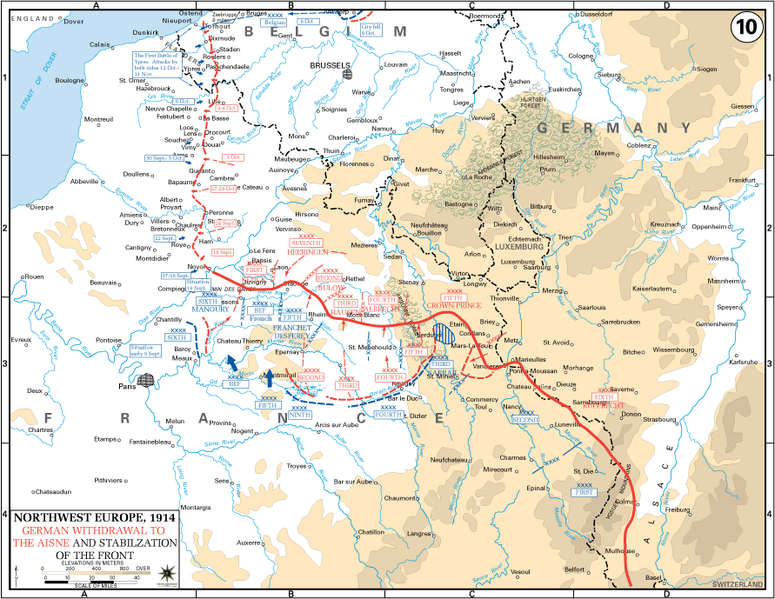
The start of the “Great War” twenty-five years earlier, was different. Had you been alive in August 1914, you would have witnessed what might be described as the simultaneous detonation of a continent. France alone suffered 140,000 casualties over the four day “Battle of the Frontiers”, where the River Sambre met the Meuse. 27,000 Frenchmen died in a single day, August 22, in the forests of the Ardennes and Charleroi. The British Expeditionary Force escaped annihilation on August 22-23, only by the intervention of mythic angels, at a place called Mons.
First Battle of the Marne, September 1914 H/T Britannica
In the East, a Russian army under General Alexander Samsonov was encircled and so thoroughly shattered at Tannenberg, that German machine gunners were driven to insanity at the damage inflicted by their own guns, on the milling and helpless masses of Russian soldiers. Only 10,000 of the original 150,000 escaped death, destruction or capture. Samsonov himself walked into the woods, and shot himself.
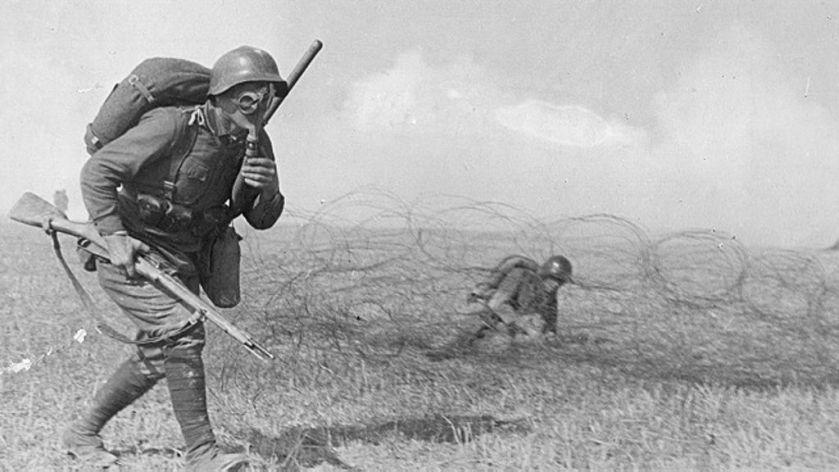
Russian soldiers, WW1, H/T BBC
The “Race to the Sea” of mid-September to late October was more a series of leapfrog movements and running combat, in which the adversaries tried to outflank one another. It would be some of the last major movement of the Great War, ending in the apocalypse of Ypres, in which 75,000 from all sides lost their lives. All along a 450-mile front, millions of soldiers dug into the ground to shelter themselves from what Private Ernst Jünger later called a “Storm of Steel”.
On the Western Front, it rained for much of November and December that first year. The no man’s land between British and German trenches was a wasteland of mud and barbed wire. Christmas Eve, 1914 dawned cold and clear. The frozen ground allowed men to move about for the first time in weeks. That evening, English soldiers heard singing. The low sound of a Christmas carol, drifting across no man’s land…Stille Nacht, heilige Nacht…Silent Night.
The Tommies saw lanterns and small fir trees. Messages were shouted along the trenches. In some places, British soldiers and even a few French joined in the Germans’ songs. Alles schläft; einsam wacht, Nur das traute hochheilige Paar. Holder Knabe im lockigen Haar…
Christmas day truce of 1914 published 1915 London illustrated news
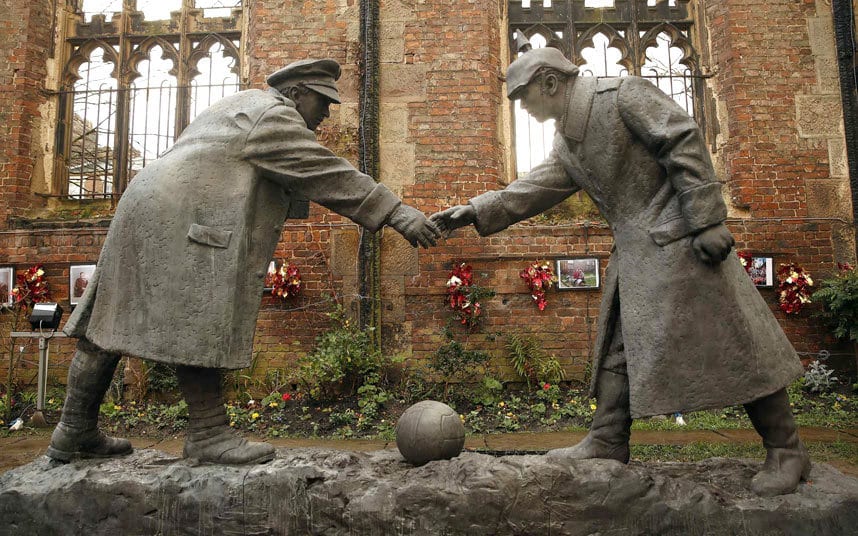
The following day was Christmas, 1914. A few German soldiers emerged from their trenches at the first light of dawn, approaching the Allies across no man’s land and calling out “Merry Christmas” in the native tongue of their adversaries. Allied soldiers first thought it was a trick, but these Germans were unarmed, standing out in the open where they could be shot on a whim. Tommies soon climbed out of their own trenches, shaking hands with the Germans and exchanging gifts of cigarettes, food and souvenirs. In at least one sector, enemy soldiers played a friendly game of soccer.
Captain Bruce Bairnsfather later wrote: “I wouldn’t have missed that unique and weird Christmas Day for anything. … I spotted a German officer, some sort of lieutenant I should think, and being a bit of a collector, I intimated to him that I had taken a fancy to some of his buttons. … I brought out my wire clippers and, with a few deft snips, removed a couple of his buttons and put them in my pocket. I then gave him two of mine in exchange. … The last I saw was one of my machine gunners, who was a bit of an amateur hairdresser in civil life, cutting the unnaturally long hair of a docile Boche, who was patiently kneeling on the ground whilst the automatic clippers crept up the back of his neck.”
Captain Sir Edward Hulse Bart reported a sing-song which “ended up with ‘Auld lang syne’ which we all, English, Scots, Irish, Prussians, Wurttenbergers, etc, joined in. It was absolutely astounding, and if I had seen it on a cinematograph film I should have sworn that it was faked!”
Nearly 100,000 Allied and German troops were involved in the unofficial ceasefire of Christmas 1914, lasting in some sectors until New Year’s Day.
A few tried to replicate the event the following year, but there were explicit orders preventing it. Captain Llewelyn Wyn Griffith recorded that after a night of exchanging carols, dawn on Christmas Day 1915 saw a “rush of men from both sides … [and] a feverish exchange of souvenirs” before the men were quickly called back by their officers.
One German unit tried to leave their trenches under a flag of truce on Easter Sunday 1915, but were warned off by the British opposite them.
German soldier Richard Schirrmann wrote in December 1915, “When the Christmas bells sounded in the villages of the Vosges behind the lines …. something fantastically unmilitary occurred. German and French troops spontaneously made peace and ceased hostilities; they visited each other through disused trench tunnels, and exchanged wine, cognac and cigarettes for Westphalian black bread, biscuits and ham. This suited them so well that they remained good friends even after Christmas was over”.
Some will tell you, the bitterness engendered by continuous fighting made such fraternization all but impossible. Yet, there are those who believe that soldiers never stopped fraternizing with their opponents, at least during the Christmas season. Heavy artillery, machine gun, and sniper fire were all intensified in anticipation of Christmas truces, minimizing such events in a way that kept them out of the history books.
Pvt. Ronald MacKinnon, H/T National Post
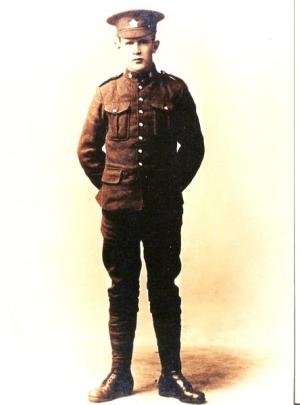
Even so, evidence exists of a small Christmas truce in 1916, though little is known of it. 23-year-old Private Ronald MacKinnon of Princess Patricia’s Canadian Light Infantry, wrote home about German and Canadian soldiers reaching across battle lines near Arras, sharing Christmas greetings and trading gifts. “I had quite a good Christmas considering I was in the front line”, he wrote. “Christmas Eve was pretty stiff, sentry-go up to the hips in mud of course. … We had a truce on Christmas Day and our German friends were quite friendly. They came over to see us and we traded bully beef for cigars”. The letter ends with Private MacKinnon noting that “Christmas was ‘tray bon’, which means very good.”
Private Ronald MacKinnon of Toronto Ontario, Regimental number 157629, was killed barely three months later on April 9, 1917, during the Battle of Vimy Ridge.
The Man He Killed
by Thomas Hardy
Had he and I but met By some old ancient inn, We should have set us down to wet Right many a nipperkin!
But ranged as infantry, And staring face to face, I shot at him as he at me, And killed him in his place.
I shot him dead because– Because he was my foe, Just so: my foe of course he was; That’s clear enough; although
He thought he’d ‘list, perhaps, Off-hand like–just as I– Was out of work–had sold his traps– No other reason why.
Yes; quaint and curious war is! You shoot a fellow down You’d treat, if met where any bar is, Or help to half a crown.
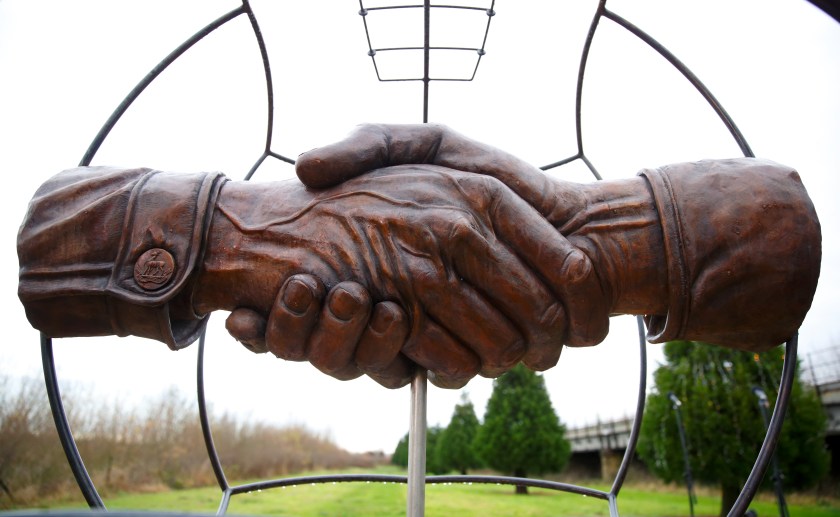
Christmas truce memorial, National Arboretum, Staffordshire, England
If you enjoyed this “Today in History”, please feel free to re-blog, “like” & share on social media, so that others may find and enjoy it as well. Please click the “follow” button on the right, to receive email updates on new articles. Thank you for your interest, in the history we all share.


 Charles Monroe Schulz was one of the brighter kids at Central High School in Saint Paul, Minnesota, but that didn’t help his social life. He was already a shy boy and skipped two half-grades, graduating as the youngest student in the class of 1940.
 weed out those who merely claimed to know him, if they called him “Charles”, or “Chuck”. Schulz’ uncle called him “Sparky” as a boy, after the horse Spark Plug in Billy DeBeck’s comic strip, Barney Google. He always signed the strip “Schulz”, but friends and family knew him as Sparky, until the day he died.





 That someone appears to have gone to Mecca looking for help from the BanūʾUmayya, the “Sons of Umayya”, the second such center of Islamic power since the time of Muhammad and known to history as the Umayyad Caliphate.






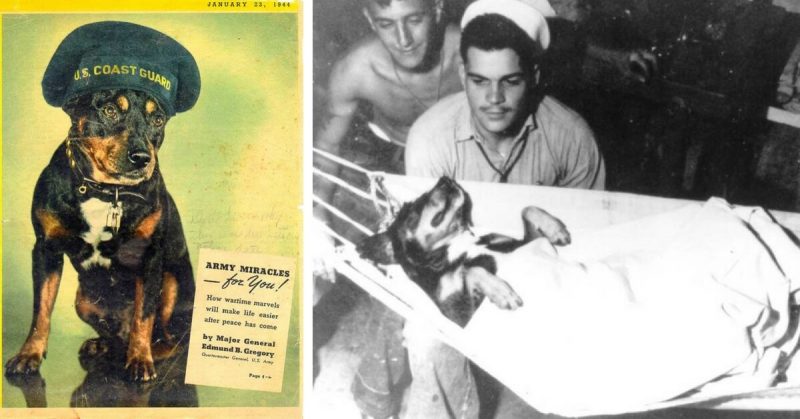
 In the winter of 1937, the Coast Guard cutter USCGC George W. Campell steamed out of New York harbor, patrolling the east coast with a mission of life-saving and national defense. The night before, Chief Boatswain’s Mate A. A. “Blackie” Roth (the name is also given as “Rother”) had given his girlfriend, a puppy. She couldn’t keep him, the landlord wouldn’t allow it. No other crewman could take the small dog. It was either leave him astray and hope for the best, or smuggle the puppy on board.
 Sinbad’s favorite toys were the large metal washers which he’d hide, until someone came to play with him. They even built him a hammock, much more comfy to sleep in, in those long Atlantic swells.



 D’Estaing sent an ultimatum to British Commander Augustine Prevost on September 16, 1779. He was to surrender the city “To the arms of his Majesty the King of France”, or he would be personally answerable for what was about to happen. It could not have pleased General Benjamin Lincoln or his Patriot allies when d’Estaing added “I have not been able to refuse the army of the United States uniting itself with that of the King. The junction will probably be effected this day. If I have not an answer therefore immediately, you must confer with General Lincoln and me”.


 In Mexico as well as Spain and most Latin countries, pranksters practice their craft not on April 1 but on December 28. The custom goes back to the biblical story of King Herod, who is said to have killed all the baby boys in Bethlehem, to rid himself of the future ‘King of the Jews. The “Massacre of the Innocents” is a sad story but the ‘joke’ was on Herod. Mary and Joseph had taken the baby Jesus away, to Egypt.
 For two-hundred years now, the citizens of Ibi, Alicante on the Spanish Mediterranean coast have celebrated December 28, with a giant food fight. The practice was suspended for a time following the Spanish Civil War but revived, in 1981. Now, it’s a big tourist attraction, and the event makes a ton of money, for charity.


 Marcus and Laura never had much money, but were both inveterate readers who instilled a lifelong love of books in their young son, Ambrose. At 15, Bierce left home to become a “printer’s devil”, fetching type and mixing ink, following in the footsteps of Benjamin Franklin, Thomas Jefferson, and his own contemporary, Mark Twain.
 Bierce worked for the Hearst Newspaper San Francisco Examiner in 1896, when he was sent to Washington to cover a railroad bill at that time, working its way through Congress.
 Bierce’s mocking definitions became so numerous that they were compiled and published in 1906 as “The Cynic’s Word Book”. It is still in print today as the “Devil’s Dictionary”.
 an ending to this story as any, as one hundred and five years ago today is as good a day as any on which to end it. The fact is that in that 105 years, there’s never been a trace of what became of him, and probably never will be.


 The American Revolution was on its last legs in December 1776. The year had started out well for the Patriot cause but turned into a string of disasters, beginning in August. Food, ammunition and equipment were in short supply by December. Men were deserting as the string of defeats brought morale to a new low. Most of those who remained, ended enlistments at the end of the year.



 On the Western Front, it rained for much of November and December that first year. The no man’s land between British and German trenches was a wasteland of mud and barbed wire. Christmas Eve, 1914 dawned cold and clear. The frozen ground allowed men to move about for the first time in weeks. That evening, English soldiers heard singing. The low sound of a Christmas carol, drifting across no man’s land…Stille Nacht, heilige Nacht…Silent Night.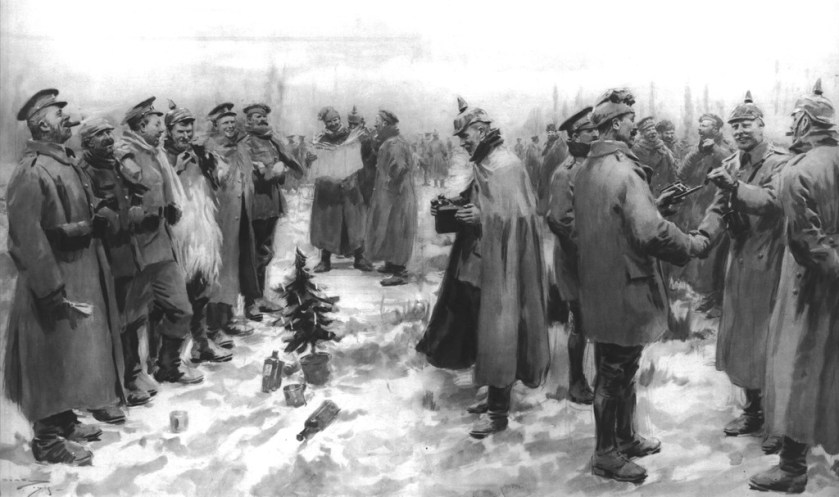
 Captain Sir Edward Hulse Bart reported a sing-song which “ended up with ‘Auld lang syne’ which we all, English, Scots, Irish, Prussians, Wurttenbergers, etc, joined in. It was absolutely astounding, and if I had seen it on a cinematograph film I should have sworn that it was faked!”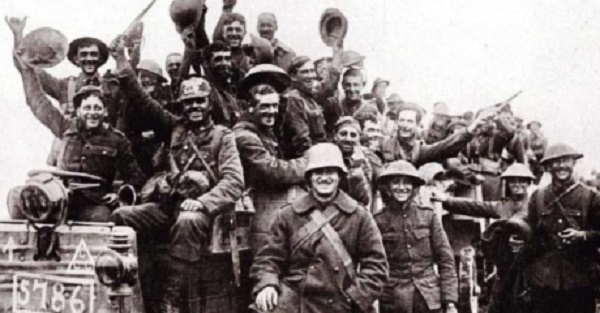


 Historical Easter Eggs - Today in History
You must be logged in to post a comment.