March 31, 2016 A Talent for Music

The 1104th worked to find and defuse explosives, though on several occasions, the unit had to drop its tools and fight as Infantry.

James and Kate Kaminski’s little bundle of joy came into the world on June 26th 1926, in Brooklyn.

The Kaminskis named this, their fourth son, Melvin James. The elder James died of tuberculosis at 34, when the boy was only two. A small Jewish kid growing up in a tough Brooklyn neighborhood, Kaminsky learned the value of being able to crack a joke. “Growing up in Williamsburg”, he said, “I learned to clothe it in comedy to spare myself problems—like a punch in the face”.

download (41)The boy had a talent for music. He was taught by another kid from Williamsburg, named Buddy Rich.  By 14 he was good enough to be playing drums for money.

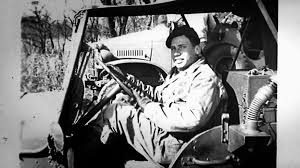
Melvin attended a year at Brooklyn College before being drafted into the Army, in WWII. After attending Army Specialized Training at VMI, Corporal Kaminsky joined the 1104th Combat Engineers Battalion of the 78th Infantry Division, in the European theater.  There, he served through the end of the war.

He and his unit worked to find and defuse explosives, though on several occasions, the 1104th had to drop its tools and fight as Infantry.

download (40)At one point, Kaminsky’s unit gathered along a River. The Americans were so close they could hear German soldiers singing a beer hall song, from the other side. Kaminsky grabbed a bullhorn and serenaded the Germans back, crooning out an old tune that Al Jolson used to perform, in black face:  “Toot Toot Tootsie, Goodbye”.  After he was done, polite applause could be heard, drifting across the river.  I can’t imagine many Allied soldiers ever tried singing to their Nazi adversaries, during World War II.  The ones who actually pulled it off, must number precisely, one.

Kaminski went into show business after the war, playing drums and piano in the Borscht Belt resorts and nightclubs of the Catskills. It was around this time that he took his professional name, adopting his mother’s maiden name of Brookman and calling himself “Mel Brooks”.

images (45)Brooks started doing stand-up, when the regular comedian at one of the clubs was too sick to perform. By ’49 he was “Tummler”, the master entertainer at Grossinger’s, one of the most famous resorts in the Borscht Belt.

Soon he was making $50 a week writing for his buddy Sid Caesar and his NBC program “The Admiral Broadway Review”.

In 1968, Mel Brooks wrote and produced the satirical comedy film “The Producers”, about a theatrical producer and an accountant who set out to fleece their investors. The scheme was to create a play so awful that it was sure to flop on Broadway, then to abscond to Brazil with investors’ money.  The problems started, when the show turned out to be a hit. The fictional play is a musical, called “Springtime for Hitler”.  Even before the time when taking offense became an industry, I don’t know many guys beside Mel Brooks who could have gotten away with that one.

There isn’t one of us who doesn’t know his work. Three of his movies made the American Film Institute’s top 100 list of comedy films.  From the 2,000 year old man with “over forty-two thousand children, and not one comes to visit me” to Blazing Saddles’ “Candygram for Mongo” (“Mongo likes candy”).

download (46)

“As long as the world is turning and spinning”, Brooks says, “we’re gonna be dizzy and we’re gonna make mistakes”.

images (42)

Brooks has risen to the top of his chosen profession, winning the coveted “EGOT”, an acronym for the entertainment industry’s four major awards, the Emmy, Grammy, Oscar and Tony. Only eleven others have ever risen to this level: Richard Rodgers, Helen Hayes, Rita Moreno, John Gielgud, Audrey Hepburn, Marvin Hamlisch, Jonathan Tunick, Mike Nichols, Whoopi Goldberg, Scott Rudin, and Robert Lopez.  As of this date, Brooks only needs another Oscar to be the first “Double EGOT”, in history.

Two years ago, March 31, 2016, the Averhill Park K-12 School District in upstate New York kicked off a three-day production of “Young Frankenstein”.  Let me know if you can think of another 90-year-old guy, who remains that current.  I can’t think of one.

“Well, just being stupid and politically incorrect doesn’t work. You can be politically incorrect if you’re smart”.

melbrooks1-2x

If you enjoyed this “Today in History”, please feel free to re-blog, “like” & share on social media, so that others may find and enjoy it as well. Please click the “follow” button on the right, to receive email updates on new articles.  Thank you for your interest, in the history we all share.

March 28, 1918 A White Feather

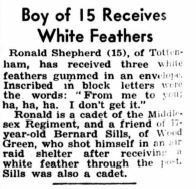
Gangs of “feather girls” took to the streets, looking for military-age men out of uniform. Frederick Broome was fifteen years old, when “accosted by four girls who gave me three white feathers.”

At different times and places, a white feather has carried different meanings.  For those inclined toward New-Age, the presence of a white feather is proof that Guardian Angels are near.  For the Viet Cong and NVA Regulars who were his prey, the “Lông Trắng” (“White Feather”) symbolized the deadliest menace of the American war effort in Vietnam, USMC Scout Sniper Carlos Hathcock, who wore one in his bush hat.  Following the Battle of Crécy in 1346, Edward of Woodstock, Prince of Wales, plucked three white ostrich feathers from the dead body of the blind King John of Bohemia. To this day, those feathers appear in the coat of arms, of the prince of Wales.

The Edward and John who faced one another over the field at Crécy, could be described in many ways.  Cowardice is not one of them.  For the men of the WW1 generation, a white feather represented precisely that.

In August 1914, seventy-three year old British Admiral Charles Cooper Penrose-Fitzgerald organized a group of thirty women, to give out white feathers to men not in uniform.  The point was clear enough. To gin up enough manpower, to feed the needs of a war so large as to gobble up a generation, and spit out the pieces.

white-feather-2

Lord Horatio Kitchener supported the measure, saying  “The women could play a great part in the emergency by using their influence with their husbands and sons to take their proper share in the country’s defence, and every girl who had a sweetheart should tell men that she would not walk out with him again until he had done his part in licking the Germans.”

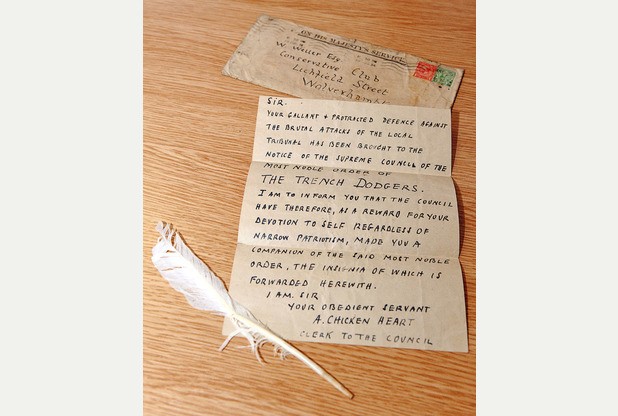
The Guardian newspaper chimed in, breathlessly reporting on the activities of the “Order of the White Feather“, hoping that the gesture “would shame every young slacker” into enlisting.

000simkinJE9
“The White Feather: A Sketch of English Recruiting”, Collier’s Weekly (1914)

In theory, such an “award” was intended to inspire the dilatory to fulfill his duty to King and country.   In practice, such presentations were often mean-spirited and out of line.  Sometimes, grotesquely so.

The movement spread across Great Britain and the Commonwealth nations and across Europe, encouraged by suffragettes such as Emmeline Pankhurst and her daughter Christabel, and feminist writers Mary Augusta Ward, founding President of the Women’s National Anti-Suffrage League, and British-Hungarian novelist and playwright, Emma Orczy.

Distributors of the white feather were almost exclusively female, who frequently misjudged their targets. Stories abound of men on leave, wounded, or in reserved occupations being handed one of the odious symbols.

MvicSeaman George Samson received a white feather on the same day he was awarded the British Commonwealth’s highest military award for gallantry in combat, equivalent to the American Medal of Honor:  the Victoria Cross.
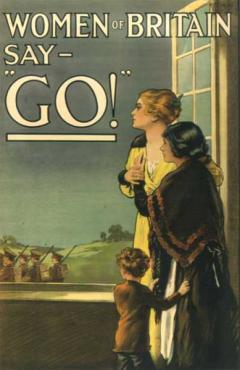
Gangs of “feather girls” took to the streets, looking for military-age men out of uniform.  Frederick Broome was  fifteen years old, when “accosted by four girls who gave me three white feathers.”

The writer Compton Mackenzie, himself a serving soldier, complained that these “idiotic young women were using white feathers to get rid of boyfriends of whom they were tired“.

389px-1915_Women_of_Britain,_say_Go!James Lovegrove was sixteen when he received his first white feather:  “On my way to work one morning a group of women surrounded me. They started shouting and yelling at me, calling me all sorts of names for not being a soldier! Do you know what they did?  They struck a white feather in my coat, meaning I was a coward. Oh, I did feel dreadful, so ashamed.” Lovegrove went straight to the recruiting office, who tried to send him home for being too young and too small: “You see, I was five foot six inches and only about eight and a half stone. This time he made me out to be about six feet tall and twelve stone, at least, that is what he wrote down. All lies of course – but I was in!”.
James Cutmore attempted to volunteer for the British Army in 1914, but was rejected for being near-sighted. By 1916, the war in Europe was consuming men at a rate unprecedented in history. Governments weren’t nearly so picky. A woman gave Cutmore a white feather as he walked home from work. Humiliated, he enlisted the following day. In the 1980s, Cutmore’s grandchild wrote “By that time, they cared nothing for [near-sightedness]. They just wanted a body to stop a shell, which Rifleman James Cutmore duly did in February 1918, dying of his wounds on March 28. My mother was nine, and never got over it. In her last years, in the 1980s, her once fine brain so crippled by dementia that she could not remember the names of her children, she could still remember his dreadful, lingering, useless death. She could still talk of his last leave, when he was so shell-shocked he could hardly speak and my grandmother ironed his uniform every day in the vain hope of killing the lice.”

figure-1Some of these people were not to be put off. One man was confronted by an angry woman in a London park, who demanded to know why he wasn’t in uniform. “Because I’m German“, he said. She gave him a feather anyway.

Some men had no patience for such nonsense. Private Ernest Atkins was one. Atkins was riding in a train car, when the woman seated behind him presented him with a white feather. Striking her across the face with his pay book, Atkins promised “Certainly I’ll take your feather back to the boys at Passchendaele. I’m in civvies because people think my uniform might be lousy, but if I had it on I wouldn’t be half as lousy as you.”

white-feather-3Private Norman Demuth was discharged from the British Army, after being wounded in 1916. A woman on a bus handed Demuth a feather, saying “Here’s a gift for a brave soldier.” Demuth was cooler than I might have been, under the circumstances: “Thank you very much – I wanted one of those.” He used the feather to clean his pipe, handing it back to her with the comment, “You know we didn’t get these in the trenches.”

Inevitably, the white feather became a problem, when civilian government employees began to receive the hated symbol.  Home Secretary Reginald McKenna issued lapel badges to employees in state industries, reading “King and Country”, proving that they too, were serving the war effort. Veterans who’d been discharged for wounds or illness were likewise issued such a badge, that they not be accosted in the street.

So it was that the laborer from the small town in Germany was sent to kill the greengrocer from St. Albans, spurred on by their women and the whole sorry mess driven by the politicians who would make war. The white feather campaign was briefly revived during WW2, but never caught on to anything approaching the same degree as the first.

The English poet, writer and soldier Siegfried Loraine Sassoon, CBE, MC, was decorated for bravery on the Western Front.  Sassoon would become one of the leading poets of WW1.  Let him have the final word.

“If I were fierce, and bald, and short of breath,
I’d live with scarlet majors at the Base,
And speed glum heroes up the line to death…
And when the war is done and youth stone dead,
I’d toddle safely home and die – in bed.”

Siegfried Sassoon

March 27, 1912  Cherry Blossoms on the Potomac

On March 27, 1912, the Viscountess Chinda, wife of the Japanese ambassador to the United States, joined First Lady Helen Taft in planting two Japanese Yoshina cherry trees on the bank of the Potomac River, first of a gift of 3,020 such trees from the people of Japan, to the people of the United States.

Eliza Scidmore was an American journalist, world traveler, author and socialite.  The first female board member of the National Geographic Society, her brother was a career diplomat, who served 38 years in the Asian Pacific. Frequent visits led her to a passionate interest in all things Japanese, most especially the ‘Sakura’, the Japanese blossoming cherry tree.  She called it “the most beautiful thing in the world”.

download (36)

In January 1900, Federal judge William Howard Taft was summoned to Washington, to meet with the President. He hoped it was to discuss a Supreme Court appointment, but it wasn’t meant to be. One day judge Taft would get his wish, becoming the only man in United States history to serve both as President, and as Chief Justice of the Supreme Court. For now, the American war in the Philippines was ongoing. Taft was directed to head up the commission to organize civilian self-government, on the island nation.

While the future President Taft labored in the Philippines, Helen Herron Taft took up residence in Japan, where she came to appreciate the beauty of the native cherry trees.

download (37)Years later, the Japanese Consul in New York learned of the First Lady’s interest in the Sakura, and suggested the city of Tokyo make a gift of Cherry trees, to the government of the United States.

For Eliza Scidmore, it was a dream 34 years in the making.  It was she who raised the money to make it happen.

On March 27, 1912, the Viscountess Chinda, wife of the Japanese ambassador to the United States joined First Lady Helen Taft in planting two Japanese Yoshina cherry trees on the bank of the Potomac River.  Near the Jefferson memorial. The two were planted in a formal ceremony, the first of 3,020 such trees.

Cherry BlossomsIt was the second such effort. 2,000 trees had arrived from Japan two years earlier, in January 1910, but they had fallen prey to disease along their journey. A private Japanese citizen donated the funds to transport a new batch of trees. The 3,020 were taken from the bank of the Arakawa River in the Adachi Ward suburb of Tokyo, to be planted along the Potomac River Basin, East Potomac Park, and the White House grounds.

The blossoming trees were overwhelmingly popular with visitors to the Washington Mall. In 1934, city commissioners sponsored a three-day celebration of the late March blossoming cherry trees, which grew into a national Cherry Blossom Festival.

During WWII, aerial bombardment laid waste to Tokyo and its surrounding suburbs. After the war, cuttings from the cherry trees of Washington were sent back to Japan, to restore the Tokyo collection.

It’s not clear to me, if the trees which line the Arakawa River today are entirely from the Potomac collection, or some combination of American and native stock.  After the conflagration that was the war in the Pacific, I’m not sure it matters.  It may even be the whole point.

Processed by: Helicon Filter;
Cherry Trees line the Arakawa River, Tokyo, Japan

If you enjoyed this “Today in History”, please feel free to re-blog, “like” & share on social media, so that others may find and enjoy it as well. Please click the “follow” button on the right, to receive email updates on new articles.  Thank you for your interest, in the history we all share.

March 26, 1937  I Yam What I Yam

Cartoonist E.C. Segar (rhymes with cigar) passed away back in 1938, but his characters live on.  Over the weekend of January 16-18, 2004, the Empire State Building was lit up spinach green, a tribute to the 75th anniversary of Segar’s favorite character. 

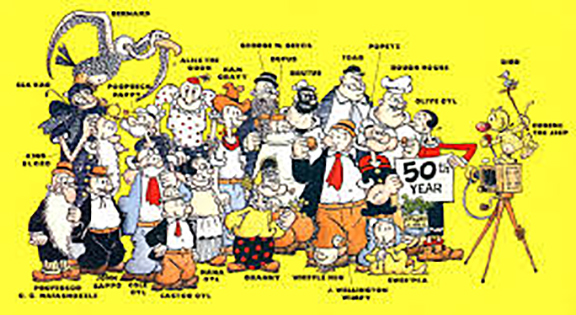
Eighty-nine years ago, Popeye the Sailor appeared for the first time in Elzie Segar’s “Thimble Theater”, a newspaper comic strip revolving around the lives of Olive Oyl and her extended family, including her brother Castor and then-boyfriend Harold Hamgravy.

download (29)The strip was around for ten years or so, when Olive & co. decided to recruit a sailor to get them to the casino on Dice Island.  Approaching a rough looking character on the docks, “Popeye’s” first line was “Ja think I was a cowboy? He was supposed to be an extra, but he became so popular he soon developed into the center of the strip.
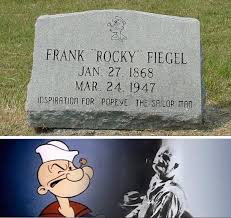
Like Olive, who was patterned after the real-life Dora Paskel, the one eyed, fighting, pipe smoking sailor was based on a real man:  Chester, Illinois boxer Frank ‘Rocky’ Fiegal.  The boxer didn’t mind being associated with a cartoon character.  When Fiegal died in 1947, his gravestone was inscribed with the words “inspiration for Popeye.”

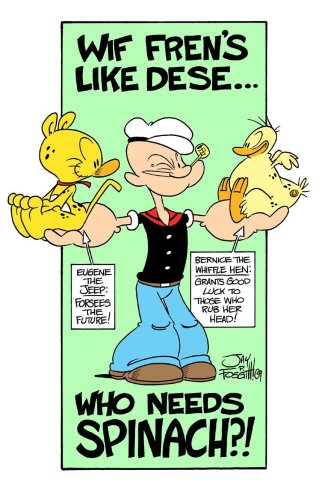
popeye__eugene_and_bernice_by_fourpanelheroBefore spinach, Popeye gained his superhuman strength patting the head of a magical “whiffle hen” named “Bernice”.
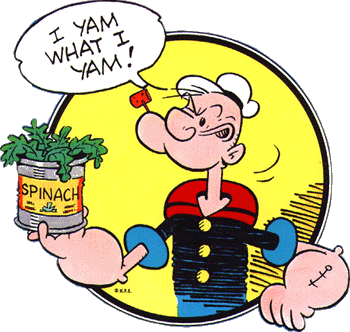
Back in 1870, a misplaced decimal point in a scientific journal led readers to believe that spinach had ten times the iron than it actually does.  Some ideas die hard.  Sixty years later, the grandchildren and great-grandchildren of those people still believed it to be true.

Bluto beat our sailor up in 1932 and tossed him into a spinach field, with predictable results.  Following that episode, spinach sales increased by 33%.  At one point, children voted spinach their third favorite food, behind turkey and ice cream.

To the everlasting joy of depression-era spinach producers, Popeye found extra muscle in the leafy vegetable, ever since.  On March 26, 1937, Crystal City, Texas spinach producers unveiled a statue of Popeye, the first time in history that a statue had been erected in honor of a cartoon character.

What-is-SpinachPopeye’s pet “Eugene the Jeep” first appeared in a 1936 strip called “Wha’s a Jeep?”.  Eugene was sort of magical dog who could go anywhere.  Five years later, military contractors worked to develop the iconic off-road vehicle of WWII.  Like Popeye’s pet Eugene, the General Purpose GP (“Jeep”) could go anywhere.  Eventually, the name stuck.
Jeep isn’t the only word we get from the Popeye cartoon franchise.  The inveterate moocher J. Wellington Wimpy, who would gladly pay you Tuesday for a hamburger today, gave us the word “wimp” and the burger chain that goes with it.  The comic strip introduced a character called “Dufus”.  To this day, a Dufus (Doofus) in the American vernacular is a “silly fool, a dimwit, or a stupid person”,

Just about every cartoon character who ever was, appears in the 1988 “Who framed Roger Rabbit”, except for Popeye.  Disney didn’t forget him, the problem was that they couldn’t get legal permission to use the character, from Paramount Pictures.

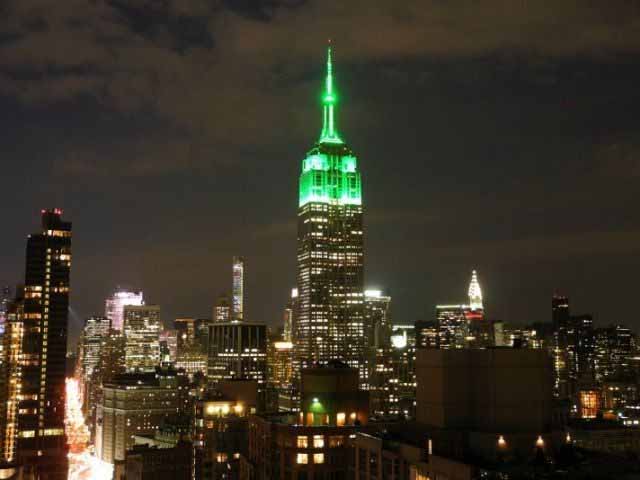
Cartoonist E.C. Segar (rhymes with cigar) passed away back in 1938, but his characters live on.  Over the weekend of January 16-18, 2004, the Empire State Building was lit up spinach green, a tribute to the 75th anniversary of Segar’s favorite character.   Weight Watchers put out a series of spinach recipes. There was even a ceremonial “official adoption” of the orphan sea waif Swee’ Pea, during National Adoption Month (November).

EmpireStateBldg.Green_
“Later that year (2004), the Empire State Building was lit in spinach green to celebrate Popeye’s 75th, and Weight Watchers put out a series of spinach recipes. There was even a ceremonial “official adoption” of the orphan sea waif Swee’ Pea during National Adoption Month (November)”. H/T The Coronado Times

On December 8, 2009, Google featured the character to honor the birth of his creator, Elzie Crisler Segar. Google’s famous Doodle appeared along with the mouseover text, “E.C. Segar’s Birthday.”

If you enjoyed this “Today in History”, please feel free to re-blog, “like” & share on social media, so that others may find and enjoy it as well. Please click the “follow” button on the right, to receive email updates on new articles.  Thank you for your interest, in the history we all share.

March 22, 2228 Final Frontier

Kirk was killed in 2329 on the Enterprise (B), after the ship was eaten by a Nexus energy ribbon on its maiden voyage. Only he didn’t die, because Jean-Luc Picard found him alive in the timeless Nexus, negotiating hotel deals for Priceline.com. Or something like that.

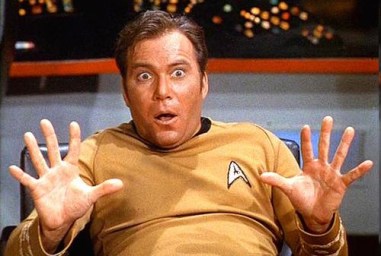
On this day in the year 2228, a boy was born to George and Winona Kirk. He would go on to become the youngest captain in Starfleet history but, before he could boldly go where no man has gone before, he had to have a name.

The former WWII fighter pilot and veteran of 89 combat missions Gene Roddenberry had 16 suggestions for a name, among them “Hannibal”, “Timber”, “Flagg”, and “Raintree”.  The television screenwriter and producer decided on James T. Kirk, based on a journal entry from the 18th century British explorer, Captain James Cook, who wrote “ambition leads me … farther than any other man has been before me“.

Kirk_surrounded_by_Tribbles-970x545

Kirk was killed in 2329 on the Enterprise (B), after the ship was eaten by a Nexus energy ribbon on its maiden voyage. Only he didn’t die, because Jean-Luc Picard found him alive in the timeless Nexus, negotiating hotel deals for Priceline.com. Or something like that.

In his 1968 book “Making of Star Trek“, Roddenberry writes that James Kirk was born in a small town in Iowa. Full time “Trekkie” and part time Riverside, Iowa Councilman Steve Miller thought “Why not Riverside”. In 1985, Miller moved that Riverside declare itself the Future Birthplace of James T. Kirk. The motion passed unanimously. Miller poked a stick into the ground behind the barber shop, (good thing he owned the property), declaring that this was the place.  An engraved monument was erected, and so it was.  Riverside, population 963, became the “Future Birthplace of Captain James T. Kirk.  A bench was added later, along with a Shuttlecraft-shaped donation box.

jk6Riverside’s official slogan was changed from “Where the best begins” to “Where the Trek begins,” the annual “River Fest” summer festival, became “Trek Fest”.

Star Trek fans, ever-jealous protectors of series trivia, sometimes wonder why the March 22, 2228 date on the Riverside monument differs from the March 22, 2233 date usually cited as Kirk’s future birthday. The 2233 date didn’t come around until eight years after the monument, with the publication The Star Trek Chronology: The History of the Future. 2228 or 2233 you can take your pick, but both agree on March 22, which happens to be William Shatner’s birthday.

download (24)In case you ever wondered what the “T” stands for – its “Tiberius”.

The Space Foundation of Colorado Springs bills itself as “the world’s premier organization to inspire, educate, connect, and advocate on behalf of the global space community“.  A 2010 survey conducted by the organization found that James Tiberius Kirk was voted the 6th “most inspirational space hero of all time“, tied with Russian Cosmonaut Yuri Gagarin.  Tied for 6th place, with the first human in space.  A guy who went there, and came back.  A guy who…you know…actually…exists.

If you enjoyed this “Today in History”, please feel free to re-blog, “like” & share on social media, so that others may find and enjoy it as well. Please click the “follow” button on the right, to receive email updates on new articles.  Thank you for your interest, in the history we all share.

March 3, 1634 Watering Hole

In early colonial America, tavern keepers would put out an “Ale Stick” or “Ale Stake”, a wooden pole with a bush of barley tied to the top, informing thirsty travelers that sustenance could be found, inside.  Sometimes a hoop of woven barley hanging outside, would tell you that you had arrived.

Despite seemingly inexhaustible supplies of pristine drinking water, colonists to the New World were first and foremost Englishmen, every one of whom understood that drinking water could make you deathly ill. The connection between sanitation and the boiling to make beer was ill understood, but everyone knew. Those who drank beer and ale didn’t get sick.  The brewhouse was an indispensable priority in every new settlement.

The earliest settlers to Jamestown, Virginia neglected the brewer’s art. Their first pleas for relief from England, included advertisements seeking “two brewers’ to join them.

When Pilgrims fetched up on the shores of Cape Cod and the later Plimoth colony in 1620, it was not in search of a beach vacation, but because of dwindling beer supplies.

330px-Boston,_1775bsmall1
Today, much of the bay has been filled in and developed, forming the core of downtown Boston. This is the Shawmut Peninsula, as it looked during Cole’s time.

Little brother Benjamin Franklin describes his earliest experience working in his brother’s print shop, with frequent reference to fetching ale for the journeyman printers.

Beer and ale were dietary staples in the era, a source of nourishment as well as refreshment. Infants drank beer and it was especially recommended for nursing mothers. Many households added a small brewing room to the outside of the building, so that the heat and risk of fire associated with brewing and cooking could be kept outside of living quarters. To this day, the lower rooflines of these “brew rooms” can be found, jutting out from the sides of the oldest American homes.

In early colonial America, tavern keepers would put out an “Ale Stick” or “Ale Stake”, a wooden pole with a bush of barley tied to the top, informing thirsty travelers that sustenance could be found, inside.  Sometimes a hoop of woven barley hanging outside, would tell you that you had arrived.

Samuel Cole was an early settler in the Massachusetts Bay colony, arriving with the Winthrop fleet in 1630 and establishing himself on the Shawmut peninsula.  Four years later, he opened the first house of entertainment in Boston, calling his place “Cole’s Inn”, established March 3, 1634.

Taverns were common in England from as early as the 1200s, where women called “Ale Wives” would fetch beer, wine, mead and ale for the guests. Though lodgings were a common feature of the ale houses of the time, it would not be until the early 1700s that Colonial taverns commonly offered such amenities.

185

Later taverns posted elaborate signs, carved from wood, stone, or even terra cotta, and hanged from wooden posts mounted to the building or to a nearby tree. Barley, the universal symbol for beer, remained a common feature of such signs, and continues in use on the labels of many brands sold to this day.

download (17)The signs of the time frequently included horses, indicating that lodgings and stables were available. Many such establishments came to be called after such signs, and names such as “Chestnut Mare” and “White Stallion” were common.
Today, a Google search of the term “Black Horse Tavern” yields some 1,090,000 hits.  Cheers.

“Filled with mingled cream and amber
I will drain that glass again.
Such hilarious visions clamber
Through the chambers of my brain –
Quaintest thoughts — queerest fancies
Come to life and fade away;
Who cares how time advances?
I am drinking ale today.” – Edgar Allen Poe


If you enjoyed this “Today in History”, please feel free to re-blog, “like” & share on social media, so that others may find and enjoy it as well. Please click the “follow” button on the right, to receive email updates on new articles.  Thank you for your interest, in the history we all share.

March 2, 1977 Heeere’s Johnny

The world’s longest running talk show began in 1954, when Steve Allen sat down at his piano on September 27.  This show is gonna go on… forever”, Allen quipped.  So far, he seems to have gotten that right.

download (14)
Johnny Carson, Navy portrait

With Jack Parr about to sign off the “Tonight Show” for the last time, NBC executives were anxious to find a replacement.  Bob Newhart, Jackie Gleason, Groucho Marx, and Joey Bishop all declined the opportunity, when a United States Navy veteran, amateur magician and amateur boxer with a 10/0 record agreed to take the job.

Back when late-night comedians were expected to be funny, Johnny Carson had misgivings, believing himself unequal to the task of producing 90 minutes of fresh content, every day.

A series of guest hosts followed including Merv Griffin, Art Linkletter, Joey Bishop, Jerry Lewis and Groucho Marx, as Carson finished out the last six months of a contract with ABC.  Despite his apprehensions, Carson started the new gig on October 1, 1962.

No sooner had NBC announced that Johnny Carson would be joining “The Tonight Show,” than the national press gaggle came after him, looking for interviews. Paradoxically, the future “King of late night comedy” was averse to publicity.  Carson resisted at first, but finally relented, providing a list of answers to which journalists could apply any question they pleased:

  • “Yes, I did”.
  • “Not a bit of truth in that rumor”.
  • “Only twice in my life, both times on Saturday”.
  • “I can do either, but prefer the first”.
  • “NO”.
  • “Kumquats”.
  • “I can’t answer that question”.
  • “Toads and tarantulas”.
  • “Turkestan, Denmark, Chile, and the Komandorskie Islands”.
  • “As often as possible, but I’m not very good at it yet”.
  • “I need much more practice”.
  • “It happened to some old friends of mine, and it’s a story I’ll never forget”.
download (15)
Ed McMahon

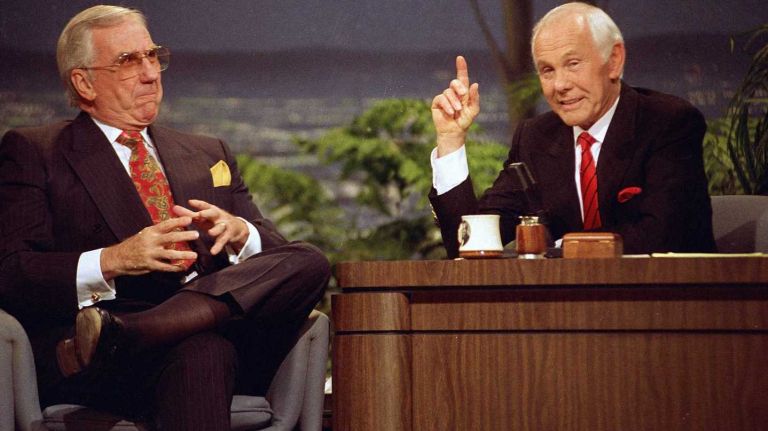
A Marine Corps aviator and flight instructor from Lowell, Massachusetts joined Carson from that first show, back in 1962.   The Marine earned his carrier landing qualifications around the time the atomic bomb ended the war in the Pacific, and went on to fly 85 combat missions in Korea, earning six air medals and retiring with the rank of Colonel in 1966.   His name was Ed McMahon.

In those days, the Tonight Show was a whopping 105 minutes long.  Groucho Marx delivered a fifteen-minute monologue before introducing the host for that first program.  After that and for years afterward, the monologue segment fell to McMahon himself.

introducing-the-new-host-of-the-tonight-show-johnny-carson (1)
Groucho Marx introducing the new host of the Tonight Show, October 1, 1962

When the Tonight Show first aired, everyone on the set including Carson himself, smoked.  The “Public Health Cigarette Smoking Act” was introduced in Congress in 1969.  Ironically, it was President Richard Nixon, an avid pipe smoker who lit up as many as eight bowls a day, who signed the measure into law on April 1, 1970.   The measure included a permanent ban on television cigarette advertising, scheduled to take effect ac1dd1ea41e71a3d44fe61af45173ba5--johnny-carson-tonight-showJanuary 2, the following year.  The last cigarette ad in the history of American television was a Virginia Slims ad, broadcast at 11:59p.m., January 1, 1971, on the Tonight Show, Starring Johnny Carson.  Smoking on-air became a thing of the past sometime in the mid-80s, but that cigarette box remained on Carson’s desk until his final episode, in 1992.  You’ve come a long way, baby.

For NBC, the Tonight Show was a cash cow.  Many years the program grossed over $100 million, accounting for 15-20% of the profits earned by the entire network.  Carson threatened to walk in 1980, ending up with a deal unprecedented in the history of American broadcasting: $5 million a year and series commitments estimated at $50 million.  Just as important, show content would no longer belong to the network, but to Carson himself.

hqdefault (1)Carson began taking Mondays off in 1972, when the show moved from New York to California.  There followed a period of rotating guest hosts, including George Carlin and Joan Rivers, who became permanent guest host between 1983 and 1986.

The Tonight Show Starring Johnny Carson was a late-night fixture through seven US Presidents: John Kennedy, Lyndon Johnson, Richard Nixon, Gerald Ford, Jimmy Carter, Ronald Reagan, and George HW Bush.  Nearly every American over the age of 30 and some younger will remember the opening, “Heeeeeeeeeeere’s Johnny!”.  There was the opening monologue, and the imaginary golf swing.  “Carnac the Magnificent”, holding the envelope to his head, reciting the punchline to the joke sealed inside.  “Saucepan… Who was Peter Pan’s wino brother?”  When a joke bombed, there was the comedic curse.  “May a bloated yak change the temperature of your jacuzzi!”

download (16)Jay Leno appeared on the Tonight Show with Johnny Carson for the first time on March 2, 1977.  He would frequently guest, and served as permanent host from May 1992 to May 2009.

Five years after Carson’s final show, 10,000 taped episodes were moved to a salt mine in Kansas, to protect them from deterioration. There they remain, 54 stories underground, where the average temperature is 68° Fahrenheit, with a uniform 40% humidity.

Excepting Conan O’Brien’s eight months in 2010, Leno remained permanent host of the Tonight Show until February 2014, recording more episodes (4,610) than even Carson himself, with 4,531. Saturday Night live veteran Jimmy Fallon took over the reins in February 2014, where he remains to this day.

The world’s longest running talk show began in 1954, when Steve Allen sat down at his piano on September 27.  This show is gonna go on… forever”, Allen quipped.  So far, he seems to have gotten that right.

1962_Johnny-03_large

If you enjoyed this “Today in History”, please feel free to re-blog, “like” & share on social media, so that others may find and enjoy it as well. Please click the “follow” button on the right, to receive email updates on new articles.  Thank you for your interest, in the history we all share.

February 25, 1921 Fellow Traveler

In the 1930s, many believed that International Communism was “winning”. The capitalist west was plunged into a Great Depression that it couldn’t seem to get its arms around, while the carefully controlled propaganda of Stalin’s Soviet Union did everything it could to portray itself as a “workers’ paradise”.

In the wake of the “Great War” and the Bolshevik revolution in Russia, American authorities became increasingly alarmed concerning the rise of radical Leftism.

00000744Far-left anarchists mailed no fewer than 36 dynamite bombs to prominent political and business leaders in April 1919, alone. In June, another nine far more powerful bombs destroyed churches, police stations and businesses.

Attorney General A. Mitchell Palmer had one hand delivered to his home by anarchist Carlo Valdinoci, who did something wrong and somehow managed blow himself to bits on the AG’s doorstep. Palmer attempted to suppress these radical organizations in 1919-20, but his searches and seizures were frequently illegal, his arrests and detentions without warrant, and his deportations questionable.

436398aceb9a0d77db5df9e6439394aa--red-scare-open-handsTo this day there are those who describe the period as the “First Red Scare”, as a way to ridicule the concerns of the era. The criticism seems unfair. The thing about history, is that we know how their story ends. The participants don’t, any more than we know what the future holds for ourselves.
Looking over the international tableau of the time, the largest nation on the planet had fallen to communism, in 1917. The Red Army offensive of 1920 drove into Poland, almost as far as Warsaw. The “Peace of Riga”, signed in 1921 split off parts of Belarus and Ukraine, making them parts of Soviet Russia. On this day in 1921, Bolshevist Russian forces occupied Tbilisi, capital of the Democratic Republic of Georgia.

In the 1930s, many believed that International Communism was “winning”. The capitalist west was plunged into a Great Depression that it couldn’t seem to get its arms around, while the carefully controlled propaganda of Stalin’s Soviet Union did everything it could to portray itself as a “workers’ paradise”.

download (12)
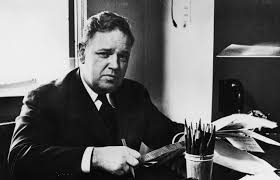
Whittaker Chambers

Whittaker Chambers was one of those who believed the winning side to be on the political Left, and joined the Communist Party of the United States (CPUSA) in 1925. Chambers worked for a time as a writer at the Party’s newspaper “Daily Worker”, before becoming editor of “New Masses”, the Party’s literary magazine.

From the early to mid-thirties, Chambers delivered messages and received documents from Soviet spies in the government, photographing them himself or delivering them for Soviet intelligence agents to photograph. At some point, Chambers’ idealism began to waver, with the realization that he was supporting a murderous regime. By 1939, he joined the staff of Time Magazine, where he pushed a strong anti-communist line.

A series of legislative committees were formed between 1918 and the outbreak of WWII to investigate this series of threats, though these committees sometimes did more to construct the image of a threat than they did to stop one. It was in this context that HUAC, the House Committee on Un-American Activities was formed in 1938, becoming a “standing” (permanent) committee in 1945.

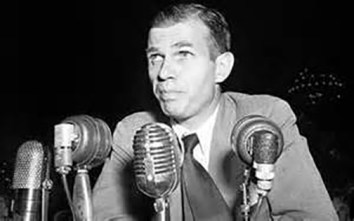
Alger Hiss
Alger Hiss

Whittaker Chambers warned about communist sympathizers in the Roosevelt administration as early as 1939, the FBI interviewed him in 1942.  Government priorities began to change n the wake of WWII, and Chambers was summoned to testify on August 3, 1945, where he named Alger Hiss and others as Communists.

A graduate of Johns Hopkins and Harvard Law School who had clerked for Supreme Court Justice Oliver Wendell Holmes, Alger Hiss seemed an unlikely communist. He had gone on to practice law in Boston and New York before returning to Washington to work on President Franklin Roosevelt’s “New Deal”, winding up at the State Department as an aide to Assistant Secretary of State Francis B. Sayre, former President Woodrow Wilson’s son-in-law. By this time Hiss was a high ranking official in the State Department.

Hiss flatly denied Chambers’ charges, filing suit for defamation of character in December. Chambers escalated in his 1948 deposition for the suit, claiming that, not only was Hiss a communist sympathizer, he was also a spy.

pumpkinBefore defecting from the Left, Chambers had secreted documents and microfilms, some of which he hid inside a pumpkin at his Maryland farm. The collection was known as the “Pumpkin Papers”, consisting of incriminating documents, written in what appeared to Hiss’ own hand, or typed on his Woodstock no. 230099 typewriter.

Defending himself, Hiss claimed to have given the typewriter to his maid, Claudia Catlett. When the idiosyncrasies of Hiss’ machine were demonstrated to be consistent with the documents, he then claimed that Chambers’ team including freshman member of Congress Richard M. Nixon, must have modified the typeface on a second typewriter to mimic his own.

woodstockHiss’ theory never explained why Chambers side needed another typewriter, if they’d had the original long enough to mimic its imperfections with a second.
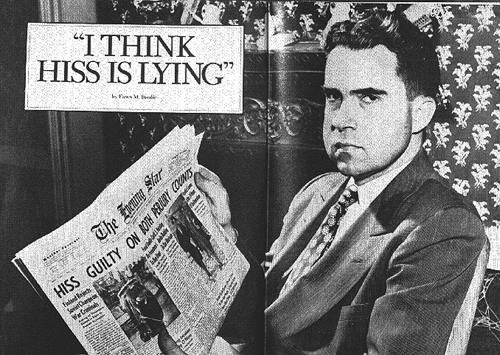
Alger Hiss’ first trial for lying to a Grand Jury ended with a hung jury, 8-4.  A second trial began on November 17, found him guilty of perjury on January 21, 1950.  Hiss maintained that he was innocent but lost his conviction, and served 44 months in Lewisburg Federal Penitentiary before being released in 1954.

What many saw as a devoted civil servant maligned by the anti-communist hysteria of the 1940, others believed to be a liar and enemy agent.  Alger Hiss went to his grave in 1996, protesting his innocence.

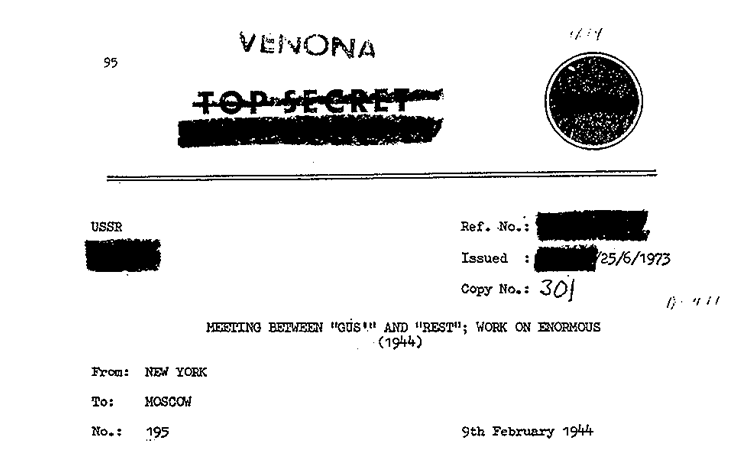
Soviet-era cables, decrypted through a now-declassified program called the “Venona Project”, seem to convict him beyond a reasonable doubt of being a soviet agent. Venona transcript #1822, sent in March 1945 from the Soviet Washington station chief to Moscow, describes the subject codenamed ALES as having attended the February 4–11, 1945 conference at Yalta, before traveling to Moscow. Hiss attended Yalta on these dates, before going to Moscow with Secretary of State Edward Stettinius.

2015-02-23_21-41-12

Historians John Earl Haynes and Harvey Klehr report that the Venona transcripts tie approximately 349 Americans to Soviet intelligence, though fewer than half that number were ever identified.  The Office of Strategic Services alone, precursor to the CIA, housed between fifteen and twenty Soviet spies.

The CIA’s official conclusion, based on the CIA.gov on-line library is that “Although no specific file on Hiss has been released from the KGB or GRU archives, enough material has been found in other files–in Moscow, Eastern Europe, and Washington–to enable historians to write several new works that leave almost no room for doubt about Hiss’ guilt”.

848e7d_4d7c05b4724b4f7fb7ec239b5888096a_mv2

February 14, 269, Valentine’s Day

The Eastern Orthodox Church celebrates Saint Valentine twice, first as a church elder on July 6, and again as a martyr on the 30th.  That would suit the greeting card companies just fine, but don’t tell them.  Once a year is enough for some of us to remember. 

800px-Santa_Giulia_4
Bronze likeness of Barbarian Emperor Claudius II, “The Cruel”

In the third century AD, Roman Emperor Claudius II was having trouble recruiting for his legions. To many he was “Claudius the Cruel” which may have had something to do with his problem, but that’s not how he saw it.

To Emperor Claudius, such reluctance could only mean that Roman men were excessively devoted to their wives and families.  The solution was obvious – ban all engagements and marriages.

Valentinus was a Roman priest at this time, who wanted no part of such a silly decree. Valentinus continued to carry out marriages in secret until it was discovered, when he was dragged before the Prefect to answer for his crimes.

Claudius came to like his prisoner, for whom things could have gone much better, but for one critical mistake. He tried to convert the pagan Emperor to Christianity.

Valentinus was condemned to be beaten to death with clubs and beheaded, the sentence carried out on February 14 in the year AD269.

valentinus4
Valentinus

Legend has it that Valentinus befriended his jailers’ blind daughter, at one point miraculously restoring the girl’s sight. He is said to have penned a farewell note to her shortly before his execution, signing it “From Your Valentine.”

2,000-year-old history is necessarily clouded by legend, and there are different versions of this tale. It’s possible that Valentinus’ story never happened at all.  Little or no evidence exists suggesting romantic celebrations on February 14, until Geoffrey Chaucer’s 1375 “Parliament of Foules,” in which the poet describes the mating habits, of birds:  “For this was sent on Seynt Valentyne’s day, Whan every foul cometh ther to choose his mate”.

Yet, there is concrete archaeological proof that Valentinus lived.  Pope Gelasius decreed February 14th to be a celebration in honor of his martyrdom, in 496.

The date is also significant of the pagan festival of Lupercalia, carried out from February 13-15 in honor of the goddess Februata Juno. Greek historian Plutarch of Chaeronea (46-c.120) described the occasion as follows: “Lupercalia, [when] many of the noble youths and of the magistrates run up and down through the city naked, for sport and laughter striking those they meet with shaggy thongs. And many women of rank also purposely get in their way, and like children at school present their hands to be struck, believing that the pregnant will thus be helped in delivery, and the barren to pregnancy.

8-lupercalia-thong-whipping

It wasn’t the every-day guys of Rome who would run about oiled and naked, either.  This was the upper crust of Roman society.  Plutarch writes in chapter 61 of his Life of Julius Caesar, that Consul Mark Antony offered Caesar the diadem with the wreath of laurel during the festival of Lupercalia, and Antony was no spectator.   He was taking part in the “sacred running”.  Think about That, the next time your local drama club puts on a performance of Julius Caesar.

There are, in fact, about a dozen Saint Valentines, the most recently beatified being Saint.Valentine Berrio-Ochoa, a Dominican friar who served as bishop of Vietnam until his beheading in 1861. There was even a Pope Valentine, who served about 40 days, sometime around  827AD.

vic5511

So, take your pick.  With all those Saint Valentines, you can celebrate St. Valentine of Viterbo on November 3, or maybe you’d like to get a head start with St. Valentine of Raetia, on January 7.  Perhaps you’d prefer the only female St. Valentine (Valentina), a virgin martyred in Palestine on July 25, in the year AD308.

The Eastern Orthodox Church celebrates Saint Valentine twice, first on July 6 as an elder of the church, and again as a martyr on the 30th.  That would suit the greeting card companies just fine, but don’t tell them.  Once a year is enough for some of us to remember.

February 4, 2012 Have a Nice Day

From Betty Boop to the hula hoop, popular culture is always primed and ready to dive into the latest fad.

medals_silver_star_100x200If you were to keyword search “United States Army”, “Silver Star” and “World War II”, you’ll find among a long list of recipients the name of “Ball, Harvey A. HQ, 45th Infantry Division, G.O. No. 281”.

Harvey Ball earned the silver star medal “for Conspicuous Gallantry in Action” in 1945, during the battle for Okinawa. He went on to serve most of his life in the United States Army Reserve, retiring with the rank of Colonel, in 1979.

Twenty years later, Colonel Ball was awarded the “Veteran of the Year” award from the Veterans Council of his home town of Worcester, Massachusetts. Yet, if we think of Harvey Ball, it is probably not for his military service.

Harvey Ross Ball worked for a sign painter while attending Worcester South High School, and went on to study fine arts at the Worcester Art Museum School.

After the war, Ball came home to Worcester and worked for a local advertising firm, later opening his own ad agency, Harvey Ball Advertising, in 1959.

In 1963, Worcester’s State Mutual Life Assurance Company (now Hanover Insurance) bought out the Guarantee Mutual Company of Ohio.  Employee morale had plummeted at the new acquisition, and Director of Promotions Joy Young was tasked with solving the problem.  She hired Harvey Ball as a freelance artist to create a visual icon. A pin to be worn as part of the company’s ‘friendship campaign’.

Harvey_Ball
Harvey Ball, surrounded by his own creation

First came that silly grin. The pair quickly realized that the button could be inverted, and we can’t have “frowny” faces walking about, can we. Ball added eyes, the left drawn slightly smaller than the right, to “humanize” the design.

The work took about ten minutes and the artist was paid $45, equivalent to $330 today.  Neither Ball nor State Mutual Felt it necessary to copyright the graphic.

From Betty Boop to the hula hoop, popular culture is always primed and ready to dive into the latest fad. State Mutual ordered 100 buttons.  Before  Long, manufacturers were taking orders for thousands at a time.

Philadelphia brothers Bernard and Murray Spain seized on the image seven years later, producing millions of coffee mugs, t-shirts, watches and bumper stickers, emblazoned with the happy face and the slogan “Have a happy day”, later revised to the ever present, “Have a nice day”.

The image was everywhere, second only to the ubiquitous “Peace Sign”.

Frenchman Franklin Loufrani copyrighted the image in France in 1972, using it to highlight the “good news” section of the newspaper France Soir.

WMCA_good_guys_sweatshirt_1962
WMCA “good guys” sweatshirt, 1962

Loufrani’s son Nicolas took over the family business, launching The Smiley Company in 1996.  The younger Loufrani is skeptical of Harvey Ball’s claim to have created such a simple design, pointing to cave paintings found in France dated to 2500BC, and a similar graphic used in radio ad campaigns, of the early ’60s.

Of course, that didn’t prevent the company from seeking US trademark rights to the image, kicking off a years-long legal battle with retail giant Wal-Mart, which had been using the happy face in its “Rolling Back Prices” campaign.

The Smiley Company is one of the 100 largest licensing corporations in the world with revenues of $167 million in 2012, the year that BBC Radio produced the documentary “Smiley’s People”, broadcast on February 4.

GalleMartianCrater
Martian Crater

The artist didn’t seem to mind, that he never copyrighted his Smiley Face. Harvey Ball is gone now, but his son Charles says his father never was a money driven kind of guy. “Hey”, he would say, “I can only eat one steak at a time. drive one car at a time”.

In the 2009 film “Watchmen” characters fly to Mars, landing in a crater that looks like a Smiley Face. The red planet really does have such a place. It’s called the Galle crater.

In June of 2010, Wal-Mart and the Smiley Company settled their 10-year-old legal dispute in Chicago federal court. The terms of the settlement are confidential, and the judges words as he lowered the gavel, are unknown to this writer.  I so want to believe he told all those lawyers, to “have a nice day”.

If you enjoyed this “Today in History”, please feel free to re-blog, “like” & share on social media, so that others may find and enjoy it too. Please click the “follow” button on the right, to receive email updates on new articles.  Thank you for your interest, in the history we all share.