

The Federal Government passed the Merchant Marine act of 1936, “to further the development and maintenance of an adequate and well-balanced American merchant marine”.
The act served multiple purposes. Among them was the modernizing what was at that time a largely WWI vintage merchant marine fleet, and serving as the basis for a naval auxiliary that could be activated in time of war or national emergency.
Two years later, the first keel laid under the Merchant Marine act was the SS America, built by the United States Line and operated as a passenger liner until America entered WWII in 1941.
Naval interiors of the age tended to be stodgy and overwrought. SS America has the almost unique distinction of having its interiors designed entirely by women, as naval architect William Francis Gibbs turned to the all-female team of Miriam Smyth, Ann Urquhart & Dorothy Marckwald. “It is not without reason”, according to team leader “Dot” Marckwald, “the majority of the passengers are women, and no man could ever know as much about their comfort problems and taste reactions as another woman.”
SS America was christened by Eleanor Roosevelt and launched on August 31, 1939, the day before Adolf Hitler invaded Poland.
She would serve as a passenger liner for the two years remaining for US neutrality, with American flags painted on both sides of her hull. At night she’d sail while fully illuminated.
Where there are government subsidies, there are strings. For SS America, those strings  were pulled on May 28, 1941, while the liner was at Saint Thomas in the US Virgin Islands. The ship had been called into service by the United States Navy, and ordered to return to Newport News.
Re-christened the USS West Point, she served as a transport for the remainder of the war, carrying in excess of 350,000 troops and other passengers by 1946. Hers was the largest total of any Navy troop ship in service during WWII, and included USO entertainers, Red Cross workers, and prisoners of war. As America, she had even carried two Nazi spies as part of her crew, until their discharge on America’s return to Virginia. The two spies, Franz Joseph Stigler and Erwin Wilheim Siegler, were members of the Duquesne spy ring, reporting allied movements in the Panama Canal Zone until they and 31 of their cohorts were found out late in 1941.
 During her service to the United States Navy, West Point was awarded the American Defense Service Medal, American Campaign Medal, European-African-Middle Eastern Campaign Medal, Asiatic-Pacific Campaign Medal, and World War II Victory Medal.
Returned to civilian service in 1946 and re-christened America, the ship remained a favorite for cruise ship vacationers through most of the fifties. By 1964, the competition from larger, faster ships and the airlines had put the best years behind the aging liner. Sold and then sold again, she had come full circle by 1978, when new owners tried to capitalize on the old ship’s mystique. She was in terrible condition and her refit nowhere near complete when America set sail on her first cruise on June 30, 1978. There was rusted metal, oil soaked rags and backed up sewage. There were filthy mattresses and soiled linens, and so many complaints that the ship turned back after barely clearing the Statue of Liberty.
Impounded for non-payment of debts and receiving an inspection score of 6 out of a possible 100 points by the Public Health Service, the US District Court ordered America to be sold at auction.
One new owner after another bought the hulk during the eighties, only to default. First it was going to be a prison ship, and then sold and renamed Alferdoss, which means “paradise” in Arabic. She was anything but at this point. The next buyer intended to scrap her, only to become the latest in a long line of financial defaults.
Sold yet again in 1993 and renamed the American Star, the new owners planned to convert her to a five-star hotel ship off Phuket, Thailand. A planned 100 day tow began on New Year’s Eve of 1993, but the lines broke. On January 17, 1994, the former SS America was  adrift in foul seas, running aground in the Canary Islands the following day.
Discussions of salvage operations were soon squashed, as the ship broke in two in the pounding surf.
The National WWII Museum in New Orleans reports on its website that the men and women who fought and won the great conflict are now passing at a rate of 550 per day. The Frank Buckles of their era, the last living American veteran of WWI, is expected to pass some time in the 2030s. How many, I wonder, might think back and remember passage on the most successful troop transport of their day.
By the spring of 2013, the only time you could tell there’s a wreck on the beach, was at low tide.



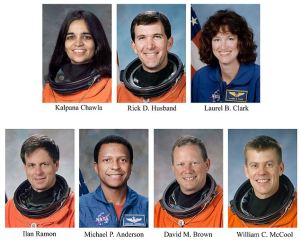 STS-107 launched from the Kennedy Space Center aboard the Space Shuttle Columbia on January 16, 2003. A piece of insulating foam broke away from the external fuel tank eighty seconds after launch, striking Columbia’s left wing and leaving a small hole in the carbon composite tiles along the leading edge. Three previous Space Shuttle missions had experienced similar damage and, while some engineers thought this one could be more serious, they were unable to pinpoint the precise location or extent of the damage. NASA managers believed that, even if there had been major damage, little could be done about it.
 Payload Specialist Colonel Ilan Ramon, born Ilan Wolferman, was an Israeli fighter pilot and the first Israeli astronaut to join the NASA space program. Colonel Ramon’s mother is an Auschwitz survivor, his grandfather and several family members killed in the Nazi death camps. In their memory, Ramon carried a copy of “Moon Landscape”, a drawing by 14 year old holocaust victim Petr Ginz, depicting what the boy thought earth might look like from the moon. Today, there are close to 84,000 pieces of Columbia and assorted debris, stored in the Vehicle Assembly Building at the Kennedy Space Center. To the best of my knowledge, that drawing by a 14 year old boy who never made it out of Auschwitz, is not among them.

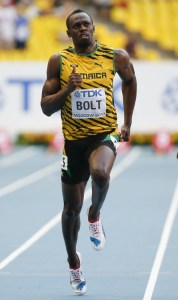 Roger Bannister became the first human to run a sub-four minute mile on May 6, 1954, with an official time of 3 minutes 59.4 seconds. The Jamaican sprinter Usain Bolt is recorded as the fastest man who ever lived. At the 2009 World Track and Field Championships, Bolt ran 100 meters at an average 23.35 mph from a standing start, and the 20 meters between the 60 & 80 markers at an average 27.79 mph.
 smashing the elevated train tracks on Atlantic Ave and hurling entire buildings from their foundations. Horses, wagons, and dogs were caught up with broken buildings and scores of people as the brown flood sped across the North End. Twenty municipal workers were eating lunch in a nearby city building when they were swept away, parts of the building thrown fifty yards. Part of the tank wall fell on a nearby fire house, crushing the building and burying three firemen alive.
 In 1983, a Smithsonian Magazine article described the experience of one child: “Anthony di Stasio, walking homeward with his sisters from the Michelangelo School, was picked up by the wave and carried, tumbling on its crest, almost as though he were surfing. Then he grounded and the molasses rolled him like a pebble as the wave diminished. He heard his mother call his name and couldn’t answer, his throat was so clogged with the smothering goo. He passed out, then opened his eyes to find three of his four sisters staring at him”.


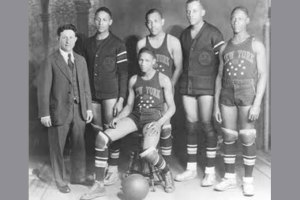
 multi-sport athlete and teammate of Satchel Paige, Tatum would entertain the crowd with comedic routines whenever he put a runner out. He was 6’4″ with an 84″ wingspan, able to touch his knees without bending. He’s credited with inventing the hook shot, an early version of the “skyhook” that would make Kareem Abdul-Jabbar famous, 30 years later.
 third Caucasian, the first-ever white player to be offered a contract, Bob Karstens. Karstens was the newest showman on the team, creating the signature pregame “Magic Circle,” the behind-the-back backhand shot, the “yo-yo” basketball and the “goofball,” a basketball filled with weights to give it a crazy bounce. It was the early 1940s and the Harlem Globetrotters were the most famous, and the most profitable, professional basketball franchise in the world.
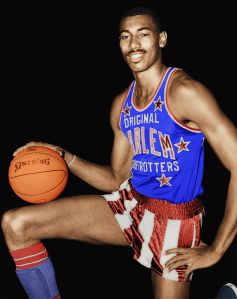
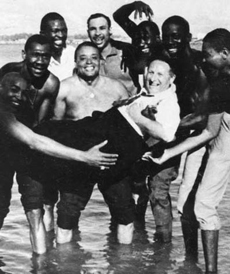 Abe Saperstein passed away in 1966, aged 63. The owner and founder of the Harlem Globetrotters, he was also founder and first Commissioner of the American Basketball League, and inventor of the three point shot. Elected to the Basketball of Fame in 1971. Here’s a great trivia question for you. At 5’3″, Saperstein is the shortest male member in the place. In 2005, he was inducted into the National Jewish Sports Hall of Fame.


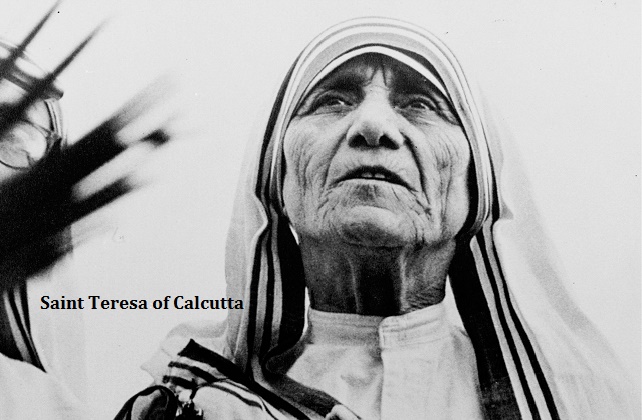
 The Sisters taught English to school children in India, a language which Agnes learned in the Loreto Abbey in Rathfarnham, Ireland.
 Awarded the Nobel Peace Prize in 1979, she refused the traditional honor banquet, requesting instead that the $192K cost of the banquet be given to help the poor of India.


 When Caesar went to Egypt in 48BC, he was impressed with the way they handled their calendar. He hired the Alexandrian astronomer Sosigenes to help straighten things out. The astronomer calculated that a proper year was 365¼ days, which more accurately tracked the solar, and not the lunar year. “Do like the Egyptians”, he might have said, the new “Julian” calendar going into effect in 46BC. Caesar decreed that 67 days be added that year, moving the New Year’s start from March to January 1. The first new year of the new calendar was January 1, 45BC.

 The Artkraft Strauss sign company designed a 5′ wide, 700lb ball covered with incandescent bulbs. The ball was hoist up the flagpole by five men on December 31, 1907. Once it hit the roof of the building, the ball completed an electric circuit, lighting up a sign and touching off a fireworks display.
 continues. The ball used the last few years is 12′ wide, weighing 11,875lbs; a great sphere of 2,688 Waterford Crystal triangles, illuminated by 32,256 Philips Luxeon Rebel LED bulbs and producing more than 16 million colors. It used to be that the ball only came out for New Year. The last few years, you can see the thing, any time you like.

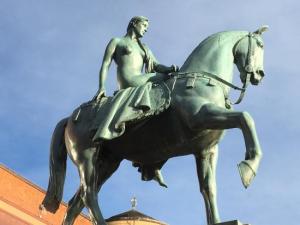 repeal the tax on one condition; that she ride a horse through the streets of town, dressed only in her birthday suit and her long hair. Lady Godiva took him at his word. She issued a proclamation that all townspeople stay indoors and shut their windows, and then she took her famous naked ride through town.
 On December 31, 1695, King William III decreed a 2 shilling tax on each house in the land. Not wanting to miss an opportunity to “stick-it-to-the-rich”, there was an extra tax on every window over ten, a tax that would last for another 156 years.


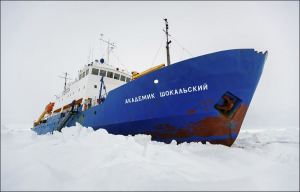 Back in 2013, EU politicians were discussing a way of taxing livestock flatulence, as a means of curbing “Global Warming”. At that time there was an Australian ice breaker, making its way to Antarctica to free the Chinese ice breaker, that got stuck in the ice trying to free the Russian ship full of environmentalists. They were there to view the effects of “Global Warming”, before they got stuck in the ice.

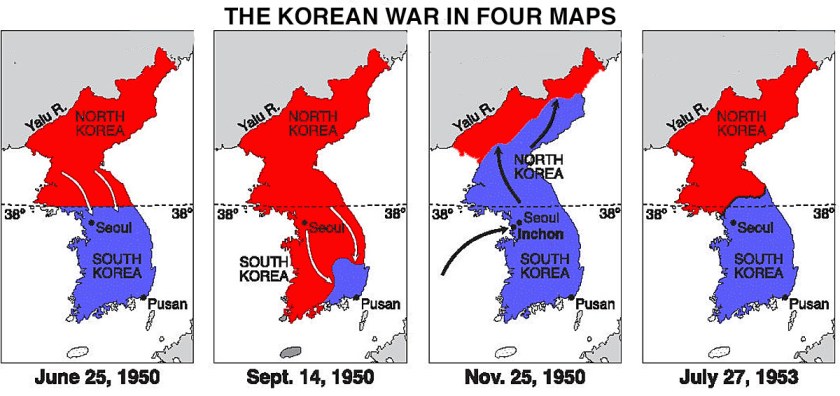 Sixteen countries sent troops to South Korea’s aid, about 90% of them Americans. The Soviets sent material aid to the North, while Communist China sent troops. The Korean War lasted three years, causing the death or disappearance of over 2,000,000, combining military and civilian.
 South Korea went through a series of military dictatorships from the ‘60s to the ‘80s, since developing into a successful Republic. In the North, Kim Il-sung built a communist hellhole, a cult of personality established under a North Korean ideology known as “Juche”, (JOO-chay).
 that would make Caligula blush, he had South Korean film maker Shin Sang-ok kidnapped along with his actress ex-wife, Choi Eun-hee. After four years spent starving in a North Korean gulag, the couple accepted Kim’s “suggestion” that they re-marry and go to work for him, producing the less-than-box-office-smash “Pulgasari”, a kind of North Korean Godzilla film.
 North Korea broke ground on what foreign media called “the worst building in the world” in 1987, just in time for the Seoul Olympics the following year. With 105 stories and eight revolving floors, the Ryugyong would have been the tallest hotel in the world, if it ever opened. Construction shut down in 1992, partly because Soviet funding dried up, and partly because construction was so bad that it’s unsafe to stand within 10 blocks of the thing. In 2008, Orascom Telecom of Egypt agreed to spend $180 million to put glass on the outside, in exchange for a $400 million contract to build the nation’s first 3G cellular network. Whether there will ever be more than one customer, is unclear. Perhaps 2017 will be the year that the Ryugyong becomes more than the world’s largest telecommunications antenna, but so far the place remains “too popular to take reservations”.
 Anywhere from 1 to 3 million North Koreans starved to death during the ‘90s, while it’s estimated that one in every hundred North Korean citizens are incarcerated in a system of gulags, torture chambers and concentration camps.


 Ambrose Bierce was born in Horse Cave Creek, Ohio, to Marcus Aurelius and Laura Sherwood Bierce, the 10th of 13 children, all with names beginning with the letter “A”.
 number on speed dial. In Bierce’s day, he’d better carry a gun. Ambrose Bierce didn’t shy away from politics, he jumped right in, frequently using a mock dictionary definition to lampoon his targets. One example and my personal favorite, is “Politics: A strife of interests masquerading as a contest of principles. The conduct of public affairs for private advantage”.
 off limits. Politics was a favorite target of his columns, such as: “CONSERVATIVE, n: A statesman who is enamored of existing evils, as distinguished from the Liberal who wishes to replace them with others”, or “POLITICIAN, n. An eel in the fundamental mud upon which the superstructure of organized society is reared. When he wriggles he mistakes the agitation of his tail for the trembling of the edifice. As compared with the statesman, he suffers the disadvantage of being alive”.
 Gwinnett Bierce was executed by firing squad in the town cemetery. It’s as good an ending to this story as any, as one hundred and three years ago today is as good a day as any on which to end it. The fact is that in that 103 years, there’s never been a trace of what became of him, and probably never will be.


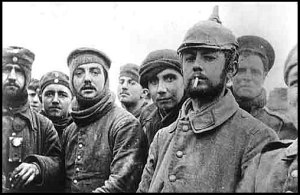 Captain Bruce Bairnsfather later wrote: “I wouldn’t have missed that unique and weird Christmas Day for anything. … I spotted a German officer, some sort of lieutenant I should think, and being a bit of a collector, I intimated to him that I had taken a fancy to some of his buttons. … I brought out my wire clippers and, with a few deft snips, removed a couple of his buttons and put them in my pocket. I then gave him two of mine in exchange. … The last I saw was one of my machine gunners, who was a bit of an amateur hairdresser in civil life, cutting the unnaturally long hair of a docile Boche, who was patiently kneeling on the ground whilst the automatic clippers crept up the back of his neck.”
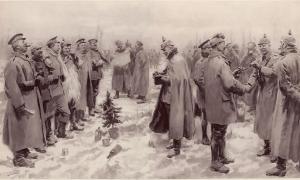 December 24-25, 1914, lasting in some sectors until New Year’s Day.


You must be logged in to post a comment.