May 10, 1941 Prisoner #7

The last of the other inmates had left by 1966, leaving #7 the prison’s only occupant. Warden Bird wrote a book in 1974, titled “The Loneliest Man in the World”, about his relationship with Hess during his 30 years’ confinement.

At the end of WWI, Rudolf Walter Richard Hess enrolled in the University of Munich.  He’d been wounded several times in the Great War, serving in the 7th Bavarian Field Artillery Regiment. As a student, Hess studied geopolitics under Karl Haushofer, an early proponent of “Lebensraum” (“living space”), the philosophy which later became a central plank in the Nazi Party political platform.

rudolf-hess-nazi rallyHess was an early and ardent proponent of Nazi ideology.  A True Believer. He was at Hitler’s side during the failed revolution of 1923, the “Beer Hall Putsch”. He served time with Hitler in prison, and helped him write his political opus “Mein Kampf” (My Struggle). Hess was appointed to Hitler’s cabinet when the National Socialist German Workers’ Party seized power in 1933, becoming Deputy Führer, #3 after Hermann Göring and Hitler himself. Hess signed many statutes into law, including the Nuremberg Laws of 1935, depriving the Jews of Germany of their rights and property.

Obsessed as he was with race theory, Hitler believed that, as fellow Anglo Saxons, the British people were meant to be natural allies to Germany.  If only they could get rid of Churchill, he believed, the two nations might be able to work things out. Churchill and Hitler deeply hated one another, but there were many in Great Britain, including much of the landowning aristocracy, London financiers and media moguls, who regarded the Soviet Union as the greater threat.rudolf-hess-plane

Rudolf Hess flew into Scotland on May 10, 1941, parachuting to earth as his Messerschmidt two-seat aircraft ran out of gas. It’s unclear whether the scheme was Hess’ own idea or if it had official sanction. It was a cockamamie scheme, in which he intended to arrange peace talks with Douglas Douglas-Hamilton, 14th Duke of Hamilton, believing him to be a prominent opponent of the British government. The Deputy Führer was immediately arrested, remaining in British custody until the end of the war, when he was returned to Germany for the 1946 Nuremberg Trials.

Hess mental state seems to have declined while under British custody and questions were raised about his sanity and fitness to stand trial.  Judges decided that he understood the charges against him and was capable of defending himself.  Hess did himself no good at trial, declaring his late Führer to be “the greatest son my Volk has brought forth in its thousand-year history”. He testified that he wouldn’t change a thing about having worked for the man, saying “I regret nothing.”Hess at Nuremberg

Nine months later, the court acquitted Hess of war crimes and crimes against humanity, apparently deciding that his earlier persecution of Jews to be insufficiently connected to their later annihilation.  Hess was convicted of conspiracy to wage aggressive war and of crimes against peace and sentenced to life in prison, transferred to Spandau Prison in West Berlin, and placed under the authority of the four major allied powers. Spandau had once housed as many as 600 prisoners.   There he was stripped of his name and given a number, #7, one of 8 former Nazi officials imprisoned there.  After July 18, 1947, those eight became the only inmates to occupy the facility.

Hess’ fellow convicts were gradually released from the prison, as their terms expired or on compassionate grounds. His main companion at this time was his jailer, warden Eugene K. Bird, with whom Hess became close friends. The last of the other inmates had left by 1966, leaving #7 the prison’s only occupant. Warden Bird wrote a book in 1974, titled “The Loneliest Man in the World”, about his relationship with Hess during his 30 years’ confinement.

Spandau
Changing the Guard at Spandau

Attempts by family members and prominent politicians to get him released were blocked by Soviet authorities, who believed him to be a principle architect of Barbarossa, the Nazi sneak attack on the Soviet Union in 1941. On August 17, 1987, #7 tied a lamp cord to a window latch and hanged himself with it. He was 93.

Spandau prison was demolished following the death of its final remaining prisoner, the rubble dumped into the North Sea to prevent the place from becoming a Neo-Nazi shrine,

May 9, 1914 The History of Mother’s Day

Following her mother’s death in 1905, Anna Jarvis conceived of Mother’s Day as a way to honor her legacy, and to pay respect for the sacrifices that all mothers make on behalf of their children.

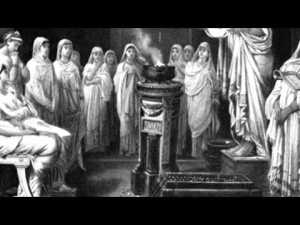
The earliest discernible Mother’s day comes from 1200-700BC, descending from the Phrygian rituals of modern day Turkey and Armenia. “Cybele” was the great Phrygian goddess of nature, mother of the Gods, of humanity, and of all the beasts of the natural world, her cult spreading throughout Eastern Greece with colonists from Asia Minor.Women in Rome

Much of ancient Greece looked to the Minoan Goddess Rhea, daughter of the Earth Goddess Gaia and the Sky God Uranus, mother of the Gods of Olympus. Over time the two became closely associated with the Roman Magna Mater, each developing her own cult following and worshipped through the period of the Roman Empire.

In ancient Rome, women partook of a festival, strictly forbidden to Roman men. So strict was this line of demarcation that only women were permitted even to know the name of the deity.  For everyone else she was simply the “Good Goddess”. The Bona Dea.

In the sixteenth century, it became popular for Protestants and Catholics alike to return to their “mother church” whether that be the church in which they were baptized, the local parish church, or the nearest cathedral. Anyone who did so was said to have gone “a-mothering”. Domestic servants were given the day off and this “Mothering Sunday”, the 4th Sunday in Lent, was often the only time when whole families could get together. Children would gather wild flowers along the way, to give to their own mothers or to leave in the church. Over time the day became more secular, but the tradition of gift giving continued.

Ann Maria Reeves Jarvis

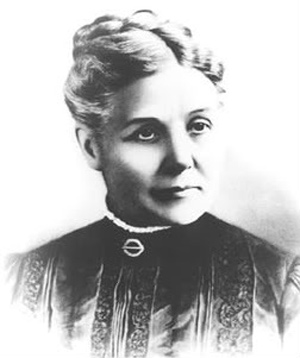
Ann Maria Reeves Jarvis was a social activist in mid-19th century western Virginia.  Pregnant with her sixth child in 1858, she and other women formed “Mothers’ Day Work Clubs”, to combat the health and sanitary conditions which were leading at that time to catastrophic levels of infant mortality.  Jarvis herself gave birth between eleven and thirteen times in a seventeen year period.  Only four would live to adulthood.

Jarvis had no patience for the sectional differences that led the nation to Civil War, or which led her own locality to secede and form the state of West Virginia in order to rejoin the Union.  Jarvis refused to support a measure to divide the Methodist church into northern and southern branches.  She would help Union and Confederate soldier alike if she could.  It was she alone who offered a prayer when others refused, for Thornsbury Bailey Brown, the first Union soldier killed in the vicinity.

Anna Jarvis
Anna Jarvis

Following Jarvis’ death in 1905, her daughter Anna conceived of Mother’s Day as a way to honor her legacy and to pay respect for the sacrifices that all mothers make on behalf of their children.

Obtaining financial backing from Philadelphia department store owner John Wanamaker, Anna Jarvis organized the first official Mother’s Day celebration at a Methodist church in Grafton, West Virginia. That same day, thousands attended the first Mother’s Day event at Wanamaker’s store in Philadelphia.

Anna Jarvis resolved that Mother’s Day be added to the national calendar, and a massive letter writing campaign ensued. On May 9, 1914, President Woodrow Wilson signed a measure declaring the second Sunday of May, to be Mother’s Day.

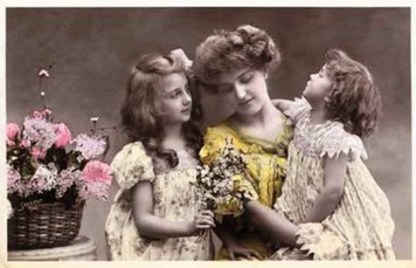
Mothers-Day-1919Anna Jarvis believed Mother’s Day to be a time of personal celebration, a time when families would gather to love and honor their mother.
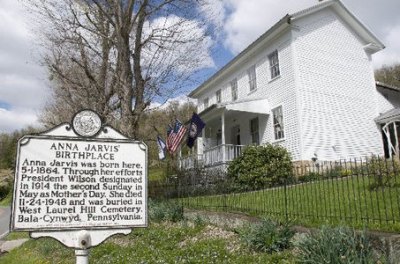
In the early days she had worked with the floral industry to help raise the profile of Mother’s Day. By 1920 she had come to resent what she saw as the commercialization of the day.  Greeting cards seemed a pale substitute for the hand written personal notes she envisioned. Jarvis protested a Philadelphia candy maker’s convention in 1923, deriding confectioners, florists and even charities as “profiteers”. Carnations had by this time become symbolic of Mother’s Day, and Jarvis resented that they were being sold at fundraisers.  She protested at a meeting of the American War Mothers in 1925 where women were selling carnations, and got herself arrested for disturbing the peace.Anna-House1

Soon she was launching an endless series of lawsuits against those she felt had used the “Mother’s Day” name in vain.

During the last years of her life, Anna Jarvis lobbied the government to take her creation off of the calendar, gathering signatures door-to-door to get the holiday rescinded. The effort was obviously unsuccessful.  The mother of mother’s day died childless in a sanitarium in 1948, her personal fortune squandered on legal fees.

Today, some variation of Mother’s Day is observed from the Arab world to the United Kingdom. In the United States, Mother’s Day is one of the most commercially successful days of the year for flower and greeting card sales, and the biggest day of the year for long-distance telephone calls. Church attendance is the third highest of the year, behind only Christmas and Easter. Many churchgoers celebrate the day with carnations:  colored if the mother is still living and white if she has passed on.

Happy Mother’s Day.


May 8, 1877 Westminster Dog Show

1,200 dogs arrived for that first show, in an event so popular that the originally planned three days morphed into four.

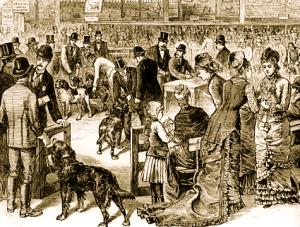
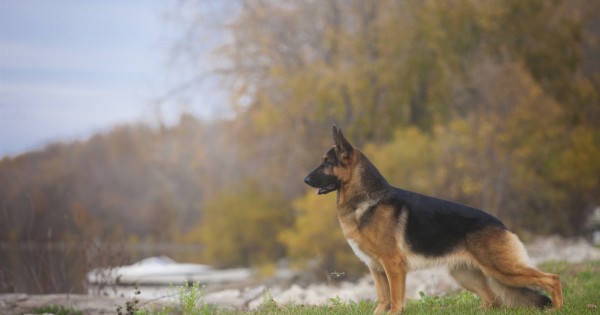
westminsterdogshowThe world’s most famous dog show was first held on May 8, 1877, and called the “First Annual NY Bench Show.” The venue was Gilmore’s Garden at the corner of Madison Avenue and 26th Street, a hall which would later be known as Madison Square Garden.  Interestingly, another popular Gilmore Garden event of the era was boxing.  Competitive boxing was illegal in New York in those days, so events were billed as “exhibitions” or “illustrated lectures.” I love that last one.
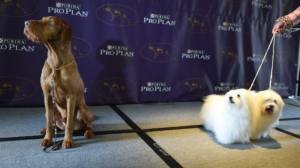
It was originally a show for hunting dogs, mostly Setters and Pointers with a few Terriers.  A group of hunters used to meet at the Westminster Hotel at Irving Place & 16th Street, in Manhattan.  The Westminster Kennel Club was formed by this group when they first decided to hold a dog show.  When you think of the 2nd amendment purgatory that is Warren Wilhelm (Bill) DiBlasio’s New York, it’s amusing to think that original prizes included pearl handled revolvers.

new-westminster-breeds1,200 dogs arrived for that first show, in an event so popular that the originally planned three days morphed into four.  The Westminster Kennel Club donated all proceeds from the fourth day to the ASPCA, for the creation of a home for stray and disabled dogs.  The organization remains supportive of animal charities, to this day.
The Westminster dog show is the longest continuously held sporting event in the United States, with the sole exception of the Kentucky Derby, which began only two years earlier.

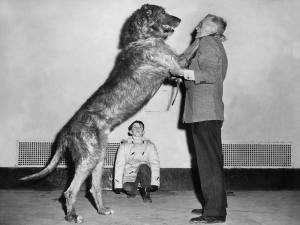
Not even two World Wars could stop Westminster.  A tugboat strike cut two days down toWolfhound one in 1946.  Even so, “Best in Show” was awarded fifteen minutes earlier than it had been, the year before. I wonder how many puppies were named “Tug” that year.  The Westminster dog show was first televised in 1948, three years before the first nationally televised college football game.
When the American Kennel Club was founded in 1884, Westminster was the first club to be admitted.  Breed parent clubs such as the German Shepherd Dog Club of America develop breed standards, extensive written descriptions of what the perfect specimen looks like for any given breed.  Some of the traits which distinguished the original working dogs of 1877 are still apparent, while other elements are seemingly arbitrary, such as tail carriage, eye shape and color.

Dogs are judged first against others of their own breed, and then the best of each goes forward into one of seven groups:  Sporting, Hound, Working, Terrier, Toy, Non-Sporting, and Herding.  In the final round, the winners from each of these seven groups compete for “Best in Show”, of which there can be only one.

Mixed breeds have been permitted since 2014, to compete in an agility event.

Warren_remedy
Ch. Warren Remedy

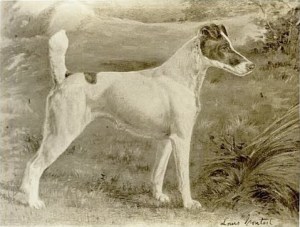
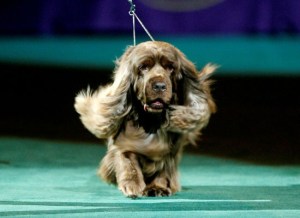
A Smooth Fox Terrier named Ch.(Championship) Warren Remedy won the top award in 1907, 1908 and 1909, the only dog to ever win three Best in Shows at Westminster.  Seven dogs have twice taken the top award, and five owners have won Best in Show with more than one dog.  A Sussex Spaniel named Stump became the oldest winner in dog show history in 2009, at the age of 10.  Judge Sari Tietjen said she had no idea the winning dog was a senior citizen.  “He showed his heart out,” she said. “I didn’t know who he was or how old … I just couldn’t say no to him”.

Stump
Stump

Today, the Westminster dog show runs two days and nights in February.  Entry is limited to 2,800 dogs and fills up on the first day of registration.  Breed judging takes place during the day at Piers 92 and 94. Group and Best in Show competition takes place in the evening at Madison Square Garden. Since 1992, Westminster has invited the top five dogs from each breed to pre-enter, based on dog show performances of the preceding year.

Madison Square Garden generally sells out for the event, the WKC issuing up to 700 press credentials for media attending from no fewer than 20 countries.  Each year the Westminster website www.westminsterkennelclub.org receives 20 million page views from 170 countries.

Algonquin-CatSince the late 60s, the Westminster Best in Show winner has celebrated at Sardi’s, a popular mid-town eatery in the theater district and birthplace of the Tony award.  And then the Nanny State descended, pronouncing that 2012 would be their last.  There shalt be no dogs dining any restaurants, not while Mayor Bloomberg is around.
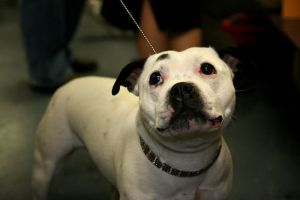
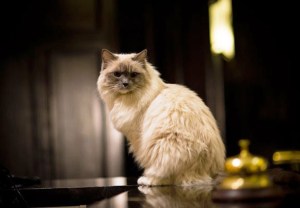
The Algonquin, the historic hotel at the corners of 59th St. W. & 44th, took in a stray cat sometime back in the 1930s.  A succession of felines have had the run of the place ever since. The males have all been “Hamlet”, and the females called “Matilda”.Staffordshire_Bull_Terrier_Westminster_Dog_Show

Mayor Yourslurpeeistoobig Bloomberg’s Board of Health descended on the Algonquin in 2011, requiring that the cat be kept on a leash.  There ensued a tempest in a cat box, until a compromise was reached later that year. An electronic pet fence would be installed, confining the cat to non-food areas of the hotel.

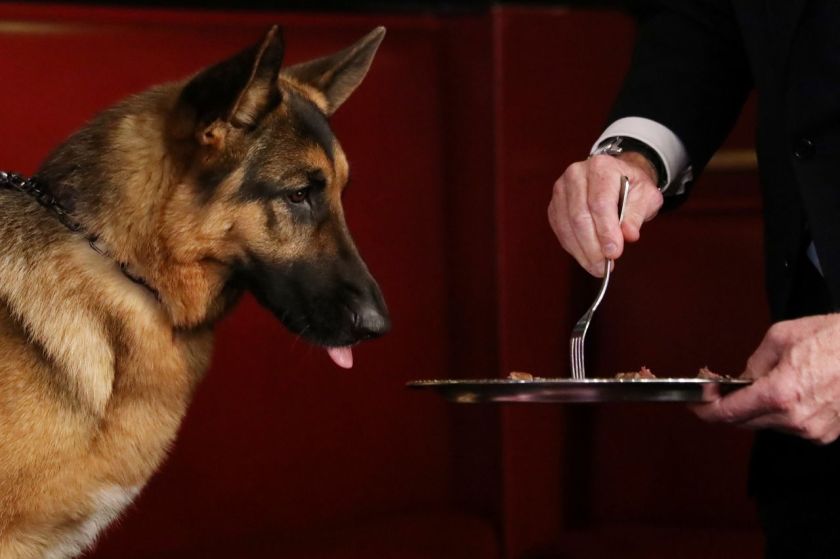
Not wanting another such drama, Nanny Bloomberg pulled his health commissioner, Dr. Thomas Farley, aside.  By the end of the week, the health department had found a loophole to defuse the standoff:  Dr. Farley would issue a waiver.  Since then, the winner at Westminster is free to enjoy the traditional celebratory luncheon of diced chicken and rice off a silver platter.  Provided that it’s eaten in the back room.

SardisDinner


May 1, 1863  Flags of the Confederacy

I find it infinitely preferable that we learn from our history, rather than hide from it.

Last week, New Orleans authorities took to the dead of night, to remove monuments to the history of their own city.   The recent fuss about the “Confederate Flag” has faded away, sort of, not so the political atmosphere that gave it birth.   For all that, it seems worth pointing out:  the “Stars and Bars” with which we’ve all become so familiar, never was the flag of the Confederate States of America.  It wasn’t even the real Stars & Bars.

Battle_of_Sullivans_Island
Battle of Sullivan’s Island, 1776

On June 28, 1776, British General Sir Henry Clinton ordered the ship Thunder to attack the Continental fortification on Sullivan’s Island, in Charleston Harbor. The fighting was furious and lasted 16 hours and more. At one point, a British shell tore the flagstaff away. In full view and under constant fire, Sergeant William Jasper of the 2nd South Carolina retrieved the fallen flag of his regiment and fixed it to an artilleryman’s sponge pole. There he stood on the parapet, holding the flag under fire until a new pole could be installed.

Jasper’s heroism had rallied his forces to fight on.  Governor John Rutledge gave him his personal sword, in recognition of his bravery.  The battle was a humiliating defeat for a British fleet that hadn’t been beaten in 100 years. It was four years before they’d take another run at Charleston.

SC secession flag
SC Secession Flag

The Liberty Flag or Moultrie flag became a standard for South Carolina militia. A palmetto was added in 1861, a reference to the palm trunks laid over the sand walls of Fort Moultrie, which had helped withstand that British bombardment of 85 years earlier. A variant of this flag appeared at South Carolina’s secession conventions, as did militia and state flags in all the state secession conventions.

Bonnie Blue Flag
Bonnie Blue Flag

When Mississippi seceded in January 1861, a blue flag with a single white star was flown from the capitol dome. This, the first and unofficial flag of the Confederacy, came to be called the “Bonnie Blue Flag”, closely patterned after the flag flown over the short-lived Republic of West Florida in 1810, and adopted by the Congress of the Republic of Texas on December 10, 1836.


The first national flag of the Confederate States of America, the real Stars and Bars, was similar in design to the United States flag. A blue field containing seven, nine, eleven and finally thirteen stars, depending on the period, appeared in the “canton”, or upper left corner. Three stripes of equal height ran from hoist to fly end, alternating red to white and back to red.

Stars and bars
Stars and Bars

Regiments of the era carried flags to help commanders observe and assess the progress of battle. At a distance, the Stars and Bars and the Stars and Stripes were hard to tell apart, particularly in still conditions, or when smoke clouded the view.

The similarity between the two national flags led to confusion at the first battle of Manassas, also known as the first battle of Bull Run. After the battle, Confederate General Pierre Gustave Toutant Beauregard wrote that he was “resolved then to have [our flag] changed if possible, or to adopt for my command a ‘Battle flag’, which would be entirely different from any State or Federal flag”.

The star studded diagonal stripes of the St. Andrew’s Cross is what resulted, becoming Beauregard’s battle flag, as well as that of the Army of Tennessee, the Army of Northern Virginia, and the ensign of the Confederate Navy.

Most submissions for the second national flag incorporated the battle flag into the design. The winning design adopted on May 1, 1863, was called the “Stainless Banner”, placing the Saint Andrews Cross in the canton, the rest of the flag pure white. Visibility remained an issue with this design as with the first; as it was often misinterpreted as a flag of surrender.

stainless-banner-david-andrews
Stainless Banner

The third national flag, also known as the “Blood Stained Banner”, was adopted March 4, 1865. This last design retained the white background with the same canton as before, but now there was a vertical red stripe on the fly end.

The Confederate battle flag enjoyed renewed popularity during the first half of the 20th century. Several WWII military units with Southern nicknames, made the flag their unofficial emblem. The USS Columbia flew a Confederate Navy Ensign throughout combat in the South Pacific. A Confederate battle flag was raised over Shuri Castle after the Battle of Okinawa, by a Marine from Company A of the 1st Battalion, 5th Marines; the self-styled “Rebel Company”. It was visible for miles and was taken down after three days on the orders of General Simon Bolivar Buckner, Jr., son of Confederate general Simon Bolivar Buckner. “Americans from all over are involved in this battle”, said Buckner, replacing it with the US flag.

Blood stained banner
Blood Stained Banner

According to Civil War historian and native Southerner Shelby Foote, the flag traditionally represented the South’s resistance to Northern political dominance.

The symbol became highly controversial during the Civil Rights era, and disagreement continues over its symbolism. Supporters of the flag view it as a symbol of southern heritage and the independence of the distinct cultural tradition of the American South. Civil rights groups associate it with a history of racial discrimination and the institution of slavery.

Now, we have the current government in New Orleans, taking to the dark of night, to remove Confederate memorials from the streets of that city.

In writing these history essays, I hope to learn something new about a subject which interests me.  I enjoy the responses of those who feel the same way. There’s plenty of time for politics and I don’t intend that this blog be the place for it.  Except to say:  I find it infinitely preferable that we learn from our history, rather than hiding from it.

April 29, 1915 The Wipers Times

My favorite among the classified ads has to be the “Flammenwerfer” – Flame Thrower. “Guaranteed absolutely harmless.” “Instructive – Amusing”.

Second YpresAs chief of the Imperial German general staff from 1891-1905, German Field Marshal Alfred von Schlieffen devised the strategic roadmap by which Germany prosecuted the first world war. The “Schlieffen Plan” could be likened to a bar fight, where a fighter (Germany) had to take out one guy fast (France), before turning and facing his buddy (Imperial Russia). Of infinite importance to Schlieffen’s plan was the westward sweep through France, rolling the country into a ball on a timetable before his armies could turn east to face the “Russian Steamroller”. “When you march into France”, Schlieffen had said, “let the last man on the right brush the Channel with his sleeve.”Ypres
Field Marshall Helmuth von Moltke once said “No battle plan ever survives contact with the enemy”.  So it was in the tiny Belgian city where German plans were broken, on the road to Dunkirk. Native Dutch speakers called it Leper, today we know it as Ypres (Ee-press), since the battle maps of the time were drawn up in French. The Tommys of the British Expeditionary Force (BEF), called the place “Wipers”.

What had hitherto been a war of movement ground to a halt in the apocalyptic fighting around Ypres, in October-November, 1914. 104,920 on all sides were killed, wounded or missing, around a city roughly the size of my little town of Falmouth, on Cape Cod.

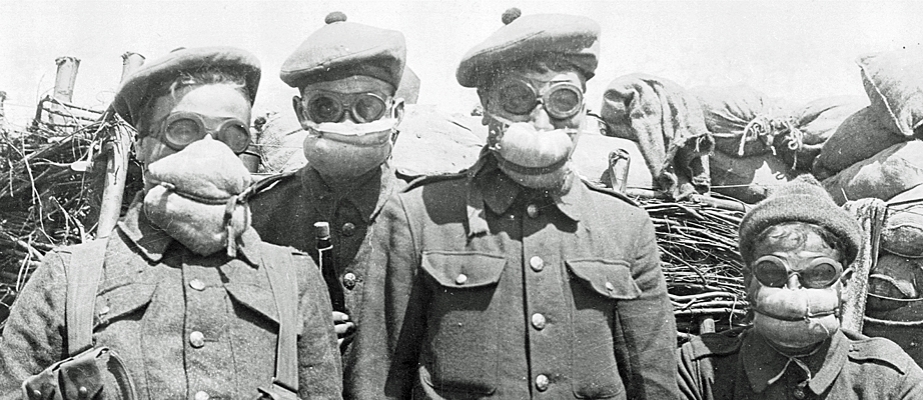
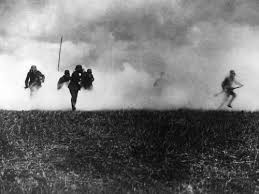
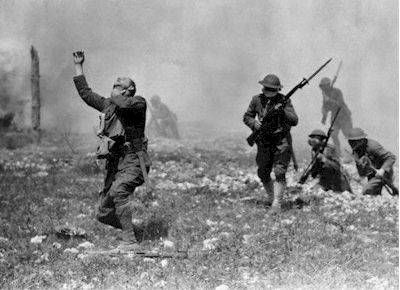
The-Wipers-Times-300x400The second Battle of Ypres began with a new and terrifying weapon, on April 22, 1915. German troops placed 5,730 gas cylinders weighing 90 pounds apiece, along a four mile front. Allied troops must have looked on in wonder, as that vast yellow-green carpet crept toward their lines. Chlorine gas forms hypochlorous acid when combined with water, destroying the moist tissues of the lungs and eyes. Heavier than air, the stuff crept along the ground and poured into the trenches, forcing troops out into heavy German fire. 6,000 casualties were sustained in the gas attack alone, opening a four mile gap in the allied line. Thousands retched and coughed out their last breath, as others tossed their equipment and ran in terror.
After the war, German losses were estimated at 34,933 between April 21 and May 30, BEF casualties numbered 59,275. The French recorded about 18,000 on April 22 alone, with another 3,973 by the 29th of April. All told, 2nd Ypres cost allied forces 87,223 killed, wounded or missing.

The third Battle of Ypres would begin in July of 1917, lasting almost until the end of the war. 3rd Ypres would result in 570,000 losses on all sides, but in early 1916, that was all part of some unknown and terrible future.Offensive as I might be

It’s hard to imagine anything remotely humorous coming out of the horrors of Ypres, but such a thing became possible in the early months of 1916.

The “Sherwood Foresters” were line infantry Regiments of the British Army, stationed at the front lines of the Ypres salient. Coming across a printing press, a sergeant who had been a printer in peacetime got the thing going. They began to print a trench magazine, the first published on February 12. The paper included poems and reflections, “adverts” and plenty of dark humor.  Written for fellow soldiers, not civilians, some in-jokes are so obscure that their meaning is lost to the modern reader. Others are clearly understandable, even 101 years into their future.

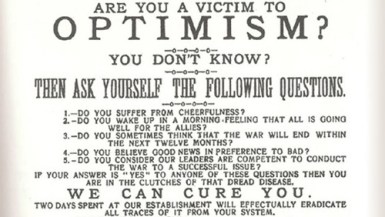
OptimismRichly typeset advertisements for “Music Hall Extravaganzas” include “Tickling Fritz” by the P.B.I. (Poor Bloody Infantry) Film Co. of the United Kingdom and Canada, advising the enthusiast to “Book Early”. There were Real Estate ads for property in no-man’s land. “BUILD THAT HOUSE ON HILL 60. BRIGHT-BREEZY-&-INVIGORATING. COMMANDS AN EXCELLENT VIEW OF HISTORIC TOWN OF YPRES”. Another one read “FOR SALE, THE SALIENT ESTATE – COMPLETE IN EVERY DETAIL! UNDERGROUND RESIDENCES READY FOR HABITATION. Splendid Motoring Estate! Shooting Perfect !! Fishing Good!!!”

There were news features, this one of a bungled trench raid: “”…They climbed into the trench and surprised the sentry, but unfortunately the revolver which was held to his head missed fire. Attempts were made to throttle him quietly, but he succeeded in raising the alarm, and had to be killed.” editor’s note, “This we consider real bad luck for the sentry after the previous heroic efforts to keep him alive””.Flammenwerfer

There were weather reports, laying odds on the forecast. “5 to 1 Mist, 11 to 2 East Wind or Frost, 8 to 1 Chlorine”. My favorite among the classified ads has to be the “Flammenwerfer” – Flame Thrower. “Guaranteed absolutely harmless.”  “Instructive – Amusing”.

It turns out that units of all sizes, from individual companies to army corps, lightened their load with some kind of unit journal in WWI.

The Wipers Times ran through the end of the war, with the exception of the “Operation Michael” period, the last gasp German Western Front offensive of 1918. The final edition, titled “The Better Times”, was published in December 1918, just short of two months after the armistice.   The banner read “Xmas, Peace and Final Number.”

Better Times


April 25, 1976 Don’t Do it Around Me

Rick Monday was playing Center Field for the Cubs. Describing the “protesters”, Monday said “He got down on his knees, and I could tell he wasn’t throwing holy water on it”.

The bottom of the fourth had just started out in Dodger Stadium, when two “protesters” jumped out of the left field bleachers and ran onto the field.

The pair succeeded in soaking an American flag with lighter fluid, but they weren’t quite fast enough with the match.

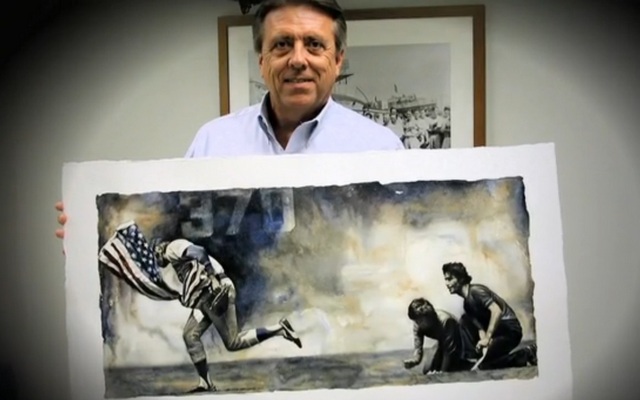
Rick Monday was playing Center Field for the Cubs.  Describing the scene, Monday said “He got down on his knees, and I could tell he wasn’t throwing holy water on it”.Monday, possum

Monday dashed over and grabbed the flag, to thunderous applause from the 25,167 in attendance. All but two, that is.  By that time. those two were being led off in handcuffs.

When Monday came out to bat in the top of the 5th, he got a standing ovation from Dodger fans, while the message board flashed “RICK MONDAY… YOU MADE A GREAT PLAY…”

The arrested were identified as 37-year old William Errol Thomas, and his eleven year old son. Poor kid.  He’d be 52 now. I wonder how he turned out.

Thomas was convicted of trespassing, and ordered to pay a $60 fine or spend three days in jail. He was unemployed and didn’t have anything better to do, so he took the time.

Rick-Monday-CubsRick Monday had served a tour in the Marine Corp Reserve, in fulfillment of his ROTC obligation after leaving Arizona State. “If you’re going to burn the flag”, he said, “don’t do it around me. I’ve been to too many veterans’ hospitals and seen too many broken bodies of guys who tried to protect it.”

The flag Rick Monday rescued that day was presented to him nine days later by a Dodgers’ executive, during a pregame ceremony at Wrigley Field. He has been offered up to a million dollars to sell the flag.  As of this date he has declined all offers.

You can see the whole episode at the link below. My favorite part has to be that impotent little temper tantrum at the end, when the protester throws his little lighter at the outfielder’s back. Like a runt possum, hissing at a passing stallion.

April 24, 1959 The Day the Music Died

A boy named Don McLean heard about the plane crash while doing his morning paper route. One day, the future singer/songwriter would pen the words “February made me shiver, with every paper I’d deliver”.

Jiles Richardson was a Texas DJ in 1958, the year he found recording success of his own with a song called “Chantilly Lace”.

Richie Valenzuela was only 16 when Del-Fi Records producer Bob Keane discovered the singer in California. “Donna”, a song he had written for his high school sweetheart Donna Ludwig, was on the way to #2 on the Billboard Hot 100, right alongside the 45’s “B” side, an old Mexican standard turned Rock & Roll tune called “La Bamba”. By 1958 he was one of the hottest young recording artists of his time.All three

Charles Hardin Holley, “Buddy” to his friends and family, learned guitar, four-string banjo and lap steel guitar from his older brothers, Travis and Larry. The boy took to music at an early age, winning his first talent contest at the age of five. A music critic would one day describe the Lubbock Texas native as “the single most influential creative force in early rock and roll.” Contemporary and later musicians claiming inspiration from his work include the Beatles, the Rolling Stones, Bob Dylan, and Elvis Costello.

58 years ago, his name changed as the result of a misspelling in a recording contract, Holly was headliner of the “The Winter Dance Party Tour”. Richardson, performing as the “Big Bopper” and Valenzuela, professionally known as Ritchie Valens, were on the tour, along with Dion and the Belmonts, Holly’s friend from Lubbock and fellow musician Waylon Jennings, and a young Owasso, Oklahoma Rockabilly musician and former “Crickets” band member, an enrolled member of the Cherokee Nation named Tommy Allsup.WinterDanceParty

The musical tour included 24 cities in 3 weeks, a grueling schedule under the best of circumstances, but theirs were anything but the best. The tour bus had no heat, and a three-week winter bus tour of the upper Midwest is no place to be without heat. It was so cold that Holly’s drummer, Carl Bunch, suffered frostbite in his feet and left the tour in Clear Lake, Iowa.

Holly was sick of it, and decided to charter a plane for himself and some of his guys. At least that would give him time to do laundry before the next performance.

Dwyer Flying Service got the charter with a 1947 Beechcraft Bonanza, at $36 per person. There’s a popular story that the four-seater aircraft was called “American Pie”, but the story is a myth. The single engine airplane bore only the tail number: N3794N.

Richardson was running a fever at the time, so Waylon Jennings gave up his seat so the Big Bopper could ride in comfort. Allsup and Valens flipped a coin for the last seat, the coin landing heads up. Ritchie Valens had won the coin toss.

dancepartymapOn learning that Jennings wasn’t going to fly, Holly said “Well, I hope your old bus freezes up.” Jennings replied “Well, I hope your plane crashes.” It was just a good ribbing between friends, but the comment would haunt Jennings for the rest of his life.


N3794N left the ground in a snowstorm, shortly after 1:00am on February 3. The pilot, Roger Peterson, may have been inexperienced with the instrumentation, or he may have become disoriented in near whiteout conditions. One wing hit the ground in a cornfield outside of Clear Lake, and the aircraft corkscrewed into the ground, throwing the three musicians clear of the plane. There was no fire, just a small aircraft being swallowed up in a snow covered cornfield.  The bodies would lie in the field until late that afternoon.American Pie Plane crash

The show would go on. Needing to fill in at the next stop in Moorhead, Minnesota, they found a 15 year old talent across the state line in Fargo, and so began the musical career of Bobby Vee.

A boy named Don McLean heard about the plane crash while doing his morning paper route. One day, the future singer/songwriter would pen the words “February made me shiver, with every paper I’d deliver”.tommys-heads-saloon

Allsup returned to Odessa, resuming his musical career and opening a club in Dallas. in 1979. He called it “Tommy’s Heads Up Saloon”, after the coin toss that saved his life.

Distraught, Buddy Holly’s widow miscarried their only child shortly after the wreck.  His last song, “It Doesn’t Matter Anymore”, reached #1 on the UK charts on April 24, 1959, the first posthumous release ever to do so.  In the US the song charted at 13 on the Billboard Hot 100, it would be his last top 20 hit in the country. Inscribed on Ritchie Valens’ gravestone are the words, “Come On, Let’s Go.”  The last surviving member of Buddy Holly’s 1959 touring band “The Crickets” passed away earlier this year, on January 11.  Tommy Allsup was 85.


April 23, 1982, Conch Republic

The Mayor’s response could best be summed up in the words of Bugs Bunny: “Of course you know, this means war!”

Except for the Naval Air Station at Boca Chica and Coast Guard installations in Key West, Marathon and Islamorada, most if not all economic activity in the Florida Keys comes from tourism. It’s no wonder then, that when the federal government shuts down the only road into town, the locals are going to get cranky.

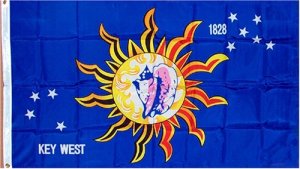
On April 18, 1982, the Mariel boatlift was a mere two years in the past, and very much in the public memory. The United States still had a border in those days, or at least a federal government that tried to enforce it. Border Patrol set up a roadblock in front of Skeeter’s Last Chance Saloon in Florida City, blocking Rt.1, the only road into the Keys. Originally intended to intercept illegals entering the country, the roadblock soon morphed into a hunt for illegal drugs, as well.Conch Republic Flag

Cars waited for hours, in lines that stretched for 19 miles. Predictably, the attitude of federal officials was one of towering indifference, but not so local business owners. Robert Kerstein wrote in his Key West on the Edge — Inventing the Conch Republic, “No one in Key West doubted that drugs were trafficked widely in the Keys by road and by boat. But tourism’s boosters had little tolerance for interruptions to their business.”

Dennis Wardlow, then-mayor of Key West, contacted the chief of police, the Monroe County sheriff, and his State Rep, as well as Governor Bob Graham, demanding the roadblock’s removal. With none of the above having any knowledge of the barrier and lacking the authority to pull it down, Wardlow contacted INS directly. When the Border Patrol told him it was “none of his business,” the Mayor’s response could best be summed up in the words of Bugs Bunny: “Of course you know, this means war!”Key West Review Feb 2014 011

Suffering a blizzard of hotel cancellations, this “attack on Key West’s sovereignty” could not stand. On April 22, Mayor Wardlow, local attorney & pilot David Horan and Old Town Trolley Tours operator Ed Swift flew to Miami seeking legal relief. When District Court Judge C. Clyde Atkins failed to issue an injunction, the Key West delegation took to the courthouse steps.

“What are you going to do, Mr. Mayor”, asked the assembled media. Swift leaned over and whispered into the Mayor’s ear, “Tell them we are going to go home and secede” “We are going to go home and secede!”, said Wardlow, and that’s what they did.

Over the next 24 hours, a group of secessionist co-conspirators worked feverishly to form the new government, filling cabinet positions such as “Secretary of Underwater Affairs” and “Minister of Nutrition”.

Old Customs Building, Key West

On April 23, with federal agents on scene to monitor the proceedings, a crowd gathered before the old customs building. Mayor Wardlow and a gaggle of allies mounted the back of a flatbed truck to read the proclamation of secession. “We serve notice on the government in Washington”, it read, “to remove the roadblock or get ready to put up a permanent border to a new foreign land. We as a people, may have suffered in the past, but we have no intention of suffering in the future at the hands of fools and bureaucrats”.

Battle of the Conch Republic
“Great Battle of the Conch Republic”

With that, Mayor Wardlow declared “war” on the United States.  The “Great Battle of the Conch Republic” broke out in the harbor, when the Schooner Western Union commanded by Captain John Kraus, attacked the Coast Guard Cutter Diligence with water balloons, Conch fritters and toilet paper.  Diligence fought back with water hoses, as the new “Prime Minister” broke a loaf of stale Cuban bread over the head of a man dressed in a Navy uniform. Others launched stale bread and conch fritters at federal agents, Navy sailors and Coast Guard personnel in attendance.

Conch Republic PassportsOne minute after declaring his “verbal shot” at the feds, Wardlow “surrendered” to a nearby naval officer, demanding a billion dollars in “foreign aid” in compensation for “the long federal siege.”

Apparently, that’s what it takes to get the attention of a federal bureaucrat. The roadblock lifted, and soon the restaurants, stores and hotels of the Keys were once again filled with smiling tourists. Key West never got their “foreign aid”, but they never received so much as a letter saying they couldn’t secede, either.

So it is that Key West celebrates its independence this day, April 23. The “Conch Republic’ issues its own passports, and sells t-shirts and bumper stickers with the slogan “We seceded where others failed”. And if the federal government ever comes back to mess with the micro-nation, they’d better be prepared to deal with the Conch Republic’s very own “Special Forces”, whose motto is “Sanctus Merda”.  “Holy Shit”.


Tip of the hat to

“Conch Republic Military Forces

The Official Site of the Conch Republic Military”

Linked Here

for the “Conch Battle Hymn of the Republic”

words by First Sea Lord, Admiral Finbar Gittelman • October 14, 2012 © Finbar Gittelman

Mine eyes have seen the glory of the sunshine and the sea
Right here upon our islands, where we love to live so free
But in April 1982, the peace was not to be
And we went rolling on

CHORUS
Glory glory Conch Republic
From Key to shining Key

They were setting up a check point, tween the mainland and the Keys
They had put a US Border, where it shouldn’t ‘oughta’ be
So that’s when we seceded, and declared our sovereignty
And the fun had just begun

(CHORUS)

We went forth into the harbor and a cutter we did spy
And we sailed up along side her and we took her by surprise
We hoisted up our battle flag, so proudly and so high
And we went sailing on

(CHORUS)

The water and Conch fritters and the Cuban bread did fly
Our bombers, they were raining toilet paper from the sky
Our cannons they did thunder to proclaim our victory
And we fought bravely on

(CHORUS)

We have faced the silly forces of misguided zealotry
We have stood up to their foolishness for all the world to see
And we’ve showed the other nations what America can be From
Key to shining Key

(CHORUS)


April 9, 1974  Open Mouth, Insert Foot

At that moment a roar went up from the crowd, as a streaker jumped out of the stands and onto the field. That’s when he lost it.

The 1974 season opened on the road for the San Diego Padres, the series ending in a humiliating, 25-2 blowout at Dodger’s Stadium.

Padres’ new owner and McDonald’s founder Ray Kroc was anything but pleased with the 0-3 start, saying “They’re snake-bit, and they’ve got the yips. They’re overanxious, trying too hard, too tense”. Kroc was positive, though, at the home opener against the Houston Astros.  Stepping up to the field microphone, Kroc said to the crowd of 39,083 at San Diego Stadium, “With your help and God’s help, we’ll give ‘em hell tonight.”

The home opener at Jack Murphy (now Qualcomm) Stadium on April 9 was no better, ending in a 9 to 5 loss.  In the middle of the eighth, the Padres were well on their way to 0 and 4, when Ray Kroc opened the door of the public address booth and told announcer John DeMott he had something to say.

Kroc had bought the club only two months earlier, when San Diego was in danger of KrocRaylosing its National League team to Washington, DC.  Only moments before,  Padres’ President Buzzie Bavasi had to leave Kroc’s side to investigate concession area water in the clubhouse, when a leak was “promoted” to a flood.

Kroc had to have been cranky when he took the mic in the first place, but it quickly got worse.  “Ladies and gentlemen,” he began, “I suffer with you.”  At that moment a roar went up from the crowd, as a streaker jumped out of the stands and onto the field.

That’s when he lost it.  “Get him out of here. Throw him in jail” Kroc shouted.  Then he continued.  “I have good news and bad news. The good news is that the Dodgers drew 31,000 for their opener and we’ve drawn 39,000 for ours. The bad news is that this is the most stupid baseball playing I’ve ever seen”.

Padres radio announcer Jerry Coleman didn’t know how to respond.  “Ladies and Gentlemen”, he said, “that was Padres owner, Ray Kroc”.

It was a bad idea.  Player representative Willie McCovey spoke for the club. “I wish Mr. Kroc hadn’t done that. I’ve never heard anything like that in my 19 years in baseball. None of us likes being called stupid. We’re pros and we’re doing the best we can. His words will ring in the players’ ears for a long time.”

Players were so angry they threatened to boycott the next game.  San Diego dentist Steve Arlin was the losing pitcher that night.  “We were all embarrassed by it,” he said. “We weren’t playing well, but we didn’t need to be reminded”.

Even opposing players jumped into the fray.  Houston player rep Denis Menke said, “That was in bad taste.”  Menke went on to protest Kroc’s comments to Marvin Miller, head of the players’ union.

Miller thought Kroc’s actions were unacceptable, too.  “Imagine what would have happened if a player, after being taken out of a game, made an announcement over the P.A. that his manager was stupid. The player would be fined or suspended. I see a direct parallel in the Kroc case.”

Astros’ third baseman Doug Rader said, “He thinks he’s in a sales convention dealing with a bunch of short-order cooks. That’s not the way to go about getting a winner. Somebody ought to sit him down and straighten him out.” Within two weeks Rader had received so many angry calls from short order cooks, that he had to make a public apology.

Houston SpatulaBuzzie Bavasi did the most to defuse the situation.  Taking a cue from Rader’s comments, Bavasi designated the next game in the Houston series “Short Order Cook’s Night”.  Any Padres fan who came wearing a chef’s hat, would be admitted into the game for free.  Rader, the Astro’s team captain, took the lineup card to home plate wearing an apron with a chef’s hat, slipping the card off a skillet with a spatula and handing it over to the home plate umpire, like a pancake.
Baseball Commissioner Bowie Kuhn later forced Kroc to make a public apology, but Sporting News columnist Melvin Durslag wasn’t buying it. “The reason (he’d never seen such stupid baseball playing) was largely due to his inexperience at watching baseball.  He knows as much about the sport as Willie McCovey knows about an Egg McMuffin.”

San Diego went on to lose 102 games that year, 42 more than archrival LA Dodgers.  The season wasn’t halfway over, when the new owner wondered what he’d gotten himself into.  I bought the team to have some fun”, Kroc said.  “But it is proving to be about as enjoyable as a wake.  Your own”.

April 7, 1933 A Brief History of Beer

A team of draft horses hauled a wagon up Pennsylvania Avenue, to deliver a case of beer to the White House. It was the first public appearance of the Budweiser Clydesdales

Given the right combination of sugars, almost any cereal will undergo simple fermentation, due to the presence of wild yeasts in the air.  It seems likely our cave-dwelling ancestors experienced their first beer, as the result of this process.

Alulu_Beer_Receipt
From Wikipedia: “Alulu beer receipt – This records a purchase of “best” beer from a brewer, c. 2050 BC from the Sumerian city of Umma in ancient Iraq”.

Starch dusted stones were found with the remains of doum-palm and chamomile in the 18,000-year old Wadi Kubbaniya in upper Egypt.  While it’s difficult to confirm, University of Pennsylvania archaeologist Dr. Patrick McGovern says, “it’s very likely they were making beer there”.

Chemical analysis of pottery shards date the earliest barley beer to 3400BC, in the Zagros Mountains of Iran.

Wine seemed better suited to the sensibilities of the Roman palate, when Tacitus maligned the bitter brew of Germanic barbarians.  Nevertheless, the letters of Roman cavalry commanders from the Roman Britain period, c. 97-103 AD, include requests for more “cerevisia”, for the legionaries.

In North and South America, native peoples brewed fermented beverages from local ingredients, including agave sap, the first spring tips of the spruce tree, and maize.

beer-ingredients
“Ancient cultures used an array of ingredients to make their alcoholic beverages, including emmer wheat, wild yeast, chamomile, thyme and oregano. (Landon Nordeman)” H/T Smithsonian magazine

The Pilgrims left the Netherlands city of Leiden in 1620, hoping for rich farmland and congenial climate in the New World.  Not the frozen, rocky soil of New England.  Lookouts spotted the wind-swept shores of Cape Cod on November 9, 1620, and may have kept going, had they had enough beer.  One Mayflower passenger wrote in his diary: “We could not now take time for further search… our victuals being much spent, especially our beer…”

Prior to the invention of the drum roaster in 1817, malt was typically dried over wood, charcoal, or straw fires, leaving a smoky quality that would seem foreign to the modern beer drinker.  William Harrison wrote in his “Description of England” in 1577, “For the wood-dried malt, when it is brewed, beside that the drink is higher of colour, it doth hurt and annoy the head of him that is not used thereto, because of the smoke”.london-beer-flood

Smoky flavor didn’t trouble the true aficionado of the age.  When the Meux Brewery casks let go in 1814 spilling nearly 400,000 gallons onto the street, hundreds of Britons hurried to scoop it up in pots and pans.  Some even lapped it up, doggy-style.

1,389 were trampled to death and another 1,300 injured in a suds stampede, when someone thought the beer had run out at the coronation of Czar Nicholas II, in 1896.

The 18th amendment, better known as “prohibition”, went into effect at midnight, January 16, 1920. For thirteen years it was illegal to import, export, transport or sell liquor, wine or beer in the United States.

Prohibition PhotoPortable stills went on sale within a week, and organized smuggling was quick to follow. California grape growers increased acreage by over 700% over the first five years, selling dry blocks of grapes as “bricks of rhine” or “blocks of port”. The mayor of New York City sent instructions on wine making, to his constituents.

Smuggling operations became widespread, as cars were souped up to outrun “the law”. This would lead to competitive car racing, beginning first on the streets and back roads and later moving to dedicated race tracks.  It’s why we have NASCAR, today.

Organized crime became vastly more powerful due to the influx of enormous sums of cash.  The corruption of public officials was a national scandal.

MoonshineGaining convictions for breaking a law that everyone hated became increasingly difficult. There were over 7,000 prohibition related arrests in New York alone between 1921 and 1923.  Only 27 resulted in convictions.

Finally, even John D. Rockefeller, Jr., a lifelong teetotaler who contributed $350,000 to the Anti-Saloon League, had to announce his support for repeal.

It’s difficult to compare rates of alcohol consumption before and during prohibition.  If death by cirrhosis of the liver is any indication, alcohol consumption didn’t decrease by more than 10 to 20 per cent.

FDR signed the Cullen–Harrison Act into law on March 22, 1933, commenting “I think this would be a good time for a beer.”  The law went effect on April 7, allowing Americans to buy, sell and drink beer containing up to 3.2% alcohol.

A team of draft horses hauled a wagon up Pennsylvania Avenue, delivering a case of beer to the White House – the first public appearance of the Budweiser Clydesdales.

Clydesdale, Pennsylvania Ave“Dry” leaders tried to prohibit consumption of alcohol on military bases in 1941, but military authorities claimed it was good for morale. Brewers were required to allocate 15% of total annual production to be used by the armed forces. So essential were beer manufacturers to the war effort, that teamsters were ordered to end a labor strike against Minneapolis breweries.  Near the end of WWII, the army made plans to operate recaptured French breweries, to ensure adequate supplies for the troops.

Beer toast18 states continued prohibition at the state level after the national repeal, the last state finally dropping it in 1966. Almost 2/3rds of all states adopted some form of local option, enabling residents of political subdivisions to vote for or against local prohibition.  Some counties remain dry to this day.  Ironically, Lynchburg County, Tennessee, home to the Jack Daniel distillery, is one such dry county.

The night before Roosevelt’s law went into effect, April 6, 1933, beer lovers lined up at the doors of their favorite public houses, waiting for their first legal beer in thirteen years.  A million and a half barrels of the stuff were consumed on April 7, a date remembered today as “National Beer Day”.

So it is that, from that day to this, April 6 is celebrated as “New Beer’s Eve”.  Sláinte.

For every wound, a balm.
For every sorrow, cheer.
For every storm, a calm.
For every thirst, a beer.

timeline