December 30, 1863 The Confederate States of…Bermuda

“The opportunities for Bermudians to profit from blockade running were boundless… The Civil War proved to be the road to riches.”

When South Carolina seceded from the Union in December 1860, it was the first of 11 states to do so. War broke out in April, and the Confederacy desperately needed ships for its fledgling Navy. It needed manufactured goods as well, goods which were no longer available from the industrialized North. The answer, in both cases, was Great Britain. While remaining officially neutral, England soon became primary ship builders and trade partners for the Confederacy.

For the British military, Bermuda had already demonstrated its value. Bermuda based privateers captured 298 American ships during the war of 1812. The place served as a base for amphibious operations as well, such as the 1815 sack of Washington, DC. British Commander Sir Alexander Milne said “If Bermuda were in the hands of any other nation, the base of our operations would be removed to the two extremes, Halifax and Jamaica, and the loss of this island as a Naval Establishment would be a National misfortune”.

slide_18President Abraham Lincoln issued a proclamation soon after taking office, threatening to blockade southern coastlines. It wasn’t long before the “Anaconda Plan” went into effect, a naval blockade extending 3,500 miles along the Atlantic coastline and Gulf of Mexico, up into the lower Mississippi River.

Running the blockade was no small or occasional enterprise. The number of attempts to run the Federal stranglehold have been estimated at 2,500 to 2,800, of which about 2/3rds succeeded. Over the course of the war, the Union Navy captured over 1,100 blockade runners. Another 355 vessels were destroyed or run aground.

runnerbritanniawilmCotton would ship out of Mobile, Charleston, Wilmington and other ports, while weapons and other manufactured goods would come back in. Sometimes, these goods would make the whole trans-Atlantic voyage.  Often, they would stop at neutral ports in Cuba or the Bahamas.
North Carolina and Virginia had long-established trade relations with Bermuda, 600 nautical miles to the east.

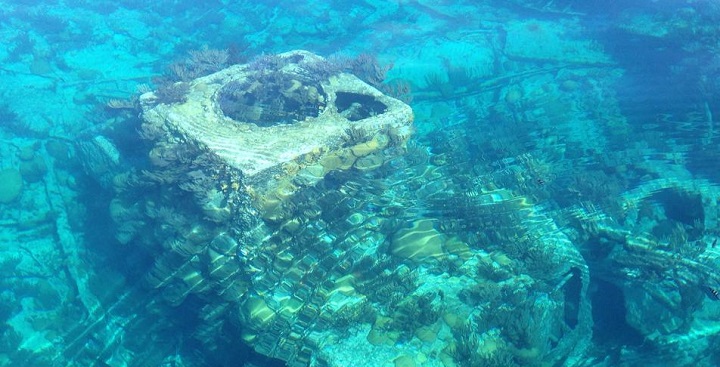
The most successful blockade runners were the fast, paddle wheeled steamers, though surprisingly little is known of the ships themselves. They were usually built in secrecy, and operated at night. One notable exception is the “Nola”, a 236-foot paddle steamer which ran aground on December 30, 1863, en route from London to North Carolina. Nola ran aground, attempting to escape threatening weather. She was wrecked near Western Blue Cut on Bermuda’s reefs, and remains a popular dive destination to this day.

shipwreck-in-bermuda
The blockade runner “Nola” was known at various times as Montana, Gloria, and Paramount.

President Lincoln appointed Massachusetts native Charles Maxwell Allen Consul to Bermuda in 1861, where he remained until his death in 1888. There were times when it was a great job, I’m sure, but not in the early days. “There are a great many Southern people here”, Allen wrote in 1862, “14 came in the steamer ‘Bermuda’. They & their friends are down on me & have threatened to whip me”. People were getting rich running the blockade.  Allen estimated that one blockade runner alone, which sank after three voyages, generated a profit of more than £173,000.

Bermuda-National-Trust-Museum
Bermuda National Trust Museum

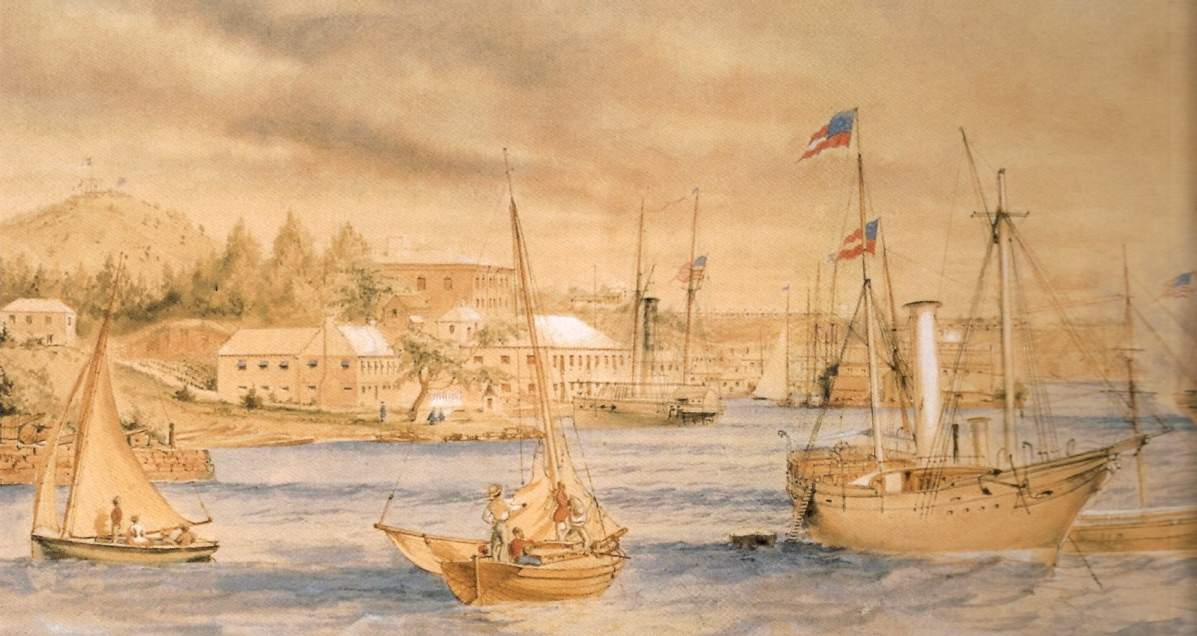
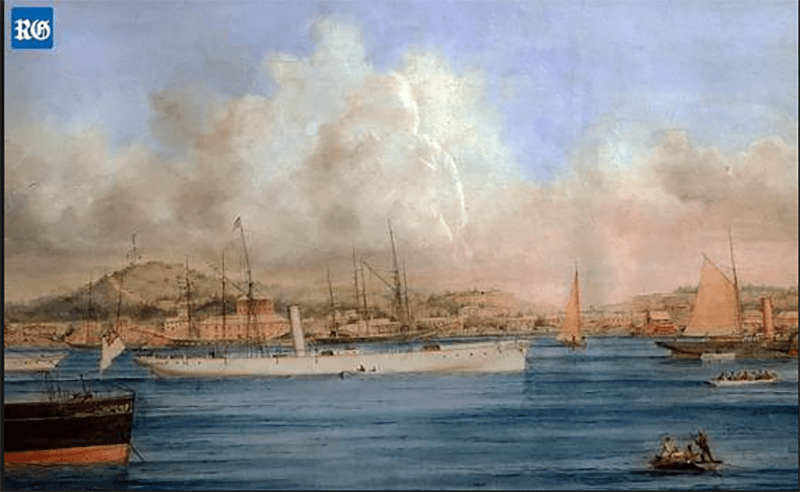
Today, the capital of Bermuda is Hamilton, moved across the island in 1815 from the old port of St. George, leaving the former capital in a kind of time warp, where you can walk down streets that look like they did 150 years ago. Portraits of Robert E. Lee and Confederate battle flags can still be found on the walls of the old port, beside paintings showing the harbor filled with blockade runners, lying quietly at anchor.

Once the office of Confederate Commercial Agent John Tory Bourne and Confederate Shipping Agent Major Norman Walker, today the Bermuda National Trust Museum tells the story of the island’s history, including Bermuda’s role in the American Civil War. The museum’s guide book explains: “The opportunities for Bermudians to profit from blockade running were boundless. Ships needed coal and provisions. Crews required lodging, food and entertainment between runs. Cargoes had to be unloaded, stored and reloaded, while crews and cargoes had to be ferried to ships lying at anchor. Bermudian pilots guided the ships through the reefs; those with skills as mates, carpenters, firemen and ordinary seamen signed on as crew. The Civil War proved to be the road to riches.

Sheryl and I traveled to Bermuda a while back, and visited the old port at St. George. At some point we learned about the maritime history of the island, as well. Making a living at sea in the 19th century was a dangerous business, so much so that one in ten of the married women living in Bermuda at that time, were widows.

It occurred to me that all those Confederate officers and enlisted men were spending a lot of time in Bermuda.  The possibility that followed soon morphed into a probability and then a certainty. At this point I can only wonder how many English citizens there are, residents of Bermuda and loyal subjects of the Queen, who can trace their paternity back to the Confederate States of America.

Bonnie Blue
‘The ‘Bonnie Blue’ flies over bonnie St George’s’ H/T Royal Gazette


December 27, 1865 Confederados

The numbers are hazy, but port records indicate that somewhere between ten and twenty thousand former Confederates moved to Brazil in the twenty years following the Civil War. A great uncle of former First Lady Rosalynn Carter, was one.

Most of us grew up learning that 600,000+ Americans were killed in the Civil War.  618,222 to be precise, more than the combined totals of every conflict in which the United States has been involved, from the Revolution to the War on Terror.  Recently, sophisticated data analysis techniques have been applied to newly digitized 19th century census figures, indicating that even that figure may be understated.

The actual number may lie somewhere between 650,000 and 850,000.

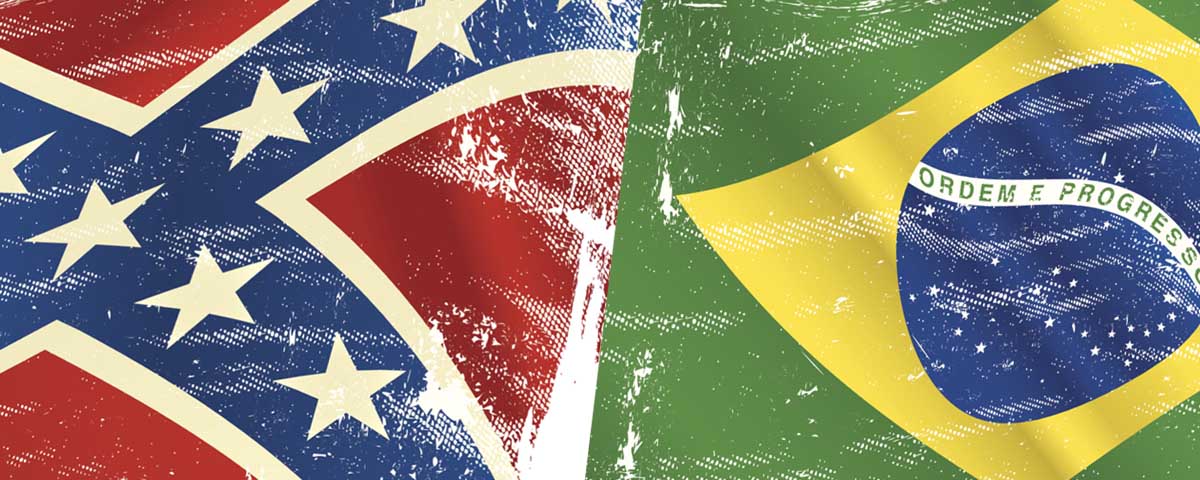
VIR_362561_27117_cuanto_sabes_sobre_los_estados_confederados_de_america

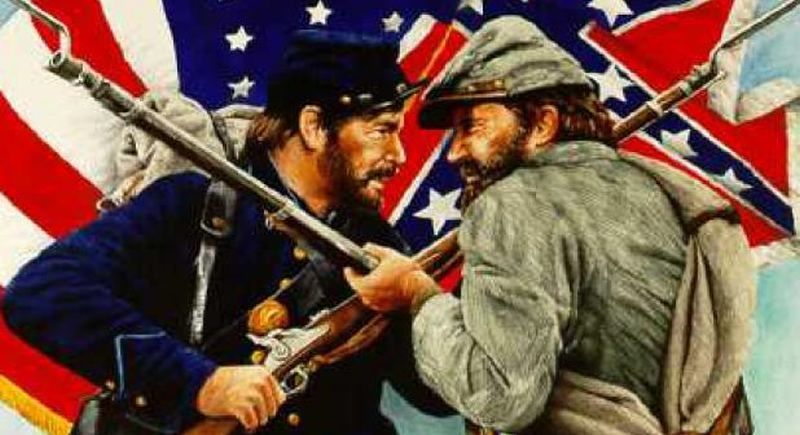
The cataclysm of the Civil War would leave in its wake animosities which would take generations to heal.  “Reconstruction” would be 12 years in the making, but some never did reconcile themselves to the war’s outcome. Vicksburg, Mississippi, which fell after a long siege on July 4, 1863, would not celebrate another Independence Day for 70 years.

In 1865, Emperor Dom Pedro II of Brazil wanted to encourage domestic cultivation of cotton.  Men like Jefferson Davis and Robert E. Lee advised southerners against emigration, but the Brazilian Emperor offered transportation subsidies, cheap land and tax breaks to those who would move.

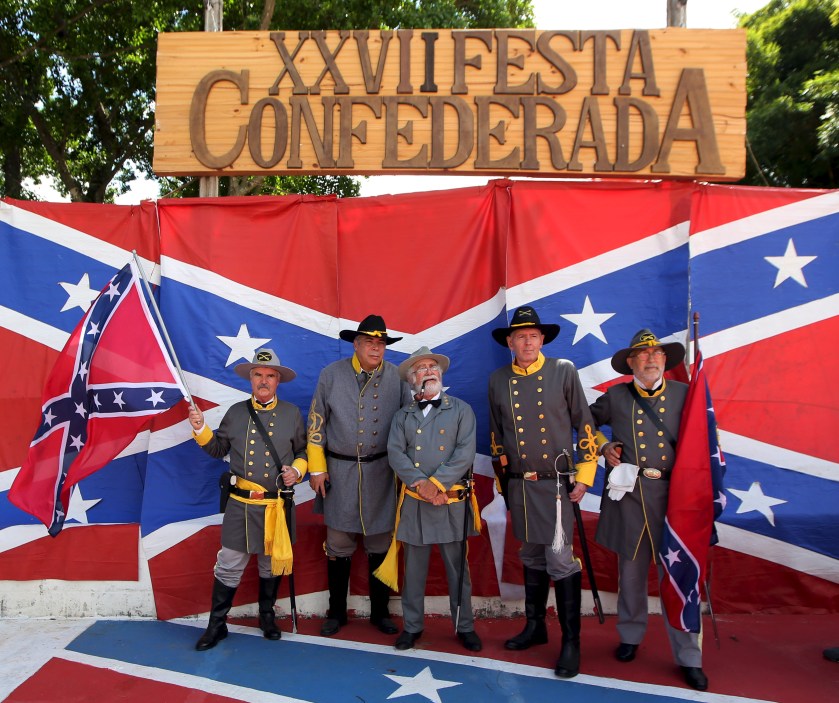
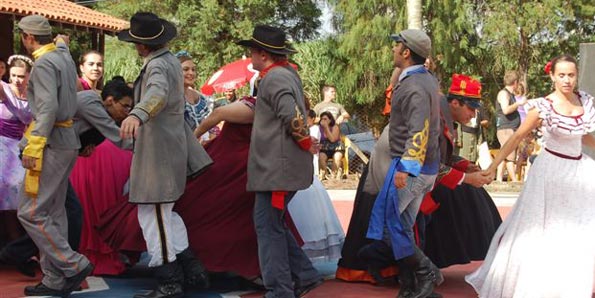
Descendants of American Southerners wearing Confederate-era uniforms pose for a photograph during a party to celebrate the 150th anniversary of the end of the American Civil War in Santa Barbara D'Oeste, Brazil
Descendants of American Southerners wearing Confederate-era uniforms pose for a photograph during a party to celebrate the 150th anniversary of the end of the American Civil War in Santa Barbara D’Oeste, Brazil,

Colonel William Hutchinson Norris, veteran of the Mexican American War and former member of the Alabama House of Representatives and later State Senator, was the first to make the move.  Together with his son Robert and 30 families of the former Confederacy, Norris arrived in Rio de Janeiro on December 27, 1865, aboard the ship “South America”.

The numbers are hazy, but port records indicate that somewhere between ten and twenty thousand former Confederates moved to Brazil in the twenty years following the Civil War.  A great uncle of former First Lady Rosalynn Carter, was one.

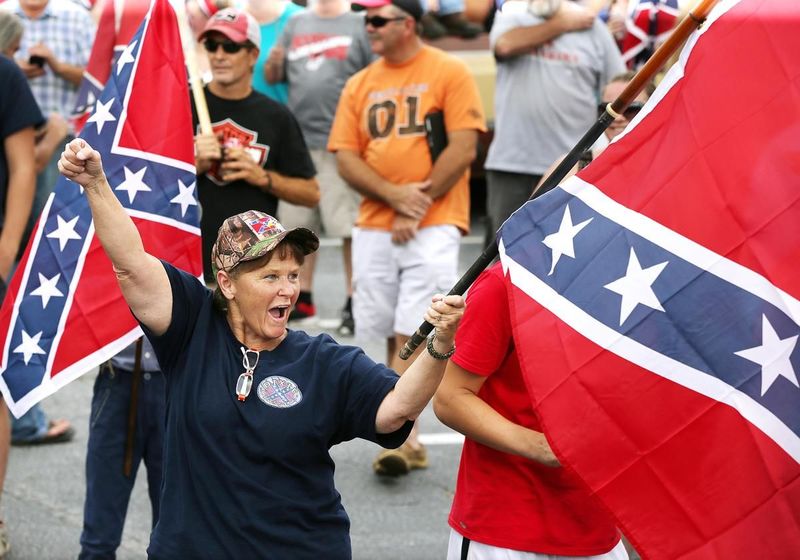
Confederate flag rally at Stone Mountain Park

Some of these “Confederados” settled in the urban areas of São Paulo, most made their homes in the northern Amazon region around present-day Santa Bárbara d’Oeste and a place the locals called “Vila dos Americanos”, and the inhabitants called “Americana”.  Some would return to the newly re-united states.  Most would never return, and their ancestors, Portuguese speaking Brazilians all, remain there to this day.

Confederados earned a reputation for honesty and hard work, and Dom Pedro’s program was judged a success by immigrant and government alike.  The settlers brought modern cultivation techniques and new food crops, all of which were quickly adopted by native Brazilian farmers.

Small wonder.  Mark Twain once wrote “The true Southern watermelon is a boon apart, and not to be mentioned with common things. It is chief of this world’s luxuries, king by the grace of God over all the fruits of the earth. When one has tasted it, he knows what the angels eat. It was not a Southern watermelon that Eve took; we know it because she repented”.

That first generation kept to itself for the most part, building themselves Baptist churches and town squares, while traditional southern dishes like barbecue, buttermilk biscuits, vinegar pie and southern fried chicken did their own sort of culinary diplomacy with native populations.

Slavery remained legal in Brazil until 1888, but this nation of 51% African or mixed-race ancestry (according to the 2010 census), seems more interested in understanding and celebrating their past, than tearing their culture apart over it.

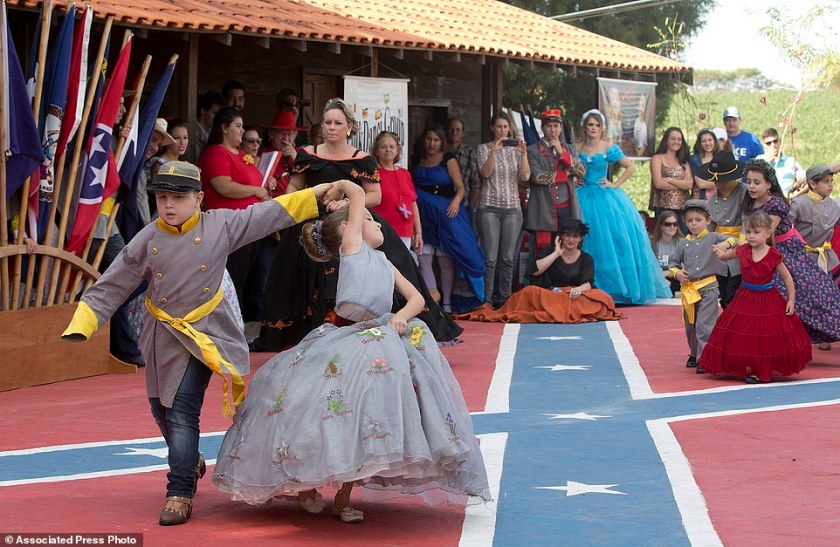
Today, descendants of those original Confederados preserve their cultural heritage through the Associação Descendência Americana (American Descendants Association), with an annual festival called the Festa Confederada.  There you’ll find hoop skirts and uniforms in gray and butternut, along with the food, the music and the dances of the antebellum South.

There you will find the Confederate battle flag, as well.  It seems that Brazilians have thus far resisted that peculiar urge which afflicts Isis and the American Left, to destroy the symbols of their own history.

descendentes-confederados-guerra-civil-eua

In 2016, the New York Times reported on the May celebration of the Festa Confederada, of Santa Bárbara d’Oeste:

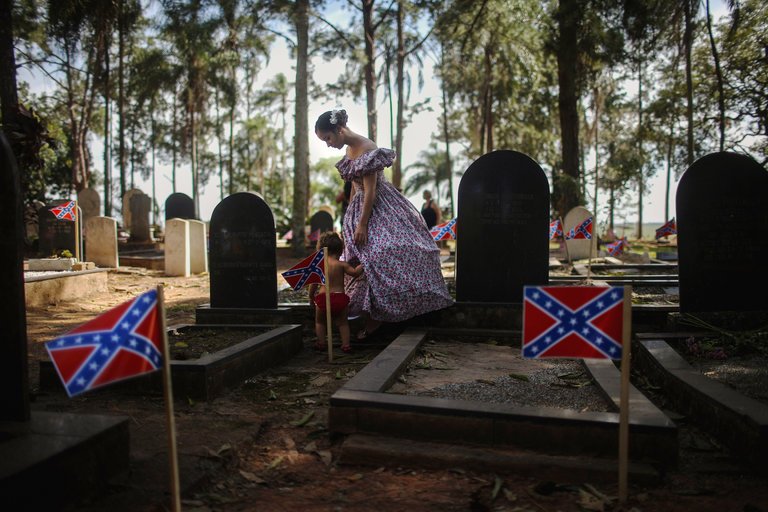
‘“This is a joyful event,” said Carlos Copriva, 52, a security guard who described his ancestry as a mix of Hungarian and Italian. He was wearing a Confederate kepi cap that he had bought online as he and his wife, Raquel Copriva, who is Afro-Brazilian, strolled through the bougainvillea-shaded cemetery.  Smiling at her husband, Ms. Copriva, 43, who works as a maid, gazed at the graves around them. “We know there was slavery in both the United States and Brazil, but look at us now, white and black, together in this place,” she said while pointing to the tombstones. “Maybe we’re the future and they’re the past.”’

Brazil Confederates

09BRAZIL-master768-v3 (1)
“A woman in a traditional hoop skirt walked past graves adorned with Confederate battle flags in Santa Bárbara d’Oeste, Brazil. An annual celebration of the area’s many Confederate settlers was held in the cemetery last month”. Hat tip to Mario Tama/Getty Images, New York times, for this image

December 26, 1776 Trenton

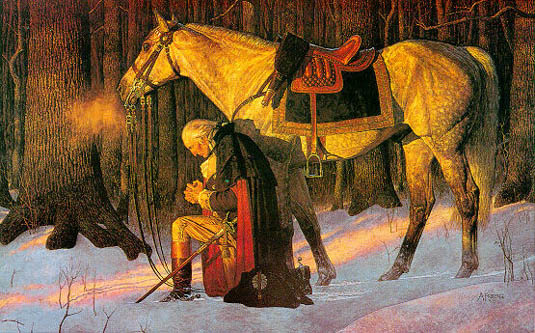
Most of his troops were about to end their enlistments, effective at the end of the year. A mere five days away.  Washington himself, who had become Commander-in-Chief of an Army with an average of nine rounds’ powder per man, thought they may have reached the end, writing to his cousin in Virginia “I think the game is pretty near up”.

1776 started out well for the Patriot cause, with the British evacuating Boston in March, the June victory at Fort Moultrie South Carolina, and the Continental Congress adopting the Declaration of Independence on July 4.

Valcour 1
Battle of Valcour Island

Things took a turn for the worse in August, with General George Washington’s defeat at the Battle of Long Island, and the loss of the strategically important port of New York that September. It wasn’t all bad, Benedict Arnold’s October defeat at Valcour Island in Vermont, cost the fleet of General Sir Guy Carleton dearly enough that it had to turn back, buying another year of life for the Patriot cause.

By the end of November, General Howe pushed the last American troops out of New York, chasing Washington’s shrinking army through New Jersey and across the Delaware River into Pennsylvania.

Washington’s men gathered up or destroyed every boat they could find for miles, while across the Delaware, British General Lord Cornwallis established outposts from New Brunswick to Burlington, including one at Trenton, New Jersey.

Camping on the western banks of the Delaware, Washington was in desperate straits. Most of the Patriots’ military supplies and artillery had been lost in the defense of New York.  Food, ammunition and equipment were in short supply, men were deserting as the string of defeats brought morale to a new low.

washington-praying

Most of his troops were about to end their enlistments, effective at the end of the year. A mere five days away.  Washington himself, who had become Commander-in-Chief of an Army with an average of nine rounds’ powder per man, thought they may have reached the end, writing to his cousin in Virginia “I think the game is pretty near up”.

The Americans needed a decisive victory, and quickly, if their cause was to survive. Washington planned a three-pronged attack on the Hessian garrison at Trenton, himself at the head of a 2,400 man army, flanked by a 1,900 man diversionary force under Colonel John Cadwalader and a blocking move by 700 men under General James Ewing.

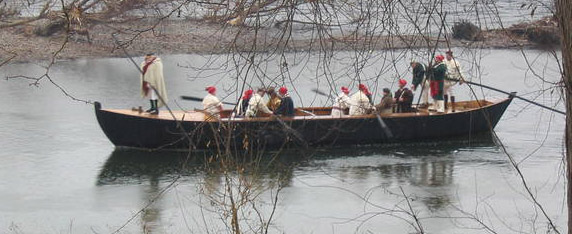
As the army began the famous crossing of the Delaware that Christmas night, the password was “Victory”. There was only one recognized response:  “Or Death”.

durham-boats-by-luke-jones-flickr-cc-cropped
Washington’s men made the crossing in 40-60′ “Durham Boats”, with flat-bottom barges transporting horses and artillery

Washington’s three crossings soon dissolved into one, as Cadwalader and Ewing both turned back. The weather that night was dreadful.  A howling ‘nor-easter’ came up at 11:00, hampering the crossing as freezing rain changed to sleet and sleet to snow. Horses balked at being led onto flat-bottom barges.  Cannon weighing as much as 1,720 lbs had to be tied down to prevent capsize. With visibility near zero, several men fell overboard during the crossing.  One soldier said it “blew a perfect hurricane”.

Washington’s crossing may have itself been forced to turn back from the difficult crossing, but for the indispensable nautical skills of Colonel John Glover’s Marblehead Militia, the “amphibious regiment”.

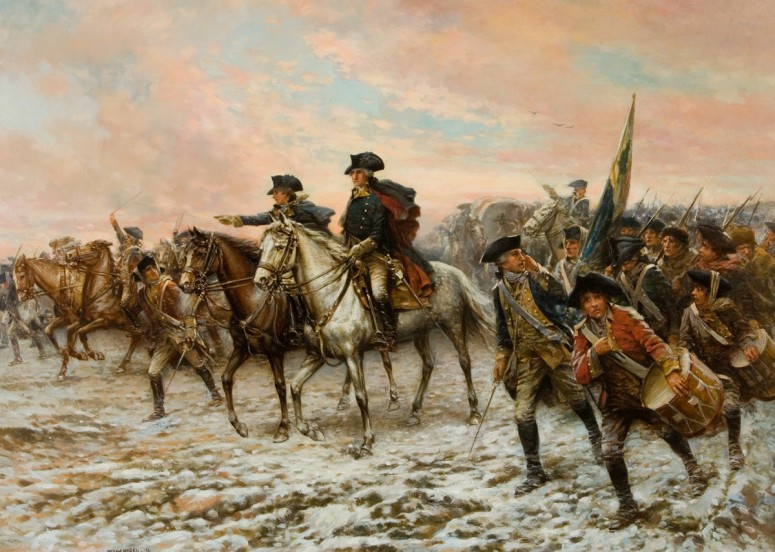
Two froze to death on the overnight march to Trenton. Men were so poorly equipped that many of them lacked boots, the soaked and freezing rags wrapped around their feet not enough to keep them from leaving bloody footprints in the snow.

large_di-0707-2_m-4535_march-to-trenton-web

Loyalists had warned the Hessian commander, Colonel Johann Rall, that American forces were planning an action. As late as December 22, a spy had warned British General James Grant that Washington was holding a war council.  His warning to the Hessian commander was “Be on your guard”.

Approaching Trenton along parallel roads, General John Sullivan sent word to Washington that the weather was wetting his men’s gunpowder. Washington responded, “Tell General Sullivan to use the bayonet. I am resolved to take Trenton.”

The Patriot force arrived at Trenton at 8am December 26, completely surprising the Hessian garrison. There is a story about the Hessians being drunk or hungover after Christmas celebrations, but the story is almost certainly untrue.

1200px-Battle_of_Trenton_by_Charles_McBarron

Unaware of Washington’s march on Trenton, 50 colonists had attacked a Hessian outpost earlier that morning. While Washington worried that his surprise was blown, Colonel Rall apparently believed that this was the attack he’d been warned about. He expected no further action that day.

conrad_heyer-200px
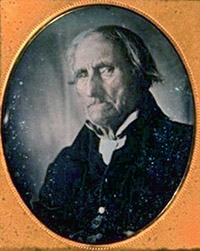
Conrad Heyer crossed the Delaware with General Washington, and lived long enough to see the dawn of the age of photography

The tactical surprise was complete for the American side. Hessian soldiers spilled out of their quarters and tried to form up, but most were shot down or dispersed. A few American civilians, residents of Trenton, even joined in the fight. All told, Hessian losses were 22 killed, 92 wounded, 918 captured and 400 escaped. Four Hessian colonels were killed, including Rall himself. The Americans suffered the two who had frozen to death, and five wounded. They had won the first major victory of the Revolution.

On December 30, the Americans once again crossed the Delaware, eluding a main force under Generals Cornwallis and Grant, proving on January 3rd at a place called Princeton, that they could defeat a regular British army in the field.

Encouraged by these victories, many of Washington’s men extended their terms of enlistment, and new enlistments flooded in. The American Revolution would slog on for almost six more years.  For today, the Patriot cause had lived to fight another day

December 24, 1814 Shanghai’d

In the 1860s and 70s, one “ferocious old harridan” called “Miss Piggott” operated a saloon and boarding house, in San Francisco. She’d maneuver unsuspecting guests over a trap door before serving them her “Miss Piggott Special” a potion consisting of equal parts brandy, whiskey and gin laced with laudanum or opium. One knock on the head with her “bung starter”, a wooden mallet used to open whiskey kegs, and she’d pull the lever and down they would fall, to the mattress waiting below.

In modern times, governments have employed various strategies to meet the personnel needs of national armed services. Recruiting methods range from voluntary to compulsory service, and even a lottery or other form of draft, in times of national emergency.

During the age of sail, vast numbers of skilled and unskilled seamen alike, were required to meet the needs of naval vessels at sea. Governments resorted to more straightforward methods of meeting manpower requirements, namely, kidnapping.

Such involuntary service or “impressment”, was first made legal during Elizabethan times, but the practice dates back to the 13th century.

impressment-of-american-sailors-granger

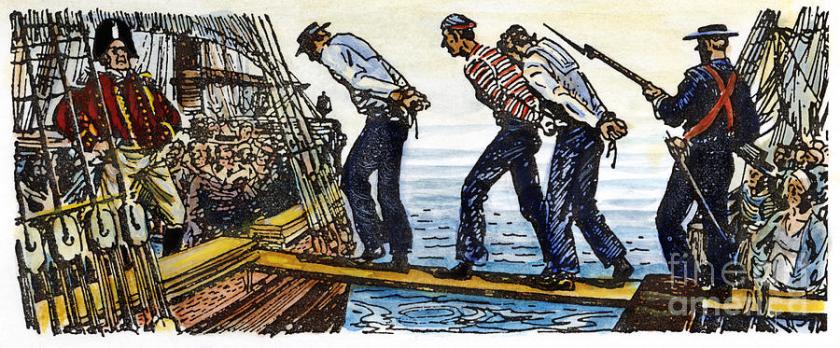
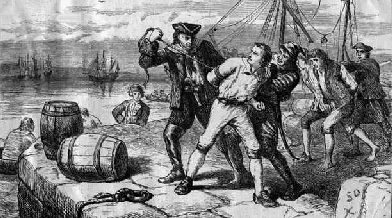
“Press gangs” would patrol waterfronts looking for vagrants, raiding taverns and even pouncing on unsuspecting victims in their beds. Prints from the time show armed gangs barging into weddings and hauling the groom away, much to the dismay of the bride.
Such “pressing” more often took place at sea, where armed gangs would board merchant ships and take what they needed, sometimes leaving victims without sufficient hands to take them safely back to port.

Such methods were essential to the strength of the British Navy, particularly during the Napoleonic wars. American merchant vessels were often targets. The British Navy impressed over 15,000 American sailors alone, between 1793 and 1812.

impressThe American public was outraged and there were calls for war in 1807, when HMS Leopard overtook the USS Chesapeake, kidnapping three American-born sailors and one British deserter, leaving another three dead and 18 wounded.
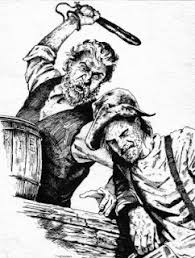
This time, American retaliation took the form of an embargo. Five years later, continued impressment of American seamen would be a major cause of the war of 1812, the conflict formally ending this day in 1814.

Crimping 1Outside of the British Royal Navy, the practice of kidnapping people to serve as shipboard labor was known as “crimping”. Low wages combined with the gold rushes of the 19th century left the waterfront painfully short of manpower, skilled and unskilled, alike. “Boarding Masters” had the job of putting together ship’s crews, and were paid for each recruit. There was strong incentive to produce as many able bodies, as possible. Unwilling men were “shanghaied” by means of trickery, intimidation or violence, most often rendered unconscious and delivered to waiting ships, for a fee.
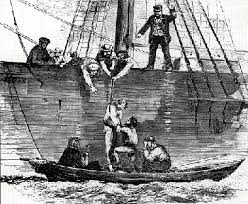
Crimps made $9,500 or more per year in the 1890s, equivalent to over a quarter-million, today. The practice flourished in British port cities like London and Liverpool, and in the west coast cities of San Francisco, Portland, Astoria and Seattle. You certainly didn’t want to be caught out alone and drunk, in east coast port cities like New York, Boston, Philadelphia, or Baltimore.

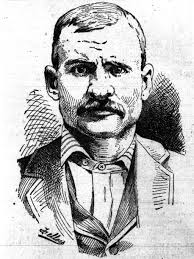
James Kelly kept several bars and a boarding house, in San Francisco. Better-known as “Shanghai” Kelly, the man provided a steady stream of the unwilling to labor aboard the undermanned ships of the San Francisco waterfront.

He once shanghai’d 100 guys, in a single evening.

In the early 1870s, Kelly rented the paddleboat Goliath, and widely publicized a free booze cruise to celebrate his birthday. Bartenders drugged unwitting revelers with opium-laced whiskey, and then offloaded them to waiting ships. Shanghai Kelly’s biggest concern was returning after such a public event, with an empty boat. His luck held, when another paddle wheel steamer, the Yankee Blade, struck a rock and began to sink. Goliath rescued everyone on board, and continued the party. Nobody back at the waterfront, noticed a thing.

Crimping 3, Bunko Kelley
James “Bunko” Kelley

Joseph “Bunko” Kelley was another infamous crimp, also working out of the San Francisco waterfront. The “King of Crimps”, Kelley once set a record, rounding up 50 guys in three hours. The Bunko name stuck, when Kelley delivered one crewman for $50, who turned out to be a cigar store Indian. In 1893, Kelley delivered 22 guys who’d mistakenly consumed embalming fluid, from a local mortuary. He sold all of them for $52 apiece though most of them were dead, a fact to which the ship’s captain only became wise, after returning to sea.

The “Shanghai tunnels” of Portland run through the Old Town/Chinatown section to the main business district, connecting the basements of hotels and taverns to the waterfront at the Willamette River. The tunnels themselves are real enough, though their history is shrouded in mystery. Originally constructed to move goods from the Willamette waterfront to basement storage areas, the number of unconscious bodies hustled down the dark chambers of the Portland Underground”, remains unknown. There are those who will tell you, the practice continued into the WW2 period.

State and federal legislatures passed measures to curb the practice after the Civil War, but crimping didn’t go away, easily. In their heyday, the owners of sailor’s boarding houses had endless supplies of manpower, fanning out across polling places to “vote early and often”.

crimping 2San Francisco political bosses William T. Higgins, (R) and Chris “Blind Boss” Buckley (D) were both notable crimps, and well positioned to look after their political interests. Notorious crimps such as Joseph “Frenchy” Franklin and George Lewis were elected to the California state legislature. There was no better spot, from which to ensure that no legislation would interfere with such a lucrative trade.
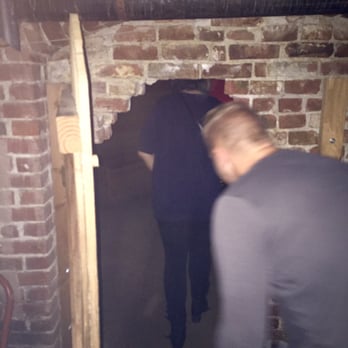
A brief list of infamous crimps includes Andy “Shanghai Canuck” Maloney of Vancouver, Anna Gomes of San Francisco, and New Bedford’s own “Shanghai Joe” and Tom Codd the “Shanghai Prince”. William “Billy” Gohl, the “Ghoul of Grays Harbor” of Aberdeen Washington, was also a serial killer.

In the 1860s and 70s, one “ferocious old harridan” called “Miss Piggott” operated a saloon and boarding house, in San Francisco. She’d maneuver unsuspecting guests over a trap door before serving them her “Miss Piggott Special” a potion consisting of equal parts brandy, whiskey and gin laced with laudanum or opium. One knock on the head with her “bung starter”, a wooden mallet used to open whiskey kegs, and she’d pull the lever and down they would fall, to the mattress waiting below.

Crimping 5Imagine the hangover the next morning, to wake up and find you’re now at sea, bound for somewhere in the far east. Regulars knew about the trap door and avoided it at all costs, knowing that anyone going over there, was “fair game”.

Widespread adoption of steam power in the late 19th and early 20th centuries did as much to curb shanghaiing as did any legislative effort. Without acres of canvas to furl and unfurl, the need for unskilled labor was greatly diminished. The “Seaman’s Act of 1915”, sometimes called the “magna carta of sailor’s rights,” ended the practice for good.

You might want to do yourself a favor, though, and look out for that trap door.

December 22, 1944 The Battered Bastards of Bastogne

The seven roads leading to Antwerp converged in Bastogne, in what the Germans called “Straße Oktopus”, “Road Octopus”. The town was strategically indispensable to the German drive on Antwerp, and all or parts of 7 German armored divisions converged on the place. Over 54,000 men. The Allies understood the importance of the place as well. General Eisenhower dispatched the 101st Airborne Division, to hold the town, at all costs.

The largest German offensive of the western front burst out of the frozen Ardennes forest on December 16, 1944, aiming to drive a wedge between British and American forces and to capture the Belgian port of Antwerp, vital to the German need to re-supply. It was called “Unternehmen Wacht am Rhein”.  “Operation Watch on the Rhine”.

The tactical surprise was complete, allied forces driven back through the densely forested regions of France, Belgium and Luxembourg. Wartime news maps showed a great inward “bulge” in the lines, and the name stuck. The Battle of the Bulge was the largest and bloodiest battle fought by the US in WWII, fought in the harshest winter conditions in recorded history and involving 610,000+ Americans.

54626e3c46ec3.image

The seven roads leading to Antwerp converged in Bastogne, in what the Germans called “Straße Oktopus”, “Road Octopus”. The town was strategically indispensable to the German drive on Antwerp, and all or parts of 7 German armored divisions converged on the place. Over 54,000 men. The Allies understood the importance of the place as well. General Eisenhower dispatched the 101st Airborne Division, to hold the town, at all costs.

For two days, a desperate defense of the nearby villages of Noville and Foy held back the 2nd Panzerdivision, as 11,000 men and 800 officers of the 101st joined a combined force of 11,000 converging on Bastogne. By the 21st, Bastogne’s field hospital was overrun, surrounded by forces outnumbering them 2½ to one. Poorly supplied for the cold winter conditions with air supply made all but impossible by weather conditions, the citizens of Bastogne gave their blankets to the Americans, along with white linens to be used for camouflage.

On the morning of December 22, 1944, two German officers appeared at the American perimeter along with two enlisted men, carrying a white flag. They were a Major Wagner of the 47th Panzer Corps, and Lt. Hellmuth Henke of the Panzer Lehr Operations Section.

The pair carried a note from German General Luttwitz, 165 words in all, and reading in part: “To the U.S.A. Commander of the encircled town of Bastogne. There is only one possibility to save the encircled U.S.A. troops from total annihilation: that is the honorable surrender of the encircled town. In order to think it over a term of two hours will be granted beginning with the presentation of this note“.

nuts
General Anthony McAuliffe

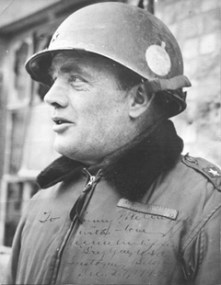
The note worked its way up the chain of command to the acting Division Commander, General Tony McAuliffe. Told that there was a surrender ultimatum, McAuliffe first thought that it was the Germans who wanted to surrender. Soon disabused of that notion, he laughed and said: “Us surrender? Aw, nuts!”

Knowing that he had to reply, McAuliffe said “Well I don’t know what to tell them.” Lt. General Harry Kinnard spoke up, saying, “That first remark of yours would be hard to beat”. McAuliffe said, “What do you mean?” and Kinnard replied “Sir, you said ‘Nuts’.” They all agreed, and McAuliffe wrote his reply.

“To the German Commander, “Nuts!” The American Commander.”

Joseph H. “Bud” Harper was the American army officer who delivered the reply, with medic Ernie Premetz acting as translator.

Confused by the American slang, Henke asked “What does that mean?” Harper said to Premetz “You can tell them to take a flying shit.” The medic, knowing he had to convey the intent of the message, translated as “Du kannst zum Teufel gehen”. You can go to hell. Harper then said, “If you continue to attack, we will kill every goddamn German that tries to break into this city.” Henke replied, “We will kill many Americans. This is war.” Harper then said, “On your way Bud, and good luck to you.”

Years later, Harper would say that he always regretted wishing the Germans luck.

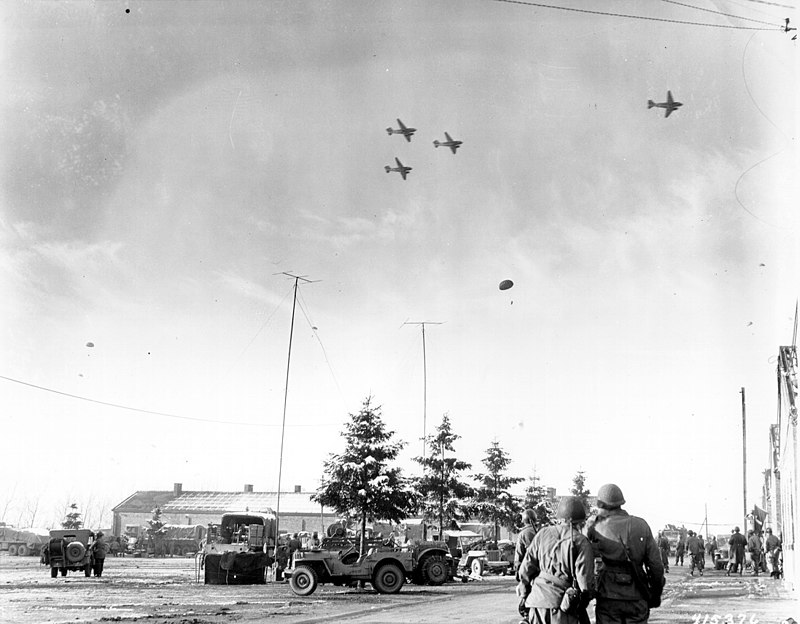
800px-Bastogne_resupply1944_sm

In his Christmas eve letter of 1944, General McAuliffe wrote “What’s merry about all this, you ask? We’re fighting – it’s cold we aren’t home. All true but what has the proud Eagle Division accomplished with its worthy comrades the 10th Armored Division, the 705th Tank Destroyer Battalion and all the rest? Just this: We have stopped everything that has been thrown at us from the north, east, south and west”.

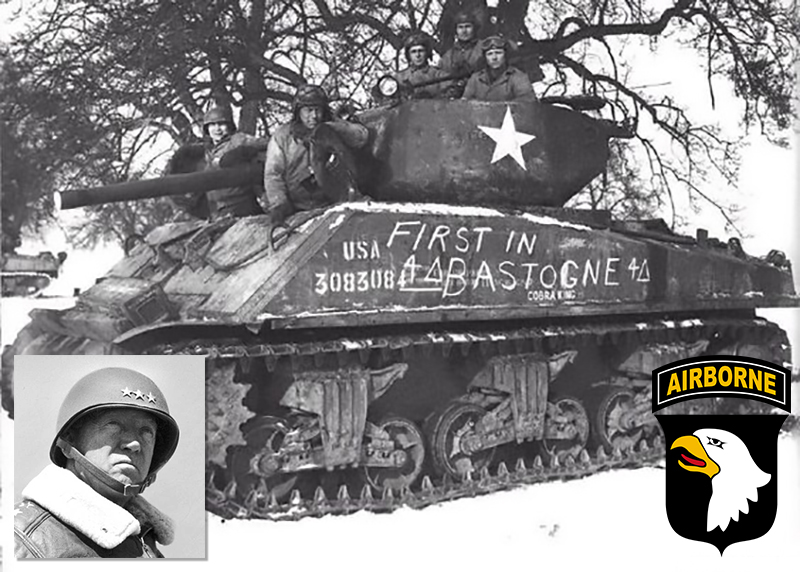
Elements of George Patton’s 3rd Army would break through from the southwest two days later, ending the German encirclement.

Tank-first-in-Bastogne-2c

By the end of January, the last great effort of German armed forces had been spent and driven back beyond their original lines. An official report by the US Army on the Battle of the Bulge lists 108,347 casualties, including 19,246 killed, 62,489 wounded and 26,612 captured and missing.

Those numbers could have been far worse, if not for what newspapers would soon call the “Battered Bastards of Bastogne”.


Afterward

A Black nurse called “Anna” briefly appeared in Historian Stephen Ambrose’ ‘A Band of Brothers’, and on the HBO series based on the book.  But who was Anna?  Was she a myth?  British military historian Martin King discovered her in a nursing home, 61 years after the encirclement at Bastogne.

Augusta-ChiwyAugusta Marie Chiwy (“Shee-wee”) was the bi-racial daughter of a Belgian veterinarian and a Congolese mother, she never knew.

Thinking it safe to visit her father in Bastogne that Christmas, Chiwy found herself, like everyone else in that place, surrounded.  A trained nurse, Chiwy spent the entire siege tending to the wounded, along with Dr. Jack Prior.  Once, she even ran through enemy fire to collect the wounded from the field.

On Christmas eve, the petite nurse was blown off her feet and through a wall. She got up and went back to it, despite the direct hit that killed 30 American wounded, along with the only other nurse at the Rue Neufchatel aid station, Renée Lemaire.

AugustaanuresChiwy married after the war, and rarely talked about her experience in Bastogne.  It took King a full 18 months to coax the story out of her.  The result was the 2015 Emmy award winning historical documentary, “Searching for Augusta, The Forgotten Angel of Bastogne”.

In 2011, Augusta Chiwy was awarded a Knighthood in the Order of the Crown in the name of King Albert II, of Belgium.  The United States Army awarded her the Civilian Award for Humanitarian Service, presented by the Ambassador to Belgium.

The Forgotten Angel of Bastogne died on August 23, 2015, at the age of 94.

December 21, 1861 Medal of Honor

Medals of Honor are not awarded casually, reserved only for the bravest of the brave, and for well-documented acts of valor. Permit me to share a few examples, each from his own moment in history.

As Revolution-era General, George Washington once wrote that the “road to glory in a patriot army and a free country is…open to all”.   European armies of the time bestowed honors, only on high-ranking officers who had achieved victory in battle. There was no such honor for the common soldier.

There was precedent for such an award in the Colonial military, but only under limited circumstances.  Congressional medals were awarded to Washington himself on March 25, 1776, following the British evacuation of Boston, to General Horatio Gates in November 1777, in recognition of his victory over British General John Burgoyne at Saratoga, and to Major-General “Light-Horse Harry” Lee, father of Civil War-era Confederate general Robert E. Lee, in recognition of his 1779 attack on the British position at Paulus Hook, New Jersey.

purpleheartA “Fidelity Medallion” was awarded to three militia men in 1780, for the capture of John André, the British officer and spy whose capture uncovered the treachery of General Benedict Arnold.
The future 1st President’s general orders of August 7, 1782 established a “Badge of Military Merit” to recognize those members of the Continental Army who performed “any singular meritorious action”.

In time, Washington’s Badge of Military Merit morphed into what we now know as the Purple Heart, but the precedent had been set.  This was the first such honor available to any U.S. military service member, who had distinguished himself by act of valor.

Congress created the “Meritorious Service Citation Certificate” around the time of the Mexican-American war, a recognition of “any private soldier who had distinguished himself by gallantry performed in the presence of the enemy”.  The award would come in and out of use in the decades that followed, later becoming the Distinguished Service Medal, an award available to United States and foreign military service personnel and, in limited circumstances, civilians.

In the early days of the Civil War, General-in-chief of the army Winfield Scott was against such an award.  Secretary of the Navy Gideon Welles adopted the idea on behalf of the Navy, following Scott’s retirement in October 1861.  President Abraham Lincoln signed “Public Resolution #82” on December 21, 1861, creating a Navy medal of honor.

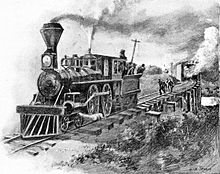
DoV1-018_-_Mitchel_RaidAn Army version of the medal was created the following July, first awarded to six Union soldiers for hijacking the Confederate locomotive, “The General”.  Leader of the raid James Andrews was caught and hanged as a Union spy.  He alone was judged ineligible for the medal of honor, as he was a civilian.
Medals of Honor are not awarded casually, reserved only for the bravest of the brave, and for well-documented acts of valor. Permit me to share a few examples, each from his own moment in history.

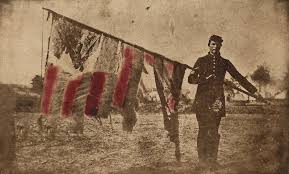
downloadFew soldiers on the Civil War battlefield had a quicker route to death’s door, than the color bearer.  National and regimental flags were all-important sources of inspiration and communication.
Reverend W. Jamison Thomson of Hartford, CT described the importance of the battle flag: “It represents the cause, is the rallying point, while it is aloft proclaims that victory is still intended, is the center of all eyes, is the means of communication between soldiers, officers, and nation,” he said, “and after the engagement, and after many of them, is their marked memento so long as its identity can be preserved.”

Pvt. Joseph E. Brandle served as regimental color bearer, with the 17th Michigan Infantry.  Private Brandle earned the MOH for his actions of November 16, 1863, near Lenoire, Tennessee…”…[H]aving been twice wounded and the sight of one eye destroyed, [he] still held to the colors until ordered to the rear by his regimental commander.”

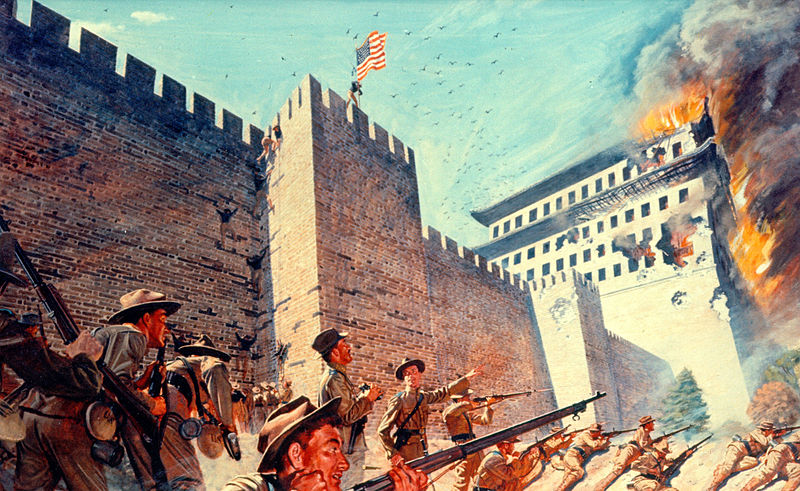
During the Boxer Rebellion of 1900, Chaplain’s assistant and regimental musician Calvin Pearl Titus of Vinton, Iowa, volunteered to scale the 30-ft walls of Peking, raising the American flag over the outer walls of the city.  President Theodore Roosevelt awarded Titus the medal of Honor, for “Gallant and daring conduct in the presence of his colonel and other officers…”  He was “the last color bearer”.

800px-Siege_of_Peking,_Boxer_Rebellion

york
Sergeant York

On October 8, 1918, Tennessee native Cpl. Alvin Cullum York of the 82nd Division lead a group of seventeen against a numerically superior German force, dug in at Chatel-Chehery, France.

Let his citation tell the story: “…After his platoon had suffered heavy casualties and three other non-commissioned officers had become casualties, Cpl. York assumed command. Fearlessly leading seven men, he charged with great daring toward a machine gun nest, which was pouring deadly and incessant fire upon his platoon. In this heroic feat the machine gun nest was taken, together with four officers and 128 men and several guns.”

Audie_Murphy
Audie Murphy

Kingston Texas 2nd Lieutenant Audie Murphy found himself senior officer of a company of 18, whittled down from 235 by disease, wounds and casualties.  On January 26, 1945, Murphy’s small force found itself under assault by six German tanks and a large infantry force.

A man the Marine Corps had once turned down for being too small, Murphy climbed aboard a burning tank destroyer.  Out in the open and exposed to German fire from three sides, the 19-year old single-handedly fought off the entire assault, killing or wounding fifty and causing the German tanks to withdraw.

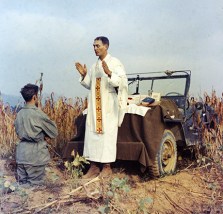
The Medal at LastFather Emil Kapaun selflessly sacrificed himself on behalf of his fellow prisoners in 1951, in the frozen hell of a North Korean prison camp.  President Barack Obama awarded Kapaun’s family the Medal of Honor during a ceremony in the east wing of the White House, on April 11, 2013.

Chaplain Kapaun’s body lies in an unmarked mass grave, somewhere in Pyoktong county.

2827
Sammy Lee Davis

PFC Sammy Lee Davis distinguished himself during the small hours of November 18, 1967, when the 4th Artillery of 9th Infantry Division came under heavy attack west of Cai Lay, Republic of Vietnam.

Repeatedly knocked to the ground by enemy mortar fire and suffering multiple injuries, the Cannoneer from Dayton, Ohio fought back first with a heavily damaged, burning howitzer, and then with recoilless rifle and machine gun.

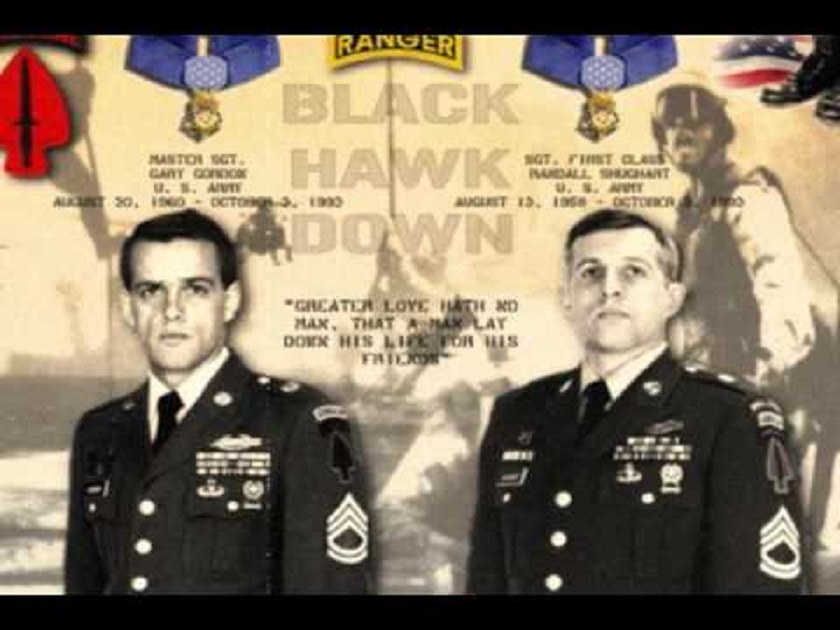
Two Medals of honor were awarded posthumously, to Delta Force snipers Gary Gordon and Randy Shugart, for their hopeless defense of the crash site of a downed UH-60 Blackhawk helicopter, against hundreds of fighters loyal to the Somali warlord Mohamed Farrah Aidid.

gary-gordon-and-randy-shughart-delta-force

0422C5
Corporal Jason Lee Dunham

Corporal Jason Lee Dunham of Scio New York deliberately threw himself on an Iraqi grenade on April 14, 2004, saving the lives of fellow Marines at the sacrifice of his own life.  He was twenty-two.

monti_image
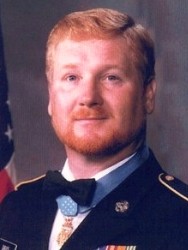
Sergeant Jared Monti

Sergeant 1st class Jared Monti of Abington Massachusetts was killed in the mountains of Nuristan Province in Afghanistan, while attempting to rescue a wounded soldier from a hail of small arms and rocket-propelled grenade fire.

Monti was the sixth person from the wars in Iraq and Afghanistan, to be awarded the Medal of Honor.  The Lee Brice song “I Drive your Truck“, voted Song of the Year at the 49th annual Academy of Country Music Awards, is his story.

The nation’s highest medal for military valor has been awarded 3,517 times since its inception in 1861, to 3,498 distinct recipients.  621 were awarded posthumously.  Possibly without exception, these are people who will tell you that they are not heroes.  They were doing a job and those left behind, are the real heroes.

If that is not the very definition of true heroism, it should be.

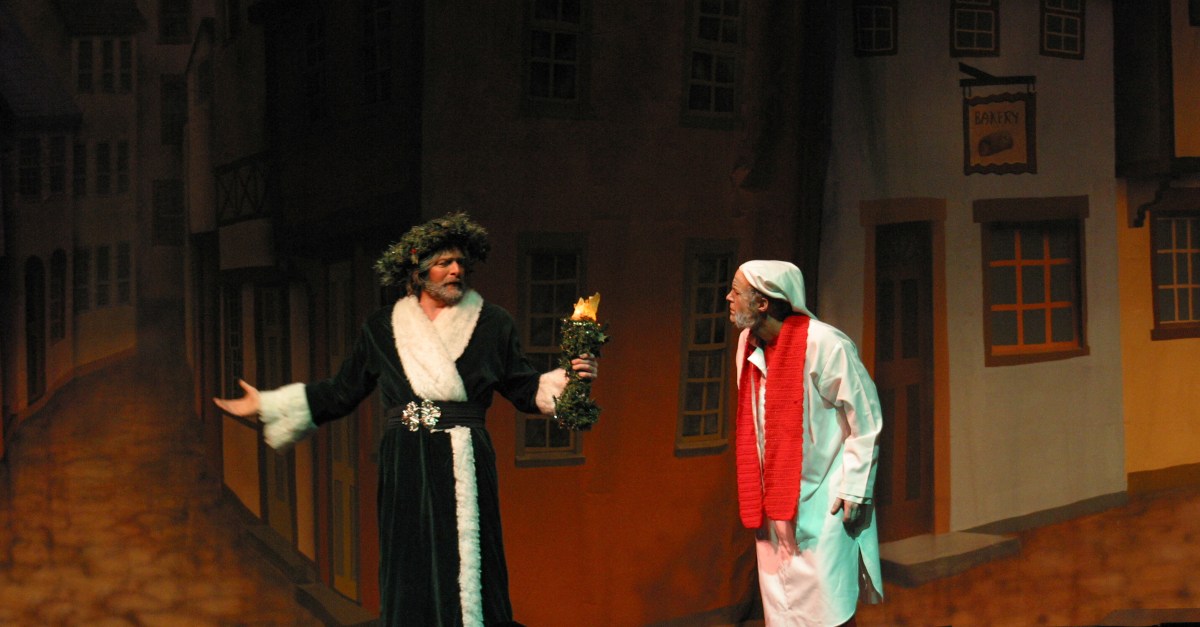
December 19, 1843  A Christmas Carol

Charles Dickens’ masterpiece, A Christmas Carol, was published for the first time 174 years ago on this day, December 19, 1843.

It’s hard not to love the traditions of the Christmas season.  Getting together with loved ones, good food, the exchange of gifts, and our favorite Christmas specials on TV.  I always liked a Charlie Brown’s Christmas, and of course there’s the Charles Dickens classic, “A Christmas Carol”, set against the vast brick factory buildings of Lowell, Massachusetts, along the Merrimack River.

That wasn’t what you thought I’d say, was it.

American-Notes-for-General-Circulation
Charles Dickens’ 1842 travelogue

The 29-year-old Charles Dickens was already a well-known and popular author when he stepped onto the shores of Boston Harbor on January 22, 1842.

“The Pickwick Papers,” “Oliver Twist,” “Nicholas Nickleby”; were all behind the young author at the time of his trip to America, perhaps to write a travelogue, or maybe looking for material for a new novel.

Dickens traveled to Watertown, Massachusetts, to the Perkins School for the Blind, where Helen Keller and her teacher Anne Sullivan had educated each other, a half-century later.

He visited a school for neglected boys in Boylston.  Dickens must have thought the charitable institutions in his native England suffered by comparison, for he later wrote “I sincerely believe that the public institutions and charities of this capital of Massachusetts are as nearly perfect as the most considerate wisdom, benevolence, and humanity, can make them.”

LowellMillGirlsIn February, Dickens took a train north to the factory town of Lowell, visiting the textile mills and speaking with the “mill girls”, the women who worked there.  Once again, he seemed to believe that his native England suffered in the comparison.  Dickens spoke of the new buildings and the well dressed, healthy young women who worked in them, no doubt comparing them with the teeming slums and degraded conditions in London.

Lowell OfferingDickens left with a copy of “The Lowell Offering”, a literary magazine written by those same mill girls, which he later described as “four hundred good solid pages, which I have read from beginning to end.”

Over a century and a half later, Natalie McKnight, professor of English and dean at Boston University, read the same 400 pages that Dickens read.  She couldn’t help but notice similarities between the work of the mill girls, and “A Christmas Carol,” published about a year and a half after Dickens’ visit.  Chelsea Bray was a senior English major at the time.  Professor McKnight asked her to read those same pages.

7ba33a5b1a569dd293edd9eff5d8eb80--christmas-carol-vintage-christmasThe research which followed was published in the form of a thesis, later fleshed out to a full-length book:

“Dickens and Massachusetts
The Lasting Legacy of the Commonwealth Visits
How Massachusetts shaped Dickens’s view of America”
Edited by Diana C. Archibald and Joel J. Brattin
Published May 1, 2015.

The book describes a number of similarities between the two works, making the argument that Dickens familiar story draws much from his experience in Lowell.

Charles Dickens’ masterpiece, A Christmas Carol, was published for the first time 174 years ago on this day, December 19, 1843.


If you enjoyed this “Today in History”, please feel free to re-blog, “like” & share on social media, so that others may find and enjoy the same. Please click the “follow” button on the right, to receive email updates on new articles. Thank you for your interest, in the history we all share.

December 16, 1884 River Horse

Short days from now, families across the nation will gather for the Christmas table.  There will be moist and savory stuffing, and green bean casserole.  Creamy mashed potatoes and orange cranberry sauce.  And there, the centerpiece of the feast.  Slow-roasted and steaming in its tray, golden brown and delicious, the roast hippopotamus.

Short days from now, families across the nation will gather for the Christmas table.  There will be moist and savory stuffing, and green bean casserole.  Creamy mashed potatoes and orange cranberry sauce.  And there, the centerpiece of the feast.  Slow-roasted and steaming in its tray, golden brown and delicious, the roast hippopotamus.

Wait…

What?

The story begins on December 16, 1884, the opening day for the World’s Fair, in New Orleans. Among the many wonders on display was the never-before seen, Eichornia crassipes, a gift of the Japanese delegation.  The Water Hyacinth.  Visitors marveled at this beautiful aquatic herb, its yellow spots accentuating the petals of beautiful delicate purple and blue flowers, floating across tranquil ponds on thick, dark green leaves.

Eichhornia_crassipes
Eichhornia crassipes

The seeds of Eichornia crassipes are spread by wind, flood, birds and humans, and remain viable for 30 years.  Beautiful as it is to look at, the Water Hyacinth is an “alpha plant”, the aquatic equivalent to the Japanese invasive perennial Kudzu, the “vine that ate the south”.  Impenetrable floating mats choke out native habitats and species, while thick roots impede the passage of vessels, large and small.  The stuff is toxic if ingested by humans and most animals, and costs a fortune to remove.

This plant native from the Amazon basin quickly broke the bounds of the 1884 World’s Fair, spreading across the bayous and waterways of Louisiana, and beyond.

Kenya_Kisumu_Harbour_Hyacinths_1997ke09b21-768x493
You can hardly find the water, in Lake Victoria’s Kisumu Harbor, Kenya

In the first decade of the 20th century, an exploding American population could barely keep up with its own need for food, especially, meat.  The problem reached crisis proportions in 1910, with over grazing and a severe cattle shortage.  Americans were seriously discussing the idea, of eating dogs.

Enter Louisiana member of the House of Representatives, New Iberia’s own Robert Foligny Broussard, with a solution to both problems.  “Lake Bacon”.

The attorney from Louisiana’s 3rd Congressional district proposed the “American Hippo” bill, H.R. 23621, in 1910, with enthusiastic support from Theodore Roosevelt and the New York Times.  One Agricultural official estimated that such a free-range hippo herd would produce up to a million tons of meat, per year.

Lippincott’s monthly magazine waxed rhapsodic about the idea:  “This animal, homely as a steamroller, is the embodiment of salvation.  Peace, plenty and contentment lie before us, and a new life with new experiences, new opportunities, new vigour, new romance, folded in that golden future, when the meadows and the bayous of our southern lands shall swarm with herds of hippopotami”.

p03dtkqg

With a name deriving from the Greek term “River Horse”, the common hippopotamus is the third largest land animal living today.  Despite a physical resemblance to hogs and other even-toed ungulates, Hippopotamidae’s closest living relatives are cetaceans such as whales, dolphins and porpoises.

The problem is, these things are dangerous.

Major_Frederick_Russell_Burnham
Major Frederick Russell Burnham

The adult bull hippopotamus is extremely aggressive, unpredictable and highly territorial.  Heaven help anyone caught between a cow and her young.  Hippos can gallop at short sprints of 19 mph, only a little slower than Sprinter Usain Bolt, “the fastest man who ever lived”.

Google the “10 most dangerous animals in Africa”.  You’ll be rewarded with the knowledge that hippos are #1, responsible for more human fatalities, than any other large animal, in Africa.

Be that at it as it may, the animal is a voracious herbivore, spending daylight hours at the bottom of rivers & lakes, happily munching on vegetation.

What could be better than taking care of two problems at once.  Otherwise unproductive swamps and bayous from Florida to Louisiana would become home to great hordes of free-range hippos.  The meat crisis would be solved, and America would become a nation of hippo ranchers.

As Broussard’s bill wended its way through Congress, the measure picked up steam with the enthusiastic support of two enemies who’d spent ten years in the African bush, trying to kill each other. No, really.

Captain Fritz Duquesne

Frederick Russell Burnham had argued for the introduction African wildlife into the American food stream, some four years earlier.  A freelance scout and American adventurer, Burnham was known for his service to the British South Africa company and to the British army in colonial Africa. The “King of Scouts’, commanding officers described Burnham as “half jackrabbit and half wolf”.  A “man totally without fear.”  One writer described Burnham’s life as “an endless chain of impossible achievements”, another “a man whose senses and abilities approached that of a wild predator”.  He was the inspiration for the Indiana Jones character and for the Boy Scouts.  Frederick Burnham was the “most complete human being who ever lived “.

Frederick “Fritz” Joubert Duquesne was a Boer of French Huguenot ancestry, descended from Dutch settlers to South Africa.  A smooth talking guerilla fighter, the self-styled “Black Panther” once described himself as every bit the wild African animal, as any creature of the veld.  An incandescent tower of hate for all things British, Duqesne was a liar, a chameleon, a man of 1,000 aliases who once spent seven months feigning paralysis, so he could fool his jailers long enough to cut through his prison bars.  Destined to be a German spy and saboteur through two world wars, Frederick Burnham described his mortal adversary, thus:  “He was one of the craftiest men I ever met. He had something of a genius of the Apache for avoiding a combat except in his own terms; yet he would be the last man I should choose to meet in a dark room for a finish fight armed only with knives“.

During the 2nd Boer war, the pair had sworn to kill each other.  In 1910, these two men became partners in a mission to bring hippos, to America’s dinner table.

Biologically, there seems little reason to believe that Hippo ranching couldn’t have worked along the Gulf coast.  Colombian officials estimate that, within a few years, the hippo descendants of drug kingpin Pablo Escobar’s exotic animal menagerie will number 100 or more individuals.

Broussard’s measure went down to defeat by one vote, but didn’t entirely go away.  Always the political calculator, Representative and later-Senator Broussard died with the bill on his legislative agenda, waiting for the right moment to reintroduce the thing.

General_Collection_deadzoneOver time, the solution to the meat question became a matter of doubling down on what we’re already doing, as factory farms and confinement operations took the place of free ranges, and massive use of antibiotics replaced the idea of balanced biological systems.
We may or may not have “traded up”.  Today, we contend with ever more antibiotic-resistant strains of “Superbug”. Louisiana spends $2 million per year on herbicidal control of the water hyacinth. The effluent of factory farms from Montana to Pennsylvania works its way into the nation’s rivers and streams, washing out to the Mississippi Delta to a biological dead zone, the size of New Jersey.

That golden future of Lippincott’s hippo herds roam only in the meadows and bayous of the imagination.  Who knows, it may be for the best.  I don’t know if any of us could see each other across the table.  Not with a roast hippopotamus.

December 14, 1862  Angel of Marye’s Heights

No one will ever know how many lives were saved by his courage, and his kindness, this day in 1862. 

One of the bloodiest battles of the Civil War began on December 11, 1862, when nearly 200,000 combatants collided in the town of Fredericksburg, Virginia.

rappa5The Union crossing of the Rappahannock was intended to be a surprise, depending on pontoons coming down from Washington to meet up with General Ambrose Burnside’s Union army in Falmouth, across the river from Fredericksburg.
The army of the Potomac arrived on November 19, with no sign of pontoons.  When they finally arrived, heavy snows slowed military operations for an additional week.  Lt. General James Longstreet and Lt. General Thomas Jonathan “Stonewall” Jackson had more than enough time to prepare defenses.

Burnside’s crossing began on the morning of December 11, as engineer battalions constructed bridges in the face of determined Confederate fire. Several groups of soldiers had to row across the river, the battle then moving through the streets and buildings of Fredericksburg as Union and Confederate troops fought the first urban combat of the Civil War.

On the morning of the 13th, Robert E. Lee’s Confederate forces occupied a seven-mile-long curving line, with the five divisions of Longstreet’s Corps on the left along Marye’s Heights, west of town.  Fighting began on both ends of the Confederate position, more or less simultaneously.  George Meade had some early successes against Stonewall Jackson’s dug-in positions on the right, but requested reinforcements never arrived.  By the end of the day, the old farmer’s expression “slaughter pen”, had taken on a whole new meaning.

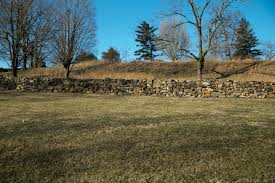
Marye's HeightsIn contrast to the swampy approaches on the Confederate right, 5,000 soldiers under James Longstreet looked out from behind the stone wall on Marye’s Heights to an open plain, crossed from left to right by a mill run, 5′ deep, 15′ wide and filled with 3′ of freezing water.
Confederate artillery commander Edward Porter Alexander looked out on that field, and said “a chicken could not live on that field when we open on it”.  Alexander was right.  For six hours, the Union army threw one attack after another against the rebels behind the wall.  Fourteen assaults, in all.  As the sun went down on the evening of December 13, the ground below Marye’s Heights was carpeted with the mangled, dead and dying bodies of Union soldiers.

The Army of the Potomac suffered over 13,000 casualties, about two-thirds of them in front of that wall.  Lee’s army, by comparison, suffered around 4,500 losses.  Watching the great Confederate victory unfold from his hilltop command post, Robert E. Lee said “It is well that war is so terrible, or we should grow too fond of it.”

sergeant_richard_kirkland1
Sergeant Richard Kirkland

Union ambulance corps had all they could do to remove their wounded from the plains, but dared not enter within the Confederate’s range of fire in front of that wall.  All through the night of the 13-14th, the moans of mangled and dying Union soldiers could be heard along the heights.

I don’t doubt that some Confederate soldiers reveled in all that carnage, but I’m sure that the moans and cries of agony were difficult for most of them to hear.  There wasn’t a man among them who didn’t understand that, but for the grace of God, that could be himself.

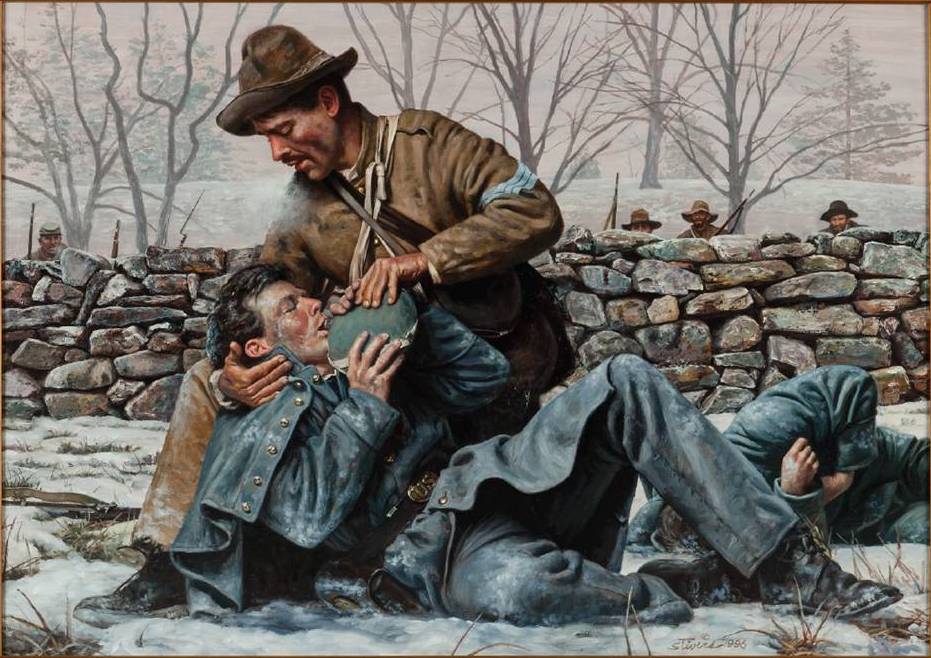
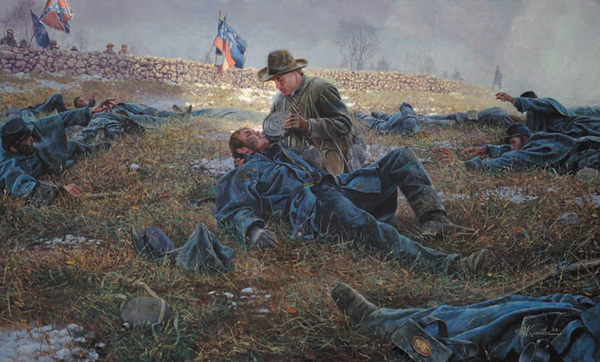
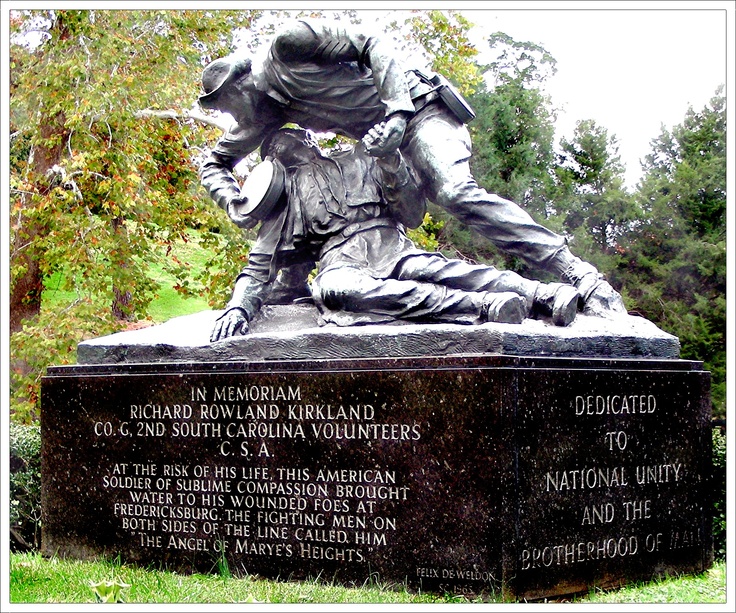
For Sergeant Richard Kirkland, Company G, 2nd South Carolina Infantry, it wasn’t good enough to sit and listen.  He could no longer stand to hear “those poor people crying for water”.  Kirkland left his position and made his way to General Joseph Kershaw’s headquarters, asking permission to help.

On the morning of December 14, 1862, Richard Kirkland took as many canteens as he could carry, and stepped into the no man’s land between two watching armies.  No one fired, nor even moved.  Sgt. Kirkland worked his way alone from one wounded man to the next, straightening out a shattered leg here, there spreading out an overcoat, always with a quiet word of encouragement and a drink of water.

Angel of Marye's Heights

Kirkland was out there for no less than 1½ hours.  Alone in no man’s land, he never left until he had helped every fallen soldier, Federal and Confederate, on that part of the battlefield.

General Kershaw later gave this account:  “Unharmed he reached the nearest sufferer. He knelt beside him, tenderly raised the drooping head, rested it gently upon his own noble breast, and poured the precious life-giving fluid down the fever scorched throat. This done, he laid him tenderly down, placed his knapsack under his head, straightened out his broken limb, spread his overcoat over him, replaced his empty canteen with a full one, and turned to another sufferer.”

Richard Kirkland would not survive the war.  He met his end while leading an infantry charge the following September, at a place called Chickamauga. No one will ever know how many lives were saved by his courage, and his kindness, this day in 1862.

Richard Rowland Kirkland will forever remain, the Angel of Marye’s Heights.

55227d724bc71729117c7386ca437c4c

December 12, 1937  The Road to Pearl Harbor

Interestingly, though the Japanese government held considerable animosity for that of the United States, the people of Japan seemed a different story.  Ambassador Grew was flooded with expressions of sympathy from Japanese citizens, who apologized for their government and expressed affection for the United States.

USS Panay was a flat bottomed river craft, built in Shanghai as part of the Asiatic fleet and charged with protecting American lives and property on the Yangtze River, near Nanking.

crew02Japanese forces invaded China in the summer of 1937, advancing on Nanking as American citizens evacuated the city.  The last of them boarded Panay on December 11:  five officers, 54 enlisted men, four US embassy staff, and 10 civilians.

Japanese air forces received word the morning of December 12, 1937, that Chinese forces were being evacuated on several large steamers and a number of junks, about 12 miles north of the city.

Anchored a short way upstream along with several Chinese oil tankers, Panay came under bombing and strafing attack that morning, sinking mid-river with three men killed.  43 sailors and five civilians were wounded.  Two newsreel cameramen were on board at the time, and captured part of the attack.

The American ambassador to Japan at the time was Joseph C. Grew, a man who was more than old enough to remember how the sinking of the Maine in Havana Harbor brought the US into war with Spain, in 1898.  Grew hoped to avoid a similar outcome following the Panay sinking, though Japanese authorities were less than helpful.

US cryptographers uncovered information shortly after the attack, indicating that aircraft were operating under orders.  The Japanese government continued to insist that the attack had been accidental.

images (13)The matter was officially settled four months later, with an official apology and an indemnity of $2,214,007.36 paid to the US government.

The “accidental attack” narrative appears to be a safe story which both sides pretended to accept, but it seems a little hard to believe.   HMS Ladybird had been fired on that same morning by Japanese shore batteries, and the attack was followed a month later by the “Allison incident”, in which the American consul in Nanking, John M. Allison, was struck in the face by a Japanese soldier.

Added to the fact that American property was being looted by Japanese forces, it seems clear that relations between the two governments at that time, were toxic.

Interestingly, though the Japanese government held considerable animosity for that of the United States, the people of Japan seemed a different story.  Ambassador Grew was flooded with expressions of sympathy from Japanese citizens, who apologized for their government and expressed affection for the United States.

Letters came from citizens of all ages and walks of life, from doctors and professors to school children.  The wives of high ranking Japanese officials apologized to Grew’s wife without the knowledge of their husbands, while ten Japanese men describing themselves as retired US Navy sailors living in Yokohama, sent a check for $87.19.

A typical letter read: “Dear Friend! This is a short letter, but we want to tell you how sorry we are for the mistake our airplane made. We want you to forgive us I am little and do not understand very well, but I know they did not mean it. I feel so sorry for those who were hurt and killed. I am studying here at St. Margarets school which was built by many American friends. I am studying English. But I am only thirteen and cannot write very well. All my school-mates are sorry like myself and wish you to forgive our country. To-morrow is X-Mas, May it be merry, I hope the time will come when everybody can be friends. I wish you a Happy New Year. Good-bye.”

The two governments never did patch things up. What’s been called the “Rape of Nanking”, began the day after the Panay incident.  On December 13, Japanese forces smashed into the city of 600,000, murdering fully half of the inhabitants.  Newsreel footage may be found of live prisoners being used for bayonet practice, being mowed down by machine guns, or doused with accelerant and burnt alive.

The US placed an embargo on September 1940, prohibiting exports of steel, scrap iron, and aviation fuel, in retaliation for the Japanese occupation of northern French Indochina:  modern day Laos, Cambodia and Vietnam.

uss

Japan occupied southern Indochina by the summer of 1941, as the US, Great Britain, and the Netherlands retaliated by freezing Japanese assets.

Throughout that summer and fall, Japan tried to negotiate a settlement to lift the embargo on terms which allowed them to keep newly captured territory, while at the same time preparing for war.

General Hideki Tojo, future Prime Minister, secretly set November 29 as the last day on which Japan would accept settlement without war.

Air and naval forces of the Imperial Japanese government attacked the US naval anchorage at Pearl Harbor, about a week later.