Governor Montiano bought the ruse, hook, line and sinker. The Spanish invaders left St. Simons island for good on July 25, never to return. One of the most brilliant head fakes in colonial history had ended the invasion, leaving the 13th colony in the undisputed hands of the British Crown.
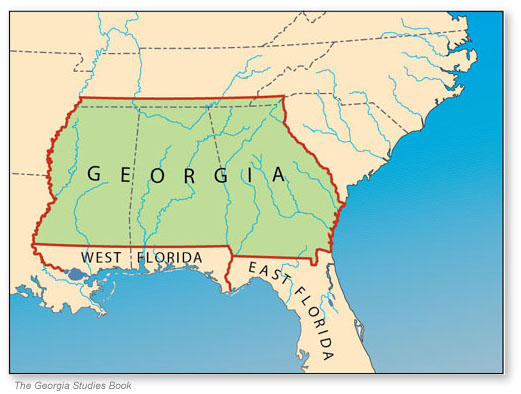
The territory which would come to be occupied by the colony of Georgia was a subject for dispute between Great Britain and Spain, since long before the state became a colony.
Spain had taken Florida for its own, dating the claim back to explorer Ponce de Leon’s first mapping the territory in 1513 and claiming Georgia to be part of it. James Oglethorpe founded the 13th colony as a buffer colony for the British in 1733, serving as a protective zone against Spanish invasion, for her twelve sister colonies to the north.
The Convention of Pardo concluded in early 1739 attempted to settle issues relating to smuggling and to the slave trade, but Spain suspected “cheating” and continued to board foreign vessels at will. The War of Jenkins’ Ear broke out later that year, when Commander Juan de León Fandiño hacked off the ear of Commander Robert Jenkins, informing the unfortunate ship’s master that he could “Go, and tell your King that I will do the same”, to him.
Spain immediately began to draw up plans to invade the Georgia colony.
One day, St. Simons Island would be made notable for having provided the 2,000 southern Live Oak trees, forming the hull of the USS Constitution, “Old Ironsides”. On July 5, 1742, that day was far in the future. On this day, a Spanish invasion force of somewhere between 4,500 and 5,000 men landed on the island, in 36 ships.
A much smaller force of approximately 950 British Regulars, Colonial Militia and Indian Allies was under the command of James Oglethorpe, founder of the Georgia Colony. Oglethorpe withdrew his forces in in the face of the much larger invasion, and later attacked a Spanish reconnaissance in Force at a place called Gully Hole Creek. The Spanish were routed, with almost a third of their number either killed or captured. Falling back in the face of superior numbers of Spanish reinforcements, the British attacked the Spaniards a second time as they stacked arms and pulled out their pots and pans preparing for dinner. The “Battle of Bloody Marsh” was another victory for the British, and would prove to be decisive.
“Bloody Marsh” in 2008
A few days later, Oglethorpe launched what can only be described a a psychological warfare operation. A Spanish prisoner was released to the other side, with information that a massive British force was on the way. Fearing that Montiano might learn the true size of his puny force, Oglethorpe spread drummers out until their sound seemed to come from all directions.
Governor Montiano bought the ruse, hook, line and sinker. The Spanish invaders left St. Simons island for good on July 25, never to return. One of the most brilliant head fakes in colonial history had ended the invasion, leaving the 13th colony in the undisputed hands of the British Crown.
Georgia colony, 1764
If you enjoyed this “Today in History”, please feel free to re-blog, “like” & share on social media, so that others may find and enjoy it as well. Please click the “follow” button on the right, to receive email updates on new articles. Thank you for your interest, in the history we all share.
In an ending no fiction writer would dare put to paper, both men died on the same day, July 4, 1826. Fifty years to the day from the birth of the Republic, they had helped to create.
Delegates to the 2nd Continental Congress originally pushed for Richard Henry Lee to write the Declaration of Independence. It was he who delivered the all-important resolution on June 1, 1776: “Resolved, that these United Colonies are, and of right ought to be, free and independent States...”
Lee was appointed to the Committee of Confederation, assigned to write the Articles by which the fledgling nation would govern itself. Lee believed that two such committees were too much and, soon, he would be called home to care for a critically ill wife.
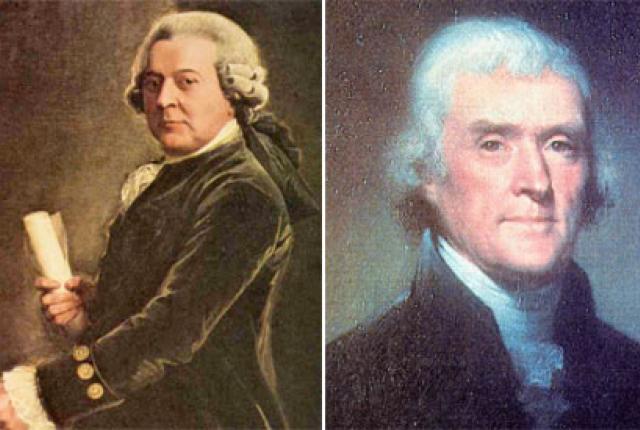
So it is that a committee of five were appointed to write the Declaration of Independence, including Massachusetts attorney John Adams, and a young Virginia delegate named Thomas Jefferson.
Jefferson had no interest in writing the Declaration of Independence and suggested that Adams pen the first draft. Adams declined, and described the following conversation, in a letter to Massachusetts politician Timothy Pickering:
“Jefferson proposed to me to make the draft. I said, ‘I will not,’ ‘You should do it.’ ‘Oh! no.’ ‘Why will you not? You ought to do it.’ ‘I will not.’ ‘Why?’ ‘Reasons enough.’ ‘What can be your reasons?’ ‘Reason first, you are a Virginian, and a Virginian ought to appear at the head of this business. Reason second, I am obnoxious, suspected, and unpopular. You are very much otherwise. Reason third, you can write ten times better than I can.’ ‘Well,’ said Jefferson, ‘if you are decided, I will do as well as I can.’ ‘Very well. When you have drawn it up, we will have a meeting.”
Thomas Jefferson would spend the following seventeen days, writing the first draft. He and Adams had only just met during the Continental Congress in Philadelphia. The two would develop a close personal friendship which would last for most of their lives.
The friendship between the two men came to an ugly ending during the Presidential election of 1800, in which the mudslinging from both sides rose to levels never before witnessed in a national election.
Jefferson defeated one-term incumbent Adams and went on to serve two terms as President of the United States. Upon Jefferson’s retirement in 1809, one of the Declaration’s signers, Dr. Benjamin Rush, took it upon himself to patch up the broken friendship between the two founding fathers.
Dr. Rush worked on this personal diplomatic mission for two years. In 1811, he finally succeeded.
Jefferson Seal
There followed a series of letters between John Adams and Thomas Jefferson, which together constitute one of the most comprehensive historical and philosophical assessments ever written about the American founding.
The correspondence between the pair touched on a variety of topics, from the birth of a self-governing Constitutional Republic, to then-current political issues, to matters of philosophy and religion and issues related to their advancing years.
Both men understood that they were writing not only to one another, but also to generations yet unborn. Each went to great lengths to explain the philosophical underpinnings of his views, Adams the firm believer in strong, centralized government, Jefferson advocating a smaller federal government which was more deferential to the states.
By 1826, Jefferson and Adams were among the very last survivors among the founding generation. James Monroe alone, would survive these two.
In an ending no fiction writer would dare put to paper, both men died on the same day, July 4, 1826. Fifty years to the day from the birth of the Republic, they had helped to create. Adams was 90 as he lay on his deathbed, suffering from congestive heart failure. His last words were “Thomas Jefferson still survives”. There was no way of knowing. The author of the Declaration of Independence had died of a fever, five hours earlier at his Monticello home near Charlottesville, Virginia. Jefferson was 82.
John Adams son John Quincy was himself President at the time of the two men’s passing, and remarked that the coincidence was among the “visible and palpable remarks of Divine Favor”.
A month after the two men passed, Daniel Webster spoke of the pair at Faneuil Hall, in Boston.
“No two men now live, (or) any two men have ever lived, in one age, who (have) given a more lasting direction to the current of human thought. No age will come, in which the American Revolution will appear less than it is, one of the greatest events in human history. No age will come, in which it will cease to be seen and felt, on either continent, that a mighty step, a great advance, not only in American affairs, but in human affairs, was made on the 4th of July 1776″.
If you enjoyed this “Today in History”, please feel free to re-blog, “like” & share on social media, so that others may find and enjoy it as well. Please click the “follow” button on the right, to receive email updates on new articles. Thank you for your interest, in the history we all share.
History is replete with examples of what power concentrated in the hands of a few, leads to.
Two hundred and forty-two years ago, our founding fathers bequeathed to us a nation unique in all history. A nation founded on an idea, that all men are created equal, and government derives its powers from the just consent of the governed. A Federal, Constitutional Republic in which our politicians are not our ‘leaders’ but rather our Representatives, operating within a system of diffuse powers with checks and balances, periodically accountable through democratic processes to their bosses – the people who put them there.
In modern times, it has become fashionable to point to the flaws in such a system. Howard Zinn and others present a victim’s-eye narrative of American history. Smug, faculty iconoclasts and a pop culture Commentariat, decrying the ‘sugar coated fairy tales’, of our past. Yet, the Great Winston Churchill may have had the final word, describing ‘Democracy” as the worst form of government there is…except for all the others.
For many among us, most I should think, some form of that Constitutional, self-governing Republic envisioned by our founders, remains preferable to all other forms of government. Warts and all.
History is replete with examples of what power concentrated in the hands of a few, leads to.
Indeed, such a system has imperfections, not least among them those who would ascend to political office.
Hearst columnist Ambrose Bierce, a social satirist of his day and my favorite curmudgeon, once defined politics as ‘A strife of interests, masquerading as a contest of principles. The conduct of public affairs for private advantage.
In the late 19th century, Democrat William “Boss” Tweed owned New York politics, fleecing city taxpayers at the head of the Tammany Hall political machine. New York debt levels soared by over $100 million between 1868 and 1870 alone, a figure equivalent to over a Billion dollars, today.
As Governor of Tennessee, Democrat Ray Blanton ran a ‘pay for play’ operation selling pardons, paroles and commutations, until drawing the attention of the eye of Sauron, at the FBI. Blanton’s corruption was extensive enough to spawn a book and a later movie, and launched the political career of prosecutor and sometime actor, Fred Thompson.
And, lest I be accused of picking on Democrats, Pennsylvania Republican and Representative in Congress R. Budd Dwyer faced up to 55 years in prison and a $300,000 fine for racketeering and mail fraud, when he took a .357 Magnum revolver out of a manila envelope and blew his brains out. On live television, no less.
There are so many more and we all have our ‘favorites’, in this parade of horribles. Yet, for insensate cupidity and pure boneheadedness, it would be hard to outdo the attorney, circuit court judge and member of the United States House of Representatives, Andrew Jackson May.
The Kentucky Democrat was a staunch supporter of the ‘New Deal’ policies of President Franklin Delano Roosevelt, serving in seven succeeding Congresses between 1931 and 1947. As Chairman of the powerful Committee on Military Affairs, May became involved with New York businessmen Murray and Henry Garsson, a relationship which would lead to war profiteering allegations.
Congressman Andrew Jackson May
After the war, a Senate investigating committee discovered evidence of substantial kickbacks from the Garsson brothers. Making matters worse, their munition business took excessive profits, while producing shoddy product. May’s bribery scandal revealed evidence that the Garsson factory produced defective fuses for their 4.2-inch mortar shells, detonating prematurely and leading to the death of no fewer than 38 American soldiers.
Andrew May would serve nine months in Federal prison for accepting bribes in exchange for securing munitions contracts during WW2.
Yet, even that pales in comparison with the ‘May incident’, for which the man has earned eternal infamy. As an influential member of an important committee, Andrew May was necessarily entrusted with highly confidential information, among them deficiencies in Imperial Japanese Navy anti-submarine depth-charge tactics.
Imperial Japanese Navy light Crusier using Depth Charges against an American submarine, South Pacific 1942 H/T ww2incolor
For some time, the American submarine service had enjoyed considerable success in its war on Japanese shipping. Imperial Japanese naval planners held some bad assumptions about American submarine specifications, among them maximum depth capabilities.
Japanese depth charges were set to detonate at too shallow a depth, leading to a high survival rate for American subs. Congressman May took care of that problem, in 1943.
Returning home from a junket, the Congressman revealed this highly sensitive information, before a press conference. Various press associations ran with the story and some were bright enough to ‘sit on it’, but not all. Several newspapers published the information, including one in Hololulu.
Vice Admiral Charles A. Lockwood
Japanese naval ASW (Antisubmarine Warfare) forces were quick to adjust depth charge settings. Vice Admiral Charles A. Lockwood, commander of the U.S. submarine fleet in the Pacific, estimated that May’s indiscretion killed as many as 800 American crewman, with the loss of ten submarines. “I hear Congressman May said the Jap depth charges are not set deep enough”, he said. “He would be pleased to know that the Japs set them deeper now.”
Andrew Jackson May was convicted by a federal jury on this day in 1947, for accepting cash bribes from Murray and Henry Garsson, to use his position as Chairman of the Military Affairs Committee to secure munitions contracts for the Garsson firm. The Garsson brothers also received prison terms.
President Harry Truman granted May a full pardon in 1952, though his political career was finished. Andrew May returned home to Kentucky to resume the practice of law, until his death in 1959. We are left only to contemplate, what the man or the press could be thinking, to divulge information more safely left in the hands of a stupid child. That, and the horrifying realization that the democratic process might actually work, and the government we elect is just…like…Us.
If you enjoyed this “Today in History”, please feel free to re-blog, “like” & share on social media, so that others may find and enjoy it as well. Please click the “follow” button on the right, to receive email updates on new articles. Thank you for your interest, in the history we all share.
56 men would sign the Declaration of Independence in the days and weeks that followed, giving birth to a nation unique in all history. A nation founded on an idea.
The first Virginia Convention organized in 1774, when Royal Governor Lord Dunmore dissolved the colony’s House of Burgesses. The colonial governing body had called for a day of prayer, a show of solidarity with her sister colony in Boston, after the British government closed the harbor in retaliation for the “Boston Tea Party“.
Three additional such meetings would take place in the following year-and-one-half, to discuss increasingly fractious relations with the British Empire. No expression emerged from these conventions, in favor of independence.
That would change on May 15, 1776, when the fifth Virginia Convention declared that the colonial government as “formerly exercised” by King George III in Parliament, was “totally dissolved”. Three resolutions emerged from this body: one calling for a declaration of rights in Virginia, another calling for the establishment of a republican constitution, and a third instructing its delegates to the Continental Congress in Philadelphia, to declare independence from Great Britain.
Richard Henry Lee’s resolution was taken almost verbatim from instructions from the Virginia Convention. As presented to the second Continental Congress on June 7, 1776, Lee’s resolution read:
“Resolved, that these United Colonies are, and of right ought to be, free and independent States, that they are absolved from all allegiance to the British Crown, and that all political connection between them and the State of Great Britain is, and ought to be, totally dissolved. That it is expedient forthwith to take the most effectual measures for forming foreign Alliances. That a plan of confederation be prepared and transmitted to the respective Colonies for their consideration and approbation”.
At the time, several colonies were not yet ready to declare independence.
Representatives agreed to delay the vote until July 1, appointing a “Committee of Five” to draft a declaration of independence from Great Britain. Members of the committee included John Adams of Massachusetts, Benjamin Franklin of Pennsylvania, Roger Sherman of Connecticut, Robert Livingston of New York and Thomas Jefferson of Virginia. The committee selected Jefferson to write the document, the draft presented to the Congress for review on June 28.
Debate resumed on July 1, 1776, with most of the delegates expressing favor for Lee’s resolution.
The final vote was taken on July 2, when delegates from 12 of the 13 colonies voted in favor. Delegates from New York abstained, having as yet received no clear instructions from their constituents.
The Pennsylvania Evening Post reported on July 2nd that “This day the Continental Congress declared the United Colonies Free and Independent States”.
The Pennsylvania Gazette followed suit on the third with “Yesterday, the CONTINENTAL CONGRESS declared the UNITED COLONIES FREE and INDEPENDENT STATES”.
John Adams believed that July 2 would go down as Independence Day, for the young nation.
56 men would sign the Declaration of Independence in the days and weeks that followed, giving birth to a nation unique in all history. A nation founded on an idea.
That line was drawn in the sand, two hundred and forty two years ago, today. As Caesar had ‘crossed the Rubicon’ nearly two thousand years earlier, a decision had been taken from which there would be no turning back. Fifty-six men affixed their signatures to that document, affirming that to this “… we mutually pledge to each other our lives, our fortunes and our sacred honor.”
These were no empty words. One of those signers, Benjamin Franklin, stated in all candor, that now “We must all hang together or, assuredly we shall all hang separately.”
On this day in 1984, exactly 208 years after a young nation declared its independence, a memorial was dedicated in the Constitution Gardens, on the National Mall in Washington, DC. The monument consists of fifty-six stone blocks, each bearing the inscribed likeness of the actual signature, of every man who so pledged his life, his fortune and his sacred honor.
Today, this day is mostly forgotten in favor of July 4, when the final edits of Jefferson’s Declaration were adopted, the final document engrossed (handwritten onto parchment), and sent off to the printer.
Happy Independence Day.
If you enjoyed this “Today in History”, please feel free to re-blog, “like” & share on social media, so that others may find and enjoy it as well. Please click the “follow” button on the right, to receive email updates on new articles. Thank you for your interest, in the history we all share.
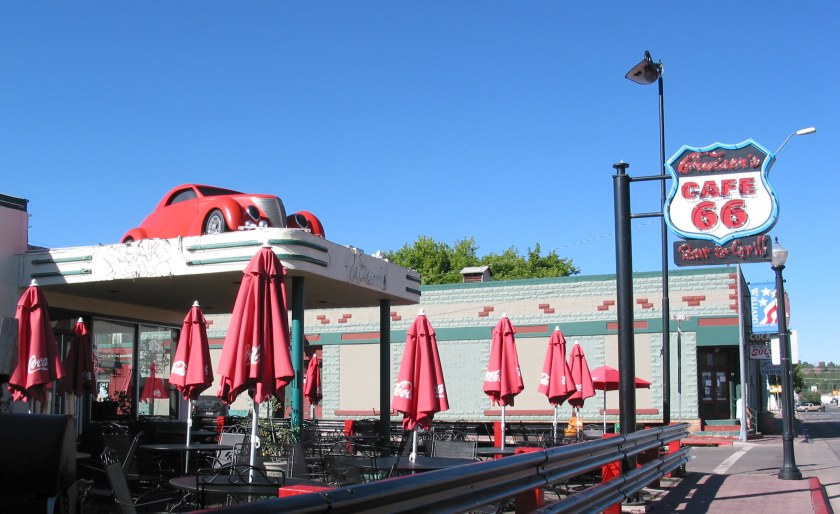
The golden age of the automobile, had arrived. All manner of roadside attractions popped up to serve the burgeoning tourist business. There were teepee-shaped motels and frozen custard stands. Indian curio shops and reptile farms.
In 1857, President James Buchanan appointed Lieutenant Edward Beale to survey and build a 1,000-mile wagon road from Fort Defiance, New Mexico to the Arizona/California border. The survey continued an experiment first suggested by Secretary of War and future President of the Confederate States of America Jefferson Davis, in the use of camels as draft animals.
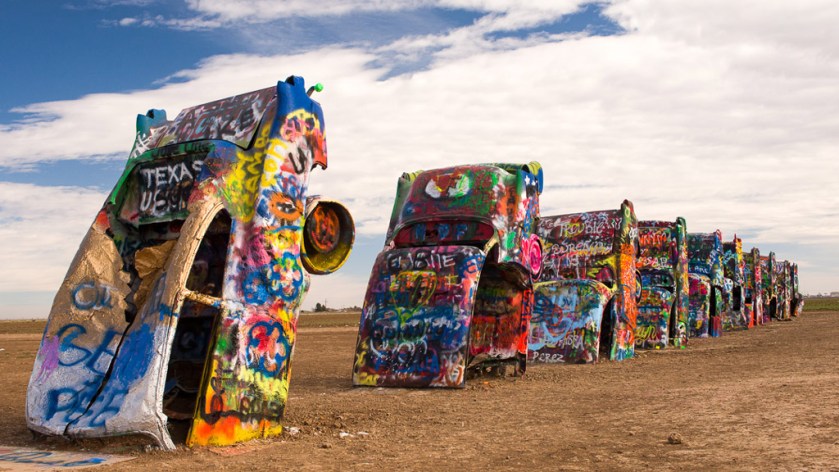
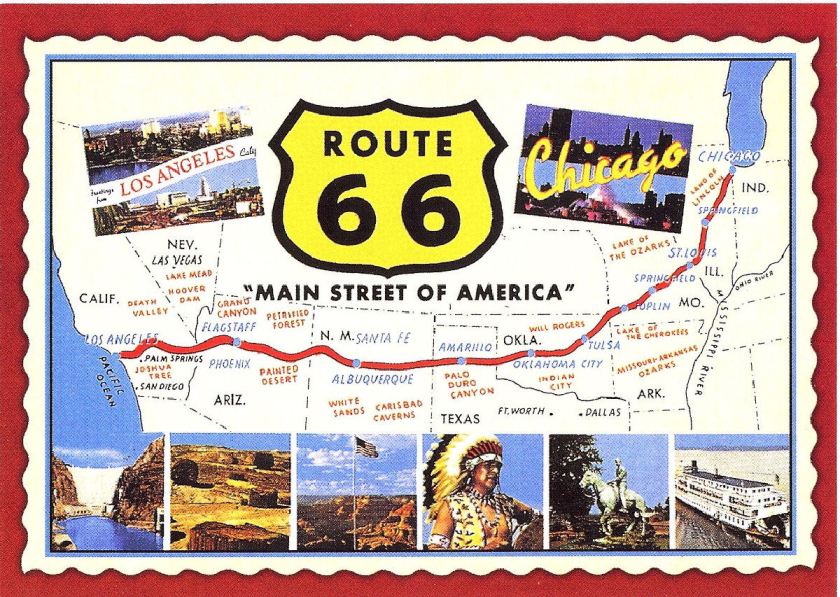
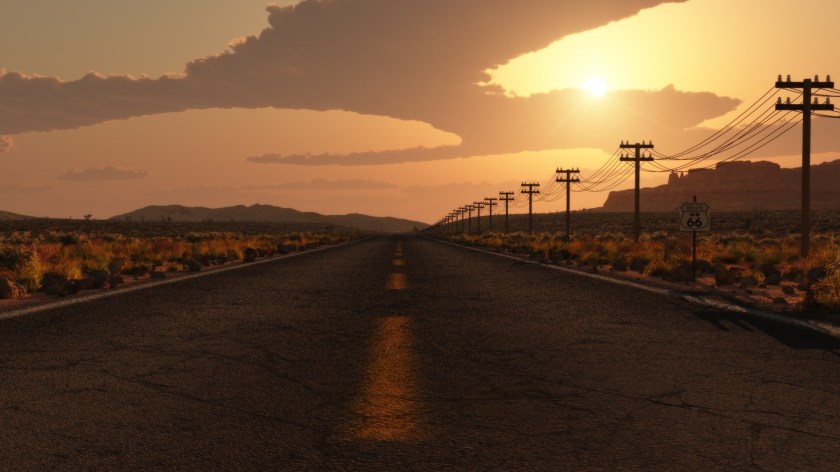
The camel part turned out to be a flop, but the road building was not. Beale’s wagon trail went on to become the western end of “America’s Main Street”. Route 66.
The “Mother Road” became an official part of the national highway system in 1927. It was yet to be paved, when the US Highway 66 Association held a “Bunion Derby” in 1928. It was a footrace from Los Angeles to Madison Square Garden, a distance of 3,423½ miles. Naturally, the LA to Chicago leg ran along Route 66.
Andy Hartley Payne, an Oklahoma Cherokee runner won the race in 573 hours, 4 minutes and 34 seconds. 11th place finisher Harry Abrams ran the race in the opposite direction the following year, becoming the only person to twice run across the continental United States.
In 1914, a Model T sold for $490. As the 20s drew to a close, the number of registered drivers had tripled to 23 million.
The 1932 Summer Olympics in Los Angeles and the westward migration of the “Dust Bowl” era increased the number of “Mom & Pop” service stations, restaurants, and motor courts, springing up to serve the needs of passing motorists.
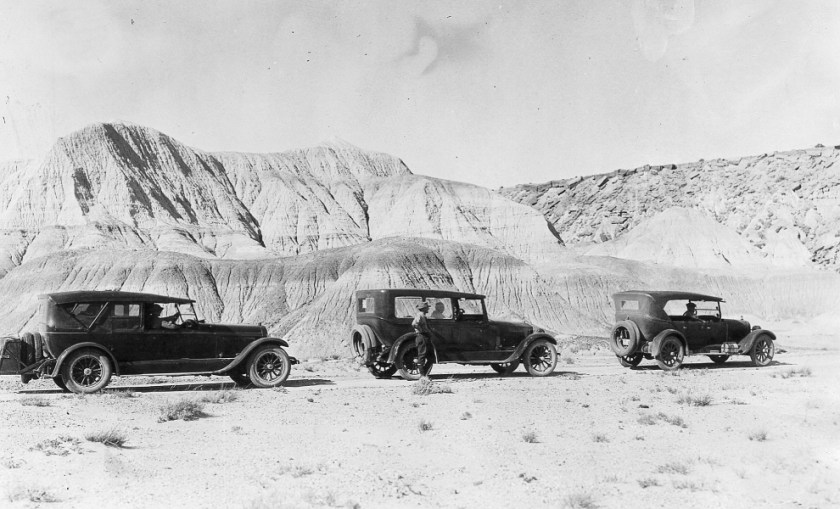
The road was fully paved by 1938, passing through the Painted Desert on the way by the Grand Canyon and Meteor Crater in Arizona.
The golden age of the automobile, had arrived. All manner of roadside attractions popped up to serve the burgeoning tourist business. There were teepee-shaped motels and frozen custard stands. Indian curio shops and reptile farms.
Meramec Caverns outside of St. Louis painted billboards on barns, calling themselves “Jesse James hideout”. The Big Texan sold a 72-ounce steak dinner, making it free to anyone who could eat the whole thing in an hour.
The fast-food industry was born on Route 66, when Sheldon “Red” Chaney built Red’s Giant Hamburg in Springfield, Missouri. Believed to be the first drive-through restaurant in the country, the name was supposed to be “Red’s Giant Hamburger“. Chaney had to cut the two bottom letters off his sign, when the city refused to raise the telephone wires.
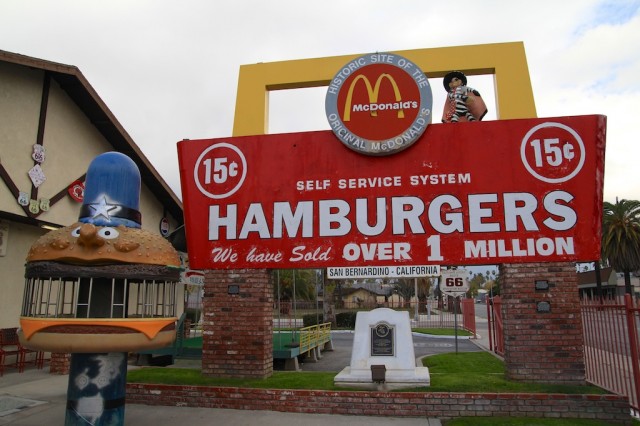
Patrick McDonald opened “The Airdrome” restaurant on Route 66 in 1937, years before the world knew anything about Ray Kroc. Hot dogs were some of the first items he ever sold. Ten cent hamburgers were added later, along with all-you-can-drink orange juice for five cents. Three years later, McDonald’s two sons Maurice and Richard (“Mac” and “Dick”) moved the entire building 40 miles east, to San Bernardino, calling the place “McDonald’s Bar-B-Que”.
General Eisenhower came out of WWII with an appreciation for the German highway system, the Autobahn, and signed the Interstate Highway Act as President in 1956. It was the beginning of the end for Route 66. New highway construction began to bypass town centers, and once-thriving Mom & Pops began to die off.
By the mid-’50s, Missouri upgraded its sections of US 66 to four lanes, by-passing town centers and the businesses that went with them.
Illinois widened US 66 from Chicago to the Mississippi River. By 1957, virtually the entire Missouri-Kansas-Oklahoma stretch was replaced by 4 lane toll roads. You could see the old 66 as you drove parallel to it, but travelers rarely stopped.
The last parts of Route 66 were decertified by state highway and transportation officials on this day in 1985. In some cities, the old road is now the “Business Loop”.
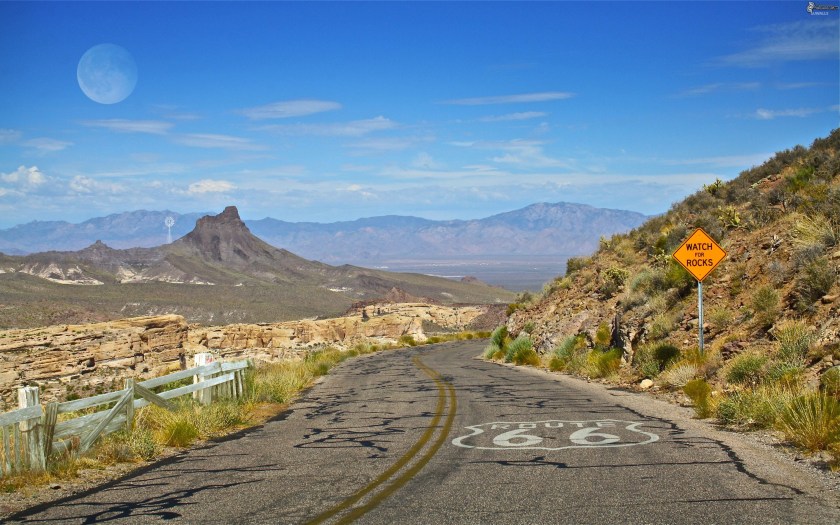
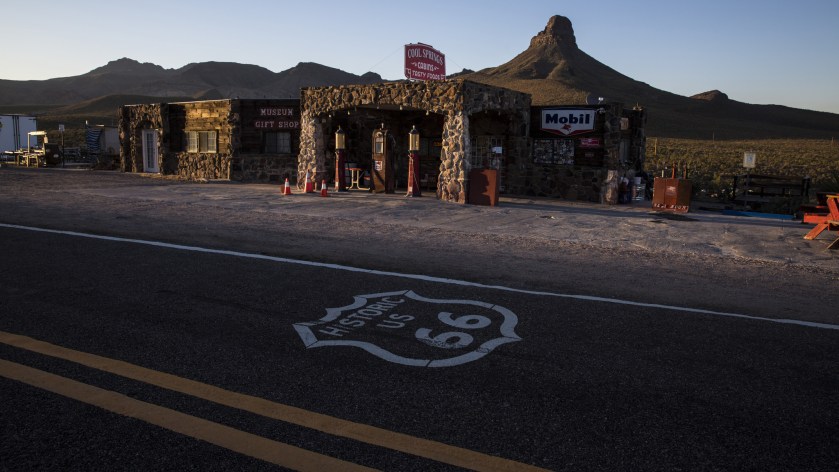
The Mother Road has been carefully preserved in some areas, abandoned in others.
Today, most of the old attractions are gone. You couldn’t drive the old Route 66 from Chicago to LA if you wanted to. But you could get close. If you plan ahead.
If you enjoyed this “Today in History”, please feel free to re-blog, “like” & share on social media, so that others may find and enjoy it as well. Please click the “follow” button on the right, to receive email updates on new articles. Thank you for your interest, in the history we all share.
No whites were to be permitted onto these territories but for Federal Government officials, but the rich resources of the Black Hills, first in timber and then in gold, made the provision near-impossible to enforce.
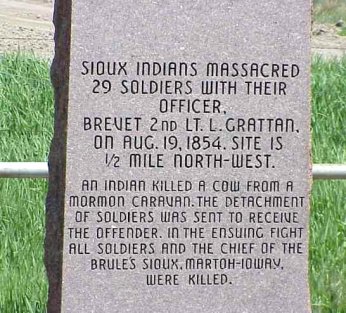
During the late summer of 1854, 4,000 natives of the Brulé and Oglala Sioux were camped in the future Wyoming territory, near the modern city of Torrington, WY. On August 17, visiting Miniconjou High Forehead killed a wandering cow, belonging to a Mormon traveling the nearby Oregon trail. The native camp accorded with the terms of the treaty of 1851 and the cow episode could have been amicably handled, but events quickly spun out of control.
Chief Conquering Bear attempted to negotiate recompense, offering a horse or cow from the tribe’s herd. The owner refused, demanding $25. That same treaty of 1851 specified that such matters would be handled by the local Indian agent, in this case John Whitfield, scheduled to arrive within days with tribal annuities more than sufficient to settle the matter to everyone’s satisfaction.
Ignorant of this provision or deliberately choosing to ignore it, senior officer Lieutenant Hugh Fleming from nearby Ft. Laramie requested that the Sioux Chief arrest High Forehead, and hand him over to the fort. Conquering Bear refused, not wanting to violate rules of hospitality. Besides, the Oglala Chief had no authority over a Miniconjou.
6th Infantry Regiment Second Lieutenant John Grattan arrived with a force of twenty-nine and a bad attitude, intent on arresting the cow’s killer. One Ft. Laramie commander later remarked, “There is no doubt that Lt. Grattan left this post with a desire to have a fight with the Indians, and that he had determined to take the man at all hazards.” French-Native interpreter Lucienne Auguste was contemptuous, taunting Sioux warriors as “women” and threatening that the soldiers had come not to talk, but to kill.
What followed was all but inevitable. Angry warriors took up flanking positions around the soldiers, one of whom panicked and fired, mortally wounding Conquering Bear. When it was over, all thirty soldiers were dead, their bodies ritually mutilated.
The Federal government was quick to respond to the “Gratton Massacre”, Secretary of War Jefferson Davis characterizing the incident as “the result of a deliberately formed plan.”
The first Sioux War of 1854 – ’56 became the first of seven major wars and countless skirmishes between the United States and various sub-groups of the Sioux people, culminating in the Ghost Dance War of 1890.
Diametrically opposite cultures steeped in mutual distrust engaged in savage cruelty each upon the other, often at the expense of innocents. There was even one major massacre of natives by other natives, when a war band of some 1,500 Oglala/Brulé Sioux attacked a much smaller group of Pawnee, during their summer buffalo hunt. Seventy-one Pawnee warriors were killed along with 102 of their women and children, their bodies horribly mutilated and scalped, some even set on fire.
Today, a 35-foot obelisk stands in mute witness, to the horrors of “Massacre Canyon”.
Massacre Canyon Monument
In the early eighteenth century, peoples of the Suhtai and Tsitsista tribes migrated across the northern Mississippi River, pushing the Kiowa to the southern plains and in turn being pushed westward, by the more numerous Lakota, or “Teton” Sioux. These were the first to adopt the horse culture of the northern plains, the two tribes merging in the early 19th century to become the northern Cheyenne.
The ten bands comprising the northern Cheyenne spread from the black hills of South Dakota, to the Platte Rivers of Colorado, at times antagonistic to and at others allied with all or part of the seven nations of the Sioux.
In 1866, the Lakota people went to war behind Chief Red Cloud, over Army encroachment onto the Powder River basin area, in northeastern Wyoming. The war ended two years later with the Treaty of Fort Laramie, granting a Great Sioux Reservation to include the western half of South Dakota including the Black Hills, as well as large, “unceded territory” in Wyoming and Montana and the Powder River Country, as Cheyenne and Lakota hunting grounds.
No whites were to be permitted onto these territories but for Federal Government officials, but the rich resources of the Black Hills, first in timber and then in gold, made the provision near-impossible to enforce.
The Army attempted for a time to keep settlers out of Indian territories, while political pressure mounted on the Grant administration to take back the Black Hills from the Lakota. Delegations of Sioux Chieftains traveled to Washington, D.C. in an effort to persuade the President to honor existing treaties, and to stem the flow of miners into their territories. Congress offered $25,000 for the land, and for the tribes to relocate south to Indian Territory, in modern-day Oklahoma. Chief Spotted Tail spoke for the whole delegation: “You speak of another country, but it is not my country; it does not concern me, and I want nothing to do with it. I was not born there … If it is such a good country, you ought to send the white men now in our country there and let us alone.”
The government now determined to force the issue, and imposed a deadline of January 31. That many of the tribes even knew of such a time limit seems unlikely. The government’s response was unworthy of a Great Nation. On February 8, 1876, Major General Philip Sheridan ordered the commencement of military operations against those deemed “hostiles”.
The Great Sioux War of 1876-’77 began with a ham-fisted assault on the frigid morning of March 17, when Colonel Joseph Reynolds and six companies of cavalry attacked a village believed to that of the renegade Crazy Horse, but turned out to be a village of Northern Cheyenne.
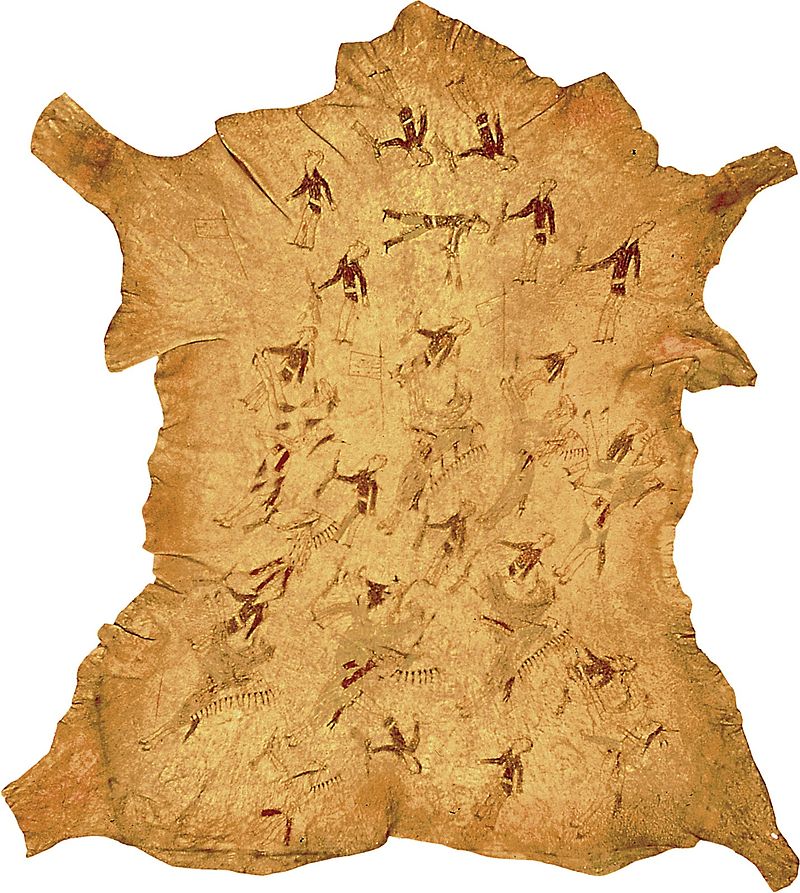
Cheyenne Artist’s Depiction of the Battle of Little bighorn
A second, far larger campaign was launched that Spring, when three columns were sent to converge on the Lakota hunting grounds. Brigadier General George Crook’s column was the first to make contact, resulting in the Battle of Rosebud Creek on June 17. While Crook claimed victory afterward, the native camp was vastly larger than expected, and Crook withdrew to camp and wait for reinforcements. He had just taken his force out of what was to come.
General Alfred Terry dispatched the 7th Cavalry, 31 officers and 566 enlisted men led by Lieutenant Colonel George Armstrong Custer, to begin a reconnaissance in force along the Rosebud. Custer was given the option of departing from his orders and going on the offence, should there be “sufficient reason”. For a man possessed of physical bravery bordering on recklessness – Custer had proven that thirteen years earlier at Gettysburg – there was bound to be sufficient reason.
Custer divided his force into three detachments, more concerned about preventing the escape of the “hostiles”, than with fighting them. It was a big mistake.
The tale of those other two columns is worth a “Today in History” essay of their own if not an entire book, but this is a story about Little Big Horn. Suffice it to say that Major Marcus Reno‘s experience of this day was as grizzly and as shocking, as that moment when the brains and face of his Arikara scout Bloody Knife spattered across his own. Reno’s detachment had entered a buzz saw and would have been annihilated altogether, had it not met up with that of captain Frederick Benteen.
To describe what followed as “Custer’s last stand“ is to conjure images of soldiers fighting back to back, or crouched behind dead and dying horses amidst a swirling tide of warriors. Later archaeological evidence reveals not piles of spent casings marking the site of each man’s last desperate stand, but rather a scattering of brass across the hillside. Like a handful of rice, tossed across a hardwood floor.
2,500 warriors swept down on 268. There were no survivors.
Capture The Flag, at Little Bighorn
The Battle of Little Big Horn, the Natives called it the “Battle of the Greasy Grass”, may be more properly regarded as the Indian’s last stand. Custer’s detachment was destroyed, to a man. Within hours, an enormous encampment of 10,000 natives or more were returning to their reservations, leaving no more than 600 in their place.
Crook and Terry awaited reinforcements for nearly two months after the battle. Neither cared to venture out again, until there were at least 2,000 men.
Strong men, bareback riders, trapeze performers and acrobats were killed instantly and others horribly maimed, as wooden circus cars telescoped into one another. Confused and bleeding survivors stumbled from the wreckage, as gas-fed lanterns began to set fire to all that wood.
There is an oft-repeated but mistaken notion that the circus goes back to Roman antiquity. The panem et circenses, (bread and circuses)” of Juvenal, ca AD100, refers more to the ancient precursor of the racetrack, than to anything resembling a modern circus. The only common denominator is the word itself, the Latin root ‘circus’, translating into English, as “circle”.
The father of the modern circus is the British Sergeant-Major turned showman, Philip Astley. A talented horseman, Astley opened a riding school near the River Thames in 1768, where he taught in the morning and performed ‘feats of horsemanship’ in the afternoon. Equestrian and trick riding shows were gaining popularity all over Europe at this time, performers riding in circles to maintain balance while standing on the backs of galloping horses. It didn’t hurt matters, that the “ring” made it easier for spectators to view the event.
These afternoon shows gained overwhelming popularity by 1770, and Astley hired acrobats, rope-dancers, and jugglers to fill the spaces between equestrian events. The modern circus, was born.
From that day to this, the “Fancy Pants” dresses in red tailcoat and top hat, evocative of British fox hunting garb. This “Announcer” is commonly (and mistakenly) called the “ringmaster”, while the true ring master is the “equestrian director”, standing in the center of the ring and pacing horses for the riding acts.
In 1825, Joshuah Purdy Brown of Somers New York replaced the wooden structure common to European circuses with a canvas tent, around the time when cattle dealer Hachaliah Bailey bought a young African elephant, and began to exhibit the animal all over the country.
The exotic animal angle was a great success. Other animals were added, and farmers were soon leaving their fields to get into the traveling menagerie business. The unique character of the American traveling circus emerged in 1835, when 135 such farmers and menagerie owners combined with three affiliated circuses to form the American Zoological Institute.
Phineas Taylor Barnum and William Cameron Coup launched P.T. Barnum’s Museum, Menagerie & Circus in 1871, where the “museum” part was a separate exhibition of human and animal oddities. It wouldn’t be long, before the ‘sideshow” became a regular feature of the American circus.
There have been no fewer than 81 major circuses in American history, and countless “Dog & Pony” shows, programs so small as to include only a few family members and an assistant or two, with a couple of trained animals. And all this time, I thought ‘Dog & Pony Show’ referred to the United States Congress.
The ‘Greatest Show on Earth’ closed for the last time on Sunday, May 21 2017, when ‘animal rights activists’ and changing tastes in entertainment finished the Ringling Brothers, Barnum & Bailey Circus, ending a 146-year run.
In the mid-19th century, German animal trainer Carl Hagenbeck toured Europe with “ethnographical” spectacles, combining animals with native peoples such as the Sámi of the Scandinavian peninsula, complete with reindeer and sleds. Hagenbeck was among the first to develop animal training methods based on trust and reward rather than pain and fear, his demonstrations emphasizing the animal’s intelligence and tractability over ferocity.
In 1906, Hagenbeck sold his traveling animal show to American circus operator Benjamin Wallace, before going on to develop open zoological gardens and native panoramas which would be familiar to today’s zoo enthusiast, rather than the barred cells of his day.
The American war machine was spinning up to peak operational capacity in 1918, as the industrial might of the nation pursued an end to the war ‘over there’.
Hagenbeck-Wallace was one of the premier circuses of the day, moving about the country on three trains and employing no fewer than 1,000 roustabouts and assorted performers.
In the small hours of June 22, an engineer with the Michigan Central Railroad was at the wheel of Train No. 41, an empty 21-car troop train. Automatic signals and flares and at least one frantic signalman should have warned the driver that a stalled train lay on the track ahead, but he missed them all. Alonzo Sargent was asleep at the wheel.
The following day, newspapers across the country told the story of what happened next.
On June 22, the circus was scheduled to appear at the Show Grounds at 150th and Calumet Avenue in Hammond, Indiana. In the early morning darkness, an overheated axle box required one train to make an unscheduled stop. It was 4am and most of the circus’ employees were asleep, when the Michigan Central locomotive smashed into the rear of the stalled train.
The Hammond circus train wreck was one of the worst such accidents, in history. Strong men, bareback riders, trapeze performers and acrobats were killed instantly and others horribly maimed, as wooden circus cars telescoped into one another. Confused and bleeding survivors stumbled from the wreckage, as gas-fed lanterns began to set fire to all that wood.
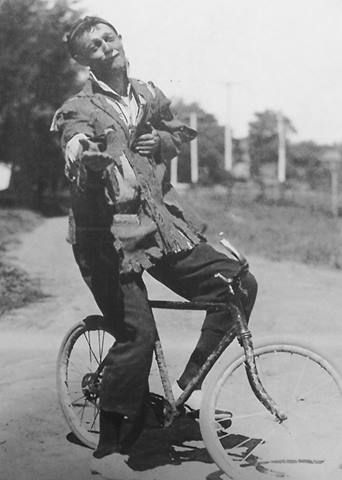
Hagenbeck-Wallace clown “Big Joe” Coyle
Those lucky enough to escape the horror were forced to watch in disbelief as friends, families and co-workers were incinerated alive.
Hours later a clown, “Big Joe” Coyle, could be seen weeping, beside the mangled bodies of his wife and two small boys.
127 were injured and an estimated 86 crushed or burned to death in the wreck. The rumor mill went berserk. Wild lions and tigers had escaped and were roaming the streets and back yards of Gary, Indiana. Elephants died in an heroic attempt to put out the flames, spraying water on the burning wreckage with their trunks.
None of the stories were true. The animals had passed through hours before on an earlier caravan, and now awaited a train which would never come.
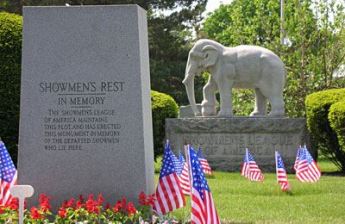
The Showmen’s League of America was formed in 1913, with Buffalo Bill Cody its first President. The group had recently purchased a 750-plot parcel at the Woodlawn Cemetery in Forest Park, Illinois and called it “Showmen’s Rest”, having no idea their investment would be used so soon.
A mass grave was dug for the unidentified and unidentifiable. Some of the dead were roustabouts or temporary workers, hired only hours or days earlier. Some performers were known only by stage names, their gravestones inscribed with names like “Four-Horse Driver”, “Baldy” and “Smiley”.
The Hagenbeck-Wallace circus was a big deal in those days. Famed lion tamer Clyde Beatty was a member, as was a young Red Skelton, tagging along with his father, who worked as a clown.
Only two shows had to be canceled, as erstwhile ‘competitors’ Barnum & Bailey and others lent workers, performers and equipment. The show would go on.
In the world of elephants, an upraised trunk carries connotations of joy, while a lowered trunk symbolizes mourning. At the Woodlawn cemetery of Chicago, five elephant statues circumscribe the mass grave of clowns, trapeze artists, strongmen and other circus performers. Each has a foot raised with a ball underneath. Every trunk, hangs low. The largest of the five bears the inscription, “Showmen’s League of America.” On the other four are inscribed the words “Showmen’s Rest”.
British envoys delivered proclamations reaffirming the practice of impressment, amounting to the kidnapping of sailors and forcing their labor aboard British ships. In total, the Royal Navy impressed over 9,000 sailors claiming to be American citizens, becoming the driving force behind the United States going to war with England, in 1812.
The Napoleonic Wars took place between 1799 and 1815, pitting a series of seven international coalitions against the forces of Napoleon Bonaparte and his Grande Armée. The former American colonies benefited from the European conflict, remaining on the sidelines and doing business with both sides. Within a ten-year period, the fledgling United States had become one of the world’s largest neutral shippers.
In 1807, two third-rate French warships were penned up in Maryland’s Chesapeake Bay, blockaded by a number of English warships outside of the harbor.
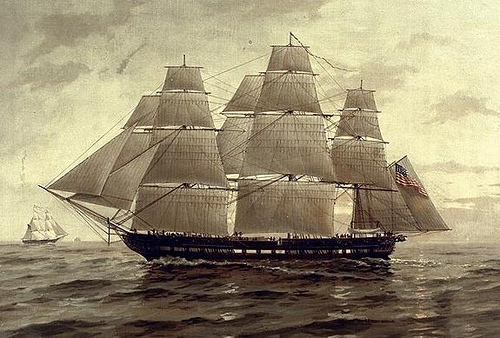
The American frigate, USS Chesapeake
London born Jenkin Ratford was an English sailor who deserted the British Navy and defected to the neutral United States. This story might have ended better for him had he not run his mouth, but that wasn’t this guy. Ratford couldn’t resist taunting British officers, boasting of his escape to the “land of liberty”
The USS Chesapeake was preparing for a Mediterranean cruise with Ratford aboard, when she emerged from Norfolk, Virginia. Her decks were laden with supplies and stores of every kind, and her guns unwisely stored. Chesapeake was nowhere near combat ready when she was approached by the HMS Leopard on June 22.
The Chesapeake’s commander, Commodore James Barron, was unconcerned when the Leopard, under the command of Captain Salusbury Pryce Humphreys, asked permission to board. Lieutenant John Meade of Her Majesty’s Navy presented Barron with a search warrant. Barron declined to submit, and the officer returned to the Leopard.
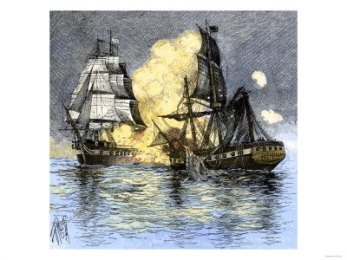
Humphreys then used a hailing trumpet and ordered the American ship to comply, to which Barron responded “I don’t hear what you say”. Humphreys fired two rounds across Chesapeake’s bow, followed immediately by four broadsides.
Chesapeake fired a single shot before striking colors and surrendering. Humphreys refused the surrender and boarded, taking Ratford and three American born sailors with them when they left.
There was little resistance, yet the “Chesapeake-Leopard Affair” had left three American crewmembers dead, and 18 wounded.
American public opinion was outraged over the humiliation, as the four men were transported to Halifax for trial. Federalists and Democratic-Republicans were united as never before. President Thomas Jefferson remarked “Never since the Battle of Lexington have I seen this country in such a state of exasperation as at present, and even that did not produce such unanimity.”
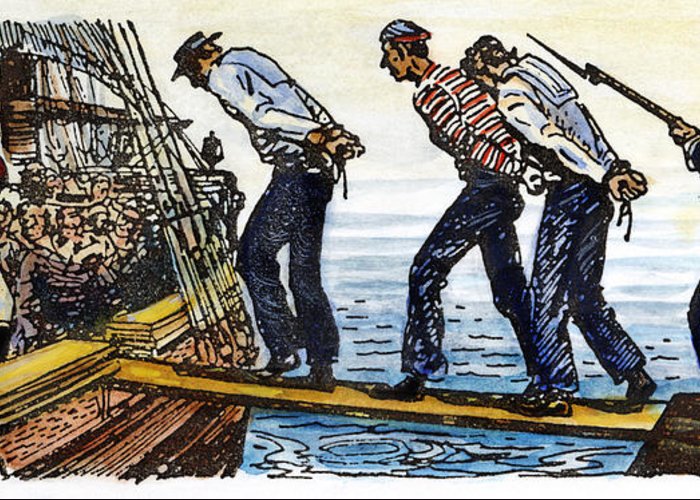
The English court found all four guilty of desertion and hanged Ratford by the fore yardarm of his former vessel, HMS Halifax. The three Americans, David Martin, John Strachan, and William Ware, were sentenced to 500 lashes.
With the puny American navy deployed to the Mediterranean to check the Barbary pirates, President Jefferson’s options were limited to economic retaliation. The Embargo Act of 1807 intended to extract concessions from France and Great Britain, instead had the effect of imposing crippling setbacks on some industries, while others railed against government interference in the private economy. Many came to the conclusion that the only solution, lay in violence.
Political cartoon depicting merchants harassed cursing the “Ograbme”—“embargo” spelled backwards.
British envoys delivered proclamations reaffirming the practice of impressment, amounting to the kidnapping of sailors and forcing their labor aboard British ships. In total, the Royal Navy impressed over 9,000 sailors claiming to be American citizens, becoming the driving force behind the United States going to war with England, in 1812.
Despite being wounded, Barron was blamed for the “Chesapeake-Leopard Affair”. A court-martial suspended him from service for five years, without pay. Commodore Stephen Decatur was one of the presiding officers at the court-martial. In 1820, Barron challenged Decatur to a duel, killing his fellow Commodore over comments concerning the 1807 incident.
Undergoing a refit in Boston Harbor in 1813, USS Chesapeake was challenged to single combat by Captain Philip Broke, commanding the British frigate HMS Shannon.
United States Naval Captain James Lawrence was eager to comply, confident in the wake of a number of American victories in single-ship actions.
It was a Big mistake.
All of Boston turned out that June day, to watch the fight. Cheers went out across the docks and from scores of private vessels across Boston Harbor, as Chesapeake slipped her moorings and glided out of the harbor.
Boston authorities reserved dock space in expectation of a guest. The arrival of a captured British frigate, so it was thought, was a foregone conclusion. Rooftops, hills and trees from Lynn to Malden and Cohasset to Scituate were crowded with spectators, come to watch the show.
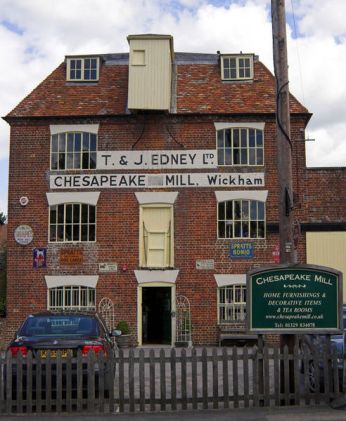
The tale of the Battle of Boston Harbor must be a story for another day. Suffice it to say that USS Chesapeake ended her career as the British frigate HMS Chesapeake, before being sold for scrap, in 1819. Two-hundred years later, the ship’s timbers live on. Part of the Chesapeake Mill in the historic village of Wickham, in Hampshire, England.
If you enjoyed this “Today in History”, please feel free to re-blog, “like” & share on social media, so that others may find and enjoy it as well. Please click the “follow” button on the right, to receive email updates on new articles. Thank you for your interest, in the history we all share.
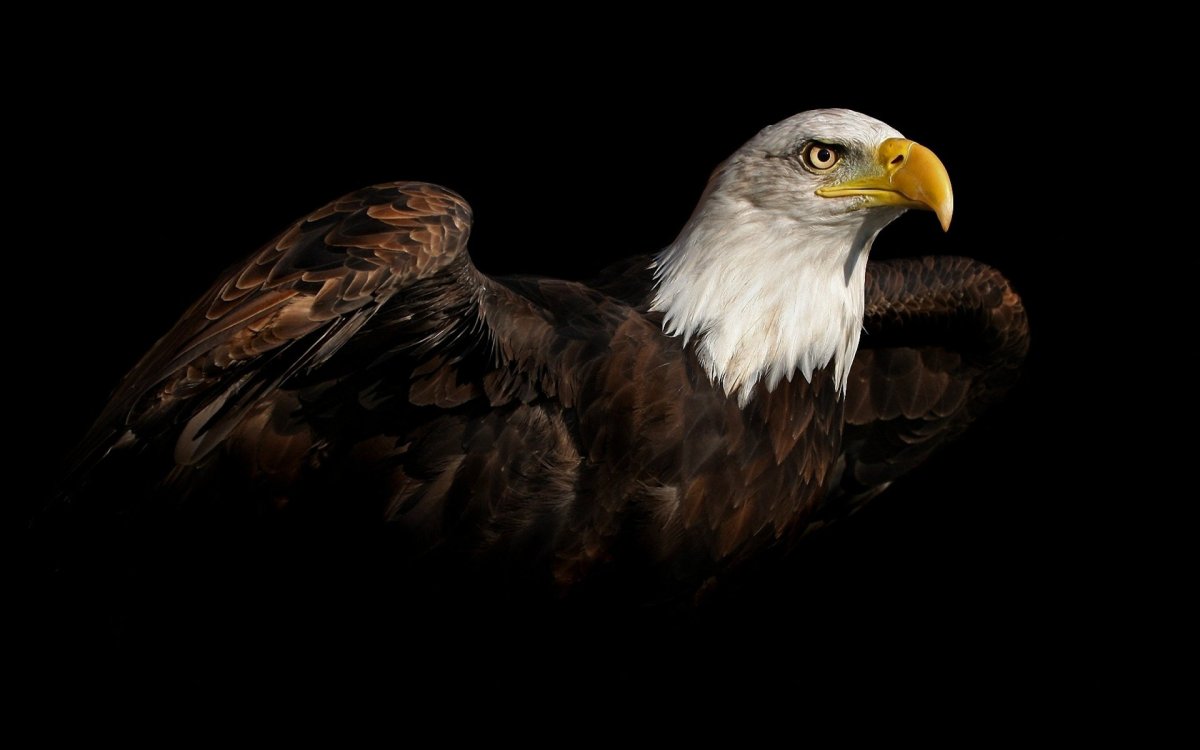
Benjamin Franklin objected to the selection of the eagle, preferring the national symbol be the turkey. He complained that the eagle tended to steal its dinner from other birds, and that he’d seen one driven away by a tiny Kingbird, no larger than a sparrow.
Since the age of the Greek phalanx and before, individuals, institutions and nation-states have distinguished among themselves by means of heraldic symbols. From medieval times and lasting to this day, such symbols are incorporated into elaborate coats of arms, used to identify individual persons and families, government organizations, corporations and other entities.
Town seal from the Czech Republic town of Náchod, 1570
Eighteen states in addition to the United States itself have officially adopted coats of arms, in addition to the formerly independent republics of Texas and Hawaii. These and other symbols are incorporated into official seals, to authenticate passports, certificates, proclamations, and other documents.
Every state in the union has its own seal, as well as the federal district, the five inhabited territories of the United States and the three largest Native American tribes.
When the 2nd Continental Congress declared independence from Great Britain in 1776, there remained several pieces of unfinished business. Benjamin Franklin, Thomas Jefferson and John Adams were appointed to a committee of three to take care of one such detail – the creation of an official seal. The Congress rejected their first draft, approving only the “E pluribus Unum“, (of the many, one), attributed to Thomas Jefferson.
Six years and two such committees later, it was May of 1782. The brother of a Philadelphia naturalist provided a drawing showing an eagle displayed as a symbol of “supreme power and authority.” An earlier submission used a phoenix instead of an eagle, representing a nation risen from the ashes of the Revolution. That bird would be replaced in the final design, by the bald eagle.
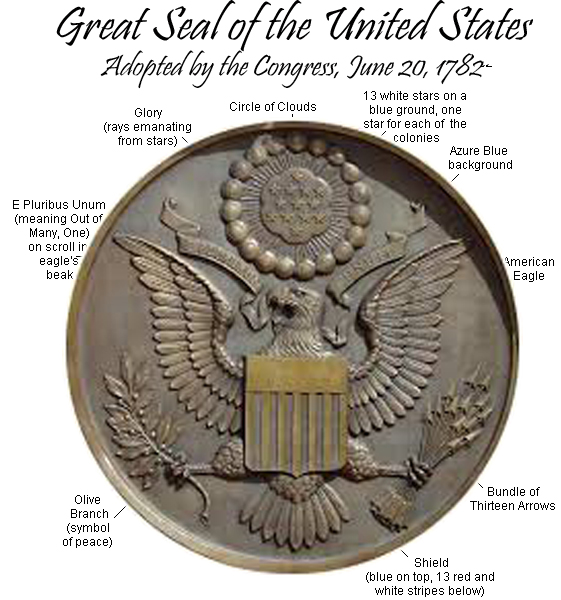
Individual states adopted the eagle as their own symbols, as early as 1778. The Continental Congress officially adopted the current design on this day in 1782. The final design of the obverse (front) side of the seal, depicts a Bald Eagle, symbolic of liberty and freedom. The eagle grasps thirteen arrows in its right talons, symbolizing a strong defense. An olive branch symbolizing peace is held in the other claw. A banner containing Jefferson’s E pluribus Unum, is held in the eagle’s beak.
Prominently displayed on its breast is a shield, the thirteen red and white stripes symbolizing the states, arranged in support of the federal government, symbolized in blue.
Finally, a constellation of thirteen stars breaks out of the clouds above, signifying a new people, now ready to take its place among the sovereign nations of earth.
Benjamin Franklin objected to the the eagle’s selection, preferring the national symbol be the turkey. He complained of the eagle stealing its dinner from other birds. He said that he’d seen one driven away by a tiny Kingbird, no larger than a sparrow.
Franklin later wrote a letter to his daughter, saying, “For the Truth the Turkey is in Comparison a much more respectable Bird, and withal a true original Native of America . . . He is besides, though a little vain & silly, a Bird of Courage, and would not hesitate to attack a Grenadier of the British Guards who should presume to invade his Farm Yard with a red Coat on.”
Some versions of the symbol used between 1916 and 1945 showed an eagle facing to its left, toward the arrows, giving rise to the urban legend that the seal is changed to have the eagle face towards the olive branch in peace, and towards the arrows in wartime.
On the reverse (back) side of the Great Seal, the pyramid represents strength and duration, like the great Pyramids at Giza. The Roman numeral MDCCLXXVI at its base translates as 1776. The Latin phrase “Novus ordo seclorum” refers to a “New Order of the Ages.” The pyramid itself has thirteen levels, atop which is the Eye of God, with the Latin phrase “Annuit Cœptis,” loosely translating as “favors undertakings.”
The hand of Providence would favor the United States and its endeavors, for all time.
The militant atheist type wishing to divest himself of all that “church & state” stuff may, at his convenience, feel free to send those dollar bills, to me. I’m in the book.
If you enjoyed this “Today in History”, please feel free to re-blog, “like” & share on social media, so that others may find and enjoy it as well. Please click the “follow” button on the right, to receive email updates on new articles. Thank you for your interest, in the history we all share.
USS Kearsarge steamed further to sea as the Confederate vessel approached. There would be no one returning to port until the issue was decided.
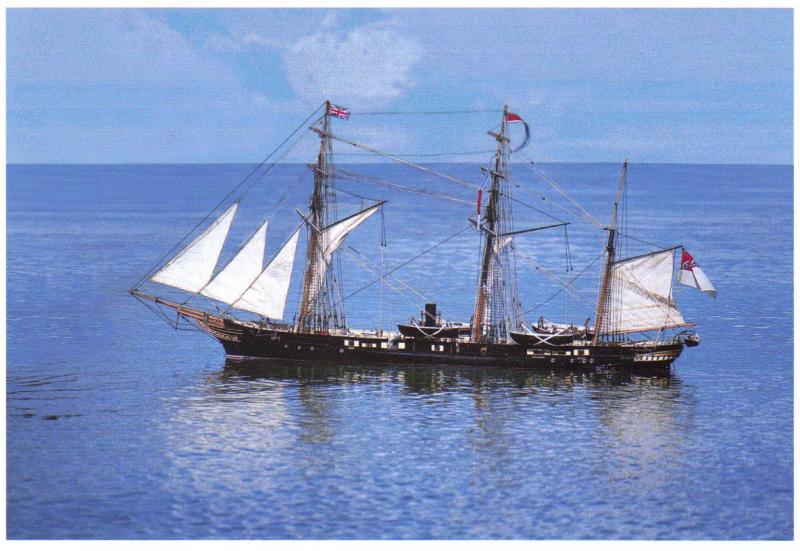
Hull #290 was launched from the John Laird & Sons shipyard in Birkenhead, Cheshire, England as the screw sloop HMS Enrica on May 15, 1862. She sailed in secret to the Terceira Island in the Azores, where she was met by Raphael Semmes, her new captain. Three days, 8 cannon and 350 tons of coal later, the Enrica was transformed into the 220′, 1,500-ton sloop of war and Confederate States of America commerce raider, CSS Alabama.
CSS Alabama
Alabama’s mission was to wage economic war on the Union, attacking commercial shipping from the Pacific to the Indian Ocean, from Newfoundland to Brazil. In her two-year career as commerce raider, Alabama claimed 65 prizes valued at nearly $123 million in today’s dollars. She was the most successful, and most notorious, commerce raider of the Civil War.
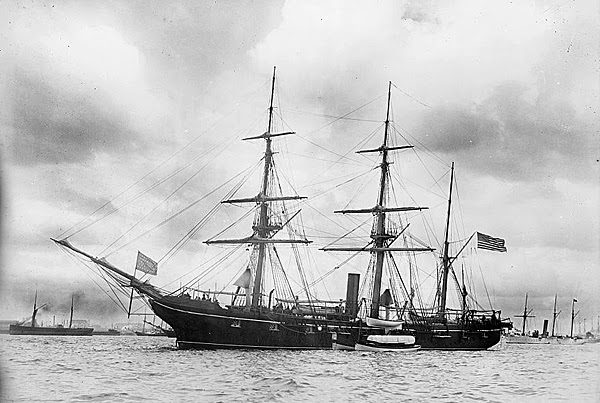
Civil War Steam Sloop USS Kearsarge
Alabama was in sore need of a refit when she put into Cherbourg France, on the 11th of June, 1864. The Mohican-class Union steam sloop-of-war USS Kearsarge, then on patrol near Gibralter, hurried to Cherbourg, arriving on the 14th.
Captain Raphael Semmes and 1st Lieutenant John Kell aboard CSS Alabama 1863
Seeing himself blockaded, Alabama’s Captain challenged Kearsarge Captain John Winslow to a ship-to-ship duel, saying “my intention is to fight the Kearsarge as soon as I can make the necessary arrangements. I hope these will not detain me more than until to-morrow or the morrow morning at farthest. I beg she will not depart until I am ready to go out. I have the honor to be your obedient servant, R. Semmes, Captain“. That suited Winslow just fine, who took up station in international waters, and waited for Alabama to come out.
CSS Alabama steamed out of Cherbourg harbor on the morning of June 19, 1864, escorted by the French ironclad Couronne, which remained nearby to ensure that the combat remained in international waters. Kearsarge steamed further to sea as the Confederate vessel approached. There would be no one returning to port until the issue was decided.
Captain Winslow put his ship around and headed for his adversary at 10:50am. Alabama fired first from a distance of a mile, and continued to fire as the range decreased.
Sinking of the CSS Alabama, by Andy Thomas
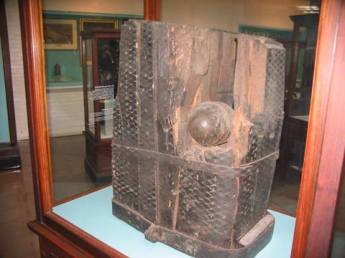
The engagement followed a circular course at a range of a half mile; the ships steaming in opposite directions and firing at will. One ball from Alabama lodged in Kearsarge’s sternpost, but failed to explode. Within an hour, Kearsarge’s 11″ Dahlgren smooth bore pivot cannons reduced the most successful commerce raider in history to a sinking wreck. Alabama turned and tried to run back to port, but Kearsarge headed her off as rising water stopped her engines.
USS Kearsarge Sternpost
Semmes struck his colors and sent a boat to Kearsarge with a message of surrender and an appeal for help.
For those rescued by Kearsarge, the Civil War was over. These would spend the rest of the war as prisoners of the Federal government. Captain Semmes escaped along with 41 others, being plucked from the water and taken to neutral ports by the British steam yacht Deerhound, and the private sail yacht Hornet.
If you enjoyed this “Today in History”, please feel free to re-blog, “like” & share on social media, so that others may find and enjoy it as well. Please click the “follow” button on the right, to receive email updates on new articles. Thank you for your interest, in the history we all share.


 The territory which would come to be occupied by the colony of Georgia was a subject for dispute between Great Britain and Spain, since long before the state became a colony.
 off the ear of Commander Robert Jenkins, informing the unfortunate ship’s master that he could “Go, and tell your King that I will do the same”, to him.


 Lee was appointed to the Committee of Confederation, assigned to write the Articles by which the fledgling nation would govern itself. Lee believed that two such committees were too much and, soon, he would be called home to care for a critically ill wife.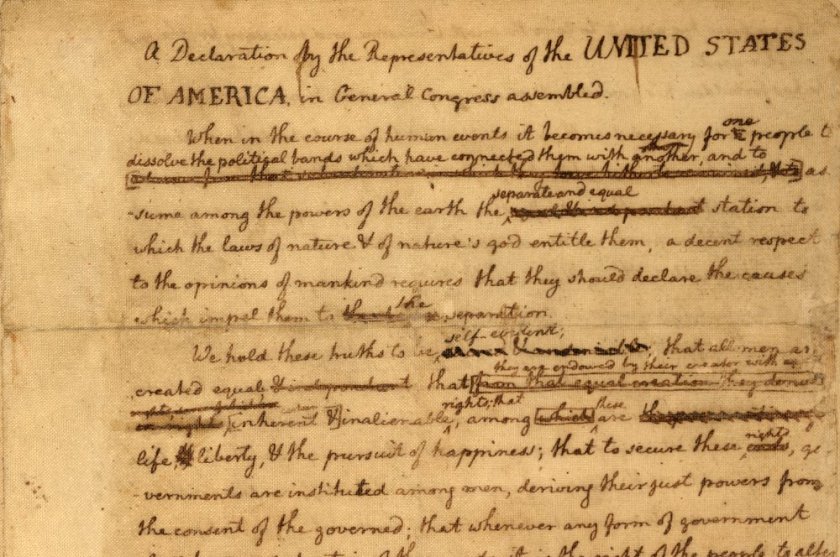



 Indeed, such a system has imperfections, not least among them those who would ascend to political office.









 Chief Conquering Bear attempted to negotiate recompense, offering a horse or cow from the tribe’s herd. The owner refused, demanding $25. That same treaty of 1851 specified that such matters would be handled by the local Indian agent, in this case John Whitfield, scheduled to arrive within days with tribal annuities more than sufficient to settle the matter to everyone’s satisfaction.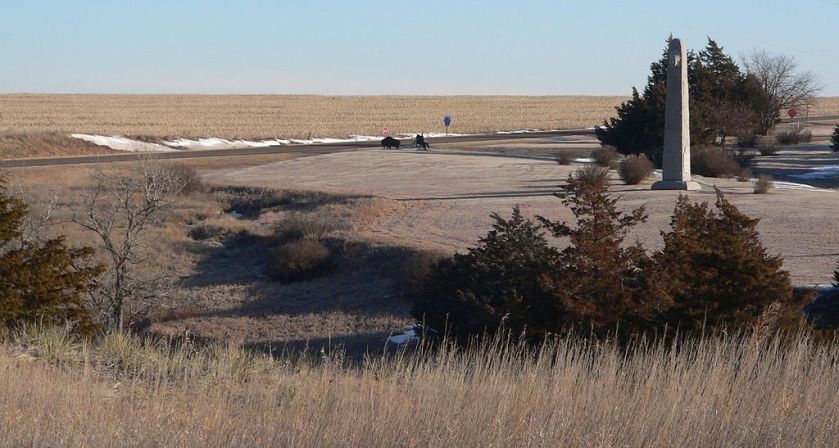
 The tale of those other two columns is worth a “Today in History” essay of their own if not an entire book, but this is a story about Little Big Horn. Suffice it to say that Major Marcus Reno‘s experience of this day was as grizzly and as shocking, as that moment when the brains and face of his Arikara scout Bloody Knife spattered across his own. Reno’s detachment had entered a buzz saw and would have been annihilated altogether, had it not met up with that of captain Frederick Benteen.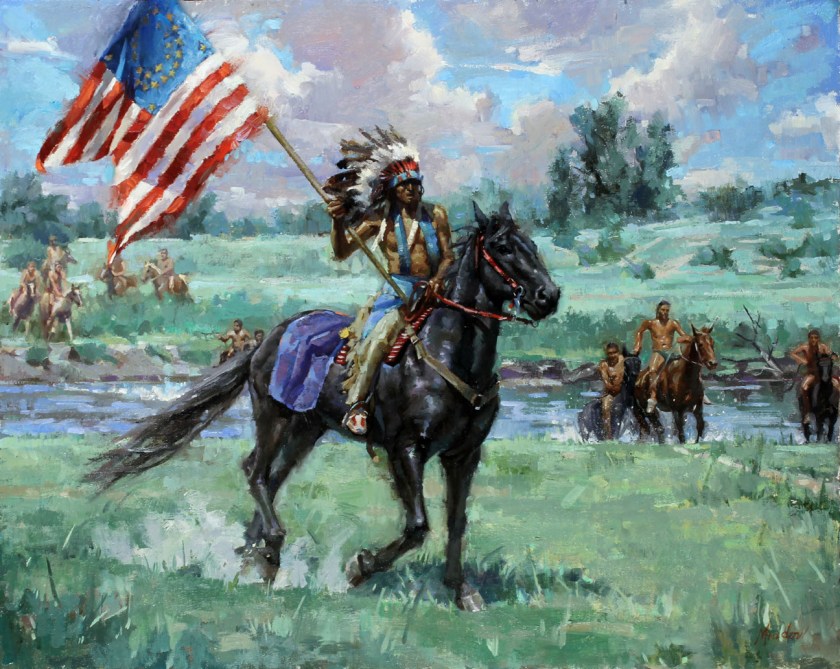


 There is an oft-repeated but mistaken notion that the circus goes back to Roman antiquity. The panem et circenses, (bread and circuses)” of Juvenal, ca AD100, refers more to the ancient precursor of the racetrack, than to anything resembling a modern circus. The only common denominator is the word itself, the Latin root ‘circus’, translating into English, as “circle”.
 These afternoon shows gained overwhelming popularity by 1770, and Astley hired acrobats, rope-dancers, and jugglers to fill the spaces between equestrian events. The modern circus, was born.
 and fear, his demonstrations emphasizing the animal’s intelligence and tractability over ferocity.




 Humphreys then used a hailing trumpet and ordered the American ship to comply, to which Barron responded “I don’t hear what you say”. Humphreys fired two rounds across Chesapeake’s bow, followed immediately by four broadsides.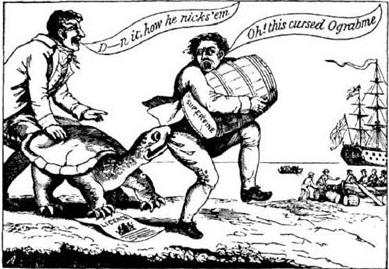
 United States Naval Captain James Lawrence was eager to comply, confident in the wake of a number of American victories in single-ship actions.


 Finally, a constellation of thirteen stars breaks out of the clouds above, signifying a new people, now ready to take its place among the sovereign nations of earth.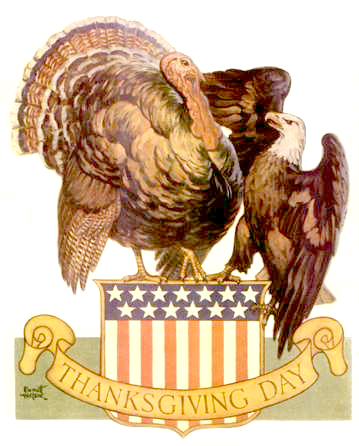
 The militant atheist type wishing to divest himself of all that “church & state” stuff may, at his convenience, feel free to send those dollar bills, to me. I’m in the book.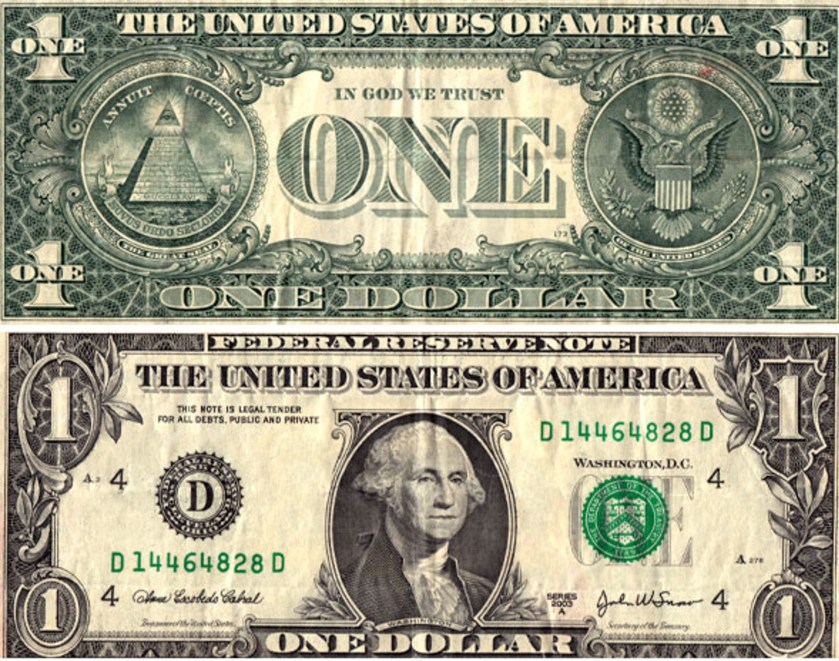



 CSS Alabama steamed out of Cherbourg harbor on the morning of June 19, 1864, escorted by the French ironclad Couronne, which remained nearby to ensure that the combat remained in international waters. Kearsarge steamed further to sea as the Confederate vessel approached. There would be no one returning to port until the issue was decided.
 Captain Winslow put his ship around and headed for his adversary at 10:50am. Alabama fired first from a distance of a mile, and continued to fire as the range decreased.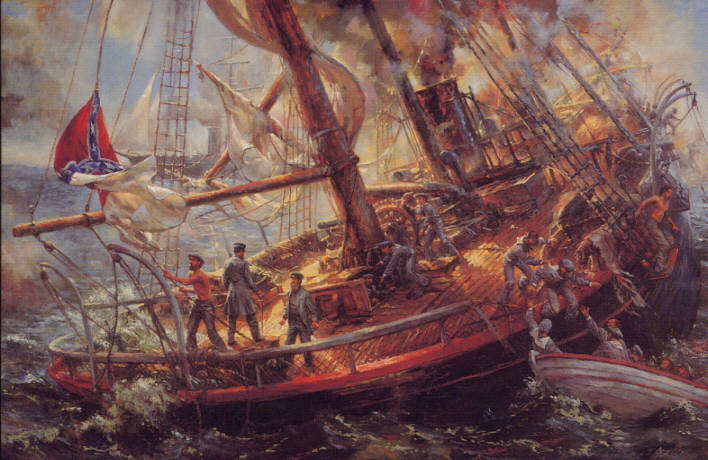

 Historical Easter Eggs - Today in History
You must be logged in to post a comment.