
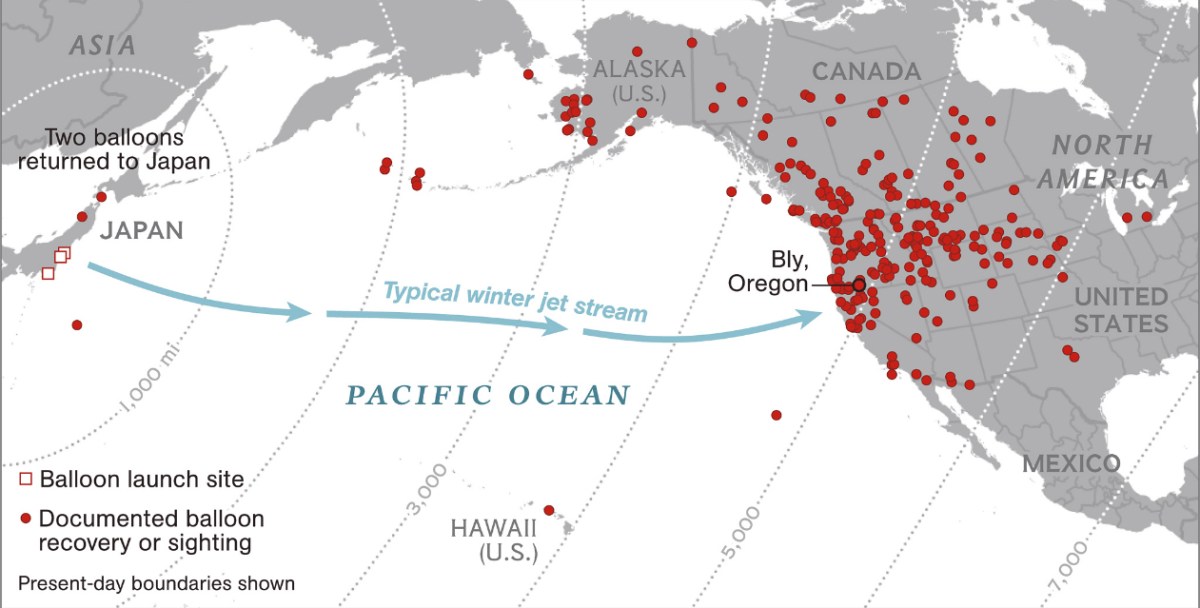
Following the 1883 eruption of the Krakatoa volcano, weather watchers described an eastbound, upper atmospheric air current described as the “equatorial smoke stream”. In the 1920s, Japanese meteorologist Wasaburo Oishi tracked these upper level winds from a site near Mount Fuji, using pilot balloons. Oishi doomed his work to international obscurity when he published his findings in Esperanto. Inside Japan, there were those who took note, filing away this new-found knowledge of what we now call the “Jet Stream”.
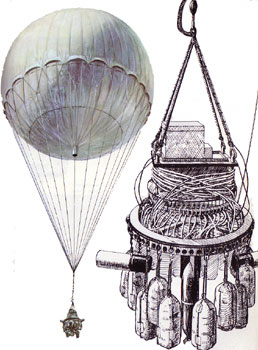 In the latter half of WWII, Imperial Japanese military thinkers conceived the fūsen bakudan or “fire balloon”, a hydrogen filled balloon device designed to ride the jet stream, using sand ballast and a valve system to navigate the weapon system onto the North American continent.
With sandbags, explosives, and the device which made the thing work, the total payload was about a thousand pounds on liftoff. The first such device was released on November 3, 1944, beginning the crossing to the west coast of North America. 9,300 such balloons were released with military payloads, between late 1944 and April, 1945.
Such a long-range attack would not be duplicated until the 1982 Falklands War, and was near unimaginable at the time. In 1945, intercontinental weapons were more in the realm of science fiction. As these devices began to appear, American authorities theorized that they originated with submarine-based beach assaults, German POW camps, even the internment camps into which the Roosevelt administration herded Japanese Americans.
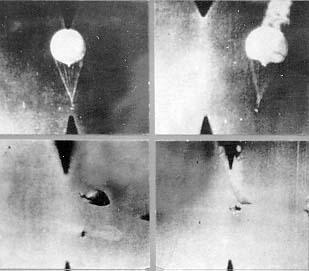
These “washi” paper balloons flew at high altitude and surprisingly quickly, completing the Pacific crossing in three days. Balloons landed from Alaska to Northern Mexico, and as far east as Detroit.
A P-38 Lightning fighter shot one down near Santa Rosa, California, while Yerington, Nevada cowboys cut one up to make hay tarps. Pieces of balloon were found in the streets of Los Angeles. A prospector near Elko Nevada delivered one to local authorities, on the back of a donkey.
Among US units assigned to fight fire balloons was the 555th Parachute Infantry Battalion, which suffered one fatality and 22 injuries fighting fires.
One of the last balloons came down on March 10 near Hanford Washington, shorting out power lines supplying electricity for Manhattan Project nuclear reactor cooling pumps. The war in the Pacific could have ended very differently, had not backup safety devices restored power, almost immediately.
Colonel Sigmund Poole, head of the U.S. Geological Survey military geology unit, asked, “Where’d the damned sand come from?” Microscopic analysis of sand ballast identified diatoms and other microscopic sea life. This and the mineral content of the sand itself proved to be definitive. This stuff could only have come from the home islands of Japan, more specifically, one or two beaches on the island of Honshu.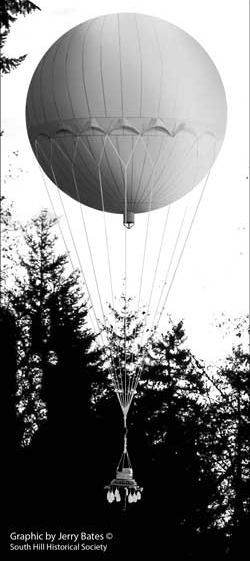
American authorities were alarmed. Anti-personnel and incendiary bombs were relatively low grade threats. Not so the biological weapons Japanese military authorities were known to be developing at the infamous Unit 731, in northern China.
284 of these weapons are known to have completed the Pacific crossing to the United States, Mexico and Canada. Experts estimate as many as 1,000 may have made it. Sightings were reported in seventeen US states. Pilots were ordered to shoot them down on sight, but many devices escaped detection, altogether.
In an effort to deny valuable intelligence to their Japanese adversary, US military and government authorities did everything they could to keep these “Fire Bombs” out of the media. Even though such secrecy put Americans at risk.
Japanese Authorities reported that the bombs were hitting key targets, thousands were dead or injured, and American morale was low.
On the morning of May 5, 1945, Pastor Archie Mitchell and his wife Elsie took their Sunday school class of five on a picnic to a forest area near Bly, Oregon. Elsie and the kids came upon a large balloon with a strange looking device attached to it, as Pastor Mitchell parked the car. There was no way they could have known, what they had found was a Japanese weapon of war. The device exploded, killing all six, instantly.
Several such devices exploded, igniting wildfires in the forests of California, Oregon and Washington, but the site near Bly is the only one known to have resulted in American casualties.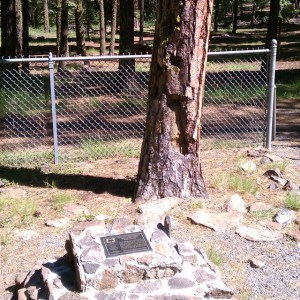
Today there is a small picnic area located in the Fremont-Winema National Forest, in Lake County, Oregon. It’s maintained by the US Forest Service, memorialized as the Mitchell Recreation Area and listed on the National Register of Historic Places. A small stone marker points the way to a shrapnel scarred tree.
A second monument bears these words, cast in bronze: The “only place on the American continent where death resulted from enemy action during World War II”. There are six names above those words, those of five children and their teacher, who was pregnant at the time. Elsie Mitchell, age 26. Edward Engen, age 13. Jay Gifford, age 13. Joan Patzke, age 13. Dick Patzke, age 14. Sherman Shoemaker, age 11.


 Itter Castle appeared in the land records of the Austrian Tyrol as early as 1240. When Germany annexed Austria in 1938, Schloss Itter was first leased and later requisitioned outright by the German government, for unspecified “Official use”.

 It was late afternoon as the convoy left for Castle Itter. Leaving Boche Buster and a few Infantry to guard the largest bridge into town. What remained of the convoy fought its way through its last SS roadblock in the early evening, roaring across the last bridge and lurching to a stop in front of Itter’s gate as night began to fall. Itter’s prisoners looked on in dismay. They had expected a column of American tanks and a heavily armed infantry force. What they had here, was a single tank with seven Americans, and a truckload of armed Germans.
 concentration camp administration for the Third Reich and some of the most fanatical soldiers of WWII. Even at this late date SS units were putting up fierce resistance across northern Austria. 100-150 of them attacked on the morning of May 5. Fighting was furious around Castle Itter, the one Sherman providing machine-gun fire support until it was destroyed by a German 88mm gun. By early afternoon Lee was able to get a desperate plea for reinforcements through to the 142nd Infantry, before being cut off. Aware that he’d been unable to give complete information on the enemy’s troop strength and disposition, Lee accepted Jean Borotra’s gallant offer of assistance.
 Literally vaulting over the castle wall, the tennis star ran through a gauntlet of SS strongpoints and ambushes to deliver his message, before donning an American uniform to help fight through to the castle’s defenders. The relief force arrived at around 4pm, as defenders were firing their last ammunition.

 McCrae fought in one of the most horrendous battles of WWI, the second battle of Ypres, in the Flanders region of Belgium. Imperial Germany launched one of the first chemical attacks in history, attacking the Canadian position with chlorine gas on April 22, 1915. The Canadian line was broken but quickly reformed, in near-constant fighting that lasted for over two weeks.


 The vivid red flower blooming on the battlefields of Belgium, France and Gallipoli came to symbolize the staggering loss of life in that war. Since then, the red poppy has become an internationally recognized symbol of remembrance of the lives lost in all wars. I keep a red poppy pinned to my briefcase and another on the visor of my car. A reminder that no free citizen of a self-governing Republic, should ever forget where we come from. Or the prices paid by our forebears, to get us here.


 Gehrig was pitching for Columbia University against Williams College on April 18, 1923, the day that Babe Ruth hit the first home run out of the brand new Yankee Stadium. Though Columbia would lose the game, Gehrig struck out seventeen batters to set a team record.
 Gehrig appeared at Yankee Stadium on “Lou Gehrig Appreciation Day”, July 4, 1939. He was awarded trophies and other tokens of affection by the New York sports media, fellow players and groundskeepers. He would place each one on the ground, already too weak to hold them. Addressing his fans, Gehrig described himself as “The Luckiest Man on the Face of the Earth”.


 Be that as it may, the cause of death was difficult to detect, the condition of the corpse close to that of someone who had died at sea, of hypothermia and drowning. The dead man’s parents were both deceased, there were no known relatives and the man died friendless. So it was that Glyndwr Michael became the Man who Never Was.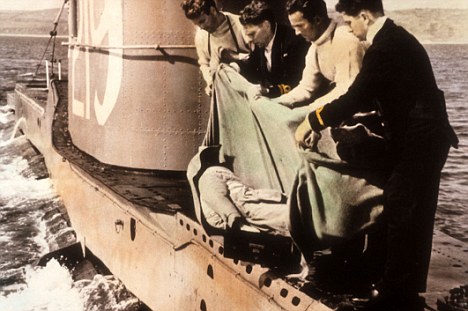
 The non-existent Major William Martin was buried with full military honors in the Huelva cemetery of Nuestra Señora. The headstone reads:
 As chief of the Imperial German general staff from 1891-1905, German Field Marshal Alfred von Schlieffen devised the strategic roadmap by which Germany prosecuted the first world war. The “Schlieffen Plan” could be likened to a bar fight, where a fighter (Germany) had to take out one guy fast (France), before turning and facing his buddy (Imperial Russia). Of infinite importance to Schlieffen’s plan was the westward sweep through France, rolling the country into a ball on a timetable before his armies could turn east to face the “Russian Steamroller”. “When you march into France”, Schlieffen had said, “let the last man on the right brush the Channel with his sleeve.”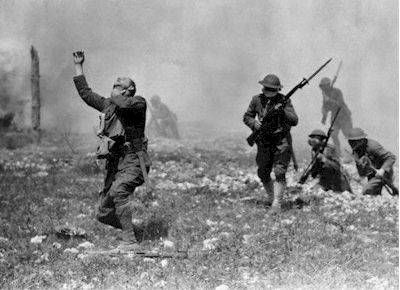
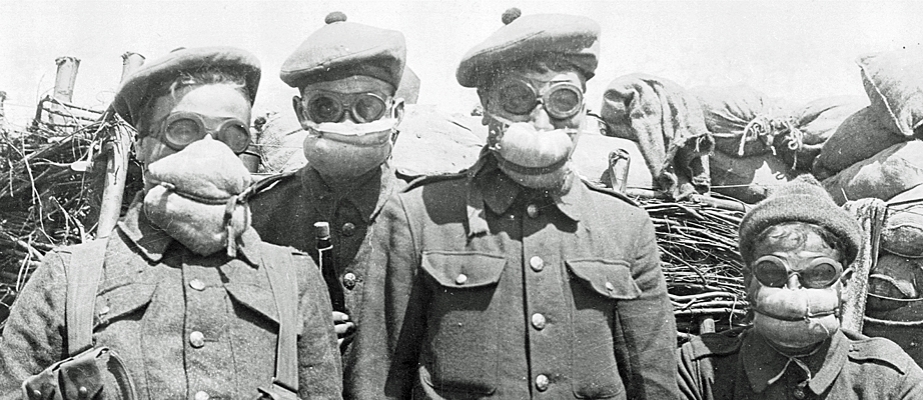
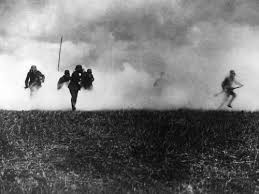
 The second Battle of Ypres began with a new and terrifying weapon, on April 22, 1915. German troops placed 5,730 gas cylinders weighing 90 pounds apiece, along a four mile front. Allied troops must have looked on in wonder, as that vast yellow-green carpet crept toward their lines. Chlorine gas forms hypochlorous acid when combined with water, destroying the moist tissues of the lungs and eyes. Heavier than air, the stuff crept along the ground and poured into the trenches, forcing troops out into heavy German fire. 6,000 casualties were sustained in the gas attack alone, opening a four mile gap in the allied line. Thousands retched and coughed out their last breath, as others tossed their equipment and ran in terror.
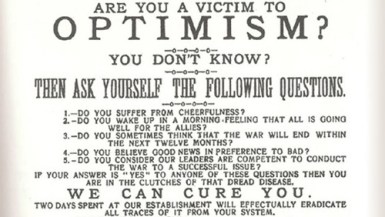 Richly typeset advertisements for “Music Hall Extravaganzas” include “Tickling Fritz” by the P.B.I. (Poor Bloody Infantry) Film Co. of the United Kingdom and Canada, advising the enthusiast to “Book Early”. There were Real Estate ads for property in no-man’s land. “BUILD THAT HOUSE ON HILL 60. BRIGHT-BREEZY-&-INVIGORATING. COMMANDS AN EXCELLENT VIEW OF HISTORIC TOWN OF YPRES”. Another one read “FOR SALE, THE SALIENT ESTATE – COMPLETE IN EVERY DETAIL! UNDERGROUND RESIDENCES READY FOR HABITATION. Splendid Motoring Estate! Shooting Perfect !! Fishing Good!!!”


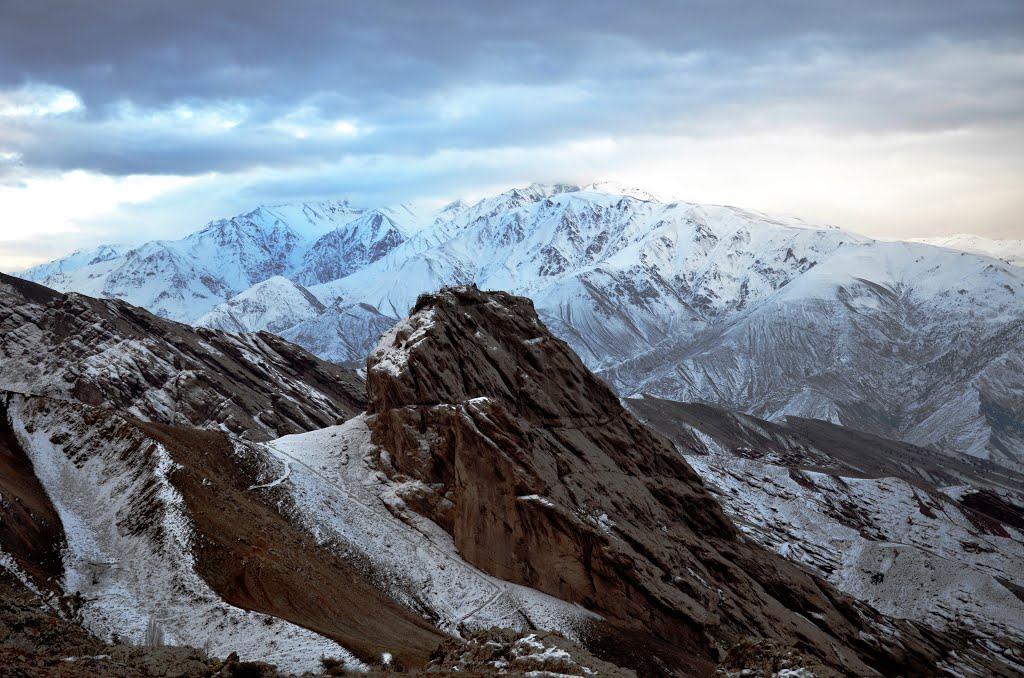
 Into the gap stepped the “Old Man of the Mountain”, Hassan-i Sabbah, and his fanatically loyal, secret sect of “Nizari Ismaili” followers, the Assassins.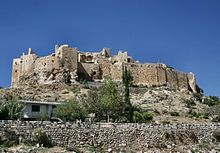



 Today the Exercise Tiger disaster is largely forgotten. Some have charged official cover-up, though information from SHAEF press releases appeared in the August edition of Stars & Stripes. At least three books contain the information. It seems more likely that the immediate need for secrecy and subsequent D-Day invasion swallowed the Tiger disaster, whole. History has a way of doing that.


 Historical Easter Eggs - Today in History
You must be logged in to post a comment.