"Tell me a factand I'll learn. Tell me a truth, and I'll believe. But tell me a story, and it will live in my heart forever." – Steve Sabol, NFL Films
Author: Cape Cod Curmudgeon
I'm not an academic "Historian". I'm a father, a son and a grandfather. A history geek and sometimes curmudgeon who still likes to learn new things. I make every effort to get my facts straight but I'm as good at being wrong as the next guy. I offer these stories hoping you'll enjoy them as much as I do. This is the history we all share. I'm glad you're here.
Rick Long, the “Cape Cod Curmudgeon”
In his 1968 book “Making of Star Trek”, Gene Roddenberry says that James Kirk was born in a small town in Iowa. Full time Trekkie and part time Riverside Councilman Steve Miller thought “Why not Riverside”.
A boy was born on March 22, 2233 in Riverside, Iowa, destined to become the youngest captain in Star Fleet history. Before he could boldly go where no man has gone before, he had to have a name.
The WWII fighter pilot and veteran of 89 combat missions Gene Roddenberry made 16 name suggestions on this date in 1965, among them Hannibal, Timber, Flagg, and Raintree.
Roddenberry decided on James T. Kirk, based on a journal entry of the 18th century British explorer, Captain James Cook: “ambition leads me … farther than any other man has been before me”.
Kirk was killed in 2329 on the Enterprise (B), after the ship was eaten by a Nexus energy ribbon on its maiden voyage. Only he didn’t die, because Jean-Luc Picard found him alive in the timeless Nexus, negotiating hotel deals for Priceline.com. Or something like that.
In his 1968 book “Making of Star Trek”, Gene Roddenberry says that James Kirk was born in a small town in Iowa. Full time Trekkie and part time Riverside Councilman Steve Miller thought “Why not Riverside”. In 1985 Miller moved that Riverside declare itself the Future Birthplace of James T. Kirk. The motion passed unanimously. The town’s slogan was changed from “Where the best begins” to “Where the Trek begins,” and the annual summer festival changed from “River Fest” to “Trek Fest”.
The Riverside connection became Holy Writ, when the 2009 film Star Trek identified the place as Kirk’s home town. There is a granite monument in Riverside, population 963, declaring itself to be the “Future Birthplace of Captain James T. Kirk.
In case you were ever curious about what the “T” stands for…its Tiberius.
Frantic around the clock rescue efforts began almost immediately, to get at 461 sailors and Marines trapped within the hull of the Oklahoma.
It was literally “out of the blue”, when the first wave of enemy aircraft arrived at 7:48 local time, December 7, 1941. 353 Imperial Japanese warplanes approached in two waves out of the southeast, fighters, bombers, and torpedo planes, across Hickam Field and over the waters of Pearl Harbor. Tied in place and immobile, the eight vessels moored at “Battleship Row” were easy targets.
In the center of the Japanese flight path, sailors and Marines aboard the USS Oklahoma fought back furiously. She didn’t have a chance. Holes as wide as 40′ were torn into the hull in the first ten minutes of the fight. Eight torpedoes smashed into her port side, each striking higher on the hull as the Battleship began to roll.
HT John F DeVirgilio for this graphic
Bilge inspection plates had been removed for a scheduled inspection the following day, making counter-flooding to prevent capsize, impossible. Oklahoma rolled over and died as the ninth torpedo slammed home. Hundreds scrambled out across the rolling hull, jumped overboard into the oil covered, flaming waters of the harbor, or crawled out over mooring lines in the attempt to reach USS Maryland in the next berth.
The damage was catastrophic. Once the pride of the Pacific fleet, all eight battleships were damaged, four of them sunk. Nine cruisers, destroyers and other ships were damaged, and another two sunk. 347 aircraft were damaged, most caught while still on the ground. 159 of those, were destroyed altogether. 2,403 were dead or destined to die from the attack, another 1,178 wounded.
Nine Japanese torpedoes struck Oklahoma’s port side, in the first ten minutes.
Frantic around the clock rescue efforts began almost immediately, to get at 461 sailors and Marines trapped within the hull of the Oklahoma. Tapping could be heard as holes were drilled to get to those trapped inside. 32 of them were delivered from certain death. 14 Marines and 415 sailors aboard Oklahoma lost their lives immediately, or in the days and weeks to come. Bulkhead markings would later reveal that, at least some of the doomed would live for another seventeen days in the black, upside-down hulk of that ship. The last such mark was drawn by the last survivor on Christmas Eve.
Of the sixteen ships lost or damaged, thirteen would be repaired and returned to service. USS Arizona remains on the bottom, a monument to the event and to the 1,102-honored dead who remain entombed within her hull. The USS Utah defied salvage efforts. She too is a War Grave, 64 honored dead remaining within her hull, lying at the bottom not far from the Arizona. Repairs were prioritized and USS Oklahoma was beyond repair. She, and her dead, would have to wait.
The extraordinarily difficult salvage would not begin until March, 1943. 21 giant A-frames were fixed to the hull, 3″ cables connecting compound pulleys to 21 electric motors, each capable of pulling 429 tons. Two pull configurations were used over 74 days, first the configuration shown (above right), then direct connections once the hull had achieved 70°. In May the decks once again saw the light of day.
Fully righted, the ship was 10′ below water. Massive temporary wood and concrete structures called “cofferdams” closed the gaping wounds left by torpedoes, so the hull could be pumped out and re-floated. A problem even larger than those torpedo holes were the gaps between hull plates, caused by the initial capsize and righting operations. Divers stuffed kapok in the gaps as water was pumped out.
Individual divers spent 2-3 years on the Oklahoma salvage job. Underwater arc welding and hydraulic jet techniques were developed during this period, which remain in use to this day. 1,848 dives were performed for a total of 10,279 man hours under pressure. For all that, no military and only one civilian diver lost his life, when his air hose was severed.
Oklahoma prepared for drydock
Salvage workers entered the pressurized hull through airlocks wearing masks and protective suits. Bodies were in advanced stages of decomposition by this time and the oil and chemical-soaked interior was toxic to life. Most victims would never be identified.
Twenty 10,000 gallon per minute pumps operated for 11 hours straight, re-floating the battleship on November 3, 1943.
Oklahoma entered dry dock the following month, a total loss to the American war effort. She was stripped of guns and superstructure, sold for scrap on December 5, 1946 to the Moore Drydock Company of Oakland, California.
The battered hulk left Pearl Harbor for the last time in May 1947, headed for a scrapyard in San Francisco bay. She would never make it. Taken under tow by the ocean-going tugs Hercules and Monarch, the three vessels entered a storm 540 miles east of Hawaii. On May 17, disaster struck. Piercing the darkness, Hercules’ spotlight revealed that the former battleship was listing heavily. Naval base at Pearl Harbor instructed them to turn around, when these two giant tugs suddenly found themselves slowing to a stop. Despite her massive engines, Hercules was being dragged astern with no warning, hurtling past Monarch, herself swamped at the stern and being dragged backward at 17mph.
Fortunately for both tugs, skippers Kelly Sprague of Hercules and George Anderson of Monarch had both loosened the cable drums connecting 1,400-foot tow lines to Oklahoma. Monarch’s line played out and detached, but Hercules’ line didn’t do so until the last possible moment. With tow line straight down and sinking fast, Hercules finally detached directly over Oklahoma’s final resting place, the 409-ton tug bobbing to the surface like the float on a child’s fishing line.
Ordered in March 1911 and launched three years later, the 583’ Nevada-class battleship USS Oklahoma was designed to fight at the most extreme ranges expected by gunnery experts. Commanded by Charles B. McVay, Jr., father of the ill-fated skipper of the USS Indianapolis Charles Butler McVay III, Oklahoma’s role in WW1 was limited, due to the unavailability of oil in major theaters of operation. Notable among her exploits of the Great War, were the memorable fist fights that crew members got into with Sinn Féin members in Berehaven, and casualties sustained during the 1918-19 flu pandemic.
She was up-armored in a 1927 – ’29 refit, where additional anti-torpedo armor bulges were added, briefly making her the widest battleship in the United States fleet. Oklahoma was dispatched to Europe in 1936, to evacuate American civilians during the Spanish civil war. The only US warship ever named after the 46th state was destroyed in an enemy sneak attack, before she knew her nation was at war. The final resting place of the USS Oklahoma, (BB-37), is unknown.
Man and dog stepped off the ship in 1928 to a throng of reporters. There were flash bulbs, shouted questions and the din of traffic and honking horns that can only be New York City. Buddy never wavered.
Morris Frank lost the use of an eye in a childhood accident, losing his vision altogether when a boxing accident damaged the other when he was 16. Frank hired a boy to guide him around, but the young man was easily bored and sometimes wandered off leaving Frank to fend for himself.
German specialists had been working at this time, on the use of Alsatians (German Shepherds), to act as guide dogs for WWI veterans blinded by mustard gas. An American breeder living in Switzerland, Dorothy Harrison Eustis, wrote an article about the work in a 1927 issue of the Saturday Evening Post. When Frank’s father read him the article, he wrote to Eustis pleading with her to train a dog for himself. “Is what you say really true? If so, I want one of those dogs! And I am not alone. Thousands of blind like me abhor being dependent on others. Help me and I will help them. Train me and I will bring back my dog and show people here how a blind man can be absolutely on his own. We can then set up an instruction center in this country to give all those here who want it a chance at a new life.”
Dorothy Eustis called Frank in February 1928 and asked if he was willing to come to Switzerland. The response left little doubt: “Mrs. Eustis, to get my independence back, I’d go to hell”. She accepted the challenge and trained two dogs, leaving it to Frank to decide which was the more suitable. Morris came to Switzerland to work with the dogs, both female German Shepherds. He chose one named “Kiss” but, feeling that no 20-year-old man should have a dog named Kiss, he called her “Buddy”.
Man and dog stepped off the ship in 1928 to a throng of reporters. There were flash bulbs, shouted questions and the din of traffic and honking horns that can only be New York City. Buddy never wavered. At the end of that first day, Dorothy Eustis received a single word telegram: “Success”. Morris Frank was set on the path that would become his life’s mission: to get Seeing Eye Dogs accepted all over the country.
Frank and Eustis established the first guide dog training school in the US in Nashville, on January 29, 1929. Frank was true to his word, becoming a tireless advocate of public accessibility for the blind and their guide dogs. In 1928, he was routinely told that Buddy couldn’t ride in the passenger compartment with him. Seven years later, all railroads in the United States had adopted policies allowing guide dogs to remain with their owners while onboard. By 1956, every state in the Union had passed laws guaranteeing access to public spaces for blind people and their dogs.
Frank told a New York Times interviewer in 1936 that he had probably logged 50,000 miles with Buddy, by foot, train, subway, bus, and boat. He was constantly meeting with people, including two Presidents and over 300 ophthalmologists, demonstrating the life-changing qualities of owning a guide dog.
Buddy’s health was failing in the end, but the team had one more hurdle to cross. One more barrier to break. Frank wanted to fly in a commercial airplane with his guide dog. The pair did so on this day in 1938, flying from Chicago to Newark, Buddy curled up at Morris Frank’s feet. United Air Lines was the first to adopt the policy, granting “all Seeing Eye dogs the privilege of riding with their masters in the cabins of any of our regularly scheduled planes.”
Buddy was all business during the day, but, to the end of her life, she liked to end her work day with a roll on the floor with Mr. Frank. Buddy died seven days after that plane trip, but she had made her mark. By this time there were 250 seeing eye dogs working across the country, and their number was growing fast. Buddy’s replacement was also called Buddy, as was every seeing eye dog Frank would ever own, until he passed in 1980.
It’s estimated today that there are over 10,000 seeing eye dogs, currently working in the United States.
The trompe l’oeil painted bronze statue “The Way to Independence” was unveiled on April 29, 2005, on Morristown Green, Morristown NJ. Artist John Seward Johnson, II
A “cape” is a headland or promontory extending into a body of water, formed by glaciers, volcanoes or changes in sea level.. A quick count reveals at least 67 capes around the world, (Cape Fear, Cape Canaveral, Cape Coral), yet we locals love to call our little bit of paradise, “The Cape™”.
In the Elizabethan and Stuart ages, exploration and colonization was a private enterprise. The English Crown would grant exclusive rights to individuals and corporations to form and exploit colonies, in exchange for sovereignty and a portion of the proceeds. Such efforts were high risk/reward, profit-driven propositions, of interest to a relative few explorers and venture capitalists.
Queen Elizabeth I of England granted Walter Raleigh a charter to establish a colony north of Spanish Florida in 1583, the area called “Virginia”, in honor of the virgin Queen. At the time, the name applied to the entire coastal region from South Carolina to Maine, and included Bermuda.
By the turn of the 17th century, Raleigh’s influence with the Queen was just about nil. Her only interest seemed to be the revenue stream produced for the crown, and Raleigh was providing none after losing £40,000 in the disastrous “Lost Colony of Roanoke” episode.
By the mid-1590s, a new colonial plan identified parts of northern Virginia, where climate conditions better suited English sensibilities, than those of the more southerly latitudes. The area produced vast wealth from the cold-water fish prized by Europeans, providing the foothold and profits required to support the subsequent addition of settlers.
Early explorers to the area included Sir Humphrey Gilbert, Martin Pring, and George Weymouth, who brought back an American Native named Squanto, who learned English before returning to his homeland. Sir John Smith later called the area “New England”.
Bartholomew Gosnold departed Falmouth, Cornwall in 1602, with 32 onboard a barque named Concord. Intending to establish a colony in New England, Gosnold sailed due west to the Azores, coming ashore at Cape Elizabeth Maine, on May 14. He sailed into Provincetown Harbor the following day, naming the place “Cape Cod”.
Gosnold Town hall, Pop. 75
Following the coastline, Gosnold discovered an island covered with wild grape vines. Naming it after his deceased daughter, he called it Martha’s Vineyard. The expedition came ashore on Cuttyhunk in the Elizabethan island chain where they briefly ran a trading post, before heading back to England. Today, the town of Gosnold is the smallest in Massachusetts, with a population of 75 and most of the land owned by the Forbes family.
The title of first European may be a misnomer, as Vikings are believed to have explored the area as early as 1000AD. The land was fruitful for the first Viking explorers, but the indigenous peoples fought back ferociously, causing those “first” Europeans to withdraw to the more easily colonized areas of Greenland and Iceland.
First Encounter Beach, Eastham
The first of the Puritans fetched up on the shores of Cape Cod in 1620, staying long enough to draw up the first written government framework in the United States, signing the Mayflower Compact off the shore of Provincetown on November 11. Today the sandy soil and scrubby vegetation of the Cape is a delight to tourists, but those first settlers weren’t feeling it. They had to eat. The only positive result from two exploratory trips ashore was the discovery of seed corn stashed by the natives. A third trip ashore resulted in a hostile “first encounter” on the beaches of modern day Eastham, persuading the “Pilgrims” that this wasn’t their kind of place. They left the Cape for good on December 16, dropping anchor at Plymouth Harbor.
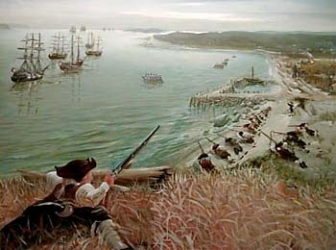
Falmouth Militia on the Beaches, April 3, 1779
The Pilgrims would later encounter the English-speaking natives Samoset and Squanto, who helped to conclude peace terms with Massasoit, Sachem of the Wampanoag.
Some 90% of the native population had been wiped out in the two years preceding, by an epidemic long thought to be smallpox, but now believed to be Leptospirosis, a highly contagious pulmonary hemorrhagic syndrome. Otherwise, things may have gone for the Pilgrims as they had for those first Vikings of 600 years earlier, but that’s a tale for another day.
Militia from my own town of Falmouth and neighboring Sandwich poured onto the beaches on April 3, 1779, opposing a landing by 220 Regulars in the modern day area of Surf Drive. The invaders were repulsed, but little Falmouth sustained a cannonade of ball, shot and grape that lasted from eleven in the morning until dark.
The British warship HMS Nimrod fired on my town during the War of 1812. It’s closed now, but the building that formerly housed the Nimrod Restaurant, still sports a hole in the wall where the cannon ball came in.
Cape Cod was among the first areas settled by the English in North America, the town of Sandwich established in 1637, followed by Barnstable and Yarmouth in 1639. The thin soil was ill suited to agriculture, and intensive farming techniques eroded topsoil. Farmers grazed cattle on the grassy dunes of the shoreline, only to watch “in horror as the denuded sands ‘walked’ over richer lands, burying cultivated fields and fences.”
By 1800, Cape Cod was all but denuded of trees and firewood had to be transported by boat from Maine. Local agriculture was all but abandoned by 1860, save for better-suited, smaller scale crops such as cranberries and strawberries. By 1950, Cape Cod forests had recovered in a way not seen since the late 1700s.
Cranberry picking in 1906
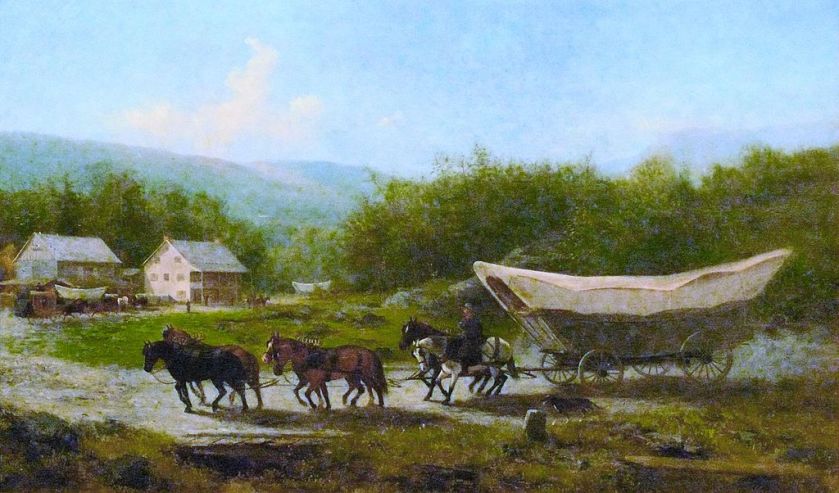
The early Industrial Revolution that built up Rhode Island and Massachusetts bypassed much of Cape Cod, but not entirely. Blacksmiths Isaac Keith and Ezekiel Ryder began building small buggies and sleighs in the Upper Cape town of Bourne, in 1828. Two years later Keith went off on his own By the Gold Rush of 1849, the Keith Car Works was a major builder of the Conestoga Wagons found throughout the United States and Canada, as well as their smaller, lighter cousin, the Prairie Schooner. Before the railroads, Conestoga wagons were heavily used in the transportation of shade tobacco grown in Connecticut, western Massachusetts and southern Vermont, even now some of the finest cigar binders and wrappers available. The story may or may not be true, but I’ve been told that’s why we call cigars, “stogies”.
The dredging of a canal connecting the Manomet and Scusset rivers and cutting 62 miles off the water route from Boston to New York was discussed since the time of Miles Standish. Construction of a privately owned toll canal began on June 22, 1909. Giant boulders left in the wake of the glaciers and ghastly winter weather hampered construction, the canal finally opening on July 29, 1914, charging a maximum of $16 per vessel. Navigation was difficult, due to a 5+ mph current combined with a maximum width of 100′ and a max. depth of 25′. Several accidents damaged the canal’s reputation and toll revenues failed to meet investors’ expectations.
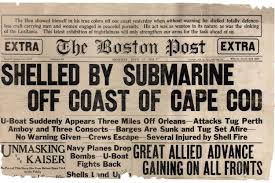
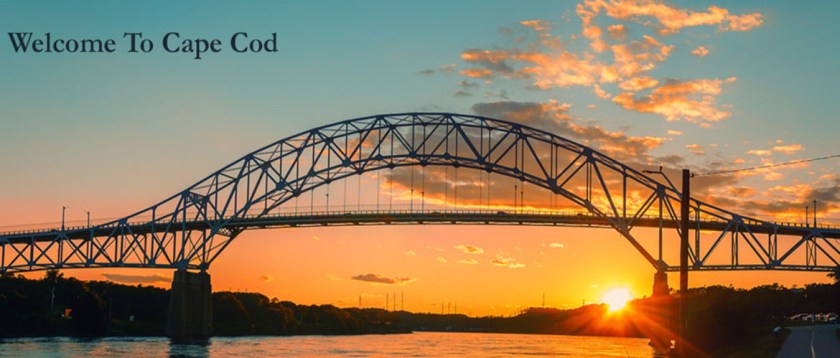
German submarine U-156 surfaced off Nauset beach in Orleans on July 21, 1918, shelling the tug Perth Amboy and its string of towed barges. The federal government took over the canal under a presidential proclamation four days later, later placing it under the jurisdiction of the Army Corps of Engineers. The canal was re-dredged as part of President Roosevelt’s depression era Works Progress Administration to its current width of 480′ and depth of 32′, and connected to the mainland by the Sagamore, Bourne, and Cape Cod Canal Railroad Bridges.
Cranberry picking in 1906
So it is that an estimated 5.23 million tourists will wait countless hours amidst seas of brake lights, to cross those two narrow roadways onto “the Cape”, to enjoy that brief blessed moment of warmth hidden amidst our four seasons, known locally as “almost winter, winter, still winter and bridge construction”.
If anyone wonders why my buddy Carl calls me the “Cape Cod Curmudgeon”, I can only say in my own defense. I’ve been commuting through that crap, for years.
A potential animal arms race got no further than that single letter from the King of Siam, but it makes the imagination run wild. What would War Elephants have looked like, at Gettysburg?
Long before Jefferson Davis became President of the Confederate States of America, he was a young Army Officer who was approached with the idea of using camels as pack animals. To Davis, the beast’s ability to survive in the desert, its massive strength and great stamina, made him wonder if this wasn’t the weapon of the future.
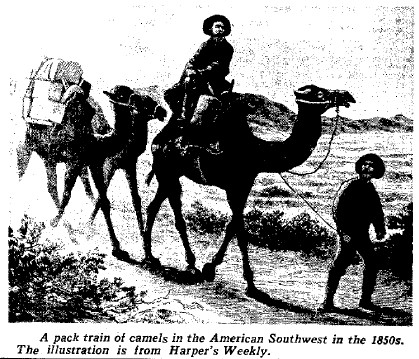
Twenty years later, then-US Secretary of War Jefferson Davis ordered the creation of the First United States Camel Corps. Major Henry Wayne was sent to Turkey to acquire 62 of the beasts, along with trainers who could teach US soldiers how to properly handle and care for camels.
The camels arrived on May 14, 1856, and set out for the newly established Camp Verde in Kerr County Texas, with elements of the US Cavalry and 7 Turkish & Arab handlers.
Major Wayne became an enthusiastic salesman for the camel program, putting on demonstrations for cavalry groups. He’d order what seemed an impossible load to be placed on a kneeling camel, and then step back and frown, “concerned” that he might have overdone it. Mule drivers would smirk and jab each other with their elbows – now he’s done it – and then he would step forward and pile on more weight. On command, the camel would stand up and stroll away, entirely unconcerned.
One of the Turks, a man named Hadji Ali, (“Hi Jolly” to the soldiers), established a successful breeding program while stationed at Camp Verde, but the program was not without problems. Camels don’t play well with other pack animals, and they don’t accept the whips and prods that were used to drive horses and mules. They tend to retaliate. A cranky camel will spit in your face or rake your skin off with their teeth if given the chance, and they can turn and charge in a manner that’s terrifying.
Camp Verde had about 60 camels when Civil War broke out in 1861. The King of Siam seems to have been the only man who grasped the military advantage to the Confederacy. Seeing a business opportunity, he wrote to President Abraham Lincoln, saying “here, we use elephants”. It seems that Lincoln never responded to the King’s overture. A potential animal arms race got no further than this single letter, but it makes the imagination run wild. What would War Elephants have looked like, at Gettysburg?
Some of Camp Verde’s camels were sold off, one was pushed over a cliff by frustrated cavalrymen. Most were simply turned loose to fend for themselves. Their fates are mostly unknown, except for one who made his way to Mississippi in 1863, where he was taken into service with the 43rd Infantry Regiment. “Douglas the Confederate Camel” was a common sight throughout the siege of Vicksburg, until being shot and killed by a Union sharpshooter. Lieutenant Colonel Robert Bevier of the 5th Regiment, Missouri Confederate Infantry was furious, enlisting six of his best snipers to rain down hell on Douglas’ killer. Bevier later said of the Federal soldier “I refused to hear his name, and was rejoiced to learn that he had been severely wounded.”
The Apache wars were drawing to a close in 1883, but southeastern Arizona could still be a dangerous place. Renegade bands of Apache were on the move, and isolated ranches were in a constant state of siege.
Two men rode out to check on their livestock one day, leaving their wives at the ranch with the kids. One of the women went down to the spring for a bucket of water while the other remained in the house with the children. Suddenly there was a terrifying scream, and the dogs began to bark. The woman inside saw what she described as a huge, reddish beast, being ridden by a devil.
She barricaded herself inside the house and hysterically prayed while waiting for the men to return. The pair returned that night and found the body of the other woman by the stream. She’d been trampled almost flat, with huge, cloven hoof prints in the mud around her body and a few red hairs in the brush.
Gold prospectors awakened in the night a few days later, as their tent crashed down around them to the sound of thundering hoofs. They clawed their way out of the mess and saw a huge beast, much larger than a horse, run off into the moonlight. The next day, they too found red hairs in the brush.
The stories became more fantastic and more terrifying with each telling, one man claiming that he personally saw the beast kill and eat a grizzly. Another claimed that he had chased the “Red Ghost”, only to have it vanish before his eyes.
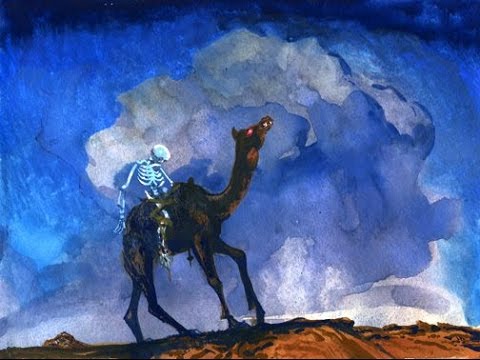
A few months later, a Salt River rancher named Cyrus Hamblin spotted the animal while rounding up cows. It was a camel, and Hamblin saw that it had something that looked like the skeleton of a man tied to its back. Nobody believed his story, but a group of prospectors fired on the animal several weeks later. Though their shots missed, they saw the animal bolt and run, and a human skull with some parts of flesh and hair still attached fell to the ground.
There were further incidents over the next year, mostly at prospector camps. A cowboy near Phoenix came upon the Red Ghost while eating grass in a corral. Cowboys seem to think they can rope anything with hair on it, and this guy was no exception. He lashed the rope onto the pommel of his saddle, and tossed it over the camel’s head. The angry beast turned and charged, knocking horse and rider to the ground. As the camel galloped off, the astonished cowboy could clearly see the skeletal remains of a man lashed to its back.
The beast last appeared nine years later in the garden of a rancher. He aimed his Winchester and fired, dropping the animal with one shot. On the back of the poor, tormented beast was the body of a man, tied down with heavy rawhide straps that cruelly scarred the animal’s flesh. The story of the Red Ghost ends here. How the body of a man came to be tied to its back, remains a cruel mystery.
The Lafayette Escadrille is often confused with the much larger Lafayette Flying Corps, and the movie “Flyboys” adds to the confusion.
Norman Prince
Knowing that his father would not approve, Norman Prince of Beverly Massachusetts concealed his flight training. Using the name George Manor, Norman earned his wings in 1911 in the Quincy, Massachusetts neighborhood of Squantum. A fluent French speaker with a family estate in Pau, France, Norman sailed in January 1915, to join the French war effort.
The earliest vestiges of the American Hospital of Paris and what would become the American Ambulance Field Service can be found five years earlier, in 1906. Long before the American entry in 1917, individual sympathies brought Americans into the war to fight for Britain and France. They traveled to Europe to fight in the war against the Axis Powers, joining the Foreign Legion, the Flying Corps or, like Ernest Hemingway, the Ambulance Service.
Squadron Insignia pin
After 1915, American pilots volunteered for multiple “Escadrille” – flight squadrons of the French Air Service, the Aéronautique Militaire.
The March 7, 1918 Harvard Alumni Bulletin, would give Norman Prince full credit for persuading the French government to form all-American flying squadrons, though he would not live to see the article.
Sergeant Norman Prince caught a landing wheel on a telegraph wire after a bombing run on October 12, 1916, sustaining massive injuries when his plane flipped over and crashed. He was promoted to sous (2nd) lieutenant on his death bed and awarded the Legion of Honor. He died three days later, at the age of 29.
Lt. Col. William Thaw II with_lion cub mascots Whiskey and Soda
William Thaw II of Pittsburgh was the first pilot to fly up New York’s East River under all four bridges, the first American engaged in aerial combat in the war.
Thaw pooled his money with three other pilots to purchase a male lion cub, the first of two such mascots kept by the Escadrille. He bought the lion from a Brazilian dentist for 500 francs and bought a dog ticket, walking the lion onto the train on a leash. Explanations that this was an “African dog” were less than persuasive, and the pair was thrown off the train. “Whiskey” would have to ride to his new home in a cage, stuck in cargo.
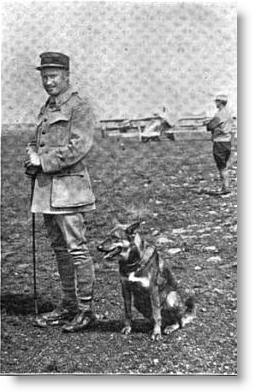
French Lieutenant Colonel Georges Thenault & Fram, 1917
French Lieutenant Colonel Georges Thenault owned a “splendid police dog” named Fram who was the best of friends with Whiskey, though he learned to keep to himself at dinner time.
A female lion, “Soda”, was purchased sometime later. The lions were destined to spend their adult years in a Paris zoo, but both remembered from whence they had come. Both animals recognized William Thaw on a later visit to the zoo, rolling onto their backs in expectation of a good belly rub.
Originally authorized on March 21, 1916 as the Escadrille Américaine (Escadrille N.124), American pilots wore French uniforms and flew French aircraft. Nevertheless, Germany was dismayed at the existence of such a unit, and complained that the neutral United States appeared to be aligning with France.
Escadrille N.124 changed its name in December 1916, adopting that of a French hero of the American Revolution. Marie-Joseph Paul Yves Roch Gilbert du Motier, Marquis de Lafayette. Five French officers commanded a core group of 38 American volunteers, supported by all-French mechanics and ground crew. Rounding out the Escadrille were the unit mascots, the African lions Whiskey and Soda.
This early in aviation history, flying duty was hazardous to say the least. Planes were flimsy and plagued with mechanical difficulties. Machine guns jammed and other parts failed when they were needed most. There were countless wounds in addition to fatal injuries. At least one man actually asked to be sent back to the trenches, where he felt safer.
Kiffin Rockwell
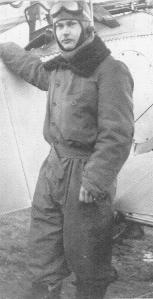
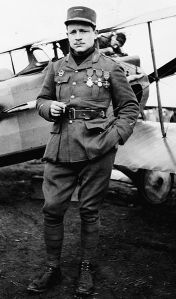
The first major action of the Escadrille Américaine took place at the Battle of Verdun on May 13, 1916. Kiffin Rockwell of Newport Tennessee became the first American to shoot down an enemy aircraft on May 18, later losing his own life when he was shot down by the gunner in a German Albatross observation plane on September 23. French born American citizen Raoul Lufbery became the squadron’s first Ace with 5 confirmed kills, and went on to be the highest scoring flying ace in the unit with 17 confirmed victories. He was killed on May 19, 1918, when his Nieuport 28 flipped over while he attempted to clear a jam in his machine gun.
The unit sustained its first fatality on June 24, 1916, when Victor Chapman was attacked by German flying ace Leutnant Kurt Wintgens, north of Douaumont. Chapman was carrying oranges at the time, intended for his buddy Clyde Balsley, who was in hospital recuperating from an earlier incident.
Edmond Genet
Ossining, New York native Edmond Genet was a bit of a celebrity among American expats, as the second-great grandson of Edmond-Charles Genêt, of the Founding-era Citizen Genêt Affair. Genet sailed for France at the end of January 1915, joining the French Foreign Legion, and finally the Lafayette Escadrille on January 22, 1917.
Genet had left while on leave from the US Navy, and was therefore classified as a deserter. The decision weighed heavily on him. Edmond Genet was shot down and killed by anti-aircraft artillery on April 17, eleven days after the American declaration of war, officially making him the first American fatality in the War to end all Wars. The war department sent his family a letter after his death, stating that his service was considered in all respects, honorable.
38 American pilots passed through the Lafayette Escadrille, “the Valiant 38”, eleven of whom were either killed in action or died later as the result of wounds received. The unit flew for the French Air Service until the US’ entry into the war, when it passed into the 103rd Aero Squadron, American Expeditionary Force.
Raoul Lufbery
The Lafayette Escadrille is often confused with the much larger Lafayette Flying Corps, and the movie “Flyboys” adds to the confusion. The Flying Corps was different from the Escadrille, the former coming about as the result of widespread interest in the exploits of the latter. American volunteers were assigned individually or in groups of two or three to fly in various French Aviation units, but, prior to US entry into the war. The Lafayette Escadrille was the only one to serve as a single organization.
All told, 267 American volunteers applied to serve in the Lafayette Flying Corps, credited with downing 199 German planes at the cost of 19 wounded, 15 captured, 11 dead of illness or accident, and 51 killed in action.
Lafayette Escadrille, July 1917. Standing (left to right) Soubiron, Doolittle, Campbell, Persons, Bridgman, Dugan, MacMonagle, Lowell, Willis, Jones, Peterson and de Maison-Rouge. Seated (left to right) Hill, Masson with “Soda,” Thaw, Thénault, Lufbery with “Whiskey,” Johnson, Bigelow and Rockwell. Georges Thenault’s dog “Fram” sits in the foreground.
All told, Irena Sendler saved about 2,400 Jewish children and infants and about 100 teenagers, who went into the forests to join partisan bands fighting the Nazis. The far better known Oskar Schindler is credited with saving less than half that number.
Dr. Stanisław & Janina Krzyżanowski
Dr. Stanislaw Krzyżanowski was a physician treating mostly the poorer Jewish families in the central Polish town of Otwock, 14 miles southeast of Warsaw. He had once said to his only daughter Irena: “If you see someone drowning, you must save them.” “But, what if I can’t swim?” she asked. “Nevertheless, you must try”.
Overwhelmed by the typhus epidemic of 1917, Dr. Krzyżanowski contracted the disease himself and died that February, but his example guided his daughter for the rest of her life. Jewish community leaders showed their gratitude by offering to pay for Irena’s education, but her mother declined.
Irena (Krzyżanowski) Sendler was a nurse living outside Warsaw, when Nazi Germany invaded Poland in 1939. The Nazis gathered up every Jew they could find in 1940, penning 400,000 or more up in the city. Soon, the Warsaw ghetto became the scene of suffering, disease and starvation. Knowing the Nazis feared nothing so much as Typhus, Sendler took advantage of their fears and obtained permission to begin work in the ghetto.
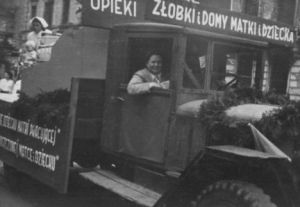
“Irena in a social welfare department truck in May 1948” H/T U.K. Daily Mail
She would travel there daily, and soon started to smuggle Jewish babies out in the bottom of a medical bag. She’d place soiled bandages around and over sedated babies, to keep guards from looking too closely. She carried a burlap sack in the back of her truck. Sometimes she’d use that or even a coffin to smuggle larger children and even teenagers out of the ghetto, other times leading them out through cellars or sewers.
Sendler traveled with a small a dog she had trained to bark at Nazi soldiers letting her in and out of the gates. They wanted nothing to do with her small, yappy dog, and the barking would cover any sounds that the babies might make.
She would make as many as three runs a day, taking out as many as 6 children. Most of them were already orphans by this time, their parents murdered by the Nazi regime. Many times, parents gave up their children in order to save them.
Irena coded the names of these children onto two slips of paper, including false and real names. These she buried in glass jars under a tree in the yard of a friend. She obtained false papers for each of the kids, passing them along to nunneries, monasteries and to foster parents.
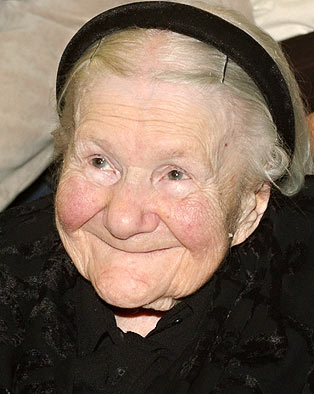
‘Angel of the Warsaw Ghetto”, Irena Sendler
Elzbieta Ficowska was smuggled out in a carpenter’s toolbox at the age of six months. ‘When I was 17″, she said, “a friend said she’d heard I was Jewish. At that point, my Polish mum told me the truth, giving me a silver spoon engraved with my name and birth date, which my blood family had placed in the box with me. Elzbieta later learned that her family wept on hearing she was to be baptized, but later signaled their understanding by sending a christening gown and tiny gold cross. “I consider both my Polish mum and Irena to be a little pathological. It is a kind of insanity to overcome such fear. They were so alike, my mum and Irena – fantastic, strong women”.
Anna Mieszkowska, the author of Sendler’s Polish biography, tells a story. ‘Irena told me not to put this story in the book. She was asked to save two children, a boy and a girl. The parents wanted them to go but the grandparents did not. Irena arrived at their address and found the whole family had committed suicide – grandparents, parents, children. She had nightmares about this for many years.’
Sendler was caught by the Gestapo in 1943, betrayed by a colleague under torture, and by a nosy landlady. Nazi interrogators beat her savagely, but she never gave up any of those names.
Irena lasted 100 days in Pawiak prison, a place where average inmate survival was less than a month. Finally she was returned to the Gestapo and stood against a wall for execution, too broken to care. An SS guard said “not you” and shoved her out into the street. He’d been bribed by her friends, and was himself later caught and executed. For now she was “officially” dead, which made it easier to escape detection for the remainder of the war.
After the war, Irena tried to reunite parents or surviving family members with the children she’d rescued. She was rarely successful.
All told, Irena Sendler saved about 2,400 Jewish children and infants and about 100 teenagers, who went into the forests to join partisan bands fighting the Nazis. The far better known Oskar Schindler is credited with saving less than half that number.
Today, Elzbieta Ficowska tries to keep her Jewish roots, but they seem foreign to her. ‘When I enter a Catholic church, everything is mine. Sometimes I look in the mirror for traces of my real parents. I sent letters all around the world to try to find out about them.’ She has never seen so much as a photograph.
The Polish Government honored Irena Sendler with the Order of the White Eagle, its highest award. The Yad Vashem Remembrance Center in Jerusalem honored her as a “Righteous Gentile” in 1965. She received honorary citizenship in Israel in 1985, and the Polish and Israeli Governments nominated her for the Nobel Peace Prize in 2007.
The Nobel Prize for Peace was awarded on October 12 in Oslo, Norway, to the Intergovernmental Panel on Climate Change (IPCC) and Albert Arnold Gore Jr. “for their efforts to build up and disseminate greater knowledge about man-made climate change, and to lay the foundations for the measures that are needed to counteract such change”.
Irena Sendler passed away on May 12, 2008 at the age of 98. This choice of 2007 Nobel prize recipients has been controversial, since Nobel by-laws prohibit posthumous award of the prize. Many felt that Sendler had more than earned it. Some have claimed that Nobel committee rules require qualifying work to have taken place within the two years immediately preceding nomination, but I think they’re making it up. I’ve read the Nobel statutes. You can do so yourself, HERE, if you’re so inclined I find no such requirement. Let me know if I missed it, the whole thing seems political, to me.
Irena Sendler always said that she wasn’t a hero, she only did what any normal person would do. I find in the story of this petite Polish nurse, some of the most magnificent courage of which our species is capable. If that does not make her a hero, I don’t know what would.
The British comedy troupe that formed this day in 1969 was amused at the idea of a haughty Lord Montgomery, patterned after Field Marshal Bernard Law Montgomery, 1st Viscount Montgomery of Alamein, KG, GCB, DSO, PC, DL, etc. “Python” seemed just slippery enough to make the whole thing work.
Graham Chapman was trained and educated to be a physician, but that career trajectory was never meant to be. John Cleese was writing for TV personality David Frost and actor/comedian Marty Feldman at the time, when he recruited Chapman as a writing partner and “sounding board”. BBC offered the pair a show of their own in 1969, when Cleese reached out to former How To Irritate People writing partner Michael Palin, to join the team. Palin invited his own writing partner Terry Jones and colleague Eric Idle over from rival ITV, who in turn wanted American-born Terry Gilliam for his animations.
The British comedy troupe that formed this day in 1969 was amused at the idea of a haughty Lord Montgomery, patterned after Field Marshal Bernard Law Montgomery, 1st Viscount Montgomery of Alamein, KG, GCB, DSO, PC, DL, etc. “Python” seemed just slippery enough to make the whole thing work.
The Pythons considered several names for their new program, including “Owl Stretching Time”, “The Toad Elevating Moment”, “Vaseline Review” and “A Horse, a Spoon and a Bucket”. “Flying Circus” had come up as well. The name stuck when BBC revealed that they had already printed flyers, and weren’t about to go back to the printer.
The show was a collaborative process, beginning with the first broadcast on October 5, 1969. With no writers of their own, the six would divide into groups and write their own material. Whether any given sketch would make it into the program, was always a democratic process.
Different Python factions were responsible for different elements of the team’s humor. The work of the Oxford educated Terry Jones and Michael Palin was more visual, and a little more off the wall. The Spanish Inquisition arriving in a suburban apartment is a prime example, while the Cambridge educated John Cleese and Graham Chapman were more confrontational – “This is abuse. I came here for an argument”. Cleese said “anything that got utterly involved with words and disappeared up any personal orifice was Eric’s”, like the Man who Spoke in Anagrams. Terry Gilliam was the guy behind the animation.
The Flying Circus broke new ground with techniques like the “cold open”. With no titles, credits, or opening theme, Michael Palin would crawl across the tundra a la Robinson Crusoe, looking into the camera and saying “It’s“… And off they went. The cold open sometimes lasted until the middle of the show. Occasionally, the Pythons fooled viewers by rolling closing credits halfway through, usually continuing the gag by fading to the BBC logo while Cleese parodied the tones of a BBC announcer. On one occasion the closing credits ran directly after the opening titles.
I personally learned to never leave a Python film during closing credits, finding my reward for sticking around at the end of the Life of Brian was to learn who wiped the moose’s noses. (As I recall, it was John J. Llama).
The “Iron Lady”, Prime Minister Margaret Thatcher herself, seems to have been a fan, doing a more than passable version of the Dead Parrot sketch at a Conservative Party Conference in 1990.
The Pythons shared a dislike for “capping” bits with punchlines, and experimented with ending sketches by cutting abruptly to another scene, or breaking the rules altogether by addressing the camera directly. Two examples were the knight in armor, played by Terry Gilliam, who would wander onto the set and whack people over the head with a rubber chicken. Or Chapman’s “Colonel” character, who would walk into sketches and order them stopped because things were becoming “far too silly.”
Gilliam’s animations were a favorite technique, when a 16 ton weight would drop from the sky, or else it was Cupid’s foot – yes, that’s Cupid’s foot – cut from a reproduction of the Renaissance masterpiece “Venus, Cupid, Folly, and Time” by Il Bronzino.
John Cleese left the Flying Circus at the end of the third season. He had considered doing so at the end of the second, feeling that he had little original material to offer the show. He found Chapman difficult to work with, who was at this time a full tilt alcoholic. Cleese could be difficult himself. Eric Idle once said of John Cleese. “He’s so funny because he never wanted to be liked. That gives him a certain fascinating, arrogant freedom”.
The group reunited in 1974 to do the Holy Grail, which was filmed on location in Scotland, on a budget of £229,000. The money was raised in part by investments from musical figures like Pink Floyd, Jethro Tull and Led Zeppelin backer Tony Stratton-Smith. Investors in the film wanted to cut the famous Black Knight scene, (“None shall pass”), but were eventually persuaded to keep it in the film. Good thing, the scene became second only to the Holy Hand Grenade of Antioch and the Killer Rabbit. “What’s he going to do, nibble my bum?”
Graham Chapman is best remembered as King Arthur in the Holy Grail, and Brian Cohen in the Life of Brian. He died of spinal and throat cancer on the 20th anniversary of their first broadcast. John Cleese delivered a uniquely Pythonesque eulogy, which sounded a lot like the Dead Parrot sketch. “”Graham Chapman, co-author of the Parrot sketch, is no more,” he began. “He has ceased to be, bereft of life, he rests in peace, he has kicked the bucket, hopped the twig, bit the dust, snuffed it, breathed his last, and gone to meet the Great Head of Light Entertainment in the sky…”
I don’t believe he’d have had it any other way. Silly bunt.
The last of the other inmates had left by 1966, leaving #7 the prison’s only occupant. Warden Bird wrote a book in 1974, titled “The Loneliest Man in the World”, about his relationship with Hess during his 30 years’ confinement.
At the end of WWI, Rudolf Walter Richard Hess enrolled in the University of Munich. He’d been wounded several times in the Great War, serving in the 7th Bavarian Field Artillery Regiment. As a student, Hess studied geopolitics under Karl Haushofer, an early proponent of “Lebensraum” (“living space”), the philosophy which later became a central plank in the Nazi Party political platform.
Hess was an early and ardent proponent of Nazi ideology. A True Believer. He was at Hitler’s side during the failed revolution of 1923, the “Beer Hall Putsch”. He served time with Hitler in prison, and helped him write his political opus “Mein Kampf” (My Struggle). Hess was appointed to Hitler’s cabinet when the National Socialist German Workers’ Party seized power in 1933, becoming Deputy Führer, #3 after Hermann Göring and Hitler himself. Hess signed many statutes into law, including the Nuremberg Laws of 1935, depriving the Jews of Germany of their rights and property.
Obsessed as he was with race theory, Hitler believed that, as fellow Anglo Saxons, the British people were meant to be natural allies to Germany. If only they could get rid of Churchill, he believed, the two nations might be able to work things out. Churchill and Hitler deeply hated one another, but there were many in Great Britain, including much of the landowning aristocracy, London financiers and media moguls, who regarded the Soviet Union as the greater threat.
Rudolf Hess flew into Scotland on May 10, 1941, parachuting to earth as his Messerschmidt two-seat aircraft ran out of gas. It’s unclear whether the scheme was Hess’ own idea or if it had official sanction. It was a cockamamie scheme, in which he intended to arrange peace talks with Douglas Douglas-Hamilton, 14th Duke of Hamilton, believing him to be a prominent opponent of the British government. The Deputy Führer was immediately arrested, remaining in British custody until the end of the war, when he was returned to Germany for the 1946 Nuremberg Trials.
Hess mental state seems to have declined while under British custody and questions were raised about his sanity and fitness to stand trial. Judges decided that he understood the charges against him and was capable of defending himself. Hess did himself no good at trial, declaring his late Führer to be “the greatest son my Volk has brought forth in its thousand-year history”. He testified that he wouldn’t change a thing about having worked for the man, saying “I regret nothing.”
Nine months later, the court acquitted Hess of war crimes and crimes against humanity, apparently deciding that his earlier persecution of Jews to be insufficiently connected to their later annihilation. Hess was convicted of conspiracy to wage aggressive war and of crimes against peace and sentenced to life in prison, transferred to Spandau Prison in West Berlin, and placed under the authority of the four major allied powers. Spandau had once housed as many as 600 prisoners. There he was stripped of his name and given a number, #7, one of 8 former Nazi officials imprisoned there. After July 18, 1947, those eight became the only inmates to occupy the facility.
Hess’ fellow convicts were gradually released from the prison, as their terms expired or on compassionate grounds. His main companion at this time was his jailer, warden Eugene K. Bird, with whom Hess became close friends. The last of the other inmates had left by 1966, leaving #7 the prison’s only occupant. Warden Bird wrote a book in 1974, titled “The Loneliest Man in the World”, about his relationship with Hess during his 30 years’ confinement.
Changing the Guard at Spandau
Attempts by family members and prominent politicians to get him released were blocked by Soviet authorities, who believed him to be a principle architect of Barbarossa, the Nazi sneak attack on the Soviet Union in 1941. On August 17, 1987, #7 tied a lamp cord to a window latch and hanged himself with it. He was 93.
Spandau prison was demolished following the death of its final remaining prisoner, the rubble dumped into the North Sea to prevent the place from becoming a Neo-Nazi shrine,
Following her mother’s death in 1905, Anna Jarvis conceived of Mother’s Day as a way to honor her legacy, and to pay respect for the sacrifices that all mothers make on behalf of their children.
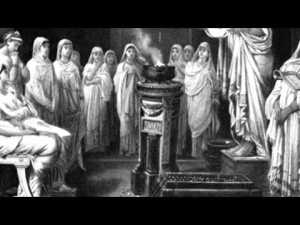
The earliest discernible Mother’s day comes from 1200-700BC, descending from the Phrygian rituals of modern day Turkey and Armenia. “Cybele” was the great Phrygian goddess of nature, mother of the Gods, of humanity, and of all the beasts of the natural world, her cult spreading throughout Eastern Greece with colonists from Asia Minor.
Much of ancient Greece looked to the Minoan Goddess Rhea, daughter of the Earth Goddess Gaia and the Sky God Uranus, mother of the Gods of Olympus. Over time the two became closely associated with the Roman Magna Mater, each developing her own cult following and worshipped through the period of the Roman Empire.
In ancient Rome, women partook of a festival, strictly forbidden to Roman men. So strict was this line of demarcation that only women were permitted even to know the name of the deity. For everyone else she was simply the “Good Goddess”. The Bona Dea.
In the sixteenth century, it became popular for Protestants and Catholics alike to return to their “mother church” whether that be the church in which they were baptized, the local parish church, or the nearest cathedral. Anyone who did so was said to have gone “a-mothering”. Domestic servants were given the day off and this “Mothering Sunday”, the 4th Sunday in Lent, was often the only time when whole families could get together. Children would gather wild flowers along the way, to give to their own mothers or to leave in the church. Over time the day became more secular, but the tradition of gift giving continued.
Ann Maria Reeves Jarvis
Ann Maria Reeves Jarvis was a social activist in mid-19th century western Virginia. Pregnant with her sixth child in 1858, she and other women formed “Mothers’ Day Work Clubs”, to combat the health and sanitary conditions which were leading at that time to catastrophic levels of infant mortality. Jarvis herself gave birth between eleven and thirteen times in a seventeen year period. Only four would live to adulthood.
Jarvis had no patience for the sectional differences that led the nation to Civil War, or which led her own locality to secede and form the state of West Virginia in order to rejoin the Union. Jarvis refused to support a measure to divide the Methodist church into northern and southern branches. She would help Union and Confederate soldier alike if she could. It was she alone who offered a prayer when others refused, for Thornsbury Bailey Brown, the first Union soldier killed in the vicinity.
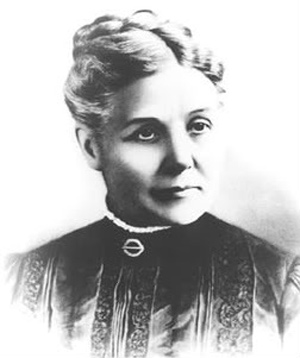
Anna Jarvis
Following Jarvis’ death in 1905, her daughter Anna conceived of Mother’s Day as a way to honor her legacy and to pay respect for the sacrifices that all mothers make on behalf of their children.
Obtaining financial backing from Philadelphia department store owner John Wanamaker, Anna Jarvis organized the first official Mother’s Day celebration at a Methodist church in Grafton, West Virginia. That same day, thousands attended the first Mother’s Day event at Wanamaker’s store in Philadelphia.
Anna Jarvis resolved that Mother’s Day be added to the national calendar, and a massive letter writing campaign ensued. On May 9, 1914, President Woodrow Wilson signed a measure declaring the second Sunday of May, to be Mother’s Day.
Anna Jarvis believed Mother’s Day to be a time of personal celebration, a time when families would gather to love and honor their mother.
In the early days she had worked with the floral industry to help raise the profile of Mother’s Day. By 1920 she had come to resent what she saw as the commercialization of the day. Greeting cards seemed a pale substitute for the hand written personal notes she envisioned. Jarvis protested a Philadelphia candy maker’s convention in 1923, deriding confectioners, florists and even charities as “profiteers”. Carnations had by this time become symbolic of Mother’s Day, and Jarvis resented that they were being sold at fundraisers. She protested at a meeting of the American War Mothers in 1925 where women were selling carnations, and got herself arrested for disturbing the peace.
Soon she was launching an endless series of lawsuits against those she felt had used the “Mother’s Day” name in vain.
During the last years of her life, Anna Jarvis lobbied the government to take her creation off of the calendar, gathering signatures door-to-door to get the holiday rescinded. The effort was obviously unsuccessful. The mother of mother’s day died childless in a sanitarium in 1948, her personal fortune squandered on legal fees.
Today, some variation of Mother’s Day is observed from the Arab world to the United Kingdom. In the United States, Mother’s Day is one of the most commercially successful days of the year for flower and greeting card sales, and the biggest day of the year for long-distance telephone calls. Church attendance is the third highest of the year, behind only Christmas and Easter. Many churchgoers celebrate the day with carnations: colored if the mother is still living and white if she has passed on.

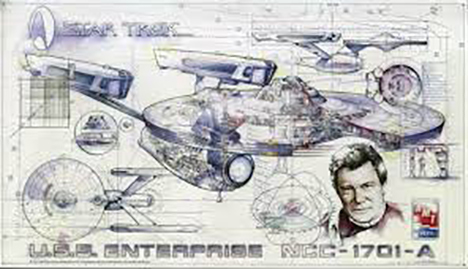
 Roddenberry decided on James T. Kirk, based on a journal entry of the 18th century British explorer, Captain James Cook: “ambition leads me … farther than any other man has been before me”.


 It was literally “out of the blue”, when the first wave of enemy aircraft arrived at 7:48 local time, December 7, 1941. 353 Imperial Japanese warplanes approached in two waves out of the southeast, fighters, bombers, and torpedo planes, across Hickam Field and over the waters of Pearl Harbor. Tied in place and immobile, the eight vessels moored at “Battleship Row” were easy targets.


 USS Oklahoma was designed to fight at the most extreme ranges expected by gunnery experts. Commanded by Charles B. McVay, Jr., father of the ill-fated skipper of the USS Indianapolis Charles Butler McVay III, Oklahoma’s role in WW1 was limited, due to the unavailability of oil in major theaters of operation. Notable among her exploits of the Great War, were the memorable fist fights that crew members got into with Sinn Féin members in Berehaven, and casualties sustained during the
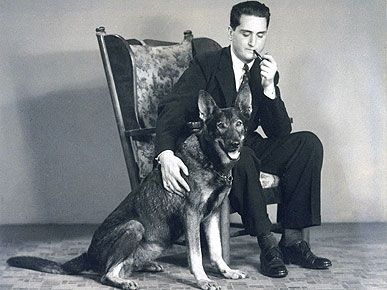
 Dorothy Eustis called Frank in February 1928 and asked if he was willing to come to Switzerland. The response left little doubt: “Mrs. Eustis, to get my independence back, I’d go to hell”. She accepted the challenge and trained two dogs, leaving it to Frank to decide which was the more suitable. Morris came to Switzerland to work with the dogs, both female German Shepherds. He chose one named “Kiss” but, feeling that no 20-year-old man should have a dog named Kiss, he called her “Buddy”.
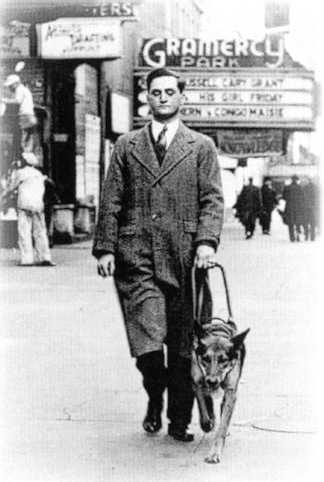 Frank told a New York Times interviewer in 1936 that he had probably logged 50,000 miles with Buddy, by foot, train, subway, bus, and boat. He was constantly meeting with people, including two Presidents and over 300 ophthalmologists, demonstrating the life-changing qualities of owning a guide dog.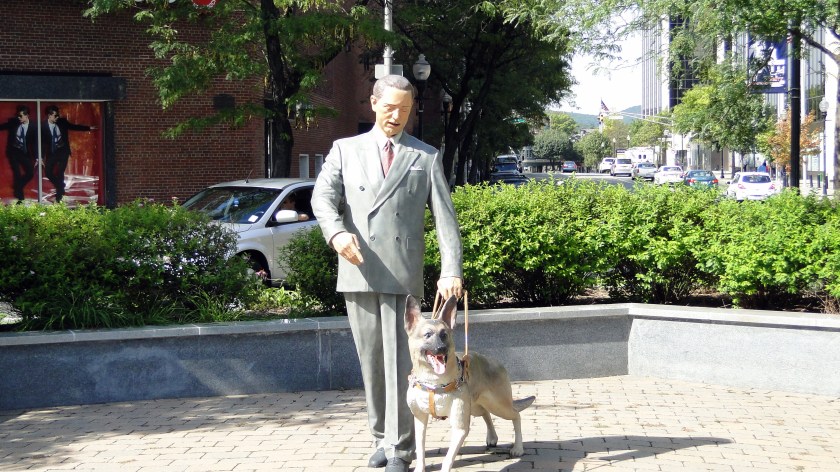

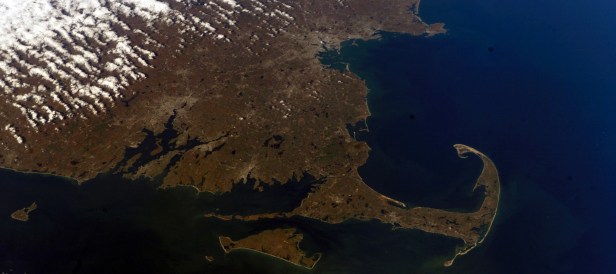
 Queen Elizabeth I of England granted Walter Raleigh a charter to establish a colony north of Spanish Florida in 1583, the area called “Virginia”, in honor of the virgin Queen. At the time, the name applied to the entire coastal region from South Carolina to Maine, and included Bermuda.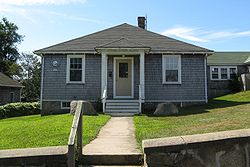

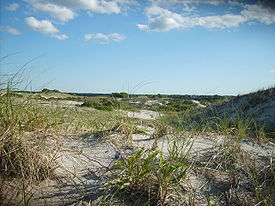 Sandwich established in 1637, followed by Barnstable and Yarmouth in 1639. The thin soil was ill suited to agriculture, and intensive farming techniques eroded topsoil. Farmers grazed cattle on the grassy dunes of the shoreline, only to watch “in horror as the denuded sands ‘walked’ over richer lands, burying cultivated fields and fences.”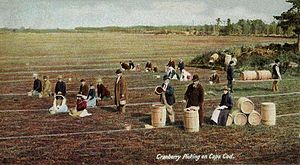



 Some of Camp Verde’s camels were sold off, one was pushed over a cliff by frustrated cavalrymen. Most were simply turned loose to fend for themselves. Their fates are mostly unknown, except for one who made his way to Mississippi in 1863, where he was taken into service with the 43rd Infantry Regiment. “Douglas the Confederate Camel” was a common sight throughout the siege of Vicksburg, until being shot and killed by a Union sharpshooter. Lieutenant Colonel Robert Bevier of the 5th Regiment, Missouri Confederate Infantry was furious, enlisting six of his best snipers to rain down hell on Douglas’ killer. Bevier later said of the Federal soldier “I refused to hear his name, and was rejoiced to learn that he had been severely wounded.”
 men to return. The pair returned that night and found the body of the other woman by the stream. She’d been trampled almost flat, with huge, cloven hoof prints in the mud around her body and a few red hairs in the brush.
 There were further incidents over the next year, mostly at prospector camps. A cowboy near Phoenix came upon the Red Ghost while eating grass in a corral. Cowboys seem to think they can rope anything with hair on it, and this guy was no exception. He lashed the rope onto the pommel of his saddle, and tossed it over the camel’s head. The angry beast turned and charged, knocking horse and rider to the ground. As the camel galloped off, the astonished cowboy could clearly see the skeletal remains of a man lashed to its back.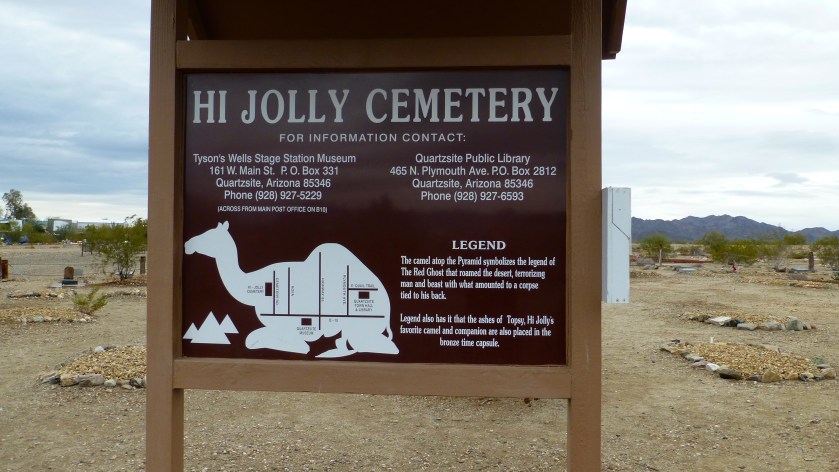


 Escadrille N.124 changed its name in December 1916, adopting that of a French hero of the American Revolution. Marie-Joseph Paul Yves Roch Gilbert du Motier, Marquis de Lafayette. Five French officers commanded a core group of 38 American volunteers, supported by all-French mechanics and ground crew. Rounding out the Escadrille were the unit mascots, the African lions Whiskey and Soda.



 The Nobel Prize for Peace was awarded on October 12 in Oslo, Norway, to the Intergovernmental Panel on Climate Change (IPCC) and Albert Arnold Gore Jr. “for their efforts to build up and disseminate greater knowledge about man-made climate change, and to lay the foundations for the measures that are needed to counteract such change”.

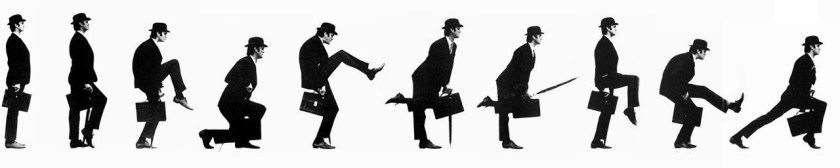


 The group reunited in 1974 to do the Holy Grail, which was filmed on location in Scotland, on a budget of £229,000. The money was raised in part by investments from musical figures like Pink Floyd, Jethro Tull and Led Zeppelin backer Tony Stratton-Smith. Investors in the film wanted to cut the famous Black Knight scene, (“None shall pass”), but were eventually persuaded to keep it in the film. Good thing, the scene became second only to the Holy Hand Grenade of Antioch and the Killer Rabbit. “What’s he going to do, nibble my bum?”

 Hess was an early and ardent proponent of Nazi ideology. A True Believer. He was at Hitler’s side during the failed revolution of 1923, the “Beer Hall Putsch”. He served time with Hitler in prison, and helped him write his political opus “Mein Kampf” (My Struggle). Hess was appointed to Hitler’s cabinet when the National Socialist German Workers’ Party seized power in 1933, becoming Deputy Führer, #3 after Hermann Göring and Hitler himself. Hess signed many statutes into law, including the Nuremberg Laws of 1935, depriving the Jews of Germany of their rights and property.



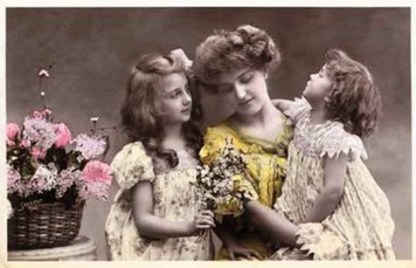 Anna Jarvis believed Mother’s Day to be a time of personal celebration, a time when families would gather to love and honor their mother.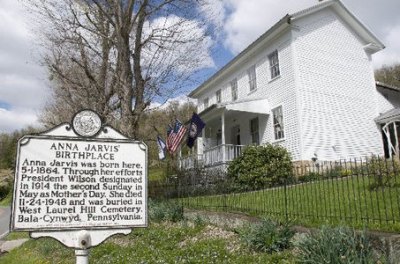


You must be logged in to post a comment.