"Tell me a factand I'll learn. Tell me a truth, and I'll believe. But tell me a story, and it will live in my heart forever." – Steve Sabol, NFL Films
Author: Cape Cod Curmudgeon
I'm not an academic "Historian". I'm a father, a son and a grandfather. A history geek and sometimes curmudgeon who still likes to learn new things. I make every effort to get my facts straight but I'm as good at being wrong as the next guy. I offer these stories hoping you'll enjoy them as much as I do. This is the history we all share. I'm glad you're here.
Rick Long, the “Cape Cod Curmudgeon”
Resolved, that these United Colonies are, and of right ought to be, free and independent States, that they are absolved from all allegiance to the British Crown, and that all political connection between them and the State of Great Britain is, and ought to be, totally dissolved.
Richard Henry Lee’s resolution was taken almost verbatim from instructions from the Virginia Convention and its President, Edmund Pendleton. As presented to the second Continental Congress on June 7, 1776, Lee’s resolution read:
“Resolved, that these United Colonies are, and of right ought to be, free and independent States, that they are absolved from all allegiance to the British Crown, and that all political connection between them and the State of Great Britain is, and ought to be, totally dissolved. That it is expedient forthwith to take the most effectual measures for forming foreign Alliances. That a plan of confederation be prepared and transmitted to the respective Colonies for their consideration and approbation”.
Several colonies were not yet ready to declare independence at that time.
Representatives agreed to delay the vote until July 1, appointing a “Committee of Five” to draft a declaration of independence from Great Britain. Members of the committee included John Adams of Massachusetts, Benjamin Franklin of Pennsylvania, Roger Sherman of Connecticut, Robert Livingston of New York and Thomas Jefferson of Virginia. The committee selected Jefferson to write the document, the draft presented to Congress for review on June 28.
Debate resumed on July 1, 1776, with most of the delegates favoring Lee’s resolution.
The final vote was taken on July 2, when delegates from 12 of the 13 colonies voted in favor. Delegates from New York abstained, having had no clear instructions from their constituents.
The Pennsylvania Evening Post reported on July 2nd that “This day the Continental Congress declared the United Colonies Free and Independent States”.
The Pennsylvania Gazette followed suit on the third with “Yesterday, the CONTINENTAL CONGRESS declared the UNITED COLONIES FREE and INDEPENDENT STATES”.
John Adams thought that July 2 would go down as the country’s Independence Day.
This day has been mostly forgotten in favor of July 4, when the final edits of Jefferson’s Declaration were adopted, the final document engrossed (handwritten onto parchment), and sent off to the printer.
The 56 signers were never together at the same time. Many of the signatures we see on the Declaration of Independence, would not be affixed to the document until August 2, possibly even later.
One hundred and fifty-four years ago today, the Union and the Confederacy met in the south central Pennsylvania town of Gettysburg.
After two years of civil war, Robert E. Lee wanted to take the war to his adversary. Lee intended to do enough damage to create overwhelming political pressure in the North, to end the war and let the South go its own way. Lee had his best cartographers draw up maps of the Pennsylvania countryside, all the way to Philadelphia. And then he took his Army of Northern Virginia into Pennsylvania.
One hundred and fifty-four years ago today, the Union and the Confederacy met in the south central Pennsylvania town of Gettysburg.
Joseph “Fighting Joe” Hooker, to whom Lee contemptuously referred as “Mr. F.J. Hooker”, wanted to attack Richmond, but Lincoln ordered him to intercept Lee’s army to protect Washington DC. Hooker was replaced on the 28th by Major General George Gordon Meade, “that damn old goggle eyed snapping turtle” to his men, in a move that so surprised him that he thought he was being arrested over army politics, when the messenger came into his tent.
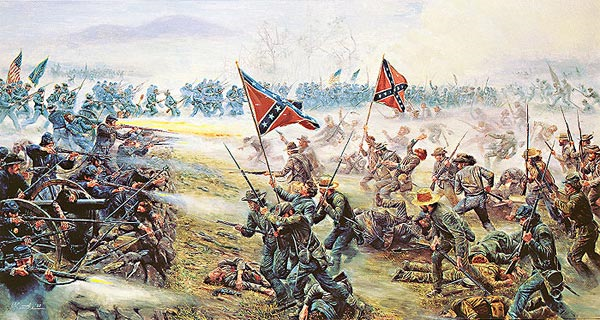
The “North” came up from the south that day, the “South” came down from the north. No one wanted the fight to be in Gettysburg, it was more like an accidental collision. What started out as a skirmish turned into a general engagement as fighting cascaded through the town. Confederate forces held the town at the end of the day, with the two armies’ taking parallel positions along a three-mile-long “fishhook” from Cemetery Hill and Culp’s Hill to the north, toward two prominences known as Big and Little Round Top to the south.
Fighting would continue and prove inconclusive at Culp’s Hill on day two, as the two armies stretched their position toward the Round Tops. Dan Sickles, the Tammany Hall politician best known for murdering the nephew of Francis Scott Key (he would be the first in American legal history to plead temporary insanity), had been ordered to move his corps into position on cemetery ridge, anchored at Little Round Top. Instead he took his corps a mile forward, into a Peach Orchard where they were torn apart in the Confederate assault. Some of the most savage fighting of the Civil War took place that day, at places like Devil’s Den, the Wheat Field, and bloody run. Sickles himself lost a leg to a cannonball. There was a foot race to the top of Little Round Top, leading to as many as 15 attacks and counterattacks for control of a small prominence at the Union’s extreme left. At the end of the day, the positions of the Armies had not changed.
On day 3, the last day, Lee came up the middle. 13,000 Confederate soldiers came across 1¼ miles of open field, to attack the Union Center at a position between a small copse of trees and a corner in stone fence called the angle. Cannon fire from their left, right and center tore them apart as they pressed on. A battered remnant actually penetrated Union lines: the “high water mark” of the Confederacy. It’s anyone’s guess what would have happened, had 4,000 Confederate cavalry smashed into the Union rear at that point, as Lee seems to have intended. But a 23-year-old general named George Armstrong Custer had waded into them with his 450 Union cavalry, routing the much larger force and very possibly changing history.
Lee withdrew in the rain of the 4th, ending the largest battle of the civil war. Lincoln was convinced that the time had come to destroy the Army of Northern Virginia, but Meade and his battered army did not follow. Lee and his army slipped back across the line and returned to Confederate territory. The most lethal war in American history would continue for two more years.
Years earlier, then-Secretary of War Jefferson Davis had brought some 75 camelsinto West Texas, to try them out as pack animals. Davis’ camel experiment had been a flop, but the King of Siam, (now Thailand), didn’t know that. Seeing the military advantage to the Confederacy, the King wrote to President Abraham Lincoln, proposing to send elephants to help the Union war effort. This “animal arms race” appears to have gotten no further than the King’s letter to Lincoln but, the imagination runs wild, at the idea of War Elephants, at Gettysburg.
A correspondent to the New York Times wrote in 1918 “When I landed in France I didn’t think so much of the Salvation Army; after two weeks with the Americans at the front I take my hat off… [W]hen the memoirs of this war come to be written the doughnuts and apple pies of the Salvation Army are going to take their place in history”.
The United States entered the ‘War to end all Wars’ in April, 1917. The first 14,000 Americans arrived ‘over there’ in June, the American Expeditionary Forces (AEF) formed on July 5. American troops fought the military forces of Imperial Germany alongside their British and French allies, others joining Italian forces in the struggle against the Austro-Hungarian Empire.
For a variety of reasons, WW1 was a war of movement in the East. Not so on the Western front. As early as October 1914, combatants were forced to burrow into the ground like animals, sheltering from what Ernst Jünger called the ‘Storm of Steel’.
Conditions in the trenches and dugouts defy description. You must have smelled the trenches long before you could see them. The collective funk of a million men and more, out in the open. Little but verminous scars in the earth teaming with rats and lice and swarming with flies, time and again the shells churned up and pulverized the soil, the water and the shattered remnants of once-great forests, along with the bodies of the slain.
You couldn’t call the stuff these people lived in mud – it was more like a thick slime, a clinging, sucking ooze capable of claiming grown men, even horses and mules.
Captain Alexander Stewart wrote “Most of the night was spent digging men out of the mud. The only way was to put duck boards on each side of him and work at one leg: poking and pulling until the suction was relieved. Then a strong pull by three or four men would get one leg out, and work would begin on the other…He who had a corpse to stand or sit on, was lucky”.
On first seeing the horror of Paschendaele, Sir Launcelot Kiggell broke down in tears. “Good God”, he said. “Did we really send men to fight in that?”
Often unseen in times of such calamity, are the humanitarian workers. Those who tend to the physical and spiritual requirements, the countless small comforts, of those in need.
Within days of the American declaration of war, Evangeline Booth, National Commander of the Salvation Army, responded, saying “The Salvationist stands ready, trained in all necessary qualifications in every phase of humanitarian work, and the last man will stand by the President for execution of his orders”.
These people are so much more than that donation truck, and the bell ringers we see behind those red kettles, in December.
Lieutenant Colonel William S. Barker of the Salvation Army left New York with Adjutant Bertram Rodda on June 30, 1917, to survey the situation. It wasn’t long before his not-so surprising request came back in a cable from France. Send ‘Lassies’.
A small group of carefully selected female officers was sent to France on August 22. That first party comprised six men, three women and a married couple. Within fifteen months their number had expanded by a factor of 400.
In December 1917, a plea for a million dollars went out to support the humanitarian work of the Salvation Army, the YMCA, YWCA, War Camp Community Service, National Catholic War Council, Jewish Welfare Board, the American Library Association and others. This “United War Work Campaign” raised $170 million in private donations, equivalent to $27.6 billion, today.
‘Hutments’ were formed all over the front, many right out at the front lines. Religious services of all denominations were held in these facilities. Concert performances were given, clothing mended and words of kindness were offered in response to all manner of personal problems. There were canteen services. On one occasion, the Loyal Order of Moose conducted an initiation at one of them. Pies and cakes were baked in crude ovens and lemonade was served to hot and thirsty troops. Of all these corporal works of mercy, the ones best remembered by the ‘doughboys’ themselves, were the doughnuts.
Helen Purviance, sent to France in 1917 with the American 1st Division, seems to have been first with the idea. An ensign with the Salvation Army, Purviance and fellow ensign Margaret Sheldon first formed the dough by hand, later using a wine bottle in lieu of a rolling pin. Having no doughnut cutter at the time, dough was shaped and twisted into crullers, and fried seven at a time on a pot-bellied wood stove.
The work was grueling. The women worked well into the night that first day, serving all of 150 hand-made doughnuts. “I was literally on my knees,” Purviance recalled, but it was easier than bending down all day, on that tiny wood stove. It didn’t seem to matter. The men stood in line for hours, patiently waiting in the mud and the rain. Their own little piece of warm, home-cooked heaven, in a world full of misery.
Before long, the women got better at it. Soon they were turning out 2,500 to 9,000 doughnuts a day. An elderly French blacksmith made Purviance a doughnut cutter, out of a condensed milk can and a camphor-ice tube, attached to a wooden block.
It wasn’t long before the aroma of hot doughnuts could be found, wafting all over the dugouts and trenches of the western front. Volunteers with the Salvation Army and others made apple pies and all manner of other goodies, but the name that stuck, was “Doughnut Lassies”.
A correspondent to the New York Times wrote in 1918 “When I landed in France I didn’t think so much of the Salvation Army; after two weeks with the Americans at the front I take my hat off… [W]hen the memoirs of this war come to be written the doughnuts and apple pies of the Salvation Army are going to take their place in history”.
If you cared to bet on it, book makers posted 3–1 odds on the English winning the Cup. The American team was 500–1.
In 2016, the British soccer world was cast into the abyss when the mighty English football club went down to defeat at the hands, err feet, of Iceland, a nation whose entire population falls short that of New Orleans.
It’s hard to think of anyone who could have deserved it more. About 8% of the entire country turned out to watch the finals that year, in France. CNN reporter James Masters wrote that it was the most humbling defeat for English soccer, since their 1950 defeat by the Americans.
In 1950, the English National Soccer team had a post-war record of 23 wins, 4 losses, and 3 draws. If you asked them, they’d have told you they considered themselves the “Kings of Football”.
The American team had lost the last seven straight international matches by a combined score of 45–2. If you cared to bet on it, book makers posted 3–1 odds on the English winning the Cup. The American team was 500–1.
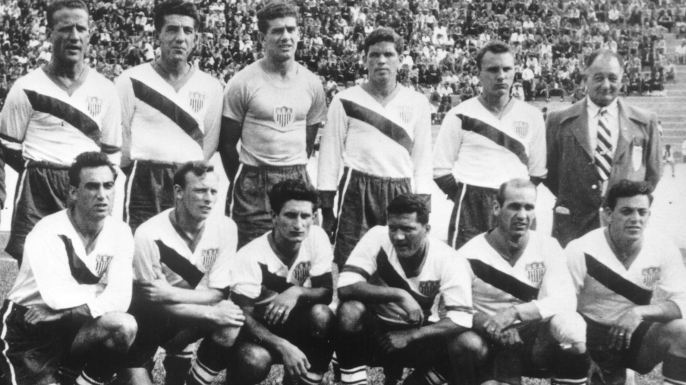
The Americans were semi-professionals, most of the team holding down other jobs to support their families. Defender Walter Bahr was a high school teacher. Port-au-Prince native Joseph Edouard Gaetjens was playing forward while studying accounting at Columbia University on a scholarship from the Haitian government. Goalkeeper Frank Borghi drove a hearse for his uncle’s funeral parlor. Prudencio “Pete” Garcia worked as a linesman.
The team had been thrown together on short notice, having only one chance to train together before leaving for the FIFA World Cup playoffs. On June 29 they would be in Belo Horizonte, Brazil, playing the self-styled Kings of Football in the first round. Coach Bill Jeffrey captured what everyone was thinking, when he told the press “We don’t have a chance”.
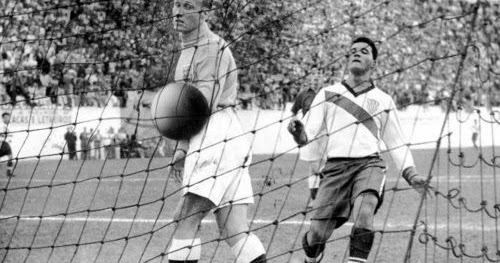
It was thirty-seven minutes into a 0-0 game when Bahr took a long shot from 25 yards out. The English team had taken 9 clear shots on goal by this time. This was only the second for the US team. Goaltender Bert Williams moved to his right to intercept, as Gaetjens dived at the ball, heading it to the left of the English goalkeeper. The crowd exploded as the US took the lead, eventually winning the game, 1–0.
It was a double elimination format, and England lost their match with Spain. The Kings of Football had failed to make it to the second round, going home after the first round with a tournament record of 1–0–2.
International headlines trumpeted news of the upset, with the ironic exceptions of the American and English press. A St. Louis Post-Dispatch reporter with the unlikely name of Dent McSkimming was the only American reporter at the game. McSkimming wasn’t about to miss this match, even when his editor refused to pay for the trip. A true fan of the sport, McSkimming studied Portuguese for three days to prepare for the trip.
The British press was more interested by the English cricket team’s first-ever loss to the West Indies on the same day.
The US went on to lose their next match 5–2 against Chile, so they didn’t go on to the final round, either. But they had won the most shocking upset ever, until the 1980 US Olympic hockey victory over the Soviet Union.
The United States would not qualify another World Cup soccer team, until 1990. This time, there were 100 credentialed American reporters, in attendance.
Years earlier, German Chancellor Otto von Bismarck had said the next European war would be started by “Some damn fool thing in the Balkans”. Bismarck got his damn fool thing on June 28, 1914, when future Emperor Franz Ferdinand came to Sarajevo, the capital of the Balkan province of Bosnia-Herzegovina.
In 1914, Austria-Hungary was a kaleidoscope of fifteen distinct ethnic groups speaking at least that many languages. Ostensibly a constitutional union between the Empire of Austria and the Kingdom of Hungary, the dual monarchy was in fact divided, sometimes sharply, along no fewer than six religious lines.
Since the 1889 suicide of his cousin Crown Prince Rudolf, the only son of Emperor Franz Josef, Franz Ferdinand, was the Heir Presumptive to the Austro-Hungarian throne.
Sophie Maria Josephine Albina Chotek von Chotkow und Wognin was a minor noble in the Kingdom of Bohemia, a small figure in a constellation of 19th century European royalty. It’s uncertain when Sophie and Franz first met and fell in love, but their relationship caused a royal scandal. The future Queen of the Habsburg Dynasty was expected to hold suitable rank. Only a Princess of one of Europe’s dynastic families would do, certainly no Bohemian Countess.
Ferdinand wrangled with the Royal Court in Vienna for a year before the couple was permitted to marry, but only under hard and humiliating conditions. Theirs was a “morganatic” marriage. A marriage of unequals.
Three days before the wedding, June 28, 1900, Franz was forced to sign and publicly declare Sophie to be his morganatic wife, never to bear the titles of Empress, Queen or Archduchess. Any children produced by the marriage would neither inherit nor be granted dynastic rights or privileges of any kind. The Imperial family didn’t even show up at the wedding.
In a world where rank was everything, Sophie was never permitted to appear beside her husband in public. She was humiliated at every court function, relegated to last place and made to stand in line behind every Archduchess, Princess and Countess from Vienna to Budapest.
June 28 was significant for another reason. The invading army of Ottoman Sultan Murad I was wiped out on this date in the 1389 Battle of Kosovo, (June 15, ‘old style’), the “Field of Blackbirds”. It was a Pyrrhic victory, as the Balkan defenders were virtually wiped out as well. The Ottomans being far more numerous, the Balkan states soon became vassals of the Ottoman Turks.
The Encyclopedia Britannica describes “Balkanization” as “fragmentation of ethnic groups”. The Balkans form a geographic and political region, including 13 southeastern European nations from Slovenia to Greece. Located at the crossroads of east and west, the region has been subjugated and re-subjugated since the 6th century BC conquests of Persian King Darius the Great. The Balkan wars of 1912-1913 wrested some (but not all) of the area back from Ottoman control, as a newly enlarged Serbia pushed for greater independence and alliance among south Slavic peoples.
Years earlier, German Chancellor Otto von Bismarck had said the next European war would be started by “Some damn fool thing in the Balkans”. Bismarck got his damn fool thing on June 28, 1914, when future Emperor Franz Ferdinand came to Sarajevo, the capital of the Balkan province of Bosnia-Herzegovina.
Morganatic marriage was unknown in Hungarian law and custom. This trip was a rare opportunity for the couple to openly travel together. A “place in the sun” for Ferdinand’s wife, Sophie.
Ironically, Franz Ferdinand favored a more federalized model for the Empire, with greater autonomy for all its provinces. That wasn’t enough for the radical Serbian nationalists of the “Black Hand”, who inserted seven assassins along the route which the Archduke was scheduled to travel.
They were a carpenter, a printer, a teacher and four students. The oldest was 27. All suffered from tuberculosis, all armed with revolvers, crude bombs, or both, and a cyanide capsule with which to commit suicide if captured.
The six car motorcade drove by the first assassin, Muhamed Mehmedbašić, a little after 10am. He froze, allowing the cars to pass unmolested.
Riding along the Appel Quay, the motorcade passed the second assassin, Nedeljko Čabrinović, who threw his bomb at the open car. The driver sped away as the bomb went off under the wheel of the fourth car, wounding two occupants and a dozen spectators. Meanwhile, Čabrinović popped his cyanide pill and jumped into the Miljacka River, expecting to die. The cyanide just made him retch and the river was but a few inches deep, so the would-be assassin was soon in police custody.
The motorcade sped on to a planned reception at City Hall, passing three more assassins, Vasco Cubrilovic, Danilo Ilic and Cvijetko Popovic, none of whom did anything. There followed a sort of dark comedy, when Ferdinand jumped out of the car, incandescent with rage. Addressing Fehim Effendi Curcic, the mayor of Sarajevo, Ferdinand shouted “One comes here to visit and is received with bombs. Mr. Mayor, what do you say? It’s outrageous!” Unaware of what had happened, Mayor Curcic began to read his prepared remarks: “Our hearts are filled with happiness…”
Ferdinand later insisted on visiting the wounded at hospital, though he begged Sophie to stay behind. She wouldn’t have it. The Military Governor of the province, Oskar Potiorek, assured them of safe passage. Sophie would remain by her husband’s side.
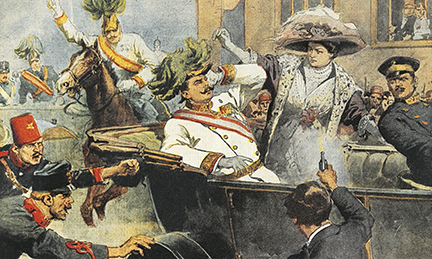
Soon they were off, speeding by the sixth assassin, Trifko Grabez, before he could react. Taking a wrong turn onto Franz Josef Strasse, the chauffeur realized his error and came to a stop before turning around. They were 8’ from the seventh and last assassin, Gavrilo Princip. Princip was in point blank range in two steps, firing once into Sophie’s side and once into the neck of the Archduke.
Archduke Franz Ferdinand’s jugular had been severed by the bullet. “For heaven’s sake, what’s happened to you?” she cried, before slipping to the floor of the car. “Sophie dear, Sophie dear, don’t die. Stay alive for our children.” Asked if he was alright, Franz Ferdinand was already fading away. “Es ist nichts; Es ist nichts…” (It is nothing; it is nothing…). By 11:30, both were dead.
The mad act of a tubercular 19-year led to a series of diplomatic missteps and military mobilizations and counter-mobilizations called the “July Crisis of 1914″, culminating in the “War to End all Wars” that August. There is virtually no part of 20th century history, that would ever be the same.
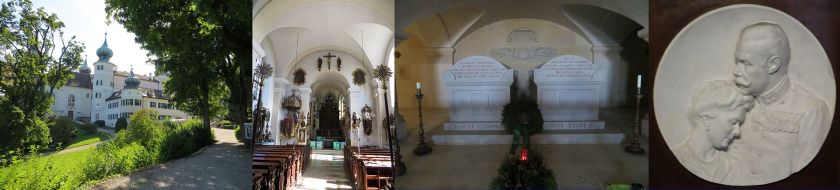
Knowing that he and his beloved wife could never be buried together in the Imperial Crypt, Ferdinand got the last word. In 1910, the Archduke set up a family crypt below the choir at the Artstetten Castle, in lower Austria. Neither had any idea that they’d need it, four years later. Now, Sophie and Ferdinand are at rest. At equal heights. Photo credit (2012) Marshmallowbunnywabbit at English Wikipedia, CC BY-SA 3.0, https://commons.wikimedia.org/w/index.php?curid=29775082
It was the age of the automobile, and all manner of roadside attractions sprang up to serve the burgeoning tourist business. There were teepee-shaped motels, frozen custard stands, Indian curio shops, and reptile farms.
In 1857, President James Buchanan appointed Lieutenant Edward Beale to survey and build a 1,000-mile wagon road from Fort Defiance, New Mexico to the Arizona/California border. The survey continued an experiment first suggested by Secretary of War and future President of the Confederate States of America Jefferson Davis, in the use of camels as draft animals.
The camel part turned out to be a flop, but the road building was not. Beale’s wagon trail went on to become the western end of “America’s Main Street”. Route 66.
The “Mother Road” became an official part of the national highway system in 1927. It was yet to be paved, when the US Highway 66 Association held a “Bunion Derby” in 1928. It was a footrace from Los Angeles to Madison Square Garden, a distance of 3,423½ miles. Naturally, the LA to Chicago leg ran along Route 66.
Andy Hartley Payne, an Oklahoma Cherokee runner won the race in 573 hours, 4 minutes and 34 seconds. 11th place finisher Harry Abrams ran the race in the opposite direction the following year, becoming the only person to twice run across the continental United States.
In 1914, a Model T sold for $490. As the 20s drew to a close, the number of registered drivers had tripled to 23 million.
The 1932 Summer Olympics in Los Angeles and the westward migration of the “Dust Bowl” era increased the number of “Mom & Pop” service stations, restaurants, and motor courts, springing up to serve the needs of passing motorists.
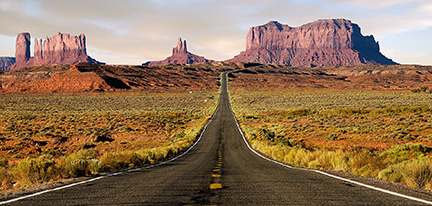
The road was fully paved by 1938, passing through the Painted Desert on the way by the Grand Canyon and Meteor Crater in Arizona. The golden age of the automobile had dawned. All manner of roadside attractions popped up to serve the burgeoning tourist business, there were teepee-shaped motels, frozen custard stands, Indian curio shops, and reptile farms.
Meramec Caverns outside of St. Louis put their advertising on barns, calling themselves “Jesse James hideout”. The Big Texan sold a 72-ounce steak dinner, making it free to anyone who could eat the whole thing in an hour.
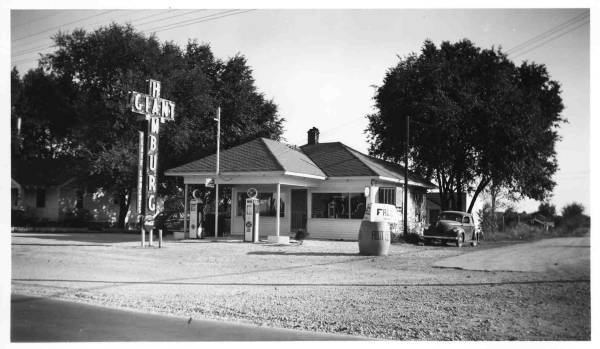
The fast-food industry was born on Route 66, when Sheldon “Red” Chaney built Red’s Giant Hamburg in Springfield, Missouri. Believed to be the first drive-through restaurant in the country, the name was supposed to be “Red’s Giant Hamburger“. Chaney had to cut the two bottom letters off his sign, when the city refused to raise the telephone wires.
Patrick McDonald opened “The Airdrome” restaurant on Route 66 in 1937, near the Airport in Monrovia, California. Hot dogs were some of the first items he ever sold. Ten cent hamburgers were added later, along with all-you-can-drink orange juice for five cents. Three years later, McDonald’s two sons Maurice and Richard (“Mac” and “Dick”) moved the entire building 40 miles east, to San Bernardino, calling the place “McDonald’s Bar-B-Que”.
General Eisenhower came out of WWII with an appreciation for the German highway system, the Autobahn, and signed the Interstate Highway Act as President in 1956. It was the beginning of the end for Route 66. New highway construction began to bypass town centers, and once-thriving Mom & Pops began to die off.
By the mid-50s, Missouri upgraded its sections of US 66 to four lanes, by-passing town centers and the businesses that went with them.
Illinois widened US 66 from Chicago to the Mississippi River. By 1957, virtually the entire Missouri-Kansas-Oklahoma stretch was replaced by 4 lane toll roads. You could see the old 66 as you drove parallel to it, but travelers rarely stopped.
The last parts of Route 66 were decertified by state highway and transportation officials on this day in 1985. In some cities, the old road is now the “Business Loop”. It’s been carefully preserved in many areas, and abandoned in others.
Today, most of the old attractions are gone. You couldn’t drive the old Route 66 from Chicago to LA if you wanted to, but you could get close. You only need to plan ahead.
It’s a fairy tale, to some degree, but at least parts of the story appear to be historically accurate. The part about the rats was added 200 years later and the magic flute is a little hard to believe, but the town of Hamelin part is real enough.
We’re all familiar with the fairy tale of the Pied Piper of Hamelin. The village was overrun with rats, they hired a magical piper to lead them out of town and drown them in the river. The mayor reneged on the deal when the piper came looking for payment. On the 26th of June, 1284, the piper retaliated, using his skills to lead the village’s children away. 130 children were never seen again.
It’s a fairy tale, to some degree, but at least parts of the story appear to be historically accurate. The part about the rats was added 200 years later and the magic flute is a little hard to believe, but the town of Hamelin part is real enough.
The first entry in Hamelin’s chronicles reads, “It is 100 years since our children left”. That was written in 1384. There was a stained glass window in the Church in Hamelin, installed around 1300, featuring a colorful figure leading several children dressed in white. The window was destroyed in 1660, but we have detailed descriptions dating from the 14th to the 17th centuries.
There is little agreement concerning the facts of the story. The figure of the piper could be merely a symbol of the children’s death by plague or some other catastrophe. Or it could be some charismatic figure like Nicholas of Cologne, who led tens of thousands of children away on the “children’s crusade” against the infidel, in 1212. Most of them were never seen again. Nicholas himself died on the return trip home. Villagers were so angry over the loss of their children that they lynched the boy’s father.
Another theory has it that children were recruited to move east. Eastern Europe became open for German settlement after the defeat of the Danes at the Battle of Bornhoved in 1227. The Bishops and Dukes from Lower Saxony and Westphalia sent out “Locators”: glib, medieval recruitment officers who offered rich rewards to anyone willing to move east to the Baltic region.
Linguistics professor Jurgen Udolph has tracked all the family names that he could find from the Hamelin of 1284, and started searching for matches elsewhere. He claims that the same surnames occur with amazing frequency in Priegnitz and Uckermark, forming a straight line from north central Germany through Berlin to the former Pomeranian Region in what is now Poland, a distance of some 400 miles.
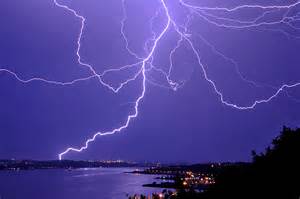
Roy Sullivan is recognized by the Guinness Book of World Records for being struck by lightning more times than any other human being. All seven strikes were documented by the superintendent of the Shenandoah National Park, R. Taylor Hoskins, and verified by doctors.
Roy Sullivan was fishing on Saturday morning, June 25, 1977, when lightning hit the top of his head, burning his hair, chest and stomach. He turned to his car when he spotted a black bear, trying to steal his trout. Sullivan summoned the strength to whack the bear with a stick. He’d later claim it was the twenty-second time he’d had to whack a black bear with a stick.
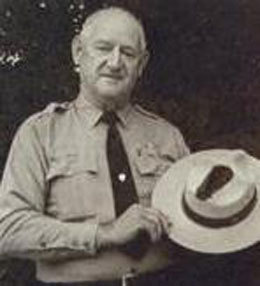
Roy Cleveland Sullivan was a park ranger in the Shenandoah National Park in Stanley, Virginia. He was hit by lightning on seven different occasions between 1942 and 1977, the episode related above being his last.
Somewhere along the line, Sullivan earned the nickname “Human Lightning Rod”. It upset him in his later years, that people avoided being in his presence. Especially when the weather was threatening. They may have been right to avoid him, though, Sullivan’s wife was struck once as well, while she was hanging clothes in their back yard. Roy was helping her at the time, so the bolt might have been aimed at him.
Roy Sullivan is recognized by the Guinness Book of World Records for being struck by lightning more times than any other human being. All seven strikes were documented by the superintendent of the Shenandoah National Park, R. Taylor Hoskins, and verified by doctors.
The first verified lightning strike was in 1942, but Sullivan claimed he had been hit even earlier; when he was a kid helping his father cut wheat in a field. That thunderbolt struck the blade of his scythe without injuring him, but he couldn’t prove it later on, so he couldn’t claim that one for the Guinness record.
Roy Cleveland Sullivan died from a self-inflicted gunshot wound on September 28, 1983 at the age of 71, over what is described as an unrequited love.
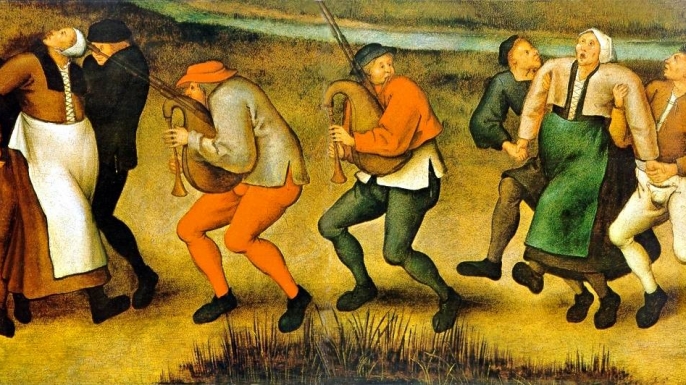
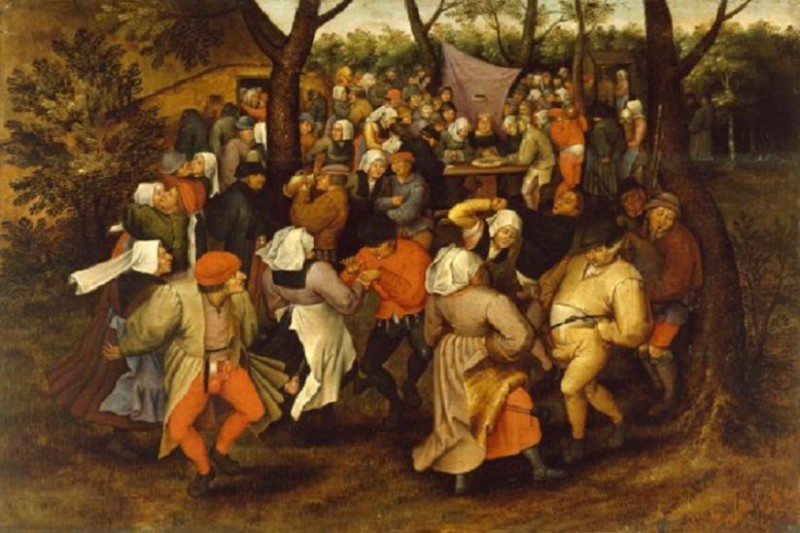
There was a major outbreak of St. Vitus’ Dance on June 23, 1374. The population writhed through the streets of Aachen, screaming about visions and hallucinations, until they collapsed. There they continued to tremble and twitch on the ground, too exhausted to stand.
A legend of the medieval Christian church had it that, if anyone provoked the wrath of Saint Vitus, the Sicilian martyred in 303AD, he would send down plagues of compulsive dancing. One of the first outbreaks of St. Vitus’ Dance occurred sometime in the 1020s in Bernburg, Germany. 18 peasants disturbed a Christmas Eve service, singing and dancing around the church.
In a story reminiscent of the Pied Piper of Hamelin, a large group of children jumped and danced all the way from Erfurt to Arnstadt in 1237. A distance of nearly thirteen miles.
In 1238, 200 people jumped, twitched and convulsed on a bridge over the River Meuse, until it collapsed. The survivors were taken to a nearby Chapel of St. Vitus, the Patron Saint of epileptics. Many would not be fully restored to health, until September.
There was a major outbreak of St. Vitus’ Dance on June 23, 1374. The population writhed through the streets of Aachen, screaming about visions and hallucinations, until they collapsed. There they continued to tremble and twitch on the ground, too exhausted to stand.
Most outbreaks coincided with periods of extreme hardship, involving between dozens and tens of thousands of individuals.
The dancing mania quickly spread throughout Europe, spreading to Cologne, Flanders, Franconia, Hainaut, Metz, Strasbourg, Tongeren and Utrecht. Further outbreaks were reported in England and the Netherlands.
One Frau Troffea began to dance in a street in Strasbourg in July 1518, going at it somewhere between four to six days. 34 joined in within the week. Within the month there were 400 more. Many of these people actually danced themselves to death, succumbing to heart attack, stroke, or exhaustion.
Reactions varied. Some thought those suffering from St. Vitus’ Dance were possessed by the devil. Others hired bands, to play along. Some even built dance floors to contain the phenomenon.
There were no fewer than seven distinct outbreaks of the dancing plague during the medieval period, and one in Madagascar as late as 1840. Even today there is little consensus about what caused it.
Some have blamed “St Anthony’s Fire”, the toxic and psychoactive fungus Claviceps purpurea, or ergot, often ingested with infected rye bread. Symptoms of ergot poisoning are not unlike those of LSD, and include nervous spasms, psychotic delusions, spontaneous abortion, convulsions and gangrene resulting from severe vasoconstriction.
Others believe such outbreaks to be evidence of Sydenham’s chorea, a disorder characterized by rapid, uncoordinated jerking movements primarily affecting the face, hands and feet and closely associated with a medical history of Rheumatic fever. Particularly in children.
A third theory describes the phenomenon as some kind of mass psychosis, brought on by starvation. disease and the Black Death, the Bubonic Plague.
Today such episodes seem quaint, even amusing. These people were dealt a pandemic about which they understood nothing, a calamity which killed an estimated 75 to 100 million, at a time the total world population was some 450 million.
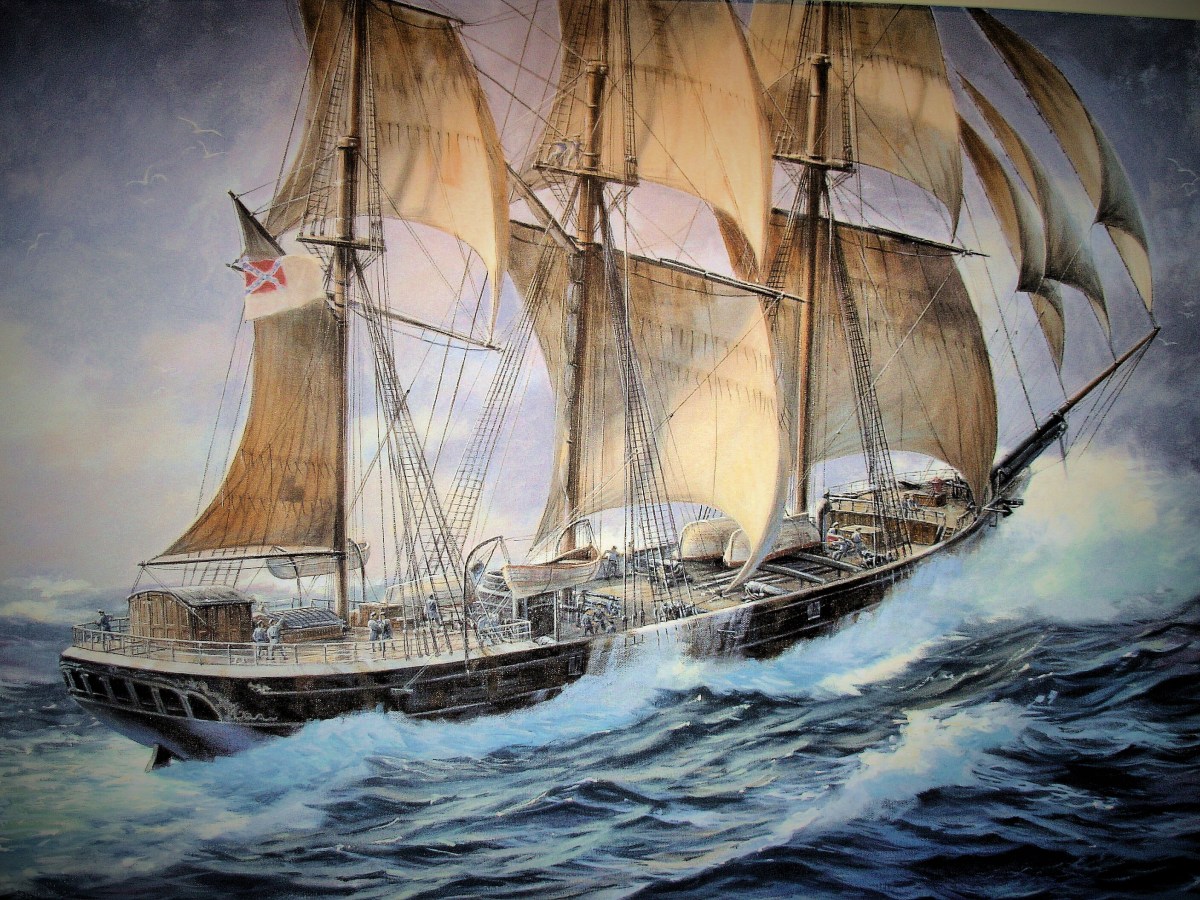
The Confederate raider CSS Shenandoah, Lieutenant James Iredell Waddell Commanding, was in the Bering Sea hunting prizes at this time, between the coasts of Alaska and Siberia.
The last shot of the Civil War was fired on this day in 1865, but it might not have happened the way you thought.
General Robert E. Lee surrendered the Army of Northern Virginia on the 9th of April, President Lincoln was assassinated on the 14th, and Confederate President Jefferson Davis was captured on the 10th of May.
The last fatality of the war occurred at the Battle of Palmito Ranch, Brownsville, TX over May 12–13, ending the life of Private John J. Williams of 34th Indiana. The last man killed in the Civil War.
General Joseph E. Johnston surrendered the remains of three Confederate Armies to General William Tecumseh Sherman at Bennett Place on April 26. Organized resistance came to a full stop when Confederate General E. Kirby Smith surrendered his forces to General E. R. S. Canby in New Orleans on May 26.
Yet that final shot was still almost a month away.
Both sides had long practiced economic warfare. The Union’s “Anaconda Plan” sought to strangle the economy of the South, while Confederate commerce raiders roamed the oceans of the world, destroying the other side’s shipping.
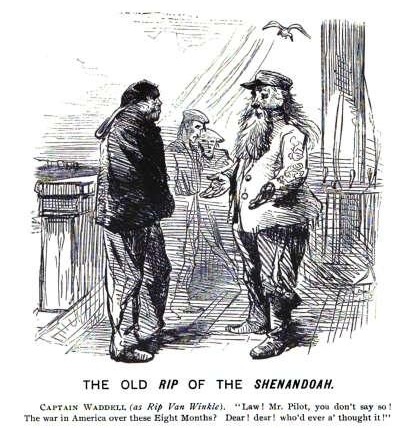
Editorial cartoon satirizing “Rip Van Waddell” still engaged in combat after everyone else thought the Civil War was over.
The Confederate raider CSS Shenandoah, Lieutenant James Iredell Waddell Commanding, was in the Bering Sea hunting prizes at this time, between the coasts of Alaska and Siberia.
It must have been a sight, to see a wooden hulled Union whaler, laden with oil, burned to the waterline under starlit skies amidst the ice floes of the Bering Sea.
On June 22, the last shot of the Civil War was a warning shot, fired across the bows of a whaler off the Aleutian Islands.
Waddell learned of Lee’s surrender on June 23, along with Jeff Davis’ proclamation that the “war would be carried on with re-newed vigor”. Waddell elected to continue hostilities, capturing 21 more whalers in the waters just below the Arctic Circle. The last 11 were captured in the space of 7 hours.
The only Confederate ship to circumnavigate the globe, Shenandoah had traversed 58,000 miles in 12 months and 17 days at sea, capturing or sinking 38 merchant vessels. Mostly whale ships. The voyage had taken 1,000 prisoners, without a single battle casualty on either side.
Waddell was on the way to attack San Francisco on August 2, when he learned in a chance meeting with the British Barque Barracouta, that the war was over.
Believing they would all be hanged as pirates, Captain Waddell aimed to surrender to neutral England. He took down his battle flag and put CSS Shenandoah through a radical alteration at sea. She was dismantled as a man-of-war; her battery dismounted and struck below, her hull repainted to resemble an ordinary merchant vessel.
There followed a 9,000 mile race down the coast of Mexico, around Cape Horn and across the Atlantic, with American vessels in constant pursuit. CSS Shenandoah made it to English territorial waters outside the Mersey, when the pilot refused to take the ship into Liverpool. He needed to know, under which flag this vessel sailed. The crew raised the Stainless Banner, the third and last official flag of the Confederacy.
CSS Shenandoah sailed up the River Mersey, her flag fully flying, spectators lining both sides of the river. Captain Waddell surrendered to Captain James A. Paynter of HMS Donegal. The Stainless Banner was lowered for the last time at 10:00am on November 6, 1865, in front of CSS Shenandoah’s officers and crew, and the Royal Navy detachment who’d boarded her.
The last act of the Civil War occurred later that morning, when Captain Waddell walked up the steps of Liverpool Town Hall, presenting the letter by which he surrendered his vessel to the British government.
The officers and crew were unconditionally released following investigation, as they had done nothing to justify their further detention. CSS Shenandoah was returned to the United States, where the Government sold her to Majid bin Said, the first Sultan of Zanzibar. He renamed her El Majidi in honor of himself. She was blown ashore and wrecked in a hurricane, in 1872.
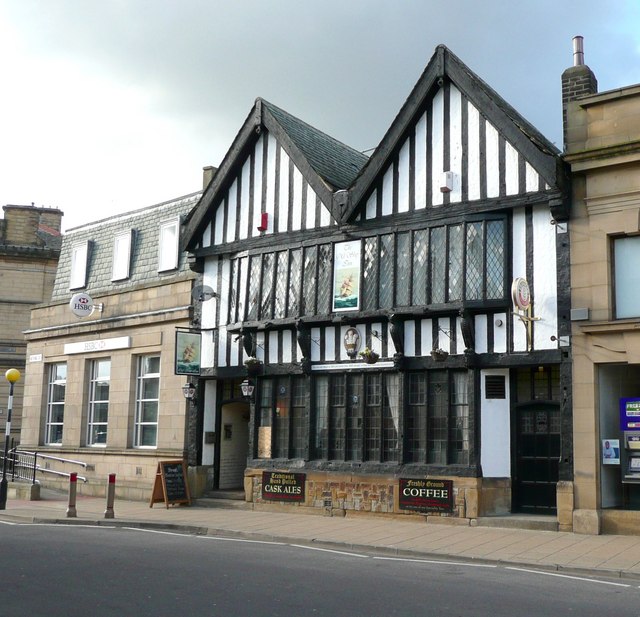
HMS Donegal survived longer than any other player in this story. Launched in 1858, she remained in service to the British Crown until 1925, when she was sold and broken up for scrap. Some of Donegal’s timbers formed the front of the Prince of Wales public house in Brighouse, which today operates as the Old Ship pub.
The Old Ship pub in Brighouse was built from the timbers of the decommissioned HMS Donegal in 1926


 Representatives agreed to delay the vote until July 1, appointing a “Committee of Five” to draft a declaration of independence from Great Britain. Members of the committee included John Adams of Massachusetts, Benjamin Franklin of Pennsylvania, Roger Sherman of Connecticut, Robert Livingston of New York and Thomas Jefferson of Virginia. The committee selected Jefferson to write the document, the draft presented to Congress for review on June 28.




 Often unseen in times of such calamity, are the humanitarian workers. Those who tend to the physical and spiritual requirements, the countless small comforts, of those in need.





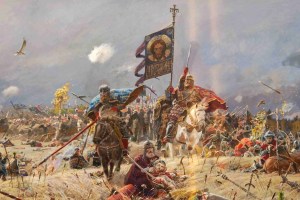 June 28 was significant for another reason. The invading army of Ottoman Sultan Murad I was wiped out on this date in the 1389 Battle of Kosovo, (June 15, ‘old style’), the “Field of Blackbirds”. It was a Pyrrhic victory, as the Balkan defenders were virtually wiped out as well. The Ottomans being far more numerous, the Balkan states soon became vassals of the Ottoman Turks.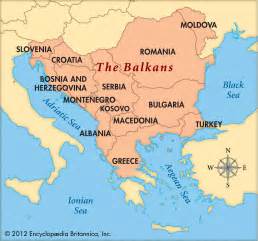
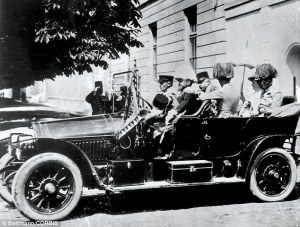 The six car motorcade drove by the first assassin, Muhamed Mehmedbašić, a little after 10am. He froze, allowing the cars to pass unmolested.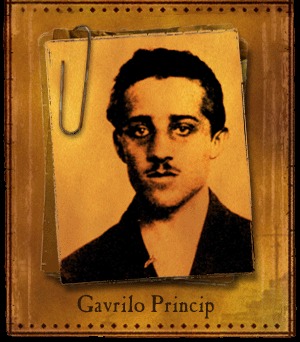


 In 1857, President James Buchanan appointed Lieutenant Edward Beale to survey and build a 1,000-mile wagon road from Fort Defiance, New Mexico to the Arizona/California border. The survey continued an experiment first suggested by Secretary of War and future President of the Confederate States of America Jefferson Davis, in the use of camels as draft animals.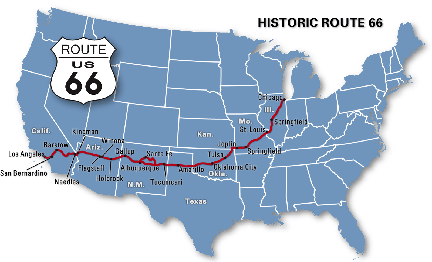




 By the mid-50s, Missouri upgraded its sections of US 66 to four lanes, by-passing town centers and the businesses that went with them.
 The last parts of Route 66 were decertified by state highway and transportation officials on this day in 1985. In some cities, the old road is now the “Business Loop”. It’s been carefully preserved in many areas, and abandoned in others.

 It’s a fairy tale, to some degree, but at least parts of the story appear to be historically accurate. The part about the rats was added 200 years later and the magic flute is a little hard to believe, but the town of Hamelin part is real enough.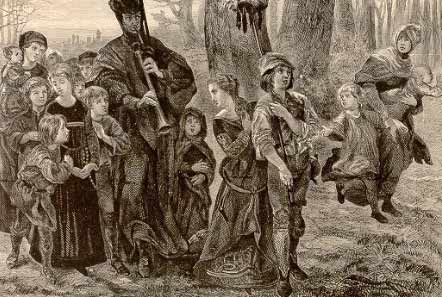




 Others believe such outbreaks to be evidence of Sydenham’s chorea, a disorder characterized by rapid, uncoordinated jerking movements primarily affecting the face, hands and feet and closely associated with a medical history of Rheumatic fever. Particularly in children.

 Historical Easter Eggs - Today in History
You must be logged in to post a comment.