July 15, 1864 Great Shohola Train Wreck

When the main switch was opened, only four miles of track stood between two speeding, 30-ton steam locomotives.

The wood burning steam locomotive #171 left Jersey City, New Jersey on July 15, 1864, pulling 17 passenger and freight cars. On board were 833 Confederate Prisoners of War and 128 Union guards, heading from Point Lookout prison in Maryland, to the Union prison camp in Elmira, New York.

Engine #171 was an “extra” that day, running behind a scheduled train numbered West #23. West #23 displayed warning flags, giving the second train right of way, but #171 was running late.  First delayed while guards located missing prisoners, then there was that interminable wait for the drawbridge. By the time #171 reached Port Jervis, Pennsylvania, the train was four hours behind schedule.

shohola station
Shohola station

Telegraph operator Douglas “Duff” Kent was on duty at the Lackawaxen Junction station, near Shohola, Pennsylvania. Kent had seen West #23 pass through that morning with the “extra” flags.  His job was to hold eastbound traffic at Lackawaxen until the second train passed. Kent may have been drunk that day, but nobody’s certain. He disappeared the following day, never to be seen again.

Erie Engine #237 arrived at Lackawaxen at 2:30 pm pulling 50 coal cars, loaded for Jersey City.  Kent gave the all clear at 2:45.  The main switch was opened, and Erie #237 joined the single track heading east out of Shohola.

Only four miles of track stood between two speeding, 30-ton steam locomotives.

King and Fullers Cut
King and Fuller’s Cut, Shohola, Pennsylvania

The trains met head-on at “King and Fuller’s Cut”, a pass blasted out of solid rock and named after its prime engineering contractors.  This section of track followed a blind curve with only 50’ visibility.  Engineer Samuel Hoitt was at the throttle of #237.  Hoitt would survive, having just enough time to jump before the moment of impact.  One man in the lead car on #171 was thrown clear.  He too would live.  There would be no other survivors among the 37 men on that car.

Historian Joseph C. Boyd described what followed on the 100th anniversary of the wreck: “[T]he wooden coaches telescoped into one another, some splitting open and strewing their human contents onto the berm, where flying glass, splintered wood, and jagged metal killed or injured them as they rolled. Other occupants were hurled through windows or pitched to the track as the car floors buckled and opened. The two ruptured engine tenders towered over the wreckage, their massive floor timbers snapped like matchsticks. Driving rods were bent like wire. Wheels and axles lay broken. The troop train’s forward boxcar had been compacted and within the remaining mass were the remains of 37 men”. Witnesses saw “headless trunks, mangled between the telescoped cars” and “bodies impaled on iron rods and splintered beams.”

shohola4
“Jupiter 1864 train engine, typical of the type of engine used during the Civil War Era”. Tip of the hat to http://www.civilwaralbum.com/misc11/shohola1.htm, for this image.

Pinned by cordwood against the split boiler plate and slowly scalded to death, engineer William Ingram lived long enough to speak with would-be rescuers. Frank Evans, one of the guards, remembered: “With his last breath he warned away all who went near to try and aid him, declaring that there was danger of the boiler exploding and killing them.”

Evans describes the scene. “I hurried forward. On a curve in a deep cut we had met a heavily-laden coal train, traveling nearly as fast as we were. The trains had come together with that deadly crash. The two locomotives were raised high in air, face to face against each other, like giants grappling. The tender of our locomotive stood erect on one end. The engineer and fireman, poor fellows, were buried beneath the wood it carried. Perched on the reared-up end of the tender, high above the wreck, was one of our guards, sitting with his gun clutched in his hands, dead!. The front car of our train was jammed into a space of less than six feet. The two cars behind it were almost as badly wrecked. Several cars in the rear of those were also heaped together…Taken all in all, that wreck was a scene of horror such as few, even in the thick of battle, are ever doomed to be a witness of.”

Estimates of Confederate dead are surprisingly inexact.  Most sources indicate 51 killed on the spot or dying within the first 24 hours. Other sources put their number as high as 60 to 72.  17 Union guards were killed on the spot, or died within a day of the wreck.  5 prisoners appear to have escaped in the confusion.

Captured at Spotsylvania early in 1864, 52nd North Carolina Infantry soldier James Tyner was in the Elmira camp at this time.  Tyner’s brother William was one of the prisoners on board #171. William was badly injured in the wreck, surviving only long enough to avoid the 76′ trench in which the Confederate dead were buried. He died in Elmira three days later, never regaining consciousness.

I’ve always wondered if the brothers saw each other that one last time.  James Tyner was my twice-great Grandfather, one of four brothers who had gone to war in 1861.

We’ll never know.  James Tyner died in captivity on March 13, 1865, 27 days before Lee’s surrender at Appomattox. Of the four brothers, Nicholas alone survived the war, laying down his arms when the man they called “Marse Robert” surrendered to General Ulysses S. Grant.

Family Plot
Note the shape of the stones themselves. Union tombstones from the Civil War era have rounded tops. Those marking Confederate graves are pointed at the top. It has been said that the pointed top was adopted to prevent “Yankees” from sitting on Confederate headstones.  This photo taken in the family cemetery, in the “Sand Hills” of North Carolina.  

Afterward

Two Confederate soldiers, the brothers John and Michael Johnson, died overnight and were buried in the Congregational church yard across the Delaware river, in Barryville, New York.  The remaining POWs killed immediately or shortly thereafter were buried in a common grave that night, alongside the track.  Individual graves were dug for the 17 Union dead, and they too were laid alongside the track.

As the years went by, signs of all those graves were erased.  Hundreds of trains carried thousands of passengers up and down the Erie Railroad, ignorant of the burial ground through which they passed.

The “pumpkin flood” of 1903 scoured the rail line uncovering many of the dead, carrying away at least some of their mortal remains, along with thousands of that year’s pumpkin crop.

On June 11, 1911, the forgotten dead of Shohola we’re disinterred, and reburied in mass graves in the Woodlawn National Cemetery, in Elmira, New York.


Two brass plaques bear the names of the dead, mounted to opposite sides of a common stone marker.  The names of the Union dead face north.  Those of the Confederate face south.

The only instance from of the Civil War era, in which Union and Confederate share a common grave.

July 14, 1789 Storming the Bastille

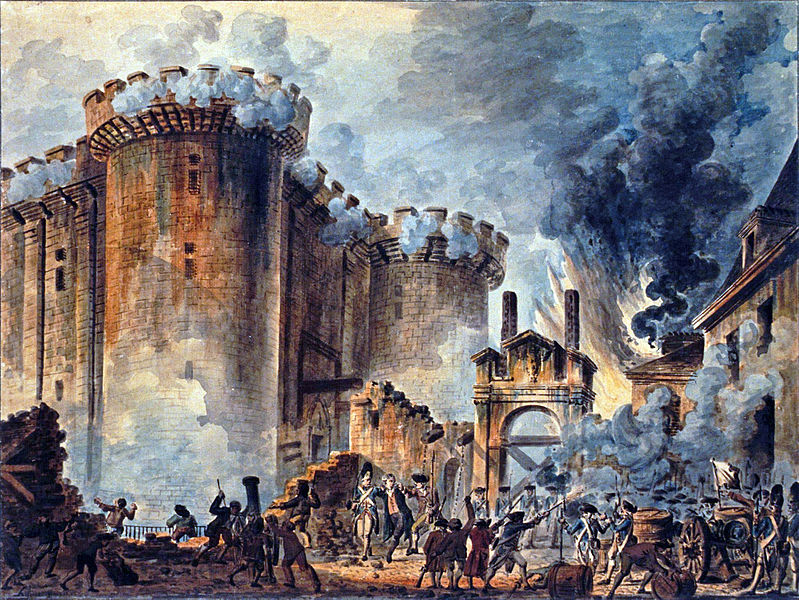
Paris was “intoxicated with liberty and enthusiasm,” when the crowd converged on the Bastille on the morning of July 14, 1789. It was guarded by 82 invalides (veteran soldiers no longer fit for service in the field) and 32 Swiss grenadiers.
The attackers – vainqueurs de la Bastille – numbered 954.

In most of medieval France, the major constituent parts of French society were the “Three Estates”:  the Clergy, the Nobility and the Commons.

France was in a state of economic crisis in the late 18th century. The Nobility refused to accede to the tax demands of King Louis XVI. The Commoners reconstituted themselves into a “National Assembly” in June 1789, demanding an audience with the King for the purpose of drawing up a Constitution.

The National Assembly converged on the Estates General on June 20, only to find the door locked. What followed was either hysterical or duplicitous, because the King and his family were still mourning the death of the Dauphin; the heir apparent.  It was customary at that time to hold political matters, until the King came out of mourning.

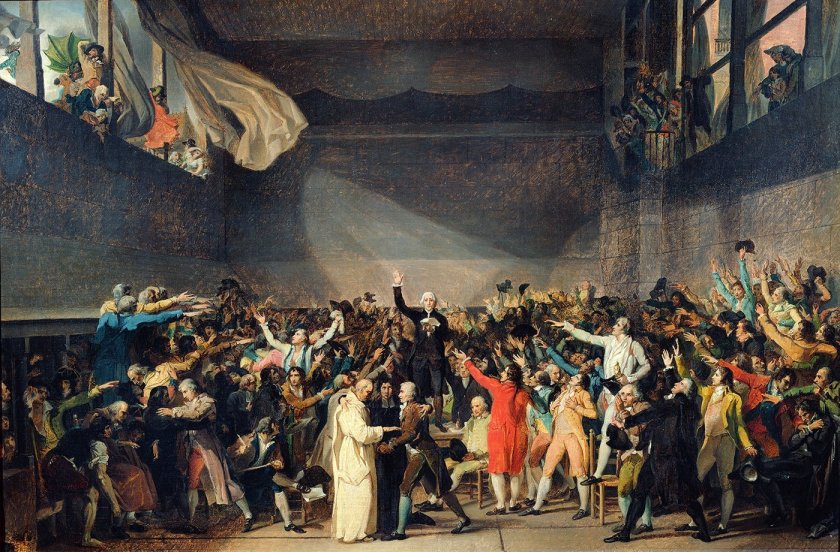
Tennis Court Oath
Tennis Court Oath

Be that as it may, the entire National Assembly, all 577 members, converged on an indoor tennis court. All but one put their names to a solemn oath, the famous “The Tennis Court Oath”, swearing “not to separate, and to reassemble wherever circumstances require, until the constitution of the kingdom is established”.

The oath itself was a revolutionary act, asserting that political authority came from the people and their representatives, not from the monarchy. The National Assembly had declared themselves to be supreme in the exercise of state power, making it increasingly difficult for the monarchy to operate based on “Divine Right of Kings”.

Riots followed as the left and reformist factions moved from anarchy to a coherent movement against the monarchy and the French right.

Built in 1309, the fortress and medieval prison of the Bastille had long been a focal point of the insurrection, representing royal authority in the center of the city. Donatien Alphonse François, better known as the Marquis de Sade, was one of the few remaining prisoners in the Bastille by this time. He was transferred to an insane asylum after attempting to incite a crowd outside his window, yelling: “They are massacring the prisoners; you must come and free them.”

Prise_de_la_Bastille

Paris was “intoxicated with liberty and enthusiasm,” when French revolutionaries converged on the Bastille on the morning of July 14, 1789. The fortress was guarded by 82 “invalides”, veteran soldiers no longer fit for service in the field, and 32 Swiss grenadiers under the command of Governor Bernard-René de Launay, the son of the previous governor, actually born in the Bastille.

The attackers – vainqueurs de la Bastille – numbered 954. Negotiations dragged on until the crowd lost patience, crowding into the outer courtyard and cutting the chain that held the drawbridge. Firing broke out as the bridge slammed down, crushing one unlucky vainqueur, while a nearby force of Royal Army troops did nothing to intervene. 98 attackers and one defender died in the fighting.  The mob murdered another 7, after their surrender.

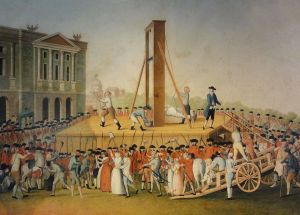
The successful insurrection at Paris raced across all of France, as the “Great Fear” spread across the countryside. The absolute monarchy which had ruled for centuries was over within three years, when Louis himself lost his head to the guillotine in 1793. 16,594 went to the guillotine under “the Reign of Terror”, led by the “Committee of Safety” under the direction of Parisian lawyer Maximilian Robespierre. Among them was Queen Marie Antoinette, who never did say “let them eat cake”.  Her last words were pardon me, sir, I meant not to do it, on stepping on her executioner’s toes.

Exécution_de_Marie_Antoinette_le_16_octobre_1793
Execution of Marie Antoinette

As many as 40,000 were summarily executed or died in prison awaiting trials before the hysteria died down.  Robespierre himself lost his head in 1794.

The Napoleonic Wars which followed resulted in a Corsican artillery corporal-turned Emperor, fighting (and winning), more battles than Hannibal, Caesar, Alexander the great, and Frederick the Great, combined.

The saddest part of the whole sad story, may be the son of Louis and Antoinette, Louis-Charles, Duke of Normandy. He was King Louis XVII in name only, thrown into a stone prison cell at the age of 8. He would die there, at the age of 10. Miserable, sick and alone.  It all seems pointless. The Bourbon Dynasty was back in power, within twenty years.

July 13, 1943 Kursk

Fighting between Nazi Germany and the Soviet Union had long since taken on shades of a race war, Slav against Teuton, in a paroxysm of mutual extermination that is horrifying, even by the hellish standards of WWII.

WWII has been rightly described as the deadliest conflict in human history. Yet to the extent that WWII history is taught at all, it is largely based on the Western and Pacific theaters of the war. The “Ostfront” is less well understood, at least in the West:  the war as it was fought between the Soviet Union and Germany, on the Eastern theater of the war.

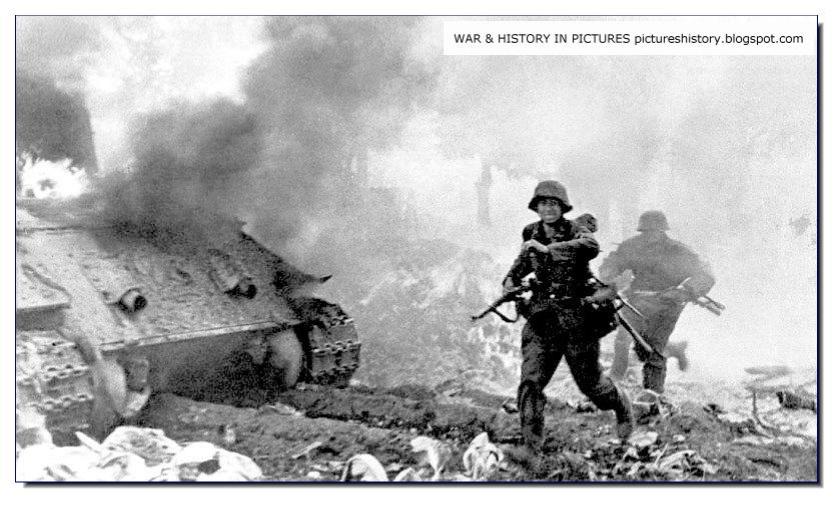
It may have been governments who started the war.  It was the every-day “Fritz” and the “Ivan” down the street, who did the fighting and the dying.totenkopf-SS-division-nazi-germany-elite-classic-fiercest-warriors-006

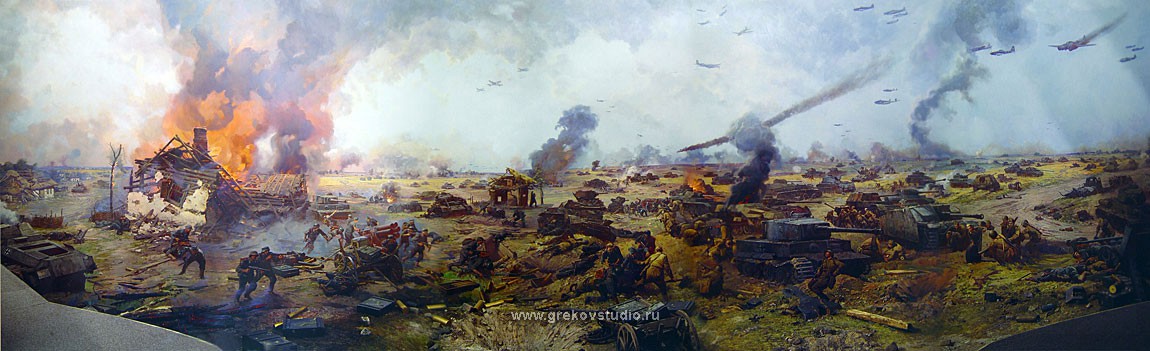
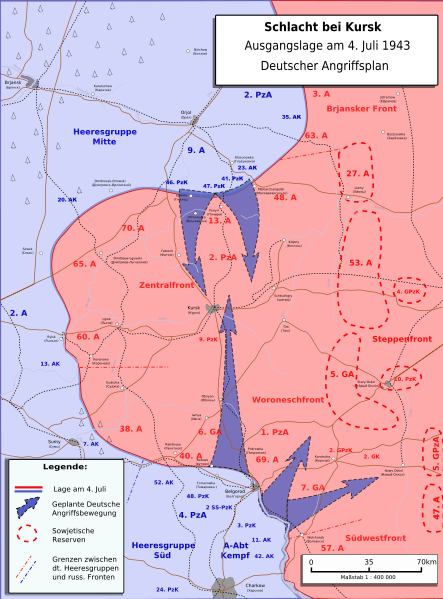
The greatest tank battle in history started this day on the Eastern Front. It began as a “Battle of a Bulge”, six months before the last German offensive began in the snow-covered forests of the Ardennes. The five-months long Battle for Stalingrad had ended with a decisive Soviet victory in February of that year, resulting in a “Bulge”, or salient in the Soviet lines, near the city of Kursk.

The Germans planned to shorten their battle lines by eliminating the Kursk salient, and commenced a series of strategic attacks in March, retaking Kharkov and Belgorod. Offensive operations ceased by the end of March due to the onset of the spring “rasputitsa” (mud season) and the exhaustion of both the Wehrmacht and the Red Army.

Field Marshal Erich von Manstein sent to Germany for massive reinforcements of Panther medium and Tiger heavy tanks, while Soviet forces prepared the “Defense in Depth” strategy which would prove decisive in July.

Kursk-1943-Plan-GE.svgThe Kursk salient was of little or no strategic value to the German war effort.  Both Manstein and General Walter Model argued for a tactical defense. Even Heinz Guderian, arguably the father of modern armored tactics, argued against the offensive, but Hitler would not hear of it. Der Fuhrer was going to have his offensive.
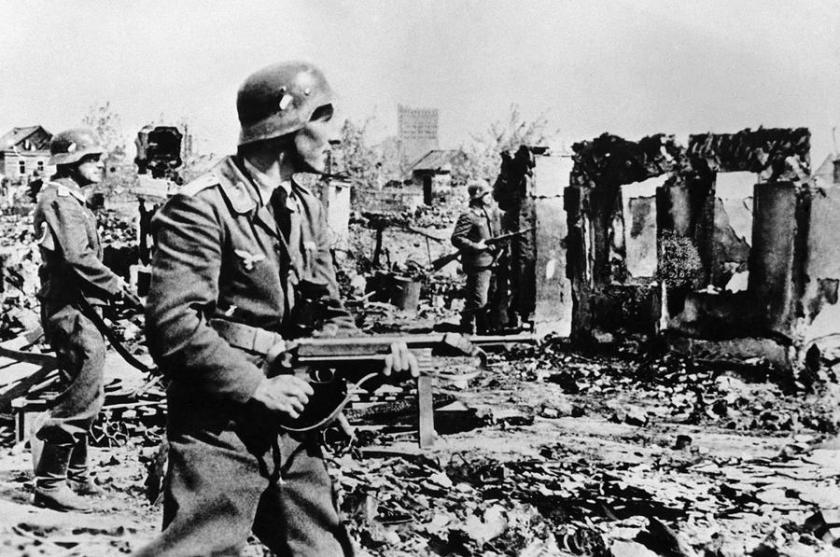
“Operation Citadel” started with a series of two offensives beginning on July 5. The Soviet’s defensive preparations began to take their toll almost immediately.

Minefields, fortifications, pre-sighted artillery fire zones and anti-tank strong points extended over 190 miles into the Soviet perimeter. By July 13, the Red Army had regained the offensive. Accounts of the battle vary wildly, with most estimates around 6,000 tanks, 2,000,000 troops, and 4,000 aircraft being involved in the fight.

Estimated losses are difficult to learn, due to the obsessive secrecy of both Nazis and Communists. Sources indicate over a quarter of a million German casualties and four times that number on the Soviet side.  1,083 tanks & assault guns were lost to the German side, over 8 times that number for the Russians.

The battle is considered to be a decisive victory for the Soviet union, representing the final German initiative of the Eastern Front. Though Soviet losses were far higher than those of Germany, the vast resources of the Soviet Union were far better positioned to replace those losses than that of the 3rd Reich.

main_900

Fighting between Nazi Germany and the Soviet Union had long since taken on shades of a race war.  Slav against Teuton, in a paroxysm of mutual extermination that is horrifying, even by the hellish standards of WWII.  The war on the Ostfront, was yet to grind out another year.

July 12, 1630 Ellis Island

The Ellis Island Immigration Station was officially opened on New Year’s Day, 1892.  The first immigrant to pass through it was a 15-year-old “rosy-cheeked Irish girl,” from County Cork, named Annie Moore. Three large ships were waiting to land that first day.  By year’s end nearly 450,000 had passed through the island.

In 1630, the small, 3½ acre island in upper New York Bay was little more than a mud bank, surrounded by oyster beds and barely rising above the water at high tide.  The Indians called it Kioshk, (Gull Island), after its only inhabitants.  Colonial governors of what was then “Nieuw Amsterdam” exchanged the island for “certain cargoes, or parcels of goods” on July 12. Dutch settlers called it “Little Oyster Island”.

The island was briefly known as Dyre’s, then Bucking Island during the Colonial era, and briefly known as Gibbet Island after some pirates were hanged there in the 1760s. By the time of the Revolution, a New York merchant named Samuel Ellis owned the island, on which he operated a small tavern catering to fisherman.

Ellis’ heirs sold the island to New York State in 1808, which sold it to the Federal Government the same year for $10,000. The island served as an arsenal from 1812 to 1890.  An 1834 agreement between New York and New Jersey gave Ellis Island and neighboring Bedloe’s Island to New York, even though it was on the New Jersey side of the main shipping channel.

Over the years, the ballast discharged from incoming ships and the material excavated from New York’s subway system and the excavation of Grand Central Station grew the island.  By the 1930s, Ellis Island had grown from 3½ to 27½ acres.

Statue_of_LibertyThe states turned over control of immigration to the Federal Government in 1890, and an immigration control office was opened on a Barge on the Battery at the tip of Manhattan.

405,664 immigrants, 80% of the national total, were processed through the Barge Office while the Ellis Island immigration station was under construction.

That most famous gift from the people of France, the Statue of Liberty, was dedicated on October 28, 1886 on Bedloe’s Island, though it took until 1956 to officially change the name to “Liberty Island”.

The Ellis Island Immigration Station was officially opened on New Year’s Day, 1892.  The first immigrant to pass through it was a 15-year-old “rosy-cheeked Irish girl,” from County Cork, named Annie Moore. Three large ships were waiting to land that first day.  By year’s end nearly 450,000 had passed through the island.

Ellis island’s original Georgia pine structures were completely destroyed in a fire on June 15, 1897.  The present building was opened on December 17, 1900.

An estimated 25 million passed through the Ellis Island station between 1892 and 1924.  The all-time high was April 17th, 1908, when 11,747 immigrants were processed on a single day. The Immigration Act of 1924 imposed an annual quota of 164,000, marking the end of mass legal immigration to America. Ellis Island changed from an immigrant processing station at this time, to a center for the assembly, detention, and deportation of aliens who had entered the US illegally or had violated terms of admission.

That 1834 agreement came up again in the 1990s, in a series of lawsuits between New York and New Jersey over which state “owned” Ellis Island. It went all the way to the Supreme Court, which decided in 1998 that the original 3½ acres belonged to New York, but the rest of it was now in New Jersey.

Today, Ellis Island and the old immigration processing center operates as a museum of the American immigrant experience.  I’d be more than a little interested, to know how they handle sales tax in the gift shop.

July 11, 1804 Weehawken

What would it be like to turn on CNN or Fox News, to learn that Barack Obama’s Secretary of the Treasury Jacob Lew was party to a duel, and that he was near death after being shot by the Vice President of the United States, Mike Pence.

What would it be like to turn on CNN or Fox News, to learn that Barack Obama’s Secretary of the Treasury Jacob Lew was party to a duel, and that he was near death after being shot by the Vice President of the United States, Mike Pence.

Weehawken today
Weehawken, New Jersey

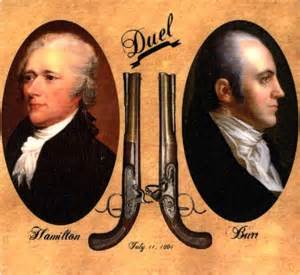
The year was 1804.  President Thomas Jefferson’s Vice President, Aaron Burr, had a long standing personal problem with one of the Founding Fathers. Alexander Hamilton had been Secretary of the Treasury under George Washington:  the first Secretary of the Treasury, the only signer of the US Constitution from the state of New York.

The animosity between the two began in 1791, when Burr defeated Hamilton’s father-in-law Philip Schuyler in a US Senate election. Hostilities escalated when the Electoral College deadlocked over the 1800 Presidential election, moving the selection of President and Vice President to the House of Representatives. Hamilton exerted his influence on behalf of Jefferson, who was elected on the 36th ballot, making Burr his VP.Duel

Burr knew that Jefferson wouldn’t keep him on as VP for the 1804 election, and so he ran for Governor of New York. He blamed Hamilton for his defeat, and challenged the man to a duel over comments made during the election.

Dueling was illegal in both New York and New Jersey by this time, though enforcement was far more aggressive in New York. The pair rowed across the Hudson River from Manhattan to Weehawken, New Jersey in the early morning hours of July 11, 1804, dueling pistols tucked safely in a leather bag.

Both men’s “seconds” stood with their backs to the duelists, enabling both to later state under oath that they didn’t see either the weapons or the duel itself. “Plausible deniability” was preserved, but it’s hard to have a first-hand account when the only witnesses deliberately turned their backs. Accounts vary, but it seems that Hamilton fired first, apparently “throwing away his shot” as he had once advised his son Philip to do when the younger man was in this position.

Hamilton-Burr-duel

This account is supported by a letter that Hamilton wrote the night before the duel, stating that he was “strongly opposed to the practice of dueling” for both religious and practical reasons. The letter went on, “I have resolved, if our interview is conducted in the usual manner, and it pleases God to give me the opportunity, to reserve and throw away my first fire, and I have thoughts even of reserving my second fire”.

Burr had no such reservations. He fired with intent to kill, the shot hitting Hamilton in the lower abdomen. The wound was clearly fatal, even to Hamilton himself, who said “This is a mortal wound, doctor”.

The man whose likeness appears on the $10 bill died the next day. Among his last words were “Pendleton knows,” (Judge Nathaniel Pendleton, his second), “that I did not intend to fire at him”.

Hamilton Bill

July 10, 1946 Ruined

Paper money crashed in the post-Revolutionary Articles of Confederation period, when you could buy a sheep for two silver dollars, or 150 paper “Continental” dollars. Creditors hid from debtors, not wanting to be repaid in worthless paper currency. For generations after our founding, a thing could be described as worthless, as “not worth a Continental”.

You’ve worked all your life.  You’ve supported your family, paid your taxes, and paid your bills. You’ve even managed to put a few bucks aside, in hopes of a long and happy retirement.  “Inflation” is such a bloodless term.  What if you hadn’t touched that “nest egg”, and its purchasing power was suddenly diminished…by 10%…40%…70%.

Throughout Roman antiquity, coinage retained a high silver content as a matter of law.  Precious metal made the coins themselves objects of value and, for 500 years, the Roman economy remained relatively stable. Republic morphed into Empire over the 1st century BC, leading to a conga line of Emperors minting mountains of coins in their own likenesses. Slaves were worked to death in Spanish silver mines, to satisfy an endless need for the metal. Birds fell from the sky over vast smelting fires, yet there was never enough silver.  Silver content was inexorably reduced, until the currency itself became worthless.  Roman currency collapsed in the 3rd century reign of Diocletian. An Empire and its citizens were left to barter as best they could, in a world where money no longer had any value.

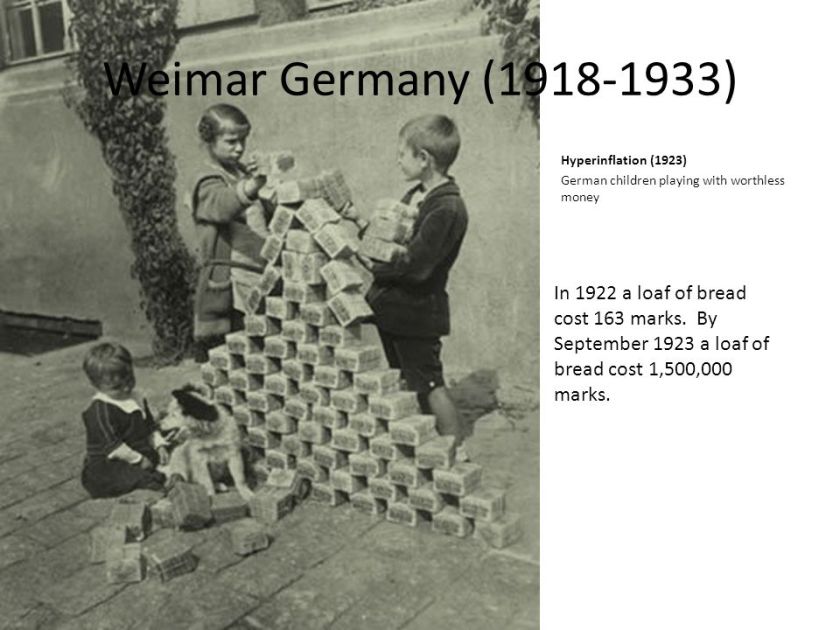
Weimar+Germany+(1918-1933)+Hyperinflation+(1923)+German+children+playing+with+worthless+money
German children playing with worthless currency, 1923.

In the waning days of the Civil War, the Confederate dollar wasn’t worth the paper it was printed on. Paper money crashed in the post-Revolutionary Articles of Confederation period as well, when you could buy a sheep for two silver dollars, or 150 paper “Continentals”. Creditors hid from debtors, not wanting to be repaid in worthless paper currency. Generations after our founding, the worthlessness of a thing could be described as “not worth a Continental”.

The assistance of French King Louis XVI was invaluable to Revolutionary era Americans, but French state income was only about 357 million livres at the time, with expenses of over half-billion. France descended into its own Revolution, as the government printed “assignat”, notes purportedly backed by 4 billion livres in property expropriated from the church. 912 million livres in circulation in 1791 rose to almost 46 billion in 1796, of a note whose purchasing power had diminished by 99%.

The money in their pockets was literally, not worth the paper it was printed on.  One historian described the economic policy of the Jacobins, the leftist radicals behind the reign of terror, as:  “[A]n utter exhaustion of the present at the expense of the future”.

In each of these historic cases, nothing defined and established the value a currency, except what a willing buyer and a willing seller agreed it was worth.  There was no “there”, there.  It all sounds depressingly familiar.

The Austro-Hungarian Empire was on the losing side of WW1, and broken up after the war.  Lacking the governmental structures of established states, the newly independent nation of Hungary began to experience inflation.  Before the war, a US Dollar would have bought you 5 Kronen.  In 1924, it was 70,000.

10Hungary replaced the Kronen with the Pengö in 1926, pegged to a rate of 12,500 to one.
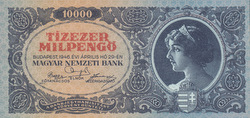
Hungary became a battleground in the latter stages of WW2, between the military forces of Nazi Germany and the USSR. 90% of Hungarian industrial capacity was damaged, half of it destroyed altogether.  Transportation became difficult, with most of the nation’s rail capacity damaged or destroyed.  What remained was either carted off to Germany, or seized by the Soviets, as reparations.

1000

The loss of all that productive capacity led to scarcity of goods, and prices began to rise.  The government responded by printing money.  Total currency in circulation in July 1945 stood at 25 billion Pengö.  Money supply rose to 1.65 trillion by January, 65 quadrillion in April and 47 septillion in July.  That’s a Trillion Trillion.  Twenty-four zeroes.

Banks received low rate loans, so that money could be loaned to companies to rebuild. The government hired workers directly, giving out loans to others and in many cases, outright grants.  The country was flooded with money, the stuff virtually grew on trees, but there was nothing to back it up.10000

Inflation took a straight line into the stratosphere.  The item that cost you 379 Pengö in September 1945, cost 1,872,910 by March, 35,790,276 in April, and 862 billion in June.  Inflation neared 150,000% per day, as the currency became all but worthless.  Massive printing of money had accomplished the cube root of zero.  The worst hyperinflation in history peaked on July 10, 1946, when that 379 Pengö item from September, cost you 1,000,000,000,000,000,000,000,000.

The government responded by changing the name, and the color, of the currency.  The Pengö was replaced by the Milpengö (1,000,000 Pengö), which was replaced by the Bilpengö (1,000,000,000,000 Pengö), and finally by the (supposedly) inflation-indexed Adopengö.  This spiral resulted in the largest denomination common currency note ever printed, the Milliard Bilpengö.  A Billion Trillion Pengö.

The thing was worth twelve cents.

100000One more currency replacement and all that Keynesian largesse would finally stabilize the currency, but at what cost?  Real wages were reduced by 80% and creditors wiped out.  The fate of the nation was sealed when communists seized power in 1949.  Hungarians could now share in that old Soviet joke: “They pretend to pay us, and we pretend to work”.

The ten worst hyperinflations in history occurred during the 20th century, including Zimbabwe in 2008, Yugoslavia 1994, Germany 1923, Greece 1944, Poland 1921, Mexico 1982, Brazil 1994, Argentina 1981, and Taiwan 1949.  The common denominator in all ten were massive amounts of government debt, and a currency with no intrinsic worth.

Hungary-Milliard-Bilpengo
A Billion Trillion Pengö. The largest denomination common currency note ever printed. It was worth about twelve cents.

In 2015, Boston University economist Laurence Kotlikoff testified before the Senate Budget Committee.  “The first point I want to get across” he said, “is that our nation is broke.  Our nation’s broke, and it’s not broke in 75 years or 50 years or 25 years or 10 years. It’s broke today”.

Kotlikoff went on to describe the “fiscal gap”, the difference between US’ projected revenue, and the obligations with which our government has saddled the taxpayer.  “We have a $210 trillion fiscal gap at this point”, Kotlikoff testified.  11.6 times GDP, the total of all goods and services produced in the United States.

On top of that, the United States owes something close to twenty trillion dollars, in fiscal operating debt, and our currency is unmoored from anything of inherent value.   We spend a lot of time, talking about politics.  Perhaps we should be talking about math, instead.

July 9, 1943 Chips

Chips attacked the four Italians manning the machine gun, single-handedly forcing their surrender to American troops. The dog sustained a scalp wound and powder burns in the process, indicating that they had tried to shoot him during the brawl.  In the end the score was Chips 4, Italians Zero.

The United States Armed Forces had an extensive K-9 program during World War II, when private citizens were asked to donate their dogs to the war effort. One such dog was “Chips”, a German Shepherd/Collie/Husky mix who ended up being the most decorated K-9 of WWII.

Chips belonged to Edward Wren of Pleasantville, NY, who “enlisted” his dog in 1942. He was trained at the War Dog Training Center, Front Royal, Virginia, and served in the 3rd Infantry Division with his handler, Private John Rowell. Chips and his handler took part in North Africa, Italy, France and Germany.  He served as a sentry dog for the Roosevelt-Churchill conference in 1943, and the team was part of the Sicily landings later that year.

The Allied invasion of Sicily was a large scale amphibious and airborne operation, beginning this day in 1943 and lasting through the 17th of August.  Six weeks of land combat followed, in an operation code named “Operation Husky”.

Chips, War DogDuring the landing phase, private Rowell and Chips were pinned down by an Italian machine gun team. The dog broke free from his handler, running across the beach and jumping into the pillbox.  Chips attacked the four Italians manning the machine gun, single-handedly forcing their surrender to American troops. The dog sustained a scalp wound and powder burns in the process, demonstrating that they had tried to shoot him during the brawl.  In the end, the score was Chips 4, Italians Zero.   He helped to capture ten more later that same day.

Chips was awarded the Distinguished Service Cross, Silver Star, and Purple Heart, but the awards were later revoked.  At that time the army didn’t permit commendations to be given to animals. His unit awarded him a Theater Ribbon with an Arrowhead for the assault landing anyway, along with eight Battle stars.  One for each of his campaigns.

Chips was discharged in December, 1945, and returned home to live out his days with the Wren family in Pleasantville. Disney made a TV movie based on his life in 1990.  They called it “Chips, the War Dog”.

July 8, 1776 The Liberty Bell 

The Philadelphia Public Ledger reported the last clear note ever sounded by the Liberty Bell, on George Washington’s birthday, 1846 .

Philadelphia’s city bell originally hung from a tree near the Pennsylvania State House, now known as Independence Hall. The date is uncertain, but it probably dates back to the city’s founding in 1682. The bell would ring to alert citizens of civic events and proclamations, and to the occasional civic danger.

The “Liberty Bell” was ordered from the London bell foundry of Lester and Pack (today the Whitechapel Bell Foundry) in 1752, arriving in August of that year. Weighing in at 2,080 lbs, it has written upon it a passage from the Book of Leviticus, the third book of the Hebrew Bible; the third of five books of the Torah. “Proclaim LIBERTY throughout all the land unto all the inhabitants thereof”.

Mounted to a stand to test the sound, the first strike of the clapper cracked the bell’s rim. Authorities tried to return it, but the ship’s master couldn’t take it on board, so the bell was re-cast by two local founders, John Pass and John Stow. It was broken into pieces, melted down and re-cast, with the addition of 10% copper to make the metal less brittle.

The_Bell's_First_Note_by_JLG_Ferris
The Bell’s First Note, by Jean Leon Gerome Ferris

Pass and Snow bragged that the bell’s lettering was clearer on this second casting than the original. The newly re-cast bell was ready in March 1753, when City officials scheduled a public celebration to test the sound. There was free food and drink all around, but the crowd gasped and started to laugh when the bell was struck. It didn’t break this time…it sounded like two coal scuttles being banged together.

Pass and Stow hastily took it away, again breaking the bell into pieces, and again melting it down to be recast.

The whole performance was repeated in June 1753.  This time most thought the sound to be satisfactory, and the bell was hung in the steeple of the State House. One who did not like the sound was Isaac Norris, speaker of the Pennsylvania Provincial Assembly. He ordered a second bell in 1754, though he was unsuccessful in his efforts to return the original for credit to the Lester and Pack foundry.

The new bell was attached to the tower clock, while the old one was, by vote of the Assembly, devoted “to such Uses as this House may hereafter appoint.” One such use of the old bell occurred on July 8, 1776, to announce the public reading of the Declaration of Independence.

Bells are easily melted down for ammunition, so the bell was taken down and hidden before the British occupation of Philadelphia in 1777. The distinctive large crack began to develop some time in the early 19th century, about the time when abolitionist societies began calling it “The Liberty Bell”. Some say it cracked while ringing after the death of Chief Justice John Marshall in 1835.

Libbell1908
The Liberty Bell is paraded through the streets of Philadelphia, 1908, in a recreation of its 1777 journey to Allentown

The Philadelphia Public Ledger reported the last clear note ever sounded by the Liberty Bell, in its February 26, 1846 edition:

“The old Independence Bell rang its last clear note on Monday last in honor of the birthday of Washington and now hangs in the great city steeple irreparably cracked and dumb. It had been cracked before but was set in order of that day by having the edges of the fracture filed so as not to vibrate against each other … It gave out clear notes and loud, and appeared to be in excellent condition until noon, when it received a sort of compound fracture in a zig-zag direction through one of its sides which put it completely out of tune and left it a mere wreck of what it was.”

Benjamin_Harrison
“#23”, Benjamin Harrison

The bell would periodically travel to expositions and celebrations, but souvenir hunters would break off pieces from its rim, and additional cracking would develop after several of these trips. The bell’s travels were sharply curtailed after it came back from Chicago with a new crack in 1893, and discontinued altogether in 1915.

Former President Benjamin Harrison may have had the last word as the Liberty bell passed through Indianapolis in 1893. “This old bell was made in England”, he said, “but it had to be re-cast in America before it was attuned to proclaim the right of self-government and the equal rights of men.”

July 7, 1798 XYZ

In the UK, the ruling class appeared to enjoy the chaos.  A British political cartoon of the time depicted the United States, represented by a woman being groped by five Frenchmen while John Bull, the fictional personification of all England, laughs from a nearby hilltop.

Imagine that you’ve always considered yourself to be somewhere in the political center, maybe a little to the left.  Now imagine that, in the space of two years, your country’s politics have shifted so radically that you find yourself on the “reactionary right”. So much so, that you are subject to execution by your government.  And all that time, your politics haven’t changed.

Our strongest ally in the American Revolution lost its collective mind in 1792, when France descended into its own revolution.    17,000 Frenchmen were officially tried and executed during the 1793-94 “Reign of Terror”, including King Louis XVI himself and his queen, Marie Antoinette.  Untold thousands died in prison or without benefit of trial.  The monarchical powers of Europe were quick to intervene and for the 32nd time since the Norman invasion of 1066, England and France found themselves at war.

Exécution_de_Marie_Antoinette_le_16_octobre_1793
Execution of Marie Antoinette

Both sides in the European conflict seized neutral ships which were trading with their adversary.  The “Treaty of Amity, Commerce, and Navigation” between Great Britain and its former colonies, better known as the “Jay Treaty”, all but destroyed relations with the French Republic.  France retaliated by stepping up attacks on American merchant shipping, seizing 316 vessels in one 11-month period, alone.

France had been the colonies’ strongest ally during the American Revolution, now the Jay treaty infuriated the French, who believed the agreement violated earlier arrangements between the two nations.  Making matters worse, America repudiated its war debt in 1794, arguing that it owed money to “L’ancien Régime”, not to the “First Republic” which had overthrown it and executed its King.

In 1796, France formally broke diplomatic relations with the United States, rejecting the credentials of President Washington’s Ambassador, Charles Cotesworth Pinckney.

The following year, President John Adams dispatched a delegation of two.  They were future Chief Justice of the Supreme Court John Marshall, and future Massachusetts Governor Elbridge Gerry, the man who later became the 5th Vice President, lending his name to the term “Gerrymander”.  Their instructions were to join with Pinckney in negotiating a treaty with France, with terms similar to those of the Jay treaty with Great Britain.

The American commission arrived in Paris in October 1797, requesting a meeting with the French Foreign Minister, Charles Maurice de Talleyrand.  Talleyrand, unkindly disposed toward the Adams administration to begin with, demanded a bribe for himself and substantial ‘loan’ to the French Republic, before so much as meeting with the American delegation.  The practice was not uncommon in European diplomacy of the time.  The Americans were appalled.

Believing that the Adams administration sought war by exaggerating the French position, Jeffersonian allies in Congress joined with more warlike Federalists in demanding the release of the commissioner’s communications. It was these dispatches, released in redacted form, which gave the name “X-Y-Z Affair” to the diplomatic and military crisis to follow.

Nicholas Hubbard, an English banker, was identified in the transcripts, only as “W”.  W introduced “X” (Baron Jean-Conrad Hottinguer) as a “man of honor”, who wished an informal meeting with Pinckney.  Pinckney agreed and Hottinguer reiterated Talleyrand’s demands, specifying the payment of a large loan to the French government, and a £50,000 bribe to Talleyrand himself.  Met with flat refusal by the American commission, X then introduced Pierre Bellamy (“Y”) to the Americans.  Lucien Hauteval (“Z”), Talleyrand’s personal emissary, was then sent to negotiate with Elbridge Gerry.  X, Y and Z, each in their turn, reiterated the Foreign Minister’s demand for a loan, and a bribe.

American politics were sharply divided over the European war.  President Adams and his Federalists, always the believers in strong, central government, took the side of the Monarchists.  Thomas Jefferson and his “Democratic-Republicans” found more in common with the ‘liberté, égalité and fraternité’ espoused by French revolutionaries.

In the UK, the ruling class appeared to enjoy the chaos.  A British political cartoon of the time depicted the United States, represented by a woman being groped by five Frenchmen while John Bull, the fictional personification of all England, laughs from a nearby hilltop.

John Bull cartoon

At this point, the United States had little means of defending itself.  The government had disbanded the Navy along with the Marine Corps at the end of the Revolution, selling the last warship in 1785 and retaining only a handful of “revenue cutters” doing customs enforcement.  The Naval Act of 1794 established a standing Navy for the first time in US history.  In October 1797, Congress authorized the construction of six frigates.  One of them, USS Constitution, saw its first combat in the Quasi-War with France, and remains in service to this day, the oldest commissioned ship in the United States Navy.

Quasi War

Adams’ commission left without entering formal negotiations, their failure leading to a political firestorm in the United States.  Congress rescinded all existing treaties with France on July 7, 1798, authorizing American privateers to attack French shipping. The undeclared “Quasi-War” with France, had begun.

Four days later, President John Adams signed “An Act for Establishing and Organizing a Marine Corps,” permanently establishing the United States Marine Corps as an independent service branch, in order to defend the American merchant fleet.

For the United States, military involvement proved decisive.  Before military intervention, the conflict with France resulted in 28 Americans killed, 42 wounded, and over 2,000 merchant ships captured.  Following intervention, the US suffered 54 killed and 43 wounded, with only a single ship lost, and that one was later recaptured.

The undeclared naval war with our former ally was settled with the Treaty of Mortefontaine, also known as the Convention of 1800, and ratified the following year.

July 6, 1863 Sallie

By unanimous consent of the veterans, Sallie’s likeness looks out from the base of the statue, looking out for the spirits of “her boys” for all eternity. 

From contemporary descriptions and the only photograph that’s known to exist of her, Sallie was a Staffordshire Bull Terrier, brindle in color. She was four weeks old in 1861, given as a gift to 1st Lieutenant William Terry of the 11th Pennsylvania Volunteer Infantry, who made her the regimental mascot.   The men of the regiment were enormously fond of Sallie, as she tagged along on long marches and kept them company in their camps. She learned the drum roll announcing reveille, and loved to help wake sleeping soldiers in the morning.

If you’ve ever had a dog in your life, you know how that goes.

11th PASallie’s first battle came at Cedar Mountain, in 1862.  No one thought of sending her to the rear before things got hot, so she took up her position with the colors, barking ferociously at the adversary.   There she remained throughout the entire engagement, as she did at Antietam, Fredericksburg, Chancellorsville, and Spotsylvania.  They said she only hated three things:  Rebels, Democrats, and Women.

Sallie marched with “her” soldiers in a review in the spring of 1863.  Abraham Lincoln was reviewing the army, when he spotted the dog from the center of the reviewing stand, and raised his famous top hat in salute.

At Gettysburg, Sallie was separated from her unit in the chaos of the first day’s fighting.  They found her five days later, on July 6, parched with thirst and weakened by hunger.  She was standing guard over her dead and dying comrades from July 1.

It’s been said that only a dog is capable of that kind of loyalty, yet virtue in one is capable of inspiring virtue in another.  So it was in February, 1865.  Sallie was struck in the head by a bullet at Hatcher’s Run.  She was killed instantly, when several men of the 11th PA laid down their arms and buried her right then and there, even though they were still under fire from the Confederate side.Sallie

There is a story.  I don’t know if it’s true, but it’s nice to think that it might be.   Soldiers were moving out after the battle, when they heard whining from a hollowed out tree. There they found several of Sallie’s puppies. They’d had no idea she was pregnant, or how puppies came to be in that hollowed out tree, but they gave them to local civilians so that Sallie’s bloodline could live on.

Surviving veterans of the regiment returned to Gettysburg in 1890, to dedicate a memorial to those members of the 11th Pennsylvania who lost their lives on that field of battle.  The monument shows an upright Union soldier, rifle at the ready.Sallie's Eyes

By unanimous consent of the veterans themselves, Sallie’s likeness looks out from the base of the statue, looking after the spirits of “her boys”, for all eternity.

There are only two dogs so honored on the battlefield at Gettysburg, the other is part of the Irish Brigade monument.  Of the two, Sallie is the only one to have actually participated in the battle.

Irish brigade memorial, Gettysburg“Sallie was a lady,

she was a soldier too.

She marched beside the colors,

our own red white and blue.

It was in the days of our civil war,

that she lived her life so true”.