"Tell me a factand I'll learn. Tell me a truth, and I'll believe. But tell me a story, and it will live in my heart forever." – Steve Sabol, NFL Films
Author: Cape Cod Curmudgeon
I'm not an academic "Historian". I'm a father, a son and a grandfather. A history geek and sometimes curmudgeon who still likes to learn new things. I make every effort to get my facts straight but I'm as good at being wrong as the next guy. I offer these stories hoping you'll enjoy them as much as I do. This is the history we all share. I'm glad you're here.
Rick Long, the “Cape Cod Curmudgeon”
Of 300 ships which had arrived on the 20th, the battered remnants of the Viking army needed only 24 to sail away.
Edward the Confessor, King of England, went into a coma in late 1065, having expressed no clear preference for a successor. Edward died on January 5, 1066, after briefly regaining consciousness and commending his wife and kingdom to the “protection” of Harold, son of Godwin, the powerful Earl of Essex.
Anglo-Saxon Kings didn’t ordinarily pick their own successors, but their wishes carried import. Nobles of the Witenagemot, the early Anglo-Saxon predecessor to the modern parliament, appear to have been in Westminster to observe the Feast of the Epiphany. Convening the following day, the council elected Harold Godwinson, crowning him King Harold II.
For some, Harold’s quick ascension was a matter of administrative convenience and happenstance. Others saw it as evidence of conspiracy. A usurpation of the throne. Edward’s death touched off a succession crisis that would change world history.
Harold’s younger brother Tostig, Earl of Northumbria, believed he had his own claim to the throne. His animosity for his brother would prove fatal for them both. After conducting inconclusive raids that spring, Tostig went to a Norman Duke called William “the Bastard”, looking for support. William had his own claim to the English throne, and had openly declared his intention to take it. The Norman Duke had no use for King Harold’s little brother, so Tostig sought the assistance of the King of Norway, King Harald “Hardraada”, the name translating, literally, as “hard ruler”.
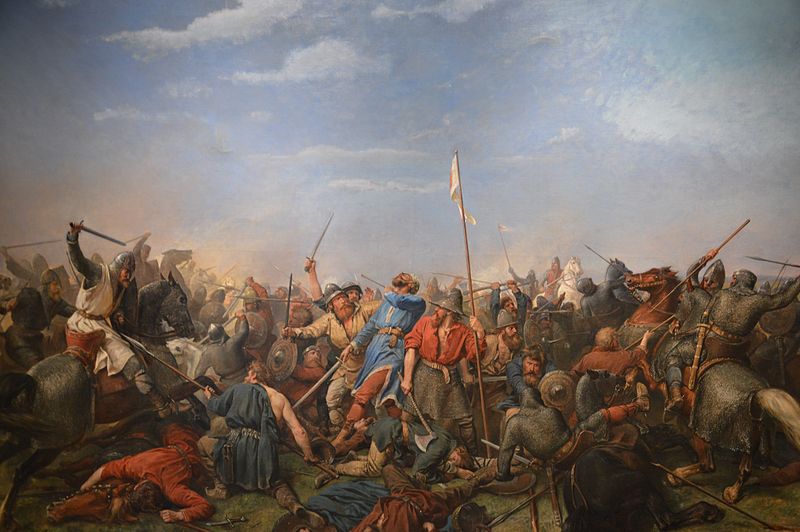
Tostig sailed for England with King Harald and a mighty army of 10,000 Viking warriors, meeting the northern Earls Edwin and Morcar in battle at Fulford Gate, on September 20.
The encounter was a comprehensive defeat for the English side. When Harald came to Stamford Bridge five days later, he expected only formal capitulation and tribute.
Meanwhile, King Harold was at the head of an army in the south, anticipating William’s invasion from Normandy. My military friends will appreciate what happened next; Harold marched his army north, traveling day and night, covering 185 miles in four days, on foot, completely surprising the Viking army waiting at Stamford Bridge.
The Vikings must have looked at the horizon and wondered how a peace party could raise that much dust, only to learn that they faced a new army.
Believing they were there to accept submission, Harald’s army had left half its number behind to watch the ships, along with their armor.
During the height of the following battle, one giant Viking warrior, a Berserker, stood alone at the top of Stamford Bridge. Swinging the great two-handed Dane Axe, this giant of a man had slain something like 40 English warriors, lying dead in heaps around him, when one of Harold’s soldiers floated himself under the bridge, spearing the Viking warrior from below.
The savagery of the battle can only be imagined. Before the age of industrialized warfare, every injury was personally administered with a bladed or crushing weapon of some kind. 5,000 of King Harold’s soldiers would be dead before it was over, about a third of his force. Two thirds of King Harald’s Vikings died that day, about 6,000, including Harald himself and his ally Tostig. So many died in that small area that 50 years later, the site was said to have turned white with the sun bleached bones of the slain.
Of some 300 ships arriving on the 20th, the battered remnants of Harald’s Viking army needed only 24, to sail away.
Stamford Bridge is often described as the end of the Viking invasions of England, but that isn’t quite so. There would be others, but none so powerful as this.
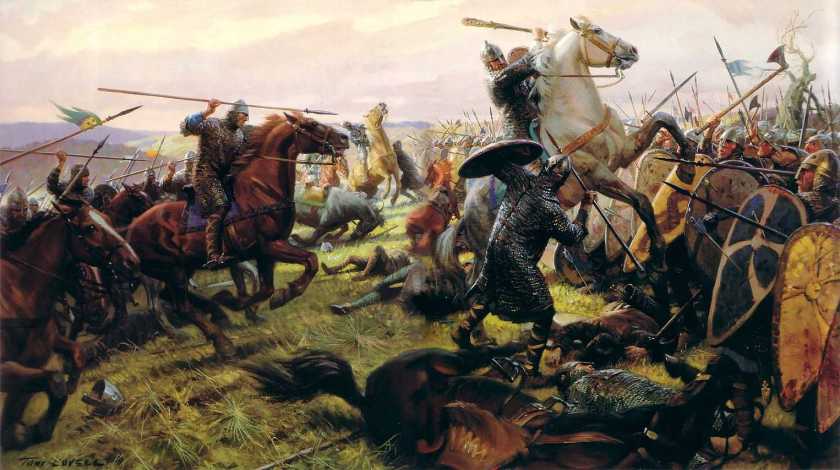
The Norman landing King Harold had been waiting for took place three days later at Pevensey Harbor, just as his battered army was disbanding and heading home for the Fall harvest. The Anglo Saxon army would march south again, meeting the Norman invader on October 14 at a place called “Hastings”. King Harold II took an arrow in the eye that day, thus becoming the last of the Anglo Saxon Kings.
Battle of Hastings, by Tom Lovell
Thenceforward and forever, William the Bastard would be known as William “The Conqueror”.
Over time, SCOTUS has proven itself to be as imperfect as any other institution. There have only been 112 justices in the history of the court. Some of them have been magnificent human beings, and some of them cranks.
Article III of the Constitution establishes the Supreme Court of the United States (SCOTUS), and “such inferior Courts as the Congress may from time to time ordain and establish”.
There’s no mention of the number of justices. The first Congress passed the Federal Judiciary Act on September 24, 1789, creating a six-justice Supreme Court.
Twelve years later, the presidency of John Adams was coming to an end. As a Federalist, Adams wanted nothing more than to stymie the incoming administration of Democratic-Republican Thomas Jefferson. Toward that end, Adams appointed the infamous “midnight judges” in the last hours of his administration: 16 Federalist Circuit Court judges and 42 Federalist Justices of the Peace.
The incoming Jefferson administration sought to block the appointments. Jefferson ordered then-Secretary of State James Madison to hold those commissions as yet undelivered, thus invalidating the appointments. One of the appointees, William Marbury, took the matter to Court.
The case advanced all the way to the Supreme Court, which ruled in Marbury v. Madison that the provision of the Judiciary Act enabling Marbury to bring his claim, was unconstitutional. Marbury had lost his case, but the principle of judicial review, the idea that the court could preside, Godlike, over laws passed by their co-equal branch of government, has been the law of the land, ever since.
In the early days of the Great Depression, Federal agricultural officials conceived the hare brained idea that artificially introducing scarcity would increase prices, and therefore wages, in the agricultural sector. Six million hogs were destroyed in 1933. Not harvested, just destroyed and thrown away. 470,000 cattle were shot in Nebraska alone. Vast quantities of milk were poured down sewers, all at a time of national depression when malnutrition was widespread.
With the Agricultural Adjustment Act of 1938, Washington began to impose production quotas on the nation’s farmers. Ohio farmer Roscoe Filburne was ordered to grow 223 bushels of wheat in the 1941 season. Filburne grew 462.
Article 1, Section 8 of the Constitution permits Congress “To regulate Commerce with foreign Nations, and among the several States, and with the Indian Tribes”. On this flimsy basis, the Federal Government took Roscoe Filburne to court.
The farmer argued that the “surplus” stayed on his farm, feeding his family and his chickens. Lower Courts sided with Filburne. The government appealed all the way to the Supreme Court, arguing that, by withholding his surplus, Filburne was effecting interstate market conditions, thereby putting him under federal government jurisdiction.
Intimidated by the Roosevelt administration’s aggressive and illegal “court packing scheme“, SCOTUS ruled against the farmer. Ever since, what you don’t do can be held against you in a court of law. Get it? Neither do I.
Over time, SCOTUS has proven itself to be as imperfect as any other institution. There have only been 17 Chief Justices and 101 Associate Justices in the entire history of the court. Five Chiefs having previously sat as Associate Justices, there are only 113 in all.
Some of them have been magnificent human beings, and some of them cranks. There have been instances of diminished capacity ranging from confusion to outright insanity. One justice spent part of his term in a debtor’s prison. Another killed a man. There have been open racists and anti-Semites.
There is no official portrait of the 1924 court because Justice James C. McReynolds wouldn’t stand next to Louis Brandeis, the court’s first Jewish Justice. One Justice was known to chase flight attendants around his quarters, while another spent his time in chambers watching soap operas.
There’s the former Klan lawyer turned Justice who took a single phrase, “separation of church and state”, from a private letter of Thomas Jefferson, and turned the constitutional freedom OF religion into an entirely made up freedom FROM religion.
The Supreme Court reinforced chattel slavery with the Dred Scott decision. The Korematsu ruling gave us the forced incarceration of Americans of Japanese descent. Buck v. Bell gave American women the gift of forced sterilization, and Stenberg v. Carhartt enshrined the constitutional “right” to the hideous and detestable “procedure” known as partial birth abortion. From “Separate but Equal” to the “rights” of terrorists, SCOTUS’ rulings are final, inviolate, and sometimes imbecilic.
Chief Justice John Roberts, who once said “remember that it’s my job to call balls and strikes, and not to pitch or bat,” invented a whole new definition of taxation, enshrining the “Affordable Care Act” as the law of the land.
The framers gave us a Constitutional Republic with co-equal branches of government, with power diffused and limited by a comprehensive set of checks and balances.
They gave us two distinct means to amend that Constitution, should circumstances require it.
Traditionally, Congress proposes amendments, submitting them to the states for ratification. The problem is that many believe Congress itself to be part of the problem, and a broken institution is unlikely to fix itself.
Article V gives us a way to amend the constitution, if we would take it. Instead of Congress proposing amendments, an Article V convention of state legislatures would propose amendments, to take effect only if ratified by a super majority of states. We could start with an amendment permitting 2/3rds of the People’s representatives in Congress, to overturn a SCOTUS decision. Then we could term limit these people.
Unless, that is, you believe it’s fine for the Federal Government to prohibit a farmer from growing wheat for his own use, that one man in a black robe can force you to buy a product you don’t want and call it a “tax”, or you believe that “established by the state” means by the state or federal government, at the sole discretion of the man who says, “I’m from the Government. I’m here to help”.
More than once Lewis and Clark found themselves negotiating for their lives with hostile Indians, as Discovery Corps member Francois Labiche translated English to French, fur trapper Toussant Charbonneau French to Hidatsa, and his wife Sacagawea speaking to the other side in Shoshone.
Minister to France and future President Thomas Jefferson began to express interest in an expedition to the Pacific Northwest, as early as the 1780s.
As President, Jefferson asked Congress to fund an expedition to the Pacific, two years into his first term. He understood that the fledgling United States would have a better claim to the Pacific Northwest if the team gathered data on plants and animals, but Jefferson’s primary interest in the mission, was trade.
Today we take coast-to-coast travel for granted, it seems odd to think how strange and unknown were the more remote parts of our own country. Though extraordinarily well read and one of the brightest men of his generation, (Jefferson once cut out 901 bible verses from which he assembled his own “Jefferson Bible”, translating the volume into Greek, Latin, French and back to English, “just for fun”), President Jefferson legitimately believed that herds of Wooly Mammoth roamed the western reaches of the nation.
Jefferson wanted to find an all-water route to the Pacific for the conduct of business. The President commissioned the Corps of Discovery expedition in 1803, naming Army Captain Meriwether Lewis expedition leader.
The two men had known one another since Lewis was a boy, having long since developed a relationship of mentor and protégé. At this time Lewis was working as personal secretary to the President. Tough, intellectually gifted and resourceful, Lewis received a crash course in the natural sciences from the President himself, before being sent off to Philadelphia to brush up on medicine, botany and celestial navigation.
Lewis selected William Clark as his second in command, due to the man’s exceptional skills as a frontiersman. It would prove to be an excellent choice.
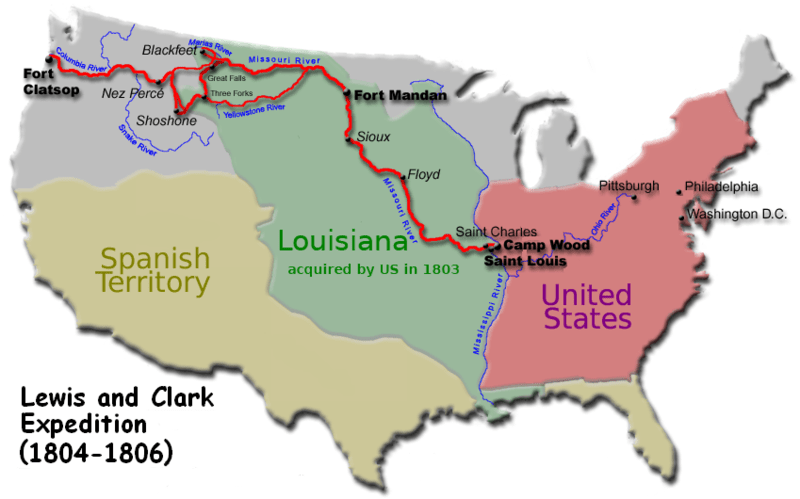
Most of 1803 was spent in planning and preparation, Lewis and Clark joining forces near Louisville that October. After wintering in the Indiana territory base camp in modern day Illinois, the 33-man expedition departed on May 14, 1804, accompanied by “Seaman”, a “Dogg of the Newfoundland breed”.
Lewis and Clark set out to explore the Louisiana Territory, as it became an official part of the United States. Borders were still hazy at the time, and Spanish authorities suspected that the expedition would encroach on their territory in the southwest. They had good reason to think so, Thomas Jefferson believed the same.
Corps of Discovery members couldn’t know that General James Wilkinson, one of the most duplicitous, avaricious, and corrupt individuals of the age, was reporting their every move to his paymaster, the Spanish King Charles IV.
Over the course of the expedition, the tiny group was hunted by no fewer than four Spanish expeditions with as many as 600 soldiers, mercenaries and Comanche guides, each intending to make the Corps of Discovery vanish without a trace.
Discovery established friendly relations with at least 24 indigenous tribes, without whose help they may have become lost or starved in the wilderness. Most were more than impressed with Lewis’ state-of-the-art pneumatic rifle, which could silently fire up to 20 rounds after being pumped full of compressed air.
Not all Indian tribes were friendly, there were several run-ins with a group the Americans called “Teton-wan Sioux”. The Sioux were no joke. On one occasion, a group of four who had separated from the main expedition fled 100 miles in a single day from these people, before they felt it was safe to stop.
Lewis and Clark’s memoirs describe similar encounters with a large and especially ferocious species of bear, the Grizzly, an animal which more than once had expedition members climbing trees with a notable sense of urgency.
It was at the winter camp of 1804-5 that they met a French fur trapper named Toussaint Charbonneau and his young wife (or slave – she might have been a little of both), Sacagawea. They seemed to have thought Charbonneau a shady character, but they liked the young Indian girl, and her linguistic skills would prove useful. Sacagawea spoke Shoshone and Hidatsa while Charbonneau spoke Hidatsa and French. More than once Lewis and Clark found themselves negotiating for their lives with hostile Indians, as Discovery Corps member Francois Labiche translated English to French, Charbonneau French to Hidatsa, and Sacagawea speaking to the other side in Shoshone.
It was at this camp that Sacagawea gave birth to a son, whom she and Charbonneau named Jean Baptiste. The family stayed with the expedition, proving to be incredibly valuable to the group. They met many Indian bands along the way, whom Sacagawea’s presence quickly put at ease. War bands never traveled with women, especially not with one carrying an infant. One such band was a group of Shoshone led by Chief Cameahwait, who turned out to be none other than Sacagawea’s own brother. It must have been quite a reunion, they hadn’t seen one another since her kidnap by the Hidatsa, back in 1800.
The Corps of Discovery reached the Pacific Ocean in November 1805, and set out their second winter camp in modern-day Oregon.
They returned through a cut in the Rocky Mountains which Sacagawea remembered from her childhood, the modern day Bozeman Pass, arriving at the Hidatsa-Mandan villages on August 14, 1806. For Sacagawea, Charbonneau and Jean Baptiste, this was the end of the trip.
Lewis and Clark arrived in St. Louis on September 23, 1806, the Corps of Discovery having met their objectives. They had reached the western coast and returned, though they did not find a continuous water route to the Pacific. The expedition created maps along the way, establishing legal claim to the land, while describing 178 previously unknown plants and 122 unknown animals, and establishing diplomatic and trade relations with at least two dozen indigenous nations.
Despite being heavily armed, most members were required to defend themselves only once, that in a running gun battle with a band of Blackfeet, on the way home.
The expedition suffered only one fatality when Sergeant Charles Floyd succumbed to what appears to have been appendicitis. Though not seriously wounded, a humiliated Lewis had to spend several weeks face-down in a canoe, when one of the enlisted guys mistook his rump for that of an elk, and shot it.
Meriwether Lewis died from gunshot wounds to the chest and head on October 11, 1809. Historians differ as to whether it was murder or suicide, though most believe his death to have been the latter. It would not have been his first such attempt.
York
Sacagawea gave birth to a daughter named Lizette on December 22, 1812, and died a few months later at the age of 25. Eight months later, William Clark legally adopted her two children. Clark is recorded as having brought the boy up and educating him in St. Louis, before sending him to Europe with a German prince at the age of 18. I was unable to determine with any certainty, whether Lizette survived infancy.
Among the two-dozen plus officers and enlisted men on Discovery was William Clark’s African slave “York”, who accompanied the expedition from beginning to end. Though not an official member of the Corps of Discovery, York’s hunting skills made him a valuable member of the expedition. Indigenous tribes were fascinated by the first black man any of them had ever seen. The Arikara people of North Dakota believed him to hold spiritual powers, calling the tall man “Big Medicine”.
Though a slave, York seems to have earned a degree of respect from expedition members. At least two geographic features were named after the man. Both York and Sacagawea had a vote on the placement of the 1805-’06 winter camp, prompting historian Stephen E. Ambrose to speculate that this may have been the first time in American history, that a black man and a woman were given the vote.
Accounts differ as to what became of him. Some say Clark freed the man, others say that York was unwilling to return to a life of slavery, following 2½ years of liberty. A black man who claimed to have been he was discovered ten or twelve years later, a tribal elder living with his four wives among the Crow, in north-central Wyoming.
Thomas Berger, author of the fictional Dances with Wolves, writes about a particularly dark skinned strain among the Indians, which many believe to have descended from York.
What became of Seaman the dog is unknown. Having accompanied the Lewis & Clark expedition from the very beginning, the last journal reference to him was written in July, two months before the journey’s end.
‘I only regret, that I have but one life to lose for my country'”.
The nine Hale brothers of Coventry Connecticut fought on the Patriot side of the Revolution, from its earliest days. Five of them helped to fight the battles at Lexington and Concord. The youngest and most famous brother was home in New London at the time, finishing the terms of his teaching contract.
Nathan Hale’s unit would participate in the siege of Boston, Hale himself joining George Washington’s army in the spring of 1776, as the army moved to Long Island to block the British move on the strategically important port city of New York.
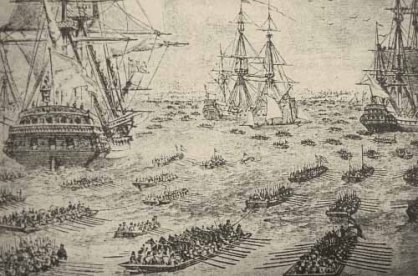
General Howe appeared at Staten Island on June 29 with a fleet of 45 ships. By the end of the week, he’d assembled an overwhelming fleet of 130.
There was an attempt at peaceful negotiation on July 13, when General Howe sent a letter to General Washington under flag of truce. The letter was addressed “George Washington, Esq.”, intentionally omitting Washington’s rank of General. Washington declined to receive the letter, saying that there was no one there by that address. Howe tried the letter again on the 16th, this time addressing it to “George Washington, Esq., etc., etc.”. Again, Howe’s letter was refused.
British Landing on Long island
The next day, General Howe sent Captain Nisbet Balfour in person, to ask if Washington would meet with Howe’s adjutant, Colonel James Patterson. A meeting was scheduled for the 20th.
Patterson told Washington that General Howe had come with powers to grant pardons. Washington refused, saying “Those who have committed no fault want no pardon”.
Patriot forces were comprehensively defeated at the Battle of Brooklyn, fought on August 27, 1776. With the Royal Navy in command on the water, Howe’s army dug in for a siege, confident that the adversary was trapped and waiting to be destroyed at their convenience.
British retreat from Long Island
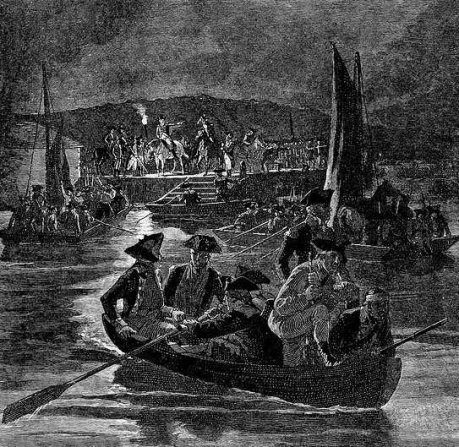
On the night of August 29-30, Washington withdrew his army to the ferry landing and across the East River, to Manhattan.
With horse’s hooves and wagon wheels muffled, oarlocks stuffed with rags, the Patriot army withdrew, as a rearguard tended fires, convincing the redcoats in their trenches that the Americans were still there.
The surprise was complete for the British side, on waking for the morning of the 30th. The Patriot army had vanished.
The Battle of Long Island would almost certainly have ended in disaster for the Patriot cause, but for that silent evacuation over the night of August 29-30.
Following evacuation, the Patriot army found itself isolated on Manhattan island, virtually surrounded. Only the thoroughly disagreeable current conditions of the Throg’s Neck-Hell’s Gate segment of the East River, prevented Admiral Sir Richard Howe (William’s brother), from enveloping Washington’s position, altogether.
Expecting a British assault in September, General Washington became increasingly desperate for information on British movements.
Washington asked for volunteers for a dangerous mission, to go behind enemy lines, as a spy. Up stepped a volunteer. His name was Nathan Hale.
Hale set out on his mission on September 10, disguised as a Dutch schoolmaster. He was successful for about a week but appears to have been something less than “street smart”. The young and untrained Patriot-turned spy, placed his trust where it did not belong.
Major Robert Rogers was an old British hand, a leader of Rangers during the earlier French and Indian War. Rogers must have suspected that this Connecticut schoolteacher was more than he pretended to be, and intimated that he, himself, was a spy in the Patriot cause.
Hale took Rogers into his confidence, believing the two to be playing for the same side. Barkhamsted Connecticut shopkeeper Consider Tiffany, a British loyalist and himself a sergeant of the French and Indian War, recorded what happened next, in his journal: “The time being come, Captain Hale repaired to the place agreed on, where he met his pretended friend” (Rogers), “with three or four men of the same stamp, and after being refreshed, began [a]…conversation. But in the height of their conversation, a company of soldiers surrounded the house, and by orders from the commander, seized Captain Hale in an instant. But denying his name, and the business he came upon, he was ordered to New York. But before he was carried far, several persons knew him and called him by name; upon this he was hanged as a spy, some say, without being brought before a court martial.”
The “stay behind” spy Hercules Mulligan would have far greater success reporting on British goings-on, from the 1776 capture of New York to the ultimate withdrawal seven years later. But that is a story for another day.
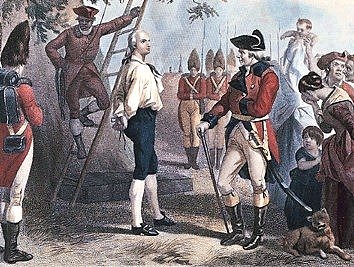
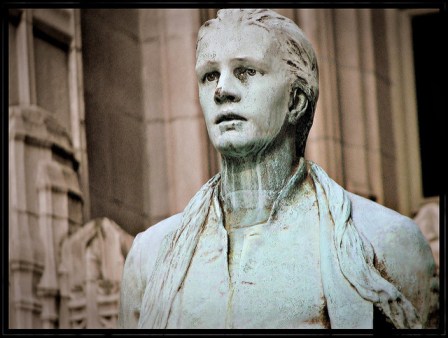
Nathan Hale was brought to the gallows on September 22, 1776, and hanged as a spy. He was 21. CIA.gov describes him as “The first American executed for spying for his country”.
There is no official account of Nathan Hale’s final words, but we have an eyewitness statement from British Captain John Montresor, who was present at the hanging.
Montresor spoke with American Captain William Hull the following day under flag of truce. He gave Hull the following account: “‘On the morning of his execution,’ said Montresor, ‘my station was near the fatal spot, and I requested the Provost Marshal to permit the prisoner to sit in my marquee, while he was making the necessary preparations. Captain Hale entered: he was calm, and bore himself with gentle dignity, in the consciousness of rectitude and high intentions. He asked for writing materials, which I furnished him: he wrote two letters, one to his mother and one to a brother officer.’ He was shortly after summoned to the gallows. But a few persons were around him, yet his characteristic dying words were remembered. He said, ‘I only regret, that I have but one life to lose for my country‘.
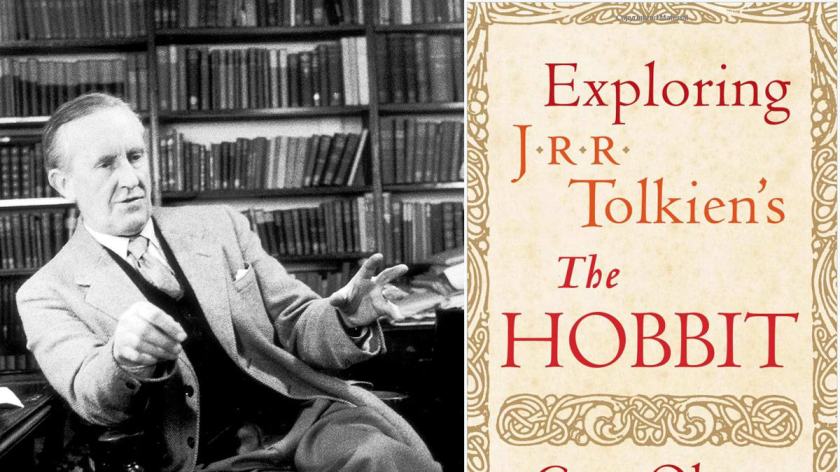
Tolkein discovered Christ II by Cynewulf in the course of his studies, one of only four surviving works by the 9th century Old English poet. One couplet captured his imagination. “Eálá Earendel engla beorhtast, Ofer middangeard monnum sended” – Hail Earendel brightest of angels, over Middle Earth sent to men.
Opportunities for promotion led Arthur Reuel Tolkien to South Africa sometime around 1890, where the bank clerk became manager of the Bloemfontein branch of the Bank of Africa. Tolkein’s fiancée Mabel joined him in the Orange Free State in 1891, and the couple was married that April. The first of two boys arrived the following year. They called him John Ronald Reuel.
Mabel returned to England shortly after the birth of their second son, believing the climate to be healthier. She may have been right. Arthur died unexpectedly in South Africa, never rejoining his family. The older boy was four that year, the family’s departure leaving him with “slight but vivid” memories of Africa. One of them involved an encounter with an enormous, hairy, spider.
The family lived for a time next to a rail line, south of Birmingham. John always had an interest in languages, even before he began to invent words. It must have fired the young boy’s linguistic imagination to see the Welsh coal trucks go by, with names like “Nantyglo“, “Penrhiwceiber” and “Senghenydd” painted on their sides.
Finances were difficult for the family, becoming worse when Mabel succumbed to diabetes when John was only 12.
A Father Francis looked after the boys’ spiritual and educational development at King Edward’s school, where J.R.R. mastered Latin and Greek, becoming competent in a number of other languages, as well. He would make up entire languages for fun, while he and several buddies met regularly after school as the “TCBS” (Tea Club and Barrovian Society), exchanging and criticizing each other’s literary work.
Tolkein discovered Christ II by Cynewulf in the course of these studies, one of only four surviving works by the 9th century Old English poet. One couplet captured his imagination. “Eálá Earendel engla beorhtast, Ofer middangeard monnum sended” – Hail Earendel brightest of angels, over Middle Earth sent to men.
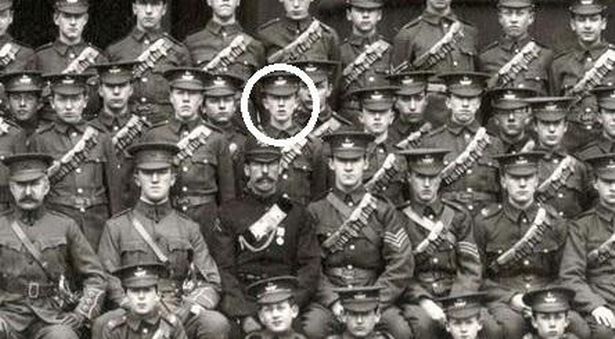
Tolkien served briefly on the Western Front in WWI, before contracting a typhus-like infection called “trench fever”. He convalesced back in England, serving out the rest of the war in Home Duty. Most of his TCBS friends had been killed in action by this time, and he wrote of his experiences in their memory. “…in huts full of blasphemy and smut, or by candle light in bell-tents, even some down in dugouts under shell fire“.
It’s easy to see these early experiences in his first works, the notes he called his “Legendarium”: the Deep Elves, the wars against Morgoth, the siege and fall of Gondolin and Nargothrond.
Tolkien took a professorship at Oxford after the war, where one day he found himself correcting papers. He found that one of his students had left a page blank. Who knows what possessed him, but he wrote on the page “In a hole in the ground there lived a hobbit“. In typical Tolkien fashion, he then had to find out what a “Hobbit” was, why it lived in a hole, and on, and on.
Tolkien’s musings grew into a tale he told his kids. It grew from there when the publishing firm George, Allen and Unwin got hands on an incomplete typescript, and encouraged the professor to finish his work. J.R.R. Tolkein’s tale was published on this day in 1937, under the title “The Hobbit“.
The Hobbit was so successful that the publisher asked if Tolkein had similar material available for publication. By this time, Tolkien’s Legendarium had taken a more complete form which he was calling his “Qenya Silmarillion”. Tolkien submitted the work to mixed reviews. the prevailing sense being that the work was not commercially viable.
The author was disappointed by the setback, but agreed to take up the challenge of writing “The New Hobbit”. It took 16 years of coaxing and prodding to accelerate the snail’s pace of this unhurried writer, by the now-grown son of one of the publishers, Rayner Unwin. Tolkien even offered the work to a rival publisher at one point, but they backed off the project on realizing the scope and size of the work.
J.R.R. Tolkein’s tale developed into far more than a children’s story, published in three parts in 1954-1955 under the title “Lord of the Rings“. Early misgivings that the project would be a financial loss, soon evaporated.
Author and publisher alike had greatly underestimated the public appeal of Tolkien’s work. To date, the Lord of the Rings trilogy and the Hobbit have sold well over 300 million copies. But for exchange issues related to a rising dollar and plunging foreign currencies, the Peter Jackson Hobbit film trilogy of 2012 would have grossed $1 billion at the world-wide box office.
Nestorius, Patriarch of Constantinople, described Rome’s Hun problem, succinctly. “They have become both masters and slaves of the Romans”.
In the 5th century, the migration of warlike Germanic tribes across northern Europe culminated in the destruction of the Roman Empire in the west. That much is relatively well known, but the “why”, is not. What would a people so fearsome that they brought down an empire, have been trying to get away from?
The Roman Empire was split in two in the 5th century and ruled by two separate governments. Ravenna, in northern Italy, became capital to the Western Roman Empire in 402, and would remain so until the final collapse in 476. Constantinople, seat of the Byzantine empire and destined to become modern day Istanbul, ruled in the East.
Vast populations moved westward from Germania during the early fifth century, and into Roman territories in the west and south. They were Alans and Vandals, Suebi, Goths, and Burgundians. There were others as well, crossing the Rhine and the Danube and entering Roman Gaul. They came not in conquest: that would come later. These tribes were fleeing the Huns: a people so terrifying that whole tribes agreed to be disarmed, in exchange for the protection of Rome.
Rome itself had mostly friendly relations with the Hunnic Empire, which stretched from modern day Germany in the west, to Turkey and most of Ukraine in the east. The Huns were nomads, mounted warriors whose main weapons were the bow and javelin. Huns frequently acted as mercenary soldiers, paid to fight on behalf of Rome.
Rome looked at such payments as just compensation for services rendered. The Huns looked at them as tribute, tokens of Roman submission to the Hunnic Empire.
Nestorius, Patriarch of Constantinople, described Rome’s Hun problem, succinctly. “They have become both masters and slaves of the Romans”.
Relations were strained between the two powers in the time of the Hunnic King Rugila, as his nephew the future King Attila, came of age.
Rugila’s death in 434 left the sons of his brother Mundzuk, Attila and Bleda, in control of the united Hunnic tribes. The brothers negotiated a treaty with Emperor Theodosius of Constantinople the following year, giving him time to strengthen the city’s defenses. This included building the first sea wall, a structure the city would be forced to defend a thousand years later in the Islamic conquest of 1453, but that is a story for another day.
The priest of the Greek church Callinicus wrote what happened next, in his “Life of Saint Hypatius”. “The barbarian nation of the Huns, which was in Thrace, became so great that more than a hundred cities were captured and Constantinople almost came into danger and most men fled from it. … And there were so many murders and blood-lettings that the dead could not be numbered. Ay, for they took captive the churches and monasteries and slew the monks and maidens in great numbers“.
Bleda died sometime in 445, leaving Attila the sole King of the Huns. Relations with the Western Roman Empire had been relatively friendly, for a time. That changed in 450 when Justa Grata Honoria, sister of Emperor Valentinian, wanted to escape a forced marriage to the former consul Herculanus. Honoria sent the eunuch Hyacinthus with a note to King Attila, asking him to intervene on her behalf. She enclosed her ring in token of the message’s authenticity, which Attila took to be an offer of marriage.
Valentinian was furious with his sister. Only the influence of their mother Galla Placidia convinced him to exile rather than have her put to death, while he frantically wrote to Attila saying it was all a misunderstanding.
The King of the Huns wasn’t buying it, and sent an emissary to Ravenna, to claim what was his. Attila demanded delivery of his “bride”, along with half the empire, as dowry.
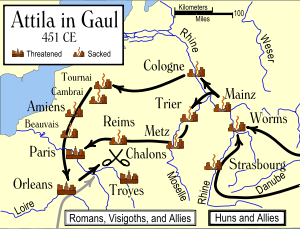
In 451, Attila gathered his vassals and began a march to the west. The Hunnic force was estimated to be half a million strong, though the number is probably exaggerated. The Romans hurriedly gathered an army to oppose them, while the Huns sacked the cities of Mainz, Worms and Strasbourg. Trier and Metz fell in quick succession, as did Cologne, Cambrai, and Orleans.
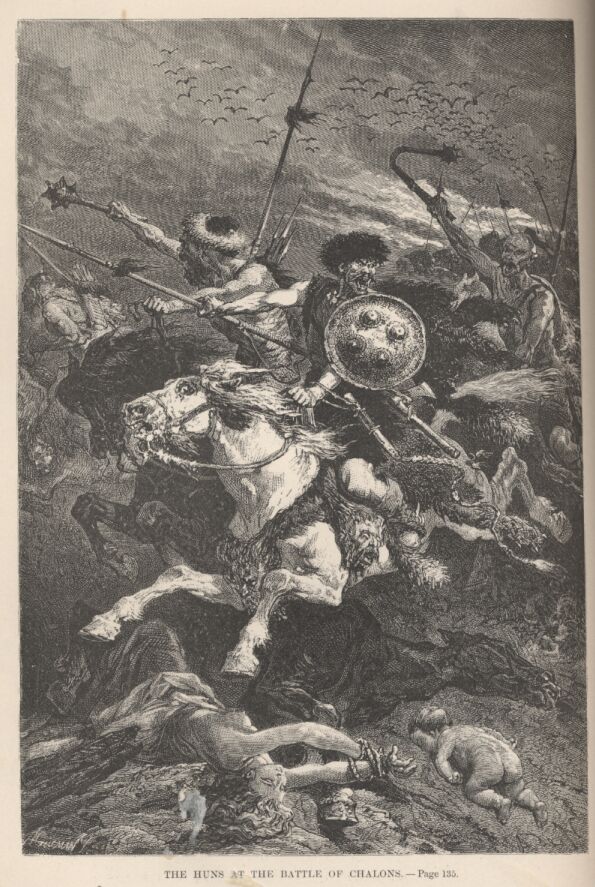
The Roman army, allied with the Visigothic King Theodoric I, finally stopped the army of Attila at the Battle of the Catalaunian Plains, near Chalons. Some sources date the Battle of Chalons at June 20, 451, others at September 20. Even the outcome of the battle is open to interpretation. Sources may be found to support the conclusion that it was a Roman, a Gothic or a Hunnic victory.
Apparently a Pyrrhic victory, Chalons was one of the last major military operations of the Roman Empire in the west. The Roman alliance had stopped the Hunnic invasion in Gaul, but the military capacity of Roman and Visigoth, both, was destroyed. The Hunnic Empire was dismantled by a coalition of Germanic vassals at the Battle of Nedau, in 454.
“The Huns at the Battle of Chalons” from page 135 of A Popular History of France From The Earliest Times Volume I of VI (en:Project Gutenberg e-text). Illustration by A. De Neuville (1836-1885). img url: http://www.gutenberg.org/dirs/1/1/9/5/11951/11951-h/images/135.jpg
Attila would return to sack much of Italy in 452, this time razing Aquileia so completely that no trace of it was left behind. Legend has it that Venice was founded at this time, when local residents fled the Huns, taking refuge in the marshes and islands of the Venetian Lagoon.
Attila died the following year at a wedding feast, celebrating his marriage to the young Ostrogoth, Ildico. The King of the Huns died in a drunken stupor, suffering a massive nosebleed or possibly esophageal bleeding. The Hunnic Empire died along with Attila the Hun, as he choked to death on his own blood.
In the 1850s, then-Secretary of War Jefferson Davis persuaded President Franklin Pierce that the military super weapons of the future, were camels. Able to carry greater loads over longer distances than any pack animal, Davis saw camels as the high tech weapon of the age.
If you happen to visit www.visitvicksburg.com, you will learn that the Cedar Hill Cemetery, established by the United Daughters of the Confederacy, contains the graves of some 5,000 Confederate Soldiers who died in the 1863 Siege of Vicksburg, Mississippi. Each one stands in memory of a soldier killed in the line of duty. Even the one with the camel on it.
The story begins with Jefferson Davis, in the 1840s. Now we remember him as the President of the Confederate States of America. Then, he was a United States Senator from Mississippi, with a pet project of introducing camels into the United States.
Re-introducing them might be more like it. Today, the distribution of these animals is almost the inverse of their area of origin. According to the fossil record, the earliest camelids first appeared on the North American continent, these even-toed ungulates ancestor to the Alpaca, Llama, Guanaco and Vicuña of today.
Jefferson Davis’ experiment was to be the first large-scale re-introduction of these animals on the North American continent, in geologic history.
Davis envisioned the day when every southern planter would have a stable full of camels. In the kind of pork barrel tit-for-tat spending deal beloved of Congressmen to this day, the Senator slid $30,000 into a highway appropriations bill, to get the support of a colleague from Illinois.
The measure failed, but in the 1850s, then-Secretary of War Davis persuaded President Franklin Pierce that camels were the military super weapons of the future. Able to carry greater loads over longer distances than any other pack animal, Davis saw camels as the high tech weapon of the age. Hundreds of horses and mules were dying in the hot, dry conditions of Southwestern Cavalry outposts, when the government purchased 75 camels from Algeria, Tunisia and Egypt. Several camel handlers came along in the bargain, one of them a Syrian named Haji Ali, who successfully implemented a camel breeding program. Haji Ali became quite the celebrity within the West Texas outpost. The soldiers called him “Hi Jolly”.
When the Civil War broke out, Camp Verde, Texas had about 60 camels. The King of Siam, (now Thailand), saw the military advantage to the Confederacy, and wrote to President Abraham Lincoln. “Here”, he wrote, “we use elephants”. The King went on to propose bringing elephants into the Northwest, to help the Union war effort. This “animal arms race” appears to have gotten no further than the King’s letter to the President, but the imagination runs wild at the idea of War Elephants at Gettysburg….
The horse lobby did a lot to kill the camel project, and the animal’s unpleasant personality traits didn’t help. A camel will not passively accept a riding crop or a whip. They are vengeful, and can spit stinking wads of phlegm with great accuracy over considerable distances. If they’re close enough, they will rake the skin off your face with their front teeth. Camels have been known to trample people to death.
Douglas, the Confederate Camel
Cut loose, one of those Texas camels somehow made its way to Mississippi, where he was taken into service with the 43rd Infantry Regiment, who named him “Douglas”.
Douglas wouldn’t permit himself to be tethered, but he always stuck around so he was allowed to graze on his own. Southern soldiers became accustomed to the sight of “Old Douglas”. The 43rd Mississippi became known as the “Camel Regiment,” but the horses never did get used to their new companion. On this day in 1862, Major General Sterling Price was preparing to face two Union armies at Iuka, when the sight of Old Douglas spooked the regimental horses. One horse’s panic turned into a stampede, injuring several of them and possibly killing one or two.
The 43rd Infantry was ordered to Vicksburg during General Ulysses S. Grant’s siege of the city, when Douglas was shot and killed by a Union sharpshooter. Enraged by the murder of their prized camel, the 5th Missouri’s commander Lieutenant Colonel Robert S. Bevier enlisted six of his best snipers, who stalked the killer until one of them had his revenge. Bevier later said of Douglas’ killer, “I refused to hear his name, and was rejoiced to learn that he had been severely wounded.”
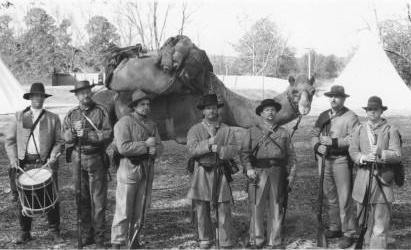
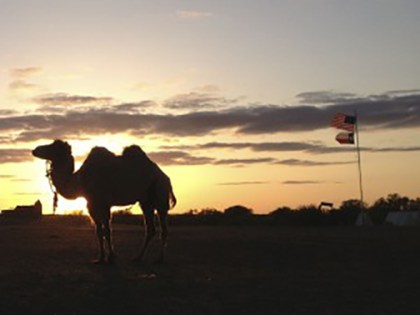
So it is that there is a camel at the Cedar Hill Cemetery in Vicksburg, Mississippi. He is not forgotten. Douglas and other camels of the era are remembered by the Texas Camel Corps, a cross between a zoo and a living history exhibit.
The organizations website begins with: “Texas Camel Corps was established to educate the public about the historic use of camels in America in the 19th century”. I might have to check those boys out.
President George Washington personally laid the cornerstone of the Capitol building on September 18, 1793
Between 1775 and 1783, the United States Congress and its predecessor bodies did their business in the Pennsylvania State House in Philadelphia, later known as “Independence Hall”.
The governing body convening under the Articles of Confederation in March 1781 met there as well, until the Mutiny of 1783, when a mob of angry soldiers converged on the Hall demanding payment for their service in the Revolution.
Congress requested the Governor of Pennsylvania, John Dickinson, to call up the militia and dispel the mob. Governor Dickinson sided with the veterans, and refused to aid the Congress. So it was that the United States Congress up and fled, leaving Philadelphia first for Annapolis and then Trenton, before finally ending up in New York City.
The “Residence Act” of July 1790 established the Federal government along the banks of the Potomac River. The specific site had been up for debate, before Alexander Hamilton brokered a compromise. Several delegates switched support in favor of the current location, in exchange for the Federal government assuming their states’ war debt.
The Residence Act gave President George Washington authority to select the site for the capital, setting a deadline of December 1800 for completion, when the Congress moved back to Philadelphia.
Roman temple to Jupiter Optimus Maximus, on Capitoline Hill
Pierre L’Enfant was selected to create the city plan, and to design the buildings themselves. His plan established the “Congress House” building on Jenkins Hill, with a grand Boulevard connecting it with the President’s house and a public space stretching westward to the banks of the Potomac.
Jefferson objected to that name for the building, preferring “Capitol”, after the Roman temple to Jupiter Optimus Maximus, on Capitoline Hill.
L’Enfant was fired in February 1792, with no plans having been completed for the Capitol. Then-Vice President Thomas Jefferson was a key adviser to the President, and he organized a competition to select designs for the Capitol building and for the President’s house.
An amateur architect and late entry into the competition named William Thornton was officially approved for the project, though several others had input into the finished product.
President George Washington personally laid the cornerstone of the Capitol building on September 18, 1793.
Funding problems and design squabbles plagued the project from the beginning. The building was incomplete when Congress held its first session there on November 17, 1800.
Government functions were not all that took place at the Capitol building. From its earliest days, Church services were held there as well, giving lie to currently fashionable notions of the “separation of church and state”. These services were non-denominational and voluntary. Preachers from all Protestant denominations appeared from the beginning, and Catholic priests began officiating services in 1826. Religious services would continue at the US Capitol until the Civil War.
The Capitol was partially burned down during the British sack of Washington in 1814. Reconstruction began the following year and ended with the addition of the Rotunda and the first dome.
By the 1850s, the number of new states’ representatives threatened to exceed the building’s designed capacity. President Millard Fillmore held a design competition, resulting in the House and Senate wings as you see them today.
Work began in 1855 to replace the small wood-framed dome of 1818. Weighing in at 6,400 tons and costing $1,047,291, equivalent to $27.4 million in 2016 dollars. The Capitol dome is cast iron – actually a dome-within-a-dome, finished to blend with the stone facade of the original building.
Standing atop the capitol dome is the colossal 15,000lb. “Statue of Freedom” hoisted into place on December 2, 1863.
Ironically, a slave named Philip Reid helped to cast the bronze statue, winning his freedom by the time it was put into place. In 1868, Samuel Douglas Wyeth wrote in his guide book “The Federal City, the Ins and Abouts of Washington”, that “Mr. Reed (sic), the former slave, is now in business for himself, and highly esteemed by all who know him”.
Prime Minister Winston Churchill captured the spirit of the period, as only he could. “Never in the field of human conflict was so much owed by so many to so few”. – Winston Churchill
When the allies invaded Europe in 1944, they had to land on the beach in order to get a foothold. At that point, they controlled none of the European continent. The Nazi war machine had been so successful, that a map of Europe at that time could have been drawn in only two colors. One for the occasional neutral nation, the other for Nazi controlled or occupied territory.
Allied evacuation of Dunkirk, May 1940
Your eyes would have to cross the English Channel on that map to find a third color, that of Great Britain, which in June of 1940 stood defiant and alone in the face of the Nazi war machine.
In his “Finest Hour” speech of June 18, Prime Minister Winston Churchill said “What General Weygand has called the Battle of France is over. I expect that the Battle of Britain is about to begin“.
In Germany, street decorations were being prepared for the victory parades which were sure to come, as Hitler considered plans for his surprise attack on his ally to the East, the Soviet Union. After Great Britain and her allies had been hurled from the beaches of Dunkirk, Hitler seemed to feel he had little to do but “mop up”.
Germany needed air supremacy before “Operation Sea Lion”, the amphibious invasion of England, could begin. Luftwaffe commander Hermann Göring said he would have it in four days.
Military planners of the 1930s believed that “The Bomber will always get through”, and Luftwaffe strategy was based on that assumption. Air Chief Marshal Sir H.C.T. “Stuffy” Dowding, leader of RAF Fighter Command, had other ideas. Dangerously low on aircraft and the pilots to fly them, the “Dowding System” employed a complex network of detection, command, and control to run the battle. The RAF hadn’t the faintest prayer of defending their entire coast, but Dowding’s system allowed them to dispatch individual squadrons to intercept each German air raid.
The “Channel battles” beginning on July 10 were followed by a month of Luftwaffe attacks on English air fields. Losses were catastrophic for the RAF, but worse for the Luftwaffe. On only one day during this period, September 1, did the Germans succeed in destroying more aircraft than they lost.
German tactics changed on September 7. For almost two months, Luftwaffe attacks concentrated on cities and towns.
The Imperial War Museum online library (http://www.iwm.org.uk/collections/search?query=battle+of+britain&items_per_page=10) overflows with images of every day English life, set against a backdrop of catastrophic destruction. Children climbing over piles of rubble on their way to school. A milk man on his rounds, picking his way through shattered streets. Adults browsing through stacks of library books, the ceilings open to the sky, great beams and rubble littering the aisles between the stacks.
23,002 English civilians died in the raids. Another 32,138 were injured.
Interestingly, the most successful RAF squadrons to fight in the Battle of Britain weren’t British at all, but Polish.
Czechoslovakia fell to the Nazis on the Ides of March, 1939, Czech armed forces having been ordered to offer no resistance. Some 4,000 Czech soldiers and airmen managed to get out, most escaping to neighboring Poland.
Tales of Polish courage in the face of the Nazi invasion of September 1 are magnificent bordering on reckless, replete with images of Polish horse cavalry riding out to meet German tanks. Little Poland never had a chance, particularly when the Soviet Union piled on two weeks later. Poland capitulated in a month, but the German victory was more costly than expected. Much more. It’s estimated that the Wehrmacht expended twice as much ammunition defeating Poland as they did France the following Spring. A country with a third larger population.
The combined fighting forces of the two nations wound up in France in accordance with the Franco-Polish Military Alliance of 1921, thence to Great Britain following the French capitulation of June, 1940.
British military authorities were slow to recognize the flying skills of the Polskie Siły Powietrzne (Polish Air Forces), the first fighter squadrons only seeing action in the third phase of the Battle of Britain. Despite the late start, Polish flying skills proved superior to those of less-experienced Commonwealth pilots. The 303rd Polish fighter squadron became the most successful RAF fighter unit of the period, its most prolific flying ace being Czech Sergeant Josef František. He was killed in action in the last phase of the Battle of Britain, the day after his 26th birthday.
145 Polish aircrew served with the RAF during this period, making up the largest non-British contribution to the Battle of Britain. The smallest is a two-way tie at one each, between Barbados and Jamaica.
Polish Air Force memorial, St Clement Danes, London
In the end, Great Britain could not be defeated. German resources greatly outnumbered those of the English, but the ratio was reversed when it came to losses. The two nations were at a stalemate and none but a Pyrrhic victory was possible for either. Hitler indefinitely postponed Operation Sea Lion on September 17. By the end of October, the air raids had come to an end.
In the end, the Battle of Britain remains a story we remain free to tell, in English. Prime Minister Winston Churchill captured the spirit of the period, as only he could.
“Never in the field of human conflict was so much owed by so many to so few”.
Of all the hundreds of amphibious landings carried out in WW2, no other soldier ever stepped off a landing craft with bow and arrow and Scottish broadsword. Usually, while playing bagpipes.
A child was born on this day in 1906. He was John Malcolm Thorpe Fleming Churchill, the first son and grandson of British civil servants in the Ceylon Civil Service. The family lived in Hong Kong at the time, returning to England in 1917. “Jack” graduated from the Royal Military College at Sandhurst, serving in Burma with the Manchester Regiment, before leaving the military, ten years later.
Churchill worked as a newspaper editor for a time in Nairobi Kenya, along with an occasional career as male model, and a couple appearances in motion pictures. From there he might have faded into obscurity, unlike his fellow Englishman of no relation, with the same last name. Then came World War II, where John Churchill would earn the name, “Mad Jack”.
It was around this time that Churchill learned to play bagpipes, a bit of an eccentricity for an Englishman of his era. Mad Jack was nothing if not eccentric. He also taught himself to shoot a bow and arrow, becoming quite good at it. Good enough to represent his country in the world archery championship in Oslo, in 1939.
Churchill resumed his military commission and rejoined the Manchester Regiment later that year, when Germany invaded Poland. Part of the British Expeditionary force to France in 1940, Churchill signaled an ambush on a German unit, by taking its Feldwebel (staff sergeant) out with a broadhead arrow. No one could have been more surprised than that German NCO, whose dying thought must have been “How did I get an arrow in my chest?”
The unfortunate German is, to my knowledge, the only combatant in all of WWII, to be felled by an English longbow.
Not long after, allied military forces were hurled from the beaches of Europe. The only way back in, was via those same beaches. We’ve all seen the D-Day style waterborne assault: invading forces pouring out of Higgins Boats and charging up the beaches. Amphibious landings were carried out from the earliest days of WWII, from Norway to North Africa, from the Indian Ocean to Italy. In all those landings, there’s likely no other soldier who stepped off a Higgins Boat, with a bow and arrows.
On December 27, 1941, #3 Commando raided the German garrison at Vågsøy, Norway. As the ramp dropped on the first landing craft, out jumped Mad Jack Churchill playing “March of the Cameron Men” on the bagpipes, before throwing a grenade and charging into battle. Mad Jack made several such landings, usually while playing his bagpipes, a Scottish broadsword at his belt.
“Mad Jack” Churchill, speaking at a landing exercise
Churchill was attached to that sword, a basket hilted “Claybeg”, a slightly smaller version of the Scottish Claymore. He said “Any officer who goes into action without his sword is improperly dressed.” Mad Jack could be seen at the Catania (Sicily) and Salerno landings of 1943, trademark broadsword at his belt, bagpipes under an arm and an English longbow and arrows, around his neck.
Churchill lost the sword in confused, hand to hand fighting around the town of Piegoletti, for which he received the Distinguished Service Order. Almost single-handed but for a corporal named Ruffell, Churchill captured 42 Germans including a mortar squad. “I always bring my prisoners back with their weapons”, he explained. “It weighs them down. I just took their rifle bolts out and put them in a sack, which one of the prisoners carried. [They] also carried the mortar and all the bombs they could carry and also pulled a farm cart with five wounded in it….I maintain that, as long as you tell a German loudly and clearly what to do, if you are senior to him he will cry ‘Jawohl’ and get on with it enthusiastically and efficiently whatever the … situation. That’s why they make such marvelous soldiers…” It looked, he said, like “an image from the Napoleonic Wars.”
Churchill later trudged back to town, to collect his sword. He encountered an American squad along the way, who seemed to have lost themselves and were headed toward German lines. When the NCO refused to turn around, Churchill informed him that he was going to be on his way, and he “wouldn’t come back for a bloody third time”.
Archery historian Hugh Soar, pictured with four of “Mad Jack’s” English longbows
Mad Jack’s luck ran out in 1944 on the German-held, Yugoslavian island of Brac. He was leading a Commando raid at the time, in coordination with Josip Broz Tito’s Partisans. Only Churchill and six others managed to reach the top of hill 622, when a mortar shell killed or wounded everyone but Churchill himself. He was knocked unconscious by a grenade and captured.
He’d been playing “Will Ye No Come Back Again?” on his pipes.
Hitler’s infamous ‘Commando Order” had long since taken effect, and Churchill and his surviving men escaped immediate execution at the hands of the Gestapo, thanks to the decency of one Wehrmacht Captain Thuener. “You are a soldier“, he said, “as I am. I refuse to allow these civilian butchers to deal with you. I shall say nothing of having received this order.” Churchill was able to pay Thuener back for his kindness after the war, keeping him out of the merciless hands of the Red Army.
Churchill was flown to Berlin and interrogated on suspicion that he might be related to the more famous Churchill, before being sent off to Sachsenhausen concentration camp in Oranienburg, Germany. There, Mad Jack and Royal Air Force officer Bertram James escaped that September, slipping under the wire and crawling through an abandoned drain, walking all the way to the Baltic coast. They almost made it, too, but the pair was captured near the coastal city of Rostock, just a few miles from the coast.
Mad Jack was sent off to Burma, following the defeat of Nazi Germany. He was disappointed by the swift end to the war brought about by the American bombings at Hiroshima and Nagasaki, saying “If it wasn’t for those damn Yanks, we could have kept the war going another 10 years!”
As a Seaforth Highlander, Mad Jack was posted to the British Mandate in Palestine, in 1948. He was one of the first to the scene of the ambush and massacre of the Haddassah medical convoy that April, banging on a bus and offering evacuation in an armored personnel carrier. His offer was refused in the mistaken belief that Hadassah was mounting an organized rescue.
No such rescue ever arrived. Churchill and a team of 12 British Light Infantry were left to shoot it out with some 250 Arab insurgents, armed with everything from blunderbusses and old flintlocks, to Sten and Bren guns. Seventy-eight Jewish doctors, nurses, students, patients, faculty members and Haganah fighters were killed along with one British soldier. Dozens were burned beyond recognition and buried in mass graves. Churchill later coordinated the evacuation of some 700 Jewish patients and medical personnel from the Hadassah hospital at Hebrew University, in Jerusalem.
Churchill served as an instructor at the land-air warfare school in Australia, where he became passionately devoted to surfing. Returning to England upon his retirement, he became the first to surf the 5′ tidal surge up the River Severn, on a board of his own design.
Surfing the Tidal Bore, up the Severn River
Mad Jack Churchill remained an eccentric, even in his later years. He loved sailing radio-controlled model warships on the Thames, and little seemed to bring him more joy than to horrify fellow train passengers, opening the window and hurling his briefcase into the darkness.
No one ever suspected that he threw it into the garden of his own back yard. It saved him the trouble of carrying it home from the station.
He scribbled a couplet once on a postcard, and mailed it to a friend. The face of the card bore the regimental colors.
On the back, Mad Jack Churchill had written these words.
“No Prince or Lord has tomb so proud / As he whose flag becomes his shroud.”

 Tostig sailed for England with King Harald and a mighty army of 10,000 Viking warriors, meeting the northern Earls Edwin and Morcar in battle at Fulford Gate, on September 20.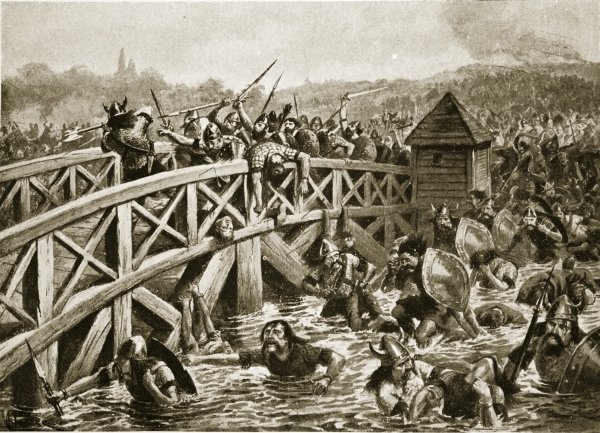


 The incoming Jefferson administration sought to block the appointments. Jefferson ordered then-Secretary of State James Madison to hold those commissions as yet undelivered, thus invalidating the appointments. One of the appointees, William Marbury, took the matter to Court.
 Intimidated by the Roosevelt administration’s aggressive and illegal “
 The framers gave us a Constitutional Republic with co-equal branches of government, with power diffused and limited by a comprehensive set of checks and balances.


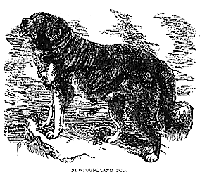 Most of 1803 was spent in planning and preparation, Lewis and Clark joining forces near Louisville that October. After wintering in the Indiana territory base camp in modern day Illinois, the 33-man expedition departed on May 14, 1804, accompanied by “Seaman”, a “Dogg of the Newfoundland breed”.
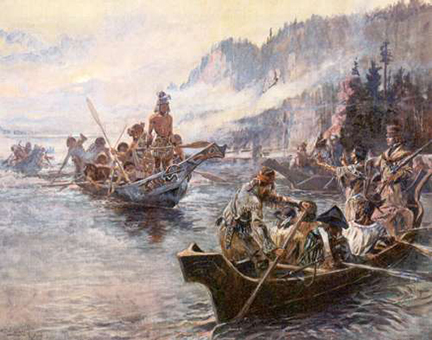 Discovery established friendly relations with at least 24 indigenous tribes, without whose help they may have become lost or starved in the wilderness. Most were more than impressed with Lewis’ state-of-the-art pneumatic rifle, which could silently fire up to 20 rounds after being pumped full of compressed air.
 The Corps of Discovery reached the Pacific Ocean in November 1805, and set out their second winter camp in modern-day Oregon.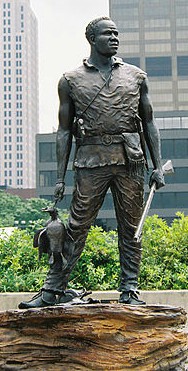


 Washington asked for volunteers for a dangerous mission, to go behind enemy lines, as a spy. Up stepped a volunteer. His name was Nathan Hale.
 Hale took Rogers into his confidence, believing the two to be playing for the same side. Barkhamsted Connecticut shopkeeper Consider Tiffany, a British loyalist and himself a sergeant of the French and Indian War, recorded what happened next, in his journal: “The time being come, Captain Hale repaired to the place agreed on, where he met his pretended friend” (Rogers), “with three or four men of the same stamp, and after being refreshed, began [a]…conversation. But in the height of their conversation, a company of soldiers surrounded the house, and by orders from the commander, seized Captain Hale in an instant. But denying his name, and the business he came upon, he was ordered to New York. But before he was carried far, several persons knew him and called him by name; upon this he was hanged as a spy, some say, without being brought before a court martial.”
 There is no official account of Nathan Hale’s final words, but we have an eyewitness statement from British Captain John Montresor, who was present at the hanging.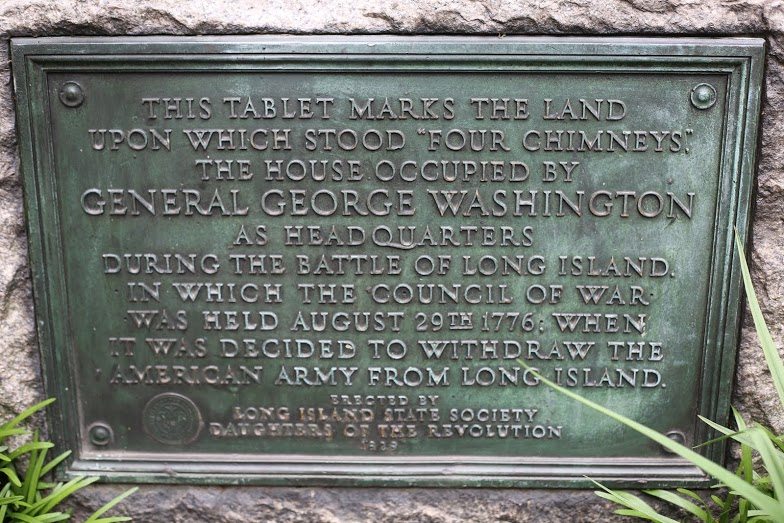




 Vast populations moved westward from Germania during the early fifth century, and into Roman territories in the west and south. They were Alans and Vandals, Suebi, Goths, and Burgundians. There were others as well, crossing the Rhine and the Danube and entering Roman Gaul. They came not in conquest: that would come later. These tribes were fleeing the Huns: a people so terrifying that whole tribes agreed to be disarmed, in exchange for the protection of Rome.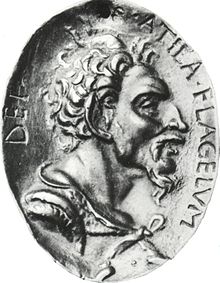

 Valentinian was furious with his sister. Only the influence of their mother Galla Placidia convinced him to exile rather than have her put to death, while he frantically wrote to Attila saying it was all a misunderstanding.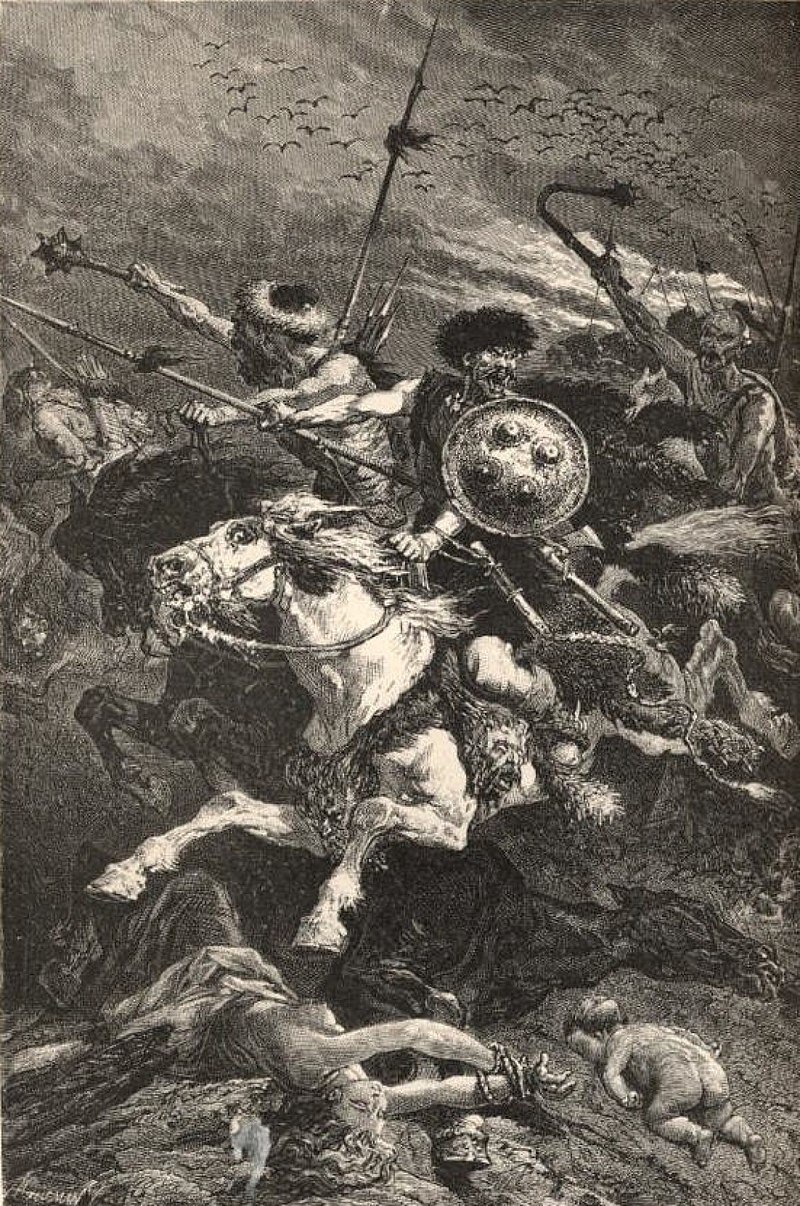


 The story begins with Jefferson Davis, in the 1840s. Now we remember him as the President of the Confederate States of America. Then, he was a United States Senator from Mississippi, with a pet project of introducing camels into the United States.
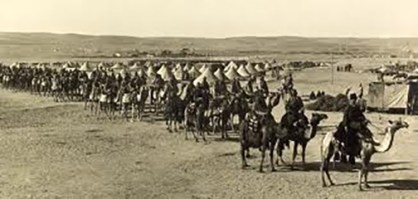 The measure failed, but in the 1850s, then-Secretary of War Davis persuaded President Franklin Pierce that camels were the military super weapons of the future. Able to carry greater loads over longer distances than any other pack animal, Davis saw camels as the high tech weapon of the age. Hundreds of horses and mules were dying in the hot, dry conditions of Southwestern Cavalry outposts, when the government purchased 75 camels from Algeria, Tunisia and Egypt. Several camel handlers came along in the bargain, one of them a Syrian named Haji Ali, who successfully implemented a camel breeding program. Haji Ali became quite the celebrity within the West Texas outpost. The soldiers called him “Hi Jolly”.


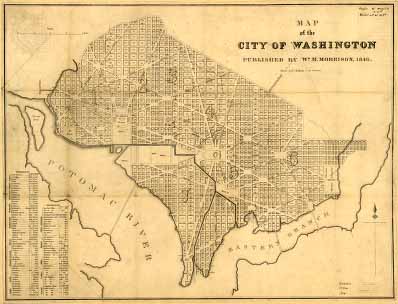 The “Residence Act” of July 1790 established the Federal government along the banks of the Potomac River. The specific site had been up for debate, before Alexander Hamilton brokered a compromise. Several delegates switched support in favor of the current location, in exchange for the Federal government assuming their states’ war debt.
 Funding problems and design squabbles plagued the project from the beginning. The building was incomplete when Congress held its first session there on November 17, 1800.
 By the 1850s, the number of new states’ representatives threatened to exceed the building’s designed capacity. President Millard Fillmore held a design competition, resulting in the House and Senate wings as you see them today.

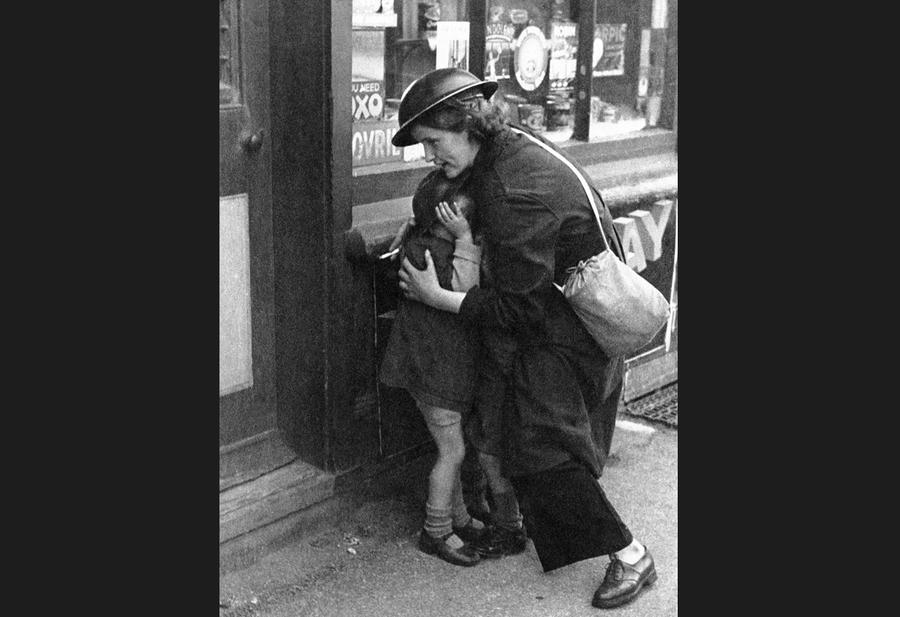


 Germany needed air supremacy before “Operation Sea Lion”, the amphibious invasion of England, could begin. Luftwaffe commander Hermann Göring said he would have it in four days.


 Czechoslovakia fell to the Nazis on the Ides of March, 1939, Czech armed forces having been ordered to offer no resistance. Some 4,000 Czech soldiers and airmen managed to get out, most escaping to neighboring Poland.
 British military authorities were slow to recognize the flying skills of the Polskie Siły Powietrzne (Polish Air Forces), the first fighter squadrons only seeing action in the third phase of the Battle of Britain. Despite the late start, Polish flying skills proved superior to those of less-experienced Commonwealth pilots. The 303rd Polish fighter squadron became the most successful RAF fighter unit of the period, its most prolific flying ace being Czech Sergeant Josef František. He was killed in action in the last phase of the Battle of Britain, the day after his 26th birthday.


 Mad Jack was sent off to Burma, following the defeat of Nazi Germany. He was disappointed by the swift end to the war brought about by the American bombings at Hiroshima and Nagasaki, saying “If it wasn’t for those damn Yanks, we could have kept the war going another 10 years!”


You must be logged in to post a comment.