May 25, 1738  That Other war between the States

The problem comes about when you realize that 40° north latitude is north of Philadelphia, well into territory controlled by the Maryland colony.
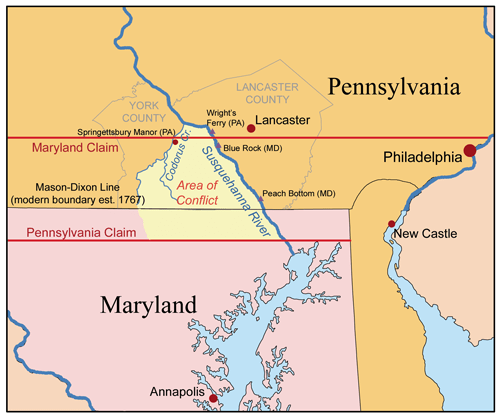
The Pennsylvania Charter of 1681 specifies the southern boundary of the colony to be “A circle drawne at twelve miles distance from New Castle Northward and Westward unto the beginning of the fortieth degree of Northern Latitude, and then by a streight Line Westward“.

The problem comes about when you realize that 40° north latitude is north of Philadelphia, well into territory controlled by the Maryland colony.

cresapwarmap

Maryland insisted on the boundary as drawn by the Charter, while Pennsylvania proposed a boundary near 39°36′, creating a disputed zone of some 28 miles.

In 1726, Quaker minister John Wright began a “ferry” service across the Susquehanna River. Starting as a pair of dugout canoes, “Pennsylvania Dutch” farmers were soon settling the Conejohela Valley on the eastern border between Maryland and Pennsylvania.
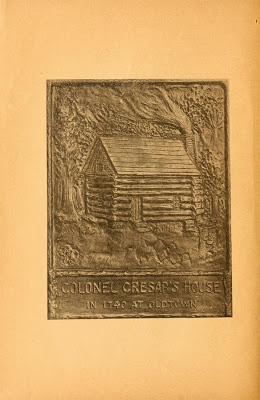
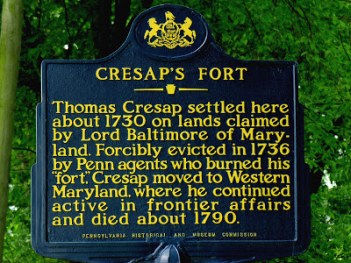
cresap2Business was good.  By 1730, Wright had applied for a ferry license. With Lord Baltimore fearing a loss of control in the area (read – taxes), Maryland resident Thomas Cresap established a second ferry service up the river. Maryland granted Cresap some 500 acres along the west bank, serenely unconcerned that much of the area was already inhabited by Pennsylvania farmers.

Cresap went to these farmers and began collecting “quit-rents”, (an early form of property tax) for the government in Maryland. Pennsylvania authorities responded by issuing “tickets” to settlers which, while not granting immediate title, amounted to an “IOU” of title under Pennsylvania jurisdiction.

When Cresap and his ferry worker were thrown overboard by two Pennsylvanian farmers, probably over a debt, Cresap took the matter to Pennsylvania authorities for justice. After the magistrate said that he couldn’t expect justice in his court because he was a “liver in Maryland”, Cresap filed charges with Maryland authorities, claiming that, as a Maryland resident, he was no longer bound by Pennsylvania law.

Cresap and his gang members began confiscating York and Lancaster county properties as early as 1734, handing them over to supporters. Maryland militia crossed colonial borders twice in 1736, and Pennsylvania militia were quick to respond.
thomas-cresap
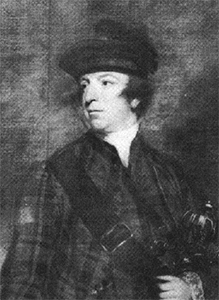
Thomas Cresap

When the Lancaster county Sheriff arrived with a posse to arrest Cresap at his home, Cresap fired through the door, striking and mortally wounding deputy Knowles Daunt. When Daunt died of his wounds, Pennsylvania Governor Patrick Gordon demanded that Maryland arrest Cresap for murder.

Samuel Ogle, Governor of Maryland, responded by naming Cresap a captain of the Maryland militia.

Cresap resumed and expanded his raids, destroying barns and shooting livestock. Sheriff Samuel Smith raised a posse to arrest him in November. When the Pennsylvanians set his cabin on fire, Cresap ran for the river. Grabbing him before he could launch a boat, Cresap shoved one of them overboard, shouting, “Cresap’s getting away!”, whereupon the other deputies proceeded to pound their colleague with oars until one of them discovered the ruse.

Cresap was taken to Lancaster, where he decked the blacksmith who had come to put him in shackles. He was finally subdued and hauled off to Philadelphia in chains, but even then the man was anything but broken. “Damn it”, he said, looking around, “this is one of the prettiest towns in Maryland!”
DSCN8422-1Maryland authorities petitioned George II, King of Great Britain and Ireland, imploring the King to restore order among his subjects. King George’s proclamation of August 18, 1737 instructed the governments of both colonies to cease hostilities. When that failed to stop the fighting, the Crown organized direct negotiations between the two. Peace was signed in London on May 25, 1738, the agreement providing for an exchange of prisoners and a provisional boundary to be drawn fifteen miles south of the southernmost home in Philadelphia, and mandating that neither Maryland nor Pennsylvania “permit or suffer any Tumults Riots or other Outragious Disorders to be committed on the Borders of their respective Provinces.”

So ended the “Conojocular War”, the bloody eight-year conflict between Philadelphia and surrounding area and sometimes referred to as “Cresap’s War”. The matter was settled once and for all, when Penns and Calverts, each descendants of their colonial founders,  hired surveyors Charles Mason and Jeremiah Dixon to establish the modern boundary in 1767. Today, the area in conflict is part of York County, Pennsylvania.

And now you know where that line comes from.

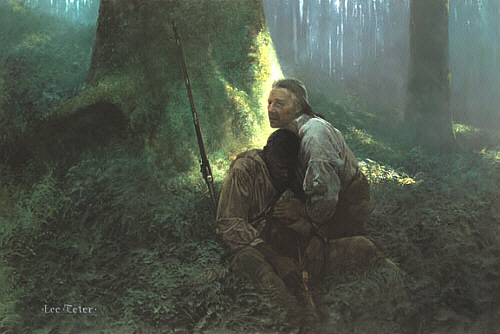
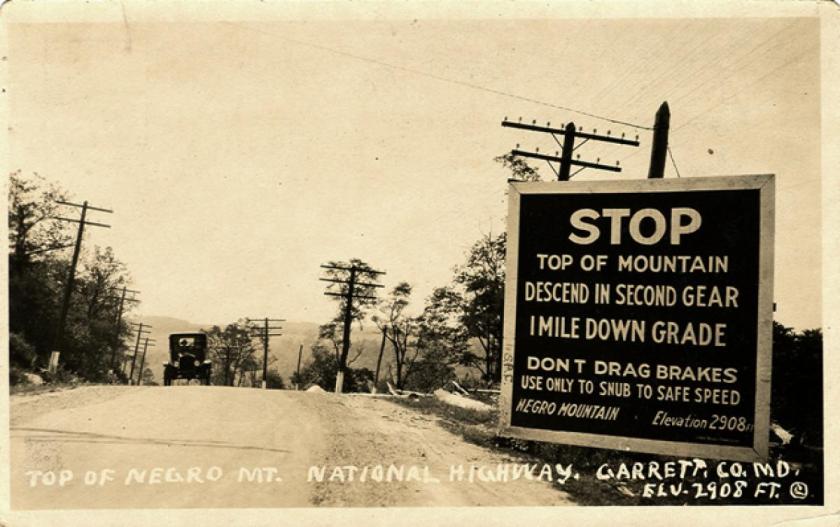
Afterward: During the French & Indian Wars of the 1750s Thomas Cresap and a party of 100 pursued an Indian war band over the present-day Savage Mountain and onto the next. Along with the party marched a free black man, a frontiersman known only as “Nemesis”. A fierce fight ensued on May 28, 1756.  Nemesis, described only as “large and powerfully built”, fought bravely, but lost his life. He was buried on the site, where Cresap named the mountain in his honor. “Negro Mountain”, the long ridge of the Allegheny Mountains stretching from Deep Creek Lake in Maryland, north to the Casselman River in Pennsylvania, stands to this day as his monument. Feature image, top of page, the painting “Shades of Death” by artist Lee Teter, depicts Colonel Thomas Cresap comforting the mortally wounded, heroic frontiersman.
mountain28n-1-web

May 24, 1935 Under the Lights

The first minor league game played under the lights drew 12,000 spectators, at a time when the host club was averaging only 600 per game. As the Great Depression dragged on, minor league owners were finding night games a key to staying in business. Even then, the Poobahs of Major League Baseball were slow to catch on.

The-lamplighterIn 18th century London, it was a bad idea to go out at night. Not without a lantern in one hand, and a club in the other.
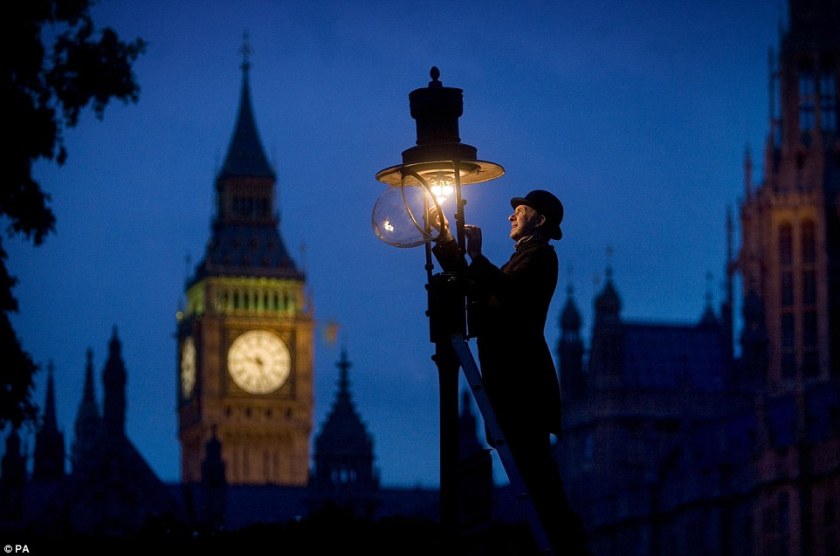
The city introduced its first gas-lit street in 1807 on the Central London Pall Mall, between St. James’s Street & Trafalgar Square. Before long, hundreds of “Lamp Lighters” could be seen with their ladders, gas lights bathing the city in a soft, green glow.

The Westminster Review newspaper opined that gas lamps had done more to eliminate immorality and criminality on the streets, than any number of church sermons.

The United States followed nine years later, when the city of Baltimore lit up in 1816.

Thomas Edison patented the first carbon-thread incandescent lamp in 1879.  The first baseball game played “under the lights” took place the following year near Nantasket Beach, in the ‘south shore’ town of Hull, Massachusetts.

It was September 2, 1880 when two teams, sponsored by the RH White & Co. and Jordan Marsh department stores of Boston, played a full nine innings to a 16-all tie.  The era of the night game had arrived, and the lamp lighters of London, can be seen to this day.

Except, no, it didn’t work out that way.  The lamp lighter part is true enough.  Today, five gas engineers keep the Victorian era alive, winding and checking the mechanisms, polishing the glass and replacing the mantles of some 1,500 – 2,000 gas lamps.

00E97E09000004B0-2848038-It_is_one_of_the_rare_places_in_the_city_where_a_walker_can_imag-4_1416898177238
Modern-day “Lamp Lighter” H/T UK Guardian

Across the pond, organized baseball would take another fifty years to give the arc light another try.

Evidence exists of other 19th-century night games, but these were little more than novelties. Holyoke Massachusetts inventor George F. Cahill, creator of the pitching machine, devised a portable lighting system in 1909. With the blessing of Garry Herrmann, President of the Cincinnati Reds, Cahill staged an exhibition game on the night of June 19, between the Elk Lodges of Cincinnati and Newport, Kentucky.

The crowd of 3,000  had little trouble following the ball and Cahill was an enthusiastic salesman for his invention, but the man was doomed to frustration and disappointment.  Night-time exhibition games were regularly met with great enthusiasm, yet Organized Baseball was slow to catch on.

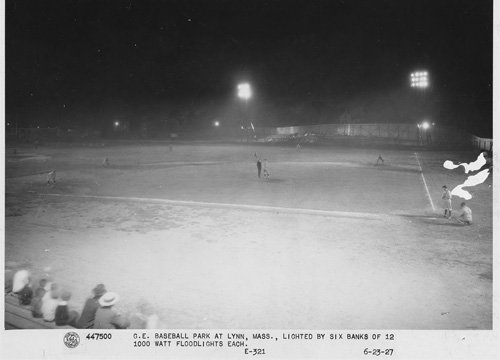
The Class B New England league played a night exhibition game on June 24, 1927 before a crowd of 5,000, sponsored by the General Electric Employees’ Athletic Association. The Washington Senators were in town at that time to play the Boston Red Sox.  Delegations from both clubs were on-hand to watch Lynn defeat Salem in a seven-inning game, 7-2. Washington manager Bucky Harris and Boston manager Bill Carrigan, were impressed. Senator’s star outfielder Goose Goslin expressed a desire to play a night game. Claude Johnson, President of the New England League, predicted that all leagues would have night baseball within five years, including the majors.

Lighting_Baseball2When the Great Depression descended across the land, minor league clubs folded by the bushel. Small town owners were desperate to innovate. The first-ever night game in professional baseball was played on May 2, 1930, when Des Moines, Iowa hosted Wichita for a Western League game.

The game drew 12,000 spectators at a time when Des Moines was averaging just 600 per game.  Soon, minor league owners were finding night games a key to staying in business.

Even then, the Poobahs of Major League Baseball were slow to catch on.  Five years later, the Cincinnati Reds defeated the Philadelphia Phillies in the first-ever big league game played under the lights.

A crowd of 25,000 spectators waited on this day in 1935, as President Roosevelt symbolically turned on the lights from Washington DC.  The Reds played a night game that year against every National League opponent and, despite a losing record of 68-85, enjoyed an increase in paid attendance of 117%.

6DZG7YeE
The first night game in Major League Baseball was played on this day in 1935, when the Cincinnati Reds defeated the Philadelphia Phillies, 2-1

Thoughought the ’30s and ’40s, teams upgraded facilities to include lights and, before long, most of Major League Baseball had night games on the schedule. Wrigley Field, home of the Chicago Cubs and the second-oldest MLB stadium after Fenway Park, was the last to begin hosting night games. To this day, the Cubbies remain the only major league team to host the majority of its games, during the day.

Wrigley’s first officially recorded night game ended in a 6-4 win over the New York Mets on August 8, 1988.

If you enjoyed this “Today in History”, please feel free to re-blog, “like” & share on social media, so that others may find and enjoy it as well. Please click the “follow” button on the right, to receive email updates on new articles.  Thank you for your interest, in the history we all share.

May 23, 1618 Thrown out of the Window

The first such defenestration took place back on July 30, 1419, when radical followers of the Protestant reformer Jan Hus were marching by the new town hall. Someone threw a rock out of the window at them, and they busted down the door.  The mob threw a judge, a Burgomaster and 13 members of the town council out of the window.

Défenestrer:  from dé- +‎ fenêtre +‎ -er.  The word is obsolete now, but in the old French, the root signified “window”.   “Defenestrate” then, combines with an object, meaning to throw a person or thing, out of  the window.

In 1840, a young politician found himself in a legislative minority, opposed to a payment to the Illinois State Bank.  In order to prevent a quorum,  a handful of Whigs attempted to leave the chamber.  Finding the door locked, our man stepped to a second-story window, and jumped out.  Abraham Lincoln would come to regret what he called his “window scrape”, but the future 16th President was far from the first politician to jump out of a window.  Voluntarily, or otherwise.

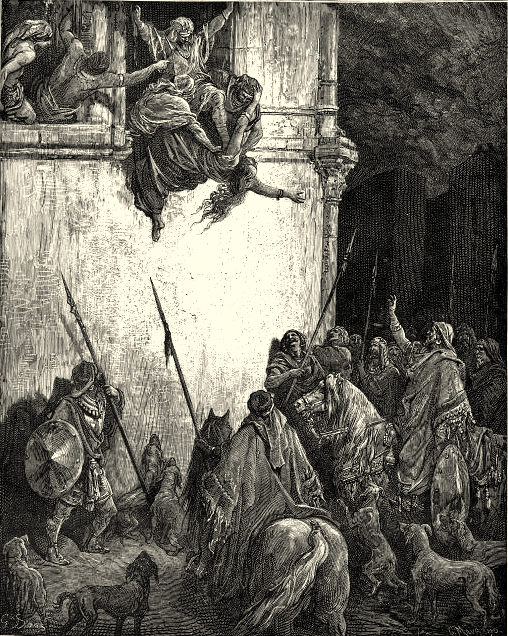
Jezebel, yeah that Jezebel, the unlovable Queen of Israel from the Bible, was executed by defenestration, in BC842.

Defenestration-Jezebel-Gustave-Dore
Defenestration of Jezebel by Gustave Dore

In 1617, the Kingdom of Bohemia included pretty much all of the modern-day Czech Republic, a principality in those days ruled by the Habsburg dynasty, and included in the Holy Roman Empire.

Ever since the Peace of Augsburg in 1555, the religious persuasion of all subjects was guided by the principle of “Cuius Regio, Eius Religio“:   the ruling Prince got to choose the religious practices of his subjects.

The system worked fairly well, and Emperor Rudolf II further guaranteed religious liberty in his “Letter of Majesty”, of 1609. Then came King Matthias, aging and without issue, who elected Ferdinand of Styria his heir in 1617. Now everything changed. A strong proponent of the Catholic counter-reformation, Ferdinand was not well disposed to the religious liberties of the Protestant majority. Before long, Bohemian officials were closing Protestant chapels.

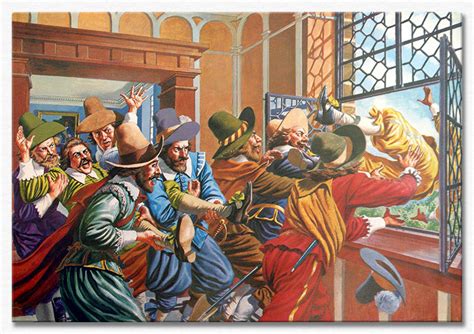
defenestration

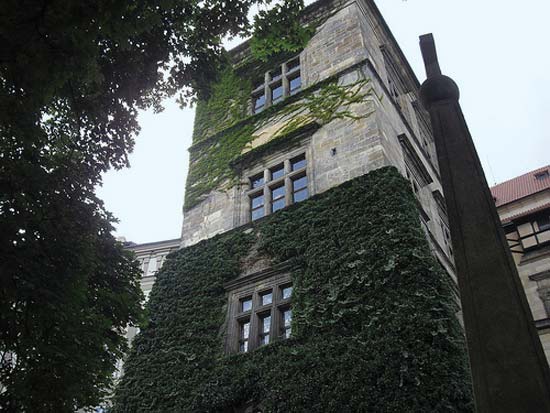
On May 23, 1618, “Defensors” appointed under the Letter of Majesty to protect Protestant rights called an assembly in Prague, trying and convicting the Imperial Regents of violating their religious rights. These Regents were Vilem Slavata of Chlum, and Count Jaroslav Borzita of Martinice. Having been found guilty, they, along with their secretary Philip Fabricius, were thrown out of the windows of Prague Castle. Literally.

It was 70-ft. down, to the street.

141270-004-701F2730

This event, the Defenestration of Prague, signaled the beginning of the 30 years’ war, but this wasn’t the first time that someone had been thrown out of a Prague window.

The first such defenestration took place back on July 30, 1419, when radical followers of the Protestant reformer Jan Hus were marching by the new town hall. Someone threw a rock out of the window at them, and they busted down the door.  The mob threw a judge, a Burgomaster (“Master of the Town”) and 13 members of the town council out of the window.

These guys weren’t as fortunate as the victims of the second defenestration, 200 years later.  These guys died in the fall or were dispatched by the mob, below.

What happened to the victims of the second defenestration? Surprisingly, none of the three were seriously injured. Supporters claimed they were caught and protected from injury by holy angels.  Detractors attributed their salvation to a pile of horseshit.  Be that as it may, Phillip Fabricius was made a Noble by the Emperor, and granted a title:  Baron von Hohenfall.   (“Baron of Highfall“).

I swear I wouldn’t make that up.


If you enjoyed this “Today in History”, please feel free to re-blog, “like” & share on social media, so that others may find and enjoy it as well. Please click the “follow” button on the right, to receive email updates on new articles.  Thank you for your interest, in the history we all share.

May 22, 1856 State’s Rights

The issue of slavery had joined and become so intertwined with ideas of self-determination, as to be indistinguishable.

Since the earliest days of the Republic, those supporting strong federal government found themselves opposed by those favoring greater self-determination by the states. In the southern regions, climate conditions led to dependence on agriculture, the rural economies of the south producing cotton, rice, sugar, indigo and tobacco. Colder states to the north tended to develop manufacturing economies, urban centers growing up in service to hubs of transportation and the production of manufactured goods.

domestic-tariffs-at-the-souths-expense (1)In the first half of the 19th century, 90% of federal government revenue came from tariffs on foreign manufactured goods. A lion’s share of this revenue was collected in the south, with the region’s greater dependence on imported goods.  Much of this federal largesse was spent in the north, with the construction of railroads, canals and other infrastructure.
The debate over economic issues and rights of self-determination, so-called ‘state’s rights’, grew and sharpened with the “nullification crisis” of 1832-33, when South Carolina declared such tariffs to be unconstitutional and therefore null and void within the state. A cartoon from the time depicted “Northern domestic manufacturers getting fat at the expense of impoverishing the South under protective tariffs.”

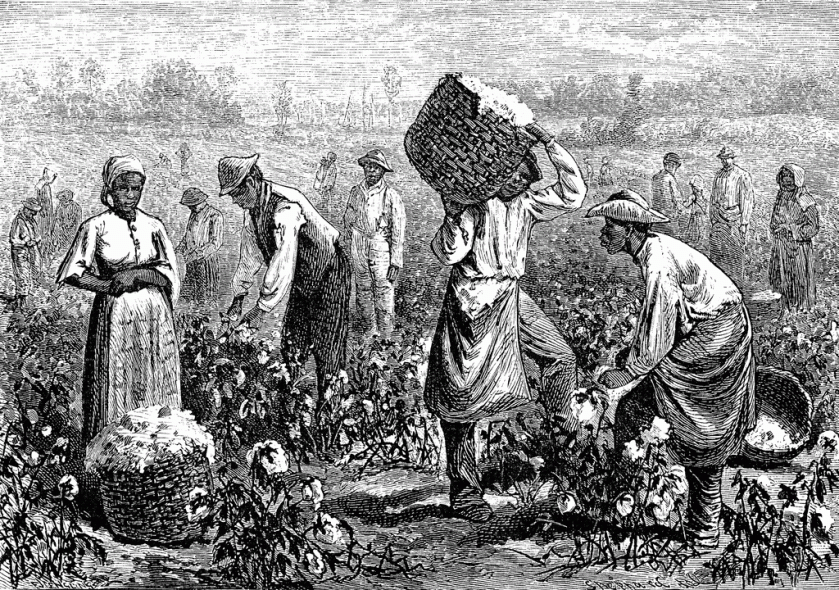
Chattel slavery pre-existed the earliest days of the colonial era, from Canada to Brazil and around the world. Moral objections to what was really a repugnant institution could be found throughout, but economic forces had as much to do with ending the practice, as any other. The “peculiar institution” died out first in the colder regions of the US and may have done so in warmer climes as well, but for Eli Whitney’s invention of a cotton engine (‘gin’) in 1794.

It takes ten man-hours to remove the seeds to produce a single pound of cotton. By comparison, a cotton gin can process about a thousand pounds a day, at comparatively little expense.

54521_cotton-pick_lg

The year of Whitney’s invention, the South exported 138,000 pounds a year to Europe and the northern states. Sixty years later, Great Britain alone was importing 600 million pounds a year from the southern states. Cotton was King, and with good reason.  The stuff is easily grown, highly transportable, and can be stored indefinitely, compared with food crops.  The southern economy turned overwhelmingly to the one crop, and its need for plentiful, cheap labor.

25The issue of slavery had joined and become so intertwined with ideas of self-determination, as to be indistinguishable.

The first half of the 19th century was one of westward expansion, generating frequent and sharp conflicts between pro and anti-slavery factions. The Missouri compromise of 1820 attempted to reconcile the sides, defining which territories would legalize slavery, and which would be “free”.

The short-lived “Wilmot Proviso” of 1846 sought to ban slavery in new territories, after which the Compromise of 1850 attempted to strike a balance.  The Kansas Nebraska Act of 1854 created two new territories, essentially repealing the Missouri Compromise and allowing settlers to determine their own direction.

This attempt to democratize the issue had the effect of drawing up battle lines.  Pro-slavery forces established a territorial capital in Lecompton, while “antis” set up an alternative government in Topeka.

78451229_783584_lIn Washington, Republicans backed the anti-slavery side, while most Democrats supported their opponents.  On May 20, 1856, Massachusetts Senator Charles Sumner took to the floor of the Senate and denounced the Kansas-Nebraska Act.  Never known for verbal restraint, Sumner attacked the measure’s sponsors Stephen A. Douglas of Illinois (he of the later Lincoln-Douglas debates), and Andrew Butler of South Carolina by name, accusing the pair of “consorting with the harlot, slavery”.  Douglas was in the audience at the time and quipped “this damn fool Sumner is going to get himself shot by some other damn fool”.
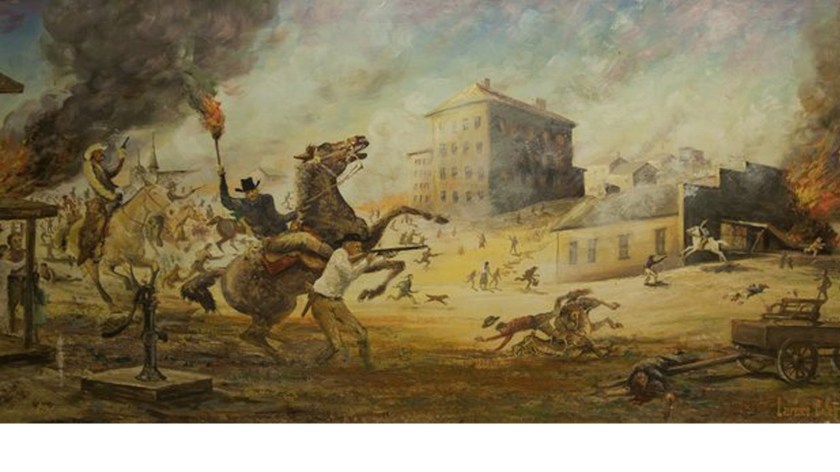
In the territories, the standoff had long since escalated to violence. Upwards of a hundred or more were killed between 1854 – 1861, in a period known as “Bleeding Kansas”.

The town of Lawrence was established by anti-slavery settlers in 1854, and soon became the focal point of pro-slavery violence. Emotions were at a boiling point when Douglas County Sheriff Samuel Jones was shot trying to arrest free-state settlers on April 23, 1856. Jones was driven out of town but he would return.

Lawrence Massacre
Sack of Lawrence, Kansas

The day after Sumner’s speech, a posse of 800 pro-slavery forces converged on Lawrence Kansas, led by Sheriff Jones.  The town was surrounded to prevent escape and much of it burned to the ground.  This time there was only one fatality; a slavery proponent who was killed by falling masonry.  Seven years later, Confederate guerrilla Robert Clarke Quantrill carried out the second sack of Lawrence.  This time, most of the men and boys of the town were murdered where they stood, with little chance to defend themselves.

Meanwhile, Preston Brooks, Senator Butler’s nephew and a Member of Congress from South Carolina, had read over Sumner’s speech of the day before.  Brooks was an inflexible proponent of slavery and took mortal insult from Sumner’s words.


Preston Brooks (left), Charles Sumner, (right)

Brooks was furious and wanted to challenge the Senator to a duel. He discussed it with fellow South Carolina Representative Laurence Keitt, who explained that dueling was for gentlemen of equal social standing. Sumner was no gentleman, he said.  No better than a drunkard.

Brooks had been shot in a duel years before, and walked with a heavy cane. Resolved to publicly thrash the Senator from Massachusetts, the Congressman entered the Senate building on May 22, in the company of Congressman Keitt and Virginia Representative Henry A. Edmundson.

Caning of Charles SumnerThe trio approached Sumner, who was sitting at his desk writing letters. “Mr. Sumner”, Brooks said, “I have read your speech twice over carefully. It is a libel on South Carolina, and Mr. Butler, who is a relative of mine.”

Sumner’s desk was bolted to the floor.  He never had a chance. The Senator began to rise when Brooks brought the cane down on his head. Over and over the cane crashed down, while Keitt brandished a pistol, warning onlookers to “let them be”. Blinded by his own blood, Sumner tore the desk from the floor in his struggle to escape, losing consciousness as he tried to crawl away. Brooks rained down blows the entire time, even after the body lay motionless, until finally, the cane broke apart.

states_rights_imgIn the next two days, a group of unarmed men will be hacked to pieces by anti-slavery radicals, on the banks of Pottawatomie Creek.
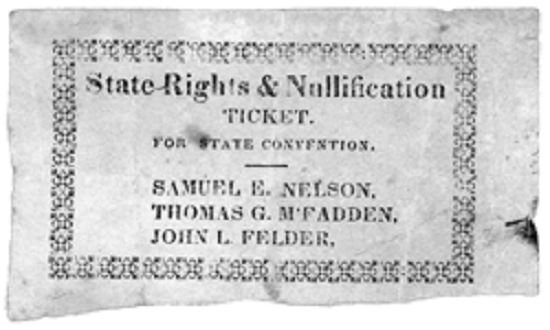
The 80-year-old nation forged inexorably onward, to a Civil War which would kill more Americans than every war from the American Revolution to the War on Terror, combined.

StateRights_and_Nullification

If you enjoyed this “Today in History”, please feel free to re-blog, “like” & share on social media, so that others may find and enjoy it as well. Please click the “follow” button on the right, to receive email updates on new articles.  Thank you for your interest, in the history we all share.

May 21, 1944 That Other Disaster, at Pearl Harbor

Details of the West Loch disaster would remain classified until 1960, explaining why the incident is so little known, today.

Between June and November 1944, forces of the United States Marine Corps and Army conducted Operation Forager with support from the United States Navy, an offensive intended to dislodge Imperial Japanese forces from the Mariana Islands and the island nation of Palau.

Part of the island-hopping strategy employed during the last two years of WW2, Operation Forager followed the Gilbert and Marshall Islands campaign and had as its objective the neutralization of Japanese bases in the central Pacific, support for the Allied drive to retake the Philippines, and to provide bases for strategic bombing raids against the Japanese home islands.

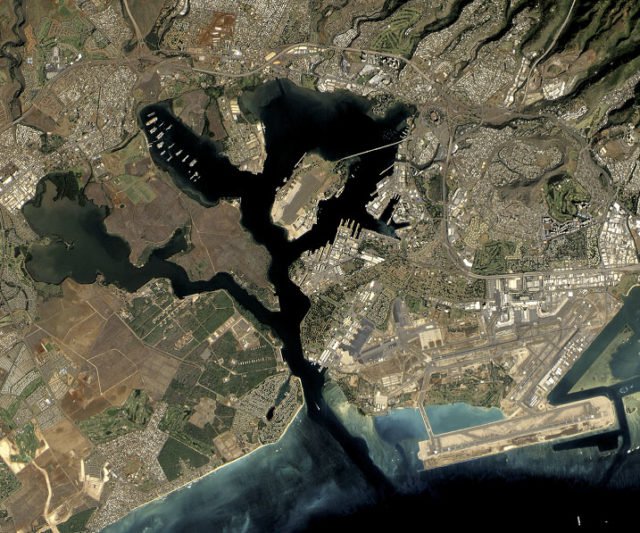
pearlharbor_sm-640x533
A NASA image of Pearl Harbor. The disaster occurred in West Loch which is to the left side of the photo, where the water is lighter in color.

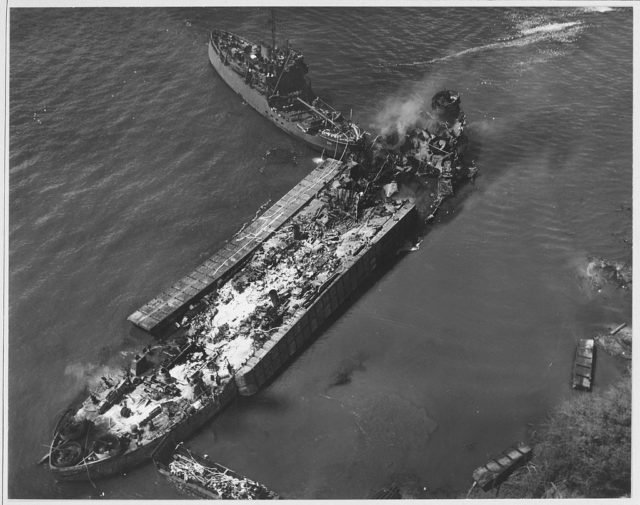
In May 1944, the Pacific naval anchorage at Pearl Harbor was a rush of activity, building up for the planned invasion.  Seventy-four years ago today, twenty-nine Landing Ships, Tank (LSTs) were tied beam-to-beam on six piers, loading munitions, high octane gasoline and other equipment.

LST_Sicily
LST in Sicily

LST-353 exploded shortly after three in the afternoon, causing an incendiary chain reaction down the line of LSTs. 200 men were blown into the water in the first few minutes, in explosions powerful enough to knock vehicles on their sides. Eleven buildings on the shore were destroyed altogether and another nine, damaged.

Firefighting efforts were slow to get underway, due to the heat and the inexperience of many of the crew. Some LSTs began to move away under their own power or with the assistance of tugs, others were abandoned and left adrift and burning, before sinking in the channel.

Burning gasoline spread across the water and ignited other ships, left unharmed by the initial explosions. Fires continued to burn for the next twenty-four hours.

Casualty figures are surprisingly inexact. Most sources report 163 personnel killed in the incident and another 396, wounded. Some sources put the number of dead as high as 392.  Eleven tugboats were damaged while engaged in fire control efforts.  Six LSTs were sunk, two already carrying smaller, fully loaded Landing Craft Tanks (LCT) lashed to their decks.  Several others were heavily damaged and/or run aground.

A press blackout was ordered immediately after the incident, and military personnel were ordered not to talk. A Naval Board of Inquiry was opened the following day. The disaster at West Loch was initially believed to be caused by Japanese submarines, but the idea was dismissed due to the shallow depth of the harbor, and the presence of anti-submarine nets.

lst-480_following_west_loch_disaster-640x505
The wreckage of the LST 480 following the West Loch Disaster.

The precise cause of the accident remained elusive, as everyone near the initial explosion was killed. Army stevedores were unloading mortar ammunition at the time, using an elevator just fifteen feet from 80 drums of fuel. Some believe that a mortar round was accidentally dropped and exploded, others that fuel vapors were ignited by a cigarette or welder’s torch.

Subsequent salvage and removal efforts on the West Loch brought up the remains of a Japanese midget submarine, now believed to be the fifth such sub used in the attack of two years earlier.

Details of the West Loch disaster would remain classified until 1960, explaining why the incident is so little known, today.

1000w_q95

The last fatality from the disaster at West Loch occurred nine months later, during salvage operations for a sunken LST.

330px-Owen_F_P_Hammerberg

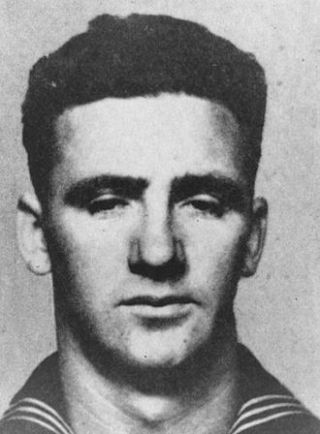
Boatswain’s Mate 2nd Class Owen Francis Patrick Hammerberg

On February 17, 1945, two divers were using jet nozzles to tunnel under a sunken LST, when the steel wreckage above them caved in. Buried alive with lifelines and air hoses hopelessly tangled with jagged pieces of steel, the pair was trapped under 40′ of water and another 20′ of mud.  There seemed no chance of survival, when fellow Navy diver Owen Francis Patrick Hammerberg went into the water.

Working in the swirling mud and pitch blackness beneath the bottom of Pearl Harbor, the diver worked desperately to wash another tunnel under the sunken LST.  Hammerberg reached the first man after hours of exhausting labor, freeing his lines and enabling the man to reach the surface.

Let Owen Hammerberg’s Medal of Honor citation, the one he would not live to read, tell what happened next.

Cmoh_army“…Venturing still farther under the buried hulk, he held tenaciously to his purpose, reaching a place immediately above the other man just as another cave-in occurred and a heavy piece of steel pinned him crosswise over his shipmate in a position which protected the man beneath from further injury while placing the full brunt of terrific pressure on himself. Although he succumbed in agony 18 hours after he had gone to the aid of his fellow divers, Hammerberg, by his cool judgment, unfaltering professional skill and consistent disregard of all personal danger in the face of tremendous odds, had contributed effectively to the saving of his 2 comrades…”.

Navy diver and Boatswain’s Mate 2nd Class Owen Francis Patrick Hammerberg was the only service member in WW2 and the last person ever, to receive the Medal of Honor as the result of heroism performed outside of combat.

If you enjoyed this “Today in History”, please feel free to re-blog, “like” & share on social media, so that others may find and enjoy it as well. Please click the “follow” button on the right, to receive email updates on new articles.  Thank you for your interest, in the history we all share.

May 20, 1942 White Feather Sniper

The elite sniper must be able to bear heat and insects and rain and a thousand other torments, all while hiding in plain sight from people who want more than life itself, to kill them.

The world of the elite sniper is different from anything most of us will ever experience. Able marksmanship (“one shot, one kill”) is only the beginning. The sniper must be expert at camouflage, field craft, infiltration, reconnaissance, ex-filtration and observation. He or she must be skilled in urban, desert and/or jungle warfare. They must be able to bear heat and insects and rain and a thousand other torments, all while hiding in plain sight from people who want more than life itself, to kill them.

carlos-hathcockCarlos Norman Hathcock, born this day in Little Rock in 1942, was a Marine Corps Gunnery Sergeant and sniper with a record of 93 confirmed and greater than 300 unconfirmed kills during the American war in Vietnam.

The Viet Cong and NVA called him “du kich Lông Trắng,” translating as “White Feather Sniper”, after the object he wore in his bush hat.

At another time and place, a white feather was bestowed as a symbol of cowardice, an often misplaced emblem of feminine patriotic zeal. Not with this guy.  Hathcock once took four days and three nights to cross 1,500 yards of open ground, stalking and killing a North Vietnamese General before withdrawing without detection. He was almost stepped on by NVA soldiers who were frantically searching for him, and nearly bitten by a deadly Bamboo Viper. It was the only time he ever removed that white feather from his bush hat.

Hathcock once took out an enemy soldier at a distance so great, the man couldn’t be seen with the naked eye. One shot, one kill.

9fa4afc0e7019de60f36f410659f4caaThe sniper’s choice of target could at times be intensely personal. One female Vietcong sniper, the platoon leader and interrogator called ‘Apache’ due to her interrogation techniques, would torture Marines and ARVN soldiers until they bled to death. Her signature was to cut the eyelids off her victims. After she skinned one Marine alive and left him emasculated within earshot of his base, Hatchcock spent weeks hunting this one sniper.
One day, Hathcock was tracking an NVA patrol, when he spotted the enemy sniper from the length of seven football fields. “We were in the midst of switching rifles,” he said. “We saw them. I saw a group coming, five of them. I saw her squat to pee, that’s how I knew it was her. They tried to get her to stop, but she didn’t stop. I stopped her. I put one extra in her for good measure.”

At a time when a typical NVA bounty for American snipers ranged from $8 to $2,000, the North Vietnamese set a  bounty of $30,000 on Hathcock’s head, so great was the damage he had done to their numbers. Whole platoons of counter snipers were sent to kill him. Marines in the area began to wear white feathers of their own, preferring to draw enemy fire on themselves rather than lose such a valuable asset.

The elite Vietcong sniper known as “The Cobra” had already taken the lives of several Marines, when he was sent specifically to kill Hathcock. The two elite snipers stalked each other for days when the Marine fired on a glint of light in the jungle, 300 yards distant. They found the enemy sniper dead, the round having traveled up the man’s scope and into his eye.

Such a shot is only possible if the two snipers were zeroed in on each other at the precise instant of the shot.  Let the man tell the story in his own words.

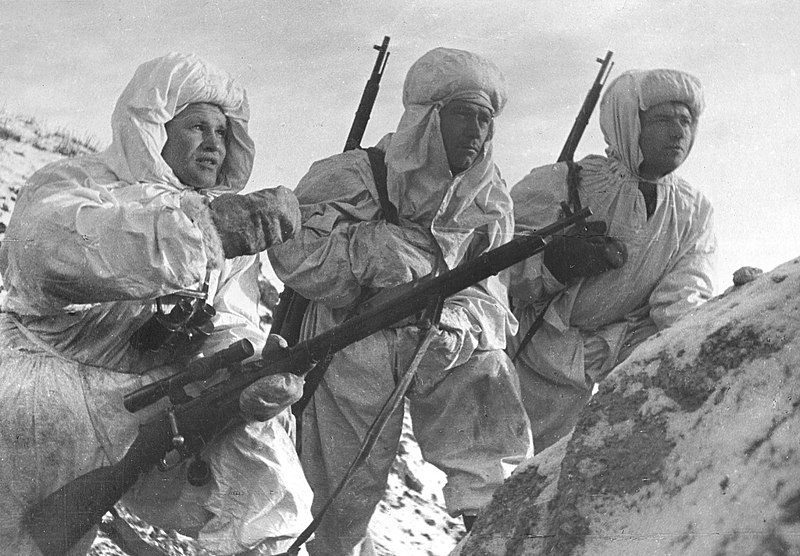
A through-the-scope shot is supposed to have taken place during the “War of the Rats” (“Rattenkrieg”) phase of the siege of Stalingrad, between Russian sniper Vasily Zaytsev and the Wehrmacht sniper school director sent to kill him, Major Erwin König.  There is some controversy as to whether such a shot ever took place.

Zaitsev
Vasily Zaytsev, left, and soviet snipers equipped with Mosin-Nagant M1891/30 with PE scope in Stalingrad, December 1942.

A 2006 episode of Mythbusters “proved” that the shot is impossible, but I enthusiastically disagree.   Adam Savage, Jamie Hyneman et.al. used a multiple-lensed scope for their test, while the Soviet made scope used by the Vietnamese sniper had only one or two internal lenses.

History.com and Marine Corps sniper Staff Seregeant Steve Reichert, USMC Retired, conducted a more realistic test at the at the T1G tactical training facility in Memphis, TN, with assistance from the appropriately-named mannequin, “Dead Fred”.  Reichert’s test (below) demonstrates that the “through the scope” shot not only Can happen under the right conditions, but that, in all probability,  it Did.

Carlos Hathcock developed Multiple Sclerosis in his later years, and passed away on February 23, 1999. He was decorated with the Silver Star, the Purple Heart and Navy and Marine Corps Commendation Medal. The honor he would perhaps have treasured most, was that of having a rifle named after him, a variant of the Springfield Armory M21 called the M25 “White Feather”.

springfield

If you enjoyed this “Today in History”, please feel free to re-blog, “like” & share on social media, so that others may find and enjoy it as well. Please click the “follow” button on the right, to receive email updates on new articles.  Thank you for your interest, in the history we all share.

May 19, 1944 The Seven Dwarves of Auschwitz

Not even concentration camp guards could resist the irony of seven dwarves. They immediately awakened Dr. Josef Mengele, the “Angel of Death”.

Shimson Eizik Ovitz was a Romanian rabbi, a WWI-era entertainer, and a man afflicted with pseudoachondroplasia. He was a dwarf. Ovitz fathered 10 children by two normal sized wives:  Brana Fruchter and Batia Bertha Husz. Three of those grew to normal height, the other seven were dwarves.

Batia gave the kids a piece of advice that stuck with them, all their lives: “through thick and thin” she said, “never separate. Stick together, guard each other, and live for one another”.

war2_1687882a

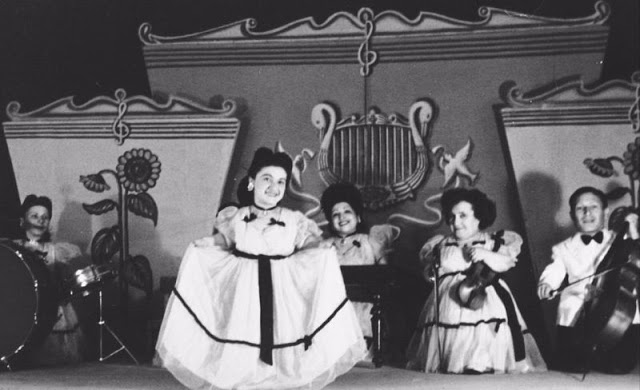
The dwarves were talented musicians, performing a variety show throughout the ’30s and early ’40s as the “Lilliput Troupe”. They toured Romania, Hungary and Czechoslovakia with their normal height siblings serving as road crew, until being swept up by the Nazis and deported to Auschwitz.

The train arrived around midnight on May 19th, 1944 and, accustomed to celebrity, one began to give out autographed cards. The family would soon be disabused of any notions of celebrity.

Not even concentration camp guards could resist the irony of seven dwarves. Dr. Josef Mengele was immediately awakened, knowing of his perverse fascination with the malformed, and what he called “blood” (family) experiments. The “Angel of Death”was delighted, “I now have work for 20 years”.

the-dwarves-of-auschwitz-4

The ten siblings were spared from the gas chamber that night, along with two more family members, a 15-month old boy and a 58-year old woman. Families of their handyman and a neighbor were also spared, insisting that they were close relatives. A total of 22 people.

The family was housed in horrific conditions, yet seven dwarves didn’t come along every day.  They were kept alive for further use and, as bad as it was, the food and clothing was better than that received by most camp inmates. Mengele even allowed them to keep their hair, and arranged special living quarters for them.

The bizarre and hideous “experiments” Mengele performed in the name of “science” were little more than torture rituals.  The three skeletons displayed of their dwarf predecessors, an ever-present reminder of what could be.  Boiling water was poured into their ears followed by freezing.  Eyelashes and teeth were pulled without anesthesia.  Blood was drawn until they would throw up and pass out, only to be revived to have more blood drawn.

the-ovitzs-leaving-the-ca-008

On one occasion, the Angel of Death told the family they were “going to a beautiful place”. Terrified, the siblings were given makeup, and told to dress themselves. Brought to a nearby theater and placed onstage, the family must have thought they’d be asked to perform. Instead, Mengele ordered them to undress, leaving all seven naked before a room full of SS men.  Mengele gave a speech, and then the audience was invited onstage to poke and prod the humiliated family.

One day of fresh horrors ended to reveal the next, and still they lived.  It was unusual for even two or three siblings to survive the Auschwitz death camp.  I don’t believe there was another instance where a family of twelve lived to tell the tale.

Auschwitz was liberated by the Soviet Red Army on January 27, 1945.

Traveling by foot to their Transylvanian home village of Rozavlea, the family found it ruined, though they did find a stash of gold coins where they had left it, buried for safekeeping before the war.

ba132f2b89040eef0fb0b59e29512bafThere was no future for them in this place.  Only 50 of the 650 Jewish inhabitants of the village ever returned. The family emigrated to Israel in May 1949, resuming their musical tour and performing until the group retired in 1955.
Josef Mengele never faced justice. He fled to South America after the war, and suffered a stroke while swimming in 1979.  The cause of death for one of the great monsters of history, was accidental drowning.

The youngest and last of the Ovitz dwarves, Piroska, “Perla” to her friends, passed away two days before the terrorist attack on the World Trade Towers. She spoke for the whole family, I think, when she said “I was saved by the grace of the devil”.

If you enjoyed this “Today in History”, please feel free to re-blog, “like” & share on social media, so that others may find and enjoy it as well. Please click the “follow” button on the right, to receive email updates on new articles.  Thank you for your interest, in the history we all share.

March 18, 2011 No Ordinary Donkey

For the family who now owned him, the  neglected, half-starved pack animal out back suddenly became a “beloved pet”.  They couldn’t possible let him go for anything less than $30,000.  (But, of course).

Al Taqaddum Airbase, “TQ” in military parlance, is a military airbase, 45 miles west of Baghdad, on the Habbaniyah Plateau of Iraq. In 2008, Al Taqaddum was home to the 1st Marine Logistics Group, under the command of Colonel John D. Folsom.

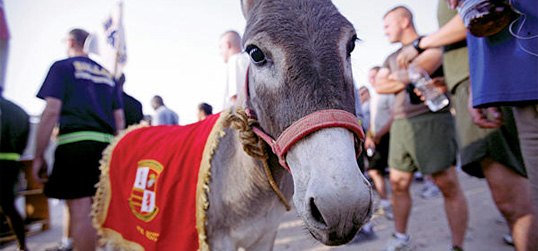
wwfs-colonel-folsom-smallEarly one August morning, Colonel Folsom awoke to a new sound. The thwap-thwap-thwap of the helicopters, the endless hum of the generators, those were the sounds of everyday life. This sound was different – the sound of braying donkey.
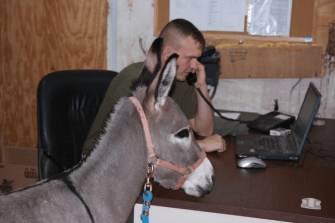
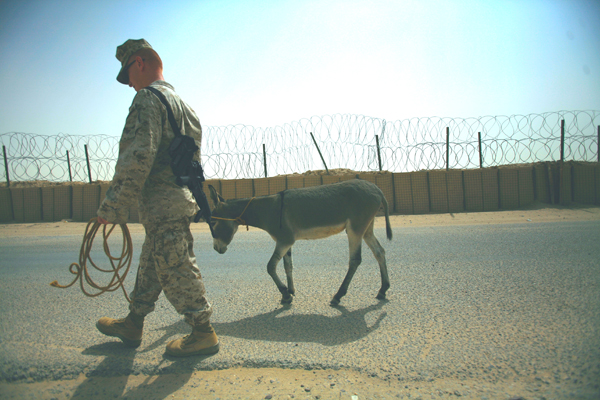
Folsom emerged from his quarters to find the small, emaciated animal, tied to a eucalyptus tree.  Standing all of 3′ tall, a sergeant had spotted the donkey roaming outside Camp Taqaddum, and thought it would be amusing to catch him.  Folsom thought it might be fun to have one around. Time would tell they were both right.

Smoke visits Sgt Lonnie Forrest

The website for a UK donkey sanctuary recommends a diet of highly fibrous plant material, eaten in small quantities throughout the day. I read the list twice and nowhere will you find bagels yet, for this little Iraqi donkey, there was nothing better.  Preferably frozen.  He’d hold them in his mouth and walk along, scraping the bagel in the dirt before eating it.  He liked to play the same game, with a deflated rubber ball.

You won’t find cigarettes on the list either, but he stole one once, and gobbled it down.  It didn’t seem to matter that the thing was lit.  For that reason and because of the color of his coat, the Marines called him “Smoke”.

Smoke-the-donkey-MattShelatoBefore long,  Smoke was a familiar sight around Camp Taqaddum.  After long walks around the wire, Smoke learned to open doors and wander around.  If you ever left that candy dish out on your desk, you were on your own.

SmokeRegulations prohibit the keeping of pets in a war zone.  A Navy Captain helped get Smoke designated as a therapy animal, and he was home to stay.  As it turned out, there was more than a little truth to the label.  For young women and men thousands of miles from home in a war zone, the little animal was a welcome reminder of home.
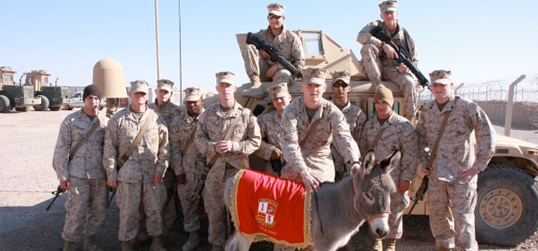
The humor of the situation was hard to resist, and the “ass jokes” all but told themselves.  (Sorry, but we’re talking about Marines, here).  Dozens of Marines laughed uproariously in that mess hall in 2009, belting out a mangled version of an old Kenny Rogers song: “Yes, he’s once, twice, three times a donkey…. I loooooovvvvvveeeeee youuuuuuuuu.”

That was the year when Folsom’s unit cycled out of Camp Taqaddum, to be replaced by another contingent of Marines.  These promised to look after the 1st MLG’s mascot, but things didn’t work out that way.  A Major gave the donkey away to a Sheikh who in turn dumped him off on an Iraqi family, and that was the end.  Except, it wasn’t.

Smoke-Home-LowerColonel Folsom couldn’t get the little animal out of his head and, learning of his plight in 2010, determined to get him back.  There were plenty of kids who had survived trauma of all kinds in his home state of Nebraska.  Folsom believed that the animal could do them some good, as well.
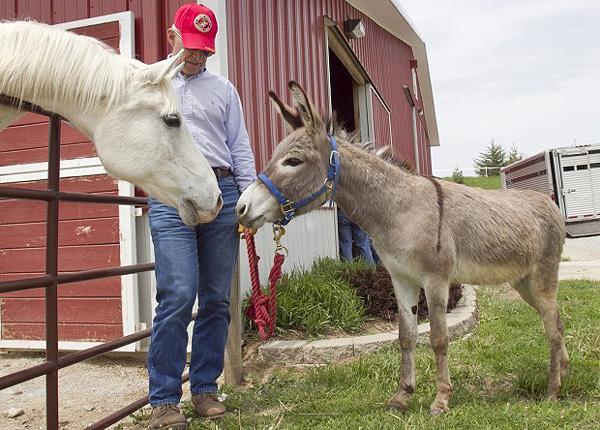
There ensued a months-long wrangle with American and Iraqi authorities, who couldn’t understand why all the fuss over a donkey.  For the family who now owned him, the  neglected, half-starved pack animal out back suddenly became a “beloved pet”.  They couldn’t possible let him go for anything less than $30,000.  (But, of course).

900 donors pitched in and, despite seemingly endless obstacles and miles of red tape, Smoke the Donkey slowly made his way from al-Anbar to Kuwait and on to Turkey and finally, to his new home in Nebraska.

smoke-donkey-omaha.600pjpg
Smoke the Marine Corps Donkey, at his new home in Omaha

ABCNews.com broadcast this announcement on May 18, 2011. Smoke the Marine Corps Donkey, “mascot, ambassador, and battle buddy”, was now, an American.  Semper Fi.

May 17, 1781 Faces of the Revolution

To look into the eyes of such men is to compress time, to reach back before the age of photography, and look into eyes that saw the birth of a nation.

FOTR, Dr Eneas Munson
Dr Eneas Munson

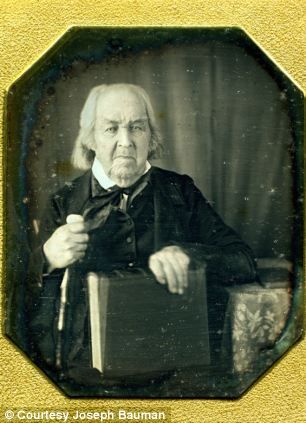
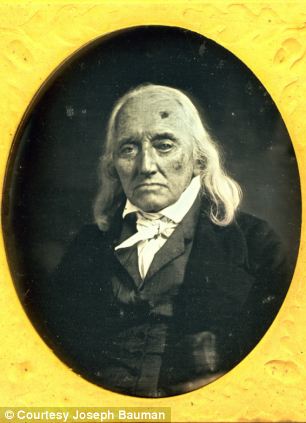
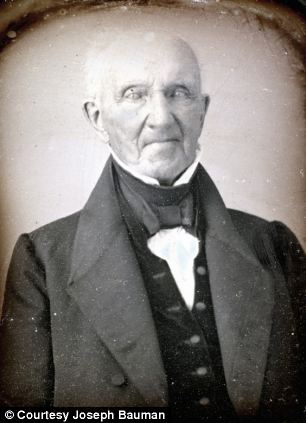
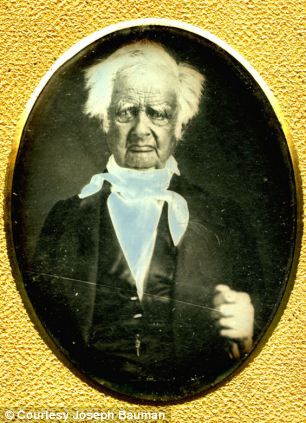
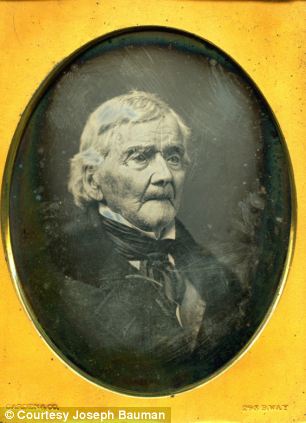
Imagine seeing the faces of the men who fought the American Revolution.  Not the paintings, there’s nothing extraordinary about that, except for the talent of the artist.  I mean their photographs – images that make it possible for you to look into their eyes.

In a letter dated May 17, 1781 and addressed to Alexander Scammell, General George Washington outlined his intention to form a light infantry unit, under Scammell’s leadership.

Comprised of Continental Line units from Connecticut, Massachusetts and New Hampshire, Milford, Massachusetts-born Colonel’s unit was among the defensive forces which kept Sir Henry Clinton penned up in New York City, as much of the Continental army made its way south, toward a place called Yorktown.

FOTR, Rev Levi Hayes
Reverend Levi Hayes was a fifer with a Connecticut regiment

Among the men under Scammell’s command was Henry Dearborn, future Secretary of War, under President Thomas Jefferson. A teenage medic was also present.  His name was Eneas Munson.

One day, the medic would go on to become Doctor Eneas Munson, professor of the Yale Medical School in New Haven Connecticut,  President of the Medical Society of that same state.  And a man who would live well into the age of photography.

The American Revolution ended in 1783.  By the first full year of the Civil War, only 12 Revolutionary War veterans remained on the pension rolls of a grateful nation.

Two years later, Reverend EB Hillard brought two photographers through New York and New England to visit, and to photograph what were believed to be the last six.  Each was 100 years or older at the time of the interview.

FOTR, Peter Mackintosh
Peter Mackintosh was apprenticed to a Boston blacksmith, the night of the Boston Tea Party

William Hutchings of York County Maine, (still part of Massachusetts at the time) was captured at the siege of Castine, at the age of fifteen.  British authorities said it was a shame to hold one so young a prisoner, and he was released.

Reverend Daniel Waldo of Syracuse, New York fought under General Israel Putnam, becoming a POW at Horse Neck.

Adam Link of Maryland enlisted at 16 in the frontier service.

Alexander Millener of Quebec was a drummer boy in George Washington’s Life Guard.

Clarendon, New York native Lemuel Cook would live to be one of the oldest surviving veterans of the Revolution, surviving to the age of 107.  He and Alexander Millener witnessed the British surrender, at Yorktown.

FOTR, Jonathan Smith
Jonathan Smith Fought in the Battle of Long Island on August 29, 1778

Samuel Downing from Newburyport, Massachusetts, enlisted at the age of 16 and served in the Mohawk Valley under General Benedict Arnold.  “Arnold was our fighting general”, he’d say, “and a bloody fellow he was. He didn’t care for nothing, he’d ride right in. It was ‘Come on, boys!’ ’twasn’t ‘Go, boys!’ He was as brave a man as ever lived…He was a stern looking man, but kind to his soldiers. They didn’t treat him right: he ought to have had Burgoyne’s sword. But he ought to have been true. We had true men then, twasn’t as it is now”.

Hillard seems to have missed Daniel F. Bakeman, but with good reason.  Bakeman had been unable to prove his service with his New York regiment.  It wasn’t until 1867 that he finally received his veteran’s pension by special act of Congress.

FOTR, James Head
James Head was only thirteen when he joined the Continental Navy. Head was taken prisoner but later released in Providence, and walked 224 miles home to Warren, Maine.

Daniel Frederick Bakeman would become the Frank Buckles of his generation, the last surviving veteran of the Revolution. The 1874 Commissioner of Pensions report said that “With the death of Daniel Bakeman…April 5, 1869, the last of the pensioned soldiers of the Revolution passed away.  He was 109.

Most historians agree on 1839 as the year in which the earliest daguerreotypes became a practical possibility.

When Utah based investigative reporter Joe Bauman came across Hillard’s photos in 1976, he believed that there must be others.  Photography had been in existence for 35 years by Reverend Hillard’s time.  What followed was 30 years’ work, first finding and identifying photographs of the right vintage, and then digging through muster rolls, pension files, genealogical records and a score of other source documents, to see if each had been involved in the Revolution.

FOTR, George Fishley
George Fishley served in the Continental army, and served in the Battle of Monmouth

There were some, but it turned out to be a small group.  Peter Mackintosh, for one, was a 16-year-old blacksmith’s apprentice, from Boston.  He was working the night of December 16, 1773, when a group of men ran into the shop scooping up ashes from the hearth and rubbing them on their faces.  It turns out they were going to a Tea Party.

James Head was a thirteen year-old Continental Naval recruit from a remote part of what was then Massachusetts.  Head would be taken prisoner but later released, walking the 224 miles from Providence to his home in what would one day be Warren, Maine.

Head was elected a Massachusetts delegate to the convention called in Boston, to ratify the Constitution.   He would die the wealthiest man in Warren, stone deaf from his service in the Continental Navy.

FOTR, Simeon Hicks
Rehoboth, Massachusetts “Minuteman” Simeon Hicks mobilized after the battles of Lexington and Concord, and help to seal off the British garrison in Boston.

George Fishley served in the Continental army and fought in the Battle of Monmouth, and in General John Sullivan’s campaign against British-allied Indians in New York and Pennsylvania.

Fishley would spend the rest of his days in Portsmouth New Hampshire, where he was known as ‘the last of our cocked hats.”

Daniel Spencer fought with the 2nd Continental Light Dragoons, an elite 120-man unit also known as Sheldon’s Horse after Colonel Elisha Sheldon.  First mustered at Wethersfield, Connecticut, the regiment consisted of four troops from Connecticut, one troop each from Massachusetts and New Jersey, and two companies of light infantry. On August 13 1777, Sheldon’s horse put a unit of Loyalists to flight in the little-known Battle of the Flocky, the first cavalry charge in history, performed on American soil

FOTR, Daniel Spencer
Daniel Spencer fought with the 2nd Continental Light Dragoons, an elite unit of 120 also known as Sheldon’s horse and known for the first cavalry charge, ever carried out on American soil

Bauman’s research uncovered another eight in addition to Hillard’s record, including a shoemaker, two ministers, a tavern-keeper, a settler on the Ohio frontier, a blacksmith and the captain of a coastal vessel, in addition to Dr. Munson.

The experiences of these eight span the distance from the Boston Tea Party to the battles at Monmouth, Quaker Hill, Charleston and Bennington.  Their eyes saw the likes of George Washington, Alexander Hamilton & Henry Knox, the battles of the Revolution and the final surrender, at Yorktown.

Bauman collected the glass plate photos of eight and paper prints of another five, along with each man’s story, and published them in an ebook entitled “DON’T TREAD ON ME: Photographs and Life Stories of American Revolutionaries”.

To look into the eyes of such men is to compress time, to reach back before the age of photography, and look into eyes that saw the birth of a nation.


If you enjoyed this “Today in History”, please feel free to re-blog, “like” & share on social media, so that others may find and enjoy it as well. Please click the “follow” button on the right, to receive email updates on new articles.  Thank you for your interest, in the history we all share.


May 16, 1938 Buddy’s Eyes

Dorothy Eustis called Frank in February 1928 and asked if he was willing to come to Switzerland. “Mrs. Eustis, to get my independence back, I’d go to hell”.

Written references to seeing eye dogs date back to the Tudor era, when a bit of children’s doggerel began “A is for Archer…B is a Blind-man/Led by a dog.”

German researchers began working with Alsatians (German Shepherd Dogs) in the 1920s, to serve as guides for WWI veterans blinded by gas.  An American breeder living in Switzerland, Dorothy Harrison Eustis, wrote an article about the work in a 1927 issue of the Saturday Evening Post.  US Senator Thomas Schall from Minnesota, who was legally blind, was paired with a German service dog that same year.

Morris Frank of Nashville lost the use of an eye in childhood.  His vision was destroyed altogether in a boxing accident, at the age of 16.  Frank hired a boy to guide him around, but the young man was easily bored and sometimes wandered off, leaving Frank to fend for himself.

SeeingEyeDog_MorrisFrank_Buddy

Frank’s father saw Eustis’ article in 1927, and read it to him.  The twenty-year old was electrified.  Morris wrote to Eustis pleading with her to train a dog for himself. “Is what you say really true? If so, I want one of those dogs! And I am not alone. Thousands of blind like me abhor being dependent on others. Help me and I will help them. Train me and I will bring back my dog and show people here how a blind man can be absolutely on his own. We can then set up an instruction center in this country to give all those here who want it a chance at a new life.

Dorothy Eustis called Frank in February 1928 and asked if he was willing to come to Switzerland. “Mrs. Eustis, to get my independence back, I’d go to hell”. She accepted the challenge and trained two dogs, leaving it to Frank himself to decide which was more suitable. Morris came to Switzerland to work with the dogs, both female German Shepherds. He chose a dog named “Kiss” but, feeling that no 20-year-old man should have a dog named Kiss, he called her “Buddy”.

Seeing Eye Dog Statue
Morris Frank was a founder of the first guide-dog school in the United States. He was the first person to be partnered with a seeing eye dog and the co-founder of The Seeing Eye, a guide-dog school.

Man and dog stepped off the ship in 1928 to a throng of reporters. There were flash bulbs, shouted questions and the din of traffic and honking horns that can only be New York City, but Buddy never wavered. At the end of the day Eustis received a single word telegram: “Success”. Morris Frank was set on the path that became his life’s mission: to get Seeing Eye Dogs accepted all over the country.

On January 29, 1929, Frank and Eustis established the first American guide dog training school in Frank’s home town of Nashville:  “The Seeing Eye“.  Frank was true to his word, becoming a tireless advocate of public accessibility for the blind and their guide dogs. In 1928, Morris was routinely told that Buddy couldn’t ride with him in the passenger compartment. Seven years later, all railroads in the United States had adopted policies allowing guide dogs to remain with their owners while on board.

By 1956, every state in the Union had passed laws guaranteeing access to public spaces for blind people and their dogs.

Frank told a New York Times interviewer in 1936 that he had logged 50,000 miles with Buddy, by foot, train, subway, bus, and boat. He was constantly meeting with people, including two Presidents and over 300 ophthalmologists, demonstrating the life-changing qualities of a guide dog.

Buddy’s health was failing toward the end of her life, but the team had one more hurdle to cross. One more barrier to break. Frank wanted to fly in a commercial aircraft with his guide dog, and did so on this day in 1938, flying from Chicago to Newark. United Airlines was the first to adopt the policy, granting “all Seeing Eye dogs the privilege of riding with their masters in the cabins of any of our regularly scheduled planes.”

DAW_SeeingEyeDogs1

Morris Frank’s seeing eye dog was all business during the day but, to the end of her life, she loved to end her work day with a roll on the floor with her “Dad”.  Buddy died a week after that plane ride, but she had made her mark. There were 250 seeing eye dogs working across the country by this time, and their number was growing fast. Buddy’s replacement was also called Buddy, as was every seeing eye dog Frank ever owned, until he passed away in 1980.

SeeingeyeToday, The Seeing Eye operates a 330-acre complex in Morris Township, New Jersey, the oldest guide dog school still in operation, in the world.  The primary breeds used for such training are German Shepherds, Labs, Golden Retrievers, and Lab/Golden mixed breeds. Boxers are occasionally used, for individuals with allergies.

SeeingEyePuppies

Since 1929, Seeing Eye, Inc. has trained some 16,000 guide dogs, pairing them with blind and vision-impaired across the United States and Canada.  There are currently 1,720 such human/canine partnerships. The organization places an average of 260 guide dogs every year.    The non-profit is primarily funded through private donations, as new students pay only $150, and returning students pay $50.  Military veterans are charged a single dollar.


If you enjoyed this “Today in History”, please feel free to re-blog, “like” & share on social media, so that others may find and enjoy it as well. Please click the “follow” button on the right, to receive email updates on new articles.  Thank you for your interest, in the history we all share.