June 6, 1944 Dress Rehearsal

Unable to wear their lifebelts correctly due to the large backpacks they wore, many men placed them around their waists. That only turned them upside down and that’s how they died, thrashing in the water with their legs above the waves.

The largest amphibious assault in history began seventy-four years ago today, on the northern coast of France.  British and Canadian forces came ashore at beaches code-named Gold, Juno and Sword.  Americans faced light opposition at Utah Beach, while heavy resistance at Omaha Beach resulted in over 2,000 American casualties.

By end of day, some 156,000 Allied troops had successfully stormed the beaches of Normandy.  Within a week that number had risen to 326,000 troops, over 50,000 vehicles and more than 100,000 tons of equipment.

ww2_dday_landing

The first phase of Operation Overlord, code named ‘Neptune’, achieved its stunning success as the result of lessons learned from the largest amphibious training exercise of WW2, the six phases of “Operation Fabius”, itself following the unmitigated disaster of a training exercise that killed more Americans, than the actual landing at Utah beach.

Slapton is a village and civil parish in the River Meadows of Devon County, where the southwest coast of England meets the English Channel.  Archaeological evidence suggests human habitation from at least the bronze age.  The “Domesday Book”, the recorded manuscript of the “Great Survey” of England and Wales completed in 1086 by order of William the Conqueror, names the place as “Sladone”, with a population of 200.

Slapton_Sands
Slapton Sands

In late 1943, the place was home to 750 families, some of whom had never so much as left their village.  Some 3,000 locals were evacuated with their livestock to make way for “Operation Tiger”, a full-scale rehearsal for the landing scheduled for the following spring.

Thousands of US military personnel were moved into the region during the winter of 1943-’44. The area was mined and bounded with barbed wire, and patrolled by sentries.  Secrecy was so tight, that even those in surrounding villages, had no idea of what was happening.

p012721

Exercise Tiger was scheduled to begin on April 22, covering all aspects of the “Force U” landing on Utah beach and culminating in a live-fire beach landing at Slapton Sands at first light on April 27.

Nine large tank landing ships (LSTs) shoved off with 30,000 troops on the evening of the 26th, simulating the overnight channel crossing. Live ammunition was used in the exercise, to harden troops off to the sights, sounds and smells of actual battle. Naval bombardment was to commence 50 minutes before H-Hour, however delays resulted in landing forces coming under direct naval bombardment. An unknown number were killed in this “friendly fire” incident. Fleet rumors put the number as high as 450.

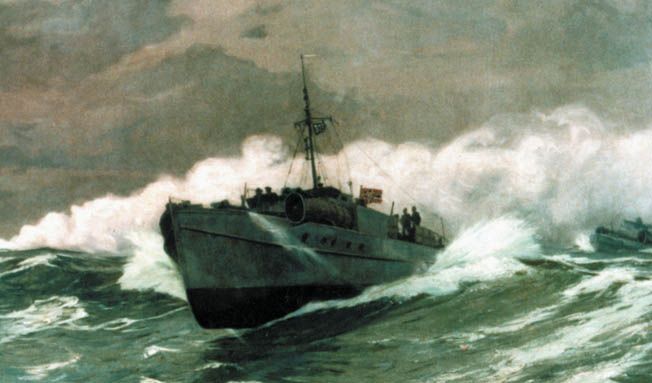
Two Royal Navy Corvettes, HMS Azalea and Scimitar, were to guard the exercise from German “Schnellboots” (what the Allies called “E-Boats”), the fast-attack craft based out of Cherbourg.
aabd944fc8651966c90eed0e7eecbcaa

HMS Scimitar withdrew for repairs following a collision with an LST on the 27th. In the early morning darkness of the following day, the single corvette was leading 8 LSTs carrying vehicles and combat engineers of the 1st Engineer Special Brigade through Lyme Bay, when the convoy was spotted by a nine vessel S-Boat patrol.

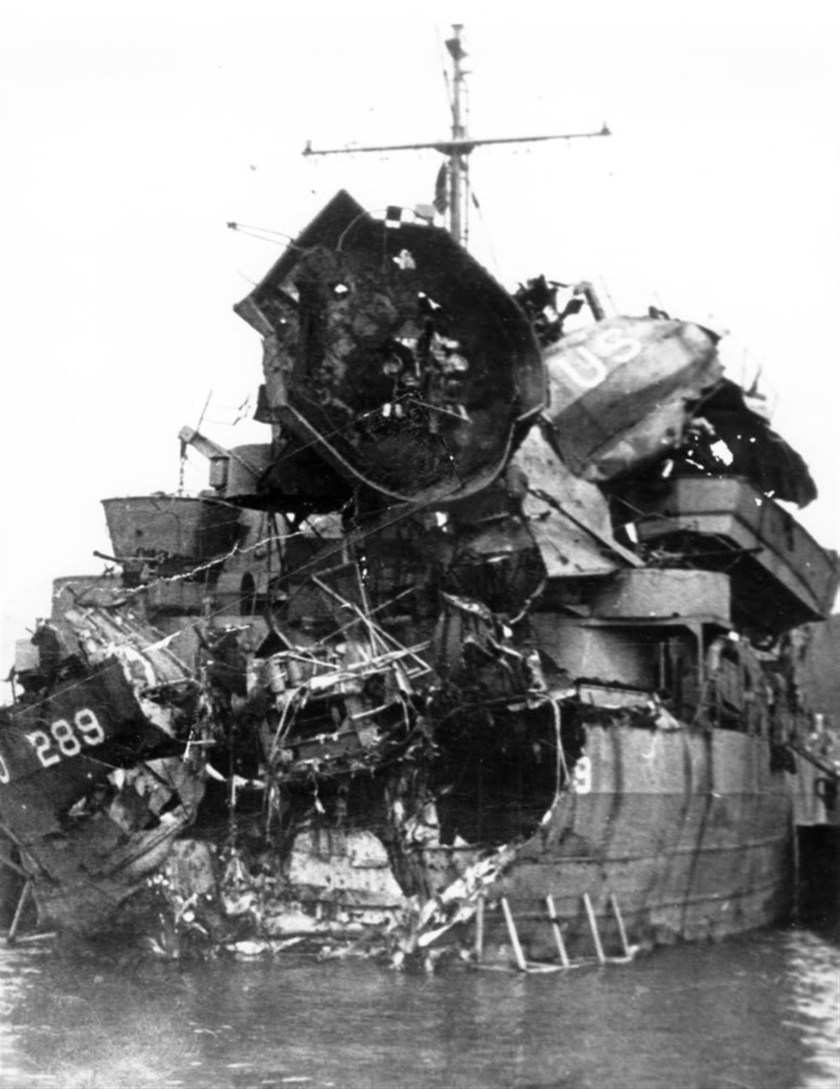
8 LSTs (Landing Ship, Tank) in single-file didn’t have a chance against fast-attack craft capable of 55mph.  LST-531 was torpedoed and sunk in minutes, killing 424 Army and Navy personnel. LST-507 suffered the same fate, with the loss of 202. LST-289 was severely damaged and grounded in flames, with the loss of 123. LST-511 was damaged in yet another friendly fire incident. Unable to wear their lifebelts correctly due to the large backpacks they wore, many men placed them around their waists. That only turned them upside down and that’s how they drowned, thrashing in the water with their legs above the waves. Dale Rodman, who survived the sinking of LST-507, said “The worst memory I have is setting off in the lifeboat away from the sinking ship and watching bodies float by.”
Operation-Tiger-1944
LST (Landing Ship, Tank 289: “Severely damaged by a German E-Boat torpedo attack off Slapton Sands, England, 28 April 1944, during Operation Tiger, the rehearsal for the Normandy invasion”.  H/T ExerciseTiger.org.uk

Survivors were sworn to secrecy due to official embarrassment, and the possibility of revealing the real invasion, scheduled for June.  Ten officers with high level clearance were killed in the incident, but no one knew that for sure until their bodies were recovered.  The D-Day invasion was nearly called off, because any of them could have been captured alive, revealing secrets during German interrogation and torture.

There remains a surprising amount of confusion, concerning the final death toll. Estimates range from 639 to 946, nearly five times the number killed in the actual Utah Beach landing.  Some or all of the personnel from that damaged LST may have been aboard the other 8 on the 28th, and log books went down along with everything else.  Many of the remains were never found.

5d274a9049a6b00623d5672d4b355bdd

The number of dead would surely have been higher, had not Captain John Doyle disobeyed orders and turned his LST-515 around, plucking 134 men from the frigid water.

Today, the Exercise Tiger disaster is mostly forgotten.  Some have charged official cover-up, though information from SHAEF press releases appeared in the August edition of Stars & Stripes.  At least three books describe the event.  It seems more likely that the immediate need for secrecy and subsequent D-Day invasion swallowed the Tiger disaster, whole.  History has a way of doing that.

DSCF0195-1024x768
Exercise Tiger Memorial, Slapton

Some of Slapton’s residents came home to rebuild their lives after the war, but many never returned.  In the early ’70s, Devon resident and civilian Ken Small discovered an artifact of the Tiger exercise, while beachcombing on Slapton Sands.  With little to no help from either the American or British governments, Small purchased rights from the American Government to a submerged Sherman tank from the 70th Tank Battalion. The tank was raised in 1984 with help from local residents and dive shops, and now stands as a memorial to Exercise Tiger.  Not far from the monument to villagers, who never came home.

Slaptonmemorial

A plaque was erected at Arlington National Cemetery in 1995, inscribed with the words “Exercise Tiger Memorial”. A 5,000-pound stern anchor bears silent witness to the disaster in Mexico, Missouri.

In 2012, a granite memorial was erected at Utah Beach, engraved with the words in French and English: “In memory of the 946 American servicemen who died in the night of 27 April 1944 off the coast of Slapton Sands (G.B.) during exercise Tiger the rehearsals for the D-Day landing on Utah Beach“.

In 1988, volunteers from the Army Brotherhood of Tankers repaired, repainted and re-stenciled an M4 Sherman tank, installing a mirror image of the Slapton memorial at Fort Taber Park in the south-coastal working class city of New Bedford, Massachusetts.

New Bedford veteran’s agent Christopher Gomes lost his right leg during the Iraq War, in 2008.  Gomes was succinct that Memorial Day 2016, when he spoke of this difficult chapter in British/American military history.  “People only die”, he said, “when they are forgotten about″.

Left – Memorial Day 2018:  WW2 Navy combat veteran Vincent Riccardi, Exercise Tiger’s oldest survivor, salutes his fallen comrades at Fort Taber Park in New Bedford, Massachusetts. H/T South Coast Today
Right – The M4 Sherman Tank Tank at the Fort Taber – Fort Rodman Military Museum at Fort Taber Park in New Bedford mirrors the one built to the fallen at Slapton Sands, Devon, England.


34668415_2086248128295884_3219656447432327168_n
H/T “Ghosts of time” for this image, Today and Now.


If you enjoyed this “Today in History”, please feel free to re-blog, “like” & share on social media, so that others may find and enjoy it as well. Please click the “follow” button on the right, to receive email updates on new articles.  Thank you for your interest, in the history we all share.

May 27, 1940 The Miracle of Dunkirk

By day 9 of the evacuation, 338,226 soldiers had been rescued from the beach.  For those, the “Miracle of Dunkirk” ended on June 4.  For approximately 40,000 British and another 40,000 French soldiers left behind in the confusion, a special kind of hell had just begun. 

The Nazi conquest of Europe began with the Sudetenland in 1938, the border districts of Bohemia, Moravia, and German speaking parts of Czechoslovakia. Within two years, every major power on the European mainland was either neutral, or under Nazi occupation.

319154The island nation of Great Britain alone escaped occupation, but British armed forces were shattered and defenseless in the face of the German war machine.

In May 1940, the British Expeditionary Force (BEF) and what remained of French forces occupied a sliver of land along the English Channel. Field Marshall Gerd von Rundstedt called a halt of the German armored advance on May 24.  Reichsmarschall Hermann Göring urged Hitler to stop the ground assault, and let the Luftwaffe finish the destruction of the adversary. On the other side of the channel, Admiralty officials combed every boatyard for miles, for boats to ferry its people off of the beach.

dunkirk1Hitler ordered his Panzer groups to resume the advance on May 26, while a National Day of Prayer was declared at Westminster Abbey. That night Winston Churchill ordered “Operation Dynamo”. One of the most miraculous evacuations in military history had begun from the beaches of Dunkirk.

The battered remnants of the French 1st Army fought a desperate delaying action against the advancing Germans. They were 40,000 men against seven full divisions, 3 of them armored. They held out until May 31 when, having run out of food and ammunition, the last 35,000 finally surrendered. Meanwhile, a hastily assembled fleet of 933 vessels large and small began to withdraw the broken army from the beaches.

The Evacuation of DunkirkLarger ships were boarded from piers, while thousands waded into the surf and waited in shoulder deep water for smaller vessels. They came from everywhere: merchant marine boats, fishing boats, pleasure craft, lifeboats and tugs. The smallest among them was the 14’7″ fishing boat “Tamzine”, now in the Imperial War Museum.

dunkirk2A thousand copies of navigational charts helped organize shipping in and out of Dunkirk, as buoys were laid around Goodwin Sands to prevent strandings. Abandoned vehicles were driven into the water at low tide, weighted down with sand bags and connected by wooden planks, forming makeshift jetties.

dunkirkevacuation7,669 were evacuated on the first full day of the evacuation, May 27, and none too soon.  The following day, members of the SS Totenkopf Division marched 100 captured members of the 2nd Battalion of the Royal Norfolk Regiment off to a pit, and machine gunned the lot of them.  A group of the 2nd Battalion of the Royal Warwickshire Regiment were captured that same day, herded into a barn and murdered with grenades.

428B34BA00000578-0-image-a-52_1500631364614
Troops wait in the rubble of Dunkirk, for rescue

By day 9 of the evacuation, 338,226 soldiers had been rescued from the beach.  For those, the “Miracle of Dunkirk” ended on June 4.  For approximately 40,000 British and another 40,000 French soldiers left behind in the confusion, a special kind of hell had just begun.

dunkirk troops, 1940Most light equipment and virtually all heavy equipment had to be left behind, just to get what remained of the allied armies out alive. But now, with the United States still the better part of a year away from entering the war, the allies had a military fighting force that would live to fight on.
Winston Churchill delivered a speech that night to the House of Commons, calling the events in France “a colossal military disaster”. “[T]he whole root and core and brain of the British Army”, he said, had been stranded at Dunkirk and seemed about to perish or be captured. In his “We shall fight on the beaches” speech of June 4, Churchill hailed the rescue as a “miracle of deliverance”.

On the home front, thousands of volunteers signed up for the “stay behind” mission, expected to follow. With German invasion all but imminent, their mission was to go underground and disrupt and destabilize the invaders, in any way they could. These were to be the British Resistance, a guerrilla force reportedly vetted by a senior Police Chief so secret that, the man was to be garroted in case of invasion, to prevent membership in the units from being revealed.  Many were issued suicide pills in case of capture yet, thanks to these men and women, Great Britain was the only nation of the WW2 era to have a fully operational resistance, BEFORE occupation.

WW2-Aux_Units-1112x634

Participants in these auxiliaries were not allowed to tell their families what they were doing, or where they were.  They generally passed themselves off as Home Guard, a home defense organisation operated by the British Army.  Bob Millard, who passed away in 2014 at the age of 91, said they were given 3 weeks’ rations.  Even Josephine, Millard’s wife of 67 years, didn’t know a thing about the auxiliaries until their reunion, in 1994. “You just didn’t talk about it, really”, he said. “As far as my family were aware I was still in the Home Guard. It was all very hush hush. After the war, it was water under the bridge”.

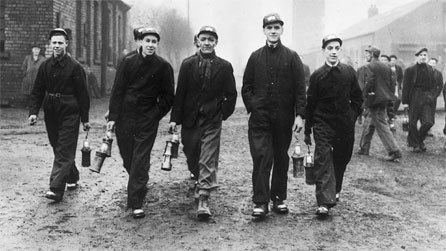
Another under-recognized group from the period are the young men conscripted to serve in the coal mines of the United Kingdom.  One in ten conscripts of the time received not a uniform, but the hard hat and steel-toed boot of the coal miner.  Often maligned as “Conchies” (conscientious objectors) or worse, these were held in service for as long as two years after the war, condemned to live the life of the Troglodyte with no expectation of peacetime jobs being held for them, as for those who served in uniform.

bevin_boys
“Bevin Boys” of WW2

These “Bevin Boys”, so-called after Minister of Labor Ernest Bevin, would wait decades for recognition of their contribution to the war effort, full acceptance coming only as the result of a speech given by Queen Elizabeth II, fifty years after VE Day.

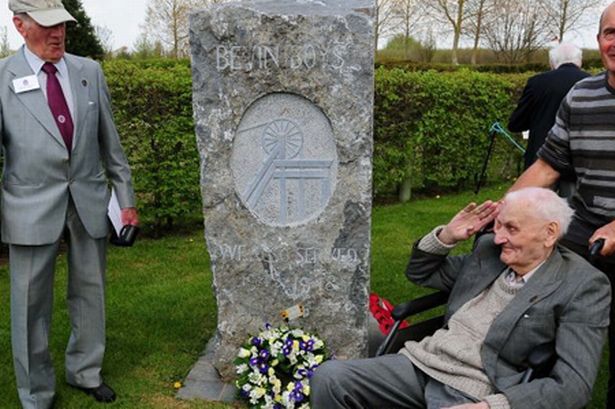
The word “Cenotaph” literally translates as “Empty Tomb”, in Greek. Every year since 1919 and always taking place on the Sunday closest to the 11th day of the 11th month, the Cenotaph at Whitehall is the site of a remembrance service, commemorating British and Commonwealth servicemen and women who died in the conflicts of the 20th century. Since WWII, the march on the Cenotaph includes an ever-decreasing number of Home Guard and the Bevin Boys, without whom the war effort would have ground to a halt.

In 2013, five short years ago, the last surviving auxiliers joined their colleagues, proudly marching past the Cenotaph for the very first time.  Historians from the Coleshill Auxiliary Research Team (CART) had been trying to do this for years.

CART founder Tom Sykes said: “After over 70 years of silence, the veterans of the Auxiliary Units and Special Duties Section, now more than ever, deserve to get the official recognition that has for so long been lacking. ‘They were, in this country’s hour of need, willing to give up everything, families, friends and ultimately their lives in order to give us a fighting chance of surviving“.

visitors-pay-tribute-at-the-bevin-boys-memorial-in-alrewas-745730884
Memorial to wartime ‘Bevin Boys’ unveiled in Staffordshire

May 19, 1944 The Seven Dwarves of Auschwitz

Not even concentration camp guards could resist the irony of seven dwarves. They immediately awakened Dr. Josef Mengele, the “Angel of Death”.

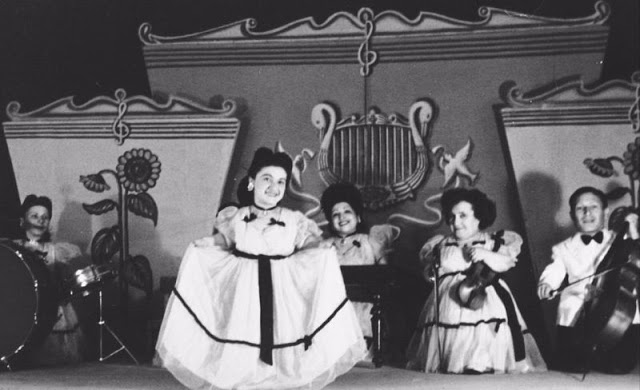
Shimson Eizik Ovitz was a Romanian rabbi, a WWI-era entertainer, and a man afflicted with pseudoachondroplasia. He was a dwarf. Ovitz fathered 10 children by two normal sized wives:  Brana Fruchter and Batia Bertha Husz. Three of those grew to normal height, the other seven were dwarves.

Batia gave the kids a piece of advice that stuck with them, all their lives: “through thick and thin” she said, “never separate. Stick together, guard each other, and live for one another”.

war2_1687882a

The dwarves were talented musicians, performing a variety show throughout the ’30s and early ’40s as the “Lilliput Troupe”. They toured Romania, Hungary and Czechoslovakia with their normal height siblings serving as road crew, until being swept up by the Nazis and deported to Auschwitz.

The train arrived around midnight on May 19th, 1944 and, accustomed to celebrity, one began to give out autographed cards. The family would soon be disabused of any notions of celebrity.

Not even concentration camp guards could resist the irony of seven dwarves. Dr. Josef Mengele was immediately awakened, knowing of his perverse fascination with the malformed, and what he called “blood” (family) experiments. The “Angel of Death”was delighted, “I now have work for 20 years”.

the-dwarves-of-auschwitz-4

The ten siblings were spared from the gas chamber that night, along with two more family members, a 15-month old boy and a 58-year old woman. Families of their handyman and a neighbor were also spared, insisting that they were close relatives. A total of 22 people.

The family was housed in horrific conditions, yet seven dwarves didn’t come along every day.  They were kept alive for further use and, as bad as it was, the food and clothing was better than that received by most camp inmates. Mengele even allowed them to keep their hair, and arranged special living quarters for them.

The bizarre and hideous “experiments” Mengele performed in the name of “science” were little more than torture rituals.  The three skeletons displayed of their dwarf predecessors, an ever-present reminder of what could be.  Boiling water was poured into their ears followed by freezing.  Eyelashes and teeth were pulled without anesthesia.  Blood was drawn until they would throw up and pass out, only to be revived to have more blood drawn.

the-ovitzs-leaving-the-ca-008

On one occasion, the Angel of Death told the family they were “going to a beautiful place”. Terrified, the siblings were given makeup, and told to dress themselves. Brought to a nearby theater and placed onstage, the family must have thought they’d be asked to perform. Instead, Mengele ordered them to undress, leaving all seven naked before a room full of SS men.  Mengele gave a speech, and then the audience was invited onstage to poke and prod the humiliated family.

One day of fresh horrors ended to reveal the next, and still they lived.  It was unusual for even two or three siblings to survive the Auschwitz death camp.  I don’t believe there was another instance where a family of twelve lived to tell the tale.

Auschwitz was liberated by the Soviet Red Army on January 27, 1945.

Traveling by foot to their Transylvanian home village of Rozavlea, the family found it ruined, though they did find a stash of gold coins where they had left it, buried for safekeeping before the war.

ba132f2b89040eef0fb0b59e29512bafThere was no future for them in this place.  Only 50 of the 650 Jewish inhabitants of the village ever returned. The family emigrated to Israel in May 1949, resuming their musical tour and performing until the group retired in 1955.

Josef Mengele never faced justice. He fled to South America after the war, and suffered a stroke while swimming in 1979.  The cause of death for one of the great monsters of history, was accidental drowning.

The youngest and last of the Ovitz dwarves, Piroska, “Perla” to her friends, passed away two days before the terrorist attack on the World Trade Towers. She spoke for the whole family, I think, when she said “I was saved by the grace of the devil”.

If you enjoyed this “Today in History”, please feel free to re-blog, “like” & share on social media, so that others may find and enjoy it as well. Please click the “follow” button on the right, to receive email updates on new articles.  Thank you for your interest, in the history we all share.

May 5, 1945 Church Picnic

284 Japanese balloon bombs are known to have completed the Pacific crossing to the United States, Mexico and Canada. Experts estimate as many as 1,000 may have made it.

Following the eruption of the Krakatoa volcano in 1883, weather watchers described an eastbound, upper atmospheric air current described as the “equatorial smoke stream”.

In the 1920s, Japanese meteorologist Wasaburo Oishi tracked these upper level winds from a site near Mount Fuji, using pilot balloons. Oishi doomed his work to international obscurity when he published his findings in Esperanto. Inside Japan, there were those who took note, filing away this new-found knowledge of what we now call the “Jet Stream”.

In the latter half of WWII, Imperial Japanese military planners conceived the fūsen bakudan or “fire balloon”, a hydrogen filled balloon device designed to ride the jet stream, using sand ballast and a valve system to navigate the weapon system onto the North American continent.

BalloonBomb-1bWith sandbags, explosives, and the device which made the thing work, the total payload was about a thousand pounds on liftoff. The first such device was released on November 3, 1944, beginning the crossing to the west coast of North America. 9,300 such balloons were released with military payloads, between late 1944 and April, 1945.

Such a long-range attack would not be duplicated until the 1982 Falklands War, and was near unimaginable at the time.

JB41In 1945, intercontinental weapons were more in the realm of science fiction. As these devices began to appear, American authorities theorized that they originated with submarine-based beach assaults, German POW camps, and even the internment camps into which the Roosevelt administration herded Japanese Americans.

These “washi” paper balloons flew at high altitude and surprisingly quickly, completing the Pacific crossing in three days. Balloons landed from Alaska to Northern Mexico, and as far east as Detroit. Fighter aircraft shot down fewer than 20.

image011-r

A P-38 Lightning fighter shot one down near Santa Rosa, California, while Yerington, Nevada cowboys cut one up to make hay tarps. Pieces of balloon were found in the streets of Los Angeles. A prospector near Elko Nevada delivered one to local authorities, on the back of a donkey.

Among US units assigned to fight fire balloons was the 555th Parachute Infantry Battalion, which suffered one fatality and 22 injuries fighting fires.

One of the last balloons came down on March 10 near Hanford Washington, shorting out power lines supplying electricity for Manhattan Project nuclear reactor cooling pumps. The war in the Pacific could have ended very differently, had not backup safety devices restored power, almost immediately.

Colonel Sigmund Poole, head of the U.S. Geological Survey military geology unit, asked, “Where’d the damned sand come from?” Microscopic analysis of sand ballast identified diatoms and other microscopic sea life. This and the mineral content of the sand itself proved to be definitive. This stuff could only have come from the home islands of Japan, more specifically, one or two beaches on the island of Honshu.

world-war-ii-balloonAmerican authorities were alarmed. Anti-personnel and incendiary bombs were relatively low grade threats. Not so the biological weapons Japanese military authorities were known to be developing at the infamous Unit 731, in northern China.

284 of these weapons are known to have completed the Pacific crossing to the United States, Mexico and Canada. Experts estimate as many as 1,000 may have made it.

Balloon Bomb Route

Sightings were reported in seventeen US states. Pilots were ordered to shoot them down on sight, but many devices escaped detection, altogether.

In an effort to deny valuable intelligence to their Japanese adversary, US military and government authorities did everything they could to keep these “Fire Bombs” out of the media. Even though such secrecy put Americans at risk.

Japanese Authorities reported that the bombs were hitting key targets, thousands were dead or injured, and American morale was low.

Terrorballoons3
Archie & Elsie mitchell

On the morning of May 5, 1945, Pastor Archie Mitchell and his wife Elsie took their Sunday school class of five on a picnic to a forest area near Bly, Oregon. Elsie and the kids came upon a large balloon with a strange looking device attached to it, as Pastor Mitchell parked the car. There was no way they could have known, what they had found was a Japanese weapon of war. The device exploded, killing all six, instantly.

Several such devices exploded, igniting wildfires in the forests of California, Oregon and Washington, but the site near Bly is the only one known to have resulted in American casualties.

6149872687_10db3f9597_b
Shrapnel Tree – Mitchell Monument, Bly, Oregon

Today there is a small picnic area located in the Fremont-Winema National Forest, in Lake County, Oregon. It’s maintained by the US Forest Service, memorialized as the Mitchell Recreation Area and listed on the National Register of Historic Places. A small stone marker points the way to a shrapnel scarred tree.

Mitchell_Monument;_August_12,_2013

A second memorial bears these words, cast in bronze: The “only place on the American continent where death resulted from enemy action during World War II”. There are six names above those words, those of five children and their teacher, who was pregnant at the time. Elsie Mitchell, age 26. Edward Engen, age 13. Jay Gifford, age 13. Joan Patzke, age 13. Dick Patzke, age 14. Sherman Shoemaker, age 11.


If you enjoyed this “Today in History”, please feel free to re-blog, “like” & share on social media, so that others may find and enjoy it as well. Please click the “follow” button on the right, to receive email updates on new articles.  Thank you for your interest, in the history we all share.

April 9, 1940 “Evacuation Day”

Norway was out of the war, but not necessarily out of the fight.   A Nazi officer passed an old woman on the street, who complained at his rudeness and knocked his hat off, with her cane. The officer apologized and scurried off.  The gray-haired old matron snickered, to herself:  “Well, we’ll each have to fight this war as best we can.  That’s the fourth hat I’ve knocked into the mud this morning.”

The Encyclopedia Britannica describes Croton oil as a “poisonous viscous liquid obtained from the seeds of a small Asiatic tree…”  Highly toxic and a violent irritant, the substance was once used as a drastic purgative and counter-irritant in human and veterinary medicine, but is now considered too dangerous for medicinal use. Applied externally, Croton oil is capable of peeling your skin off.  Taken internally, the stuff may be regarded as the atomic bomb, of laxatives.

The Nazi conquest of Europe began with the annexation of the Sudetenland in 1938, the border districts of Bohemia, Moravia, and German speaking parts of Czechoslovakia. Within two years, every major power on the European mainland was either neutral, or subject to Nazi occupation.  France fell to the Nazi war machine in six weeks, in 1940.  The armed forces of the island nation of Great Britain were left shattered and defenseless, stranded on the beaches of Dunkirk.

On the Scandinavian Peninsula, longstanding policies of disarmament in the wake of WW1, left the Nordic states of Denmark and Norway severely under-strength, able to offer little resistance to the Nazi invaders.

On this day in 1940, German warships entered Norwegian harbors from Narvik to Oslo, as German troops occupied Copenhagen and other Danish cities.  King Christian X of Denmark surrendered almost immediately.  To the northwest, Norwegian commanders loyal to former foreign minister Vidkun Quisling ordered coastal defenders to stand down, permitting the German landing to take place, unopposed.  Norwegian forces refused surrender demands from the German Minister in Oslo, but the outcome was never in doubt.

Nazi Germany responded with an airborne invasion by parachute.  Within weeks, Adolf Hitler could add a second and third scalp to his belt, following the invasion of Poland, six months earlier.  The Kingdoms of Denmark and Norway, were out of the war.

Norway was out of the war, but not necessarily out of the fight.   A Nazi officer passed an old woman on the street, who complained at his rudeness and knocked his hat off, with her cane. The officer apologized and scurried off.  The gray-haired old matron snickered, to herself:  “Well, we’ll each have to fight this war as best we can.  That’s the fourth hat I’ve knocked into the mud this morning.

A Norwegian Resistance was quick to form, as patriotic locals united against the Nazi occupier and the collaborationist policies of the Quisling government.

The Norwegian secret army, known as Milorg and led by General Otto Ruge, was at first loath to engage in outright sabotage, for fear of German reprisals against innocent civilians.  Later in the war, Milorg commandos attacked the heavy water factory at Rjukan and sank a ferry carrying 1,300 lbs of heavy water, inflicting severe damage to the Nazi nuclear research program.

Sven Somme, tree
Norwegian Resistance member Sven Somme demonstrates one of the techniques by which he evaded capture in the mountains.

In the beginning, Resistance activities centered more around covert sabotage and the gathering of intelligence.  One of the great but still-unknown dramas of WW2 unfolded across the snow covered mountains of the Scandinavian peninsula, as the civilian-turned-spy Sven Somme fled 200 miles on foot to neutral Sweden, pursued by 900 Wehrmacht soldiers and a pack of bloodhounds.

Operations of all kinds were undertaken, to stymie the Nazi war effort. Some actions seem like frat-boy pranks, such as coating condoms destined for German units, with itching powder.  Hundreds of Wehrmacht soldiers (and presumably Norwegian women) showed up at Trondheim hospitals, believing they had contracted God-knows-what kind of plague.

Other operations demonstrate a kind of evil genius.  This is where Croton oil comes in.

download (61)
“Croton oil (Crotonis oleum) is an oil prepared from the seeds of Croton tiglium, a tree belonging to the order Euphorbiales and family Euphorbiaceae, and native or cultivated in India and the Malay Archipelago. Small doses taken internally cause diarrhea. Externally, the oil can cause irritation and swelling. Croton oil is used in some chemical peels, due to its caustic exfoliating effects it has on the skin”. H/T, Wikipedia

Norwegian resistance fighters, as dedicated as they were, still had to feed themselves and their families.  Many of these guys were subsistence fishermen, and that meant sardines.  For centuries, the small fish had been a staple food item across the Norwegian countryside.  It was a near-catastrophic blow to civilian and Resistance fighters alike, when the Quisling government requisitioned the entire sardine crop.

The Battle of the Atlantic was in full-swing by this time, as wolf packs of German submarines roamed the north Atlantic, preying on Allied shipping.  Thousands of tons of sardines would be sent to the French port of Saint-Nazaire, to feed U-Boat crews on their long voyages at sea.

U-864
German Type X Submarine, U-864

Norwegian vengeance began with a request to the Special Operations Executive (SOE) in Great Britain, for the largest shipment of Croton oil, possible.  The “atomic laxative” was smuggled into canneries across Norway, and used to replace vegetable oil in sardine tins.  The plan worked nicely and no one suspected a thing, the pungent taste of the fish covering the strange flavor of Croton oil.

From midget submarines such as the Biber, Hai, Molch, and Seehund models to the behemoth 1,800-ton “Type X“, the Kriegsmarine employed no fewer than fifteen distinct submarine types in WW2, including the workhorse “Type VII”, of which some 700 saw service in the German war effort.  In the North Atlantic, the battle raged on with torpedo and depth charge.  Under the surface, there unfolded a different story.

Except for the participants in this tale, no one knows what it looks like, when ten thousand submariners simultaneously lose control of their bowels. It could not have been a pretty sight.

Feature image, top of page:  “Anti-Nazi graffiti on the streets of Oslo, reading “Live” above the monogram for the Norwegian king, who had fled when the Germans invaded in 1940”. (Photo: Bettmann/Getty Images)


If you enjoyed this “Today in History”, please feel free to re-blog, “like” & share on social media, so that others may find and enjoy it as well. Please click the “follow” button on the right, to receive email updates on new articles.  Thank you for your interest, in the history we all share.

February 20, 1974 Holdout

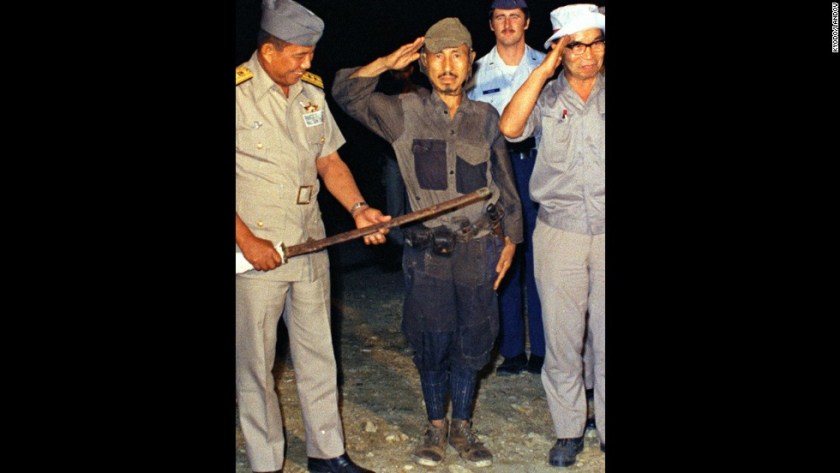
Thus properly relieved of duty, Onada surrendered, turning over his sword, his rifle, 500 rounds of ammunition and a number of hand grenades, along with the dagger his mother had given him, to kill himself if he were ever captured.  It was March 9, 1974. 

On December 7, 1941, Imperial Japanese air forces attacked the US Pacific Naval anchorage at Pearl Harbor.

President Franklin Delano Roosevelt appeared before a joint session of Congress the following day, asking for a declaration of war.  Little did they know, the war with 450px-Shigemitsu-signs-surrenderImperial Japan would rage for another 33 years.
Alright, not really. Representatives of the Empire of Japan signed the instruments of surrender aboard the USS Missouri on September 2, 1945, formally ending the war in the Pacific.  Except, there were those who didn’t get the message.

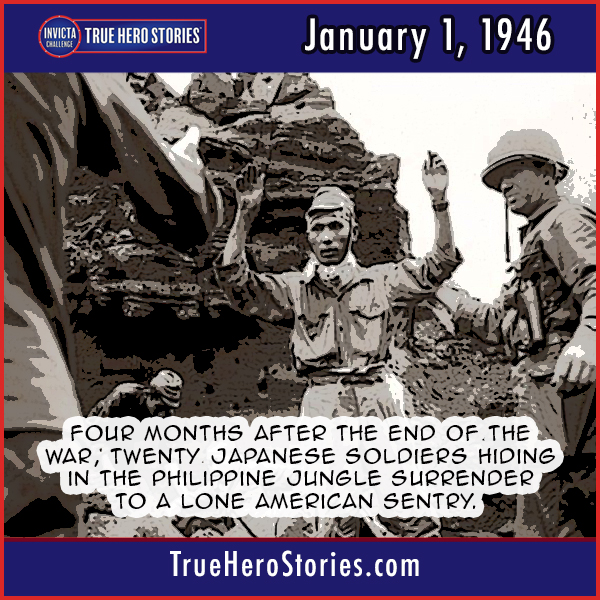
Following the Battle of Saipan, June 15 – July 9, 1944, Captain Sakae Ōba and a company of 46 men took to carrying out guerrilla actions against American troops.  The company surrendered on December 1, 1945, three months after the end of the war.

Jan-1-Japanese-Holdouts-Surrender-On-Philippines-Five-Months-After-End-Of-War-2

Navy Lieutenant Hideo Horiuchi was arrested on August 13, 1946, while recovering from wounds received in a battle with Dutch troops.

Lieutenant Ei Yamaguchi led 33 soldiers in an attack on an American Marine Corps detachment on Peleliu in March, 1947. Reinforcements were sent in, including a Japanese admiral who finally convinced these guys that the war was over. The group surrendered in April.

Two machine gunners from the Imperial Japanese Navy surrendered on Iwo Jima, on January 6, 1949.

japanese-holdouts-of-wwii-5-728Several went on to fight for the Viet Minh against French troops in Indochina.
Seaman Noburo Kinoshita hanged himself in the Luzon jungle, in 1955.  Kinoshita had vowed never to “return to Japan in defeat”.  I guess he meant it.

Private Bunzō Minagawa held out until May 1960, on the American territory of Guam.  Minagawa’s immediate superior, Sergeant Masashi Itō, surrendered a few days later.  Corporal Shoichi Yokoi, who also served under Itō, was captured twelve years later.

After the war, 2nd Lieutenant Hirō Onoda took to the mountains of Lubang Island in the Philippines, along with Private Yūichi Akatsu, Corporal Shōichi Shimada and Private First Class Kinshichi Kozuka, carrying out guerilla actions and engaging in shootouts with local police.  Akatsu left the other three in 1949, and surrendered six months later.  Shimada was killed by a search party in 1954.  Kozuka was shot and killed by local police in 1972, while burning rice collected by farmers.

Onoda-suzuki
Suzuki returned to Japan with this photograph in February 1974, as proof of his encounter with Onada.

Two years later, the Japanese explorer and adventurer Norio Suzuki set out, looking for “Lieutenant Onoda, a wild panda, and the Abominable Snowman, in that order”.  The pair met on February 20, 1974 when Suzuki nearly got shot for his troubles, but he was quick.  “Onoda-san, the emperor and the people of Japan are worried about you.”

“I am a soldier” he said, “and remain true to my duties.” Onada would surrender when ordered to do so, by a superior officer.  Suzuki returned to Japan and located Onoda’s commanding officer, Major Yoshimi Taniguchi, who was working in a book store. The pair flew to Lubang, where Taniguchi issued the following orders:

In accordance with the Imperial command, the Fourteenth Area Army has ceased all combat activity.
In accordance with military Headquarters Command No. A-2003, the Special Squadron of Staff’s Headquarters is relieved of all military duties.
Units and individuals under the command of Special Squadron are to cease military activities and operations immediately and place themselves under the command of the nearest superior officer. When no officer can be found, they are to communicate with the American or Philippine forces and follow their directives.

Thus properly relieved of duty, Onada surrendered, turning over his sword, his rifle, 500 rounds of ammunition and a number of hand grenades, along with his kaiken, the dagger his mother had given him, to kill himself if he were ever captured.  It was March 9, 1974.

140117080502-01-hiroo-onoda-restricted-horizontal-large-gallery

Private Teruo Nakamura, born Attun Palalin to the aboriginal Amis people of Taiwan, was the last confirmed holdout of WW2.  Nakamura, who spoke neither Japanese nor Chinese, was discovered by the Indonesian Air Force on Morotai, surrendering to a search patrol on December 18, 1974.  The war was over. 29 years, 3 months, and 16 days after the Japanese Instrument of Surrender.

Years later, Hirō Onada described that first encounter:  “This hippie boy Suzuki came to the island to listen to the feelings of a Japanese soldier. Suzuki asked me why I would not come out…”  Norio Suzuki had found his Onada, and the wild panda was soon to follow.  The explorer died in a Himalayan avalanche at age 37, still searching for the Abominable Snowman.

If you enjoyed this “Today in History”, please feel free to re-blog, “like” & share on social media, so that others may find and enjoy it as well. Please click the “follow” button on the right, to receive email updates on new articles.  Thank you for your interest, in the history we all share.

February 19, 1945 The Crocodiles of Ramree

To the human participants in this story, this is a tale of four weeks’ combat for a tropical island.  For the apex predator of the mangrove swamp, it was little more than a dinner bell.

500 ft. off the coast of Myanmar (formerly Burma), and across the Bay of Bengal from the Indian sub-continent, there lies the island of Ramree, about a third the size of New York’s Long Island.

In 1942, the Imperial Japanese Army aided by Thai forces and Burmese insurgents drove the British Empire and Chinese forces out of Burma, occupying much of the Burmese peninsula and with it, Ramree island. In January 1945, the allies came to take it back.

356-Squadron-RAF-after-bombing-Japanese-positions-on-Ramree-Island
RAF 356 Squadron after bombing Japanese positions on Ramree Island

The battle started out with Operation Matador on January 14, an amphibious assault designed to capture the strategic port of Kyaupyu, and it’s nearby airfield.

By early February, a mixed force of British Royal Marines and their Indian allies dislodged a force of some 980 Japanese defenders, who abandoned their base and marched inland to join a larger regiment of Japanese soldiers across the island.

The route took the retreating Japanese across 10 miles of marsh and mangrove swamp. Bogged down and trapped in the mire, the soldiers soon found themselves cut off and surrounded, alone with the snakes, the mosquitoes and the scorpions, of Ramree island.

ramree-island2On February 7, the 71st Infantry and supporting tanks reached Ramree town where they found determined Japanese resistance, the town falling two days later. Naval forces blockaded small tributaries called “chaungs”, which the retreating Japanese used in their flight to the mainland. A Japanese air raid damaged an allied destroyer on the 11th as a flotilla of small craft crossed the strait, to rescue survivors of the garrison. By February 17, Japanese resistance had come to an end.
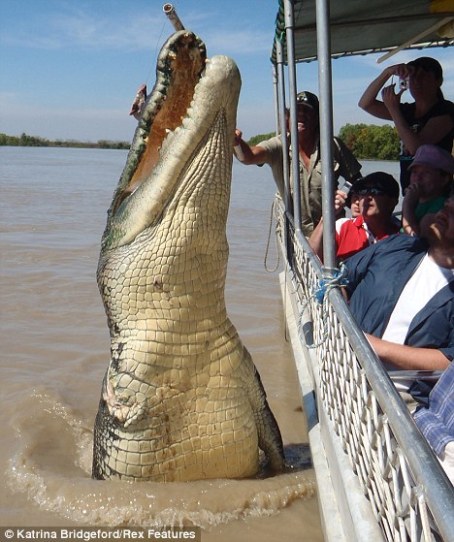
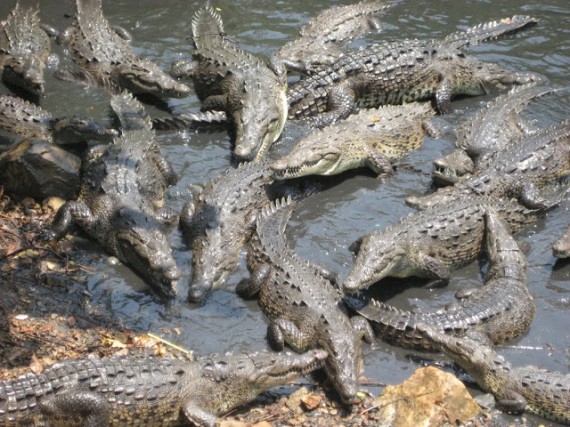
Throughout the four-week battle for Ramree Island, the allied blockade inflicted heavy casualties on Japanese forces.  The thousand men cut off in the swamp, had more immediate concerns.

article-2013816-0CF9D84B00000578-348_468x559
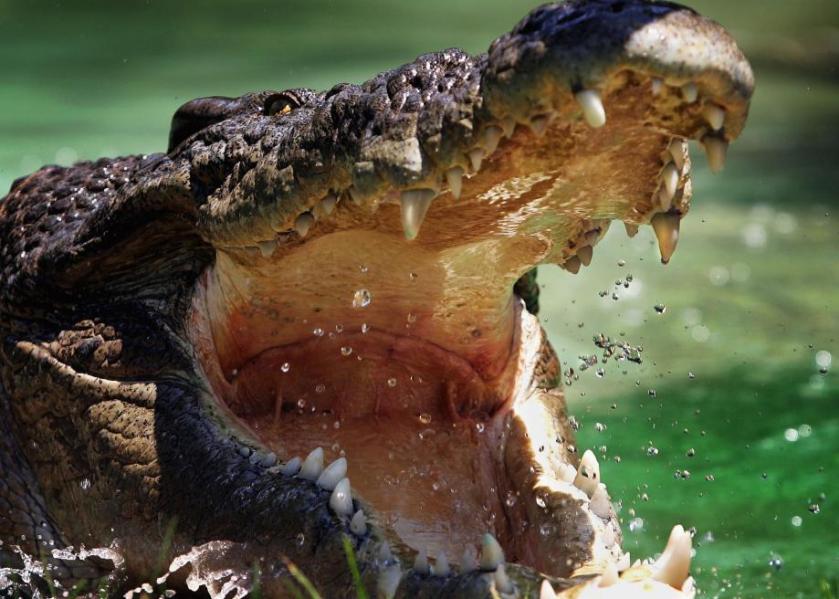
:Lured by a tour guide dangling kangaroo meat from a pole, the 18ft, two-ton monster was, er, snapped by photographer Katrina Bridgeford, who was on the Adelaide River cruise with her family”. Tip of the Hat for this image, to the UK Daily Mail Note the missing right arm on this monster – probably eaten by one of his own kind.

NationalGeographic.com describes the Japanese’ problem, the nightmare predator,  Crocodylus porosus:  “Earth’s largest living crocodilian—and, some say, the animal most likely to eat a human—is the saltwater or estuarine crocodile. Average-size males reach 17 feet and 1,000 pounds, but specimens 23 feet long and weighing 2,200 pounds are not uncommon.

Classic opportunistic predators, they lurk patiently beneath the surface near the water’s edge, waiting for potential prey to stop for a sip of water. They’ll feed on anything they can get their jaws on, including water buffalo, monkeys, wild boar, and even sharks. Without warning, they explode from the water with a thrash of their powerful tails, grasp their victim, and drag it back in, holding it under until the animal drowns.

ramree-island

British naturalist Bruce Stanley Wright participated in the battle for Ramree, and gave the following account in his book, Wildlife Sketches Near and Far, published in 1962:

“That night [February 19, 1945] was the most horrible that any member of the M.L. [marine launch] crews ever experienced. The crocodiles, alerted by the din of warfare and the smell of blood, gathered among the mangroves, lying with their eyes above water, watchfully alert for their next meal. With the ebb of the tide, the crocodiles moved in on the dead, wounded, and uninjured men who had become mired in the mud.

The scattered rifle shots in the pitch black swamp punctured by the screams of wounded men crushed in the jaws of huge reptiles, and the blurred worrying sound of spinning crocodiles made a cacophony of hell that has rarely been duplicated on earth. At dawn the vultures arrived to clean up what the crocodiles had left…Of about 1,000 Japanese soldiers that entered the swamps of Ramree, only about 20 were found alive.

The crocodile attacks of Ramree are well documented, but there are those who question the numbers.  Some accounts indicate as many as 400 escaping the swamp, while the Guinness Book of World Records credits the incident with the “Most Number of Fatalities in a Crocodile Attack.”  Could there be so many of these creatures, as to wipe out nearly a thousand men?  What was there to eat, to support such a large population?

map_cpor_800b
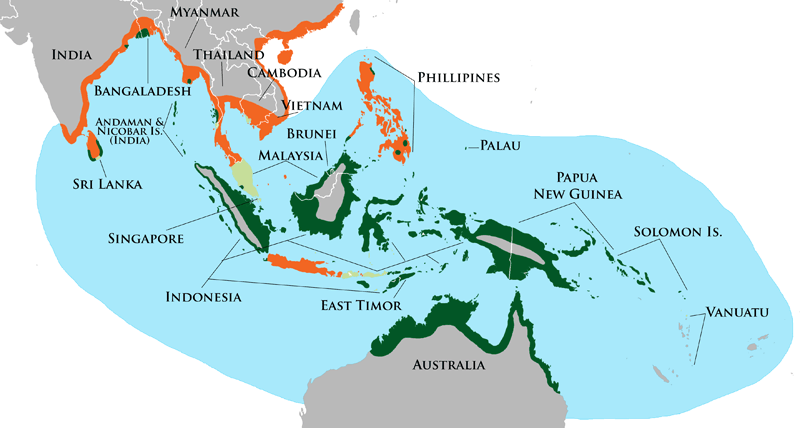
Current Distribution – Saltwater or Estuarine Crocodile (Crocodylus porosus)

The actual numbers can never be known, but consider this:  Saltwater crocodiles are excellent swimmers, and are regularly spotted miles out to sea.  Individuals have even been discovered in the relatively frigid Sea of Japan – thousands of miles from their native habitat.  In 2016, Australian Rangers counted 120 “salties” in a 6-kilometer (3.7 mile) stretch of the East Alligator River, in the Northern Territory.

To the human participants in this story, this is a tale of four weeks’ combat for a tropical island.  For the apex predator of the mangrove swamp, it was little more than a dinner bell.

56714641-saltwater-crocodile-is-pictured-at-the-australian.jpg.CROP.promo-large2

If you enjoyed this “Today in History”, please feel free to re-blog, “like” & share on social media, so that others may find and enjoy it as well. Please click the “follow” button on the right, to receive email updates on new articles.  Thank you for your interest, in the history we all share.


February 9, 1945 Operation Caesar

The most unusual confrontation of WW2 occurred on this day in 1945, in the form of a combat action between two submerged submarines.

In 1939, the impending Nazi invasion of Poland was an open secret.  That August, representatives of Nazi Germany and the Soviet Union signed the Nazi-Soviet Pact, pledging mutual non-aggression for a period of two years.

Two days later, representatives of the United Kingdom signed the Agreement of Mutual Assistance with Poland, aligning Great Britain with the Franco-Polish Military Alliance.  Should Poland be invaded by a foreign power, England and France were now committed to intervene.

The first fourteen “Unterseeboots” (U-boats) left their bases, fanning out across the North Atlantic.  Hitler’s invasion of Poland, began, three weeks later. Even then, Hitler believed that war with England and France could still be avoided.  The “Kriegsmarine” was under strict orders to follow the “Prize Regulations” of 1936.

how-hitler-tried-to-terrorize-the-seas-with-u-boats-during-world-war-ii

England and France declared war on Nazi Germany on Septemebr 3. Hours later, U-30 Oberleutnant Fritz Julius Lemp fired a torpedo into the British liner SS Athenia. Lemp had mistakenly believed it to be an armed merchant vessel and fair game under Prize Regulations, but the damage was done. The longest and most complex naval battle in history, had begun.

As in WWI, both England and Germany were quick to implement blockades on one another. For good reason. By the time that WWII was in full swing, England alone would require over a million tons a week of imported goods, in order to continue the fight.

convoy_thumbThe “Battle of the Atlantic” lasted 5 years, 8 months and 5 days, ranging from the Irish Sea to the Gulf of Mexico, from the Caribbean to the Arctic Ocean. Winston Churchill would describe this as “the dominating factor all through the war.  Never for a moment could we forget that everything happening elsewhere, on land, at sea or in the air depended ultimately on its outcome”.

Thousands of ships were involved in more than a hundred convoy battles, with over 1,000 single ship encounters unfolding across a theater thousands of miles wide. According to http://www.usmm.org, the United States Merchant Marine suffered the highest percentage of fatalities of any service branch, at 1 in 26 compared to one in 38, 44, 114 and 421 respectively, for the Marine Corps, Army, Navy and Coast Guard.

800px-Atlantic_Merchant_CasualtyNew weapons and tactics would shift the balance first in favor of one side, and then to the other. In the end over 3,500 merchant ships and 175 warships would be sunk to the bottom of the ocean, compared with the loss of 783 U-boats.

The most unusual confrontation of the war occurred on this day in 1945, in the form of a combat action between two submerged submarines. Submarines operate in 3-dimensional space, but their most effective weapon does not. The torpedo is a surface weapon, operating in two-dimensional space: left, right and forward. Firing at a submerged target requires that the torpedo be converted to neutral buoyancy, introducing near-insurmountable complexity into firing calculations.

U-864
U-864

The war was going badly for the Axis Powers in 1945, the allies enjoying near-uncontested supremacy over the world’s shipping lanes. At this time, any surface delivery between Nazi Germany and Imperial Japan was likely to be detected and stopped. The maiden voyage of the 287’, 1,799 ton German submarine U-864 departed on “Operation Caesar” on December 5, delivering Messerschmitt jet engine parts, V-2 missile guidance systems, and 65 tons of mercury to the Imperial Japanese war production industry.

2655041787_639d9fb20a_b
WW2 U-boat pens, Bergen, Norway

The mission was a failure, U-864 having to retreat to the submarine pens in Bergen, Norway, for repairs after running aground in the Kiel Canal. The sub was able to clear the island of Fedje off the Norway coast undetected on February 6. By this time British MI6 had broken the German Enigma code. They were well aware of Operation Caesar.

The British submarine Venturer, commanded by 25-year-old Lieutenant Jimmy Launders, was dispatched from the Shetland Islands, to intercept and destroy U-864.

6868162_f496
A four dimensional firing solution accounting for time, distance, bearing and target depth was theoretically possible, but had rarely been attempted under combat conditions.

ASDIC, an early name for sonar, would have been far more helpful in locating U-864, but at a price. That familiar “ping” would have been heard by both sides, alerting the German commander that he was being hunted. Launders opted for hydrophones, a passive listening device which could alert him to external noises. Calculating his adversary’s direction, depth and speed was vastly more complicated without ASDIC, but the need for stealth won out.

Developing an engine noise which he feared might give him away, U-864’s commander, Ralf-Reimar Wolfram decided to return to Bergen for repairs. German submarines of the age were equipped with “snorkels”, heavy tubes which broke the surface, enabling diesel engines U-864 locationand crews to breathe while running submerged. Venturer was on batteries when the first sounds were detected, giving the British sub the stealth advantage but sharply limiting the time frame in which it could act.

A four dimensional firing solution accounting for time, distance, bearing and target depth was theoretically possible, but had rarely been attempted under combat conditions. Plus, there were unknown factors which could only be approximated.

A fast attack sub, Venturer only carried four torpedo tubes, far fewer than her much larger adversary. Launders calculated his firing solution, ordering all four tubes firing with a 17½ second delay between each pair.

U-864 WreckWith four incoming at as many depths, the German sub didn’t have time to react. Wolfram was only just retrieving his snorkel and converting to electric, when the #4 torpedo struck. U-864 imploded and sank, instantly killing all 73 aboard.

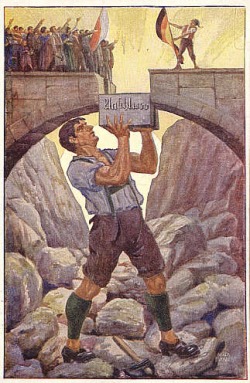
Surface actions were common enough between all manner of vessels, but a fully submerged submarine to submarine kill occurred only once in WWI, on October 18, 1914, when the German U-27 torpedoed and sank the British sub HMS E3 with the loss of all 28 aboard. To my knowledge, such an action occurred only this one time, in all of WWII.


If you enjoyed this “Today in History”, please feel free to re-blog, “like” & share on social media, so that others may find and enjoy it too. Please click the “follow” button on the right, to receive email updates on new articles.  Thank you for your interest, in the history we all share.

January 29, 1944 Operation Pied Piper

In the summer of 1938, the horrors of the Great War were a mere twenty years in the past.  Hitler had swallowed up Austria, only six months earlier.   Authorities divided the British Isles into “risk zones”, identified as “evacuation,” “neutral,” and “reception.”  In some of the most gut wrenching decisions of the age, these people were planning “Operation Pied Piper”, the evacuation of millions of their own children, in the event of war.

For the people of the modern Czech Republic, the Munich agreement of 1938 was a betrayal. “O nás bez nás!” “About us, without us!”

431768
Nazi propaganda depicting German Anschluss with Austria

Intent on avoiding war with Nazi Germany, Italy, France and Great Britain had convened in Munich that September, to resolve German claims on western Czechoslovakia.  The “Sudetenland”.  Representatives of the Czech and Slovak peoples, were not invited.

On September 30, British Prime Minister Neville Chamberlain returned to London, declaring “Peace in Our Time”.  The piece of paper Chamberlain held in his hand bore the signatures of Adolf Hitler, Benito Mussolini and Édouard Daladier as well as his own, annexing the Sudetenland, to Nazi Germany.

To Winston Churchill, it was an act of appeasement.  Feeding the crocodile (Hitler), in hopes that he will eat you last.  For much of Great Britain, the sense of relief was palpable.

In the summer of 1938, the horrors of the Great War were a mere twenty years in the past.  Hitler had swallowed up Austria, only six months earlier.   British authorities divided the home islands into “risk zones”, identified as “Evacuation,” “Neutral,” and “Reception.”  In some of the most gut wrenching decisions of the age, these people were planning “Operation Pied Piper”, the evacuation of millions of their own children, in the event of war.

94330When Nazi Germany invaded Poland the following September, London mayor Herbert Morrison was at 10 Downing Street, meeting with Chamberlain’s aide, Sir Horace Wilson.  Morrison believed that the time had come for Operation Pied Piper.  A year to the day from the Prime Minister’s “Peace in our Time” declaration, Wilson protested.  “But we’re not at war yet, and we wouldn’t want to do anything to upset delicate negotiations, would we?”
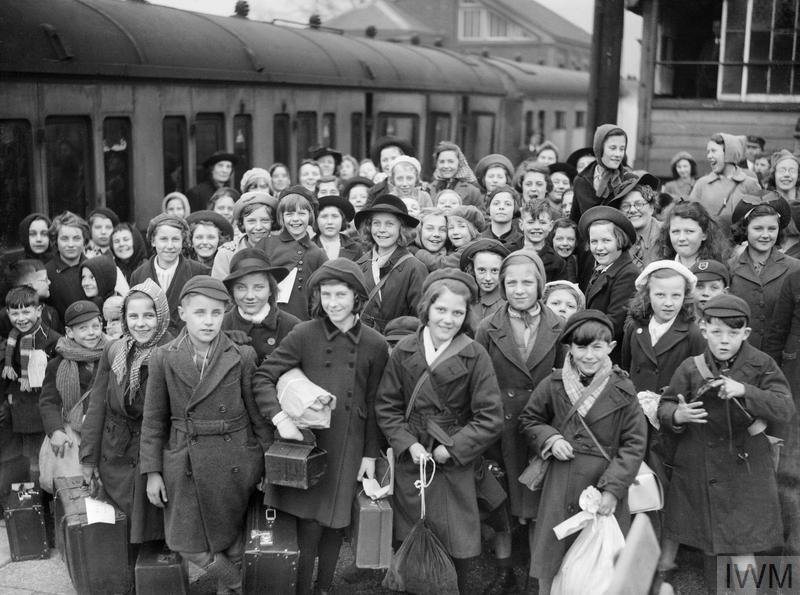
Morrison was done with the Prime Minister’s dilatory response to Hitler’s aggression, practically snarling in his thick, East London accent “Look, ’Orace, go in there and tell Neville this from me: If I don’t get the order to evacuate the children from London this morning, I’m going to give it myself – and tell the papers why I’m doing it. ’Ow will ’is nibs like that?”

Thirty minutes later, Morrison had the document. The evacuation, had begun.

large_000000

Next weekend, Superbowl 52 will be played at U.S. Bank Stadium, in front of a crowd of 66,655. In 1938, forty-five times that number were mobilized in the first four days of the evacuation, primarily children, relocated from cities and towns across Great Britain to the relative safety of the countryside. What must that have sounded like?

Operation_Pied_Piper-PosterBBC History reported that, “within a week, a quarter of the population of Britain would have a new address”.

Zeppelin raids had killed 1,500 civilians in London alone, during the ‘Great War’.  Since then, governments had gotten so much better at killing each other’s citizens.  As early as 1922, Prime Minister Lord Arthur Balfour had spoken of ‘unremitting bombardment of a kind that no other city has ever had to endure.’  As many as 4,000,000 civilian casualties were predicted, in London alone.

BBC History describes the man in charge of the evacuation, Sir John Anderson, as a “cold, inhuman character with little understanding of the emotional upheaval that might be created by evacuation”.

Children were labeled ‘like luggage’, and sent off with gas masks, toothbrushes and fresh socks & underwear. None of them knew to where, or for how long.

thumbnail_ww2evacueesThe evacuation of all that humanity ran relatively smoothly, considering.  James Roffey, founder of the Evacuees Reunion Association, recalls ‘We marched to Waterloo Station behind our head teacher carrying a banner with our school’s name on it. We all thought it was a holiday, but the only thing we couldn’t work out was why the women and girls were crying.’

Arrivals at the billeting areas, were another matter.  Many kids were shipped off to the wrong places, and rations were insufficient.  Geoffrey Barfoot, billeting officer in the seaside town of Weston-super-Mare, said ‘The trains were coming in thick and fast. It was soon obvious that we just didn’t have the bed space.’

Kids were lined up against walls and on stages, and potential hosts were invited to “take their pick”.

For many, the terrors and confusion of those first few days grew into love and friendships, that lasted a lifetime.  Others entered a hell of physical or sexual abuse, or worse.

For the first time, “city kids” and country folks were finding out how the “other half” lived, with sometimes amusing results.  One boy wrinkled his nose on seeing carrots pulled out of muddy fields, saying “Ours come in tins”.  Richard Singleton recalled the first time he asked his Welsh ‘foster mother’ for directions to the toilet.  “She took me into a shed and pointed to the ground. Surprised, I asked her for some paper to wipe our bums.  She walked away and came back with a bunch of leaves.”

John Abbot, evacuated from Bristol, had his rations stolen by his host family. He was horsewhipped for speaking out while they enjoyed his food, and he was given nothing more than mashed potatoes. Terri McNeil was locked in a birdcage and left with a piece of bread and a bowl of water.

an-evac-killed-by-bus-near-blackpoolIn the 2003 BBC Radio documentary “Evacuation: The True Story,” clinical psychologist Steve Davis described the worst cases, as “little more than a pedophile’s charter.”

Eighty years later, the words “I’ll take that one”, are seared into the memories of more than a few.

Hundreds of evacuees were killed because of relocation, while en route or during their stays at “safe havens”.  Two boys were killed on a Cornish beach, mined to defend against German amphibious assault. Apparently, no one had thought to put up a sign.

Irene Wells, age 8, was standing in a church doorway, when she was crushed by an army truck.  One MP from the house of Commons said “There have been cases of evacuees dying in the evacuation areas. Fancy that type of news coming to the father of children who have been evacuated”.

When German air raids failed to materialize, many parents decided to bring the kids back home.  By January 1940, almost half of evacuees had returned.

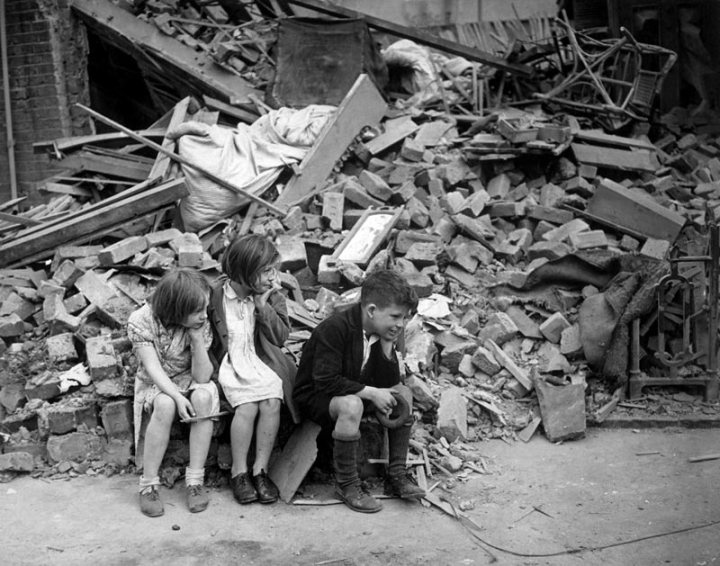
980xAuthorities produced posters urging parents to leave the kids where they were, and a good thing, too. The Blitz against London itself began on September 7. The city experienced the most devastating attack to-date on December 29, in a blanket fire-bombing that killed almost 3,600 civilians.

Sometimes, refugees from relatively safe locations were shipped into high-risk target areas. Hundreds of refugees from Gibraltar were sent into London, in the early days of the Blitz. None of them could have been happy to leave London Station, to see hundreds of locals pushing past them, hurrying to get out.

This story doesn’t only involve the British home islands, either.  American Companies like Hoover and Eastman Kodak took thousands of children in, from employees of British subsidiaries.  Thousands of English women and children were evacuated to Australia, following the Japanese attack on Singapore.

62d70d4914a701b66b42480e66c82105By October 1940, the “Battle of Britain” had devolved into a mutually devastating battle of attrition, in which neither side was capable of striking the death blow. Hitler cast his gaze eastward the following June, with a surprise attack on his “ally”, Josef Stalin.

“Operation Steinbock”, the Luftwaffe’s last large-scale strategic bombing campaign of the war against southern England, was carried out three years later.  285 German bombers attacked London on this day in 1944, in what the Brits called the “Baby Blitz”. You’ve got to be some tough cookie, to call 245 bombers a Baby Blitz.

WWII_London_Blitz_East_London-Children

Late in the war, the subsonic “Doodle Bug” or V1 “flying bomb” was replaced by the terrifying supersonic V2.  1,000 or more of these, the world’s first rocket, were unleashed against southern England, primarily London, killing or wounding 115,000. With a terminal velocity of 2,386mph, you never saw or heard this thing coming, until the weapon had done its work.

15092_0In the end, many family ‘reunions’ were as emotionally bruising as the original breakup.   Years had come and gone and new relationships had formed.  The war had turned biological family members, into all but strangers.

Richard Singleton remembers the day his mother came, to take him home to Liverpool.  “I had been happily living with ‘Aunty Liz and Uncle Moses’ for four years,” he recalled. “I told Mam that I didn’t want to go home. I was so upset because I was leaving and might never again see aunty and uncle and everything that I loved on the farm.”

Douglas Wood tells a similar story.  “During my evacuation I had only seen my mother twice and my father once,” he recalls. “On the day that they visited me together, they had walked past me in the street as they did not recognise me. I no longer had a Birmingham accent and this was the subject of much ridicule. I had lost all affinity with my family so there was no love or affection.”

The Austrian-British psychoanalyst Anna Freud, daughter of Sigmund Freud, commissioned an examination of the psychological effects of the separation. After a 12-month study, she concluded that “separation from their parents is a worse shock for children than a bombing.”

January 27, 1945 Cabanatuan

The Japanese atrocity at Palawan sparked a series of raids at Santo Tomas Internment Camp, Bilibid Prison, Los Baños and others.  The first such behind-enemy-lines rescue, was Cabanatuan.

Today, Cabanatuan calls itself the “Tricycle Capital of the Philippines”, with about 30,000 motorized “auto rickshaws”.  Seventy-three years ago, the place was home to one of the worst POW camps of WWII.

15918-cabanatuan-city-locator-map

1942 was a dreadful year for the allied war effort in the Pacific.  The Battle of Bataan alone resulted in 72,000 prisoners being taken by the Japanese, marched off to POW camps designed for ten to twenty-five thousand.

pows-cabanatuan20,000 died from sickness or hunger, or were murdered by Japanese guards on the 60 mile “death march” from Bataan, into captivity at Cabanatuan prison and others.

Cabanatuan held 8,000 prisoners at its peak, though the number dropped considerably as the able-bodied were shipped out to work in Japanese slave labor camps.

Cabanatuan-prisoncamp-report_555Two rice rations per day, fewer than 800 calories, were supplemented by the occasional animal or insect caught and killed inside camp walls, or by the rare food items smuggled in by civilian visitors.

2,400 died in the first eight months at Cabanatuan, animated skeletons brought to “hospital wards”, nothing more than 2’x6′ patches of floor, where prisoners waited to die.

A Master Sergeant Gaston saw one of these wards in July 1942, saying: “The men in the ward were practically nothing but skin and bones and they had open ulcers on their hips, on their knees and on their shoulders…maggots were eating on the open wounds. There were blow flies…by the millions…men were unable to get off the floor to go to the latrine and their bowels moved as they lay there”.

The war was going badly for the Japanese by October 1944, as Imperial Japanese High Command ordered able bodied POWs removed to Japan.  1,600 were taken from Cabanatuan, leaving 500 weak and disabled prisoners.  The guards abandoned camp shortly after, though Japanese soldiers continued to pass through.  POWs were able to steal food from abandoned Japanese quarters; some even captured two water buffalo called “Carabao”, which were killed and eaten.  Many feared a trick and never dared to leave the camp.  Most were too sick and weak to leave in any case, though the extra rations would help them through what was to come.

Palawan_Massacre_POW_Burial_Site_1945On December 14, some fifty to sixty soldiers of the Japanese 14th Area Army in Palawan doused 150 prisoners with gasoline and set them on fire, machine gunning or clubbing any who tried to escape the flames.   Some thirty to forty managed to escape the killing zone, only to be hunted down and murdered, one by one.  Eleven managed to escape the slaughter, and lived to tell the tale.  139 were burned, clubbed or machine gunned to death.
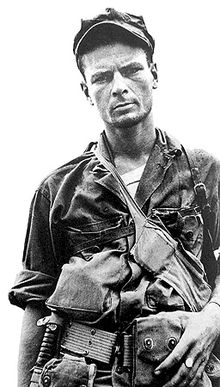
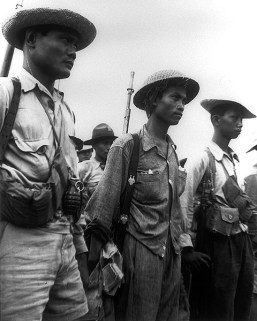
The atrocity at Palawan sparked a series of raids at Santo Tomas Internment Camp, Bilibid Prison, Los Baños and others.  The first such behind-enemy-lines rescue, was Cabanatuan.

Lieutenant Colonel Henry Mucci of the United States Army’s elite 6th Ranger Battalion selected Captain Robert Prince to plan the rescue. “We couldn’t rehearse this”, Prince said. “Anything of this nature, you’d ordinarily want to practice it over and over for weeks in advance. Get more information, build models, and discuss all of the contingencies. Work out all of the kinks. We didn’t have time for any of that. It was now, or not”.

220px-Robert_Prince
6th Ranger Battalion Capt. Robert Prince

On the evening of January 27, 1945, a 14-man advance team formed from the 6th Ranger Battalion and a special reconnaissance group called the “Alamo Scouts”, separated into two groups and began the 30-mile march behind enemy lines to liberate Cabanatuan.

The main force of 121 Rangers moved out the following day, meeting up with 200 Filipino guerrillas, serving as guides and helping in the rescue.

Other guerrillas assisted along the way, muzzling dogs and corralling chickens so that Japanese occupiers would hear nothing of their approach.  Japanese soldiers once again occupied the camp, with 1,000 more camped across the Cabo River outside the prison.  As many as 7,000 more were deployed, just a few miles away.

On the night of the 30th, a P-61 Black Widow piloted by Captain Kenneth Schrieber and 1st Lt. Bonnie Rucks staged a ruse.  For 45 minutes, the pair conducted a series of aerial acrobatics, cutting and restarting engines with loud backfires while seeming to struggle to maintain altitude. Thousands of Japanese soldiers watched the show, as Rangers belly crawled into positions around the camp.

Pajota's_Guerrillas
Filipino Guerilla fighters of Captain Juan Pajota

Guard towers and pillboxes were wiped out in the first fifteen seconds of the assault.  Filipino guerrillas blew the bridge and ambushed the large force across the river while one, trained to use a bazooka only hours earlier, took out four Japanese tanks.

In the camp, all was pandemonium as some prisoners came out and others hid, suspecting some trick to bring them out in the open.  They were so emaciated that Rangers carried them out two at a time.

The raid was over in 35 minutes, POWs brought to pre-arranged meet-up places with dozens of carabao carts.   A long trek yet remained, one POW said “I made the Death March from Bataan, so I can certainly make this one!”  Over three days, up to 106 carts joined the procession, their plodding 2 MPH progress covered by strafing American aircraft.

Two American Rangers were killed in the raid, another 4 Americans and 21 Filipinos wounded, compared with 500-1,000 Japanese killed and four tanks put out of action.  One prisoner died in the arms of a Ranger, before leaving the gate.  Another died of illness on the long trip back.  464 American soldiers were liberated, along with 22 British and 3 Dutch soldiers, 28 American civilians, 2 Norwegians and one civilian each of British, Canadian and Filipino nationalities.

800px-Carabao_Cart
Carabao cart, similar to the ones used after the raid on Cabanatuan

Edwin Rose was a civilian, a purser on a ship plying the Singapore – Hong Kong run, when the war broke out.  He was caught in Manila and spent 929 days in captivity.  One of the longest-held POWs of the war in the Pacific. Rose awoke the night of the raid, and “heard all the shooting”.  He “knew the Americans had arrived” but he rolled over and went back to sleep, thinking they were there to stay. On awakening the following morning, Rose found he had “Cabanatuan all my own.”

POWs_celebrateHe dressed and shaved, put on his best clothes, and walked out of camp.  Passing guerrillas found him and passed him to a tank destroyer.  Give the man points for style.  A few days later, Edwin Rose strolled into 6th army headquarters, a cane tucked under his arm.

The Cabanatuan raid of January 30, 1945 liberated over 500 allied prisoners, the Americans among them representing virtually every state in the Union. Begging pardon for any mistakes in rank and/or spelling, the following represents those from my home state of Massachusetts:

  • Lieutenant Commander Robert Strong, Jr., Arlington
  • Captain John Dugan, Milton
  • 2nd Lieutenant John Temple, Pittsfield
  • Sergeant Richard Neault, Adams
  • Sergeant Stanislaus Malor, Salem
  • Private, 1st Class Joseph Thibeault, Lawrence
  • Private Edward Searkey, Lynn
  • USN C/QM Martin Seliga, Fitchburg
  • USN 1/C PO J.E.A. Morin, Danvers
  • USN AC MM Carl Silverman, Wareham

I hope I didn’t leave anyone out.  These guys have earned the right to be remembered.

If you enjoyed this “Today in History”, please feel free to re-blog, “like” & share on social media, so that others may find and enjoy it too. Please click the “follow” button on the right, to receive email updates on new articles.  Thank you for your interest, in the history we all share.