March 4, 1942 Pearl Harbor, Version 2.0

If successful, this would be an endurance mission, one of the longest bombing raids ever attempted, and carried out entirely without fighter escort.  The mission was designated “Operation K”, and scheduled for March 4, 1942.

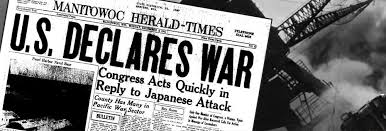
On December 7, 1941, forces of the Imperial Japanese Navy attacked the United States’ Pacific naval Anchorage, at Pearl Harbor. President Franklin Delano Roosevelt addressed a joint session of Congress the following day, requesting a declaration that, since the attack, a state of war had existied between the United States, and Japan. Three days later, Nazi Germany declared war on the United States, reciprocated by an American declaration against Nazi Germany, and their Italian allies. A two-years long conflict in Europe, had become a World War.
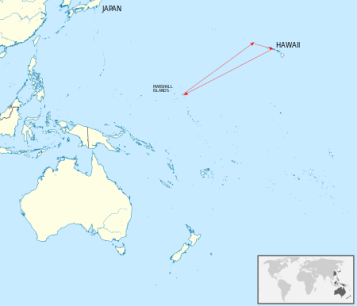
450px-Operation_K.svgIn the months that followed, the United States ramped up its war capacity, significantly.  Realizing this but having little information, the Imperial Japanese Navy (IJN) determined to visit Pearl Harbor once again, to have a look around.

For the IJN, this was an opportunity to test the new Kawanishi H8K1 “Emily” flying boat, an amphibious bomber designed to carry out long distance bombing raids. So it was that a second, albeit smaller attack was launched against Pearl Harbor.

The IJN plan was complex.  This, the first Kawanishi H8K1 operation in Japanese military service, involved a small formation of flying boats to be sent to Wotje Atoll in the Marshall Islands, from there to stage the long-range attack.  The five flying boats would be loaded with four 550lb bombs apiece and flown to French Frigate Shoals northwest of Oahu, there to rendezvous with three Japanese submarines, waiting to refuel them.  Ten miles south of Oahu, the 356’ diesel-powered submarine I-23 was to hold watch over the operation, reporting weather and acting as “lifeguard” in case any aircraft had to ditch in the ocean.

HighFlight-OperationK2-300x181
“A Kawanishi H8K1 of the 802nd Kokutai is lifted out of the water onto the decks of the HIJMS Akitsushima, 1942, off Shortland Island”. H/T fly.historicwings.com, for this image

After refueling, the bomber – reconnaissance mission would approach Pearl Harbor and attack the “10-10 dock”, so-called because it was 1,010 feet long and a key naval asset for the US Pacific Fleet.

If successful, this would be an endurance mission, one of the longest bombing raids ever attempted, and carried out entirely without fighter escort.  The mission was designated “Operation K”, and scheduled for March 4, 1942.

As it turned out, the raid was a “comedy of errors”, on both sides.

Things began to go wrong, almost from the beginning.  I-23 vanished.  To this day nobody knows where the submarine went. American forces reported several engagements with possible subs during this time frame.  Maybe one of those depth charges did its job.  It is equally possible that, unknown to the Imperial Japanese Navy, I-23 was involved in an accident, lost at sea with all hands.

cb33f4104e2bbd353f6d2db6accd356c

As it was, only two of the new flying boats were ready for the operation, the lead plane (Y-71) flown by Lieutenant Hisao Hashizume, and his “wingman” Ensign Shosuke Sasao flying the second aircraft, Y-72.

The staging and refueling parts of the operation were carried out but, absent weather intelligence from the missing I-23, the two-aircraft bombing formation was ignorant of weather conditions over the target.  As it was, a thick cloud cover woud leave the Japanese pilots all but blind.

HighFlight-OperationK3-285x300
Captain Joseph J. Rochefort, USN

On the American side, Captain Joseph J. Rochefort, USN, worked in the Combat Intelligence Unit, tasked with intercepting enemy communications and breaking Japanese codes.  US code breakers had intercepted and decoded Japanese radio communications prior to the attack of four months earlier, but urgent warnings were ignored by naval authorities at Pearl Harbor.

Once again, Rochefort’s team did its job and urgent warnings were sent to Commander in Chief Pacific (CINCPAC) and to Com-14.  Incredibly, these warnings too, fell on deaf ears.  Rochefort was incredulous.  Years later, he would describe his reaction, at the time “I just threw up my hands and said it might be a good idea to remind everybody concerned that this nation was at war.”

American radar stations on Kauai picked up and tracked the incoming aircraft, but that same cloud cover prevented defenders from spotting them.  Curtiss P-40 Warhawk fighters were scrambled to search for the attackers, while Consolidated PBY Catalina flying boats were sent to look for non-existent Japanese aircraft carriers, assumed to have launched the two bombers.

Meanwhile, the two Japanese pilots became confused, and separated.  Hashizume dropped his bombs on the side of Mt. Tantalus, about 1,000 ft. from nearby Roosevelt High School.  Hashizume’s bombs left craters 6-10 ft deep and 20-30 ft across on the side of the extinct volcano.  Sasao is presumed to have dropped his bombs, over the ocean.
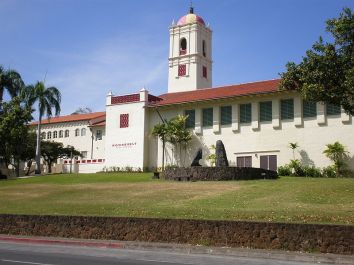
800px-President-Theodore-Roosevelt-High-School
President Theodore Roosevelt High School, Honolulu

A Los Angeles radio station reported “considerable damage to Pearl Harbor”, with 30 dead sailors and civilians, and 70 wounded.  Japanese military authorities took the broadcast to heart, and considered the operation to have been a great success.  Talk about ‘fake news’.  As it was, the damage was limited to those craters on Mt. Tantalus, and shattered windows at Roosevelt High.

The United States Army and the US Navy blamed each other for the explosions, each accusing the other of jettisoning munitions over the volcano.

The IJN planned another such armed reconnaissance mission for the 6th or 7th of March, but rescheduled for the 10th because of damage to Hashizume’s aircraft, and the exhaustion of air crew.  The second raid was carried out on March 10, but Hashizume was shot down and killed near Midway atoll, by Brewster F2A “Buffalo” fighters.

HighFlight-OperationK7
The results of the second Japanese raid on Pearl Harbor, carried out on March 4, 1942, were limited to four craters on the side of an extinct volcano.

A follow-up to Operation K was scheduled for May 30, but by that time, US military intelligence had gotten wise to the IJN meet-up point.  Japanese submarines arriving at French Frigate Shoals found the place mined, and swarming with American warships.

In the end, the Imperial Japanese Navy was unable to observe US Navy activity, or to keep track of American aircraft carriers.  Days later, this blindness would have a catastrophic effect on the Japanese war effort, at a place called Midway.

DiscoverHawaiiTours_PearlHarbor_USSMissouri_2

If you enjoyed this “Today in History”, please feel free to re-blog, “like” & share on social media, so that others may find and enjoy it as well. Please click the “follow” button on the right, to receive email updates on new articles.  Thank you for your interest, in the history we all share.

March 3, 1634 Watering Hole

In early colonial America, tavern keepers would put out an “Ale Stick” or “Ale Stake”, a wooden pole with a bush of barley tied to the top, informing thirsty travelers that sustenance could be found, inside.  Sometimes a hoop of woven barley hanging outside, would tell you that you had arrived.

Despite seemingly inexhaustible supplies of pristine drinking water, colonists to the New World were first and foremost Englishmen, every one of whom understood that drinking water could make you deathly ill. The connection between sanitation and the boiling to make beer was ill understood, but everyone knew. Those who drank beer and ale didn’t get sick.  The brewhouse was an indispensable priority in every new settlement.

The earliest settlers to Jamestown, Virginia neglected the brewer’s art. Their first pleas for relief from England, included advertisements seeking “two brewers’ to join them.

When Pilgrims fetched up on the shores of Cape Cod and the later Plimoth colony in 1620, it was not in search of a beach vacation, but because of dwindling beer supplies.

330px-Boston,_1775bsmall1
Today, much of the bay has been filled in and developed, forming the core of downtown Boston. This is the Shawmut Peninsula, as it looked during Cole’s time.

Little brother Benjamin Franklin describes his earliest experience working in his brother’s print shop, with frequent reference to fetching ale for the journeyman printers.

Beer and ale were dietary staples in the era, a source of nourishment as well as refreshment. Infants drank beer and it was especially recommended for nursing mothers. Many households added a small brewing room to the outside of the building, so that the heat and risk of fire associated with brewing and cooking could be kept outside of living quarters. To this day, the lower rooflines of these “brew rooms” can be found, jutting out from the sides of the oldest American homes.

In early colonial America, tavern keepers would put out an “Ale Stick” or “Ale Stake”, a wooden pole with a bush of barley tied to the top, informing thirsty travelers that sustenance could be found, inside.  Sometimes a hoop of woven barley hanging outside, would tell you that you had arrived.

Samuel Cole was an early settler in the Massachusetts Bay colony, arriving with the Winthrop fleet in 1630 and establishing himself on the Shawmut peninsula.  Four years later, he opened the first house of entertainment in Boston, calling his place “Cole’s Inn”, established March 3, 1634.

Taverns were common in England from as early as the 1200s, where women called “Ale Wives” would fetch beer, wine, mead and ale for the guests. Though lodgings were a common feature of the ale houses of the time, it would not be until the early 1700s that Colonial taverns commonly offered such amenities.

185

Later taverns posted elaborate signs, carved from wood, stone, or even terra cotta, and hanged from wooden posts mounted to the building or to a nearby tree. Barley, the universal symbol for beer, remained a common feature of such signs, and continues in use on the labels of many brands sold to this day.

download (17)The signs of the time frequently included horses, indicating that lodgings and stables were available. Many such establishments came to be called after such signs, and names such as “Chestnut Mare” and “White Stallion” were common.
Today, a Google search of the term “Black Horse Tavern” yields some 1,090,000 hits.  Cheers.

“Filled with mingled cream and amber
I will drain that glass again.
Such hilarious visions clamber
Through the chambers of my brain –
Quaintest thoughts — queerest fancies
Come to life and fade away;
Who cares how time advances?
I am drinking ale today.” – Edgar Allen Poe


If you enjoyed this “Today in History”, please feel free to re-blog, “like” & share on social media, so that others may find and enjoy it as well. Please click the “follow” button on the right, to receive email updates on new articles.  Thank you for your interest, in the history we all share.

March 2, 1977 Heeere’s Johnny

The world’s longest running talk show began in 1954, when Steve Allen sat down at his piano on September 27.  This show is gonna go on… forever”, Allen quipped.  So far, he seems to have gotten that right.

download (14)
Johnny Carson, Navy portrait

With Jack Parr about to sign off the “Tonight Show” for the last time, NBC executives were anxious to find a replacement.  Bob Newhart, Jackie Gleason, Groucho Marx, and Joey Bishop all declined the opportunity, when a United States Navy veteran, amateur magician and amateur boxer with a 10/0 record agreed to take the job.

Back when late-night comedians were expected to be funny, Johnny Carson had misgivings, believing himself unequal to the task of producing 90 minutes of fresh content, every day.

A series of guest hosts followed including Merv Griffin, Art Linkletter, Joey Bishop, Jerry Lewis and Groucho Marx, as Carson finished out the last six months of a contract with ABC.  Despite his apprehensions, Carson started the new gig on October 1, 1962.

No sooner had NBC announced that Johnny Carson would be joining “The Tonight Show,” than the national press gaggle came after him, looking for interviews. Paradoxically, the future “King of late night comedy” was averse to publicity.  Carson resisted at first, but finally relented, providing a list of answers to which journalists could apply any question they pleased:

  • “Yes, I did”.
  • “Not a bit of truth in that rumor”.
  • “Only twice in my life, both times on Saturday”.
  • “I can do either, but prefer the first”.
  • “NO”.
  • “Kumquats”.
  • “I can’t answer that question”.
  • “Toads and tarantulas”.
  • “Turkestan, Denmark, Chile, and the Komandorskie Islands”.
  • “As often as possible, but I’m not very good at it yet”.
  • “I need much more practice”.
  • “It happened to some old friends of mine, and it’s a story I’ll never forget”.
download (15)
Ed McMahon

A Marine Corps aviator and flight instructor from Lowell, Massachusetts joined Carson from that first show, back in 1962.   The Marine earned his carrier landing qualifications around the time the atomic bomb ended the war in the Pacific, and went on to fly 85 combat missions in Korea, earning six air medals and retiring with the rank of Colonel in 1966.   His name was Ed McMahon.

In those days, the Tonight Show was a whopping 105 minutes long.  Groucho Marx delivered a fifteen-minute monologue before introducing the host for that first program.  After that and for years afterward, the monologue segment fell to McMahon himself.

introducing-the-new-host-of-the-tonight-show-johnny-carson (1)
Groucho Marx introducing the new host of the Tonight Show, October 1, 1962

When the Tonight Show first aired, everyone on the set including Carson himself, smoked.  The “Public Health Cigarette Smoking Act” was introduced in Congress in 1969.  Ironically, it was President Richard Nixon, an avid pipe smoker who lit up as many as eight bowls a day, who signed the measure into law on April 1, 1970.   The measure included a permanent ban on television cigarette advertising, scheduled to take effect ac1dd1ea41e71a3d44fe61af45173ba5--johnny-carson-tonight-showJanuary 2, the following year.  The last cigarette ad in the history of American television was a Virginia Slims ad, broadcast at 11:59p.m., January 1, 1971, on the Tonight Show, Starring Johnny Carson.  Smoking on-air became a thing of the past sometime in the mid-80s, but that cigarette box remained on Carson’s desk until his final episode, in 1992.  You’ve come a long way, baby.

For NBC, the Tonight Show was a cash cow.  Many years the program grossed over $100 million, accounting for 15-20% of the profits earned by the entire network.  Carson threatened to walk in 1980, ending up with a deal unprecedented in the history of American broadcasting: $5 million a year and series commitments estimated at $50 million.  Just as important, show content would no longer belong to the network, but to Carson himself.

hqdefault (1)Carson began taking Mondays off in 1972, when the show moved from New York to California.  There followed a period of rotating guest hosts, including George Carlin and Joan Rivers, who became permanent guest host between 1983 and 1986.

The Tonight Show Starring Johnny Carson was a late-night fixture through seven US Presidents: John Kennedy, Lyndon Johnson, Richard Nixon, Gerald Ford, Jimmy Carter, Ronald Reagan, and George HW Bush.  Nearly every American over the age of 30 and some younger will remember the opening, “Heeeeeeeeeeere’s Johnny!”.  There was the opening monologue, and the imaginary golf swing.  “Carnac the Magnificent”, holding the envelope to his head, reciting the punchline to the joke sealed inside.  “Saucepan… Who was Peter Pan’s wino brother?”  When a joke bombed, there was the comedic curse.  “May a bloated yak change the temperature of your jacuzzi!”

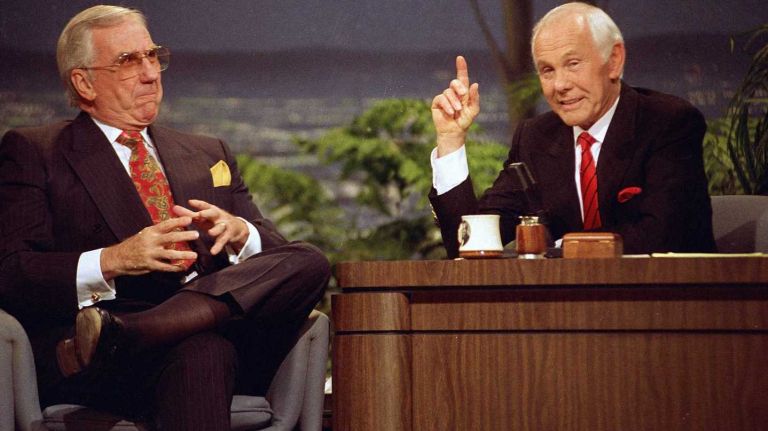
download (16)Jay Leno appeared on the Tonight Show with Johnny Carson for the first time on March 2, 1977.  He would frequently guest, and served as permanent host from May 1992 to May 2009.

Five years after Carson’s final show, 10,000 taped episodes were moved to a salt mine in Kansas, to protect them from deterioration. There they remain, 54 stories underground, where the average temperature is 68° Fahrenheit, with a uniform 40% humidity.

Excepting Conan O’Brien’s eight months in 2010, Leno remained permanent host of the Tonight Show until February 2014, recording more episodes (4,610) than even Carson himself, with 4,531. Saturday Night live veteran Jimmy Fallon took over the reins in February 2014, where he remains to this day.

The world’s longest running talk show began in 1954, when Steve Allen sat down at his piano on September 27.  This show is gonna go on… forever”, Allen quipped.  So far, he seems to have gotten that right.

1962_Johnny-03_large

If you enjoyed this “Today in History”, please feel free to re-blog, “like” & share on social media, so that others may find and enjoy it as well. Please click the “follow” button on the right, to receive email updates on new articles.  Thank you for your interest, in the history we all share.

March 1, 2011 The Love of a Dog

The writer and photographer Roger Caras once said “Dogs are not our whole life, but they make our lives whole.”

Years ago, a segment broadcast on National Public Radio’s All Things Considered, told the story of a working shepherd, who worked the hills of 1930s North Dakota. This man, I don’t recall his name, fell ill, and was taken to a local Jesuit hospital.

The man’s business partner and constant companion “Shep”, a sheepdog of unknown breed, befriended a nurse who would feed him a morsel out of the side door.

For 11 days, Shep waited at the hospital, for his master’s return.   On the 11th day the man died, his casket taken to the local train station and placed in the cargo hold, to be returned home for burial.

images (23)
“Greyfriar’s Bobby’

Shep was there throughout, and watched the train chug away with the body of his human.   He returned to that hospital door for sustenance, but every time he heard the train whistle, there was a sheepdog waiting at the station.

In those days, there were two trains a day.  For five years, Shep returned to the station, every time he heard that whistle.   He never missed a train. In time, the dog wasn’t quite as fast as he used to be, his hearing not so good. He was killed while waiting on the tracks, for the man who could never return.

“Greyfriar’s Bobby” was a Skye Terrier in 19th-century Edinburgh, who waited 14 years by the grave of his owner, City Police nightwatchman, John Gray. There he died in 1872 and was buried in the Greyfriars Kirkyard, not far from where he had stood watch. all those years.

download (13)
Hachikō Statue in Tokyo, Japan

Hachikō, an Akita known to Japanese children as chūken Hachikō (“faithful dog Hachikō”), used to tag along with his owner Hidesaburō Ueno, a professor of agriculture at Tokyo University. Ueno would commute to work and every evening, Hachikō would wait at the Shibuya Station, for the professor’s return.  Hidesaburō stopped coming home in May 1925, when a cerebral hemorrhage took him away while delivering a lecture.  Every day for nine years, nine months and fifteen days, the golden colored Akita appeared at Shibuya Station, precisely in time for that evening train.

Liam Tasker came from the Scottish town of Kirkcaldy, in the historic county of Fife.  Tasker joined the Royal Army in 2001 as a mechanic, but he wanted more.  He was transferred to the Royal Army Veterinary Corps six years later, and assigned as a trainer with the 1st Military Working Dog (MWD) Regiment.  Tasker was a natural, and rose quickly among the ranks of the group.  In 2010, Lance Corporal Tasker was paired with MWD Theo, a twenty-two-month-old English Springer Spaniel serving as a T.E.D.D. (Tactical Explosives Detection Dog) with the British Army.

liam_and_theo
Liam and Theo

A Military Working Dog is anything but a “disposable” asset.  It is a highly trained, specialized soldier who complements and adds to the abilities of his human partner, as that two legged soldier complements those of the dog.

The writer and photographer Roger Caras once said “Dogs are not our whole life, but they make our lives whole.”  So it was, with Liam and Theo.  The team was posted to Afghanistan, where the two managed to find 14 improvised explosive devices and weapons caches, in five months.  “I love my job and working with Theo,” Tasker would say. “He has a great character and never tires…He can’t wait to get out and do his job and will stop at nothing.”  Fourteen was a record for that time according to BBC, there is no telling how many lives were saved.  The pair proved so successful that their tour was extended, by a month.  It was a month too long.

4de6134f233b601ab634d1078c676380On March 1, 2011, L/Cpl Tasker was killed by a Taliban sniper while on patrol in Helmand Province, and brought back to base by his fellow soldiers.  Theo suffered a seizure after returning to base and never recovered.  He died that afternoon.  It was believed that Theo’s seizure was brought on by the stresses of Tasker’s death, but the autopsy proved inconclusive.  Liam’s mother Jane Duffy later said, “I think Theo died of a broken heart, nobody will convince me any different.”

Major Alexander Turner of the 1st Battalion Irish Guards described the pair, saying “He used to joke that Theo was impossible to restrain but I would say the same about Lance Corporal Tasker.” Liam and Theo were returned to Great Britain, arriving first in RAF Lyneham, Wiltshire.  Rumors have gone around ever since, that the two were buried together.  Tasker’s mother would neither confirm nor deny.  She only said, with a sad smile, that “Liam and Theo are where they should be.”

Afterward

Nate & ZinoOn a more upbeat note, and this story needs one, our daughter Carolyn and son-in-law Nate transferred to Savannah in 2013, where Nate deployed to the Wardak province of Afghanistan as a TEDD handler and paired with “MWD Zino”, a four-year-old German Shepherd trained to detect up to 64 explosive compounds.
The team was separated at the end of their tour but reunited months later, a story told on National Public Radio’s “Here & Now” program and produced out of their Boston affiliate, WBUR.
The radio program was broadcast the day of their reunion, in 2014.  It’s a great story, if you’re interested in listening to it.

http://hereandnow.wbur.org/2014/03/21/soldier-dog-reunion 

February 28, 1944 Test Pilot

In her 1951 memoir “Fliegen – mein leben”, (Flying is my life), Hannah Reitsch offers no moral judgement one way or the other, on Hitler or the Third Reich.

Hannah Reitsch wanted to fly.  Born March 29, 1912 into an upper-middle-class family in Hirschberg, Silesia, it’s all she ever thought about. At the age of four, she tried to jump off the family balcony, to experience flight.  In her 1955 autobiography The Sky my Kingdom, Reitsch wrote:  ‘The longing grew in me, grew with every bird I saw go flying across the azure summer sky, with every cloud that sailed past me on the wind, till it turned to a deep, insistent homesickness, a yearning that went with me everywhere and could never be stilled.

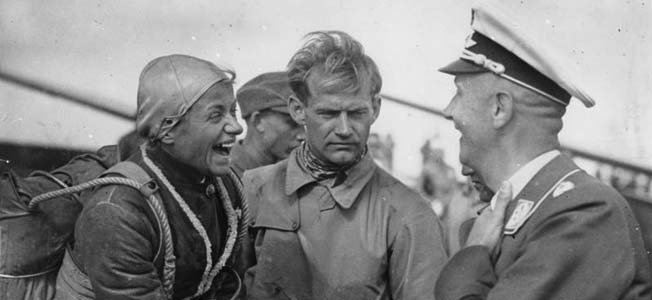
94329f643cf875a2a36889aec9d1162c--hanna-reitsch-medical-schoolReitsch began flying gliders in 1932, as the treaty of Versailles prohibited anyone flying “war planes” in Germany. In 1934, she broke the world’s altitude record for women (9,184 feet).  In 1936, Reitsch was working on developing dive brakes for gliders, when she was awarded the honorary rank of Flugkapitän, the first woman ever so honored. In 1937 she became a Luftwaffe civilian test pilot.  She would hold the position until the end of WW2.
A German Nationalist who believed she owed her allegiance to the Fatherland more than to any party, Reitsch was patriotic and loyal, and more than a little politically naive.  Her work brought her into contact with the highest levels of Nazi party officialdom.  Like the victims of Soviet purges who went to their death believing that it would all stop “if only Stalin knew”, Reitsch refused to believe that Hitler had anything to do with events such as the Kristallnacht pogrom.  She dismissed any talk of concentration camps, as “mere propaganda”.

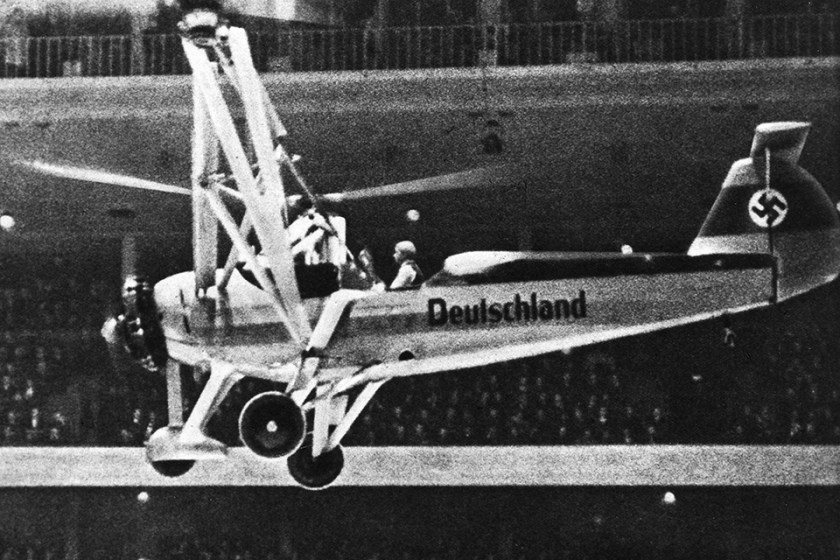
Hubschrauber Focke-Wulf FW 61 V1 in Berliner Deutschlandhalle 1938
In February 1938, Hannah Reitsch became the first person of either sex to fly a helicopter, the Focke-Achgelis Fa-61, inside a building, Berlin’s Deutschlandhalle. (ullstein bild via Getty Images)

As a test pilot, Reitsch won an Iron Cross, Second Class, for risking her life in an attempt to cut British barrage-balloon cables. On one test flight of the rocket powered Messerschmitt 163 Komet in 1942, she flew the thing at speeds of 500 mph, a speed nearly unheard of at the time. She spun out of control and crash-landed on her 5th flight, leaving her with severe injuries.  Her nose was all but torn off, her skull fractured in four places.  Two facial bones were broken, and her upper and lower jaws out of alignment.  Even then, she managed to write down what had happened, before she collapsed.

Hannah ReitschDoctors did not expect her to live, let alone fly again.  She spent five months in hospital, and suffered from debilitating dizzy spells.  She put herself on a program of climbing trees and rooftops, to regain her sense of balance.  Soon, she was test flying again.

On this day in 1944, Reichsmarshall Hermann Göring awarded her a special diamond-encrusted version of the Gold Medal for Military Flying. Adolf Hitler personally awarded her an Iron Cross, First Class, the first and only woman in German history, so honored.

It was while receiving this second Iron Cross in Berchtesgaden, that Reitsch suggested the creation of a Luftwaffe suicide squad, “Operation Self Sacrifice”.

Hanna-Reitsch-2Hitler was initially put off by the idea, though she finally persuaded him to look into modifying a Messerschmitt Me-328B fighter for the purpose. Reitsch put together a suicide group, becoming the first to take the pledge, though the idea would never take shape. The pledge read, in part: “I hereby voluntarily apply to be enrolled in the suicide group as a pilot of a human glider-bomb. I fully understand that employment in this capacity will entail my own death.”
The plan came to an abrupt halt when an Allied bombing raid wiped out the factory in which the prototype Me-328s were being built.

In the last days of the war, Hitler dismissed his designated successor Hermann Göring, over a telegram in which the Luftwaffe head requested permission to take control of the crumbling third Reich.  Hitler appointed Generaloberst Robert Ritter von Greim, ordering Hannah to take him out of Berlin and giving each a vial of cyanide, to be used in the event of capture.   The Arado Ar 96 left the improvised airstrip on the evening of April 28, under small arms fire from Soviet troops.  It was the last plane to leave Berlin.  Two days later, Adolf Hitler was dead.

Taken into American custody on May 9, Reitsch and von Greim repeated the same statement to American interrogators: “It was the blackest day when we could not die at our Führer’s side.” She spent 15 months in prison, giving detailed testimony as to the “complete disintegration’ of Hitler’s personality, during the last months of his life.  She was found not guilty of war crimes, and released in 1946. Von Greim committed suicide, in prison.

Hanna-Reitsch

In her 1951 memoir “Fliegen – mein leben”, (Flying is my life), Reitsch offers no moral judgement one way or the other, on Hitler or the Third Reich.

She resumed flying competitions in 1954, opening a gliding school in Ghana in 1962.  She later traveled to the United States, where she met Igor Sikorsky and Neil Armstrong, and even John F. Kennedy.

Hannah Reitsch remained a controversial figure, due to her ties with the Third Reich.  Shortly before her death in 1979, she responded to a description someone had written of her, as `Hitler’s girlfriend’.  “I had been picked for this mission” she wrote, “because I was a pilot…I can only assume that the inventor of these accounts did not realize what the consequences would be for my life.  Ever since then I have been accused of many things in connection with the Third Reich”.

592644327Toward the end of her life, she was interviewed by the Jewish-American photo-journalist, Ron Laytner. Even then she was defiant:  “And what have we now in Germany? A land of bankers and car-makers. Even our great army has gone soft. Soldiers wear beards and question orders. I am not ashamed to say I believed in National Socialism. I still wear the Iron Cross with diamonds Hitler gave me. But today in all Germany you can’t find a single person who voted Adolf Hitler into power … Many Germans feel guilty about the war. But they don’t explain the real guilt we share – that we lost“.

Hannah Reitsch died in Frankfurt on August 24, 1979, of an apparent heart attack.  Former British test pilot and Royal Navy officer Eric Brown received a letter from her earlier that month, in which she wrote, “It began in the bunker, there it shall end.”  There was no autopsy, or at least there’s no report of one.  Brown, for one, believes that after all those years, she may have finally taken that cyanide capsule.

February 27, 1992 The Founding Father & Son, of Golf

Young Tom Morris followed that first Open Championship in 1868 with three more, in 1869, 1870 and 1872. His record stands to this day, the only player ever to win four consecutive Open Golf Championships.   (There was no championship in 1871).

On this day in 1992, 16-year-old Tiger Woods became the youngest PGA golfer in 35 years, going on to become the first $100 million man on the Professional Tour.

article-2537121-1A8B0ADF00000578-386_470x741
“Young” Tom Morris

The youngest in thirty-five years, but not the youngest.  Andy Zhang made the US Open in 2012, at the ripe old age of fourteen years, six months, but even he wasn’t the youngest.

The youngest golfer ever to play in one of the majors (the Masters, US & British Opens and the PGA Championship), was the appropriately named “Young” Tom Morris  Jr., a Scot who played in the 1865 British Open at 14 years and four months.

Morris withdrew from that year’s tournament, at about the time General Robert E. Lee was meeting General Ulysses S. Grant at Appomattox.  Young Tom went on to win the British Open three years later, winning the equivalent of $12 for the feat. Ironically, the victory came at the expense of his father “Old” Tom Morris, Greenkeeper and club pro at the famous ‘Old Course’ at St. Andrews.

Young Tom followed that first Open Championship in 1868 with three more, in 1869, 1870 and 1872. His record stands to this day, the only player ever to win four consecutive Open Golf Championships.   (There was no championship in 1871).

The 18th Green of the Old Course at St. Andrews looks much the same today, as it did in 1891.

Young Tom went on to win three more Open tournaments, the first of only two teenagers in history to win any of the majors.  In 1864, Young Tom attended a tournament with his father at the King James VI Golf Club.  With days to go before his 13th birthday, he was too young to compete in either the professional or amateur sections.  Local organizers set up a two-man tournament between himself and a local youth champion.  A large gallery followed the two young golf stars throughout their match.  Those who did so were rewarded by seeing young Tom win the match, by a score sufficient to have won the professional tournament.

a-golf-match-involving-willie-park-old-tom-morris-and-young-tom-morris-g3b8fhThe Father/Son team tee’d off in match against the brothers Willie and Mungo Park on September 11, 1875. With two holes to go, Young Tom received a telegram with upsetting news. His wife Margaret had gone into a difficult labor. The Morrises finished those last two holes winning the match, and hurried home by ship across the Firth of Forth and up the coast. Too late. Tom Morris Jr. got home to find that his young wife and newborn baby, had died in childbirth.

Weeks later, Young Tom played a marathon tournament in wretched weather, leaving him in a weakened state and bleeding from his lungs. He died at St. Andrews, the “Home of Golf” and place of his birth, twenty-four years earlier. It was Christmas day.

In 2016, the historical drama “Tommy’s Honour” opened the 2016 Edinburgh International Film Festival, based on “Tommy’s Honor:  The Story of Old Tom Morris and Young Tom Morris, Golf’s Founding Father and Son” by Kevin Cook, one of five books voted 2007 “Book of the Year”, by Sports Illustrated.  Journalist and film critic Ross Miller wrote in The National newspaper of Scotland, calling the film “emotional, inspiring and deeply heartfelt.  You don’t have to be a golf fan” Miller wrote, ” to be taken in by this engrossing, quietly passionate film that not only brings something new to the sports biopic table but also serves as a poignant, often heartbreaking portrait of paternal love and pursuing your passion with everything you have.

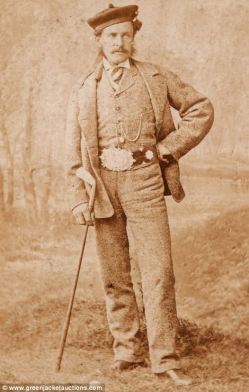
The feature image at the top of the page depicting Old and Young Tom was shot at St. Mary’s Studio, and recently sold for $19,850.

February 26, 1936 The Road to War

While unsuccessful, the incident killed some of Japan’s most moderate internationalist politicians, putting an end to effective civilian control over the army while increasing the military’s influence over civilian government. 

As Japan emerged from the medieval period into the early modern age, the future Nippon Empire transformed from a period characterized by warring states, to the relative stability of the Tokugawa Shōgunate.  Here, a feudal military government ruled from the Edo castle in the Chiyoda district of modern-day Tokyo, over some 250 provincial domains called han.

48d1a1f4d1544d2b0e6a6093b3455ca8The military and governing structure of the time was based on a rigid and inflexible class system, placing the feudal lords or daimyō at the top, followed by a warrior-caste of samurai, and a lower caste of merchants and artisans.  At the bottom of it all stood some 80% of the population, the peasant farmer forbidden to engage in non-agricultural work, and expected to provide the income to make the whole system work.

Concerned about 17th century Spanish and Portuguese colonial expansion into Asia made possible by Catholic missionaries, the Tokugawa Shōgunate issued three edicts of expulsion beginning in the early 1630s, effecting a complete ban on Christianity in the Japanese home islands.  The policy ushered in a period of national seclusion, where Japanese subjects were forbidden to travel abroad, and foreign contact limited to a small number of Dutch and Chinese merchants, trading through the port of Nagasaki.

Economically, the production of fine silk and cotton fabrics, the manufacture of paper and porcelain and sake brewing operations thrived in the larger urban centers, bringing considerable wealth to the merchant class.  Meanwhile, the daimyō and samurai classes remained dependent on a fixed stipend tied to agricultural production, particularly in the smaller han.

The system led to a series of peasant uprisings in the 18th and 19th centuries, and extreme dislocation within the warrior caste.

Into this world stepped the “gunboat diplomats” of President Millard Filmore in the person of Commodore Matthew Calbraith Perry, determined to open the ports of Japan to trade with the west.  By force, if necessary.

main-qimg-bcbcbd9d5177f80c4a51fcaa82d8ccb5In time, these internal Japanese issues and the growing pressure of western encroachment led to the end of the Tokugawa period and the restoration of the Meiji Emperor, in 1868.  The divisions would last, well into the 20th century.
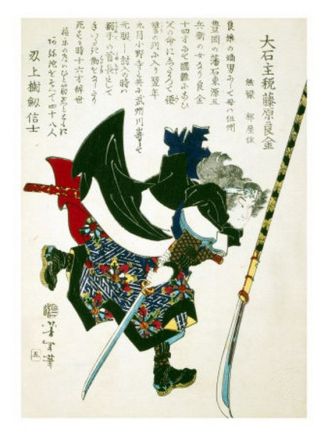
By the 1920s, two factions had evolved within the Japanese Imperial Army.  The Kōdō-ha or “Imperial Way” members were the radical nationalists, resentful of civilian control over the military.  This group sought a “Shōwa Restoration”, purging Japan of western ideas and returning the Emperor to what they believed to be his rightful place.  By force, if necessary.  Incensed by the rural poverty they blamed on the privileged classes, the group was vehemently anti-capitalist, seeking to eliminate corrupt party politics and establish a totalitarian state-socialist government, run by the military.

Opposed to this group was the much larger Tōsei-ha or “Control faction” within the army, who stressed the need for technological development within the military, while taking a more conciliatory tone with the government when it came to military spending.

220px-Sanno_Hotel_in_1936
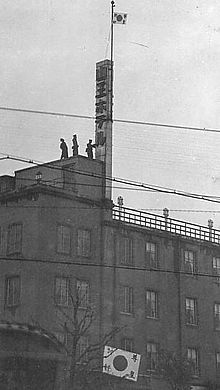
Rebel occupation of the Sannō Hotel

In the Fall of 1930, a group of young officers of the Kōdō-ha attempted the assassinations of Prime Minister Osachi Hamaguchi, Prince Saionji Kinmochi. and Lord Privy Seal Makino Nobuaki.  The group attempted a coup the following March, and the installation of soldier-stateman Ugaki Kazushige, as Premier.  Ugaki himself was of the more moderate faction and took no role in the attempted coup, though he assumed responsibility and resigned his post.

That September, the ultra-nationalists launched an invasion of Manchuria, without authorization from the Imperial Japanese Army General Staff Office, and over objections from the civilian government.  A month later the group launched another coup attempt.  This too was unsuccessful but, as with the “March Incident” of six months earlier, the government’s response was excessively mild.   Ringleaders were sentenced to 10 or 20 days’ house arrest, and other participants were merely transferred.  For the radicals, such lenience became a virtual hall pass, ensuring that there would be future such efforts.

This “Righteous Army” faction remained influential throughout the period known as “government by assassination“, due largely to the threat that it posed. Sympathizers among the general staff and imperial family included Prince Chichibu, the Emperor’s own brother.  Years later, Winston Churchill would describe Hitler’s appeasers as “one who feeds a crocodile, hoping it will eat him last”. Despite being fiercely anti-capitalist, this particular crocodile received sustenance from zaibatsu – the industrial and financial business leaders who hoped that their support would shield themselves.

220px-Korekiyo_Takahashi_and_Makoto_Saito_last_pic_together
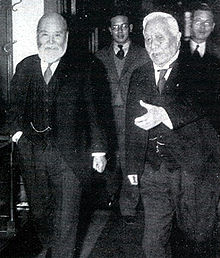
The February 26 incident killed some of Japan’s most moderate, internationalist leaders, including Finance minister Takahashi Korekiyo (left) and Lord Keeper of the Privy Seal, Saitō Makoto.

General Tetsuzan Nagata was murdered in 1935, following the discovery of yet another coup plot and the Army’s arrest and subsequent expulsion of its leaders.

In 1931, Japan abandoned the gold standard in an effort to defeat deflationary forces exerted by worldwide depression.  The “John Maynard Keynes of Japan”, the moderate politician and Finance Minister Takahashi Korekiyo, argued for government deficit spending to stimulate demand.   The country emerged from the worst parts of the depression two years later, but Takahashi’s efforts to reign in military spending created a conspiracy mindset among more radical army officers.

On February 26, 1936, 1,438 soldiers divided into six groups attacked Prime Minister Admiral Keisuke Okada, former Prime Minister and now-Finance Minister Takahashi Korekiyo, Grand Chamberlain Admiral Suzuki Kantarō, Lord Keeper of the Privy Seal and former Prime Minister Saitō Makoto, the Ministry of War, the offices of the Asahi Shimbun newspaper, Tokyo police headquarters and attempted to seize the Imperial palace of the Emperor himself.

While unsuccessful, the incident killed some of Japan’s most moderate internationalist politicians, putting an end to effective civilian control over the army while increasing the military’s influence over civilian government.  Admiral Isoroku Yamamoto, the unwilling architect of the attack on Pearl Harbor, was reassigned to sea to prevent his assassination by army hard-liners.  Another step had been taken, on the road to war.

February 25, 1921 Fellow Traveler

In the 1930s, many believed that International Communism was “winning”. The capitalist west was plunged into a Great Depression that it couldn’t seem to get its arms around, while the carefully controlled propaganda of Stalin’s Soviet Union did everything it could to portray itself as a “workers’ paradise”.

In the wake of the “Great War” and the Bolshevik revolution in Russia, American authorities became increasingly alarmed concerning the rise of radical Leftism.

00000744Far-left anarchists mailed no fewer than 36 dynamite bombs to prominent political and business leaders in April 1919, alone. In June, another nine far more powerful bombs destroyed churches, police stations and businesses.

Attorney General A. Mitchell Palmer had one hand delivered to his home by anarchist Carlo Valdinoci, who did something wrong and somehow managed blow himself to bits on the AG’s doorstep. Palmer attempted to suppress these radical organizations in 1919-20, but his searches and seizures were frequently illegal, his arrests and detentions without warrant, and his deportations questionable.

436398aceb9a0d77db5df9e6439394aa--red-scare-open-handsTo this day there are those who describe the period as the “First Red Scare”, as a way to ridicule the concerns of the era. The criticism seems unfair. The thing about history, is that we know how their story ends. The participants don’t, any more than we know what the future holds for ourselves.
Looking over the international tableau of the time, the largest nation on the planet had fallen to communism, in 1917. The Red Army offensive of 1920 drove into Poland, almost as far as Warsaw. The “Peace of Riga”, signed in 1921 split off parts of Belarus and Ukraine, making them parts of Soviet Russia. On this day in 1921, Bolshevist Russian forces occupied Tbilisi, capital of the Democratic Republic of Georgia.

In the 1930s, many believed that International Communism was “winning”. The capitalist west was plunged into a Great Depression that it couldn’t seem to get its arms around, while the carefully controlled propaganda of Stalin’s Soviet Union did everything it could to portray itself as a “workers’ paradise”.

download (12)
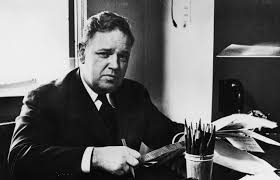
Whittaker Chambers

Whittaker Chambers was one of those who believed the winning side to be on the political Left, and joined the Communist Party of the United States (CPUSA) in 1925. Chambers worked for a time as a writer at the Party’s newspaper “Daily Worker”, before becoming editor of “New Masses”, the Party’s literary magazine.

From the early to mid-thirties, Chambers delivered messages and received documents from Soviet spies in the government, photographing them himself or delivering them for Soviet intelligence agents to photograph. At some point, Chambers’ idealism began to waver, with the realization that he was supporting a murderous regime. By 1939, he joined the staff of Time Magazine, where he pushed a strong anti-communist line.

A series of legislative committees were formed between 1918 and the outbreak of WWII to investigate this series of threats, though these committees sometimes did more to construct the image of a threat than they did to stop one. It was in this context that HUAC, the House Committee on Un-American Activities was formed in 1938, becoming a “standing” (permanent) committee in 1945.

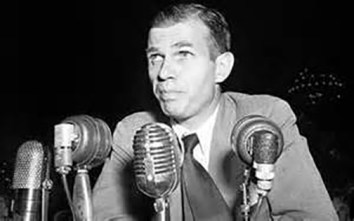
Alger Hiss
Alger Hiss

Whittaker Chambers warned about communist sympathizers in the Roosevelt administration as early as 1939, the FBI interviewed him in 1942.  Government priorities began to change n the wake of WWII, and Chambers was summoned to testify on August 3, 1945, where he named Alger Hiss and others as Communists.

A graduate of Johns Hopkins and Harvard Law School who had clerked for Supreme Court Justice Oliver Wendell Holmes, Alger Hiss seemed an unlikely communist. He had gone on to practice law in Boston and New York before returning to Washington to work on President Franklin Roosevelt’s “New Deal”, winding up at the State Department as an aide to Assistant Secretary of State Francis B. Sayre, former President Woodrow Wilson’s son-in-law. By this time Hiss was a high ranking official in the State Department.

Hiss flatly denied Chambers’ charges, filing suit for defamation of character in December. Chambers escalated in his 1948 deposition for the suit, claiming that, not only was Hiss a communist sympathizer, he was also a spy.

pumpkinBefore defecting from the Left, Chambers had secreted documents and microfilms, some of which he hid inside a pumpkin at his Maryland farm. The collection was known as the “Pumpkin Papers”, consisting of incriminating documents, written in what appeared to Hiss’ own hand, or typed on his Woodstock no. 230099 typewriter.

Defending himself, Hiss claimed to have given the typewriter to his maid, Claudia Catlett. When the idiosyncrasies of Hiss’ machine were demonstrated to be consistent with the documents, he then claimed that Chambers’ team including freshman member of Congress Richard M. Nixon, must have modified the typeface on a second typewriter to mimic his own.

woodstockHiss’ theory never explained why Chambers side needed another typewriter, if they’d had the original long enough to mimic its imperfections with a second.
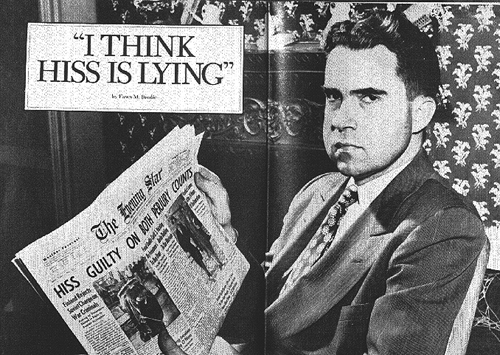
Alger Hiss’ first trial for lying to a Grand Jury ended with a hung jury, 8-4.  A second trial began on November 17, found him guilty of perjury on January 21, 1950.  Hiss maintained that he was innocent but lost his conviction, and served 44 months in Lewisburg Federal Penitentiary before being released in 1954.

What many saw as a devoted civil servant maligned by the anti-communist hysteria of the 1940, others believed to be a liar and enemy agent.  Alger Hiss went to his grave in 1996, protesting his innocence.

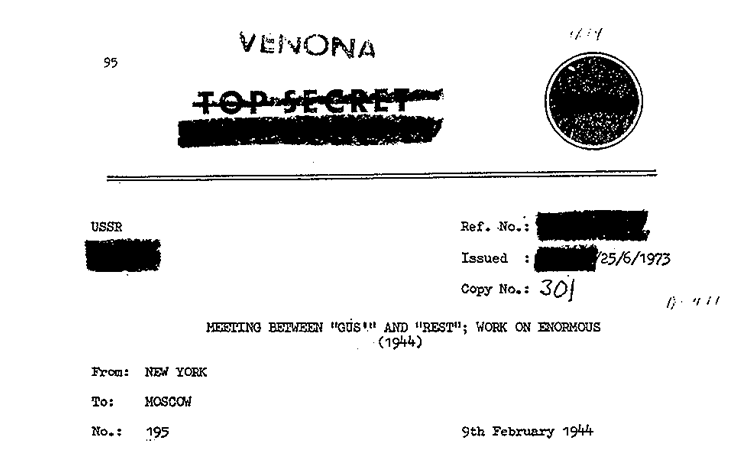
Soviet-era cables, decrypted through a now-declassified program called the “Venona Project”, seem to convict him beyond a reasonable doubt of being a soviet agent. Venona transcript #1822, sent in March 1945 from the Soviet Washington station chief to Moscow, describes the subject codenamed ALES as having attended the February 4–11, 1945 conference at Yalta, before traveling to Moscow. Hiss attended Yalta on these dates, before going to Moscow with Secretary of State Edward Stettinius.

2015-02-23_21-41-12

Historians John Earl Haynes and Harvey Klehr report that the Venona transcripts tie approximately 349 Americans to Soviet intelligence, though fewer than half that number were ever identified.  The Office of Strategic Services alone, precursor to the CIA, housed between fifteen and twenty Soviet spies.

The CIA’s official conclusion, based on the CIA.gov on-line library is that “Although no specific file on Hiss has been released from the KGB or GRU archives, enough material has been found in other files–in Moscow, Eastern Europe, and Washington–to enable historians to write several new works that leave almost no room for doubt about Hiss’ guilt”.

848e7d_4d7c05b4724b4f7fb7ec239b5888096a_mv2

February 24, 1917  The Zimmermann Telegram

“We intend to begin on the first of February unrestricted submarine warfare. We shall endeavor in spite of this to keep the United States of America neutral. In the event of this not succeeding, we make Mexico a proposal of alliance on the following basis: make war together, make peace together, generous financial support and an understanding on our part that Mexico is to reconquer the lost territory in Texas, New Mexico, and Arizona”.

On May 10, 1915, President Woodrow Wilson gave what came to be known as his “Too Proud to Fight Speech” in which he said:  “The example of America must be the example not merely of peace because it will not fight, but of peace because peace is the healing and elevating influence of the world and strife is not. There is such a thing as a man being so right it does not need to convince others by force that it is right”.

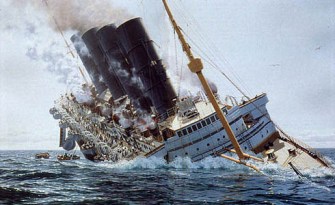
Lusitania sinkingThough Wilson didn’t mention it directly, HMS Lusitania had been torpedoed only three days earlier with the loss of 1,198, 128 of whom were Americans.

No one doubted that the attack on the civilian liner was foremost on the President’s mind.  Back in February, Imperial Germany had declared a naval blockade against Great Britain, warning that “On and after February 18th every enemy merchant vessel found in this region will be destroyed, without its always being possible to warn the crews or passengers of the dangers threatening“.  “Neutral ships” the announcement continued, “will also incur danger in the war region“.

Lusitania warningThe reaction to the Lusitania sinking was immediate and vehement, portraying the attack as the act of barbarians and huns and demanding a German return to “prize rules”, requiring submarines to surface and search merchantmen while placing crews and passengers in “a place of safety”.
Imperial Germany protested that Lusitania was fair game, as she was illegally transporting munitions intended to kill German boys on European battlefields. Furthermore, the embassy pointed out that ads had been taken out in the New York Times and other newspapers, specifically warning that the liner was subject to attack.

Nevertheless, the German policy of unrestricted submarine warfare was suspended for a time, for fear of bringing the US into the war against Germany.

President Wilson was elected back in 1912, talking about the sort of agrarian utopia favored by Thomas Jefferson.  In 1916, the election was about war and peace.  Wilson won re-election on the slogan “He kept us out of war”, but it hadn’t been easy.  In Europe, WWI was in its second year while, to our south, Mexico was going through a full-blown revolution.  Public opinion had shifted in favor of England and France by this time.  The German resumption of unrestricted submarine warfare, threatened to tip the balance.

With Great Britain holding naval superiority on the surface, Germany had to do something to starve the British war effort.  In early 1917, chief of the Admiralty Staff Admiral Henning von Holtzendorff argued successfully for the resumption of unrestricted submarine warfare, the policy to take effect on February 1.

Anticipating the results of such a move, German Foreign Secretary Arthur Zimmermann dispatched a telegram to German ambassador to Mexico Heinrich von Eckardt on January 19, authorizing the ambassador to propose a military alliance with Mexico, in the event of American entry into the war.  “We intend to begin on the first of February unrestricted submarine warfare. We shall endeavor in spite of this to keep the United States of America neutral. In the event of this not succeeding, we make Mexico a proposal of alliance on the following basis: make war together, make peace together, generous financial support and an understanding on our part that Mexico is to reconquer the lost territory in Texas, New Mexico, and Arizona”.

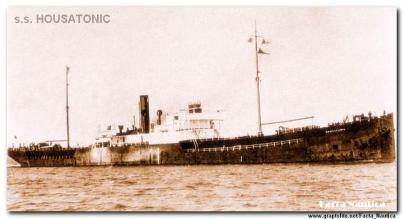
housatonic-4-facta-nautica-1000x544The American cargo vessel SS Housatonic was stopped off the southwest coast of England on February 3, and boarded by German submarine U-53.  Captain Thomas Ensor was interviewed by Kapitänleutnant Hans Rose, who explained he was sorry, but Housatonic was “carrying food supplies to the enemy of my country”.  She would be destroyed.  The American Captain and crew were allowed to launch lifeboats and abandon ship, while German sailors raided the American’s soap supplies.  Apparently, WWI-vintage German subs were short on soap.
Housatonic was sunk with a single torpedo, the U-Boat towing the now-stranded Americans toward the English coast.  Sighting the trawler Salvator, Rose fired his deck guns to be sure they’d been spotted, and then slipped away.  It was February 3, 1917.

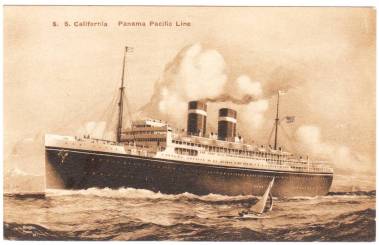
SS_CaliforniaPresident Woodrow Wilson retaliated, breaking off diplomatic relations with Germany the following day. Three days later, a German U-boat fired two torpedoes at the SS California, off the Irish coast. One missed, but the second tore into the port side of the 470-foot, 9,000-ton steamer. California sank in nine minutes, killing 43 of her 205 passengers and crew.
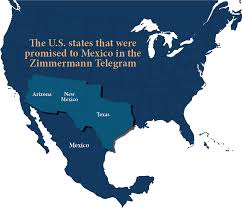
In Mexico, a military commission convened by President Venustiano Carranza quickly concluded that the German proposal was unviable, but the damage was done.  British code breakers intercepted the Zimmermann telegram, divulging the contents to the American government on February 24.

images (22)The contents of Zimmermann’s note were published in the American media on March 1.  Even then, there was considerable antipathy toward the British side, particularly among Americans of German and Irish ethnicity.  “Who says this thing is genuine, anyway”, they might have said.  “Maybe it’s a British forgery”.
Zimmermann himself put an end to such speculation two days later, telling an American journalist, “I cannot deny it. It is true.” What Zimmermann had hoped that Americans would see as mere contingency, public opinion in the US saw as an unforgivable betrayal of American neutrality.

The combination of events was the last straw.  Wilson’s War Cabinet voted unanimously for a declaration of war on March 20.  The President himself delivered his war address before a joint session of Congress, two weeks later.  The United States entered the “war to end all wars”, on April 6.

Afterward

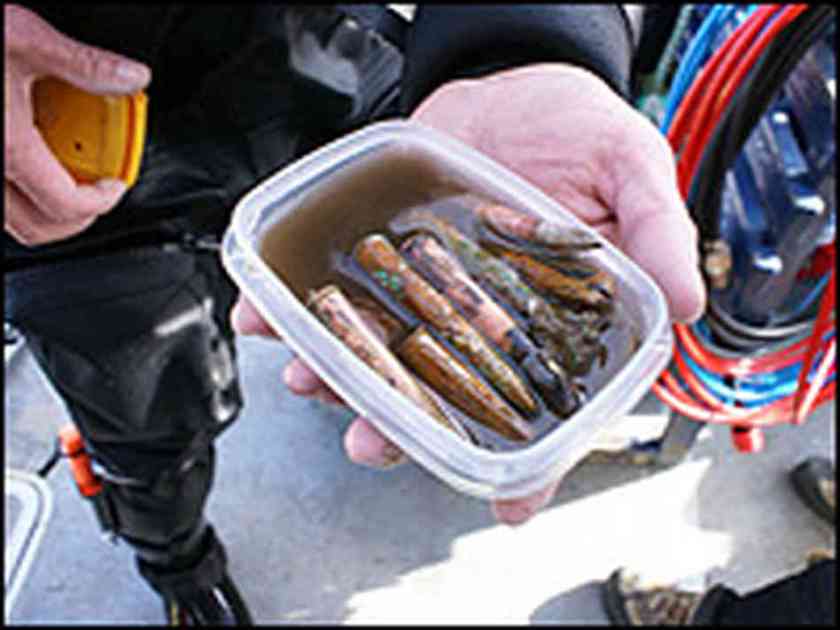
At the time, the German claim that Lusitania carried contraband munitions seemed to be supported by survivors’ reports of secondary explosions within the stricken liner’s hull. In 2008, the UK Daily Mail reported that dive teams had reached the wreck, lying at a depth of 300′. Divers reported finding tons of US manufactured Remington .303 ammunition, about 4 million rounds, stored in unrefrigerated cargo holds in cases marked “Cheese”, “Butter”, and “Oysters”.

Lusitania, ammunition

February 23, 1836  The Lexington of Texas

“If my countrymen do not rally to my relief, I am determined to perish in the defense of this place, and my bones shall reproach my country for her neglect.”

Following the Mexican War of Independence with Spain, (1810 – 1821), Texas became a part of Mexico.  In 1831, Mexican authorities gave the settlers of Gonzales a small swivel cannon, a defense against the raids of the Comanche.  The political situation deteriorated in the following years.  By 1835, several Mexican states were in open revolt.  That September, commander of “Centralist” (Mexican) troops in Texas Colonel Domingo de Ugartechea, came to take it back.

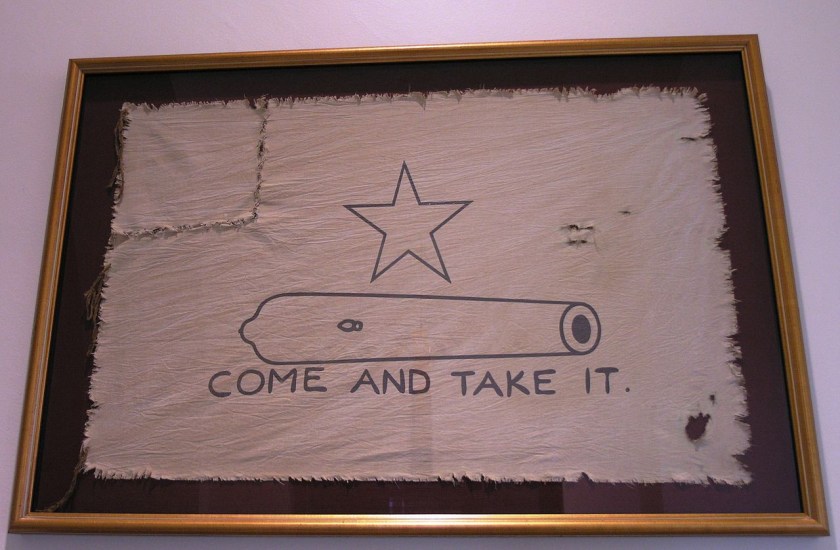
Dissatisfied with the increasingly dictatorial policies of President and General Antonio Lopez de Santa Anna, the colonists had no intention of handing over that cannon.  One excuse was given after another to keep the Mexican dragoons out of Gonzalez, while secret pleas for help went out to surrounding communities.  Within two days, 140 “Texians” had gathered in Gonzalez, fashioning a flag that echoed some 2,315 years through history, King Leonidas’ defiant response to the Persian tyrant, Xerxes:   “Come and Take it.”

1_w8rDKtbIBYgc6dg2Nn9t1g

Militarily, the skirmish of October 2 had little significance, much the same as the early battles in the Massachusetts colony, some sixty years earlier.  Politically, the “Lexington of Texas” marked a break between Texian settlers, and the Mexican government.

Settlers continued to gather, electing the well-respected local and former legislator of the Missouri territory Stephen F. Austin, as their leader.  Santa Anna sent his brother-in-law, General Martin Perfecto de Cos to reinforce the settlement of San Antonio de Béxar, near the modern city of San Antonio.  On the 13th, Austin led his Federalist army of Texians and their Tejano allies to Béxar, to confront the garrison.  Austin’s forces captured the town that December, following a prolonged siege. It was only a matter of time before Santa Anna himself came to take it back.

Two forts – more like lonely outposts – blocked the only approaches from the Mexican interior into Texas: Presidio La Bahía (Nuestra Señora de Loreto Presidio) at Goliad and the Alamo at San Antonio de Béxar.  That December, a group of volunteers led by George Collinsworth and Benjamin Milam overwhelmed the Mexican garrison at the Alamo, and captured the fort  The Mexican President arrived on February 23 at the head of an army of 3,000, demanding its surrender.  Lieutenant Colonel William Barret “Buck” Travis, responded with a cannon ball.

Knowing that his small force couldn’t hold for long against such an army, Travis sent out a series of pleas for help and reinforcement, writing “If my countrymen do not rally to my relief, I am determined to perish in the defense of this place, and my bones shall reproach my country for her neglect.” 32 troops attached to Lt. George Kimbell’s Gonzales ranging company made their way through the enemy cordon and into the Alamo on March 1. There would be no more.

Alamo-Weight-Loss-Motivation-2Estimates of the Alamo garrison have ranged between 189 and 257 at this stage, but current sources indicate that defenders never numbered more than 200.
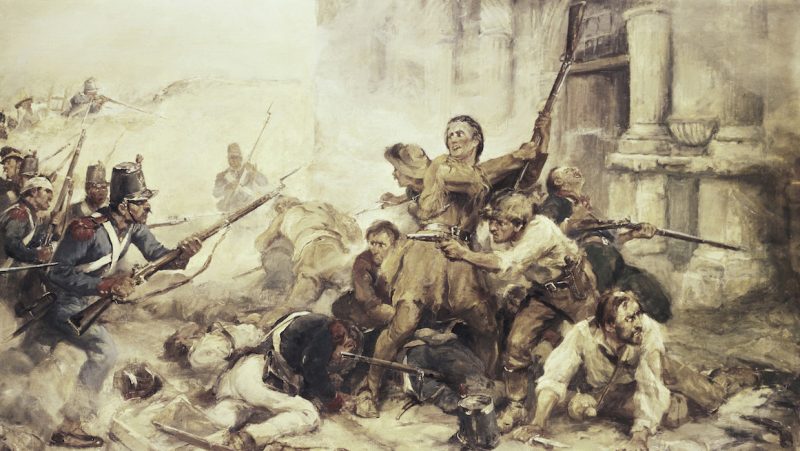
On March 2, 1836, the interim government of Texas signed the Texas Declaration of Independence.  The final assault on the Alamo began at 5:00am, four days later. 1,800 troops attacked from four directions.  600 to 1,600 were killed from concentrated artillery fire and close combat, but the numbers were overwhelming. Hand to hand fighting moved to the barracks after the walls were breached, and ended in the chapel.

Remember-the-Alamo-3-6-17-e1488801582528-800x451

As many as seven defenders still lived when it was over, many believe that former Congressman Davy Crockett was among them. Santa Anna ordered them summarily executed. By 8:00am there were no survivors, except for a handful of noncombatant women, children, and slaves, slowly emerging from the smoking ruins. These were provided with blankets and two dollars apiece, and given safe passage through Mexican lines with the warning:  a similar fate awaited any Texan who continued in their revolt.

Three weeks later following the Battle of Coleto, 350 Texian prisoners were murdered by the Mexican army under direct orders from Santa Anna, an event remembered as the Goliad massacre.

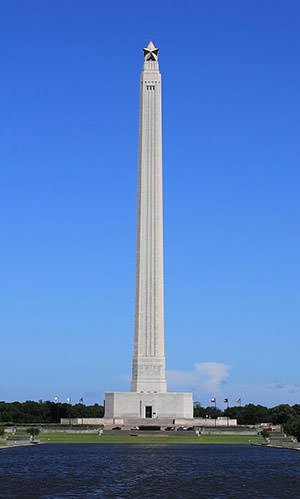
San-Jacinto-Monument
Measuring 570′, the San Jacinto Monument is the world’s longest masonry column

The ranks of Sam Houston’s unit swelled with volunteers, as Houston’s army retreated eastward, along with the provisional government and hordes of civilians.  Houston’s green and inexperienced force of 1,400, were now all that stood on the side of Texan independence.

On April 21, a force of some 900 Texans shouting “Remember the Alamo!” & “Remember Goliad!” and led by Sam Houston defeated Santa Anna’s force of some 1,300 at San Jacinto, near modern day Houston.  In “one of the most one-sided victories in history” 650 Mexican soldiers were killed in eighteen minutes and another 300 captured, compared with 11 Texians dead and another 30 wounded, including Houston itself.    Mexican troops occupying San Antonio were ordered to withdraw, by May.

Intermittent conflicts continued into the 1840s between Texas and Mexico, but the outcome was never again placed in doubt.  Texas became the 28th state of the United States on December 29, 1845.

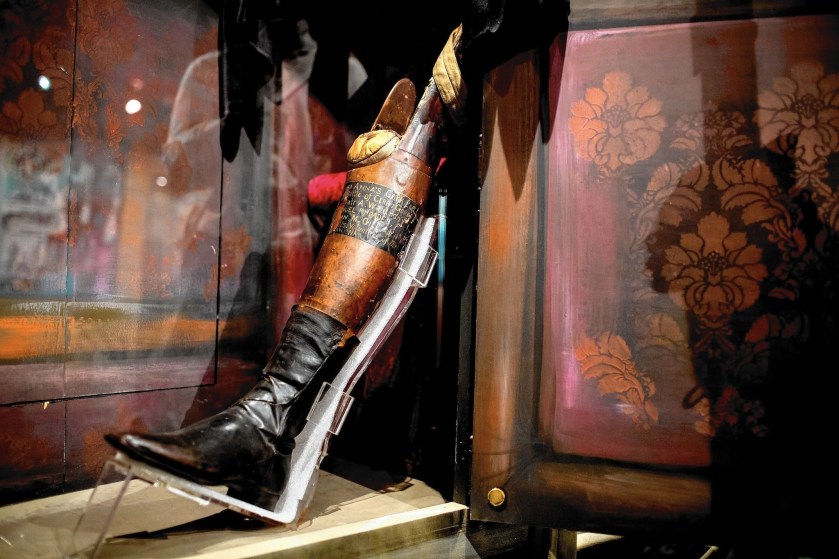
As for Santa Anna, he went on to lose a leg to a cannon ball two years later, fighting the French at the Battle of Veracruz. Following amputation, the leg spent four years buried at Santa Anna’s hacienda, Manga de Clavo. When Santa Anna resumed the presidency in late 1841, he had the leg dug up and placed in a crystal vase, brought amidst a full military dress parade to Mexico City and escorted by the Presidential bodyguard, the army, and cadets from the military academy. This guy was nothing if not a self-promoter.

The leg was reburied in an elaborate ceremony in 1842, including cannon salvos, speeches, and poetry read in the General’s honor. The state funeral for Santa Anna’s leg was attended by his entire cabinet, the diplomatic corps, and the Congress.

ct-santa-anna-leg-dispute-illinois-texas-edit-20161111

Antonio Lopez de Santa Anna served 11 non-consecutive terms as Mexican President, spending most of his later years in exile in Jamaica, Cuba, the United States, Colombia, and St. Thomas. In 1869, the 74-year-old former President was living in Staten Island, trying to raise money for an army to return and take over Mexico City. Santa Anna is credited with bringing the first shipments of chicle to America, a gum-like substance made from the tree species, Manilkara chicle, and trying to use the stuff as rubber on carriage tires.

Thomas Adams, the American assigned to aid Santa Anna while he was in the US, also experimented with chicle as a substitute for rubber. He bought a ton of the stuff from the General, but his experiments would likewise prove unsuccessful. Instead, Adams helped to found the American chewing gum industry with a product called “Chiclets”.

If you enjoyed this “Today in History”, please feel free to re-blog, “like” & share on social media, so that others may find and enjoy it as well. Please click the “follow” button on the right, to receive email updates on new articles.  Thank you for your interest, in the history we all share.