Cartoonist E.C. Segar (rhymes with cigar) passed away back in 1938, but his characters live on. Over the weekend of January 16-18, 2004, the Empire State Building was lit up spinach green, a tribute to the 75th anniversary of Segar’s favorite character.
Eighty-nine years ago, Popeye the Sailor appeared for the first time in Elzie Segar’s “Thimble Theater”, a newspaper comic strip revolving around the lives of Olive Oyl and her extended family, including her brother Castor and then-boyfriend Harold Hamgravy.
The strip was around for ten years or so, when Olive & co. decided to recruit a sailor to get them to the casino on Dice Island. Approaching a rough looking character on the docks, “Popeye’s” first line was “Ja think I was a cowboy? He was supposed to be an extra, but he became so popular he soon developed into the center of the strip.
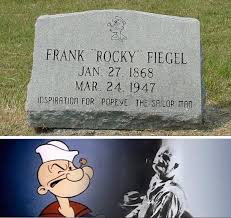
Like Olive, who was patterned after the real-life Dora Paskel, the one eyed, fighting, pipe smoking sailor was based on a real man: Chester, Illinois boxer Frank ‘Rocky’ Fiegal. The boxer didn’t mind being associated with a cartoon character. When Fiegal died in 1947, his gravestone was inscribed with the words “inspiration for Popeye.”
Before spinach, Popeye gained his superhuman strength patting the head of a magical “whiffle hen” named “Bernice”.
Back in 1870, a misplaced decimal point in a scientific journal led readers to believe that spinach had ten times the iron than it actually does. Some ideas die hard. Sixty years later, the grandchildren and great-grandchildren of those people still believed it to be true.
Bluto beat our sailor up in 1932 and tossed him into a spinach field, with predictable results. Following that episode, spinach sales increased by 33%. At one point, children voted spinach their third favorite food, behind turkey and ice cream.
To the everlasting joy of depression-era spinach producers, Popeye found extra muscle in the leafy vegetable, ever since. On March 26, 1937, Crystal City, Texas spinach producers unveiled a statue of Popeye, the first time in history that a statue had been erected in honor of a cartoon character.
Popeye’s pet “Eugene the Jeep” first appeared in a 1936 strip called “Wha’s a Jeep?”. Eugene was sort of magical dog who could go anywhere. Five years later, military contractors worked to develop the iconic off-road vehicle of WWII. Like Popeye’s pet Eugene, the General Purpose GP (“Jeep”) could go anywhere. Eventually, the name stuck.
Jeep isn’t the only word we get from the Popeye cartoon franchise. The inveterate moocher J. Wellington Wimpy, who would gladly pay you Tuesday for a hamburger today, gave us the word “wimp” and the burger chain that goes with it. The comic strip introduced a character called “Dufus”. To this day, a Dufus (Doofus) in the American vernacular is a “silly fool, a dimwit, or a stupid person”,
Just about every cartoon character who ever was, appears in the 1988 “Who framed Roger Rabbit”, except for Popeye. Disney didn’t forget him, the problem was that they couldn’t get legal permission to use the character, from Paramount Pictures.
Cartoonist E.C. Segar (rhymes with cigar) passed away back in 1938, but his characters live on. Over the weekend of January 16-18, 2004, the Empire State Building was lit up spinach green, a tribute to the 75th anniversary of Segar’s favorite character. Weight Watchers put out a series of spinach recipes. There was even a ceremonial “official adoption” of the orphan sea waif Swee’ Pea, during National Adoption Month (November).
“Later that year (2004), the Empire State Building was lit in spinach green to celebrate Popeye’s 75th, and Weight Watchers put out a series of spinach recipes. There was even a ceremonial “official adoption” of the orphan sea waif Swee’ Pea during National Adoption Month (November)”. H/T The Coronado Times
On December 8, 2009, Google featured the character to honor the birth of his creator, Elzie Crisler Segar. Google’s famous Doodle appeared along with the mouseover text, “E.C. Segar’s Birthday.”
If you enjoyed this “Today in History”, please feel free to re-blog, “like” & share on social media, so that others may find and enjoy it as well. Please click the “follow” button on the right, to receive email updates on new articles. Thank you for your interest, in the history we all share.
Most of us remember the names, of the great monsters of history. Who remembers the name of the man who saved the lives of seven times the number, of this whole Parade of Horribles, put together?
Too often, history is measured in terms of its monsters.
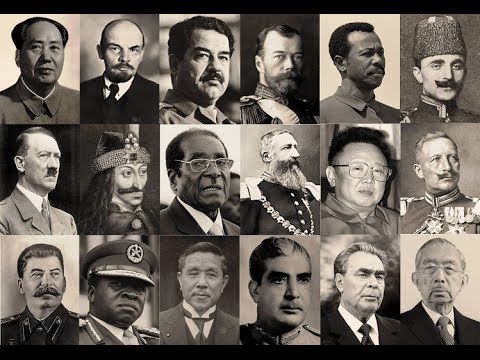
President Robert Mugabe of Zimbabwe once orchestrated the murder of 20,000 civilians from a single province, after failing to receive a single vote. Josef Stalin deliberately starved as many as ten million Ukrainians, in a “terror famine” known as Holodomor. Pol Pot and a Communist cadre of nine – the Ang-Ka – killed between 1.7 and 2.5 million fellow citizens of 1970s Cambodia: about a fifth of the population. Mao Tse-Tung’s policies and political purges killed between 49 and 78 million of his own people, between 1949 and 1976.
You’re really playing in the Big Leagues when they can’t get your body count any closer than the nearest twenty-nine million.
From Adolf Hitler to Idi Amin, from Enver Pasha to Hideki Tojo and Leopold II of Belgium, the top ten dictators of the last 150 years account for the loss of nearly 150 million souls. Most of us remember the names, of the great monsters of history. Who remembers the name of the man who saved the lives of seven times the number, of this whole Parade of Horribles, put together?
Today, we live in a time and place where the National Institutes of Health (NIH) writes “The U.S. is one of the wealthiest countries in the world and accordingly has high obesity rates; one-third of the population has obesity plus another third is overweight”.
It wasn’t always so. In 1820, 94% of the world’s population lived in “absolute poverty.” The American economic historian and scientist Robert Fogel, winner (with Douglass North) of the 1993 Nobel Prize in Economics, wrote that: “Individuals in the bottom 20% of the caloric distributions of France and England near the end of the eighteenth century, lacked the energy for sustained work and were effectively excluded from the labor force.”
It’s hard to get our heads around the notion of “food insecurity”. I’m not talking about what’s in the fridge. This is the problem of acute malnutrition, of epidemic starvation, of cyclical famine and massive increases in mortality due to starvation and hunger-induced disease.
Norman Borlaug
Norman Ernest Borlaug was born this day in 1914, on his grandparents’ farm near Cresco, Iowa. The boy’s grandfather, Nels Olson Borlaug, once told the boy “You’re wiser to fill your head now if you want to fill your belly later on.”
A farm kid educated during the Great Depression, Borlaug periodically put his studies on hold, in order to earn money. As a leader in the Civilian Conservation Corps working with unemployed people on Federal projects, many of his co-workers faced near-catastrophic levels of hunger. He later recalled, “I saw how food changed them … All of this left scars on me”.
Borlaug earned his Bachelor of Science in Forestry, in 1937. Nearing the end of his undergraduate education, he attended a lecture by Professor Elvin Charles Stakman, discussing plant rust disease, a parasitic fungus that feeds on phytonutrients in wheat, oats, and barley crops. Stakman was exploring special breeding methods, resulting in rust-resistant plants. The research greatly interested Borlaug, who later enrolled at the University of Minnesota, to study plant pathology under Stakman. Borlaug earned a Master of Science degree in 1940, and a Ph.D. in plant pathology and genetics, in 1942.
Borlaug attempted to enlist in the military following the attack on Pearl Harbor, but his application was rejected under wartime labor regulations. He was put to work in a lab, doing research for the United States armed forces.
Between 1939 and ’41, Mexican farmers suffered major crop failures, due to stem rust. In July 1944, Borlaug declined an offer to double his salary, traveling instead to Mexico City, heading a new program focusing on soil development, maize and wheat production, and plant pathology.
“Pure line” (genotypically identical) plant varieties possess only one to a handful of disease-resistance genes. Random mutations of rusts and other plant diseases overcome pure line survival strategies, resulting in crop failures. “Multi-line” plant breeding involves backcrossing and hybridizing plant varieties, transferring multiple disease-resistance genes into recurrent parents. In the first ten years Borlaug worked for the Mexican agricultural program, he and his team made over 6,000 individual crossings of wheat. Mexico transformed from a net-importer of food, to a net exporter.
In the early sixties, Borlaug’s dwarf spring wheat strains went out for multi-location testing around the world, in a program administered by the US Department of Agriculture. In March 1963, Borlaug himself traveled to India with Dr. Robert Glenn Anderson, along with 220lbs of seed from four of the most promising strains.
The Indian subcontinent experienced minor famine and starvation at this time, limited only by the US shipping 1/5th of its wheat production into the region in 1966 – ’67. Despite resistance from Indian and Pakistani bureaucracies, Borlaug imported 550 tons of seeds.
Biologist Paul Ehrlich wrote in his 1968 bestselling book The Population Bomb, “The battle to feed all of humanity is over … In the 1970s and 1980s hundreds of millions of people will starve to death in spite of any crash programs embarked upon now.” Ehrlich said, “I have yet to meet anyone familiar with the situation who thinks India will be self-sufficient in food by 1971…India couldn’t possibly feed two hundred million more people by 1980.”
He could not have been more comprehensively wrong.
Borlaug’s initial yields were higher than any other crop, ever harvested in South Asia. Countries from Pakistan to India to Turkey imported 80,000 tons and more of seeds. By the time of Ehrlich’s book release in 1968, William Gaud of the US Agency for International Development was calling Borlaug’s work a “Green Revolution”. Massive crop yields substituted famine and starvation with a host of new problems. There were labor shortages to harvest crops, and insufficient numbers of bullock carts to haul it to the threshing floor. Jute bags were needed, along with trucks, rail cars, and grain storage facilities. Some local governments even closed school buildings, to use them for grain storage.
Borlaug won the Nobel Peace Prize in 1970, for his contributions to the world food supply. The man’s name is nearly synonymous with the Green Revolution.
According to former Director General of the International Water Management Institute David Seckler, “The environmental community in the 1980s went crazy pressuring the donor countries and the big foundations not to support ideas like inorganic fertilizers for Africa.” The Rockefeller and Ford foundations withdrew funding, along with the World Bank.
Well fed environmentalist types congratulated themselves on their “success”, as the Ethiopian famine of 1984-’85 destroyed over a million lives. Millions more were left destitute, on the brink of starvation.
Borlaug became involved in 1984, at the invitation of Ryoichi Sasakawa, chairman of the Japan Shipbuilding Industry Foundation (now the Nippon Foundation). Sasakawa wondered why methods used so successfully in Asia, were not being employed in Africa. Since that time, the Sasakawa Africa Association (SAA) has trained over 8 million farmers in SAA farming techniques. Maize crops developed in African countries have tripled, along with increased yields of wheat, sorghum, cassava, and cowpeas.
Norman Ernest Borlaug died of Lymphoma in 2009, at the age of 95. Prime Minister of India Manmohan Singh and President Pratibha Patil paid tribute, saying “Borlaug’s life and achievement are testimony to the far-reaching contribution that one man’s towering intellect, persistence and scientific vision can make to human peace and progress”. The United Nations’ Food and Agriculture Organization (FAO) described Borlaug as “… a towering scientist whose work rivals that of the 20th century’s other great scientific benefactors of humankind”. American author and journalist Gregg Easterbrook wrote in 1997, “[The] form of agriculture that Borlaug preaches may have prevented a billion deaths.”
The world population when Ehrlich released his book in 1968, was about 3.53 billion. Today, that number stands at 7.6 billion and, when we hear about starvation, such events are almost exclusively man-made. The American magician and entertainer Penn Jillette described Norman Borlaug as “The greatest human being who ever lived…and you’ve probably never heard of him.” Let that be the answer to the self-satisfied and well-fed, environmentalist types.
“I now say that the world has the technology—either available or well advanced in the research pipeline—to feed on a sustainable basis a population of 10 billion people. The more pertinent question today is whether farmers and ranchers will be permitted to use this new technology? While the affluent nations can certainly afford to adopt ultra low-risk positions, and pay more for food produced by the so-called ‘organic’ methods, the one billion chronically undernourished people of the low income, food-deficit nations cannot.” – Norman Borlaug, 2000
Twenty-one-year-old Peter Knapp spotted the Confederate sharpshooter, behind the iron plate. He raised his rifle, aimed at the peephole, and fired.
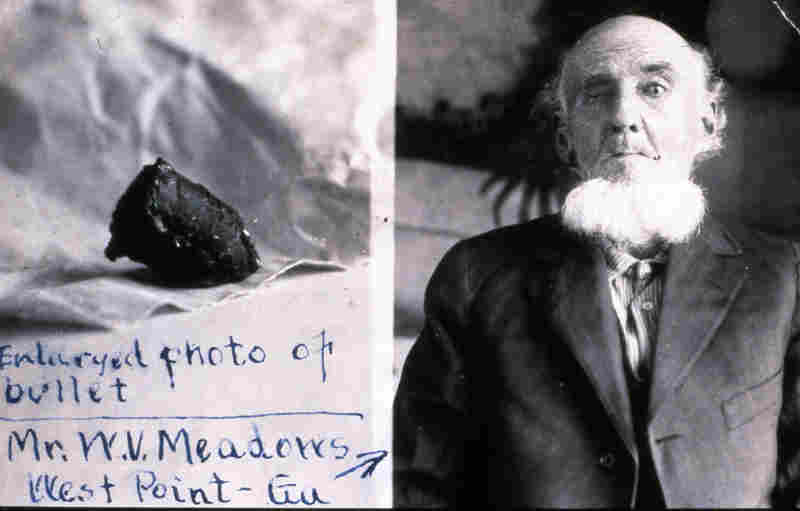
Willis Meadows grasped his throat, as he began to choke. The one-eyed 78-year old couldn’t breathe, as spasms became more violent. Whatever was in there wouldn’t come out. He thought his time had come. That’s when the bullet flew out of his mouth, clattering across the wooden table and onto the kitchen floor. It was March 24, 1921.
Fifty-nine years earlier, nineteen-year-old Willis V. Meadows signed up with his brothers and his cousins, enlisting in Company G of the 37th Alabama Volunteer Infantry.
Meadows was assigned to the western front along the Mississippi River. By the following summer, Company G had joined in defending Vicksburg Mississippi, laid siege by the Union army of Major General Ulysses S Grant.
On July 1, Meadows was positioned just outside of town, firing at the oncoming Yankees through a peephole in an iron boiler plate. Three blue-clad soldiers approached from the east, members of Company H of the Fifth Iowa Volunteer Infantry, with orders to take out enemy snipers.
Twenty-one-year-old Peter Knapp spotted the Confederate sharpshooter, behind the iron plate. He raised his rifle, aimed at the peephole, and fired. It was a perfect shot, the one-ounce slug clearing the small hole and striking the sniper in the right eye.
Willis fell over apparently dead, blood streaming out of his eye with the bullet lodged near his brain. The battle moved on. Vicksburg Mississippi fell to the Union army on July 4, 1863. The “Confederate Gibraltar” wouldn’t celebrate another Independence Day, for 80 years.
Meanwhile, Meadows was found and brought to Union physicians. Surgeons probed for the bullet but were unable to find it, and didn’t feel it was safe to operate. Instead, he was put on a POW ship and brought to a Federal hospital. Meadows was later paroled and brought to a Confederate hospital, there to spend the remainder of the war as a patient and sometime nurse’s aide.
Peter Knapp was captured that November at Missionary Ridge, part of the Chattanooga campaign, and spent the rest of the war in a number of Confederate prisons, including the Hell of Andersonville.
Both went back to civil life after the war. Meadows returned to his farm in Lanett, Alabama, just east of the Georgia state line. He would later marry, but the marriage produced no children. Knapp farmed for a time in Michigan before marrying, later moving to Kelso, in Washington state.
Willis Meadows and Peter Knapp might have walked off the page of their time and on to obscurity, but for a circumstance even more unlikely, than a man holding a bullet in his head for fifty-eight years.
Following Meadows’ coughing episode in 1921, “Coughs Up Bullet” was a newspaper story, all over the country. “Ripley’s Believe It or Not” ran the story eleven years later, published around the world in 42 countries and 17 languages. Even Robert Ripley missed the best part.
Peter Knapp read the story, and realized that that had to have been his bullet. He contacted Meadows a few months later, and the two compared notes. Sure enough. The two had met again.
When politicians make war, it is the young men and sometimes the young women, who do the fighting, and the bleeding, and the dying. Now these two old men, former mortal enemies who had tried their level best to kill one another, became friends. The two old warriors spent the rest of their days, exchanging photographs and wishing each other good health.
The Central Point Oregon newspaper editor who heard the story in 1950, had the final word. “Can you beat that for a story?” he asked. “How small this little old world is, after all.”
Afterward
It’s remarkable enough that Peter Knapp survived the brutality of the notorious Andersonville prison camp, an institution described as the “Auschwitz of the Civil War”. The Union POW camp at Elmira New York might be described as the Andersonville of the North. My own thrice-Great Grandfather went to his final rest there, along with his brother.
A passage from Knapp’s journal written in January 1862 expresses the man’s patriotism: ‘May God give wisdom and strength to our rulers that they counsel wisely, so that this government, which has been the wonder of the world, may triumph over its many enemies, crush treason to the earth never to rise again and proving to the world that republican governments are capable of withstanding any storm which may gather on their political horizon.’
Following his death in 1924 at the age of 81, Peter Knapp’s remains were cremated and, for whatever reason, never claimed by his family. The ‘cremains’ of his wife Georgianna joined those of her husband in 1930, and there they sat, unclaimed.
In 2012, Alice Knapp was researching the genealogical records of her deceased husband Steve, when she came upon the story of his ancestor. Stunned to learn that he had never been buried, Ms. Knapp called the Portland crematorium. ‘Yeah, he’s here’. Alice Knapp got the death certificate in Washington. I “called back and said, ‘By the way, is his wife there?’ and they said, ‘Yeah.’ The shock was that he was not ever buried. That was the surprise to me.”
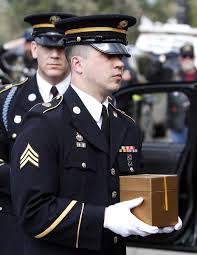
So it was that Peter Knapp of the 5th Iowa Infantry was laid to rest with his wife at the Willamette National Cemetery in Oregon, with full military honors provided by the Oregon National Guard.
A folded American flag was presented to representatives of the Knapp family, ‘on behalf of a grateful nation’. One-hundred and forty-seven years, after the Civil War.
Kirk was killed in 2329 on the Enterprise (B), after the ship was eaten by a Nexus energy ribbon on its maiden voyage. Only he didn’t die, because Jean-Luc Picard found him alive in the timeless Nexus, negotiating hotel deals for Priceline.com. Or something like that.
On this day in the year 2228, a boy was born to George and Winona Kirk. He would go on to become the youngest captain in Starfleet history but, before he could boldly go where no man has gone before, he had to have a name.
The former WWII fighter pilot and veteran of 89 combat missions Gene Roddenberry had 16 suggestions for a name, among them “Hannibal”, “Timber”, “Flagg”, and “Raintree”. The television screenwriter and producer decided on James T. Kirk, based on a journal entry from the 18th century British explorer, Captain James Cook, who wrote “ambition leads me … farther than any other man has been before me“.
Kirk was killed in 2329 on the Enterprise (B), after the ship was eaten by a Nexus energy ribbon on its maiden voyage. Only he didn’t die, because Jean-Luc Picard found him alive in the timeless Nexus, negotiating hotel deals for Priceline.com. Or something like that.
In his 1968 book “Making of Star Trek“, Roddenberry writes that James Kirk was born in a small town in Iowa. Full time “Trekkie” and part time Riverside, Iowa Councilman Steve Miller thought “Why not Riverside”. In 1985, Miller moved that Riverside declare itself the Future Birthplace of James T. Kirk. The motion passed unanimously. Miller poked a stick into the ground behind the barber shop, (good thing he owned the property), declaring that this was the place. An engraved monument was erected, and so it was. Riverside, population 963, became the “Future Birthplace of Captain James T. Kirk. A bench was added later, along with a Shuttlecraft-shaped donation box.
Riverside’s official slogan was changed from “Where the best begins” to “Where the Trek begins,” the annual “River Fest” summer festival, became “Trek Fest”.
Star Trek fans, ever-jealous protectors of series trivia, sometimes wonder why the March 22, 2228 date on the Riverside monument differs from the March 22, 2233 date usually cited as Kirk’s future birthday. The 2233 date didn’t come around until eight years after the monument, with the publication The Star Trek Chronology: The History of the Future. 2228 or 2233 you can take your pick, but both agree on March 22, which happens to be William Shatner’s birthday.
In case you ever wondered what the “T” stands for – its “Tiberius”.
The Space Foundation of Colorado Springs bills itself as “the world’s premier organization to inspire, educate, connect, and advocate on behalf of the global space community“. A 2010 survey conducted by the organization found that James Tiberius Kirk was voted the 6th “most inspirational space hero of all time“, tied with Russian Cosmonaut Yuri Gagarin. Tied for 6th place, with the first human in space. A guy who went there, and came back. A guy who…you know…actually…exists.
If you enjoyed this “Today in History”, please feel free to re-blog, “like” & share on social media, so that others may find and enjoy it as well. Please click the “follow” button on the right, to receive email updates on new articles. Thank you for your interest, in the history we all share.
By the height of the eugenics movement, some 30 states had passed legislation, legalizing the involuntary sterilization of individuals considered “unfit” for reproduction. All told, some 60,000 individuals were forcibly sterilized in state-sanctioned procedures.
In 380BC, Plato described a system of state-controlled human breeding in his Socratic dialogue “The Republic”, introducing a “guardian class” to watch over over his ideal society.
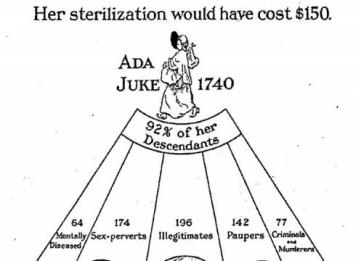
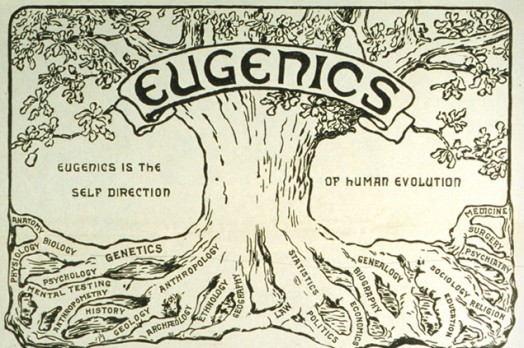
In the 19th century, Francis Galton studied the theories of his cousin Charles Darwin on the evolution of species, applying them to a system of selective breeding intended to bring “better” human beings into the world. He called it his theory of “Eugenics”.
Eugenics gained worldwide respectability in the early 20th century, when countries from Brazil to Japan adopted policies regarding the involuntary sterilization of certain mental patients.
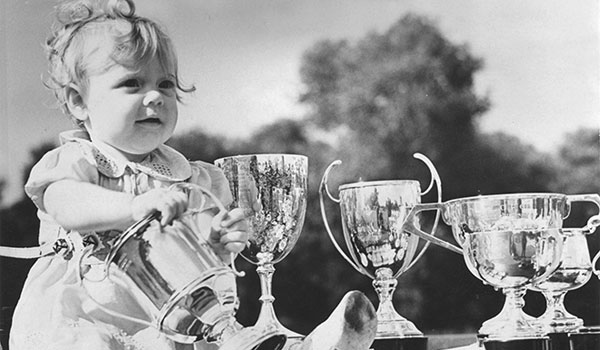
“Better Babies” competitions sprang up at state fairs across the United States, where babies were measured, weighed, and “judged”. Like livestock. By the 20s, these events had evolved into “Fitter Family” competitions.
One of the leaders of the eugenics movement was the pacifist and Stanford University professor, David Starr Jordan. After writing several books on the subject, Jordan became a founding member of the Eugenics Committee of the American Breeders Association. The higher classes of American society were being eroded by the lower class, he argued. Careful, selective breeding would be required to preserve the nation’s “upper crust”.
Margaret Samger
Margaret Higgins Sanger believed that birth control should be compulsory for “unfit” women, who “recklessly perpetuated their damaged genetic stock by irresponsibly breeding more children in an already overpopulated world.”
An early advocate for birth control, Sanger has her supporters to this day, including former Presidential candidate Hillary Rodham Clinton. “I admire Margaret Sanger enormously”, Clinton said. “Her courage, her tenacity, her vision…” Time Magazine points out that “Sanger opened the first birth-control clinic in the United States”, describing her as “An advocate for women’s reproductive rights who was also a vocal eugenics enthusiast…”
Detractors have described Sanger as a “thoroughgoing racist”, citing her own words in What Every Girl Should Know, published in 1910:“In all fish and reptiles where there is no great brain development, there is also no conscious sexual control. The lower down in the scale of human development we go the less sexual control we find. It is said that the aboriginal Australian, the lowest known species of the human family, just a step higher than the chimpanzee in brain development, has so little sexual control that police authority alone prevents him from obtaining sexual satisfaction on the streets”.
Admire or detest the woman as you choose, Sanger’s work established organizations which later evolved into the Planned Parenthood Federation of America.
Around the world, eugenics policies took the form of involuntarily terminated pregnancies, compulsory sterilization, euthanasia, and even mass extermination.
Madison Grant, the New York lawyer best known for his work in developing the discipline of wildlife management, was a leader in the eugenics movement, once receiving an approving fan letter from none other than Adolf Hitler.
Public policy and academic types conducted three international eugenics conferences to discuss the application of programs to improve human bloodlines. The first such symposium convened in London in 1912, discussing papers on “racial suicide” and similar topics. Presiding over the conference was none other than Major Leonard Darwin, the son of Charles Darwin, with Harvard president emeritus Charles William Eliot serving as vice President.
The 1912 conference was followed by two more in 1921 and 1932, both held in New York City. Colleges and universities delved into eugenics as academic discipline, with courses exploring the ethical and public policy considerations of eliminating the “degenerate” and “unfit”.
In Pennsylvania, 270 involuntary sterilizations were performed without benefit of law, between 1892 and 1931. On March 21, 1905, the Pennsylvania legislature passed “An Act for the Prevention of Idiocy”, requiring that every institution in the state entrusted with the care of “ idiots and imbecile children”, be staffed by at least one skilled surgeon, whose duty it was to perform surgical sterilization. The bill was vetoed by then-Governor Samuel Pennypacker, only to return in 1911, ’13, ’15, ’17, ’19, and again in 1921.
By the height of the eugenics movement, some 30 states had passed legislation, legalizing the involuntary sterilization of individuals considered “unfit” for reproduction. All told, some 60,000 individuals were forcibly sterilized in state-sanctioned procedures.
California forced Charlie Follett to undergo a vasectomy in 1945 at the age of 15, when Follett found himself abandoned by alcoholic parents. He was only one of some 20,000 Californians forced to undergo such a procedure.
Roadside Marker, Raleigh, NC
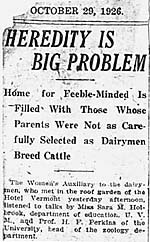
Vermont passed a sterilization law in 1931, aimed at what then-University of Vermont zoology professor Henry Perkins called the “rural degeneracy problem.” An untold number of “defectives” were forced to undergo involuntary sterilization, including Abenaki Indians and French-Canadian immigrants.
Indiana passed the first eugenic sterilization law in 1907, but the measure was legally flawed. To remedy the situation, the Eugenics Record Office (ERO), founded in 1910 by the the former Harvard University Zoology Professor Charles Benedict Davenport, Ph.D., crafted a statute, which was later adopted by the Commonwealth of Virginia as state law in 1924.
That September, Superintendent of the ‘Virginia State Colony for Epileptics and Feebleminded’ Dr. Albert Sidney Priddy, filed a petition to sterilize one Carrie Elizabeth Buck, an 18-year-old patient at the institution whom Priddy claimed to be “incorrigible”. A “genetic threat to society”. Buck’s 52-year-old mother had a record of prostitution and immorality, Priddy claimed, and the child to whom Buck gave birth in the institution only proved the point.
Carrie Elizabeth Buck was born into poverty in Charlottesville, Virginia, the first of three children born to Emma Buck. Carrie’s father Frederick Buck abandoned the family, shortly after the marriage. Emma was committed to the “Virginia State Colony for Epileptics and Feebleminded” following accusations of immorality, prostitution, and having syphilis.
Buck’s guardian brought her case to court, arguing that compulsory sterilization violated the equal protection clause of the 14th amendment. After losing in district court, the case was appealed to the Amherst County Circuit Court, the Virginia Supreme Court, and finally the United States Supreme Court.
Dr. Priddy died along the way, Dr. John Hendren Bell taking his place. SCOTUS decided the “Buck vs Bell” case on May 2, 1927, ruling in an 8–1 decision that Carrie Buck, her mother, and her perfectly normal infant daughter, were all “feeble-minded” and “promiscuous.”
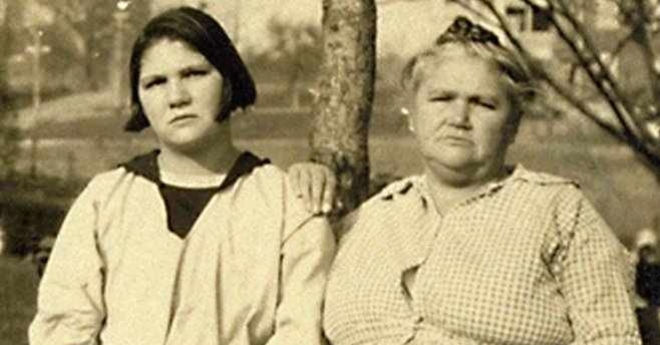
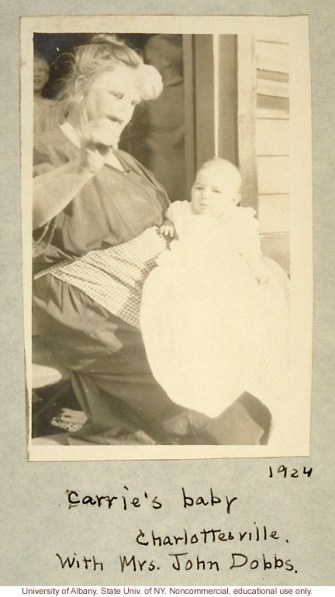
“This photograph was taken on the eve of the initial trial of Buck v Bell in Virginia. Mrs. Dobbs appear to be holding a coin believed to be used as a test for alertness or mental acuity. Vivian appears to be looking elsewhere. It may have ben on the strength of this test that Arthur Estabrook concluded that she “showed backwardness.” H/T DNA Learning Center, dnalc.org
In the majority ruling, Justice Oliver Wendell Holmes, Jr., did more than just greenlight the Virginia statute. He urged the nation as a whole to get serious about eugenics, and to prevent large numbers of “unfit” from breeding: “”It is better for all the world“, Holmes wrote, “if instead of waiting to execute degenerate offspring for crime, or to let them starve for their imbecility, society can prevent those who are manifestly unfit from continuing their kind“. In writing about Carrie Buck herself, her mother and infant daughter Vivian, Holmes delivered one of the most brutal pronouncements in all American jurisprudence: “Three generations of imbeciles are enough.”
It was later revealed that Carrie Buck had been raped by a member of the Dobbs family, the foster family who had taken her in and later had her committed. To save the family “honor”. No matter. Buck was compelled to undergo tubal ligation, later paroled from the institution to become a domestic worker with a family in Bland, Virginia. Buck’s daughter Vivian was adopted by the Dobbs family.
In a later examination of the child, ERO field worker Dr. Arthur Estabrook pronounced her “feeble minded” saying that she “showed backwardness”, supporting the “three generations” theory expressed in the SCOTUS opinion.
Vivian died from complications of measles in 1932, after only two years in school. Dr. Estabrook failed to explain in his report, how she seemed to do well for those two years, nor did doctor Estabrook reveal how she came to be listed on her school’s honor roll, in April, 1931.
With a force never exceeding 14,000 (3,000 Germans and 11,000 Askari warriors), “Der Löwe von Afrika” tied up as many as 300,000 British, Belgian and Portuguese troops, wearing them out in the pursuit.
When war broke out in 1914, a map of Africa looked nothing like it does today. From the Belgian Congo to Italian Somaliland, most of the continent was carved into colonies of the various European powers. France, Great Britain, Italy, Portugal, Belgium, Germany and Spain. All administered parts of the African continent.
Paul Emil von Lettow-Vorbeck was born into minor Prussian Nobility on this day, in 1870. Joining the Corps of Cadets as a teenager, Lettow-Vorbeck worked his way up the German Imperial Army chain of command, becoming a general by the time of WWI.
Stationed in Deutsch-Ostafrika (German East Africa) and knowing that his sector would be little more than a side show to the greater war effort, Lettow-Vorbeck determined to tie up as many of his adversaries as possible.
With a force never exceeding 14,000 (3,000 Germans and 11,000 Askari warriors), “Der Löwe von Afrika” tied up as many as 300,000 British, Belgian and Portuguese troops, wearing them out in the pursuit.
Like the much better-known Lawrence of Arabia, Lettow-Vorbeck became a master of guerilla warfare. He never lost a single battle, though it was not unheard of for combatants to break and flee a charging elephant or rhinoceros.
To his adversaries, disease and parasites were often more dangerous than enemy action. In July 1916, Allied non-battle casualties ran 31 to 1, compared with battle casualties.
In 1956, Brazilian scientists attempted to cross African honey bees with indigenous varieties, to produce an insect better suited to the South American tropics. Today, we call the results of these failed experiments “Africanized” or “Killer” bees.
At one point in the Battle of Tanga (November 7-8, 1914), a British landing force and their Sepoy allies were routed and driven back to the sea by millions of African bees, disturbed by rifle and machine gun fire. There’s a story about a British radioman, I don’t know if it’s true, who held to his station, directing the beach evacuation while being stung to death by thousands of angry bees. He was posthumously awarded the Victoria Cross for “gallantry under aerial attack”.
“Der Löwe von Afrika” – the Lion of Africa – returned to Germany a conquering hero. Of all German commanders in WWI, Lettow-Vorbeck alone was undefeated in the field. The only German commander to successfully invade imperial British soil, during the Great War.
Lettow-Vorbeck developed a deep distrust of the upstart Adolf Hitler, and attempted to establish a conservative opposition to the Nazi party. When then-Chancellor Hitler offered him an ambassadorship to the Court of St. James in 1935, Lettow-Vorbeck told Hitler to “go f**k” yourself. Describing the interview afterward, Vorbeck’s nephew explained “That’s right, except that I don’t think he put it that politely.”
Such a blunt refusal was guaranteed to bring unwanted attention from the Nazi regime. Vorbeck’s home and office were searched, his person subject to constant harassment and surveillance. By the end of WWII, the Lion of Africa was destitute. Both of his sons were killed serving in the Wehrmacht, his home in Bremen destroyed by Allied bombs.
For a time, Vorbeck lived on food sent from British Intelligence Officer Richard Meinertzhagen and South African Field Marshal Jan Christiaan Smuts, two of his former adversaries in the East Africa campaign. It was a token of the respect these two had, for a man who had once been their enemy.
The old General never forgot his Ascaris, returning to East Africa in 1953, to the tears of his former warriors. Paul Emil von Lettow-Vorbeck died in 1964, at the age of 93. A few months later, the Bundestag voted to give back pay to the African warriors who had fought with German forces in WWI. Some 350 elderly Ascaris showed up. A few could produce certificates given them back in 1918, some had scraps of old uniforms. Precious few could prove their former service to the German Empire.
The German banker who brought the money had an idea. As each man stepped forward, he was handed a broom and ordered to perform the German manual of arms. Not one man failed the test.
Lettow-Vorbeck formed a lifelong friendship during his time in Africa, with the Danish author Karen Blixen, best known by her pen name Isak Dinesen, author of “Out of Africa”. Years later, Blixen recalled, “He belonged to the olden days, and I have never met another German who has given me so strong an impression of what Imperial Germany was and stood for”.
If you enjoyed this “Today in History”, please feel free to re-blog, “like” & share on social media, so that others may find and enjoy it as well. Please click the “follow” button on the right, to receive email updates on new articles. Thank you for your interest, in the history we all share.
During three months of active operations inside Mexico, American forces killed or captured 292 Villistas, but Pancho Villa evaded capture. Pershing publicly proclaimed the operation a success, but privately complained that Wilson imposed too many restrictions, making it impossible to fulfill the mission.
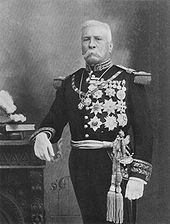
Porfirio Diaz
In thirty-five years as President of Mexico, the administration of José de la Cruz Porfirio Díaz Mori had yet to figure out the question of Presidential succession. At first popular following his seizure of power in the coup of 1876, the Porfirian regime soon began to stagnate. Diaz’ policies benefitted ‘el jefe’ cronies and supporters, the wealthy estate-owning “haciendados”, while leaving rural agricultural “campesinos” unable to make a living.
Following the turn of the century, the aging President expressed support for a return to democracy and an intention to step down from office.
An unlikely opponent stepped forward in the person of UC-Berkeley educated lawyer and wealthy hacienda owner, Francisco Madero. Madero wanted a return to democratic elections, but Diaz would have none of it.
Francisco Madero
Perhaps the octogenarian President expected that his country would beg him to stay, or maybe he changed his mind, but anyone stepping into Diaz’ path, did so at his own risk. Madero fled to the United States, but later returned and faced arrest. Meanwhile, the 80-year old Porfirio Diaz won re-election to an eighth term by a margin that would make Saddam Hussein blush. Voters were outraged by what was clearly a massively corrupt election.
Madero escaped prison and produced the Plan de San Luis Potosí to nullify the elections and overthrow Díaz by force. The table was set for the Mexican Revolution.
Armed conflict ousted Diaz from office the following year, when a free and fair election put Francisco Madero into office. Opposition was quick to form, from both sides of the political spectrum. Conservatives and land owners saw Madero as too weak, his policies too liberal, while former revolutionary fighters and the economically dispossessed, saw him as too conservative. In February 1913, both Madero and his vice president Pino Suárez were run out of office, and murdered by order of military officer, Victoriano Huerta.
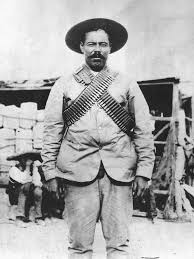
Pancho Villa
Francisco “Pancho” Villa was a Mexican constitutionalist and a Madero supporter. As commander of the División del Norte (Division of the North), Villa fought on behalf of Primer Jefe (“First Chief”) of the Constitutionalist army Venustiano Carranza, but later turned on his erstwhile leader.
American newspaperman and commentator Ambrose Bierce, author of The Devil’s Dictionary and my favorite curmudgeon, joined Pancho Villa’s army in December 1913, as an observer. And then he vanished. Most likely, Bierce faced a firing squad in Chihuahua, but his story remains unknown.
Trouble began between Villistas and the American government when the US declared its support for Villa’s former ally, providing rail transport from Texas to Arizona for 5,000 Carrancista forces.
The Division del Norte was badly defeated by forces loyal to Carranza in July 1915, and again in November. Villa’s army ceased to exist as a military fighting force, reduced to local skirmishes and cross-border raids while foraging the countryside.
A three-way fight broke out on November 26, when Villa’s forces attacked the border town of Nogales, Sonora, and fired across the border at American troops in Nogales, Arizona. On January 11, sixteen American employees of the American Smelting and Refining Company were taken from a train near Santa Isabel Chihuahua, stripped naked, and executed.
In early March, a force of some 1,500 Villistas were camped along the border three miles south of Columbus New Mexico, when Villa sent spies into Camp Columbus (later renamed Camp Furlong). Informed that Camp Columbus’ fighting strength numbered only thirty or so, a force of some 600 crossed the border around midnight on March 8.
Villa divided his force into two columns, launching a two-pronged assault in the early morning darkness of March 9. Townspeople were asleep at first, awakening to the sounds of burning buildings, and shouts of “Viva Villa! Viva Mexico!”
What began as a pre-dawn raid soon erupted into full-scale battle, as residents poured from homes with hunting rifles and shotguns. The Camp Columbus garrison was taken by surprise but recovered quickly, as barefoot soldiers scrambled into position. Four Hotchkiss M1909 machine guns fired 5,000 rounds apiece before the shooting died down, joined by another 30 troopers with M1903 Springfield rifles.
Pancho Villa proclaimed the raid a success, having captured over 300 rifles and shotguns, 80 horses, and 30 mules. Strategically, the raid was a disaster. The Mexicans had lost 90 to 170 dead they could barely afford, out of a raiding force of 484 men. Official American reports indicate 8, 10 or 11 soldiers killed, plus another 7 or 8 civilians, depending on which report you believe.
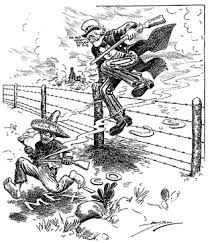
The United States government wasted no time in responding. That same day, the President who would win re-election in eight months on the slogan “He kept us out of war” appointed Newton Diehl Baker, Jr. to fill the previously vacant position of Secretary of War. The following day, Woodrow Wilson ordered General John Pershing to capture Pancho Villa, dead or alive.
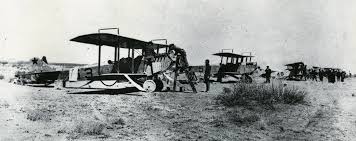
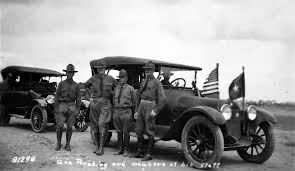
7,000 American troops crossed into Mexico on March 13. It was the first American military expedition to employ mechanized vehicles, including trucks and automobiles to carry supplies and personnel, and Curtiss Jenny aircraft used for reconnaissance.
On March 5, 1913, President William Howard Taft ordered the formation of the 1st Aero squadron, nine aircraft divided into two companies. ‘Aviation’ at that time was not what is, today. Aircraft were highly experimental, many built by the pilots themselves. Crashes were commonplace, and flight lessons all but unheard of. Frequently, general guidelines were given on the ground, and pilots were left to their own devices. One of the early pilots, Captain Benjamin D. Foulois, sent away and received written instruction from Orville Wright, by mail!
The 1st Aero Squadron arrived in New Mexico on March 15, with 8 aircraft, 11 pilots and 82 enlisted men. The first reconnaissance sortie was flown the following day, the first time that American aircraft were used in actual military operations.
Five aircraft departed on the evening of March 19, with orders to report ‘without delay’ to Pershing’s headquarters in Casas Grandes, Mexico. One made it that night, another two straggled in the next morning. One returned to Columbus and 2 others went missing. The problems, it turned out, were insurmountable. 90 HP engines were unable to bring them across 10,000 – 12,000’ mountain peaks, nor could they handle the turbulent winds of mountain passes. Dust storms wrought havoc with engines and, making things worse, the unrelenting heat of the Sonoran Desert de-laminated wooden propellers.
On May 14, a young 2nd Lieutenant in charge of a force of fifteen and three Dodge touring cars got into a running gunfight, while foraging for corn, in Chihuahua. It was the first motorized action in American military history. Three Villistas were killed and strapped to the hoods of the cars and driven back to General Pershing’s headquarters. General Pershing nicknamed that 2nd Lt. “The Bandito”. History remembers his name as George S. Patton.
During three months of active operations inside Mexico, American forces killed or captured 292 Villistas, but Pancho Villa evaded capture. Pershing publicly proclaimed the operation a success, but privately complained that Wilson imposed too many restrictions, making it impossible to fulfill the mission. “Having dashed into Mexico with the intention of eating the Mexicans raw”, Pershing complained, “we turned back at the first repulse and are now sneaking home under cover, like a whipped cur with its tail between its legs.”
Pancho Villa Expedition, “Around the Campfire”
American forces were withdrawn by January 1917, as the European war loomed over American politics. German Foreign Secretary Arthur Zimmermann observed political opposition to American operations inside of Mexico, and concluded that a military alliance was possible between the two countries.
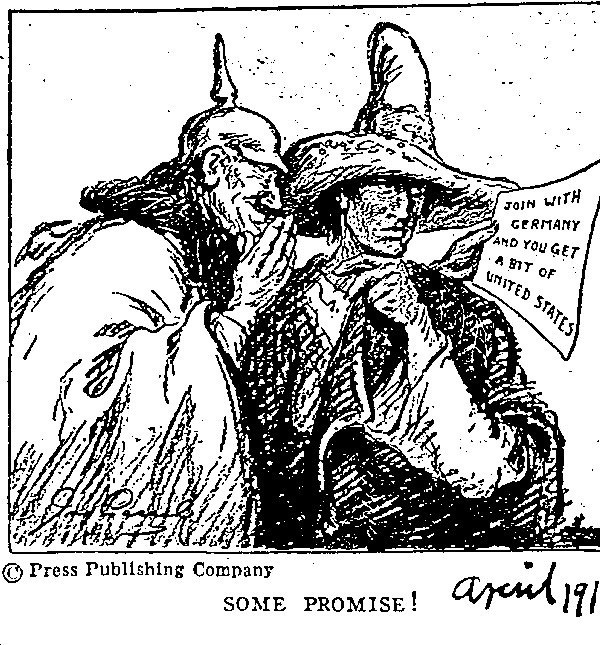
The ‘Zimmermann note‘ proposing such an alliance between Germany and Mexico and promising the “restoration of its former territories of Texas, New Mexico and Arizona“, may be seen as the ‘last straw’ that brought the United States into WW1.
Around the year AD 14 or 15, the youngest son of the Roman war hero Germanicus found himself growing up around the Legions. As a boy of just two or three, little Gaius Caesar accompanied his father on campaigns in the north of Germania. Centurions were amused to see the boy dressed in miniature soldier’s uniform, including the boots, the “Caligae”, and the segmented Roman body armor – the “Lorica Segmentata”.
Around the year AD 14 or 15, the youngest son of the Roman war hero Germanicus found himself growing up around the Legions. As a boy of just two or three, little Gaius Caesar accompanied his father on campaigns in the north of Germania. Centurions were amused to see the boy dressed in miniature soldier’s uniform, including the boots, the “Caligae“, and the segmented Roman body armor – the “LoricaSegmentata”.
Soldiers of the Legions called him “Little Boots”, after the tiny soldier’s boots the boy liked to wear in camp. In Latin, “Caligula“. He’s said to have hated the name, but it stuck.
The Roman historian Suetonius writes that Germanicus was poisoned on the orders of Emperor Tiberius, who viewed the general as a political rival. Caligula’s mother Agrippina was denied permission to remarry, for the same reason. Agrippina was later exiled, as were her sons Drusus and Nero, while Caligula was remanded to the island of Capri and the personal custody of Tiberius, himself.
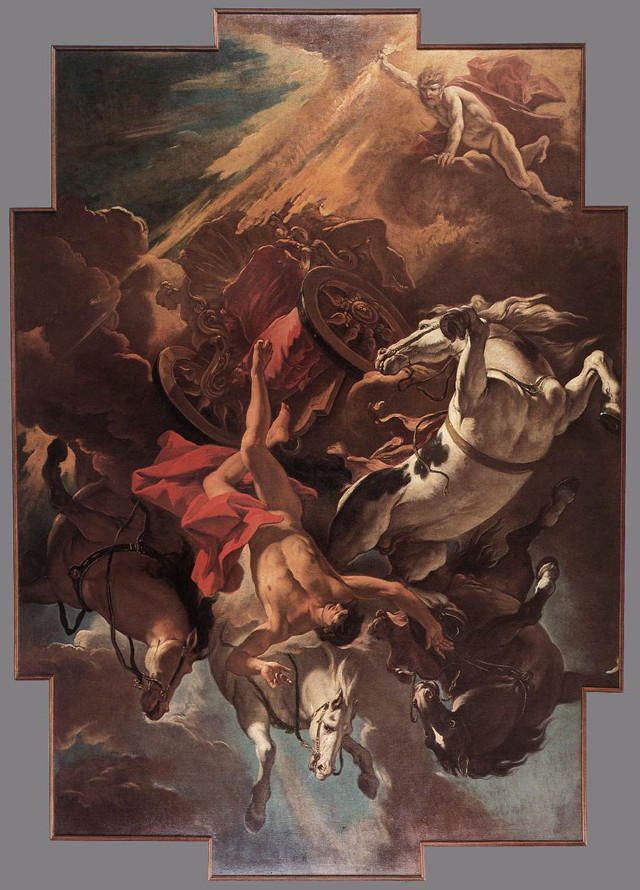
One observer spoke well of Caligula during this period, saying “Never was there a better servant or a worse master.” Suetonius believed the boy to be vicious and cruel, a natural actor who suppressed his hatred for the man responsible for the death of his family. The historian writes that, when Tiberius brought Caligula to Capri, it was to “… prove the ruin of himself and of all men, and that he was rearing a viper for the Roman people and a Phaethon for the world.”
The Fall of Phaeton, by Sebastiano Ricci
Phaethon, according to Greek mythology, was the child of the sun God Helios. As a boy, Phaethon was permitted to drive the sun chariot for a day, but couldn’t control the horses. With the earth in danger of being burned by the runaway sun, the God Zeus was forced to strike the chariot with a thunderbolt, killing the boy in the process.
Suetonius appears not to have been a fan.
When Tiberius died on March 16 AD 37, many believed his passing to have been hastened by a pillow, in the hands of the Praetorian Guard Commander Naevius Sutorius Macro. Tiberius’ estate and titles were left to Caligula and Tiberius’ own grandson, Tiberius Gemellus.
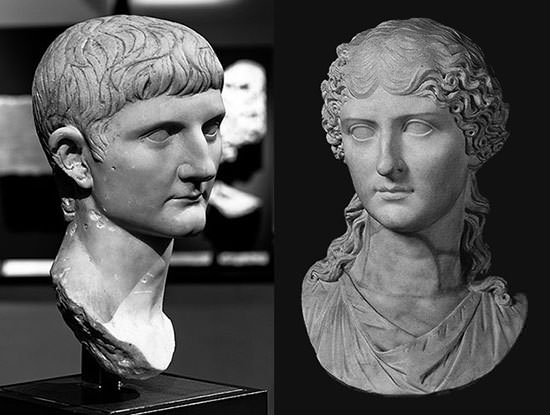
Busts of Caligulas Parents, Germanicus (left) and Agrippina the Elder
On this day in the year 37, the Roman Senate annulled the will of the Emperor Tiberius, proclaiming 24-year-old Caligula, Emperor. After years of purges and treason trials, Caligula’s ascension to the throne was a welcome breath of fresh air. The son of the war hero Germanicus was in charge. What could go wrong. All of Rome erupted in paroxysms of joy, proclaiming Caligula to be the first emperor Ever, admired by “all the world, from the rising to the setting sun”.
160,000 animals were sacrificed in three months of public jubilation. The Jewish philosopher Philo of Alexandria described the first seven months as “completely blissful”.
Map of the Roman Empire and neighboring states during the reign of Gaius Caligula (37-41 AD).
Caligula’s first two years were relatively peaceful and prosperous. The Emperor provided lavish gladiatorial games for the entertainment of the people, and abolished the sales tax. He granted bonuses to the military and destroyed Tiberius’ papers, declaring the treason trials of his hated predecessor a thing of the past. Too late for his own family, Caligula recalled those who had been sent into exile. The bones of his mother and brothers, were deposited in the tomb of Augustus.
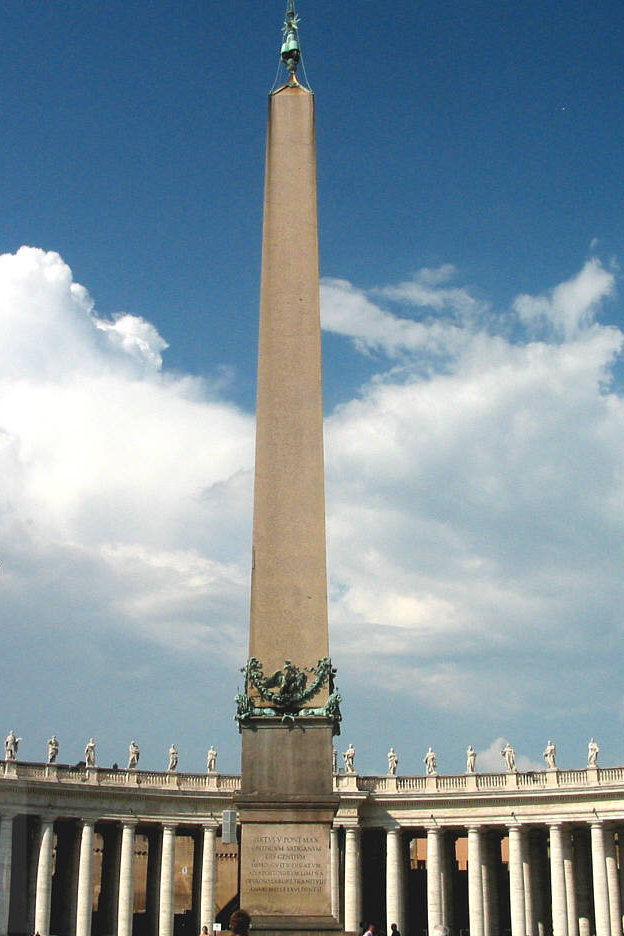
The obelisk at St. Peter’s Square in Vatican City, originally erected in Alexandria in BC 30-28, was transported to Rome and erected in the year AD 40, where it stands to this day. The “Piazza San Pietro Obelisk” is the only such monument to have survived from Roman times.
Piazza San Pietro Obelisk
In AD39, Caligula suffered a severe and prolonged illness, in which he hovered between life and death for over a month. It may or may not have had anything to do with his subsequent behavior, but the man who emerged from that illness was widely believed to be insane.
The Emperor performed a spectacular stunt by ordering a temporary floating bridge to be built, using ships as pontoons, stretching for over two miles from the resort of Baiae (pronounced BAY-eye) to the neighboring port of Puteoli. Though Caligula could not swim, he rode his favorite horse, Incitatus, across the bridge, wearing the breastplate of Alexander the Great. Tiberius’ soothsayer Thrasyllus of Mendes predicted that Caligula had “no more chance of becoming emperor than of riding a horse across the Bay of Baiae”. Little Boots, had proven otherwise.
In case you’re wondering, Incitatus was the same horse whom Caligula appointed as priest, and planned to make a Consul of Rome, the top elected official of the Roman government.
In time, what seemed like mere eccentricities became terrifying and erratic. Caligula regularly made senators run alongside his chariot. He’d order executions on a whim – common man or foreign dignitary – it didn’t matter. At the Roman games, he once had an entire crowd section thrown into the arena, to be eaten alive by wild animals. He said he was bored.
Caligula began to appear in public, dressed as various Gods and demigods: Hercules, Mercury, Venus and Apollo. He wished to be worshipped as “Neos Helios” – the New Sun. He’d refer to himself as a God when meeting with politicians. He built temples for the worship of himself, where the heads of statues were replaced by his own likeness.
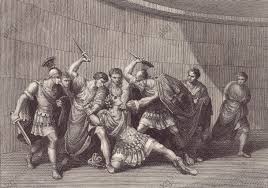
Death of Caligula at the hands of his own Praetorian Guard
Later stories of wanton hedonism, cruelty, and sexual depravity may be exaggerated, but none seem to be without a grain of truth. Roman politics often associated poor government policy, with insanity and sexual perversity.
Little Boots was murdered by his own Praetorian Guard in AD 41, like his predecessor Julius Caesar, stabbed thirty times in a conspiracy led by a man named Cassius. Stricken with grief and outraged by the murder, Caligula’s Germanic guard turned the scene into a bloodbath in a raging assault against conspirators, Senators and innocent bystanders, alike.
Most historians dismiss the floating bridge story as a myth. No archaeological evidence has ever surfaced, to prove the story true. Caligula’s two “pleasure barges”, extracted from the bottom of Lake Nemi, are a different story.
The Pleasure Barges of Caligula (inset, Bronze Medusa)
Locals had long known of the presence of a wreck at around 60-ft. deep in the extinct volcano-turned Lake, some twenty-five miles from Rome. Occasionally, fishermen and treasure hunters would use grappling hooks, to bring up souvenirs.
The Fascist Dictator Benito Mussolini had heard of the legend, and ordered the lake drained. One wreck turned out to be two in 1927 when, for the first time in 2,000 years, the “pleasure barges” of Emperor Caligula saw the light of day.
Benito Mussolini attends the inauguration “Il Museo delle Navi Romane” – the Museum of Nemi.
Dubbed Prima nave (the 1st ship) and Seconda nave, the former measured 230-ft., the latter 240. The lavish furnishings included hot and cold running water, cedar planking with jewel encrusted prows, vessels of gold and silver and bathrooms of alabaster and bronze. There were hand-operated bilge pumps and a platform rotating on ball bearings: perhaps to rotate a great statue, or maybe it was a deck crane, for loading supplies. There were glass mosaics in the floors and marble décor, stone statuary and gilded copper roofs. One wreck bore a lead pipe, bearing the inscription “Property of Gaius Caesar Augustus Germanicus”.
On the night of May 31, 1944, US army shells hit the museum, causing little apparent damage but forcing a German artillery unit, to move. Two hours later, smoke was seen coming from the windows. The concrete shell of the Nemi Museum was spared by the fire. The two priceless archaeological artifacts housed inside, were destroyed. Official reports blamed German sabotage. German newspaper editorials blamed Allied bombing.
During the retreat through Italy, German soldiers burned some 80,000 books and manuscripts of the Royal Society of Naples, out of spite. It’s easy to believe they torched the two Nemi Ships, as well. Like Emperor Caligula himself 2,000 years before, the Italian dictator Mussolini died by violence, at the hands of his own countrymen.
“The remains of the hull of one of Caligula’s two “pleasure barges” recovered from Lake Nemi. Workers in the foreground give an indication of scale”. H/T, Wikipedia for this image
If you enjoyed this “Today in History”, please feel free to re-blog, “like” & share on social media, so that others may find and enjoy it as well. Please click the “follow” button on the right, to receive email updates on new articles. Thank you for your interest, in the history we all share.
Squanto would mediate between the settlers and the native tribes, teaching the Pilgrims to plant corn: several kernels in a mound, buried with a fish head to enrich the soil. When planted together in a circle, the “three sisters” would support and thrive together, the corn stalks providing poles for the beans, and the squash leaves providing ground cover & holding in moisture, while keeping weeds at bay.
In 1620, the 60-ton Pinnace Speedwell departed Delfshaven, meeting with Mayflower at Southampton, Hampshire. The two vessels set out on August 15, but soon had to turn back as Speedwell was taking on water. Speedwell was abandoned after a second failed attempt, Mayflower setting out alone on September 16, 1620, with an estimated 142 passengers and crew.
66 days at sea brought the “Old Comers” up on the outer reaches of Cape Cod on November 11, near the present-day site of Provincetown Harbor. There, the group stayed long enough to draw up the first written framework of government established in the New World, a “civil body politic” called the Mayflower Compact.
As anyone familiar with the area will understand, a month in that place and time convinced them of its unsuitability. By mid-December the Mayflower had crossed Cape Cod Bay and fetched up at Plimoth Harbor.
Words fail to describe the terrible conditions of that first winter. Over half of these “Pilgrims” died during those first few months, eighty-two in all, of malnutrition, disease, exposure and starvation. It was nearly as awful as the “starving time” of the Jamestown colony of ten years earlier, in which all but 60 of 214 colonists perished.
Massasoit,
The morning of March 16, 1621 dawned fair and clear, warm for the season. The settlers had long heard tales of their new neighbors, and even spotted a few back in November, at the modern-day “First Encounter Beach”, in Eastham. There were wild stories of “cannibals” and “savages”, but none had yet been observed, at anything but a distance. This morning, the newcomers realized that it was they who were being observed.
They were hurriedly arranging defenses when one of the “savages” approached the group, naked as the day he was born but for a leather fringe about his waist, holding a bow and two arrows. Tall and straight with flowing black hair, the man walked straight up and introduced himself, to the astonishment of the group, in English. He said his name was Samoset.
The following account appears in Mourt’s Relation (1622) written primarily by Edward Winslow and William Bradford:
Samoset, “1st Friend” of the Pilgrims
“ Friday the 16th was a fair warm day….We were finishing our work, when a strange looking man, a man which caused us to be surprised becaused he seemed unafraid …. walked into the village. We stopped him. … He spoke to us in English, and was friendly. He said he had learned some English among the Englishmen that came to fish at Monhegan Island, and he gave us their names. He was a man who spoke freely and openly. We questioned him about many things. He was the first Indian we met. He said he was from Morattiggon (modern day Maine) and been 8 months in these parts…He asked for a drink and we gave him strong water and biscuit, and butter, and cheese, and pudding, and a piece of mallard (duck), all which he liked well. He said he had also eaten this food before with the English that had come before where he was from.
He told us the place where we now live was known as Patuxet by the Indians. Four years ago all the Indians who lived there died of a sickness and none were left, so they cannot hurt us, or to say the land where we now live belongs to them. All the afternoon we spent talking with him; we thought he would leave that night, but he did not leave. Then we thought to carry him on shipboard, and he intended to leave, but the wind was high and the water not deep enough so he could not return back that day. We lodged him that night at Stephen Hopkins house, and watched him.
Southern New England tribal range, circa 1600
Samoset was a Sagamore (minor Chief) of the Abenaki tribe of modern-day Maine, visiting at that time with Ousamequin, the Pokanoket Sachem (leader) of the Wôpanâak (Wampanoag) and Massassoit (Great Sachem) of the Wampanoag Confederacy of southeastern Massachusetts and Rhode Island.
This plaque is all that remains of the Pilgrim’s 1620 raid on the Nauset’s corn stash, in modern-day Truro, MA
Samoset warned the newcomers to beware the Nauset, later called “Cape Cod Indians”, a tribal unit of some one-hundred individuals sharing the Massachusett (Natick) language and occupying modern-day Cape Cod and surrounding islands. Small wonder. Long before the large-scale colonization of the New World, European seafarers had kidnapped some twenty Nausets, and sold them into slavery, leaving in their wake diseases with which the native immune system was ill-equipped to deal. It was a Nauset corn cache the Pilgrims themselves had plundered back in November, a stash laid up to take their people through the long, barren winter.
Samoset departed the following day, March 17, but returned on the 22nd with Tisquantum, (Squanto), one of the few surviving Pawtuxet. A man who spoke better English than Samoset himself, Squanto would mediate between the settlers and the native tribes, including Massasoit. Squanto taught the Pilgrims to plant corn: several kernels in a mound, buried with a fish head to enrich the soil. When planted together in a circle, the “three sisters” would support one another and thrive together, the corn stalks acting as poles for the beans, and squash leaves providing ground cover & holding in moisture, while keeping weeds at bay.
The Pawtuxet Squanto taught the Pilgrims what and where to plant, where to fish and how to hunt beaver
The newcomers reciprocated, teaching the natives about their own crops, with the aid of European farming tools.
“Days of Thanksgiving” took place in the New World as early September 8, 1565, when a group of Spaniards lead by explorer Pedro Menéndez de Avilé invited members of the Timucua tribe to a day of Thanksgiving in Saint Augustine, Florida. Yet, the harvest feast of 1621, shared between the Pilgrims and the Pokanokets, is generally considered to be the basis for our own Thanksgiving holiday.
In the following months, the debt of corn was repaid to the Nauset people, who returned the favor by restoring a small boy to the colony, who’d been found lost and wandering in the woods. The Nauset would become Christianized in the following years, turning out to be the European’s greatest allies.
Years later, colonists would go to war against the Wampanoag people and ‘King Philip’, the English name for Metacomet, the son of Massasoit. The Nauset would act as warriors and scouts against the Wampanoag people in King Philip’s War, a conflict which killed some 5,000 New England inhabitants, three quarters of whom were indigenous people.
In terms of the percentage killed of the overall population, King Philip’s War was over twice as costly as the American Civil War, and seven times that of the American Revolution. But that must be a story for another day.
Feature image, top of page: First Encounter Beach, Eastham Massachusetts
If you enjoyed this “Today in History”, please feel free to re-blog, “like” & share on social media, so that others may find and enjoy it as well. Please click the “follow” button on the right, to receive email updates on new articles. Thank you for your interest, in the history we all share.
Think of the OJ trial, only in this case, the killer was a former First Lady. This one had everything: Left vs. Right, the fall of the powerful, and all the salacious detail anyone could ask for. French public and media alike were riveted by the Caillaux affair, disinterested and unheeding of the European crisis barreling down on them, like the four horsemen of the apocalypse.
We hear a lot in election years, about “Left” and “Right”. “Liberal” and “Conservative”.
The terms have been with us a long time, originating in the early days of the French Revolution. In those days, National Assembly members supportive of the Monarchy sat on the President’s right. Those favoring the Revolution, on the left. The right side of the seating arrangement began to thin out and disappeared altogether during the “Reign of Terror”, but re-formed with the restoration of the Monarchy, in 1814-1815. By that time it wasn’t just the “Party of Order” on the right and the “Party of Movement” on the left. Now, the terms began to describe nuances in political philosophy, as well.
200 years later, philosophical differences between the Left and Right of the period, would be recognizable to political observers today.
Joseph Cailloux
Joseph Cailloux (rhymes with “bayou”) was a left-wing politician, appointed Prime Minister of France in 1911. The man was indiscreet in his love life, even for a French politician. Back in 1907, Cailloux had paraded about with a succession of mistresses, finally carrying on with one Henriette Raynouard, while both were married to other people. By 1911, both were divorced. That October, Henriette Raynouard became the second Mrs. Cailloux.
The political right considered Cailloux to be far too accommodating with Germany, with whom many felt war to be all but inevitable. While serving under the administration of President Raymond Poincare in 1913, Cailloux became a vocal opponent of a bill to increase the length of mandatory military service from two years to three, intended to offset the French population disadvantage conferred by France’s 40 million, compared with 70 million Germans.
Madame Cailloux
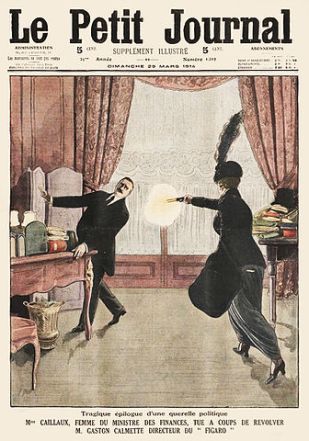
Gaston Calmette, editor of the leading conservative newspaper Le Figaro, threatened to publicize love letters between the former Prime Minister and his second wife, written while both were still married for the first time.
Henriette Cailloux was not amused.
On March 16, 1914, Madame Cailloux took a taxi to the offices of Le Figaro. After being shown into Calmette’s office, the pair spoke briefly, before Henriette withdrew the Browning .32 automatic. Cailloux fired six rounds at the editor. Two missed, but four were more than enough to do the job. Gaston Calmette was dead within six hours.
German Chancellor Otto von Bismarck once said the next great European war would begin with “some damn fool thing in the Balkans”. No one realized it at the time, but Bismarck got his damn fool thing on June 28, when a Serbian Nationalist assassinated the heir apparent to the Austro-Hungarian throne, the Archduke Franz Ferdinand.
The July Crisis of 1914 was a series of diplomatic maneuverings, culminating in the ultimatum from Austria-Hungary to the Kingdom of Serbia. Vienna, with tacit support from Berlin, made plans to punish Serbia for her role in the assassination, while Russia mobilized armies in support of her Slavic ally.
There is a common but mistaken notion that Imperial Germany “started” World War I, but it isn’t so. Kaiser Wilhelm was a famous “saber rattler”, but actually going to war with the other major European powers, was another matter.
It was Germany’s weaker ally Austria-Hungary which, having received vague assurances of German support, pursued a policy of unreasoning belligerence against Serbia.
German Foreign Minister Gottlieb von Jagow was away on honeymoon, during key periods of the July crisis. The Kaiser himself was out of touch, cruising the Norwegian fjords. That cruise has been called the most expensive maritime disaster, in history.
On being informed of the decision to mobilize, the Kaiser told his General Staff “Gentlemen, you will regret this.”
SMY Hohenzollern II, which Emperor Wilhelm II used on annual extended Nordlandfahrt cruises to Norway. All told, he spent four years living on board.
Meanwhile, England and France looked the other way. In Great Britain, officialdom was focused on yet another home rule crisis concerning Ireland, while all of France was distracted by the “Trial of the Century”.
Madame Caillaux’s trial for the murder of Gaston Calmette began on July 20. Think of the OJ trial, only in this case, the killer was a former First Lady. This one had everything: Left vs. Right, the fall of the powerful, and all the salacious detail anyone could ask for. French public and media alike were riveted by the Caillaux affair, disinterested and unheeding of the European crisis barreling down on them, like the four horsemen of the apocalypse.
The trial ended in acquittal on July 28, the jury ruling the murder to have been a “crime passionnel”. A crime of passion. That same day, Austria-Hungary declared war on Serbia.
In the days that followed, the Czar would begin the mobilization of men and machines which would place Imperial Russia on a war footing. Kaiser Wilhelm’s Germany invaded Belgium, in pursuit of the one-two punch strategy by which it sought first to defeat France, before turning to face the “Russian Steamroller”. England declared war in support of a 75-year-old commitment to protect Belgian neutrality, a treaty obligation German diplomats had dismissed as a “scrap of paper”.
An event which could have resulted in little more that a policing action in the Balkans, was about to explode into the “War to End All Wars”. Edward Grey, 1st Viscount Grey of Fallodon said “The lamps are going out all over Europe: we shall not see them lit again in our life-time.” Eleven million military service members and seven million civilians who were alive in July 1914, would not live to see the other side.
If you enjoyed this “Today in History”, please feel free to re-blog, “like” & share on social media, so that others may find and enjoy it as well. Please click the “follow” button on the right, to receive email updates on new articles. Thank you for your interest, in the history we all share.

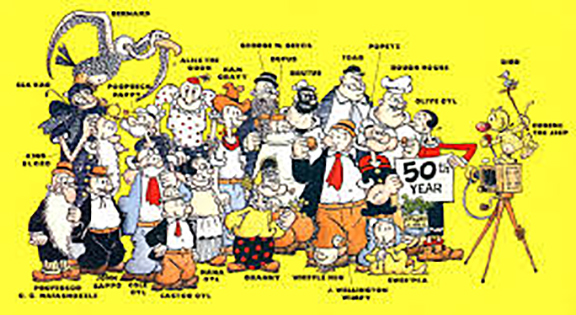
 The strip was around for ten years or so, when Olive & co. decided to recruit a sailor to get them to the casino on Dice Island. Approaching a rough looking character on the docks, “Popeye’s” first line was “Ja think I was a cowboy? He was supposed to be an extra, but he became so popular he soon developed into the center of the strip.
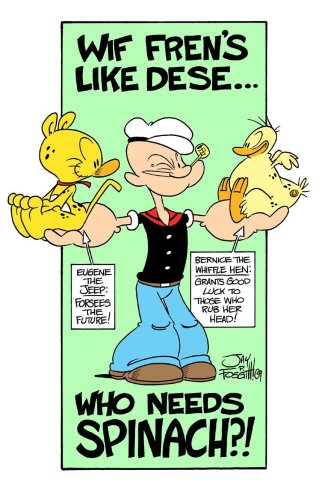 Before spinach, Popeye gained his superhuman strength patting the head of a magical “whiffle hen” named “Bernice”.
 Popeye’s pet “Eugene the Jeep” first appeared in a 1936 strip called “Wha’s a Jeep?”. Eugene was sort of magical dog who could go anywhere. Five years later, military contractors worked to develop the iconic off-road vehicle of WWII. Like Popeye’s pet Eugene, the General Purpose GP (“Jeep”) could go anywhere. Eventually, the name stuck.



 Between 1939 and ’41, Mexican farmers suffered major crop failures, due to stem rust. In July 1944, Borlaug declined an offer to double his salary, traveling instead to Mexico City, heading a new program focusing on soil development, maize and wheat production, and plant pathology.
 The Indian subcontinent experienced minor famine and starvation at this time, limited only by the US shipping 1/5th of its wheat production into the region in 1966 – ’67. Despite resistance from Indian and Pakistani bureaucracies, Borlaug imported 550 tons of seeds.
 According to former Director General of the International Water Management Institute David Seckler, “The environmental community in the 1980s went crazy pressuring the donor countries and the big foundations not to support ideas like inorganic fertilizers for Africa.” The Rockefeller and Ford foundations withdrew funding, along with the World Bank.

 Fifty-nine years earlier, nineteen-year-old Willis V. Meadows signed up with his brothers and his cousins, enlisting in Company G of the 37th Alabama Volunteer Infantry.
 Willis fell over apparently dead, blood streaming out of his eye with the bullet lodged near his brain. The battle moved on. Vicksburg Mississippi fell to the Union army on July 4, 1863. The “Confederate Gibraltar” wouldn’t celebrate another Independence Day, for 80 years.
 Willis Meadows and Peter Knapp might have walked off the page of their time and on to obscurity, but for a circumstance even more unlikely, than a man holding a bullet in his head for fifty-eight years.
 It’s remarkable enough that Peter Knapp survived the brutality of the notorious Andersonville prison camp, an institution described as the “Auschwitz of the Civil War”. The Union POW camp at Elmira New York might be described as the Andersonville of the North. My own thrice-Great Grandfather went to his final rest there, along with his brother.
 In 2012, Alice Knapp was researching the genealogical records of her deceased husband Steve, when she came upon the story of his ancestor. Stunned to learn that he had never been buried, Ms. Knapp called the Portland crematorium. ‘Yeah, he’s here’. Alice Knapp got the death certificate in Washington. I “called back and said, ‘By the way, is his wife there?’ and they said, ‘Yeah.’ The shock was that he was not ever buried. That was the surprise to me.”


 Riverside’s official slogan was changed from “Where the best begins” to “Where the Trek begins,” the annual “River Fest” summer festival, became “Trek Fest”.
 In case you ever wondered what the “T” stands for – its “Tiberius”.
 In the 19th century, Francis Galton studied the theories of his cousin Charles Darwin on the evolution of species, applying them to a system of selective breeding intended to bring “better” human beings into the world. He called it his theory of “Eugenics”.
 “Better Babies” competitions sprang up at state fairs across the United States, where babies were measured, weighed, and “judged”. Like livestock. By the 20s, these events had evolved into “Fitter Family” competitions.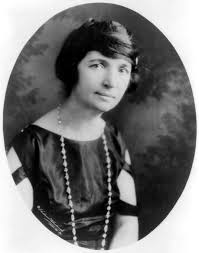
 The 1912 conference was followed by two more in 1921 and 1932, both held in New York City. Colleges and universities delved into eugenics as academic discipline, with courses exploring the ethical and public policy considerations of eliminating the “degenerate” and “unfit”.

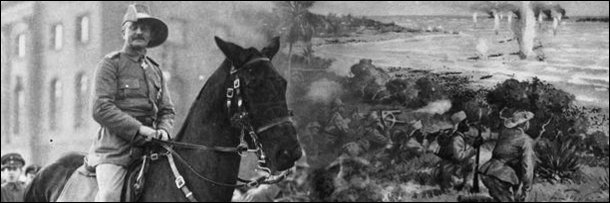
 Stationed in Deutsch-Ostafrika (German East Africa) and knowing that his sector would be little more than a side show to the greater war effort, Lettow-Vorbeck determined to tie up as many of his adversaries as possible.
 To his adversaries, disease and parasites were often more dangerous than enemy action. In July 1916, Allied non-battle casualties ran 31 to 1, compared with battle casualties.
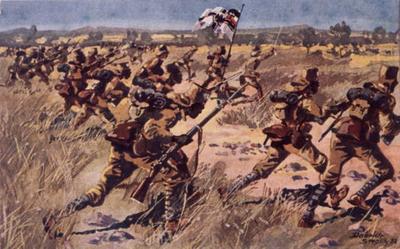 At one point in the
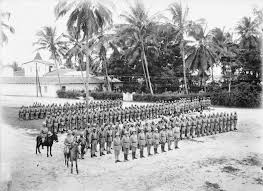 Such a blunt refusal was guaranteed to bring unwanted attention from the Nazi regime. Vorbeck’s home and office were searched, his person subject to constant harassment and surveillance. By the end of WWII, the Lion of Africa was destitute. Both of his sons were killed serving in the Wehrmacht, his home in Bremen destroyed by Allied bombs.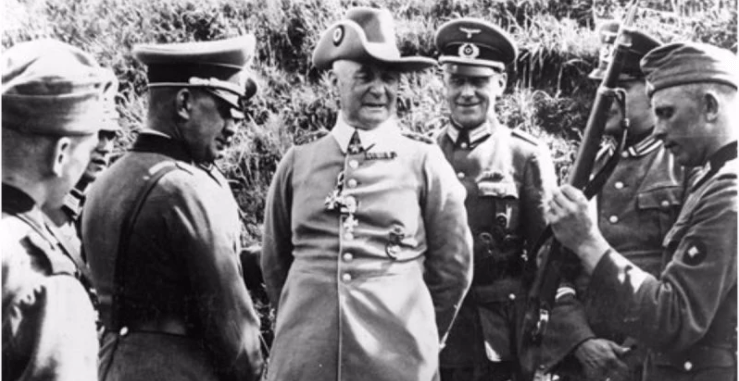



 In early March, a force of some 1,500 Villistas were camped along the border three miles south of Columbus New Mexico, when Villa sent spies into Camp Columbus (later renamed Camp Furlong). Informed that Camp Columbus’ fighting strength numbered only thirty or so, a force of some 600 crossed the border around midnight on March 8.
 The United States government wasted no time in responding. That same day, the President who would win re-election in eight months on the slogan “He kept us out of war” appointed Newton Diehl Baker, Jr. to fill the previously vacant position of Secretary of War. The following day, Woodrow Wilson ordered General John Pershing to capture Pancho Villa, dead or alive.
 The 1st Aero Squadron arrived in New Mexico on March 15, with 8 aircraft, 11 pilots and 82 enlisted men. The first reconnaissance sortie was flown the following day, the first time that American aircraft were used in actual military operations.
 On May 14, a young 2nd Lieutenant in charge of a force of fifteen and three Dodge touring cars got into a running gunfight, while foraging for corn, in Chihuahua. It was the first motorized action in American military history. Three Villistas were killed and strapped to the hoods of the cars and driven back to General Pershing’s headquarters. General Pershing nicknamed that 2nd Lt. “The Bandito”. History remembers his name as George S. Patton.






 In 1620, the 60-ton Pinnace Speedwell departed Delfshaven, meeting with Mayflower at Southampton, Hampshire. The two vessels set out on August 15, but soon had to turn back as Speedwell was taking on water. Speedwell was abandoned after a second failed attempt, Mayflower setting out alone on September 16, 1620, with an estimated 142 passengers and crew.
 As anyone familiar with the area will understand, a month in that place and time convinced them of its unsuitability. By mid-December the Mayflower had crossed Cape Cod Bay and fetched up at Plimoth Harbor.


 Years later, colonists would go to war against the Wampanoag people and ‘King Philip’, the English name for Metacomet, the son of Massasoit. The Nauset would act as warriors and scouts against the Wampanoag people in King Philip’s War, a conflict which killed some 5,000 New England inhabitants, three quarters of whom were indigenous people.

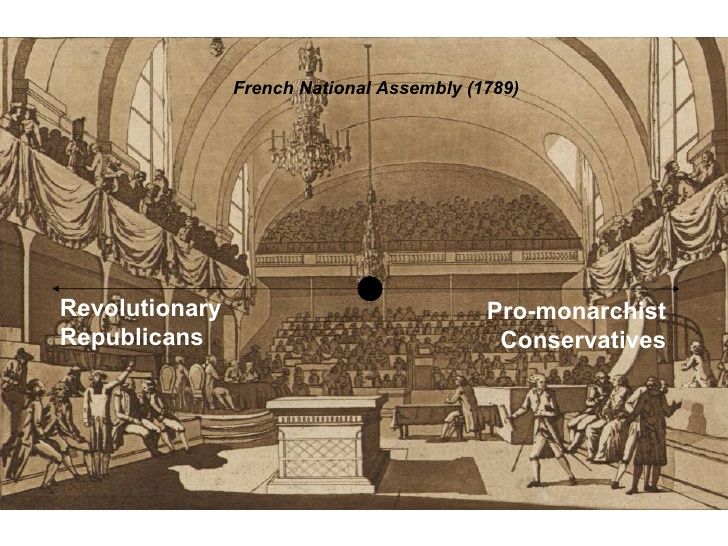 By that time it wasn’t just the “Party of Order” on the right and the “Party of Movement” on the left. Now, the terms began to describe nuances in political philosophy, as well.

 The July Crisis of 1914 was a series of diplomatic maneuverings, culminating in the ultimatum from Austria-Hungary to the Kingdom of Serbia. Vienna, with tacit support from Berlin, made plans to punish Serbia for her role in the assassination, while Russia mobilized armies in support of her Slavic ally.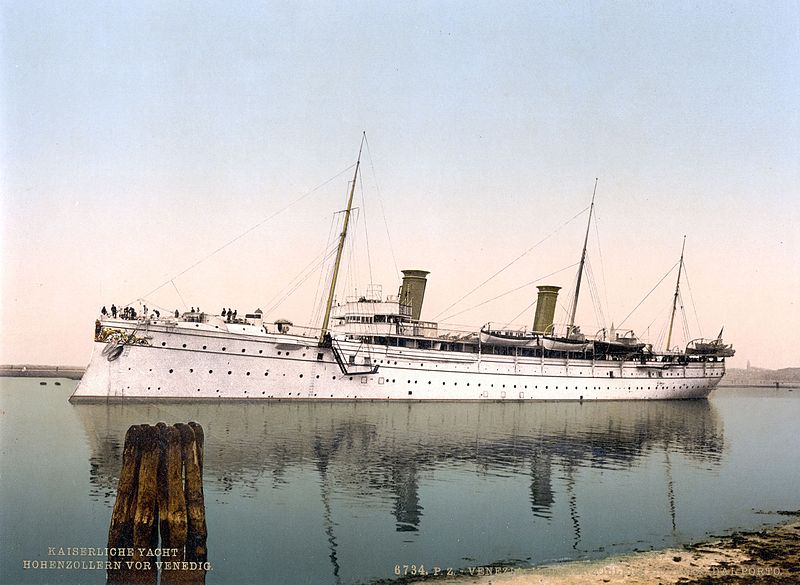
 In the days that followed, the Czar would begin the mobilization of men and machines which would place Imperial Russia on a war footing. Kaiser Wilhelm’s Germany invaded Belgium, in pursuit of the one-two punch strategy by which it sought first to defeat France, before turning to face the “Russian Steamroller”. England declared war in support of a 75-year-old commitment to protect Belgian neutrality, a treaty obligation German diplomats had dismissed as a “

 Historical Easter Eggs - Today in History
You must be logged in to post a comment.