February 2, 1709 A Real Life Robinson Crusoe

“One may see that solitude and retirement from the world is not such an insufferable state of life as most men imagine, especially when people are fairly called or thrown into it unavoidably, as this man was”.

The Royal House of Habsburg takes the name from Habsburg Castle, built in the 1020s in modern-day Switzerland. It was Otto II who died somewhere around 1111AD who first added the name to his titles, calling himself Graf (Count) of Habsburg. The Habsburg line would grow into a dynasty, one family producing Kings and Emperors ruling over dominions from Bohemia to England and Ireland, to the Second Mexican Empire.

The Habsburg Royal Line ruled from the Kingdom of Portugal in the West to Germany, Hungary, Croatia and several Dutch and Italian principalities.  The throne of the Holy Roman Empire was continuously occupied by a member of this one family from 1438 until the extinction of the male line, in 1740.

Rey_Carlos_II_de_España
King Charles II of Spain

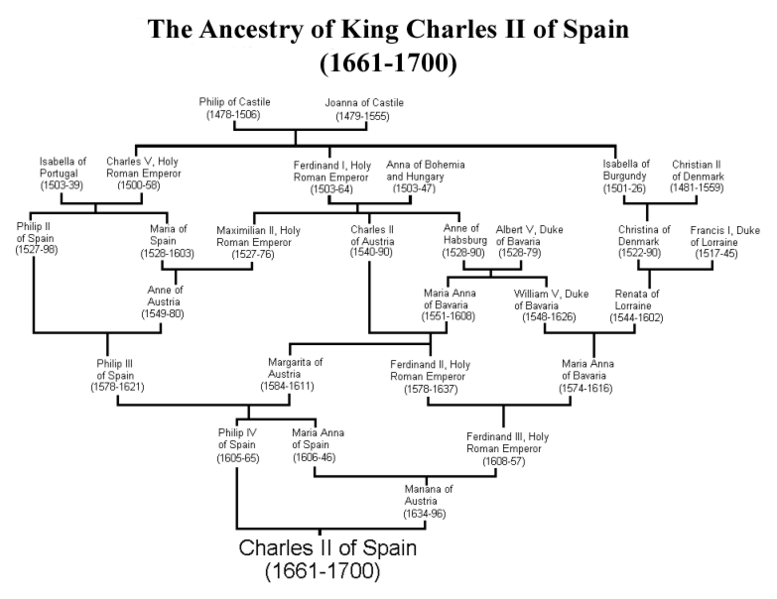
Political alliances were often sealed during this period, by marriage. The family sought to consolidate power through a number of political unions, such marriages being by definition, consanguineous. Inside the family. Marriages between first cousins or uncles and nieces, were commonplace. Such inbreeding produced any number of genetic disorders and almost certainly brought about the extinction of the line.

Nowhere was this more apparent than the Spanish Habsburgs. A study by the University of Santiago de Compostela examined some 3,000 family members over 16 generations and concluded the end of the Spanish line, Charles II, possessed a genome not dissimilar to that of the offspring of a brother and sister.

King Charles II of Spain was weak and sickly from birth. Known as El Hechizado (the Bewitched), Charles was the recipient of any number of deleterious but recessive alleles, made dominant through generations of inbreeding.

The “Habsburg jaw” was so pronounced, Charles spoke and ate, only with difficulty.  He couldn’t talk until age four.  The man was eight before he learned to walk.  He was “short, lame, epileptic, senile and completely bald before 35, always on the verge of death but repeatedly baffling Christendom by continuing to live.

777px-carlos_segundo801The male line of the Spanish Habsburgs came to an end on November 1, 1700, when Charles II died without heir, five days before his 39th birthday. The will named 16-year-old Philip of Anjou successor, grandson of the Bourbon King Louis XIV of France and Charles’ half-sister, Maria Theresa.

Such an ascension would have consolidated the Spanish and French crowns and disrupted the balance of power, in Europe. The Grand Alliance of England, the Dutch Republic and Holy Roman Emperor Leopold preferred Leopold’s younger son Archduke Charles.  The War of Spanish Succession, was on.

The English dispensed “Letters of Marque and Reprisal”, authorizing private persons to conduct acts of war against French and Spanish interests. Similar to mercenary soldiers, except “Privateers” were not paid, directly. They were in it for plunder.
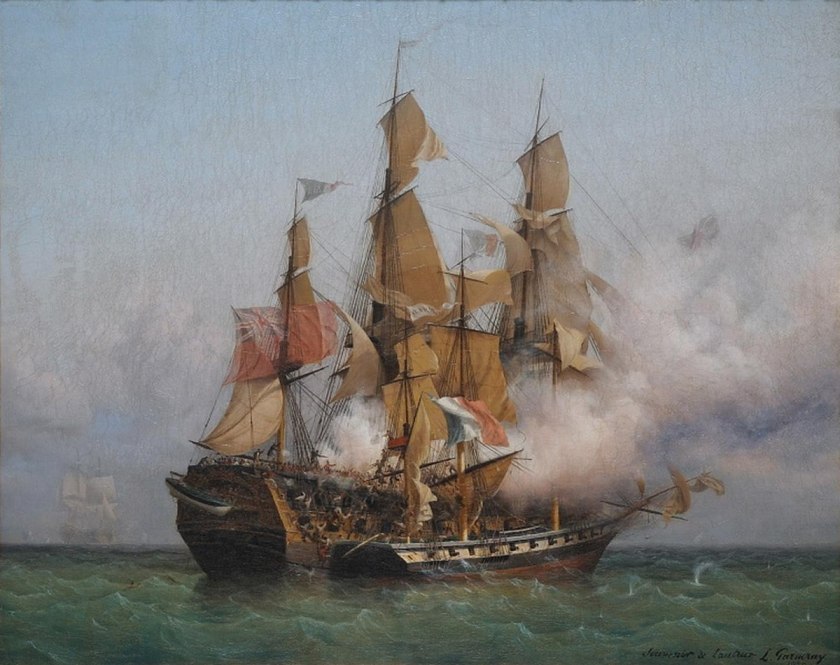
1200px-Confiance_Kent_fight
East Indiaman Kent battling Confiance, a privateer vessel commanded by French corsair Robert Surcouf in October 1800, as depicted in a painting by Ambroise Louis Garneray

The sixteen-gun Cinque Ports was one such privateer, the English vessel departing in 1703 accompanied by the 26-gun St. George under overall command of William Dampier, the first man to thrice, circumnavigate the globe.

Intending to attack Spanish shipping, the pair rounded the horn and cruised the South American coast as far as Panama, capturing several enemy vessels along the way. The two privateers separated in 1704, when 21-year-old Captain Thomas Stradling put ashore at Más a Tierra island in the uninhabited Juan Fernández archipelago for fresh water, and meat.  They were 420 miles off the Chilean coast.

Juan Fernandez Archipelago, off the coast of Chile

An 18th century Sailing Master was not so much a military title as a professional seaman, and navigator.  Cinque Ports’ Sailing Master Alexander Selkirk was gravely concerned about the vessel’s seaworthiness.  The hull was deeply worm eaten and Selkirk wanted to stay for repairs.  Stradling would have none of it.  The argument became heated, and Selkirk stated that he’d rather be put ashore, than continue on.

Selkirk would come to regret the comment but that was it for the hot tempered Captain.  He was mocked as a mutineer, put ashore with a musket, a hatchet, knife, some oats, tobacco and a cooking pot, a Bible, bedding and some clothes.  It was October, 1704.
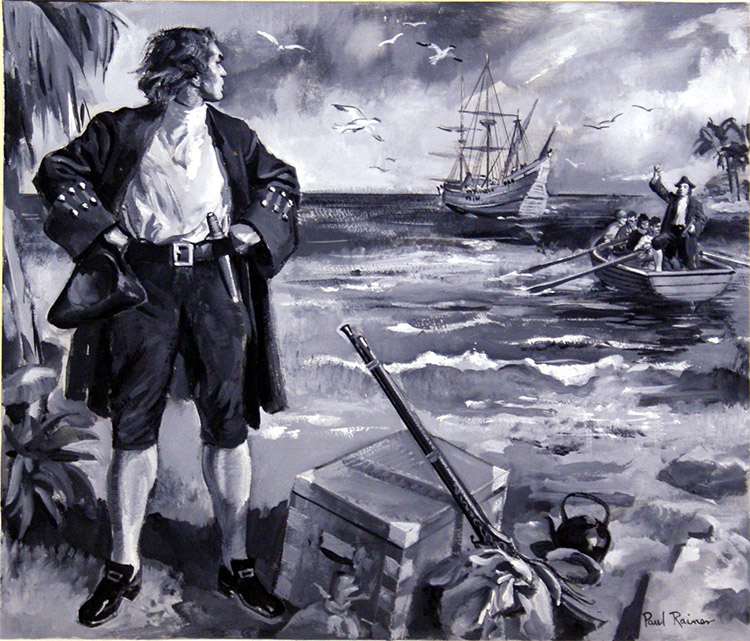
RainerCrusoe

Selkirk was right.  Cinque Ports would founder, her shipwrecked survivors picked up by their enemy and entering a brutal period of captivity.

Marooned and alone, Selkirk subsisted for a time on spiny lobster.  He spent his days on the shoreline, hoping and praying for a sail.  None came.  He’d shoot the occasional sea lion, but powder and shot soon gave out.  Hordes of these raucous creatures gathered for mating season soon drove him inland, where Selkirk discovered wild turnips, cabbage leaves and pepper berries.  Feral goats left behind by earlier sailors provided milk and meat while he learned to fashion tools out of old barrel hoops, found on the beach.

Selkirk_reading_his_Bible
Selkirk reads his Bible in one of two huts he built on a mountainside. Drawing by anonymous

Rats attacked him by night, until Selkirk found common cause with feral cats.  They would receive their morsels and he, a sound night’s sleep.

Selkirk built two huts out of pepper trees.  One for sleeping, the other for cooking.  When his clothes wore out he’d fashion replacements from goat skins, sewn together using an old nail.  His old shoes wore out but those needed no replacement.  The man’s feet were as tough as that old nail.

alexander-selkirk-robinson-crusoeVessels came twice to the island, but both proved to be Spanish.  A Scottish privateer could count on torture and worse at the hands of his enemy, and so he hid.  Selkirk was spotted one time and chased by a Spanish search party.  Several stopped for a leak under a tree in which he was hiding, but they never knew.  In time they became bored, and sailed away.

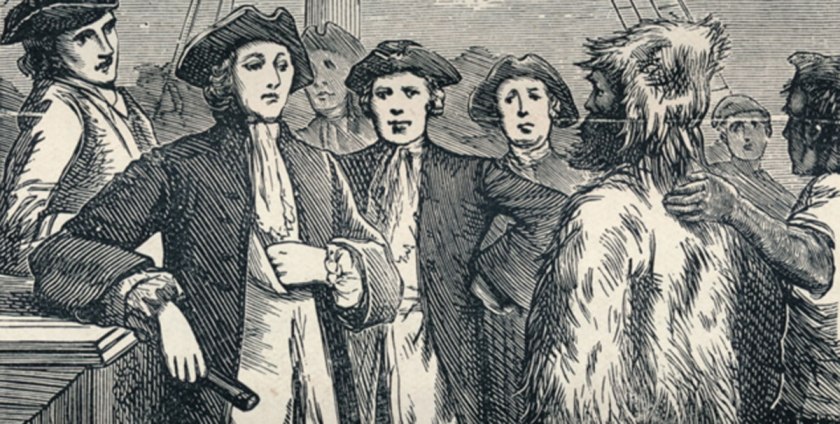
On February 2, 1709, the English privateer Duke spotted a fire where there should be none, and stopped to investigate.  After 52 months alone, Selkirk was incoherent with joy.  Though his language skills were all but gone, Captain Woodes Rogers was impressed with his demeanor.

“One may see that solitude and retirement from the world is not such an insufferable state of life as most men imagine, especially when people are fairly called or thrown into it unavoidably, as this man was”.

Serkirk_being_taken_aboard_the_Duke
Selkirk, Seated right, is brought aboard the Duke

William Dampier was pilot aboard Duke and vouched for Selkirk’s seamanship.  The agile castaway even ran down several goats, restoring health to a crew then in the grips of scurvy.

Alexander Selkirk was made second mate aboard Duke and returned to a life at sea.  He died on December 13, 1721 off the coast of Africa, a victim of yellow fever.  When Daniel Defoe published his famous novel in 1719, few could miss the resemblance to Alexander Selkirk.
15-1-30-selkirk-1200

In the 1960s, Chile changed the name of Más a Tierra, to Robinson Crusoe Island.   National Geographic writes that Defoe’s character was more an amalgamation of shipwreck stories, than one based solely on Selkirk.  The idea makes sense.  The Life and Surprising Adventures of Robinson Crusoe was based not in the mid-latitudes of the South Pacific but on a Caribbean island, some 2,700 miles distant. Crusoe’s goatskin attire seems ill suited to the heat of the Spanish Main but, no matter. It makes for one hell of a story.

Feature image, top of page: Alexander Selkirk, inspiration for Robinson Crusoe, sculpture by Scottish artist Thomas Stuart Burnett. Located at Selkirk’s birthplace of Lower Largo in Fife.

If you enjoyed this “Today in History”, please feel free to re-blog, “like” & share on social media, so that others may find and enjoy it as well. Please click the “follow” button on the right, to receive email updates on new articles.  Thank you for your interest, in the history we all share.

February 1, 1901 The End of Memory

The people he sought were over 101, one was 113. It could not have been easy, beginning with the phone call to next of kin. There is no delicate way to ask the question, “Is he still with us?” Most times, the answer was “no”.

last-of-the-doughboysThe Forgotten World War

In 2003, author Richard Rubin set out to interview the last surviving veterans of the Great War, the “War to End All Wars”.  World War One.

The people he sought were over 101, one was 113. It could not have been easy, beginning with the phone call to next of kin. There is no delicate way to ask the question, “Is he still with us?” Most times, the answer was “no”.

Sometimes, it was “yes”, and Rubin would ask for an interview. The memories his subjects sought to bring back were 80 years old and more.  Some spoke haltingly, and with difficulty.  Others were fountains of information, as clear and lucid as if the memories of which they spoke, were only  yesterday.

Rubin writes “Quite a few of them told me that they were telling me things that they hadn’t talked about in 50, 60, 70 years. I asked a few of them why not, and the surprising response often was that nobody had asked.”

anthony-pierro-at-107
Anthony Pierro at 107

Anthony Pierro of Swampscott, Massachusetts, served in Battery E of the 320th Field Artillery and fought in several of the major battles of 1918, including Oise-Aisne, St. Mihiel, and Meuse-Argonne.

Pierro recalled his time in Bordeaux, as the best time of the war. “The girls used to say, ‘upstairs, two dollars.’” Pierro’s nephew Rick interrupted the interview. “But you didn’t go upstairs.”  Although possibly unexpected, Uncle Anthony’s response was a classic.  “I didn’t have the two dollars”.

Reuben Law of Carson City, Nevada remembered a troop convoy broken up by a German U-Boat, while his own transport was swept up in the murderous Flu pandemic of 1918.

hildegarde-schan
Hildegarde Schan

They’re not all men, either. 107-year-old Hildegarde Schan of Plymouth, Massachusetts speaks of caring for the wounded.

Howard Ramsey started a new burial ground in France, we now know as theMeuse-Argonne American Cemetery.

“So I remember one night”, Ramsey said, “It was cold, and we had no blankets, or nothing like that. We had to sleep, we slept in the cemetery, because we could sleep between the two graves, and keep the wind off of us, see?”

Arthur Fiala of Kewaunee, Wisconsin remembered traveling across France in a boxcar marked “40-8″, (40 men or eight horses).

fialacombo
Arthur Fiala

There was J. Laurence Moffitt of Orleans, Massachusetts. Today, we see the “Yankee Division” on highway signs. At 106, this man was the last surviving member of his outfit, with a memory so clear that he could recall every number from every fighting unit of the 26th Division.

briantcombo
George Briant

George Briant was caught in an open field with his battery, as German planes dropped bombs from the sky.  Briant thinks he was hit by every one of them, too.  After several months in the hospital, he begged to go back to the front.  On the last night of the war, November 10, 1918, Briant came upon the bodies of several men who had just been shelled.

“Such fine, handsome, healthy young men”, he said, “to be killed on the last night of the war.  I cried for their parents. I mean it’s a terrible, terrible thing to lose anyone you love in a war, but imagine knowing precisely when that war ends, and then knowing that your loved one died just hours before that moment.

Rubin interviewed dozens of these men, and a handful of women. Their stories are linked HERE if you care to watch.  I highly recommend it.  Their words are more powerful than anything I can offer.

The Last Doughboy

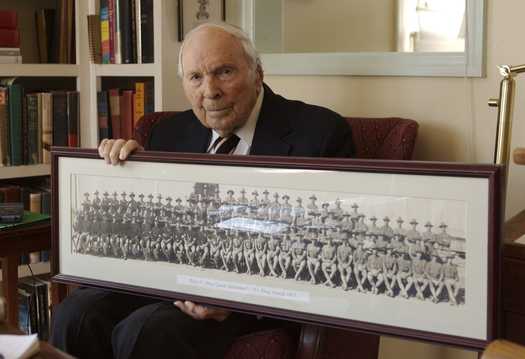
Frank Woodruff Buckles, born Wood Buckles, is one of them. Born this day in 1901, Buckles enlisted with the First Fort Riley Casualty Detachment, trained for trench casualty retrieval and ambulance operations.  He was sixteen.

buckles2-obit-jumbo
Frank Woodruff Buckles, S/N 15577

The unit set sail from Hoboken New jersey in December 1917 aboard HMS Carpathia, a vessel made famous by the Titanic rescue, five years earlier.

Woodruff never saw combat but he saw lots of Germans, with a Prisoner-of War escort company.  Returning home in January 1920 aboard USS Pocahontas, Buckles was paid $143.90, including a $60 bonus.

Buckles was a civilian in 1940, working for the White Star Lines and WR Grace shipping companies. His work took him to the Philippines, where he remained after the outbreak of WWII. He was helping to resupply U.S. troops when captured by Japanese forces in January 1942, imprisoned for thirty-nine months as a civilian prisoner in the Santo Tomas and Los Baños prison camps.  He was rescued by the 11th Airborne Division on February 23, 1945, on the day he was to be executed.

buckles_and_bush
“I found out afterwards when I read up on my history that some of the things that I did were quite important”.

Buckles married Audrey Mayo of Pleasanton, California in 1946, and returned from whence he had come.  Back to the land, back to the Gap View Farm near Charles Town, West Virginia in January 1954, to farm the land his ancestors worked, back in 1732.

Audrey Mayo Buckles lived to ninety-eight and passed away on June 7, 1999.  Frank continued to work the farm until 106, and still drove his tractor.  For the last four years of his life he lived with his daughter Susannah near Charles Town, West Virginia.

Once asked his secret to a long life, Buckles responded, “When you start to die, don’t”.

On December 3, 2009, Frank Buckles became the oldest person ever to testify before the United States Congress, where he campaigned for a memorial to honor the 4.7 million Americans who served in the War to End All Wars.

“We still do not have a national memorial in Washington, D.C. to honor the Americans who sacrificed with their lives during World War I. On this eve of Veterans Day, I call upon the American people and the world to help me in asking our elected officials to pass the law for a memorial to World War I in our nation’s capital. These are difficult times, and we are not asking for anything elaborate. What is fitting and right is a memorial that can take its place among those commemorating the other great conflicts of the past century. On this 92nd anniversary of the armistice, it is time to move forward with honor, gratitude, and resolve”.

frankbuckles2

The United States came late to the Great War, not fully trained, equipped and mobilized until well into the last year.  Even so, fully 204,000 Americans were wounded in those last few months.  116,516 never came home from a war in which, for all intents and purposes, the US fought a bare five months.

Frank Woodruff Buckles passed away on February 27, 2011 at the age of 110, and went to his rest in Arlington National Cemetery.  The last of the Doughboys, the only remaining American veteran of WWI, the last living memory of the war to end all wars, was gone.

Concurrent resolutions were proposed in the US House of Representatives and Senate for Buckles to lie in state, in the Capitol rotunda. For reasons still unclear, the plan was blocked by Speaker John Boehner and Senate Majority Leader Harry Reid.  Neither Boehner nor Reid would elaborate, proposing instead a ceremony in the Amphitheater at Arlington National Cemetery.  The President of the United States attended his funeral.

Reporter Paul Duggan of The Washington Post described the occasion:

“The hallowed ritual at grave No. 34-581 was not a farewell to one man alone. A reverent crowd of the powerful and the ordinary—President Obama and Vice President Biden, laborers and store clerks, heads bowed—came to salute Buckles’s deceased generation, the vanished millions of soldiers and sailors he came to symbolize in the end”.

abc_nwo_frank_buckles_110228_wg

Afterward

Sixteen million Americans joined with allies the world over to defeat the Axis Powers of WW2.  They were the children of Frank Buckles’ generation, sent to complete what their parents had begun.  Seventy years later, 939,332 remained alive.  They’ve been called the “Greatest Generation”.  Today, we lose them at a rate of 362, per day.

If Department of Veterans Affairs actuarial projections are any indication, the Frank Buckles of his generation, the last living veteran of WW2, can be expected to pass from among us in 2044.

That such an event should pass from living memory, is a loss beyond measure.

https___blogs-images.forbes.com_niallmccarthy_files_2018_05_20180528_veterans

Feature image, top of page:  Frank Buckles, age 107
the-last-doughboy
If you enjoyed this “Today in History”, please feel free to re-blog, “like” & share on social media, so that others may find and enjoy it as well. Please click the “follow” button on the right, to receive email updates on new articles.  Thank you for your interest, in the history we all share.

January 31, 1918 Battle of May Island

By 6:30pm, the fleet had formed a line some thirty miles long proceeding north at 20 knots, equivalent to 23MPH over the ground. It was full dark at this latitude with the Haar or “sea fog”, closing in.  The fleet was effectively deaf and blind, and traveling fast. The table was set, for disaster.

ww1navybritish-shipbuildingmapbritishisles2Operation E.C.1 was a planned exercise for the British Grand Fleet, scheduled for February 1, 1918 out of the naval anchorage at Scapa Flow in the North Sea Orkney Islands.
Forty vessels of the British Royal Navy departed Rosyth in the Scottish fjord at the Firth of Forth on January 31, bound for Scapa flow. They were the 5th Battle squadron with destroyer escort, the 2nd Battlecruiser squadron and their destroyers, two cruisers and two flotillas of K-class submarines, each led by a light cruiser.

By 6:30pm, the fleet had formed a line some thirty miles long proceeding north at 20 knots, equivalent to 23MPH over the ground. It was full dark at this latitude with the Haar or “sea fog”, closing in.  The fleet was effectively deaf and blind, and traveling fast.

While only an exercise, strict radio silence was observed, lest there be any Germans in the vicinity. Each vessel displayed a faint blue stern light, travelling 400-yards ahead of the next-in-line. Black-out shields restricted the lights’ visibility to one compass point left or right of the boats’ center line.   The table was set for disaster.

Though large for WW1-vintage submarines at over 300-feet, K-class subs were low to the water and slow, compared with the much larger surface vessels.  Compounding the problem, the unfortunately nicknamed”Kalamity Klass” was powered by steam, meaning that stacks had to be folded and closed, before the thing was ready to dive.  Only eighteen K-class submarines were ever built, one of which caused damage to a German U-boat, in a ramming attack.

Seems the K-class was more dangerous to its own people, than anyone else.

A half-hour into the cruise, the flagship HMS Courageous passed a tiny speck on the map called May Island and picked up speed. A pair of lights appeared in the darkness as the 13th Submarine Flotilla passed, possibly a pair of mine sweeping trawlers. The flotilla turned hard to port to avoid collision when the helm of the third-in-line K-14 jammed, and veered out of line. Both K-14 and the boat behind her, K-12 turned on their navigation lights as K-22, the next submarine in line, lost sight of the flotilla and collided with K-14, severing the bow and killing two men. Two stricken submarines now struggled to pull themselves apart while an entire fleet sped through the darkness, unaware of what was about to happen.

The destroyer HMS Ithuriel received a coded signal and turned to lend aid, doubling back and followed by the remainder of the 13th submarine flotilla and thus putting themselves on collision course with the outgoing 12th flotilla.

Unaware of the mess lying in her path, 12th flotilla escort HMS Fearless was traveling way too fast to change the outcome. Fearless went “hard astern” on sighting K-17 but too late, her bow knifing through the smaller vessel, sinking the sub within minutes with the loss of 47 men. Meanwhile, outgoing submarine K-4 heard the siren and came to a stop but not the trailing K-3 which hit her sister sub broadside, nearly cutting the vessel in half.

K-4 sank in minutes, with the loss of 55 crew.

battlemayisland_fearless1
HMS Fearless

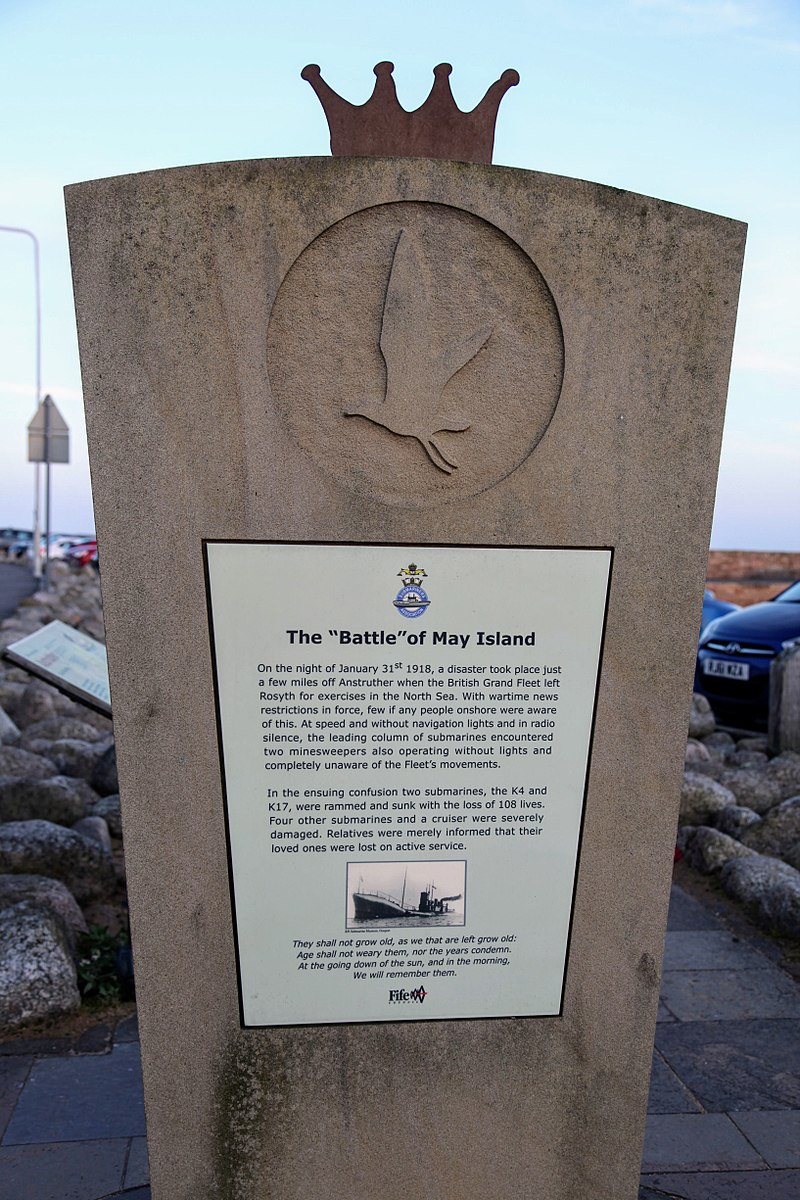
The number of near misses that night, can never be known. 104 men were dead before it was over, with the total loss of two K-class submarines. Four more sustained severe damage, along with the Scout Cruiser HMS Fearless.

A hastily arranged Board of inquiry began on February five and sat for five days, resulting in several courts martial for negligence.  Those would be adjudicated, “unproved”.

The whole disaster and subsequent inquiry was kept quiet to avoid embarrassment, and deprive the German side of the propaganda bonanza. Full details were released only in 1994, long after the participants in this story, had passed away.

On January 31, 2002, a memorial cairn was erected in memory of the slain.  As it had been eighty four years earlier, there wasn’t a German to be found.  The “Battle of May Island” was no battle at all.  Only the black forlorn humor, of men at war.

800px-may_island_memorial_anstruther


If you enjoyed this “Today in History”, please feel free to re-blog, “like” & share on social media, so that others may find and enjoy it as well. Please click the “follow” button on the right, to receive email updates on new articles.  Thank you for your interest, in the history we all share.

January 30, 1752 Founding Philanderer

Not that he could’ve have done anything about it, even if the husband did find out.  Morris walked with a peg, his left leg severed below the knee in a carriage accident, lost while running from an angry husband.

nyc-pdf-manhattan-street-map-printable-street-guide-4
Midtown Street Grid

To drive the streets of Manhattan is to realize that someone had a plan for this place. You might not be able to get there for the congestion, but you can figure out how to do it. Not like the rabbit warren that is her sister city of Boston, that all but unnavigable melange of neighborhoods, grown together as the city expanded into former marshlands and harbor.

In grade school, we all learned the preamble to the Constitution. “We the People of the United States, in Order to form a more perfect Union…” It’s considerably snappier than the original version:

We the people of the states of New-Hampshire, Massachusetts, Rhode-Island and Providence Plantations, Connecticut, New-York, New-Jersey, Pennsylvania, Delaware, Maryland, Virginia, North-Carolina, South-Carolina, and Georgia, do ordain, declare and establish the following constitution for the government of ourselves and our posterity.”

us-constitution

That West 53rd leads to East 53rd and runs next to 54th may be attributed to a committee of three, who fought (and won) the battle against the wide circles and grand plazas, once envisioned for “The City”. That we may be spared that stultifying recitation of our founding document may be laid at the feet of one member of that committee.

Today, his life is all but lost to history, among the familiar constellation of founding fathers.  If he’s remembered at all it’s for that funny name.  Gouverneur Morris.  And what a life it was.

morris_g
Gouverneur Morris

Gouverneur Morris was born this day in 1752, the son of Lewis Morris, Jr. and his second wife Sarah (Gouverneur) Morris. Abigail Adams informs us the name was pronounced “Governeer”.

Born to a wealthy New York land owning family, Morris was destined to a place among the founders. His half-brother Lewis signed the Declaration of Independence.  Nephew Lewis Richard served in the Vermont legislature and the US Congress.

As a member of the Continental Congress, Morris helped General George Washington secure funding, to keep the Continental Army in the field. A staunch ally of the Commander-in-Chief, Morris defended Washington against the “Conway Cabal“, the only serious effort to have the General unseated, as commander-in-chief.

gouverneur_morris_1789
Gouverneur Morris 1789

A staunch opponent of slavery, Morris derided the “peculiar institution” as “the curse of heaven on the states where it prevailed.”  Morris mocked the “3/5ths compromise”, that cynical effort to increase congressional representation based on “property”, who had no right to vote.

Upon what principle”, Morris asked, “is it that the slaves shall be computed in the representation? Are they men? Then make them citizens, and let them vote. Are they property? Why, then, is no other property included?”

And did I mention, Gouverneur Morris was a first-class Rake?

“Rake” is such a great word, short for “Rakehell” or Hellraiser’.  It’s a shame it’s fallen out of usage.  This isn’t the tool shed variety.  An 18th century Rake is a man habituated to dissolute conduct, a chronic libertine devoted to wine, women and song.  Emphasis on the Women and, no problem if they just happened to be married.

At a time when sexual attitudes were “buttoned up” to say the least, Gouverneur Morris was all but addicted to sex in public, given over to the excitement, of the risk at being caught.

As Minister Plenipotentiary to France in the wake of the American Revolution, Morris writes of one such dalliance in the hallway at the Louvre, then a Royal Residence.

wooden-leg-of-gouverneur-morris-new-york-historical-society-photo-by-the_adverse_possessors-cc-by-sa-2-5-426x640
Gouverneur Morris’ wooden leg

“Go to the Louvre… we take the Chance of Interruption and celebrate in the Passage while Mademoiselle (the woman’s daughter) is at the Harpsichord in the Drawing Room. The husband is below. Visitors are hourly expected. The Doors are all open.”

“Celebrate” was Morris’ code word for…well…you know.

Not that he could’ve done anything about it, even if the husband did find out.  Morris walked with a peg, his left leg severed below the knee in a carriage accident, lost while running from an angry husband.

That wooden leg actually helped him one time, as the French Revolution spiraled downward toward the homicidal madness  known as the “Reign of Terror“. While riding in a carriage, a sign of the aristocracy, a horde of sans coulotte attempted to seize the vehicle.  It may have cost Morris, his head.  Gouverneur Morris leaned out the window and shook the leg at them, momentarily shocking the mob into stunned silence. Whether the mob thought him a war veteran or just plain crazy is unknown, but the driver had just enough time, to get away.

800px-william_hogarth_027
18th century painting “A Rake’s Progress”, by English artist William Hogarth

Morris tried to raise enough to bribe the guards, to release King Louis XVI and Marie Antoinette.  When that didn’t work out he bought the Queen’s furniture, and brought it home as a keepsake.

Morris finally “settled down” at age 57, but even that was a scandal.  That Anne Gary (“Nancy”) Randolph was twenty-two years younger than he was not so unusual, but marrying his housekeeper, was.  Worse still, the blushing bride had become pregnant by her own brother-in-law at age seventeen, and was tried for killing the baby.  On a plantation named “Bizarre’, no less.

Anne was acquitted of the charge of infanticide, but the scandal followed her, all her days.  Morris announced his marriage to her at his Christmas party.  In his diary, Gouverneur writes “I marry this day Anne Gary Randolph. No small surprise to my guests.”

1_bvbmve3hyozqr_ety3gckw
Whalebone

Toward the end of his life, Gouverneur Morris experienced problems with his urinary tract, probably the result of prostate cancer.  Believing there to be some blockage in his pipes, Morris tried the “Do-it-Yourself” approach to fixing the problem, with a piece of whalebone.

Unsurprisingly, the method caused himself considerable damage and massive infection.  The man who brought the Erie Canal to upstate New York died on November 6, 1813.  Six days later, the Columbian Centinal newspaper of Boston reported his death following “a short but distressing illness.”

I should say so.

If you enjoyed this “Today in History”, please feel free to re-blog, “like” & share on social media, so that others may find and enjoy it as well. Please click the “follow” button on the right, to receive email updates on new articles.  Thank you for your interest, in the history we all share.


January 29, 1820  An Ass for a Lion

“One of the strongest natural proofs of the folly of hereditary right in kings, is, that nature disapproves it, otherwise she would not so frequently turn it into ridicule by giving mankind an ass for a lion”.  – Thomas Paine, Common Sense

The Declaration of Independence, the birth certificate of the nation, begins with this preamble: “When in the Course of human events, it becomes necessary for one people to dissolve the political bands which have connected them with another...”.

The next paragraph leads with the phrase most commonly cited:

“We hold these truths to be self-evident, that all men are created equal, that they are endowed by their Creator with certain unalienable Rights, that among these are Life, Liberty and the pursuit of Happiness”. 

The paragraph ends with a personal indictment of one man, followed by a 27-item Bill of Particulars against him.  “The history of the present King of Great Britain is a history of repeated injuries and usurpations, all having in direct object the establishment of an absolute Tyranny over these States. To prove this, let Facts be submitted to a candid world“.

The word “He” appears 19 times in the document.  “Tyrant” is used twice and “ruler”, only once:  “A Prince whose character is thus marked by every act which may define a Tyrant, is unfit to be the ruler of a free people”.

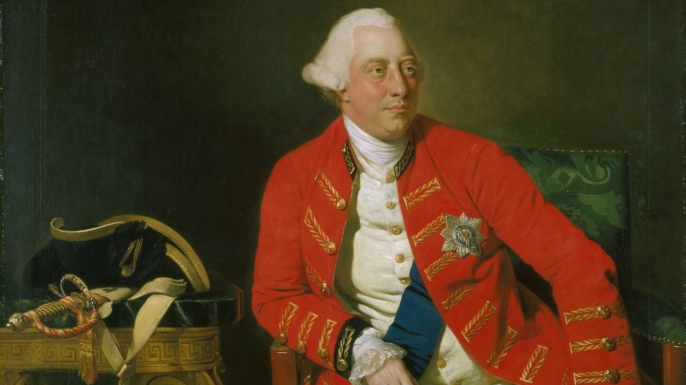
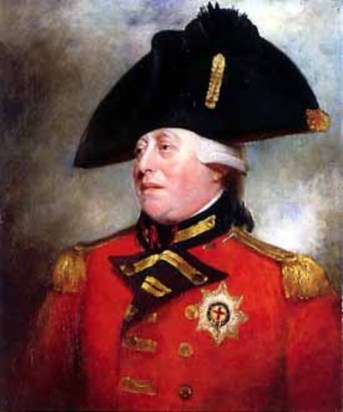
king_george_iii_of_england_by_johann_zoffany-e

King George III of England, by Johann Zoffany

The overall tenor of the document is a personal indictment of one man, George III, King of England.  Thomas Paine wrote of the King in “Common Sense”, the pamphlet which inspired a people to rise up in the summer of 1776:  “One of the strongest natural proofs of the folly of hereditary right in kings, is, that nature disapproves it, otherwise she would not so frequently turn it into ridicule by giving mankind an ass for a lion”.

George III became something of a lighting rod for colonial discontent, held personally responsible for policies brought forth by the British legislative body. The Stamp Act of 1765, the Townshend duties on tea, paper and other products in 1767;  these came from Parliament, as did the “Coercive Acts” of 1774, referred to by the Patriots of Massachusetts and others as “The Intolerable Acts”.

intolerable
The “Intolerable Acts” were a series of bills passed by Parliament, to punish American colonists for The Boston Tea Party.

These policies were a result of the financial burdens of garrisoning and administering the huge territories of the American colonies, the never-ending wars with France and Spain, and the loans given to the East India Company, then responsible for administering India.

The third King of the House of Hanover was himself a creature of Parliament, his lineage having been invited to rule over Great Britain in 1714, after the fall of the House of Stuart.  What Parliament gives, Parliament may take away.

George III is the longest reigning of any English King, ruling from 1760 until his death on January 29, 1820.  He is exceeded in office only by his Granddaughter Victoria, the last monarch of the House of the Hanoverian Dynasty and Elizabeth II, reigning Queen of the United Kingdom and the other Commonwealth realms.

Medical historians have long believed that George III suffered from a genetic blood disorder called Porphyria, a term from the Greek meaning “purple pigment”.  This refers to a blue discoloration in the urine of those suffering from the condition, along with symptoms primarily involving the central nervous system, and accompanied by severe abdominal pain, vomiting and mental disturbances.

king-george-iii_1_The illness seems to have afflicted George III alone however, casting doubt on an hereditary condition.  George III’s medical records cast further doubt on the porphyria diagnosis, showing that he was prescribed medicine based on gentian, a plant with deep blue flowers which may turn the urine blue. He seems to have been afflicted with some kind of mental illness, suffering bouts which occurred with increasing severity and for increasing periods of time.  At times he would talk until he foamed at the mouth or go into convulsions where pages had to sit on him to keep the King from injuring himself.
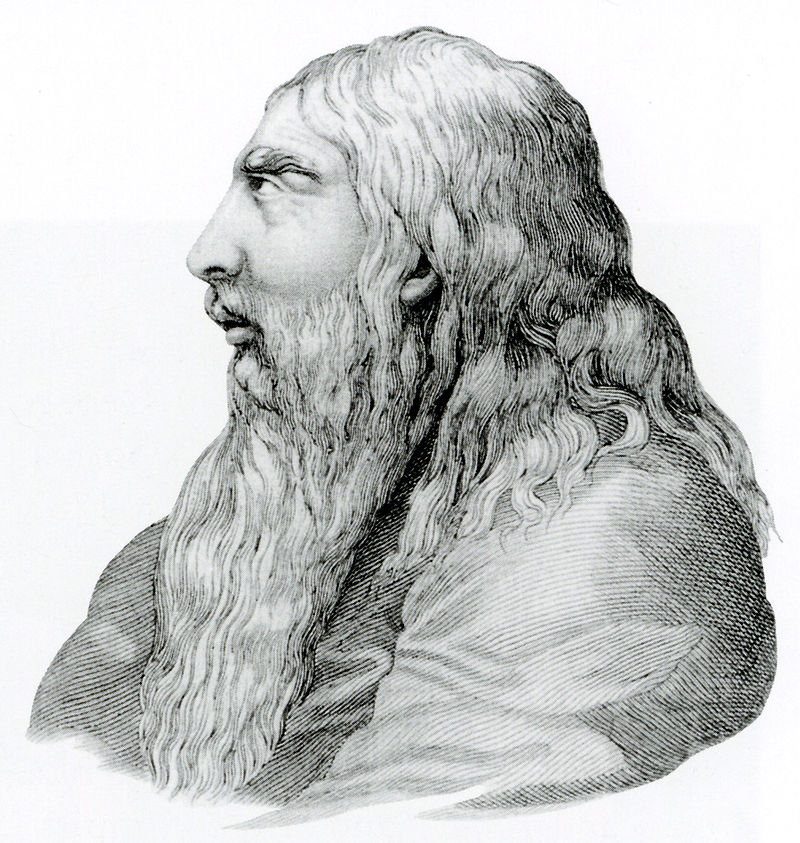
An ongoing research project at St George’s, University of London, has looked at thousands of King George III’s handwritten letters, and concluded that the King suffered from mental illness.  His writing was erratic at times coinciding with his “spells”, with run-on sentences of 400 words or more and as many as 8 verbs with no punctuation.  These are features seen today in the writing and speech of patients as they experience the manic phase of bipolar disorder.  This manic phase stands at one end of a spectrum of mood disorders, with an overwhelming sadness or depression at the other.  Research is ongoing, but these types of mood swings are consistent with contemporary witnesses to George’s behavior, as well as the written record.

All but blind from cataracts and suffering a painful rheumatic disorder, George’s final descent was triggered by the death of his youngest and favorite daughter Princess Amelia, at age 27.  In November 1810, the Princess’s nurse reported “scenes of distress and crying every day …  melancholy beyond description.”

George himself accepted the Regent Act of 1811, appointing his eldest son the Prince of Wales and future King George IV, Prince Regent.  Britannica.com describes the last ten years as a “living death”, a period of violent insanity interspersed with “intervals of senile lucidity”.

The King neither knew nor would he have understood when he was appointed King of Hanover in 1814, nor when his wife died in 1818. On Christmas 1819, George spoke for fifty-eight hours straight, all of it, gibberish.

800px-george_iii_by_henry_meyer

Engraving of George III in later life, by Henry Meyer

Today, George III is remembered for two things:  losing the American colonies, and going mad.

There is an historic lesson in this story.  If the country ruled by a King (or Queen) wins the lottery and gets a good and fair monarch, then that country may experience a period of peace and prosperity.  If that nation draws the cosmic short straw and gets a bad one, the results can be catastrophic.  In the end, it’s the most powerful argument I can think of for a governmental system of specified authority, diffuse power, and checks & balances.

January 28, 1942 The Mighty 8th Air force

On this seventy-seventh birthday of the Mighty 8th Air Force, we can all thank a teacher, that we are able to read this story. We can thank a Veteran, that we can read it in English.

The Nazi conquest of Europe began with the Sudetenland in 1938, the border districts of Bohemia, Moravia, and German speaking parts of Czechoslovakia.

The invasion of Poland brought France and Great Britain in on the side of their ally, in 1939.  Ground forces of the United Kingdom were shattered the following year, along with those of her French, Indian, Moroccan, Belgian, Canadian and Dutch allies.

The hastily assembled fleet of 933 vessels large and small were all that stood between salvation, and unmitigated disaster.  338,226 soldiers were rescued from the beaches of France.  Defeated, all but disarmed yet still unbeaten, these would live to fight another day.

dunkirkevacuation
Dunkirk

In 1940, every major power on the European mainland was either neutral, or under Nazi occupation.  The island nation of Great Britain stood alone and unconquered, defiant in the face of the Nazi war machine.  In Germany, street decorations were prepared for victory parades, as plans were laid for “Operation Sea Lion”, the planned invasion of Great Britain and final destruction of the British Isles.

After the allied armies were hurled from the beaches of Dunkirk, Hitler seemed to feel he had little to do but “mop up”.   Luftwaffe commander-in-chief Hermann Göring convinced Der Fuhrer that aircraft alone could do the job.

Hitler approved, and turned his attention to the surprise attack on his “ally” to the East. The “Battle of Britain” had begun.

Two days in August 1940 saw 3,275 sorties against the British home isles, with only 120 aircraft lost to the German side.  A single Junkers 88 or Heinkel 111 bomber carried 5,510-pounds of bombs.

heinkel-he-111-during-battle-of-britain-01

The wrath of the Luftwaffe was spent by the end of October, Operation sea Lion postponed again and again.  Great Britain would fight on alone, but for the shattered remnants of formerly allied powers, for another year and one-half.  Prime Minister Winston Churchill captured the spirit of the period as only he could, when he said: “Never in the field of human conflict was so much owed by so many to so few”.

Battle of Britain

Hitler would turn his his back and launch “Operation Barbarossa” in June, 1941.  The surprise invasion of the Soviet Union.

Under the terms of the tripartite pact with Fascist Italy and Imperial Japan, Nazi Germany was obliged to render aid in the event that either ally was attacked. On December 8, 1941, the day after the Japanese attack on the US naval anchorage at Pearl Harbor, Ambassador Hiroshi Ōshima came to German Foreign Minister Joachim von Ribbentrop, looking for  a commitment of support.

mighty-eighth-crewman
Crewman, Mighty 8th

Ribbentrop balked.  With their ally having been the aggressor, Germany was under no obligation to intervene.  Adolf Hitler thought otherwise. Hitler detested Roosevelt, and thought it was just a matter of time before the two powers were at war. He might as well beat the American President to the punch.

At 9:30am Washington time on December 11, German Chargé d’Affaires Hans Thomsen handed a note to American Secretary of State Cordell Hull. For the second time in the diplomatic history of the United States and Germany, the two nations were in a state of war.

Half a world away, one man went to bed to sleep the “sleep of the saved and thankful”.

“Silly people, and there were many, not only in enemy countries, might discount the force of the United States… But I had studied the American Civil War, fought out to the last desperate inch. American blood flowed in my veins. I thought of a remark which Edward Grey had made to me more than thirty years before—that the United States is like ‘a gigantic boiler’. Once the fire is lighted under it there is no limit to the power it can generate.  Being saturated and satiated with emotion and sensation, I went to bed and slept the sleep of the saved and thankful”. – Prime Minister Winston Churchill

8thaf-shoulder-patch48 days later, at Hunter Field in Savannah, Georgia, the Eighth Bomber Command was activated as part of the United States Army Air Forces. It was January 28, 1942.

The 8th was intended to support operation “Super Gymnast”, the invasion of what was then French North Africa.  Super Gymnast was canceled in April.  By May, the 8th Bomber Command had moved headquarters to a former girls’ school in High Wycombe, England, from where it conducted the strategic bombing campaign against Nazi Germany.

thndbrdRe-designated the Eighth Air Force on February 22, 1944, at its peak the “Mighty Eighth” could dispatch over 2,000 four engine bombers and more than 1,000 fighters on a single mission. 350,000 people served in the 8th Air Force during the war in Europe, with 200,000 at its peak in 1944.


By 1945, the Wehrmacht could tell itself a new joke:  “When we see a silver plane, it’s American. A black plane, it’s British. When we see no plane, it’s German”.  American aviation paid a heavy price for this little bit of black humor.

the-mighty-eighth-banner

Half of US Army Air Force casualties in World War II were suffered by the 8th, over 47,000 casualties, with more than 26,000 killed. By war’s end, 8th Air Force personnel were awarded 17 Medals of Honor, 220 Distinguished Service Crosses, and 442,000 Air Medals. There were 261 fighter aces in the 8th, 31 of whom scored 15 or more confirmed kills.  305 gunners were also recognized, as aces.

b-52h_static_display_arms_06

Following the allied victory in Europe, 8th AF Headquarters was reassigned to Sakugawa (Kadena Airfield), Okinawa, under the command of Lieutenant General James H. “Jimmy” Doolittle.  Tasked with organizing and training new bomber groups for the planned invasion of Japan, the 8th received its first B-29 Superfortress on August 8.  Seven days later, the atomic bomb had ended the war in the Pacific.

With the onset of the jet age and the “Cold War” at it height, the 8th Air Force moved to Westover Air Force Base in Massachusetts on June 13, 1955, the second of three Numbered Air Force groups of the newly constituted Strategic Air Command (SAC).

Since that time, the Mighty 8th has been called on to perform combat missions from Southeast Asia to the Middle East to the Federal Republic of Yugoslavia, flying out of its current headquarters at Barksdale Air Force Base, in Louisiana.

If you’re ever in Savannah, do yourself a favor and pay a visit to the National Museum of the Mighty Eighth Air Force (http://www.mightyeighth.org/). Not only will you experience an incredible story well told, but you will meet some 90+ year old veterans who walk as straight and tall today as they did, seventy years ago.

Happy Birthday, Mighty Eighth.

If you enjoyed this “Today in History”, please feel free to re-blog, “like” & share on social media, so that others may find and enjoy it as well. Please click the “follow” button on the right, to receive email updates on new articles.  Thank you for your interest, in the history we all share.

January 27, 47,981BC I, Neanderthal

Today, to call someone “Neanderthal” is to insult him as a stupid brute.  It appears that our cousin was nothing of the sort.

In the 17th century, the German Reformed Church teacher and hymn writer Joachim Neander liked to hike a valley outside of Düsseldorf. The beauty of nature was inspirational, clearing his mind and inspiring verses like:

“See how God this rolling globe/swathes with beauty as a robe…
Forests, fields, and living things/each its Master’s glory sings.”

The theologian contracted tuberculosis and died at the age of thirty.  And yet he lived on in a way, in the valley which came to bear his name.

Some 200 years later, three years before Charles Darwin published the Origin of Species, workers quarrying limestone in the Neander Valley discovered an unusual skull.  This was no ordinary head, elongated and nearly chinless as it was, with heavy ridges over the eyes.  Heavy bones were found alongside  which fitted together, albeit oddly.

From top, clockwise: a) Neander Valley by Friedrich Wilhelm Schreiner, oil on cardboard, 1855, b) original bones discovered the following year, and c) Artist’s conception of what he looked like, H/T Artist: Kennis & Kennis Reconstructions

The state of archaeological science had much to learn in 1856.  Who knows, 22nd century historians and scientists may look back and say the same thing about us.  At the time, even to discern fossils from ordinary rock was beyond the ability of many scientists.

Scholars of the day had no shortage of theories. This was a lost Cossack, a bowlegged rider suffering from rickets, a painful condition resulting in weak and misshapen bones. To some, the life of pain resulting from such a condition made perfect sense, the bony eye ridges resulting from perpetually furrowed brow.

800px-neandertala_homo__modelo_en_neand-muzeo

British geologist William King suspected something radically different. This was no aberrant human being nor even a lost ancestor. This was a member of a long lost branch of humanity.   An extinct but parallel species to our own.  King published a paper in 1864 hypothesizing his idea of an evolutionary dead end, naming the long lost species after the poet who had once wandered the valley in which it was discovered.

bn-jj263_cavema_p_20150713194645

H/T, WSJ

He called it Homo Neanderthalensis: Neanderthal Man.

Today, to call someone “Neanderthal” is to insult him as a stupid brute.  It appears that our cousin was nothing of the sort.

thxsbryh8nThe hyoid bone at the floor of the mouth serves as a connecting-point for the tongue and other musculature, giving humans the ability to speak. A delicate structure likely to be lost in most fossilized specimens, the first Neanderthal hyoid was only discovered in 1989.

An international team of researchers analysed this fossil Neanderthal bone using 3D x-ray imaging and mechanical modelling and, yes.  Neanderthal could not only speak, but was capable of highly complex speech not unlike ourselves, though his voice was likely high and grating.  Certainly not the base grunting commonly associated with “cave-men”.

Neanderthal bodies were suited to the ice age of the early and middle Paleolithic era, shorter in stature and more robust, considerably more powerful than Cro-Magnon, our direct ancestor and all but indistinguishable from ourselves.

Neanderthal emerged on the Eurasian landmass, about 300,000 years ago.  The average female stood 5′ – 5’1″ and weighed 140-pounds, the average male about five inches taller and weighing in at 172.

neanderthal, mother and child

“Neanderthal sculptures, named Nana and Flint, at the Gibraltar Museum”. H/T Jaap Scheeren, New York Times

Neanderthal possessed  a brain only slightly smaller than Cro-Magnon, walked upright, formed and used simple tools and controlled fire.  They even buried their own dead, at least sometimes.  Some researchers theorize that they built boats and sailed the Mediterranean.  Imperfectly formed tools and weapons found alongside more sophisticated specimens even suggest he educated his children.

neanderthalchild1t
H/T Signs of the Times, Science & Technology

He might even fit in if you brought him back today, provided you dressed him right.

Despite all that, Neanderthal was an evolutionary dead end and not our ancestor, though he did “coexist” for about 5,000 years with our Cro-Magnon forebears.  The two even bred together and produced children, sometimes, the first such encounter taking place on this day, fifty thousand years ago.

Whether the happy couple had Barry White or Marvin Gaye playing in the cave, is lost to history.

Alright, I made that part up, but not the “coexist” part.  Our modern ancestors migrated from the African continent some 50,000 years ago, resulting in that first hookup somewhere on the Eurasian landmass.  It was far from the last.

range_of_neanderthalsacoloured

Known Neanderthal range, ca 300,000 years ago, to 35,000BC

Several years ago, Vanderbilt University Geneticists compared a genome-wide map of Neanderthal haplotypes, with a database of some 28,000 modern adults of European and Asian ancestry. The 2016 study published in the journal Science, reported that modern day Eurasians carry between 1½% to 4% of Neanderthal DNA.  

The study went on to postulate a range of traits relevant to disease risk in modern humans and linked back to Neanderthal DNA, including those which influence depression, obesity, mood disorders, skin disease and addiction.

20-physical-traits-you-may-have-inherited-from-a-neanderthal-300x300The idea isn’t as strange as it sounds. Last year, Sir Richard Branson was in the news, claiming  he’d looked into his family ancestry. Forty generations back, turns out Branson is related to Charlemagne.  It’s no big deal, according to Geneticist Adam Rutherford. Speaking at the Chalke Valley History Festival, Rutherford explained: “Literally every person in Europe is directly descended from Charlemagne. Literally, not metaphorically. You have a direct lineage which leads to Charlemagne,” adding “Looking around this room, every single one of you … is directly descended between 21 and 24 generations from Edward III.

Edward III of England exited this world a mere 689 years ago.  The time from which the last Neanderthal left the stage was fifty times that span.

1-occipital-bun-e1419459708298If you have European or Asian ancestry, the following traits might be a sign of your inner Neanderthal:

The “Occipital Bun” (I have one of those) is a knot of rounded bone, believed to have once anchored the massive neck and jaw muscles of Neanderthal.

c0dd5e736cc6ddebdf295b65d14c75e3The naturally large eyes of individuals such as Ukrainian model Masha Tyelna are believed to have been useful to Neanderthal, making their way in the dim light of northern latitudes.  In fact, Neanderthal may have used more brain power processing visual input:  an evolutionary disadvantage compared with early modern humans.

12-red-hair

One mutation in the main gene for hair color appears to come from Neanderthal, including a spectrum of red hair from auburn to carrot top to strawberry blond. Two to six per cent of modern Europeans have red hair, compared with 0.6%, worldwide. Red hair is much more prevalent in the British Isles. 10% to 13% of Irish and Scottish respectively have red hair, while 30% (Scotland) and 46% (Ireland) carry the gene.

I remember, before it turned gray, my beard was a screaming shade of red.

4ca8e48815353a6b541668666ebe924fFreckles?  Fair skin is more efficient at producing vitamin D from weak sunlight, an advantage for those living at northern latitudes. Freckles result from clusters of cells which overproduce melanin granules, triggered by exposure to sunlight. Freckles are found in a wide range of skin colors and ethnicity, but are most prevalent on fair complexions. It is a Neanderthal gene most common in Eurasians, among whom 70% are believed to carry the gene.

Having evolved for hundreds of thousands of years on the Eurasian landmass, Neanderthals developed the Human Leukocyte Antigen (HLA) receptor, a gene complex responsible for immune system response to local pathogens. While the HLA receptor conferred an immunity advantage on modern humans, it rendered us more susceptible to a range of autoimmune conditions from Lupus to Crohn’s disease to increased risk for cancer and type 2 Diabetes.

Perhaps calling someone ‘Neanderthal’ isn’t such an insult, after all.  Maybe, there’s one peering out from the bathroom mirror.

article-2529822-1a1bd6a7000005dc-828_634x389

Feature image, top of page: Hat tip, CBSNews.com

If you enjoyed this “Today in History”, please feel free to re-blog, “like” & share on social media, so that others may find and enjoy it as well. Please click the “follow” button on the right, to receive email updates on new articles.  Thank you for your interest, in the history we all share.

January 26, 1972 Sole Survivor

A keyword search reveals seventy-two sole survivors, defined as the only survivor of a plane crash that killed ten or more passengers and crew.

With his father suffering tuberculosis and often hospitalized, Otis Ray Redding, Jr. quit school at the age of fifteen to help support the family. He worked at a gas station, but it was the occasional musical gig that got him noticed.  From Macon (Georgia) talent contests to local bands, Redding later joined Little Richard’s band “The Upsetters” when the singer abandoned rock & roll music, for gospel.

Redding began his musical career at a time of racial segregation, touring the “chitlin circuit”:  a string of venues hospitable to black musicians, comedians and entertainers throughout the American south, northeast and upper Midwest.  Harlem’s Apollo Theater, the Regal Theater in Chicago, the Howard Theater in Washington, D.C, the Royal Peacock in Atlanta, and others.

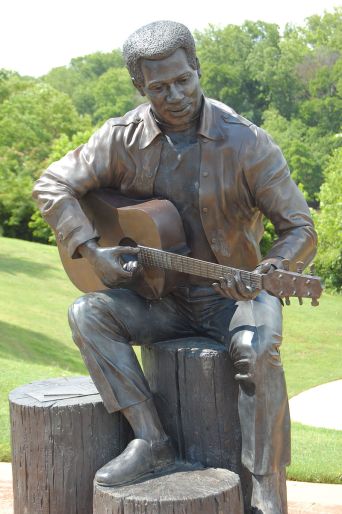
800px-otisreddingstatueRedding joined STAX Records in 1962, a portmanteau of the founding partners and siblings Jim Stewart and his sister Estelle Axton (STewart/AXton = Stax).
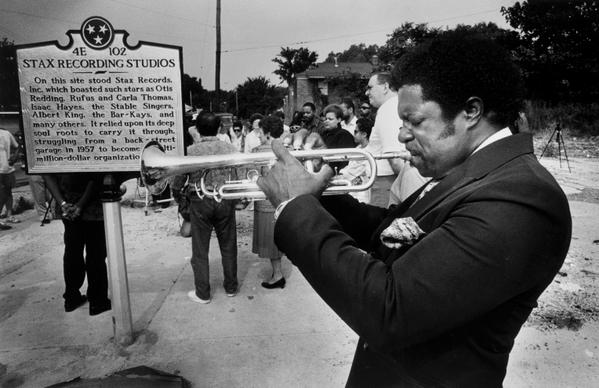
The label’s use of a single studio and a small stable of musicians and songwriters produced a readily identifiable sound based on black gospel and rhythm & blues which came to be known as Southern soul, or Memphis soul.

Singer-songwriter-musician Otis Redding became Stax Records’ biggest star in the five years before the plane crash that took his life: the “Big O”, the “King of Soul”.

Musicians from Led Zeppelin to Lynyrd Skynyrd to Janis Joplin and virtually every soul and R&B musician of the era have taken musical influence from Otis Redding. It was he who wrote the ballad R-E-S-P-E-C-T made famous by the “Queen of Soul”, Aretha Franklin.

His initial recordings were mainly popular with black audiences, but Redding (and others) crossed the “color barrier”, performing at “white owned” venues like Whisky a Go Go in LA, the Monterey Pop Festival of 1967, and venues throughout Paris, London and other European cities.

Redding’s iconic song and  #1 hit, “Sittin’ on the Dock of the bay“, became the first posthumous number-one record on both the Billboard Hot 100 and R&B charts.  Dock of the Bay was the first posthumous album to reach number one on the UK Albums Chart.

The song wasn’t intended to turn out the way it did.

Redding had taken strong influence from the Beatles, particularly the layered sounds of Sgt. Pepper’s Lonely Hearts Club Band.  He wanted to expand his musical footprint beyond the soul and R&B genre.  If you listen to the song – the seagulls, the sound of lapping waves – that’s what he was going for.  The “outro”, the twenty-five seconds’ whistling at the end, were nothing but a place holder, intended to be replaced by some yet-to-be-decided vocal effect in a second recording session, a few days later.

That second session was never meant to be.

The kid who once pumped gas to help support his family boarded his own Beechcraft H-18 aircraft on December 10, 1967, along with Bar-Kays guitarist Jimmy King, tenor saxophonist Phalon Jones, organist Ronnie Caldwell, trumpet player Ben Cauley, drummer Carl Cunningham, their valet Matthew Kelly and the pilot, Richard Fraser.

The band had played two nights in Cleveland.  The next stop was Madison, Wisconsin. The plane took off despite warnings of foul weather.  The show must go on. Ben Cauley remembers waking from a nap to see band-mate Phalon Jones look out a window and exclaim “Oh No!”  He then found himself alone, clutching a seat cushion in the 34-degree waters of Lake Monona.  He was the sole survivor.

ben-cauley
Bar-Kays trumpet player, Ben Cauley

A keyword search reveals seventy-two sole survivors, defined as the only survivor of a plane crash that killed ten or more passengers and crew.

Pilot error was ruled at fault for the wreck of Vietnam Airlines Flight 815 on September 3, 1997. The Tupolev Tu-134B-3 crashed at final approach at Phnom Penh Internatinal Airport in Cambodia, leaving Chanayuth Nim-anong the youngest on the list, at 14-months-old. The crash killed 66 passengers and crew including Taiwanese national Ho Suicheng, who was there to marry his fiancée, Cambodian Khuth Linda.  It was she who identified his body. Khuth went through with the wedding, as planned.  With his photograph.

Crew member Alexander Sizov is the oldest at 52, sole survivor of the charter plane crash of September 7, 2011 that wiped out forty-three members of the Lokomotiv Yaroslavl ice hockey team along with Canadian coach Brad McCrimmon. At the time, Lokomotiv Yaroslavl was a member of the Kontinental Hockey League (KHL), Russia’s top ice hockey league.

aeoecl55qgmcyujnx6uc7a_alexander-sizov-52-bol-mechanikom-na-palube

The old adage ‘only the good die young’ may be illustrated with Chinese national Huáng Yù, sole survivor of the hijacked Cathay Pacific aircraft Miss Macao in the 1948 crash that killed the other 27 people on board.  Huáng was the lead hijacker.  He not only escaped death, but prosecution, too.  No one could decide what jurisdiction to try him under.

Though they would never meet, the Beatles form a common bond between the Redding crash and another sole survivor, half a world away.

Serbian flight attendant Vesna Vulović grew up in the age of Beatlemania, and wanted nothing more than to learn English, and move to London. That she did for a time before moving to Stockholm, but the girl’s parents would have nothing of the drugs and sex of the Swedish capital. On returning to Belgrade, Vulović saw a friend in a stewardess uniform. That was it, she remembered: “I thought, ‘Why shouldn’t I be an air hostess? I could go to London once a month’.” Vulović joined JAT, Yugoslavia’s national flag carrier and largest airline, in 1971.

maxresdefault (19)
Vesna Vulović

JAT 367 flew from Stockholm to Belgrade with stopovers in Copenhagen and Zagreb, arrived in Denmark on January 25, 1972. Vulović wasn’t intended to be on the second leg scheduled for the following day, but JAT confused her for another flight attendant with the same name.

Croatian nationalists carried out 128 terrorist attacks against Yugoslav civilian and military targets between 1962 and 1982. JAT Flight 367 became one of them on this day in 1972, the briefcase bomb exploding at 33,330-feet and tearing the aircraft into three pieces.

jat_dc-9_(7107744587)
JAT DC-9 YU-AHL, sister ship of the aircraft involved H/T Wikipedia

Former WW2 medic Bruno Honke found Vulović screaming among the wreckage outside the Czechoslovak village of Srbská Kamenice, her turquoise uniform covered with blood, her 3-inch stiletto heels torn off by the force of the impact. Vulović herself has no recollection of the explosion, or the descent. She suffered a fractured skull with brain hemorrhage, two broken legs and three broken vertebrae. She would spend her next 27 days, in a coma. Two months later, she was offered a sedative for the flight back to Belgrade. She declined the injection, saying she had no memory of the crash. What was there to be afraid of?

Something of a Yugoslavian national hero, Vesna Vulović went back to work for JAT following sixteen months recuperation, albeit, with a limp. She wanted to go back to flying, but got a desk job, instead.  The Guinness Book of world Records officially recognized Vulović’s 1971 fall.  The title was officially awarded in 1985 in a special ceremony, personally bestowed by none other than Paul McCartney.

Feature image, top of page:  Otis Reddings aircraft is fished out of the frigid waters of Lake Monona, near Madison Wisconsin.  The band was four miles from their destination.


January 25, 1925 The Great Race of Mercy

“It was literally the plague among children. Many families lost three of four children—many lost all”.

In the 4th century BC, Hippocrates of Kos identified an upper respiratory infection, characterized by the formation of a leathery white “pseudomembrane” on the tonsils, pharynx, and/or nasal cavities of its victims.  Early symptoms resemble a cold or flu in which fever, sore throat, and chills lead to bluish skin coloration, painful swallowing, and difficulty breathing.  Late symptoms include cardiac arrhythmia with cranial and peripheral nerve palsies.

German bacteriologist Friedrich August Johannes Loeffler first identified Corynebacterium diphtheriae in the 1880s, the causal agent of the disease Diphtheria.  Within ten years, researchers had developed an effective antitoxin.

Today the disease is all but eradicated in the United States, but diphtheria was once a leading cause of death among children and adults over 40.

Diphtheria is highly contagious and spread by direct physical contact and by breathing aerosolized secretions of its victims.  Spain experienced an outbreak of the disease in 1613. To this day the year is remembered as “El Año de los Garotillos”.  The Year of Strangulations.

A severe outbreak swept through New England in 1735. In one New Hampshire town, one of every three children under the age of 10 died of the disease. In some cases entire families were wiped out. Noah Webster described the outbreak, saying “It was literally the plague among children. Many families lost three of four children—many lost all”.

download (7)Dr. Curtis Welch practiced medicine in Nome, Alaska, in 1925. Several children became ill with what he first diagnosed as tonsillitis. More came down with sore throats, early sufferers beginning to die as Welch observed the pseudomembrane of diphtheria. Dr. Welch had ordered fresh antitoxin the year before, but the shipment hadn’t arrived by the time the ports froze over. By January, all the serum in Nome was expired.
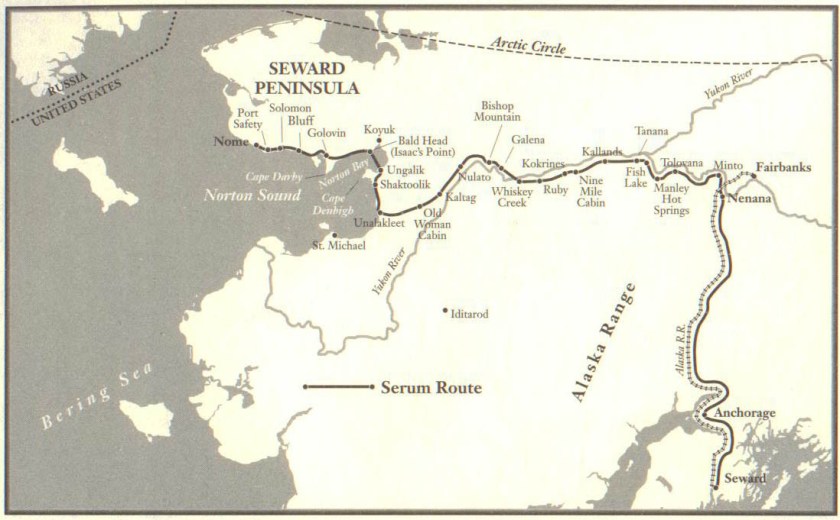

There were 10,000 living in Nome at the time, 2° south of the Arctic Circle. Welch expected a high mortality rate among the 3,000 or so white inhabitants, but the 7,000 area natives: Central Yupik, Inupiaq, St. Lawrence Island Yupik and American Indians with lineage tied to tribes in the lower 48, likely had no immunity whatsoever. Mortality among these populations could be expected to approach 100%.

Five children had already died by January 25, while Dr. Welch suspected more in the remote native camps. A plea for help went out by telegram and an Anchorage hospital came up with 300,204 units of serum. Enough for 30 patients. A million units would be required. but, perhaps this would be enough to stave off epidemic. Until a larger shipment arrived, in February.

A 20-lb cylinder containing the antitoxin and wrapped in protective fur shipped as far as it could by rail, arriving at Nenana, 674 miles from Nome. Three vintage biplanes were available, but all were in pieces, and none could be started in the sub-arctic cold. The antitoxin would have to go the rest of the way, by dog sled.

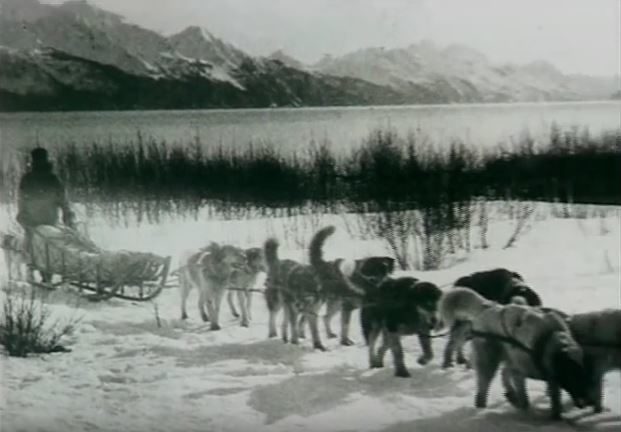
On January 27, a US Marshal pounded on the door of Willard J. “Wild Bill” Shannon, begging for his help with the relay to Nome.   It was after midnight and −50° Fahrenheit , when Shannon and his nine-dog team received the serum. The temperature had dropped to −62°F by the time the team reached Tolovana, 24 hours later. Shannon himself was hypothermic, with parts of his face turned black with frostbite.  Three of his dogs had died on the way, victims of frostbitten lungs.

97baa68e7dc7b530eea4c9a84b1081d2

Leonhard Seppala and his team took their turn, departing into gale force winds and zero visibility, with a wind chill of −85°F.  With Seppala’s 8-year old-daughter and only child Sigrid at risk for the disease, the stakes could not have been higher.

Up the 5,000′ “Little McKinley”, Seppala gambled on a shortcut across the unstable ice of Norton Sound.  The howling gale threatened to break up the ice, stranding the team at sea.  Visibility was so poor that Seppala couldn’t see his own “wheel dog” – the dog nearest his sled.  The 19-dog team struggled for traction on the glassy skin of the ocean water, returning to the coastline only hours before the ice broke up.

Much of the time, navigation in that black, frozen wilderness was entirely up to Seppala’s lead dog.  Most sled dogs are retired by age twelve, especially team leaders, but it was twelve-year-old “Togo”, who was trusted with the lead.

images (14)

Seppala and Togo ran 170 miles to receive the serum, returning another 91 miles to make the handoff on February 1. Together the pair covered twice as much ground as any other team, over the most dangerous terrain of the “serum run”.

Gunnar Kaasen and his team took the handoff, hitting the trail at 10:00 that night. A massive gust estimated at 80mph upended the sled, pitching musher and serum alike into the snow. Already frostbitten, Kaasen searched in the darkness with bare hands, until he found the cylinder. Covering the last 53 miles overnight, the team reached Front Street, Nome, at 5:30am on February 2. The serum was thawed and ready to use,  by noon.

seppala520 mushers and 150 dogs or more had covered 674 miles in 5 days, 7½ hours, a distance that normally took the mail relay 2-3 weeks. Not a single serum ampule was broken.
With 28 confirmed cases and enough antitoxin for 30, the serum run had held the death toll to no higher than seven.

Doctor Welch suspected as many as 100 or more deaths in the native camps, but the real number will never be known. An untold number of dogs died while completing the run.  Several mushers were severely frostbitten.

diphtheria_balto
Gunnar Kaasen and Balto

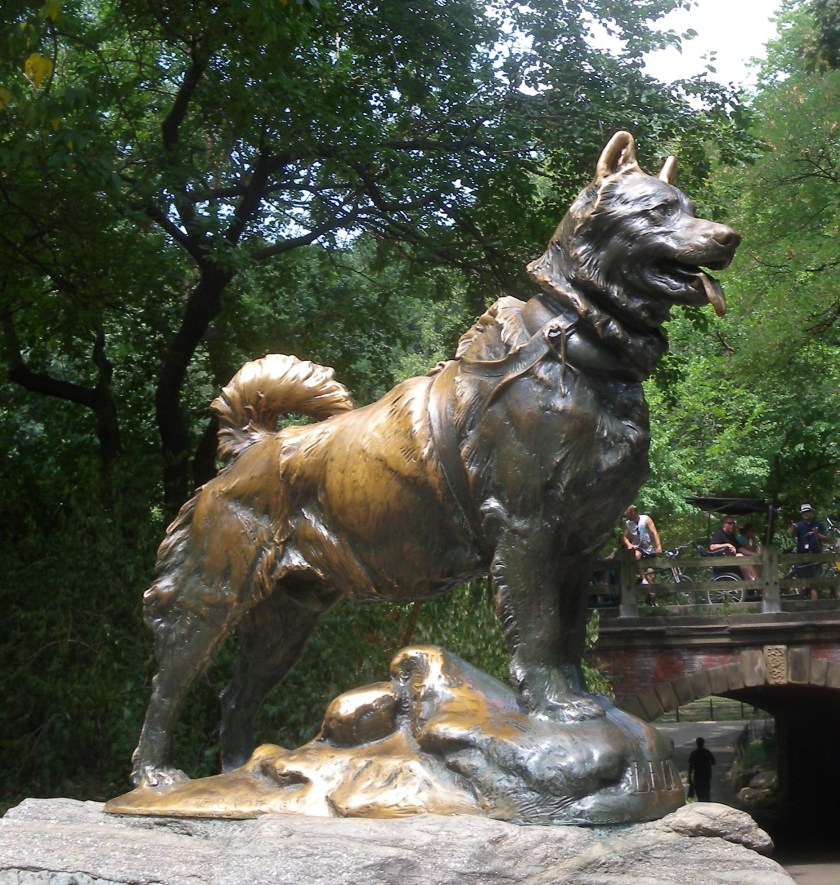
Gunnar Kaasen and his lead dog “Balto” were hailed as heroes of the serum run, the dog becoming the most popular canine celebrity in the country, after Rin Tin Tin. There was a nine-month vaudeville tour, and Hollywood produced a 30-minute silent film, “Balto’s Race to Nome,” starring himself in the lead role.

A bronze likeness was erected in New York’s Central Park in 1925, with Balto in attendance.  The statue stands there to this day, though Kaasen’s lead is depicted wearing Togo’s “colors” (awards).

Balto’s fame was a source of considerable bitterness for Leonhard Seppala, who felt that Kaasen’s 53-mile run was nothing compared with his own 261, Kaasen’s lead little more than a “freight dog”.  The statue was particularly galling.  “It was almost more than I could bear” he said, “when the ‘newspaper dog’ Balto received a statue for his ‘glorious achievements’”.

Togo lived another four years though the serum run rendered him lame, never again able to run. The real hero of the serum run spent the last years of his life in Poland Spring, Maine, and passed away at the ripe old age of 16.

Wild Bill Shannon disappeared in 1937, while prospecting for gold.  His bones were discovered four years later, perhaps a victim of exposure, or perhaps yet another “close call”, with a grizzly bear.

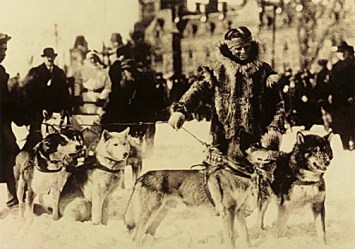
Togo and Seppala
Leonhard Seppala and Togo

Leonhard Seppala was in his old age in 1960, when he recalled his lead dog on the serum run.   “I never had a better dog than Togo. His stamina, loyalty and intelligence could not be improved upon. Togo was the best dog that ever traveled the Alaska trail.”

Today, the memory of the 1925 serum run lives on in the Iditarod Trail Sled Dog Race, held every March and run over much of the same terrain as the ‘Great Race of Mercy’.   Togo himself is stuffed and mounted,  standing watch at the Iditarod museum headquarters, in Wasilla, Alaska.

Afterward

Despite the decrepit condition of those three biplanes, pilots and mechanics thought they could have one ready to go, in three days.  The challenge was immense.  Ethylene Glycol wouldn’t be used as an automotive anti-freeze until the following year, and older methods such as Methyl Alcohol wrought havoc on internal engine components.

e16a10c46b80a325b8c6e8e4009c828c“The once tight fabric covering the wings and fuselage was weak from all the rough landings as well as the wind and rain. Dirt and oil caked the engine and prop. Wires for the rudders and elevators hung from the sides of the fuselage.” Even in such disrepair, the pilots and mechanics thought one of the planes could be ready to go Nome in just three days, a flight they thought would take no more than 6-hours”.

If unsuccessful, all would be lost.  Pilot, aircraft and serum.

The decision was a high stakes gamble, falling in the end to Alaska Governor Scott Bone, who decided on the twenty-team relay.  Good thing, too.  Multiple efforts to get one of those aircraft in shape for the second shipment, failed.

The Salisbury cousins Gay and Laney tell the tale in a harrowing account called The Cruelest Miles, if you’re interested in more reading.  I haven’t gotten to mine yet, but it sounds like a good read.

If you enjoyed this “Today in History”, please feel free to re-blog, “like” & share on social media, so that others may find and enjoy it as well. Please click the “follow” button on the right, to receive email updates on new articles.  Thank you for your interest, in the history we all share.

January 24, 1776 Seven Weeks in Winter

It must have been a sight when that noble train of artillery entered Cambridge on this day in 1776. By March, Henry Knox’ cannon would be manhandled to the top of Dorchester Heights, resulting in the British evacuation of Boston and a peculiar Massachusetts institution which exists to this day, known as “Evacuation Day”:  March 17.

The American Revolution began with the Shot Heard Round the World” on the morning of April 19, 1775. Within days of the Battles at Lexington and Concord and subsequent British withdrawal to Boston, over 20,000 men poured into Cambridge from all over New England. Abandoned Tory homes and the empty Christ Church became temporary barracks and field hospitals.  Even Harvard College shut down, its buildings becoming quarters for some 1,600 Patriots.

The Continental Congress appointed George Washington General of this “Army” on June 15, two days before the British assault on Farmer Breed’s hill. The action would take its name from that of a neighboring farmer, and went into history as the Battle of Bunker Hill.

battle-of-bunker-hill

Shortly after arriving in July, General Washington discovered that his army had enough gunpowder for nine rounds per man, and then they’d be done.

At the time, Boston was a virtual island, connected to the mainland by a narrow strip of land.  British forces were effectively penned up in Boston, by a force too weak to do anything about it.

The stalemate dragged on for months, when a 25-year-old bookseller came to General Washington with a plan. His name was Henry Knox. His plan was a 300-mile, round trip slog into a New England winter, to retrieve the guns of Forts Ticonderoga, and Crown Point.

fort ticonderoga artillery (fort ti photo)

Washington’s advisers derided the idea as hopeless, but the General approved. Henry Knox set out with a column of men on December 1.

Located on the New York banks of Lake Champlain, Fort Ticonderoga was captured by a small force led by Ethan Allen and Colonel Benedict Arnold, in May of that year. In it were brass and iron cannon, howitzers, coehorns and mortars, 30 pieces in all and another 29, from Fort Crown Point.  Arriving on December 5, Knox and his men set about disassembling the artillery, making it ready for transport. A flotilla of flat bottom boats was scavenged from all over the countryside, the guns loaded and rowed the length of Lake George, arriving barely before the water began to freeze over.

colonel-knox-bringing-the-cannons-from-fort-ticonderoga (2)Local farmers were enlisted to help and by December 17, Knox was able to report to General Washington “I have had made forty two exceedingly strong sleds & have provided eighty yoke of oxen to drag them as far as Springfield where I shall get fresh cattle to carry them to camp. . . . I hope in 16 or 17 days to be able to present your Excellency a noble train of artillery.”

Bare ground prevented the sleds from moving until Christmas morning, when a heavy snow fell and the column set out for Albany. Two attempts to cross the Hudson River on January 5 each resulted in cannon being lost to the river, but finally Knox was able to write “Went on the ice about 8 o’clock in the morning & proceeded so carefully that before night we got over 23 sleds & were so lucky as to get the Cannon out of the River, owing to the assistance the good people of the City of Albany gave.”

henry-knox-moving-canning-from-fort-ticonderoga

Continuing east, Knox and his men crossed into Massachusetts, over the Berkshires, and on to Springfield. With 80 fresh yoke of oxen, the 5,400lb sleds moved along much of what are modern-day Routes 9 and 20, passing through Brookfield, Spencer, Leicester, Worcester, Shrewsbury, Northborough, Marlborough, Southborough, Framingham, Wayland, Weston, Waltham, and Watertown.

It must have been a sight when that noble train of artillery entered Cambridge on this day in 1776. By March, Henry Knox’ cannon would be manhandled to the top of Dorchester Heights, resulting in the British evacuation of Boston and a peculiar Massachusetts institution which exists to this day:  “Evacuation Day”, March 17.

800px-henry_knox_artillery_handover_to_george_washington_marker

It is doubtful whether Washington possessed either powder or shot in quantities sufficient for a sustained campaign, but British forces occupying Boston didn’t know that. The mere presence of those guns moved British General Howe to weigh anchor and sail for Nova Scotia, but that must be a story for another day.

Afterward

During WW1, Winthrop Massachusetts artist and bronze foundry operator Henry L. Norton served with the Canadian army “over there” where he was wounded, seven times. In 1926, 150 years after Knox’s march through New York and Massachusetts, Norton and Albany sculptor Henry James Albright designed commemorative plaques to be installed on 56 stone monuments, marking the path of that noble train of artillery. The project was completed in 1927.

knoxtrailmap

Marker locations were updated in 1975 to reflect new research, concerning Knox’s route between Kinderhook New York and Alford, Massachusetts,

50581448_2298075013536100_5233603815533445120_n
Henry Knox Trail marker. Tip of the hat to Aaron Altice, for this image

A new marker was added in 2009, adjacent to a house owned by General John Thomas at the Roxbury Heritage State Park, in Boston. It was he who guided the weapons from Cambridge to their final placement on Dorchester Heights.

photo94269

If you enjoyed this “Today in History”, please feel free to re-blog, “like” & share on social media, so that others may find and enjoy it as well. Please click the “follow” button on the right, to receive email updates on new articles.  Thank you for your interest, in the history we all share.