January 18, 532 Nika Riot

Modern sport has seen its share of fan passion rising to violence, but the worst “futbol hooligan” pales into docility, compared with the crowd come to watch the chariot races. Imagine the worst fan violence of the modern era combined with aspects of street gangs and political organizations, each faction holding positions on the issues of the day and attempting to sway public policy by shouting slogans, between races.  

Chariots go back to the earliest days of the Roman Republic, coming down from the ancient Greeks by way of the Etruscan empire. The mythical abduction of the Sabine women was carried out, while the Sabine men watched a chariot race. While Romans never used them as weapons of war, chariots were used in triumphal processions, pulled by teams of horses, tigers or dogs, even ostriches.

What the Greeks regarded as an opportunity for talented amateurs to rise within their chosen sport, the Romans saw as entertainment. A class of professional drivers rose to meet the demand.

roman-chariot-raceLook up the Highest Paid Athlete of All Time and you’ll be rewarded with the knowledge that Michael Jordan amassed career earnings of $1.85 Billion, according to Forbes Magazine.  Steve Forbes and Michael Jordan alike may be surprised to know.  Spanish driver Gaius Appuleius Diocles amassed an astonishing 35,863,120 sesterces, equivalent to $15 Billion, today.  Not bad for a man whose name suggests he probably began as a slave, freed by a guy named Gaius Appuleius.

The Hippodrome of the Byzantine era (from the Greek Hippos: Horse and Dromos: Path, or Way) was already the center of sport and social activity in 324.  That was the year Emperor Constantine moved the seat of the Roman Empire east to Byzantium, calling the place, Nova Roma. New Rome.  The name failed to catch on and the city came to be known as Constantinople.

f285a884c132221b7abbb5958de2452dThe age of Constantine saw enormous expansion of the city which bore his name, including enlargement of the Hippodrome to an impressive 1,476-feet long by 427-feet wide with a seating capacity of 100,000.  By way of comparison, the Empire State Building is 1,454-feet from sidewalk to the very tip of the spire.  Mercedes Benz Stadium in Atlanta, home of Super Bowl LIII, has a rated capacity of 71,000 spectators.

There were four teams or “factions” (factiones), distinguished by the color of their uniform: Red, Blue, Green and White, and echoed by the colors worn by their fans.  Twelve chariots would enter each race, three from each faction. Golden-tipped dolphins were tipped over, to count the laps. Each race ran seven.f9fb0a187c6e429d1e9b2c84e723043bA raised median called a spina ran down the center, adorned with stone statuary and obelisks. Ganging up to drive opposing handlers into the stone median or the stands, whipping opponents and even hauling them out of their chariots was not only permitted, but encouraged.

It was the racetrack, or circus and the sport of chariot racing, that truly put the Fanatic in Fans. There are tales of poisoned horses and drivers. Lead tablets and amulets inscribed with curses, spiked through with nails and thrown from the stands. One such curse read:

I call upon you, oh demon, whoever you are, to ask that from this hour, from this day, from this moment, you torture and kill the horses of the green and white factions and that you kill and crush completely the drivers Calrice, Felix, Primulus, and Romanus, and that you leave not a breath in their bodies.

Racing chariots were as light as possible and extremely flimsy, to increase speed. With no suspension, even a bump could throw a driver into the path of oncoming teams. Clogs were built into lattice floors, to hold the driver’s feet. Teams of two (biga), three (triga) and four (quadriga) horses were common, but teams as large as six were not unheard of.

Though rare, ten-horse teams were known to take the field.

While Greek drivers held the reins in their hands, Roman charioteers wrapped them around the waist. Unsurprisingly, any driver thrown out would be dragged to death or trampled, unless able to cut himself free.

Crashes were frequent and spectacular, often killing or maiming driver and horse alike. Such wrecks were called naufragia, a Latin word translating as ”shipwreck”.  As many as forty chariots crashed in one catastrophic pile-up, near Delphi.ba90ba114005e082444846ca7ff751f7Modern sport has seen its share of fan passion rising to violence, but the worst “futbol hooligan” pales into docility, compared with the crowd come to watch the chariot races. Imagine the worst fan violence of the modern era combined with aspects of street gangs and political organizations, each faction holding positions on the issues of the day and attempting to sway public policy by shouting slogans, between races.

Distinctions between politics and sport, all but disappeared.  Emperor Vitellius, a fan of the Blue faction, had citizens put to death in the year 69 for talking trash about his team. Ten years later, one fan threw himself on the funeral pyre of his favorite driver.

In 531, fans of the Blues and Greens were arrested for murder, following riots which broke out during a chariot race. The killers were sentenced to death and most were executed but two, escaped. On January 10, 532, the two men one Blue and one Green had taken refuge in a church, surrounded by an angry mob.

Emperor Justinian, a supporter of the Blues, was beset with problems. The war in the east was not going well with the Persians and at home, rampant corruption and public fury over confiscatory tax policy.  Now this.  Justinian resorted to that time honored technique to pacify the turbulent masses.  Bread and Circuses.  He announced a chariot race.

Bad idea.

It was a tense and angry crowd that arrived at the Hippodrome on January 13.  By race #22 chants of “Blue” and “Green” were changed to angry shouts, directed at the Emperor.  “Nίκα! Nίκα! Nίκα! (“Nika” translating as “Win!” “Victory!” or “Conquer!”).

Fury boiled over and anarchy turned to Riot.  The Royal Palace was laid siege over the next five days and the city, laid waste.  Even the magnificent Hagia Sofia, the foremost church in Constantinople, was destroyed.

Hagia_Sophia_Mars_2013
Now a mosque in Istanbul, the beautiful Hagia Sofia was destroyed during the Nika riots of 532 and later rebuilt, by Emperor Justinian.

Rioters proclaimed the Senator Flavius Hypatius as their new Emperor and demanded the dismissal of key advisers.  Soon Justinian himself prepared to flee for his life.  He surely would have done so if not for his wife, the formidable Empress Theodora.

“Those who have worn the crown should never survive its loss”, she declared. “Never will I see the day when I am not saluted as empress.  Who is born into the light of day must sooner or later die; and how could an Emperor ever allow himself to be a fugitive.”

The avenue of escape lay open to the Emperor but Theodora’s words, cut deep.  Not to be deterred, the Empress closed the door on escape.  “Royalty is a fine burial shroud” she said.  “The Royal color Purple makes a fine winding sheet.”

Dwzr7yJUUAEA9MYWith spine thus restored, Justinian formulated a plan.  The popular eunuch Narses was sent with a bag of gold, into the lion’s den.  Small and slight of build, unarmed but for those coins, Narses entered the Hippodrome and went directly to the Blue section.  On this day in 562 Hypatius was in the very act of coronation when the eunuch spoke.  Narses reminded the Blues that Hypatius was a Green while Justinian himself, supported their team.

Gold was distributed among the Blues and the trap was sprung.  As Blue team supporters streamed out of the Hippodrome, Imperial troops led by the Generals Belisarius and Mundus fell upon the crowd, killing some 30,000 Blue and Green alike.jerusalem-distrThus ends one of the great “backfires” in political history.  Senator Hypatius was put to the sword and those who had supported the pretender, sent into exile.  Justinian I would rule another 33 years, rebuilding Constantinople, muzzling the Senatorial Class which had caused him such grief and reconquering lost territories, in Italy.

Wealthy estates were confiscated outright and races were suspended for a period of five years.  None were left to stand against this Emperor for a long and fruitful reign.

January 17, 1994 Ghost of the American Star

Naval interiors of the age tended to be stodgy and overwrought.  America has the almost unique distinction of having its interiors designed entirely by women, as naval architect William Francis Gibbs turned to the all-female team of Miriam Smyth, Ann Urquhart & Dorothy Marckwald.  

The Federal Government passed the Merchant Marine Act of 1936, “to further the development and maintenance of an adequate and well-balanced American merchant marine”.

The act served multiple purposes, among them modernizing what was at that time a largely WWI vintage merchant marine fleet, and serving as the basis for a naval auxiliary that could be activated in time of war or national emergency.

Ss_america_under_constructionTwo years later, the first keel laid under the Merchant Marine act was the SS America, built by the United States Line and operated as a passenger liner until the United States entered WWII in 1941.

Naval interiors of the age tended to be stodgy and overwrought.  America has the almost unique distinction of having its interiors designed entirely by women, as naval architect William Francis Gibbs turned to the all-female team of Miriam Smyth, Ann Urquhart & Dorothy Marckwald.

“It is not without reason”, according to team leader “Dot” Marckwald, “the majority of the passengers are women, and no man could ever know as much about their comfort problems and taste reactions as another woman.”

SS America was christened by Eleanor Roosevelt and launched on August 31, 1939. One day later, Adolf Hitler invaded Poland.

America would serve as a passenger liner for the two years remaining for American neutrality. American flags were painted on both sides of her hull, and at night she sailed while fully illuminated.

Where there are government subsidies, there are strings.  For SS America, those strings were pulled on May 28, 1941, while the ship was at Saint Thomas in the US Virgin Islands.  The ship had been called into service by the United States Navy, and ordered to return to Newport News.

Re-christened the USS West Point, she served as a transport for the remainder of the war, carrying in excess of 350,000 troops and other passengers by 1946.  It was the largest total of any Navy troop ship in service during WWII, and included USO entertainers, Red Cross workers, and prisoners of war.  As America, she had even carried two Nazi spies as part of her crew, until their discharge on America’s return to Virginia.  The two spies, Franz Joseph Stigler and Erwin Wilheim Siegler, were members of the Duquesne spy ring, reporting allied movements in the Panama Canal Zone until they and 31 of their cohorts were found out late in 1941.

WestPointBalloon1During her service to the United States Navy, West Point was awarded the American Defense Service Medal, American Campaign Medal, European-African-Middle Eastern Campaign Medal, Asiatic-Pacific Campaign Medal, and World War II Victory Medal.

Returned to civilian service in 1946 and re-christened America, the ship remained a favorite for cruise ship vacationers through most of the fifties.  By 1964, the competition from larger, faster ships and the airlines had put the best years behind the aging liner.  Sold and then sold again, she had come full circle by 1978, when new owners tried to capitalize on the old ship’s mystique.

ss-america-gettyimages-940194090She was in terrible condition and her refit nowhere near complete when America set sail on her first cruise on June 30, 1978.  There was rusted metal, oil soaked rags and backed up sewage.  There were filthy mattresses and soiled linens.  One woman later said, she was a “floating garbage can.”  The angriest of customers actually got into fist fights with members of the crew.  There were so many complaints the ship finally turned back, still within sight of the Statue of Liberty.

Impounded for non-payment of debts and receiving an inspection score of 6 out of a possible 100 points by the Public Health Service, the US District Court ordered America to be sold at auction.

One new owner after another bought the hulk during the eighties, only to default.  First it was going to be a prison ship, and then sold and renamed Alferdoss translating as “paradise” in Arabic.  She was anything but at this point.  The next buyer intended to scrap her, only to become the latest in a long line of financial defaults.

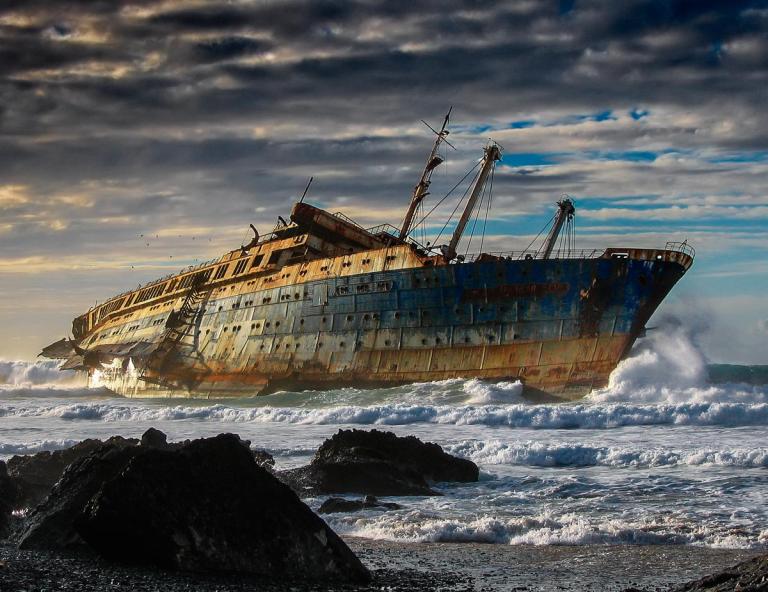
SS America, InteriorsSold yet again in 1993 and renamed the American Star, the new owners planned to convert her to a five-star hotel ship off Phuket, Thailand.  A planned 100 day tow began on New Year’s Eve of 1993, but the lines broke.  On January 17, 1994, the former SS America was adrift in foul seas, running aground in the Canary Islands the following day.   Discussions of salvage operations were soon squashed, as the ship broke in two in the pounding surf.

maxresdefault-2The National WWII Museum in New Orleans reports on its website that the men and women who fought and won the great conflict are now passing at a rate of 550 per day.  How many, I wonder, might think back and remember passage on the most successful troop transport of their day.
By the spring of 2013, the only time you could tell there’s a wreck on the beach, was at low tide.

January 14, 1741 Turncoat

As a British officer, Arnold himself once asked an American prisoner “What will the Americans do with me if they catch me?” The reply though mostly forgotten, is one for the ages. “They will cut off the leg which was wounded when you were fighting so gloriously for the cause of liberty, and bury it with the honors of war, and hang the rest of your body on a gibbet.”

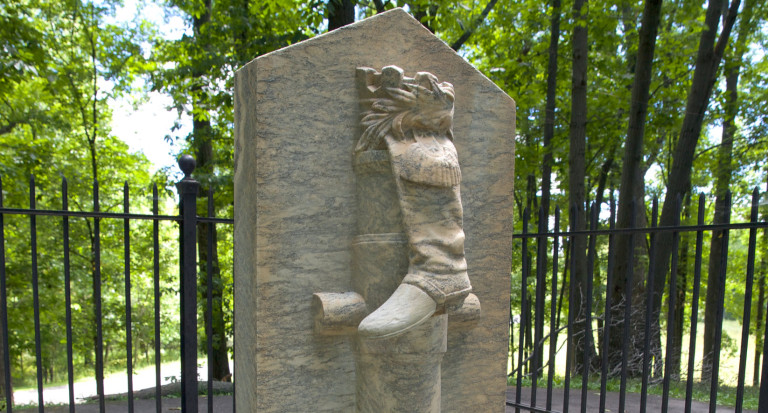
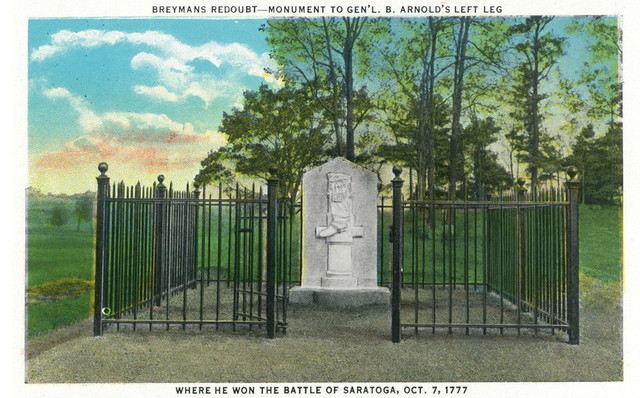
Three hours from the upstate New York village of Sleepy Hollow, in the woods of Schuylerville, there stands the statue of a leg.  A boot, actually, a man’s riding boot, along with an epaulet and a cannon barrel pointing downward, denoting the death of a General.  It seems the loneliest place on earth out there in the woods, with nothing but a footpath worn into the forest floor to lead you there.

The back of the stone bears these words.  “In memory of the most brilliant soldier of the Continental Army“.  A most brilliant soldier who, according to his own memorial, has no name.

Breymann-Redoubt-at-Saratoga
Breymann’s RedoubtSaratoga Battlefield. H/T American Battlefield trust

In 1632, Reverend John Lothropp was an ordained minister of the Church of England. That was the year he renounced his orders, and joined the cause of religious independence. Lothropp was arrested and jailed for his apostasy, pardoned only on condition that he leave and never come back. He accepted the terms of his exile, arriving in Plymouth Massachusetts a short fourteen years after the original pilgrims.

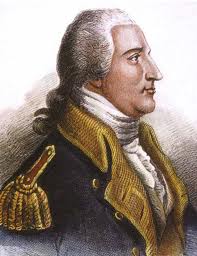
John Lothropp is mostly forgotten today but his old house on Cape Cod, now houses the oldest public library in America.  That, and a host of famous relatives, direct descendants including George Bush the elder and the younger, Franklin Roosevelt, Ulysses Grant, James Garfield and Millard Fillmore. Oh, and the guy who once wore that riding boot, up in Schuylerville. Benedict Arnold, born this day in 1741.

The year was 1777, October 7, the last day of the Battle of Saratoga.  General Horatio Gates was in overall command of American forces, a position greatly exceeding his capabilities.  Gates was cautious to the point of timidity, generally believing his men better off behind prepared fortifications, than taking the offensive.

Benedict Arnold
General Benedict Arnold

Gates’ subordinate, General Benedict Arnold, could not have been more different.  Arnold was imaginative and daring, a risk taker possessed of physical courage bordering on thereckless.  The pair had been personal friends once but that was time, long past.  By this time the two men were constantly at odds.

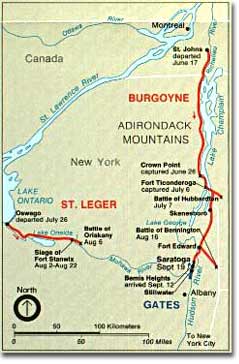
British General John “Gentleman Johnny” Burgoyne led a joint land and water invasion of 7,000 British and Hessian troops south along the New York side of Lake Champlain, down the Hudson River valley.

The invasion started out well for Burgoyne with the bloodless capture of Fort Ticonderoga, but Gentleman Johnny ran into a buzz saw outside of Bennington, Vermont, losing almost 1,000 men to General John Stark’s New Hampshire rebels and a militia unit headed by Ethan Allen, calling itself the “Green Mountain Boys”.

Burgoyne intended to continue south to Albany, linking up with forces under Sir William Howe and cutting the colonies in half.  The 10,000 or so Colonial troops situated on the high ground near Saratoga, were all that stood in his way.

Burgoyne's Route to SaratogaPatriot forces selected a site called Bemis Heights about 10 miles south of Saratoga, spending a week constructing defensive works with the help of Polish engineer Thaddeus Kosciusko.  Theirs was a formidable position with mutually supporting cannon on overlapping ridges, with interlocking fields of fire.
Burgoyne had no choice but to stop and give battle at the American position, or be chopped to pieces trying to pass it by.

The Battle of Freeman’s Farm, the first of two battles for Saratoga, occurred on September 19.  Technically a Patriot defeat in that the British held the ground at the end of the day, it was a costly victory.  English casualties were almost two to one.  Worse, the British column was out at the end of a long and tenuous supply line, while fresh men and supplies all but poured into the American position.

Freeman’s Farm could have been worse for the Patriot cause, but for Benedict Arnold’s anticipating British moves, and taking steps to block them in advance.

The personal animosity between Gates and Arnold boiled over in the days that followed.  Gates’ report to Congress made no mention of Arnold’s contributions at Freeman’s Farm, though field commanders and the men involved with the day’s fighting, unanimously credited Arnold for the day’s successes.  A shouting match between Gates and Arnold resulted in the latter being relieved of command, and replaced by General Benjamin Lincoln.

Saratoga ReenactmentThe second and decisive battle for Saratoga, the Battle of Bemis Heights, occurred on October 7, 1777.

Lieutenant Colonel Heinrich Christoph Breymann’s Hessian grenadier regiment formed the right anchor of Burgoyne’s line, manning a wooden fortification near the length of a football field and some 7-feet high.  It was a strategically important position, with nothing between itself and the regiment’s main camp to the rear.

Though relieved of command Arnold was on the field, directing the battle on the American right.  As the Hessian position began to collapse, General Arnold left his troops facing Balcarre’s Redoubt on the right, riding between the fire of both armies and joining the final attack on the rear of the German post.  Arnold was shot through the left leg during the final moments of the action, shattering the same leg which had barely healed after the same injury at the Battle of Quebec City, only two years earlier.  The same leg wounded in the defense of Ridgefield, only six months earlier.

saratogabig.jpgIt would have been better in the chest, he said, than to have received such a wound in that leg.
Burgoyne had no choice but to capitulate, surrendering his entire force on October 17.  It was a devastating defeat for the British cause, and finally brought France in on the American side.  A colonial Army had gone toe to toe with the most powerful military on the planet, and still stood.

One British officer described the battle:  “The courage and obstinacy with which the Americans fought were the astonishment of everyone, and we now became fully convinced that they are not that contemptible enemy we had hitherto imagined them, incapable of standing a regular engagement, and that they would only fight behind strong and powerful works.”

One year earlier almost to the day, Benedict Arnold led a stick-built “Navy” literally constructed on the shores of lake Champlain, in a suicidal action by the shores of Valcour Island. Three years later, a man who would otherwise be remembered among the top tier of our founding fathers, betrayed the American fortifications at West Point to the British spy, John André.

The name of one of our top Revolution-era warriors, a General whom one of his own soldiers later described as “the very genius of war,” became that of Traitor.  As a British officer, Arnold himself once asked an American prisoner “What will the Americans do with me if they catch me?” The reply though mostly forgotten, is one for the ages. “They will cut off the leg which was wounded when you were fighting so gloriously for the cause of liberty, and bury it with the honors of war, and hang the rest of your body on a gibbet.”

home-design
The forest has grown around it now.  The only memorial on the Saratoga Battlefield, to an American Hero with no name.

So it is that there is the statue of a leg in the forest south of Saratoga, dedicated to a nameless Hero of the Revolution.  On the back of the monument are inscribed these words:

Saratoga Obelisk“In memory of
the most brilliant soldier of the
Continental Army
who was desperately wounded
on this spot the sally port of
BURGOYNES GREAT WESTERN REDOUBT
7th October, 1777
winning for his countrymen
the decisive battle of the
American Revolution
and for himself the rank of
Major General.”

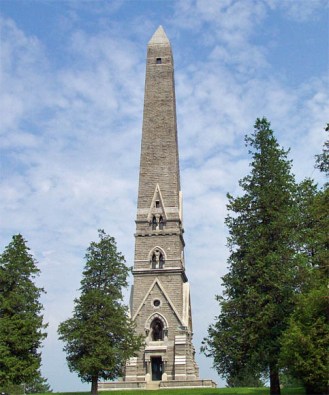
Today, the Saratoga battlefield and the site of Burgoyne’s surrender are preserved as the Saratoga National Historical Park.  On the grounds of the park stands an obelisk, containing four niches.

Three of them hold statues of American heroes of the Battle.  General Horatio Gates. General Philip John Schuyler.  Colonel Daniel Morgan.

The fourth niche, where Benedict Arnold’s statue was intended to go, remains empty.


January 13, 1997 Buffalo Soldier

Fun Fact: “Few images embody the spirit of the American West as well as the trailblazing, sharpshooting, horseback-riding cowboy of American lore. And though African-American cowboys don’t play a part in the popular narrative, historians estimate that one in four cowboys were black”. – Smithsonian.com

In September 1867, Private John Randall of Troop G, US 10th Cavalry Regiment, was escorting two civilians on a hunting trip. The hunter became the hunted when a band of 70 Cheyenne warriors swept down on the trio. The two civilians were killed in the initial attack and Randall’s horse shot out from under him.

hardpicCornered in a washout under some railroad tracks Randall held off the attack single handed with his revolver, despite a gunshot wound to his shoulder and no fewer than 11 lance wounds.
By the time help arrived, 13 Cheyenne warriors lay dead.  Private Randall was still standing. Word spread among the Cheyenne about a new kind of soldier, “who had fought like a cornered buffalo; who like a buffalo had suffered wound after wound, yet had not died; and who like a buffalo had a thick and shaggy mane of hair.”

The US 10th Cavalry, formed on September 21, 1866 at Fort Leavenworth, Kansas, was the first unit of “Negro Cavalry”, an all-black unit which would soon be joined by the 9th, 24th and 25th Cavalry and come to be known as “Buffalo Soldiers”.

Fun Fact: “Few images embody the spirit of the American West as well as the trailblazing, sharpshooting, horseback-riding cowboy of American lore. And though African-American cowboys don’t play a part in the popular narrative, historians estimate that one in four cowboys were black”. – Smithsonian.com

Several all-black regiments were formed during the late Civil War including the 54th Massachusetts Volunteer Infantry depicted in the film, “Glory”.  The “Buffalo Soldiers” were the first peacetime all-black regiments in the regular Army.

The original units fought in the American Indian Wars, the Spanish-American War, the Philippine-American War, the Border War and two World Wars, amassing 23 Medals of Honor by the end of 1918.

423ECBEE00000578-4688680-image-m-72_1499857448640
At one time, “Buffalo Soldier” was a catch-all term, used to describe American troops of African ancestry. Today the term is used as a badge of honor only by those units who trace their lineage to the 9th and 10th Cavalry regiments. Here, the 92nd Division (segregated) in the Argonne Forest of WW1. The 92nd’s insignia is a buffalo: a tribute to their predecessors.

The old met the new during WWII when Mark Matthews, veteran of the Pancho Villa Expedition, WW1, WW2 and the Battle of Saipan, was sent to train with the Tuskeegee Airmen.  In the end, Matthews proved too old to fly.  A member of the Buffalo Soldiers Drum & Bugle Corps, Matthews would play taps at Arlington National Cemetery, always from the woods. Blacks of the era were not permitted at “white” funerals.  1st Sergeant Matthews retired shortly before the Buffalo Soldiers were disbanded, part of President Truman’s initiative to integrate United States’ armed forces.

154418015_zpswr4iy9c0
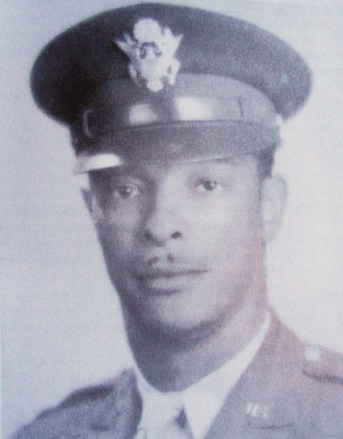
1st Lt. John Robert Fox

In December 1944, the segregated 366th Infantry Regiment of the 92nd Infantry Division was fighting in the vicinity of Sommocolonia, in northern Italy.  German soldiers began to infiltrate the town on Christmas day, disguised as civilians.

A heavy artillery barrage began in the early morning hours of the 26th, followed by an overwhelming attack of enemy ground forces.  Vastly outnumbered, American infantry were forced to conduct a fighting retreat.

First Lieutenant John R. Fox, forward observer for the 598th Field Artillery Battalion, volunteered to stay behind with a small Italian force, to help slow the enemy advance.  From the second floor of a house, Lieutenant Fox directed American defensive fire by radio, adjusting each salvo closer to his own position.  Warned that his final adjustment would bring artillery down on his own head, the soldier who received the message was stunned at the response.

1st Lieutenant John R. Fox’ last known words, were “Fire it.”

When American forces retook the town, Lieutenant Fox’ body was found with those of about 100 German soldiers.

393_sommocolonia_17.jpegThe King James Bible teaches us, in John 15:13:  “Greater love hath no man than this, that a man lay down his life for his friends“.  After the war, Sommocolonia erected a Memorial.  A tribute to nine brave soldiers who gave their lives that their brothers might live.  Eight Italians and one American.
In a January 13, 1997 ceremony at the White House, President Bill Clinton awarded the Medal of Honor, posthumously, to the family of 1st Lieutenant John R. Fox.

Memorial Day celebration in Washington, D.C.1st Sergeant Mark Matthews, the last of the Buffalo Soldiers, died of pneumonia on September 6, 2005 at the age of 111.  A man who forged papers in order to join at age fifteen and once had to play taps from the woods, Matthews was buried with full military honors at Arlington National Cemetery, section 69, grave #4215.

An American Hero.

The rank of General of the Armies is equivalent to that of a six-star general, the highest possible operational rank of the United States Armed Forces.  The rank has been awarded only twice, once posthumously to George Washington, and once to an active-duty officer: John Joseph Pershing.

Then-1st Lieutenant Pershing served with the Buffalo Soldiers from October 1895 to May 1897 plus another six months in Cuba, and came to respect soldiers of African ancestry. These were “real soldiers”, in every way.  As West Point instructor beginning in 1897, Pershing was looked down upon and insulted by white cadets and officers, aggrieved over Pershing’s strict and unyielding disciplinary policies.

The press sanitized the favored insult directed at Pershing to “Black Jack,” delivered, no doubt, behind the man’s back.  That’s not actually what they called him but good enough for currently fashionable sensibilities.

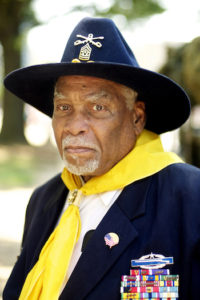
Buffalo-soldiers-three-guys-20171201_150356-800x445
Living Historians of the Pennington-Moye VFW Post 9251, Rochester NY

During WW1, General Pershing bowed to the segregationist policies of President Woodrow Wilson and Secretary of War Newton Baker.  It seems Pershing understood what the Connecticut academic and the Ohio politician had failed to learn.  A principle enunciated by the Reverend Martin Luther King Jr., some fifty years later:

“We must learn to live together as brothers or perish together as fools”.

January 12, 1968 An Air Combat First

Twenty-eight ton, four-engine bombers were never meant for diving attacks and multiple-G banking turns.

To the extent that most of us think about aerial combat, at least the non-pilots among us, I think we envision some variation of the dog fights between Snoopy and the Red Baron. Two aircraft, bobbing and weaving through the sky.  Like bantamweight boxers, each attempting to strike the winning blow.

The Snoopy story is fun but in the real world, Manfred von Richthofen was killed by a single bullet from the ground, while pursuing a Canadian pilot behind Allied lines.  The Red Baron landed his red Fokker tri-plane in a beet field and died mere moments later. He was buried with full military honors.  By his enemies.

Manfred-von-Richthofen-The-Red-Baron
Manfred von Richtofen

Possibly the strangest dogfight of WWII took place on August 17, 1943, between two German long-range “Condor” maritime patrol bombers, and an American B-24D Liberator bomber modified to hunt submarines, in the skies over the Atlantic Ocean.

Twenty-eight ton, four-engine bombers were never meant for diving attacks and multiple-G banking turns, but these three entered a full-on dogfight.

02b_am2015_milcoll_xviii_maxwell_5_live-ct.jpgStripped of armor to increase range and carrying a full load of depth charges, the American anti-submarine bomber with its 10-man crew dove out of the clouds at 1,000 feet, throttles open and machine guns ablaze. The first Condor never came out of that diving turn, while machine gun fire from the second tore into the American bomber, shredding hydraulic systems and setting the right wing ablaze.

Rear-gunners returned fire as crew members frantically jettisoned depth charges.  With engines #3 and 4 dead, Liberator pilot Hugh Maxwell Jr. kicked in full right rudder, throwing the massive aircraft into a skid and crash landing in the water, the aircraft breaking into three pieces.02d_am2015_b24_flak_live.jpgMaxwell had dubbed his B-24 “The Ark”, explaining that “it had a lot of strange animals aboard, and I hoped it would bring us through the deluge”. It must have worked.  Seven out of ten crew members lived to be plucked from the water. The second Condor made it back to Bordeaux, where it crashed and burned on landing.

Surviving Liberator crew members were rescued by the British destroyer Highlander, along with three Germans from that first Condor. It was all the Highlander crew could do to keep the soaking wet combatants from resuming the fight, on the decks of the destroyer.

The “Brass” got into the action in November 1942, when general Eisenhower and a high ranking entourage left London destined for Gibraltar in a fleet of 6 converted B-17 Flying Fortress bombers. Five made the crossing without incident but one turned back due to mechanical problems.  Sure enough, the lone American bomber was lumbering overhead the following day when set upon by a flight of four German long-range fighters.c01d0637794c357f99670b25d4224b7f.jpgWith crew reduced to a minimum it was one-star General Jimmy Doolittle (yeah, That Jimmy Doolittle), who took the stick from a wounded pilot.  A Colonel, a Major and two senior civilian officials pitched in while one-star general Lyman Lemnitzer manned a machine gun, holding the fighters at bay.

The German squadron peeled off, probably low on fuel.  The B-17 made it with what must have been the most senior combat team, in aviation history.

The final air-to-air combat of WW2 took place on April 12 1945, between unarmed spotter aircraft. Two Americans were flying low near Berlin when the pair spotted a German Fieseler Storch spotter aircraft, even lower. Having the better air position the Americans opened fire with service pistols. As the Storch attempted to escape, the aircraft brushed a wing on the ground, and it was over.

Duel-in-the-Sun.jpg
Last air-to-air combat of WW2

On the first night of the Gulf War in 1991, a single Iraqi Mirage fighter intercepted an American EF-111, an unarmed F-111 bomber modified for radar-jamming patrol. Flying at 200′ and equipped with sophisticated terrain-following radar, the bomber was able to climb up and over hilltops while the French-made Mirage fighter had no such systems.

The last anyone saw of that Iraqi fighter, was when he plowed into that hillside.

33d47fd2fa54f4be18ca783dc2054998.jpg
Low Level, terrain-following radar

Later in the same conflict, an Iraqi Hughes 500 helicopter was taken out by bombs dropped from an American Air Force F-15E bomber. At least one Iraqi PC-7 Turboprop pilot got so spooked he bailed out of a perfectly good aircraft, before a single shot was fired in his direction.

The strangest dogfight in history took place on January 12, 1968, when four Soviet-made Antonov AN-2 Colt biplanes took off from a base in North Vietnam headed west toward Laos.

Only 125 nautical miles from Hanoi, Phou Pha Thi mountain was long used as a staging base for CIA directed Hmong guerrilla fighters and Thai security forces. Lima Site 85 was the American radar facility, perched atop the 5,800-foot massif.

th1.jpg
Lima site 85, atop 5,800 Phou Pha Thi Mountain

CIA-operated “Air America” captain Ted Moore was flying a UH-1D Huey helicopter at the time, carrying a load of ammunition to Phou Pha Thi. Moore arrived to see two North Vietnamese biplanes, dropping 122mm mortar shells through holes in the floor and strafing the mountaintop with 57mm rockets. “It looked like WWI,” he later recalled. Moore gave chase, positioning his helicopter above one biplane, as flight mechanic Glenn Woods fired an AK-47 from above.

Moore and Woods dropped back to the second biplane, as the first crashed into a ridge west of the North Vietnamese border. Moments later, the second crashed into a mountainside, as the other two slipped back into North Vietnamese air space. The entire contact was over in less than 20 minutes.

Theirs was a secret war, waged in the mists of the Annamite Mountains. Two months later, North Vietnamese commandos attacked and destroyed Site 85, inflicting the largest loss of US Air Force personnel of the war in Vietnam.

1000607120-The-Waiting-War_02
Ann Holland holds a 2017 calendar — “Secret Ops of the CIA” — that represents the place where her husband’s unit was overrun in 1968 during the Vietnam War. Mel Holland was on a mountaintop radar station that guided B-52 bombers toward targets in North Vietnam. (Amanda Cowan/The Columbian)

On July 27, 2007, Air America veterans Marius Burke and Boyd Mesecher presented the CIA with “An Air Combat First”, an oil on canvas painting by Keith Woodcock, depicting the shoot-down. The event was attended by members of the Air America Board, pilot Ted Moore, wife of flight mechanic Glenn Woods Sawang Reed, CIA paramilitary veteran Bill Lair; and the painting’s donors. Presumably, the painting hangs at CIA Headquarters in Langley, Virginia. A testament to the only time in the history of the Vietnam war, that an enemy fixed-wing aircraft was shot down, by a helicopter.

7415429298_aabd85f3c9_b.jpg
An Air combat First.  H/T artist Keith Woodcock

January 11, 1935 Amelia

“The woman who can create her own job is the woman who will win fame and fortune”. – Amelia Earhart

Amelia Earhart was born July 24, 1897 in Atchison, Kansas, the first surviving child of Samuel “Edwin” and Amelia “Amy” Otis Earhart. Amy didn’t believe in raising “nice little girls”, she allowed “Meeley” and her younger sister “Pidge” to live an outdoor, rough and tumble “tomboy” kind of childhood.

AmeliachildEd seems to have had life-long problems with alcohol, often resulting in an inability to provide for his family. Amelia must have been a disciplined student despite it all, as she graduated with her high school class, on time, notwithstanding having attended six different schools.

Earhart was certainly independent, saying later in life “The woman who can create her own job is the woman who will win fame and fortune”.

Amelia and her sister saw their first airplane in 1908, at the Iowa State Fair in Des Moines. It was a rickety old biplane in which Edwin was trying to interest them in a ride.   Earhart later described that biplane as “a thing of rusty wire and wood and not at all interesting.”  At the time, the girls preferred the merry-go-round.

earhart-98-e1544117412522.jpgMeeley and Pidge worked as nurse’s aids in Toronto, in 1919.  There she met several wounded aviators and developed a strong admiration for these people.  Amelia would spend much of her free time watching the Royal Flying Corps practice at a nearby airfield.

Around that time, Earhart and a friend were visiting an air show in Toronto, when one of the pilots thought it would be funny to dive at the two women. “I am sure he said to himself, ‘Watch me make them scamper,’” she said, but Earhart held her ground.  “I did not understand it at the time, but I believe that little red airplane said something to me as it swished by.”

A ten-minute ride at a Long Beach California air show in 1920 changed her life.  From that time on, Amelia Earhart knew she wanted to fly.

Earhart worked at a variety of jobs from photographer to truck driver, earning money to take flying lessons from pioneer female aviator Anita “Neta” Snook.

She bought a second-hand Kinner Airster in 1921, a bright yellow biplane she called “The Canary”, flying it to 14,000’ the following year, a world altitude record for female pilots.

Neta_amelia_kinner_airster_s
Neta Snook, Amelia Earhart, 1921

Short funds grounded her for a time, by 1927 she was flying out of the Dennison Airport in Quincy, Massachusetts.  Earhart invested in the airport and worked as a salesman for Kinner airplanes in the Boston area while writing about flying in the local newspaper.

Charles Lindbergh’s New York to Paris Flight on May 20-21 of that year was the first solo, non-stop transatlantic crossing by airplane. Aviatrix Amy Phipps Guest wanted to be the first woman to make the flight, but later decided it was too dangerous. Instead she would sponsor the trip, provided that “another girl with the right image” was found.

“Lady Lindy”, Earhart became that first woman on May 21, 1932, five years to the day after Lindbergh.

Amelia_Earhart_standing_under_nose_of_her_Lockheed_Model_10-E_Electra,_small

On this day in 1935, Amelia Earhart became the first person of either sex to fly solo from Hawaii to California.

Two years later, Earhart and copilot/navigator Frederick J. Noonan attempted to fly around the world. The US Coast Guard cutter Itasca picked up radio messages that the aircraft was lost and low on fuel on July 2, 1937, and then it vanished.

The $4 million search and rescue effort covered 150,000 square miles and lasted for sixteen days, but to no avail.

amelialostphotosFollowing the end of the official search, Earhart’s husband and promoter George Palmer Putnam financed private searches of the Phoenix Islands, Christmas (Kiritimati) Island, Fanning (Tabuaeran) Island, the Gilbert and the Marshall Islands, but no trace of the aircraft or its occupants was ever found.

Earhart was declared dead in absentia on January 5, 1939 at the age of 41, Noonan on June 20, 1938.  He was 44.

For years, the prevailing theory was that Earhart’s Lockheed Model 10 Electra ran out of gas and plunged into the ocean.

Earhart-electra_10
“Amelia Earhart’s Lockheed Electra 10E. During its modification, the aircraft had most of the cabin windows blanked out and had specially fitted fuselage fuel tanks. The round RDF loop antenna can be seen above the cockpit. This image was taken at Luke Field on March 20, 1937; the plane would crash later that morning”.

The International Group for Historic Aircraft Recovery (TIGHAR) has been exploring a 1½ mile long, uninhabited tropical atoll once called Gardner Island, now Nikumaroro, in the southwestern Pacific Republic of Kiribati. After eleven visits to the atoll, TIGHAR sonar images revealed a straight, unbroken anomaly under the sand, remarkably consistent with the fuselage of a Lockheed Electra.

The traces of a long-dead campfire were discovered in 1940, along with animal bones, a box from a sextant, and thirteen human bones.  A doctor judged them to have belonged to a male and American authorities were never notified.

Those bones were subsequently lost, but computerized re-evaluation of their measurements suggest that the skeleton was probably that of a white female of European ethnicity, standing roughly the same 5’8″ as Amelia Earhart.

A specially trained team of four border collies was brought to Nikumaroro to search for bones in June 2017.  Thus far, the answer to one of the great mysteries of the 20th century, remains elusive.

Nikumaroro is no tropical island paradise.  There is no fresh water and daytime temperatures exceed 100°F in July. The island’s only inhabitants are Birgus latro, commonly known as the coconut crab, The largest land-dwelling arthropod in the world, specimens weigh up to 9-pounds and measure over 3′ from leg tip to leg tip.

Gifted with a keen sense of smell, the adult coconut crab feeds on fruits, nuts, seeds, and the pith of fallen trees but will eat carrion or just about anything else if given the opportunity.  Virtually any food source left unattended will be investigated and carried away, giving rise to the alternative name “Robber crab.”

It’s anyone’s guess how those two aviators spent the last hours of their lives, or who it was who lit that fire or left those bones. Looking at the size of the island’s only inhabitants, it’s not difficult to imagine why there were only 13.

January 10, 1927 You Will Respect my Authoritah!

“Oh no! Nothing’s worse than Cartman with Authoritah.” ~ Stan Marsh

A French proverb comes down to us from 1742, attributed to one François de Charette: “On ne fait pas d’omelette sans casser des oeufs”. You can’t make an omelette without breaking eggs.

Irish playwright George Bernard Shaw was a big fan of socialism in his day and an enthusiastic supporter of the gulags, of Josef Stalin.“[The] unfortunate Commissar” he wrote, must shoot his own workers “so that he might the more impressively ask the rest of the staff whether they yet grasped the fact that orders are meant to be executed.”. 

Yikes

Connoisseurs of the animated series South Park will remember the Prime Directive of Mr. Garrison’s favorite third grader, Eric Cartman.  “You will respect my authoritah“!

All well and good for a cartoon.  Few would have guessed the real-world Federal Government would poison its own citizens, to enforce its own authoritah.

The Eighteenth Amendment establishing national prohibition of intoxicating liquors was passed out of Congress on December 17, 1917 and sent to the states, for ratification. The  “Volstead” act, so named for Chairman of the House Judiciary Committee Andrew Volstead, was enacted to carry out the will of congress.

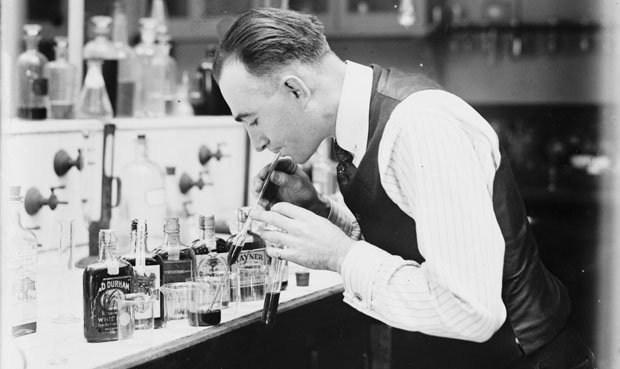
At last ratified in January 1919, “Prohibition” went into effect at midnight, January 16, 1920. For thirteen years it was illegal to import, export, transport or sell intoxicating liquor, wine or beer in the United States.Prohibition-midnight-e1568752688531-1024x511 (1).jpg“Industrial alcohol” such as solvents, polishes and fuels were “denatured” and rendered distasteful by the addition of dyes and chemicals.  The problem was, it wasn’t long before bootleggers figured out how to “renature” the stuff.
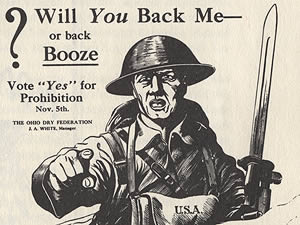
The Treasury Department, in charge of enforcement at that time, estimated that over 60 million gallons of industrial alcohol were stolen during Prohibition.

war-propaganda
War-propaganda

Not to be defied, the federal government upped the ante.  The Parasite Leviathan, would not be defied.

By the end of 1926, denaturing processes were reformulated with the introduction of known poisons such as kerosene, gasoline, iodine, zinc, nicotine, formaldehyde, chloroform, camphor, quinine and acetone.

Treasury officials went so far as to impose a requirement of no less than 10% by volume of methanol, a virulent toxin used in anti-freeze.

You will respect my authoritah.

You can renature this stuff ’til the cows come home.  It will kill you.

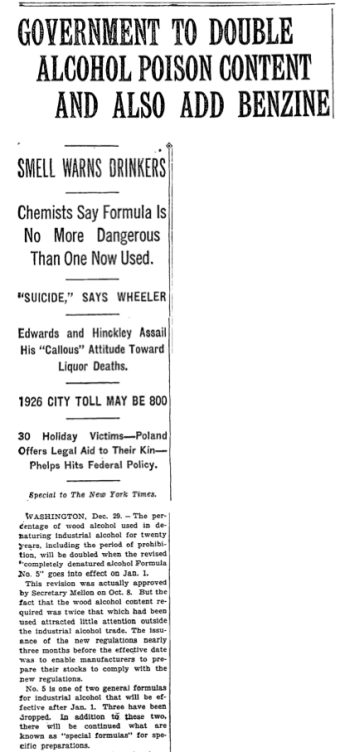
Sixty people wound up at New York’s Bellevue Hospital on Christmas eve 1926, desperately ill from contaminated alcohol.  Eight of them died.  Within two days, the death toll stood at thirty-one.  The number soared to 400 by New Year’s Day , with no end in sight.

copper-still
A copper still and bucket, like those used in the creation and renaturing of alcohol at home. H’T allthatsinteresting.com, and Chicago History Museum/Getty Images

Many who didn’t die, probably wished it. Holiday revelers experienced hallucinations, uncontrollable vomiting, even blindness.

TIME Magazine reported a doubling in toxicity levels in the January 10, 1927 issue, compared with the old method:  “The new formula included “4 parts methanol (wood alcohol), 2.25 parts pyridine bases, 0.5 parts benzene to 100 parts ethyl alcohol”. TIME noted, “Three ordinary drinks of this may cause blindness. (In case you didn’t guess, “blind drink” isn’t just a figure of speech).”

To paraphrase Wikipedia, Pyridine is a highly flammable chemical structurally related to benzene, with the unpleasant smell of dead fish.

New York medical examiner Charles Norris was quick to understand the problem and organized a press conference to warn of the danger. “The government knows it is not stopping drinking by putting poison in alcohol.  Yet it continues its poisoning processes, heedless of the fact that people determined to drink are daily absorbing that poison. Knowing this to be true, the United States government must be charged with the moral responsibility for the deaths that poisoned liquor causes, although it cannot be held legally responsible.”

Norris pointed out that the poorest people of the city, were most likely to be victims: “Those who cannot afford expensive protection and deal in low-grade stuff”.

The towering sanctimony of the other side, is hard to believe.  Teetotalers argued the dead had “brought it on themselves”.  Long-time leader of the anti-saloon league Wayne Wheeler proclaimed “The Government is under no obligation to furnish the people with alcohol that is drinkable when the Constitution prohibits it. The person who drinks this industrial alcohol is a deliberate suicide.”

You will respect my Authoritah.

prohibition_2

In its thirteen years of existence, Prohibition was an unmitigated disaster.  Portable stills went on sale within a week of enactment and organized smuggling was quick to follow. California grape growers increased acreage by over 700% over the first five years, selling dry blocks of grapes as “bricks of Rhine” or “blocks of Port”. The mayor of New York City himself sent instructions to his constituents, on how to make wine.

Smuggling operations became widespread as cars were souped up to outrun “the law”. This lead in time to competitive car racing, beginning on the streets and back roads and later moving to dedicated race tracks. It’s why we have NASCAR, today.

alcohol_poison_passed

Organized crime muscled up to become vastly more powerful, due to the influx of enormous sums of cash. The corruption of public officials was a national scandal.

Gaining convictions for breaking a law everyone hated became increasingly difficult. The first 4,000 prohibition-related arrests resulted in only six convictions and not a single jail sentence.

It’s hard to compare alcohol consumption rates before and during prohibition but, if death by cirrhosis of the liver is any indication, alcohol consumption never went down by more than 10 to 20 per cent.

In the end, even John D. Rockefeller, Jr., a lifelong teetotaler who contributed $350,000 to the Anti-Saloon League, had to announce support for repeal.

On December 5, 1933, the state of Utah triggered the magic 2/3rds requirement to ratify the Twenty-first Amendment, repealing the Eighteenth and voiding the Volstead Act, returning control over alcohol policy to the states.

Not to be defied, federal officials poisoned industrial alcohol until the very last day, resulting in the death of no fewer than 10,000 Americans.   They didn’t even pretend not to know, what was happening.

You will respect my authoritah!

Assistant Secretary of the Treasury Seymour Lowman had the last word among those who would tell you, “I’m from the government.   I’m here to help”.  If deliberately poisoned alcohol resulted in a more sober nation Lowman opined, then “a good job will have been done”.


January 3, 2000 There will Never be Another

A Charlie Brown Christmas has been a staple of the Christmas season since 1965, though Linus almost didn’t get to tell his famous story of the baby Jesus.

Charles_Schulz_HS_Yearbook.jpg
Charles Shulz, high school yearbook photo, class of 1940

Charles Monroe Schulz loved to draw.  He was good at at, too.  Already one of the brighter kids at Central High School in Saint Paul, Minnesota, Shulz skipped two half-grades graduating youngest member of his class, in 1940.  Already a shy boy, rapid academic advancement did little to help his social life.

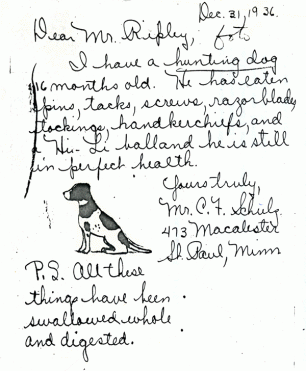
In those days, the family owned a hunting dog.  “Spike” had a number of cringe-worthy habits, including eating sharp objects. It didn’t seem to bother him much, and the boy sent a drawing to Ripley’s Believe It or Not!  The magazine ran it, complete with a description of ol’ Spike’s more unusual predilections.

The drawing was signed, “Sparky”.

Even with Schulz later celebrity, you could always weed out those who merely claimed to know the man, as opposed to those who did.  If Schutz-Letterthey called him “Charles”, or “Chuck”, that was a sure sign of the mere pretender.   Schulz’ uncle called him “Sparky” as a boy, after the horse Spark Plug in Billy DeBeck’s comic strip, Barney Google.  He always signed the strip “Schulz”, but friends and family knew him as Sparky, until the day he died.

Schulz was drafted into the Army in 1943, a Staff Sergeant with the 20th Armored Division in Europe and squad leader of a .50-caliber machine gun team.

He never got a chance to fire his weapon, though he did come face-to-face with a Wehrmacht soldier, once.  His blood must’ve turned cold in his veins when he realized he’d forgotten to load, but the man he faced was no Nazi fanatic.  This was a regular guy, who wanted to go home as much as Shulz himself.  The German surrendered, happily.  I hope he got home.

Schulz returned to Minneapolis after the war where he did some lettering for a Catholic comic magazine, Timeless Topix. He took a job in 1946 at Art Instruction, Inc., reviewing and grading lessons submitted by students, a job he held for several years while developing his talents as comic creator.

1392261715-0

Charlie Brown, that lovable little loser who was always close but never quite made it, first appeared in a series of single-panel jokes called “Li’l Folks“, along with a dog who looked something like Snoopy.  The comic was published in local papers from June 1947 to January ’50, and later syndicated.  That first strip was published in seven newspapers on October 2, 1950, but United Features thought the name was too close to two strips already in syndication:  Li’l Abner, and “Little Folks“.

So it was they called it “Peanuts” after the peanut gallery of Vaudeville days, the cheapest and rowdiest seats in the theater. Schulz didn’t like the name, saying it “made it sound too insignificant,” but the name stuck.

Schulz took pride in his service during the war.  At various times, Peanuts paid tribute to Rosie the Riveter and Ernie Pyle.  More than any other, he’d honor “Willy & Joe”, those two GIs from the imagination of war correspondent and cartoonist Bill Mauldin, a man to whom Schulz always referred as “My Hero”.  Over the years, Snoopy visited with Willie & Joe no fewer than 17 times. Always on Veterans Day.PeanutsA Charlie Brown Christmas has been a staple of the Christmas season since 1965, though Linus almost didn’t get to tell his famous story of the baby Jesus. ABC executives thought Linus’ recitation of the birth of Christ too overtly religious.  The “suits” wanted a laugh track as well, but Schulz refused. “If we don’t do it, who will?” In the end, the scene remained.  Perhaps the most memorable moment in cartoon history.  The laugh track version was produced, but never aired.Charlie Brown’s love interest in some of those TV specials, the “Little Red-Haired Girl”, was based on an accountant from that old job at Art Instruction, named Donna Mae Johnson.  The couple had an office romance for a time, but she turned him down when Shulz proposed.

Johnson wasn’t the only character based on a real person.  Linus and Shermy were patterned after Schulz’ close friends Linus Maurer and Sherman Plepler.  Peppermint Patty was inspired by a cousin on his mother’s side, Patricia Swanson.  Snoopy himself resembles that old family dog, though Spike was a Pointer, not a Beagle.

In 1967, American opinion polls showed a sharp drop in support for the war in Vietnam.  1968 was a wretched year in American politics, beginning with the Tet Offensive in January.   Media reporting turned the American military victory over the Vietnamese New Year, into a thing of despair.  President Johnson withdrew from the Presidential election, that March.  Martin Luther King, Jr. was assassinated that April leading to riots across the country.  Robert F. Kennedy was assassinated in June, after winning the critical California primary.  The Democratic National Convention that August was more of a riot, than a political convention.

Franklin_(Peanuts)
Franklin Armstrong

Race relations were particularly vile in 1968, when a Jewish Mom and Los Angeles schoolteacher wrote to the cartoonist, asking if he would add a black character.  Harriet Glickman never expected a response from the now-famous Charles M. Schulz, but respond he did.  He said he liked the idea but expressed concern the character might seem condescending, to black families.

With Schulz’ permission, Glickman asked friends of African ancestry, how to make such a character “more relatable”.

Franklin Armstrong made his first appearance on July 31, 1968.  What was remarkable for the time, was how unremarkable, he was.  Just another little boy, at first confused about the strange stuff going on in Charlie Brown’s neighborhood.  Particularly Linus’ obsession with the ‘Great Pumpkin’.  Franklin first met Charlie Brown on a beach.  He said his father was a soldier, off fighting in Vietnam.  “My dad’s a barber,” said Charlie Brown.  “He was in a war too, but I don’t know which one.”

One newspaper editor wrote saying he didn’t mind a “negro” character, but please don’t show them in school together.  Schulz didn’t bother to respond to that one.

Universal Studios Japan

Peanuts went on to become a pop culture phenomenon, with countless animated specials combining with merchandise sales to produce revenues in the Billions.  At it’s peak, Peanuts ran in 2,600 papers in 75 countries and 21 languages.  Schulz himself is estimated to have earned $30 to $40 million, a year.

I wonder if Donna Mae Johnson ever regretted turning down that marriage proposal.

Peanuts-Characters.jpg

In 1969, the command module for the Apollo 11 mission to the moon was named Charlie Brown.  The lunar module was called Snoopy.  President Ronald Reagan was a fan, who once wrote to Schulz that he identified with Charlie Brown.

Imitation of Charles Schulz cartoon, madOver fifty years, Schulz drew nearly 18,000 strips, taking vacation only once in 1997 to celebrate his 75th birthday.  In all those years, that five-week stretch was the only time the papers ever had Peanuts reruns.
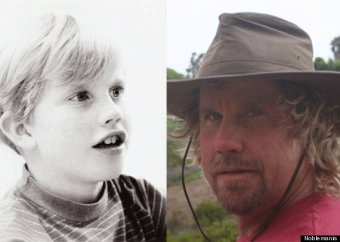
o-STEPHEN-SHEA-570
Stephen Shea, H/T Huffington Post

Fun fact: Former child actor Stephen Shea inherited the speaking role for Linus van Pelt when his older brother Chris’ voice changed, and went on to perform in eight animated specials. Chris went to summer camp with a boy who happened to be President of The Doors fan club. It turns out that Jim Morrison was a big Peanuts fan, and invited Chris and his father to be his special guests, at a Doors concert.

By the late 1990s, Schulz’ health was beginning to fail.  His once-firm hand, now had a tremor. He never really recovered from the stroke that hit him in November 1999 and announced his intention to retire, on December 14.  The last original Peanuts comic strip was published on January 3, 2000.

This son of a barber and a housewife, just like Charlie Brown himself, passed away just over a month later, a victim of colon cancer.

There will never be another.

470fb32d30dce0ef207d56ab998cf9c8--the-peanuts-peanuts-snoopy

If you enjoyed this “Today in History”, please feel free to re-blog, “like” & share on social media, so that others may find and enjoy it as well. Please click the “follow” button on the right, to receive email updates on new articles.  Thank you for your interest, in the history we all share.


Advertisements
Report this ad
Advertisements
Report this ad

January 2, 1819 Time Me, Gentlemen

Florence Nightingale explains in her Notes on Nursing, “there are many physical operations where ceteris paribus (all else being the same) the danger is in a direct ratio to the time the operation lasts; and ceteris paribus the operator’s success will be in direct ratio to his quickness”.

With the invention of gunpowder in the year 142, the Chinese of the Eastern Han Dynasty had a handy if somewhat noisy way, to scare off evil spirits.

The first millennium of the common era was a time of ever improved and more efficient ways for humans to slaughter one another, from the gunpowder slow match of 919 to the fire bombs and gunpowder propelled fire arrows of the Southern Tang, of 975.

The Wuwei Bronze Cannon of 1227 may be the first such weapon in all history.  By 1453, the terrifying bombard of the Ottoman Turks were capable of hurling stone balls up to 24.8-inches in diameter, more than enough to shatter the formerly impregnable Theodosian Walls of Constantinople.

Huge siege cannon used in the final assault
Ottoman siege cannon, 1453

For a thousand years, gunpowder weapons large and small businesses and a inflicted massive injury to the human frame, resulting in damage beyond even the skills of the modern surgeon.  Often the only answer was amputation, seemingly by the bushel basket.

sickles_lg
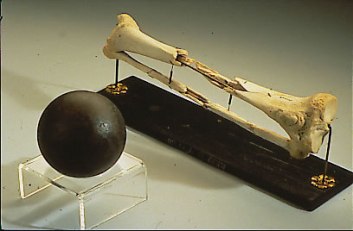
General Dan Sickles leg, destroyed by a 12-pound ball at Gettysburg, 1863

The carnage of the gunpowder era experienced something of a golden age in the 19th century.  Projectiles traveled at a bone-shatteringly slow pace compared with the high velocity weapons of today while innovations such as percussion caps, shrapnel shells and breech loading weapons geometrically increased the rate of fire.

It’s been said the most common objects removed from the bodies of front-line soldiers, were the shattered bones and teeth of the next man in line.

This was a time before anesthesia, when the speed of the surgeon’s knife spelled the difference in the pain experienced by the patient, to say nothing of the poor unfortunates’ chance of survival.  Florence Nightingale explains in her Notes on Nursing:  “there are many physical operations where ceteris paribus” (everything else being the same) “the danger is in a direct ratio to the time the operation lasts; and ceteris paribus the operator’s success will be in direct ratio to his quickness“.

listons-knives-2-1
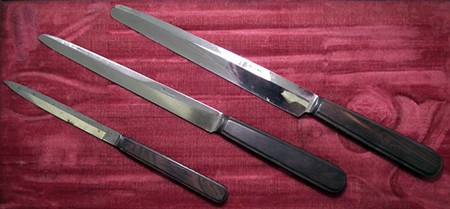
Robert Liston’s surgical instruments

First came the burly assistants, to hold down the writhing victim


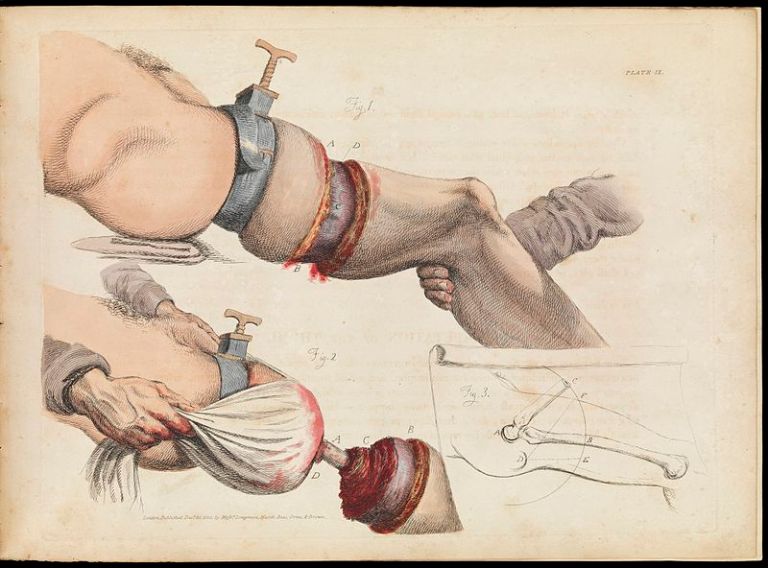
.  In skilled hands the surgeon’s knife could cut all-round in a single stroke, through skin and muscle and sinew clear down to the bone before the saw completed the work of separation.  Screams of agony rent the air as veins, flesh and arteries were cauterized with red-hot irons, vitriol (sulfuric acid) or boiling hot tar.  Should the victim survive the experience the wound would then be sewn shut.  God help the poor soul if there was any infection left after all that.

During the Franco-Prussian War of 1870 –’71, one surgeon amputated 200 shattered limbs in one 24-hour period, a nearly unbelievable average of one every seven minutes.  Perfectly healthy fingers were occasionally severed in the gore and confusion.

Plate_IX_illustration_of_leg_amputation_Sir_Charles_Bell_Wellcome_L0072192.jpg
A 19th-century surgical illustration detailing amputation at the thigh. Credit: Wellcome Library, London. H/T Military-History.org

This was the world of the “Fastest Knife on West End”, a Scottish-born physician who, on this day in 1819, had just embarked on the first year of a medical career which would last until his death, in 1847.

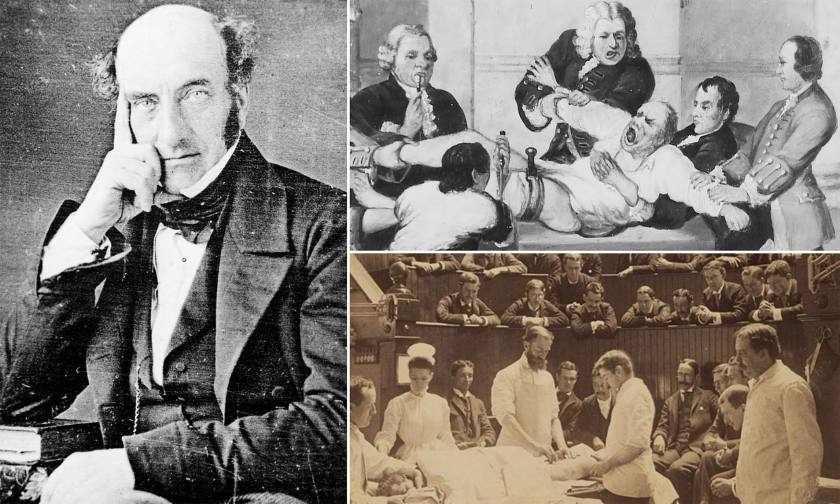
Robert Liston, always the showman, would stride into the operating theater and call out, “Time me Gentlemen.  Time me”.  English surgeon and author Richard Gordon, an expert on Robert Liston, describes what that looked like:

“He was six foot two, and operated in a bottle-green coat with wellington boots. He sprung across the blood-stained boards upon his swooning, sweating, strapped-down patient like a duelist, calling, ‘Time me gentlemen, time me!’ to students craning with pocket watches from the iron-railinged galleries. Everyone swore that the first flash of his knife was followed so swiftly by the rasp of saw on bone that sight and sound seemed simultaneous. To free both hands, he would clasp the bloody knife between his teeth”. 

16944174-0-image-a-45_1565084128752Liston once amputated a leg in 2½ minutes from incision to suture but accidentally severed the poor bastard’s testicles, in the process.

On another occasion, he amputated a leg in 2½ minutes while severing the fingers of one assistant and piercing the coat of an observer.  The spectator was so terrified at the blood and so certain that his own vital organs had been pierced, he died right then and there from heart failure.

Both patient and assistant later died from hospital gangrene, a common problem in the days before Joseph Lister.  To the best of my knowledge, Robert Liston remains the only surgeon in history to achieve 300% mortality, on a single procedure.

January 1, 45BC Happy New Year

Most of the non-Catholic world took 170 years to adopt the Gregorian calendar. Britain and its American colonies “lost” 11 days synchronizing with it in 1752. The last holdout, Greece, would formally adopt the Gregorian calendar in 1923. Since that time we’ve all gathered to celebrate New Year’s Day on the 1st of January.

From the 7th century BC, the Roman calendar attempted to follow the cycles of the moon. The method frequently fell out of phase with the change of seasons, requiring the random addition of days. The Pontifices, the Roman body charged with overseeing the calendar, made matters worse. They were known to add days to extend political terms, and to interfere with elections. Military campaigns were won or lost due to confusion over dates. By the time of Julius Caesar, things needed to change.

When Caesar went to Egypt in 48BC, he was impressed with the way the Egyptians handled their calendar. Caesar hired the Alexandrian astronomer Sosigenes to help straighten things out. The astronomer calculated that a proper year was 365¼ days, which more accurately tracked the solar, and not the lunar year. “Do like the Egyptians”, he might have said, the new “Julian” calendar going into effect in 46BC. Caesar decreed that 67 days be added that year, moving the New Year’s start from March to January 1. The first new year of the new calendar was January 1, 45BC.

Caesar synchronized his calendar with the sun by adding a day to every February, and changed the name of the seventh month from Quintilis to Julius, to honor himself. Rank hath its privileges.

Not to be outdone, Caesar’s successor changed the 8th month from Sextilis to Augustus. As we embark on the third millennium, we still have July and August.

Roman-calendar (1)

Sosigenes was close with his 365¼ day long year, but not quite there. The correct value of a solar year is 365.242199 days. By the year 1000, that 11 minute error had added seven days. To fix the problem, Pope Gregory XIII commissioned Jesuit astronomer Christopher Clavius to come up with yet another calendar. The Gregorian calendar was implemented in 1582, omitting ten days and adding a day on every fourth February.

Most of the non-Catholic world took 170 years to adopt the Gregorian calendar. Britain and its American colonies “lost” 11 days synchronizing with it in 1752. The last holdout, Greece, would formally adopt the Gregorian calendar in 1923. Since that time we’ve all gathered to celebrate New Year’s Day on the 1st of January.

The NY Times Newspaper moved into “Longacre Square” just after the turn of the 20th century. For years, New Years’ eve celebrations had been held at Trinity Church. Times owner Adolph Ochs held his first fireworks celebration on December 31, 1903, with almost 200,000 people attending the event. Four years later, Ochs wanted a bigger spectacle to draw attention to the newly renamed Times Square. He asked the newspaper’s chief electrician, Walter F. Painer for an idea. Painer suggested a time ball.

83_big.jpg

A time ball is a marine time signaling device, a large painted ball which is dropped at a predetermined rate, enabling mariners to synchronize shipboard marine chronometers for purposes of navigation. The first one was built in 1829 in Portsmouth, England, by Robert Wauchope, a Captain in the Royal Navy. Time balls were obsolete technology by the 20th century, but it fit the Times’ purposes.

The Artkraft Strauss sign company designed a 5′ wide, 700lb ball covered with incandescent bulbs. The ball was hoist up the flagpole by five men on December 31, 1907. Once it hit the roof of the building, the ball completed an electric circuit, lighting up a sign and touching off a fireworks display.

The newspaper no longer occupies the building at 1 Times Square, but the tradition continues. The ball used the last few years is 12′ wide, weighing 11,875lbs; a great sphere of 2,688 Waterford Crystal triangles, illuminated by 32,256 Philips Luxeon Rebel LED bulbs and producing more than 16 million colors. It used to be that the ball only came out for New Year. The last few years, you can see the thing, any time you like.

times-square-ball (1).jpg

In most English speaking countries, the traditional New Year’s celebration ends with the singing of “Auld Lang Syne”, a poem written by Robert Burns in 1788 and set to the tune of an old pentatonic Scots folk melody. The original verse, phonetically spelled as a Scots speaker would pronounce it, sounds something like this:

“Shid ald akwentans bee firgot, an nivir brocht ti mynd?
Shid ald akwentans bee firgot, an ald lang syn?
CHORUS
“Fir ald lang syn, ma jo, fir ald lang syn,
wil tak a cup o kyndnes yet, fir ald lang syn.
An sheerly yil bee yur pynt-staup! an sheerly al bee myn!
An will tak a cup o kyndnes yet, fir ald lang syn”.
“We twa hay rin aboot the braes, an pood the gowans fyn;
Bit weev wandert monae a weery fet, sin ald lang syn”.
CHORUS
“We twa hay pedilt in the burn, fray mornin sun til dyn;
But seas between us bred hay roard sin ald lang syn”.
CHORUS
“An thers a han, my trustee feer! an gees a han o thyn!
And we’ll tak a richt gude-willie-waucht, fir ald lang syn”

Happy New Year, from Mr & Mrs Cape Cod Curmudgeon, Rick & Sheryl.