June 10, 1944 Village of the Damned

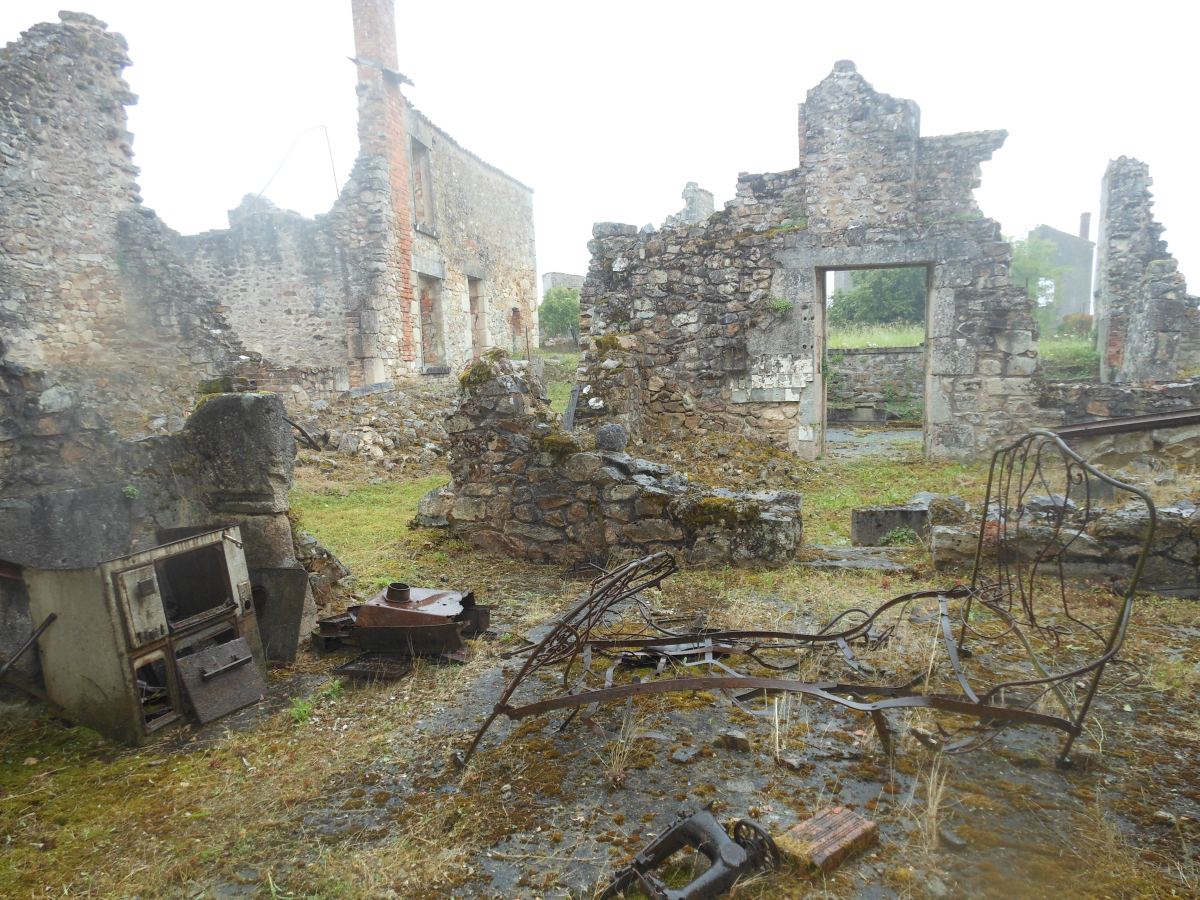
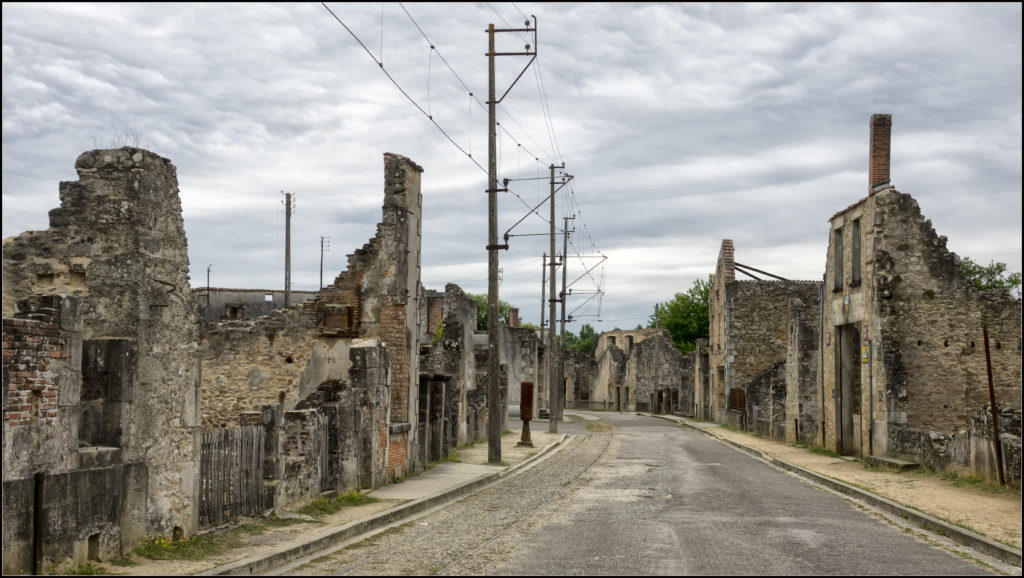
French President Jacques Chirac dedicated a memorial museum in 1999, the “Centre de la mémoire d’Oradour“. The village stands today as those Nazi soldiers left it, seventy-seven years ago today. 

It was D+4 following the invasion of Normandy, when the 2nd Panzer Division of the Waffen SS passed through the Limousin region, in west-central France.  “Das Reich” carried orders to help stop the Allied advance, when SS-Sturmbannführer Adolf Diekmann received word that SS officer Helmut Kämpfe was being held by French Resistance fighters in the village of Oradour-sur-Vayres.
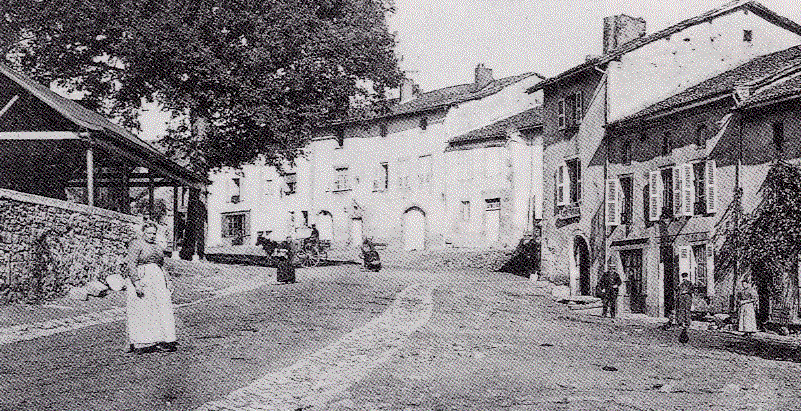
Diekmann’s battalion sealed off nearby Oradour-sur-Glane, seemingly oblivious to their own confusion between two different villages.

Everyone in the town was ordered to assemble in the village square, for examination of identity papers. The entire population was there plus another half-dozen unfortunates, caught riding bicycles in the wrong place, at the wrong time.

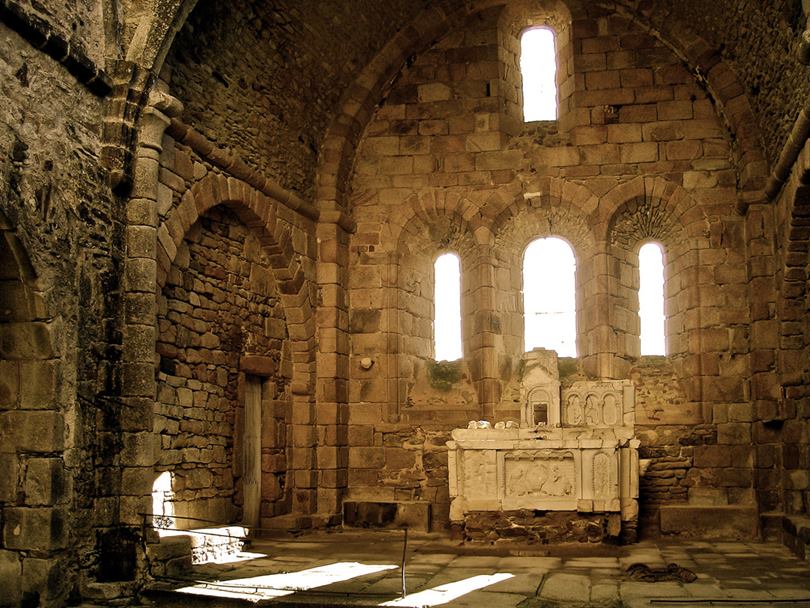
The women and children of Oradour-sur-Glane were locked in a church while German soldiers looted the town. The men were taken to a half-dozen barns and sheds where machine guns were already set up.
SS soldiers aimed for the legs when they opened fire, intending to inflict as much pain as possible. Five escaped in the confusion before Nazis lit the barn on fire. 190 men were burned alive.

Soldiers then lit an incendiary device in the church and gunned down 247 women and 205 children, as they fled for their lives.
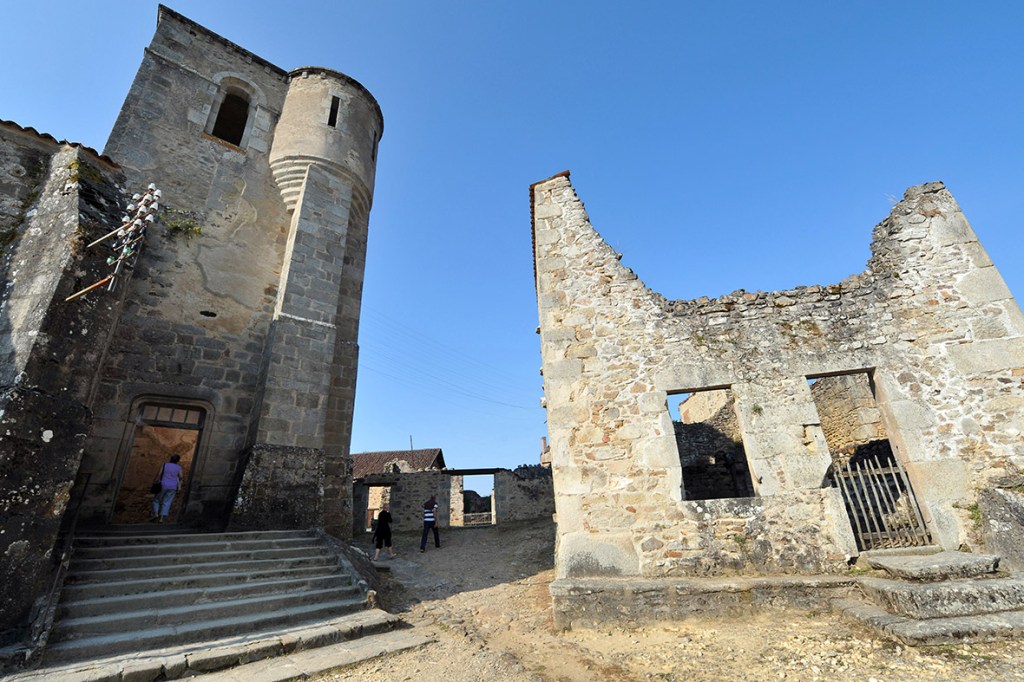
47-year-old Marguerite Rouffanche escaped out a back window, followed by a young woman and child.  All three were shot.  Rouffanche alone escaped alive, crawling to some bushes where she managed to hide, until the next morning.

Oradour-sur-Glane-Hardware

642 inhabitants of Oradour-sur-Glane, aged one week to 90 years, were shot to death, burned alive or some combination of the two, in just a few hours.  The village was then razed to the ground.
Raymond J. Murphy, a 20-year-old American B-17 navigator shot down over France and hidden by the French Resistance, reported seeing a baby. The child had been crucified.
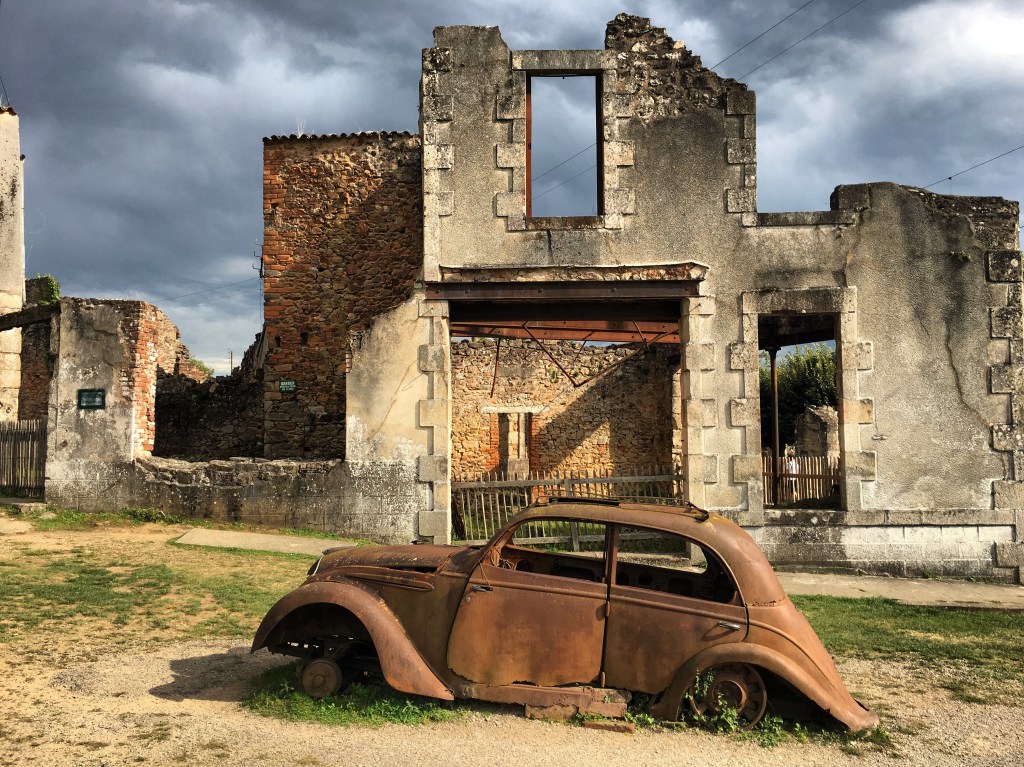
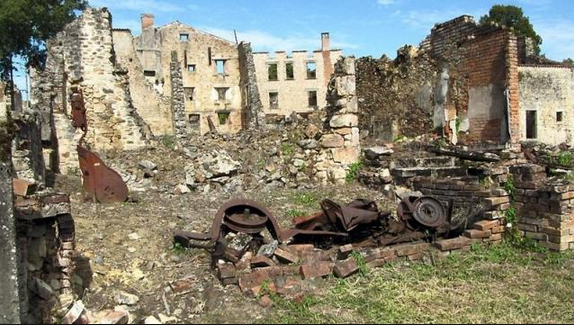
After the war, a new village was built on a nearby site.  French President Charles de Gaulle ordered that the old village remain as it stood,  a monument for all time to criminally insane governing ideologies, and the malign influence of collectivist thinking.
Generals Erwin Rommel and Walter Gleiniger, German commander in Limoges, protested the senseless act of brutality.  Even the SS Regimental commander agreed and began an investigation, but it didn’t matter.  Diekmann and most of the men who had carried out the massacre were themselves dead within the next few days, killed in combat.

The ghost village at the old Oradour-sur-Glane stands mute witness to this day, to the savagery committed by black-clad Schutzstaffel units in countless places like the French towns of Tulle, Ascq, Maillé, Robert-Espagne, and Clermont-en-Argonne; the Polish villages of Michniów, Wanaty and Krasowo-Częstki and the city of Warsaw; the Soviet village of Kortelisy; the Lithuanian village of Pirčiupiai; the Czechoslovakian villages of Ležáky and Lidice; the Greek towns of Kalavryta and Distomo; the Dutch town of Putten; the Yugoslavian towns of Kragujevac and Kraljevo and the village of Dražgoše, in what is now Slovenia; the Norwegian village of Telavåg; the Italian villages of Sant’Anna di Stazzema and Marzabotto.

And on.  And on.  And on.
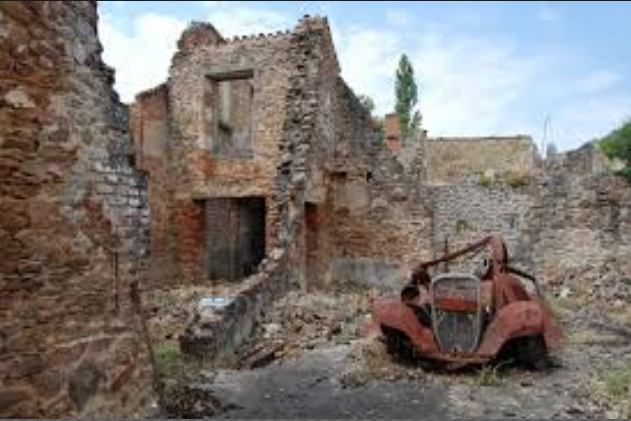
Oradour-sur-Glane.jpg 2

The story was featured on the 1974 British television series “The World at War” narrated by Sir Laurence Olivier, who intones these words for the first and final episodes of the program: 

“Down this road, on a summer day in 1944. . . The soldiers came. Nobody lives here now. They stayed only a few hours. When they had gone, the community which had lived for a thousand years. . . was dead. This is Oradour-sur-Glane, in France. The day the soldiers came, the people were gathered together. The men were taken to garages and barns, the women and children were led down this road . . . and they were driven. . . into this church. Here, they heard the firing as their men were shot. Then. . . they were killed too. A few weeks later, many of those who had done the killing were themselves dead, in battle. They never rebuilt Oradour. Its ruins are a memorial. Its martyrdom stands for thousands upon thousands of other martyrdoms in Poland, in Russia, in Burma, in China, in a World at War”.

Sir Laurence Olivier

French President Jacques Chirac dedicated a memorial museum in 1999, the “Centre de la mémoire d’Oradour“. The village stands today as those Nazi soldiers left it, seventy-seven years ago today. 

It may be the most forlorn place on earth.
June 9, 1772 The Road to Revolution

The customs schooner H.M.S. Gaspée sailed into Narragansett Bay, Rhode Island in early 1772, to aid with customs enforcement and collections. She was chasing the packet boat Hannah through shallow water on the 9th of June, when she ran aground. What followed was one of the earliest acts of rebellion, of the American Revolution.

The Seven Years’ War of 1756-’63 was in many ways a world war, experienced in the American colonies as the French and Indian War.  The cost to the British crown was staggering. Parliament wanted their colonies in America to pay for their share of it. The war had been fought for their benefit after all, had it not?

intolerable-acts

In the 1760s, several measures were taken to collect these revenues. In one 12-month period, Parliament passed the Stamp Act, the Quartering Act, and the Declaratory Act, and deputized the Royal Navy’s Sea Officers to help enforce customs laws in colonial ports.

American colonists hated these measures.  For decades now, the colonies had been left to run their own affairs.  Many of them bristled at the heavy handed measures now being taken by revenue and customs agents. In Rhode Island, the Sugar Act of 1764 was particularly egregious as the distillation of rum from molasses, was a main industry. Rhode Islanders took control of Fort George on Goat Islands and fired several cannon shots at the HMS St. John.  The Royal Navy vessel managed to escape harm as did her aggressors, with the approach of the 21-gun HMS Squirrel.

Ten years later, the first distinctly American flag in history unfurled some 27 miles up the road in in Taunton, Massachusetts. Even now the “Liberty and Union” flag proclaimed the desire for autonomy…and union. Liberty and Union but that first open act of rebellion, was already ten years in the past.

Back in 1769, colonists burned the customs ship H.M.S. Liberty in Newport harbor.  In a few short months, the “Boston Massacre” would unfold before the Custom House, on King Street.

GaspeePtaerial

The customs schooner H.M.S. Gaspée sailed into Narragansett Bay, Rhode Island in early 1772, to aid with customs enforcement and collections. On June 9 she was chasing the packet boat Hannah through shallow water when she ran aground near the modern-day Gaspée Point, near the town of Warwick.

Local Sons of Liberty met that afternoon at Sabin Tavern opposite Fenner’s Wharf, from which the daily packet ship sailed to Newport Harbor. There the co-conspirators concocted a plot. They would set fire to the Gaspée, and spent the evening hours casting bullets for the enterprise.

They rowed out to the ship at dawn the next morning. There was a brief scuffle in which Lieutenant William Dudingston was shot and wounded. The vessel was then looted, and burned to the waterline.

Earlier attacks on British shipping had been dealt with lightly, but the Crown was not going to ignore the destruction of its own military vessels. Treason charges were prepared. Planning commenced to try the perpetrators in England, but the crown was never able to make the case.  Unsurprisingly, it seems that nobody saw anything.

Lexington Reenactors

A few days later, a visiting minister in Boston, John Allen, used the Gaspée incident in a 2nd Baptist Church sermon. His sermon was printed seven times in four colonial cities, one of the most widely read pamphlets in Colonial British America.

The King’s “Tea Act” would lead to the Boston Tea Party the following year.  The blizzard of regulations that came down in 1774, the “Intolerable Acts”, would pave the way to the April Battles at  Lexington & Concord and the conflict at a place called Bunker Hill, that June.

One eighth of all the British officers to die of wounds in the American Revolution fell that day, on a nearby hill owned by Ephraim Breed. The fuse had been lit, to an American Revolution.  This flame was not to be put out, easily.

June 12, 1970 No-Hitter

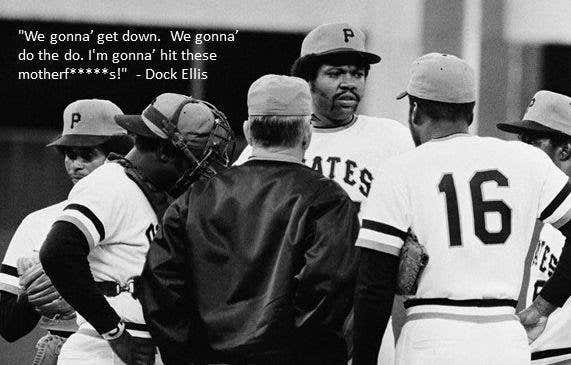
“I really didn’t see the hitters, all I could tell is if they were on the right side or the left side. The catcher had tape on his fingers to help me see signals. But I was high as a Georgia pine.”

In the sport of baseball, a “no-hitter“ is a game in which nobatter is able to get on base, in the usual manner. Players may still get on base through a walk, an error or being hit by a pitch, but not by hitting the ball.

The talent to pitch 27 or more outs without surrendering a single hit is nearly as scarce, as hen’s teeth. Nearly a quarter-million Major League games have been played in this country between 1876 and 2021. Only 311 have ended, with no-hitters.

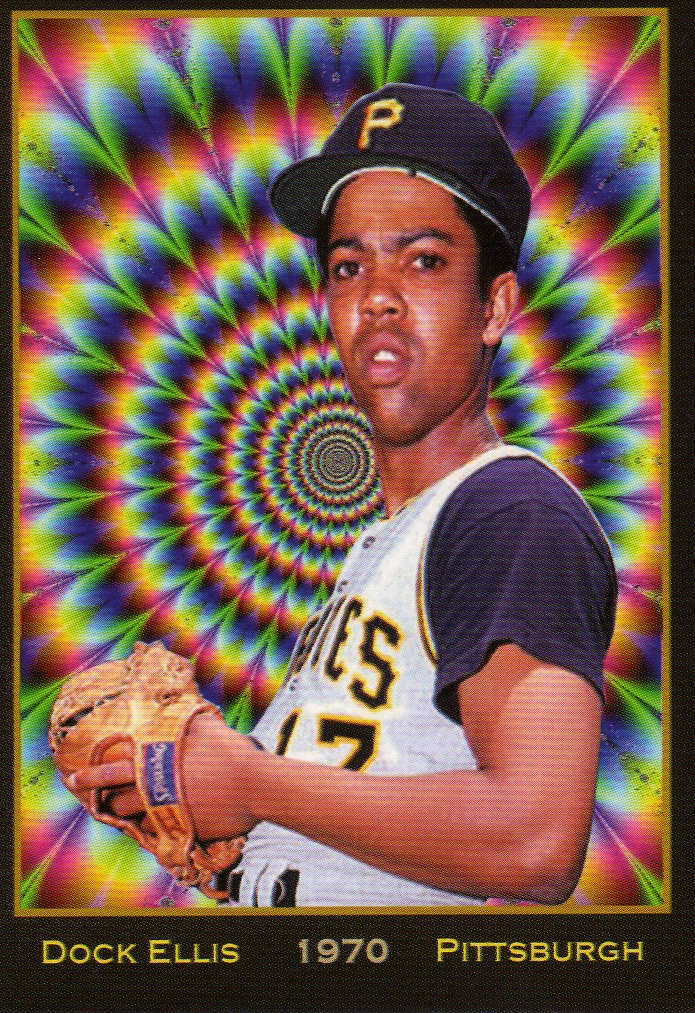
No fewer than six Major League ball clubs have recorded but a single no-hitter, in their entire existence. The number of pitchers to throw more than one, are precious few. Those who did it while tripping on acid number…precisely…one.

This is dated. Padres pitcher Joe Musgrove threw San Diego’s first no-hitter in April, this year

At his best, Pittsburg Pirates pitcher Dock Ellis was one of the best there was. Former ESPN announcer and San Diego Padres infielder, Dave “Soup” Campbell once said “I’ve always been asked who the toughest guy I ever faced was, and I always say Dock. His fastball had such great late movement, always seemed to be in one place when I’d start my swing and then move in another direction. It could sink, move in on my hands, or sail away like Mariano Rivera’s cutter.”

And then there were those times…

Baseball commissioner Bowie Kuhn repeatedly ordered the man to refrain from wearing curlers, on the field. He once burned a pre-game pitch list in the locker room and set off the sprinkler system. The man literally went ‘hunting’ Cincinnati batters one day in 1974, striking the first three men in the lineup: Pete Rose, Joe Morgan, and Dan Driessen. The next two were a little too quick dodging one head shot after another until Ellis was pulled, from the game.

Lest anyone think that was by accident, permit me to put the matter to rest. He said he’d do it, before the game. I believe Dock Ellis still holds the record for most consecutive batters, hit by a pitch.

Dock Ellis could be one of the best in the game, but never seemed to keep the focus to stay that way. Flamboyant, vocal and quick to anger, Jackie Robinson himself once praised Dock Ellis for advancing the rights of black players and criticized him, for talking too much.

And then there were the drugs. Ever mindful of his “can’t miss” status as a prospect, Ellis was never without a bit of chemical assistance. He later said he never pitched a major league game, without amphetamines.

And those were the days he was working.

June 11, 1970 was a Thursday, the day before a double header between the visiting Pirates, and the San Diego Padres. Ellis wasn’t pitching that day and drove to Los Angeles, to visit a friend.

Father Time moved on. The earth revolved on its axis and night followed day but Dock Ellis, knew none of it. “Two or three” LSD tabs took care of that. And then it was Friday. Game day. Ellis crushed another tablet and snorted the thing. Two hours later his host asked, aren’t you playing tonight? Ellis didn’t believe that it was Friday, asking “what happened to Thursday? She had to show him a sports page with the day’s date. June 12, 1970.

It was 2:00pm. He was scheduled to pitch at 6:08.

The rest of that day? Who knows. There was that frenzied trip to the airport, the flight and the pitcher’s arrival, just in time. Sometimes the ball seemed so big he later said, and sometimes, it was small. There was a plate up there or was it several, and why did it (they) keep moving? Years later he said he couldn’t see the batters, just which side of the plate they were on. Catcher Jerry May had to wear reflective tape on his fingers, so Ellis could see the signals.

At 8:18 it was over, the most unlikely no-hitter, in history. Pitching was so erratic the Padres had a man on base, in every inning.

“I started having a crazy idea in the fourth inning that Richard Nixon was the home plate umpire, and once I thought I was pitching a baseball to Jimi Hendrix, who to me was holding a guitar and swinging it over the plate. I remember diving out of the way of a ball I thought was a line drive. I jumped, but the ball wasn’t hit hard and never reached me.”

Dock Ellis

In 1993, San Francisco’s “proto-punk” singer songwriter Barbara Manning and the SF Seals, a group named after the city’s one-time minor league ball club, released what may be the first and only baseball themed EP in the history, of indie pop.

Manning’s trilogy included a cover of Les Brown’s “Joltin’ Joe DiMaggio,” the “Ballad of Denny McLain” and “Dock Ellis”, the psychedelic ballad of a Major League no-hitter, once pitched while tripping on acid.

June 4, 1629 The Secrets of Wallabi Island

Three months after the original shipwreck, rescuers would discover a horror for the ages.

During the colonial period, European powers formed joint-stock companies to carry out foreign trade and exploration, to colonize distant lands and conduct military operations against foreign adversaries.

Such organizations may be chartered for a single voyage or for an extended period of time, and were much more than what we associate with the modern “company”. These organizations could raise their own armies, enforce the law up to and including trial and execution of accused wrongdoers and largely functioned outside the control of the governments which formed them.

The Vereenigde Oostindische Compagnie (VOC), better known as the Dutch East India Company, founded in 1602, was the world’s first formally listed public company, an early multi-national corporation paving the way to the corporate-led globalization of the early modern period.

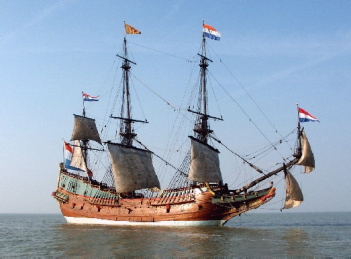
On October 27, 1628, a Dutch East India Co. merchant fleet departed the Dutch West Indies bound for the south Pacific Moluccan Islands to trade for spices. Among these vessels was the 650-ton ship Batavia, embarked on her maiden voyage.

On board were enormous stockpiles of gold and silver coinage and a complement of 341 passengers and crew, including men, women and children.

Among ship’s officers were the bankrupt pharmacist Onderkoopman (junior merchant) Jeronimus Cornelisz, in flight from the Netherlands due to his heretical religous beliefs, and skipper Ariaen Jacobsz. While underway, the two conceived a plan to mutiny, and start a new life somewhere else. All that specie in the hold would make for a very nice start.

A small group of men were recruited and a plot was hatched, to molest a ranking female member of the passenger list. The plotters hoped to provoke a harsh act of discipline against the crew, which could then be used to recruit more men to the mutineers. Lucretia Jans was assaulted as planned but, for whatever reason, Opperkoopman (senior merchant) Francisco Pelsaert never made any arrests.

bat7

Perhaps the man was ill at the time but, be that as it may, the die was cast. The conspirators now needed only the right set of circumstances, to put their plans in motion.

Jacobsz deliberately steered the ship off course and away from the rest of the fleet. He got his ‘right set of circumstances’ on the morning of June 4, 1629, when Batavia struck a reef off the west coast of Australia.

Forty people drowned before the rest could be gotten safely to shore, swimming or transferred to nearby islands in the ship’s longboat and yawl.

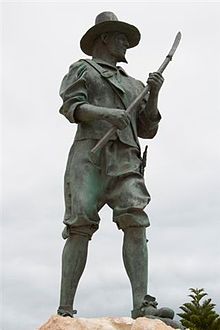
220px-Wiebbe_Hayes_Statue

With no source of fresh drinking water, the situation was dire. A group comprising Captain Jacobsz, Francisco Pelsaert, several senior officers and crew members plus a few passengers set out in a 30-foot longboat.  The group performed one of the great feats of open boat navigation in all history, arriving after 33 days at the port of Batavia in modern-day Jakarta, Indonesia.

Boatswain Jan Evertsz was arrested and executed for negligence in the wreck of the Batavia, his role in the conspiracy never suspected.

Pelsaert was immediately given command of the Sardam by Batavia’s Governor General, Jan Coen.

Pelsaert’s rescue arrived three months after the original shipwreck, to discover a horror for the ages.

Left alone in charge of the survivors, Cornelisz and several co-conspirators took control of all the weapons and food supplies, then carried out plans to eliminate potential opposition.

A group of soldiers led by Wiebbe Hayes was tricked into being moved to West Wallabi Island, under the false pretense of looking for water. Convinced there was none, Cornelisz abandoned the group on the island to die.  The psychopath and his dedicated band of followers,  were now free to murder the rest at their leisure .

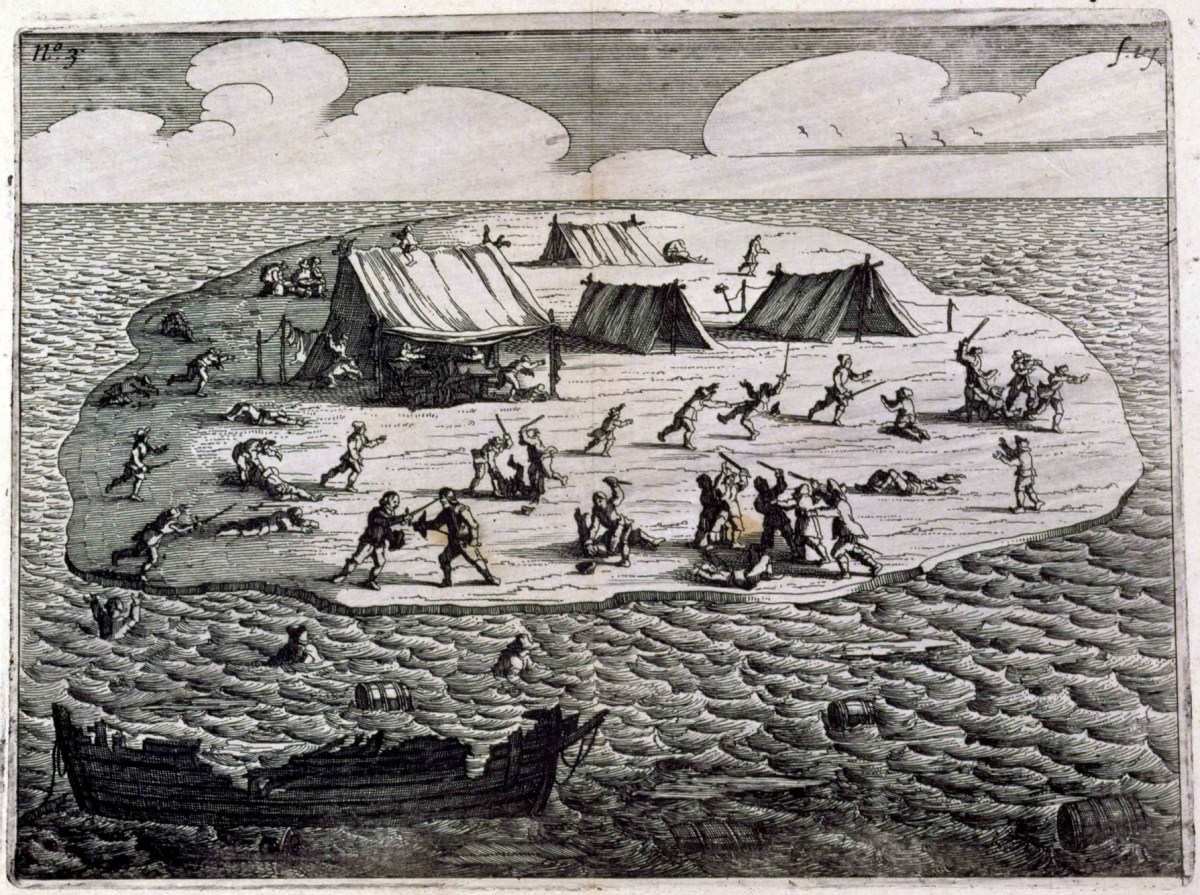
Author Mike Dash writes in Batavia’s Graveyard: The True Story of the Mad Heretic Who Led History’s Bloodiest Mutiny: “With a dedicated band of murderous young men, Cornelisz began to systematically kill anyone he believed would be a problem to his reign of terror, or a burden on their limited resources. The mutineers became intoxicated with killing, and no one could stop them. They needed only the smallest of excuses to drown, bash, strangle or stab to death any of their victims, including women and children”.

Like some neo-Mansonian psychopath, Cornelisz left the actual killing to others though he did attempt to poison one infant, who was later strangled.  No fewer than 110 men, women and children were murdered during this period.  Women left alive were confined to ‘rape tents’.

Meanwhile, Wiebbe Hayes and his soldiers found water and, unaware of the butchery taking place on Beacon island, began to send smoke signals, according to a prearranged plan.  The group would only learn of the ongoing massacre from survivors, who escaped to swim for their lives.

800px-The_Fort_-_West_Wallabi_Island_-_Colour
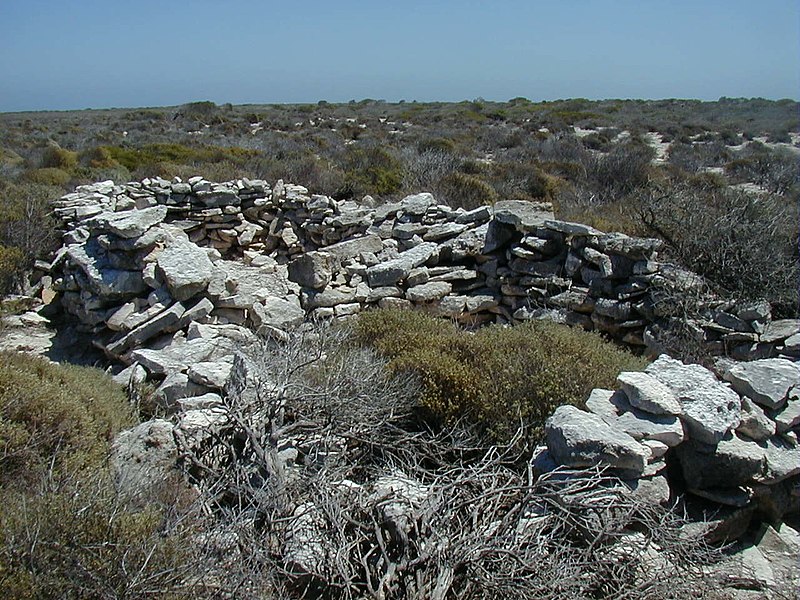
Makeshift ‘fort’ built by Wiebbe Hayes and his soldiers, on West Wallabi Island

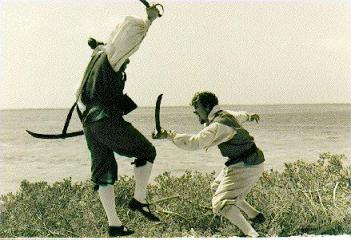
With their own supplies dwindling, Cornelisz & Co. assaulted the soldiers on West Wallabi Island, now in possession of crude handmade weapons and manning makeshift fortifications. Pitched battles ensued, pitting muskets against sticks and spears. The bad guys almost won too, but the better trained and (by this time) better fed soldiers, prevailed.

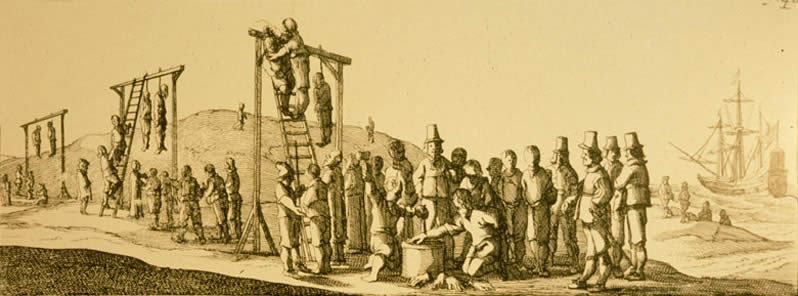
Pelsaert’s arrival triggered a furious race between Cornelisz’s men and the soldiers. Fortunately for all, Hayes won the race. A brief but furious battle ensued before Cornelisz and his company were captured. After a brief trial, Cornelisz and the worst of the conspirators were brought to Seal Island, their hands chopped off and the rest of them, hanged.

Two judged only to be minor players were brought to the Australian mainland and marooned, never to be seen again.

Image-bat-hist-04b
The hangings on Long Island as illustrated in the Lucas de Vries 1649 edition of Ongeluckige Voyagie.

The remaining conspirators were brought back to Batavia and tried. Five were hanged. Jacop Pietersz, second-in-command, was broken on the wheel, a hideous remnant of medieval justice and the worst form of execution available, at that time. Captain Jacobsz resisted days of torture and never did confess. What became of him is unknown.

Francisco Pelsaert was judged partly responsible for the disaster, due to his failure to exercise command. Senior Merchant Pelsaert’s assets were confiscated.  He would die penniless in less than a year, a broken man.

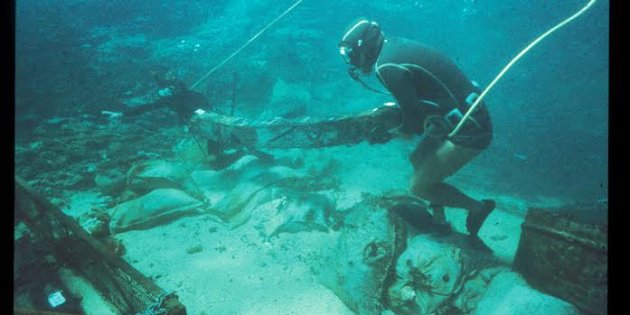
The exact number of those buried in mass graves on Beacon Island, remains unknown.  Of the 341 who departed the West Indies that day in 1628, 68 lived to tell the tale.  Archaeologists labor an land and at sea but, three centuries later, the Wallabi Islands remain jealous of their secrets

http_o.aolcdn.comhssstoragemidas922be7ce080e004b9894e39c2f52e3db204025152batavia+3
“Archaeologists recovering Batavia timbers from the wreck site”.  H/T, HuffPo for this image

May 26, 1907 Little Duke

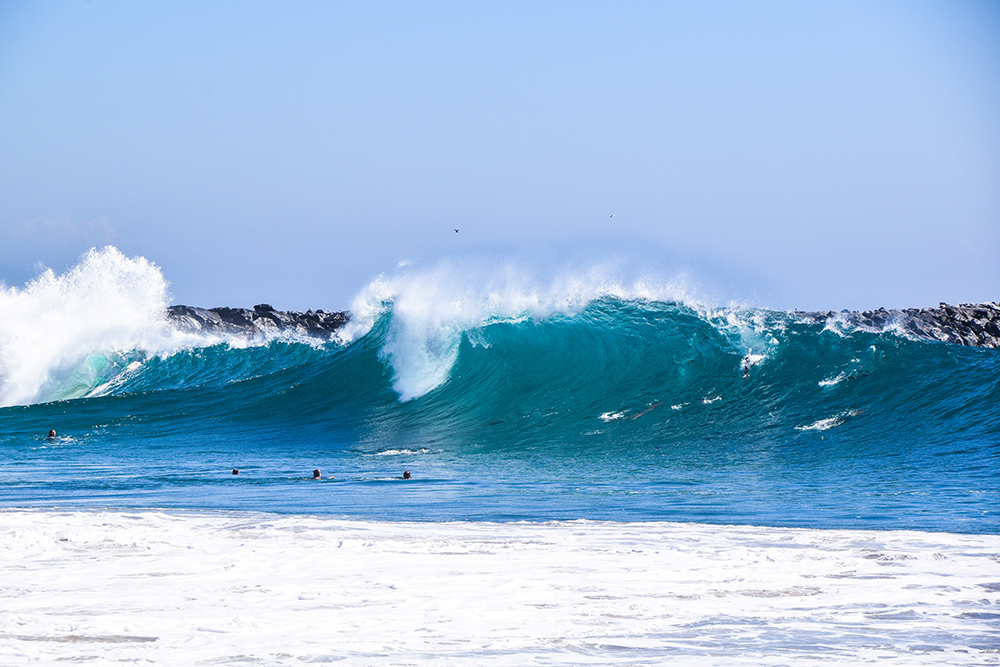
The Wedge is a spot at the end of Balboa Peninsula in southern California. Located at the east end of Newport beach the place is a surfer’s paradise and a spot anyone with any sense, would stay out of the water.

The Wedge is a spot at the end of Balboa Peninsula in southern California. Located at the east end of Newport beach the place is a surfer’s paradise and a spot anyone with any sense, would stay out of. When conditions are right, a steeply rising sandy bottom causes waves to rise to 30-feet and more. Great, curling monsters breaking onto the shore with such force the outgoing water alone creates a surf and a backwash so powerful as be a danger, to the strongest of swimmers.

Wally O’Connor was a four-time Olympiad, a competition swimmer and water polo player inducted in 1976, into the USA Water Polo Hall of Fame. Long before that, he stood at the entrance of Newport Harbor admiring The Wedge, and what may have been some of the biggest waves he had ever seen.

O’Connor turned to his friend Marion and said I’ll take the first pass. “Watch and learn”.

O’Connor stood at the crest of a wave of his own at this time, a craze that was sweeping the west coast surfing crowd. Body surfing. The man didn’t invent the sport but his strength and skill was capable of drawing crowds on the beach.

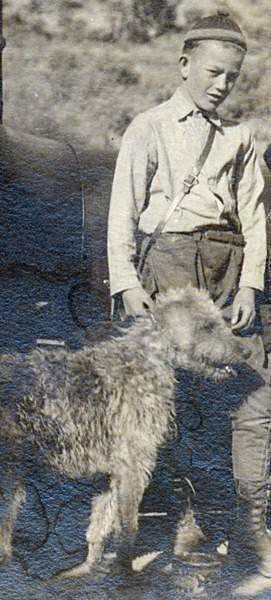
Marion hated that name. As a boy, he was rarely seen outside the company of his best buddy, a large Airedale terrier, named Duke. Local firefighters took to calling him “Little Duke” and the name stuck.

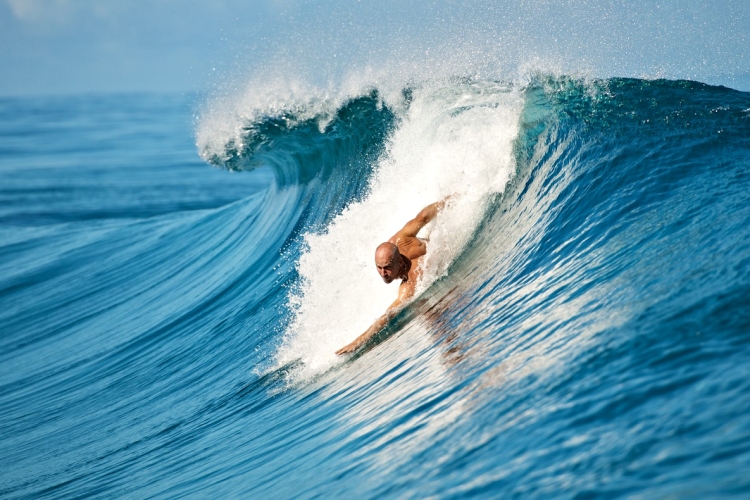
Now years later on that day at Newport Beach, Marion Mitchell lit another Camel, and watched. It was easy to see why Wally had won Olympic gold in Paris, back in 1924. Powerful strokes brought his friend out to 100 yards where, diving into the face of an oncoming wave, he sprang from the bottom to emerge at the curl of a giant breaker, not on the crest but in it, speeding to the shore like Superman with one arm out straight and the other, tucked behind.

Wally was flying, not on but of the water, his body staying just ahead of the thunderous crash that hurled him forward like a spear where he glided, grinning, onto the sand. Like a seal.

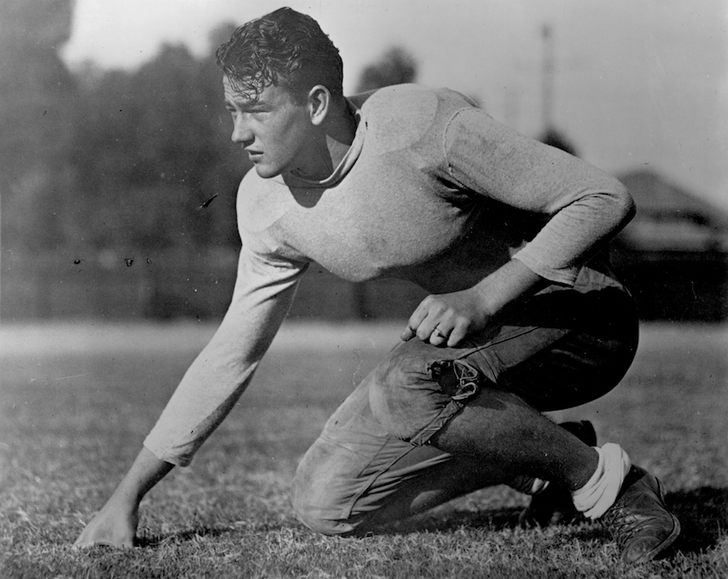
For Duke, that ride was heart pounding. Electric. An upper Midwest kid who had moved with his family to southern California where he now played football, on a scholarship to the University of Southern California. Duke was well accustomed to the adrenaline, the bone crunching action of college football but this, was something different. This looked like human flight itself and no power on earth was going to keep him from it.

Though himself powerfully built, Duke wasn’t the swimmer that Wally was. The water wasn’t his home but, there he was, strong if ungraceful strokes bringing him out to where Wally had launched that virtuoso performance.

Waiting for a wave as big as Wally’s he too dove into its towering base, springing from the bottom to emerge from the crest and, for a moment, to fly.

And that is where the similarity, ends. One must have exquisite timing to do this at this level, to be at just the right place where the thundering crash of the water hurls you forward and not down, toward the bottom.

Duke hit solid ground with the force of a car wreck. He could literally hear his collarbone break, feel the shoulder dislocate with the terrific force, of that impact.

The other thing he could almost hear was the sound of a football scholarship, crashing to an end. Of the end of USC and the promising law career that would never be.

Duke emerged alive from the water that day but not so, his future plans. With the end of that scholarship he was left no choice but to drop out. Duke left USC never to return and took a job. A prop man, at 20th Century Fox.

There, Director Raoul Walsh saw Marion moving studio furniture and thought, this guy would be better in front of the camera, than behind it.

So it is, one of the great leading male actors of the age of film, met with reporters some 35 years later, in the living room of his Encino home. He spoke with them of his lung cancer, only four days out of major surgery, though he didn’t call it that. With four ribs and a lung removed and stitches pulling loose even now he called it “The Big C”, assuring reporters it was no big deal. Soon, he’d be back in the saddle.

That he did, going on to appear in 24 feature films over the next 12 years until finally, the Big C returned. This time there would be no encore. The man who shot Liberty Valance born Marion Robert Morrison on May 26, 1907, died on June 11, 1979, at the age of 72.

So it is we remember his name, the man the LA Times once called a “$35-a-week prop department flunky” who performed in over 200 feature films, all because of a body surfing accident, in 1926.

Happy birthday, John Wayne.

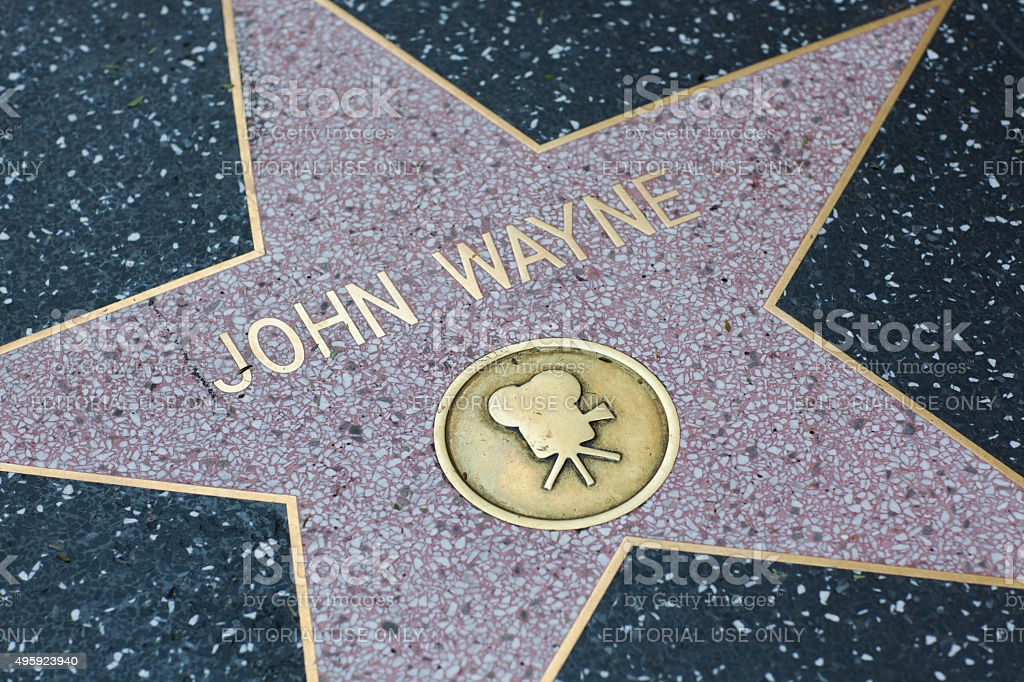
Los Angeles, USA – September 8, 2012: John Wayne memorial on the famous Hollywood Walk of Fame in Los Angeles, CA, USA.

Hat tip Mike Rowe for this story and his excellent podcast, The Way I Heard It.

May 25, 1738 Mason Dixon Line

The problem with King Charles II’s land grant to William Penn is that it overlapped with that of his father King Charles I, to Lord Baltimore.

Agree or disagree with US government policy, that’s your business, but what we do in this country, we do as a nation. It would seem absurd to us to see the President raise an army to go to war with the Congress, and yet that’s just what happened in 17th century England.

The period 1639-’51 saw a series of intertwined conflicts within and between the three kingdoms, including the Bishops’ Wars of 1639 and ’40, the Scottish Civil War of 1644–’45; the Irish Rebellion of 1641, Confederate Ireland, 1642–’49 and the Cromwellian conquest of Ireland in 1649, collectively known as the Eleven Years War or Irish Confederate Wars and finally, the first, second and third English Civil Wars.

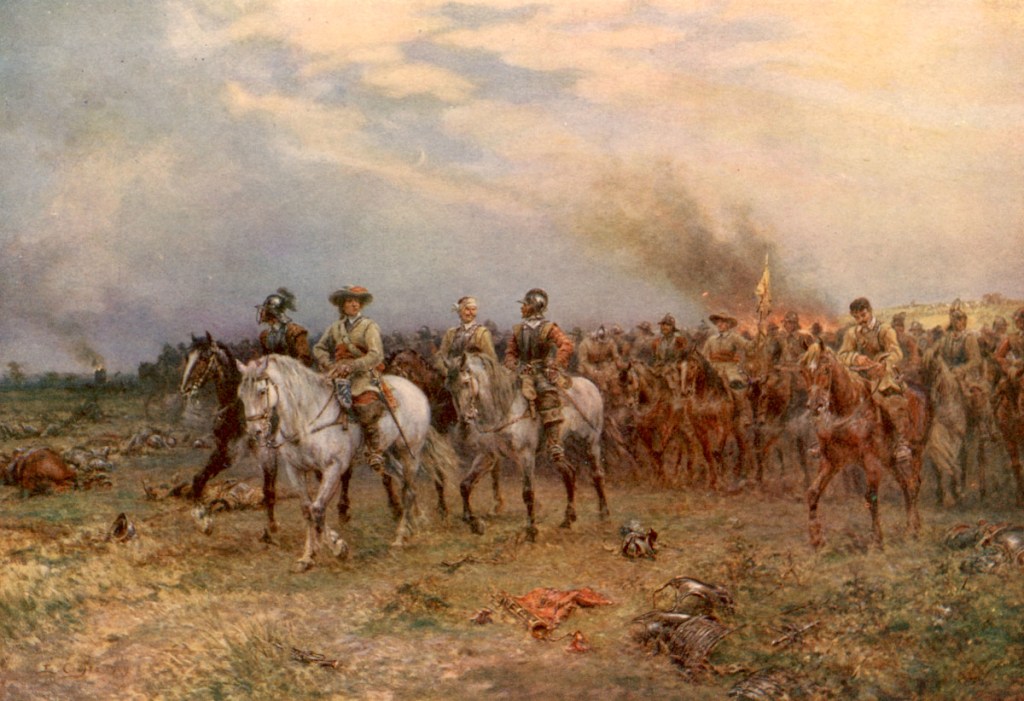
An officer in the British Royal Navy, William Penn served on the side of the Parliament during the first English Civil War of 1642-46′, a conflict which would lead to the execution of the King himself, in 1649. England and Wales came to be governed as a Commonwealth under “Lord Protector” Oliver Cromwell, later followed by Ireland and Scotland.

The experiment proved to be a failure, the interregnum lasting 11 years. In 1660, the dead King’s son was invited to rule as Charles II, King of Scotland, England and Ireland.

One might think an officer’s support of the Parliament would have cost him his head, but William Penn had a gift for landing on his feet. When he died in 1670, King Charles II owed the man money.

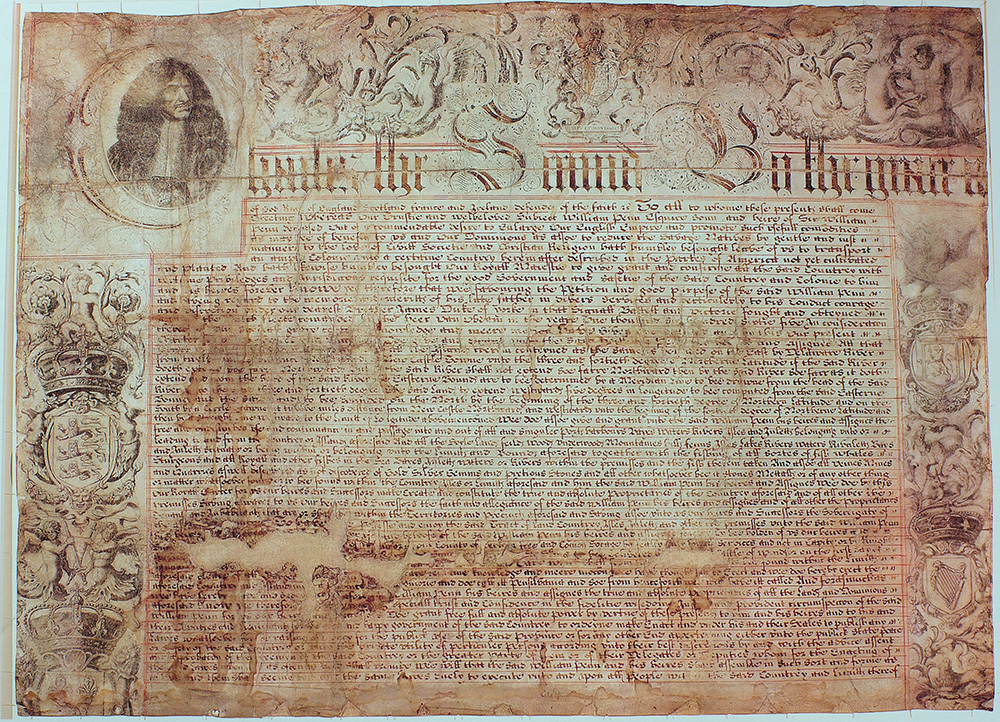
Penn’s son, also named William, was a dedicated pacifist, and a Quaker. The younger Penn had utopian ideas he wanted to try out, in the new world. Thus the Charter of 1681 came to be, granting a slice of the forested lands of North America in exchange for money, owed to Penn’s late father. That land came to be called “Penn’s Woods” or, in Latin, Pennsylvania.

It’s why so many Philadelphia streets, are named after trees.

Pennsylvania Charter of 1681, page 1 of 4.

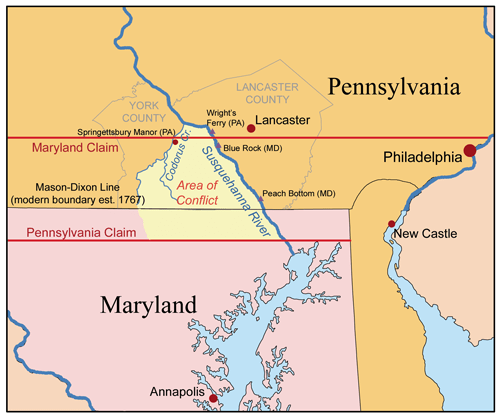
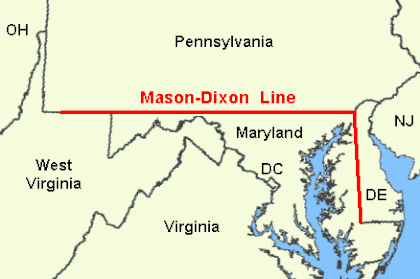
The King’s Charter specified a southern boundary for the new colony to begin at “A circle drawne at twelve miles distance from New Castle Northward and Westward unto the beginning of the fortieth degree of Northern Latitude, and then by a streight Line Westward“.

The problem comes about when you realize that 40° north latitude is north of Philadelphia. Well into territory granted to Lord Baltimore by King Charles I and controlled by Maryland and Delaware.

What is this “Pennsylvania” of which you speak?

cresapwarmap

The Maryland colony insisted on the boundary as drawn by Charles II’s Charter, while Pennsylvania proposed a boundary near 39°36′, creating a disputed zone of some 28 miles.

In 1726, Quaker minister John Wright began a ferry service across the Susquehanna River. Starting as a pair of dugout canoes, “Pennsylvania Dutch” farmers were soon settling the Conejohela Valley on the eastern border between Maryland and Pennsylvania.

cresap2

Business was good.  By 1730, Wright had applied for a ferry license. With Lord Baltimore fearing a loss of control in the area (read – taxes), Maryland resident Thomas Cresap established a second ferry service up the river. Maryland granted Cresap some 500 acres along the west bank, serenely unconcerned that much of the area was already inhabited by Pennsylvania farmers.

Cresap went to these farmers to collect “quit-rents”, an early form of property tax, for the government in Maryland. Pennsylvania authorities responded by issuing “tickets” to settlers which, while not granting immediate title, amounted to an “IOU” of title under Pennsylvania jurisdiction.

Then came the day when Cresap and his ferry worker were thrown overboard by two Pennsylvanian farmers, probably over a debt. Cresap took the matter to Pennsylvania authorities for justice. The magistrate informed the plaintiff he couldn’t expect justice in his court because he was a “liver in Maryland”. Incensed, Cresap then filed charges with Maryland authorities claiming that, as a Maryland resident, he was no longer bound by Pennsylvania law.

thomas-cresap

Cresap and his allies began to confiscate York and Lancaster county properties as early as 1734, handing them over to his supporters. Maryland militia crossed colonial borders twice in 1736, and Pennsylvania militia were quick to respond.

CLancaster county Sheriff arrived with a posse to arrest Cresap at his home, when Cresap fired through the door, mortally wounding deputy Knowles Daunt.

When Daunt died, Pennsylvania Governor Patrick Gordon demanded that Maryland arrest Cresap for murder. Samuel Ogle, Governor of Maryland, responded by naming Cresap a captain in the Maryland militia.

Cresap resumed and expanded his raids, destroying barns and shooting livestock. Sheriff Samuel Smith raised a posse to arrest him in November. When the Pennsylvanians set his cabin on fire, Cresap ran for the river. Grabbing him before he could launch a boat, Cresap shoved one of them overboard, shouting, “Cresap’s getting away!”, whereupon the other deputies proceeded to pound their colleague with oars until one of them discovered the ruse.

Cresap was taken to Lancaster, where he decked the blacksmith who had come to put him in shackles. He was finally subdued and hauled off to Philadelphia in chains, but even then the man was anything but broken. “Damn it”, he said, looking around, “this is one of the prettiest towns in Maryland!”

DSCN8422-1

Maryland authorities petitioned George II, King of Great Britain and Ireland, imploring the King to restore order among his loyal subjects. King George’s proclamation of August 18, 1737 instructed the governments of both colonies to cease hostilities.

When that failed to stop the fighting, the Crown organized direct negotiations between the two. Peace was signed in London on May 25, 1738, the agreement providing for an exchange of prisoners and a provisional boundary to be drawn fifteen miles south of the southernmost home in Philadelphia and mandating that neither Maryland nor Pennsylvania “permit or suffer any Tumults Riots or other Outragious Disorders to be committed on the Borders of their respective Provinces.”

So ended the “Conojocular War”, the bloody eight-year conflict between Philadelphia and surrounding area and sometimes referred to as “Cresap’s War”.

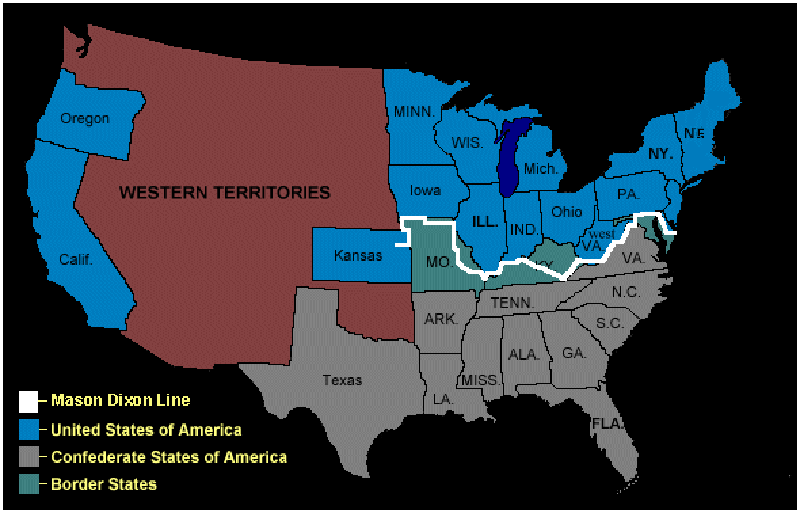
In 1767, descendants of the Penns and Calverts hired surveyors Charles Mason and Jeremiah Dixon to establish a boundary. That original line extended westward, becoming the demarcation between northern “free” states, and Southern “slave” states. The Mason-Dixon line came to renewed prominence during the Missouri Compromise period of 1820 and again, during the Civil War. The Virginia border originally made up part of the line and thus the northern boundary of the Confederacy, until West Virginia seceded to rejoin the union.

Today, the Mason-Dixon line is more of a loose separation, delineating the culture and politics of the South, from those of the North. The area of Cresap’s original conflict is now part of York County, Pennsylvania.
Afterward

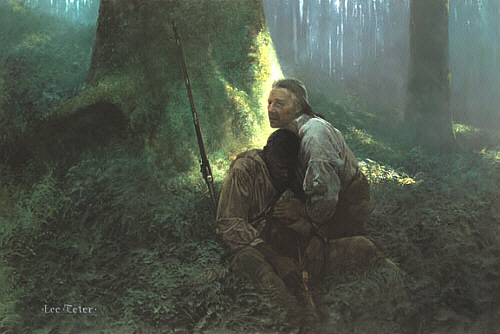
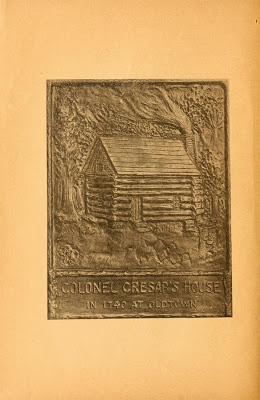
During the French & Indian Wars of the 1750s, Thomas Cresap and a party of 100 pursued an Indian war band over the modern-day Savage Mountain and onto the next ridge. Along with the party marched a free black man, a frontiersman known only as “Nemesis”. A fierce fight ensued on May 28, 1756.  Nemesis, described as “large and powerfully built”, fought bravely, but lost his life.

The painting “Shades of Death” by artist Lee Teter, depicts Colonel Thomas Cresap comforting the mortally wounded, heroic frontiersman.

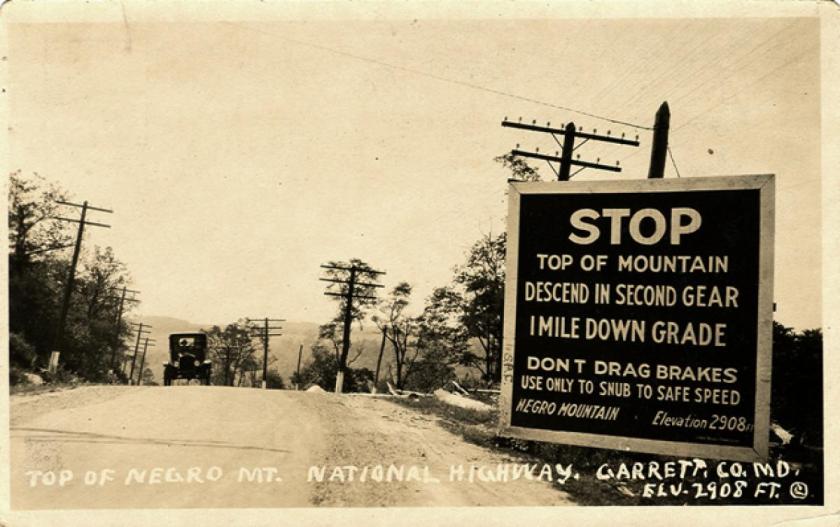
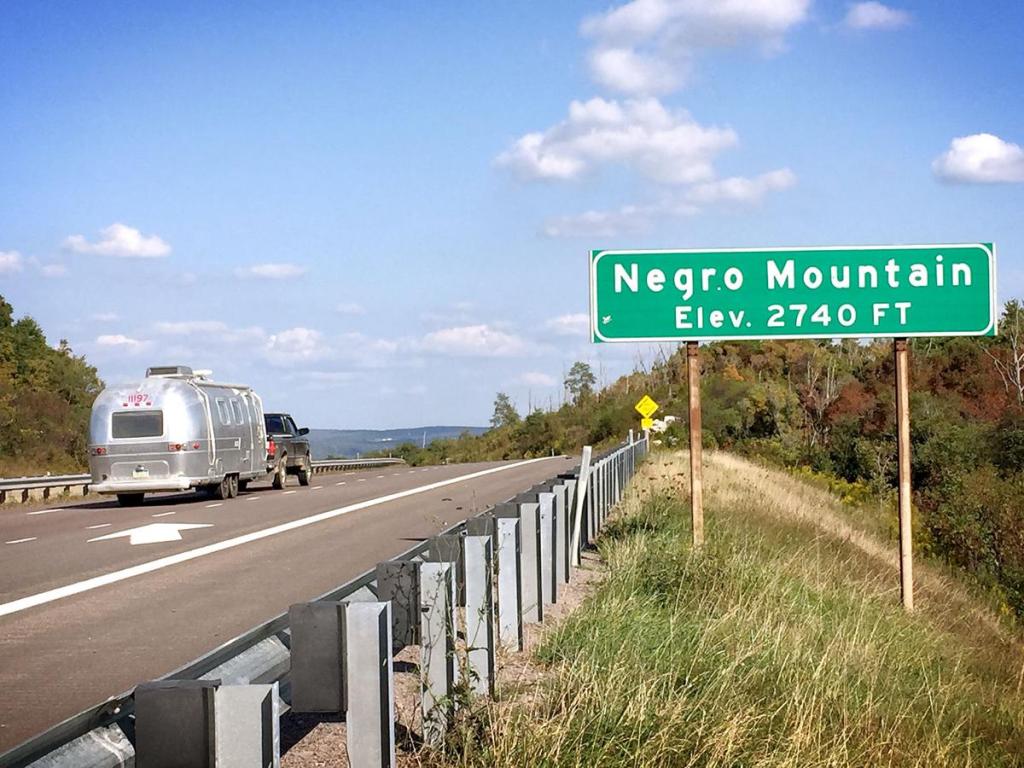
He was buried on the site, the story goes, where Cresap named the mountain in his honor. “Negro Mountain”, the long ridge of the Allegheny Mountains stretching from Deep Creek Lake in Maryland north to the Casselman River in Pennsylvania, stands to this day as his monument. 

mountain28n-1-web

Eventually, someone took offense at the name. Rosita Youngblood, a Philadelphia politician of African ancestry, said in 2007: “Through a school project, my son and granddaughter first informed me of the name of this range and I found it to be disparaging that we have one of our great works of nature named as such… I find it disheartening for tourists who visit this range to see the plaque with the name Negro Mountain displayed on the mountainside.”

Professor Christopher Bracey is a law professor and associate professor of African and African-American studies at Washington University. Bracey also descends from African ancestors. He contends that: “I must confess I have a slightly different take on it than [Youngblood]… Here we have a mountain, whose name was intended to be a testament to Negro bravery. It seems rather crass and unsophisticated to name it Negro Mountain, but the intentions were strong.”

Measures to rename Negro Mountain and Polish Mountain alike were voted down in the Maryland state senate. As of this writing, road signs have been removed by the Maryland State Highway Administration, citing concerns over “racial sensitivity”.

May 24, 1883 First Across

For 11 years she studied higher mathematics, catenary curves, materials strength and the intricacies of cable construction, all while acting as the pivot point on the largest bridge construction project on the planet and nursemaid, to a desperately sick husband.

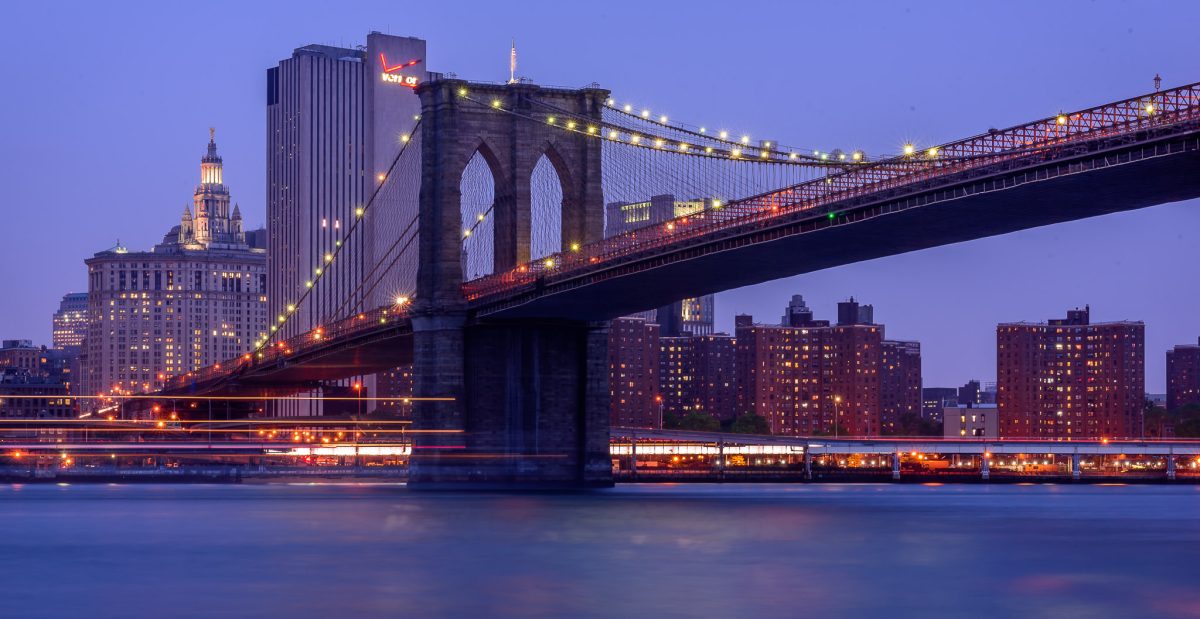
Focused as he was on surveying, the engineer should have paid more attention to his surroundings. The year was 1869. Civil engineer John Roebling had begun the site work two years ago, almost to the day. Now just a few more compass readings, across the East River. Soon, work would begin on the longest steel suspension span in the world. A bridge connecting the New York boroughs of Brooklyn and Manhattan.

Roebling was working on the pier with his 32-year old son Washington, also a civil engineer. As the ferry came alongside, the elder Roebling’s toes were caught and crushed so badly, as to require amputation.

brooklyn-bridge-caisson-granger“Lockjaw” is such a sterile term, it doesn’t begin to describe the condition known as Tetanus. In the early stages, the anaerobic bacterium Clostridium Tetani produces tetanospasmin, a neurotoxin producing mild spasms in the jaw muscles. As the disease progresses, sudden and involuntary contractions affect skeletal muscle groups, becoming so powerful that bones are literally fractured as the muscles tear themselves apart. These were the last days of John Roebling, the bridge engineer who would not live to see his most famous work.

The German-born civil engineer was the first casualty of the project.  He would not be the last.

Brooklyn Bridge Caisson Construction

Washington took over the project, beginning construction on January 3, 1870.

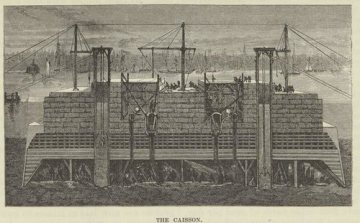
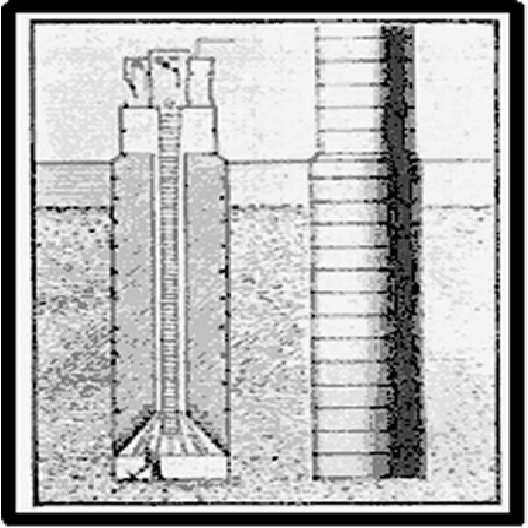
Enormous yellow pine boxes called “caissons” were built on the Brooklyn and New York sides of the river, descending at the rate of 6-inches per week in search of bedrock. Like giant diving bells, the New York side ended up at 78- feet below mean high tide, the Brooklyn side 44-feet. Pressurized air was pumped into these caissons, keeping water and mud at bay as workers excavated the bottom.

In 1872, these “sandhogs” began to experience a strange illness that came to be called “caisson disease”.

Civil War era submarine designer Julius Hermann Kroehl may have recognized what was happening, but Kroehl was five years in his grave by this time, victim of the same “fever”.

Today we call it “the bends”. Pop the top off a soda bottle and you’ll see the principle at work. Without sufficient decompression time, dissolved gasses come out of solution and the blood turns to foam. Bubbles form in or migrate to any part of the body, resulting in symptoms ranging from joint pain and skin rashes, to paralysis and death.  The younger Roebling was badly injured as a result of the bends in 1872, leaving him partially paralyzed and bedridden, incapable of supervising construction on-site.
brooklyn-anchorage

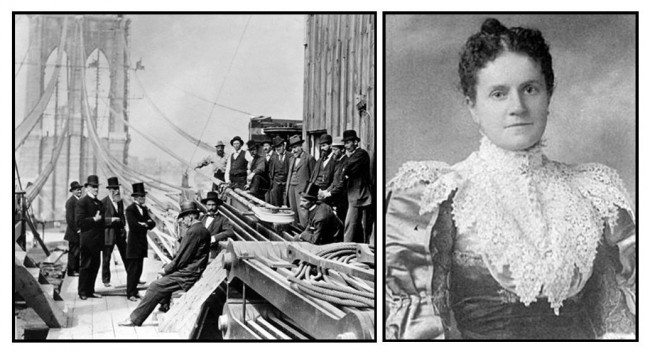
Roebling moved to an apartment in Brooklyn Heights and conducted the entire project looking out the window, designing and redesigning details while his wife, Emily Warren Roebling, became the critical connection between her husband and the job site.

To aid in the work, Emily Roebling took a crash course in bridge engineering. For 11 years she studied higher mathematics, catenary curves, materials strength and the intricacies of cable construction, all while acting as the pivot point on the largest bridge construction project on the planet and nursemaid, to a desperately sick husband.

Emily-Warren-Roebling-e1389630968571
Emily Warren Roebling, the “first woman field engineer”.

Historian David McCullough wrote in his book, The Great Bridge: The Epic Story of the Building of the Brooklyn Bridge: “By and by it was common gossip that hers was the great mind behind the great work and that this, the most monumental engineering triumph of the age, was actually the doing of a woman, which as a general proposition was taken in some quarters to be both preposterous and calamitous. In truth, she had by then a thorough grasp of the engineering involved”.

Unlikely as it sounds, fires broke out at the bottom of the river on several occasions, started by workmen’s candles, fed by the oakum used for caulking and turbocharged by all that pressurized air. On at least one occasion, the caisson was filled with millions of gallons of water, before the fire went out for good.

Brooklyn bridge builders

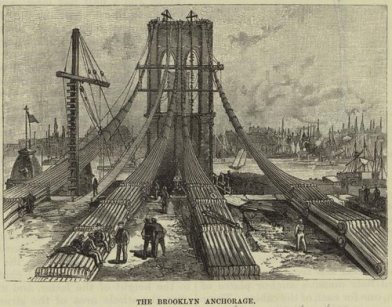
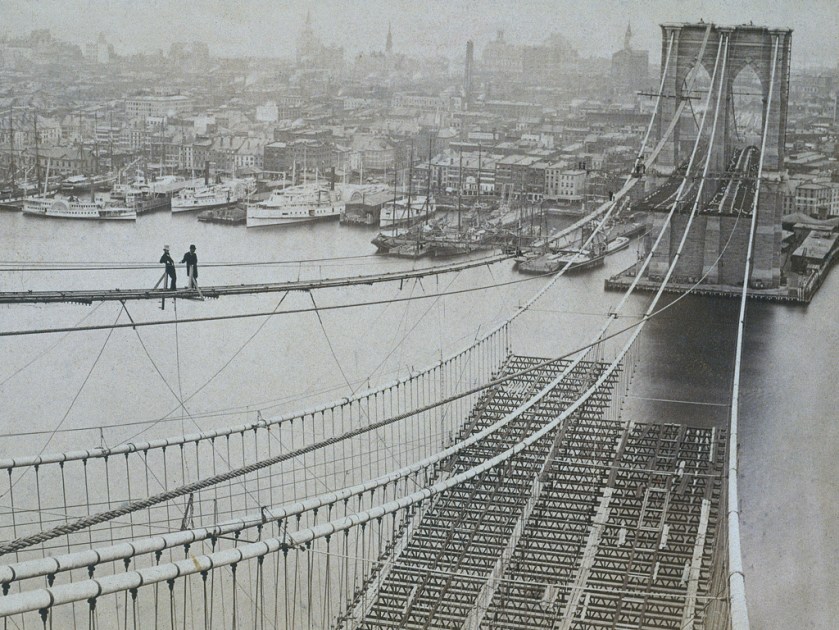
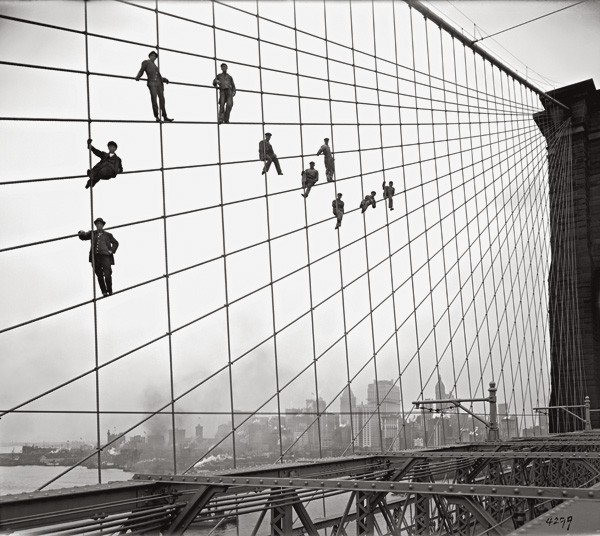
A footbridge connected the two sides in 1877, and soon the wires began to be strung. Wooden “buggies” carried men back and forth along wires suspended hundreds of feet above the water, as individual wires were woven into the four great cables that support the bridge. The work was exacting, with each wire bound together to precise specifications. Rumors about corruption and sleaze surrounded the project when J. Lloyd Haigh, the wire contractor, was discovered to be supplying inferior material. It was way too late to do anything about it, and 150 extra wires were bundled into each cable to compensate. The tactic worked.  Haigh’s shoddy wire remains there, to this day.

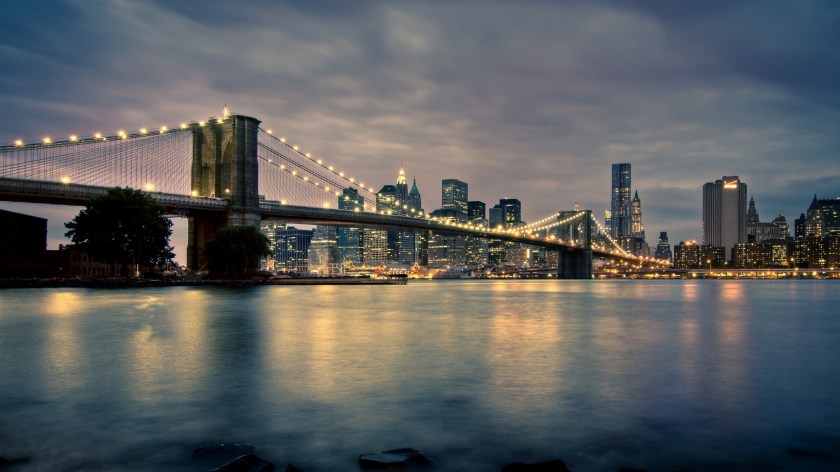
At the time it was built, the span across the East river linking Brooklyn with Manhattan was the longest suspension bridge in the world.

Construction was completed in 1883, the bridge opening for use on May 24. Emily Roebling was the first to cross, in a carriage, carrying a rooster as the sign, of victory. New York politician Abram Stevens Hewitt honored her, at that day’s dedication. Today a bronze plaque bears name of the first female field engineer.

“…an everlasting monument to the sacrificing devotion of a woman and of her capacity for that higher education from which she has been too long disbarred.’

New York politician Abram Stevens Hewitt

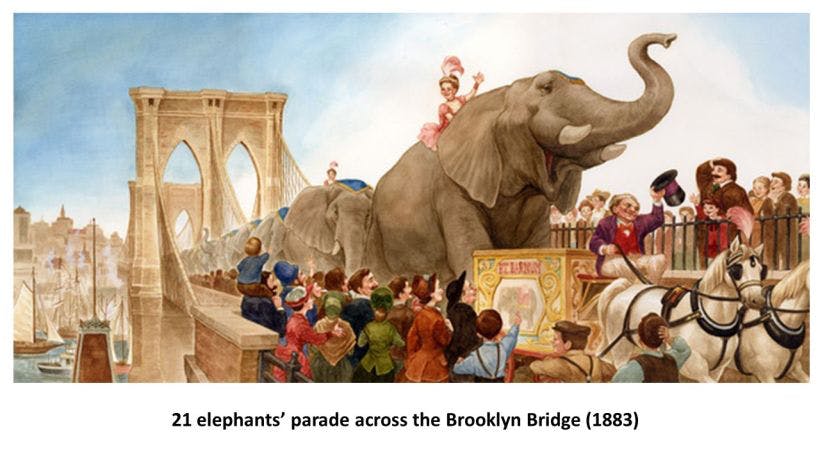
Six days later, a rumor started that the bridge was about to collapse.  At least 12 people were killed in the resulting stampede. A year later, a publicity stunt by P. T. Barnum helped to put people’s minds at ease when Jumbo, the circus’ prize elephant, led a parade of 20 other elephants across the bridge.

For a long time the span was called the “New York and Brooklyn Bridge” or the “East River Bridge”, officially becoming the “Brooklyn Bridge” only in 1915. At least 27 were killed in its construction. Three from the bends, several from cable stringing accidents and others crushed under granite blocks or killed in high falls.

Even today, popular culture abounds with stories of suckers “buying” the Brooklyn Bridge. It was the longest bridge in the world for its time, and would remain so until 1903. Roebling had designed his project to be six times the strength required for the job. Even with those defective cables, the bridge is four times as strong as it needs to be. Many of the Brooklyn Bridge’s contemporary structures have long since gone.  Johann Augustus Roebling’s bridge carries 145,000 cars, every day.

Brooklyn Bridge

May 22, 1807 Aaron Burr

Vice President John Nance Garner served in office between 1931, and ’41. With precisely zero influence over President Roosevelt’s policies, Garner once described the position as “not worth a bucket of warm piss”. Since that time, the sentiment is often cleaned up and retold as, “warm spit”. Be that as it may, such a prize was a distant second-best to a man like Aaron Burr.

What would it be like to turn on the evening news, and learn that former Treasury Secretary Steve Mnuchin lay near death, following an “affair of honor”. A duel. Worse yet, the man who shot him wasn’t a man at all but a woman, Kamala Harris, the sitting vice president of the United States.

The year was 1804.  President Thomas Jefferson’s Vice President Aaron Burr, had a long standing grudge against Alexander Hamilton, first Secretary of the Treasury under President George Washington.

GettyImages-515414860-E
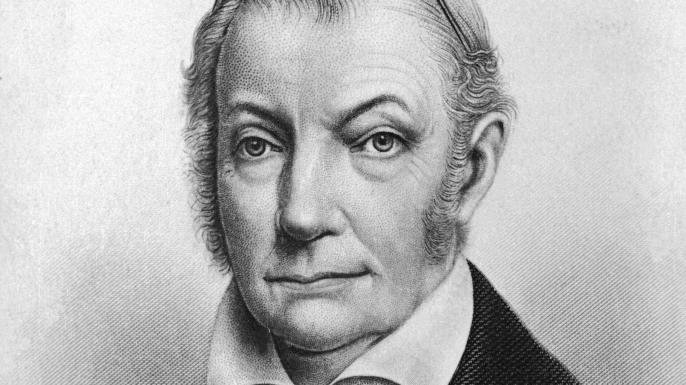
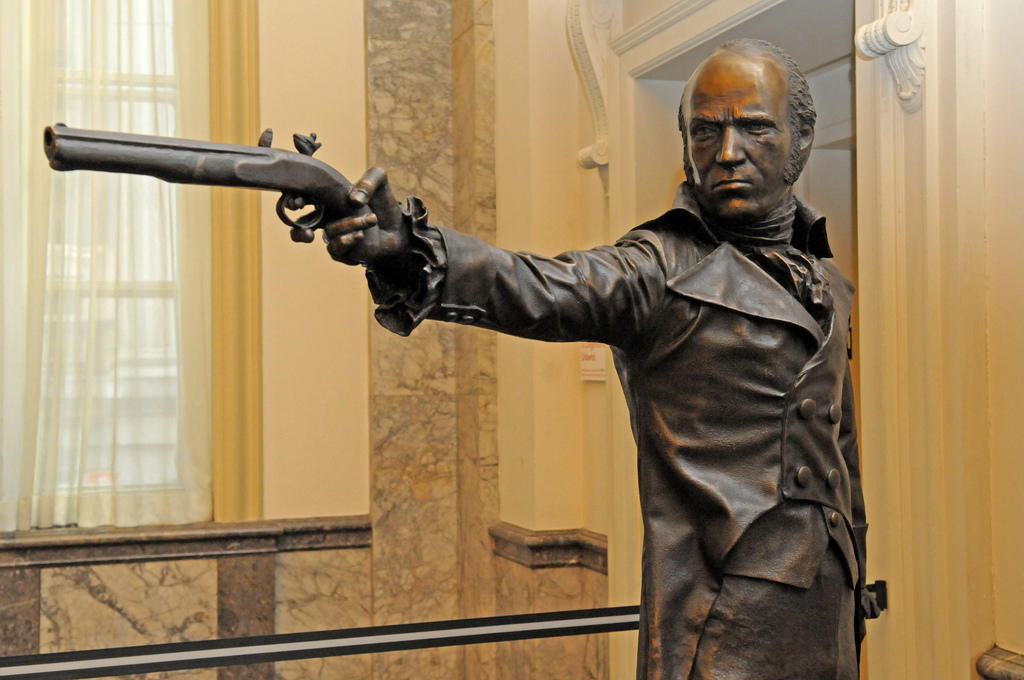
Aaron Burr

The animosity between the two went back to the Senate election of 1791, when Burr won a United States Senate election over Hamilton’s father-in-law, Philip Schuyler. Animosity between the two men escalated during the presidential race of 1800, one of the ugliest elections in American history.  It’s been called the “Revolution of 1800”, an election pitting Democratic-Republican candidate Thomas Jefferson, against one-term incumbent John Adams, of the Federalist party.

Both sides were convinced beyond a doubt, that the other side would destroy the young nation. Federalists attacked Jefferson as an un-Christian deist, a populist whose sympathies with the French Revolution would bring about a similar cataclysm in the young American republic. Democratic-Republicans criticized the alien and sedition acts, and the deficit spending of the Adams administration.

At the time, electors cast two votes, the first and second vote-getters becoming president and vice president.

“The father of modern political campaigning”, Aaron Burr had long since enlisted help from New York’s Tammany Hall, transforming what was then a social club into a political machine.  The election was a decisive victory for the Democratic-Republicans.  Not so much for the candidates themselves.

The electoral vote tied at 73 between Jefferson and Burr, moving the selection to the House of Representatives. Hamilton was no fan of Thomas Jefferson but detested Burr and threw his support behind the former. Jefferson was elected on the 36th ballot, Aaron Burr, relegated to the second spot.

Vice President John “Cactus Jack” Nance Garner was the 32nd vice president of the United States, serving under President Franklin Delano Roosevelt.

With precisely zero influence over Roosevelt’s policies, Garner described the position as “not worth a bucket of warm piss”. 

The sentiment is often cleaned up and retold as, “warm spit”. Be that as it may, such a prize was a distant second-best to a man like Aaron Burr.

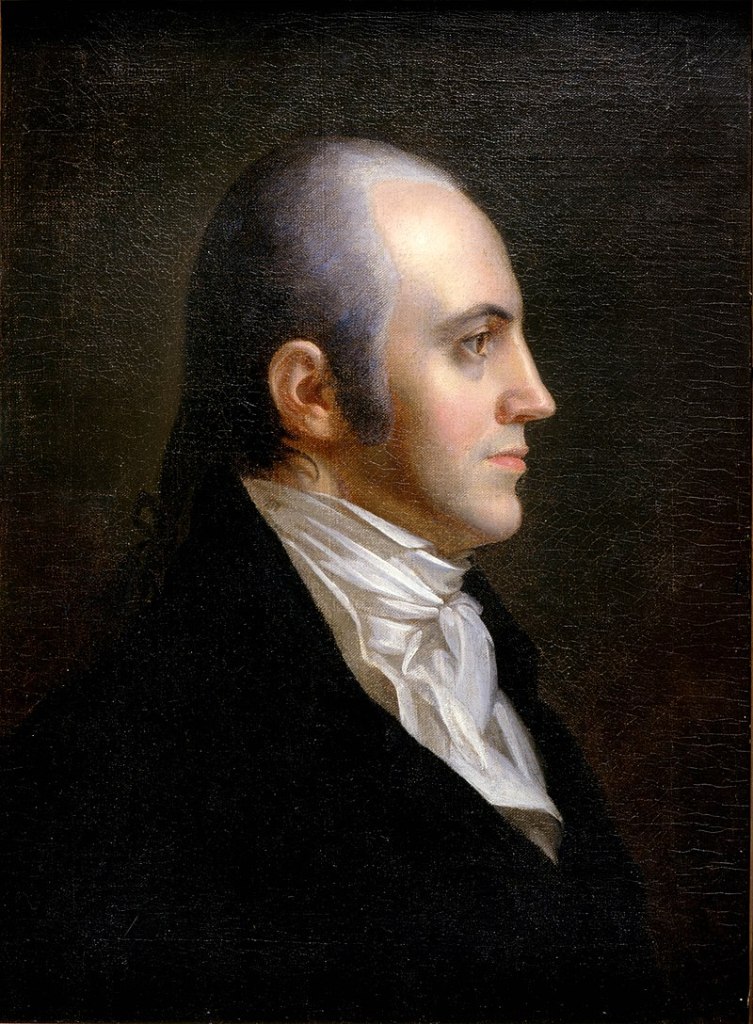
Vice President Aaron Burr, 1802

As part of the new administration, the vice president was anything but a “team player”. Behind the scenes, Burr corresponded with British and Spanish ministers to the United States, offering in the first case to detach Louisiana from the Union and, in the second, to orchestrate an overthrow of Mexico.  Either way, he himself would do nicely to found the new dynasty.  Thank you very much for asking.

Today we’re accustomed to the idea of “Judicial Review”, the idea that Supreme Court decisions are final and inviolate, but that wasn’t always the case. The landmark Marbury v Madison decision established the principle in 1803, a usurpation of power so egregious to Democratic-Republicans, as to bring about the impeachment of Associate Justice Samuel Chase, a signer of the Declaration of Independence.

chase2
Justice Samuel Chase

Relations were toxic between Jefferson and Burr.  The VP knew he wouldn’t be around for the 1804 re-election campaign so he ran for Governor of New York, losing in a landslide to a virtual unknown, Morgan Lewis.

“Nothing has given me so much chagrin as the Intelligence that the Federal party were thinking seriously of supporting Mr. Burr for president. I should consider the execution of the plan as devoting the country and signing their own death warrant. Mr. Burr will probably make stipulations, but he will laugh in his sleeve while he makes them and will break them the first moment it may serve his purpose.”

Alexander Hamilton

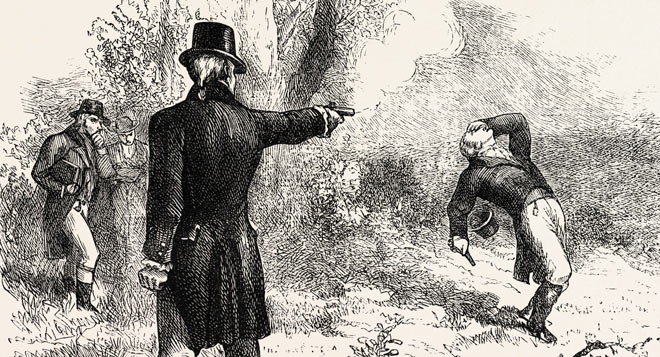
It was a humiliating defeat.  Burr blamed Hamilton, a tireless supporter of his victorious opponent, and challenged him to a duel.  Dueling was illegal at this time but enforcement was lax in New Jersey. So it was, the pair rowed across the Hudson River with their “seconds”, meeting at the waterfront town of Weehawken. It was July 11, 1804. Hamilton “threw away” his shot, firing into the air. Aaron Burr shot to kill.

missedinhistory-podcasts-wp-content-uploads-sites-99-2015-07-hamilton-burr-660x357Murder charges were filed in both New York and New Jersey, but neither went to trial.

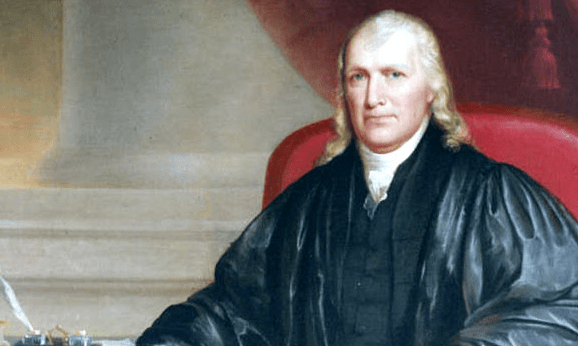
As vice president, Aaron Burr went on to preside over Justice Chase’s impeachment, It was the high point of a career otherwise ended, the day he met Alexander Hamilton in Weehawken.

Burr headed for New Orleans where he got mixed up with one General James Wilkinson, one of the sleazier characters of the founding generation. At that time, Wilkinson was a paid agent for Spanish King Charles IV. 100 years later Theodore Roosevelt would say of the man, “In all our history, there is no more despicable character.”

Wilkinson took his payments in silver dollars, hidden in rum, sugar and coffee casks. All those clinking coins nearly undid him, when a messenger was caught and killed with 3,000 of them. The messenger’s five murderers were themselves Spaniards, who testified at trial the money belonged to the spy, James Wilkinson. Payment for services rendered to their King. Wilkinson’s luck held, as the killers spoke no English. Thomas Power, interpreter for the Magistrate, was another Spanish spy. He threw those guys so far under the bus, they’d never get out: ‘They just say they’re wicked murderers motivated by greed.’
Imagine a person who would say such a thing, in high public office.

The nature of Burr’s discussions with Wilkinson is unclear but, in 1806, Burr led a group of armed colonists toward New Orleans, with the apparent intention of snatching the territory and turning the place into an independent Republic. It’s safe to assume that Aaron Burr saw himself at the head of such a Republic.

Seeing no future in it and wanting to save his own skin, Wilkinson turned on his former ally, sending dispatches to Washington accusing the former vice president of treason. Burr was tracked down in Alabama on February 19, 1807, arrested for treason and sent to Richmond, Virginia, for trial.

Classics-Burr-conspiracy-p-cropped

The size and shape of the “Burr Conspiracy” remain unclear, to this day.  Historians claim the vice president intended to take parts of Texas and the Louisiana Purchase, forming his own independent Republic. Others claim he intended to conquer Mexico,  That Aaron Burr had a following among prominent politicians and soldiers is beyond question, but estimates of their numbers range from forty, to over seven-thousand.

Burr himself claims only to have wanted the 40,000 acres in the Texas Territory, deeded him by the Spanish crown.  On this there is no uncertainty.  The lease still exists.

The one-time vice president who killed the man on our ten dollar bill went to trial for treason on May 22, 1807. Burr was acquitted in the end, on grounds he had not committed an “overt act” as specified in the Constitution. Not guilty in the eyes of the law. The court of public opinion, was another matter. Aaron Burr would ever be held in contempt, as a traitor.

150320191637-ten-dollar-bill-780x439

He spent the next several years in Europe before returning to New York, and resuming his law practice. At the age of 77, Burr married Eliza Jumel, a wealthy widow 19 years his junior. After four months of watching her fortune squandered, she filed for separation. For her divorce attorney, Eliza hired Alexander Hamilton, Jr. The divorce was final on September 14, 1836. Aaron Burr, now relegated to a New York boarding house, died the very same day, at the age of 80.

“Aaron Burr was like a new refrigerator. He was bright, cold and empty.”

American journalist, biographer and historian, Richard Brookhiser

May 21, 1856 Bleeding Kansas

As the young nation expanded ever westward, attempts to “democratize” the issue of slavery instead had the effect of drawing up battle lines. Pro-slavery forces established a territorial capital in Lecompton, Kansas while “antis” set up their own government in Topeka.  The resulting standoff would soon escalate to violence. Upwards of a hundred or more would be killed between 1854 – 1861, in a period called “Bleeding Kansas”.


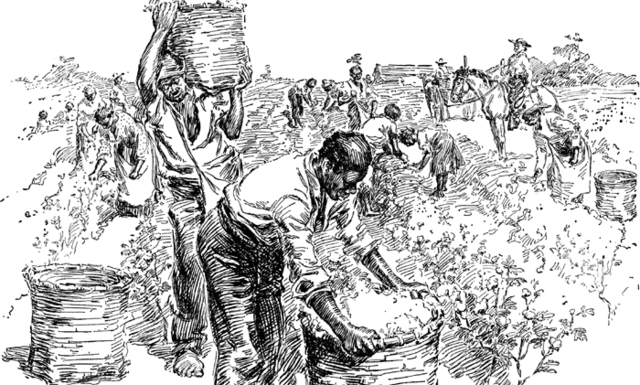
Since the time of the Revolution, conflicts arose between those supporting a strong federal government, and those favoring greater self-determination for the states. In the South, climate conditions led to dependence on agriculture, the rural economy of the southern states producing cotton, rice, sugar, indigo and tobacco. Colder states to the north tended to develop manufacturing economies, urban centers growing up in service to hubs of transportation and the production of manufactured goods.

In the first half of the 19th century, 90% of federal government revenue came from tariffs on foreign manufactured goods. Most of this revenue was collected in the South, with the region’s greater dependence on imported goods.  Much of this federal largesse was spent in the North, with the construction of roads, canals and other infrastructure.

The debate over economic issues and rights of self-determination, so-called ‘state’s rights’, grew and sharpened in 1828 with the threatened secession of South Carolina and the “nullification crisis” of 1832-33, when South Carolina declared such tariffs unconstitutional and therefore null and void within the state. Encyclopedia Britannica includes a Cartoon from the time depicting “Northern domestic manufacturers getting fat at the expense of impoverishing the South under protective tariffs.”

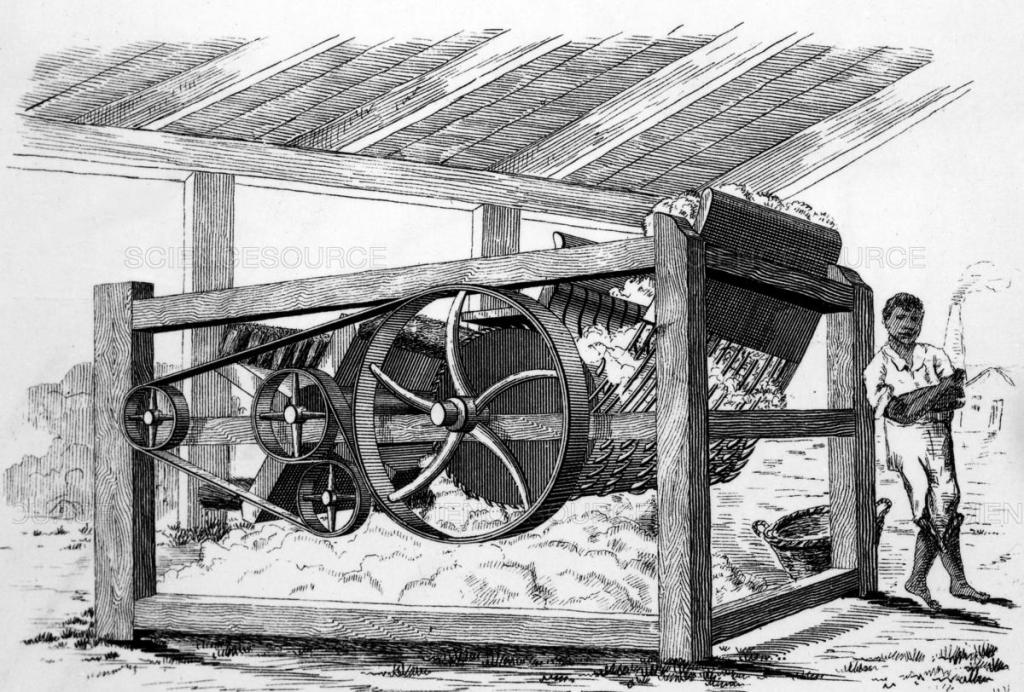
Chattel slavery existed from the earliest days of the colonial era, from Canada to Mexico, and around the world. Moral objections to what was really a repugnant practice could be found throughout, but economic forces had as much to do with ending the practice, as any other. The “peculiar institution” died out first in the colder regions of the US and may have done so in warmer climes as well, but for Eli Whitney’s invention of a cotton engine (‘gin’) in 1792.

It takes ten man-hours to remove the seeds to produce a single pound of cotton. By comparison, a cotton gin can process about a thousand pounds a day, at comparatively little expense.

The year of Whitney’s invention, the South exported 138,000 pounds a year to Europe and the northern colonies. Sixty years later, Britain alone was importing 600 million pounds a year, from the American south. Cotton was King, and with good reason.  The stuff is easily grown, is more easily transportable, and can be stored indefinitely, compared with food crops.  The southern economy turned overwhelmingly to this one crop and its need for plentiful, cheap labor. The issue of slavery had joined and become so intertwined with ideas of self-determination, as to be indistinguishable.

The Cotton Gin

The first half of the 19th century was one of westward expansion in the United States, generating frequent and sharp conflicts between pro and anti-slavery factions. The Missouri compromise of 1820 was the first attempt to reconcile these factions, defining which territories would be slave states, and which would be “free”.

The short-lived “Wilmot Proviso” of 1846 sought to ban slavery in new territories, after which the Compromise of 1850 attempted to strike a balance.  The Kansas Nebraska Act of 1854 created the territories of Kansas and Nebraska, basically repealing the Missouri Compromise and allowing settlers to determine their own way through popular sovereignty.

BleedingKansasFight

This attempt to democratize the issue instead had the effect of drawing up battle lines.  Pro-slavery forces established a territorial capital in Lecompton, while “antis” set up an alternative government in Topeka. 

In Washington, Republicans backed the anti-slavery forces, while Democrats generally supported their opponents.  The resulting standoff would soon escalate to violence. Upwards of a hundred or more would be killed between 1854 – 1861, in a period called “Bleeding Kansas”.

The town of Lawrence, Kansas was established by anti-slavery settlers in 1854, and soon became the focal point of pro-slavery violence. Emotions were at the boiling point when Douglas County Sheriff Samuel Jones was shot trying to arrest free-state settlers on April 23, 1856. Jones was driven out of town but he would return.

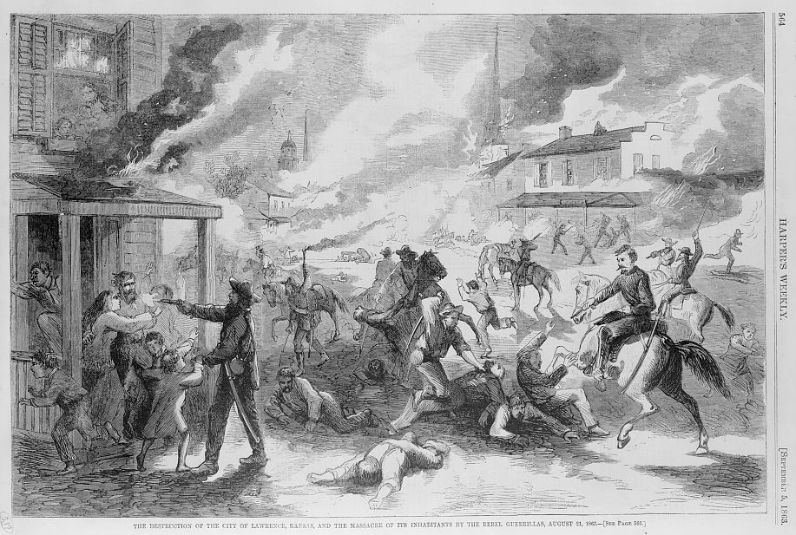
Lawrence Massacre, 1863

On this day in 1856, a posse of 800 pro-slavery forces closed around the town, led by Sheriff Jones. Cannon were positioned to cover the town and detachments of troops posted, to prevent escape. They commandeered the home of the first governor of Kansas, Charles L. Robinson, and used it as their headquarters.

The town’s two printing offices were sacked, the presses destroyed, and the type thrown into the river. The posse next set about to destroy the Free State Hotel, which they believed had been built to serve more as a fort than a hotel.

They may have been right, because it took the entire day with cannon shot, kegs of gunpowder and incendiary devices, before the hotel was finally reduced to a roofless, smoldering ruin.

There was looting and a few robberies as the men left town, burning Robinson’s home on the way out. Seven years later, a second raid on Lawrence resulted in the murder of over 150 boys and men. For now there was only one fatality: That of a slavery proponent killed, by falling masonry.

john-brown

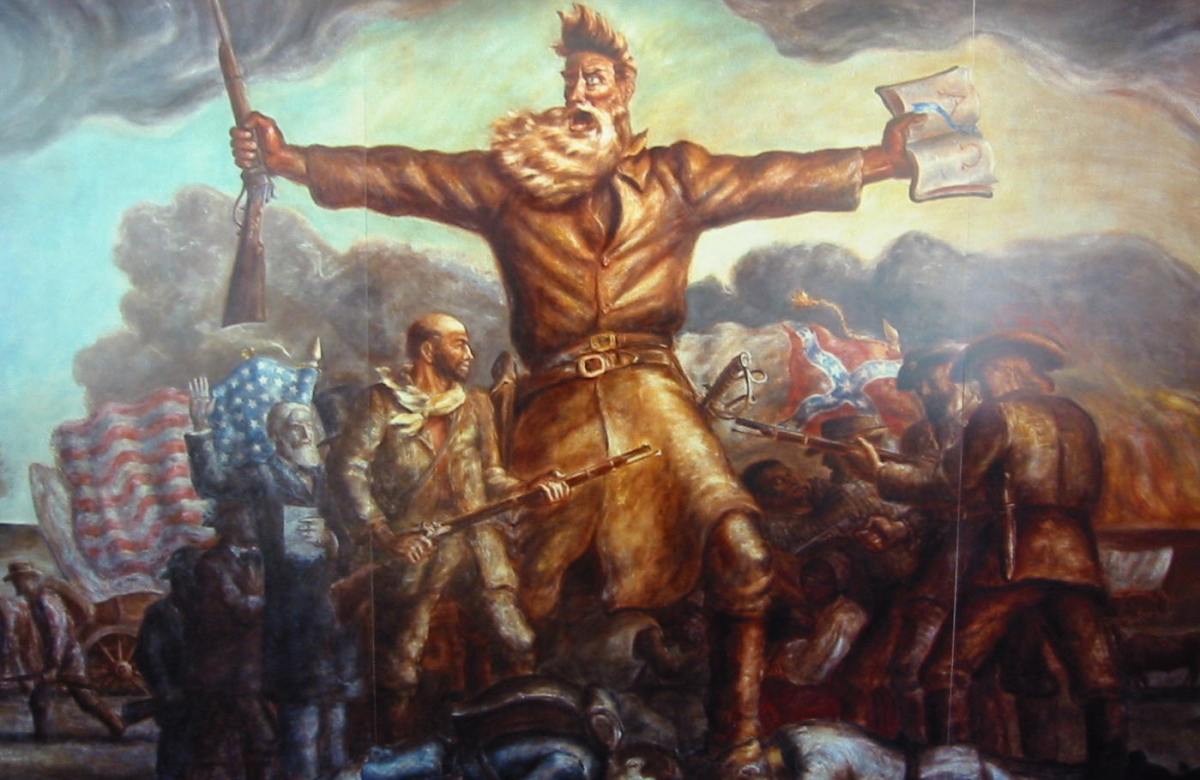
In the following days, five unarmed men will be taken from their homes and butchered with broadswords, by anti-slavery radicals John Brown, his sons and allies. Four months of partisan violence ensued when small armies formed up across eastern Kansas, clashing at places like Black Jack, Franklin, Fort Saunders, Hickory Point, Slough Creek, and Osawatomie

In Washington DC, a Senator will be beaten nearly to death on the floor of the United States Senate, by a member of the House of Representatives.

The 80-year-old nation forged inexorably onward, to a Civil War which would kill more Americans than every conflict from the American Revolution to the War on Terror, combined.

May 20, 1845 The Lost Franklin Expedition

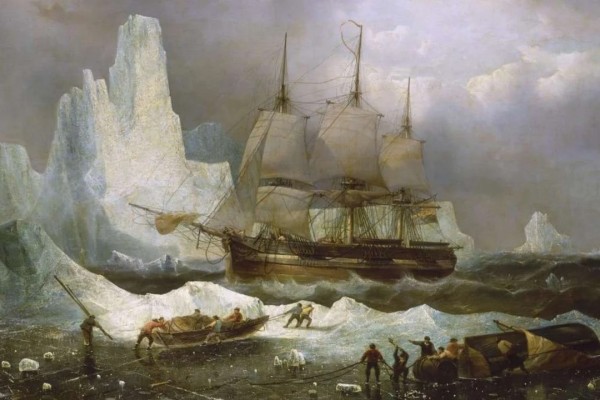
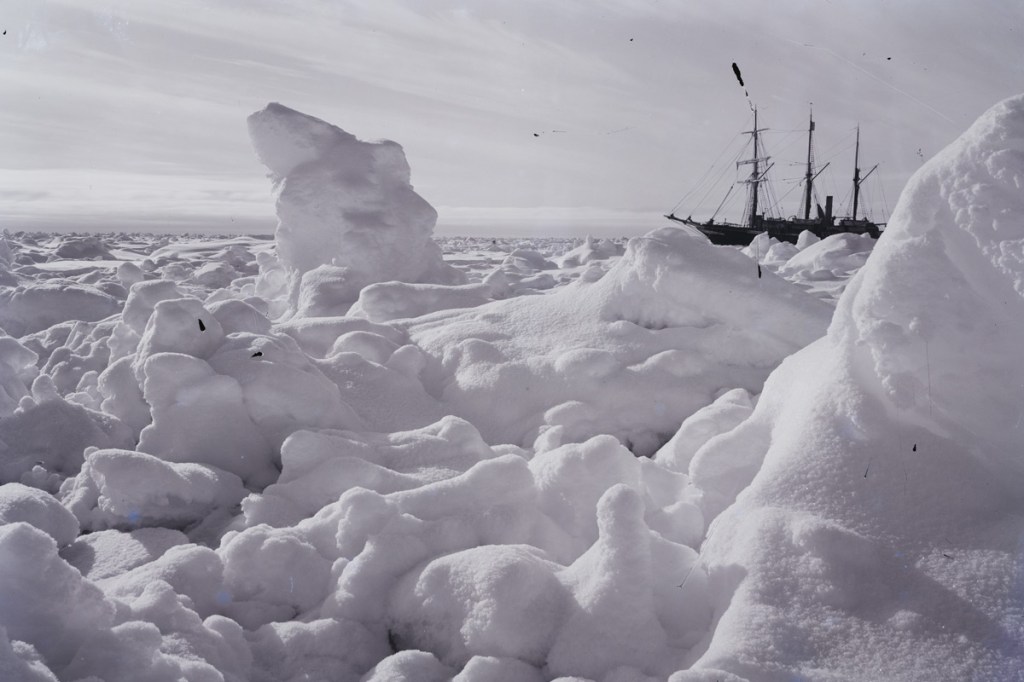
HMS Erebus and Terror were perhaps the finest vessels ever to make the attempt, having proven themselves in an earlier expedition, to the Antarctic. With hulls strengthened by steel plates and beams to withstand the massive pressures of the ice, the two were equipped not only with sail but with massive locomotive engines and screws, able to retract within channels designed to avoid damage from the ice.

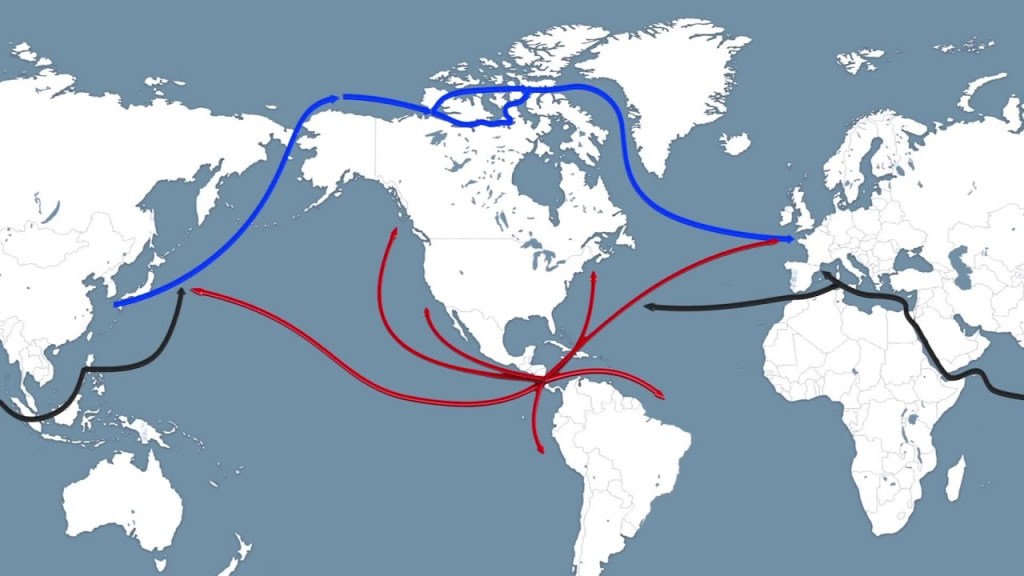
Since the fall of Constantinople when the Ottoman Empire blocked overland trade routes to the east, European explorers searched for a navigable shortcut by open water, from Europe to Asia.  

The idea of a northern sea route has been around at least since the second century world maps of the Greco-Roman geographer, Ptolemy. Five years after Christopher Columbus “sailed the ocean blue”, John Cabot became the first European to explore the fabled “Northwest Passage”. Cabot made landfall in the Canadian Maritime sometime in June 1497 and, like Columbus, mistakenly believed he had reached the Asian shore.

A year later, King James VII authorized a much larger expedition of five ships and 200 men. Cabot’s expedition is believed to have been caught in a severe storm in the North Atlantic. None were ever heard from, again.

Jacques Cartier departed France in 1534 in search of a faster route to Asia. Three such expeditions failed to discover the great river to the west.

In 1539, the Spanish explorer Francisco de Ulloa departed the Pacific coast of Mexico for what the Spanish called, the Strait of Anián. Ulloa is credited with proving that Baja California is a peninsula and not an island but he too came back, empty handed.

Henry Hudson’s explorations paved the way to Dutch settlement in New York but the river that bears his name, proved to be a dead end. Another attempt in 1610 saw Hudson’s expedition stuck in the ice, in Hudson Bay. The ice melted with the Spring of 1611 when the crew mutinied, setting Cabot and a few loyalists adrift in a small boat. The mutineers returned to England. Cabot and the others, vanished.

The “Corps of Discovery“, better known as the Lewis and Clark expedition, departed the Indiana Territory in 1804 with, among other purposes, and intention of finding a water route to the Pacific.

By the 19th century, European explorers looked to the north. To the Arctic. On this day in 1845, Captain Sir John Franklin departed England with a crew of 134 men aboard two ships, HMS Erebus and HMS Terror, in search of the Northwest Passage.

HMS Terror. Photo Credit: Wikipedia

HMS Erebus and Terror were perhaps the finest vessels ever to make the attempt, having proven themselves in an earlier expedition, to the Antarctic. With hulls strengthened by steel plates and beams to withstand the massive pressures of the ice, the two were equipped not only with sail but with massive locomotive engines and screws, able to retract within channels designed to avoid damage from the ice. Inside, a steam heating system kept sailors insulated from the arctic cold.

Two months later, the vessels were spotted at the entrance of Baffin Bay. They were never seen again.

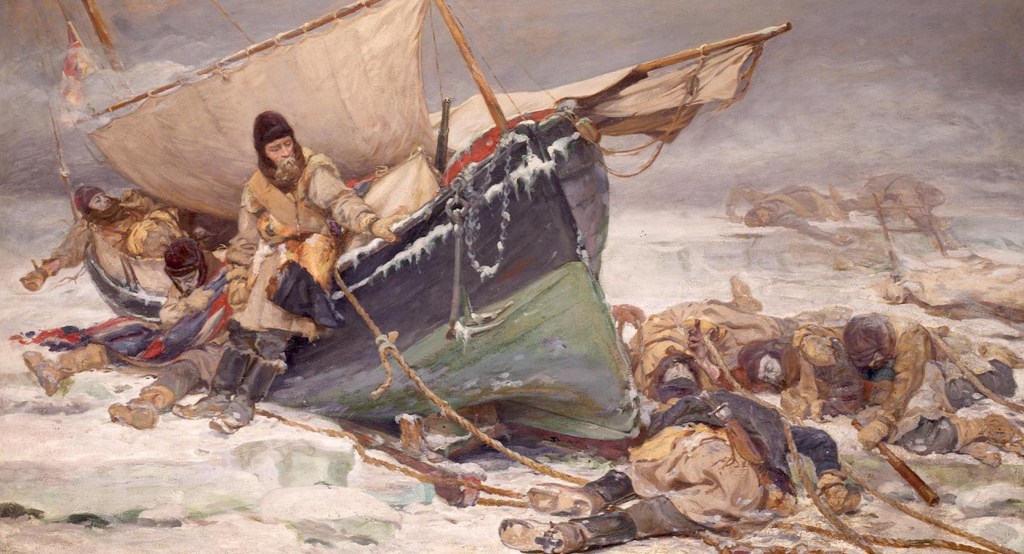
Three years later, a rescue expedition set out at the urging of lady Franklin and others, in search of the lost expedition. Three expeditions really, one overland and one each approaching from the north Atlantic, and Pacific. Some tantalizing clues emerged over the following decade. Three graves discovered on Beechy Island, in the Canadian Arctic Archipelago . A note and then another, discovered under stone cairns. The weathered bones bearing knife marks raising questions, about cannibalism.

American vessels joined with those of British searchers. The search became all but a crusade for a time but nothing turned up, beyond the occasional clue. No member of the Franklin expedition was ever seen again. Not at least, by European eyes.

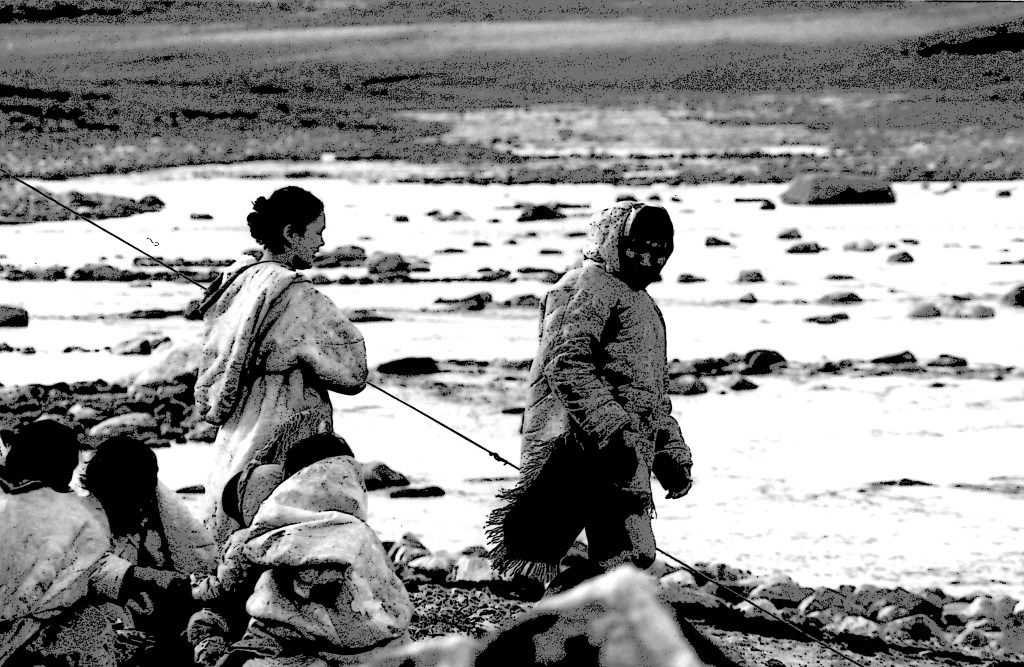
Anthropologists believe the Thule people split from related groups called Aleuts and from Siberian migrants some 4,000 years ago, displacing the paleo-eskimo culture called the Tuniit. The “Inuit” people further split around the year 1000 and moved east, across the Arctic.

The techniques by which a human being survives and even thrives in such an inhospitable place, the histories, these are the Qaujimajatuqangit, the knowledge of the Inuit, told and retold in stories going back thousands of years.

Inuit historian Louie Kamookak, explains:

“Inuit had no written system of language… History was passed down through oral history, which meant telling and retelling stories. During the long winter days and nights it was usually the elders who would tell stories.”

Hat Tip Louis Kamookak

169 years after HMS Erebus and Terror disappeared the Qaujimajatuqangit of the Netsilik Inuit of King William Island led to their discovery.

In September 2014, an expedition led by Parks Canada discovered the wreck of the HMS Erebus, in an area identified in Inuit oral history. She lay in a mere 36-feet of water, a good sixty miles from where she was believed to be. Two years later, Inuit knowledge led to the wreck of HMS Terror.

Afterward

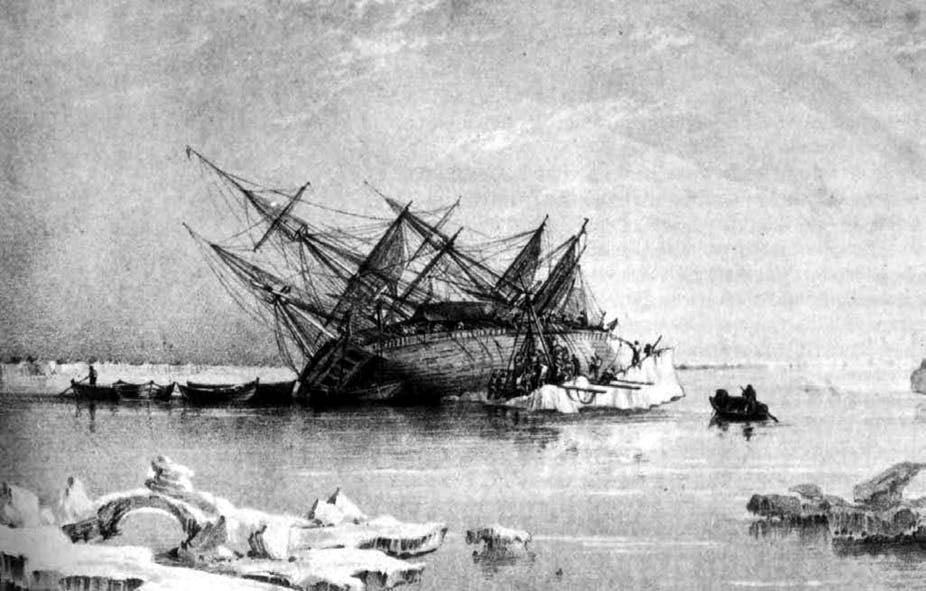
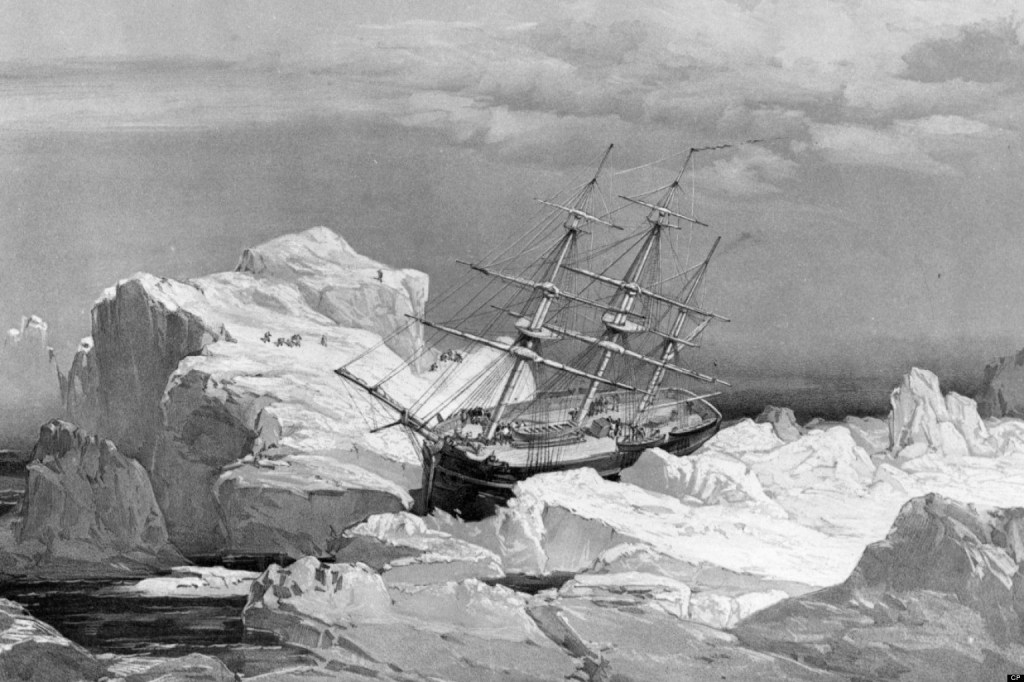
In 1852, searchers aboard HMS Resolute discovered the long suffering crew of HMS Investigator, hopelessly encased in ice while searching for the lost Franklin expedition, three years earlier.

HMS Investigator is shown on the north coast of Baring Island in the Arctic in this 1851 drawing. The ships commanded by Sir John Franklin in his doomed 19th-century search for the Northwest Passage will have to overwinter wherever they are at least one more time. THE CANADIAN PRESS/Public Archives of Canada

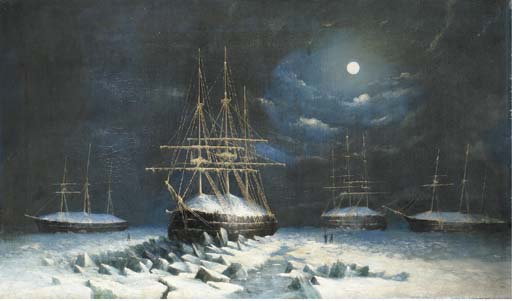
Resolute herself became trapped in the ice, the following year. There was no choice but to abandon ship, striking out across the ice pack in search of rescue. Most of them made it despite egregious hardship, straggling into Beechy Island over the Spring and summer of 1854.

In 1855, the American whale ship George Henry discovered the Resolute drifting in pack ice, some 1,200 miles from her last known position. Captain James Buddington split his crew, half of them now manning the abandoned ship. Fourteen sailed Resolute back to Groton Connecticut, arriving on Christmas eve.

The late 1850s was a difficult time for American-British relations. Senator James Mason of Virginia presented a bill in Congress to fix up the Resolute, and give her back to her Majesty Queen Victoria’s government as a token of friendship between the two nations.

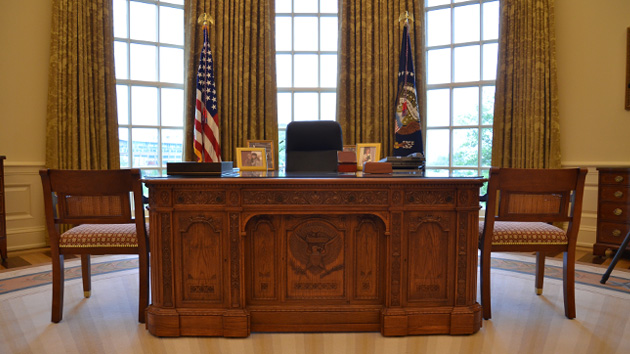
$40,000 were spent on the refit. Commander Henry J. Hartstene presented the vessel to Queen Victoria on December 13, 1859. HMS Resolute served in the British navy until 1879 when she was retired, and broken up. The British government ordered two desks to be fashioned from English oak of the ship’s timbers, the work being done by the skilled cabinet makers of the Chatham dockyards. In 1880, the British government presented a large partner’s desk to President Rutherford B. Hayes. A token of appreciation for HMS Resolute’s return, a quarter-century earlier.

The Resolute Desk has remained in the White House from that day to this, excepting the Truman renovations and 11 years following the assassination of President John F. Kennedy, when it was moved to the Smithsonian. President George H.W. Bush moved it into the residence office, in the White House. Aside from that, the Resolute desk has remained in the oval office from the Presidency of Jimmy Carter, to that of Joe Biden.