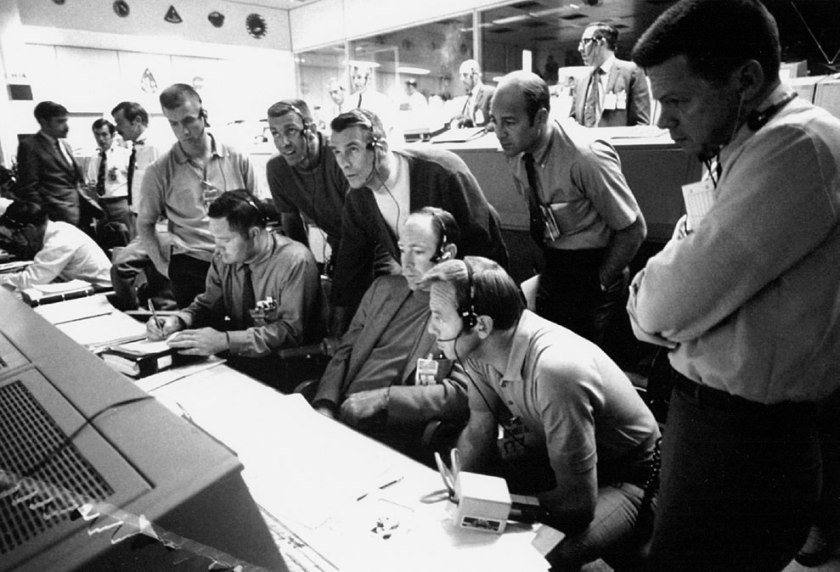
With communications being impossible, TV commentators used models and illustrations, to describe the unfolding drama. On board Odyssey, power was so low that voice-only transmissions became difficult. Visual communications with Mission Control were as impossible as the idea that the stranded astronauts could get out and walk home.
The seventh manned mission in the Apollo space program was scheduled to be the third moon landing, launching at 13:13 Central Standard Time from the Kennedy Space Center in Florida.
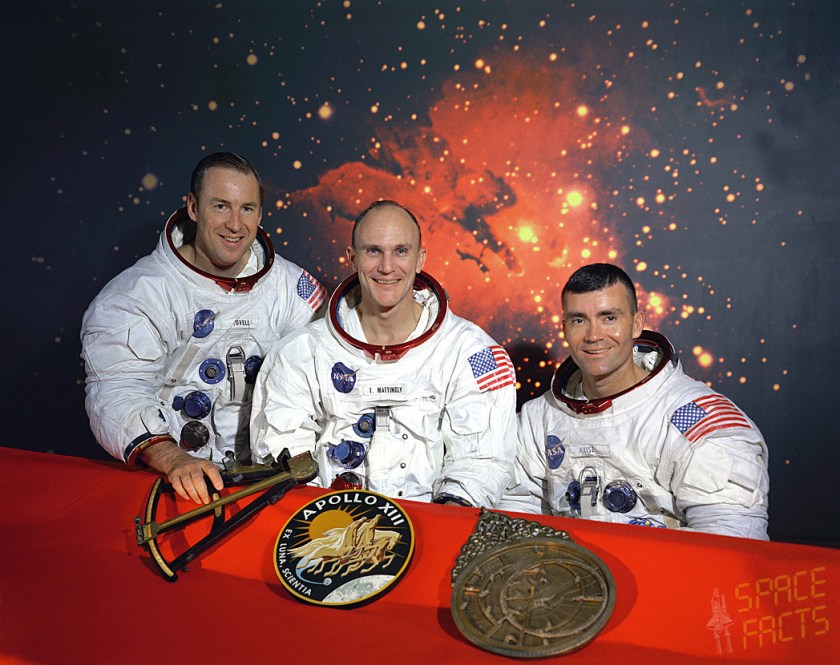
Jack Swigert was the backup pilot for the Command Module (CM), officially joining the Apollo 13 mission only 48 hours earlier, when prime crew member Ken Mattingly was grounded, following exposure to German measles.
Jim Lovell was the most seasoned astronaut in the world at that time, a veteran of two Gemini missions and Apollo 8. By launch day, April 11, 1970, Lovell had racked up 572 space flight hours. For Fred Haise, backup crew member on Apollo 8 and 11, this would be his first spaceflight.
Apollo 13, original crew photo, Left to right: Commander, James A. Lovell Jr., CM pilot Ken Mattingly, LM pilot, Fred W. Haise Jr.
Two separate vessels were joined to form the Apollo spacecraft, separated by an airtight hatch. The crew lived in a Command/Service module called “Odyssey”. The Landing Module (LM) dubbed “Aquarius”, would perform the actual moon landing.
56 hours into the mission and 5½ hours from the Moon’s sphere of gravitational influence, Apollo crew members had just finished a live TV broadcast. Haise was powering the LM down while Lovell stowed the TV camera. Mission Control asked Swigert to activate stirring fans in the Service Module’s hydrogen and oxygen tank. Two minutes later, the astronauts heard a “loud bang”.
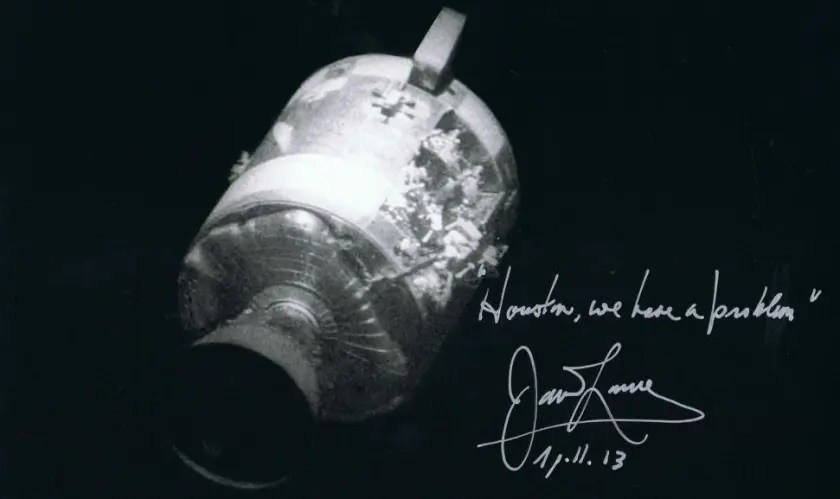
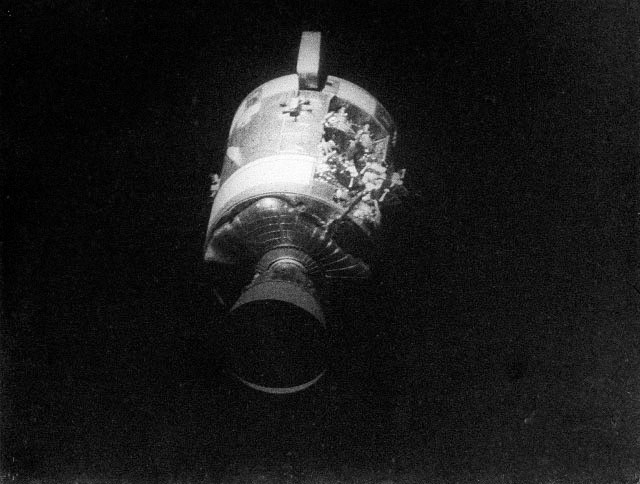
Manufacturing and testing of the vessel had both missed an exposed wire in an oxygen tank. Swigert had flipped the switch for a routine procedure, causing a spark to set the oxygen tank on fire. Alarm lights lit up all over Odyssey and in Mission Control. The entire spacecraft shuddered as one oxygen tank tore itself apart and damaged another. Power began to fluctuate. Attitude control thrusters fired, and communications temporarily went dark.
The crew could not have known at the time. The entire Sector 4 panel had just blown off.
The movie takes creative license with Commander James Lovell saying “Houston, we have a problem”. On board the real Apollo 13 it was Jack Swigert who spoke: “Houston, we’ve had a problem”.
205,000 miles into deep space with life support systems shutting down, the Lunar Module became the only means of survival. There was no telling if the explosion had damaged Odyssey’s heat shields. It didn’t matter. For now, the challenge was to remain alive. Haise and Lovell frantically worked to boot up Aquarius, while Swigert shut down systems aboard Odyssey. Power needed to be preserved for splashdown.
The situation had been suggested during an earlier training simulation, but considered unlikely. As it happened, the accident would have been fatal without access to the Lunar Module.
Fifteen years before Angus “Mac” MacGyver hit your television screen, mission control teams, spacecraft manufacturers and the crew itself worked around the clock to “MacGyver” life support, navigational and propulsion systems. For four days and nights, the three-man crew lived aboard the cramped, freezing Aquarius, a landing module intended to support a crew of 2 for only a day and one-half.
With heat plummeting to near freezing food inedible and an acute shortage of water, this tiny, claustrophobic “lifeboat” would have to do what it was never intended to do.
Apollo XIII timeline
Atmospheric re-entry alone presented near-insurmountable challenges. The earth’s atmosphere is a dense fluid medium. If you reenter at too steep an angle, you may as well be jumping off a high bridge. As it is, the human frame can withstand deceleration forces no higher than 12 Gs, equivalent to 12 individuals identical to yourself, piled on top of you. Even at that, you’re only going to survive a few minutes, at best.
We all know what it is to skip a stone off the surface of a pond. If you hit the atmosphere at too shallow an angle, the result is identical to that stone. There is no coming down a second time. You get one bounce and then there is nothing but the black void of space.
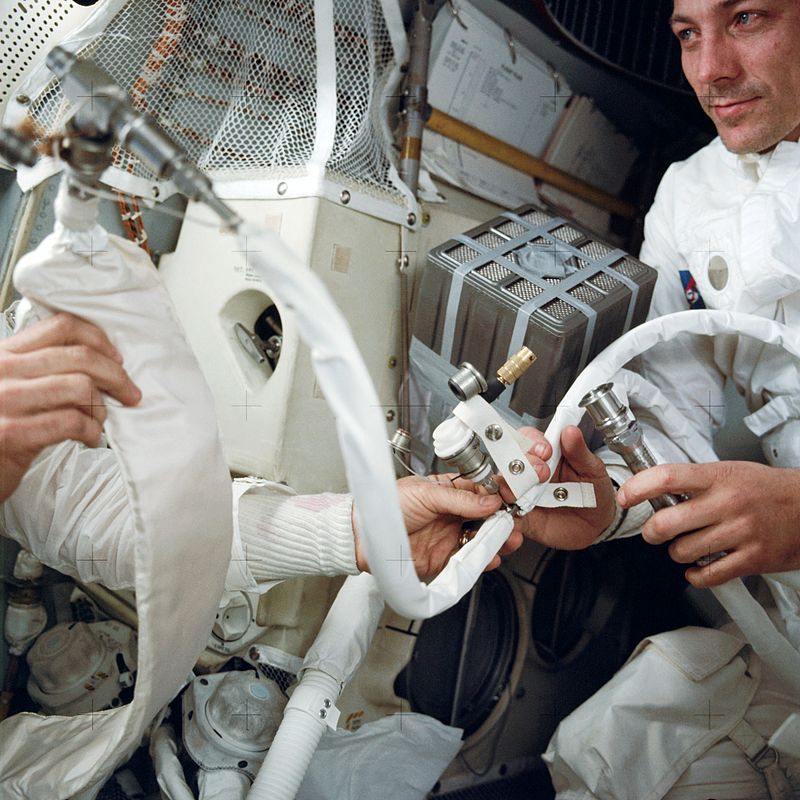
“Astronaut John L. Swigert, at right, with the “mailbox” rig improvised to adapt the command module’s square carbon dioxide scrubber cartridges to fit the lunar module, which took a round cartridge”. /T Wikipedia
The world held its breath it seemed for seventy-eight hours, waiting for the latest update from newspaper and television news. With communications being impossible, TV commentators used models and illustrations, to describe the unfolding drama. On board Odyssey, power was so low that voice-only transmissions became difficult. Visual communications with Mission Control were as impossible as the idea that the stranded astronauts could get out and walk home.
As Odyssey neared earth, engineers and crew jury-rigged a means of jettisoning the spent Service Module, to create enough separation for safe re-entry.
Shooting star as seen by night, H/T contentbuket.com
One last problem to be solved, was the crew’s final transfer from Lunar Module back to Command Module, prior to re-entry. With the “reaction control system” dead, University of Toronto engineers had only slide rules and six hours in which to devise a way to “blow” the LM, by pressurizing the tunnel connecting it with the CM. Too much pressure might damage the hatch and seal. Too little wouldn’t provide enough separation between the two bodies. Either failure would result in one of those “shooting stars” you see at night, as the searing heat of re-entry incinerated the Command Module and everything in it.
By this time, the Command Module had been in “cold soak” for days. No one knew for certain, if the thing would come back to life.
Apollo 13 landing
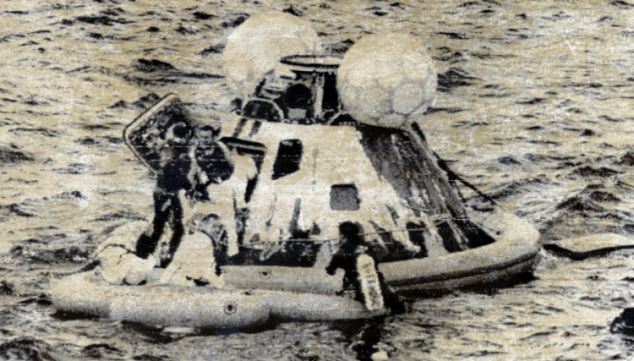
Crashing into the atmosphere at over 24,000mph, the capsule had 14 minutes in which to come to a full stop, splashing down in the waters of the Pacific Ocean. External temperatures on the Command Module reached 2,691° Fahrenheit, as the kinetic energy of re-entry converted to heat.
The Apollo 13 mission ended safely with splashdown southeast of American Samoa on April 17, 1970, at 18:07:41 local time. Exhausted and hungry, the entire crew had lost weight. Haise had developed a kidney infection. Total duration was 142 hours, 54 minutes and 41 seconds.
The Roman alliance had stopped the Hunnic invasion in Gaul, but it was a Pyrrhic victory. The military might of Roman and Visigoth alike, was no more.
In the 5th century, the migration of warlike Germanic tribes across northern Europe culminated in the destruction of the Roman Empire in the west. That much is relatively well known, but the “why”, is not. What would a people so fearsome as to bring down an empire, have been trying to get away from?
The Roman Empire was split in two in the 5th century and ruled by two separate governments. Ravenna, in northern Italy, became capital to the Western Roman Empire in 402 and would remain so until the final collapse, in 476. In the east was Constantinople, seat of the Byzantine empire and destined to go on another thousand years. That would come to an end in 1453 at the hands of the 21-year-old Mehmed “The Conqueror’, 7th sultan of the ottoman Empire. Today we know this crossroads between east and west as Istanbul, but that must be a story, for another day.
Back to the 5th century vast populations moved westward from Germania, into Roman territories in the west and south. They were Alans and Vandals, Suebi, Goths and Burgundians. There were others as well, crossing the Rhine and the Danube and entering Roman Gaul. They came not in conquest: that would come later. These tribes were fleeing a people so terrifying that whole tribes agreed to be disarmed, in exchange for the protection of Rome.
The Huns.
Rome itself had mostly friendly relations with the Hunnic Empire, which stretched from modern day Germany in the west to Turkey and most of Ukraine, in the east. They were a nomadic people, mounted warriors all but born to the saddle whose main weapons were the bow, and the javelin. Often, Huns acted as mercenary soldiers, paid to fight on behalf of Rome.
Rome looked at such payments as just compensation for services rendered. To the Huns this was tribute. Tokens of Roman submission to the Hunnic Empire.
Nestorius, Patriarch of Constantinople, described Rome’s problems with the Hun, succinctly. “They have become both masters and slaves of the Romans”.
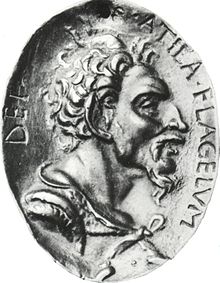
Relations became strained between the two powers during the time of the Hunnic King Rugila, as his nephew the future King Attila, came of age.
Rugila’s death in 434 left the sons of his brother Mundzuk, Attila and Bleda, in control of the united Hunnic tribes. The following year, the brothers negotiated a treaty with Emperor Theodosius of Constantinople, giving the Byzantines time to strengthen the city’s defenses. This included the first sea wall, a structure the city would be forced to defend a thousand years later when even the Theodosian Wall could not stem the Islamic conquest of 1453.
The priest of the Greek church Callinicus wrote what happened next, in his “Life of Saint Hypatius”. “The barbarian nation of the Huns, which was in Thrace, became so great that more than a hundred cities were captured and Constantinople almost came into danger and most men fled from it. … And there were so many murders and blood-lettings that the dead could not be numbered. Ay, for they took captive the churches and monasteries and slew the monks and maidens in great numbers“.
Bleda died sometime in 445 leaving Attila the sole King of the Huns. Relations with the Western Roman Empire had been relatively friendly, for a time. That changed in 450 when Justa Grata Honoria, sister of Emperor Valentinian, sought to escape a forced marriage to the former consul Herculanus. Honoria sent the eunuch Hyacinthus with a note to Attila, asking the king to intervene on her behalf. She enclosed her ring in token of the message’s authenticity. Attila took this to be an offer of marriage.
Valentinian was furious with his sister. Only the influence of their mother Galla Placidia convinced him to exile rather than have her put to death while he frantically wrote to Attila saying it was all, nothing more than a misunderstanding.
The King of the Huns wasn’t buying it and sent an emissary to Ravenna, to claim what was his. Attila demanded delivery of his “bride” along with a modest half of the empire, as dowry.
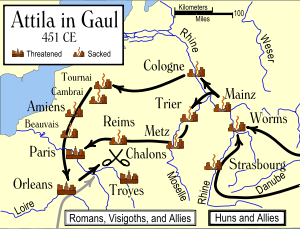
In 451, Attila gathered his vassals and began a march to the west. The Hunnic force was estimated to be half a million strong though that number is almost certainly exaggerated. The Romans hurriedly gathered an army to oppose them while the Huns sacked the cities of Mainz, Worms, Strasbourg and Trier.
Some 1,500 years later the headlines announced the impregnable city of Metz, had fallen to US 95th Infantry.
On April 7, 451 the streets of Metz ran red with the blood of the slain followed in quick succession by those of Cologne, Cambrai, and Orleans.
The Roman army, allied with the Visigothic King Theodoric I, finally stopped the army of Attila at the Battle of the Catalaunian Plains, near Chalons. Some sources date the Battle of Chalons at June 20, 451, others at September 20. Even the outcome of the battle is open to interpretation. Sources may be found to support the conclusion that the battle was a Roman, a Gothic or a Hunnic victory.
Be that as it may it was a Pyrrhic victory in the end. Chalons was one of the last major military operations of the Roman Empire in the west. The Roman alliance had stopped the Hunnic invasion in Gaul, but the military might of Roman and Visigoth alike, was no more.
Attila would return to sack much of Italy in 452, this time razing Aquileia so completely that no trace of it was left behind. Legend has it that Venice was founded at this time when local residents fled the Huns, taking refuge in the marshes and islands of the Venetian Lagoon.
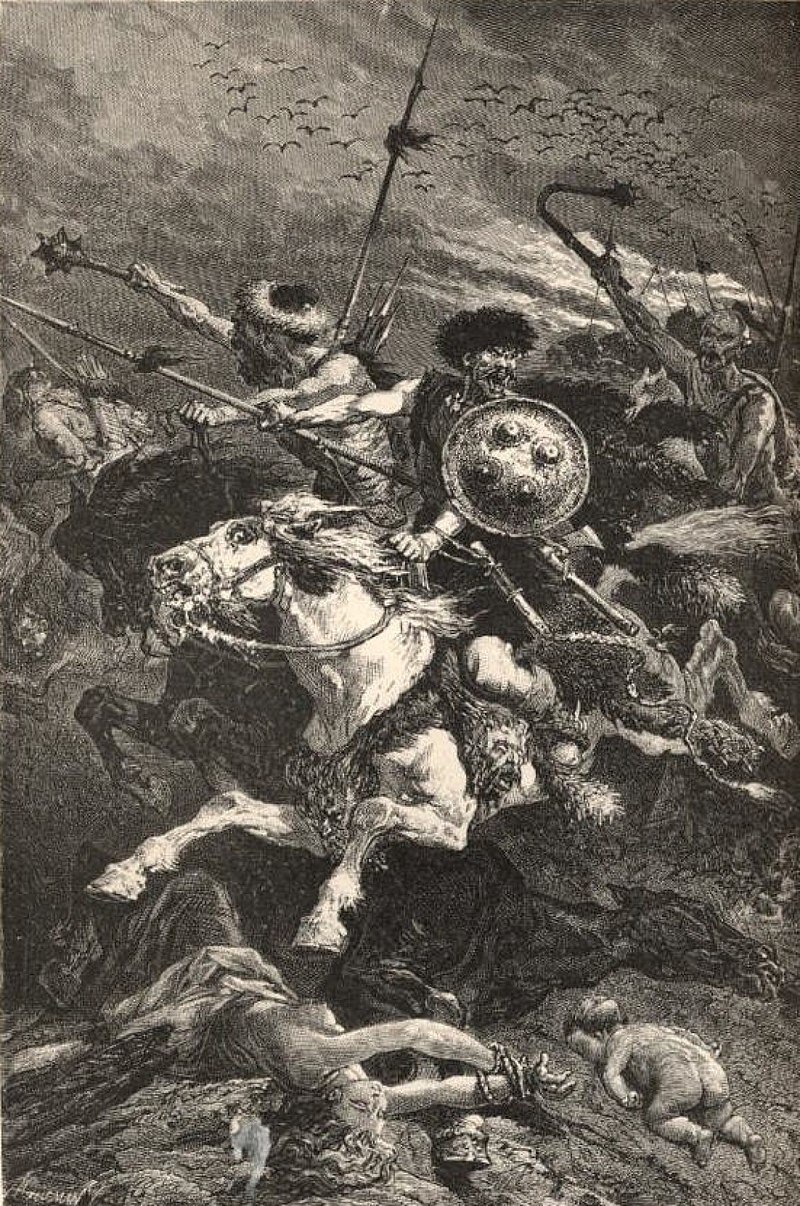
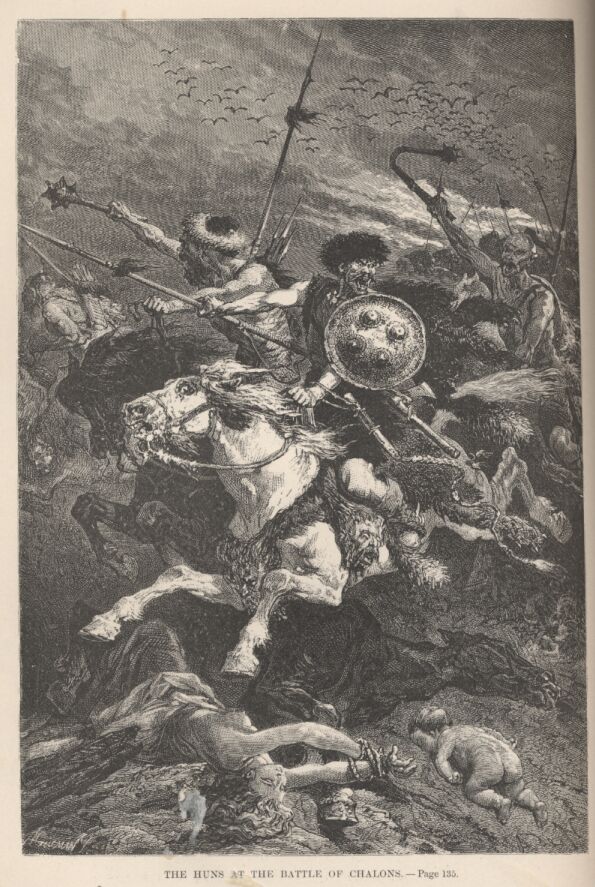
“The Huns at the Battle of Chalons” from page 135 of A Popular History of France From The Earliest Times Volume I of VI (en:Project Gutenberg e-text). Illustration by A. De Neuville (1836-1885). img url: http://www.gutenberg.org/dirs/1/1/9/5/11951/11951-h/images/135.jpg
Attila himself died the following year at a wedding feast, celebrating his marriage to the beautiful young Ostrogoth, Ildico. She may have been yet another alliance bride weeping in her innocence, at the death of her newly wed husband. Or perhaps she was the assassin, come to settle some ancient blood feud between the Germanic peoples, and the Hun. The King of the Huns died in a drunken stupor as the result of a massive nosebleed, or possibly esophageal bleeding. This was not the first such event.
The last of the Hunnic Empire died with King Attila as he choked to death on his own blood. In 454 the Hunnic Empire was dismantled by a coalition of Germanic vassals following the Battle of Nedau.
The night before Roosevelt’s law went into effect was April 6, 1933. Beer lovers lined up at the doors of their favorite watering holes waiting for their first legal beer in thirteen years.
Given the right combination of sugars, nearly any cereal will undergo simple fermentation, due to the presence of wild yeasts in the air. In all likelihood our cave-dwelling ancestors experienced their first beer, as the result of this process.
In the 18,000-year old Wadi Kubbaniya in upper Egypt, starch dusted stones and the remains of doum-palm and chamomile indicate “it’s very likely they were making beer there” according to University of Pennsylvania archaeologist, Dr. Patrick McGovern.
Chemical analysis of pottery shards date the earliest barley beer to 3400BC in the Zagros Mountains of Iran.
Tacitus maligned the bitter brew of the Germanic barbarians. Wine seemed better suited to the sensibilities of the Roman palate, even so, letters from Roman cavalry commanders of the Roman Britain period, c. 97-103 AD, include requests for more “cerevisia“, for the legionaries.
In North and South America, native peoples brewed fermented beverages from local ingredients including agave sap, the first spring tips of the spruce tree, and maize.
Pilgrimsleft the Netherlands city of Leiden in 1620, hoping not for the frozen, rocky soil of New England, but for rich farmland and a congenial climate in the New World. Lookouts spotted the wind-swept shores of Cape Cod on November 9, 1620 and may have kept going, had there been enough beer. A Mayflower passenger wrote in his diary: “We could not now take time for further search… our victuals being much spent, especially our beer…”
Prior to the invention of the drum roaster in 1817, malt was typically dried over wood, charcoal or straw fires leaving a smoky quality which would seem foreign to the modern beer drinker. William Harrison wrote in his “Description of England” in 1577, “For the wood-dried malt, when it is brewed, beside that the drink is higher of colour, it doth hurt and annoy the head of him that is not used thereto, because of the smoke“.
Smoky flavor didn’t trouble the true aficionado of the age. When the Meux Brewery casks let go in 1814 spilling nearly 400,000 gallons onto the street, hundreds of Brits hurried to scoop the stuff up in pots and pans. Some got down on all fours and lapped it up off of the street, doggy-style.
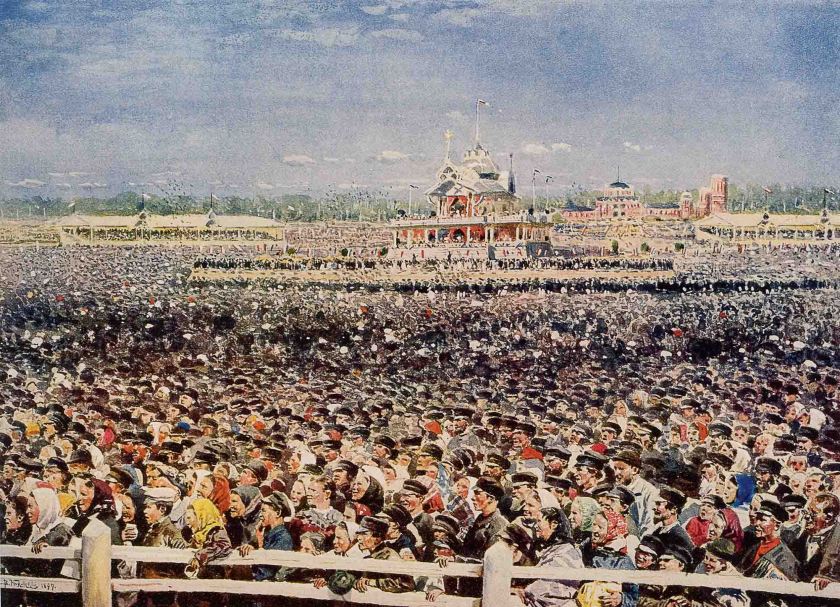
1,389 were trampled to death and another 1,300 injured in a stampede for the suds when someone thought the beer had run out at the coronation of Czar Nicholas II, in 1896.
The 18th amendment, better known as “prohibition”, went into effect at midnight, January 16, 1920. For thirteen years it was illegal to import, export, transport or sell liquor, wine or beer in the United States.
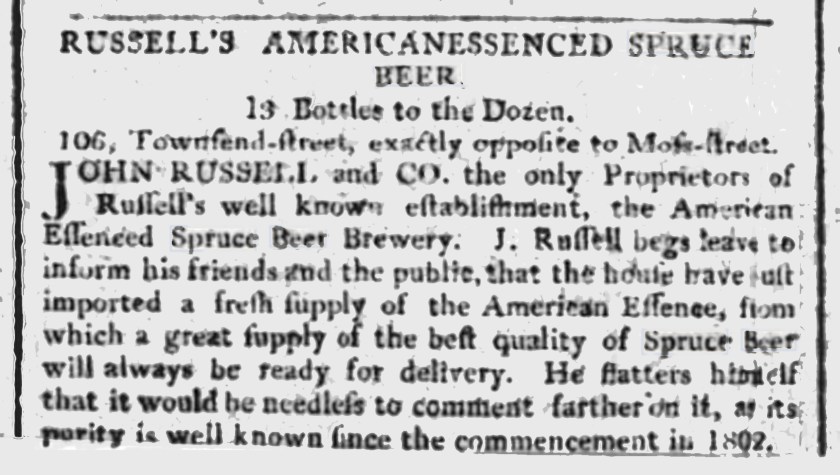
Portable stills went on sale within a week, and organized smuggling was quick to follow. California grape growers increased acreage by over 700% over the next five years, selling dry blocks of grapes as “bricks of rhine” or “blocks of port”. The mayor of New York City sent instructions to his constituents, on how to make wine.
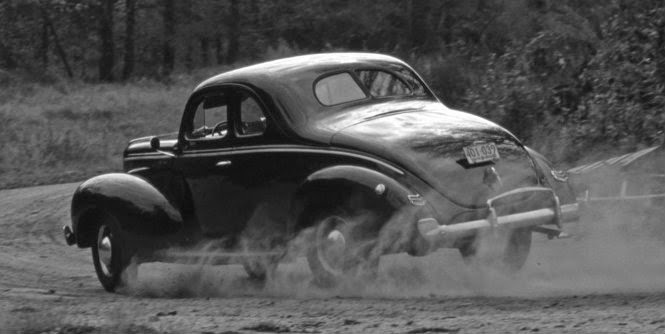
Smuggling operations became widespread as cars were souped up to outrun “the law”. This would lead to competitive car racing, beginning first on the streets and back roads and later moving to dedicated race tracks. It’s why we have NASCAR, today.
Organized crime became vastly more powerful due to the influx of enormous sums of cash. The corruption of public officials was a national scandal.
Gaining convictions became increasingly difficult for breaking a law that everyone hated. There were over 7,000 prohibition related arrests in New York alone between 1921 and 1923. Only 27 resulted in convictions.
The federal government went so far as to deliberately poison denatured alcohol to discourage its “renaturing” resulting in no fewer than 10,000 dead. Even so, the writing was on the wall. Not even poisonous hooch was going to keep the determined reveler, from enjoying a drink.
At last even John D. Rockefeller, Jr., the lifelong teetotaler who contributed $350,000 to the Anti-Saloon League, had to announce support for repeal.
It’s difficult to compare rates of alcohol consumption before and during prohibition. If death by cirrhosis of the liver is any indication, alcohol consumption never decreased by more than 10 to 20 per cent.
President Franklin Delano Roosevelt signed the Cullen–Harrison Act into law on March 22, 1933 with the quip, “I think this would be a good time for a beer.” The law went effect on April 7. For the first time in 13 years Americans could once again buy, sell and legally enjoy a beer containing up to 3.2% alcohol.
A team of draft horses hauled a wagon up Pennsylvania Avenue, delivering a case of beer to the White House. It was the first public appearance of the now-famous, Budweiser Clydesdales.
“Dry” leaders tried to prohibit consumption of alcohol on military bases in 1941, but authorities claimed it was good for morale. Brewers were required to allocate 15% of total annual production to be used by the armed forces. So essential were beer manufacturers to the war effort that teamsters were ordered to end a labor strike against Minneapolis breweries. Near the end of WWII, the army made plans to operate recaptured French breweries, to ensure adequate supplies for the troops.
18 states continued prohibition at the state level after national repeal, the last state finally dropping it in 1966. Almost 2/3rds of all states adopted some form of local option, enabling residents of political subdivisions to vote for or against local prohibition. Some counties remain dry to this day. Ironically, Lynchburg County, Tennessee, home to the Jack Daniel distillery, is one such dry county.
The night before Roosevelt’s law went into effect was April 6, 1933. Beer lovers lined up at the doors of their favorite watering holes waiting for their first legal beer in thirteen years. A million and a half barrels of the stuff were consumed the following day, a date remembered to this day as “National Beer Day”.
So it is we remember, from that day to this. April 6. “New Beer’s Eve”.
Sláinte.
For every wound, a balm. For every sorrow, cheer. For every storm, a calm. For every thirst, a beer.
Listen my children and you shall hear
Of the midnight ride of…Sybil Ludington
“Listen my children and you shall hear, Of the midnight ride of” …Sybil Ludington.
Wait…What?
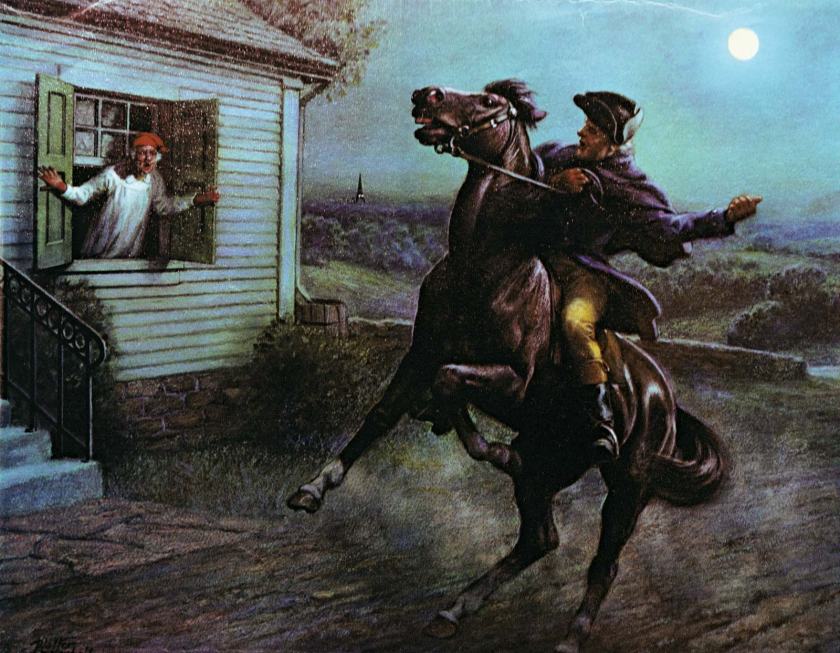
Paul Revere’s famous “midnight ride” began on the night of April 18, 1775. Revere was one of two riders, soon joined by a third, fanning out from Boston to warn of an oncoming column of “regulars”, come to destroy the stockpile of gunpowder, ammunition, and cannon in Concord.
Revere himself covered barely 12 miles before being captured, his horse confiscated to replace the tired mount of a British sergeant. Revere would finish his “ride” on foot, arriving at sunrise on the 19th to witness the last moments of the battle on Lexington Green.
Two years later, Patriot forces maintained a similar supply depot, in the southwest Connecticut town of Danbury.
William Tryon was the Royal Governor of New York, and long-standing advocate for attacks on civilian targets. In 1777, Tryon was major-general of the provincial army. On April 25th, the General set sail for the Connecticut coast of Long Island Sound with a force of 1,800, intending to destroy Danbury.
Patriot Colonel Joseph Cooke’s small Danbury garrison was caught and quickly overpowered on the 26th, trying to remove food supplies, uniforms, and equipment. Facing little if any opposition, Tryon’s forces went on a bender, burning homes, farms and storehouses. Thousands of barrels of pork, beef, and flour were destroyed, along with 5,000 pairs of shoes, 2,000 bushels of grain, and 1,600 tents.
Colonel Henry Ludington was a farmer and father of 12, with a long military career. A long-standing and loyal subject of the British crown, Ludington switched sides in 1773, joining the rebel cause and rising to command the 7th Regiment of the Dutchess County Militia, in New York’s Hudson Valley.
In April 1777, Ludington’s militia was disbanded for planting season, and spread across the countryside. An exhausted rider arrived at the Ludington farm on a blown horse, on the evening of the 26th, asking for help. 15 miles away, British regulars and a force of loyalists were burning Danbury to the ground.
The Dutchess County Militia had to be called up. The Colonel had one night to prepare for battle, and this rider was done. The job would have to go to Colonel Ludington’s first-born, his daughter, Sybil.
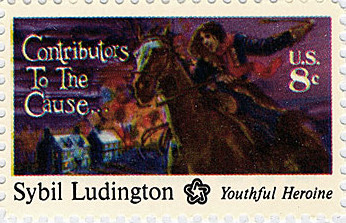
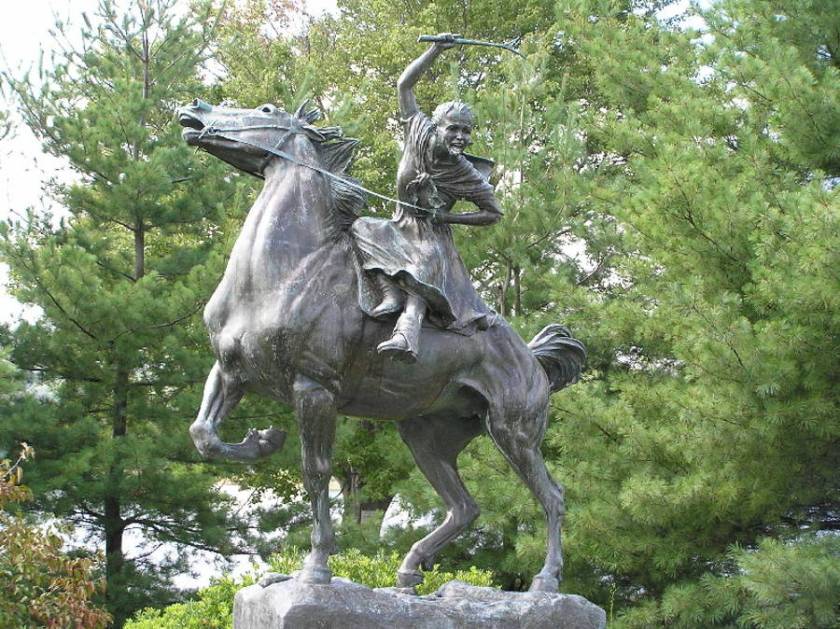
Born April 5, 1761, Sybil Ludington was barely sixteen at the time of her ride. From Poughkeepsie to what is now Putnam County and back, the “Female Paul Revere” rode across the lower Hudson River Valley, covering 40 miles in the pitch dark of night, alerting her father’s militia to the danger and urging them to come out and fight. She’d use a stick to knock on doors, even using it once, to fight off a highway bandit.
By the time Sybil returned the next morning, cold, rain-soaked, and exhausted, most of 400 militia were ready to march.
Arnold’s forces arrived too late to save Danbury, but inflicted a nasty surprise on the British rearguard as the column approached nearby Ridgefield. Never outnumbered by less than three-to-one, Connecticut militia was able to slow the British advance until Ludington’s New York Militia arrived on the following day. The last phase of the action saw the same type of swarming harassment, as seen on the British retreat from Concord to Boston, early in the war.35 miles to the east of Danbury, General Benedict Arnold was gathering a force of 500 regular and irregular Connecticut militia, with Generals David Wooster and Gold Selleck Silliman.
Though the British operation was a tactical success, the mauling inflicted by these colonials ensured that this was the last hostile British landing on the Connecticut coast.
The British raid on Danbury destroyed at least 19 houses and 22 stores and barns. Town officials submitted £16,000 in claims to Congress, for which town selectmen received £500 reimbursement. Further claims were made to the General Assembly of Connecticut in 1787, for which Danbury was awarded land. In Ohio.
At the time, Benedict Arnold planned to travel to Philadelphia, to protest the promotion of officers junior to himself, to Major General. Arnold, who’d had two horses shot out from under him at Ridgefield, was promoted to Major General in recognition for his role in the battle. Along with that promotion came a horse, “properly caparisoned as a token of … approbation of his gallant conduct … in the late enterprize to Danbury.” For now, the pride which would one day be his undoing, was assuaged.The Keeler Tavern in Ridgefield is now a museum. The British cannonball fired into the side of the building, remains there to this day.
Henry Ludington would become Aide-de-Camp to General George Washington, and grandfather to Harrison Ludington, mayor of Milwaukee and 12th Governor of Wisconsin.
Gold Silliman was kidnapped with his son by a first marriage by Tory neighbors, and held for Nearly seven months at a New York farmhouse. Having no hostage of equal rank with whom to exchange for the General, Patriot forces went out and kidnapped one of their own, in the person of Chief Justice Judge Thomas Jones, of Long Island.
Mary Silliman was left to run the farm, including caring for her own midwife, who was brutally raped by English forces for denying them the use of her home. The 1993 made-for-TV movie “Mary Silliman’s War” tells the story of non-combatants, pregnant mothers and farm wives during the Revolution, as well as Mary’s own negotiations for her husband’s release from his Loyalist captors.
General David Wooster was mortally wounded at the Battle of Ridgefield, moments after shouting “Come on my boys! Never mind such random shots!” Today, an archway marks the entrance to Wooster Square, in the East Rock Neighborhood of New Haven.
Sybil Ludington received the thanks of family and friends and even that of George Washington. She then stepped off the pages of history.
Paul Revere’s famous ride would have likewise faded into obscurity, but for the poetry of Henry Wadsworth Longfellow. Eighty-six years, later.
“Listen my children and you shall hear Of the midnight ride of Paul Revere, On the eighteenth of April, in Seventy-five; Hardly a man is now alive Who remembers that famous day and year. He said to his friend, “If the British march By land or sea from the town to-night, Hang a lantern aloft in the belfry arch Of the North Church tower as a signal light,– One if by land, and two if by sea; And I on the opposite shore will be, Ready to ride and spread the alarm Through every Middlesex village and farm, For the country folk to be up and to arm. ”Then he said “Good-night!” and with muffled oar Silently rowed to the Charlestown shore, Just as the moon rose over the bay, Where swinging wide at her moorings lay The Somerset, British man-of-war; A phantom ship, with each mast and spar Across the moon like a prison bar, And a huge black hulk, that was magnified By its own reflection in the tide. Meanwhile, his friend through alley and street Wanders and watches, with eager ears, Till in the silence around him he hears The muster of men at the barrack door, The sound of arms, and the tramp of feet, And the measured tread of the grenadiers, Marching down to their boats on the shore. Then he climbed the tower of the Old North Church, By the wooden stairs, with stealthy tread, To the belfry chamber overhead, And startled the pigeons from their perch On the sombre rafters, that round him made Masses and moving shapes of shade,– By the trembling ladder, steep and tall, To the highest window in the wall, Where he paused to listen and look down A moment on the roofs of the town And the moonlight flowing over all. Beneath, in the churchyard, lay the dead, In their night encampment on the hill, Wrapped in silence so deep and still That he could hear, like a sentinel’s tread, The watchful night-wind, as it went Creeping along from tent to tent, And seeming to whisper, “All is well!” A moment only he feels the spell Of the place and the hour, and the secret dread Of the lonely belfry and the dead; For suddenly all his thoughts are bent On a shadowy something far away, Where the river widens to meet the bay,– A line of black that bends and floats On the rising tide like a bridge of boats. Meanwhile, impatient to mount and ride, Booted and spurred, with a heavy stride On the opposite shore walked Paul Revere. Now he patted his horse’s side, Now he gazed at the landscape far and near, Then, impetuous, stamped the earth, And turned and tightened his saddle girth; But mostly he watched with eager search The belfry tower of the Old North Church, As it rose above the graves on the hill, Lonely and spectral and sombre and still. And lo! as he looks, on the belfry’s height A glimmer, and then a gleam of light! He springs to the saddle, the bridle he turns, But lingers and gazes, till full on his sight A second lamp in the belfry burns.A hurry of hoofs in a village street, A shape in the moonlight, a bulk in the dark, And beneath, from the pebbles, in passing, a spark Struck out by a steed flying fearless and fleet; That was all! And yet, through the gloom and the light, The fate of a nation was riding that night; And the spark struck out by that steed, in his flight, Kindled the land into flame with its heat. He has left the village and mounted the steep, And beneath him, tranquil and broad and deep, Is the Mystic, meeting the ocean tides; And under the alders that skirt its edge, Now soft on the sand, now loud on the ledge, Is heard the tramp of his steed as he rides. It was twelve by the village clock When he crossed the bridge into Medford town. He heard the crowing of the cock, And the barking of the farmer’s dog, And felt the damp of the river fog, That rises after the sun goes down. It was one by the village clock, When he galloped into Lexington. He saw the gilded weathercock Swim in the moonlight as he passed, And the meeting-house windows, black and bare, Gaze at him with a spectral glare, As if they already stood aghast At the bloody work they would look upon. It was two by the village clock, When he came to the bridge in Concord town. He heard the bleating of the flock, And the twitter of birds among the trees, And felt the breath of the morning breeze Blowing over the meadow brown. And one was safe and asleep in his bed Who at the bridge would be first to fall, Who that day would be lying dead, Pierced by a British musket ball. You know the rest. In the books you have read How the British Regulars fired and fled,— How the farmers gave them ball for ball, From behind each fence and farmyard wall, Chasing the redcoats down the lane, Then crossing the fields to emerge again Under the trees at the turn of the road, And only pausing to fire and load. So through the night rode Paul Revere; And so through the night went his cry of alarm To every Middlesex village and farm,— A cry of defiance, and not of fear, A voice in the darkness, a knock at the door, And a word that shall echo for evermore! For, borne on the night-wind of the Past, Through all our history, to the last, In the hour of darkness and peril and need, The people will waken and listen to hear The hurrying hoof-beats of that steed, And the midnight message of Paul Revere”.
Founding Mother
Fatherless at age three and orphaned at twelve, Mary Ball learned a sense of independence, at an early age. She was wed at age 22 in a “semi-arranged” marriage by her guardian, George Eskridge. Mary’s first and only husband was Augustine “Gus” Washington, father to six children, borne of the union. Gus died when the eldest was only eleven and Mary thirty-five, leaving Mary to raise Eskridge’ namesake and four surviving siblings, alone. Today, little is written about Martha Ball Washington, a woman whose personal strength of character taught her son to lead, by example. Eleven-year-old George would grow to become a General in the cause of Liberty and first President of the United States, a man who himself died childless whom we remember today as “Father of the Country”, George Washington
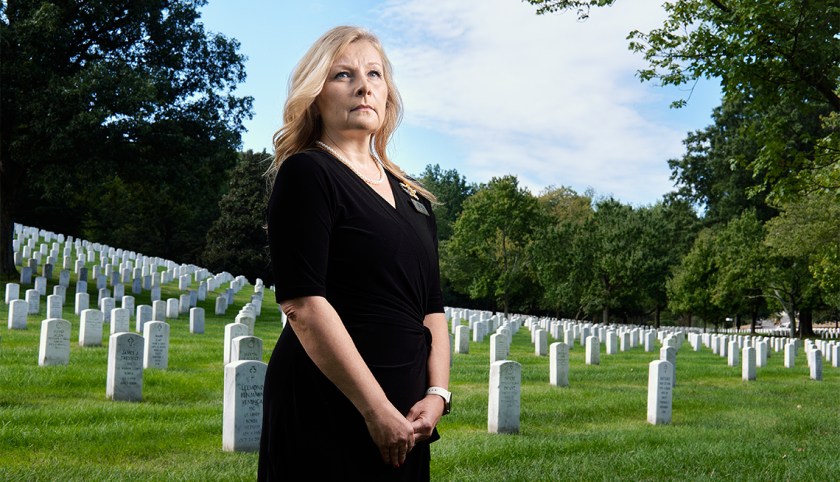
The job of the Arlington Ladies is to honor, not to grieve, but it doesn’t always work out that way. Linda Willey of the Air Force Ladies describes the difficulty of burying Pentagon friends after 9/11, while pieces of debris yet littered the cemetery.
The first military burial at Arlington National Cemetery was that of Private William Henry Christman, 67th Pennsylvania Infantry, interred on May 13, 1864. Two more joined Christman that day, the trickle soon turning into a flood. By the end of the war between the states, that number was 17,000 and rising.
In modern times, an average week will see 80 to 100 burials in the 612 acres of Arlington.
In 2005, a news release from the Department of Defense reported “Private First Class Michael A. Arciola, 20, of Elmsford, New York, died February 15, 2005, in Al Ramadi, Iraq, from injuries sustained from enemy small arms fire. Arciola was assigned to the 1st Battalion, 503d Infantry Regiment, 2nd Infantry Division, Camp Casey, Korea”.
Private Arciola joined a quarter-million buried in our nation’s most hallowed ground on March 31. Two hundred or more mourners attended his funeral, a tribute befitting the tragedy of the loss of one so young.
Sixteen others were buried in Arlington that Friday, most considerably older. Some brought only a dozen or so mourners. Others had no friends or family members whatsoever on-hand, to say goodbye.
Save for a volunteer, from the Arlington Ladies.
In 1948, Air Force Chief of Staff General Hoyt Vandenberg and the general’s wife Gladys made a practice of attending military funeral services at Arlington National Cemetery.
Sometimes, a military chaplain was the only one present at these services. Both Vandenbergs felt that a member of the Air Force family should be present at these funerals. Gladys began to invite other officer’s wives. Over time, a group of women from the Officer’s Wives Club were formed for the purpose.
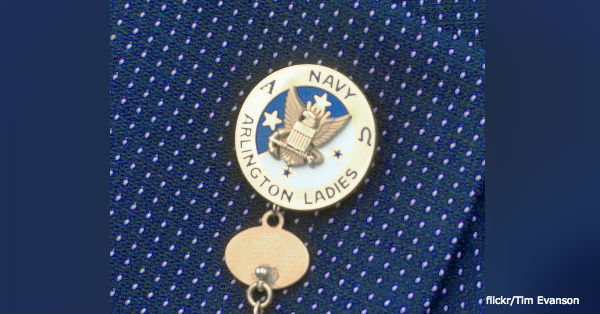
In 1973, General Creighton Abrams’ wife Julia did the same for the Army forming a group calling themselves “Arlington Ladies”. Groups of Navy and Coast guard wives followed suit, in 1985 and 2006.
Traditionally, the Marine Corps Commandant sends an official representative of the Corps to all Marine funerals. The Marine Corps Arlington Ladies were formed in 2016.
Arlington Ladies’ Chairman Margaret Mensch explained “We’ve been accused of being professional mourners, but that isn’t true. I fight that perception all the time. What we’re doing is paying homage to Soldiers who have given their lives for our country.”
The casual visitor cannot help but being struck with the solemnity of such an occasion. Air Force Ladies’ Chairman Sue Ellen Lansell spoke of one service where the only other guest was “one elderly gentlemen who stood at the curb and would not come to the grave site. He was from the Soldier’s Home in Washington, D. C. One soldier walked up to invite him closer, but he said no, he was not family”.
The organization was traditionally formed of current or former military wives. Today their number includes daughters and even one “Arlington Gentleman”. 46 years ago they came alone, or in pairs. Today, 145 or so volunteers from four military branches are a recognized part of all funeral ceremonies at Arlington National Cemetery, their motto: “No Soldier will ever be buried alone.”
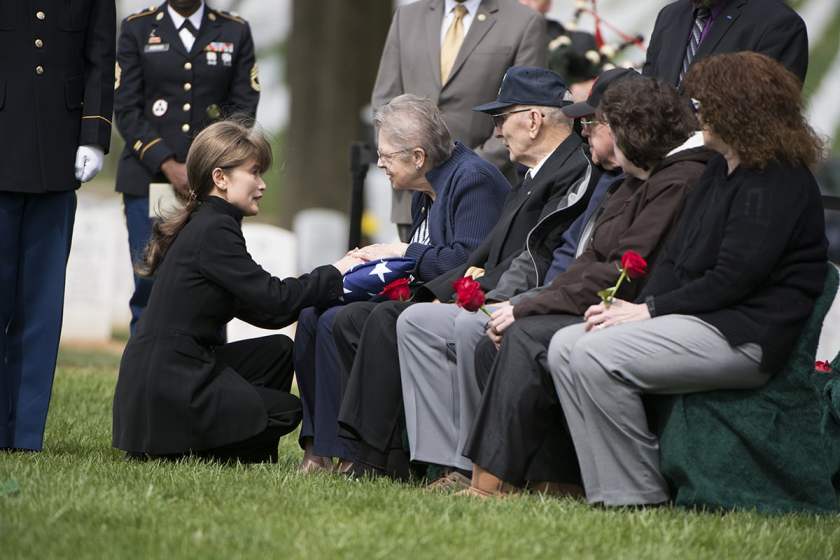
The volunteer arrives with a military escort from the Navy or the United States Army 3rd Infantry Regiment, the “Old Guard”. The horse-drawn caisson arrives from the old post chapel, carrying the flag draped casket. Joining the procession, she will quietly walk to the burial site, her arm inside that of her escort. A few words are spoken over the deceased, followed by the three-volley salute. Off in the distance, a solitary bugler sounds Taps.
The folded flag is presented to the grieving widow, or next of kin. Only then will she break her silence, stepping forward with a word of condolence and two cards: one from the service branch Chief of Staff and his wife and a second, from herself.
Joyce Johnson buried her husband Lieutenant Colonel Dennis Johnson in 2001, a victim of the Islamist terrorist attack on the Pentagon. Johnson remembers the Arlington Ladies’ volunteer as “a touchingly, human presence in a sea of starched uniforms and salutes”. Three years later, Joyce Johnson paid it forward, and became one herself.
Any given funeral may be that of a young military service member killed in service to the nation, or a veteran of Korea or WWII, who spent his last days in the old soldier’s home. It could be a four-star General or a Private. It matters not a whit.
“We’re not professional mourners. We’re here because we’re representing the Air Force family and because, one day, our families are going to be sitting there in that chair”. – Sandra Griffin, Air Force volunteer, Arlington Ladies
Individual volunteers attend about five funerals a day, sometimes as many as eight. As with the Tomb of the Unknown sentinels who hold their vigil heedless of weather, funeral services pay no mind, to weather conditions. The funeral will proceed on the date and time scheduled irrespective of rain, snow or heat. Regardless of weather, an Arlington Lady Will be in attendance.
The job of the Arlington Ladies is to honor, not to grieve, but it doesn’t always work out that way. Linda Willey of the Air Force Ladies describes the difficulty of burying Pentagon friends after 9/11, while pieces of debris yet littered the cemetery. Paula McKinley of the Navy Ladies still chokes up, over the hug of a ten-year old girl who had just lost both parents. Margaret Mensch speaks of the heartbreak of burying one of her own young escorts after he was killed in Afghanistan, in 2009.
Barbara Benson was herself a soldier, an Army flight nurse during WWII. She is the longest serving Arlington Lady. “I always try to add something personal”, Benson said, “especially for a much older woman. I always ask how long they were married. They like to tell you they were married 50 or 60 years…I don’t know how to say it really, I guess because I identify with Soldiers. That was my life for 31 years, so it just seems like the natural thing to do.”
Elinore Riedel was chairman of the Air Force Ladies during the War in Vietnam, when none of the other military branches had women representatives. “Most of the funerals were for young men,” she said. “I saw little boys running little airplanes over their father’s coffins. It is a gripping thing, and it makes you realize the awful sacrifices people made. Not only those who died, but those left behind.”
Mrs. Reidel is a minister’s daughter, who grew up watching her father serve those in need. “It doesn’t matter whether you know a person or not”, she said, “whether you will ever see them again. It calls upon the best in all of us to respond to someone in deep despair. I call it grace…I honestly feel we all need more grace in our lives.”
23-year veteran of the United States Air Force Sandra Griffin, now serves as an Arlington Lady.
I dedicate this “Today in History” to the man for whom I am namesake. The man who gave me the love for history you see, on these pages. United States Army Lieutenant Colonel (retired) Richard B. “Rick” Long, Sr., 2/25/37 – 3/31/18.
“First they came for the socialists, and I did not speak out—because I was not a socialist. Then they came for the trade unionists, and I did not speak out— because I was not a trade unionist. Then they came for the Jews, and I did not speak out—because I was not a Jew. Then they came for me—and there was no one left to speak for me”. – Martin Niemöller
“We shall go on to the end. We shall fight in France, we shall fight on the seas and oceans, we shall fight with growing confidence and growing strength in the air, we shall defend our island, whatever the cost may be. We shall fight on the beaches, we shall fight on the landing grounds, we shall fight in the fields and in the streets, we shall fight in the hills; we shall never surrender, and if, which I do not for a moment believe, this island or a large part of it were subjugated and starving, then our Empire beyond the seas, armed and guarded by the British Fleet, would carry on the struggle, until, in God’s good time, the New World, with all its power and might, steps forth to the rescue and the liberation of the old”.
Winston Churchill
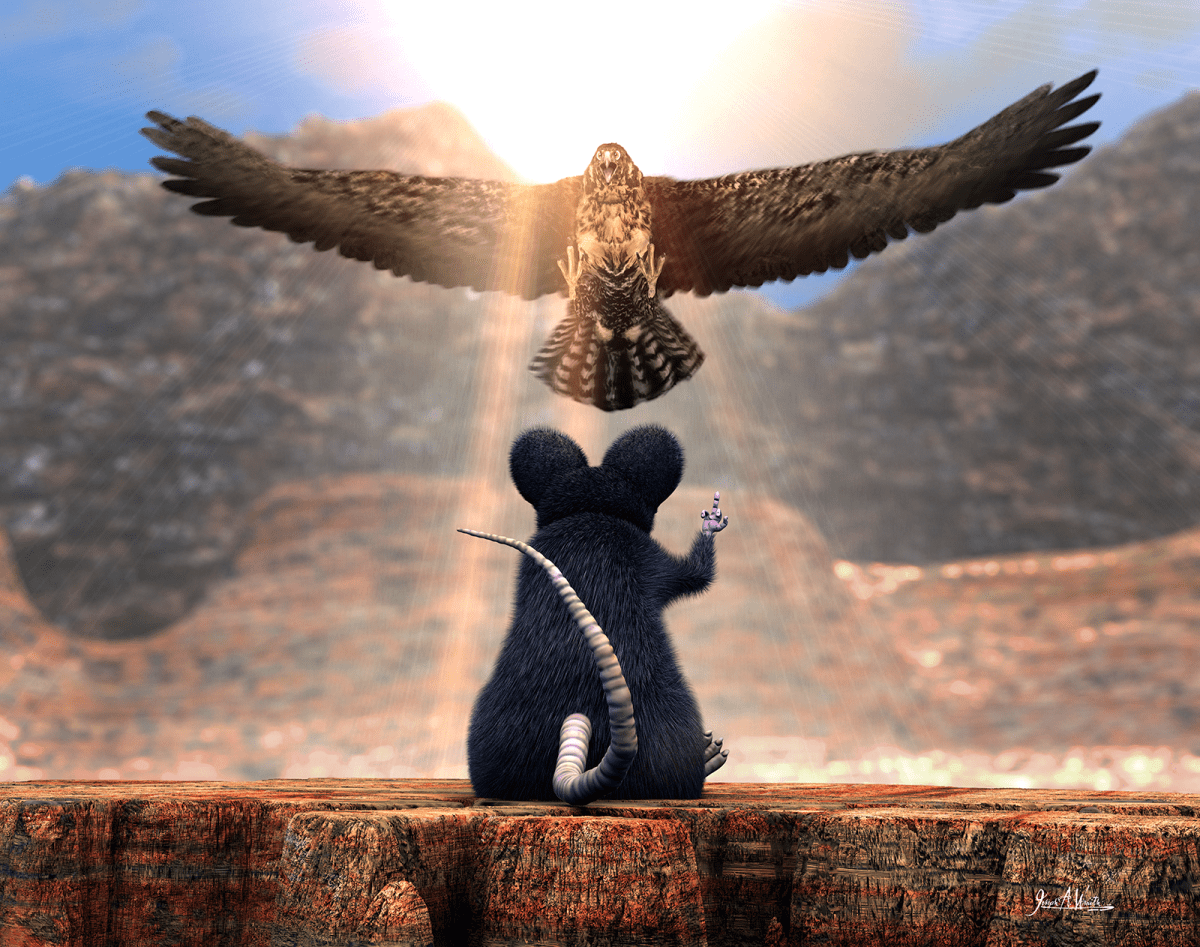
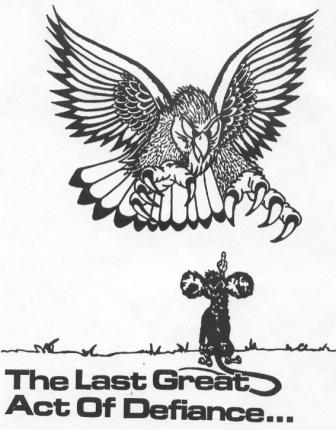
Before the age of the internet, office jokes and bits of folk wisdom were passed around and copied, and copied again. “The Last great of Defiance“ was one of those and shall live for all time, as my personal favorite.
The image speaks for itself. I had one on the wall, for years. This is one of those stories.
The last great effort of German arms burst out of the frozen Ardennes forest on December 16, 1944, aiming for the vital port at Antwerp.
“Unternehmen Wacht am Rhein“, (“Operation Watch on the Rhine”) was a tactical surprise for the Wehrmacht, as allied forces were driven back through the densely forested regions of France, Belgium and Luxembourg. Wartime news maps showed a great inward “bulge” in the lines, and the name stuck. The Battle of the Bulge was the largest and bloodiest battle fought by American forces in World War 2, fought in the harshest winter conditions in recorded history and involving some 610,000 GIs.
Prisoners were swept up by the thousands, to face an uncertain future. In Malmedy, Belgium, seventy-five captured Americans were marched into an open field and machine gunned by members of the 1st SS Panzer Division (Leibstandarte Adolf Hitler), a part of 6th Panzer Army.
On December 16, the all-black 333rd Field Artillery Battalion of the racially segregated US Army put up an heroic defense outside the town of Wereth, Belgium. Using 155mm guns to delay the German advance they were desperately outnumbered. The 333rd was overrun the following day, groups of men scattering to escape as best they could. Eleven soldiers made their way to the home of Mathias Langer, the Mayor of Wereth.
To shelter allied troops under German occupation was to risk summary execution. Despite the obvious risk to their own lives, Matthias and his wife Maria took these men in and attempted to hide them, in their home. When German troops arrived, the eleven surrendered rather than risk the lives of their benefactors.
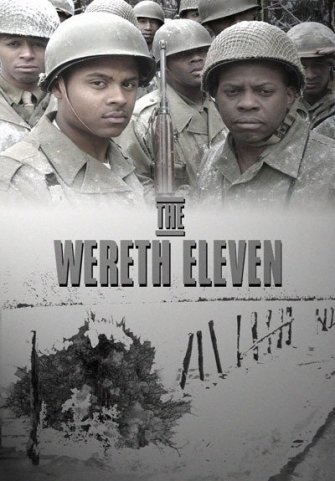
Movie poster for the 2011 film, “The Wereth Eleven”
The prisoners were marched out of sight and murdered by German troops. Every one of them. Lost in the confusion of the Bulge, the bodies of the Wereth 11 lay hidden under the snow, until the Spring melt. For the next fifty years their story was lost, to history.
Nazi atrocities were not limited to Allied troops. By some accounts, more civilians were killed during the Battle of the Bulge than anytime. in the last four years. When the fighting was over, more than 115 bodies were found in the towns of Ster and Parfondruy, alone.
For Master Sargent Roderick “Roddie” Edmonds, the war ended on December 19, swept up with hundreds of American troops and taken prisoner. These were the lucky ones, escaping those first white-hot moments of capture to be sent to a German prisoner-of-war camp. Edmonds was later transferred to another camp near Ziegenhain, Germany. At 24, M/Sgt Roddie Edmonds was now the senior non-commissioned officer at Stalag IX-A, responsible for 1,275 American POWs.
The Wehrmacht had harsh anti-Jewish policies and kept Jewish POWs in strict segregation. In the East, Russian Jews who became POWs were sent directly to extermination camps. In the west the future was more uncertain, for Jewish POWs. Many of them were worked to death, in slave labor camps.
On January 27, the first day at Stalag IX-A, commandant Siegmann ordered Edmonds: All American Jews were to identify themselves at the following day’s assembly. The word went out to all five barracks: “We’re not doing that. We’re all turning out“.
The following morning, 1,275 POWs presented themselves. Every. Single. Man.
Siegmann was perplexed. “They can’t all be Jews!” As senior NCO, Edmonds spoke for the group. “We’re all Jews here“. The Nazi commandant was apoplectic, pressing a Luger into Edmonds’ forehead. This is your last chance.
Imagine yourself in this situation and ponder, what would you do?
Edmonds gave his name, rank and serial number. : ‘If you are going to shoot’, he said, ‘ you are going to have to shoot all of us because we know who you are and you’ll be tried for war crimes when we win this war.’” Siegmann was incandescent, white with rage, but the moment had passed. He was beaten.
The 1,275 American POWs held at Stalag IX-A were liberated on March 30, 1945, their number including some 200 Jews.
Years later the Army called once again and Roddie Edmonds was recruited, for the war in Korea. He never told his family a word about what happened, at Stalag IX-A.
Chris Edmonds is the Pastor at Piney Grove Baptist Church in Maryville, Tennessee. Following his father’s death in 1985, Chris’ mother gave him his father’s war diary, where he found a brief mention of this story. Chris scoured the news for more information, around the time Richard Nixon was looking for his post-Presidential home. As it happened, Nixon bought his posh, upper-east side home from Lester Tanner, a prominent New York Lawyer who mentioned in passing, he owed his life to Roddie Edmonds.
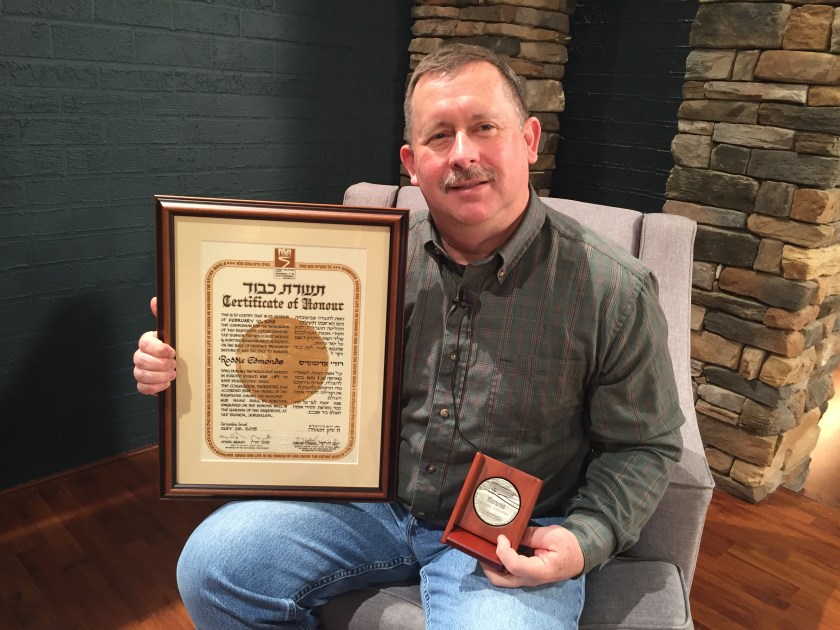
So it is, this story came to light. In 2015, Edmonds was honored as “Righteous among the Nations”, the first American soldier, so honored. It’s the highest honor bestowed by the state of Israel, on non-Jews who risked their lives to save Jews from the Nazi death machine. President Barack Obama recognized Edmonds’ heroism in a 2016 speech before the Israeli embassy. In 2017 Tennessee Senator Marsha Blackburn led a bipartisan effort to bestow the Congressional Gold Medal.
Pastor Edmonds and the Jewish veterans saved by M/Sgt Edmonds continue to push for the Knoxville, Tennessee native to receive the Medal of Honor. Pastor Edmonds says he always looked up to his father, the man had always been, his hero. “I just didn’t know he had a cape in his closet“.
” Every stomach ache or stiffness caused a panic. Was it polio? I remember the awful photos of children on crutches, in wheelchairs and iron lungs. And coming back to school in September to see the empty desks where the children hadn’t returned.” – David Oshinsky
When I was little a boy I once asked my mother. What is polio? At the time I didn’t understand the look that crossed her face but I’ve thought about it, often. What I saw that day was the realization that the nightmare which had terrorized her generation, was something her children would never have to fear.
Recall the terrors of the AIDS virus. Now, instead of the well understood vectors by which that virus is transmitted, imagine all the terrifying finality of that disease combined with the randomness, of the common cold. Like the Covid-19 nightmare of the last two years polio too was ever-present, but with far more lasting results.
The first major polio epidemic in the United States appeared in Vermont, when 132 cases were diagnosed in 1894. A larger outbreak killed 6,000 New York City residents in 1916, with over 27,000 cases diagnosed.
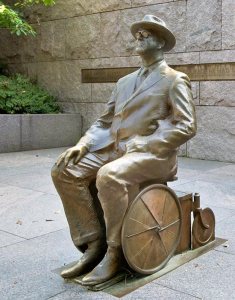
Franklin Delano Roosevelt suffered polio at the age of 39
Poliomyelitis tended to come out in the summer, disproportionately effecting children and young adults. 58,000 cases were reported in the 1952 epidemic alone, 3,145 of them died and another 21,269 left with mild to disabling paralysis.
A President of the United States suffered from polio, as a younger man. The press did their best to treat the matter with delicacy, but the disease left him able to stand only with great pain and difficulty, dependent on a wheelchair for the rest of his life.
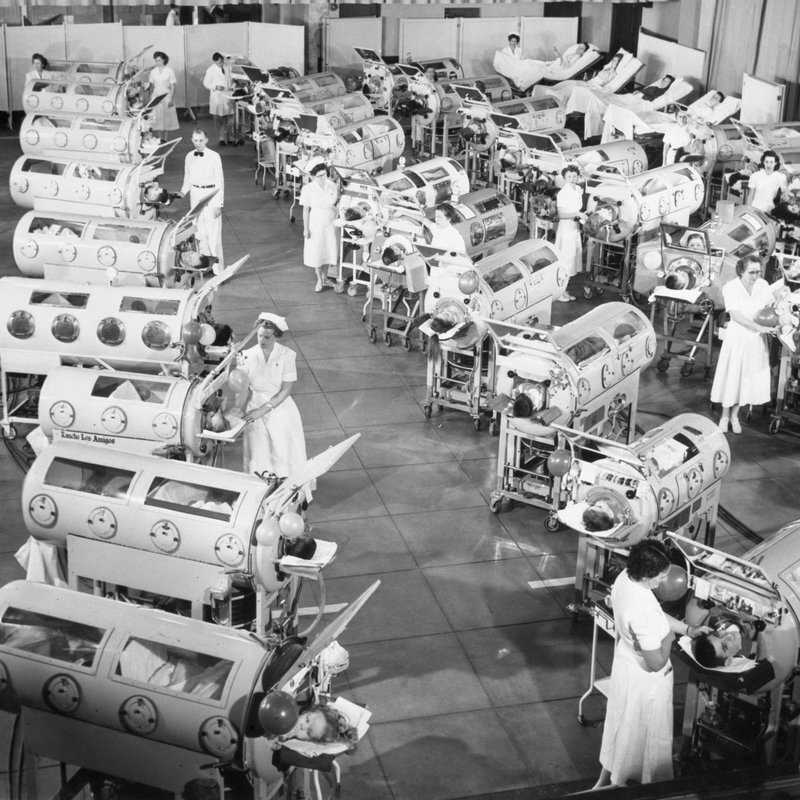
Others were doomed to 800-pound monstrosities called “iron lungs”, seven-foot long, “negative pressure ventilators” which reproduced the movements of breathing. The Smithsonian Institution estimated that in 1959 some 1,200 Americans were dependent on iron lungs.
Today, modern “biphasic” ventilators (alternating negative/positive pressure) are worn like the cuirass of the conquistadors, all but replacing the iron lung. As of 2014, there were only ten individuals left, living their lives in one of the things.
A story of inspiration: Martha was 13 that day in 1948 when the family buried her brother, Gaston. The boy had died of poliomyelitis, a plague which had terrorized, a generation. She didn’t tell her parents that night when she went to bed, that her body ached. Mom and Dad already had enough to worry about. Martha was a year in the hospital before coming home, in an iron lung. She would spend the next 61 years of her life paralyzed from the neck down, dependent on the 7-foott metal tube in which she lived, to breathe. I can personally think of nothing worse and yet Martha made the best of it, going on to earn high honors in high school and college, entertaining guests at her home and even writing a book once voice to text, became a reality.
“I’m happy with who I am, where I am,” Mason told The Charlotte Observer in 2003. “I wouldn’t have chosen this life, certainly. But given this life, I’ve probably had the best situation anyone could ask for.” You may be interested in the following radio segment about the life, of Martha Mason.
NPR All Things Considered segment describing the life, of Martha Mason
Early efforts to develop a vaccine, proved fruitless. One New York University study produced no immunity whatever, at the cost of nine dead children. Other vaccine trials used “volunteers” from state mental institutions.
Jonas Edward Salk was born on October 28, 1914, the son of Jewish immigrants of Irish descent. Daniel and Dora (Press) Salk were not themselves formally educated, but the couple kept their kids focused on school.
Salk attended City College of New York and New York University School of Medicine, taking the road less traveled on graduation from Med School. Instead of becoming a practicing physician, Salk went into medical research.
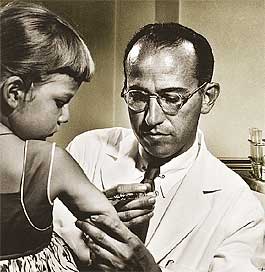
Salk accepted an appointment to the University of Pittsburgh School of Medicine in 1947, the following year beginning a project funded by the National Foundation for Infantile Paralysis, which later became the March of Dimes. The grant was funded to determine the number of polio types, but Salk took it several steps further. He saw it as an opportunity to develop a vaccine.
It’s not widely known that the American Revolution took place during a smallpox pandemic. George Washington himself was a proponent of vaccinating, which, as with rabies, was always done with live virus.
Live virus vaccination carries obvious risks. Dr. Salk was interested in the way the body developed antibodies to killed virus. On March 26, 1953, Dr. Salk announced the successful test of a vaccination, to prevent polio. He and his team completed lab trials in 1954, injected themselves and volunteers alike, with inert virus. Having experienced no ill effects, field trials began a short time later.
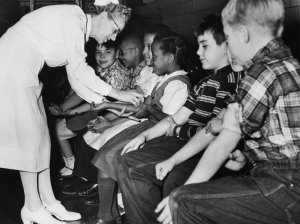
Field trials of Dr. Salk’s vaccine were some of the most extensive in history. 20,000 physicians and public health officials were involved in the trial, along with 64,000 school personnel, 220,000 volunteers, and over 1,800,000 school children.
News of the vaccine’s success was announced on April 12, 1955. Jonas Salk was hailed as a miracle worker. David Oshinsky, history professor at New York University and author of Polio: An American Story, tells a story about that day.
“The public was horribly and understandably frightened by polio. There was no prevention and no cure. Everyone was at risk, especially children. There was nothing a parent could do to protect the family. I grew up in this era. Each summer, polio would come like The Plague. Beaches and pools would close — because of the fear that the poliovirus was waterborne. Children had to stay away from crowds, so they often were banned from movie theaters, bowling alleys, and the like. My mother gave us all a ‘polio test’ each day: Could we touch our toes and put our chins to our chest? Every stomach ache or stiffness caused a panic. Was it polio? I remember the awful photos of children on crutches, in wheelchairs and iron lungs. And coming back to school in September to see the empty desks where the children hadn’t returned.”
David Oshinsky
Jonas Salk consumed over seven years of his life on his goal. When broadcast journalist Edward R. Murrow asked him “who owns the patent on this vaccine”, Dr. Salk replied: “There is no patent. Could you patent the sun?”
All those years, all that time, work and effort, and even in the end the man took no personal financial interest in the result. A mortal virus afflicted the children of his generation. One man was going to lift heaven and earth if he had to, to stop it.
In the late 1950s, Salk became interested in building his own research institute. He searched for a site for over a year, until meeting San Diego Mayor Charles Dail, himself a polio survivor. Dail showed Salk 27 acres on a mesa in La Jolla, just west of the proposed site for the new UC campus then planned for San Diego. In June of 1960, the citizens of San Diego overwhelmingly voted “yes”, to donate the land for Salk’s dream. Construction began with initial funding from the National Foundation/March of Dimes, and completed in 1967.
Jonas Salk died on June 23, 1995, at the age of 80. A memorial at the Institute bearing his name reads: “Hope lies in dreams, in imagination and in the courage of those who dare to make dreams into reality.”
By 1979, the disease was eradicated from the United States. The worldwide effort to wipe out polio began in 1988, with the Global Polio Eradication Initiative. 20 million volunteers from virtually every country in the world have vaccinated over 2.5 billion children, at a cost of $11 billion. Worldwide, the incidence of new polio cases decreased by 99%. Today, polio remains endemic in northern Nigeria and the border regions between Afghanistan and Pakistan.
So it is that those of us born after 1955 can live out our lives in blissful ignorance, having no idea of the terrors our parents endured before us.
“Men were known to go into Murder Bay and were not heard of again until their bodies were discovered in the canal or found buried in ash dumps”. – Washington Post, 1888
March is upon us once again, a time when tourists flock to our nation’s capital to take in the cherry blossoms, along the banks of the Potomac. A gift to the United States from the people of Japan the Yoshino cherry in bloom has been called, the “most beautiful thing in the world.
H/T ABC News for this image of the cherry blossoms, of 2022
There, tourists may take in the Lock Keeper’s House, the oldest structure yet standing on the National Mall whose purpose it was to collect tolls and make records of travelers, on the Washington City Canal. Why you may ask, is a lock keeper’s house located at the corner of Constitution Avenue and 17th Street, some ten blocks from the Potomac?
The answer takes us back to a day when our nation’s capital was anything but, the most beautiful place on the earth.
Between 1775 and 1783, the United States Congress and its predecessor bodies did their business in the Pennsylvania State House in Philadelphia, later known as “Independence Hall”.
The “Residence Act” of July 1790 established a home for the Federal government along the banks of the Potomac River.
The specific site was under negotiation when Alexander Hamilton brokered a deal. Several delegates supported the current location in exchange for which, the Federal government agreed to assume their state’s debt, from the late revolution.
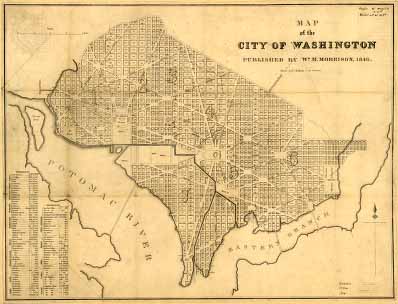
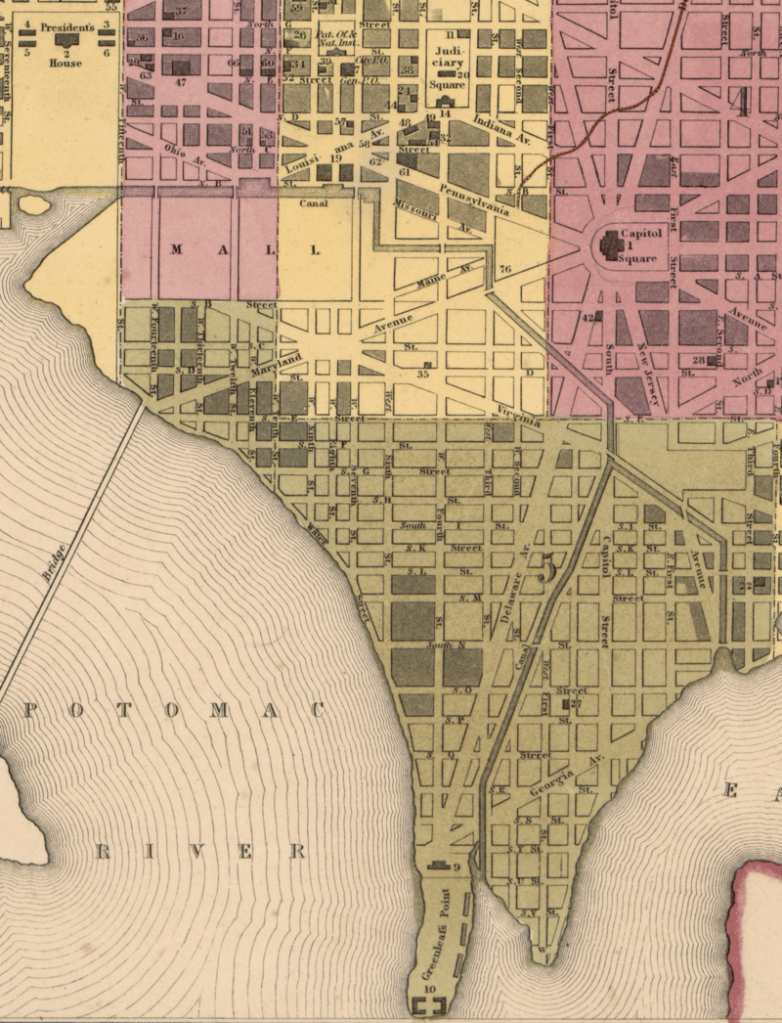
Pierre L’Enfant was selected to create the city plan as well as a design, for the buildings themselves. At the time, navigable waterways formed the economic backbone of the nation. L’Enfant’s plan allowed for a great canal connecting the Anacostia River called the “East branch” with the Tiber Creek, a tributary waterway to the Potomac.
Interest was high in such a canal but funding, was not. The project proceeded in fits and starts over the following decade and stopped altogether, during the War of 1812.
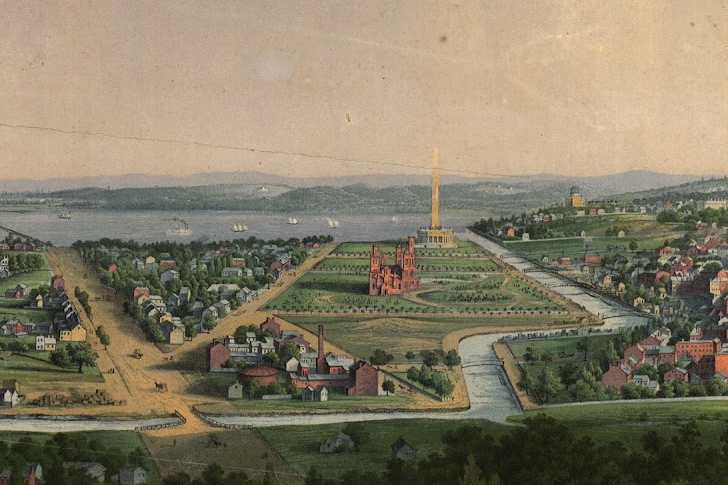
The Washington City Canal was dedicated in 1815. The Chesapeake and Ohio Canal was finished in 1833 and the lock keeper’s house, two years later. The system had problems from the beginning, overflowing its banks at extreme high tides and becoming too shallow for navigation, at extreme lows. Congress appropriated funds for improvements in 1849 but there were problems with contractors, and staff.
By now, business and government alike looked to the railroad as the future of commerce. The Washington City Canal fell into disrepair.
Washington City Canal H/T photographer, Tom Bosse
Dead animals joined with effluent of every manner and description to fill the W canal. In an age before streetlights, the Washington Evening Star of 1859 called the thing a “Man Trap”, “…because of the number of persons who have walked into it and drowned.” The Secretary of the Interior labeled the canal “a shallow, open sewer, of about one hundred and fifty feet in width, (sometimes called a canal,) which stretches its filthy surface through the heart of the city.”
The Civil War more than doubled Washington’s population with everything from soldiers and political types to escaped slaves living in “contraband camps”, along the canal.
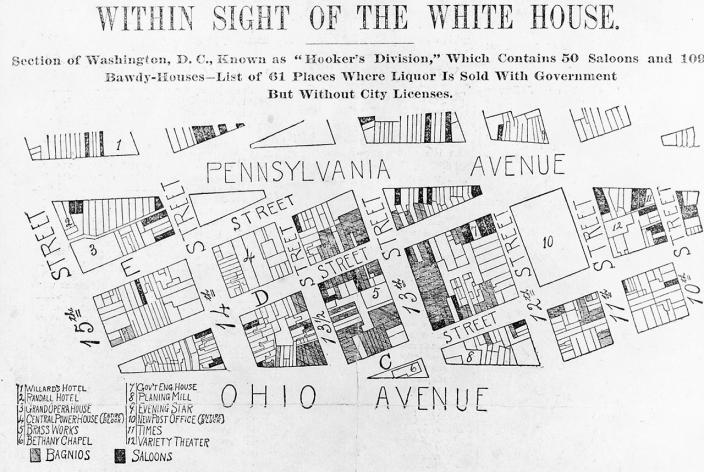
Prostitutes flocked to over 100 houses of ill repute to service the needs, of Union General Joseph Hooker’s army. It’s a myth to say that’s where we get the term “hooker” from, but these ‘ladies of the night’ arrived in such numbers they would come to be called, “Hooker’s Division”.
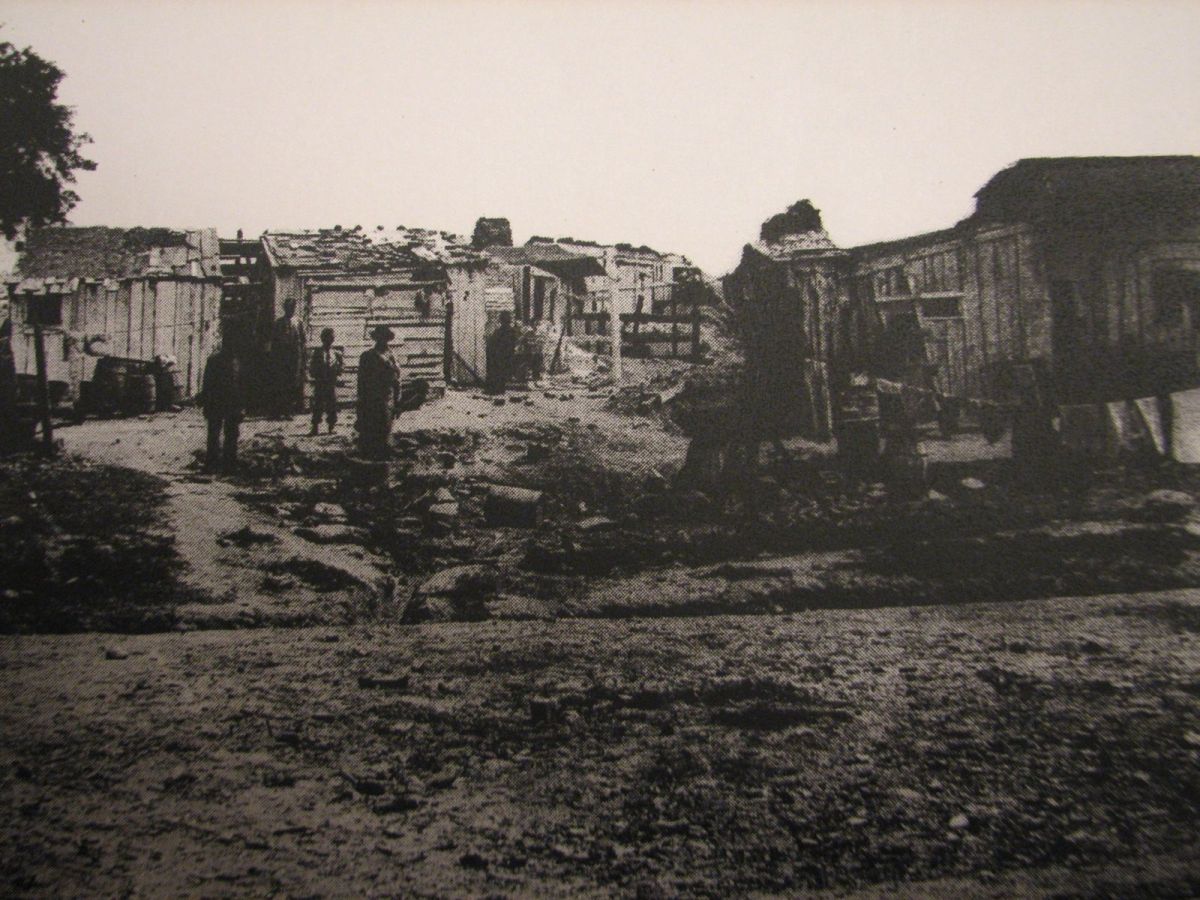
Desperate to contain the seedier aspects of the city General Hooker consolidated the dark underbelly of the nation’s capital into these few blocks. What was already a seedy redlight district of brothels, gambling dens and alcohol was transformed to a hideous slum, known as “Murder Bay”.
Murder bay in 1855, H/T Smithsonian
Crime and violence rose to almost cartoonish levels. The place was so dangerous the police themselves stayed out, if at all possible. The Washington Post wrote in 1888 “Men were known to go into Murder Bay and were not heard of again until their bodies were discovered in the canal or found buried in ash dumps”. ‘Reforms’ were attempted throughout the post-war era, without success.
Murder Bay as it looked, in 1910
What began with the best of intentions was destined to end, with the wrecking ball. As the ‘Great War’ started up ‘over there’ the federal government bought up land on Pennsylvania Avenue between 14th and 15th Streets. In the 1920s a handy new invention called the bulldozer, helped out.
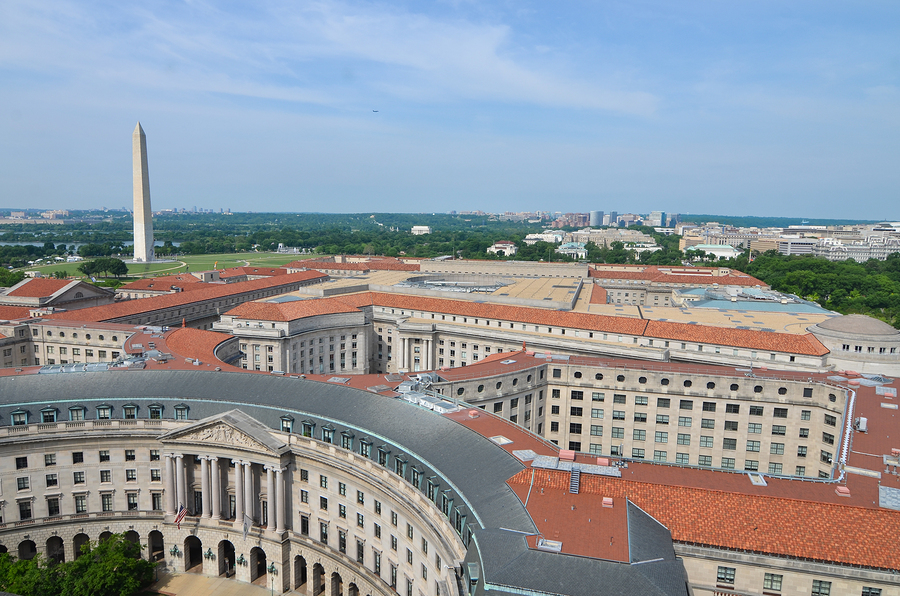
Ten large city and federal office buildings were built in parts of Murder Bay to form an area now known as, the Federal Triangle. Other parts were razed beginning in the mid-1920s to be replaced with the Internal Revenue Service and the Departments of Justice, Labor, Interstate Commerce and the National Archives.
Washington DC, skyline with federal government buildings and the Monument
On March 25, 1964, President Lyndon Johnson signed Executive Order No. 11210 providing for “the development of an orderly, phased program for carrying out the improvement of Pennsylvania Avenue”.
The notorious slum known as Murder bay is but a memory now but the canal where it all began, yet flows to the sea. Pierre L’Enfant’s channel is still there, bricked over beneath the wheels of the busses and the bicycle rickshaws and the feet of all those tourists, come to see the cherry blossoms, along the Potomac.
“Colonel Von Luger, it is the sworn duty of all officers to try to escape. If they cannot escape, then it is their sworn duty to cause the enemy to use an inordinate number of troops to guard them, and their sworn duty to harass the enemy to the best of their ability”. Group Captain Ramsey (played by James Donald), senior British officer at the prisoner of war camp in the 1963 film The Great Escape, addressing the German commandant.
Stalag Luft III in the province of Lower Silesia was a German POW camp, built to house captured Allied airmen. The first “Kriegsgefangene” (POWs), arrived on March 21, 1942. The facility would grow to include 10,949 “kriegies”, comprising some 2,500 Royal Air force officers, 7,500 US Army Air officers, and about 900 from other Allied air forces.
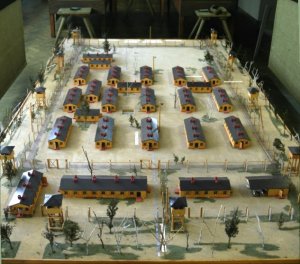
Barracks were built on pilings to discourage tunneling, creating 24” of open space beneath the buildings. Seismic listening devices were placed around the camp’s perimeter. In the German mind, the place was the next best thing, to airtight.
Model of the set used to film the movie The Great Escape
Kriegies didn’t see it that way, three of whom concocted a gymnastic vaulting horse out of wood from Red Cross packages.
A Trojan horse was more like it. Every day, the horse would be lugged out to the perimeter. Above ground, prisoners’ gymnastic exercises masked the sound, while underground, kriegies dug with bowls into the sand, using the horse itself to hide diggers, excavated soil and tools alike. Iron rods were used to poke air holes to the surface. There was no shoring of the tunnel, except at the entrance.
Every evening for three months, plywood was placed back over the hole, and covered with the gray-brown dust of the prison yard.
On October 19, 1943, the three British officers made their escape. Lieutenant Michael Codner and Flight Lieutenant Eric Williams reached the port of Stettin in the West Pomeranian capital of Poland, where they stowed away on a Danish ship. Flight Lieutenant Oliver Philpot boarded a train to Danzig, and stowed away on a ship bound for neutral Sweden. Eventually, all three made it back to England.
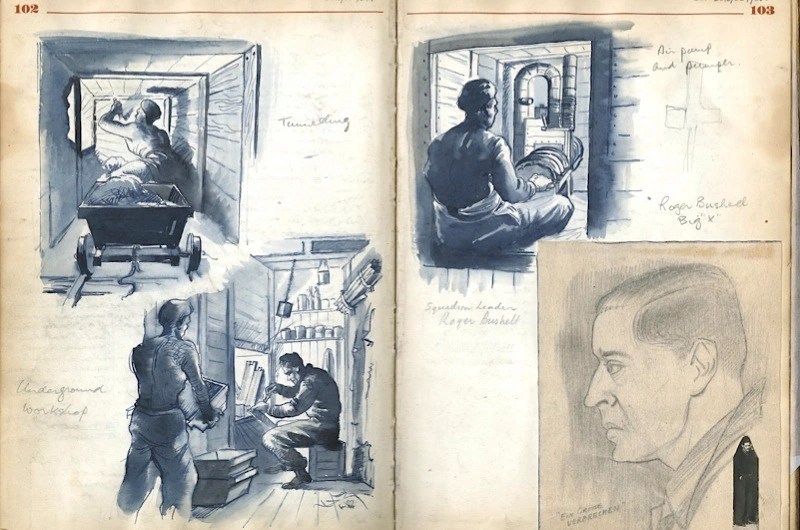
RAF Squadron Leader Roger Bushell was shot down and forced to crash land on his first engagement in May 1940, but not before taking two Messerschmitt Bf 110 fighters with him. Taken to the Dulag Luft near Frankfurt, Bushell formed an escape committee along with Fleet Air Arm pilot Jimmy Buckley, and Wing Commander Harry Day.
For POWs of officer rank, escape was the first duty. Bushell escaped twice and almost made it, but each time his luck deserted him. By October, Roger Bushell found himself in the north compound of Stalag Luft III, where British officers were held.
By the following spring, Bushell had concocted the most audacious escape plot in WWII history. “Everyone here in this room is living on borrowed time”, he said. “By rights we should all be dead! The only reason that God allowed us this extra ration of life is so we can make life hell for the Hun… In North Compound we are concentrating our efforts on completing and escaping through one master tunnel. No private-enterprise tunnels allowed. Three bloody deep, bloody long tunnels will be dug – Tom, Dick and Harry. One will succeed!”
The effort was unprecedented. Previous escape attempts had never involved more than twenty. Bushell, soon to be known by the code name “Big X” was proposing to get out with 200.
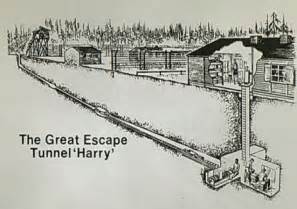
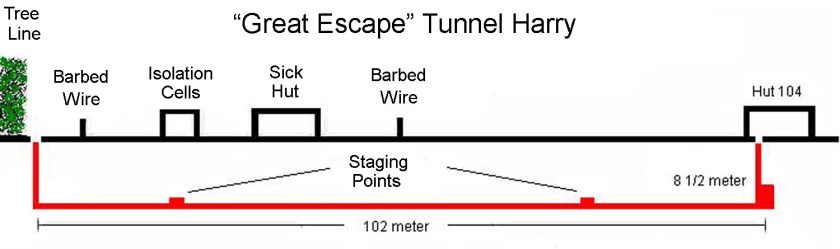
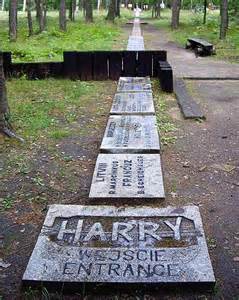
Civilian clothes had to be fashioned for every man. Identification and travel documents forged. “Tom” began in a darkened hallway corner. “Harry’s entrance was hidden under a stove, “Dick”‘s entrance was concealed in a drainage sump.
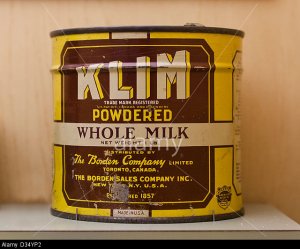
The Red Cross distributed high calorie, dehydrated whole-milk powder called “Klim” (“Spell it backwards”) throughout German POW camps. Klim tins were fashioned into tools, candle holders and vent stacks. Fat was skimmed off soups and molded into candles, using threads from old clothing for wicks.
Six hundred prisoners were involved in the construction. 200 with sacks sewn under greatcoats made 25,000 trips into the prison yard, disposing of soil as Tom, Dick and Harry were excavated. 30′ down and only 2 ft. square, the three tunnels extended outward for a football field and more.
These “penguins” were running out of places to put all that soil, around the time the camp was expanded to include “Dick’s” originally planned exit point. From that time forward, “Dick” was refilled from the other two. “Tom” was discovered in September 1943, the 98th tunnel in the camp to be found out.
The escape was planned for the good weather of summer, but a Gestapo visit changed the timetable. “Harry” was ready by March. The “Great Escape” was scheduled for the next moonless night. 73 years ago – March 24, 1944.
Contrary to the Hollywood movie, no Americans were involved in the escape. At that point none were left in camp.
The escape was doomed, almost from the start. First the door was frozen shut, then a partial collapse had to be repaired. The exit came up short of the tree line, further slowing the escape. It was over when guards spotted #77 coming out of the ground.
German authorities were apoplectic on learning the scope of the project. 90 complete bunk beds had disappeared, along with 635 mattresses. 52 twenty-man tables were missing, as were 4,000 bed boards and an endless list of other objects. For the rest of the war, each bed was issued with only nine boards, and those were counted, regularly.
Gestapo members executed German workers who had not reported the disappearance of electrical wire.
In the end, only three of the 76 made it to freedom: two Norwegian and one Dutch pilot. Hitler personally ordered the execution of the other 73, 50 of which were carried out.
General Arthur Nebe is believed to have personally selected the 50 for execution. He was later involved with the July 20 plot to assassinate Adolf Hitler, and executed on March 21, 1945. Roger “Big X” Bushell and his partner Bernard Scheidhauer were caught while waiting for a train at the Saarbrücken railway station. They were murdered by members of the Gestapo on March 29, who were themselves tried and executed for war crimes, after the war.
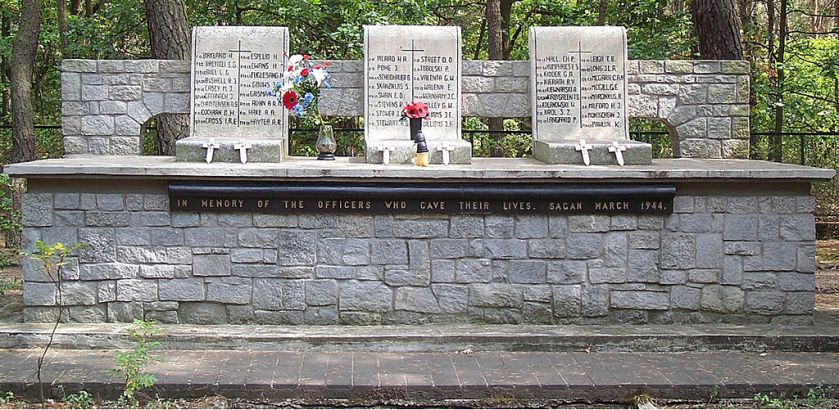
New camp Kommandant Oberst Franz Braune was horrified that so many escapees had been shot. Braune allowed those kriegies who remained to build a memorial, to which he personally contributed. Stalag Luft III is gone today, but that stone memorial to “The Fifty”, still stands.
Dick Churchill was an HP.52 bomber pilot and RAF Squadron Leader. One of the 76 who escaped, Churchill was recaptured three days later, hiding in a hay loft. In a 2014 interview, he said he was fairly certain he’d been passed over for execution, because his captors thought he might be related to Prime Minister Winston Churchill. Today, Dick Churchill, age 97, is the only man among those 76, still left alive.
“It was soldiers saving soldiers. Soldiers putting out fires on other soldiers; soldiers dragging soldiers out of fires; resuscitating; giving soldiers CPR; putting tourniquets on limbs that had been severed; putting out fires on their bodies, sometimes with their own hands. Anything they could do to care for their buddies that were more seriously injured they were doing. They can’t do that without knowing how. They responded the way they would in combat”.
March 23, 1994 was a good day for a jump.. The skies were clear with moderate winds of 5 -7 MPH, temperatures a comfortable mid-sixties.
H/T History.army.mil
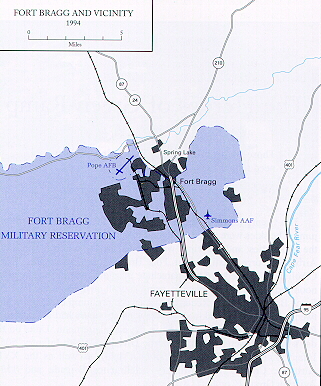
Some 500 paratroopers of the 82nd Airborne Division were assembled around the parking area known as “Green Ramp”, part of a joint exercise between Fort Bragg North Carolina, and nearby Pope Air Force base.
There were two parachute drops scheduled that day. The sky above was filled with aircraft, General Dynamics F-16 Fighting Falcons, Fairchild Republic A-10 Thunderbolts and C-130 aircraft, conducting training.
On the ground, paratroops of the First Brigade, 504th Infantry Regiment, and 505th Infantry Regiment prepared to board Lockheed C-130 Hercules and Lockheed C-141 Starlifter aircraft parked on Green Ramp, or practiced jumps from one of several concrete tail mock-ups or just waited, resting in a large personnel shed called the “PAX”, or surrounding lawns.
An F-16D Fighting Falcon was conducting a simulated flame-out on final approach to the runway, with two pilots at the stick. 300-feet above tree level, the giant four-engine turboprop military transport known as the C-130E Hercules, was making the same approach.
The Fighter’s nose struck the tail of the transport, severing the C-130E’s right elevator. F-16 pilots applied full after burner trying to recover the aircraft, as its frame began to disintegrate. The transport was able to recover, veering off to circle the air field and assess the damage. Meanwhile both F-16 pilots ejected with the fighter still on afterburner, hurtling toward Green Ramp.
H/T Fayettville Observer
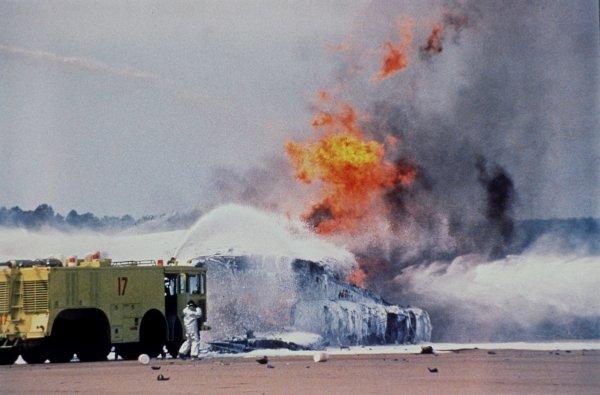
The shattered wreckage of the F-16 hit the ground between two parked C-130s before striking the right wing of the C-141B Starlifter, puncturing 55,000 gallon fuel tanks. A great fireball of flaming wreckage some 75-feet in diameter ricocheted across the tarmac, hurtling toward 82nd Airborne personnel staging for that second jump.
“S. Sgt. Daniel E. Price of the 2d Battalion, 505th Infantry, sacrificed his life to save a female soldier he had never met before. Spc. Estella Wingfield, an information systems operator with Headquarters and Headquarters Detachment, 525th Military Intelligence Brigade, remembered:
He looked me in the eye, grabbed me by the shirt, threw me several feet in the air and jumped on top of me…. An instant later, I heard the blast, felt the extreme heat from the explosion and the debris falling on us…. After the explosion and the rounds stopped going off, he whispered in my ear, “Crawl out from underneath me.”” I did and took off running.
History.army.mil
Captain Gerald K. Bebber, Chaplain to the 525th Military Intelligence Brigade chaplain, remembers he:
“heard the high pitched screech of a jet fighter airplane at open throttle from beyond the pack shed [sic] suddenly give way to a deep reverberating thud and massive explosion. I recognized the sound from my experience in battle in Desert Storm. As soon as I could think this, a great roaring rush of fire entered my sight above and to the left of the pack shed. It was at tree-top level, slanting down as it gushed into the mockup area at terrific speed…. The flame came though the tops of the trees that stood in a small open area beside the pack shed. In the torrent of flame I saw pieces of wreckage and machinery hurling along. As the torrent rushed in I could hear cries of alarm, curses, and someone yelling “run” from the mock-ups. The fire blast crackled as it blasted in, and at its sides it curled outward as it went forward. I was standing perhaps thirty feet beside the edge of the blast, and could see eddies of the flame curling out toward me. I turned and ran from the flame, to just beyond the right end of the pack shed, where . . . I no longer felt the intense heat, so I stopped. To my left, out on the aircraft ramp, now in my line of sight I could see a parked C-141 engulfed in flames. It was the left one of a pair of C-141s parked there”.
H/T Fayetville Observer
Jump master Captain James B. Rich was conducting a pre-jump briefing by one of those concrete mock-ups, and remembers the “overwhelming understanding that there was no way in hell I could outrun the oncoming debris…” Captain Rich “felt fully exposed” as flaming chunks of white hot metal, rained down. It was like “heavy pipes clanging against each other, mixed with a handful of steel marbles thrown against a road sign“.
2d Battalion S. Sgt. Michael T. Kelley remembered nuclear event training and hit the ground as the fireball rolled over him. When he got up he was on fire. Sergeant Kelley dropped and rolled as a would-be rescuer jumped on his body, to put out the flames. A second beat back the fire with “a wrap of some kind” while a third came up with water. When the flames went out, Sgt. Kelly had severe burns over 70 per cent of his body, including the lower one-third of his face.
Sgt. Gregory Cowper of the 2d Battalion, 505th Infantry, began to roll when the fire caught up with him. “Ammunition was going off”, he said, “I couldn’t tell where it was. I looked to my left and there was a man on fire. I looked to my right and there was a man on fire.”
Rank held no distinction that day, Privates to Captains age eighteen to forty, pulling one another from the flames and shielding the wounded, with their bodies. Twenty three were killed outright, another eighty severely injured. One badly burned soldier survived nine agonizing months before succumbing, to his wounds.
82d Airborne commander Major General William M. Steele, remembered:
“It was soldiers saving soldiers. Soldiers putting out fires on other soldiers; soldiers dragging soldiers out of fires; resuscitating; giving soldiers CPR; putting tourniquets on limbs that had been severed; putting out fires on their bodies, sometimes with their own hands. Anything they could do to care for their buddies that were more seriously injured they were doing. They can’t do that without knowing how. They responded the way they would in combat”.
The Green Ramp disaster of March 23, 1994 was the greatest single-day loss of life suffered by the 82nd Airborne division, since the Battle of the Bulge.
A Trivial Matter
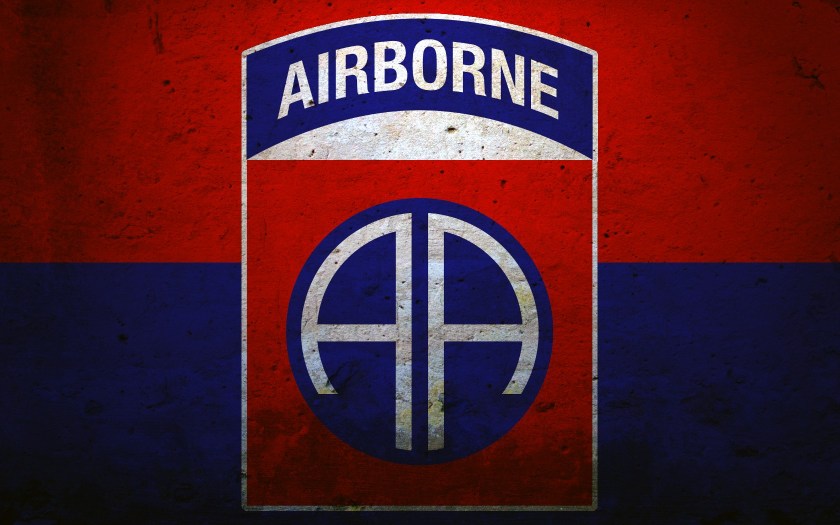
Originally constituted as the 82nd Division following the American entry into World War 1, The 82nd Airborne Division was organized on August 25, 1917, at Camp Gordon, Georgia. The “AA” on the arm patch stands for “All American”. Now based out of Fort Bragg North Carolina, the All Americans have participated in virtually every American conflict, of the last 100 years.



 Fifteen years before Angus “Mac” MacGyver hit your television screen, mission control teams, spacecraft manufacturers and the crew itself worked around the clock to “MacGyver” life support, navigational and propulsion systems. For four days and nights, the three-man crew lived aboard the cramped, freezing Aquarius, a landing module intended to support a crew of 2 for only a day and one-half.
















 Revere himself covered barely 12 miles before being captured, his horse confiscated to replace the tired mount of a British sergeant. Revere would finish his “ride” on foot, arriving at sunrise on the 19th to witness the last moments of the battle on Lexington Green.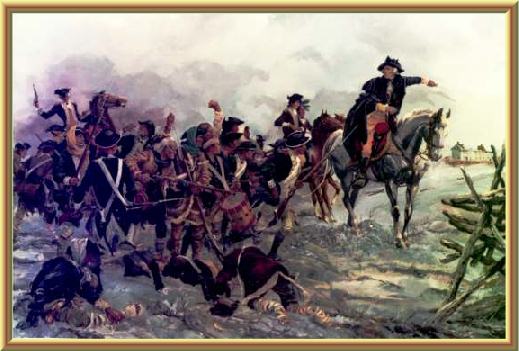


 General David Wooster was mortally wounded at the Battle of Ridgefield, moments after shouting “Come on my boys! Never mind such random shots!” Today, an archway marks the entrance to Wooster Square, in the East Rock Neighborhood of New Haven.

 In 2005, a news release from the Department of Defense reported “Private First Class Michael A. Arciola, 20, of Elmsford, New York, died February 15, 2005, in Al Ramadi, Iraq, from injuries sustained from enemy small arms fire. Arciola was assigned to the 1st Battalion, 503d Infantry Regiment, 2nd Infantry Division, Camp Casey, Korea”.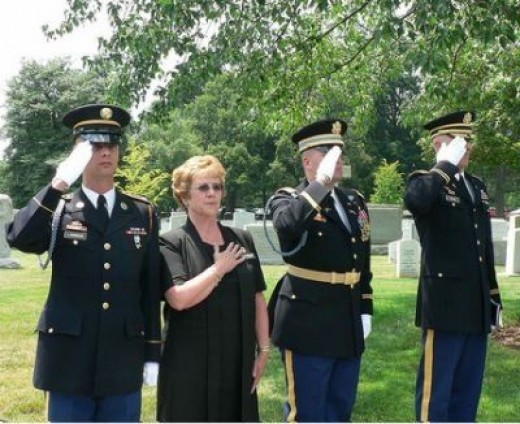
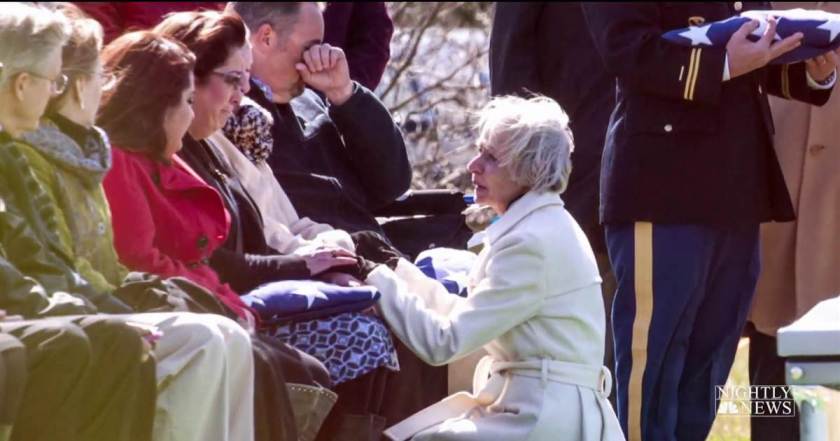 Sometimes, a military chaplain was the only one present at these services. Both Vandenbergs felt that a member of the Air Force family should be present at these funerals. Gladys began to invite other officer’s wives. Over time, a group of women from the Officer’s Wives Club were formed for the purpose.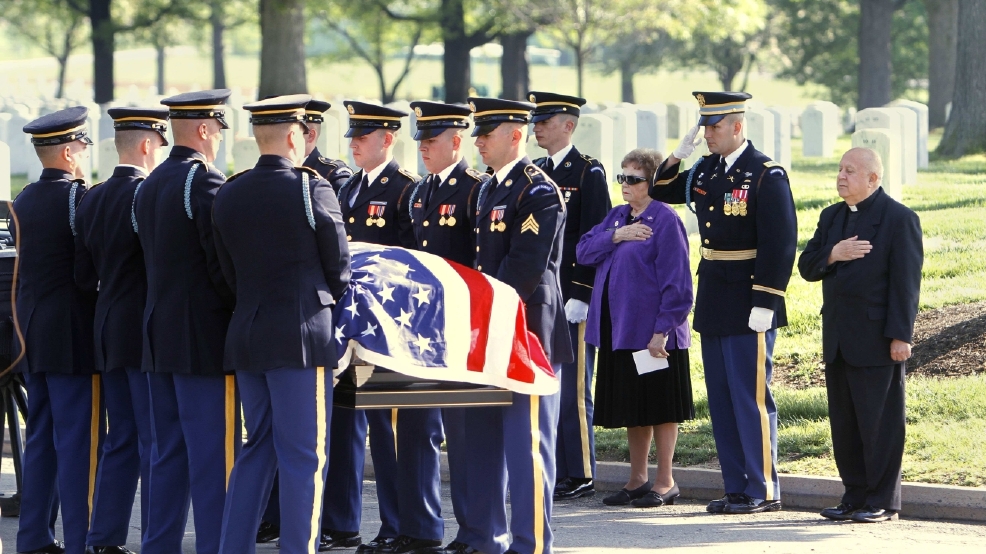
 The casual visitor cannot help but being struck with the solemnity of such an occasion. Air Force Ladies’ Chairman Sue Ellen Lansell spoke of one service where the only other guest was “one elderly gentlemen who stood at the curb and would not come to the grave site. He was from the Soldier’s Home in Washington, D. C. One soldier walked up to invite him closer, but he said no, he was not family”.
























 Historical Easter Eggs - Today in History
You must be logged in to post a comment.