2,000 years later, the ancient civilization of Rome still permeates our everyday lives.
According to legend, Romulus and Remus were the sons of Rhea Silvia, the daughter of King Numitor of Alba Longa, a mythical city located in the Alban Hills southeast of what would become Rome. Numitor was deposed by his younger brother Amulius, who forced Rhea to become a vestal virgin so that she would not give birth to rival claimants to his title. However, Rhea was already pregnant by the war god Mars, and destined to give birth to Romulus and Remus.
Learning of the birth, Amulius ordered the infants drowned in the Tiber river, but the pair survived, washing ashore at the foot of the Palatine hill where they were suckled by a she-wolf.
Later discovered by the shepherd Faustulus, the boys were reared by the shepherd and his wife. Much later, the twins became leaders of a band of young shepherd warriors. On learning their true identity, the twins attacked Alba Longa, killed King Amulius, and restored their grandfather to the throne.
Abduction of the Sabine Women, by Giambologna
Romulus and Remus founded a town on the site where they had been saved, the traditional date being April 21, 753BC. Romulus later murdered his brother after some petty quarrel, making himself sole ruler of the settlement. He modestly called it “Rome”, after himself.
No new town would last long without women, so Romulus invited the neighboring Sabines to a festival, where he kidnapped their women. A war ensued, but the Sabine women persuaded the Sabine men away from seizing the place. They drew up a peace treaty, merging the two communities under the joint rule of Romulus and the Sabine king, Titus Tatius.
The Romulus and Remus mythology developed in the 4th century BC, the exact date of the founding set by the Roman scholar Marcus Terentius Varro, in the first century BC.
There would be six more kings of Rome, the last three believed to be Etruscan. The Roman Republic was formed around 509 BC, and ended around the time of the murder of Julius Caesar in 44BC.
Vincenzo Camuccini, “Morte di Cesare”, 1798,
The Roman Imperial period which emerged would later split in two, ending in the final dissolution of the Western Roman Empire on September 4, 476, when Romulus Augustus, the last Emperor of the Western Empire, was deposed by the Germanic chieftain, Odoacer.
The Eastern Empire, originally known as Byzantium, would last for another thousand years. The end came on May 29, 1453, when the capital city of Constantinople fellto the Ottoman Turks, who came to call the city “Istanbul”.
The loss of Constantinople severed trade routes with Asia, forcing European powers to seek out water routes. Forty years later, Ferdinand and Isabella would discuss such a voyage of exploration with the Italian navigator, Christopher Columbus.
Founded by Byzas, son of the Greek King Nisos circa 657BC, the earliest days of Byzantium are clouded by legend. Located on the easternmost peninsula where Europe becomes Asia, the city is surrounded on three sides, by water.
Besieged and all but destroyed by Rome in 196AD, the city soon regained the wealth and status it had formerly enjoyed as a center of trade. The Roman Emperor Constantine established a second residence at Byzantium in 330, which was later renamed Constantinople, in his honor. What had been a fishing village a thousand years earlier was now the seat of the Eastern Roman Empire, and would remain so for another thousand years.
Emperor Theodosius built a set of walls around the landward side of the city in the 5th century. Avars, Arabs, Rus and Bulgars would all come up against the Theodosian Walls, which were all but impregnable to the siege apparatus of the era. Until the age of gunpowder.
21-year-old Mehmed II began the final siege of Constantinople on April 6, 1453. Commanding 120,000 attackers with an estimated 126 ships, Ottoman forces faced 7,000 to 12,000 Christian defenders with 26 ships, defending almost 3½ miles of land wall and another 9 miles of sea wall facing the Sea of Marmara and the Golden Horn.
Byzantine commander Constantine XI sent out a plea for reinforcements to Pope Nicholas V, who agreed to seek help despite centuries of animosity between the Eastern and Western Churches. France and England were enmeshed in a hundred-years’ war at the time, Spain had a Reconquistato tend to. The German Principalities were fighting each other. No significant assistance ever appeared.
Giovanni Giustiniani arrived with 700 Genoese and Greek soldiers in January 1453, and was placed in command of the land walls. Three Genoese galleys and a Byzantine blockade runner fought their way through the Ottoman blockading fleet on April 20th. There would be no more help after that.
On land, Mehmed’s forces encircled the network of trenches, parapets and walls which made up the Theodosian defenses. At sea, he placed his forces on either side of the Bosporus, effectively cutting off the Black Sea and encircling the city on three sides.
A huge chain across the northern harbor, the “Golden Horn”, was all that kept Constantinople open on that side.
Mehmed placed his cannon into positions facing the wall. The largest, the monster “Basilica” was 27′ long, weighed 18 tons, and required a team of 60 oxen and 400 men to move it. It had a diameter of 30″, large enough for a grown man to crawl inside. Its 150lb powder charge was capable of hurling a half-ton stone ball a distance of over a mile. While the weapon did catastrophic damage to the city walls, it took over three hours to reset after firing, and frantic efforts by the defenders were able to repair much of the damage between shots.
Serbian Sappers dug tunnels under the city, intending to undermine and blow out the walls, but Christian counter-miners broke into the tunnels and attacked them with swords, axes and Greek fire, an early form of napalm.
Unable to breach the chain, Mehmed ordered his ships portaged across dry land on greased logs, enabling them to enter the harbor and attack via the Golden Horn. Burning vessels called “fire ships” were launched against them without success, requiring Constantine to spread out his already thin forces to defend multiple sides.
Holding a council of war with his advisors on May 26th, Mehmed ordered a massive assault carried out on the night of the 28th-29th, after a period of rest and prayer.
Mehmed’s poorly equipped, inferior “auxiliary” soldiers launched just after midnight. These were the cannon fodder, their purpose to wear down the defenders in preparation for attacks by professional soldiers, the Bashi-Bazouks. Then came the Janissaries, Christian slave warriors raised from childhood to be the elite of the Ottoman army, Attackers stormed the walls by the tens of thousands, while Ottoman ships pounded the city from the harbor.
Christian defenses finally began to falter, as Giustiniani was badly wounded and taken to the rear. Constantine too was under heavy pressure, leading the defense of the Lycus Valley to the south. When Ottomans found the Kerkoporta gate to the north open, they surged into the city, opening additional gates. Fanning out, Ottoman soldiers moved through Constantinople, killing at will.
Hagia Sofia
When Emperor Justinian finished construction in 537, the Hagia Sofia was the largest Christian cathedral in the world, remaining so for almost 1,000 years. Now Christian civilians in their thousands fled to the massive dome, barricading themselves inside where they prayed.
The Venetian surgeon Nicolò Barbaro wrote that “all through the day the Turks made a great slaughter of Christians through the city”. At last, the massive bronze doors of the Hagia Sofia were breached, and the Turks began to divide up civilians according to their value at the slave market. Thousands of civilians were killed and 30,000 either enslaved or deported.
In the weeks that followed, Pope Nicholas V called for an immediate crusade to recover the city, but none stepped forward to lead the effort. It was a turning point in Western history. Many see the Fall of Constantinople as the end of the Middle Ages and the beginning of the Renaissance. The loss of Constantinople severed European trade routes with Asia, forcing European powers to seek out water routes.
Forty years later, Ferdinand and Isabella would discuss such a voyage of exploration with the Italian navigator, Christopher Columbus.
Christian artifacts and artworks were removed or plastered over as churches were converted into mosques. Mehmed II became “Mehmed the Conqueror”, his greatest conquest “Kostantiniyye”, the name morphing to “Islambol” by the 18th century, meaning “City of Islam” or “Full of Islam”. Today, the former seat of the Byzantine Empire is the 7th largest city on the planet, by population. Istanbul.
Taking positions across the village green to block the soldiers’ line of march, 80 “minutemen” turned and faced 700 of the most powerful military, on the planet.
The column of British soldiers moved out from Boston late on the 18th, their mission to confiscate the American arsenal at Concord and to capture the Patriot leaders Sam Adams and John Hancock, known to be hiding in Lexington.
Boston Patriots had been preparing for such an event. Sexton Robert John Newman and Captain John Pulling carried two lanterns to the steeple of the Old North church, signaling that the Regulars were crossing the Charles River to Cambridge. Dr. Joseph Warren ordered Paul Revere and Samuel Dawes to ride out and warn surrounding villages and towns, the two soon joined by a third rider, Samuel Prescott. It was Prescott alone who would make it as far as Concord, though hundreds of riders would fan out across the countryside before the night was through.
The column entered Lexington at sunrise on April 19, bayonets gleaming in the early morning light. Armed with a sorry assortment of weapons, colonial militia poured out of Buckman Tavern, and fanned out across the town square. Some weapons were hand made by village gunsmiths and blacksmiths, some decades old, but all were in good working order. Taking positions across the village green to block the soldiers’ line of march, 80 “minutemen” turned and faced 700 of the most powerful military, on the planet.
Words were exchanged and no one knows who fired the first shot. When it was over, eight Lexington men lay dead or dying, another ten wounded. One British soldier was wounded.
Vastly outnumbered, the militia soon gave way, as word spread and militia gathered from Concord to Cambridge. The King’s Regulars never did find the weapons for which they had come, nor did they find Adams or Hancock. There had been too much warning for that.
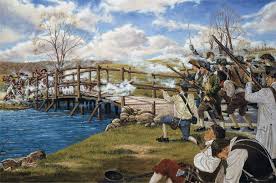
Regulars would clash with colonial subjects two more times that day, first at Concord Bridge and then in a running fight at a point in the road called “The Bloody Angle”. Finally, hearing that militia was coming from as far away as Worcester, the column turned to the east and began their return march to Boston.
Some British soldiers marched 35 miles over those two days, their final retreat coming under increasing attack from militia members firing from behind stone walls, buildings and trees. One taking up such a firing position was Samuel Whittemore of Menotomy Village, now Arlington Massachusetts. At 80 he was the oldest known combatant of the Revolution.
Whittemore took his position by the road, armed with his ancient musket, two dueling pistols and the old French cutlass captured years earlier from a French officer whom he explained had “died suddenly”.
Waiting until the last possible moment, Whittemore rose and fired his musket at the oncoming Redcoats, one shot, one kill. Several charged him from only feet away as he drew his pistols. Two more shots, one dead and one mortally wounded. He had barely drawn his sword when they were on him, a .69 caliber ball fired almost point blank tearing part of his face off, as the butt of a rifle smashed into his head. Whittemore tried to fend off the bayonet strokes with his sword but he didn’t have a chance. He was run through thirteen times before he lay still, one for each colony.
The people who came out of their homes to clean up the mess afterward found Whittemore, up on one knee and trying to reload his old musket.
Doctor Nathaniel Tufts treated the old man’s wounds as best he could, but felt that there was nothing anyone could do. Sam Whittemore was taken home to die in the company of his loved ones, which he did. Eighteen years later, at the age of ninety-eight.
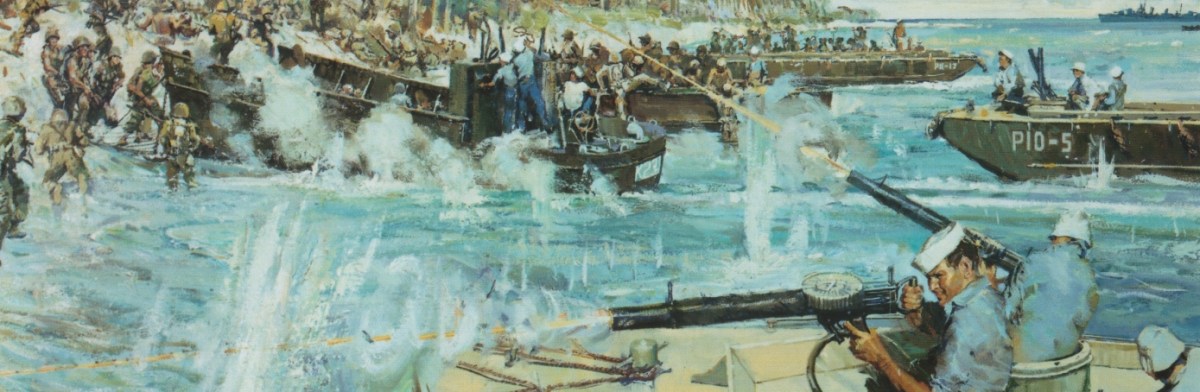
Painfully aware of the overwhelming productive capacity of the American economy, Yamamoto sought to neuter the US High Seas fleet in the Pacific, while simultaneously striking at the oil and rubber rich resources of Southeast Asia
Isoroku Takano was born in Niigata, the son of a middle-ranked samurai of the Nagaoka Domain. His first name “Isoroku”, translating as “56”, refers to his father’s age at the birth of his son. At this time, it was common practice that samurai families without sons would “adopt” suitable young men, in order to carry on the family name, rank, and the income that came with it. The young man so adopted would carry the family name. So it was that Isoroku Takano became Isoroku Yamamoto in 1916, at the age of 32.
After graduating from the Imperial Japanese Naval Academy, Yamamoto went on to serve in the Russo-Japanese war of 1904, later returning to the Navy Staff College and emerging as Lieutenant Commander in 1916. He attended Harvard University from 1919-1921, learning fluent English. A later tour of duty in the US enabled him to travel extensively, and to study American customs and business practices.
Like most of the Japanese Navy establishment, Yamamoto promoted a strong Naval policy, at odds with the far more aggressive Army establishment. For those officers, particularly those of the Kwantung army, the Navy existed only to ferry invasion forces about the globe.
Yamamoto opposed the invasion of Manchuria in 1931 and the 1937 land war with
Panay
China. As Deputy Navy Minister, it was Yamamoto who apologized to Ambassador Joseph Grew, following the “accidental” bombing of the USS Panay in 1937. Even when he was the target of assassination threats by pro-war militarists, Yamamoto still opposed the attack on Pearl Harbor, which he believed would “awaken a sleeping giant and fill him with a terrible resolve”.
Yamamoto received a steady stream of hate mail and death threats in 1938, as a growing number of army and navy officers spoke publicly against him. Irritated with Yamamoto’s immovable opposition to the tripartite pact with Nazi Germany and Fascist Italy, army hardliners dispatched military police to “guard” him. In one of the last acts of his short-lived administration, Navy Minister Mitsumasa Yonai reassigned Yamamoto to sea as Commander-in-Chief of the Combined Fleet, making it harder for assassins to get at him.
Many believed that Yamamoto’s career was finished when his old adversary Hideki Tōjō ascended to the Prime Ministership in 1941. Yet there was none better to run the combined fleet. When the pro-war faction took control of the Japanese government, he bowed to the will of his superiors. It was Isoroku Yamamoto who was tasked with planning the attack on Pearl Harbor.
Nothing worked against the Japanese war effort as much as time and resources. Painfully aware of the overwhelming productive capacity of the American economy, Yamamoto sought to emasculate the US High Seas fleet in the Pacific, while simultaneously striking at the oil and rubber rich resources of Southeast Asia. To accomplish this first objective, he planned to attack the anchorage at Pearl Harbor, followed by an offensive naval victory which would bring the Americans to the bargaining table. It’s not clear if he believed all that, or merely hoped that it might work out.
Yamamoto got his decisive naval engagement six months after Pearl Harbor, near Midway Island. Intended to be the second surprise that finished the carriers which had escaped destruction on December 7, American code breakers turned the tables. This time it was Japanese commanders who would be surprised.
American carrier based Torpedo bombers were slaughtered in their attack, with 36 out of 42 shot down. Yet Japanese defenses had been caught off-guard, their carriers busy rearming and refueling planes when American dive-bombers arrived.
Midway was a disaster for the Imperial Japanese navy. The carriers Akagi, Kaga, Soryu and Hiryu, the entire strength of the task force, went to the bottom. The Japanese also lost the heavy cruiser Mikuma, along with 344 aircraft and 5,000 sailors. Much has been made of the loss of Japanese aircrews at Midway, but two-thirds of them survived. The greater long term disaster, may have been the loss of all those trained aircraft mechanics and ground crew who went down with their carriers.
The Guadalcanal campaign, fought between August 1942 and February ’43, was the first major allied offensive of the Pacific war and, like Midway, a decisive victory for the allies.
Needing to boost morale after the string of defeats, Yamamoto planned an inspection tour throughout the South Pacific. US naval intelligence intercepted and decoded his schedule. The order for “Operation Vengeance” went down the chain of command from President Roosevelt to Secretary of the Navy Frank Knox to Naval Operations Admiral Ernest King to Admiral Chester Nimitz at Pearl Harbor. Sixteen Lockheed P-38 Lightnings, the only fighters capable of the ranges involved, were dispatched from Guadalcanal on April 17 with the order: “Get Yamamoto”.
Yamamoto’s two Mitsubishi G4M bombers with six Mitsubishi A6M Zeroes in escort were intercepted over Rabaul on April 18, 1943. Knowing only that his target was “an important high value officer”, 1st Lieutenant Rex Barber opened up on the first Japanese transport until smoke billowed from its left engine. Yamamoto’s body was found in the wreckage the following day with a .50 caliber bullet wound in his shoulder, another in his head. He was dead before he hit the ground.
Isoroku Yamamoto had the unenviable task of planning the attack on Pearl Harbor, but he was an unwilling participant in his own history. “In the first six to twelve months of a war with the United States and Great Britain”, he had said, “I will run wild and win victory upon victory. But then, if the war continues after that, I have no expectation of success”.
“Trials” were carried out across the country, some in sports stadia in front of thousands of spectators. Hundreds of supporters of the former regime were executed as a result. When Castro didn’t like the outcome, he would personally order a retrial.
Cuban strongman Fulgencio Batista seized power March 1952, proclaiming himself president and labeling his governing system “disciplined democracy”. While Batista had some popular support when he canceled presidential elections, many Cubans came to see the administration as a one-man dictatorship. Opponents of the regime formed several anti-Batista groups, taking to armed rebellion to oust the government. The best known of these groups was the “26th of July Movement”, founded by the lawyer Fidel Castro and operated out of base camps in the Sierra Maestra mountains.
Batista’s repressive tactics led to widespread disapproval by the late ’50s, culminating in his resignation on December 31, 1958. By February 1959, Fidel Castro had installed himself as Prime Minister.
Castro proclaimed his administration to be an example of “direct democracy”, and dismissed the need for elections. The Cuban people could assemble demonstrations and express their democratic will to him personally, he said. Who needs elections?
“Trials” were carried out across the country, some in sports stadia in front of thousands of spectators. Hundreds of supporters of the former regime were executed as a result. When Castro didn’t like the outcome, he would personally order a retrial.
American influence had once been widespread on the island, but that went away as the Castro regime adopted an increasingly leftist posture. “Until Castro”, said Earl Smith, former American Ambassador to Cuba, “the U.S. was so overwhelmingly influential in Cuba that the American ambassador was the second most important man, sometimes even more important than the Cuban president.”
Castro nationalized US controlled oil refineries run by Esso and Standard Oil as well as Anglo-Dutch Shell, when US authorities objected to their being required to process oil purchased from the Soviet Union. Tit-for-tat retaliations resulted in the expropriation of American owned banks and sugar refineries, by October 1960 the Castro regime had “nationalized” a total of 166 such businesses, including Coca Cola and Sears & Roebuck.
Secretary of State Christian Herter publicly stated that Castro was “following faithfully the Bolshevik pattern” by instituting a single-party political system, taking control of trade unions, suppressing civil liberties, and sharply limiting both freedom of speech and freedom of the press. Castro fired back, criticizing the way black people and the working classes were treated in New York City, attacking US media as “controlled by big business” and claiming that the American poor were living “in the bowels of the imperialist monster”.
A “secret” operation was conceived and initiated under the Eisenhower administration, and approved by the incoming Kennedy administration. Beginning on April 15, 8 B-29 CIA bombers attacked Cuban military aircraft on the ground at several locations. A B-26 bearing Cuban markings and perforated with bullet-holes later landed at Miami International Airport, the pilots claiming to be defecting Cubans. The story began to unravel, when reporters noted that the plane’s machine guns hadn’t been fired. Furthermore, the Cubans didn’t operate that type of plane. Fidel Castro said that not even Hollywood would have tried such a feeble story.
The invasion began on the 16th, when 1,400 Cuban exiles landed on Cuba’s “Playa Girón”, or “Bay of Pigs”. Snagged on razor sharp coral that reconnaissance had identified as seaweed, landing forces were pinned down as government forces responded in the early morning hours of April 17. The landing achieved a beachhead, but things quickly started to go wrong. A freighter containing food, fuel, medical equipment, and ten days’ ammunition, was sunk. The Cuban Air Force had taken a beating two days earlier, but “Brigade 2506” wasn’t supplied with fighter aircraft at all. Wanting to preserve “plausible deniability”, President Kennedy refused to allow US fighters to go into combat, leaving the remnants of the Cuban Air Force unopposed. Landing forces were bombed and strafed, at will.
Kennedy was finally persuaded to authorize unmarked US fighter jets from the aircraft carrier Essex to provide escort cover for the invasion’s B-26 bombers, most of which were flown by CIA personnel in support of the ground invasion. Fighters missed their rendezvous by an hour, due to a misunderstanding about time zones. Unescorted bombers are easy targets, and two of them were shot down with four Americans killed. Fighting ended on April 20, 1961 in what had become an unmitigated fiasco.
The Bay of Pigs invasion was probably doomed from the start. Castro was popular at that time, and the project had not exactly been a secret. The New York Times had run a story a month earlier, predicting a US invasion of Cuba in the coming weeks. Another story ran on April 7, headlined “Anti-Castro Units Trained to Fight at Florida Bases,” reporting that invasion plans were in their final stages. When Kennedy saw the paper, he said that Castro didn’t need spies, all he had to do was read the news.
The Kaiser calculated that all he had to do was “kick the door in”, the Russian Republic would collapse, and they would be out of the war. He was right.
The “War to End all Wars” entered its third year in 1917, seeming as though it would go on forever. Neither side seemed able to gain strategic advantage on the front. The great battles of 1916 seemed only yesterday, in which any single day’s fighting produced more casualties than every European war of the preceding 100 years, combined. At home, the social fabric of the combatant nations was unraveling.
By 1916 it was generally understood in Germany, that the war effort was “shackled to a corpse”, referring to Germany’s Austro-Hungarian ally. Italy, the third member of the “Triple Alliance”, was little better. On the Triple Entente side, the French countryside was literally torn to pieces, the English economy close to breaking. The Russian Empire, the largest nation on the planet, was on the edge of the precipice.
The United States had declared its intention to enter the war barely ten days earlier. While no American forces had arrived as of yet, both sides understood that the balance was about to shift. For Kaiser Wilhelm’s Germany, it was time to throw a knockout punch.
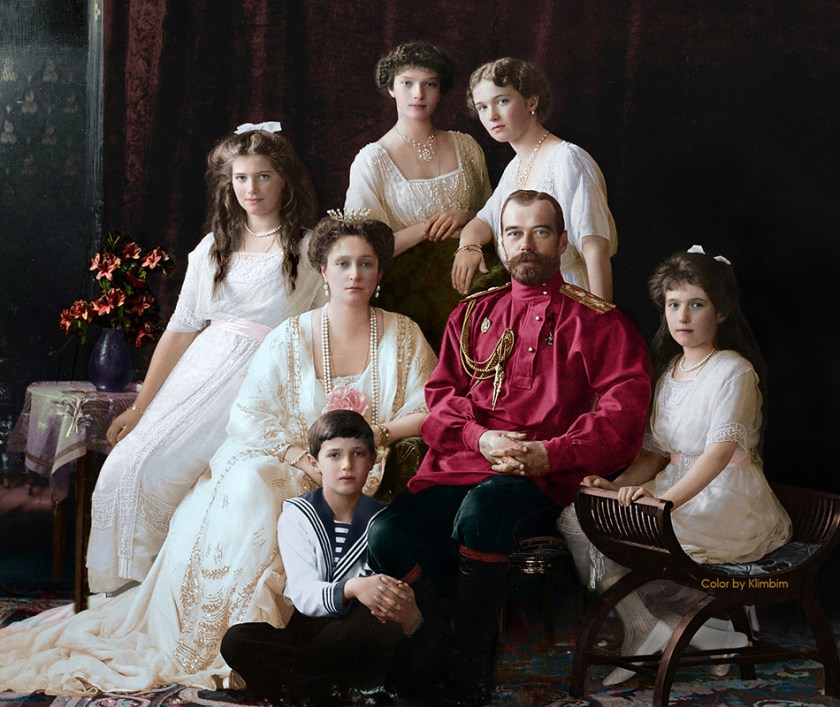
Imperial Russia had seen the first of what would be two revolutions back in February, when food riots led to the overthrow and exile of the Imperial family. Full scale civil war broke out in 1918, resulting in the Bolshevik murder of the Czar and Czarina, together with their children, servants and dogs.
The Kaiser calculated that all he had to do was “kick the door in”, the Russian Republic would collapse, and they would be out of the war. He was right.
After the overthrow of the Romanov dynasty, the more moderate Menshevik “Whites” vowed to continue the war effort. The split which had begun with the failed revolution of 1905 was more pronounced by this time with the more radical Bolsheviks (“Reds”) taking the more extreme road. While Reds and Whites both wanted to bring socialism to the Russian people, the Mensheviks argued for predominantly legal methods and trade union work, while Bolsheviks favored armed violence.
In a small town in the northeast of Sweden, there is a train station. A bronze plaque on a blue tile wall, proclaims: “Here Lenin passed through Haparanda on April 15, 1917, on his way from exile in Switzerland to Petrograd in Russia”.
Lenin was in exile, and Imperial Germany was at war with Russia at this time. British historian Edward Crankshaw writes, the German government saw “in this obscure fanatic one more bacillus to let loose in tottering and exhausted Russia to spread infection”.
Not far from food riots of his own and loathe to inflict such a bacillus on his own homeland, a “Sealed Train” carrying Vladimir Ilyich Lenin and 31 dissidents departed from exile in Switzerland on April 9, complements of the Kaiser. Leaving Zurich Station amid the jeers and the insults of 100 or so assembled Russians shouting “Spies!” “Traitors!” “Pigs!” “Provocateurs!”, Lenin turned to a friend. “Either we’ll be swinging from the gallows in three months, or we shall be in power.”
North through Germany and across the Baltic Sea, the group traveled the length of Sweden, crossing at the border village of Haparanda into Russian-Occupied Finland. The group arrived at Finlandsky Vokzal (Finland Station) in Petrograd on the evening of April 16, 1917. Like the handful of termites that brought down the mighty oak, that small faction inserted into the picture that April, would help to radicalize the population, and consolidate power on the Bolshevik’s side.
Lenin’s Journey from Zurich to St. Petersburg, April 1917
By October, Russia would experience its second revolution in a year. The Kaiser’s Germany could breathe easier. The “Russian Steamroller”, was out of the war. Chief of the General Staff Paul von Hindenburg and his deputy Erich Ludendorff could move their divisions westward, in time to face the American’s arrival.
Since the end of the Soviet era, Russian historians have come to believe that Vladimir Ilyich (Ulyanov) Lenin personally ordered the murder of the czar and his family, and that the Lenin era was every bit as bloody, as that of his successor Josef Stalin.
Lenin called for “Mass Terror” during the civil war of 1918, resulting in executions in the tens of thousands. Historian Alexander Margolis had the last word on the subject if not the understatement of the century, when he said: “If they had arrested Lenin at the Finland Station, it would have saved everyone a lot of trouble”.
Czar Nicholas II & family, colorized by the Russian artist Olga Shirnina, also known as ‘klimbim’
The elderly owner of Macy’s Department Stores Isidor Straus was offered a seat with his wife Ida, on account of his age. Strauss refused any special consideration and Ida refused to leave his side. The couple went down with the ship.
For Scale, Note the Man Standing Next to Titanic’s Stern and Rudder
The maiden voyage of the largest ship afloat left the port of Southampton, England On April 10, 1912, carrying 2,224 passengers and crew. An accident was narrowly averted only minutes later, as Titanic passed the moored liners SS City of New York and Oceanic.
Both smaller ships lifted in the bow wave formed by Titanic’s passing, then dropped into the trough. New York’s mooring cables snapped, swinging her around stern-first. Collision was averted by a bare 4 feet as the panicked crew of the tugboat Vulcan struggled to bring New York under tow.
The Southampton-to-New York run made stops at Cherbourg, France and Queenstown Ireland, to pick up passengers before the Atlantic crossing. Titanic stoker John Coffey jumped ship in Ireland, hiding under a pile of mail bags. The Queenstown native may have had a premonition as he claimed, or maybe he just wanted to go home. Be that as it may, subsequent events may have made him the luckiest man on the cruise.
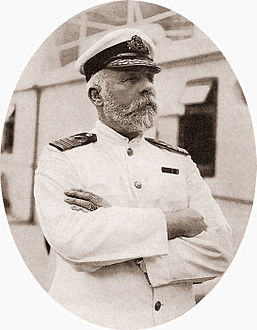
Edward Smith, 1911
By the evening of the 14th, Titanic was 400 miles off the coast of Newfoundland, conditions clear, calm and cold. There were warnings of drifting ice from other ships in the area, but the ship continued to steam at full speed. It was generally believed that ice posed little danger to large vessels at this time, Captain Edward Smith opined that he “[couldn’t] imagine any condition which would cause a ship to founder. Modern shipbuilding has gone beyond that.”
Lookout Frederick Fleet alerted the bridge of an iceberg dead ahead at 11:40pm. First Officer William Murdoch ordered the engines put in reverse, veering the ship to the left. Lookouts were relieved, thinking that collision had been averted. Below the surface, the starboard side of Titanic ground into the iceberg, opening a gash the length of a football field. The ship had been designed to withstand the flooding of four watertight compartments. The iceberg had opened five. As Titanic began to lower at the bow, it soon became clear that the ship was doomed.
Last known image of titanic
Those aboard were poorly prepared for such an emergency. The ship was built for 64 wooden lifeboats, enough for 4,000, however the White Star Liner carried only 16 wooden lifeboats and four collapsibles. Regulations then in effect required enough room for 990 people. Titanic carried enough to accommodate 1,178.
As it was there was room for over half of those on board, provided that each boat was filled to capacity. The crew, however, hadn’t been adequately trained in evacuation.
The “women and children first” protocol was generally followed, sometimes to the exclusion of all others. Ship’s officers didn’t know how many could safely board the lifeboats, and many were launched barely half-full. The first lifeboat in the water, rated at 65 passengers, launched with only 28 aboard.
3rd class passenger Bertram Dean and his wife Georgette had decided to leave the UK and emigrate to the United States. Mr. Dean planned to become a partner in a tobacco store, owned by a cousin in Wichita. Down below, Bert Dean was among the first to hear the collision. After inspecting the damage, Dean told his wife to dress the children, two-year old Bertram and two-month old Millvina, the youngest passenger on board. Georgette and the two kids were placed on lifeboat #10, the first to escape. Most of the male passengers and crew were left aboard, even as lifeboats launched half empty.
J. Bruce Ismay, CEO of White Star Lines, helped to load some of the boats. Looking about and seeing no women or children in the vicinity, only then did he step onto a lowering collapsible, but he never lived down having survived a disaster in which so many others perished.
Titanic chief architect Thomas Andrews was last seen in the First Class smoking room, staring blankly at a painting of the ship. John Jacob Astor IV, the wealthiest passenger onboard, was traveling with his young wife Madeleine Talmadge Force, 29 years his junior. Placing her on a lifeboat, Astor asked if he could join her, explaining that she was pregnant. All that money didn’t help him, Astor was refused. All he could do was kiss his young wife goodbye as the boat lowered out of sight.
The elderly owner of Macy’s Department Stores Isidor Straus was offered a seat with his wife Ida, on account of his age. Strauss refused any special consideration and Ida refused to leave his side. The couple went down with the ship, as did Benjamin Guggenheim and his valet, who returned to their rooms and changed into Tuxedos. Emerging on deck, the wealthy industrialist declared, “We are dressed in our best and are prepared to go down like gentlemen”.
The stories that will never be told, are those of the 700 or so 3rd class passengers below decks. Disoriented, terrified and trapped below decks, one by one they spent their last moments gasping in shrinking pockets of air, as frigid water swirled like class V rapids through the pitch black interior of the ship.
Distress signals were sent by wireless and lamp, but none of the ships responding were close enough to effect the outcome. The Californian, six miles to the north, was close enough to see distress rockets, but crew members thought the liner was having a party.
Two hours and 40 minutes after striking the iceberg, Titanic went up by the stern. The forward deck dipped underwater as seawater poured in through open hatches and grates. The immense strain on the keel split the ship in two between the third and fourth funnels, as the unsupported stern rose out of the water. Propellers exposed, the stern remained afloat for a few minutes longer, rising to a nearly vertical angle with hundreds of people still clinging to it. The last piece sank out of sight at 2:20am, plunging passengers and crew into 28°F water. Most of them died within minutes of hypothermia, cardiac arrest, or drowning. Lifeboats had room for almost 500 more, but only 13 were pulled from the water.
RMS Carpathia arrived on the scene around 4am, in response to Titanic’s distress calls. Originally bound for Austria-Hungary, Carpathia diverted to New York with survivors. A crowd of 40,000 awaited the arrival of 705 survivors on the 18th, despite a cold, driving rain. It would take four full days to compile and release the full list of casualties.
Millvina Dean, once the youngest survivor of the Titanic disaster, died 97 years later, the last survivor of the sinking. The remains of her father lie with the ship on which he perished, 12,415 feet beneath the surface of the north Atlantic.
The day before the launch sequence, Vladimir Yazdovsky took her home to play with his kids. “I wanted to do something nice for her,” he explained. “She had so little time left to live.”
At the dawn of the space age, no one knew whether the human body could survive conditions of rocket launch and space flight. The US Space program experimented with a variety of primate species between 1948 and 1961, including rhesus monkeys, crab-eating macaques, squirrel monkeys, pig-tailed macaques, and chimpanzees.
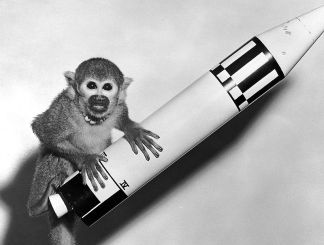
“Miss Baker”
On May 28, 1959, a squirrel monkey named “Miss Baker” became the first of the US space program, to survive the stresses of spaceflight and related medical procedures. A rhesus monkey called “Miss Able” survived the mission as well, but died four days later as the result of a reaction to anesthesia.
Soviet engineers experimented with dogs on a number of orbital and sub-orbital flights, to determine the feasibility of human space flight. The Soviet Union launched missions with positions for at least 57 dogs in the fifties and early sixties, though the actual number is smaller. Some flew more than once.
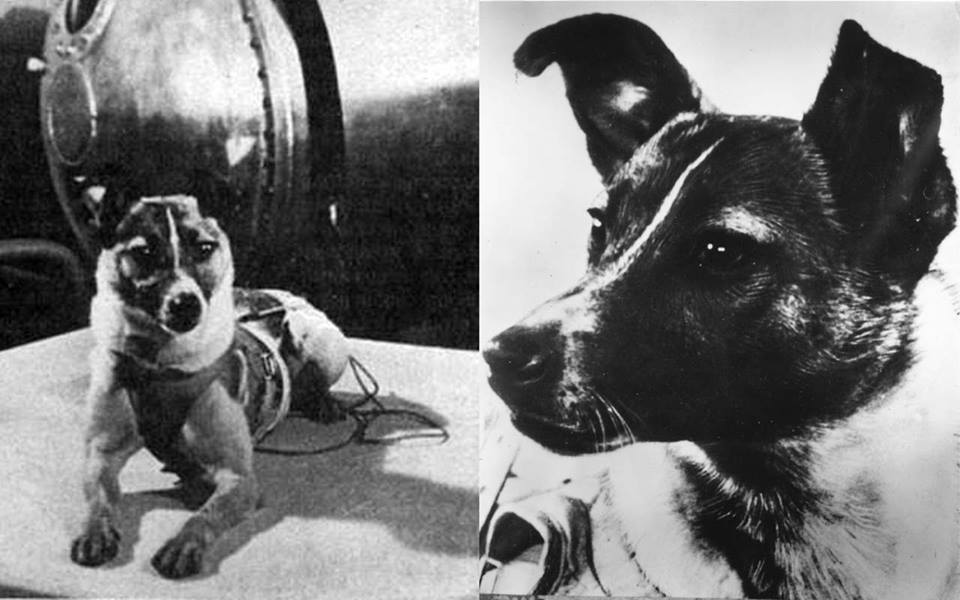
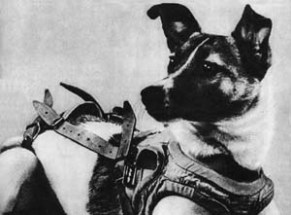
Laika
Most survived. As with the early US program, those who did not often died as the result of equipment malfunction. The first animal to be sent into orbit, was a different story.
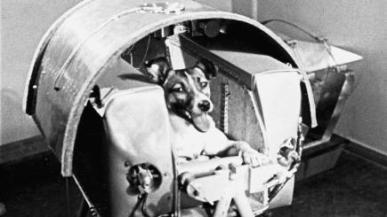
Three dogs were plucked from the streets of Moscow and trained for the purpose. “Laika” was an 11lb mutt, possibly a terrier-husky cross. In Russian, the word means “Barker”. Laika was chosen due to her small size and calm disposition. One scientist wrote, “Laika was quiet and charming.”
First, were the long periods of close confinement, meant to replicate the tiny cabin of Sputnik 2. Then came the centrifuge, the highly nutritional but thoroughly unappetizing gel she was meant to eat in space, and then the probes and electrodes that monitored her vital signs.
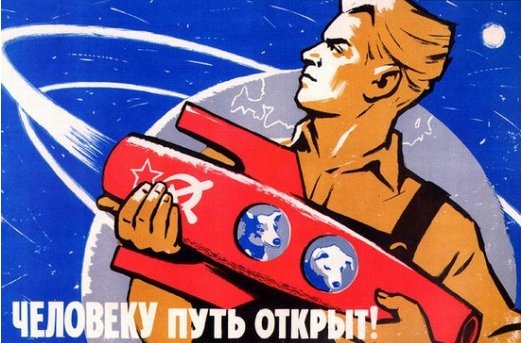
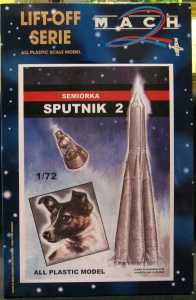
Sputnik 2, Pre-Launch Propaganda
The day before the launch sequence, Vladimir Yazdovsky took her home to play with his kids. “I wanted to do something nice for her,” he explained. “She had so little time left to live.”
Laika was placed inside the capsule for three days, tightly harnessed in a way that only allowed her to stand, sit and lie down. Finally, it was November 3, 1957. Launch day. One of the technicians “kissed her nose and wished her bon voyage, knowing that she would not survive the flight”.
Sensors showed her heart rate to be 103 beats/minute at time of launch, spiking to 240 during acceleration. She ate some of her food in the early stages, but remained stressed and agitated. The thermal control system malfunctioned shortly into the flight, the temperature inside the capsule rising to 104°, Fahrenheit. Five to seven hours into the flight, there were no further signs of life.
There were official hints about Laika parachuting safely to earth, and then tales of a painless and humane, euthanasia. Soviet propaganda portrayed “the first traveler in the cosmos”, heroic images printed on posters, stamps and matchbook covers. Soviet authorities concealed Laika’s true cause of death and how long it took her to die. That information would not be divulged , until 2002.
In the beginning, the US News media focused on the politics of the launch. It was all about the “Space Race”, and the Soviet Union running up the score. First had been the unoccupied Sputnik 1, now Sputnik 2 had put the first living creature into space. The more smartass specimens among the American media, called the launch “Muttnik”.
Sputnik 2 became controversial, as animal lovers began to question the ethics of sending a dog to certain death in space. In the UK, the Royal Society for the Prevention of Cruelty to Animals received protests before Radio Moscow was finished with their launch broadcast. The National Canine Defense League called on dog owners to observe a minute’s silence.
Protesters gathered with their dogs in front of the UN building, to express their outrage. In the Soviet Union, political dissent was squelched, as always. Of all Soviet bloc nations, it was probably Poland who went farthest out on that limb, when the scientific periodical Kto, Kiedy, Dlaczego (“Who, When, Why”), reported Laika’s death as “regrettable”. “Undoubtedly a great loss for science”.
Sputnik 2 and its passenger left the vacuum of space on April 14, 1958, burning up in the outer atmosphere.
It was not until 1998 and the collapse of the Soviet tower of lies, that Oleg Gazenko, one of the scientists who had trained the dog, was free to speak his mind. “Work with animals is a source of suffering to all of us”, he said, “We treat them like babies who cannot speak. The more time passes, the more I’m sorry about it. We shouldn’t have done it…We did not learn enough from this mission to justify the death of the dog”.
Afterward
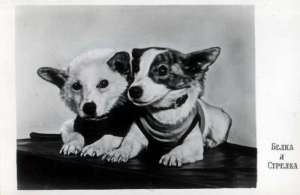
As a dog lover, I feel the need to add a more upbeat postscript, to this thoroughly depressing story.
“Belka” and “Strelka” spent a day in space aboard Sputnik 5 on August 19, 1960, and returned safely to Earth. The first Earth-born creatures to go into orbit and return alive.
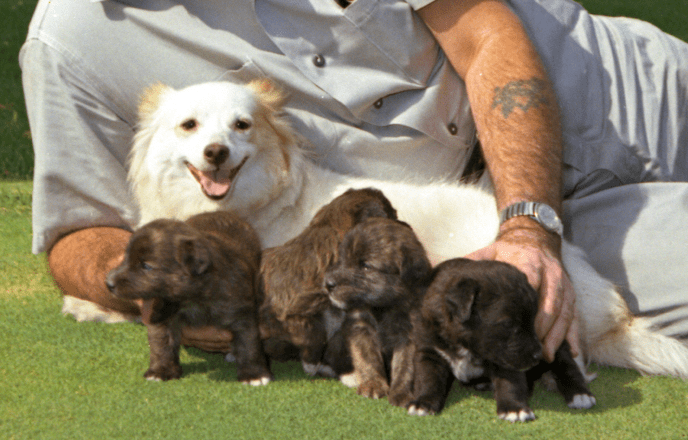
Strelka later gave birth to six puppies, fathered by “Pushok”, a dog who’d participated in
Charlie, (l) and Pushinka, (r)
ground-based space experiments, but never flew. Nikita Khrushchev gave “Pushinka”, one of the puppies, to President John F. Kennedy in 1961.
Pushinka and a Kennedy dog named “Charlie” conducted their own Cold War rapprochement, resulting in four puppies. Pups that JFK jokingly referred to as “pupniks”. Pushinka’s descendants are still living, to this day.
Pushinka and her “pupniks”, enjoying a moment on the White House lawn
Thousands of shells were fired at Fort Sumter over 34 hours. Federal forces fired back, though vastly outgunned. For all that, the only casualty was one Confederate mule.
South Carolina seceded from the Union on December 20, 1860, after which the state government considered itself to be that of a sovereign nation. Six days later, US Army Major Robert Anderson quietly moved his small command from the Revolution-era Fort Moultrie on Sullivan’s Island to the as-yet to be completed Fort Sumter, a brick fortification at the mouth of Charleston Harbor.
President James Buchanan attempted to reinforce and resupply Anderson, via the unarmed merchant vessel “Star of the West”. Shore batteries opened up on the effort on January 9, 1861, effectively trapping Anderson and his garrison inside the only federal property in the vicinity.
The newly founded Confederate States of America couldn’t tolerate the presence of an armed federal force at the mouth of Charleston harbor, while secessionists debated whether this was South Carolina’s problem, or that of the national government, in Mobile.
Meanwhile, the Federal government refused to recognize the Confederacy, as an independent state. Neither side wanted to be seen as the aggressor, both needing the support of the border states.
Political opinion was so sharply divided at that time, that brothers literally wound up fighting against brothers. By the time the war got going, every seceding state but South Carolina sent regiments to fight for the Union. Even that state contributed troops. A surprising number of northern soldiers resigned commissions and fought for the south, including Barre, Massachusetts native Daniel Ruggles, Ohio Quaker Bushrod Johnson and New York native Samuel Cooper, to name a few. But I’m getting ahead of the story.
Confederate Brigadier General Pierre Gustave Toutant-Beauregard (I love that name) was placed in charge of Charleston in March, and immediately began to strengthen the batteries surrounding the harbor.
Fort Sumter was designed for a garrison of 650 in the service of 130 guns, most of them pointed outward, positioned to defend the harbor against threats from the sea. In April 1861 there were only 60 guns, too much for Major Anderson’s 85-man garrison, almost half of whom were non-combatants: workmen or musicians.
When Abraham Lincoln was inaugurated on March 4, the resupply of Fort Sumter became the first crisis for the new administration. Lincoln notified South Carolina Governor Francis Pickens that he was sending supply ships, resulting in Beauregard’s ultimatum: the Federal garrison was to evacuate immediately, or Confederate batteries would open fire.
Major Anderson’s response lacking acceptable specificity, shore batteries opened fire at 4:30 am on April 12th, 4003 guns firing in counter-clockwise rotation. Abner Doubleday, Federal 2nd in command and the man erroneously credited with the invention of baseball, later wrote “The crashing of the shot, the bursting of the shells, the falling of the walls, and the roar of the flames, made a pandemonium of the fort.”
Two years later at Gettysburg, Norman Jonathan Hall would lose over 200 men from his brigade, in furious fighting at a critical breach in Union lines, near the”copse of trees”. One day, a brass plaque would mark the spot of the “High Water Mark” of the Confederacy. On this day, Lieutenant Hall raced through flames to rescue the colors, after a direct hit on the main flagpole knocked the flag to the ground. His eyebrows were permanently burned off of his face, but Hall and two artillerymen were able to jury-rig the pole, so that once again, Old Glory flew over Fort Sumter.
The Confederate flag flies over Fort Sumter, 1861
Thousands of shells were fired at Fort Sumter over 34 hours. Federal forces fired back, though vastly outgunned. For all that, the only casualty was one Confederate mule.
The only fatalities in the whole mess, occurred after the Union surrender on April 13. Firing a 100-gun salute while lowering the flag, one cannon misfired, mortally wounding privates Daniel Hough and Edward Galloway.
The following day, Colonel Robert E. Lee resigned his commission in the United States Army.
The Civil War had begun, but there didn’t seem to be a single individual who understood what kind of demons had just been unleashed. Robert Rhett, the rabble rousing editor of the Charleston Mercury Newspaper, offered to personally eat the bodies of all the slain in the coming conflict. Not wanting to be outdone, former Senator James Chesnut, Jr. said “a lady’s thimble will hold all the blood that will be shed,” promising to personally drink any that might be spilled.
The war between the states would end the lives of more Americans than the Revolution, WWI, WWII, and the wars in Korea, Vietnam, Iraq and Afghanistan, combined.


 According to legend, Romulus and Remus were the sons of Rhea Silvia, the daughter of King Numitor of Alba Longa, a mythical city located in the Alban Hills southeast of what would become Rome. Numitor was deposed by his younger brother Amulius, who forced Rhea to become a vestal virgin so that she would not give birth to rival claimants to his title. However, Rhea was already pregnant by the war god Mars, and destined to give birth to Romulus and Remus.


 Founded by Byzas, son of the Greek King Nisos circa 657BC, the earliest days of Byzantium are clouded by legend. Located on the easternmost peninsula where Europe becomes Asia, the city is surrounded on three sides, by water.
 21-year-old Mehmed II began the final siege of Constantinople on April 6, 1453. Commanding 120,000 attackers with an estimated 126 ships, Ottoman forces faced 7,000 to 12,000 Christian defenders with 26 ships, defending almost 3½ miles of land wall and another 9 miles of sea wall facing the Sea of Marmara and the Golden Horn.
 Mehmed placed his cannon into positions facing the wall. The largest, the monster “Basilica” was 27′ long, weighed 18 tons, and required a team of 60 oxen and 400 men to move it. It had a diameter of 30″, large enough for a grown man to crawl inside. Its 150lb powder charge was capable of hurling a half-ton stone ball a distance of over a mile. While the weapon did catastrophic damage to the city walls, it took over three hours to reset after firing, and frantic efforts by the defenders were able to repair much of the damage between shots.
 Serbian Sappers dug tunnels under the city, intending to undermine and blow out the walls, but Christian counter-miners broke into the tunnels and attacked them with swords, axes and Greek fire, an early form of napalm.
 These were the cannon fodder, their purpose to wear down the defenders in preparation for attacks by professional soldiers, the Bashi-Bazouks. Then came the Janissaries, Christian slave warriors raised from childhood to be the elite of the Ottoman army, Attackers stormed the walls by the tens of thousands, while Ottoman ships pounded the city from the harbor.


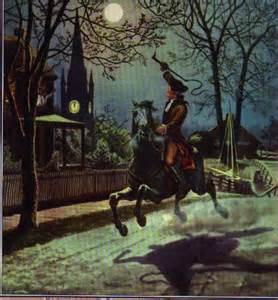 Boston Patriots had been preparing for such an event. Sexton Robert John Newman and Captain John Pulling carried two lanterns to the steeple of the Old North church, signaling that the Regulars were crossing the Charles River to Cambridge. Dr. Joseph Warren ordered Paul Revere and Samuel Dawes to ride out and warn surrounding villages and towns, the two soon joined by a third rider, Samuel Prescott. It was Prescott alone who would make it as far as Concord, though hundreds of riders would fan out across the countryside before the night was through.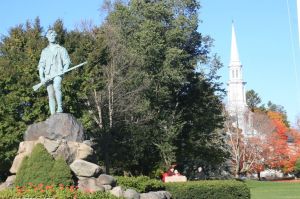
 Some British soldiers marched 35 miles over those two days, their final retreat coming under increasing attack from militia members firing from behind stone walls, buildings and trees. One taking up such a firing position was Samuel Whittemore of Menotomy Village, now Arlington Massachusetts. At 80 he was the oldest known combatant of the Revolution.


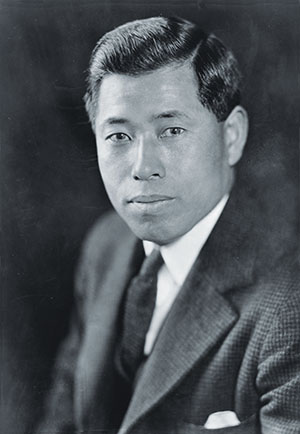 Isoroku Takano was born in Niigata, the son of a middle-ranked samurai of the Nagaoka Domain. His first name “Isoroku”, translating as “56”, refers to his father’s age at the birth of his son. At this time, it was common practice that samurai families without sons would “adopt” suitable young men, in order to carry on the family name, rank, and the income that came with it. The young man so adopted would carry the family name. So it was that Isoroku Takano became Isoroku Yamamoto in 1916, at the age of 32.
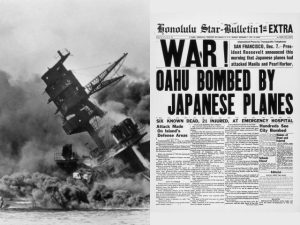 Many believed that Yamamoto’s career was finished when his old adversary Hideki Tōjō ascended to the Prime Ministership in 1941. Yet there was none better to run the combined fleet. When the pro-war faction took control of the Japanese government, he bowed to the will of his superiors. It was Isoroku Yamamoto who was tasked with planning the attack on Pearl Harbor.
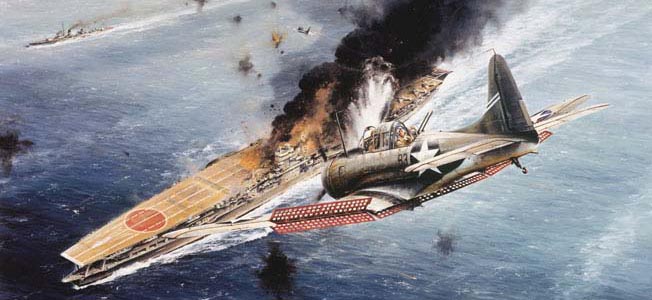 American carrier based Torpedo bombers were slaughtered in their attack, with 36 out of 42 shot down. Yet Japanese defenses had been caught off-guard, their carriers busy rearming and refueling planes when American dive-bombers arrived.
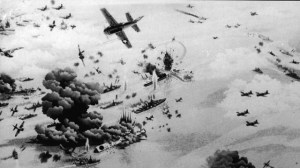 Midway was a disaster for the Imperial Japanese navy. The carriers Akagi, Kaga, Soryu and Hiryu, the entire strength of the task force, went to the bottom. The Japanese also lost the heavy cruiser Mikuma, along with 344 aircraft and 5,000 sailors. Much has been made of the loss of Japanese aircrews at Midway, but two-thirds of them survived. The greater long term disaster, may have been the loss of all those trained aircraft mechanics and ground crew who went down with their carriers.
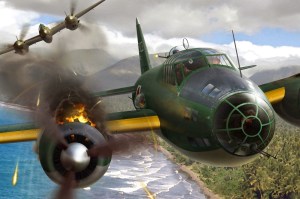 tour throughout the South Pacific. US naval intelligence intercepted and decoded his schedule. The order for “Operation Vengeance” went down the chain of command from President Roosevelt to Secretary of the Navy Frank Knox to Naval Operations Admiral Ernest King to Admiral Chester Nimitz at Pearl Harbor. Sixteen Lockheed P-38 Lightnings, the only fighters capable of the ranges involved, were dispatched from Guadalcanal on April 17 with the order: “Get Yamamoto”.
 intercepted over Rabaul on April 18, 1943. Knowing only that his target was “an important high value officer”, 1st Lieutenant Rex Barber opened up on the first Japanese transport until smoke billowed from its left engine. Yamamoto’s body was found in the wreckage the following day with a .50 caliber bullet wound in his shoulder, another in his head. He was dead before he hit the ground.


 Castro proclaimed his administration to be an example of “direct democracy”, and dismissed the need for elections. The Cuban people could assemble demonstrations and express their democratic will to him personally, he said. Who needs elections?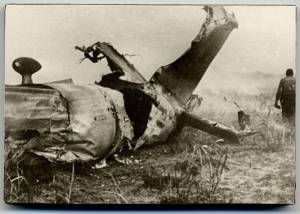
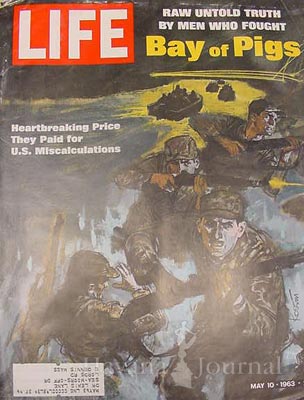 Kennedy was finally persuaded to authorize unmarked US fighter jets from the aircraft carrier Essex to provide escort cover for the invasion’s B-26 bombers, most of which were flown by CIA personnel in support of the ground invasion. Fighters missed their rendezvous by an hour, due to a misunderstanding about time zones. Unescorted bombers are easy targets, and two of them were shot down with four Americans killed. Fighting ended on April 20, 1961 in what had become an unmitigated fiasco.


 By 1916 it was generally understood in Germany, that the war effort was “shackled to a corpse”, referring to Germany’s Austro-Hungarian ally. Italy, the third member of the “Triple Alliance”, was little better. On the Triple Entente side, the French countryside was literally torn to pieces, the English economy close to breaking. The Russian Empire, the largest nation on the planet, was on the edge of the precipice.
 the more extreme road. While Reds and Whites both wanted to bring socialism to the Russian people, the Mensheviks argued for predominantly legal methods and trade union work, while Bolsheviks favored armed violence.




 allowed her to stand, sit and lie down. Finally, it was November 3, 1957. Launch day. One of the technicians “kissed her nose and wished her bon voyage, knowing that she would not survive the flight”.
 In the beginning, the US News media focused on the politics of the launch. It was all about the “Space Race”, and the Soviet Union running up the score. First had been the unoccupied Sputnik 1, now Sputnik 2 had put the first living creature into space. The more smartass specimens among the American media, called the launch “Muttnik”.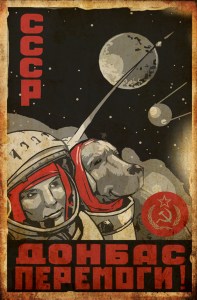
 As a dog lover, I feel the need to add a more upbeat postscript, to this thoroughly depressing story.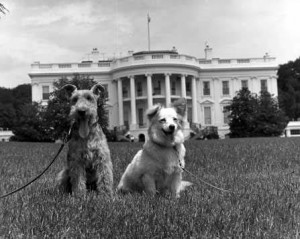


 President James Buchanan attempted to reinforce and resupply Anderson, via the unarmed merchant vessel “Star of the West”. Shore batteries opened up on the effort on January 9, 1861, effectively trapping Anderson and his garrison inside the only federal property in the vicinity.


 Charleston Mercury Newspaper, offered to personally eat the bodies of all the slain in the coming conflict. Not wanting to be outdone, former Senator James Chesnut, Jr. said “a lady’s thimble will hold all the blood that will be shed,” promising to personally drink any that might be spilled.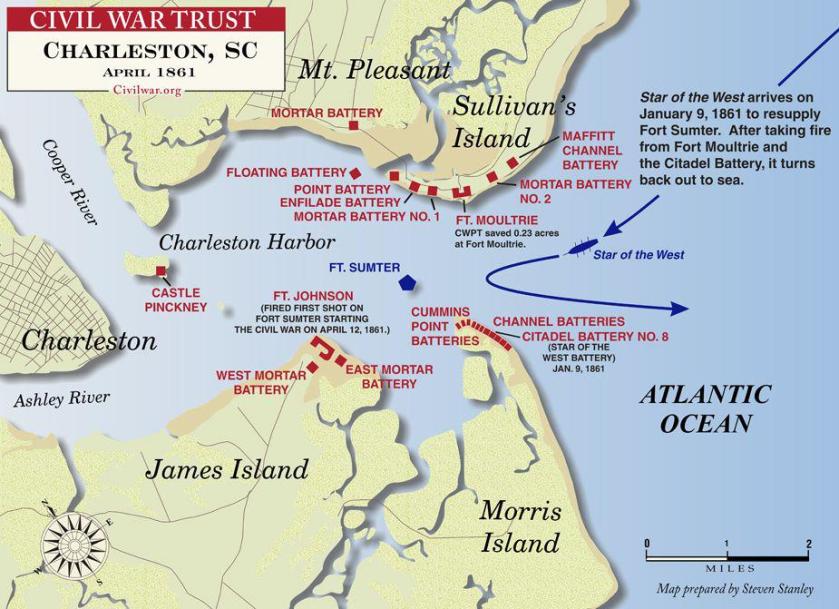


You must be logged in to post a comment.