In 1914, Imperial Germany took a straight line through neutral Belgium into France, believing that Great Britain would never honor a “scrap of paper” signed back in 1839.
In 1830, what is now Belgium was part of the United Kingdom of the Netherlands, a fusion of territories brought about in the wake of the Napoleonic Wars, formerly belonging to the Dutch Republic, Austrian Netherlands, and Prince-Bishopric of Liège. It was a Constitutional Monarchy, ruled by the first King of the Netherlands, King William I.
The “Southern Provinces” of King William’s polity were almost all Catholic, and mostly French speaking, in contradistinction to the Dutch speaking, mostly Protestant north. Many southern liberals of the time thought King William a despot and tyrant, and high levels of industrial unemployment made for widespread unrest among the working classes.
La Muette de Portici (The Mute Girl of Portici) is an opera in five acts by Daniel Auber. Generally recognized as the earliest of the French Grand Opera, it was first performed at the Paris Opéra on February 29 1828. During an August 25, 1830 performance, a riot broke out during one particularly patriotic duet, Amour sacré de la patrie, (Sacred love of Fatherland). Soon it was spilling out onto the street, a full-scale riot spreading across Brussels and igniting other riots as shops were looted, factories occupied and machinery destroyed.
King William committed troops to the southern provinces in an effort to restore order, while radicals asserted control of rioting factions and began talk of secession. Dutch military units experienced massive desertion of recruits from the southern provinces, and had to pull out.
The States-General in Brussels voted in favor of secession and declared independence, assembling a National Congress while King William appealed to the Great Powers for help. The resulting 1830 London Conference of major European powers came to recognize Belgian independence, and Leopold I was installed as “King of the Belgians”.
King William made one more attempt to reconquer Belgium militarily, in 1831. France intervened with troops of its own and the “Ten Days’ Campaign” ended in failure. The European powers signed the “Treaty of London” in 1839, recognizing and guaranteeing Belgium’s independence and neutrality.
The German Composer Wilhelm Richard Wagner remarked on the events decades later, saying that “[S]eldom has an artistic product stood in closer connection with a world-event”.
In August 1914, Imperial Germany’s plan in the event of war could be likened to one guy against two in a bar fight, (Germany vs France & Russia). The plan was to take out the nearer one first (France), before turning to face the second. Imperial Germany took a straight line through neutral Belgium into France, believing that Great Britain would never honor that “scrap of paper” signed back in 1839.
In this German calculations were grievously mistaken. A regional squabble had begun that June, with an assassination in the Balkans. That miscalculation would plunge the world into two world wars.
The only bright spot for the American side that day, came when Commodore Joshua Barney lead 520 seamen in a downhill charge, against a vastly superior British force. Barney took a bullet to the thigh and was captured by the British, who paroled him on the spot. Rear Admiral Sir George Cockburn was impressed with the American sailor’s show of courage, saying “They have given us the only fighting we have had.”
In the early years of the nineteenth century, Napoleon Bonaparte and his Grande Armée kept his Britannic Majesty’s armed forces pretty well occupied. In the former American colonies, the first two years of the War of 1812 were little more than a series of skirmishes.
The Corsican’s defeat at Waterloo and subsequent exile to Elba freed up some of the most elite, battle hardened troops in the world.
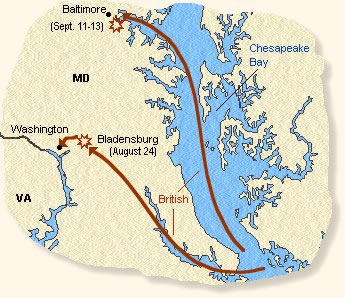
On the morning of August 24, 1814, 4,370 of them were moving up the Chesapeake, toward Baltimore.
They were met by an inexperienced and poorly equipped militia force of some 6,000 American forces at Bladensburg, Maryland, whose comprehensive defeat and humiliating rout went into the history books as the “Bladensburg Races”. President James Madison and most of the federal government were present at the battle, and nearly captured. American militia members fled through the streets of Washington, while every politician from President Madison down to Freshman Members of Congress skedaddled across the countrysides of Maryland and Virginia.
The only bright spot for the American side that day, occurred when Commodore Joshua Barney lead 520 seamen in a downhill charge against vastly superior British forces. Barney took a bullet to the thigh and was captured by the British. Rear Admiral Sir George Cockburn was so impressed with the American sailor’s show of courage that he paroled the man on the spot, saying “They have given us the only fighting we have had.”
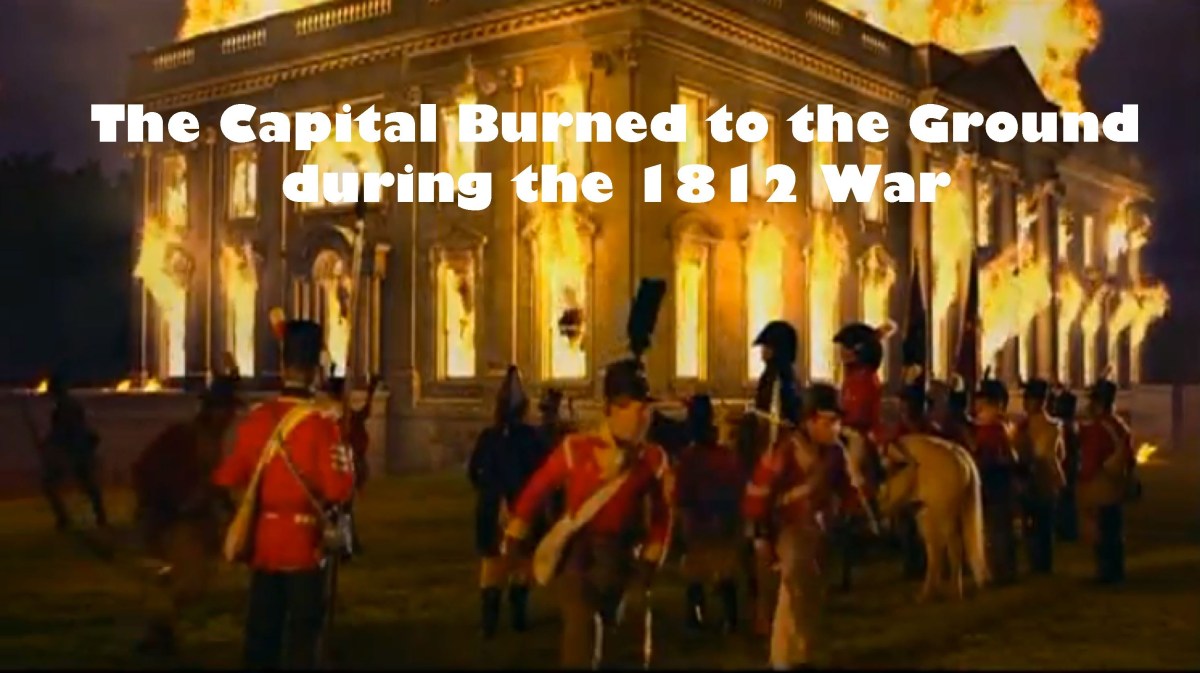
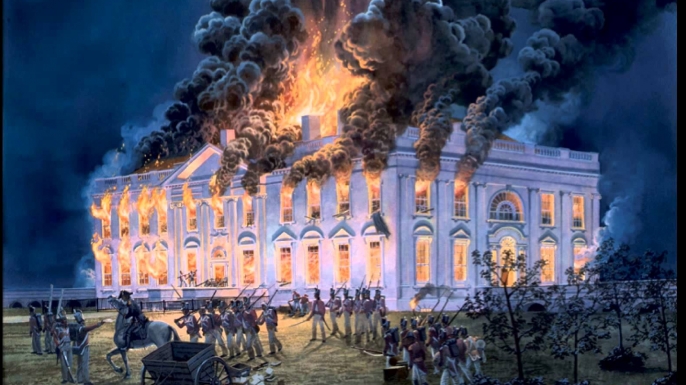
The British sent an advance guard of soldiers to Capitol Hill under flag of truce, intending to discuss terms of surrender. The column was attacked by the occupants of a single house at the corner of Maryland & Constitution Ave., the only resistance the redcoats would see in the city. The house was burned, and the British raised the Union Jack over Washington DC. Then they commenced to burn every government building they could find.
The Senate and House of Representatives buildings were the first to burn, along with the Library of Congress and Supreme Court, which at that time were located inside. The Treasury building was next, though British hopes were disappointed to find there was no money inside.
First Lady Dolley Madison barely had time to gather up some precious objects, ordering White House staff to remove the portrait of George Washington before the “President’s House”, as the White House was then called, was overrun. The table was set for President Madison and a party of 40 at the time, the wine still cooling on a sideboard when the British set the White House of it’s day, on fire. All night they added fuel to the flames, just to keep it going.
Portraits of King George III and his wife Queen Charlotte Sophia were discovered in one public building, and taken down before that building too, was burned. The two portraits made their way halfway across the Atlantic to Bermuda, where they hang in the Parliament building, to this day.
The Washington Navy Yard was torched the following day, along with departments of State, War and Navy. Admiral Cockburn entered the building of the National Intelligencer newspaper intending to burn that down, too, but several women persuaded him not to. Instead, Cockburn ordered his troops to tear the building down brick by brick. He ordered all the “C” typeset destroyed, too, “so that the rascals can have no further means of abusing my name.”
The largest loss of life in the whole episode occurred on the afternoon of the 25th, when General Ross sent two hundred men to secure a fort on Greenleaf’s Point. The fort had already been destroyed by American forces, but 150 barrels of gunpowder remained. The powder ignited while the British were trying to drop it into a well, killing at least a dozen and injuring many others.
A heavy thunderstorm came up that same day, putting out many of the fires and spawning a small tornado that damaged British ships causing them to withdraw. Thomas Jefferson later sold his personal library of more than 6,000 volumes to the government, restocking the Library of Congress with his own personal collection.
The episode has been called “The greatest disgrace ever dealt to American arms”…”The most humiliating episode in American history.” It was the only time before or since, that an enemy force has occupied our nation’s capital.
A German infantryman wrote to his family, “Animals flee this burning hell of a city. The hardest stones do not last for long. Only men endure”.
WWII could have ended differently, had two of the most homicidal dictators in history become allies. It actually started out that way, when the Soviet Union and Nazi Germany signed the Molotov-Ribbentrop non-aggression pact, in August, 1939. That would end two years later with “Operation Barbarossa”, the German surprise invasion of the Soviet Union, beginning on June 22, 1941.
We’re accustomed to thinking of World War II in terms of the European and the Pacific “Theaters”, but the most horrific casualties of the most destructive war in history, took place on the “Ostfront”, (Eastern Front). 95% of all German Army casualties between 1941 and 1944, and 65% of all Allied military casualties from the entire war, took place on the Eastern Front. The bloodiest battle of the Eastern Front, probably the bloodiest battle in all of history, began this day in 1942, in the city of Stalingrad.
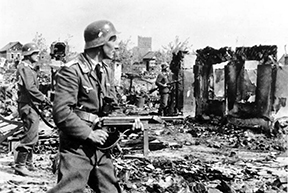
Photo by Nara Archives / Rex Features (2093505a) October 1942, Stalingrad – Soviet Guardsmen Fighting In The Streets Of The Stalingrad Outskirts
Soviet propagandists called it a “harvest victory”, when most of the cattle, grain and rail cars were shipped out of the city in advance of the German assault.
Most of Stalingrad’s civilian residents remained however, leaving the city short of food, even before the commencement of German attacks. Making things worse, the Luftwaffe bombed Volga River shipping, sinking 32 ships and crippling another 9 in the narrow waterway, cutting off this vital link in the city’s supply chain.
Wilfred von Richtofen, cousin of the famous “Red Baron” of WWI, opened up with his heavy bombers on August 23rd, dropping over 1,000 tons of high explosive on Stalingrad.
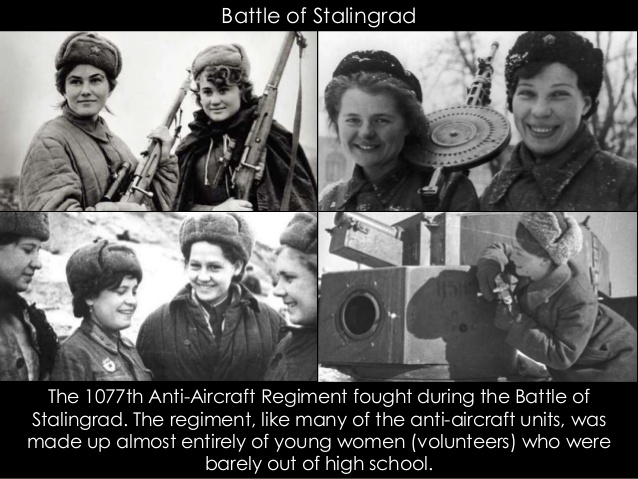
The Soviets suffered from extreme manpower shortages in the beginning. The burden of the early defense of the city fell to the 1077th Anti-Aircraft Regiment, a primarily female unit of young volunteers who had no training and the wrong weapons to engage ground targets. These women were all alone at this point with no support from other units, but they traded shot for shot with the German 16th Panzer Division until all 37 AA guns had been wiped out or overrun. When it was over, 16th Panzer soldiers were shocked to learn they’d been fighting women.
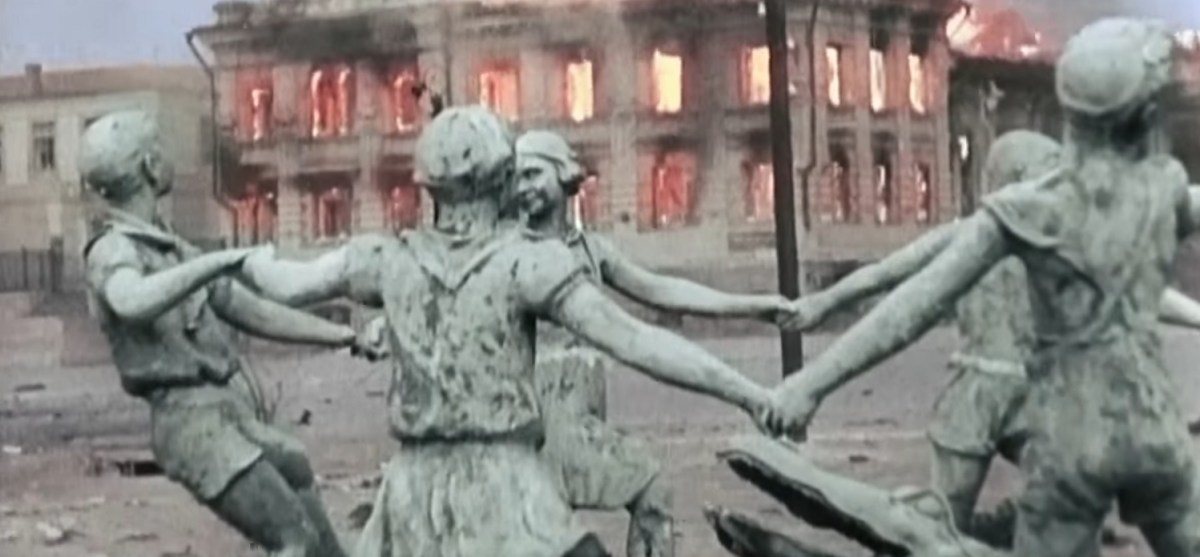
Stalingrad was quickly reduced to rubble, with the German 6th Army controlling 90% of the city. Still, Lt. Gen. Vasily Ivanovich Chuikov’s army held on. With backs to the Volga, they fought for the very sewers of the city, men and women alike reduced to a primitive level of existence. The Germans called it “Rattenkrieg”. “War of the Rats”. A German infantryman wrote to his family, “Animals flee this burning hell of a city. The hardest stones do not last for long. Only men endure”.
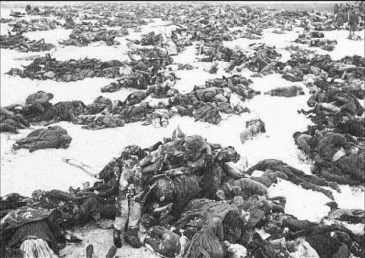
As many as 80,000 Red Army soldiers lay dead by the middle of October, 1942. Counting German losses and civilian deaths, the battle cost a quarter of a million lives up to this point, and the fighting still had months to go.
Ice floes in the Volga river further cut off the defender’s supplies, reducing them to cannibalism as a massive Soviet counter-attack was building on the German’s exposed left flank.
By November, General Georgy Zhukov had assembled over a million fresh troops, 1,500 tanks, 2,500 heavy guns, and three Air Armies for the assault on Stalingrad. The rumble of artillery, the “Great Soviet God of War” could be heard across the steppe as the Soviet counter-attack commenced in a blinding snowstorm on November 19th, 1942. It was now the Germans who were trapped.
German General Friedrich von Paulus asked Hitler’s permission to withdraw before they became surrounded. The response was that he should fight “to the last soldier and the last bullet.”
German forward movement on the Eastern Front came to an end in February, 1943, when 91,000 freezing, wounded, sick and starving Germans were surrendered to the Red Army.
Even then, as many as 11,000 Germans refused to lay down their arms and continued to fight from the cellars and the sewers of Stalingrad, holding on until early March.
Disease, death marches, cold, overwork, mistreatment, and malnutrition would all take their toll on the prisoners. Of the nearly 110,000 who went into captivity after the Battle of Stalingrad, fewer than 6,000 lived to return to Germany, after the war.
An entire study called “Cryptozoology” (literally, the study of hidden animals) has sprung up around Nessie and other beasts whose existence is never quite proven, and never completely debunked. There is Big Foot, who seems to have made it to stardom with his own series of beef jerky commercials. You have the Chupacabra, the Yeti, Ogopogo and Vermont’s own Lake Champlain monster, “Champ”.
As the story goes, an Irish priest named Columba was traveling the Scottish Highlands, teaching Christianity to the Picts. He was walking along the shores of Loch Ness one day, when he came upon some local villagers burying one of their number. The poor unfortunate had swum out to retrieve a boat that was loose from its moorings, when he was bitten by a water creature of some sort. The priest sent one of his followers swimming across the loch to get the boat. The monster rose from the depths once again and was just about to eat the man, when Columba commanded it away.
There’s no telling how it actually happened, because the story was written down 100 years later. The events described took place on August 22nd, 565, meaning that people have been talking about the Loch Ness monster for close to 1,500 years, at a minimum.
Loch Ness is formed by a 60 mile, active tectonic fault, where the hills are still rising at a rate of 1mm per year. It’s made up of 3 lochs; Loch Lochy, Loch Oich and Loch Ness, with Loch Ness being by far the largest. There is more water in Loch Ness than all the other lakes in England, Scotland and Wales, combined. It is 22½ miles long and varies from a mile to 1½ miles wide, with a depth of 754′ and a bottom “as flat as a bowling green”.
Loch Ness never freezes. There is a thermocline at 100′, below which the water remains a uniform 44° Fahrenheit. As the surface water cools in winter, it’s replaced by warmer water rising up from below, causing the loch to steam on cold days. The heat energy generated has been compared to burning 2 million tons of coal. With the steam rising off the water and the occasional seismic tremor, it must be a very eerie place at times.
The first photographic “evidence” of the Loch Ness monster was taken on the 12th of November 1933, by Hugh Gray. Some said the picture showed an otter, while others believed it was “some kind of giant marine worm”. The UK Daily Mail sent a team to look for evidence, headed by the famous big game hunter Marmaduke Wetherell. There was great media excitement when Wetherell discovered enormous footprints along the shore in December. Researchers from the Natural History Museum examined the tracks, which they determined to have come from a dried hippo’s foot; probably one of the umbrella stands popular at the time. That was the end of that.
Surgeon’s Photo
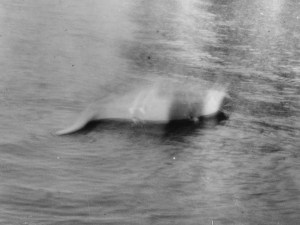
A British surgeon, Colonel Robert Wilson, took what might be the most famous picture of “Nessie” the following year. He didn’t want his name associated with it, so it became “The Surgeon’s Photo”, showing what appears to be a head and neck rising above the waters of the loch.
In one of history’s more interesting death bed confessions, Christian Spurling claimed in 1994 at the age of 93, that the surgeon’s photo had been a hoax. According to Spurling, his step-father Marmaduke Wetherell, was smarting over his hippo-foot humiliation. Spurling remembers Wetherell saying “We’ll give them their monster”, and asking his stepson to build a credible model of a marine creature. And so he did, the photo was taken, and Dr. Wilson became the respectable front man for the hoax.
An entire study called “Cryptozoology” (literally, the study of hidden animals) has sprung up around Nessie and other beasts whose existence is never quite proven, and never completely debunked. There is Big Foot, who seems to have made it to stardom with his own series of beef jerky commercials. You have the Chupacabra, the Yeti, Ogopogo, Vermont’s own Lake Champlain monster, “Champ”, and more.
Hundreds of images have been taken over the years, purporting to demonstrate that these critters really exist. Some have been transparent hoaxes, for others there is less certainty. In the end, people will believe what they want to believe. The existence of these mythical creatures may never be proven, short of one of them washing up on shore somewhere. Even then, there will be those who argue otherwise.
Quantrill’s band went through the town, systematically shooting most of the male population. The shooting, the looting and the burning went on for four hours. Between 160 and 190 of the men and boys of Lawrence, ages 14 to 90, were murdered. Most of them had had no means of defending themselves.
Lawrence, Kansas, 1863
300 to 400 riders converged outside the city of Lawrence, Kansas in the early morning hours of August 21, 1863.
They were a loose collection of independent bushwacker groups, pro-slavery and nominally Confederate, though they were part of no command and control structure.
This was a civilian group operating outside of the Confederate chain of command, more of a gang of criminal outlaws than a military operation. There was Cole Younger and Frank James, Jesse’s older brother. There was William T. “Bloody Bill” Anderson, whose men were known for tying the scalps of slain Unionists to the saddles and bridles of their horses. Leading the group was a 27 year old former schoolteacher from Ohio: William Clarke Quantrill.
Lawrence, Kansas was mostly asleep as several columns of riders descended on the town. It was 5:00am and pitch dark, as most of the city of 3,000 awoke to the sound of pounding hooves.
Doors were smashed in amid the sounds of gunshots and screams. Quantrill’s band went through the town, systematically shooting most of the male population. The shooting, the looting and the burning went on for four hours. Between 160 and 190 of the men and boys of Lawrence, ages 14 to 90, were murdered. Most of them had had no means of defending themselves.
Quantrill’s Raid Memorial Stone on New Hampshire Street
Intending to deprive Confederate sympathizers from their base of support, General Thomas Ewing authorized General Order No. 11 four days later, ordering that most of four counties along the Kansas-Missouri border be depopulated. Tens of thousands of civilians were forced out of their homes as Union troops came through, burning buildings, torching fields and shooting livestock.
The area was so thoroughly devastated that it would forever be known as the “Burnt District”.
Quantrill fled to Texas after the raid on Lawrence, and was later killed in a Union ambush near Taylorsville, Kentucky. His band broke up into several smaller groups, with some joining the Confederate army.
Others such as Frank and Jesse James and the Younger brothers, went on to apply the hit and run tactics they had learned from Quantrill’s band to a career of bank and train robberies.
Quantrill himself said that the raid was retribution for the 1861 “Jayhawker” raid of Colonel Charles “Doc” Jennison and Senator James H. Lane, that left 9 dead in Osceola, Missouri and acres of so-called “Jennison Monuments”, the two story brick chimneys that were all that remained of the burned out homes of Union and Confederate sympathizers alike.
Others blamed the raid on the collapse of a makeshift jail in Kansas City that killed several female relatives of the raiders. It seems more likely that it was just one more in a series of homicidal raids carried out by both sides: such raids usually resulting in the death of innocents.
Newspaper articles appeared in Canada in August 1907 that Quantrill was still alive, living on Vancouver Island under the name of John Sharp. It was probably an unfortunate fib on Mr. Sharp’s part. Two men traveled to Canada for the express purpose of beating Mr. Sharp to death, which they did as soon as they could locate him. The crime has never been solved.
Lou Gehrig collapsed in 1939 spring training, going into an abrupt decline early in the season. Sports reporter James Kahn wrote: “I think there is something wrong with him. Physically wrong, I mean. I don’t know what it is, but I am satisfied that it goes far beyond his ball-playing”.
The Lane Tech High school baseball team was at home on June 26, 1920. 10,000 spectators had assembled to watch the game at Cubs Park, now Wrigley Field. New York’s Commerce High was ahead 8–6 in the top of the 9th, when a left handed batter hit a grand slam out of the park. No 17-year-old had ever hit a baseball out of a major league park before, and I don’t believe it’s happened, since. It was the first time the country heard the name Lou Gehrig.
Gehrig was pitching for Columbia University against Williams College on April 18, 1923, the day that Babe Ruth hit the first home run out of the brand new Yankee Stadium. Though Columbia would lose the game, Gehrig struck out seventeen batters to set a team record. The loss didn’t matter to Paul Krichell, the Yankee scout who had been following Gehrig. Krichell didn’t care about the arm either, as much as he did that powerful left-handed bat. He had seen Gehrig hit some of the longest home runs ever seen on several Eastern campuses, including a 450′ home run at Columbia’s South Field that cleared the stands, landing at 116th Street and Broadway.
NY Giants manager John McGraw persuaded a young Gehrig to play pro ball under a false name, Henry Lewis, despite the fact that it could jeopardize his collegiate sports eligibility. He played only a dozen games for the Hartford Senators before being found out, and suspended for a time from college ball. This period, and a couple of brief stints in the minor leagues in the ’23 and ’24 seasons, were the only times Gehrig didn’t play for a New York team.
Gehrig started as a pinch hitter with the NY Yankees on June 15, 1923. He came into his own in the ‘26 season, in 1927 he batted fourth on “Murderers’ Row”; the first six hitters in the Yankee’s batting order: Earle Combs, Mark Koenig, Babe Ruth, Lou Gehrig, Bob Meusel and Tony Lazzeri.
He had one of the greatest seasons of any batter in history that year, hitting .373, with 218 hits: 52 doubles, 18 triples, 47 home runs, a then-record 175 RBIs, with a .765 slugging percentage. Gehrig’s bat helped the 1927 Yankees to a 110–44 record, the American League pennant, and a four game World Series sweep of the Pittsburgh Pirates.
Gehrig was the “Iron Horse”, playing in more consecutive games than any player in history. It was an “unbreakable” record, standing for 56 years, until surpassed in 1995 by Cal Ripken, Jr. Gehrig hit his 23rd and last major league grand slam on August 20 1938, a record that would stand until fellow Yankee Alex Rodriquez tied it in 2012.
Lou Gehrig collapsed in 1939 spring training, going into an abrupt decline early in the season. Sports reporter James Kahn wrote: “I think there is something wrong with him. Physically wrong, I mean. I don’t know what it is, but I am satisfied that it goes far beyond his ball-playing”.
The team was in Detroit on May 2 when Gehrig told manager Joe McCarthy “I’m benching myself, Joe”. It’s “for the good of the team”. McCarthy put Babe Dahlgren in at first and the Yankees won 22-2, but that was it. The Iron Horse’s streak of 2,130 consecutive games, had come to an end.
Gehrig left the team in June, arriving at the Mayo Clinic on the 13th. The diagnosis of Amyotrophic Lateral Sclerosis (ALS) was confirmed six days later, on June 19. It was his 36th birthday. It was a cruel prognosis: rapidly increasing paralysis, difficulty in swallowing and speaking, and a life expectancy of fewer than three years.
Gehrig briefly rejoined the Yankees in Washington, D.C. He was greeted by a group of Boy Scouts at Union Station, happily waving and wishing him luck. Gehrig waved back, but he leaned forward to a reporter. “They’re wishing me luck”, he said, “and I’m dying.”
The Iron Horse appeared at Yankee Stadium on “Lou Gehrig Appreciation Day”, July 4, 1939. Gehrig was awarded a series of trophies and other tokens of affection by the New York sports media, fellow players and groundskeepers. He would place each one on the ground, already too weak to hold them up. Addressing his fans, Lou Gehrig then described himself as “The Luckiest Man on the Face of the Earth”.
Henry Louis Gehrig died on June 2, 1941, at the age 37.
I drove by Yankee Stadium a while back, and thought of Lou Gehrig. It was right after the Boston Marathon bombing. The sign out front said “United we Stand”. With it was a giant Red Sox logo. That night, thousands of Yankees fans interrupted a game with the Arizona Diamondbacks, to belt out Neil Diamond’s Sweet Caroline, a staple of Red Sox home games since 1997.
I’ve always been a Boston guy myself, I think I’m required by Massachusetts state law to hate the Yankees. But seriously, what a Class Act.
American forces in South Korea were moved to DEFCON 3 on August 19. Two days later, the show of force response called “Operation Paul Bunyan”, descended like a biblical plague, on the North Korean outpost.
The current impasse with North Korea has died down for the time being, but the Korean peninsula is no stranger to conflict. 16th and 17th century Manchu and Japanese invasions brought about a sense of Korean isolationism, leading many to describe the place as a “Hermit Kingdom”. The tendency became more pronounced in the 19th century, as Koreans witnessed the colonization of China to the north, and its humiliation in two opium wars.
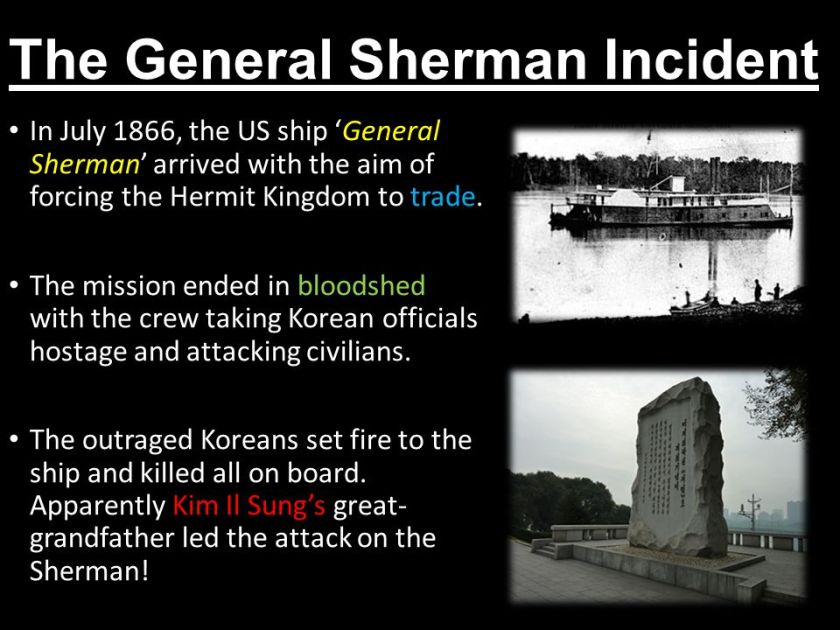
The July 1866 General Sherman incident resulted in the death of all 20 officers and crew and the destruction of an American armed merchant marine side-wheel steamer, leading to the U.S. Navy’s 1871 expedition to the Kingdom of Joseon (Chosŏn), the Shinmiyangyo. The expedition would result in the death of about 300 Korean soldiers and three Americans.
US-Korean relations soured in 1905 in the wake of the Russo-Japanese War, when the U.S. recognized Korea as falling into the Japanese “sphere of influence”.
Korean nationalists were dismayed in 1910, with the Japanese annexation of the Korean Peninsula. Woodrow Wilson’s high-sounding principles of national self-determination bypassed the Hermit Kingdom, leaving Koreans with virtually no role in their own internal administration.
Following the Japanese defeat in WWII, the Korean peninsula was divided into two occupied zones: the north held by the Soviet Union and the south by the United States. The Cairo declaration of 1943 had called for a unified Korea, its division along the 38th parallel intended to be temporary. It wasn’t meant to be. Kim Il-sung came to power in North Korea in 1946, nationalizing key industries and collectivizing land, haranguing his countrymen about the “spirit of self-reliance” he called Juche, (JOO-chay).
Propaganda poster depicting “Dear Leader”, Kim Il-sung
South Korea declared statehood in May 1948, under the vehemently anti-communist military strongman, Syngman Rhee.
The 1948-49 withdrawal of Soviet and most American forces left the south holding the weaker hand. Escalating border conflicts led to war when the North, with assurances of support from the Soviet Union and Communist China, invaded South Korea in June 1950.
Within days, the United States secured a United Nations resolution, calling for the defense of South Korea against North Korean aggression. Sixteen countries sent troops to South Korea’s aid. 90% of them were Americans.
American intervention turned the tide. US and South Korean forces crossed the North Korean border in November 1951, pressing north toward the Chinese border. Hundreds of thousands of troops from the People’s Republic of China poured across the border in December, mounting heavy assaults against allied forces and converting what had been a war of movement, into a brutal stalemate and war of attrition.
Republican Dwight David Eisenhower won decisively in the 1952 Presidential election, a contest which turned heavily on foreign policy. It wasn’t long before President Eisenhower’s public hints of nuclear escalation brought all sides to the negotiating table.
33,741 Americans lost their lives in the Korean war. Total casualties including North and South Korea, China and United Nations forces, military and civilian, number some 2.8 million.
View from the south side of the Joint Security Area, Korean DMZ
An armistice was signed on July 27, 1953, a new border drawn between North and South Korea, giving South Korea additional territory and creating a “demilitarized zone” between the two nations. WWIII had been averted, though the two sides technically remain at war, to this day.
The Demilitarized Zone (DMZ) between the Democratic People’s Republic of Korea (North) and the Republic of Korea (South), has been the focal point of cold war tension, ever since.
The Korean DMZ conflict of 1966–69 culminated in the Blue House Raid of 1968, the attempted assassination of ROK President Park Chung-hee by North Korean commandos. This period saw a series of skirmishes along the DMZ, resulting in the death of 43 Americans, 299 South Koreans and 397 North Koreans.
South Korean Executive Mansion – “Blue House”
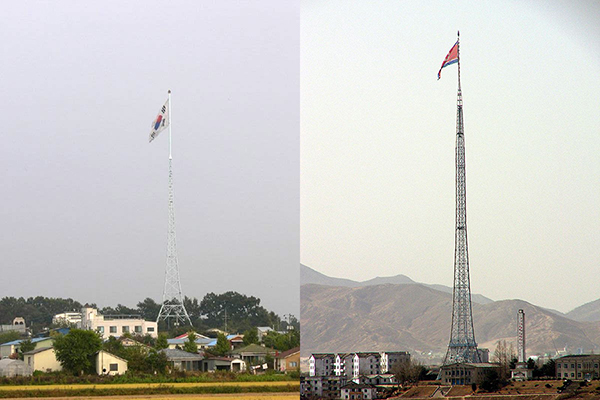
Some such episodes are borderline comical, such as the “mine is bigger than yours” tit-for-tat known as the “flagpole war” of the 1980s. The South Korean government built a 323′ flagpole flying a huge, 287lb ROK flag in Daeseong-dong, 350 meters from the line of demarcation. Not to be outdone, DPRK government officials erected a 525′ flagpole in Kijŏng-dong, flying a 595lb flag of North Korea. As of 2014, the DPRK pole remains the 4th tallest flagpole, in the world.
Other episodes are distinctly un-funny, such as the 1976 axe murders of two American Army officers.
The Joint Security Area (JSA) lies within the village of Panmunjom, the only piece of the DMZ where North and South Korean guards stand face-to-face. There the “Bridge of No Return” crosses the border, the Military Demarcation Line running across its center. Here, POWs were brought from both sides, and given their final ultimatum. They could stay in the country of their captivity or cross that bridge and return to their homeland. They could never come back.
Lieutenant Pak Chul
The bridge was last used for prisoner exchange in 1968, when the crew of USS Pueblo was released and ordered to cross into South Korea.
Visible only during winter months, command Post #3, near the Bridge of No Return, has been called the “loneliest outpost in the world”. On numerous occasions, North Korean troops have taken advantage of this isolation, attempting to grab United Nations Command personnel and drag them across the bridge into North Korean territory.
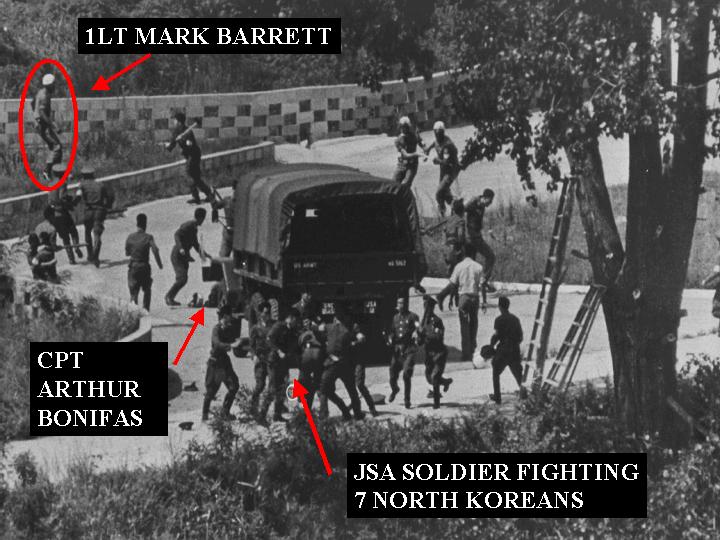
On August 18, 1976, five Korean Service Corps (KSC) personnel entered the JSA, escorted by US Army Captain Arthur Bonifas, his ROK counterpart Captain Kim, area platoon leader First Lieutenant Mark Barrett, and 11 American and South Korean enlisted personnel.
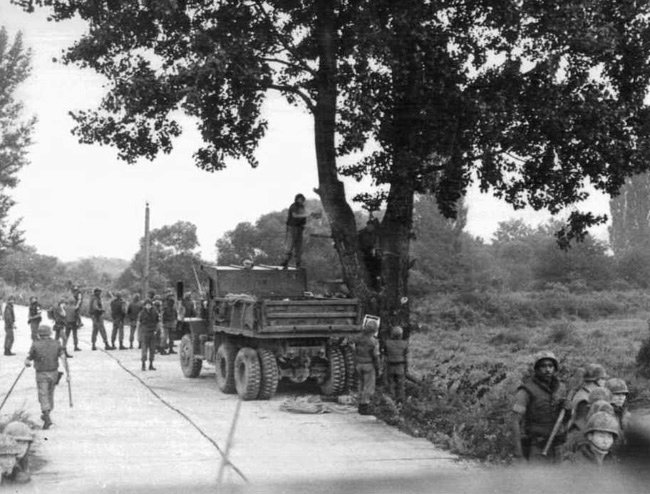
15 North Korean soldiers appeared, commanded by Senior Lieutenant Pak Chul, whom UNC soldiers called “Lt. Bulldog” based on his confrontational history. Lt. Pak ordered the UNC to cease tree trimming, “because Kim Il-sung personally planted it and nourished it and it’s growing under his supervision.” Captain Bonifas turned his back on the North Koreans, ordering the detail to continue. That’s when the stuff hit the fan.
Another 20 North Korean soldiers crossed the bridge, carrying crowbars and clubs. Lt. Pak removed his watch, wrapped it in a handkerchief, placed it in his pocket, and shouted, “Kill the bastards!”.
When it was over, Captain Bonifas and First Lieutenant Barrett were dead, hacked to death with axes dropped by the tree-trimmers. All but one of the UNC guards were injured. Within hours, Kim Jong-il, son of “Dear Leader” Kim Il-sung, described the incident as an unprovoked incident in which American officers attacked North Korean guards.
The CIA believed the whole episode to have been pre-planned. American forces in South Korea were moved to DEFCON 3 on August 19. Two days later, the show of force response called “Operation Paul Bunyan”, descended like a biblical plague, on the North Korean outpost.
At 7:00am on August 21, 23 American and South Korean vehicles drove into the JSA with chainsaws, 753 troops escorted by two 30-man security platoons, armed with pistols and axe handles. This was no tree trimming operation.
64 South Korean Special Forces brandished M16 rifles and M79 grenade launchers. Lethally effective elite soldiers, they taunted the North Koreans, daring them to cross the bridge. Several had Claymore mines strapped to their chests, firing mechanisms at the ready.
20 utility helicopters and seven Cobra attack choppers circled overhead, behind them F-4 Phantom IIs and nuclear-capable B-52 Stratofortresses.
12,000 additional troops were ordered to Korea, including 1,800 Marines from Okinawa. At Yokota Air Base in Japan, a dozen C-130s stood “nose to tail”, ready to provide back-up. Air bases from Guam to Idaho were on full alert. The entire USS Midway carrier task force, stood offshore.
“Minds blown” by this show of force, North Korea responded with 150-200 troops of its own, but did little but look on at the proceedings.
42 minutes later, all that remained of dear leader’s tree was a 20’ stump, deliberately left to aggravate North Korean sensibilities.
Korean DMZ ‘Incident Tree’
Captain Bonifas and Lieutenant Barrett were posthumously promoted to the ranks of Major and Captain, respectively. Today, Camp Bonifas is home to the United Nations Command Security Battalion – Joint Security Area, whose mission it is to monitor and enforce the Korean Armistice Agreement of 1953 in the no-man’s land between North and South Korea.
Camp Bonifas is home to a one-hole, “par 3” AstroTurf patch, surrounded on three sides by minefields. Sports Illustrated has called it “the most dangerous hole in golf”. There is at least one report of an errant shot exploding a land mine. How nice it is that a sense of humor can survive, even in this wretched place.
John White returned on August 18, 1590, three years to the day from the birth of his granddaughter. He found the place deserted, only the word “CROATOAN” carved into a fence post, and the letters “CRO” on a nearby tree.
The 16th century was drawing to a close when Queen Elizabeth set out to establish a permanent English settlement in the New World. The charter went to Walter Raleigh, who sent explorers Philip Amadas and Arthur Barlowe to scout out locations for a settlement.
The pair landed on Roanoke Island on July 4, 1584, establishing friendly relations with local natives, the Secotans and Croatans. They returned a year later with glowing reports of what is now the Outer Banks of North Carolina. Two Native Croatans, Manteo and Wanchese, accompanied the pair back to England. All of London was abuzz with the wonders of the New World.
Explorer Sir Walter Raleigh
Queen Elizabeth was so pleased that she knighted Raleigh. The new land was called “Virginia” in honor of the Virgin Queen.
Raleigh sent a party of 100 soldiers, miners and scientists to Roanoke Island, under the leadership of Captain Ralph Lane. The attempt was doomed from the start. They arrived too late in the season for planting, and Lane alienated the neighboring tribe when he murdered their chief, Wingina. By 1586 they had had enough, and left the island.
Ironically, their supply ship arrived about a week later. Finding the island deserted, that ship left 15 men behind to “hold the fort” before they too, departed.
The now knighted “Sir” Walter Raleigh was not deterred. He recruited 90 men, 17 women and 9 children for a more permanent “Cittie of Raleigh”, appointing John White governor. Among the colonists were White’s pregnant daughter, Eleanor, her husband Ananias Dare, and the Croatans Wanchese and Manteo.
Wanchese, Manteo
The caravan stopped at Roanoke Island in July, 1587, to check on the 15 men left behind a year earlier. Raleigh believed that the Chesapeake afforded better opportunities for his new settlement, but his Portuguese pilot Simon Fernandes had other ideas.
Fernandes was a Privateer, impatient to resume his hunt for Spanish shipping. He ordered the colonists ashore on Roanoke Island. It could not have lifted the spirits of the small group to learn that the 15 left there by the earlier expedition, had disappeared.
Eleanor Dare gave birth to a daughter on August 18, 1587, and called her Virginia. The first English child born to the new world.
Fernandez departed for England ten days later, taking along an anxious John White, who wanted to return to England for supplies. It was the last time Governor White would see his family.
White found himself trapped in England by the invasion of the Spanish Armada, and the Anglo-Spanish war. It would be three years before he could return to Roanoke. He arrived on August 18, 1590, three years to the day from the birth of his granddaughter. He found the place deserted, only the word “CROATOAN” carved into a fence post. The letters “CRO” were carved into a nearby tree.
White had hopes of finding his family at Croatoan, the home of Chief Manteo’s people to the south, on modern day Hatteras Island.
A hurricane came up before he could explore further, his ships so damaged that he had return to England. Despite several attempts, he was never able to raise the resources to return.
What happened to the lost colonists of Roanoke, remains a mystery. They may have died of disease or starvation, or they may have been killed by hostile natives.
Perhaps they went to live with Chief Manteo’s people, after all. One of the wilder legends has Virginia Dare, now a young woman, transformed into a snow white doe by the evil medicine man, Chico, but that’s a story for another day. The fate of the first English child born on American soil may never be known.
Seventeen years later, another group of colonists would apply the lessons learned in Roanoke, founding their own colony a few miles up the coast at a place called Jamestown.
A personal anecdote involves a conversation I had with a woman in High Point, North Carolina, a few years back. She described herself as having Croatan ancestry, her family going back many generations on the outer banks of North Carolina. She described her Great Grandmother, a full blooded Croatan. The woman looked like it, too, except for her crystal blue eyes. She used to smile at the idea of the lost colony of Roanoke. “They’re not lost”, she would say. “They are us”.
French President Charles de Gaulle came to New York City in 1960, surprising media and dignitaries alike when all he wanted to do was to visit with a black elevator operator at the Rockefeller Center.
Eugene James Bullard was born October 9, 1894 in Columbus Georgia, the seventh of 10 children born to William Octave Bullard and an indigenous Creek named Josephine “Yokalee” Thomas. Bullard’s father had come from Martinique, where his people could trace their lineage back to the Haitian Revolution.
Eugene wanted to leave behind the racial discrimination of his day. The near-lynching of his father became the catalyst in 1902, when the boy was eight. He ran away from home, spending the next four years doing odd jobs to survive The elder Bullard had always told him “in France a man is accepted as a man regardless of the color of his skin”. In 1906, the boy stowed away on a German ship to Aberdeen.
Bullard worked a number of odd jobs to support himself. By age 16 he was becoming well known as a boxer, and moved to Paris at the first opportunity.
WWI broke out in August of 1914. By the end of the year the French nation had suffered over a half million casualties.
Bullard enlisted in the French Foreign Legion, an American serving as one of 54 different nationalities serving in the Moroccan Division, Third Marching Regiment.
The Regiment was sent to the Somme front in 1915, where 300,000 Frenchmen were lost by the end of November. One unit of 500 men began the disastrous Champagne offensive of September. At the end of the battle, 31 responded to the first evening’s roll call.
What remained of Bullard’s unit was disbanded to form the 170th Infantry, and sent to Verdun. He thought he had arrived in hell, saying, “I thought I had seen fighting in other battles but no one has ever seen anything like Verdun – not ever before or ever since.”
Erich von Falkenhayn had designed his battle plan for Verdun to “bleed France white”, calling Verdun Operation Gericht. Operation Execution Place. Over 250,000 died in the 10 months long battle, more than 100,000 were missing and 300,000 gassed or wounded.
Bullard had been wounded four times before. On March 5th 1916, he received the wounds that took him out of the ground war. He was 8 months in hospital when the opportunity arose to join the French Flying Corps. A white American buddy bet him $2,000 that he couldn’t get into aviation and become a pilot, and he took the challenge. Bullard earned his wings on May 5, 1917, and received his $2,000 soon thereafter.
Bullard was assigned to the 93d Spad Squadron on August 17, 1917, flying Spad V11s and Nieuports with a mascot, a pet Rhesus Monkey he called “Jimmy”. He said, “I was treated with respect and friendship – even by those from America. Then I knew at last that there are good and bad white men just as there are good and bad black men.”
The first black combat pilot and the only one to serve in the Great War, Bullard painted a bleeding red heart pierced by a knife on the side of his Spad biplane. Below the heart were the words “Tout le Sang qui coule est rouge!” The phrase roughly translates as “All Blood Runs Red”.
Bullard is credited with two kills while flying for the 93rd, though one of the Germans crashed behind enemy lines so it remained unconfirmed. He tried to join the American squadron when the US entered the war, but the whites only policy of the time prevented him from doing so.
Bullard married in 1923. The marriage ended in divorce, with Bullard gaining custody of their two surviving daughters (a son had died of pneumonia in infancy). He became a drummer at the jazz club, “Le Grand Duc”, later buying his own club and calling it “L’Escadrille”. Bullard made several famous friends during this time, including Josephine Baker, Louis Armstrong, Langston Hughes and the French flying ace Charles Nungesser.
He volunteered with the 51st Infantry when WWII broke out, becoming wounded and escaping to the United States in 1940.
Bullard spent his last days in obscurity. His daughters had married by the 1950s, and he lived alone in a New York apartment, decorated with pictures of his famous friends and a framed case containing his fifteen French war medals. He worked as an elevator operator at the Rockefeller Center, where nobody knew anything about his service.
The French government requested his presence in 1954, when he and two white Frenchmen were accorded the honor of relighting the Eternal Flame at the Tomb of the Unknown French Soldier at l’Arc de Triomphe.
France honored Bullard once again in 1959, naming him a Knight of the Légion d’honneur in a lavish ceremony in New York City. Dave Garraway interviewed him on the Today Show, but he remained alone and unknown in his native country.
French President Charles de Gaulle came to New York City in 1960, surprising media and dignitaries alike when all he wanted to do was to visit the black elevator operator who worked at the Rockefeller Center.
Eugene James “Jacques” Bullard died on October 12, 1961. He was buried with the tri-color of France draping his coffin, laid to rest with full honors by the Federation of French War Officers at Flushing Cemetery in New York.
The first black fighter pilot, the “Black Swallow of Death”, was honored by the country he had loved and served during two world wars. On August 23, 1994, 77 years after Bullard’s American flight physical, the USAF posthumously awarded Eugene Bullard a commission as a Lieutenant.
Mao’s “Cultural Revolution” of the late 1960s is estimated to have killed 40 to 70 million Chinese. You’re really playing in the Big Leagues, when they can’t estimate your death toll to anything closer than the nearest 30 million.
At the age of 2 years and 10 months, Puyi was taken from his parents and installed on the Qing Dynasty throne, in the Chinese Imperial Palace in Beijing. The year was 1908.
It must have been bewildering for this toddler who was terrified by the sound of the ceremonial drums. Grown men would kowtow and avert their eyes in his presence. His wet nurse, Wen-Chao Wang, was the only familiar face in the Royal Court. She was the only one who could console him. She alone was allowed to accompany him to the Forbidden City.
Puyi’s abdication of the throne four years later marked the end of 1,000 years of dynastic rule in China, earning him the sobriquet “The Last Emperor” of China.
Japanese experts gathered to inspect the scene of the ‘railway sabotage’ on the railway line.
Today, the Tsingtao beer available in Chinese restaurants the world over, is one of the last cultural vestiges of European colonization of China. In the latter half of the 19th century, China became increasingly subjugated through colonization by British, French and German powers.
American President Millard Filmore dispatched Commodore Matthew Perry to Japan in 1852, forcing an opening of that nation’s economy to trade with the West, and commencing a half-century’s period of rapid industrialization in resource-poor Japan. The smaller nation grew in both economic and military power, while China suffered the humiliations of the first and second opium wars, and forced colonization by European interests.
Japan piled on in the First Sino-Japanese War of 1894-95, culminating in the massacre of much of Lüshun City (formerly “Port Arthur”), cession of Chinese territories, and the recognition of an independent Korea.
China declared war on Imperial Germany in August 1917, intending to send combat units to the western front, but never getting around to doing so. The move entitled them to a seat at the Paris Peace Conference, but all that got them was a secret list of 21 demands issued by the Japanese Empire. Japan emerged from this period with greater influence over the Chinese economy, and increased Japanese control over the resource-rich regions of Northern China and Manchuria.
On September 18, 1931, a small quantity of dynamite was detonated by Japanese Lt. Kawamoto Suemori, near a railroad owned by Japan’s South Manchuria Railway near Mukden, in modern Shenyang. It was a ruse, a bald pretext for the Japanese invasion of Manchuria in Northern China, and everyone knew it.
The explosion was so weak that it failed to destroy the line and a train passed minutes later, but the script was already written. The Imperial Japanese Army accused Chinese dissidents of the “Mukden Incident”, launching a full scale invasion.
Japan installed Puyi as Emporer Kangde of the puppet state of “Manchukuo”, all the while suppressing the native Han Chinese in one of the most brutal and genocidal occupations of the 20th century.
Puyi was kept on a short leash by his Japanese handlers, his life mainly consisting of signing laws prepared by Japan, reciting prayers, consulting oracles, and making formal visits throughout his state.
The Second world war was drawing to a close when the Soviet Union declared war on Japan, beginning its invasion of occupied China two days after the atomic bomb was dropped on Hiroshima, the day before Nagasaki. Puyi was captured at an airfield on this day in 1945, and held in a Soviet gulag in Siberia until Mao Tse-Tung’s Communist party came to power in 1949.
Japanese occupation of Beijing, 1937 – 1945
Puyi spent ten years in the Fushun War Criminals Management Centre in Liaoning province until he was declared “reformed”, moving to Peking in 1959 and taking up residence as an ordinary citizen.
Mao’s “Cultural Revolution” of the late 1960s is estimated to have killed 40 to 70 million Chinese. You’re really playing in the Big Leagues, when they can’t estimate your death toll any closer than the nearest 30 million.
The Last Emperor was an easy target of the “Red Guards”. He probably wouldn’t have survived the tender ministrations of the communist government, but he died quietly due to complications of Kidney Cancer on October 17, 1967.
The ashes of the last Emperor, a man who had found himself at the head of over a half-billion people at a time when the world population was only 2 billion, were placed at the Babaoshan Cemetery, the former burial ground of imperial concubines and court eunuchs.




 The Corsican’s defeat at Waterloo and subsequent exile to Elba freed up some of the most elite, battle hardened troops in the world.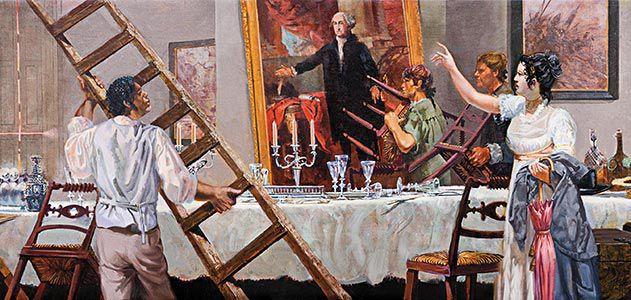
 General Ross sent two hundred men to secure a fort on Greenleaf’s Point. The fort had already been destroyed by American forces, but 150 barrels of gunpowder remained. The powder ignited while the British were trying to drop it into a well, killing at least a dozen and injuring many others.

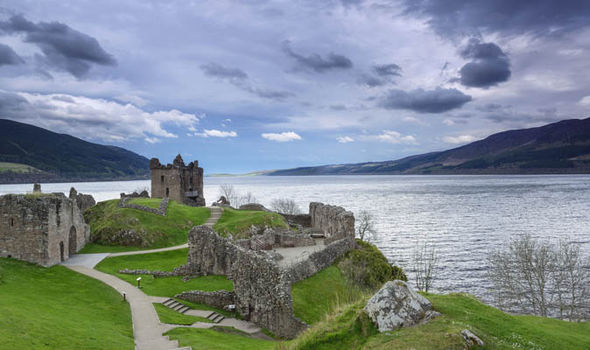
 Loch Ness is formed by a 60 mile, active tectonic fault, where the hills are still rising at a rate of 1mm per year. It’s made up of 3 lochs; Loch Lochy, Loch Oich and Loch Ness, with Loch Ness being by far the largest. There is more water in Loch Ness than all the other lakes in England, Scotland and Wales, combined. It is 22½ miles long and varies from a mile to 1½ miles wide, with a depth of 754′ and a bottom “as flat as a bowling green”.
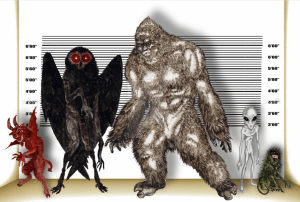 An entire study called “Cryptozoology” (literally, the study of hidden animals) has sprung up around Nessie and other beasts whose existence is never quite proven, and never completely debunked. There is Big Foot, who seems to have made it to stardom with his own series of beef jerky commercials. You have the Chupacabra, the Yeti, Ogopogo, Vermont’s own Lake Champlain monster, “Champ”, and more.


 Quantrill fled to Texas after the raid on Lawrence, and was later killed in a Union ambush near Taylorsville, Kentucky. His band broke up into several smaller groups, with some joining the Confederate army.

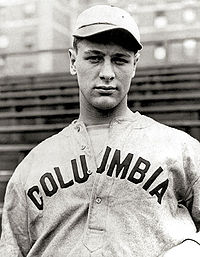 Gehrig was pitching for Columbia University against Williams College on April 18, 1923, the day that Babe Ruth hit the first home run out of the brand new Yankee Stadium. Though Columbia would lose the game, Gehrig struck out seventeen batters to set a team record. The loss didn’t matter to Paul Krichell, the Yankee scout who had been following Gehrig. Krichell didn’t care about the arm either, as much as he did that powerful left-handed bat. He had seen Gehrig hit some of the longest home runs ever seen on several Eastern campuses, including a 450′ home run at Columbia’s South Field that cleared the stands, landing at 116th Street and Broadway.
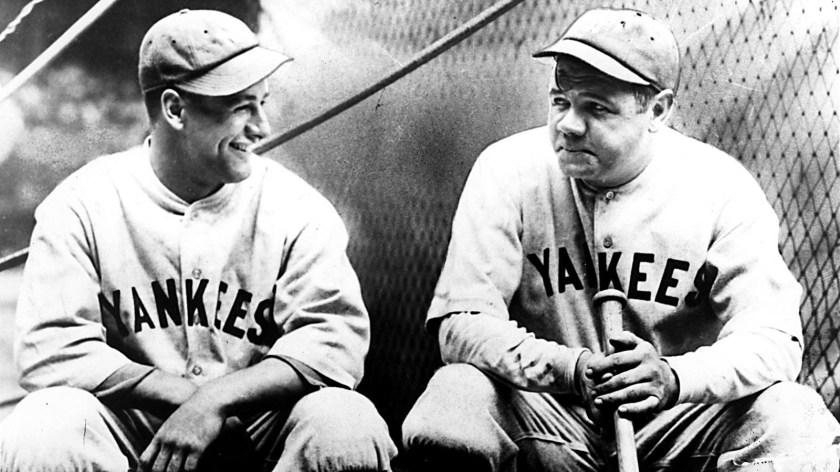
 Gehrig left the team in June, arriving at the Mayo Clinic on the 13th. The diagnosis of Amyotrophic Lateral Sclerosis (ALS) was confirmed six days later, on June 19. It was his 36th birthday. It was a cruel prognosis: rapidly increasing paralysis, difficulty in swallowing and speaking, and a life expectancy of fewer than three years.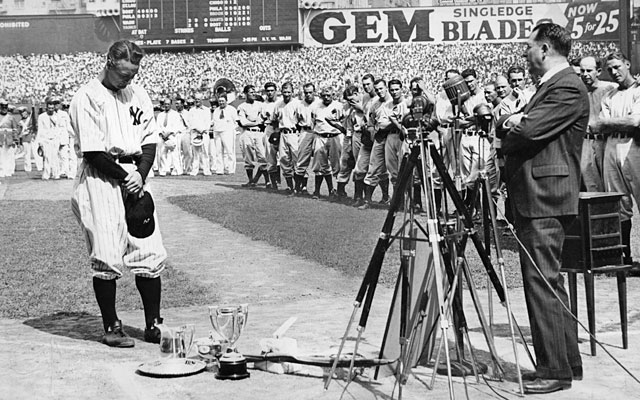






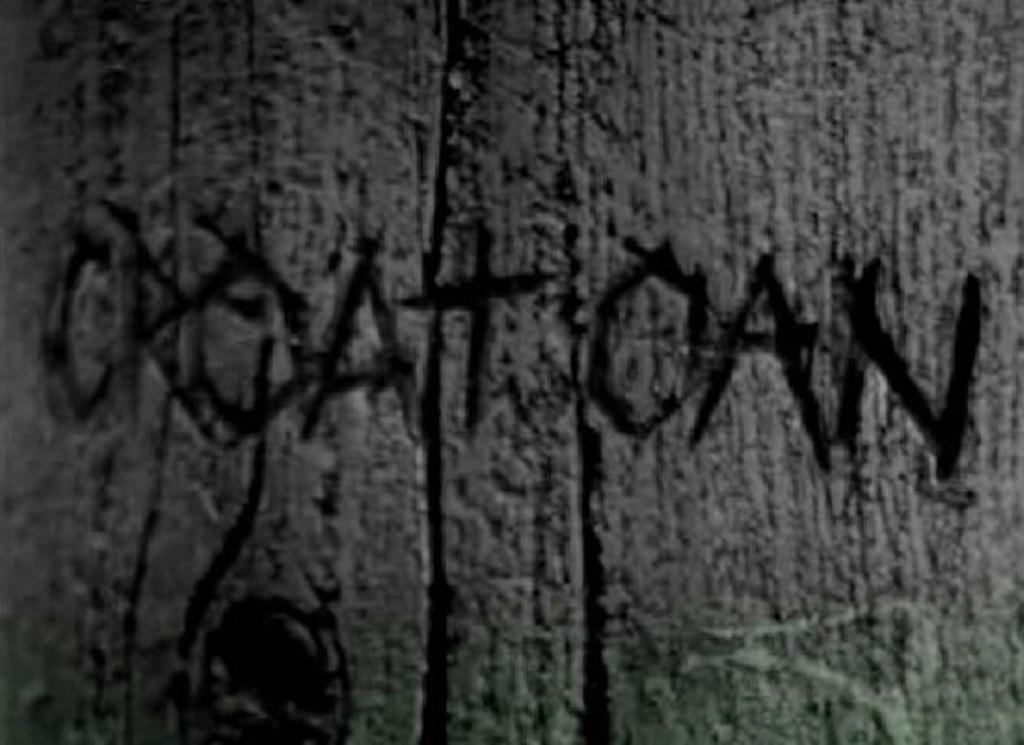

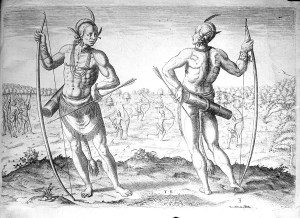
 White found himself trapped in England by the invasion of the Spanish Armada, and the Anglo-Spanish war. It would be three years before he could return to Roanoke. He arrived on August 18, 1590, three years to the day from the birth of his granddaughter. He found the place deserted, only the word “CROATOAN” carved into a fence post. The letters “CRO” were carved into a nearby tree.
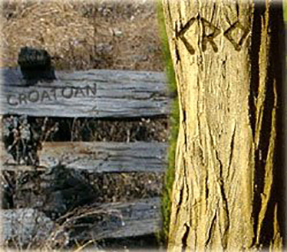 White had hopes of finding his family at Croatoan, the home of Chief Manteo’s people to the south, on modern day Hatteras Island.
 Seventeen years later, another group of colonists would apply the lessons learned in Roanoke, founding their own colony a few miles up the coast at a place called Jamestown.


 Bullard was assigned to the 93d Spad Squadron on August 17, 1917, flying Spad V11s and Nieuports with a mascot, a pet Rhesus Monkey he called “Jimmy”. He said, “I was treated with respect and friendship – even by those from America. Then I knew at last that there are good and bad white men just as there are good and bad black men.”


 Historical Easter Eggs - Today in History
You must be logged in to post a comment.