September 3, 1752  The Lost days

Tragically, the number of historians’ and geneologists’ heads to have since exploded, remains unknown.

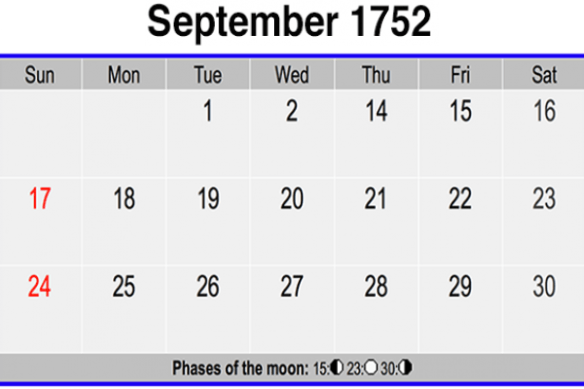
If you were living in England or one of the American colonies 265 years ago, this day did not exist. When you went to bed last night, it was September 2.  This morning when you got up, it was September 14.

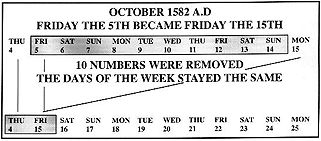
The “Julian” calendar adopted in 46BC, miscalculated the solar year by 11 minutes per year, resulting in a built-in error of 1 day for every 128 years.   By the late 16th century, the seasonal equinoxes were ten days out of sync, and that was causing a problem with the holiest days of the Catholic church.October 1582 missing days

In 1579, Pope Gregory XIII commissioned the Jesuit mathematician and astronomer Christopher Clavius, to devise a new calendar and correct this “drift”.  The “Gregorian” calendar was adopted in 1582, omitting ten days from that October, and changing the manner in which “leap” years were calculated.

The Catholic countries of Europe were quick to adopt the Gregorian calendar.  England and its overseas colonies continued to use the Julian calendar well into the 18th century, resulting in immense confusion.  Legal contracts, civic calendars, and the payments of rents and taxes were all complicated by the two calendar system. Military campaigns were won or lost, due to confusion over dates.

Between 1582 and 1752, some English and colonial records included both the “Old Style” and “New Style” year.  The system was known as “double dating”, and resulted in date notations such as March 19, 1602/3.  Others merely changed dates. Google “George Washington’s birthday”, for instance, and you’ll be informed that the father of our country was born on February 22, 1732.  The man was actually born on February 11, 1731, under the Julian Calendar.  It was only after 1752 that Washington himself recognized the date of his birth as February 22, 1732, reflecting the Gregorian Calendar.

virginia-almanack-1752
Virginia almanack of 1752

Tragically, the number of historians’ and geneologists’ heads to have since exploded, remains unknown.

The “Calendar Act of 1750” set out a two-step process for adoption of the Gregorian calendar.  Since the Roman calendar began on March 25, the year 1751 was to have only 282 days so that January 1 could be synchronized with that date.  That left 11 days to deal with.

So it was decreed that Wednesday, September 2, 1782, would be followed by Thursday, September 14.

You can read about “calendar riots” around this time, though they may be little more than a late Georgian-era urban myth.

Philip Stanhope, 4th Earl of Chesterfield, was a prime sponsor of the calendar measure.  His use of the word “Mobs” was probably a description of the bill’s opponents in Parliament.   Even so, there were those who believed their lives were being shortened by those 11 days, and others who considered the Gregorian calendar to be a “Popish Plot”.  The subject would become a very real campaign issue between Tories and Whigs, in 1754.

There’s a story concerning one William Willett, who lived in Endon. Willett wagered that he could dance non-stop for 12 days and 12 nights, starting his jig about town the evening of September 2nd 1752. He stopped the next morning, and went out to collect his bets. I was unable to determine, how many actually paid up.

The official start of the British tax year was changed in 1753, so as not to “lose” those 11 days of tax revenue.  Revolution was still 23 years away in the American colonies, but the reaction “across the pond” could not have been one of unbridled joy.

Turkey was the last country to formally adopt the Gregorian calendar, doing so in 1927.

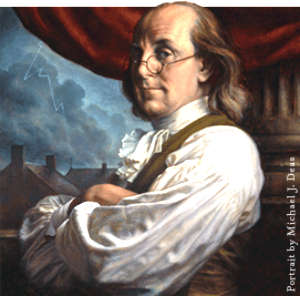
ben franklinBenjamin Franklin seems to have liked the idea, writing that, “It is pleasant for an old man to be able to go to bed on September 2, and not have to get up until September 14.”

The Gregorian calendar gets ahead of the solar cycle by 26 seconds every year, despite some very clever methods of synchronizing the two cycles.  Several hours have already been added, and it will be a full day ahead by the year 4909.

I wonder how Mr. Franklin would feel, to wake up and find that it’s still yesterday.

September 2, 1192 Sultan and Crusader

In time, the Crusader and the Sultan came to hold a degree of respect for one another.   Legend has it that, at one point in the fighting around Jaffa, Saladin even sent Richard a fresh horse, after one was killed beneath him.

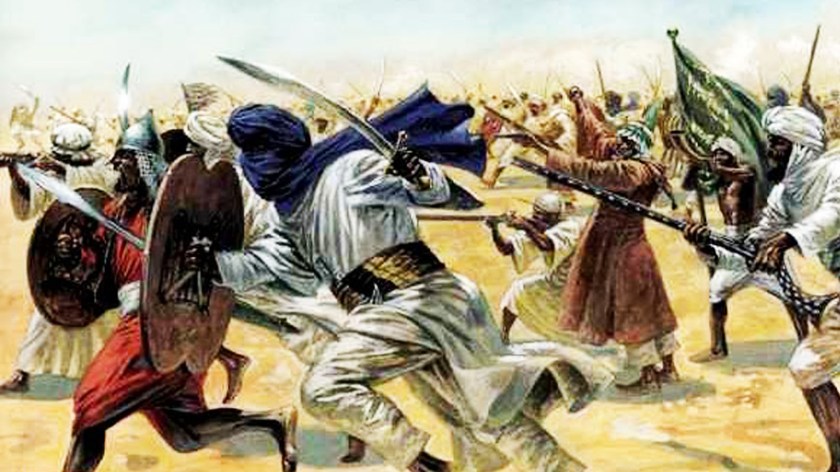
The Islamic Conquests began in the 7th century on the Arabian Peninsula.  In the first 100 years of its existence, Islam established the largest pre-modern empire up to that time, stretching from the borders of China in the east, through India and Central Asia, the Middle East, North Africa, Egypt, Sicily to the Iberian Peninsula (Spain), in the west.

The Sasanid Empire in what is now Iran ceased to exist under the Muslim conquest, as did much of Byzantium, seat of the Roman Empire in the east. Europe itself narrowly escaped subjugation when Charles “The Hammer” Martel defeated the army of Abdul Rahman al Qafiqi at Poitiers (Tours) in October, 732.

Estimates suggest that the Caliphate was over 5 million square miles, larger than any modern-day state with the sole exception of the Russian Federation.

Muslim Conquests, 632-750

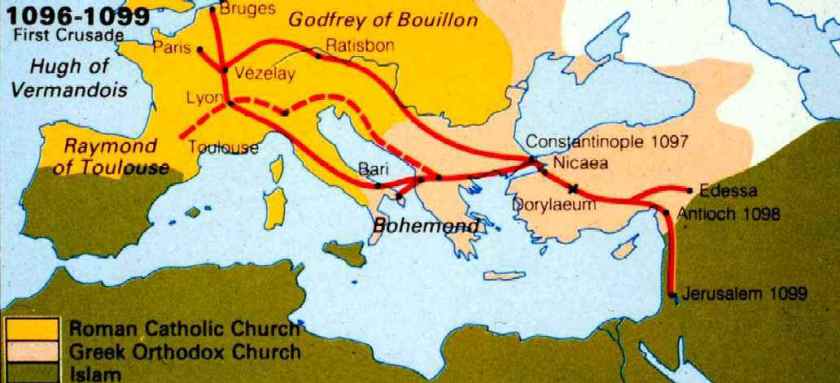
The First of the Christian Crusades was launched by Pope Urban II on November 27, 1095, in response to an appeal from Byzantine Emperor Alexios I Komnenos, who was requesting help in Constantinople against the invading Seljuq Turks.

Such a request wasn’t new, the Reconquista in Spain had not yet reached the mid-point of its 781-year effort to overthrow Muslim rule, and European knights traveled to Spain on a regular basis to assist in the effort.

Once in Anatolia (modern day Turkey), the ancillary goal of freeing Jerusalem itself and the Holy Land soon became the principal objective, as Jerusalem had by then been under Islamic rule for 461 years.  Jerusalem was recaptured on July 15, 1099, following a siege of six weeks.

first_crusade_route_map
Route Map of the First Crusade

The County of Edessa was the first Crusader state to be created, and the first to go, falling in 1144 and leading to the second crusade. Mostly notable for its failures, the one major success of the second crusade was when it stopped on the way to the Holy Land, helping a much smaller Portuguese army overthrow Muslim rule in Lisbon. Two kings then marched two separate armies across Europe into Anatolia, only to be soundly defeated by the Turks.

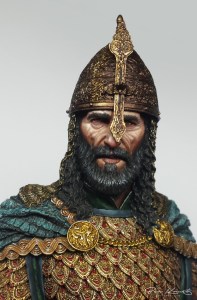
Saladin
Saladin

A Kurdish leader arose to become Sultan at this time, founding a dynasty which would last for eighty-nine years. His name was Salāḥ ad-Dīn Yūsuf ibn Ayyūb, better known as Saladin, a Sunni Muslim who rose to greatness in a Shi’ite world.

No less a figure than Dante Alighieri counted Saladin a “virtuous pagan,” in the ranks of Hector, Aeneas, and Caesar.

While Christian leaders in the Middle East fell to squabbling among themselves, Saladin united Syria, Egypt, Mesopotamia, Yemen and parts of North Africa. Saladin’s annihilation of a crusader army at Hattin on July 4, 1187 opened the way to the recapture of every Crusader state but one.  Jerusalem itself fell on October 2.

Pope Urban III is said to have collapsed and died, on hearing the news.

King Henry II of England and King Philip II of France were at war at the time, but ended that and began preparations for a third crusade with the exhortations of Pope Henry VIII. An extremely unpopular tax of 10% on all revenues and movable goods was imposed by the Church, and enforced under pains of imprisonment or excommunication. This “Saladin Tithe” raised 100,000 marks of silver, about 800,000 ounces.

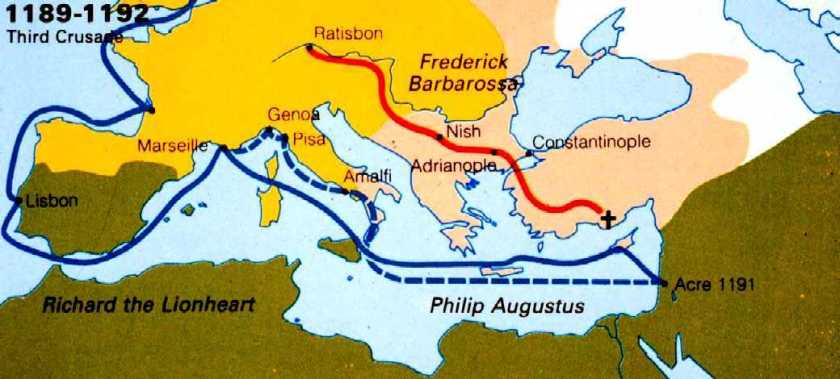
third_crusade_route_map
Route Map of the Third Crusade

The aging Holy Roman Emperor, Frederick I “Barbarossa” (Red Beard), was the first to go, taking up the cross at Mainz Cathedral in March, 1188.  Emperor Frederick drowned crossing the Saleph River in Asia Minor in June 1190, after which most of his army of 100,000 returned to Germany.

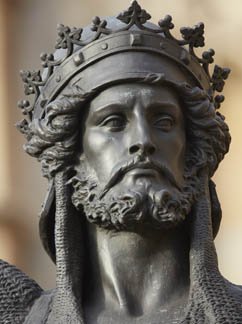
Henry II of England died in the meantime, leaving his son Richard I “Coeur de Lion”(Lion-heart) to lead the crusade with Philip in the summer of 1190.

Loewenherz_LondonPortraet
Richard I, “Lion-heart”

Richard took time to conquer Sicily on the way to the Holy Lands, where King Tancred I was holding Richard’s sister Queen Joan, prisoner.  He reached Cyprus that May, there pausing long enough to marry Berengaria of Navarre, thus alienating his alliance with the French King, who considered Richard to be betrothed to his own half-sister, Alys.

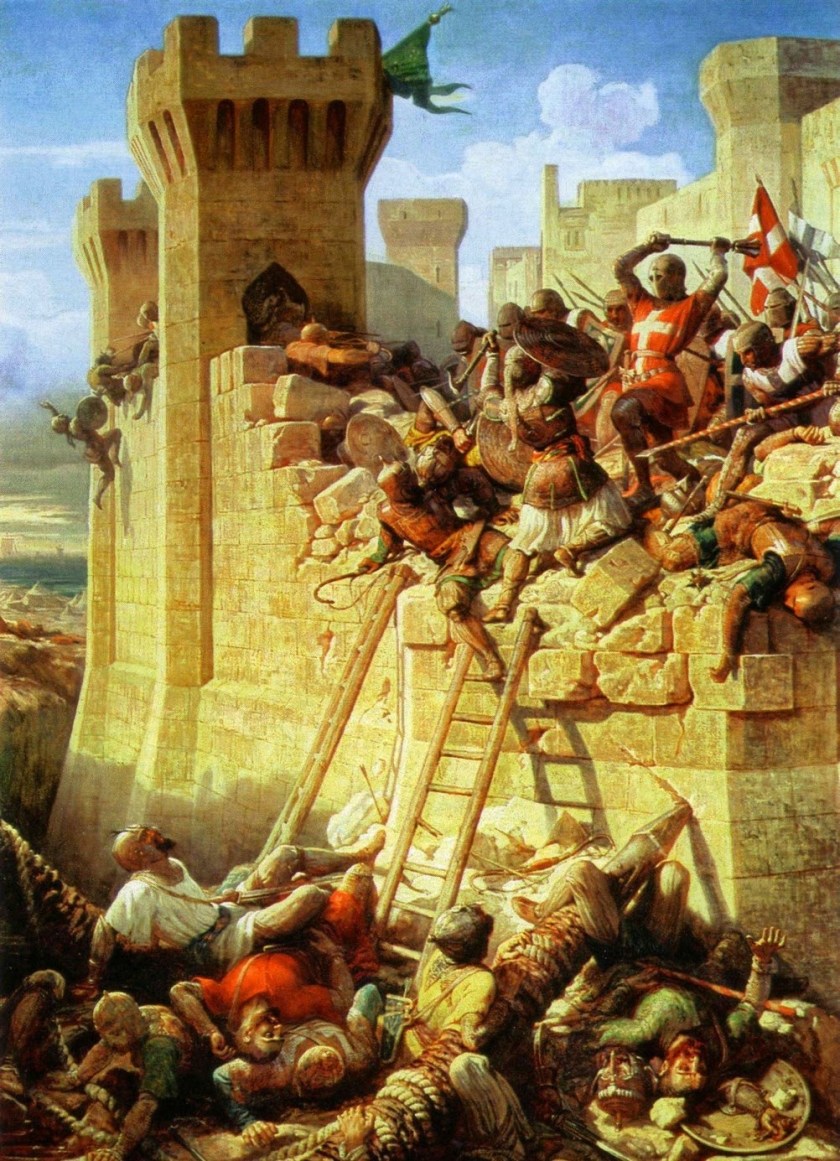
Richard landed near Acre in June 1191 to find the city under Muslim occupation, and under siege by the forces of Guy de Lusignan, himself held under siege by the armies of Saladin.

Richard became ill at one point during the battle for Acre, it’s said that he picked off guards on the city walls with a crossbow, as he was being carried off on a stretcher.

The fall of Acre led to a number of meetings between Richard and Saladin’s brother Al-Adil, from which nothing resulted.  The Crusaders lost all patience by August, believing Saladin to be dragging his feet, and decapitated 2,700 Muslim prisoners in view of Saladin’s army.  This number included women and children.  Saladin responded by murdering every Christian captive, under his control.

Dominique-Louis-FeÌ-reÌ-ol Papety - The Siege of Acre ca_ 1840
The Siege of Acre, by Dominique-Louis-FeÌ-reÌ-ol Papety – ca 1840

Richard took the strategically important city of Jaffa, control over which was necessary if the Crusaders were to hold the coast and retake Jerusalem. The Crusader victory at Arsuf would prove Richard’s personal courage and skill as a commander, at the same time putting a dent in Saladin’s reputation as the invincible warrior King.

Two times Crusader armies came within sight of Jerusalem, never suspecting that, within the city, “Saracen” morale was so low that the city may have been theirs for the taking.  Meanwhile, the Crusader side fell to bickering, with half wanting to push on to Jerusalem, the other wanting to attack Saladin’s base of power, in Egypt.

In time, the Crusader and the Sultan came to hold a degree of respect for one another.   Legend has it that, at one point in the fighting around Jaffa, Saladin even sent Richard a fresh horse, after one was killed beneath him. The pair even discussed marrying Joan off to Saladin’s brother, Al-Adil, with themselves becoming co-rulers in Jerusalem. The plan might’ve worked, too, until the Roman Church got wind and threatened excommunication if Richard carried it out.

I have not been able to learn what Joan herself thought of the match.

crusade, 3

Time finally ran out for Richard and Saladin, both. The Christian army was decimated by disease.  Fierce quarrels between German, English and French contingents threatened to break up the Crusader army.   Richard himself was gravely ill, near despair of ever regaining his health.  On top of that, his own little brother John was plotting against him, with the connivance of the French King Philip. Richard Lion-heart no longer had the strength to challenge Saladin for Jerusalem.

Saladin, for his part, had serious morale problems, after repeated defeats at the hands of the Crusaders.

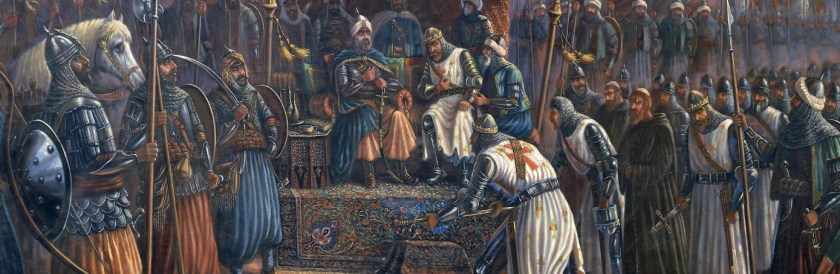
With Saladin’s brother Saif adDin acting as intermediary, the King and the Sultan concluded the Treaty of Jaffa on this day in 1192.  The fortifications at Ascalon were to be dismantled, in exchange for which Christians would continue to hold the coast from Jaffa to Tyre. Jerusalem would remain in Muslim hands, while unarmed Christian pilgrims and traders would be guaranteed free passage to visit the Holy Sepulcher of the Lord in peace, without the exaction of any tribute or tax.  Further, Christian traders were permitted the possession objects for sale throughout the land, thus permitting such traders right of free commerce.

Crusades

Sultan Salāḥ ad-Dīn Yūsuf ibn Ayyūb died of a fever the following March, and was buried in the garden outside the Umayyad Mosque in Damascus, Syria.  Saladin’s kingdom and the Crusader states would remain at peace, for a period of three years.

Seven centuries later, German Emperor Wilhelm II donated a new marble sarcophagus, to the tomb of the Sultan who had reclaimed Jerusalem from the Crusaders.

Foul weather drove King Richard I ashore near Venice, where he was captured by Duke Leopold of Austria and handed over to German Emperor Henry VI and held for ransom. This time, the tithe would be 25%, raising about 1.2 million ounces of silver, and forever answering any questions as to what might constitute a “King’s Ransom”.

Magna Carta
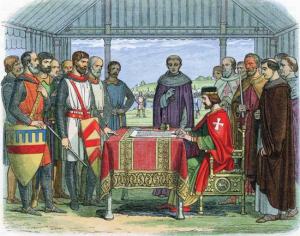
King John signing the Magna Carta, June 15, 1215

A bolt from a crossbow left Richard Coeur de Lion mortally wounded on April 6, 1199, while besieging the castle of Châlus, in central France. He was 41.

Richard was destined to be succeeded by his brother John, after all.  John became such an unpopular King that his Nobles and their French and Scots allies forced him to sign the “Great Charter of the Liberties”, the Magna Carta, at a place called Runnymede.

Nearly 600 years later, the document would influence early government in the thirteen American colonies, and the formation of our own Constitutional Republic.  But that must be a story for another day.


September 1 (est.), 911 A Different Normandy Story

Rollo was called “The Walker”, because the man was so huge that no horse could carry him.

The warlike men who sailed their longboats out of the north tormented the coastal UK and northwestern Europe, ever since their first appearance at Lindisfarne Monastery in 793.

These “Norsemen” (“Normans”), attacked Paris early in 911. By July they were holding Rollothe nearby town of Chartres under siege. Normans had burned the place to the ground back in 858 and would probably have done so again, but for their defeat at the battle of Chartres on July 20.
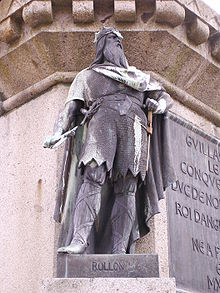
Even in defeat, these people presented a formidable threat. The Frankish King approached them with a solution.

King Charles III, known as “Charles the Simple” after his plain, straightforward ways, proposed to give the Normans the region from the English Channel to the river Seine. It would be the Duchy of Normandy, some of the finest farmlands in northwest Europe, and it would be theirs in exchange for an oath of loyalty to Charles.

Rollo the WalkerThe deal made sense for the King, because he had already bankrupted his treasury paying these people tribute. And what better way to deal with future Viking raids down the channel, than to make them the Vikings’ own problem?
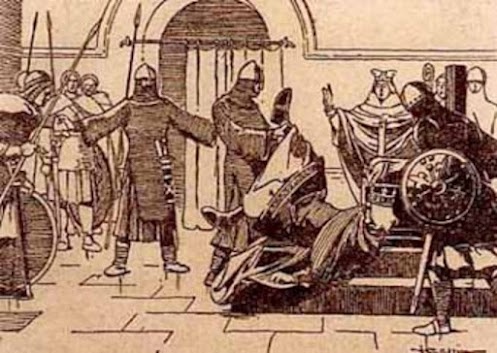
And so the Treaty of Saint-Clair-sur-Epte was concluded on this day in 911, when the Viking Chieftain Rollo pledged feudal allegiance to the King of Western Francia. Rollo was called “The Walker”, because the man was so huge that no horse could carry him. He must have been some scary character with a two-handed battle axe.

At some point in the proceedings, The Walker was expected to stoop down and kiss the king’s foot, in token of obeisance. Rollo recognized Treaty of Saint-Clair-sur-Eptethe symbolic importance of the gesture, but wasn’t about to submit to such degradation himself. The chieftain motioned to one of his lieutenants, a man almost as huge as himself, to kiss the king’s foot. The man shrugged, reached down and lifted King Charles off the ground by his ankle. He kissed the foot, and tossed the King of the Franks aside.  Like a sack of potatoes

In that moment, the personal dignity of the King of France, ceased to exist. The Duchy of Normandy, was born.

August 31, 1959 Sergeant Reckless

Life Magazine published a collector’s edition in 1997, listing 100 heroes from American history.  Alongside the names of George Washington and Thomas Jefferson, Sally Ride and Abraham Lincoln, was that of a small Mongolian horse.  Sergeant Reckless.

About RecklessA Recoilless Rifle is a type of lightweight tube artillery.  Think of a portable cannon.  Kind of a bazooka, really, only the Recoilless fires modified shells rather than rockets.   The back blast of these shells compensates for the mule’s kick to be expected from such a weapon, making the rifle “recoilless”.
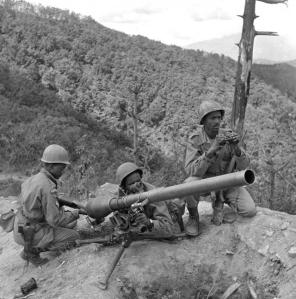
While that reduces projectile range, reduced gas pressures permit a thinner-walled barrel, resulting in a weapon light enough to be served by a 2 to 3-man crew, and shoulder fired by a single infantryman.

The “RCLR” weapon system has provided the punch of artillery to mobile troop formations since the early days of WWII, including Airborne, Special Forces and Mountain units.

The problem arises when combat operations consume ammunition faster than the supply chain can replace it.  Mountainous terrain makes the situation worse.  Even today in the more mountainous regions of Afghanistan, there are times when the best solution for the problem, is horsepower.

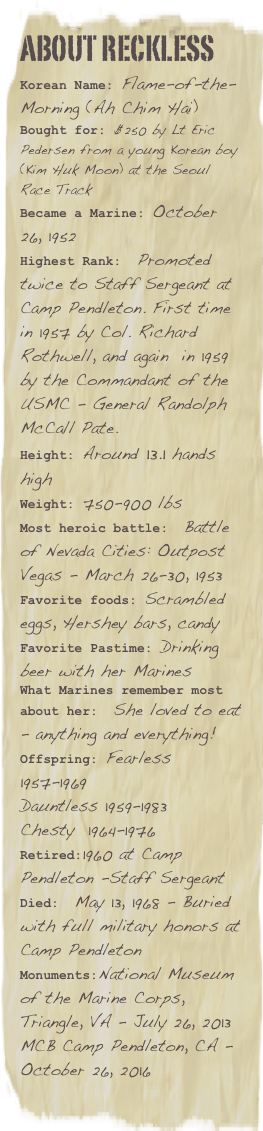
Ah Chim-hai was a chestnut mare of mixed Mongolian and Thoroughbred lineage, a race horse at the track in Seoul, South Korea.  Her name translated as “Flame of the Morning”.

Lieutenant Eric Pedersen of the recoilless rifle platoon, anti-tank company, needed a pack animal to carry the weapon’s 24-lb shells up Korean mountain passes.  In October 1952, Pederson received permission to buy a horse for his platoon.  Pederson and stable boy Kim Huk-moon agreed on a price of $250.  Kim cried on watching his “Flame” leave the stable, but the boy’s sister had stepped on a land mine, and needed a prosthetic leg.

The Marines called her “Reckless” – a nod to the weapon system she was meant to serve, and to the fighting spirit of the 5th Marines.

Recoilless Rifle, Korea
Recoilless Rifle team on a Korean Ridge

Pederson wrote to his wife in California to send a pack saddle, while Gunnery Sergeant Joseph Latham and Private First Class Monroe Coleman provided for her care and training.

Navy Hospitalman First Class George “Doc” Mitchell provided most of Reckless’ medical care, Latham taught her battlefield skills:  how to step over communication wires, when to lie down under fire, how to avoid becoming entangled in barbed wire.  She learned to run for cover, at the cry “Incoming!”

The platoon built her a bunker and fenced off a pasture, but soon Reckless was allowedSergeant Reckless ejoys a beer to roam freely throughout the camp.  She’d enter tents at will, sometimes spending the night if it was cold.

She’d eat anything:   bacon, mashed potatoes, scrambled eggs, shredded wheat.  Just about anything else that a Marine wasn’t watching closely enough, as well.  Reckless even ate her horse blanket once, and she loved a beer.  Mitchell had to warn his fellow Marines against giving her more than two Cokes a day, which she’d drink out of a helmet.  Once, she ate $30 worth of winning poker chips.  Reckless was a Marine.

Sergeant Reckless, 2She “went straight up” the first time she heard an RCLR go off, despite being loaded down with six shells.  All four feet left the ground and she came down trembling with fear, but Coleman was able to soothe her.  The second time she snorted.  By the fourth she didn’t bother to look up. She was happily munching on a discarded helmet liner.

Recoilless rifle tactics call for fire teams to fire four or five rounds, and then relocate before the enemy can return fire.  Reckless usually learned the route after one or two trips, often traveling alone to deliver supplies on the way up, and evacuate wounded on the way down.

Sergeant RecklessIn February 1953, Captain Dick Kurth and his Fox Company were fighting for a hill called “Detroit”.  Reckless made 24 trips by herself, carrying a total 3,500lbs of ammunition over 20 miles.  She made 51 solo trips that March, during the battle for Outpost Vegas.  Reckless carried 9,000lbs of ammunition in a single day, over 35 miles of open rice paddies and steep hills.  At times, artillery exploded around her at the rate of 500 rounds per minute.  She was wounded twice during the battle.  That night, she was too exhausted to do anything but hang her head while they rubbed her down.

Sergeant Reckless, arrivingReckless was the first horse in Marine Corps history to participate in an amphibious landing.  She was wounded twice, and later awarded two Purple Hearts and a Marine Corps Good Conduct Medal.  Her name appears on Presidential Unit citations from the United States and the Republic of Korea.
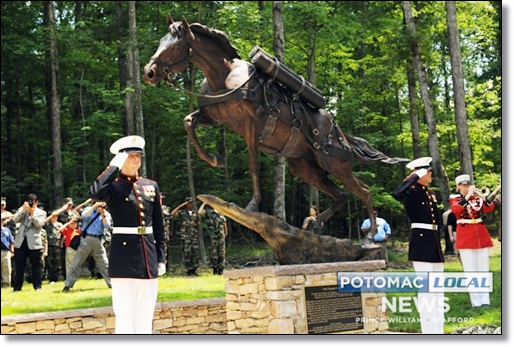
On August 31, 1959, Reckless was promoted to Staff Sergeant in a ceremony at Camp Pendleton.  1,900 of her 5th Marine comrades attended, as did two of her sons, “Fearless” and “Dauntless”.  A third, “Chesty”, was unavailable to attend.

General Randolph McCall Pate, a veteran of Guadalcanal, Iwo Jima and Korea, served as the 21st Commandant of the Marine Corps, from 1956-1959.  General Pate once wrote “In my career I have seen many animals that have been adopted by Marines, but never in all my experience have I seen one which won the hearts of so many as did. . .Reckless.”

Life Magazine published a collector’s edition in 1997, listing 100 heroes from American history.  Alongside the names of George Washington and Thomas Jefferson, Sally Ride and Abraham Lincoln, was that of a small Mongolian horse.  Sergeant Reckless.

Sergeant Reckless statue

August 30, 1893 Kingfish

In his ‘High Popalorum, Low Popahirum’ speech of 1935, Long said “The only difference I ever found between the Democratic leadership and the Republican leadership, is that one of them is skinning you from the ankle up and the other, from the neck down.”

A child was born on this day in 1893 in Winn Parish, north central Louisiana.  The seventh of nine surviving children born to Caledonia Palestine Tison and Huey Long.

Share our wealthLargely home schooled and gifted with a photographic memory, Huey Pierce Long, Jr. won a debating scholarship to LSU, but couldn’t afford the textbooks. He worked as a traveling salesman until briefly attending University of Oklahoma College of Law, and later Tulane Law School. He passed the bar exam after only a year in law school.  Long spent ten years in private practice, representing a series of small plaintiffs against large businesses. He would often say that he never took a case against a poor man.
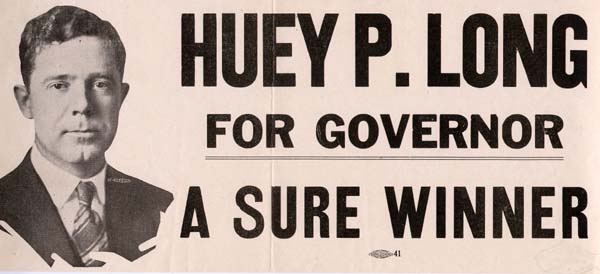
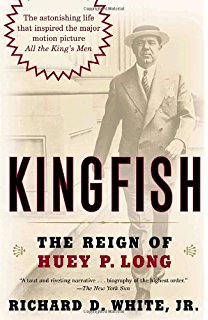
As chairman of the Louisiana Public Service Commission, Long won a lawsuit against Cumberland Telephone & Telegraph.  Huey successfully argued the case all the way to the US Supreme Court, where former President and later Chief Justice William Howard Taft described him as one of the best legal minds he had ever encountered.

60% of Louisiana’s population was rural and poor in 1928.  One in four was illiterate.

Huey for Governor

There were only 300 miles of paved roads and just three major bridges in the whole state, but Huey was everywhere in his run for governor.  He campaigned against the New Orleans political machine, the “Old Regulars”.  His left-wing, populist attacks were vehement, relentless and personal.Kingfish

George “Kingfish” Stevens was the smooth talking trouble maker from the Amos & Andy radio program, the stereotypical African-American character whose catchphrase “Holy mackerel!”, was soon to enter the American lexicon.

A follower called Huey the “Kingfish” and Long must’ve liked it. The name stuck, with Huey’s encouragement.

Poll taxes had long disenfranchised poor whites in Louisiana, and selective application of literacy standards had all but shut blacks out of the voting process. “I’m for the poor man”, he said, “all poor men, black and white, they all gotta have a chance…’Every man a king’ — that’s my slogan.”

Huey had tapped into deep class resentments.  He won his election overwhelmingly, with 96.1% of the vote.

Cousin HueyThe populist soon showed an authoritarian side, as Long fired hundreds of opponents from the state bureaucracy, replacing them with patronage appointments.

Huey kept a “Deduct Box”, and every state employee was expected to hand over a portion of his salary. $50,000 to $75,000 was raised in this manner, equivalent to $705,000 to $1,000,000 in today’s dollars.  It was Huey’s alone to spend on any political purpose he liked.

Long would bully opponents of his legislative agenda, as opponents attempted to impeach him in his first year. He tried to cut the session short as the state legislature dissolved into “Bloody Monday”, a massive fist fight, brass knuckles and all. The legislature voted to proceed with impeachment, but suspended when Huey got a third of state senators to sign a “Round Robin” statement promising not to convict, no matter what the evidence.

Long became ruthless after the impeachment attempt, firing relatives of opponents where he could, and supporting their adversaries in local elections. “I used to try to get things done by saying ‘please’,” he said. “Now…I dynamite ’em out of my path.”

Long ran for US Senate and won in 1930.  For 9 months he was both Governor and Huey and the Guard.gifSenator. Lieutenant Governor Paul Cyr argued that Long couldn’t be both, taking the oath of office in October 1931 and declaring himself Governor.

Long responded by ordering National Guard troops to surround the Capitol, ending Cyr’s “coup d’état”. He won the showdown in state Supreme Court, making Senate President and Long ally Alvin Olin King the new Lieutenant Governor. Huey then handpicked his successor, and the Senator from Louisiana effectively became Louisiana’s Dictator.

Huey was an early redistributionist.  His “Share our Wealth” policies alienated conservative Democrats and Republicans alike. In his ‘High Popalorum, Low Popahirum’ speech of 1935, Long said “The only difference I ever found between the Democratic leadership and the Republican leadership is that one of them is skinning you from the ankle up, and the other, from the neck down.”

huey-longLong continued to run the state from his Senate seat, as his enemies formed a paramilitary organization, the “Square Deal Association”, and plotted armed insurrection. 200 of them stormed the East Baton Rouge Parish courthouse that January, prompting the Governor to call out the National Guard and declare martial law.
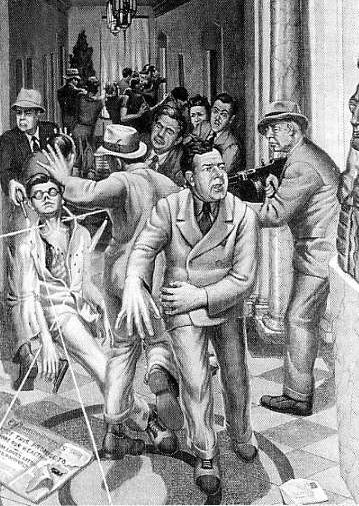
Death threats followed, as did arson attempts, and at least one drive-by shooting at Huey’s home in New Orleans.  He was never without a personal bodyguard of armed State Police.

Long was a contender for the upcoming 1936 Democrat presidential primary, but it wasn’t meant to be.

The Senator was in the State Capitol for a special session of the legislature with a number of bills to push through, including a measure to gerrymander Judge Benjamin Pavy out of his job.  It was September 8, 1935.Huey Long Assasination

Pavy’s son-in-law Dr. Carl Austin Weiss approached the Kingfish in a narrow hallway, brandishing a .32 revolver.

Weiss shot Huey once in the abdomen before his bodyguards opened up, firing wildly as the Senator ran to safety.  A later autopsy revealed that Dr. Weiss had been shot 57 times.

Huey Long died two days later, 11 days after his 42nd birthday. Some think that a bodyguard’s bullet was the one that killed him, but the truth may never be known.  His last words were, “God, don’t let me die. I have so much to do”.

There is an obvious question to be asked, based on the surname borne by this scrivener, in common with the subject of this story.  The answer, I’m sorry to report, is yes. Remotely.

August 29, 1854  The President’s Desk

The British government ordered at least three desks to be fashioned out of the ship’s timbers, the work being done by the skilled cabinet makers of the Chatham dockyards.  The British government presented a large partner’s desk to President Rutherford B. Hayes in 1880.  A token of gratitude for HMS Resolute’s return, 24 years earlier.

(AP Photo/Look Magazine, Stanley Tretick, File)
The desk, known as the Resolute Desk, has been used by almost every American President since, whether in a private study or the oval office. 

HMS ResoluteHMS Resolute was a Barque rigged merchant ship, purchased by the English government in 1850 as the Ptarmigan, and refitted for Arctic exploration.  Re-named Resolute, the vessel became part of a five ship squadron leaving England in April 1852, sailing into the Canadian arctic in search of the Franklin expedition, which had disappeared into the ice pack in 1845.
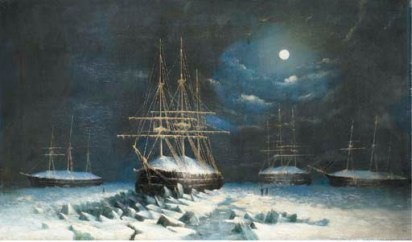
They never found Franklin, though they did find the long suffering crew of the HMS Investigator, hopelessly encased in ice where they had been stranded since 1850.

Three of the expedition’s ships themselves became trapped in floe ice in August 1853, including Resolute.  There was no choice but to abandon ship, striking out across the ice pack in search of their supply ships.  Most of them made it, despite egregious hardship, straggling into Beechey Island between May and August of the following year.resoluteice2

The expedition’s survivors left Beechey Island on August 29, 1854, never to return.

Meanwhile Resolute, alone and abandoned among the ice floes, continued to drift eastward at a rate of 1.5 nautical miles per day.

The American whale ship George Henry discovered the drifting Resolute on September 10, 1855, 1,200 miles from her last known position.  Captain James Buddington split his crew, half of them now manning the abandoned ship.  Fourteen of them sailed Resolute back to their base in Groton CT, arriving on Christmas eve.

Resolute hulk
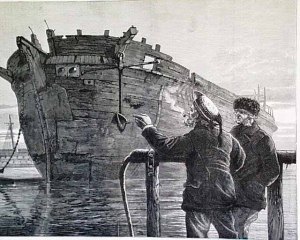
LLUSTRATED LONDON NEWS, England, October 4, 1879: “The Old Arctic Exploring Ship Resolute, Now Broken Up At Chatham Dockyard”

1856 was a difficult time for American-British relations.  Senator James Mason of Virginia presented a bill in Congress to fix up the Resolute, giving her back to her Majesty Queen Victoria’s government as a token of friendship between the two nations.

$40,000 were spent on the refit, and Resolute sailed for England later that year, Commander Henry J. Hartstene presenting her to Queen Victoria on December 13.

Resolute served in the British navy until being retired and broken up in 1879.  The British government ordered at least three desks to be fashioned out of the ship’s timbers, the work being done by the skilled cabinet makers of the Chatham dockyards.  The British government presented a large partner’s desk to President Rutherford B. Hayes in 1880.  A token of gratitude for HMS Resolute’s return, 24 years earlier.

KENNEDY
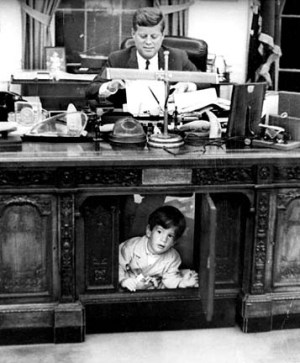
(AP Photo/Look Magazine, Stanley Tretick, File)

The desk, known as the Resolute Desk, has been used by almost every American President since, whether in a private study or the oval office.

FDR had a panel installed in the opening, since he was self conscious about his leg braces.  It was Jackie Kennedy who brought the desk into the Oval Office.  There are pictures of JFK working at the desk, while his young son JFK, Jr., played under it.

Presidents Johnson, Nixon and Ford were the only ones not to use the Resolute desk, as LBJ allowed it to leave the White House after the Kennedy assassination.

The desk spent several years in the Kennedy Library and later the Smithsonian Institute, the only time the desk has been out of the White House.

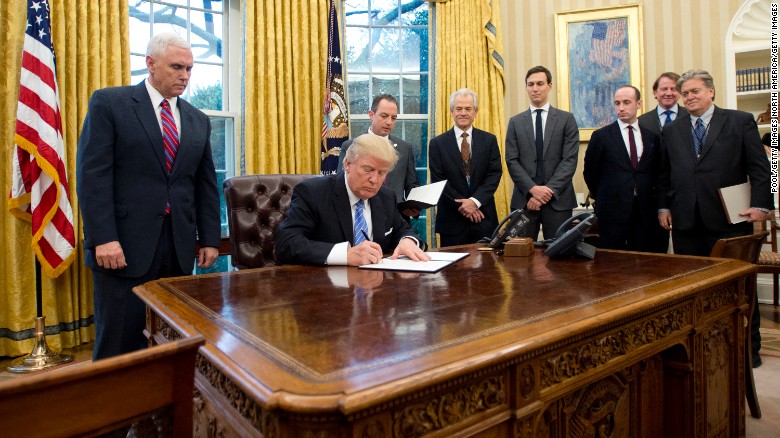
Jimmy Carter returned the Resolute Desk to the Oval Office, where it has remained through the Presidencies of Ronald Reagan, George H.W. Bush, Bill Clinton, George W. Bush, Barack Obama and, so far, Donald Trump.

President Trump at Resoute Desk

August 28, 1948 Landslide Lyndon

‘People have been saying for 40 years, ‘No one knows what really happened in that election,’ and ‘Everybody does it.’ Neither of those statements is true. I don’t think that this is the only election that was ever stolen, but there was never such brazen thievery”.

In 1944, Texas political Boss George Berham Parr and Webb County Judge Manuel “Black Coke StevensonHawk” Raymond had a favor to ask of then-Governor Coke Robert Stevenson. They wanted the Governor to appoint a Raymond relative, E. James Kazen, as Laredo district attorney.

The Governor wasn’t playing ball. The United States was at war at that time, and the commander at the local Army Air Force Base opposed the appointment, saying that half his men were down with VD. A district attorney from the local political machine, he argued, would mean lax enforcement of prostitution laws, and his high sick rate was adversely effecting the war effort.

Stevenson was persuaded, and he appointed another man to the job. George Parr would not forget the slight.

Four years later, Coke Stevenson was running for the United States Senate. Parr had a debt to repay to Stevenson’s opponent, Congressman Lyndon Baynes Johnson, who had helped him obtain a Presidential Pardon back in 1946. He had some payback to do on Stevenson’s account as well, but that would be payback of a different sort.

Landslide LyndonTexas had only a weak Republican party in 1948.  The winner of the Democrat’s three-way primary was sure to be the next Senator.
When the votes were counted on August 28, Stevenson was the top vote getter with 37.3%, edging out Johnson at #2, by 112 votes out of 988,295 cast.

Texas state law requires an absolute majority to determine a primary winner, so a runoff was held between the top two finishers.

Stevenson held the lead at the end of counting.  Five days later, Jim Wells County amended its return. 202 additional votes had been “found”, hidden away in Box #13 from the town of Alice.

200 of the 202 had voted for Johnson.  By a miraculous coincidence, each had signed their names in alphabetical order, in the same penmanship, each apparently using the same pen.

An investigation was called, and the executive committee of the Texas Democratic Party upheld Johnson’s victory, 29-to-28.   Stevenson sued.

160221-updegrov-lbj-fortas-tease_xkflll
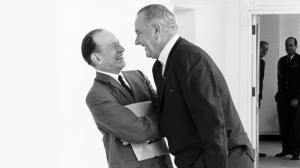
Fortas, Johnson

A Federal court ordered Johnson’s name off the ballot pending the results of an investigation, but the matter was settled in Johnson’s favor when Associate Supreme Court Justice Hugo Black voided the order on the urging of Johnson lawyer, Abe Fortas.

Purely coincidentally I’m sure, the very same Abe Fortas would himself be appointed to the Supreme Court by then-President Lyndon Johnson, in 1965.

Johnson went on to defeat the Republican candidate in the general election.  The primary ballots were “accidentally” burned some time later.

‘Means of Ascent’ author Robert A. Caro, the second volume of a projected four-volume Johnson study entitled ‘The Years of Lyndon Johnson’, told the New York Times in a 1990 interview: ‘People have been saying for 40 years, ‘No one knows what really happened in that election,’ and ‘Everybody does it.’ Neither of those statements is true. I don’t think that this is the only election that was ever stolen, but there was never such brazen thievery”.

LBJ had “won” his primary by 87 votes, August 28 forever marking the day on which he would be known as “landslide Lyndon”. Johnson easily defeated Republican Jack Porter for the Senate seat, later becoming Vice President and then President after the texas-ballot-boxassassination of John F Kennedy, a man whom many believe stole his own election from Richard Nixon in 1960, with the help of Chicago’s Daley machine and a little creative vote counting in Cook County.

Johnson never acknowledged stealing the election, but Ronnie Dugger, editor of the Texas Observer, once visited him in the White House. Then-President Johnson pulled out a photo of five “ol’ boys” from Alice, grinning back at the camera with the infamous Box 13 between them. Dugger asked LBJ if he had stolen the election. President Johnson’s only response, was to laugh.


August 27 1896 Shortest War in History 

A news correspondent from Reuters reported that the Sultan had “fled at the first shot with all the leading Arabs, who left their slaves and followers to carry on the fighting”.

The late 19th century was period of friendly but competing relations between Imperial Germany and Great Britain in Colonial East Africa, as each vied for control of territory and trade rights.

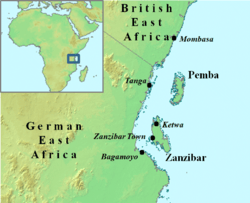
In 1886 Sultan Khalifah granted rights to the land of Kenya to Britain, and that of Tanganyika, modern day Tanzaniya, to Germany. The Heligoland-Zanzibar Treaty between Britain and Germany officially demarcated each nation’s sphere of influence in East Africa, in the process ceding Germany’s rights in the island nation of Zanzibar to the United Kingdom.

The agreement effectively ended the slave trade in much of East Africa, upsetting many among the Arab ruling classes who profited handsomely by this lucrative trade.

The shortest war in history began with the unexpected death and probable assassination of Sultan Hamad of Zanzibar, who died suddenly on August 25, 1896. Many suspected his 29-year-old nephew Khalid bin Bargash of the assassination, as he took up residence in his uncle’s palace complex.

Anglo-Zanzibar_war_mapBritish authorities demanded that Khalid order his forces to stand down and leave the palace. Instead, the new Sultan called up his palace guard and barricaded himself inside.

Several English warships arrived on the 26th, as a cable was sent to Lord Salisbury that afternoon, requesting authorization to use force if necessary. The reply came back from Her Majesty’s government: “You are authorized to adopt whatever measures you may consider necessary, and will be supported in your action by Her Majesty’s Government.”

That was followed by one of history’s great examples of government butt-covering, adding: “Do not, however, attempt to take any action which you are not certain of being able to accomplish successfully”.AngloZanzibarWar(1)

At 8:30 on the morning of August 27th, a message came from Khalid saying “We have no intention of hauling down our flag and we do not believe you would open fire on us”. Diplomatic Consul Basil Cave replied “We do not want to open fire, but unless you do as you are told we shall certainly do so”.

No further messages being forthcoming, General Lloyd Mathews ordered his ships to commence bombarding the palace complex at 9:00am, East Africa Time.  Her Majesty’s ships Raccoon, Thrush and Sparrow opened fire at 9:02, Thrush’s first shot disabling an Arab 12-pounder cannon.  500 shells, 4,100 machine gun rounds and 1,000 rifle rounds were fired at the palace complex.  By 9:40, the weapons of the 3,000 palace defenders, servants and slaves, had gone silent. The palace and attached harem were burning, the Sultan’s flag cut down.  The order was given to cease fire.

A news correspondent from Reuters reported that the Sultan had “fled at the first shot with all the leading Arabs, who left their slaves and followers to carry on the fighting”.
The episode went into history as the Anglo-Zanzibar War.  The whole thing lasted 38 minutes.  Less time than it took me to write this story.

August 26, 1346 Crécy

“Do not send to me so long as my son lives; let the boy win his spurs; let the day be his.”

From the time of Charlemagne, the social and political structure of Middle Ages European society rested on a set of reciprocal obligations between a warrior nobility, supporting and in turn being supported by, a hierarchy of vassals and fiefs.

The system was called Feudalism, a system in which the King granted portions of land called “fiefs” to Lords and Barons in exchange for loyalty, and to Knights (vassals) in exchange for military service.

Knights were a professional warrior class,  dependent upon the nobility for lodging, food, armor, weapons, horses and money.

The whole edifice was borne up by peasants, serfs who farmed the land and provided the vassal or lord with material wealth, in the form of food and other products.

The 18th century historian and political economist Jean Charles Léonard de Sismondi wrote “We must not confound chivalry with the feudal system. The feudal system may be called the real life of the period of which we are treating, possessing its advantages and inconveniences, its virtues and its vices. Chivalry, on the contrary, is the ideal world, such as it existed in the imaginations of the Romance writers. Its essential character is devotion to woman and to honour”.

The Battle of Crécy is memorable for several reasons. Crude cannon had been used in siege operations during the Muslim conquest of Spain, (al Andalus), but this was the first time they were used in open battle. Perhaps more important, though less evident at the time, was that Crécy spelled the end of feudalism.

Crecy-en-Ponthieu_champ-de-bataille
Crécy Battlefield

The Battle of Crécy was the first major combat of the hundred years’ war, a series of conflicts fought over a 116-year period for control of the French throne.  King Edward III invaded the Normandy region of France on July 12, 1346. Estimates vary concerning the size of his army, but not of its composition. This was not an army of mounted knights, though there were a few of those. This was a yeoman army of spearmen and foot archers, ravaging the French countryside as they went, and pursued by a far larger army of French knights and mercenary allies.

crecy-mapA fortunate tidal crossing of the Somme River gave the English a day’s lead, allowing Edward’s forces time to rest and prepare for battle as they stopped to wait for the far larger French army near the village of Crécy.

Edward’s forces took a strong defensive position overlooking flat agricultural land, natural obstacles to either side effectively nullifying the French numerical advantage. The French army under King Philip VI was wet and exhausted when they arrived on the 26th, nevertheless launching themselves directly at the English, almost immediately upon their arrival.

Genoese crossbowmen opened the battle on the French side, but wet strings hampered the weapon’s effectiveness. English archers had unstrung their longbows during the previous night’s rain, and now showered thousands of arrows down on the heads of their adversaries. The French first line broke and ran, only to be accused of cowardice and hacked to pieces by the knights to their rear.Crecy, Bowmen

French mounted knights now entered the fray, but orderly lines soon dissolved into confusion. The muddy field combined with English obstacles and that constant barrage of arrows unhorsed French knights and confused their lines.

Riderless horses and unmounted knights alike were run down by successive waves of horsemen, each impatient to win his share of the “glory”. Those who made it to the English side faced a tough, disciplined line of spearmen and foot soldiers who held their position. Heavily armored knights, once unhorsed, were easy prey to the quick and merciless knives of the English.

A messenger sought out the English King in the midst of the battle, beseeching aid for the King’s son, the 16-year-old Prince of Wales. Edward replied “Do not send to me so long as my son lives; let the boy win his spurs; let the day be his.”

Philip’s ally, the blind King John of Bohemia, heard that the battle was going badly for the French. He ordered his companions to tie his horse’s bridle to theirs, and lead him into the fight. It was the last time he was seen alive.Ich Dien

The Prince of Wales did earn his spurs that day. He adopted old King John’s crest and motto, the triple ostrich plume with the words “Ich Dien”. I serve.  The heraldic badge is worn by his successors, to this day.

When it was over, the feudal age lay dead in the mud and the blood of Crécy, alongside the mythical age of chivalry.  The English side suffered one/tenth the number of casualties.  2,200 Heraldic coats were taken as trophies.

In the words of A Short History of the English People, by John Richard Green, “The churl had struck down the noble; the bondsman proved more than a match in sheer hard fighting, for the knight”.  After Crécy, the world’s land battles would be fought not by armored knights fighting toe-to-toe with battle-axe and lance, but by common foot soldiers, with the bow and with the gun.


August 25, 1830  Night at the Opera

In 1914, Imperial Germany took a straight line through neutral Belgium into France, believing that Great Britain would never honor a “scrap of paper” signed back in 1839. 

In 1830, what is now Belgium was part of the United Kingdom of the Netherlands, a fusion of territories brought about in the wake of the Napoleonic Wars, formerly belonging to the Dutch Republic, Austrian Netherlands, and Prince-Bishopric of Liège. It was a Constitutional Monarchy,  ruled by the first King of the Netherlands, King William I.

The “Southern Provinces” of King William’s polity were almost all Catholic, and mostly French speaking, in contradistinction to the Dutch speaking, mostly Protestant north.  Many southern liberals of the time thought King William a despot and tyrant, and high levels of industrial unemployment made for widespread unrest among the working classes.la muette

La Muette de Portici (The Mute Girl of Portici) is an opera in five acts by Daniel Auber.  Generally recognized as the earliest of the French Grand Opera, it was first performed at the Paris Opéra on February 29 1828.   During an August 25, 1830 performance, a riot broke out during one particularly patriotic duet, Amour sacré de la patrie, (Sacred love of Fatherland).  Soon it was spilling out onto the street, a full-scale riot spreading across Brussels and igniting other riots as shops were looted, factories occupied and machinery destroyed.

King William committed troops to the southern provinces in an effort to restore order, while radicals asserted control of rioting factions and began talk of secession.  Dutch military units experienced massive desertion of recruits from the southern provinces, and had to pull out.

The States-General in Brussels voted in favor of secession and declared independence, assembling a National Congress while King William appealed to the Great Powers for help. The resulting 1830 London Conference of major European powers came to recognize Belgian independence, and Leopold I was installed as “King of the Belgians”.Leopold_I_of_Belgium

King William made one more attempt to reconquer Belgium militarily, in 1831.  France intervened with troops of its own and the “Ten Days’ Campaign” ended in failure.  The European powers signed the “Treaty of London” in 1839, recognizing and guaranteeing Belgium’s independence and neutrality.

The German Composer Wilhelm Richard Wagner remarked on the events decades later, saying that “[S]eldom has an artistic product stood in closer connection with a world-event”.

In August 1914, Imperial Germany’s plan in the event of war could be likened to one guy against two in a bar fight, (Germany vs France & Russia).  The plan was to take out the nearer one first (France), before turning to face the second.  Imperial Germany took a straight line through neutral Belgium into France, believing that Great Britain would never honor that “scrap of paper” signed back in 1839.

In this German calculations were grievously mistaken.  A regional squabble had begun that June, with an assassination in the Balkans.  That miscalculation would plunge the world into two world wars.