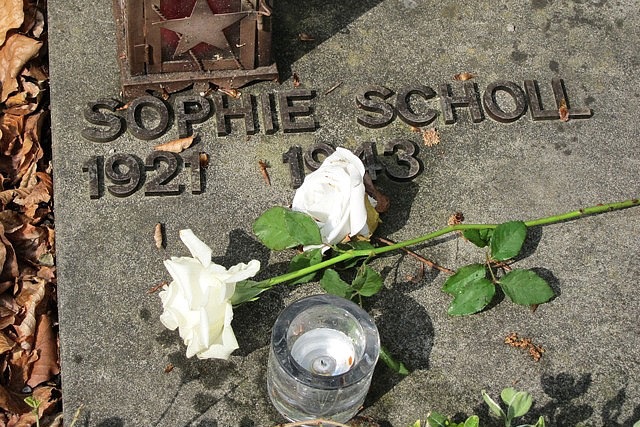
February 18, 1943 Just a Normal Person

“Success is not final, failure is not fatal: it is the courage to continue that counts.” ― Winston S. Churchill

With Hitler’s appointment as chancellor on January 30, 1933, the Nazi party lost little time in eliminating opposition. Two days later, the 876-member democratically elected deliberative body, the “Reichstag”, was dissolved.

As the 1930s wore on it was increasingly dangerous to oppose the Nazi party. History fails to record many of the names of those who simply…disappeared. Forget for a moment the idiocy of our age and the ease with which the word Nazi, is thrown around. Then imagine having the courage to oppose those monsters alone, in the 1930s and ’40s. Many who did so would pay with their lives: Bernhard Lichtenberg. Martin Niemöller. Claus von Stauffenberg. Franz Jägerstätter. Dietrich Bonhoeffer. There were others. Too many to count.
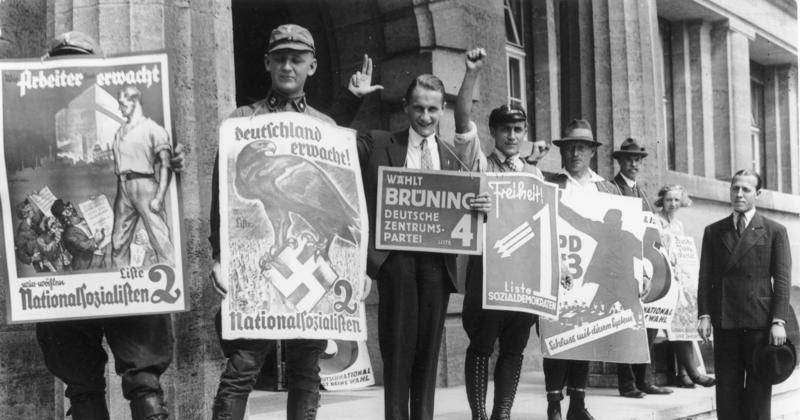
Campaigners outside a polling place during the federal elections, of 1932

Some survived to tell the tale. One such was the Württemberg politician Robert Scholl who criticized the ruling party before, during and after World War 2. Scholl was one of the lucky ones. He lived to tell the story, but not without spending some of the intervening years, behind bars.

Robert and Magdalena (Müller) Scholl had six children together, four girls and two boys. The older of the two brothers, Hans, joined the Hitler youth, against the express will of his father. 
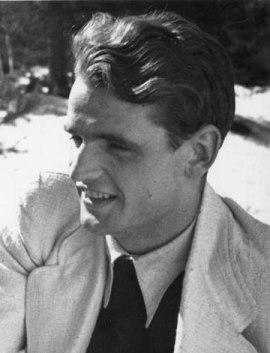
Hans Scholl

Hans even held a leadership position in the Deutsches Jungvolk in der Hitler Jugend (“German Youngsters in the Hitler Youth”), a section of the Hitler Youth aimed at indoctrinating boys, 10-14.

In 1935, Hans was selected to carry the flag at the 1935 Nazi party rally in Nuremberg, one of three standard-bearers, from Ulm.

He joined the Reich Labor Service for two years before beginning medical school, in Munich. During a semester break, Scholl was drafted as a medic in the French campaign. Back at school, Scholl began to meet teachers and students, critical of the regime. Theirs was a Christian-ethical world view. One of them was Alexander Schmorrell.

Hugo Schmorell was a German-born doctor, living and working in Russia. He married Natalia Vedenskaya, the daughter of a Russian Orthodox priest. Alexander Schmorell was born to the couple in Orenberg Russia and baptized, in the Russian Orthodox church. 

Hugo remarried after Natalia died of typhus, this time to a German woman who, like himself, grew up in Russia. Alexander grew up bilingual, able to speak German and Russian, like a native.

Following the Russian Revolution, the family moved to Weimar Germany . In later interrogations by the Gestapo, Alexander described himself as a German-Russian Tsarist who hated Bolsheviks. 
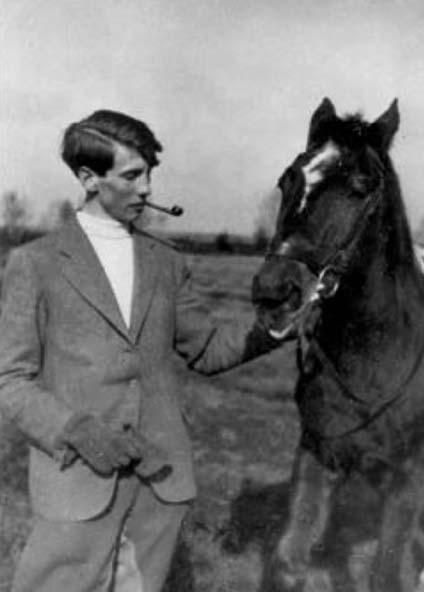
Alexander Schmorell

In the Nazi world view, slavs are part of a great horde of Untermenschen, people considered racially or socially, inferior. Alexander Schmorell believed no such thing about himself. He was proud of both his German and his Russian side.

In religion class, Schmorell displayed a stubborn refusal to bend to the will of others, crossing himself right-to-left in the manner of the Russian church and not left to right. Alexander joined the Scharnhorst youth as a boy, mostly for the love of horseback riding. Once the organization was absorbed into the Hitler Youth movement he gradually stopped attending. Like Scholl, Schmorell joined the Wehrmacht, participating in the Anschluss and eventual invasion, of Czechoslovakia.

In 1941, Scholl and Schmorrell were drafted as medical auxiliaries, for service in the east. There the two witnessed the dark underbelly of the regime in whose service, they risked their lives. The Warsaw ghetto. The savage treatment of Russian prisoners. The endless deportations and dark rumors of extermination centers.
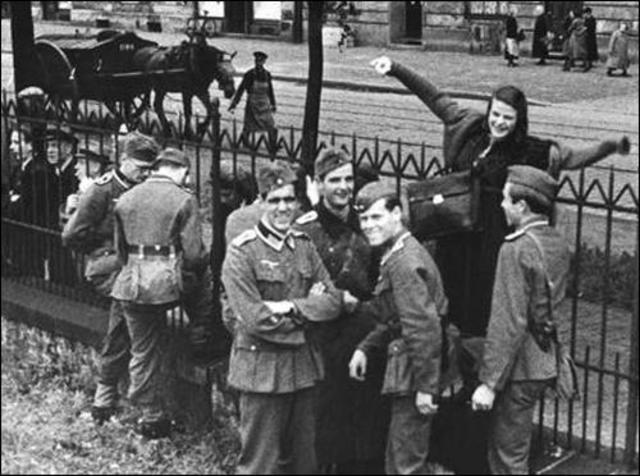
Members of the German resistance “White Rose, in 1942

Scholl and Schmorrell wanted better. Back in school the pair discussed this growing dissatisfaction with the regime with Kurt Huber, professor of music and a vocal anti-Nazi. By June 1942 the pair had begun to write pamphlets and calling themselves, the “White Rose”.

“Isn’t it true that every honest German is ashamed of his government these days? Who among us has any conception of the dimensions of shame that will befall us and our children when one day the veil has fallen from our eyes and the most horrible of crimes—crimes that infinitely outdistance every human measure—reach the light of day?”— 1st leaflet of the White Rose
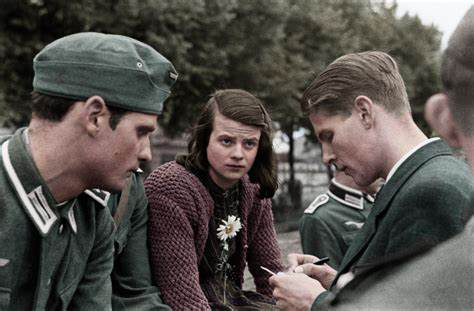
Hans and Sophie Scholl with Christoph Probst

During later gestapo interrogations, Scholl gave differing stories as to the origin of the name. A poem of the same name by the German poet, Clemens Brentano. A work by the Cuban poet, José Martí. Perhaps it was nothing more than the purity of the white rose, in the face of evil. Or maybe Scholl meant to throw his Nazi tormenters off the scent of Josef Söhngen, the anti-Nazi bookseller who had helped them, in so many ways.
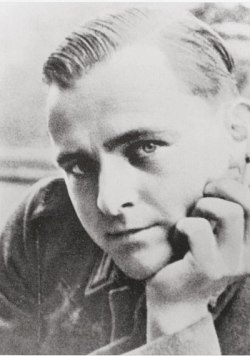
Willi Graf

Since the conquest of Poland, 300,000 Jews have been murdered in this country in the most bestial way … The German people slumber on in dull, stupid sleep and encourage the fascist criminals. Each wants to be exonerated of guilt, each one continues on his way with the most placid, calm conscience. But he cannot be exonerated; he is guilty, guilty, guilty!”— 2nd leaflet of the White Rose

The group added members and supporters. Willi Graf who, unlike the founding members hated the Hitler Youth movement, from the beginning. Christoph Probst whose step-mother was Jewish and considered the Nuremberg laws an affront to human dignity. Hans’ sister Sophie who joined, despite her older brother’s protestations. Like her brother, Sophie detested what the Nazis stood for.

“Why do you allow these men who are in power to rob you step by step, openly and in secret, of one domain of your rights after another, until one day nothing, nothing at all will be left but a mechanised state system presided over by criminals and drunks? Is your spirit already so crushed by abuse that you forget it is your right—or rather, your moral duty—to eliminate this system?”— 3rd leaflet of the White Rose

Sophie Scholl

“The government—or rather, the party—controlled everything: the news media, arms, police, the armed forces, the judiciary system, communications, travel, all levels of education from kindergarten to universities, all cultural and religious institutions. Political indoctrination started at a very early age, and continued by means of the Hitler Youth with the ultimate goal of complete mind control. Children were exhorted in school to denounce even their own parents for derogatory remarks about Hitler or Nazi ideology”.

Surviving White Rose member George J. Wittenstein, M.D., “Memories of the White Rose”, 1979

Bishop Clemens August Graf von Galen was critical of the Nazi movement from the beginning, denouncing Hitler’s “Worship of Race” as early as 1934.

Galen excoriated the Nazi euthanization program from the Catholic pulpits of Münster and across the German empire, condemning  “the innocent and defenseless mentally handicapped and mentally ill, the incurably infirm and fatally wounded, innocent hostages and disarmed prisoners of war and criminal offenders, people of a foreign race or descent”.
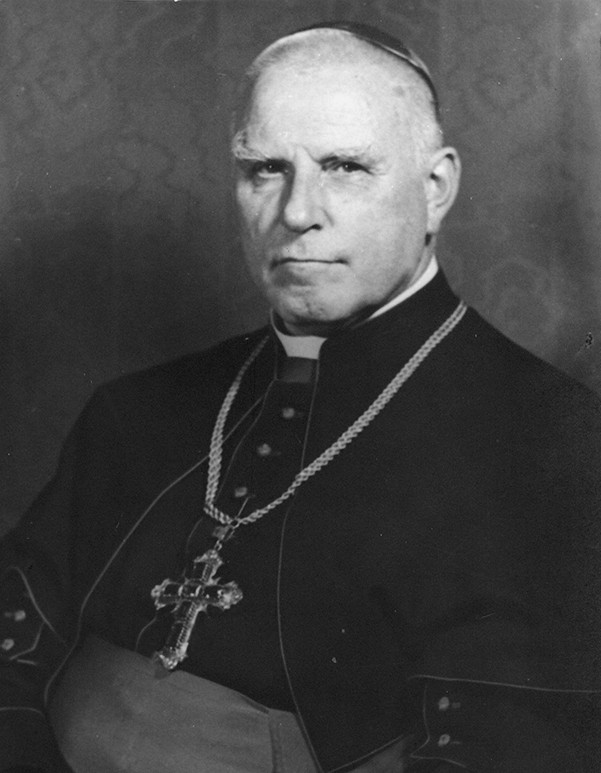
Bishop Galen’s sermons were seminal in the formation of the White Rose. One of his sermons formed the basis for the first pamphlet.

Hand copied leaflets were inserted into phone books or mailed directly, to teachers and students.

The grotesque sham trials conducted by Hitler’s “Blood Judge” Roland Feisler made short work of any who would oppose “Der Fuhrer”. Today, the “People’s Court” of Nazi Germany is best remembered in the wake of the July 20, 1944 plot to assassinate Adolf Hitler. In reality, this perversion of justice had been around for ten years, handing out death sentences, in the hundreds. This video gives a pretty good idea of “justice” meted out, in Roland Feisler’s court.

“The ultimate test of a moral society is the kind of world that it leaves to its children.”

Dietrich Bonhoeffer

There were Germans throughout the war who objected to the murder of millions, but theirs was a forlorn hope. Clergymen Dietrich Bonhoeffer would state “the ultimate question for a responsible man to ask is not how he is to extricate himself heroically from the affair, but how the coming generation shall continue to live.” For his opposition to the Reich, Bonhoeffer would pay with his life.

Helmuth James Graf von Moltke, great grand-nephew of the famous Helmut von Moltke would lead 28 dissidents of the “Kreisau Circle”, against this “outrage of the Christian conscience.” These too would pay with their lives.

The most successful German opposition party came from the universities of Munich, with connections in Berlin, Hamburg, Stuttgart and Vienna, including the White Rose. These were a surprise to Nazi leaders as Universities had long been stalwart supporters of Nazi ideology. 

Hans and Sophie arrived on campus with a suitcase full of pamphlets, on February 18. This was their 6th. Hurriedly moving through the campus the Scholls left stacks of leaflets outside of full lecture halls: Memorial to the “Weiße Rose” in front of the Ludwig Maximilian University of Munich
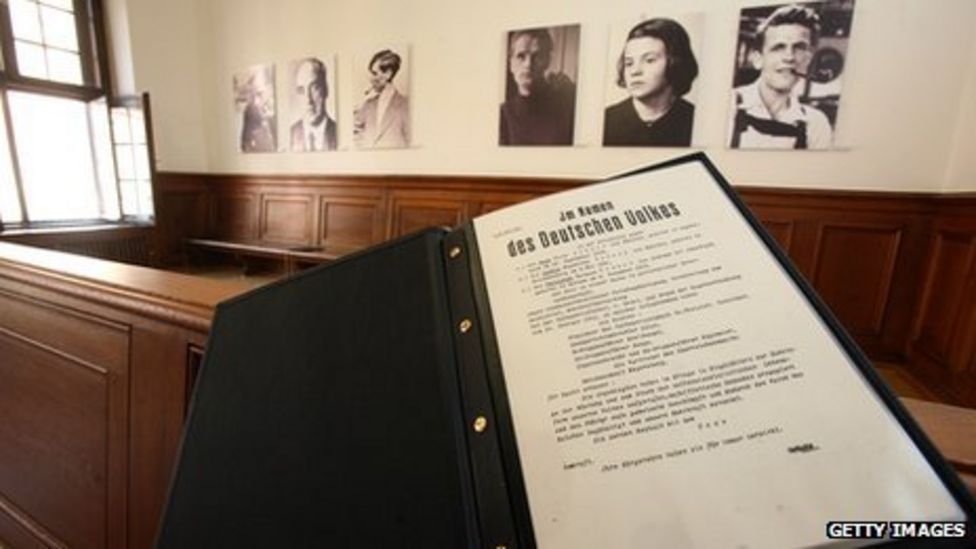
Today, the “People’s Court” of the schweinhund Feisler is a district court, in Munich.

“…Fellow Fighters in the Resistance!  Shaken and broken, our people behold the loss of the men of Stalingrad. Three hundred and thirty thousand German men have been senselessly and irresponsibly driven to death and destruction by the inspired strategy of our World War I Private First Class. Fuhrer, we thank you!…” – Excerpt from pamphlet 6

Their task complete, the pair realized they still had a few. From the upper floor of the atrium, Sophie tossed them into the air and watched them flutter to the ground. It was a reckless and stupid act.

If this story is about heroism it also about the opposite, the sort of loathesome toady without who no Nazi regime, would have thrived. One such was the custodian Jakob Schmid, who scurried to the top of the stairs and grasped the two by the collar.
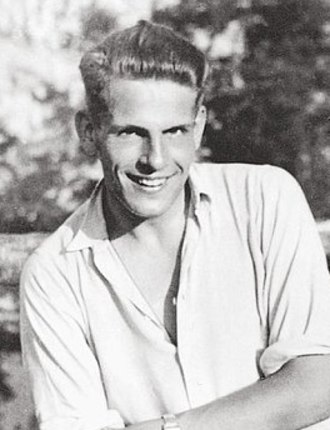
Christoph Probst

The Scholl siblings were quickly arrested. Hans had on his person the draft of another pamphlet: #7, written by Christoph Probst. He tried to eat it but the Gestapo was too fast. Probst was arrested within hours, eighty more over the following days. On February 22, 1943, all three were tried before judge Feisler’s People’s Court. All three were sentenced to death by guillotine, the execution carried out, the same day. 

Hans Scholl’s last words are recorded as Es lebe die Freiheit! (Let Freedom live!)

Graf, Schmorrell, Huber and 11 others were tried on April 13. All three received the same sentence, death by decapitation. All but one of the others received prison sentences, between 6 months and 10 years.

The last member to be executed was Hans Conrad Leipelt on January 29, 1945.

Despite the execution of the group’s leaders, the White Rose had the last word. That last pamphlet was smuggled out of Germany and copied, by the allies. Millions of copies rained down from the sky, dropped, by allied bombers.

Lieselotte ″Lilo″ Fürst-Ramdohr was a war widow at 29 when she joined the White Rose, hiding pamphlets in an apartment closet and helping to make stencils, for graffiti. In 2013 she gave an interview for BBC Worldwide. It was three months before she died, at the age of 99.
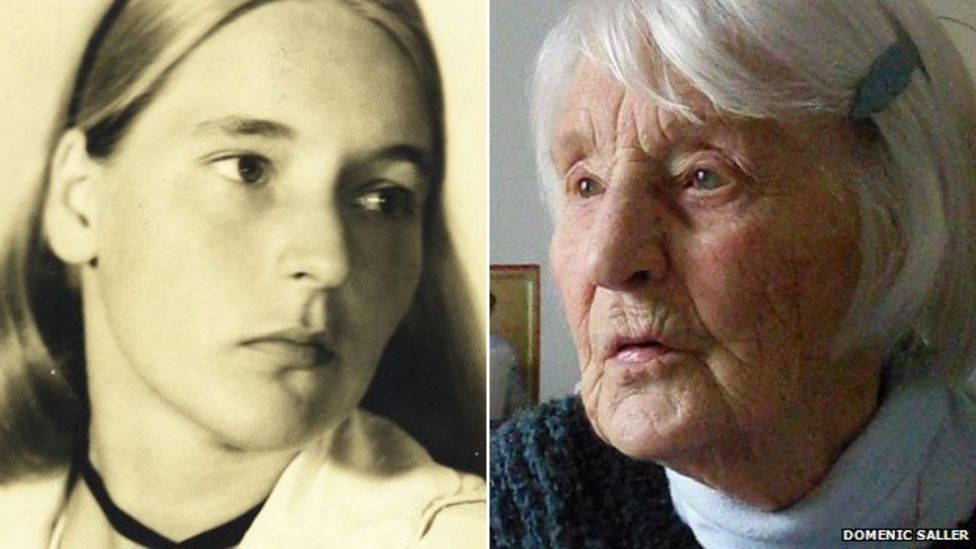
Lieselotte ″Lilo″ Fürst-Ramdohr

Lieselotte was arrested and interrogated for a month by the Gestapo, and released. She thinks they’d hoped she would lead them, to fellow conspirators.

In 2012, Lilo’s friend Alexander Schmorell was awarded sainthood by the Russian Orthodox church. She thought it was all too amusing. “He would have laughed out loud” she said, “if he had known. He wasn’t a saint. He was just a normal person.”
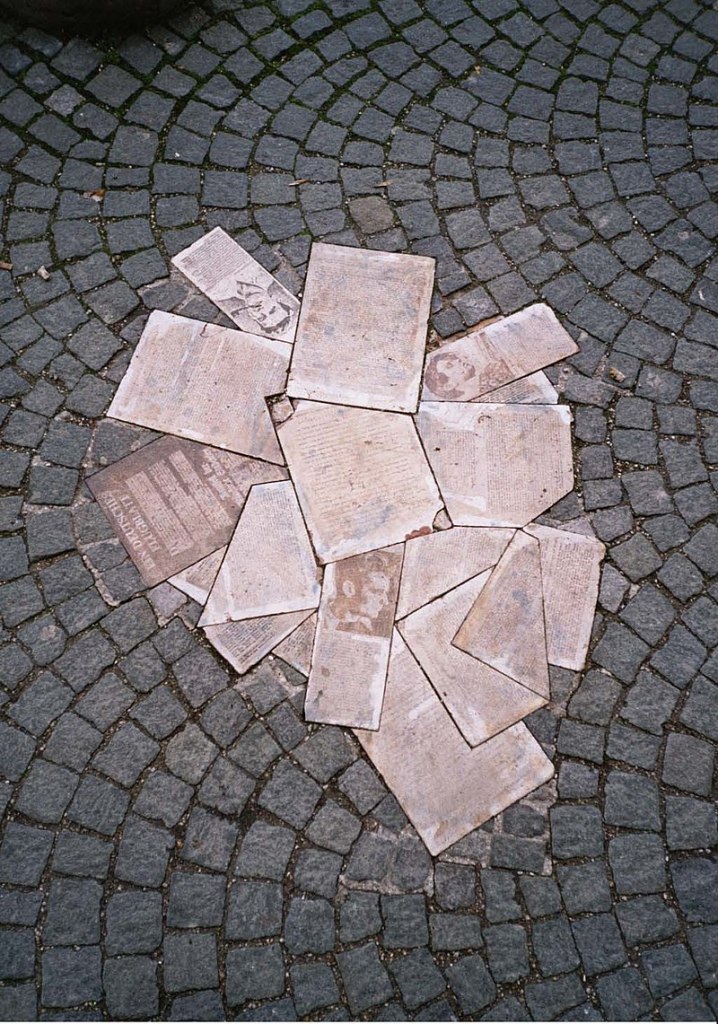
February 14, 1945 The Firebombing of Dresden

“We saw terrible things: cremated adults shrunk to the size of small children, pieces of arms and legs, dead people, whole families burnt to death, burning people ran to and fro, burnt coaches filled with civilian refugees, dead rescuers and soldiers, many were calling and looking for their children and families, and fire everywhere, everywhere fire, and all the time the hot wind of the firestorm threw people back into the burning houses they were trying to escape from”. Eyewitness to the firebombing at Dresden

The most destructive war in history entered its final, apocalyptic phase in January 1945, with another four months of hard fighting yet remaining before Allied forces could declare victory in Europe. In the west, the “Battle of the Bulge” was ended, the last great effort of German arms spent and driven back beyond original lines. In the east, the once mighty German military contracted in on itself, in the face of a massive Soviet advance.

Dozens of German divisions hurried east to meet the threat. Allied intelligence believed the war could be over in April if the major cities to the east, were destroyed. Dresden. Leipzig. Chemnitz. Letting these places stand to serve as bases for retreating German forces, could drag the war out until November.

destroyed-german-equipment-znoymo-czechoslovakia-1945-may
German military equipment lies broken in Czechoslovakia, 1945

Sir Charles Portal, British Chief of the Air Staff, put the problem succinctly: “We should use available effort in one big attack on Berlin and attacks on Dresden, Leipzig, and Chemnitz, or any other cities where a severe blitz will not only cause confusion in the evacuation from the East, but will also hamper the movement of troops from the West.”

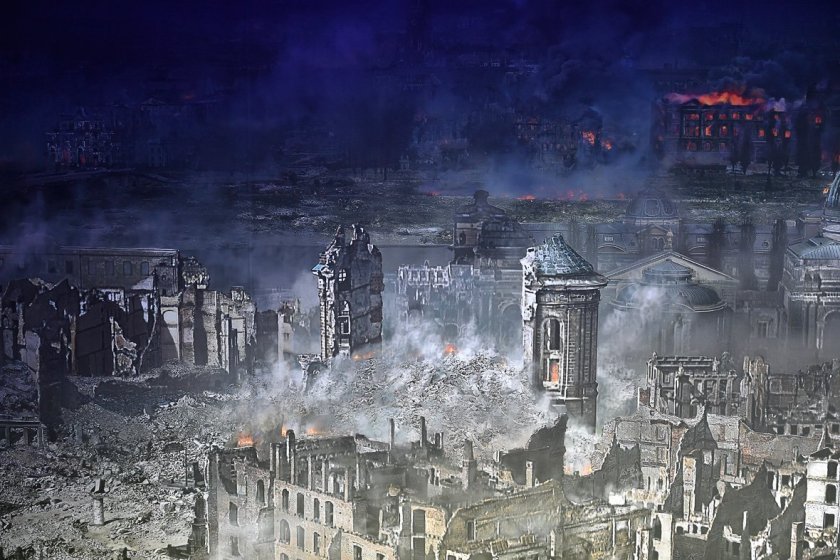
With its baroque and rococo city center, the capital city of Dresden was long described as the “Jewel Box” of the Free State of Saxony, family seat to the Polish monarchs and royal residence to the Electors and Kings of Saxony. Dresden was the seventh-largest city in Germany in 1945, home to 127 medium-to-large sized factories supplying the German war machine, and the largest built-up area in the “thousand-year Reich”, yet to be bombed.

Dresden_montage
Long described as “Florence on the Elbe” Dresden was considered one of the world’s most beautiful cities, a treasure of art and architecture.

For Victor Klemperer, the 13th of February, 1945, was the most terrifying and depressing experience of a lifetime. Once home to well over 6,000 Jews, Dresden now contained a mere forty-one. Klemperer’s marriage to an “Aryan” wife had thus far protected him from the “final solution”, despite the yellow Juden star he was forced to wear on his coat.

Now, the man witnessed notices for final “deportation” being delivered even to those last few. There wasn’t one who received such a notice who didn’t understand what it meant. Terrified that he might be next the process was interrupted by the coming firestorm. Three nights later Klemperer removed the yellow star, an act punishable by death at the time.

Three hundred miles away, bad weather hampered operations for the United States Army Air Force (USAAF).  The first wave in the fire bombing of Dresden would be a Royal Air Force (RAF) operation.

dresden-bombing (2)

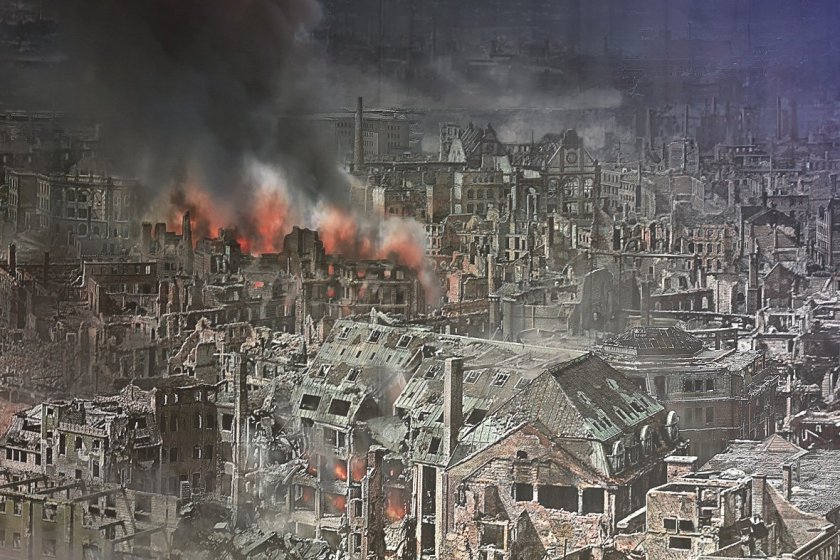
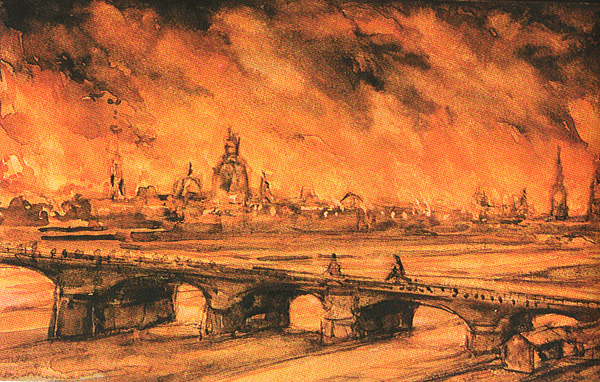
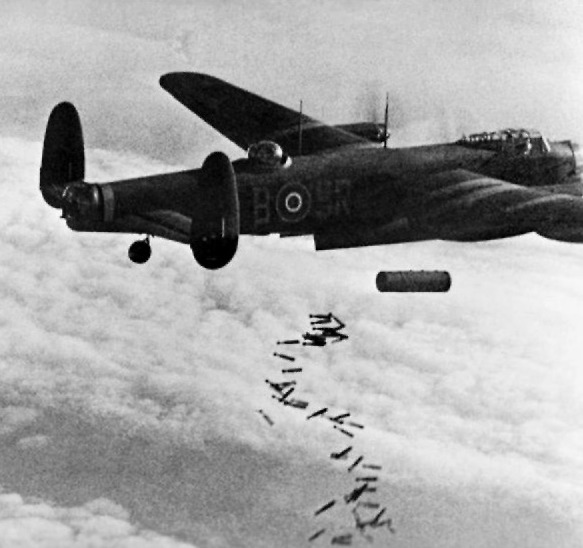
The first group of Lancaster bombers arrived in the skies over Dresden two hours before midnight, February 13. These were the pathfinders, their job to find the place and drop magnesium parachute flares, to light up the target. Then came the marker planes, Mosquito bombers whose job it was to drop 1,000-pound target indicators whose red glare provided something to aim at. Then came the first wave, 254 Lancaster bombers dropping 500 tons of high explosives ranging from 500-pounders to massive, 4,000-pound “blockbusters”. Next came the incendiaries. The “fire bombs”. 200,000 of them.

For those caught on the ground like scared rabbits in oncoming headlights, the horrors had only begun.

dresden

The second wave came in the small hours of February 14, just as rescue operations were getting underway. By now thousands of fires were burning, with smoke rising 15,000 feet into the air. You could see it from the air, from five hundred miles.

Then came another 529 Lancasters, dropping another 1,800 tons of bombs.

Lancaster_I_NG128_Dropping_Blockbuster_-_Duisburg_-_Oct_14,_1944
Lancaster bomber

The USAAF arrived over the target on the afternoon of February 14, the 317 B-17 “Flying Fortresses” of the “Mighty 8th” delivering another 771 tons of bombs.

Fires enveloped the city by the tens of thousands growing into a great, howling firestorm. A shrieking, seemingly living demon beast from the blackest pits of hell, devouring all in its path.

A firestorm of this size develops its own weather, fire tornadoes reaching into the sky as pyrocumulonimbus clouds hurl lightning bolts back to earth, starting new fires. Gale force winds scream into the vortex from all points of the compass, powerful enough to hurl grown adults opening doors in an effort to flee, off their feet and into the flames.

Lothar Metzger brings us one of the few eyewitness accounts of the fire bombing of Dresden, as seen from the ground:

“It is not possible to describe! Explosion after explosion. It was beyond belief, worse than the blackest nightmare. So many people were horribly burnt and injured. It became more and more difficult to breathe. It was dark and all of us tried to leave this cellar with inconceivable panic. Dead and dying people were trampled upon, luggage was left or snatched up out of our hands by rescuers. The basket with our twins covered with wet cloths was snatched up out of my mother’s hands and we were pushed upstairs by the people behind us. We saw the burning street, the falling ruins and the terrible firestorm. My mother covered us with wet blankets and coats she found in a water tub.

We saw terrible things: cremated adults shrunk to the size of small children, pieces of arms and legs, dead people, whole families burnt to death, burning people ran to and fro, burnt coaches filled with civilian refugees, dead rescuers and soldiers, many were calling and looking for their children and families, and fire everywhere, everywhere fire, and all the time the hot wind of the firestorm threw people back into the burning houses they were trying to escape from.

I cannot forget these terrible details. I can never forget them”.

He was ten years old at the time.

dresden-bombing (3)

For Victor Klemperer, the fire bombing of Dresden was a last minute reprieve. On the 19th he joined a refugee column fleeing the inferno, for American held territory. He would survive the attack, and live to see the end of the war.

Official death tolls from the burned out city are estimated at 18,500 to 25,000. The real number will never be known. At this point in the war refugees and military forces were streaming through the area by the tens of thousands. Estimates run as high as 200,000. That number if accurate, is more than death tolls resulting from the atomic bombings of Hiroshima and Nagasaki, combined.

January 20, 2018 Rosie the Riveter

All told some six million women answered the call, expanding the female participation in the overall workforce from 27%, to 37%.


Following the German invasion of Poland in 1939 and the outbreak of general war in Europe, President Franklin Delano Roosevelt proclaimed a limited national emergency, authorizing an increase in Regular Army personnel to 227,000 and 235,000 for the National Guard. Strong isolationist sentiment kept the United States on the sidelines for the first two years, as victorious German armies swept across France.

That all changed on December 7, 1941, with the Japanese attack on the Pacific naval anchorage at Pearl Harbor. Seizing the opportunity, Nazi Germany declared war on the United States, four days later.

The Roosevelt administration had barely found the keys to the American war machine in February 1942, when disaster struck with the fall of Singapore, a calamity Prime Minister Winston Churchill called the “worst disaster” in British military history.

The mobilization of the American war machine was a prodigious undertaking. From that modest beginning in 1939, the Army alone had 5.4 million men under arms by the end of 1942. By the end of the war in 1945, American factories produced a staggering 296,000 warplanes, 86,000 tanks, 64,000 landing ships, 6,000 navy vessels, millions of guns, billions of bullets, and hundreds of thousands of trucks and jeeps. US war production exceeded that of the Axis powers of Germany, Italy, and Japan, combined.

As all that manpower mobilized to fight the war, women moved into the workforce in unprecedented numbers.  Nearly a third of a million women worked in the American aircraft industry alone in 1943:  65% of the industry’s workforce, up from just 1% in the interwar years.

All told some six million women answered the call, expanding the female participation in the overall workforce from 27%, to 37%.

rosie-the-riveter

The mythical “Rosie the Riveter” first appeared in a song written by Redd Evans and John Jacob Loeb and made famous by swing bandleader James Kern “Kay” Kyser, in 1943.  The song told of a munitions worker who “keeps a sharp lookout for sabotage / Sitting up there on the fuselage…Rosie’s got a boyfriend, Charlie.  Charlie, he’s a Marine / Rosie is protecting Charlie Working overtime on the riveting machine”.

Norman Rockwell had almost certainly heard the song when he gave Rosie form for the cover of that year’s Memorial Day Saturday Evening Post.  Posed like the Prophet Isaiah from Michelangelo’s Sistine Chapel, Rockwell’s “Rosie” is on lunch break, riveting gun on her lap, a beat-up copy of Mein Kampf ground happily under foot.

1035x1485-gettyimages-90017379

Vermont Dental Hygienist Mary Doyle Keefe was the model for Rockwell’s Rosie.  The propaganda value of such an iconic image was unmistakable, but copyright rules limited the use of Rockwell’s portrait.  The media wasted no time in casting a real-life Rosie the Riveter, one of whom was Rose Will Monroe, who worked as a riveter at the Willow Run aircraft factory, in Ypsilanti Michigan.  Rose Monroe would go on to appear in war-bond drives, but the “Real” Rosie the Riveter, was someone else.

The year before the Rosie song came out, Westinghouse commissioned graphic artist J. Howard Miller to produce a propaganda poster, to boost company morale.  The result was the now-familiar “We Can Do It” poster, depicting the iconic figure flexing her biceps, wearing the familiar red & white polka dot bandanna.

world-war-ii-women-at-work-in-color-8
Colorized image of railroad workers on break, 1943

Though she didn’t know it, Miller’s drawing was based on a photograph of California waitress Naomi Parker Fraley, who worked in a Navy machine shop in 1942.

While Norman Rockwell’s Rosie the Riveter was the first, it is Miller’s work we remember, today.  Rosie the Riveter was larger than any one woman.  She was symbolic of her age, one of the most memorable and long lasting images of the twentieth century.

merlin_132732191_22bab46e-396e-4056-809a-2e551095a7dc-superjumbo
Naomi Parker Fraley, real-life model for Rosie the Riveter

For many years, it was believed that a Michigan woman, Geraldine Hoff Doyle, was the “real” Rosie the Riveter.  Hoff Doyle had seen the uncaptioned image, and believed it to be herself.  It was an innocent mistake. The woman bears a striking resemblance to the real subject of the photograph.

Thirty years came and went before Parker-Fraley even knew about it.  She saw herself in a newspaper clipping, and wrote to the paper around 1972, trying to set the record straight.  Too late. Hoff Doyle’s place had been cemented into popular culture, and into history.

Parker-Fraley was devastated. “I just wanted my own identity,” she says. “I didn’t want fame or fortune, but I did want my own identity.”

kimble_research_rosie-320
Professor James Kimble, Ph. D.

Another thirty-eight years would come and go before Seton Hall Communications Professor James J. Kimble, Ph.D., took an interest in the identity of the famous female from the WW2 poster. Beginning in 2010 and lasting nearly six years, the search became an obsession. It was he who discovered the long lost original picture with photographer’s notes identifying Naomi Parker-Fraley. “She had been robbed of her part of history,” Kimble said. “It’s so hurtful to be misidentified like that. It’s like the train has left the station and you’re standing there and there’s nothing you can do because you’re 95 and no one listens to your story.

rosie-the-riveter (1)

Over the years there have been many Rosie the Riveters, the last of whom was Elinor Otto, who built aircraft for fifty years before being laid off at age ninety-five.  Naomi Parker-Fraley knew she was the “first”, but that battle was a long lost cause until Dr. Kimble showed up at her door, in 2015.  All those years, she had known.  Now the world knew.

Rosie the Riveter died on January 20, 2018.  She was ninety-six.

Hat tip “BoredPanda.com”, for a rare collection of colorized images from the WW2 era, of women at work.  It’s linked HERE.

January 12, 1913 Man of Steel

Historians differ as to the deaths brought about by this one man. Numbers range from several million to well over twenty million.

A story comes to us of one Josef Jughashvili, the only child of a laundress and an alcoholic shoemaker, to survive to adulthood. Walking along a rain swollen river a group of boys chanced upon a bleating calf, cut off by the torrent on a small and crumbling island. Taking off his shirt Jughashvili dived into the roiling waters and swam to the terrified animal. Turning first to be sure his buddies were watching Josef proceeded to break the defenseless animal’s legs, one at a time.

The tale may be apocryphal or it may be true but the narrative captures perfectly, the man he would become. One of the great beasts of a century which gave us, no small number of monsters.

In 1884 a bout with smallpox left him disfigured. The other kids called him “pocky”. Though smaller than his classmates he joined a gang and got into many fights from which he never, backed down. He was smart and excelled in academics. He also displayed talent in art, drama and choir. A childhood friend recalled he “was the best but also the naughtiest pupil”.

Police phot at age 23, 1902

He enrolled in the seminary in Tiflis but a life in the priesthood, was never meant to be. A voracious reader, the “Forbidden Book Club” filled young Jughashvili’s head with ideas forbidden, in Czarist Russia. Plato. Checkov. Tolstoy. Zola. So taken was he with the writings of Friedrich Engels and Karl Marx he attempted to learn German, to better appreciate the original text.

Jugashvili proclaimed himself an atheist and thus ended any future, in the Orthodox priesthood. Expelled from seminary before the turn of the century he was now a Marxist agitator, teaching classes in leftist theory from a small flat on Sololaki Street and entering a life of crime, in order to finance the Bolshevik party.

In 1912, Vladimir Ilyich Lenin appointed Josef to the first Central Committee of the Bolshevik Party, while still in exile in Switzerland. On this day in 1913, Josef Dzhugashvili signed a letter to the Social Democrat newspaper, “Stalin”. The Man of Steel.

By 1917, three years of total war had brought the Russian economy, to its knees. Kaiser Wilhelm calculated that all he had to do was “kick the door in” to destroy his adversary to the east. Thus did the famous “sealed train” depart Zurich bound for Petrograd in April, 1917 carrying Lenin, and 31 Marxist revolutionaries.

Kaiser Wilhelm was right. As WW1 continued elsewhere Czarist Russia descended into not one but two civil wars resulting in the triumph of the radical Bolsheviks over the more moderate Mensheviks and the murder of Czar Nicholas, his wife the Czarina and the couple’s children, servants and dogs.

The Union of Soviet Socialist republics (USSR) was officially founded in 1922. Lenin died in 1924. Throughout this period Stalin steadily grew his own base of support, outmaneuvering rivals for the top spot. By the late 1920s he was head of the communist state.

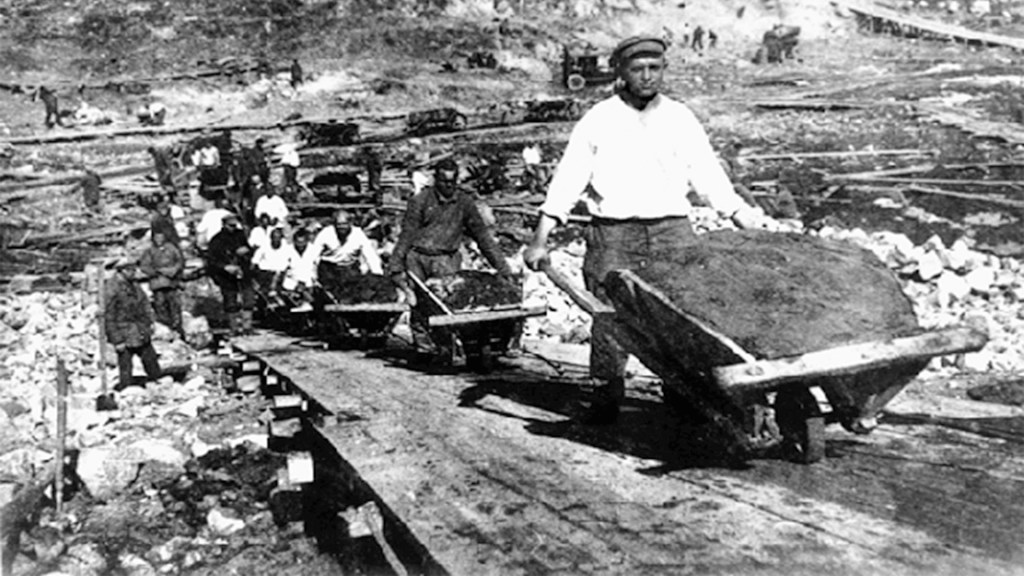
The “Glavnoe Upravlenie Lagerei” or Main Camp Administration system, began in 1919. By 1921 there were 84 such “Gulags”, but this hideous system really came of age, under Josef Stalin.

The Soviet Union was mostly agrarian when Stalin came to power, launching a series of five year plans to bring the USSR into the industrial age. Significant opposition came first from the Kulaks, the more prosperous of the peasant farming class who viewed Stalin’s “collectivization” efforts as a return to the serfdom, of earlier ages.

The ranks of the Gulags swelled to include the educated and ordinary citizens alike. Doctors, intellectuals, students, artists and scientists all disappeared into the Gulags, crude slave labor camps from which many, never returned.

Anyone so much as suspected of holding views contrary to the regime, anyone suspected of association with such persons were “disappeared”. Swept up in the night by Stalin’s terrifying NKVD security police and placed in conditions of such brutality prisoners were known to hack at their hands with axes or thrust their arms into wood stoves to avoid yet another man-killing hour, of slave labor.

“I trust no one, not even myself.

Josef Stalin

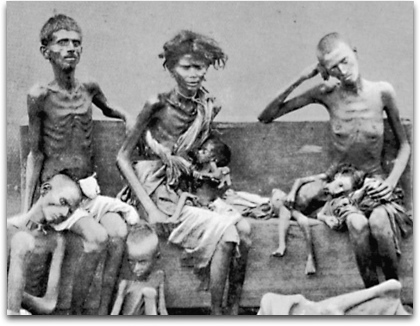
The early 1930s was a time of famine for the Kulaks of Ukraine, the former breadbasket of the Soviet Union. Continuing to resist Stalin’s collectivization, these “enemies of the state” were deliberately starved to death by their own government, their numbers running into the several millions in a period known, as “Holodomor“.

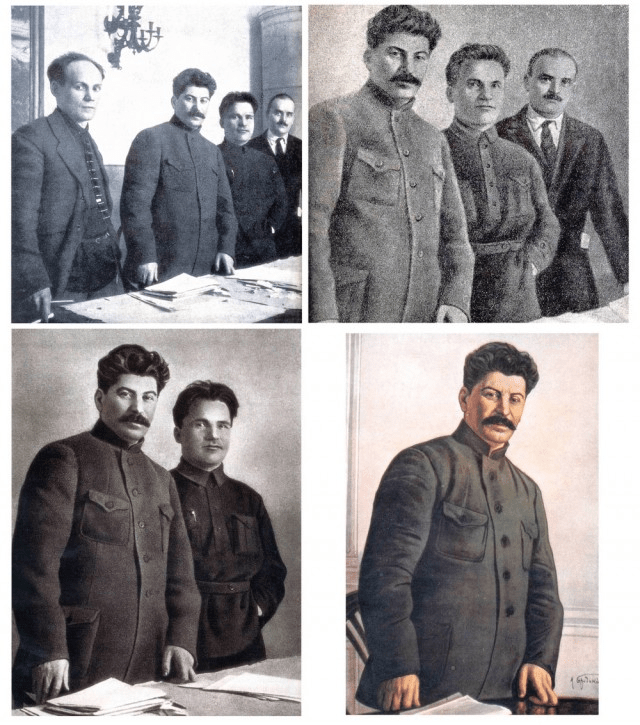
During the late ’30s, nearly 800,000 were summarily executed during the Great Purge, another two million shipped off to the gulags. Official paranoia rose to levels almost comical, but for their deadly consequence. Photo retouching became a cottage industry as former associates were simply…disappeared.

Much may be said of a man, by the company he keeps. Genrikh Yagoda, Nikolai Yezhov, Lavrentiy Beria, they’re not common names for those of us educated in American public schools but these are the men who carried out the Stalinist terror, as heads of the dread NKVD. Though we may not know their names these are beasts as loathsome as Nazi Police Official Reinhard Heydrich, SS Reichsführer Heinrich Himmler or Gestapo Chief Heinrich Müller.

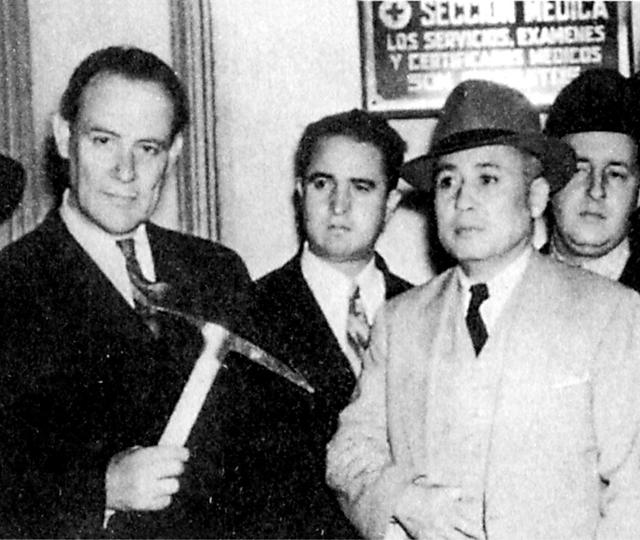
By 1938, Stalin’s purges had crippled the Soviet Union. Entire swathes of the Soviet military, government and popu,ation, had ceased to exist. Head of the security state Nikolai Yezhov was himself outmaneuvered from his position, denounced and murdered by his successor, Lavrentiy Beria. Even Leon Trotsky, founding father that he was of the Bolshevik party was tracked down to his place of exile in Mexico on Stalin’s orders and murdered with an ice axe, in the top of his head.

Investigators display the ice axe used to assassinate Leon Trotsky

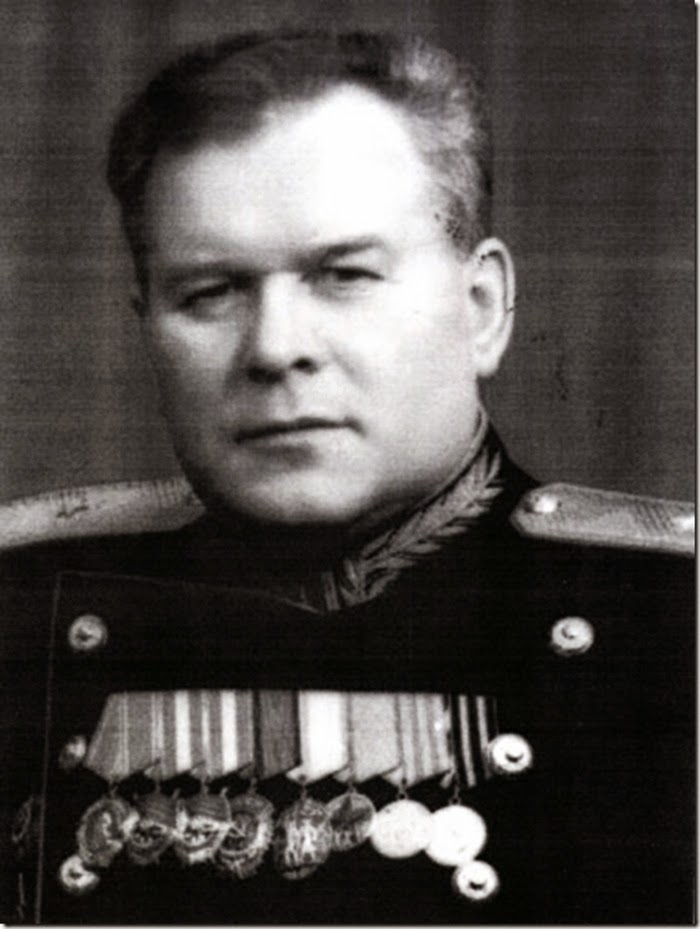
Major General Vasili Blokhin was handpicked by Stalin in 1926 as chief executioner, for the NKVD. To this day the man stands as the world’s most prolific executioner with tens of thousands dead, by his blood soaked hands. During the Spring of 1940 Blokhin personally murdered 7,000 Polish prisoners of war over 28 consecutive nights, each with a bullet to the back of the head.

The man literally kept a briefcase full of German made Walther PPK pistols, lest one of them overheat.

Major General Vasili Blokhin

Today, the 1940 episode is remembered as the Katyn Massacre, the murder of 22,000 defenseless prisoners of war primarily, Polish Army officers. For fifty years the atrocity was believed to have been carried out, by the Nazis.

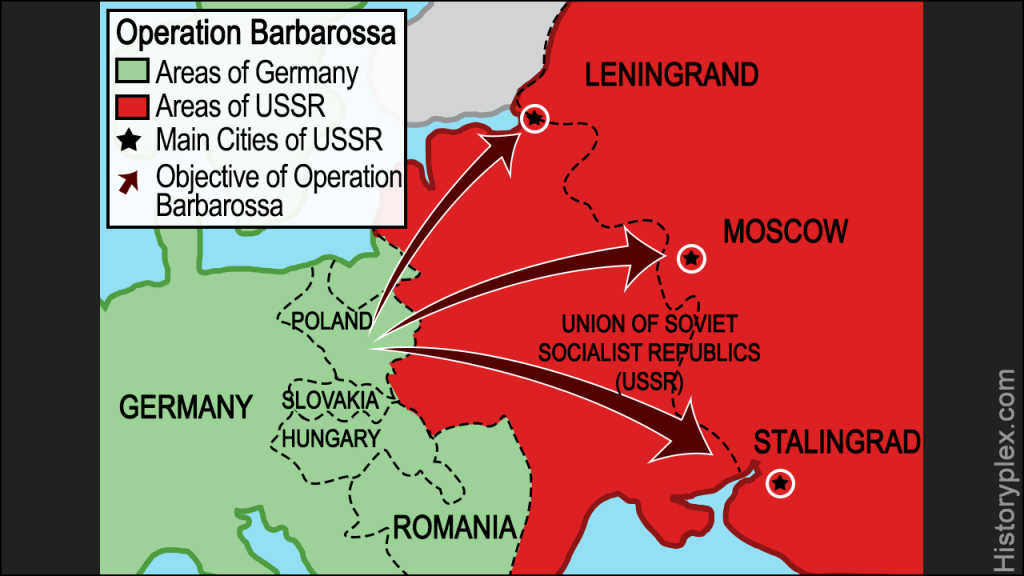
The Molotov Ribbentrop pact of 1939 meant, at east for a time, an alliance between the two great monsters of mid-20th century Europe. That all changed on June 22, 1941. Operation Barbarossa. Adolf Hitler’s surprise attack, on the Soviet Union.

Some 30 million among an estimated 70 to 85 million killed during World War 2 died, on the Eastern Front. The number includes nine million children, killed in an out-and-out race war, Slav against Teuton, that is dreadful even by the horrendous standards of WW2. Order No. 27 became standard operating procedure, for the rest of the war. Between 1942 and 1945 some 422,700 Red Army personnel were executed by their own officers, as the result of Stalin’s order. “Ni shagu nazad”. “Not one step back”.

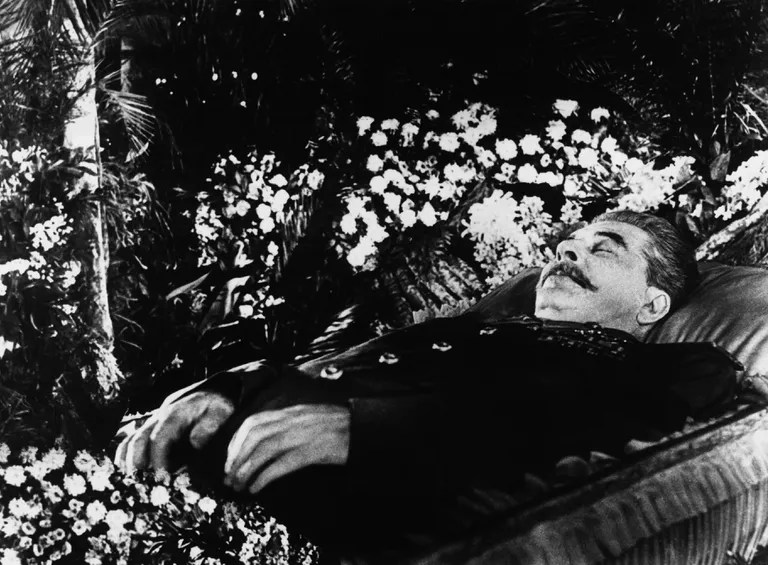
Josef Stalin went to bed sometime after 4:00am on February 28, 1953, with orders that he not be disturbed. 10am came and went, the usual time when the dictator would call for his tea. Morning turned to afternoon and into evening and yet, his terrified guards not wanting themselves to be purged, waited on. It was 10pm when a guard entered the room using as his excuse, the afternoon mail. The Soviet dictator was alive but helpless and unable to speak, laying in a pool of his own urine. His broken watch was stopped at 6:30pm.

The Man of Steel lingered in agony until March 5 as his own doctors languished in the Gulag and none assumed the authority, to make a decision about his care. Whether Stalin was murdered or simply left to die by those too terrified to do anything about it, is a matter for speculation.

Historians differ as to the deaths brought about by this one man. Numbers range from several million to well over twenty million.

Today, public imagination barely registers how fortunate we are that Adolf Hitler chose to turn from a defeated adversary on the beaches of Dunkirk to attack his erstwhile ally, in the east. Where we would be today had Little Boy and Fat Man had a swastika or a hammer and sickle painted on the side is a nightmare, too dismal to contemplate.

December 25, 1942 Dreaming of a White Christmas

White Christmas hit Number 1 on the Hit Parade that November, and never looked back. By Christmas day 1942 the song had barely made it halfway through a ten-week run, at the top spot.

Israel was the youngest of eight children borne of the Baline Family in western Siberia and emigrated to the United States, in 1893. In grammar school “Izzy” delivered telegrams and sold newspapers, to help with family finances. Israel’s father Moses died when the boy was only 13 and he took work as a “ Busker”, to support himself.

Everyone who will read this has bought a record I suspect, but the sale of music came long before the age of the phonograph. Buskers or “song pluggers” would perform songs in vaudeville theaters, railroad stations and even street corners in hopes of selling sheet music, of the latest songs.

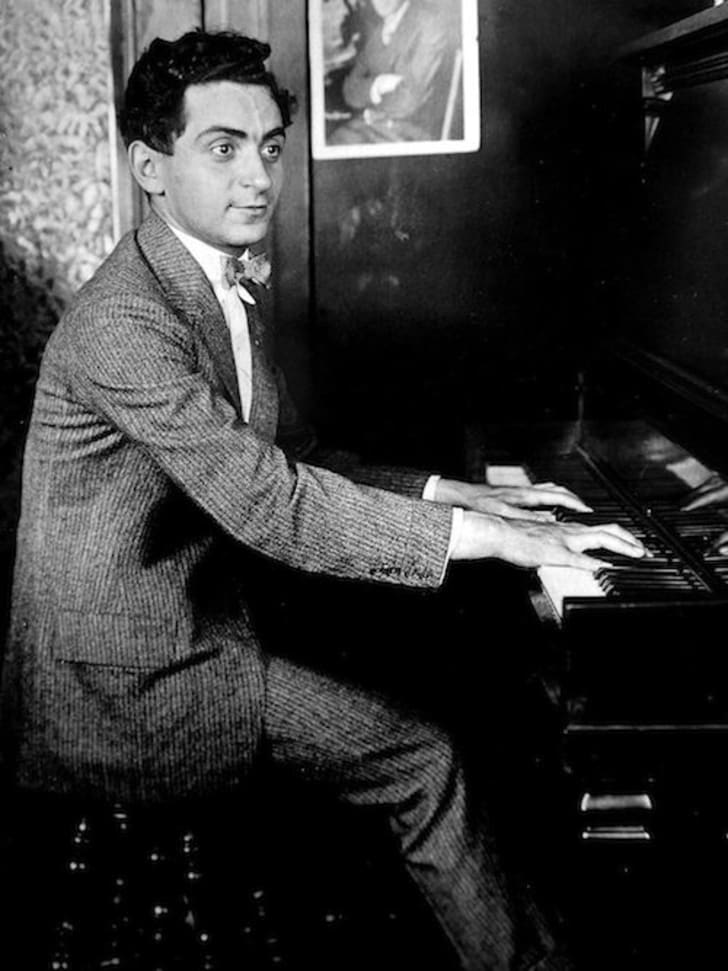
Even at a young age Israel Baline had a pleasing voice and a natural ear, for music. By 16 he was a singing waiter at the Pelham Cafe in New York’s Chinatown. It was there he taught himself to play the piano and to compose music, with the help of a friend. The boy’s first published work led to a name change when Marie from Sunny Italy came back from the publisher, with a typo. I. Baline was now I. Berlin.

At least that’s the story. Others will tell you Irving Berlin changed his name to sound less ethnic. Be that as it may, the author of American standards like “Puttin’ on the Ritz” and “There’s No Business Like Show Business”, had come of age.

In 1911, Berlin’s “Alexander’s Ragtime Band” sold a million copies and inspired a dance craze still remembered, to this day.

Irving Berlin wrote “God Bless America” during World War 1 but only used it, in 1938. A love song to an adopted country from a kid escaped from the anti-Jewish Russian pogroms of the age the song went on to earn $9.6 million. Every dime of it was donated to the Boy Scouts of America, and Campfire Girls.

Christmas was an unhappy time for Irving Berlin. A devoted husband of 62 years Irving and Ellin (Mackay) lost their only son (also Irving) on Christmas day in 1928, to Sudden Infant death Syndrome. Every year at Christmas was an occasion to visit their baby’s grave.

Berlin wrote the best selling record of all time in 1941 but it didn’t start out, the way you might think. In 1940, the composer signed to score a musical for paramount Pictures, about a retired vaudeville performer who opened an inn. The hook was that this particular inn was only open, on holidays. “Holiday Inn” would guide the viewer through a years’ worth of holidays, in music.

As for White Christmas that started out, as a spoof. A satire sung under a palm tree by music industry sophisticates enjoying drinks, around a Beverly hills swimming pool:

The sun is shining, the grass is green
The orange and palm trees sway
There’s never been such a day
In Beverly Hills, L. A.
But it’s December the 24th
And I am longing to be up north….
I’m dreaming of a white Christmas…
(Chorus continues)

Bing Crosby was already famous in 1941. Berlin agreed to include White Christmas in the film, provided that Crosby perform the tune. Crosby himself was on board, from day 1. On hearing the song he told Berlin “You don’t have to worry about this one, Irving.”

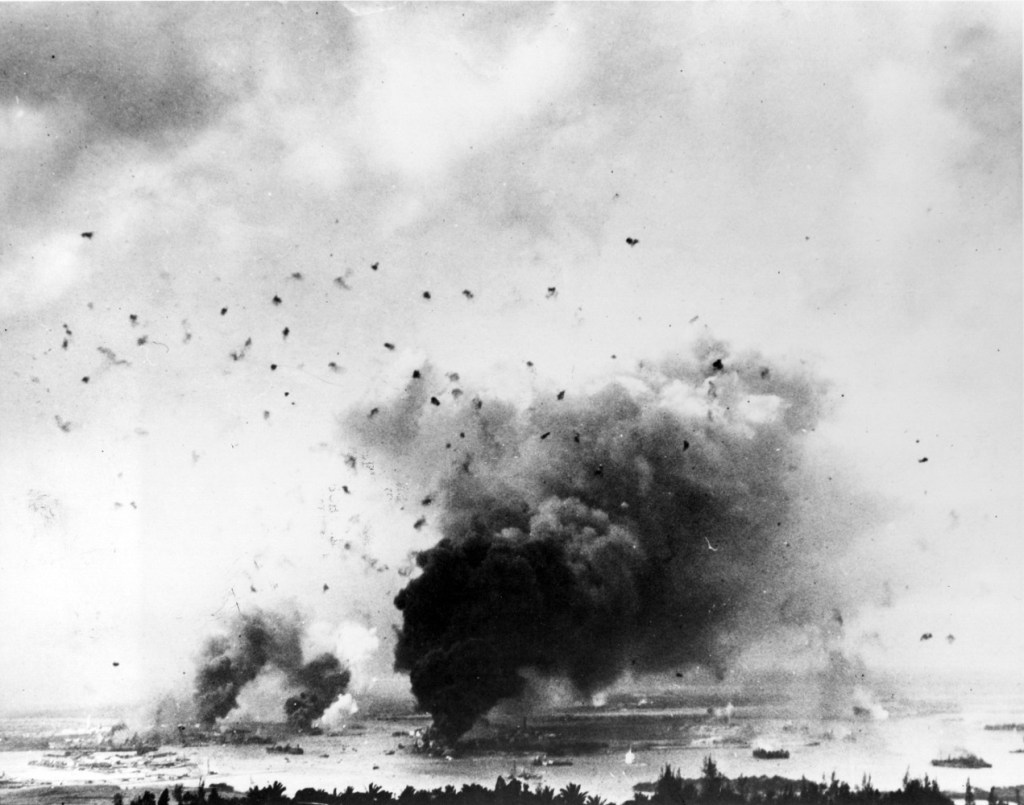
And then the world changed. A mighty sucker punch came out of the east on December 7, 1941, a sneak attack by the air and naval forces of imperial Japan on the American Pacific naval anchorage, at Pearl Harbor.

President Franklin Roosevelt asked for and received a congressional declaration of war on Japan, on December 8. Nazi Germany piled on and declared war on the United States, three days later. The US had entered World War 2.

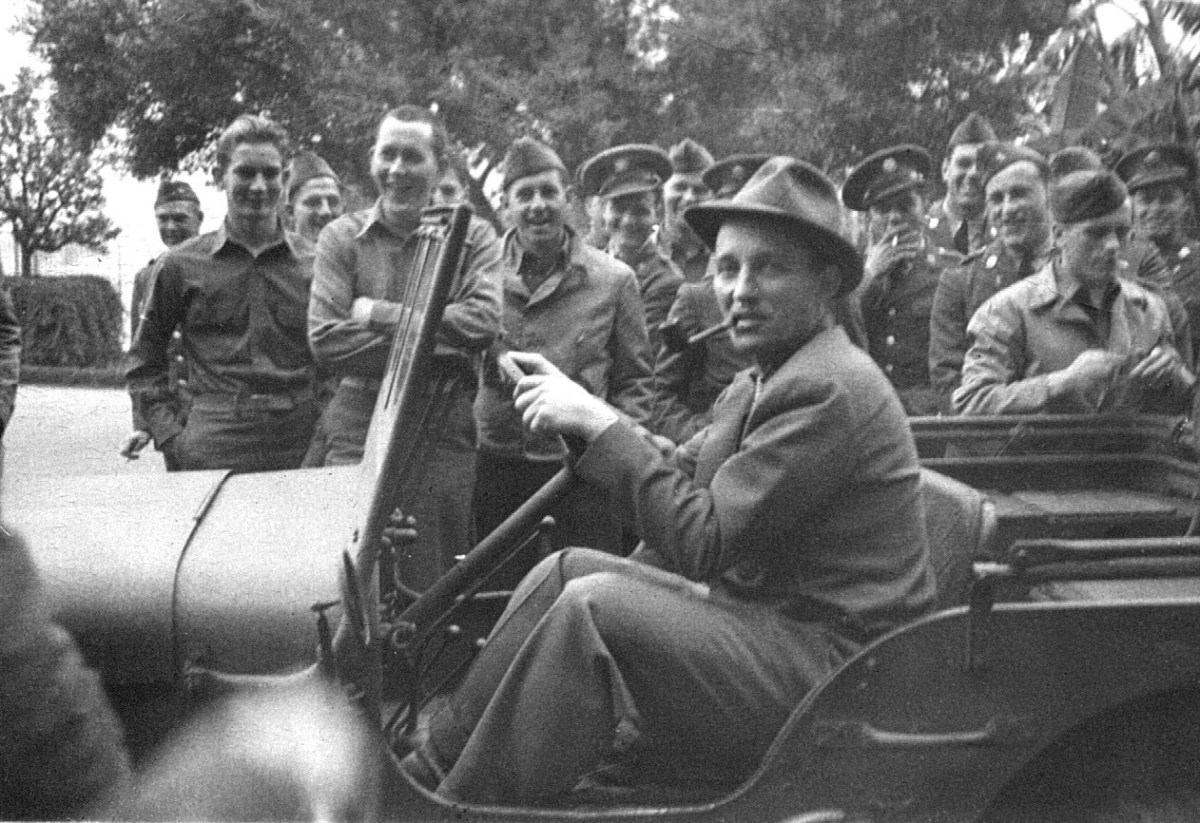
A generation of men signed up for the draft including Bing Crosby. He would prove too old but this was a loyal American. Crosby would use his gifts at every opportunity and perform for the troops.

Seventeen days after the attack on Pearl Harbor was Christmas eve, 1941. Bulkhead markings would later reveal that even then, the last survivors on board the USS Oklahoma down there at the bottom of Pearl Harbor were making their last marks on the wall of that black, upside down place in the vain hope of a rescue, that would never come.

Bing Crosby performed the track live that Christmas eve and over the following January, the shortwave broadcast of the Kraft Music Hall reaching troops then fighting for their lives on Corregidor and the Philippines. The set list always started out with a tune, destined to become the official anthem of the US Army: “AS The Caissons Go Rolling Along.”.

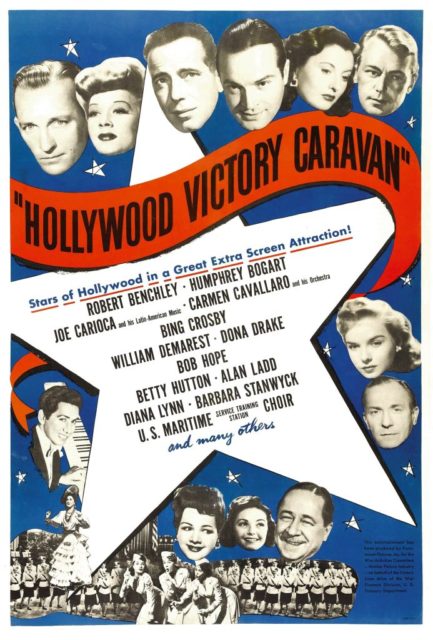
President Roosevelt asked Hollywood to step up, and do its part. Crosby and others formed the Hollywood Victory Caravan in support of the war effort, Carey Grant, Desi Arnaz, Olivia de Havilland and others raising over $700,000 in support of the Army and Navy Relief Society.

When Holiday Inn was released in 1942 Berlin expected Be Careful It’s My Heart to be a hit, a song tied in the film, to Valentine’s day. But a funny thing happened. White Christmas was received by the people who heard it not as satire but a heartfelt reminder of Christmases past and a promise, of Christmas yet to come. Soldiers abroad and their families dreamed alike of a white Christmas, “just like the ones I used to know“.

That first verse quietly went away, never to return.

Fun Fact: Despite Berlin’s songwriting success he didn’t write music and only played the piano in F Sharp. He bought special transposing keyboards so his songs didn’t all sound the same and paid music secretaries to notate and transcribe, his music.

Crosby himself had mixed feelings about performing White Christmas. “I hesitated about doing it” he once told an interviewer, ” because invariably it caused such a nostalgic yearning among the men, that it made them sad. Heaven knows, I didn’t come that far to make them sad. For this reason, several times I tried to cut it out of the show, but these guys just hollered for it.”

White Christmas hit Number 1 on the Hit Parade that November, and never looked back. By Christmas day 1942 the song had barely made it halfway through a ten-week run, at the top spot.

Bing Crosby appeared in over 70 radio shows over the course of the war including 30 Command Performance spots, 13 on Mail Call, 5 appearances on Song Sheet, 19 on GI Journal and at least twice on Jubilee, all in addition to his regular Kraft Music Hall show transcribed on discs and personal appearances before troops on the front lines. A survey among soldiers after the war revealed that Bing Crosby had accomplished more in support of troop morale than Franklin Roosevelt, Dwight Eisenhower or even, Bob Hope.

Bing Crosby signing autographs in France, in 1944

It’s a new perspective to look at one of the seminal events of the 20th century, through the eyes of the artist. Imagine for a moment you are Bing Crosby himself, performing for the troops in Belgium and France and Luxembourg in December, 1944. What must it have been like a month later to realize that 75,000 of those men were now casualties in the last great feat of German arms of World War 2, the Battle of the Bulge.

Bing Crosby performing for the troops in 1944

Today, the Guinness Book of World Records names Bing Crosby’s “White Christmas” not only the best-selling Christmas single in the United States, but also the best-selling single of all time with estimated sales of over 50 million copies, worldwide.

I hope you enjoyed this story and wish a you Merry Christmas and a safe, healthy and prosperous new year.. May this be the first of many more.

Rick Long, the “Cape Cod Curmudgeon”.

December 18, 1944 Typhoon

Hulls would creak and groan with the pounding and rivets popped. Captains in wheelhouses would order course headings, but helmsmen could do no better than 50° to either side of the intended course. Some ships rolled more than 70°. The 888-ft carrier USS Hancock, scooped tons of water onto its flight decks, 57-feet above the surface.


In September 1935, the Imperial Japanese Navy was caught in foul weather while conducting wargame maneuvers. By the 26th, the storm had reached Typhoon status.  The damage to the Japanese fleet was near catastrophic. Two large destroyers had their bows torn away by heavy seas. Several heavy cruisers suffered major structural damage.  Submarine tenders and light aircraft carriers developed serious cracks in their hulls. One minelayer required near total rebuild and virtually all fleet destroyers suffered damage to superstructures. 54 crewmen lost their lives.

Nine years later, it would be the turn of the American fleet.

The war in the Pacific was in its third year in December 1944. A comprehensive defeat only weeks earlier had dealt the Imperial Japanese war effort a mortal blow at Leyte Gulf, yet the war would slog on for the better part of another year.

Carrier Task Force 38 was a massive assembly of warships, a major element of the 3rd Fleet under the Command of Admiral William “Bull” Halsey.  In formation, TF-38 moved in three eight-mile diameter circles, each with an outer ring of destroyers, an inner ring of battleships and cruisers and a mixed core of 35,000-ton Essex class and smaller escort carriers. TF-38 was a massive force fielding eighty-six warships, all told.

By mid-December 1944, Task Force 38 was underway for three weeks, having just completed three days of heavy raids against Japanese airfields in the Philippines, suppressing enemy aircraft in support of American amphibious operations against Mindoro.  Ships were badly in need of re-supply.  A replenishment fleet, 35 ships in all, was sent to the nearest spot near Luzon still outside of Japanese fighter range. 

Rapid movement into previously enemy-held territory made it impossible to establish advance weather reporting.  By the time that Task Force meteorological service reports made it to ships in the operating area, weather reports were at least twelve hours old.

Cobra 9

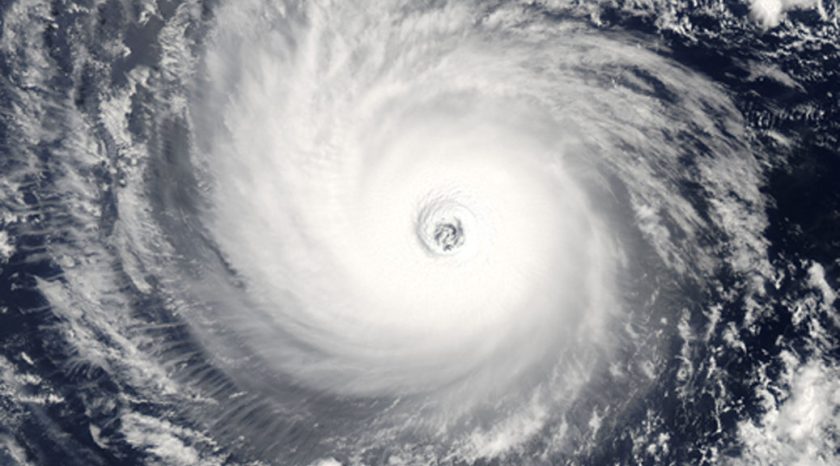
Three days earlier, a barometric low pressure system had begun to form off Luzon, fed by the warm waters of the Philippine sea.  High tropospheric humidity fed and strengthened the disturbance as counter-clockwise winds began to develop around the low pressure center.  By the 18th, this once-small “tropical disturbance” had developed into a compact but powerful cyclone.

Replenishment operations began the morning of the 17th as increasing winds and building seas made refueling increasingly difficult.  Refueling hoses were parted in several locations. Thick hawsers had to be cut to avoid collision as sustained winds built to 40 knots.  Believing the storm center to be 450 miles to his southeast, Admiral Halsey declined a return to base.  It would take too long and beside, and combat operations were scheduled to resume, two days later.  Halsey needed the carrier group refueled and on station, so it was decided.  Task Force 38 and the replenishment fleet would proceed to a second replenishment point, hoping to resume refueling operations on the morning of the 18th.

Cobra

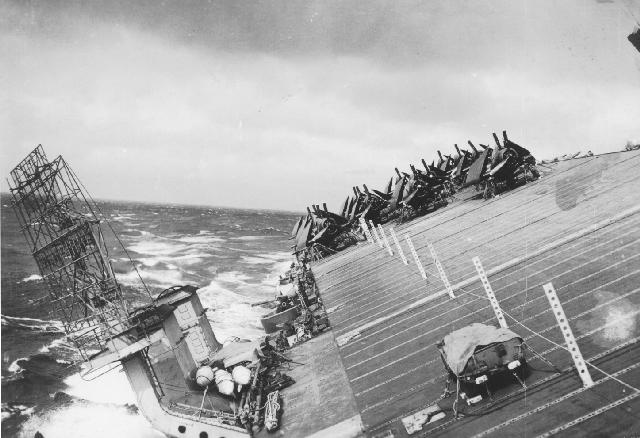
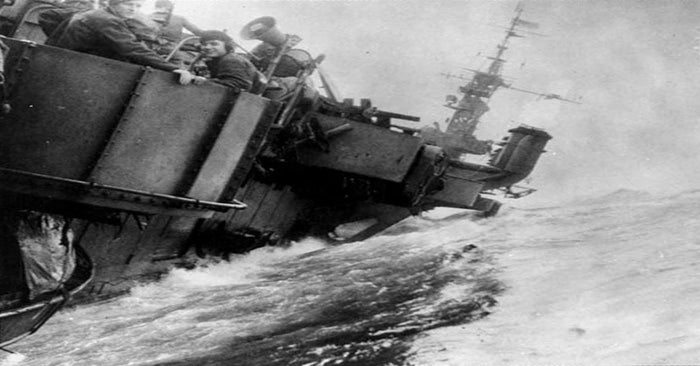
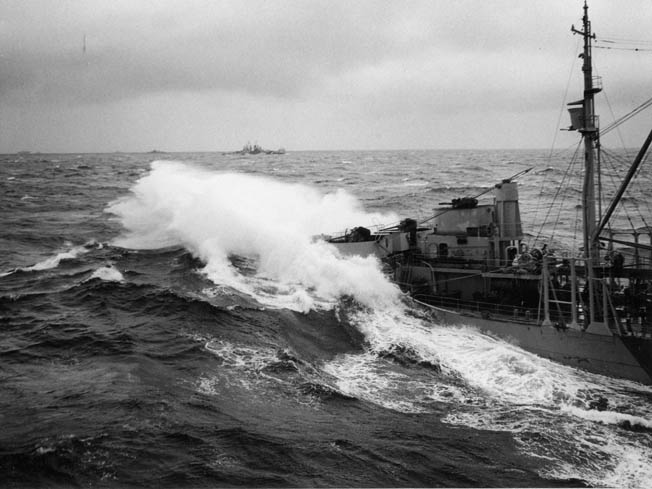
Four times over the night of December 17-18, course was corrected in the search for calmer water.  Four times the ships of Task Force 38 and it’s attendant resupply ships turned each time moving closer to the eye of the storm.  2,200-ton destroyers pitched and rolled like corks, towering over the crest of 70-foot waves only to crash into the trough of the next, shuddering like cold dogs as decks struggled to shed thousands of tons of water.

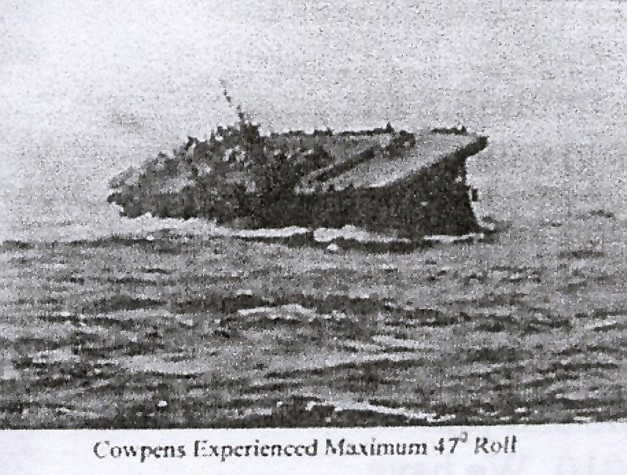
Hulls creaked and groaned with the pounding. Rivets popped.  Captains in wheelhouses order course headings but helmsmen could do no better than 50° to either side of the intended direction.  Some ships rolled more than 70°.  The 888-ft carrier USS Hancock scooped tons of water onto its own flight decks, 57-feet up.

USS Cowpens during Typhoon Cobra

Typhoon Cobra reached peak ferocity between 1100 and 1400 with sustained winds of 100mph and gusts of up to 140.

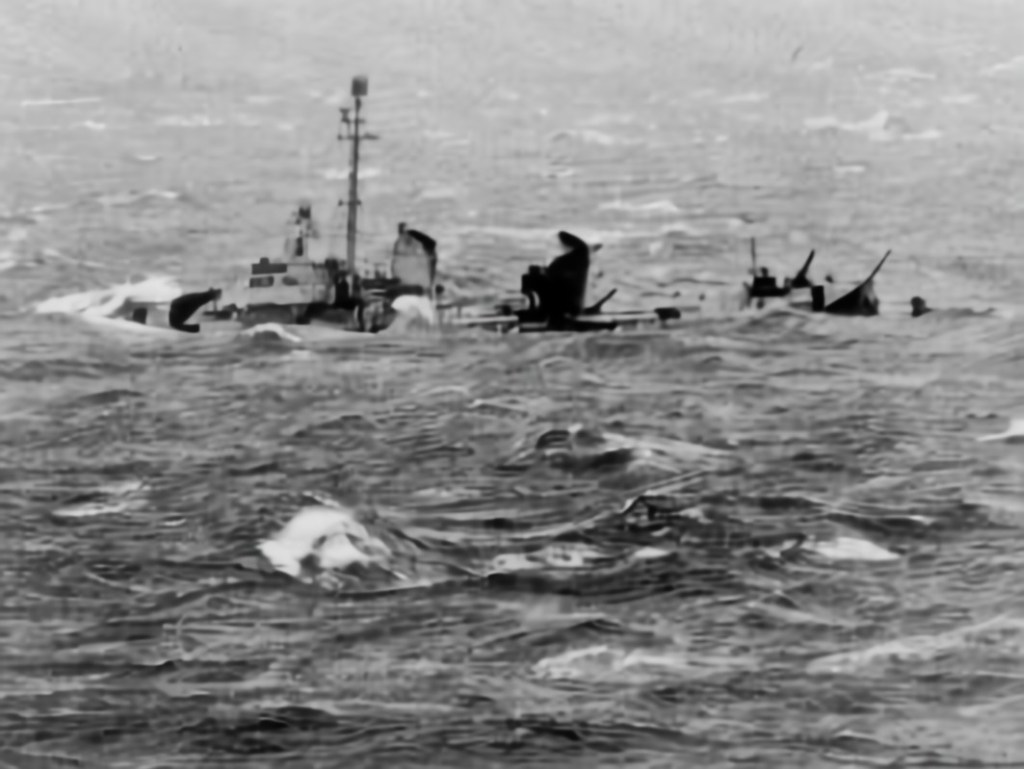
The lighter destroyers got the worst of it, finding themselves “in irons” – broad side to the wind and rolling as much as 75° with no way to regain steering control.  Some managed to pump seawater into fuel tanks to increase stability, while others rolled and couldn’t recover, water cascading down smokestacks and disabling engines.

Cobra 4

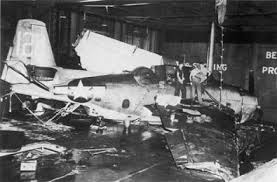
146 aircraft were either wrecked or blown overboard.  The carrier USS Monterrey nearly went down in flames as loose aircraft crashed about on hanger decks and burst into flames.  One of those fighting fires aboard Monterrey was then-Lieutenant Gerald Ford, the former Michigan Wolverine center and future President of the United States.

Cobra 10

Many of the ships of TF-38 sustained damage to above-decks superstructure, knocking out radar equipment and crippling communications.

Cobra 8

790 Americans were killed by Typhoon Cobra:

USS Hull – with 70% fuel aboard, capsized and sunk with 202 men drowned. There were 62 survivors.
USS Monaghan – capsized and sunk with 256 men drowned. There were 6 survivors.
USS Spence – rudder jammed hard to starboard, capsized and sunk with 317 men drowned after hoses parted attempting to refuel from New Jersey because they had also disobeyed orders to ballast down directly from Admiral Halsey. There were 23 survivors.
USS Cowpens – hangar door torn open and RADAR, 20mm gun sponson, whaleboat, jeeps, tractors, kerry crane, and 8 aircraft lost overboard. One sailor lost.
USS Monterey – hangar deck fire killed three men and caused evacuation of boiler rooms requiring repairs at Bremerton Navy yard
USS Langley – damaged
USS Cabot – damaged
USS San Jacinto – hangar deck planes broke loose and destroyed air intakes, vent ducts and sprinkling system causing widespread flooding. Damage repaired by USS Hector
USS Altamaha – hangar deck crane and aircraft broke loose and broke fire mains
USS Anzio – required major repair
USS Nehenta – damaged
USS Cape Esperance – flight deck fire required major repair
USS Kwajalein – lost steering control
USS Iowa – propeller shaft bent and lost a seaplane
USS Baltimore – required major repair
USS Miami – required major repair
USS Dewey – lost steering control, RADAR, the forward stack, and all power when salt water shorted main electrical switchboard
USS Aylwin – required major repair
USS Buchanan – required major repair
USS Dyson – required major repair
USS Hickox – required major repair
USS Maddox – damaged
USS Benham – required major repair
USS Donaldson – required major repair
USS Melvin R. Nawman – required major repair
USS Tabberer – lost foremast
USS Waterman – damaged
USS Nantahala – damaged
USS Jicarilla – damaged
USS Shasta – damaged “one deck collapsed, aircraft engines damaged, depth charges broke loose, damaged“

It could have been worse.  The destroyer escort USS Tabberer defied orders to return to port, Lieutenant Commander Henry Lee Plage conducting a 51-hour boxed search for survivors despite the egregious pounding being taken by his own vessel.  USS Tabberer plucked 55 swimmers from the water, survivors of the capsized destroyers Hull and Spence.

Cobra 7, Pittsburgh

Typhoon Cobra moved on overnight, December 19 dawning clear with brisk winds. Admiral Halsey ordered “All ships of the Task Force line up side-by-side at about ½ mile spacing and comb the 2800-square mile area” in which they’d been operating.  Carl M. Berntsen, SoM1/C aboard the destroyer USS DeHaven, recalled that “I saw the line of ships disappear over the horizon to starboard and to port”. The Destroyer USS Brown rescued six survivors from the Monaghan and another 13 from USS Hull.  18 more would be plucked from the water, 93 in all, by ships spread across fifty to sixty miles of open ocean.

When it was over, Admiral Chester Nimitz said typhoon Cobra “represented a more crippling blow to the Third Fleet than it might be expected to suffer in anything less than a major action.”
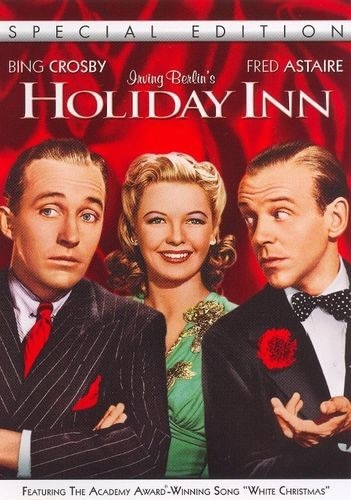
Afterward

CARL MARTIN BERNTSEN PASSED AWAY ON OCTOBER 13TH, 2014 IN KITTY HAWK, NORTH CAROLINA. HE WOULD HAVE BEEN 94, THE FOLLOWING MONTH. I AM INDEBTED TO HIM AND HIS EXCELLENT ESSAY FOR THIS STORY.  VIRTUALLY ALL SHIPS OF TASK FORCE 38 WERE DAMAGED TO VARYINHG DEGREEs.

December 8, 1941 The Game that Never Was

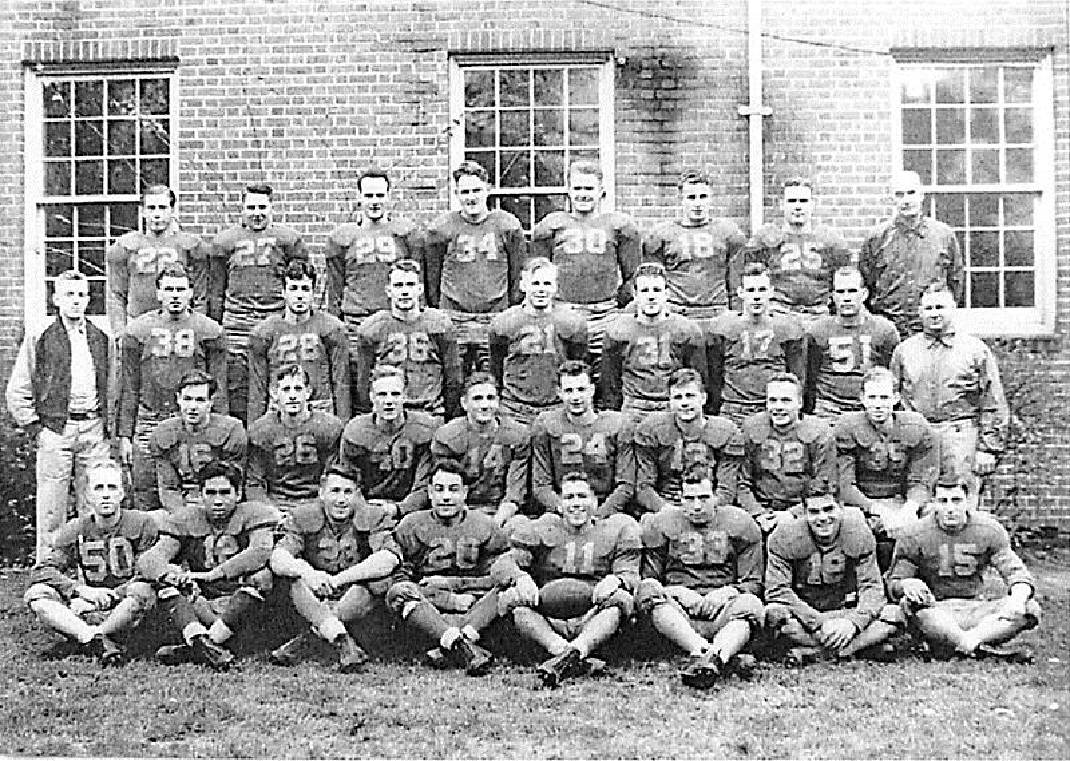
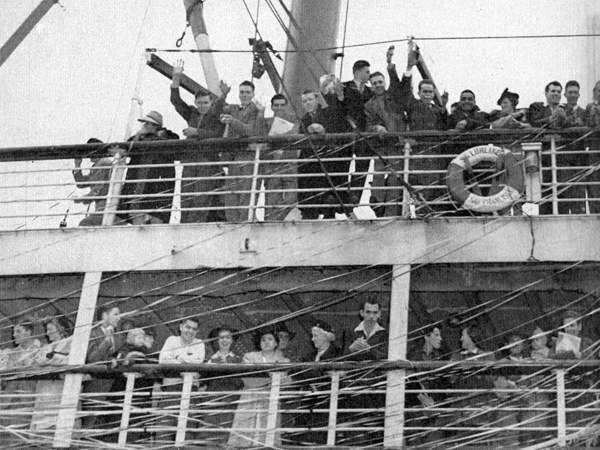
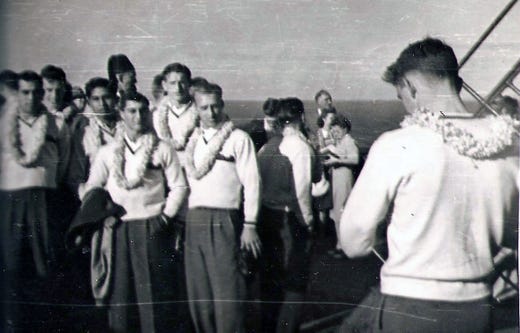
The two teams departed November 27 aboard the SS Lurline along with an entourage of fans, dignitaries and coaching staff. An outing like that was once in a lifetime. An unforgettable trip and so it was, only not for the reason any of them expected.

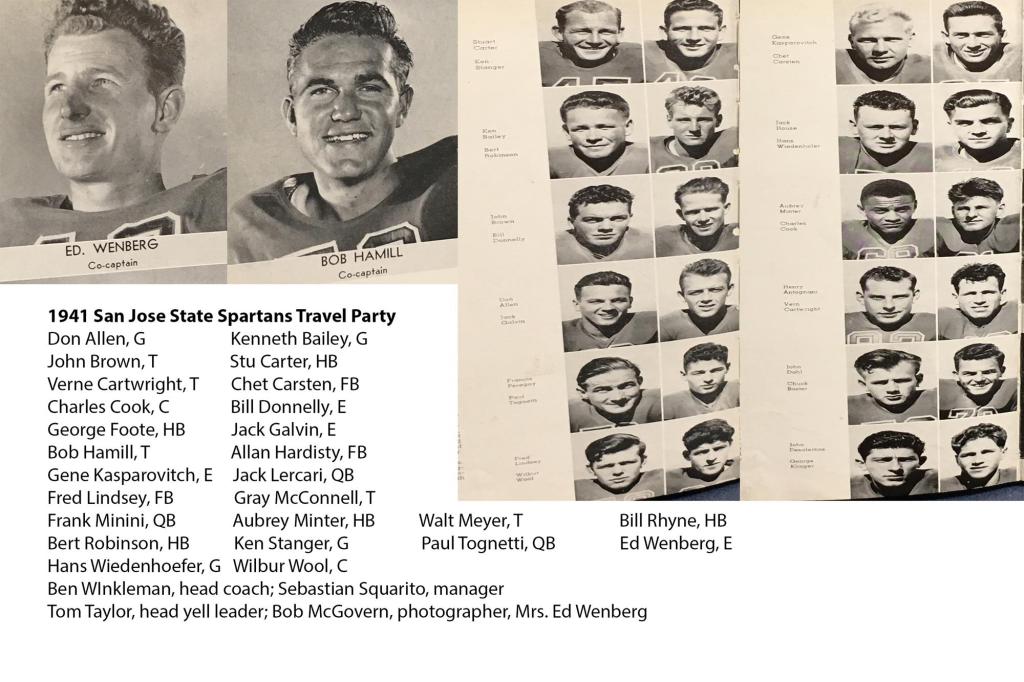
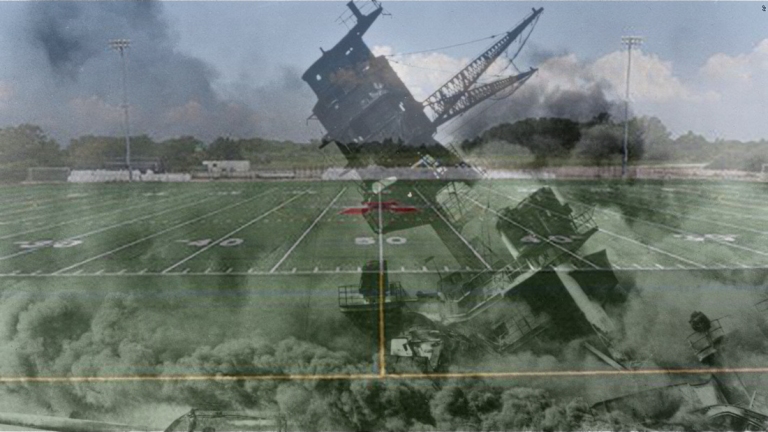
In December 1941, the San Jose Spartans and the Willamette Bearcats of Oregon, went on the road. They were college kids, enjoying a few days in paradise and a chance to play, the game they loved. What could be better than that?

The two teams departed November 27 aboard the SS Lurline along with an entourage of fans, dignitaries and coaching staff. The Rainbow Warriors of Hawaii defeated Willamette 20-6 on Saturday, December 6. The Warriors were scheduled to play San Jose State on December 13, followed by a Spartans- Bearcats matchup, on December 16.

An outing like that was once in a lifetime. An unforgettable trip and so it was, only not for the reason any of them expected.

On December 7, 1941 a great sucker punch came out of the southeast. 353 Imperial Japanese warplanes attacked Hickam Air Field and the US Pacific Naval anchorage at Pearl Harbor, lying at peace in the early morning sunshine of a quiet Sunday morning. The sneak attack carried out 80 years ago yesterday destroyed more American lives than any foreign enemy attack on American soil, until the Islamist terrorist attack of September 11, 2001.

The President of the United States addressed a joint session of Congress on December 8, requesting a declaration of war against the Empire of Japan.

Back on the mainland, the families of players now stranded in Hawaii, received no word. There were no communications. None could know with certainty, that brothers and sons were alive or dead. Hawaii was locked down, under Martial Law.

Meanwhile, the visiting teams were mobilized to perform wartime duties. San Jose state players were sent to work with Federal authorities and Honolulu police to round up Japanese, Italian and German citizens, and to enforce wartime blackout orders. Willamette players were assigned World War 1-vintage Springfield rifles and tin hats, and ordered to string barbed wire on the beaches.

If you’ve heard of Punahou High School it probably involves the school’s most famous alumnus, the former US President Barack Obama. 80 years ago today all hell, was about to break loose at Punahou high.

United States Army Corps of Engineers troops began to appear at the Punahou gates at 1:00am, on December 8. By 5:00am, Dole Hall Cafeteria Manager Nina “Peggy” Brown was ordered to prepare breakfast, for 750 men. For the next ten days Willamette players stood 24-hour guard, around the school.

Many players had never so much as handled a gun. Now in the darkness every shadow carried the menace, of an enemy soldier. Wild gunfire would break out at the sound of a stealthy invader which turned out to be nothing, but a falling coconut. Shirley McKay Hadley was a Willamette student in 1941 accompanied by her father, then serving as state Senator. She joked it all, many years later, “They were lucky they didn’t shoot each other.”
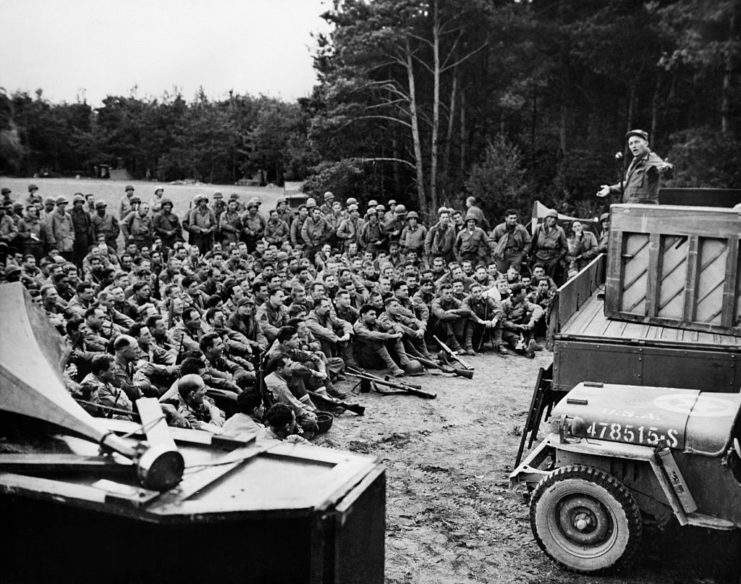
Female members of the entourage were assigned nursing duties. Spartan Guard Ken Stranger delivered a baby, on December 7.

On December 19, players received two-hours notice. It was time to go. The civilian liner SS President Coolidge had been commandeered to transport gravely wounded service members. This would be the kids’ ride home complete with Naval escort, a defense against Japanese submarine attack.

Seven San Jose players stayed behind and joined the Honolulu police force , for which each was paid $166 a month. Willamette coach Roy “Spec” Keene refused to let any of his players stay behind as none had been able to speak with their parents, first.

Nearly every member of both squads went on to fight for the nation. Willamette Guard Kenneth Bailey was killed over Bari Italy in 1943 and awarded the Purple Heart, posthumously.

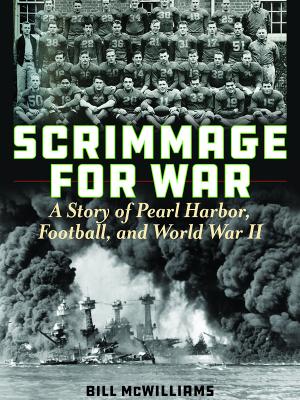
Bill McWilliams served 27 years in the United States Air Force, as a fighter bomber pilot. He’s written a book about 12 of these guys who went on to fight the conflict, of the “Greatest Generation”.

The book came out in 2019 and it’s still in print, if you’re interested. It looks like one hell of a story.

Andy Rogers played for the Willamette squad and went on to serve for the duration of the war, with the 3rd division of the United States Marine Corps. Mr. Rogers is 98 today and lives in Napa Valley, California. The only living member of either traveling squad who would have played that day, in the game that never was.

December 7, 1941 USS Oklahoma

14 Marines and 415 sailors aboard Oklahoma lost their lives immediately, or in the days and weeks to come. Bulkhead markings would later reveal that, at least some of the doomed would live for another seventeen days in the black, upside-down hell. The last mark was drawn by the last survivor, on Christmas Eve.


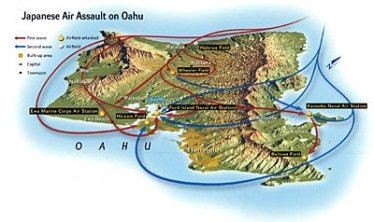
It was literally “out of the blue” when the first wave of enemy aircraft arrived at 7:48 am local time, December 7, 1941. 353 Imperial Japanese warplanes approached in two waves out of the southeast, fighters, bombers, and torpedo aircraft.  Across Hickam Field and over the still waters of Pearl Harbor. Tied in place and immobile, the eight vessels moored at “Battleship Row” were easy targets.

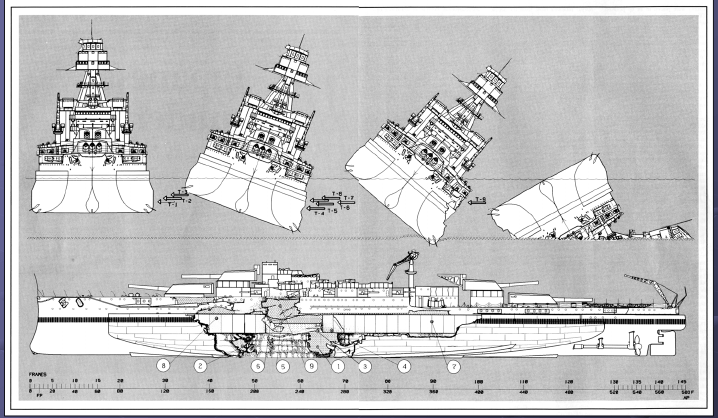
In the center of the Japanese flight path, sailors and Marines aboard the USS Oklahoma fought back furiously, as holes as wide as 40-feet were torn into her side. Eight torpedoes smashed into her port side, each striking higher on the hull as the great Battleship began to roll.

She never had a chance.

_oahu

Bilge plates had been removed for a scheduled inspection the following day, making counter-flooding to prevent capsize, impossible. The ninth torpedo slammed home even as Oklahoma rolled over, and died. Hundreds scrambled out across the rolling hull, jumped overboard into the oil covered, flaming waters of the harbor, or crawled out over mooring lines in the attempt to reach USS Maryland, tied in the next berth.

The damage was catastrophic. Once the pride of the Pacific fleet, all eight battleships were damaged. Four of them sunk. Nine cruisers, destroyers and other craft were damaged, another two sunk. 347 aircraft were damaged, most caught while still on the ground. 159 of those, were destroyed. 2,403 were dead or destined to die from the attack, another 1,178 wounded.

Nine Japanese torpedoes struck USS Oklahoma’s port side, in the first ten minutes.

HT John F DeVirgilio for this graphic
The last moments of USS Oklahoma.  H/T John F DeVirgilio for this graphic

Frantic around the clock rescue efforts began almost immediately, to get at 461 sailors and Marines trapped within the hull of the Oklahoma. Tapping could be heard as holes were drilled to get at those trapped inside. Thirty-two were delivered from certain death.

14 Marines and 415 sailors aboard Oklahoma lost their lives immediately, or in the days and weeks to come. Bulkhead markings would later reveal that, at least some of the doomed would live for another seventeen days in the black, upside-down hell. The last mark was drawn by the last survivor, on Christmas Eve.

Of sixteen ships lost or damaged, thirteen were destined to be repaired, and returned to service. USS Arizona remains on the bottom to this day, a monument to the event and to the 1,102-honored dead who remain entombed within her hull. USS Utah defied salvage efforts. She too is a registered War Grave, 64 honored dead remaining within her hull, lying at the bottom not far from the Arizona.

Of necessity, such repairs were prioritized. For the time being, USS Oklahoma was beyond help. She, and her dead, would have to wait.

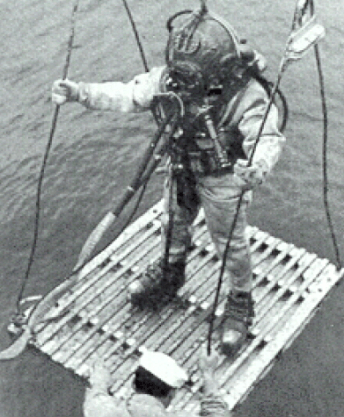
Oklahoma Diver

Recovery of the USS Oklahoma was the most complex salvage operation ever attempted, beginning in March, 1943.  With the weight of her hull driving Oklahoma’s superstructure into bottom, salvage divers descended daily to separate the tower, while creating hardpoints from which to attach righting cables.

The work was hellishly dangerous down there in the mud and the oil at the bottom of Pearl Harbor.  Several divers lost their lives and yet, another day would come and each would descend yet again, into that black water.

21 giant A-frames were fixed to the hull of USS Oklahoma, 3-inch cables connecting compound pulleys to 21 electric motors, each capable of pulling 429 tons.

Two pull configurations were used over 74 days, first attached to these massive A-frames, then direct connections once the hull had achieved 70°. In May 1943, her decks once again saw the light of day, for the first time in over two years.

rightng-strategy
USS Oklahoma, righting strategy

Fully righted, the ship was still ten-feet below water. Massive temporary wood and concrete structures called “cofferdams” closed cavernous holes left by torpedoes, so the hull could be pumped out and re-floated. A problem even larger than those torpedo holes were the gaps between hull plates, caused by the initial capsize and righting operations. Divers stuffed kapok into gaps as water was pumped out.

Individual divers spent 2-3 years on the Oklahoma salvage job. Underwater arc welding and hydraulic jet techniques were developed during this period, which remain in use to this day. 1,848 dives were performed for a total of 10,279 man hours under pressure.

9781591147244

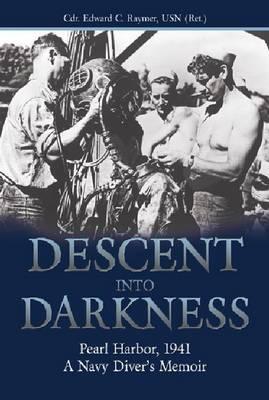
CDR Edward Charles Raymer, US Navy Retired, was one of those divers. Raymer tells the story of those men in Descent into Darkness: Pearl Harbor, 1941 – A Navy Diver’s Memoir, if you’re interested in further reading.  Most of those men are gone now, including Raymer himself.  They have earned the right to be remembered.

Ken Hartle died in January 2017 in an Escondido, California Alzheimer’s and dementia center. He was 103, possibly the oldest of those divers. Before the age of SCUBA, Hartle and his fellow divers worked in heavy canvas suits and brass helmets weighing together, over 200 pounds. He regularly risked death, towing away unexploded bombs and torpedoes. He suffered the bends and nearly lost his life one day, when an anchor chain exploded into flying shards of metal. The part he’d never talk about even after all those years, was the hardest part. ‘Bringing up our boys’.

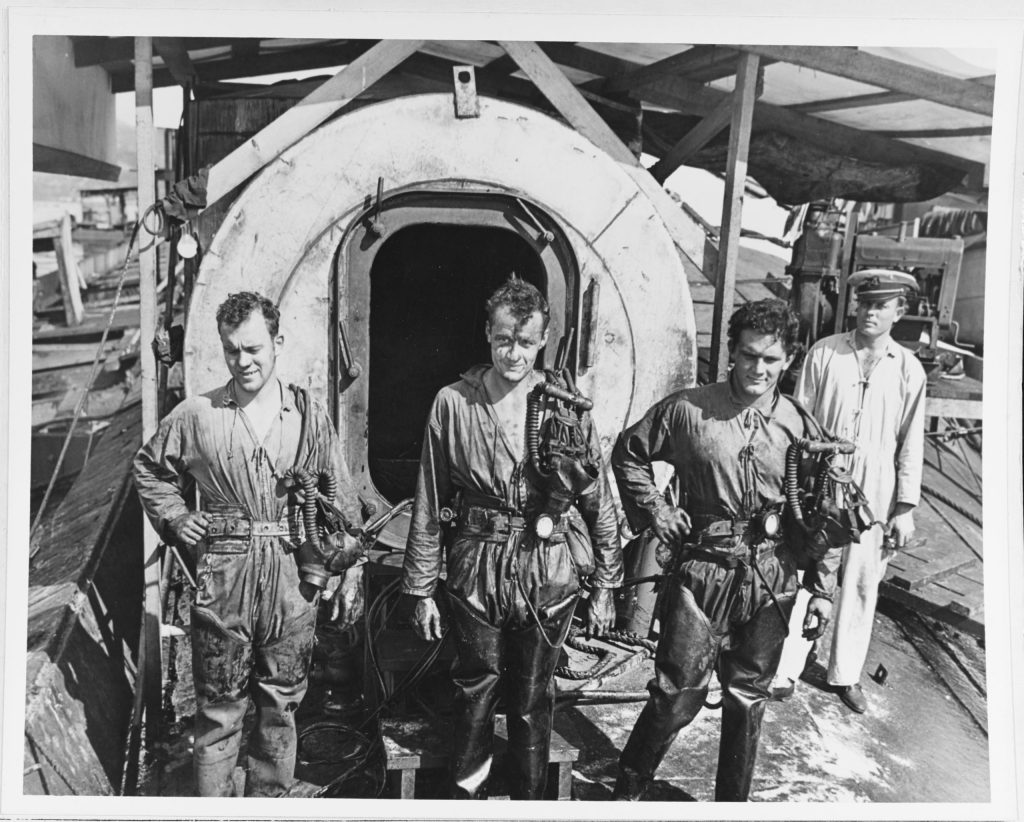
Salvage workers entered the pressurized hull through airlocks wearing masks and protective suits. Bodies were in advanced stages of decomposition by this time and the oil and chemical-soaked interior was toxic to life. Most victims would never be identified.

Divers standing in front of a decompression chamber, while they were working to salvage ships sunk in the 7 December 1941 Japanese air raid on Pearl Harbor. Note warrant officer standing at right. Official U.S. Navy Photograph, from the collections of the Naval History and Heritage Command.

Twenty 10,000 gallon per minute pumps operated for 11 hours straight, re-floating the battleship on November 3, 1943.

Oklahoma entered dry dock the following month, a total loss to the American war effort. She was stripped of guns and superstructure, sold for scrap on December 5, 1946 to the Moore Drydock Company of Oakland, California.

The battered hulk left Pearl Harbor for the last time in May 1947, destined for the indignity of a scrapyard in San Francisco bay. She would never make it.

Taken under tow by the ocean-going tugs Hercules and Monarch, the three vessels entered a storm, 540 miles east of Hawaii. On May 17, disaster struck. Piercing the darkness, Hercules’ spotlight revealed the former battleship to be listing, heavily. Naval base at Pearl Harbor instructed them to turn around, when these two giant tugs suddenly found themselves slowing, to a stop. Despite her massive engines, Hercules began to move backward. She was being dragged astern with no warning, hurtling past Monarch, herself swamped at the stern and being dragged backward at 17 mph.

the-tug-boat-hercules-william-havle
Ocean-going tug Hercules, photograph by William Havle

Fortunately for both tugs, skippers Kelly Sprague of Hercules and George Anderson of Monarch had both loosened the cable drums connecting 1,400-foot tow lines, to Oklahoma. Monarch’s line played out and detached. Hercules’ line didn’t do so until the last possible moment. With tow line straight down and sinking fast, Hercules’ cable drum exploded in a shower of sparks directly over Oklahoma’s final resting place, the 409-ton tug bobbing to the surface like the float on a child’s fishing line.

Postcard image of USS Oklahoma (BB-37) from the service of AMM2c Durrell Wade“. H/T nationalww2museum.org

“Okie” was stabbed in the back, attacked and mortally wounded even before she knew she was at war.  The causes leading to her final descent, remain uncertain.  Most will tell you, her plates couldn’t hold.  The beating of six years earlier, was just too much.   Those who served on her decks, might tell you differently. Maybe she just preferred, to die at sea.

Afterward

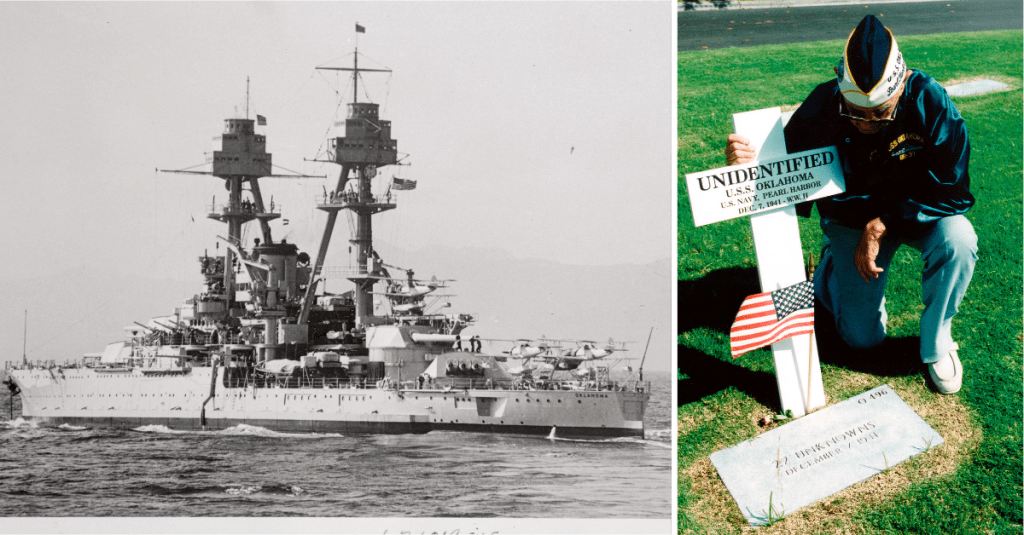
Jesus Garcia of Guam died at age 21 on December 7, 1941, a sailor serving aboard the USS Oklahoma. William Eugene Blanchard of Tignall Georgia, was 24.

In 1947, “Okie’s” honored dead were disinterred. Dental records and dog tags were used to identify thirty-five. The other 391 including Blanchard and Garcia were reburied in 61 caskets, in Hawaii’s National Military Cemetery of the Pacific. Their names were known, only to God.

Nearly sixty years later, scientific advances in DNA analysis made further identifications, possible. Veteran Ray Emory was serving aboard the USS Honolulu on that day in 1941 and persuaded the D.o.D., to make the attempt.

Exhumations began in 2015. Mitochondrial DNA was enough for many identifications, but not all. Mitochondrial DNA comes from the maternal side. Shared ancestral lines means that sometimes, that’s not enough. One DNA sequence matched 25 victims.

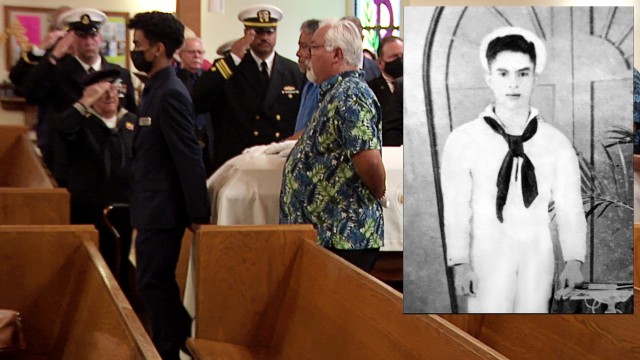
Further DNA was collected from paternal lines, combining with the mitochondrial to identify many of Oklahoma’s dead. William Blanchard was laid to rest with full military honors on June 7, 2021 in Elizabeth City, North Carolina.

As I write this it is December 7, 2021. 80 years after the fact some ninety percent of those who gave their lives on board USS Oklahoma once again, have their names.

Jesus Garcia went to his final rest in San Diego on October 6, 2021. Gilbert Nadeau, 95, was the only WW2 veteran able to attend.

November 9, 2013 A Vintage like No Other

On November 9, 2013, a company of heroes cracked open and enjoyed a 117-year-old bottle of rare and vintage cognac. If there can be a more magnificent act of tribute, I cannot at this moment think of what it might be.

On November 9, 2013, there occurred a gathering of four.  A tribute to fallen heroes. These four were themselves heroes, and worthy of tribute.  This was to be their last such gathering.

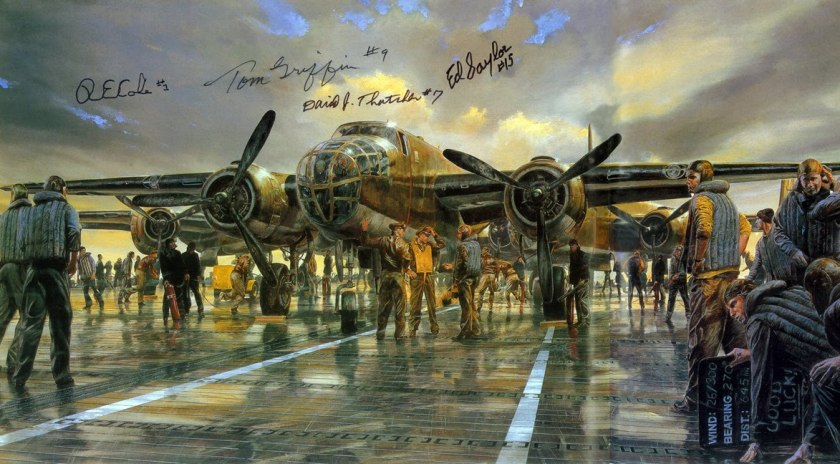
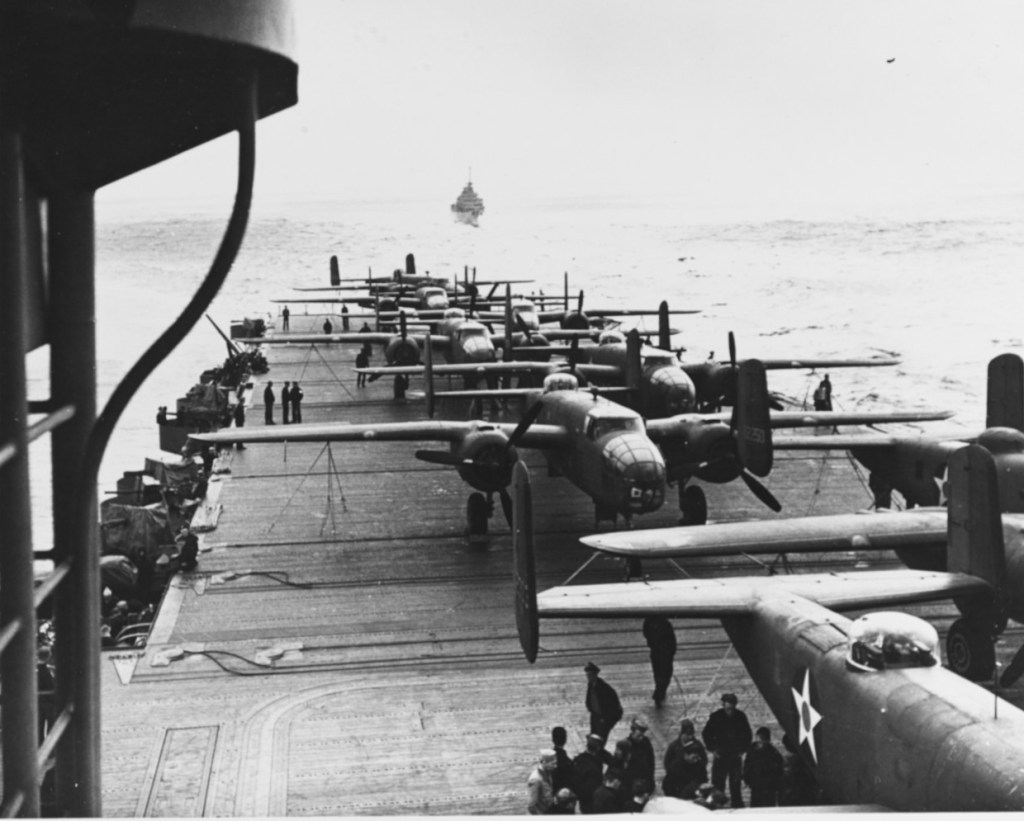
This story begins on April 18, 1942, when a flight of sixteen Mitchell B25 medium bombers launched from the deck of the carrier, USS Hornet. It was a retaliatory raid on Imperial Japan, planned and led by Lieutenant Colonel James “Jimmy” Doolittle of the United States Army Air Force. The raid was payback for the sneak attack on Pearl Harbor, four months earlier. A demonstration that the Japanese home islands, were not immune from destruction.

Launching such massive aircraft from the decks of a carrier had never been attempted. There were no means of bringing them back.  With extra gas tanks installed and machine guns removed to save the weight, this was to be a one-way mission, into territory occupied by a savage adversary.

Doolittle Signatures

Fearing that mission security was breached, the bomb run was forced to launch 200 miles before the intended departure spot.  At this range the bombers themselves might not even make it. Fighter escort, impossible.

Japanese Premier Hideki Tojo was inspecting military bases, at the time of the raid. One B-25 came so close he could see the pilot, though the American bomber never fired a shot.

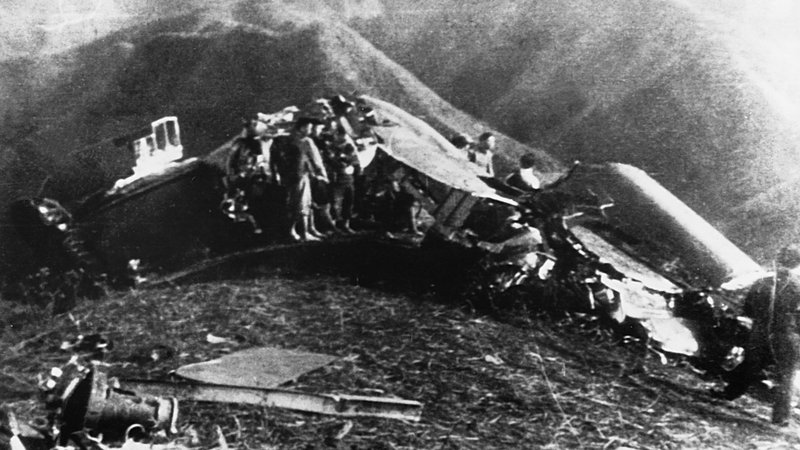
After dropping their bombs, fifteen continued west, toward Japanese occupied China.  Unbeknownst at the time, carburetors bench-marked and calibrated for low level flight had been replaced in flight #8, which now had no chance of making it to the mainland.  Twelve crash landed in the coastal provinces.  Three more, ditched at sea.  Pilot Captain Edward York pointed flight 8 toward Vladivostok, where he hoped to refuel.  The pilot and crew were instead taken into captivity and held, for thirteen months.

aftermath.jpg__800x450_q85_crop_upscale

Crew 3 Engineer-Gunner Corporal Leland Dale Faktor died in the fall after bailing out. Staff Sergeant Bombardier William Dieter and Sergeant Engineer-Gunner Donald Fitzmaurice bailed out of aircraft #6 off the China coast, and drowned.

The heroism of the indigenous people at this point, is a little-known part of this story.  The massive sweep across the eastern coastal provinces, the Zhejiang-Jiangxi campaign, cost the lives of 250,000 Chinese.  A quarter-million murdered by Japanese soldiers, in the hunt for Doolittle’s raiders.  How many were in a position to betray the American flyers and refused, will never be known.

Amazingly, only eight were captured, out of seventy-seven survivors.

First Lieutenant Pilot “Bill” Farrow and Sergeant Engineer-Gunner Harold Spatz, both of Crew 16, and First Lieutenant Pilot Dean Edward Hallmark of Crew 6 were caught by the Japanese and executed by firing squad on October 15, 1942.  Crew 6 Co-Pilot First Lieutenant Robert John Meder died in a Japanese prison camp, on December 11, 1943.  Most of the 80 who began the mission, survived the war.

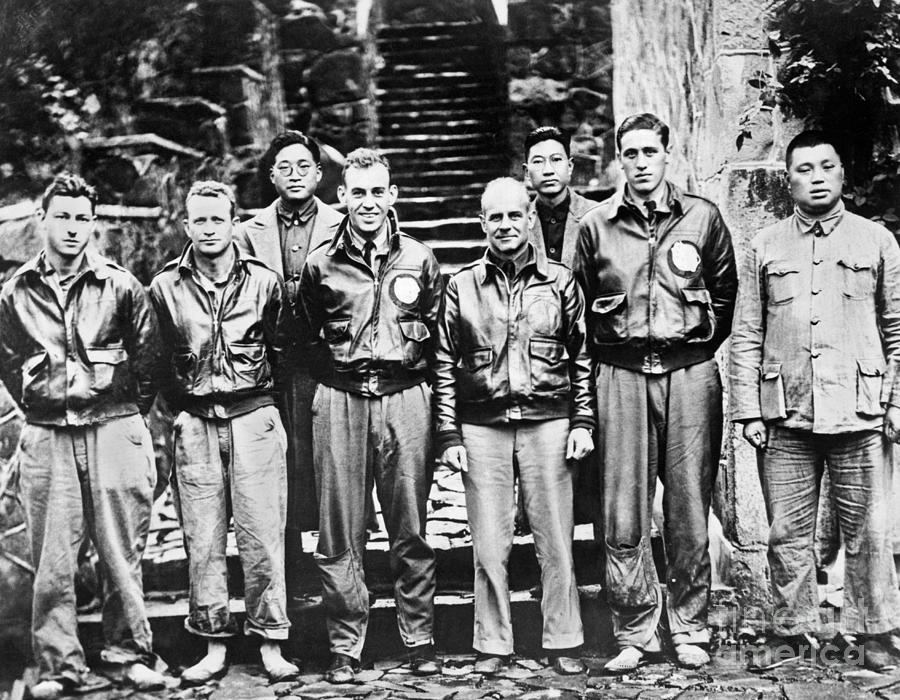
Jimmy Doolittle and his crew in China, after the raid

Thirteen targets were attacked, including an oil tank farm, a steel mill, and an aircraft carrier then under construction.. Fifty were killed and another 400 injured, but the mission had a decisive psychological effect.  Japan withdrew its powerful aircraft carrier force to protect the home islands. Admiral Isoroku Yamamoto attacked Midway, thinking that to have been the jump-off point for the raid. Described by military historian John Keegan as “the most stunning and decisive blow in the history of naval warfare”, the battle of Midway would be a major strategic defeat for Imperial Japan.

s_w07_20418042
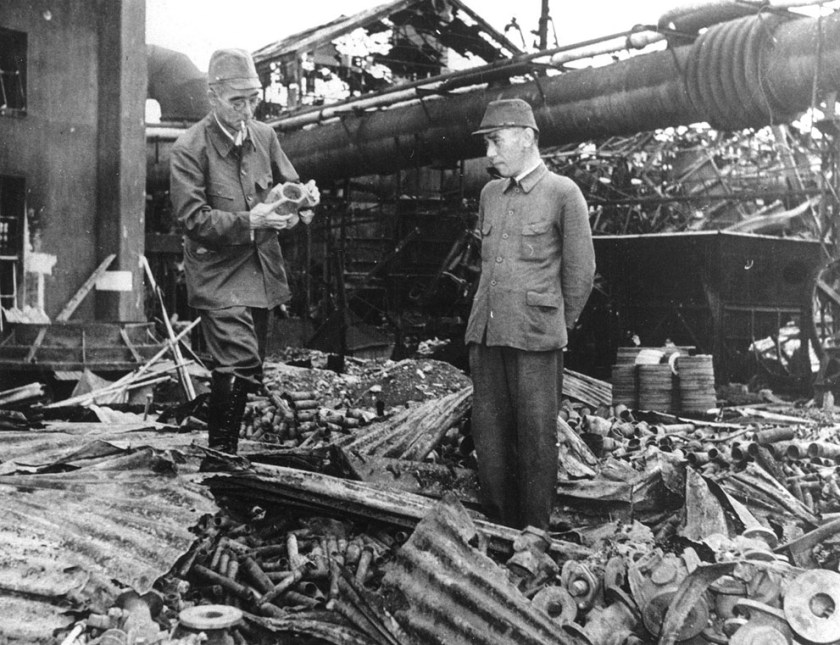
Ryozo Asano, left, spokesman for a group of diversified Japanese family enterprises called the Zaibatsu, inspects the wreckage of his Tokyo steel plant

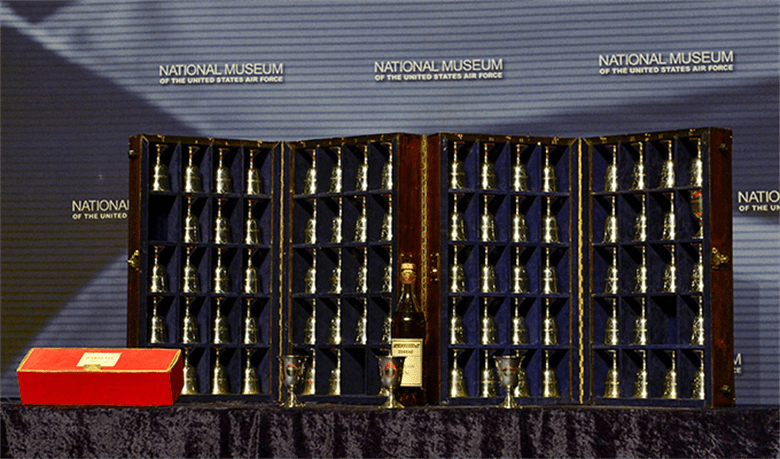
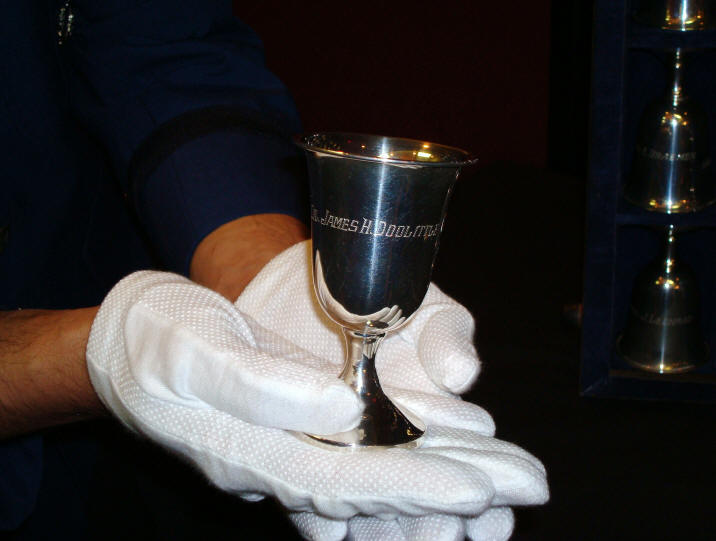
Every year since the late 1940s, the surviving Doolittle raiders have held a reunion.  In 1959, the city of Tucson presented them with 80 silver goblets, each engraved with a name. They are on display at the National Museum of the Air Force, in Dayton Ohio.

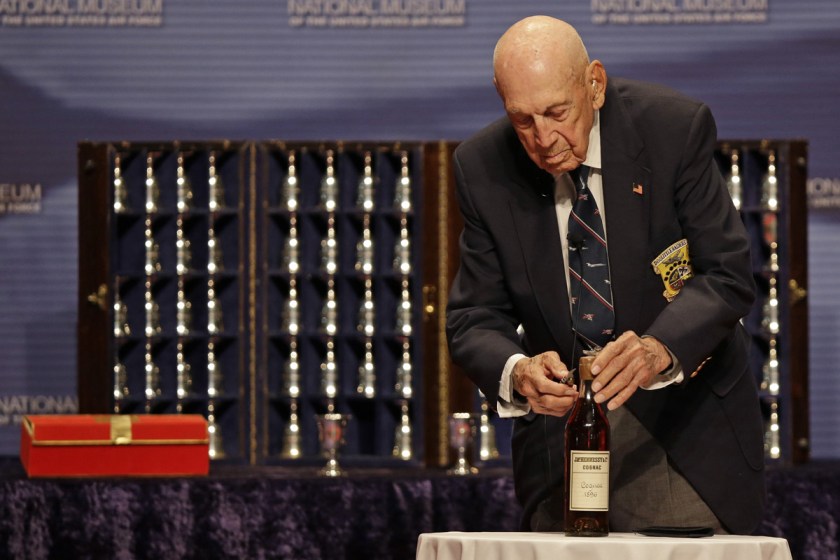
With those goblets is a fine bottle of vintage Cognac.  Hennessy VS 1896, the year Jimmy Doolittle was born. For many years there a bargain between the survivors that, one day, the last two would open that bottle, and toast their comrades.

DSC00017

They changed that bargain in 2013.   Just a little. Jimmy Doolittle himself passed away in 1993. Twenty years later, 76 goblets were turned over, each signifying a man who had passed on.  Now, there were only four.

  1. Lieutenant Colonel Richard E. Cole* of Dayton Ohio was co-pilot of crew No. 1.  Remained in China after the Tokyo Raid until June 1943, and served in the China-Burma-India Theater from October, 1943 until June, 1944. Relieved from active duty in January, 1947 but returned to active duty in August 1947.
  2. Lieutenant Colonel Robert L. Hite* of Odell Texas was co-pilot of crew No. 16. Captured by the Japanese and held prisoner for forty months, he watched his weight drop to eighty pounds.
  3. Lieutenant Colonel Edward J. Saylor* of Brusett Montana was engineer-gunner of crew No. 15.   Served throughout the duration of WW2 until March 1945, both Stateside, and overseas.  Accepted a commission in October 1947 and served as Aircraft Maintenance Officer at bases in Iowa, Washington, Labrador and England.
  4. Staff Sergeant David J. Thatcher* of Bridger Montana was engineer-gunner of crew No. 7.  Served in England and Africa after the Tokyo raid until June 1944, and discharged in July 1945.
*H/T, http://www.doolittleraider.com

These four agreed to gather, one last time.  It would be these four men who would finally open that bottle.

doolittle2

Robert Hite, 93, was too frail to travel in 2013.  Wally Hite stood in for his father.

On November 9, 2013, that 117 year-old bottle of rare, vintage cognac was cracked open, and enjoyed among a company of heroes.  If there is a more magnificent act of tribute, I cannot at this moment think of what it might be.

On April 18, 2015, Richard Cole and David Thatcher fulfilled their original bargain, as the last surviving members of the Doolittle raid.  Staff Sergeant Thatcher passed away on June 23, 2016, at the age of 94.  Today, not one of those eighty goblets remains upright.  Lieutenant Colonel Richard Cole passed from this life on April 9, 2019, at the age of 103.  There is no living man today who has so earned the right to open that rare and vintage cognac.

November 6, 1944 Going Home

Sometime in the 2030s it is said, the most destructive war in human history will fade from living memory as the last World War II combatant, is laid to rest. They have All earned the right, to be remembered.

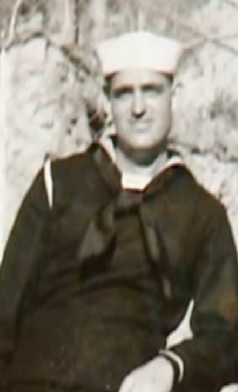
As Depression descended over the 1930s US, few states had a harder time of it, than the Sooner state. This was the world of Loyce Edward Deen, growing up 7th of eight children born to Grace and Allen Deen in the small town of Sulphur, Oklahoma.

The family moved to Altus, Oklahoma where Allen worked as a schoolteacher. Loyce would care for his younger brother Lewis, born with Down’s syndrome. The pair became extremely close. It broke his brother’s heart when Lewis became and ill and died, while Loyce was still in Junior High.

Loyce and his older brother Lance were busy during the High school years, caring for their mother following a debilitating stroke.

Loyce’s niece Bertha Deen Sullivan was little at the time, and still remembers. “Loyce was a tall dark handsome young man with deep blue eyes”. He would pick her up and ask “Who loves ya?” And then he would kiss her on the forehead.

Altus was a small town, the kind of place where the newspaper printed the bio of every graduating high school senior. Where Deen was concerned, the Times-Democrat wrote “Loyce Deen is a young man with high ambitions. He plans to enter the US Navy aeronautical mechanics division after graduation and finds subjects such as problems of American democracy, the most interesting. He has also been active in dramatics work at school.

Loyce worked for a time with the government’s Civilian Conservation Corps (CCC), and later joined the Douglas Aircraft Company in Wichita, building wing sets for the A-26 Invader attack bomber.

Loyce_pic_

Deen wanted to join the Navy, even before the Japanese attack on Pearl Harbor. In October 1942, he did just that.

First came basic training in San Diego and then gunner’s school, learning all about the weapons systems aboard a Grumman TBF Avenger torpedo bomber. Then on to Naval Air School Fort Lauderdale, before joining the new 15th Air Group, forming out of Westerly, Rhode Island.

On April 29, 1944, the Air Group reported for duty aboard the “Fightingest Ship in the Navy” at Pearl Harbor.  The aircraft carrier, USS Essex.

An Air Group consists of eighty or so aircraft, of three distinct types. First are the fighters, the fast, single seat Grumman Hellcats. Next are the two-seat dive bombers, the Curtiss Helldivers, the pilot joined by a rear-seat gunner whose job it is to lay the one-ton bomb on the target while handling a machine gun, at the same time. Third is the torpedo bomber, the Grumman Avenger, with two enlisted crewmen in addition to the pilot. The Avenger carries a ton of bombs, depth charges or aerial torpedoes and, like the Helldiver, is designed for low-level attack.

cache_3727742604

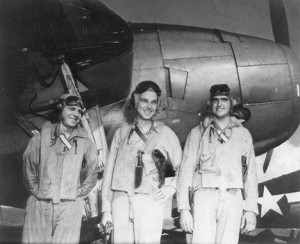
Loyce was the turret gunner on one of these Avengers, assigned to protect the aircraft from above and teamed up with Pilot Lt. Robert Cosgrove from New Orleans, Louisiana and Radioman Digby Denzek, from Grand Rapids, Michigan.

Cosgrove was a superb pilot, often returning aircraft to the carrier, so shot up as to seem unflyable. Digby had several jobs, including arming the weapons systems, and operating the radio. When the team was under fire, Digby would crawl down into a ball turret on the belly of the aircraft, his machine gun defending from below.

The 15th Air group saw some of the most intense fighting it had ever encountered during the battle of Leyte Gulf of October 24-25, 1944. Commander Lambert, who oversaw the Avenger squadron, described “Coming in through the most intense and accurate AA yet experienced, the squadron made three hits on one battleship, two hits on another battleship, and two hits each on two different heavy cruisers“.

Dennis_Blalock
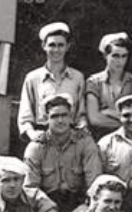
Dennis Blalock of Calhoun GA, his hands on the shoulders of shipmate, Loyce Deen. Both would be dead within ten days, of this photograph

Deen received a shrapnel wound to his foot sometime during the fighting of the 24th. He wrapped the thing up and stayed on to fight, the following day. He would later receive a Purple heart medal for the wound. Posthumously.

Following rest and replenishment at Ulithi Atoll in the Caroline Islands, USS Essex was on station for the November 5 Battle of Manila Bay.  Loyce could have stayed back on a hospital ship until that foot healed, but chose to ignore the injury and rejoin his unit.

Loyce’s niece Bertha, was not surprised. On being informed of his injury, she said “I’m not surprised he stayed with his unit. Loyce would not have it any other way – he would always remain at his post to make sure his brothers came home safely with him.

Loyce Deen climbed into his gun turret for the last time on November 5. It was a two hour ride to the target zone in Manila Bay, with Japanese aircraft on the radar for most of that time, the carriers USS Lexington and Ticonderoga, under kamikaze attack.

Lieutenant Cosgrove’s Avenger came under savage anti-aircraft fire, from a Japanese cruiser.  Loyce Deen took two direct hits and was killed, instantly.  The Avenger aircraft, tail number 93, was so smashed up as to be all but unflyable.  It took all of the pilot’s strength and skill to fly the thing back through two thunderstorms, and land on the Essex.

e281f946d5375133dd2c1afe6213dacd

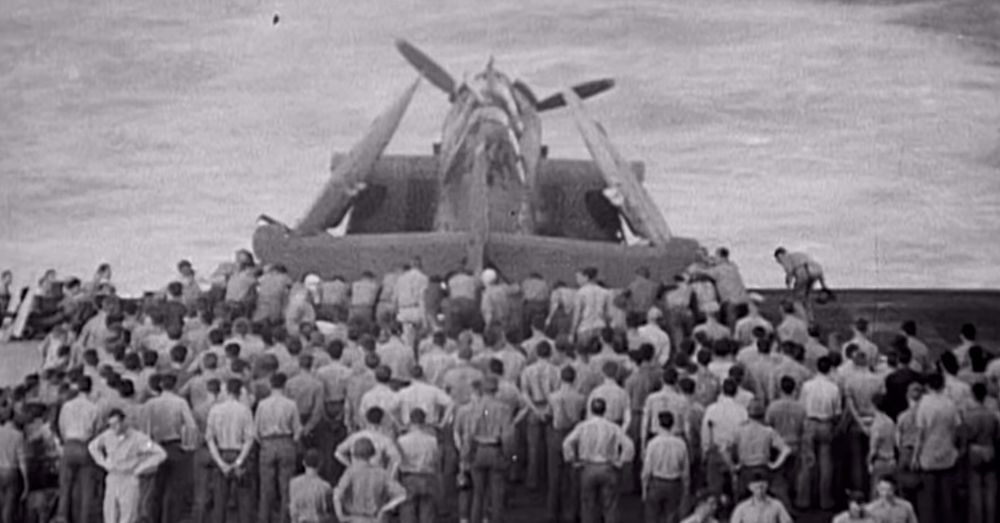
The body Loyce Edward Deen was so badly mangled it was impossible to disentangle the remains, from the smashed turret. For the first time in history and I believe the only time, a man was deliberately buried at sea, entombed by the aircraft in which he had served.

Fingerprints were taken and dog tags removed. This particular Avenger wasn’t even scavenged, for parts. With the crew of the USS Essex assembled on deck, the shattered aircraft was pushed over the side. Two other Avengers flew overhead in salute, as the tail dipped beneath the waves.

Loyce Edward Deen, was going home.

Not long after the ceremony, the carrier went to General Quarters. There were kamikazes to deal with.

For us this story has come to an end. Lieutenant Cosgrove and the rest of Air Group 15 got back into their aircraft the following day, November 6 and again on the 12th, 13th and 14th, each day yet another mortal combat against that same fleet, in Manila Bay.

For the Deen family the dread knock came to their door, the week of Thanksgiving.