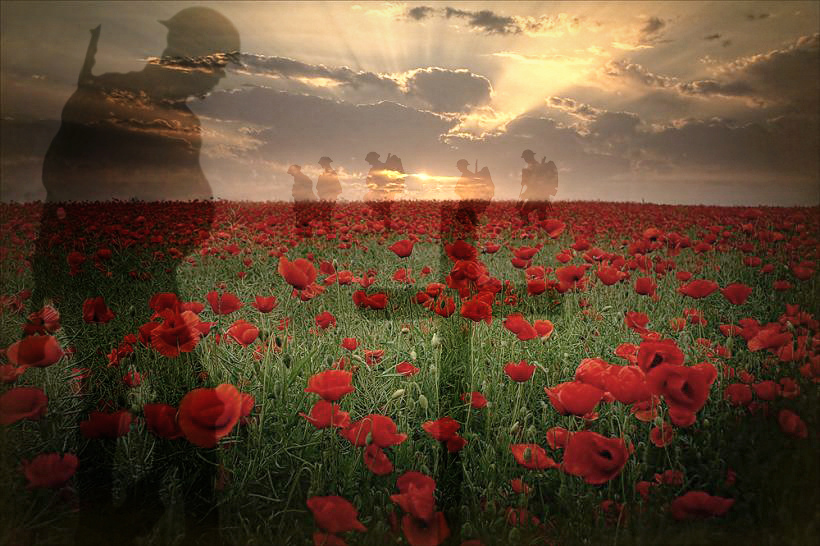
November 11, 1918 The Eleventh Hour

The final surrender was signed at 5:10am on November 11, and back-timed to 5:00am Paris time, scheduled to go into effect later that morning. The 11th hour, of the 11th day, of the 11th month.

In an alternate history, the June 1914 assassination of the heir-apparent to the Habsburg Empire could have led to nothing more than a regional squabble.  A policing action, in the Balkans.

As it was, mutual distrust and entangling alliances combined with slavish obedience to mobilization timetables, to draw the Great Powers of Europe, into the vortex.  On August 3, the “War to End All Wars” exploded across the European continent.

Many of the soldiers who went off to war in those days, viewed the conflict as some kind of grand adventure. Many of them singing patriotic songs, the young men and boys of Russia, Germany, Austria and France stole last kisses from wives and sweethearts, and boarded their ships and trains.

Believing overwhelming manpower to be the key to victory, British Secretary of State for War Lord Horatio Kitchener recruited friends and neighbors by the tens of thousands into “Pal’s Battalions”, to fight for King and country.
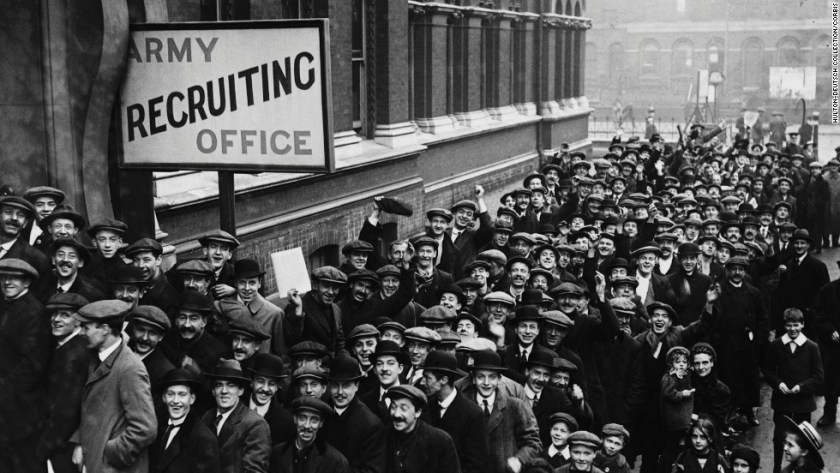
140604153439-19-wwi-main-timeline-0604-restricted-horizontal-large-gallery
The signs could have been written in any number of languages, in the early phase of the war

Four years later, an entire generation had been chewed up and spit out, in pieces.

Any single day’s fighting during the great battles of 1916 produced more casualties than every European war of the preceding 100 years, civilian and military, combined.

6,503 Americans lost their lives during the savage, month-long battle for Iwo Jima, in 1945. The first day’s fighting during the 1916 Battle of the Somme, killed three times that number on the British and Commonwealth side, alone.

battle_of_the_somme_in_pictures_1
Over 1.5 million shells were fired in the days leading to the battle of the Somme

Over 16 million were killed and another 20 million wounded, while vast stretches of the European countryside were literally, torn to pieces. Tens of thousands remain missing, to this day.

Had you found yourself in the mud and the blood, the rats and the lice of the trenches during the New Year of 1917-’18, you could have heard a plaintive refrain drifting across the barbed wire and frozen wastes of no man’s land, sung to the tune of ‘Auld Lang Syne”.

We’re here, because we’re here,
because we’re here, because we’re here,
we’re here, because we’re here,
because we’re here, because we’re here.
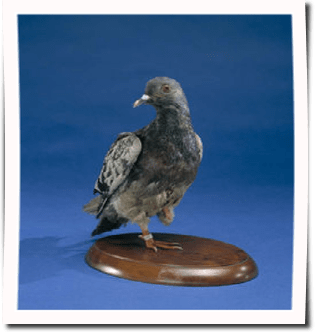
cher-ami
Cher Ami

Those who fought the “Great War”, were not always human.  The carrier pigeon Cher Ami escaped a hail of bullets and returned twenty-five miles to her coop despite a sucking chest wound, the loss of an eye and a leg that hung on, by a single tendon.  The message she’d been given to carry, saved the lives of 190 men.

“Warrior” was the thoroughbred mount to General “Galloper” Jack Seely, arriving in August 1914 and serving four years “over there”. “The horse the Germans can’t kill” survived snipers, poison gas and shellfire to be twice buried alive in great explosions, only to return home to the Isle of Wight, and live to the ripe old age of 33.
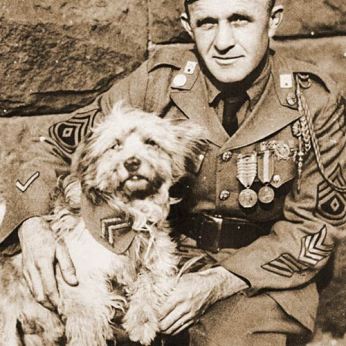
18-03-23-thumb
First division Rags

First Division Rags” ran through a torrent of shells, gassed and blinded in one eye, a shell fragment damaging his front paw, yet still, he got his message through.

Jackie the baboon lost a leg during heavy bombardment from German guns, while frantically building a protective rock wall around himself, and his comrades.

Tirpitz the German pig jumped clear of the sinking light cruiser SMS Dresden, to become mascot to the HMS Glasgow.

Sixteen million animals served on all sides and in all theaters of WW1:  from cats to canaries, to pigeons and mules, camels, donkeys and dogs.  As “dumb animals”, these were never given the choice to “volunteer”.  And yet they served, some nine million of them making the supreme sacrifice.
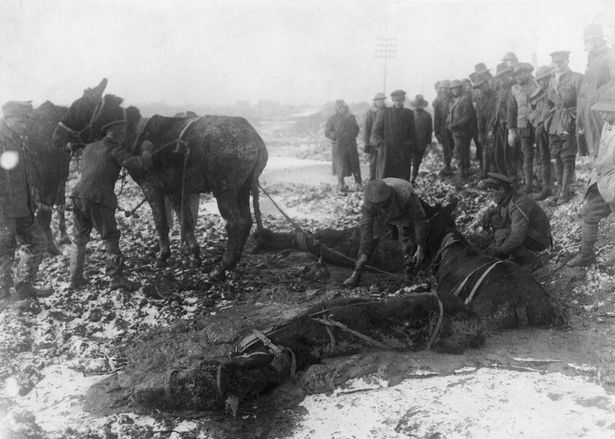
WW1-animals
British Army mules in the mud of the western front, 1918

In the end, starvation and malnutrition stalked the land at home as well as the front, with riots at home and mutiny in the trenches. The Russian Empire of the Czars had collapsed into a Bolshevik hellhole, never to return.  Nearly every combatant saw the disintegration of its domestic economy, or teetering on the brink.

A strange bugle call came out of the night of November 7, 1918. French soldiers of the 171st Régiment d’Infanterie, stationed near Haudroy, advanced into the fog and the darkness, expecting that they were about to be attacked. Instead, they were shocked to see the apparitions of three sedans, their sides displaying the German Imperial Eagle.

Imperial Germany, its army disintegrating in the field and threatened with revolution at home had sent a peace delegation, headed by the 43-year-old German politician Matthias Erzberger.

The delegation was escorted to the Compiegne Forest near Paris, to a conference room fashioned out of a railroad dining car. There they were met by a delegation headed by Ferdinand Foch, Marshall of France.

Adolf Hitler would gleefully accept French surrender in the same rail car, some twenty-two years later.

original-french-postcard-showing-the-wagon-in-which-the-ww1-armistice-M1B0DJ

The German delegation was shocked at the words that came out of Foch’s mouth. ‘Ask these gentlemen what they want,’ he said to his interpreter. Stunned, Erzberger responded. The German believed that they were there to discuss terms of an armistice. Foch dropped the hammer: “Tell these gentlemen that I have no proposals to make”.

Ferdinand Foch had seen his country destroyed by war, and had vowed “to pursue the Feldgrauen (Field Grays) with a sword at their backs”. He had no intention of letting up.

Marshall Foch now produced a list of thirty-four demands, each one a sledgehammer blow on the German delegation. Germany was to divest herself of all means of self-defense, from her high seas fleet to the last machine gun. She was to withdraw from all lands occupied since 1870. With the German population at home facing starvation, the allies were to confiscate 5,000 locomotives, 150,000 railroad cars, and 5,000 trucks.

1200px-Waffenstillstand_gr

By this time, 2,250 were dying every day on the Western Front.  Foch informed Ertzberger that he had 72 hours in which to respond. “For God’s sake, Monsieur le Marechal”, responded the German, “do not wait for those 72 hours. Stop the hostilities this very day”.  Even so, the plea fell on deaf ears. Fighting would continue until the last minute, of the last day.

The German King, Kaiser Wilhelm, abdicated on the 10th, as riots broke out in the streets of Germany. The final surrender was signed at 5:10am on November 11, and back-timed to 5:00am Paris time, scheduled to go into effect later that morning. The 11th hour, of the 11th day, of the 11th month.

The order went out to that effect. The war would be over in hours, but there were no other instructions.

Some field commanders ordered their men to stand down. Why fight and die over ground they could walk over, in a few hours?
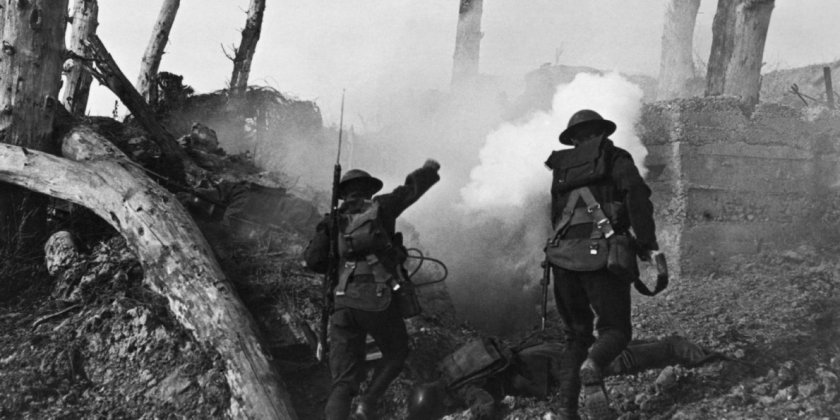
the-last-soldier-killed-in-wwi-died-one-minute-before-the-war-ended
The last six hours

Many continued the attack, believing that Germany had to be well and truly beaten. Others saw their last chance at glory or promotion. An artillery captain named Harry S Truman, kept his battery firing until only minutes before 11:00.

English teacher turned Major General Charles Summerall had a fondness for the turn of phrase. Ordering his subordinates across the Meuse River in those final hours, Summerall said “We are swinging the door by its hinges. It has got to move…Get into action and get across. I don’t expect to see any of you again…

No fewer than 320 Americans were killed in those final six hours, another 3,240 seriously wounded.

7fe16b6c9f770b107480c9ca6c28e87c

Still smarting from the disastrous defeat at Mons back in 1914, British High Command was determined to take the place back, on the final day of the war. The British Empire lost more than 2,400 in those last 6 hours.

The French 80th Régiment d’Infanterie received two orders that morning – to launch an attack at 9:00, and cease-fire at 11:00. French losses for the final day amounted to 1,170. The already retreating Germans suffered 4,120.

One-hundred years ago today, all sides suffered over 11,000 dead, wounded, and missing in those final six hours. Some have estimated that more men died per hour after the signing of the armistice, than during the D-Day invasion, 26 years later.

Over in the Meuse-Argonne sector, Henry Gunther was “visibly angry”.   Perhaps this American grandson of German immigrants felt he had something to prove.  Anti-German bias had not reached levels of the next war, when President Roosevelt interned Americans of Japanese descent.  Yet, such bias was very real.  Gunther’s fiancé had already broken up with him, and he’d recently been busted in rank, after writing home complaining about conditions at the front.

Bayonet fixed, Gunther charged the enemy machine gun position, as German soldiers frantically waved and yelled for him, to go back. He got off a “shot or two”, before the five round burst tore into his head. Henry Nicholas John Gunther of Baltimore Maryland, was the last man to die in combat, in the Great War.  It was 10:59am.  The war would be over, in sixty seconds.
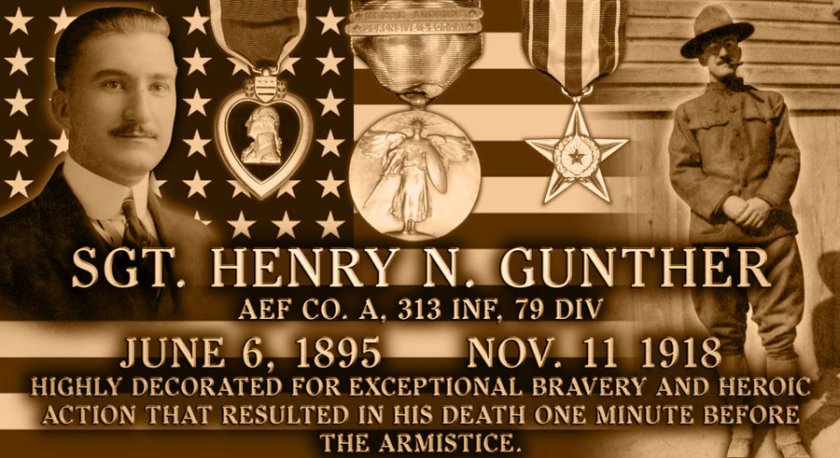
Sargeant-Henry-Gunther

After eight months on the front lines of France, Corporal Joe Rodier of Worcester Massachusetts, was jubilant.   “Another day of days“.   Rodier wrote in his diary.  “Armistice signed with Germany to take effect at 11 a.m. this date. Great manifestations. Town lighted up at night. Everybody drunk, even to the dog. Moonlight, cool night & not a shot heard“.

Matthias Erzberger was assassinated in 1921, for his role in the surrender. The “Stab in the Back” mythology destined to become Nazi propaganda, had already begun.

AEF Commander General John “Black Jack” Pershing believed the armistice to be a grave error. He believed that Germany had been defeated but not beaten, and that failure to smash the German homeland meant that the war would have to be fought, all over again. Ferdinand Foch agreed. On reading the Versailles treaty in 1919, Foch said “This isn’t peace! This is a truce that will last for 20 years”.

The man got it wrong, by 36 days.
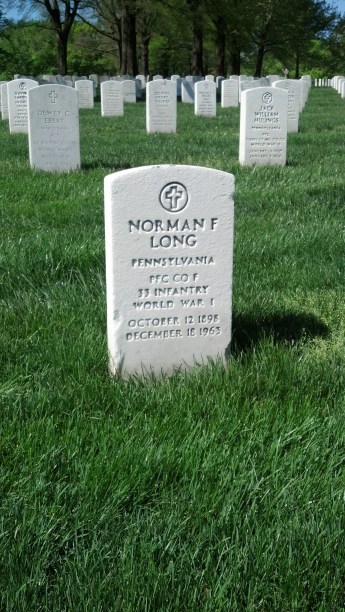
Norman Francis Long

A personal note:

I am old enough at age sixty, to enjoy the memories of a five-year-old, fishing with his grandfather.

PFC Norman Francis Long was wounded during the Great War, a member of the United States Army, 33rd Pennsylvania Infantry.  He left us on December 18, 1963, only hours before his namesake and my brother Norman, was born.

A 1977 fire in the national archives, left us without the means to learn the details of his service.

My father’s father went to his final rest on Christmas eve of 1963, in Arlington National Cemetery.  Section 41, grave marker 2161.

Rest in peace, Grampa.  You left us, too soon.


If you enjoyed this “Today in History”, please feel free to re-blog, “like” & share on social media, so that others may find and enjoy it as well. Please click the “follow” button on the right, to receive email updates on new articles.  Thank you for your interest, in the history we all share.

November 4, 1918 Soldier Poet

My friend, you would not tell with such high zest
To children ardent for some desperate glory,
The old Lie: Dulce et decorum est
Pro patria mori.

Wilfred Edward Salter Owen was working as a private English tutor in Bordeaux, when the “Great War” broke out in 1914.

800px-Memorial_to_the_Artists_Rifles,_Royal_Academy,_LondonAt first in no hurry to sign up, he even considered joining the French Army before returning home to England, to enlist in the Artists Rifles Training Corps, in October 1915.
Originally formed in 1859, the Artists Rifles was a British special forces regiment, raised in London and comprised of painters, musicians, actors and architects, and symbolized by the heads of the Roman gods Mars and Minerva.

It must have felt a natural place.  Wilfred Owen was a poet, a talent first discovered about ten years earlier, at age ten or eleven.

Owen was commissioned Second Lieutenant after six-months training, and posted with the Manchester Regiment of line infantry.  An application to the Royal Flying Corps was rejected in 1916 and he was shipped to France, joining the 2nd Manchester regiment near Beaumont Hamel, on the river Somme.

He was contemptuous of his men at first, considering them to be louts and barbarians.  He wrote home to his mother Susan in 1917, describing his company as “expressionless lumps”.  The war would soon beat that out of him.

Owen was close with his mother, his letters home telling a tale of mud and frostbite, of fifty hours spent under heavy bombardment, sheltered only by a muddy, flooded out dugout, of falling through shell-shattered earth into a cellar below, earning him a trip to the hospital.  It would not be his last.

Owen was caught in an explosion during the bitter battle of St. Quentin, blown off of his feet and into a hole, there to spend days fading in and out of consciousness amidst the shattered remains of a fellow officer.

d6d65d6After this experience, soldiers reported him behaving strangely. Owen was diagnosed as suffering from neurasthenia or shell shock, what we now understand to be Post-Traumatic Stress Disorder, and sent to Craiglockhart War Hospital in Edinburgh, for treatment.

There, Dr. Arthur Brock encouraged Owen to work hard on his poetry, to overcome his shell shock.  There he met another patient, the soldier and poet, Siegfried Sassoon. The chance meeting would elevate Wilfred Owen to one of the great war poets, of his generation.

Owen’s work was qualitatively different before this time, vaguely self important but never self pitying. Never a pacifist – he held those people to ridicule – Owen’s nightmares now brought forth a brutal honesty and a deep compassion for the burdens of the ordinary soldier.  Tales of trench life:  of gas, lice, mud and death, of Hell and returning to earth, steeped in contempt for the patriotic sentimentality of non-combatants and the slurs of cowardice, so lightly dispensed by the women of the “White Feather” movement.

Anthem for Doomed Youth, is a classic of the period:

What passing-bells for these who die as cattle?
— Only the monstrous anger of the guns.
Only the stuttering rifles’ rapid rattle
Can patter out their hasty orisons.
No mockeries now for them; no prayers nor bells;
Nor any voice of mourning save the choirs,—
The shrill, demented choirs of wailing shells;
And bugles calling for them from sad shires.

What candles may be held to speed them all?
Not in the hands of boys, but in their eyes
Shall shine the holy glimmers of goodbyes.
The pallor of girls’ brows shall be their pall;
Their flowers the tenderness of patient minds,
And each slow dusk a drawing-down of blinds.

wilfred-owenOwen continued to write through his period of convalescence, his fame as author and poet growing through the late months of 1917 and into March of the following year. Supporters requested non-combat postings on his behalf, but such requests were turned down. It’s unlikely he would have accepted them, anyway. His letters reveal a deep sense of obligation, an intention to return to the front to be part of and to tell the story of the common man, thrust by his government into uncommon conditions.

Wilfred Owen well understood his special talent.  He wanted a return to front line combat, made all the more urgent when Sassoon was once again wounded, and removed from the front.

He was back in France by September 1918, capturing a German machine gun position on the 29th, for which he would be awarded the Military Cross.  Posthumously.

On October 31, Owen wrote home to his mother, from the cellar of the Forrester’s house, at Ors.  It was to be the last such note she would ever receive,  “Of this I am certain: you could not be surrounded by a band of friends half so fine as surround me here.

The forty-four mile Sambre-Oise Canal flows through the Meuse river basin, a network of 38 locks directing the water’s flow and connecting the Netherlands and Belgium with the central waterways of France. Forces of the 2nd Battalion Royal Sussex forced the canal on November 4, in coordination with elements of the 2nd Manchester Regiment and the Lancashire Fusiliers. British forces were to cross surrounding fields lined with high hedges, then to cross the canal by portable foot bridges, or climbing across the lock gates, themselves.

landrecies1918

The battle of the Sambre–Oise Canal was one of the last Allied victories of the Great War, and not without cost. Lock houses on the opposite side formed strong points for German defensive fire, from small arms and machine guns.

Wilfred Owen was at the head such a raiding party, when the bullets from the German machine gun tore into his body. He died a week nearly to the hour, from the armistice which would end the war.  He was twenty-five.

The church bells of Shrewsbury rang out in celebration that day in 1918, as Owen’s parents Tom and Susan, received the telegram.  The eleventh hour of the eleventh day of the eleventh month.

“Deeply regret to inform you, that…”

“Dulce et Decorum Est”

Bent double, like old beggars under sacks,
Knock-kneed, coughing like hags, we cursed through sludge,
Till on the haunting flares we turned our backs,
And towards our distant rest began to trudge.
Men marched asleep. Many had lost their boots,
But limped on, blood-shod. All went lame; all blind;
Drunk with fatigue; deaf even to the hoots
Of gas-shells dropping softly behind.

Gas! GAS! Quick, boys!—An ecstasy of fumbling
Fitting the clumsy helmets just in time,
But someone still was yelling out and stumbling
And flound’ring like a man in fire or lime.—
Dim through the misty panes and thick green light,
As under a green sea, I saw him drowning.

In all my dreams before my helpless sight,
He plunges at me, guttering, choking, drowning.

If in some smothering dreams, you too could pace
Behind the wagon that we flung him in,
And watch the white eyes writhing in his face,
His hanging face, like a devil’s sick of sin;
If you could hear, at every jolt, the blood
Come gargling from the froth-corrupted lungs,
Obscene as cancer, bitter as the cud
Of vile, incurable sores on innocent tongues,—
My friend, you would not tell with such high zest
To children ardent for some desperate glory,
The old Lie: Dulce et decorum est
Pro patria mori.

Wilfred Owen, 1917

October 26, 1918 Talking in Code

In 1917, Colonel Bloor heard two of his Choctaw soldiers talking to each other, and realized he didn’t have the foggiest notion of what they were saying. If he didn’t understand their conversation, the Germans wouldn’t have a clue.

During the twentieth century, the United States and others specially recruited bilingual speakers of obscure languages, then applying those skills in secret communications based on those languages.  Among these, the story of the Navajo “Code Talkers” are probably best known.   Theirs was a language with no alphabet or symbols, a language with such complex syntax and tonal qualities as to be unintelligible to the non-speaker. The military code based on such a language proved unbreakable in WWII. Japanese code breakers never got close.

The United States Marine Corps recruited some 4-500 Navajo speakers, who served in all six Marine divisions in the Pacific theater.  Guadalcanal, Tarawa, Peleliu, Iwo Jima:  Navajo code talkers took part in every assault conducted by the United States Marine Corps, from 1942 to ‘45.

160907143620-navajo-code-talkers-3-exlarge-169.jpgThe history of the Navajo code talkers of WWII is relatively well known, but by no means, unique.  Indigenous Americans of other nations served as code talkers in WW2, including Assiniboine, Lakota and Meskwaki soldiers, who did service in the Pacific, North African, and European theaters of the war.
Fourteen Comanche soldiers took part in the Normandy landings.  As with the Navajo, these substituted phrases when their own language lacked a proper term.  Thus, “tank” became “turtle”.  “Bombers” became “pregnant airplanes”.  Adolf Hitler was “Crazy White Man”.

The information is contradictory, but Basque may also have been put to use, in areas where no native speakers were believed to be present.  Native Cree speakers served with Canadian Armed Services, though oaths of secrecy have all but blotted their contributions, from the pages of history.

The first documented use of military codes based on native American languages took place during the Second Battle of the Somme in September of 1918, employing on the language skills of a number of Cherokee troops.

The government of Choctaw nation will tell you otherwise, contending that Theirs was the first native language, used in this way.  Late in 1917, Colonel Alfred Wainwright Bloor was serving in France with the 142nd Infantry Regiment. They were a Texas outfit, constituted in May of that year and including a number of Oklahoma Choctaws.

The Allies had already learned the hard way that their German adversaries spoke excellent English, and had already intercepted and broken several English-based codes. Colonel Bloor heard two of his Choctaw soldiers talking to each other, and realized he didn’t have the foggiest notion of what they were saying. If he didn’t understand their conversation, the Germans wouldn’t have a clue.

ChoctawCoders
Choctaw soldiers in training in World War I for coded radio and telephone transmissions

The first test under combat conditions took place on October 26, 1918, as two companies of the 2nd Battalion performed a “delicate” withdrawal from Chufilly to Chardeny, in the Champagne sector. A captured German officer later confirmed the Choctaw code to have been a complete success. We were “completely confused by the Indian language”, he said, “and gained no benefit whatsoever” from wiretaps.

Choctaw soldiers were placed in multiple companies of infantry. Messages were transmitted via telephone, radio and by runner, many of whom were themselves native Americans.

As in the next war, Choctaw would improvise when their language lacked the proper word or phrase. When describing artillery, they used the words for “big gun”. Machine guns were “little gun shoot fast”.

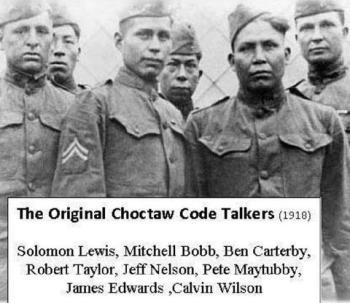
Choctaw code talkersThe Choctaw themselves didn’t use the term “Code Talker”, that wouldn’t come along until WWII. At least one member of the group, Tobias W. Frazier, simply described what they did as, “talking on the radio”.  Of the 19 who served in WWI, 18 were native Choctaw from southeast Oklahoma. The last was a native Chickasaw. The youngest was Benjamin Franklin Colbert, Jr., the son of Benjamin Colbert Sr., one of Teddy Roosevelt’s “Rough Riders” of the Spanish American War. Born September 15, 1900 in the Durant Indian Territory, he was all of sixteen, the day he enlisted.
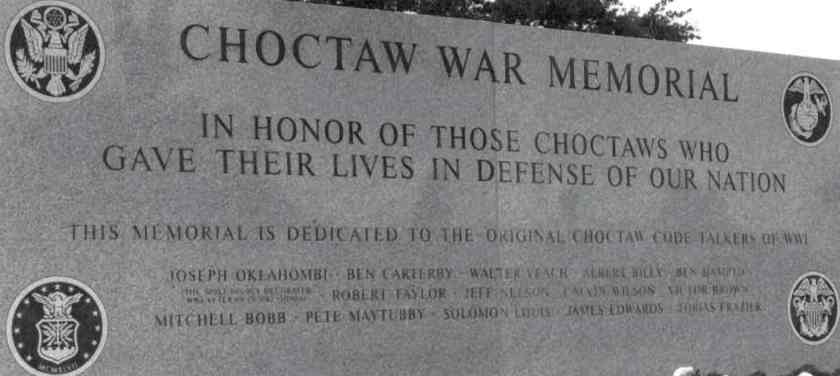
Another was Choctaw Joseph Oklahombi, whose name means “man killer” in the Choctaw language. Six days before Sergeant York’s famous capture of 132 Germans in the Argonne Forest, Joseph Oklahombi charged a strongly held German position, single-handed. Oklahombi‘s Croix de Guerre citation, personally awarded him by Marshall Petain, tells the story:

“Under a violent barrage, [Pvt. Oklahombi] dashed to the attack of an enemy position, covering about 210 yards through barbed-wire entanglements. He rushed on machine-gun nests, capturing 171 prisoners. He stormed a strongly held position containing more than 50 machine guns, and a number of trench mortars. Turned the captured guns on the enemy, and held the position for four days, in spite of a constant barrage of large projectiles and of gas shells. Crossed no man’s land many times to get information concerning the enemy, and to assist his wounded comrades”.

Unconfirmed eyewitness accounts report that 250 Germans occupied the position, and that Oklahombi killed 79 of them before their comrades decided it was wiser to surrender. Some guys are not to be trifled with.

choctawwarmemorial

October 22, 1914 Massacre of the Innocents

A million men had been brought to this place, for the purpose of killing each other.     The first Battle for Ypres, (there would be others), was the greatest clash in history, or one of them, bringing together more manpower and more firepower than entire wars of the previous century.

“Sitzkrieg”. “Phony War”. Those were the terms used to describe the September 1939 to May 1940 period, when neither side of what was to become World War 2, was yet prepared to launch a major ground war against the other.

The outbreak of “The Great War” twenty-five years earlier, was a different story. Had you been alive in August of 1914, you could have witnessed what might be described as the simultaneous detonation, of a continent.  France alone suffered 140,000 casualties over the four day “Battle of the Frontiers”, where the River Sambre met the Meuse.  27,000 Frenchmen died in a single day, August 22, in the forests of the Ardennes and Charleroi.

Battle-of-the-Frontiers-1914-7
Battle of the Frontiers, 1914

The British Expeditionary Force escaped annihilation on August 22-23, only by the intervention of mythic angels, at a place called Mons.  In the East, a Russian army under General Alexander Samsonov was encircled and so thoroughly shattered at Tannenberg, that German machine gunners were driven to insanity at the damage inflicted by their own guns, on the milling and helpless masses of Russian soldiers.  Only 10,000 of the original 150,000 escaped death, destruction or capture.  Samsonov himself walked into the woods, and shot himself.

The “Race to the Sea” of mid-September to late October was more a series of leapfrog movements and running combat, in which the adversaries tried to outflank one another.  This would be some of the last major movement of the Great War, ending in the apocalypse of Ypres.

When governments make war, It’s the everyday John and the Nigel down the street, the Fritz, the Ivan and the Pierre next door, who must do the fighting, and the bleeding, and the dying.

The battle for the medieval textile town of Leper, most of the battle maps were drawn in French and so we know the place as “Ypres”, began on October 20 and lasted about three weeks, pitting a massive German force of some 600,000 against a quarter-million French, 100,000 British, and 65,000 Belgians.

flanders_october_20-24

A million men had been brought to this place, for the purpose of killing each other.     The first Battle for Ypres, (there would be others), was the greatest clash in history, or one of them, bringing together more manpower and more firepower than entire wars of the previous century. The losses are hard to get your head around. The British Expeditionary Force (BEF) alone suffered 56,000 casualties, including 8,000 killed, 30,000 maimed and another 18,000 missing, of whom roughly one-third, were dead.

The breakdown is harder to get at for the other combatants but, all in, Germany suffered 135,000 casualties, France 85,000 and Belgium, 22,000. Assuming the same percentage distribution of killed, wounded and missing, the three week struggle for Ypres cost the lives of 75,000 men, enough to fill the Athens Olympic Stadium, in Greece.

A story comes down from the fighting of October 22, destined to become German and later Nazi, mythology.  French, British and Belgian troops were by this time, digging into the ground to shelter themselves from what Private Ernst Jünger later called the “Storm of Steel”.   German Generals, desperate to break through the Allied line and capture Calais and the other French ports on the English Channel, attacked.

German reserve divisions comprised of student volunteers:  inexperienced, untrained college students fired with patriotic zeal and singing songs of the Fatherland, marched to the attack against a puny British force, dug into shallow holes around the village of Langemarck.  What the BEF lacked this day in numbers, were more than made up, in firepower. Let William Robinson, a volunteer dispatch driver with the British Army, describe what came to be known as the “Kindermord bei Ypern”  The Massacre of the Innocents at Ypres.

“The enemy seemed to rise out of the ground and sweep towards us like a great tidal wave, but our machine guns poured steel into them at the rate of six hundred shots per minute, and they’d go down like grass before the scythe… The Germans were climbing over heaps of their own dead, only to meet the same fate themselves.”

Overwhelming German numbers succeeded in forcing the British back and capturing Langemarck on October 22, but the cost was appalling.  Some regiments lost 70% of their strength.

5393774889_6b9037d2a6_bDoubt has been cast on the “Myth of Langemarck”, and the tragic bravery of idealistic German boys, happily defending the Fatherland.  The numbers of dead and maimed are real enough, but most reservists were in fact comprised of older working class men, not the fresh-faced youth, of the Kindermord.  Be that as it may, a story must be told.  Excuses must be made to the home team, for the crushing failure of the War of Movement, and the four-year war of attrition, to follow.

Two short months later, some of these same men would step out of their trenches and across the frozen fields of Flanders, to shake the hand of the man he’d been sent there, to kill.  The unofficial “Christmas Truce” of 1914 would last a day or two in some sectors and a week or two in others.  And then it was back, to the business at hand.  For Four. More. Years.

Christmas Truce

The Man He Killed
BY THOMAS HARDY

“Had he and I but met
By some old ancient inn,
We should have sat us down to wet
Right many a nipperkin!
“But ranged as infantry,
And staring face to face,
I shot at him as he at me,
And killed him in his place.
“I shot him dead because —
Because he was my foe,
Just so: my foe of course he was;
That’s clear enough; although
“He thought he’d ‘list, perhaps,
Off-hand like — just as I —
Was out of work — had sold his traps —
No other reason why.
“Yes; quaint and curious war is!
You shoot a fellow down
You’d treat if met where any bar is,
Or help to half-a-crown.”

October 15, 1917 Mata Hari

Historians differ whether she passed on intelligence or merely gossip, a courtesan and middle-aged debutante, and convenient excuse for French failures in the face of the German war machine. 

mata-daughterMargaretha Geertruida Zelle, “M’greet” to family and friends, was born in the Netherlands on August 7, 1876, the eldest of four children.
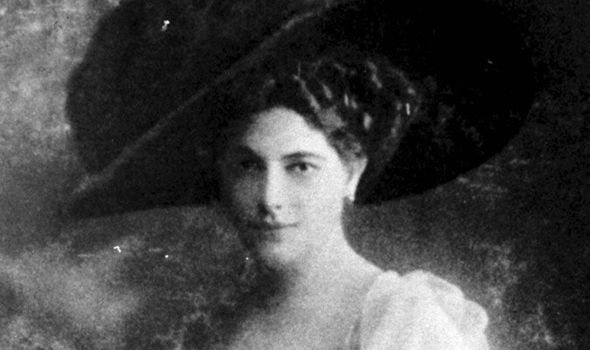
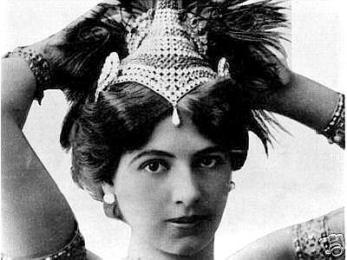
Adam Zelle, Margaretha’s father, was once a prosperous hat merchant.  By 1891, a series of bad investments had cost him his fortune.  He left the family, never to return.  Mother Antje Zelle, died.  Margaretha and her three brothers were broken up, and sent to live with relatives.  She was fifteen.

As a young woman, Margaretha answered a newspaper ad placed by Dutch Colonial Army Captain Rudolf MacLeod, then stationed in the Dutch East Indies, in modern day Indonesia.

Becoming a “mail order bride” must have seemed like the way to financial security.  Strikingly beautiful with raven hair and olive skin, she sent him a photograph, of herself.  Despite a twenty-one year age difference, the couple was wed on July 11, 1895.  She was not yet nineteen.

The marriage produced a daughter, and a son.  MacLeod was a drunk and frequently flew into rages, over the attentions his young wife received from other officers.  The boy was killed in 1899, poisoned by a household worker for reasons which remain unclear.  The marriage was dead by the early 1900s and MacLeod fled, taking the couple’s daughter with him.  The divorce became final, in 1905.

mata_hari-469562

Zelle-MacLeod moved to Paris becoming mistress to a French diplomat, who encouraged her to support herself, as an exotic dancer.  She took the name: “Mata Hari”, Indonesian for “sun” (literally, “eye of the day”), in Sanskrit.

mata-hari2All things “Oriental” were all the rage in early 1900s Paris.  Mata Hari played the more exotic aspects of her background to the hilt, projecting a bold and in-your-face sexuality that was unique and provocative for her time.
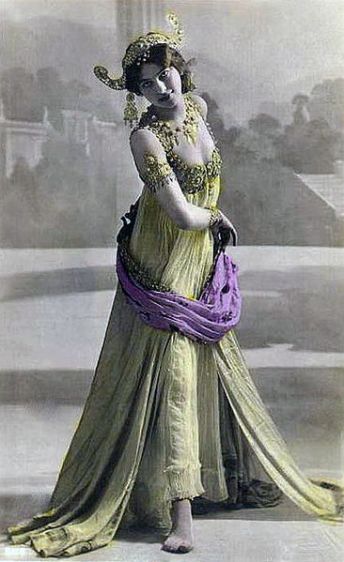
She claimed to be a Java princess of priestly Hindu birth, immersed since childhood in the sacred art of Indian dance.

One Vienna reporter described Mata Hari as “slender and tall with the flexible grace of a wild animal, and with blue-black hair.” Her face, he wrote, “makes a strange foreign impression.” Another writer described her performance as “so feline, extremely feminine, majestically tragic, the thousand curves and movements of her body trembling in a thousand rhythms.”

Carefree and thoroughly uninhibited, Mata Hari was photographed in the nude or the next thing to it on many occasions, becoming the long-time mistress of the millionaire Lyon industrialist Émile Étienne Guimet.

Mata_Hari_postcardThe world stood still at the beginning of World War I, but not Mata Hari.  Her dancing days were over by 1914, but her neutral Dutch citizenship allowed her to move about without restriction.  But not without a price. Mata Hari’s sexual conquests knew no border, naively including officers and government officials of every nationality, and both sides of the Great War.

Rumors of espionage followed and she was taken to Scotland Yard for interrogation in 1916, but later released.

That year, Mata Hari accepted a lucrative assignment to spy for France, from army captain Georges Ladoux.

She would seduce her way into the German High Command but the Germans suspected as much and set her up, releasing a cable labeling Mata Hari, as a German double agent.

She was arrested again on February 13, 1917, in her room at the Hotel Elysee Palace, in what is now the banking giant HSBC’s French headquarters. She was kept in a rat infested prison as the case was prepared against her, all the while writing to the Dutch Consul in Paris, proclaiming her innocence. “My international connections are due to my work as a dancer, nothing else”, she wrote. “I really did not spy, it is terrible that I cannot defend myself”.

In a bombshell confession which probably sealed her fate, Mata Hari admitted during interrogations by Captain Pierre Bouchardon, that a German diplomat had paid her 20,000 francs.  She said the money meant nothing, that she saw it as compensation for furs and other clothing lost on a train, while she was being hassled by German border guards.  “A courtesan, I admit it. A spy, never!” she insisted. “I have always lived for love and pleasure.”

matahariMata Hari’s elderly defense attorney and former lover Edouard Clunet, never really had a chance. He couldn’t cross examine the prosecution’s witnesses, or even directly question his own.

The trial took place during a string of French military defeats.  Spies both real and imagined, were convenient scapegoats.  By some accounts, Captain Ladoux even tampered with evidence, to put her case in the worst possible light.

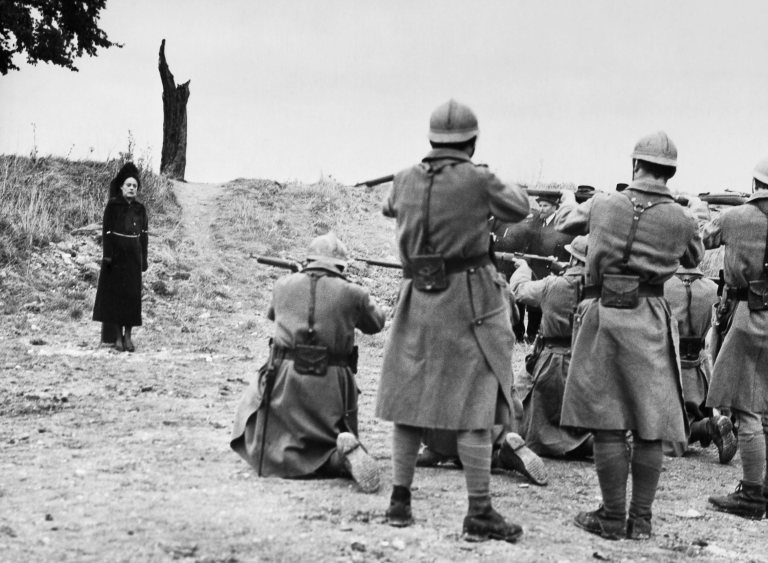
The conviction was a foregone conclusion. The military tribunal took forty-five minutes to reach a verdict of guilty.  Margaretha Geertruida Zelle was executed by firing squad on October 15, 1917.  Legend has it, that she blew them a kiss.  She was 41.

British reporter Henry Wales described the execution, based on an eyewitness account:

“Unbound and refusing a blindfold, Mata Hari stood alone to face her firing squad.  After the shots rang out, Wales reported that “Slowly, inertly, she settled to her knees, her head up always, and without the slightest change of expression on her face. For the fraction of a second it seemed she tottered there, on her knees, gazing directly at those who had taken her life. Then she fell backward, bending at the waist, with her legs doubled up beneath her.” An NCO walked up to her body, pulled out his revolver, and shot her in the head to make sure she was dead”.

MataHari

German documents unsealed in the 1970s hint that Mata Hari may have been a German spy, but many disagree with that conclusion.  Historians differ whether she passed on intelligence or merely gossip, a courtesan and middle-aged debutante, and convenient excuse for French failures in the face of the German war machine.  The whole truth may never be known but, the real-life exotic dancer who later became a lethal double agent, is a story that’s hard to resist.

If you enjoyed this “Today in History”, please feel free to re-blog, “like” & share on social media, so that others may find and enjoy it as well. Please click the “follow” button on the right, to receive email updates on new articles.  Thank you for your interest, in the history we all share.

October 13, 1914 Signalman Jack

One day, a train passenger looked down and realized with horror, that a monkey was switching the tracks.

In the early days of the Great War, the formerly separate British colonies of the Cape, Natal, Transvaal and Orange River were united in the Union of South Africa, in support of the Allied war effort.

Public opinion was by no means, unanimous.  “Afrikaners” were bitterly opposed to alliance with the British.  The Jameson Raid and two Boer Wars were hard pills to swallow, and life-long friendships were cast asunder.  As former Generals of the second Boer War, Prime Minister Louis Botha and Defense Minister Jan Smuts had once fought the British.  Now, that was in the past.  Like many, the two men dreamed of a unified South Africa.

Anti-British rebellion broke out on this day in 1914, but was quickly put down by loyalist South Africans.  Before the war was over, some 136,000 of their countrymen would serve in the African, Middle East and Western Fronts of the Great War.

The story of World War 1 is intertwined with the history of rail.  The mobilization of millions in a matter of weeks, would have been impossible without the railroads which moved them.   WW1 could not  have happened the way it did, without rail.

(c) Piet Conradie Klipplaat 25-08-2009 e - SAR Class 15AR (R indicates reboilered) engine no 1840

South African recruits traveled rails begun in 1859, when early construction worked its way inland from deep-water ports and harbors. James Edwin Wide came to work for the South African railroad, about twenty years later.

Co-workers on the Cape Town–Port Elizabeth Railway service called him “Jumper” for his fondness of jumping between railway cars.  It was a regrettable habit, which would one day, cost him his legs.

After the accident, Wide’s railroad days seemed to be over.  Then a signalman’s job opened up. Wide would work the Uitenhage train station twenty-three miles outside of Port Elizabeth, switching the tracks for oncoming trains.

Trains would toot their whistle a specified number of times, telling the signalman which tracks to change.  The job suited him, pulling the levers is easy enough for a man with no legs.  Not so much, the half-mile walk to work.

jack-the-signalman3One day at an open-air market, the peg-legged signalman saw something that changed all that. It was a monkey, a Chacma baboon.
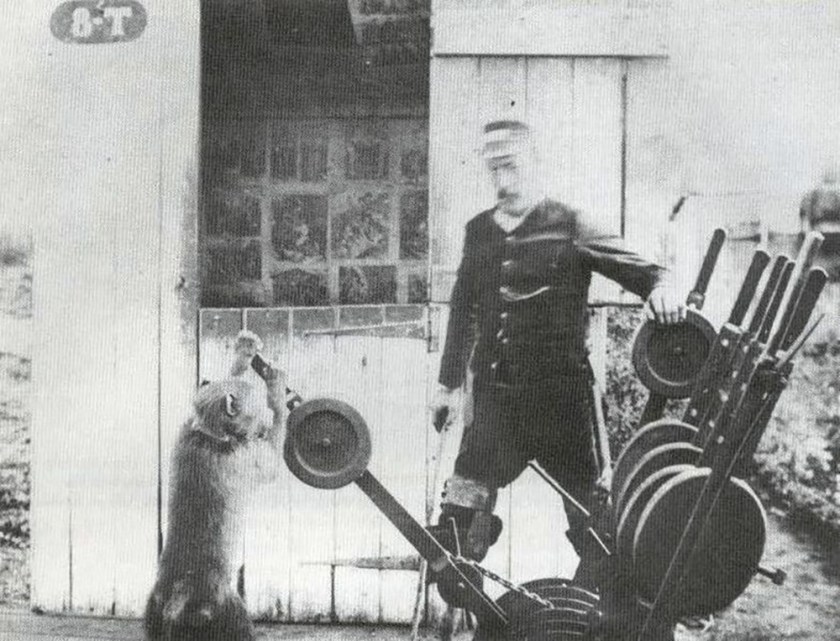
One of the largest of the “Old World” monkeys, a Chacma or “Cape” baboon is an intelligent animal. “Corporal Jackie” proved as much, during the “War to end all Wars”. This one was exceptionally so. This one was driving an oxcart.

Wide bought the animal and called him”Jack”, and taught him to pull his small trolley, up and down the line.  Jack was a help around the house, sweeping the floors and taking out the trash. He figured out the train signal and the switch thing too.  Soon, Jack was pulling on the levers, himself.

William Luff writes in The Railway Signal, that Wide “trained the baboon to such perfection that he was able to sit in his cabin stuffing birds, etc., while the animal, which was chained up outside, pulled all the levers and points.

One day, a train passenger looked down and realized with horror, that a monkey was switching the tracks. (It must have been fun to be in the complaint department, when That one came in).  Railroad managers were furious and could have fired signalman Wide, but decided to test his baboon, instead.

jack-the-signalman41

Railway superintendent George Howe came away, astounded. “Jack knows the signal whistle as well as I do, also every one of the levers…It was very touching to see his fondness for his master. As I drew near they were both sitting on the trolley. The baboon’s arms round his master’s neck, the other stroking Wide’s face.”

Jack passed with flying colors.  Managers were so impressed they gave him the job, for real. “Signalman Jack” now had an employee number, and a salary of twenty cents per day, plus a half-bottle of beer, each week.  It isn’t clear what a baboon did with the money, though one suspects it may have purchased more than a few peanuts.

Signalman Jack worked the rail until the day he died of tuberculosis, in 1890.  A keyword search for railroad accidents between 1880 and ’89, the time-frame for this story, reveals a list of sixty-one serious incidents. In the nine years in which he was on the job, Signalman Jack made not one single mistake.

jack.signalman_0

If you enjoyed this “Today in History”, please feel free to re-blog, “like” & share on social media, so that others may find and enjoy it as well. Please click the “follow” button on the right, to receive email updates on new articles.  Thank you for your interest, in the history we all share.

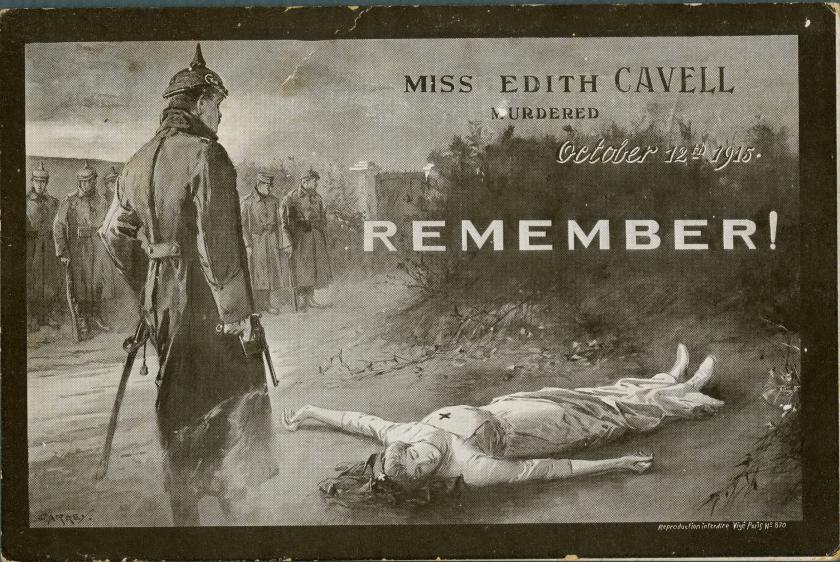
October 11, 1915 The Execution of Edith Cavell

“Standing as I do in view of God and Eternity, I realise that patriotism is not enough, I must have no hatred or bitterness towards anyone”. – Edith Cavell, October 11, 1915

ec1
The Cavell vicarage in Swardeston is now a private home

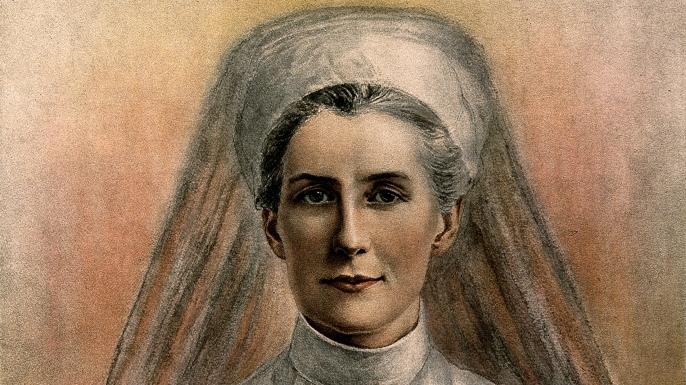
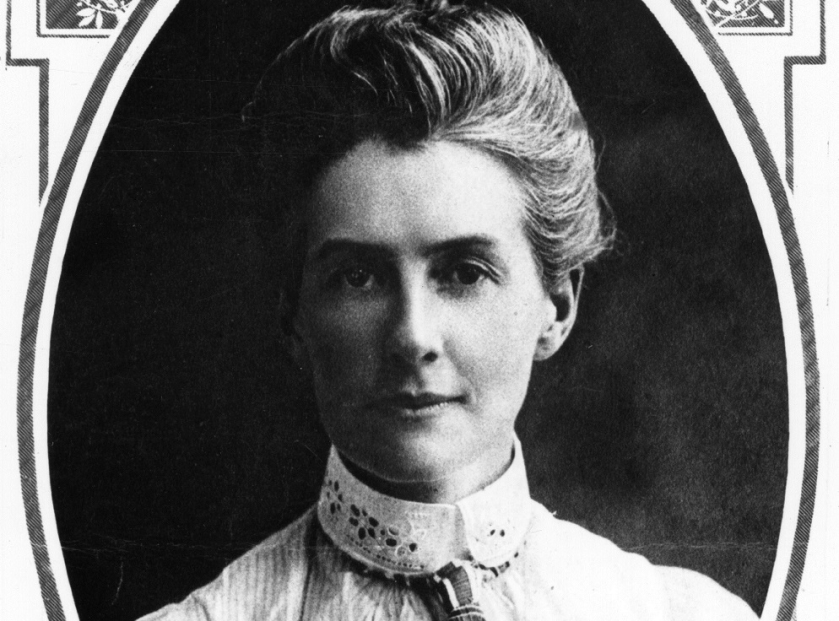
As a little girl growing up in Swardeston, Norfolk, Edith Cavell was no saint.  Nor was she a “bad girl “.  Just a normal kid, growing up in Victorian England.   The daughter of a Vicar of the Church of England, she thought her father’s sermons were ‘boring’. Even so, she would hold her Christian faith until the day she died.

Reverend Frederick Cavell was something of a Puritan and nearly ruined the family finances, building the vicarage with his own money.  Yet, this was no crabbed and dour man of the cloth.  He was easily tempted into roaring like a bear and chasing the three Cavell sisters and their brother about the house, to squeals of children’s laughter.

ec3
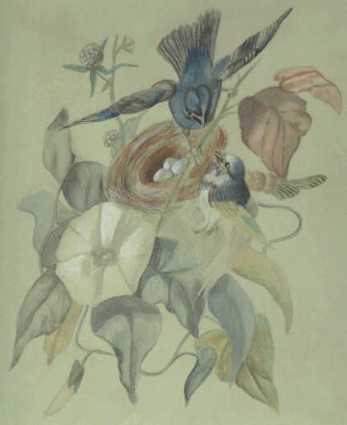
Chalk drawing by Edith Cavell

A gifted artist, Edith loved to paint and draw, the birds, flowers and even fellow villagers, frequent subjects. She and her sister once painted and sold cards to finance a new room in their father’s Sunday school, raising the impressive sum of £300.

As a young woman, she once danced until her feet bled, and destroyed a new pair of shoes, in the process.

Edith worked a number of jobs as governess, including one in Brussels, Belgium.  The children under her care remembered her as wonderfully kind and always smiling, and great fun to be with.

On Summer breaks she’d return to Swardeston, where she loved to play tennis, and to paint.  It was there that she cared for her father in 1895, nursing the parson through a brief illness.  Reverend Cavell recovered, but the experience convinced Edith, she was cut out for a career in nursing.

ecdepage
Edith Cavell with Dr. LePage at the Berkendael Institute

Following training at Royal London Hospital, Edith worked a number of positions, rising through the ranks and becoming matron of Queen’s District Nursing Homes, in 1906. The following year, Edith returned to Brussels at the request of Dr. Antoine Depage, to nurse a child patient under his care. That October, Depage opened the nursing school ‘L’École Belge d’Infirmières Diplômées’ based in his Berkendael Institute, and asked Edith to run it.

In 1913, Cavell’s educational program was producing exceptionally qualified professional nurses, providing for the staffing needs of three hospitals, 24 communal schools and 13 kindergartens. When Queen Elizabeth of Belgium fell and broke her arm, one of Edith’s nurses was personally requested, to provide her care.

On top of it all. she was still giving four lectures a week to doctors and nurses, and still finding time to care for a friend’s daughter who was addicted to morphine, providing for a runaway girl, and for her two dogs, Don and Jack.

Nurse_Edith_Cavell_1865-1915_Q32930

In June 1914, a tubercular nineteen-year-old named Gavrilo Princip murdered the heir-apparent to the dual monarchy of the Austro-Hungarian Empire, in Sarajevo. As diplomats bungled their way through the “July Crisis” of 1914, Edith returned to Norfolk, to visit with her now widowed mother. She was pulling weeds from the garden on August 1, when she learned that Austro-Hungarian troops had invaded Serbia.

Entangling alliances and mutual distrust drew a continent into war in the days that followed, as Edith returned to Brussels, feeling her nursing skills were now needed, more than ever.

ec5
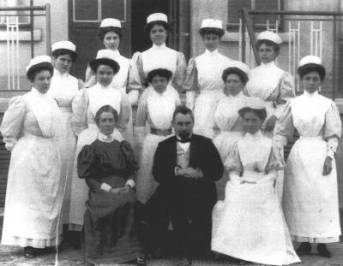
Edith Cavell with some of her nurses, in Belgium

German soldiers invaded and occupied Brussels later that August, and the wounded came pouring into Edith’s clinic.  The International Red Cross took over the hospital at this time, the neutral organization established to care for the wounded of all nationalities.  Medical personnel were strictly forbidden from taking sides.  Edith cared for all who needed her services, regardless of uniform or nationality.

The German violation of Belgian neutrality was an outrageous provocation, the single cause for which England entered the war.  German troops were afraid of Belgian guerrilla fighters, the francs-tireurs, believing them to be every bit as dangerous, as the French soldiers they were fighting. Allied propaganda magnified tales of German brutality into the “Rape of Belgium”, but such atrocities against civilians were very real, particularly in places like Liège, Andenne, Leuven and foremost, Dinant.

The Battle of Mons of August 23 was a crushing defeat for the badly outnumbered British Expeditionary Force (BEF), the first such confrontation on European soil since the Battle of Waterloo, in 1815. Hundreds of British and allied soldiers were cut off and stranded, behind enemy lines. Word got back to the Red Cross hospital about allied soldiers being shot by German troops, while locals took others into their homes to hide them from harm.

800px-British_Empire_Union_WWI_poster

That September, Edith took in two British soldiers, hiding them for two weeks in her clinic.  She was later asked to join an underground organization, dedicated to hiding these stranded soldiers and spiriting them across borders into neutral territories.  Despite the danger to herself, she agreed.  She was now in violation of the law.

For the rest of 1914 until the following September, Edith hid 200 stranded soldiers at the Berkendael Institute, while architect Philippe Baucq secretly organized their evacuation to neutral Holland.

Edith Cavell

Now enters this story, a name which must be remembered with the likes of Judas Iscariot,  Ephialtes of Trachis and Vidkun Quisling, as Traitor.  Five years later, Georges Gaston Quien would be tried and convicted by Parisian authorities of collaborating with the enemy, and put to death.  Quien had betrayed Edith Cavell’s organization, to German secret police.

Baucq was arrested on July 31, 1915, with another member of the escape-route team.  Letters found in their possession incriminated Edith Cavell and she was arrested, on August 5.  German interrogators tricked her into confession, claiming that they knew everything, already.  The best thing she could do, was save her friends.  Confess.

She was placed in solitary confinement for the rest of that month, and tried for treason, in early October.  At trial, Edith freely confessed to helping allied soldiers escape German occupied territory.

ec6

Edith Cavell’s Brussels cell

Edith Cavell was convicted of treason on October 11, 1915, along with Philippe Baucq, and three others. The sentence was death. Neutral governments in the United States and Spain protested, and attempted to get the sentence reduced. Such efforts came to nothing.

The English chaplain Stirling Gahan visited her cell on the last day of her life, and found her calm, as she received the Sacrament.  “I am thankful to have had these 10 weeks of quiet to get ready”.  she told him.  “Now I have had them and have been kindly treated here. I expected my sentence and I believe it was just. Standing as I do in view of God and Eternity, I realise that patriotism is not enough, I must have no hatred or bitterness towards anyone”. 

Her final words were as worthy, as those of that hero of the American Revolution, Nathan Hale, who regretted only that he had but one life to give for his country.  In the last moments of her life, she calmly spoke to the German Lutheran prison chaplain, Paul Le Seur.  “Ask Father Gahan to tell my loved ones later on that my soul, as I believe, is safe, and that I am glad to die for my country.”

Edith Louisa Cavell was executed by firing squad at 2:00am on October 12, at the Tir National shooting range, in Schaerbeek.  She was forty-nine.

e-19960034-008

Hat tip to www.edithcavell.org.uk, from which I have learned much of this story, and drawn many of these images.

If you enjoyed this “Today in History”, please feel free to re-blog, “like” & share on social media, so that others may find and enjoy it as well. Please click the “follow” button on the right, to receive email updates on new articles.  Thank you for your interest, in the history we all share.

October 4, 1918 First Division Rags

The Big Red One marched down Broadway in 1928, part of the First Division’s 10th anniversary WW1 reunion.  The French street dog who had lost an eye in their service, in the lead.

Private James Donovan was AWOL. He had overstayed his leave in the French town of Montremere, and the ‘Great War’, awaited.

When the MPs found him, Donovan knew he had to think fast. He reached down and grabbed a stray dog, explaining to the two policemen that he was part of a search party, sent out to find the Division Mascot.

rags-figure13-jpg

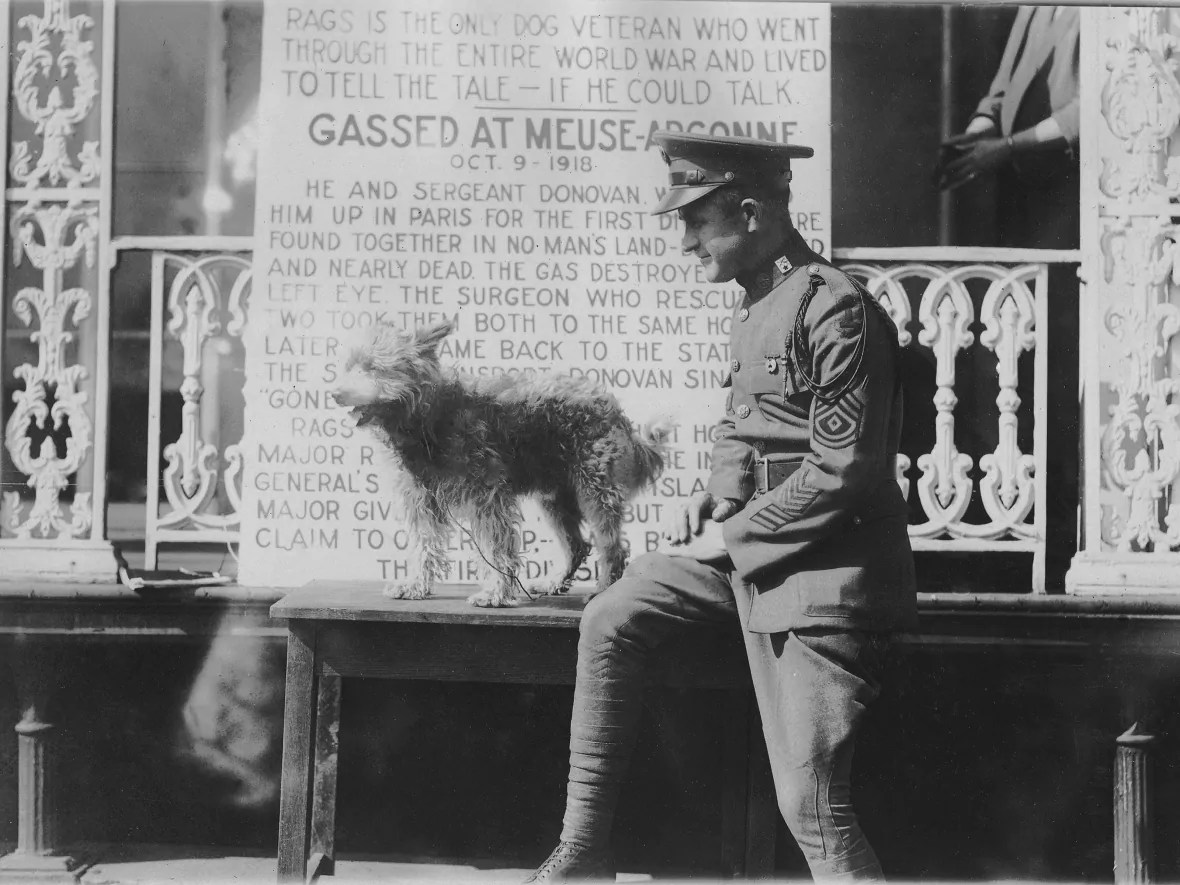
It was a small dog, possibly a Cairn Terrier mix, about twenty-five pounds. He looked like a pile of rags, and that’s what they called him. The dog had gotten Donovan out of a jam, now he would become the division mascot, for real. Rags was now part of the US 1st Infantry Division, the Big Red One.

Instead of “shaking hands”, Donovan taught the dog a sort of doggie “salute”. Rags would appear at the flag pole for Retreat for years after the war, lifting his paw and holding it by his head. Every time the flag was lowered and the bugle played, there was that small terrier, saluting with the assembled troops.

The dog learned to imitate the men around him, who would drop to the ground and hug it tightly during artillery barrages. He would hug the ground with his paws spread out, soon the doughboys noticed him doing it before any of them knew they were under fire. Rags’ acute and sensitive hearing became an early warning system, telling them that shells were incoming, well before anyone heard them.

rags-the-dog

Rags was disdainful of doggie tricks, he was more interested in Doing something.  In the hell of life in the trenches, barbed wire was often all that stood between safety and enemy attack.  Wire emplacements were frequent targets for bombardment, and a break in the wire represented a potentially lethal weak point in the lines.  Somehow, Rags could find these breaks in the wire, and often led men into the darkness, to effect repairs.

Thousands of dogs, horses and pigeons were “enlisted” in the first world war, with a number of tasks.  The French trained specialized “chiens sanitaire” to seek out the dead and wounded, and bring back small bits of uniform so that aid could be delivered, or the body recovered.  Somehow, Rags figured this job out, for himself.  Once he found a dead runner, and recovered the note the man had died, trying to deliver.  Not only was his body found, but that note enabled the rescue of an officer, cut off and surrounded by Germans.

rags-figure18-jpg

Donovan’s job was hazardous. He was out on the front lines, stringing communications wire between advancing infantry and supporting field artillery. Runners were used to carry messages until the wire was laid, but these were frequently wounded, killed or they couldn’t get through the shell holes and barbed wire.

Donovan trained Rags to carry messages attached to his collar. On this day in 1918, British and French forces were engaged in heavy fighting from St. Quentin to Cambrai. French and Americans in the Champagne region advanced as far as the Arnes, as the American attack ground on, west of the River Meuse. Around this time, Rags was given a message from the 26th Infantry Regiment for the 7th Field Artillery. The small dog completing his mission, resulting in an artillery barrage and leading to the capture of the Very-Epinonville Road.

An important objective had been taken, with minimal loss of life to the American side.

rags-figure19-jpg

The terrier’s greatest trial came five days later, during the Meuse-Argonne Campaign. The small dog ran through falling bombs and poison gas to deliver his message. Gassed and partially blinded, shell splinters damaged his right paw, eye and ear. Rags survived and, so far as I know, got his message where it needed to be.

Rags survived the deadliest battle in American military history, with the loss of an eye.  Now-Sergeant James Donovan, wasn’t so lucky.  He was severely gassed and the two were brought to the rear. If anyone asked about expending medical care on a dog, they were told that it was “orders from headquarters”.

18-03-23-thumb

Rags recovered quickly, but Donovan did not.  He was transferred to the hospital ship in Brest, as Rags was forced to look on, from the docks.  Animals were thought to carry disease and were strictly forbidden from hospital ships.  Those animals who were smuggled on board, were typically chloroformed and thrown overboard.

Nevertheless, Rags was smuggled on board to be with his “Battle Buddy”.  How many entered into the conspiracy of silence in his defense, can never be known.

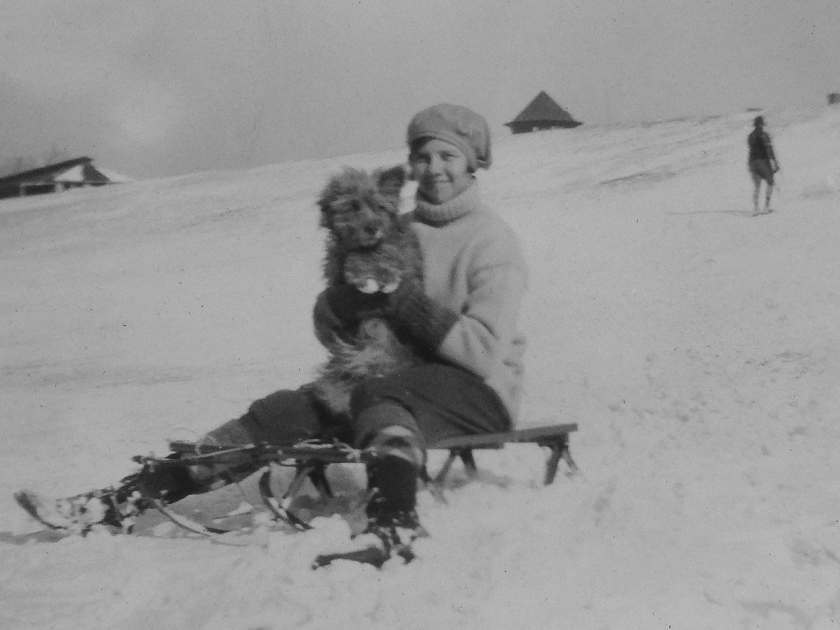
The pair made it back to United States, and to the Fort Sheridan base hospital near Chicago, where medical staff specialized in gas cases. It was here that Rags was given a collar and tag, identifying him as “1st Division Rags”.  Donovan died of his injuries, in early 1919.  Rags moved into the base fire house becoming “post dog”, until being adopted by Major Raymond W. Hardenbergh, his wife and two daughters, in 1920.

rags-the-dog, sledding

The Big Red One marched down Broadway in 1928, part of the First Division’s 10th anniversary WW1 reunion.  The French street dog who had lost an eye in their service, in the lead.

Rags lived out the last of his years in Maryland. A long life it was, too, the dog lived until 1934, remaining with the 1st Infantry Division, for all his 20 years.  On March 22, 1934, the 16-paragraph obituary in the New York Times began: “Rags, Dog Veteran of War, Is Dead at 20; Terrier That Lost Eye in Service is Honored.”

Canadian writer Grant Hayter-Menzies has written a book about 1st Division Rags, from which I have drawn some of these details. The book is entitled From Stray Dog to World War I Hero: The Paris Terrier Who Joined the First Division.  Eleven-minute audio from a fascinating CBC interview, may be found HERE.

Hat tip to the Canadian Broadcasting Corporation, from whose website I have drawn most of these images.

If you enjoyed this “Today in History”, please feel free to re-blog, “like” & share on social media, so that others may find and enjoy it as well. Please click the “follow” button on the right, to receive email updates on new articles.  Thank you for your interest, in the history we all share.

October 2, 1918 Lost Battalion

Lieutenant James Leak compared those six days lost in the Ardennes with the 1836 siege of the Alamo, and the legendary 300, at Thermopylae.

The Argonne Forest is a long strip of wild woodland and stony mountainside in northeastern France, a hunting preserve since the earliest days of the Bourbon Kings.  For most of WWI, the Argonne remained behind German lines.  On October 2, 1918, nine companies of the US 77th “Metropolitan Division” came to take part of it back.

whittlesey
Major Charles White Whittlesey

Their objective was the Charlevaux ravine and a road & railroad on the other side, cutting off German communications in the sector.  As heavy fighting drew to a close on the first day, the men found a way up hill 198 and began to dig in for the night.

Major Charles White Whittlesey, commanding, thought that things were too quiet that first night.  Orders called for them to be supported by two American units on their right and a French force on their left/  That night, the voices drifting in from the darkness, were speaking German.

They had come up against a heavily defended double trench line and, unknown at the time, allied forces to their left and right had been cut off and stalled. The Metropolitan Division was alone, and surrounded.

The fighting was near constant on day two, with no chance of getting a runner through.   Whittlesey dispatched a message by carrier pigeon, “Many wounded. We cannot evacuate.”  The last thing that German forces wanted was for an enemy messenger to get through, and the bird went down in a hail of German bullets.

cher-ami
Cher Ami

Whittlesey grabbed another pigeon and wrote “Men are suffering.  Can support be sent?”/  That second bird would be shot down as well.

On day three, the “lost battalion” came under fire from its own artillery.  Whittlesey grabbed his third and last carrier pigeon, “Cher Ami”, and frantically wrote out his message.

German gunfire exploded from the high ridges above them as this bird, too, fluttered to the ground.  Soon she was up again, flying out of sight despite the hail of bullets.  She arrived in her coop 65 minutes later, shot through the breast and blind in one eye.  The message, hanging by a single tendon from a leg all but shot off, read:  “WE ARE ALONG THE ROAD PARALELL 276.4. OUR ARTILLERY IS DROPPING A BARRAGE DIRECTLY ON US. FOR HEAVENS SAKE STOP IT”.

Drops of food and supplies were attempted from the air, but they all ended up in German hands.

the_lost_battalion_1919_-_1

By October 7, food and ammunition were running out.  554 had entered the Ardennes five days earlier, now fifty per cent were either dead, or wounded.  Water was available from a nearby stream, but only at the cost of exposure to German fire.  Bandages had to be removed from the dead in order to treat the wounded. Medicine was completely out and men were falling ill.  Even so, survivors continued to fight off German attacks from all sides.

Out of the forest emerged a blindfolded American prisoner, carrying a white flag.  He’d been sent with a message, from the German commander:

The suffering of your wounded men can be heard over here in the German lines, and we are appealing to your humane sentiments to stop. A white flag shown by one of your men will tell us that you agree with these conditions. Please treat Private Lowell R. Hollingshead [the bearer] as an honorable man. He is quite a soldier. We envy you. The German commanding officer.

Though he later denied it, Whittlesey’s response was remembered as “You go to hell!”.  White sheets placed to help allied aircraft find their position were pulled in, lest they be mistaken for flags of surrender.  The meaning was unmistakable.  When they were finally relieved the following day, only 194 were fit to walk out on their own.

The Meuse-Argonne offensive of which it was part would last forty seven days, and account for the greatest single-battle loss of life, in American military history.

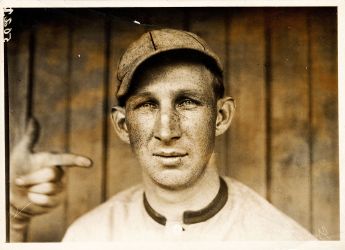
Edward Leslie Grant attended Dean Academy in his home town of Franklin, Massachusetts, and later graduated from Harvard University.  “Harvard” Eddie Grant became a Major League ballplayer, playing utility infielder for the Cleveland Indians as early as 1905.

1920px-_Harvard__Eddie_Grant,_Cincinnati_Reds_third_baseman,_by_Paul_Thompson,_1911
“Harvard Eddie” Grant

Grant delighted in aggravating his fellow infielders, calling the ball with the grammatically correct “I have it”, instead of the customary “I got it”.

Grant played for the Philadelphia Phillies and the Cincinnati Reds, before retiring from the New York Giants and opening a Law Office in Boston. He was one of the first men to enlist when the US entered WWI in 1917, becoming a Captain in the 77th Infantry Division, A.E.F.

Sixty former ballplayers were killed during the Great War, including nine former Major League players, twenty-six minor players, three negro leaguers and a number who played college, semi-pro and amateur. Another four played in the Australian League. Harvard Eddie Grant was killed leading a search for the Lost Battalion on October 5, the first Major League ball player to be killed in the Great War.

Eddie Grant was honored on Memorial Day, 1921, as representatives of the US Armed Forces and Major League Baseball joined with his sisters to unveil a plaque in center field at the Polo Grounds. From that day until the park closed in 1957, a wreath was solemnly placed at the foot of that plaque after the first game of every double header.  He is memorialized by the Edward L. Grant Highway in The Bronx, and by Grant Field at Dean College in Franklin, Massachusetts.

lost-battalion

Major Whittlesey, Captain George McMurtry, and Captain Nelson Holderman all received the Medal of Honor for their actions atop hill 198.  Whittlesey was further honored as a pallbearer at the interment ceremony for the Unknown Soldier, but his experience weighed heavily on him.

In what is believed to have been a suicide, Charles White Whittlesey disappeared from the SS Toloa bound for Havana in 1921, leaving instructions in his stateroom as to what to do with his bags.  Whittlesey’s cenotaph is located at Pittsfield Cemetery in his home town of Pittsfield, Massachusetts.  It is an ‘IMO’ marker (In Memory Only).  His body was never found.

In prepared remarks before a gathering at Abilene Christian College in 1938, Lieutenant James Leak compared those six days lost in the Ardennes with the 1836 siege of the Alamo, and the legendary 300, at Thermopylae.   “[T]he “Lost Battalion””, he said, “is entirely a misnomer…it was not “Lost”. We knew exactly where we were, and went to the exact position to which we had been ordered“.

1200px-LostBattalionMonument
Monument to the Lost Battalion
If you enjoyed this “Today in History”, please feel free to re-blog, “like” & share on social media, so that others may find and enjoy it as well. Please click the “follow” button on the right, to receive email updates on new articles.  Thank you for your interest, in the history we all share.

August 14, 1945 Victory Kiss

When the sailor spotted Greta Zimmer, the dental assistant was dressed in the same white uniform as those Navy nurses. To him, she must have seemed like one of those white-clad angels of mercy from those earlier months.

The most destructive war in history ended this day in 1945, with the unconditional surrender of the Empire of Japan.

Rumors were flying since the small hours on the morning of August 14, but President Harry Truman had yet to receive the formal surrender. The White House’ official announcement was still hours away.

article-2138126-12DED591000005DC-157_306x402Born and raised in Austria, Greta Zimmer was 16 years old, in 1939. Fearful of the war bearing down on them, Greta’s parents sent her and her two sisters to America, not knowing if they’d ever see each other again.

Six years later Zimmer was a dental assistant, working at the Manhattan office of Dr. J. L. Berke.

Patients had been coming into the office all morning, with rumors that the war was over.  Greta’s lunch break came just after 1:00.  She set out for Times Square, knowing that the lit and moving type on the Times news zipper would give her the latest information.

Petty Officer 1st Class George Mendonça was on his last day of shore leave, spending the day with his new girlfriend, Rita Petry. The couple had heard the rumors too, but right now they were enjoying their last day together. The war could wait until tomorrow.

George-MendonsaThe couple went to a movie at Radio City Music Hall, but the film was interrupted by a theater employee who turned on the lights, announcing that the war was over. Leaving the theater, the couple joined the tide of humanity moving toward Times Square.

The pair stopped at the Childs Restaurant on 7th Ave & 49th, where bartenders were pouring anything they could get hands on into waiting glasses. Revelers were scooping them up as fast as the glasses were filled.

Mendonça’s alcohol-powered walk/run from the restaurant left Rita trailing behind, but neither one seemed to mind. Times Square was going wild.

The sailor from the USS Sullivans had seen bloodshed. He’d been there on May 11, as kamikaze planes smashed into the USS Bunker Hill. Explosions and fires killed 346 sailors that day. 43 of their bodies would never be found. Mendonça had helped to pull the survivors, some of them hideously burned, out of the water. He had watched while Navy nurses tended to the grievously wounded, and the dying.

When the sailor spotted Greta Zimmer, the dental assistant was dressed in the same white uniform as those Navy nurses. To him, she must have seemed like one of those white-clad angels of mercy from those earlier months.

V-J_Day_Times_Square_NYWTS

Reporters from the AP, New York Times, New York Daily News and others descended on Times Square, to record the spontaneous celebration.

As a German Jew in the 1930s, Alfred Eisenstaedt had photographed the coming storm. He had photographed Benito Mussolini’s first meeting with Adolf Hitler in Venice, in 1934. Alfred EisenstaedtNow Eisenstaedt and his Leica Illa rangefinder camera worked for Life Magazine, heading for Times Square in search of “The Picture™”.

The lit message running around the Times Building read, “VJ, VJ, VJ, VJ” as George Mendonça grabbed a stranger and kissed her. Two seconds later the moment was gone, but Eisenstaedt and his camera had been in the right place at the right time.

The image of the sailor kissing the nurse would become as famous as Joe Rosenthal’s photo of the flag raising at Iwo Jima, but not until years later.

tumblr_mdc6daetGK1rdtetlo1_500

After the war, Greta Zimmer learned that both of her parents had died in Nazi concentration camps. She later married and made her home in Frederick, Maryland. Greta Zimmer Friedman never returned to Austria, and passed away in September 2016, at the age of 92.

The German made camera which took the iconic image recently went to auction at the Westlicht auction house in Vienna, where it was expected to sell for $30,000. The winning bid was nearly $150,000.

George Mendonça and Rita Petry were married after the war, and put down roots in Rhode Island.  The couple, now married seventy-one years, recently celebrated George’s ninety-fifth birthday.  A framed copy of the famous photograph hangs in the hallway of the couple’s home.   Rita once pointed to herself, grinning in the background of the image.  And then she admitted:  ‘In all these years, George has never kissed me like that.’

3V2RXMYLUBHGJFFSEK2NOOVATM
“Former Navy Quartermaster 1st Class George Mendonça and his wife of 71 years, Rita, celebrate George’s 95th birthday”. H/T Navy Times
Feature image, top of page, Victory Kiss by James Laurier Fine Art, www.jimlaurier.com