Something sacred and wonderful happened back in 2013, and few of us heard about it, at the time.
November 11, nineteen short days ago, marked the end of World War One. Before they had numbers. “The Great War”. The “War to end all Wars”. There is barely a piece of 20th century history, you cannot trace back to that conflict.
International Communism was borne of the Great War, without which there would be no cold war, no Korean War, no war in Vietnam. The killing fields of Cambodia would remain in this alternative universe, mere fields. The spiritual descendants of Chiang Kai-shek’s brand of capitalism would today run all of China, and not some communist cabal.
The modern boundaries of the Middle East arose from the Great War. While the region’s tribal alliances and religious strife are nothing new those conditions would exist in a very different form, if not for those boundaries.
World War II, a conflagration which left more dead, wounded or missing than any conflict in human history (WWI ranks only number 5), was little more than the Great War, part II. A Marshall of France, on looking at the Versailles Treaty formally ending WWI, said “This isn’t peace. This is a cease-fire that will last for 20 years”.
He was off, by something like 36 days.
It’s hard to know how any of us can be participating citizens of a self-governing Republic, how we can know where we want the country to go, if we don’t understand where it’s been. It’s a principle reason to study, history. It’s why I believe something wonderful happened back in 2013, and few of us heard about it.
In the summer of 2013, over 1,000 British and Belgian schoolchildren visited seventy battlefields of the Great War. Ypres. Passchendaele. Verdun. The Somme. All over Northern France and Belgium, the region known as “Flanders”. There those children collected samples of the sacred soil from those fields of conflict.
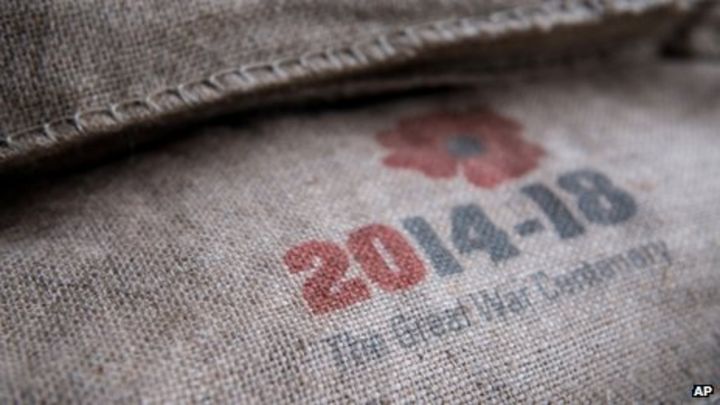
The soil was placed in WWI-style burlap sandbags, each stenciled with a red poppy, where it came from, and the dates. 70 sandbags were transported to London and brought to Wellington Barracks, the central London home to some of the most elite regiments in the British military, regiments dating back to the time of the English Civil Wars who gave so many of their own, to the soil of Flanders Fields.
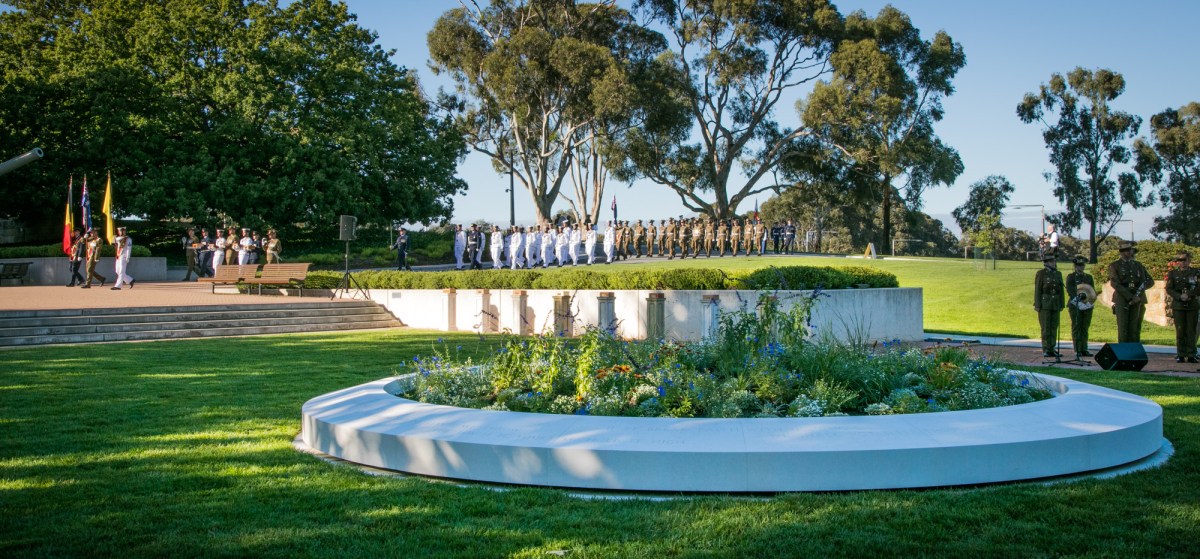
There at Wellington Barracks next to Buckingham Palace a garden was being built. The soil of the Great War would nourish and support that garden, planted to be made ready for the following year, and the solemn 100-years’ remembrance of the War to end all Wars.
That day, December 1, 2013, was for the Flanders Fields Memorial Garden, the first full day of forever.
I cannot think of anything more fitting than that it was children, our own future and posterity, who retrieved the sacred soil of Flanders and brought it to that garden.
It is now for that posterity to keep our shared history alive, and never let it fade into some sepia-toned remnant of a forgotten past.
In the end, starvation and malnutrition stalked the land at home as well as the front with riots at home and mutiny, in the trenches. The Russian Empire of the Czars had collapsed into a Bolshevik hellhole, never to return. Nearly every combatant saw the disintegration of its domestic economy, or teetering on the brink.
In an alternate history, the June 1914 assassinationof the heir-apparent to the Habsburg Empire may have led to nothing more, than a regional squabble. Wiser heads could have prevailed, the diplomatic crisis of July resulting in nothing more than a policing action in the Balkans.
As it was, mutual distrust and entangling alliances combined with slavish obedience to mobilization timetables, to draw the Great Powers of Europe into the vortex. On August 3, the “War to End All Wars” exploded across the European continent.
Many of the soldiers who went off to war in those days, viewed the conflict as some kind of grand adventure. Many of them sang patriotic songs as the young men and boys of Russia, Germany, Austria and France stole last kisses from wives and sweethearts, and boarded their ships and trains.
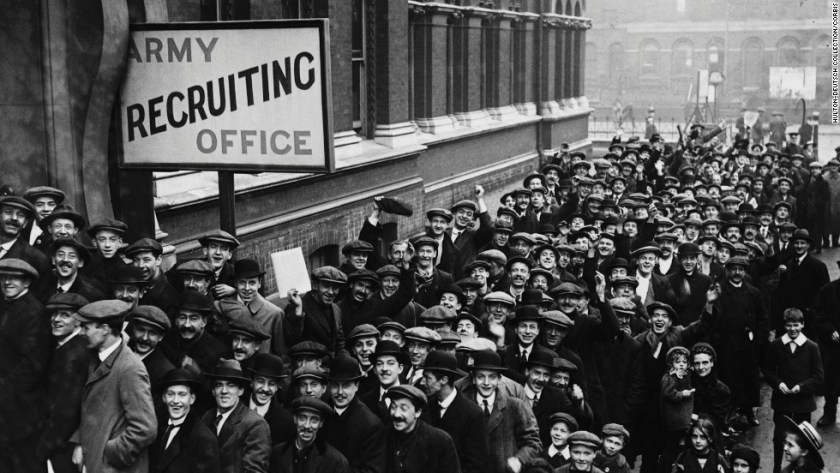
Believing overwhelming manpower to be the key to victory, British Secretary of State for War Lord Horatio Kitchener recruited friends and neighbors by the tens of thousands into “Pal’s Battalions”, to fight for King and country.
The signs could have been written in any number of languages, in the early phase of the war
Over the next four years a generation would be chewed up and spit out, in pieces.
Many single day’s fighting of the great battles of 1916 produced more casualties than every European war of the preceding 100 years, civilian and military, combined.
6,503 Americans lost their lives during the savage, month-long battle for Iwo Jima, in 1945. The first day’s fighting during the 1916 Battle of the Somme killed three times that number on the British and Commonwealth side, alone.
Over 1.5 million shells were fired in the days leading to the battle of the Somme
Over 16 million were killed and another 20 million wounded while vast stretches of the European countryside were literally, torn to pieces. Tens of thousands remain missing, to this day.
Had you found yourself in the mud and the blood, the rats and the lice of the trenches during the New Year of 1917-’18, you could have heard a plaintive refrain drifting across the barbed wire and frozen wastes of no man’s land, sung to the tune of “Auld Lang Syne”.
We’re here, because we’re here, because we’re here, because we’re here, we’re here, because we’re here, because we’re here, because we’re here.
Cher Ami
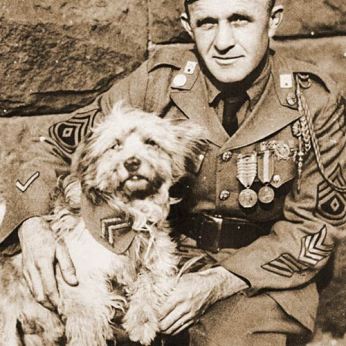
Those who fought the “Great War”, were not always human. The carrier pigeon Cher Ami escaped a hail of bullets and returned twenty-five miles to her coop despite a sucking chest wound, the loss of an eye and a leg that hung on, by a single tendon. The message she’d been given to carry, saved the lives of 190 men.
“Warrior” was the thoroughbred mount to General “Galloper” Jack Seely, arriving in August 1914 and serving four years “over there”. “The horse the Germans can’t kill” survived snipers, poison gas and shellfire to be twice buried alive in great explosions, only to return home to the Isle of Wight, and live to the ripe old age of 33.
First division Rags
“First Division Rags” ran through a torrent of shells, gassed and blinded in one eye, a shell fragment damaging his front paw, yet still, he got his message through.
Jackiethe baboon lost a leg during heavy bombardment from German guns while frantically building a protective rock wall to shelter himself from what the German soldier Ernst Jünger later called, the “Storm of Steel”.
Tirpitz the German pig jumped clear of the sinking light cruiser SMS Dresden and would serve out the war not in a frying pan but as mascot to the HMS Glasgow.
Sixteen million animals served on all sides and in all theaters of WW1: from cats to canaries, to pigeons and mules, camels, donkeys and dogs. As “dumb animals”, none were given the choice to “volunteer”. And yet serve they did, some nine million animals making the supreme sacrifice.
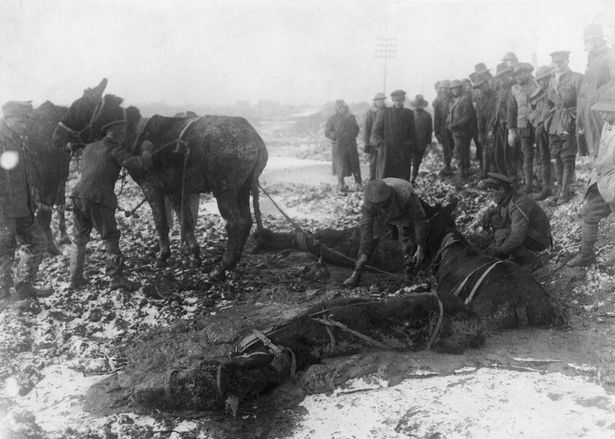
British Army mules in the mud of the western front, 1918
In the end, starvation and malnutrition stalked the land at home as well as the front with riots at home and mutiny, in the trenches. The Russian Empire of the Czars had collapsed into a Bolshevik hellhole, never to return. Nearly every combatant saw the disintegration of its domestic economy, or teetering on the brink.
A strange bugle call came out of the night of November 7, 1918. French soldiers of the 171st Régiment d’Infanterie, stationed near Haudroy, advanced into the fog and the darkness, expecting that they were about to be attacked. Instead, they were shocked to see the apparitions of three sedans, their sides displaying the German Imperial Eagle.
Imperial Germany, its army disintegrating in the field and threatened with revolution at home had sent a peace delegation, headed by the 43-year-old politician Matthias Erzberger.
The delegation was escorted to the Compiegne Forest near Paris, to a conference room fashioned from a railroad dining car. There they were met by a delegation headed by Ferdinand Foch, Marshall of France.
Adolf Hitler would gleefully accept French surrender in the same rail car, some twenty-two years later.
The German delegation was shocked at the words that came out of Foch’s mouth. ‘Ask these gentlemen what they want,’ he said to his interpreter. Stunned, Erzberger responded. The Germans believed they were there to discuss terms of an armistice. Foch dropped the hammer: “Tell these gentlemen that I have no proposals to make”.
Ferdinand Foch had seen his country destroyed by war. He had vowed “to pursue the Feldgrauen (Field Grays) with a sword at their backs”. He had no intention of letting up.
Marshall Foch now produced a list of thirty-four demands, each one a sledgehammer blow on the German delegation. Germany was to divest herself of all means of self-defense, from her high seas fleet to the last machine gun. She was to withdraw from all lands occupied since 1870. With the German population at home facing starvation, the allies were to confiscate 5,000 locomotives, 150,000 rail cars and 5,000 trucks.
With 2,250 dying every day on the Western Front, Foch informed Erzberger he had 72 hours in which to respond. “For God’s sake, Monsieur le Marechal”, responded the German, “do not wait for those 72 hours. Stop the hostilities this very day”. Even so, the plea fell on deaf ears. Fighting would continue until the last minute, of the last day.
The German King, Kaiser Wilhelm, abdicated on the 10th as riots broke out in the streets of Germany. The final surrender was signed at 5:10am on November 11 and back-timed to 5:00am Paris time, scheduled to go into effect later that morning. The 11th hour, of the 11th day, of the 11th month.
The order went out to that effect. The war would be over in hours, but there were no other instructions.
Some field commanders ordered their men to stand down. Why fight and die over ground they could walk over in just a few hours?
The last six hours
Many continued the attack, believing that Germany had to be well and truly beaten. Others saw their last chance at glory or promotion. An artillery captain named Harry S Truman, kept his battery firing until only minutes before 11:00.
English teacher turned Major General Charles Summerall had a fondness for the turn of phrase. Ordering his subordinates across the Meuse River in those final hours, Summerall said “We are swinging the door by its hinges. It has got to move…Get into action and get across. I don’t expect to see any of you again…”
No fewer than 320 Americans were killed in those final six hours, another 3,240 seriously wounded.
Still smarting from the disastrous defeat at Mons back in 1914, British High Command was determined to take the place back, on the final day of the war. The British Empire lost more than 2,400 in those last 6 hours.
The French 80th Régiment d’Infanterie received two orders that morning – to launch an attack at 9:00, and cease-fire at 11:00. French losses for the final day amounted to 1,170. The already retreating Germans suffered 4,120.
One-hundred-three years ago today all sides suffered over 11,000 dead, wounded, and missing in those final six hours. Some have estimated that more men died per hour after the signing of the armistice, than during the D-Day invasion, 26 years later.
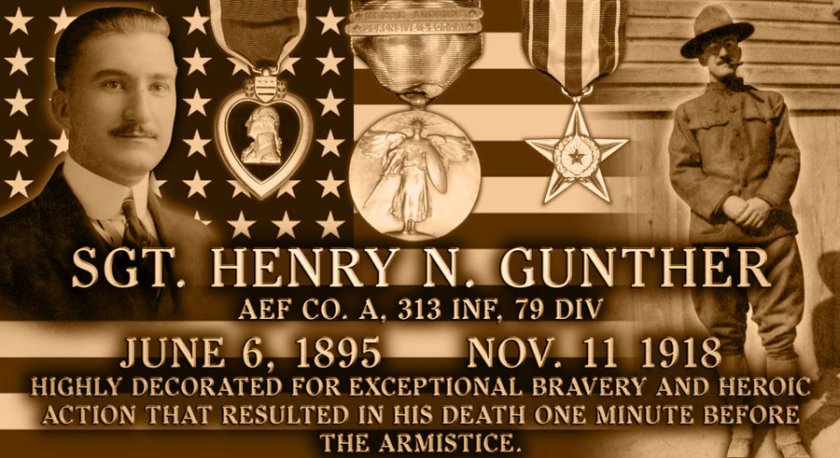
Over in the Meuse-Argonne sector, Henry Gunther was “visibly angry”. Perhaps this American grandson of German immigrants felt he had something to prove. Anti-German bias had not reached levels of the next war, when President Roosevelt interned Americans of Japanese descent. Yet, such bias was very real. Gunther’s fiancé had already broken up with him. He’d recently been busted in rank, after writing home complaining about conditions at the front.
Bayonet fixed, Gunther charged the enemy machine gun position, as German soldiers frantically waved and yelled for him, to go back. He got off a “shot or two”, before the five round burst tore into his head. Henry Nicholas John Gunther of Baltimore Maryland was the last man to die in combat, in the Great War. It was 10:59am. The war would be over, in sixty seconds.
After eight months on the front lines Corporal Joe Rodier of Worcester Massachusetts, was jubilant. “Another day of days“. Rodier wrote in his diary. “Armistice signed with Germany to take effect at 11 a.m. this date. Great manifestations. Town lighted up at night. Everybody drunk, even to the dog. Moonlight, cool night & not a shot heard“.
Matthias Erzberger was assassinated in 1921, for his role in the surrender. The “Stab in the Back” mythology destined to become Nazi propaganda, had already begun.
AEF Commander General John “Black Jack” Pershing believed the armistice to be a grave error. He believed that Germany had been defeated but not beaten, and that failure to smash the German homeland meant that the war would have to be fought, all over again. Ferdinand Foch agreed. On reading the Versailles treaty in 1919, Foch remarked “This isn’t peace! This is a truce that will last for 20 years”.
The man got it wrong, by 36 days.
On a personal note:
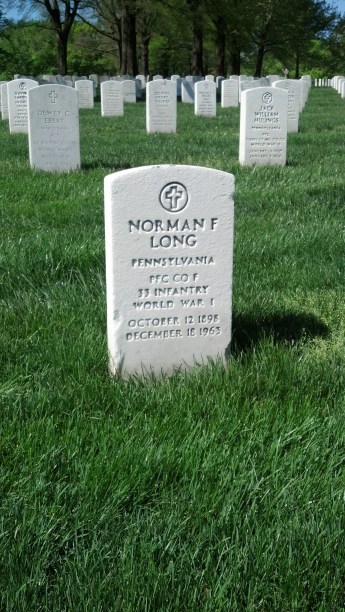
PFC Norman F. Long was wounded during the Great War, a member of the United States Army, 33rd Pennsylvania Infantry. He left us on December 18, 1963, only hours before his namesake, my brother Norm, was born.
My father’s father went to his final rest on Christmas eve of 1963, in Arlington National Cemetery. Section 41, grave marker 2161.
At 63 I remember still, the pleasures of a little boy fishing with his grandfather. Just as I myself will one day take my granddaughter fishing and a bridge some sixty years in the building, will have been crossed.
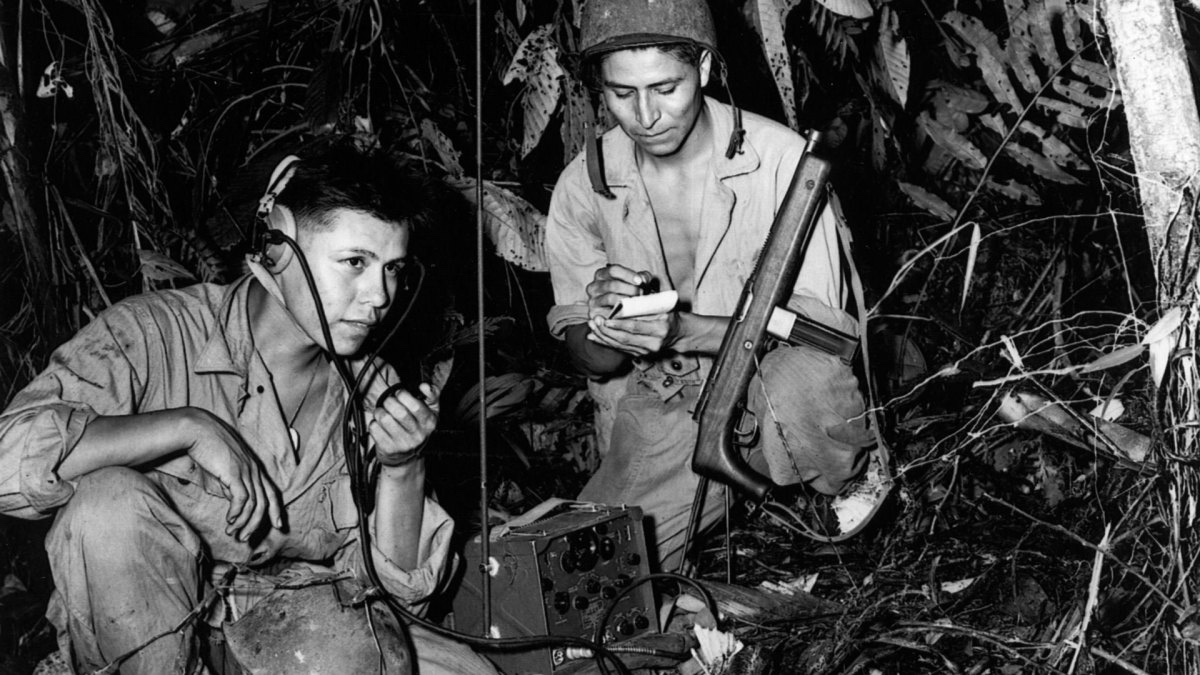
The history of the Navajo code talkers of World War 2 is well known but by no means, unique. Indigenous Americans of other nations served as code talkers during WW2 including Assiniboine, Lakota and Meskwaki soldiers serving in the Pacific, North African, and European theaters of the war.
During the twentieth century, the United States and others specially recruited bilingual speakers of obscure languages, applying those skills in secret communications based on those languages. Among these, the story of the Navajo “Code Talkers” are probably best known. Theirs was a language with no alphabet or symbols, a language with such complex syntax and tonal qualities as to be unintelligible to the non-speaker. The military code based on such a language proved unbreakable in WWII. Japanese code breakers never got close.
The United States Marine Corps recruited some 400-500 Navajo speakers who served in all six Marine divisions in the Pacific theater. Guadalcanal, Tarawa, Peleliu, Iwo Jima: Navajo code talkers took part in every assault conducted by the United States Marine Corps from 1942, to ‘45.
The history of the Navajo code talkers of WWII is well known but by no means, unique. Indigenous Americans of other nations served as code talkers during WW2 including Assiniboine, Lakota and Meskwaki soldiers who did service in the Pacific, North African, and European theaters of the war.
Fourteen Comanche soldiers took part in the Normandy landings. As with the Navajo, these soldiers substituted phrases when their own language lacked a proper term. Thus, “tank” became “turtle”. “Bombers” became “pregnant airplanes”. Adolf Hitler was “Crazy White Man”.
The information is contradictory, but Basque may also have been used, in areas where no native speakers were believed to be present. Native Cree speakers served with Canadian Armed Services, though oaths of secrecy have all but blotted their contributions, from the pages of history.
The first documented use of military codes based on native American languages took place during the Second Battle of the Somme in September 1918, employing on the language skills of a number of Cherokee troops.
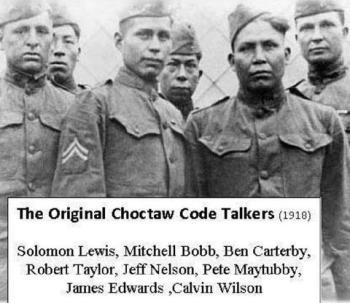
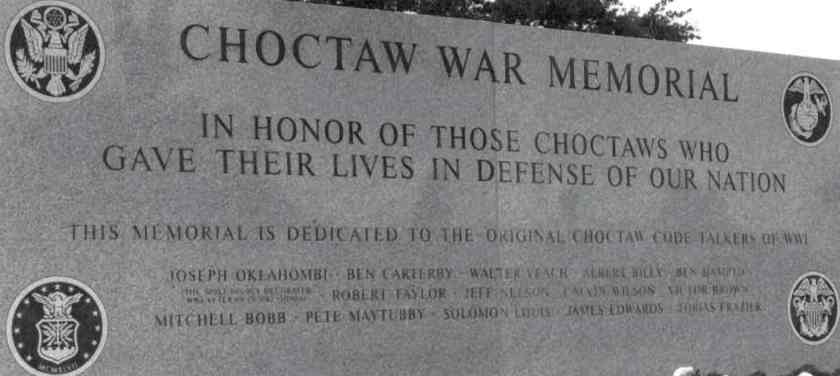
The government of Choctaw nation will tell you otherwise, contending that Theirs was the first native language, used in this way. Late in 1917, Colonel Alfred Wainwright Bloor was serving in France with the 142nd Infantry Regiment. They were a Texas outfit, constituted in May of that year and including a number of Oklahoma Choctaws.
The Allies had already learned the hard way that their German adversaries spoke excellent English, and had already intercepted and broken several English-based codes. Colonel Bloor heard two of his Choctaw soldiers talking to each other, and realized he didn’t have the foggiest notion of what they were saying. If he didn’t understand their conversation, the Germans wouldn’t have a clue.
Choctaw soldiers in training in World War I for coded radio and telephone transmissions
The first test under combat conditions took place on October 26, 1918, as two companies of the 2nd Battalion performed a “delicate” withdrawal from Chufilly to Chardeny, in the Champagne sector. One captured German officer later confirmed the Choctaw code to have been a complete success. We were “completely confused by the Indian language”, he said, “and gained no benefit whatsoever” from wiretaps.
Choctaw soldiers were embedded within multiple companies of infantry. Messages were transmitted via telephone, radio and by runner, many of whom were themselves native Americans.
As in the next war, Choctaw would improvise when their language lacked the proper word or phrase. When describing artillery, they used the words for “big gun”. Machine guns were “little gun shoot fast”.
The Choctaw themselves didn’t use the term “Code Talker”, that phrase wouldn’t come about, until WWII. At least one member of the group, Tobias W. Frazier, simply described what they did as, “talking on the radio”. Of the 19 who served in WWI, 18 were native Choctaw from southeast Oklahoma. The last was a native Chickasaw. The youngest was Benjamin Franklin Colbert, Jr., the son of Benjamin Colbert Sr., one of Teddy Roosevelt’s “Rough Riders” of the Spanish American War. Born September 15, 1900 in the Durant Indian Territory, he was all of sixteen, the day he enlisted.
Another was Choctaw Joseph Oklahombi, whose name translates as “man killer” in the Choctaw language. Six days before Sergeant York’s famous capture of 132 Germans in the Argonne Forest, Joseph Oklahombi charged a strongly held German position, single-handed. Let Private Oklahombi‘s Croix de Guerre citation, personally awarded him by Marshall Petain, tell his story:
“Under a violent barrage, [Pvt. Oklahombi] dashed to the attack of an enemy position, covering about 210 yards through barbed-wire entanglements. He rushed on machine-gun nests, capturing 171 prisoners. He stormed a strongly held position containing more than 50 machine guns, and a number of trench mortars. Turned the captured guns on the enemy, and held the position for four days, in spite of a constant barrage of large projectiles and of gas shells. Crossed no man’s land many times to get information concerning the enemy, and to assist his wounded comrades”.
Unconfirmed eyewitness accounts report that 250 Germans occupied the position, and that Oklahombi killed 79 of them before their comrades decided it was wiser to surrender. Some guys are just not to be trifled with.
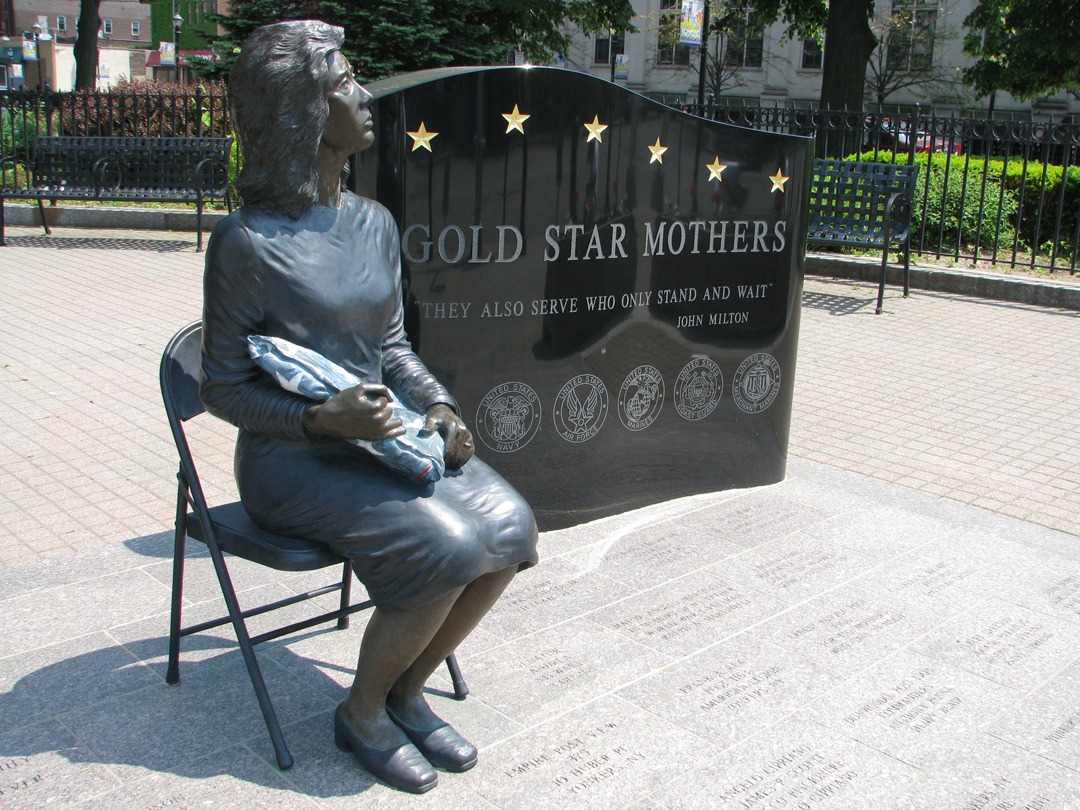
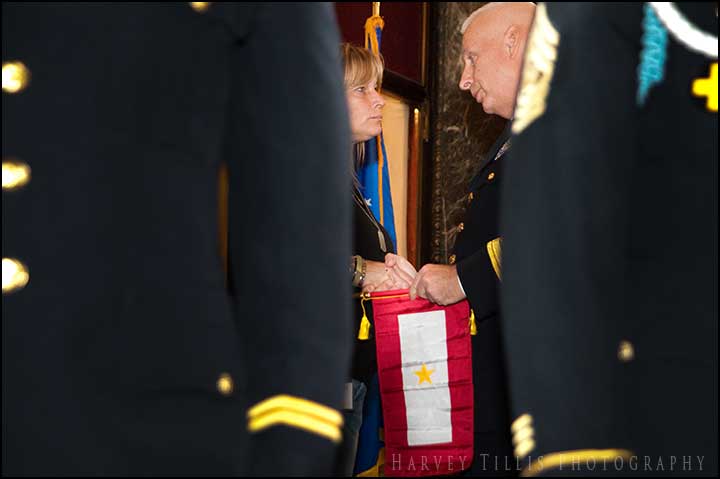
Today, Title 36 § 111 of the United States Code provides that the last Sunday in September be observed as Gold Star Mother’s Day, in honor of those women who have made the ultimate sacrifice. April 5 is set aside, as Gold Star Spouse’s Day.
Suppose you were to stop 100 randomly selected individuals on the street, and ask them:
“Of all the conflicts in American military history, which single battle accounts for the greatest loss of life“.
I suppose you’d get a few Gettysburgs in there, and maybe an Antietam or two. The Battle of the Bulge would come up, for sure, and there’s bound to be a Tarawa or an Iwo Jima. Maybe a Normandy.
I wonder how many would answer, Meuse-Argonne.
The United States arrived late to the “War End all Wars”, entering the conflict in April 1917 when President Woodrow Wilson asked permission of the Congress, for a declaration of war against Imperial Germany. American troop levels “over there” remained small throughout 1917, as the formerly neutral nation of fifty million ramped up to a war footing.
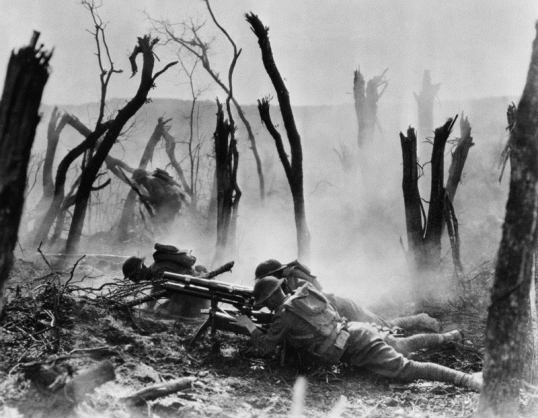
US Marines during Meuse-Argonne offensive of 1918
The trickle turned to a flood in 1918, as French ports were expanded to handle their numbers. The American Merchant Marine was insufficient to handle the influx, and received help from French and British vessels. By August, every one of what was then forty-eight states had sent armed forces, amounting to nearly 1½ million American troops in France.
After four years of unrelenting war, French and British manpower was staggered and the two economies, nearing collapse. Tens of thousands of German troops were freed up and moving to the western front, following the chaos of the Russian Revolution. The American Expeditionary Force was arriving none too soon.
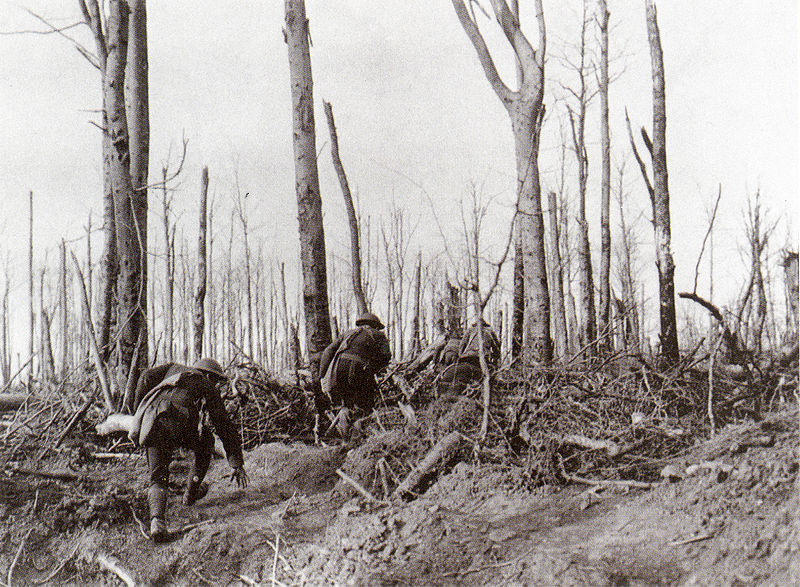
“Gun crew from Regimental Headquarters Company, 23rd Infantry, firing 37mm gun during an advance against German entrenched positions. , 1918”, H/T Wikipedia
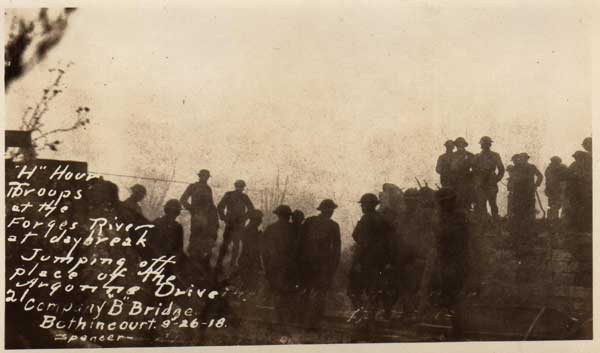
Following successful allied offensives at Amiens and Albert, Allied Supreme Commander Ferdinand Foch ordered General John J. “Black Jack” Pershing to take overall command of the offensive, with the objective of cutting off the German 2nd Army. Some 400,000 troops were moved into the Verdun sector of northeastern France. This was to be the largest operation of the AEF, of World War I. With a half-hour to go before midnight September 25, 2,700 guns opened up in a six hour bombardment, against German positions in the Argonne Forest, along the Meuse River.
Butte de Montfaucon, today
Some 10,000 German troops were killed or incapacitated by mustard and phosgene gas attacks, and another 30,000 plus, taken prisoner. The Allied offensive advanced six miles into enemy territory, but bogged down in the wild woodlands and stony mountainsides of the Argonne Forest.
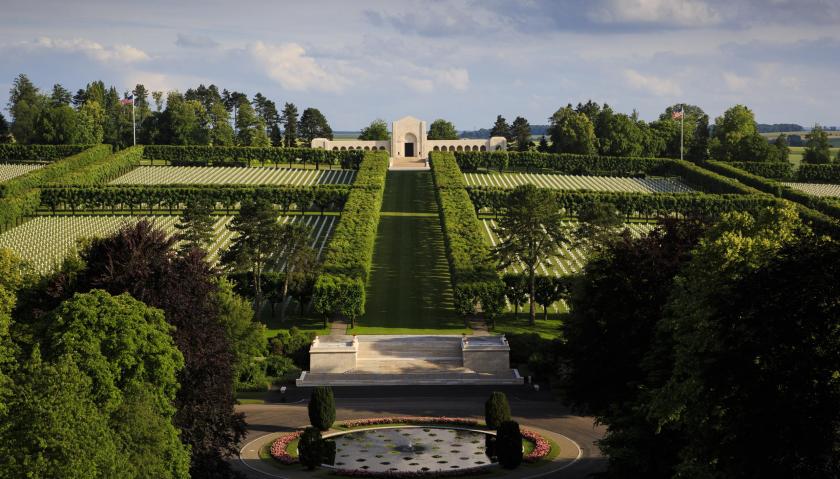
Meuse-Argonne American cemetery near Romagne, in France
The Allied drive broke down on German strong points like the hilltop monastery at Montfaucon and others, and fortified positions of the German “defense in depth”.
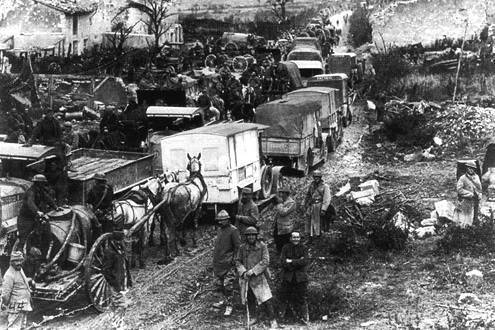
Pershing called off the Meuse-Argonne offensive on September 30, as supplies and reinforcements backed up in what can only be termed the Mother of All Traffic Jams.
Fighting was renewed four days later resulting in some of the most famous episodes of WW1, including the “Lost Battalion” of Major Charles White Whittlesey, and the single-handed capture of 132 prisoners, by Corporal (and later Sergeant) Alvin York.
Meuse-Argonne American Cemetery, outside of Romagne, France
The Meuse-Argonne offensive lasted forty-seven days, resulting in 26,277 American women gaining that most exclusive and unwanted of distinctions. That of becoming a Gold Star Mother. More than any other battle, in American military history. 95,786 mothers would see their boys come home, mangled.
Gold Star Mother’s Monument At The Putnam County (NY) Veteran Memorial Park, photograph by James Connor
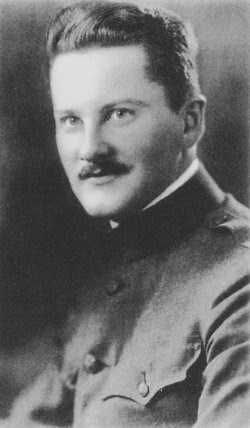
George Vaughn Seibold was born in the nation’s capital, Washington DC, At 23, Seibold volunteered when the US entered the war, in 1917. He requested a flying assignment and, as the US had no aerial force in the war at that time he was sent to Canada to be trained, on British aircraft.
George Vaughn Seibold
He was assigned to the 148th Aero Squadron of the British Royal Flying Corps and sent off for combat, in France. George sent a regular stream of letters back home to his family. George’s mother grace Darling Siebold would do community service visiting wounded servicemen, in hospital.
And then one day, the letters stopped.
The Siebold family inquired but, as aviators were under British control US authorities, could be of little assistance. Grace continued to visit the maimed from the war “over there” but now in the vain hope that George might somehow appear, among them.
It wasn’t meant to be.
On October 11, 1918, George’s wife in Chicago, Catharine (Benson) Siebold received a box, marked “Effects of deceased Officer 1st Lt. George Vaughn Seibold”. The family later learned that George was killed in action over Baupaume, France, August 26, 1918. His body was never recovered.
Grace believed that grief turned inward was corrosive, and self destructive. She continued to visit the wounded but now she founded a group of other mothers, who had lost sons in military service. The group not only gave comfort to these women but an opportunity to reach out, and help the wounded. They named the organization after the gold star families hung in their windows, in honor of their dead.
On May 28, 1918, President Woodrow Wilson approved a suggestion from the Women’s Committee of the Council of National Defenses, that American women were asked to wear black bands on the left arm, with a gilt star for every family member who had given his life for the nation.
Today, Title 36 § 111 of the United States Code provides that the last Sunday in September be observed as Gold Star Mother’s Day, in honor of those women who have made the ultimate sacrifice. April 5 is set aside, as Gold Star Spouse’s Day.
In recent years both President Barack Obama and Donald Trump have signed proclamations, setting this day aside as Gold Star Mother’s and Family’s Day.
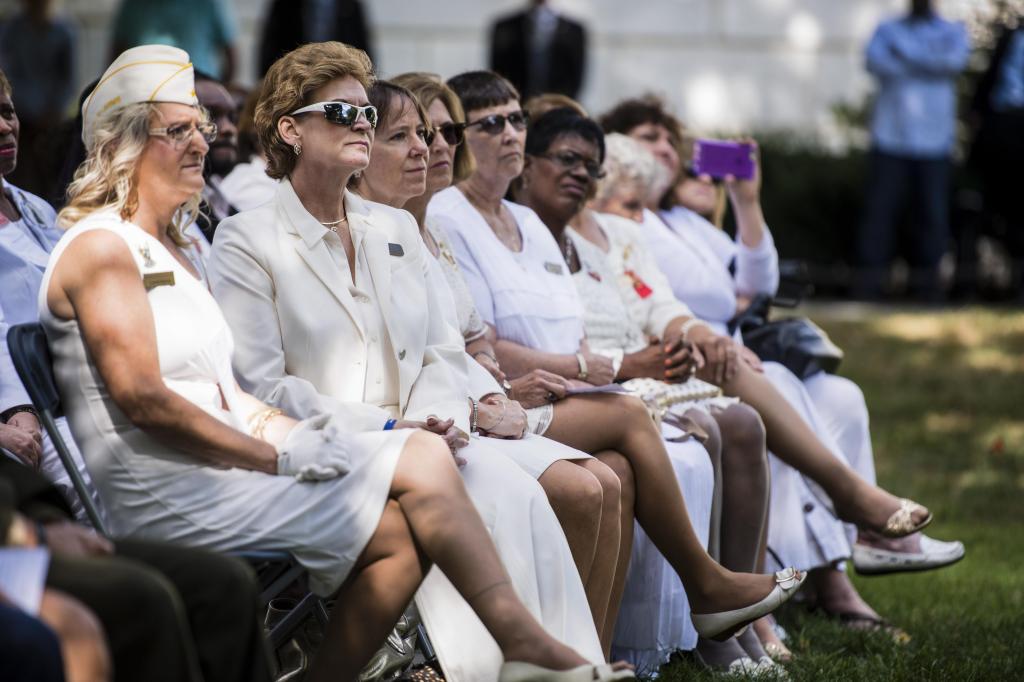
At first a distinction reserved only for those mothers who had lost sons and daughters in WW1, (272 U.S. Army nurses died of disease in the great War) that now includes a long list of conflicts, fought over the last 100 years. At this time the United States Army website reports “The Army is dedicated to providing ongoing support to over 78,000 surviving Family members of fallen Soldiers”.
Gold Star Mother’s commemoration, Arlington National Cemetery, 2015
Seventy-eight thousand, out of a nation of nearly 330 million. They are so few, who pick up this heaviest of tabs on behalf of the rest of us.
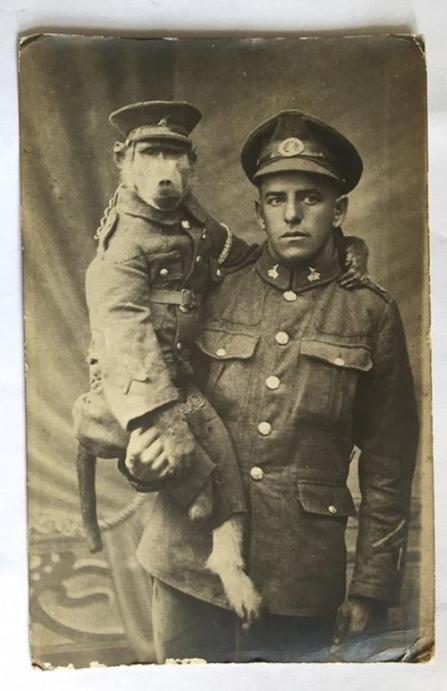
Jackie marched with his company in a special uniform and cap complete with buttons, regimental badges, and a hole for his tail.
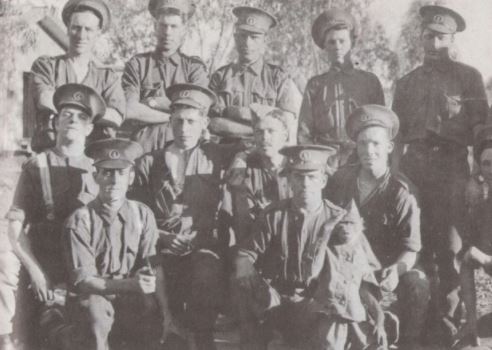
In 1915, Albert Marr and his family lived at a farm called Cheshire just outside Pretoria, South Africa. It was there that he found a small Chacma baboon and adopted the monkey, as a pet. He called the animal, “Jackie”.
The Great War had not yet reached it second year when Marr was sworn into the 3rd (Transvaal) Regiment of the 1st South African Infantry Brigade. He was now Private Albert Marr, #4927.
Private Marr asked for permission to bring Jackie along. Mascots are good for morale in times of war, a fact about which military authorities, were well aware.
To Marr’s great surprise, permission was granted. It wasn’t long before Jackie became the official Regimental Mascot.
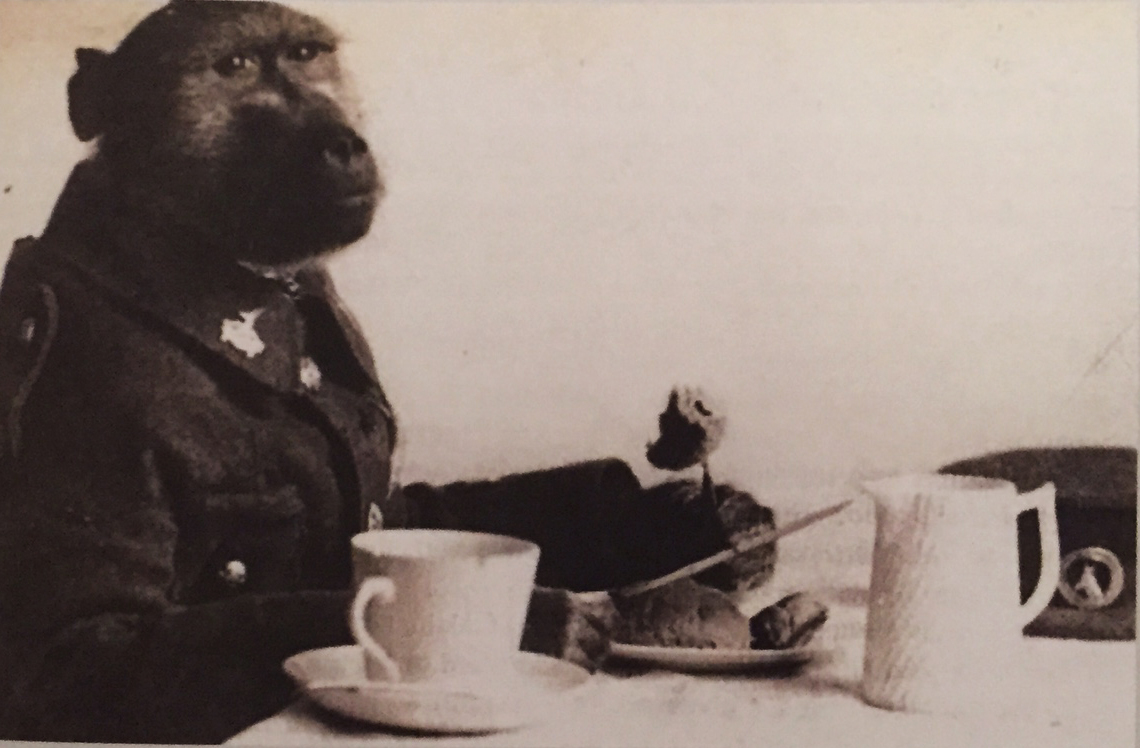
Jackie drew rations like any other soldier, eating at the mess table, using his knife and fork and washing it all down with his own drinking basin. He even knew how to use a teacup.
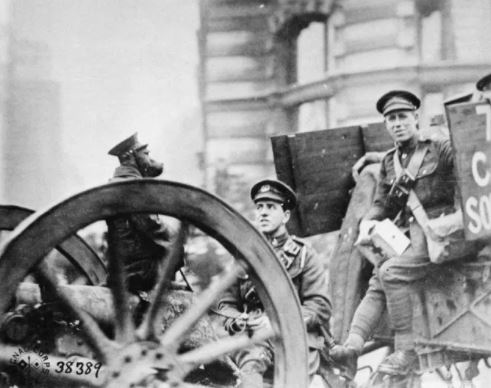
Jackie drilled and marched with his company in a special uniform and cap complete with buttons, regimental badges, and a hole for his tail.
He would entertain the men during quiet periods, lighting their pipes and cigarettes and saluting officers as they passed on their rounds. He learned to stand at ease when ordered, placing his feet apart and hands behind his back, regimental style.
These two inseparable buddies, Albert Marr and Jackie, first saw combat during the Senussi Campaign in North Africa. On February 26, 1916, Albert took a bullet in the shoulder at the Battle of Agagia. The monkey, beside himself with agitation, licked the wound and did everything he could to comfort the stricken man. It was this incident more than any other that marked Jackie’s transformation from pet and mascot, to a full-fledged member and comrade, of the regiment.
Jackie would accompany Albert at night, on guard duty. Marr soon learned to trust Jackie’s keen eyesight and acute hearing. The monkey was almost always first to know about enemy movements or impending attack, sounding an early warning with a series of sharp barks, or by pulling on Marr’s tunic.
The pair went through the nightmare of Delville Wood together early in the Somme campaign, when the First South African Infantry held its position despite eighty percent casualties.
The third Battle of Ypres, known as the battle of Passchendaele, began in the early morning hours of July 31, 1917. The pair experienced the sucking, nightmare mud of that place and the desperate fighting, around Kemmel Hill. The two were at Belleau Wood, a mostly American operation in which Marine Captain Lloyd Williams of the 2nd Battalion, 5th Marines, was famously informed he was surrounded, by Germans. “Retreat?” Williams snorted, “hell, we just got here.”
Through all of it, Marr and Jackie come through World War 1 mostly unscathed. That all changed in April, 1918.
Withdrawing through the West Flanders region of Belgium, the South African brigade came under heavy bombardment. Jackie was frantically building a wall of stones around himself, a shelter from the hammer blow concussion of the shells and the storm of flying metal buzzing through the air, as angry hornets. A jagged piece of shrapnel wounded Jackie’s arm and another all but tore off the animal’s leg. Even then, Jackie refused to be carried off by the stretcher-bearers, trying instead to finish his wall as he hobbled about on the bloody stump which had once been, his leg.
Lt. Colonel R. N. Woodsend of the Royal Medical Corps described the scene: “It was a pathetic sight; the little fellow, carried by his keeper, lay moaning in pain, the man crying his eyes out in sympathy, ‘You must do something for him, he saved my life in Egypt. He nursed me through dysentery’. The baboon was badly wounded, the left leg hanging with shreds of muscle, another jagged wound in the right arm. We decided to give the patient chloroform and dress his wounds…It was a simple matter to amputate the leg with scissors and I cleaned the wounds and dressed them as well as I could. He came around as quickly as he went under. The problem then was what to do with him. This was soon settled by his keeper: ‘He is on army strength’. So, duly labelled, number, name, ATS injection, nature of injuries, etc. he was taken to the road and sent by a passing ambulance to the Casualty Clearing Station”.
No one was quite sure that the chloroform used for the operation, wouldn’t kill him. When the officer commanding the regiment went to the aid station to check on him Jackie sat up in bed, and saluted.
As the “War to End All Wars” drew to a close, Jackie was promoted to the rank of Corporal and given a medal, for bravery. He may be the only monkey in history, ever to be so honored.
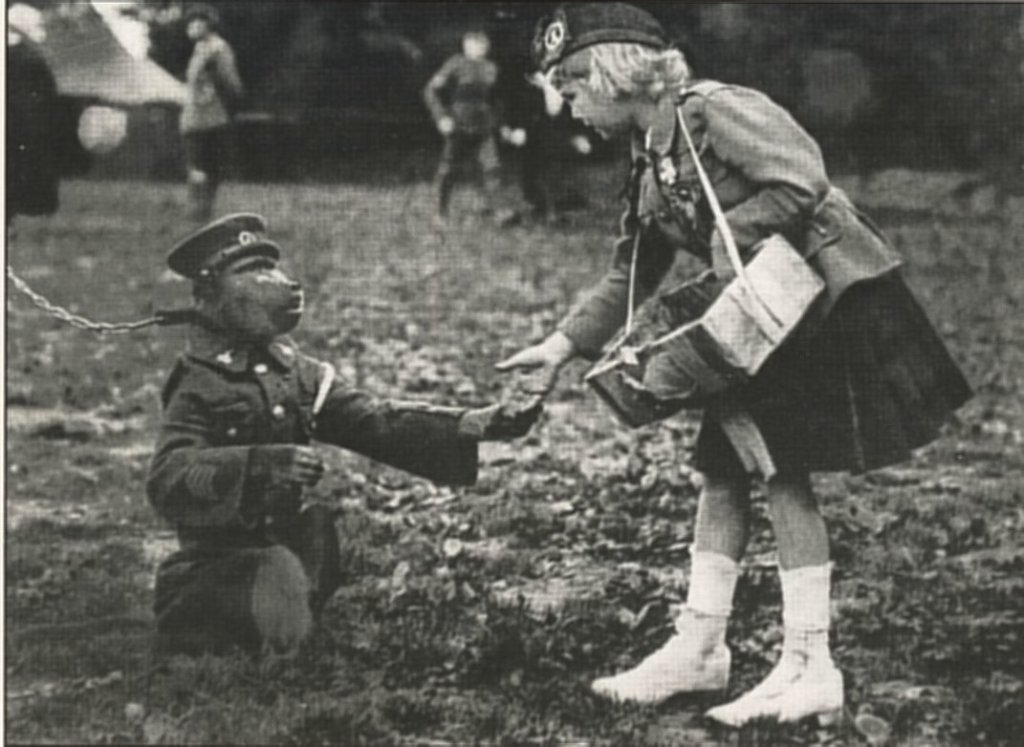
The war ended that November. Jackie and Albert were shipped to England and soon became, media celebrities. The two were hugely successful raising money for the widows and orphans fund, where members of the public could shake Jackie’s hand for half a crown. A kiss on the baboon’s cheek, would cost you five shillings.
Fundraising, in London
On his arm he wore a gold wound stripe and three blue service chevrons, one for each of his three years’ front line service.
Jackie was the center of attention on arriving home to South Africa when a parade was held, officially welcoming the Regiment home. On July 31, 1920, Jackie received the Pretoria Citizen’s Service Medal, at the Peace Parade in Church Square, Pretoria.
All thing must come to an end. The Marr family farm burned to the ground in May 1921. Jackie died in the fire. Albert Marr lived to the age of 84 and passed away, in 1973. There wasn’t a day in-between when the man didn’t miss his little battle buddy Jackie, the baboon who went to war.
[B]etween 1915 and spring 1917, 43 American factories suffered explosions or fires of mysterious origin, in addition to the bombs set on some four dozen ships carrying war supplies to the Allies”
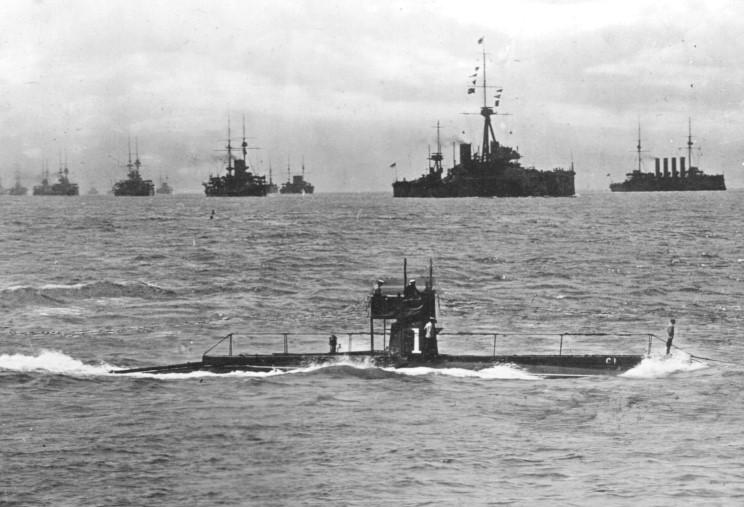
In the early months of the Great War, Britain’s Royal Navy swept the high seas of the Kaiser’s surface ships and blockaded ports in Germany. The United States was neutral at this time, when over a hundred German ships sought refuge in American harbors.
The blockade made it impossible for the Central Powers of Germany and Austria-Hungary to import war materiel from overseas while Great Britain, France, and Russia continued to buy products from US farms and factories. American businessmen were happy to sell to any foreign customer who had the cash but, for all intents and purposes, such trade was limited to the allies.
To the Central Powers, such trade had the sole purpose of killing their boys, fighting for the Fatherland on the battlefields of Europe.
The first and most overt reaction from the Kaiser came in the form of unrestrained submarine warfare, when even vessels flying the flags of neutral nations came under attack. Less apparent at that time was the covert campaign of sabotage carried out by German, agents on US soil.
“Black Tom” was originally an island in New York Harbor, next to Liberty Island. So called after a former resident, by WWI, landfill had expanded the island to become part of Jersey City. The area contained a mile-long pier with warehouses and rail lines operated by the Lehigh Valley Railroad, and served as a major hub in the trade of war materiel to the allies.
Black Tom Island, 1880
On July 30, 1916, the Black Tom terminal had over two million pounds of small arms and artillery ammunition in freight cars, and one hundred thousand pounds of TNT on a nearby Barge.
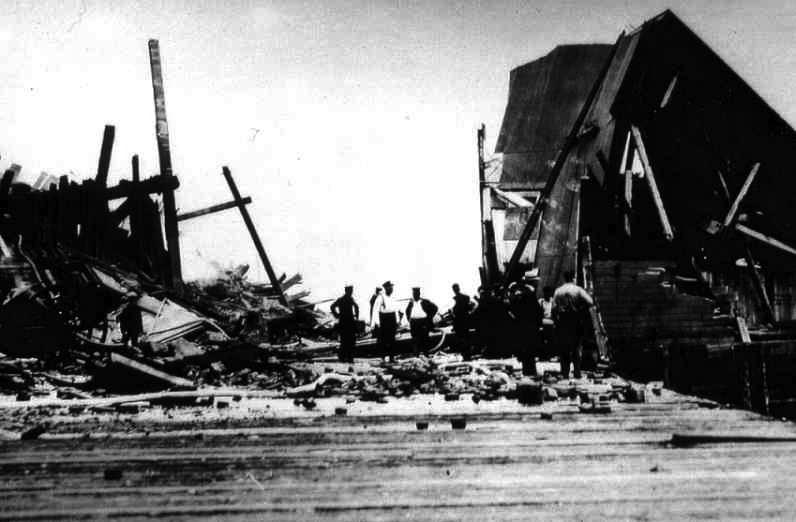
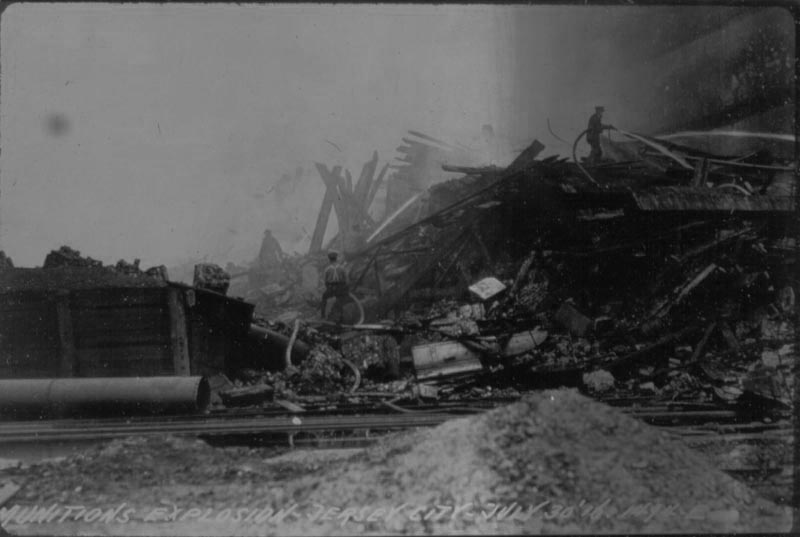
In the small hours of the morning, around 2:00am, guards discovered a series of small fires. Some tried to put them out while others fled, fearing an explosion. The first and loudest blast took place at 2:08am, a detonation so massive as to be estimated at 5.5, on the Richter scale. People were awakened from Maryland to Connecticut in what many thought was an earthquake. The Brooklyn Bridge shook. The walls of Jersey City’s municipal building were cracked as shrapnel flew through the air. Windows broke as far as 25 miles away, while fragments embedded themselves in the clock tower at the Jersey Journal building in Journal Square, over a mile away. The clock stopped at 2:12 am.
Firefighters were unable to fight the fires until the bullets and shrapnel stopped flying. Photo: Wikimedia Commons
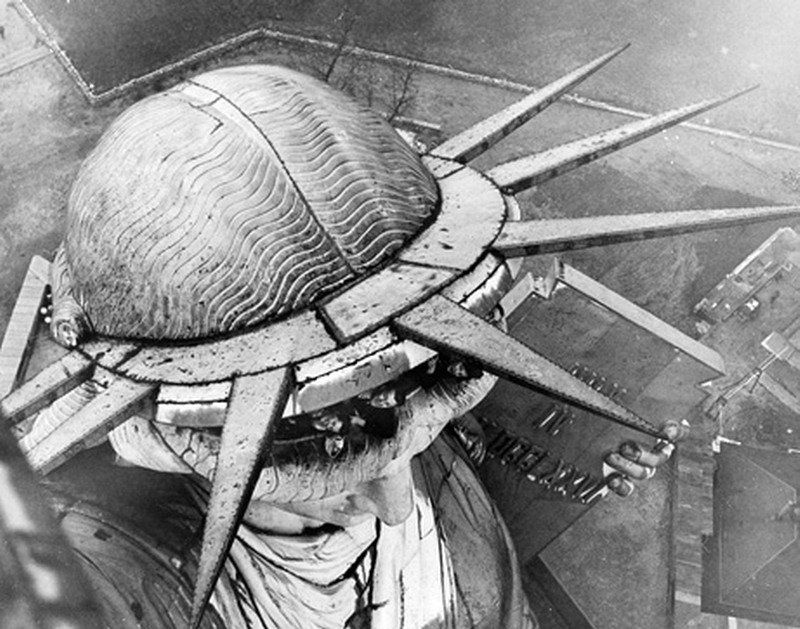
Stained Glass windows were shattered at St. Patrick’s Church, and Ellis Island was evacuated to Manhattan. Damage to the skirt and torch carried by the Statue of Liberty alone, came to over $2¼ million in 2017 dollars. To this day the ladder to “Lady Liberty’s” torch remains off limits, to visitors.
The enormous vaulted ceiling of Ellis Island’s main hall, collapsed. According to one Park officer, damage to the Ellis Island complex came to $500,000 “half the one million dollars it cost the government to build the facility.”
Known fatalities in the explosion included a Jersey City police officer, a Lehigh Valley Railroad Chief of Police, a ten week old infant, and the barge captain.
The explosion at Black Tom nearly brought the US into the war against Germany, but that would wait for the resumption of unrestricted submarine warfare. That, and a telegram from German Secretary for Foreign Affairs Arthur Zimmermann, promising US territories to Mexico, in exchange for a declaration of war against the US.
Black Tom was the most spectacular, but by no means the only such act of sabotage. The archive at cia.gov states that “[B]etween 1915 and spring 1917, 43 American factories suffered explosions or fires of mysterious origin, in addition to the bombs set on some four dozen ships carrying war supplies to the Allies”.
Responsibility for the Black Tom explosion was never proven, conclusively. Early suspicions centered on accidental causes. Legal wrangling would climb the judicial ladder all the way to the United States Supreme Court and continue well into the second World War. Anna Rushnak, an elderly Czech immigrant who ran a four-bits-a-night boarding house in Bayonne was thrown from her bed by the explosion, to find then-23-year-old Michael Kristoff sitting on the edge of his bed, mumbling “What I do? What I do?”
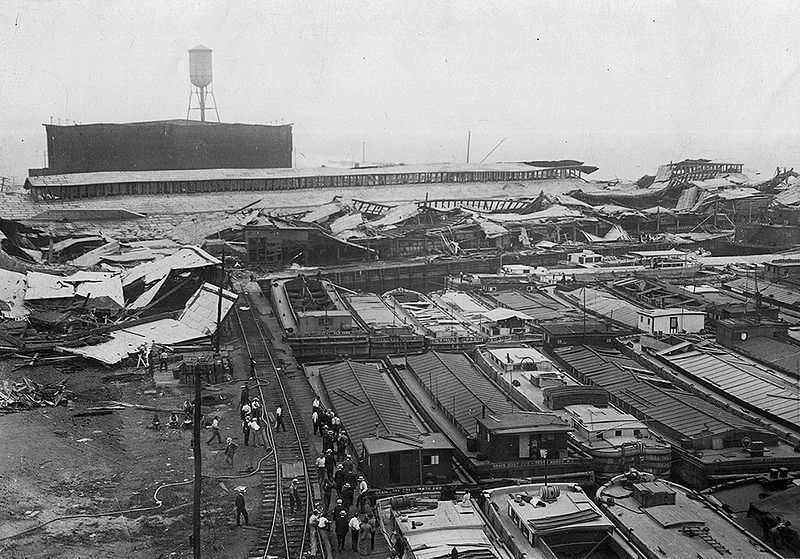
Lehigh Valley Railroad pier, after the explosion
Kristoff, a Slovakian subject of the Austro-Hungarian Empire, Germany’s principle ally in World War 1, was arrested by Bayonne Police, interrogated, and judged to be “insane but harmless.”
In 1922, the Lehigh Valley Railroad was buried in lawsuits, and looking to fix blame on a German act of sabotage. Located in an Albany jail where he was serving time for theft Kristoff came to the judicial spotlight, once again. He admitted working for the Germans “for a few weeks” back in 1916, but was released before the claim could be investigated. Kristoff was finally traced to a pauper’s grave in 1928 and there ends his story, yet that ‘insane but harmless’ label remains open to question. Papers carried on the body exhumed from that potter’s field were indeed those of Michael Kristoff, but the dental records, didn’t match.
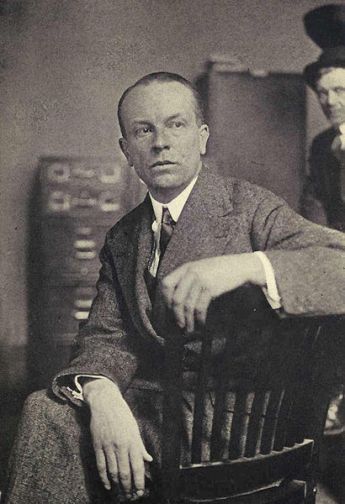
“German Master Spy Franz Von Rintelen and his “pencil bomb” were responsible for acts of sabotage in the United States during World War I”. H/T Smithsonian
Meanwhile, suspicion fell on the German-born naturalized citizen Kurt Jahnke who ran sabotage operations for the German Admiralty out of bases in San Francisco and Mexico City with his assistant, Imperial German Navy Lieutenant Lothar Witzke. Witzke was arrested on February 1, 1918 in Nogales, Arizona and convicted by court martial. He was sentenced to death, though the war was over before sentence could be carried out. President Wilson later commuted the sentence, to life.
By 1923, most nations were releasing POWs from the “Great War”, including spies. A report from Leavenworth prison shows Witzke heroically risking his life, entering a boiler room after an explosion and probably averting disaster. It may be on that basis that he was finally released. Lieutenant Lothar Witzke was pardoned by President Calvin Coolidge on November 22, 1923 and deported to Berlin, where a grateful nation awarded him the Iron Cross, 1st and 2nd Class.
The U.S.–German Peace Treaty of 1921 established the German-American Mixed Claims Commission, which declared in 1939 that Imperial Germany had, in fact been responsible and awarded a judgement of $50 million. The Nazi government refused to pay and the matter was finally settled in 1953, with a judgement of $95 million (including interest) against the Federal Republic of Germany. The final payment was made in 1979.
Shrapnel damage may be see to this day, on the statue of Liberty
The Black Tom explosion and related acts of pro-German espionage resulted in the Federal Espionage Act signed into law in June 1917, creating, among its other provisions, a “Bureau of Investigation” under the United States Department of Justice.
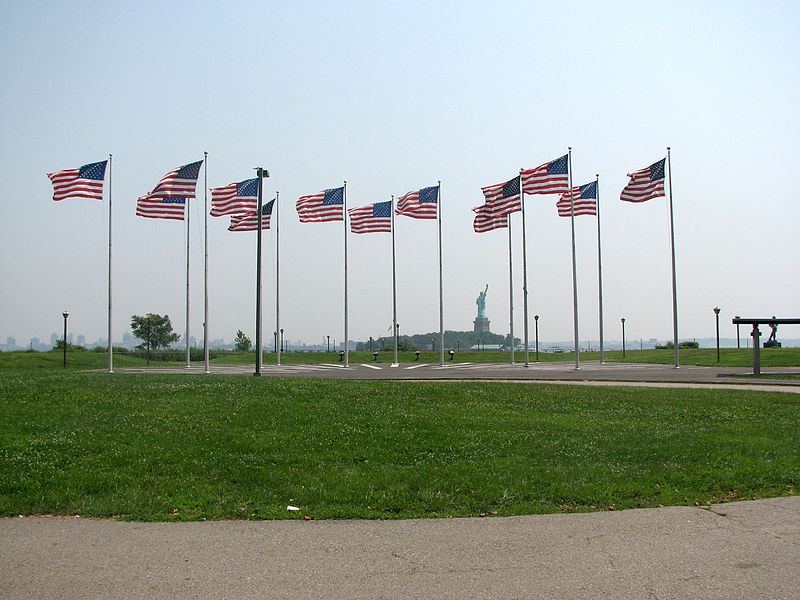
Nothing remains today of the Black Tom terminal or the largest foreign terrorist attack on American soil until 9/11, save for a plaque, as seen in the photograph below. That, and a new law enforcement bureaucracy, called the FBI.
View of the Statue of Liberty from the site of the Black Tom explosion
Fancy the irony that, today as I write this, a 7-foot “non-scalable fence” surrounds the Capitol building, in Washington DC. In those days, you were apparently free to stroll about, with a bomb in your hands. At least while Congress was in recess.
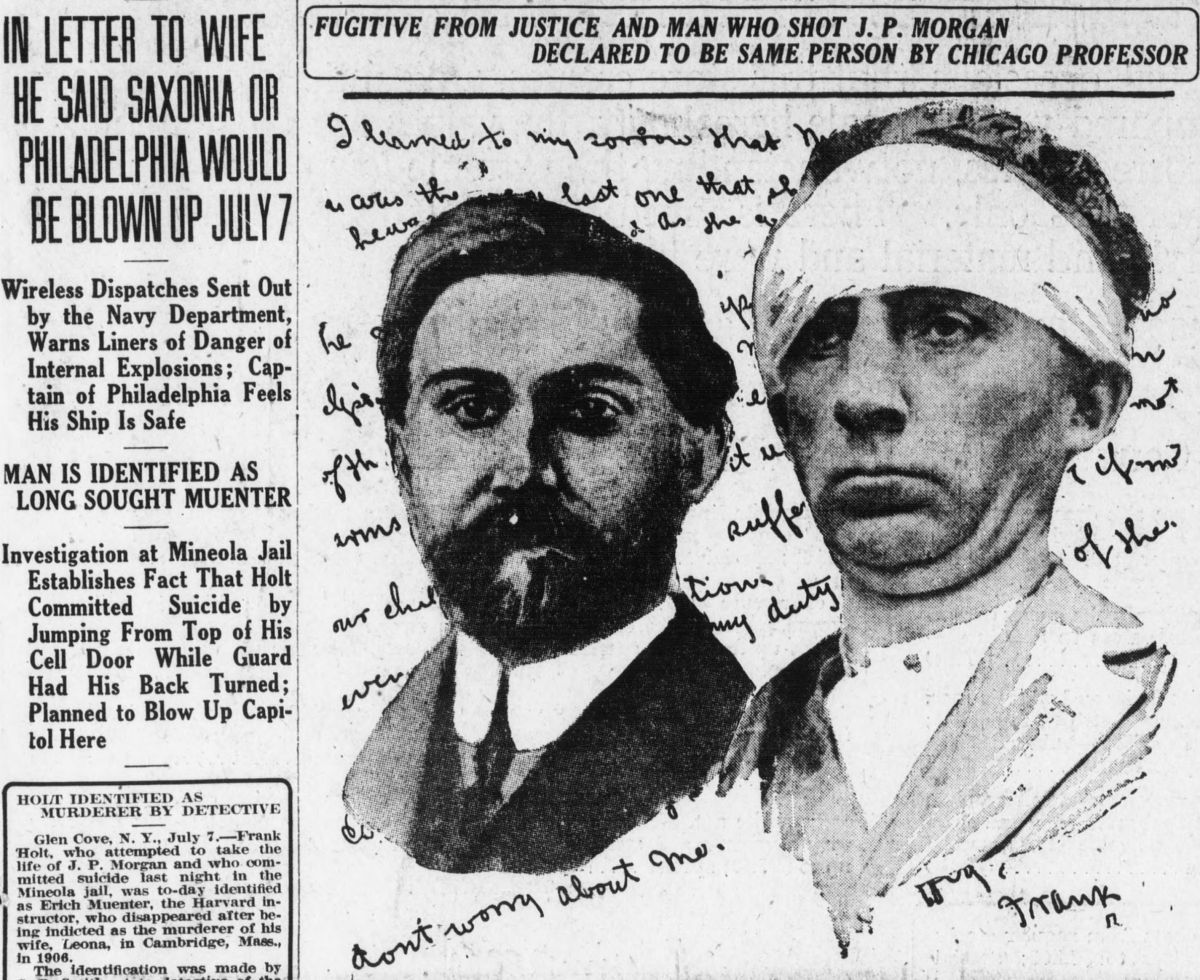
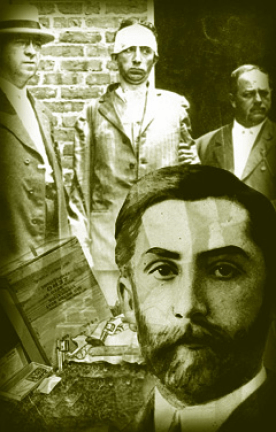
The train left Boston station in April 1906, headed for Chicago. On board were the infant, the toddler, the nanny and the children’s father, Professor Erich Muenter, a German language instructor from Harvard University. The two little girls’ mother was onboard as well. Leone (Krembs) Muenter was in her casket taking a one-way trip to her own funeral, and burial in her home town. She had passed from some sort of stomach ailment, ten days after giving birth.
The story may have ended there, but for Dr. Herbert McIntyre. The circumstances of Leone’s death didn’t add up. Dr. McIntyre ordered an autopsy. On April 27, Cambridge police issued a warrant for the arrest of Professor Erich Muenter for the murder of his wife, by arsenic poisoning.
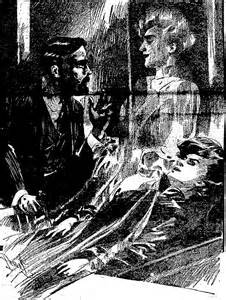
Apparently, this “man of science” wanted to test his theory that you could literally see the soul passing, at the moment of death. Now, Erich Muenter vanished.
Eight years later, the European continent exploded in the ‘War to End Wars’.
US policy at this time allowed arms sales to any and all belligerents in the European war. With British dominance of North Atlantic shipping routes, for all intents and purposes this meant France and Great Britain.
German language professor Frank Holt was teaching at Cornell University in 1915. A naturalized citizen and committed German nationalist, Holt had ties with the secret German spy intelligence unit Abteilung IIIb, which was conducting a campaign of sabotage against US ships carrying munitions ‘over there’.
Frank Holt might have described himself as a ‘peace activist’, obsessed with the idea that arms themselves were extending the war. If arms exports were brought to a halt he believed, the war would come to an end.
Holt gave up arguing the point on July 2 and took a train to Washington DC. In his hands he carried a bomb, three sticks of dynamite attached to a timing mechanism, ingeniously designed to go off when the acid ate through the cork stopper.
Fancy the irony that, today as I write this, a 7-foot “non-scalable fence” surrounds the Capitol building, in Washington DC. In those days, you were apparently free to stroll about, with a bomb in your hands. At least while Congress was in recess.
Finding the Senate chamber locked, Holt placed his package under a telephone switchboard in the Senate reception room, with the timer set to go off around midnight.
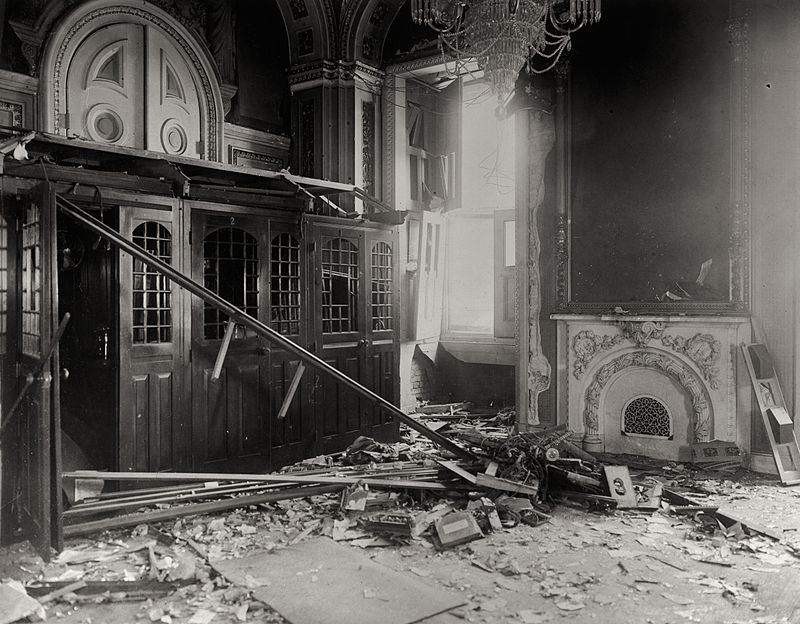
The explosion when it came, was enormous. The room was torn to pieces while, across the building, a night watchman was blown out of his chair. Writing to the Washington Star newspaper under the pseudonym R. Pearce, Holt explained his intentions to “make enough noise to be heard above the voices that clamor for war. This explosion is an exclamation point in my appeal for peace.”
Aftermath of the Senate bombing, July 2, 1915
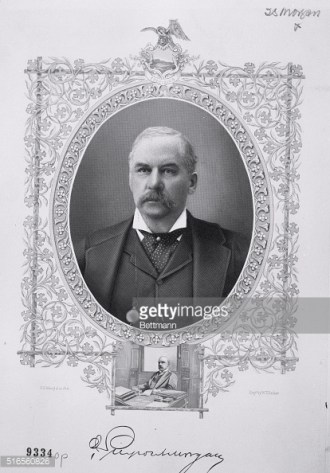
The following day, a tiny little box on the front page of the New York Times attributed the explosion to ‘gasses’. The paper was hitting news stands as Frank Holt headed for Long Island, to the Glen Cove estate of “the Great Pierpont”, J. P. Morgan. Armed with two revolvers, a suitcase full of dynamite and a few anti-war newspaper clippings, Holt bulled his way through the butler who opened the door, and into the Morgan residence.
John Pierpont Morgan
Pandemonium broke out in the home, as Holt turned his weapons on the four Morgan children. Mrs. Morgan tried to block the path to her husband but the millionaire financier lunged, tackling the much smaller man to the ground. Holt fired twice into Morgan’s thigh and groin, as the pair went down together. Pierpont twisted the gun from his grasp as Mrs. Morgan and a gaggle of household servants struggled for the other. All the while, the butler pounded the would-be assassin’s head with a lump of coal as Holt shouted “Kill me! Kill me now! I don’t want to live any more. I have been in a perfect hell for the last six months on account of the European war!”
A copy of the R. Pearce letter quickly tied Holt to the Capitol bombing, as former colleagues identified the long-since vanished, alleged killer of Leone Muenter. Frank Holt and Erich Muenter were the same man.
A colleague once described Muenter as “a brilliant man, a tireless worker, and a profound student. Night after night he would sit reading, studying and writing while his wife lay asleep in a room nearby.” The Harvard Crimson newspaper described him as “harmless on the surface…affect[ing] a scholarly stoop and a Van Dyke, and wore dingy, patched suits”. Fluent in seven languages he was the pale, bearded model of the junior faculty intellectual, complete with elbow patches.
For all his vaunted brilliance, Erich Muenter was nuttier than a squirrel turd. His intention as explained to police, was to take Morgan’s wife and children hostage, until the financier cut off loans to Europe. He told police of his intention to assassinate J.P. Morgan, as well. How the two objectives squared with one another, remains to be explained.
That Sunday morning, July 4, the J.P. Morgan shooting seems to have been front page on every newspaper in the world. On July 5, Erich Muenter took the brass ferrule from a pencil eraser, and slit his wrist. That suicide attempt was unsuccessful. The following day he scaled the bars of his prison cell and jumped, leaving his brains on the concrete floor, twenty feet below.
The day after his death, Police tracked down a trunk Muenter left in a New York city storage facility. In it were 134 sticks of dynamite, blasting caps, fuse coils, batteries, nitric acid, windproof matches, mercury fulminate and smokeless explosive powder. Three tin can bombs had been recently completed, and were ready to go. Inspector of Combustibles Owen Egan declared the find to be “the greatest equipment for bomb making ever brought to New York”.
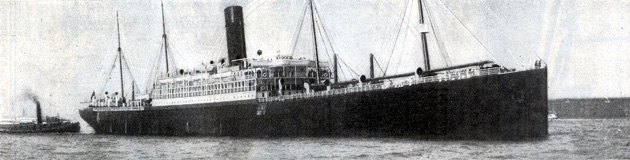
That same day, the 2nd Mrs. Muenter received a letter from her dead husband. It said that an arms shipment headed for England would go to the bottom, that very day. Warned by wireless, the crew of SS Minnehaha frantically searched for the bomb, without success. Muenter’s bomb went off and touched off a fire, but it was far away from Minnehaha’s cargo of high explosives, and did little damage to the ship itself.
The vessel sustained little damage at the time but, in the end, the ghost of Erich Muenter had his way. The Harland & Wolff liner SS Minnehaha was torpedoed and sunk off the Irish coast with the loss of 43, on September 7, 1917. There was one survivor.
Imagine if you will a world of trench warfare. A world of mud and rats where instant and violent death is an ever-present possibility. A world of lice and disease and the stink of millions of men in the open, both dead and alive. A world capable of producing psychological trauma on an industrial scale. Now imagine just for a moment, a bit of home made comfort steps into that world.
For a variety of reasons, the eastern front of the “War to end all Wars” was a war of movement. Not so in the West. As early as October 1914, combatants burrowed into the ground like animals sheltering from what Private Ernst Jünger would come to call, the ‘Storm of Steel’.
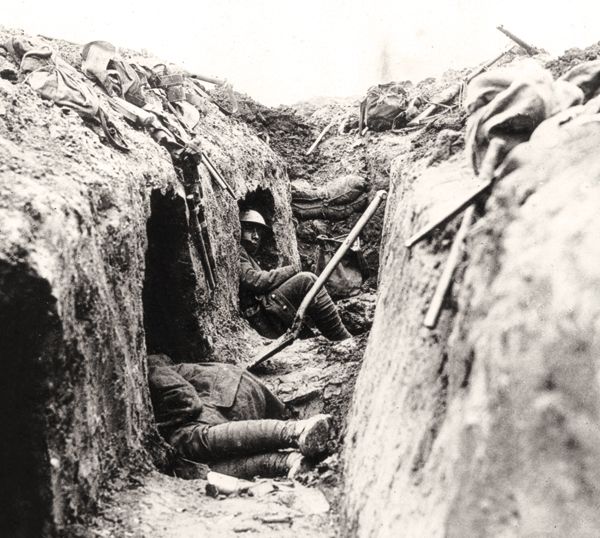
Conditions in the trenches and dugouts must have defied description. You would have smelled the trenches long before you could see them. The collective funk of a million men and more, enduring the troglodyte existence of men who live in holes. Little but verminous scars in the earth teaming with rats and lice and swarming with flies. Time and again the shells churned up and pulverized the soil, the water and the shattered remnants of once-great forests, along with the bodies of the slain.
By the time the United States entered the ‘War to end all Wars’ in April, 1917, millions had endured three years of this existence. The first 14,000 Americans arrived ‘over there’ in June, the American Expeditionary Forces (AEF) forming on July 5. American troops fought the military forces of Imperial Germany alongside their British and French allies, others joining Italian forces in the struggle against the Austro-Hungarian Empire.
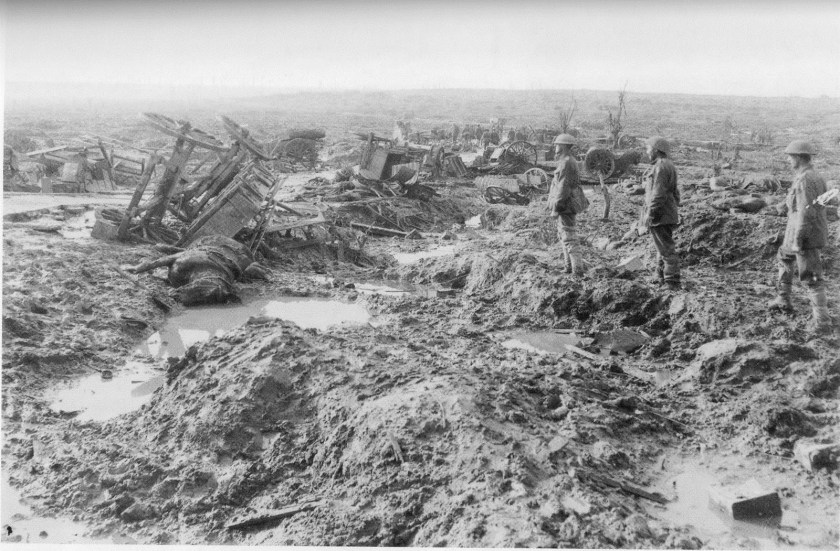
You couldn’t call the stuff these people lived in mud – it was more like a thick slime, a clinging, sucking ooze capable of swallowing grown men, even horses and mules, alive.
Captain Alexander Stewart wrote “Most of the night was spent digging men out of the mud. The only way was to put duck boards on each side of him and work at one leg: poking and pulling until the suction was relieved. Then a strong pull by three or four men would get one leg out, and work would begin on the other…He who had a corpse to stand or sit on, was lucky”.
Sir Launcelot Kiggell broke down in tears, on first seeing the horror of Paschendaele, . “Good God”, he said. “Did we really send men to fight in That?”
Unseen and unnoticed in times of such dread calamity, are the humanitarian workers. Those who tend to the physical and spiritual requirements and the countless small comforts, of those so afflicted.
Within days of the American declaration of war, Evangeline Booth, National Commander of the Salvation Army, responded, saying “The Salvationist stands ready, trained in all necessary qualifications in every phase of humanitarian work, and the last man will stand by the President for execution of his orders”.
These people are so much more than that donation truck, and the bell ringers we see behind the red kettles, every December.
Lieutenant Colonel William S. Barker of the Salvation Army left New York with Adjutant Bertram Rodda on June 30, 1917, to survey the situation. It wasn’t long before his not-so surprising request came back in a cable from France. Send ‘Lassies’.
A small group of carefully selected female officers was sent to France on August 22. That first party comprised six men, three women and a married couple. Within fifteen months their number had expanded by a factor of 400.
In December 1917, a plea for a million dollars went out to support the humanitarian work of the Salvation Army, the YMCA, YWCA, War Camp Community Service, National Catholic War Council, Jewish Welfare Board, the American Library Association and others. This “United War Work Campaign” raised $170 million in private donations, equivalent to $27.6 billion, today.
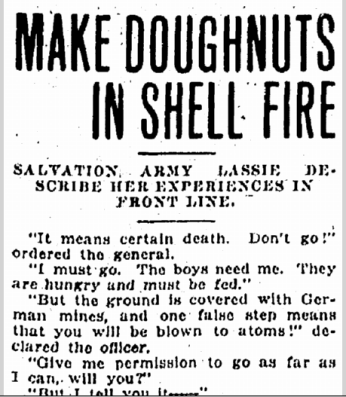
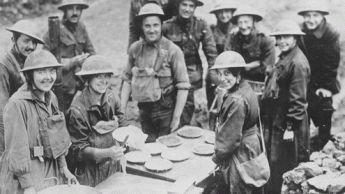
‘Hutments’ were formed all over the front, many right out at the front lines. There were canteen services. Religious observances of all denominations were held in these facilities. Concert performances were given, clothing mended and words of kindness offered in response to all manner of personal problems. On one occasion, the Loyal Order of Moose conducted a member initiation. Pies and cakes were baked in crude ovens and lemonade served to hot and thirsty troops.
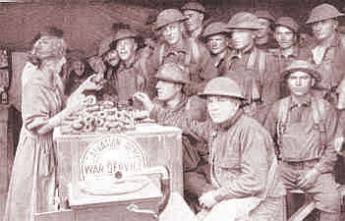
Of all these corporal works of mercy, the ones best remembered by the ‘doughboys’ themselves, were the doughnuts.
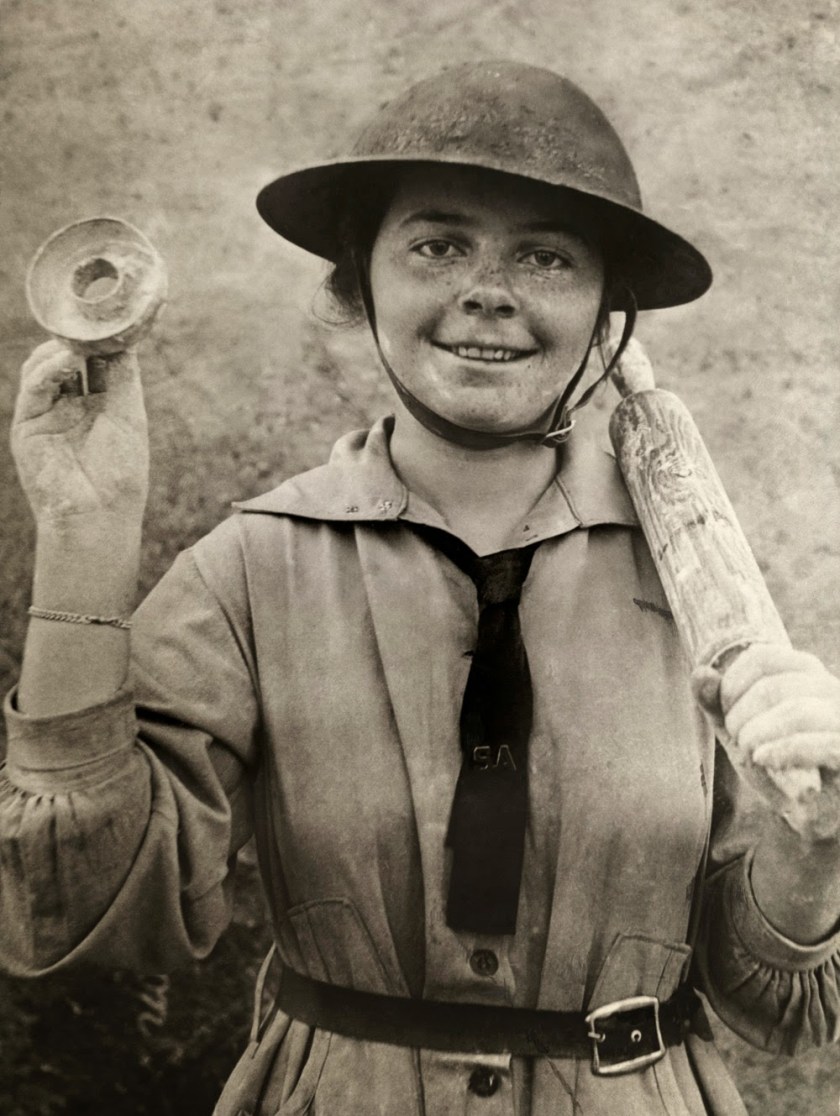
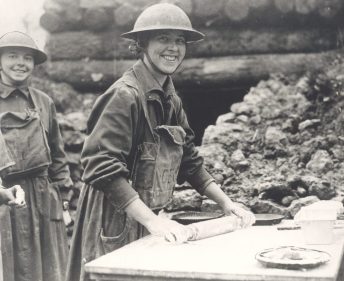
Helen Purviance, sent to France in 1917 with the American 1st Division, seems to have been first with the idea. An ensign with the Salvation Army, Purviance and fellow ensign Margaret Sheldon first formed the dough by hand, later using a wine bottle in lieu of a rolling pin. Having no doughnut cutter at the time, dough was shaped and twisted into crullers, fried seven at a time in a lard-filled helmet, on a pot-bellied wood stove.
The work was grueling. The women worked well into the night that first day, serving all of 150 hand-made doughnuts. “I was literally on my knees,” Purviance recalled, but it was easier than bending down all day, on that tiny wood stove. It didn’t seem to matter. Men stood in line for hours, patiently waiting in the mud and the rain of that world of misery, for their own little piece of warm, home-cooked heaven.
Techniques gradually improved and it certainly helped, when these there was a real pan to cook in. These ladies were soon turning out 2,500 to 9,000 doughnuts a day. An elderly French blacksmith made Purviance a doughnut cutter, out of a condensed milk can and a camphor-ice tube, attached to a wooden block.
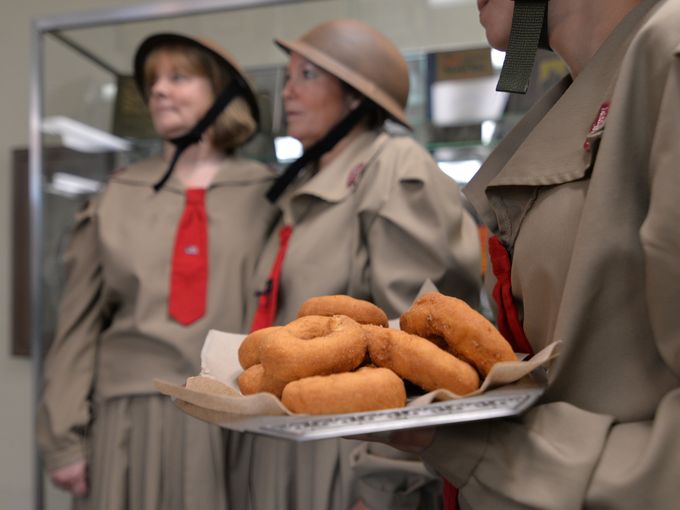
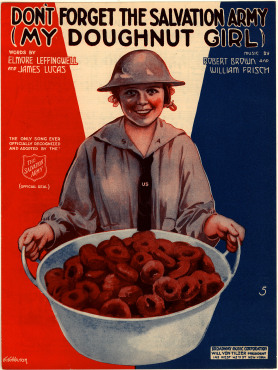
Before long the pleasant aroma of hot doughnuts could be detected, wafting all over the dugouts and trenches of the western front. Salvation Army volunteers and others made apple pies and all manner of other goodies, but the name that stuck, was “Doughnut Lassies”.
June 2, 2017 – Salvation Army employees Cheryl Freismuth (l) and Susan Klyk (c) celebrate the 100th anniversary of the “Doughnut Lassies” of WW1 with student Catie McDougall (r). H/T The Detroit News
One New York Times correspondent wrote in 1918 “When I landed in France I didn’t think so much of the Salvation Army; after two weeks with the Americans at the front I take my hat off… [W]hen the memoirs of this war come to be written the doughnuts and apple pies of the Salvation Army are going to take their place in history”.
Contrary to popular myth the doughnut was not invented in WW1. Neither was the name for soldiers of the Great War although millions of “doughboys” returned from ‘over there’ requesting wives, mothers sweethearts and local bakeries make their newfound favorite confection. Russian émigré Adolph Levitt invented the first doughnut machine in 1920. The round cake with the hole in the middle, has never looked back.
If you’re interested, the Doughnut Lassies’ original WW1 recipe may be found, HERE. Let me know how they come out.
Munitions workers began to complain of headaches and nausea and skin conditions, like hives. Constant exposure to toxic chemicals turned the hair and skin of these women a brilliant shade of yellow, or orange. Expectant “Canary Girls’ gave birth to bright yellow “Canary Babies”.
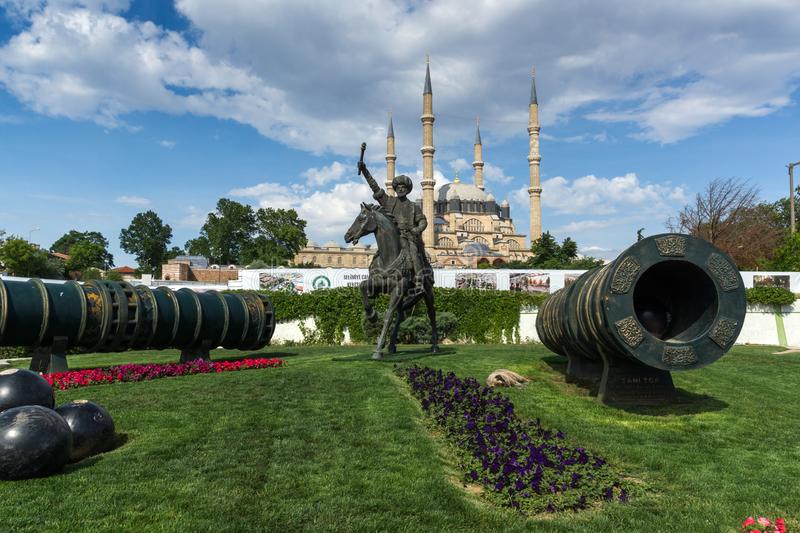
Since the age of antiquity, heavy weapons have tilted the scales of battlefield strategy. The first catapult was developed in Syracuse, in 339 BC. The Roman catapult of the 1st century BC hurled 14-pound stone balls against fixed fortifications. The age of gunpowder brought new and ghastly capabilities to artillery. In 1453, the terrifying siege guns Mehmed II faced the walls of Constantinople, hurling 150-pound missiles from barrels, wide enough to swallow a grown man.
Monument to Ottoman Sultan Mehmed II, Edirne, East Thrace, Turkey
Such weapons were slow to reload and sometimes, unreliable. Mehmed’s monsters took a full three hours to fire. Seven years later, King James II of Scotland was killed when his own gun, exploded.
This experimental three-shot cannon belonging to Henry VIII burst, with predictable results for anyone standing nearby.
By the Napoleonic wars, artillery caused more battlefield casualties than any other weapon system.
At that time such weapons were virtually always, loaded at the muzzle. The first breech loaders came about in the 14th century but it would take another 500 years, before precision manufacturing made such weapons reliable, and plentiful.
Breech loading vastly increased rate-of-fire capabilities. By the end of the 19th century, technological advances brought new and hideous capabilities to what Josef Stalin would come to call, the “God of War’.
Heretofore, the massive recoil of such weapons required a period of time to re-set, re-aim and reload. In the 1890s, French soldier Joseph Albert DePort solved that problem with a damping system enabling the barrel to recoil, leaving the gun in place. Recoilless weapons could now be equipped with shields keeping gun crews as close as possible while smokeless powder meant that gunners could clearly see what they were shooting at.
By World War 1, trained crews serving a French 75 could fire once every two seconds. Massed artillery fired with such horrifying rapidity as to resemble the sound, of drums.
This clip is five minutes long. Imagine finding yourself under “drumfire”, for days on end.
While guns of this type were aimed by lines of sight, howitzers fired missiles in high parabolic trajectories to fall on the heads, of the unlucky.
The great Field Marshall Helmuth von Moltke (the elder) once said, “No battle plan ever survives contact with the enemy”. So it was in the tiny Belgian city of Ypres where the German war of movement met with weapons of the industrial revolution.
A million men were brought to this place, to kill each other. The first Battle for Ypres, there would be others, brought together more firepower than entire wars of an earlier age. The losses are hard to get your head around. The British Expeditionary Force (BEF) alone suffered 56,000 casualties including 8,000 killed, 30,000 maimed and another 18,000 missing, of whom roughly one-third, were dead.
British 18-pounder
The breakdown is harder to get at for the other combatants but, all in, Germany suffered 135,000 casualties, France 85,000 and Belgium, 22,000. The three week struggle for Ypres cost the lives of 75,000 men, enough to fill the Athens Olympic Stadium, in Greece. Soldiers on all sides dug frantically into the ground, to shelter from what Private Ernst Jünger called, the “Storm of Steel”.
First drum fire in the war, in the Champagne, Lasted 75 hours, from Sept. 22 to 25. Was directed against 20 Miles of the German Front. (Photo by Hulton Archive/Getty Images)
The French alone expended 2,155,862 shells during the Anglo-French offensive called the second battle of Artois, fought May 9 through June 18, 1915, a fruitless effort to capitalize on German defenses, weakened by the diversion of troops to the eastern front. The objective, to flatten the German “Bulge” in the Artois-Arras sector.
Immediately to the French left, the British 6th army under Sir John French was to advance on May 9 in support of the French offensive, taking the villages of Aubers, Fromelles and Le Maisnil and the elevation known as Aubers Ridge.
The battle of Aubers was an unmitigated disaster. The man-killing shrapnel rounds so valued by pre-war strategists were as nothing, against fortified German earthworks. No ground was taken, no tactical advantage gained despite British losses, ten times that on the German side.
War correspondent Colonel Charles à Court Repington sent a telegram to The Times, complaining of the lack of high-explosive shells. On May 14 The Times headline read: “Need for shells: British attacks checked: Limited supply the cause: A Lesson From France”. The article placed blame squarely on the government of Herbert Asquith who had stated as recently as April 20, that the army had sufficient ammunition.
“We had not sufficient high explosives to lower the enemy’s parapets to the ground … The want of an unlimited supply of high explosives was a fatal bar to our success”.
The Times, May 14, 1915
For British politics at home, the information fell as a bombshell, precipitating a scandal known as the Shell Crisis of 1915.
Governments were slow at first to understand the prodigious appetites, of this war. Fixed trench lines led to new rail construction capable of providing cataracts of munitions, to front lines. The problem came from a munitions industry, unable to supply such demands.
Men shipped off to the war by the millions leaving jobs vacant and families at home, without income. Women represented a vast pool of untapped labor. Despite social taboos against women working outside the home, wives, sisters and mothers came flooding into the workplace.
By the end of the war some three million women joined the workforce a third of whom, worked in munitions factories.
Ever conscious of husbands, sons and sweethearts at the front, women worked grueling hours under dangerous conditions. “Munitionettes” manufactured cordite propellants and trinitrotoluene (TNT) explosives, hand filling projectiles from individual bullets to giant shells.
At the front, the war was an all-devouring monster consuming men and munitions at rates unimagined, in earlier conflicts. During the first two weeks of the 3rd Battle for Ypres, better known as Passchendaele, British, Australian and Canadian artillery fired 4,283,550 shells at their German adversary.
Munitions workers began to complain of headaches and nausea and skin conditions, like hives. Constant exposure to toxic chemicals turned the hair and skin of these women a brilliant shade of yellow, or orange. Expectant “Canary Girls” gave birth to bright yellow “Canary Babies”.
Nothing could be done and the yellow tended to fade over time but not a very different yellow, caused by toxic jaundice.
The work was well paid but exhausting, often seven days a week. Grueling 14-hour shifts led to girls as young as 14 coming into the workforce, but it wasn’t enough. “History of Yesterday” writes that two women on average died every week from toxic chemicals, and workplace accidents. One 1918 explosion at the National Shell Filling Factory №6 near Chilwell caused the death of 130 women.
The modern reader can scarcely imagine the crushing burdens of these women caring for families at home and ever conscious of sons, brothers and sweethearts, struggling to survive in this all consuming war.
The canary colored hair and skin would fade in time, but not the long term health effects of daily exposure to toxic substances. It didn’t matter. Twenty years later another generation would do it, all over again.
“We are the Dead. Short days ago
We lived, felt dawn, saw sunset glow,
Loved and were loved, and now we lie
In Flanders fields”. – John McCrae
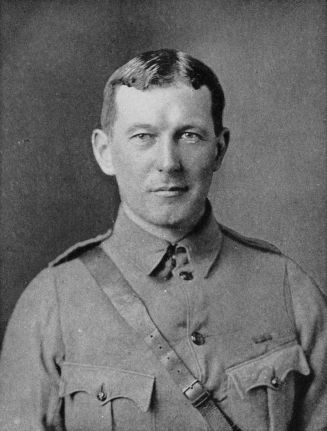
Dr. John McCrae
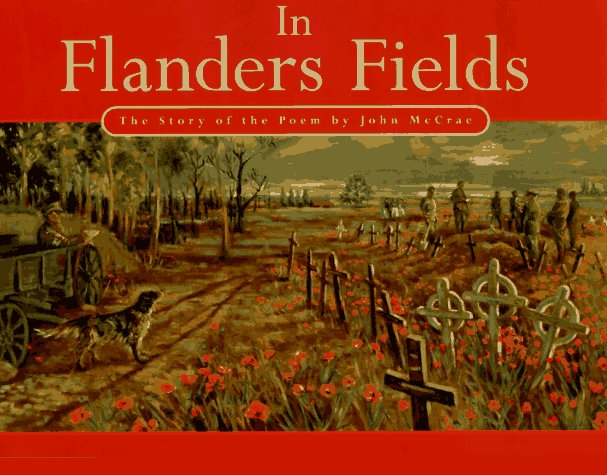
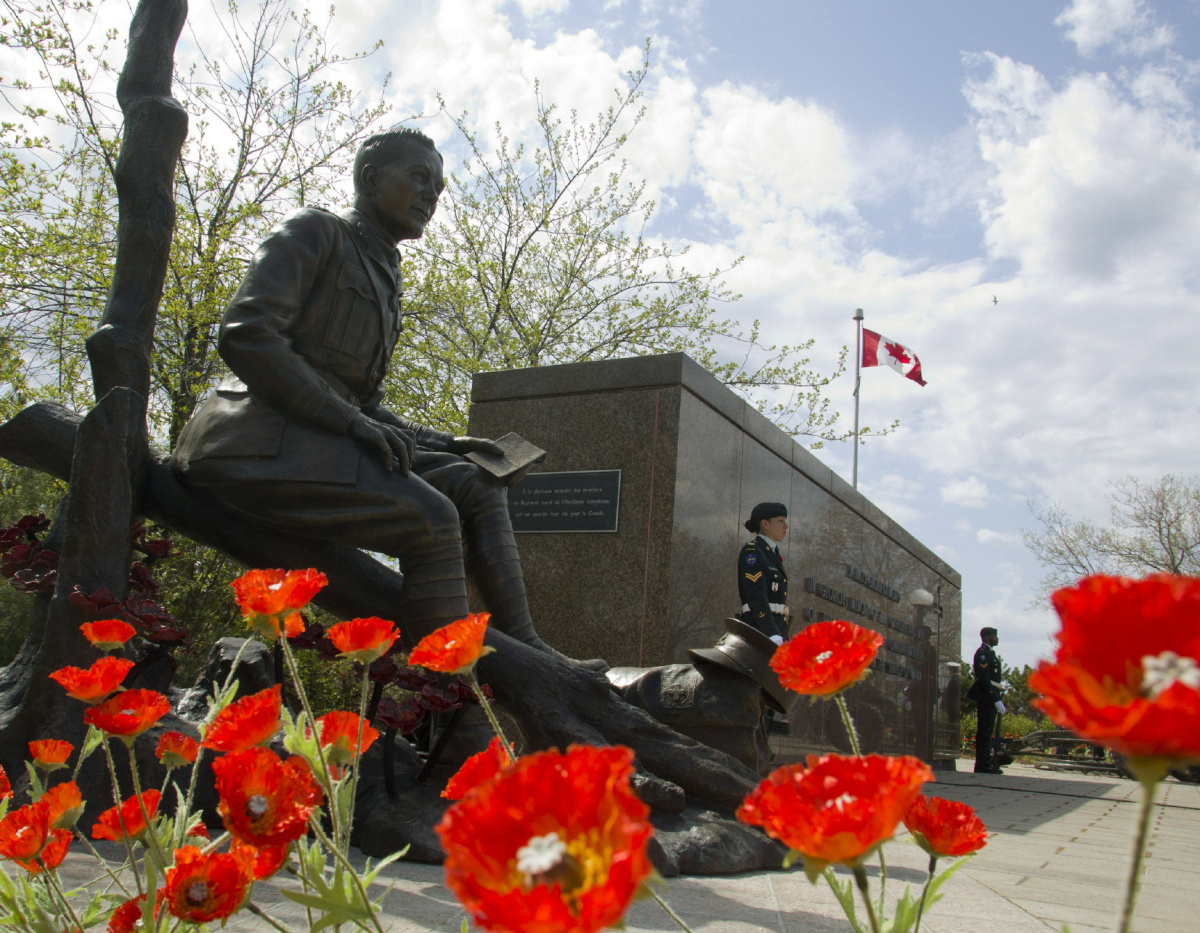
John McCrae was a physician and amateur poet from Guelph, Ontario. Following the outbreak of the “Great War” in 1914, he enlisted in the Canadian Expeditionary Force at the age of 41. Based on his age and training, McCrae could have joined the medical corps, but volunteered instead to join a fighting unit as gunner and medical officer.
McCrae had previously served in the Boer War. This was to be his second tour of duty in the Canadian military.
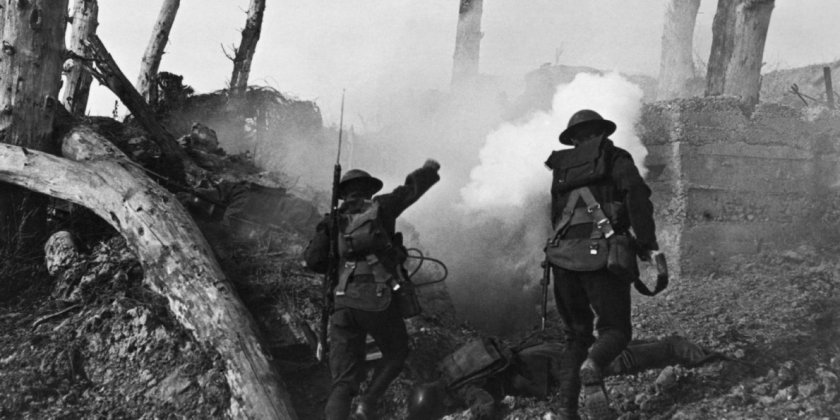
Dr. McCrae fought one of the most horrendous battles of the Great War, the second battle of Ypres, in the Flanders region of Belgium. Imperial Germany launched the first mass chemical attack in history at Ypres, attacking the Canadian position with chlorine gas on April 22, 1915. The Canadian line was broken but quickly reformed in an apocalyptic bloodletting that lasted more than two full weeks.
Dr. McCrae later described the ordeal, in a letter to his mother:
“For seventeen days and seventeen nights”, he wrote, “none of us have had our clothes off, nor our boots even, except occasionally. In all that time while I was awake, gunfire and rifle fire never ceased for sixty seconds … and behind it all was the constant background of the sights of the dead, the wounded, the maimed, and a terrible anxiety lest the line should give way”.
Stop and imagine for a moment, please, what this looked like, what this smelled like, in color.
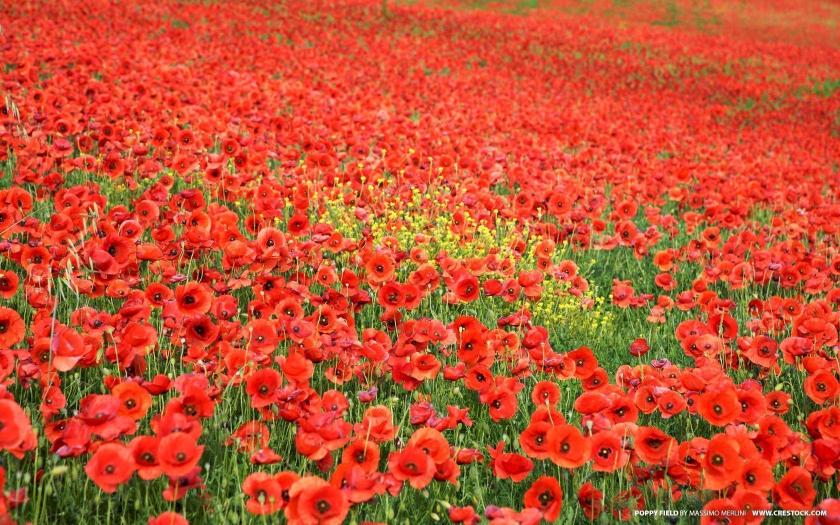
On May 3, Dr. McCrae presided over the funeral of friend and fellow soldier Alexis Helmer, who had died in the battle. He performed the burial service himself, when he noted how quickly the red poppies grew on the graves of the fallen. Sitting in the back of a medical field ambulance the following day, just north of Ypres, he composed this verse. He called the poem, “We Shall Not Sleep”.
Today we remember John McCrae’s composition as:
In Flanders Fields
In Flanders fields the poppies blow Between the crosses, row on row, That mark our place; and in the sky The larks, still bravely singing, fly Scarce heard amid the guns below.
We are the Dead. Short days ago We lived, felt dawn, saw sunset glow, Loved and were loved, and now we lie In Flanders fields.
Take up our quarrel with the foe: To you from failing hands we throw The torch; be yours to hold it high. If ye break faith with us who die We shall not sleep, though poppies grow In Flanders fields.
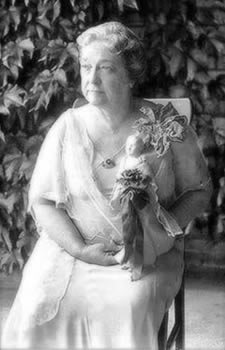
Moina Belle Michael was born August 15, 1869 near Good Hope Georgia, about an hour’s drive east of Atlanta. She began teaching at age fifteen and, over a long career, worked in nearly every part of the peach state’s education system.
In 1918, Michael was working at the YMCA Overseas War Secretaries headquarters, in New York. Browsing through the November Ladies Home Journal she came across Dr. McCrae’s poem. It was Saturday morning, November 9, 1918. Two days before the armistice.
John McCrae was in a grave of his own by this time having succumbed to pneumonia, while serving the No. 3 Canadian General Hospital, in Boulogne. He was buried with full military honors at the Wimereux cemetery where his gravestone lies flat due to the sandy, unstable soil.
Michael had seen McCrae’s poem before but it got to her this time, especially that last part:
“If ye break faith with us who die We shall not sleep, though poppies grow In Flanders fields”
Moina was so moved she made a personal pledge to “keep the faith”, vowing always to wear a red poppy, in remembrance of the dead. She scribbled down a response, a poem, on the back of a used envelope. She called it:
We Shall Keep the Faith
Oh! you who sleep in Flanders Fields, Sleep sweet – to rise anew! We caught the torch you threw And holding high, we keep the Faith With All who died.
We cherish, too, the poppy red That grows on fields where valor led; It seems to signal to the skies That blood of heroes never dies, But lends a luster to the red Of the flower that blooms above the dead In Flanders Fields.
And now the Torch and Poppy Red We wear in honor of our dead. Fear not that ye have died for naught; We’ll teach the lesson that ye wrought In Flanders Fields.
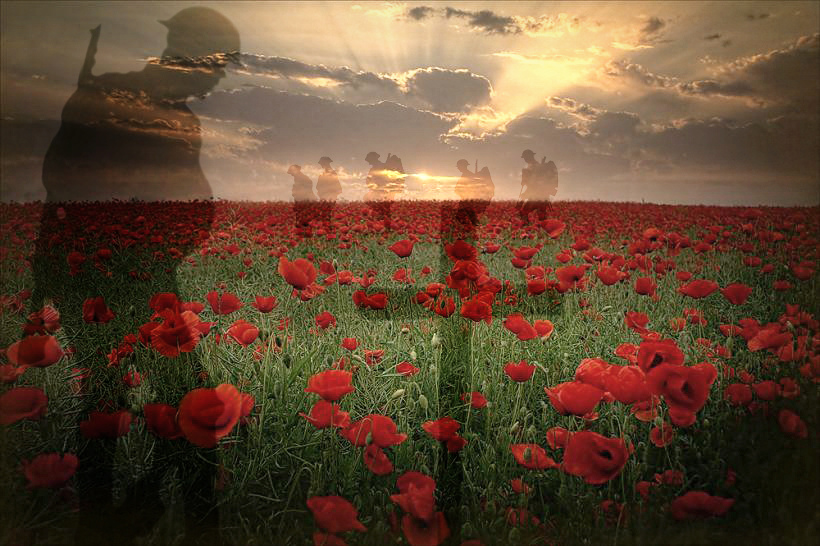
The vivid red flower blooming on the battlefields of Belgium, France and Gallipoli came to symbolize the staggering loss of life brought about by the Great War, the “War to End all Wars”. Before they had numbers, this was a war where the death toll from many single day’s fighting exceeded that of every war of the preceding century, military and civilian, combined.
Since that time, the red poppy has become an internationally recognized symbol of remembrance, lest we neglect to remember the lives lost in all wars. I keep one always, pinned to the visor of my car. A reminder that no free citizen of a self-governing Republic should ever forget where we come from. Nor the price paid by our ancestors, to get us to this place.












 The history of the Navajo code talkers of WWII is well known but by no means, unique. Indigenous Americans of other nations served as code talkers during WW2 including Assiniboine, Lakota and Meskwaki soldiers who did service in the Pacific, North African, and European theaters of the war.








 To the Central Powers, such trade had the sole purpose of killing their boys, fighting for the Fatherland on the battlefields of Europe.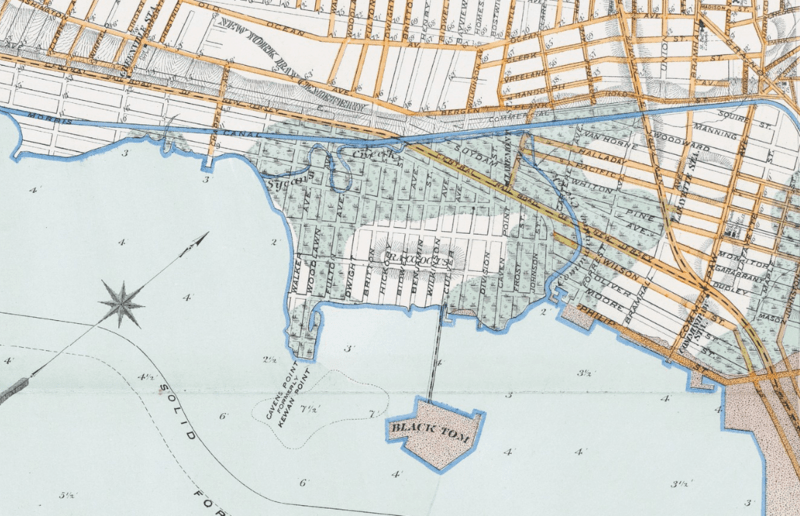
 Known fatalities in the explosion included a Jersey City police officer, a Lehigh Valley Railroad Chief of Police, a ten week old infant, and the barge captain.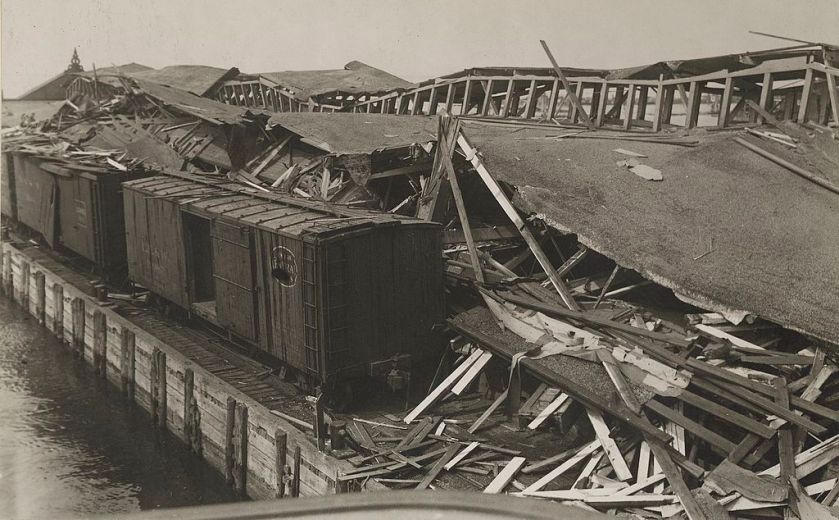












 Historical Easter Eggs - Today in History
You must be logged in to post a comment.