For the family who now owned him, the neglected, half-starved pack animal out back suddenly became a “beloved pet”. They couldn’t possible let him go for anything less than $30,000. (But, of course).
Al Taqaddum Airbase, “TQ” in military parlance, is a military airbase, 45 miles west of Baghdad, on the Habbaniyah Plateau of Iraq. In 2008, Al Taqaddum was home to the 1st Marine Logistics Group, under the command of Colonel John D. Folsom.
Early one August morning, Colonel Folsom awoke to a new sound. The thwap-thwap-thwap of the helicopters, the endless hum of the generators, those were the sounds of everyday life. This sound was different – the sound of braying donkey.
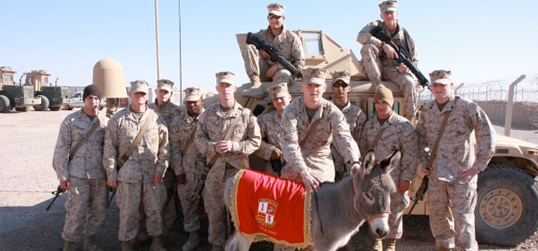
Folsom emerged from his quarters to find the small, emaciated animal, tied to a eucalyptus tree. Standing all of 3′ tall, a sergeant had spotted the donkey roaming outside Camp Taqaddum, and thought it would be amusing to catch him. Folsom thought it might be fun to have one around. Time would tell they were both right.
Smoke visits Sgt Lonnie Forrest
The website for a UK donkey sanctuary recommends a diet of highly fibrous plant material, eaten in small quantities throughout the day. I read the list twice and nowhere will you find bagels yet, for this little Iraqi donkey, there was nothing better. Preferably frozen. He’d hold them in his mouth and walk along, scraping the bagel in the dirt before eating it. He liked to play the same game, with a deflated rubber ball.
You won’t find cigarettes on the list either, but he stole one once, and gobbled it down. It didn’t seem to matter that the thing was lit. For that reason and because of the color of his coat, the Marines called him “Smoke”.
Before long, Smoke was a familiar sight around Camp Taqaddum. After long walks around the wire, Smoke learned to open doors and wander around. If you ever left that candy dish out on your desk, you were on your own.
Regulations prohibit the keeping of pets in a war zone. A Navy Captain helped get Smoke designated as a therapy animal, and he was home to stay. As it turned out, there was more than a little truth to the label. For young women and men thousands of miles from home in a war zone, the little animal was a welcome reminder of home.
The humor of the situation was hard to resist, and the “ass jokes” all but told themselves. (Sorry, but we’re talking about Marines, here). Dozens of Marines laughed uproariously in that mess hall in 2009, belting out a mangled version of an old Kenny Rogers song: “Yes, he’s once, twice, three times a donkey…. I loooooovvvvvveeeeee youuuuuuuuu.”
That was the year when Folsom’s unit cycled out of Camp Taqaddum, to be replaced by another contingent of Marines. These promised to look after the 1st MLG’s mascot, but things didn’t work out that way. A Major gave the donkey away to a Sheikh who in turn dumped him off on an Iraqi family, and that was the end. Except, it wasn’t.
Colonel Folsom couldn’t get the little animal out of his head and, learning of his plight in 2010, determined to get him back. There were plenty of kids who had survived trauma of all kinds in his home state of Nebraska. Folsom believed that the animal could do them some good, as well.
There ensued a months-long wrangle with American and Iraqi authorities, who couldn’t understand why all the fuss over a donkey. For the family who now owned him, the neglected, half-starved pack animal out back suddenly became a “beloved pet”. They couldn’t possible let him go for anything less than $30,000. (But, of course).
900 donors pitched in and, despite seemingly endless obstacles and miles of red tape, Smoke the Donkey slowly made his way from al-Anbar to Kuwait and on to Turkey and finally, to his new home in Nebraska.
Smoke the Marine Corps Donkey, at his new home in Omaha
ABCNews.com broadcast this announcement on May 18, 2011. Smoke the Marine Corps Donkey, “mascot, ambassador, and battle buddy”, was now, an American. Semper Fi.
Dorothy Eustis called Frank in February 1928 and asked if he was willing to come to Switzerland. “Mrs. Eustis, to get my independence back, I’d go to hell”.
Written references to seeing eye dogs date back to the Tudor era, when a bit of children’s doggerel began “A is for Archer…B is a Blind-man/Led by a dog.”
German researchers began working with Alsatians (German Shepherd Dogs) in the 1920s, to serve as guides for WWI veterans blinded by gas. An American breeder living in Switzerland, Dorothy Harrison Eustis, wrote an article about the work in a 1927 issue of the Saturday Evening Post. US Senator Thomas Schall from Minnesota, who was legally blind, was paired with a German service dog that same year.
Morris Frank of Nashville lost the use of an eye in childhood. His vision was destroyed altogether in a boxing accident, at the age of 16. Frank hired a boy to guide him around, but the young man was easily bored and sometimes wandered off, leaving Frank to fend for himself.
Frank’s father saw Eustis’ article in 1927, and read it to him. The twenty-year old was electrified. Morris wrote to Eustis pleading with her to train a dog for himself. “Is what you say really true? If so, I want one of those dogs! And I am not alone. Thousands of blind like me abhor being dependent on others. Help me and I will help them. Train me and I will bring back my dog and show people here how a blind man can be absolutely on his own. We can then set up an instruction center in this country to give all those here who want it a chance at a new life.”
Dorothy Eustis called Frank in February 1928 and asked if he was willing to come to Switzerland. “Mrs. Eustis, to get my independence back, I’d go to hell”. She accepted the challenge and trained two dogs, leaving it to Frank himself to decide which was more suitable. Morris came to Switzerland to work with the dogs, both female German Shepherds. He chose a dog named “Kiss” but, feeling that no 20-year-old man should have a dog named Kiss, he called her “Buddy”.
Morris Frank was a founder of the first guide-dog school in the United States. He was the first person to be partnered with a seeing eye dog and the co-founder of The Seeing Eye, a guide-dog school.
Man and dog stepped off the ship in 1928 to a throng of reporters. There were flash bulbs, shouted questions and the din of traffic and honking horns that can only be New York City, but Buddy never wavered. At the end of the day Eustis received a single word telegram: “Success”. Morris Frank was set on the path that became his life’s mission: to get Seeing Eye Dogs accepted all over the country.
On January 29, 1929, Frank and Eustis established the first American guide dog training school in Frank’s home town of Nashville: “The Seeing Eye“. Frank was true to his word, becoming a tireless advocate of public accessibility for the blind and their guide dogs. In 1928, Morris was routinely told that Buddy couldn’t ride with him in the passenger compartment. Seven years later, all railroads in the United States had adopted policies allowing guide dogs to remain with their owners while on board.
By 1956, every state in the Union had passed laws guaranteeing access to public spaces for blind people and their dogs.
Frank told a New York Times interviewer in 1936 that he had logged 50,000 miles with Buddy, by foot, train, subway, bus, and boat. He was constantly meeting with people, including two Presidents and over 300 ophthalmologists, demonstrating the life-changing qualities of a guide dog.
Buddy’s health was failing toward the end of her life, but the team had one more hurdle to cross. One more barrier to break. Frank wanted to fly in a commercial aircraft with his guide dog, and did so on this day in 1938, flying from Chicago to Newark. United Airlines was the first to adopt the policy, granting “all Seeing Eye dogs the privilege of riding with their masters in the cabins of any of our regularly scheduled planes.”
Morris Frank’s seeing eye dog was all business during the day but, to the end of her life, she loved to end her work day with a roll on the floor with her “Dad”. Buddy died a week after that plane ride, but she had made her mark. There were 250 seeing eye dogs working across the country by this time, and their number was growing fast. Buddy’s replacement was also called Buddy, as was every seeing eye dog Frank ever owned, until he passed away in 1980.
Today, The Seeing Eye operates a 330-acre complex in Morris Township, New Jersey, the oldest guide dog school still in operation, in the world. The primary breeds used for such training are German Shepherds, Labs, Golden Retrievers, and Lab/Golden mixed breeds. Boxers are occasionally used, for individuals with allergies.
Since 1929, Seeing Eye, Inc. has trained some 16,000 guide dogs, pairing them with blind and vision-impaired across the United States and Canada. There are currently 1,720 such human/canine partnerships. The organization places an average of 260 guide dogs every year. The non-profit is primarily funded through private donations, as new students pay only $150, and returning students pay $50. Military veterans are charged a single dollar.
If you enjoyed this “Today in History”, please feel free to re-blog, “like” & share on social media, so that others may find and enjoy it as well. Please click the “follow” button on the right, to receive email updates on new articles. Thank you for your interest, in the history we all share.
The lightly armed merchant vessel of the 18th century was ill equipped to oppose the swarming attack of a hundred or more pirates. Enter history’s first, machine gun.
A story comes to us from the Revolution, of a battle near Boonesborough, Kentucky. A British officer dared to poke his head out from behind a tree. A split-second later he was dead, a lead ball in his head. It was a near-miraculous shot for the day, nearly 250-yards distant from the shooter. The man with the rifle was Daniel Boone. The weapon was his famous Kentucky long rife.
It was a good thing that the man could shoot that weapon, because it took about a minute to load, aim and fire. The smooth-bore weapons of the age were a little quicker. A skilled shooter could could get off 3 rounds per minute, but aimed fire was all but impossible at any kind of distance.
Kentucky Long Rifle
Military tactics on land evolved toward massed firepower. When large groups of men fired at one another, something was going to get hit. Defending yourself at sea, was another matter.
Long before the revolt in Great Britain’s American colony, European navies abandoned oar-powered vessels in favor of sailing ships carrying tons of powerful cannon. Not so the corsairs of the North African coast.
Ottoman privateer Murat Reis, the Elder
The “Barbary pirates” of the Ottoman provinces of Algeria, Tunisia & Tripolitania and the independent sultanate of Morocco favored small, fast galleys, powered by combinations of sail and oar and carrying a hundred or more fighting men armed with flintlock, axe and cutlass.
Barbary navies never formed battle fleets, and would flee at the sight of European frigates. These people were looking for lightly armed merchantmen. They came to take hostages for the Arab slave markets.
The Arab slave trade was never racialized in the way of trans-Atlantic, chattel slavery. Black Africans and white Europeans alike, were fair game. Some historians assert that as many as 17 million entered the Arab slave markets, from Western Asia, North Africa, the Horn of Africa, Southeast Africa and Europe.
It was the enslaved mercenary armies of the Ayyubid dynasty of Egypt and Syria, the Mamālīk (singular Mamlūk), who expelled the last Christian armies from the Levant in 1302, ending the era of the Crusades. For five-hundred years, elite slave armies called “Janissaries” formed the bulwark of Ottoman power from southeastern Europe to western Asia and north Africa.
Ohio State University history Professor Robert Davis estimates that Barbary corsairs captured as many as 1 – 1¼ million Europeans between the 16th and 19th centuries alone, kidnapped from seaside villages along the Mediterranean coast, England, and as far away as the Netherlands, Ireland and Iceland. Some 700 Americans were held in conditions of slavery in North Africa, between the period of the American Revolution and the War of 1812.
The lightly armed merchant vessel of the 18th century was ill equipped to oppose the swarming attack of a hundred or more pirates. Enter history’s first machine gun.
The “Puckle Gun”, patented this day in 1718
James Puckle (1667–1724) was a British inventor, barrister and author. The Puckle Gun, also called the “defence gun”, was a tripod-mounted, single-barreled flintlock fitted with a revolving cylinder. At a time when a trained shooter could load and fire no more than three times per minute, James Puckle’s weapon was capable of nine.
The Puckle gun was intended for naval use, to prevent the boarding of ships at sea. There were two variations, the first intended for use against Christian adversaries. This one fired round balls. The second version was considered to be the more lethal of the two and fired square bullets, intended for use against Muslim Turks. According to the patent, square bullets would persuade the Turks of the “benefits of Christian civilization”. The weapon could also fire shot, with each discharge containing up to sixteen musket balls.
Among investors, there was little interest in the Puckle Gun, and the weapon never gained wide acceptance. Before the era of mass production, gunsmiths had trouble reliably producing its small, complicated parts. One newspaper quipped that the gun “only wounded those who hold shares therein”.
In time, humankind would become much more adept at killing itself. Dr. Richard Gatling invented his multi-barrel, crank fired “Gatling Gun” in 1861, writing that his creation would reduce the size of armies and so reduce the number of deaths by combat and disease. With a rate of fire of up to 900 rounds per minute in the .30 caliber model, Gatling’s gun was popular from the Great Railroad Strike of 1877 to the Anglo-Zulu war of two years later, and the “Rough Riders” assault up San Juan Hill.
American-British inventor Hiram Maxim invented the first true “machine gun” in 1884, by harnessing the weapon’s recoil. The Hiram gun was a favorite of colonial wars from 1886–1914, and variants entered the trenches of WW1.
It would take about a hot minute with the search engine of your choice, to realize that the practice of Muslim slavery, primarily (though not exclusively) at the expense of black Africans, continues to this day.
The stories became more fantastic and more terrifying with each telling. One man claimed that he personally saw the beast kill and eat a grizzly. Another claimed that he had chased the “Red Ghost”, only to have it vanish before his eyes.
Long before he became President of the Confederate States of America, Jefferson Davis was a young Army Officer. At one time, Davis was approached with the idea of using camels as pack animals. To Davis, the idea made sense. The beast’s ability to survive in the desert, its massive strength and great stamina, made him wonder if this wasn’t the weapon of the future.
Twenty years later, then-US Secretary of War Jefferson Davis ordered the creation of the 1st United States Camel Corps. Major Henry Wayne was sent to Turkey to acquire 62 of the animals, along with trainers who could teach American soldiers how to properly handle and care for them.
The camels arrived on May 14, 1856, and set out for the newly established Camp Verde in West Texas, with elements of the US Cavalry and seven handlers.
Major Wayne became an enthusiastic salesman for the camel program, putting on demonstrations for cavalry groups. He would order what seemed an impossible load to be placed on a kneeling camel, and then step back and frown, “concerned” that he might have overdone it. Mule drivers would smile and jab each other with their elbows – now he’s done it – then he would step forward and pile on more weight. On command, the camel would stand up and stroll away, completely unconcerned.
One of the handlers, a Syrian named Hadji Ali, (“Hi Jolly” to the soldiers), established a successful breeding program while stationed at Camp Verde. The program was not without problems. Camels don’t play well with other pack animals, and they don’t accept the whips and prods used to handle horses and mules. They tend to retaliate. A camel will spit or rake your face with its teeth if given the chance, and they can turn and charge in a manner that’s terrifying.
Camp Verde had about 60 camels when Civil War broke out in 1861. The King of Siam seems to have been the only one who grasped the military advantage to the Confederacy. Seeing a business opportunity, the King wrote to President Abraham Lincoln, saying “here, we use elephants”. It seems that Lincoln never responded to the King’s overture, and the animal arms race got no further than this single letter. It makes the imagination run wild, though, at the idea of War Elephants at Gettysburg.
The only known surviving photo of the U.S. Camel Corps shows a camel at Drum Barracks, San Pedro, CA. Library of Congress photo
Some of Camp Verde’s camels were sold off. One poor brute was pushed over a cliff by frustrated cavalrymen. Most were simply turned loose to fend for themselves. The fates of these animals are mostly unknown, except for one who made his way to Mississippi in 1863, where he was taken into service with the 43rd Infantry Regiment. “Douglas the Confederate Camel” was a common sight throughout the siege of Vicksburg, until being shot and killed by a Union sharpshooter. Lieutenant Colonel Robert Bevier of the 5th Regiment, Missouri Confederate Infantry was furious, enlisting six of his best snipers to rain down hell on Douglas’ killer. Bevier later said of the Federal soldier “I refused to hear his name, and was rejoiced to learn that he had been severely wounded.”
Marker for “Douglas The Confederate Camel”. Cedar Hill Cemetery, Vicksburg, Mississippi
The Apache wars were drawing to a close in 1883, but southeastern Arizona could still be a dangerous place. Renegade bands of Apache were on the move, and isolated ranches were in a constant state of siege.
Two men rode out to check on their livestock one day, leaving their wives at the ranch with the kids. One of the women went down to the spring for a bucket of water while the other remained in the house with the children. Suddenly there was a terrifying scream, and the dogs began to bark. The woman inside saw what she described as a huge, reddish beast, being ridden by a devil.
She barricaded herself inside the house and hysterically prayed while she waited for the men to return. They returned that night and found the body of the other woman by the stream. She’d been trampled almost flat, with huge, cloven hoof prints in the mud around her body and a few red hairs in the brush.
Gold prospectors awakened in the night a few days later, as their tent crashed down around them to the sound of thundering hoofs. They clawed their way out of the mess and saw a huge beast, much larger than a horse, run off into the moonlight. The next day, they too found red hairs in the brush.
The stories became more fantastic and more terrifying with each telling. One man claimed that he personally saw the beast kill and eat a grizzly. Another claimed that he had chased the “Red Ghost”, only to have it vanish before his eyes.
A few months later, a Salt River rancher named Cyrus Hamblin spotted the animal while rounding up cows. It was a camel, and Hamblin saw that it had something that looked like the skeleton of a man tied to its back. Nobody believed his story, but a group of prospectors fired on the animal several weeks later. Though their shots missed, they saw the animal bolt and run, and a human skull with some parts of flesh and hair still attached fell to the ground.
There were further incidents over the next year, mostly at prospector camps. A cowboy near Phoenix came upon the Red Ghost while eating grass in a corral. Cowboys seem to think they can rope anything with hair on it, and this guy was no exception. He lashed the rope onto the pommel of his saddle, and tossed it over the camel’s head. The angry beast turned and charged, knocking horse and rider to the ground. As the camel galloped off, the astonished cowboy could clearly see the skeletal remains of a man lashed to its back.
The beast last appeared nine years later in the garden of a rancher. He aimed his Winchester and fired, dropping the animal with one shot. On the back of the poor, tormented beast was the body of a man, tied down with heavy rawhide straps that cruelly scarred the animal’s flesh. The story of the Red Ghost ends here. How the body of a man came to be tied to its back remains a cruel mystery.
The tomb of Hadji Ali in Quartzite, Arizona. The inscription reads: THE LAST CAMP OF HI JOLLY BORN SOMEWHERE IN SYRIA ABOUT 1828 DIED AT QUARTZITE DECEMBER 16, 1902 CAME TO THIS COUNTRY FEBRUARY 10, 1856 CAMELDRIVER – PACKER SCOUT – OVER THIRTY YEARS A FAITHFUL AID TO THE U.S. GOVERNMENT ARIZONA HIGHWAY DEPARTMENT 1935
If you enjoyed this “Today in History”, please feel free to re-blog, “like” & share on social media, so that others may find and enjoy it as well. Please click the “follow” button on the right, to receive email updates on new articles. Thank you for your interest, in the history we all share.
The unsurprising and probably intended result was massively increased forfeiture auctions of real property, and General Lee’s home was no exception.
Shortly after the outbreak of Civil War in 1861, Robert E. and Mary Custis Lee were forced to evacuate their home overlooking the Potomac. “Arlington House”, as they called it, was soon occupied by Federal troops.
As the financial costs of the Civil War mounted, the United States Congress passed a special property tax on “insurrectionary” districts, in order to pay for it. A subsequent amendment required in-person payment of the tax, though clearly, no southern property owner was going to show up in the Union capital to pay the tax.
Arlington House
The unsurprising and probably intended result was massively increased forfeiture auctions of real property, and General Lee’s home was no exception. Mary, who had by this time fled to Fairfax Virginia, was confined to a wheelchair, the victim of rheumatoid arthritis. A Lee cousin was sent with the payment, amounting to $92.07, but tax collectors refused the money. The government auctioned off the property and sold it, to itself, for the sum of $26,800. Somewhat below the currently assessed value of $34,100.
With Washington, D.C. running out of burial space, Quartermaster General Montgomery Meigs proposed that the Lee property be used as a military cemetery. To ensure that the house would never again be inhabited by the Lee family, Meigs directed that graves to be placed as close to the mansion as possible.
The first three military graves at Arlington were dug on May 13, 1864, by James Parks, a former slave who had been freed by his owner and stayed on as a grave digger. 65 years later, “Uncle Jim” would receive special dispensation to be buried there, becoming the first and only person to be buried at Arlington who was also born there.
In 1866, the Quartermaster ordered the remains of 2,111 unknown Civil War dead to be exhumed and placed inside a vault in the Lees’ rose garden.
General Lee seems to have resigned himself to the loss of the property, writing to Mary early in the war that “It is better to make up our minds to a general loss. They cannot take away the remembrance of the spot, and the memories of those that to us rendered it sacred. That will remain to us as long as life will last, and that we can preserve“. He never returned, and never attempted to restore title after the war. Mary visited once, but left without entering the house, so upset was she at what had been done to the place.
After their passing, the Lee’s eldest son George Washington Custis Lee sued for payment for the estate, claiming the seizure to have been illegal. A jury sided with Lee and the United States Supreme Court agreed, in a 5-4 decision handed down in 1882. Arlington House once again belonged to the Lee family, and the Federal government faced the daunting task of disinterring 17,000 graves.
Lengthy negotiations with the heirs resulted in the Lee family selling the home for $150,000, equivalent to $3,221,364 today. The new title was officially recorded on May 14, 1883. Arlington National Cemetery would remain for all time, our nation’s most hallowed ground.
If you enjoyed this “Today in History”, please feel free to re-blog, “like” & share on social media, so that others may find and enjoy it as well. Please click the “follow” button on the right, to receive email updates on new articles. Thank you for your interest, in the history we all share.
For a century, French colonial rulers had looted the mineral wealth of Cambodia, leaving a countryside riddled with mines. After four years of Communist rule, those mines were filled with bones.
Between AD790 and 1431, the Khmere Empire founded by Prince Jayavarman II occupied much of what today includes Cambodia, Thailand, Laos, and southern Vietnam. Now extinct, this powerful civilization was in its day, home to the largest city in the world.
Until recently overrun by Jungle, the capital city of Angkor, whose original name was Yashodharapura (“Glory-bearing city”), was nearly the size of modern day Los Angeles, and home to a million people. Even today, the Hindu temple complex of Angkor Wat, built circa 1122, remains the largest religious monument in the world.
Temple complex at Angkor Wat
During the 1950s, a group of some 200 middle-class Cambodian kids were educated at French Universities. The greater part of them formed a student group of Marxist-Leninist intellectuals, dreaming of an agrarian utopia on the Indo-Chinese peninsula.
Flag of Democratic Kampuchea
What began as a small leftist insurgency in Cambodia, grew in power thanks to support from Communist China and North Vietnam. From only a few hundred individuals in 1960, these “Red Khmeres” (Khmere Rouge) grew into an effective insurgency against the Khmere Republic government of Norodom Sihanouk and Lon Nol.
By early 1975, the Khmere Rouge had overwhelmed Khmer National Armed Forces. The Khmere Rouge captured the Cambodian capital of Phnom Penh on April 17, 1975, overthrowing the government and executing its officers.
Pol Pot
Unlike the cult of personality grown up around the Kim family of North Korea or that of the Stalinist USSR or Maoist China, the Communist Party of (the newly re-christened) “Kampuchea” (CPK) was led by a secretive, eight-member group of those same leftist intellectuals from the Paris student days, calling itself the the “Angkar”, (pronounced ahng-kah, translating as ‘The Organization’).
The Khmere Rouge and the Angkar, led by Communist General Secretary Saloth Sar (better known as ‘Pol Pot’), set to work creating an agrarian peasant’s utopia by exterminating political opponents in “Democratic Kampuchea”, including monks, teachers and business owners. Anyone possessing so much as a whiff of an education, a pair of eyeglasses even, was deemed an “enemy of the people” and clubbed to death on the spot.
For a century, French colonial rulers had looted the mineral wealth of Cambodia, leaving a countryside riddled with mines. After four years of Communist rule, those mines were filled with bones.
At the height of its depravity, the Khmere Rouge smashed the heads of infants and children against Chankiri (Killing) Trees so that they “wouldn’t grow up and take revenge for their parents’ deaths”. Soldiers laughed as they carried out these grim executions. Failure to do so would have shown sympathy, making the killer him/herself, a target.
As the war in neighboring Vietnam drew a close, the “Killing Fields” of Cambodia remained part of an unknown and terrible future. Representatives of the United States, North & South Vietnam, and the Vietcong signed the Paris Peace Treaty in January, 1973. The last Americans airlifted out of Saigon on April 30, 1975 as the capital fell to Communist forces.
On May 12, the American flagged container ship SS Mayaguez passed the coast of Cambodia bound for Sattahip, in southwest Thailand. At 2:18pm, two fast patrol craft of the Khmere Rouge approached the vessel, firing machine guns and then rocket-propelled grenades across its bows.
Captain Charles Miller ordered Mayaguez to a stop, but not before broadcasting SOS and Mayday messages. 39 Americans were now hostages of the Khmere Rouge. Some of the most savage killers, of the 20th century.
The cargo vessel was being towed to Kompong Som on the Cambodian mainland, as word of the incident reached the White House. A government made to look weak and indecisive by what President Ford himself called the “humiliating withdrawal” of only days earlier, could ill afford another drawn-out hostage drama, similar to that of the USS Pueblo. Massive force would be brought to bear against the Khmere Rouge, and time was of the essence.
Two destroyers and an aircraft carrier were ordered to proceed at full speed to the Gulf of Thailand, along with a contingent of Air Force fighters, bombers, and helicopters. A Navy P-3 Orion surveillance aircraft located Mayaguez anchored off Kho-Tang Island, 40 miles from the Cambodian mainland.
At least some of the Mayaguez crew were (mistakenly) believed to be held on the island. Air force units air lifted a battalion-sized Marine rescue team to rescue the crew. Meanwhile, the destroyer USS Holt was ordered to seize the Mayaguez, as the aircraft carrier Coral Sea launched bombing strikes against military targets in Cambodia.
Expecting only light resistance, US forces were met with savage force on May 15, from a heavily armed contingent of some 150-200 Khmere Rouge. Three of the nine helicopters participating in the operation were shot down, and another four too heavily heavily damaged to continue
US bombing raids accomplished their purpose on the Cambodian mainland. A fishing boat soon approached the destroyer USS Wilson under flag of truce. Onboard were the 39 crewmen of the Mayaguez.
The situation was different on Kho-Tang Island. US forces were ordered to withdraw, as Khmere Rouge commanders pressed the attack. Air Force helicopter crews and Marine riflemen moved through heavy fire throughout the 15th, their defensive perimeter becoming smaller with the departure of every over-loaded chopper.
The cost of the Mayaguez Incident, officially the last battle of the Vietnam war, was heavy. Eighteen Marines, Airmen and Navy corpsmen were killed or missing in the assault and evacuation of Kho-Tang Island. Another twenty-three were killed in a helicopter crash. The last of 230 Marines would not get out until well after dark.
No United States Marine would leave one of their own behind, either dead or alive. Not intentionally, but such discipline was impossible in the chaos of that night. LCpl Joseph Hargrove, Pfc Gary Hall and Pvt Danny Marshall formed a machine gun team, guarding the right flank of the evacuation as darkness fell.
The team was last seen by Sgt. Carl Anderson Jr.. Later reports described the three as being out of ammunition and “scared”. Anderson ordered the three to evacuate and they were preparing to do so, when last seen. Navy SEALs and Marines asked permission to go back and attempt a rescue, but permission was denied.
The government in Washington, touted the operation as a victory.
From left, Lance Cpl. Joseph Hargrove, Pfc. Gary Hall and Pvt. Danny Marshall H/T Stars and Stripes, for this image
Joseph Nelson Hargrove turned twenty-four, the day he was last seen on that beach. In 2012, Khmere Rouge commander Em Son told Stars & Stripes that Hargrove was captured a week later, trying to steal food. He was shot and killed the following day, while attempting to escape. Gary Hall and Danny Marshall were captured a short time later, brought to the mainland and beaten to death by the Khmere Rouge. Both were 18.
In 2011, Khmer Rouge platoon commander Mao Run claimed to have killed a US service man with a grenade, several days after the battle. Alone and exhausted, this may have been a fourth man left behind alive. The name of this man and the details of his final days, remain uncertain.
The last official battle of the War in Vietnam, etched the last 41 names on the Vietnam Veterans Memorial wall in Washington.
This is a long clip – about 28 minutes – but well worth watching.
If you enjoyed this “Today in History”, please feel free to re-blog, “like” & share on social media, so that others may find and enjoy it as well. Please click the “follow” button on the right, to receive email updates on new articles. Thank you for your interest, in the history we all share.
The “Iron Lady”, Prime Minister Margaret Thatcher herself, appears to have been a fan, doing a more than passable version of the Dead Parrot sketch at a Conservative Party Conference in 1990.
Graham Chapman was trained and educated to be a physician, but that career trajectory was never meant to be. John Cleese was writing for TV personality David Frost and actor/comedian Marty Feldman in 1969, when he recruited Chapman as a writing partner and “sounding board”. BBC offered the pair a show of their own in 1969, when Cleese reached out to former How To Irritate People writing partner Michael Palin, to join the team. Palin invited his own writing partner Terry Jones and colleague Eric Idle over from rival ITV, who in turn wanted American-born Terry Gilliam for his animations.
The British comedy troupe which formed on this day forty-nine years ago was amused at the idea of a haughty Lord Montgomery, patterned after Field Marshal Bernard Law Montgomery, 1st Viscount Montgomery of Alamein, KG, GCB, DSO, PC, DL, etc., etc., etc. “Python” seemed just slippery enough to make the whole thing work.
The Pythons considered several names for the new program, including “Owl Stretching Time”, “The Toad Elevating Moment”, “Vaseline Review” and “A Horse, a Spoon and a Bucket”. “Flying Circus” had come up as well. The name stuck when BBC revealed that it had already printed flyers, and weren’t about to go back to the printer.
The show was a collaborative process, beginning with the first broadcast on October 5, 1969. With no writers of their own, the six would divide into groups and write their own material. Whether any given sketch would make it into the program, was always a democratic process.
Different Python factions were responsible for different elements of the team’s humor. The work of the Oxford educated Terry Jones and Michael Palin was more visual, and a little more off the wall. The Spanish Inquisition bursting into the suburban apartment is a prime example, while the Cambridge educated John Cleese and Graham Chapman were more confrontational – “This is abuse. I came here for an argument”. Cleese described Eric Idle’s work: “anything that got utterly involved with words and disappeared up any personal orifice was Eric’s”. The Man who Spoke in Anagrams. Terry Gilliam was the guy behind the animation.
The Flying Circus broke new ground with techniques like the “cold open”. With no titles, credits, or opening theme, Michael Palin would crawl across the tundra a la Robinson Crusoe, looking into the camera and saying “It’s“… And off they went. The cold open sometimes lasted until the middle of the show. Occasionally, the Pythons fooled viewers by rolling closing credits halfway through, usually continuing the gag by fading to the BBC logo while Cleese parodied the tones of a BBC announcer. On one occasion, closing credits ran directly after the opening titles.
I personally learned to never leave a Python film during closing credits, finding my reward for sticking around at the end of the Life of Brian was to learn who wiped the moose’s noses. As I recall, it was John J. Llama.
The “Iron Lady”, Prime Minister Margaret Thatcher herself, appears to have been a fan, doing a more than passable version of the Dead Parrot sketch at a Conservative Party Conference in 1990.
The Pythons shared a dislike for “capping” bits with punchlines, and experimented with ending sketches by cutting abruptly to another scene, or breaking the rules altogether by addressing the camera directly. The knight in armor, played by Terry Gilliam, would wander onto the set and whack people over the head with a rubber chicken. Chapman’s “Colonel” character would walk into sketches and order them stopped because things were becoming “far too silly.”
Gilliam’s animations were a favorite technique, when a 16 ton weight would drop from the sky, or else it was Cupid’s foot – yes, that’s Cupid’s foot – cut from a reproduction of the Renaissance masterpiece “Venus, Cupid, Folly, and Time” by Il Bronzino.
John Cleese left the Flying Circus at the end of the third season. He had considered doing so at the end of the second, feeling that he had little original material to offer the show. He found Chapman difficult to work with, who was at this time a full tilt alcoholic. Cleese could be difficult himself. Eric Idle once said of John Cleese. “He’s so funny because he never wanted to be liked. That gives him a certain fascinating, arrogant freedom”.
The group reunited in 1974 to do the Holy Grail, filmed on location in Scotland on a budget of £229,000. The money was raised in part by investments from musical figures like Pink Floyd, Jethro Tull and Led Zeppelin backer Tony Stratton-Smith.
Investors in the film wanted to cut the famous Black Knight scene, (“None shall pass”), but were eventually persuaded to keep it in the film. Good thing, the scene became second only to the Holy Hand Grenade of Antioch and the Killer Rabbit. “What’s he going to do, nibble my bum?”
Graham Chapman is best remembered as King Arthur in the Holy Grail, and Brian Cohen in the Life of Brian. Chapman died of spinal and throat cancer on the 20th anniversary of their first broadcast. John Cleese delivered a uniquely Pythonesque eulogy, which sounded a lot like the Dead Parrot sketch. “”Graham Chapman, co-author of the Parrot sketch, is no more,” he began. “He has ceased to be, bereft of life, he rests in peace, he has kicked the bucket, hopped the twig, bit the dust, snuffed it, breathed his last, and gone to meet the Great Head of Light Entertainment in the sky…”
I don’t believe he’d have had it any other way. Silly bunt.
If you enjoyed this “Today in History”, please feel free to re-blog, “like” & share on social media, so that others may find and enjoy it as well. Please click the “follow” button on the right, to receive email updates on new articles. Thank you for your interest, in the history we all share.
It is often said that, when governments make war, it’s the everyday John and the Nigel, the Fritz and the Pierre down the street, who must do the fighting, the bleeding and the dying. It might well be added, that it is left to the mice, to pick up the pieces.
Little is written in times of war, about the Innocents. The proverbial mice trying to go about their business, amidst the combat of elephants. What then is to be made of the innocent who exists, only as the result of that war?
Throughout history and across cultures, having a child by a member of a hostile force is looked upon as a grave betrayal of social values. Often, such parents (usually women) are shunned by neighbors and even family. “War children” are ostracized and bullied, or worse.
Following liberation, French women were beaten and humiliated in the streets, their heads shaved, for being “collaborators” with their German occupiers.
On the Eastern Front of WW2, combat between Nazi Germany and the Soviet Union had long taken on shades of a race war, Slav against Teuton, in a paroxysm of mutual extermination that is horrifying, even by the hellish standards of that war. Soviet soldiers committed prodigious numbers of rapes on German and Austrian women, and even Soviet women released from work camps. Historian Geoffrey Roberts writes that 70,000–100,000 such rapes took place in Vienna, alone.
Post-WW2 Occupation Zones
Propaganda banners and posters appeared all over the Soviet-occupation zone and later East Germany, proclaiming the heroism of those who had smashed the Nazi war machine and paved the way to Soviet-German friendship. The plight of tens of thousands of the mostly fatherless “Russian children”, was taboo.
Sixty-five years later, Jan Gregor of the East German state of Brandenburg, can still remember the day his mother told him that she’d been “made pregnant by force”. He was five, at the time.
An estimated 100,000 “Amerasian” children were born to Asian mothers and US servicemen during WWII, the Korean War, and war in Vietnam.
37,000 or more children were fathered by American soldiers and German & Austrian women in the 10 years following the German surrender. Food and sex became principle units of currency in a growing black market. Cigarettes were widely referred to as “frau bait.”
Locals disapproved of such relations, not only because Americans had recently been their enemies, but also because such children often became “wards of the state” in local economies severely impoverished by war.
The situation for children fathered by black GIs called Negermischlinge (“Negro half-breeds”) was particularly difficult, in what was then a nearly-racially homogeneous society. Even in cases where the father wanted to marry the mother of his child, Army policy prohibited interracial marriages, until 1948. Some were eventually adopted by African-American couples and families in the United States. The plight of black German-speaking children trying to get by in post-war America, is a tale that is yet to be told.
Lebensborn Birth House
Military forces of Nazi Germany invaded the Scandinavian Kingdoms of Denmark and Norway on April 9, 1940. Denmark fell in a day and Norwegian armed resistance ceased within two months, when civil rule passed to the Reichskommissariat Norwegen (Reich Commissariat of Norway).
The neutral Scandinavian countries remained under Wehrmacht occupation, for the following five years.
Sometimes, relationships formed between German occupying forces and native women. The racially obsessed Nazi regime was happy to encourage such relations, particularly in Norway, where local women were considered to be of pure, “Aryan” stock.
“Lebensborn”, the SS-initiated, state-supported association whose goal it was to raise the birth rate of the “Master Race” began on December 12, 1935. The first such Birth House outside of German soil opened in Norway, within a year of the invasion.
Some such relationships were consensual. Many were anything but. Some 10,000 to 12,000 children were born of Norwegian women and German fathers, the most famous being Anni-Frid Synni Lyngstad of ABBA, who was forced to flee Norway after the war for fear of reprisals.
For nearly a thousand years, the administration of Iceland was all but indistinguishable from that of Denmark and Norway. An Act of Union established Iceland as a fully sovereign state in 1918, an independent country in a Personal Union through a common monarch, with the Kingdom of Denmark.
Alarmed at the possibility of a German military presence in Iceland, British authorities invited the neutral nation to join the war as “as a belligerent and an ally,” following the collapse of Denmark. The invitation was rejected, and the UK invaded Iceland on May 10, an initial force of 746 British Royal Marines disembarking at the Icelandic capital of Reykjavík.
The British invasion of Iceland never resembled the “shooting war” in Europe. The government complained that its neutrality had been “flagrantly violated” and demanded compensation, but principle opposition took the form of hordes of civilians, crowding in to see what was going on. Many locals learned they had been invaded, only on seeing a single British aircraft – at that time the only airplane in Iceland.
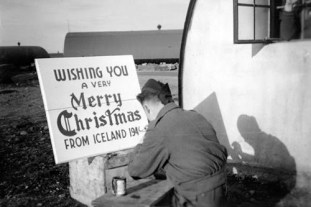
Icelandic public opinion was sharply divided at the invasion and subsequent occupation. Some described this as the “blessað stríðið”, the “Lovely War”, and celebrated the building of roads, hospitals, harbors, airfields and bridges as a boon to the local economy. Many resented the occupation, which in some years equaled 50% of the native male population.
Sexual relationships between foreign troops and local women were severely frowned upon, such women often subjected to what might indelicately be described as “slut-shaming”. In 1941, the Icelandic Minister of the Judiciary investigated “The Situation”. Upset that foreign troops were “taking away” women from friends and family. Police investigated over 500 women for sexual relations with soldiers. Most were determined to be consensual. Two facilities opened to house such women in 1942, but closed within a year.
Two-hundred fifty-five ástandsbörn (“Children of the Situation”) were born of such relationships. 332 Icelandic women married foreign soldiers.
WWII landing craft – Mjóifjorður, Iceland
It is often said that, when governments make war, it’s the everyday John and the Nigel, the Fritz and the Pierre down the street, who must do the fighting, the bleeding and the dying. It might well be added, that it is left to the mice, to pick up the pieces.
If you enjoyed this “Today in History”, please feel free to re-blog, “like” & share on social media, so that others may find and enjoy it as well. Please click the “follow” button on the right, to receive email updates on new articles. Thank you for your interest, in the history we all share.
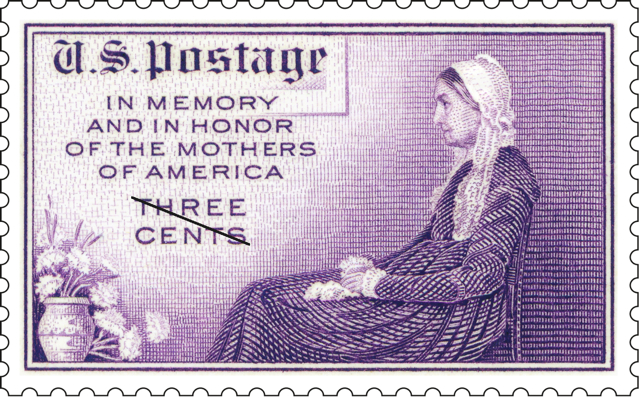
We have a tendency in this culture, to make a big deal of our own birthday. What would it be like if our birthdays became “Mother’s Day”, instead? Why not, she did all the work. All any of the rest of us did, was to show up on cue, and scream.
We have a tendency in this culture, to make a big deal of our own birthday. What would it be like if our birthdays became “Mother’s Day”, instead? Why not, she did all the work. All any of the rest of us did, was to show up on cue, and scream.
The earliest discernible Mother’s day comes from 1200-700BC, descending from the Phrygian rituals of modern-day Turkey and Armenia. “Cybele” was the great Goddess of nature, mother of the Gods, of humanity, and of all the beasts of the natural world. Her cult would spread throughout Eastern Greece with colonists from Asia Minor.
Much of ancient Greece looked to the Minoan Goddess Rhea, daughter of the Earth Goddess Gaia and the Sky God Uranus, mother of the Gods of Olympus. Over time the two became closely associated with the Roman Magna Mater, each developing her own cult following and worshiped through the period of the Roman Empire.
In ancient Rome, women partook of a festival, strictly forbidden to Roman men. So strict was this line of demarcation that only women were permitted even to know the name of the deity. For everyone else she was simply the “Good Goddess”. The Bona Dea.
In the sixteenth century, it became popular for Protestants and Catholics alike to return to their “mother church” whether that be the church of their own baptism, the local parish church, or the nearest cathedral. Anyone who did so was said to have gone “a-mothering”. Domestic servants were given the day off and this “Mothering Sunday”, the 4th Sunday in Lent, was often the only time when whole families could get together. Children would gather wild flowers along the way, to give to their own mothers or to leave in the church. Over time the day became more secular, but the tradition of gift giving continued.
Ann Maria Reeves Jarvis was a social activist in mid-19th century western Virginia. Pregnant with her sixth child in 1858, she and other women formed “Mother’s Day Work Clubs”, to combat the health and sanitary conditions which were leading at that time to catastrophic levels of infant mortality. Jarvis herself gave birth between eleven and thirteen times in a seventeen year period. Only four of those would live to adulthood.
Jarvis had no patience for the sectional differences which led to the Civil War, or those which led her own locality to secede and form the state of West Virginia in order to rejoin the Union. Jarvis refused to support a measure to divide the Methodist church into northern and southern branches. She would help Union and Confederate soldier alike if she could. It was she alone who offered a prayer when others refused, for Thornsbury Bailey Brown, the first Union soldier killed in the vicinity.
Following her death in 1905, Jarvis’ daughter Anna conceived of Mother’s Day as a way to honor her legacy and to pay respect for the sacrifices that all mothers make on behalf of their children.
Obtaining financial backing from Philadelphia department store owner John Wanamaker, Anna Jarvis organized the first official Mother’s Day celebration at a Methodist church in Grafton, West Virginia.
Anna Jarvis resolved that Mother’s Day be added to the national calendar, and formed the International Mother’s Day Association, in 1912. She took out a patent on the name, the singular “Mother’s” expressive of her desire that each of us honor our own mother, and not some anonymous parade of “Mothers'”.
A massive letter writing campaign ensued and, on May 9, 1914, President Woodrow Wilson signed a measure declaring the second Sunday of May, to be Mother’s Day.
Anna Jarvis believed Mother’s Day to be a time of personal celebration, a time for families to gather to love and honor their mother. In the early days, Jarvis worked with the floral industry to help raise the profile of Mother’s Day, but she came to resent what she saw as over-commercialization. Greeting cards seemed a pale substitute for the hand written personal notes she envisioned. In 1923, Jarvis protested a Philadelphia candy maker’s convention, deriding confectioners, florists and even charities as “profiteers”.
Anna Jarvis
Carnations had by this time become symbolic of Mother’s Day, and Jarvis resented that they were being sold at fundraisers. She protested at a meeting of the American War Mothers in 1925 where women were selling carnations, and got herself arrested for disturbing the peace.
She was soon filing lawsuits against those she felt had used the “Mother’s Day” name in vain.
During the last years of her life, Anna Jarvis lobbied the government to take her creation off of the calendar, gathering signatures door-to-door to get the holiday rescinded. The effort was obviously unsuccessful. The mother of mother’s day died childless in a sanitarium in 1948, her personal fortune squandered on legal fees.
So it is that the creator of Mother’s Day turned against her own holiday, but her creation lives on. Today, Mother’s Day is celebrated in over 40 countries. In the United States, Mother’s Day is one of the biggest days of the year for flower and greeting card sales, and the busiest day of the year for the phone company. Church attendance is the third highest of the year, behind only Christmas and Easter. Many celebrate the day with carnations: colored if the mother is still living and white if she has passed on.
Happy Mother’s Day, Mom. May this be the first of many more.
If you enjoyed this “Today in History”, please feel free to re-blog, “like” & share on social media, so that others may find and enjoy it as well. Please click the “follow” button on the right, to receive email updates on new articles. Thank you for your interest, in the history we all share.
“Westminster pre-dates the invention of the light bulb, the automobile, and the zipper; the building of the Brooklyn Bridge and the Washington Monument; and manned air flight and the establishment of the World Series. Since Westminster held its first show 127 years ago, there have been 26 men elected president and 12 states have joined the union”.
The most famous dog show in the world was first held on May 8, 1877, called the “First Annual NY Bench Show of Dogs.” The event began as a show for hunting dogs, mostly Setters and Pointers with a few Terriers.
That first show featured two Staghounds belonging to the late General George Armstrong Custer. Victoria, Queen of the United Kingdom of Great Britain and Ireland, entered two Deerhounds. Two years later, Russian Czar Alexander III entered a Siberian Wolfhound. German Emperor Wilhelm II entered his own Wolfhound, a year later.
The event was held at Gilmore’s Garden at the corner of Madison Avenue and 26th Street, a location which would one day be known as Madison Square Garden. In those days, another popular Gilmore Garden event was competitive boxing, a sport which was illegal in New York at that time. Events were billed as “exhibitions” or, better yet, “Illustrated Lectures.” (I love that one).
A group of hunters used to meet at the Westminster Hotel at Irving Place & 16th Street, “to drink and lie about their shooting accomplishments”. The Westminster Kennel Club was formed when the group first decided to hold a dog show.
According to Westminsterkennelclub.org, “Westminster pre-dates the invention of the light bulb, the automobile, and the zipper; the building of the Brooklyn Bridge and the Washington Monument; and manned air flight and the establishment of the World Series. Since Westminster held its first show 127 years ago, there have been 26 men elected president and 12 states have joined the union…The dog show has outlasted three previous versions of Madison Square Garden, and is currently being staged in MSG IV. It is one of only four events to be held in all four “Gardens.”.
Prizes for that original show included pearl handled revolvers. Amusing when you think of the 2nd amendment purgatory that is Warren Wilhelm’s (Bill DiBlasio’s) New York.
1,201 dogs arrived for that first show, in an event so popular that the originally planned three days morphed into four. The Westminster Kennel Club donated all proceeds from the fourth day to the ASPCA, for the creation of a home for stray and disabled dogs. The organization remains supportive of animal charities, to this day.
The Westminster dog show is the longest continuously held sporting event in the United States, with the sole exception of the Kentucky Derby, which began only a year earlier.
Not even two World Wars would stop the Westminster Dog Show, though a tugboat strike cut two days down to one in 1946. Even so, “Best in Show” was awarded fifteen minutes earlier than the year before. I wonder how many puppies were named “Tug” that year.
The Westminster dog show was first televised in 1948, three years before college football was first broadcast on national television.
When the American Kennel Club (AKC) was founded in 1884, Westminster was the first club to be admitted. Breed parent clubs such as the German Shepherd Dog Club of America developed breed standards, extensive written descriptions of what the perfect specimen looks like for any given breed. Some of the traits which distinguished the original working dogs of 1877 are still apparent, while other elements are seemingly arbitrary, such as tail carriage, eye shape and color.
Breed standard for the American Staffordshire Bull Terrier
Dogs are judged first against others of their own breed. The best of each goes forward into one of seven groups: Sporting, Hound, Working, Terrier, Toy, Non-Sporting, and Herding. In the final round, the winners from each group competes for “Best in Show”. In the end, there can be only one.
Mixed breeds have been permitted since 2014, to compete in an agility event.
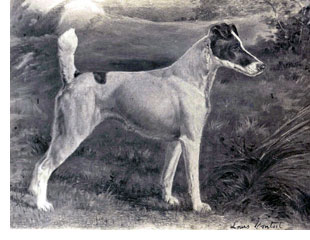
Warren Remedy
A Smooth Fox Terrier named Ch.(Championship) Warren Remedy won the top award in 1907, 1908 and 1909, the only dog to ever win three Best in Shows at Westminster. Seven dogs have twice taken the top award. Five owners have won Best in Show with more than one dog. A Sussex Spaniel named Stump became the oldest winner in dog show history in 2009, at the age of 10. Judge Sari Tietjen said she had no idea the winning dog was a senior citizen. “He showed his heart out,” she said. “I didn’t know who he was or how old … I just couldn’t say no to him”.
Today, the Westminster dog show runs two days and nights in February. Entry is limited to 2,800 dogs and fills up on the first day of registration. Breed judging takes place during the day at Piers 92 and 94. Group and Best in Show competition takes place in the evening at Madison Square Garden. Since 1992, Westminster has invited the top five dogs from each breed to pre-enter, based on dog show performances of the preceding year.
Madison Square Garden generally sells out for the event, the WKC issuing up to 700 press credentials for media attending from no fewer than 20 countries. The Westminster website http://www.westminsterkennelclub.org receives about 20 million page views from 170 countries.
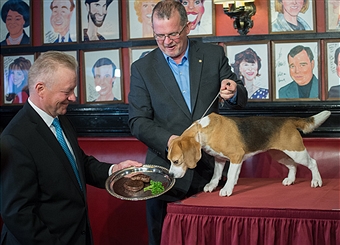
Since the late 1960s, winner of the Westminster Best in Show has celebrated at Sardi’s, a popular mid-town eatery in the theater district and birthplace of the Tony award.
And then the Nanny State descended, pronouncing that 2012 would be the last. There shalt be no dogs dining in New York restaurants. Not while Mayor Bloomberg is in charge.
Suddenly, Westminster found itself in good company. The Algonquin, the historic hotel at the corners of 59th Street West & 44th, had taken in a stray cat, sometime back in the 1930s. Ever since, one of a succession of felines have had the run of the place. The males have all been called “Hamlet”, the females, “Matilda”.
Meet “Hamlet”, the Algonquin Hotel’s official Cat in Residence
And then his Lordship Mayor Yourslurpeeistoobig’s Board of Health descended on the Algonquin, requiring that the cat be kept on a leash. There ensued a tempest in a cat box, until a compromise was reached, later that year. An electronic pet fence was installed confining the cat to non-food areas of the hotel, in return for which city bureaucrats returned to whatever it is they do.
Back to the dog show. Not wanting another such drama, Nanny Bloomberg pulled his health commissioner, Dr. Thomas Farley, aside. By the end of the week, the health department had found a loophole to defuse the standoff: Dr. Farley would issue a waiver. Since then, the winner at Westminster is free to enjoy the traditional celebratory luncheon of diced chicken and rice from a silver platter. Provided that it’s eaten in the back room.
Feature Image, top of page: “Rumor”, Best in Show winner, 2017
This one slays me. I couldn’t resist.
If you enjoyed this “Today in History”, please feel free to re-blog, “like” & share on social media, so that others may find and enjoy it as well. Please click the “follow” button on the right, to receive email updates on new articles. Thank you for your interest, in the history we all share.

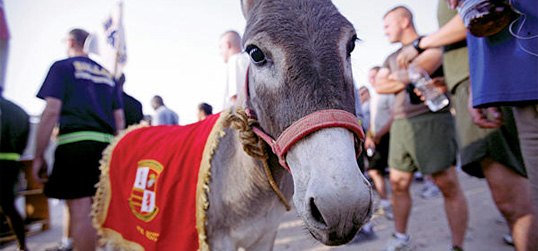
 Early one August morning, Colonel Folsom awoke to a new sound. The thwap-thwap-thwap of the helicopters, the endless hum of the generators, those were the sounds of everyday life. This sound was different – the sound of braying donkey.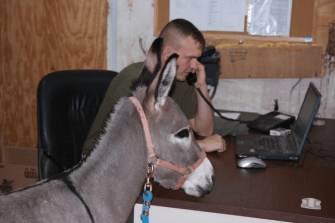
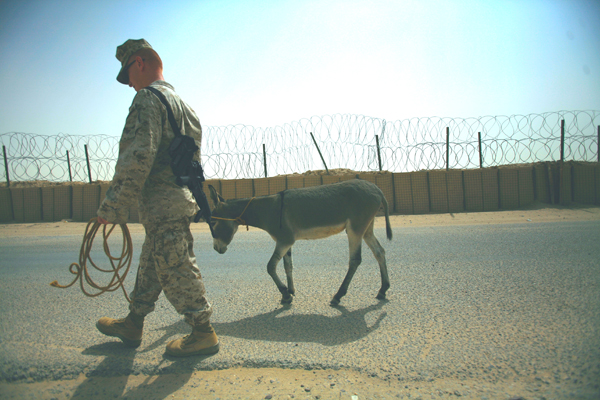 Before long, Smoke was a familiar sight around Camp Taqaddum. After long walks around the wire, Smoke learned to open doors and wander around. If you ever left that candy dish out on your desk, you were on your own.
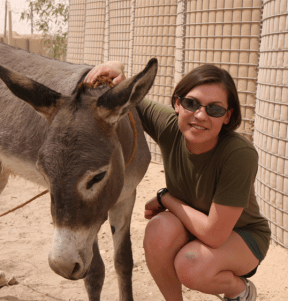 Regulations prohibit the keeping of pets in a war zone. A Navy Captain helped get Smoke designated as a therapy animal, and he was home to stay. As it turned out, there was more than a little truth to the label. For young women and men thousands of miles from home in a war zone, the little animal was a welcome reminder of home.
 Colonel Folsom couldn’t get the little animal out of his head and, learning of his plight in 2010, determined to get him back. There were plenty of kids who had survived trauma of all kinds in his home state of Nebraska. Folsom believed that the animal could do them some good, as well.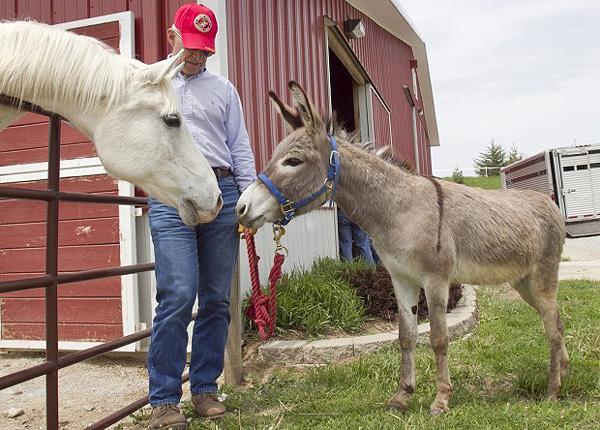


 Today, The Seeing Eye operates a 330-acre complex in Morris Township, New Jersey, the oldest guide dog school still in operation, in the world. The primary breeds used for such training are German Shepherds, Labs, Golden Retrievers, and Lab/Golden mixed breeds. Boxers are occasionally used, for individuals with allergies.


 The camels arrived on May 14, 1856, and set out for the newly established Camp Verde in West Texas, with elements of the US Cavalry and seven handlers.


 A few months later, a Salt River rancher named Cyrus Hamblin spotted the animal while rounding up cows. It was a camel, and Hamblin saw that it had something that looked like the skeleton of a man tied to its back. Nobody believed his story, but a group of prospectors fired on the animal several weeks later. Though their shots missed, they saw the animal bolt and run, and a human skull with some parts of flesh and hair still attached fell to the ground.


 In 1866, the Quartermaster ordered the remains of 2,111 unknown Civil War dead to be exhumed and placed inside a vault in the Lees’ rose garden.


 At the height of its depravity, the Khmere Rouge smashed the heads of infants and children against Chankiri (Killing) Trees so that they “wouldn’t grow up and take revenge for their parents’ deaths”. Soldiers laughed as they carried out these grim executions. Failure to do so would have shown sympathy, making the killer him/herself, a target.
 On May 12, the American flagged container ship SS Mayaguez passed the coast of Cambodia bound for Sattahip, in southwest Thailand. At 2:18pm, two fast patrol craft of the Khmere Rouge approached the vessel, firing machine guns and then rocket-propelled grenades across its bows.
 The cargo vessel was being towed to Kompong Som on the Cambodian mainland, as word of the incident reached the White House. A government made to look weak and indecisive by what President Ford himself called the “humiliating withdrawal” of only days earlier, could ill afford another drawn-out hostage drama, similar to that of the USS Pueblo. Massive force would be brought to bear against the Khmere Rouge, and time was of the essence.
 Expecting only light resistance, US forces were met with savage force on May 15, from a heavily armed contingent of some 150-200 Khmere Rouge. Three of the nine helicopters participating in the operation were shot down, and another four too heavily heavily damaged to continue
 The cost of the Mayaguez Incident, officially the last battle of the Vietnam war, was heavy. Eighteen Marines, Airmen and Navy corpsmen were killed or missing in the assault and evacuation of Kho-Tang Island. Another twenty-three were killed in a helicopter crash. The last of 230 Marines would not get out until well after dark.




 Following liberation, French women were beaten and humiliated in the streets, their heads shaved, for being “collaborators” with their German occupiers.
 Sixty-five years later, Jan Gregor of the East German state of Brandenburg, can still remember the day his mother told him that she’d been “made pregnant by force”. He was five, at the time.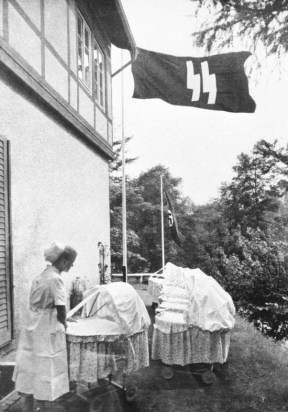

 Icelandic public opinion was sharply divided at the invasion and subsequent occupation. Some described this as the “blessað stríðið”, the “Lovely War”, and celebrated the building of roads, hospitals, harbors, airfields and bridges as a boon to the local economy. Many resented the occupation, which in some years equaled 50% of the native male population.




 A group of hunters used to meet at the Westminster Hotel at Irving Place & 16th Street, “to drink and lie about their shooting accomplishments”. The Westminster Kennel Club was formed when the group first decided to hold a dog show.
 1,201 dogs arrived for that first show, in an event so popular that the originally planned three days morphed into four. The Westminster Kennel Club donated all proceeds from the fourth day to the ASPCA, for the creation of a home for stray and disabled dogs. The organization remains supportive of animal charities, to this day.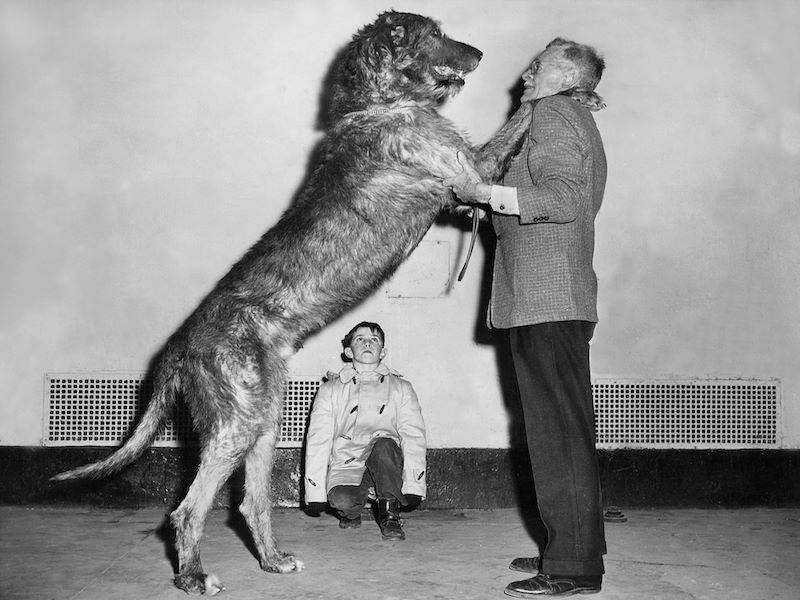


 Since the late 1960s, winner of the Westminster Best in Show has celebrated at Sardi’s, a popular mid-town eatery in the theater district and birthplace of the Tony award.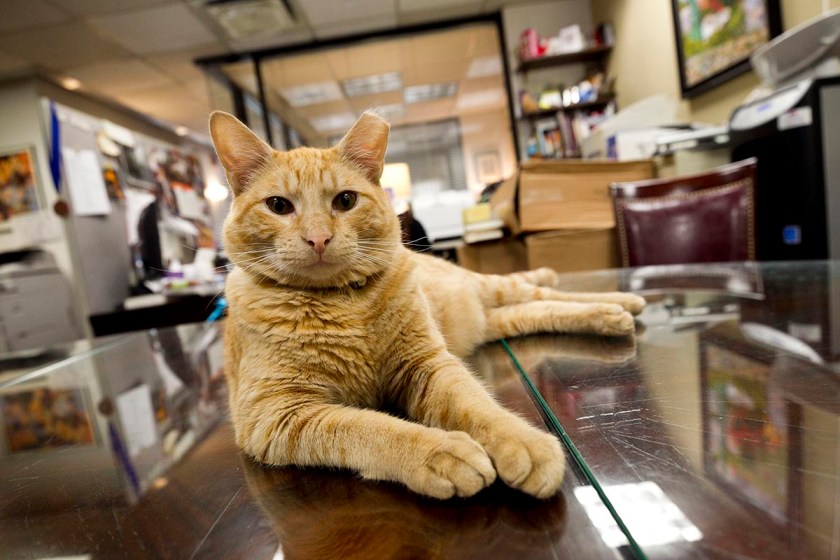


 Historical Easter Eggs - Today in History
You must be logged in to post a comment.