From Betty Boop to the hula hoop, popular culture is always primed and ready to dive into the latest fad.
Established by act of Congress on July 9, 1918, the Silver Star is the third-highest decoration is the system of military honors, awarded to members of US armed services for valor in combat against an enemy of the United States. A search of public records reveals a long list of recipients of the Silver Star including the name “Ball, Harvey A. HQ, 45th Infantry Division, G.O. No. 281”.
Harvey Ball earned the silver star medal “for Conspicuous Gallantry in Action” in 1945, during the battle for Okinawa. He went on to serve most of his life in the United States Army Reserve, retiring in 1979 with the rank of Colonel.
Harvey Ross Ball worked for a sign painter while attending Worcester South High School, and went on to study fine arts at the Worcester Art Museum School.
After the war, Ball came home to Worcester and worked for a local advertising firm, later opening his own ad agency, Harvey Ball Advertising, in 1959.
In 1963, the State Mutual Life Assurance Company of Worcester (now Hanover Insurance) bought out the Guarantee Mutual Company of Ohio. Employee morale tanked with the new acquisition. Director of Promotions Joy Young was tasked with solving the problem. Young hired Harvey Ball as a freelance artist to create a visual icon. A pin to be worn as part of the company’s ‘friendship campaign’.
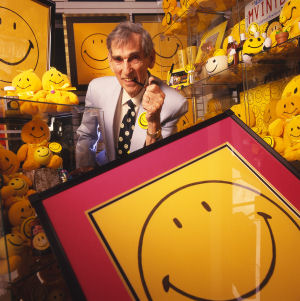
Harvey Ball, surrounded by his own creation
First came the silly grin. That part was easy but the pair soon realized, the button could be inverted. Now we’ve got a “frowny” face and we can’t have that. Ball added eyes, the left drawn just a little smaller than the right, to “humanize” the image.
The work took ten minutes and the artist was paid $45, equivalent to $330 today. Neither Ball nor State Mutual Felt the need to copyright the graphic.
From Betty Boop to the hula hoop, popular culture is always primed and ready to dive into the latest fad. State Mutual ordered 100 buttons. It wasn’t long before manufacturers were taking orders for thousands at a time.
Philadelphia brothers Bernard and Murray Spain seized on the image seven years later and produced millions of coffee mugs, t-shirts, watches and bumper stickers, emblazoned with the happy face and the slogan “Have a happy day”. It was later revised to the ever present, “Have a nice day”.
The image was everywhere, second only to the ubiquitous “Peace Sign”.
Frenchman Franklin Loufrani copyrighted the graphic in France in 1972, using the image in the “good news” section of the newspaper France Soir and developing a line of imprinted novelty items. Loufrani’s son Nicolas took over the family business and launched the Smiley Company, in 1996.
Unsurprisingly, the younger Loufrani is skeptical of Harvey Ball’s claim to have created such a simple design, pointing to cave paintings found in France dated to 2500BC and a similar graphic used in radio ad campaigns, of the early 1960s.
Of course, that didn’t prevent the company from seeking US trademark rights to the image and kicking off a years-long legal battle with retail giant WalMart, which had been using the happy face in its “Rolling Back Prices” campaign.
The Smiley Company is one of the 100 largest licensing corporations in the world with revenues of $167 million in 2012, holding rights to the Smiley Face in over 100 countries. Notably, the United States is not one of them.
As for Harvey Ball, he didn’t seem to mind that he never copyrighted his Smiley Face. The artist is gone now but Ball’s son Charles says his father never was a money driven kind of guy. “Hey”, he would say, “I can only eat one steak at a time. drive one car at a time”.
The Galle Crater, on Mars
In the 2009 film “Watchmen” characters fly to Mars, landing in a crater that looks like a Smiley Face. The red planet really does have such a place. It’s called the Galle crater.
In June of 2010, Wal-Mart and the Smiley Company settled their 10-year-old legal dispute in Chicago federal court. The terms of the settlement are confidential and the words of the judge as he lowered his gavel, are unknown to this scribe.
I so want to believe the man told all those lawyers, to “have a nice day”.
There’s a popular story that the 1947 Beechcraft Bonanza was called “American Pie”, but the story is a myth. The single engine airplane bore only the tail number: N3794N.
Jiles Richardson was a Texas DJ in 1958, the year he found recording success of his own with a song called “Chantilly Lace”.
Richie Valenzuela was only 16 when Del-Fi Records producer Bob Keane discovered the singer in California. “Donna”, a song he had written for his high school sweetheart Donna Ludwig, was on the way to #2 on the Billboard Hot 100, right alongside the 45’s “B” side, an old Mexican standard turned Rock & Roll tune called “La Bamba”. By 1958, Valenzuela was one of the hottest young recording artists of his time.
Charles Hardin Holley, “Buddy” to his friends and family, learned guitar, four-string banjo and lap steel guitar from his older brothers, Travis and Larry. The boy took to music at an early age, winning his first talent contest at age five. One music critic would describe the Lubbock Texas native as “the single most influential creative force in early rock and roll.” Contemporary and later musicians claiming inspiration from Holley’s work include the Beatles, the Rolling Stones, Bob Dylan, and Elvis Costello.58 years ago, his name changed as the result of a misspelling in a recording contract, Buddy Holly was headliner of the “The Winter Dance Party Tour”. Richardson, performing as the “Big Bopper” and Valenzuela, professionally known as Ritchie Valens, were on the tour, along with Dion and the Belmonts, Holly’s friend from Lubbock and fellow musician Waylon Jennings, and a young Owasso, Oklahoma Rockabilly musician and former “Crickets” band member, an enrolled member of the Cherokee Nation named Tommy Allsup.
The musical tour included 24 cities in 3 weeks, a grueling schedule under the best of circumstances. This were anything but the best of circumstances. The tour bus had no heat. A three-week winter bus tour of the upper Midwest is no place to be without heat. It was so cold that Holly’s drummer, Carl Bunch, suffered frostbite in his feet and left the tour in Clear Lake, Iowa.Holly was sick of it, and decided to charter a plane for himself and some of his guys. At least that would give them time to do laundry before the next performance.
Dwyer Flying Service got the charter with a 1947 Beechcraft Bonanza, at $36 per person. There’s a popular story that the four-seater aircraft was called “American Pie”, but the story is a myth. The single engine airplane bore only the tail number: N3794N.
Richardson was running a fever at the time, so Waylon Jennings gave up his seat so the Big Bopper could ride in comfort. Allsup and Valens flipped a coin for the last seat, the coin landing heads up. Ritchie Valens had won the coin toss.
On learning that Jennings wasn’t going to fly, Holly said “Well, I hope your old bus freezes up.” Jennings replied “Well, I hope your plane crashes.” It was just a good ribbing between friends. None could know that Jennings’ joke, would come true. The comment haunted Waylon Jennings for the rest of his life.
N3794N left the ground in a snowstorm, shortly after 1:00am on February 3. The pilot, Roger Peterson, may have been inexperienced with the instrumentation. He may have become disoriented in near-whiteout conditions. One wing hit the ground in a cornfield outside of Clear Lake and the aircraft corkscrewed into the ground, throwing the three musicians clear of the plane. There was no fire, barely a sound. Just a small aircraft swallowed whole, by a snow covered cornfield.
The bodies would lie in that field until late in the afternoon.
The show would go on. Needing to fill in at the next stop in Moorhead, Minnesota, they found a 15 year old talent across the state line in Fargo, and so began the musical career of Bobby Vee.
A boy named Don McLean heard about the plane crash while doing his morning paper route. One day, the future singer/songwriter would pen the words “February made me shiver, with every paper I’d deliver”.
Allsup returned to Odessa, resuming his musical career and opening a club in Dallas, in 1979. He called the place, “Tommy’s Heads Up Saloon”. A nod to the “lost” coin toss that had saved his life.
Distraught, Buddy Holly’s widow miscarried their only child, shortly after the wreck. His last song reached #1 on the UK charts on April 24, 1959, the first posthumous release ever to do so. In the US the song charted at 13 on the Billboard Hot 100. It would be Buddy Holly’s last top 20 hit in the nation.
The name of the song, was “It Doesn’t Matter Anymore.”
Inscribed on Ritchie Valens’ gravestone are the words, “Come On, Let’s Go.”
The last surviving member of Buddy Holly’s 1959 tour band passed away at the age of 85. Tommy Allsup was a big fan of Western Swing, and member of the Rockabilly Hall of Fame. Tommy’s son Austin is himself a singer/songwriter, that’s him in the picture. Austin received messages of condolence on the passing of his father, including one from Ritchie Valens’ sister. “I told her in my message back“, he said “now my dad and Ritchie can finally finish the tour they started 58 years ago.”
Hat Tip Texashillcountry.com for this image, and for the anecdote told above
If you enjoyed this “Today in History”, please feel free to re-blog, “like” & share on social media, so that others may find and enjoy it as well. Please click the “follow” button on the right, to receive email updates on new articles. Thank you for your interest, in the history we all share.
Midway between Winter Solstice and Spring Equinox and well before the first crocus of spring has peered out across the frozen tundra, there is a moment of insanity which helps those of us living in northern climes get through to that brief, blessed moment of warmth when the mosquitoes once again have their way with us.
Here on Sunny Cape Cod™, we have a joke about the four seasons. There’s “Almost Winter”, “Winter”, “Still Winter” and “Bridge Construction”.
Midway between Winter Solstice and Spring Equinox and well before the first crocus of spring has peered out across the frozen tundra, there is a moment of insanity which helps those of us living in northern climes get through to that brief, blessed season of warmth when the mosquitoes once again have their way with us.
Groundhog Day.
The ancient Romans observed a mid-season festival on February 5, the pagan Irish on February 1. For Christians, it was February 2, Candlemas day, a Christian holiday celebrating the ritual purification of Mary. For reasons not entirely clear, early Christians believed there would be six more weeks of winter if the sun came out on Candlemas Day.
Clergy would bless and distribute candles needed for winter, their length representing how long and cold the winter would be. Germans expanded on the idea by selecting an animal, a hedgehog, as a means of predicting weather. Once a suitable number of Germans had come to America, they switched over to a more local rodent: Marmota monax. The common Groundhog.Groundhogs hibernate for the winter, an ability some people of my acquaintance, would love to master. During that time, the animal’s heart rate drops from 80 beats per minute to 5 as the slumbering rodent lives off stored body fat. Another ability some of us could learn to appreciate, very much.
The male couldn’t care less about the weather; he comes out of his burrow in February in search of a mate. If uninterrupted, he will fulfill his groundhog mission of love and return to earth, not coming out for good until sometime in March.But then there is the amorous woodchuck’s worst nightmare in a top hat, the groundhog hunter.
Groundhogs are something of a regional delicacy, said to taste like a cross between pork, and chicken. In the 1880s, groundhog hunters hosted annual Groundhog day festivals in addition to summer hunts, followed by picnics featuring steaming dishes like Country-Style Groundhog, Groundhog and Sweet Potatoes and Waco Groundhog in Sour Cream, all of it washed down with “groundhog punch” consisting ofvodka, milk, eggs, orange juice “and other ingredients.” Yumm.
One group of groundhog hunters in Punxsutawney, Pennsylvania, imaginatively called themselves the Punxsutawney Groundhog Club. One of them, a newspaper editor, declared on February 2, 1887, that their groundhog “Punxsutawney Phil, Seer of Seers, Sage of Sages, Prognosticator of Prognosticators, and Weather Prophet Extraordinary“, was the only true weather forecasting rodent.There are those who would dispute the Gobbler’s Knob crowd and their claims to Punxsutawney Phil’s weather forecasting prowess. Alabama has “Birmingham Bill”, and Canada has Shubenacadie Sam. New York can’t seem to decide between Staten Island Chuck and New York City’s very own official groundhog, “Pothole Pete”.
Today, Phil himself is no longer on the menu. Groundhog punch has given way to a magic elixir said to give Punxatawney’s hundred-year-old rodent, seven more years of life. Since 2010, Punxatawney Faithful can get text message alerts concerning the prognostications of their favorite rodent. (Text “Groundhog” to 247365, if you’re interested).
There is no word for groundhog in Arabic. Accounts of this day in the Arab press translate the word as جرذ الأرض or, “Ground Rat”. If that’s not enough to make us all the life of the party, I don’t know what is.
If anyone were to bend down and ask Mr. Ground Rat his considered opinion on the matter, he would probably cast a pox on all our houses. It’s been a long winter. Mr. Ground Rat’s all dressed up for a date. He has other things on his mind.
The Confucian maxim may have crossed from China to Japan with a Tendai-Buddhist legend, sometime around the 8th century. Up to this time, the story had nothing to do with monkeys.
The Analects of Confucius is a written record of the sayings of the philosopher and his contemporaries, compiled between 475 and 221BC.
In it, a follower called Yen Yüan asked the Master about perfect virtue.
Confucius answered, “To subdue one’s self and return to propriety, is perfect virtue. If a man can for one day subdue himself and return to propriety, all under heaven will ascribe perfect virtue to him”.
“I beg to ask the steps of that process”, asked the student. Confucius replied, “Look not at what is contrary to propriety. Listen not to what is contrary to propriety. Speak not what is contrary to propriety. Make no movement which is contrary to propriety”.
Even in the age of Confucius, this was an ancient idea. Zarathrusta, also known as Zoroaster is in some respects the father of the world’s first monotheistic religion. It was sometime around 1200BC when Zoroaster taught his followers on the high Iranian Plateau “Humata, Hukhta, Hvarshta”. Good Thoughts, Good Words, Good Deeds.
The Confucian maxim may have crossed from China to Japan with a Tendai-Buddhist legend, sometime around the 8th century. Up to this time, the story had nothing to do with monkeys.In medieval Japanese, mi-zaru, kika-zaru, and iwa-zaru translate as “don’t see, don’t hear, and don’t speak”, –zaru being an archaic negative verb conjugation and pronounced similarly to “saru”, the word for monkey.
The visual play on words then, depicts Iwazaru covering his mouth, Kikazaru covering his ears and Mizaru covering his eyes.
Though it’s unusual to see him anymore, there is a fourth monkey. Shizaru is generally depicted with his arms crossed or covering his privates, his name variously translated as “do no evil”, or “know no evil”.The first known depiction of the “Three Mystic Apes” appears over the doors of the Tōshō-gū shrine in Nikkō, Japan, carved sometime in the 17th century.Mohandas Karamchand Gandhi was a Hindu lawyer, a member of the merchant caste from coastal Gujarat, in western India. Today he is known by the honorific “Mahatma”, from Gandhithe Sanskrit meaning “high-souled”, or “venerable”.
Ghandi is recognized as the Father of modern India, who brought Independence to his nation through non-violent protest. Mohandas Gandhi lived a life of poverty and simplicity, owning almost no material possessions at the time of his assassination at the hands of Hindu nationalist Nathuram Vinayak Godse on January 30, 1948.
Beside the clothes on his back, Gandhi owned a tin cup and a spoon, a pair of sandals, his spectacles and a set of three carved monkeys. A reminder to the high-souled one to hear no evil, see no evil, and speak no evil.
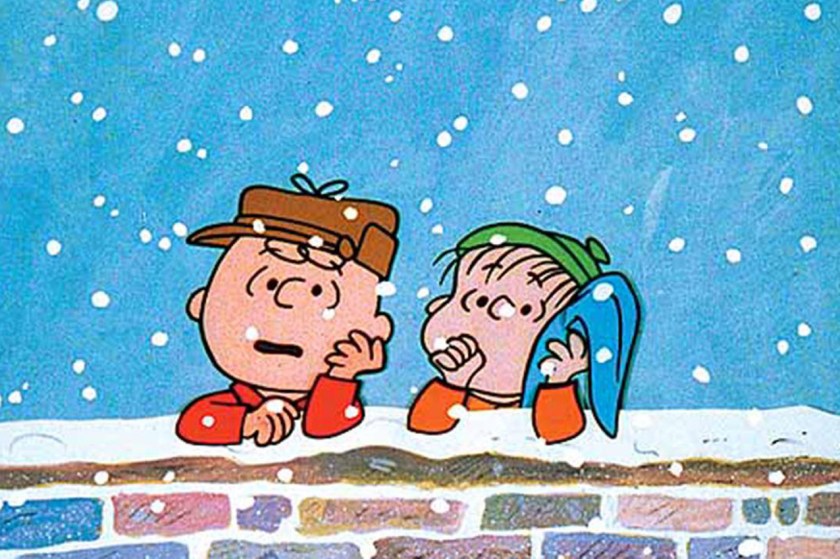
A Charlie Brown Christmas has been a staple of the Christmas season since 1965, though Linus almost didn’t get to tell his famous story of the baby Jesus.
Charles Shulz, high school yearbook photo, class of 1940
Charles Monroe Schulz loved to draw. He was good at at, too. Already one of the brighter kids at Central High School in Saint Paul, Minnesota, Shulz skipped two half-grades graduating youngest member of his class, in 1940. Already a shy boy, rapid academic advancement did little to help his social life.
In those days, the family owned a hunting dog. “Spike” had a number of cringe-worthy habits, including eating sharp objects. It didn’t seem to bother him much, and the boy sent a drawing to Ripley’s Believe It or Not! The magazine ran it, complete with a description of ol’ Spike’s more unusual predilections.
The drawing was signed, “Sparky”.
Even with Schulz later celebrity, you could always weed out those who merely claimed to know the man, as opposed to those who did. If they called him “Charles”, or “Chuck”, that was a sure sign of the mere pretender. Schulz’ uncle called him “Sparky” as a boy, after the horse Spark Plug in Billy DeBeck’s comic strip, Barney Google. He always signed the strip “Schulz”, but friends and family knew him as Sparky, until the day he died.
Schulz was drafted into the Army in 1943, a Staff Sergeant with the 20th Armored Division in Europe and squad leader of a .50-caliber machine gun team.
He never got a chance to fire his weapon, though he did come face-to-face with a Wehrmacht soldier, once. His blood must’ve turned cold in his veins when he realized he’d forgotten to load, but the man he faced was no Nazi fanatic. This was a regular guy, who wanted to go home as much as Shulz himself. The German surrendered, happily. I hope he got home.
Schulz returned to Minneapolis after the war where he did some lettering for a Catholic comic magazine, Timeless Topix. He took a job in 1946 at Art Instruction, Inc., reviewing and grading lessons submitted by students, a job he held for several years while developing his talents as comic creator.
Charlie Brown, that lovable little loser who was always close but never quite made it, first appeared in a series of single-panel jokes called “Li’l Folks“, along with a dog who looked something like Snoopy. The comic was published in local papers from June 1947 to January ’50, and later syndicated. That first strip was published in seven newspapers on October 2, 1950, but United Features thought the name was too close to two strips already in syndication: Li’l Abner, and “Little Folks“.
So it was they called it “Peanuts” after the peanut gallery of Vaudeville days, the cheapest and rowdiest seats in the theater. Schulz didn’t like the name, saying it “made it sound too insignificant,” but the name stuck.
Schulz took pride in his service during the war. At various times, Peanuts paid tribute to Rosie the Riveter and Ernie Pyle. More than any other, he’d honor “Willy & Joe”, those two GIs from the imagination of war correspondent and cartoonist Bill Mauldin, a man to whom Schulz always referred as “My Hero”. Over the years, Snoopy visited with Willie & Joe no fewer than 17 times. Always on Veterans Day.A Charlie Brown Christmas has been a staple of the Christmas season since 1965, though Linus almost didn’t get to tell his famous story of the baby Jesus. ABC executives thought Linus’ recitation of the birth of Christ too overtly religious. The “suits” wanted a laugh track as well, but Schulz refused. “If we don’t do it, who will?” In the end, the scene remained. Perhaps the most memorable moment in cartoon history. The laugh track version was produced, but never aired.Charlie Brown’s love interest in some of those TV specials, the “Little Red-Haired Girl”, was based on an accountant from that old job at Art Instruction, named Donna Mae Johnson. The couple had an office romance for a time, but she turned him down when Shulz proposed.
Johnson wasn’t the only character based on a real person. Linus and Shermy were patterned after Schulz’ close friends Linus Maurer and Sherman Plepler. Peppermint Patty was inspired by a cousin on his mother’s side, Patricia Swanson. Snoopy himself resembles that old family dog, though Spike was a Pointer, not a Beagle.
In 1967, American opinion polls showed a sharp drop in support for the war in Vietnam. 1968 was a wretched year in American politics, beginning with the Tet Offensive in January. Media reporting turned the American military victory over the Vietnamese New Year, into a thing of despair. President Johnson withdrew from the Presidential election, that March. Martin Luther King, Jr. was assassinated that April leading to riots across the country. Robert F. Kennedy was assassinated in June, after winning the critical California primary. The Democratic National Convention that August was more of a riot, than a political convention.
Franklin Armstrong
Race relations were particularly vile in 1968, when a Jewish Mom and Los Angeles schoolteacher wrote to the cartoonist, asking if he would add a black character. Harriet Glickman never expected a response from the now-famous Charles M. Schulz, but respond he did. He said he liked the idea but expressed concern the character might seem condescending, to black families.
With Schulz’ permission, Glickman asked friends of African ancestry, how to make such a character “more relatable”.
Franklin Armstrong made his first appearance on July 31, 1968. What was remarkable for the time, was how unremarkable, he was. Just another little boy, at first confused about the strange stuff going on in Charlie Brown’s neighborhood. Particularly Linus’ obsession with the ‘Great Pumpkin’. Franklin first met Charlie Brown on a beach. He said his father was a soldier, off fighting in Vietnam. “My dad’s a barber,” said Charlie Brown. “He was in a war too, but I don’t know which one.”
One newspaper editor wrote saying he didn’t mind a “negro” character, but please don’t show them in school together. Schulz didn’t bother to respond to that one.
Peanuts went on to become a pop culture phenomenon, with countless animated specials combining with merchandise sales to produce revenues in the Billions. At it’s peak, Peanuts ran in 2,600 papers in 75 countries and 21 languages. Schulz himself is estimated to have earned $30 to $40 million, a year.
I wonder if Donna Mae Johnson ever regretted turning down that marriage proposal.
In 1969, the command module for the Apollo 11 mission to the moon was named Charlie Brown. The lunar module was called Snoopy. President Ronald Reagan was a fan, who once wrote to Schulz that he identified with Charlie Brown.
Over fifty years, Schulz drew nearly 18,000 strips, taking vacation only once in 1997 to celebrate his 75th birthday. In all those years, that five-week stretch was the only time the papers ever had Peanuts reruns.
Stephen Shea, H/T Huffington Post
Fun fact: Former child actor Stephen Shea inherited the speaking role for Linus van Pelt when his older brother Chris’ voice changed, and went on to perform in eight animated specials. Chris went to summer camp with a boy who happened to be President of The Doors fan club. It turns out that Jim Morrison was a big Peanuts fan, and invited Chris and his father to be his special guests, at a Doors concert.
By the late 1990s, Schulz’ health was beginning to fail. His once-firm hand, now had a tremor. He never really recovered from the stroke that hit him in November 1999 and announced his intention to retire, on December 14. The last original Peanuts comic strip was published on January 3, 2000.
This son of a barber and a housewife, just like Charlie Brown himself, passed away just over a month later, a victim of colon cancer.
There will never be another.
If you enjoyed this “Today in History”, please feel free to re-blog, “like” & share on social media, so that others may find and enjoy it as well. Please click the “follow” button on the right, to receive email updates on new articles. Thank you for your interest, in the history we all share.
Most of the non-Catholic world took 170 years to adopt the Gregorian calendar. Britain and its American colonies “lost” 11 days synchronizing with it in 1752. The last holdout, Greece, would formally adopt the Gregorian calendar in 1923. Since that time we’ve all gathered to celebrate New Year’s Day on the 1st of January.
From the 7th century BC, the Roman calendar attempted to follow the cycles of the moon. The method frequently fell out of phase with the change of seasons, requiring the random addition of days. The Pontifices, the Roman body charged with overseeing the calendar, made matters worse. They were known to add days to extend political terms, and to interfere with elections. Military campaigns were won or lost due to confusion over dates. By the time of Julius Caesar, things needed to change.
When Caesar went to Egypt in 48BC, he was impressed with the way the Egyptians handled their calendar. Caesar hired the Alexandrian astronomer Sosigenes to help straighten things out. The astronomer calculated that a proper year was 365¼ days, which more accurately tracked the solar, and not the lunar year. “Do like the Egyptians”, he might have said, the new “Julian” calendar going into effect in 46BC. Caesar decreed that 67 days be added that year, moving the New Year’s start from March to January 1. The first new year of the new calendar was January 1, 45BC.
Caesar synchronized his calendar with the sun by adding a day to every February, and changed the name of the seventh month from Quintilis to Julius, to honor himself. Rank hath its privileges.
Not to be outdone, Caesar’s successor changed the 8th month from Sextilis to Augustus. As we embark on the third millennium, we still have July and August.
Sosigenes was close with his 365¼ day long year, but not quite there. The correct value of a solar year is 365.242199 days. By the year 1000, that 11 minute error had added seven days. To fix the problem, Pope Gregory XIII commissioned Jesuit astronomer Christopher Clavius to come up with yet another calendar. The Gregorian calendar was implemented in 1582, omitting ten days and adding a day on every fourth February.
Most of the non-Catholic world took 170 years to adopt the Gregorian calendar. Britain and its American colonies “lost” 11 days synchronizing with it in 1752. The last holdout, Greece, would formally adopt the Gregorian calendar in 1923. Since that time we’ve all gathered to celebrate New Year’s Day on the 1st of January.
The NY Times Newspaper moved into “Longacre Square” just after the turn of the 20th century. For years, New Years’ eve celebrations had been held at Trinity Church. Times owner Adolph Ochs held his first fireworks celebration on December 31, 1903, with almost 200,000 people attending the event. Four years later, Ochs wanted a bigger spectacle to draw attention to the newly renamed Times Square. He asked the newspaper’s chief electrician, Walter F. Painer for an idea. Painer suggested a time ball.
A time ball is a marine time signaling device, a large painted ball which is dropped at a predetermined rate, enabling mariners to synchronize shipboard marine chronometers for purposes of navigation. The first one was built in 1829 in Portsmouth, England, by Robert Wauchope, a Captain in the Royal Navy. Time balls were obsolete technology by the 20th century, but it fit the Times’ purposes.
The Artkraft Strauss sign company designed a 5′ wide, 700lb ball covered with incandescent bulbs. The ball was hoist up the flagpole by five men on December 31, 1907. Once it hit the roof of the building, the ball completed an electric circuit, lighting up a sign and touching off a fireworks display.
The newspaper no longer occupies the building at 1 Times Square, but the tradition continues. The ball used the last few years is 12′ wide, weighing 11,875lbs; a great sphere of 2,688 Waterford Crystal triangles, illuminated by 32,256 Philips Luxeon Rebel LED bulbs and producing more than 16 million colors. It used to be that the ball only came out for New Year. The last few years, you can see the thing, any time you like.
In most English speaking countries, the traditional New Year’s celebration ends with the singing of “Auld Lang Syne”, a poem written by Robert Burns in 1788 and set to the tune of an old pentatonic Scots folk melody. The original verse, phonetically spelled as a Scots speaker would pronounce it, sounds something like this:
“Shid ald akwentans bee firgot, an nivir brocht ti mynd? Shid ald akwentans bee firgot, an ald lang syn? CHORUS “Fir ald lang syn, ma jo, fir ald lang syn, wil tak a cup o kyndnes yet, fir ald lang syn. An sheerly yil bee yur pynt-staup! an sheerly al bee myn! An will tak a cup o kyndnes yet, fir ald lang syn”. “We twa hay rin aboot the braes, an pood the gowans fyn; Bit weev wandert monae a weery fet, sin ald lang syn”. CHORUS “We twa hay pedilt in the burn, fray mornin sun til dyn; But seas between us bred hay roard sin ald lang syn”. CHORUS “An thers a han, my trustee feer! an gees a han o thyn! And we’ll tak a richt gude-willie-waucht, fir ald lang syn”
Happy New Year, from Mr & Mrs Cape Cod Curmudgeon, Rick & Sheryl.
In some German speaking regions, a malevolent Schmutzli accompanies Samichlaus, carrying a twig broom with which to spank wicked children. Never mind Santa Claus. The Schmutzli is watching.
The historical life of St. Nicholas is shrouded in legend. Born in modern-day Turkey on March 15, AD270, Nicholas was the only child of affluent parents, both of whom died in a plague leaving young Nicholas a very wealthy orphan.
1689 fresco depicts St. Nicholas, giving to a school
Nicholas was raised in the Christian faith and became an early bishop in the Greek church.
One of many stories concerning the bishop’s generosity involves a destitute father, unable to raise a dowry sufficient to marry his three daughters off. On two nights in a row, Nicholas crept up to the man’s window and dropped a small sack of gold coins.
On the third night, the man stayed up to learn the identity of his secret benefactor, only to be asked to keep the name, secret.
Saint Nicholas died on December 6 in the year 343. He was entombed in a marble cathedral dedicated to his name, in the Roman town of Myra.
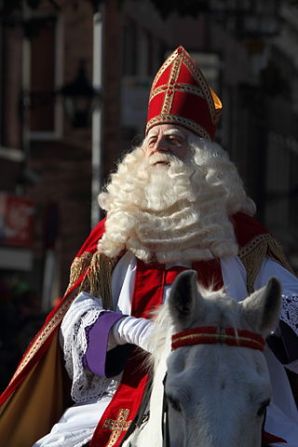
The “Sinterklass” of the Netherlands, rides a white horse
Nicholas is remembered as the patron saint of whole nations and cities such as Amsterdam and Moscow, revered among the early Christian saints and remembered for a legendary habit of secret gift-giving.
Some ideas take hold in the popular imagination, while others fade into obscurity. The “Three Daughters” episode made it into nearly every artistic medium available at that time, from frescoes to carvings and windows, even theatrical performances.
The Patron Saint not only of sailors but of ships and their cargoes, the seas were the internet of the day and the story of St. Nick spread from the Balkans to Holland, from England to Crete.
In time, the Feast of St. Nicholas took hold around December 6. Children and other marginal groups such as old women and slaves could receive gifts, but only by demanding them. Secret gift giving appeared sometime around the year 1200.
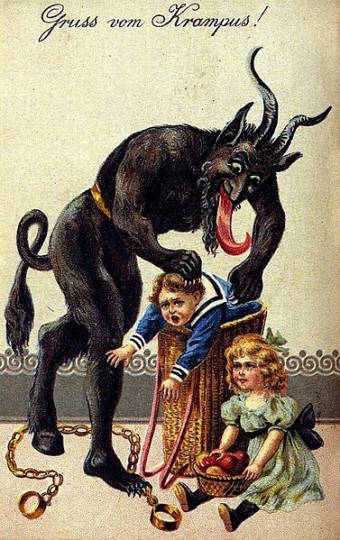
On the European continent, legends of St. Nicholas combined with Pagan traditions and developed in quirky directions, including an evil doppelgänger who accompanies St. Nick on his rounds.
As early as the 11th century, the Krampus may be expected to snatch up bad little tykes in parts of Germany, Austria and the Alpine villages of northern Italy, never to be seen again.
In eastern Europe, the witch Frau Perchta “The Disemboweller” was said to place pieces of silver in the shoes of children and servants who’d been good and worked hard over the year. Those who’d been naughty or lazy would be slit open and their organs replaced, with pebbles and straw.
Yikes.
In French-speaking regions, Père Fouettard (Father Whipper) accompanies Père Noël on gift-giving rounds, dispensing beatings and/or lumps of coal to naughty boys & girls.
In some German speaking regions, a malevolent Schmutzli accompanies Samichlaus, carrying a twig broom with which to spank wicked children.
Never mind Santa Claus. The Schmutzli is watching.
Samichlaus and the Schmutzli
In the 13th century, the “Little Ice Age” of led to a proliferation of chimneys. Windows and doors were common objects, often the things of thieves and vagabonds. The chimney was different, a direct pathway to the warm heart of the home. So it was St. Nick made his first gift-giving appearance via the chimney in a three daughters fresco, painted sometime in 1392, in Serbia.
St. Nicholas saving the Three Maidens, Decani monastery, Kosovo
St. Nicholas was beginning to be seen as part of the family outside of the Church, which is probably why he survived what came next. Saints reigned in the Christian world until the 16th century, when the Protestant reformation rejected such “idolatry” as a corruption of Christianity.
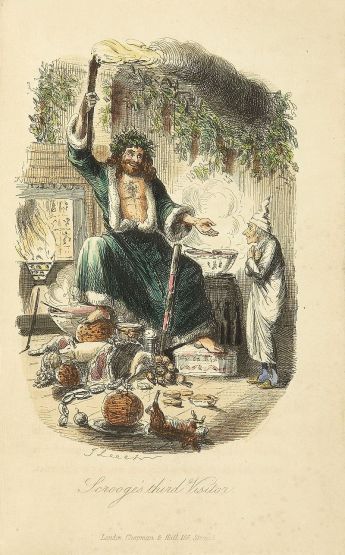
The Ghost of Christmas present as illustrated by John Leech, in Charles Dickens’ classic, a Christmas Carol
Whatever you called him: Sinterklaos, Saint-Nikloi or Zinniklos, St. Nick went away entirely in England and Scotland during the time of Henry VIII, giving way to the spirit of Christmas cheer in the person of one Father Christmas. England would no longer keep the feast of the Saint on December 6. The celebration moved to December 25, to coincide with Christmas itself.
Protestants adopted as gift bringer the Baby Jesus or Christkindl, later morphing into Kris Kringle.
Puritan arrivals to New England rejected Christmas and everything with it, as “un-Christian”. In 1644, Massachusetts levied a fine of five shillings, on anyone observing the holiday.
Sinterklaas survived the iconoclasm of the Reformation in places like Holland, transferring to the 17th century settlement of New Amsterdam: what we now know as the new world port city of New York.
Sinterklass blended with Father Christmas to create a distinctly American Santeclaus, which began to take hold in the 19th century.
The Christmas “celebrations” of the period looked more like Mardi Gras than what we know today. Drunk and rowdy gangs wandered the streets of New York, Philadelphia and the cities of the northeast, something between a noisy mob and a marching band. Men fired guns into the air and banged or blew on anything that would make noise. Mobs would beat up the unfortunate, and break into the homes of the “upper classes”, demanding food and liquor.
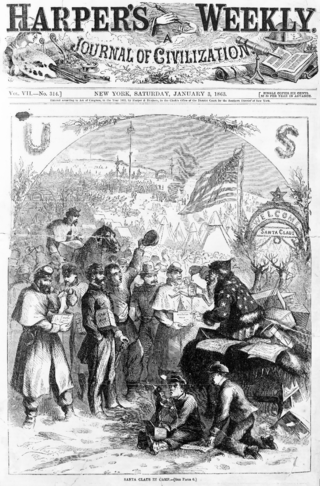
Santa Claus 1863, by Thomas Nast
New York philanthropist John Pintard, the man responsible for the holidays celebrating the fourth of July and George Washington’s birthday, popularized an image first set forth by Washington Irving, in his satirical story A History of New York from the Beginning of the World to the End of the Dutch Dynasty, by Diedrich Knickerbocker, depicting St. Nicholas bringing gifts to good little boys and girls, and switches with which to tan the hides of bad kids.
The unknown genius who published and illustrated A Children’s Friend in 1821, first depicted “Santa Claus” not as a Catholic bishop, but as a non-sectarian adult in a fur lined robe, complete with a sleigh inexplicably powered by a single reindeer, coming in through the chimney not on December 6, but on Christmas eve.
An anonymous poem believed to have been written on December 24, 1822 and later attributed to Clement Clarke Moore, began with the words: “T’was the night before Christmas, and all through the house“…
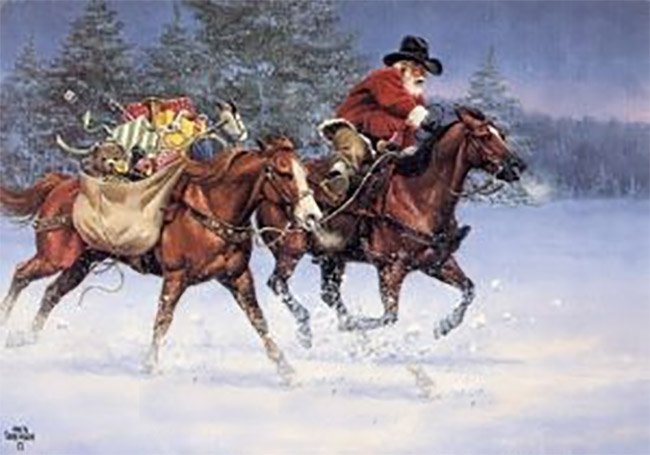
Santa Express
“A Visit From St. Nicholas“, better known by its first line, gave us the first description of the modern Santa Claus. It was a tool for domesticating the occasion, agreeable to law enforcement for calming the rowdy streets, to manufacturers and retailers for selling goods, to the church to make way for a family friendly day of worship and to parents, for the control of unruly children.
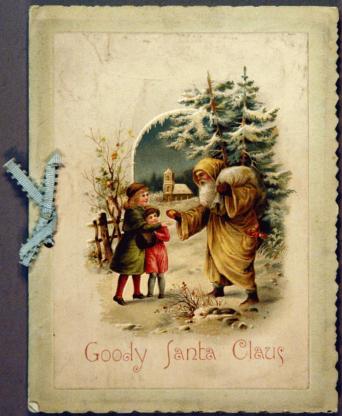
Goody Santa Claus 1889
The “Right Jolly old Elf” took his modern form thanks to the pen of illustrator and editorial cartoonist Thomas Nast, creator of the Democratic donkey and the Republican elephant and scourge of the Tammany Hall political machine which had swindled New York city, out of millions.
The idea of a Mrs. Claus seems to come from a poem by Katharine Lee Bates of the Cape Cod Curmudgeon’s own town of Falmouth, Massachusetts.
Today, the author is best known for her 1895 poem “Pikes Peak”, later set to music and widely known as “America the Beautiful”.
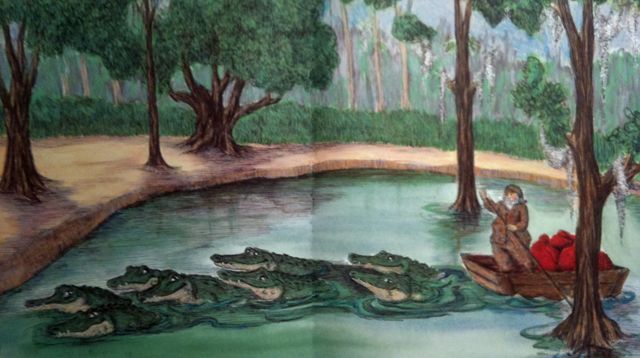
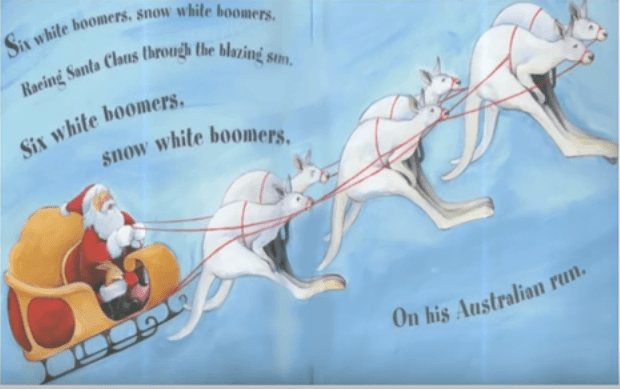
Tonight, NASA may be expected to track Santa and his sleigh drawn by eight reindeer, though none are any longer, all that tiny. Santa Claus will appear around the planet. Regional variations include Santa’s arriving on a surfboard in Hawaii. In Australia, he’s pulled by six white kangaroos. In Cajun country, Papa Noël arrives in a pirogue, drawn by eight alligators.
Santa Claus is the most powerful cultural idea, ever conceived. This year, Christmas sales are expected to exceed one Trillion dollars. Not too bad for a 2,000-year old saint, best remembered for gift giving with no expectation of anything in return.
Merry Christmas.
Fun fact: Today, the port city of Bari on the Adriatic coast of Italy is remembered for the WW2-era mustard gas accident, which spawned the discovery of modern chemotherapy drugs. A thousand years earlier, city fathers feared growing Muslim influence over the tomb of Saint Nicholas, and went to retrieve his remains. Find him, they did. Saint Nicholas’ large bones were removed and brought back as holy relics to Bari where they remain, to this day. Smaller fragments were removed during the 1st Crusade, brought back to Venice or enshrined in basilica from Moscow to Normandy.
The teeth and small bones of the real St. Nicholas are enshrined in over a dozen churches from Russia to France and the Palestinian territories. Some of these cherished relics were believed to reside in St. Nicholas Orthodox Church, in New York City, destroyed in the terrorist attacks of September 11, 2001 and never recovered.
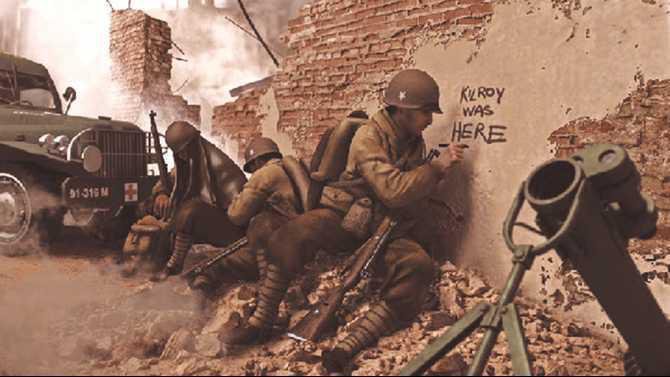
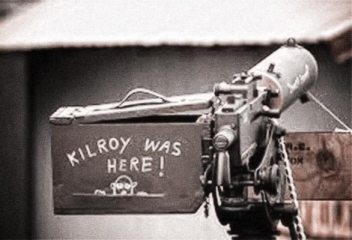
Kilroy was Here became a protective talisman, a good-luck symbol expected to provide good juju, for the American GI. Soldiers began to write the graffiti on newly captured areas and landings. Kilroy was the “Super GI”, showing up for every combat, training and occupation operation of the WW2 and Korean war era. The scribbled cartoon face was there before you arrived. He was still there when you left.
The Fore River Shipyard began operations in 1883 in Braintree, Massachusetts, moving to its current location on the Weymouth Fore River on Quincy Point, in 1901. The yard was purchased by Bethlehem Steel in 1913, and operated under the Bethlehem Shipbuilding Corporation.
Most of the ships built at Fore River were intended for the United States Navy, including early submarines built for Electric Boat, the Battleship USS Massachusetts, and the Navy’s first carrier, the USS Lexington. In the inter-war years, non-US Navy customers included the United States Merchant Marine, the Argentine Navy, the Royal Navy of Great Britain and the Imperial Japanese Navy.
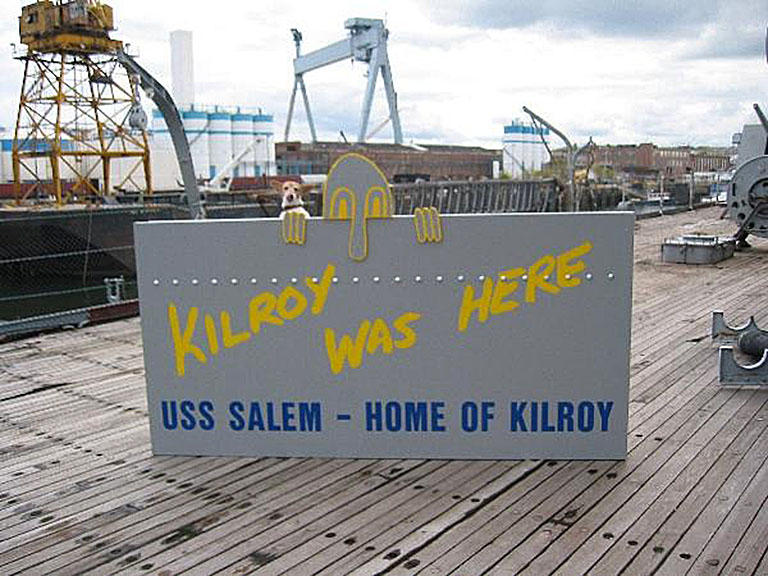
USS Salem CA-139 museum ship, Fore River Shipyard, Quincy
The Navy Act of 1938 mandated a 20% increase in American Naval strength. Much of that increase came through Fore River. The Shipyard employed 17,000 personnel the day Imperial Japan invaded the American Pacific anchorage at Pearl Harbor. That number increased to 32,000 by 1943 with a payroll equivalent to $9.69 Billion, in today’s dollars.
Necessity became the mother of invention, and the needs of war led to prodigious increases in speed. No sooner was USS Massachusetts launched, than the keel of USS Vincennes, began to be laid. By the end of the war, Fore River had completed ninety-two vessels of eleven different classes.
Builders at the yard were paid by the number of rivets installed. Riveters would mark the end of their shift with a chalk mark, but dishonest co-workers could erase their marks, marking a new spot a few places back on the same seam.
Shipyard inspector James Kilroy ended the practice, writing “Kilroy was Here”, next to each chalk mark.
With hulls leaving the yard so fast there was no time to paint the interiors, Kilroy’s name achieved mythic proportions. The man literally seemed to be everywhere, his name written in every cramped and sealed space in the United States Navy.
For the troops inside of those vessels, Kilroy always seemed to have “been there”, first. This was a symbol, an assurance that this particular troop ship, was well and truly sealed.
Kilroy was Here became a protective talisman, a good-luck symbol expected to provide good juju, for the American GI. Soldiers began to write the graffiti on newly captured areas and landings. Kilroy was the “Super GI”, showing up for every combat, training and occupation operation of the WW2 and Korean war era. The scribbled cartoon face was there before you arrived. He was still there when you left.
German Intelligence believed Kilroy to be some kind of “super spook”, able to go anywhere he pleased and to leave, without a trace.
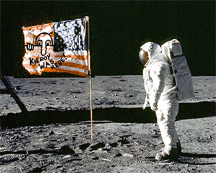
The challenge became, who could put the Kilroy graffiti in the most difficult and surprising place.
I’ve never been there, but I I understand there’s a Kilroy, at the top of Mt. Everest. The cartoon was scribbled in the dust of the moon. There’s one on the Statue of Liberty and another on the underside of the Arch of Triumph, in Paris. There’s on the great Wall, in China.
The World War 2 Memorial in Washington, DC could hardly have been complete without a Kilroy, engraved in granite. If you look closely enough, you’ll find two of them.
Under-water Demolition (UDT) teams, predecessors to the United States Navy SEALs, swam ashore on Japanese-held Pacific islands, preparing the way for amphibious invasions. More than once, UDT divers found that Kilroy had already been there, the silly cartoon nose scribbled on makeshift signs, and even enemy pillboxes.
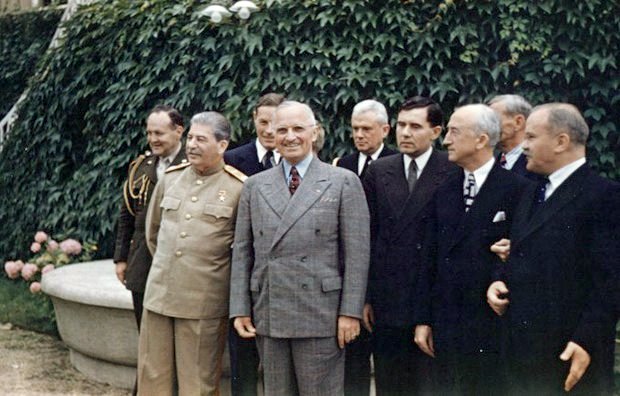
When Truman, Stalin, and Churchill met at Potsdam, a VIP latrine was built for their exclusive use. Stalin was the first in, emerging from the outhouse and asking his aide, “Who is Kilroy?”
Ask a Brit and he will tell you “Mr. Chad” came first, cartoonist George Chatterton’s response to war rationing. “Wot, no tea”?
The cartoon appeared in every theater of the war, but few knew the mythical Kilroy’s true identity.
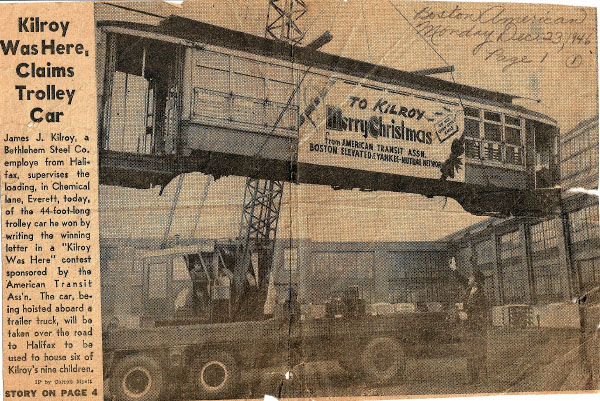
In 1946, the Transit Company of America held a contest, asking the “real” Kilroy to come forward.
Nearly forty guys showed up to claim the prize, a real trolley car. Doubtless they all felt they had legitimate claims, but James Kilroy brought a few riveters and some shipyard officials along, to vouch for his authenticity. That was it.
That Christmas the Kilroy kids, all nine of them, had the coolest playhouse in all of Massachusetts.
James Kilroy went on to serve as Boston City Councillor and member of the Massachusetts House of Representatives, from Halifax. Surely there is a doodle, somewhere in the “Great & General Court” up there in Boston, to inform the passer-by. Kilroy was here.
James Kilroy passed away on this day, November 24, 1962, at the age of sixty.
In 1955, singer-songwriter Richard Berry wrote a tune about a Jamaican sailor returning home to see his lady love. It’s a ballad, a Caribbean-flavored conversation in the first person singular, with a bartender. The bartender’s name is Louie.
In 1955, singer-songwriter Richard Berry wrote a tune about a Jamaican sailor returning home to see his lady love. It’s a ballad, a Caribbean-flavored conversation in the first person singular, with a bartender. The bartender’s name is Louie.
The song was covered in Latin and and R&B styles in the 1950s, never becoming more than a regional hit on the west coast.
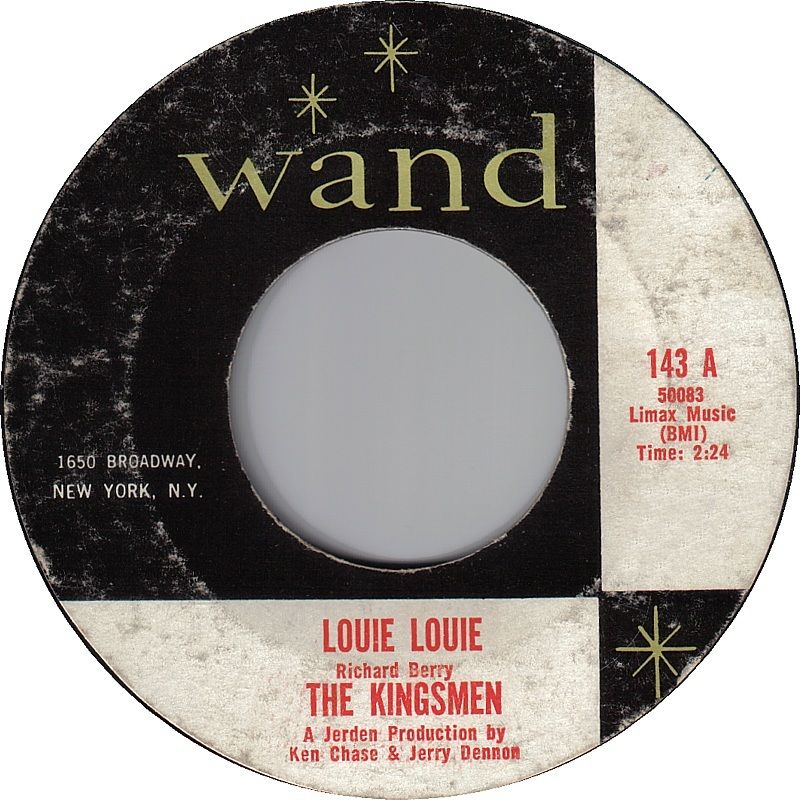
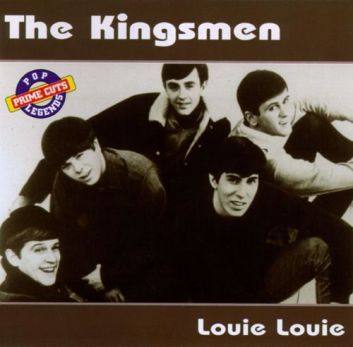
“Mainstream” white artists of the fifties and sixties often covered songs written by black artists. On April 6, 1963, an obscure rock & roll group out of Portland, Oregon rented a recording studio for $50, and covered the song. They were The Kingsmen. Lead singer Jack Ely showed the band how he wanted it played. Berry’s easy 1-2-3-4, 1-2, 1-2-3-4 ballad was transformed to a raucous 1-2-3, 1-2, 1-2-3 beat.
The Kingsmen recorded the song in a single take. The guitar was chaotic, the lyrics difficult to make out. The single was released by a small label in May and re-released by Wand Records in October.
Rock music is so mainstream now, it’s hard to remember the style was once considered subversive. Decadent. The impenetrable lyrics led to all kinds of speculation, driving sales through the 15th of November, all the way to the Billboard Top 100 chart.
It all went downhill from there. “Louie Louie, me gotta go,” became in the fevered imagination, “Louie Louie, grab her way down low.” Invented lyrics ranging from mildly raunchy to downright pornographic were written out on slips of paper and exchanged between teenagers, spurring interest in the song and driving record sales, through the roof.
Music critic Dave Marsh later wrote: “This preposterous fable bore no scrutiny even at the time, but kids used to pretend it did, in order to panic parents, teachers and other authority figures. …So ‘Louie Louie’ leaped up the chart on the basis of a myth about its lyrics so contagious that it swept cross country quicker than bad weather.”
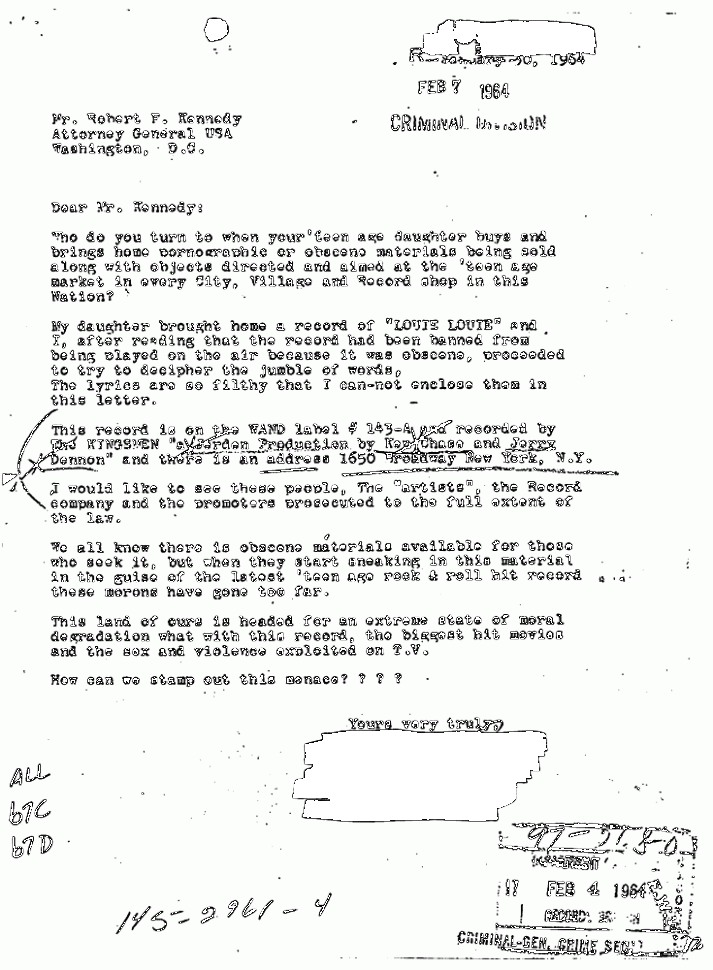
Concerned parents contacted government authorities to see what could be done. One father, a Sarasota, Florida junior high teacher whose name is redacted in FBI files, wrote to Attorney General Bobby Kennedy:
“Who do you turn to when your teen age daughter buys and brings home pornographic or obscene materials being sold along with objects directed and aimed at the teenage market in every City, Village and Record shop in this Nation?” The letter asserts “The lyrics are so filthy I cannot enclose them in this letter” and concludes with a plea, complete with four punctuation marks: “How can we stamp out this menace????”
Dad might have taken a breath. The pop culture scene was not so steeped in filth, as he imagined. The top television program of the time was the Beverly Hillbillies. The top movie the Disney animated production, “The Sword and the Stone”.
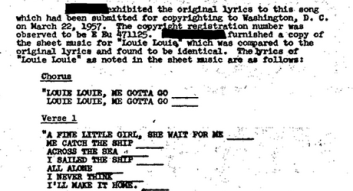
The FBI took up an investigation under the ITOM statute in 1964, a federal law regulating the Interstate Transportation of Obscene Material. Investigators interviewed witnesses. They listened to the song at varying speeds, backward and forward. The relentless search for lascivious material lasted two years and in the end, came up empty.
The FBI’s archival website contains 119 pages, covering the investigation. In the end, the song was ruled “unintelligible at any speed”.
Inexplicably, G-men never interviewed Kingsmen lead singer Jack Ely. He probably could have saved them a lot of time. The lyrics never did measure up to the fevered imagination, of a Sarasota schoolteacher.
Louie Louie, with lyrics
The song has been covered by numerous artists over the years, including Paul Revere & the Raiders, Otis Redding, Motorhead, Black Flag and Young MC. The best ever though, has got to be the Delta Tau Chi fraternity version from John Landis’ 1978 movie, Animal House.
3309 Tanner Drive quickly became, a circus. Television trucks arrived, to cover the ordeal. Baby Jessica’s rescue was carried from the Netherlands to Brazil, from Germany to Hong Kong and mainland China. Well wishers called in to local television stations, from the Soviet Union. Telephone linemen installed extra lines, to handle the traffic.
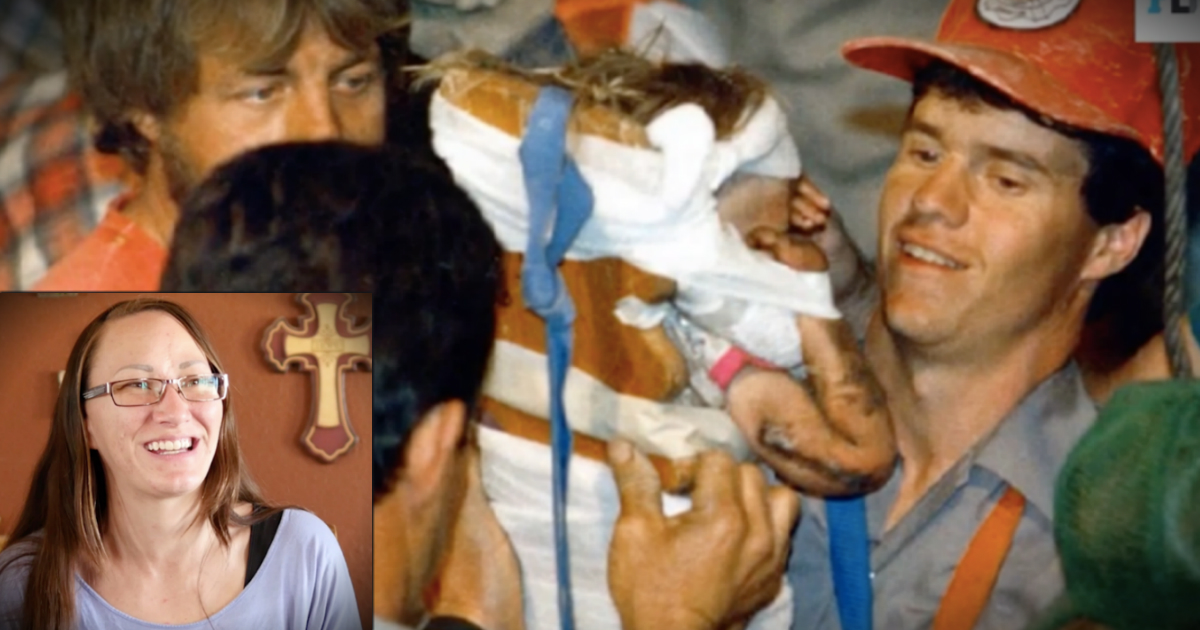
Jessica McClure Morales is 33-years old. A typical West Texas Mom, with two kids and a dog. Her life is normal in every way. She’s a teacher’s aide. Her husband Danny, works for a piping supply outfit.
Thirty-two years ago, Jessica McClure’s day was anything but normal.
October 14, 1987 began like any other, just an eighteen-month-old baby girl, playing in the back yard of an Aunt. That old well pipe shouldn’t have been left open, but what harm could it do. Standing there only three inches above the grass, the thing was only eight inches wide.
And then the baby disappeared. Down the well.
My command of the language fails to produce a word, adequate to describe the horror that young mother must have felt, looking down that pipe.
Midland, Texas first responders quickly devised a plan. A second shaft would be dug, parallel to the well. Then it was left only to bore a tunnel, until rescuers reached the baby. The operation would be over, by dinnertime.
Except, the rescue proved far more difficult than first imagined. The tools first brought on-scene, were inadequate to get through the hard rock surrounding the well. What should have taken minutes, was turning to hours.
3309 Tanner Drive quickly became, a circus. Television trucks arrived, to cover the ordeal. Baby Jessica’s rescue was carried from the Netherlands to Brazil, from Germany to Hong Kong and mainland China. Well wishers called in to local television stations, from the Soviet Union. Telephone linemen installed extra lines, to handle the traffic.
Local and national news reporters watch from ladders overlooking a fenceline as rescue crews attempt to free Jessica McClure. (October 1987)
The whole world it seemed, held its breath.
Midland police officer Andy Glasscock spent much of those fifty-eight hours on his belly next to that hole, concentrating on every sound to come up from the well. Hard-eyed veteran though he was, the man could be brought to tears at the sound of that little voice, drifting up from deep in that hole in the ground…”Mama“. “How does a kitten go?” Officer Glasscock would ask, into the darkness. The little voice would respond…”Meow“.
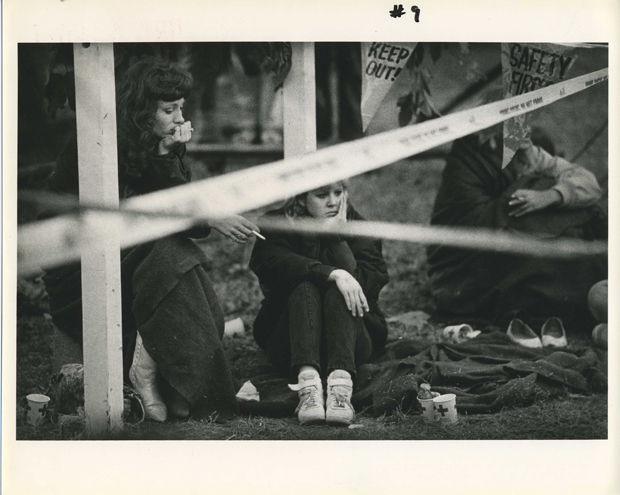
Supporters wait outside the barricade line as workers attempt to rescue Jessica from the well. (October 1987)
Watching the evening news, it’s sometimes easy to believe the world is going to hell. It’s not. What we saw for those fifty-eight hours was the True heroism and fundamental decency of every-day women and men. Fathers, sons and brothers, straining each fiber and sinew, inching closer to the bottom of that well. Mothers sisters and wives, pitching in and doing whatever it was, that needed to be done. We’d see it again in a New York Minute, should circumstances require it.
Rescue crews worked through the night to pump warm air into the well where Jessica had become trapped (October 1987)
You could watch it happen, around the clock. Many of us did. I remember it. Each man would dig until he’d drop, and then another guy would take his place. These were out-of-work oil field workers and everyday guys. Mining engineers and paramedics. The work was frenetic, desperate, and at the same time, agonizingly slow.
Anyone who’s used a jackhammer, knows it’s not a tool designed to be used, sideways. Even so, these guys tried. A waterjet became a vital part of the rescue, a new and unproven technology, in 1987.
Jessica’s father Chip McClure speaks to a cadre of reporters. (October 1987)
The sun went down that Wednesday and rose the following day and then set again. Still, the nightmare dragged on.
A microphone was lowered down, so doctors could hear that baby girl breathe. She would cry. Sometimes she would sing. A small voice drifting up from that hole in the ground. The words of “Winnie the Pooh”.
These were good signs. A baby could neither sing nor cry, if she could not breathe.
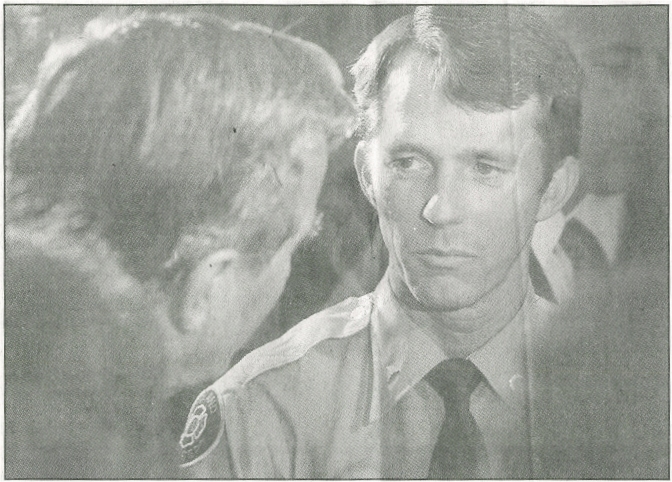
The final tunneling phase of the operation could only be described, as a claustrophobic nightmare. An unimaginable ordeal. Midland Fire Department paramedic Robert O’Donnell was chosen because of his tall, wiry frame. Slathered all over with K-Y jelly and stuffed into a space so tight it was hard to breathe, O’Donnell inched his way through that black hole that Thursday night and into the small hours of Friday morning until finally, he touched her leg.
The agony of those minutes dragging on to hours, can only be imagined. What O’Donnell was trying to do, could not be done. In the end, the paramedic was forced to back out of the hole, one agonizing inch at a time, defeated. Empty handed. As men went back to work enlarging the tunnel, the paramedic sat on a curb, and wept.
On the second attempt, O’Donnell was able wrestle the baby out of that tiny space, handing her to fellow paramedic Steve Forbes, who carried her to safety.
Baby Jessica came out of that well with her face deeply scarred and toes black with gangrene, for lack of blood flow. She required fifteen surgeries before her ordeal was over, but she was alive.
The story has a happy ending for baby Jessica. Not so, for many others. The New York Times wrote:
“The little girl’s parents moved her out of town, to a three-bedroom house that they never could have afforded before she was rescued, to hide from the world that embraced them so hard they couldn’t breathe. Eventually, they were divorced. Others who helped to save the child — O’Donnell was just the most visible of hundreds — found themselves drinking, or in marriage counseling, or in legal tangles, all because of the fickle, seductive, burning spotlight”.
President Ronald Reagan quipped, “Everybody in America became godmothers and godfathers of Jessica while this was going on.” Baby Jessica appeared with her teenage parents Reba and Chip on Live with Regis and Kathie Lee, to talk about the incident. Scott Shaw of the Odessa American won the Pulitzer prize for The photograph. ABC made a television movie: Everybody’s Baby: The Rescue of Jessica McClure. USA Today ranked her 22nd on a list of “25 lives of indelible impact.” Everyone in the story became famous. Until they weren’t.
For paramedic Robert O’Donnell, the nightmare never ended. Already claustrophobic, those hours spent alone in a black hole so tight as to all but prevent breath, were pure agony. The failure and that agonizing inchworm’s crawl out of that hole, empty handed. The ultimate success. The fame and celebrity. The Oprah show. The relentless pursuit, of media. “For a year afterward everyone wanted a piece of him” said his older brother, Ricky. “Then all of a sudden one day it seemed like everyone dropped him.”
Lee High Rebelettes hold up a sign during halftime of the Lee-Odessa Permian football game showing their support for Jessica. (October 1987)
The Paramedic had rescued lots of people but, somehow, his life stopped in 1987. Transfixed in the bright lights and the fame of those last fifteen minutes of The Rescue. Everywhere he went, he was “The man who Saved Baby Jessica™”.
Post-traumatic stress is a strange and incomprehensible thing. The next seven years were a downward spiral. There were marital problems. That humiliating episode with that made-for-TV movie. The whole family watching to see his part, but no one bothered to tell them. The scene had been cut. The 11-year career with the Midland Fire Department, collapsing amidst allegations of prescription drug abuse. Divorce.
In April 1995, O’Donnell’s mother noticed the missing shotgun at the family ranch, in Stanton Texas. The 410 buckshot, loaded with larger pellets intended for bigger game, or self defense. They found the body some 20-miles away, slumped over the wheel of the new Ford pickup. This was no accident. You don’t put a barrel that long into your mouth, without meaning to.
Those of us of a certain age remember the baby Jessica episode, well. I suspect Robert O’Donnell’s story is less well known, and that’s a shame. The man is an American hero. He has earned the right to be remembered.


 Established by act of Congress on July 9, 1918, the Silver Star is the third-highest decoration is the system of military honors, awarded to members of US armed services for valor in combat against an enemy of the United States. A search of public records reveals a long list of recipients of the Silver Star including the name “Ball, Harvey A. HQ, 45th Infantry Division, G.O. No. 281”.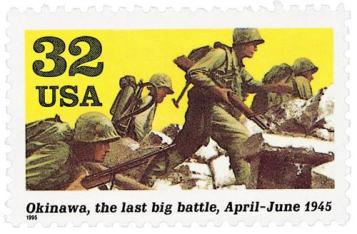



 58 years ago, his name changed as the result of a misspelling in a recording contract, Buddy Holly was headliner of the “The Winter Dance Party Tour”. Richardson, performing as the “Big Bopper” and Valenzuela, professionally known as Ritchie Valens, were on the tour, along with Dion and the Belmonts, Holly’s friend from Lubbock and fellow musician Waylon Jennings, and a young Owasso, Oklahoma Rockabilly musician and former “Crickets” band member, an enrolled member of the Cherokee Nation named Tommy Allsup.
 Holly was sick of it, and decided to charter a plane for himself and some of his guys. At least that would give them time to do laundry before the next performance.
 N3794N left the ground in a snowstorm, shortly after 1:00am on February 3. The pilot, Roger Peterson, may have been inexperienced with the instrumentation. He may have become disoriented in near-whiteout conditions. One wing hit the ground in a cornfield outside of Clear Lake and the aircraft corkscrewed into the ground, throwing the three musicians clear of the plane. There was no fire, barely a sound. Just a small aircraft swallowed whole, by a snow covered cornfield.
 A boy named Don McLean heard about the plane crash while doing his morning paper route. One day, the future singer/songwriter would pen the words “February made me shiver, with every paper I’d deliver”.


 Groundhogs hibernate for the winter, an ability some people of my acquaintance, would love to master. During that time, the animal’s heart rate drops from 80 beats per minute to 5 as the slumbering rodent lives off stored body fat. Another ability some of us could learn to appreciate, very much.
 But then there is the amorous woodchuck’s worst nightmare in a top hat, the groundhog hunter.
 There are those who would dispute the Gobbler’s Knob crowd and their claims to Punxsutawney Phil’s weather forecasting prowess. Alabama has “Birmingham Bill”, and Canada has Shubenacadie Sam. New York can’t seem to decide between Staten Island Chuck and New York City’s very own official groundhog, “Pothole Pete”.


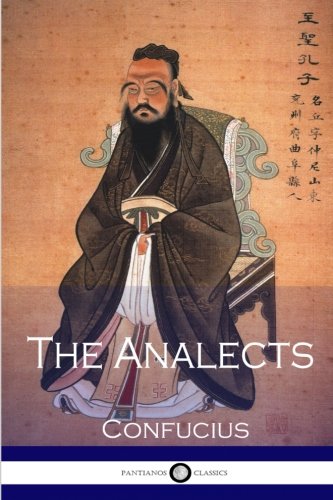 In it, a follower called Yen Yüan asked the Master about perfect virtue.
 In medieval Japanese, mi-zaru, kika-zaru, and iwa-zaru translate as “don’t see, don’t hear, and don’t speak”, –zaru being an archaic negative verb conjugation and pronounced similarly to “saru”, the word for monkey.
 The first known depiction of the “Three Mystic Apes” appears over the doors of the Tōshō-gū shrine in Nikkō, Japan, carved sometime in the 17th century.
 Mohandas Karamchand Gandhi was a Hindu lawyer, a member of the merchant caste from coastal Gujarat, in western India. Today he is known by the honorific “Mahatma”, from Gandhithe Sanskrit meaning “high-souled”, or “venerable”.


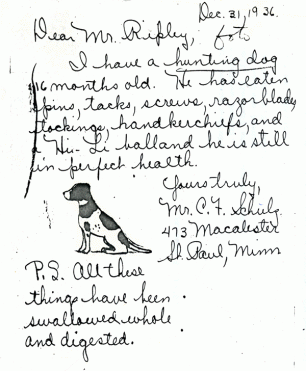 they called him “Charles”, or “Chuck”, that was a sure sign of the mere pretender. Schulz’ uncle called him “Sparky” as a boy, after the horse Spark Plug in Billy DeBeck’s comic strip, Barney Google. He always signed the strip “Schulz”, but friends and family knew him as Sparky, until the day he died.
 A Charlie Brown Christmas has been a staple of the Christmas season since 1965, though Linus almost didn’t get to tell his famous story of the baby Jesus. ABC executives thought Linus’ recitation of the birth of Christ too overtly religious. The “suits” wanted a laugh track as well, but Schulz refused. “If we don’t do it, who will?” In the end, the scene remained. Perhaps the most memorable moment in cartoon history. The laugh track version was produced, but never aired.
 Charlie Brown’s love interest in some of those TV specials, the “Little Red-Haired Girl”, was based on an accountant from that old job at Art Instruction, named Donna Mae Johnson. The couple had an office romance for a time, but she turned him down when Shulz proposed.


 Over fifty years, Schulz drew nearly 18,000 strips, taking vacation only once in 1997 to celebrate his 75th birthday. In all those years, that five-week stretch was the only time the papers ever had Peanuts reruns.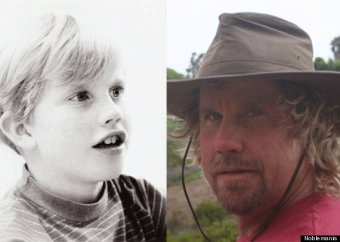


 On the European continent, legends of St. Nicholas combined with Pagan traditions and developed in quirky directions, including an evil doppelgänger who accompanies St. Nick on his rounds.


 Necessity became the mother of invention, and the needs of war led to prodigious increases in speed. No sooner was USS Massachusetts launched, than the keel of USS Vincennes, began to be laid. By the end of the war, Fore River had completed ninety-two vessels of eleven different classes.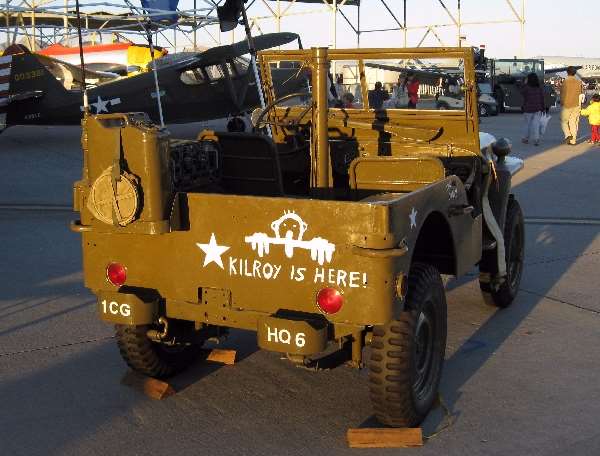


 German Intelligence believed Kilroy to be some kind of “super spook”, able to go anywhere he pleased and to leave, without a trace.
 The cartoon appeared in every theater of the war, but few knew the mythical Kilroy’s true identity.
 James Kilroy went on to serve as Boston City Councillor and member of the Massachusetts House of Representatives, from Halifax. Surely there is a doodle, somewhere in the “Great & General Court” up there in Boston, to inform the passer-by. Kilroy was here.
 In 1955, singer-songwriter Richard Berry wrote a tune about a Jamaican sailor returning home to see his lady love. It’s a ballad, a Caribbean-flavored conversation in the first person singular, with a bartender. The bartender’s name is Louie.
 It all went downhill from there. “Louie Louie, me gotta go,” became in the fevered imagination, “Louie Louie, grab her way down low.” Invented lyrics ranging from mildly raunchy to downright pornographic were written out on slips of paper and exchanged between teenagers, spurring interest in the song and driving record sales, through the roof.
 Dad might have taken a breath. The pop culture scene was not so steeped in filth, as he imagined. The top television program of the time was the Beverly Hillbillies. The top movie the Disney animated production, “The Sword and the Stone”.
 The FBI took up an investigation under the ITOM statute in 1964, a federal law regulating the Interstate Transportation of Obscene Material. Investigators interviewed witnesses. They listened to the song at varying speeds, backward and forward. The relentless search for lascivious material lasted two years and in the end, came up empty.
 Jessica McClure Morales is 33-years old. A typical West Texas Mom, with two kids and a dog. Her life is normal in every way. She’s a teacher’s aide. Her husband Danny, works for a piping supply outfit.
 Midland, Texas first responders quickly devised a plan. A second shaft would be dug, parallel to the well. Then it was left only to bore a tunnel, until rescuers reached the baby. The operation would be over, by dinnertime.


 These were good signs. A baby could neither sing nor cry, if she could not breathe.
 Baby Jessica came out of that well with her face deeply scarred and toes black with gangrene, for lack of blood flow. She required fifteen surgeries before her ordeal was over, but she was alive.
 The story has a happy ending for baby Jessica. Not so, for many others. The New York Times wrote:
 President Ronald Reagan quipped, “Everybody in America became godmothers and godfathers of Jessica while this was going on.” Baby Jessica appeared with her teenage parents Reba and Chip on Live with Regis and Kathie Lee, to talk about the incident. Scott Shaw of the Odessa American won the Pulitzer prize for The photograph. ABC made a television movie: Everybody’s Baby: The Rescue of Jessica McClure. USA Today ranked her 22nd on a list of “25 lives of indelible impact.” Everyone in the story became famous. Until they weren’t.
 In April 1995, O’Donnell’s mother noticed the missing shotgun at the family ranch, in Stanton Texas. The 410 buckshot, loaded with larger pellets intended for bigger game, or self defense. They found the body some 20-miles away, slumped over the wheel of the new Ford pickup. This was no accident. You don’t put a barrel that long into your mouth, without meaning to.
 Historical Easter Eggs - Today in History
You must be logged in to post a comment.