On this day in 1959, Jacques Plante decided that he’d had enough. It was three minutes into a game with the New York Rangers, when he took a puck to the nose on a shot fired by Andy Bathgate. The puck broke his nose, opening a wound which required seven stitches to close. When Plante returned to the ice, he was wearing a fiberglass mask.
In the Netherlands, ice hockey began sometime in the 16th century. North Americans have played the sport since 1855. For all that time, flying hockey pucks have collided with the faces of goalies. The results could not have been pretty.
The name of Montreal Canadien goal tender Jacques Plante is engraved five times on Lord Stanley’s cup, once for each of their five consecutive championships between 1956 and ‘60. For a lifelong Bruins fan, that isn’t easy to say.
Original caption: 11/1/1959-New York, NY- His face and shirt bloodied, Montreal Canadiens goalie Jacques Plante puts on a special plastic mask after being treated for a facial cut received in the opening period of the Rangers-Canadiens hockey game. Plante suffered a severe gash on the left side of his face when he was struck by a shot off the stick of Andy Bathgate of the New York Rangers. After donning the mask, which he had designed himself, Plante returned to the game. November 1, 1959 New York, New York, USA
Plante literally wrote the book on NHL goal tending. He was the first to take the position outside of the crease, making himself the third defenseman. He was the first to take the puck behind the net, and the first to bring anything like stick handling to the position. Before Plante, a Goalie’s job was pretty much to deflect the puck and let the defenders take it from there.
On this day in 1959, Jacques Plante decided that he’d had enough. It was three minutes into a game with the New York Rangers, when he took a puck to the nose on a shot fired by Andy Bathgate. The puck broke his nose, opening a wound which required seven stitches to close. When Plante returned to the ice, he was wearing a fiberglass mask.
Coach Toe Blake was furious. He had allowed the mask during practice, but this was regulation. Nobody wore a mask. Coaches believed they cut the goaltender’s field of vision, and, besides. These were supposed to be the “fearless” guys, who jumped in front of the puck.
Easy for him to say. It wasn’t his face. Plante was adamant, and Blake wasn’t about to bench the best goalie in the NHL. There would be one more game when Plante played without the mask, the only game the Canadiens lost in that series, and that was the end of it. For Jacques Plante, the mask had now become standard equipment.
NHL Goalie Terry Sawchuk
In 1966, Life Magazine published an image of Toronto Maple Leafs goalie Terry Sawchuk, “a face only a hockey puck could love“. “Re-created here, by a professional make-up artist and a doctor” read the accompanying article, “are some of the more than 400 stitches he had earned during 16 years in the National Hockey League. Terry Sawchuk’s face was bashed over and over, but not all at one time. His wounds healed. The scars weren’t easily seen – except for a few of them. The re-creation of his injuries was done to help show the extent of his injuries over a span of years”.
Gerry Cheevers
During a 1968-’69 season playoff game against the Boston Bruins, a puck fired by Phil Esposito hit Plante in the forehead, knocking him out, cold. He later said that the mask saved his life. He’s probably right.
Gerry Cheevers, who played for the 1970-’72 Bruins, famously had his mask marked up with stitches. That started when a puck hit him in the face during practice. When Bruins coach Harry Sinden followed Cheevers to the dressing room, he found him enjoying a beer and smoking a cigarette. Sinden sent Cheevers back out on the ice, and John Forestall, the team trainer, painted stitches on his mask. Every time Cheevers was hit after that, he would have new stitches painted on. The mask became one of the most recognizable symbols of the era, and now hangs on the wall of his grandson’s bedroom.
Montreal Maroon’s goaltender Clint Benedict, 1930
Jacques Plante wasn’t the first NHL goaltender to wear a face mask. Montreal Maroons’ Clint Benedict wore a crude leather mask in 1929, to protect a broken nose.
It was Plante who introduced the face mask as everyday equipment, now a mandatory fixture for all goaltenders.
I’m not sure if NHL goalies are any prettier these days, but I do believe they have a lot more teeth.
In the end, we are left with the tale of a warlord. A prince. A sadist. An impaler. A psychotic madman who, 400 years after his death, would inspire the name of Count Dracula.
In modern Romanian, “Dracul” means “The Devil”. In the old language, it meant “the Dragon”, the word “Dracula” (Drăculea) translating as “Son of the Dragon”. Count Dracula, favorite of Halloween costume shoppers from time immemorial, has been with us since the 1897 publication of Bram Stoker’s novel, of the same name.
Stoker’s working titles for the manuscript were “The Un-dead”, and “Count Wampyr”. He nearly kept one of them too, until reading about Vlad Țepeș (TSE·pesh), a Wallachian Prince and 15th century warrior, who fought on the front lines of the Jihad of his day.
Stoker wrote in his notes, “in Wallachian language means DEVIL“. In a time and place remembered for its brutality, Vlad Țepeș stands out as extraordinarily cruel. There are stories that Țepeș disemboweled his own pregnant mistress. That he collected the noses of vanquished adversaries, some 24,000 of them. That he dined among forests of victims, impaled on spikes. That he even impaled the donkeys they rode in on.
Founded in 1330, the Principality of Wallachia is a region in modern-day Romania, situated between the Lower Danube river and the Carpathian Mountains. A crossroads between East and West, the region was scene to frequent bloodshed, as Ottomanforces pushed westward into Europe, and Christian forces pushed back.
In 1436, Vlad II became voivode, (prince), of Wallachia. The sobriquet “Dracul” came from membership in the “Order of the Dragon” (literally “Society of the Dragonists”), a monarchical chivalric order founded by Holy Roman Emperor Sigismund in 1408, dedicated to stopping the Ottoman advance into Europe.
Shifting loyalties put the Wallachian prince in a weakened position, forcing him to pay homage to Ottoman Sultan Murad II, including participation in the Ottoman invasion of the nearby Romanian principality of Transylvania.
Transylvanian voivode John Hunyadi persuaded Vlad to fight with him against the Ottomans. Vlad was summoned to a diplomatic meeting in 1442 with Sultan Murad II, and brought his two younger sons, Vlad III and Radu, along. The meeting was a trap. Vlad was thrown in prison but later released in exchange for a pledge to pay annual tribute, and the promise of 500 Wallachian boys to serve as janissaries in the Ottoman army. Vlad III, age 12, and his younger brother were left behind as hostages, to ensure the loyalty of their father.
The timeline is unclear, but Vlad Dracul appears to have been convinced that his sons were “butchered for the sake of Christian peace”, sometime around 1444. Byzantine historian Michael Critobulus writes that Vlad and Radu fled to the Ottoman Empire in 1447 following the murder of their father and older brother Mircea, suggesting that the two were released, most likely following Vlad’s pledge of homage to the Sultan.
The terms of the boys’ captivity were relatively mild by the standards of the time, and Vlad became a skilled horseman and warrior. Radu went over to the Turkish side, but Vlad hated captivity, developing a deep enmity for his captors that would last all his life.
Vlad III Țepeș
With the death of his father and older brother, Vlad III became a potential claimant for the throne in Wallachia. Vlad won back his father’s seat in 1448 with Ottoman support, only to be deposed after only two months. Sometime later, he switched sides in the Ottoman-Hungarian conflict.
Following the fall of Constantinople in 1453, the Ottoman Empire stood ready to invade all of Europe.
Vlad III regained the Wallachian throne in 1456 with military support from King Ladislaus V of Hungary. The new prince made it his first order of business to cut ties with the Ottoman Empire, terminating the annual tribute which had formerly ensured peace between Wallachia and the Caliphate.
A group of visiting Ottoman envoys declined to remove their turbans in Vlad’s court, citing religious custom. The prince commended them for their religious devotion and ordered the turbans nailed to their skulls, assuring them that now, they would never be removed.
According to stories circulated after his death, Vlad III needed to consolidate power, against his fractious nobles (boyars). Hundreds of them were invited to a banquet, only to be stabbed, their still twitching bodies then impaled on spikes.
Ethnic Germans had long since emigrated to these parts, forming a distinct merchant class in Wallachian society. These Saxon merchants were allied with the boyars. It was not long before they too, found themselves impaled on spikes.
Vlad invaded the Ottoman Empire in 1461, by his own count killing “23,884 Turks and Bulgarians”.
Sultan Mehmet II, conqueror of Constantinople, invaded Wallachia at the head of an army 150,000 strong in 1462, only to find the roads lined with a “forest of the impaled”, and the capital city of Târgoviște, deserted.
The Byzantine Greek historian Laonikos Chalkokondyles writes: “The sultan’s army entered into the area of the impalements, which was seventeen stades long and seven stades wide. There were large stakes there on which, as it was said, about twenty thousand men, women, and children had been spitted, quite a sight for the Turks and the sultan himself. The sultan was seized with amazement and said that it was not possible to deprive of his country a man who had done such great deeds, who had such a diabolical understanding of how to govern his realm and its people. And he said that a man who had done such things was worth much. The rest of the Turks were dumbfounded when they saw the multitude of men on the stakes. There were infants too affixed to their mothers on the stakes, and birds had made their nests in their entrails”.
To give a sense of scale to this horror, a “stade” derives from the Greek “stadeon” – the dimensions of an ancient sports arena.
In the end, the Romanian principalities had little with which to oppose the overwhelming force of the Ottoman Empire. Vlad III Țepeș would be twice deposed only to regain power. Unable to defeat his more powerful adversary, Vlad was exiled for several years in Hungary, spending much of that time in prison. Heaven help the poor rodent who fell into his hands, in that wretched cell.
Bran Castle
Vlad successfully stole back the throne following the death of his brother Radu at the head of an Ottoman column in 1475, but this last reign would be brief. The prince of Wallachia was marching to yet another battle with the Ottomans in 1477, when he and his small vanguard of soldiers were ambushed, and Vlad was killed.
Today, the mountaintop Castle in Bran, Romania is celebrated as the “home” of Count Dracula. Ironically, neither Bram Stoker nor Vlad Țepeș ever set foot in the place. There is some debate as to the veracity of these tales, and whether they were significantly embellished. Johannes Gutenberg invented the modern movable type printing press in 1439 when Vlad III was about 8, so his contemporaries had ample opportunity to tell their stories. Many were written by his detractors, of which a guy like Vlad “the Impaler”, had many. Yet the details of these stories are virtually identical, suggesting they contain significantly more than a grain of truth.
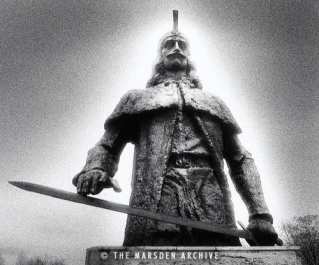
Statues of Vlad Țepeș dot the Romanian countryside, though his burial place is unknown. In the end, we are left only with the tale of a warlord. A prince. A sadist. An impaler. A psychotic madman who, 400 years after his death, would inspire the name of Count Dracula.
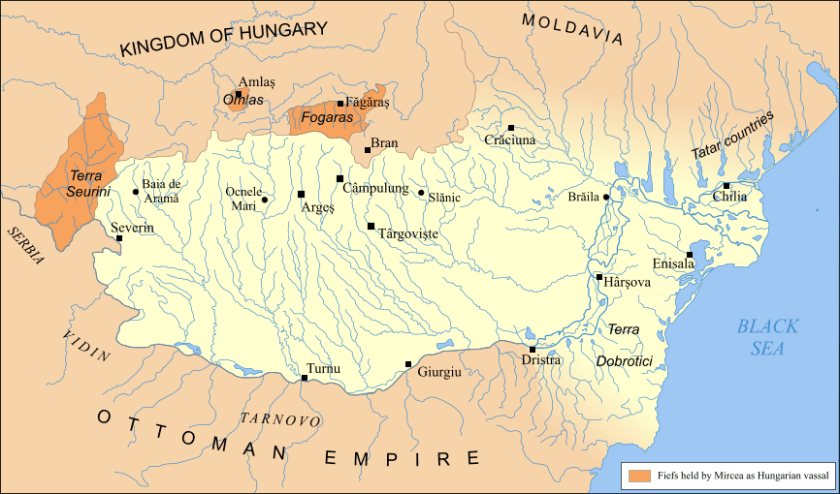
Territories held by Wallachian prince Mircea the Elder, father of Vlad II “Dracul”, c. 1390
Traffic was jammed in both directions in the little town of Grover’s Mill, NJ, as locals tried to get out, and curiosity seekers came to see what Martians looked like.
34.6 million miles distant, the Red Planet is our nearest neighbor in the solar system. It was the God of Death to the Babylonians of 3000BC, lending its name to the war gods of Greek and Roman antiquity alike.
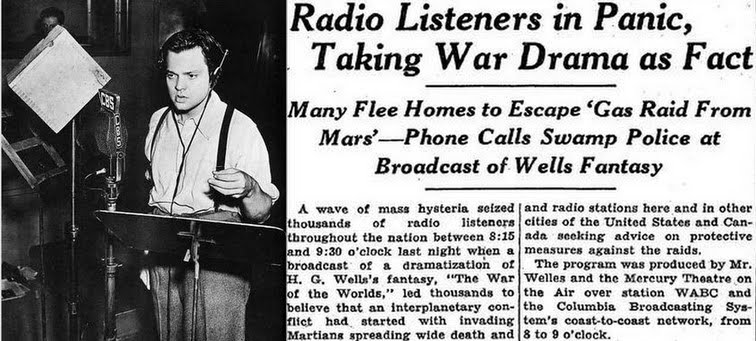
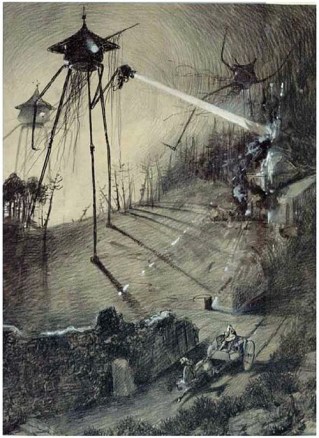
In the 19th century, amateur astronomer Percival Lowell was convinced that he saw canals on Mars, evidence of some great civilization. In 1898, H.G. Wells published a book about a Martian invasion of earth, beginning with a landing in England. On this day in 1938, the Mercury Theater of the Air brought that story to life.
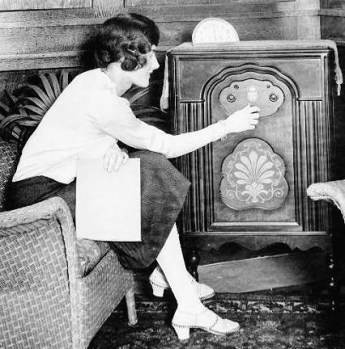
The radio drama began with a statement that what followed was fictional. The warning was repeated at the 40 and 55-minute mark, and again at the end of the broadcast. It began with a weather report, and then went to a dance band remote, featuring “Ramon Raquello and his orchestra”. The music was periodically interrupted by live “news” flashes, beginning with strange explosions on Mars. Producer Orson Welles made his first radio appearance as the “famous” (but non-existent) Princeton Professor Dr. Richard Pierson, who dismissed speculation about life on Mars.
A short time later, another “news flash” reported that there had been a fiery crash in Grovers Mill, NJ. What was originally thought to be a meteorite was revealed to be a rocket machine as a tentacled, pulsating Martian unscrewed the hatch and incinerated the crowd with a death ray.
The dramatic technique was brilliant. Welles had his cast listen to the Hindenburg tape, explaining that was the “feel” that he wanted in his broadcast. Fictional on-the-spot reporter Carl Phillips describes the death ray in the same rising crescendo, only to be cut off in mid-sentence as it’s turned on him.
The 60-minute play unfolds with Martians wiping out a militia unit sent against them, and finally attacking New York City with poison gas.
Despite repeated notices that the broadcast was fictional, it’s been estimated that as many as 1.2 million thought the news was real. According to Grovers Mill folklore, a local named William Dock shot a water tower, mistaking it for a Martian in the moonlight. Traffic was jammed in both directions in the little town, as locals tried to get out, and curiosity seekers came to see what a Martian looked like.
The New York Times reported on Oct. 31, “In Newark, in a single block at Heddon Terrace and Hawthorne Avenue, more than 20 families rushed out of their houses with wet handkerchiefs and towels over their faces to flee from what they believed was to be a gas raid. Some began moving household furniture”.
The USA Today newspaper, reporting on the 75th anniversary of the broadcast, reported “The broadcast … disrupted households, interrupted religious services, created traffic jams and clogged communications systems,”
Then as today, supposed “victims” of the broadcast and their lawyers lined up to get paid for “mental anguish” and “personal injury”. All suits were dismissed, except for a claim for a pair of black men’s shoes, size 9B, by a Massachusetts man who had spent his shoe money to escape the Martians. Welles thought the man should be paid.
In the end, the War of the Worlds was what the broadcast described itself to be. A Halloween concoction. The equivalent of dressing up in a sheet, jumping out of a bush and saying, ‘Boo!’.
A talented artist, Bill Mauldin’s medium was the cartoon. Through them, he told the story of the common soldier, usually at a rate of six per week.
Born on October 29, 1921 in New Mexico and brought up in Arizona, William Henry “Bill” Mauldin was part of what Tom Brokaw called, the “Greatest Generation”.
Mauldin enlisted in the 45th Infantry Division when the United States entered WWII. He was a talented artist, trained at the Chicago Academy of Fine Arts, and volunteered to work for the unit’s newspaper, as a cartoonist.
As a sergeant of the 45th Division’s press corps and later for Stars & Stripes, Mauldin was part of the invasion of Sicily and the later Italian campaign. He was given his own jeep and allowed to go wherever he pleased, which was usually out in front. His medium was the cartoon. He told the story of the common soldier, usually at the rate of six per week.
Mauldin developed two cartoon infantrymen, calling them “Willie and Joe”. He told the story of the war through their eyes. He became extremely popular within the enlisted ranks, while his humor tended to poke fun at the “spit & polish” of the officer corps. He even lampooned General George Patton one time, for insisting that his men to be clean shaven all the time. Even in combat.
Patton summoned the cartoonist to his office, threatening to “throw his ass in jail” for “spreading dissent”, until Dwight Eisenhower told Patton to leave him alone. According to the Supreme Allied Commander, Mauldin’s cartoons gave the soldiers an outlet for their frustrations.
Mauldin later told an interviewer, “I always admired Patton. Oh, sure, the stupid bastard was crazy. He was insane. He thought he was living in the Dark Ages. Soldiers were peasants to him. I didn’t like that attitude, but I certainly respected his theories and the techniques he used to get his men out of their foxholes”.
His was no rear echelon assignment. Mauldin’s fellow soldier-cartoonist, Gregor Duncan, was killed in Anzio in May 1944. Mauldin himself was wounded in a German mortar attack near Monte Cassino. By the end of the war, he had received the Army’s Legion of Merit for his drawings.
Mauldin tried to revive Willy & Joe after the war, but found they didn’t assimilate well into civilian life.
“Peanuts” cartoonist Charles M. Schulz was himself a veteran of World War II. Schulz paid tribute to Rosie the Riveter and Ernie Pyle in his strip, but more than any other, he paid tribute to Willy & Joe. Snoopy visited with Willie & Joe no fewer than 17 times over the years. Always on Veterans Day.
Bill Mauldin passed away on January 22, 2003, from a bathtub scalding exacerbated by complications of Alzheimer’s disease.
Bill Mauldin drew Willie & Joe for last time in 1998, for inclusion in Schulz’ Veteran’s Day Peanuts strip. Schulz had long described Mauldin as his hero. He signed that final strip Schulz, as always, and added “and my Hero“. Bill Mauldin’s signature, appears underneath.
South Carolina seceded in December 1860, and the world waited to see who’d follow. New York City became the next to call for secession on January 6, when Mayor Fernando Wood addressed the city’s governing body.
By the early 1830s, cotton exceeded the value of all other American exports, combined. As secession loomed over the nation, a Chicago Daily Times editorial warned that if the South left “in one single blow, our foreign commerce must be reduced to less than one half of what it is now”.
South Carolina seceded in December 1860, and the world waited to see who’d follow. New York City became the next to call for secession on January 6, when Mayor Fernando Wood addressed the city’s governing body. “When Disunion has become a fixed and certain fact”, he said, “why may not New York disrupt the bands which bind her to a venal and corrupt master…and destroyed the Confederacy of which she was the proud Empire City?”
In New York city and “upstate” alike, economic ties with the south ran deep. 40¢ of every dollar paid for southern cotton stayed in New York, in the form of insurance, shipping, warehouse fees and profits.
30 minutes’ east of Buffalo, the village of Lancaster contemplated staying with the Union. 500 miles from the nearest Confederate state, George Huber remembered the time. “When war was declared, Lancaster seethed with the news, and many were the nights we stayed up as late as 12 o’clock to talk things out. I was twelve years old at the time, but I remember the stern faces of the elders and the storm of passionate and angry discussion. Soon the town split into two factions, it was a very tense situation…Often the excitement ran so high that if a man in either group had made the slightest sign, neighbors would have been at each other’s throats and fists would have taken the place of words.”
“Town Line”, a hamlet on the village’s eastern boundary, put it to a vote. In the fall of 1861, residents gathered in the old schoolhouse-turned blacksmith’s shop. By a margin of 85 to 40, Town Line, New York voted to secede from the Union.
At first there was angry talk of arresting “Copperheads” for sedition, but “seceders” soon became quiet, as casualty reports came back from the front. Most became afraid to meet in public, amidst angry talk of lynching. A half-dozen or so more ardent secessionists went south to fight for the Confederacy. Others quietly moved north, to Canada. Outside of Lancaster, no one seemed to notice. Taxes continued to be paid. No federal force ever arrived to enforce the loyalty of the small village.
Town Line became a dangerous place for the few southern sympathizers left. Most of those remaining moved to Canada and, once again, Lancaster became the quiet little village in upstate New York, that nobody ever heard of.
Impatient to get on with it, Dade County “symbolically” seceded both from Georgia and from the Union, back in 1860. Officially, Dade County seceded with Georgia in 1861, and rejoined with the rest of the state in 1870. The deal was sealed on July 4, 1945, when a telegram from President Harry S. Truman was read at a celebration marking Dade County’s “rejoining” the Union.
The “Confederate Gibraltar”, VicksburgMississippi, fell on July 4, 1863. The city wouldn’t celebrate another Independence Day, for 80 years.
By October 1945, there was legally only one remaining part of the Confederate States of America. The hamlet of Town Line, New York.
Even Georgians couldn’t help themselves from commenting. 97-year-old Confederate General T.W. Dowling said: “We been rather pleased with the results since we rejoined the Union. Town Line ought to give the United States another try“. Judge A.L. Townsend of Trenton Georgia commented “Town Line ought to give the United States a good second chance“.
A courier express note arrived on October 7, 1945. “There are few controversies that are not susceptible to a peace time resolution” read the note, “if examined in an atmosphere of tranquility and calm rather than strife and turmoil. I would suggest the possibility of roast veal as a vehicle of peace. Why don’t you run down the fattest calf in Erie County, barbecue it and serve it with fixins in the old blacksmith shop where the ruckus started? Who can tell? The dissidents might decide to resume citizenship.” The note was signed “Very Sincerely Yours, Harry Truman”.
Fireman’s Hall became the site of the barbecue, “The old blacksmith shop where the ruckus started” being too small for the assembled crowd. On October 28, 1945, residents adopted a resolution suspending its 1861 ordinance of secession, by a vote of 90-23. The Stars and Bars of the Lost Cause was lowered for the last time, outside the old blacksmith shop.
Alabama member of the United States House of Representatives, John Jackson Sparkman, may have had the last word on the sunject. “As one reconstructed rebel to another, let me say that I find much comfort in the fact that you good people so far up in Yankee land have held out during the years. However, I suppose we grow soft as we grow older.”
The violent uprising of the early 50s was called “Mau Mau”, an anagram of Uma Uma, translating as “Get out, Get out”.
By the 1940s, the Kikuyu people of Kenya had been under British Colonial rule for nearly fifty years. At this time, there were primarily three political blocs among Kenyan Africans. First, the conservatives, who tended to support the status quo. Next were moderate nationalists, those who sought an orderly return to indigenous rule over African soil. Last were the radical nationalists. These wanted African rule, Right Now, no matter the cost.
The first attempt to form a country-wide political party began in 1944, with the formation of the KASU, the Kenya Africa Study Union. KASU was anti-colonial from the beginning, becoming increasingly radicalized through the WW2 period and into the late 1940s.
The violent uprising of the early 50s was called “Mau Mau”, an anagram of Uma Uma, roughly translating as “Get out, Get out”. The first “blow against the Colonial regime” was struck on October 3, 1952, when a white woman was stabbed to death near her home in Thika, in the Kiambu County of Kenya.
Senior Chief Waruhiu wa Kungu was shot to death in his car less than a week later. Governor Evelyn Baring declared a state of emergency on October 20, arresting hundreds of suspected leaders of the uprising.
There was little reason and less restraint in the events that followed. Thousands of black Africans were hacked, burned or shot to death by Mau Mau militants, many of them mutilated and horribly tortured before death. Militants attacked the settlement of Lari on the night of March 25-26, herding Kikiyu men, women and children into huts before setting them on fire. Anyone who tried to escape was hacked with machetes, and thrown back into the flames.
The scene played out on dozens of occasions. Massacres were met with retaliatory raids by African security forces, at least partially overseen by British commanders.
There was even biological warfare, when Mau Mau radicals used the poisonous milk of the African milk bush, to kill cattle.
Displeased with the government’s response to the uprising, settler groups formed their own “Kenya Police Reserve’s Special Branch”. God help the unlucky militant who fell into their hands.
Black Africans were victims of most of the violence, their deaths numbering in the thousands. Combined with those who “disappeared”, their number may have run into the tens of thousands, by the time the violence ended in 1956. 62 Asians, predominantly Indians, were also killed, along with 58 whites.
Barack Obama wrote in his memoir “Dreams from my Father”, that his grandfather Hussein Onyango Obama was captured and tortured by British authorities during the Mau Mau uprising. The now-former President wrote that his father was “selected by Kenyan leaders and American sponsors to attend a university in the United States, joining the first large wave of Africans to be sent forth to master Western technology and bring it back to forge a new, modern Africa“.
The elder Obama’s real history seems to differ from the public version, though the American media is remarkably quiet on the subject. The UK Daily Mail reports, under the headline “Obama’s grandfather tortured by the British? A fantasy (like most of the President’s own memoir)“, that Onyango was inclined to create “[H]istory to conform with the image he wished for himself…Following on from his forebears on both sides”.
If you’re interested in a little pop culture sauce for this turkey, the Mau Mau uprising inspired a number of similar rebellions throughout the region. One of them occurred in the East African coastal city of Zanzibar.
Thousands of Arabs and Indians were murdered in the 1964 Zanzibar rebellion, while thousands more fled for their lives.
Among those to escape were Bomi and Jer Bulsara, along with their 17-year-old son, Farrokh. The Bulsaras were Parsis from the Gujarat region of India, who had sent Farrokh to piano lessons from the age of 7. By the time he was 12, the boy had formed a school band, called “The Hectics”.
Farrokh was attending St. Peter’s boarding school at the time of the rebellion, and calling himself “Freddie”.
After fleeing Zanzibar, the family settled in Feltham, Middlesex, in England. Freddie Bulsara resumed his studies while joining in a series of bands through the late sixties. First “Ibex”, then “Wreckage” and finally, “Sour Milk Sea”.
In April 1970, Bulsara changed his name to “Mercury”, forming a band with guitarist Brian May, bassist John Deacon, and drummer Roger Taylor. The group went on to record 18 #1 rock music albums, 18 #1 singles and 10 #1 DVDs. The group sold close to 300 million albums, being inducted into the Rock & Roll Music Hall of Fame in 2001, as “Queen”.
Though he was penniless, the “Official Norton Seal of Approval” was good for business. Some restaurants even put out brass plaques, declaring their “Appointment to his Imperial Majesty, Emperor Norton I of the United States”.
Joshua Abraham Norton was born around 1818, in England. He lived most of his early life in South Africa, immigrating to the United States in 1849 following an inheritance of $40,000 from his father – equivalent to $1½ million, today.
As a San Francisco businessman, Norton sextupled his fortune to $250,000, then blew it all on a bad Peruvian rice deal. A lawsuit followed, which the now-formerly wealthy businessman, lost. Somewhere along the line, Joshua Norton appears to have lost his mind.
For a time, Norton disappeared from the public eye. In September 1859, he proclaimed himself Emperor of the United States, his Royal Ascension announced to the public in a letter to the editor of the San Francisco Bulletin. “At the peremptory request and desire of a large majority of the citizens”, it read, “I, Joshua Norton…declare and proclaim myself Emperor of these United States.” The letter went on to command representatives from all the states to convene in San Francisco, “to make such alterations in the existing laws of the Union as may ameliorate the evils under which the country is laboring.”
The edict was signed NORTON I, Emperor of the United States”
To many of his “subjects”, “Emperor Norton” was a harmless eccentric. A kook. Many were pleased to go along with the gag.
On October 12, Emperor Norton abolished the United States Congress, declaring “fraud and corruption prevent a fair and proper expression of the public voice…in consequence of which, we do hereby abolish Congress.”
When Congress failed to disperse, Norton issued a second edict, ordering General Winfield Scott to Washington to rout the rascals. “WHEREAS, a body of men calling themselves the National Congress are now in session in Washington City, in violation of our Imperial edict of the 12th of October last, declaring the said Congress abolished; WHEREAS, it is necessary for the repose of our Empire that the said decree should be strictly complied with; NOW, THEREFORE, we do hereby Order and Direct Major-General Scott, the Command-in-Chief of our Armies, immediately upon receipt of this, our Decree, to proceed with a suitable force and clear the Halls of Congress”.
That December, Norton fired Virginia Governor Henry Wise for hanging abolitionist John Brown, appointing then-vice President John C. Breckinridge in his stead.
As America teetered on the brink of Civil War in 1861, Norton abolished the Union altogether and established an absolute monarchy, with himself at the helm. France invaded Mexico later that year, when Norton added “Protector of Mexico” to his titles.
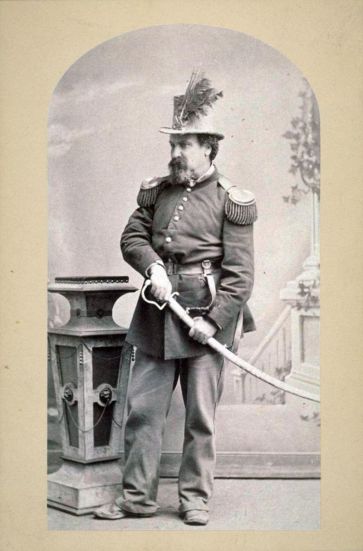
Norton wore an elaborate blue uniform with gold epaulettes, carrying a cane or saber and topped off with beaver hat with peacock feather. By day he “inspected” the streets and public works of San Francisco, by night he would dine in the city’s finest establishments. No play or musical performance would dare open in the city, without reserved balcony seats for Emperor Norton.
Mark Twain, who lived for a time in Emperor Norton’s San Francisco, patterned the King in Huckleberry Finn, on Joshua Norton. Among his many proposals, Norton envisioned flying machines, the League of Nations, and the construction of the San Francisco Bay Bridge.
Though he was penniless, the “Official Norton Seal of Approval” was good for business. Some restaurants even put out brass plaques, declaring their “Appointment to his Imperial Majesty, Emperor Norton I of the United States”.
Norton was often accompanied by two stray dogs. “Bummer” and “Lazarus” became quite the celebrities themselves, and usually dined for free along with the Emperor.
In 1867, police officer Armand Barbier arrested Norton, attempting to have him involuntarily committed to an insane asylum. The public backlash was so vehement that Police Chief Patrick Crowley ordered Norton’s release and issued a public apology. The episode ended well, when Emperor Norton magnanimously pardoned the police department. After that, San Francisco cops saluted Emperor Norton whenever meeting him in the street.
The 1870 census records one Joshua Norton, age 50, occupation, Emperor, along with a note, declaring him to be insane.
Admiring supporters gave aid in the guise of “paying taxes”. A local printer even printed “Imperial bonds”, emblazoned with Norton’s likeness and official seal. To this day, Norton’s Notes are highly prized collector’s items.
The San Francisco Board of Supervisors once bought him a new uniform, when the old one got too shabby. Norton responded with a very nice thank you note, issuing each of them a “Patent of Nobility in Perpetuity”.
On the evening of January 8, 1880, Norton collapsed on a sidewalk and died before help could arrive. The San Francisco Chronicle published his obituary on the front page, under the headline “Le Roi est Mort” (“The King is Dead”). “On the reeking pavement”, began another obituary, “in the darkness of a moon-less night under the dripping rain…, Norton I, by the grace of God, Emperor of the United States and Protector of Mexico, departed this life.”
Emperor Norton’s funeral was attended by 10,000 loyal “subjects”. His reign had lasted for twenty-one years.
It was game four of the World Series between the Cubbies and the Detroit Tigers, October 6, 1945, with Chicago home at Wrigley Field. Billy Sianis, owner of the Billy Goat Tavern in Chicago, bought tickets for himself and his pet goat “Murphy”.
For a Red Sox fan, there was nothing sweeter than the 2004 World Series victory ending the “Curse of the Bambino”. Babies grew up and had babies of their own during that time. There were grandchildren and great grandchildren and even great-greats, and still the drought wore on. It was 86 years, one of the longest World Series championship droughts in Major League Baseball history.
Yet the suffering of We who love the Red Sox™ pales in comparison, with the 108-year drought afflicting the Chicago Cubs, since back-to-back championships in 1907/1908.
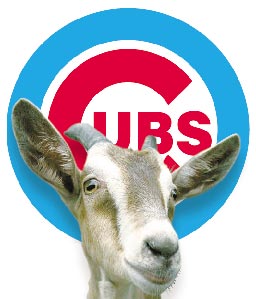
They say it’s the fault of Billy goat.
It was game four of the World Series between the Cubbies and the Detroit Tigers, October 6, 1945, with Chicago home at Wrigley Field. Billy Sianis, owner of the Billy Goat Tavern in Chicago, bought tickets for himself and his pet goat “Murphy”. Anyone who’s ever found himself in the company of a goat understands the problem. Right?
There are different versions of the story, but they all end with Billy and Murphy being thrown out of the game and casting a curse on the team. “Them Cubs”, he said, “they ain’t gonna win no more”.
Sianis’ family claims that he sent a telegram to team owner Philip Wrigley reading, “You are going to lose this World Series and you are never going to win another World Series again. You are never going to win a World Series again because you insulted my goat.”
Billy Sianis was right. The Cubs were up two games to one at the time, but they went on to lose the series. They’ve been losing ever since.
Billy Sianis himself tried to break the curse, prior to his death in 1970, but no dice. Billy’s nephew Sam brought a goat out onto the field in 1984, 1989, 1994 and again in 1998. All to no avail
In 2003, the year of the goat on the Chinese calendar, a group of Cubs fans brought a goat named “Virgil Homer” to Houston, during the division championship series. They couldn’t get him into Minute Maid Park, so they unfurled a scroll outside and proclaimed the End of the Curse.
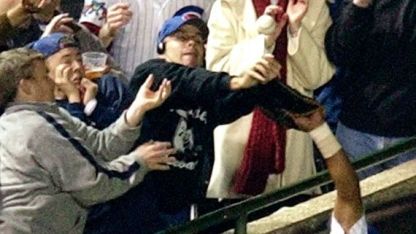
That got them through the series, but the curse came roaring back in game 6 of the National League championship. It was Cubbies 3, Florida Marlins 0 in the 8th inning of game 6. Chicago was ahead in the series, when a lifelong Cubs fan named Steve Bartman deflected what should have been an easy catch for Chicago outfielder Moisés Alou.
Alou slammed his glove down in anger and frustration. Pitcher Mark Prior glared at the stands, crying “fan interference”. The Marlins came back with 8 unanswered runs in the inning. Steve Bartman required a police escort to get out of the field alive.
For fourteen years, Chicago mothers frightened wayward children into behaving, with the name of Steve Bartman.
In 2008, a Greek Orthodox priest sprinkled holy water around the Cubs dugout. Goat carcasses and parts have appeared at Wrigley Field on multiple occasions, usually draped across a statue of Harry Caray.
The Florida Marlins taunted the Cubs in August 2009, parading a goat in front of the Cub’s dugout between the second and third innings. Cubs’ manager Lou Piniella was not amused, though the Cubs squeaked by with that one, 9-8.
Five fans and a goat set out on foot from the Cubs’ Spring Training facility in 2012. Calling it “Crack the Curse”, the group hiked 1,764 miles from Mesa, Arizona to Wrigley Field. The effort raised a lot of money for the Fred Hutchinson Cancer Center, but did nothing to lift the Curse of the Billy goat.
Red Sox fans are well aware of the infamous choke in game 6 of the ‘86 World Series, resulting in the gag “What does Billy Buckner have in common with Michael Jackson? They both wear one glove for no apparent reason”. With due respect to Mr. Buckner, he was better than that story would have you believe, there’s something my fellow Sox fans may not know. The former Cub 1st Baseman was wearing a Chicago batting glove under his mitt. For “luck”.
In 2011, a philanthropic enterprise sprang up called “Reverse the Curse”, selling goat milk lip balms, soaps and more, and, according to their website, “[C]ollaborating with an institution that provides technical cooperation for agriculture in the U.S., Dominican Republic and Haiti to develop goat breeding centers, vegetable gardens, and chicken farms for small producers”.
2015 was once again the Year of the Goat on the Chinese zodiac. That September, five “competitive eaters” consumed a 40-pound goat in 13 minutes and 22 seconds at Chicago’s “Taco in a Bag”. The goat was gone. Surely that would work.
The Cubs made it all the way to the National League Championships, only to be broomed by the New York Mets.
Mets 2nd baseman Daniel Murphy was NLCS MVP that year, setting a postseason record for consecutive games with a home run. Mets fans joked that, Murphy may be the Greatest of All Time (G.O.A.T.), but he wasn’t the first.
As the 2017 season draws to a close, the Chicago Cubs find themselves champions of the National League Central division, and defending World Champions. That’s right. On October 22, 46 years to the day following the death of Billy Sianis, the Cubbies defeated the LA Dodgers 5–0 to win the 2016 National League pennant.
The mother of all droughts came to a halt on November 2 in a ten-inning cardiac arrest that had us all up Way past midnight, on a school night. I even watched that 17-minute rain delay, and I’m a Red Sox guy.
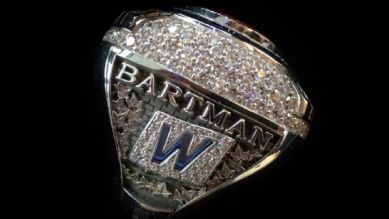
The drought has ended, the curse is broken. Steve Bartman has emerged from Chicago’s most unforgiving doghouse, his way now lit by the 108 diamonds of his very own World Series ring. Billy Sianis and Murphy may, at long last, rest in peace.
In reading up for this story, I learned that the 1913/1914 Milwaukee Brewers roster included a nanny goat, named Fatima. Honest. I wouldn’t kid you about a thing like that.
Joachim‘s mother Elsabeth had to flee with the baby in the harsh winter of 1945, as the oncoming Soviet Red Army destroyed all in its path. The two would escape the Iron Curtain one more time in 1948, this time in a dangerous nighttime dash which the then-four year old remembers to this day.
Joachim Fritz Krauledat was born in Tilsit, East Prussia on April 12, 1944, a region later absorbed into Soviet Russia. The boy never met his father. A German soldier on the Eastern Front of WWII, Fritz Krauledat would be killed months before the birth of his son.
Joachim‘s mother Elsabeth had to flee with the baby in the harsh winter of 1945, as the oncoming Soviet Red Army destroyed all in its path. The two would escape the Iron Curtain one more time in 1948, this time in a dangerous nighttime dash which the then-four year old remembers to this day.
“Pack your rucksack Joachim. We’re going on a trip.’ That was all my mother told me the night we escaped from East Germany” ….. We crossed near the Hartz Mountains south of Brunswick and Hannover. I remember seeing search lights moving, ……… As the women passed under the wire, one of our guides took me by the hand and led me through, As I crouched I could hear a commotion, then gunfire, maybe a machine gun burst. Hurry, hurry, hurry just keep running implored our guide.” *
The family settled for a time in Hannover, West Germany, barely avoiding the communist noose as it closed around their former home in the East.
Krauledat was an indifferent student, possibly due to poor eyesight. He’s legally blind, afflicted since birth with achromatopsia, a condition which left him totally colorblind and severely averse to light. Even as a child, he was rarely seen without the dark glasses which would later become his trademark.
The boy became interested in music, listening over the British Forces Broadcasting Service and US Armed Forces Radio. Listening to his transistor radio, Little Richard singing in a language he didn’t understand, Joachim Krauledat knew. He was going to become a rock ‘n roll singer.
The family moved to Canada in 1958, where the Canadian National Institute for the Blind offered him a Wollensach reel-to-reel tape recorder. The “Talking Book Program” was intended to bring the spoken word to visually impaired students. This 14-year old was more interested in the “record” button.
The gym teacher called him “John”, while his mother became “Mrs. K,” to the other kids. The name stuck. Years later, Joachim Krauledat legally changed his name to John Kay.
“ From as far back as I remember, I always liked music.”
– John Kay
The family moved to Buffalo in 1963, where the young musician found his possibilities limited. At age 20 he and his buddy Klaus packed up the ’62 Chevy, and headed west. The “Mother Road”. Route 66.
The next several years were spent honing and developing his music, a folk and blues singer performing throughout North America. Kay joined a blues rock and folk group called “The Sparrow” in 1965, becoming part of the rock music scene in San Francisco’s Haight-Ashbury district, and the Sunset Strip in Los Angeles.
Heading West, Route 66
The band added a couple new members in 1967, changing their name to a character from a Herman Hesse novel. They called themselves Steppenwolf.
Steppenwolf became one of the world’s foremost rock bands, with standards like “The Pusher”, and “Monster”, releasing “Magic Carpet Ride” on this day in 1968. They gave us the term “Heavy Metal” with the rock anthem “Born to Be Wild”, but that didn’t refer to the music. “Heavy Metal Thunder” referred to large, loud, motorcycles.
Steppenwolf toured for over 40 years. There isn’t a Baby Boomer alive who wouldn’t read this and come away with one of their songs in his head. They’ve sold over 25 million records and licensed their songs in over 50 motion pictures. The music is iconic, from the sound track of the 1969 “Easy Rider” film to their last performance on July 24, 2010, at the three day HullabaLOU music festival in Louisville, Kentucky.
Steppenwolf gave us 22 albums. We all know them in one way or another. Yet, the lead singer’s escape from the horrors of the Iron Curtain, not once but twice, is all but unknown. That, as Paul Harvey used to say, is the Rest, of the Story.
– John Kay from his autobiography, Magic Carpet Ride
Lawrence tried to convince his superiors that Arab independence was in their own best interest, but found himself undermined by the Sykes-Picot agreement, negotiated in secret between French and British authorities with the backing of the Russian government, back in May 1916.
In 1879, 18-year-old Sarah Lawrence arrived at Killua Castle in Tremadog, Wales, the estate of Sir Thomas Chapman and his wife, Edith. Sarah had come to work as governess for their four daughters, but would soon become more than a mere employee.
The affair between the Victorian Aristocrat and the domestic servant produced a son, born in secret in 1885. When the scandal was discovered, Chapman left his wife and moved his new mistress to England. Edith never did grant a divorce, so the couple adopted Sarah’s last name and pretended to be husband and wife. The couple’s second of five children, Thomas Edward Lawrence, learned the true identity of his parents only after his father’s death in 1919.
TE, as Lawrence preferred to be called, was reading books and newspapers by the age of four. He first went to the Middle East as an archaeology student in 1909, walking 1,100 miles across Syria, Palestine, and parts of Turkey, surveying the castles of the Crusaders for his thesis. During this time he was shot at, robbed and severely beaten. Despite all of it, TE Lawrence developed an affinity for the Middle East and its people, which would last a lifetime.
In 1914, the British government sent Lawrence on an expedition across the Sinai Peninsula and Negev desert. Ostensibly an archaeological expedition, this was in reality a secret military survey, of lands then controlled by the Ottoman Turks.
Lawrence joined the Army after WWI broke out that August, taking a desk job as an intelligence officer in Cairo.
You may picture the man as 6’3” Peter O’Toole, especially if you’ve seen the movie. In reality, Lawrence was always self-conscious about his 5’5” stature. It irritated him to have a safe desk job, while millions were dying on the front. The guilt must have become overwhelming when two of his younger brothers were killed in 1915.
T.E. Lawrence and the Arab Revolt, of 1916 – 1918
The Ottoman Empire was in decline at this time, the “Sick Man of Europe”, though still one of the Great Powers. The Hashemite Kingdom of the Arabs had long chafed under Ottoman rule, particularly following the “Young Turk” coup of 1908, when secular, Turkish nationalism replaced the formerly pan-Islamic unity of the Caliphate.
Seeing his chance to break away and unify the Arab Lands and trusting in the honor of British officials who promised support, Sharif Hussein bin Ali, Emir of Mecca and King of the Arabs, saw his chance and launched the Arab Revolt against the Ottoman Empire, in 1916.
Despite having zero military training, Lawrence took to the field at the outbreak of hostilities.
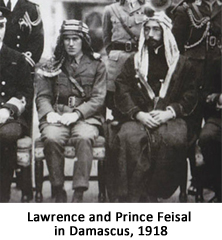
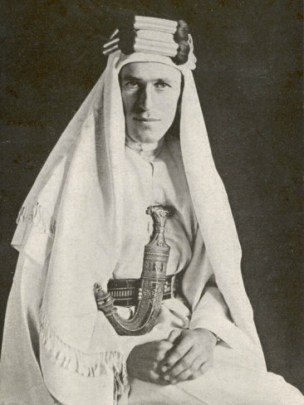
Dressing himself in the flowing Arab Thawb, Lawrence joined the forces of Ali’s son, Feisal.
In theory, the Hejaz Railway could take you from the Ottoman capital at Constantinople to the Arab city of Medina, some 1,800 miles distant, without your feet ever touching the ground. In reality, the rail line was a ripe target for attackers. By his own count, TE Lawrence “scientifically” destroyed 79 bridges, a method of his own perfection by which bridges were destroyed but left standing, requiring Turkish workmen to dismantle the wreckage before repairs could begin.
Lawrence was captured in 1916, subjected to beatings, torture, and homosexual rape by the Governor of Daraa, Hajim Bey, a man he described as an “ardent pederast”.
Lawrence at Aqaba, 1917
Lawrence escaped, though shattered by the experience, joining the desert guerilla war against the Turk. He would take risks that he would not order on his followers, spying behind enemy lines, leading camel charges, blowing up trains and enduring the hardships of the desert. Lawrence would suffer dozens of bullet and shrapnel wounds, in raids that tied up thousands of Ottoman troops and undermined their German ally.
By the summer of 1918, there was a price on his head. One officer wrote “Though a price of £15,000 has been put on his head by the Turks, no Arab has, as yet, attempted to betray him. The Sharif of Mecca [King of the Hedjaz] has given him the status of one of his sons, and he is just the finely tempered steel that supports the whole structure of our influence in Arabia“.
2,000 years after the Apostle Paul’s dramatic conversion on the Road to Damascus, “Lawrence of Arabia” entered the defeated city on October 1, 1918. Like many, Lawrence saw Damascus as the future capital of a united Arab state. Lawrence tried to convince his superiors that Arab independence was in their own best interest, but found himself undermined by the Sykes-Picot agreement, negotiated in secret between French and British authorities with the backing of the Russian government, back in May 1916.
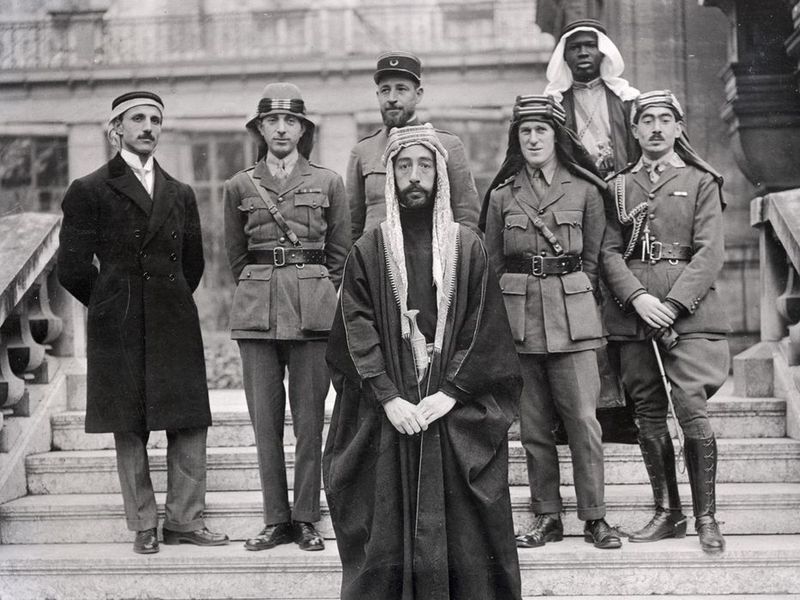
Feisal party at Versailles Conference. Left to right: Rustum Haidar, Nuri as-Said, Prince Faisal (front), Captain Pisani (rear), T. E. Lawrence, Faisal’s slave (name unknown), Captain Hassan Khadri. H/T Wikimedia Commons
Lawrence was furious, believing that what had been won by Arab arms, should remain in Arab hands. Interrupting the praise of his own exploits at a war cabinet meeting, Lawrence snapped ‘Let’s get to business. You people don’t understand yet the hole you have put us all into.’ He refused a knighthood personally given him by King George V, thinking instead that he’d been summoned to discuss Arab borders.
Lawrence of Arabia, 1919
In the end, the pan-Arab kingdom of the Hashemites was never meant to be. The Middle East was carved into zones of English and French influence, and Lawrence never did come to terms with the betrayal.
Today, Lawrence of Arabia is the subject of three major motion pictures, and at least 70 biographies. A prolific writer himself, author of countless letters and at least twelve major works, Lawrence seems to have disliked the fame which had come his way. “To have news value”, he would say, “is to have a tin can tied to one’s tail”. TE Lawrence would go on to serve under a series of assumed names, his latest being TE Shaw, possibly a nod to his close friend, the Irish playwright and noted polemicist, George Bernard Shaw.
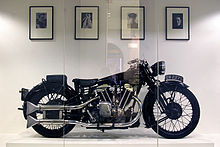
The Brough Superior motorcycle, T. E. Lawrence’s eighth, was awaiting delivery when he died. It is at the Imperial War Museum.
An avid motorcyclist, Lawrence would ride 500-700 miles a day, once even racing a Sopwith Camel biplane. He owned several Brough (rhymes with rough) motorcycles, the last a Brough Superior SS100. This thing came with a certificate, guaranteeing that it would do 0-100 within ¼ mile.
There is a roadside memorial in Dorset, marking the spot where TE Lawrence went over the handlebars, trying to avoid two boys on bicycles. He was forty-six. Mourners at his funeral would include Winston and Clementine Churchill, novelist EM Forster, and his last surviving brother, Arnold.
To most of us, the desert is an inscrutable place, as is the mind, culture and history of the Middle East. Few westerners would ever get to know this part of the world like TE Lawrence.
Lawrence taught us a bit about all of it, when he said “Men have looked upon the desert as barren land, the free holding of whoever chose; but in fact each hill and valley in it had a man who was its acknowledged owner and would quickly assert the right of his family or clan to it, against aggression”.


 In the Netherlands, ice hockey began sometime in the 16th century. North Americans have played the sport since 1855. For all that time, flying hockey pucks have collided with the faces of goalies. The results could not have been pretty.


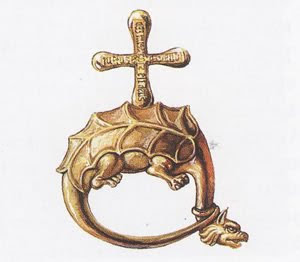 In 1436, Vlad II became voivode, (prince), of Wallachia. The sobriquet “Dracul” came from membership in the “Order of the Dragon” (literally “Society of the Dragonists”), a monarchical chivalric order founded by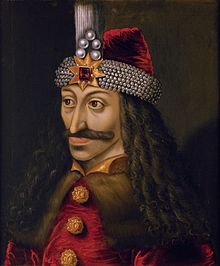
 Ethnic Germans had long since emigrated to these parts, forming a distinct merchant class in Wallachian society. These Saxon merchants were allied with the boyars. It was not long before they too, found themselves impaled on spikes.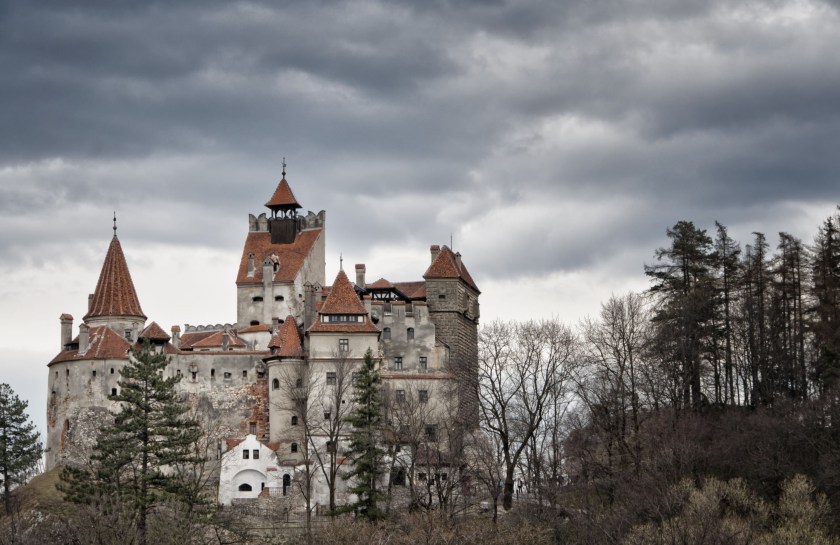



 The radio drama began with a statement that what followed was fictional. The warning was repeated at the 40 and 55-minute mark, and again at the end of the broadcast. It began with a weather report, and then went to a dance band remote, featuring “Ramon Raquello and his orchestra”. The music was periodically interrupted by live “news” flashes, beginning with strange explosions on Mars. Producer Orson Welles made his first radio appearance as the “famous” (but non-existent) Princeton Professor Dr. Richard Pierson, who dismissed speculation about life on Mars.
 The dramatic technique was brilliant. Welles had his cast listen to the Hindenburg tape, explaining that was the “feel” that he wanted in his broadcast. Fictional on-the-spot reporter Carl Phillips describes the death ray in the same rising crescendo, only to be cut off in mid-sentence as it’s turned on him.
 The New York Times reported on Oct. 31, “In Newark, in a single block at Heddon Terrace and Hawthorne Avenue, more than 20 families rushed out of their houses with wet handkerchiefs and towels over their faces to flee from what they believed was to be a gas raid. Some began moving household furniture”.

 Born on October 29, 1921 in New Mexico and brought up in Arizona, William Henry “Bill” Mauldin was part of what Tom Brokaw called, the “Greatest Generation”.
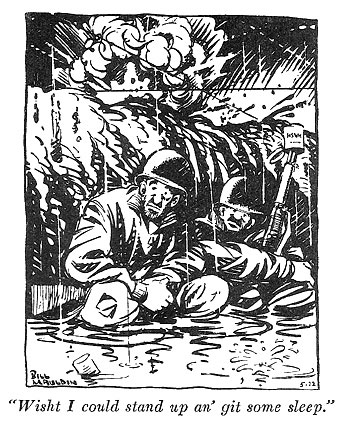 Mauldin developed two cartoon infantrymen, calling them “Willie and Joe”. He told the story of the war through their eyes. He became extremely popular within the enlisted ranks, while his humor tended to poke fun at the “spit & polish” of the officer corps. He even lampooned General George Patton one time, for insisting that his men to be clean shaven all the time. Even in combat.
 Mauldin later told an interviewer, “I always admired Patton. Oh, sure, the stupid bastard was crazy. He was insane. He thought he was living in the Dark Ages. Soldiers were peasants to him. I didn’t like that attitude, but I certainly respected his theories and the techniques he used to get his men out of their foxholes”.
 Bill Mauldin drew Willie & Joe for last time in 1998, for inclusion in Schulz’ Veteran’s Day Peanuts strip. Schulz had long described Mauldin as his hero. He signed that final strip Schulz, as always, and added “and my Hero“. Bill Mauldin’s signature, appears underneath.


 In New York city and “upstate” alike, economic ties with the south ran deep. 40¢ of every dollar paid for southern cotton stayed in New York, in the form of insurance, shipping, warehouse fees and profits.
 “Town Line”, a hamlet on the village’s eastern boundary, put it to a vote. In the fall of 1861, residents gathered in the old schoolhouse-turned blacksmith’s shop. By a margin of 85 to 40, Town Line, New York voted to secede from the Union.
 A rumor went around in 1864, that a
  Even Georgians couldn’t help themselves from commenting. 97-year-old Confederate General T.W. Dowling said: “We been rather pleased with the results since we rejoined the Union. Town Line ought to give the United States another try“. Judge A.L. Townsend of Trenton Georgia commented “Town Line ought to give the United States a good second chance“.
 Fireman’s Hall became the site of the barbecue, “The old blacksmith shop where the ruckus started” being too small for the assembled crowd. On October 28, 1945, residents adopted a resolution suspending its 1861 ordinance of secession, by a vote of 90-23. The Stars and Bars of the Lost Cause was lowered for the last time, outside the old blacksmith shop.

 The violent uprising of the early 50s was called “Mau Mau”, an anagram of Uma Uma, roughly translating as “Get out, Get out”. The first “blow against the Colonial regime” was struck on October 3, 1952, when a white woman was stabbed to death near her home in Thika, in the Kiambu County of Kenya.

 Farrokh was attending St. Peter’s boarding school at the time of the rebellion, and calling himself “Freddie”.

 For a time, Norton disappeared from the public eye. In September 1859, he proclaimed himself Emperor of the United States, his Royal Ascension announced to the public in a letter to the editor of the San Francisco Bulletin. “At the peremptory request and desire of a large majority of the citizens”, it read, “I, Joshua Norton…declare and proclaim myself Emperor of these United States.” The letter went on to command representatives from all the states to convene in San Francisco, “to make such alterations in the existing laws of the Union as may ameliorate the evils under which the country is laboring.”
 That December, Norton fired Virginia Governor Henry Wise for hanging abolitionist John Brown, appointing then-vice President John C. Breckinridge in his stead.
 Norton wore an elaborate blue uniform with gold epaulettes, carrying a cane or saber and topped off with beaver hat with peacock feather. By day he “inspected” the streets and public works of San Francisco, by night he would dine in the city’s finest establishments. No play or musical performance would dare open in the city, without reserved balcony seats for Emperor Norton.
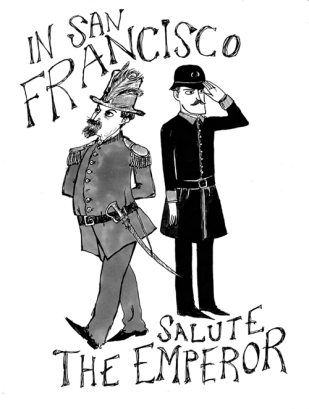 In 1867, police officer Armand Barbier arrested Norton, attempting to have him involuntarily committed to an insane asylum. The public backlash was so vehement that Police Chief Patrick Crowley ordered Norton’s release and issued a public apology. The episode ended well, when Emperor Norton magnanimously pardoned the police department. After that, San Francisco cops saluted Emperor Norton whenever meeting him in the street.
 The San Francisco Board of Supervisors once bought him a new uniform, when the old one got too shabby. Norton responded with a very nice thank you note, issuing each of them a “Patent of Nobility in Perpetuity”.


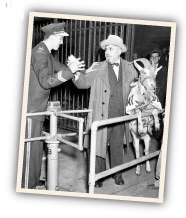 It was game four of the World Series between the Cubbies and the Detroit Tigers, October 6, 1945, with Chicago home at Wrigley Field. Billy Sianis, owner of the Billy Goat Tavern in Chicago, bought tickets for himself and his pet goat “Murphy”. Anyone who’s ever found himself in the company of a goat understands the problem. Right?
 Billy Sianis was right. The Cubs were up two games to one at the time, but they went on to lose the series. They’ve been losing ever since.
 Alou slammed his glove down in anger and frustration. Pitcher Mark Prior glared at the stands, crying “fan interference”. The Marlins came back with 8 unanswered runs in the inning. Steve Bartman required a police escort to get out of the field alive.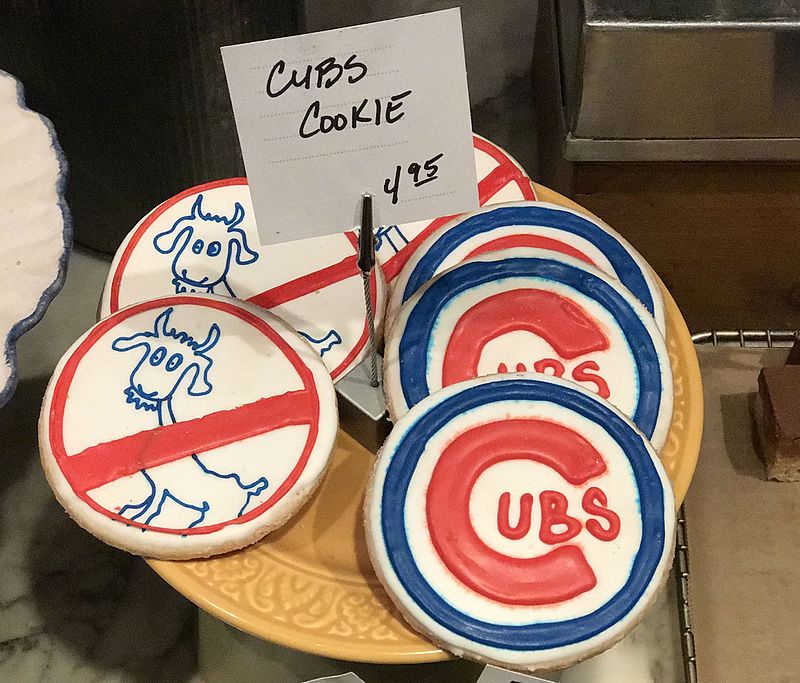
 The mother of all droughts came to a halt on November 2 in a ten-inning cardiac arrest that had us all up Way past midnight, on a school night. I even watched that 17-minute rain delay, and I’m a Red Sox guy.


 The family settled for a time in Hannover, West Germany, barely avoiding the communist noose as it closed around their former home in the East.
 Steppenwolf gave us 22 albums. We all know them in one way or another. Yet, the lead singer’s escape from the horrors of the Iron Curtain, not once but twice, is all but unknown. That, as Paul Harvey used to say, is the Rest, of the Story.

 TE, as Lawrence preferred to be called, was reading books and newspapers by the age of four. He first went to the Middle East as an archaeology student in 1909, walking 1,100 miles across Syria, Palestine, and parts of Turkey, surveying the castles of the Crusaders for his thesis. During this time he was shot at, robbed and severely beaten. Despite all of it, TE Lawrence developed an affinity for the Middle East and its people, which would last a lifetime.
 Dressing himself in the flowing Arab Thawb, Lawrence joined the forces of Ali’s son, Feisal.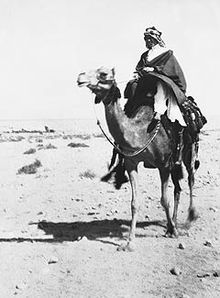
 To most of us, the desert is an inscrutable place, as is the mind, culture and history of the Middle East. Few westerners would ever get to know this part of the world like TE Lawrence.


You must be logged in to post a comment.