For nigh on seventy years, few knew from where this little known bit of verse, had come.
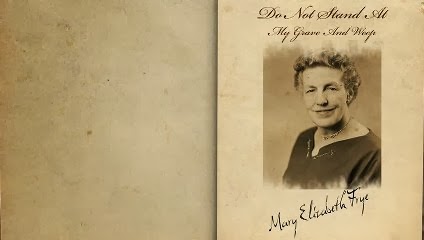
In the early 1930s, Mary Elizabeth Frye was a Baltimore housewife and amateur florist, the wife of clothing merchant, Claud Frye.
A young Jewish girl was living with the couple at this time, unable to visit her sick mother in Germany, due to the growing anti-Semitic violence of the period. Her name was Margaret Schwarzkopf.
Margaret was bereft when her mother died, heartbroken that she could never “stand by my mother’s grave and shed a tear.” Mrs Frye took up a brown paper shopping bag, and wrote out this twelve line verse.
She didn’t title the poem, nor did she ever publish it, nor copyright the work. People heard about it and liked it so Frye would make copies, but that’s about it.
For nigh on seventy years, few knew from where this little known bit of verse, had come.
Over the years, there have been many claims to authorship, including attributions to traditional and Native American origins.
The unknown poem has been translated into Danish, Dutch, French, German, Hebrew, Ilocano, Japanese, Korean, Russian, Spanish, Tagalog and other languages, appearing on countless bereavement cards and read over untold funeral services.
The English translation of one Swedish version reads: “Do not weep at my grave – I am not there / I am in the sun’s reflection in the sea / I am in the wind’s play above the grain fields / I am in the autumn’s gentle rain / I am in the Milky Way’s string of stars / And when on an early morning you are awaked by bird’s song / It is my voice that you are hearing / So do not weep at my grave – we shall meet again.”
Many in the United Kingdom heard the poem for the first time in 1995, when a grieving father read it over BBC radio in honor of his son, a soldier slain by a bomb in Northern Ireland. The son had left the poem with a few personal effects, and marked the envelope ‘To all my loved ones’.
For National Poetry Day that year, the British television program The Bookworm conducted a poll to learn the nation’s favorite poems, subsequently publishing the winners, in book form. The book’s preface describes “Do Not Stand at My Grave and Weep” as “the unexpected poetry success of the year from Bookworm’s point of view… the requests started coming in almost immediately and over the following weeks the demand rose to a total of some thirty thousand. In some respects it became the nation’s favourite poem by proxy… despite it being outside the competition.”
All this at a time when the name and even the nationality of the author, was unknown.
Abigail Van Buren, better known as “Dear Abby”, researched the history of the poem in 1998, and determined that Mrs. Frye was, after all, the author.
Mary Elizabeth Frye passed away in Baltimore Maryland on September 4, 2004. She was ninety-eight.
The Times of Great Britain published her untitled work on November 5, as part of her obituary. ‘The verse demonstrated a remarkable power to soothe loss”, wrote the Times. “It became popular, crossing national boundaries for use on bereavement cards and at funerals regardless of race, religion or social status”.
“I Did Not Die”
by Mary Elizabeth Frye
Do not stand at my grave and weep, I am not there; I do not sleep. I am a thousand winds that blow, I am the diamond glints on snow, I am the sun on ripened grain, I am the gentle autumn rain. When you awaken in the morning’s hush I am the swift uplifting rush Of quiet birds in circling flight. I am the soft star-shine at night. Do not stand at my grave and cry, I am not there; I did not die.
If you enjoyed this “Today in History”, please feel free to re-blog, “like” & share on social media, so that others may find and enjoy it as well. Please click the “follow” button on the right, to receive email updates on new articles. Thank you for your interest, in the history we all share.
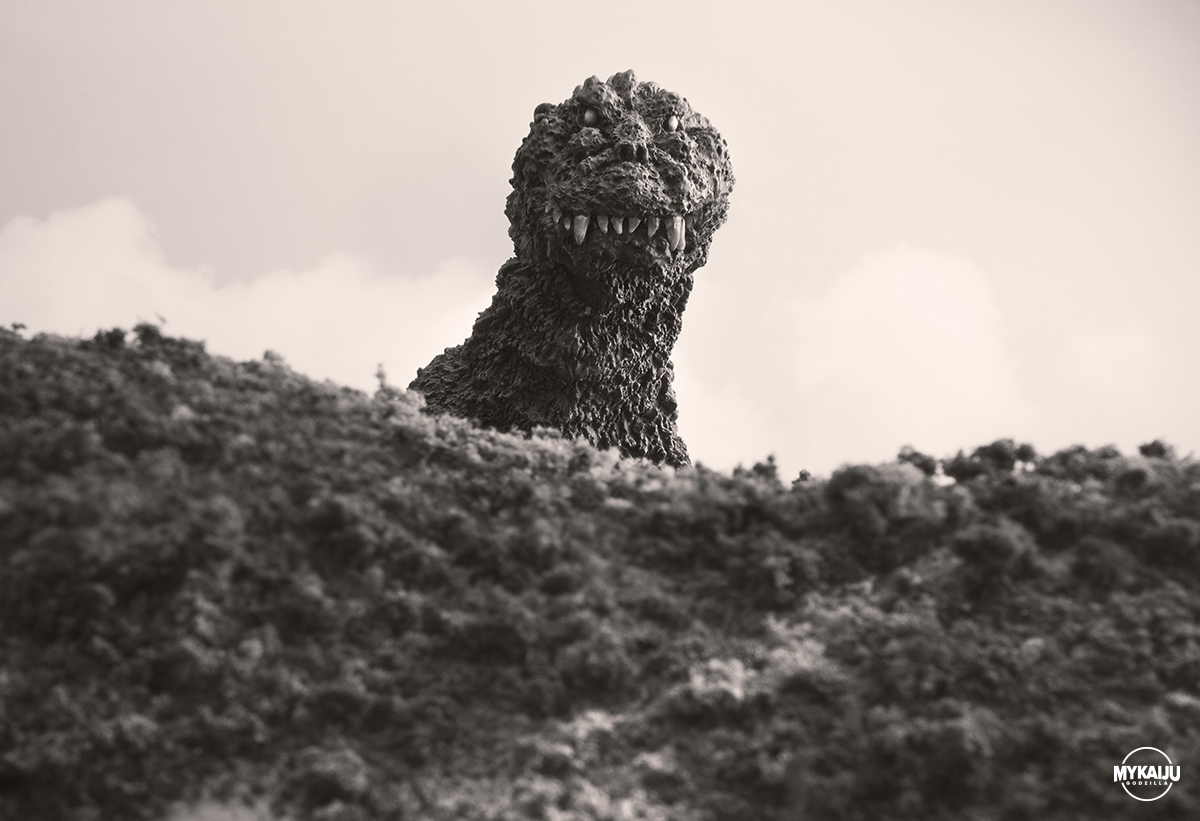
He was a Kaiju, a Japanese word meaning “strange creature”, more specifically a “daikaiju”, meaning a really, really big one.
In 1954, the fishing boat Daigo Fukuryū Maru (“Lucky Dragon No.5”) was working the grounds near the Marshall Islands, in the equatorial Pacific. At 6:45am local time, March 1, 23 fishermen were witness to “Castle Bravo”, a thermonuclear test explosion that lit up the western sky “like a sunrise”. Then came the sound the explosion. The TX-21 device with a predicted yield of 6 megatons, and code named “Shrimp”.
For eight minutes, these twenty-three men watched the mushroom cloud rise into the sky. An hour and one-half later came the fallout, the fine white dust, calcinated coral of the Bikini atoll, falling like snow from the sky.
None of the twenty-three crew members of the Lucky Dragon recognized the material as hazardous, and made no effort to avoid exposure. Some even tasted the stuff.
A few fishermen developed acute radiation sickness, over the next three days. By the time of their return to Yaizu on the 14th, all 23 were suffering from nausea, headaches, bleeding from the gums, and other symptoms. One was destined to die of a liver disorder on September 23, a complication of radiation sickness. They had entered the ranks of the “hibakusha”. The “explosion-effected people”.
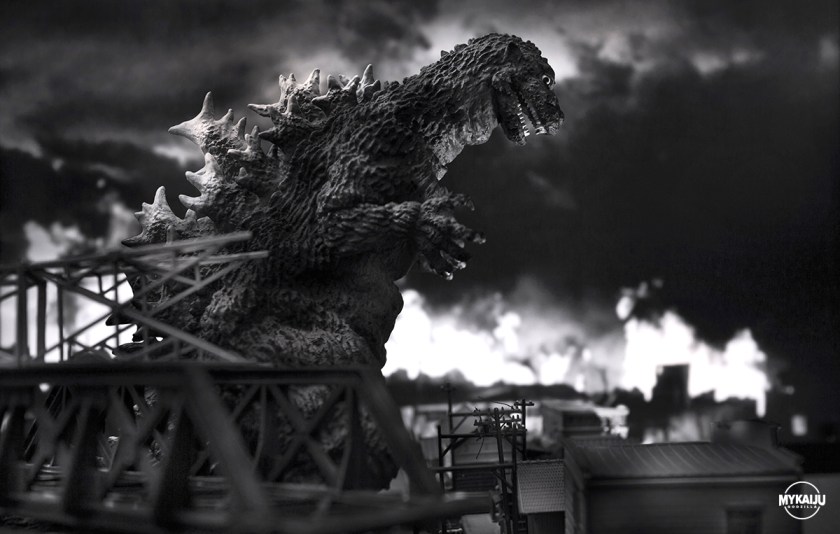
The atomic explosions at Hiroshima and Nagasaki were only nine years in the past at this time, and a fierce anti-nuclear sentiment was building in Japan. In this context, there arose a metaphor for all that destruction. Literally rising from the sea, this product of the Japanese entertainment industry took the form of a monster. “Godzilla”, Ishirō Honda’s first film released by Toho Studios, this day in 1954.
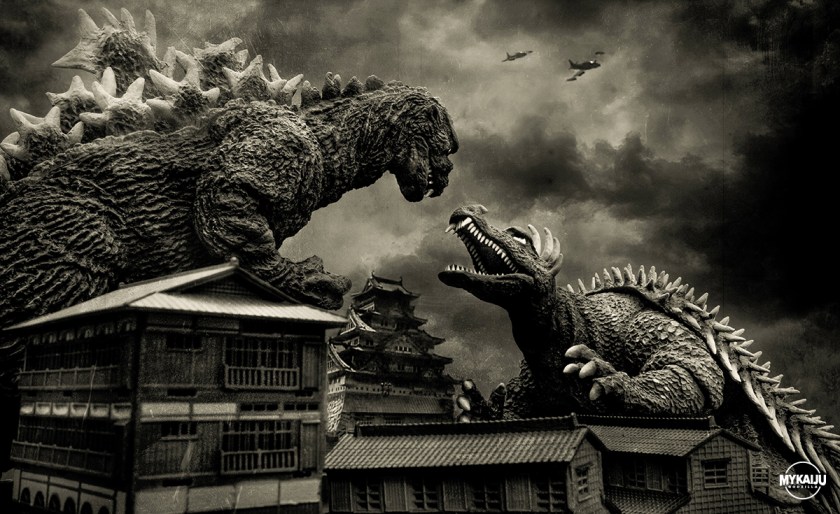
The name is a portmanteau, two words combined to form a third, of the Japanese word “gorira”, (gorilla), and “kujira”, meaning whale. Godzilla was the Gorilla Whale, with the head of a Tyrannosaur, Stegasaur-like plates on his back and skin modeled after the keloid scarring of the hibakusha.
The original Godzilla (“ɡodʑiɽa”) was awakened by atomic testing and impervious to any but a nuclear weapon. Emerging from the depths with his atomic breath, havoc and destruction was always accompanied by the distinctive roar, a sound effect made by rubbing a resin glove down the strings of a bass violin, then changing the speed at playback.
The actor who played Godzilla in the original films, Haruo Nakajima, was a black belt in Judo. His expertise was used to choreograph the monster’s movements, defining the standard for most of the Godzilla films, to follow.
Originally an “it”, Godzilla was usually depicted as a “he”, although that became a little complicated with the 1998 American remake “Zilla”, when he started laying eggs.
He was a Kaiju, a Japanese word meaning “strange creature”, more specifically a “daikaiju”, meaning a really, really big one. Godzilla is the best known, but certainly not the only such creature. You may remember other kaiju, including Gamera, Mothra, King Ghidorah, Mechagodzilla and Rodan.
Godzilla has appeared in 28 original films, with more in the works. Over the course of his existence he has been a hero, a villain, and a destructive but values-neutral force of nature.
Godzilla got his own star on the Hollywood “Walk of Fame” in 2004, timed to coincide with the release of the 29th movie, “Godzilla: Final Wars.” Instead of nuclear weapons testing, this version was spawned by “environmental pollution”. It takes the superheroes of the “Earth Defense Organization” (but, of course) to freeze him back into the ice of the South Pole. The film was a flop, grossing less than $12 million after a production budget of $19 million.
The franchise came roaring back ten years later, when Godzilla was released in 2014, grossing $200 million domestically and $529.1 million on worldwide sales.
A film franchise 64 years in the making is still going strong, and will continue to do so, for the foreseeable future. Godzilla: King of the Monsters is set to be released in 2019 and Godzilla vs. Kong, in 2020.
If you enjoyed this “Today in History”, please feel free to re-blog, “like” & share on social media, so that others may find and enjoy it as well. Please click the “follow” button on the right, to receive email updates on new articles. Thank you for your interest, in the history we all share.
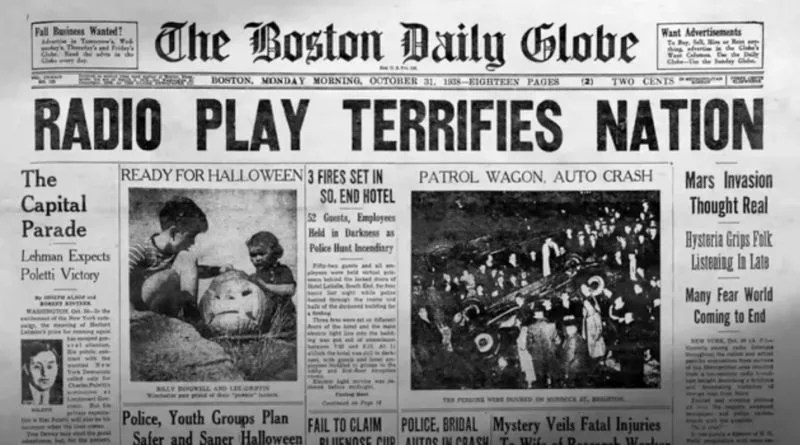
Despite repeated notices that the broadcast was fictional, it’s been estimated that as many as 1.2 million thought the news, was real. According to Grover’s Mill folklore, a local named William Dock shot a water tower, mistaking it for a Martian in the moonlight. Traffic was jammed in both directions in the little town, as locals tried to get out, and curiosity seekers came to see what Martians looked like.
34.6 million miles distant, the Red Planet is our nearest neighbor in the solar system. To the Babylonians of 3000B.C. Mars was the God of Death, lending its name to the war gods of Greek and Roman antiquity, alike.
In the 19th century, amateur astronomer Percival Lowell was convinced that he saw canals on Mars, evidence of some great civilization. In 1898, H.G. Wells published a book about a Martian invasion of earth, beginning with a landing in England. On this day in 1938, the Mercury Theater of the Air brought the story to life.
The radio drama began with a statement that, what followed, was fictional. The warning was repeated at the 40 and 55-minute mark, and again at the end of the broadcast. It began with a weather report, and then went to a dance band remote, featuring “Ramon Raquello and his orchestra”. The music was periodically interrupted by live “news” flashes, beginning with strange explosions on Mars. Producer Orson Welles made his first radio appearance as the “famous” (but non-existent) Princeton Professor Dr. Richard Pierson, who dismissed speculation about life on Mars.
A short time later, another “news flash” reported a fiery crash in Grovers Mill, NJ. What was originally thought to be a meteorite was revealed to be a rocket machine as a tentacled, pulsating Martian unscrewed the hatch and incinerated the crowd with a death ray.
The dramatic technique was brilliant. Welles had his cast listen to the Hindenburg tape, explaining that was the “feel” that he wanted in his broadcast. Fictional on-the-spot reporter Carl Phillips describes the death ray in the same rising crescendo, only to be cut off in mid-sentence as it was turned on him.
The 60-minute play unfolds with Martians wiping out a militia unit sent against them, and finally attacking New York City with poison gas.
Alien spacecraft, hovering over the trees
Despite repeated notices that the broadcast was fictional, it’s been estimated that as many as 1.2 million thought the news, was real. According to Grover’s Mill folklore, a local named William Dock shot a water tower, mistaking it for a Martian in the moonlight. Traffic was jammed in both directions in the little town, as locals tried to get out, and curiosity seekers came to see what Martians looked like.
The USA Today Newspaper reporting on the 75th anniversary of the broadcast, that “The broadcast … disrupted households, interrupted religious services, created traffic jams and clogged communications systems. “The New York Times reported on Oct. 31, 1938: “In Newark, in a single block at Heddon Terrace and Hawthorne Avenue, more than 20 families rushed out of their houses with wet handkerchiefs and towels over their faces to flee from what they believed was to be a gas raid. Some began moving household furniture”.
Then as today, supposed “victims” of the broadcast and their lawyers lined up to get paid for “mental anguish” and “personal injury”. All suits were dismissed, except for a claim for a pair of black men’s shoes, size 9B, by a Massachusetts man who had spent his shoe money to escape the Martians. Welles thought the man should be paid.
In the end, the War of the Worlds was just what the broadcast described itself to be. A Halloween concoction. The equivalent of dressing up in a sheet, and jumping out of a bush, and saying, ‘Boo!’.
If you enjoyed this “Today in History”, please feel free to re-blog, “like” & share on social media, so that others may find and enjoy it as well. Please click the “follow” button on the right, to receive email updates on new articles. Thank you for your interest, in the history we all share.
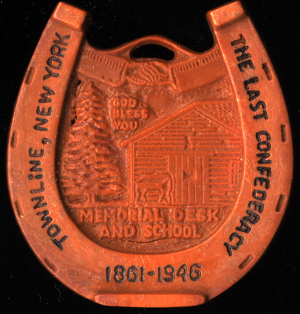
By October 1945 there legally remained only one part of the former Confederate States of America. The little hamlet of Town Line, New York.
By the early 1830s, cotton exceeded the value of all other American exports, combined. As secession loomed over the nation, a Chicago Daily Times editorial warned that if the South left “in one single blow, our foreign commerce must be reduced to less than one half of what it is now”.
South Carolina seceded in December 1860, and the world waited to see who’d follow. New York City became the next to call for secession on January 6, when Mayor Fernando Wood addressed the city’s governing body. “When Disunion has become a fixed and certain fact”, he said, “why may not New York disrupt the bands which bind her to a venal and corrupt master…and destroyed the Confederacy of which she was the proud Empire City?”
In New York city and state alike, economic ties with the south ran deep. 40¢ of every dollar paid for southern cotton stayed in New York, in the form of insurance, shipping, warehouse fees and profits.
30 minutes’ east of Buffalo, the village of Lancaster contemplated staying with the Union. 500 miles from the nearest Confederate state, George Huber remembered the time. “When war was declared, Lancaster seethed with the news, and many were the nights we stayed up as late as 12 o’clock to talk things out. I was twelve years old at the time, but I remember the stern faces of the elders and the storm of passionate and angry discussion. Soon the town split into two factions, it was a very tense situation…Often the excitement ran so high that if a man in either group had made the slightest sign, neighbors would have been at each other’s throats and fists would have taken the place of words.”
The old blacksmith shop
“Town Line”, a hamlet on the village’s eastern boundary, put it to a vote. In the fall of 1861, residents gathered in the old schoolhouse-turned blacksmith’s shop. By a margin of 85 to 40, Town Line voted to secede from the Union.
There was angry talk of arresting “Copperheads” for sedition, as casualty reports came back from the front. “Seceders” became quiet, afraid to meet in public amidst angry talk of lynching. A half-dozen or so more ardent secessionists went south to fight for the Confederacy. Others quietly moved north, to Canada. Outside of Lancaster, no one seemed to notice. Taxes continued to be paid. No federal force ever arrived to enforce the loyalty of the small village.
A rumor went around in 1864, that a large Confederate army was building in Canada, poised to invade from the north. Town Line became a dangerous place for the few southern sympathizers left. Most of those remaining moved to Canada and, once again, Lancaster became the quiet little village in upstate New York, that nobody ever heard of.
Impatient to get on with it, Dade County “symbolically” seceded both from Georgia as well as the Union, back in 1860. Officially, Dade County seceded with Georgia in 1861, and rejoined with the rest of the state in 1870, but the deal was sealed on July 4, 1945, when a telegram from President Harry S. Truman was read at a celebration marking Dade County’s “rejoining” the Union.
The “Confederate Gibraltar”, Vicksburg Mississippi, fell on July 4, 1863. The city wouldn’t celebrate another Independence Day for 80 years.
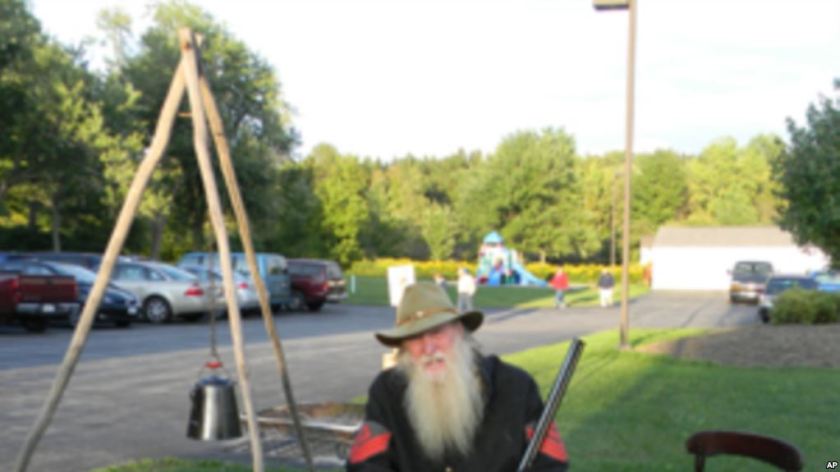
In 2011, the residents of Town Line, New York dressed up to mark the town’s sesquicentennial of secession from the Union
By October 1945 there legally remained only one part of the former Confederate States of America. The little hamlet of Town Line, New York.
Even Georgians couldn’t help themselves, from commenting. 97-year-old Confederate General T.W. Dowling said: “We been rather pleased with the results since we rejoined the Union. Town Line ought to give the United States another try“. Judge A.L. Townsend of Trenton Georgia commented “Town Line ought to give the United States a good second chance“.
A courier express note arrived on October 7, 1945. “There are few controversies that are not susceptible to a peace time resolution” read the note, “if examined in an atmosphere of tranquility and calm rather than strife and turmoil. I would suggest the possibility of roast veal as a vehicle of peace. Why don’t you run down the fattest calf in Erie County, barbecue it and serve it with fixin’s in the old blacksmith shop where the ruckus started? Who can tell? The dissidents might decide to resume citizenship.” The note was signed “Very Sincerely Yours, Harry Truman”.
Fireman’s Hall was the site of the barbecue, “The old blacksmith shop where the ruckus started” being too small for the assembled crowd. On October 28, 1945 residents adopted a resolution suspending the 1861 ordinance of secession, by a vote of 90-23. The Stars and Bars of the Confederate States of America was lowered for the last time, outside the old blacksmith shop.
Alabama member of the United States House of Representatives John Jackson Sparkman, may have had the last word: “As one reconstructed rebel to another, let me say that I find much comfort in the fact that you good people so far up in Yankee land have held out during the years. However, I suppose we grow soft as we grow older.”
If you enjoyed this “Today in History”, please feel free to re-blog, “like” & share on social media, so that others may find and enjoy it as well. Please click the “follow” button on the right, to receive email updates on new articles. Thank you for your interest, in the history we all share.
Imagine a world with no grocery stores, and watching your food, All of it, disintegrate, before your eyes.
Between 1932 and 1943, children’s author Laura Ingalls Wilder published a series of eight novels, a fictionalized autobiography based on the childhood experiences of a 19th century pioneer and settler family. Third in the series is the best known, Little House on the Prairie, the subject for a television series running from 1974 to ’83.
In her fourth book, Wilder tells of the time when grasshoppers wiped out a much-anticipated and badly needed wheat crop, laying so many eggs that all hope was gone for the following year, as well. On the Banks of Plum Creek, published this day in 1937, told the story of “Pa” having to walk three-hundred miles east to find work on farms, which had escaped the plague of grasshoppers.
There are something like 11,000 species of grasshoppers in the world, the familiar, plant munching insects of our summer fields. They are vegetarian creatures with polyphagous food habits, meaning they’ll eat just about anything, if the need arises.
Rocky Mountain locust, Melanoplus spretus, photographed in 1870s, Minnesota
Usually a solitary creature, only a few species will become locusts, the “gregarious” phase of the insect’s life cycle characterized by swarming, migration, and accompanied by explosive growth in population.
The two years in Wilder’s story, 1874 – ’75, are among the worst swarms on record for the Rocky Mountain Locust, Melanoplus spretus.
M. Spretus finds its home in the fertile valleys of the Rocky Mountains, but outbreaks of the insect have caused farm damage as far away as Maine in the period 1743–’56, and in Vermont during the administration of President George Washington.
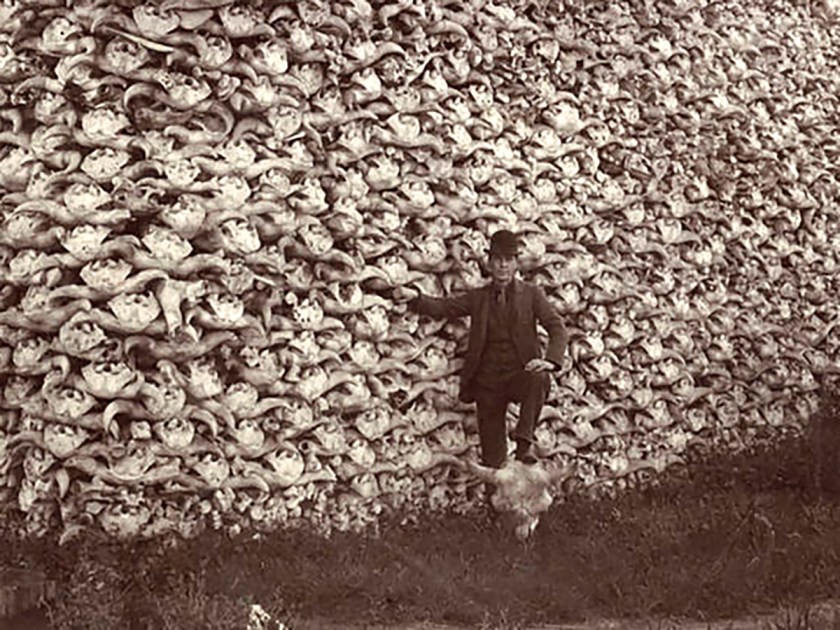
When President Thomas Jefferson sent Lewis & Clark off on the Corps of Discovery expedition, vast herds of American bison stretched from horizon to horizon, as far as the eye could see. Historians estimate 30 to 60 million of the creatures, each weighing up to 2,000 pounds and measuring twelve-feet long. A minimum of sixty billion pounds of biomass, needing something to eat.
The western artist George Catlin estimated that, by 1841, some two to three million of the creatures had been slaughtered for their hides. Bison populations came under increasing pressure as natives acquired horses and guns, but the real slaughter began with the Indian wars and “hunting by rail”, when every dead buffalo was seen as a dead Indian. By the late 1880s, only a few hundred individuals remained alive, in Yellowstone National Park.
A mountain of bison skulls
With the bison gone and a new wave of vegetation, there arose a new and very different multitude, to feed on it.
During the 19th century, farming expanded westward into the grasshopper’s favored habitat, triggering massive outbreaks in their numbers. Locust populations exploded to varying degrees in 1828, ’38, ’46, and ’55, affecting areas throughout the West and upper mid-west. Plagues visited Minnesota in 1856–’57 and again in the last year of the Civil War. Nebraska suffered repeated infestations between 1856 and ’74.
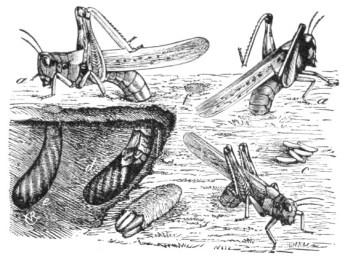
Illustration of egg-laying females, from 1877
Population blooms of two years are typical, as eggs laid in year one tend not to thrive as well as their parents. At its height, farmers reported finding up to 150 egg cases per square inch, each containing 100 eggs or more.
In 1875, Doctor Albert L. Child of the U.S. Signal Corps watched a mile-high swarm of locusts pass overhead, for five days straight. Together with telegraph reports from neighboring towns, Child estimated the swarm to be 110 miles wide and 1,800 miles long. 198,000 square miles, one-third the size of Alaska, or the combined landmass of our thirteen smallest states. It was a rolling flood, the size of California and Maine, put together.
The numbers are so far outside of human experience, they are hard to get your head around. For a little perspective, a million seconds is about twelve days. A Billion seconds ago, Jimmy Carter was President of the United States. A Trillion seconds ago, the oldest known clay object was fired to ceramic in the earliest oven. It was 29,000, B.C. ”
Albert’s Swarm” was the largest such assembly of organisms in recorded history, estimated at 12½ Trillion individuals.
It was a biological wildfire, a living blizzard that blotted out the sun, 12½ trillion insects each the size of a child’s finger, and each driven to eat its own weight. Every day. All in, Albert’s Swarm is estimated to have weighed 27½ million tons.
As the continuous track of a bulldozer moves ever forward, the leading edge of the swarm would alight to rest and eat, only to pick up the rear, a few days later. In this manner, the swarm would cover ten miles or so, in a few weeks.
One farmer reported that the locusts seemed “like a great white cloud, like a snowstorm, blocking out the sun like vapor“. Even the sound was horrific, rising to a scream and rolling over the land like some evil tide, the whirring and rasping cacophony of billions of mandibles borne aloft to eat, almost literally, everything in sight. Native populations could and did, move. For prairie settler and pioneer families, home was on the farm.
Imagine a world with no grocery stores, and watching your food, All of it, disintegrate, before your eyes. Standing crops were the first to go, and then the root vegetables, potatoes, carrots and turnips, eaten out of the ground. Throw a blanket over your garden to protect even that little bit, and they would eat the blanket. Fence posts, saddles, nothing was off limits. These creatures would eat the wool, right off of your sheep. At its worst, the locust horde was known to eat the clothes off of people’s backs.
Trains were literally stopped in their tracks on uphill stretches of rail, unable to gain traction for the grease of millions of tiny bodies, ground beneath their wheels.
Farmers used gunpowder, fire and water, anything they could think of, to destroy what could only be seen as a plague of biblical proportion. They smeared them with “hopperdozers”, a plow-like device pulled behind horses, designed to knock jumping locusts into a pan of liquid poison or fuel, or even sucking them into vacuum cleaner-like contraptions.
Still, it was like trying to turn the tide, with a shot glass. Missouri entomologist Charles Valentine Riley came up with a recipe to eat the damned things, seasoned with salt and pepper and pan-fried in butter. Some bought the recipe, but many felt they “would just as soon starve as eat those horrible creatures”.
In 1877, a Nebraska law required everyone between the ages of 16 and 60 to work at least two days eliminating locusts, or face a $10 fine. Missouri and other Great Plains states offered bounties: $1 a bushel for locusts gathered in March, 50¢ in April, 25¢ in May, and 10¢ in June.
And then the locust went away, and no one is entirely certain, why. It is theorized that plowing, irrigation and harrowing destroyed up to 150 egg cases per square inch, in the years between swarms. Great Plains settlers, particularly those alongside the Mississippi river, appear to have disrupted the natural life cycle. Winter crops, particularly wheat, enabled farmers to “beat them to the punch”, putting away stockpiles of food before the pestilence reached the swarming phase.
Today, the Rocky Mountain Locust is extinct. Several grasshopper species swarm as locusts on every continent in the world, save for North America and Antarctica. The last living specimen of the Rocky Mountain Locust was seen in Canada, in 1902.
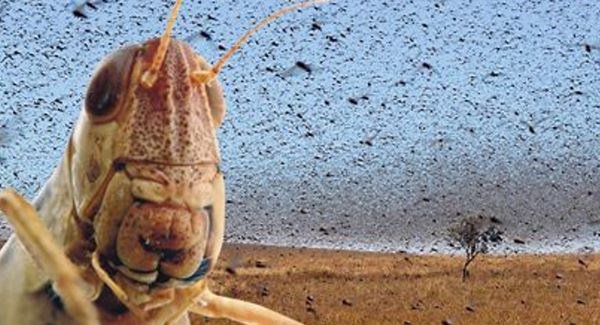
Feature image, top of page: A child swings a broomstick at a 4-mile wide swarms of locusts, plaguing Argentina. H/T Business Insider
Television cameras were quick to arrive and covered the ordeal, live. Those of us of a certain age remember it well. The rescue was carried from the Netherlands to Brazil, from Germany to Hong Kong and mainland China. Well wishers called in to local television stations, from the Soviet Union. It seemed the whole world, stopped to watch.
Jessica McClure Morales is a West Texas Mother of two school-age children. Her life is normal in every way. She’s a teacher’s aide. Her husband Danny, works for a piping supply outfit. Just a normal Texas Mom, with two kids and a puppy, playing in the yard.
On this day in 1987, Jessica McClure’s life was anything but normal. Frightened and alone, “Baby Jessica” was stuck twenty-two feet down, at the bottom of a well.
Everything seemed so normal that Wednesday, October 14, just an eighteen-month-old baby girl, playing in the back yard of an Aunt. That old well pipe shouldn’t have been left open, but what harm could it do. The thing was only eight inches wide.
And then the baby disappeared. Down the well.
The language does not contain a word adequate to describe the horror that young mother must have felt, looking down that pipe.
Midland Fire and Police Departments devised the plan. A second shaft would be dug, parallel to the well. Then to bore a tunnel, until rescuers reached the baby. The operation would be over, by dinnertime.
The rescue proved far more difficult than first imagined. The first tools brought on-scene, were inadequate to get through the hard rock surrounding the well. What should have taken minutes, was turning to hours.
Television cameras were quick to arrive and covered the ordeal, live. Those of us of a certain age remember it well. The rescue was carried from the Netherlands to Brazil, from Germany to Hong Kong and mainland China. Well wishers called in to local television stations, from the Soviet Union. It seemed the whole world, stopped to watch.
Watching the evening news, it’s sometimes easy to believe that the world is going to hell. It’s not. What we saw for those fifty-eight hours was the True heroism and fundamental decency of every-day guys: fathers, sons and brothers, doing what they needed to do. We’d see it again in a New York Minute, should circumstances require.
You could watch it happen, around the clock. Many of us did. I remember it, each would dig until he’d drop, and then another man would take his place. There were out-of-work oil field workers and everyday guys. Mining engineers and paramedics. The work was frenetic and distraught, and at the same time, agonizingly slow.
Anyone who’s used a jackhammer, knows it’s not a tool designed to be used, sideways. Even so, they tried. A waterjet became a vital part of the rescue, a new and unproven technology, in 1987.
The sun went down that Wednesday and rose the following day and then it set, and still, the nightmare dragged on.
A microphone was lowered down, so doctors could hear her breathe. She would cry, and sometimes she would sing. A small voice drifting up from that hole in the ground, the words of “Winnie the Pooh”.
Both were good signs. A baby could neither sing nor cry, if she could not breathe.
The final tunneling phase of the operation could only be described, as a claustrophobic nightmare. An unimaginable ordeal. Midland Fire Department paramedic Robert O’Donnell was chosen, because of his small, wiry frame. Slathered all over with K-Y jelly and jammed into a space so tight it was difficult to breathe, O’Donnell inched his way through that black hole that Thursday night and into the small hours of Friday morning, until finally, he touched her leg.
The agony of those minutes that dragged on to hours can only be imagined. What he was trying to do, could not be done. In the end, O’Donnell was forced to back out of the hole, defeated. Empty handed. As they went back to work enlarging the tunnel, the paramedic sat on a curb, and wept.
On the second attempt, O’Donnell was able wrestle the baby out of that tiny space, handing her to fellow paramedic Steve Forbes, who carried her to safety.
Baby Jessica came out of that well with her face deeply scarred, and toes turned to gangrene, for lack of blood flow. She would require fifteen surgeries before it was over but, she was alive.
Media saturation coverage led then-President Ronald Reagan to quip, that “everybody in America became godmothers and godfathers of Jessica while this was going on.” Baby Jessica appeared with her teenage parents on Live with Regis and Kathie Lee, to talk about the incident. Scott Shaw of the Odessa American won the Pulitzer prize for the photograph, and ABC made a television movie: Everybody’s Baby: The Rescue of Jessica McClure. USA Today ranked her 22nd on a list of “25 lives of indelible impact.” Everyone in the story became famous. Until they weren’t.
In time, the scars healed for Jessica McClure. Today she has no recollection of those fifty-eight hours. Not so much the hero from the bottom of that hole, Robert O’Donnell. Whatever personal hell the man went through that night, alone in that blackest of places, never left his mind. And then there was the fame. And the adulation. And then, nothing.
Even now, we struggle to understand Post-Traumatic Stress Disorder, (PTSD), a condition which ends the lives of twenty-two of the best among us every day, and has killed more Vietnam combat veterans, than the war itself. It was only 1987, when the Diagnostic and Statistical Manual of Mental Disorders dropped the requirement, that stressors be outside the range of normal human experience.
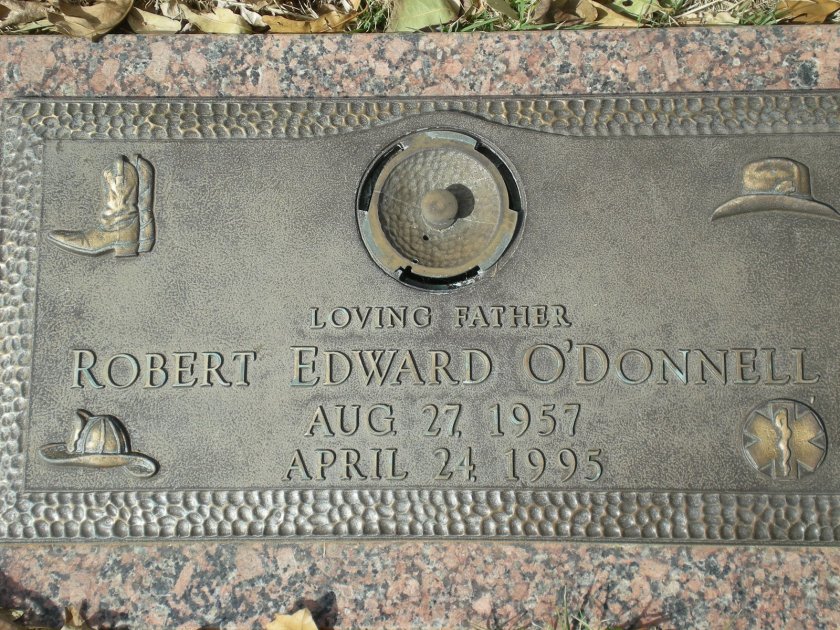
Robert O’Donnel took his own life on April 24, 1995. The media declined to notice. The stone above his grave bears the images of a cowboy hat and boots, and those of a fire hat, and the six-pointed Star of Life, symbol for emergency medical services, in nations the world over. A “Loving Father,” who has earned the right to be remembered.
If you enjoyed this “Today in History”, please feel free to re-blog, “like” & share on social media, so that others may find and enjoy it as well. Please click the “follow” button on the right, to receive email updates on new articles. Thank you for your interest, in the history we all share.
Red Sox fans are well aware of the famous choke in game 6 of the ‘86 World Series, resulting in the line “What does Billy Buckner have in common with Michael Jackson? They both wear one glove for no apparent reason”. What my fellow Sox fans may not be aware of, is that the former Cub was wearing a Chicago batting glove under his mitt. For “luck”.
For a Red Sox fan, there was nothing sweeter than the 2004 World Series victory ending the curse of the Bambino. Babies grew up and had babies of their own during that time. There were grandchildren and great grandchildren, and sometimes even great-greats, and still the drought wore on. It was 86 years, the third-longest World Series championship drought in Major League Baseball history.
Long suffering fans of the Chicago White Sox endured the second-longest such championship dearth, following the “Black Sox” scandal of 1919. For 88 years, that mournful cry came down through the ages: “Say it ain’t so, Joe”.
Yet, the suffering inflicted by the curse of the Black Sox and that of the Bambino, pales in comparison with the 108-year drought afflicting the Chicago Cubs since back-to-back championships in 1907/1908. And they say it’s the fault of a Billy goat.
It was game four of the World Series between the Cubbies and the Detroit Tigers, October 6, 1945, with Chicago home at Wrigley Field. Billy Sianis, owner of the Billy Goat Tavern in Chicago, bought tickets for himself and his pet goat “Murphy”. Really.
Now, goats don’t smell any sweeter than most other livestock, save for the male in rut. This part of the animals fertility cycle happens in the fall for many breeds and, while it’s pure speculation, the oft-repeated expression “smells like a goat”, comes to mind. There are different versions of the story, but they all end with the pair being ejected, and Billy casting a curse. “Them Cubs“, he said, “they ain’t gonna win no more“.
Sianis’ family claims that he sent a telegram to team owner Philip Wrigley reading, “You are going to lose this World Series and you are never going to win another World Series again. You are never going to win a World Series again because you insulted my goat.”
Billy Sianis was right. The Cubs were up two games to one at the time, but they went on to lose the series. They’ve been losing ever since.
Billy Sianis himself is gone now, but they brought his nephew Sam onto the field with a goat in 1984, to help break the curse. They did it again in 1989, 1994 and 1998, and always the same result.
The Florida Marlins taunted the Cubs in August of 2009, parading a goat in front of the Cub’s dugout between the second and third innings. Chicago manager Lou Piniella was not amused, though the Cubs squeaked by with that one, 9-8.
In 2003, the year of the goat on the Chinese calendar, a group of Cubs fans brought a goat named Virgil Homer to Houston, during the division championship series. They couldn’t get him into Minute Maid Park, so they unfurled a scroll outside and proclaimed the End of the Curse.
Ol’ Virgil got them through that series, but the curse came roaring back in game 6 of the NL championship. It was Cubbies 3, Florida Marlins 0 in the 8th inning of game 6. Chicago was ahead in the series, when lifelong Cubbies fan Steve Bartman reached down and deflected a ball that should have easily been caught by Chicago outfielder Moisés Alou. The Marlins came back with 8 unanswered runs in the inning, while Bartman required a police escort to get out of the field alive.
For fourteen years, Chicago mothers frightened wayward children into behaving, with the name of Steve Bartman.
In 2008, a Greek Orthodox priest sprinkled holy water around the Cubs dugout. Goat carcasses and parts have appeared at Wrigley Field on multiple occasions, usually draped across the statue of Harry Caray.
Five fans set out on foot with a goat from the Cubs’ Spring Training facility in 2012. “Crack the Curse” was supposed to do it. These guys walked 1,764 miles from Mesa, Arizona to Wrigley Field. The effort raised a lot of money for the Fred Hutchinson Cancer Center, but the curse of the Billy goat remained serene, and unbreakable.
Red Sox fans are well aware of the famous choke in game 6 of the ‘86 World Series, resulting in the line “What does Billy Buckner have in common with Michael Jackson? They both wear one glove for no apparent reason”. What my fellow Sox fans may not be aware of, is that the former Cub was wearing a Chicago batting glove under his mitt. For “luck”.
2015 was the Year of the Goat on the Chinese zodiac. In September, five “competitive eaters” consumed a 40-pound goat in 13 minutes and 22 seconds at Chicago’s “Taco in A Bag”. The goat was gone. Surely that would work. The Cubs made it all the way to the National League Championships, only to be broomed by the New York Mets.
Mets 2nd baseman Daniel Murphy was the NLCS MVP that year, setting a postseason record for consecutive games with a home run. Mets fans joked that, Murphy may be the Greatest of All Time (GOAT), but he wasn’t the first.
The cookies pictured above were baked in 2016, and that might’ve finally done it. That’s right. The Mother of all Droughts came to a halt in extra innings of game seven, following a 17-minute rain delay. At long last, Steve Bartman could emerge from Chicago’s most unforgiving doghouse, his way now lit by his own World Series ring. The ghost of Billy Sianis’ goat, may finally rest in peace.
In reading up for this story, I discovered that the 1913/1914 Milwaukee Brewers roster included a nanny goat, called Fatima. Honest. I wouldn’t kid you about a thing like that.
If you enjoyed this “Today in History”, please feel free to re-blog, “like” & share on social media, so that others may find and enjoy it as well. Please click the “follow” button on the right, to receive email updates on new articles. Thank you for your interest, in the history we all share.
Steppenwolf gave us 22 albums, and we all know them in one way or another. Yet, the lead singer’s escape from the horrors of the Iron Curtain, is all but unknown.
Joachim Fritz Krauledat was born in Tilsit, East Prussia on April 12, 1944, a region later absorbed into the Soviet Union. The boy never met his father Fritz, a German soldier killed on the Eastern Front of WWII.
Elsbeth had to flee with her infant son in the harsh winter of 1945, as the oncoming Soviet Red Army destroyed all in its path. The two would escape the Iron Curtain once again in 1948, this time in a dangerous nighttime dash which the then-four year old remembers, to this day.
They settled for a time in Hannover, West Germany, barely avoiding the communist noose as it closed around their former home in the east.
Krauledat was an indifferent student, due to poor eyesight. He’s legally blind and extremely light-sensitive, forced to wear dark glasses since the age of three. An eye condition called achromatopsia left him entirely color blind, seeing the world in shades of black and white and gray.
The boy became interested in music, listening over the British Forces Broadcasting Service and the US Armed Forces Radio before his family moved to Canada, in 1958.
Joachim never became a Canadian citizen. He spent the next seven years practicing his music, performing as a folk and blues singer throughout North America. He joined a blues rock and folk group called “The Sparrow” in 1965, becoming part of the rock music scene in Yorkville, Toronto and later San Francisco’s Haight-Ashbury and the Sunset Strip in Los Angeles.
By this time, Joachim Krauledat had taken to calling himself John Kay. The band added a couple new members in 1967, changing their name to a character from a Herman Hesse novel. “Steppenwolf”.
Steppenwolf became one of the world’s foremost rock bands, with standards like “The Pusher”, and “Monster”, releasing “Magic Carpet Ride” on this day in 1968. They gave us the term “Heavy Metal” with their rock anthem “Born to Be Wild”, but that didn’t refer to the music. “Heavy Metal Thunder” referred to large, loud, motorcycles.
Steppenwolf toured for over 40 years. There isn’t a Baby Boomer alive (or many of our kids), who wouldn’t read this and come away with one of their songs in his head. They’ve sold over 25 million records and licensed their songs in over 50 motion pictures. The music is iconic, from the sound track of the 1969 “Easy Rider” film to their last performance on July 24, 2010, at the three day HullabaLOU music festival in Louisville, Kentucky.
Steppenwolf gave us 22 albums, and we all know them in one way or another. Yet, the lead singer’s escape from the horrors of the Iron Curtain, is all but unknown. That, as Paul Harvey used to say, is the Rest of the Story.
If you enjoyed this “Today in History”, please feel free to re-blog, “like” & share on social media, so that others may find and enjoy it as well. Please click the “follow” button on the right, to receive email updates on new articles. Thank you for your interest, in the history we all share.
Miss Martus would take out her handkerchief by day or light her lantern by night, and she would greet every vessel that came or went from the Port of Savannah. Every one of them. Some 50,000 vessels, over 44 years.
Following the War of 1812, President James Madison ordered a series of coastal fortifications built, to protect the young nation from foreign invasion. Fort Pulaski, located on Cockspur Island between Savannah and Tybee Island, Georgia, is one of them.
Florence Margaret Martus was born there in 1868, where her father worked as an ordnance sergeant. Martus spent her childhood on the south channel of the Savannah River, moving in with her brother, keeper of the Cockspur Island Lighthouse, when she was 17.
Sometime around 1887 while still a young girl, Florence began waving at ships passing in the river.
It started with friends, working the river. Harbor masters, bar pilots and tugboat captains. She’d use a lantern by night and a white handkerchief by day.
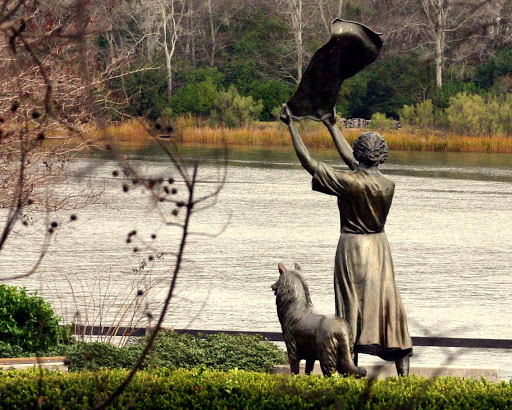
“The waving girl” and her collie soon became familiar figures, greeting every ship that entered or left the port of Savannah. Sailors would look for her and salute in return. Vessels would blow their horns. Few ever met her, in person.
Legends grew up around her, over the years. She had fallen in love with a sailor. She wanted him to find her when he returned. He’d been lost at sea.
The bittersweet truth was not quite so dramatic. She later said, “That’s a nice story. But what got me started – I was young and it was sort of lonely on the island for a girl. At first I would run out to wave at my friends passing, and I was so tickled when they blew the whistle back at me“.
So it was that Miss Martus would take out her handkerchief by day or light her lantern by night, and she would greet every vessel that came or went from the Port of Savannah. Every one of them. Some 50,000 vessels, over 44 years.
In 1893, Martus and her brother braved hurricane conditions, rowing out to save several men from a sinking boat. She waved an American flag at the troop ship St. Mihiel after WWI, on its return to Savannah carrying the US Army of the Rhine.
“The Waving Girl” took it upon herself to greet every ship entering or leaving the Port of Savannah, from young womanhood until old age.
She stopped only when she was forced to do so when her brother, then 70, had to leave his lighthouse job and the home that went with it.
All that time she kept a careful record of every ship: name, date, where it was from and type of vessel. It must have broken her heart to move, because she burned the entire record. 44-years’ worth. WWII-era reporter Ernie Pyle lamented “The daily record for forty-four years, one of the most legendary figures of the Seven Seas, kept in her own hand, gone up in smoke in two minutes”.
Martus never reconciled herself to the move, saying, “It’s just like trying to dig up that big oak tree and get it to take root someplace else.”
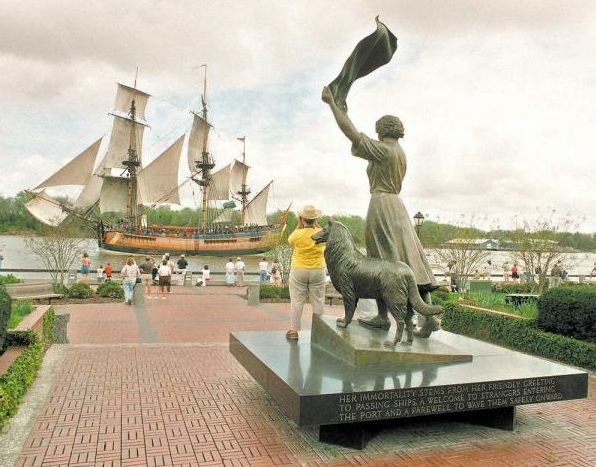
The artist Felix de Weldon, who sculpted the United States Marine Corps Memorial outside Arlington National Cemetery, erected a statue of the Waving Girl and her collie. You can see it in Morrell Park, on the west bank of the Savannah River.
The Waving Girl passed away on February 8, 1943, following a brief bout with bronchial pneumonia.
The Southeastern Shipbuilding Corporation of Savannah built 88 Liberty ships during the course of World War II, the light, low-cost cargo ship which came to symbolize the industrial output of the American economy.
One of them was named in her honor. The SS Florence Martus was officially christened on September 27, 1943.
Today, the four vessels of the “Savannah Belles Ferry” fleet ply the waters of the Savannah River, each named for notable women from Savannah history. There is the Juliette Gordon Low, named for the founder of the Girl Scouts of America. Susie King Taylor was born a slave and earned her freedom at age 14, serving as a nurse during the Civil War and later opening one of the first schools in Savannah, for Americans of African ancestry. The Mary Musgrove is named for the native American translator, and indispensable connection between Chief Tomochichi, Mico (Leader) of the Yamacraw and James Oglethorpe, founding father of the city of Savannah. And the Florence Martus, the Waving Girl of Cockspur Island.
If you enjoyed this “Today in History”, please feel free to re-blog, “like” & share on social media, so that others may find and enjoy it as well. Please click the “follow” button on the right, to receive email updates on new articles. Thank you for your interest, in the history we all share.
Precise identification of the Beast of Gévaudan has baffled cryptozoologists, from that day to this.
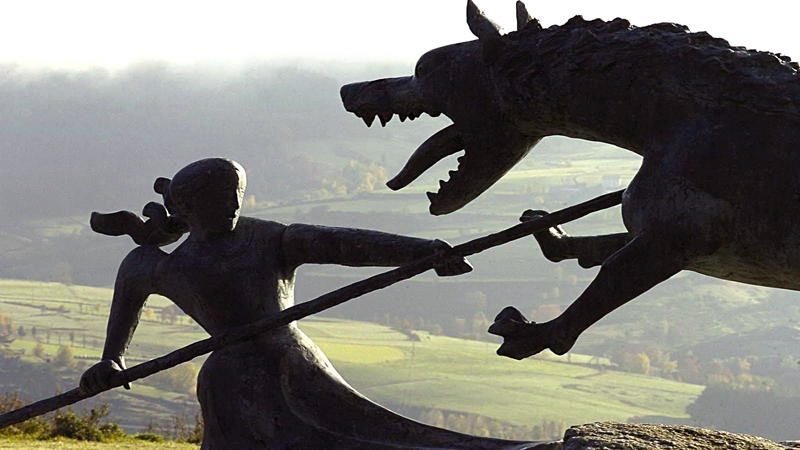
In the summer of 1764, a young woman was tending cattle near the Mercoire forest in the Gévaudan region of south-central France, when a large animal emerged from the forest. She later described the creature as wolf-like in appearance, but much larger. The size of a calf, or a donkey.
Twice the animal attacked, only to be driven off by the bulls in the herd. Twenty-nine days later, Janne Boule was not so lucky. The 14-year-old is officially recorded as the first victim of La Bête du Gévaudan. The “Beast of Gévaudan”. Over the following three years, there would be many more.
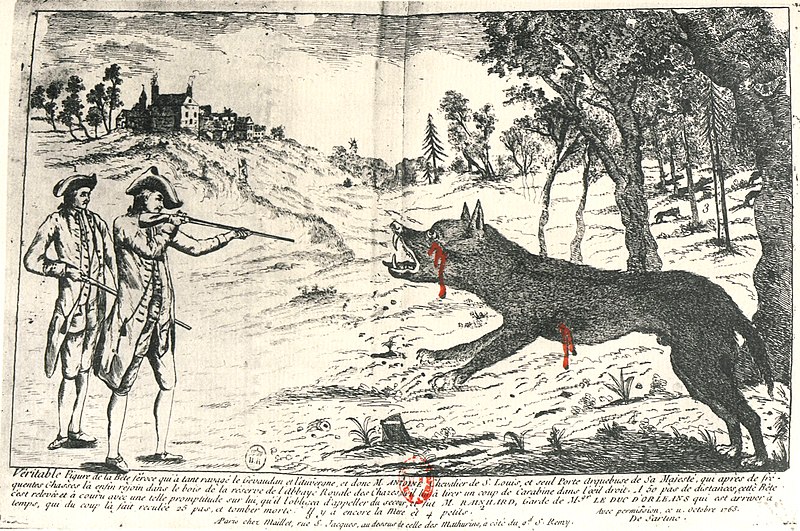
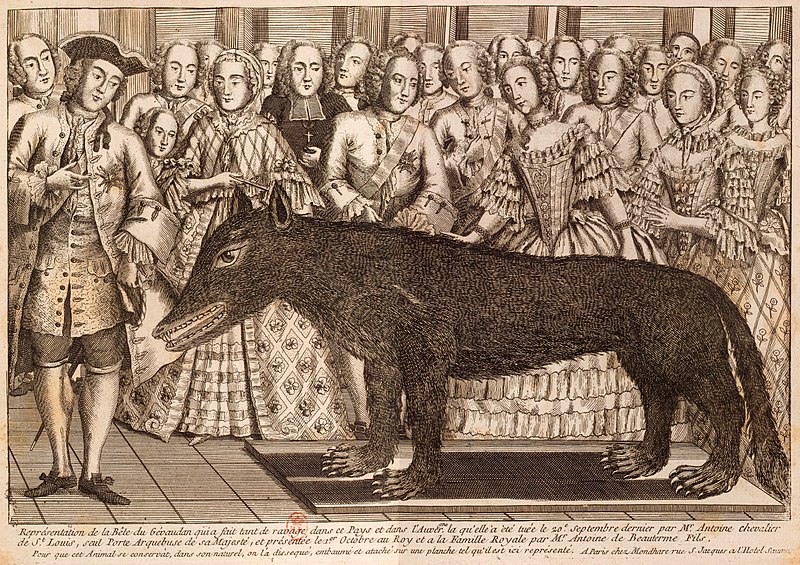
Contemporary illustration depicts the Beast as a large wolf, or wolf hybrid.
A 1987 study of contemporary sources estimates 210 such attacks over the three-year period, resulting in 113 fatalities and another 49 injuries. Victims were most often killed, by having their throats ripped out. Ninety-eight of those, were partially eaten.
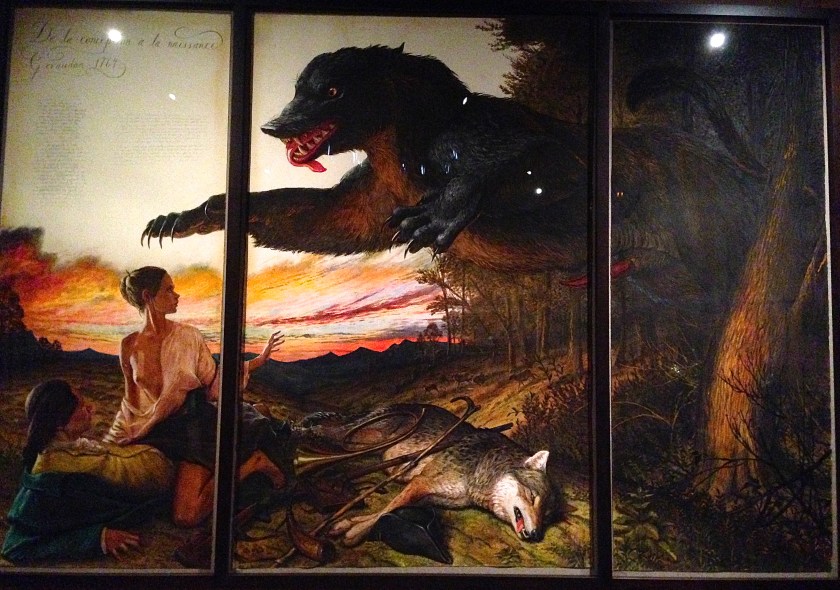
Precise identification of the Beast of Gévaudan has baffled cryptozoologists, from that day to this. Eyewitness accounts describe a large animal with a long tail, about the size of a calf, or a donkey. With reddish fur and a flat head, the Beast was said to be exceptionally powerful, able to leap distances of 30-feet and more, and capable of carrying off a grown adult, in its jaws.
Terror gripped the region in the later months of 1764, as the Beast attacked women, men and children. Usually while alone, and often while tending livestock.
Suspicion centered on an unusually large wolf, dog, or some hybrid combination of the two. Stories went to the supernatural, laying bare our most primordial fear, that of a shape shifter. A Werewolf.
The Epic of Gilgamesh comes to us from the second millennium BC, telling the tale of such creatures. The 1st-century BC Roman poet Ovid, was the first to write of shape-shifting as a conscious act of will.
In January 1765, the Beast came to the attention of King Louis XV, who decreed that the French state would help to find and destroy the Beast. First captain Duhamel of the Clermont-Ferrand dragoons was brought out with his troops, and sent to Le Gévaudan. The professional wolf-hunters Jean Charles Marc Antoine Vaumesle d’Enneval and his son Jean-François, arrived with eight bloodhounds, trained in wolf-hunting.
“Officer of the Royal Bedchamber” Antoine De Beauterne Marques Argents, Knight Equerry of the Royal Military Order of Saint Louis and Gun-Bearer to Louis XV of France (now, there’s a title) announced on this day in 1765 that he had killed the Beast of Gévaudan, to great rejoicing.
The animal was a large grey wolf measuring 5-feet, 7-inches and weighing 130-pounds. Eyewitnesses claimed to have recognized scars on the animal’s body and Beauterne himself swore that this was the Beast. “We declare by the present report signed from our hand”, he said, “we never saw a big wolf that could be compared to this one. Hence, we believe this could be the fearsome beast that caused so much damage.”
The animal was stuffed and brought to Versailles, but the joy was short-lived.
Two boys were attacked on December 2 but managed to fight off the Beast. A dozen more fatal attacks were reported to have followed, near La Besseyre-Saint-Mary.
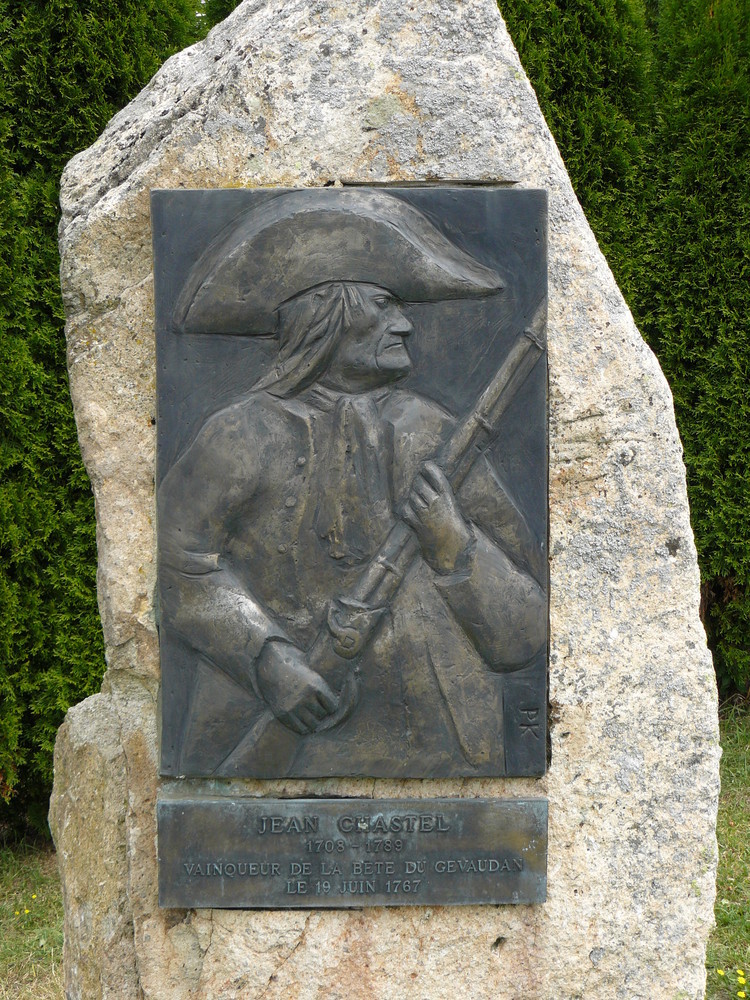
The animal disappeared around the middle of 1767. It is believed to have been shot a dozen or more times by this time, and poison baits were widespread. A local farmer and inn-keeper named Jean Chastel is credited with killing the Beast of Gévaudan on June 19, 1767, with a bullet which he himself had cast, in silver.
Jean Chastel
The silver bullet meme did much to feed into werewolf mythology. Chastel himself is depicted as a werewolf in Patricia Briggs’ novel, Hunting Ground. Here, the hunter and the hunted are one and the same, and some random wolf was shot, to throw everyone off the scent.
National Geographic posits that the Beast of Gévaudan was in fact, a subadult male lion. African lions were by no means unknown at this place and time, though images of the era were usually quite stylized, depicting the full mane of the adult male.
Exotic animal menageries were common among the upper classes. It is quite possible that such an animal could’ve been on the loose. Physical descriptions of the Beast including it’s reddish hair, flat head and furry ridge-line, match up with those of such an animal. This combined with descriptions of the hunting and killing methods of the animal, make the lion theory quite plausible.
The Beast of Gévaudan may have been a wolf, or maybe a lion. Perhaps it was several animals. Or maybe Jean Chastel is a werewolf, after all. A clever one who threw half a nation off his scent, and now only does his killing, in the dark. Just another thing that goes BUMP, in the night.
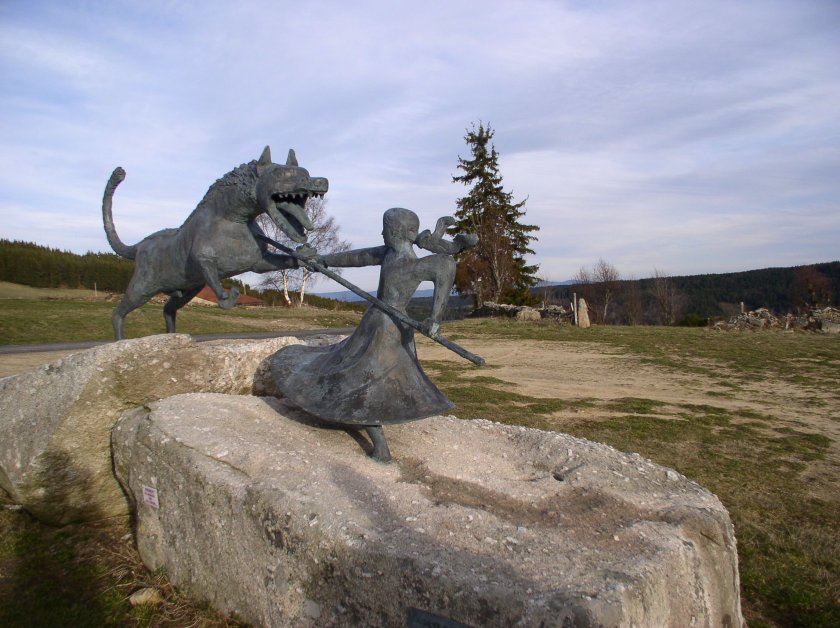
A monument was erected in the village of Auvers to honour those who fought against the beast.
If you enjoyed this “Today in History”, please feel free to re-blog, “like” & share on social media, so that others may find and enjoy it as well. Please click the “follow” button on the right, to receive email updates on new articles. Thank you for your interest, in the history we all share.







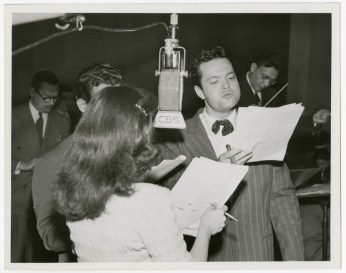 The radio drama began with a statement that, what followed, was fictional. The warning was repeated at the 40 and 55-minute mark, and again at the end of the broadcast. It began with a weather report, and then went to a dance band remote, featuring “Ramon Raquello and his orchestra”. The music was periodically interrupted by live “news” flashes, beginning with strange explosions on Mars. Producer Orson Welles made his first radio appearance as the “famous” (but non-existent) Princeton Professor Dr. Richard Pierson, who dismissed speculation about life on Mars.
 A short time later, another “news flash” reported a fiery crash in Grovers Mill, NJ. What was originally thought to be a meteorite was revealed to be a rocket machine as a tentacled, pulsating Martian unscrewed the hatch and incinerated the crowd with a death ray.


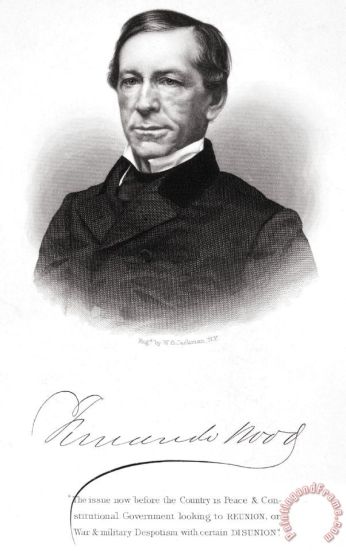 South Carolina seceded in December 1860, and the world waited to see who’d follow. New York City became the next to call for secession on January 6, when Mayor Fernando Wood addressed the city’s governing body. “When Disunion has become a fixed and certain fact”, he said, “why may not New York disrupt the bands which bind her to a venal and corrupt master…and destroyed the Confederacy of which she was the proud Empire City?”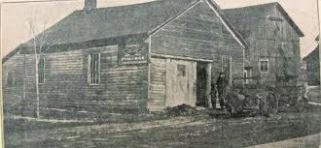
 A courier express note arrived on October 7, 1945. “There are few controversies that are not susceptible to a peace time resolution” read the note, “if examined in an atmosphere of tranquility and calm rather than strife and turmoil. I would suggest the possibility of roast veal as a vehicle of peace. Why don’t you run down the fattest calf in Erie County, barbecue it and serve it with fixin’s in the old blacksmith shop where the ruckus started? Who can tell? The dissidents might decide to resume citizenship.” The note was signed “Very Sincerely Yours, Harry Truman”.
![4b4cf0f864c3dabcdb_IMG_7326[1]](https://todayinhistory.blog/wp-content/uploads/2018/10/4b4cf0f864c3dabcdb_img_73261.jpg?w=684&h=513)


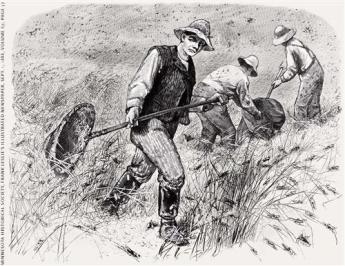 Farmers used gunpowder, fire and water, anything they could think of, to destroy what could only be seen as a plague of biblical proportion. They smeared them with “hopperdozers”, a plow-like device pulled behind horses, designed to knock jumping locusts into a pan of liquid poison or fuel, or even sucking them into vacuum cleaner-like contraptions.
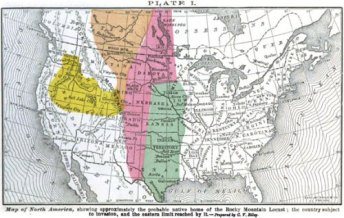 And then the locust went away, and no one is entirely certain, why. It is theorized that plowing, irrigation and harrowing destroyed up to 150 egg cases per square inch, in the years between swarms. Great Plains settlers, particularly those alongside the Mississippi river, appear to have disrupted the natural life cycle. Winter crops, particularly wheat, enabled farmers to “beat them to the punch”, putting away stockpiles of food before the pestilence reached the swarming phase.

 On this day in 1987, Jessica McClure’s life was anything but normal. Frightened and alone, “Baby Jessica” was stuck twenty-two feet down, at the bottom of a well.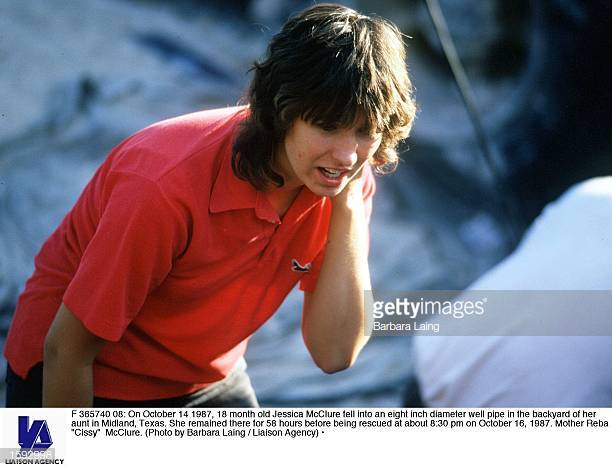

 The sun went down that Wednesday and rose the following day and then it set, and still, the nightmare dragged on.



 Yet, the suffering inflicted by the curse of the Black Sox and that of the Bambino, pales in comparison with the 108-year drought afflicting the Chicago Cubs since back-to-back championships in 1907/1908. And they say it’s the fault of a Billy goat.
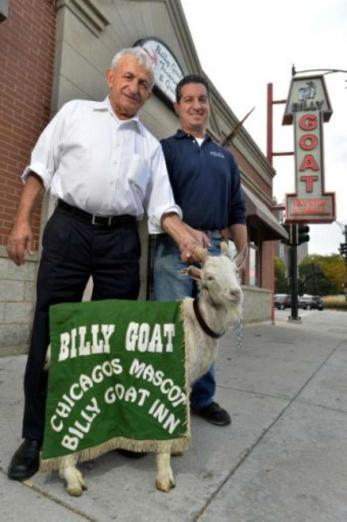 Billy Sianis himself is gone now, but they brought his nephew Sam onto the field with a goat in 1984, to help break the curse. They did it again in 1989, 1994 and 1998, and always the same result.
 For fourteen years, Chicago mothers frightened wayward children into behaving, with the name of Steve Bartman.
 The cookies pictured above were baked in 2016, and that might’ve finally done it. That’s right. The Mother of all Droughts came to a halt in extra innings of game seven, following a 17-minute rain delay. At long last, Steve Bartman could emerge from Chicago’s most unforgiving doghouse, his way now lit by his own World Series ring. The ghost of Billy Sianis’ goat, may finally rest in peace.

 Elsbeth had to flee with her infant son in the harsh winter of 1945, as the oncoming Soviet Red Army destroyed all in its path. The two would escape the Iron Curtain once again in 1948, this time in a dangerous nighttime dash which the then-four year old remembers, to this day.
 By this time, Joachim Krauledat had taken to calling himself John Kay. The band added a couple new members in 1967, changing their name to a character from a Herman Hesse novel. “Steppenwolf”.
 Steppenwolf gave us 22 albums, and we all know them in one way or another. Yet, the lead singer’s escape from the horrors of the Iron Curtain, is all but unknown. That, as Paul Harvey used to say, is the Rest of the Story.
 Florence Margaret Martus was born there in 1868, where her father worked as an ordnance sergeant. Martus spent her childhood on the south channel of the Savannah River, moving in with her brother, keeper of the Cockspur Island Lighthouse, when she was 17.
 So it was that Miss Martus would take out her handkerchief by day or light her lantern by night, and she would greet every vessel that came or went from the Port of Savannah. Every one of them. Some 50,000 vessels, over 44 years.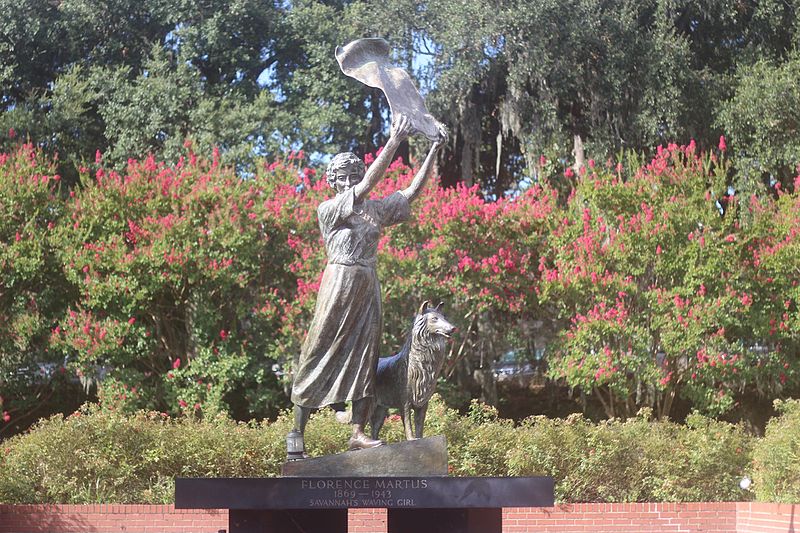

 The Southeastern Shipbuilding Corporation of Savannah built 88 Liberty ships during the course of World War II, the light, low-cost cargo ship which came to symbolize the industrial output of the American economy.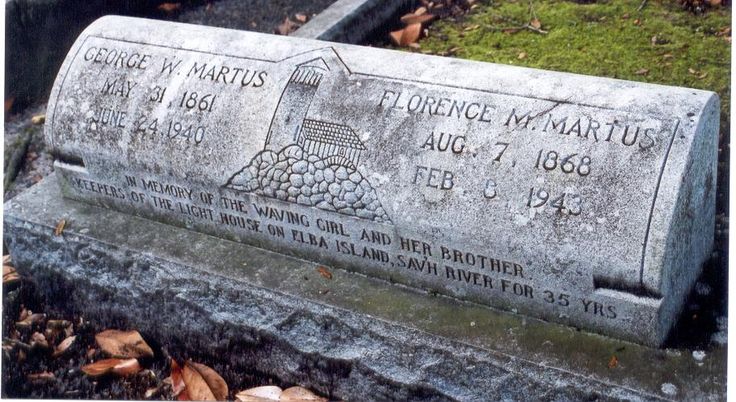


 Terror gripped the region in the later months of 1764, as the Beast attacked women, men and children. Usually while alone, and often while tending livestock.

 Historical Easter Eggs - Today in History
You must be logged in to post a comment.