March 4, 1789  A Self Governing Republic

Even at the convention, many of the framers were concerned about the larger, more populous states governing at the expense of the smaller states. The proverbial five wolves and a lamb, voting on what’s for lunch. 

Early discussions concerning the American experiment in self-government began nearly twenty years before the Revolution, with the Albany Congress of 1754 and Benjamin Franklin’s proposed Albany Plan of Union. The 2nd Continental Congress appointed a drafting committee to write our first constitution in 1776, the work beginning on July 12. The finished document was sent to the states for ratification on November 15, the following year.

ArticlesOfConfederation (1)Twelve of the thirteen original states ratified these “Articles of Confederation” by February, 1779. Maryland would hold out for another two years, over land claims west of the Ohio River. In 1781, seven months before Cornwallis’ surrender at Yorktown, the 2nd Continental Congress formally ratified the Articles of Confederation. The young nation’s first governing document.

The Articles of Confederation provided for a loose alliance of sovereign states. At the center stood a congress, a unicameral legislature, and that’s about it. There was no Executive, there was no Judiciary.

In theory, Congress had the authority to govern foreign affairs, conduct war, and regulate currency. In practice, these powers were limited because Congress had no authority to enforce requests made on the states, either for money or for troops.

The Union would probably have broken up if the Articles of Confederation were not amended or replaced. Twelve delegates from five states met at Mann’s Tavern in Annapolis Maryland in September 1786, to discuss the issue. The decision of the Annapolis Convention was unanimous. Representatives from all the states were invited to send delegates to a new constitutional convention in Philadelphia, the following May.

635800718776443557-signing-of-the-constitution

The United States had won its independence from England four years earlier, when 55 state delegates convened in Philadelphia to compose a new constitution.

Delegates from 12 of the 13 colonies met on May 25, 1787 at Philadelphia’s Pennsylvania State House, the birthplace of the Declaration of Independence and the Articles of Confederation.  Only Rhode Island abstained.  The building is now known as Independence Hall.

The assembly immediately discarded the idea of amending the Articles, instead crafting a brilliant Federal system of checks and balances over three months of debate. The Federal Republic crafted by the framers delegates specific, limited powers to the Federal Government, with authority outside those specified powers devolving to the states.

bigstock-Declaration-of-Independence-20186213-1140x592

Even at the convention, many of the framers were concerned about the larger, more populous states governing at the expense of the smaller states. The proverbial five wolves and a lamb, voting on what’s for lunch.  The “Connecticut Compromise” solved that problem, creating a bicameral legislature with proportional representation in the lower house (House of Representatives) and equal representation of the states in the upper house (Senate).

The Constitution was signed by 38 of the 41 delegates on September 17, 1787. As dictated by Article VII, the document would not become binding until ratified by nine of the 13 states.

Five states: Delaware, Pennsylvania, New Jersey, Georgia, and Connecticut ratified the document in quick succession. Some states objected to the new constitution, particularly Massachusetts, which wanted more protection for basic political rights such as freedom of speech, religion, and of the press. They wanted it specified that powers undelegated to the Federal government, were reserved to the states. A compromise was reached in February, 1788 whereby Massachusetts and other states would ratify the document, with the assurance that such amendments would be immediately proposed.

The Constitution was ratified in Massachusetts by a two vote margin, followed by Maryland and South Carolina. New Hampshire became the ninth state to ratify on June 21. The new Constitutional Government would take effect on March 4, 1789.

On September 25, the first Congress adopted 12 amendments, sending them to the states for ratification. The states got rid of the first two, and so the Congress’ original 3rd amendment became 1st, of what we now call the “Bill of Rights”. Today, the United States Constitution is the oldest written national constitution in operation in the world.

united-states-founding-documents-vintage-american-flag-declaration-independence-constitution-america-58534238It’s interesting to note the priorities of that first Congress, as expressed in their original 1st and 2nd amendments. The ones that were thrown out. The first had to do with proportional representation, and would have led us to a 6,000-member House of Representatives, instead of the 435 we currently have. The second most important thing in the world, judging by the priorities of that first Congress, was that any future Congress could not change their own salaries. Any such change could affect only future Congresses.

That original 2nd amendment, reading that “No law, varying the compensation for the services of the Senators and Representatives, shall take effect, until an election of Representatives shall have intervened”, took effect in 1992 as the 27th amendment, following a ratification period stretching out to 202 years, 7 months, and 12 days. We must not be too hasty about these things.

If you enjoyed this “Today in History”, please feel free to re-blog, “like” & share on social media, so that others may find and enjoy it as well. Please click the “follow” button on the right, to receive email updates on new articles.  Thank you for your interest, in the history we all share.

March 1, 1692 The Conduct of Public Affairs for Private Advantage

“Politics: A strife of interests masquerading as a contest of principles. The conduct of public affairs for private advantage”. – Ambrose Bierce

On this day in 1692, three residents of Salem Village in the Massachusetts Bay Colony were charged with the illegal practice of witchcraft.  Twelve-year-old Abigail Williams and ten-year-old Elizabeth Parris were ill with some unknown sickness, and accused the trio of biting and pinching the girls, and poking them with knitting needles.

Massachusetts Governor William Phips established “Courts of Oyer and Terminer” (to hear and determine) to hear the charges.  Sarah Goode, Sarah Osborne, and an Indian slave from Barbados named Tituba, being the first so accused.  Five men and fourteen women were hanged as witches over the following seven months.  As many as 17 more died in the tiny, freezing stone compartments which then passed for jail cells.

crucibleaccused
H/T The Crucible. Accused

According to the law of the time, the accused were required to enter a plea.  Guilty or not guilty.  Without such a plea, there could be no trial.  On March 19, 72-year-old Martha Corey was arrested for witchcraft.  Martha’s husband, 81-year-old Giles Cory, was so caught up in the hysteria as to join in the accusations against his wife.  Until he himself was accused.

Martha Corey: “I, sir, am innocent to a witch. I know not what a witch is”.
Judge Hathorne: “If you know not what a witch is, how do you know you are not one?” ~ The Crucible

Corey refused to plead, so he was subjected to the “peine forte et dure”  (French:  “hard and forceful punishment”).  Stripped naked and placed under a board, Corey was tied spread-eagle on is back, his arms and legs secured, by cords.  Stones of increasing size were heaped on top, to extract his plea.  This torture went on for two days, the man given nothing but the “worst bread” on day one, and “standing” water, the following day.

Knowing his possessions would be forfeit to his tormentor in the event of conviction, Corey’s only response was “more weight”.

gilescoreytrial

Giles Corey’s persecutor was Essex County High Sheriff George Corwin, he who signed warrants for the arrest and execution of those condemned of witchcraft.  It was he who (conveniently) received the belongings, of those so condemned.  In the end, Corwin himself was standing atop the pile of stones, shoving Corey’s tongue back into his mouth, with a cane.

The end came on Monday September 19, around noon.  One witness remembered the old farmer’s last words:  “Damn you. I curse you and Salem!”  Martha Corey was hanged, three days later.

Politics: A strife of interests masquerading as a contest of principles. The conduct of public affairs for private advantage”. – Ambrose Bierce

Even then, George Corwin came after Corey’s adult children, to extort money from the Corey farm.  What a guy.  In 1710, Corey’s daughter Elizabeth and her husband John Moulton filed a lawsuit, seeking damages.  Elizabeth’s statement to the court said, “After our father’s death the sheriff threatened to seize our father’s estate and for fear we complied with him and paid him eleven pound six shillings in money.”

210d7ba514235b4587ef16cac39a0f1e

The hideous nature of Giles Corey’s death did much to cool the ardor, for the persecution of witches.  Governor Phips dissolved the Courts of Oyer and Terminer a month later, around the time his own wife was accused of witchcraft.

Afterward

This George Corwin character must have been some 14-carat SOB but, he would get what he had coming, in the end.  Four years after the witchcraft hysteria of 1692, the High Sheriff died of an apparent heart attack, at the age of 30.  Salem resident Phillip English was accused in the earlier madness, when Corwin seized his property.  English put a lien on the corpse and delayed its burial, until he could be reimbursed.   The lien was eventually satisfied, and the debt paid back.  How long George Corwin was left to rot, is unknown to this writer.

Sometime in the 1830s, the writer Nathaniel Hawthorne added the “W” to his name, distancing himself from his twice-great grandfather and Salem witch trial judge, John Hathorne.  It didn’t do a lick of good for the poor collection of oddballs and outcasts who would not survive the witchcraft hysteria of 1692.

Page break

For three hundred years, nineteen innocents were believed to have been hanged on Gallows Hill.  You can visit Gallows Hill Park if you like, in modern-day Salem.  Today it’s more of a skate park, than historic site.  In 2016, the Gallows Hill Project of Salem State University determined the place to have been Proctor’s Ledge, not Gallows Hill.  It’s an interesting story in itself, for those inclined to read more.  Salem State’s story, is linked above.

If you enjoyed this “Today in History”, please feel free to re-blog, “like” & share on social media, so that others may find and enjoy it as well. Please click the “follow” button on the right, to receive email updates on new articles.  Thank you for your interest, in the history we all share.

February 27, 2014 To Err is Human

On this day in 2014, the Stockholm offices of the Swedish Public Employment Service erupted in chaos, as 61,000 people showed up for a job interview. The email was supposed to go out to a thousand select individuals. Instead, tens of thousands went out to registered job seekers, demonstrating the truth of the old adage:  To err is human. To Really screw up, requires a Government.

In 1999, the NASA space probe Mars Climate Orbiter burned up in the Martian atmosphere and with it, three hundred million taxpayer dollars. Post-mortem examination revealed that NASA calculations used metric newton-seconds as a unit of measure, while prime contractor Lockheed Martin used pound-seconds.  Oops.

That’s up there with the multi-billion dollar Hubble Space Telescope, needing “glasses”.

ff85a527-c954-444a-e86e-34042da4b025
Images taken before and after “corrective lenses” were installed on the multi-billion dollar Hubble Space Telescope

Of all the powers citizens delegate to Government, few can be as fearsome as the power of arrest, the power to take our freedom, the power to take our lives.  Such awesome power must be wielded by the wisest of heads and subjected to the strictest of checks and balances, but such is not always the case.

According to the government’s own website, vault.fbi.gov:

The FBI began COINTELPRO—short for Counterintelligence Program—in 1956 to disrupt the activities of the Communist Party of the United States. In the 1960s, it was expanded to include a number of other domestic groups, such as the Ku Klux Klan, the Socialist Workers Party, and the Black Panther Party. All COINTELPRO operations were ended in 1971. Although limited in scope (about two-tenths of one percent of the FBI’s workload over a 15-year period), COINTELPRO was later rightfully criticized by Congress and the American people for abridging first amendment rights and for other reasons”.

5bb8b3022200004301dd71d0
FBI Director J. Edgar Hoover

“Rightfully criticized”?  I should say so.  COINTELPRO tactics included smearing individuals and groups using forged documents and false reports, planted in the media.  There were instances of harassment, wrongful imprisonment and illegal violence, up to and including assassination. Director J. Edgar Hoover’s FBI harassed witnesses, withheld evidence, and publicly humiliated or falsely charged targets, with crimes.  Washington Light_bulb_votePost journalist Carl Rowan insists the FBI sent at least one anonymous letter to Reverend Martin Luther King, Jr., urging the man to commit suicide.

The program was exposed when an activist group burgled an FBI field office in Media, Pennsylvania, stealing reams of information which were then exposed to news outlets. It was March 1971, the “fight of the century” between Joe Frazier and Muhammad Ali providing cover for the burglary. The irony is rich.  Ali himself was a COINTELPRO target, based on associations with the Nation of Islam, and the anti-Vietnam war movement.

It was the perfect crime.  No one was ever caught.

FBI

Decades later, long after the statute of limitations had run its course, Keith Forsyth identified himself as one of eight burglars.  Knowing the office to be locked at night, one of the crooks wrote a polite note asking the door be left unlocked, and pinned it to the door.

It pays be nice I guess.  The last to leave the office, courteously obliged.  One burglar was so delighted, he proposed that a polite thank you note, be left on the door.  Lucky for him, cooler heads prevailed.

Speaking of savvy Government personnel.  On this day in 2014, the Stockholm offices of the Swedish Public Employment Service erupted in chaos, as 61,000 people showed up for a job interview. The email was supposed to go out to a thousand select individuals. Instead, tens of thousands went out to registered job seekers, demonstrating the truth of the old adage:  To err is human. To Really screw up, requires a Government.

If you enjoyed this “Today in History”, please feel free to re-blog, “like” & share on social media, so that others may find and enjoy it as well. Please click the “follow” button on the right, to receive email updates on new articles.  Thank you for your interest, in the history we all share.

February 19, 1807 Burning Ambition

Behind the scenes, the vice president secretly corresponded with the British and Spanish Ministers to the United States, offering in the first case to detach Louisiana from the Union and in the second, to orchestrate an overthrow, of Mexico.  He himself would do nicely to found the new dynasty, thank you very much, for asking.

What would it be like to turn on CNN or Fox News, to learn that Former Secretary of the Treasury Jacob Lew had been party to a duel, and he was near death after being shot by Vice President Mike Pence.

The year was 1804.  President Thomas Jefferson’s Vice President Aaron Burr, had a long standing grudge against Alexander Hamilton, first Secretary of the Treasury under President George Washington.

GettyImages-515414860-E
Aaron Burr

The animosity between the two went back to the Senate election of 1791, and escalated during one of the ugliest election seasons in American history.  It’s been called the “Revolution of 1800”, the election pitting Democratic-Republican candidate Thomas Jefferson, against one-term incumbent John Adams, of the Federalist party.

Both sides were convinced beyond doubt, that the other side would destroy the young nation. Federalists attacked Jefferson as an un-Christian deist, a populist whose sympathies with the French Revolution would bring about a similar cataclysm in the young American Republic. Democratic-Republicans criticized the alien and sedition acts, and the deficit spending the Adams administration employed to support Federal policy.

At the time, electors cast two votes, the first and second vote-getters becoming President and Vice President.

“The father of modern political campaigning”, Aaron Burr had long since enlisted help from New York’s Tammany Hall, transforming what was then a social club into a political machine.  The election was a decisive victory for the Democratic-Republicans.  Not so much for the candidates themselves.

The electoral vote tied at 73 between Jefferson and Burr, moving the selection to the House of Representatives. Hamilton exerted influence on behalf of Jefferson, who was elected on the 36th ballot.  Aaron Burr was relegated to the vice-Presidency.

John Nance Garner served as 32nd vice president between 1931 – ’41. With precisely zero influence over Presidential authority, Garner described the position as “not worth a bucket of warm piss”.  The sentiment is cleaned up and commonly retold as, “warm spit”.

A man with the towering ambition of Aaron Burr could certainly relate.  Behind the scenes, the vice president secretly corresponded with the British and Spanish Ministers to the United States, offering in the first case to detach Louisiana from the Union and in the second, to orchestrate an overthrow, of Mexico.  He himself would do nicely to found the new dynasty.  Thank you very much, for asking.

chase2
Justice Samuel Chase

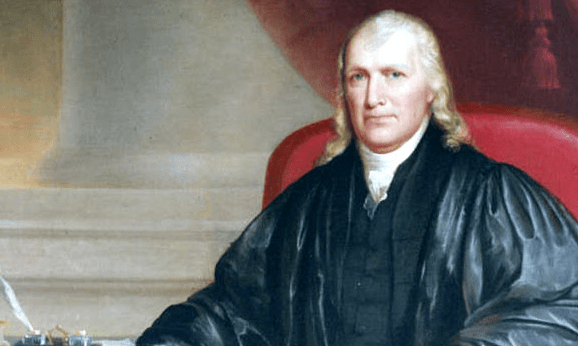
We’re accustomed today to the idea of “Judicial Review”, the idea that Supreme Court decisions are final and inviolate, but that wasn’t always the case. The landmark Marbury v Madison decision established the principle in 1803, a usurpation of power so egregious to Democratic-Republicans, as to bring about the impeachment of Associate Justice Samuel Chase, a signer of the Declaration of Independence.

As VP, Burr presided over Chase’ impeachment.  It was the high point of the only term he would ever serve.

Relations were toxic between Jefferson and Burr.  The VP knew he wouldn’t be around for the 1804 re-election campaign, so he ran for Governor of New York, losing in a landslide to a virtual unknown, Morgan Lewis.

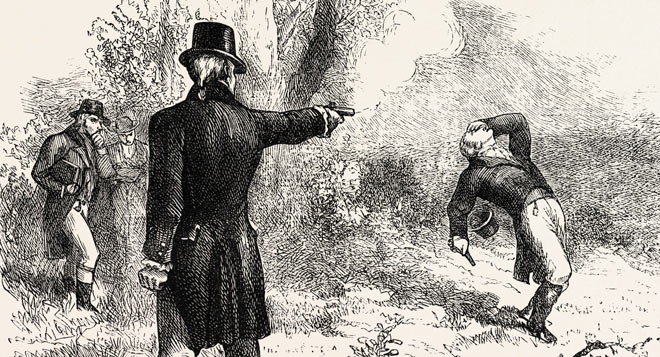
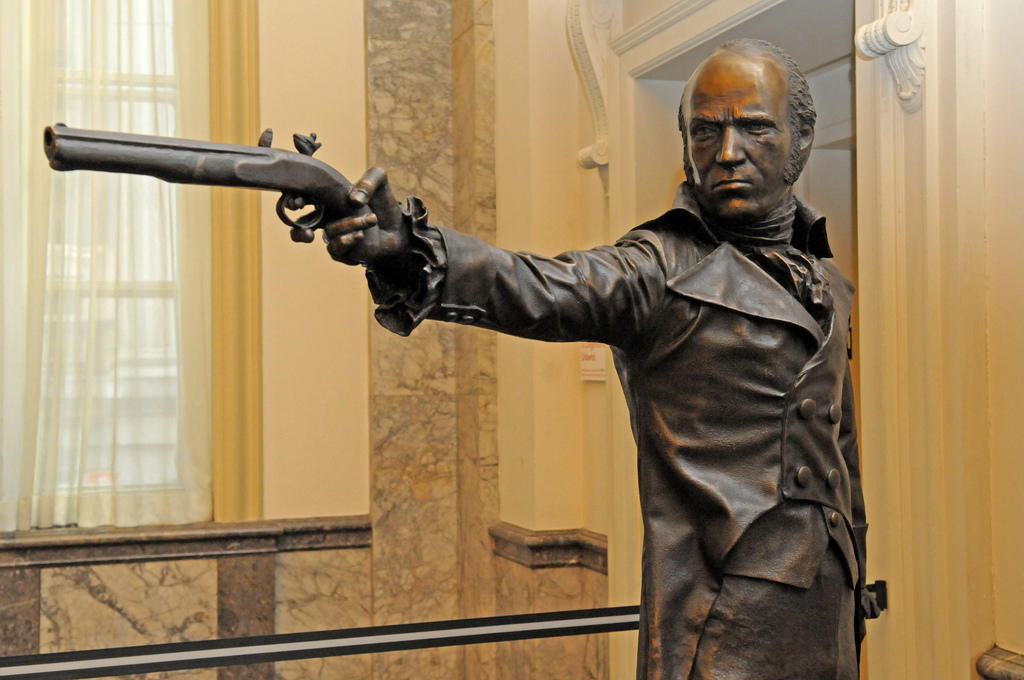
It was a humiliating defeat.  Burr blamed Alexander Hamilton over comments made during the election, and challenged him to a duel.  Dueling was illegal at this time but enforcement was lax in New Jersey. The pair rowed across the Hudson River with their “seconds”, meeting at the waterfront town of Weehawken. It was July 11, 1804. Hamilton “threw away” his shot, firing into the air. Aaron Burr shot to kill.

missedinhistory-podcasts-wp-content-uploads-sites-99-2015-07-hamilton-burr-660x357Murder charges were filed in both New York and New Jersey, but neither went to trial.
Aaron Burr went on to preside over Justice Chase’ impeachment, the high point of a career otherwise ended, the day he met Alexander Hamilton in Weehawken.

Burr headed for New Orleans where he got mixed up with one General James Wilkinson, one of the sleazier characters of the founding generation. At that time, Wilkinson was a paid agent for Spanish King Charles IV. 100 years later Theodore Roosevelt would say of Wilkinson, “In all our history, there is no more despicable character.”

Wilkinson took his payments in silver dollars, hidden in rum, sugar and coffee casks. All those clinking coins nearly undid him, when a messenger was caught and killed with 3,000 of them. The messenger’s five murderers were themselves Spaniards, who testified at trial the money belonged to the spy, James Wilkinson. Payment for services rendered to their King. Wilkinson’s luck held, as the killers spoke no English. Thomas Power, interpreter for the Magistrate, was another Spanish spy. He threw those guys so far under the bus, they’d never get out: ‘They just say they’re wicked murderers motivated by greed.’

The nature of Burr’s discussions with Wilkinson is unclear but, in 1806, Burr led a group of armed colonists toward New Orleans, with the apparent intention of snatching the territory and turning the place into an independent Republic. It’s probably safe to assume that Aaron Burr saw himself at the head of such a Republic.

Seeing no future in it and wanting to save his own skin, General Wilkinson turned on his former ally, sending dispatches to Washington accusing the former Vice President of treason. Burr was tracked down in Alabama on February 19, 1807, arrested for treason and sent to Richmond, Virginia, for trial.

Classics-Burr-conspiracy-p-cropped

The size and shape of the “Burr Conspiracy” remain unclear, to this day.  Historians claim the Vice President intended to take parts of Texas and the Louisiana Purchase, forming his own independent Republic. Others claim he intended to conquer Mexico,  That Aaron Burr had a following among prominent politicians and soldiers is beyond question, but estimates of their numbers range from forty, to over seven-thousand.

Burr himself claims only to have wanted the 40,000 acres in the Texas Territory, deeded him by the Spanish crown.  On this there is no uncertainty.  The lease still exists.

Burr was acquitted on September 1, on grounds he had not committed an “overt act” as specified in the Constitution. He was not guilty in the eyes of the law, but the court of public opinion would forever regard him as traitor. Aaron Burr spent the next several years in Europe before returning to New York, and resuming his law practice.

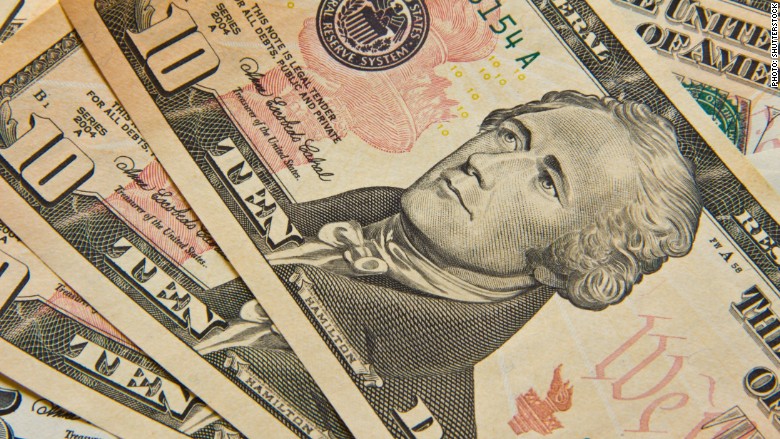
The Vice President who killed the man on our $10 bill, died in obscurity on September 14, 1836, at the age of 80.

150320191637-ten-dollar-bill-780x439

If you enjoyed this “Today in History”, please feel free to re-blog, “like” & share on social media, so that others may find and enjoy it as well. Please click the “follow” button on the right, to receive email updates on new articles.  Thank you for your interest, in the history we all share.

February 17, 1895 Yellow Journalism

Circulation wars were white hot in those days, competing papers using anything possible to get an edge. Real-life street urchins hawked lurid headlines, heavy on scandal-mongering and light on verifiable fact. Whatever it took, to increase circulation.

YellowKidMickey Dugan was “born” on February 17, 1895, a wise-cracking street urchin from the wrong side of the tracks.  “Generous to a fault” with a “sunny disposition” Mickey was the kind of street kid you’d find in New York’s turn-of-the-century slums, maybe hawking newspapers. “Extra, Extra, read all about it!”

With his head shaved as if recently ridden of lice, Mickey was one of thousands of homeless urchins roaming the back lots and tenements of the city, not so much an individual as an archetype. Mickey Dugan was a cartoon character, the child of artist and “Buster Brown” creator, Richard Outcault.

Outcault’s “Hogan’s Alley” strip, one of the first regular Sunday newspaper cartoons in the country, became colorized by May of 1895. For the first time Mickey Dugan’s oversize, hand-me-down nightshirt was depicted in yellow.  Readers soon forgot his name.  He was simply “the Yellow kid”.

000789.1LOutcault worked for Joseph Pulitzer in those days, owner of the New York World Newspaper. Arch rival William Randolph Hearst hired the cartoonist away to work for Pulitzer’s cross-town competitor Journal American, but the pair soon learned that there was no copyright protection on the Yellow Kid. Soon the character was simultaneously appearing in both competing newspaper strips, where he would remain for over a year.

Circulation wars were white hot in those days, competing papers using anything possible to get an edge.  Real-life street urchins hawked lurid headlines, heavy on scandal-mongering and light on verifiable fact. Whatever it took, to increase circulation.

The Yellow Kid ceased to be of interest by 1898, but he lived on in a way, in the style of newspaper reporting which came to be known as “yellow journalism”.

PulitzerHearstWarYellowKids.jpg

After two wars for independence from Spain, the Caribbean island of Cuba found its economy increasingly intertwined with that of the United States. From the Spanish perspective, Cuba was more of a province than a colony, they were not about to relinquish a foot of territory. When the Cuban Rebellion of 1895 broke out, don Valeriano Weyler’s brutal repressions killed hundreds of thousands in Cuban concentration camps.

In America, some saw parallels between the “Cuba Libre” movement, in their own revolution of a hundred-odd years earlier. Fearing the economic repercussions of a drawn out conflict, shipping and other business interests put pressure on President McKinley to intervene. Meanwhile, the yellow papers kept the issue front page, whipping up popular fury with tales of the noble Cuban revolutionary and the barbaric Spaniard. There were even tales of American women being publicly strip searched by Spanish authorities.

USS_Maine01
USS Maine

The armored cruiser USS Maine left Key West headed for Cuba in January 1898, to protect US interests and to emphasize the need for a quick resolution to the conflict. Anchored in Havana Harbor on February 15, a massive explosion of unknown origin rocked the Maine, sinking the cruiser within minutes and killing 266 of the 355 Americans on board.

The McKinley administration urged calm. Conditions in Cuba were bad enough, but front page headlines like “Spanish Murderers” and “Remember the Maine” accompanied sensationalized accounts of Spanish brutality. War became all but inevitable when US Navy findings were released that March, stating that an external explosion had doomed the Maine.

MaineThe Spanish-American War began the following month, directly resulting in the Philippine-American war.

There is a story, that illustrator Frederic Remington said there was no war brewing in Cuba. Hearst is supposed to have replied. “You furnish the pictures and I’ll furnish the war.” The story may be apocryphal. The media can’t tell us what to think, but they can certainly control what we think ABOUT. Hearst and Pulitzer had clamored for two years for war with Spain, and they were happy to take credit when it came. Besides, it was good for circulation. A week after the Spanish-American War began in April, Hearst’s American Journal ran the headline “How do you like the Journal’s war?” Front page, above the fold.

spanish-american
War Propaganda

It’s been said that you should never pick a fight with a guy who buys ink by the barrel. I disagree. I have broken that dictum myself and recommend the practice to anyone so inclined. For all the Wizard of Oz antics of the print and electronic media, there remains only the one man behind the curtain. President Reagan once said of the Soviet Union, “doveryai no proveryai” (trust, but verify). He might have said the same of an information industry whose business model it is, to rent an audience to a sponsor.

In 1976, a team of American naval investigators concluded that the Maine explosion was likely caused by a fire which ignited its ammunition stocks, not by Spanish mine or act of sabotage.

Small consolation it was to 3,289 Americans and an estimated 90,000 Spaniards, killed in “the Journal’s war”. Nor to the loved ones, they left behind.

If you enjoyed this “Today in History”, please feel free to re-blog, “like” & share on social media, so that others may find and enjoy it as well. Please click the “follow” button on the right, to receive email updates on new articles.  Thank you for your interest, in the history we all share.

January 30, 1752 Founding Philanderer

Not that he could’ve have done anything about it, even if the husband did find out.  Morris walked with a peg, his left leg severed below the knee in a carriage accident, lost while running from an angry husband.

nyc-pdf-manhattan-street-map-printable-street-guide-4
Midtown Street Grid

To drive the streets of Manhattan is to realize that someone had a plan for this place. You might not be able to get there for the congestion, but you can figure out how to do it. Not like the rabbit warren that is her sister city of Boston, that all but unnavigable melange of neighborhoods, grown together as the city expanded into former marshlands and harbor.

In grade school, we all learned the preamble to the Constitution. “We the People of the United States, in Order to form a more perfect Union…” It’s considerably snappier than the original version:

We the people of the states of New-Hampshire, Massachusetts, Rhode-Island and Providence Plantations, Connecticut, New-York, New-Jersey, Pennsylvania, Delaware, Maryland, Virginia, North-Carolina, South-Carolina, and Georgia, do ordain, declare and establish the following constitution for the government of ourselves and our posterity.”

us-constitution

That West 53rd leads to East 53rd and runs next to 54th may be attributed to a committee of three, who fought (and won) the battle against the wide circles and grand plazas, once envisioned for “The City”. That we may be spared that stultifying recitation of our founding document may be laid at the feet of one member of that committee.

Today, his life is all but lost to history, among the familiar constellation of founding fathers.  If he’s remembered at all it’s for that funny name.  Gouverneur Morris.  And what a life it was.

morris_g
Gouverneur Morris

Gouverneur Morris was born this day in 1752, the son of Lewis Morris, Jr. and his second wife Sarah (Gouverneur) Morris. Abigail Adams informs us the name was pronounced “Governeer”.

Born to a wealthy New York land owning family, Morris was destined to a place among the founders. His half-brother Lewis signed the Declaration of Independence.  Nephew Lewis Richard served in the Vermont legislature and the US Congress.

As a member of the Continental Congress, Morris helped General George Washington secure funding, to keep the Continental Army in the field. A staunch ally of the Commander-in-Chief, Morris defended Washington against the “Conway Cabal“, the only serious effort to have the General unseated, as commander-in-chief.

gouverneur_morris_1789
Gouverneur Morris 1789

A staunch opponent of slavery, Morris derided the “peculiar institution” as “the curse of heaven on the states where it prevailed.”  Morris mocked the “3/5ths compromise”, that cynical effort to increase congressional representation based on “property”, who had no right to vote.

Upon what principle”, Morris asked, “is it that the slaves shall be computed in the representation? Are they men? Then make them citizens, and let them vote. Are they property? Why, then, is no other property included?”

And did I mention, Gouverneur Morris was a first-class Rake?

“Rake” is such a great word, short for “Rakehell” or Hellraiser’.  It’s a shame it’s fallen out of usage.  This isn’t the tool shed variety.  An 18th century Rake is a man habituated to dissolute conduct, a chronic libertine devoted to wine, women and song.  Emphasis on the Women and, no problem if they just happened to be married.

At a time when sexual attitudes were “buttoned up” to say the least, Gouverneur Morris was all but addicted to sex in public, given over to the excitement, of the risk at being caught.

As Minister Plenipotentiary to France in the wake of the American Revolution, Morris writes of one such dalliance in the hallway at the Louvre, then a Royal Residence.

wooden-leg-of-gouverneur-morris-new-york-historical-society-photo-by-the_adverse_possessors-cc-by-sa-2-5-426x640
Gouverneur Morris’ wooden leg

“Go to the Louvre… we take the Chance of Interruption and celebrate in the Passage while Mademoiselle (the woman’s daughter) is at the Harpsichord in the Drawing Room. The husband is below. Visitors are hourly expected. The Doors are all open.”

“Celebrate” was Morris’ code word for…well…you know.

Not that he could’ve done anything about it, even if the husband did find out.  Morris walked with a peg, his left leg severed below the knee in a carriage accident, lost while running from an angry husband.

That wooden leg actually helped him one time, as the French Revolution spiraled downward toward the homicidal madness  known as the “Reign of Terror“. While riding in a carriage, a sign of the aristocracy, a horde of sans coulotte attempted to seize the vehicle.  It may have cost Morris, his head.  Gouverneur Morris leaned out the window and shook the leg at them, momentarily shocking the mob into stunned silence. Whether the mob thought him a war veteran or just plain crazy is unknown, but the driver had just enough time, to get away.

800px-william_hogarth_027
18th century painting “A Rake’s Progress”, by English artist William Hogarth

Morris tried to raise enough to bribe the guards, to release King Louis XVI and Marie Antoinette.  When that didn’t work out he bought the Queen’s furniture, and brought it home as a keepsake.

Morris finally “settled down” at age 57, but even that was a scandal.  That Anne Gary (“Nancy”) Randolph was twenty-two years younger than he was not so unusual, but marrying his housekeeper, was.  Worse still, the blushing bride had become pregnant by her own brother-in-law at age seventeen, and was tried for killing the baby.  On a plantation named “Bizarre’, no less.

Anne was acquitted of the charge of infanticide, but the scandal followed her, all her days.  Morris announced his marriage to her at his Christmas party.  In his diary, Gouverneur writes “I marry this day Anne Gary Randolph. No small surprise to my guests.”

1_bvbmve3hyozqr_ety3gckw
Whalebone

Toward the end of his life, Gouverneur Morris experienced problems with his urinary tract, probably the result of prostate cancer.  Believing there to be some blockage in his pipes, Morris tried the “Do-it-Yourself” approach to fixing the problem, with a piece of whalebone.

Unsurprisingly, the method caused himself considerable damage and massive infection.  The man who brought the Erie Canal to upstate New York died on November 6, 1813.  Six days later, the Columbian Centinal newspaper of Boston reported his death following “a short but distressing illness.”

I should say so.

If you enjoyed this “Today in History”, please feel free to re-blog, “like” & share on social media, so that others may find and enjoy it as well. Please click the “follow” button on the right, to receive email updates on new articles.  Thank you for your interest, in the history we all share.


January 22, 1968 Operation Chrome Dome

“Always remember, the flash of an atomic bomb can come at any time, no matter where you may be”.  

To anyone under the age of 40, the Cold War must seem a strange and incomprehensible period.  Many of us who lived through it, feel the same way.

The communist world emerging from the “Great War” comprised the former Czarist state of Russia alone, the 1924 constitution promising a “federation of peoples equal in rights”. Instead, the Soviet system delivered a murderous, top-down authoritarian ideology, best exemplified by the deliberate murder by starvation of millions of its own citizens in Ukraine, the Holodomor, under the guise of agricultural “collectivization”. Here, the Party controlled the state, the military, the press and the economy.

At their best, the western democracies of the “First World” operated on the basis of classical liberalism with two or more distinct political parties, a free press and rule of law.

hydrogen_nuclear_bomb

In the wake of WW2, the two governing ideologies were irreconcilable, splitting the alliance which had once defeated Nazi Germany. The most destructive war in history had barely come to a close in 1946, when the Soviet state set itself to gobbling up the formerly non-communist states of eastern Europe. Former British Prime Minister Winston Churchill delivered the most famous oration of the era on March 5, declaring “From Stettin in the Baltic to Trieste in the Adriatic, an iron curtain has descended across the continent.” The leaders of non-communist parties were discredited and intimidated, subjected to show trials and even execution. Albania, Poland, Hungary, Czechoslovakia, Romania, East Germany: all were taken, often forcibly, into the Soviet embrace.

As the “Cold War” descended across the land, United States and allied nations of the “Western Bloc” sought to “contain” Soviet expansionism, extending military and financial aid to the western democracies and creating the North Atlantic Treaty Organization (NATO alliance). With the Soviet Berlin Blockade of 1948 – ’49, the US Air Force together with the RAF and Royal Australian Air Force delivered 2,333,478 tons of freight in nearly a third of a million sorties. Added together, the Berlin Airlift covered the better part of the distance from the Earth, to the Sun.

The United States’ monopoly on the most destructive weapon system in history came to an end on August 29, 1949, with the ‘RDS-1’ explosion at the Semipalatinsk test site in modern-day Kazakhstan. The Soviet Union had the atomic bomb.

b-52chromedome

Today, the anti-communist tactics of the House Un-American Activities Committee (HUAC) and Senator Joseph McCarthy are reviled as excessive, as indeed some of them were. Yet, the Top Secret cable decryption program known as Venona and declassified only in 1995, revealed extensive Soviet espionage activities at Los Alamos National Laboratories, the State Department, Treasury, Office of Strategic Services (OSS) and even the White House.

The 1950s were a time of escalating tensions and sometimes calamity:  the war in Korea, the “Space Race”, the beginning of American intervention in Vietnam.  The Cuban Revolution of 1959.  The exodus from Soviet-controlled East Germany to the west resulted in a “brain drain” of some 20% of the population, culminating in the “Berlin Crisis” of 1961.  First it was barbed wire and then a wall, complete with guard towers and mine fields.  Nobody else was getting out.

In 1957 – ’58, both American and Soviet authorities planned in a show of force, to Nuke the Moon.

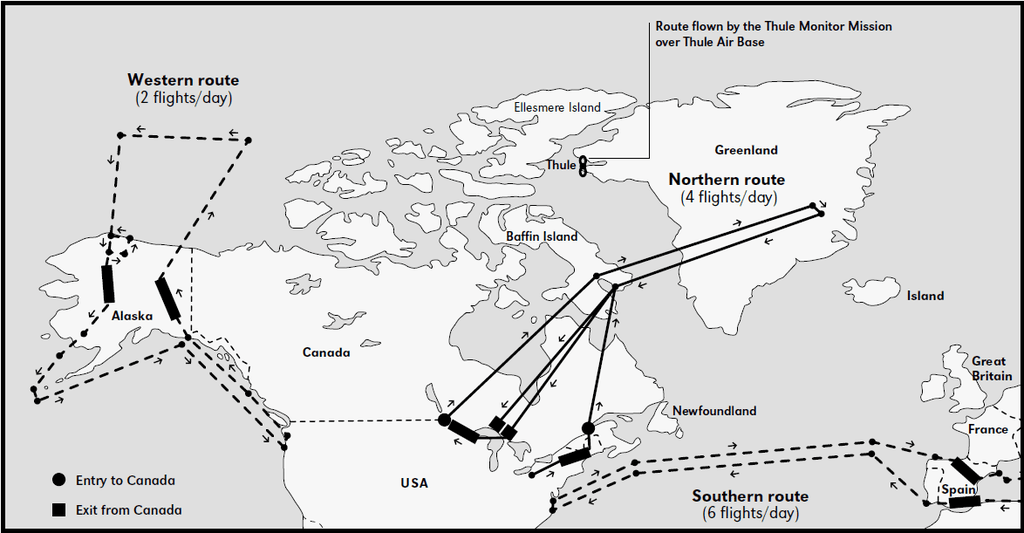
United States Air Force General and Strategic Air Command (SAC) commander General Thomas Sarsfield Power introduced Operation Chrome Dome, placing thermonuclear weapons on permanent air patrol to provide a rapid “first strike” or retaliatory “second strike” in the event of nuclear war.

chromedome1964b52mission
1964 Operation Chrome Dome Map from Sheppard Air Force Base, TX – H/T Wikipedia

Missions initially departed Sheppard Air Force Base in Texas and flew across the United States and over New England, refueling over the Atlantic before heading north toward Soviet air space. Three separate missions were being flown by 1966, one East over the Atlantic and the Mediterranean, another north to Baffin Bay, and the third over Alaska.  12 missions per day, 365 days a year.

heres_every_interesting_detail_you_should_know_about_the_cold_war_640_25

The Department of Defense has a term for accidents involving nuclear weapons, warheads or components, which do not involve the immediate risk of nuclear war. They’re called “Broken Arrows“.

Broken Arrows include accidental or unexplained nuclear or non-nuclear detonation of an atomic weapon, the loss of such a weapon and the release of nuclear radiation resulting in public hazard, actual or potential. There have been 32 Broken Arrow incidents since 1950. As of this date, six nuclear weapons have been lost and never recovered.

Major “Kong” rides the bomb in the dark, 1964 comedy by Stanle Kubrick, “Dr. Strangelove or: How I Learned to Stop Worrying and Love the Bomb”

Five such incidents are associated with Operation Chrome Dome:

• On January 24, 1961, a B-52 Stratofortress carrying two Mark 39 nuclear weapons broke up in mid-air, dropping its payload in the area of Goldsboro, North Carolina. Five men bailed out and landed safely. One bailed out but did not survive the landing. Two more died in the crash.
• Two months later, a B-52 Stratofortress carrying two nuclear weapons departed Mather Air Force Base near Sacramento before experiencing uncontrolled decompression. Forced to fly at a lower altitude and unable to meet its refueling aircraft, the bomber ran out of gas and crashed outside of Yuba City, California. The air crew safely bailed out, but a fireman was killed and several injured in an accident, while en-route to the scene.
• In 1964, a B-52 Stratofortress carrying two Mark 53s was returning from Massachusetts to Georgia in heavy winter weather. Severe turbulence tore off a vertical stabilizer and the bomber crashed on the Stonewell Green farm, Near Meyersdale, Pennsylvania. Radar Bombardier Major Robert Townley was unable to bail out, and died in the crash. Navigator Major Robert Lee and tail gunner TSgt Melvin Wooten succumbed to injuries and hypothermia, on the ground. Only pilot Major Thomas McCormick and co-pilot Captain Parker Peedin, survived.
• On January 17, 1966, a B-52G bomber collided with a KC-135 tanker during mid-air refueling at 31,000-feet, over the Mediterranean. The tanker ignited, killing all four crew members. The bomber broke apart, killing three of seven.
• On January 21, 1968, a B-52 carrying four hydrogen bombs over Baffin Bay developed an uncontrolled cabin fire, forcing seven crew to bail out. Six ejected safely. Co-pilot Leonard Svitenko gave up his ejection seat when the third pilot took over, and sustained fatal head injuries while bailing out from a lower hatch. The bomber crashed on sea ice over 770-feet of water in North Star Bay in Greenland, a territory under Danish jurisdiction. Conventional explosives detonated in the crash, dispersing radioactive material, for miles.

For days, the only way to the crash site, was by dog sled. With average daytime temperatures of -25° and 80-MPH winds, “Project Crested Ice” was better known by those who were there as “Dr. Freezelove”.  The cleanup involved 562 American and Danish personnel, removing twenty-seven 25,000-gallon containers of contaminated snow and ice.

800px-crested_ice_tank_loading

The Thule Air Base accident became an international incident, resulting in termination of Operation Chrome Dome on January 22, 1968.  From that day to this, the next thermonuclear war will have to start from the ground.

At the height of the Cold war, civil defense film character Bert the Turtle advised  school children to “Duck and Cover”.  Kids across the nation were shown this film, I was one of them.  “Always remember“, says the narrator.,”the flash of an atomic bomb can come at any time, no matter where you may be“.

Probably explains a lot, about my generation.

If you enjoyed this “Today in History”, please feel free to re-blog, “like” & share on social media, so that others may find and enjoy it as well. Please click the “follow” button on the right, to receive email updates on new articles.  Thank you for your interest, in the history we all share.

January 18, 1943 Chickenfeed

The United States Supreme Court, apparently afraid of President Roosevelt and his aggressive and illegal “court packing” scheme, ruled against the farmer. Ever since, what you don’t do can be argued in a court of law to impact interstate conditions, putting what you didn’t do under the jurisdiction of the federal government.

Get it? Neither do I, but I digress.

The first bread slicer was invented by Otto Frederick Rohwedder of Davenport, Iowa, in 1912. The idea was unpopular among bakers, who feared that pre-sliced bread would go stale faster, leading to spoiled inventory and dissatisfied customers.

The project almost ended in a fire in 1917, when a fire destroyed the prototype along with the blueprints. Rohwedder soldiered on.  By 1927, he had scraped up enough financing to rebuild his bread slicer.

sliced-breadFrank Bench, a personal friend of the inventor, was the first to install the machine.  The first pre-sliced loaf was sold in July of the following year. Customers loved the convenience and Bench’s bread sales shot through the roof.
Sliced bread became a national hit when the Continental Baking Company, then-owner of the “Wonder Bread” brand, began using a modified version of Rowhedder’s machine in 1930.  Sliced bread was here to stay. Sort of.

These were the early days of the Great Depression.  Nine million savings accounts were wiped out in the first three years.  Federal agricultural officials conceived the hare brained idea that artificially introduced scarcity would raise prices and therefore wages, in the agricultural sector.  No fewer than six million hogs were destroyed in 1933, alone. Not harvested, just destroyed and thrown away at a time when a 22.9% unemployment led the way to widespread malnutrition and hunger.

470,000 cattle were shot in Nebraska alone. Vast quantities of milk were poured down sewers, and whole cotton fields, plowed under.

755px-us_employment_graph_-_1920_to_1940.svg
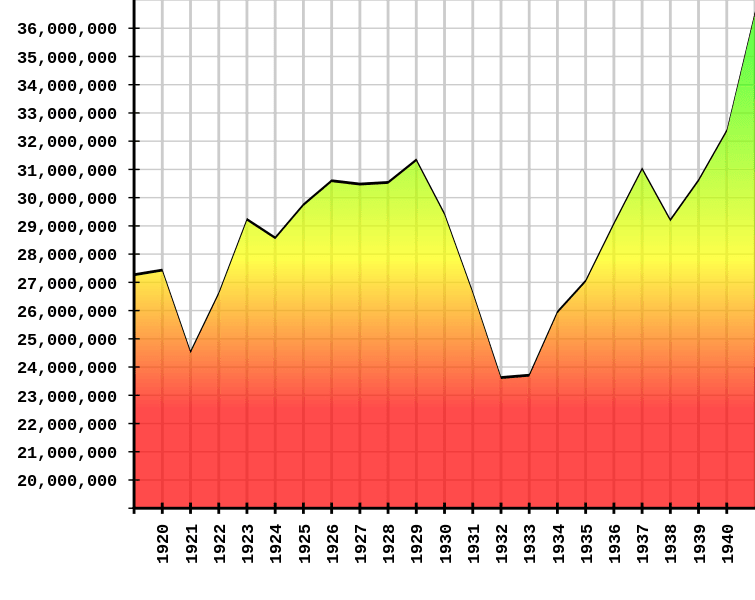
US unemployment, 1920-’40

Whether because of or despite government policies, unemployment dropped from 25% to 9% during Roosevelt’s first time (1933 – ’37), then more than doubled to 19%, in 1938.

250px-claude_r._wickard_2
Claude R. Wickard

The “Second New Deal” saw a blizzard of social welfare programs, all but crowding out the productive bits of the economy.  The Great Depression not so much as ended but paused, with the onset of WW2.

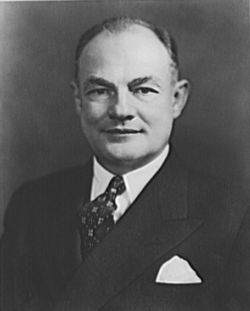
US entry into WW2 was in its second year in 1943 when Claude Wickard, head of the War Foods Administration and Secretary of Agriculture, had the hare brained idea of banning sliced bread.

Mr. Wickard was no stranger to hare brained ideas; it is he who lends his name to the landmark Supreme Court case Wickard v. Filburn.

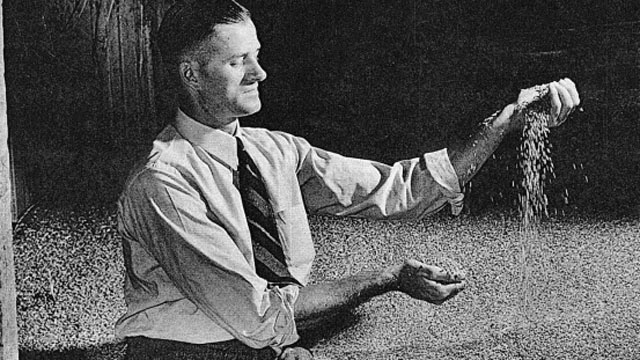
Speaking of hare brained ideas.  The Agricultural Adjustment Act of 1938 limited the area that farmers could devote to wheat production, in an effort to stabilize the price of wheat. Ohio farmer Roscoe Filburn was producing more than his allotment, and the federal government ordered him to destroy the surplus and pay a fine, even though his “surplus” was being consumed on the farm by the Filburn family, and their chickens.

commerceclauseArticle 1, Section 8 of the Constitution includes the “Commerce Clause”,  permitting the Congress “To regulate Commerce with foreign Nations, and among the several States, and with the Indian Tribes”. That’s it.
The Federal District Court sided with the farmer, but the Federal government appealed to the Supreme Court, arguing that, by withholding his surplus from the interstate wheat market, Filburn was effecting prices and therefore fell under federal government jurisdiction under the commerce clause.

slicedbreadban-january18.1943The United States Supreme Court, apparently afraid of President Roosevelt and his aggressive and illegal “court packing” scheme, ruled against the farmer. Ever since, what you don’t do can be argued in a court of law to impact interstate conditions, putting what you didn’t do under the jurisdiction of the federal government.
Get it? Neither do I, but I digress.

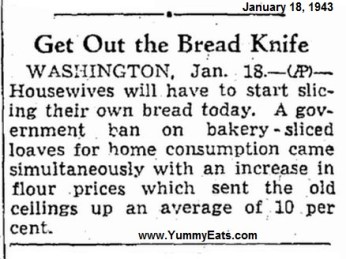
Back to Mr. Wickard, who enacted his ban against sliced bread and put it into effect on January 18, 1943. The push-back, as you might guess, was immediate and vehement. One woman took up her pen, and wrote to the New York Times: “I should like to let you know how important sliced bread is to the morale and saneness of a household. My husband and four children are all in a rush during and after breakfast. Without ready-sliced bread I must do the slicing for toast—two pieces for each one—that’s ten. For their lunches I must cut by hand at least twenty slices, for two sandwiches apiece. Afterward I make my own toast. Twenty-two slices of bread to be cut in a hurry!”

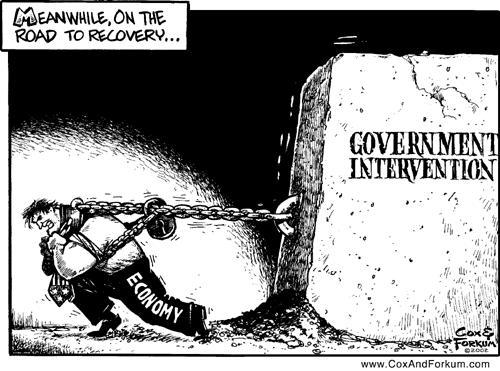
big-governmentThe stated reasons for the ban never did make sense. At various times, Wickard claimed that it was to conserve wax paper, wheat or steel, but one reason was goofier than the one before. According to the War Production Board, most bakeries had plenty of wax paper supplies on hand, even if they didn’t buy any.  Furthermore, the federal government had a billion bushels of wheat stockpiled at the time, about two years’ supply, and the amount of steel saved by not making bread slicers has got to be marginal, at best.
The ban was rescinded on March 8, 1943, and pre-sliced bread was once again available to the federal government and its subjects. There’s no telling who first used the expression “the greatest thing since sliced bread”, but a reasonable guess may be made as to why.

If you enjoyed this “Today in History”, please feel free to re-blog, “like” & share on social media, so that others may find and enjoy it as well. Please click the “follow” button on the right, to receive email updates on new articles.  Thank you for your interest, in the history we all share.

January 10, 1927 Poison Hooch

It’s a crazy, mixed up world full of nut job conspiracy theories. This is not one of those.

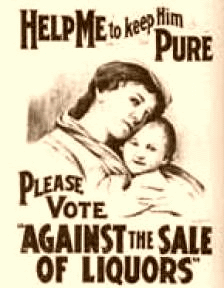
prohibition3The Eighteenth Amendment establishing the national prohibition of “intoxicating liquors” was passed out of Congress on December 17, 1917 and sent to the states, for ratification. The National Prohibition or “Volstead” act, so named for Chairman of the House Judiciary Committee Andrew Volstead, was enacted to carry out its intent.
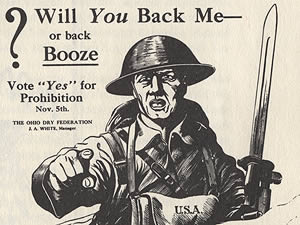

At last ratified in January 1919, “Prohibition” went into effect at midnight, January 16, 1920. For thirteen years, it was illegal to import, export, transport or sell liquor, wine or beer in the United States.

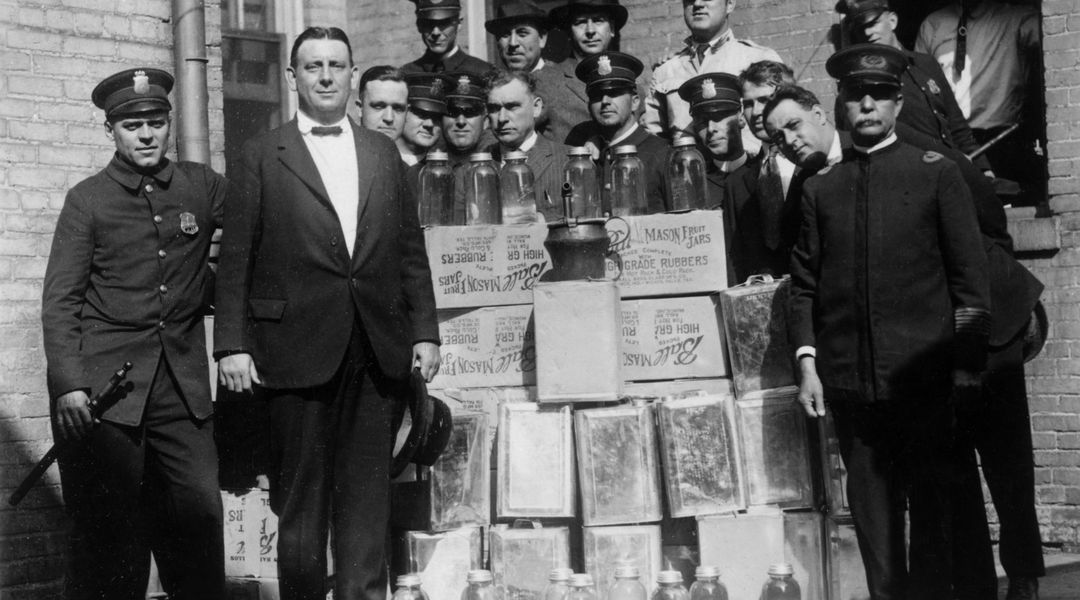
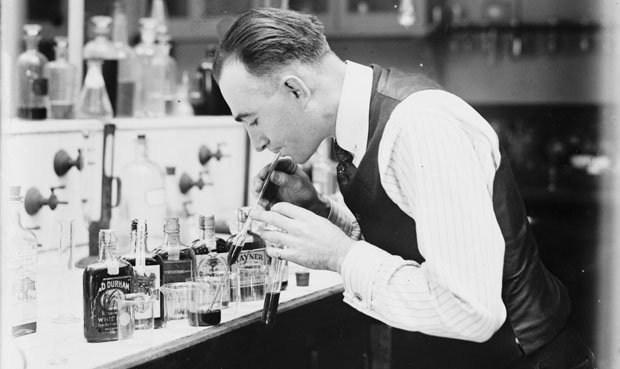
“Industrial alcohol” such as solvents, polishes and fuels were “denatured” and rendered unpalatable by the addition of dyes and chemicals.  The problem was, it wasn’t long before bootleggers figured out how to “renature” the stuff. The Treasury Department, in charge of enforcement at that time, estimated that over 60 million gallons of industrial alcohol were stolen during Prohibition.

war-propaganda
War-propaganda

Not to be defied, the government upped the ante. By the end of 1926, denaturing processes were reformulated with the introduction of known poisons such as kerosene, gasoline, iodine, zinc, nicotine, formaldehyde, chloroform, camphor, quinine and acetone. Better still, Treasury officials required no less than 10% by volume of methanol, a virulent toxin used in anti-freeze.

You can renature all you want. that stuff isn’t coming out.

On Christmas eve 1926, sixty people wound up at New York’s Bellevue Hospital, desperately ill from contaminated alcohol. Eight of them died. Two days later the death toll was thirty-one. By New Year’s Day the number had soared to 400, with no end in sight.

copper-still
A copper still and bucket, like those used in the creation and renaturing of alcohol at home. H’T allthatsinteresting.com, and Chicago History Museum/Getty Images

Many who didn’t die, may have wished it. Drinkers experienced hallucinations, uncontrollable vomiting, even blindness.

In its January 10, 1927 issue, TIME Magazine reported  a doubling in toxicity levels, from the new method:  “The new formula included “4 parts methanol (wood alcohol), 2.25 parts pyridine bases, 0.5 parts benzene to 100 parts ethyl alcohol” and, as TIME noted, “Three ordinary drinks of this may cause blindness. (In case you didn’t guess, “blind drink” isn’t just a figure of speech.)”

New York medical examiner Charles Norris was quick to understand the problem, and organized a press conference to warn of the danger. “The government knows it is not stopping drinking by putting poison in alcohol,” he said. “Yet it continues its poisoning processes, heedless of the fact that people determined to drink are daily absorbing that poison. Knowing this to be true, the United States government must be charged with the moral responsibility for the deaths that poisoned liquor causes, although it cannot be held legally responsible.”

Norris pointed out that the poorest people of the city, were most likely to be victims: “Those who cannot afford expensive protection and deal in low-grade stuff”.

The towering sanctimony of the other side, is hard to believe.  Teetotalers argued that the dead had “brought it on themselves”. Long-time leader of the anti-saloon league Wayne B. Wheeler claimed “The Government is under no obligation to furnish the people with alcohol that is drinkable when the Constitution prohibits it. The person who drinks this industrial alcohol is a deliberate suicide.”

prohibition_2

In the thirteen years of its existence, Prohibition was an unmitigated disaster.  Portable stills went on sale within a week of enactment, and organized smuggling was quick to follow. California grape growers increased acreage by over 700% over the first five years, selling dry blocks of grapes as “bricks of rhine” or “blocks of port”. The mayor of New York City sent instructions to his constituents, on how to make wine.

Smuggling operations became widespread, as cars were souped up to outrun “the law”. This would lead to competitive car racing, beginning first on the streets and back roads and later moving to dedicated race tracks. It’s why we have NASCAR, today.

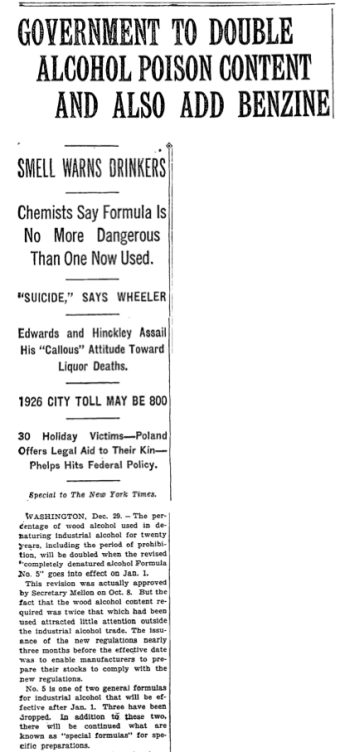
alcohol_poison_passed

Organized crime became vastly more powerful due to the influx of enormous sums of cash. The corruption of public officials was a national scandal.

Gaining convictions for breaking a law that everyone hated became increasingly difficult. The first 4,000 prohibition-related arrests resulted in only six convictions, and not one jail sentence.

It’s hard to compare alcohol consumption rates before and during prohibition but, if death by cirrhosis of the liver is any indication, alcohol consumption wasn’t reduced by any more than 10 to 20 per cent.

In the end, even John D. Rockefeller, Jr., a lifelong teetotaler who contributed $350,000 to the Anti-Saloon League, had to announce his support for repeal.

On December 5, 1933, Utah became the 36th state to ratify the Twenty-first Amendment, repealing the Eighteenth and voiding the Volstead Act, returning control over alcohol policy to the states.

Federal officials continued to poison industrial alcohol until the very end, resulting in the death of some 10,000 citizens.   They didn’t even pretend not to know, what was happening.  Assistant Secretary of the Treasury Seymour Lowman may have had the last word, among those who would say “I’m from the government, and I’m here to help”.  Lowman opined that, if deliberately poisoned alcohol resulted in a more sober nation, then “a good job will have been done.”

If you enjoyed this “Today in History”, please feel free to re-blog, “like” & share on social media, so that others may find and enjoy it as well. Please click the “follow” button on the right, to receive email updates on new articles.  Thank you for your interest, in the history we all share.

January 8, 1835 When the Dollar Dies

You’ve worked all your life. You’ve supported your family, paid your taxes, and met your every obligation. You even managed to put a few bucks aside, in hopes of a long and happy retirement. What happens to that retirement “nest egg”, when the cost of the coffee in your hand doubles in the time it takes to drink it?

You’ve worked all your life. You’ve supported your family, paid your taxes, and met your every obligation. You’ve even managed to put a few bucks aside, in hopes of a long and happy retirement.

The subject of currency devaluation is normally left to eggheads and academics, the very term sufficient to make most of us tip over and hit our heads on the floor, from boredom. But, what happens to that “nest egg”, when the cost of the coffee in your hand doubles in the time it takes to drink it?

History records 58 such instances of hyperinflation. The economic train wreck socialism has wrought on Venezuela, constitutes #59. This in a country with the largest proven oil reserves on the planet.

In antiquity, Roman law required a high silver content in the coinage of the realm. Precious metal made the coins themselves objects of value. The Roman economy remained relatively stable for 500 years. Republic morphed into Empire over the 1st century BC, leading to a conga line of Emperors minting mountains of coins in their own likeness. Slaves were worked to death in Spanish silver mines. Birds fell from the sky over vast smelting fires, yet there was never enough to go around. Silver content was inexorably reduced until the currency itself collapsed in the 3rd century reign of Diocletian.

An Empire and its citizens were left to barter as best they could, in a world where money had no value.

The assistance of French King Louis XIV was invaluable to Revolution-era Americans, at a time when colonial inflation rates approached 50% per month. Even so, French state income was only about 357 million livres at that time, with expenses exceeding one-half Billion.

France descended into a Revolution of its own, in the wake of the American conflict. The government printed “assignat”, notes purportedly backed by 4 billion livres in property expropriated form the church. 912 million livres were in circulation in 1791, rising to nearly 46 billion in 1796.

One historian described the economic policy of the leftist radicals behind the Reign of Terror: “The attitude of the Jacobins about finances can be quite simply stated as an utter exhaustion of the present at the expense of the future”.

Somehow, that sounds familiar.

Paper money crashed in the post-Revolutionary Articles of Confederation period as well, when you could buy a live sheep for two silver dollars, or 150 “Continental” (paper) dollars.
Roles reversed and creditors hid from debtors, not wanting to be repaid in worthless scrip. Generations after our founding, a thing could be described as worthless as “Not worth a Continental”.

Germany was a prosperous country in 1914, with a gold-backed currency and thriving industries in optics, chemicals and machinery. The Deutsche Mark had approximately equal value with the British shilling, the French Franc and the Italian Lira, with an exchange rate of four or five to the dollar.

That was then.

While the French third Republic levied an income tax to pay for the “Great War”, the Kaiser suspended the gold standard and fought the war on credit, believing he’d get it back from conquered territories.
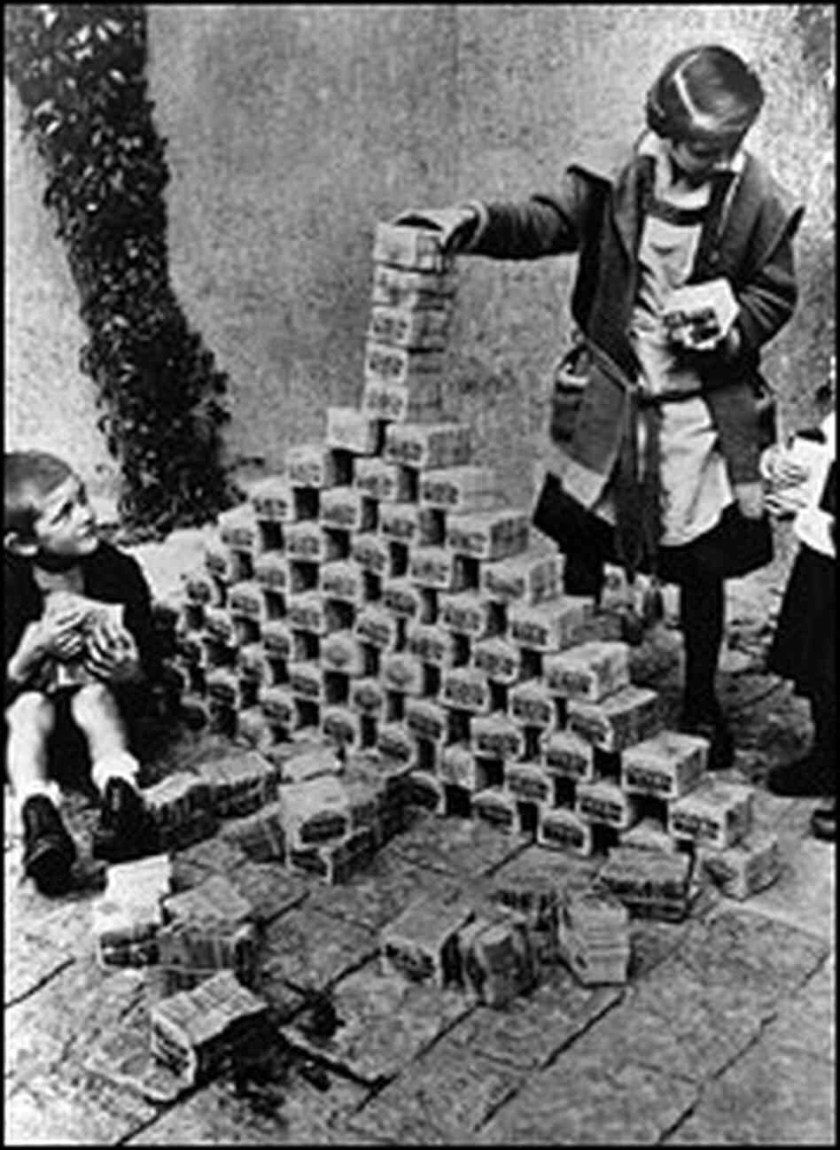
Except, Germany lost. The “Carthaginian peace” described by British economist John Maynard Keynes saddled an economy already massively burdened by war debt, with reparations. Children built ‘forts’ with bundles of hyperinflated, worthless marks. Women fed banknotes into wood stoves, while men papered walls with them. By November 1923, one US dollar bought 4,210,500,000,000 German marks.

The despair of the ‘Weimar Republic’ period resulted in massive political instability, providing rich soil for the growth of the National Socialist German Workers’ Party, of Adolf Hitler.

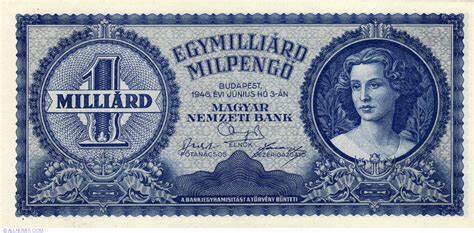
The Austro-Hungarian Empire was also on the losing side, and broken up after the war. Lacking the governmental structures of more established states, a newly independent Hungary began to experience inflation. Before the war, one US Dollar bought you 5 Kronen. In 1924, it was 70,000. Hungary replaced the Kronen with the Pengö in 1926, pegged to a rate of 12,500/1.

Hungary became a battleground in the latter stages of WW2, between the military forces of Nazi Germany and those of the USSR. 90% of Hungarian industrial capacity was damaged, half destroyed altogether. Transportation became difficult with most of the nation’s rail capacity, damaged or destroyed. What remained was either carted off to Germany, or seized by the Russians as reparations.

The loss of all that productive capacity resulted in scarcity of goods, and prices began to rise. The government responded by printing money. Total currency in circulation in July 1945 stood at 25 Billion Pengö. Money supply rose to 1.65 Trillion by January, 65 Quadrillion that Spring and 47 Septillion, in July. That’s a Trillion Trillion. Twenty-four zeroes.

Banks received low rate loans, so that money could be loaned to companies to rebuild. The government hired workers directly, giving out loans to others and in many cases, outright grants. The country was flooded with money, the stuff virtually grew on trees, but there was nothing to back it up.

Inflation approached escape velocity. The item that cost you 379 Pengö in September 1945, cost 1,872,910 by March, 35,790,276 in April, and 862 Billion in June. Inflation neared 150,000% per day, making the currency all but worthless. Massive printing of money accomplished the cube root of zero. The worst hyperinflation in history peaked in 1946, when the item that cost you 379 Pengö last September, now cost 1,000,000,000,000,000,000,000,000.

The government responded by changing the name, and the color, of the currency. The Pengö was replaced by the Milpengö (1,000,000 Pengö), which was replaced by the Bilpengö (1,000,000,000,000), and finally by the (supposedly) inflation-indexed Adopengö. This spiral resulted in the largest denominated note in history, the Milliard Bilpengö. A Billion Trillion Pengö.

The thing was worth twelve cents.

One more replacement and all that Keynesian largesse would finally stabilize the currency, but at what price? Real wages were reduced by 80% and creditors wiped out. The fate of the nation was sealed when communists seized power in 1949. Hungarians could now share in that old Soviet joke. “They pretend to pay us, and we pretend to work”.

The ten worst hyperinflations in history occurred during the 20th century, including Zimbabwe in 2008, Yugoslavia 1994, Germany 1923, Greece 1944, Poland 1921, Mexico 1982, Brazil 1994, Argentina 1981, and Taiwan 1949. The common denominator in all ten were massive government debt and a currency with no inherent value, excepting what a willing buyer and a willing seller agreed it was worth.

In 2015, Boston University economist Laurence Kotlikoff testified before the Senate Budget Committee. “The first point I want to get across” he said, “is that our nation is broke. Our nation’s broke, and it’s not broke in 75 years or 50 years or 25 years or 10 years. It’s broke today”. Kotlikoff went on to describe a “fiscal gap”, the difference between US’ projected revenue, and the obligations our government has saddled us with. “We have a $210 trillion fiscal gap at this point”. Nearly twelve times GDP – the sum total of all goods and services produced in the United States.

American public debt hit zero for the first and only time in history on this day in 1835. The number now approaches twenty-two Trillion, more than the combined GDP of the bottom 174 nations, on earth. All that, in a currency unmoored from anything of objective value. What could go wrong?