March 2, 1977 Heeeere’s Johnny

The world’s longest running talk show began in 1954, when Steve Allen sat down at his piano on September 27. This show is gonna go on… forever”, Allen quipped. So far, he seems to have gotten that right.

carson-navy_portrait
US Navy Portrait

With Jack Parr about to sign off the “Tonight Show” for the last time, NBC executives were anxious to find a replacement. Bob Newhart, Jackie Gleason, Groucho Marx, and Joey Bishop all declined the opportunity, when a United States Navy veteran, amateur magician and amateur boxer with a 10/0 record agreed to take the job.

Johnny Carson had himself turned down the job, believing himself unequal to the task of producing 90 minutes a day of fresh content. A series of guest hosts including Merv Griffin, Art Linkletter, Joey Bishop, Jerry Lewis and Groucho Marx followed, as Carson finished out the last six months of an ABC contract. Despite misgivings, Carson started the new gig on October 1, 1962.

No sooner had NBC announced that Johnny Carson was joining “The Tonight Show,” than the national press gaggle came after him, looking for interviews. Carson resisted at first, but finally relented, providing journalists with a list of answers to which they could apply any question they liked: “Yes, I did. Not a bit of truth in that rumor. Only twice in my life, both times on Saturday. I can do either, but prefer the first. NO. Kumquats. I can’t answer that question. Toads and tarantulas. Turkestan, Denmark, Chile, and the Komandorskie Islands. As often as possible, but I’m not very good at it yet. I need much more practice. It happened to some old friends of mine, and it’s a story I’ll never forget”.carson-mcmahon-1963
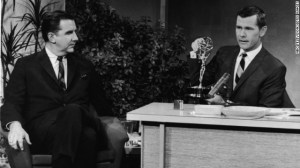
Carson was joined shortly thereafter by a Marine Corps Colonel and flight instructor, from Lowell, Massachusetts. The Marine had earned his carrier landing qualifications around the time the atomic bomb ended the war in the Pacific, going on to fly 85 combat missions in Korea, and earning six air medals. His name was Ed McMahon.

When the Tonight Show first aired, everyone on the set including Carson himself, smoked. The “Public Health Cigarette Smoking Act” was introduced in Congress in 1969. Ironically, it was President Richard Nixon, an avid pipe smoker who lit up as many as eight bowls a day, who signed the measure into law on April 1, 1970. The measure included a permanent ban on television cigarette advertising, scheduled to take effect January 2 the following year. The last cigarette ad in the history of American television was a Virginia Slims ad, broadcast at 11:59p.m., January 1, 1971, on the Tonight Show, Starring Johnny Carson. Smoking on-air became a thing of the past sometime in the mid-80s, but that cigarette box remained on Carson’s desk until his final episode, in 1992. You’ve come a long way, baby.carson-monolog
For NBC, the Tonight Show was a cash cow. Many years the program grossed over $100 million, accounting for 15-20% of the profits earned by the entire network. Carson threatened to walk in 1980, ending up with a deal unprecedented in the history of American television: $5 million a year and series commitments estimated at $50 million. Just as important, show content would no longer belong to the network, but to Carson himself.

Carson began taking Mondays off in 1972, when the show moved from New York to California. There followed a period of rotating guest hosts, including George Carlin and Joan Rivers, who became permanent guest host from 1983 until 1986.

carson-carnac  The Tonight Show Starring Johnny Carson was a late-night fixture through seven US Presidents: John F. Kennedy, Lyndon Johnson, Richard Nixon, Gerald Ford, Jimmy Carter, Ronald Reagan, and George H.W. Bush. Almost every American over the age of 30 will remember “Heeeeeeeeeeere’s Johnny!”. The opening monologue, and the imaginary golf swing. “Carnac the Magnificent”, holding the envelope to his head, reciting the punchline to the joke sealed inside. “Saucepan… Who was Peter Pan’s wino brother?” When the joke bombed, there was the comedic curse. “May a bloated yak change the temperature of your jacuzzi!”

Jay Leno appeared on the Tonight Show with Johnny Carson for the first time on March 2, 1977. He would frequently guest host, and served as permanent from May 1992 to May 2009.

Five years after Carson’s final show, 10,000 taped episodes were moved to a salt mine in Kansas, to protect them from deterioration. There they remain, 54 stories underground, where the average temperature is 68 degrees, with a uniform 40% humidity.
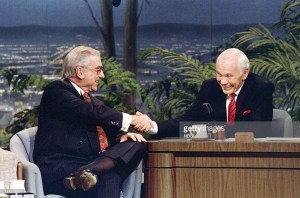
carson-mcmahon-1992
Final episode, 1992

Excepting Conan O’Brien’s eight months in 2010, Leno remained permanent host until February 2014, recording more episodes (4,610) than even Carson himself (4,531). Saturday Night live veteran Jimmy Fallon took over the reins in February 2014, where he remains to this day.

The world’s longest running talk show began in 1954, when Steve Allen sat down at his piano on September 27. This show is gonna go on… forever”, Allen quipped. So far, he seems to have gotten that right.

February 27, 1992 Founding Father and Son, of Golf

The youngest golfer ever to play in one of the majors (the Masters, US & British Opens and the PGA Championship), was the appropriately named “Young” Tom Morris Jr., a Scot who played in the 1865 British Open at 14 years and four months

On this day in 1992, 16 year old Tiger Woods became the youngest PGA golfer in 35 years, going on to become the first $100 million man on the PGA Tour.

He certainly wasn’t the youngest.  Andy Zhang made the US Open in 2012, at the ripe old age of fourteen years, six months, but even he wasn’t the youngest.

The youngest golfer ever to play in one of the majors (the Masters, US & British Opens and the PGA Championship), was the appropriately named “Young” Tom Morris  Jr., a Scot who played in the 1865 British Open at 14 years and four months.

Morris withdrew from that year’s tournament, at about the time General Robert E. Lee was meeting General Ulysses S. Grant at Appomattox. Young Tom went on to win the British Open three years later, winning the equivalent of $12 for the feat. Ironically, the victory came at the expense of his father “Old” Tom Morris, Greenkeeper and club pro at the famous ‘Old Course’ at St. Andrews.IMG_0427.JPG

Young Tom followed that first Open Championship in 1868 with three more, in 1869, 1870 and 1872. His record stands to this day, the only player ever to win four consecutive Open Golf Championships.   (There was no championship in 1871).

Young Tom would win three more Opens before dying on Christmas day, at the age of 24. The first of only two teenagers in history to win any of the majors.

In April 1864, Young Tom attended a tournament with his father, at the King James VI Golf Club.  With days to go before his 13th birthday, he was too young to compete in either the professional or amateur sections.  Local organizers organized a two-man tournament between himself and a local youth champion.  A large gallery followed the two young golf stars throughout their match.  Those who did so were rewarded by seeing young Tom win the match, by a score sufficient to have won the professional tournament.

In 2016, the historical drama “Tommy’s Honour” opened the 2016 Edinburgh International Film Festival, on June 15, based on one of Sports Illustrated 2007 “Books of the Year”, “Tommy’s Honor: The Story of Old Tom Morris and Young Tom Morris, Golf’s Founding Father and Son”, by Kevin Cook.  The film will be broadcast on the Golf Channel, in spring 2017.

February 25, 1921 Red Scare

In the 1930s, many believed that International Communism was “winning”. That the Soviet Union was deliberately starving millions of its own citizens to death during this period, seemed to trouble relatively few.

In the wake of WWI and the Bolshevik revolution in Russia, American authorities became increasingly alarmed at the rise of foreign and leftist radicalism.  Most especially the militant followers of anarchist Luigi Galleani.

This was not meaningless political posturing.  Anarchists mailed no fewer than 36 dynamite bombs to prominent political and business leaders in April 1919, alone. In June, another nine far more powerful bombs destroyed churches, police stations and businesses. Attorney General A. Mitchell Palmer had one hand delivered to his home by anarchist Carlo Valdinoci, who did something wrong and somehow managed to blow himself to bits on the AG’s doorstep.

Palmer attempted to suppress these radical organizations in 1919-20, but his searches and seizures were frequently illegal, his arrests and detentions without warrant, his deportations questionable.
Lookinganarchism over the international tableau of the time, there appeared great cause for concern.  The largest nation on the planet had just fallen to communism, in 1917.
The Red Army offensive of 1920 drove into Poland, almost as far as Warsaw. The “Peace of Riga”, signed in 1921, split off parts of Belarus and Ukraine, making them both parts of Soviet Russia. On this day in 1921, Bolshevist Russian forces occupied Tbilisi, capital of the Democratic Republic of Georgia.
In the 1930s, many believed that International Communism was “winning”. The capitalist west was plunged into a Great Depression that it couldn’t seem to control, while the carefully staged propaganda of Stalin’s Soviet Union did everything it could to portray itself as a “workers’ paradise”.
That the Soviet Union was deliberately  starving millions of its own citizens to death during this period, seemed to trouble relatively few.
Whittaker Chambers was one who saw communism as winning, and joined the Communist Party of the United States (CPUSA) in 1925. For a time he worked as a writer at the Party’s newspaper “Daily Worker”, before becoming editor of “New Masses”, the Party’s literary magazine.
Through the early to mid-thirties, Chambers delivered messages and received documents from Soviet spies in the government, photographing them himself or delivering them to Soviet intelligence agents to be photographed.
By the late 30s, Chambers’ idealism was replaced by the growing realization that he was supporting a murderous regime. By 1939, he joined the staff of Time Magazine, where he pushed a strong anti-communist line.
A series of legislative committees were formed between 1918 and the outbreak of WWII to investigate this series of threats.  It was in this context that HUAC, the House Committee on Un-American Activities was formed in 1938, becoming a “standing” (permanent) committee in 1945.img_0416
Chambers warned about communist sympathizers in the Roosevelt administration, as early as 1939.  Government priorities changed during the course of WWII.  Chambers was summoned to testify on August 3, 1945.
In his testimony, Chambers named Alger Hiss and others, as communists.  A graduate of Johns Hopkins and Harvard Law School who had clerked for Supreme Court Justice Oliver Wendell Holmes, Alger Hiss seemed an unlikely communist. He went on to practice law in Boston and New York before returning to Washington to work on President Roosevelt’s “New Deal”, winding up at the State Department as an aide to Assistant Secretary of State Francis B. Sayre, former President Woodrow Wilson’s son-in-law.
alger-hiss-public-servant-i-am-amazed-until-the-day-i-die-i-shallHiss flatly denied Chambers’ charges, filing suit that December for defamation of character.  Chambers doubled down in his 1948 deposition, claiming that Hiss was not only a communist sympathizer, he was also a spy.
Before his defection, Chambers had secreted documents and microfilms, some of which he hid inside a pumpkin at his Maryland farm. The entire collection became known as the “Pumpkin Papers”, consisting of incriminating documents, written in what appeared to Hiss’ own hand, or typed on his Woodstock no. 230099 typewriter.
Hiss claimed to have given the typewriter to his maid, Claudia Catlettimg_0415. When the idiosyncrasies of his machine were demonstrated to be consistent with the documents, he then claimed that Chambers’ team, including freshman member of Congress Richard M Nixon, must have modified the typeface on a second typewriter to mimic his own.
Hiss’ theory never explained why Chambers side needed another typewriter, if they’d had the original long enough to mimic it with the second.
Alger Hiss’ first trial for lying to a Grand Jury ended with a hung jury, 8-4.  A second trial began on November 17. He was found guilty on January 21, 1950, still proclaiming his innocence. He appealed his conviction but lost, and served 44 months in Lewisburg Federal Penitentiary before being released in 1954.
Hiss would go to his grave protesting his innocence, though Soviet era cables, decrypted through the now-declassified “Venona Project”, seem to convict him beyond a reasonable doubt of being a soviet agent. Venona transcript #1822, sent in March 1945, from the Soviets’ Washington station chief to Moscow, describes subject codenamed ALES as having attended the February 4–11, 1945 Yalta conference, before traveling to Moscow. Hiss did attend Yalta on those dates, before going to Moscow with Secretary of State Edward Stettinius.
41facggulzl-_sx306_bo1204203200_Historians John Earl Haynes and Harvey Klehr report that the Venona transcripts tied 349 Americans to Soviet intelligence, though fewer than half have ever been identified.  The Office of Strategic Services alone, precursor to the CIA, housed between fifteen and twenty Soviet spies.
In 1992, former KGB archivist Vasili Mitrokhin defected to Great Britain, taking with him 30 years of handwritten notes. The Mitrokhin Archive revealed that Soviet moles went as high as President  Roosevelt’s most trusted aid, Harry Hopkins. Equivalent to finding that, at any point during the last three administrations, Karl Rove, Valerie Jarrett or Steve Bannon was an agent for the other side.

February 24, 1980 The Impossible Dream

The Soviet Union entered the Lake Placid games as heavy favorites, having built a 27-1-1 record since that 1960 upset, outscoring their opponents by a combined 175 to 44

In the world of sports, there may be nothing more boring than the “dream team” sent to represent the US in the 1992 Olympics.  NBA professionals all, these guys are paid in the tens of millions to play their game.  To the surprise of precisely no one, they swept their series with an average of 44 points, against opponents like Angola, Lithuania and Croatia.  Yawn.

We didn’t always send professional athletes to the Olympics.  There was a time when athletes’ amateur status was tightly controlled.  Jim Thorpe, possibly the finest all-round athlete in American history, was stripped of his 1912 gold medals in the decathlon and pentathlon, because he had once accepted small sums to play baseball during college summers.  It could not have given him much comfort that those medals were reinstated, in 1983.  By that time, the man had been dead for thirty years.

In 1980, the US hockey team defeated Finland on February 24 to win the gold medal, at the winter Olympics in Lake Placid.  It was almost anti-climactic.  The real drama played out two days earlier, when a collection of American amateurs defeated the mighty Soviet Union.

Canadians dominated Olympic ice hockey in the early days of the event, winning six out of seven gold medals between 1920 and 1952.  Team USA scored a surprise gold at Squaw Valley in 1960, after which the Soviet Union seemed unstoppable, winning gold in 1964, ’68, ’72 &’76.

My fellow children of the cold war will attest, a favorite complaint of the era was the semi-professional status of the former Soviet bloc athletes, particularly those from East Germany and the Soviet Union itself.  Between its first appearance in the 1952 Olympic games and its final appearance in 1988, the Soviet Union was at the top of the combined medal count with 1,204.  Even now they’re second only to that of the United States, a country that’s been participating over twice as long.

The Soviet Union entered the Lake Placid games as heavy favorites, having built a 27-1-1 record since that 1960 upset, outscoring their opponents by a combined 175 to 44.  The 1980 team had world class training facilities, having played together for years in a well-developed league.  Vladislav Tretiak was widely believed to be the best goaltender in the world at that time.  He, defenseman Viacheslav Fetisov and forward Valeri Kharlamov, would all go on to be enshrined in the International Hockey Hall of Fame.

In exhibition games that year, Soviet club teams went 5–3–1 against NHL teams.  A year earlier, the Soviet national team routed an NHL All-Star team 6–0 to win the Challenge Cup.

University of Minnesota coach Herb Brooks had assembled the youngest team in U.S. history to play in the Olympics, with an average age of only 21.  Left wing Buzz Schneider was the only veteran, returning from the 1976 Olympic squad.  Nine players had played under Coach Brooks.  Another four came from archrival Boston University, including goalie Jim Craig, and team captain Mike Eruzione.  For some players, the hostility of that college rivalry carried over to their Olympic teammates.

The Soviet team had demolished earlier opponents by a combined score of 50-11.  The US squad had squeaked out a series of upsets, 23-8. The day before, New York times sports reporter Dave Anderson wrote, “Unless the ice melts, or unless the United States team or another team performs a miracle, as did the American squad in 1960, the Russians are expected to easily win the Olympic gold medal for the sixth time in the last seven tournaments.”

Team USSR took an early lead of 2-1 in the first period.  Mark Johnson tied the score with one second left, leading Soviet coach Viktor Tikhonov to make the goofiest decision, ever.  He pulled the best goalie in the world, replacing him with backup goaltender Vladimir Myshkin.  The move shocked players on both teams.  Years later, Johnson and Fetisov were NHL teammates, and Johnson asked him about the decision.  “Coach Crazy”, was all he said.

Aleksandr Maltsev scored an unanswered goal on a power play, 2:18 into the second period.  At the end of the second, the Soviet Union led, 3-2.

Mark Johnson scored his second goal of the game at 8:39 in the third, in the last seconds of another power play.  For the American team, it was only the third shot on net, in the last 27 minutes. Vasili Pervukhin got in his goalie’s way with ten minutes to play, as Mike Eruzione fired one past Myshkin to put the Americans ahead, 4-3.

miracle-on-iceThe Soviets attacked ferociously, but Craig let nothing past.  Altogether the Soviet team made 39 shots on goal to the Americans’ 16, but the score held.

In the final moments of the game, the crowd began to count down the seconds.  ABC Sportscaster Al Michaels calling the game in a rising crescendo:  “11 seconds, you’ve got 10 seconds, the countdown going on right now! Morrow, up to Silk. Five seconds left in the game. Do you believe in miracles!? YES!!”

David had slain Goliath.  Rocky Balboa had defeated Captain Ivan Drago.  A bunch of college kids had just beaten the Soviet Union.  Coach Brooks sprinted back to the locker room, and cried.  Pandemonium reigned supreme, as  Jim Craig circled the ice, wrapped in a flag.  ABC sportscaster Jim McKay compared the victory to a Canadian college football team defeating the Superbowl champion Pittsburgh Steelers.  Afterward, players spontaneously broke into a chorus of “God Bless America” in the locker room.

sports_illustrated_miracle_on_ice_cover
The March 3, 1980 cover of Sports Illustrated needed no captions. Everyone knew what happened.

In the gold medal round on the 24th, the Americans were behind at the end of the 2nd period, 2-1.  The American team was in the locker room during the second intermission, when coach Brooks said “If you lose this game, you’ll take it to your f***ing graves”.  Team USA defeated Finland for the gold medal, 4-2.

IOC President Avery Brundage (1952-1972), was adamant about preserving the amateur status of the Olympics. Once he was gone, the floodgates began to open.  Years later, sportswriter Ron Rapoport said “The pros are there for a reason… The pro athletes are pre-sold to the public, which means increased viewership.”

Nineteen years later, Sports Illustrated called the Miracle on Ice “the top sports moment of the entire 20th century”.

The “Dream Team” of 1992 crossed a line that can never be retaken, but that can’t change the finest moments in sporting history.  For those of us who follow Boston sports, that means the 2004 World Series, the last 2:17 of Superbowl LI, and the Miracle on Ice, of 1980.

February 23, 1862 Floating Cathouse of the Cumberland

Certain that Nashville’s prostitutes were the source of the venereal plague, Union officials decided it was easier to get rid of them, than it was to keep their men from paying for sex

The Federal invasion of Tennessee began in early 1862, when Union forces under Ulysses S. Grant moved against Fort Henry on the Tennessee River and Fort Donelson on the Cumberland.  Both fortifications fell in February.  Another Federal army under Don Carlos Buell captured Nashville on the 25th.
Confederate presence in Tennessee essentially ceased to exist by June.  West Tennessee would remain in Union hands for the remainder of the war.
Robert E. Lee wrote to his wife on February 23, “The news from Tennessee and North Carolina is not cheering and disasters seem to be thickening around us”.
Union commanders declared martial law, posting garrisons in major towns including Chattanooga, Memphis, and Murfreesboro. Nashville in particular became a major military center, permanently occupied by thousands of Federal troops and support personnel.
According to the 1860 Census, Nashville had 198 white prostitutes and 9 described as “mulatto”, plying their trade in the two block red-light district known as “Smoky Row”. By 1862, the number of these “public women” had grown to 1,500.  It was barely enough to go around.

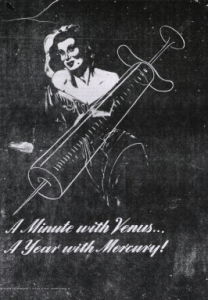
Major General William Rosecrans saw this sex trade as an issue and ordered Georgesyphilis_slogan Spalding, Provost Marshal of Nashville, to get rid of them. Though a Catholic, “Old Rosy’s” objection wasn’t based on moral grounds.  He was afraid of disease. 8.2% of all Union soldiers were afflicted with syphilis or gonorrhea in 1862, over half the battle casualty rate of 17.5%  Venereal disease was a major problem, and the only available treatments at the time involved mercury.  Without getting into details, that could take a man out for weeks.  Advanced cases were nothing short of grotesque.
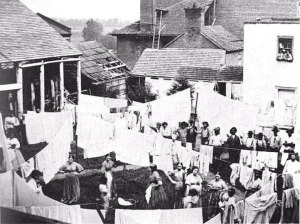
tertiary-syphilis
Tertiary Syphilis Victim
Certain that Nashville’s prostitutes were the source of the plague, Union officials decided it was easier to get rid of them, than it was to keep their men from paying for sex.  Spalding had all the prostitutes in Nashville gathered up by July, (I wonder what that sounded like).    The Nashville Daily Press reported  “A variety of ruses were adopted to avoid being exiled; among them, the marriage of one of the most notorious of the cyprians to some scamp. The artful daughter of sin was still compelled to take a berth with her suffering companions, and she is on her way to banishment”.
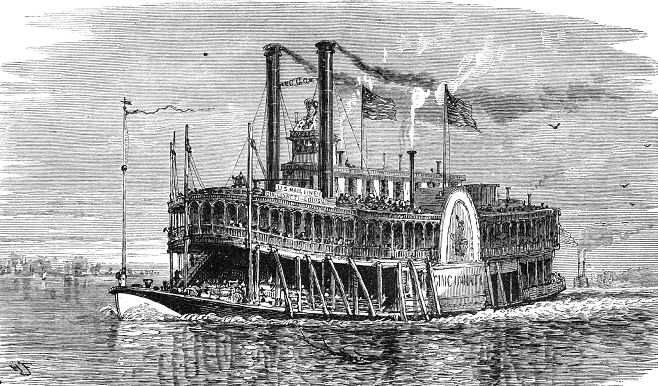
John Newcomb was the owner of a brand new steam powered riverboat, the “Idahoe”. (I swear I didn’t make that up). To Newcomb’s horror, Spalding ordered him to take 111 of Nashville’s most infamous hookers out of town, on Idahoe’s maiden voyage. Giving him three days’ rations, authorities didn’t care where he took them, so long as he got them out of Nashville.
It took a week for Idahoe to reach Louisville, by which time news of the unusual passenger list had already reached that city’s law enforcement. Newcomb was forbidden from docking there, and ordered to continue on to Cincinnati. Ohio didn’t want Nashville’s hookers any more than Louisville, so the steamboat was ordered to dock across the river in Kentucky.
Some of the women swam ashore but nobody was permitted to leave. Holcomb was desperate, finally returning to Louisville once more, only to be turned away again. Defeated, John Newcomb returned to Nashville 28 days later, with 98 of his original passengers and six children.
With Idahoe’s owner demanding to be compensated, a staffer inspected the vessel on August 8, finding the ship’s staterooms “badly damaged, the mattresses badly soiled,” and recommending that Newcomb be paid $1,000 in damages + $4,300 for food and for the “medicine peculiar to the diseased of women in this class”.
hospital_nashville
Civil War Nashville Hospital

In the end, it proved easier to manage the world’s oldest profession, than it was to eliminate it. A scheme was devised, by which each prostitute in Nashville would register and pay a $5 license fee, entitling her to ply her trade. A doctor would examine these women once a week, a service for which she would pay another 50¢. Women found to have venereal diseases were sent to a hospital, paid for in part by the weekly fees. The result of the program, according to one doctor, was a “marked improvement” in licensed prostitutes’ physical and mental health.

Altogether, the program cost about $6,000, on revenues of $5,900. Venereal disease was cut to one or two cases among the soldiers, compared to 3,000 or more without it. Today, the system practiced in Lyon County Nevada, closely resembles this system established in 1863.
As for John Newcomb, he waited almost two years for his money, finally writing directly to Secretary of War Edward Stanton before receiving any reimbursement. The Idahoe never again cruised in Southern rivers. “I told them it would forever ruin her reputation as a passenger boat”, he said. “It was done, so she is now & since known as the floating whore house.”

February 15, 2005 Arlington Lady

Their job is to honor, not to grieve, but it doesn’t always work out that way

The first military burial at Arlington National Cemetery was that of Private William Henry Christman, 67th Pennsylvania Infantry, interred on May 13, 1864. Two more joined him that day, the trickle soon turning into a flood. By the end of the war between the states, that number was 17,000 and rising.

In modern times, an average week will see 80 to 100 burials in the 612 acres of Arlington.

arlington

Twelve years ago, a news release from the Department of Defense reported that “Private First Class Michael A. Arciola, 20, of Elmsford, New York, died February 15, 2005, in Al Ramadi, Iraq, from injuries sustained from enemy small arms fire.  Arciola was assigned to the 1st Battalion, 503d Infantry Regiment, 2nd Infantry Division, Camp Casey, Korea”.

Private Arciola joined a quarter-million buried in our nation’s most hallowed ground on March 31. Two hundred or more mourners attended his funeral.  A tribute befitting the tragedy of the loss of one so young.

Sixteen others were buried there that same Friday, most of them considerably older.  Some of them brought only a dozen or so mourners.  For others, no friends or family members were on-hand to say goodbye.

bodavis-jr-funeral
Former Tuskegee Airman Benjamin O. Davis Jr. is laid to rest, Saturday, July 6, 2002

In 1948, Air Force Chief of Staff General Hoyt Vandenberg and his wife, Gladys, regularly attended funeral services at Arlington National cemetery.  Sometimes, a military chaplain was the only one present at these services.  Both felt that a member of the Air Force family should be present at these funerals, and Gladys began to invite other officer’s wives.  Over time, a group of women from the Officer’s Wives Club were formed for the purpose.  In 1973, General Creighton Abram’s wife Julia did the same for the Army, forming a group calling itself the “Arlington Ladies”.  Groups of Navy and Coast guard wives followed suit, in 1985 and 2006.  Traditionally, the Marine Corps Commandant sends an official representative of the Corps to all Marine funerals.  The Marine Corps Arlington Ladies were formed in 2016.

margaret-mensch
Margaret Mensch, April 22, 2010

Arlington Ladies’ Chairman Margaret Mensch said  “We’ve been accused of being professional mourners, but that isn’t true.  I fight that perception all the time. What we’re doing is paying homage to Soldiers who have given their lives for our country.”

Air Force Ladies’ Chairman Sue Ellen Lansell spoke of a service where the only other guest was “one elderly gentlemen who stood at the curb and would not come to the grave site.  He was from the Soldier’s Home in Washington, D. C. One soldier walked up to invite him closer, but he said no, he was not family”.

Traditionally, the organization was made up of current or former military wives.  Today their number includes daughters, and even one “Arlington Gentleman”.  Their motto, “No Soldier will ever be buried alone.”arlington-lady

44 years ago they came alone, or in pairs.  Today, the 145 or so volunteers from the four branches are a recognized part of funeral ceremonies, operating out of a joint office in the cemetery’s administration building.

The volunteer arrives with a military escort from the Navy or the United States Army 3rd Infantry Regiment, the “Old Guard”.  The horse-drawn caisson arrives from the old post chapel, carrying the flag draped casket.  Joining the procession, she will quietly walk to the burial site, her arm inside that of her escort.  A few words are spoken over the deceased, followed by the three-volley salute.  Somewhere, a solitary bugler sounds Taps.  The folded flag is presented to the grieving widow, or next of kin.  Only then will she break her silence, stepping forward with a word of condolence and two cards:  one from the service branch Chief of Staff and his wife, and a second from herself.

Joyce Johnson buried her husband Lt. Col. Dennis Johnson in 2001, a victim of the terrorist attack on the Pentagon.  She remembers the Arlington Ladies volunteer as “a touchingly, human presence in a sea of starched uniforms and salutes”.  Three years later, Joyce Johnson paid it forward, becoming one herself.

arlington-in-snowA funeral may be for a young military service member killed in the wars in Iraq or Afghanistan, or a veteran of Korea or WWII, who spent his last days in the old soldier’s home.  It could be a four-star General or a Private.  It doesn’t matter.

Individual volunteers attend about five funerals a day, sometimes as many as eight.  As with the Tomb of the Unknown sentinels who keep their guard heedless of weather, funeral services disregard weather conditions.  The funeral will proceed on the date and time scheduled regardless of rain, snow or heat.  An Arlington Lady Will be in attendance.

Their job is to honor, not to grieve, but it doesn’t always work out that way.  Linda Willey of the Air Force ladies describes the difficulty of burying Pentagon friends after 9/11, while pieces of debris still littered the cemetery.  Paula McKinley of the Navy Ladies still chokes up, over the hug of a ten-year old who had just lost both of her parents.  Margaret Mensch speaks of the heartbreak of burying one of her own young escorts, after he was killed in Afghanistan, in 2009.

Offering condolences
Army Arlington Lady Anne Lennox with letters of condolence for the widow of Brigadier General Henry G. Watson.

Barbara Benson was herself a soldier, an Army flight nurse during WWII.  She is the longest serving Arlington Lady.  “I always try to add something personal”, Benson said, “especially for a much older woman.  I always ask how long they were married.  They like to tell you they were married 50 or 60 years…I don’t know how to say it really, I guess because I identify with Soldiers. That was my life for 31 years, so it just seems like the natural thing to do.”

Elinore Riedel was chairman of the Air Force Ladies during the War in Vietnam, when none of the other military branches had women representatives. “Most of the funerals were for young men,” she said. “I saw little boys running little airplanes over their father’s coffins. It is a gripping thing, and it makes you realize the awful sacrifices people made. Not only those who died, but those left behind.”

Mrs. Reidel is a minister’s daughter, who grew up watching her father serve those in need.  “It doesn’t matter whether you know a person or not”, she said, “whether you will ever see them again.  It calls upon the best in all of us to respond to someone in deep despair. I call it grace…I honestly feel we all need more grace in our lives.”

081103-M-1529O-307

February 13, 1542 The Six Wives of Henry VIII

Catherine of Aragon was destined to die alone in a convent, possibly the only class act in this whole, sorry story.

Catherine of Aragon, the youngest daughter of Ferdinand and Isabella, came to England to marry Arthur, the eldest son and heir to the throne of Henry VII, in 1501. Arthur died the following year and his younger brother took the throne, asking Catherine to marry him in 1509.

She was by all accounts a devoted wife, but the marriage bore no sons. Henry came to believe, or said he believed, that it was punishment from God for marrying his brother’s wife. By this time he had fallen hard for Thomas Boleyn’s daughter, Anne. The king was in a pickle. His wife wouldn’t agree to a divorce, and Anne Boleyn was not about to give it up as a mere mistress.  She was going to be the King’s wife, or nothing.

The problem was, the Pope refused to grant the divorce.  Henry launched the Reformation so that he could divorce his wife and marry this young French girl, getting his divorce the following year and going on to become Supreme Head of the Church of England.  Catherine of Aragon died alone in a convent three years later, possibly the only Class Act in this whole, sorry story.henryviii_wives

Catherine was popular with the people, but this second wife was not. To many, she was ”the King’s whore”.  Many believed she was a witch who had cast a spell on the king. The marriage produced one daughter, Elizabeth, but again no sons. Anne miscarried a male child on the day that Catherine of Aragon was buried at Peterborough Abbey.  The Savoyard ambassador Eustace Chapuys commented that “She has miscarried of her saviour.”  There would be no divorce this time, the king concocted a plot based on a story, and Anne was convicted of incest, adultery and treason.  Anne Boleyn was executed by decapitation in 1536.  She would not be the last.

Henry married Jane Seymour 11 days later.  Though she bore him a son, she died two weeks after the birth. Years later, Henry would request on his deathbed that he be buried next to her.

Anne of Cleaves would be wife #4, an arranged marriage with a German Princess intended to secure an alliance with the other major Protestant power on the continent, especially after England’s break with Rome over that first divorce. Henry was put off by her appearance however, as if Henry himself were a prize.  The marriage went unconsummated. They were amicably divorced after 6 months.henryviii

Catherine Howard was 19 and Henry 49 when she became wife #5. He was hugely fat by this time, with festering ulcers on his leg that never healed. Henry’s suits of armor reveal a waistline that had grown from 32″ to 54″.  The man weighed 400lbs on his passing, five years later.  Catherine was young and flirtatious, preferring the company of young courtiers to that of the fat old guy she was married to.  She would be tried and convicted of adultery two years later.  As with her predecessor, execution was by the headsman’s axe.  Catherine Howard lost her head on, February 13, 1542.

Katherine Parr was the 6th and last wife of Henry VIII. Henry died in January 1547, Parr going on to marry Thomas Seymour, 1st Baron of Sudeley, six months later. Katherine died in September 1548, as the result of complications of childbirth.

kell-positiveIronically, Henry himself may have been the problem, when it came to the inability to produce a male heir.  Researchers revealed in 2011 that Henry’s blood group may have been “Kell positive”, a rare condition which would have initiated an auto-immune response in the mother’s body, targeting the body of the baby inside of her.  It’s unlikely that first pregnancies would have been effected, but the mother’s antibodies would have attacked second and subsequent Kell-positive babies as foreign objects.

The science to prove or disprove the theory didn’t exist in the Tudor era, but it may not matter.  Anyone who tried to bring that bit of news to Henry VIII, very likely would have paid for it, with his head.

February 12,  1733  Our 13th Colony

Years later, Tomochichi presented a symbol of power to the King of England. It was a bald eagle feather, the first time this symbol of our country had been associated with the American colonies.

General James Oglethorpe was a crusader, an idealist, a member of the British Parliament.  First elected in 1722, his anonymous 1728 pamphlet “The Sailor’s Advocate” advocated improvement in the terrible working conditions of the sailors of his day.  Oglethorpe chaired a committee on prison reform that same year, calling attention to the horrendous conditions in the nation’s debtors’ prisons, and to the hopeless plight of those released with no means of support.

james-oglethorpe
James Oglethorpe

Oglethorpe saw the greater problem as urbanization, stripping the countryside of the productively employed and depositing them in cities with no opportunity for productive employment.  To deal with the problem, Oglethorpe and others petitioned in 1730 to form a committee of trustees, to establish a new Colony in America. They would call their new colony “Georgia”, the petition approved in 1732.  Thousands applied to go, Trustees narrowing the number down to the first 114  colonists.  Those who couldn’t pay their own way would be subject to a period of indenture, typically 5-7 years.

mico-of-the-yamacraw-son
Tomochichi, Mico of the Yamacraw, and his Son

It was November that year, when Oglethorpe and his colonists left aboard the “Anne”,intending to found their new Colony.   The Province of Georgia and its Colonial Capital of Savannah were founded on that date, February 12, 1733.  A personal friendship developed between Oglethorpe and native Chieftan Tomochichi, Mico (Leader) of the Yamacraw, a formal treaty of friendship signed in May of that year.   Years later the pair would journey to England, where Tomochichi presented a symbol of power to the King of England.  It was a bald eagle feather, the first time this symbol of our nation had been associated with the American colonies.

The home town to Oglethorpe’s Utopian experiment, Savannah, was founded around four wards, each containing eight blocks situated around its own central square. Established to help the poor and to produce materials like silk and olives for England, Georgia issued each colonist 50 acres of land, its motto “Non Sibi Sed Allis”.   “Not for Themselves But for Others”.

Oglethorpe outlined four prohibitions for his Utopian community, even before the first ships left England.

1: No rum, brandy or spirits were allowed in Georgia, though beer, wine and ale were OK.

2: No African slaves were allowed, though they were occasionally “borrowed” for construction projects.

3: No lawyers were allowed, since Oglethorpe felt that every man ought to be able to speak for himself.

4: No Catholics were allowed, as it was believed that they’d be too sympathetic to the Spanish, then in control of the Florida territory.

james-oglethorpe-with-yamacraw-chief-tomochichi-mary-appears-between-themReturning to England, Oglethorpe would continue to serve on the Board of Trustees, though he often found himself outvoted. Despite his opposition, the Board of Trustees gradually relaxed their restrictions on land ownership, on hard liquor, and on slavery. By 1750, Georgia’s founding father was no longer involved with the board that created it. His grand experiment was over when Trustees voted to return their governing charter, making Georgia the 13th of Britain’s American colonies.

Chief Tomochichi died in 1739 at age 97, requesting that he be buried among his English friends. The Mico of the Yamacraw was interred in Wright Square, saluted with cannon and musket fire.  James Oglethorpe himself was one of the pall bearers. If you ever go to Savannah, you can still see Wright Square, and the monument dedicated on April 21, 1899. A bronze tablet is engraved with Cherokee roses and arrowheads, and inscribed with these words”  “In memory of Tomochichi – the Mico of the Yamacraws – the companion of Oglethorpe – and the friend and ally of the Colony of Georgia”.

tomochichis-grave-in-wright-square
Tomochichi’s Grave, Wright Square, Savannah

February 11, 1812 Gerrymander

Before redistricting, Barney Frank’s old 4th congressional district resembled nothing so much as a grasping hand. I’m not sure if the new congressional map is an improvement, but hey. It seems to work for the ruling class

The dictionary defines “Gerrymander” as a verb: “To divide (a geographic area) into voting districts in a way that gives one party an unfair advantage in elections”.  In the Old Country the practice goes way back, the earliest instance in the American colonies dates back to early 1700s, Pennsylvania.

gerry-manderIn 1788, Virginia voted to ratify the Constitution and join the Union. Former Governor Patrick Henry persuaded the state legislature to reconfigure the 5th Congressional District, thereby forcing his political enemy James Madison to run against a powerful opponent named James Monroe. Henry’s redistricting tactic failed and Madison won, anyway.  One day he would become the nation’s fourth president. All was not over for James Monroe, though.  He would become #5.

Elbridge Gerry was born in 1744, in Massachusetts’ North Shore town of Marblehead.  He’d spend most of his adult life in public office, excepting ten years in the family codfish packing business.  First elected to the state legislature in 1772, Gerry died in office in 1814, while serving as James Madison’s Vice President.

Politics are ugly these days, but that’s nothing new.  Back in 1812, parties were split between Federalists supporting strong central government and favoring business & industry, pitted against Jeffersonian Democratic-Republicans, suspicious of centralized power and favoring non-slaveholding, small landowning, family farmers to secure the well-being of the nation.  Both parties believed the other would destroy the young nation, and campaigns were as nasty as they get.elkanah_tisdale_the_gerry-mander_map_1813_cornell_cul_pjm_1034_01

Elbridge Gerry was elected Massachusetts Governor in 1810.  Soon, his Democratic-Republican supporters were doing everything they could to get the man re-elected.  The redistricting plan that emerged on February 11, 1812 confined Federalist precincts to a handful of congressional districts, while Democratic-Republican precincts were spread across many.  In the end, 50,164 Democratic-Republican votes resulted in 29 seats in Congress, and only 11 Federalist Party seats, despite a vote tally of 51,766.

Benjamin Russell was a newspaper editor, and ardent Federalist.  The painter Gilbert Stuart commented on the new district map hanging over Russell’s desk, saying “That will do for a salamander.”  “Better say a Gerry-mander!” was Russell’s reply.  A cartoonist added head, wings, and claws.  The cartoon map and the name appeared in the Boston Gazette within the month.

Ever since, “gerrymandering” has been a bi-partisan favorite for keeping “public

maryland_us_congressional_district_3_since_2013-tif
Maryland 3rd Congressional District

servants’” bellied-up to the public trough.

In 1842, Federal law required that voting districts be compact, and contiguous.  That worked out for about a hot minute.  In the 1870s, Mississippi gerrymandered a “shoestring” district 300 miles long and only 32 miles wide.  Other states have “packed” voters into districts shaped like frying pans, dumbbells, and turkey feet.

In the 1960s, gerrymandering was used to “crack” the voting strength of black and urban voters.  A 1962 Supreme Court decision ruled that electoral districts must reflect the principle of “one man, one vote”.  A 1985 decision ruled it unconstitutional to alter election districts to favor of any political party.

These days, voting districts are intentionally drawn up to favor or disfavor parties, racial,modern-gerrymanders and other “interest” groups, ensuring that we look on one another as “us and them”, rather than just, plain, fellow Americans.  Talk about “the conduct of public affairs for private advantage”.  (Hat tip to my favorite curmudgeon, Ambrose Bierce, for that one).

In 2000, California’s two major parties worked together to redraw state and Federal legislative districts, in such a way as to preserve the status quo, in perpetuity.  It worked.  53 congressional, 20 state senate, and 80 state assembly seats were at risk in the 2004 election.  Not one of them changed parties.  28th state senate district Senator Jenny Oropeza (D) won re-election in 2010, despite having died in office, a month earlier.

Here in Massachusetts, Barney Frank’s old 4th congressional district resembles nothing so much as a grasping hand.  I’m not sure if the new congressional map is an improvement, but hey.  It seems to work for the ruling class.

February 10, 1920 Play Ball!

In a world where classified information is kept on personal email servers, there are still some secrets so pinky-swear-double-probation-secret that the truth may Never be known

Former Boston Braves pitcher Max Surkont once said “Baseball was never meant to be taken seriously — if it were, we would play it with a javelin instead of a ball”.

I’m not sure about javelins, but I know how much we all love to see home runs when we go see a ballgame.

That’s not always how the game was played. The “Hitless Wonders” of the Chicago White Sox won the 1906 World Series with a .230 club batting average. Manager Fielder Jones said “This should prove that leather is mightier than wood”.  Fielder Allison Jones, that’s the man’s real name.  Is that the greatest baseball name ever, or what?

deadballparksIt was the “dead-ball” era, when an “inside baseball” style of play relied on stolen bases, hit-and-run plays and, more than anything else, speed.

That’s not to say there were no power hitters. In some ways, a triple may be more difficult than a home run, requiring a runner to cover three bases in the face of a defense still in possession of the ball. Pittsburgh Pirates outfielder Owen “Chief” Wilson set a record of 36 triples in 1912. “Wahoo” Sam Crawford hit a career record 309 triples in his 18 years in Major League Baseball, playing for the Cincinnati Reds and Detroit tigers between 1899 and 1917. 100 years later, it’s unlikely that either record will ever be broken.

In his 1994 television miniseries “Baseball”, Ken Burns said that “Part of every pitcher’s job was to dirty up a new ball the moment it was thrown onto the field… They smeared it with dirt, licorice, and tobacco juice; it was deliberately scuffed, sandpapered, scarred… and as it came over the plate, [the ball] was very hard to see.”

Spitballs lessened the natural friction with a pitcher’s fingers, reducing backspin anddead-ball causing the ball to drop. Sandpapered, cut or scarred balls tended to “break” to the side of the scuff mark. Balls were rarely replaced in those days.  By the end of a game, the ball was scarred, misshapen and entirely unpredictable.  Major League Baseball outlawed “doctored” pitches on February 10, 1920, though it remained customary to play an entire game with the same ball.

The first ever game to be played “under the lights” was forty years in the past in 1920, but it would be another 15 before the practice became widespread.

Late afternoon on August 16, the Cleveland Indians were playing the New York Yankees at the Polo Grounds. Cleveland shortstop Ray Chapman took the plate in the top of the 5th, submarine-pitcherfacing “submarine” pitcher Carl Mays.  These are not to be confused with the windmill underhand pitches we see in softball.  Submarine pitchers throw side-arm to under-handed, their upper bodies so low that some of them scuff their hands on the ground, the ball rising as it approaches the strike zone.
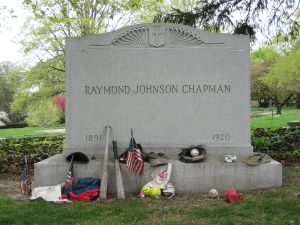
Chapman never moved, he seems not to have seen it coming. The crack of the ball hitting his head was so loud that Mays thought he had hit the end of the bat, fielding the ball and throwing to first for the out. Wally Pipp, the first baseman better known for losing his starting position to Lou Gehrig because of a headache, immediately knew something was wrong. The batter made no effort to run, slowly collapsing to the ground with blood streaming out of his left ear.

ray_chapman_grave29-year-old Ray Chapman had said this was his last year playing ball.  He wanted to spend more time in the family business he had just married into. The man was right.  Raymond Johnson Chapman died 12 hours later, the only player in the history of Major League Baseball, to die from injuries sustained during a game.
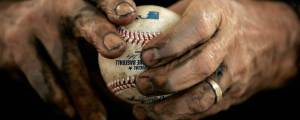
The age of one-ball-per-game died with Ray Chapman, and with it the era of the dead ball. The lively ball era, had begun. Batters loved it, but pitchers complained about having to handle all those shiny new balls.new-balls

MLB rule #3.01(c) states that “Before the game begins the umpire shall…Receive from the home club a supply of regulation baseballs, the number and make to be certified to the home club by the league president. The umpire shall inspect the baseballs and ensure they are regulation baseballs and that they are properly rubbed so that the gloss is removed. The umpire shall be the sole judge of the fitness of the balls to be used in the game”.

Umpires would “prep” the ball using a mixture of water and dirt from the field, but this resulted in too-soft covers, vulnerable to tampering. Something had to take the shine off the ball without softening the cover.

rubbing-mudPhiladelphia Athletics third base coach Lena Blackburne took up the challenge in 1938, scouring the riverbanks of New Jersey for just the right mud. Blackburne found his mud hole, describing the stuff as “resembling a cross between chocolate pudding and whipped cold cream”. By his death in the late fifties, Blackburne was selling his “Baseball Rubbing Mud” to every major league ball club in the country, and most minor league teams.rubbing-mud-2
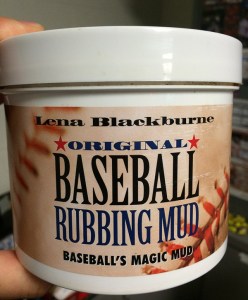
In a world where classified information is kept on personal email servers, there are still some secrets so pinky-swear-double-probation-secret that the truth may Never be known. Among them Facebook “Community Standards” algorithms, the formula for Coca Cola, and the Secret Swamp where Lena Blackburne’s Baseball Rubbing Mud comes from.

Nobody knows, but one thing is certain. The first pitchers will show up to the first spring training camp, a few short days short days from now. Every baseball thrown from pre-season to the 2017 World Series, will first have been de-glossed with Lena Blackburne’s famous, Baseball Rubbing Mud.

Go Sox.