January 19, 1945 Sibling Rivalry

Remember that familiar cat or those famous three stripes, next time you lace up.  You just might be wearing a piece of history.

In the biblical story of Genesis, Cain was born to Adam and Eve, followed by his brother Abel. The first to be born slew his own brother, the first human to die, and Cain was cast out to wander in the land of nod, east of Eden.

According to legend, the evil King Amulius ordered the twin sons of Rhea Silvia and the war god Mars drowned in the Tyber River. Instead the boys washed ashore, to be suckled by a she-wolf. Romulus and Remus founded a town on the site of their salvation, the traditional date being April 21, 753BC. Romulus later murdered his brother after some petty quarrel, making himself sole ruler of the settlement. He modestly called the place “Rome”, after himself.

Two thousand years later, two brothers come into this story. The enmity between Adolf and Rudolf Dassler never rose to fratricide but it came close, a hatred for one another which lasted, beyond the grave.  And you may be wearing one of their products, as you read this.

Oh.  Did I tell you they were both, Nazis?

The Bavarian town of Herzogenaurach is located in the Middle Franconia region of West Germany, about 14 miles from Nuremberg. In the early 20th century, the local textile economy collapsed in the face of more industrialized competitors. Many turned to shoe-making. By 1922, the small town of 3,500 boasted some 122 cobblers. Christoph Dassler was one such, specializing in felt slippers.

adolf_dassler
Adolf Dassler

Adolf “Adi” Dassler was the third son and youngest of four children born to Christoph and Paulina Dassler.  An avid sportsman and athlete, Adi engaged in a variety of sporting events including track & field, futbol, skiing and ice hockey.  Usually with close friend Fritz Zehlein, the son of a local blacksmith.

The “Great War” descended over Germany in 1914, and the elder Dassler boys were conscripted into the army. Not yet thirteen, Adi was apprenticed to a baker, but turned to his father instead to learn the intricate stitching of the cobbler. Adi was particularly interested in sports, and how the proper shoe could improve athletic performance.

Adi himself was drafted into the army in 1918, five months before his 18th birthday.

Adi returned to what he knew after the war, repairing shoes while starting a business of his own. The German economy lay in ruins.  Dassler was forced to scavenge war materials, to form his designs. Leather from bread pouches. Canvas from uniforms. And always the need to improvise, jury rigging available machinery in the absence of electricity.

Rudolf Dassler trained to become a police officer, but left to join his brother’s company, forming the Dassler Brothers Sports Shoe company, in 1924.  Dassler Brothers may have been the first to use metal spikes, fashioned by Adi’s old buddy, Fritz Zehlein.

The following year, the company was making leather Fußballschuhe with nailed studs and track shoes with hand-made spikes.

jesseowensadidasshoesFormer Olympian and coach of the German Olympic track & field team Josef Waitzer took an interest in the work, becoming a friend and consultant. Dassler brothers shoes were used in international competitions as early as the 1928 games in Amsterdam and the Los Angeles games, of 1932.

With the rise of Adolf Hitler and the Nazi party in 1933, it was hard not to see the economic self-interest, in politics. The Dassler brothers – Adi, Rudi and Fritz joined the party on May 1.

bundesarchiv_bild_183-r96374,_berlin,_olympiade,_jesse_owens_beim_weitsprung
Jesse Owens

For the family business, the big break came in 1936, when American Olympian Jesse Owens agreed to compete in Dassler Brothers shoes. This American athlete of African ancestry went on to win four gold medals, a humiliating defeat for Hitler’s Aryan “master race”, but the sporting world soon beat a path to Adi’s door.

Compared with his brothers, Rudi seems to have been the more ardent Nazi.  Adi confined himself to coaching Hitler Youth teams, while Rudi was off at rallies and political meetings.  It was much of what led to their parting of the ways.

Germany once again found itself at war and Adi switched over to producing army boots.  Christoph and Paulina lived with their two grown sons and their wives, and five grandchildren.  Käthe (Martz) Dassler, Adi’s wife, had frequent run-ins with her mother and father-in-law, and seems to have had a relationship of mutual detestation with Rudi’s wife, Friedl.

Family fault lines were already irreparable in 1943, when Adi and Käthe climbed into a bomb shelter, already occupied by his brother and his family. Adi commented “The dirty bastards are back again,” referring to Allied war planes overhead. Rudi was convinced his brother was talking about him.

Rudolf blamed his brother and his “Nazi friends” when he was called up to fight the Russians, in the east.  Adi himself was drafted but dismissed, when his civilian services were deemed indispensable to the war effort.

Stationed in Tuschin that April, Rudi wrote to his brother: “I will not hesitate to seek the closure of the factory so that you be forced to take up an occupation that will allow you to play the leader and, as a first-class sportsman, to carry a gun.”

The Soviet Red Army overran Tuschin on January 19, 1945, decimating Dassler’s unit.  Rudi fled to Herzogenaurach where a doctor certified him as militarily “incapable”, due to a frozen foot.

rudolf_dassler
Rudolf Dassler

Allied “de-nazification” efforts after the war led to a blizzard of recriminations between the two brothers, and the end of the Dassler Brothers Shoe Factory.  These two hated each other.

Adi Dassler’s new company would be known as Adidas.  Rudi tried to copy the idea and called his new company “Ruda”, but it didn’t have the same ring.  He settled on “Puma”.

Herzogenaurach became a two-factory town, a German Hatfield & McCoys.  The rivalry extended to the two football clubs in town, ASV Herzogenaurach and 1FC Herzogenaurach.  There were Adidas stores, and Puma stores. Adidas restaurants, and Puma restaurants.  And don’t even think about being served if you had the wrong shoes on your feet.  The place was so saturated with the hate these two brothers felt for each other, it came to be the “Town of Bent Necks“.   For sixty years, people ignored or talked with each other, based on whose side they were on.

The Dassler brothers never reconciled.  They are buried in the same cemetery, as far away from each other as it is possible to be.  The families are now out of the business, and so is the antagonism that held out for all those years.  So remember that familiar cat or those famous three stripes, next time you lace up.  You just might be wearing a piece of history.

071512_1035_adidasvspum1

If you enjoyed this “Today in History”, please feel free to re-blog, “like” & share on social media, so that others may find and enjoy it as well. Please click the “follow” button on the right, to receive email updates on new articles.  Thank you for your interest, in the history we all share.

January 17, 1976 He Gave us Laughter

Prodigious abuse of drugs and alcohol got Belushi fired on multiple occasions, but he always came back.  John Belushi was an original.  There was no other.

john_belushi_hs_yearbook
High School yearbook photo. “Killer” Belushi received a football scholarship to Western Illinois University, but turned it down.  He had other things to do.

Lead vocalist “Joliet Jake” Blues (John Belushi) and harmonica player/backing vocalist Elwood Blues (Dan Aykroyd) made their musical debut on January 17, 1976 in a comedy sketch on Saturday Night Live.

The Blues Brothers appeared on two more SNL sketches, both in 1978, before releasing their first album that same year: Briefcase Full of Blues. The Blues Brothers film created around the two characters was released in 1980.

Dan Aykroyd developed his musical talents during the late 1950s and early sixties at an Ottowa night club called Le Hibou (French for ‘the owl’), saying “I actually jammed behind Muddy Waters. S. P. Leary left the drum kit one night, and Muddy said ‘anybody out there play drums? I don’t have a drummer.’ And I walked on stage and we started, I don’t know, Little Red Rooster, something. He said ‘keep that beat going, you make Muddy feel good.”

Eric Idle of Monty Python was once an SNL guest host.  Idle paid the ultimate compliment to Aykroyd’s comedic ability, saying  he was “the only member of the SNL cast capable of being a Python“.

gty_the_blues_brothers_02jef_150625_16x9_992

John Belushi joined The Second City comedy troupe in 1971, playing off-Broadway in National Lampoon’s Lemmings, and played The National Lampoon Radio Hour from 1973 to ’75, a half-hour comedy program syndicated on over 600 stations.

hqdefault (10)He appeared from 1973 – ’75 on The National Lampoon Radio Hour, along with future SNL regulars Gilda Radner, Chevy Chase and Bill Murray. A number of radio segments went on to become SNL sketches in the show’s first couple of seasons.

Ackroyd tells a story about long days of rehearsals on the SNL set. An exhausted John Belushi would wander off and let himself into the house of a friend or a stranger, scrounging around for food and falling asleep in the house, unable to be found for the next day’s work. Such outings were the inspiration for the SNL horror-spoof sketch “The Thing That Wouldn’t Leave”.

Prodigious abuse of drugs and alcohol got Belushi fired on multiple occasions, but he always came back.  John Belushi was an original.  There was no other.

thingAnimal House, the film that launched Belushi’s career on the big screen, almost didn’t happen.

The first draft of the screenplay by Harold Ramis and Douglas Kenney was about Charles Manson in High School, entitled Laser Orgy Girls. The script was rejected, unsurprisingly, leading to a three-month cram writing session and an entirely different cast. Even then, the project only got off the ground when Donald Sutherland signed up to play Professor Jennings.

“Faber College” is really the University of Oregon, the only school that would let the production on campus. Years earlier, the Dean had declined to allow The Graduate to film there. He wasn’t going to miss another shot at Hollywood. Without even reading the script, this guy gave the production such carte blanche, that he allowed the use of his own office to film the Dean Wormer scenes.

I wonder if he ever had second thoughts.

Remember the band at the Dexter Lake Club? “Otis Day” was played by actor DeWayne Jessie. Animal House became so popular and such a boost to Jesse’s career that he legally changed his name.  To this day, he still tours with the band as “Otis Day and the Knights”.

There’s a popular myth that Belushi actually “chugged” a fifth of Jack Daniels during that one scene, but it was really ice tea.  Even so, Belushi’s abuse of drugs and alcohol, were legendary.  He would hire “bodyguards” and “trainers” to keep him on the straight & narrow, and then slip out the door.  Periods of sobriety were usually in response to a specific challenge – doing a movie, meeting a film deadline –  the same challenges that drove him over the edge and into another bender.

belushi

On the evening of March 4, 1982, Belushi spent the evening partying with Catherine Evelyn Smith, a former back-up singer and groupie for The Band described as a “strung-out addict and a drug dealer”, and former SNL writer Nelson Lyon.  The three ingested massive quantities of alcohol and even more cocaine, stumbling about the precincts of West Hollywood, looking for another party.

According to Smith, the pair ended up back at Belushi’s room at the Chateau Marmont, where Belushi asked her to shoot him up with a “Speedball”, a combined injection of heroine and cocaine.  Comedian Robin Williams and actor Robert DiNiro visited over the small hours of the morning, to find the pair in a daze.  Williams left around 3:00am saying “If you ever get up again, call.”

He later said he didn’t understand what Belushi was doing with “that lowlife”.

rs-28717-22878_lgJohn Belushi was found dead the following morning.  The cause of death was originally thought to be an accidental overdose.  Cathy Smith was extradited from Canada and tried on first degree murder charges following a National Enquirer interview in which she admitted giving Belushi eleven speedballs. A plea bargain reduced the charge to involuntary manslaughter.  She served fifteen months in prison.

In his 1984 book Wired: The Short Life & Fast Times of John Belushi, investigative journalist and non-fiction author Bob Woodward writes of a man out of control. Belushi’s widow Judith Jacklin Belushi participated in the project, apparently hoping for a more sympathetic depiction. “Instead”, writes Rolling Stone, “she got 432 pages of cold facts, the majority of them drug related and ugly”.

Film critic, screenwriter, and author Roger Ebert wrote: “The protests over Woodward’s unflinching portrait of Belushi’s last days reminds me (not with a smile) of an old Irish joke. The mourners are gathered around the dead man’s coffin.
“What did he die of?” one asks the widow.
“He died of the drink,” she says.
“Did he go to AA?”
“He wasn’t that bad.””

belushi-photo

Judy arranged for a traditional Albanian Orthodox Christian funeral in which Belushi was interred, twice. The first was in Chilmark on Martha’s Vineyard, an island just off Cape Cod, in Massachusetts. There, a classic New England slate tombstone, complete with skull and crossbones, marks the location. The inscription reads, “I may be gone but Rock and Roll lives on.” An unmarked tombstone in an undisclosed location marks his final resting place.

John Adam Belushi is remembered on the Belushi family marker at his mother’s grave at Elmwood Cemetery in River Grove, Illinois.  This stone reads, “HE GAVE US LAUGHTER”.

john-belushi

If you enjoyed this “Today in History”, please feel free to re-blog, “like” & share on social media, so that others may find and enjoy it as well. Please click the “follow” button on the right, to receive email updates on new articles.  Thank you for your interest, in the history we all share.

January 15, 1919 Slower than Cold Molasses, in January

Molasses, waist deep, covered the street and swirled and bubbled about the wreckage … Here and there struggled a form—whether it was animal or human being was impossible to tell. Only an upheaval, a thrashing about in the sticky mass, showed where any life was … Horses died like so many flies on sticky fly-paper. The more they struggled, the deeper in the mess they were ensnared. Human beings—men and women—suffered likewise

On May 6, 1954, Roger Bannister became the first human to run a sub-four minute mile, with an official time of 3 minutes, 59.4 seconds.

Jamaican sprinter Usain Bolt is the fastest man who ever lived. At the 2009 World Track and Field Championships, Bolt ran 100 meters at an average 23.35 mph from a standing start, and the 20 meters between the 60 & 80 markers, at an average 27.79 mph.

It would come as a rude shock to both of those guys, that they are literally slower than cold molasses.  In January.

File photo of Bolt of Jamaica competing in the men's 100 metres semi-final heat event during the IAAF World Athletics Championships at the Luzhniki stadium in Moscow
Usain Bolt

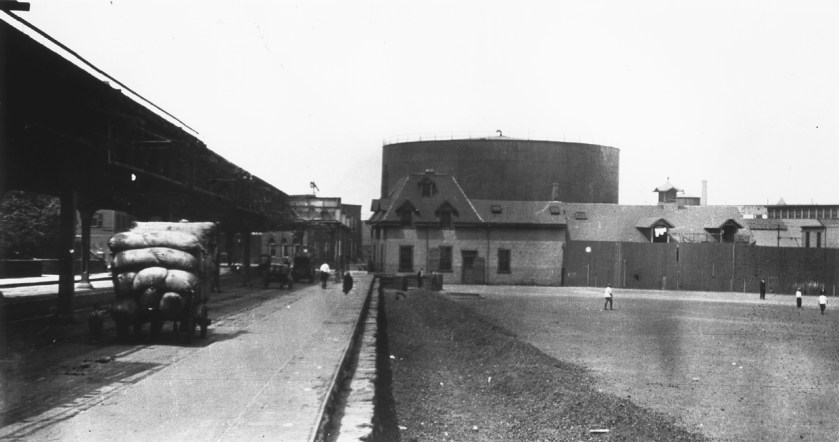
In 1919, the Purity Distilling Company operated a large molasses storage tank at 529 Commercial Street, in the North End of Boston. Fifty feet tall and ninety feet wide, the tank held 2.32 million gallons, about 14,000 tons of the sweet stuff, awaiting transfer to the Purity industrial alcohol distillation plant, in Cambridge.

It had been cold earlier in the month, but on January 15, it was a balmy 46°, up from the bitter low of 2° of the day before.

molasses-floods-boston.jpg7_

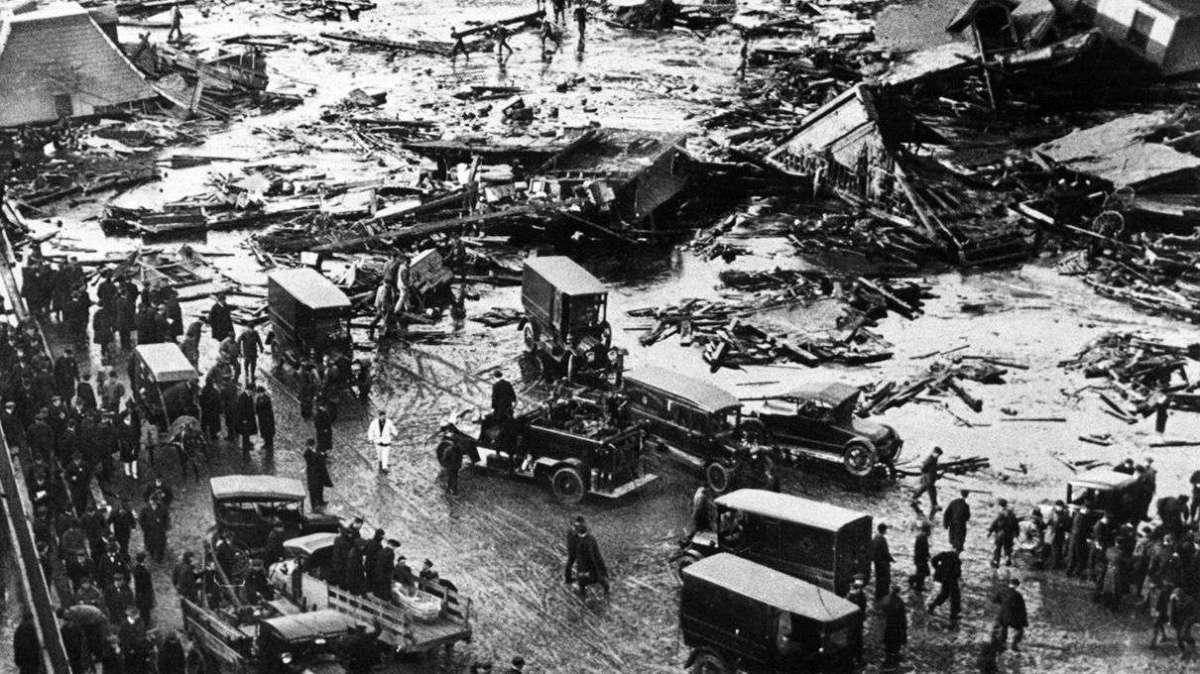
If you were there at about 12:30, the first sound you might have heard was a rumble, like the sound of a distant train. The next sound was like that of a machine gun, as rivets popped and the two sides of the metal tower split apart.

The collapse hurled a wall of molasses 40′ high down the street at 35 miles per hour, smashing the elevated train tracks on Atlantic Ave and hurling entire buildings from their foundations. Horses, wagons, and dogs were caught up with broken buildings and scores of people as the brown deluge sped across the North End. Twenty municipal workers were eating lunch in a nearby city building when they were swept away, parts of the building thrown fifty yards. Part of the tank wall fell on a nearby fire house, crushing the building and burying three firemen alive.

4944688057_166d60fb7a_b
The power of the deluge may be seen in the elevated rail, twisted and deformed as by the temper tantrum, of some titanic child.

In the 17th century, Sir Isaac Newton described the physical properties of fluids. Water, a “Newtonian” fluid, retains a constant viscosity (flow) between 32° and 212°, Fahrenheit. We all know what it is to swim in water, but a “non-Newtonian” fluid such as molasses, acts very differently. Non Newtonian fluids change viscosity and “shear”, in response to pressure. You do not propel yourself through non-Newtonian fluid, the stuff will swallow you, whole. Not even Michael Phelps is swimming out of all that gunk.

The Boston Post reported “Molasses, waist deep, covered the street and swirled and bubbled about the wreckage … Here and there struggled a form—whether it was animal or human being was impossible to tell. Only an upheaval, a thrashing about in the sticky mass, showed where any life was … Horses died like so many flies on sticky fly-paper. The more they struggled, the deeper in the mess they were ensnared. Human beings—men and women—suffered likewise”.

firefighters-tried-to-wash-the-molasses-away-with-freshwater-but-would-later-find-that-briny-seawater-was-the-only-way-to-“cut”-the-hardened-substance.-paranormalsoup-300
“Firefighters tried to wash the molasses away with freshwater, but would later find that briny seawater was the only way to “cut” the hardened substance”. H/T Historycollection.com

In 1983, a Smithsonian Magazine article described the experience of one child: “Anthony di Stasio, walking homeward with his sisters from the Michelangelo School, was picked up by the wave and carried, tumbling on its crest, almost as though he were surfing. Then he grounded and the molasses rolled him like a pebble as the wave diminished. He heard his mother call his name and couldn’t answer, his throat was so clogged with the smothering goo. He passed out, then opened his eyes to find three of his four sisters staring at him”.

All told, the molasses flood of 1919 killed 21 people, and injured another 150. 116 cadets from the Massachusetts Nautical School, now Mass Maritime Academy, were the first rescuers on-scene. They were soon followed by Boston Police, Red Cross, Army and Navy personnel. Some Red Cross nurses literally dove into the mess to rescue victims, while doctors and surgeons set up a makeshift hospital and worked around the clock.

It was four days before the search was called off for additional victims. The total cleanup was estimated at 87,000 man-hours.

The men playing cards at the firehouse looked out the windows and saw a dark wall that didn’t belong there. Whatever it was, the wall was coming right at them.

The rupture resulted from a combination of factors. Construction was so poor, locals knew they could come down and collect household molasses from drippings down the outside of the thing, which was leaking so badly it was painted brown to hide the leaks.

This was only the 6th or 7th time the tank had been filled to capacity, and rising temperatures almost surely helped to build up gas pressure inside the structure.

molasses part of tank

With temperatures being so cold, the rapid spread of all that molasses made no sense. The proverbial “cold molasses” had exploded it seemed, in January.  Newspapers speculated that there must be something more. A bomb, perhaps.

Newspapers would more profitably have resorted to their physics books. In fluid dynamics, a “gravity current” describes the horizontal flow in a gravitational field, of a dense fluid into a fluid of lesser density. Think about the way cold air rushes through an open doorway into a warm room, even with no wind behind it.

molasses flood, headline

Today, the site of the Great Molasses Flood is occupied by a recreational complex called Langone Park, featuring a Little League ball field, a playground, and boccie courts. The Boston Duck Tours DUKW’s regularly visit the place with their amphibious vehicles, especially the dark brown one. The one with the name “Molly Molasses”, painted on its side.

molly molasses

Feature image, top of page:  H/T Boston Globe.

If you enjoyed this “Today in History”, please feel free to re-blog, “like” & share on social media, so that others may find and enjoy it as well. Please click the “follow” button on the right, to receive email updates on new articles.  Thank you for your interest, in the history we all share.

January 14, 1699 Witchcraft Hysteria

The witchcraft hysteria launched by the Spanish Inquisition would dwarf what was to come in the English colony.

Four years before the Salem witch trials of 1692, Goodwife Ann “Goody” Glover and her young daughter worked as housekeepers, for the Goodwin family of Boston.   13-year-old Martha, one of the Goodwin girls, accused the younger Glover of stealing fabric. Ann’s daughter ran out in tears, which earned Martha a rebuke from Ann Glover. Four of the five Goodwin children soon began to writhe and carry on in a manner destined to become familiar, four years later. Their doctor concluded “nothing but a hellish Witchcraft could be the origin of these maladies.”

The following trial, contained no small amount of anti-Catholic bigotry. Cotton Mather, the socially and politically influential New England Puritan minister called Glover “a scandalous old Irishwoman, very poor, a Roman Catholick and obstinate in idolatry.”

Glover’s Gaelic was far better than her English, and the two “Irish speakers” hired to translate, probably made some of it up as they went along.  For Ann Glover, the final straw was her inability to complete the Lord’s Prayer. What may seem to the modern mind as mere doctrinal differences were at one time matters of life-and-death. As a Catholic, she was either unable or unwilling to complete the prayer with the Protestant doxology, “For thine is the kingdom, and the power, and the glory, forever, Amen”. It doesn’t exist in the Catholic recitation.

Ann Glover was hanged as a witch on November 16, 1688.

5554327958_7c0274e293_o-700x900
The Great Elm of Boston Common, toppled in a storm in 1876, once served as the city’s hanging tree.

The witchcraft hysteria to strike Massachusetts’ North Shore communities of Danvers, Ipswich, Andover and Salem four years later ended the lives of five men and fourteen women at the end of a rope, on Gallows Hill. As many as 17 more died in the tiny, freezing stone compartments that passed for jail cells. 81-year-old Giles Cory was “pressed” to death over two days and nights, as rocks were piled on his chest to extract his confession. Knowing that his possessions were forfeit to his tormentor should he confess; Cory’s only response was “more weight”.

A persistent myth holds that victims of the Salem witchcraft hysteria were burned at the stake, but English law in the North American colonies, forbade it. All the convicted witches of 1692, died by hanging.

Not so one hundred years earlier, across the Atlantic. The witchcraft hysteria launched by the Spanish Inquisition would dwarf what was to come in the English colony.

The Spanish Inquisition was one of several such inquisitions, launched to root out “heretics” between the 12th and 19th centuries. The Inquisitional system was based on ancient Roman law and carried out by the Latin church from Mexico to Peru to the Portuguese colony of Goa, in India. The overwhelming majority of sentences handed down by the inquisition, demanded penances such as wearing a cross sewn into the clothing, scourging, or going on pilgrimage. When a suspect was convicted of unrepentant heresy, the inquisitional tribunal was required by law to hand the condemned over to secular authorities for execution of sentence, which may include imprisonment, banishment, or burning at the stake.

dc1459b2fb0d7566e9f725eac1ae9316

The Italian astronomer Galileo Galilee was tried by the Roman inquisition in 1633 and held under house arrest until his death in 1642, for the heretical belief that the earth revolved around the sun. The last victim of the Inquisition was in Spain in 1826, when schoolteacher Cayetano Ripoll was executed by garrote, for teaching Deism in his school.

Interestingly, there seems zero evidence that either the Greek or the Russian Orthodox Church, ever conducted an inquisition.

Belief in witches was widespread in pre-Christian Europe but largely absent from the first thirteen hundred years of Christian thought. The medieval Church distinguished between “white” and “black” magic, and local folk practice mixed with appeals to patron saints to ward off disease, protect livestock and ensure a bountiful harvest. The vehement denunciation of witches was more a product of the late medieval and early renaissance periods, due to plague outbreaks and changes in weather brought about by the Little Ice Age.

The Malleus Maleficarum or “Hammer of the Witches” written in 1486 by Dominican priest Heinrich Kramer, elevated witchcraft to criminal status and advocated for its extermination. Kramer himself was expelled from Innsbruck for his beliefs and described as “senile”, but the work would have lasting effect.

zugarramurdi-4_grandeEducated Spaniards of the era considered witchcraft to be a Protestant superstition. The Spanish Inquisition, launched in 1478 to protect Catholicism as the One True Faith, went first after forced converts from Islam (Moriscos) and Judaism (Marranos) suspected of lapsing into their prior faith.

In 1609, the French judge Pierre de l’Ancre conducted a massive witch hunt in Labourd, a formerly French territory in the Basque Provinces of Spain. De l’Ancre has been described as “ridiculous”, an “obsessed fanatic”. In the year of his judgeship, seventy people were burned at the stake including several priests. Even then he wasn’t satisfied, believing as many as 3,000 witches had escaped his grasp;  10% of the entire population of Labourd, at that time.

The following year, witch trials began in the northern Spanish cities of Logroño, and Navarre. In Salem, Puritans investigated only a few hundred suspected witches, resulting in the death of 20. During the Basque witch trials of 1610-’14, some 7,000 would be examined by the Inquisition on charges of witchcraft and sentenced to auto-da-fé, a ritualized, public penance after the performance of which, the condemned would learn their fate.

witch-trials-basque

Of 44,674 cases tried by the Spanish inquisition, 826 resulted in burning at the stake. Another 778 died by torture and were burned, in effigy.

In August 1614, the central office of the Inquisition ordered that all witch trials be dismissed in Logroño, and introduced new and more rigorous standards of evidence.  Back in Massachusetts, the state declared a day of fasting on January 14, 1699, in memory of the wrongful persecutions from 1688-’92.

Sometime in the 1830s, the writer Nathaniel Hawthorne added the “W” his name, distancing himself from his twice-great grandfather and Salem witch trial judge, John Hathorne.  None of it did a lick of good for the poor collection of oddballs and outcasts, done to death in the earlier period.

January 12, 1967 Cryonic Suspension

Suffering from an incurable and metastatic kidney cancer, Dr. James Hiram Bedford became the first person in history to be cryonically preserved on January 12, 1967. Frozen at the boiling point of liquid nitrogen, −321° Fahrenheit, he remains in cryonic suspension, to this day.

The human brain is an awesome thing. Weighing in at about 3-pounds, the organ is comprised of something like 86 billion neurons, each comprised of a stoma or cell body, an axon to take information away from the cell, and anywhere between a handful and a hundred thousand dendrites bringing information in. Chemical signals transmit information over minute gaps between neurons called synapses, about 1/25,000th to 1/50,000th of the thickness of a sheet of paper.
There are roughly a quadrillion such synapses, meaning that any given thought could wend its way through more pathways than there are molecules in the known universe. This is roughly the case, whether you are Stephen J. Hawking, or Forrest Gump.
signaltransmissiondendritescellbodynucleussynapse
Figure Dendrites. Cell body. Nucleus. Axon hillock. Axon. Signal direction. Synapse. Myelin sheath. Synaptic terminals. Presynaptic cell. Postsynaptic cell.

For all of this, the brain cannot store either oxygen or glucose (blood sugar), meaning that there’s about 6 minutes after the heart stops, before the brain itself begins to die.
Legally, brain death occurs at “that time when a physician(s) has determined that the brain and the brain stem have irreversibly lost all neurological function”. Brain death defines the legal end of life in every state except New York and New Jersey, where the law requires that a person’s lungs and heart must also have stopped, before that person is declared legally dead.

“Information-theoretic death” is defined as death which is final and irreversible by any technology.  Clearly then, there is a gap, a small span of time, between the moment of legal death and a person’s permanent and irreversible passing.
So, what if it were possible to get down to the molecular level and repair damaged brain tissue. For that matter, when exactly does such damage become “irreversible”?
cryonics (1)
The Alcor Life Extension Foundation, the self-described “world leader in cryonics, cryonics research, and cryonics technology” explains “Cryonics is an effort to save lives by using temperatures so cold that a person beyond help by today’s medicine can be preserved for decades or centuries until a future medical technology can restore that person to full health”.
The practice is highly controversial, and not to be confused with Cryogenics, the study of extremely low temperatures, approaching the still-theoretical cessation of all molecular activity. Absolute zero.
The Cryogenic Society of America, Inc. includes this statement on its home page:
“We wish to clarify that cryogenics, which deals with extremely low temperatures, has no connection with cryonics, the belief that a person’s body or body parts can be frozen at death, stored in a cryogenic vessel, and later brought back to life. We do NOT endorse this belief, and indeed find it untenable”.
cryonic capsules
The modern era of cryonics began in 1962, when Michigan College physics professor Robert Ettinger proposed that freezing people may be a way to reach out to some future medical technology.
The Life Extension Society, founded by Evan Cooper in 1964 to promote cryonic suspension, offered to preserve one person free of charge in 1965. Dr. James Hiram Bedford was suffering from untreatable kidney cancer at that time, which had metastasized to his lungs.
Bedford became the first person to be cryonically preserved on January 12, 1967, frozen at the boiling point of liquid nitrogen, −321° Fahrenheit, and sealed up in a double-walled, vacuum cylinder called a “dewar”, named after Sir James Dewar, the 19th century Scottish chemist and physicist best known for inventing the vacuum flask, and for research into the liquefaction of gases.
kendi-istegiyle-dondurulan-ilk-insan-51-yildir-uyanmayi-bekliyor
Dr. James Hiram Bedford

Fifty-one years later, cryonics societies around the world celebrate January 12 as “Bedford Day”. Dr. Bedford has since received two new “suits”, and remains in cryonic suspension, to this day.

Advocates experienced a major breakthrough in the 1980s, when MIT engineer Eric Drexler began to publish on the subject of nanotechnology. Drexler’s work offered the hope that, theoretically, one day injured tissue may be repaired at the molecular level.
In 1988, television writer Dick Clair, best known for television sitcoms “It’s a Living”, “The Facts of Life”, and “Mama’s Family”, was dying of AIDS related complications. In his successful suit against the state of California, “Roe v. Mitchell” (Dick Clair was John Roe), Judge Aurelio Munoz “upheld the constitutional right to be cryonically suspended”, winning the “right” for everyone in California.
munoz
Judge Aurelio Munoz

The decision failed to make clear who was going to pay for it.

As to cost, a Cryonics Institute (CI) video advertises a cryopreservation fee of $28,000, payable in monthly installments of $25.
Ted Williams went into cryonic preservation in 2002, despite the bitter controversy that split the Williams first-born daughter Bobby-Jo Williams Ferrell, from her two half-siblings John-Henry and Claudia. The pair were adamant that the greatest hitter in baseball history wanted to be preserved to be brought back in the future, while Ferrell pointed out the will, which specified that Williams be cremated, his ashes scattered off the Florida coast.
The court battle produced a “family pact” written on a cocktail napkin, which was ruled authentic and allowed into evidence. So it is that Ted Williams’ head went into cryonic preservation in one container, his body in another.
ben_franklin-1-2-e1336601575917The younger Williams died of Leukemia two years later, despite a bone marrow donation from his sister. John-Henry joined his father, in 2004.
Walt Disney has long been rumored to be in frozen suspension, but the story isn’t true. After his death in 1966, Walt Disney was interred at Forest Lawn Memorial Park in Glendale, California.
In April 1773, Benjamin Franklin wrote a letter to Jacques Dubourg. “I wish it were possible”, Franklin wrote, “to invent a method of embalming drowned persons, in such a manner that they might be recalled to life at any period, however distant; for having a very ardent desire to see and observe the state of America a hundred years hence, I should prefer to an ordinary death, being immersed with a few friends in a cask of Madeira, until that time, then to be recalled to life by the solar warmth of my dear country! But…in all probability, we live in a century too little advanced, and too near the infancy of science, to see such an art brought in our time to its perfection”.
Maybe so but, for the several hundred individuals who have plunked down $25,000 to upwards of $200,000 to follow Dr. Bedford into cryonic suspension, hope springs eternal.

If you enjoyed this “Today in History”, please feel free to re-blog, “like” & share on social media, so that others may find and enjoy it as well. Please click the “follow” button on the right, to receive email updates on new articles.  Thank you for your interest, in the history we all share.


January 10, 1927 Poison Hooch

It’s a crazy, mixed up world full of nut job conspiracy theories. This is not one of those.

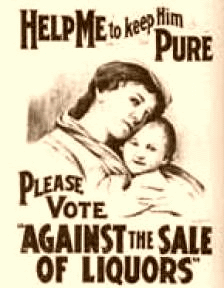
prohibition3The Eighteenth Amendment establishing the national prohibition of “intoxicating liquors” was passed out of Congress on December 17, 1917 and sent to the states, for ratification. The National Prohibition or “Volstead” act, so named for Chairman of the House Judiciary Committee Andrew Volstead, was enacted to carry out its intent.

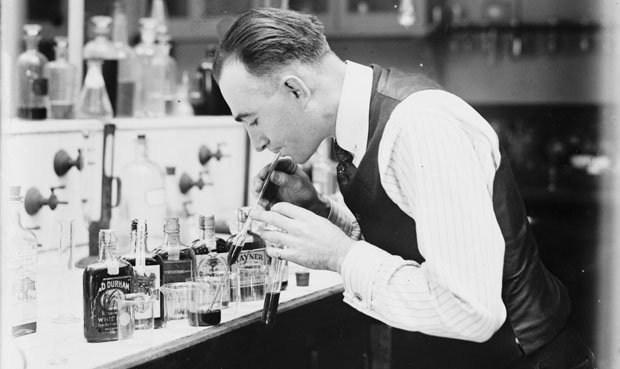
At last ratified in January 1919, “Prohibition” went into effect at midnight, January 16, 1920. For thirteen years, it was illegal to import, export, transport or sell liquor, wine or beer in the United States.

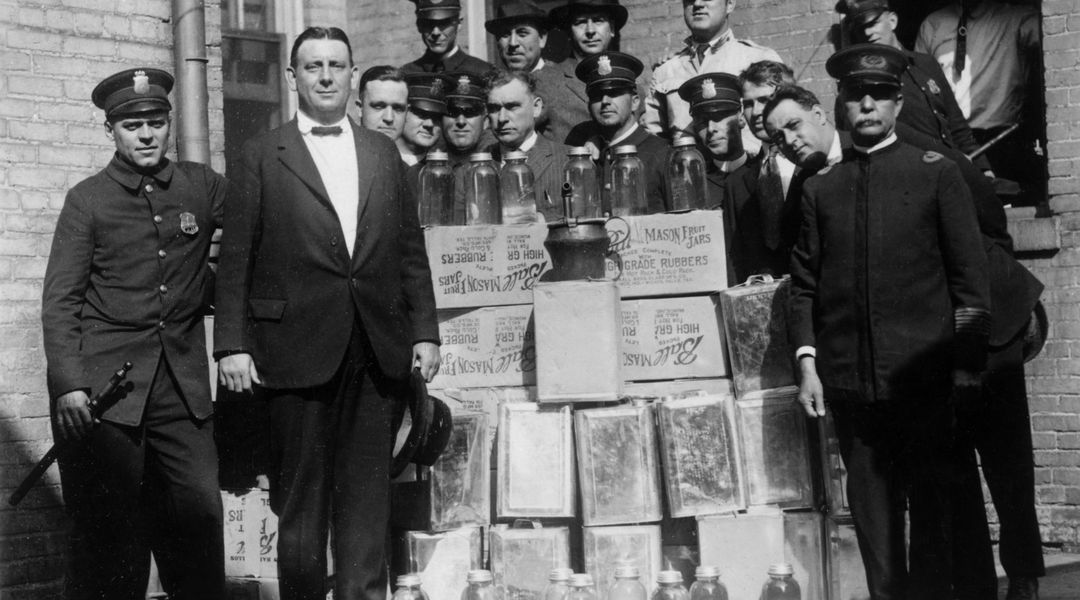
“Industrial alcohol” such as solvents, polishes and fuels were “denatured” and rendered unpalatable by the addition of dyes and chemicals.  The problem was, it wasn’t long before bootleggers figured out how to “renature” the stuff. The Treasury Department, in charge of enforcement at that time, estimated that over 60 million gallons of industrial alcohol were stolen during Prohibition.

war-propaganda
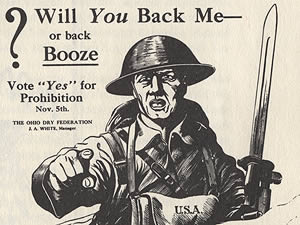
War-propaganda

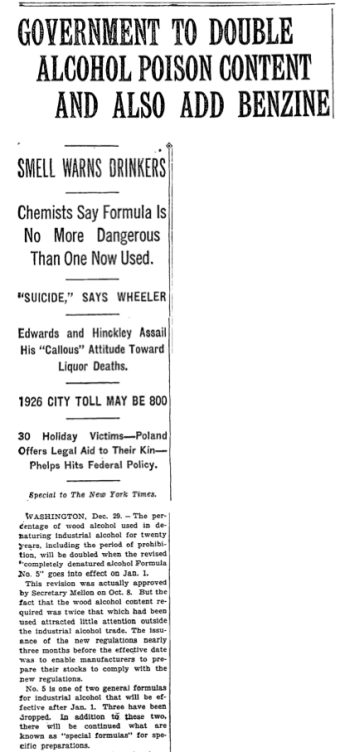
Not to be defied, the government upped the ante. By the end of 1926, denaturing processes were reformulated with the introduction of known poisons such as kerosene, gasoline, iodine, zinc, nicotine, formaldehyde, chloroform, camphor, quinine and acetone. Better still, Treasury officials required no less than 10% by volume of methanol, a virulent toxin used in anti-freeze.

You can renature all you want. that stuff isn’t coming out.

On Christmas eve 1926, sixty people wound up at New York’s Bellevue Hospital, desperately ill from contaminated alcohol. Eight of them died. Two days later the death toll was thirty-one. By New Year’s Day the number had soared to 400, with no end in sight.

copper-still
A copper still and bucket, like those used in the creation and renaturing of alcohol at home. H’T allthatsinteresting.com, and Chicago History Museum/Getty Images

Many who didn’t die, may have wished it. Drinkers experienced hallucinations, uncontrollable vomiting, even blindness.

In its January 10, 1927 issue, TIME Magazine reported  a doubling in toxicity levels, from the new method:  “The new formula included “4 parts methanol (wood alcohol), 2.25 parts pyridine bases, 0.5 parts benzene to 100 parts ethyl alcohol” and, as TIME noted, “Three ordinary drinks of this may cause blindness. (In case you didn’t guess, “blind drink” isn’t just a figure of speech.)”

New York medical examiner Charles Norris was quick to understand the problem, and organized a press conference to warn of the danger. “The government knows it is not stopping drinking by putting poison in alcohol,” he said. “Yet it continues its poisoning processes, heedless of the fact that people determined to drink are daily absorbing that poison. Knowing this to be true, the United States government must be charged with the moral responsibility for the deaths that poisoned liquor causes, although it cannot be held legally responsible.”

Norris pointed out that the poorest people of the city, were most likely to be victims: “Those who cannot afford expensive protection and deal in low-grade stuff”.

The towering sanctimony of the other side, is hard to believe.  Teetotalers argued that the dead had “brought it on themselves”. Long-time leader of the anti-saloon league Wayne B. Wheeler claimed “The Government is under no obligation to furnish the people with alcohol that is drinkable when the Constitution prohibits it. The person who drinks this industrial alcohol is a deliberate suicide.”

prohibition_2

In the thirteen years of its existence, Prohibition was an unmitigated disaster.  Portable stills went on sale within a week of enactment, and organized smuggling was quick to follow. California grape growers increased acreage by over 700% over the first five years, selling dry blocks of grapes as “bricks of rhine” or “blocks of port”. The mayor of New York City sent instructions to his constituents, on how to make wine.

Smuggling operations became widespread, as cars were souped up to outrun “the law”. This would lead to competitive car racing, beginning first on the streets and back roads and later moving to dedicated race tracks. It’s why we have NASCAR, today.

alcohol_poison_passed

Organized crime became vastly more powerful due to the influx of enormous sums of cash. The corruption of public officials was a national scandal.

Gaining convictions for breaking a law that everyone hated became increasingly difficult. The first 4,000 prohibition-related arrests resulted in only six convictions, and not one jail sentence.

It’s hard to compare alcohol consumption rates before and during prohibition but, if death by cirrhosis of the liver is any indication, alcohol consumption wasn’t reduced by any more than 10 to 20 per cent.

In the end, even John D. Rockefeller, Jr., a lifelong teetotaler who contributed $350,000 to the Anti-Saloon League, had to announce his support for repeal.

On December 5, 1933, Utah became the 36th state to ratify the Twenty-first Amendment, repealing the Eighteenth and voiding the Volstead Act, returning control over alcohol policy to the states.

Federal officials continued to poison industrial alcohol until the very end, resulting in the death of some 10,000 citizens.   They didn’t even pretend not to know, what was happening.  Assistant Secretary of the Treasury Seymour Lowman may have had the last word, among those who would say “I’m from the government, and I’m here to help”.  Lowman opined that, if deliberately poisoned alcohol resulted in a more sober nation, then “a good job will have been done.”

If you enjoyed this “Today in History”, please feel free to re-blog, “like” & share on social media, so that others may find and enjoy it as well. Please click the “follow” button on the right, to receive email updates on new articles.  Thank you for your interest, in the history we all share.

January 9, 1493 Of Mermaids and Manatees

“Pax Romana”, or “Roman Peace”, refers to a period between the 1st and 2nd century AD, when the force of Roman arms subdued most everyone standing against them. The conquered peoples described the period differently. Sometime in 83 or 84AD, Calgacus of the Caledonian Confederacy in Northern Scotland, said “They make a desert and call it peace”.

The conquests of Genghis Khan and his successors accomplished much the same during the 13th and 14th century. The “Pax Mongolica” effectively connected Europe with Asia, making it safe to travel the “Silk Road” from Britain in the west to China in the east. Great caravans carrying Chinese silks and spices came to the west via transcontinental trade routes. It was said of the era that “a maiden bearing a nugget of gold on her head could wander safely throughout the realm.”

Never mind the pyramids of skulls, over there.

The “Black Death” and the political fragmentation of the Mongol Empire brought that period to an end. Muslim domination of Middle Eastern trade routes made overland travel to China and India increasingly difficult in the 15th century. After Constantinople fell to the Ottoman Turks in 1453, such travel became next to impossible. Europe began to look for a water route to the East.

It’s popular to believe that 15th century Europeans thought the world was flat, but that’s a myth. Otherwise, the cats would have pushed everything over the edge, by now.

The fact that the world is round had been understood for over a thousand years, though 15th century mapmakers often got places and distances wrong. In 1474, Paolo dal Pozzo Toscanelli detailed a scheme for sailing westward to China, India and the Spice Islands. He believed that Japan, which he called “Cipangu”, was larger than it is, and farther to the east of “Cathay” (China). Toscanelli vastly overestimated the size of the Eurasian landmass, and the Americas were left out altogether.

This is the map that Christopher Columbus took with him in 1492.

Columbus had taken his idea of a westward trade route to the Portuguese King, to Genoa and to Venice, before he came to Ferdinand and Isabella in 1486. At that time the Spanish monarchs had a Reconquista to tend to, but they were ready in 1492. The Nina, Pinta and the Santa Maria sailed that August.

By January 9, 1493, the expedition had been at sea for six months. Sailing off the coast of Hispaniola, what we now call the Dominican Republic, Columbus spotted three “mermaids”.

They were Manatee, part of the order “Sirenia”. “Sirens” are the beautiful sisters, half birdlike creatures who live by the sea, according to ancient Greek mythology. These girls, according to myth, sang a song so beautiful that sailors were hypnotized, crashing their ships into rocks in their efforts to reach them.

Columbus seems not to have been impressed, describing these mermaids as “not half as beautiful as they are painted.”

Small wonder. These marine herbivores measure 10 to 13-feet from nose to tail, and weigh in at 800-1,200 lbs.

Not everyone was quite so dismissive. A hundred years later, the English explorer John Smith reported seeing a mermaid, almost certainly a Manatee. It was “by no means unattractive”, he said, but I’m not so sure. It’s just possible Mr. Smith needed to get out a little more.

January 7, 1927 Harlem Globetrotter

No less a figure than Wilt Chamberlain said “Meadowlark was the most sensational, awesome, incredible basketball player I’ve ever seen. People would say it would be Dr. J or even Jordan. For me it would be Meadowlark Lemon”.

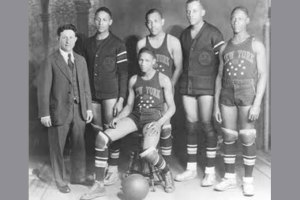
In 1926, 24 year old Abraham Saperstein organized a basketball team.  He called it the “Savoy Big Five,” after Chicago’s famous Savoy Ballroom.  At least that’s what the official team history says, except the Savoy didn’t open until 1927, so we may have to just go with it.

January 7, 1927 Harlem Globetrotters

Saperstein renamed them the “Harlem Globetrotters”, even though they were from Chicago, the team arriving in a Model “T” Ford for their debut game on January 7, 1927.   For two years it had been exhibition games before dances.  Now, the big game in Hinckley, Illinois would be played in front of 300 fans, with a total game payout of $75.

harlemglobetrotters1927
Harlem Globetrotters, 1927

They toured Wisconsin, Minnesota, and Iowa, playing almost every night against any and all challengers. Saperstein himself sometimes suited up to fill in for an injured player.  The Globetrotters played their 1000th game in Iron Mountain, Michigan in 1934.

In 1941, Negro League 1st baseman Reece “Goose” Tatum caught Saperstein’s eye.  A goose-tatummulti-sport athlete and teammate of Satchel Paige, Tatum would entertain the crowd with comedic routines whenever he put a runner out.  He was 6’4″ with an 84″ wingspan, able to touch his knees without bending. He’s credited with inventing the hook shot, an early version of the “skyhook” that would make Kareem Abdul-Jabbar famous, 30 years later.

Tatum was the original “Clown Prince” of the Globetrotters, though that title more often goes Meadowlark Lemon and his confetti-in-the-water-bucket routine.  Tatum combined natural athletic ability with a comedic timing that would change the whole direction of the club.  He passed away in 1967 at the age of 45, when sports reporter Lawrence Casey of the Chicago Daily Defender wrote, “Like Joe Louis in boxing, Babe Ruth in baseball, Bobby Jones in golf, Goose Tatum was king of his chosen sport.”

When Goose was drafted into the Army Air Corps in 1942, the Globetrotters signed their bob-karstensthird Caucasian, the first-ever white player to be offered a contract, Bob Karstens.  Karstens was the newest showman on the team, creating the signature pregame “Magic Circle,” the behind-the-back backhand shot, the “yo-yo” basketball and the “goofball,” a basketball filled with weights to give it a crazy bounce.  It was the early 1940s and the Harlem Globetrotters were the most famous, and the most profitable, professional basketball franchise in the world.

A near-fatal car accident cost Boid Buie his left arm when he was 13.  Never a great athlete before the crash, he worked so hard on his goals that Buie became the “One Armed Firecracker”.  He signed with the Globetrotters in 1946, playing 9 seasons as a starter and averaging 14 points per game.  Ever since the 2011 Elite Showcase Basketball Classic, the MVP Award is presented in the name of Boid Buie.buie

The Globetrotters were a serious basketball team throughout the early years, winning the World Professional Basketball Tournament as late as 1940.  They gradually worked more comic routines into their game in the late 40s and 50s as the newly founded NBA gained popularity until finally, they were better known for entertainment than for sport.

“Playing the bones” has a musical history going back to ancient China, Egypt, Greece and Rome.  Part of 19th century minstrel shows and traditional to musical genres ranging from Irish, to Bluegrass, to Zydeco. Freeman Davis’ “Brother Bones” recording of the 1925 jazz standard “Sweet Georgia Brown” became the Globetrotters’ theme song in 1952.

Former point guard with the NBA Baltimore Bullets, Louis “Red” Klotz, formed an exhibition team in 1952 to play against the Globetrotters.  In a nod to future President Dwight Eisenhower, he called them the Washington Generals.  The Generals played serious basketball while their opponents juggled balls, spun them on fingertips, and made trick shots.  The two teams played 13,000 games between 1953 and 1995, of which the Generals actually won 6.

Those of us who came of age in the 70s remember Curley Neal and Meadowlark Lemon,

who joined the club in 1954.  Who remembers that Wilt “the stilt” Chamberlain joined theteam four years later?  Chamberlain would be the first Globetrotter to have his jersey retired.

Chamberlain and the Globetrotters did their part to warm the Cold War, with a nine game series in Moscow, in 1959.  The Generals stayed at home, this time they brought the “Chinese Basketeers”.  An audience of 14,000 sat in stupefied silence, finally warming when they realized that this was more show than sport.  The team was paid the equivalent of $4,000 per game which could only be spent in Moscow, prompting the American press to observe that the Soviets were becoming capitalists.

abe-sapersteinAbe Saperstein passed away in 1966, aged 63.  The owner and founder of the Harlem Globetrotters, he was also founder and first Commissioner of the American Basketball League, and inventor of the three point shot.   Elected to the Basketball of Fame in 1971.  Here’s a great trivia question for you.  At 5’3″, Saperstein is the shortest male member in the place.  In 2005, he was inducted into the National Jewish Sports Hall of Fame.

Meadowlark Lemon “defends” Betty Ford

Saperstein’s creation went on, signing Olympic Gold Medalist Lynette Woodard their first ever female player in 1985.  Pope John Paul II became an honorary Globetrotter in 1986, in a ceremony in front of 50,000 in Saint Peter’s Square.

The list of official honorary Globetrotters includes Henry Kissinger, Bob Hope, Kareem Abdul-Jabbar, Whoopi Goldberg, Nelson Mandela, Jackie Joyner-Kersee, and Jesse Jackson.  Jesse Owens, the track star who stuffed Adolf Hitler at the 1936 Berlin olympics, accompanied the Globetrotters to Berlin in 1951.  Bill Cosby and Magic Johnson are both signed to $1 a year lifetime contracts, though Cosby’s contract was increased to $1.05 in 1986.

Ninety years after their founding, the Harlem Globetrotters show no signs of slowing down.  In 2015, the team drafted 6’6″ 2015 college slam dunk champion LaQuavius Cotton from Mississippi’s Delta State University, and trick shot expert “Dude Perfect” of Mickinney, Texas.  How do you not root for a team with two guys named LaQuavius Cotton and Dude Perfect?

pope-francis“Flight Time Lang” teaches Pope Francis to spin the ball

Shortly before he passed in 1999, Wilt Chamberlain was asked about the greatest basketball player of all time.  “Meadowlark was the most sensational, awesome, incredible basketball player I’ve ever seen.  People would say it would be Dr. J or even Jordan. For me it would be Meadowlark Lemon.”  Meadowlark Lemon played over 16,000 games with the Harlem Globetrotters before retirement, and passed away on December 27, 2015 in Scottsdale, Arizona, aged 83.  Rest in Peace, sir.  You brought a lot of smiles to the little boy in me.

January 4, 1903 Electrocuting an Elephant

In the six years I’ve been writing “Today in History”, I’ve written about 700 of these stories. A father isn’t supposed to have favorites among his “children”, but I have to confess. I do. This is not one of those. This story, I detest.

Thomas Edison didn’t invent the light bulb.  The first platinum filament bulb arrived some forty years earlier. What he did was to make the thing commercially viable, earlier versions being too expensive, and too quick to burn out. Edison went through thousands of materials before discovering the right filament, finally landing on carbonized bamboo leading to his famous quip, “I have not failed. I’ve just found 10,000 ways that won’t work.”

topsy
Topsy

Half a world away from Edison’s workshop, an elephant was born in the jungles of Southeast Asia, captured by elephant traders and smuggled into the United States.

Adam John Forepaugh, owner of the Forepaugh Circus, bought the animal and named her “Topsy”, after a slave girl from Harriet Beecher Stowe’s novel, Uncle Tom’s Cabin.

Circuses of the era were known for sleazy business practices. Adam Forepaugh was at home in this environment. The Forepaugh circus claimed Topsy was the first elephant born in America, a hoax publicly exposed when the elephant trader who sold the animal, tipped off arch-rival circus operator, P.T. Barnum.

Edison opened his first electrical power plant in 1882, in New York city. Two years later, a young Serbian immigrated to America, and went to work for Edison. His name was Nikola Tesla. Tesla was himself a brilliant inventor and helped his boss improve his Direct-Current generators, while simultaneously developing a different method of electrical distribution: Alternating Current.

Tesla tried to convince Edison the future belonged to AC, but the “Wizard of Menlo Park” was adamant. AC had no future he claimed, Edison would not budge. Tesla quit his job in 1885 and applied for several patents for his work in AC technology. In 1888, he sold his patents to industrialist George Westinghouse, and the Westinghouse Electric Company. The “War of the Currents” had begun.

edison-first-bulb
Edison’s first bulb

Topsy grew to be 10-feet tall and twenty-feet long, and worked for the circus for 27 years.  She gained a reputation for being a “bad” elephant, but it’s hard to separate circus hype, from reality.  Newspapers of course, were happy to play along.   These were the days of Yellow Journalism, and circulation wars were red hot.  Newsies hawked lurid headlines, on the streets. Anything to sell papers – extra extra, read all about it.

forepaugh-elephants-(no-dat

Topsy was supposed to have killed twelve men by 1900.  More common accounts claim she had killed two Forepaugh & Sells Brothers’ Circus workers: one in Paris, Texas and one in Waco.  Journalist Michael Daly wrote in 2013 there is no record of anyone killed by an elephant in Waco.  The handler attacked in Paris received injuries, but there is no record of his being killed.

No matter, the story sold papers.  It was great for attendance too.  People crowded into the circus to see the “man-killing elephant”.

Topsy and the other elephants were being unloaded from a train in June 1902, when one Louis Dodero thought he’d”tickle” her, behind the ear. Topsy seized him around the waist and lifted him high, before hurling him to the ground. It could have been worse but a handler stepped in and savaged her, with a fork.

topsy_the_elephant
An illustration of Topsy from the St. Paul Globe on June 16, 1902. H/T Smithsonian.com

Meanwhile, Edison felt threatened by the rise of AC, which could be distributed over long distances far more cheaply, that DC.  Edison launched a propaganda campaign, publicly executing several dogs and even a horse, to demonstrate the dangers of AC.

When New York came looking for a more humane way to execute the condemned, the one-time opponent of capital punishment recommended an electric chair. In 1890, convicted murder William Kimmler was the first person to die in an electric chair, the apparatus powered by a Westinghouse AC generator designed by a salesman secretly on Edison’s payroll.

Despite such propaganda, Tesla’s low-cost alternative won out. Westinghouse won the contract to power the 1893 World’s Fair in Chicago, and the all-important generators, at Niagara Falls. The War of the Currents was over by 1896. AC has remained dominant in the power industry, to this day.

the current war

In March 1902, one James Fielding Blount entered the elephant’s tent, possibly drunk.  Accounts vary as to what happened next.  The common story is that Blount began teasing the animals each in turn, offering the elephants a bottle of whiskey. He reportedly threw sand in Topsy’s face and then burned the tip of her trunk with a cigar.  Topsy hurled the fool to the ground and crushed the life out of him

320px-topsy_elephant_electrocution_luna_park,_coney_island_january_1903
Being led to the place of execution

Forepaugh sold their “bad” elephant in June, when she was added to the animal menagerie at Coney Island’s Sea Lion Park. William “Whitey” Alt, Topsy’s handler, came along.

A bad summer season and heavy competition convinced owner Paul Boynton to get out of the business. New owners Frederick Thompson and Elmer Dundy decided to expand the park, and Topsy was put to work moving timbers and heavy equipment.

Newspapers and publicity shots characterized the work as “penance” for Topsy’s rampaging ways.

Meanwhile Alt, an habitual drunk and the only person who could handle her (albeit brutally), stabbed Topsy with a pitchfork and then set her loose to run free in the streets. The episode led to Alt’s arrest as did another, in which the drunk handler rode the elephant through the streets of Coney Island and into a local police station, causing the officers to dive for the cells for protection.

Alt was fired after that episode, and the owners claimed they had no way of handling the park’s elephant.  Thompson and Dundy tried to give her away without success, before hitting on an idea.  They would execute their problem elephant by hanging, and charge admission to witness the spectacle.

electrocuting_an_elephant_edison_film_1903_frame_shot

President of the American Society for the Prevention of Cruelty to Animals John Peter Haines got wind of the plan, and objected to the “needlessly cruel” means of execution. Weeks of negotiations ensued, in which the owners offered to give Topsy to the SPCA, before settling on an “all of the above” means of execution including poison, strangulation by means of ropes tied to a steam powered winch, and electrocution.

The execution was carried out on August 4, 1903 and recorded by an Edison film crew, one of many “actuality” films produced by the Edison Mfg. Co. from 1897, on.  The short film “Executing an Elephant” runs for 74 seconds. You can find it on Youtube if you are so inclined. I don’t want to see it again.

In the following years, Thomas Edison was blamed for staging the spectacle, to discredit his rival. The story is repeated from that day to this, but it’s a myth.

Edison lost his battle to supply the world’s electricity, years before. There’s no evidence he was even there on the date of execution, and his written correspondence contains no mention of it.  This then, is the story of an innocent animal, caught between ignorance and a changing business climate.  I do not think I could hate this story, more.


January 1, 45 BC Happy New Year

A time ball is a marine time signaling device, a large painted ball which is dropped at a predetermined rate, enabling mariners to synchronize shipboard marine chronometers for purposes of navigation. The first one was built in 1829 in Portsmouth, England, by Robert Wauchope, a Captain in the Royal Navy. Time balls were obsolete technology by the 20th century, but it fit the Times’ purposes.

From the 7th century BC, the Roman calendar attempted to follow the cycles of the moon. The method frequently fell out of phase with the change of seasons, requiring the random addition of days. The Pontifices, the Roman body charged with overseeing the calendar, made matters worse. They were known to add days to extend political terms, and to interfere with elections. Military campaigns were won or lost due to confusion over dates. By the time of Julius Caesar, things needed to change.

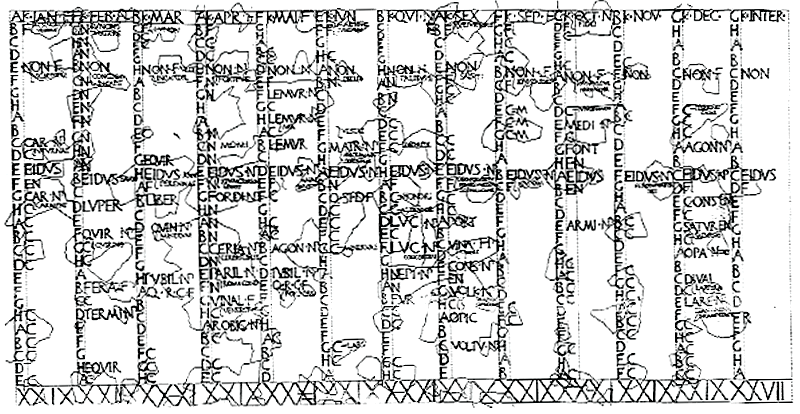
When Caesar went to Egypt in 48BC, he was impressed with the way the Egyptians handled their calendar. Caesar hired the Alexandrian astronomer Sosigenes to help straighten things out. The astronomer calculated that a proper year was 365¼ days, which more accurately tracked the solar, and not the lunar year. “Do like the Egyptians”, he might have said, the new “Julian” calendar going into effect in 46BC. Caesar decreed that 67 days be added that year, moving the New Year’s start from March to January 1. The first new year of the new calendar was January 1, 45BC.

Caesar synchronized his calendar with the sun by adding a day to every February, and changed the name of the seventh month from Quintilis to Julius, to honor himself. Rank hath its privileges.

Not to be outdone, Caesar’s successor changed the 8th month from Sextilis to Augustus. As we embark on the third millennium, we still have July and August.

Roman-calendar (1)
Roman Calendar

Sosigenes was close with his 365¼ day long year, but not quite there. The correct value of a solar year is 365.242199 days. By the year 1000, that 11 minute error had added seven days. To fix the problem, Pope Gregory XIII commissioned Jesuit astronomer Christopher Clavius to come up with yet another calendar. The Gregorian calendar was implemented in 1582, omitting ten days and adding a day on every fourth February.

Most of the non-Catholic world took 170 years to adopt the Gregorian calendar. Britain and its American colonies “lost” 11 days synchronizing with it in 1752. The last holdout, Greece, would formally adopt the Gregorian calendar in 1923. Since then, we’ve all gathered to celebrate New Year’s Day on the 1st of January.

The NY Times Newspaper moved into “Longacre Square” just after the turn of the 20th century. For years, New Years’ eve celebrations had been held at Trinity Church. Times owner Adolph Ochs held his first fireworks celebration on December 31, 1903, with almost 200,000 people attending the event. Four years later, Ochs wanted a bigger spectacle to draw attention to the newly renamed Times Square. He asked the newspaper’s chief electrician, Walter F. Painer for an idea. Painer suggested a time ball.

83_big.jpg

A time ball is a marine time signaling device, a large painted ball which is dropped at a predetermined rate, enabling mariners to synchronize shipboard marine chronometers for purposes of navigation. The first one was built in 1829 in Portsmouth, England, by Robert Wauchope, a Captain in the Royal Navy. Time balls were obsolete technology by the 20th century, but it fit the Times’ purposes.

The Artkraft Strauss sign company designed a 5′ wide, 700lb ball covered with incandescent bulbs. The ball was hoist up the flagpole by five men on December 31, 1907. Once it hit the roof of the building, the ball completed an electric circuit, lighting up a sign and touching off a fireworks display.

best_4d32a97cf1505d8dca5f_sompixnyctimessquareballvintage.jpg

The newspaper no longer occupies the building at 1 Times Square, but the tradition continues. The ball used the last few years is 12′ wide, weighing 11,875lbs; a great sphere of 2,688 Waterford Crystal triangles, illuminated by 32,256 Philips Luxeon Rebel LED bulbs and producing more than 16 million colors. It used to be that the ball only came out for New Year. The last few years, you can see the thing, any time you like.

times-square-ball (1).jpg

In most English speaking countries, the traditional New Year’s celebration ends with the singing of “Auld Lang Syne”, a poem written by Robert Burns in 1788 and set to the tune of an old pentatonic Scots folk melody. The original verse, phonetically spelled as a Scots speaker would pronounce it, sounds something like this:

“Shid ald akwentans bee firgot, an nivir brocht ti mynd?
Shid ald akwentans bee firgot, an ald lang syn?
CHORUS
“Fir ald lang syn, ma jo, fir ald lang syn,
wil tak a cup o kyndnes yet, fir ald lang syn.
An sheerly yil bee yur pynt-staup! an sheerly al bee myn!
An will tak a cup o kyndnes yet, fir ald lang syn”.
“We twa hay rin aboot the braes, an pood the gowans fyn;
Bit weev wandert monae a weery fet, sin ald lang syn”.
CHORUS
“We twa hay pedilt in the burn, fray mornin sun til dyn;
But seas between us bred hay roard sin ald lang syn”.
CHORUS
“An thers a han, my trustee feer! an gees a han o thyn!
And we’ll tak a richt gude-willie-waucht, fir ald lang syn”.

If you enjoyed this “Today in History”, please feel free to re-blog, “like” & share on social media, so that others may find and enjoy it as well. Please click the “follow” button on the right, to receive email updates on new articles.  Thank you for your interest, in the history we all share.  Happy New Year