For nigh on seventy years, few knew from where this little known bit of verse, had come.
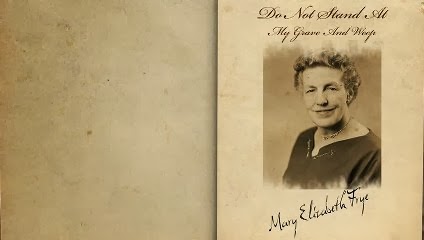
In the early 1930s, Mary Elizabeth Frye was a Baltimore housewife and amateur florist, the wife of clothing merchant, Claud Frye.
A young Jewish girl was living with the couple at this time, unable to visit her sick mother in Germany, due to the growing anti-Semitic violence of the period. Her name was Margaret Schwarzkopf.
Margaret was bereft when her mother died, heartbroken that she could never “stand by my mother’s grave and shed a tear.” Mrs Frye took up a brown paper shopping bag, and wrote out this twelve line verse.
She didn’t title the poem, nor did she ever publish it, nor copyright the work. People heard about it and liked it so Frye would make copies, but that’s about it.
For nigh on seventy years, few knew from where this little known bit of verse, had come.
Over the years, there have been many claims to authorship, including attributions to traditional and Native American origins.
The unknown poem has been translated into Danish, Dutch, French, German, Hebrew, Ilocano, Japanese, Korean, Russian, Spanish, Tagalog and other languages, appearing on countless bereavement cards and read over untold funeral services.
The English translation of one Swedish version reads: “Do not weep at my grave – I am not there / I am in the sun’s reflection in the sea / I am in the wind’s play above the grain fields / I am in the autumn’s gentle rain / I am in the Milky Way’s string of stars / And when on an early morning you are awaked by bird’s song / It is my voice that you are hearing / So do not weep at my grave – we shall meet again.”
Many in the United Kingdom heard the poem for the first time in 1995, when a grieving father read it over BBC radio in honor of his son, a soldier slain by a bomb in Northern Ireland. The son had left the poem with a few personal effects, and marked the envelope ‘To all my loved ones’.
For National Poetry Day that year, the British television program The Bookworm conducted a poll to learn the nation’s favorite poems, subsequently publishing the winners, in book form. The book’s preface describes “Do Not Stand at My Grave and Weep” as “the unexpected poetry success of the year from Bookworm’s point of view… the requests started coming in almost immediately and over the following weeks the demand rose to a total of some thirty thousand. In some respects it became the nation’s favourite poem by proxy… despite it being outside the competition.”
All this at a time when the name and even the nationality of the author, was unknown.
Abigail Van Buren, better known as “Dear Abby”, researched the history of the poem in 1998, and determined that Mrs. Frye was, after all, the author.
Mary Elizabeth Frye passed away in Baltimore Maryland on September 4, 2004. She was ninety-eight.
The Times of Great Britain published her untitled work on November 5, as part of her obituary. ‘The verse demonstrated a remarkable power to soothe loss”, wrote the Times. “It became popular, crossing national boundaries for use on bereavement cards and at funerals regardless of race, religion or social status”.
“I Did Not Die”
by Mary Elizabeth Frye
Do not stand at my grave and weep, I am not there; I do not sleep. I am a thousand winds that blow, I am the diamond glints on snow, I am the sun on ripened grain, I am the gentle autumn rain. When you awaken in the morning’s hush I am the swift uplifting rush Of quiet birds in circling flight. I am the soft star-shine at night. Do not stand at my grave and cry, I am not there; I did not die.
If you enjoyed this “Today in History”, please feel free to re-blog, “like” & share on social media, so that others may find and enjoy it as well. Please click the “follow” button on the right, to receive email updates on new articles. Thank you for your interest, in the history we all share.
“Standing as I do in view of God and Eternity, I realise that patriotism is not enough, I must have no hatred or bitterness towards anyone”. – Edith Cavell, October 11, 1915
The Cavell vicarage in Swardeston is now a private home
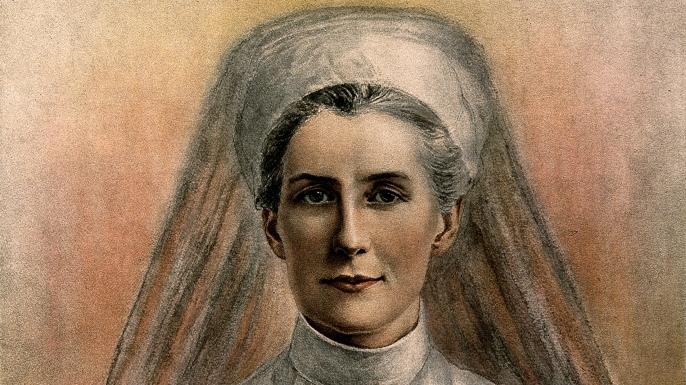
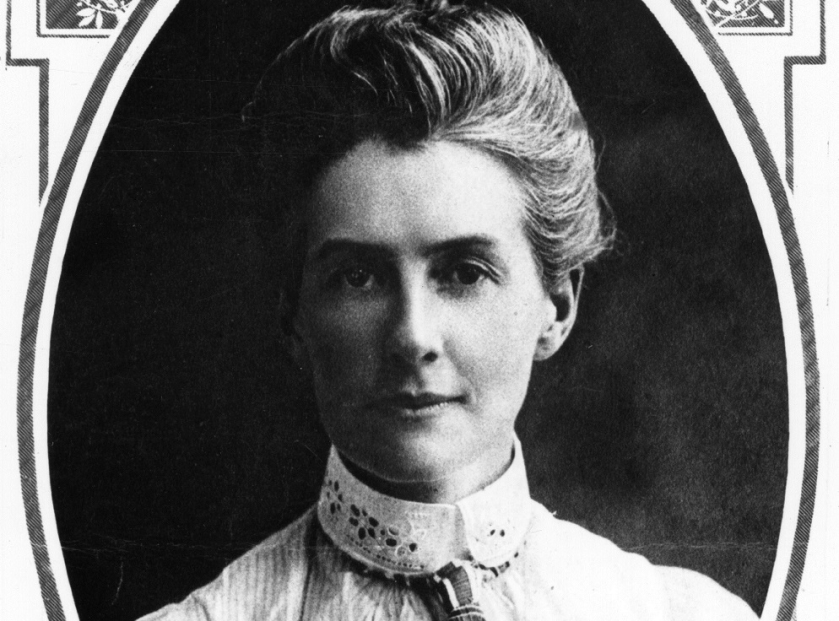
As a little girl growing up in Swardeston, Norfolk, Edith Cavell was no saint. Nor was she a “bad girl “. Just a normal kid, growing up in Victorian England. The daughter of a Vicar of the Church of England, she thought her father’s sermons were ‘boring’. Even so, she would hold her Christian faith until the day she died.
Reverend Frederick Cavell was something of a Puritan and nearly ruined the family finances, building the vicarage with his own money. Yet, this was no crabbed and dour man of the cloth. He was easily tempted into roaring like a bear and chasing the three Cavell sisters and their brother about the house, to squeals of children’s laughter.
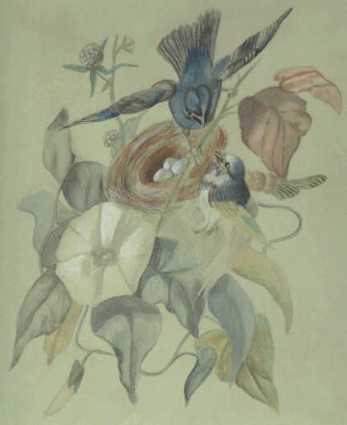
Chalk drawing by Edith Cavell
A gifted artist, Edith loved to paint and draw, the birds, flowers and even fellow villagers, frequent subjects. She and her sister once painted and sold cards to finance a new room in their father’s Sunday school, raising the impressive sum of £300.
As a young woman, she once danced until her feet bled, and destroyed a new pair of shoes, in the process.
Edith worked a number of jobs as governess, including one in Brussels, Belgium. The children under her care remembered her as wonderfully kind and always smiling, and great fun to be with.
On Summer breaks she’d return to Swardeston, where she loved to play tennis, and to paint. It was there that she cared for her father in 1895, nursing the parson through a brief illness. Reverend Cavell recovered, but the experience convinced Edith, she was cut out for a career in nursing.
Edith Cavell with Dr. LePage at the Berkendael Institute
Following training at Royal London Hospital, Edith worked a number of positions, rising through the ranks and becoming matron of Queen’s District Nursing Homes, in 1906. The following year, Edith returned to Brussels at the request of Dr. Antoine Depage, to nurse a child patient under his care. That October, Depage opened the nursing school ‘L’École Belge d’Infirmières Diplômées’ based in his Berkendael Institute, and asked Edith to run it.
In 1913, Cavell’s educational program was producing exceptionally qualified professional nurses, providing for the staffing needs of three hospitals, 24 communal schools and 13 kindergartens. When Queen Elizabeth of Belgium fell and broke her arm, one of Edith’s nurses was personally requested, to provide her care.
On top of it all. she was still giving four lectures a week to doctors and nurses, and still finding time to care for a friend’s daughter who was addicted to morphine, providing for a runaway girl, and for her two dogs, Don and Jack.
In June 1914, a tubercular nineteen-year-old named Gavrilo Princip murdered the heir-apparent to the dual monarchy of the Austro-Hungarian Empire, in Sarajevo. As diplomats bungled their way through the “July Crisis” of 1914, Edith returned to Norfolk, to visit with her now widowed mother. She was pulling weeds from the garden on August 1, when she learned that Austro-Hungarian troops had invaded Serbia.
Entangling alliances and mutual distrust drew a continent into war in the days that followed, as Edith returned to Brussels, feeling her nursing skills were now needed, more than ever.
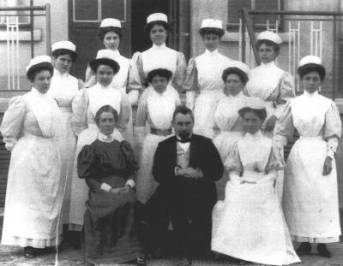
Edith Cavell with some of her nurses, in Belgium
German soldiers invaded and occupied Brussels later that August, and the wounded came pouring into Edith’s clinic. The International Red Cross took over the hospital at this time, the neutral organization established to care for the wounded of all nationalities. Medical personnel were strictly forbidden from taking sides. Edith cared for all who needed her services, regardless of uniform or nationality.
The German violation of Belgian neutrality was an outrageous provocation, the single cause for which England entered the war. German troops were afraid of Belgian guerrilla fighters, the francs-tireurs, believing them to be every bit as dangerous, as the French soldiers they were fighting. Allied propaganda magnified tales of German brutality into the “Rape of Belgium”, but such atrocities against civilians were very real, particularly in places like Liège, Andenne, Leuven and foremost, Dinant.
The Battle of Mons of August 23 was a crushing defeat for the badly outnumbered British Expeditionary Force (BEF), the first such confrontation on European soil since the Battle of Waterloo, in 1815. Hundreds of British and allied soldiers were cut off and stranded, behind enemy lines. Word got back to the Red Cross hospital about allied soldiers being shot by German troops, while locals took others into their homes to hide them from harm.
That September, Edith took in two British soldiers, hiding them for two weeks in her clinic. She was later asked to join an underground organization, dedicated to hiding these stranded soldiers and spiriting them across borders into neutral territories. Despite the danger to herself, she agreed. She was now in violation of the law.
For the rest of 1914 until the following September, Edith hid 200 stranded soldiers at the Berkendael Institute, while architect Philippe Baucq secretly organized their evacuation to neutral Holland.
Now enters this story, a name which must be remembered with the likes of Judas Iscariot, Ephialtes of Trachis and Vidkun Quisling, as Traitor. Five years later, Georges Gaston Quien would be tried and convicted by Parisian authorities of collaborating with the enemy, and put to death. Quien had betrayed Edith Cavell’s organization, to German secret police.
Baucq was arrested on July 31, 1915, with another member of the escape-route team. Letters found in their possession incriminated Edith Cavell and she was arrested, on August 5. German interrogators tricked her into confession, claiming that they knew everything, already. The best thing she could do, was save her friends. Confess.
She was placed in solitary confinement for the rest of that month, and tried for treason, in early October. At trial, Edith freely confessed to helping allied soldiers escape German occupied territory.
Edith Cavell’s Brussels cell
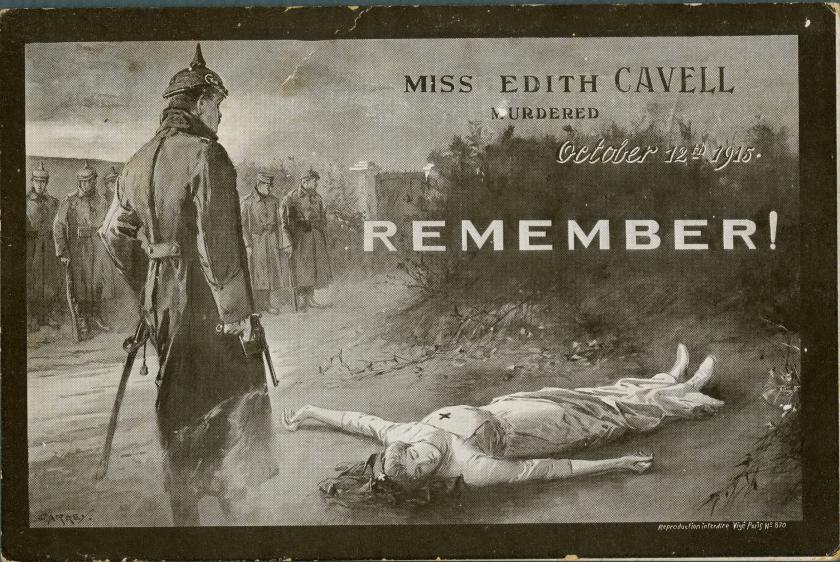
Edith Cavell was convicted of treason on October 11, 1915, along with Philippe Baucq, and three others. The sentence was death. Neutral governments in the United States and Spain protested, and attempted to get the sentence reduced. Such efforts came to nothing.
The English chaplain Stirling Gahan visited her cell on the last day of her life, and found her calm, as she received the Sacrament. “I am thankful to have had these 10 weeks of quiet to get ready”. she told him. “Now I have had them and have been kindly treated here. I expected my sentence and I believe it was just. Standing as I do in view of God and Eternity, I realise that patriotism is not enough, I must have no hatred or bitterness towards anyone”.
Her final words were as worthy, as those of that hero of the American Revolution, Nathan Hale, who regretted only that he had but one life to give for his country. In the last moments of her life, she calmly spoke to the German Lutheran prison chaplain, Paul Le Seur. “Ask Father Gahan to tell my loved ones later on that my soul, as I believe, is safe, and that I am glad to die for my country.”
Edith Louisa Cavell was executed by firing squad at 2:00am on October 12, at the Tir National shooting range, in Schaerbeek. She was forty-nine.
Hat tip to www.edithcavell.org.uk, from which I have learned much of this story, and drawn many of these images.
If you enjoyed this “Today in History”, please feel free to re-blog, “like” & share on social media, so that others may find and enjoy it as well. Please click the “follow” button on the right, to receive email updates on new articles. Thank you for your interest, in the history we all share.
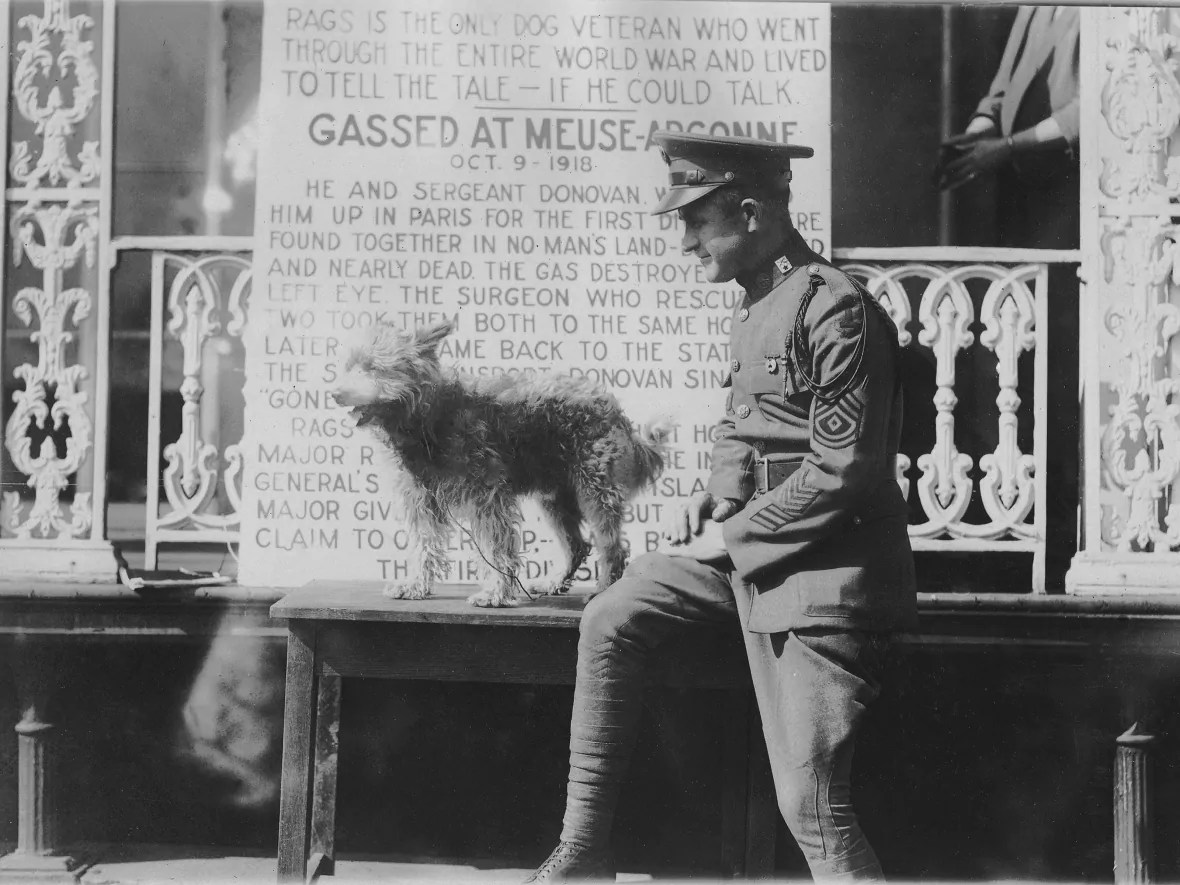
The Big Red One marched down Broadway in 1928, part of the First Division’s 10th anniversary WW1 reunion. The French street dog who had lost an eye in their service, in the lead.
Private James Donovan was AWOL. He had overstayed his leave in the French town of Montremere, and the ‘Great War’, awaited.
When the MPs found him, Donovan knew he had to think fast. He reached down and grabbed a stray dog, explaining to the two policemen that he was part of a search party, sent out to find the Division Mascot.
It was a small dog, possibly a Cairn Terrier mix, about twenty-five pounds. He looked like a pile of rags, and that’s what they called him. The dog had gotten Donovan out of a jam, now he would become the division mascot, for real. Rags was now part of the US 1st Infantry Division, the Big Red One.
Instead of “shaking hands”, Donovan taught the dog a sort of doggie “salute”. Rags would appear at the flag pole for Retreat for years after the war, lifting his paw and holding it by his head. Every time the flag was lowered and the bugle played, there was that small terrier, saluting with the assembled troops.
The dog learned to imitate the men around him, who would drop to the ground and hug it tightly during artillery barrages. He would hug the ground with his paws spread out, soon the doughboys noticed him doing it before any of them knew they were under fire. Rags’ acute and sensitive hearing became an early warning system, telling them that shells were incoming, well before anyone heard them.
Rags was disdainful of doggie tricks, he was more interested in Doing something. In the hell of life in the trenches, barbed wire was often all that stood between safety and enemy attack. Wire emplacements were frequent targets for bombardment, and a break in the wire represented a potentially lethal weak point in the lines. Somehow, Rags could find these breaks in the wire, and often led men into the darkness, to effect repairs.
Thousands of dogs, horses and pigeons were “enlisted” in the first world war, with a number of tasks. The French trained specialized “chiens sanitaire” to seek out the dead and wounded, and bring back small bits of uniform so that aid could be delivered, or the body recovered. Somehow, Rags figured this job out, for himself. Once he found a dead runner, and recovered the note the man had died, trying to deliver. Not only was his body found, but that note enabled the rescue of an officer, cut off and surrounded by Germans.
Donovan’s job was hazardous. He was out on the front lines, stringing communications wire between advancing infantry and supporting field artillery. Runners were used to carry messages until the wire was laid, but these were frequently wounded, killed or they couldn’t get through the shell holes and barbed wire.
Donovan trained Rags to carry messages attached to his collar. On this day in 1918, British and French forces were engaged in heavy fighting from St. Quentin to Cambrai. French and Americans in the Champagne region advanced as far as the Arnes, as the American attack ground on, west of the River Meuse. Around this time, Rags was given a message from the 26th Infantry Regiment for the 7th Field Artillery. The small dog completing his mission, resulting in an artillery barrage and leading to the capture of the Very-Epinonville Road.
An important objective had been taken, with minimal loss of life to the American side.
The terrier’s greatest trial came five days later, during the Meuse-Argonne Campaign. The small dog ran through falling bombs and poison gas to deliver his message. Gassed and partially blinded, shell splinters damaged his right paw, eye and ear. Rags survived and, so far as I know, got his message where it needed to be.
Rags survived the deadliest battle in American military history, with the loss of an eye. Now-Sergeant James Donovan, wasn’t so lucky. He was severely gassed and the two were brought to the rear. If anyone asked about expending medical care on a dog, they were told that it was “orders from headquarters”.
Rags recovered quickly, but Donovan did not. He was transferred to the hospital ship in Brest, as Rags was forced to look on, from the docks. Animals were thought to carry disease and were strictly forbidden from hospital ships. Those animals who were smuggled on board, were typically chloroformed and thrown overboard.
Nevertheless, Rags was smuggled on board to be with his “Battle Buddy”. How many entered into the conspiracy of silence in his defense, can never be known.
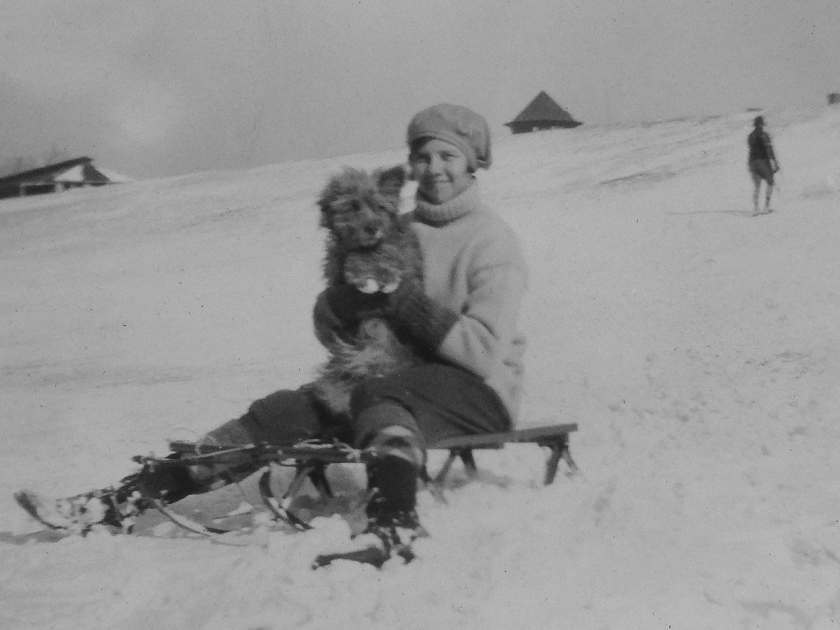
The pair made it back to United States, and to the Fort Sheridan base hospital near Chicago, where medical staff specialized in gas cases. It was here that Rags was given a collar and tag, identifying him as “1st Division Rags”. Donovan died of his injuries, in early 1919. Rags moved into the base fire house becoming “post dog”, until being adopted by Major Raymond W. Hardenbergh, his wife and two daughters, in 1920.
The Big Red One marched down Broadway in 1928, part of the First Division’s 10th anniversary WW1 reunion. The French street dog who had lost an eye in their service, in the lead.
Rags lived out the last of his years in Maryland. A long life it was, too, the dog lived until 1934, remaining with the 1st Infantry Division, for all his 20 years. On March 22, 1934, the 16-paragraph obituary in the New York Times began: “Rags, Dog Veteran of War, Is Dead at 20; Terrier That Lost Eye in Service is Honored.”
Canadian writer Grant Hayter-Menzies has written a book about 1st Division Rags, from which I have drawn some of these details. The book is entitled From Stray Dog to World War I Hero: The Paris Terrier Who Joined the First Division. Eleven-minute audio from a fascinating CBC interview, may be found HERE.
Hat tip to the Canadian Broadcasting Corporation, from whose website I have drawn most of these images.
If you enjoyed this “Today in History”, please feel free to re-blog, “like” & share on social media, so that others may find and enjoy it as well. Please click the “follow” button on the right, to receive email updates on new articles. Thank you for your interest, in the history we all share.
Once, the small dog was able to perform a task in minutes, which would have otherwise taken an entire airstrip out of service for three days, and exposed a construction battalion to enemy fire.
The first dog may have approached some campfire, long before recorded history. It may have been hurt or it maybe it was looking for a morsel. Dogs have been by our side ever since.
Over history, the unique attributes of Canis Familiaris have often served in times of war. Ancient Egyptian artwork depicts dogs at work in multiple capacities. The ancient Greeks used dogs against Persian invaders at the Battle of Marathon.
The European allies and Imperial Germany had about 20,000 dogs working a variety of jobs in WWI. Though the United States didn’t have an official “War Dog” program in those days, a Staffordshire Terrier mix called “Sgt. Stubby” was smuggled “over there” with an AEF unit training out of New Haven, Connecticut.
Stubby is credited with saving an unknown number of lives, his keen sense of hearing giving his companions early warning of incoming artillery rounds.
Once, Stubby even caught a German spy who had been creeping around, mapping allied trenches. It must have been a very bad day for that particular Bosch, to be discovered spinning in circles, a 50-pound, muscular terrier affixed to his arse.
The US War Dogs program was developed between the World Wars, and dogs have served in every conflict, since. My own son in law Nate served in Afghanistan with “Zino”, a five-year old German Shepherd and Tactical Explosives Detection Dog (TEDD), trained to detect as many as 64 explosive compounds.
The littlest war dog first appeared in the jungles of New Guinea, when an American soldier spotted a “golden head” poking out of an abandoned foxhole. It was all of 4-pounds, a seven-inch tall, Yorkshire Terrier. At the time, nobody had the foggiest notion of how the tiny dog had gotten there. The soldier brought her back to camp and sold her to a comrade for £2 Australian, about $6.44. He was Corporal William Wynne, who named her “Smoky”.
Smoky lived a soldier’s life for the next eighteen months, traveling about in a rucksack and learning to parachute from trees. At first, soldiers thought she might have belonged to the Japanese side, but they brought her to a POW camp and quickly learned that she understood neither Japanese nor English commands.
The little dog flew 12 air/sea rescue and photo reconnaissance missions, secured in Wynne’s backpack. She survived 150 air raids and a typhoon, often giving soldiers early warning of incoming fire. Wynne credited Smoky with saving his life one time, on an LST transport ship. It was around October 3, 1944 off Morotai, when the Japanese submarine RO-41 sank the American destroyer escort, USS Shelton. The decks around them were shaking from anti-aircraft and machine gun fire, when Smoky guided Wynne to duck at the moment an incoming shell struck, killing 8 men standing next to them. She was his “angel from a foxhole.”
Once, the small dog was able to perform a task in minutes, a job which would have otherwise taken an airstrip out of service for three days, and expose a construction battalion to enemy fire. The air field at Lingayen Gulf, Luzon, was crucial to the Allied war effort. The signal corps needed to run a teletype communication wire across the field. To do so in the conventional manner would have taken days, and put the airfield out of operation. Except, there was one possible workaround.
A 70-foot, 8” drain pipe half filled with dirt, already crossed under the air strip
Wynne credits the dog with enabling the airfield to remain open, saving 40 aircraft and 250 ground crew from exposure to Japanese fire. Let him tell the story:
“I tied a string to Smoky’s collar and ran to the other end of the culvert . . . (Smoky) made a few steps in and then ran back. `Come, Smoky,’ I said sharply, and she started through again. When she was about 10 feet in, the string caught up and she looked over her shoulder as much as to say `what’s holding us up there?’ The string loosened from the snag and she came on again. By now the dust was rising from the shuffle of her paws as she crawled through the dirt and mold and I could no longer see her. I called and pleaded, not knowing for certain whether she was coming or not. At last, about 20 feet away, I saw two little amber eyes and heard a faint whimpering sound . . . at 15 feet away, she broke into a run. We were so happy at Smoky’s success that we patted and praised her for a full five minutes”.
Smoky toured all over the world after the war, appearing in over 42 television programs and licking faces & performing tricks for thousands at veteran’s hospitals. In June 1945, Smoky toured the 120th General Hospital in Manila, visiting with wounded GIs from the Battle of Luzon. She’s been called “the first published post-traumatic stress canine”, and credited with expanding interest in what had hitherto been an obscure breed.
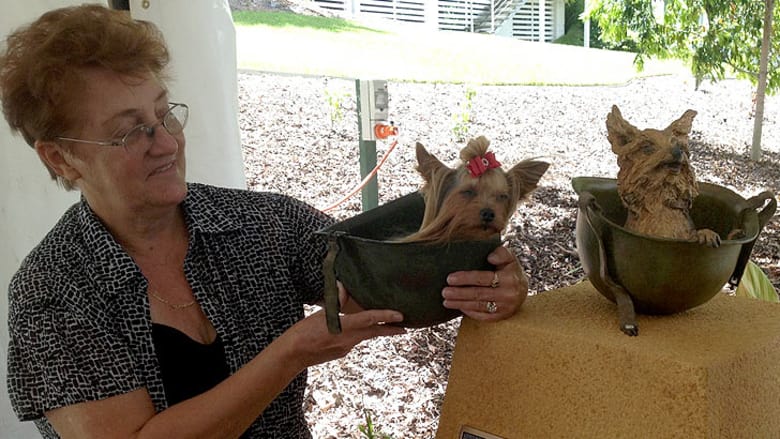
The Littlest Wardog died in her sleep in February 1957 at the age of fourteen, and buried in a .30 caliber ammunition box. Years later,a life-size a bronze sculpture of Smoky sitting in a GI helmet was installed over her final resting place in Rocky River Ohio, setting atop a two-ton blue granite base.
Bill Wynne was 90 years old in 2012, when he was “flabbergasted” to be approached by Australian authorities. They explained that an Australian army nurse had purchased the dog from a Queen Street pet store, and became separated in the jungles of New Guinea. sixty-eight years later, the Australian delegation had come to award his dog, a medal.
A memorial statue was unveiled on December 12 of that year, at the Australian War Memorial at the Queensland Wacol Animal Care Campus in Brisbane.
On December 11, 2015, the Australian Royal Society for the Prevention of Cruelty to Animals (RSPCA) awarded Smoky the Purple Cross. According to the press release, the award was “established in 1993 to recognize the deeds of animals that have shown outstanding service to humans, particularly where they have demonstrated exceptional courage, by risking their own safety or life, to save a person from injury or death. Since its inception, only nine animals have been awarded the prestigious award”.
“Yorkie Doodle Dandy” by Bill Wynne, tells the story of the dog Animal Planet has called, the first therapy dog. Originally published in 1996 by Wynnesome Press, the book is currently in its 5th edition, by Top Dog Enterprises, LLC.
As a personal aside, Nate and Zino were separated after their tour in Afghanistan. They were reunited in 2014, when the dog came to live with Nate and our daughter Carolyn in their home in Savannah. Last fall, Sheryl and I traveled to Houston with a friend, to celebrate our anniversary at the “Redneck Country Club”. 2,000 miles from home and completely by chance, who do we meet but the trainer who taught Zino to be a TEDD in the first place. Small world.
If you enjoyed this “Today in History”, please feel free to re-blog, “like” & share on social media, so that others may find and enjoy it as well. Please click the “follow” button on the right, to receive email updates on new articles. Thank you for your interest, in the history we all share.
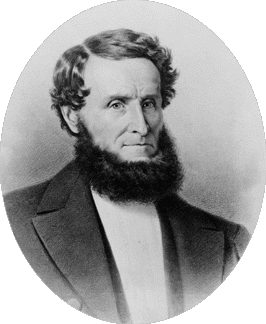
To his detractors, Lick was a disagreeable miser. Eccentric, selfish, reclusive. Even “touched in the head,” but absolutely honest and an astute businessman. At the end of his life, he confounded them all, using his considerable fortune to benefit his adopted state of California.
If you’ve never explored your own genealogy, I highly recommend it. One of the more enjoyable aspects of shaking the family tree, is getting to know the people who fall out of it. I have the family genealogist, the man for I am namesake, to thank for this one. Lieutenant Colonel United States Army (retired), Richard B. “Rick” Long, Sr., 2/25/37 – 3/31/18. Rest in Peace, Dad. You left us too soon.
James Lick was born in Stumpstown, Pennsylvania, now Fredericksburg, in the late days of the Washington administration. Lick’s grandfather William served in the Revolution and his son John went on to serve in the Civil War. James himself was a carpenter’s son, who learned the trade of fine cabinet making, from his earliest days.
As a young man, Lick fell in love with Barbara Snavely, the daughter of a local miller. When she became pregnant with his child he asked for her hand in marriage, only to be rudely rebuffed by her father. When Lick owned a plant as large and opulent as his own, then and only then could James have his daughter’s hand in marriage.
Humiliated, Lick moved to Baltimore at age 21, where he learned to make pianos. He became quite skilled at the craft and moved to New York to set up his own piano shop.
On learning that his pianos were being exported to South America, Lick moved to Argentina to pursue the business. Despite his poor Spanish his piano business thrived, though unstable Argentinian politics sometimes made things difficult.
In 1825, Lick left Buenos Aires, for a year-long tour of Europe. This was the time of the Brazilian War for Independence, and Portuguese authorities captured his ship on its return.
Passengers and crew were incarcerated in a POW camp in Montevideo, though Lick himself would later escape and returned on foot, to Buenos Aires.
Having made his first fortune, Lick briefly returned to Stumpstown, to claim his bride and now-fourteen year old son, only to learn that she had married another. James Lick returned to Buenos Aires, later moving his business to Valparaíso, Chile and finally to Lima, Peru. He would never marry.
Anticipating the Mexican American War and the annexation of California, Lick moved to San Francisco in 1846 with his tools, $30,000 in gold, and 600lbs of chocolate.
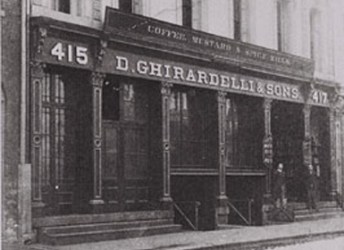
Lick had a backlog of piano orders at the time which he was forced to build himself, when his workers returned home to join the Mexican army. The chocolate sold so quickly, that Lick convinced his friend and confectioner, an Italian émigré to Peru, to come set up shop in California. The man’s name is recognizable to chocolate lovers, the world over. He was Domingo Ghirardelli
Gold was discovered at Sutter’s Mill, shortly after Lick’s arrival. He caught a little of the gold fever himself, but soon learned that he could make more money buying and selling land, rather than digging holes in it.
San Francisco was a small village in 1848. By 1850 the population had reached 20,000. Lick bought up land around San Jose and planted orchards of apricots, plums and pears. It was here in Santa Clara county that Lick took his revenge on the long-dead Pennsylvania miller, spending the unheard-of sum of $200,000 and building the largest flour mill, then in the state.
In 1855, the now-37 year old John Lick came to live with the father he never knew. The elder man had requested he do so, but the son didn’t get along with his cantankerous father, and soon returned “back east”.
Lick began construction of a Grand Hotel in 1861, with a 400 seat dining room straight out of the Palace at Versailles. Many considered the “Lick House” to be the finest hotel west of the Mississippi River.
“The opulent dining room of The Lick House hotel on Montgomery at Sutter seated 400 and boasted walls and floors of exotic woods and three crystal chandeliers imported from Venice”, H/T sfcityguides.com
James Lick suffered a massive stroke in 1874. At the time, this carpenter’s son was the wealthiest man in California, his estates including much of San Francisco and Santa Clara County, all of Catalina Island and large holdings outside of Lake Tahoe.
To his detractors, Lick was a disagreeable miser. Eccentric, selfish, reclusive. Even “touched in the head,” but absolutely honest and an astute businessman. At the end of his life, he confounded them all, using his considerable fortune to benefit his adopted state of California.
For years, Lick had harbored an interest in astronomy. President of the California Academy of Sciences George Davidson persuaded him to leave the majority of his fortune, to building the most powerful telescope then in existence.
Lick placed $2,930,654 into the hands of seven trustees, equivalent to $64 million today, with specific instructions for how the funds were to be used:
“$700,000 to the University of California for the construction of an observatory and the placing therein of a telescope to be more powerful than any other in existence. $150,000 for the building and maintenance of free public James Lick Baths in San Francisco. $540,000 to found and endow an institution of San Francisco to be known as the California School of Mechanic Arts. $535,000 for the son he never knew. $100,000 for the erection of three appropriate groups of bronze statuary to represent three periods in Californian history and to be placed before the city hall of San Francisco. $60,000 to erect in Golden Gate Park, San Francisco, a memorial to Francis Scott Key, author of The Star-Spangled Banner”.
In 1875, Thomas Fraser recommended a site for the telescope on the 4,209′ summit of Mount Hamilton, near San Jose. Lick approved the location, provided that Santa Clara County build a “first class” road to the site. The county agreed and the road was completed in the fall of 1876.
On this day in 1876, James Lick died in his room at the Lick House. His life’s great project was completed eleven years later. With a 36” lens, the “Great Lick Refractor” was, for its time, the largest refracting telescope in the world.
Lick Observatory as it looked, in 1900
Today, the University of California’s “Lick Observatory” operates a 120-inch (3.0-meter) reflecting telescope, polished and ground on-site from a 10,000-pound Corning Labs glass test blank. At the time of its commissioning in 1959, it was the second-largest telescope anywhere and remains to this day, the 3rd largest refracting telescope in the world.
According to his last wishes, the body of James Lick lies entombed, beneath the floor of the observing room.
If you enjoyed this “Today in History”, please feel free to re-blog, “like” & share on social media, so that others may find and enjoy it as well. Please click the “follow” button on the right, to receive email updates on new articles. Thank you for your interest, in the history we all share.
They are so few, who pick up this heaviest of tabs on behalf of the rest of us.
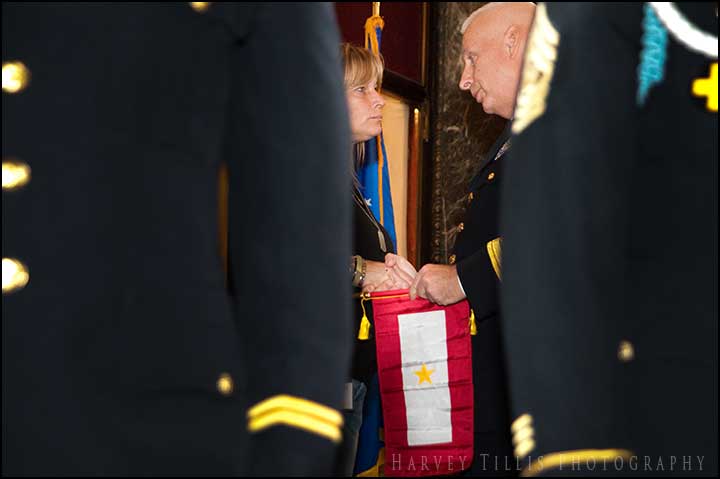
Today, Sunday, September 30, 2018, is Gold Star Mother’s Day. I wish to dedicate this “Today in History”, to those women who have made the greatest sacrifice a mother can make, in service to the nation. The rest of us owe them a debt which can never be repaid.
Suppose you were to stop 100 randomly selected individuals on the street, and ask them: “Of all the conflicts in American military history, which single battle accounts for the greatest loss of life“. I suppose you’d get a few Gettysburgs in there, and maybe an Antietam or two. The Battle of the Bulge would come up, for sure, and there’s bound to be a Tarawa or an Iwo Jima. Maybe a Normandy. I wonder how many would answer, Meuse-Argonne.
The United States was a relative late-comer to the Great War, entering the conflict in April 1917, when President Woodrow Wilson asked permission of the Congress, for a “War to end all wars”. American troop levels “over there” remained small throughout the rest of 1917, as the formerly neutral nation of fifty million ramped up to a war footing.
US Marines during Meuse-Argonne offensive of 1918
The trickle turned to a flood in 1918, as French ports were expanded to handle their numbers. The American Merchant Marine was insufficient to handle the influx, and received help from French and British vessels. By August, every one of what was then forty-eight states had sent armed forces, amounting to nearly 1½ million American troops in France.
After four years of unrelenting war, French and British manpower was staggered and the two economies, nearing collapse. Tens of thousands of German troops were freed up and moving to the western front, following the chaos of the Russian Revolution. The American Expeditionary Force was arriving none too soon.
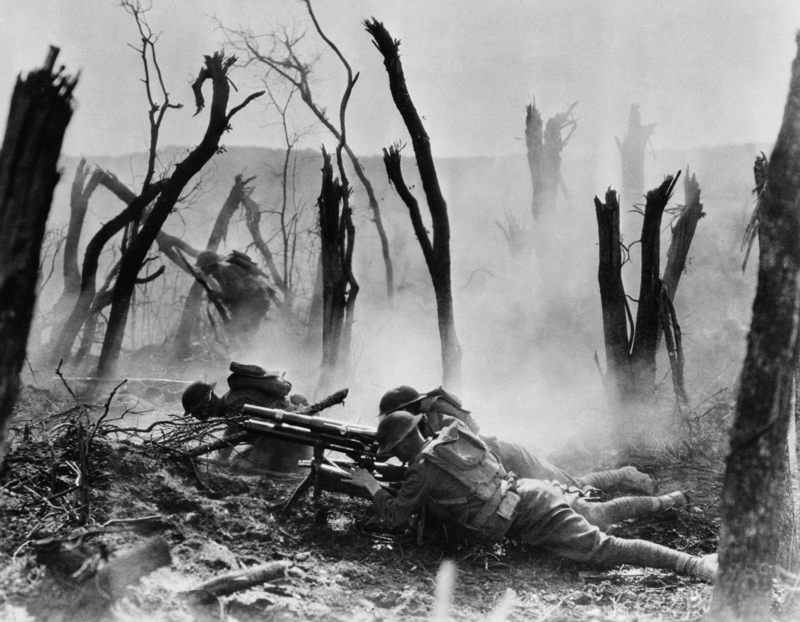
“Gun crew from Regimental Headquarters Company, 23rd Infantry, firing 37mm gun during an advance against German entrenched positions. , 1918”, H/T Wikipedia
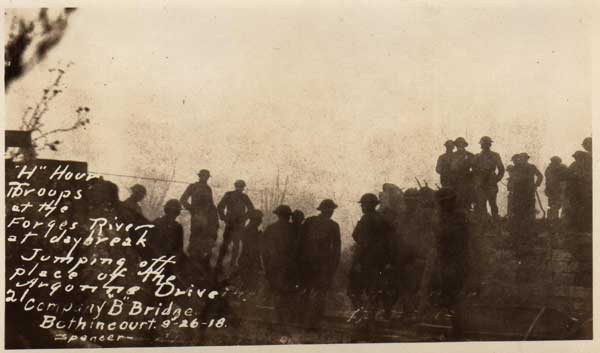
Following successful allied offensives at Amiens and Albert, Allied Supreme Commander Ferdinand Foch ordered General John J. “Black Jack” Pershing to take overall command of the offensive, with the objective of cutting off the German 2nd Army. Some 400,000 troops were moved into the Verdun sector of northeastern France. This was to be the largest operation of the AEF, of World War I.With a half-hour to go before midnight September 25, 2,700 guns opened up in a six hour bombardment, against German positions in the Argonne Forest, along the Meuse River.
Butte de Montfaucon, today
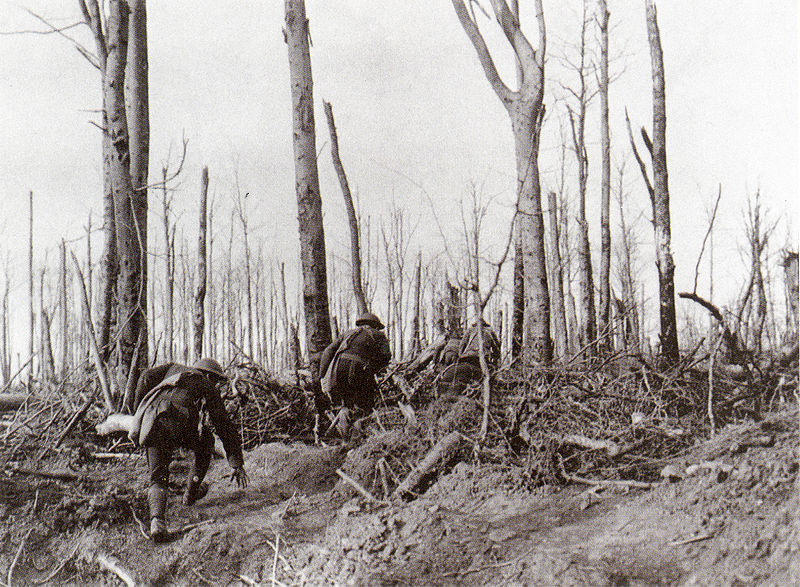
Some 10,000 German troops were killed or incapacitated by mustard and phosgene gas attacks, and another 30,000 plus, taken prisoner. The Allied offensive advanced six miles into enemy territory, but bogged down in the wild woodlands and stony mountainsides of the Argonne Forest.
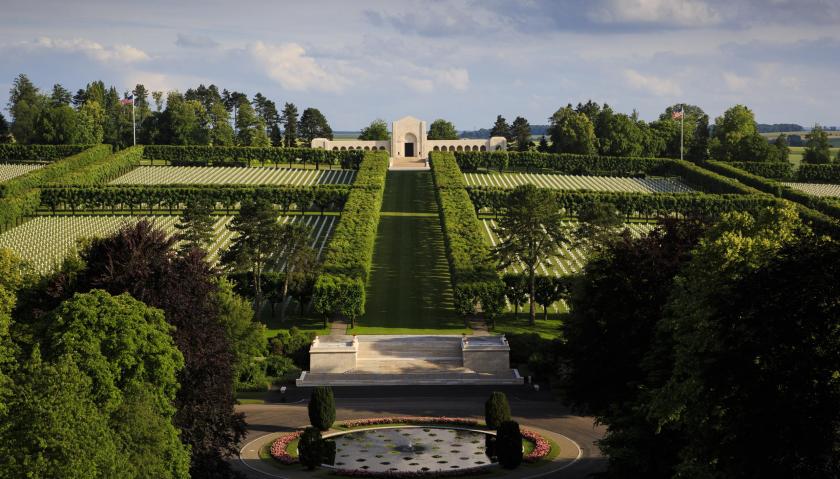
Meuse-Argonne American cemetery near Romagne, in France
The Allied drive broke down on German strong points like the hilltop monastery at Montfaucon and others, and fortified positions of the German “defense in depth”.
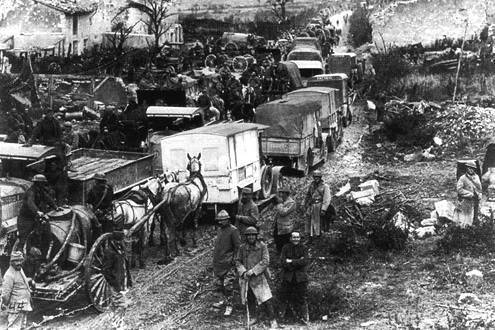
Pershing called off the Meuse-Argonne offensive on September 30, as supplies and reinforcements backed up in what can only be termed the Mother of All Traffic Jams.
Fighting was renewed four days later resulting in some of the most famous episodes of WW1, including the “Lost Battalion” of Major Charles White Whittlesey, and the single-handed capture of 132 prisoners, by Corporal (and later Sergeant) Alvin York.
Meuse-Argonne American Cemetery, outside of Romagne, France
The Meuse-Argonne offensive would last forty-seven days, resulting in 26,277 American women gaining that most exclusive and unwanted of distinctions, that of being a Gold Star Mother. More than any other battle, in American military history. 95,786 others would see their boys come home, mangled.
Gold Star Mother’s Monument At The Putnam County (NY) Veteran Memorial Park, photograph by James Connor
In May of that year, President Woodrow Wilson approved a suggestion from the Women’s Committee of the Council of National Defenses, that American women were asked to wear black bands on the left arm, with a gilt star for every family member who had given his life for the nation.
Today, Title 36 § 111 of the United States Code provides that the last Sunday in September be observed as Gold Star Mother’s Day, in honor of those women who have made the ultimate sacrifice. (April 5 is set aside, as Gold Star Spouse’s Day). Recently, both President Barack Obama and Donald Trump have signed proclamations, setting this day aside as Gold Star Mother’s and Family’s Day.
At first a distinction reserved only for those mothers who had lost sons and daughters in WW1, that now includes a long list of conflicts, fought over the last 100 years. At this time the US Army website reports “The Army is dedicated to providing ongoing support to over 78,000 surviving Family members of fallen Soldiers”.
Seventy-eight thousand, out of a nation of some 320 million. They are so few, who pick up this heaviest of tabs on behalf of the rest of us.
If you enjoyed this “Today in History”, please feel free to re-blog, “like” & share on social media, so that others may find and enjoy it as well. Please click the “follow” button on the right, to receive email updates on new articles. Thank you for your interest, in the history we all share.
There was nothing but potential in that rookie year, but that bright future was never meant to be.
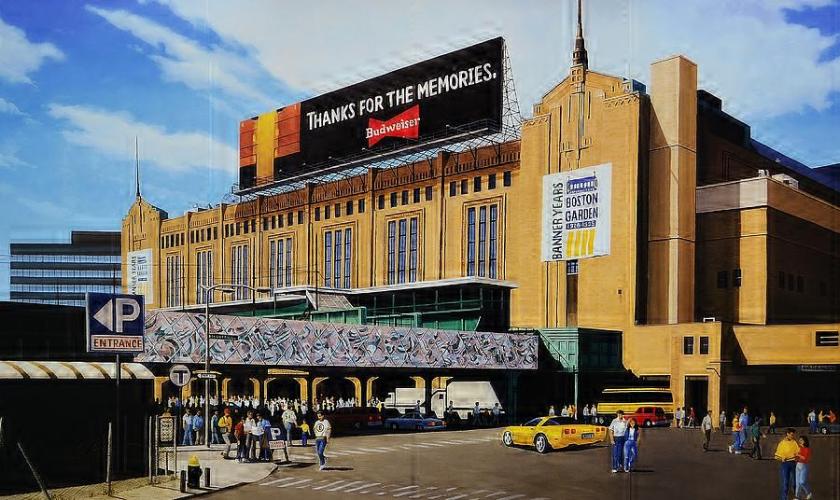
Having come of age in this part of the world, it’s hard to imagine anyone over forty never having been to the old Boston Garden.
Originally built as a boxing venue, “The Garden” was then known as the Boston Madison Square Garden.
President Calvin Coolidge flipped a switch at the White House in November 1928, turning the lights on at the brand new arena. Three days later, a crowd of 14,000 watched Dorchester native Dick “Honeyboy” Finnegan take the World featherweight championship away from French boxer Andre Routis, in a ten round decision.
From the earliest days, the Boston Garden was the site of political conventions, tennis matches, roller derbies and bike races. There you could hear the sounds of a Christian revival one night, and a dance marathon the next.
FDR, Winston Churchill and Dwight Eisenhower all delivered speeches from the floor of the Garden. Legend has it that JFK mapped out his political strategy for the 1960 Presidential election, while watching a Bruins game.
I saw my first big-time rock concert, when Aerosmith played the Garden in 1975.
The Boston Celtics played to 16 championships on the old parquet, along with 19 Conference and 15 Division titles.
Boston Garden is a painting by T Kolendera
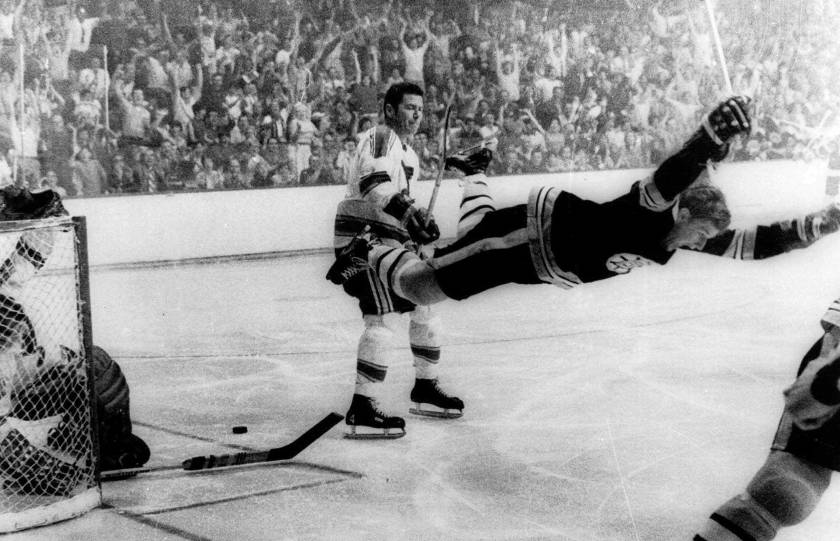
Five times did the Bruins hold Lord Stanley’s Cup aloft on the home ice of the Garden, adding to 19 Eastern Division championships, two Conference championships, and a President’s trophy.
In the end, obstructed seats and a lack of air conditioning spelled the end for the Boston Garden. On this day in 1995, Cam Neely scored the final goal in a 3-0 victory over the arch rival Montreal Canadiens. There would be no more.
Many of the Greats of Boston hockey were there that night, to take a final skate around the Bruins’ home ice. Johnny Bucyk was on-hand, along with Milt Schmidt. There was Phil Esposito, Ray Bourque and Bobby Orr, and possibly the greatest, though few will remember the name of Normand Léveillé.
A first-round draft pick in 1981, Léveillé scored 33 goals in his first 60 games with the Bruins. There was nothing but potential in that rookie year, but that bright future was never meant to be.
On October 23, 1982, Boston was playing the Canucks in the ninth game of his second season. Léveillé complained of feeling dizzy, and lost consciousness during trainers’ examination . An aneurysm had burst inside of his head. The delicate filaments of his brain were being torn apart, as a spider’s web is destroyed by a garden hose.
Emergency brain surgery was followed by three weeks in a coma. At 19, Normand Léveillé would never play hockey again. He was lucky to be alive.
Bound to a wheelchair after thirteen years and barely able to stand without aid of a walker, Normand Léveillé came back to the Garden twenty-three years ago tonight, to skate there one last time.
Let sports reporter Brent Conklin finish this story:
“For the final skate, an ecstatic Léveillé held his cane in front of him, while Bourque, facing Léveillé, pulled him around the ice; the crowd clamored in approval as eyes throughout the Garden filled up with tears.
Léveillé’s girlfriend, Lucie Legare, said at the end of the ceremony: “He said the biggest emotion wasn’t to put on the (Bruins) sweater again, but to have his fellow men there, caring. I cried. It’s just too much.”
“It was the highlight of the day,” Orr said.
Thus ends a long chapter in the history of sports. And although the luxurious Fleet Center becomes the center of attention on Oct. 7 — when the Bruins open their season versus the New York Islanders — to the very last second of the post-game ceremony, memories were still being made and dreams realized at rickety old Boston Garden”.
If you enjoyed this “Today in History”, please feel free to re-blog, “like” & share on social media, so that others may find and enjoy it as well. Please click the “follow” button on the right, to receive email updates on new articles. Thank you for your interest, in the history we all share.
The old pilot never forgot a promise made to the place he had once tried to burn down.
In the months before the Japanese attack on Pearl Harbor, the B-1 type submarine I-25 quietly slipped from her dock, departing Yokusuka on November 21 and joining three other Japanese subs on patrol, in the waters north of Oahu.
The B-1 type was a fast cruiser submarine, built for long range and carrying on her bows a small aircraft hanger and deck catapult, designed to store and launch a single two-seater Yokosuka E14Y reconnaissance floatplane, known to the allies as a “Glen”.
With twenty of them built, the B-1 series was the most numerous of some thirty nine distinct submarine types, employed by the Japanese in WW2. The type was fairly successful, particularly in the beginning of the war. I-26 crippled the aircraft carrier USS Saratoga in August of 1942, and I-19 sank the aircraft carrier USS Wasp that September, at the same time damaging the battleship USS North Carolina and the destroyer USS O’Brien, which later sank.
I-25 launched the only piloted aircraft during World War II, to successfully attack the American mainland.
Nobuo Fujita
Lieutenant Commander Meiji Tagami turned the I-25 into the winds off the Oregon coast on the morning of September 9, 1942, and launched the Yokosuka E14Y floatplane, piloted by Warrant Officer Nobuo Fujita and armed with two 168-lb thermite bombs.
Fujita had hoped the target would be Los Angeles or San Francisco, payback for the Doolittle raid that April but, no chance of that. Lumbering along at 90MPH, such an aircraft is way too slow to attack such a heavily defended target.
Fujita’s target this day, was the vast forested region along the Oregon coast, near the California border. With a little luck, the incendiary bombs would burn down a large section of the forest and a string of coastal towns along with it, diverting American resources from the war effort.
That day, the luck was on the American side. A recent rain in the Siskiyou National Forest had left the place wet, at low risk for fire. Howard “Razz” Gardner watched the aircraft come in, from the fire lookout tower on Mount Emily. He never saw the bombing itself but the plume of smoke, was easy enough to follow. Razz was able to hike to the scene while the Forest Service dispatched lookout Keith Johnson, from a nearby tower. The pair was able to keep the blaze contained overnight, and the crew arriving the next morning, put it out.
The following day, area commander Lieutenant General John DeWitt announced “The Western Defense Command is investigating the circumstances surrounding the discovery on Sept. 9 of fragments of what appears to have been an incendiary bomb. These fragments were found by personnel of the United States Forestry Service near Mt. Emily nine miles northeast of Brookings, Or. Markings of the bomb fragments indicated that the missile was of Japanese origin”.
Fujita and his observer made a second attack on September 29, but the damage was negligible. Not at all the regional conflagration he had hoped for. Late in the war, Japanese authorities released hundreds of balloon bombs into the gulf stream, in a sustained attack on the continental United States. One managed to kill a Sunday School class and its teacher but, the earlier attacks flown by Nobuo Fujita remained the only piloted attack on the US mainland, of WW2.
Years later, the junior chamber of commerce in Brookings Oregon, the “Jaycees”, got a bright idea over a few beers. Why not invite the only foreign pilot to successfully attack the American Mainland, as an honored guest.
It was a gesture of friendship, but the idea set off a firestorm in the coastal community. A full-page op-ed signed by 100 locals ran in the Brookings-Harbor Pilot, in 1962. Part of it read:
“[Fujita’s] sole claim to fame is that he’s the only Nip pilot who bombed the mainland of the United States by airplane … Why stop with Fujita? Why not assemble the ashes of Judas Iscariot, the corpse of Atilla the Hun, a shovel full of dirt from the spot where Hitler died … .”
Brookings resident Greg Jacques remembers, “There was a lot of turmoil. You gotta remember it was only like 16 years after the war. There were 30 to 40 to 50 percent of the men in the community at that time were in World War II.” There were heated arguments in coffee shops and bars, all over town. Then-Jaycees President Bill McChesney recalled, “I got a death threat it in the middle of the night. This guy said, ‘If you walk with that Nip down the street we’re going to have rifles pointed at you, and your family.’”
In the end, the group of young businessmen, none over the age of 35, voted unanimously to extend the invitation. To hell with the consequences. President John F. Kennedy congratulated the group, on their efforts to promote international friendship.
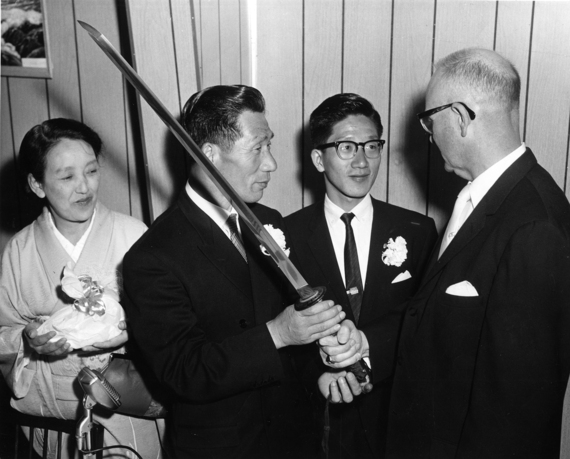
With assurances to the Japanese government that the former pilot would not be tried as a war criminal, the Fujita family left the Ibaraki Prefecture for the City of Brookings Oregon, in 1962. Nobuo, his wife Akayo, and their young son Yasuyoshi. Nobuo carried with him a prized family heirloom, a 400-year old Katana, the Samurai Sword with which he intended to perform Seppuku, ritual suicide by disembowelment, should this visit go wrong.
Despite the bitterness left in the wake of that terrible war, the visit did not go wrong.
Fujita was made honorary chairman of that year’s azalea festival. The man was presented with a ceremonial key to the city, and allowed to take the controls of an aircraft, flying over the bomb site. He even tried his hand at playing a bagpipe, during a parade.
All things were not “Kumbaya” – several men were jailed during the visit, in a preemptive effort to keep the lid on.
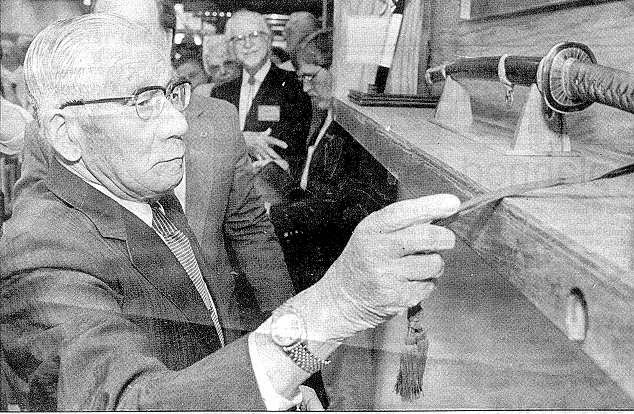
In the end, Nobuo Fujita did not open his abdomen with that sword, nor did he pass the treasured heirloom to his son, as once intended. The sword which had accompanied him on his every mission of the late war, including the one over Brookings itself, that prized object did he give to the city of Brookings, as a symbol of friendship. The sword may be seen at the Chetco Public Library, to this day.
Back in Japan, the economy was tough after the war. Fujita passed the family hardware store down to his son, but the business failed. The old pilot never forgot a promise made to the place he had once tried to burn down. Fujita worked for years to earn the money, to buy a few books every month. In 1985 he kept his promise, inviting three Brookings-Harbor High School students on a cultural exchange visit to Japan, with the money he had saved. An aide to President Ronald Reagan sent him a letter, “with admiration for your kindness and generosity.”
Hat tip Oregon Public Broadcasting, OPB.org, for this and the sword image.
Fujita returned to Brookings in 1990, and again in 1992, and 1995. During the 1992 visit, he planted a Pacific Redwood, at the site where his bombs fell.
Nobuo Fujita died in 1997 at the age of eighty-five, only days after being made an honorary citizen of the city of Brookings. In October of the following year, Fujita’s daughter Yoriko Asakura returned to the bomb site, where she buried some of her father’s ashes. Now, his spirit would fly over that place, forever.
At some point, the only foreign pilot to successfully attack the American mainland, confided to his diary: “If we knew each other. If we understood each other as a friend. This foolish war would never have happened. I sincerely hope that a day would come where everyone could overcome their differences through talking and not fighting”.
Yeah…What he said.
If you enjoyed this “Today in History”, please feel free to re-blog, “like” & share on social media, so that others may find and enjoy it as well. Please click the “follow” button on the right, to receive email updates on new articles. Thank you for your interest, in the history we all share.
Men stood in line for hours, patiently waiting in the mud and the rain for their own little piece of warm, home-cooked heaven in a world full of misery.
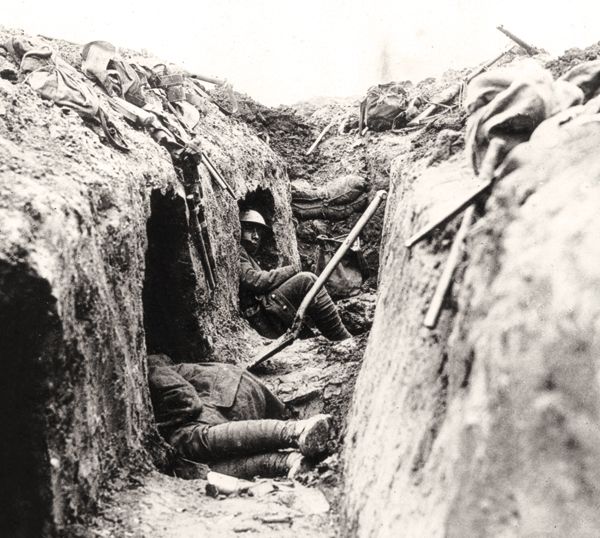
For a variety of reasons, the eastern front of the “War to end all Wars” was a war of movement. Not so on the Western front. As early as October 1914, combatants were forced to burrow into the ground like animals, sheltering from what Ernst Jünger called the ‘Storm of Steel’.
Conditions in the trenches and dugouts must have defied description. You would have smelled the trenches long before you could see them. The collective funk of a million men and more, enduring the Troglodyte existence of men who live in holes. Little but verminous scars in the earth teaming with rats and lice and swarming with flies, time and again the shells churned up and pulverized the soil, the water and the shattered remnants of once-great forests, along with the bodies of the slain.
By the time the United States entered the ‘War to end all Wars’ in April, 1917, millions had endured this existence for three years. The first 14,000 Americans arrived ‘over there’ in June, the American Expeditionary Forces (AEF) forming on July 5. American troops fought the military forces of Imperial Germany alongside their British and French allies, others joining Italian forces in the struggle against the Austro-Hungarian Empire.
You couldn’t call the stuff these people lived in mud – it was more like a thick slime, a clinging, sucking ooze capable of swallowing grown men, even horses and mules, alive.
Captain Alexander Stewart wrote “Most of the night was spent digging men out of the mud. The only way was to put duck boards on each side of him and work at one leg: poking and pulling until the suction was relieved. Then a strong pull by three or four men would get one leg out, and work would begin on the other…He who had a corpse to stand or sit on, was lucky”.
On first seeing the horror of Paschendaele, Sir Launcelot Kiggell broke down in tears. “Good God”, he said. “Did we really send men to fight in That?”
Often unseen in times of such dread calamity, are the humanitarian workers. Those who tend to the physical and spiritual requirements, the countless small comforts, of those so afflicted.
Within days of the American declaration of war, Evangeline Booth, National Commander of the Salvation Army, responded, saying “The Salvationist stands ready, trained in all necessary qualifications in every phase of humanitarian work, and the last man will stand by the President for execution of his orders”.
These people are so much more than that donation truck, and the bell ringers we see behind those red kettles, every December.
Lieutenant Colonel William S. Barker of the Salvation Army left New York with Adjutant Bertram Rodda on June 30, 1917, to survey the situation. It wasn’t long before his not-so surprising request came back in a cable from France. Send ‘Lassies’.
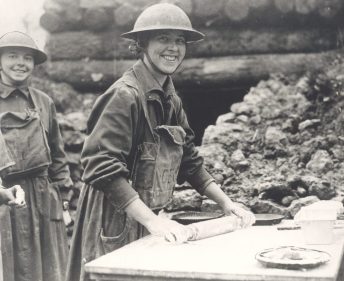
A small group of carefully selected female officers was sent to France on August 22. That first party comprised six men, three women and a married couple. Within fifteen months their number had expanded by a factor of 400.
In December 1917, a plea for a million dollars went out to support the humanitarian work of the Salvation Army, the YMCA, YWCA, War Camp Community Service, National Catholic War Council, Jewish Welfare Board, the American Library Association and others. This “United War Work Campaign” raised $170 million in private donations, equivalent to $27.6 billion, today.
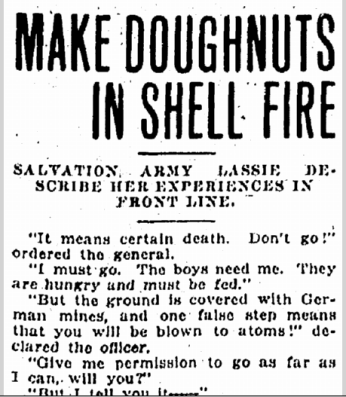
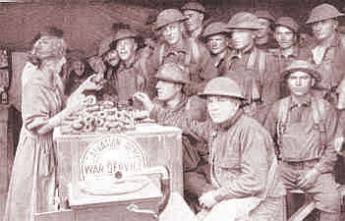
‘Hutments’ were formed all over the front, many right out at the front lines. There were canteen services. Religious observances of all denominations were held in these facilities. Concert performances were given, clothing mended and words of kindness offered in response to all manner of personal problems. On one occasion, the Loyal Order of Moose conducted a member initiation. Pies and cakes were baked in crude ovens and lemonade served to hot and thirsty troops. Of all these corporal works of mercy, the ones best remembered by the ‘doughboys’ themselves, were the doughnuts.
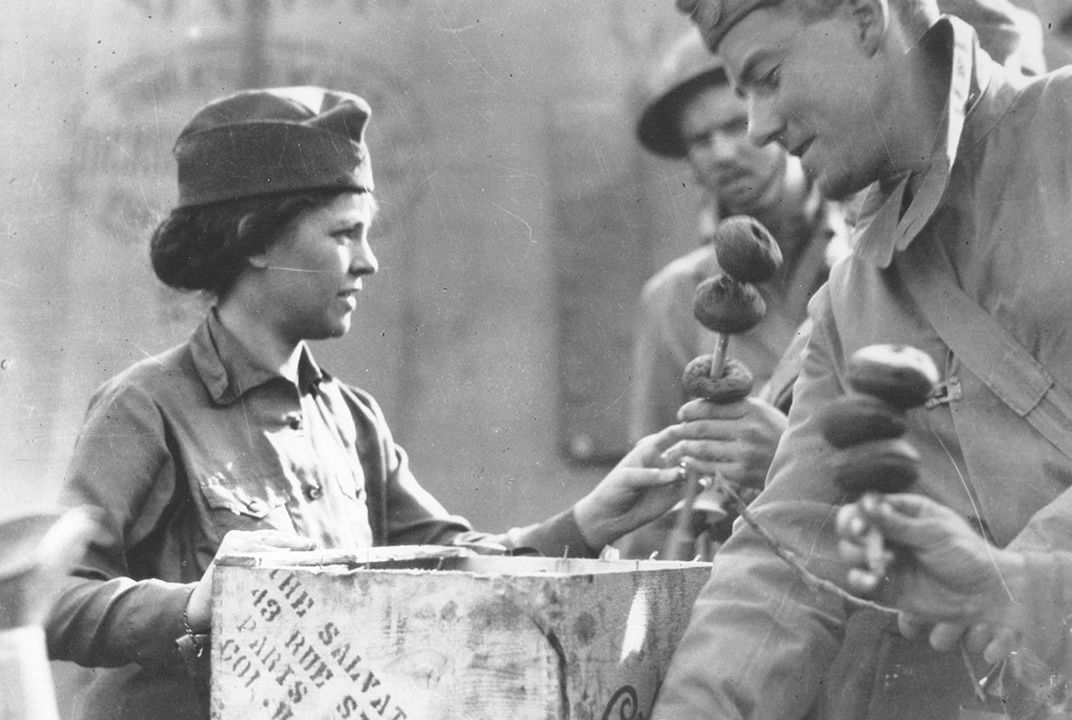
Helen Purviance, sent to France in 1917 with the American 1st Division, seems to have been first with the idea. An ensign with the Salvation Army, Purviance and fellow ensign Margaret Sheldon first formed the dough by hand, later using a wine bottle in lieu of a rolling pin. Having no doughnut cutter at the time, dough was shaped and twisted into crullers, and fried seven at a time on a pot-bellied wood stove.
The work was grueling. The women worked well into the night that first day, serving all of 150 hand-made doughnuts. “I was literally on my knees,” Purviance recalled, but it was easier than bending down all day, on that tiny wood stove. It didn’t seem to matter. Men stood in line for hours, patiently waiting in the mud and the rain for their own little piece of warm, home-cooked heaven in a world full of misery.
Before long, the women got better at it. Soon they were turning out 2,500 to 9,000 doughnuts a day. An elderly French blacksmith made Purviance a doughnut cutter, out of a condensed milk can and a camphor-ice tube, attached to a wooden block.
It wasn’t long before the aroma of hot doughnuts could be found, wafting all over the dugouts and trenches of the western front. Salvation Army volunteers and others made apple pies and all manner of other goodies, but the name that stuck, was “Doughnut Lassies”.
June 2, 2017 – Salvation Army employees Cheryl Freismuth (l) and Susan Klyk (c) celebrate the 100th anniversary of the “Doughnut Lassies” of WW1 with student Catie McDougall (r). H/T The Detroit News
One New York Times correspondent wrote in 1918 “When I landed in France I didn’t think so much of the Salvation Army; after two weeks with the Americans at the front I take my hat off… [W]hen the memoirs of this war come to be written the doughnuts and apple pies of the Salvation Army are going to take their place in history”.
If you enjoyed this “Today in History”, please feel free to re-blog, “like” & share on social media, so that others may find and enjoy it as well. Please click the “follow” button on the right, to receive email updates on new articles. Thank you for your interest, in the history we all share.
Dorothy Eustis called Frank in February 1928 and asked if he was willing to come to Switzerland. “Mrs. Eustis, to get my independence back, I’d go to hell”.
Written references to seeing eye dogs date back to the Tudor era, when a bit of children’s doggerel began “A is for Archer…B is a Blind-man/Led by a dog.”
German researchers began working with Alsatians (German Shepherd Dogs) in the 1920s, to serve as guides for WWI veterans blinded by gas. An American breeder living in Switzerland, Dorothy Harrison Eustis, wrote an article about the work in a 1927 issue of the Saturday Evening Post. US Senator Thomas Schall from Minnesota, who was legally blind, was paired with a German service dog that same year.
Morris Frank of Nashville lost the use of an eye in childhood. His vision was destroyed altogether in a boxing accident, at the age of 16. Frank hired a boy to guide him around, but the young man was easily bored and sometimes wandered off, leaving Frank to fend for himself.
Frank’s father saw Eustis’ article in 1927, and read it to him. The twenty-year old was electrified. Morris wrote to Eustis pleading with her to train a dog for himself. “Is what you say really true? If so, I want one of those dogs! And I am not alone. Thousands of blind like me abhor being dependent on others. Help me and I will help them. Train me and I will bring back my dog and show people here how a blind man can be absolutely on his own. We can then set up an instruction center in this country to give all those here who want it a chance at a new life.”
Dorothy Eustis called Frank in February 1928 and asked if he was willing to come to Switzerland. “Mrs. Eustis, to get my independence back, I’d go to hell”. She accepted the challenge and trained two dogs, leaving it to Frank himself to decide which was more suitable. Morris came to Switzerland to work with the dogs, both female German Shepherds. He chose a dog named “Kiss” but, feeling that no 20-year-old man should have a dog named Kiss, he called her “Buddy”.
Morris Frank was a founder of the first guide-dog school in the United States. He was the first person to be partnered with a seeing eye dog and the co-founder of The Seeing Eye, a guide-dog school.
Man and dog stepped off the ship in 1928 to a throng of reporters. There were flash bulbs, shouted questions and the din of traffic and honking horns that can only be New York City, but Buddy never wavered. At the end of the day Eustis received a single word telegram: “Success”. Morris Frank was set on the path that became his life’s mission: to get Seeing Eye Dogs accepted all over the country.
On January 29, 1929, Frank and Eustis established the first American guide dog training school in Frank’s home town of Nashville: “The Seeing Eye“. Frank was true to his word, becoming a tireless advocate of public accessibility for the blind and their guide dogs. In 1928, Morris was routinely told that Buddy couldn’t ride with him in the passenger compartment. Seven years later, all railroads in the United States had adopted policies allowing guide dogs to remain with their owners while on board.
By 1956, every state in the Union had passed laws guaranteeing access to public spaces for blind people and their dogs.
Frank told a New York Times interviewer in 1936 that he had logged 50,000 miles with Buddy, by foot, train, subway, bus, and boat. He was constantly meeting with people, including two Presidents and over 300 ophthalmologists, demonstrating the life-changing qualities of a guide dog.
Buddy’s health was failing toward the end of her life, but the team had one more hurdle to cross. One more barrier to break. Frank wanted to fly in a commercial aircraft with his guide dog, and did so on this day in 1938, flying from Chicago to Newark. United Airlines was the first to adopt the policy, granting “all Seeing Eye dogs the privilege of riding with their masters in the cabins of any of our regularly scheduled planes.”
Morris Frank’s seeing eye dog was all business during the day but, to the end of her life, she loved to end her work day with a roll on the floor with her “Dad”. Buddy died a week after that plane ride, but she had made her mark. There were 250 seeing eye dogs working across the country by this time, and their number was growing fast. Buddy’s replacement was also called Buddy, as was every seeing eye dog Frank ever owned, until he passed away in 1980.
Today, The Seeing Eye operates a 330-acre complex in Morris Township, New Jersey, the oldest guide dog school still in operation, in the world. The primary breeds used for such training are German Shepherds, Labs, Golden Retrievers, and Lab/Golden mixed breeds. Boxers are occasionally used, for individuals with allergies.
Since 1929, Seeing Eye, Inc. has trained some 16,000 guide dogs, pairing them with blind and vision-impaired across the United States and Canada. There are currently 1,720 such human/canine partnerships. The organization places an average of 260 guide dogs every year. The non-profit is primarily funded through private donations, as new students pay only $150, and returning students pay $50. Military veterans are charged a single dollar.
If you enjoyed this “Today in History”, please feel free to re-blog, “like” & share on social media, so that others may find and enjoy it as well. Please click the “follow” button on the right, to receive email updates on new articles. Thank you for your interest, in the history we all share.












 The European allies and Imperial Germany had about 20,000 dogs working a variety of jobs in WWI. Though the United States didn’t have an official “War Dog” program in those days, a Staffordshire Terrier mix called “Sgt. Stubby” was smuggled “over there” with an AEF unit training out of New Haven, Connecticut.


 Smoky toured all over the world after the war, appearing in over 42 television programs and licking faces & performing tricks for thousands at veteran’s hospitals. In June 1945, Smoky toured the 120th General Hospital in Manila, visiting with wounded GIs from the Battle of Luzon. She’s been called “the first published post-traumatic stress canine”, and credited with expanding interest in what had hitherto been an obscure breed.
 A memorial statue was unveiled on December 12 of that year, at the Australian War Memorial at the Queensland Wacol Animal Care Campus in Brisbane.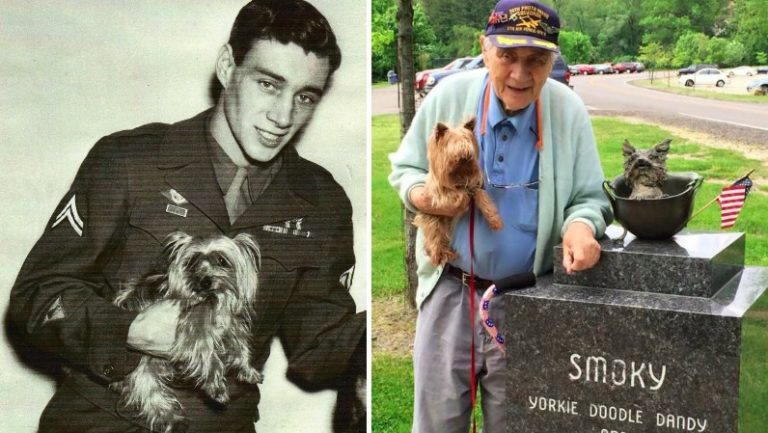


 In 1825, Lick left Buenos Aires, for a year-long tour of Europe. This was the time of the Brazilian War for Independence, and Portuguese authorities captured his ship on its return.
 Gold was discovered at Sutter’s Mill, shortly after Lick’s arrival. He caught a little of the gold fever himself, but soon learned that he could make more money buying and selling land, rather than digging holes in it.







 Bound to a wheelchair after thirteen years and barely able to stand without aid of a walker, Normand Léveillé came back to the Garden twenty-three years ago tonight, to skate there one last time.






 Often unseen in times of such dread calamity, are the humanitarian workers. Those who tend to the physical and spiritual requirements, the countless small comforts, of those so afflicted.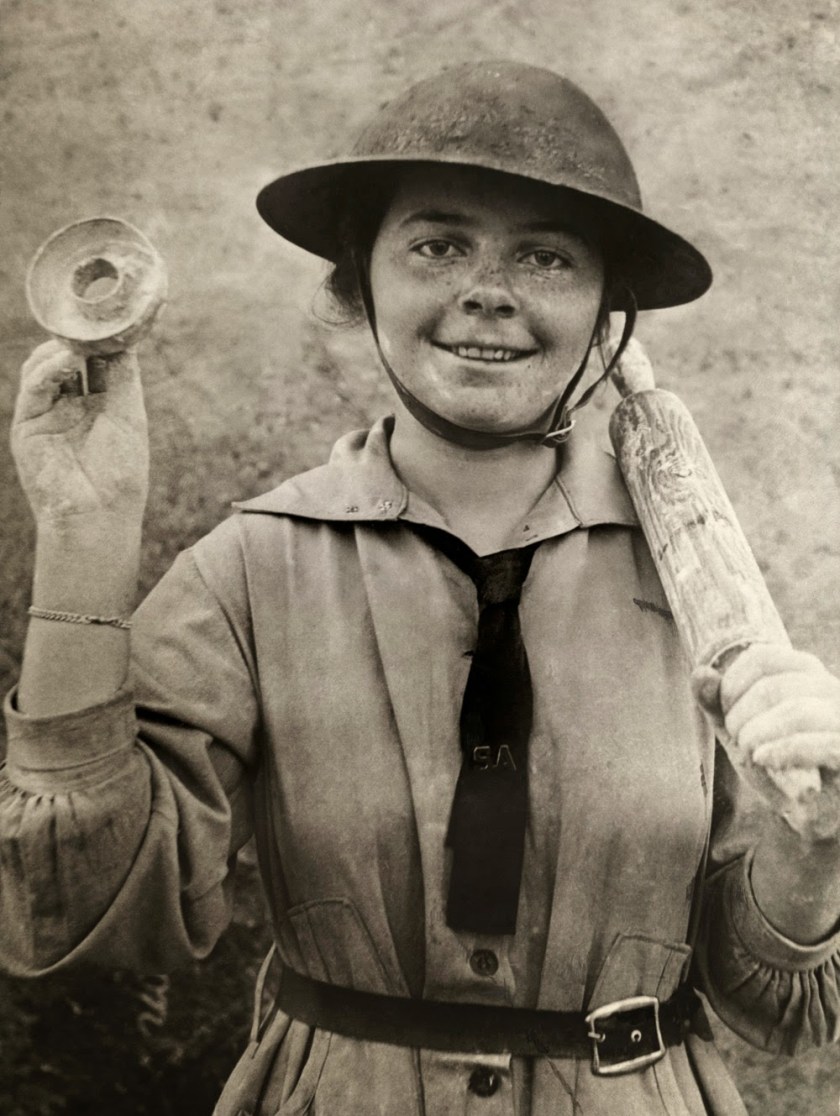
 A small group of carefully selected female officers was sent to France on August 22. That first party comprised six men, three women and a married couple. Within fifteen months their number had expanded by a factor of 400.
 ‘Hutments’ were formed all over the front, many right out at the front lines. There were canteen services. Religious observances of all denominations were held in these facilities. Concert performances were given, clothing mended and words of kindness offered in response to all manner of personal problems. On one occasion, the Loyal Order of Moose conducted a member initiation. Pies and cakes were baked in crude ovens and lemonade served to hot and thirsty troops. Of all these corporal works of mercy, the ones best remembered by the ‘doughboys’ themselves, were the doughnuts.

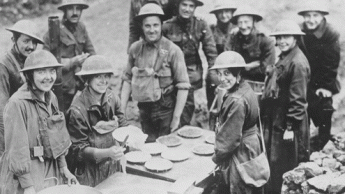 Before long, the women got better at it. Soon they were turning out 2,500 to 9,000 doughnuts a day. An elderly French blacksmith made Purviance a doughnut cutter, out of a condensed milk can and a camphor-ice tube, attached to a wooden block.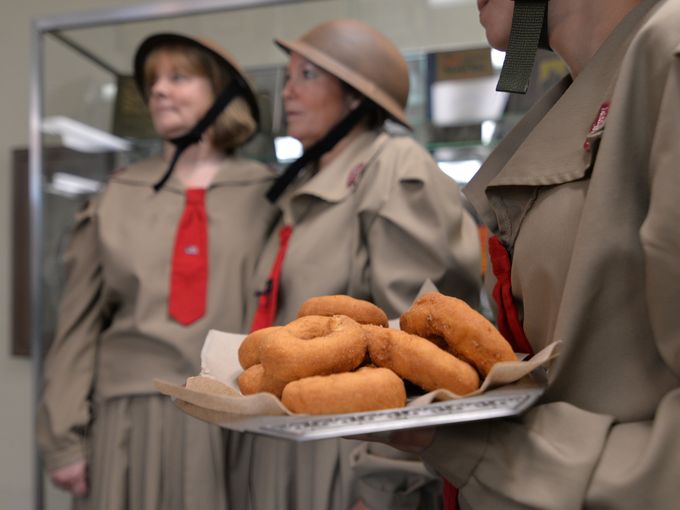


 Today, The Seeing Eye operates a 330-acre complex in Morris Township, New Jersey, the oldest guide dog school still in operation, in the world. The primary breeds used for such training are German Shepherds, Labs, Golden Retrievers, and Lab/Golden mixed breeds. Boxers are occasionally used, for individuals with allergies.

 Historical Easter Eggs - Today in History
You must be logged in to post a comment.