December 18, 1944 Typhoon Cobra

Hulls would creak and groan with the pounding and rivets popped.  Captains in wheelhouses would order course headings, but helmsmen could do no better than 50° to either side of the intended course.  Some ships rolled more than 70°.  The 888-ft carrier USS Hancock, scooped tons of water onto its flight decks, 57′ up.

In September 1935, the Imperial Japanese Navy was conducting wargame maneuvers, when the fourth fleet was caught in extremely foul weather. By the 26th, the storm had reached Typhoon status,  The damage to the Japanese fleet was near catastrophic. Two large destroyers had their bows torn away by heavy seas. Several heavy cruisers suffered major structural damage.  Submarine tenders and light aircraft carriers developed serious cracks in their hulls. One minelayer required near total rebuild, and virtually all fleet destroyers suffered damage to their superstructures. 54 crewmen were lost.

Nine years later, it would be the turn of the American fleet.

The war in the Pacific was in its third year in December 1944. A comprehensive defeat only weeks earlier had dealt the Imperial Japanese war effort a mortal blow at Leyte Gulf, yet the war would go on for the better part of another year.

Carrier Task Force 38 was a massive assembly of warships, a major element of the 3rd Fleet under the Command of Admiral William “Bull” Halsey.  In formation, TF-38 moved in three eight-mile diameter circles, each with an outer ring of destroyers, an inner ring of battleships and cruisers, and a mixed core of 35,000-ton Essex class and smaller escort carriers. TF-38 was a massive force, fielding eighty-six warships, altogether.

By mid-December 1944, Task Force 38 had been underway for three weeks, having just completed three days of heavy raids against Japanese airfields in the Philippines, suppressing enemy aircraft in support of American amphibious operations against Mindoro.  Ships were badly in need of re-supply.  A replenishment fleet, 35 ships in all, was sent to the nearest spot near Luzon, yet still outside of Japanese fighter range.  Replenishment operations began the morning of the 17th.

Rapid movement into previously enemy-held territory made it impossible to establish advance weather reporting.  By the time that Task Force aerological (meteorological) service reports made it to ships in the operating area, weather reports were at least twelve hours old.
Cobra 9

Three days earlier, a barometric low pressure system had begun to form off Luzon, fed by the warm waters of the Philippine sea.  High tropospheric humidity fed and strengthened the disturbance, as counter-clockwise winds began to develop around the low pressure center.  By the 18th, this small “tropical disturbance” had developed into a compact but powerful cyclone.

Replenishment operations began the morning of the 17th, as increasing winds and building seas made refueling increasingly difficult.  Refueling hoses were parted on several occasions and thick hawsers had to be cut to avoid collision, as sustained winds built to 40 knots.  Believing the storm center to be 450 miles to his southeast, Admiral Halsey didn’t want to return to base.  That would take too long, and combat operations were scheduled to resume, two days later.  Halsey needed the carrier group refueled and on station, and so it was decided.  Task Force 38 and the replenishment fleet, would proceed to a second replenishment point, hoping to resume refueling operations on the morning of the 18th.
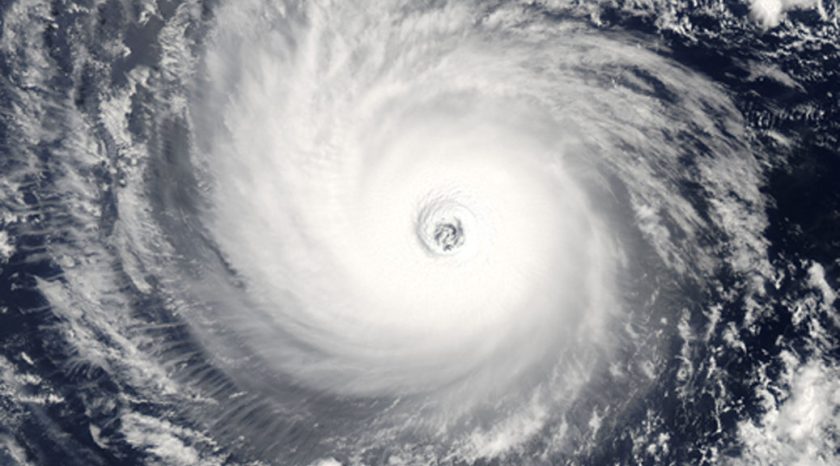
Cobra

Four times over the night of December 17-18, course was corrected in the search for calmer water.  Four times, the ships of Task Force 38 and it’s attendant resupply ships, turned closer to the eye of the storm.  2,200-ton destroyers pitched and rolled like corks, towering over the crest of 70-waves, only to crash into the trough of the next, shuddering like cold dogs as decks struggled to shed thousands of tons of water.

Hulls would creak and groan with the pounding and rivets popped.  Captains in wheelhouses would order course headings, but helmsmen could do no better than 50° to either side of the intended course.  Some ships rolled more than 70°.  The 888-ft carrier USS Hancock, scooped tons of water onto its flight decks, 57′ up.
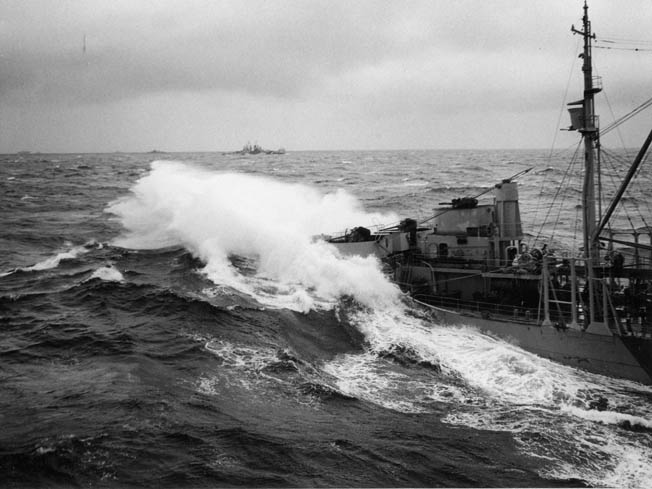
Cobra 4

Typhoon Cobra reached peak ferocity between 1100 and 1400, with sustained winds of 100mph and gusts of up to 140.

The lighter destroyers got the worst of it, finding themselves “in irons” – broad side to the wind and rolling as much as 75°, with no way to regain steering control.  Some managed to pump seawater into fuel tanks to increase stability, while others rolled and couldn’t recover, as water cascaded down smokestacks and disabled engines.

146 aircraft were either wrecked or blown overboard.  The carrier USS Monterrey nearly went down in flames, as loose airplanes crashed about on hanger decks and burst into flames.  One of those fighting fires aboard Monterrey was then-Lieutenant Gerald Ford, the former Michigan Wolverine center and future President of the United States.


Many of the ships of TF-38 sustained damage to above-decks superstructure, knocking out radar equipment and crippling communications.


790 Americans lost their lives in Typhoon Cobra, killed outright or washed overboard and drowned.

It could have been worse.  The destroyer escort USS Tabberer defied orders to return to port, Lieutenant Commander Henry Lee Plage conducting a 51-hour boxed search for survivors, despite the egregious pounding being taken by his own ship.  USS Tabberer plucked 55 swimmers from the water, survivors of the capsized destroyers Hull and Spence.

Typhoon Cobra moved on that night, December 19 dawning clear with brisk winds. Admiral Halsey ordered “All ships of the Task Force line up side-by-side at about ½ mile spacing and comb the 2800-square mile area” in which they’d been operating.  Carl M. Berntsen, SoM1/C aboard the destroyer USS DeHaven, recalled that “I saw the line of ships disappear over the horizon to starboard and to port”. The Destroyer USS Brown rescued six survivors from the Monaghan, and another 13 from USS Hull.  18 more would be plucked from the water, 93 in all, by ships spread across 50-60 miles of open ocean.

When it was over, Admiral Chester Nimitz said typhoon Cobra “represented a more crippling blow to the Third Fleet than it might be expected to suffer in anything less than a major action.”

Afterward

Carl Martin Berntsen passed away on October 13th, 2014 in Kitty Hawk, North Carolina. He would have been 94, the following month. I am indebted to him and his excellent essay for this story.  Virtually all ships of Task Force 38 were damaged to some degree.  I tip my hat to Wikipedia, for the following summary of the more serious instances.

USS Hull – with 70% fuel aboard, capsized and sunk with 202 men drowned (62 survivors)

USS Monaghan – capsized and sunk with 256 men drowned (six survivors)

USS Spence – rudder jammed hard to starboard, capsized and sunk with 317 men drowned (23 survivors) after hoses parted attempting to refuel from New Jersey because they had also disobeyed orders to ballast down directly from Admiral Halsey

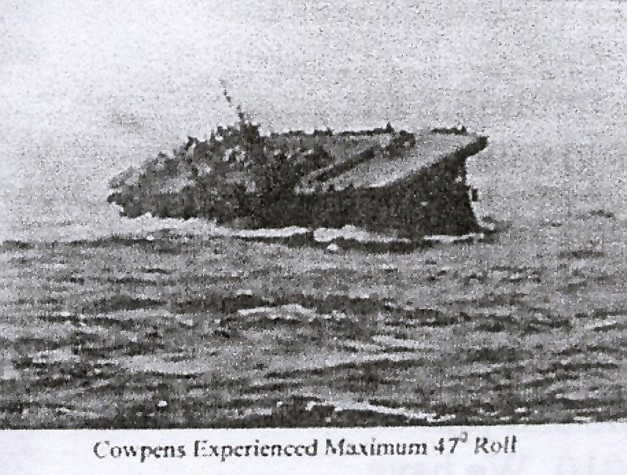
USS Cowpens – hangar door torn open and RADAR, 20mm gun sponson, whaleboat, jeeps, tractors, kerry crane, and 8 aircraft lost overboard. One sailor lost.

USS Monterey – hangar deck fire killed three men and caused evacuation of boiler rooms requiring repairs at Bremerton Navy yard

USS Langley – damaged

USS Cabot – damaged

USS San Jacinto – hangar deck planes broke loose and destroyed air intakes, vent ducts and sprinkling system causing widespread flooding. Damage repaired by USS Hector

USS Altamaha – hangar deck crane and aircraft broke loose and broke fire mains

USS Anzio – required major repair

USS Nehenta – damaged

USS Cape Esperance – flight deck fire required major repair

USS Kwajalein – lost steering control

USS Iowa – propeller shaft bent and lost a seaplane

USS Baltimore – required major repair

USS Miami – required major repair

USS Dewey – lost steering control, RADAR, the forward stack, and all power when salt water shorted main electrical switchboard

USS Aylwin – required major repair

USS Buchanan – required major repair

USS Dyson – required major repair

USS Hickox – required major repair

USS Maddox – damaged

USS Benham – required major repair

USS Donaldson – required major repair

USS Melvin R. Nawman – required major repair

USS Tabberer – lost foremast

USS Waterman – damaged

USS Nantahala – damaged

USS Jicarilla – damaged

USS Shasta – damaged “one deck collapsed, aircraft engines damaged, depth charges broke loose, damaged “

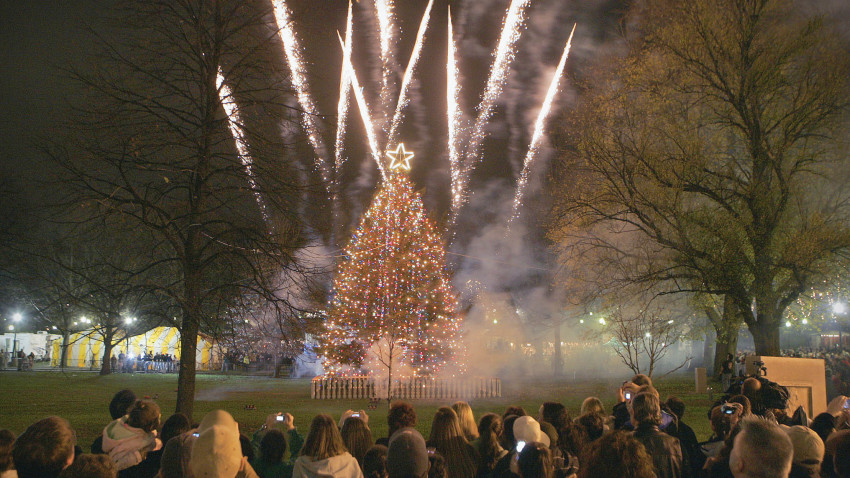
December 10, 1917 Oh, Christmas Tree…

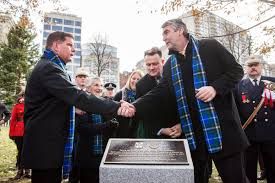
On November 30, a monument was unveiled on Boston Commons, commemorating the 100th anniversary of the Halifax explosion.  The official 2017 Christmas tree lit up for the first time, that night.

A few days short ago, a Christmas tree was erected on Boston Commons. Symbolizing as it does the friendship between the people of two nations, this is no ordinary tree. This tree stands in solemn remembrance of catastrophe, 100 years ago, today.

As “The Great War” dragged to the end of its third year in Europe, Halifax harbor in Nova Scotia was the bustling scene of supply, munition, and troop ships destined for “over there”.  With a population of 50,000 at the time, Halifax was the busiest port in Atlantic Canada.

The Norwegian vessel Imo left its mooring in Halifax harbor on December 6, 1917, destined for New York City.   The French ship Mont Blanc was entering the harbor at this time, intending to join the convoy which would form her North Atlantic escort.

In her holds, Mont Blanc carried 200 tons of Trinitrotoluene (TNT), and 2,300 tons of TNP – Trinitrophenol or “Picric Acid”, a substance used as a high explosive.  In addition, the freighter carried 35 tons of high octane gasoline and 20,000 lbs of gun cotton.

Not wanting to draw the attention of pro-German saboteurs, the freighter flew no flags warning of her dangerous cargo.  Mont Blanc was a floating bomb.

Somehow, signals became crossed as the two ships passed, colliding in the narrows at the harbor entrance and igniting TNP onboard Mont Blanc.  French sailors abandoned ship as fast as they could, warning everyone who would listen of what was about to happen.

As might be expected, the pyrotechnic spectacle put on by the flaming ship was too much to resist, and crowds gathered around the harbor.  The high-pitched scream emitted by picric acid under combustion is a principal feature of fireworks displays, to this day.  You can only imagine the scene as the burning freighter brushed the harbor pier setting that ablaze as well, before running itself aground.

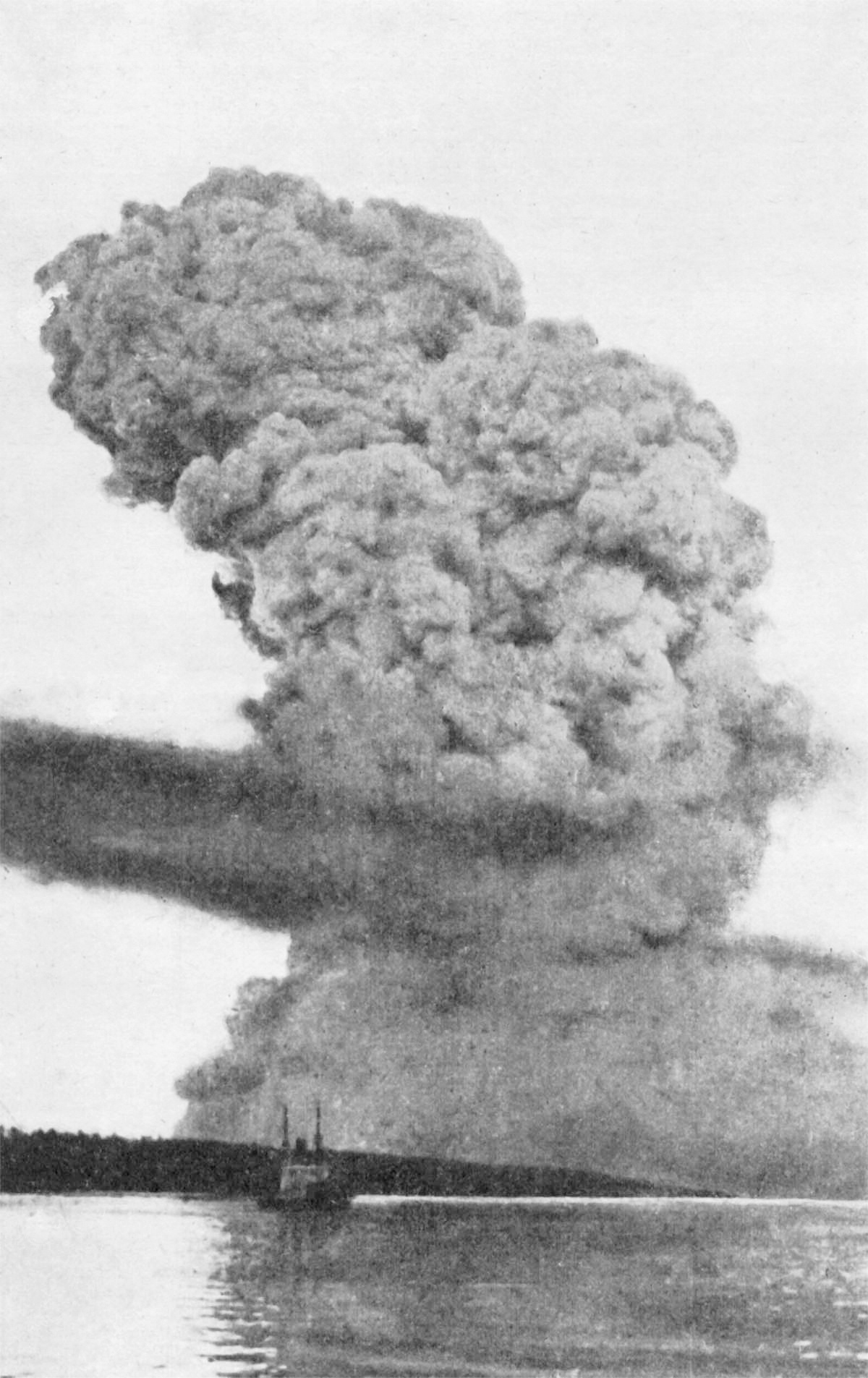
That was when Mont Blanc exploded.

Halifax explosion, 2

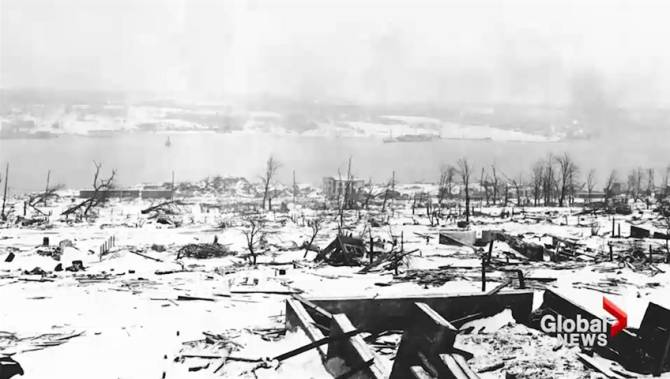
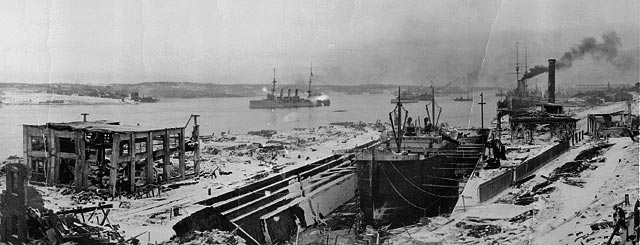
The detonation and resulting fires killed over 1,800 and wounded another 9,000, flattening the north end of Halifax and shattering windows as far as 50 miles away.

It was one of the largest man made, non-nuclear explosions in history. Mont Blanc’s anchor landed two miles away, one of her gun barrels, three.  Later analysis estimated the output at 2.9 kilotons, an explosive force greater than some tactical nuclear weapons.

Halifax explosion, 3

The first ray of light the morning of December 7 revealed some 1,600 homes destroyed in the blast, as a blizzard descended across Nova Scotia.

Boston Mayor James Michael Curley wrote to the US Representative in Halifax “The city of Boston has stood first in every movement of similar character since 1822, and will not be found wanting in this instance. I am, awaiting Your Honor’s kind instruction.”

Halifax explosion, 1

The man was as good as his word.  Mayor Curley and Massachusetts Governor Samuel McCall composed a Halifax relief Committee to raise funds and organize aid.  McCall reported that the effort raised $100,000 in its first hour, alone. President Woodrow Wilson authorized a $30,000 carload of Army blankets sent to Halifax.

Within 12 hours of the explosion, the Boston Globe reported on the first train leaving North Station, with “30 of Boston’s leading physicians and surgeons, 70 nurses, a completely equipped 500-bed base hospital unit and a vast amount of hospital supplies”.

Delayed by deep snow drifts, the train arrived on the morning of December 8, the first non-Canadian relief train on the scene.

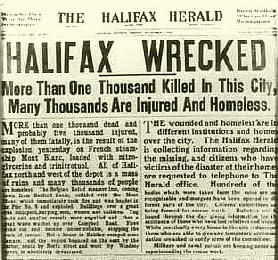
Halifax HeraldThere was strong sentiment at the time, that German sabotage lay behind the disaster.  A front-page headline on the December 10 Halifax Herald Newspaper proclaimed “Practically All the Germans in Halifax Are to Be Arrested”.
$750,000 in relief aid would arrive from Massachusetts alone, equivalent to more than $15 million today.  Canadian Prime Minister Robert Borden would write to Governor McCall on December 9, “On behalf of the Government of Canada, I desire to convey to Your Excellency our very sincere and warm thanks for your sympathy and aid in the appalling calamity which has befallen Halifax”.

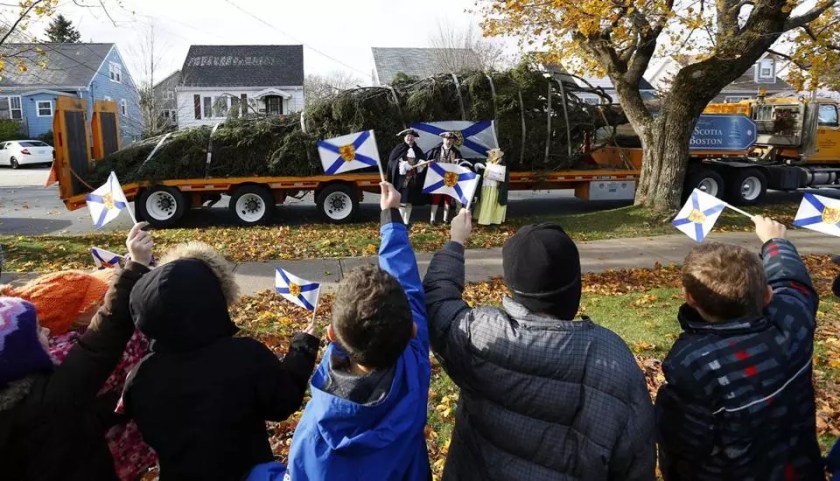
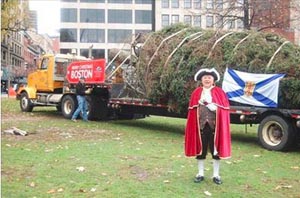
The following year, Nova Scotia sent the city of Boston a gift of gratitude.  A very large Christmas tree.

O1A0508

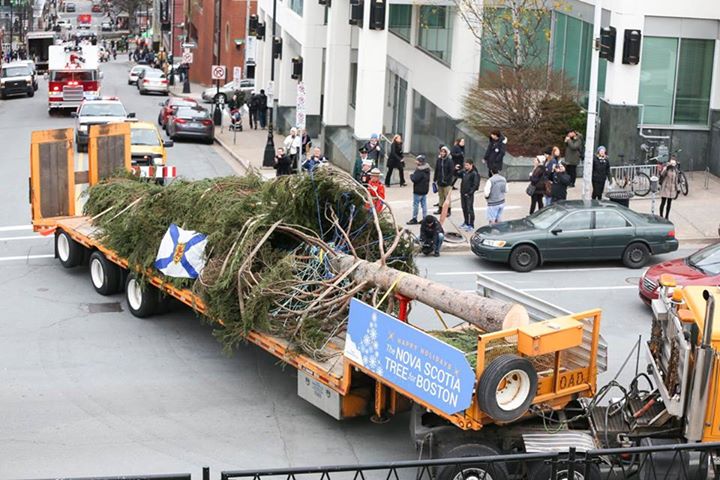
In 1971, the Lunenburg County Christmas Tree Producers Association sent another tree to Boston, to promote Christmas tree exports, and to once again acknowledge the support of the people and government of Boston after the 1917 disaster. The Nova Scotia government later took over the annual gift of the Christmas tree, to promote trade and tourism.Halifax Tree Sendoff

So it is that, every year, the people of Nova Scotia send the official Christmas tree to the people of Boston.  More recently, the principle tree is joined by two smaller trees, donated to Rosie’s Place and the Pine Street Inn, two Boston homeless shelters.

events3406This is no Charlie Brown shrub we’re talking about. The 1998 tree required 3,200 man-hours to decorate:  17,000 lights connected by 4½ miles of wire, and decorated with 8,000 bulbs.

In 2013, the tree was accompanied by a group of runners, in recognition of the Boston Marathon bombing earlier that year.

This year’s tree stands 53′ tall, marking 100 years since the Halifax exlosion. It takes two men a day and a half to prepare for cutting, a crane holding the tree upright while the chainsaw does its work.  It’s a major media event, as the tree is paraded through Halifax on a 53’ flatbed, before boarding the ferry across the Bay of Fundy to begin its 750-mile journey south.download

For a small Canadian province, it’s been no small commitment.  In 2015 Nova Scotia spent $242,000 on the program, including transportation cutting & lighting ceremonies, and the promotions that went with it.

On November 30, a monument was unveiled on Boston Commons, commemorating the 100th anniversary of the Halifax explosion.  The official 2017 Christmas tree lit up for the first time, that night.

Last year, Premier Stephen McNeil explained the program and why it was worth the expense:  “(It) gives us a chance to showcase our beautiful part of the world to a global community”.   Premier McNeil may have had the last word this year, at the tree lighting ceremony. “We had massive deaths and injuries,” McNeil said of the 1917 catastrophe. “It would have been far worse if the people of Boston hadn’t come and supported us.”

boston-tree-header

If you enjoyed this “Today in History”, please feel free to re-blog, “like” & share on social media, so that others may find and enjoy the same. Please click the “follow” button on the right, to receive email updates on new articles.  Thank you for your interest, in the history we all share.

December 5, 1914 Shackleton Expedition

At South Georgia Island, Ernest Shackleton asked how the war had ended. The response hit like a hammer. “The war isn’t over.  Millions are dead.  Europe is mad.  The world is mad”.

In an alternate history, the June 1914 assassination of the heir-apparent to the Habsburg Empire could have led to nothing more than a regional squabble. A policing action in the Balkans. As it was, mutual distrust and entangling alliances drew the Great Powers of Europe into the vortex. On August 3, the “War to End Wars” exploded across the European continent.

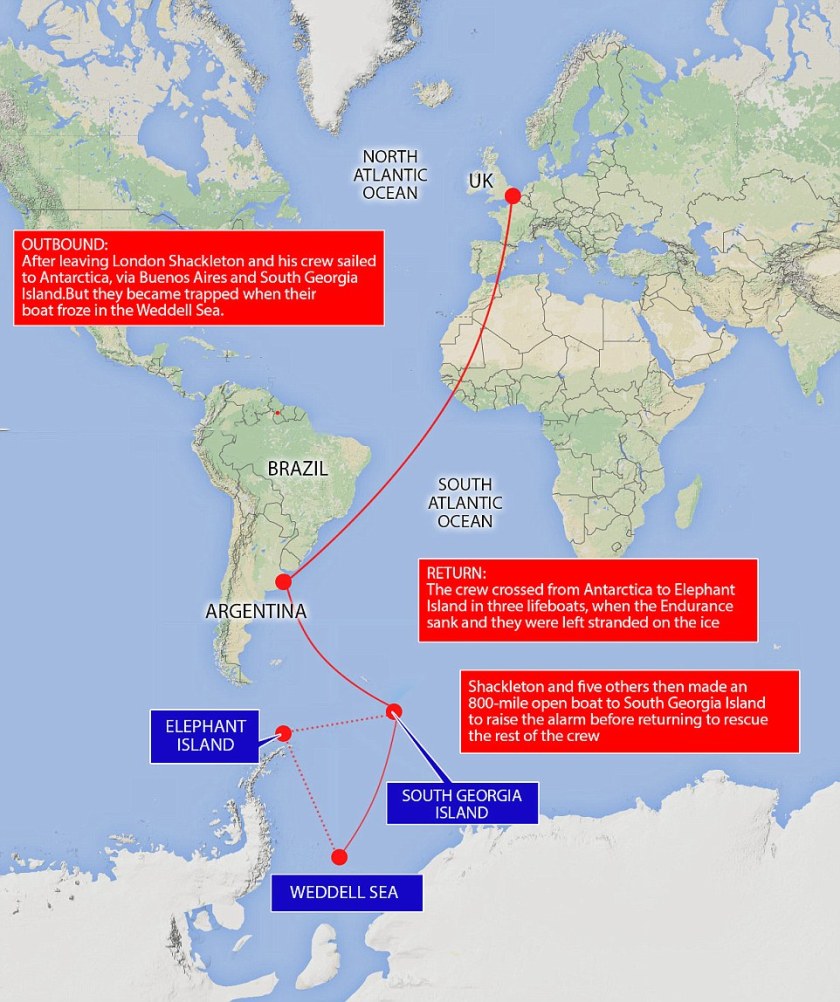
The period has been called the “Heroic Age of Antarctic Exploration”.  As the diplomatic wrangling, mobilizations and counter-mobilizations of the “period preparatory to war” unfolded, Sir Ernest Shackleton made final arrangements for his third expedition into the Antarctic.  Despite the outbreak of war, first Lord of the Admiralty Sir Winston Churchill ordered Shackleton to Proceed. The “Endurance” expedition departed British waters on August 8.

Shackleton 5

The German invasion of France ground to a halt that September. The first entrenchments were being dug as Shackleton himself remained in England, departing on September 27 to meet up with the Endurance expedition in Buenos Aires.

With the unofficial “Christmas Truce” of 1914 short weeks away from the trenches of Flanders, Shackleton’s expedition left Grytviken whaling station on South Georgia Island.  It was December 5.Shackleton 12

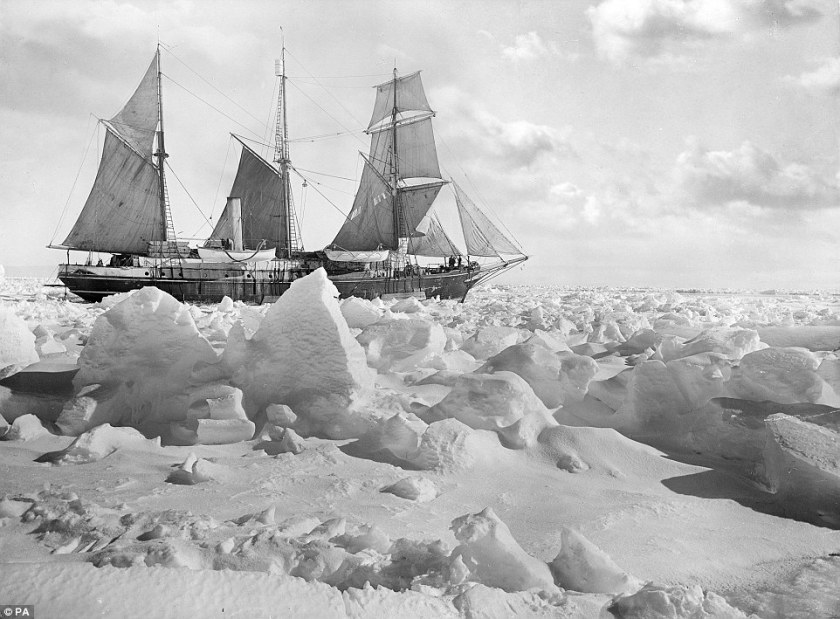
The Endurance expedition intended to be the first to cross the Antarctic continent.  The way things turned out, the crew wouldn’t touch land, for another 497 days.

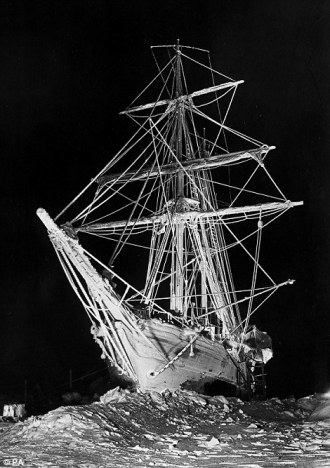
The disaster of the Great War became “Total War” with the zeppelin raids of January, as Endurance met with disaster of its own. The ship was frozen fast, within sight of the Antarctic continent. There was no hope of escape.Shackleton 7

HMS Lusitania departed New York City on May 1, 1915, not knowing that she only had six days to live. The sun that vanished that night over the Shackleton expedition, would not reappear for another four months.

As the nine-month battle unfolded across the Gallipoli Peninsula, Shackleton’s men abandoned ship’s routine and converted to winter station. On September 1, the massive pressure of the pack ice caused Endurance to “literally [jump] into the air and [settle] on its beam,” as losses to the Czar’s army in Galicia and Poland lead to a mass exodus of Russian troops and civilians from Poland. The “Great Retreat” gave way to the sort of discontent which would one day end the Czarist regime, as Shackleton gave the order to abandon ship. On November 21, the wreck of the Endurance slipped below the surface.

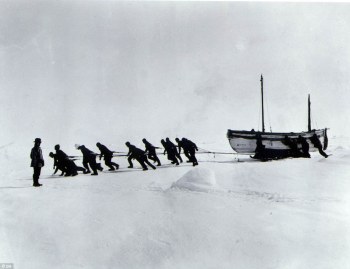
That December, Allies began preparations for a summer offensive along the upper reaches of the River Somme. The Shackleton party camped on pack ice, adrift in open ocean, as Erich von Falkenhayn began the Verdun offensive with which he would “bleed France white”.  The ice broke up that April, forcing Shackleton and his party into three small lifeboats. Seven brutal days would come and go in those open boats, before the party reached land at the desolate shores of Elephant Island.Shackleton 10

The whaling stations at South Georgia Island, some 800 miles distant, were the only hope for survival. Shackleton and a party of five set out on April 24 aboard the 22½’ lifeboat, James Caird, as the five-month siege at Kut-al-Amara in Mesopotamia ended with the surrender of 13,000 British and Indian soldiers, to the Turks.

The party arrived on the west coast of South Georgia Island in near-hurricane force winds, the cliffs of South Georgia Island coming into view on May 10. As Captain Frank Worsely, Second officer Tom Crean and expedition leader Ernest Shackleton picked their way across glacier-clad mountain peaks thousands of feet high, Austrian troops attacked Italian mountain positions in the Trentino.

Shackleton 9The trio arrived at the Stromness whaling station on May 20.  They must have been a sight, with thick ice encrusting their long, filthy beards, and saltwater-soaked sealskin clothing rotting from their bodies. The first people they came across were children, who ran in fright at the sight of them.

The last of the Shackleton expedition would be rescued on August 22, ending the 20-months long ordeal.

At South Georgia Island, Ernest Shackleton asked how the war had ended. The response hit like a hammer. The war isn’t over.  Millions are dead.  Europe is mad.  The world is mad“.


If you enjoyed this “Today in History”, please feel free to re-blog, “like” & share on social media, so that others may find and enjoy the same. Please click the “follow” button on the right, to receive email updates on new articles.  Thank you for your interest, in the history we all share.

November 28, 1942 Cocoanut Grove

ICYMI – “Barney” Welansky, the current owner, liked to brag about his ties with the Mob and with Boston Mayor Maurice Tobin. Welansky was in Mass General Hospital that night, recovering from a heart attack. He would soon have a lot of company.

If you go behind the Hotel Radisson in Boston, over by the parking garage, you’ll find 17 Piedmont Street, in the Bay Village neighborhood. The address is a parking lot now.  75 years ago, it contained the most popular nightclub in Boston.

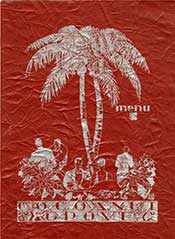
cocoanut-grove-menu
Cocoanut Grove Menu

Rumors of criminal connections followed the Cocoanut Grove for years. The former owner, gangster and bootlegger Charles “King” Solomon, had been gunned down ten years earlier in the men’s room of Roxbury’s Cotton Club. “Barney” Welansky, the current owner, liked to brag about his ties with the Mob and with Boston Mayor Maurice Tobin. Welansky was in Mass General Hospital that night, recovering from a heart attack. He would soon have a lot of company.

During prohibition, the club had been a speakeasy . Originally a garage and warehouse, Cocoanut Grove was converted into a 1½ story complex of dining rooms, bars, and lounges, offering patrons dining and dancing in a “tropical paradise” of artificial palm trees, satin bunting and paper palm fronds, complete with a roof which could be rolled back when weather permitted, for dancing under the stars.

Cocoanut_Grove_Night_Club_FireWelansky was a tough boss, maniacally determined not to be cheated out of a tab or a cover charge. He locked exit doors, concealed others with draperies, and even bricked up one emergency exit. Nobody was going to leave Cocoanut Grove without paying up.

Boston College had just ended an undefeated season, losing their slot in the Sugar Bowl in a stunning upset to Holy Cross, 55–12.

Over a thousand football fans, military service members, and Thanksgiving weekend revelers crowded into the nightclub that night.  The rated capacity was 460.

Downstairs in the Melody Lounge, Goody Goodelle played piano on a revolving stage, surrounded by paper palms. Someone, perhaps a soldier on leave with his sweetheart, had removed a light bulb to have a little privacy. 16-year old bus boy Stanley Tomaszewski climbed up to replace the bulb, lighting a match so he could see what he was doing.

Cocoanut Grove, 2The decorations ignited immediately, fire racing so fast along the satin canopy, that wooden strips suspending it from the ceiling remained unscathed.

Waiters attempted to douse the fire with water, but it spread far too quickly. Lounge patrons were overcome so rapidly by toxic smoke, that some were later found dead in their seats, drinks still in their hands.

Flames raced up the stairway to the main level, burning the hair of people trying to escape. The orchestra was just beginning its evening show as a fireball leapt across the dance floor, spreading quickly through the Caricature Bar, and down a hallway to the Broadway Lounge. Inside of five minutes, flames had spread into the main hall and the entire nightclub was ablaze.

maxresdefaultToday, fire codes require revolving doors to be flanked by doors on either side, but that wasn’t the case in 1942. Desperate to escape, patrons packed the single revolving door, their bodies jamming it so tightly that firefighters later had to dismantle the entire frame.

The bodies of club guests piled up at locked exits, as other doors, opening inward, became useless in the crush of bodies. Firefighters later testified that 300 could have been saved, if only those doors had opened to the outside.

Ambulances, taxis, newspaper delivery trucks and private cars descended on Boston City Hospital’s emergency room, the injured, dead and dying arriving at a rate of one every eleven seconds. Dr. Stanley Levenson, just a year out of Harvard Medical School and down that night with food poisoning, got the call. “I was still in bed on Saturday night, when I got a call from Dr. Charles Lund, chief of surgery, and he told me that no matter how I felt, I had to get to ER immediately, something terrible had happened”.

Cocoanut Grove3The most striking story of survival that night, was that of 21-year old Coast Guardsman Clifford Johnson, who returned to the nightclub no fewer than four times in search of his date, Estelle Balkan. He didn’t know that she had safely escaped, and each time Johnson returned with another unconscious smoke victim in his arms. Johnson himself was on fire his last time out, when he collapsed onto the sidewalk, still ablaze.
Clifford Johnson
Clifford Johnson

Three other burn victims were taken to Mass General that night, with burns over 30% of their bodies.   Johnson alone survived the ordeal, despite third degree burns over 50% of his body. Much of that, was burned to the bone.  Johnson would suffer almost two years of excruciating medical procedures, including no fewer than 30,000 skin grafts in the first year alone.

I earn my living in the Commercial Furniture business.  I can tell you from experience that Cocoanut Grove effects Boston fire code regulations, to this day. 492 died in the conflagration, the deadliest nightclub fire in American history.

cocoanut grove4Barney Welansky was tried and convicted on 19 counts of manslaughter, and sentenced to 12-15 years. Maurice Tobin, by then Governor, released him after four, his body ravaged with cancer. Welansky died 9 weeks later. Stanley Tomaszewski was exonerated.  It wasn’t he who had placed all those flammable decorations, but the bus boy was treated like a Jonah, for the rest of his life.
Clifford Johnson would be 21 months in the hospital, after which he married his nurse and returned to his home state of Missouri, the first of his era to survive such severe burns. Ironically, Johnson would be killed in a car wreck in 1956, pinned beneath an overturned Jeep, and burned to death.


If you enjoyed this “Today in History”, please feel free to re-blog, “like” & share on social media, so that others may find and enjoy the same. Please click the “follow” button on the right, to receive email updates on new articles.

Thank you for your interest, in the history we all share.

November 20, 1820  The Real Moby Dick

Never in the history of the whale fishery had a whale been known to attack a ship unprovoked.  This one hit the port side so hard that it shook the ship.

The whaleship Essex set sail from Nantucket in August 1819, the month when Herman Melville was born.  The 21 man crew expected to spend 2-3 years hunting sperm whales, filling the ship’s hold with oil before returning to split the profits of the voyage.

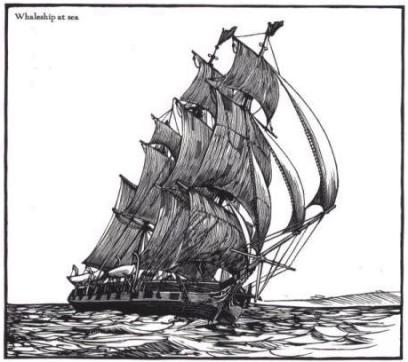
Whaleship at seaEssex sailed down the coast of South America, rounding the Horn and entering the Pacific Ocean.  They heard that the whaling grounds near Chile and Peru were exhausted, so they sailed for the “offshore grounds”, almost 2,000 miles from the nearest land.
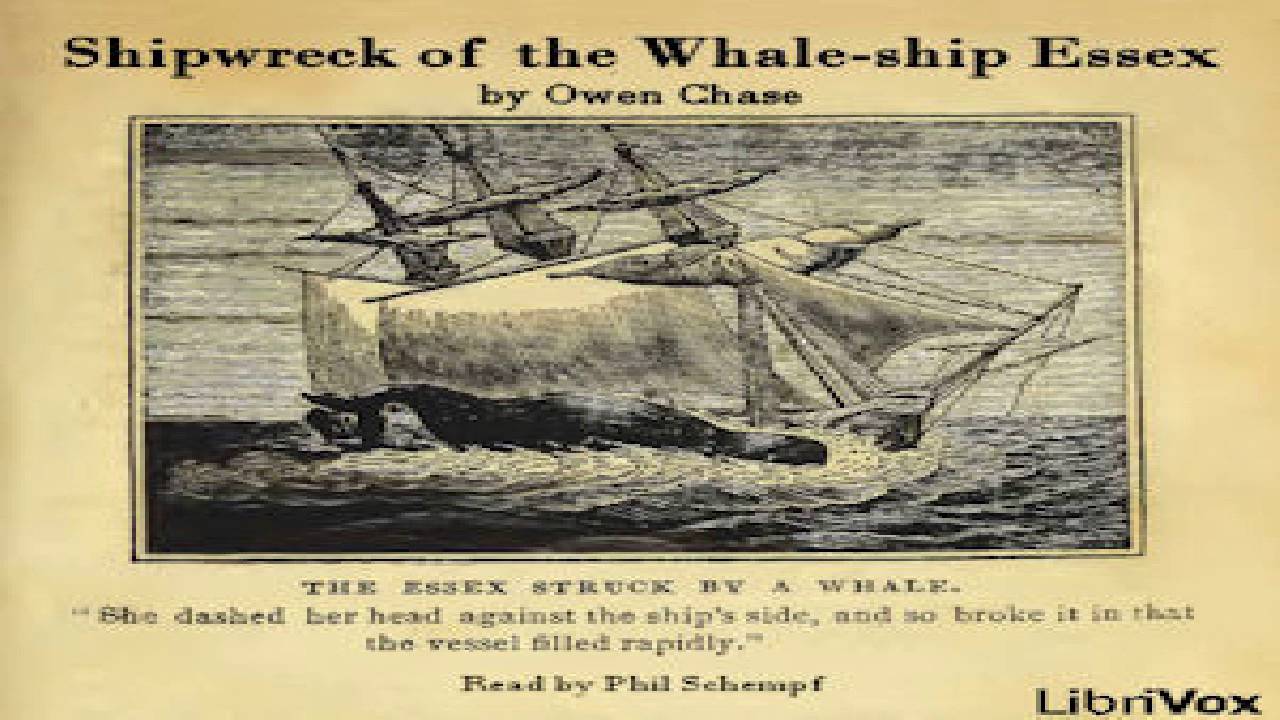
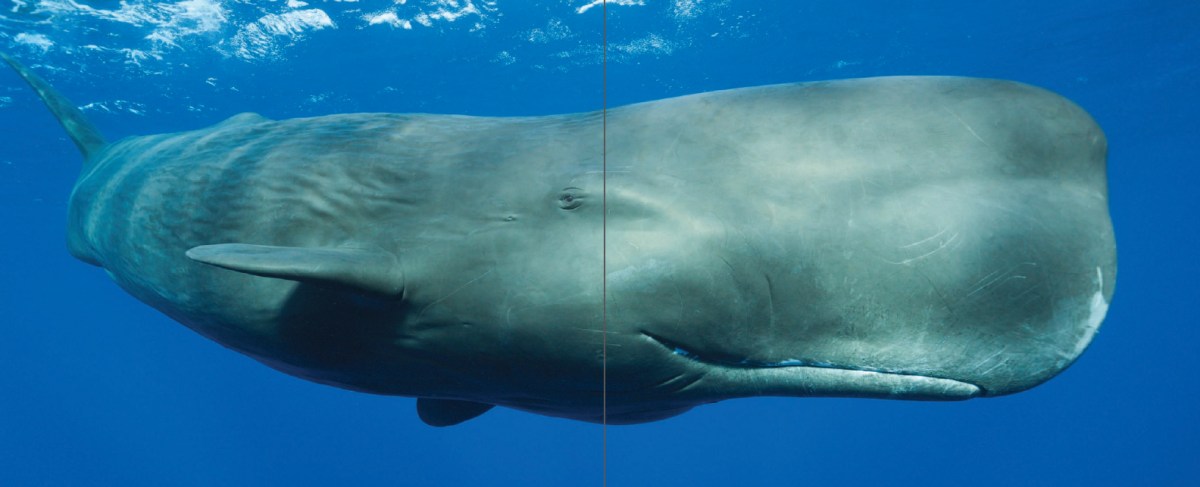
They were there on November 20, 1820, with two of their three boats out hunting whales.  The lookout spotted a huge bull sperm whale, much larger than normal, estimated at 85 feet long and 80 tons.  He was behaving oddly, lying motionless on the surface with his head facing the ship.  In moments the whale began to move, picking up speed as he charged the ship.  Never in the history of the whale fishery had a whale been known to attack a ship unprovoked.  This one hit the port side so hard that it shook the ship.

Wreck of the whale ship Essex

The huge animal seemed dazed by the impact, floating to the surface and resting by the ship’s side.  He then turned and swam away for several hundred yards, before turning to resume his attack.  He came in at the great speed of 24 knots according to First Mate Owen Chase, ramming the port bow and driving the stern into the water.  Oak planking cracked and splintered as the whale worked his tail up and down, driving the 238-ton vessel backward.  Essex had already started to go down when the whale broke off his attack, diving below the surface, never to return.

Essex_photoCaptain George Pollard’s boat was the first to make it back, and he stared in disbelief.  “My God, Mr. Chase, what is the matter?”  he asked.  “We have been stove by a whale” came the reply.
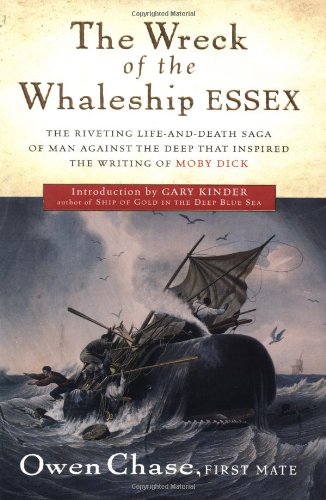
No force on earth could save the stricken whale ship. The crew divided into groups of seven and boarded the three boats.  It wasn’t long before Essex sank out of sight and they were alone, stranded in 28′ open boats, and about as far from land as it was mathematically possible to be.

The whalers believed that cannibals inhabited the Marquesa islands, 1,200 miles to the west, so they headed south, parallel to the coast of South America.  Before their ordeal was over, they themselves would become the cannibals.

With good winds, they might reach the coast of Chile in 56 days.  They had taken enough rations to last 60, provided they were distributed at starvation levels, but most of it had been ruined by salt water.  There was a brief reprieve in December, when the three small boats landed on a small island in the Pitcairn chain.  There they were able to get their fill of birds, eggs, crabs, and peppergrass, but within a week the island was stripped clean.  They decided to move on, except for three who refused to get back in the boats.

EssexThey never knew that this was Henderson Island, only 104 miles from Pitcairn Island, where survivors from the 1789 Mutiny on HMS Bounty had managed to survive for the past 36 years.

After two months at sea, the boats had long separated from one another.  Starving men were beginning to die, and the survivors came to an unthinkable conclusion.  They would have to eat their own dead.

When those were gone, the survivors drew lots to see who would die, that the others might live.  Captain Pollard’s 17-year-old cousin Owen Coffin, whom he had sworn to protect, drew the black spot.   Pollard protested, offering to take his place, but the boy declined. “No”, he said, “I like my lot as well as any other.”  Again, lots were drawn to see who would be Coffin’s executioner.  Owen’s friend, Charles Ramsdell, drew the black spot.

On February 18, the British whaleship Indian spotted a boat containing Owen Chase, Benjamin Lawrence and Thomas Nickerson.  It was 90 days after Essex’ sinking.  Five days later, the Nantucket whaleship Dauphin pulled alongside another boat, to find Captain Pollard and Charles Ramsdell inside.  The pair was so far gone that they didn’t notice at first, gnawing on the bones of their comrades.

The three who were left on Henderson Island were later rescued.  The third whaleboat was found beached on a Pacific island several years later, with four skeletons on board.

The Essex was the first ship recorded to have been sunk by a whale, though it would not be the last.  The Pusie Hall was attacked in 1835. The Lydia and the Two Generals were both attacked by whales a year later, and the Pocahontas and the Ann Alexander were sunk by whales in 1850 and 1851.

31 years after the Essex sinking, a sailor turned novelist published his sixth volume, beginning it with the words, “Call me Ishmael”.

November 7, 1940 Galloping Gertie

The men who built the Tacoma Narrows Bridge used to suck lemons on the job site, to keep from becoming seasick. It was probably one of these “boomers” who first noticed how the bridge rippled in the wind. Someone  called it “Galloping Gertie”, and the name stuck.

The name “Galloping Gertie” was first used to describe a 900′ bridge over the Ohio River in Wheeling, West Virginia. Built in 1849, it was the longest suspension bridge in the world at the time, until collapsing in a windstorm in May, 1854.

Ninety years later, the 5,939′ bridge over Puget Sound earned the same name.

The Tacoma Narrows Bridge had been designed by one of the most respected bridge engineers of its time. Federal and state experts all approved the plans, when construction began in 1937. When finished, it was the third longest suspension bridge in the world.

historical11

The deck’s vertical wave motions, or “bounce”, were noted as early as May 1940, as workmen finished the bridge’s floor system. As with the 790’ John Hancock Tower in Boston, the bridge would literally twist in the wind. The solution was similar in both cases.  Engineers installed hydraulic buffers, pistons called “Tuned Mass Dampers,” to act as shock absorbers. The tactic worked for the John Hancock building, which, mercifully, no longer ejects 4’x11’, 500lb glass panels onto the street below.

The tactic made little to no improvement on the bridge.

historical16The men who built it used to suck lemons on the job site, to keep from becoming seasick. It was probably one of these “boomers” who first noticed how the bridge rippled in the wind. Someone  called it “Galloping Gertie”, and the name stuck.

Carol Peacock, a student at nearby Fife High School, sat down to do her homework on the evening of November 6, 1940. She was taking a journalism class.  Her assignment was to write an essay beginning with, “Just suppose . . .” She called her essay, “Tacoma Narrows Bridge Collapses.” Nostradamus could not have called it better. The bridge came down the next day.

Leonard Coatsworth, a Tacoma News Tribune editor, entered the span some time before 11:00am on November 7, the last person to drive onto the bridge. “Just as I drove past the towers”, he said, “the bridge began to sway violently from side to side. Before I realized it, the tilt became so violent that I lost control of the car…I jammed on the brakes and got out, only to be thrown onto my face against the curb…Around me I could hear concrete cracking…The car itself began to slide from side to side of the roadway. On hands and knees most of the time, I crawled 500 yards or more to the towers…Toward the last, I risked rising to my feet and running a few yards at a time…Safely back at the toll plaza, I saw the bridge in its final collapse and saw my car plunge into the Narrows.”

collapse6The bridge was bucking so violently that at times, one sidewalk rose as high as 28’ above its opposite.

Frederick Bert Farquharson was a professor of civil engineering at the University of Washington. He’d been retained to help fix the bridge, and was on the span on the morning of the 7th. Professor Farquharson noticed “Tubby”, a black Cocker Spaniel, cowering in the back of Coatsworth’s abandoned car. He tried to rescue the terrified dog, but all he got was a bite on the hand. Driven by the desire to record the engineering science and delayed by the failed rescue attempt, Professor Farquharson was the last to leave the span. Tubby went down with the bridge, the only life lost in the incident.

The bridge remains at the bottom of Puget Sound to this day, one of the largest artificial reefs, in the world.

Photographer Howard Clifford and reporter Bert Brintnall covered the story for the Tacoma News Tribune. The pair had noticed a billboard ad that morning, for the Pacific National Bank. “As secure as the Narrows Bridge,” it read. They returned fewer than two hours after the collapse, wanting to photograph the billboard for their story. Workmen had already covered the sign with white paper.

Feature Image Credit:  By Barney Elliott; The Camera Shop – Screenshot taken from 16MM Kodachrome motion picture film by Barney Elliott., Fair use, https://en.wikipedia.org/w/index.php?curid=23093518

July 30 1945 USS Indianapolis

“This is Captain McVay’s dog tag from when he was a cadet at the Naval Academy. As you can see, it has his thumbprint on the back. I carry this as a reminder of my mission in the memory of a man who ended his own life in 1968. I carry this dog tag to remind me that only in the United States can one person make a difference no matter what the age. I carry this dog tag to remind me of the privilege and responsibility that I have to carry forward the torch of honor passed to me by the men of the USS Indianapolis”.

The heavy cruiser USS Indianapolis set out on its secret mission on July 16, 1945, under the command of Captain Charles Butler McVay, III.  She was delivering “Little Boy” to the Pacific island of Tinian, the atomic bomb which would later be dropped on Hiroshima.

USS_Indianapolis_at_Mare_IslandIndianapolis made her delivery on July 26, arriving at Guam two days later and then heading for Leyte to take part in the planned invasion of Japan. She was expected to arrive on the 31st.
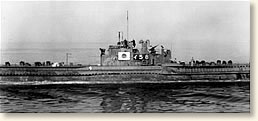
Japanese submarine I-58, Captain Mochitsura Hashimoto commanding, fired a spread of six torpedoes at the cruiser, two striking Indianapolis’ starboard bow at fourteen minutes past midnight on Monday, July 30. The damage was massive. Within 12 minutes she had rolled over, gone straight up by the stern, and sunk beneath the waves.

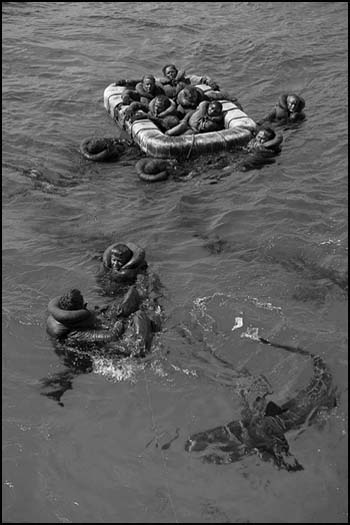
About 300 of Indianapolis’ 1,196-member crew were killed outright, leaving almost 900 treading water. Many had no life jackets and there were few life boats.  There had been too little time.Indianapolis Sub

For four days they treaded water, alone in open ocean, hoping for the rescue that did not come.   Shark attacks began on the first day, and didn’t let up for the entire time they were in the water. Kapok life vests became waterlogged and sank after 48 hours, becoming worse than useless.

Exhaustion, hypothermia, and severe sunburn took their toll as the days went by. Some went insane and began to attack shipmates.  Others found the thirst so unbearable that they drank seawater, setting off a biological chain reaction which killed them in a matter of hours.

Some simply swam away, following some hallucination that only they could see. Through it all, random individuals would suddenly rise up screaming from the ocean, and then disappear from sight, as the sharks claimed another victim.

indianapolis_2
Caribbean Reef sharks circling the sailors in reenactment scene after USS Indianapolis had been sunk by Japanese submarine. As seen on OCEAN OF FEAR: WORST SHARK ATTACK EVER.

At Naval Command, there was confusion about where Indianapolis was to report when it arrived.  When the cruiser failed to arrive on the 31st, there was no report of the non-arrival.  Perhaps worst, a message which could have clarified Indianapolis’ expected arrival on Monday came through garbled, and there was no request to repeat it.

As it was, only the barest of chances led to Indianapolis’ survivors being located at all.   Lieutenant Wilbur Gwinn, pilot of a Ventura scout-bomber, had lost the weight from a navigational antenna wire.  Belly-crawling through the fuselage to fix the thrashing antenna, Gwinn noticed an oil slick.  Back in the cockpit, he dropped down to have a better look.  Only then did he spot men floating in open ocean.

Lieutenant R. Adrian Marks and his PBY Catalina amphibious patrol aircraft were the first on the scene.  Horrified to see sharks actually attacking the men below, Marks landed his flying boat at sea.   The last Indianapolis survivor was plucked from the ocean Friday afternoon, half dead after almost five days in the water.  Of the 900 or so who survived the sinking, only 317 remained alive at the end of the ordeal.

The Navy had committed multiple errors, from denying McVay’s requested escort to informing him that his route was safe, even when the surface operations officer knew at least two Japanese submarines operated within the area.  No Matter.  A capital ship had been lost and someone was going to pay.  A hastily convened court of inquiry was held in Guam on August 13, leading to Captain McVay’s court-martial.

No less a figure than Fleet Admiral Chester Nimitz (CINCPAC) and Admiral Raymond Spruance, for whom the Indianapolis had served as 5th Fleet flagship, opposed the court-martial, believing McVay to be guilty of an error in judgement at worst, not gross negligence. Naval authorities in Washington saw things differently, particularly Navy Secretary James Forrestal and Chief of Naval Operations Admiral Ernest King.

Captain McVay’s orders were to “zigzag” at discretion, a naval maneuver most effective at avoiding torpedoes already in the water.   No Navy directives in effect at that time or since have so much as recommended, let alone ordered, zigzagging at night or in poor visibility.

Prosecutors flew I-58 commander Hashimoto in to testify at the court-martial, but he swore that zigzagging would have made no difference.  The Japanese Commander even became part of a later effort to exonerate McVay, but to no avail. Charles Butler McVay III was convicted of “hazarding his ship by failing to zigzag”, his career ruined.

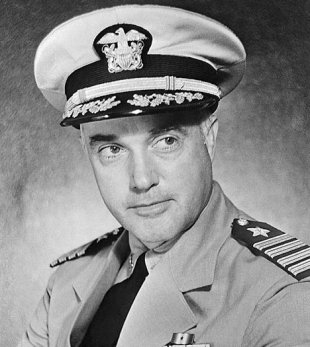
Captain Charles Butler McVay, III

McVay had wide support among Indianapolis’ survivors, but opinion was by no means unanimous. Many family members held him personally responsible for the death of loved ones.  Birthdays, anniversaries and holidays would come and go.  There was almost always hate mail from some family member. One Christmas missive read “Merry Christmas! Our family’s holiday would be a lot merrier if you hadn’t killed my son”.

As the years went by, McVay began to question himself.  In time, he came to feel the weight of the Indianapolis’ dead, a soul crushing burden from which there was no escape.  On November 6, 1968, Charles McVay took a seat on his front porch in Litchfield Connecticut, took out his Navy revolver, and killed himself.  He was cremated, his ashes scattered at sea.

The ULTRA code-breaking system which revealed I-58’s presence on Indianapolis’ course, would not be declassified until the early 90s.

Afterward:

Hunter Alan Scott was 11 and living in Pensacola when he saw the movie “Jaws”, in 1996. He was fascinated by the movie’s brief mention of Indianapolis’ shark attacks.  The next year, he created his 8th grade “National History Day” project on USS Indianapolis’ sinking.

The boy interviewed nearly 150 survivors and reviewed 800 documents.  The more he read, the more he became convinced that Captain McVay was innocent of the charges for which he’d been convicted.

Scott’s National History Day project went up to the state finals, only to be rejected because he used the wrong type of notebook to organize the material.

He couldn’t let it end there. Scott began to attend Indianapolis survivors’ reunions, at their invitation, and helped to gain a commitment in 1997 from then-Representative Joe Scarborough that he would introduce a bill in Congress to exonerate McVay the following year.

Senator Bob Smith of New Hampshire joined Scarborough in a joint resolution of Congress.  Hunter Scott and several Indianapolis survivors were invited to testify before Senator John Warner and the Senate Armed Services committee on September 14, 1999.

Holding a dog tag in his hand, Scott testified “This is Captain McVay’s dog tag from when he was a cadet at the Naval Academy. As you can see, it has his thumbprint on the back. I carry this as a reminder of my mission in the memory of a man who ended his own life in 1968. I carry this dog tag to remind me that only in the United States can one person make a difference no matter what the age. I carry this dog tag to remind me of the privilege and responsibility that I have to carry forward the torch of honor passed to me by the men of the USS Indianapolis”.

The United States Congress passed a resolution in 2000, signed into law by President Bill Clinton on October 30, exonerating Charles Butler McVay, III of the charges which had led to his court martial, humiliation and suicide.

The record cannot not be expunged – Congress has rules against even considering bills which alter military records.  Yet Captain McVay had been exonerated, something that the Indianapolis survivors had tried for years to accomplish, without success.  Until the intervention of a 12-year-old boy.

The last word on the whole episode belongs to Captain Hashimoto, who wrote the Senate Armed Services Committee in 1999 on behalf of Captain McVay.  “Our peoples have forgiven each other for that terrible war and its consequences“, wrote the former submarine commander, now a Shinto Priest.  “Perhaps it is time your peoples forgave Captain McVay for the humiliation of his unjust conviction“.

July 29, 1967 USS Forrestal

With trained firefighters now dead or incapacitated, hundreds of sailors and marines fought for hours to bring the fire under control.   Flare-ups would continue inside the ship until 4:00 the next morning.

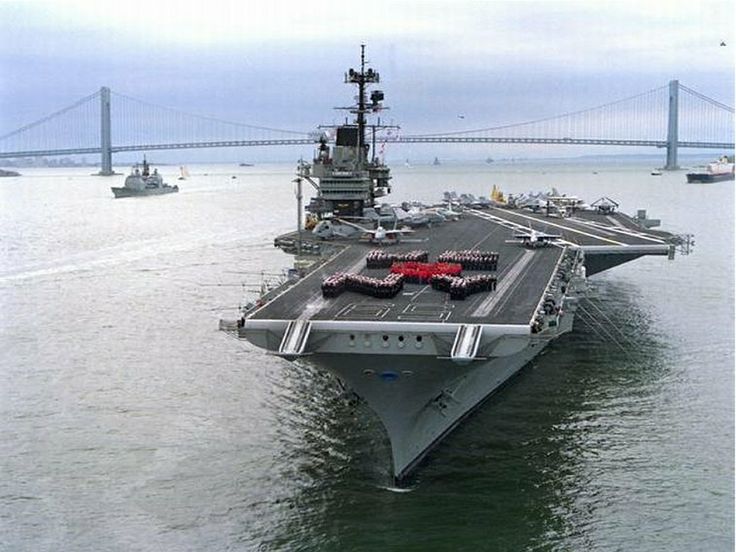
The Super Carrier USS Forrestal departed Norfolk, Virginia in June 1967, with a crew of 552 officers and 4,988 enlisted men. Sailing around the horn of Africa, Forrestal stopped briefly at Leyte Pier in the Philippines, before sailing on to “Yankee Station” in the Gulf of Tonkin, arriving on July 25.

Before the cruise, damage control firefighting teams were shown training films of navy ordnance tests, demonstrating how a 1,000lb bomb could be directly exposed to a jet fuel fire for a full 10 minutes. These tests were conducted using the new Mark 83 bomb, featuring a thicker, heat resistant wall, and “H6” explosive, designed to burn off at high temperatures.  Like a huge sparkler.

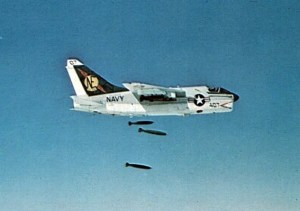
A-7E_VA-25_dropping_bombs_over_Vietnam_c1970
US Navy A-7 Corsair drops a load of Mark 83 bombs; Photograph by USN – Official U.S. Navy photograph from the USS Ranger (CVA-61) 1970-71 Cruise Book., Public Domain, https://commons.wikimedia.org/w/index.php?curid=18491727

Along with the Mark 83s, the ordnance resupply had included 16 AN-M65A1 “fat boy” bombs, WWII surplus intended to be used on the second bombing runs of the 29th.  These were thinner skinned than the newer ordnance, armed with 20+ year-old “Composition B” explosive.  Already far more sensitive to heat and shock than newer ordnance, composition B becomes more so as the explosive ages.  The stuff becomes more powerful as well, up to 50%, by weight.

These older bombs were way past their “sell-by” date, having spent the better part of the last 30 years in the heat and humidity of the Philippine jungle.  Ordnance officers wanted nothing to do with the Fat Boys.  They were rusting and leaking paraffin, their packaging rotted.  Some had production dates as early as 1935.

Handlers were wary of these old weapons, fearing they might go off spontaneously during catapult launch. Someone suggested that they be immediately jettisoned. Captain John Beling was informed of these concerns, and demanded that Diamond Head, their supply ship, take them back and exchange them for newer ordnance.  The reply was that there were no more.   Combat operations were using Mark 83s up faster than new ones could be procured. Fat boys were all that was available.

At 10:50am local time, July 29, preparations were underway for the second strike of the day.

Today, John McCain’s diagnosis of brain cancer has brought the Senator from Arizona to prominence in the evening news.  Fifty years ago today, Lieutenant Commander John McCain was in the cockpit of an A-4 Skyhawk. Next to him was Lieutenant Commander Fred D. White in his own A-4.

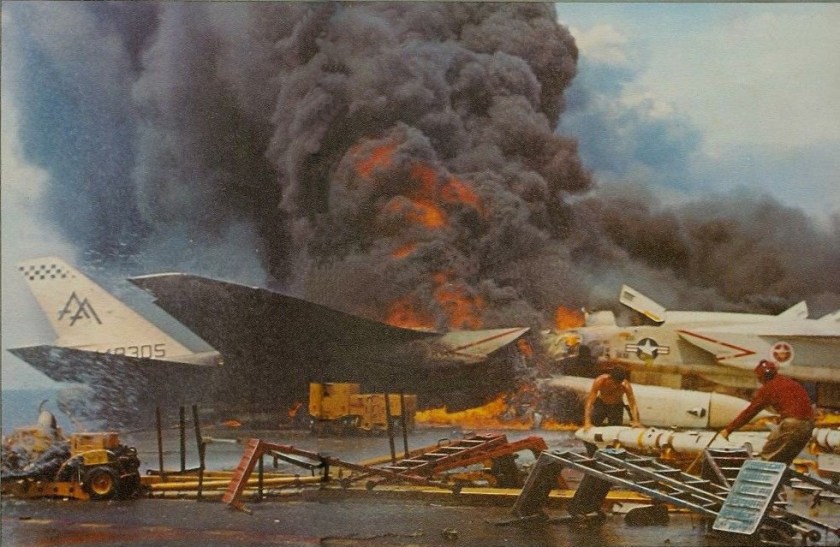
An electrical malfunction fired a 5″ Zuni rocket across the flight deck and into White’s fuel tank. The rocket’s safety mechanism prevented it from exploding, but the A-4’s torn fuel tank was spewing flaming jet fuel onto the deck. Other fuel tanks soon overheated and exploded, adding to the conflagration as McCain scrambled down the nose of the aircraft and across the refueling probe.

USS_Forrestal_fire_RA-5Cs_burning_1967

Damage Control Team #8 sprang into action immediately, as Chief Gerald Farrier spotted one of the Fat Boys turning cherry red in the flames. Without benefit of protective clothing, Farrier held his PKP fire extinguisher on the 1,000lb bomb, hoping to keep it cool enough to prevent its cooking off as his team brought the conflagration under control.

Firefighters were confident that their ten-minute window would hold as they fought the flames, but composition B explosives proved as unstable as the ordnance people had feared.  The bomb went off in just over a minute, killing Farrier instantly and virtually the entire firefighting team, along with Fred White, who was a split second behind McCain.

USS_Forrestal_explosion_29_July_1967
By Official U.S. Navy Photograph – This Image was released by the United States Navy with the ID USN 1124794

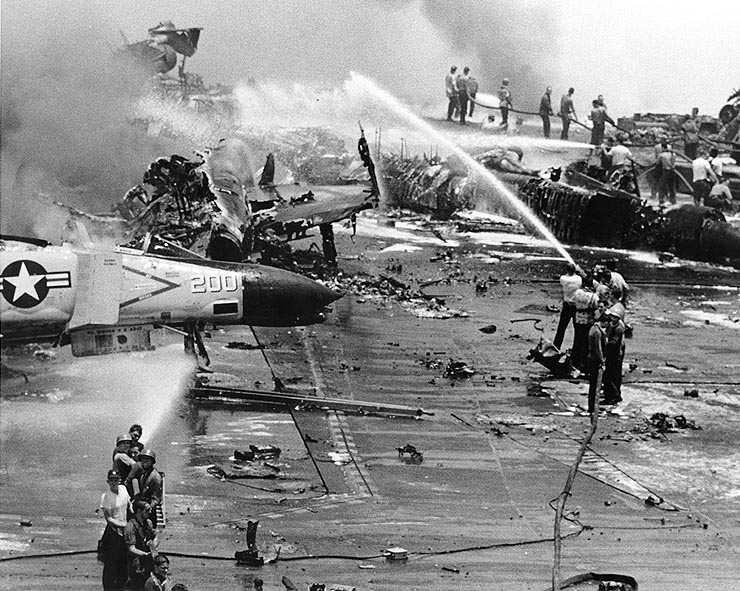
The Mark 83 bombs performed as designed, but eight of the old thousand-pounders went off in the next few seconds, triggering the sympathetic detonation of at least one 500 pounder. The port quarter of the Forrestal ceased to exist as huge holes were torn in the flight deck, flaming jet fuel draining into the aircraft hangar and the living quarters below.

Gary Childs, my uncle, was in his cabin when the fire broke out, leaving just before his quarters were engulfed in flames.  With trained firefighters now dead or incapacitated, he and hundreds of sailors and marines fought for hours to bring the fire under control.   Flare-ups continued inside the ship until 4:00am on the 30th.

vietnam-memorial

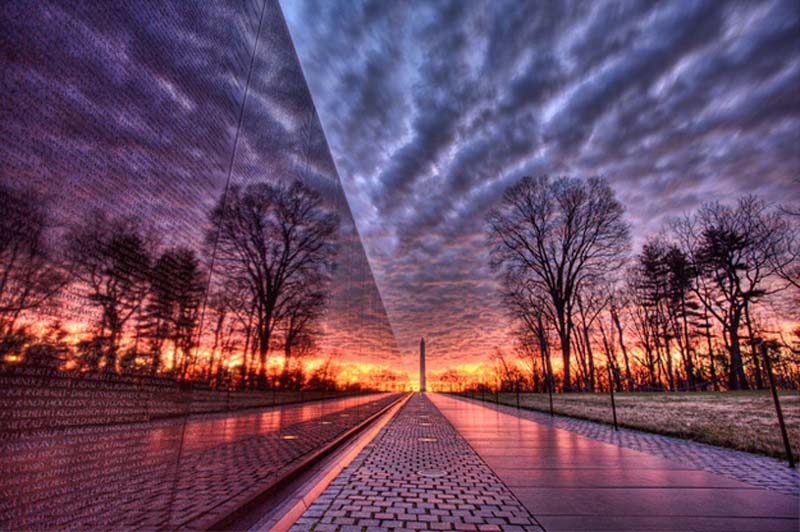
Panel 24E of the Vietnam Memorial contains the names of 134 crewmen who died in the  conflagration. Eighteen of those found their final rest at Arlington National Cemetery.  Another 161 were seriously wounded. Not including the aircraft, damage to the USS Forrestal exceeded $72 million.  Equivalent to over $415 million today.

July 28, 1957 Broken Arrow

Since 1950, there have been 32 Broken Arrow incidents.  As of this date, six nuclear weapons have been lost and never recovered.

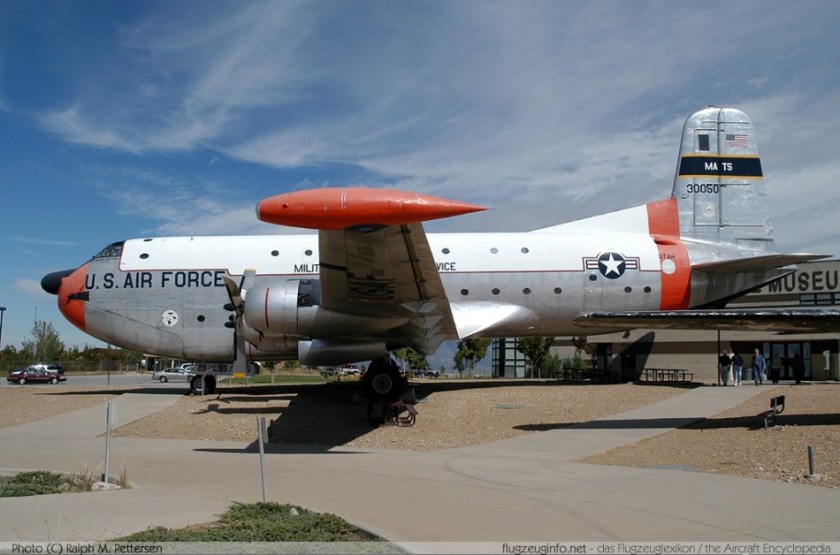
At one time, the C-124 was the world’s largest military transport aircraft.  Weighing in at 175,000lbs with a wingspan of 175ft, four 3,500 horsepower Pratt & Whitney propeller engines drive the air frame along at a stately cruising speed of 246 mph.  Manufacturer Douglas Aircraft called the aircraft “Globemaster”.  Airmen called the plane “Old Shaky”.

c124c_pettersen

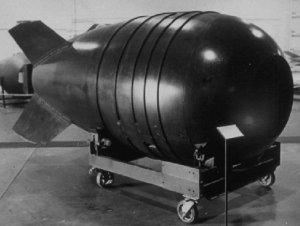
The Air Force C-124 Globemaster transport left its base in Delaware on July 28, 1957, on a routine flight to Europe. On board were a crew of seven, three nuclear bombs, and one nuclear core. The flight would routinely have taken 10-12 hours.  This trip was destined to be anything but routine.Mk6

Exactly what went wrong remains a mystery, due to the sensitive nature of the cargo. Two engines had to be shut down shortly into the mission, and the aircraft turned back.  The nearest suitable airfield was the Naval Air Station in Atlantic City, but that was too far. Even at maximum RPMs, the best the remaining two engines could do was slow the massive aircraft’s descent into the sea.

sans_titre11An emergency landing on open ocean is not an option with such a large aircraft.  It would have broken up on impact with the probable loss of all hands.   Descending rapidly, the crew would have jettisoned everything they could lay hands on, to reduce weight.  Non-essential equipment would have gone first, then excess fuel, but it wasn’t enough.  With only 2,500ft and losing altitude, there was no choice left but to jettison those atomic bombs.
At 3,000lbs apiece, two of the three bombs were enough to do the job, and the C-124 made it safely to Atlantic City.  What became of those two atomic bombs remains a mystery.  Most likely, they lie at the bottom of the ocean, 100 miles off New Jersey.

The United States Department of Defense has a term for accidents involving nuclear weapons, warheads or components, which do not involve the immediate risk of nuclear war.  Such incidents are called “Broken Arrows”.Image2

Broken Arrows include accidental or unexplained nuclear or non-nuclear detonation of an atomic weapon, the loss of such a weapon with or without its carrying vehicle, and the release of nuclear radiation resulting in public hazard, whether actual or potential.

Since 1950, there have been 32 Broken Arrow incidents.  As of this date, six nuclear weapons have been lost and never recovered.

If you’re interested, a handy “Nuclear Folly Locator” appears at the link below, based on Rudolph Herzog’s “A Short History of Nuclear Folly”.  It makes for some very comforting reading.

https://www.google.com/maps/d/viewer?mid=1gYCdyVCF3mhfJwX4c5xdBnc-Y8Q&usp=sharing

July 24, 1915 Shipwreck in Chicago

Woodrow Wilson’s administration passed strict lifeboat legislation in the wake of the RMS Titanic disaster. Ironically, that weight is probably what doomed the already top-heavy Eastland, to disaster.

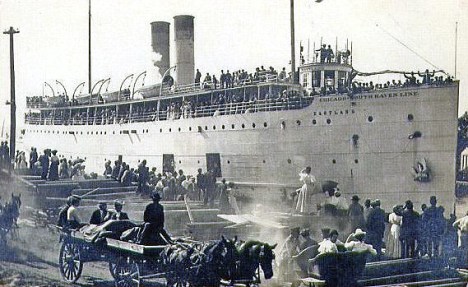
The SS Eastland was a passenger steamship based in Chicago, used for tours of the inland waterways and Great Lakes areas around the city.  Eastland’s design was top heavy and made her subject to listing, a problem that plagued the ship from her christening in 1903. Embarking passengers would crowd along the rail to wave goodbye, several times having to be herded across the decks to reduce the list. Once, she even started to take on water at the main gangplank.SS_Eastland

Special passenger restrictions were imposed on Eastland, which seemed to help until 1914, when Woodrow Wilson’s administration passed strict lifeboat legislation in the wake of the RMS Titanic disaster.

The ironic part is that the weight of additional lifeboats is probably what doomed the already top-heavy Eastland to disaster.

It was July 24, 1915, when Eastland and two other Great Lakes passenger steamers, the Theodore Roosevelt and the Petoskey, were chartered to take Western Electric employees to a picnic in Michigan City, Indiana. Eastland was docked on the south bank of the Chicago River, between Clark and LaSalle, near the site of the present day Merchandise Mart. Passengers began boarding around 6:30am.  By 7:10 the ship had reached its full capacity of 2,572 passengers.

chi-eastland12side-19991029

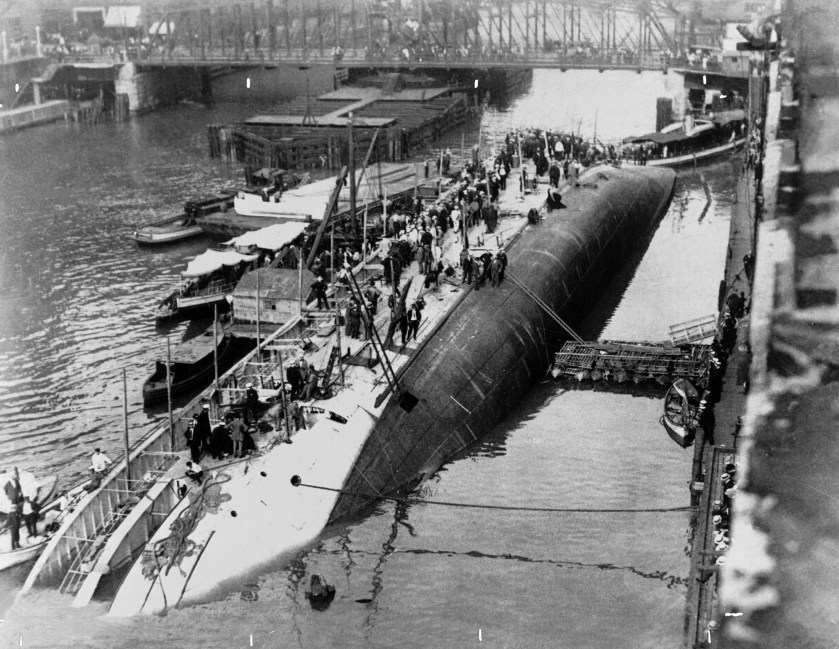
A number of passengers went below decks to get out of the chill, but hundreds stayed out on the upper decks, excited about the day ahead. The port side list away from the dock, had set in early in the boarding process, and crew members began to pump water into the starboard ballast tanks to stabilize the ship.  Something interesting must have happened on the river at 7:28, causing a number of passengers to rush to the port side rail.

Novelist Jack Woodford witnessed what happened next, describing it in his autobiography: “And then movement caught my eye. I looked across the river. As I watched in disoriented stupefaction a steamer large as an ocean liner slowly turned over on its side as though it were a whale going to take a nap. I didn’t believe a huge steamer had done this before my eyes, lashed to a dock, in perfectly calm water, in excellent weather, with no explosion, no fire, nothing. I thought I had gone crazy”.  Hundreds were trapped below decks, others were crushed under heavy bookcases, pianos and tables.

Another vessel, the Kenosha, pulled alongside almost immediately.  Several passengers were able to jump directly onto her decks, others were rescued at the wharf, only 20′ away.  Hundreds were beyond saving.

Eastland_PostcardTemporary morgues were set up in area buildings for the identification of the dead; including what is now the sound stage for The Oprah Winfrey Show, Harpo Studios, and the location of the Chicago Hard Rock Cafe.

Then-20-year-old George Halas was scheduled to be on the Eastland, but he was late and showed up after the capsize. 844 passengers and four crew members lost their lives in the disaster, but Eastland herself would have a second life. She was raised from the bottom, converted to a gun boat, and stationed at the Great Lakes Naval Reserve, re-christened USS Wilmette.

Wilmette saw no combat service in WWI, though she was given the task of sinking UC-97, a German U-Boat surrendered to the US after WWI. Wilmette’s guns were manned by Gunner’s Mate J.O. Sabin, who had fired the first American shell in WWI, and Gunner’s Mate A.F. Anderson, the man who fired the first American torpedo of the war.

Wilmette would serve once again as a training ship in WWII, and sold for scrap on Halloween day, 1946.