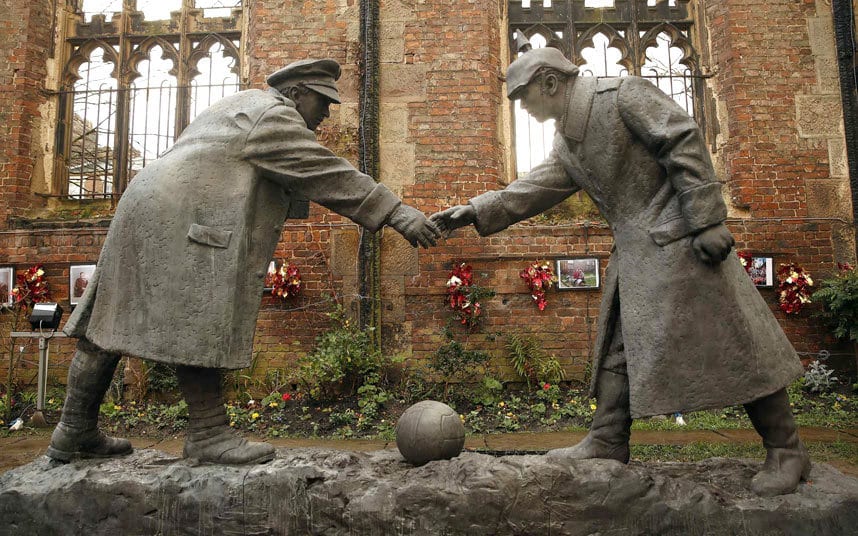
December 25, 1914 A Truce to end all Wars

Nearly 100,000 Allied and German troops were involved in the unofficial ceasefire of Christmas 1914, lasting in some sectors until New Year’s Day.

“Sitzkrieg”. “Phony War”. Those were the terms used to describe the September ‘39 to May 1940 period, when neither side of what was to become the second world war, was yet prepared to launch a major ground war against the other.

The start of the “Great War” twenty-five years earlier, was different.  Had you been alive in August 1914, you would have witnessed what might be described as the simultaneous detonation of a continent. France alone suffered 140,000 casualties over the four day “Battle of the Frontiers”, where the River Sambre met the Meuse. 27,000 Frenchmen died in a single day, August 22, in the forests of the Ardennes and Charleroi. The British Expeditionary Force escaped annihilation on August 22-23, only by the intervention of mythic angels, at a place called Mons.

132294-004-D282B5CA
First Battle of the Marne, September 1914 H/T Britannica

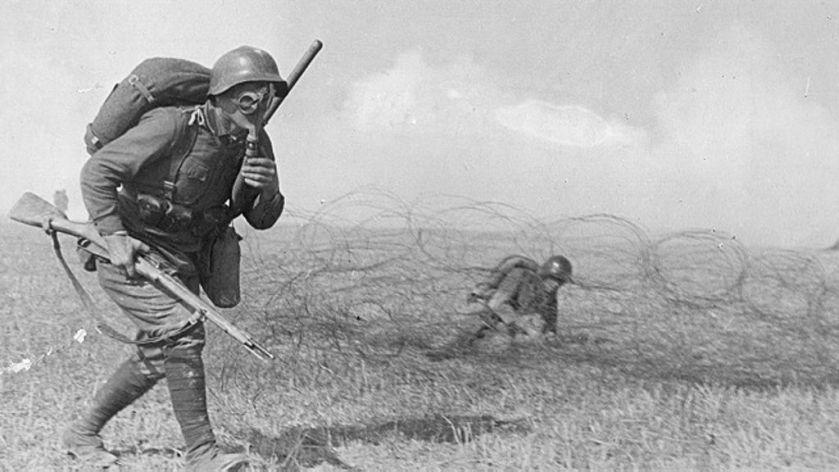
In the East, a Russian army under General Alexander Samsonov was encircled and so thoroughly shattered at Tannenberg, that German machine gunners were driven to insanity at the damage inflicted by their own guns, on the milling and helpless masses of Russian soldiers. Only 10,000 of the original 150,000 escaped death, destruction or capture. Samsonov himself walked into the woods, and shot himself.
140626140504_wwi_russian_soldiers_640x360_getty_nocredit
Russian soldiers, WW1, H/T BBC

The “Race to the Sea” of mid-September to late October was more a series of leapfrog movements and running combat, in which the adversaries tried to outflank one another. It would be some of the last major movement of the Great War, ending in the apocalypse of Ypres, in which 75,000 from all sides lost their lives. All along a 450-mile front, millions of soldiers dug into the ground to shelter themselves from what Private Ernst Jünger later called a “Storm of Steel”.
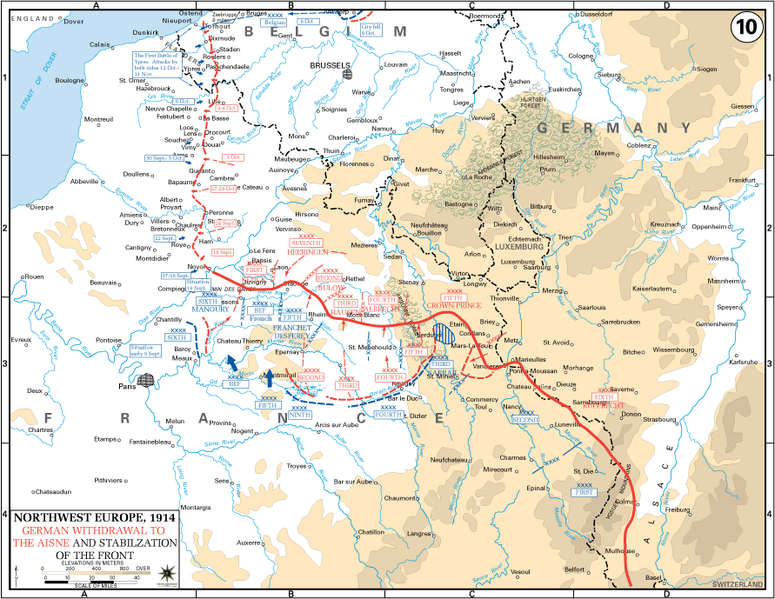
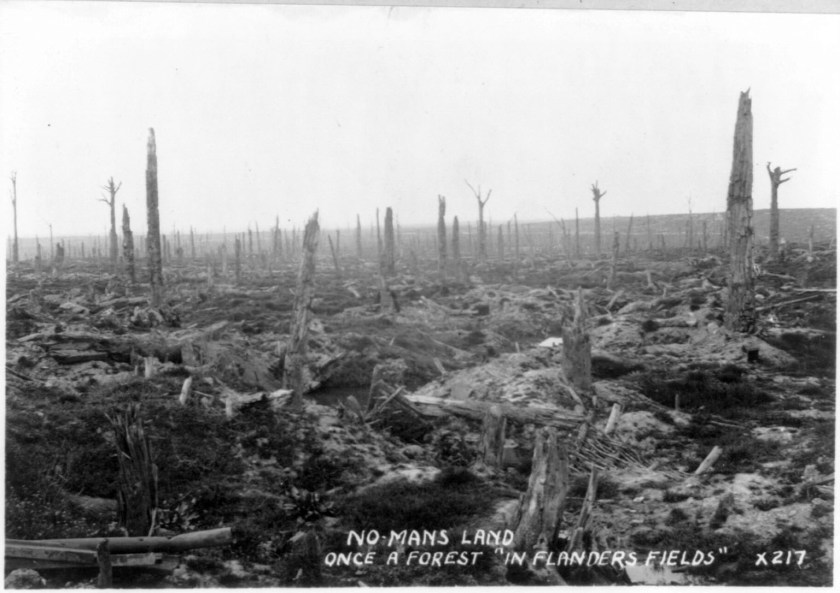
775px-Stabilization_of_Western_Front_WWIOn the Western Front, it rained for much of November and December that first year. The no man’s land between British and German trenches was a wasteland of mud and barbed wire. Christmas Eve, 1914 dawned cold and clear. The frozen ground allowed men to move about for the first time in weeks. That evening, English soldiers heard singing.  The low sound of a Christmas carol, drifting across no man’s land…Stille Nacht, heilige Nacht…Silent Night.

The Tommies saw lanterns and small fir trees.  Messages were shouted along the trenches.  In some places, British soldiers and even a few French joined in the Germans’ songs. Alles schläft; einsam wacht, Nur das traute hochheilige Paar. Holder Knabe im lockigen Haar

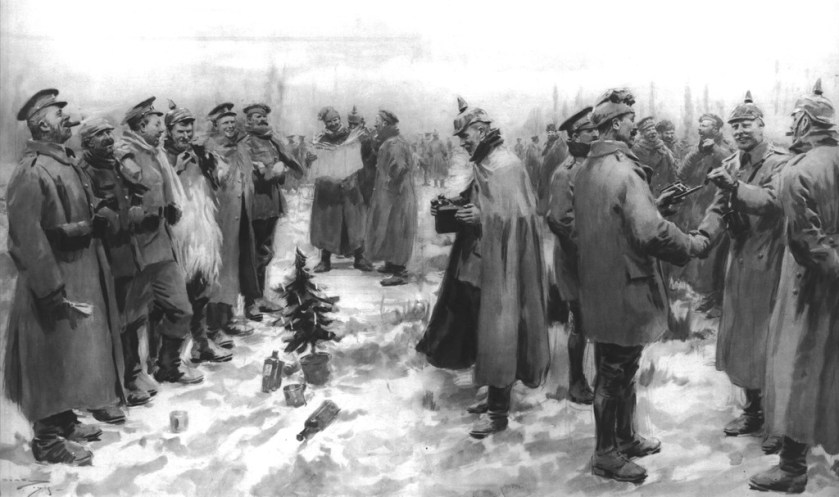
christmas-day-truce-of-1914-published-1915-london-illustrated-news
Christmas day truce of 1914 published 1915 London illustrated news

The following day was Christmas, 1914. A few German soldiers emerged from their trenches at the first light of dawn, approaching the Allies across no man’s land and calling out “Merry Christmas” in the native tongue of their adversaries. Allied soldiers first thought it was a trick, but these Germans were unarmed, standing out in the open where they could be shot on a whim. Tommies soon climbed out of their own trenches, shaking hands with the Germans and exchanging gifts of cigarettes, food and souvenirs. In at least one sector, enemy soldiers played a friendly game of soccer.

Captain Bruce Bairnsfather later wrote: “I wouldn’t have missed that unique and weird Christmas Day for anything. … I spotted a German officer, some sort of lieutenant I should think, and being a bit of a collector, I intimated to him that I had taken a fancy to some of his buttons. … I brought out my wire clippers and, with a few deft snips, removed a couple of his buttons and put them in my pocket. I then gave him two of mine in exchange. … The last I saw was one of my machine gunners, who was a bit of an amateur hairdresser in civil life, cutting the unnaturally long hair of a docile Boche, who was patiently kneeling on the ground whilst the automatic clippers crept up the back of his neck.”

o-TRUCE-facebookCaptain Sir Edward Hulse Bart reported a sing-song which “ended up with ‘Auld lang syne’ which we all, English, Scots, Irish, Prussians, Wurttenbergers, etc, joined in. It was absolutely astounding, and if I had seen it on a cinematograph film I should have sworn that it was faked!”

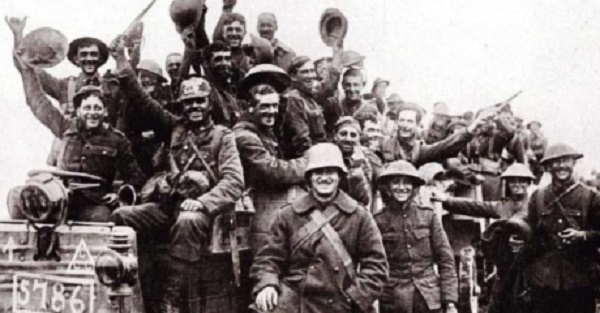
Nearly 100,000 Allied and German troops were involved in the unofficial ceasefire of Christmas 1914, lasting in some sectors until New Year’s Day.
1xmas1

A few tried to replicate the event the following year, but there were explicit orders preventing it. Captain Llewelyn Wyn Griffith recorded that after a night of exchanging carols, dawn on Christmas Day 1915 saw a “rush of men from both sides … [and] a feverish exchange of souvenirs” before the men were quickly called back by their officers.

YpresXmasTruce
Ypres, Christmas Truce, Hat tip http://www.Bitaboutbritain.com. Thanks, Mike.

One German unit tried to leave their trenches under a flag of truce on Easter Sunday 1915, but were warned off by the British opposite them.

German soldier Richard Schirrmann wrote in December 1915, “When the Christmas bells sounded in the villages of the Vosges behind the lines …. something fantastically unmilitary occurred. German and French troops spontaneously made peace and ceased hostilities; they visited each other through disused trench tunnels, and exchanged wine, cognac and cigarettes for Westphalian black bread, biscuits and ham. This suited them so well that they remained good friends even after Christmas was over”.

Some will tell you, the bitterness engendered by continuous fighting made such fraternization all but impossible. Yet, there are those who believe that soldiers never stopped fraternizing with their opponents, at least during the Christmas season. Heavy artillery, machine gun, and sniper fire were all intensified in anticipation of Christmas truces, minimizing such events in a way that kept them out of the history books.
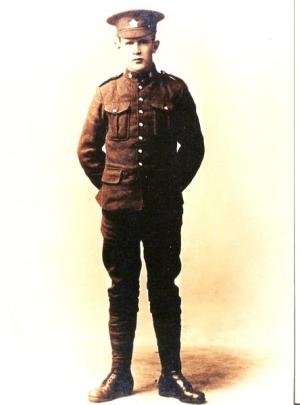
mackinnon-ronald-photo-nd
Pvt. Ronald MacKinnon, H/T National Post

Even so, evidence exists of a small Christmas truce in 1916, though little is known of it. 23-year-old Private Ronald MacKinnon of Princess Patricia’s Canadian Light Infantry, wrote home about German and Canadian soldiers reaching across battle lines near Arras, sharing Christmas greetings and trading gifts. “I had quite a good Christmas considering I was in the front line”, he wrote. “Christmas Eve was pretty stiff, sentry-go up to the hips in mud of course. … We had a truce on Christmas Day and our German friends were quite friendly. They came over to see us and we traded bully beef for cigars”. The letter ends with Private MacKinnon noting that “Christmas was ‘tray bon’, which means very good.”

Private Ronald MacKinnon of Toronto Ontario, Regimental number 157629, was killed barely three months later on April 9, 1917, during the Battle of Vimy Ridge.

The Man He Killed 
by Thomas Hardy

Had he and I but met
By some old ancient inn,
We should have set us down to wet
Right many a nipperkin!

But ranged as infantry,
And staring face to face,
I shot at him as he at me,
And killed him in his place.

I shot him dead because–
Because he was my foe,
Just so: my foe of course he was;
That’s clear enough; although

He thought he’d ‘list, perhaps,
Off-hand like–just as I–
Was out of work–had sold his traps–
No other reason why.

Yes; quaint and curious war is!
You shoot a fellow down
You’d treat, if met where any bar is,
Or help to half a crown.
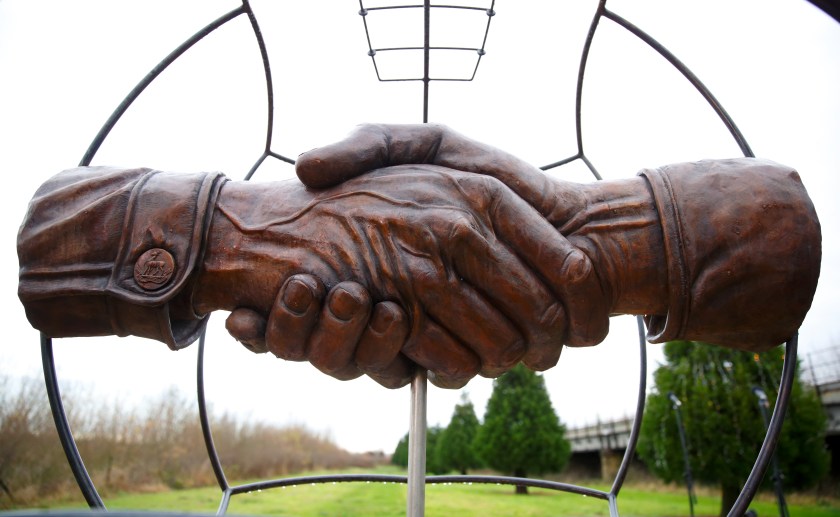
The Duke Of Cambridge Visits Staffordshire & Birmingham
Christmas truce memorial, National Arboretum, Staffordshire, England
If you enjoyed this “Today in History”, please feel free to re-blog, “like” & share on social media, so that others may find and enjoy it as well. Please click the “follow” button on the right, to receive email updates on new articles.  Thank you for your interest, in the history we all share.

December 19, 1843  A Christmas Carol

This quintessentially English tale is said to have drawn much from the work of Shakespeare, and others.  Perhaps the Old World drew inspiration from the New, as well. 

It’s hard not to love the traditions of the Christmas season.  Getting together with loved ones, good food, the exchange of gifts, and our favorite Christmas specials on TV.  I always liked a Charlie Brown’s Christmas, and of course there’s the Charles Dickens classic, “A Christmas Carol”, set against the vast brick factory buildings of Lowell, Massachusetts, along the Merrimack River.

Wait … What?

The 29-year-old Charles Dickens was already a well-known and popular author when he stepped onto the shores of Boston Harbor on January 22, 1842.  New Yorkers had literally lined the docks the year before, greeting ships bearing copies of the author’s latest, The Old Curiosity Shop.

“The Pickwick Papers,” “Oliver Twist,” “Nicholas Nickleby”; all were behind the young writer when he came to America, perhaps to write a travelogue, or maybe looking for material for a new novel.

LowellMillGirls
The “Mill Girls”, of Lowell

Dickens traveled to Watertown, to the Perkins School for the Blind, where Helen Keller and her teacher Anne Sullivan underwent their mutual education, a half-century later.  He visited a school for neglected boys, in Boylston.

Dickins must have thought the charitable institutions in his native England suffered by comparison, for he later wrote “I sincerely believe that the public institutions and charities of this capital of Massachusetts are as nearly perfect as the most considerate wisdom, benevolence, and humanity, can make them.”

In February, Dickens took a train north to the factory town of Lowell, visiting the textile mills and speaking with the “mill girls”, the women who worked there.  Once again, he seemed to believe that his native England came up short, in the comparison.  Dickens spoke of the new buildings and the well dressed, healthy young women who worked in them, perhaps comparing them with his own traumatic childhood experience of working in the mills back home, with his father confined in debtor’s prison.

v_Lowell_Offering_1The celebrity novelist enjoyed the finest sights of Boston and New York, and took in a steamship ride, down the Mississippi. He visited one of the great wonders of the natural world, the spectacular Niagara Falls.

And yet, the author described that visit to the industrial city of Lowell as “the happiest day” of his American vacation.

Dickens left the mill girls with a copy of “The Lowell Offering”, a literary magazine written by those same women, which he later described as “four hundred good solid pages, which I have read from beginning to end.”

More than a century and a half later, Natalie McKnight, professor of English and Dean at Boston University, noticed similarities between the two while preparing a talk for the Lowell Historical Society.

She read the same 400 pages as Dickens, and couldn’t help noticing parallels between the work of the mill girls, and “A Christmas Carol,” published about a year and a half after the author’s visit.  Chelsea Bray was a senior English major at the time.  Professor McKnight asked her to read those same pages.

v_Marleys_Ghost_John_Leech_1843
Marley’s Ghost, by John Leech, 1843

One story, “A Visit from Hope,” begins, “‘Past twelve!’ said a sweet, musical voice, as I was seated by the expiring embers of a wood fire. I turned hastily to see who had thus intruded on my presence, when, lo! I beheld an old man. His thin white locks were parted on his forehead, his form was bent, and as he extended his thin, bony hand toward me, it shook like an aspen leaf.”’

Makes it hard not to think of the ghost of Jacob Marley, Ebenezar Scrooge’s “dead as a doornail”, former partner.

Christmas,” another Lowell essay, describes Christmas as “the best day in the whole year” for what it brings out in people. The theme pops up again with Scrooge’s nephew, as in: “[T]he only time I know of, in the long calendar of the year, when men and women seem by one consent to open their shut-up hearts freely, and to think of people below them as if they really were fellow-passengers to the grave, and not another race of creatures bound on other journeys.”

Another piece, “The Blessings of Memory,” speaks of joyful recollections, too soon overridden by “unreal phantoms.” Scrooge’s redemption is all about Memory: Bray writes, “Scrooge’s conversion begins when the Ghost of Christmas Past makes him relive his memories and reconnect to past sorrows and joys.”

ChristmasCarol-OV_nov17-2

The research performed by the two was published in the form of a thesis, and later fleshed out to a full-length book:

“Dickens and Massachusetts
The Lasting Legacy of the Commonwealth Visits
(University of Massachusetts Press, 2015)

The book describes a number of similarities between the two works, making the argument that Dickens’ familiar story draws much from his experience in Lowell.  The authors specifically reject any accusation of plagiarism.  The Lowell essays possess neither the character development nor the linguistic richness of Dickens’ masterwork.

This quintessentially English tale is said to have drawn much from the work of Shakespeare, and others.  Perhaps the Old World drew inspiration from the New, as well.   Charles Dickens’ masterpiece, A Christmas Carol, was published for the first time 175 years ago today, December 19, 1843.

If you enjoyed this “Today in History”, please feel free to re-blog, “like” & share on social media, so that others may find and enjoy it as well. Please click the “follow” button on the right, to receive email updates on new articles.  Thank you for your interest, in the history we all share.

December 16, 1773 The Boston Tea Party

The Tea Act of 1773 actually reduced the price of tea, but Colonists saw the measure as an effort to buy popular support for taxes already in force, and refused the cargo.  In Philadelphia and New York, tea ships were turned away and sent back to Britain while in Charleston, the cargo was left to rot on the docks. 7,000 gathered at Old South Meeting house in Boston, to decide what they would do.

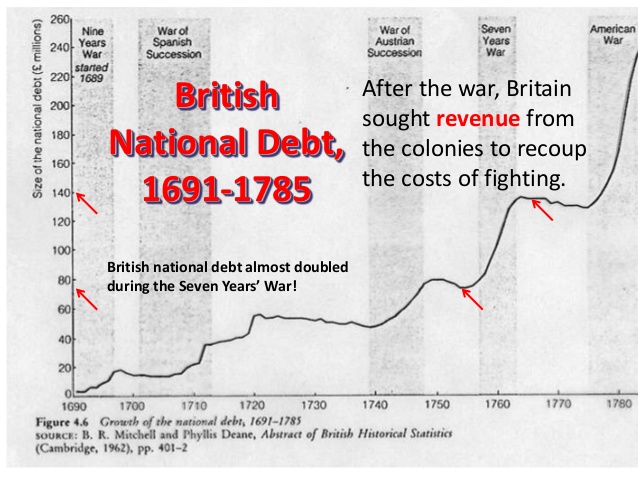
In the time of Henry VIII, British military outlays averaged 29.4% as a percentage of central government expenses.   That number skyrocketed to 74.6% in the 18th century, and never dropped below 55%.

The Seven Years’ War alone, fought on a global scale from 1756 – ‘63, saw England borrow the unprecedented sum of £58 million, doubling the national debt and straining the British economy.

the-american-revolution-10-638For the American colonies, the conflict took the form of the French and Indian War.   Across the “pond”, the never-ending succession of English wars meant that, not only were colonists left alone to run their own affairs, but individual colonists learned an interdependence of one upon another, resulting in significant economic growth during every decade of the 1700s.
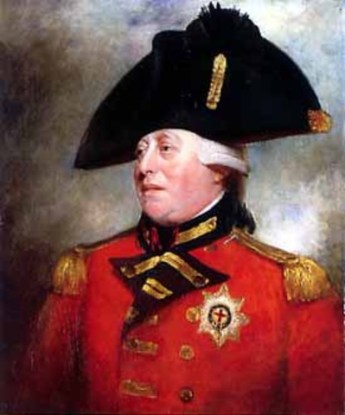
Some among the British government saw in the American colonies, the classically “Liberal” notion of the Free Market, as described by intellectuals such as John Locke:   “No People ever yet grew rich by Policies,” wrote Sir Dudley North. “But it is Peace, Industry, and Freedom that brings Trade and Wealth“.  These, were in the minority.  The prevailing attitude at the time, saw the colonies as the beneficiary of much of British government expense.  These wanted some help, picking up the tab.

king-george-iii_1_
King George, III

Several measures were taken to collect revenues during the 1760s.  Colonists bristled at what was seen as heavy handed taxation policies.  The Sugar Act, the Currency Act:  in one 12-month period alone, Parliament passed the Stamp Act, Quartering Act, and the Declaratory Act, while deputizing Royal Navy Sea Officers to enforce customs laws in colonial ports.

The merchants and traders of Boston specifically cited “the late war” and the expenses related to it, concluding the Boston Non-Importation Agreement of August 1, 1768. The agreement prohibited the importation of a long list of goods, ending with the statement ”That we will not, from and after the 1st of January 1769, import into this province any tea, paper, glass, or painters colours, until the act imposing duties on those articles shall be repealed”.

The ‘Boston Massacre’ of 1770 was a direct result of the tensions between colonists and

gaspee-shippey
Burning of the Gaspee, Narragansett Bay, Rhode Island

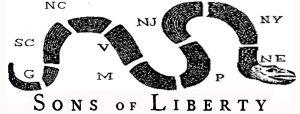
the “Regulars” sent to enforce the will of the Crown.  Two years later, Sons of Liberty looted and burned the HMS Gaspee in Narragansett Bay, Rhode Island.

The Tea Act, passed by Parliament on May 10, 1773, was less a revenue measure than it was an effort to prop up the British East India Company, by that time burdened with debt and holding some eighteen million pounds of unsold tea.  The measure actually reduced the price of tea, but Colonists saw it as an effort to buy popular support for taxes already in force, and refused the cargo.  In Philadelphia and New York, tea ships were turned away and sent back to Britain while in Charleston, the cargo was left to rot on the docks.

British law required a tea ship to offload and pay customs duty within 20 days, or the cargo was forfeit.  The Dartmouth arrived in Boston at the end of November with a cargo of tea, followed by the tea ships Eleanor and Beaver.  Samuel Adams called for a meeting at Faneuil Hall on the 29th, which then moved to Old South Meeting House to accommodate the crowd.  25 men were assigned to watch Dartmouth, making sure she didn’t unload.

sons-of-liberty7,000 gathered at Old South Meeting House on December 16th, 1773, the last day of deadline, for Dartmouth’s cargo.  Royal Governor Hutchinson held his ground, refusing the vessel permission to leave.  Adams announced that “This meeting can do nothing further to save the country.”

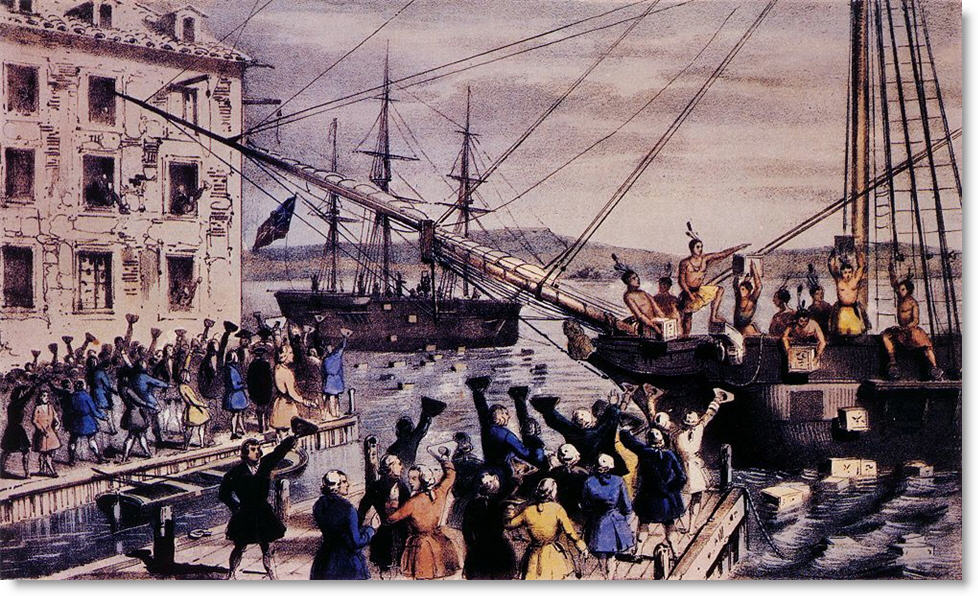
That night, anywhere between 30 and 130 Sons of Liberty, many dressed as Mohawk Indians, boarded the three ships in Boston Harbor.  There they threw 342 chests of tea, 90,000 pounds in all, into Boston Harbor.  £9,000 worth of tea was destroyed, worth about $1.5 million in today’s dollars.

In the following months, other protesters staged their own “Tea Parties”, destroying imported British tea in New York, Philadelphia, Charleston, and Greenwich, NJ.  There was even a second Boston Tea Party on March 7, 1774, when 60 Sons of Liberty, again dressed as Mohawks, boarded the “Fortune”.  This time they dumped a ton and one-half of the stuff, into the harbor.  That October in Annapolis Maryland, the Peggy Stewart was burned to the water line.

For decades to come, the December 16 incident in Boston Harbor was blithely referred to as “the destruction of the tea.” The earliest newspaper reference to “tea party” wouldn’t come down to us, until 1826.

the_boston_tea_party_1773

John Crane of Braintree is one of the few original tea partiers ever identified, and the only man injured in the event. An original member of the Massachusetts Society of the Cincinnati and early member of the Sons of Liberty, Crane was struck on the head by a tea crate and thought to be dead.  His body was carried away and hidden under a pile of shavings at a Boston cabinet maker’s shop.  It must have been a sight when John Crane “rose from the dead”, the following morning.

Great Britain responded with the “Intolerable Acts” of 1774, including the occupation of intolerable-actsBoston by British troops.    Minutemen clashed with “Lobster backs” a few months later, on April 19, 1775.  When it was over, eight Lexington men lay dead or dying, another ten wounded. One British soldier was wounded.  No one alive today knows who fired the first shot at Lexington Green.  History would remember the events of that day as “The shot heard ’round the world”.

If you enjoyed this “Today in History”, please feel free to re-blog, “like” & share on social media, so that others may find and enjoy it as well. Please click the “follow” button on the right, to receive email updates on new articles.  Thank you for your interest, in the history we all share.

December 13, 1941 Cook’s Assistant

There is no telling, how many lives could have been lost.  But for the actions, of a sixteen-year-old cook’s assistant.

Similar to the Base Exchange system serving American military personnel, the British Navy, Army and Air Force Institutes (NAAFI) is the UK-government organization operating clubs, bars, shops and supermarkets in service to British armed forces, as well as naval canteen services (NCS) aboard Royal Navy ships.

naafiNAAFI personnel serving on ships are assigned to duty stations and wear uniforms, while technically remaining civilians.
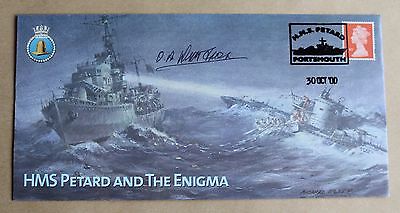
Tommy Brown was fifteen when he lied about his age, enlisting in the NAAFI on this day in 1941 and assigned as canteen assistant to the “P-class” destroyer, HMS Petard.

On October 30, 1942, Petard joined three other destroyers and a squadron of Vickers Wellesley light bombers off the coast of Port Said Egypt, in a 16-hour hunt for the German “Unterseeboot”, U–559.

Hours of depth charge attacks were rewarded when the crippled U-559 came to the surface, the 4-inch guns of HMS Petard, permanently ending the career of the German sub.

The U-559 crew abandoned ship, but not before opening the boat’s seacocks.   Water was pouring into the submarine as Lieutenant Francis Anthony Blair Fasson and Able Seaman Colin Grazier dived into the water and swam to the submarine, with Junior canteen assistant Tommy Brown close behind.

Ww2-Hms-Petard-The-Enigma-2000-Cover

With the submarine sinking fast, Fasson and Grazier made their way into the captain’s cabin.   Finding a set of keys, Fasson opened a drawer, to discover a number of documents, including two sets of code books.

With one hand on the conning ladder and the other clutching those documents, Brown made three trips up and down from the hatch, to Petard’s whaler.

war (1)

With the sub beginning to sink, the canteen assistant called for his shipmates to get out of the boat, but the other two were trapped. Brown himself was dragged under, but managed to kick free and come to the surface.  Colin Grazier and Francis Fasson, did not escape.

The episode brought Brown to the attention of the authorities, ending his posting aboard Petard with the revelation of his true age.  He never was discharged from the NAAFI, and later returned to sea on board the HMS Belfast.

grazier 2

By 1945 he was Leading Seaman Tommy Brown, home on shore leave when fire broke out at the family home in South Shields.  He died while trying to rescue his youngest sister Maureen, and was buried with full military honors in Tynemouth cemetery.

Fasson and Grazier were awarded the George Cross, the second-highest award of the United Kingdom system of military honors.  Since he was a civilian due to his NAAFI employment, Brown was awarded the George medal.

Fasson Memorial

None of the three would ever learn that their actions had helped to end the war.

For German U-boat commanders, the period between the fall of France and the American entry into WW2 was known as “Die Glückliche Zeit” – “The Happy Time” – in the North Sea and North Atlantic.  From July through October 1940 alone, 282 Allied ships were sunk off the northwest approach to Ireland, for a combined loss of 1.5 million tons of merchant shipping.

tmp791791015303315457

Tommy Brown’s Mediterranean episode took place in 1942, in the midst of the “Second Happy Time”, also known among German submarine commanders as the American shooting season. U-boats inflicted massive damage during this period, sinking 609 ships totaling 3.1 million tons with the loss of thousands of lives, against a cost of only 22 U-boats.

According to USMM.org, the United States Merchant marine suffered a higher percentage of fatalities at 3.9%, than any other American service branch during WW2.

enigma2Early versions of the German “Enigma” code were broken as early as 1932, thanks to cryptanalysts of the Polish Cipher Bureau, and French spy Hans Thilo Schmidt.
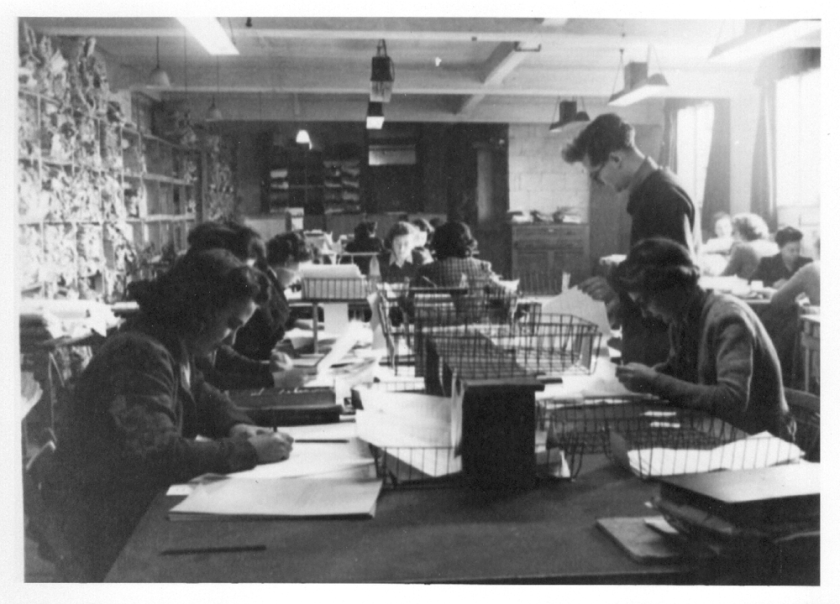
French and British military intelligence were read into Polish decryption techniques in 1939, \methods which were later improved upon by the British code breakers of Bletchley Park.  Vast numbers of messages were intercepted and decoded from Wehrmacht and Luftwaffe sources, shortening the war by at least a year, and possibly two.

The Kriegsmarine was a different story.  Maniacally jealous of security, Admiral Karl Dönitz introduced a third-generation enigma machine (M4) into the submarine service around May 1941, a system so secret that neither Wehrmacht nor Luftwaffe, were aware of its existence.  The system requires identical cipher machines at both ends of the transmission and took a while to put into place, with German subs being spread around the world.

By early 1942, all M4 machines were in place.  On February 2, German submarine communications went dark.  For code breakers at Bletchley Park, the blackout was sudden and complete.  Like the flipping of a switch.  For a period of nine months, Allies had not the foggiest notion of what the German submarine service was up to.  The result was disastrous.

BletchleyThe beginning of the end of darkness came to an end on October 30, when a ship’s cook climbed up that conning ladder.  Code sheets allowed British cryptanalysts to attack the “Triton” key used by the U-boat service.  It would not be long, before the U-boats themselves, were under attack.
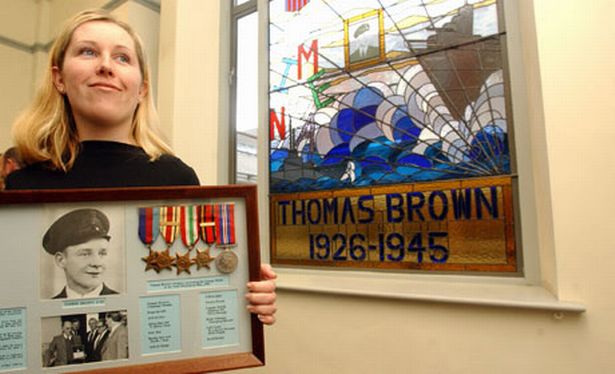
Tommy Brown never knew what was in those documents.  The entire enterprise would remain Top Secret, until years after his death.  Winston Churchill would later write, that the actions of the crew of Petard, were crucial to the outcome of the war.  There is no telling, how many lives could have been lost.  But for the actions, of a sixteen-year-old cook’s assistant.

thomas-brown-sharon-carley-462946894

If you enjoyed this “Today in History”, please feel free to re-blog, “like” & share on social media, so that others may find and enjoy it as well. Please click the “follow” button on the right, to receive email updates on new articles.  Thank you for your interest, in the history we all share.

December 9, 1952 Gasping for Air

When such a weather system occurs over areas with high levels of atmospheric contaminants, the resulting ground fog can be catastrophic. 63 people perished during a similar episode in 1930, in the Meuse River Valley area of Belgium. In 1950, 22 people were killed in Poza Rica, Mexico. In 1952, the infamous “Great Smog of London” claimed the lives of thousands, over a course of five days.

schwarzenegger-ap-18337474166966
“Actor Arnold Schwarzenegger delivers a speech during the opening of COP24 UN Climate Change Conference 2018 in Katowice, Poland, Monday, Dec. 3, 2018.
Czarek Sokolowski / AP” H/T CBS News, Inc.

Last week, climate activists and world leaders gathered in Poland to discuss carbon pollution resulting from the use of fossil fuels, and ways to combat what they see as a future of anthropogenic global warming.

Adherents to current climate change theories hold onto such ideas with a fervor bordering on the religious while skeptics raise any number of questions but, one thing is certain. There was a time when the air and water around us was tainted with impunity, with sometimes deadly results.

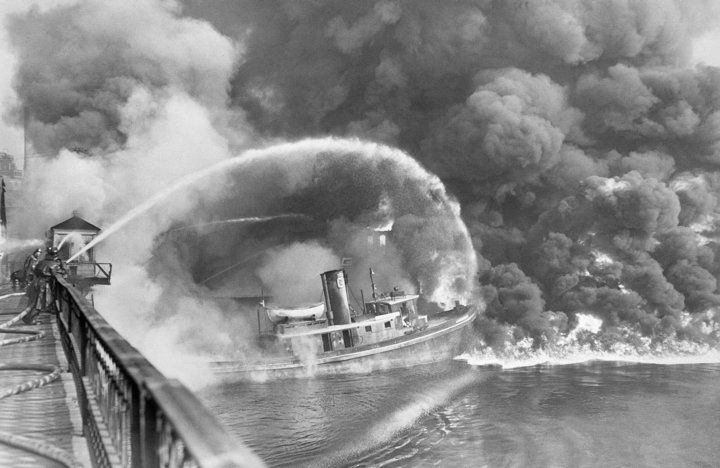
In 1969, the Cuyahoga River in Cleveland Ohio caught fire, resulting in property damage worth $100,000, equivalent to nearly $700,000, today. The fire resulted in important strategies to clean up the river, but this wasn’t the first such fire. The Cuyahoga wasn’t even the first river to catch fire. There were at least thirteen such incidents on the Cuyahoga, the first occurring in 1868. The Rouge River in Michigan caught fire in the area around Detroit in 1969, and a welder’s torch lit up the Buffalo River in New York, the year before. The Schuylkill River in Philadelphia caught fire from a match tossed into the water, in 1892.

Fire on the Cuyahoga River
Cuyahoga River burning, in 1952. H/T Getty Images

Today, the coal silts, oil and chemical contaminants at the heart of these episodes are largely under control in the developed world, but not the world over. One section of Meiyu River in Wenzhou, Zhejiang China burst into flame in the early morning of March 5, 2014. Toxic chemical pollution and other garbage dumped into Bellandur Lake in Bangalore India resulted in part of the lake catching fire the following year, the fire spreading to the nearby Sun City apartments.

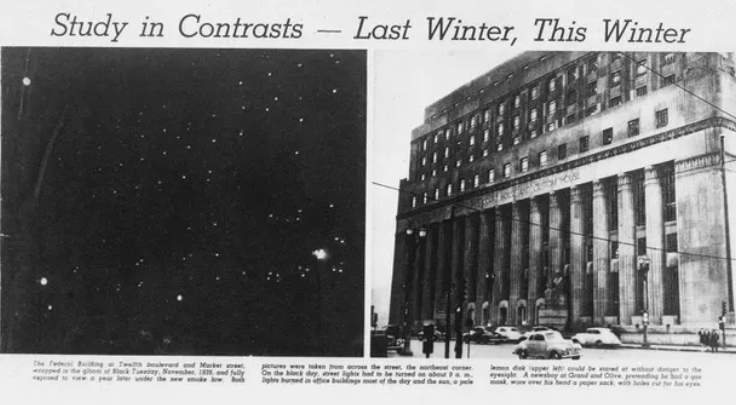
If you happen to visit the “Iron City”, Pittsburgh Pennsylvania, photographs may be found of streetlights turned on in the middle of the day. In November 1939, St. Louis brought a new meaning to the term “Black Tuesday”, when photographs of the Federal building at Twelfth Boulevard and Market Street show the sun little more than a “pale lemon disk” and streetlights on at 9:00 in the morning.

Federal Building, St. Louis

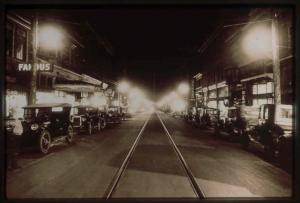
Air pollution turned deadly in the early morning hours of October 26, 1948 when an atmospheric inversion trapped flourine gases over Donora Pennsylvania, home of US Steel Corporation’s Donora Zinc Works and American Steel and Wire. By the 29th, the inversion had trapped so much grime that spectators gathered to watch a high school football game, couldn’t see the kids on the field. The “Death Fog” hung over Donora for four days, killing 22 and putting half the town, in the hospital.

mid-day
Donora Smog at Midday with streetlights on. H/T Donora Historical Society

The Donora episode was caused by an “anticyclone”, a weather event in which a large high pressure front draws air down through the system and out in a clockwise motion.

When such a weather system occurs over areas with high levels of atmospheric contaminants, the resulting ground fog can be catastrophic. 63 people perished during a similar episode in 1930, in the Meuse River Valley area of Belgium. In 1950, 22 people were killed in Poza Rica, Mexico. In 1952, the infamous “Great Smog of London” claimed the lives of thousands, over a course of five days.

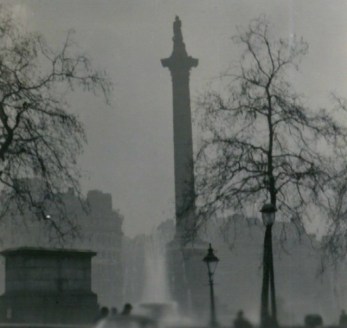
Nelson's_Column_during_the_Great_Smog_of_1952
Nelson’s Column during the Great Smog of 1952

On December 5, a body of cold, stagnant air descended over a near-windless London, trapped under a “lid” of warm air. London had suffered poor air quality since the 13th century and airborne pollutants had combined to create “pea soupers” in the past, but this was unlike anything in living memory. The smoke from home and industrial chimneys and other pollutants such as sulphur dioxide combined with automobile exhaust, with nowhere to go.

Yellow-black particles of the stuff built and accumulated at an unprecedented rate. Visibility was down to a meter and driving all but impossible. Public transportation shut down, requiring those rendered sick by the fog, to transport themselves to the hospital.  Outdoor sporting events were canceled and even indoor air quality, was affected.  Weather conditions held until December 9, when the fog dispersed.

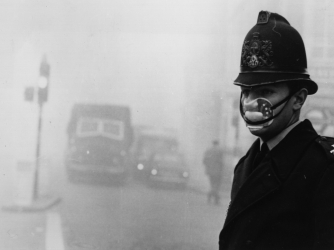
hith-london-fog-2660357-ABThere was no panic, Londoners are quite accustomed to the fog, but this one was different. Over the weeks that followed, public health authorities estimated that 4,000 people had died as a direct result of the smog by December 8, and another 100,000 made permanently ill. Research pointed to another 6,000 losing their lives in the following months, as a result of the event.
More recently, research puts the death toll of the Great Smog at 12,000.

A similar event took place about ten years later in December 1962, but without the same lethal impact. A spate of environmental legislation in the wake of the 1952 disaster began to remove black smoke from chimneys.  Financial incentives moved homeowners away from open coal fires toward less polluting alternatives such as gas or oil, or less polluting coke.

Today, the wealthier, developed nations have made great strides toward improvement in air and water quality, though problems persist in the developing world.  In the United States, the Environmental Protection Agency (EPA) reports that:

“[B]etween 1980 and 2017, gross domestic product increased 165 percent, vehicle miles traveled increased 110 percent, energy consumption increased 25 percent, and U.S. population grew by 44 percent. During the same time period, total emissions of the six principal air pollutants dropped by 67 percent”.

The same report shows that, during the same period, CO2 emissions have increased by 12 percent.  Policy makers continue to wrangle with the long-term effects of carbon.  Now, it’s hard to separate the politics from the science.

While politicians and climate activists jet around the planet to devise trillion dollar “solutions”, let us hope that cooler heads than that of Arnold Schwarzenegger, prevail.  There is scarcely a man, woman or child among us who do not want clean air and clean water, and a beautiful, natural environment around us, for ourselves and our posterity.  It’s only a matter of how we get there.

If you enjoyed this “Today in History”, please feel free to re-blog, “like” & share on social media, so that others may find and enjoy it as well. Please click the “follow” button on the right, to receive email updates on new articles.  Thank you for your interest, in the history we all share.

December 6, 1768 The Murderer’s Dictionary

Among the entire catalog of works there is no tale so queer as the Oxford English dictionary, and the convicted murderer who helped to bring it into being.  From an insane asylum, no less.

For the great reference works of the English language, the beginnings were often surprisingly modest. Encyclopedia Britannica was first published on this day in 1768 in Edinburgh, Scotland: part of the Scottish enlightenment. Webster’s dictionary got its beginnings with a single infantrymen of the American Revolution, who went on to codify what would become the standardized system of spelling for “American English“.  In Noah Webster’s dictionary, ‘colour’ became ‘color’, and programme’ became ‘program’, a novel concept at a time when the thought of a “correct“ way of spelling, was a new and unfamiliar idea.

Among the entire catalog of works there is no tale so queer as the Oxford English dictionary, and the convicted murderer who helped bring it into being.  From an insane asylum, no less.

Dissatisfied with what were at that time a spare four reference works including Webster’s dictionary, the Philological society of London first discussed what was to become the standard reference work of the English language, in 1857. The work was expected to take 10 years in compilation and cover some 64,000 pages.  The editors were off by sixty years.  Five years into the project, the team had made it all the way to “ant“.

Minor
Dr. William Chester Minor

William Chester Minor was a physician around this time, serving the Union army during the American Civil War.   

The role of this experience in the man’s later psychosis, is impossible to know. Minor was in all likelihood a paranoid schizophrenic, a condition poorly understood in his day.

As a combat surgeon, Minor saw things that no man was ever meant to see.  Terrible mutilation was inflicted on both sides at the 1864 Battle of the Wilderness.  Hundreds were wounded and unable to get out of the way of the brush fire, burning alive those sufferers too broken to move, before the horrified eyes of comrades and enemies, alike.  One soldier would later write:  It was as though “hell itself had usurped the place of earth“.

Dr. Minor was ordered to brand the forehead of an Irish deserter, with the letter “D”.  The episode scarred the soldier, and left the doctor with paranoid delusions that the Irish were coming to ‘get him’.

As a child born to New England missionaries working in Ceylon, Minor was well adjusted to the idea of foreign travel, as a means of dealing with travail. He took a military pension and moved to London in 1871, to escape the demons who were by that time, closing in.

One day, Minor shot and killed one George Merritt, a stoker who was walking to work.  He believed the man had broken into his room.  The trial was published widely, the “Lambeth Tragedy” revealing the full extent of Minor’s delusional state, to the public.

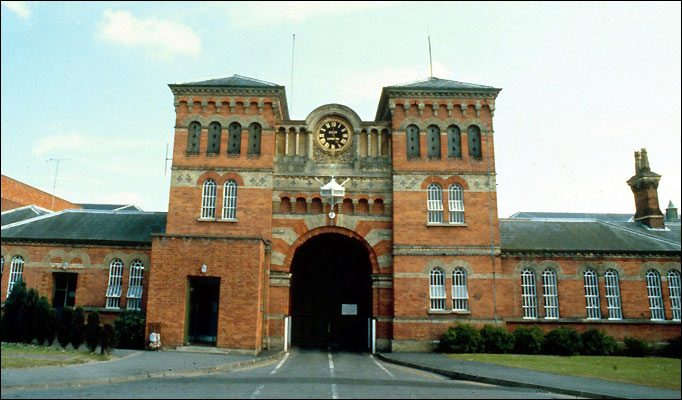
Minor was judged not guilty on grounds of insanity, and remanded “until Her Majesty’s Pleasure be known”, to the Broadmoor institution for the criminally insane. Victorian England was by no means ‘enlightened’ by modern standards, and inmates were always referred to as ‘criminals’ and ‘lunatics’. Never as ‘patients’. Yet Broadmoor, located on 290 acres in the village of Crowthorne in Berkshire was England’s newest such asylum, and a long way from previous such institutions.

Minor was housed in block 2, the “Swell Block”, where his military pension and family wealth afforded him two rooms, instead of the usual one. In time, Minor acquired so many books that one room was converted to a library.  Surprisingly, it was Merritt’s widow Eliza, who delivered many of the books.  The pair became friends, and Minor used a portion of his wealth to “pay” for his crime, and to help the widow raise her six kids.

Broadmoor-outside
Broadmoor asylum for the criminally insane

Dr. James Murray assumed editorship of the “Big Dictionary” of English in 1879, and issued an appeal in magazines and newspapers, for outside contributions. Whether this seemed a shot at redemption to William Minor or merely something to do with his time is anyone’s guess, but Minor had nothing but time. And books.

William Minor collected his first quotation in 1880 and continued to do so for twenty years, always signing his submissions: Broadmoor, Crowthorne, Berkshire.

The scope of the man’s work was prodigious, he himself an enigma, assumed to be some country gentlemen.  Perhaps one of the overseers, at the asylum.

In 1897, “The Surgeon of Crowthorne” failed to attend the Great Dictionary dinner.  Dr. Murray decided to meet his mysterious contributor in person and finally did so, four years later.  In his cell. Oh, to have been a fly on the wall, when this Oxford don was ushered into the office of Broadmoor’s director, only to learn that the man he looked for, was an inmate.

murray-at-work-scriptorium
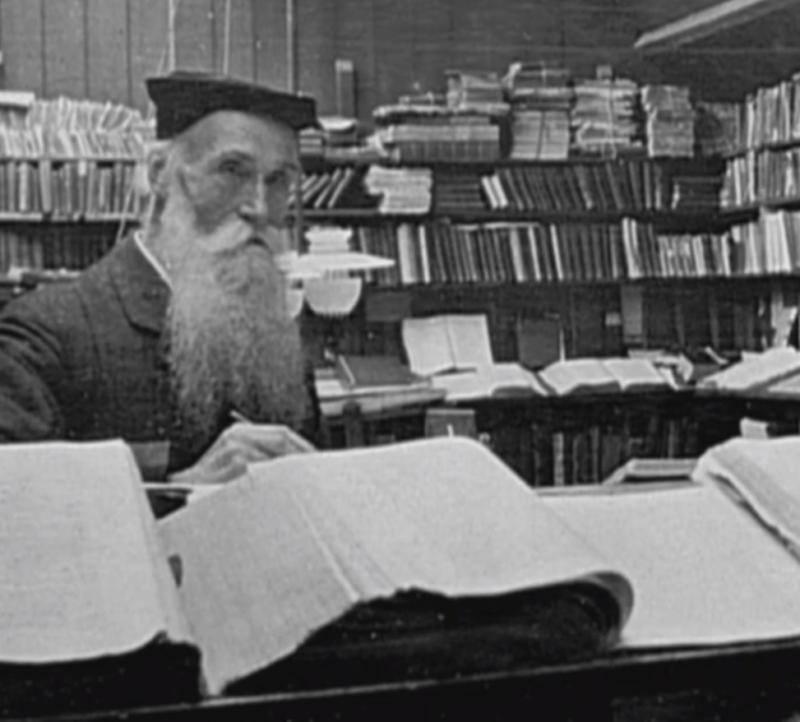
Dr. “Murray at work in his scriptorium, a dedicated room filled with books, at Oxford University (date unknown)”. H/T allthatsinteresting.com

Dr. Minor would carefully index and document each entry, which editors compared with the earliest such word use submitted by other lexicographers. In this manner, over 10,000 of his submissions made it into the finished work, including the words ‘colander’, ‘countenance’ and ‘ulcerated’.

By 1902, Minor’s paranoid delusions had crowded out his mind.  His submissions came to an end.  What monsters lurked inside the man’s head is anyone’s guess.  Home Secretary Winston Churchill ordered Minor to be removed back home to the United States, following a 1910 episode in which Minor emasculated himself, with a knife.

The madman lived out the last ten years of his life, in various institutions for the criminally insane. William Chester Minor died in 1920 and went to his rest in a small inauspicious grave, in Connecticut.

Over seventy years in compilation, only one single individual is credited with more entries to the greatest reference work in the history of the English language, than this one murderer, working from a home for lunatics.

oed-volumes
Oxford English Dictionary

Feature image, top of page:  Dr. Murray and his Oxford University editorial team, 1915.  H/T allthatsinteresting.com

If you enjoyed this “Today in History”, please feel free to re-blog, “like” & share on social media, so that others may find and enjoy it as well. Please click the “follow” button on the right, to receive email updates on new articles.  Thank you for your interest, in the history we all share.

December 1, 2013 The Sacred Soil of Flanders Fields

I’ve long believed that we can’t be participating citizens of a self-governing Republic, we can’t know where we want our nation to go, if we don’t understand where it’s been.  It’s one of the principle reasons for examining history.  It’s why I think something wonderful happened five years ago, and I don’t think many of us heard about it.

November 11, nineteen short days ago, marked the one-hundred year anniversary of the end of World War One.  Before they had numbers, this was “The Great War”.  The “War to end all Wars”.

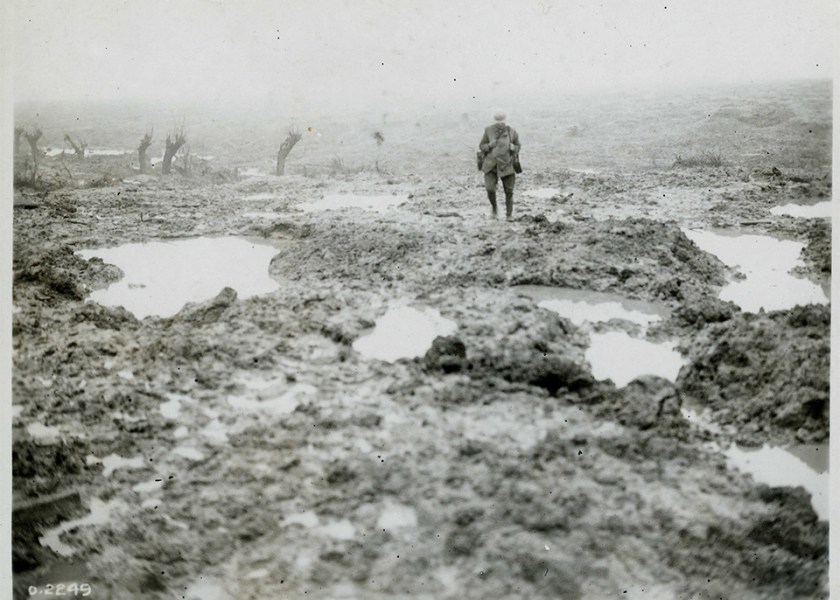
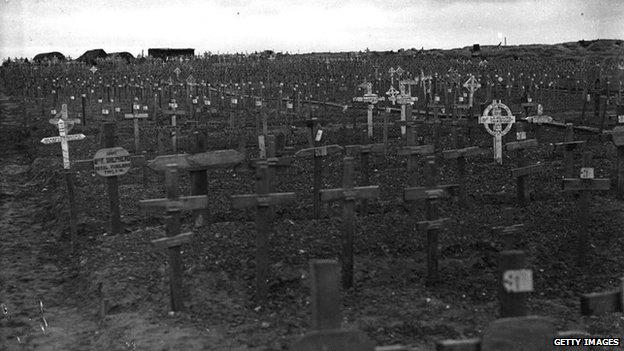
Passchendaele (1)
Passchendaele

There is barely a piece of 20th or 21st century history, which cannot be traced back to it.

International Communism was borne of the Great War, without which there would have been no cold war, no Korean War, no war in Vietnam. The killing fields of Cambodia would have remained mere rice fields.  The spiritual descendants of Chiang Kai-shek’s brand of capitalism would be running all of China, instead of only Taiwan.

no-mans-land

The current proportions of the Middle East arose from the Great War. While the region’s tribal alliances and religious strife is nothing new, those conditions would have taken a different form, had it not been for those boundaries.

World War II, an apocalypse which left more dead, wounded or missing than any conflict in world history, was little more than the Great War, part II. A Marshall of France, on reading the Versailles Treaty formally ending WWI, said “This isn’t peace. This is a cease-fire that will last for 20 years”.  He was off, by about 36 days.

_78081389_resized_3279921_10

I’ve long believed that we can’t be participating citizens of a self-governing Republic, we can’t know where we want our nation to go, if we don’t understand where it’s been.  It’s one of the principle reasons for examining history.  It’s why I think something wonderful happened five years ago, and I don’t think many of us heard about it.

Over the summer of 2013, more than 1,000 British and Belgian schoolchildren visited seventy battlefields of the Great War.  Ypres.  Passchendaele.  Verdun.  The Somme. This was a singular event.  Never before had the Commonwealth War Graves Commission permitted the excavation of these battlefields.

All over Northern France and Belgium, the region known as “Flanders”.  There these children collected samples of the sacred soil of those fields of conflict.

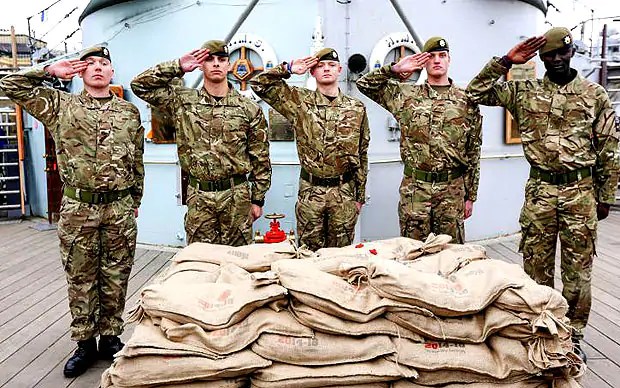
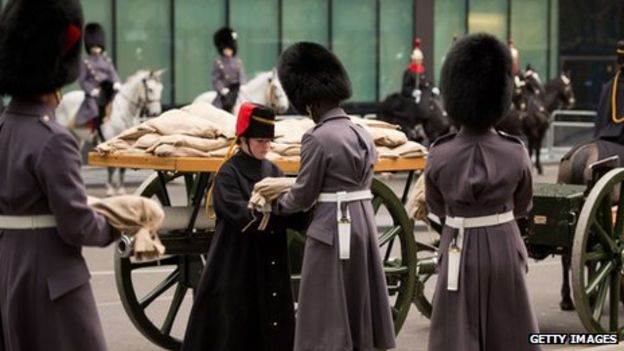
The soil from those battlefields was placed in 70 WWI-style burlap sandbags, each stenciled with a red poppy, where it came from, and the dates.  Those sandbags began their journey with a solemn Armistice Day ceremony at the Menin Gate of Ypres, that memorial to the 56,395 British and Commonwealth soldiers who fought and died on the Ypres salient of the Great War, and whose bodies were never found or identified.

The sacred soil of Flanders Fields transported to London aboard the Belgian Navy frigate Louisa Marie, and installed with great care at Wellington Barracks, the central London home of the Grenadier Guards, Coldstream Guards and Scots Guards.

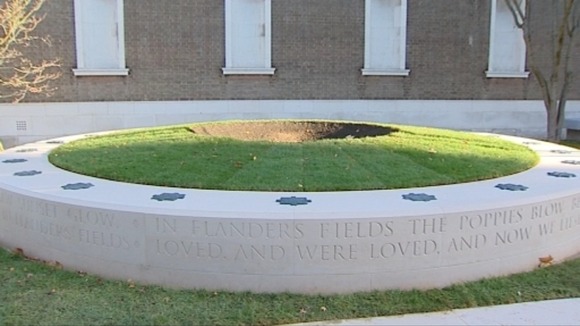
There the soil of the Great War would nourish and support a garden, inscribed with the words of Doctor John McCrae’s famous poem, “In Flanders Fields”.  Ready for the following year, a solemn remembrance of the centenary of the War to end all Wars.

_71447576_soil4_getty

That day, December 1, 2013, was for the Flanders Fields Memorial Garden, the first full day of forever.  I cannot think of anything more fitting than that it was children, our future and posterity, who retrieved the sacred soil of Flanders and installed it in that garden.

It is now for that posterity to keep our history alive, and never to let it fade, into some sepia-toned and forgotten past.

article_img

If you enjoyed this “Today in History”, please feel free to re-blog, “like” & share on social media, so that others may find and enjoy it as well. Please click the “follow” button on the right, to receive email updates on new articles.  Thank you for your interest, in the history we all share.

November 21, 1916 Miss Unsinkable

Floating on the still, frigid waters of the north Atlantic, Violet Jessop must have wondered about Captain Smith.  This was not their first cruise together, nor even their first shipwreck.

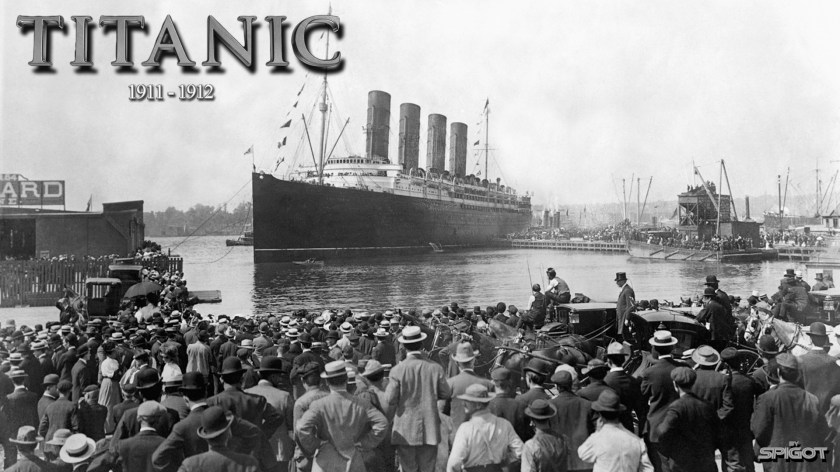
The maiden voyage of the largest ship afloat left the port of Southampton, England on April 10, 1912, carrying 2,224 passengers and crew. An accident was narrowly averted only minutes later, as Titanic passed the moored liners SS City of New York and Oceanic.

Both smaller ships lifted in the bow wave formed by Titanic’s passing, then dropped into the trough. New York’s mooring cables snapped, swinging her about, stern-first. Collision was averted by a bare 4-feet as the panicked crew of the tugboat Vulcan struggled to bring New York under tow.

Edward Smith
Titanic Captain, Edward Smith

By the evening of the 14th, Titanic was 400 miles off the coast of Newfoundland, conditions clear, calm and cold. There were warnings of drifting ice from other ships in the area, but it was generally believed that ice posed little danger to large vessels at this time.  Captain Edward Smith opined that he “[couldn’t] imagine any condition which would cause a ship to founder. Modern shipbuilding has gone beyond that.”

Lookout Frederick Fleet alerted the bridge of an iceberg dead ahead at 11:40pm. First Officer William Murdoch ordered the engines put in reverse, veering the ship to the left. Lookouts were relieved, thinking that collision had been averted. Below the surface, the starboard side of Titanic ground into the iceberg, opening a gash the length of a football field.

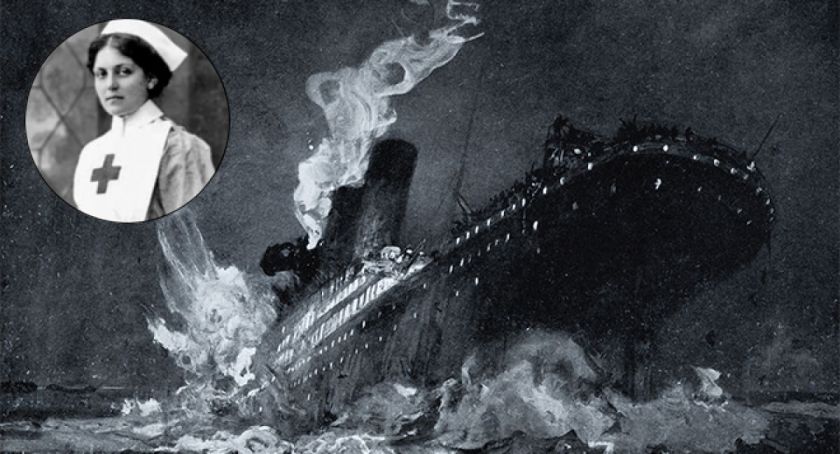
Violet_jessop_titanicThe ship was built to survive flooding in four watertight compartments. The iceberg had opened five. As Titanic began to lower at the bow, it soon became clear that the ship was doomed.
Those aboard were poorly prepared for such an emergency. The ship was built for 64 wooden lifeboats, enough for 4,000, however the White Star Liner carried only 16 wooden lifeboats and four collapsibles. Regulations then in effect required enough room for 990 people. Titanic carried enough to accommodate 1,178.

As it was, there was room for over half of those on board, provided that each boat was filled to capacity.  So strictly did Royal Navy officer Charles Lightoller  adhere to the “women and children first” directive, that many boats were launched, half-full.  The first lifeboat in the water, rated at 65 passengers, launched with only 28 aboard.

Lightoller himself survived, only by clinging to the bottom of an overturned raft.

titanic-01-wallpaper

Violet Jessop was among those first to leave, clutching someone’s forgotten baby.  As ship’s nurse, she was there to look after the comfort of the White Star Line passengers.  Now, this small boat full of confused and disoriented women were being lowered into the cold and darkness of night, while all aboard the great ship was light, and warmth.

Denial is a funny thing, that psychological defense mechanism described by Sigmund Freud, in which a person rejects a plain fact too uncomfortable to contemplate.  There was denial aplenty that night, from the well dressed passengers filing onto the decks, and from Violet Jessop, counting the lighted portholes as the boat creaked ever downward.  One row, then two:  every abandoned stateroom a tableau.  Three, and four:  feathered hats on dressers, scattered jewels on table tops.  Five and then six:  each lighted circle revealing a snapshot, soon to slip out of sight.

violet-jessop-post-660x357

Floating on the still, frigid waters of the north Atlantic, Jessop must have wondered about Captain Smith.  This was not their first cruise together, nor even their first shipwreck.

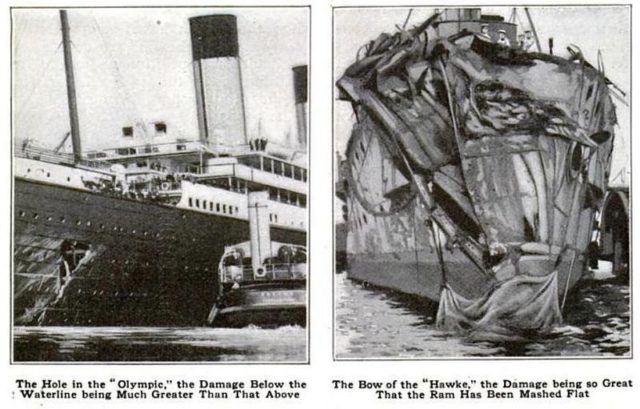
The White Star Line’s RMS Olympic set sail for New York seven months earlier, with Captain Edward Smith, commanding. Violet Jessop was on duty as the Royal Navy cruiser HMS Hawke performed mechanical tests, on a course parallel to the trans-Atlantic liner. Something went wrong and the tiller froze, swinging the bow of the Edgar-class cruiser, toward the liner. Hydrodynamic forces took over and the two ships collided, just after noon. The hull of the cruiser was smashed, two great gashes carved into the side of Olympic, one below the water line.

Two compartments flooded, but the watertight doors did their job. Olympic limped back to Southampton for repairs. Captain Smith and Violet Jessop moved on to the maiden voyage of her sister ship, the unsinkable RMS Titanic.

197-640x409

Denial turned to horror that frigid April night in 1912, when six rows of lights became five and then four, and Titanic began to rise by the stern.  RMS Carpathia arrived on the scene around 4am in response to distress calls, and diverted to New York with survivors.  Four days later, a crowd of 40,000 awaited the arrival of 705 survivors , in spite of a cold, driving rain.  It would take four full days to compile and release the list of casualties.

Violet Jessop survived that night.  Captain Smith, did not.

Back in 1907, Director General of the White Star Line J. Bruce Ismay planned a series of three sister ships, to compete with the Cunard lines’ Mauritania, and Lusitania. What these lacked in speed would be made up in size, and luxurious comfort. The three vessels were to be named Olympic, Titanic and Gigantic.

800px-Britannic_Funnel_in_transport
One of Britannic’s funnels, in transit to the ship

That last name was quietly changed following the Titanic disaster and, on December 12, 1915, the newly christened Britannic was ready for service.

Four years later, the world was at war. Nurse Jessop was working aboard HMHS (His Majesty’s Hospital Ship) Britannic.  On November 21, 1916, HMHS Britannic was on station near Kea in the Aegean Sea, when she was struck by a German mine, or torpedo.  Violet Jessop calmly made her way to her cabin,  She’d been here, before.  There she collected a ring, a clock and a prayer book, and helped another nurse, collect her composure.

maxresdefault

After the Carpathia rescue, Jessop complained to friends and family that she missed her toothbrush. Her brother Patrick had jokingly told her, next time you wreck, “look after your toothbrush”.  This time, she didn’t forget it.

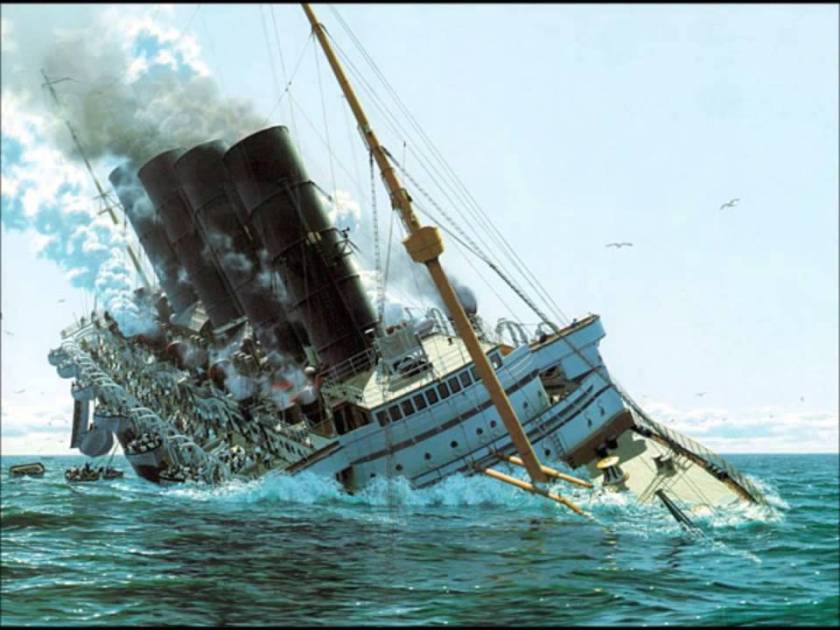
Britannic should have survived even with five watertight compartments filled, but nurses defied orders and opened the windows, to ventilate the wards.   In fifty-five minutes, HMHS Britannic replaced her sister ship Titanic, as the largest vessel on the bottom of the sea.

Fortunately, daytime hours combined with warmer weather and more numerous lifeboats, to lessen the cost in lives.  1,035 were safely evacuated from the sinking vessel, keeping the death toll in the Britannic wreck, to thirty.

Violet Jessop survived three of the most famous shipwrecks of her age, and never tired of working at sea. She returned to work as stewardess aboard RMS Olympic after the war, before retiring to private life and passing away, in 1971.

John Maxtone-Graham, editor of “Titanic Survivor”, the story of her life, remembers one last story about “Miss Unsinkable”. Fifty-nine years after the wreck, the phone rang late one night, during a violent thunderstorm. A woman’s voice at the other end asked “Is this the Violet Jessop who was a stewardess on the Titanic and rescued a baby?” “Yes” came the reply, “who is this?” The woman laughed, and responded “I was that baby.”

If you enjoyed this “Today in History”, please feel free to re-blog, “like” & share on social media, so that others may find and enjoy it as well. Please click the “follow” button on the right, to receive email updates on new articles.  Thank you for your interest, in the history we all share.


November 12, 1912 Frozen in Time

Over a hundred years later you can still feel anguish from the man’s diary: “The worst has happened…All the day dreams must go…Great God! This is an awful place”.

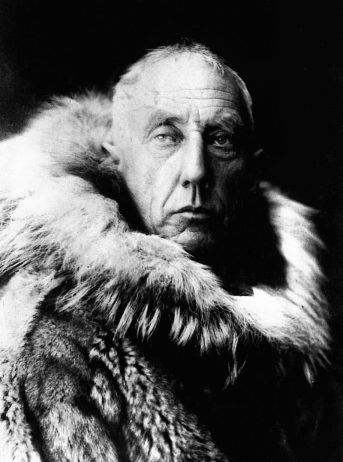
Roald AmundsenAs long as he could remember, Roald Amundsen wanted to be an explorer.  As a boy, he would read about the doomed Franklin Arctic Expedition, of 1848.  A sixteen-year-old Amundsen took inspiration from Fridtjof Nansen’s epic crossing of Greenland, in 1888.
The period would come to be called the “Heroic Age” of polar exploration.  Amundsen was born to take part.

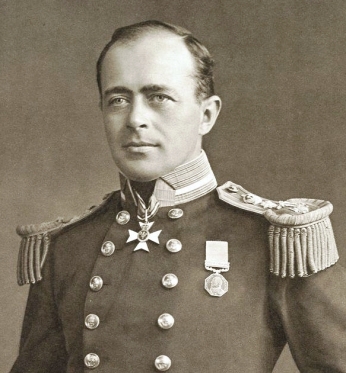
Not so, Robert Falcon Scott.   A career officer with the British Royal Navy, Scott would take a different path to this story.

Clements Markham, President of the British Royal Geographical Society (RGS), was known to “collect” promising young naval officers with an eye toward future polar exploration.  The two first met on March 1, 1887, when the eighteen-year old midshipman’s cutter won a sailing race, across St. Kitt’s Bay.

In 1894, Scott’s father John made a disastrous mistake, selling the family brewery and investing the proceeds, badly.  The elder Scott’s death of heart disease three years later brought on fresh family crisis, leaving John’s widow Hannah and her two unmarried daughters, dependent on Robert and his younger brother, Archie.

Now more than ever, Scott was eager to distinguish himself with an eye toward promotion, and the increase in income which came with it.

RobertFalconScott.jpgIn the Royal Navy, limited opportunities for career advancement were eagerly sought after, by any number of ambitious officers.  Home on leave in 1899, Scott chanced once again to meet the now-knighted “Sir” Clements Markham, and learned of an impending RGS Antarctic expedition, aboard the barque-rigged auxiliary steamship, RRS Discovery.  What passed between the two went unrecorded but, a few days later, Scott showed up at the Markham residence, and volunteered to lead the expedition.

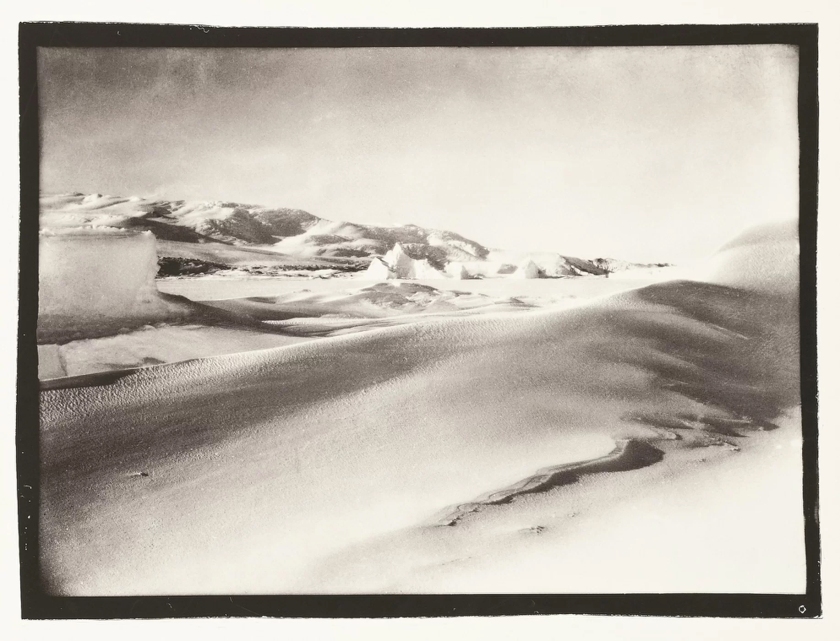
The Discovery expedition of 1901-’04 was one of science as well as exploration.  Despite a combined polar experience of near-zero, the fifty officers and men under Robert Falcon Scott made a number of important biological, zoological and geological findings, proving that the Antarctic continent was once, forested.  Though later criticized as clumsy and amateurish, a journey south in the direction of the pole discovered the polar plateau, establishing the southernmost record for its time at 82° 17′ S, only 530 miles short of the pole.

a0a85691e405edb91673335150d4f571--robert-falcon-scott-robert-scott
Kathleen Bruce Scott

Discovery returned in September 1904, the expedition hailed by one writer as “one of the great polar journeys”, of its time.  Once an obscure naval officer, Scott now entered Edwardian society, and moved among the higher social and economic circles, of the day.

A brief but stormy relationship ensued with Kathleen Bruce, a sculptress who studied under Auguste Rodin, and counted among her personal friends, the likes of Pablo Picasso, Aleister Crowley and Isadora Duncan.  The couple was married on September 2, 1908 and the marriage produced one child, Peter Markham Scott, who went on to found the World Wide Fund for Nature (WWF).

The elder Scott would not live to see it.

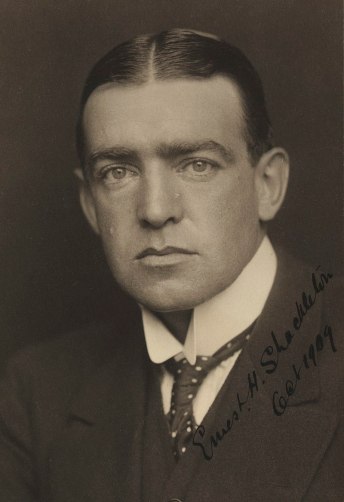
800px-Ernest_Shackleton_before_1909
Ernest Shackleton, ca 1909

The “Great Southern Journey” of Scott’s Discovery officer Ernest Shackleton, arrived at a point 112 miles short of the pole on January 9, 1909, providing Scott with the impetus for a second attempt, the following year.  Scott was still fundraising for the expedition when the old converted whaler Terra Nova departed Cardiff, in South Wales.  Scott joined the ship in South Africa and arrived in Melbourne Australia in October, 1910.

Meanwhile, and unbeknownst to Scott, Roald Amundsen was preparing for his own drive on the south pole, aboard the ship “Fram” (Forward).

It was in Melbourne that Scott received the telegram: “Beg leave to inform you Fram proceeding Antarctic Amundsen“.  Robert Falcon Scott now faced a race to the pole.

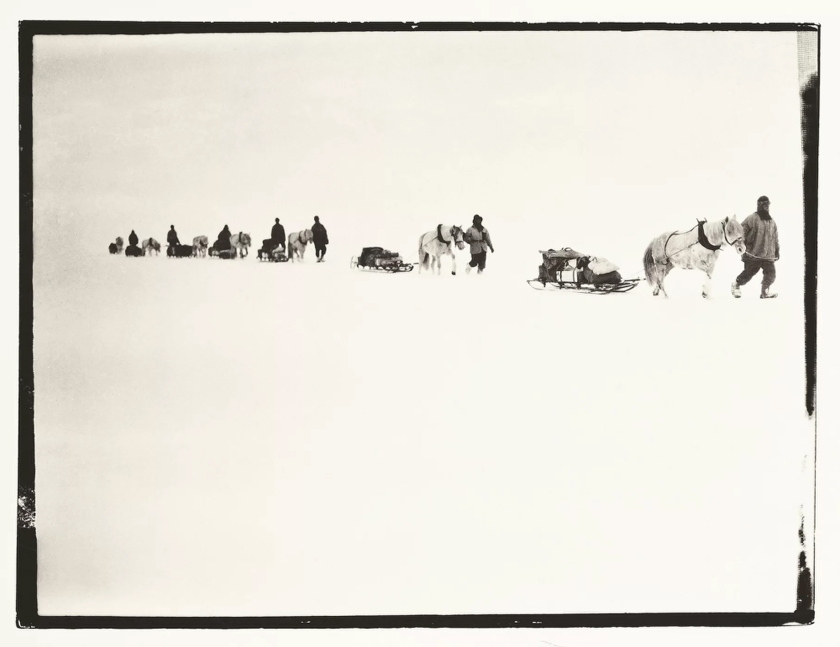
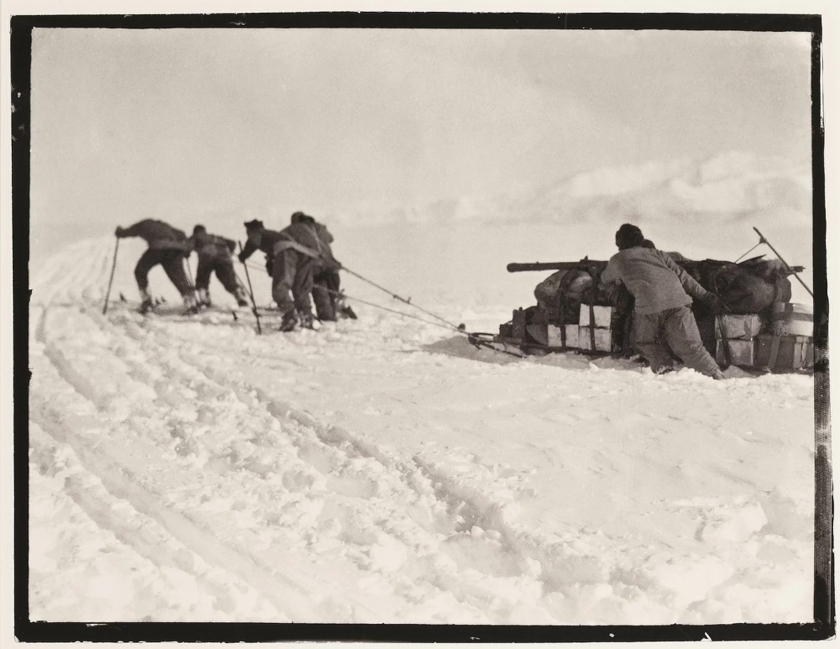
Unlike Amundsen who adopted the lighter fur-skins of the Inuit, the Scott expedition wore heavy wool clothing, depending on motorized and horse-drawn transport, and man-hauling sledges for the final drive across the polar plateau. Dog teams were expected to meet them only on the way out, on March 1.

Mount Erebus
Mount Erebus, the southernmost active volcano, in the world. Robert Falcon Scott took this photograph in 1911

Weak ponies, poorly acclimatized to the wretched conditions of Antarctica, slowed the depot-laying part of the Scott expedition.  Four horses died of cold or had to be shot, because they slowed the team.

Expedition member Lawrence “Titus” Oates warned Scott against the decision to locate “One-Ton Depot” 35-miles short of the planned location at 80°.  “Sir, I’m afraid you’ll come to regret not taking my advice.”  His words would prove prophetic.

Scott Expedition

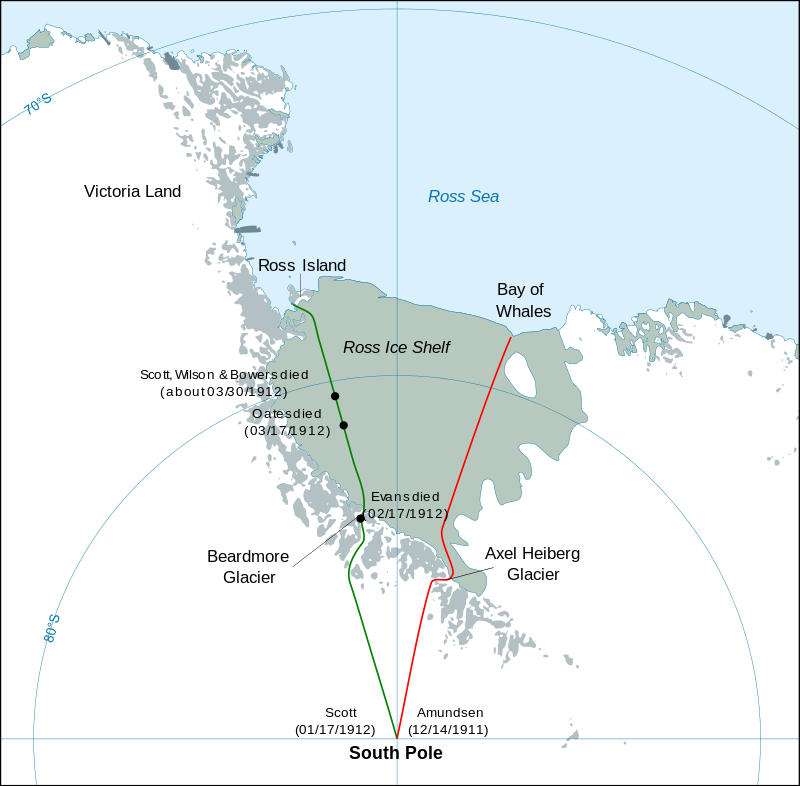
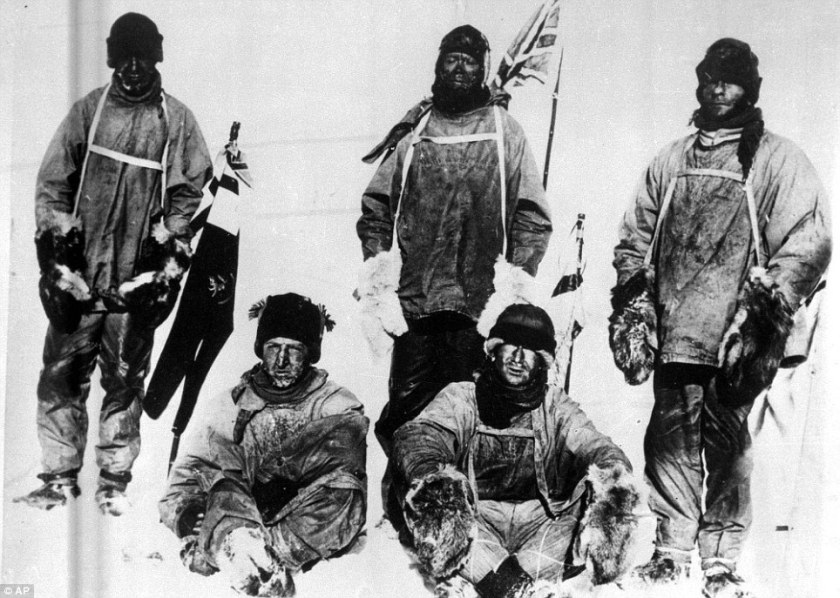
Unlike the earlier attempt, Robert Falcon Scott made it to the pole this time, only to find that Amundsen’s Norwegian team had beat him there, by a mere five weeks. Over a hundred years later you can still feel anguish from the man’s diary: “The worst has happened…All the day dreams must go…Great God! This is an awful place”.

Defeated, the five-man Scott party turned and began the 800-mile, frozen slog back from the Pole on January 19, 1912.  Team member Edgar “Taff” Evans’ condition began to deteriorate as early as the 23rd. A bad fall on Beardmore Glacier left the man concussed on February 4, “dull and incapable”.  Another fall two weeks later, left Evans dead at the foot of the glacier.

Man-hauled sledges

Dog teams failed to materialize at the appointed time.  Within days, Titus himself was severely frostbitten, concerned that his incapacity would become a threat and a burden to the team. He left his tent for the last time and limped into a blizzard on March 17, saying “I am just going outside and may be some time”.  He never returned.

Noble as it was, Lawrence Oates’ suicide, came to naught.  The last three made their final camp on March 19, with 400 miles yet to go.   A howling blizzard descended on the tents the following day and lasted for days, as Scott, Henry “Birdie” Bowers and Dr. Edward Wilson wrote good-bye letters to mothers, wives, and others.

Amundsen_-_Scott_Antarctic_expedition_map.svg

Starving and frostbitten, Robert Falcon Scott wrote to his diary in the final hours of his life “It seems a pity, but I do not think I can write more.” In his final entry, he worried about the financial burden on his family, and those of the doomed expedition: “Last entry.  For God’s sake look after our people”.

The lowest ground level temperature ever recorded was −128.6° Fahrenheit at the Soviet Vostok Antarctic Station, in 1983.  Meteorological conditions for those last days in the Scott camp, went undocumented.

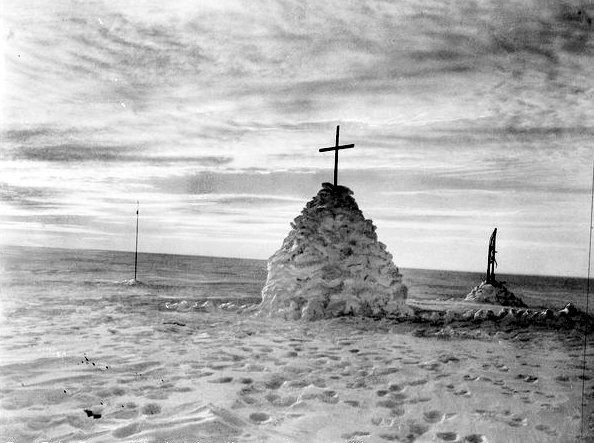
The frozen corpses of Robert Falcon Scott and his comrades were found on November 12, 1912, that last diary entry dated March 29.  A high cairn of snow was erected over it all, that final camp becoming the three men’s tomb. Ship’s carpenters built a wooden cross, inscribing on it the names of those lost: Scott, Edward Wilson, Henry Bowers, Lawrence Oates and Edgar Evans. A line from Alfred Lord Tennyson’s poem, Ulysses, was carved into the cross:

To strive, to seek, to find, and not to yield”.
article-2087811-001f786700000258-615_964x687 (1)
Defeated by only weeks, the Scott party spends a moment at the south pole, before turning for the frozen, 800-mile slog, back.

It was eleven miles short of the next supply depot.

On hearing the fate of his rival, Roald Amundsen said “I would gladly forgo any honor or money if thereby I could have saved Scott his terrible death”.

A century later, ice and snow have covered the last camp of the southern party.  Pressed ever downward by the weight of snow and ice, their corpses are encased seventy-five-feet down in the Ross Ice Shelf and inching their way outward, expected to reach the Ross Sea sometime around 2276.  One day to break off and float away, at the heart of some unknown and nameless iceberg.

Feature image, top of page:  Last Camp of the Southern Party, of Robert Scott Falcon

November 4, 1918 Soldier Poet

My friend, you would not tell with such high zest
To children ardent for some desperate glory,
The old Lie: Dulce et decorum est
Pro patria mori.

Wilfred Edward Salter Owen was working as a private English tutor in Bordeaux, when the “Great War” broke out in 1914.

800px-Memorial_to_the_Artists_Rifles,_Royal_Academy,_LondonAt first in no hurry to sign up, he even considered joining the French Army before returning home to England, to enlist in the Artists Rifles Training Corps, in October 1915.
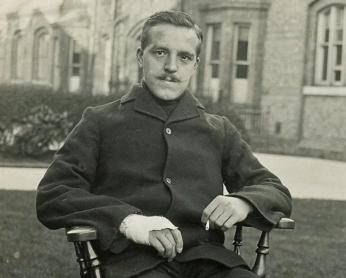
Originally formed in 1859, the Artists Rifles was a British special forces regiment, raised in London and comprised of painters, musicians, actors and architects, and symbolized by the heads of the Roman gods Mars and Minerva.

It must have felt a natural place.  Wilfred Owen was a poet, a talent first discovered about ten years earlier, at age ten or eleven.

Owen was commissioned Second Lieutenant after six-months training, and posted with the Manchester Regiment of line infantry.  An application to the Royal Flying Corps was rejected in 1916 and he was shipped to France, joining the 2nd Manchester regiment near Beaumont Hamel, on the river Somme.

He was contemptuous of his men at first, considering them to be louts and barbarians.  He wrote home to his mother Susan in 1917, describing his company as “expressionless lumps”.  The war would soon beat that out of him.

Owen was close with his mother, his letters home telling a tale of mud and frostbite, of fifty hours spent under heavy bombardment, sheltered only by a muddy, flooded out dugout, of falling through shell-shattered earth into a cellar below, earning him a trip to the hospital.  It would not be his last.

Owen was caught in an explosion during the bitter battle of St. Quentin, blown off of his feet and into a hole, there to spend days fading in and out of consciousness amidst the shattered remains of a fellow officer.

d6d65d6After this experience, soldiers reported him behaving strangely. Owen was diagnosed as suffering from neurasthenia or shell shock, what we now understand to be Post-Traumatic Stress Disorder, and sent to Craiglockhart War Hospital in Edinburgh, for treatment.

There, Dr. Arthur Brock encouraged Owen to work hard on his poetry, to overcome his shell shock.  There he met another patient, the soldier and poet, Siegfried Sassoon. The chance meeting would elevate Wilfred Owen to one of the great war poets, of his generation.

Owen’s work was qualitatively different before this time, vaguely self important but never self pitying. Never a pacifist – he held those people to ridicule – Owen’s nightmares now brought forth a brutal honesty and a deep compassion for the burdens of the ordinary soldier.  Tales of trench life:  of gas, lice, mud and death, of Hell and returning to earth, steeped in contempt for the patriotic sentimentality of non-combatants and the slurs of cowardice, so lightly dispensed by the women of the “White Feather” movement.

Anthem for Doomed Youth, is a classic of the period:

What passing-bells for these who die as cattle?
— Only the monstrous anger of the guns.
Only the stuttering rifles’ rapid rattle
Can patter out their hasty orisons.
No mockeries now for them; no prayers nor bells;
Nor any voice of mourning save the choirs,—
The shrill, demented choirs of wailing shells;
And bugles calling for them from sad shires.

What candles may be held to speed them all?
Not in the hands of boys, but in their eyes
Shall shine the holy glimmers of goodbyes.
The pallor of girls’ brows shall be their pall;
Their flowers the tenderness of patient minds,
And each slow dusk a drawing-down of blinds.

wilfred-owenOwen continued to write through his period of convalescence, his fame as author and poet growing through the late months of 1917 and into March of the following year. Supporters requested non-combat postings on his behalf, but such requests were turned down. It’s unlikely he would have accepted them, anyway. His letters reveal a deep sense of obligation, an intention to return to the front to be part of and to tell the story of the common man, thrust by his government into uncommon conditions.

Wilfred Owen well understood his special talent.  He wanted a return to front line combat, made all the more urgent when Sassoon was once again wounded, and removed from the front.

He was back in France by September 1918, capturing a German machine gun position on the 29th, for which he would be awarded the Military Cross.  Posthumously.

On October 31, Owen wrote home to his mother, from the cellar of the Forrester’s house, at Ors.  It was to be the last such note she would ever receive,  “Of this I am certain: you could not be surrounded by a band of friends half so fine as surround me here.

The forty-four mile Sambre-Oise Canal flows through the Meuse river basin, a network of 38 locks directing the water’s flow and connecting the Netherlands and Belgium with the central waterways of France. Forces of the 2nd Battalion Royal Sussex forced the canal on November 4, in coordination with elements of the 2nd Manchester Regiment and the Lancashire Fusiliers. British forces were to cross surrounding fields lined with high hedges, then to cross the canal by portable foot bridges, or climbing across the lock gates, themselves.

landrecies1918

The battle of the Sambre–Oise Canal was one of the last Allied victories of the Great War, and not without cost. Lock houses on the opposite side formed strong points for German defensive fire, from small arms and machine guns.

Wilfred Owen was at the head such a raiding party, when the bullets from the German machine gun tore into his body. He died a week nearly to the hour, from the armistice which would end the war.  He was twenty-five.

The church bells of Shrewsbury rang out in celebration that day in 1918, as Owen’s parents Tom and Susan, received the telegram.  The eleventh hour of the eleventh day of the eleventh month.

“Deeply regret to inform you, that…”

“Dulce et Decorum Est”

Bent double, like old beggars under sacks,
Knock-kneed, coughing like hags, we cursed through sludge,
Till on the haunting flares we turned our backs,
And towards our distant rest began to trudge.
Men marched asleep. Many had lost their boots,
But limped on, blood-shod. All went lame; all blind;
Drunk with fatigue; deaf even to the hoots
Of gas-shells dropping softly behind.

Gas! GAS! Quick, boys!—An ecstasy of fumbling
Fitting the clumsy helmets just in time,
But someone still was yelling out and stumbling
And flound’ring like a man in fire or lime.—
Dim through the misty panes and thick green light,
As under a green sea, I saw him drowning.

In all my dreams before my helpless sight,
He plunges at me, guttering, choking, drowning.

If in some smothering dreams, you too could pace
Behind the wagon that we flung him in,
And watch the white eyes writhing in his face,
His hanging face, like a devil’s sick of sin;
If you could hear, at every jolt, the blood
Come gargling from the froth-corrupted lungs,
Obscene as cancer, bitter as the cud
Of vile, incurable sores on innocent tongues,—
My friend, you would not tell with such high zest
To children ardent for some desperate glory,
The old Lie: Dulce et decorum est
Pro patria mori.

Wilfred Owen, 1917