
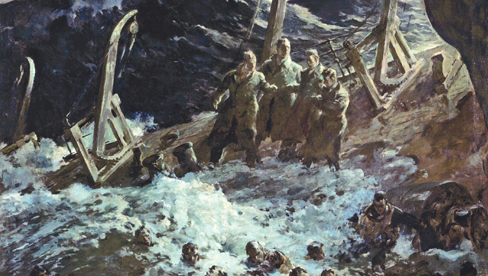
 The Troop Transport USAT Dorchester sailed out of New York Harbor on January 23, 1943, carrying 902 service members, merchant seamen and civilian workers. They were headed for the Army Command Base in southern Greenland, part of a six-ship convoy designated SG-19, together with two merchant ships and escorted by the Coast Guard Cutters Comanche, Escanaba and Tampa.
Built in 1926 as a coastal liner, Dorchester was anything but graceful, bouncing and shuddering its way through the rough seas of the North Atlantic. Several ships had already been sunk by German U-Boats in these waters. One of the Cutters detected a sub late on February 2, flashing the light signal “we’re being followed”. Dorchester Captain Hans Danielson ordered his ship on high alert that night. Men were ordered to sleep in their clothes with their life jackets on. Many disregarded the order. It was too hot down there in the holds, and those life jackets were anything but comfortable.
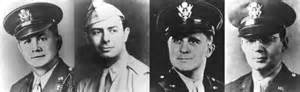
Some of those off-duty tried to sleep that night, while others played cards or threw dice, well into the night. Nerves were understandably on edge, especially among new recruits, as four Army chaplains passed among them with words of encouragement. They were the Jewish Rabbi Alexander D. Goode, the Catholic priest John P. Washington, the Dutch Reformed Church Minister Clark V. Poling and the Methodist Minister George L. Fox.
At 12:55am on February 3rd, the German submarine U-223 fired a spread of three torpedoes. One struck Dorchester amidships, deep below the water line. A hundred or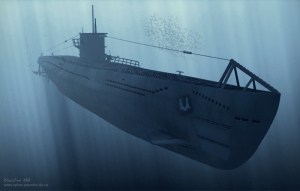 more were killed in the blast, or in the clouds of steam and ammonia vapor pouring from ruptured boilers. Suddenly pitched into darkness, untold numbers were trapped below decks. With boiler power lost, there was no longer enough steam to blow the full 6 whistle signal to abandon ship, while loss of power prevented a radio distress signal. For whatever reason, there never were any signal flares.
Those who could escape scrambled onto the deck, injured, disoriented, many still in their underwear as they emerged into the sub-arctic cold.
The four chaplains must have been a welcome sight that night, guiding the disoriented and the wounded, offering prayers and words of courage. They opened a storage locker, and handed out life preservers until there were no more. “Padre,” said one young soldier, “I’ve lost my life jacket and I can’t swim!” Witnesses differ as to which of the four it was who gave this man his life jacket, but they all followed suit. One survivor, John Ladd, said “It was the finest thing I have seen or hope to see this side of heaven.” Rabbi Goode gave his gloves to Petty Officer John Mahoney, saying “Never mind. I have two pairs”. It was only later that Mahoney realized, Rabbi Goode intended to stay with the ship.
Dorchester was listing hard to starboard and taking on water fast, with only 20 minutes to live. Port side lifeboats were inoperable due to the ship’s angle. Men jumped across the void into those on the starboard side, overcrowding them to the point of capsize. Only two of fourteen lifeboats launched successfully.
 Private William Bednar found himself floating in 34° water, surrounded by dead bodies and debris. “I could hear men crying, pleading, praying,” he recalled. “I could also hear the chaplains preaching courage. Their voices were the only thing that kept me going.”
As the ship upended and went down by the bow, survivors floating nearby could see the four chaplains. With arms linked and leaning against the slanting deck, their voices offered prayers and sang hymns for the dead and for those about to die.
Rushing back to the scene, coast guard cutters found themselves in a sea of bobbing red lights, the water-activated emergency strobe lights of individual life jackets. Most marked the locations of corpses. Of the 902 on board, the Coast Guard plucked 230 from the water, alive.
 The United States Congress attempted to confer the Medal of Honor on the four chaplains for their selfless act of courage, but strict requirements for “heroism under fire” prevented them from doing so. Congress authorized a one time, posthumous “Chaplain’s Medal for Heroism”, awarded to the next of kin by Secretary of the Army Wilber M. Brucker at Fort Myer, Virginia on January 18, 1961.
John 15:13 says “Greater love hath no man than this, that a man lay down his life for his friends”. Rabbi Goode did not call out for a Jew when he gave away his only hope for survival, Father Washington did not ask for a Catholic. Neither minister Fox nor Poling asked for a Protestant, they gave their life jackets to the nearest man.
Carl Sandburg once said that “Valor is a gift. Those having it never know for sure whether they have it until the test comes.” If I were ever so tested, I hope that I would prove myself half the man, as those four chaplains.




 crowd and their claims to Punxsutawney Phil’s weather forecasting prowess. Alabama has “Birmingham Bill”, and Canada has Shubenacadie Sam. New York can’t seem to decide between Staten Island Chuck and New York City’s very own official groundhog, “Pothole Pete”.

 In 2003, author Richard Rubin set out to interview the last surviving veterans of World War One. The people he sought were over 101, one was 113.


 Frank Woodruff Buckles, born Wood Buckles, is one of them. Born on this day in 1901, Buckles joined the Ambulance Corps of the American Expeditionary Force (AEF) at the age of 16. He never saw combat against the Germans, but he would escort 650 of them back home as prisoners.


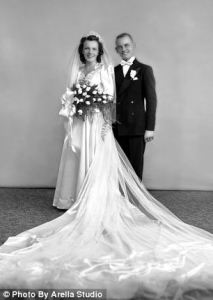 Edward Donald “Eddie” Slovik was paroled in 1942, his criminal record making him 4F. “Registrant not acceptable for military service”. He took a job at the Montella Plumbing and Heating company in Dearborn, Michigan, where he met bookkeeper Antoinette Wisniewski, the woman who would later become his wife.
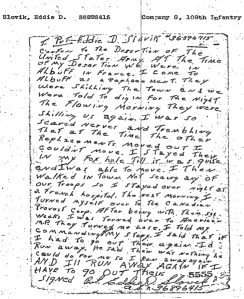 of my desertion we were in Albuff [Elbeuf] in France. I came to Albuff as a replacement. They were shelling the town and we were told to dig in for the night. The following morning they were shelling us again. I was so scared, nerves and trembling, that at the time the other replacements moved out, I couldn’t move. I stayed there in my fox hole till it was quiet and I was able to move. I then walked into town. Not seeing any of our troops, so I stayed over night at a French hospital. The next morning I turned myself over to the Canadian Provost Corp. After being with them six weeks I was turned over to American M.P. They turned me loose. I told my commanding officer my story. I said that if I had to go out there again I’d run away. He said there was nothing he could do for me so I ran away again AND I’LL RUN AWAY AGAIN IF I HAVE TO GO OUT THERE. — Signed Pvt. Eddie D. Slovik A.S.N. 36896415”.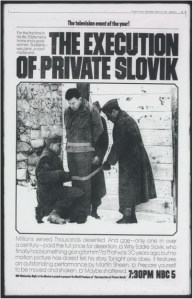
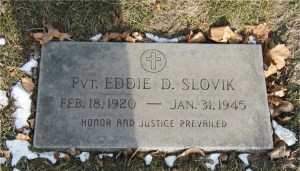 In 1987, President Ronald Reagan ordered the repatriation of Slovik’s remains. He was re-interred at Detroit’s Woodmere Cemetery next to Antoinette, who had gone to her final rest eight years earlier.
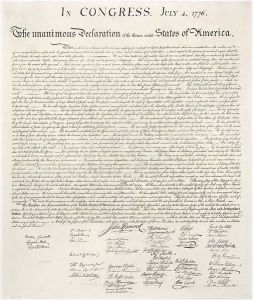 be self-evident, that all men are created equal, that they are endowed by their Creator with certain unalienable Rights, that among these are Life, Liberty and the pursuit of Happiness”.

 was obliged to render aid in the event that either ally was attacked. On December 8, 1941, the day after the Japanese attack on Pearl Harbor, Ambassador Hiroshi Ōshima came to Joachim von Ribbentrop, looking for a commitment of support from the German Foreign Minister.
 48 days later, at Hunter Field in Savannah, the Eighth Bomber Command was activated as part of the United States Army Air Forces. It was January 28, 1942.
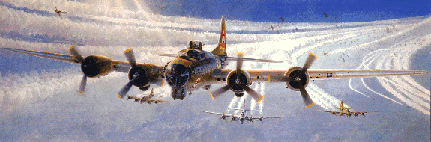 Re-designated the Eighth Air Force on February 22, 1944, at its peak the “Mighty Eighth” could dispatch over 2,000 four engine bombers and more than 1,000 fighters on a single mission. 350,000 people served in the 8th AF during the war in Europe, with 200,000 at its peak in 1944.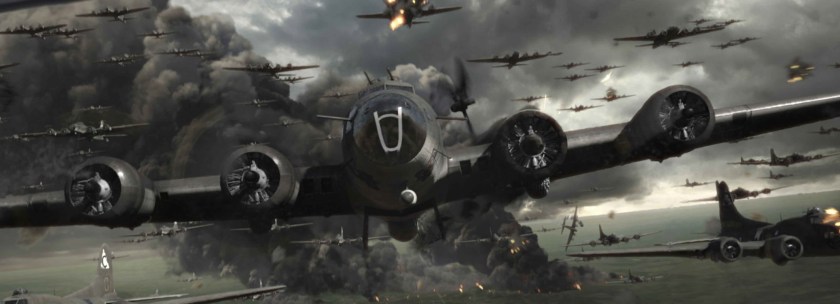




 1942 was a bad year for the allied war in the Pacific. The Battle of Bataan alone resulted in 72,000 prisoners being taken by the Japanese, marched off to POW camps designed for 10,000 to 25,000.


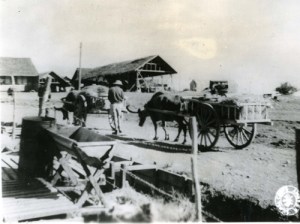
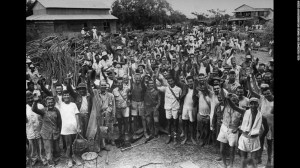


 Joining the 3rd Infantry Division of George S. Patton’s 7th Army, Murphy participated in amphibious landings in Sicily in July, fighting in nearly every aspect of the Italian campaign. From Palermo to Messina and on to Naples, Anzio and Rome, the Germans were driven out of the Italian peninsula in savage and near continuous fighting that killed a member of my own family. By mid-December, the 3rd ID suffered 683 dead, 170 missing, and 2,412 wounded. Now Sergeant Murphy was there for most of it, excepting two periods when he was down with malaria.
 “Colmar Pocket” was an 850 square mile area held by German troops: Murphy described it as “a huge and dangerous bridgehead thrusting west of the Rhine like an iron fist. Fed with men and materiel from across the river, it is a constant threat to our right flank; and potentially it is a perfect springboard from which the enemy could start a powerful counterattack.”
 Let Murphy’s Medal of Honor Citation describe what happened next: “Second Lieutenant Audie L. Murphy, 01692509, 15th Infantry, Army of the United States, on 26 January 1945, near Holtzwihr, France, commanded Company B, which was attacked by six tanks and waves of infantry. Lieutenant Murphy ordered his men to withdraw to a prepared position in a woods while he remained forward at his command post and continued to give fire directions to the artillery by telephone. Behind him to his right one of our tank destroyers received a direct hit and began to burn. Its crew withdrew to the woods. Lieutenant Murphy continued to direct artillery fire which killed large numbers of the advancing enemy infantry. With the enemy tanks abreast of his position, Lieutenant Murphy climbed on the burning tank destroyer which was in danger of blowing up any instant and employed its .50 caliber machine gun against the enemy. He was alone and exposed to the German fire from three sides, but his deadly fire killed dozens of Germans and caused their infantry attack to waver. The enemy tanks, losing infantry support, began to fall back. For an hour the Germans tried every available weapon to eliminate Lieutenant Murphy, but he continued to hold his position and wiped out a squad which was trying to creep up unnoticed on his right flank. Germans reached as close as 10 yards only to be mowed down by his fire. He received a leg wound but ignored it and continued the single-handed fight until his ammunition was exhausted. He then made his way to his company, refused medical attention, and organized the company in a counterattack which forced the Germans to withdraw. His directing of artillery fire wiped out many of the enemy; he personally killed or wounded about 50. Lieutenant Murphy’s indomitable courage and his refusal to give an inch of ground saved his company from possible encirclement and destruction and enabled it to hold the woods which had been the enemy’s objective”.
 Hollywood and, until his death in a plane crash in 1971, his post-war life was never free of it.


 with what he first diagnosed as tonsillitis. More came down with sore throats, early sufferers beginning to die as Welch observed the white pseudo membrane of diphtheria. He had ordered fresh antitoxin the year before, but the shipment hadn’t arrived by the time the ports froze over. By January, all the serum in Nome was expired.
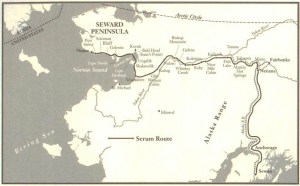 The 300,000 units shipped as far as they could by rail, arriving at Nenana, 674 miles from Nome. Three vintage biplanes were available, but all were in pieces, and none would start in the sub-arctic cold. The antitoxin would have to go the rest of the way by dog sled.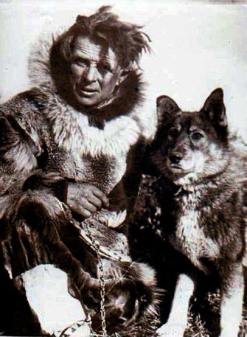
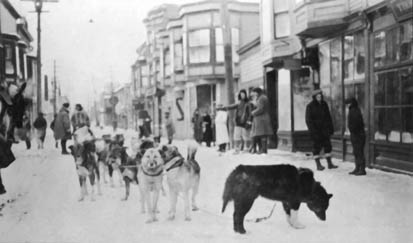
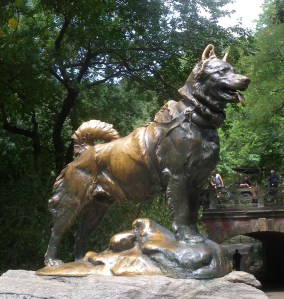 becoming the most popular canine celebrity in the country after Rin Tin Tin. It was a source of considerable bitterness for Leonhard Seppala, who felt that Kaasen’s 53 mile run was nothing compared with his own 261, Kaasen’s lead dog little more than a “freight dog”.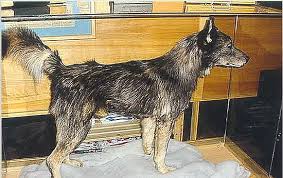


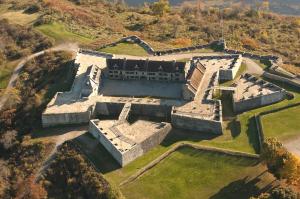
 of Lake George, arriving barely before the water began to freeze over.

 Historical Easter Eggs - Today in History
You must be logged in to post a comment.