July 7, 1798 XYZ

In the UK, the ruling class appeared to enjoy the chaos.  A British political cartoon of the time depicted the United States, represented by a woman being groped by five Frenchmen while John Bull, the fictional personification of all England, laughs from a nearby hilltop.

Imagine that you’ve always considered yourself to be somewhere in the political center, maybe a little to the left.  Now imagine that, in the space of two years, your country’s politics have shifted so radically that you find yourself on the “reactionary right”. So much so, that you are subject to execution by your government.  And all that time, your politics haven’t changed.

Our strongest ally in the American Revolution lost its collective mind in 1792, when France descended into its own revolution.    17,000 Frenchmen were officially tried and executed during the 1793-94 “Reign of Terror”, including King Louis XVI himself and his queen, Marie Antoinette.  Untold thousands died in prison or without benefit of trial.  The monarchical powers of Europe were quick to intervene and for the 32nd time since the Norman invasion of 1066, England and France found themselves at war.

Exécution_de_Marie_Antoinette_le_16_octobre_1793
Execution of Marie Antoinette

Both sides in the European conflict seized neutral ships which were trading with their adversary.  The “Treaty of Amity, Commerce, and Navigation” between Great Britain and its former colonies, better known as the “Jay Treaty”, all but destroyed relations with the French Republic.  France retaliated by stepping up attacks on American merchant shipping, seizing 316 vessels in one 11-month period, alone.

France had been the colonies’ strongest ally during the American Revolution, now the Jay treaty infuriated the French, who believed the agreement violated earlier arrangements between the two nations.  Making matters worse, America repudiated its war debt in 1794, arguing that it owed money to “L’ancien Régime”, not to the “First Republic” which had overthrown it and executed its King.

In 1796, France formally broke diplomatic relations with the United States, rejecting the credentials of President Washington’s Ambassador, Charles Cotesworth Pinckney.

The following year, President John Adams dispatched a delegation of two.  They were future Chief Justice of the Supreme Court John Marshall, and future Massachusetts Governor Elbridge Gerry, the man who later became the 5th Vice President, lending his name to the term “Gerrymander”.  Their instructions were to join with Pinckney in negotiating a treaty with France, with terms similar to those of the Jay treaty with Great Britain.

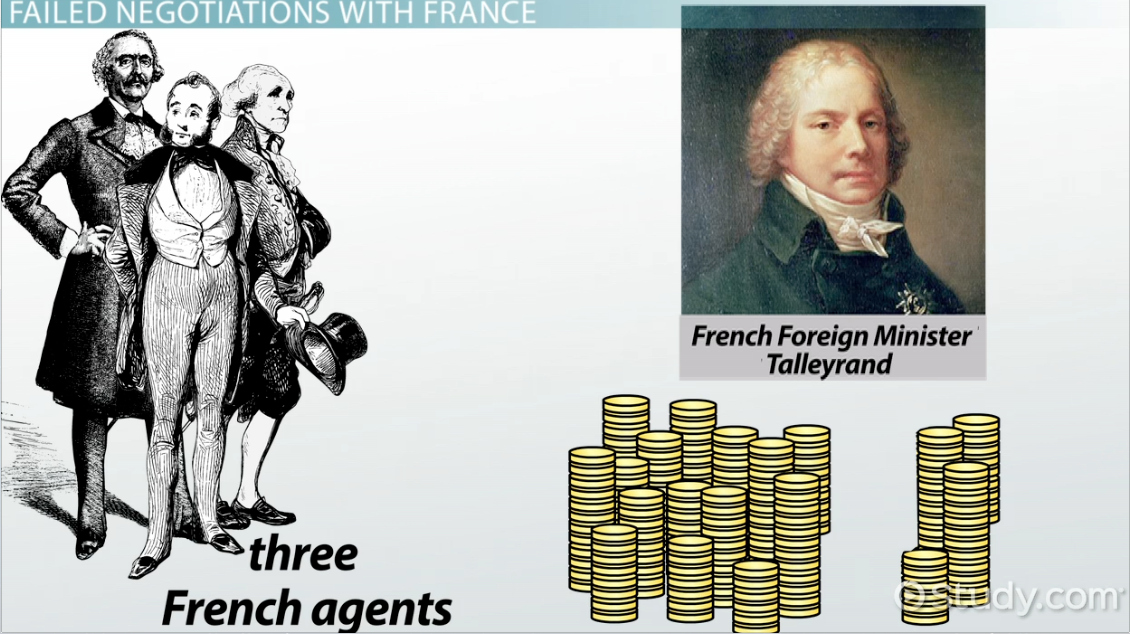
The American commission arrived in Paris in October 1797, requesting a meeting with the French Foreign Minister, Charles Maurice de Talleyrand.  Talleyrand, unkindly disposed toward the Adams administration to begin with, demanded a bribe for himself and substantial ‘loan’ to the French Republic, before so much as meeting with the American delegation.  The practice was not uncommon in European diplomacy of the time.  The Americans were appalled.

Believing that the Adams administration sought war by exaggerating the French position, Jeffersonian allies in Congress joined with more warlike Federalists in demanding the release of the commissioner’s communications. It was these dispatches, released in redacted form, which gave the name “X-Y-Z Affair” to the diplomatic and military crisis to follow.

Nicholas Hubbard, an English banker, was identified in the transcripts, only as “W”.  W introduced “X” (Baron Jean-Conrad Hottinguer) as a “man of honor”, who wished an informal meeting with Pinckney.  Pinckney agreed and Hottinguer reiterated Talleyrand’s demands, specifying the payment of a large loan to the French government, and a £50,000 bribe to Talleyrand himself.  Met with flat refusal by the American commission, X then introduced Pierre Bellamy (“Y”) to the Americans.  Lucien Hauteval (“Z”), Talleyrand’s personal emissary, was then sent to negotiate with Elbridge Gerry.  X, Y and Z, each in their turn, reiterated the Foreign Minister’s demand for a loan, and a bribe.

American politics were sharply divided over the European war.  President Adams and his Federalists, always the believers in strong, central government, took the side of the Monarchists.  Thomas Jefferson and his “Democratic-Republicans” found more in common with the ‘liberté, égalité and fraternité’ espoused by French revolutionaries.

In the UK, the ruling class appeared to enjoy the chaos.  A British political cartoon of the time depicted the United States, represented by a woman being groped by five Frenchmen while John Bull, the fictional personification of all England, laughs from a nearby hilltop.

John Bull cartoon

At this point, the United States had little means of defending itself.  The government had disbanded the Navy along with the Marine Corps at the end of the Revolution, selling the last warship in 1785 and retaining only a handful of “revenue cutters” doing customs enforcement.  The Naval Act of 1794 established a standing Navy for the first time in US history.  In October 1797, Congress authorized the construction of six frigates.  One of them, USS Constitution, saw its first combat in the Quasi-War with France, and remains in service to this day, the oldest commissioned ship in the United States Navy.

Quasi War

Adams’ commission left without entering formal negotiations, their failure leading to a political firestorm in the United States.  Congress rescinded all existing treaties with France on July 7, 1798, authorizing American privateers to attack French shipping. The undeclared “Quasi-War” with France, had begun.

Four days later, President John Adams signed “An Act for Establishing and Organizing a Marine Corps,” permanently establishing the United States Marine Corps as an independent service branch, in order to defend the American merchant fleet.

For the United States, military involvement proved decisive.  Before military intervention, the conflict with France resulted in 28 Americans killed, 42 wounded, and over 2,000 merchant ships captured.  Following intervention, the US suffered 54 killed and 43 wounded, with only a single ship lost, and that one was later recaptured.

The undeclared naval war with our former ally was settled with the Treaty of Mortefontaine, also known as the Convention of 1800, and ratified the following year.

July 4, 1826 Founding Fathers

The letters between Adams and Jefferson together constitute one of the most comprehensive historical and philosophical assessments ever written about the American founding.

Thomas Jefferson met John Adams at the 1775 Continental Congress in Philadelphia, the two forming a close personal friendship which would last for most of their lives.   They were two of the committee of five assigned to write the Declaration of Independence, and worked closely together throughout the era of our founding.

The friendship between the two men came to an end during the Presidential election of 1800.  Mudslinging on both sides rose to levels never before seen in a national election, an election in which both sides firmly believed the election of the other, would destroy the young nation.HamJeff

Jefferson defeated one term incumbent Adams and went on to serve two terms as President.

On Jefferson’s retirement in 1809, one of the signers of the Declaration of Independence, Dr. Benjamin Rush, took it upon himself to patch up the broken friendship between the two founding fathers. Dr. Rush worked on his personal diplomatic mission for two years.  In 1811, he finally succeeded.

There followed a series of letters between Adams and Jefferson, which together constitute one of the most comprehensive historical and philosophical assessments ever written about the American founding.

Their correspondence touched on a variety of topics, from the birth of this self-governing Republic, to then-current political issues, to matters of philosophy and religion and issues of aging. Both men understood that they were writing not only to one another, but to generations yet unborn.Letters

Each went to great lengths to explain the philosophical underpinnings of his views.  Adams the Federalist, the firm believer in strong, centralized government.  Jefferson was the Democratic-Republican, advocating for smaller federal government and more autonomy for the states.

In 1826, Jefferson and Adams were the last of the founding fathers.  In an ending no fiction writer would even dare to contemplate, both men died on this day in 1826, fifty years to the day from the birth of the Republic they had helped to create.

Adams was 90. His final words as he lay on his deathbed were “Thomas Jefferson still survives”.  Adams had no way of knowing that Jefferson had died five hours earlier, at Monticello.  He was 82.

Daniel Webster spoke of the pair a month later, at Faneuil Hall, in Boston. “No two men now live” he said”, (or) any two men have ever lived, in one age, who (have) given a more lasting direction to the current of human thought. No age will come, in which the American Revolution will appear less than it is, one of the greatest events in human history. No age will come, in which it will cease to be seen and felt, on either continent, that a mighty step, a great advance, not only in American affairs, but in human affairs, was made on the 4th of July, 1776″.

July 3, 1775, Washington’s Sword

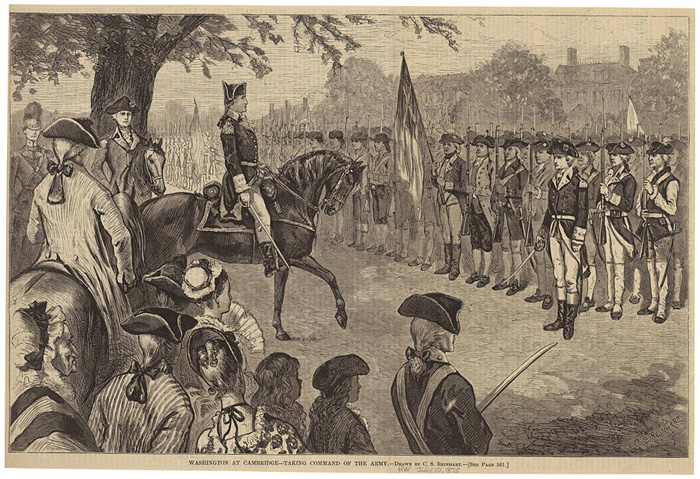
General Washington rode out in front of the troops gathered at Cambridge Common on July 3, 1775.  Washington drew his sword under the branches of an ancient elm, by that act formally taking command of the Continental Army.

The American Revolution began with the battles of Lexington and Concord on the 19th of April, 1775. Thousands of armed colonial militia followed the British columns as they withdrew, and there they remained, hemming the British occupiers up in the city of Boston.

Within days, more than 20,000 armed men from all over New England had gathered from Cambridge to Roxbury. Tories’ vacant homes, empty Churches, even the brick buildings of Harvard College served as barracks, officers’ quarters, and hospitals. Soldiers camped in tents and other makeshift shelters, while Harvard canceled classes on May 1. Classes would not resume at the Cambridge campus until June of the following year.

The Continental Congress created the Army on June 14, 1775, appointing George Washington to lead it. General Washington rode out in front of the troops gathered at Cambridge Common on July 3, 1775.  Washington drew his sword under the branches of an ancient elm, by that act formally taking command of the Continental Army.

Washington Elm marker

Interestingly, 150 years of de facto independence from Great Britain seems to have suited the American colonist.  If inheritance records are any indication, the average American enjoyed a better standard of living, than the average Brit.  Average heights of the time bear that out.

The average American colonist had a full three inches on his British counterpart. At a time when the average male stood 5’8′, Washington towered over the crowd at 6’2″.   George Washington was a hard man to miss.

For Washington to draw his sword against King George III, was itself an act of magnificent courage.  According to British law of the time, one of four definitions of High Treason was “If a man do levy war against our lord the King in his realm”.  By drawing that sword against the crown, Washington was clearly committing High Treason.  He surely understood that such a prominent person as himself would be dealt with harshly, if caught.

At that time, the centuries-old penalty for High Treason was as savage as it was gruesome. Even now the language of the death sentence is difficult to read.  You may consider that to be my warning if you don’t care to read what follows.

The full sentence as read to the condemned was: “That you be drawn on a hurdle (a sledge) to the place of execution where you shall be hanged by the neck and being alive cut down, your privy members shall be cut off and your bowels taken out and burned before you, your head severed from your body and your body divided into four quarters to be disposed of at the King’s pleasure”.

These were the terms of employment under which George Washington accepted his assignment.  He even declined to accept payment, beyond reimbursement for his personal expenses.

The 56 signers of the Declaration of Independence would show the same brand of courage, by signing that document a year later. It must have been a supreme in-your-face moment when John Hancock put his pen to that parchment, which ended: “And for the support of this Declaration, with a firm Reliance on the Protection of divine Providence, we mutually pledge to each other our Lives, our Fortunes, and our sacred Honor”.

Signers

At the signing, Ben Franklin famously said “We must all hang together, or assuredly we shall all hang separately”.  This was no empty philosophical statement they were signing.  Should circumstances turn against them, the founding fathers well understood. Each was signing his death warrant.

July 2, 1776 Founding Document

Resolved, that these United Colonies are, and of right ought to be, free and independent States, that they are absolved from all allegiance to the British Crown, and that all political connection between them and the State of Great Britain is, and ought to be, totally dissolved.

Richard Henry Lee’s resolution was taken almost verbatim from instructions from the Virginia Convention and its President, Edmund Pendleton.  As presented to the second Continental Congress on June 7, 1776, Lee’s resolution read:

“Resolved, that these United Colonies are, and of right ought to be, free and independent States, that they are absolved from all allegiance to the British Crown, and that all political connection between them and the State of Great Britain is, and ought to be, totally dissolved. That it is expedient forthwith to take the most effectual measures for forming foreign Alliances. That a plan of confederation be prepared and transmitted to the respective Colonies for their consideration and approbation”.

Several colonies were not yet ready to declare independence at that time.

Committeof 5Representatives agreed to delay the vote until July 1, appointing a “Committee of Five” to draft a declaration of independence from Great Britain. Members of the committee included John Adams of Massachusetts, Benjamin Franklin of Pennsylvania, Roger Sherman of Connecticut, Robert Livingston of New York and Thomas Jefferson of Virginia. The committee selected Jefferson to write the document, the draft presented to Congress for review on June 28.

Debate resumed on July 1, 1776, with most of the delegates favoring Lee’s resolution.Declaration of Independence

The final vote was taken on July 2, when delegates from 12 of the 13 colonies voted in favor. Delegates from New York abstained, having had no clear instructions from their constituents.

The Pennsylvania Evening Post reported on July 2nd that “This day the Continental Congress declared the United Colonies Free and Independent States”.

The Pennsylvania Gazette followed suit on the third with “Yesterday, the CONTINENTAL CONGRESS declared the UNITED COLONIES FREE and INDEPENDENT STATES”.

John Adams thought that July 2 would go down as the country’s Independence Day.

This day has been mostly forgotten in favor of July 4, when the final edits of Jefferson’s Declaration were adopted, the final document engrossed (handwritten onto parchment), and sent off to the printer.

The 56 signers were never together at the same time.  Many of the signatures we see on the Declaration of Independence, would not be affixed to the document until August 2, possibly even later.

Happy Independence Day.

declaration-of-independence


July 1, 1863 Gettysburg

One hundred and fifty-four years ago today, the Union and the Confederacy met in the south central Pennsylvania town of Gettysburg.  

After two years of civil war, Robert E. Lee wanted to take the war to his adversary. Lee intended to do enough damage to create overwhelming political pressure in the North, to end the war and let the South go its own way. Lee had his best cartographers draw up maps of the Pennsylvania countryside, all the way to Philadelphia.  And then he took his Army of Northern Virginia into Pennsylvania.

One hundred and fifty-four years ago today, the Union and the Confederacy met in the south central Pennsylvania town of Gettysburg.

Joseph “Fighting Joe” Hooker, to whom Lee contemptuously referred as “Mr. F.J. Hooker”, wanted to attack Richmond, but Lincoln ordered him to intercept Lee’s army to protect Washington DC.  Hooker was replaced on the 28th by Major General George Gordon Meade, “that damn old goggle eyed snapping turtle” to his men, in a move that so surprised him that he thought he was being arrested over army politics, when the messenger came into his tent.

The “North” came up from the south that day, the “South” came down from the north.  No one wanted the fight to be in Gettysburg, it was more like an accidental collision. What started out as a skirmish turned into a general engagement as fighting cascaded through the town. Confederate forces held the town at the end of the day, with the two armies’ taking parallel positions along a three-mile-long “fishhook” from Cemetery Hill and Culp’s Hill to the north, toward two prominences known as Big and Little Round Top to the south.

Fighting would continue and prove inconclusive at Culp’s Hill on day two, as the two armies stretched their position toward the Round Tops. Dan Sickles, the Tammany Hall politician best known for murdering the nephew of Francis Scott Key (he would be the first in American legal history to plead temporary insanity), had been ordered to move his corps into position on cemetery ridge, anchored at Little Round Top. Instead he took his corps a mile forward, into a Peach Orchard where they were torn apart in the Confederate assault. Some of the most savage fighting of the Civil War took place that day, at places like Devil’s Den, the Wheat Field, and bloody run. Sickles himself lost a leg to a cannonball. There was a foot race to the top of Little Round Top, leading to as many as 15 attacks and counterattacks for control of a small prominence at the Union’s extreme left. At the end of the day, the positions of the Armies had not changed.

Picketts Charge

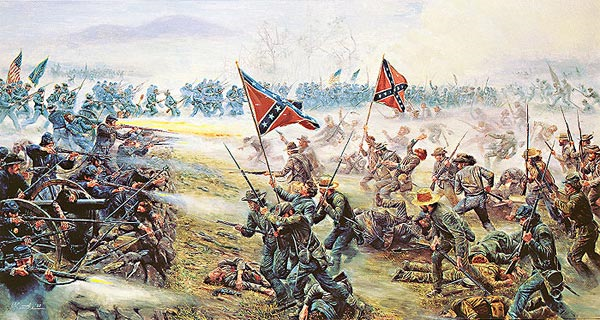
On day 3, the last day, Lee came up the middle. 13,000 Confederate soldiers came across 1¼ miles of open field, to attack the Union Center at a position between a small copse of trees and a corner in stone fence called the angle. Cannon fire from their left, right and center tore them apart as they pressed on. A battered remnant actually penetrated Union lines: the “high water mark” of the Confederacy. It’s anyone’s guess what would have happened, had 4,000 Confederate cavalry smashed into the Union rear at that point, as Lee seems to have intended. But a 23-year-old general named George Armstrong Custer had waded into them with his 450 Union cavalry, routing the much larger force and very possibly changing history.

Lee withdrew in the rain of the 4th, ending the largest battle of the civil war. Lincoln was convinced that the time had come to destroy the Army of Northern Virginia, but Meade and his battered army did not follow. Lee and his army slipped back across the line and returned to Confederate territory. The most lethal war in American history would continue for two more years.

Years earlier, then-Secretary of War Jefferson Davis had brought some 75 camels into West Texas, to try them out as pack animals. Davis’ camel experiment had been a flop, but the King of Siam, (now Thailand), didn’t know that. Seeing the military advantage to the Confederacy, the King wrote to President Abraham Lincoln, proposing to send elephants to help the Union war effort. This “animal arms race” appears to have gotten no further than the King’s letter to Lincoln but, the imagination runs wild, at the idea of War Elephants, at Gettysburg.

June 27, 1985 Get your Kicks

It was the age of the automobile, and all manner of roadside attractions sprang up to serve the burgeoning tourist business. There were teepee-shaped motels, frozen custard stands, Indian curio shops, and reptile farms.

us_camel_corp_1In 1857, President James Buchanan appointed Lieutenant Edward Beale to survey and build a 1,000-mile wagon road from Fort Defiance, New Mexico to the Arizona/California border. The survey continued an experiment first suggested by Secretary of War and future President of the Confederate States of America Jefferson Davis, in the use of camels as draft animals.
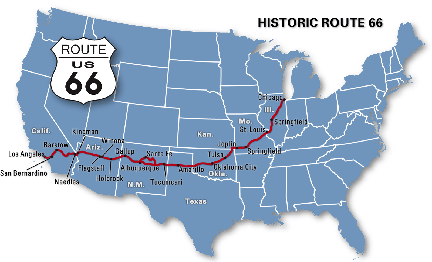
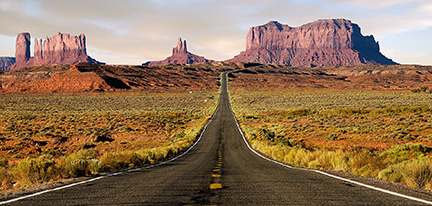
The camel part turned out to be a flop, but the road building was not.  Beale’s wagon trail went on to become the western end of “America’s Main Street”.  Route 66.route-66-map

The “Mother Road” became an official part of the national highway system in 1927. It was yet to be paved, when the US Highway 66 Association held a “Bunion Derby” in 1928.  It was a footrace from Los Angeles to Madison Square Garden, a distance of 3,423½ miles. Naturally, the LA to Chicago leg ran along Route 66.

Andy Hartley Payne, an Oklahoma Cherokee runner won the race in 573 hours, 4 minutes and 34 seconds. 11th place finisher Harry Abrams ran the race in the opposite direction the following year, becoming the only person to twice run across the continental United States.

route-66

In 1914, a Model T sold for $490.  As the 20s drew to a close, the number of registered drivers had tripled to 23 million.

The 1932 Summer Olympics in Los Angeles and the westward migration of the “Dust Bowl” era increased the number of “Mom & Pop” service stations, restaurants, and motor courts, springing up to serve the needs of passing motorists.

The road was fully paved by 1938, passing through the Painted Desert on the way by the Grand Canyon and Meteor Crater in Arizona. The golden age of the automobile had dawned.  All manner of roadside attractions popped up to serve the burgeoning tourist business, there were teepee-shaped motels, frozen custard stands, Indian curio shops, and reptile farms.

Meramec Caverns outside of St. Louis put their advertising on barns, calling themselves “Jesse James hideout”. The Big Texan sold a 72-ounce steak dinner, making it free to anyone who could eat the whole thing in an hour.

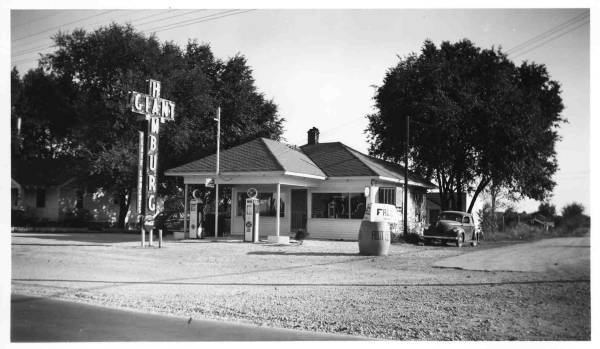
The fast-food industry was born on Route 66, when Sheldon “Red” Chaney built Red’s Giant Hamburg in Springfield, Missouri.  Believed to be the first drive-through restaurant in the country, the name was supposed to be “Red’s Giant Hamburger“.  Chaney had to cut the two bottom letters off his sign, when the city refused to raise the telephone wires.

Giant Hamburg

Patrick McDonald opened “The Airdrome” restaurant on Route 66 in 1937, near the Airport in Monrovia, California. Hot dogs were some of the first items he ever sold. Ten cent hamburgers were added later, along with all-you-can-drink orange juice for five cents. Three years later, McDonald’s two sons Maurice and Richard (“Mac” and “Dick”) moved the entire building 40 miles east, to San Bernardino, calling the place “McDonald’s Bar-B-Que”.

General Eisenhower came out of WWII with an appreciation for the German highway system, the Autobahn, and signed the Interstate Highway Act as President in 1956. It was the beginning of the end for Route 66. New highway construction began to bypass town centers, and once-thriving Mom & Pops began to die off.

route-66 carsBy the mid-50s, Missouri upgraded its sections of US 66 to four lanes, by-passing town centers and the businesses that went with them.

Illinois widened US 66 from Chicago to the Mississippi River. By 1957, virtually the entire Missouri-Kansas-Oklahoma stretch was replaced by 4 lane toll roads. You could see the old 66 as you drove parallel to it, but travelers rarely stopped.

avon-courtThe last parts of Route 66 were decertified by state highway and transportation officials on this day in 1985.  In some cities, the old road is now the “Business Loop”.  It’s been carefully preserved in many areas, and abandoned in others.

Today, most of the old attractions are gone.  You couldn’t drive the old Route 66 from Chicago to LA if you wanted to, but you could get close.  You only need to plan ahead.

June 22, 1918 Showmen’s Rest

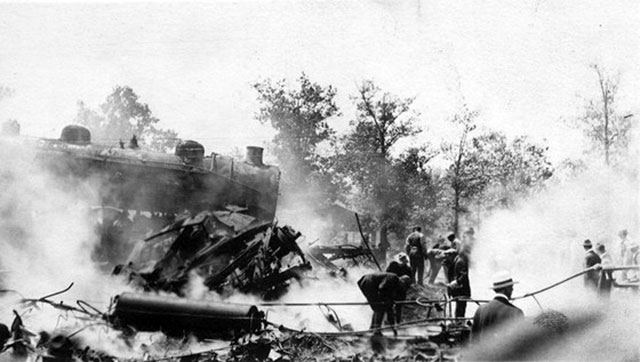
The Michigan Central locomotive smashed into the rear of the stalled circus train at 60mph.  Strong men, bareback riders, trapeze performers and acrobats were killed instantly and others horribly maimed, as wooden circus cars telescoped into one another. 

In the circus world, the term “First of May” describes the first season when an employee comes to work with the circus.

There’s an oft-repeated but mistaken notion, that the circus goes back to Roman antiquity.  The panem et circenses, “bread and circuses” of Juvenal (circa A.D. 100), refers more to the ancient precursor of the modern racetrack, than to the modern circus. The only common denominator is the word itself, as the Latin root ‘circus’, translates into English, as “circle”.

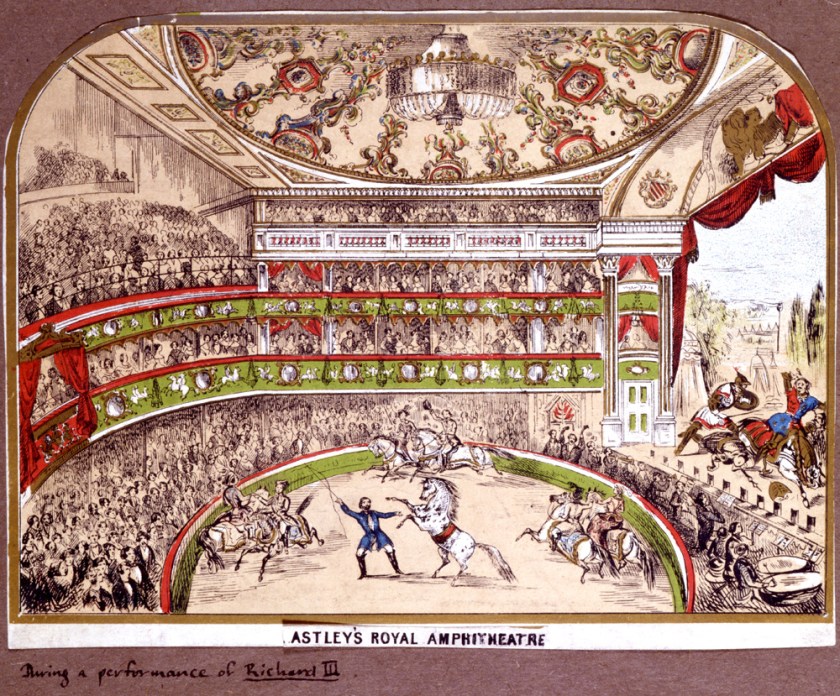
Astleys_royal_amphitheatreThe father of the modern circus is the British Sergeant-Major turned showman, Philip Astley.  A talented horseman, Astley opened a riding school near the River Thames in 1768, where he taught in the morning and performed ‘feats of horsemanship’ in the afternoon.
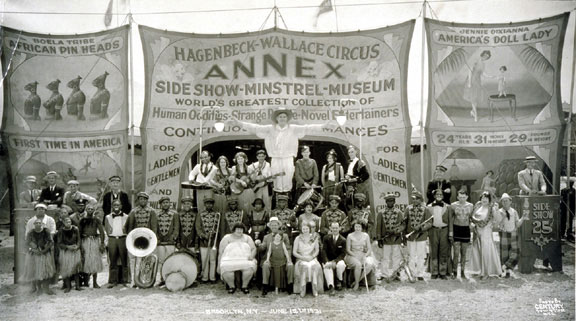
Astley’s afternoon shows had gained overwhelming popularity by 1770, and he hired acrobats, rope-dancers, and jugglers to fill the spaces between equestrian events.  The modern circus, was born.

Equestrian and trick riding shows were gaining popularity all over Europe at this time, performers riding in circles to keep their balance while standing on the backs of galloping horses.  It didn’t hurt matters, that the “ring” made it easier for spectators to view the event.

In 1825, Joshuah Purdy Brown of Somers New York replaced the wooden structure common to European circuses with a canvas tent, around the time when a cattle dealer named Hachaliah Bailey bought a young African elephant, which he exhibited all over the country.  The exotic animal angle was a great success.  Other animals were added and soon farmers were leaving their fields, to get into the traveling menagerie business.

The unique character of the American traveling circus emerged in 1835, when 135 such farmers and menagerie owners combined with three affiliated circuses to form the American Zoological Institute.

Phineas Taylor Barnum and William Cameron Coup launched P.T. Barnum’s Museum, Menagerie & Circus in 1871, where the “museum” part was a separate exhibition of human and animal oddities.  It wouldn’t be long, before the ‘sideshow” became a standard feature of the American circus.

There have been no fewer than 81 major circuses in American history, and countless smaller ones.  ‘The Greatest Show on Earth’ broke down its tent for the last time last month, when the Ringling Brothers Barnum & Bailey Circus ended a 146-year run.  There was a time though, when the circus really Was, the greatest show on earth.

The American war machine was spinning up to peak operational capacity in 1918, as the industrial might of the nation pursued the end to the war ‘over there’.hagenbeck-wallace-circus

At 3:56 on the morning of June 22, 1918, an engineer with the Michigan Central Railroad was at the controls of an empty 21-car troop train.  Automatic signals and flares should have warned him that there was a stalled train on the track ahead.  A frantic flag man tried and failed to get him to stop.  Alonzo Sargent had been fired before, for sleeping on the job.  Tonight, Sargent was once again, asleep at the wheel.

The Hagenbeck-Wallace circus was a big deal in those days.  The famous lion tamer Clyde Beatty was a member, as was a young Red Skelton, on this night tagging along with his father, who worked as a clown.

The 26-car Hagenbeck-Wallace circus train was enroute from Hammond Indiana to Monroe Wisconsin, when an overheated axle box required them to make an unscheduled stop.

Most of the 400 circus employees were asleep at that early hour, in one of four rear sleeping cars.  The Michigan Central locomotive smashed into the rear of the stalled train at 60mph.  Strong men, bareback riders, trapeze performers and acrobats were killed instantly.  Others were horribly maimed, as wooden sleeping cars telescoped into one another.  Confused and bleeding survivors struggled to emerge from the wreckage, as gas-fed lanterns began to set all that wood on fire.

hammond-circus-train-wreck

Those lucky enough to escape looked on in horror, as friends and family members were burned alive.  Some had to be physically restrained from rushing back into the inferno.

127 were injured and an estimated 86 crushed or burned to death in the wreck.  Hours afterward a clown, his name was Joe Coyle, could be seen weeping inconsolably, beside the mangled bodies of his wife and two children.

The rumor mill went berserk.  Wild lions and tigers had escaped and were roaming the streets and back yards of Gary, Indiana.  Elephants died in the heroic attempt to put out the flames, spraying water on the burning wreckage with their trunks.  None of the stories were true.  The animals had passed through hours earlier, on one of two additional trains, and were now waiting for the train that would never come.

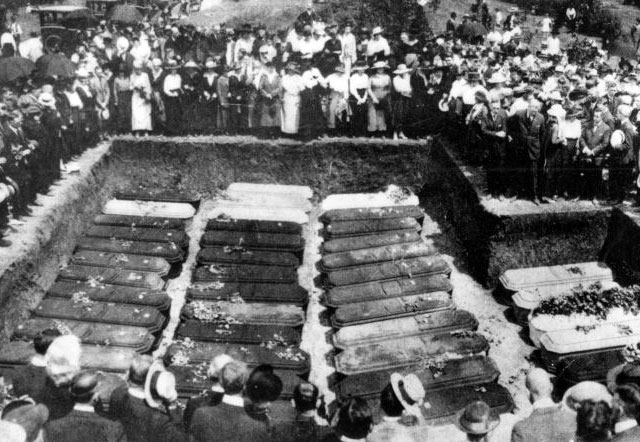
showmans-rest-circus-mass-grave

The Showmen’s League of America was formed in 1913, with Buffalo Bill Cody its first President.  The group had  purchased a 750-plot parcel at the Woodlawn Cemetery in Forest Park, Illinois only a year earlier, calling it “Showmen’s Rest”.  They had no idea their investment would be used so soon.

Only thirteen were ever identified.  A mass grave was dug for the unidentified and unidentifiable.  Most of the dead were roustabouts or temporary workers, hired just recently and known only by nicknames.  Some performers were known only by stage names, their gravestones inscribed with names like “Baldy,” “4-Horse Driver”, “Smiley,” and “Unknown Female #43.

Only one show had to be canceled, as erstwhile ‘competitors’ Barnum & Bailey, Ringling brothers and others lent workers, performers and equipment.  The show would go on.

Today, the International Circus Hall of Fame is located in the former Hagenbeck-Wallace Circus winter headquarters in Peru, Indiana.

In the elephant world, an upraised trunk symbolizes joy.  Five elephant statues circumscribe the Showmen’s Rest section of Woodlawn cemetery.  Each has a foot raised with a ball underneath.  Their trunks hang low, a symbol of mourning.  The largest of the five bears the inscription, “Showmen’s League of America.”  On the other four, appear these words.  “Showmen’s Rest”.

 June 20, 1782 The Great Seal

Some states adopted the eagle as their symbol as early as 1778.  The Continental Congress officially adopted the current design for the seal on this day in 1782. 

When the Continental Congress declared independence from Great Britain in 1776, several pieces of unfinished business remained.  Benjamin Franklin, Thomas Jefferson and John Adams were appointed to a committee to take care of one such detail.  The creation of an official seal.   The three came up with a first draft but Congress rejected it, approving only the “E pluribus Unum”, (of the many, one), attributed to Thomas Jefferson.

Six years and two such committees later, it was May 1782.  The brother of a Philadelphia naturalist provided a drawing showing an eagle displayed as the symbol of “supreme power and authority.”  An earlier submission used the phoenix instead of an eagle, representing a nation risen from the ashes of the American Revolution.  That bird would be replaced by the eagle in the final design.

Greatseal

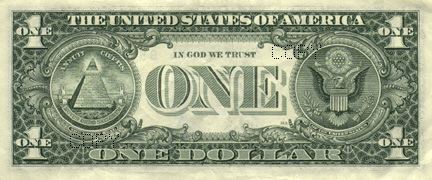
Some states adopted the eagle as their symbol as early as 1778.  The Continental Congress officially adopted the current design for the seal on this day in 1782.  The final design of the obverse (front) side of the seal, depicts a Bald Eagle, the symbol of liberty and freedom.  The eagle grasps thirteen arrows in its right talon, symbolizing a strong defense of the thirteen colonies.  An olive branch symbolizing peace is held in the other claw.  A banner containing Jefferson’s E pluribus Unum, is held in the eagle’s beak.

Prominently displayed on the eagle’s breast is a shield, the thirteen red and white stripes symbolizing the states, all of which support the federal government, represented in blue.

In 1782, the federal government had yet to morph into the all-consuming leviathan which it has since become.

Finally, a constellation of thirteen stars breaks out of the clouds above, signifying a new nation, ready to take its place among the sovereign nations of the earth.

Benjamin Franklin objected to the selection of the eagle, preferring that the turkey made the national symbol.  He complained that the eagle tended to steal its dinner from other birds, and that he’d seen them driven away by the tiny Kingbird, no larger than a sparrow. Franklin later wrote to his daughter, saying, “For the Truth the Turkey is in Comparison a much more respectable Bird, and withal a true original Native of America . . . He is besides, though a little vain & silly, a Bird of Courage, and would not hesitate to attack a Grenadier of the British Guards who should presume to invade his Farm Yard with a red Coat on.”

Some versions of the symbol used between 1916 and 1945 showed an eagle facing to its left, toward the arrows, giving rise to the urban legend that the seal is changed to have the eagle face towards the olive branch in peace, and towards the arrows in wartime.

OneD

On the reverse (back) side of the Great Seal, the pyramid represents strength and duration, like the great Pyramids at Giza.  The Roman numeral MDCCLXXVI at the base of the pyramid, stands for 1776. A Latin phrase, “Novus ordo seclorum”, translates as “New Order of the Ages.”  The pyramid itself has thirteen levels, atop which is the Eye of God, with the Latin phrase “Annuit Cœptis,” loosely translating as “favors undertakings.”  The hand of Providence, or God, would favor the undertakings of the United States, for all time.

The militant atheist type who’d like to divest himself of all that “church & state” stuff may at this point feel free to send his dollar bills, to me.  I’m happy to help.  I’m in the book.

June 17, 1775 Bunker Hill

“On you depend the fortunes of America. You are to decide the important question, on which rest the happiness and liberty of millions yet unborn. Act worthy of yourselves.” – Dr. Joseph Warren

Charlestown, Massachusetts occupies a hilly peninsula to the north of Boston, at the point where the Mystic River meets the Charles. Like Boston itself, much of what is now Charlestown was once Boston Harbor.  In 1775 the town was a virtual island, joined to the mainland only by a thin “neck” of land.

Thousands of Patriot Militia poured into the area following the April battles of Lexington and Concord, hemming in the British who controlled Boston and its surrounding waterways.Bunker Hill, 2

Reinforced and provisioned from the sea over which the Crown held undisputed control, British forces under General Sir Thomas Gage could theoretically remained in Boston, indefinitely.

The elevation of Breed’s and Bunker’s Hill across the river, changed that calculation.  Should colonial forces obtain artillery of their own, they would be able to rain down hell on British forces bottled up in Boston.  It was just this scenario that led Henry Knox into a New England winter later that year, to retrieve the guns of Fort Ticonderoga.

The Massachusetts Provincial Congress received word on the 13th that the British planned to break out of Boston within the week, taking the high ground of Dorchester Heights to the south and Charlestown to the north. Major General Israel Putnam was directed to set up defenses on Bunker Hill, on the northwest end of the Charlestown peninsula.

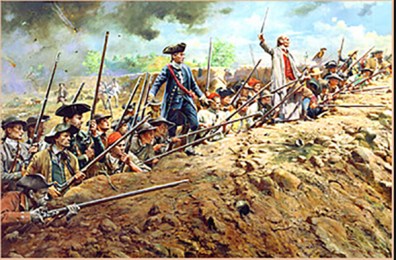
Colonel William Prescott led about 1,200 men onto the peninsula on the night of the 16th. Some work was performed on the hill which gives the battle its name, but it was farmer Ephraim Breed’s land to the southeast, which offered the more defensible hill from which to defend the peninsula.Bunker_Hill_by_Pyle

Shovels could be heard throughout the night.  The sun rose on June 17 to reveal a 130′ defensive breastwork across Breed’s hill. Major General William Howe was astonished. “The rebels,” he said, “have done more work in one night than my whole army would have done in one month.”

The warship HMS Lively opened fire on the redoubt shortly after 4am, with little effect on the earthworks. 128 guns joined in as the morning bore on, including incendiary shot which set fire to the town. Militia continued to reinforce the high ground throughout the morning hours, as Regulars commanded by General Howe and Brigadier General Robert Pigot crossed the Charles River and assembled for the assault.

Bunker_hill_first_attack
First Assault

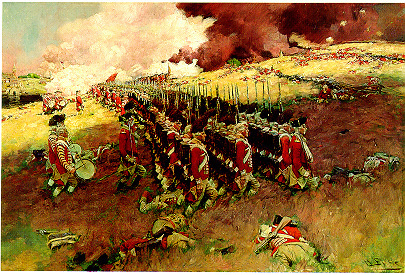
The British line advanced up Breed’s Hill twice that afternoon, Patriot fire decimating their number and driving survivors back down the hill to reform and try again. Militia supplies of powder and shot began to give out as the British advanced up the hill for the third assault.

“Don’t fire until you see the whites of their eyes”. The quote is attributed to Prescott, but the order seems to have originated with General Putnam and passed along by Prescott, Seth Pomeroy, John Stark, and others, in a desperate attempt to conserve ammunition.

Finally, there was nothing left with which to oppose the British bayonets.  The Militia was forced to retreat.

Bunker_hill_second_attack
Second Assault

Most of the colonists’ casualties occurred at this time, including Boston physician and President of Massachusetts’ Provincial Congress, Dr. Joseph Warren.  Dr. Warren had been appointed Major General on June 14, but the commission had not arrived as of yet.  On this day, he fought as a private soldier. He had been  but the commission had not yet taken effect.

Two months before the battle, Dr. Warren had spoken to his men. “On you depend the fortunes of America”, he said. “You are to decide the important question, on which rest the happiness and liberty of millions yet unborn. Act worthy of yourselves.”

Act worthy of yourselves.  That they did.

Bunker_hill_final_attack
Final Attack

The Battle of Bunker Hill ended in victory for the British, in that they held the ground when the fighting was over. It was a Pyrrhic victory. Howe lost 226 killed and 828 wounded, over a third of their number and more than twice those of the Militia.

One Eighth of all the British officers killed in the Revolution, died on Ephraim Breed’s Hill. General Henry Clinton wrote afterward, of the battle:  “A few more such victories” he said, “would have shortly put an end to British dominion in America”.

June 15, 1904  P.S. General Slocum

In Tompkins Square Park in Manhattan, there is a 9′ stele sculpted from pink Tennessee Marble.  The relief sculpture shows two children, beside the words “They were Earth’s purest children, young and fair.” 

Kleindeutschland, or “Little Germany”, occupied some 400 blocks on the Lower East Side of Manhattan, in what is now  the East Village.  “Dutchtown”, as contemporary non-Germans called it, was home to New York’s German immigrant community since the 1840s, when they first began to arrive in significant numbers. By 1855, New York had the largest ethnically German community in the world, save for Berlin and Vienna.

General Slocum tokenIt was 9:30 on a beautiful late spring morning when the sidewheel passenger steamboat General Slocum, left the dock and steamed into New York’s East River.

She was on a charter this day, carrying German American families on an outing from St. Mark’s Lutheran Church. Over a thousand tickets were sold for that day’s harbor cruise and picnic, not counting the 300+ children on board who were sailing for free. There were 1,342 people on board, mostly women and children, including band, crew and catering staff.

The fire probably started when someone tossed a cigarette or match in the forward section lamp room. Fueled by lamp oil and oily rags on the floor, the flames spread quickly, being noticed for the first time at around 10:00am.  A 12-year old boy had reported the fire earlier, but the Captain did not believe him.

Slocum 3

The ships’ operators had been woefully lax in maintaining safety equipment.  Now it began to show. Fire hoses stored in the sun for years were uncoiled, only to break into rotten bits in the hands of the crew. Life preservers manufactured in 1891 had hung unprotected in the sun for 13 years, their canvas covers splitting apart pouring useless cork powder onto the floor.  Survivors reported inaccessible life boats, wired and painted into place.Slocum 4

Crew members reported to Captain William van Schaick that the blaze “could not be conquered”  It was “like trying to put out hell itself.” The captain ran full steam into the wind trying to make it to the 134th Street Pier, but a tug boat waved them off, fearing the flames would spread to nearby buildings. The wind and speed of the ship itself whipped the flames into an inferno as Captain van Schaick changed course for North Brother Island, just off the Bronx’ shore.

Many jumped overboard to escape the inferno, but the heavy women’s clothing of the era quickly pulled them under.  Desperate mothers put useless life jackets on children and threw them overboard, only to watch in horror as they sank. One man, fully engulfed in flames, jumped screaming over the side, only to be swallowed whole by the massive paddle wheel. One woman gave birth in the confusion, and then jumped overboard with her newborn to escape the flames. They both drowned.

A few small boats were successful in pulling alongside in the Hell’s Gate part of the harbor, but navigation was difficult due to the number of corpses already bobbing in the waves.

Slocum-ablaze

Holding his station despite the inferno, Captain van Schaick permanently lost sight in one eye and his feet were badly burned by the time he ran the Slocum aground at Brother Island.  Patients and staff at the local hospital formed a human chain to pull survivors to shore as they jumped into shallow water.

1,021 passengers and crew either burned to death or drowned.  It was the deadliest peacetime maritime disaster, in American history.  There were only 321 survivors.General Slocum Casualties

The youngest survivor of the disaster was six month old Adella Liebenow. The following year at the age of one, Liebenow unveiled a memorial statue to the disaster which had killed her two sisters and permanently disfigured her mother. The New York Times reported “Ten thousand persons saw through their tears a baby with a doll tucked under her arm unveil the monument to the unidentified dead of the Slocum disaster yesterday afternoon in the Lutheran Cemetery, Middle Village, L.I.”

Both her sisters, were among the unidentified dead.

Youngest_Slocum_Survivor

Less than one per cent of Little Germany’s population was killed in the disaster, yet these were the women and children of some of the community’s most established families.  There were more than a few suicides.  Mutual recriminations devoured much of the once-clannish community, as the men began to move away.  There was nothing for them, there.   Anti-German sentiment engendered by WW1 finished what the Slocum disaster had begun. Soon, New York’s German-immigrant community, was no more.

In Tompkins Square Park in Manhattan, there is a 9′ stele sculpted from pink Tennessee Marble.  The relief sculpture shows two children, beside the words “They were Earth’s purest children, young and fair.”

Once the youngest survivor of the disaster, Adella (Liebenow) Wotherspoon passed away in 2004, at the age of 100.  The oldest survivor of the deadliest disaster in New York history, until September 11, 2001.

General_Slocum_Memorial