April 26, 1336 Because it’s There

Not being blessed with the luxury of surplus time and resources our forebears were more interested in survival, the mountains being more the object of religious veneration and supernatural terror.

Helmut and Erika Simon were visiting that day they found the body, German tourists hiking the mountains of the South Tyrol where the Austrian border, meets the Italian. On September 19, 1991, the couple was climbing the east ridge of the Fineilspitze in the Ötztal Alps, when they found him.
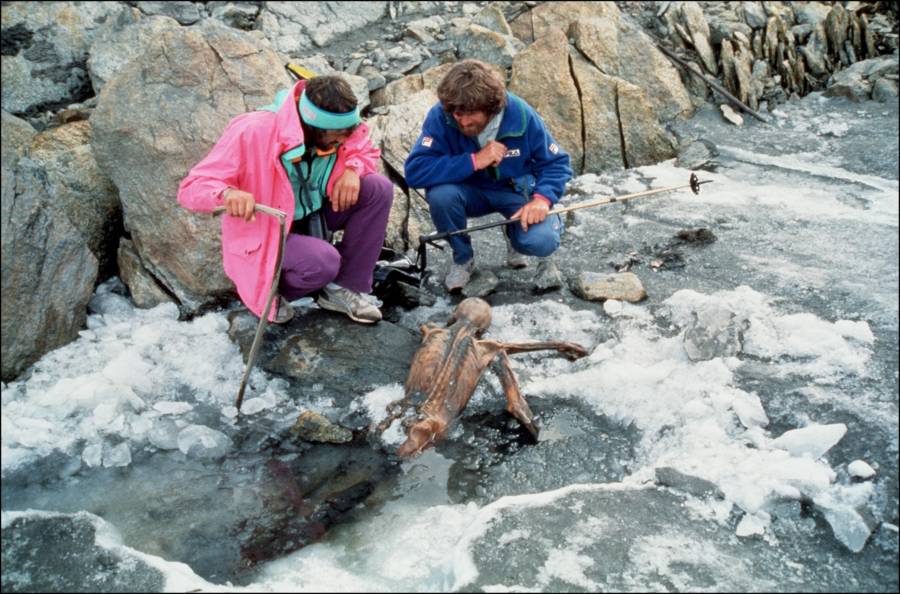
A fellow mountaineer perhaps, injured and succumbed to the cold? Who else would be up here at 3,210 meters above sea level (10,530 ft) but a fellow mountaineer.  The couple returned the following day, with a mountain gendarme.
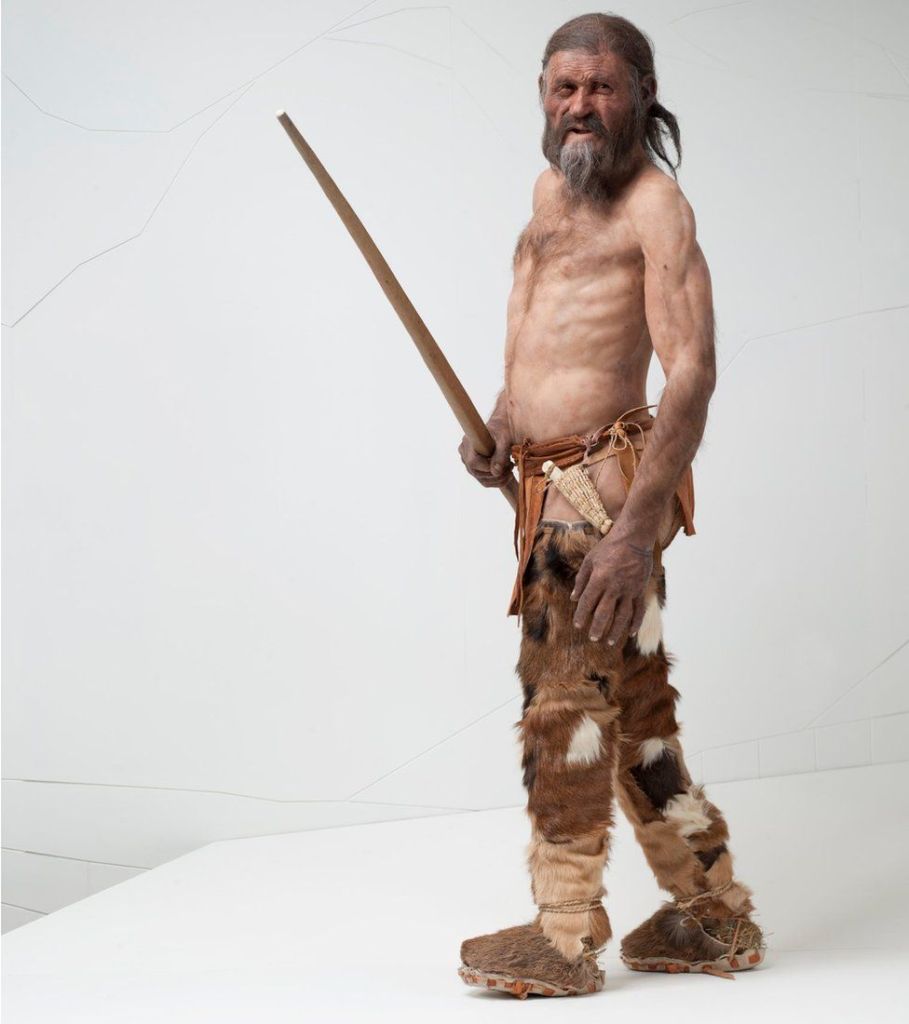
Ötzi the Ice Man, as he may have looked

Eight groups would visit the site in the following days struggling with ice axe and pneumatic drill, to free the corpse from his ice tomb.

Among these were some of the modern-day royalty of the mountaineering community. There was Hans Kammerlander who, along with fellow climber Reinhold Messner, became the first in 1984 to traverse two 8000m peaks without descending to base camp. Messner himself was the first to ascend Mt. Everest without supplemental oxygen, the first to climb all 14 of the world’s “eight-thousanders” – mountains with peaks above the 8,000 meter “death zone”, of 26,000-feet.

The body was freed from the ice on September 22 and extracted, the following day. Subsequent analysis revealed not a modern climber but the stunning realization that this man breathed his last, before the Old Kingdom of Egypt moved the first rock to build the first pyramid. This relic of the Chalcolithic (Copper Age) turned out to be Europe’s oldest known mummy, preserved in the ice since the day he died sometime, around 3230 BC.
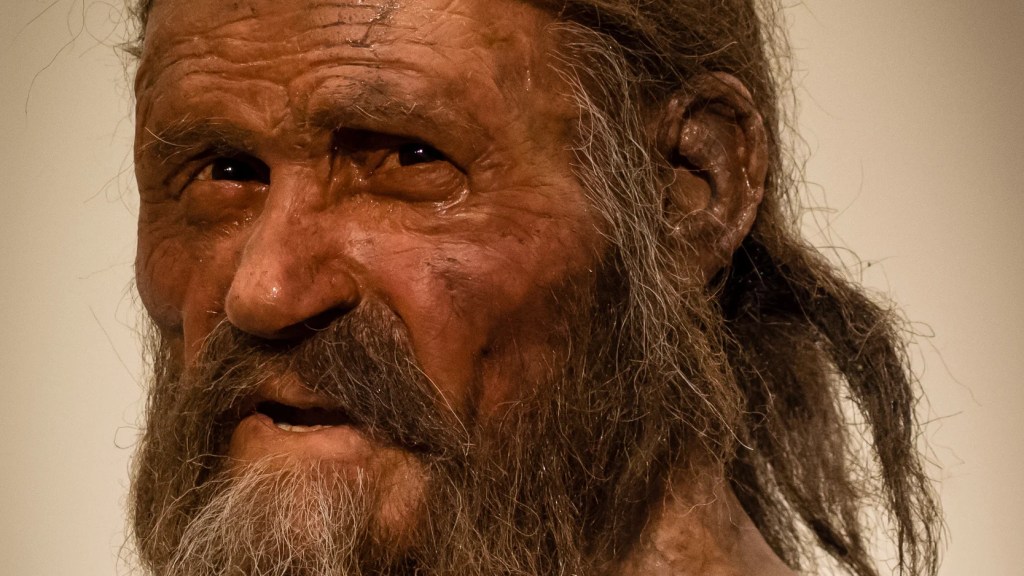
Artist’s interpretation of Ötzi the Ice Man as he may have
looked, in life.

The media called him Ötzi for the Ötztal Alps, in which he was found. Forensic analysis uncovered a nearly bone-deep defensive wound on the man’s hand between the thumb and forefinger. Not yet fully healed the injury suggests a days-long flight from attackers, until the arrow which would take his life was released by unknown pursuers to find its way, deep inside of Ötzi’s back.

Mountaineering is enjoyed today by any number of enthusiasts. There’s rock climbing and ski touring, trekking, spelunking and more. For the truly adventurous there are the hulking massifs of the world’s greatest peaks. The eight-thousanders. To the purists the sport has become little more than adventure tourism, but it wasn’t always that way.

Mountain climbers ascending Mount Rainier looking at Little Tahoma Peak. H/T Wikipedia

Humans have lived on and among the mountains since the dawn of time but the peaks were rarely visited. Ötzi himself had good reason to find himself at 10,530 feet and it wasn’t, “because it’s there”. Not being blessed with the luxury of surplus time and resources our forebears were more interested in survival, the mountains being more the object of religious veneration and supernatural terror than an object to be enjoyed, for its own sake.

Such was the case throughout the early history of our kind, through the rise and fall of the Roman republic and subsequent, empire. A timeline of the middle ages is pockmarked with conflict great and small from the early 5th century until the dawn of the Renaissance, a thousand years later.

The fourteenth century, the “calamitous 14th century” in the words of historian Barbara Tuchman, was a time of tectonic shift in the old order. The three horses of the apocalypse converged in the 14th century to form the “crisis of the late middle ages”. The Great Famine of 1315-’17 was followed a generation later by the Black Death, a calamity resulting in the death of half or more, of all Europe. Political and religious chaos followed demographic collapse, all of it set against the end of the Medieval Warm Period and the advent, of the “Little Ice age”.

This was the world of Francesco Petrarch, a man many consider the first of the modern alpinists.

Today no fewer than three paved roads and a network of walking trails crisscross the face of Mont Ventoux, a landmark in the southeastern French province, of Provence. French and foreign tourists alike climb the 6,263 limestone summit to munch on brie and baguette and to take in the views of the Calanque range all the way down the Mediterranean coast, to the Rhone Valley.
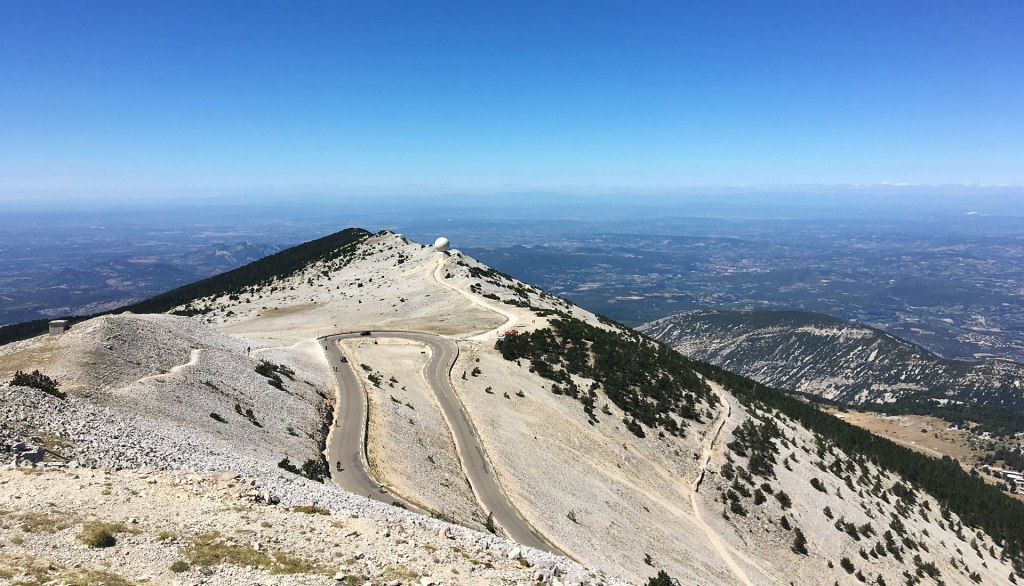
Mont Ventoux

It was all different this day in 1336 when the Italian poet Francesco Petrarch first scaled the heights of Mont Ventoux, because it was there.

In 1350, Petrarch wrote of his ascent of Mont Ventoux “My only motive was the wish to see what so great an elevation had to offer.” While certainly not the first human being to climb a mountain for fun we remember the man today as the first modern tourist and the spiritual father of untold women and men who take to the outdoors to fix a broken soul, to take in the magnificence of nature or simply to take on the challenge of climbing a mountain, because it is there.
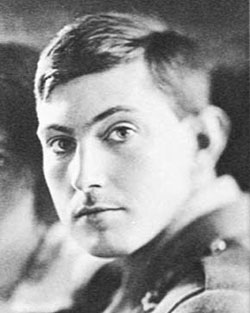
George Mallory

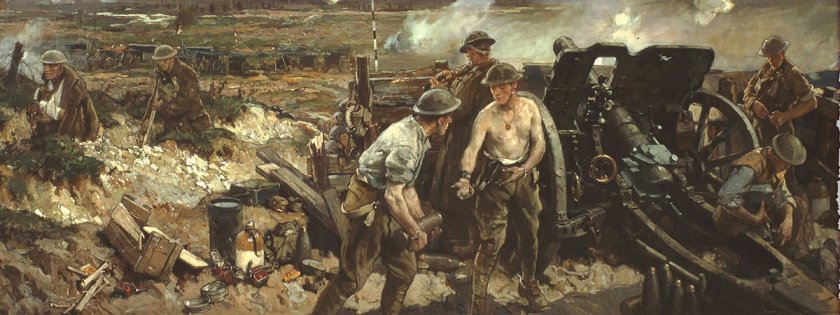
Once asked by a reporter why he wished to climb Mt. Everest, the British adventurer George Mallory famously replied, “Because it’s there”. Left out of Mallory’s facile response was the cataclysm of World War 1, a war so awful as to destroy a generation and leave a continent for the first time, in ruin. Mallory himself enlisted in the artillery in December 1915 and helped to fight out that whole terrible ordeal in the rat filled trenches, of France.

No list of the great and terrible battles of the war they thought would “end all wars” would be complete, without the horrors of the Somme. George Mallory was there throughout and might as well have answered that reporter, because I may at last find peace in that place, for my soul.

Did George Mallory find the peace he sought on the slopes of Mount Everest?

On June 8, 1924, expedition member Noel Odell last witnessed George Mallory and Andrew Irvine traverse what may have been the then-unknown “third step” at 26,000 feet on the way, to the peak. Cloud cover then obscured the pair and the two men disappeared, for the next 75 years. Was George Mallory the first to summit the world’s tallest mountain? Tantalizing clues exist that maybe he did, or maybe not.
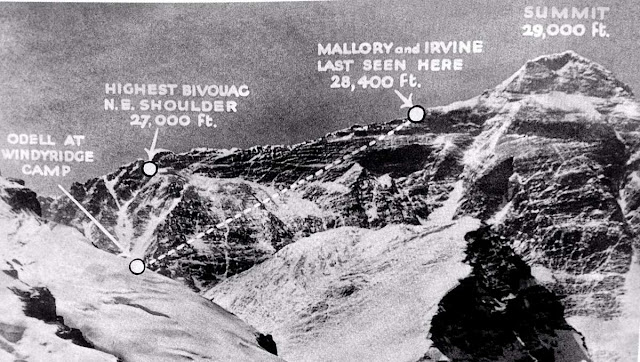
Sir Edmund Hillary and Tenzing Norgay are credited with being the first to summit Mount Everest nearly twenty years later, in 1953. In 1999, the Mallory and Irvine Research Expedition discovered the frozen corpse of George Leigh Mallory at 26,760 feet, 2,271.7 feet short, of the summit.

No helicopter will ever visit the summit of mount Everest. The human form is barely capable of survival at so great a height let alone the attempted salvage, of the body of a fellow climber. So it is that George Mallory and Andrew Irvine remain to this day on the slopes of the world’s greatest mountain, two among some 200 who died in the attempt and lie still on those towering heights, because it’s there.

April 25, 1898 Newsies

We hear a lot these days about “fake news”, but that’s nothing new.  In 1835, the New York Sun published a six-part series describing civilization, on the moon. 

United_States_presidential_election_results,_1796-1820
US presidential election results from 1796 to 1820 gives a good idea of partisan press circulation, where Green shaded states usually voted for the Democratic-Republican Party, while brown shaded states supported the Federalist Party

During the early colonial period, American newspapers were little more than “wretched little” sheets according to America’s “1st newsboy”, Benjamin Franklin.  Scarcely more than sidelines to keep the presses occupied.

Newspapers were distributed by mail in the early years, thanks to generous subsidies from the Postal Act of 1792. In 1800, the United States could boast somewhere between 150 – 200 newspapers.  Thirty-five years later, some 1,200 were competing for readership.

We hear a lot these days about “fake news”, but that’s nothing new.  In 1835, the New York Sun published a six-part series describing civilization, on the moon.   The “Great Moon Hoax”, ostensibly reprinted from the Edinburgh Courant, was falsely attributed to the work of Sir John Herschel, one of the best known astronomers of the age.

350px-Great-Moon-Hoax-1835-New-York-Sun-lithograph-298px
Lithograph from the “Great Moon Hoax” of 1835

Whatever it took, to sell newspapers.

Two years earlier, Sun publisher Benjamin Day ran a Help-Wanted advertisement, looking for adults to help expand circulation. “To the unemployed — A number of steady men can find employment by vending this paper. A liberal discount is allowed to those who buy and sell again“. To Day’s surprise, his ad didn’t produce adult applicants as expected.  Instead, the notice attracted children.

Today, kids make up a minimal part of the American workforce, but that wasn’t always so. Child labor played an integral part in the agricultural and handicraft economy, working on family farms or hiring out to other farmers.  Boys customarily apprenticed to the trades by ages 10 – 14. As late as 1900, fully 18% of the American workforce was under the age of sixteen.

download (82)
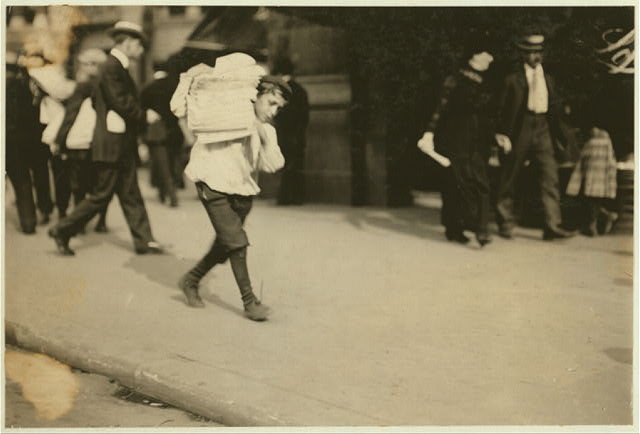
Brooklyn newsboy, ca. 1910 Photo by Lewis Hine (Library of Congress)

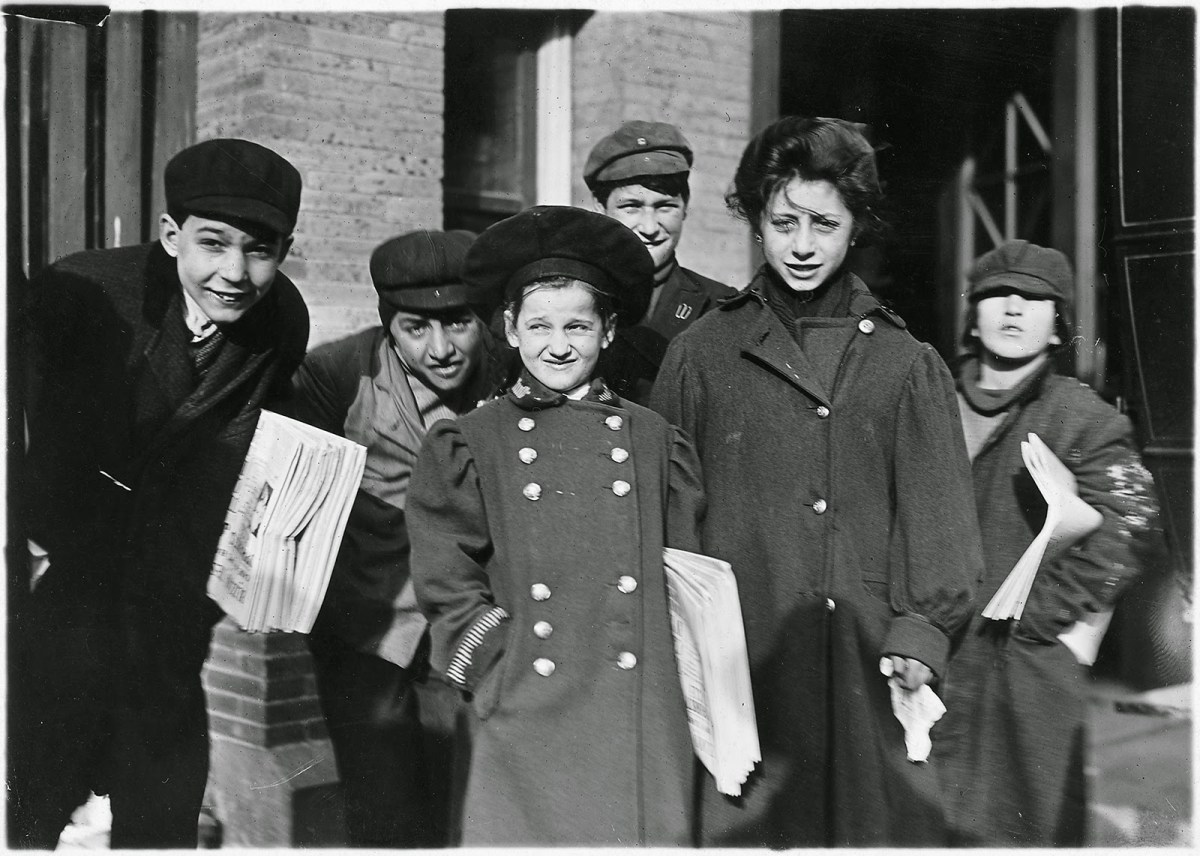
Benjamin Day’s first newspaper “hawker” was Bernard Flaherty, a ten-year-old Irish immigrant. The kid was good at it too, crying out lurid headlines, to passers-by: “Double Distilled Villainy!” “Cursed Effects of Drunkenness!” “Awful Occurrence!” “Infamous Affair!” “Extra! Extra! Read all about it!”

download (92)

Hordes of street urchins swarmed the tenements and alleyways of American cities. During the 1870s, homeless children were estimated at 20,000 – 30,000 in New York alone, as much as 12% of school-age children in the city.

For thousands of them newspapers were all that stood in the way, of an empty belly.

800px-Riischildren
Homeless children sleeping in Mulberry Street district of New York, circa 1890

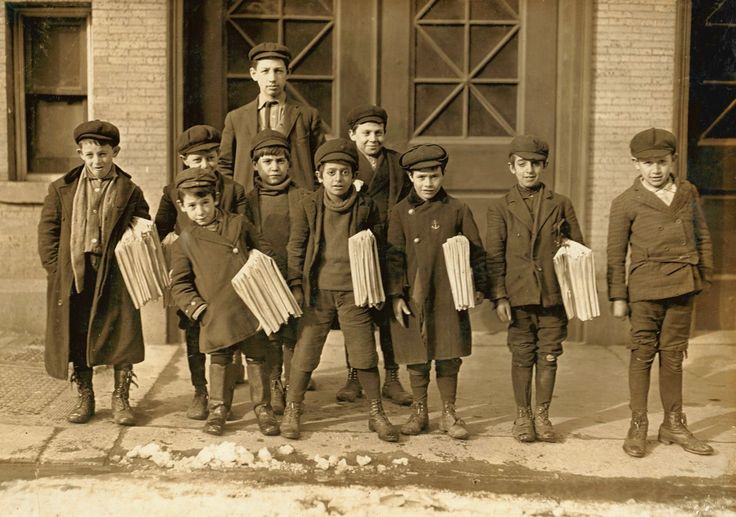
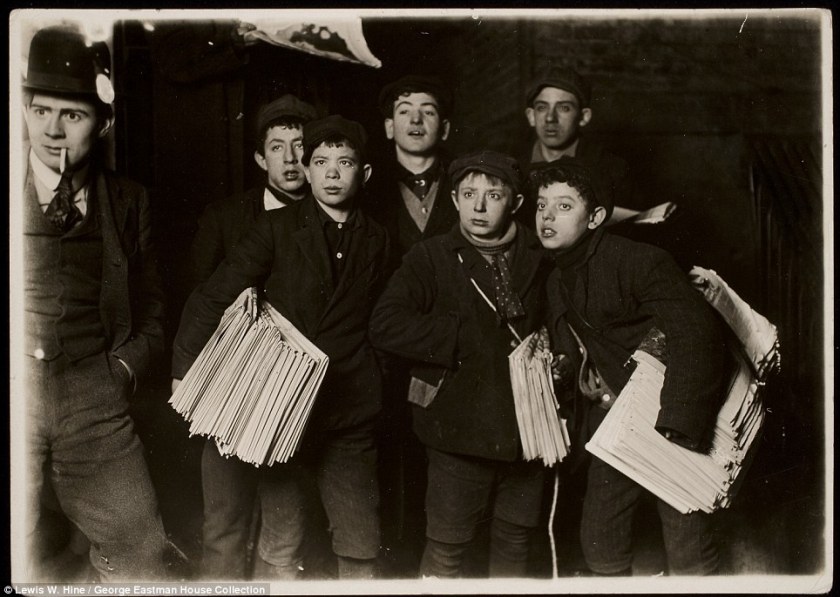
Adults had no interest in the minuscule income, and left the newsboys (and girls) to their own devices.  “Newsies” bought papers at discounted prices and peddled them on the street.    Others worked saloons and houses of prostitution.  They weren’t allowed to return any left unsold, and worked well into the night to sell every paper.

article-2467498-18D8276800000578-777_964x699

For that, newsies earned about 30¢ a day.  Enough for a bite to eat, to afford enough papers to do it again the following day, and maybe a 5¢ bed in the newsboy’s home.

article-2467498-18D8273A00000578-282_964x688

Competition was ferocious among hundreds of papers, and business practices were lamentable.  In 1886, the Brooklyn Times tried a new idea. The city was expanding rapidly, swallowing up previously independent townships along the Long Island shore. The Times charged Western District newsboys a penny a paper, while Eastern District kids paid 1 1/5¢.

The plan was expected to “push sales vigorously in new directions.” It took about a hot minute for newsies to get wise, and hundreds of them descended on the Times’ offices with sticks and rocks. On March 29, several police officers and a driver’s bullwhip were needed to get the wagons out of the South 8th Street distribution offices. One of the trucks was overturned, later that day.

article-2467498-18D8272400000578-972_964x686

That time, the newsboy strike lasted a couple of days, enforced by roving gangs of street kids and “backed by a number of roughs”. In the end, the Times agreed to lower its price to a penny apiece, in all districts. Other such strikes would not be ended so quickly, or so easily.

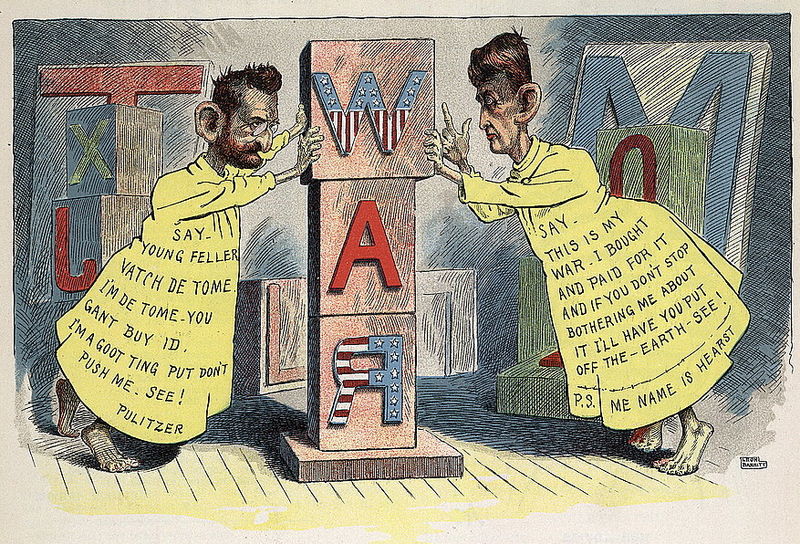
In those days, the Caribbean island of Cuba was ruled from Spain. After decades spent in the struggle for independence, many saw parallels between the “Cuba Libre” movement, and America’s own Revolution of the previous century.  In 1897-’98, few wanted war with Spain over Cuban interests more than Assistant Naval Secretary Theodore Roosevelt, and New York publishers Joseph Pulitzer & William Randolph Hearst.

800px-PulitzerHearstWarYellowKids

This was the height of the Yellow Journalism period, and newspapers clamored for war. Hearst illustrator Frederic Remington was sent to Cuba, to document “atrocities”.  On finding none, Remington wired: “There will be no war. I wish to return”.  Hearst wired back: “Please remain. You furnish the pictures, and I’ll furnish the war.” President McKinley urged calm, but agreed to send the armored cruiser USS Maine, to protect US “interests”.

The explosion that sank the Maine on February 15 killing 268 Americans was almost certainly accidental, but that wouldn’t be known for decades. Events quickly spun out of control and, on April 21, 1898, the US blockaded the Caribbean island. Spain gave notice two days later, that it would declare war if US forces invaded its territory. Congress declared on April 25 that a state of war had existed between Spain and the United States, since the 21st.

article-2467498-18D8275900000578-427_964x657

Several days later, newsboys were shouting the headline:  “How do you like the Journal’s war?”

The Spanish-American War was over in 3 months, 3 weeks and 2 days, but circulation was great while it lasted. Publishers cashed in, raising the cost of newsboy bundles from 50¢ to 60¢ – the increase temporarily offset by higher sales. Publishers reverted to 50¢ per 100 after the war, with the notable exceptions of Joseph Pulitzer’s New York World, and William Randolph Hearst’s New York Journal.

February_23rd_1908_Boys_Selling_Newspapers_on_Brooklyn_Bridge
Brooklyn newsboys, 1908

Newsies struck the two in 1899, refusing to sell their papers. 5,000 newsboys blocked the Brooklyn Bridge, bringing traffic to a standstill. Competing papers such as the New York Tribune couldn’t get enough of the likes of strike “President” Dave Simmons, the boy “prize-fighter”, Barney “Peanuts”, “Crutch” Morris, and others.  The charismatic, one-eyed strike leader “Kid Blink”, was a favorite: “Friens and feller workers. This is a time which tries de hearts of men. Dis is de time when we’se got to stick together like glue…. We know wot we wants and we’ll git it even if we is blind”.

Neither Hearst nor Pulitzer ever dropped their price, but they did agree to take back unsold papers.

800px-Child_Labor_in_United_States_1910_working_night_shift
Some worked well after midnight, to sell every paper

Long before modern notions of child welfare, street kids had precious few to look out for them, beyond themselves.  “Dutch” Johnson, Brooklyn’s “Racetrack Newsie”, caught cold, in 1905.  The illness soon turned more serious, and he was found unconscious on a pile of catalogs.  Brought to Bellevue Hospital by the East River,  the 16-year-old was informed that it was pneumonia.  This was before the age of antibiotics.  There was no chance.

“It goes”, Dutch said, in a voice barely audible.  “Only I ain’t got no money and I’d like to be put away decent”.

tumblr_ne0yqmwDCl1u0ndouo1_500 (1)
H/T http://newsieshistory.tumblr.com for this image

Bookmaker “Con” Shannon offered to take up a collection for the burial.  He could have easily produced hundreds from bookies and gamblers.   Dutch’s diminutive successor “Boston”, spoke up.  “Naw”, he said “we’re on de job and nobody else”.  So it was that “Gimpy”, “Dusty”, and the other urchins of Sheepshead Bay pitched in with their pennies, their nickels and their dimes.  For $53.40, Dutch Johnson would have his plot in Linden Hill Cemetery, complete with small stone marker.  Not a plain black wagon and a nameless grave in some anonymous Potter’s Field.

April 14, 1912 A Penny, to Remember

Warm and dry in our rooms we can only wonder what went through the minds, of those lowering the lifeboats. Among them was Thomas Millar who must have wondered why. He had wanted to give little Tommy and Ruddock, a better life. He was about to leave his sons, orphans.

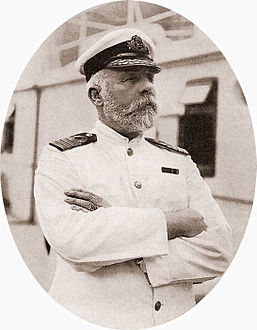
Edward Smith
Captain Edward Smith

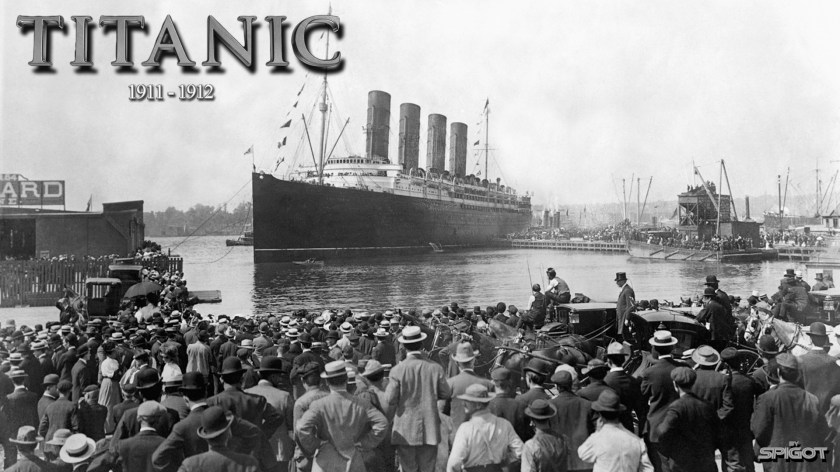
The great ship left the port of Southampton, England on April 10, 1912, narrowly averting an accident only minutes into her maiden voyage. 

The largest liner in the world at this time, the bow wave of the RMS Titanic lifted the liners SS City of New York and Oceanic at their moorings.  Dropping into the trough, New York’s mooring cables snapped with a sound like a rifle shot as the vessel swung about, stern-first. The crew of the tugboat Vulcan struggled frantically to bring New York under tow as Titanic’s Captain Edward Smith ordered starboard engines hard astern. Collision was averted, by a scant four feet.

The liner to the left is the Oceanic. The stern of the New York edges towards the Titanic” H/T http://www.encyclopedia-titanica.org

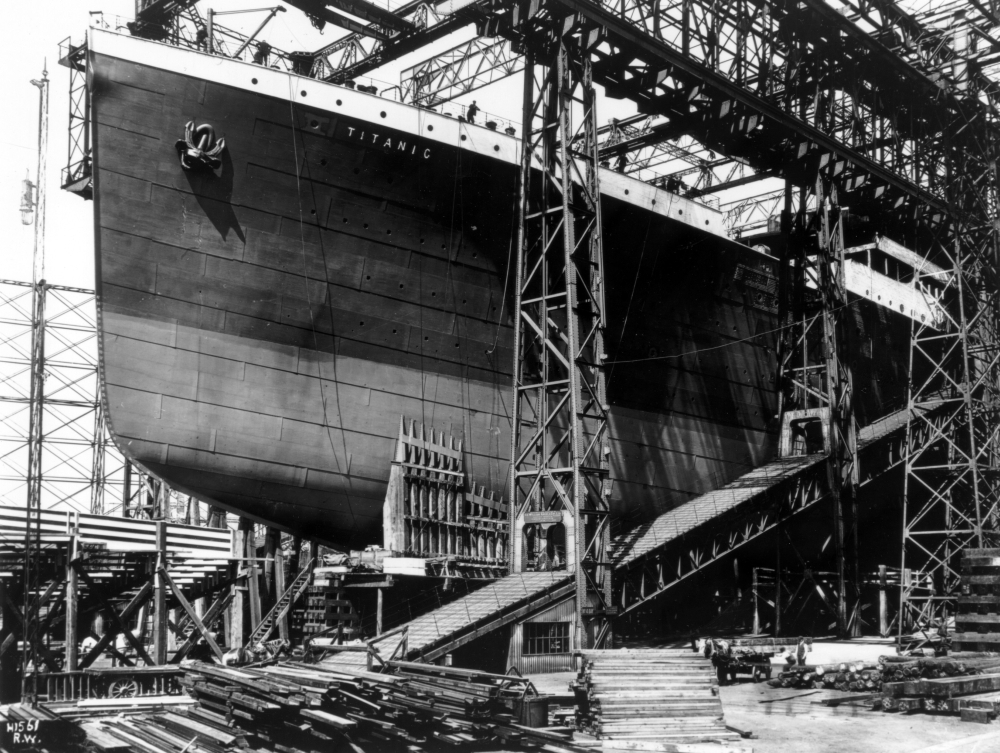
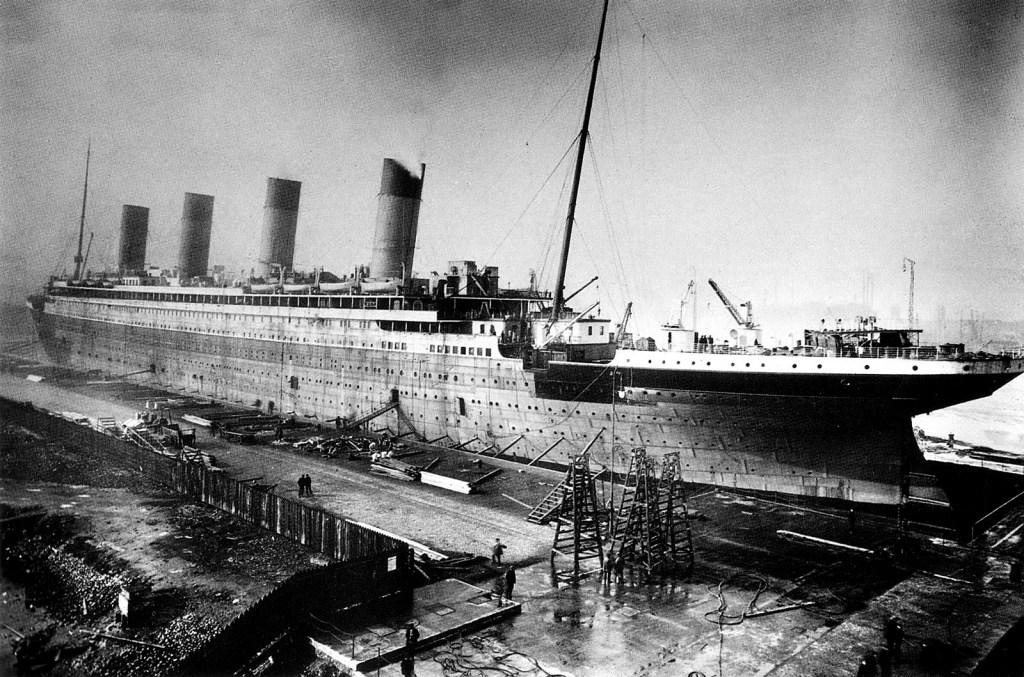
The idea for this largest of all luxury liners came about in 1907, construction beginning on March 31, 1909 at the Harland and Wolff shipyards of Belfast, Ireland.

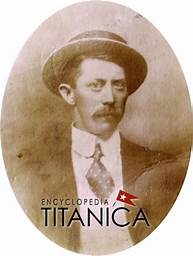
Thomas Millar

In its prime Harland and Wolff was the largest shipyard in the world with some 40,000 workmen tramping to work across the cobblestone paved streets, of Belfast.

Thomas Millar was one of those workers. The son of a sailor Millar grew up in the shadow of the great vessels of northern Ireland and all but destined, for the shipbuilding industry. First came the apprenticeship with Harland & Wolff and later work at Vickers of Barrow, Workman, Clark & Co. of Belfast before returning to work, at Harland & Wolff.

Along the way, “Tommy” married Jane “Jennie” Ruddock, the marriage producing two sons, Thomas born February 9, 1901 and William Ruddock born March 5, 1907.

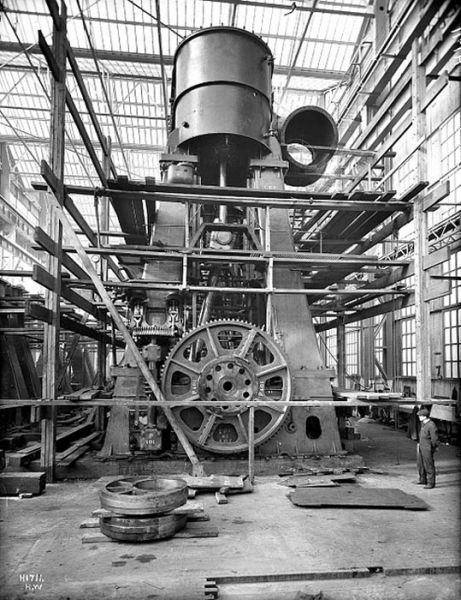
Millar took pride in his work, assigned to help build the great engines of RMS Titanic and proud to take some small part in the technological wonder, of the age. At night Millar would tell the boys about his work, wanting to instill in them the same pride he felt, in seeing the great liner take form.

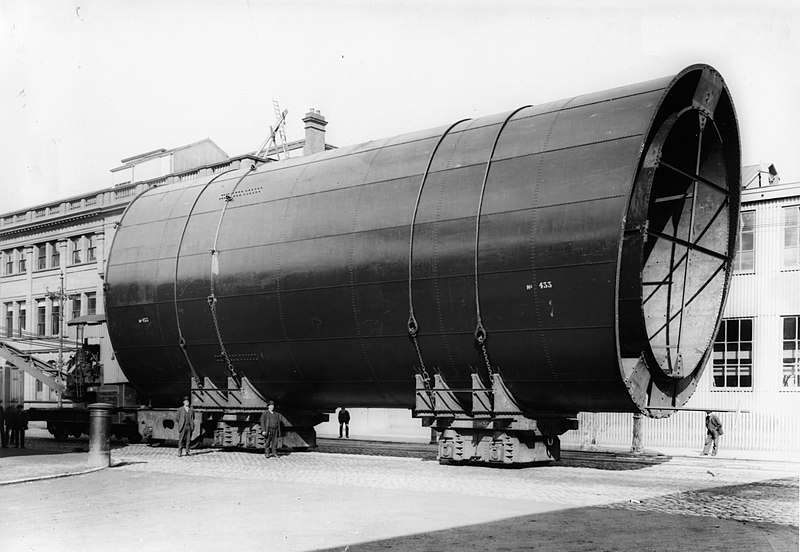
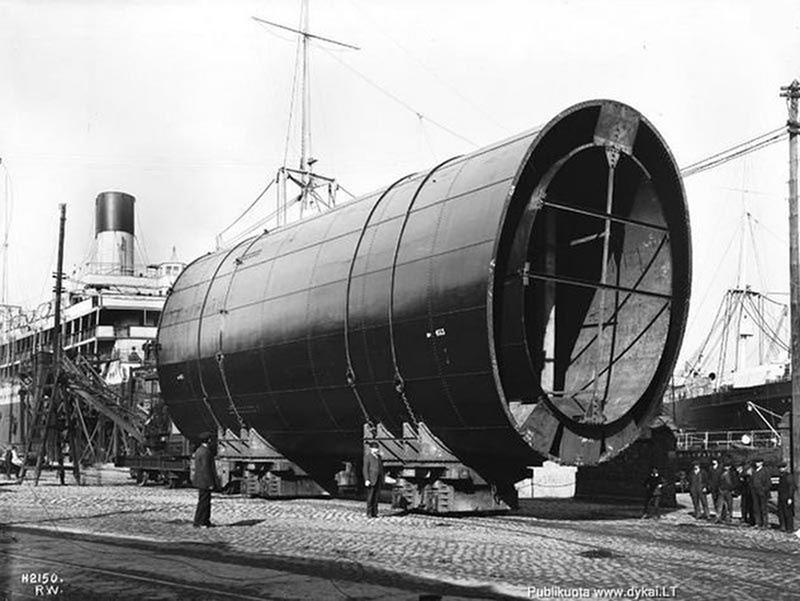
800px-Britannic_Funnel_in_transport
One of Britannic’s funnels, in transit to the ship

Disaster struck the family in January 1912 when Jennie died suddenly, of tuberculosis. With work now nearing completion on Titanic, the grieving father thought about a fresh start. He would improve his lot and that of his small family. So it was he left the dockyards to work, for the White Star Line. He would get himself settled and, when the time was right, he would reunite with his boys to pursue their new life. In America.

Thomas accepted work as assistant deck engineer for the White Star Line responsible for the upkeep of cranes, davits and the like. As things turned out he was assigned to the maiden voyage of the vessel he had helped to build. RMS Titanic.

With 16 transverse bulkheads Titanic could survive the breach, of as many as four. Shipbuilder Magazine dubbed the vessel “unsinkable”. The name was never officially sanctioned by her builders, but no matter. From that day, to this the name lives on, in the public imagination.

At last came the day. Time to leave. The work would be constant, and Thomas knew this was no place for children. He left the boys with his aunt Mary bidding the two, goodbye. “Be good to your aunt” he told the boys, “and try not to fight with your cousins”. He reached in his pocket and pulled out two new pennies. “Don’t spend these” he told his sons, “until we’re together again”.

Later that day the boys stood on the shores of Belfast Loch watching the liner, steam away. So tightly did each grip his penny the date imprinted into the palm of his small hand. 1912.

titanic-01-wallpaper

The story from here, is familiar. On Sunday April 14, Titanic was 400 miles off the coast of Newfoundland. Conditions were clear, calm and cold, just a few degrees above freezing. There had been warnings of drifting ice from other ships in the area, but no ice was believed to pose a danger, to such a ship as Titanic. Captain Smith said it himself, that he “[couldn’t] imagine any condition which would cause a ship to founder. Modern shipbuilding has gone beyond that.”

Lookout Frederick Fleet alerted the bridge. Iceberg dead ahead at 11:40pm. First Officer William Murdoch ordered the engines in reverse, veering the ship to port. Lookouts were relieved, thinking that collision was averted. Below the surface, the starboard side ground into the iceberg, opening a gash the length of a football field.

The ship was built to survive flooding in four watertight compartments. The iceberg had opened five. As Titanic began to lower at the bow, it soon became clear. The great ship was doomed.

Those aboard were poorly prepared for such an emergency. The vessel was built for 64 wooden lifeboats but only carried, 16. Based as they were on ship size and not the number of passengers and crew, regulations required enough for 990. Titanic carried enough for 1,178.

There was room for over half of those on board, provided that each boat was filled to capacity. And yet, many boats were launched only half-full. Confused and still sleepy in the midnight air many refused the small boats, reluctant to leave the “safety” of the 40,000-ton ship. In other cases so strictly did some adhere to the “women and children first” directive, that evacuation included women and children, only. The first lifeboat in the water, rated at 65 passengers, launched with only 28 aboard. Lifeboat #1 rated for 60, contained 12.

Only 20 miles away the crewmen of the SS Californian saw distress rockets but dismissed them, as fireworks. Titanic’s wireless operator pleaded for help but the dits and dahs fell on deaf ears. Californian’s wireless operator, had gone to bed. 57 miles away the steamship Carpathia turned and dashed to the rescue but, too late.

In the hour and ½ it took to lower the lifeboats Titanic’s enormous propellers were visible above the water. Warm and dry in our rooms we can only wonder what went through the minds, of those lowering the lifeboats. Thomas Millawas one of those. Did he wonder in those last hours of his life…why? He had left to seek a better life for little Tommy and Ruddock. He was about to leave them orphans.

1,496 died that night of 2,223 passengers and crew. Mostly from hypothermia. Thomas Millar’s body if it was ever recovered, was never identified. Tommy and Ruddock never did spend those pennies. The coins remain treasured family heirlooms from that day to this. You can still see those two pennies if you like, on the streets of Belfast. There Thomas’ Great-Granddaughter Susie Millar directs “the original & ONLY Titanic themed tour in Belfast guided by the direct descendant of a crew member”. http://www.titanictours-belfast.co.uk/

April 13, 1917 A Sealed Train

Leaving Zurich Station amid the jeers and the insults of 100 or so assembled Russians shouting “Spies!” “Traitors!” “Pigs!” “Provocateurs!” Lenin turned to a friend and said. “Either we’ll be swinging from the gallows in three months, or we shall be in power.”

The “War to End all Wars” dragged into its third dismal year in 1917, seeming as though it would go on forever.   Like two exhausted prize fighters, neither side could muster the strength to deliver the killing blow.  Many single days of the great battles of 1916 alone  produced more casualties than every European war of the preceding 100 years, combined.  At home, the social fabric of the combatant nations was unraveling.

WW1-Timeline-1917

By 1916 it was widely understood that the German war effort was “shackled to a corpse”, referring the Austro-Hungarian Empire where the war had started, in the first place.  Italy, the third member of the “Triple Alliance”, was little better.  On the “Triple Entente” side, the French countryside was literally torn to pieces, the English economy close to collapse. The Russian Empire, the largest nation on the planet, was teetering on the edge of the precipice.

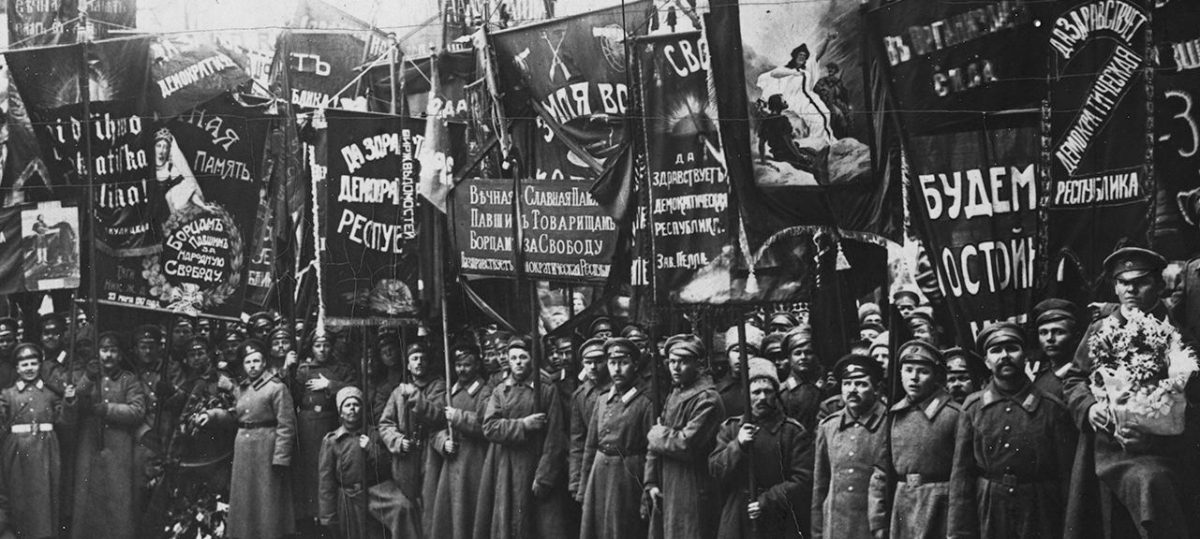
The first of two Revolutions that year began on February 23 according the “Old Style” calendar, March 8, “New Style”. Long-standing resentments over food rationing turned to mass protests in and around the Russian capital of Petrograd (modern-day Saint Petersburg). Eight days of violent demonstrations pitted Revolutionaries against police and “gendarmes”, that medieval remnant combining military units with the power of law enforcement.

By March 12 (new style), mutinous units of the Russian military had switched sides and joined with the revolutionaries. Three days later, Car Nicholas abdicated the Imperial throne.

ww1-d-727-russians.jpg
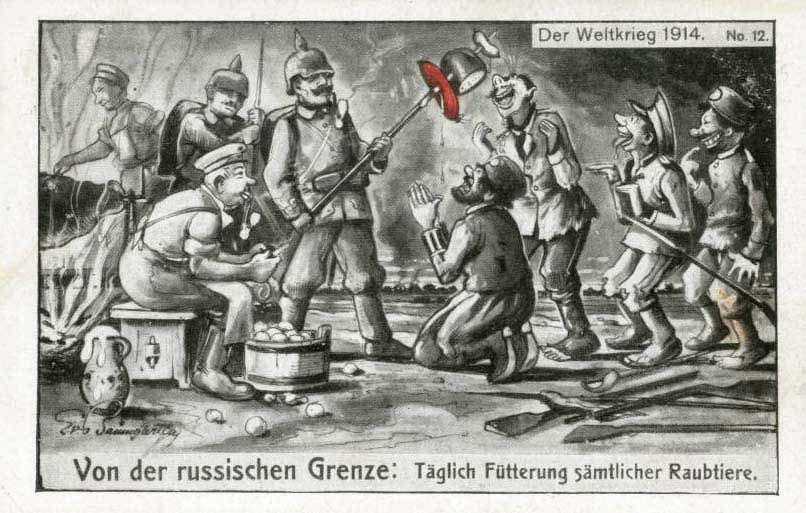
German propaganda postcard depicting Russian peasants begging for food. With the size of the Russian empire and the difficulty in transportation, the propaganda wasn’t far from the truth.

Amidst all this chaos, Kaiser Wilhelm calculated that all he had to do was “kick the door in” and his largest adversary would collapse. He was right.

Following the overthrow of the Romanov dynasty, the more moderate Menshevik “Whites” vowed to continue the war effort. The split which had begun with the failed revolution of 1905 was more pronounced by this time with the radical Bolsheviks (“Reds”) taking the more extreme road. While Reds and Whites both wanted to bring socialism to the Russian people, Mensheviks argued for predominantly legal methods and trade union activism, while Bolsheviks favored armed violence.

March 8, 1917 A Political Plague

In 1901, Vladimir Ilyich Ulyanov adopted the pseudonym “Lenin” after the River Lena, the easternmost of the three great Siberian rivers flowing into the arctic ocean. The middle-class son of a professor of mathematics and physics and the daughter of a well-to-do physician, Ulyanov became radicalized after the 1887 execution of his brother, for plotting to murder the Czar.Vladimir Ilyich Lenin

images (61)
Lenin

The man was soon convinced that capitalist society was bound to give way to socialist society with a natural transition to communism, not far behind.

Lenin was in exile when the war broke out, arrested and briefly imprisoned for his Russian citizenship. The radical revolutionary was released due to his anti-czarist sentiments when he and his wife, settled in Switzerland.

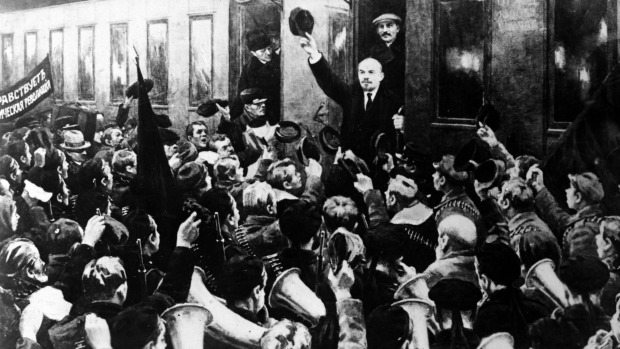
Lenin makes his way to the sealed train which would take him out of exile.

British historian Edward Crankshaw writes, the German government saw “in this obscure fanatic one more bacillus to let loose in tottering and exhausted Russia to spread infection”.

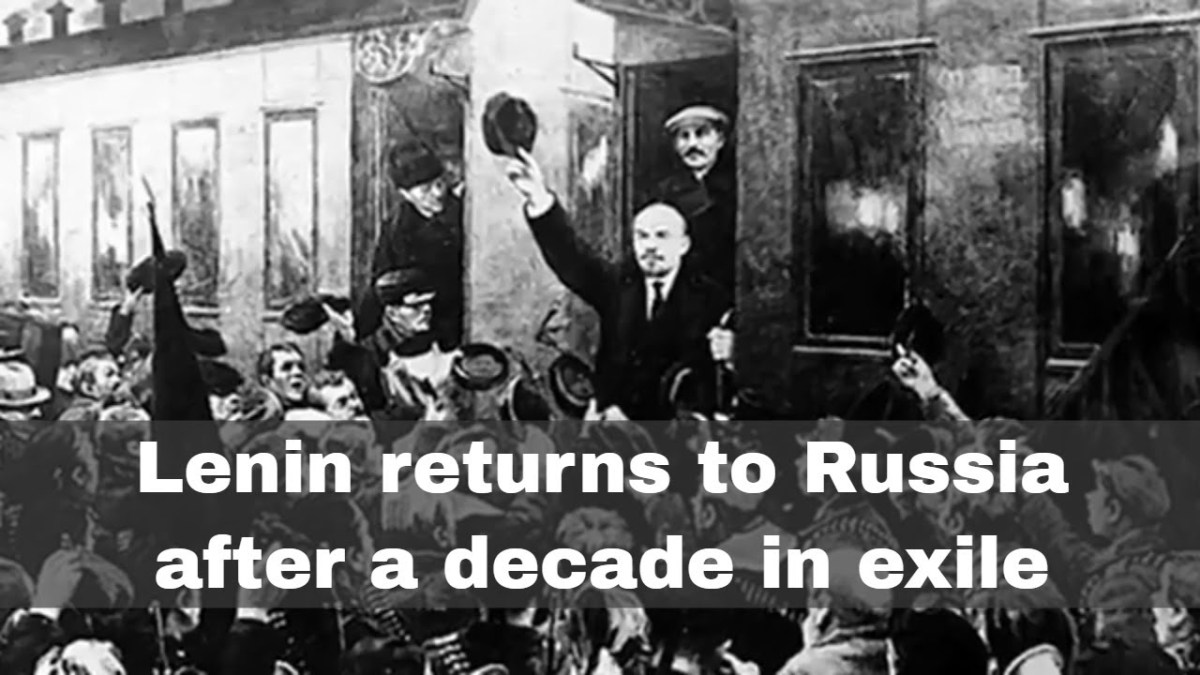
Lurching toward food riots of his own and loathe to unleash such a bacterium against his own homeland, a “Sealed Train” carrying Vladimir Ilyich Lenin and 31 dissidents departed from exile in Switzerland on April 9, complements of the Kaiser. Leaving Zurich Station amid the jeers and the insults of 100 or so assembled Russians shouting “Spies!” “Traitors!” “Pigs!” “Provocateurs!” Lenin turned to a friend and said. “Either we’ll be swinging from the gallows in three months, or we shall be in power.”

North through Germany and across the Baltic Sea, this political plague bacillus traveled the length of Sweden arriving in Petrograd on the evening of April 16, 1917. Like the handful of termites destined to bring down the mighty oak, this small faction inserted into the body politic that April, would help to radicalize the population and consolidate Bolshevik power.

Sealed Train

By October, Russia would experience its second revolution of the year. The German Empire could breathe easier. The “Russian Steamroller” was out of the war, and none too soon. With the United States entering the war that April, Chief of the General Staff Paul von Hindenburg and his deputy Erich Ludendorff could now move their divisions westward, in time to face the American Expeditionary Force.

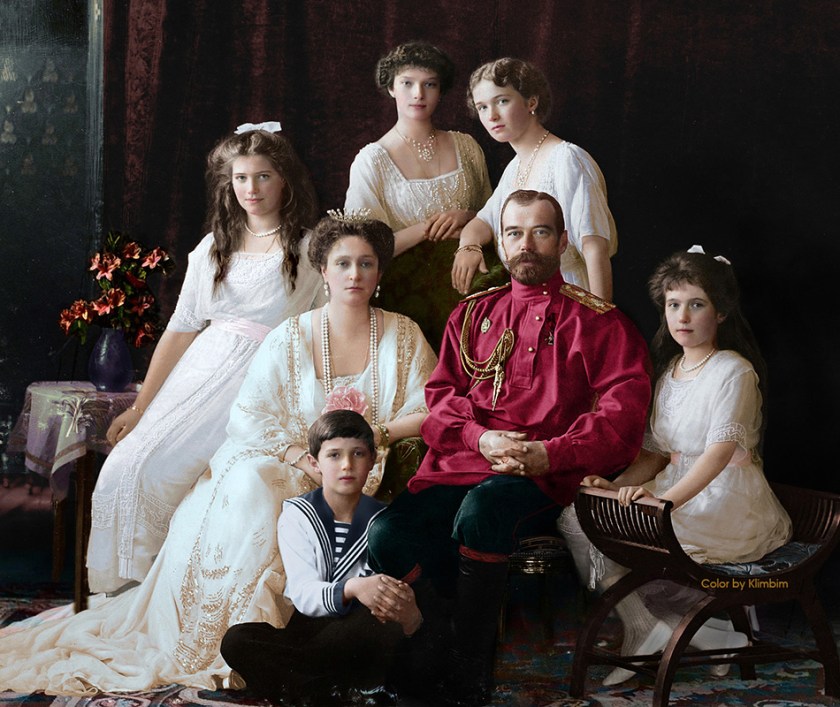
On July 17, 1918, an assassination squad from the Ural Soviet of Workers’ Deputies murdered Czar Nicholas along with his wife and children, family physician, servants and dogs. The Romanov Dynasty was no more. It was the end of Czarist Russia. The death toll of human beings murdered by the totalitarian state which would rise to take its place, has been estimated as high as sixty million.

Romanov
Czar Nicholas II & family, colorized by the Russian artist Olga Shirnina, also known as ‘klimbim’

April 11, 1970 Apollo 13

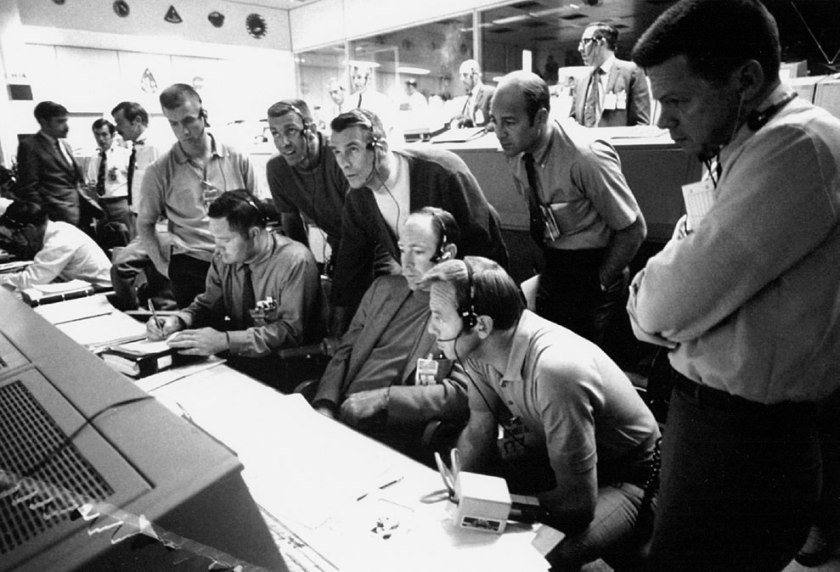
 With communications being impossible, TV commentators used models and illustrations, to describe the unfolding drama.  On board Odyssey, power was so low that voice-only transmissions became difficult. Visual communications with Mission Control were as impossible as the idea that the stranded astronauts could get out and walk home.

Apollo 13 liftoff

The seventh manned mission in the Apollo space program was scheduled to be the third moon landing, launching at 13:13 Central Standard Time from the Kennedy Space Center in Florida.

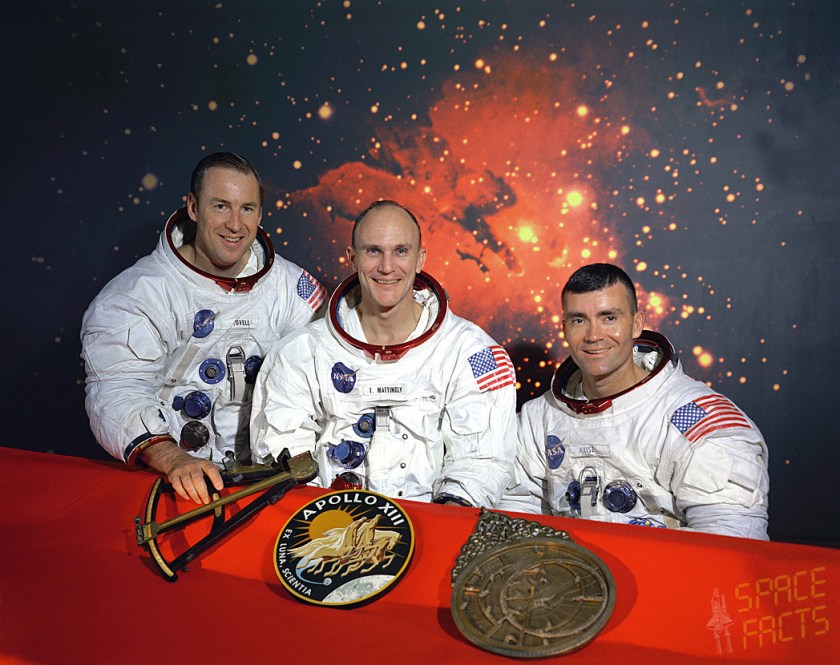
Jack Swigert was the backup pilot for the Command Module (CM), officially joining the Apollo 13 mission only 48 hours earlier, when prime crew member Ken Mattingly was grounded, following exposure to German measles.

Jim Lovell was the most seasoned astronaut in the world at that time, a veteran of two Gemini missions and Apollo 8.  By launch day, April 11, 1970, Lovell had racked up 572 space flight hours. For Fred Haise, backup crew member on Apollo 8 and 11, this would be his first spaceflight.

apollo-13_2
Apollo 13, original crew photo, Left to right: Commander, James A. Lovell Jr., CM pilot Ken Mattingly, LM pilot, Fred W. Haise Jr.

Two separate vessels were joined to form the Apollo spacecraft, separated by an airtight hatch. The crew lived in a Command/Service module called “Odyssey”.  The Landing Module (LM) dubbed “Aquarius”, would perform the actual moon landing.

56 hours into the mission and 5½ hours from the Moon’s sphere of gravitational influence, Apollo crew members had just finished a live TV broadcast.  Haise was powering the LM down while Lovell stowed the TV camera.  Mission Control asked Swigert to activate stirring fans in the Service Module’s hydrogen and oxygen tank. Two minutes later, the astronauts heard a “loud bang”.

Apollo 13 Schematic

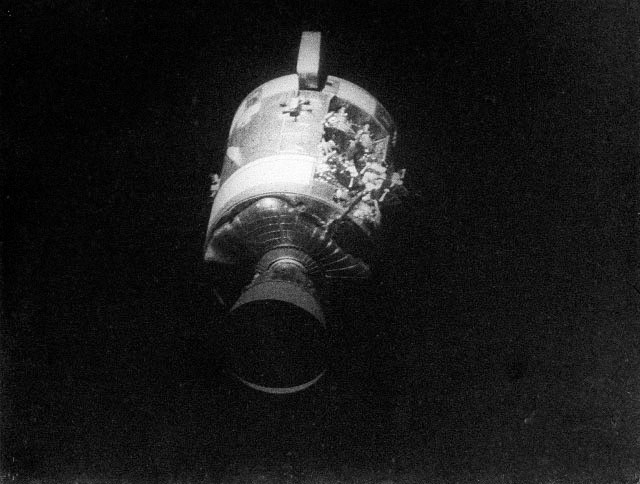
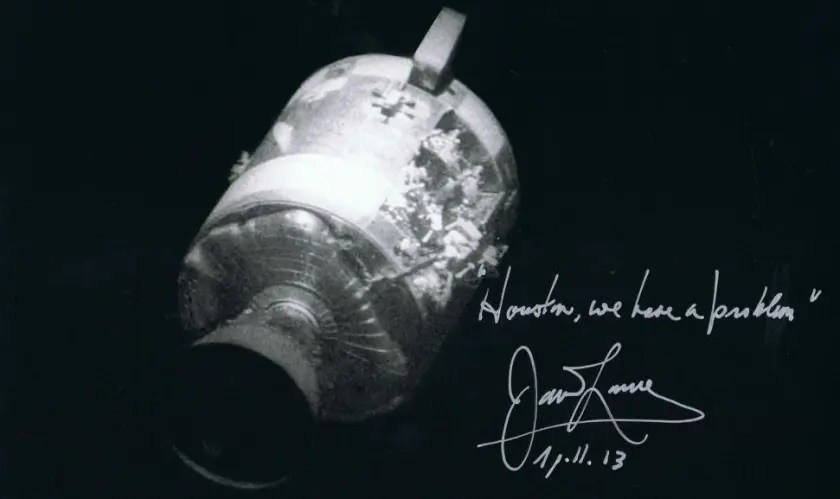
Manufacturing and testing of the vessel had both missed an exposed wire in an oxygen tank.  Swigert had flipped the switch for a routine procedure, causing a spark to set the oxygen tank on fire. Alarm lights lit up all over Odyssey and in Mission Control.  The entire spacecraft shuddered as one oxygen tank tore itself apart and damaged another.  Power began to fluctuate.  Attitude control thrusters fired, and communications temporarily went dark.

The crew could not have known at the time.  The entire Sector 4 panel had just blown off.

apollo-13-damage

The movie takes creative license with Commander James Lovell saying “Houston, we have a problem”.  On board the real Apollo 13 it was Jack Swigert who spoke:  “Houston, we’ve had a problem”.

205,000 miles into deep space with life support systems shutting down, the Lunar Module became the only means of survival.  There was no telling if the explosion had damaged Odyssey’s heat shields.  It didn’t matter. For now, the challenge was to remain alive.  Haise and Lovell frantically worked to boot up Aquarius, while Swigert shut down systems aboard Odyssey.   Power needed to be preserved for splashdown.

The situation had been suggested during an earlier training simulation, but considered unlikely. As it happened, the accident would have been fatal without access to the Lunar Module.

annexe6 A13-S70-34986 Fifteen years before Angus “Mac” MacGyver hit your television screen, mission control teams, spacecraft manufacturers and the crew itself worked around the clock to “MacGyver” life support, navigational and propulsion systems. For four days and nights, the three-man crew lived aboard the cramped, freezing Aquarius, a landing module intended to support a crew of 2 for only a day and one-half.

With heat plummeting to near freezing food inedible and an acute shortage of water, this tiny, claustrophobic “lifeboat” would have to do what it was never intended to do.

Apollo_13_timeline
Apollo XIII timeline

Atmospheric re-entry alone presented near-insurmountable challenges. The earth’s atmosphere is a dense fluid medium. If you reenter at too steep an angle, you may as well be jumping off a high bridge. As it is, the human frame can withstand deceleration forces no higher than 12 Gs, equivalent to 12 individuals identical to yourself, piled on top of you.  Even at that, you’re only going to survive a few minutes, at best.

We all know what it is to skip a stone off the surface of a pond.  If you hit the atmosphere at too shallow an angle, the result is identical to that stone. There is no coming down a second time. You get one bounce and then there is nothing but the black void of space.

800px-Apollo13_apparatus
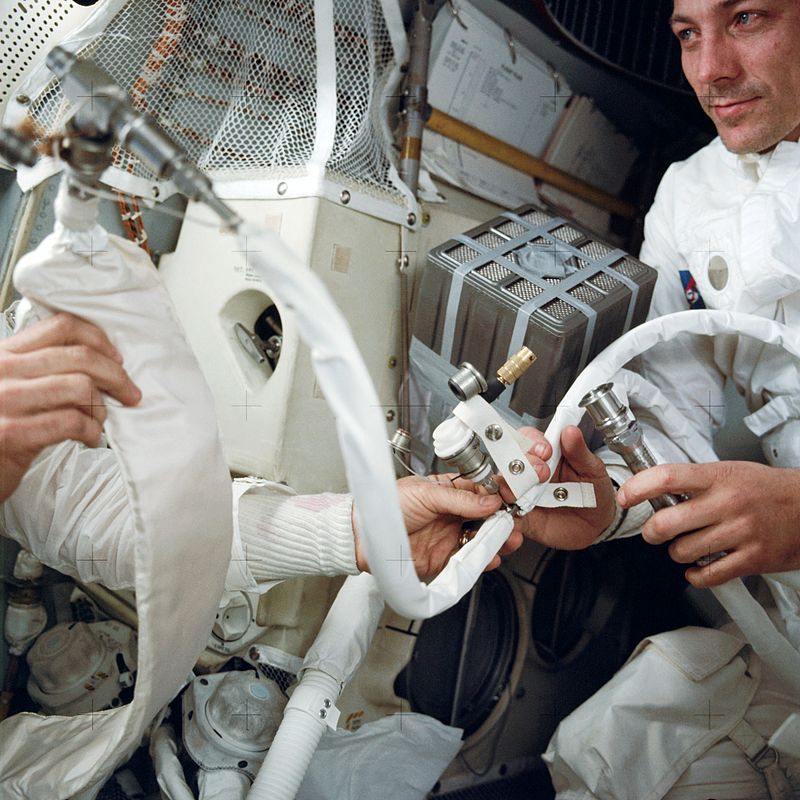
“Astronaut John L. Swigert, at right, with the “mailbox” rig improvised to adapt the command module’s square carbon dioxide scrubber cartridges to fit the lunar module, which took a round cartridge”. /T Wikipedia

The world held its breath it seemed for seventy-eight hours, waiting for the latest update from newspaper and television news.  With communications being impossible, TV commentators used models and illustrations, to describe the unfolding drama.  On board Odyssey, power was so low that voice-only transmissions became difficult. Visual communications with Mission Control were as impossible as the idea that the stranded astronauts could get out and walk home.

As Odyssey neared earth, engineers and crew jury-rigged a means of jettisoning the spent Service Module, to create enough separation for safe re-entry.

night-sky-shooting-star_njz-fhpbe__F0001-1
Shooting star as seen by night, H/T contentbuket.com

One last problem to be solved, was the crew’s final transfer from Lunar Module back to Command Module, prior to re-entry.  With the “reaction control system” dead, University of Toronto engineers had only slide rules and six hours in which to devise a way to “blow” the LM, by pressurizing the tunnel connecting it with the CM.  Too much pressure might damage the hatch and seal.  Too little wouldn’t provide enough separation between the two bodies.  Either failure would result in one of those “shooting stars” you see at night, as the searing heat of re-entry incinerated the Command Module and everything in it.

By this time, the Command Module had been in “cold soak” for days.  No one knew for certain, if the thing would come back to life.

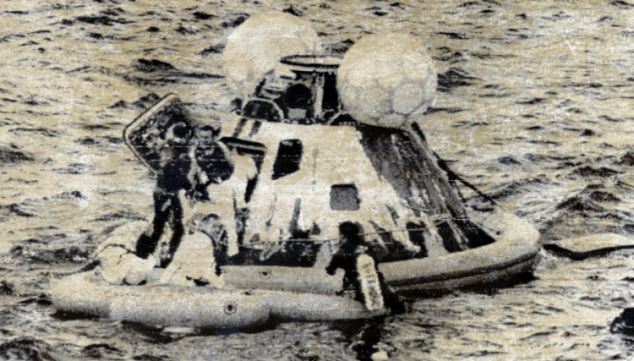
Apollo 13 after it came back to Earth.
Apollo 13 landing

Crashing into the atmosphere at over 24,000mph, the capsule had 14 minutes in which to come to a full stop, splashing down in the waters of the Pacific Ocean. External temperatures on the Command Module reached 2,691° Fahrenheit, as the kinetic energy of re-entry converted to heat.

The Apollo 13 mission ended safely with splashdown southeast of American Samoa on April 17, 1970, at 18:07:41 local time.  Exhausted and hungry, the entire crew had lost weight.  Haise had developed a kidney infection.  Total duration was 142 hours, 54 minutes and 41 seconds.

April 11, 1970  Houston, we Have a Problem

April 7, 451 Attila the Hun

The Roman alliance had stopped the Hunnic invasion in Gaul, but it was a Pyrrhic victory. The military might of Roman and Visigoth alike, was no more.

In the 5th century, the migration of warlike Germanic tribes across northern Europe culminated in the destruction of the Roman Empire in the west.  That much is relatively well known, but the “why”, is not.  What would a people so fearsome as to bring down an empire, have been trying to get away from?

The Roman Empire was split in two in the 5th century and ruled by two separate governments.  Ravenna, in northern Italy, became capital to the Western Roman Empire in 402 and would remain so until the final collapse, in 476.  In the east was Constantinople, seat of the Byzantine empire and destined to go on another thousand years. That would come to an end in 1453 at the hands of the 21-year-old Mehmed “The Conqueror’, 7th sultan of the ottoman Empire. Today we know this crossroads between east and west as Istanbul, but that must be a story, for another day.

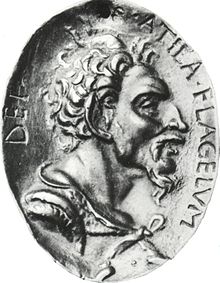
Attila Bronze

Back to the 5th century vast populations moved westward from Germania, into Roman territories in the west and south. They were Alans and Vandals, Suebi, Goths and Burgundians. There were others as well, crossing the Rhine and the Danube and entering Roman Gaul. They came not in conquest:  that would come later. These tribes were fleeing a people so terrifying that whole tribes agreed to be disarmed, in exchange for the protection of Rome.

The Huns.

Rome itself had mostly friendly relations with the Hunnic Empire, which stretched from modern day Germany in the west to Turkey and most of Ukraine, in the east. They were a nomadic people, mounted warriors all but born to the saddle whose main weapons were the bow, and the javelin. Often, Huns acted as mercenary soldiers, paid to fight on behalf of Rome.

Atilla_fléau_de_dieu

Rome looked at such payments as just compensation for services rendered.  To the Huns this was tribute. Tokens of Roman submission to the Hunnic Empire.

Nestorius, Patriarch of Constantinople, described Rome’s problems with the Hun, succinctly.  “They have become both masters and slaves of the Romans”.

Relations became strained between the two powers during the time of the Hunnic King Rugila, as his nephew the future King Attila, came of age.

Attila

Rugila’s death in 434 left the sons of his brother Mundzuk, Attila and Bleda, in control of the united Hunnic tribes. The following year, the brothers negotiated a treaty with Emperor Theodosius of Constantinople, giving the Byzantines time to strengthen the city’s defenses. This included the first sea wall, a structure the city would be forced to defend a thousand years later when even the Theodosian Wall could not stem the Islamic conquest of 1453.

The priest of the Greek church Callinicus wrote what happened next, in his “Life of Saint Hypatius”. “The barbarian nation of the Huns, which was in Thrace, became so great that more than a hundred cities were captured and Constantinople almost came into danger and most men fled from it. … And there were so many murders and blood-lettings that the dead could not be numbered. Ay, for they took captive the churches and monasteries and slew the monks and maidens in great numbers“.

Bleda died sometime in 445 leaving Attila the sole King of the Huns.  Relations with the Western Roman Empire had been relatively friendly, for a time.  That changed in 450 when Justa Grata Honoria, sister of Emperor Valentinian, sought to escape a forced marriage to the former consul Herculanus.  Honoria sent the eunuch Hyacinthus with a note to Attila, asking the king to intervene on her behalf.  She enclosed her ring in token of the message’s authenticity. Attila took this to be an offer of marriage.

Attila_in_Gaul_451

Valentinian was furious with his sister.  Only the influence of their mother Galla Placidia convinced him to exile rather than have her put to death while he frantically wrote to Attila saying it was all, nothing more than a misunderstanding.

The King of the Huns wasn’t buying it and sent an emissary to Ravenna, to claim what was his.  Attila demanded delivery of his “bride” along with a modest half of the empire, as dowry.

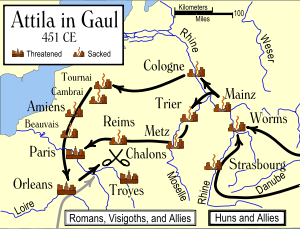
In 451, Attila gathered his vassals and began a march to the west. The Hunnic force was estimated to be half a million strong though that number is almost certainly exaggerated. The Romans hurriedly gathered an army to oppose them while the Huns sacked the cities of Mainz, Worms, Strasbourg and Trier.

Some 1,500 years later the headlines announced the impregnable city of Metz, had fallen to US 95th Infantry.

On April 7, 451 the streets of Metz ran red with the blood of the slain followed in quick succession by those of Cologne, Cambrai, and Orleans.

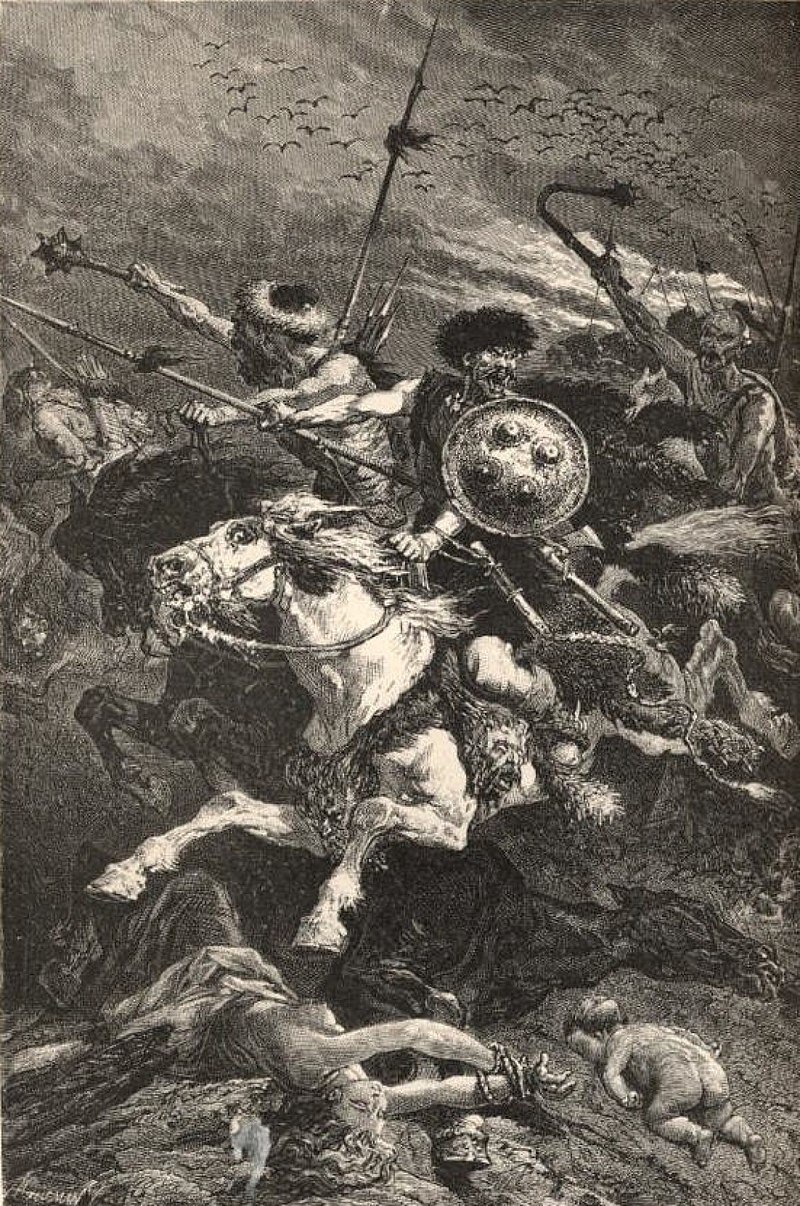
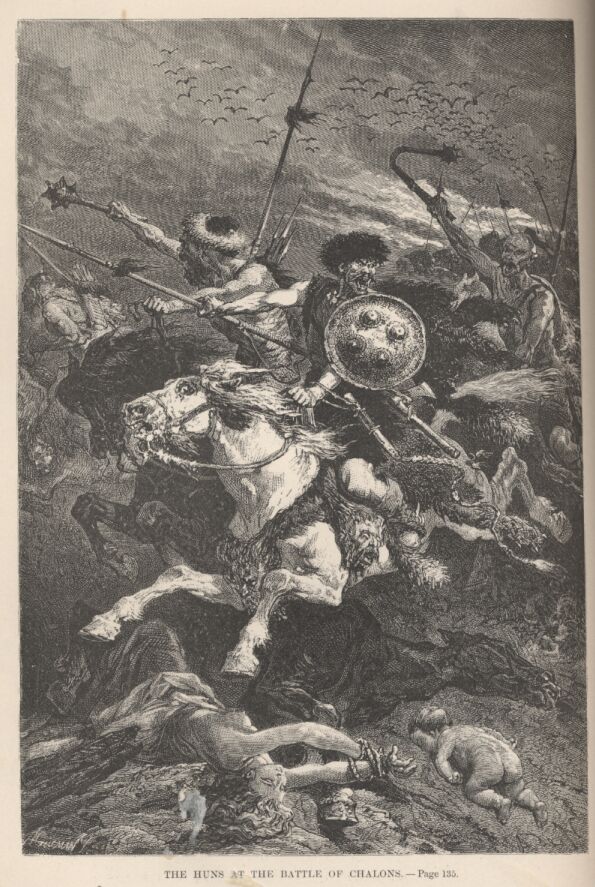
The Roman army, allied with the Visigothic King Theodoric I, finally stopped the army of Attila at the Battle of the Catalaunian Plains, near Chalons.   Some sources date the Battle of Chalons at June 20, 451, others at September 20.  Even the outcome of the battle is open to interpretation.  Sources may be found to support the conclusion that the battle was a Roman, a Gothic or a Hunnic victory.

Be that as it may it was a Pyrrhic victory in the end. Chalons was one of the last major military operations of the Roman Empire in the west. The Roman alliance had stopped the Hunnic invasion in Gaul, but the military might of Roman and Visigoth alike, was no more.

Attila would return to sack much of Italy in 452, this time razing Aquileia so completely that no trace of it was left behind. Legend has it that Venice was founded at this time when local residents fled the Huns, taking refuge in the marshes and islands of the Venetian Lagoon.

800px-De_Neuville_-_The_Huns_at_the_Battle_of_Chalons
“The Huns at the Battle of Chalons” from page 135 of A Popular History of France From The Earliest Times Volume I of VI (en:Project Gutenberg e-text). Illustration by A. De Neuville (1836-1885). img url: http://www.gutenberg.org/dirs/1/1/9/5/11951/11951-h/images/135.jpg

Attila himself died the following year at a wedding feast, celebrating his marriage to the beautiful young Ostrogoth, Ildico.  She may have been yet another alliance bride weeping in her innocence, at the death of her newly wed husband. Or perhaps she was the assassin, come to settle some ancient blood feud between the Germanic peoples, and the Hun. The King of the Huns died in a drunken stupor as the result of a massive nosebleed, or possibly esophageal bleeding.  This was not the first such event.

The last of the Hunnic Empire died with King Attila as he choked to death on his own blood. In 454 the Hunnic Empire was dismantled by a coalition of Germanic vassals following the Battle of Nedau.

April 6, 1933 New Beer’s Eve

The night before Roosevelt’s law went into effect was April 6, 1933. Beer lovers lined up at the doors of their favorite watering holes waiting for their first legal beer in thirteen years. 

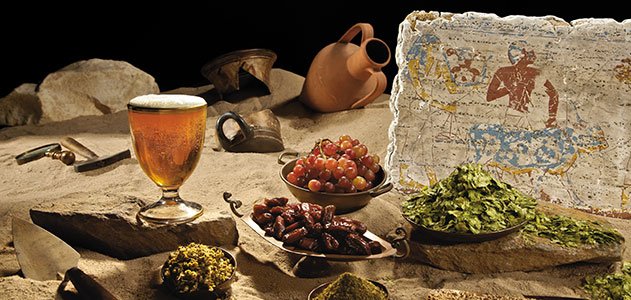
Given the right combination of sugars, nearly any cereal will undergo simple fermentation, due to the presence of wild yeasts in the air.  In all likelihood our cave-dwelling ancestors experienced their first beer, as the result of this process.

In the 18,000-year old Wadi Kubbaniya in upper Egypt, starch dusted stones and the remains of doum-palm and chamomile indicate “it’s very likely they were making beer there” according to University of Pennsylvania archaeologist, Dr. Patrick McGovern.

Chemical analysis of pottery shards date the earliest barley beer to 3400BC in the Zagros Mountains of Iran.

beer-ingredients

Tacitus maligned the bitter brew of the Germanic barbarians.  Wine seemed better suited to the sensibilities of the Roman palate, even so, letters from Roman cavalry commanders of the Roman Britain period, c. 97-103 AD, include requests for more “cerevisia“, for the legionaries.

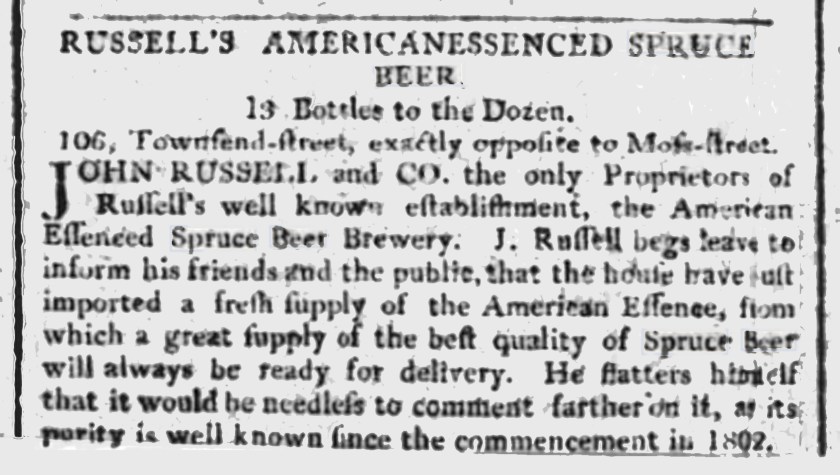
In North and South America, native peoples brewed fermented beverages from local ingredients including agave sap, the first spring tips of the spruce tree, and maize.

Pilgrims left the Netherlands city of Leiden in 1620, hoping not for the frozen, rocky soil of New England, but for rich farmland and a congenial climate in the New World.   Lookouts spotted the wind-swept shores of Cape Cod on November 9, 1620 and may have kept going, had there been enough beer.  A Mayflower passenger wrote in his diary: “We could not now take time for further search… our victuals being much spent, especially our beer…

download (67)

Prior to the invention of the drum roaster in 1817, malt was typically dried over wood, charcoal or straw fires leaving a smoky quality which would seem foreign to the modern beer drinker.  William Harrison wrote in his “Description of England” in 1577, “For the wood-dried malt, when it is brewed, beside that the drink is higher of colour, it doth hurt and annoy the head of him that is not used thereto, because of the smoke“.

Smoky flavor didn’t trouble the true aficionado of the age.  When the Meux Brewery casks let go in 1814 spilling nearly 400,000 gallons onto the street, hundreds of Brits hurried to scoop the stuff up in pots and pans.  Some got down on all fours and lapped it up off of the street, doggy-style.

2926-London-Beer-Flood1

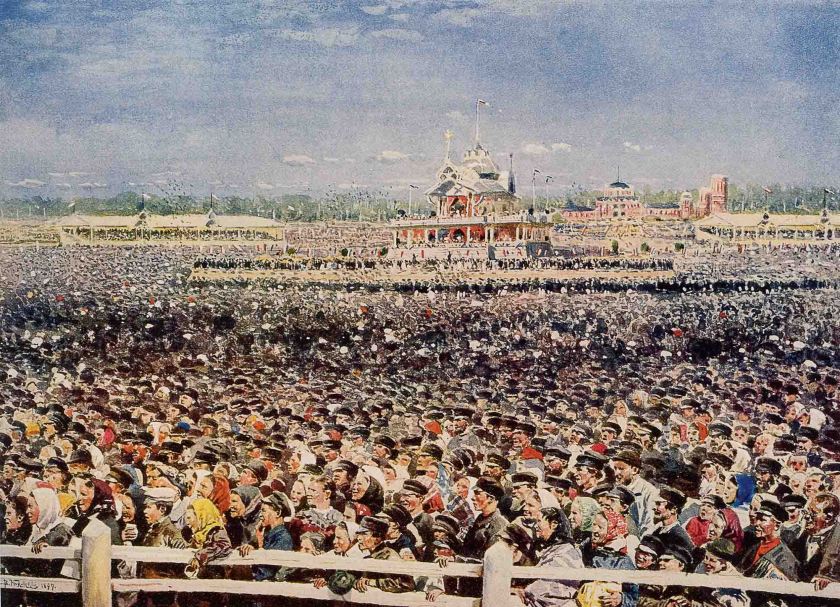
1,389 were trampled to death and another 1,300 injured in a stampede for the suds when someone thought the beer had run out at the coronation of Czar Nicholas II, in 1896.

download (66)

The 18th amendment, better known as “prohibition”, went into effect at midnight, January 16, 1920. For thirteen years it was illegal to import, export, transport or sell liquor, wine or beer in the United States.

Portable stills went on sale within a week, and organized smuggling was quick to follow. California grape growers increased acreage by over 700% over the next five years, selling dry blocks of grapes as “bricks of rhine” or “blocks of port”. The mayor of New York City sent instructions to his constituents, on how to make wine.

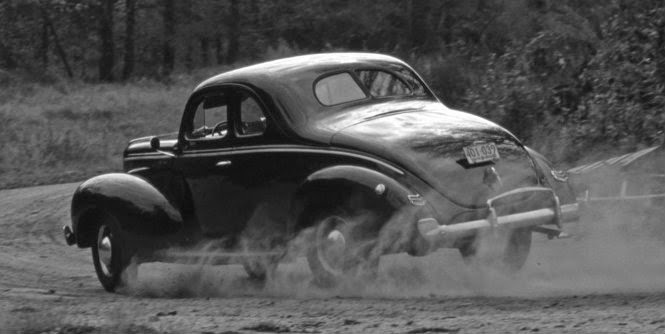
Smuggling operations became widespread as cars were souped up to outrun “the law”. This would lead to competitive car racing, beginning first on the streets and back roads and later moving to dedicated race tracks.  It’s why we have NASCAR, today.

Moonshine-Cars

Organized crime became vastly more powerful due to the influx of enormous sums of cash.  The corruption of public officials was a national scandal.

Gaining convictions became increasingly difficult for breaking a law that everyone hated. There were over 7,000 prohibition related arrests in New York alone between 1921 and 1923.  Only 27 resulted in convictions.

download (65)

The federal government went so far as to deliberately poison denatured alcohol to discourage its “renaturing” resulting in no fewer than 10,000 dead. Even so, the writing was on the wall. Not even poisonous hooch was going to keep the determined reveler, from enjoying a drink.

At last even John D. Rockefeller, Jr., the lifelong teetotaler who contributed $350,000 to the Anti-Saloon League, had to announce support for repeal.

It’s difficult to compare rates of alcohol consumption before and during prohibition.  If death by cirrhosis of the liver is any indication, alcohol consumption never decreased by more than 10 to 20 per cent.

President Franklin Delano Roosevelt signed the Cullen–Harrison Act into law on March 22, 1933 with the quip, “I think this would be a good time for a beer.”  The law went effect on April 7. For the first time in 13 years Americans could once again buy, sell and legally enjoy a beer containing up to 3.2% alcohol.

A team of draft horses hauled a wagon up Pennsylvania Avenue, delivering a case of beer to the White House. It was the first public appearance of the now-famous, Budweiser Clydesdales.

fd3cb0f1f05a3b17a69799cd32a01bcb

“Dry” leaders tried to prohibit consumption of alcohol on military bases in 1941, but authorities claimed it was good for morale. Brewers were required to allocate 15% of total annual production to be used by the armed forces. So essential were beer manufacturers to the war effort that teamsters were ordered to end a labor strike against Minneapolis breweries.  Near the end of WWII, the army made plans to operate recaptured French breweries, to ensure adequate supplies for the troops.

18 states continued prohibition at the state level after national repeal, the last state finally dropping it in 1966. Almost 2/3rds of all states adopted some form of local option, enabling residents of political subdivisions to vote for or against local prohibition.  Some counties remain dry to this day.  Ironically, Lynchburg County, Tennessee, home to the Jack Daniel distillery, is one such dry county.

The night before Roosevelt’s law went into effect was April 6, 1933. Beer lovers lined up at the doors of their favorite watering holes waiting for their first legal beer in thirteen years.  A million and a half barrels of the stuff were consumed the following day, a date remembered to this day as “National Beer Day”.

So it is we remember, from that day to this.  April 6. “New Beer’s Eve”.  

Sláinte.

For every wound, a balm.
For every sorrow, cheer. 
For every storm, a calm.
For every thirst, a beer.

Irish toast, author unknown

April 5, 1761, That Other Ride, You Never Heard About

Listen my children and you shall hear
Of the midnight ride of…Sybil Ludington

“Listen my children and you shall hear,
Of the midnight ride of” …Sybil Ludington.

Wait…What?

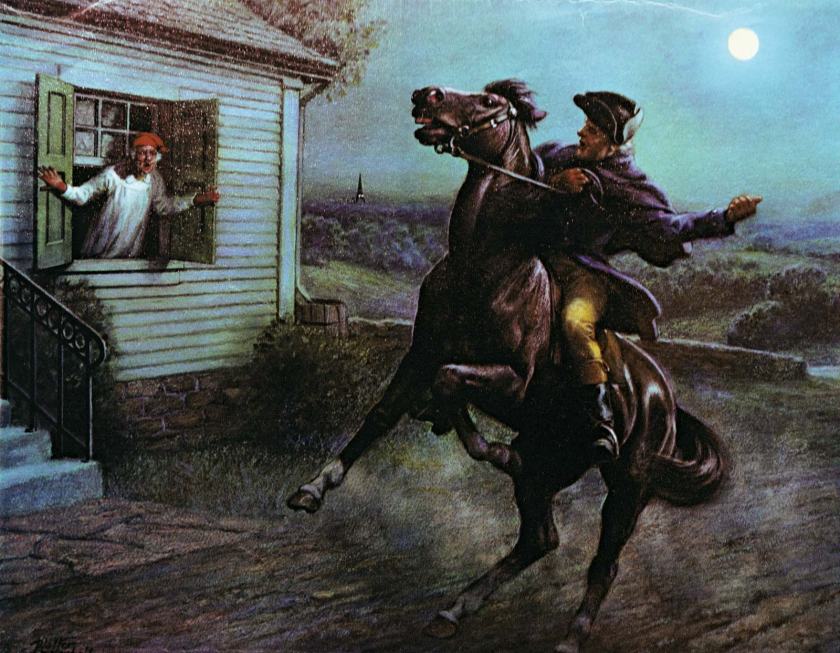
Paul Revere’s famous “midnight ride” began on the night of April 18, 1775.  Revere was one of two riders, soon joined by a third, fanning out from Boston to warn of an oncoming column of “regulars”, come to destroy the stockpile of gunpowder, ammunition, and cannon in Concord.

paul-revereRevere himself covered barely 12 miles before being captured, his horse confiscated to replace the tired mount of a British sergeant.  Revere would finish his “ride” on foot, arriving at sunrise on the 19th to witness the last moments of the battle on Lexington Green.

Two years later, Patriot forces maintained a similar supply depot, in the southwest Connecticut town of Danbury.

William Tryon was the Royal Governor of New York, and long-standing advocate for attacks on civilian targets.  In 1777, Tryon was major-general of the provincial army.  On April 25th, the General set sail for the Connecticut coast of Long Island Sound with a force of 1,800, intending to destroy Danbury.

Battle3

Patriot Colonel Joseph Cooke’s small Danbury garrison was caught and quickly overpowered on the 26th, trying to remove food supplies, uniforms, and equipment.  Facing little if any opposition, Tryon’s forces went on a bender, burning homes, farms and storehouses.  Thousands of barrels of pork, beef, and flour were destroyed, along with 5,000 pairs of shoes, 2,000 bushels of grain, and 1,600 tents.

Colonel Henry Ludington was a farmer and father of 12, with a long military career.  A long-standing and loyal subject of the British crown, Ludington switched sides in 1773, joining the rebel cause and rising to command the 7th Regiment of the Dutchess County Militia, in New York’s Hudson Valley.

908d9d26ffc8bb0c9e8a59b25da92429--american-revolutionary-war-paul-revere

In April 1777, Ludington’s militia was disbanded for planting season, and spread across the countryside.  An exhausted rider arrived at the Ludington farm on a blown horse, on the evening of the 26th, asking for help.  15 miles away, British regulars and a force of loyalists were burning Danbury to the ground.

The Dutchess County Militia had to be called up.  The Colonel had one night to prepare for battle, and this rider was done.  The job would have to go to Colonel Ludington’s first-born, his daughter, Sybil.

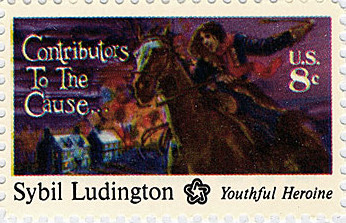
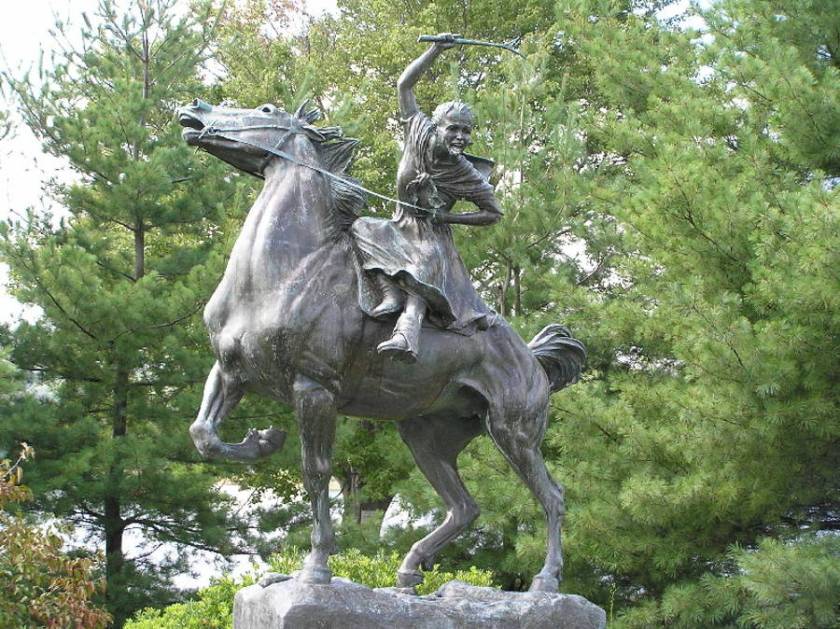
Born April 5, 1761, Sybil Ludington was barely sixteen at the time of her ride.  From Poughkeepsie to what is now Putnam County and back, the “Female Paul Revere” rode across the lower Hudson River Valley, covering 40 miles in the pitch dark of night, alerting her father’s militia to the danger and urging them to come out and fight.  She’d use a stick to knock on doors, even using it once, to fight off a highway bandit.

By the time Sybil returned the next morning, cold, rain-soaked, and exhausted, most of 400 militia were ready to march.

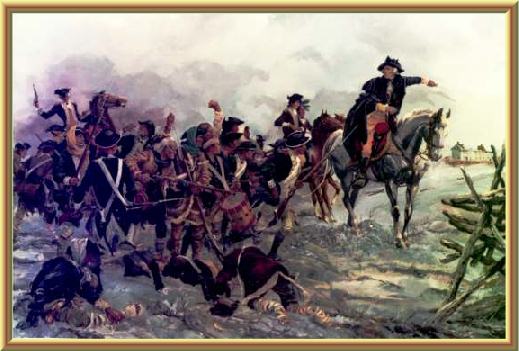
Arnold’s forces arrived too late to save Danbury, but inflicted a nasty surprise on the British rearguard as the column approached nearby Ridgefield.  Never outnumbered by less than three-to-one, Connecticut militia was able to slow the British advance until Ludington’s New York Militia arrived on the following day.  The last phase of the action saw the same type of swarming harassment, as seen on the British retreat from Concord to Boston, early in the war.35 miles to the east of Danbury, General Benedict Arnold was gathering a force of 500 regular and irregular Connecticut militia, with Generals David Wooster and Gold Selleck Silliman.

Though the British operation was a tactical success, the mauling inflicted by these colonials ensured that this was the last hostile British landing on the Connecticut coast.

The British raid on Danbury destroyed at least 19 houses and 22 stores and barns.  Town officials submitted £16,000 in claims to Congress, for which town selectmen received £500 reimbursement.  Further claims were made to the General Assembly of Connecticut in 1787, for which Danbury was awarded land.  In Ohio.

Keeler_tavern_ridgefield_cannonball_2006

At the time, Benedict Arnold planned to travel to Philadelphia, to protest the promotion of officers junior to himself, to Major General.  Arnold, who’d had two horses shot out from under him at Ridgefield, was promoted to Major General in recognition for his role in the battle.  Along with that promotion came a horse, “properly caparisoned as a token of … approbation of his gallant conduct … in the late enterprize to Danbury.”  For now, the pride which would one day be his undoing, was assuaged.The Keeler Tavern in Ridgefield is now a museum.  The British cannonball fired into the side of the building, remains there to this day.

Henry Ludington would become Aide-de-Camp to General George Washington, and grandfather to Harrison Ludington, mayor of Milwaukee and 12th Governor of Wisconsin.

Gold Silliman was kidnapped with his son by a first marriage by Tory neighbors, and held for Nearly seven months at a New York farmhouse.  Having no hostage of equal rank with whom to exchange for the General, Patriot forces went out and kidnapped one of their own, in the person of Chief Justice Judge Thomas Jones, of Long Island.

Sybil_Ludington_stamp

Mary Silliman was left to run the farm, including caring for her own midwife, who was brutally raped by English forces for denying them the use of her home.  The 1993 made-for-TV movie “Mary Silliman’s War” tells the story of non-combatants, pregnant mothers and farm wives during the Revolution, as well as Mary’s own negotiations for her husband’s release from his Loyalist captors.

IMG_6632General David Wooster was mortally wounded at the Battle of Ridgefield, moments after shouting “Come on my boys! Never mind such random shots!”  Today, an archway marks the entrance to Wooster Square, in the East Rock Neighborhood of New Haven. 

Sybil Ludington received the thanks of family and friends and even that of George Washington.  She then stepped off the pages of history.

Paul Revere’s famous ride would have likewise faded into obscurity, but for the poetry of Henry Wadsworth Longfellow.  Eighty-six years, later.

Page break

“Listen my children and you shall hear
Of the midnight ride of Paul Revere,
On the eighteenth of April, in Seventy-five;
Hardly a man is now alive
Who remembers that famous day and year. He said to his friend, “If the British march
By land or sea from the town to-night,
Hang a lantern aloft in the belfry arch
Of the North Church tower as a signal light,–
One if by land, and two if by sea;
And I on the opposite shore will be,
Ready to ride and spread the alarm
Through every Middlesex village and farm,
For the country folk to be up and to arm. ”Then he said “Good-night!” and with muffled oar
Silently rowed to the Charlestown shore,
Just as the moon rose over the bay,
Where swinging wide at her moorings lay
The Somerset, British man-of-war;
A phantom ship, with each mast and spar
Across the moon like a prison bar,
And a huge black hulk, that was magnified
By its own reflection in the tide. Meanwhile, his friend through alley and street
Wanders and watches, with eager ears,
Till in the silence around him he hears
The muster of men at the barrack door,
The sound of arms, and the tramp of feet,
And the measured tread of the grenadiers,
Marching down to their boats on the shore. Then he climbed the tower of the Old North Church,
By the wooden stairs, with stealthy tread,
To the belfry chamber overhead,
And startled the pigeons from their perch
On the sombre rafters, that round him made
Masses and moving shapes of shade,–
By the trembling ladder, steep and tall,
To the highest window in the wall,
Where he paused to listen and look down
A moment on the roofs of the town
And the moonlight flowing over all. Beneath, in the churchyard, lay the dead,
In their night encampment on the hill,
Wrapped in silence so deep and still
That he could hear, like a sentinel’s tread,
The watchful night-wind, as it went
Creeping along from tent to tent,
And seeming to whisper, “All is well!”
A moment only he feels the spell
Of the place and the hour, and the secret dread
Of the lonely belfry and the dead;
For suddenly all his thoughts are bent
On a shadowy something far away,
Where the river widens to meet the bay,–
A line of black that bends and floats
On the rising tide like a bridge of boats. Meanwhile, impatient to mount and ride,
Booted and spurred, with a heavy stride
On the opposite shore walked Paul Revere.
Now he patted his horse’s side,
Now he gazed at the landscape far and near,
Then, impetuous, stamped the earth,
And turned and tightened his saddle girth;
But mostly he watched with eager search
The belfry tower of the Old North Church,
As it rose above the graves on the hill,
Lonely and spectral and sombre and still.
And lo! as he looks, on the belfry’s height
A glimmer, and then a gleam of light!
He springs to the saddle, the bridle he turns,
But lingers and gazes, till full on his sight
A second lamp in the belfry burns.A hurry of hoofs in a village street,
A shape in the moonlight, a bulk in the dark,
And beneath, from the pebbles, in passing, a spark
Struck out by a steed flying fearless and fleet;
That was all! And yet, through the gloom and the light,
The fate of a nation was riding that night;
And the spark struck out by that steed, in his flight,
Kindled the land into flame with its heat.
He has left the village and mounted the steep,
And beneath him, tranquil and broad and deep,
Is the Mystic, meeting the ocean tides;
And under the alders that skirt its edge,
Now soft on the sand, now loud on the ledge,
Is heard the tramp of his steed as he rides. It was twelve by the village clock
When he crossed the bridge into Medford town.
He heard the crowing of the cock,
And the barking of the farmer’s dog,
And felt the damp of the river fog,
That rises after the sun goes down. It was one by the village clock,
When he galloped into Lexington.
He saw the gilded weathercock
Swim in the moonlight as he passed,
And the meeting-house windows, black and bare,
Gaze at him with a spectral glare,
As if they already stood aghast
At the bloody work they would look upon. It was two by the village clock,
When he came to the bridge in Concord town.
He heard the bleating of the flock,
And the twitter of birds among the trees,
And felt the breath of the morning breeze
Blowing over the meadow brown.
And one was safe and asleep in his bed
Who at the bridge would be first to fall,
Who that day would be lying dead,
Pierced by a British musket ball. You know the rest. In the books you have read
How the British Regulars fired and fled,—
How the farmers gave them ball for ball,
From behind each fence and farmyard wall,
Chasing the redcoats down the lane,
Then crossing the fields to emerge again
Under the trees at the turn of the road,
And only pausing to fire and load. So through the night rode Paul Revere;
And so through the night went his cry of alarm
To every Middlesex village and farm,—
A cry of defiance, and not of fear,
A voice in the darkness, a knock at the door,
And a word that shall echo for evermore!
For, borne on the night-wind of the Past,
Through all our history, to the last,
In the hour of darkness and peril and need,
The people will waken and listen to hear
The hurrying hoof-beats of that steed,
And the midnight message of Paul Revere”.
ludington-statue.jpg

Founding Mother
Fatherless at age three and orphaned at twelve, Mary Ball learned a sense of independence, at an early age. She was wed at age 22 in a “semi-arranged” marriage by her guardian, George Eskridge. Mary’s first and only husband was Augustine “Gus” Washington, father to six children, borne of the union. Gus died when the eldest was only eleven and Mary thirty-five, leaving Mary to raise Eskridge’ namesake and four surviving siblings, alone. Today, little is written about Martha Ball Washington, a woman whose personal strength of character taught her son to lead, by example. Eleven-year-old George would grow to become a General in the cause of Liberty and first President of the United States, a man who himself died childless whom we remember today as “Father of the Country”, George Washington

March 31, 2005 Arlington Ladies

The job of the Arlington Ladies is to honor, not to grieve, but it doesn’t always work out that way.  Linda Willey of the Air Force Ladies describes the difficulty of burying Pentagon friends after 9/11, while pieces of debris yet littered the cemetery.

The first military burial at Arlington National Cemetery was that of Private William Henry Christman, 67th Pennsylvania Infantry, interred on May 13, 1864. Two more joined Christman that day, the trickle soon turning into a flood. By the end of the war between the states, that number was 17,000 and rising.

In modern times, an average week will see 80 to 100 burials in the 612 acres of Arlington.

1200px-SMA_Dunway_Burial_at_Arlington_National_Cemetery_2008In 2005, a news release from the Department of Defense reported “Private First Class Michael A. Arciola, 20, of Elmsford, New York, died February 15, 2005, in Al Ramadi, Iraq, from injuries sustained from enemy small arms fire. Arciola was assigned to the 1st Battalion, 503d Infantry Regiment, 2nd Infantry Division, Camp Casey, Korea”.
Private Arciola joined a quarter-million buried in our nation’s most hallowed ground on March 31. Two hundred or more mourners attended his funeral, a tribute befitting the tragedy of the loss of one so young.

9917514_f520

Sixteen others were buried in Arlington that Friday, most considerably older. Some brought only a dozen or so mourners. Others had no friends or family members whatsoever on-hand, to say goodbye.

Save for a volunteer, from the Arlington Ladies.
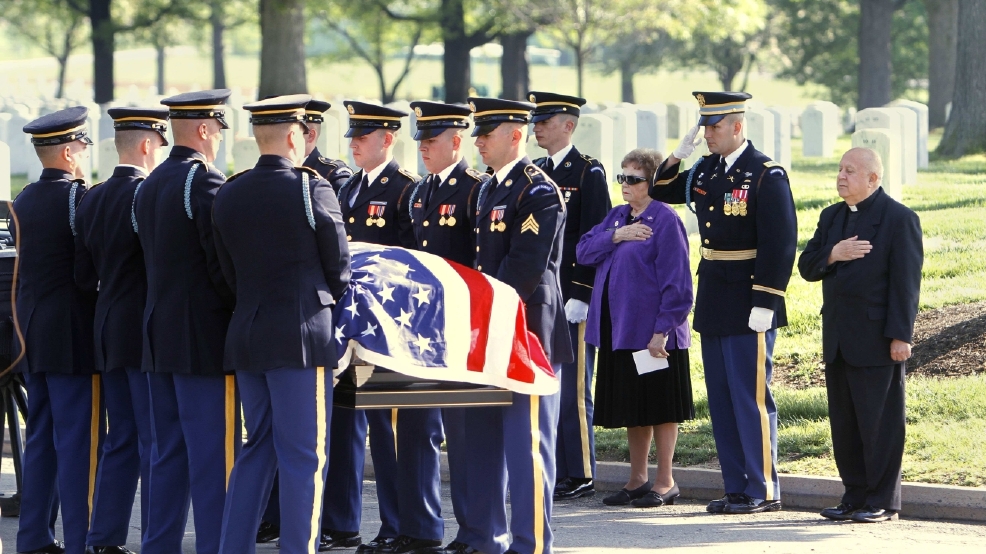
In 1948, Air Force Chief of Staff General Hoyt Vandenberg and the general’s wife Gladys made a practice of attending military funeral services at Arlington National Cemetery.

nn_lho_arlington_ladies_180102_1920x1080.nbcnews-fp-1200-630Sometimes, a military chaplain was the only one present at these services. Both Vandenbergs felt that a member of the Air Force family should be present at these funerals.  Gladys began to invite other officer’s wives. Over time, a group of women from the Officer’s Wives Club were formed for the purpose.
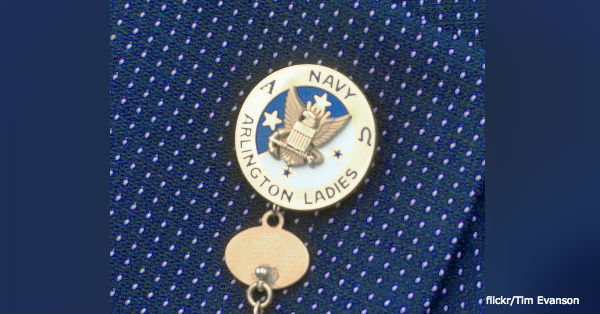
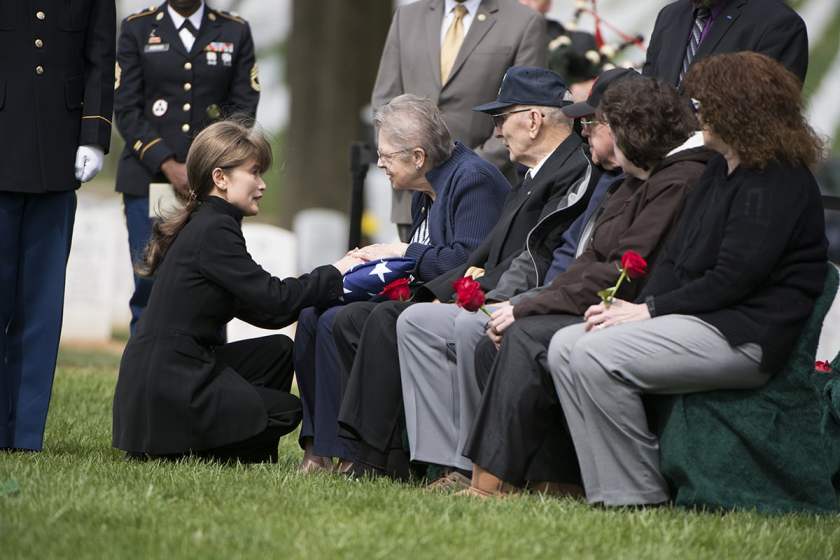
In 1973, General Creighton Abrams’ wife Julia did the same for the Army forming a group calling themselves “Arlington Ladies”. Groups of Navy and Coast guard wives followed suit, in 1985 and 2006.

Traditionally, the Marine Corps Commandant sends an official representative of the Corps to all Marine funerals.  The Marine Corps Arlington Ladies were formed in 2016.

Arlington Ladies’ Chairman Margaret Mensch explained “We’ve been accused of being professional mourners, but that isn’t true. I fight that perception all the time. What we’re doing is paying homage to Soldiers who have given their lives for our country.”

arlington_lady_joayn_bahr_at_funeral_es_053011The casual visitor cannot help but being struck with the solemnity of such an occasion. Air Force Ladies’ Chairman Sue Ellen Lansell spoke of one service where the only other guest was “one elderly gentlemen who stood at the curb and would not come to the grave site. He was from the Soldier’s Home in Washington, D. C. One soldier walked up to invite him closer, but he said no, he was not family”.

The organization was traditionally formed of current or former military wives. Today their number includes daughters and even one “Arlington Gentleman”. 46 years ago they came alone, or in pairs. Today, 145 or so volunteers from four military branches are a recognized part of all funeral ceremonies at Arlington National Cemetery, their motto: “No Soldier will ever be buried alone.”

arlington-ladies2

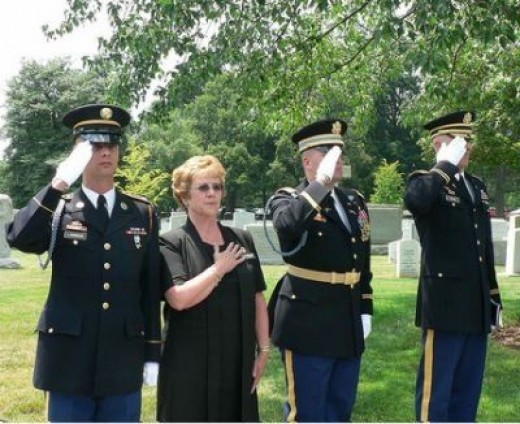
The volunteer arrives with a military escort from the Navy or the United States Army 3rd Infantry Regiment, the “Old Guard”. The horse-drawn caisson arrives from the old post chapel, carrying the flag draped casket. Joining the procession, she will quietly walk to the burial site, her arm inside that of her escort. A few words are spoken over the deceased, followed by the three-volley salute. Off in the distance, a solitary bugler sounds Taps.

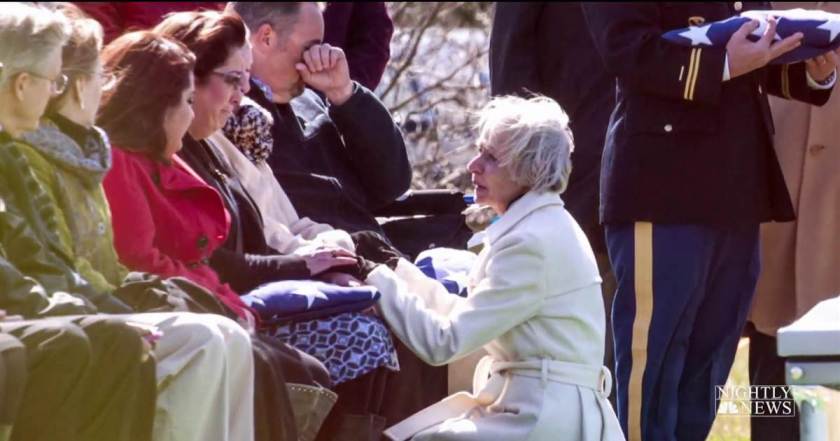
The folded flag is presented to the grieving widow, or next of kin. Only then will she break her silence, stepping forward with a word of condolence and two cards: one from the service branch Chief of Staff and his wife and a second, from herself.

Arlington-Ladies-2 (1)

Joyce Johnson buried her husband Lieutenant Colonel Dennis Johnson in 2001, a victim of the Islamist terrorist attack on the Pentagon. Johnson remembers the Arlington Ladies’ volunteer as “a touchingly, human presence in a sea of starched uniforms and salutes”. Three years later, Joyce Johnson paid it forward, and became one herself.

Any given funeral may be that of a young military service member killed in service to the nation, or a veteran of Korea or WWII, who spent his last days in the old soldier’s home. It could be a four-star General or a Private. It matters not a whit.

“We’re not professional mourners. We’re here because we’re representing the Air Force family and because, one day, our families are going to be sitting there in that chair”. – Sandra Griffin, Air Force volunteer, Arlington Ladies

Individual volunteers attend about five funerals a day, sometimes as many as eight. As with the Tomb of the Unknown sentinels who hold their vigil heedless of weather, funeral services pay no mind, to weather conditions. The funeral will proceed on the date and time scheduled irrespective of rain, snow or heat. Regardless of weather, an Arlington Lady Will be in attendance.

The job of the Arlington Ladies is to honor, not to grieve, but it doesn’t always work out that way.  Linda Willey of the Air Force Ladies describes the difficulty of burying Pentagon friends after 9/11, while pieces of debris yet littered the cemetery. Paula McKinley of the Navy Ladies still chokes up, over the hug of a ten-year old girl who had just lost both parents. Margaret Mensch speaks of the heartbreak of burying one of her own young escorts after he was killed in Afghanistan, in 2009.

Barbara Benson was herself a soldier, an Army flight nurse during WWII. She is the longest serving Arlington Lady. “I always try to add something personal”, Benson said, “especially for a much older woman. I always ask how long they were married. They like to tell you they were married 50 or 60 years…I don’t know how to say it really, I guess because I identify with Soldiers. That was my life for 31 years, so it just seems like the natural thing to do.”

1000w_q95 (2)

Elinore Riedel was chairman of the Air Force Ladies during the War in Vietnam, when none of the other military branches had women representatives. “Most of the funerals were for young men,” she said. “I saw little boys running little airplanes over their father’s coffins. It is a gripping thing, and it makes you realize the awful sacrifices people made. Not only those who died, but those left behind.”

Mrs. Reidel is a minister’s daughter, who grew up watching her father serve those in need. “It doesn’t matter whether you know a person or not”, she said, “whether you will ever see them again. It calls upon the best in all of us to respond to someone in deep despair. I call it grace…I honestly feel we all need more grace in our lives.”

1140-sandra-griffin-ladies-of-arlington.imgcache.rev1477409052107 (1)
23-year veteran of the United States Air Force Sandra Griffin, now serves as an Arlington Lady.

I dedicate this “Today in History” to the man for whom I am namesake. The man who gave me the love for history you see, on these pages. United States Army Lieutenant Colonel (retired) Richard B. “Rick” Long, Sr., 2/25/37 – 3/31/18.

Rest In Peace, Dad. You left us too soon.

March 30, 1945 A Great Act of Defiance

“First they came for the socialists, and I did not speak out—because I was not a socialist. Then they came for the trade unionists, and I did not speak out— because I was not a trade unionist. Then they came for the Jews, and I did not speak out—because I was not a Jew. Then they came for me—and there was no one left to speak for me”. – Martin Niemöller

We shall go on to the end. We shall fight in France, we shall fight on the seas and oceans, we shall fight with growing confidence and growing strength in the air, we shall defend our island, whatever the cost may be. We shall fight on the beaches, we shall fight on the landing grounds, we shall fight in the fields and in the streets, we shall fight in the hills; we shall never surrender, and if, which I do not for a moment believe, this island or a large part of it were subjugated and starving, then our Empire beyond the seas, armed and guarded by the British Fleet, would carry on the struggle, until, in God’s good time, the New World, with all its power and might, steps forth to the rescue and the liberation of the old”.

Winston Churchill
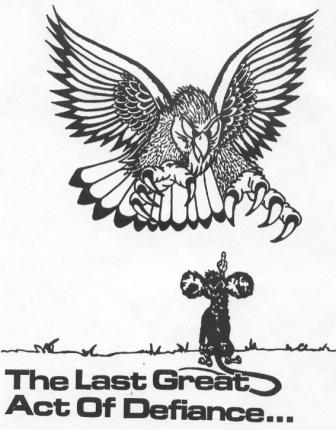
last_great_act_of_defiance1

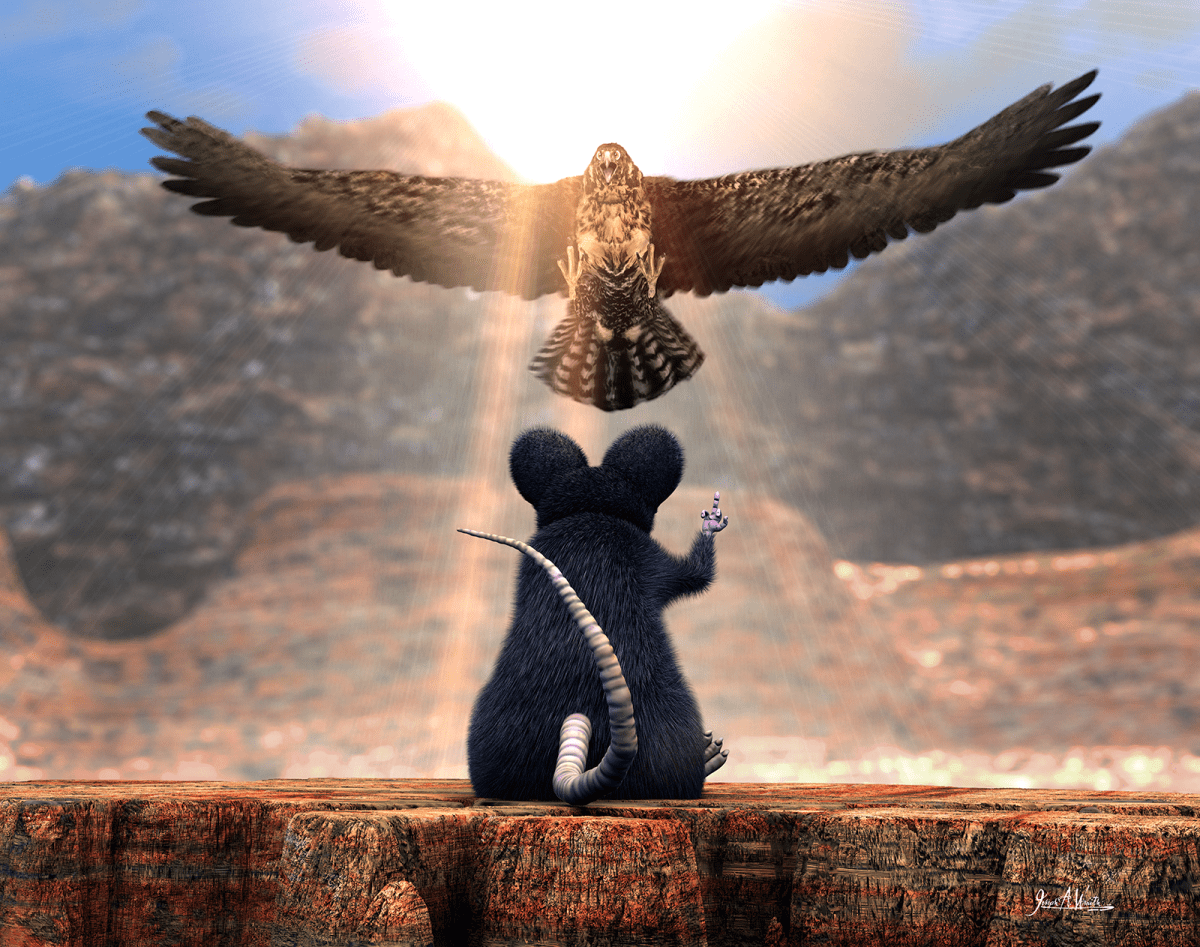
Before the age of the internet,  office jokes and bits of folk wisdom were passed around and copied, and copied again.  “The Last great of Defiance“ was one of those and shall live for all time, as my personal favorite. 

The image speaks for itself.  I had one on the wall, for years. This is one of those stories.

The last great effort of German arms burst out of the frozen Ardennes forest on December 16, 1944, aiming for the vital port at Antwerp.

Unternehmen Wacht am Rhein“, (“Operation Watch on the Rhine”) was a tactical surprise for the Wehrmacht, as allied forces were driven back through the densely forested regions of France, Belgium and Luxembourg. Wartime news maps showed a great inward “bulge” in the lines, and the name stuck. The Battle of the Bulge was the largest and bloodiest battle fought by American forces in World War 2, fought in the harshest winter conditions in recorded history and involving some 610,000 GIs.

malmed1

Prisoners were swept up by the thousands, to face an uncertain future.  In Malmedy, Belgium, seventy-five captured Americans were marched into an open field and machine gunned by members of the 1st SS Panzer Division (Leibstandarte Adolf Hitler), a part of 6th Panzer Army.

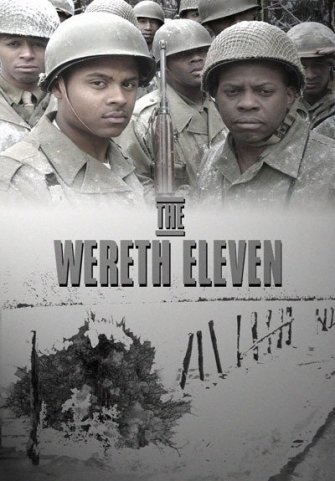
On December 16, the all-black 333rd Field Artillery Battalion of the racially segregated US Army put up an heroic defense outside the town of Wereth, Belgium. Using 155mm guns to delay the German advance they were desperately outnumbered. The 333rd was overrun the following day, groups of men scattering to escape as best they could. Eleven soldiers made their way to the home of Mathias Langer, the Mayor of Wereth.

To shelter allied troops under German occupation was to risk summary execution. Despite the obvious risk to their own lives, Matthias and his wife Maria took these men in and attempted to hide them, in their home. When German troops arrived, the eleven surrendered rather than risk the lives of their benefactors.

the-wereth-eleven-578359l
Movie poster for the 2011 film, “The Wereth Eleven”

The prisoners were marched out of sight and murdered by German troops. Every one of them. Lost in the confusion of the Bulge, the bodies of the Wereth 11 lay hidden under the snow, until the Spring melt. For the next fifty years their story was lost, to history.

Nazi atrocities were not limited to Allied troops.  By some accounts, more civilians were killed during the Battle of the Bulge than anytime. in the last four years.  When the fighting was over, more than 115 bodies were found in the towns of Ster and Parfondruy, alone.

For Master Sargent Roderick “Roddie” Edmonds, the war ended on December 19, swept up with hundreds of American troops and taken prisoner.  These were the lucky ones, escaping those first white-hot moments of capture to be sent to a German prisoner-of-war camp.  Edmonds was later transferred to another camp near Ziegenhain, Germany.  At 24, M/Sgt Roddie Edmonds was now the senior non-commissioned officer at Stalag IX-A, responsible for 1,275 American POWs.

The Wehrmacht had harsh anti-Jewish policies and kept Jewish POWs in strict segregation.  In the East, Russian Jews who became POWs were sent directly to extermination camps.  In the west the future was more uncertain, for Jewish POWs.  Many of them were worked to death, in slave labor camps.

Home_Slider_Image-1024x666

On January 27, the first day at Stalag IX-A, commandant Siegmann ordered Edmonds: All American Jews were to identify themselves at the following day’s assembly.  The word went out to all five barracks:  “We’re not doing that.  We’re all turning out“.

The following morning, 1,275 POWs presented themselves.  Every. Single. Man.

Siegmann was perplexed.  “They can’t all be Jews!”  As senior NCO, Edmonds spoke for the group.  “We’re all Jews here“.  The Nazi commandant was apoplectic, pressing a Luger into Edmonds’ forehead.  This is your last chance.

Imagine yourself in this situation and ponder, what would you do?

Edmonds gave his name, rank and serial number. :  ‘If you are going to shoot’, he said, ‘ you are going to have to shoot all of us because we know who you are and you’ll be tried for war crimes when we win this war.’”  Siegmann was incandescent, white with rage, but the moment had passed.  He was beaten.

The 1,275 American POWs held at Stalag IX-A were liberated on March 30, 1945, their number including some 200 Jews.

Years later the Army called once again and Roddie Edmonds was recruited, for the war in Korea.  He never told his family a word about what happened, at Stalag IX-A.

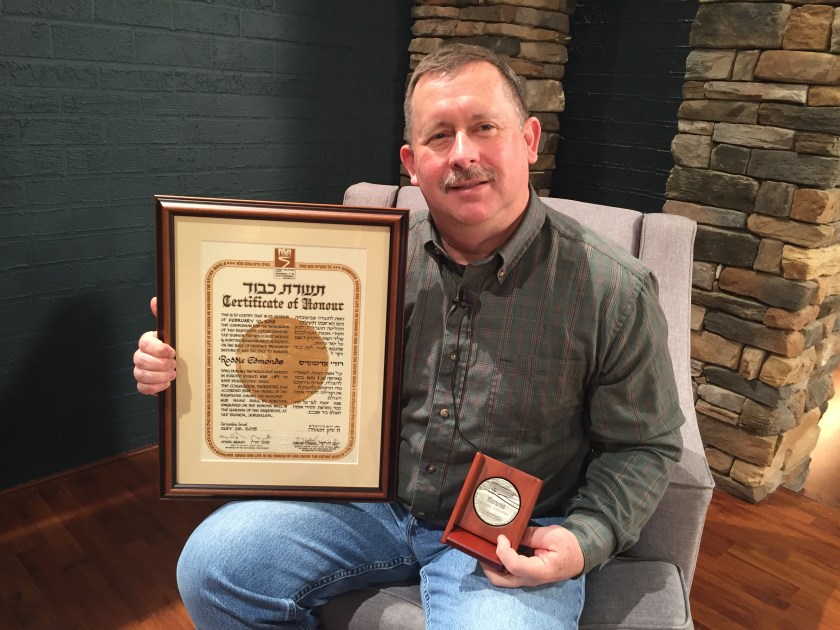
Chris Edmonds is the Pastor at Piney Grove Baptist Church in Maryville, Tennessee. Following his father’s death in 1985, Chris’ mother gave him his father’s  war diary, where he found a brief mention of this story.  Chris scoured the news for more information, around the time Richard Nixon was looking for his post-Presidential home.  As it happened, Nixon bought his posh, upper-east side home from Lester Tanner, a prominent New York Lawyer who mentioned in passing, he owed his life to Roddie Edmonds.

So it is, this story came to light.  In 2015, Edmonds was honored as “Righteous among the Nations”, the first American soldier, so honored.  It’s the highest honor bestowed by the state of Israel, on non-Jews who risked their lives to save Jews from the Nazi death machine.  President Barack Obama recognized Edmonds’ heroism in a 2016 speech before the Israeli embassy.  In 2017 Tennessee Senator Marsha Blackburn led a bipartisan effort to bestow the Congressional Gold Medal. 

Pastor Edmonds and the Jewish veterans saved by M/Sgt Edmonds continue to push for the Knoxville, Tennessee native to receive the Medal of Honor. Pastor Edmonds says he always looked up to his father, the man had always been, his hero.  “I just didn’t know he had a cape in his closet“.

Chris Edmonds_1455424082776_247114_ver1.0.JPG

Pastor Chris Edmonds