

Historic accounts differ as to the early success of the Islamic conquests. Contemporary Christian sources saw them as God’s punishment for the sins of fellow Christians. Early Muslim sources describe the rising empire as evidence of divine favor, reflections of the religious zeal of the conquerors.
Be that is it may, Islamic expansion enveloped the Arabian Peninsula in the last ten years of the life of Muhammad (622-632), at the expense of the Roman Byzantines and the Sassanid Empire of the Persians. Syria fell in 634, followed by Egypt, Mesopotamia and Persia. By 750, the Umayyad Caliphs had subjugated much of the Balkan states, part of the Indian sub-continent, all of North Africa, most of Spain, and parts of Southern France and Sicily. By the age of Columbus, the Mediterranean was a place where you traveled at your own risk.
Those of us of European ancestry owe our heritage, if not our existence, to the Christian warriors who defeated the Jihadist time after time. There was Pelagius, who stopped a military force of the Umayyad Caliphate at Covadonga in 722, without which there would be no Reconquista, no Ferdinand and Isabella, and we wouldn’t know the name of Christopher Columbus.
The father of Charlemagne, Charles “The Hammer” Martel, blocked the Muslim advance into Western Europe at the Battle of Tours, in 732.

If Marcantonio Bragadin is remembered at all, it is for being betrayed, tortured and skinned alive by Lala Mustafa Pasha. Yet, it is Bragadin’s stubborn defense of the eastern Mediterranean outpost of Famagusta in 1571, which gave European principalities time to assemble naval forces in numbers sufficient to defend the European coast, near a place called Lepanto.
The 1683 Siege of Vienna, at the crossroads of eastern and western Europe, was a hard fought contest which could have gone either way, until the arrival of a Polish army under King Jan Sobieski. The Ottomans were defeated and turned back from the conquest of Eastern Europe by the largest cavalry charge in all of history, 18,000 horsemen of the Polish King and the Holy Roman Emperor, thundering down the hill and into the lines of Mustafa Pasha.

Throughout the period, “Saracens” plundered everything that could be carried away: animals, provisions, fabrics, precious metals and money: especially men, women and children who could be sold for a good price at the slave markets. Redemption of captives being among the corporal works of mercy, the “Mathurins” Order of the Holy Trinity was founded in 1198 for the purpose of paying the ransom of Christians held captive by non-Christians, as a consequence of crusading and pirating along the southern European coastline.
Even Ireland, with its northern latitude, wasn’t immune to such raids. The renegade Dutchman-turned Barbary pirate Murat Reis attacked the village of Baltimore in County Cork, in 1631. With him were pirates from Algiers and armed troops of the Ottoman Empire, who captured all the villagers they could find, taking 107 away to the slave markets of North Africa. Years later, three women were ransomed and returned to Ireland. The rest lived out their lives as slaves, or locked away in harems or inside the walls of the sultan’s palace.

Sidi Muhammad ibn Abdallah, Sultan of Morocco, opened his ports to trade with the fledgling United States in 1777, making Morocco the first country whose head of state publicly recognized the United States. Abdallah saw the future for his country in foreign trade, and actively sought a treaty relationship with the US, well before war ended with Great Britain. The treaty signed by Thomas Barclay and Sultan Muhammad III in 1786 and ratified by the Confederation Congress the following July is still in effect today, the longest continuous treaty relationship in United States history.
Diplomacy had succeeded with Morocco, but not with Algiers, Tunis or Tripoli, each of which demanded $660,000 in tribute.
Algeria captured the schooners Maria and Dauphin in 1785, the captured crews held in conditions of slavery for over a decade. The sum negotiated for their release exceeded $1 million, more than 1/6th the entire budget of the United States. Eleven American ships were captured in 1793 alone, their crews and stores held for ransom.
Yusuf Karamanli, Pasha of Tripoli, demanded $225,000 in tribute on President Jefferson’s inauguration, in 1801. At this time, Federal revenues were barely over $10 million. Jefferson refused, resulting in the first Barbary War, a conflict memorialized in a line from the Marine Corps Hymn “From the Halls of Montezuma to the Shores of Tripoli”.
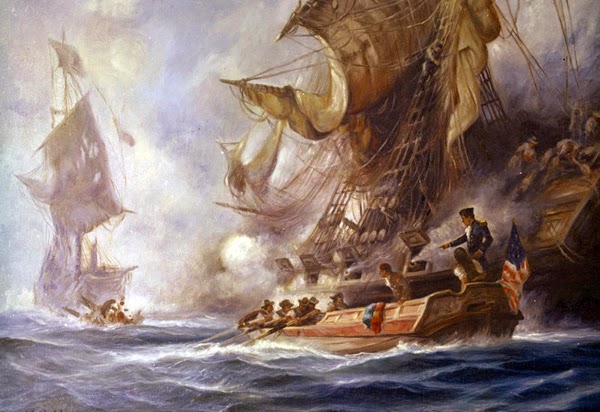
Limited to small confrontations for the first two years, more sustained combat began in June 1803 when a small American force attacked Tripoli Harbor in modern Libya.
While giving chase and firing on a pirate vessel, USS Philadelphia ran aground on an uncharted reef, two miles outside of Tripoli. Fearing the 1,240 ton, 36-gun frigate would be captured and added to the Tripolitan navy, Lieutenant Stephen Decatur led a daring expedition into Tripoli harbor to destroy the captured vessel.
 On the evening of February 16, 1804, Decatur entered Tripoli Harbor with a force of 74 Marines. With them were five Sicilian volunteers, including pilot Salvador Catalano, who spoke fluent Arabic. Disguised as Maltese sailors and careful not to draw fire from shore batteries, Decatur’s force boarded the frigate, killing or capturing all but two of its Tripolitan crew. Decatur and his marines had hoped to sail Philadelphia out of harbor, but soon found she was in no condition to leave. Setting combustibles about the deck, they set the frigate ablaze. Ropes burned off, setting the Philadelphia adrift in the harbor. Loaded cannon cooked off as the blaze spread, firing random balls into the town. It must have been a sight, when gunpowder stores ignited and the entire ship exploded.
By that time Decatur and his men had slipped away, without the loss of a single man. Even a former adversary couldn’t help but admire the feat. Days later, British Vice Admiral Lord Horatio Nelson called Decatur’s raid the “most bold and daring act of the age.”


 Mickey Dugan was born on February 17, 1895, on the wrong side of the tracks. A wise-cracking street urchin with a “sunny disposition”, Mickey was the kind of street kid you’d find in New York’s turn-of-the-century slums, maybe hawking newspapers. “Extra, Extra, read all about it!”
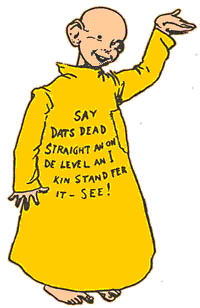 Outcault’s “Hogan’s Alley” strip, one of the first regular Sunday newspaper cartoons in the country, became colorized in May of 1895. For the first time, Mickey Dugan’s oversized, hand-me-down nightshirt was depicted in yellow. Soon, the character was simply known as “the Yellow kid”.
 We hear a lot today about “fake news”, but that’s nothing new. Circulation wars were white hot in those days, competing newspapers using anything possible to get an edge. Real-life street urchins hawked lurid headlines, heavy on scandal-mongering and light on verifiable fact. Whatever it took, to increase circulation.




 The problem was, the Pope refused to grant the divorce. Henry launched the Reformation so that he could divorce his wife and marry this young girl from Kent, getting his divorce the following year and going on to become Supreme Head of the Church of England.
 Anne of Cleaves would be wife #4, an arranged marriage with a German Princess intended to secure an alliance with the other major Protestant power on the continent, especially after England’s break with Rome over that first divorce. Henry was put off by her appearance however, apparently believing himself to be quite the prize. The marriage went unconsummated. They were amicably divorced after 6 months.




 Elbridge Gerry was born in 1744, in the north shore Massachusetts town of Marblehead. Gerry spent most of his adult life in public office, excepting a ten-year period in the family codfish packing business. First elected to the state legislature in 1772, Gerry died in office in 1814, while serving as Vice President under President James Madison.
 Benjamin Russell was a newspaper editor, and ardent Federalist. The painter Gilbert Stuart commented on the new district map hanging over Russell’s desk, saying “That will do for a salamander.” “Better say a Gerry-mander!” was Russell’s reply. A cartoonist added head, wings, and claws. The cartoon map and the name appeared in the Boston Gazette within the month.
 In the 1960s, gerrymandering was used to “crack” the voting strength of black and urban voters. A 1962 Supreme Court decision ruled that electoral districts must reflect the principle of “one man, one vote”. A 1985 decision ruled it unconstitutional to alter election districts to favor of any political party.
 Here in the home of the Gerrymander, Barney Frank’s old 4th congressional district resembles nothing so much as a grasping hand. I’m not sure if the new congressional map is much of an improvement, but hey. It seems to work for the ruling class.


 Spitballs lessened the natural friction with a pitcher’s fingers, reducing backspin and causing the ball to drop. Sandpapered, cut or scarred balls tended to “break” to the side of the scuff mark.
 Submarine pitches are not to be confused with the windmill underhand pitches we see in softball. Submarine pitchers throw side-arm to under-handed, their upper bodies so low that some of them scuff their knuckles on the ground, the ball rising as it approaches the strike zone.
 29-year-old Ray Chapman had said this was his last year playing ball. He wanted to spend more time in the family business he had just married into. The man was right. Raymond Johnson Chapman died 12 hours later, the only player in the history of Major League Baseball, to die from injuries sustained during a game.
 In a world where classified government information is kept on personal email servers, there are still some secrets so pinky-swear-double-probation-secret that the truth may Never be known. Among them Facebook “Community Standards” algorithms, the formula for Coca Cola, and the secret fishing hole where Lena Blackburne’s Baseball Rubbing Mud comes from.


 The “Battle of the Atlantic” lasted 5 years, 8 months and 5 days, ranging from the Irish Sea to the Gulf of Mexico, from the Caribbean to the Arctic Ocean. Winston Churchill would describe this as “the dominating factor all through the war. Never for a moment could we forget that everything happening elsewhere, on land, at sea or in the air depended ultimately on its outcome”.
 New weapons and tactics would shift the balance first in favor of one side, and then to the other. In the end over 3,500 merchant ships and 175 warships would be sunk to the bottom of the ocean, compared with the loss of 783 U-boats.


 and crews to breathe while running submerged. Venturer was on batteries when the first sounds were detected, giving the British sub the stealth advantage but sharply limiting the time frame in which it could act.
 With four incoming at as many depths, the German sub didn’t have time to react. Wolfram was only just retrieving his snorkel and converting to electric, when the #4 torpedo struck. U-864 imploded and sank, instantly killing all 73 aboard.


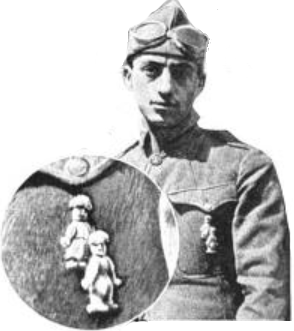 Parisian children made little good luck charms, as “protection” from the Paris gun. They were tiny pairs of handmade dolls, joined together by scraps of yarn. Their names were Nénette and Rintintin
 US Army Air Service Corporal Lee Duncan was in Paris at this time, with the 135th Aero Squadron. Duncan was aware of the custom, he may even have been given such a talisman himself.
 Better known as “Strongheart”, Etzel appeared in silent films throughout the ’20s, becoming the first major canine film star and credited with enormously increasing the popularity of the breed.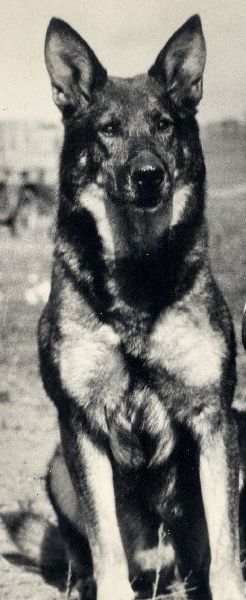


 An unnamed British military officer felt the need to run his mouth before the Parliament, at the expense of his fellow British subjects in the American colonies. “Americans are unequal to the People of this Country”, he said, “in Devotion to Women, and in Courage, and worse than all, they are religious”.

 Historical Easter Eggs - Today in History
You must be logged in to post a comment.