
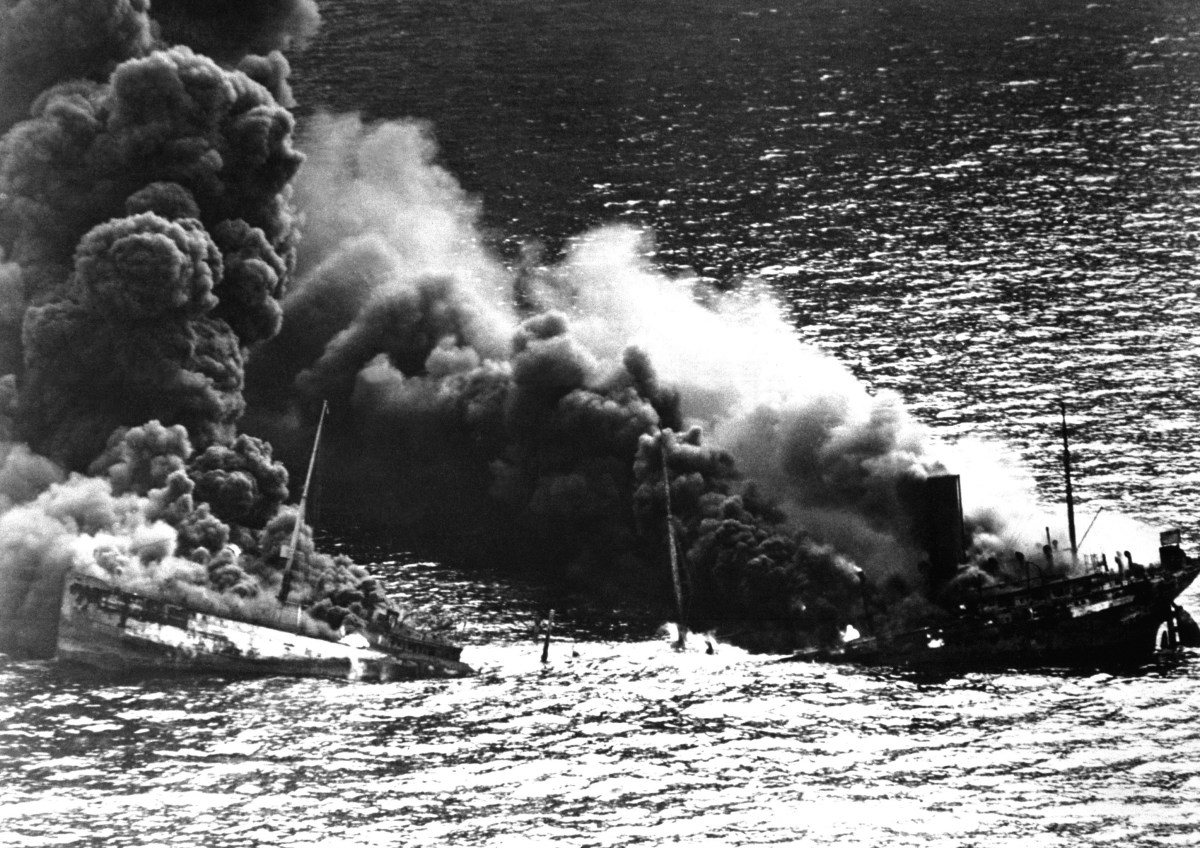
The impending Nazi invasion of Poland was an open secret in 1939. That August, the first fourteen “Unterseeboots” (U-boats) left their bases, fanning out across the North 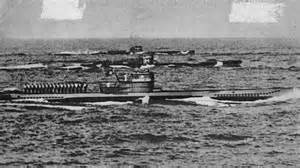 Atlantic. On the 25th the Polish-British Common Defense Pact was added to the Franco-Polish Military Alliance. Should Poland be invaded by a foreign power, England and France were now committed to intervene.
Hitler’s invasion of Poland began on September 1. Even then, he believed that war with England and France could be avoided, the “Kriegsmarine” under strict orders to follow the “Prize Regulations” of 1936. England and France declared war on Nazi Germany on the 3rd. Hours later, U-30 Oberleutnant Fritz Julius Lemp fired a torpedo into the British liner SS Athenia. Lemp had mistakenly believed it to be an armed merchant vessel and fair game under Prize Regulations, but the damage was done. The longest and most complex naval battle in history, had begun.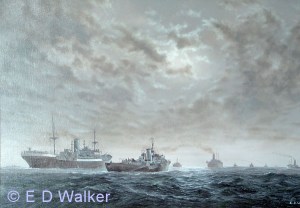
As in WWI, both England and Germany were quick to implement blockades on one another. For good reason. By the time that WWII was in full swing, England alone would require over a million tons a week of imported goods, in order to survive and to fight the war.
The “Battle of the Atlantic” lasted 5 years, 8 months and 5 days, ranging from the Irish Sea to the Gulf of Mexico, from the Caribbean to the Arctic Ocean. Winston Churchill would say “The Battle of the Atlantic was the dominating factor all through the war. Never for one moment could we forget that everything happening elsewhere, on land, at sea or in the air depended ultimately on its outcome”.
Thousands of ships were involved in over a hundred convoy battles, with over 1,000 single ship encounters unfolding across a theater thousands of miles wide. According to www.usmm.org, the United States Merchant Marine suffered the highest percentage of fatalities of any service branch, at 1 in 26 compared to one in 38, 44, 114 and 421 respectively, for the Marine Corps, Army, Navy and Coast Guard.
New weapons and tactics would shift the balance in favor of one side and then to the other. In the end over 3,500 merchant ships and 175 warships would be sunk to the bottom, compared with the loss of 783 U-boats.
The most unusual confrontation of the war occurred on this day in 1945, in the form of a combat action between two submerged submarines. Submarines operate in 3-dimensional space, but their most effective weapon does not. The torpedo is a surface weapon, operating in two-dimensional space: left, right and forward. Firing at a submerged target requires that the torpedo be converted to neutral buoyancy, introducing near-insurmountable complexity into firing calculations.
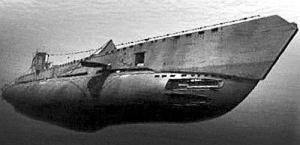
The war was going badly for the Axis Powers in 1945, the allies enjoying near-uncontested supremacy over the world’s shipping lanes. At this time, any surface delivery between Nazi Germany and Imperial Japan was likely to be detected and stopped. The maiden voyage of the 287’, 1,799 ton German submarine U-864 departed on “Operation Caesar” on December 5, delivering Messerschmitt jet engine parts, V-2 missile guidance systems, and 65 tons of mercury to the Imperial Japanese war production industry.
The mission was a failure, U-864 having to retreat to the submarine pens in Bergen, 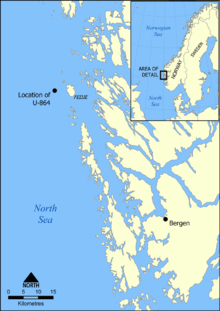 Norway, for repairs after running aground in the Kiel Canal. The sub was able to clear the island of Fedje off the Norway coast undetected on February 6. By this time British MI6 had broken the German Enigma code. They were well aware of Operation Caesar.
The British submarine Venturer, commanded by 25-year-old Lieutenant Jimmy Launders, was dispatched from the Shetland Islands, to intercept and destroy U-864.
ASDIC, an early name for sonar, would have been far more helpful in locating U-864, but at a price. That familiar “ping” would have been heard by both sides, alerting the German commander that he was being hunted. Launders opted for hydrophones, a passive listening device which could alert him to external noises. Calculating his adversary’s direction, depth and speed was vastly more complicated without ASDIC, but the need for stealth won out.
Developing an engine noise which he feared might give him away, U-864’s commander, Ralf-Reimar Wolfram decided to return to Bergen for repairs. German submarines of the age were equipped with “snorkels”, heavy tubes which broke the surface, enabling diesel engines and crews to breathe while running submerged. Venturer was on batteries when the first sounds were detected, giving the British sub the stealth advantage but sharply limiting the time frame in which it could act.
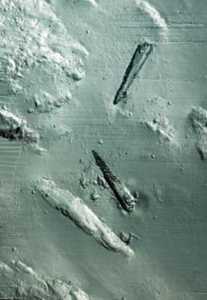 A four dimensional firing solution accounting for time, distance, bearing and target depth was theoretically possible, but had rarely been attempted under combat conditions. Plus, there were unknown factors which could only be approximated.
A fast attack sub, Venturer only carried four torpedo tubes, far fewer than her much larger adversary. Launders calculated his firing solution, ordering all four tubes and firing with a 17½ second delay between each pair. With four incoming at different depths, the German sub didn’t have time to react. Wolfram was only just retrieving his snorkel and converting to electric, when the #4 torpedo struck. U-864 imploded and sank, instantly killing all 73 aboard.
Surface actions were common enough between all manner of vessels, but a fully submerged submarine to submarine kill occurred only once in WWI, on October 18, 1914, when the German U-27 torpedoed and sank the British sub HMS E3 with the loss of all 28 aboard. To my knowledge, such an action occurred only this one time, in all of WWII.


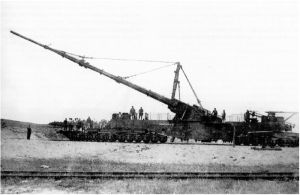 At 256 tons with a barrel of 111′ 7″, the “Paris Gun” hurled 38″ shells into the city from a range of 75 miles. If you were in Paris in 1918, you may never have heard of the German “super gun”. You’d have been well acquainted with the damage it caused. You never knew you were under attack until the explosion. The lucky ones were those who lived to see the 4’ deep, 10’-12’ wide crater.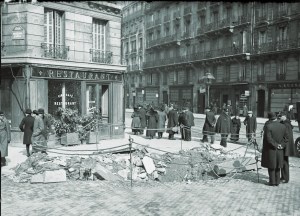
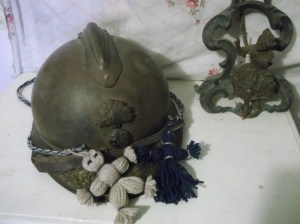 These little yarn dolls had names. They were Nénette and Rintintin.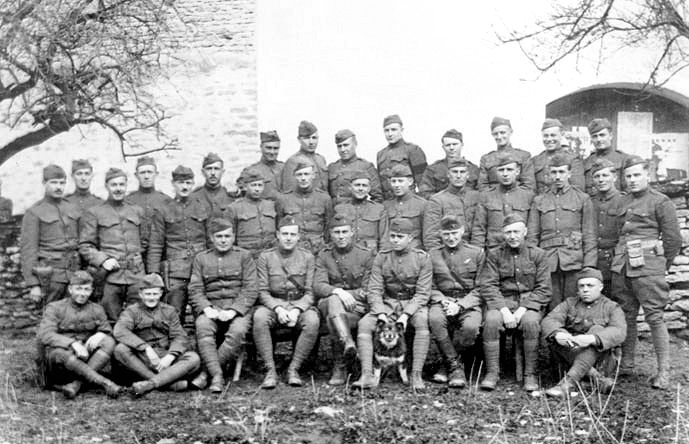
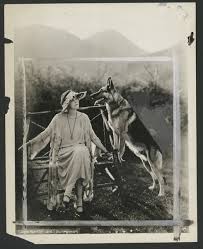
 Walking the dog on “Poverty Row”, 1920s slang for B movie studios, did the trick. Rin Tin Tin got his first film break in 1922, replacing a camera shy wolf in “The Man from Hell’s River”. His first starring role in the 1923 “Where the North begins”, is credited with saving Warner Brothers Studios from bankruptcy.
 Rin Tin Tin appeared in 27 feature length silent films, 4 “talkies”, and countless commercials and short films. Regular programming was interrupted to announce his passing on August 10, 1932, at the age of 13. An hour-long program about his life was broadcast the following day.
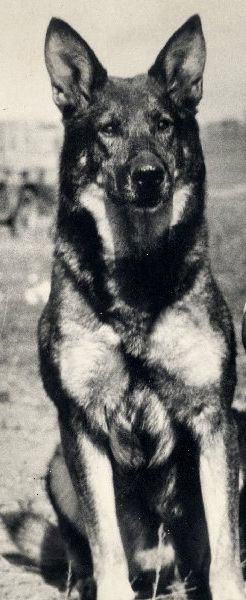 bloodlines. Rin Tin Tin and Nanette II produced at least 48 puppies. Duncan may have been obsessive about it, at least according to Mrs. Duncan. When she filed for divorce, she named Rin Tin Tin as co-respondent.
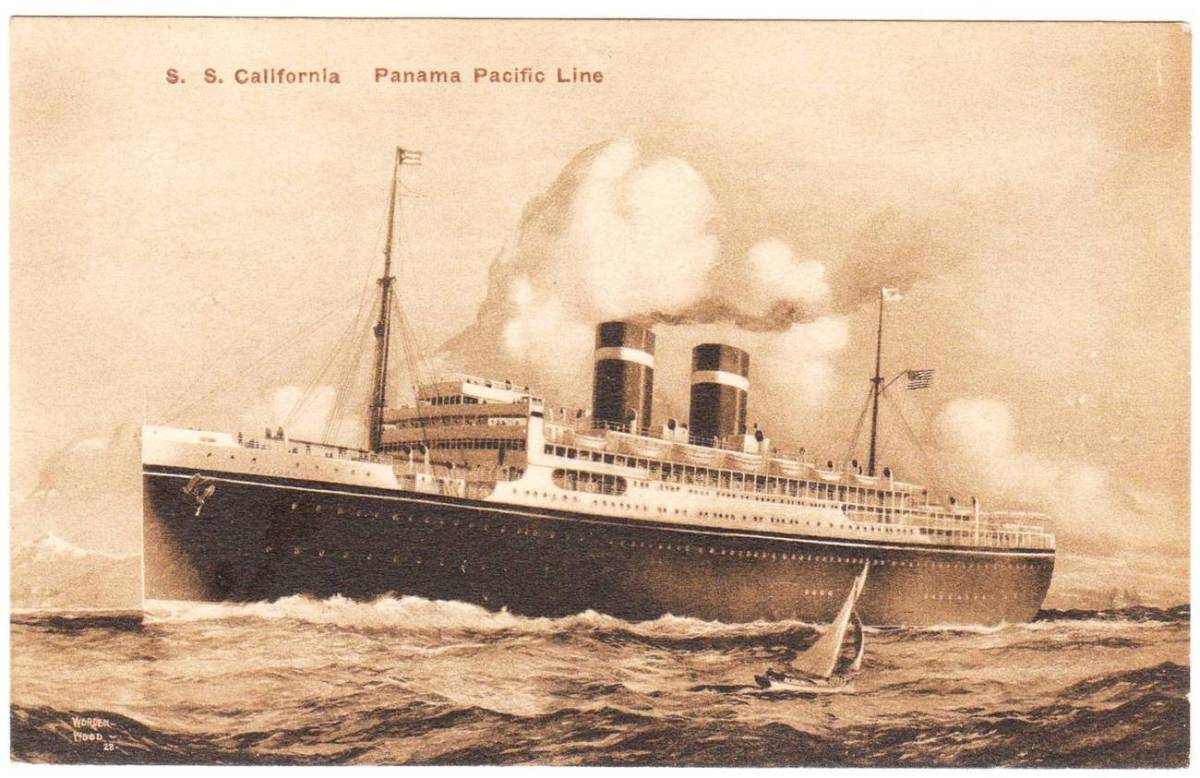
 On February 4, 1915, Imperial Germany declared a naval blockade against shipping to Britain, stating that “On and after February 18th every enemy merchant vessel found in this region will be destroyed, without its always being possible to warn the crews or passengers of the dangers threatening”. “Neutral ships” it continued, “will also incur danger in the war region”.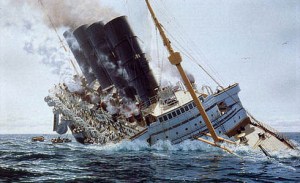
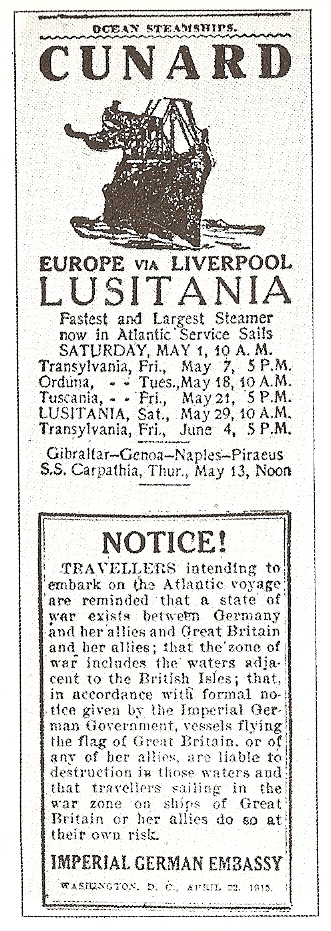 Unrestricted submarine warfare was suspended for a time, for fear of bringing the US into the war. The policy was reinstated in January 1917, prompting then-Chancellor Theobald von Bethmann Hollweg to say, “Germany is finished”. He was right.
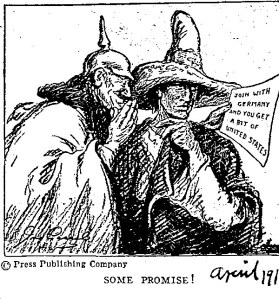 secretary of the United States Embassy in Britain. This was an overture from German Foreign Minister Arthur Zimmermann to the Mexican government , promising American territories in exchange for a Mexican declaration of war against the US.

 Declaration of Independence was even signed. With it were muskets, cannon, gunpowder, bombs, mortars, tents, and enough clothing for 30,000 men, traveling from French ports to the “neutral” Netherlands Antilles island of St. Eustatius.
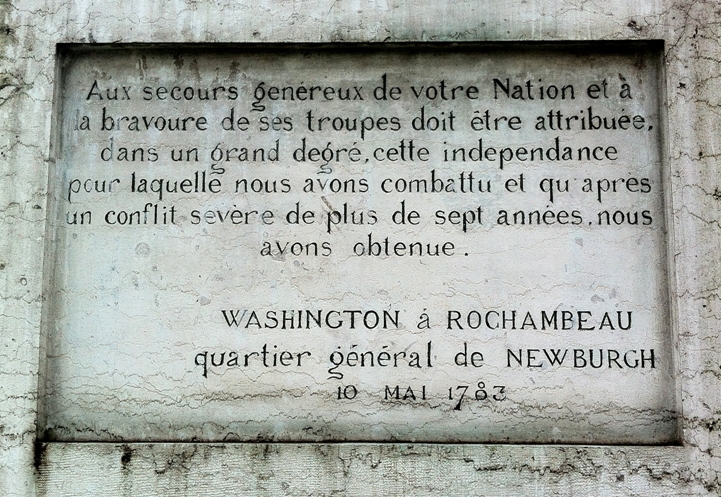
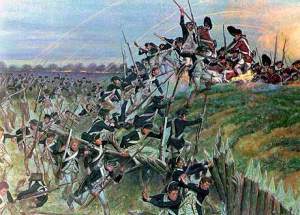 equipment, while de Grasse himself carried 500,000 silver pesos from Havana to help with the payroll and siege costs at the final Battle of Yorktown.

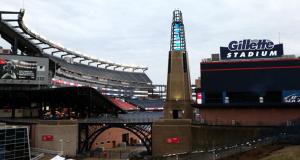 On March 24, 2000, the New England Patriots broke ground on their new stadium home in Foxborough, Massachusetts. The internet company CMGI won naming rights, agreeing to pay $114 million over 15 years for the privilege. The 2002 season opened on September 9 in the Patriots’ new home, tickets bearing the name, CMGI Stadium.
 produced single voyage profits of 400% and more, as merchants built grand estates surrounded by flower gardens. The hyacinth enjoyed early popularity, but the plant at the center of it all was the spectacular, magnificent, tulip.
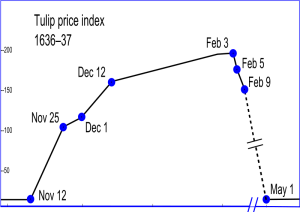 the vivid streaks of yellow or white on the red, brown or purple backgrounds of the “Bizarden” (Bizarres). Ironically, these were the most sickly specimens, victims of a “Tulip breaking virus” which “broke” petals into two or more hues.
 guidelines that year, imposing a 30% quota and raising it to 50% by the end of the Clinton era. By 2007 under President Bush, 55% of all mortgages purchased by the mortgage giants were “sub-prime”.
 2003: “I want to roll the dice a little bit more in this situation toward subsidized housing.”
 That was the year when gas first hit $4/gallon. Those living closest to the financial cliff began to fall off, and foreclosures went through the roof. Highest risk mortgage holders were the first to default, people with $20,000 incomes and multiple investment properties. We all remember 2009. I myself lost a job of 15 years when my employer went under, briefly making my family part of the “zero percent”. Some will tell you that we haven’t emerged from the “Great Recession”, to this day.


 be related to her previous employment in US Radium’s Orange, New Jersey factory. By that time she was seriously ill, yet Columbia University “Specialist” Frederick Flynn and a “Colleague” pronounced her to be in “fine health”. It was only later that the two were revealed to be company executives.
 Attorney Raymond Berry filed suit on Fryer’s behalf in 1927, the lawsuit joined by four other dial painters seeking $250,000 apiece in damages. Soon, the newspapers were calling them “radium girls”. The health of all five plaintiffs was deteriorating rapidly, while one stratagem after another was used to delay proceedings. By their first courtroom appearance in January 1928, none could raise their arm to take the oath. Grace Fryer was altogether toothless by this time, unable to walk, requiring a back brace even to sit up.

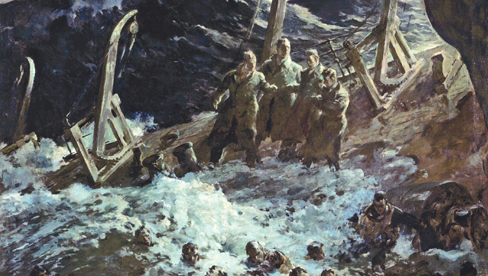
 The Troop Transport USAT Dorchester sailed out of New York Harbor on January 23, 1943, carrying 902 service members, merchant seamen and civilian workers. They were headed for the Army Command Base in southern Greenland, part of a six-ship convoy designated SG-19, together with two merchant ships and escorted by the Coast Guard Cutters Comanche, Escanaba and Tampa.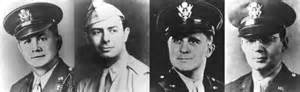
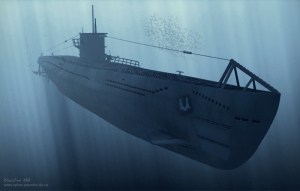 more were killed in the blast, or in the clouds of steam and ammonia vapor pouring from ruptured boilers. Suddenly pitched into darkness, untold numbers were trapped below decks. With boiler power lost, there was no longer enough steam to blow the full 6 whistle signal to abandon ship, while loss of power prevented a radio distress signal. For whatever reason, there never were any signal flares.
 Private William Bednar found himself floating in 34° water, surrounded by dead bodies and debris. “I could hear men crying, pleading, praying,” he recalled. “I could also hear the chaplains preaching courage. Their voices were the only thing that kept me going.”
 The United States Congress attempted to confer the Medal of Honor on the four chaplains for their selfless act of courage, but strict requirements for “heroism under fire” prevented them from doing so. Congress authorized a one time, posthumous “Chaplain’s Medal for Heroism”, awarded to the next of kin by Secretary of the Army Wilber M. Brucker at Fort Myer, Virginia on January 18, 1961.



 crowd and their claims to Punxsutawney Phil’s weather forecasting prowess. Alabama has “Birmingham Bill”, and Canada has Shubenacadie Sam. New York can’t seem to decide between Staten Island Chuck and New York City’s very own official groundhog, “Pothole Pete”.

 In 2003, author Richard Rubin set out to interview the last surviving veterans of World War One. The people he sought were over 101, one was 113.


 Frank Woodruff Buckles, born Wood Buckles, is one of them. Born on this day in 1901, Buckles joined the Ambulance Corps of the American Expeditionary Force (AEF) at the age of 16. He never saw combat against the Germans, but he would escort 650 of them back home as prisoners.


 Edward Donald “Eddie” Slovik was paroled in 1942, his criminal record making him 4F. “Registrant not acceptable for military service”. He took a job at the Montella Plumbing and Heating company in Dearborn, Michigan, where he met bookkeeper Antoinette Wisniewski, the woman who would later become his wife.
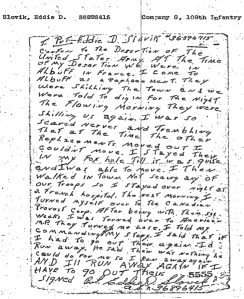 of my desertion we were in Albuff [Elbeuf] in France. I came to Albuff as a replacement. They were shelling the town and we were told to dig in for the night. The following morning they were shelling us again. I was so scared, nerves and trembling, that at the time the other replacements moved out, I couldn’t move. I stayed there in my fox hole till it was quiet and I was able to move. I then walked into town. Not seeing any of our troops, so I stayed over night at a French hospital. The next morning I turned myself over to the Canadian Provost Corp. After being with them six weeks I was turned over to American M.P. They turned me loose. I told my commanding officer my story. I said that if I had to go out there again I’d run away. He said there was nothing he could do for me so I ran away again AND I’LL RUN AWAY AGAIN IF I HAVE TO GO OUT THERE. — Signed Pvt. Eddie D. Slovik A.S.N. 36896415”.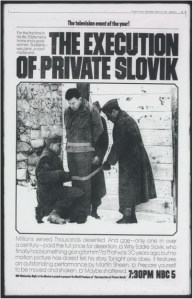
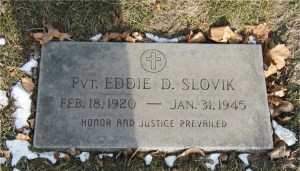 In 1987, President Ronald Reagan ordered the repatriation of Slovik’s remains. He was re-interred at Detroit’s Woodmere Cemetery next to Antoinette, who had gone to her final rest eight years earlier.
 Historical Easter Eggs - Today in History
You must be logged in to post a comment.