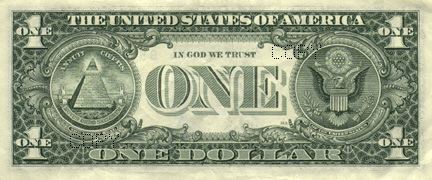
Some states adopted the eagle as their symbol as early as 1778. The Continental Congress officially adopted the current design for the seal on this day in 1782.
When the Continental Congress declared independence from Great Britain in 1776, several pieces of unfinished business remained. Benjamin Franklin, Thomas Jefferson and John Adams were appointed to a committee to take care of one such detail. The creation of an official seal. The three came up with a first draft but Congress rejected it, approving only the “E pluribus Unum”, (of the many, one), attributed to Thomas Jefferson.
Six years and two such committees later, it was May 1782. The brother of a Philadelphia naturalist provided a drawing showing an eagle displayed as the symbol of “supreme power and authority.” An earlier submission used the phoenix instead of an eagle, representing a nation risen from the ashes of the American Revolution. That bird would be replaced by the eagle in the final design.
Some states adopted the eagle as their symbol as early as 1778. The Continental Congress officially adopted the current design for the seal on this day in 1782. The final design of the obverse (front) side of the seal, depicts a Bald Eagle, the symbol of liberty and freedom. The eagle grasps thirteen arrows in its right talon, symbolizing a strong defense of the thirteen colonies. An olive branch symbolizing peace is held in the other claw. A banner containing Jefferson’s E pluribus Unum, is held in the eagle’s beak.
Prominently displayed on the eagle’s breast is a shield, the thirteen red and white stripes symbolizing the states, all of which support the federal government, represented in blue.
In 1782, the federal government had yet to morph into the all-consuming leviathan which it has since become.
Finally, a constellation of thirteen stars breaks out of the clouds above, signifying a new nation, ready to take its place among the sovereign nations of the earth.
Benjamin Franklin objected to the selection of the eagle, preferring that the turkey made the national symbol. He complained that the eagle tended to steal its dinner from other birds, and that he’d seen them driven away by the tiny Kingbird, no larger than a sparrow. Franklin later wrote to his daughter, saying, “For the Truth the Turkey is in Comparison a much more respectable Bird, and withal a true original Native of America . . . He is besides, though a little vain & silly, a Bird of Courage, and would not hesitate to attack a Grenadier of the British Guards who should presume to invade his Farm Yard with a red Coat on.”
Some versions of the symbol used between 1916 and 1945 showed an eagle facing to its left, toward the arrows, giving rise to the urban legend that the seal is changed to have the eagle face towards the olive branch in peace, and towards the arrows in wartime.
On the reverse (back) side of the Great Seal, the pyramid represents strength and duration, like the great Pyramids at Giza. The Roman numeral MDCCLXXVI at the base of the pyramid, stands for 1776. A Latin phrase, “Novus ordo seclorum”, translates as “New Order of the Ages.” The pyramid itself has thirteen levels, atop which is the Eye of God, with the Latin phrase “Annuit Cœptis,” loosely translating as “favors undertakings.” The hand of Providence, or God, would favor the undertakings of the United States, for all time.
The militant atheist type who’d like to divest himself of all that “church & state” stuff may at this point feel free to send his dollar bills, to me. I’m happy to help. I’m in the book.
Alabama’s mission was to wage economic war on the Union, attacking commercial shipping from the Pacific to the Indian Ocean, from Newfoundland to Brazil.
Maryland native Raphael Semmes was a career Naval officer, having served in the United States Navy from 1826 to 1860. There was an extended leave of absence following the Mexican-American war, in which he settled in Alabama and practiced law. Semmes was offered a Confederate naval appointment in 1861, following the secession of his adopted home state. He resigned his commission, the following day.
Following a fruitless assignment to purchase arms from the North, Semmes was ordered to New Orleans, to convert the steamer Habana into the commerce raider CSS Sumter. Semmes breached the Union blockade in June of 1861, outrunning the sloop of war USS Brooklyn. So began the most successful commerce raider, in naval history.
Captain Raphael Semmes standing by his ship’s 110-pounder rifled cannon. His XO 1st Lieutenant John McIntosh Kell, stands by the ship’s wheel.
His was a war on the economic might of the Union. Sumter would eliminate 18 Union merchant vessels from the Caribbean to the Atlantic, constantly eluding the Union warships sent to destroy her. In six short months, CSS Sumter was laid up in neutral Gibralter, her boilers too spent to go on.
On May 13, 1861, Queen Victoria issued a “Proclamation of Neutrality” in the American Civil War, prohibiting the sale of ships of war. Vessels were permitted neither to alter or improve their equipment while in British waters, but were permitted to enter.
Hull #290 was launched from the John Laird & Sons shipyard in Birkenhead, Cheshire, England as the screw sloop HMS Enrica on May 15, 1862. Enrica left Liverpool that July on a “trial run”, a party of ladies and customs officials on board to allay suspicions that the trip was anything but ‘neutral”.
The ruse was a success. Passengers were transferred to a tug only a short distance from Liverpool and returned to port, while the ship itself continued on to the Terceira Island in the Azores. There she met her new captain. Raphael Semmes.
Three days, 8 cannon and 350 tons of coal later, Enrica was transformed into the 220’, 1,500 ton sloop of war and Confederate States of America commerce raider, CSS Alabama.
CSS Alabama, artist unknown
Alabama’s mission was to wage economic war on the Union, attacking commercial shipping from the Pacific to the Indian Ocean, from Newfoundland to Brazil. In her two years as commerce raider, Alabama destroyed the Union warship USS Hatteras off the coast of Galveston, Texas, and claimed 65 prizes valued at nearly $123 million in today’s dollars.
Alabama was badly in need of a refit when she put into Cherbourg, France, on the 11th of June. The Mohican-class Union sloop of war USS Kearsarge was then on patrol near Gibraltar, making it to Cherbourg by the 14th.
Seeing that he was blockaded, Semmes challenged Kearsarge Captain John Winslow to a ship-to-ship duel. “My intention is to fight the Kearsarge as soon as I can make the necessary arrangements. I hope these will not detain me more than until to-morrow or the morrow morning at farthest. I beg she will not depart until I am ready to go out. I have the honor to be your obedient servant, R. Semmes, Captain”.
That suited Winslow just fine. Kearsarge took up station in international waters, and waited.
USS Kearsarge
Alabama steamed out of Cherbourg on the morning of June 19, 1864, escorted by the French ironclad Couronne, which remained nearby to ensure that combat remained in international waters. Kearsarge steamed further out to sea as the Confederate vessel approached. There would be no returning to port, until the issue was decided.
Captain Winslow put his ship around and headed for the enemy at 10:50am. Alabama fired first from the distance of a mile, firing furiously as the range decreased.
Heavy, overlapping rows of chain armor allowed Kearsarge to be more deliberate, and she chose her shots, carefully.
Kearsarge Stern Post
The engagement followed a circular course at a range of a half mile; the ships steaming in opposite directions and firing at will.
Alabama’s forward 7-inch Blakely pivot rifle scored an early success, lodging a 56lb shell in Kearsarge’s exposed sternpost. With its rudder thus bound, Kearsarge’s mobility was sharply limited. It could have been far worse for Captain Winslow, however, had that shell not failed to explode.
One of Kearsarge’s 11″ Dahlgren smooth bore pivot cannon found its mark, tearing Alabama’s hull open at the waterline and exploding her steam boiler. Alabama turned and tried to run back to port, but Kearsarge headed her off. Within an hour of the first shot, the most successful commerce raider in history was reduced to a sinking wreck.
“Sinking of the CSS Alabama” by Xanthus Smith (1922)
Wounded in the battle, Semmes hurled his sword overboard, denying the Union captain that symbol of surrender. He ordered the striking of his ship’s Stainless Banner and a hand-held white flag of surrender, as Alabama went down by the stern.
For those Confederate sailors rescued by Kearsarge, the Civil War was over. They would spend the rest of the war as prisoners. Raphael Semmes escaped with 41 others, being plucked from the water and taken to neutral ports by the British steam yacht Deerhound, and the private sail yacht Hornet.
Semmes would recover from his wounds, returning to the war ravaged South via Cuba in February, 1865. That April, he would supervise the destruction of all Confederate warships in the vicinity, following the fall of Richmond. Semmes’ former command fought on as “the Naval brigade”, Semmes himself appointed Brigadier General, though the appointment would never be confirmed. The Confederate Senate had ceased to exist.
Elements of the Naval Brigade fought with Lee’s rear guard at the Battle of Sailor’s Creek, before their surrender at Appomattox, only days later. Semmes himself was surrendered with General Joseph E. Johnston’s army near Durham Station, North Carolina.
Semmes returned to Mobile after the war, where he resumed his legal career. There were those who wanted to try the man for piracy, but it never happened. Raphael Semmes died an untimely death in 1877, as the result of eating some bad shrimp.
His 1869 Memoirs of Service Afloat During The War Between the States has been described as one of the “most cogent but bitter defenses ever written”, about the “lost cause”, of the South.
It was common practice of the age to “spike” enemy cannon, driving a nail into the touchhole to disable the weapon. But for a handful of nails, the outcome of the battle might have been different. Possibly, even the history of the world.
The Napoleonic Wars began in 1799, pitting Emperor Napoleon Bonaparte and his Grand Armée against a succession of international coalitions. The first five such coalitions formed to oppose him would go down to defeat.
The empire of Czar Alexander I had long traded with Napoleon’s British adversary. Napoleon invaded Russia in 1812 intending to cut off that trade, but he made the same mistake that Adolf Hitler would make, 130 years later. He failed to account for Russia’s greatest military asset. General Winter.
For months Napoleon’s army pressed ever deeper into Russian territory, as Cossack cavalry burned out villages and fields to deny food or shelter to the advancing French army. Napoleon entered Moscow itself in September, with the Russian winter right around the corner. He expected capitulation. Instead, he got more scorched earth.
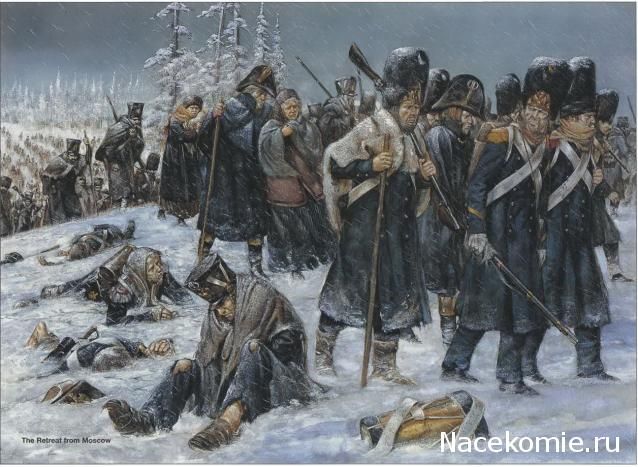
Finally there was no choice for the Grand Armée, but to turn about and go home. Starving and exhausted with no winter clothing, stragglers were frozen in place or picked off by villagers or pursuing Cossacks. From Moscow to the frontiers you could follow their retreat, by the bodies they left in the snow. 685,000 had crossed the Neman River on June 24. By mid-December there were fewer than 70,000 known survivors.
The War of the 6th Coalition ended in 1814 with Bonaparte’s defeat and exile to the Mediterranean island of Elba, and the restoration to the throne of the Bourbon King, Louis VXIII. That would last 111 days, until Napoleon reappeared at the head of another army.
The Congress of Vienna declared Napoleon an outlaw on March 13, 1815. Austria, Prussia, Russia and the UK bound themselves to put 150,000 men apiece into the field to end his rule.
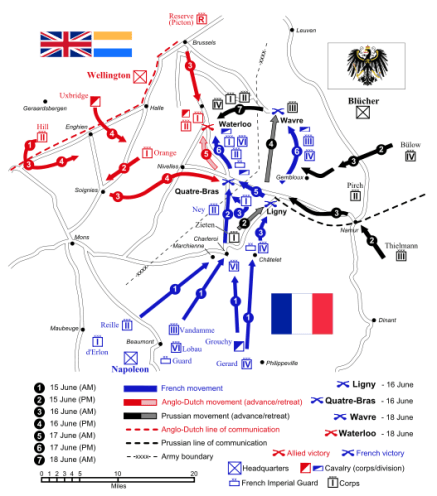
Napoleon struck first, taking 124,000 men of l’Armee du Nord on a pre-emptive strike against the Allies in Belgium. Intending to attack Coalition armies before they combined, he struck and defeated the Prussian forces of Gebhard von Blücher near the town of Ligny.
Napoleon then turned his attention to the coalition forces under the Lord Arthur Wellesley, Duke of Wellington, who fell back to a carefully selected position on a long east-west ridge at Mont St Jean, a few miles south of the village of Waterloo.
It rained all day and night that Saturday. Napoleon waited for the ground to dry on the morning of June 18, launching his first attack before noon while Wellington’s Prussian allies were still five hours away. The 80 guns of Napoleon’s grande batterie opened fire at 11:50, while Wellington’s reserves sheltered out of sight on the reverse slope of the Mont St. Jean ridge.
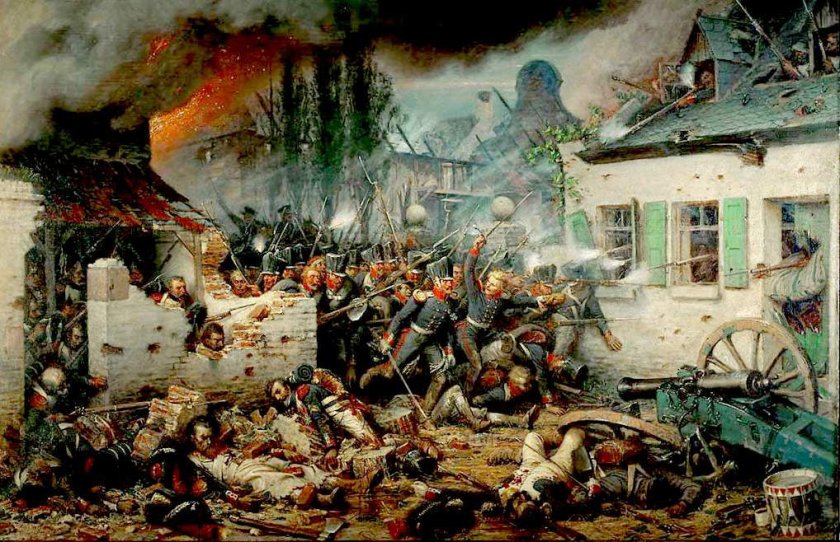
Fighting was furious around Wellington’s forward bastions, the walled stone buildings of the Château Hougomont on Wellington’s right, and La Haie Sainte on his left. Eight times, French infantry swarmed over the orchards and outbuildings of the stone farmhouses, only to be beat back.
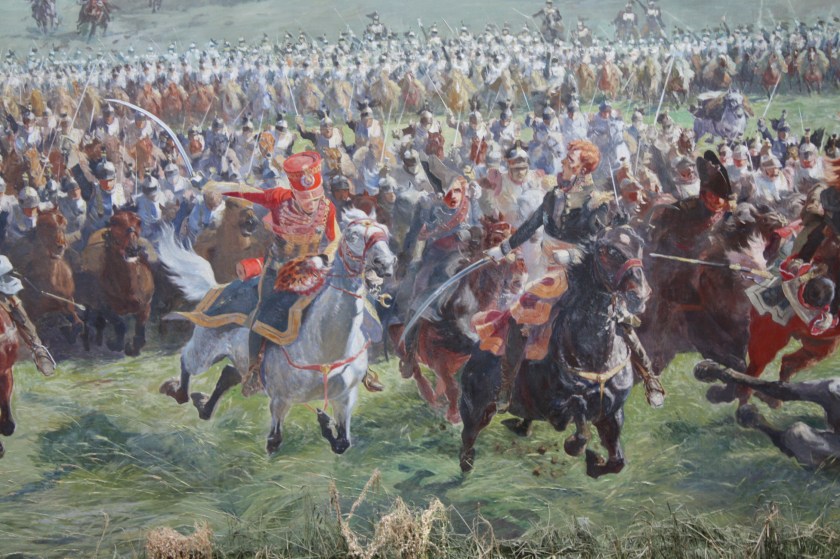
Most of the French reserves were committed by 4:00pm, when Marshall Ney ordered the massed cavalry assault. 9,000 horsemen in 67 squadrons charged up the hill as Wellington’s artillery responded with canister and shot, turning their cannon into giant shotguns tearing holes in the French ranks.
It was common practice of the age to “spike” enemy cannon, driving a nail into the touchhole to disable the weapon. But for a handful of nails, the outcome of the battle might have been different. Possibly, even the history of the world. Eleven times French cavalry gained the hill and surrounded those guns. Eleven times the gunners retreated into defensive infantry squares, bristling with bayonets. Eleven times French cavalry withdrew only to form up, and do it all over again.
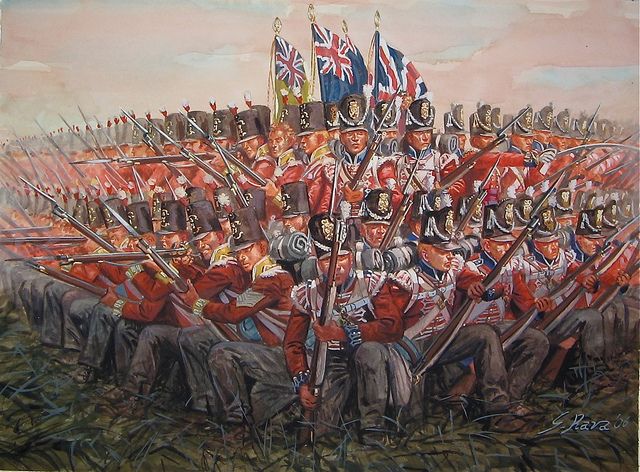
Newly arrived Prussians were pouring in from the right at 7:30 when Napoleon committed his 3,000-man Imperial Guard. These were Napoleon’s elite soldiers, almost seven feet tall in their high bearskin hats. Never before defeated in battle, they came up the hill intending to roll up Wellington’s center, away from their Prussian allies. 1,500 British Foot Guards were lying down to shelter from French artillery. As the French lines neared the top of the ridge, the English stood up, appearing to rise from the ground and firing point blank into the French line.
The furious counter assault which followed caused the Imperial Guard to waver and then fall back. Retreat broke into a route, someone shouting “La Garde recule. Sauve qui peut!” (“The Guard retreats. Save yourself if you can!”), as the Allied army rushed forward and threw themselves on the retreating French.
There is a story, possibly apocryphal, concerning Henry Paget, 2nd Earl of Uxbridge. One of the last cannonballs fired that day hit Uxbridge just above the knee, all but severing the leg. Lord Uxbridge was close to Wellington at the time, exclaiming “By God, sir, I’ve lost my leg!”. Wellington replied “By God, sir, so you have!” There’s another version in which Wellington says “By God, sir, you’ve lost your leg!”. Looking down, Uxbridge replied “By God, sir, so I have!”
According to Wellington, the battle was “the nearest-run thing you ever saw in your life.” The French defeat was complete. Bonaparte was once again captured and exiled, this time to a speck in the North Atlantic called Saint Helena. He died there in 1821.
Estimates of the total killed and wounded in the Napoleonic wars range from 3.5 to 6 million, at a time when the entire world population was about 980 million. Until Waterloo, Napoleon Bonaparte participated in, and won, more battles than Julius Caesar, Hannibal, Frederick the Great, and Alexander the Great. Combined.
“On you depend the fortunes of America. You are to decide the important question, on which rest the happiness and liberty of millions yet unborn. Act worthy of yourselves.” – Dr. Joseph Warren
Charlestown, Massachusetts occupies a hilly peninsula to the north of Boston, at the point where the Mystic River meets the Charles. Like Boston itself, much of what is now Charlestown was once Boston Harbor. In 1775 the town was a virtual island, joined to the mainland only by a thin “neck” of land.
Thousands of Patriot Militia poured into the area following the April battles of Lexington and Concord, hemming in the British who controlled Boston and its surrounding waterways.
Reinforced and provisioned from the sea over which the Crown held undisputed control, British forces under General Sir Thomas Gage could theoretically remained in Boston, indefinitely.
The elevation of Breed’s and Bunker’s Hill across the river, changed that calculation. Should colonial forces obtain artillery of their own, they would be able to rain down hell on British forces bottled up in Boston. It was just this scenario that led Henry Knox into a New England winter later that year, to retrieve the guns of Fort Ticonderoga.
The Massachusetts Provincial Congress received word on the 13th that the British planned to break out of Boston within the week, taking the high ground of Dorchester Heights to the south and Charlestown to the north. Major General Israel Putnam was directed to set up defenses on Bunker Hill, on the northwest end of the Charlestown peninsula.
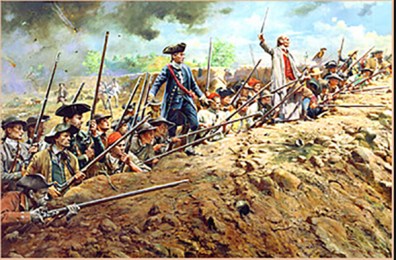
Colonel William Prescott led about 1,200 men onto the peninsula on the night of the 16th. Some work was performed on the hill which gives the battle its name, but it was farmer Ephraim Breed’s land to the southeast, which offered the more defensible hill from which to defend the peninsula.
Shovels could be heard throughout the night. The sun rose on June 17 to reveal a 130′ defensive breastwork across Breed’s hill. Major General William Howe was astonished. “The rebels,” he said, “have done more work in one night than my whole army would have done in one month.”
The warship HMS Lively opened fire on the redoubt shortly after 4am, with little effect on the earthworks. 128 guns joined in as the morning bore on, including incendiary shot which set fire to the town. Militia continued to reinforce the high ground throughout the morning hours, as Regulars commanded by General Howe and Brigadier General Robert Pigot crossed the Charles River and assembled for the assault.
First Assault
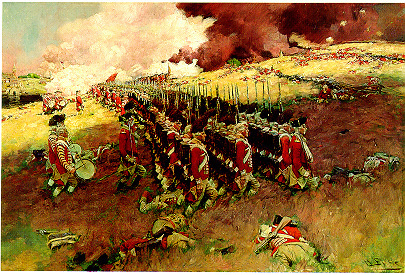
The British line advanced up Breed’s Hill twice that afternoon, Patriot fire decimating their number and driving survivors back down the hill to reform and try again. Militia supplies of powder and shot began to give out as the British advanced up the hill for the third assault.
“Don’t fire until you see the whites of their eyes”. The quote is attributed to Prescott, but the order seems to have originated with General Putnam and passed along by Prescott, Seth Pomeroy, John Stark, and others, in a desperate attempt to conserve ammunition.
Finally, there was nothing left with which to oppose the British bayonets. The Militia was forced to retreat.
Second Assault
Most of the colonists’ casualties occurred at this time, including Boston physician and President of Massachusetts’ Provincial Congress, Dr. Joseph Warren. Dr. Warren had been appointed Major General on June 14, but the commission had not arrived as of yet. On this day, he fought as a private soldier. He had been but the commission had not yet taken effect.
Two months before the battle, Dr. Warren had spoken to his men. “On you depend the fortunes of America”, he said. “You are to decide the important question, on which rest the happiness and liberty of millions yet unborn. Act worthy of yourselves.”
Act worthy of yourselves. That they did.
Final Attack
The Battle of Bunker Hill ended in victory for the British, in that they held the ground when the fighting was over. It was a Pyrrhic victory. Howe lost 226 killed and 828 wounded, over a third of their number and more than twice those of the Militia.
One Eighth of all the British officers killed in the Revolution, died on Ephraim Breed’s Hill. General Henry Clinton wrote afterward, of the battle: “A few more such victories” he said, “would have shortly put an end to British dominion in America”.
Eric Idle of Monty Python was once a Saturday Night Live guest host. He paid a great compliment to Aykroyd’s comedic ability, saying he was “the only member of the SNL cast capable of being a Python”.
Dan Aykroyd developed his musical talents during the late fifties and early sixties at an Ottowa club called Le Hibou, (French for ‘the owl’), saying “I actually jammed behind Muddy Waters. S. P. Leary left the drum kit one night, and Muddy said ‘anybody out there play drums? I don’t have a drummer.’ And I walked on stage and we started, I don’t know, Little Red Rooster, something. He said ‘keep that beat going, you make Muddy feel good.’
Eric Idle of Monty Python was once a Saturday Night Live guest host. He paid a great compliment to Aykroyd’s comedic ability, saying he was “the only member of the SNL cast capable of being a Python”.
John Belushi joined The Second City comedy troupe in 1971, playing off-Broadway in “National Lampoon’s Lemmings”. He played The National Lampoon Radio Hour from 1973 to 1975, a half-hour comedy program syndicated on over 600 stations.
Belushi appeared from 1973 to 1975 on The National Lampoon Radio Hour, along with future SNL regulars Gilda Radner, Chevy Chase and Bill Murray. A number of their radio segments went on to become SNL sketches in the show’s first couple of seasons.
Dan Ackroyd tells a story about long days of rehearsals on the SNL set. An exhausted John Belushi would wander off and let himself into the house of a friend or a stranger, scrounging around for food and then falling asleep in the house, unable to be found for the next day’s work. These outings were the inspiration for the SNL horror-spoof sketch “The Thing That Wouldn’t Leave”.
Lead vocalist “Joliet Jake” Blues (John Belushi) and harmonica player/backing vocalist Elwood Blues (Dan Aykroyd) had their musical debut on January 17, 1976 in a comedy sketch on Saturday Night Live. “The Blues Brothers” appeared twice more on SNL sketches, both in 1978, before releasing their first album that same year: Briefcase Full of Blues.
The Blues Brothers film premiered in Chicago on this day in 1980, four days before its general relase. Set in that city and sprawling across the Midwest, the musical/comedy film tells the story of a paroled convict and his brother, and their mission to save the Catholic orphanage in which they were raised from foreclosure. Their “Mission from God” needs to raise $5,000 to pay the orphanage’s property tax bill. To do so, the pair sets out to reignite their R&B band, pursued by the police and wrecking 103 cars along the way, a world record for that time.
While filming one of the night scenes, John Belushi disappeared and couldn’t be found. Looking around, Ackroyd found a single house with its lights on, and knocked on the door. Before he could ask, the homeowner smiled and said “You’re here for John Belushi, aren’t you?” The man told Ackroyd that Belushi had entered the house, asked if he could have a glass of milk and a sandwich, and then crashed on their couch. To some, he may have been a real-life Thing that Wouldn’t Leave. To Dan Ackroyd, John Belushi would always be “America’s Guest”.
John Belushi died in his hotel room on March 5, 1982, of a “Speedball”, a combined injection of heroin and cocaine. The cause of death was originally considered to be an accidental overdose, but Catherine Evelyn Smith was extradited and tried on first degree murder charges after her National Enquirer interview, in which she admitted giving Belushi the shot. A plea bargain reduced the charge to involuntary manslaughter. She served fifteen months in prison.
Belushi’s wife Judith arranged for a traditional Orthodox Christian funeral in which he was interred, twice. The first was in Abel’s Hill Cemetery, in the Chilmark section of Martha’s Vineyard. A classic New England slate tombstone complete with skull and crossbones, marks the location. The inscription reads, “I may be gone but Rock and Roll lives on.”
“Fans” repeatedly felt the need to desecrate the grave. The body was later removed at the request of Belushi’s wife, and reburied in an undisclosed location. An unmarked tombstone in an undisclosed location marks the final burial location, where the man can finally Rest in Peace.
John Belushi is remembered on the family marker at his mother’s grave at Elmwood Cemetery in River Grove, Illinois. This stone reads, “HE GAVE US LAUGHTER”.
In Tompkins Square Park in Manhattan, there is a 9′ stele sculpted from pink Tennessee Marble. The relief sculpture shows two children, beside the words “They were Earth’s purest children, young and fair.”
Kleindeutschland, or “Little Germany”, occupied some 400 blocks on the Lower East Side of Manhattan, in what is now the East Village. “Dutchtown”, as contemporary non-Germans called it, was home to New York’s German immigrant community since the 1840s, when they first began to arrive in significant numbers. By 1855, New York had the largest ethnically German community in the world, save for Berlin and Vienna.
It was 9:30 on a beautiful late spring morning when the sidewheel passenger steamboat General Slocum, left the dock and steamed into New York’s East River.
She was on a charter this day, carrying German American families on an outing from St. Mark’s Lutheran Church. Over a thousand tickets were sold for that day’s harbor cruise and picnic, not counting the 300+ children on board who were sailing for free. There were 1,342 people on board, mostly women and children, including band, crew and catering staff.
The fire probably started when someone tossed a cigarette or match in the forward section lamp room. Fueled by lamp oil and oily rags on the floor, the flames spread quickly, being noticed for the first time at around 10:00am. A 12-year old boy had reported the fire earlier, but the Captain did not believe him.
The ships’ operators had been woefully lax in maintaining safety equipment. Now it began to show. Fire hoses stored in the sun for years were uncoiled, only to break into rotten bits in the hands of the crew. Life preservers manufactured in 1891 had hung unprotected in the sun for 13 years, their canvas covers splitting apart pouring useless cork powder onto the floor. Survivors reported inaccessible life boats, wired and painted into place.
Crew members reported to Captain William van Schaick that the blaze “could not be conquered” It was “like trying to put out hell itself.” The captain ran full steam into the wind trying to make it to the 134th Street Pier, but a tug boat waved them off, fearing the flames would spread to nearby buildings. The wind and speed of the ship itself whipped the flames into an inferno as Captain van Schaick changed course for North Brother Island, just off the Bronx’ shore.
Many jumped overboard to escape the inferno, but the heavy women’s clothing of the era quickly pulled them under. Desperate mothers put useless life jackets on children and threw them overboard, only to watch in horror as they sank. One man, fully engulfed in flames, jumped screaming over the side, only to be swallowed whole by the massive paddle wheel. One woman gave birth in the confusion, and then jumped overboard with her newborn to escape the flames. They both drowned.
A few small boats were successful in pulling alongside in the Hell’s Gate part of the harbor, but navigation was difficult due to the number of corpses already bobbing in the waves.
Holding his station despite the inferno, Captain van Schaick permanently lost sight in one eye and his feet were badly burned by the time he ran the Slocum aground at Brother Island. Patients and staff at the local hospital formed a human chain to pull survivors to shore as they jumped into shallow water.
1,021 passengers and crew either burned to death or drowned. It was the deadliest peacetime maritime disaster, in American history. There were only 321 survivors.
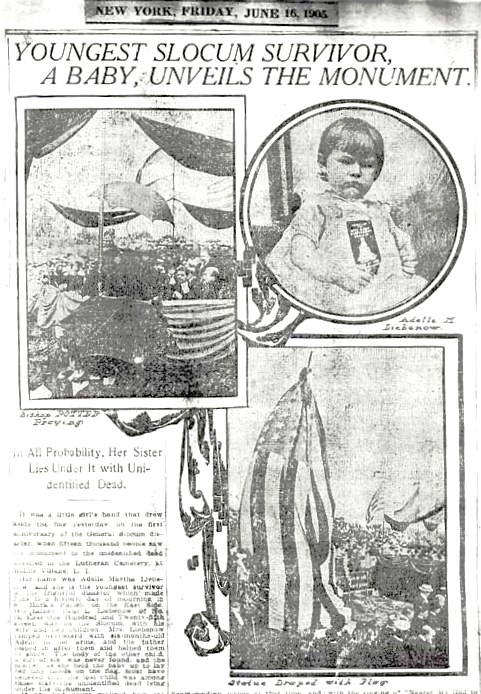
The youngest survivor of the disaster was six month old Adella Liebenow. The following year at the age of one, Liebenow unveiled a memorial statue to the disaster which had killed her two sisters and permanently disfigured her mother. The New York Times reported “Ten thousand persons saw through their tears a baby with a doll tucked under her arm unveil the monument to the unidentified dead of the Slocum disaster yesterday afternoon in the Lutheran Cemetery, Middle Village, L.I.”
Both her sisters, were among the unidentified dead.
Less than one per cent of Little Germany’s population was killed in the disaster, yet these were the women and children of some of the community’s most established families. There were more than a few suicides. Mutual recriminations devoured much of the once-clannish community, as the men began to move away. There was nothing for them, there. Anti-German sentiment engendered by WW1 finished what the Slocum disaster had begun. Soon, New York’s German-immigrant community, was no more.
In Tompkins Square Park in Manhattan, there is a 9′ stele sculpted from pink Tennessee Marble. The relief sculpture shows two children, beside the words “They were Earth’s purest children, young and fair.”
Once the youngest survivor of the disaster, Adella (Liebenow) Wotherspoon passed away in 2004, at the age of 100. The oldest survivor of the deadliest disaster in New York history, until September 11, 2001.
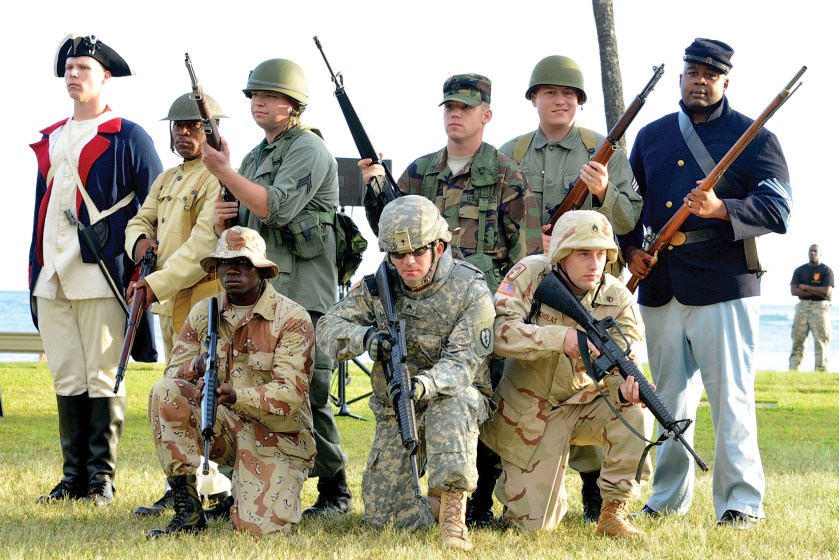
The Continental Congress established the ‘American Continental Army’ on June 14, 1775, authorizing 10 companies of ‘expert riflemen,’ to serve as light infantry in the siege of Boston.
On May 10, 1775, twelve colonies convened the second Continental Congress in Philadelphia, Pennsylvania. One colony was absent at the time, Georgia would come later, arriving on July 20 following their own Provincial Congress.
The Revolution had begun in April that year, with the battles of Lexington and Concord. A primary focus of the Second Continental Congress was to manage the war effort.
The fledgling United States had no Army at this time, relying instead on ad hoc militia units organized by the colonies themselves. At this time there were approximately 22,000 such troops surrounding British forces occupying Boston, with another 5,000 or so in New York.
The Continental Congress established the ‘American Continental Army’ on June 14, 1775, authorizing 10 companies of ‘expert riflemen,’ to serve as light infantry in the siege of Boston. The next day the Congress unanimously selected George Washington to be General and Commander in Chief of all continental forces.
Most of the Continental Army was disbanded after the Treaty of Paris ended the war in 1783. The 1st and 2nd Regiments remained to become the basis of the Legion of the United States in 1792, under General Anthony Wayne. These two became the foundation of the United States Army, in 1796.
The formation of other branches of the Armed Forces was quick to follow. The first organized merchant marine action had taken place two days earlier on June 12, 1775, when a group of Machias Maine citizens boarded and captured the schooner British warship HMS Margaretta.
The Navy was formed later that year, in October 1775, the Marine Corps in November. 18th century revenue cutter and rescue operations led to the formation of the United States Coast Guard in January 1915. The Air Force spun off of the Army Air Corps in September 1947.
Speaking on Armed Services Day in 1953, President Dwight David Eisenhower said: “It is fitting and proper that we devote one day each year to paying special tribute to those whose constancy and courage constitute one of the bulwarks guarding the freedom of this nation and the peace of the free world.”
On the other days of the year, you might say that you can thank a teacher if you can read this essay. Today, you can thank a soldier that you can read it in English. Happy birthday, United States Army.
The two men bonded almost immediately, forming a relationship that closely resembled that of father and son. The fatherless young French officer, and the father of his country who went to his grave, childless.
There are a handful of men who were indispensable to the American Revolution, men without whom the war effort would have been doomed to fail.
One, of course is George Washington, who became commander in chief before he had an army. Before he even had a country. Knowing full well that the penalty for high treason against the British Crown was death, Washington took command of an army with enough powder for an average 9 rounds per man, in a contest against the most powerful military of its time.
Another indispensable man has to be Benjamin Franklin, whose diplomatic skills and unassuming charm all but single-handedly turned France into an indispensable ally.
A third would arguably be Marie-Joseph Paul Yves Roch Gilbert du Motier, better known as the Marquis de Lafayette.
Lafayette was all of nineteen when he landed on North Island South Carolina on June 13, 1777.
The French King had forbidden his coming to America, fearing his capture by British agents. Lafayette wanted none of it. His own father, also the Marquis de Lafayette, was killed fighting the British when the boy was only two. The man was determined to take part in this contest, even if he had to defy his King to do so. Lafayette disguised himself on departure, and purchased the entire ship’s cargo, rather than landing in Barbados and thus exposing himself to capture.
Franklin had written to Washington asking him to take on Lafayette, in hopes that it would secure an increase in French aid to the American war effort. The two men bonded almost immediately, forming a relationship that closely resembled that of father and son. The fatherless young French officer, and the father of his country who went to his grave, childless.
Marie Adrienne Francoise, wife of Lafayette
Lafayette wrote home to his wife Marie Adrienne in 1778, from Valley Forge. “In the place he occupies, he is surrounded by flatterers and secret enemies. He finds in me a trustworthy friend in whom he can confide and who will always tell him the truth. Not a day goes by without his talking to me at length or writing long letters to me. And he is willing to consult me on most interesting points.”
Lafayette served without pay, spending the equivalent of $200,000 of his own money for the salaries and uniforms of staff, aides and junior officers. He participated in several Revolutionary War battles, being shot in the leg at Brandywine, going on to serve at Barren Hill, Monmouth Courthouse, Rhode Island, and the final siege at Yorktown. All the while, Lafayette periodically returned to France to work with Franklin in securing thousands of additional troops and several warships to aid in the war effort.
Adrienne gave birth to their first child on one such visit, a boy they named Georges Washington Lafayette.
It was a small force under Lafayette that took a position on Malvern Hill in 1781, hemming in much larger British forces under Lord Cornwallis at the Yorktown peninsula.
Lafayette’s sabre as general of the Garde nationale. On display at the Musée de l’Armée, Paris.
The trap was sprung that September with the arrival of the main French and American armies under Marshal Jean-Baptiste Donatien de Vimeur, comte de Rochambeau & General George Washington, and the French fleet’s arrival in the Chesapeake under Lieutenant Général des Armées Navales François-Joseph Paul, comte de Grasse.
Cornwallis surrendered on October 19, 1781, after which Lafayette returned to France.
The Marquis played an important role in his own country’s revolution, becoming a Commander of the French National Guard. When the Bastille was stormed by an angry mob in 1789, Lafayette was handed the key.
Lafayette sent the key to the Bastille to George Washington, as a “token of victory by Liberty over Despotism”. Today that key hangs in the main hallway at Washington’s mansion at Mount Vernon.
There came a time when the French Revolution morphed into the Reign of Terror, and began to eat its young. The Marquis de Lafayette was captured by Austria in 1792 and imprisoned under verminous conditions, while his wife was taken into custody by the French Republic.
Secretary of State Thomas Jefferson found a loophole that allowed Lafayette to be paid, with interest, for his services in the late Revolution. An act was rushed through Congress and signed by President Washington, the resulting funds allowing both Lafayettes some of the few privileges permitted them, during their five years’ captivity.
Georges Washington Lafayette was smuggled to America out of France in 1795, while his father was held prisoner. Adrienne was released after four, and persuaded Emperor Francis to permit her and her two daughters to join her husband in prison. After a brutal year in solitary confinement, Lafeyette’s cell door opened on October 15, 1795. He must have been astonished to see his wife and daughters walk in. The four would spend his last year in captivity, together.
Adrienne died on Christmas day, 1807. She had slipped into delirium the night before, her final words spoken to her husband: “Je suis toute à vous“. I am all yours.
Lafayette remained staunchly opposed to both the Napoleonic regime and the restoration of the Bourbon dynasty, feeling that both had come to power by undemocratic means.
1824 portrait by Scheffer, hangs in the U.S. House of Representatives
In 1824, President James Monroe and Congress invited Lafayette to visit the United States, for the nation’s upcoming 50th birthday. Crowds of cheering citizens greeted the French Marquis and his son Georges Washington on their return to Boston, Philadelphia and New York.
Harlow Giles Unger wrote in his 2003 book Lafayette, “It was a mystical experience they would relate to their heirs through generations to come. Lafayette had materialized from a distant age, the last leader and hero at the nation’s defining moment. They knew they and the world would never see his kind again.”
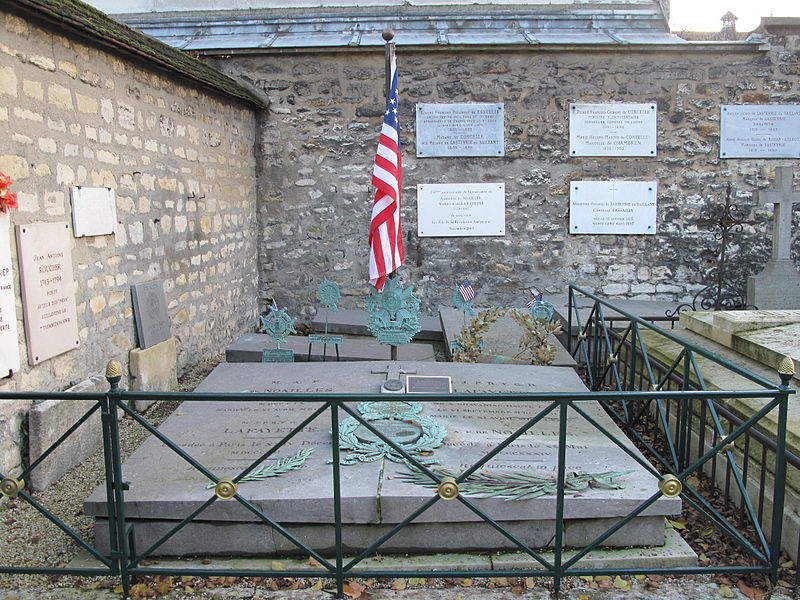
Marie-Joseph Paul Yves Roch Gilbert du Motier died in Paris on May 20, 1834, and was buried next to his wife at the Picpus Cemetery. He was seventy-six. President Andrew Jackson ordered that he be accorded the same funeral honors which President John Adams had bestowed on George Washington himself, in 1799. John Quincy Adams delivered a three-hour eulogy in Congress, saying “The name of Lafayette shall stand enrolled upon the annals of our race high on the list of the pure and disinterested benefactors of mankind.”
Lafayette Burial Place, Picpus Cemetery, Paris
In obedience to his one of his last wishes, several feet of earth were dug up from Bunker Hill, and shipped to France. The man had always wanted to be buried under American soil.
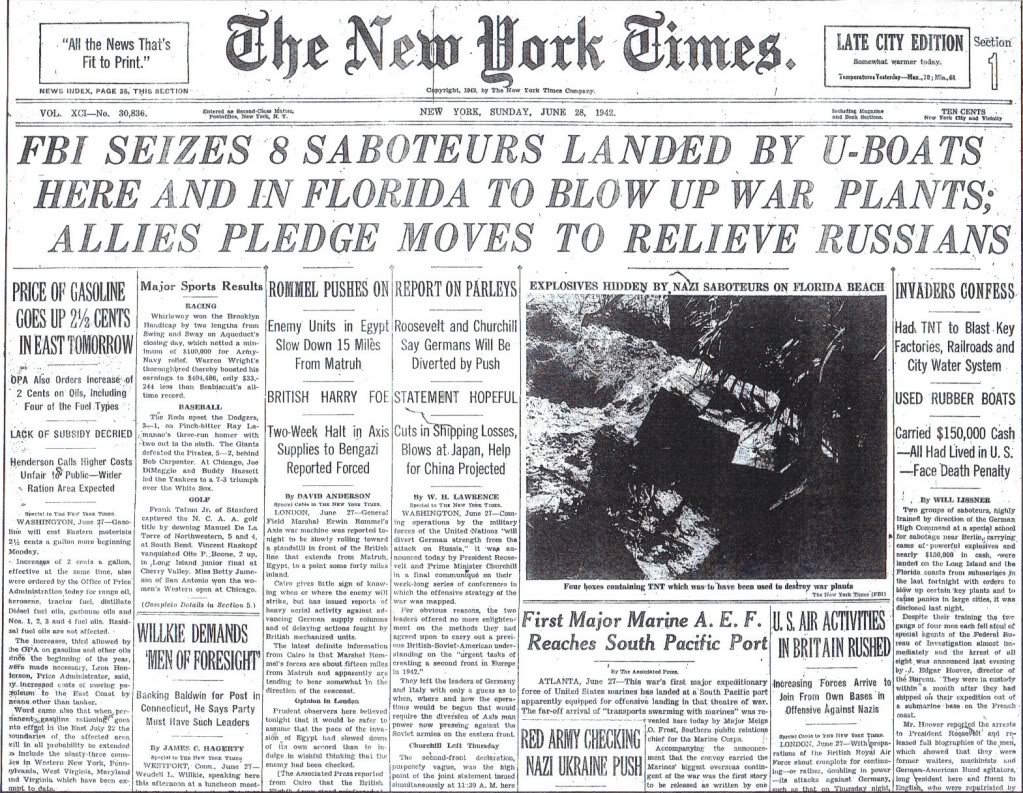
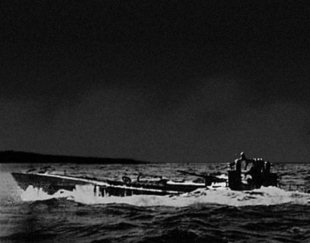
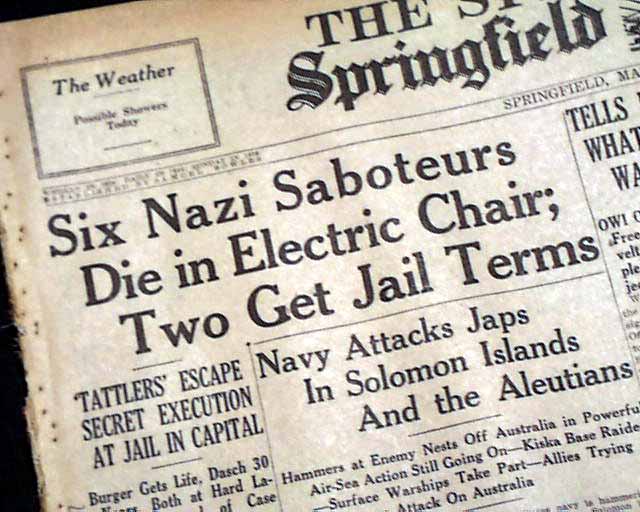
The German submarine U-202 came to the surface in the small hours of June 12 at Amagansett, NY, near Montauk Point. The inflatable that came out of its hatch was rowed to shore at what is today Atlantic Avenue beach, Long Island.
Much has been written about the eight central characters in this story. These individuals have been described in contemporary and subsequent sources alike, as Saboteurs, Nazis and Spies. Certainly to call them such, fed into the political expectations of the day. Yet their country had chosen them for this mission based on unique qualifications, separate and apart from whatever devotion they felt for the fatherland, or to the Nazi party. It may be that these guys deserve every evil name that’s been heaped upon them. Or maybe they were just eight guys who got caught up between two nations at war. It’s an interesting story. You decide.
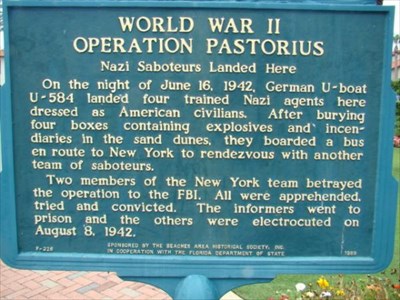
The German submarine U-202 came to the surface in the small hours of June 12 at Amagansett, New York, near Montauk Point. The inflatable that came out of its hatch was rowed to shore at what is today Atlantic Avenue beach, Long Island. Four figures stepped onto the beach wearing German military uniforms. If they’d been captured at that point, they wanted to be treated as enemy combatants, rather than spies.
Their mission was to sabotage American economic targets and damage defense production. Their targets included hydroelectric plants, train bridges, and factories. They had almost $175,000 in cash, some good liquor, and enough explosives to last them through a two year campaign.
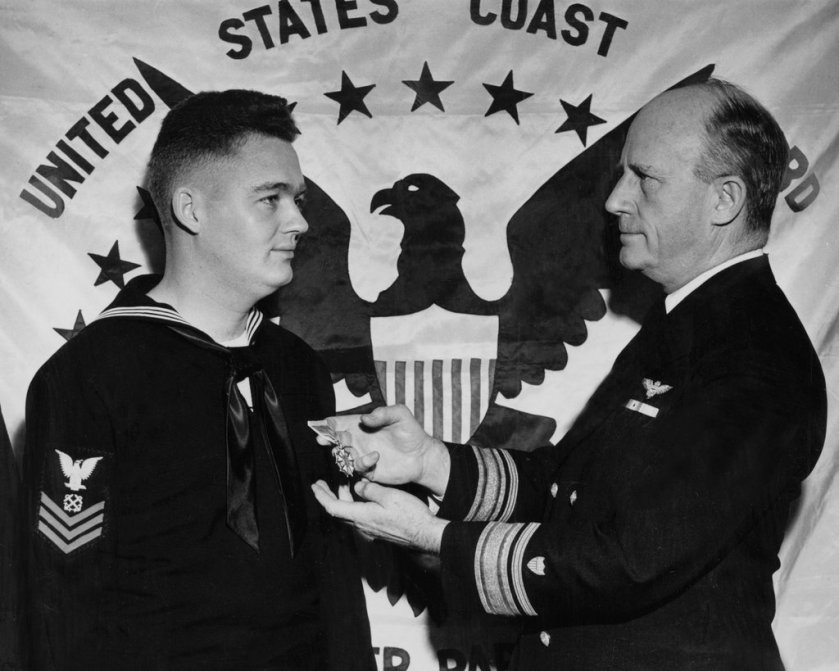
German plans began to unravel as they buried their uniforms and explosives in the sand. 21-year old Coast Guardsman John Cullen was a “sand pounder”. Armed only with a flashlight and a flare gun, Cullen had the unglamorous duty of patrolling the beaches, looking for suspicious activity.
It was “so foggy that I couldn’t see my shoes”, Cullen said, when a solitary figure came out of the dunes. He was George John Davis, he said, a fisherman run ashore. Something seemed wrong and Cullen’s suspicions were heightened, when another figure came out of the darkness. He was shouting something in German, when “Davis” spun around, yelling, “You damn fool! Go back to the others!”
With standing orders to kill anyone who confronted them during the landing, Davis hissed, “Do you have a mother? A father? Well, I wouldn’t want to have to kill you.”
It was Cullen’s lucky day. “Davis'” real name was George John Dasch. He was no Nazi. He’d been a waiter and dishwasher before the war, who’d come to the attention of the German High Command because he’d lived for a time in America. “Forget about this, take this money, and go have a good time” he said, handing over a wad of bills. $260 richer, Cullen sprinted two miles to the Coast guard station.
Seaman John Cullen, left, received the Legion of Merit from Rear Adm. Stanley V. Parker for his service in WW2
Four days later, U-584 deposited a second team of four at Ponte Vedra Beach, Florida, south of Jacksonville. As with the first, this second group had lived and worked in the United States, and were fluent in English. Two of the eight were US citizens.
George Dasch had a secret. He had no intention of carrying out his mission. He summoned Ernst Peter Burger to an upper-level hotel room. Gesturing toward an open window, Dasch said “You and I are going to have a talk, and if we disagree, only one of us will walk out that door—the other will fly out this window.”
Burger turned out to be a naturalized citizen, who’d spent 17 months in a concentration camp. He hated the Nazis as much as Dasch, and the pair decided to defect.
Dasch tested the waters. Convinced the FBI was infiltrated with Nazi agents, he telephoned the New York field office. Put on hold with the call transferred several times, Dasch was horrified to have the agent who finally listened to him, quietly hang up the phone. Had he reached a German mole? Had the call been traced?
Dasch could not have known, he’d been transferred to the ‘nut desk’. The FBI thought he was a clown.
Finally, Dasch went to the FBI office in Washington DC, where he was treated like a nut job. Until he dumped $84,000 on Assistant Director D.M. Ladd’s desk, equivalent to about a million, today. Dasch was interrogated for hours, and happily gave up everything he knew. Targets, German war production, he spilled it all, even a handkerchief with the names of local contacts, written in invisible ink. He couldn’t have been a very good spy, though. He forgot how to reveal the names.
All eight were in custody within two weeks.
J. Edgar Hoover announced the German plot on June 27, but his version had little resemblance to that of Dasch and Burger. As with the brief he had given President Roosevelt, Hoover praised the magnificent work of FBI detectives, and the Sherlock Holmes-like powers of deduction which led Assistant Director Ladd to the $84,000. Dasch and Burger’s role in the investigation was conveniently left out, as was the fact that the money had basically bounced Ladd off the head.
Neither Dasch nor Burger expected to be thrown in a cell, but agents assured them it was a formality. Meanwhile, a credulous and adoring media speculated on how Hoover’s FBI had done it all. Did America have spies inside the Gestapo? German High Command? Were they seriously that good?
Attorneys for the defense wanted a civilian trial, but President Roosevelt wrote to Attorney General Francis Biddle: “Surely they are as guilty as it is possible to be and it seems to me that the death penalty is almost obligatory”. The case went all the way to the Supreme Court, where the decision “Ex parte Quirin” became precedent for the way unlawful combatants are tried, to this day. All eight would appear before a military tribunal.
It’s unclear whether any of the eight were the menace they were made out to be. German High Command had selected all eight based on a past connection with the United States, ordering them to attack what they may have regarded as their adopted country. Several were arrested in gambling establishments or houses of prostitution. One had resumed a relationship with an old girlfriend, and the pair was planning to marry. Not exactly the behavior patterns of “Nazi saboteurs”.
The trial was held before a closed-door military tribunal in the Department of Justice building in Washington, the first such trial since the Civil War. All eight defendants were found guilty and sentenced to death. It was only on reading trial transcripts, that Roosevelt learned the rest of the story. The President commuted Burger’s sentence to life and Dasch’s to 30 years, based on their cooperation with the prosecution. The other six were executed by electric chair on August 8, in alphabetical order.
After the war, Burger and Dasch’s trial transcripts were released to the public, over the strenuous objections of J. Edgar Hoover. In 1948, President Harry S. Truman bowed to political pressure, granting them executive clemency and deporting both to the American zone of occupied Germany. The pair found themselves men without a country, hated as spies in America, and traitors in Germany.
The reader may decide, whether Hoover and Roosevelt operated from base and venal political motives, or whether the pair was playing 4-D chess. Be that as it may, Hitler rebuked Admiral Canaris, and seems to have bought into Hoover’s version of FBI invincibility. There would be no further missions of this type, save for one in November 1944, when two spies were landed on the coast of Maine to gather information on the Manhattan project.
George Dasch campaigned for the rest of his life, to be allowed to return to what he described as his adopted country. Ernst Burger died in Germany in 1975, Dasch in 1992. The pardon Hoover promised both men a half-century earlier, never materialized
Ancient animosity were on display that day, and words were exchanged between the groups. A fight broke out and it turned into a brawl. Very quickly, the brawl became a full-scale riot.
180 years ago today, fire engine #20, “The Extinguisher” crossed paths with an Irish Catholic funeral procession, returning from a blaze in Roxbury, Massachusetts.
The fire company was entirely comprised of “Yankees”: protestants of old English stock. Ancient animosity were on display that day, and words were exchanged between the groups. A fight broke out and it turned into a brawl. Very quickly, the brawl became a full-scale riot.
There were fifteen hundred combatants at the height the melee. Houses were broken into, furniture smashed and thrown into the street. Mattresses were slashed, their contents thrown to the winds. Bricks, stones and anything else that could be picked up and thrown was used as a weapon, or hurled by one side at the other. It’s a wonder that more weren’t killed, there were scores of injured.
The fighting went on for hours, until Mayor Samuel Atkins Eliot called out the military to restore order.
Several participants were tried in the days that followed, and police courts sentenced several to periods of hard labor at the House of Correction. Police and military forces were stationed at Faneuil Hall, armories and churches around the city to prevent a recurrence, as local homeowners and shopkeepers petitioned the City of Boston for reimbursement of their losses.
There were a number of further confrontations, the latest on the 18th as crowds “hissed and hooted” at fire companies returning from a South Boston blaze. A number of combatants tried to re-ignite the brawl in the days that followed, none of them successfully.
The Baltimore Sun reported on June 12 that “four of the Irishmen were killed; a great number were badly injured and probably mortally”. The article went on to report that “It commenced with a funeral, and closed in sending its victims to a dishonored grave. Hereafter, let Boston hang her head in silence, and avoid the condemning verdict of the world. Let her in future prate no more about her devotion to morality, religion, and law; and last of all, let her not open her mouth, or the jaws of her press, to reproach the city of Baltimore”.
I know not what sort of inter-city rivalry existed between Baltimore and Boston at that time. In light of the “Black Lives Matter” riots of a couple years ago and the performance of that city’s Mayor and District Attorney, perhaps the editors of the Baltimore Sun need not have been quite so smug.
A “New England oyster bar & Atlantic Coast cookery” opened in November 2014, in Boston’s financial district, calling itself “Broad Street Riot”. Too bad they closed a year later, I would have liked to try them. There’s never a bad time for a belly full of cold water oysters.




 Semmes would recover from his wounds, returning to the war ravaged South via Cuba in February, 1865. That April, he would supervise the destruction of all Confederate warships in the vicinity, following the fall of Richmond. Semmes’ former command fought on as “the Naval brigade”, Semmes himself appointed Brigadier General, though the appointment would never be confirmed. The Confederate Senate had ceased to exist.

 Finally there was no choice for the Grand Armée, but to turn about and go home. Starving and exhausted with no winter clothing, stragglers were frozen in place or picked off by villagers or pursuing Cossacks. From Moscow to the frontiers you could follow their retreat, by the bodies they left in the snow. 685,000 had crossed the Neman River on June 24. By mid-December there were fewer than 70,000 known survivors.
 The Congress of Vienna declared Napoleon an outlaw on March 13, 1815. Austria, Prussia, Russia and the UK bound themselves to put 150,000 men apiece into the field to end his rule.





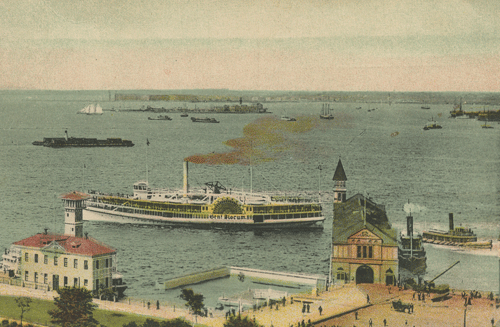
 It was 9:30 on a beautiful late spring morning when the sidewheel passenger steamboat General Slocum, left the dock and steamed into New York’s East River.




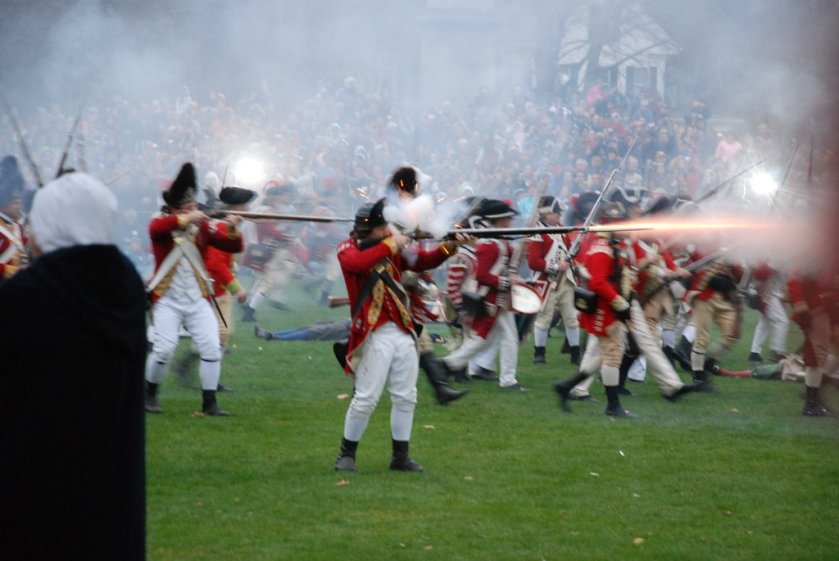
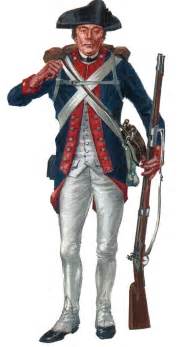 The Continental Congress established the ‘American Continental Army’ on June 14, 1775, authorizing 10 companies of ‘expert riflemen,’ to serve as light infantry in the siege of Boston. The next day the Congress unanimously selected George Washington to be General and Commander in Chief of all continental forces.


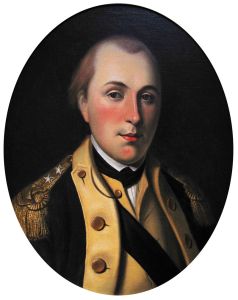 A third would arguably be Marie-Joseph Paul Yves Roch Gilbert du Motier, better known as the Marquis de Lafayette.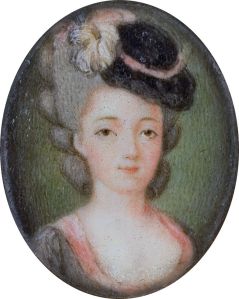

 Secretary of State Thomas Jefferson found a loophole that allowed Lafayette to be paid, with interest, for his services in the late Revolution. An act was rushed through Congress and signed by President Washington, the resulting funds allowing both Lafayettes some of the few privileges permitted them, during their five years’ captivity.




 Historical Easter Eggs - Today in History
You must be logged in to post a comment.