

In 1865, Confederate Cavalry officer John Stith Pemberton was wounded by a saber slash. Like many wounded veterans, Pemberton became addicted to the morphine given him to help ease the pain. Unlike most, “Dr.” Pemberton possessed the wherewithal to do something about it.
In civil life, Pemberton was a chemist. After the war, the former cavalry officer experimented with non-opiate pain-killers, landing on a combination of the coca leaf and kola nut. By 1886, he was bottling his concoction and selling it for 5¢ a bottle out of an Atlanta pharmacy. Ten years later, Coca-Cola was available in every American state and territory.
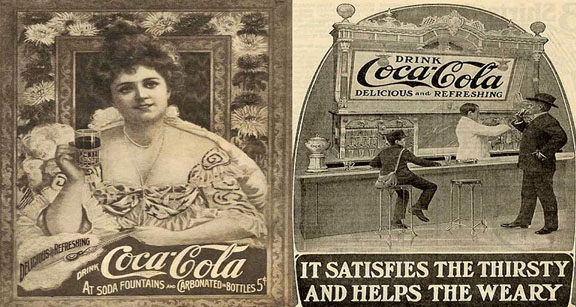
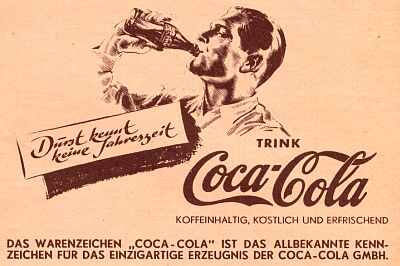
Europeans had long believed that natural mineral waters held medicinal qualities, and favored such beverages over often-polluted common drinking water. In 1920, the company opened its first European bottling plant, in France. By the time of Hitler’s annexation of Austria, the “Anschluss” of 1938, Coca-Cola had been in Germany for ten years.
Around the time that Hitler and the Nazi party were coming to power in 1933, German-born Max Keith (pronounced “Kite”) took over Coca-Cola’s German subsidiary, Coca-Cola Deutschland, GmbH. Mark Pendergrast, author of For God, Country, and Coca-Cola, writes that Keith “valued his allegiance to the drink and to the company more than his allegiance to his own country”. He had no qualms about doing business with every aspect of German society, including Nazi party members.
Bizarre though it may sound to the modern ear, a number of famous Americans and companies were involved with the European fascist regimes of the 1930s, including William Randolph Hearst, Joseph Kennedy (JFK’s father), Charles Lindbergh, John Rockefeller, Andrew Mellon (banker, head of Alcoa, and Secretary of the Treasury), DuPont, General Motors, Standard Oil (now Exxon), Ford, ITT, Allen Dulles (later head of the CIA), Prescott Bush, National City Bank, General Electric, and many in Hollywood.
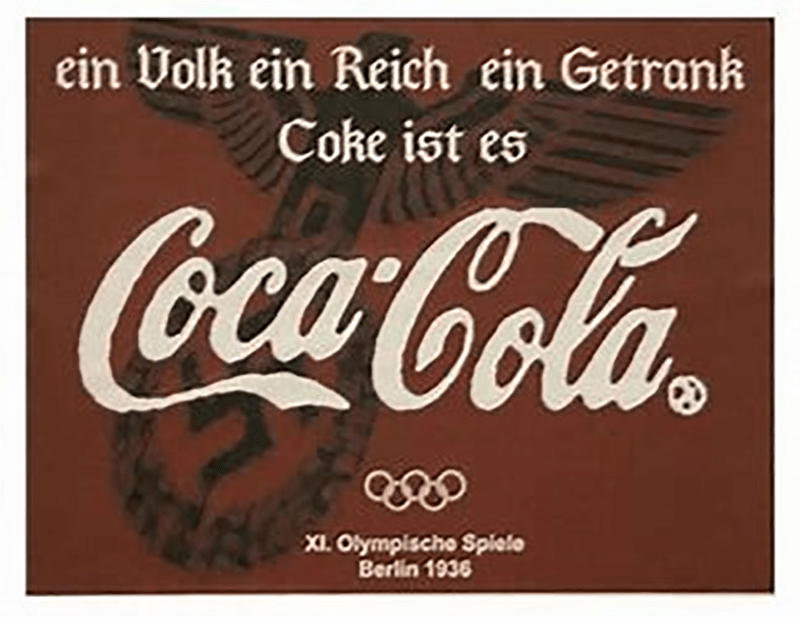
In Atlanta, Coca-Cola President Robert Woodruff was no exception. Woodruff himself attended the 1936 Berlin Olympics, alongside banners depicting the company logo, with the slogan “Ein Volk, ein Reich, ein Getrank – A People, an Empire, a Drink”.
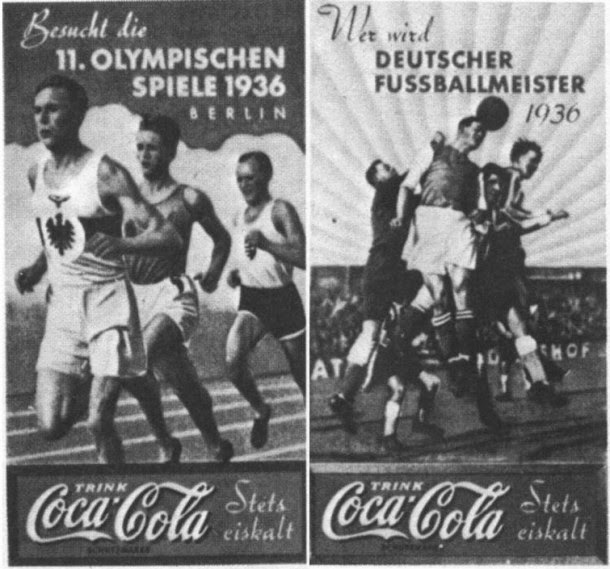
Woodruff used a 10th anniversary party for Coca-Cola GmbH to organize a mass Nazi salute in honor of Hitler’s 50th birthday, declaring that it was “to commemorate our deepest admiration for our Fuhrer.”
On January 20, 1940, Winston Churchill urged neutral nations to oppose the Nazi war machine, warning that, “Each one hopes that if he feeds the crocodile enough, the crocodile will eat him last.” Meanwhile in Germany, Coca Cola was the undisputed king of the domestic soft drink market.
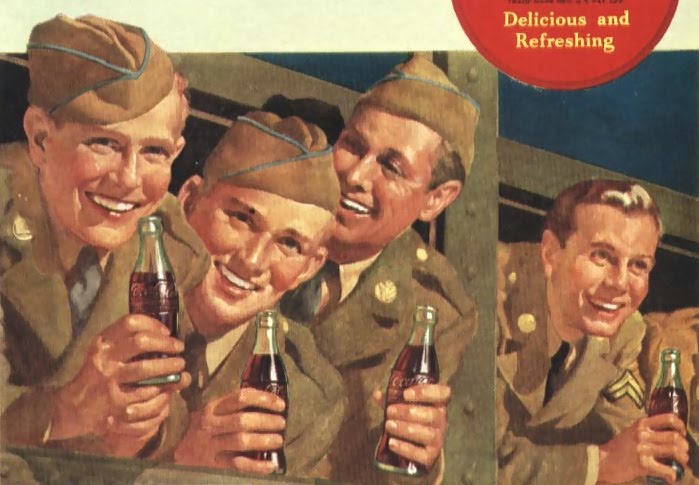
That changed a year later, with the Japanese attack on Pearl Harbor, and the German declaration of war on the United States.
American entry into WW2 meant that American companies ceased business with axis powers, while the German government threatened to seize “enemy owned” businesses. Max Keith was cut off from all communications with Coca-Cola headquarters in Atlanta, and in danger of the Nazi party nationalizing his beloved company. As shipments of Coca-Cola’s mythical “7X’ syrup, dried up, Keith had to come up with a substitute for the domestic soft drink market. Schnell.
With wartime rationing already in effect, Keith and his chemists worked with what was available. Leftovers from other food industries, apple fibers, fruit peelings, beet sugar and whey, the liquid left over when milk was curdled and strained off to make cheese.
The result was “Fantasievoll”, “Fantastiche” (“Imaginative”, “Fantastic”). So it is that the soft drink “Fanta”, was borne of the wartime necessities of Nazi Germany.
Coca-Cola GmbH had concocted a sweet, slightly cheesy tasting soft drink, and the German market responded. Sales rose steadily throughout the war, particularly as alternatives became increasingly scarce. People didn’t just drink the stuff, either. With sweeteners of all kinds strictly rationed, Fanta made its way into baked goods, soups and a variety of foodstuffs. By 1943, Fanta sales reached almost three million cases.

Tristan Donovan, author of the book Fizz: How Soda Shook Up the World, writes “It was Fanta or nothing”. Pendergrast writes that there’s little doubt that Keith did business with Nazis, but he was more company guy than idealogue. “You could not do business inside of Nazi Germany unless you collaborated with them,” wrote Pendergrast. “There’s no question he was a Nazi collaborator. [But] he was not a member of the Nazi party. His allegiance was to Coca-Cola, not to Hitler.”
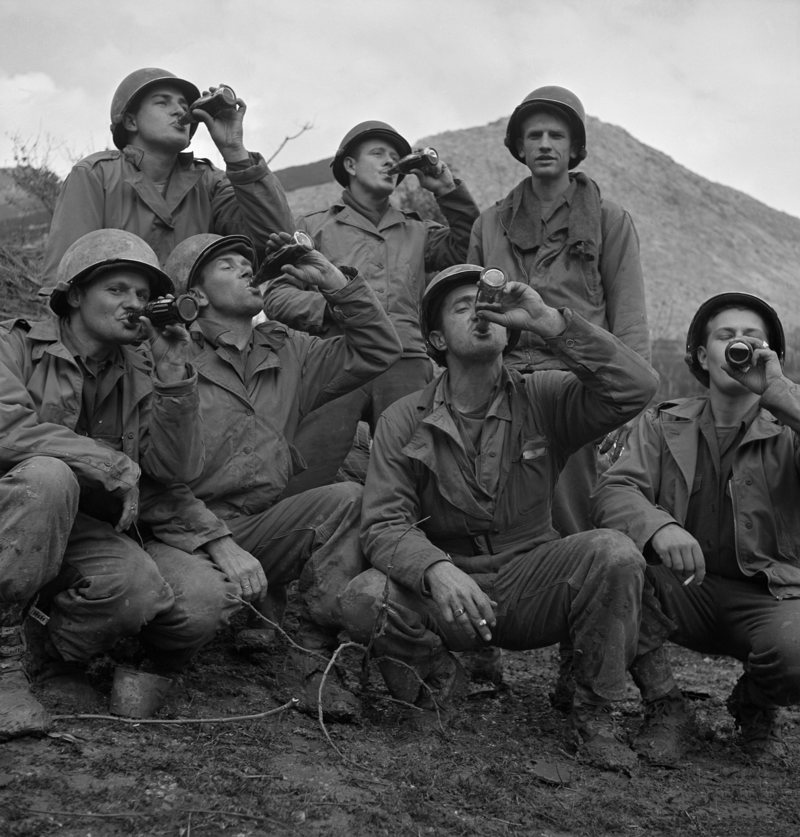
When American troops liberated Germany in the summer of 1945, legend has it that they found Keith in a half-bombed out factory, still bottling the stuff.
Fun fact: Hitler and his henchmen didn’t call themselves “Nazis”, in fact the term was frowned upon. They were the “NSDAP”, the Nazionale Socialistiche Deutsche Arbaits Partai, (National Socialist German Workers Party), the original abbreviation forwhich, was “Nasos”. The word “Nazi” derives from a Bavarian term meaning “simple minded” and was first used as a term of derision by journalist Konrad Heiden. The term was adopted by Anti-NSDAP’ers and Allied troops after war broke out, and the name stuck.
Despite being on the losing side, Keith was hailed as a hero back in Atlanta. The man who kept the company alive, in Germany. Vice President of Sales Harrison Jones called Keith a “great man”. He was given control of Coca-Cola, in all of Europe.
In April 1955, Coca-Cola reintroduced Fanta as an orange drink. Starting in Italy, the product made its way to the United States, in 1958. The name stuck, and why not. The company already owned the copyright.
In 2012, Fanta saw the strongest sales growth of the top 10 brands, the third Coke branded product to surpass 2 billion in case sales. Today, more than 100 flavors of Fanta are sold around the world, where customers from Latin America to Africa, to Europe, Brazil and China can say, “Es ist die Reale Sache”. It’s the Real Thing.


 Iva Ikuko Toguri was born in Los Angeles on July 4, 1916, the daughter of Japanese immigrants. She attended schools in Calexico and San Diego, returning to Los Angeles where she enrolled at UCLA, graduating in January, 1940 with a degree in zoology.
 She called herself “Orphan Annie,” earning 150 yen per month (about $7.00 US). She wasn’t a professional radio personality, but many of those who recalled hearing her enjoyed the program, especially the music.

 d’Aquino was sentenced to ten years and fined $10,000 for the crime of treason, only the seventh person in US history to be so convicted. She was released from the Federal Reformatory for Women at Alderson, West Virginia in 1956, having served six years and two months of her sentence.


 The United States had been in World War II for two years in 1943, when Claude Wickard, head of the War Foods Administration as well as Secretary of Agriculture, had the hare brained idea of banning sliced bread.
 Article 1, Section 8 of the Constitution includes the “Commerce Clause”, permitting the Congress “To regulate Commerce with foreign Nations, and among the several States, and with the Indian Tribes”. That’s it and, not surprisingly, the Federal District Court sided with the farmer.
 The Supreme Court, apparently afraid of President Roosevelt and his aggressive and illegal “
 The stated reasons for the ban never did make sense. At various times, Wickard claimed that it was to conserve wax paper, wheat and steel, but one reason was goofier than the one before.


 The act served multiple purposes, among them the modernization of what was then a largely WWI vintage merchant marine fleet, serving as the basis for a naval auxiliary that could be activated in time of war or national emergency.


 Where there are government subsidies, there are strings. For SS America, those strings were pulled on May 28, 1941, while the ship was at port in Saint Thomas, in the US Virgin Islands. The ship had been called into service by the United States Navy, and ordered to return to Newport News.



 STS-1, the first mission of the “Space Shuttle” program launched aboard “Columbia” from the Kennedy Space Center on Merritt Island, Florida. It was April 12, 1981, the 20th anniversary of the first human spaceflight, aboard the Russian Vostok 1. This was the first and, to-date only, manned maiden test flight of a new spacecraft system, in the US space program.
 STS-107 launched from the Kennedy Space Center aboard the Space Shuttle Columbia on January 16, 2003. Eighty seconds after launch, a piece of insulating foam the size of a briefcase broke away from the external fuel tank, striking the leading edge of Columbia’s left wing and leaving a hole in the carbon composite tiles.

 Payload Specialist Colonel Ilan Ramon, born Ilan Wolferman, was an Israeli fighter pilot, the first Israeli astronaut to join the NASA space program.


 On July 28, 1866, the Army Reorganization Act authorized the formation of 30 new units, including two cavalry and four infantry regiments “which shall be composed of colored men.”
 The original units fought in the American Indian Wars, the Spanish-American War, the Philippine-American War, the Border War and two World Wars, amassing 22 Medals of Honor by the end of WW1.


 There are roughly a quadrillion such synapses, meaning that any given thought could wend its way through more pathways than there are molecules in the known universe. This is roughly the case, whether you are Stephen J. Hawking, or Forrest Gump.
 The Alcor Life Extension Foundation, the self-described “world leader in cryonics, cryonics research, and cryonics technology” explains “Cryonics is an effort to save lives by using temperatures so cold that a person beyond help by today’s medicine can be preserved for decades or centuries until a future medical technology can restore that person to full health”.
 In 1988, television writer Dick Clair, best known for television sitcoms “It’s a Living”, “The Facts of Life”, and “Mama’s Family”, was dying of AIDS related complications. In his successful suit against the state of California, “Roe v. Mitchell” (Dick Clair was John Roe), Judge Aurelio Munoz “upheld the constitutional right to be cryonically suspended”, winning the “right” for everyone in California.
 The court battle produced a “family pact” written on a cocktail napkin, which was ruled authentic and allowed into evidence. So it is that Ted Williams’ head went into cryonic preservation in one container, his body in another.
 In April 1773, Benjamin Franklin wrote a letter to Jacques Dubourg. “I wish it were possible”, Franklin wrote, “to invent a method of embalming drowned persons, in such a manner that they might be recalled to life at any period, however distant; for having a very ardent desire to see and observe the state of America a hundred years hence, I should prefer to an ordinary death, being immersed with a few friends in a cask of Madeira, until that time, then to be recalled to life by the solar warmth of my dear country! But…in all probability, we live in a century too little advanced, and too near the infancy of science, to see such an art brought in our time to its perfection”.

 Edwin seems to have had life-long problems with alcohol, often resulting in an inability to provide for his family. Amelia must have been a disciplined student despite it all, as she graduated with her high school class, on time, notwithstanding having attended six different schools.

 Following the end of the official search, Earhart’s husband and promoter George Palmer Putnam financed private searches of the Phoenix Islands, Christmas (Kiritimati) Island, Fanning (Tabuaeran) Island, the Gilbert and the Marshall Islands, but no trace of the aircraft or its occupants was ever found.


 The precise circumstances are unknown, but the monk came into the royal orbit, sometime in 1905. “We had the good fortune”, Tsar Nicholas wrote to his diary , “to meet the man of God Grigori from the province of Tobolsk”.

 By 1916 it was clear to many in the Nobility. The only course was to kill Rasputin, before he destroyed the monarchy.

 Historical Easter Eggs - Today in History
You must be logged in to post a comment.