June 15 1904 A Community, no More

The General Slocum disaster killed fewer than one per cent of the overall population of Little Germany, yet these were the women and children of some of the community’s most established families.  

In the first full century of American independence, three great waves of European and later Asian immigrants left their homes in the ‘old country’, headed for a life in the new world.

The-Scotch-Irish-the-Eighteenth-Century-Irish-Diaspora-1Starvation, shipwreck and disease killed no fewer than 1 in 10 during the period 1790 – 1820, without any so much as setting foot in the new world. And still they came.

The largest non-English speaking minority were the ethnic Germans, escaping economic hardship and in search of political freedom.  At the time of the Civil War, nearly one-quarter of all Union troops were German Americans, some 45% of whom were born in Europe.

German migration rose faster than any other immigrant group through the latter part of the 19th century and into the 20th, many in pursuit of agricultural opportunity while others settled in major cities such as New York and Philadelphia.

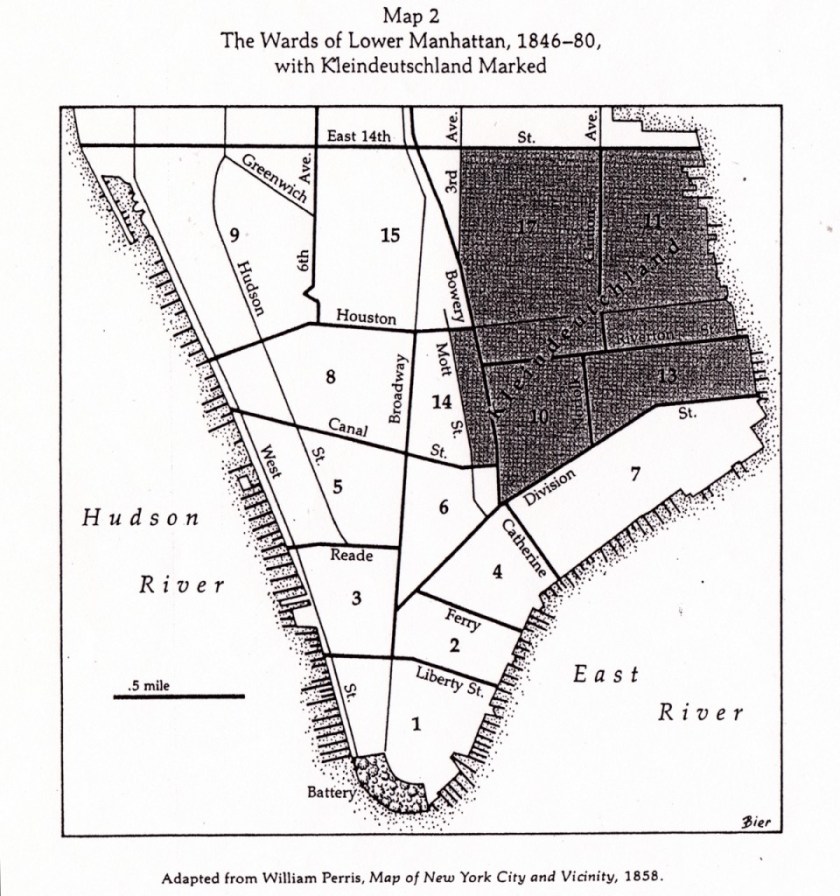
Kleindeutschland, or “Little Germany”, occupied some 400 blocks on the Lower East Side of Manhattan, in what is now the East Village. “Dutchtown”, as contemporary non-Germans called the area, was home to New York’s German immigrant community since the 1840s, when they first began to arrive in significant numbers. By 1855, New York had the largest ethnically German community in the world, save for Berlin and Vienna.
Little Germany

June 15, 1904 dawned bright and beautiful on Little Germany, a beautiful late spring morning when the sidewheel Passenger Steamboat General Slocum left the dock and steamed into the East River.

PS General Slocum was on a charter this day, carrying German-American families on an outing from St. Mark’s Lutheran Church on a harbor cruise and picnic. Over a thousand tickets were sold, not counting 300+ children who were sailing for free.

general_slocum_1

There were 1,342 people on board, mostly women and children, including band, crew and catering staff.

The fire probably started when someone tossed a cigarette or match into the forward section lamp room. The flames spread quickly, fueled by lamp oil and oily rags.  A 12-year old boy first reported the fire, but the Captain didn’t believe him.  The fire was first noticed at around 10:00am.

The ships’ operators had been woefully lax in maintaining safety equipment. Now it began to show. Fire hoses stored in the sun for years were uncoiled, only to break into rotten bits in the hands of the crew. Life preservers manufactured in 1891 had hung unprotected in the sun for 13 years, their canvas covers splitting apart pouring useless cork powder onto the floor. Survivors reported inaccessible life boats, wired and painted into place.

slo-345x180

Crew members reported to Captain William van Schaick that the blaze “could not be conquered.” It was “like trying to put out hell itself.” The captain ran full steam into the wind trying to make it to the 134th Street Pier, but a tug boat waved them off, fearing the flames would spread to nearby buildings.

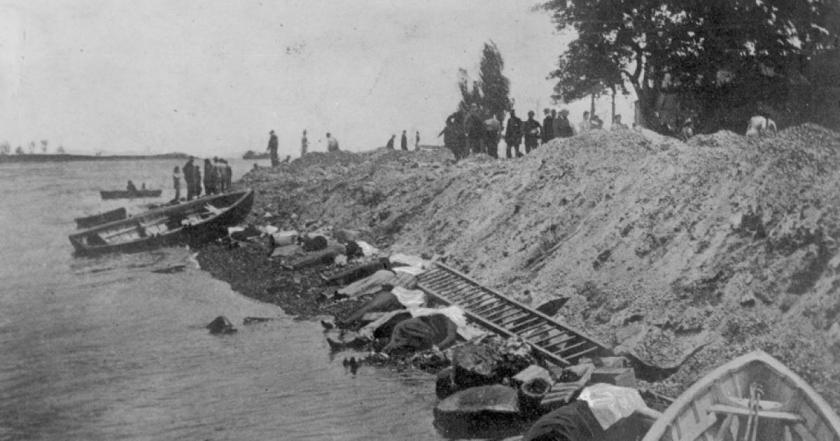
The wind and the speed of the ship itself whipped the flames into an inferno as Captain van Schaick changed course for North Brother Island, just off the Bronx’ shore.
Many jumped overboard to escape the inferno, but the heavy women’s clothing of the era quickly pulled them under.

Slocum 1

Desperate mothers put useless life jackets on children and threw them overboard, only to watch in horror as they sank. One man, fully engulfed in flames, jumped screaming over the side, only to be swallowed whole by the massive paddle wheel.

One woman gave birth in the confusion, and then jumped overboard with her newborn to escape the flames. They both drowned.

A few small boats were successful in pulling alongside in the Hell’s Gate part of the harbor, but navigation was difficult due to the number of corpses already bobbing in the waves.
general-slocum-disaster

Holding his station despite the inferno, Captain van Schaick permanently lost sight in one eye and his feet were badly burned by the time he ran the Slocum aground at Brother Island.

Patients and staff at the local hospital formed a human chain to pull survivors to shore as they jumped into shallow water.

1,021 passengers and crew either burned to death, or drowned. It was the deadliest peacetime maritime disaster, in American history.

220px-Wotherspoon_01
Adella Liebenow

There were only 321 survivors.

The youngest survivor of the disaster was six-month-old Adella Liebenow. The following year at the age of one, Liebenow unveiled a memorial statue to the disaster which had killed her two sisters and permanently disfigured her mother.

The New York Times reported “Ten thousand persons saw through their tears a baby with a doll tucked under her arm unveil the monument to the unidentified dead of the Slocum disaster yesterday afternoon in the Lutheran Cemetery, Middle Village, L.I.”

Both of Liebenow’s sisters were among the unidentified dead.

The General Slocum disaster killed fewer than one per cent of the overall population of Little Germany, yet these were the women and children of some of the community’s most established families.

There were more than a few suicides.  Mutual recriminations devoured much of a once-clannish community, as the men began to move away.  2600326453_0eae4732c8

There was no longer anything for them, in that place.

Anti-German sentiment engendered by WW1 finished what the General Slocum disaster, had begun. Soon, New York’s German-immigrant community, was no more.

Deep inside the East Village, amidst the hipsters and the poets’ cafes of “Alphabet City”, stands a forgotten memorial.  A 9′ stele erected in Tompkins Square Park, sculpted from pink Tennessee Marble. The relief sculpture shows two children, beside them are inscribed these words: “They were Earth’s purest children, young and fair.

Once the youngest survivor of the disaster, Adella (Liebenow) Wotherspoon passed away in 2004, at the age of 100, the oldest survivor of the deadliest disaster in New York history.  Until September 11, 2001.


If you enjoyed this “Today in History”, please feel free to re-blog, “like” & share on social media, so that others may find and enjoy it as well. Please click the “follow” button on the right, to receive email updates on new articles.  Thank you for your interest, in the history we all share.


June 14, 1775 Army Strong

The “olive branch petition” adopted by the 2nd Continental Congress three months after the “shot heard ’round the world’ was a last-ditch attempt to prevent full-on war, but too late.  The die was cast. 

This “Today in History” is dedicated to United States Army Lieutenant Colonel (retired) Richard B. “Rick” Long, Sr., the man for whom this writer is namesake.  Rest in Peace, Dad.  You left us too soon.

February 25, 1937 – March 31, 2018

—————

When Caesar crossed the Rubicon River at the head of an army, everyone understood what it meant. A strife of interests would no longer be carried out by civil or legal means.  Caesar had crossed the military threshold and there was no turning back.  There would be civil war.  Republic would give way to Empire. Two thousand years later, to “Cross the Rubicon” still means to take a step which cannot be reversed.

Johnadamsvp.flipped
Future President John Adams defended the British soldiers accused in the “Boston Massacre”. Six of the eight were acquitted, the other two sentenced to branding, on the hand.

The British colonies in North America crossed a Rubicon of their own in April, 1775.  Before Lexington & Concord, there had always been a benefit of the doubt.  The ‘Boston Massacre‘ of five years earlier resulted not in insurrection but in trial, with Boston attorney John Adams acting for the defense.

The “olive branch petition” adopted by the 2nd Continental Congress three months after the ‘shot heard ’round the world’ was a last-ditch attempt to prevent full-on war, but too late.  The die was cast.

The first Continental Congress of 1774 convened in response to the ‘Coercive Acts”, imposed by the English Parliament to bring the colonists into line with Crown tax policy.  The 2nd Continental Congress gathered in Philadelphia the following year, had come for the conduct of war.

The fledgling United States had no Army at this time, relying instead on ad hoc militia units organized by the colonies themselves. At this time there were approximately 22,000 armed colonials surrounding some 4,000 British troops occupying Boston, and another 5,000 or so in New York.

The Continental Congress established the ‘American Continental Army’ on this day in 1775, authorizing 10 companies of ‘expert riflemen,’ to serve as light infantry in the siege of Boston. The next day the Congress unanimously chose George Washington to be General and Commander-in-Chief of all continental forces.

14-1-87_s

During those first years of the war, American ground forces more closely resembled a ragtag assemblage of state militias, than a professional army.

Following the 1779 Battle of Stony Point, Brigadier General Anthony Wayne was able to write to Washington, “Dear Gen’l: The fort and Garrison with Col. Johnston are ours. Our officers and men behaved like men who are determined to be free.”

Most of the Continental Army was disbanded following the Treaty of Paris, formally ending the war in 1783. The 1st and 2nd Regiments remained, becoming the basis of the Legion of the United States in 1792 and forming the foundation of the United States Army in 1796, an organization since evolved into the premier fighting force, of all the world.

Battle-Streamers
United States Army flag, with campaign streamers

The Army’s official banner features the original War Office Seal in blue on a white field over a scarlet banner displaying the words “United States Army” and the year, ‘1775’. The flag was adopted by President Dwight Eisenhower on June 12, 1956, officially dedicated and unfurled before the general public on June 14, 1956, the 181st birthday of the United States Army.

The concept of individual campaign streamers first came about during the Civil War. When on full display, the US Army flag currently includes 190 such streamers.

The Navy came about in October of 1775, the Marine Corps a month later. 18th century revenue cutter and rescue operations led to the formation of the United States Coast Guard in January, 1915.

According to the website www.usmma.edu, the federal government first began training its citizens for naval service during the Grant administration.  Congress passed the landmark Merchant Marine Act in 1936.  The Air Force spun off of the Army Air Corps, eleven years later.

MILITARY-4-1075x806


On August 31, 1949, Defense Secretary Louis Johnson announced the creation of Armed Forces Day, the 3rd Saturday in May, to recognize the contributions of the United States military and its constituent branches. Speaking at an Armed Forces Day event in 1953, President Dwight David Eisenhower remarked that: “It is fitting and proper that we devote one day each year to paying special tribute to those whose constancy and courage constitute one of the bulwarks guarding the freedom of this nation and the peace of the free world.

220px-Nobel_PrizeFrom the dawn of the 20th century, the Nobel Peace prize was awarded to individuals and organizations which have “done the most or the best work for fraternity between nations, for the abolition or reduction of standing armies and for the holding and promotion of peace congresses.”

After two World Wars, is it possible that the United States military has done more to promote peace than all of those individuals and organizations, combined?

If you are so inclined, it would be proper to pay tribute and thank a teacher, that you are able read this essay.  On this, the birthday of the United States Army, you might thank a soldier that you can read it, in English.

—————

A Personal Note:
While I never served my country in uniform, on this day I pay a personal debt of gratitude, to those of my family circle, who have.
I remember my ancestor, the farmer who left to fight the most powerful military of his time, that this nation might gain its independence.
The Tyner brothers: my twice-great grandfather James and his brothers, Nicholas, Benjamin and William, who fought for what each considered to be their country, in the war between the states. Nicholas alone would survive, laying down his arms under General Lee’s orders at Appomattox and walking home to the Sand hills of North Carolina, there to help his wife and three widowed sisters-in-law raise their 28 kids.
armyflagGreat Uncle Jacob Deppin was also there at Appomattox, wearing Blue. He served for the duration, save for the year and one-half spent in captivity.
Twice-great Grandfather Wilhelm Christian was the first to change the family surname from “Lang” to “Long”. Blacksmith to the 17th PA Cavalry, his name may be found with those of fifty-six other ‘Langs’, ‘Langens’ and ‘Longs’, on the Pennsylvania monument at Gettysburg. How many are relations, is anyone’s guess.
I honor my grandfather Norman. Wounded in the Great War, he’s earned his final rest in our most hallowed ground, at Arlington.
I honor my Uncle Woodrow, killed in Anzio. Uncle Gary, who helped to fight the explosions and the fires that day in 1967, as the USS Forrestal burned. I honor my father-in-law Ken, the Airman who served with honor, in time of peace.
I honor my brothers’, Norm and Dave, with over 50 years service between them. Even now in retirement, both maintain themselves in a state of fitness and readiness, in case that call comes in one more time.
I honor my son in law Nate and his ‘battle buddy ‘Zino’, the four-year-old German Shepherd turned Tactical Explosives Detection Dog, trained to detect up to 64 explosive compounds. Theirs was to protect a Forward Operating base in Soltan Kheyl, in the Wardak Province of Afghanistan. Together the pair found and neutralized more improvised explosive devices than any other team in their sector. There can be no knowing how many lives were saved by this pair.
And I honor the family members, most often the wives and mothers. It is they who are left to run the family unit and the household alone, never knowing if it will be for a time, or forever.
Rick Long

June 13, 1777 An Indispensable Man

The two men bonded almost immediately, forming a relationship closely resembling that of father and son.  The fatherless young French officer, and the father of his country who went to his grave, childless.

There are a handful of men who were indispensable to the American Revolution, men without whom the war effort would have been doomed to failure.

One, of course is George Washington, who became commander in chief before he had an army, before there was even a country. Washington took command of a rebel army with barely enough powder for nine shots per man, knowing all the while that, if caught, the penalty at that time for high treason was to be drawn, quartered and disemboweled, before the dying eyes of the prisoner so convicted.

La_Fayette_by_Weyler
LaFayette by Weyler

Another Indispensable would have to be Benjamin Franklin, whose diplomatic skills and unassuming charm elevated him to the status of a rock star among the circles of power at Versailles. It was Benjamin Franklin who transformed the French nation from mildly interested spectator to a  crucially important ally.

A third would arguably be Marie-Joseph Paul Yves Roch Gilbert du Motier, better known as the Marquis de Lafayette.

Lafayette was all of nineteen when he arrived in North Island South Carolina on June 13, 1777.

The French King had forbidden him from coming to America, fearing his capture by British agents. Lafayette wanted none of it. His own father, also the Marquis de Lafayette, was killed fighting the British when the boy was only two. The man was going to take part in this contest, if he had to defy his King to do it.

Lafayette disguised himself on departure, and purchased the entire ship’s cargo with his own money, rather than landing in Barbados and thus exposing himself to capture.

Lafayette and Washington_at_Mount_Vernon,_1784

Franklin had written to Washington asking him to take the young man on, in hopes of securing an increase in French aid to the American war effort.

The two men bonded almost immediately, forming a relationship closely resembling that of father and son.  The fatherless young French officer, and the father of his country who went to his grave, childless.

Lafayette wrote home to his wife in 1778, from Valley Forge. “In the place he occupies, he is surrounded by flatterers and secret enemies. He finds in me a trustworthy friend in whom he can confide and who will always tell him the truth. Not a day goes by without his talking to me at length or writing long letters to me. And he is willing to consult me on most interesting points.”

Lafayette served without pay, spending the equivalent of $200,000 of his own money for the salaries and uniforms of staff, aides and junior officers. He participated in several Revolutionary War battles, including Brandywine, Monmouth Courthouse and the final siege at Yorktown.

All the while, Lafayette periodically returned to France to work with Franklin in securing thousands of additional troops and several warships to aid in the war effort.

Lafeyettes wife Marie_Adrienne_FrancoiseLafayette’s wife Adrienne gave birth to their first child on one such visit, a baby boy the couple would name Georges Washington Lafayette.

It was a small force under Lafayette that took a position on Malvern Hill in 1781, hemming in much larger British forces under Lord Cornwallis at the Yorktown peninsula.

The trap was sprung that September with the arrival of the main French and American armies under the Comte de Rochambeau and General George Washington, and the French fleet’s arrival in the Chesapeake under the Comte de Grasse.

Cornwallis surrendered on October 19, 1781, after which Lafayette returned to France.

The Marquis played an important role in his own country’s revolution, becoming a Commander of the French National Guard. When the Bastille was stormed by an angry mob in 1789, Lafayette was handed the key. Lafayette later sent the key to the Bastille to George Washington, as a “token of victory by Liberty over Despotism”. Today that key hangs in the main hallway at Washington’s mansion at Mount Vernon.

img_3767

When the French Marquis died in 1834, President Andrew Jackson ordered that he be accorded the same funeral honors which President John Adams bestowed on George Washington himself, back in 1799. John Quincy Adams delivered the three-hour eulogy in Congress, saying “The name of Lafayette shall stand enrolled upon the annals of our race high on the list of the pure and disinterested benefactors of mankind.”

Lafayette-grave

The Marquis de Lafayette lies under several feet of earth shipped to France from Bunker Hill on the Charlestown peninsula, in obedience to one of his last wishes.  He had always wanted to be buried under American soil.

lafayette

If you enjoyed this “Today in History”, please feel free to re-blog, “like” & share on social media, so that others may find and enjoy it as well. Please click the “follow” button on the right, to receive email updates on new articles.  Thank you for your interest, in the history we all share.

June 12, 1928 The Luckiest Man on the Face of the Earth

Sports reporter James Kahn wrote: “I think there is something wrong with him. Physically wrong, I mean. I don’t know what it is, but I am satisfied that it goes far beyond his ball-playing”.

The Lane Tech high school baseball team was at home on June 26, 1920. 10,000 spectators had assembled to watch the game at Cubs Park, now Wrigley Field. New York’s Commerce High was ahead 8–6 in the top of the 9th, when a left handed batter hit a grand slam out of the park. No 17-year-old had ever hit a baseball out of a major league park before, and I don’t believe it’s happened, since. It was the first time the country heard the name Lou Gehrig.

lou-gehrig-columbia-universityGehrig was pitching for Columbia University against Williams College on April 18, 1923, the day that Babe Ruth hit the first home run out of the brand new Yankee Stadium. Though Columbia would lose the game, Gehrig struck out seventeen batters to set a team record.

The loss didn’t matter to Paul Krichell, the Yankee scout who’d been following Gehrig. Krichell didn’t care about the arm either, as much as he did that powerful left-handed bat. He had seen Gehrig hit some of the longest home runs ever seen on several eastern campuses, including a 450′ home run at Columbia’s South Field that cleared the stands and landed at 116th Street and Broadway.

NY Giants manager John McGraw persuaded a young Gehrig to play pro ball under a false name, Henry Lewis, despite the fact that it could jeopardize his collegiate sports eligibility. Gehrig played only a dozen games for the Hartford Senators before being found out, and suspended for a time from college ball. This period, and a couple of brief stints in the minor leagues in the ’23 and ’24 seasons, were the only times Gehrig didn’t play for the New York team.

Gehrig started as a pinch hitter with the Yankees on June 15, 1923. He came into his own in the ‘26 season. In 1927 he batted fourth on “Murderers’ Row”, the first six hitters in the Yankee’s batting order: Earle Combs, Mark Koenig, Babe Ruth, Lou Gehrig, Bob Meusel and Tony Lazzeri.

Murderers--Row

He had one of the greatest seasons of any batter in history that year, hitting .373, with 218 hits: 52 doubles, 18 triples, 47 home runs, a then-record 175 RBIs, and a .765 slugging percentage. Gehrig’s bat helped the 1927 Yankees to a 110–44 record, the American League pennant, and a four game World Series sweep of the Pittsburgh Pirates.

On this day in 1928, Gehrig hit 2 triples and a pair of home runs, leading the Yankees in a 15-7 victory over the Chicago White Sox.  At Comiskey Park, no less.

lou-gehrig

He was the “Iron Horse”, playing in more consecutive games than any player in history. It was an “unbreakable” record, standing for 56 years, until surpassed in 1995 by Cal Ripken, Jr. Gehrig hit his 23rd and last major league grand slam in August 1938, a record that would stand until fellow Yankee Alex Rodriquez tied it in 2012.

lou-gehrig-5Lou Gehrig collapsed in 1939 spring training, going into an abrupt decline early in the season. The Yankees were in Detroit on May 2 when Gehrig told manager Joe McCarthy “I’m benching myself, Joe”. It’s “for the good of the team”. McCarthy put Babe Dahlgren in at first and the Yankees won 22-2, but that was it. The Iron Horse’s streak of 2,130 consecutive games, had come to an end.

Sports reporter James Kahn wrote: “I think there is something wrong with him. Physically wrong, I mean. I don’t know what it is, but I am satisfied that it goes far beyond his ball-playing”.

Gehrig left the team in June, arriving at the Mayo Clinic on the 13th. The diagnosis of Amyotrophic Lateral Sclerosis (ALS) was confirmed six days later, on June 19. It was his 36th birthday. It was a cruel prognosis: rapidly increasing paralysis, difficulty in swallowing and speaking, and a life expectancy of fewer than three years.

Yankees Tigers Gehrig Ends Streak

Gehrig briefly rejoined the Yankees in Washington, D.C. He was greeted by a group of Boy Scouts at Union Station, happily waving and wishing him luck. Gehrig waved back, but he leaned forward to a reporter. “They’re wishing me luck”, he said, “and I’m dying.”

Gehrig appeared at Yankee Stadium on “Lou Gehrig Appreciation Day”, July 4, 1939. He was awarded trophies and other tokens of affection by the New York sports media, fellow players and groundskeepers. He would place each one on the ground, already too weak to hold them. Addressing his fans, Gehrig described himself as “The Luckiest Man on the Face of the Earth”.

Henry Louis Gehrig died on June 2, 1941.  He was 37.

I drove by Yankee Stadium back in 2013, the week after the Boston Marathon bombing. The sign out front said “United we Stand”. With it was a giant Red Sox logo. That night, thousands of Yankees fans interrupted a game with the Arizona Diamondbacks, to belt out Neil Diamond’s “Sweet Caroline,” a staple of Red Sox home games since 1997.

terror30n-3-web

I thought about Lou Gehrig, and how the man compares with some of these guys today.  I’ve always been a Boston guy myself.  I think I’m required by state law, to hate the Yankees.  But, all kidding aside.  The man and the club.  They’re a pair of Class Acts.

Gehrig

If you enjoyed this “Today in History”, please feel free to re-blog, “like” & share on social media, so that others may find and enjoy it as well. Please click the “follow” button on the right, to receive email updates on new articles.  Thank you for your interest, in the history we all share.

June 11, 1775 The Lexington of the Sea

Called by some the “Lexington of the Sea”, the little-known episode was the first naval battle of the American Revolution, and ended in victory for the Patriot side. 

In the Passamaquoddy tongue, “Machias” roughly translates into “bad little falls”, after the river that runs through the place. Five hours and 15 minutes drive-time from Boston, Machias Maine sports a campus for the University of Maine, a municipal airport and, even today, a year-round population barely exceeding 2,000.

BAD LITTLE FALLS KC.JPG
Machias-area residents who discussed downtown revitalization Tuesday evening said the Bad Little falls was the town’s most distinctive element. (KATHERINE CASSIDY PHOTO)

Not necessarily a place where you’d expect the first naval combat of the American Revolution.

In 1775, the modern state of Maine was still part of Massachusetts. Machias itself, a small fishing village on the “Downeast” New England coast, had been a thorn in the British side, since the earliest days of the Revolution.   A local pilot intentionally grounded the coastal patrol schooner HMS Halifax that February, in Machias Bay.  The place also served as a base from which privateers preyed on British merchant shipping.

In April, a British foray from the occupied city of Boston had culminated in the Battle at Lexington Green.  While the King’s troops held the ground in the wake of the early morning skirmish, the decision of the afternoon’s battle at nearby Concord was quite different.  The colonial’s response to the column of “Regulars” was that of a swarming behive, resulting in a Patriot victory and a British retreat under fire, all the way back to Boston.

Siege-of-Boston-1-ABBoston was all but an island in those days, connected to the mainland only be a narrow “neck” of land.  A Patriot force some 20,000 strong took positions in the days and weeks that followed, blocking the city and trapping four regiments of British troops (about 4,000 men) inside of the city.

For General Thomas Gage, in charge of all those troops, the best hope for resupply was by water.

British Royal Navy Admiral Samuel Graves wanted the guns from the wreck of the Halifax, concerned they would otherwise fall into rebel hands.  Gage wanted lumber, with which to build barracks.  So it was that the wealthy merchant and Tory loyalist Ichabod Jones was enlisted to help, blissfully unaware of the dim view in which his activities were held by fellow colonials.

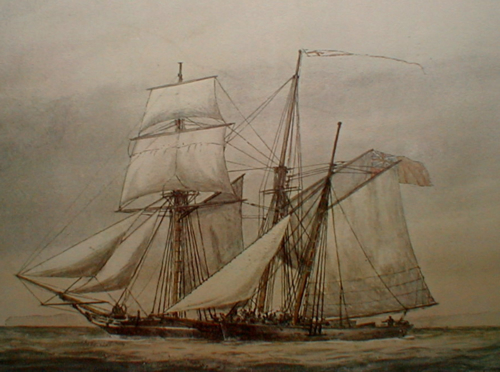
Jones arrived at Machias on June 2 aboard the merchant ships Unity and Polly, under guard of the armed schooner HMS Margaretta, commanded by Midshipman James Moore.  They had come to trade food for lumber but the townspeople were split, and voted against doing business with Jones.  This provoked a threat from the Margaretta, which moved into range to bombard the town.  The action resulted in a second vote and the trade was approved, but Jones’ response was ham-fisted.   The merchant would only do business, with those who had voted with him in the first place.

margaretta
HMS Margaretta

Local militia leader Colonel Benjamin Foster conceived a plan to seize the merchant, and saw his opportunity on June 11, when Jones and Moore were in church.  They almost had the pair too, but Jones saw some twenty men approaching, and fled for the woods.  Moore was able to get back to the Margaretta, but events soon spun out of control.

Colonel Foster and his brother, a man with the delightful name of Wooden Foster, seized the Unity.  A group of thirty began to construct breastworks to serve as protection, while others commandeered the coastal packet Falmouth.   There was gong to be a fight.

machias_meA group of Machias men approached Margaretta from the land and demanded her surrender, but Moore lifted anchor and sailed off in attempt to recover the Polly.  A turn of his stern through a brisk wind resulted in a boom and gaff breaking away from the mainsail, crippling the vessel’s navigability. Unity gave chase followed by Falmouth.

Musket fire was exchanged from both sides and hand grenades were thrown onto the decks of the Unity.   Soon, the Margaretta was boarded from both sides, the fighting hand to hand.

Called by some the “Lexington of the Sea”, the little-known episode was the first naval battle of the American Revolution, and ended in victory for the Patriot side.  Four Royal Navy seamen were killed outright and another ten wounded including Moore himself, who received a musket ball to the chest and died the following day.

Patriot losses amounted to ten killed and another three wounded.

HMS Margaretta served out the remainder of the Revolution as the renamed Machias Liberty.  British payback came on October 18 when Falmouth Massachusetts, the modern-site of Falmouth Maine and not to be confused with either of the modern-day towns of  Falmouth Massachusetts, or Falmouth Maine, was burned to the ground.

British forces attempted a second assault on Machias, with an amphibious landing of 1,000 troops over the 13th – 14th of August, 1777.  The attempt was beaten back by local militia and their Passamaquoddy and Penobscot allies, with both sides claiming victory.  The nearby village of Castine would be occupied in 1779 as would Machias itself during the War of 1812.  On both occasions, captured territories were re-dubbed the Crown Colony of “New Ireland”, a refuge for Loyalists and a base for future military operations.

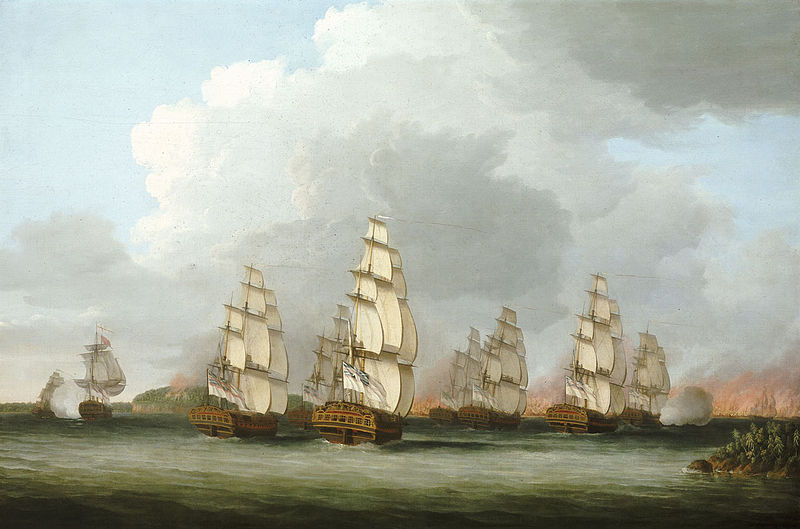
The Crown Colonies of New Ireland survived for four years in the first instance and eight months in the second.  The failed Penobscot expedition of 1779 to retake the colony would result in the most catastrophic defeat suffered by American Naval forces until the Japanese attack on Pearl Harbor 162 years later, but that must be a story for another day.

800px-PenobscotExpeditionBySerres
Britain defending New Ireland from the Penobscot Expedition by Dominic Serres
If you enjoyed this “Today in History”, please feel free to re-blog, “like” & share on social media, so that others may find and enjoy it as well. Please click the “follow” button on the right, to receive email updates on new articles.  Thank you for your interest, in the history we all share.

June 10, 1944 Ghost Village

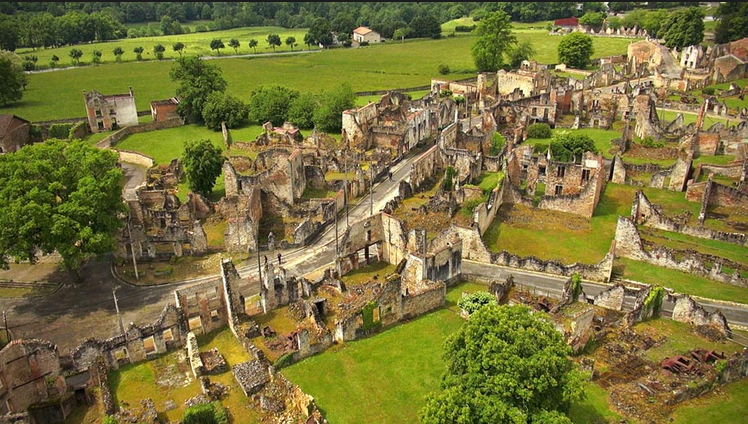
The village stands today as those Nazi soldiers left it, seventy-four years ago today.  It may be the most forlorn place on earth.

On D+4 after the Normandy invasion of WW2, the 2nd Panzer Division of the Waffen SS was passing through the Limousin region, in west-central France.  “Das Reich” had been ordered to help stop the Allied advance, when SS-Sturmbannführer Adolf Diekmann received word that SS officer Helmut Kämpfe was being held by French Resistance forces in the village of Oradour-sur-Vayres.

Oradour-sur-Glane-Hardware

Diekmann’s battalion sealed off the nearby village of Oradour-sur-Glane, seemingly unaware of their own confusion between the two villages.

Everyone in the town was ordered to assemble in the village square, for examination of identity papers. The entire population of the village was there, plus another half-dozen unfortunates, caught riding their bicycles at the wrong place, and the wrong time.

Oradour-sur-Glane-ChurchThe women and children of Oradour-sur-Glane were locked in a village church while German soldiers looted the town.  The men were taken to a half-dozen barns and sheds, where the machine guns were already set up.

The Germans aimed for the legs when they opened fire, intending to inflict as much pain as possible. Five escaped in the confusion before the SS lit the barn on fire. 190 men were burned alive.

Oradour-sur-Glane.jpg 3Nazi soldiers then lit an incendiary device in the church, and gunned down 247 women and 205 children as they tried to escape.

47-year-old Marguerite Rouffanche escaped out a back window, followed by a young woman and child.  All three were shot.  Rouffanche alone escaped alive, crawling to some pea bushes where she hid until next morning.

642 inhabitants of Oradour-sur-Glane, aged one week to 90 years, were shot to death, burned alive or some combination of the two, in a few hours.  The village was then razed to the ground.

Raymond J. Murphy, a 20-year-old American B-17 navigator shot down over France and hidden by the French Resistance, reported seeing a baby who’d been crucified.

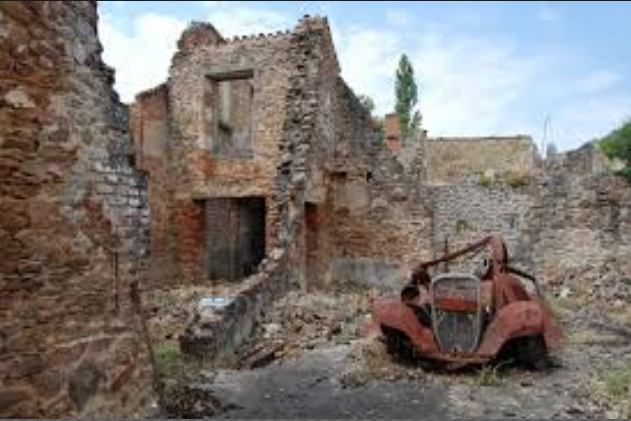
After the war, a new village was built on a nearby site.  French President Charles de Gaulle ordered that the “old” village remain as it is;  a monument for all time to criminally insane governing ideologies, and the malignity of collective punishment.

Oradour-sur-Glane.jpg 4

Generals Erwin Rommel and Walter Gleiniger, German commander in Limoges, protested the senseless act of brutality.  Even the SS Regimental commander agreed and began an investigation, but that came to naught.  Within days, Diekmann and most of the men who had carried out the massacre, had been killed in combat.

The ghost village at the old Oradour-sur-Glane stands mute witness to this day, to the savagery committed by black-clad Schutzstaffel units in countless places like the French towns of Tulle, Ascq, Maillé, Robert-Espagne, and Clermont-en-Argonne; the Polish villages of Michniów, Wanaty and Krasowo-Częstki and the city of Warsaw; the Soviet village of Kortelisy; the Lithuanian village of Pirčiupiai; the Czechoslovakian villages of Ležáky and Lidice; the Greek towns of Kalavryta and Distomo; the Dutch town of Putten; the Yugoslavian towns of Kragujevac and Kraljevo and the village of Dražgoše, in what is now Slovenia; the Norwegian village of Telavåg; the Italian villages of Sant’Anna di Stazzema and Marzabotto.

Oradour-sur-Glane.jpg 2

And on.  And on.  And on.

Oradour-sur-Glane-StreetsFrench President Jacques Chirac dedicated a memorial museum in 1999, the “Centre de la mémoire d’Oradour“. The village stands today as those Nazi soldiers left it, seventy-four years ago today.  It may be the most forlorn place on earth.

The story was featured on the 1974 British television series “The World at War”, narrated by Sir Laurence Olivier, who intones these words for the first and final episodes of the program: “Down this road, on Oradour-sur-Glane.jpg 5a summer day in 1944. . . The soldiers came. Nobody lives here now. They stayed only a few hours. When they had gone, the community which had lived for a thousand years. . . was dead. This is Oradour-sur-Glane, in France. The day the soldiers came, the people were gathered together. The men were taken to garages and barns, the women and children were led down this road . . . and they were driven. . . into this church. Here, they heard the firing as their men were shot. Then. . . they were killed too. A few weeks later, many of those who had done the killing were themselves dead, in battle. They never rebuilt Oradour. Its ruins are a memorial. Its martyrdom stands for thousands upon thousands of other martyrdoms in Poland, in Russia, in Burma, in China, in a World at War”.

Oradour-sur-Glane2

June 9, AD721 Odo

The story is familiar.  Despite all odds, the Frankish force emerged victorious.  Charles “The Hammer” Martel had saved western civilization.  Forgotten in this narrative, is the story of the man who made it all possible.

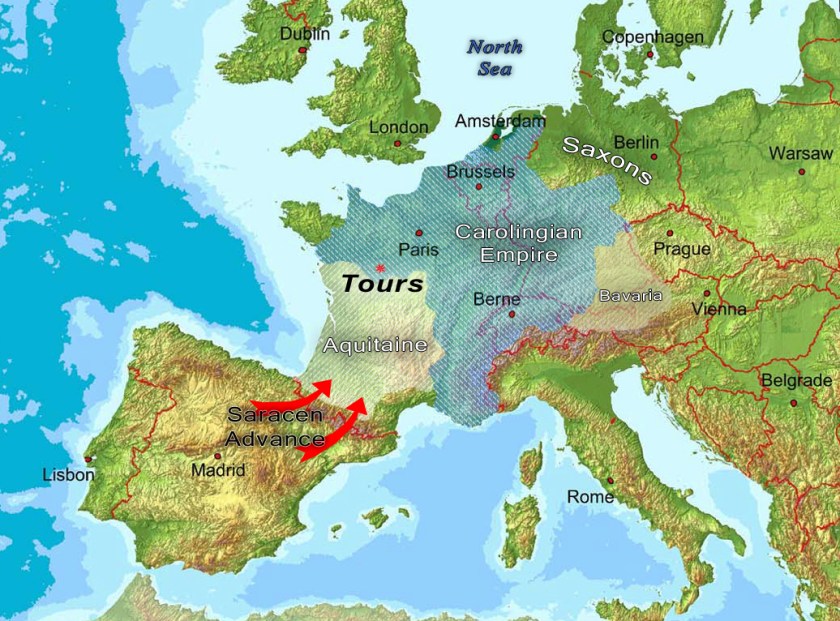
In AD732, a Frankish military force led by Charles Martel, the illegitimate son of Pippin II of Herstal, met a vastly superior invading army of the Umayyad Caliphate, led by Abd Ar-Rahman al Ghafiqi.

The Umayyad Caliphate had recently defeated two of the most powerful militaries of the era.  The Sassanid empire in modern day Iran had been destroyed altogether, as was the greater part of the Byzantine Empire, including Armenia, North Africa and Syria.

Islamic+Conquests+By+the+7th+century+Islamic+people+overran+the+Sasanid+empire+and+threatened+Constantinop+le+(674-678,+717-718)

As the Caliphate grew in strength, European civilization faced a period of reduced trade, declining population and political disintegration, characterized by a constellation of new and small kingdoms, evolving and squabbling for suzerainty over the common people.

The “Banu Umayya”, the second of four major dynasties established following the death of Muhammad 100 years earlier, was already one of the largest, most powerful empires in history. Should it fail, no force stood behind the Frankish host, sufficient to prevent a united Islamic caliphate stretching from the Atlantic coast of Spain to the Indian sub-continent, from Sub-Saharan Africa to the North Sea.


Carolingian Empire Map

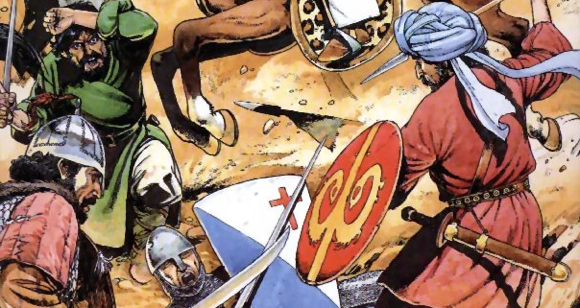
With no cavalry of his own, Charles faced a two-to-one disadvantage in the face of a combined Islamic force of infantry and horse soldiers.  History offers few instances of medieval armies withstanding the charge of cavalry, yet Charles had anticipated this moment. He had trained his men, they were ready.

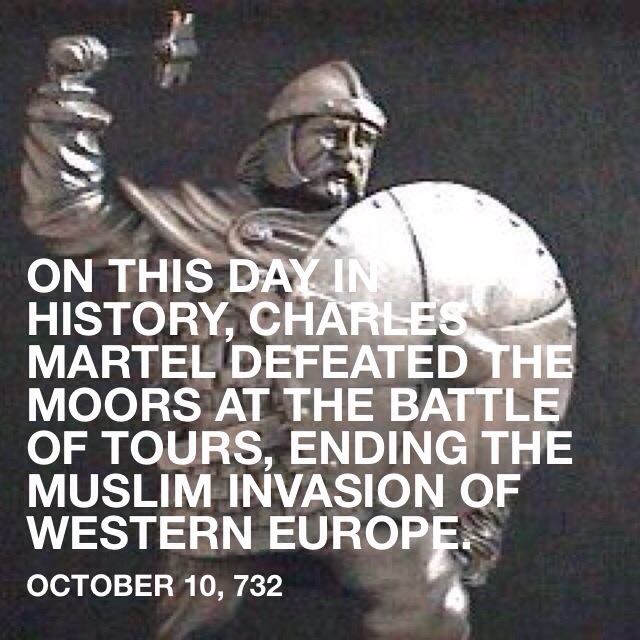
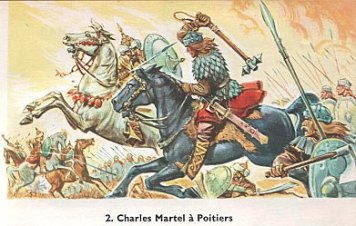
The story is familiar.   Charles “The Hammer” Martel met the invader, at a spot between the villages of Tours, and Poitiers.  Despite all odds, the Frankish force emerged victorious, from the Battle of Tours (Poitiers). Western civilization, was saved.

Battle of Tours, 732

Forgotten in this narrative, is the story of the man who made it all possible.

Twenty years earlier, a combined force of 1,700 Arab and North African horsemen, the Berbers, landed on the Iberian Peninsula led by Tariq Ibn Ziyad.  Within ten years, the Emir of Córdoba ruled over most of what we now call Portugal and Spain, save for the fringes of the Pyrenean mountains, and the highlands along the northwest coastline.

In AD721, Al-Samh ibn Malik al-Khawlani, wali (governor) of Muslim Spain, built a strong army from the Umayyad territories of Al-Andalus, and invaded the semi-independent duchy of Aquitaine, a principality ostensibly part of the Frankish kingdom, but for all intents and purposes ruled as an independent territory.

Odo_I
Duke Odo, I

Duke Odo of Aquitaine left his home in Toulouse in search of help, from the Frankish statesman and military leader, Charles Martel.  This was a time (718 – 732) of warring kingdoms and duchys, a consolidation of power in which Martel preferred not to step up on behalf of his southern rival, but to wait, and see what happened. Odo, Duke of Aquitaine, was on his own.

At this time, Toulouse was the largest and most important city in Aquitaine.  Believing Odo to have fled before their advance, the forces of al-Andalus laid siege to the city, secure in the belief that their only threat lay before them.  For three months, Odo gathered Aquitanian, Gascon and Frankish troops about him, as his city held on.

Overconfident, the besieging army had failed to fortify its outer perimeter, or to scout the surrounding countryside.  On June 9 with Toulouse on the verge of collapse, the armies of Duke Odo fell on the Muslim rear, as defenders poured from the city gates, an avenging army.    Sources report Duke Odo’s forces numbered some 300,000, though the number is almost certainly exaggerated.

bataille_de_toulouse2

Caught at rest without weapons or amour, the surprise was complete.  Some 350,000 Umayyad troops are said to have been cut down as they fled, but again, the number is probably inflated.  Al-Samh himself was mortally wounded, and later died in Narbonne.

Be that as it may, the battle of Toulouse was an unmitigated disaster for the Arab side.  Some historians believe that this day in 721 did more to check the Muslim advance into western Europe, than did the later battle at Tours.  For 450 years,  Muslim chroniclers at Al-Andalus described the battle as Balat al Shuhada (‘the path of the martyrs’), while Tours was remembered as a relatively minor skirmish.

Ch-MartelOne of those to escape with his life, was a young Abd Ar-Rahman al Ghafiqi.  Eleven years later in 732, the now – governor of Al-Andalus would once again cross the Pyrenees, this time at the head of a massive army of his own.  Al Ghafiqi’s legions laid waste to Navarre and Gascony, first destroying Auch, and then Bordeaux.  Duke Odo “The Great” would be destroyed at the River Garonne and the table set for the all-important decision of Tours.

In history as in life, time and place is everything.  Today, Duke Odo of Aquitaine is all but forgotten. We remember Charles “The Hammer” Martel as the savior of western civilization, as well we should. Yet, we need not forget the man who made it possible, who gave Martel time to gather the strength, to forge the fighting force which gave life to such an unlikely outcome.


If you enjoyed this “Today in History”, please feel free to re-blog, “like” & share on social media, so that others may find and enjoy it as well. Please click the “follow” button on the right, to receive email updates on new articles.  Thank you for your interest, in the history we all share.

June 8, 1959 Missile Mail

“Before man reaches the moon, mail will be delivered within hours from New York to California, to Britain, to India or Australia by guided missiles. We stand on the threshold of rocket mail.”

If we talk about RocketMail, we’re usually speaking of one of the early free webmail services, up there with Hotmail and a few others.  Not to be confused with the days, when the mail was delivered on Real rockets.

Sort of.

In the early 19th century, expanding western settlement meant that a letter sent to California took one of several routes, to get there. Earlier stagecoach passages were replaced by steamship routes traveling around South America, or by overland transfer 89987-004-3A10E441across the Isthmus of Panama or the Isthmus of Tehuantepec, in Mexico. The simmering tensions which would lead the nation to Civil War would prove such a system inadequate, as the rapid transfer of information became ever more important.


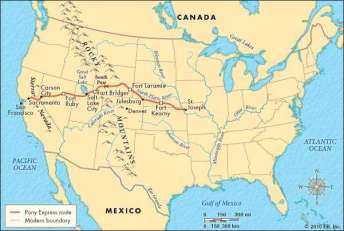
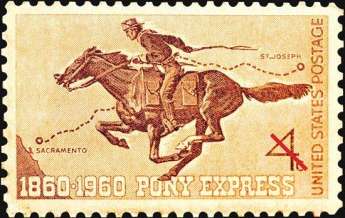
The Central Overland California & Pike’s Peak Express Company, better known as the Pony Express, was the short-lived effort to speed up the process. Between April 1860 and October ’61, continuous horse-and-rider relays carried letters the 2,000-mile distance from St. Joseph, Missouri to Sacramento, California.

Individual riders covered 75 – 100 miles at a time, on somewhere between five and ten horses.  138706-004-0303CD27The Pony Express compressed the standard 24-day schedule for overland delivery to ten days, but the system was a financial disaster.  Little more than an expensive stopgap before the first transcontinental telegraph system.

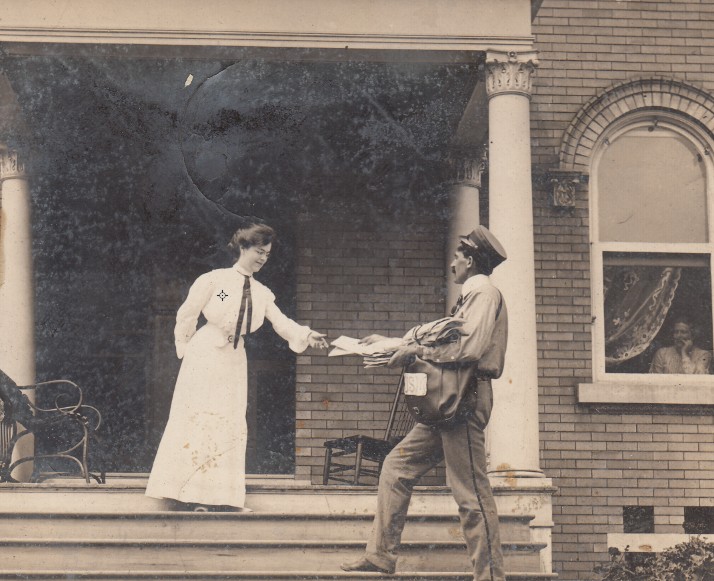
Throughout the “Reconstruction” era and on toward the turn of the century, individuals living in more remote precincts had to pick up the mail at sometimes-distant post offices, or pay private carriers.

The Post Office began experiments with Rural Free Delivery (RFD) as early as 1890, but the system was slow to catch on. Georgia Congressman Thomas Watson pushed RFD legislation through the Congress in 1893, making the practice mandatory. Implementation was slow and RFD wouldn’t be fully adopted until 1902, but elected officials were quick to implement this new way to reach out to voters.

220px-Par_avion_air_mailThe first mail carried through the air arrived by hot air balloon on January 7, 1785, a letter written by Loyalist William Franklin to his son William Temple Franklin, at that time serving a diplomatic role in Paris with his grandfather, the United States’ one-time and first postmaster, Benjamin Franklin.

The first (unofficial) mail delivery by aircraft took place on February 17, 1911, when Fred Wiseman flew three letters between Petaluma and Santa Rosa, California. Comprehensive airmail rules were adopted by the Universal Postal Union in 1929. Since then, airmail was often marked “Par avion”: “By airplane”.

Section 92 of the 1873 Postal Laws and Regulations book states that carriers would deliver “as frequently as the public convenience may require.” What exactly constitutes “Public Convenience” was open to interpretation but, in some cities, business districts received between three and five daily deliveries and twice a day to residential areas.

6a01157147ecba970c01b8d1be010c970c-800wi

In 1950, the Postmaster General ordered residential deliveries reduced to once a day and, by the early 1990s, businesses had learned to live with the same.  There was little to be improved upon, in this happy state of affairs.  Unless of course you’re receiving your mail, by rocket.

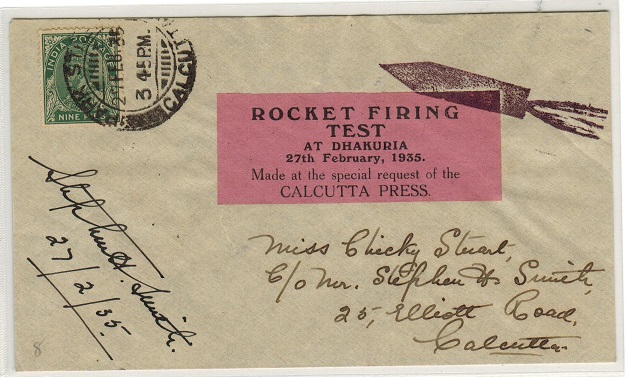
The concept is older than you might think.  German novelist Heinrich von Kleist (1777 – 1811) was the first to bring up the idea in 1810, calculating that a network of batteries could relay a letter from Berlin to Breslau, a distance of 180 miles, in half a day. Such a system was attempted using congreve rockets in 19th century Tonga, but proved unreliable. By 1929, American ambassador to Germany Jacob Gould Schurman was discussing the finer points of transatlantic rocket mail delivery, with a German reporter.

A 1936 experiment with rocket-powered mail delivery between New York and New Jersey ended with 50-lbs of mail, stranded on the ice of frozen Greenwood Lake.

From India to the United Kingdom, the 1930s were a time for experimentation with rocket-propelled mail delivery. 1,200 letters were packed into a rocket fuselage in July 1934, and fired between Harris Island in the Hebrides and Scarp island in Scotland, a distance of some 1,600 meters (1 mile). The first rocket blew up so they gathered all the letters they could find, and packed them into a second. That one exploded, too.

10394

As a piece of technology, the rockets’ origins are both simple and ancient. A rocket, quite simply, is a vessel, powered by stored propellant such as gunpowder, kerosene, or liquid hydrogen & oxygen. A Missile is a vehicle propelled by rockets, whose purpose it is to deliver a payload.

Vought_SSM-N-8_Regulus_I_(ID_unknown)_(30571413366)
Regulus Cruise Missile

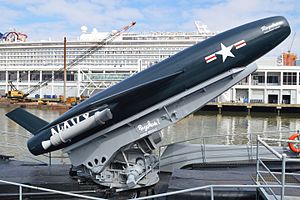
In 1959, the diesel-electric submarine USS Barbero was officially designated a branch location of the United States Post Office, for purposes of “delivering” mail to Naval Station Mayport, in Jacksonville, Florida. The nuclear warhead was removed from a Regulus Cruise missile and two Post Office-approved containers installed.  3,000 letters and postcards were inserted, addressed to President Eisenhower, Postmaster General Arthur Summerfield, and other dignitaries.

On June 8, the 13,685-pound, 32-foot cruise missile launched from the decks of the Barbero, two Aerojet-General 33,000 lbf solid-propellant boosters giving way to the turbojet engine which would guide the missile onto its target.   Twenty-two minutes later the missile struck, the Regulus opened and the mail forwarded to the Jacksonville post office for sorting and routing.

Missilemail

Postmaster Summerfield was effusive, proclaiming the “historic significance to the peoples of the entire world”.  “Before man reaches the moon”, he exclaimed, “mail will be delivered within hours from New York to California, to Britain, to India or Australia by guided missiles. We stand on the threshold of rocket mail.”

ea2ad7a5fac60ef99d3742e9ea44331c

Arthur Summerfield’s golden future of missile mail, was never meant to be.  Despite the postmaster’s enthusiasm, the system was Way too expensive.  The Defense Department saw the first and only mail delivery by intercontinental ballistic missile in history, as more of a demonstration of the weapon system’s capabilities.  In any case, aircraft were  delivering airmail by this time, in less than a day.

0831713The Regulus was superseded by the Polaris missile in 1964, the year in which Barbero ended her nuclear strategic deterrent patrols. She was struck from the Naval Registry that July, and suffered the humiliating fate of the target ship, sunk off the coast of Pearl Harbor on October 7 by the nuclear submarine USS Swordfish.

So it is that a United States mail container may be discovered at the Submarine Force Museum in Groton Connecticut, fired from a Balao-class sub, fifty-nine years ago, today.


If you enjoyed this “Today in History”, please feel free to re-blog, “like” & share on social media, so that others may find and enjoy it as well. Please click the “follow” button on the right, to receive email updates on new articles.  Thank you for your interest, in the history we all share.


June 6, 1944 Dress Rehearsal

Unable to wear their lifebelts correctly due to the large backpacks they wore, many men placed them around their waists. That only turned them upside down and that’s how they died, thrashing in the water with their legs above the waves.

The largest amphibious assault in history began seventy-four years ago today, on the northern coast of France.  British and Canadian forces came ashore at beaches code-named Gold, Juno and Sword.  Americans faced light opposition at Utah Beach, while heavy resistance at Omaha Beach resulted in over 2,000 American casualties.

By end of day, some 156,000 Allied troops had successfully stormed the beaches of Normandy.  Within a week that number had risen to 326,000 troops, over 50,000 vehicles and more than 100,000 tons of equipment.

ww2_dday_landing

The first phase of Operation Overlord, code named ‘Neptune’, achieved its stunning success as the result of lessons learned from the largest amphibious training exercise of WW2, the six phases of “Operation Fabius”, itself following the unmitigated disaster of a training exercise that killed more Americans, than the actual landing at Utah beach.

Slapton is a village and civil parish in the River Meadows of Devon County, where the southwest coast of England meets the English Channel.  Archaeological evidence suggests human habitation from at least the bronze age.  The “Domesday Book”, the recorded manuscript of the “Great Survey” of England and Wales completed in 1086 by order of William the Conqueror, names the place as “Sladone”, with a population of 200.

Slapton_Sands
Slapton Sands

In late 1943, the place was home to 750 families, some of whom had never so much as left their village.  Some 3,000 locals were evacuated with their livestock to make way for “Operation Tiger”, a full-scale rehearsal for the landing scheduled for the following spring.

Thousands of US military personnel were moved into the region during the winter of 1943-’44. The area was mined and bounded with barbed wire, and patrolled by sentries.  Secrecy was so tight, that even those in surrounding villages, had no idea of what was happening.

p012721

Exercise Tiger was scheduled to begin on April 22, covering all aspects of the “Force U” landing on Utah beach and culminating in a live-fire beach landing at Slapton Sands at first light on April 27.

Nine large tank landing ships (LSTs) shoved off with 30,000 troops on the evening of the 26th, simulating the overnight channel crossing. Live ammunition was used in the exercise, to harden troops off to the sights, sounds and smells of actual battle. Naval bombardment was to commence 50 minutes before H-Hour, however delays resulted in landing forces coming under direct naval bombardment. An unknown number were killed in this “friendly fire” incident. Fleet rumors put the number as high as 450.

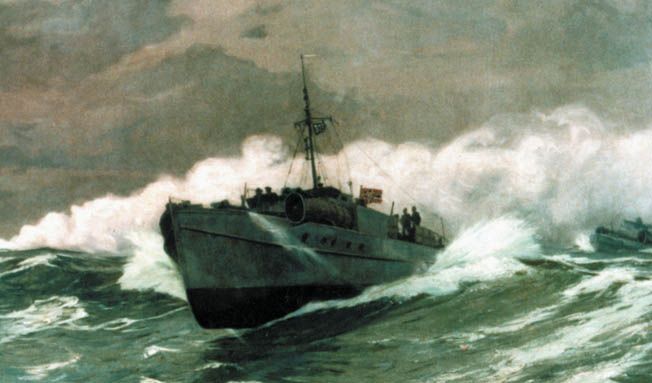
Two Royal Navy Corvettes, HMS Azalea and Scimitar, were to guard the exercise from German “Schnellboots” (what the Allies called “E-Boats”), the fast-attack craft based out of Cherbourg.

aabd944fc8651966c90eed0e7eecbcaa

HMS Scimitar withdrew for repairs following a collision with an LST on the 27th. In the early morning darkness of the following day, the single corvette was leading 8 LSTs carrying vehicles and combat engineers of the 1st Engineer Special Brigade through Lyme Bay, when the convoy was spotted by a nine vessel S-Boat patrol.

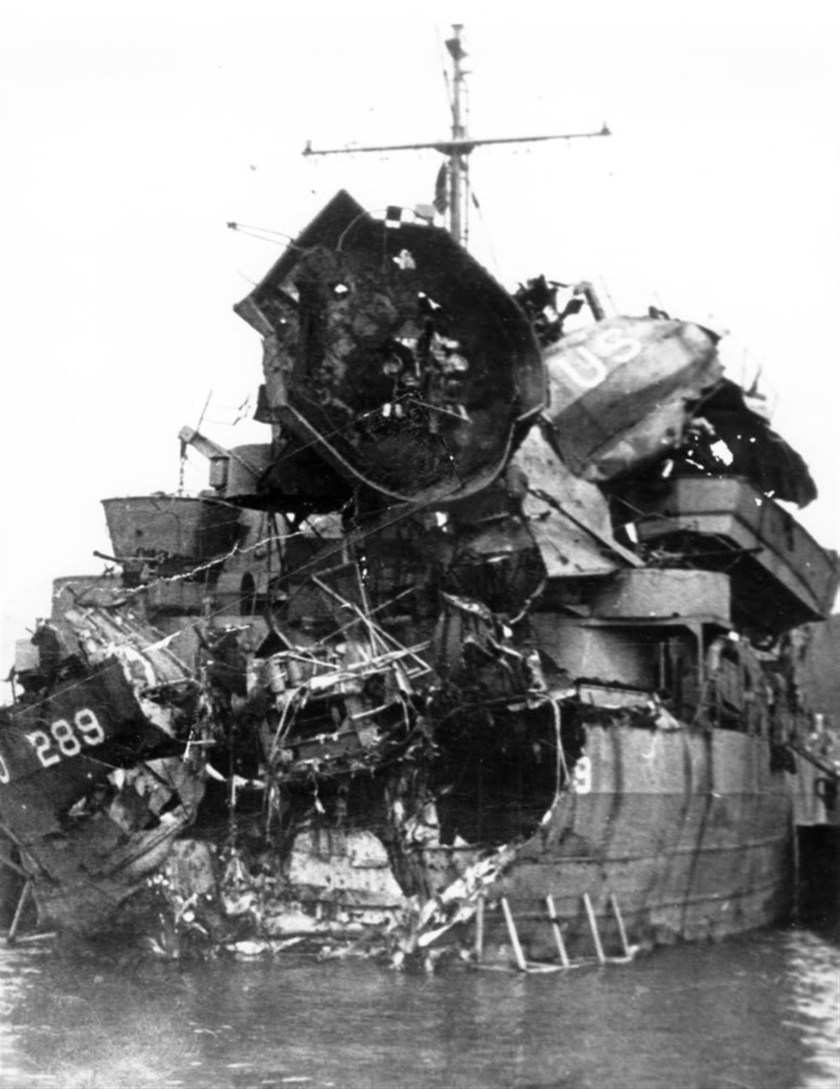
8 LSTs (Landing Ship, Tank) in single-file didn’t have a chance against fast-attack craft capable of 55mph.  LST-531 was torpedoed and sunk in minutes, killing 424 Army and Navy personnel. LST-507 suffered the same fate, with the loss of 202. LST-289 was severely damaged and grounded in flames, with the loss of 123. LST-511 was damaged in yet another friendly fire incident. Unable to wear their lifebelts correctly due to the large backpacks they wore, many men placed them around their waists. That only turned them upside down and that’s how they drowned, thrashing in the water with their legs above the waves. Dale Rodman, who survived the sinking of LST-507, said “The worst memory I have is setting off in the lifeboat away from the sinking ship and watching bodies float by.”

Operation-Tiger-1944
LST (Landing Ship, Tank 289: “Severely damaged by a German E-Boat torpedo attack off Slapton Sands, England, 28 April 1944, during Operation Tiger, the rehearsal for the Normandy invasion”.  H/T ExerciseTiger.org.uk

Survivors were sworn to secrecy due to official embarrassment, and the possibility of revealing the real invasion, scheduled for June.  Ten officers with high level clearance were killed in the incident, but no one knew that for sure until their bodies were recovered.  The D-Day invasion was nearly called off, because any of them could have been captured alive, revealing secrets during German interrogation and torture.

There remains a surprising amount of confusion, concerning the final death toll. Estimates range from 639 to 946, nearly five times the number killed in the actual Utah Beach landing.  Some or all of the personnel from that damaged LST may have been aboard the other 8 on the 28th, and log books went down along with everything else.  Many of the remains were never found.

5d274a9049a6b00623d5672d4b355bdd

The number of dead would surely have been higher, had not Captain John Doyle disobeyed orders and turned his LST-515 around, plucking 134 men from the frigid water.

Today, the Exercise Tiger disaster is mostly forgotten.  Some have charged official cover-up, though information from SHAEF press releases appeared in the August edition of Stars & Stripes.  At least three books describe the event.  It seems more likely that the immediate need for secrecy and subsequent D-Day invasion swallowed the Tiger disaster, whole.  History has a way of doing that.

DSCF0195-1024x768
Exercise Tiger Memorial, Slapton

Some of Slapton’s residents came home to rebuild their lives after the war, but many never returned.  In the early ’70s, Devon resident and civilian Ken Small discovered an artifact of the Tiger exercise, while beachcombing on Slapton Sands.  With little to no help from either the American or British governments, Small purchased rights from the American Government to a submerged Sherman tank from the 70th Tank Battalion. The tank was raised in 1984 with help from local residents and dive shops, and now stands as a memorial to Exercise Tiger.  Not far from the monument to villagers, who never came home.

Slaptonmemorial

A plaque was erected at Arlington National Cemetery in 1995, inscribed with the words “Exercise Tiger Memorial”. A 5,000-pound stern anchor bears silent witness to the disaster in Mexico, Missouri.

In 2012, a granite memorial was erected at Utah Beach, engraved with the words in French and English: “In memory of the 946 American servicemen who died in the night of 27 April 1944 off the coast of Slapton Sands (G.B.) during exercise Tiger the rehearsals for the D-Day landing on Utah Beach“.

In 1988, volunteers from the Army Brotherhood of Tankers repaired, repainted and re-stenciled an M4 Sherman tank, installing a mirror image of the Slapton memorial at Fort Taber Park in the south-coastal working class city of New Bedford, Massachusetts.

New Bedford veteran’s agent Christopher Gomes lost his right leg during the Iraq War, in 2008.  Gomes was succinct that Memorial Day 2016, when he spoke of this difficult chapter in British/American military history.  “People only die”, he said, “when they are forgotten about″.

Left – Memorial Day 2018:  WW2 Navy combat veteran Vincent Riccardi, Exercise Tiger’s oldest survivor, salutes his fallen comrades at Fort Taber Park in New Bedford, Massachusetts. H/T South Coast Today
Right – The M4 Sherman Tank Tank at the Fort Taber – Fort Rodman Military Museum at Fort Taber Park in New Bedford mirrors the one built to the fallen at Slapton Sands, Devon, England.


34668415_2086248128295884_3219656447432327168_n
H/T “Ghosts of time” for this image, Today and Now.


If you enjoyed this “Today in History”, please feel free to re-blog, “like” & share on social media, so that others may find and enjoy it as well. Please click the “follow” button on the right, to receive email updates on new articles.  Thank you for your interest, in the history we all share.

June 5, 1899 J’Accuse

At best, the passionate denunciation of anti-Semitism left in the wake of the Dreyfus affair, “l’Affaire”, would ennoble and elevate French politics.  At worst, the episode revealed and hardened divisions within the French state which would weaken the nation into 1914, and beyond.

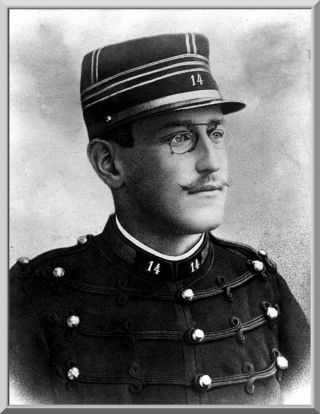
alfred-dreyfus-trial-affair-france-001.jpgIn the late 19th century, Europe was embarked on yet another of its depressingly regular paroxysms of anti-Semitism, when a French Captain of Jewish Alsatian extraction by the name of Alfred Dreyfus was arrested, for selling state secrets to Imperial Germany.

At this time the only Jewish member of the French Army General Staff, the “evidence” against Dreyfus was flimsy, limited to an on-the-spot handwriting analysis of a tissue paper missive written to the German Embassy.

“Expert” testimony came from Alphonse Bertillon, inventor of the crackpot theory of Anthropometry, the “measurement of the human individual”.

No handwriting expert, Bertillon opined nevertheless, that Dreyfus’ handwriting was similar to that of the sample, articulating a cockamamie theory he called “autoforgery” to explain the differences.

Dreyfus-Affair-Postcard (1)Chief Inspector Lieutenant-Colonel Charles Armand Auguste Ferdinand Mercier du Paty de Clam, himself no handwriting expert, agreed with Bertillon. With no file to go on and despite the feebleness of the evidence, de Clam summoned Dreyfus for interrogation on October 13, 1894.

Dreyfus maintained his innocence during the interview, with his interrogator going so far as to slide a revolver across the table, silently suggesting how Dreyfus might put an end to his ordeal.

Du Paty arrested Dreyfus two days later, informing the captain that he was to be brought before a court martial.

Despite the paucity of evidence, the young artillery officer was convicted of handing over State Secrets in November 1894, and sent to the penal colony at Devil’s Island in French Guiana, where he spent nearly five years.

110261-004-9877ECF1
Dreyfus stands before his court-martial, 1894. H/T Britannica.com for this image

A simple miscarriage of justice elevated into a national scandal two years later, when Lieutenant Colonel Georges Picquart found evidence that French Army major Ferdinand Walsin Esterhazy as involved in espionage, and it was his handwriting on the letter which was used against Dreyfus.

Esterhazy was brought to trial in 1896.  Picquart’s discovery being inconvenient for his superiors, the Lt. Col. was sacked, and later arrested.  Then-Major Hubert-Joseph Henry, he who discovered the letter in the first place, suppressed some pieces of evidence, and invented others.

Esterhazy was acquitted on the second day of trial. The military dug in, accusing Dreyfus of additional crimes based on false documents, as indignation at the obvious frame-up, began to spread.

j'accuseMost of the political and military establishment lined up against Dreyfus. The public outcry became furious in January 1898 when author Émile Zola published a bitter denunciation in an open letter to the Paris press, entitled “J’accuse” (I Blame).

Zola’s accusations against the Ministry of War would earn the writer a trial and conviction for libel, resulting in a year in prison and a fine of 3,000 francs.

Liberal and academic activists put pressure on the government to reopen the case. On June 5, 1899, Alfred Dreyfus learned of the Cour de cassation, (French Supreme Court’s) decision to revisit the judgment of 1894, and to return him to France for a new trial.

220px-Lieutenant-colonel_Henry
Lieutenant Colonel Henry at Emile Zola’s trial for libel

What followed nearly tore the nation apart. “Dreyfusards”, those seeking Dreyfus’exoneration such as Anatole France, Henri Poincaré and future Prime Minister Georges Clemenceau, pitted against authoritarian anti-Dreyfusard characters such as Édouard Drumont, publisher of the virulently Jew-Hating newspaper La Libre Parole.

By New Year’s eve 1898, Hubert-Joseph Henry had become ‘Faux Henry”, his forgeries discovered.   Halfway to the bottom of a bottle of rum, Henry took out a pen and wrote “I am like a madman”.  He then took out a shaving razor, and slit his throat.

For Dreyfus, the new trial was a circus.   The political and military establishments stonewalled.  One of two attorneys for the defense was shot in the back, on the way to court. The judge dismissed Esterhazy’s testimony, even though the man had by now confessed to the crime. The new trial resulted in yet another conviction.  Dreyfus was sentenced to another ten years in the Guiana penal colony.

This time, Dreyfus was set free with a Presidential pardon. A good thing it was, too. The man would not have survived another ten years in that place.

devils-island-french-guyana-054
80,000 men were sent to the “Bagne de Cayenne”, the French penal colony at Devil’s Island, during the 100 years in which the place operated as a penal colony. Only one in four, ever made it out.

Alfred Dreyfus accepted the act of clemency, but reserved the right to do everything he could, to prove his innocence.  Final exoneration came in July 1906, when a civilian court of appeals reversed all previous convictions.  Dreyfus was reinstated to the rank of Major in the French Army, where he served with honor for the duration of WWI, ending his service with the rank of Lieutenant-Colonel.

The chasm remaining between left-wing anti-militarists and right-wing nationalists would haunt French life, for years.  At best, the passionate denunciation of anti-Semitism left in the wake of the Dreyfus affair, “l’Affaire“, would ennoble and elevate French politics.  At worst, the episode revealed and hardened divisions within the French state which would weaken the nation into 1914, and beyond.


If you enjoyed this “Today in History”, please feel free to re-blog, “like” & share on social media, so that others may find and enjoy it as well. Please click the “follow” button on the right, to receive email updates on new articles.  Thank you for your interest, in the history we all share.