There was barely a man in the regiment, who wouldn’t have walked over the proverbial “bad road & broken glass”, for that dog.
Irish Brigade Memorial sculpted by William R. O’Donovan, a former Confederate soldier who fought at Gettysburg H/T Gettysburg.stonesentinels.com
Sallie was four weeks old in 1861, when she was given as a gift to 1st Lieutenant William Terry, of the 11th Pennsylvania Volunteer Infantry. Terry made her the regimental mascot, a post she would hold for the duration of the Civil War.
Sallie was a Staffordshire Bull Terrier, or possibly a Pit Bull, brindle in color. She would tag along on long marches, and kept the men of the regiment company in their camps. She learned the drum roll announcing reveille, and loved to help wake the sleeping soldiers in the morning.
If you’ve ever had a dog in your life, you know how that goes.
There was barely a man in the regiment, who wouldn’t have walked over the proverbial “bad road & broken glass”, for that dog. Sallie’s first battle came at Cedar Mountain, in 1862. No one thought of sending her to the rear before things got hot, so Sallie took up a position along with the colors, barking ferociously at the adversary.
There she remained throughout the entire engagement, as she would do at Antietam, Fredericksburg, Chancellorsville and Spotsylvania.
Sallie, the smallest member of the 11th PA Infantry Regiment, is one of only two dogs so memorialized at Gettysburg, the only dog who was actually In the battle.
It was said that Sallie only hated three things: Rebels, Democrats, and Women.
Sallie marched with “her” soldiers in review, in the spring of 1863. Abraham Lincoln was reviewing the army at the time, when he spotted the dog from the center of the reviewing stand, and raised his famous top hat in salute.
At Gettysburg, Sallie was separated from her unit in the chaos of the first day’s fighting. They found her five days later, on July 6, parched with thirst and weakened by hunger.
She’d been standing guard over her dead and dying comrades, since July 1.
It’s been said that only a dog is capable of that kind of loyalty, yet virtue in one is capable of inspiring virtue in another. So it was on February 5, 1865. Sallie was struck in the head by a bullet at Hatcher’s Run. She was killed instantly. Several men of the 11th PA laid down their arms and buried her, right then and there. Even though they were still under fire from the Confederate side.
There is a tale about Sallie, I don’t know if it’s true. Probably not but it’s a nice story.
After the battle in which Sallie was killed, the soldiers were moving out when a small whining was heard from within a hollowed-out tree. Someone went to the tree and found several small puppies, believed to be Sallie’s. They’d had no idea that she was pregnant, or how puppies came to be in that hollowed out tree. The soldiers gave them to local civilians, so that Sallie’s bloodline might live on.
Twenty-seven years after Gettysburg, surviving veterans of the regiment returned to dedicate a memorial to those members of the 11th Pennsylvania, who lost their lives on that field of battle.
Today, 1,320 memorial statues, monuments and markers dot the landscape of the Gettysburg battlefield. Among all of them there are only two, raised in the memory of a dog. The first is a Celtic cross, erected in honor of New York’s Irish Brigade. Ironically, it is sculpted by a Confederate veteran of the battle. At the foot of the cross rests a life-sized likeness of an Irish wolfhound, symbolizing honor and fidelity..
The other includes a brindle colored Terrier, named Sallie. The only one of the two to have actually participated in the battle.
The monument depicts an upright Union soldier, rifle at the ready. By unanimous consent of the veterans themselves, Sallie’s likeness looks out from the foot of the statue, where she guards over the spirits of “her boys”, for all eternity.
“Sallie was a lady, she was a soldier too. She marched beside the colors, our own red white and blue. It was in the days of our civil war, that she lived her life so true”.
Feature image, top of page: Only known picture of Sallie, herself. Photographer unknown.
If you enjoyed this “Today in History”, please feel free to re-blog, “like” & share on social media, so that others may find and enjoy it as well. Please click the “follow” button on the right, to receive email updates on new articles. Thank you for your interest, in the history we all share.
Governor Montiano bought the ruse, hook, line and sinker. The Spanish invaders left St. Simons island for good on July 25, never to return. One of the most brilliant head fakes in colonial history had ended the invasion, leaving the 13th colony in the undisputed hands of the British Crown.
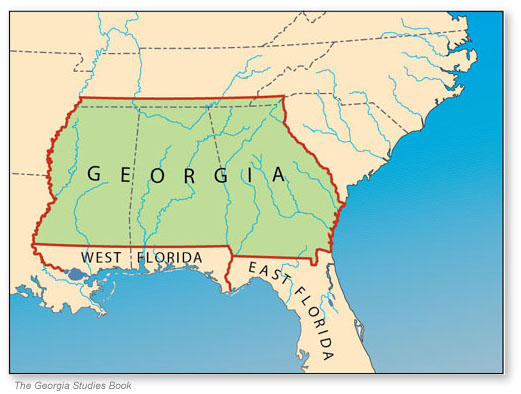
The territory which would come to be occupied by the colony of Georgia was a subject for dispute between Great Britain and Spain, since long before the state became a colony.
Spain had taken Florida for its own, dating the claim back to explorer Ponce de Leon’s first mapping the territory in 1513 and claiming Georgia to be part of it. James Oglethorpe founded the 13th colony as a buffer colony for the British in 1733, serving as a protective zone against Spanish invasion, for her twelve sister colonies to the north.
The Convention of Pardo concluded in early 1739 attempted to settle issues relating to smuggling and to the slave trade, but Spain suspected “cheating” and continued to board foreign vessels at will. The War of Jenkins’ Ear broke out later that year, when Commander Juan de León Fandiño hacked off the ear of Commander Robert Jenkins, informing the unfortunate ship’s master that he could “Go, and tell your King that I will do the same”, to him.
Spain immediately began to draw up plans to invade the Georgia colony.
One day, St. Simons Island would be made notable for having provided the 2,000 southern Live Oak trees, forming the hull of the USS Constitution, “Old Ironsides”. On July 5, 1742, that day was far in the future. On this day, a Spanish invasion force of somewhere between 4,500 and 5,000 men landed on the island, in 36 ships.
A much smaller force of approximately 950 British Regulars, Colonial Militia and Indian Allies was under the command of James Oglethorpe, founder of the Georgia Colony. Oglethorpe withdrew his forces in in the face of the much larger invasion, and later attacked a Spanish reconnaissance in Force at a place called Gully Hole Creek. The Spanish were routed, with almost a third of their number either killed or captured. Falling back in the face of superior numbers of Spanish reinforcements, the British attacked the Spaniards a second time as they stacked arms and pulled out their pots and pans preparing for dinner. The “Battle of Bloody Marsh” was another victory for the British, and would prove to be decisive.
“Bloody Marsh” in 2008
A few days later, Oglethorpe launched what can only be described a a psychological warfare operation. A Spanish prisoner was released to the other side, with information that a massive British force was on the way. Fearing that Montiano might learn the true size of his puny force, Oglethorpe spread drummers out until their sound seemed to come from all directions.
Governor Montiano bought the ruse, hook, line and sinker. The Spanish invaders left St. Simons island for good on July 25, never to return. One of the most brilliant head fakes in colonial history had ended the invasion, leaving the 13th colony in the undisputed hands of the British Crown.
Georgia colony, 1764
If you enjoyed this “Today in History”, please feel free to re-blog, “like” & share on social media, so that others may find and enjoy it as well. Please click the “follow” button on the right, to receive email updates on new articles. Thank you for your interest, in the history we all share.
In an ending no fiction writer would dare put to paper, both men died on the same day, July 4, 1826. Fifty years to the day from the birth of the Republic, they had helped to create.
Delegates to the 2nd Continental Congress originally pushed for Richard Henry Lee to write the Declaration of Independence. It was he who delivered the all-important resolution on June 1, 1776: “Resolved, that these United Colonies are, and of right ought to be, free and independent States...”
Lee was appointed to the Committee of Confederation, assigned to write the Articles by which the fledgling nation would govern itself. Lee believed that two such committees were too much and, soon, he would be called home to care for a critically ill wife.
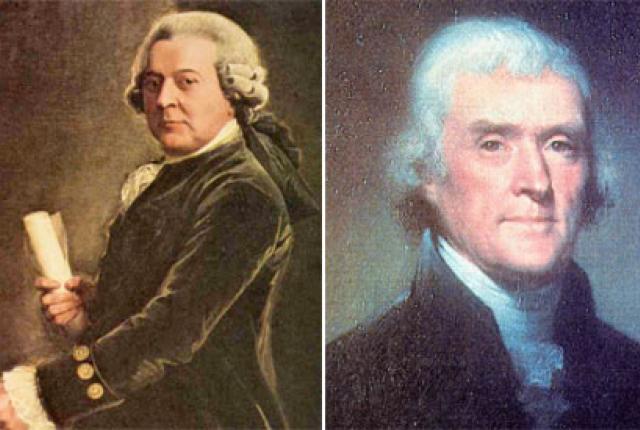
So it is that a committee of five were appointed to write the Declaration of Independence, including Massachusetts attorney John Adams, and a young Virginia delegate named Thomas Jefferson.
Jefferson had no interest in writing the Declaration of Independence and suggested that Adams pen the first draft. Adams declined, and described the following conversation, in a letter to Massachusetts politician Timothy Pickering:
“Jefferson proposed to me to make the draft. I said, ‘I will not,’ ‘You should do it.’ ‘Oh! no.’ ‘Why will you not? You ought to do it.’ ‘I will not.’ ‘Why?’ ‘Reasons enough.’ ‘What can be your reasons?’ ‘Reason first, you are a Virginian, and a Virginian ought to appear at the head of this business. Reason second, I am obnoxious, suspected, and unpopular. You are very much otherwise. Reason third, you can write ten times better than I can.’ ‘Well,’ said Jefferson, ‘if you are decided, I will do as well as I can.’ ‘Very well. When you have drawn it up, we will have a meeting.”
Thomas Jefferson would spend the following seventeen days, writing the first draft. He and Adams had only just met during the Continental Congress in Philadelphia. The two would develop a close personal friendship which would last for most of their lives.
The friendship between the two men came to an ugly ending during the Presidential election of 1800, in which the mudslinging from both sides rose to levels never before witnessed in a national election.
Jefferson defeated one-term incumbent Adams and went on to serve two terms as President of the United States. Upon Jefferson’s retirement in 1809, one of the Declaration’s signers, Dr. Benjamin Rush, took it upon himself to patch up the broken friendship between the two founding fathers.
Dr. Rush worked on this personal diplomatic mission for two years. In 1811, he finally succeeded.
Jefferson Seal
There followed a series of letters between John Adams and Thomas Jefferson, which together constitute one of the most comprehensive historical and philosophical assessments ever written about the American founding.
The correspondence between the pair touched on a variety of topics, from the birth of a self-governing Constitutional Republic, to then-current political issues, to matters of philosophy and religion and issues related to their advancing years.
Both men understood that they were writing not only to one another, but also to generations yet unborn. Each went to great lengths to explain the philosophical underpinnings of his views, Adams the firm believer in strong, centralized government, Jefferson advocating a smaller federal government which was more deferential to the states.
By 1826, Jefferson and Adams were among the very last survivors among the founding generation. James Monroe alone, would survive these two.
In an ending no fiction writer would dare put to paper, both men died on the same day, July 4, 1826. Fifty years to the day from the birth of the Republic, they had helped to create. Adams was 90 as he lay on his deathbed, suffering from congestive heart failure. His last words were “Thomas Jefferson still survives”. There was no way of knowing. The author of the Declaration of Independence had died of a fever, five hours earlier at his Monticello home near Charlottesville, Virginia. Jefferson was 82.
John Adams son John Quincy was himself President at the time of the two men’s passing, and remarked that the coincidence was among the “visible and palpable remarks of Divine Favor”.
A month after the two men passed, Daniel Webster spoke of the pair at Faneuil Hall, in Boston.
“No two men now live, (or) any two men have ever lived, in one age, who (have) given a more lasting direction to the current of human thought. No age will come, in which the American Revolution will appear less than it is, one of the greatest events in human history. No age will come, in which it will cease to be seen and felt, on either continent, that a mighty step, a great advance, not only in American affairs, but in human affairs, was made on the 4th of July 1776″.
If you enjoyed this “Today in History”, please feel free to re-blog, “like” & share on social media, so that others may find and enjoy it as well. Please click the “follow” button on the right, to receive email updates on new articles. Thank you for your interest, in the history we all share.
History is replete with examples of what power concentrated in the hands of a few, leads to.
Two hundred and forty-two years ago, our founding fathers bequeathed to us a nation unique in all history. A nation founded on an idea, that all men are created equal, and government derives its powers from the just consent of the governed. A Federal, Constitutional Republic in which our politicians are not our ‘leaders’ but rather our Representatives, operating within a system of diffuse powers with checks and balances, periodically accountable through democratic processes to their bosses – the people who put them there.
In modern times, it has become fashionable to point to the flaws in such a system. Howard Zinn and others present a victim’s-eye narrative of American history. Smug, faculty iconoclasts and a pop culture Commentariat, decrying the ‘sugar coated fairy tales’, of our past. Yet, the Great Winston Churchill may have had the final word, describing ‘Democracy” as the worst form of government there is…except for all the others.
For many among us, most I should think, some form of that Constitutional, self-governing Republic envisioned by our founders, remains preferable to all other forms of government. Warts and all.
History is replete with examples of what power concentrated in the hands of a few, leads to.
Indeed, such a system has imperfections, not least among them those who would ascend to political office.
Hearst columnist Ambrose Bierce, a social satirist of his day and my favorite curmudgeon, once defined politics as ‘A strife of interests, masquerading as a contest of principles. The conduct of public affairs for private advantage.
In the late 19th century, Democrat William “Boss” Tweed owned New York politics, fleecing city taxpayers at the head of the Tammany Hall political machine. New York debt levels soared by over $100 million between 1868 and 1870 alone, a figure equivalent to over a Billion dollars, today.
As Governor of Tennessee, Democrat Ray Blanton ran a ‘pay for play’ operation selling pardons, paroles and commutations, until drawing the attention of the eye of Sauron, at the FBI. Blanton’s corruption was extensive enough to spawn a book and a later movie, and launched the political career of prosecutor and sometime actor, Fred Thompson.
And, lest I be accused of picking on Democrats, Pennsylvania Republican and Representative in Congress R. Budd Dwyer faced up to 55 years in prison and a $300,000 fine for racketeering and mail fraud, when he took a .357 Magnum revolver out of a manila envelope and blew his brains out. On live television, no less.
There are so many more and we all have our ‘favorites’, in this parade of horribles. Yet, for insensate cupidity and pure boneheadedness, it would be hard to outdo the attorney, circuit court judge and member of the United States House of Representatives, Andrew Jackson May.
The Kentucky Democrat was a staunch supporter of the ‘New Deal’ policies of President Franklin Delano Roosevelt, serving in seven succeeding Congresses between 1931 and 1947. As Chairman of the powerful Committee on Military Affairs, May became involved with New York businessmen Murray and Henry Garsson, a relationship which would lead to war profiteering allegations.
Congressman Andrew Jackson May
After the war, a Senate investigating committee discovered evidence of substantial kickbacks from the Garsson brothers. Making matters worse, their munition business took excessive profits, while producing shoddy product. May’s bribery scandal revealed evidence that the Garsson factory produced defective fuses for their 4.2-inch mortar shells, detonating prematurely and leading to the death of no fewer than 38 American soldiers.
Andrew May would serve nine months in Federal prison for accepting bribes in exchange for securing munitions contracts during WW2.
Yet, even that pales in comparison with the ‘May incident’, for which the man has earned eternal infamy. As an influential member of an important committee, Andrew May was necessarily entrusted with highly confidential information, among them deficiencies in Imperial Japanese Navy anti-submarine depth-charge tactics.
Imperial Japanese Navy light Crusier using Depth Charges against an American submarine, South Pacific 1942 H/T ww2incolor
For some time, the American submarine service had enjoyed considerable success in its war on Japanese shipping. Imperial Japanese naval planners held some bad assumptions about American submarine specifications, among them maximum depth capabilities.
Japanese depth charges were set to detonate at too shallow a depth, leading to a high survival rate for American subs. Congressman May took care of that problem, in 1943.
Returning home from a junket, the Congressman revealed this highly sensitive information, before a press conference. Various press associations ran with the story and some were bright enough to ‘sit on it’, but not all. Several newspapers published the information, including one in Hololulu.
Vice Admiral Charles A. Lockwood
Japanese naval ASW (Antisubmarine Warfare) forces were quick to adjust depth charge settings. Vice Admiral Charles A. Lockwood, commander of the U.S. submarine fleet in the Pacific, estimated that May’s indiscretion killed as many as 800 American crewman, with the loss of ten submarines. “I hear Congressman May said the Jap depth charges are not set deep enough”, he said. “He would be pleased to know that the Japs set them deeper now.”
Andrew Jackson May was convicted by a federal jury on this day in 1947, for accepting cash bribes from Murray and Henry Garsson, to use his position as Chairman of the Military Affairs Committee to secure munitions contracts for the Garsson firm. The Garsson brothers also received prison terms.
President Harry Truman granted May a full pardon in 1952, though his political career was finished. Andrew May returned home to Kentucky to resume the practice of law, until his death in 1959. We are left only to contemplate, what the man or the press could be thinking, to divulge information more safely left in the hands of a stupid child. That, and the horrifying realization that the democratic process might actually work, and the government we elect is just…like…Us.
If you enjoyed this “Today in History”, please feel free to re-blog, “like” & share on social media, so that others may find and enjoy it as well. Please click the “follow” button on the right, to receive email updates on new articles. Thank you for your interest, in the history we all share.
56 men would sign the Declaration of Independence in the days and weeks that followed, giving birth to a nation unique in all history. A nation founded on an idea.
The first Virginia Convention organized in 1774, when Royal Governor Lord Dunmore dissolved the colony’s House of Burgesses. The colonial governing body had called for a day of prayer, a show of solidarity with her sister colony in Boston, after the British government closed the harbor in retaliation for the “Boston Tea Party“.
Three additional such meetings would take place in the following year-and-one-half, to discuss increasingly fractious relations with the British Empire. No expression emerged from these conventions, in favor of independence.
That would change on May 15, 1776, when the fifth Virginia Convention declared that the colonial government as “formerly exercised” by King George III in Parliament, was “totally dissolved”. Three resolutions emerged from this body: one calling for a declaration of rights in Virginia, another calling for the establishment of a republican constitution, and a third instructing its delegates to the Continental Congress in Philadelphia, to declare independence from Great Britain.
Richard Henry Lee’s resolution was taken almost verbatim from instructions from the Virginia Convention. As presented to the second Continental Congress on June 7, 1776, Lee’s resolution read:
“Resolved, that these United Colonies are, and of right ought to be, free and independent States, that they are absolved from all allegiance to the British Crown, and that all political connection between them and the State of Great Britain is, and ought to be, totally dissolved. That it is expedient forthwith to take the most effectual measures for forming foreign Alliances. That a plan of confederation be prepared and transmitted to the respective Colonies for their consideration and approbation”.
At the time, several colonies were not yet ready to declare independence.
Representatives agreed to delay the vote until July 1, appointing a “Committee of Five” to draft a declaration of independence from Great Britain. Members of the committee included John Adams of Massachusetts, Benjamin Franklin of Pennsylvania, Roger Sherman of Connecticut, Robert Livingston of New York and Thomas Jefferson of Virginia. The committee selected Jefferson to write the document, the draft presented to the Congress for review on June 28.
Debate resumed on July 1, 1776, with most of the delegates expressing favor for Lee’s resolution.
The final vote was taken on July 2, when delegates from 12 of the 13 colonies voted in favor. Delegates from New York abstained, having as yet received no clear instructions from their constituents.
The Pennsylvania Evening Post reported on July 2nd that “This day the Continental Congress declared the United Colonies Free and Independent States”.
The Pennsylvania Gazette followed suit on the third with “Yesterday, the CONTINENTAL CONGRESS declared the UNITED COLONIES FREE and INDEPENDENT STATES”.
John Adams believed that July 2 would go down as Independence Day, for the young nation.
56 men would sign the Declaration of Independence in the days and weeks that followed, giving birth to a nation unique in all history. A nation founded on an idea.
That line was drawn in the sand, two hundred and forty two years ago, today. As Caesar had ‘crossed the Rubicon’ nearly two thousand years earlier, a decision had been taken from which there would be no turning back. Fifty-six men affixed their signatures to that document, affirming that to this “… we mutually pledge to each other our lives, our fortunes and our sacred honor.”
These were no empty words. One of those signers, Benjamin Franklin, stated in all candor, that now “We must all hang together or, assuredly we shall all hang separately.”
On this day in 1984, exactly 208 years after a young nation declared its independence, a memorial was dedicated in the Constitution Gardens, on the National Mall in Washington, DC. The monument consists of fifty-six stone blocks, each bearing the inscribed likeness of the actual signature, of every man who so pledged his life, his fortune and his sacred honor.
Today, this day is mostly forgotten in favor of July 4, when the final edits of Jefferson’s Declaration were adopted, the final document engrossed (handwritten onto parchment), and sent off to the printer.
Happy Independence Day.
If you enjoyed this “Today in History”, please feel free to re-blog, “like” & share on social media, so that others may find and enjoy it as well. Please click the “follow” button on the right, to receive email updates on new articles. Thank you for your interest, in the history we all share.
Media response to the second incident was altogether different. Newspapers from the Boston Herald to the San Francisco Chronicle ran the story front page, above the fold. The New York Times went all-in: “Shark Kills Bather Off Jersey Beach”
As Spring gives way to Summer, kids of all ages exchange school bags for beach bags. Sports practices and homework are over, for now. We grown-ups can enjoy the last hours of the weekday, under the warmth of the sun. Gone are the days when the warmth of summer brought with it, the horrors of polio. We have no idea how lucky we are.
In pre-1955 America and around much of the world, Summer was a time of dread. TIME Magazine offered what solace it could, in 1946: “for many a parent who had lived through the nightmare fear of polio, there was some statistical encouragement: in 1916, 25% of polio’s victims died. This year, thanks to early recognition of the disease and improved treatment (iron lungs, physical therapy, etc.) the death rate is down to 5%.”
Polio afflicted the nation for generations. 1916 was particularly severe. Nationally, some 6,000 died of the disease that summer. New York City alone suffered 9,000 cases of polio, forcing a city-wide quarantine.
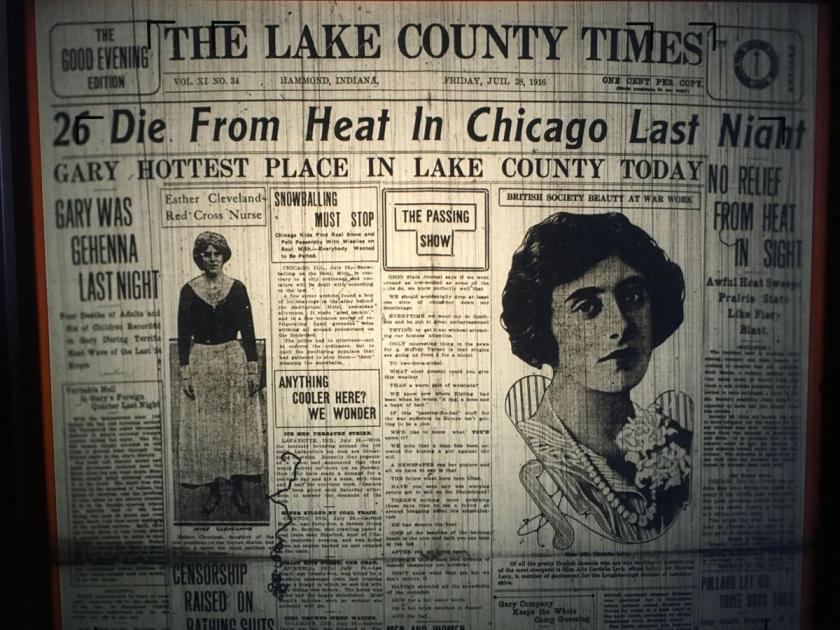
Making matters worse, the epidemic took place during one of the hottest Summers in memory, the twin threats of heat and disease driving millions to seek relief at nearby lakes, streams and beaches.
On July 1, 1916, twenty-five-year-old Charles Epting Vansant of Philadelphia was vacationing with family, at the Engleside Hotel on the Jersey shore. Just before dinner, Vansant took a swim with a Chesapeake Bay Retriever, who was playing on the beach. Vansant began to shout and bathers thought he was calling to the dog, but shouts soon turned to screams. As lifeguard Alexander Ott and bystander Sheridan Taylor pulled the man to shore, they could see the shark, following.
Charles Vansant’s left thigh was stripped to the bone. He was brought to the Engleside hotel, where he bled to death on the front desk.
Despite the incident, beaches remained open all along the Jersey Shore. Sea captains entering the ports of Newark and New York reported numbers of large sharks swarming off the Jersey shore, but such reports received little attention.
The next major shark attack occurred five days later, on July 6. Forty-five miles north of Engleside, Essex & Sussex Hotel bell captain Charles Bruder was swimming near the resort town of Spring Lake. Hearing screams, one woman notified lifeguards that a red canoe had capsized, and lay just below the surface. Lifeguards Chris Anderson and George White rowed out to the spot to discover Bruder, legless, with a shark bite to his abdomen. The twenty-seven year old Swiss army veteran bled to death before ever regaining the shore.
Like some earlier, real-life “Jaws”, authorities and the press downplayed the incident. The New York Times reported that Vansant “was badly bitten in the surf … by a fish, presumably a shark.” Pennsylvania State Fish Commissioner and former director of the Philadelphia Aquarium James M. Meehan opined that “Vansant was in the surf playing with a dog and it may be that a small shark had drifted in at high water, and was marooned by the tide. Being unable to move quickly and without food, he had come in to bite the dog and snapped at the man in passing“.
Response to the second incident was altogether different. Newspapers from the Boston Herald to the San Francisco Chronicle ran the story front page, above the fold. The New York Times went all-in: “Shark Kills Bather Off Jersey Beach“.
A trio of scientists from the American Museum of Natural History held a press conference on July 8, declaring a third such incident unlikely. Be that as it may, John Treadwell Nichols, the only ichthyologist among the three, warned swimmers to stay close to shore, and take advantage of netted bathing areas.
Rumors went into high gear, as an armed motorboat claimed to have chased a shark off Spring Creek Beach. Asbury Park Beach was closed after lifeguard Benjamin Everingham claimed to have beaten a 12-footer back, with an oar.
New Jersey resort owners suffered a blizzard of cancellations and a loss of revenue estimated at $5.6 million in 2017 dollars. In some areas, bathing declined by as much as 75%.
Even so, scores of people died in the oppressive heat. Newspapers reported twenty-six fatalities, in Chicago alone. Air conditioning, invented in 1902, would not be widely available until the 1920s. Rural areas had yet to be electrified.
Today, some sharks are known to be capable of living for a time, in fresh water. Bull sharks have been known to travel as much as sixty miles up the Mississippi River. Researchers report that the Neuse River in North Carolina has been home to bull sharks, possibly arrived in pursuit of young dolphins.
That information wasn’t available in 1916.
As the heat wave dragged on, lakes and rivers crowded with bathers from Gary, Indiana to Manchester, New Hampshire. In New Jersey, ocean beaches remained closed with the exception of the 4th Ave. Beach at Asbury Park, enclosed with a steel-wire-mesh fence and patrolled by armed motorboats.
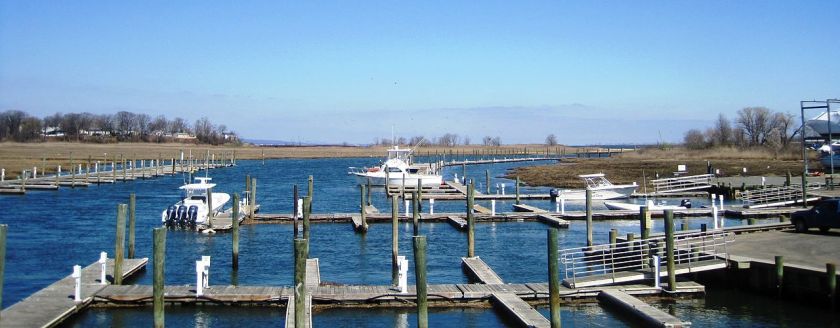
Locals sought relief from the heat in Matawan Creek, a brackish water estuary in the Marlboro Township of Monmouth County. With fresh waters flowing from Baker’s Brook through a salinity gradient to the full-salt waters of Keyport Harbor, Matawan Creek seemed more at risk for snapping turtles and snakes, than shark attack.
“Photo showing the Matawan Creek near its mouth in Keyport and Aberdeen Township, New Jersey. Photo taken from the Front Street / Amoby Road (County Route 6) bridge looking north”. H/T Wikipedia
On July 12, several boys including eleven-year-old epileptic Lester Stilwell were swimming near Wykoff Dock when the boys spotted an “old black weather-beaten board or a weathered log.” The boys scattered when that old log grew a dorsal fin, but Lester Stilwell wasn’t fast enough.
Many dismissed the rantings of five naked, hysterical boys, believing that no shark could be this far inland. Twenty-four year old tailor Stanley Fisher came running, knowing that the boy suffered from epilepsy. Arthur Smith and George Burlew joined in the effort, by now clearly a recovery and no longer a rescue. The trio got in a boat and probed with an oar and some poles, but…nothing. They were about to give up the search when Fisher dove in the water. He actually found the boy’s body, and began to swim to shore.
Matawan Creek
Townspeople lining the creek must have looked on in horror, as Fisher was attacked.
Stanley Fisher made it to shore though his right thigh was severely injured, an eighteen-inch-wide piece of his thigh gone, and an artery severed. Fisher would bleed to death at Monmouth Hospital, before the day was done.
The Jersey Shore shark attacks of 1916 claimed a fifth and final victim thirty minutes later, when Joseph Dunn of New York city was bitten a half-mile from the Stilwell and Fisher attacks. A savage tug-of war ensued between Dunn’s brother Michael and sixteen-year-old Jeremiah Hourihan, and local attorney Jacob Lefferts, who jumped in the water to help. 12-year old Joseph Dunn would survive but the damage to his left leg was severe. The boy would not be discharged from hospital, until September 15.
Based on the style of the attacks and glimpses of the shark(s) themselves, the attacks may have been those of Bull sharks, or juvenile Great Whites. Massive shark hunts were carried out all over the east coast, resulting in the death of hundreds of animals. Whether all five attacks were carried out by a single animal or many, remains unknown.
At the time, the story resulted in international hysteria. Now, the tale is all but unknown, but for the people of Matawan. Stanley’s grave sits on a promontory at the Rose Hill Cemetery, overlooking Lester’s grave, below. People still stop from time to time, leaving flowers, toys and other objects. Perhaps they’re paying tribute. Homage to the courage of those who would jump into the water, in the face of our most primordial fear.
If you enjoyed this “Today in History”, please feel free to re-blog, “like” & share on social media, so that others may find and enjoy it as well. Please click the “follow” button on the right, to receive email updates on new articles. Thank you for your interest, in the history we all share.
Men stood in line for hours, patiently waiting in the mud and the rain for their own little piece of warm, home-cooked heaven in a world full of misery.
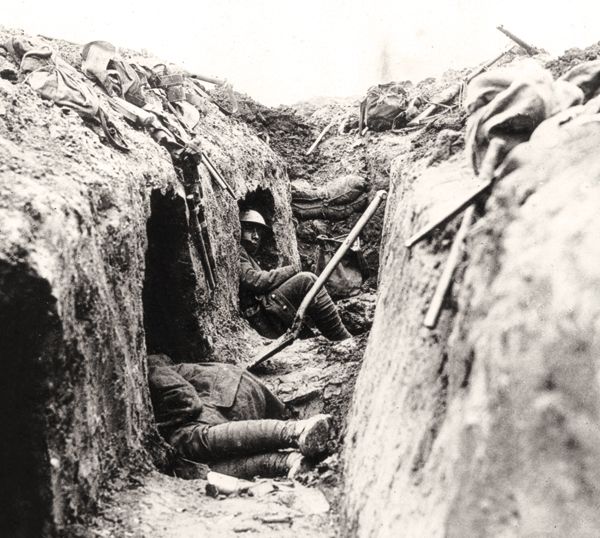
For a variety of reasons, the eastern front of the “War to end all Wars” was a war of movement. Not so on the Western front. As early as October 1914, combatants were forced to burrow into the ground like animals, sheltering from what Ernst Jünger called the ‘Storm of Steel’.
Conditions in the trenches and dugouts must have defied description. You would have smelled the trenches long before you could see them. The collective funk of a million men and more, enduring the Troglodyte existence of men who live in holes. Little but verminous scars in the earth teaming with rats and lice and swarming with flies, time and again the shells churned up and pulverized the soil, the water and the shattered remnants of once-great forests, along with the bodies of the slain.
By the time the United States entered the ‘War to end all Wars’ in April, 1917, millions had endured this existence for three years. The first 14,000 Americans arrived ‘over there’ in June, the American Expeditionary Forces (AEF) forming on July 5. American troops fought the military forces of Imperial Germany alongside their British and French allies, others joining Italian forces in the struggle against the Austro-Hungarian Empire.
You couldn’t call the stuff these people lived in mud – it was more like a thick slime, a clinging, sucking ooze capable of swallowing grown men, even horses and mules, alive.
Captain Alexander Stewart wrote “Most of the night was spent digging men out of the mud. The only way was to put duck boards on each side of him and work at one leg: poking and pulling until the suction was relieved. Then a strong pull by three or four men would get one leg out, and work would begin on the other…He who had a corpse to stand or sit on, was lucky”.
On first seeing the horror of Paschendaele, Sir Launcelot Kiggell broke down in tears. “Good God”, he said. “Did we really send men to fight in That?”
Often unseen in times of such dread calamity, are the humanitarian workers. Those who tend to the physical and spiritual requirements, the countless small comforts, of those so afflicted.
Within days of the American declaration of war, Evangeline Booth, National Commander of the Salvation Army, responded, saying “The Salvationist stands ready, trained in all necessary qualifications in every phase of humanitarian work, and the last man will stand by the President for execution of his orders”.
These people are so much more than that donation truck, and the bell ringers we see behind those red kettles, every December.
Lieutenant Colonel William S. Barker of the Salvation Army left New York with Adjutant Bertram Rodda on June 30, 1917, to survey the situation. It wasn’t long before his not-so surprising request came back in a cable from France. Send ‘Lassies’.
A small group of carefully selected female officers was sent to France on August 22. That first party comprised six men, three women and a married couple. Within fifteen months their number had expanded by a factor of 400.
In December 1917, a plea for a million dollars went out to support the humanitarian work of the Salvation Army, the YMCA, YWCA, War Camp Community Service, National Catholic War Council, Jewish Welfare Board, the American Library Association and others. This “United War Work Campaign” raised $170 million in private donations, equivalent to $27.6 billion, today.
‘Hutments’ were formed all over the front, many right out at the front lines. There were canteen services. Religious observances of all denominations were held in these facilities. Concert performances were given, clothing mended and words of kindness offered in response to all manner of personal problems. On one occasion, the Loyal Order of Moose conducted a member initiation. Pies and cakes were baked in crude ovens and lemonade served to hot and thirsty troops. Of all these corporal works of mercy, the ones best remembered by the ‘doughboys’ themselves, were the doughnuts.
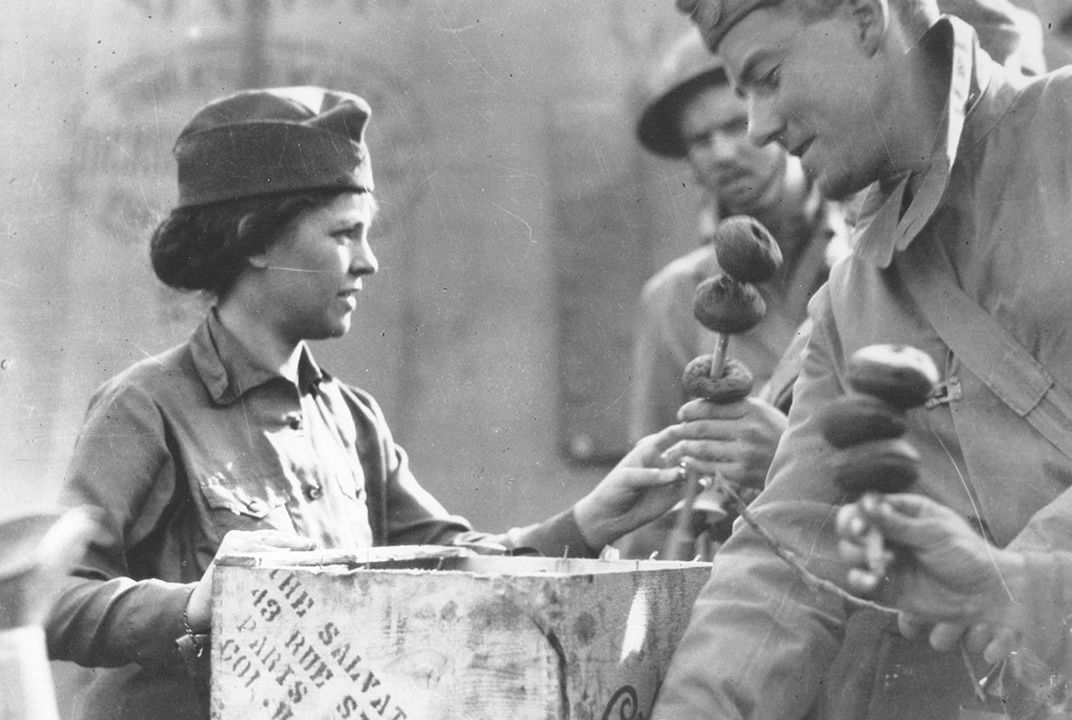
Helen Purviance, sent to France in 1917 with the American 1st Division, seems to have been first with the idea. An ensign with the Salvation Army, Purviance and fellow ensign Margaret Sheldon first formed the dough by hand, later using a wine bottle in lieu of a rolling pin. Having no doughnut cutter at the time, dough was shaped and twisted into crullers, and fried seven at a time on a pot-bellied wood stove.
The work was grueling. The women worked well into the night that first day, serving all of 150 hand-made doughnuts. “I was literally on my knees,” Purviance recalled, but it was easier than bending down all day, on that tiny wood stove. It didn’t seem to matter. Men stood in line for hours, patiently waiting in the mud and the rain for their own little piece of warm, home-cooked heaven in a world full of misery.
Before long, the women got better at it. Soon they were turning out 2,500 to 9,000 doughnuts a day. An elderly French blacksmith made Purviance a doughnut cutter, out of a condensed milk can and a camphor-ice tube, attached to a wooden block.
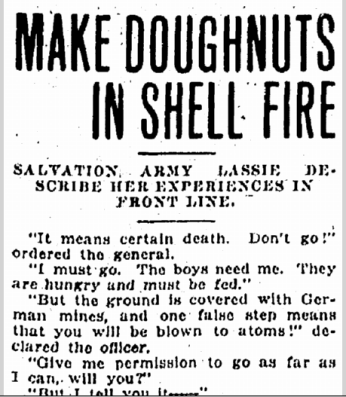
It wasn’t long before the aroma of hot doughnuts could be found, wafting all over the dugouts and trenches of the western front. Salvation Army volunteers and others made apple pies and all manner of other goodies, but the name that stuck, was “Doughnut Lassies”.
June 2, 2017 – Salvation Army employees Cheryl Freismuth (l) and Susan Klyk (c) celebrate the 100th anniversary of the “Doughnut Lassies” of WW1 with student Catie McDougall (r). H/T The Detroit News
One New York Times correspondent wrote in 1918 “When I landed in France I didn’t think so much of the Salvation Army; after two weeks with the Americans at the front I take my hat off… [W]hen the memoirs of this war come to be written the doughnuts and apple pies of the Salvation Army are going to take their place in history”.
If you enjoyed this “Today in History”, please feel free to re-blog, “like” & share on social media, so that others may find and enjoy it as well. Please click the “follow” button on the right, to receive email updates on new articles. Thank you for your interest, in the history we all share.
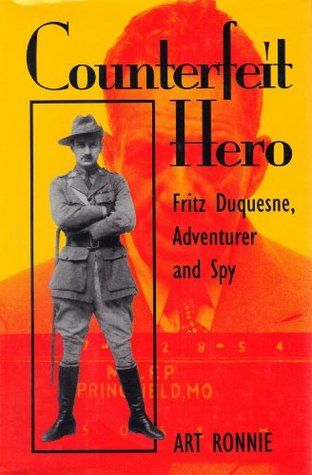
A liar, a chameleon, a man of 1,000 aliases, Fritz Duquesne once feigned paralysis for seven months in prison, just so he could fool his jailers long enough to escape. Frederick Burnham, a real-life Indiana Jones and the inspiration for the Boy Scouts of America, described Duquesne as “the last man I should choose to meet in a dark room for a finish fight armed only with knives.“
As the 19th century gave way to the 20th, massive immigration into the United States put increasing strain on the nation’s food supply. The meat shortage became particularly acute, to the point where policy makers considered importing exotic species of animals, to augment the nation’s food supply.
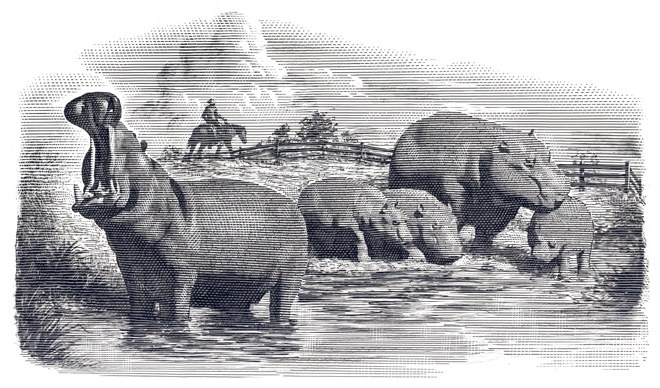
Hippo Ranching, in America
In 1910, the United States Congress defeated by one vote, a measure to introduce African hippopotami into the American food supply. Supporters of the measure envisioned great herds of free-range hippos, filling swamps, rivers and bayous from the Atchafalaya basin to the Okefenokee Swamp, to the Florida Everglades.
As the “American Hippo” bill wended its way through Congress, the measure picked up steam with the enthusiastic support of two mortal enemies who’d spent years in the African bush, trying to kill each other.
Frederick Russell Burnham
Major Frederick Russell Burnham was a freelance scout and American adventurer. The “King of Scouts’, Burnham was a “man totally without fear,” a real-life Indiana Jones and the inspiration for the Boy Scouts of America. This is the guy who should have been in the Dos Equis beer commercials. One contemporary described the man as the “most complete human being who ever lived“.
Burnham’s fellow hippo salesman and would-be murderer was Frederick “Fritz” Joubert Duquesne. A Boer of French Huguenot ancestry, Duquesne was a smooth talking guerrilla fighter, an adrenaline junkie and self-styled “Black Panther”, who once described himself as every bit the wild African animal, as any creature of the veld. A liar, a chameleon, a man of 1,000 aliases, Duquesne once feigned paralysis for seven months in prison, just so he could fool his jailers long enough to escape. Burnham himself described him as “the last man I should choose to meet in a dark room for a finish fight armed only with knives.“
During the second Anglo-Boer war of 1899 – 1902, several large shipments of gold totaling 1.5 million pounds were removed from the central bank in Pretoria, and sent to the Netherlands for the use of exiled president Paul Kruger and other Boer exiles fleeing the Transvaal.
Fritz Duquesne was in charge of moving one of those shipments across the bushveld of Portuguese East Africa, when some kind of argument broke out. When it was over, only two wounded Boers were left alive, along with Duquesne himself and a few tottys (native porters). Duquesne ordered the tottys to hide the gold, burn the wagons and kill the survivors. He then rode off on an ox, having given the rest to the porters.
Duquesne was captured and escaped several times during this period, before infiltrating the British army as an officer, in 1901. It was in this capacity that he found his parents’ farm in Nylstroom, destroyed under Marshall Horatio Kitchener’s ‘scorched earth’ policy. His sister had been raped and killed, he learned, and his mother was dying in a British concentration camp. Historian Art Ronnie remarked that, “the fate of his country and of his family would breed in him an all-consuming hatred of England.” Biographer Clement Wood echoed the sentiment, calling Duquesne: “a walking living breathing searing killing destroying torch of hate.”
Duquesne was found out during a plot to assassinate Kitchener, narrowly avoiding execution by swimming away from the “impossible, hopeless, and impregnable prison” of Bermuda. A week later, the Black Panther was stowed away on a boat to Baltimore.
British recruiting poster of WW1, featuring Field Marshal Horatio Herbert Kitchener, 1st Earl Kitchener
During this period, Duquesne became involved with the Hippo program, becoming safari guide and personal shooting instructor to President Theodore Roosevelt, himself.
Naturalized an American citizen in 1913, Duquesne became a German spy the following year, as war broke out in Europe. “Captain Frederick Fredericks”, was sent to Brazil under the guise of “doing scientific research on rubber plants,” but the real-life German agent for Naval Intelligence’ real job was to disrupt the shipping, of countries at war with Germany. That twenty-two British merchant ships randomly exploded during this period, is no coincidence.
British MI5 discovered the German agent, using the aliases George Fordam and Piet Niacud (‘Duquesne’, pronounced backward). ‘Niacud” disappeared once again, placing an article in an Argentine newspaper reporting his own murder at the hands of Amazon natives.
Fritz Duquesne in German uniform
The “Man with 1,000 aliases” picture (l) as himself ( during 2nd Boer War, ca 1901), in German uniform sometime around 1914-’16, and (r), as Australian “Captain Claude Stoughton”, from a WW1 war bond drive.
Reappearing once more in New York and using the aliases George Fordam and Frederick Fredericks, Duquesne filed insurance claims for the loss of “films” and “mineral samples” lost in the vessels which he himself sank, off the coast of Brazil. The insurance companies were reluctant to pay and launched their own investigations, while “Fredericks” disappeared once again, re-emerging as the Russian Duke ‘Boris Zakrevsky’ and joining Lord Kitchener on HMS Hampshire in Scotland.
HMS Hampshire sank on June 5, 1916 with heavy loss of life, including that of Kitchener himself. History records the Devonshire-class armored cruiser as having struck a mine. Some believe the spy had succeeded after all those years, calling in the submarine strike and sinking the Hampshire, killing the Field Marshall before rowing away in a life boat. There were only twelve survivors.
Fritz Duquesne, in younger days
A former-day Forrest Gump with a knack for always being in all the right places, Fritz emerged in 1916 as “Captain Claude Stoughton” of the Western Australian Light Horse regiment, a man who claimed to have been “bayoneted three times, gassed four times, and stuck once with a hook”. As Captain Stoughton, Duquesne would regale New York audiences with hair-raising tales of his war exploits, promoting the sale of Liberty Bonds and making patriotic speeches on behalf of the Red Cross and other organizations.
The insurance fraud caught up with him November 1917, when letters in his possession implicated him in the earlier sabotage, in Brazil. American authorities agreed to extradite Duquesne to Great Britain for “murder on the high seas, arson, faking Admiralty documents and conspiring against the Crown.”
Keeping this guy in prison, though, was like nailing an eel to a jello tree. This was when he faked his paralysis, enduring the needle pokes and prods of skeptical doctors until even they became convinced of his infirmity.
As the Nazi party came to power in the early 1930s, this “Destroying Torch of Hate” for all things British, once again took up the German cause.
Six months before the United States entered World War 2, a large pro-Nazi spy ring was discovered, operating in America. Thirty-three German agents were placed in key jobs around the United States, one opening a restaurant, another working at an airline and others working as delivery men and messengers. The FBI struck on June 29, 1941, arresting all thirty three spies on charges of espionage. At the center of it all, was none other than Frederick “Fritz” J. Duquesne.
Duquesne Spy Ring
To this day, the Duquesne Spy Ring remains the largest espionage case in United States history, which ended in convictions. Six days after the Imperial Japanese attack on Pearl Harbor, three women and thirty men were convicted of sending secret information on U.S. weapons and shipping movements, to Nazi Germany. Less than a month later, the group was sentenced to a combined total of over 300 years in prison.
Duquesne himself was sentenced to 18 years. This time, he didn’t get out. The “Man who killed Kitchener” was released fourteen years later, due to failing physical and mental health. Fritz Duquesne died on May 24, 1956, at the City Hospital on Welfare Island. His last known speech took place two years earlier, at the Adventurers’ Club of New York. The title of the lecture, was “My Life – in and out of Prison”.
If you enjoyed this “Today in History”, please feel free to re-blog, “like” & share on social media, so that others may find and enjoy it as well. Please click the “follow” button on the right, to receive email updates on new articles. Thank you for your interest, in the history we all share.
Workers at the Flint Michigan plant assembled the first Corvette on this day in 1953. The first production car rolled off the assembly line two days later. 300 hand-built Corvettes came off the line that model year, all white.
For two years, General Motors designer Harley Earl labored to build an affordable American sports car, to compete with the MGs, Jaguars and Ferraris coming out of Europe. The first convertible concept model appeared in early 1953, part of the GM Motorama display at the New York Auto Show held at the Waldorf-Astoria Hotel.
Chevrolet wanted to give the new model a “non-animal” name, starting with ‘C’. Newspaper photographer Myron Scott suggested the name of a small class of warship, the “trim, fleet naval vessel that performed heroic escort and patrol duties during World War II.” They called this new model a Corvette.
Workers at the Flint Michigan plant assembled the first Corvette on this day in 1953. The first production car rolled off the assembly line two days later. 300 hand-built Corvettes came off the line that model year, all white.
To keep costs down, off-the-shelf components were used whenever possible. The body was made of fiberglass to keep tooling expenses low. The chassis and suspension came from the 1952 Chevy sedan. The car featured an increased compression-ration version of the same in-line six “Blue Flame” block used in other models, coupled with a two-speed Power glide automatic transmission. No manual transmission of the time could reliably handle an output of 150 HP and a 0-60 time of 11½ seconds.
GM moved production to St. Louis, Missouri the following year. Since 1974, the car has been manufactured in Bowling Green, Kentucky, where the Corvette has become the official sports car of the Commonwealth of Kentucky.
Sales were disappointing in the first couple years, compared with those of European competitors. GM refined the early design and added a V-8 in 1955, greatly improving the car’s performance. By 1961, the Corvette had established itself as a classic American muscle car.
The second generation (C2) introduced the “Stingray” name in 1963. Still sporting fiberglass body panels, the car was smaller and lighter than previous models with a maximum output of 360 HP. The sleek, tapered design was said to be patterned after the Mako shark caught by lead designer Bill Mitchell, on a deep sea fishing trip.
The third generation (1968–1982) featured a radically new body and interior design, and Chevy’s first use of T-top removable roof panels. The “Stingray” name was dispensed with in 1976, in 1978, the C3 became the first of 12 Corvettes to be used as Pace Cars for the Indy 500.
The radical redesign of the fourth generation Corvette was intended for the 1983 model year but, quality issues and delays from parts suppliers resulted in only 43 prototypes being built. None of them were ever sold. Only one of the 1983 prototypes survives; it’s on display at the National Corvette Museum in Bowling Green, Kentucky.
When it came to quality and styling, many felt that the C4 compared poorly with Japanese competitors like the Nissan 300ZX and Mazda RX-7. The 5th generation introduced in 1997 addressed many of these issues. The production C5 had a top speed of 181 mph, while the lower drag coefficient and new, aerodynamic styling resulted in 28 mpg on the highway.
Twenty-first century updates exposed headlights for the first time since 1962, the 7th generation becoming the first to bear the Stingray name since the 1976 model year. Air intake grills were exposed for the first time in four generations, as the all-important 0-60 times approached the four-seconds mark.
Corvette enthusiasts criticized the aggressive, angular lines of the C7, claiming the rear end looks more like a C5 Camaro. Others complained about the front end; with an air intake grill exposed for the first time in four generations.
The supercharged 6.2L V8 power plant of the 2019 Z06 develops 650 horsepower, capable of accelerating from 0-60 mph in 2.95 seconds with a top end of 207.4 mph. Ain’t nobody fussing about that.
If you enjoyed this “Today in History”, please feel free to re-blog, “like” & share on social media, so that others may find and enjoy it as well. Please click the “follow” button on the right, to receive email updates on new articles. Thank you for your interest, in the history we all share.
The golden age of the automobile, had arrived. All manner of roadside attractions popped up to serve the burgeoning tourist business. There were teepee-shaped motels and frozen custard stands. Indian curio shops and reptile farms.
In 1857, President James Buchanan appointed Lieutenant Edward Beale to survey and build a 1,000-mile wagon road from Fort Defiance, New Mexico to the Arizona/California border. The survey continued an experiment first suggested by Secretary of War and future President of the Confederate States of America Jefferson Davis, in the use of camels as draft animals.
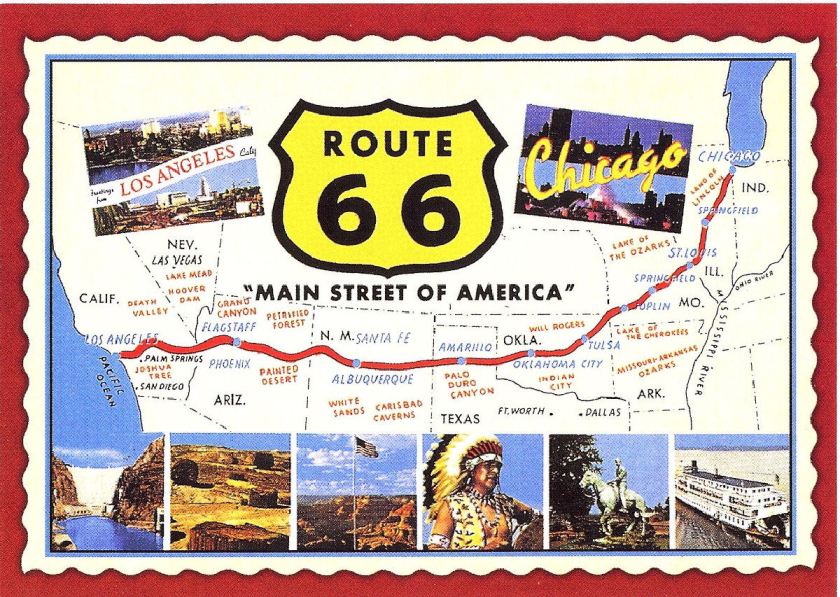
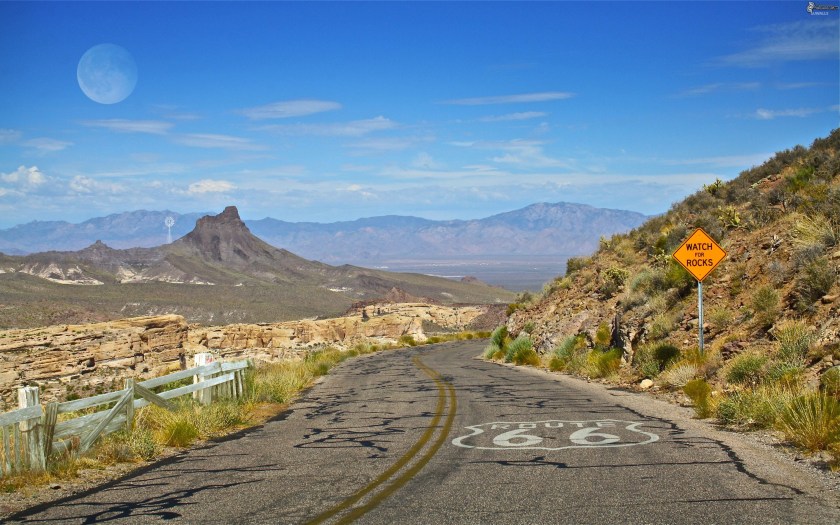
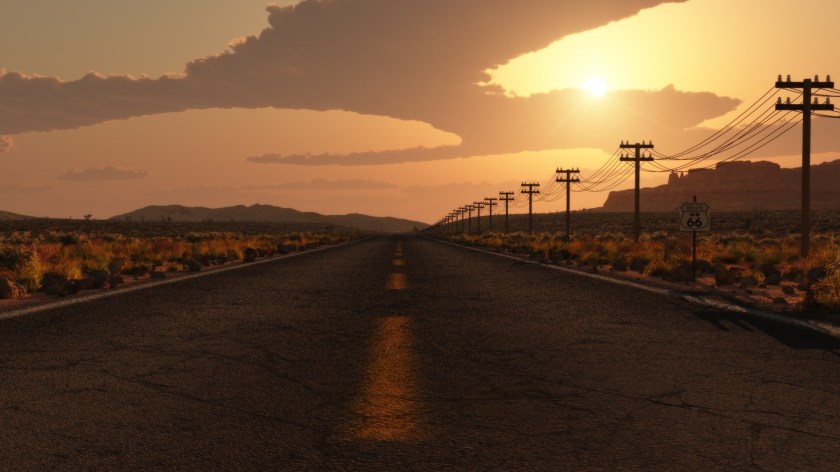
The camel part turned out to be a flop, but the road building was not. Beale’s wagon trail went on to become the western end of “America’s Main Street”. Route 66.
The “Mother Road” became an official part of the national highway system in 1927. It was yet to be paved, when the US Highway 66 Association held a “Bunion Derby” in 1928. It was a footrace from Los Angeles to Madison Square Garden, a distance of 3,423½ miles. Naturally, the LA to Chicago leg ran along Route 66.
Andy Hartley Payne, an Oklahoma Cherokee runner won the race in 573 hours, 4 minutes and 34 seconds. 11th place finisher Harry Abrams ran the race in the opposite direction the following year, becoming the only person to twice run across the continental United States.
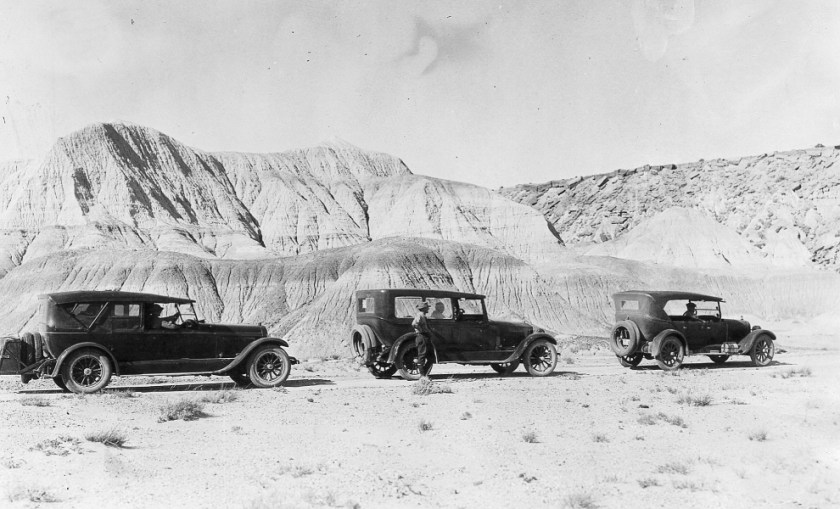
In 1914, a Model T sold for $490. As the 20s drew to a close, the number of registered drivers had tripled to 23 million.
The 1932 Summer Olympics in Los Angeles and the westward migration of the “Dust Bowl” era increased the number of “Mom & Pop” service stations, restaurants, and motor courts, springing up to serve the needs of passing motorists.
The road was fully paved by 1938, passing through the Painted Desert on the way by the Grand Canyon and Meteor Crater in Arizona.
The golden age of the automobile, had arrived. All manner of roadside attractions popped up to serve the burgeoning tourist business. There were teepee-shaped motels and frozen custard stands. Indian curio shops and reptile farms.
Meramec Caverns outside of St. Louis painted billboards on barns, calling themselves “Jesse James hideout”. The Big Texan sold a 72-ounce steak dinner, making it free to anyone who could eat the whole thing in an hour.
The fast-food industry was born on Route 66, when Sheldon “Red” Chaney built Red’s Giant Hamburg in Springfield, Missouri. Believed to be the first drive-through restaurant in the country, the name was supposed to be “Red’s Giant Hamburger“. Chaney had to cut the two bottom letters off his sign, when the city refused to raise the telephone wires.
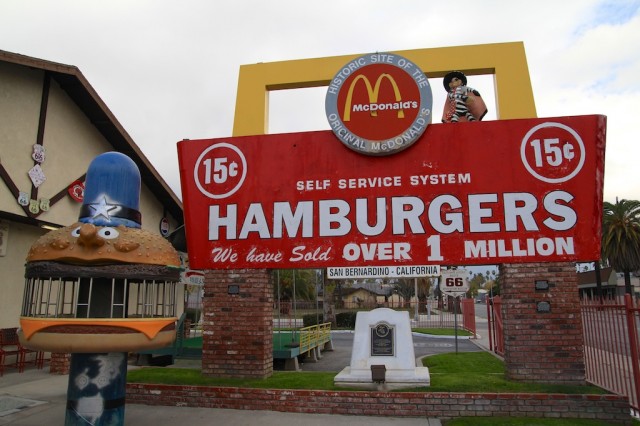
Patrick McDonald opened “The Airdrome” restaurant on Route 66 in 1937, years before the world knew anything about Ray Kroc. Hot dogs were some of the first items he ever sold. Ten cent hamburgers were added later, along with all-you-can-drink orange juice for five cents. Three years later, McDonald’s two sons Maurice and Richard (“Mac” and “Dick”) moved the entire building 40 miles east, to San Bernardino, calling the place “McDonald’s Bar-B-Que”.
General Eisenhower came out of WWII with an appreciation for the German highway system, the Autobahn, and signed the Interstate Highway Act as President in 1956. It was the beginning of the end for Route 66. New highway construction began to bypass town centers, and once-thriving Mom & Pops began to die off.
By the mid-’50s, Missouri upgraded its sections of US 66 to four lanes, by-passing town centers and the businesses that went with them.
Illinois widened US 66 from Chicago to the Mississippi River. By 1957, virtually the entire Missouri-Kansas-Oklahoma stretch was replaced by 4 lane toll roads. You could see the old 66 as you drove parallel to it, but travelers rarely stopped.
The last parts of Route 66 were decertified by state highway and transportation officials on this day in 1985. In some cities, the old road is now the “Business Loop”.
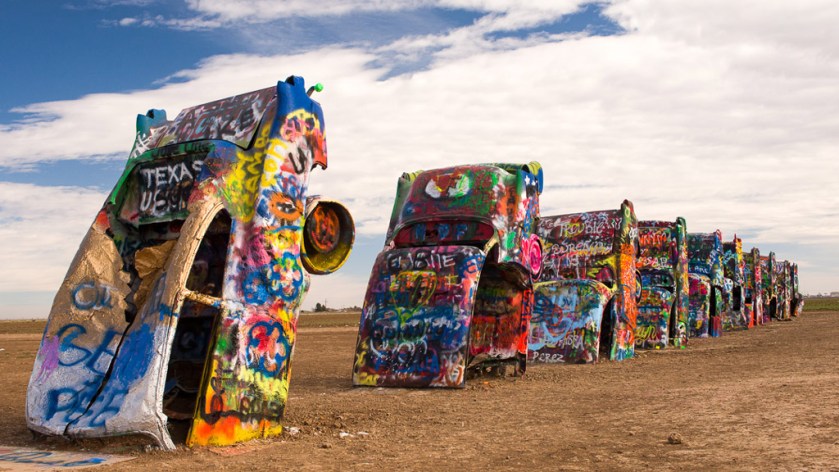
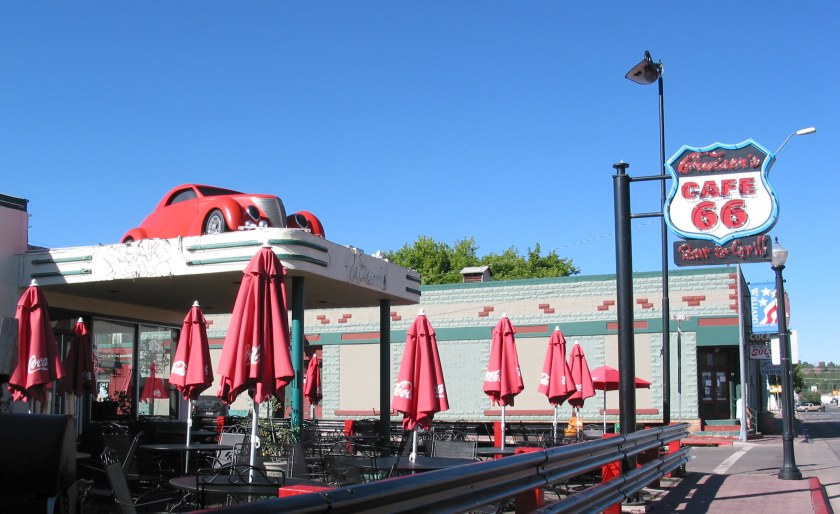
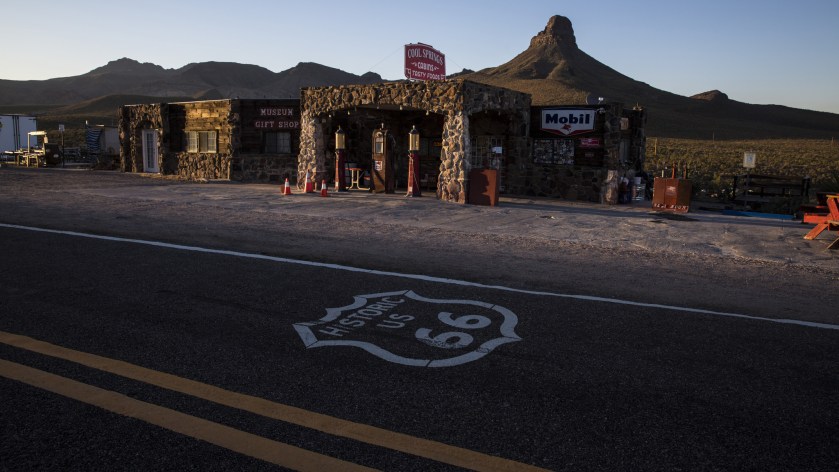
The Mother Road has been carefully preserved in some areas, abandoned in others.
Today, most of the old attractions are gone. You couldn’t drive the old Route 66 from Chicago to LA if you wanted to. But you could get close. If you plan ahead.
If you enjoyed this “Today in History”, please feel free to re-blog, “like” & share on social media, so that others may find and enjoy it as well. Please click the “follow” button on the right, to receive email updates on new articles. Thank you for your interest, in the history we all share.


 Twenty-seven years after Gettysburg, surviving veterans of the regiment returned to dedicate a memorial to those members of the 11th Pennsylvania, who lost their lives on that field of battle.
 The other includes a brindle colored Terrier, named Sallie. The only one of the two to have actually participated in the battle.

 The territory which would come to be occupied by the colony of Georgia was a subject for dispute between Great Britain and Spain, since long before the state became a colony.
 off the ear of Commander Robert Jenkins, informing the unfortunate ship’s master that he could “Go, and tell your King that I will do the same”, to him.


 Lee was appointed to the Committee of Confederation, assigned to write the Articles by which the fledgling nation would govern itself. Lee believed that two such committees were too much and, soon, he would be called home to care for a critically ill wife.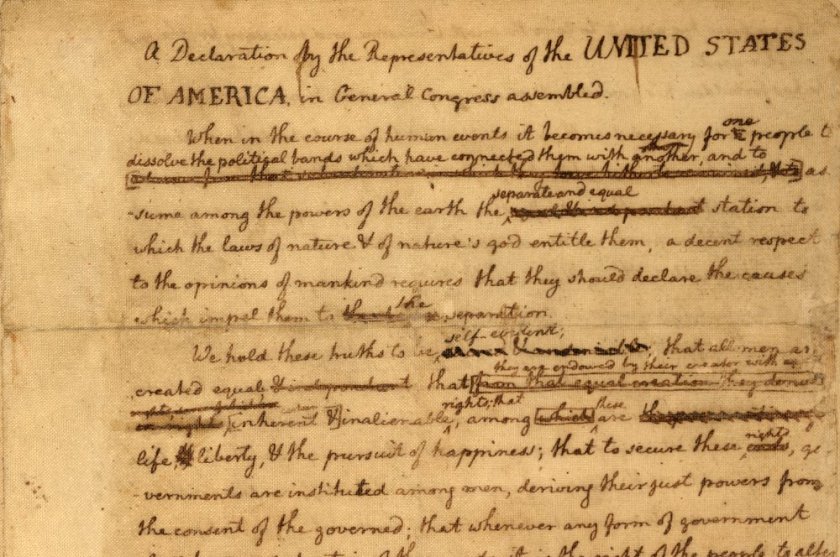



 Indeed, such a system has imperfections, not least among them those who would ascend to political office.


 In pre-1955 America and around much of the world, Summer was a time of dread. TIME Magazine offered what solace it could, in 1946: “for many a parent who had lived through the nightmare fear of polio, there was some statistical encouragement: in 1916, 25% of polio’s victims died. This year, thanks to early recognition of the disease and improved treatment (iron lungs, physical therapy, etc.) the death rate is down to 5%.”
 Charles Vansant’s left thigh was stripped to the bone. He was brought to the Engleside hotel, where he bled to death on the front desk.
 Like some earlier, real-life “Jaws”, authorities and the press downplayed the incident. The New York Times reported that Vansant “was badly bitten in the surf … by a fish, presumably a shark.” Pennsylvania State Fish Commissioner and former director of the Philadelphia Aquarium James M. Meehan opined that “Vansant was in the surf playing with a dog and it may be that a small shark had drifted in at high water, and was marooned by the tide. Being unable to move quickly and without food, he had come in to bite the dog and snapped at the man in passing“.


 Based on the style of the attacks and glimpses of the shark(s) themselves, the attacks may have been those of Bull sharks, or juvenile Great Whites. Massive shark hunts were carried out all over the east coast, resulting in the death of hundreds of animals. Whether all five attacks were carried out by a single animal or many, remains unknown.
 At the time, the story resulted in international hysteria. Now, the tale is all but unknown, but for the people of Matawan. Stanley’s grave sits on a promontory at the Rose Hill Cemetery, overlooking Lester’s grave, below. People still stop from time to time, leaving flowers, toys and other objects. Perhaps they’re paying tribute. Homage to the courage of those who would jump into the water, in the face of our most primordial fear.
 Often unseen in times of such dread calamity, are the humanitarian workers. Those who tend to the physical and spiritual requirements, the countless small comforts, of those so afflicted.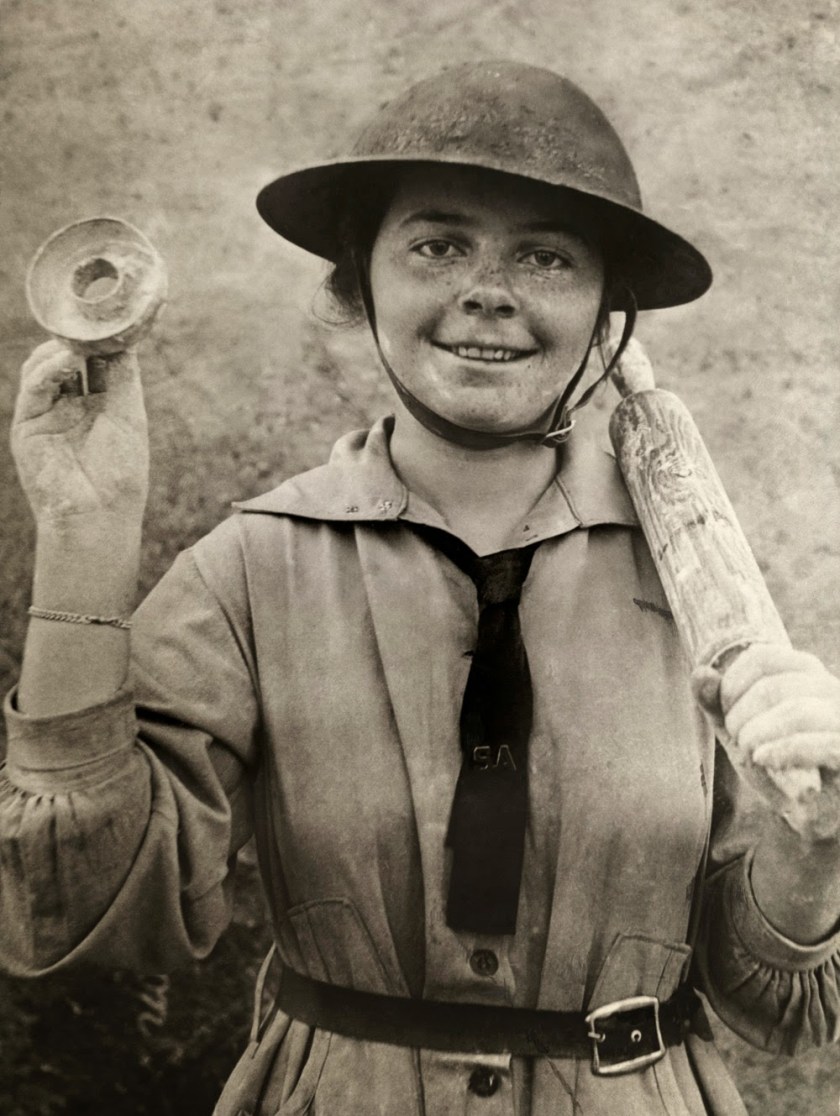
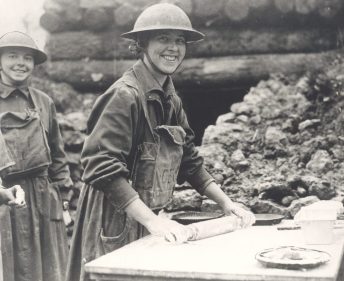 A small group of carefully selected female officers was sent to France on August 22. That first party comprised six men, three women and a married couple. Within fifteen months their number had expanded by a factor of 400.
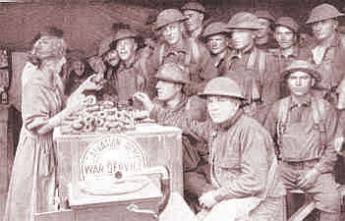 ‘Hutments’ were formed all over the front, many right out at the front lines. There were canteen services. Religious observances of all denominations were held in these facilities. Concert performances were given, clothing mended and words of kindness offered in response to all manner of personal problems. On one occasion, the Loyal Order of Moose conducted a member initiation. Pies and cakes were baked in crude ovens and lemonade served to hot and thirsty troops. Of all these corporal works of mercy, the ones best remembered by the ‘doughboys’ themselves, were the doughnuts.

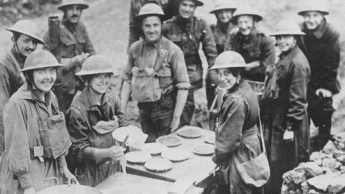 Before long, the women got better at it. Soon they were turning out 2,500 to 9,000 doughnuts a day. An elderly French blacksmith made Purviance a doughnut cutter, out of a condensed milk can and a camphor-ice tube, attached to a wooden block.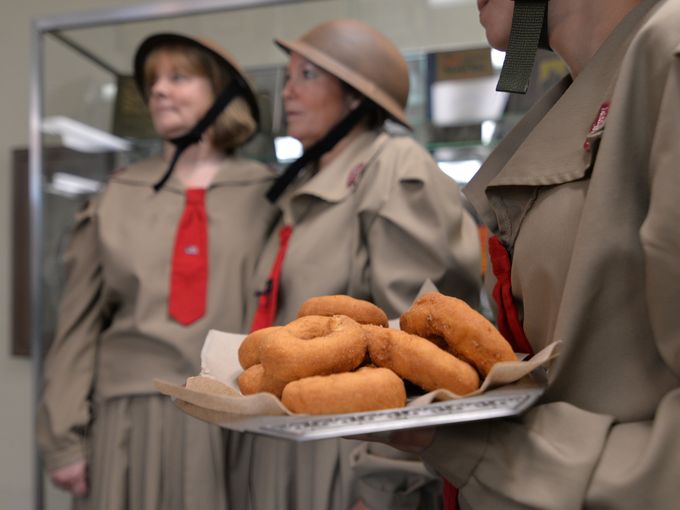



 Fritz Duquesne was in charge of moving one of those shipments across the bushveld of Portuguese East Africa, when some kind of argument broke out. When it was over, only two wounded Boers were left alive, along with Duquesne himself and a few tottys (native porters). Duquesne ordered the tottys to hide the gold, burn the wagons and kill the survivors. He then rode off on an ox, having given the rest to the porters.


 To keep costs down, off-the-shelf components were used whenever possible. The body was made of fiberglass to keep tooling expenses low. The chassis and suspension came from the 1952 Chevy sedan. The car featured an increased compression-ration version of the same in-line six “Blue Flame” block used in other models, coupled with a two-speed Power glide automatic transmission. No manual transmission of the time could reliably handle an output of 150 HP and a 0-60 time of 11½ seconds.








 Historical Easter Eggs - Today in History
You must be logged in to post a comment.