October 26, 1918 Talking in Code

In 1917, Colonel Bloor heard two of his Choctaw soldiers talking to each other, and realized he didn’t have the foggiest notion of what they were saying. If he didn’t understand their conversation, the Germans wouldn’t have a clue.

During the twentieth century, the United States and others specially recruited bilingual speakers of obscure languages, then applying those skills in secret communications based on those languages.  Among these, the story of the Navajo “Code Talkers” are probably best known.   Theirs was a language with no alphabet or symbols, a language with such complex syntax and tonal qualities as to be unintelligible to the non-speaker. The military code based on such a language proved unbreakable in WWII. Japanese code breakers never got close.

The United States Marine Corps recruited some 4-500 Navajo speakers, who served in all six Marine divisions in the Pacific theater.  Guadalcanal, Tarawa, Peleliu, Iwo Jima:  Navajo code talkers took part in every assault conducted by the United States Marine Corps, from 1942 to ‘45.

160907143620-navajo-code-talkers-3-exlarge-169.jpgThe history of the Navajo code talkers of WWII is relatively well known, but by no means, unique.  Indigenous Americans of other nations served as code talkers in WW2, including Assiniboine, Lakota and Meskwaki soldiers, who did service in the Pacific, North African, and European theaters of the war.

Fourteen Comanche soldiers took part in the Normandy landings.  As with the Navajo, these substituted phrases when their own language lacked a proper term.  Thus, “tank” became “turtle”.  “Bombers” became “pregnant airplanes”.  Adolf Hitler was “Crazy White Man”.

The information is contradictory, but Basque may also have been put to use, in areas where no native speakers were believed to be present.  Native Cree speakers served with Canadian Armed Services, though oaths of secrecy have all but blotted their contributions, from the pages of history.

The first documented use of military codes based on native American languages took place during the Second Battle of the Somme in September of 1918, employing on the language skills of a number of Cherokee troops.

The government of Choctaw nation will tell you otherwise, contending that Theirs was the first native language, used in this way.  Late in 1917, Colonel Alfred Wainwright Bloor was serving in France with the 142nd Infantry Regiment. They were a Texas outfit, constituted in May of that year and including a number of Oklahoma Choctaws.

The Allies had already learned the hard way that their German adversaries spoke excellent English, and had already intercepted and broken several English-based codes. Colonel Bloor heard two of his Choctaw soldiers talking to each other, and realized he didn’t have the foggiest notion of what they were saying. If he didn’t understand their conversation, the Germans wouldn’t have a clue.

ChoctawCoders
Choctaw soldiers in training in World War I for coded radio and telephone transmissions

The first test under combat conditions took place on October 26, 1918, as two companies of the 2nd Battalion performed a “delicate” withdrawal from Chufilly to Chardeny, in the Champagne sector. A captured German officer later confirmed the Choctaw code to have been a complete success. We were “completely confused by the Indian language”, he said, “and gained no benefit whatsoever” from wiretaps.

Choctaw soldiers were placed in multiple companies of infantry. Messages were transmitted via telephone, radio and by runner, many of whom were themselves native Americans.

As in the next war, Choctaw would improvise when their language lacked the proper word or phrase. When describing artillery, they used the words for “big gun”. Machine guns were “little gun shoot fast”.
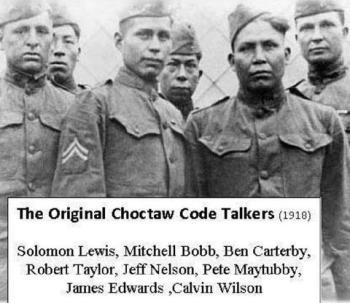
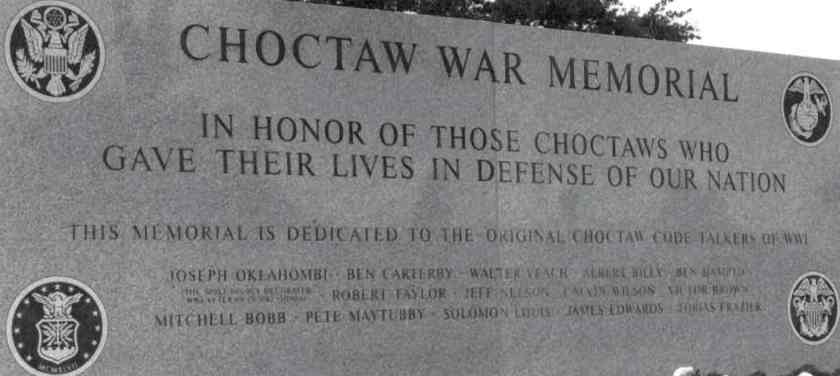
Choctaw code talkersThe Choctaw themselves didn’t use the term “Code Talker”, that wouldn’t come along until WWII. At least one member of the group, Tobias W. Frazier, simply described what they did as, “talking on the radio”.  Of the 19 who served in WWI, 18 were native Choctaw from southeast Oklahoma. The last was a native Chickasaw. The youngest was Benjamin Franklin Colbert, Jr., the son of Benjamin Colbert Sr., one of Teddy Roosevelt’s “Rough Riders” of the Spanish American War. Born September 15, 1900 in the Durant Indian Territory, he was all of sixteen, the day he enlisted.

Another was Choctaw Joseph Oklahombi, whose name means “man killer” in the Choctaw language. Six days before Sergeant York’s famous capture of 132 Germans in the Argonne Forest, Joseph Oklahombi charged a strongly held German position, single-handed. Oklahombi‘s Croix de Guerre citation, personally awarded him by Marshall Petain, tells the story:

“Under a violent barrage, [Pvt. Oklahombi] dashed to the attack of an enemy position, covering about 210 yards through barbed-wire entanglements. He rushed on machine-gun nests, capturing 171 prisoners. He stormed a strongly held position containing more than 50 machine guns, and a number of trench mortars. Turned the captured guns on the enemy, and held the position for four days, in spite of a constant barrage of large projectiles and of gas shells. Crossed no man’s land many times to get information concerning the enemy, and to assist his wounded comrades”.

Unconfirmed eyewitness accounts report that 250 Germans occupied the position, and that Oklahombi killed 79 of them before their comrades decided it was wiser to surrender. Some guys are not to be trifled with.
choctawwarmemorial

October 25, 1854 Into the Valley of Death, Rode the 600

A child might have seen the trap that was laid for us. Every private dragoon did

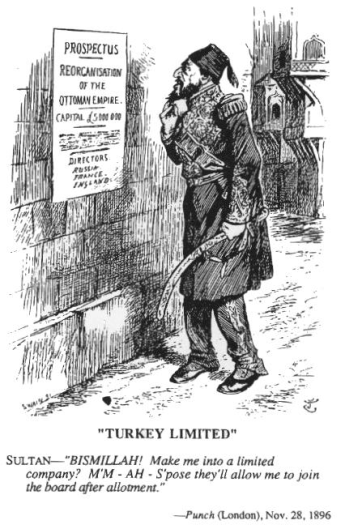
Abdul Hamid
1896 Punch cartoon lampoons a hapless Ottoman Sultan Abdul Hamid II, in front of a poster announcing the reorganization of the Ottoman Empire

At the height of its power during the 16th and 17th centuries, the Ottoman Empire was one of the most powerful states in the world, ruling over 39 million subjects and controlling a territory spanning three continents: over two million square miles.

By the mid-19th century, the once-great Empire was the “sick man of Europe”, destined to be broken apart by its adversaries, in the wake of World War 1.

For a hundred years or more, the Russian Empire had seen itself as protector of Orthodox Church co-religionists, in the biblical land of Israel and historical Palestine. The Greek clergy in the Christian Holy Land already enjoyed warm relations with their Ottoman overlords, and controlled most of the Christian holy sites.

This state of affairs was challenged in the mid-19th century by the French Empire of Emperor Napoleon III, who was trying to extend Latin (Catholic) influence over the region.

Things came to a head in 1852 with, among other disputes, an argument over a key. No kidding. The key to the main door, of the Church of the Nativity.

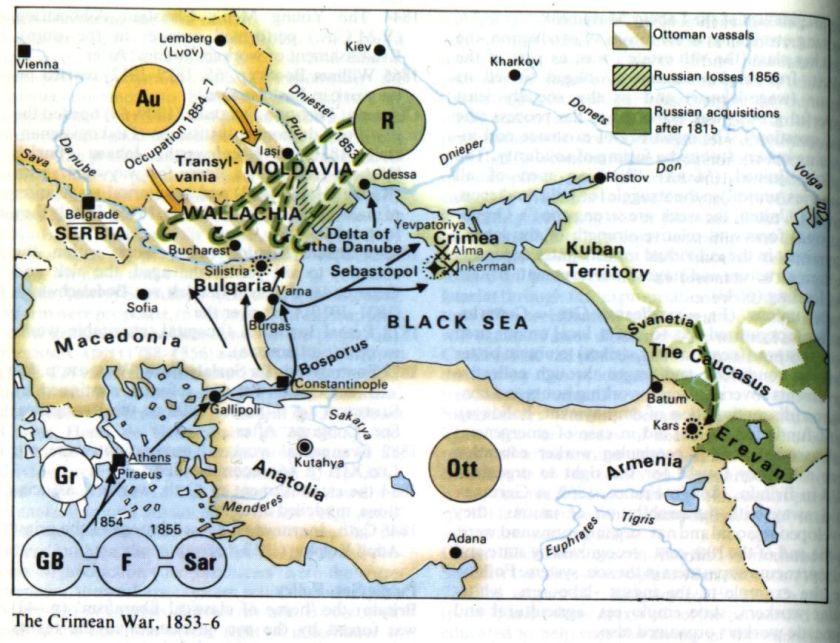
Great Britain attempted to mediate the growing Franco-Russian dispute, but neither Nicholas I nor Napoleon III, would back down. War broke out in the Crimea in October 1853, between an allied coalition of forces including the Ottoman Empire, France, Great Britain and Sardinia, against the Russian Empire of Czar Nicholas I.

The loss of life in the Crimean War (October 1853 to February 1856) was prodigious, resulting in the death of some 750,000 military service personnel on all sides, and unknown numbers of civilians. Russian diplomat Pyotr Petrovich Troubetzkoy would write: “Few wars in history reveal greater confusion of purpose or richer unintended consequences than the Crimean War.

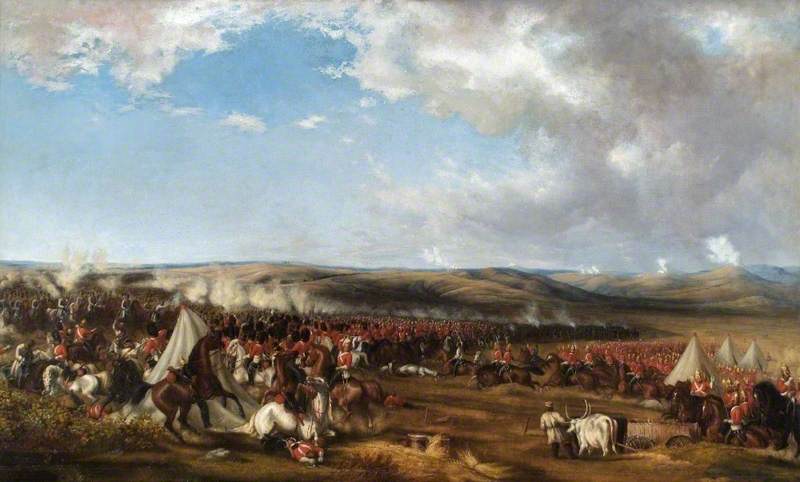
805d18a9cf90232024554f10657afd0cThe Battle of Balaclava opened shortly after 5:00am on this day in 1854, when a squadron of Russian Cossack Cavalry advanced under cover of darkness. The Cossacks were followed by a host of Uhlans, their Polish light cavalry allies, against several dug-in positions occupied by Ottoman Turks. The Turks fought stubbornly, sustaining 25% casualties before finally being forced to withdraw.
22-Balaclava-Thin-Red-Line

The Thin Red Line

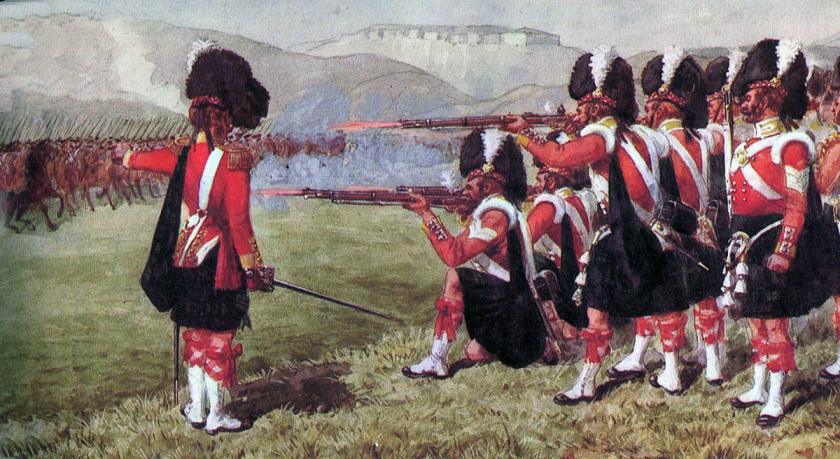
For a time, the Russian advance was held only by the red coated 93rd Highland Regiment, a desperate defense recorded in history as the Thin Red Line. Finally, the Russians were driven back by the British Heavy Brigade, led by George Bingham, 3rd Earl of Lucan, a man otherwise known to history for the brutality inflicted on tenants in Mayo, during the Irish potato famine.

BBO_DA_80005
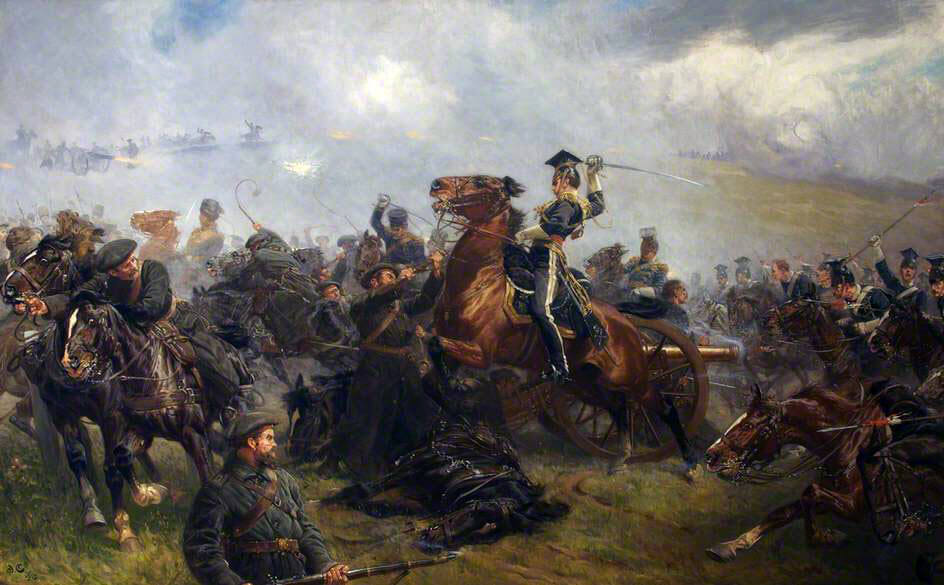
Charge of the Heavies, Balaclava, 1854

The light cavalry of the age consisted of lightly armed and armored troops mounted on small, fast horses, usually wielding cutlass or spear. They’re a raiding force, good at reconnaissance, screening, and skirmishing. The “Heavies” on the other hand, are mounted on huge, powerful chargers, both rider and horse heavily armored. They are the shock force of the army.

Lucan’s subordinate was James Brudenell, 7th Earl of Cardigan, in command of the Light Brigade. There could not have been two worse field commanders. Though possessed of physical courage bordering on recklessness, both were prideful, mean spirited and petty men. What’s more, they were brothers-in-law, and cordially detested one another.

Left to right:  Lucan, Cardigan and Raglan

Field Marshal Fitzroy James Henry Somerset, 1st Baron Raglan, was in overall command of the allied armies. Raglan occupied a high spot where he could see the battle unfold before him, but didn’t seem to realize that his subordinates below couldn’t see what he could see.

Spotting a small Russian detachment trying to get away with captured cannon, Raglan issued an order to Lucan, in overall command of his Cavalry. “Lord Raglan wishes the Cavalry to advance rapidly to the front, follow the enemy, and try to prevent the enemy carrying away the guns.” As Staff Officer Louis Nolan left to deliver the message, Raglan shouted “Tell Lord Lucan the cavalry is to attack immediately“.

454016ad6a62f6bbf67af8b7e373fb8b

The Light Brigade was well suited to such a task, but the men below had no idea what Raglan meant by such a poorly worded order. The only guns they could see were dug in Russian artillery a mile away, at the other end of the valley. When Nolan brought the order, Lucan demanded to know what guns. With a contemptuous sweep of his arm, Nolan pointed down the valley. “There, sir, are your guns“.

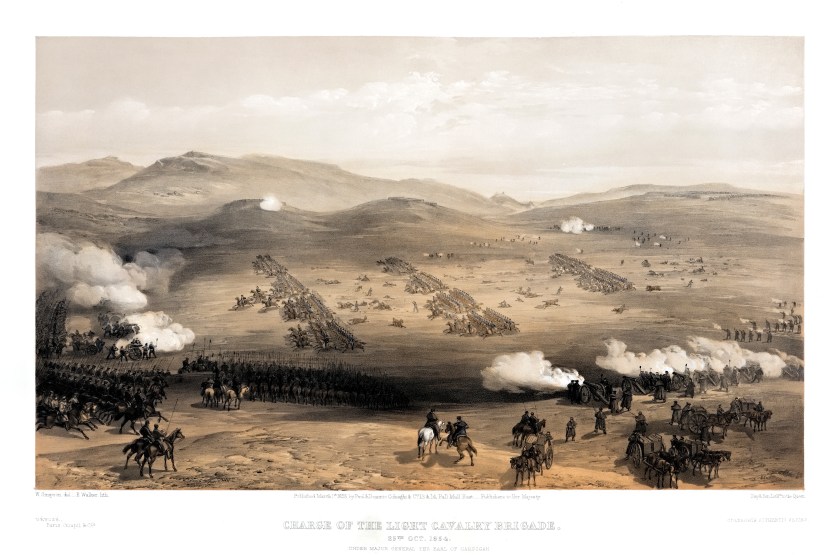
The order which then came down from Lucan to Cardigan called for a suicide mission, even for heavy cavalry. The “Lights” were being ordered to ride a mile down an open valley, with enemy cannon and riflemen lining both sides, into the muzzles of dug in, well sighted, heavy artillery.

Nose to nose and glaring, neither man blinked in the contest of wills.  In the end, Cardigan did as ordered. 674 horsemen of the Light Brigade mounted up, drew their swords, and rode into the valley of death.

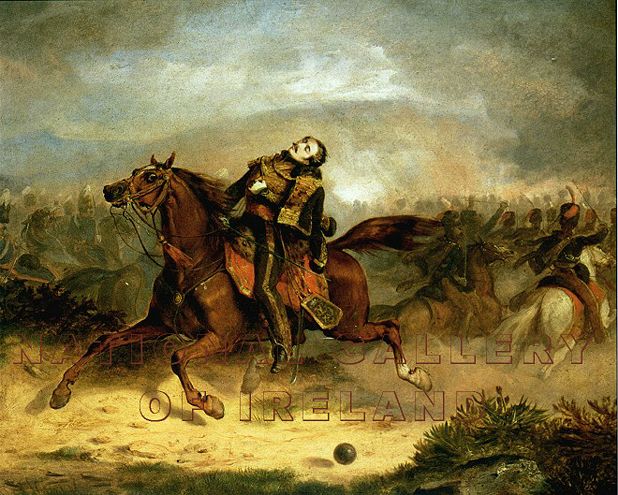
Louis Nolan should have gone back to Raglan, but rode out instead, in front of the Light Brigade. He was almost certainly trying to redirect the charge and could have saved the day, but it wasn’t meant to be. Louis Nolan, the only man in position to change history that day, was the first casualty of the raid.

Private James Wightman of the 17th Lancers, describes Nolan’s last moments: “I saw the shell explode of which a fragment struck him. From his raised sword-hand dropped the sword. The arm remained upraised and rigid, but all the other limbs so curled in on the contorted trunk as by a spasm, that we wondered how for the moment the huddled form kept the saddle. The weird shriek and the awful face haunt me now to this day, the first horror of that ride of horrors“.

Crimean-War-Russian-Artillery-Battery
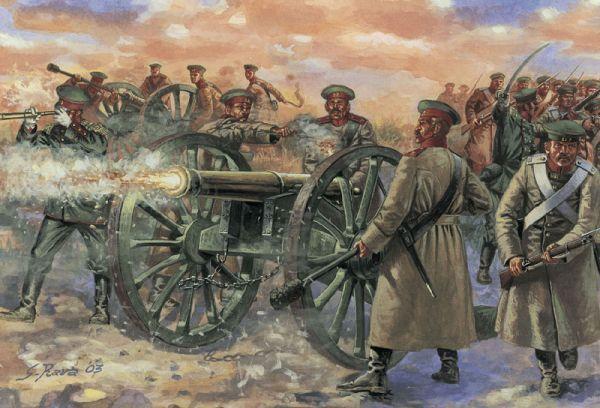
Russian artillery battery, Balaclava, 1854

Raglan must have looked on in horror as the scene unfolded, below. Instead of turning right and climbing the Causeway slopes, nearly 700 horsemen first walked, then trotted and finally charged, straight down the valley, into the Russian guns. Captain Thomas Hutton of the 4th Light Dragoons said “A child might have seen the trap that was laid for us. Every private dragoon did“.

Charge, Russian Perspective.jpg
It took the Light Brigade a full seven minutes to get to the Russian guns. Cannon fire tore great gaps out of their lines the whole time, first from the sides and then from the front. Shattered remnants actually managed to overrun the Russian guns, but had no means of holding them. They milled about for a time, and then back they came, blown and bleeding horses carrying mangled men back through another gauntlet of fire.

Louis Nolan

When it was over, 110 were dead, 130 wounded, and 58 missing or captured. 40% losses in an action which had lasted 20 minutes. Captain Nolan’s horse carried his dead body all the way down, and all the way back.

Cardigan and Lucan pointed the finger of blame at each other, for the rest of their lives. Both laid blame for the disaster on Nolan, who wasn’t there to defend himself.

Today, the Battle of Balaclava is mostly forgotten, but for a stanza in the Alfred Lord Tennyson poem, The Charge of the Light Brigade.

Forward, the Light Brigade!

Was there a man dismay’d?

Not tho’ the soldiers knew,

Some one had blunder’d:

Theirs not to make reply,

Theirs not to reason why,

Theirs but to do and die:

Into the valley of Death Rode the six hundred.

35546r
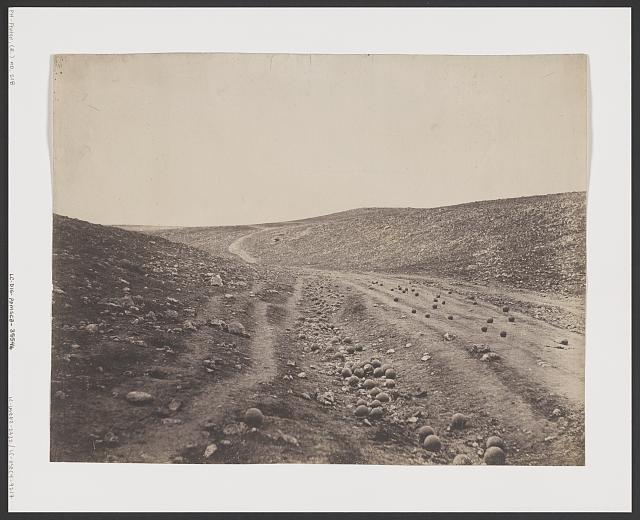
“…in coming to a ravine called the valley of death, the sight passed all imagination: round shot and shell lay like a stream at the bottom of the hollow all the way down, you could not walk without treading upon them…” Photographer Roger Fenton (“Valley of the Shadow of Death”)

The Crimean War itself may be remembered as a hideous waste of blood and treasure, for all it accomplished.  Today if remembered at all, the conflict recalls the first modern war correspondent, photographer Roger Fenton.  And of course the needless carnage, which could have been so much worse but for the efforts of one woman, who all-but invented the modern profession of nursing. The soldiers knew her as “The Lady with the Lamp”, for her late night rounds, taking care of the wounded.

History remembers this “Ministering Angel”, as Florence Nightingale.

If you enjoyed this “Today in History”, please feel free to re-blog, “like” & share on social media, so that others may find and enjoy it as well. Please click the “follow” button on the right, to receive email updates on new articles.  Thank you for your interest, in the history we all share.

October 24, 1929 Black Thursday

The man who had a family to support was grateful for work on a WPA project, but every dollar spent had first to be extracted from the wealth producing part of the economy. The government doesn’t produce wealth it can only take it. You can’t fill a swimming pool by draining one end of it, into the other.

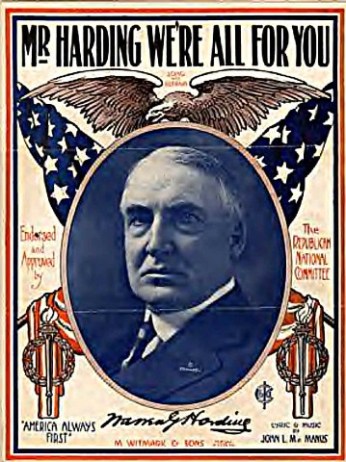
Warren Harding entered office on March 4, 1920, in the midst of the sharp recession following WWI.

HardingHarding’s Treasury Secretary, Andrew Mellon, believed that money was driven underground or overseas as income tax rates increased. Mellon held the heretical belief for that time, that lower tax rates led to greater levels of economic activity and that, as people had more of their own money to work with, increased activity resulted in higher tax revenues.
Based on Mellon’s advice, Harding cut taxes, starting in 1922. The top marginal rate was reduced annually in four stages from 73% in 1921 to 25% in 1925. Taxes were cut for lower incomes starting in 1923.

President Calvin Coolidge became President in August 1923, following Harding’s untimely death, by heart attack. Coolidge would follow Harding’s economic policies of low taxation and high growth, resulting in the “Roaring 20s”.

“Supply Side Economics”, was born.

Revenues to the treasury increased substantially, resulting in a 36% reduction of the national debt.

0108_jfk
Supply side tactics worked as well in the 1960s, as it did in the 1920s.

Unemployment and inflation both declined throughout the 1920s, while wages, profits and productivity, increased.  The decline in what would come to be called the “Misery Index” in the Carter years, was the sharpest in history.

The twenties became a time of wealth and excess, and speculation in the stock market increased exponentially. New investors poured into the market in the belief that, like the housing market of the 2000s, prices could never go down. It was a nine-year run when the Dow Jones Industrial Average increased tenfold, peaking at 381.17 on September 3, 1929.

84246

Rising share prices encouraged more people to invest, even if they didn’t have the money to do so. Brokers routinely lent investors up to two thirds of the face value of the stocks. Over $8.5 billion was hanging out on such loans, more than the entire amount of US currency in circulation, at that time.

As with 2007-’08, early tremors showed that the bubble was about to burst. Then as now, such signals were seen only in hindsight, and the rising crescendo that was 1929, continued.3-0

There was a brief contraction in March, but the “Crash” began in earnest on “Black Thursday”, October 24, 1929. The market lost 11% at the opening bell, amidst heavy trading.   To quell the frenzy, Wall Street financial firms Morgan Bank, Chase national and National City Bank of New York stepped up and bought large blocks of US Steel and other “blue chip” stocks, at prices well above where they were trading.

The tactic had the effect of stopping the slide, much as it did during the Panic of 1907. This time however, the relief would be short lived. “Black Tuesday”, October 29, saw the Dow Jones contract by 12% on a volume record which would stand unbroken for forty years. The president of the Chase National Bank said at the time “We are reaping the natural fruit of the orgy of speculation in which millions of people have indulged. It was inevitable, because of the tremendous increase in the number of stockholders in recent years, that the number of sellers would be greater than ever when the boom ended and selling took the place of buying“.

stock-market-crash-1929Fears of the Smoot-Hawley tariff act fueled a further contraction in the following weeks, for apparently good reason.  When President Hoover signed the protectionist measure into law in 1930, American imports and exports plunged by more than half.

Historians debate whether the stock market crash led to the Great Depression, or if the two events coincided. Only 16% of US households were actually invested in the stock market at the time, but the psychological effect was profound.

Easy credit and unbounded confidence had led to a speculative bubble which had finally burst.

Economists still argue about the interventionist policies which followed. The man who had a family to support was grateful for work on a WPA project, but every dollar spent had first to be extracted from the wealth producing part of the economy. The government doesn’t produce wealth it can only extract it.  You can’t fill a swimming pool by draining one end of it, into the other.

stock-market-crash-1929

The stock market and unemployment rates staggered throughout the 1930s.  It was WWII that finally put people back to work.

Yet that was merely activity from an economic point of view. It wasn’t growth, it was more like giving the kids sugar and watching them run around the house. A convincing case may be made that the Reduction of government spending in the years following WWII, put wealth back in the pockets of the people who created it in the first place, and finally ended the Great Depression.

The Dow Jones Industrial Average, as an indicator of that wealth, wouldn’t retake the high ground of ‘29, until 1954.

“It’s not Republican, it’s not Democratic, it’s not conservative, it’s not liberal, it’s not left-wing, it’s not right-wing, it’s economics.” – Arthur B. Laffer

October 23, 1983 Beirut

Altogether, those who lost their lives at the Marine barracks included 220 Marines, 18 Sailors, 3 Soldiers and an Elderly Lebanese custodian and vendor who was known to sleep in his concession stand, next to the building. 58 French paratroopers were killed at the Drakkar building, along with the wife and four children of a Lebanese janitor.

Located on the Mediterranean coast of Lebanon, Beirut is the largest seaport in the country.  It’s one of the oldest cities on earth.  The first reference may be found in the ancient Egyptian Tell el Amarna letters, written in the 15th century BC.

Once called “The Paris of the Middle East”, Beirut was at one time a regional hub of business, banking and tourism.

Lebanon descended into a vicious civil war in 1975, a fifteen-year period which Lebanese ex-patriots have tearfully described to me as a time of “national suicide”.

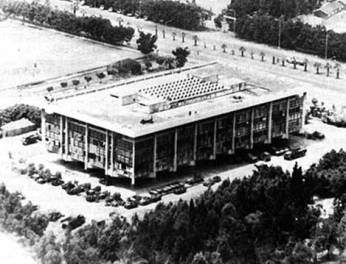
beirut-barracks-before-bombing
USMC Barracks in Beirut

In 1982, a Multinational Force of United States Marines, Navy SEALs, French Paratroopers and American, Italian and British soldiers were sent to Lebanon to restore the peace.

Thirty-five years ago, October 23 was a Sunday. Things were quiet in the early morning hours, most of Battalion Landing Team 1/8 still asleep in their barracks.

In 1982, the Islamic Republic of Iran established a base in the Syrian-controlled Beqaa Valley in Lebanon, a base which remains in operation, to this day.  On September 26, 1983, the American National Security Agency (NSA) intercepted a diplomatic message from the Iranian Ministry of Information and Security (MOIS) to its ambassador in Damascus Ali Akbar Mohtashemi, instructing the ambassador to “take spectacular action against the American Marines.” For reasons which remain unclear, the message would not be passed to the Marines in Beirut until October 26, three days after the barracks bombing.

Three hundred American military service personnel were living in the four-story concrete aviation administration building, at Beirut International Airport.  Guards paid scant attention at first, when the 19-ton, yellow stake-bed Mercedes truck entered the airport grounds. Such heavy vehicles were a common sight and besides, a water delivery was expected that morning.

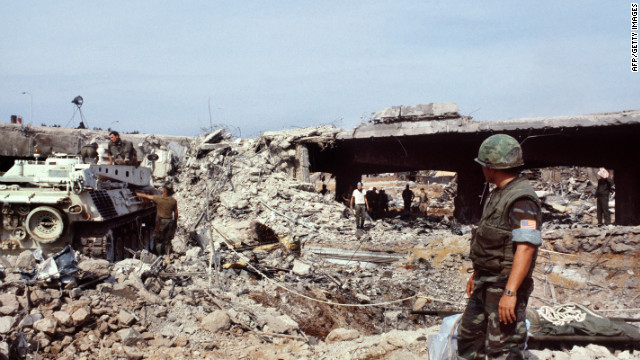
1382537342000-AP-Beirut-Bombing-Anniversary-001

Driven by an Iranian National, the truck carried a massive fuel-air explosive device, capable of an explosive force equivalent to 21,000 pounds of dynamite. The explosive was piled on a marble slab on top of a layer of concrete, to direct the destructive force upward.

Peacetime rules of engagement (ROE) prohibited the use of deadly force without explicit permission, or in times of imminent personal danger.  Weapons were to be kept on safe, with empty chamber.

The suicide bomber picked up speed, smashing through a five-foot concertina wire barrier and in-between two guard shacks.  Lance Corporal Eddie DiFranco on the driver’s side was first to realize something was wrong and managed to chamber a round, but too late. The hijacked truck struck the 1st Battalion, 8th Marine Regimental Battalion Landing Team barracks at 6:22am local time.

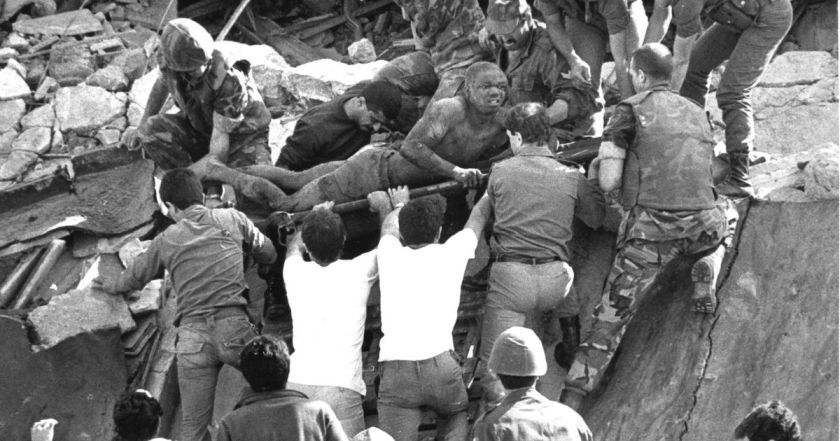
The resulting explosion lifted the four story building, shearing steel-reinforced concrete support columns and dropping floor slabs, like pancakes.  241 American military service personnel were killed in the explosion, or crushed to death in the collapse.  Another 100 were injured.  The BLT building, had ceased to exist.  It was the deadliest single-day attack on United States Marines since the February 1945 battle for Iwo Jima.

120719083732-skinner-syria-story-top

Rabbi Arnold Resnicoff, assistant chaplain for the U.S. Sixth Fleet was in a neighboring building, and remembered the scene:  “Bodies and pieces of bodies were everywhere. Screams of those injured or trapped were barely audible at first, as our minds struggled to grapple with the reality before us”.

Ten minutes later, a second suicide bomber drove his truck bomb into the French barracks, the nine story Drakkar building housing the 1st Parachute Chasseur Regiment.  By this time alerted to the attack, guards were able to shoot and kill the driver, but not before he detonated the device.

Altogether, those who lost their lives at the Marine barracks included 220 Marines, 18 Sailors, 3 Soldiers and an Elderly Lebanese custodian and vendor who was known to sleep in his concession stand, next to the building. 58 French paratroopers were killed at the Drakkar building, along with the wife and four children of a Lebanese janitor.

I didn’t include the two “jihadists”.  They’re not worth counting.

1023-beirut-barracks-bombing

For years, radical Islamist tactics were confined mostly, to kidnappings.  The Beirut barracks bombings were the first use of suicide tactics, in order to slaughter as many westerners, as possible.

Six months later, a suicide car bomb killed sixty-three at the United States embassy in Beirut, seventeen of whom, were Americans.   In 2017, Vice-President Mike pence called it “the opening salvo in a war that we have waged ever since—the global war on terror”.

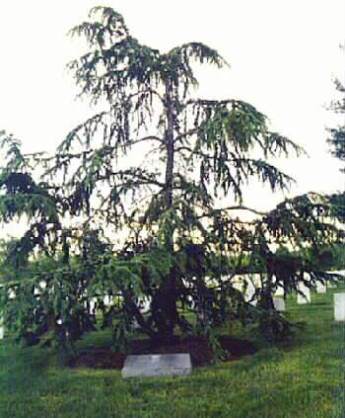
beirut11A Lebanese cedar tree grows in the green expanse of section 59 at Arlington National Cemetery, marking the final resting place of twenty-one honored dead, among the first Americans to die in the global war against Islamist terrorism. A fight which continues, to this day.
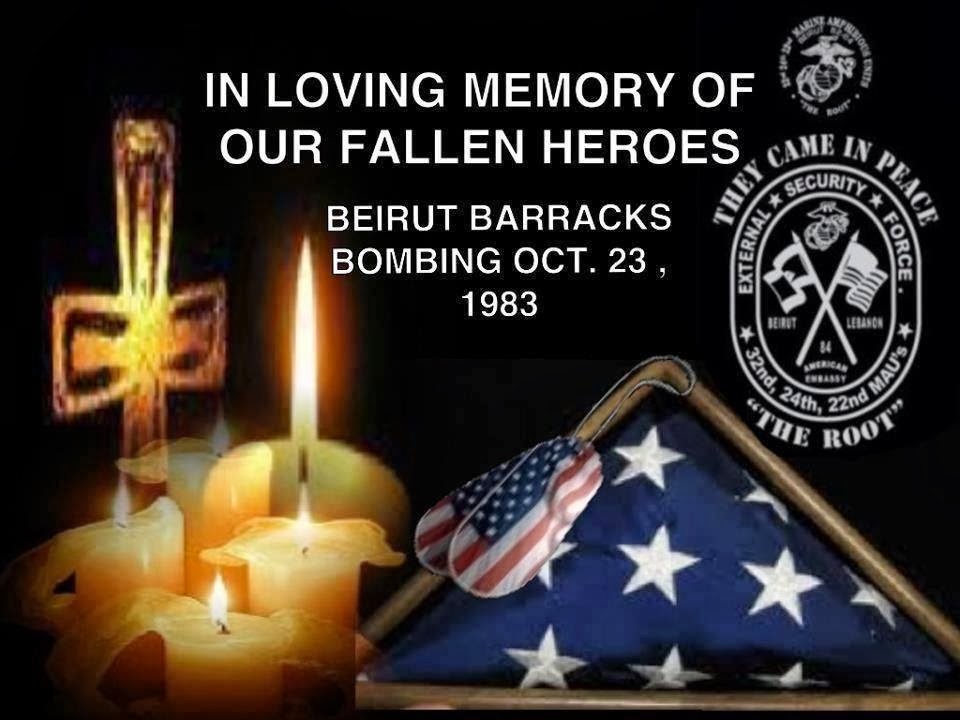
Today, thirty-five years later, survivors and first responders to the Beirut Barracks bombing continue to struggle with the sights, sounds and smells of that day.

The properly functioning conscience of a good man, recoiling in horror at what he has seen in service to his country.

The participants in this story, both living and dead, have earned our respect and our gratitude.   They have earned the right to be remembered.

October 22, 1914 Massacre of the Innocents

A million men had been brought to this place, for the purpose of killing each other.     The first Battle for Ypres, (there would be others), was the greatest clash in history, or one of them, bringing together more manpower and more firepower than entire wars of the previous century.

“Sitzkrieg”. “Phony War”. Those were the terms used to describe the September 1939 to May 1940 period, when neither side of what was to become World War 2, was yet prepared to launch a major ground war against the other.

The outbreak of “The Great War” twenty-five years earlier, was a different story. Had you been alive in August of 1914, you could have witnessed what might be described as the simultaneous detonation, of a continent.  France alone suffered 140,000 casualties over the four day “Battle of the Frontiers”, where the River Sambre met the Meuse.  27,000 Frenchmen died in a single day, August 22, in the forests of the Ardennes and Charleroi.

Battle-of-the-Frontiers-1914-7
Battle of the Frontiers, 1914

The British Expeditionary Force escaped annihilation on August 22-23, only by the intervention of mythic angels, at a place called Mons.  In the East, a Russian army under General Alexander Samsonov was encircled and so thoroughly shattered at Tannenberg, that German machine gunners were driven to insanity at the damage inflicted by their own guns, on the milling and helpless masses of Russian soldiers.  Only 10,000 of the original 150,000 escaped death, destruction or capture.  Samsonov himself walked into the woods, and shot himself.

The “Race to the Sea” of mid-September to late October was more a series of leapfrog movements and running combat, in which the adversaries tried to outflank one another.  This would be some of the last major movement of the Great War, ending in the apocalypse of Ypres.

When governments make war, It’s the everyday John and the Nigel down the street, the Fritz, the Ivan and the Pierre next door, who must do the fighting, and the bleeding, and the dying.

The battle for the medieval textile town of Leper, most of the battle maps were drawn in French and so we know the place as “Ypres”, began on October 20 and lasted about three weeks, pitting a massive German force of some 600,000 against a quarter-million French, 100,000 British, and 65,000 Belgians.

flanders_october_20-24

A million men had been brought to this place, for the purpose of killing each other.     The first Battle for Ypres, (there would be others), was the greatest clash in history, or one of them, bringing together more manpower and more firepower than entire wars of the previous century. The losses are hard to get your head around. The British Expeditionary Force (BEF) alone suffered 56,000 casualties, including 8,000 killed, 30,000 maimed and another 18,000 missing, of whom roughly one-third, were dead.

The breakdown is harder to get at for the other combatants but, all in, Germany suffered 135,000 casualties, France 85,000 and Belgium, 22,000. Assuming the same percentage distribution of killed, wounded and missing, the three week struggle for Ypres cost the lives of 75,000 men, enough to fill the Athens Olympic Stadium, in Greece.

A story comes down from the fighting of October 22, destined to become German and later Nazi, mythology.  French, British and Belgian troops were by this time, digging into the ground to shelter themselves from what Private Ernst Jünger later called the “Storm of Steel”.   German Generals, desperate to break through the Allied line and capture Calais and the other French ports on the English Channel, attacked.

German reserve divisions comprised of student volunteers:  inexperienced, untrained college students fired with patriotic zeal and singing songs of the Fatherland, marched to the attack against a puny British force, dug into shallow holes around the village of Langemarck.  What the BEF lacked this day in numbers, were more than made up, in firepower. Let William Robinson, a volunteer dispatch driver with the British Army, describe what came to be known as the “Kindermord bei Ypern”  The Massacre of the Innocents at Ypres.

“The enemy seemed to rise out of the ground and sweep towards us like a great tidal wave, but our machine guns poured steel into them at the rate of six hundred shots per minute, and they’d go down like grass before the scythe… The Germans were climbing over heaps of their own dead, only to meet the same fate themselves.”

Overwhelming German numbers succeeded in forcing the British back and capturing Langemarck on October 22, but the cost was appalling.  Some regiments lost 70% of their strength.

5393774889_6b9037d2a6_bDoubt has been cast on the “Myth of Langemarck”, and the tragic bravery of idealistic German boys, happily defending the Fatherland.  The numbers of dead and maimed are real enough, but most reservists were in fact comprised of older working class men, not the fresh-faced youth, of the Kindermord.  Be that as it may, a story must be told.  Excuses must be made to the home team, for the crushing failure of the War of Movement, and the four-year war of attrition, to follow.

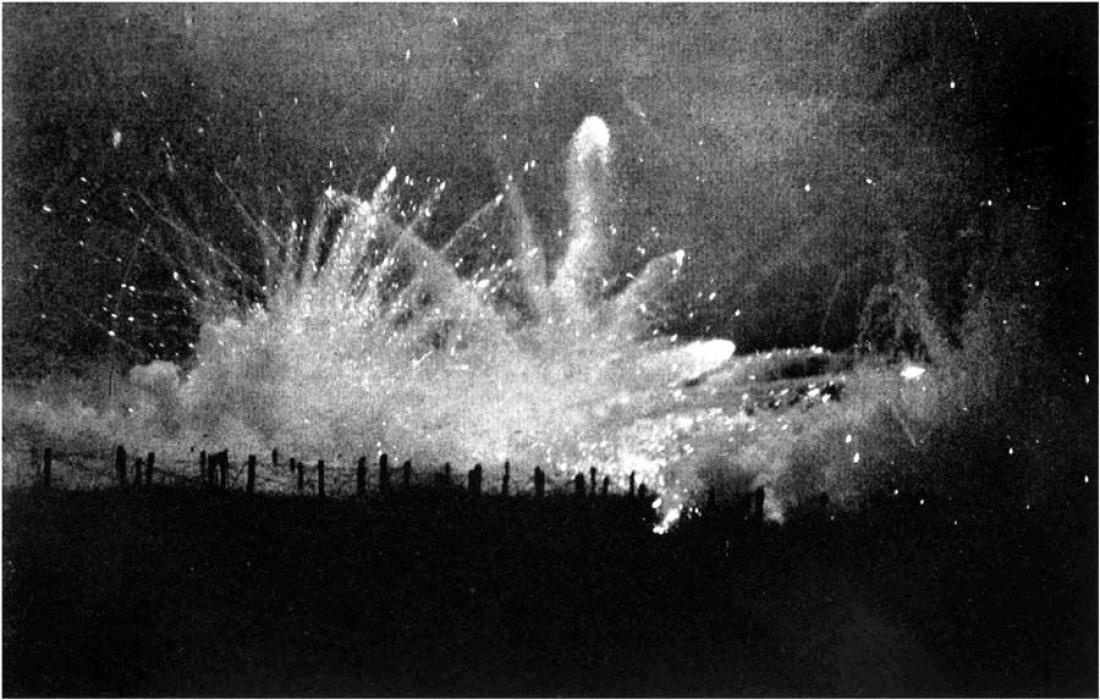
Two short months later, some of these same men would step out of their trenches and across the frozen fields of Flanders, to shake the hand of the man he’d been sent there, to kill.  The unofficial “Christmas Truce” of 1914 would last a day or two in some sectors and a week or two in others.  And then it was back, to the business at hand.  For Four. More. Years.

Christmas Truce

The Man He Killed
BY THOMAS HARDY

“Had he and I but met
By some old ancient inn,
We should have sat us down to wet
Right many a nipperkin!
“But ranged as infantry,
And staring face to face,
I shot at him as he at me,
And killed him in his place.
“I shot him dead because —
Because he was my foe,
Just so: my foe of course he was;
That’s clear enough; although
“He thought he’d ‘list, perhaps,
Off-hand like — just as I —
Was out of work — had sold his traps —
No other reason why.
“Yes; quaint and curious war is!
You shoot a fellow down
You’d treat if met where any bar is,
Or help to half-a-crown.”

October 21, 1774 First Flag

“…Steadfast, in Freedom’s Cause, we’ll live and die,
Unawed by Statesmen; Foes to Tyranny,
But if oppression brings us to our Graves,
and marks us dead, she ne’er shall mark us Slaves”

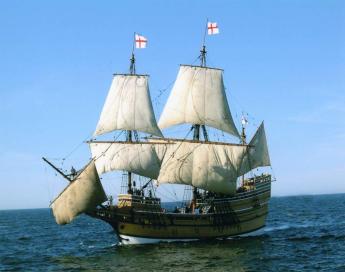
The Mayflower set sail from England on September 6, 1620, and fetched up on the outer reaches of Cape Cod in mid-November, near the present-day site of Provincetown Harbor.

5848246db1583.image
Mayflower, historic reproduction

One was born over those 66 days at sea, another died.  They were 101 in all, including forty members of the English Separatist Church, a radical Puritan faction who felt the Church of England hadn’t gone far enough, in the Protestant Reformation.

There the group drew up the first written framework of government established in the United States, 41 of them signing the Mayflower Compact on board the ship on November 11, 1620.

With sandy soil and no place to shelter from North Atlantic storms, a month in that place was enough to convince them of its unsuitability. Search parties were sent out and, on December 21, the “Pilgrims“crossed Cape Cod Bay and arrived at what we now know, as Plymouth Harbor.

Fully half of them died that first winter but the rest hung on, with assistance from the Grand Sachem Massasoit (inter-tribal chief) of the Wampanoag confederacy, in the form of the emissaries, Samoset and Squanto. The Mayflower returned to England in April 1621, with half its original crew.

british red ensign mini 2
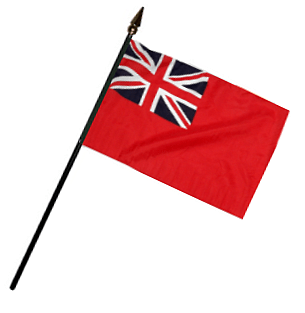
British Red Ensign

Three more ships arrived in Plymouth over the next two years, including the Fortune (1621), the Anne and the Little James (1623). Those who arrived on these first four ships were known as the “Old Comers” of Plymouth colony, and were given special treatment in the affairs of “America’s Home Town”.

A short seventeen years later, members of the Plymouth Colony founded the town of Taunton twenty-four miles inland, and formally incorporated the place on September 3, 1639.

In 1656, the first successful iron works in Plymouth Colony and only the third in “New England” was established in Taunton, on the Two Mile River. The Taunton Iron Works operated for over 200 years, until 1876.

The town was once home to several silver smithing operations, including Reed & Barton, F.B. Rogers, and Poole Silver. To this day, Taunton is known as the “Silver City”.

Taunton also has the distinction of flying what may have been the first distinctly American flag, in history.

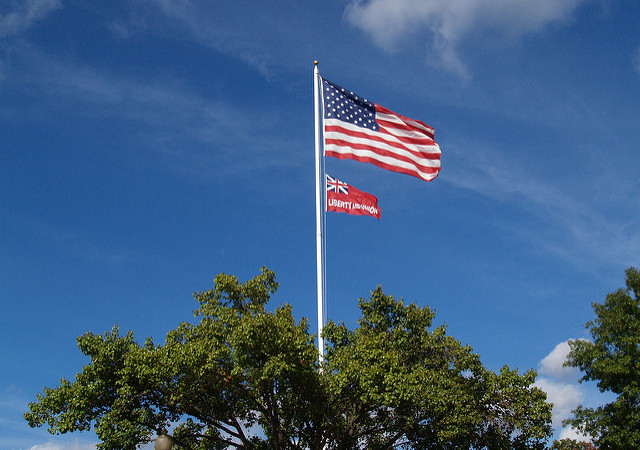
united_states_taunton_flag_liberty_and_union_1774_coffee_mug-rf4e479fc61a14108aaef1be92fcbb695_x7jgr_8byvr_512First raised above the town square on October 19, 1774, the flag’s canton featured the Union Jack, on the blood red field of the British Red Ensign. The Declaration of Independence lay two years in the future for these people.  They were, after all, still British subjects.

Between hoist and fly ends were written the words “Liberty and Union”, a solemn declaration that the colonies were going to stick together, and that their rights as British citizens, were not about to be violated.

Not so long as they had something to say about it.

On October 21, 1774, the Taunton Sons of Liberty raised the flag 112-feet high on a Liberty Pole, and tacked the following inscription on that pole:

“Be it known to the present,
And to all future generations,
That the Sons of Liberty in TAUNTON
Fired with Zeal for the Preservation of
Their Rights as Men, and as American Englishmen,
And prompted by a just Resentment of
The Wrongs and Injuries offered to the
English Colonies in general, and to
This Province in particular,
Through the unjust Claims of
A British Parliament, and the
Machiavellian Policy of their fixed Resolution
To preserve sacred and inviolate
Their Birth-Rights and Charter-Rights,
And to resist, even unto Blood,
All attempts for their Subversion or Abridgement.
Born to be free, we spurn the Knaves who dare
For us the Chains of Slavery to prepare.
Steadfast, in Freedom’s Cause, we’ll live and die,
Unawed by Statesmen; Foes to Tyranny,
But if oppression brings us to our Graves,
and marks us dead, she ne’er shall mark us Slaves”.

The Taunton flag is considered to be among the oldest distinctly American flags if not the oldest, in history. The city officially adopted it on October 19, 1974, the 200th anniversary of the day it was first raised above Taunton green. Stop and see it if you ever get by.   It’s there on the Liberty Pole, directly beneath the Stars and Stripes of the Star Spangled Banner.

AR-150926822

.If you enjoyed this “Today in History”, please feel free to re-blog, “like” & share on social media, so that others may find and enjoy it as well. Please click the “follow” button on the right, to receive email updates on new articles.  Thank you for your interest, in the history we all share.

October 20, 1937 Albert’s Swarm

Imagine a world with no grocery stores, and watching your food, All of it, disintegrate, before your eyes.

Between 1932 and 1943, children’s author Laura Ingalls Wilder published a series of eight novels, a fictionalized autobiography based on the childhood experiences of a 19th century pioneer and settler family. Third in the series is the best known, Little House on the Prairie, the subject for a television series running from 1974 to ’83.

In her fourth book, Wilder tells of the time when grasshoppers wiped out a much-anticipated and badly needed wheat crop, laying so many eggs that all hope was gone for the following year, as well.  On the Banks of Plum Creek, published  this day in 1937, told the story of “Pa” having to walk three-hundred miles east to find work on farms, which had escaped the plague of grasshoppers.

There are something like 11,000 species of grasshoppers in the world, the familiar, plant munching insects of our summer fields.  They are vegetarian creatures with polyphagous food habits, meaning they’ll eat just about anything, if the need arises.

SA4.9 r132
Rocky Mountain locust, Melanoplus spretus, photographed in 1870s, Minnesota

Usually a solitary creature, only a few species will become locusts, the “gregarious” phase of the insect’s life cycle characterized by swarming, migration, and accompanied by explosive growth in population.

The two years in Wilder’s story, 1874 – ’75, are among the worst swarms on record for the Rocky Mountain Locust, Melanoplus spretus.  

M. Spretus finds its home in the fertile valleys of the Rocky Mountains, but outbreaks of the insect have caused farm damage as far away as Maine in the period 1743–’56, and in Vermont during the administration of President George Washington.

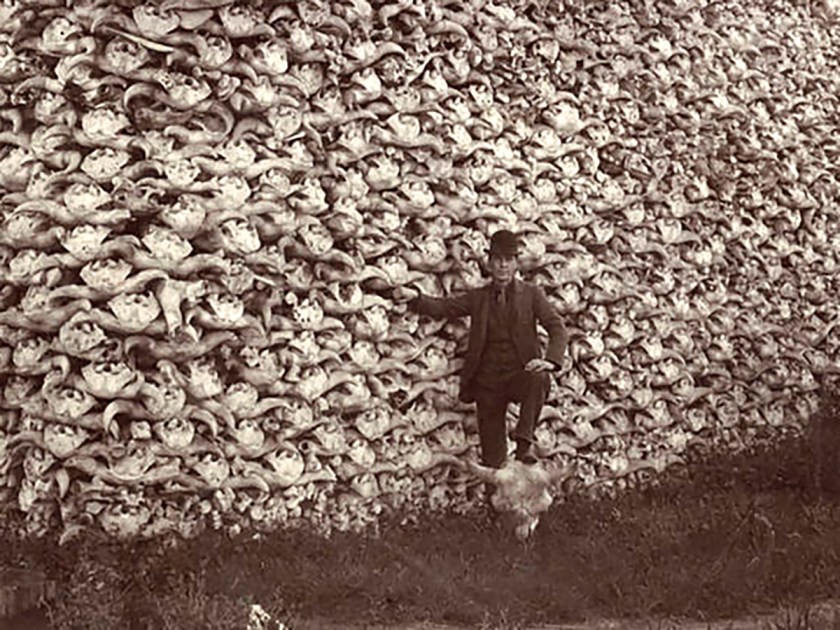
When President Thomas Jefferson sent Lewis & Clark off on the Corps of Discovery expedition, vast herds of American bison stretched from horizon to horizon, as far as the eye could see. Historians estimate 30 to 60 million of the creatures, each weighing up to 2,000 pounds and measuring twelve-feet long. A minimum of sixty billion pounds of biomass, needing something to eat.

The western artist George Catlin estimated that, by 1841, some two to three million of the creatures had been slaughtered for their hides. Bison populations came under increasing pressure as natives acquired horses and guns, but the real slaughter began with the Indian wars and “hunting by rail”, when every dead buffalo was seen as a dead Indian.  By the late 1880s, only a few hundred individuals remained alive, in Yellowstone National Park.

Mountain-of-American-Bison-Skulls-2
A mountain of bison skulls

With the bison gone and a new wave of vegetation, there arose a new and very different multitude, to feed on it.

During the 19th century, farming expanded westward into the grasshopper’s favored habitat, triggering massive outbreaks in their numbers.  Locust populations exploded to varying degrees in 1828, ’38, ’46, and ’55, affecting areas throughout the West and upper mid-west. Plagues visited Minnesota in 1856–’57 and again in the last year of the Civil War.  Nebraska suffered repeated infestations between 1856 and ’74.

Rocky_Mountain_Locust_oviposition
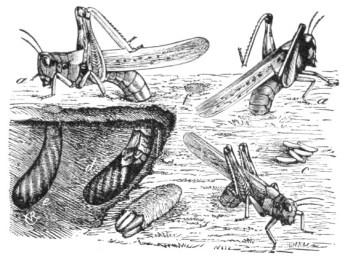
Illustration of egg-laying females, from 1877

Population blooms of two years are typical, as eggs laid in year one tend not to thrive as well as their parents.  At its height, farmers reported finding up to 150 egg cases per square inch, each containing 100 eggs or more.

In 1875, Doctor Albert L. Child of the U.S. Signal Corps watched a mile-high swarm of locusts pass overhead, for five days straight. Together with telegraph reports from neighboring towns, Child estimated the swarm to be 110 miles wide and 1,800 miles long. 198,000 square miles, one-third the size of Alaska, or the combined landmass of our thirteen smallest states.  It was a rolling flood, the size of California and Maine, put together.

The numbers are so far outside of human experience, they are hard to get your head around. For a little perspective, a million seconds is about twelve days. A Billion seconds ago, Jimmy Carter was President of the United States. A Trillion seconds ago, the oldest known clay object was fired to ceramic in the earliest oven.  It was 29,000, B.C. ”

Albert’s Swarm” was the largest such assembly of organisms in recorded history, estimated at 12½ Trillion individuals.

Exam29072013Locusts_large

It was a biological wildfire, a living blizzard that blotted out the sun, 12½ trillion insects each the size of a child’s finger, and each driven to eat its own weight.  Every day.  All in, Albert’s Swarm is estimated to have weighed 27½ million tons.

As the continuous track of a bulldozer moves ever forward, the leading edge of the swarm would alight to rest and eat, only to pick up the rear, a few days later.  In this manner, the swarm would cover ten miles or so, in a few weeks.

One farmer reported that the locusts seemed “like a great white cloud, like a snowstorm, blocking out the sun like vapor“.  Even the sound was horrific, rising to a scream and rolling over the land like some evil tide, the whirring and rasping cacophony of billions of mandibles borne aloft to eat, almost literally, everything in sight. Native populations could and did, move.  For prairie settler and pioneer families, home was on the farm.

Imagine a world with no grocery stores, and watching your food, All of it, disintegrate, before your eyes. Standing crops were the first to go, and then the root vegetables, potatoes, carrots and turnips, eaten out of the ground. Throw a blanket over your garden to protect even that little bit, and they would eat the blanket. Fence posts, saddles, nothing was off limits.  These creatures would eat the wool, right off of your sheep.  At its worst, the locust horde was known to eat the clothes off of people’s backs.

Trains were literally stopped in their tracks on uphill stretches of rail, unable to gain traction for the grease of millions of tiny bodies, ground beneath their wheels.

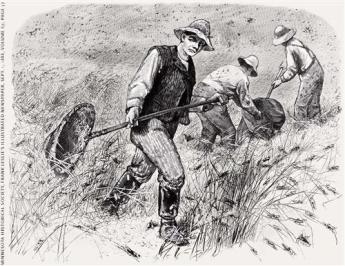
rocky-mountain-locust-1Farmers used gunpowder, fire and water, anything they could think of, to destroy what could only be seen as a plague of biblical proportion. They smeared them with “hopperdozers”, a plow-like device pulled behind horses, designed to knock jumping locusts into a pan of liquid poison or fuel, or even sucking them into vacuum cleaner-like contraptions.
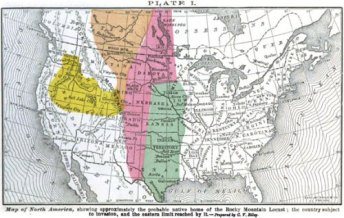
Still, it was like trying to turn the tide, with a shot glass.  Missouri entomologist Charles Valentine Riley came up with a recipe to eat the damned things, seasoned with salt and pepper and pan-fried in butter. Some bought the recipe, but many felt they “would just as soon starve as eat those horrible creatures”.

In 1877, a Nebraska law required everyone between the ages of 16 and 60 to work at least two days eliminating locusts, or face a $10 fine. Missouri and other Great Plains states offered bounties: $1 a bushel for locusts gathered in March, 50¢ in April, 25¢ in May, and 10¢ in June.

map-from-the-locust-plagueAnd then the locust went away, and no one is entirely certain, why.  It is theorized that plowing, irrigation and harrowing destroyed up to 150 egg cases per square inch, in the years between swarms. Great Plains settlers, particularly those alongside the Mississippi river, appear to have disrupted the natural life cycle.  Winter crops, particularly wheat, enabled farmers to “beat them to the punch”, putting away stockpiles of food before the pestilence reached the swarming phase.

Today, the Rocky Mountain Locust is extinct.  Several grasshopper species swarm as locusts on every continent in the world, save for North America and Antarctica.   The last living specimen of the Rocky Mountain Locust was seen in Canada, in 1902.

Feature image, top of page:  A child swings a broomstick at a 4-mile wide swarms of locusts, plaguing Argentina.  H/T Business Insider

October 29, 202 B.C., The Great Anxiety of the Romans

Hannibal met the Roman General Publius Cornelius Scipio on October 19, 202 B.C. near the town of Zama, in modern-day Tunisia.  Scipio had barely escaped Cannae with his life, but he had learned his lessons, well.  On this day at Zama, Hannibal was defeated by his own tactics. 

In 814 B.C., Phoenician settlers left their homeland on the coast of modern Lebanon, establishing colonial port cities along the Mediterranean coast. They built safe harbors for their merchant fleets in what is now Morocco, Algeria, Spain and Libya, among others. The largest such port city they built on the North African Gulf coast of Tunis, calling the place “Carthage”, meaning “New City”.

According to legend, the orphaned twin sons of Rhea Silvia and Mars, the god of war, were suckled by a she-wolf on the Italian Peninsula, 61 years later. Their names were Romulus and Remus. They would found a city on the site of their salvation, a city which would come to be called Rome.

800px-Phoenician_alphabet.svg
Phoenician alphabet

Carthage and Rome coexisted for hundreds of years, forming a relationship mostly based on trade. Carthaginian traders were famed in Classical Greece and Rome as ‘traders in purple’, referring to the near-monopoly in the precious Royal Purple dye derived from the Murex snail.

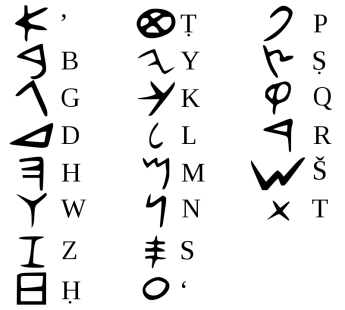
They’re known for the first “abjad”, (consonant based writing system) to gain widespread usage, the first fully developed Phoenician script dating back to the mid-11th century, BC.  The Phoenician alphabet, conventionally known as the Proto-Canaanite alphabet, is antecedent to nearly all modern phonetic alphabets in use today.

As Rome and Carthage became centers of political power and influence, it was inevitable that the two would clash. Carthage held undisputed mastery of the seas in the third century BC, while the rapid expansion of the Roman Republic brought them into conflict in Sicily, at that time partly under Carthaginian control.

roman_corvus_1b
Roman Corvus

The first of three Punic Wars, from Punicus (latin: of or relating to Carthage), began in 264BC. At the time, the Roman Legions were the most powerful land army in the region, while having little to oppose Carthage, at sea.

The Roman introduction of the Corvus, a gangway with heavy spike mounted to the underside, allowed the Romans to convert sea battles onto their own “turf”, as Roman soldiers boarded enemy ships and defeated crews in hand to hand combat. The first Punic war was over by 241 B.C., with Carthage paying heavy indemnities and ceding much of its western Mediterranean territory.

Carthage rebuilt its finances in the following years, expanding its colonial empire in Spain under the warlike Barcid family. There were several trade agreements between Rome and Carthage, even a mutual alliance against King Pyrrhus of Epirus, while Hamilcar Barca, Strategus (Military governor) of Iberia, expanded influence on the southeastern Iberian Peninsula, near what is now Cartagena (“New Carthage”), Spain.

62174894.ufgyFt6V.TunisiaMay062951
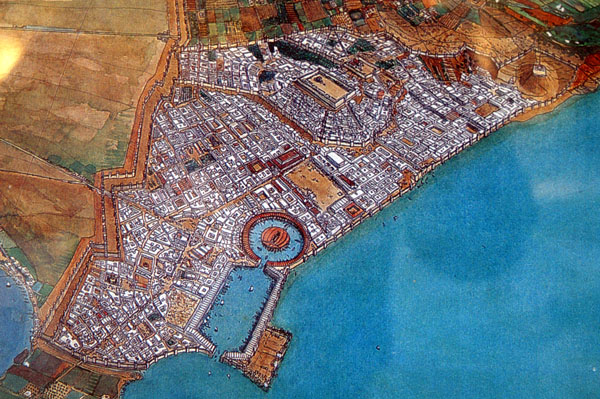
Roman-era Carthage

Eight years earlier, Hamilcar Barca made his then 12-year-old son Hannibal swear undying hatred of the Romans. In 219 B.C., Rome and Carthage found themselves in conflict over the Roman protectorate of Saguntum, in modern Spain. The Roman senate demanded that Carthage hand over Hannibal.  The Carthaginian oligarchy refused. In 218 B.C., Rome declared war.

giovanni-battista-pittoni-younger-hannibal-swearing-revenge-against-romans
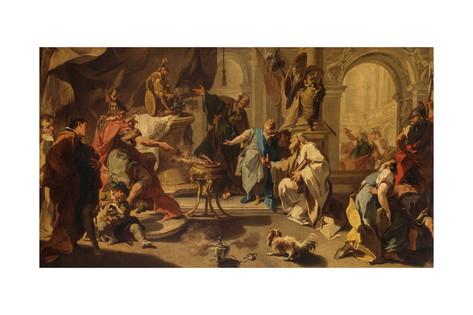
Young Hannibal swearing revenge against Rome, by Giovanni Battista Pittoni

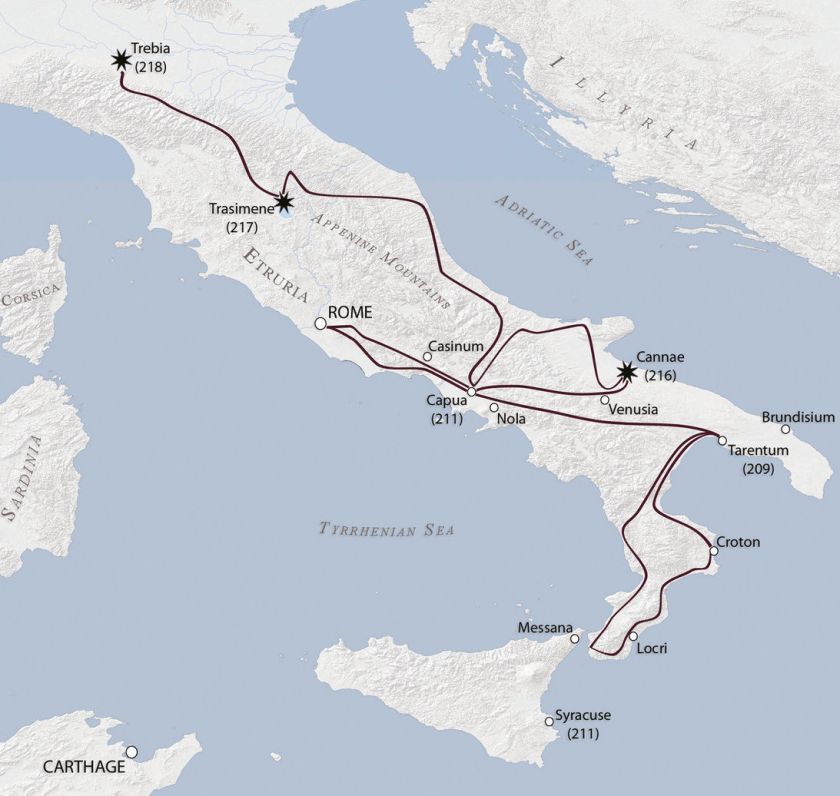
No longer a maritime power, Hannibal set out in the spring of 218 B.C., crossing into hostile Gaul (France) and arriving at the Rhône River in September with 38,000 infantry, 8,000 cavalry, and 37 war elephants. Hannibal’s crossing of the Alps that winter is one of the great feats of military history, and cost him nearly half of his force before entering Italy, that December.

The first of several major battles took place on December 18, 218 B.C. on the banks of the Trebia River. The Roman General, consul Tiberius Sempronius Longus allowed himself to be drawn into a trap and crushed. Two legions were victorious on their part of the battlefield and retreated with honor to the Province of Piacenza but, overall, Trebia was a resounding defeat for the Roman military.

The army of Hannibal was near invincible, defeating Roman legions in one major engagement after another.  Trebia, Lake Trasimene:  for sixteen years it was virtually unbeatable, devastating the Italian countryside as Rome drafted one army after another, only to be crushed, yet again.  The annihilation of Roman forces at Cannae of August 2, 216, is studied by military tacticians, to this day.

fig6

Meanwhile, Carthage itself was politically divided. Hannibal never did receive significant support from home, save for his own brother Hasdrubal, whom he summoned to join him Italy, in 209 B.C.  Hasdrubal repeated Hannibal’s feat of ten years earlier, crossing the Alps with war elephants and all, but the brothers’ reunification was never meant to be.  Hasdrubal Barca was defeated and slain in 207 B.C. near the River Metaurus, his dismembered head thrown in a sack and tossed into the camp of his brother.

It was the decisive turning point, in the second Punic War.

In the end, the General who had laid waste to the Italian peninsula was summoned to defend his homeland in North Africa.  Hannibal met the Roman General Publius Cornelius Scipio on October 19, 202 B.C. near the town of Zama, in modern-day Tunisia.  Scipio had barely escaped Cannae with his life, but he had learned his lessons, well.  On this day at Zama, Hannibal was defeated by his own tactics.  The Roman victory was decisive, ending the second Punic war under humiliating terms for Carthage.  Scipio returned to Rome triumphant, henceforward and forever to be known by the honorific, “Africanus”.

Zama-6duo1oueg9mrcgmzmaeifnsw9043jtsxsrw66goax8h

The third Punic War saw the Romans besiege Carthage itself. The city didn’t have a chance. Thousands of Carthaginians were slaughtered as the city fell in 146 B.C. The rest, as many as 70,000, were sold into slavery.  Legend has it that the ground was sewn with salt, that nothing would grow there, ever again.

Hannibal went into Carthaginian politics in the wake of the second Roman war, instituting elections for military judges and changing terms of office from life, to two years. Carthage was a thoroughly defeated power at this time, but Hannibal remained the bogey man, whom the Roman psyche could not let go.  Roman mothers told misbehaving children that Hannibal would come and get them, if they didn’t behave.  Statesman Marcus Porcius Cato, “Cato the Elder”, would end his every speech with the words “Ceterum autem censeo Carthaginem esse delendam” (“Furthermore, I consider that Carthage must be destroyed”). The sentiment is often abbreviated to “Carthago delenda est” . “Carthage must be destroyed”.

carthago
Carthago Delenda Est

Hannibal retired from politics in 195 B.C., in response to Roman concerns of his growing influence.  He journeyed first to Tyre, the mother city of Carthage, before traveling on to Antioch and later Ephesus, in modern day Turkey.  There he became military adviser and continued to clash with Roman allies, but would never threaten the Republic, as once he had done.

The Romans demanded that their old nemesis be turned over somewhere around 183 B.C., as Hannibal fled from one city to another, to escape his pursuers. Unwilling to be paraded through Rome in a cage, he poisoned himself and died sometime around 181 B.C. In a letter found after his death, Hannibal had written “Let us relieve the great anxiety of the Romans, who have found it too heavy a task to wait for the death of a hated old man”.

If you enjoyed this “Today in History”, please feel free to re-blog, “like” & share on social media, so that others may find and enjoy it as well. Please click the “follow” button on the right, to receive email updates on new articles.  Thank you for your interest, in the history we all share.

October 18, 63 B.C. The Catiline Conspiracy

The outcome of the battle was never in doubt yet, when the bodies were sorted out, the traitor and his last loyal few had received their mortal wounds, in the front. 

Ever since the overthrow of the Roman Monarchy in 509BC, Rome governed itself as a Republic.  The government was headed by two consuls, elected by the citizens to one-year terms and advised by a Senate.  The Republic operated on the principle of a separation of powers with checks and balances, and a strong aversion to the concentration of power.  Except in times of national emergency, no single individual was allowed to wield absolute power over his fellow citizens.

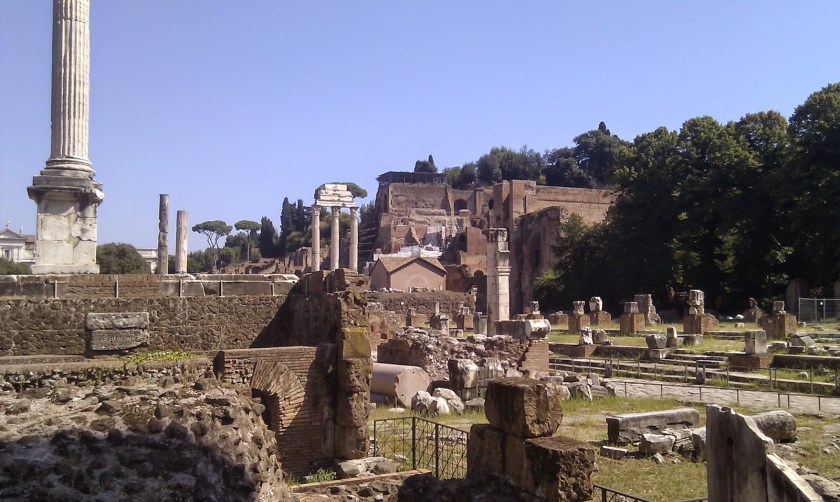
(pic - Story) Forum - From Arch of SeptimusA series of civil wars and other events took place during the first century B.C., ending the Republican period and leaving in its wake an Imperium, best remembered for its long line of dictators.
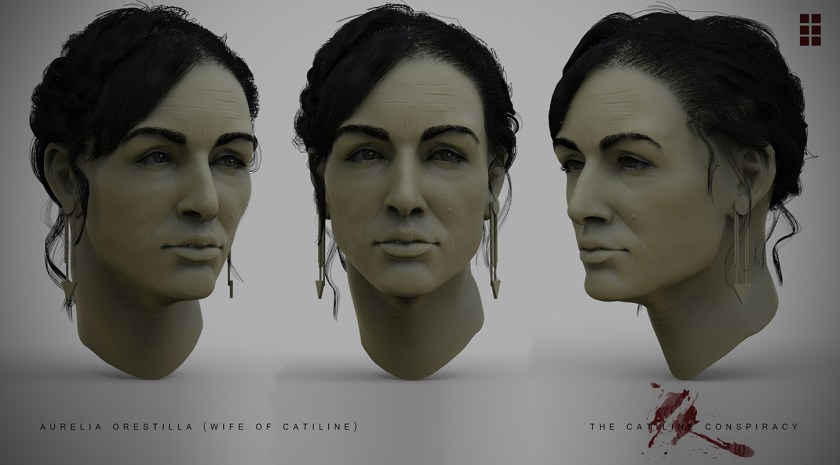
Lucius Sergius Catilina was a Roman Senator during the final period of the Republic, best remembered for his attempt to overthrow the government, particularly the power of the aristocratic Senate.  Catilina seems to have been an unsavory character, having first murdered his wife and son in order to marry the wealthy and beautiful Aurelia Orestilla, daughter of the consul of 71 B.C., Gnaeus Aufidius Orestes.  He was later tried for adultery, with a vestal virgin.

Aurelia_Head_Keyshot_File.31_writing puny
Aurelia Orestilla, wife of Catiline.  H/T James Scott 3-D Art

The first of two conspiracies bearing Catilina’s name began in 65 B.C., when he was supposed to have conspired to murder a number of Senators on their entering office, and making himself, Consul.  Catilina himself may or may not have been involved at this stage.  He would certainly be involved, in the second.

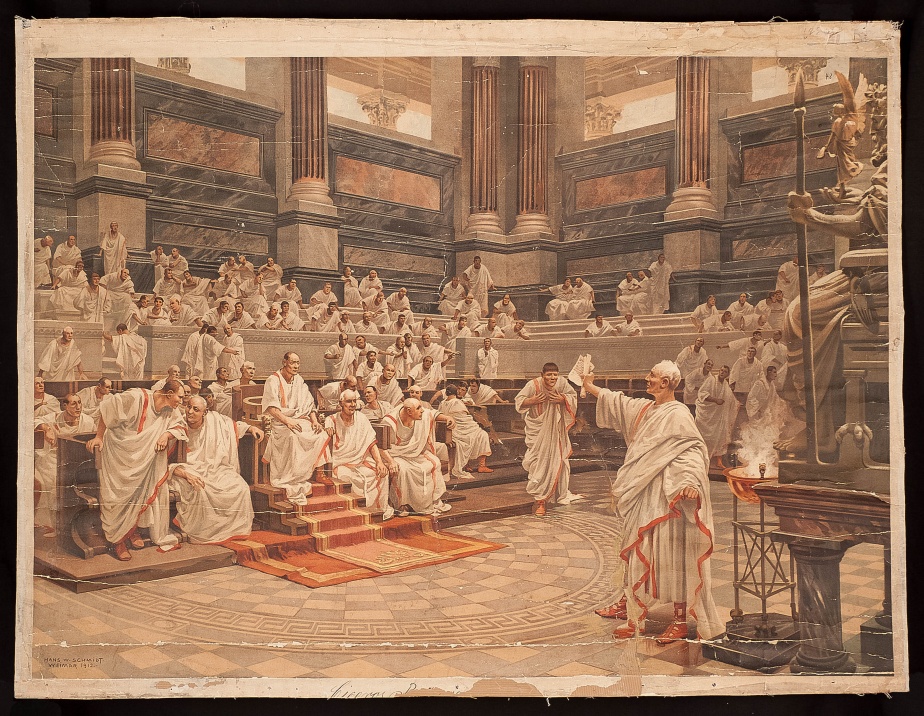
Catilina and a group of heavily indebted aristocrats concocted a plan to overthrow the Republic in 63 B.C., along with a number of disaffected veterans.  The plot was revealed on the night of October 18 in letters delivered to Consul Marcus Tullius Cicero, by General Marcus Licinius Crassus.  Cicero read these letters in the Senate the following day and later gave a series of four speeches,  the Catiline Orations.  2,000 years later, we remember Cicero as one of the most powerful public speakers, of the Roman Republic.   These Catiline Orations are held among his finest moments, as a speaker.

800px-Maccari-Cicero-56aaa5943df78cf772b45fc1

Cicero in the Senate denouncing Catiline, by Cesare Maccari

In his last speech, delivered in the Temple of Concordia on December 5, 63 B.C., Cicero established a basis for other speakers to take up the cause.  As Consul, Cicero was not himself permitted to voice an opinion regarding the execution of conspirators.  This speech laid the groundwork for others to do so, foremost, Cato the Younger.

The actual Senate debates are lost to history, leaving only Cicero’s four orations, but there was considerable resistance in the Senate to executing the conspirators.  They were, after all, fellow aristocrats.

Roma Day 1 18

Milvian Bridge

The plotters went to the Allobroges seeking military assistance, but the Gallic tribe wanted no part it and reported the proposal to their Roman patron.  Armed forces of the conspirators were ambushed at the Milvian Bridge, where the Via Flaminia crosses the Tiber River.  The rest were executed by the end of December.

Catilina himself was killed in battle the following January, near the Tuscan city of Pistoria.  By this time, Catilina’s army had dwindled from 10,000 strong, to less than a third of that.  The outcome of the battle was never in doubt yet, when the bodies were sorted out, the traitor and his last loyal few had received their mortal wounds, in the front.

The Republic was saved.  For now.

At one point during this period, then-Senator Julius Caesar stepped to the rostrum to have his say. He was handed a paper and, reading it, stuck the note in his toga and resumed his speech. Cato, Caesar’s implacable foe, stood in the senate and demanded that Caesar read the note. It’s nothing replied the future emperor, but Cato thought he had caught the hated Caesar red handed, and went in for the kill. “I demand you read that note”, he said, or words to that effect.  He wouldn’t let it go.  At last, Caesar relented. With an actor’s timing, he pulled out the note and read it to a hushed senate.

It turned out to be a love letter, a graphic one, wherein Servilia Caepionis described in detail what she wanted to do with Caesar, once she got him alone. As if the scene wasn’t bad enough, Servilia just happened to be Cato’s half-sister.

julius-caesar-assassination

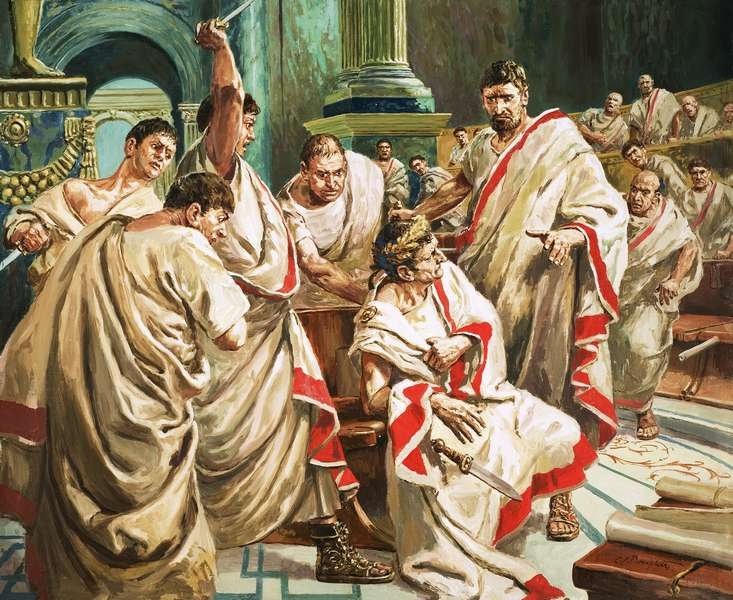
Assassination of Julius Caesar

Here’s where the story becomes Very interesting. Caesar was a well-known lady’s man.  By the time of his assassination, he had carried on with Servilia for years.  Servilia Caepionis had a son, one Marcus Junius Brutus.

87d43c51c42b9204b4c26b08df2239f0Brutus was 41 on the 15th of March, 44 B.C.  The “Ides of March”.  Caesar was 56.  The Emperor’s dying words are supposed to have been “Et tu, Brute?”, as Brutus plunged the dagger in.  “And you, Brutus?”  But that’s not what he said.  Those words were put into his mouth 1,643 years later, by William Shakespeare.
Eyewitness accounts to Caesar’s last words are lost to history, but more contemporary sources recorded the Emperor’s dying words as “Kai su, Teknon?”, in Greek.  “And you, my child?”

It seems unlikely that Brutus murdered his father on the Ides of March, but not impossible.  It’s hard to make the dates work.  Still, it makes you wonder…

Feature image, top of page:  “The picture shows the politician and most famous orator of Rome, Cicero (106-43 BC).In the year 63 BC, the senator Lucius Sergius Catilina (aprox. 108-62 BC) tried to seize power. You can see Cicero in the temple of Jupiter delivering his first of four orations against Catiline. Cicero thwarted Catiline’s conspiracy and, for the moment, saved the Republic”.  H/T Historywallcharts.eu

If you enjoyed this “Today in History”, please feel free to re-blog, “like” & share on social media, so that others may find and enjoy it as well. Please click the “follow” button on the right, to receive email updates on new articles.  Thank you for your interest, in the history we all share.

October 17, 1814 The Great London Beer Flood, of 1814

Nine people lost their lives altogether, including one man who died of alcohol poisoning, apparently leading a heroic one-man effort to drink the entire flood.

On April 1, 1785, the Times of London reported: “There is a cask now building at Messrs. Meux & Co.’s brewery…the size of which exceeds all credibility, being designed to hold 20,000 barrels of porter; the whole expense attending the same will be upwards of £10,000”.

013-giant-beer-barrel-q75-1364x1616The Meux’s Brewery Co Ltd, established in 1764, was a London brewery owned by Sir Henry Meux. What the Times article was describing was a 22′ high monstrosity, held together by 29 iron hoops.

When completed, this would be one of several such vats, each designed to hold 3,500 barrels of brown porter ale.

Ministry_of_Information_First_World_War_Official_Collection_Q28331The brewery was located in the crowded slum of St. Giles, where many homes contained several people to the room.
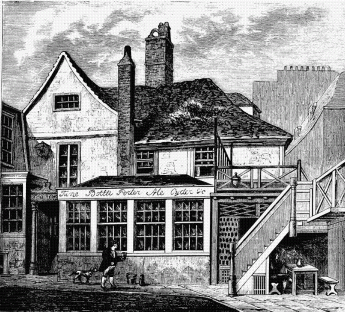
On October 17, 1814, storehouse clerk George Crick noticed one of those 700-pound iron hoops had slipped off a cask. This happened two or three times a year, and Crick thought little of it, writing a note to another employee, to fix the problem.

It was a bad decision.

The explosive release of all that hot, fermenting liquid could be heard five miles away, causing a chain reaction as the other vats went down like exploding dominoes.

323,000 imperial gallons of beer, equivalent to two-thirds of an Olympic swimming pool, smashed through the brewery’s 25-foot high brick walls and gushed into the streets, homes and businesses of St. Giles. The torrent smashed two houses and the nearby Tavistock Arms pub on Great Russell Street, where 14-year-old barmaid Eleanor Cooper was buried under the rubble.

the_manor_house_of_toten_hall_1813.gif.CROP.cq5dam_web_1280_1280_gifOne brewery worker was able to save his brother from drowning in the flood, but others weren’t so lucky.
Mary Mulvey and her 3-year-old son Thomas were drowned, while Hannah Banfield and Sarah Bates, ages 4 and 3, were swept away in the flood. Both died of their injuries. Nine people lost their lives altogether, including one man who died of alcohol poisoning, apparently leading a heroic one-man effort to drink the entire flood.

As the torrent subsided, hundreds of people came outside carrying pots, pans, and kettles – whatever they had on hand to scoop up some of it. Some just bent low and lapped at it like dogs, as all that dirty, warm beer washed through the streets. Meanwhile, several injured were taken to the nearby Middlesex Hospital, where a near-riot broke out as other patients demanded to know why they weren’t getting some of it, too.

london-beer-floodIn the days that followed, the crushing poverty of the slum led some to exhibit the corpses of their family members, charging a fee for anyone who wanted to come in and see. In one house, too many people crowded in and the floor collapsed, plunging them all into a cellar full of beer.
The stink lasted for months, as the Meux Brewery Company was taken to court over the accident. Judge and jury ruled the flood to be an ‘Act of God’.  The deaths were just a ‘casualty’, leaving no one responsible. Meux & Co. survived, though the financial loss was made worse by the fact that they had already paid tax on the beer. The company successfully applied to Parliament for a refund, and continued to brew beer on the same site.

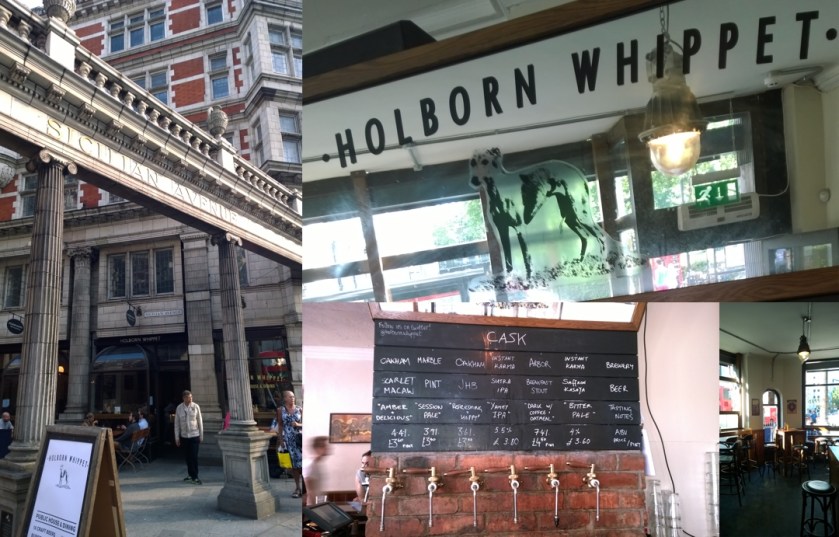
The brewery was closed in 1921 and demolished the following year. Since 2012, a London tavern called the “Holborn Whippet” (www.holbornwhippet.com) marks the event with its own vat of porter, specially brewed for this day. Cheers.


bar-holborn-whippet-montage
Holborn Whippet Pub Sicilian Ave, London
If you enjoyed this “Today in History”, please feel free to re-blog, “like” & share on social media, so that others may find and enjoy it as well. Please click the “follow” button on the right, to receive email updates on new articles.  Thank you for your interest, in the history we all share.