

We tend to look at WWII in a kind of historical box, with a beginning and an end. In reality, we feel the effects of WWII to this day. Just as the modern boundaries (and many of the problems) of the Middle East were shaped by WWI, the division of the Korean Peninsula was born of WWII.
Korea’s brief period of sovereignty ended in 1910, when the country was annexed by Imperial Japan. After Japan’s surrender in 1945, Korea was divided into two occupied zones; the north held by the Soviet Union and the south by the United States.
The Cairo Declaration of 1943 called for a unified Korea, but cold war tensions hardened the separation. By 1948, the two Koreas had separate governments, each with its own diametrically opposite governing philosophy.
Kim Il-sung came to power in North Korea in 1946, nationalizing key industries and collectivizing land and other means of production. South Korea declared statehood in May 1948, under the vehemently anti-communist military strongman, Syngman Rhee.
Both governments sought control of the Korean peninsula, but the 1948-49 withdrawal of Soviet and most American forces left the south holding the weaker hand. Escalating border conflicts along the 38th parallel led to war when the North, with assurances of support from the Soviet Union and Communist China, invaded South Korea in June 1950.
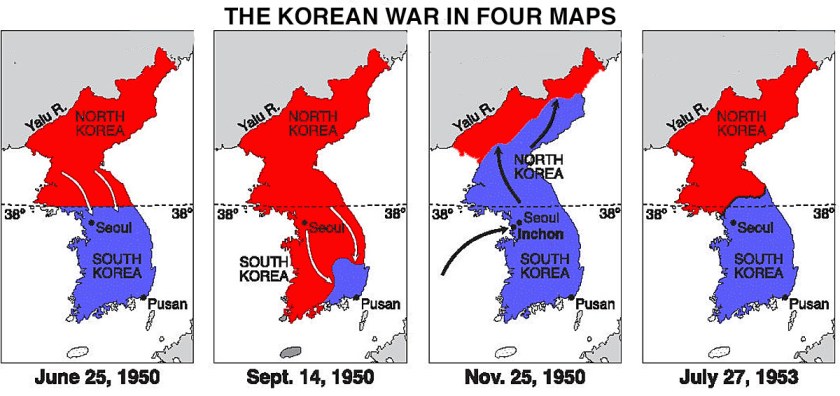 Sixteen countries sent troops to South Korea’s aid, about 90% of them Americans. The Soviets sent material aid to the North, while Communist China sent troops. The Korean War lasted three years, causing the death or disappearance of over 2,000,000, combining military and civilian.
The Korean War ended in July 1953, though the two sides technically remain at war to this day, staring each other down over millions of land mines in a fortified demilitarized zone spanning the width of the country.
The night-time satellite image of the two Koreas, tells the story of what happened next. South Korea went through a series of military dictatorships from the ‘60s to the ‘80s, since developing into a successful Republic. In the North, Kim Il-sung built a communist hellhole, a cult of personality established under a North Korean ideology known as “Juche”, (JOO-chay).
The term translates as “independent stand” or “spirit of self-reliance”, its first known reference in a speech given by Kim Il-sung on December 28, 1955. Theoretically based on independent thought, economic self-sufficiency and self-reliance in defense, “independence” applies to the collective, not to the individual, from whom absolute loyalty to the revolutionary party leader is required. In practice, this principle puts one man at the center and above it all. According to recent amendments to the North Korean constitution, that man will always be a well-fed member of the Kim family.
Son of the founder of the Juche Ideal, Kim Jung-il, was a well-known film buff. In a move that would make Caligula blush, he had South Korean film maker Shin Sang-ok kidnapped along with his actress ex-wife, Choi Eun-hee. After four years spent starving in a North Korean gulag, the couple accepted Kim’s “suggestion” that they re-marry and go to work for him, producing the less-than-box-office-smash “Pulgasari”, a kind of North Korean Godzilla film.
The couple escaped, unlike dozens of South Korean and Japanese unfortunates “recruited” with the help of a chloroform soaked rag.
 North Korea broke ground on what foreign media called “the worst building in the world” in 1987, just in time for the Seoul Olympics the following year. With 105 stories and eight revolving floors, the Ryugyong would have been the tallest hotel in the world, if it ever opened. Construction shut down in 1992, partly because Soviet funding dried up, and partly because construction was so bad that it’s unsafe to stand within 10 blocks of the thing. In 2008, Orascom Telecom of Egypt agreed to spend $180 million to put glass on the outside, in exchange for a $400 million contract to build the nation’s first 3G cellular network. Whether there will ever be more than one customer, is unclear. Perhaps 2017 will be the year that the Ryugyong becomes more than the world’s largest telecommunications antenna, but so far the place remains “too popular to take reservations”.
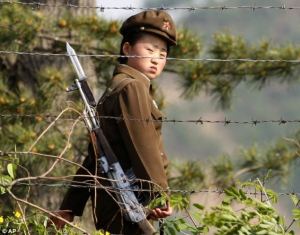 Anywhere from 1 to 3 million North Koreans starved to death during the ‘90s, while it’s estimated that one in every hundred North Korean citizens are incarcerated in a system of gulags, torture chambers and concentration camps.
As of 2010, the North Korean Military had 7,679,000 active, reserve, and paramilitary personnel, in a nation of 25,000,000. Over 30% of the nation’s population, and absorbing almost 21% of GDP. Today, that military is under the personal control of a 32 year old who had his own uncle Jang Song-thaek executed, presumably by anti-aircraft machine gun fire, before being incinerated by flame thrower. The same method used to kill two of Mr. Jang’s associates, a week earlier. The New York Times reports that the execution was for a coup plot, but others say he didn’t clap his hands long enough and with the right amount of enthusiasm, over some pronouncement of the “Dear Leader”, Kim Jung-un. The same Dear Leader who controls the nuclear arsenal.
The Islamic Republic of Iran (IRI) and the “Hermit Kingdom” of North Korea have had more or less “normal” relations, since the 1979 Iranian Revolution. The relationship isn’t all moonbeams and lollipops, the DPRK sought relations with Baghdad throughout the Iran-Iraq War. The IRI maintains relations with South Korea as well, but a cordial hatred for the United States has always kept the two united.
Authorities warned the nation of yet another impending famine in March 2016, the state-run newspaper Rodong Sinmun editorializing that “We may have to go on an arduous march, during which we will have to chew the roots of plants once again.”
The Obama administration recently concluded a nuclear “deal” with Iran, secretly sealed with pallet loads of taxpayer cash. CIA Director John Brennan conceded in September that his agency is “monitoring” whether North Korea is providing Iran with clandestine nuclear assistance. It doesn’t seem a stretch, there have been arms sales and “peaceful nuclear cooperation” between the two since the 1980s. The nuclear relationship between the two is now guided by the steady hands of the “Death to America” mullahs, and the man who banished Christmas and ordered North Korea to worship his grandmother. I cannot imagine what could go wrong.


 Ambrose Bierce was born in Horse Cave Creek, Ohio, to Marcus Aurelius and Laura Sherwood Bierce, the 10th of 13 children, all with names beginning with the letter “A”.
 number on speed dial. In Bierce’s day, he’d better carry a gun. Ambrose Bierce didn’t shy away from politics, he jumped right in, frequently using a mock dictionary definition to lampoon his targets. One example and my personal favorite, is “Politics: A strife of interests masquerading as a contest of principles. The conduct of public affairs for private advantage”.
 off limits. Politics was a favorite target of his columns, such as: “CONSERVATIVE, n: A statesman who is enamored of existing evils, as distinguished from the Liberal who wishes to replace them with others”, or “POLITICIAN, n. An eel in the fundamental mud upon which the superstructure of organized society is reared. When he wriggles he mistakes the agitation of his tail for the trembling of the edifice. As compared with the statesman, he suffers the disadvantage of being alive”.
 Gwinnett Bierce was executed by firing squad in the town cemetery. It’s as good an ending to this story as any, as one hundred and three years ago today is as good a day as any on which to end it. The fact is that in that 103 years, there’s never been a trace of what became of him, and probably never will be.


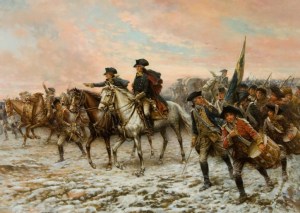 As the army began the famous crossing of the Delaware that Christmas night, the
 many of them lacked boots, the soaked and freezing rags wrapped around their feet not enough to keep them from leaving bloody footprints in the snow.
 The Patriot force arrived at Trenton at 8am December 26, completely surprising the Hessian garrison. There is a story about the Hessians being drunk or hungover after Christmas celebrations, but the story is almost certainly untrue. Unaware of Washington’s march on Trenton, 50 Americans had attacked a Hessian outpost earlier that morning. While Washington worried that his surprise was blown, Colonel Rall apparently believed that this was the attack he’d been warned about. He expected no further action that day.
 under Generals Cornwallis and Grant, proving on January 3rd at a place called Princeton, that they could defeat a regular British army in the field.

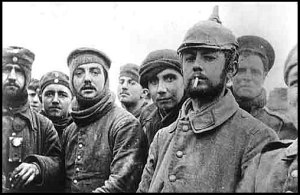 Captain Bruce Bairnsfather later wrote: “I wouldn’t have missed that unique and weird Christmas Day for anything. … I spotted a German officer, some sort of lieutenant I should think, and being a bit of a collector, I intimated to him that I had taken a fancy to some of his buttons. … I brought out my wire clippers and, with a few deft snips, removed a couple of his buttons and put them in my pocket. I then gave him two of mine in exchange. … The last I saw was one of my machine gunners, who was a bit of an amateur hairdresser in civil life, cutting the unnaturally long hair of a docile Boche, who was patiently kneeling on the ground whilst the automatic clippers crept up the back of his neck.”
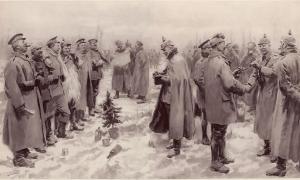 December 24-25, 1914, lasting in some sectors until New Year’s Day.


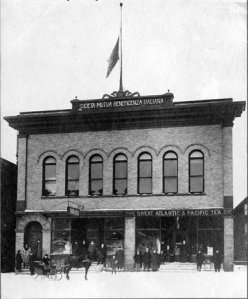 families gathered on Christmas Eve at the “Societa Mutua Beneficenza Italiana”, the Italian Hall in Calumet, Michigan, for a Christmas party sponsored by the Ladies Auxiliary of the WFM.
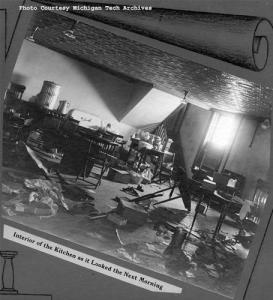 Miners Charles Moyer publicly accused members of the pro management “Citizens Alliance” of responsibility for the disaster. He was subsequently assaulted by members of the Alliance, who shot and kidnapped him, placing him on a train with instructions to leave Michigan and never return. Moyer would later receive medical attention in Chicago, holding a press conference where he displayed his gunshot wound before returning to Michigan and resuming his work with the WFM.
 1st amendment right to free speech. It’s a paraphrasing of Justice Oliver Wendell Holmes, Jr.’s opinion in the 1919 SCOTUS decision, Schenck v. United States, a case which turned, in part, on the Italian Hall disaster of seven years earlier.

 Poor mountain weather forced an overnight stop. They resumed flight on Friday the 13th, making their way through a mountain pass that afternoon. The pilot notified air controllers that he was over Curicó, Chile, but it was a fatal error. With zero visibility, he was forced to rely on dead reckoning, but strong headwinds had slowed them significantly. Cleared to descend 55 miles east of where he thought he was, the plane clipped two peaks at 13,800′, first losing a wing, then the vertical stabilizer, and finally the other wing. The battered fuselage crashed down on an unnamed peak, later called “Glaciar de las Lágrimas”, “Glacier of Tears”.
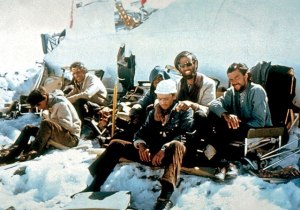 Stranded and alone in the high Andes, meager supplies soon gave out. A few chocolate bars, assorted snacks and several bottles of wine. It was gone within days, as the survivors scoured the wreckage for crumbs. They ate leather from suitcases, tore apart seats hoping to find straw, finding nothing but inedible foam. Nothing grew at this altitude. There were no animals. There was nothing in that desolate place but metal, glass, ice and rock, and the frozen bodies of the dead.
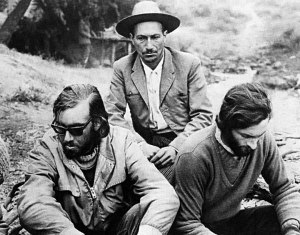 The Juan Valdez of the coffee commercials is an “arriero”, a person who transports goods using pack animals. Parrado and Canessa had hiked for almost two weeks when they were building a fire by a river, and they spotted such a man on the other side. Sergio Catalán probably didn’t believe his eyes at first, but he shouted across the river. “Tomorrow”.
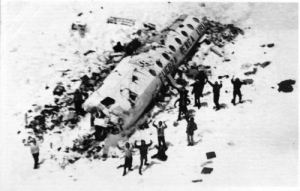 site heard the news on their transistor on December 22, that they were saved. The first helicopters arrived that afternoon, flying out with the weakest of the survivors. Altitude sickness, dehydration, frostbite, broken bones, scurvy and malnutrition. They were one decrepit bunch, but they were alive. The second expedition arrived on the morning of December 23, removing the last survivors around daybreak.

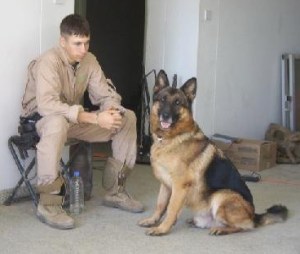 States Marine Corps in 2006. The dog’s second deployment began in November, when he was paired with Marine Corporal Dustin J. Lee, stationed in the military police department at Marine Corps Logistics Base (MCLB), “Albany”.
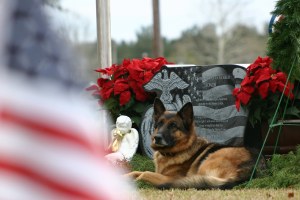 The most dreadful moment in the life of any parent, is when they receive word of the death of a child. It wasn’t long after Jerome and Rachel Lee were so notified, that they began efforts to adopt Lex. Dustin was gone, but they wanted to make his partner a permanent part of their family.
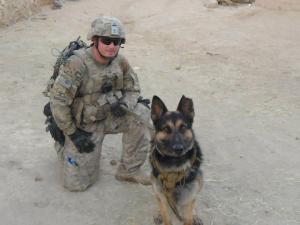 In telling this story, I wish in some small way to honor my son in law Nate and daughter Carolyn, who together experienced Nate’s deployment as a Tactical Explosives Detection Dog handler with the US Army 3rd Infantry Division in Soltan Kheyl, Wardak Province, Afghanistan. Months after departing “The Ghan” in 2013, the couple was reunited with Nate’s “Battle Buddy”, MWD Zino, who is now retired and lives with them in Savannah. “Here & Now”, broadcast out of ‘Boston’s NPR News Station’ WBUR, did a great story on the reunion. You can hear the radio broadcast
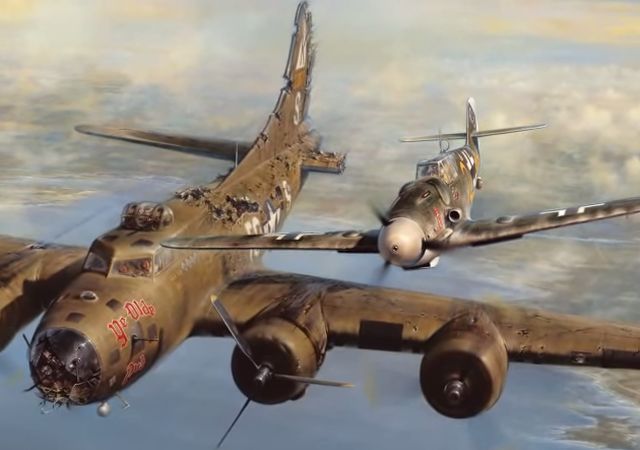
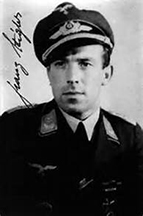 At the age of 26, Franz Stigler was an Ace. The Luftwaffe pilot of a Messerschmitt Bf-109 fighter, some of his kills had been revenge, payback for the death of his brother August earlier in the war. But this man was no Nazi. He was a German Patriot with 22 confirmed kills. On December 20, 1943, he needed one more for a Knight’s Cross. He tossed his cigarette aside and climbed into his fighter as the crippled American B17 bomber lumbered overhead. This was going to be an easy kill.
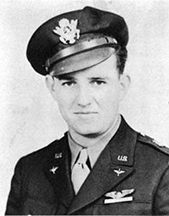 named “Ye Olde Pub”. The earlier attack on the munitions factory in Bremen had been a success, but the pilot and crew paid a heavy price for it. Their aircraft had been savaged by no fewer than 15 German fighters. Great parts of the air frame were torn away, one wing severely damaged and part of the tail torn away. The aircraft’s Plexiglas nose was shattered and the #2 engine seized. Six of the ten-man crew were wounded and the tail gunner dead, his blood frozen in icicles over silent machine guns. Brown himself had been knocked out at one point, coming around just in time to avert a fatal dive.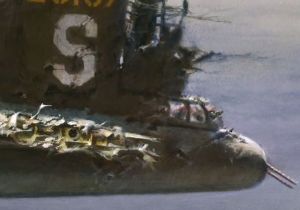
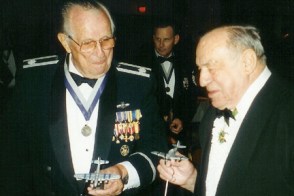 took out an ad in a fighter pilots’ newsletter. It said that he was searching for the man ‘who saved my life on Dec. 20, 1943.’ Stigler saw the ad, and the two met for the first time in 1987. “It was like meeting a family member”, Brown said at their first meeting, “like a brother you haven’t seen for 40 years”.
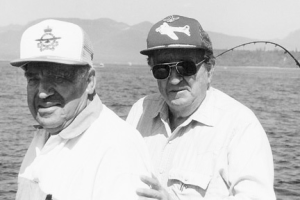 The two became close friends and occasional fishing buddies until their passing in 2008, six months apart. Stigler was age 92 and Brown 87. Their story is told in a book called “A Higher Call”, if you want to know more about it. In their obituaries, both were mentioned as the other man’s “special brother”.

 He left with a copy of “The Lowell Offering”, a literary magazine written by those same mill girls, which he later described as “four hundred good solid pages, which I have read from beginning to end.”

 No longer a maritime power, Hannibal set out in the spring of 218BC, crossing into hostile Gaul (France) and arriving at the Rhône River in September with 38,000 infantry, 8,000 cavalry, and 37 war elephants. His crossing of the Alps that winter is one of the great feats of military history, costing him almost half of his force before entering Italy in December.

 Historical Easter Eggs - Today in History
You must be logged in to post a comment.