February 14, 269 Valentine’s Day

Legend has it that Valentinus befriended his jailers’ daughter, at one point miraculously restoring the blind girl’s sight. He is said to have penned a farewell note to her shortly before his execution, signing it “From Your Valentine.”

In 269, Roman Emperor Claudius II Gothicus was having trouble recruiting for his legions. To many he was “Claudius the Cruel” which may have had something to do with his problem, but that’s not how he saw it.claudius-gothicus

That Roman men were refusing to join his legions could only mean that they were too devoted to their wives and families, Claudius’ solution was to ban engagements and marriages.

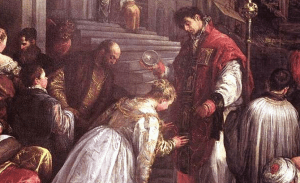
Valentinus was a Roman priest at this time.  He wanted no part of such a silly decree. Valentinus continued to carry out marriages in secret until it was discovered, when he was dragged before the Prefect to answer for his crimes.

This Emperor of barbarian birth came to like his prisoner, for whom things could have gone much better, but for one critical mistake. Valentinus tried to convert the pagan Emperor to Christianity.

owe-marriage-to-saint-valentineHe was condemned to be beaten to death with clubs and beheaded, the sentence carried out on February 14, 269.

Legend has it that Valentinus befriended his jailers’ daughter, at one point miraculously restoring the blind girl’s sight. He is said to have penned a farewell note to her shortly before his execution, signing it “From Your Valentine.”

2,000-year-old history is necessarily clouded by legend, and there are different versions of this tale.  It’s possible that the Valentinus story never happened at all. Little or no evidence exists suggesting romantic celebrations on February 14, until Geoffrey Chaucer’s 1375 “Parliament of Foules,” in which the poet describes February 14 as a day when birds come together to find a mate: “For this was sent on Seynt Valentyne’s day, Whan every foul cometh ther to choose his mate”.

Yet, there is concrete archaeological proof that Valentinus lived, and Pope Gelasius decreed February 14th to be a celebration to honor his martyrdom, in 496.
The date is also significant of the pagan festival of Lupercalia, carried out from February lupercalia-large13-15 in honor of the goddess Februata Juno. Greek historian Plutarch described the occasion as follows: “Lupercalia, [when] many of the noble youths and of the magistrates run up and down through the city naked, for sport and laughter striking those they meet with shaggy thongs. And many women of rank also purposely get in their way, and like children at school present their hands to be struck, believing that the pregnant will thus be helped in delivery, and the barren to pregnancy.”

There are, in fact, about a dozen St. Valentines, the most recently beatified being St. Valentine Berrio-Ochoa, a Dominican friar who served as bishop of Vietnam until his beheading in 1861. There was even a Pope Valentine, who served about 40 days, sometime around 827AD.

So, take your pick. With all those St. Valentines, you can celebrate St. Valentine of Viterbost-valentine-the-legend on November 3, or maybe you’d like to get a head start with St. Valentine of Raetia on January 7. Maybe you’d prefer the only female St. Valentine (Valentina), a virgin martyred in Palestine on July 25, A.D. 308.

The Eastern Orthodox Church celebrates St. Valentine twice, first as a church elder on July 6, and again as a martyr on the 30th. That would suit the greeting card companies, but don’t tell them. Once a year is more than enough for some of us to remember.

February 12,  1733  Our 13th Colony

Years later, Tomochichi presented a symbol of power to the King of England. It was a bald eagle feather, the first time this symbol of our country had been associated with the American colonies.

General James Oglethorpe was a crusader, an idealist, a member of the British Parliament.  First elected in 1722, his anonymous 1728 pamphlet “The Sailor’s Advocate” advocated improvement in the terrible working conditions of the sailors of his day.  Oglethorpe chaired a committee on prison reform that same year, calling attention to the horrendous conditions in the nation’s debtors’ prisons, and to the hopeless plight of those released with no means of support.

james-oglethorpe
James Oglethorpe

Oglethorpe saw the greater problem as urbanization, stripping the countryside of the productively employed and depositing them in cities with no opportunity for productive employment.  To deal with the problem, Oglethorpe and others petitioned in 1730 to form a committee of trustees, to establish a new Colony in America. They would call their new colony “Georgia”, the petition approved in 1732.  Thousands applied to go, Trustees narrowing the number down to the first 114  colonists.  Those who couldn’t pay their own way would be subject to a period of indenture, typically 5-7 years.

mico-of-the-yamacraw-son
Tomochichi, Mico of the Yamacraw, and his Son

It was November that year, when Oglethorpe and his colonists left aboard the “Anne”,intending to found their new Colony.   The Province of Georgia and its Colonial Capital of Savannah were founded on that date, February 12, 1733.  A personal friendship developed between Oglethorpe and native Chieftan Tomochichi, Mico (Leader) of the Yamacraw, a formal treaty of friendship signed in May of that year.   Years later the pair would journey to England, where Tomochichi presented a symbol of power to the King of England.  It was a bald eagle feather, the first time this symbol of our nation had been associated with the American colonies.

The home town to Oglethorpe’s Utopian experiment, Savannah, was founded around four wards, each containing eight blocks situated around its own central square. Established to help the poor and to produce materials like silk and olives for England, Georgia issued each colonist 50 acres of land, its motto “Non Sibi Sed Allis”.   “Not for Themselves But for Others”.

Oglethorpe outlined four prohibitions for his Utopian community, even before the first ships left England.

1: No rum, brandy or spirits were allowed in Georgia, though beer, wine and ale were OK.

2: No African slaves were allowed, though they were occasionally “borrowed” for construction projects.

3: No lawyers were allowed, since Oglethorpe felt that every man ought to be able to speak for himself.

4: No Catholics were allowed, as it was believed that they’d be too sympathetic to the Spanish, then in control of the Florida territory.

james-oglethorpe-with-yamacraw-chief-tomochichi-mary-appears-between-themReturning to England, Oglethorpe would continue to serve on the Board of Trustees, though he often found himself outvoted. Despite his opposition, the Board of Trustees gradually relaxed their restrictions on land ownership, on hard liquor, and on slavery. By 1750, Georgia’s founding father was no longer involved with the board that created it. His grand experiment was over when Trustees voted to return their governing charter, making Georgia the 13th of Britain’s American colonies.

Chief Tomochichi died in 1739 at age 97, requesting that he be buried among his English friends. The Mico of the Yamacraw was interred in Wright Square, saluted with cannon and musket fire.  James Oglethorpe himself was one of the pall bearers. If you ever go to Savannah, you can still see Wright Square, and the monument dedicated on April 21, 1899. A bronze tablet is engraved with Cherokee roses and arrowheads, and inscribed with these words”  “In memory of Tomochichi – the Mico of the Yamacraws – the companion of Oglethorpe – and the friend and ally of the Colony of Georgia”.

tomochichis-grave-in-wright-square
Tomochichi’s Grave, Wright Square, Savannah

February 10, 1920 Play Ball!

In a world where classified information is kept on personal email servers, there are still some secrets so pinky-swear-double-probation-secret that the truth may Never be known

Former Boston Braves pitcher Max Surkont once said “Baseball was never meant to be taken seriously — if it were, we would play it with a javelin instead of a ball”.

I’m not sure about javelins, but I know how much we all love to see home runs when we go see a ballgame.

That’s not always how the game was played. The “Hitless Wonders” of the Chicago White Sox won the 1906 World Series with a .230 club batting average. Manager Fielder Jones said “This should prove that leather is mightier than wood”.  Fielder Allison Jones, that’s the man’s real name.  Is that the greatest baseball name ever, or what?

deadballparksIt was the “dead-ball” era, when an “inside baseball” style of play relied on stolen bases, hit-and-run plays and, more than anything else, speed.

That’s not to say there were no power hitters. In some ways, a triple may be more difficult than a home run, requiring a runner to cover three bases in the face of a defense still in possession of the ball. Pittsburgh Pirates outfielder Owen “Chief” Wilson set a record of 36 triples in 1912. “Wahoo” Sam Crawford hit a career record 309 triples in his 18 years in Major League Baseball, playing for the Cincinnati Reds and Detroit tigers between 1899 and 1917. 100 years later, it’s unlikely that either record will ever be broken.

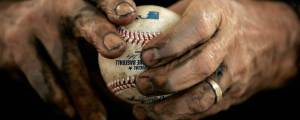
In his 1994 television miniseries “Baseball”, Ken Burns said that “Part of every pitcher’s job was to dirty up a new ball the moment it was thrown onto the field… They smeared it with dirt, licorice, and tobacco juice; it was deliberately scuffed, sandpapered, scarred… and as it came over the plate, [the ball] was very hard to see.”

Spitballs lessened the natural friction with a pitcher’s fingers, reducing backspin anddead-ball causing the ball to drop. Sandpapered, cut or scarred balls tended to “break” to the side of the scuff mark. Balls were rarely replaced in those days.  By the end of a game, the ball was scarred, misshapen and entirely unpredictable.  Major League Baseball outlawed “doctored” pitches on February 10, 1920, though it remained customary to play an entire game with the same ball.

The first ever game to be played “under the lights” was forty years in the past in 1920, but it would be another 15 before the practice became widespread.

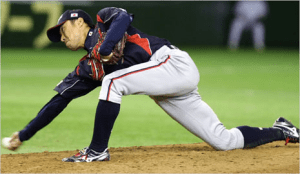
Late afternoon on August 16, the Cleveland Indians were playing the New York Yankees at the Polo Grounds. Cleveland shortstop Ray Chapman took the plate in the top of the 5th, submarine-pitcherfacing “submarine” pitcher Carl Mays.  These are not to be confused with the windmill underhand pitches we see in softball.  Submarine pitchers throw side-arm to under-handed, their upper bodies so low that some of them scuff their hands on the ground, the ball rising as it approaches the strike zone.

Chapman never moved, he seems not to have seen it coming. The crack of the ball hitting his head was so loud that Mays thought he had hit the end of the bat, fielding the ball and throwing to first for the out. Wally Pipp, the first baseman better known for losing his starting position to Lou Gehrig because of a headache, immediately knew something was wrong. The batter made no effort to run, slowly collapsing to the ground with blood streaming out of his left ear.

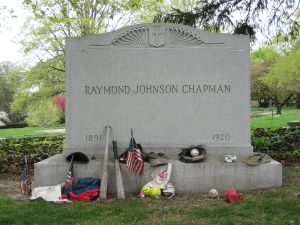
ray_chapman_grave29-year-old Ray Chapman had said this was his last year playing ball.  He wanted to spend more time in the family business he had just married into. The man was right.  Raymond Johnson Chapman died 12 hours later, the only player in the history of Major League Baseball, to die from injuries sustained during a game.

The age of one-ball-per-game died with Ray Chapman, and with it the era of the dead ball. The lively ball era, had begun. Batters loved it, but pitchers complained about having to handle all those shiny new balls.new-balls

MLB rule #3.01(c) states that “Before the game begins the umpire shall…Receive from the home club a supply of regulation baseballs, the number and make to be certified to the home club by the league president. The umpire shall inspect the baseballs and ensure they are regulation baseballs and that they are properly rubbed so that the gloss is removed. The umpire shall be the sole judge of the fitness of the balls to be used in the game”.

Umpires would “prep” the ball using a mixture of water and dirt from the field, but this resulted in too-soft covers, vulnerable to tampering. Something had to take the shine off the ball without softening the cover.

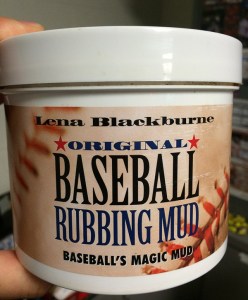
rubbing-mudPhiladelphia Athletics third base coach Lena Blackburne took up the challenge in 1938, scouring the riverbanks of New Jersey for just the right mud. Blackburne found his mud hole, describing the stuff as “resembling a cross between chocolate pudding and whipped cold cream”. By his death in the late fifties, Blackburne was selling his “Baseball Rubbing Mud” to every major league ball club in the country, and most minor league teams.rubbing-mud-2

In a world where classified information is kept on personal email servers, there are still some secrets so pinky-swear-double-probation-secret that the truth may Never be known. Among them Facebook “Community Standards” algorithms, the formula for Coca Cola, and the Secret Swamp where Lena Blackburne’s Baseball Rubbing Mud comes from.

Nobody knows, but one thing is certain. The first pitchers will show up to the first spring training camp, a few short days short days from now. Every baseball thrown from pre-season to the 2017 World Series, will first have been de-glossed with Lena Blackburne’s famous, Baseball Rubbing Mud.

Go Sox.

February 9, 1945  Battle of the Atlantic

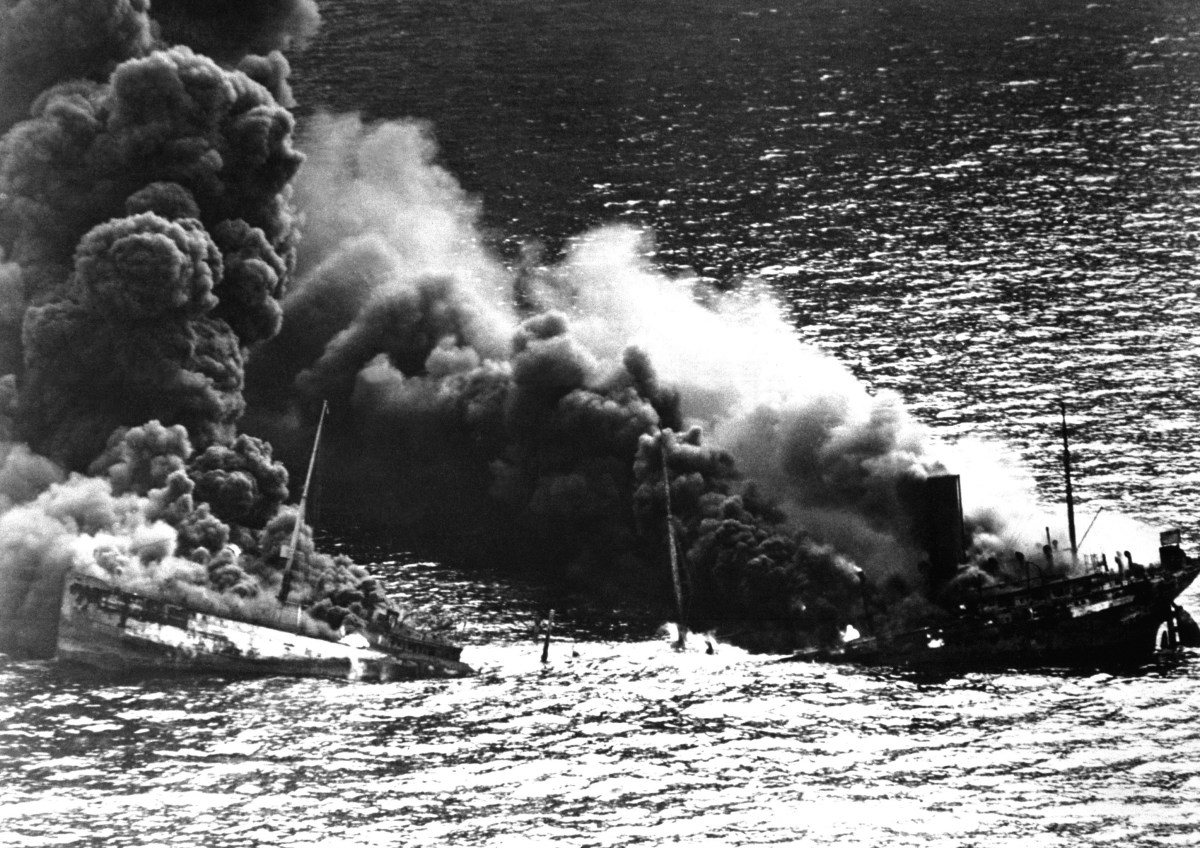
The “Battle of the Atlantic” lasted 5 years, 8 months and 5 days, ranging from the Irish Sea to the Gulf of Mexico, from the Caribbean to the Arctic Ocean

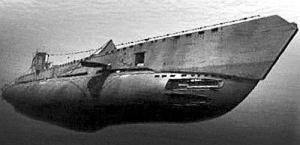
The impending Nazi invasion of Poland was an open secret in 1939.  That August, the first fourteen “Unterseeboots” (U-boats) left their bases, fanning out across the North submarineAtlantic.  On the 25th the Polish-British Common Defense Pact was added to the Franco-Polish Military Alliance.  Should Poland be invaded by a foreign power, England and France were now committed to intervene.

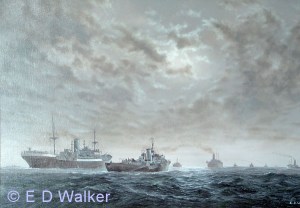
Hitler’s invasion of Poland began on September 1.  Even then, he believed that war with England and France could be avoided, the “Kriegsmarine” under strict orders to follow the “Prize Regulations” of 1936.  England and France declared war on Nazi Germany on the 3rd. Hours later, U-30 Oberleutnant Fritz Julius Lemp fired a torpedo into the British liner SS Athenia.  Lemp had mistakenly believed it to be an armed merchant vessel and fair game under Prize Regulations, but the damage was done.  The longest and most complex naval battle in history, had begun.atlantic-convoy

As in WWI, both England and Germany were quick to implement blockades on one another.   For good reason.  By the time that WWII was in full swing, England alone would require over a million tons a week of imported goods, in order to survive and to fight the war.

The “Battle of the Atlantic” lasted 5 years, 8 months and 5 days, ranging from the Irish Sea to the Gulf of Mexico, from the Caribbean to the Arctic Ocean.  Winston Churchill would say “The Battle of the Atlantic was the dominating factor all through the war. Never for one moment could we forget that everything happening elsewhere, on land, at sea or in the air depended ultimately on its outcome”.

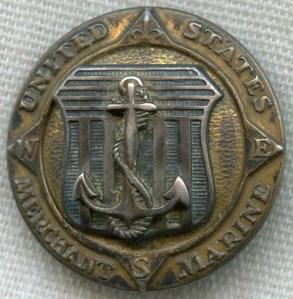
Thousands of ships were involved in over a hundred convoy battles, with over 1,000 singleusmm ship encounters unfolding across a theater thousands of miles wide.  According to www.usmm.org, the United States Merchant Marine suffered the highest percentage of fatalities of any service branch, at 1 in 26 compared to one in 38, 44, 114 and 421 respectively, for the Marine Corps, Army, Navy and Coast Guard.

New weapons and tactics would shift the balance in favor of one side and then to the other.  In the end over 3,500 merchant ships and 175 warships would be sunk to the bottom, compared with the loss of 783 U-boats.

The most unusual confrontation of the war occurred on this day in 1945, in the form of a combat action between two submerged submarines.  Submarines operate in 3-dimensional space, but their most effective weapon does not.  The torpedo is a surface weapon, operating in two-dimensional space:  left, right and forward.  Firing at a submerged target requires that the torpedo be converted to neutral buoyancy, introducing near-insurmountable complexity into firing calculations.

u-864
U-864

The war was going badly for the Axis Powers in 1945, the allies enjoying near-uncontested supremacy over the world’s shipping lanes.  At this time, any surface delivery between Nazi Germany and Imperial Japan was likely to be detected and stopped.  The maiden voyage of the 287’, 1,799 ton German submarine U-864 departed on “Operation Caesar” on December 5, delivering Messerschmitt jet engine parts, V-2 missile guidance systems, and 65 tons of mercury to the Imperial Japanese war production industry.

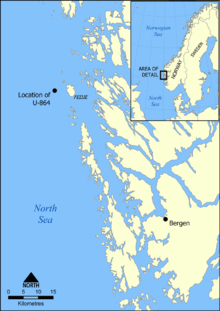
The mission was a failure, U-864 having to retreat to the submarine pens in Bergen, u-864-locationNorway, for repairs after running aground in the Kiel Canal.  The sub was able to clear the island of Fedje off the Norway coast undetected on February 6.  By this time British MI6 had broken the German Enigma code.  They were well aware of Operation Caesar.

The British submarine Venturer, commanded by 25-year-old Lieutenant Jimmy Launders, was dispatched from the Shetland Islands, to intercept and destroy U-864.

ASDIC, an early name for sonar, would have been far more helpful in locating U-864, but at a price.  That familiar “ping” would have been heard by both sides, alerting the German commander that he was being hunted.  Launders opted for hydrophones, a passive listening device which could alert him to external noises.  Calculating his adversary’s direction, depth and speed was vastly more complicated without ASDIC, but the need for stealth won out.

Developing an engine noise which he feared might give him away, U-864’s commander, Ralf-Reimar Wolfram decided to return to Bergen for repairs.  German submarines of the age were equipped with “snorkels”, heavy tubes which broke the surface, enabling diesel engines and crews to breathe while running submerged.  Venturer was on batteries when the first sounds were detected, giving the British sub the stealth advantage but sharply limiting the time frame in which it could act.

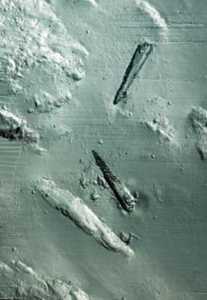
u-864-wreckA four dimensional firing solution accounting for time, distance, bearing and target depth was theoretically possible, but had rarely been attempted under combat conditions.  Plus, there were unknown factors which could only be approximated.

A fast attack sub, Venturer only carried four torpedo tubes, far fewer than her much larger adversary.  Launders calculated his firing solution, ordering all four tubes and firing with a 17½ second delay between each pair.  With four incoming at different depths, the German sub didn’t have time to react.  Wolfram was only just retrieving his snorkel and converting to electric, when the #4 torpedo struck.  U-864 imploded and sank, instantly killing all 73 aboard.

Surface actions were common enough between all manner of vessels, but a fully submerged submarine to submarine kill occurred only once in WWI, on October 18, 1914, when the German U-27 torpedoed and sank the British sub HMS E3 with the loss of all 28 aboard.  To my knowledge, such an action occurred only this one time, in all of WWII.

February 8, 1960 Rin Tin Tin

There’s a Hollywood legend that may or may not be true, that Rin Tin Tin received the most votes for Best Actor at the 1st Academy Awards in 1929

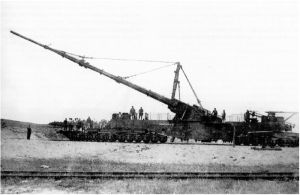
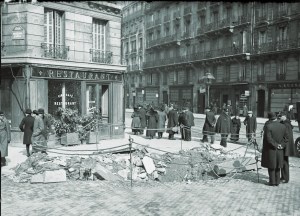
paris-gunAt 256 tons with a barrel of 111′ 7″, the “Paris Gun” hurled 38″ shells into the city from a range of 75 miles. If you were in Paris in 1918, you may never have heard of the German “super gun”. You’d have been well acquainted with the damage it caused. You never knew you were under attack until the explosion. The lucky ones were those who lived to see the 4’ deep, 10’-12’ wide crater.paris-gun-crater

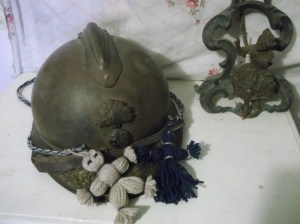
Parisian children made little good luck charms, as “protection” from the Paris gun. They were tiny pairs of handmade dolls, joined together by scraps of yarn. They were said to provide protection for their owners, but only under certain circumstances. You couldn’t make or buy your own, they had to be presented to you. They also had to remain attached, or else the little dolls would lose their protective powers.

nenetteetrintintinThese little yarn dolls had names. They were Nénette and Rintintin.

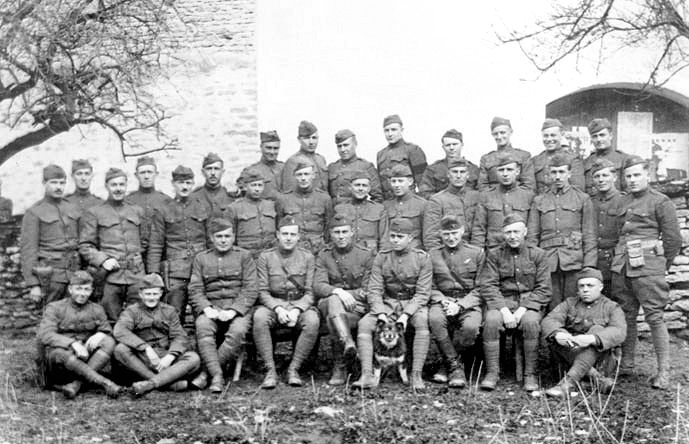
Army Air Service Corporal Lee Duncan was in Paris at this time, with the 135th Aero Squadron. He was aware of the custom, possibly having been given such a talisman himself. In the wake of the Battle of Saint-Mihiel, Corporal Duncan was sent forward to the small village of Flirey, to check out it’s suitability for an airfield. The place was heavily damaged by shellfire, and Duncan came upon the shattered remains of a dog pound. Once, this kennel had provided Alsatians (German Shepherd Dogs) to the Imperial German Army. Now, the only dogs left alive were a starving mother and five nursing puppies, so young that their eyes were still closed.135th_aero_squadron_group

Corporal Duncan cared for them, selling several once the puppies were weaned. He sold the mother to an officer and three puppies to fellow soldiers, keeping two for himself. Like those little yarn dolls that French children gave to American soldiers, Duncan felt these two puppies were his good luck charms. He called them Nanette and Rin Tin Tin.

jane-murfin-with-strongheart
Playwright Jane Murfin with Strongheart

Returning home after the war, Duncan placed the dogs with a police dog breeder and trainer in Long Island. Nanette contracted pneumonia and died, the breeder giving Duncan a female puppy, “Nanette II”, to replace her.

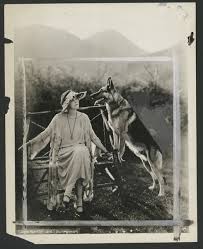
Etzel von Oeringen was born on October 1, 1917 in Germany, coming to America after the Great War and becoming a movie star in the ‘20s. Better known as “Strongheart”, Etzel was a German Shepherd Dog, whose appearance in silent films enormously increased the popularity of the breed.

A friend of silent film actor Eugene Pallete, Duncan became convinced that Rin Tin Tin could become the next canine film star. He later wrote, “I was so excited over the motion-picture idea that I found myself thinking of it night and day.”

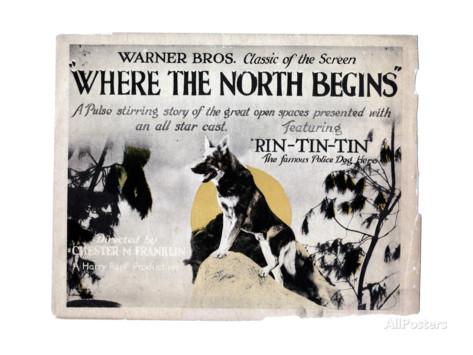
where-the-north-begins-rin-tin-tin-1923Walking the dog on “Poverty Row”, 1920s slang for B movie studios, did the trick. Rin Tin Tin got his first film break in 1922, replacing a camera shy wolf in “The Man from Hell’s River”. His first starring role in the 1923 “Where the North begins”, is credited with saving Warner Brothers Studios from bankruptcy.

Between-the-scenes silent film “intertitles” were easily changed from one language to another, and Rin Tin Tin films enjoyed international distribution. In 1927, Berlin movie audiences voted him Most Popular Actor.

There’s a Hollywood legend that may or may not be true, that Rin Tin Tin received the most votes for Best Actor at the 1st Academy Awards in 1929. Wishing to appear oh-so serious and wanting a human actor, the Academy threw out the ballots. German actor Emil Jannings got Best Actor on the 2nd ballot.

rin-tin-tin-signed-photoRin Tin Tin appeared in 27 feature length silent films, 4 “talkies”, and countless commercials and short films. Regular programming was interrupted to announce his passing on August 10, 1932, at the age of 13. An hour-long program about his life was broadcast the following day.

Suffering from the Great Depression like so many others, Duncan couldn’t afford a fancy funeral. By this time he couldn’t afford the house he lived in. Duncan sold the house and returned the body of his beloved German Shepherd to the country of his birth, where Rin Tin Tin was buried in the Cimetière des Chiens et Autres Animaux Domestiques, in the Parisian suburb of Asnières-sur-Seine.

Duncan continued breeding the line, careful to preserve the physical qualities and intelligence of the original, avoiding the less desirable traits that crept into other GSD rin-tin-tinbloodlines. Rin Tin Tin and Nanette II produced at least 48 puppies. Duncan may have been obsessive about it, at least according to Mrs. Duncan. When she filed for divorce, she named Rin Tin Tin as co-respondent.

Rin Tin Tin was awarded his own star on the Hollywood Walk of Fame on February 8, 1960. Lee Duncan passed away later that same year.  At some point, Duncan had written a poem, a tribute to the companion animal who was no more.  If you’ve ever loved a dog, I need not explain his final stanza.

“…A real unselfish love like yours, old pal,
Is something I shall never know again;
And I must always be a better man,
Because you loved me greatly, Rin Tin Tin”.

February 7, 1917 SS California

In the United States, the political tide was turning. The combination of events was the last straw. The United States entered WWI about a month later

On June 28, 1914, the assassination of Archduke Franz Ferdinand  began a cascade of events that would change the course of the 20th century.  Entangling alliances and mutual suspicion led to the mobilization and counter-mobilizion of armies.  No one wanted to show up late, in the event of war.  And so there was war.  By October, the “Great War” had devolved into the trench-bound hell which would characterize the next four years.

The German and British economies were heavily dependent on imports to feed their populations and prosecute the war effort. By February 1915, both were attempting to throttle the other through naval blockade.

Great Britain’s Royal Navy had superior numbers, while the Imperial German Navy’s surface fleet was restricted to an area of the North Sea called the German Bight. In other theaters, Germans augmented their small navy with commerce raiders and “unterseeboots”.  More than any other cause, it was the German policy of unrestricted submarine warfare, which would bring the United States into the war two years later.

wwi-submarineOn February 4, 1915, Imperial Germany declared a naval blockade against shipping to Britain, stating that “On and after February 18th every enemy merchant vessel found in this region will be destroyed, without its always being possible to warn the crews or passengers of the dangers threatening”. “Neutral ships” it continued, “will also incur danger in the war region”.

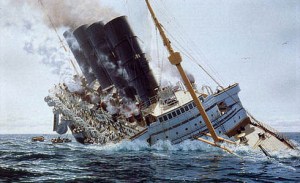
As the war unfolded, German U-boats sank nearly 5,000 ships, close to 13 million gross register ton, including the Cunard Liner Lusitania, which was torpedoed and sunk off Kinsale, Ireland, on May 7, 1915. 1,198 were drowned, including 128 Americans.  100 of the dead, were children. .lusitania-sinking

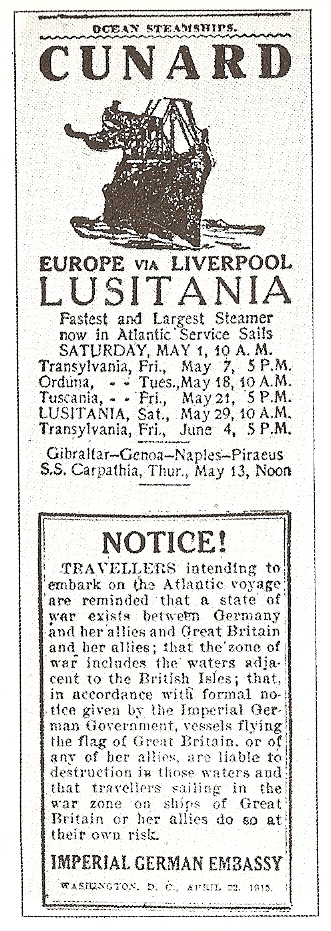
The reaction in the US and UK was immediate and vehement, portraying the sinking as the act of barbarians and Huns. Imperial Germany maintained that Lusitania was illegally transporting munitions intended to kill German boys on European battlefields. Furthermore, the embassy pointed out that ads had been taken out in the New York Times and other newspapers, specifically warning that the liner was subject to attack.

lusitania-warningUnrestricted submarine warfare was suspended for a time, for fear of bringing the US into the war.  The policy was reinstated in January 1917, prompting then-Chancellor Theobald von Bethmann Hollweg to say, “Germany is finished”.  He was right.

SS Housatonic was stopped off the southwest coast of England, and boarded by German submarine U-53.  American Captain Thomas Ensor was interviewed by Kapitänleutnant Hans Rose, who said he was sorry.  Housatonic was “carrying food supplies to the enemy of my country”, and would be destroyed.  The American Captain and crew were allowed to launch lifeboats and abandon ship, while German sailors raided the American’s soap supplies.  Apparently, WWI vintage German subs were short on soap.

Housatonic was sunk with a single torpedo, U-53 towing the now-stranded Americans toward the English coast.  Sighting the trawler Salvator, Rose fired his deck guns to be sure they’d been spotted, and then slipped away.  It was February 3, 1917.

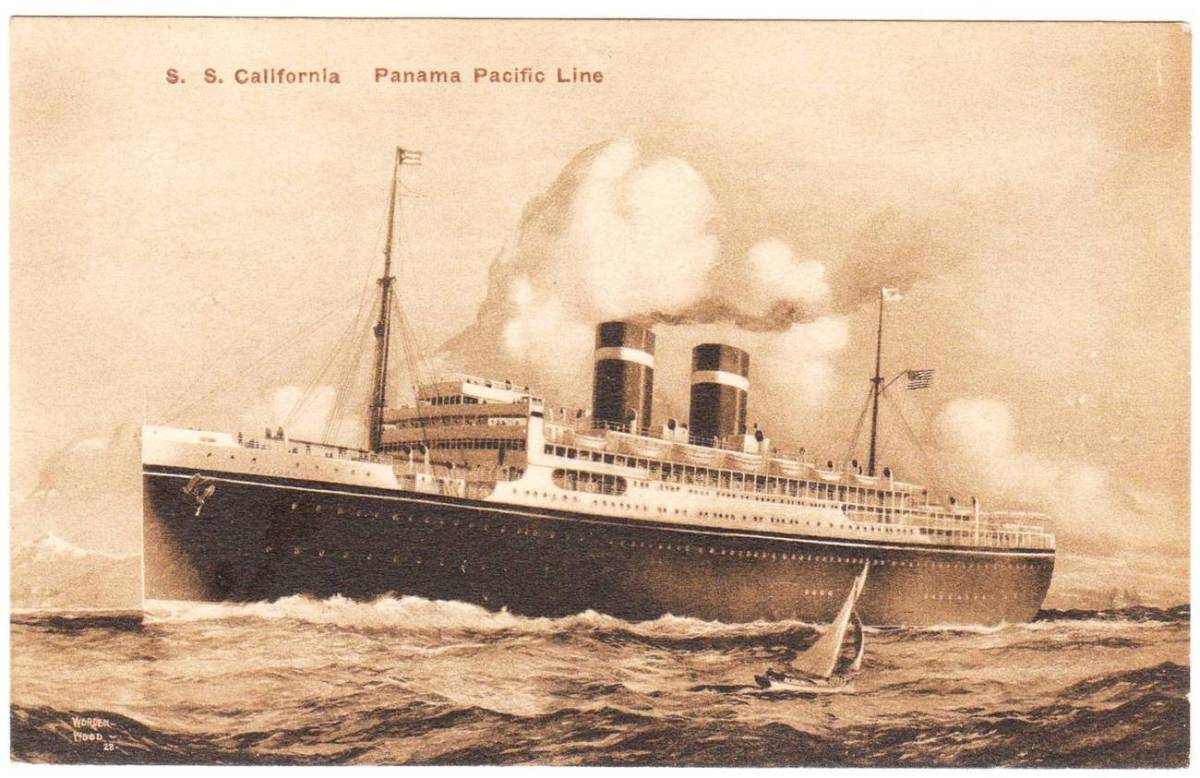
President Woodrow Wilson retaliated, breaking off diplomatic relations with Germany the following day. Three days later, on February 7, a German U-boat fired two torpedoes at the SS California, off the Irish coast. One missed, but the second tore into the port side of the 470-foot, 9,000-ton steamer. California sank in nine minutes, killing 43 of her 205 passengers and crew.

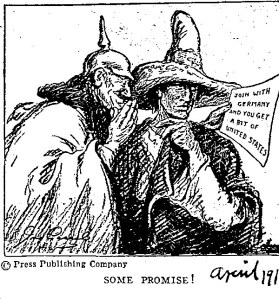
Two weeks later, British Intelligence divulged the Zimmermann note to Edward Bell,zimmerman-note secretary of the United States Embassy in Britain.  This was an overture from German Foreign Minister Arthur Zimmermann to the Mexican government , promising American territories in exchange for a Mexican declaration of war against the US.

In the United States, the political tide was turning. The combination of events was the last straw.  The United States entered WWI about a month later.

At the time, the German claim that Lusitania carried contraband munitions seemed to be supported by survivors’ reports of secondary explosions within the stricken liner’s hull. In 2008, the UK Daily Mail reported that dive teams had reached the wreck, lying at a depth of 300′. Divers reported finding tons of US manufactured Remington .303 ammunition, about 4 million rounds, stored in unrefrigerated cargo holds in cases marked “Cheese”, “Butter”, and “Oysters”.

February 6, 1778 The Road to Yorktown

If there was ever a “window of opportunity”, the siege of Yorktown was it. Fully ½ of Cornwallis’ troops were sick with Malaria during the siege, a disease to which the Americans had built some degree of immunity. Most of the French were newly arrived, so they had yet to go through the disease’ one-month gestation period.

On July 4, 1776, the Continental Congress declared the 13 American Colonies to be a free and independent nation. That same day and an ocean away, a business was formed by Spain and the French House of Bourbon, which would aid in the enterprise.

The Rodrigue Hortalez Trading Company was a ruse, organized by the French playwright, politician and spy, Pierre-Augustin Caron de Beaumarchais. Beaumarchais had obtained one million livres from France and the same amount from Spain in May of 1776, before the first_saluteDeclaration of Independence was even signed. With it were muskets, cannon, gunpowder, bombs, mortars, tents, and enough clothing for 30,000 men, traveling from French ports to the “neutral” Netherlands Antilles island of St. Eustatius.

The delivery could not have been more timely. When General Washington took command on July 3, 1775, the Continental Army had about enough powder for nine rounds per man.
Interestingly, it was little St. Eustatius which first openly recognized American Independence, firing their “First Salute” on November 16 of that year, in recognition of the visit of the American Brig Andrew Doria. Hortalez & Co. was one of four channels of Spanish aid. New Orleans Governor Luis de Unzaga began providing covert aid to the American rebels in 1776, expanding the following year under his successor, Bernardo de Gálvez y Madrid, Count of Gálvez.  It is he who gives Galveston, Texas its name.

Meanwhile, the Spanish port at Havana was opened to the Americans under Most Favored Nation status, and further Spanish aid flowed in from the Gardoqui family trading company in Bilbao, whose Patriarch, Don Diego de Gardoqui, would become Spain’s first Ambassador to the United States. According to the Ambassador, the House of Gardoqui alone supplied the American patriots with 215 bronze cannon, 30,000 muskets, 30,000 bayonets, 51,314 musket balls, 300,000 pounds of powder, 12,868 grenades, 30,000 uniforms, and 4,000 field tents. The Spanish Prime Minister, José Moñino y Redondo, Count of Floridablanca, wrote in March 1777, “the fate of the colonies interests us very much, and we shall do for them everything that circumstances permit”.saratoga-reenactment

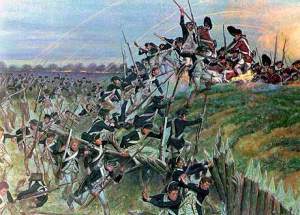
The American Victory at Saratoga in October of 1777 opened the door to more overt aid from the French, thanks largely to the tireless diplomacy of Benjamin Franklin and the Marquis du Lafayette. Representatives of the French and American governments signed the Treaties of Alliance and Amity and Commerce on February 6, 1778.

The “Southern Strategy” of 1778-80 may have cost the British army and their Hessian allies more casualties from disease than from Patriot bullets. About 1,200 Hessian soldiers were killed in combat over the course of the war. By contrast, 6,354 more died of disease, and 5,500 deserted, later settling in America.

In February 1781, General Washington sent Lafayette south at the head of a handpicked force of 1,200 New England and New Jersey troops, and 1,200 French troops.  Washington himself lead an army he described as “not strong enough even to be beaten”.

5,500 French Army troops led by the Comte de Rochambeau landed in Rhode Island that summer, linking up with General Washington’s Patriot army. Meanwhile, Lafayette harassed and shadowed Cornwallis’ much larger force, as it moved up through North Carolina and east toward the Chesapeake Bay.

Cornwallis was looking for a deep water port from which to link up with his ships. It was at this time that Lafayette received help from a slave named James, on the New Kent Armistead Farm. James pretended to serve Cornwallis in Yorktown while sending valuable military information to Lafayette and Washington, who was now moving south through New Jersey with Rochambeau. James would later legally change his name to James Lafayette.

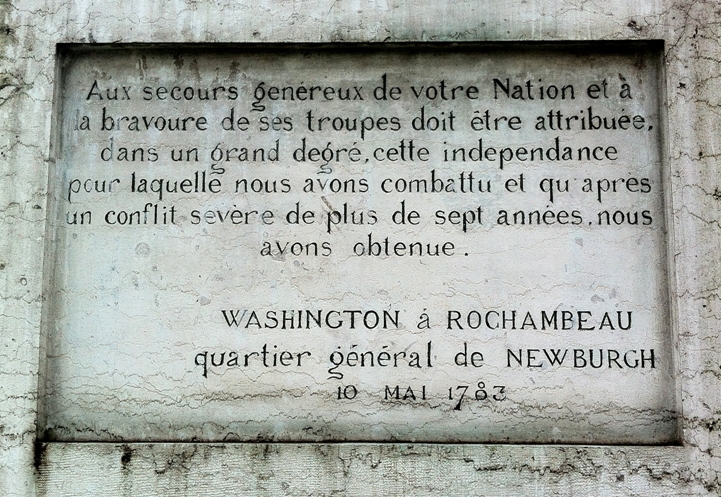
rochambeau-plaque
“To the generous help of your Nation and to the bravery of its troops must be attributed in a great degree to that independence for which we have fought, and which after a severe conflict of more than five years have been obtained”.

Meanwhile, Rear Admiral Francois Joseph Paul, the Comte de Grasse, was in Santo Domingo, meeting with the representative of Spain’s King Carlos III, Francisco Saavedra de Sangronis. De Grasse had planned to leave several warships in Santo Domingo, now capital of the Dominican Republic, to protect the French merchant fleet. Saavedra promised assistance from the Spanish navy, enabling de Grasse to sail north with all of his warships. He needed those ships.  The crucial Naval battle of the Revolution took place on September 5, when de Grasse defeated the British fleet of Rear Admiral Sir Thomas Graves, cutting Cornwallis off from the sea.

French Admiral de Barras arrived from Newport a few days later, carrying vital siege yorktownequipment, while de Grasse himself carried 500,000 silver pesos from Havana to help with the payroll and siege costs at the final Battle of Yorktown.

If there was ever a “window of opportunity”, the siege of Yorktown was it. Fully ½ of Cornwallis’ troops were sick with Malaria during the siege, a disease to which the Americans had built some degree of immunity. Most of the French were newly arrived, so they had yet to go through the disease’ one-month gestation period. The British relief force sailing out of New York Harbor wouldn’t leave until October 19, 1781, the day Cornwallis was forced to surrender.

Over the course of the Revolution, the Patriot cause received aid from sources both sought after and providential. Ben Franklin, John Jay and John Adams would negotiate through two more years and four British governments before they were through. The Treaty of Paris was signed on September 3, 1783, formally ending the American Revolution.

February 5, 1637 The Day the Bubble Burst

Economic forces had combined with irrationality to bid up prices to the point of collapse. This was neither the first nor the last time

gillette-stadiumOn March 24, 2000, the New England Patriots broke ground on their new stadium home in Foxborough, Massachusetts. The internet company CMGI won naming rights, agreeing to pay $114 million over 15 years for the privilege. The 2002 season opened on September 9 in the Patriots’ new home, tickets bearing the name, CMGI Stadium.

Except by that time, the “Dot-Com” bubble had burst. CMGI had ceased to exist.  The stadium itself would open, bearing the name of a razor and shaving cream manufacturer.

Economic forces had combined with irrationality to bid up prices to the point of collapse, but this was neither the first nor the first time.  We saw it in the housing bubble of the 2000s, and the “Bull Market” of the Roaring 20s.viceroy-tulip

The oddest of these speculative bubbles may be the “Tulpenwoede” (tulip madness) gripping Holland in the 17th century.

The first tulip bulbs came from the Ottoman Empire to Vienna in 1554, introduced to Europe by Ogier de Busbecq, ambassador of the Holy Roman Emperor Ferdinand I to the Sultan of Turkey. The tulip was different from anything in Europe, the intense, saturated colors soon turning the flower into a status symbol.

By the 17th century Holland had embarked on a Golden Age. The East Indies trade Keukenhof Gardens Desktop Backgroundproduced single voyage profits of 400% and more, as merchants built grand estates surrounded by flower gardens. The hyacinth enjoyed early popularity, but the plant at the center of it all was the spectacular, magnificent, tulip.

For much of this period, tulip bulbs were primarily of interest to the wealthy. The craze began to catch on with the middle and poorer classes by the mid-1630s.  Soon, increased demand began to drive prices to irrational levels.

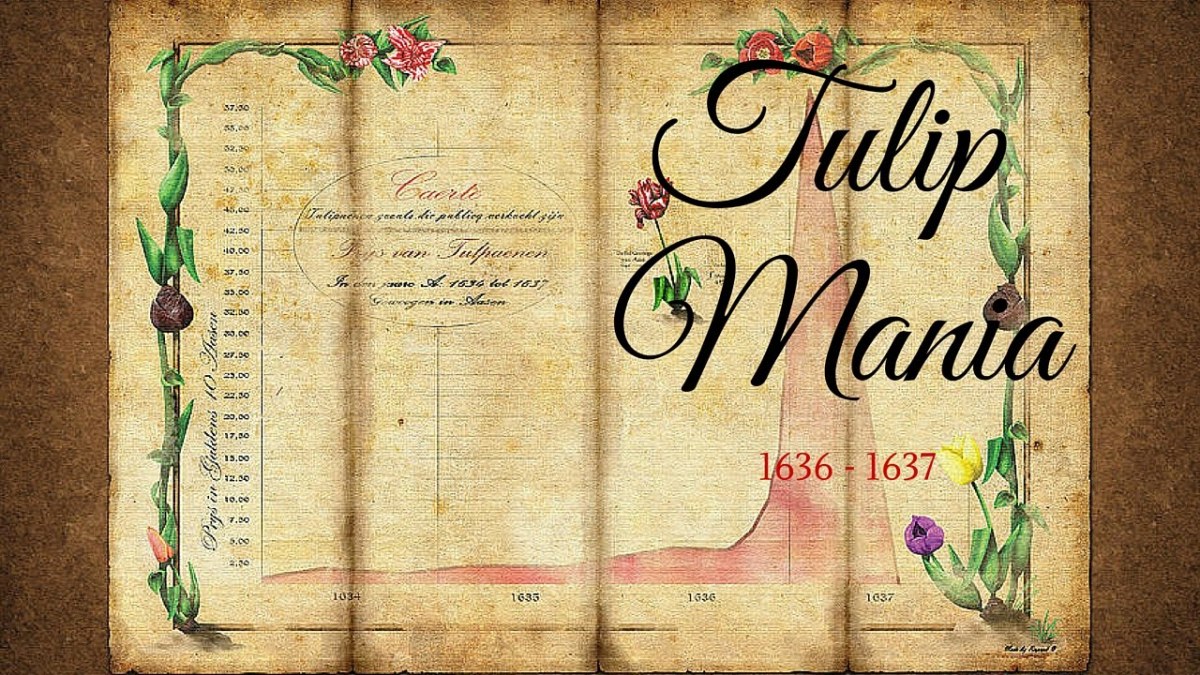
The market soared in late 1636, as prices bid up for bulbs planted to bloom the following spring. People mortgaged their homes and businesses, hoping to buy bulbs for resale at higher prices. At one point, “one single root of the rare species called the Viceroy”, sold for “two lasts of wheat, four lasts of rye, four fat oxen, eight fat swine, twelve fat sheep, two hogsheads of wine, four tuns (barrels) of beer, two tuns of butter, One thousands lbs. of cheese, one complete bed, a suit of clothes, and a silver drinking-cup”. In early 1637, single “Viceroy” bulbs bid between 3,000 and 4,200 guilders, at a time when skilled craftsman earned about 300 guilders a year. At one point, 5 hectares (12 acres) of land were offered for a single Semper Augustus bulb.

“Couleren” bulbs were most commonly traded, single hued flowers of yellow, red or white, followed by the multi-colored “Rosen” and “Violettin”. Rarest and most sought after weretulip_price_index the vivid streaks of yellow or white on the red, brown or purple backgrounds of the “Bizarden” (Bizarres).  Ironically, these were the most sickly specimens, victims of a “Tulip breaking virus” which “broke” petals into two or more hues.
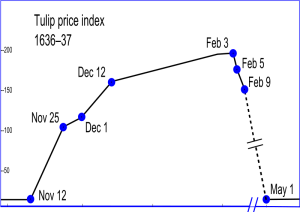
Confidence evaporated in 1637 and the market collapsed. The last recorded market data were reported on February 5, as 98 sales were recorded at wildly varying prices. Those who had taken possession of bulbs found their worth to be a fraction of the prices paid. Others were locked into futures contracts, obliged to pay ruinous sums for comparatively worthless flower bulbs.

Afterward

Today, the Federal National Mortgage Association (FNMA), and Federal Home Loan Mortgage Corporation (FHLMC), are Congressionally authorized hybrids or “GSEs” (government-sponsored enterprises), charged with “providing liquidity and stability to the U.S. housing and mortgage markets”. Better known as “Fannie Mae” and “Freddie Mac”, both entities are privately owned by shareholders and backed by taxpayers.

The US Department of Housing and Urban Development (HUD) was charged with regulating Fannie and Freddie in 1992. Before that, these organizations were required to buy only “prime” mortgages, notes which institutional investors would buy on the open market. Such standards made it too difficult for lower income, higher risk buyers to become homeowners, or so it was believed. Regulators imposed “affordable housing” liar_loansguidelines that year, imposing a 30% quota and raising it to 50% by the end of the Clinton era. By 2007 under President Bush, 55% of all mortgages purchased by the mortgage giants were “sub-prime”.

Banks and brokers were happy to sing along, issuing “NINJA” loans (No Income No Job no Assets) to anyone who asked. “Low-doc” and “no-doc” mortgages called “liar loans” sprouted up everywhere, but gone were the days when your home town bank held your mortgage.  No mortgage originator would ever be left holding the bag, should these loans turn bad.  They sold them to Fannie and Freddie.

Fannie, Freddie and others “bundled” high risk mortgages into increasingly exotic financial instruments called “mortgage backed securities”, selling them off to investors and backing transactions with “credit default swaps” (CDS), a two-party agreement impossible to distinguish between an insurance contract and a bet.

The danger signs were there for those who would see, but Barney Frank said it best inhome-made-of-dollar-on-grass 2003: “I want to roll the dice a little bit more in this situation toward subsidized housing.”

Property values doubled and doubled again. You were always going to make money in real estate. Family members sold to one another over and over at ever increasing prices, with none ever moving out of the house.  Aggregate CDS values reached $62 Trillion in 2008, equivalent to a stack of dollar bills, reaching from Earth to the moon. 18 times.

Then, the bubble burst.  Imagine waking one morning to find your entire pension or mutual fund account, was invested in that stuff.

housing-bubbleThat was the year when gas first hit $4/gallon.  Those living closest to the financial cliff began to fall off, and foreclosures went through the roof.  Highest risk mortgage holders were the first to default, people with $20,000 incomes and multiple investment properties. We all remember 2009.  I myself lost a job of 15 years when my employer went under, briefly making my family part of the “zero percent”.  Some will tell you that we haven’t emerged from the “Great Recession”, to this day.

The old subprime “MyCommunityMortgage” program is dead and buried, but not the geniuses who gave it life. Sub-prime has become a dirty word, so, until recently, regulators pushed “alt” mortgage guidelines. Once, your “income” had to be your own, whether or not you could document it. Now, you could claim other people’s income: your aunt, parents, even a roommate. They won’t be on the note, they have no responsibility to repay.  They don’t even have to live there. As long as you can augment your income enough to qualify.  What could go wrong with that?

Speaking of the Patriots, I hear there’s a game today.  I’ll have to check it out. At this point, I’d rather think about football.

Go Patriots.

February 4, 1936 Undark

Newspapers waxed rhapsodic about cities of the future, streets aglow in the light of radium lamps as smiling restaurant patrons enjoyed luminescent cocktails

In 1922, a bank teller named Grace Fryer began to feel soreness in her jaw. She was 23 at the time and too young to have her teeth falling out, yet that’s what was happening. Her doctor was able to identify the problem, but he couldn’t explain it. Grace Fryer’s jawbones were so honeycombed with holes, they looked like moth eaten fabric.

On December 21, 1898, Marie and Pierre Curie discovered the 88th element of the Periodic Table. This new and radioactive element was Radium, one of the ‘alkaline earth metals’. Curie’s work would make her the first female recipient of a Nobel Prize in 1906, and the only person of either sex to ever win two Nobels, in 1911.

There have been strange fads over the years, from goldfish swallowing to pole sitting, but none stranger than the radium craze of 1904. Newspapers waxed rhapsodic about cities of the future, streets aglow in the light of radium lamps as smiling restaurant patrons enjoyed luminescent cocktails. Serious doctors had early successes killing cancer cells, while quacks and charlatans sold radium creams, drinks and suppositories to cure everything from acne to warts.undark_ad_large

An unseen benefit of the craze, at least for a time, was that demand for radium was vastly greater than actual production. Prices skyrocketed to $84,500 per gram by 1915, equivalent to $1.9 million today. Authorities warned consumers to be on the lookout for fake radium, while the business in fake radium products soared.

When WWI began, it didn’t take long to recognize the advantages of glow in the dark instruments. A number of companies stepped up to fill the need, perhaps none larger than US Radium and their glow-in-the-dark paint, “Undark”.

Hundreds of women worked in their factories, hand painting the stuff on watches, gun sights and other instruments. Radioactivity levels were so small as to be harmless to users of these objects, but not so to the people who made them.

gracefryer
Grace Fryer

The harmful effects of radiation were relatively well understood by 1917, though the information was kept from factory workers. Camel hair brushes tended to splay out with use, supervisors encouraged the women to sharpen their brushes using their lips and tongues. The stuff was odorless and tasteless, some couldn’t resist the fun of painting nails and even teeth with the luminous paint. The only side effects of all that radium, they were told, would be rosy cheeks.

The active ingredient in Undark was a million times more active than Uranium, and company owners and scientists knew it. Company labs were equipped with lead screens, masks and tongs, while literally everything on the factory floor, glowed.

In 1925, doctors began to suspect that Grace Fryer’s condition mayradium-girls be related to her previous employment in US Radium’s Orange, New Jersey factory. By that time she was seriously ill, yet Columbia University “Specialist” Frederick Flynn and a “Colleague” pronounced her to be in “fine health”. It was only later that the two were revealed to be company executives.

These US Radium guys must have been genuine, mustache twirling, villains. In the early 20s, company officials hired physiologist and Harvard Professor Cecil Drinker to report on working conditions. Drinker’s report detailed catastrophically dangerous working conditions, with virtually every factory employee suffering blood or bone conditions.

The report filed with the New Jersey Department of Labor omitted all of it, describing conditions in glowing terms (pun not intended), claiming that “every girl is in perfect condition”.

Reports of illness among other women came flooding in. In a tactic that may sound familiar today, US Radium took to assassinating the character of these women, claiming that their symptoms resulted from syphilis.

phossyjawAttorney Raymond Berry filed suit on Fryer’s behalf in 1927, the lawsuit joined by four other dial painters seeking $250,000 apiece in damages. Soon, the newspapers were calling them “radium girls”. The health of all five plaintiffs was deteriorating rapidly, while one stratagem after another was used to delay proceedings. By their first courtroom appearance in January 1928, none could raise their arm to take the oath. Grace Fryer was altogether toothless by this time, unable to walk, requiring a back brace even to sit up.
Another dial painter, Amelia Maggia, had had to have her jaw removed in the last months of her life. Her cause of death was ruled as syphilis, but her dentist wasn’t buying it. Dr. Joseph Knef placed the jaw on a piece of dental film, the resulting image showing “absurd” levels of radiation.

The radium girls were far too sick to attend the next hearing in April, when the judge ordered a continuation to September, an accommodation to several company witnesses “summering” in Europe.

Walter Lippmann of the New York World called it a “damnable travesty of justice”. “There is no possible excuse for such a delay”, Lippmann wrote. “The women are dying. If ever a case called for prompt adjudication, it is the case of five crippled women who are fighting for a few miserable dollars to ease their last days on earth. This is a heartless proceeding. It is unmanly, unjust and cruel. This is a case which calls not for fine-spun litigation but for simple, quick, direct justice.”waterbury-mother

Delay was a deliberate and sleazy tactic, and it worked. Plaintiffs accepted a settlement of $10,000 apiece, plus legal fees and a $600 annual annuity. The deal was mediated by Judge William Clarke, himself a US Radium stockholder. None of them lived long enough to cash more than one or two annuity checks.

Marie Curie herself was dead by 1934, poisoned by radiation. With a half-life of 1,600 years, her lab notebooks remain too hot to handle, to this day.

Radium was synthesized for the first time two years later, on February 4, 1936.  Presumably, factory workers using the stuff were no longer encouraged to sharpen their brushes, by licking them.

February 3, 1943  Greater Love Hath No Man

With arms linked and leaning against the slanting deck, their voices offered prayers and sang hymns for the dead and for those about to die

usat_dorchesterThe Troop Transport USAT Dorchester sailed out of New York Harbor on January 23, 1943, carrying 902 service members, merchant seamen and civilian workers.  They were headed for the Army Command Base in southern Greenland, part of a six-ship convoy designated SG-19, together with two merchant ships and escorted by the Coast Guard Cutters Comanche, Escanaba and Tampa.
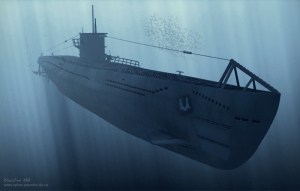
Built in 1926 as a coastal liner, Dorchester was anything but graceful, bouncing and shuddering its way through the rough seas of the North Atlantic.    Several ships had already been sunk by German U-Boats in these waters.  One of the Cutters detected a sub late on February 2, flashing the light signal “we’re being followed”.  Dorchester Captain Hans Danielson ordered his ship on high alert that night.  Men were ordered to sleep in their clothes with their life jackets on.  Many disregarded the order.  It was too hot down there in the holds, and those life jackets were anything but comfortable.

4-chaplains
The Four Chaplains

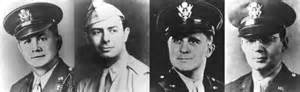
Some of those off-duty tried to sleep that night, while others played cards or threw dice, well into the night.  Nerves were understandably on edge, especially among new recruits, as four Army chaplains passed among them with words of encouragement.  They were the Jewish Rabbi Alexander D. Goode, the Catholic priest John P. Washington, the Dutch Reformed Church Minister Clark V. Poling and the Methodist Minister George L. Fox.

At 12:55am on February 3rd, the German submarine U-223 fired a spread of three torpedoes.  One struck Dorchester amidships, deep below the water line.  A hundred orgerman_submarine_wwii_by_racoonart more were killed in the blast, or in the clouds of steam and ammonia vapor pouring from ruptured boilers.  Suddenly pitched into darkness, untold numbers were trapped below decks.  With boiler power lost, there was no longer enough steam to blow the full 6 whistle signal to abandon ship, while loss of power prevented a radio distress signal.  For whatever reason, there never were any signal flares.

Those who could escape scrambled onto the deck, injured, disoriented, many still in their underwear as they emerged into the sub-arctic cold.

The four chaplains must have been a welcome sight that night, guiding the disoriented and the wounded, offering prayers and words of courage.  They opened a storage locker, and handed out life preservers until there were no more.  “Padre,” said one young soldier, “I’ve lost my life jacket and I can’t swim!”  Witnesses differ as to which of the four it was who gave this man his life jacket, but they all followed suit.  One survivor, John Ladd, said “It was the finest thing I have seen or hope to see this side of heaven.” Rabbi Goode gave his gloves to Petty Officer John Mahoney, saying “Never mind.  I have two pairs”.  It was only later that Mahoney realized, Rabbi Goode intended to stay with the ship.

Dorchester was listing hard to starboard and taking on water fast, with only 20 minutes to live.  Port side lifeboats were inoperable due to the ship’s angle.  Men jumped across the void into those on the starboard side, overcrowding them to the point of capsize.  Only two of fourteen lifeboats launched successfully.

dorchesterPrivate William Bednar found himself floating in 34° water, surrounded by dead bodies and debris. “I could hear men crying, pleading, praying,” he recalled. “I could also hear the chaplains preaching courage. Their voices were the only thing that kept me going.”

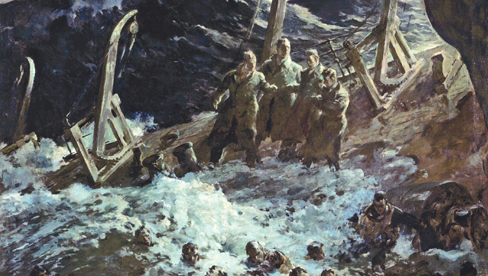
As the ship upended and went down by the bow, survivors floating nearby could see the four chaplains.  With arms linked and leaning against the slanting deck, their voices offered prayers and sang hymns for the dead and for those about to die.

Rushing back to the scene, coast guard cutters found themselves in a sea of bobbing red lights, the water-activated emergency strobe lights of individual life jackets.  Most marked the locations of corpses.  Of the 902 on board, the Coast Guard plucked 230 from the water, alive.

four-chaplainsThe United States Congress attempted to confer the Medal of Honor on the four chaplains for their selfless act of courage, but strict requirements for “heroism under fire” prevented them from doing so.  Congress authorized a one time, posthumous “Chaplain’s Medal for Heroism”, awarded to the next of kin by Secretary of the Army Wilber M. Brucker at Fort Myer, Virginia on January 18, 1961.

John 15:13 says “Greater love hath no man than this, that a man lay down his life for his friends”.  Rabbi Goode did not call out for a Jew when he gave away his only hope for survival, Father Washington did not ask for a Catholic. Neither minister Fox nor Poling asked for a Protestant, they gave their life jackets to the nearest man.

Carl Sandburg once said that “Valor is a gift.  Those having it never know for sure whether they have it until the test comes.”  If I were ever so tested, I hope that I would prove myself half the man, as those four chaplains.