October 27, 1962 Archipov

Anyone alive on or after this day in 1962, probably owes their life to one man. I wonder how many remember his name.

Come join me for a moment, in a thought experiment.  A theater of the mind.

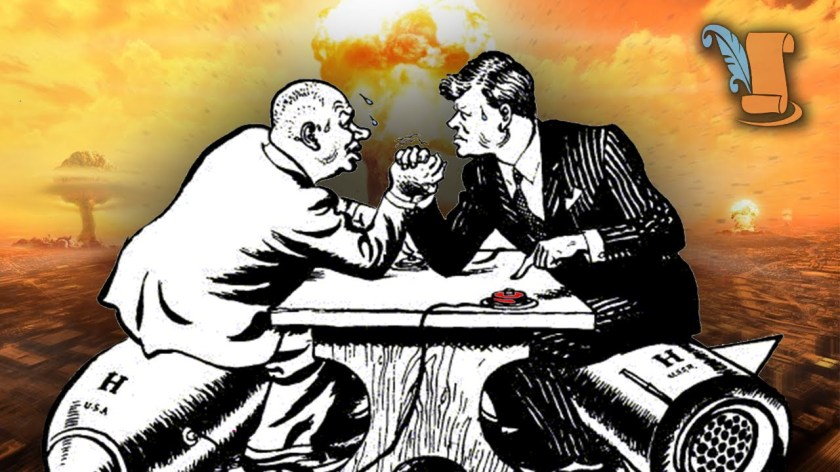
Imagine. Two nuclear superpowers, diametrically opposed, armed to the teeth and each deeply distrustful of the other. We’re talking here, about October 1962. The Cuban Missile Crisis. Now imagine at the height of the standoff, a misunderstanding leads some fool to push the button. The nuclear first strike is met with counterattack and response in a series of ever-escalating retaliatory launches.

You’ve seen enough of human nature. Counterattacks are all but inevitable, right? Like some nightmare shootout at the OK corral, only this one is fought with kiloton-sized weapons. Cities the world over evaporate in fireballs. Survivors are left to deal with a shattered, toxic countryside and nuclear winter, without end.

Are we talking about an extinction event? Possibly. Terrible as it is, it’s not so hard to imagine, is it?

In 1947, members of the Science and Security Board of the Bulletin of Atomic Scientists envisioned a “Doomsday Clock”. A symbolic clock face, dramatizing the threat of global nuclear catastrophe.  Initially set at seven minutes to midnight, the “time” has varied from seventeen minutes to two.

The Cuban Missile Crisis of October 1962 didn’t make it onto the doomsday clock. Those 13 days went by far too quickly to be properly assessed. And yet, the events of 62 years ago brought us closer to extinction than at any time before or since.

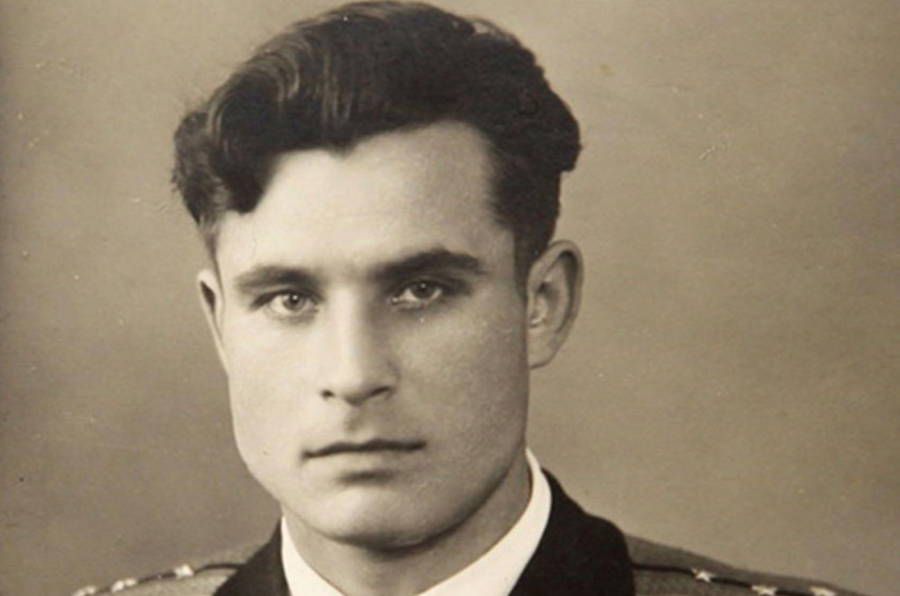
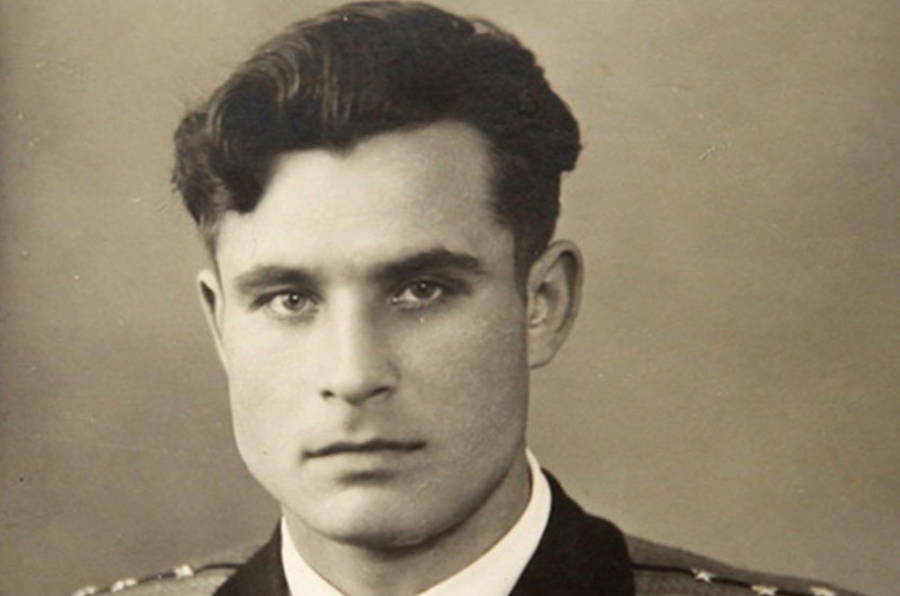
On this day in 1962, an unsuspecting world stood seconds away from the abyss. The fact that we’re here to talk about it came down to one man, Vasili Arkhipov. Many among us have never heard his name. Chances are very good that we can thank him for our lives.

As WW2 gave way to the nuclear age, Cold War military planners adopted a policy of “Deterrence”. “Mutually Assured Destruction” (MAD). Soviet nuclear facilities proliferated across the “Eastern Bloc”, while US nuclear weapons dispersed across the NATO alliance. By 1961 some 500 US nuclear warheads were installed in Europe, from West Germany to Turkey, Italy to Great Britain.

Judging President Kennedy weak and ineffective, communist leaders made their move in 1962, signing a secret arms agreement in July. Medium-range ballistic missiles with a range of 2,000 miles were headed to the Caribbean basin.

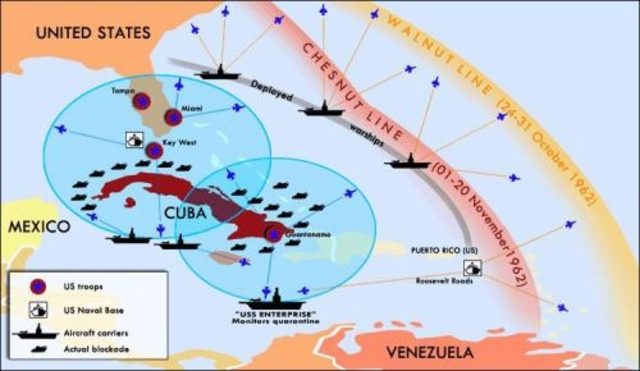
By mid- October, US reconnaissance aircraft revealed Soviet ballistic nuclear missile sites under construction Cuba. 90 miles from American shores. President John F. Kennedy warned of the “gravest consequences”, ordering a blockade of the island nation. Relations turned to ice as Soviet military vessels joined the standoff.

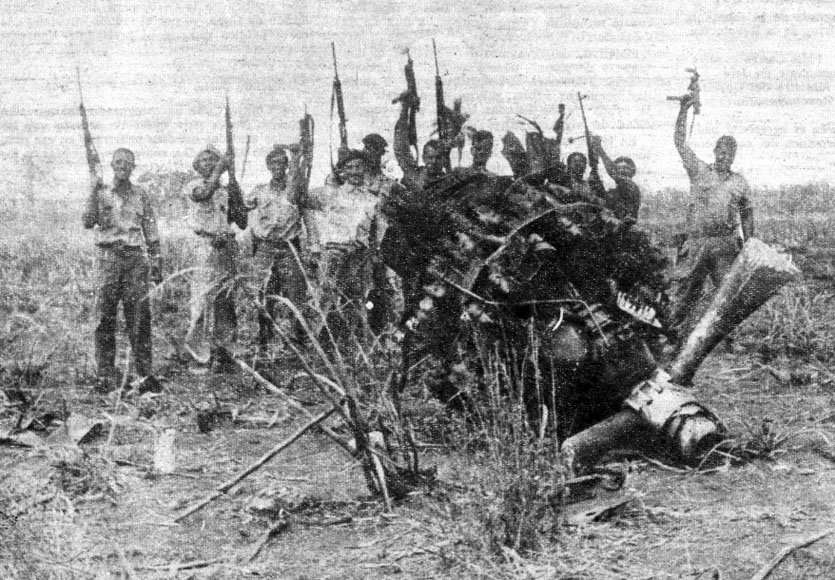
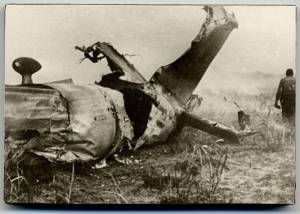
Tensions dialed up to 11 on October 27, when USAF Major Rudolph Anderson’s U-2 reconnaissance aircraft was shot down over the village of Veguitas. His body still stapped into his ejection seat.

Wreckage of Major Rudolf Anderson Jr.’s U2 at the Museo del Aire, Havana, Cuba H/T theaviationgeekclub.com

The US Navy practiced a submarine attack protocol at that time, called “hunt to exhaustion”. Anatoly Andreev described what it was like to be on the receiving end:

“For the last four days, they didn’t even let us come up to the periscope depth … My head is bursting from the stuffy air. … Today three sailors fainted from overheating again … The regeneration of air works poorly, the carbon dioxide content [is] rising, and the electric power reserves are dropping. Those who are free from their shifts, are sitting immobile, staring at one spot. … Temperature in the sections is above 50 [122ºF].”

I’m not sure I could think straight under conditions like that.

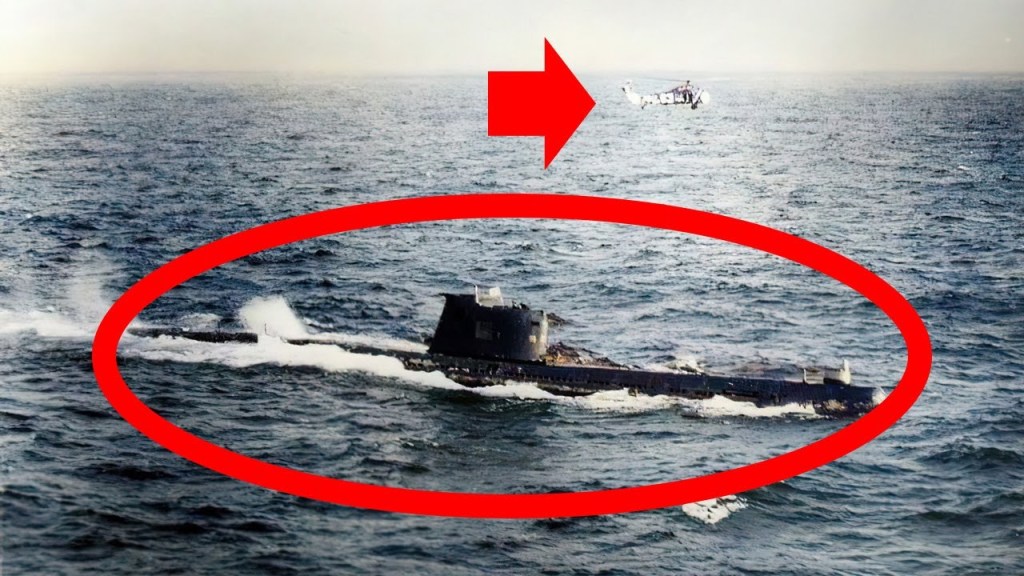
On the 27th, US Navy destroyers began to drop depth charges. This was not a lethal attack, intending only to bring the sub to the surface. Deep under the water, captain and crew had no way of knowing that. B-59 had not been in contact with Moscow for several days. Now depth charges were exploding to the left and right. Captain Valentin Savitsky made his decision. Convinced that war had begun, the time had come for the “special weapon”. “We’re gonna blast them now!,” he reportedly said. “We will die, but we will sink them all – we will not become the shame of the fleet.” Political officer Ivan Maslennikov concurred. Send it.

On most nuclear-armed Soviet submarines, two signatures were all that was needed. With Chief of (submarine fleet) Staff officer Vasili Archipov on board, the decision required approval by all three senior officers. To Archipov, this didn’t feel like a “real” attack. What if they’re only trying to get us to the surface?

Archipov said no.
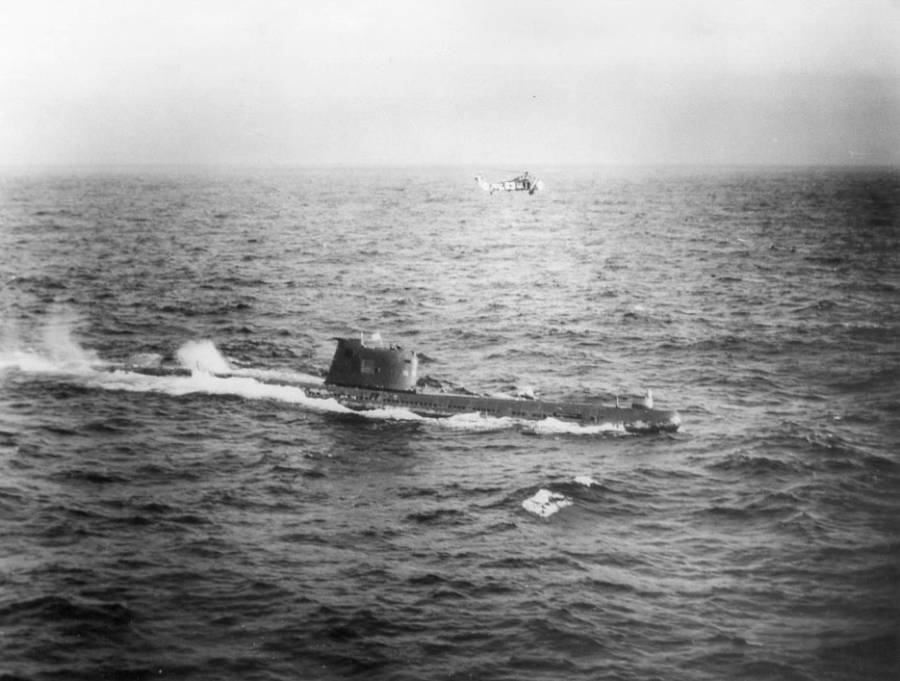
Perhaps it was his role in averting disaster aboard the nuclear-powered submarine K-19, the year before. Maybe it was his calm, unflappable demeanor when Captain Savitsky had clearly “lost his temper”. Somehow, Archipov was able to keep his head together under unimaginable circumstances and convince the other two. B-59 came to the surface to learn that, no. World War III had not begun after all.

The submarine went quietly on its way. Kruschev announced the withdrawal of Soviet missiles the following day. The Cuban Missile Crisis was over.
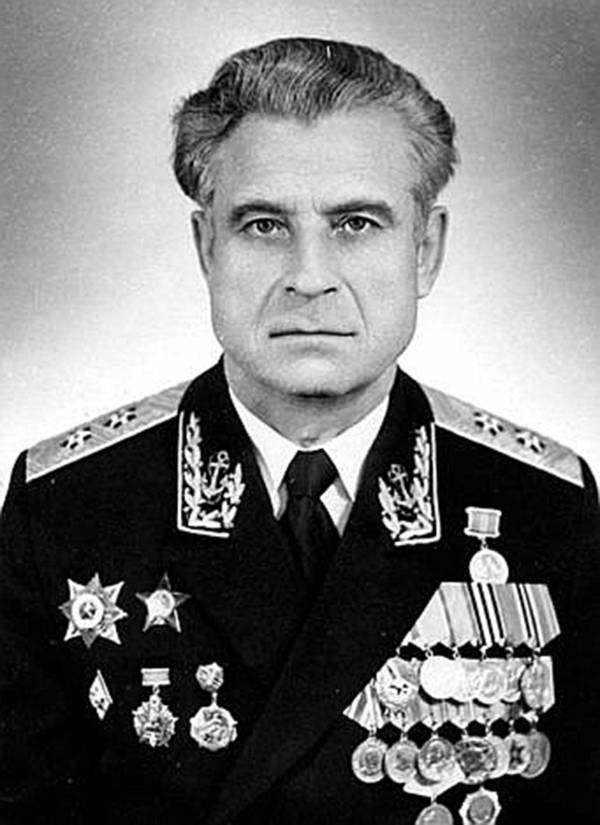
Vasily Aleksandrovich Arkhipov

These events wouldn’t come to light for another 40 years.

B-59 crewmembers were criticized on returning to the Soviet Union. One admiral told them “It would have been better if you’d gone down with your ship.”

Vasily Aleksandrovich Arkhipov retired from the submarine service in 1988 and died, ten years later. Cause of death was kidney cancer, likely the result of radiation exposure sustained during the K-19 incident, back in 1961.

Lieutenant Vadim Orlov was an intelligence officer back in 1962, onboard the B-59. In 2002, then Commander Orlov (retired) gave Archipov full credit for averting nuclear war. Former U.S. Defense Secretary Robert McNamara said in 2002 “We came very, very close, closer than we knew at the time.” Historian Arthur Schlesinger Jr. was an advisor to President Kennedy. “This was not only the most dangerous moment of the Cold War”, he said. “It was the most dangerous moment in human history.”

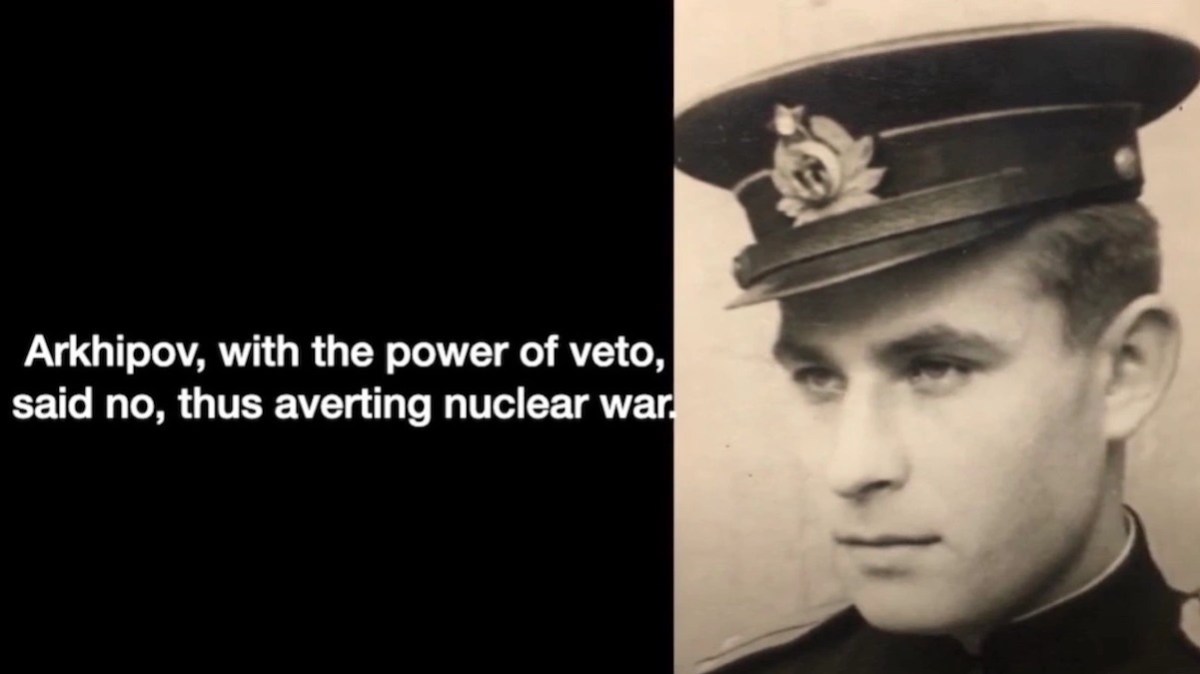
October 27, 1962  The Man who Saved the World

The outside world would not learn for decades how close it had come to the abyss.

Cold War.  The English writer George Orwell coined the term in 1945, describing “two or three monstrous super-states, each possessed of a weapon by which millions of people can be wiped out in a few seconds.”

Two diametrically opposite governing philosophies, each capable of exterminating the other by the push of a button.

Never in the history of the Cold War was the world so close to nuclear annihilation than the Cuban Missile Crisis of October 1962. Speaking to staffer Arthur Shlesinger, President John F. Kennedy called those 13 days “the most dangerous moment in human history.”
On no single date was the world so close to the precipice as October 27.

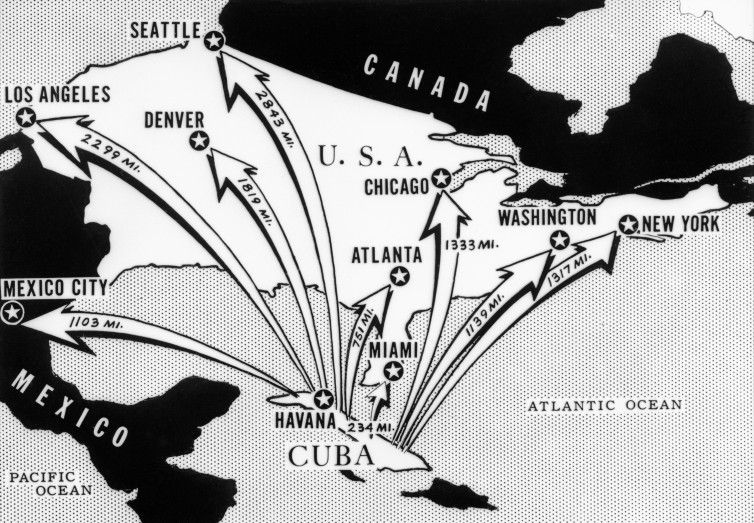
This newspaper map from the time of the Cuban Missile Crisis shows the distances from Cuba of various cities on the North American Continent. — Image by © Bettmann/CORBIS

On October 14, ultra-high altitude Lockheed U–2R reconnaissance aircraft photographs revealed the presence of medium and intermediate range ballistic nuclear missile sites under construction in Cuba. Located only 90 miles from the US mainland, such a facility was capable of delivering a nuclear payload anywhere in the eastern United States.

President Kennedy warned of the “gravest consequences” resulting from the introduction of Soviet offensive weapons in Cuba, while Foreign Minister Andrei Gromyko insisted that Soviet aid was purely defensive. U-2 photographs gave lie to Gromyko’s protestations.  Images taken on October  17 revealed the presence of 16-32 missiles.

The President warned “It shall be the policy of this nation to regard any nuclear missile launched from Cuba against any nation in the Western Hemisphere as an attack by the Soviet Union on the United States, requiring a full retaliatory response upon the Soviet Union.”  There was no mistaking American intent.
Kruschev replied, “I hope that the United States Government will display wisdom and renounce the actions pursued by you, which may lead to catastrophic consequences for world peace…”

Soviet nuclear submarines moved in response to the quarantine as Cuban waters became the scene of a tense naval standoff.

U-2 photographs of the 25th & 26th showed accelerated construction on the island, with several silos approaching operational readiness.  US air forces were placed at DEFCON 2.  War involving Strategic Air Command, was now “imminent”.

Cuban Missile Crisis, contest

Cuban President Fidel Castro publicly urged a Soviet nuclear first strike.

On day twelve of the standoff, October 27, an American U-2 was shot out of the sky by a Soviet supplied surface-to-air missile, killing pilot Major Rudolph Anderson Jr.

Meanwhile on the ocean below, events were spinning out of control.

Soviet submarine B-59 was just outside the American blockade perimeter, with orders to monitor the situation. Vasili Arkhipov was 34 at the time, one of three officers in command of the nuclear armed sub.

Vasili Aleksandrovich Arkhipov

Diving deep to avoid detection, B59 was unable to communicate with Moscow when she came under attack from American surface vessels.

The depth charges being used were “non-lethal”, intended to force the submarine to the surface, but perception is reality, right? Isolated from the outside world with orders to launch a first strike in the event of war, B-59 found herself under attack.

Imagine yourself in this situation. B59 sailor Anatoly Andreev described the scene in his journal:

“For the last four days, they didn’t even let us come up to the periscope depth … My head is bursting from the stuffy air. … Today three sailors fainted from overheating again … The regeneration of air works poorly, the carbon dioxide content [is] rising, and the electric power reserves are dropping. Those who are free from their shifts, are sitting immobile, staring at one spot. … Temperature in the sections is above 50 [122ºF].”

This was the atmosphere onboard the submarine on October 27, as B59 shook with every depth charge. Captain Valentin Savitsky ordered the submarine’s nuclear weapon armed, a missile capable of striking deep into the American heartland. The missile was armed with a payload equal to the bomb dropped on Hiroshima.

“We’re gonna blast them now” Savitsky reportedly said, “We will die, but we will sink them all – we will not become the shame of the fleet.”

Cuban blockade, October 1962

Second captain Ivan Maslennikov agreed with Savitsky and approved the attack.

According to Soviet doctrine, such a decision needed to be unanimous among the three commanders. Such a strike was as sure as night follows day to provoke a counter attack, followed by retaliatory strikes. Deep under the Caribbean surface, Vasili Aleksandrovich Arkhipov was all that stood in the way of nuclear war.

How would you respond to such a situation?

Perhaps it was the K-19 incident from 2 years earlier. In July 1961, Arkhipov was executive officer of the nuclear submarine K-19, on patrol south of Greenland. Developing a severe leak in her cooling system, the submarine’s 7-man engineering section frantically labored to jury-rig a secondary cooling system, exposing themselves to hours of intense radiation. The effort was a success, but all seven men died inside of a month. 15 more died from the effects of radiation over the following two years. Every sailor onboard K-19 was destined to die of radiation poisoning including Arkhipov himself, but for now, the man carried the moral authority of a Hero of the Soviet state.

Be that as it may, Arkhipov persuaded the other two that the American attack was intended not to destroy them, but to bring them to the surface. B59 came to the surface restoring communications with the outside world. World War 3 had not begun, after all.

The Cuban Missile crisis effectively came to a close the following day, B59 going quietly on her way. The outside world would not learn for decades how close it had come to the abyss.

Vasili Arkhipov died in obscurity 1998. Four years later, Director of the U.S. National Security Archive Thomas S. Blanton described him as “the man who saved the world”.

When governments make war, it is the everyday men (and these days women), who pay the price. Vasili Arkhipov was a Russian patriot, doing his duty for his nation. In so doing, the man made for us a very different world from what could have been. Let it be said, then, that personal courage in the line of fire is worthy of our respect. No matter on which side such a man finds himself.

February 22, 1985 Operation Beluga

A few of these creatures are likely out there still. Thanks to the efforts of a few subsistence hunters and those brave enough to set out for this wildest and most unwelcoming of places. A real-life “free Willy” story.

In 1984, the Bulletin of the Atomic Scientists moved the “doomsday clock” to three minutes before midnight, noting a turn for the worse in cold war tensions. “U.S.-Soviet relations”, they noted, “reach their iciest point in decades.”

Heedless of the world of humans, pods of Beluga Whales converged on the Chukchi Sea in pursuit of great schools of cod.

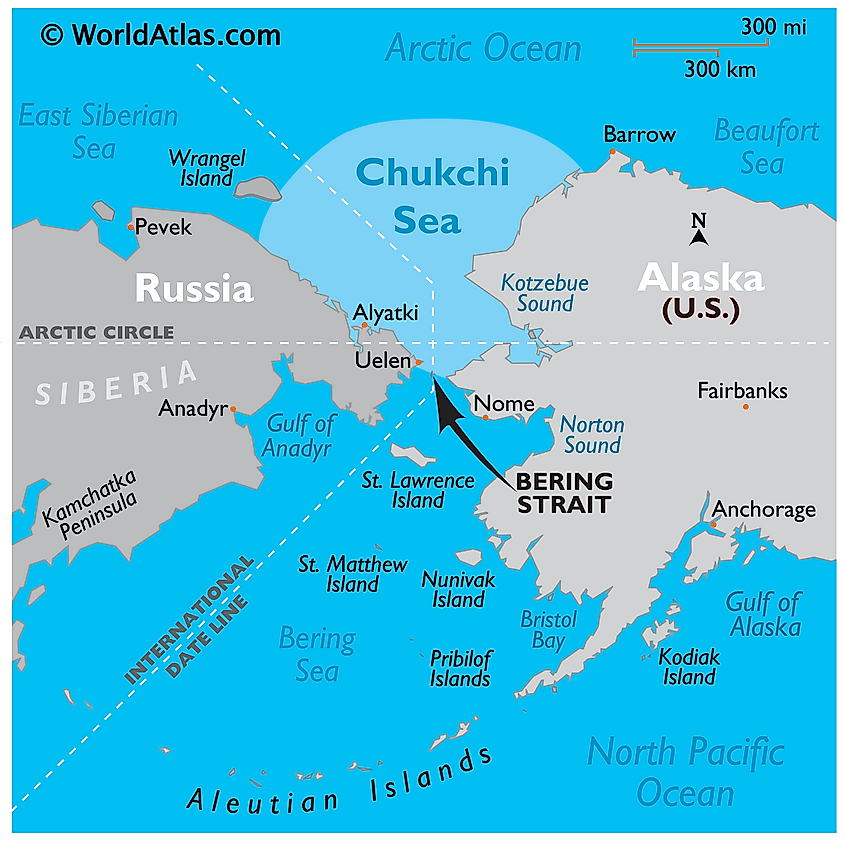
With a genus name stemming from the Russian word for “white”, Belugas populate the circumpolar region at the top of the world, from Greenland to Alaska.

Specially adapted to life in the far north, the “dolphin of the Arctic” has no dorsal fin, an adaptation helpful for swimming under ice.

Belugas moult, like snakes, scraping themselves along bergs and rocks to shed thick winter skins as water temperatures rise and fall.

Smallest of all cetaceans, the adult male ranges from 18 to 20 feet in length and weighs in around 3,500 pounds. Their lips curled in a perpetual grin, these “canaries of the sea” live in small groups called “pods” but can gather in the thousands in pursuit of food. Such as cod.

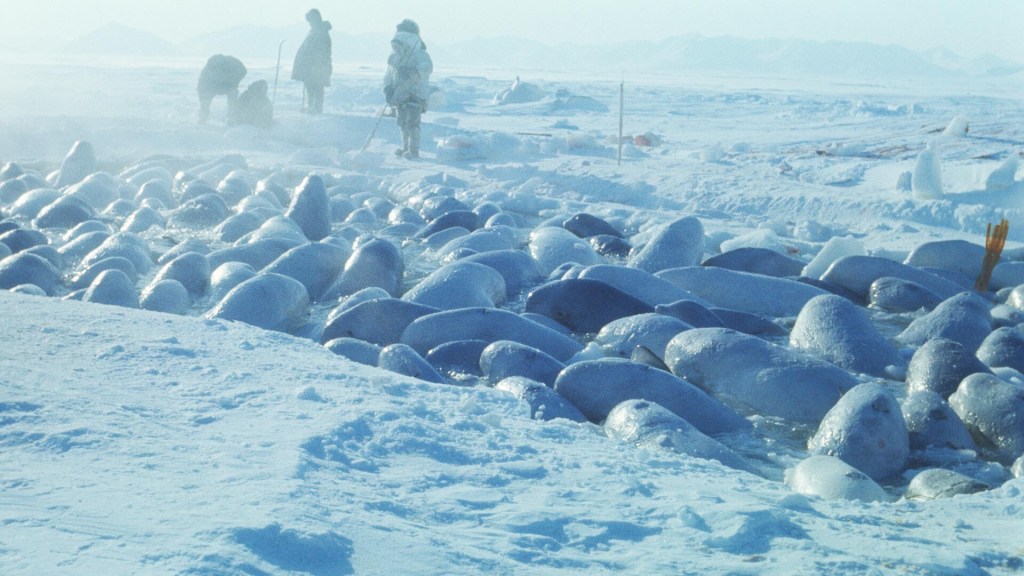
Which brings us back to 1984. A great pod gathered that December, in pursuit of enormous schools of cod. Meanwhile, on the surface, bitter cold combined with howling winds to drive great mounds of sea ice into packs up to 12 feet thick. 

The White Whale will use the fatty protruberance or “melon” on top of his head to break air holes through as much as 4 to 5 inches of sea ice.  With top speeds around 17mph, they’re able to hold their breath for 20 minutes, but sooner or later, these creatures need to breathe.

As conditions worsened throughout the Chukchi Sea, the air breathing mammals found themselves trapped with tiny air holes with 17 miles to go to open water.

Hundreds gathered at shrinking air holes while untold hundreds more drowned or starved, unable to make it beyond that interminable ice pack.

Subsistence hunters were at first overjoyed to find such abundance of meat, but no one knows better than they. There is no future in the destruction of a species.

The call went out for help as groups of all sizes did what they could to keep breathing holes from closing.  Helicopters arrived from overhead to drop frozen fish.

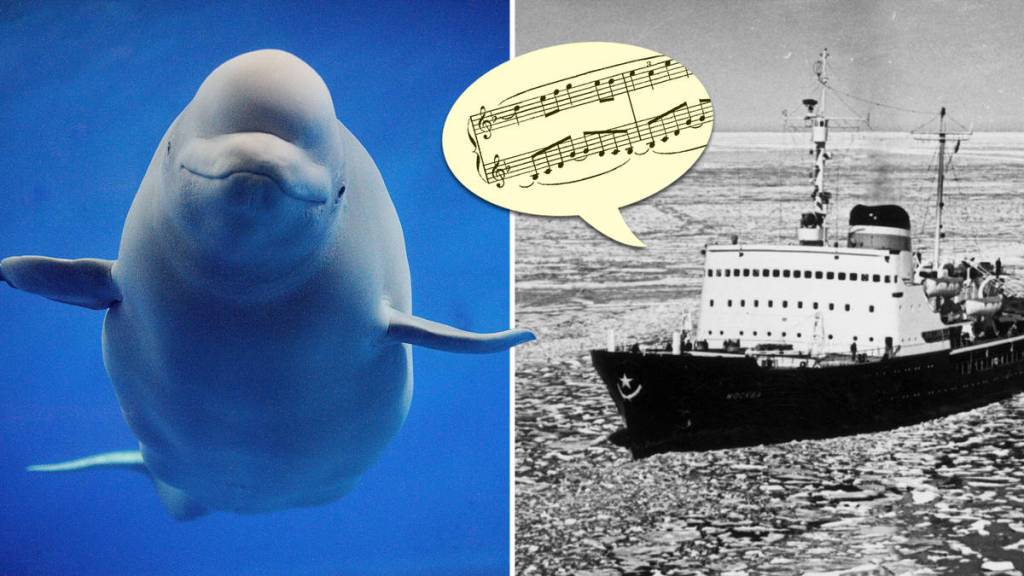
Normally charged with clearing routes through the Bering Strait, the great ice breaker Moskva was summoned to the scene.

With 15 miles of pack ice and steadily worsening conditions, commanding officer Captain Kovalenko twice considered turning back.  Snowmobiles and special spotter planes guiding her in, Moskva lumbered on toward rescue, arriving at last on February 22.

To no avail. Squealing and cowering in terrified circles, the creatures took four days even to acclimate to the presence of that strange and noisy vessel.

At last, the odd procession began to move. Let Captain Kovalenko describe the scene: ”Our tactic is this: We back up, then advance again into the ice, make a passage, and wait. We repeat this several times. The belugas start to ‘understand’ our intentions, and follow the icebreaker. Thus we move kilometer by kilometer.”

Someone recalled that Belugas, like all whales, communicate through sound. Captive animals have even shown themselves responsive to music.

So it was across her loudspeakers that music began to play.  Rock & Roll, Russian folk tunes, marshall music, but the whales were especially responsive to classical.

Shostakovich and Rachmaninov blaring across the still arctic air, slowly, the creatures began to follow. The New York Times reports, “In time the whales became fully accustomed to the ship.”

“They began coming up to the ship themselves,” Izvestia wrote. ”They hemmed it about from all sides. They were happy as children, jumping, spreading out all over the ice field.”

This most unusual of all journeys at last came to an end in late February, in open water.

Far away in distant capitals, politicians held the nuclear gun to all of our heads as the cold war dragged on. Meanwhile under some distant and frigid sea, these beautiful animals were free to live on. 

With lifespans known to run 35-50 years in the wild, chances are some of these very creatures are out there still.

November 7, 1957 Nuke the Moon

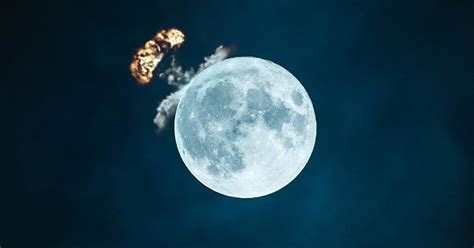
Out of the mess of the Space race emerged an idea destined to go down in the Hare-Brain Hall of fame, if there is ever to be such a place. A show of force sufficient to boost domestic morale while showing the Russkies, we mean Business. It was the top-secret “Project A119”, also known as A Study of Lunar Research Flights. We were going to detonate a nuclear weapon. On the moon.

As World War II drew to a close in 1945, there arose a different sort of conflict, a contest of wills, between the two remaining Great Powers of the world. The “Cold War” pitted the free market economy and constitutional republicanism of the United States against the top-down, authoritarian governing and economic models of the Soviet Union. The stakes could not have been higher, as each side sought to demonstrate its own technological and military superiority and, by implication, the dominance of its own economic and political system.

American nuclear preeminence lasted but four short years, coming to an end with the first successful Soviet atomic weapon test code named “First Lightning”, carried out on August 29, 1949. Mutual fear and distrust fueled the Soviet-American “arms race”, a buildup of nuclear stockpiles beyond any rational purpose. A generation grew up under the shadow of nuclear annihilation.  A single mistake, misunderstanding or one fool in the wrong place at the wrong time, initiating a sequence and bringing about the extinction of life on this planet.

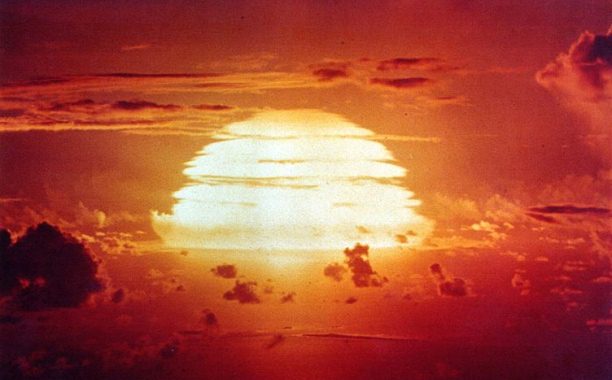
nuclear

The arms race acquired the dimensions of a Space Raceon July 29, 1956, when the United States announced its intention to launch an artificial satellite, into earth orbit. Two days later, the Soviet Union announced that it aimed to do the same.

The early Space Race period was a time of serial humiliation for the American side, as the Soviet Union launched the first Inter-Continental Ballistic Missile (ICBM) on August 21, 1957, and the first artificial satellite “Sputnik 1” on October 4.

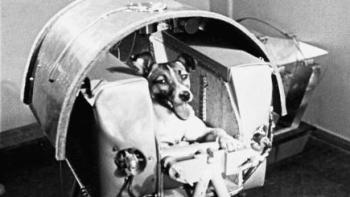
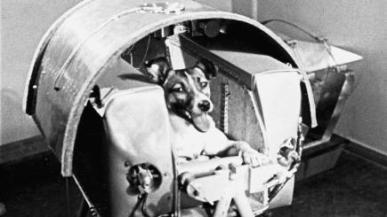
Laika and capsule

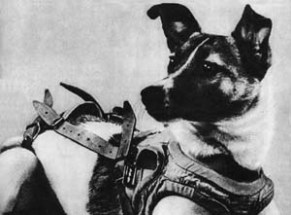
The first living creature to enter space was the dog Laika“, launched aboard the spacecraft Sputnik 2 on November 3 and labeled by the more smartass specimens among the American commentariat, as “Muttnik”.

Soviet propaganda proclaimed “the first traveler in the cosmos”, replete with heroic images printed on posters, stamps and matchbook covers. The American news media could do little but focus on the politics of the launch, as animal lovers the world over questioned the ethics of sending a dog to certain death, in space.

On the American side, the giant Vanguard rocket was scheduled to launch a grapefruit-sized test satellite into earth orbit that September, but the program was plagued by one delay after another. The December 6launch was a comprehensive disaster, the rocket lifting all of four-feet from the pad before crashing to the ground in a sheet of flame, the satellite rolling free where it continued to beep, only feet from the burning wreck.

The second Vanguard launch was nearly as bad, exploding in flames only seconds after launch.  Chortling Soviet leaders were beside themselves with joy, stamping the twin disasters as “Kaputnik”, and “Flopnik”.

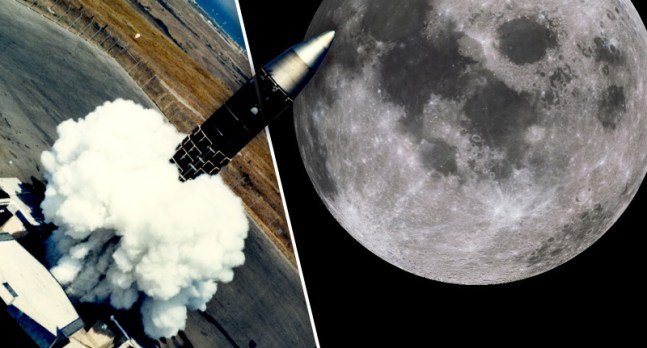
Out of this mess emerged an idea destined to go down in the Hare-Brain Hall of fame, if there is ever to be such a place. A show of force sufficient to boost domestic morale, while showing the Russkies, we mean business. It was the top-secret “Project A119”, also known as A Study of Lunar Research Flights.

We were going to detonate a nuclear weapon.  On the moon.

In 1957, newspapers reported a rumor. The Soviet Union planned a nuclear test explosion on the moon, timed to coincide with the lunar eclipse of November 7. A celebration of the anniversary of the Glorious October Revolution.

Edward Teller himself, the ‘Father of the H-Bomb” is said to have proposed such an idea as early as February, to test the effects of the explosion in a vacuum, and conditions of zero gravity.

644962_v1

Today, we take for granted the massively complex mathematics, involved in hitting an object like the moon. In 1957 there was a very real possibility of missing the thing and boomerang effect, returning the bomb from whence it came.

While the information is still classified, the project was revealed in 2000 by former NASA executive Leonard Reiffel, who said he was asked to “fast track” the program in 1958, by senior Air Force officials. A young Carl Sagan was all for the idea, believing at the time that living microbes may inhabit the moon, and a nuclear explosion may help in detecting such organisms.

Reiffel commented in a Guardian newspaper interview:  “It was clear the main aim of the proposed detonation was a PR exercise and a show of one-upmanship. The Air Force wanted a mushroom cloud so large it would be visible on earth. The US was lagging behind in the space race.” The now-retired NASA executive went on to explain that “The explosion would obviously be best on the dark side of the moon and the theory was that if the bomb exploded on the edge of the moon, the mushroom cloud would be illuminated by the sun.”

The Air Force canceled the A119 program in 1959, apparently out of concern that a ‘militarization of space’ would create public backlash, and that nuclear fallout may hamper future research and even colonization efforts, on the moon.

moon-nuke_wikimedia-commons_fb

Previously secret reports revealed in 2010 that Soviet leaders had indeed contemplated such a project, part of a multi-part program code named “E”.  Project E-1 involved reaching the moon, while E-2 and E-3 focused on sending a probe around the far side of the celestial body. The final stage, project E-4, involved a nuclear strike on the moon as a “display of force”.

Construction plans for the aforementioned Hare-Brain Hall of Fame have yet to be announced but, it already appears the place may need another wing.

IS00561-What-If-We-Detonated-a-Nuke-on-the-Moon-thumbnail-image-16X9.jpg

July 28, 1957 Broken Arrow

In cold war military parlance, a “Nucflash” is the accidental detonation of an atomic weapon carrying with it, the potential for nuclear war. A “Broken Arrow” refers to a similar incident, absent the potential for war.

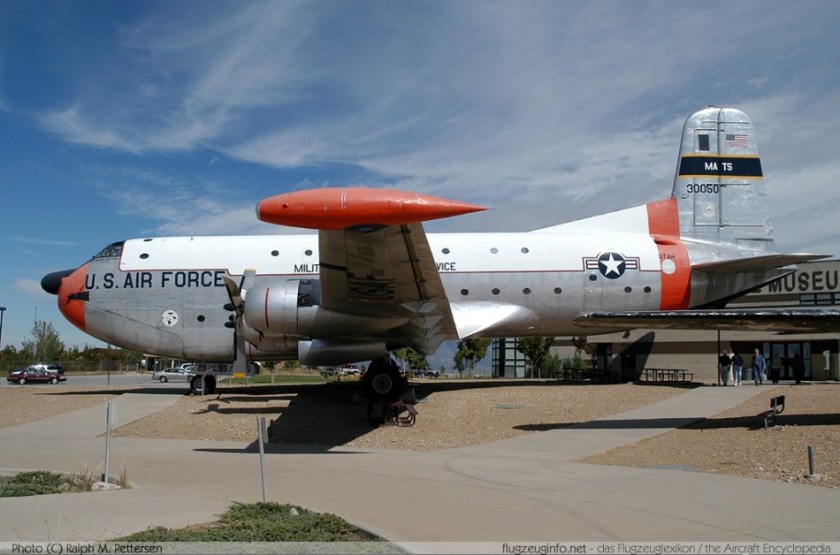
At one time, the C-124 was the world’s largest military transport aircraft.  Weighing in at 175,000lbs with a wingspan of 175-feet, four 3,500 horsepower Pratt & Whitney propeller engines drive the air frame along at a stately cruising speed of 246 mph.  Manufacturer Douglas Aircraft called the aircraft “Globemaster”.  Airmen called the plane “Old Shaky”.

c124c_pettersen

The Air Force C-124 Globemaster transport left its base in Delaware on July 28, 1957, on a routine flight to Europe. On board were a crew of seven, three nuclear bombs, and one nuclear core. The flight would routinely have taken 10-12 hours.  This trip was destined to be anything but routine.

Mk6

Exactly what went wrong remains a mystery, due to the sensitive nature of the cargo. Two engines had to be shut down shortly into the mission, and the aircraft turned back.  The nearest suitable airfield was the Naval Air Station in Atlantic City, but that was too far. Even at maximum RPMs, the best the remaining two engines could do was slow the massive aircraft’s descent into the sea.

sans_titre11

An emergency landing on open ocean is not an option with such a large aircraft.  It would have broken up on impact with the probable loss of all hands.   Descending rapidly, the crew would have jettisoned everything they could lay hands on, to reduce weight.  Non-essential equipment would have gone first, then excess fuel, but it wasn’t enough.  With only 2,500ft and losing altitude, there was no choice left but to jettison those atomic bombs.

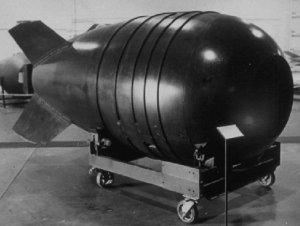
At 3,000 pounds apiece, two of the three bombs were enough to do the job, and the C-124 made it safely to Atlantic City.  What became of those two atomic bombs remains a mystery.  Most likely, they lie at the bottom of the ocean, 100 miles off the Jersey shore.

Image2

The United States Department of Defense has a term for accidents involving nuclear weapons, warheads or components, which do not involve the immediate risk of nuclear war.  Such incidents are called “Broken Arrows”.

Broken Arrows include accidental or unexplained nuclear or non-nuclear detonation of an atomic weapon, the loss of such a weapon with or without its carrying vehicle, and the release of nuclear radiation resulting in public hazard, whether actual or potential.

The US Defense Department has reported 32 Broken Arrow incidents, since 1950.  To date, six nuclear weapons remain lost, and never recovered.

If you’re interested, a handy “Short History of Nuclear Folly” may be found HERE, including details of each incident along with a handy map. It all makes for some mighty comforting bedtime reading.

April 19, 1961 Bay of Pigs

Castro proclaimed his administration to be an example of “direct democracy”, and dismissed the need for elections.  The Cuban people could assemble demonstrations and express their democratic will to him personally, he said.  Who needs elections?

Cuban strongman Fulgencio Batista seized power in March 1952, proclaiming himself president and labeling his new governing philosophy “disciplined democracy”. While Batista enjoyed limited popular support when he canceled presidential elections, many Cubans came to see the administration as a one-man dictatorship.  Opponents of the regime formed several anti-Batista groups, taking to armed rebellion to oust the government. The best known of these groups was the “26th of July Movement”, founded by the lawyer Fidel Castro and operated out of base camps in the Sierra Maestra mountains.

bay-of-pigs_timeline

Batista’s repressive tactics led to widespread disapproval by the late 1950s, culminating in his resignation on December 31, 1958.  By February 1959, Fidel Castro had installed himself as Prime Minister.

Castro proclaimed his administration to be an example of “direct democracy”, and dismissed the need for elections.  The Cuban people could assemble demonstrations and express their democratic will to him personally, he said.  Who needs elections?

“Trials” were carried out across the country, some in sports stadia in front of thousands of spectators.  Hundreds of supporters of the former regime were executed.  When Castro didn’t like the outcome, he would personally order a retrial.

American influence had once been widespread on the island, but that went away as the Castro regime adopted an increasingly leftist posture. “Until Castro”, said Earl Smith, former American Ambassador to Cuba, “the U.S. was so overwhelmingly influential in Cuba that the American ambassador was the second most important man, sometimes even more important than the Cuban president.”

Bay_of_Pigs_1

When US authorities objected to being required to process oil purchased from the Soviet Union, Castro nationalized US controlled oil refineries run by Esso and Standard Oil as well as Anglo-Dutch Shell.  Tit-for-tat retaliations resulted in the expropriation of American owned banks and sugar refineries. By October 1960 the Castro regime had “nationalized” a total of 166 such businesses including Coca Cola, and Sears & Roebuck.

Secretary of State Christian Herter publicly stated that Castro was “following faithfully the Bolshevik pattern” by instituting a single-party political system, taking control of trade unions, suppressing civil liberties and sharply limiting both freedom of speech and freedom of the press. Castro fired back, criticizing the way blacks and the working classes were treated in New York City, attacking US media as “controlled by big business” and claiming that the American poor were living “in the bowels of the imperialist monster”.

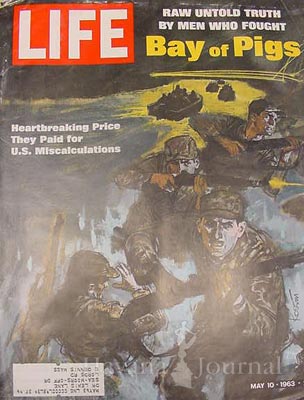
A “secret” operation was conceived and initiated under the Eisenhower administration, and approved by the incoming Kennedy administration.  Beginning on April 15, 8 B-29 CIA bombers attacked Cuban military aircraft on the ground at several locations. A B-26 bearing Cuban markings and perforated with bullet-holes later landed at Miami International Airport, the pilots claiming to be defecting Cubans. The story began to unravel, as soon as reporters noted the plane’s machine guns, hadn’t been fired.  Furthermore, Cubans didn’t operate that type of aircraft. Fidel Castro quipped, not even Hollywood would have tried such a feeble story.

The invasion began on the 16th, when 1,400 Cuban exiles landed on Cuba’s “Playa Girón”, or “Bay of Pigs”.  Snagged on razor sharp coral that reconnaissance had identified as seaweed, landing forces were pinned down as government forces responded in the early morning hours of April 17. The landing achieved a beachhead, but things quickly started to go wrong.  A freighter containing food, fuel, medical equipment and ten days’ ammunition, was sunk. The Cuban Air Force had taken a beating two days earlier, but “Brigade 2506” wasn’t supplied with fighter aircraft at all.  Wanting to preserve “plausible deniability”, President Kennedy refused to allow US fighters to go into combat, leaving the remnants of the Cuban Air Force unopposed. 

Landing forces were bombed and strafed, at will.

bay-of-pigs

In the end, Kennedy was persuaded to authorize unmarked US fighter jets from the aircraft carrier Essex to provide escort cover for the invasion’s B-26 bombers, most of which were flown by CIA personnel in support of the ground invasion. Fighters missed their rendezvous by an hour, due to a misunderstanding about time zones.  Unescorted bombers are easy targets, and two of them were shot down with four Americans killed. The fiasco came to and end on April 19 with 118 dead and 1,202, captured.

In reality, the Bay of Pigs invasion was doomed from the start. Castro was popular at that time and the project had not exactly been a secret. The New York Times ran a story a month earlier, predicting a US invasion of Cuba in the coming weeks.  Another story ran on April 7, headlined “Anti-Castro Units Trained to Fight at Florida Bases,” reporting that invasion plans were in their final stages. When Kennedy saw the paper, he said that Castro didn’t need spies. All he had to do was read the news.

April 14, 1958, Pupnik

The day before the launch sequence, Vladimir Yazdovsky took the small dog home to play with his kids.  “I wanted to do something nice for her,” he explained. “She had so little time left to live.”


At the dawn of the space age, no one knew whether the human body could survive conditions of rocket launch and space flight. The US Space program experimented with a variety of primate species between 1948 and 1961, including rhesus monkeys, crab-eating macaques, squirrel monkeys, pig-tailed macaques, and chimpanzees.

Baker
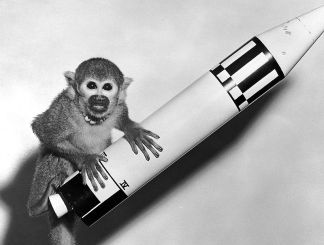
“Miss Baker”

On May 28, 1959, a squirrel monkey named “Miss Baker” became the first of the US space program, to survive the stresses of spaceflight and related medical procedures.  A rhesus monkey called “Miss Able” survived the mission as well, but died four days later as the result of a reaction to anesthesia.

Soviet engineers experimented with dogs on a number of orbital and sub-orbital flights, to determine the feasibility of human space flight.  The Soviet Union launched missions with positions for at least 57 dogs in the fifties and early sixties, though the actual number is smaller.  Some flew more than once.

Laika
Laika

Most survived.  As with the early US program, those who did not often died as the result of equipment malfunction.  The first animal to be sent into orbit, was a different story.

Three dogs were plucked from the streets of Moscow and trained for the purpose.  “Laika” was an 11-pound mutt, possibly a terrier-husky cross.  In Russian, the word means “Barker”.  Laika was chosen due to her small size and calm disposition.  One scientist wrote, “Laika was quiet and charming.”

First, were the long periods of close confinement, meant to replicate the tiny cabin of Sputnik 2. Then came the centrifuge, the highly nutritional but thoroughly unappetizing gel she was meant to eat in space, and then the probes and electrodes that monitored her vital signs.

sputnik-2-launched-a-month-later-and-carried-the-first-living-animal-a-dog-named-laika-into-space
Sputnik 2, Pre-Launch Propaganda

The day before the launch sequence, Vladimir Yazdovsky took her home to play with his kids.  “I wanted to do something nice for her,” he explained. “She had so little time left to live.”

Laika and capsule

Laika was placed inside the capsule for three days, tightly harnessed in a way that only allowed her to stand, sit and lie down.  Finally, it was November 3, 1957.  Launch day.  One of the technicians “kissed her nose and wished her bon voyage, knowing that she would not survive the flight”.

Sensors showed her heart rate to be 103 beats/minute at time of launch, spiking to 240 during acceleration. She ate some of her food in the early stages, but remained stressed and agitated. The thermal control system malfunctioned shortly into the flight, the temperature inside the capsule rising to 104°, Fahrenheit.  Five to seven hours into the flight, there were no further signs of life.

There were official hints about Laika parachuting safely to earth, and then tales of a painless and humane, euthanasia.  Soviet propaganda portrayed “the first traveler in the cosmos”,  heroic images printed on posters, stamps and matchbook covers.   Soviet authorities concealed Laika’s true cause of death and how long it took her to die.  That information would not be divulged , until 2002.

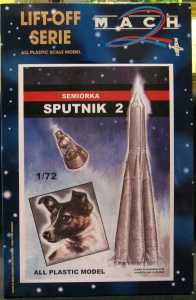
Mach2Sputnik2

In the beginning, the US News media focused on the politics of the launch.  It was all about the “Space Race”, and the Soviet Union running up the score. First had been the unoccupied Sputnik 1, now Sputnik 2 had put the first living creature into space.  The more smartass specimens among the American media, called the launch “Muttnik”.

Sputnik 2 became controversial, as animal lovers began to question the ethics of sending a dog to certain death in space. In the UK, the Royal Society for the Prevention of Cruelty to Animals received protests before Radio Moscow was finished with their launch broadcast.  The National Canine Defense League called on dog owners to observe a minute’s silence.

Atomic_Robo_Last_Stop_Sputnik_Poster2

Protesters gathered with their dogs in front of the UN building, to express their outrage.  In the Soviet Union, political dissent was squelched, as always. Of all Soviet bloc nations, it was probably Poland who went farthest out on that limb, when the scientific periodical Kto, Kiedy, Dlaczego (“Who, When, Why”), reported Laika’s death as “regrettable”.  “Undoubtedly a great loss for science”.

Sputnik 2 and its passenger left the vacuum of space on April 14, 1958, burning up in the outer atmosphere.

It was not until 1998 and the collapse of the Soviet tower of lies, that Oleg Gazenko, one of the scientists who had trained the dog, was free to speak his mind. “Work with animals is a source of suffering to all of us”, he said, “We treat them like babies who cannot speak. The more time passes, the more I’m sorry about it.  We shouldn’t have done it…We did not learn enough from this mission to justify the death of the dog”.

AFTERWARD

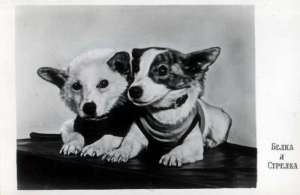
belka-strelka-2

As a lifelong dog lover, I feel the need to add a more upbeat postscript to this thoroughly depressing tale.

“Belka” and “Strelka” spent a day in space aboard Sputnik 5 on August 19, 1960 and returned safely, to Earth.  The first Earth-born creatures to go into orbit and return alive.

Charlie, Pushinka
Charlie, (l) and Pushinka, (r)

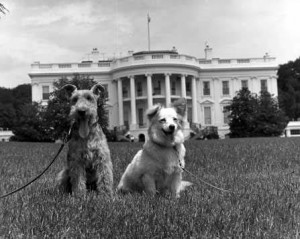
Strelka later gave birth to six puppies fathered by “Pushok”, a dog who’d participated in ground-based space experiments, but never flew.  In 1961, Nikita Khrushchev gave one of them, a puppy called “Pushinka,” to President John F. Kennedy.

Pushinka and a Kennedy dog named “Charlie” conducted their own Cold War rapprochement, resulting in four puppies. JFK called them his “pupniks”. Rumor has it their descendants are still around, to this day.

kennedy-dog-pushinka-puppies
Pushinka and her “pupniks”, enjoying a moment on the White House lawn

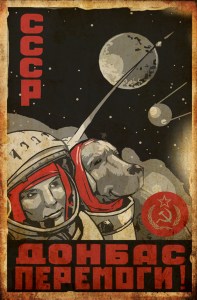
Tip of the hat to the 2019 Vienna Film Award winning “Space dogs” for the artwork at the top of this page.

March 9, 1953 Always be a Good boy

For that one moment one signal operator was the only man in the free world, who knew what the world would soon learn


All too often, history is measured in terms of the monsters.

Zimbabwe’s President Robert Mugabe once orchestrated the murder of 20,000 civilians from a single province, after failing to receive even one vote. During the late 1970s, Pol Pot and a revolutionary leftist cadre called the Angka murdered 1/5th the population of the southeast Asian nation, of Cambodia. Communist Chairman Mao Tse-Tung’s policies and political purges killed between 49 and 78 million fellow Chinese citizens, between 1949 and 1976.

You’re really playing in the Big Leagues when they can’t get your body count any closer than the nearest thirty million.

Life in Mao’s China was quite different from that depicted in the propaganda posters.

From Adolf Hitler to Idi Amin, the top ten dictators of the last 150 years account for the loss of nearly 150 million souls. Soviet dictator Josef Stalin joined this parade of horribles with the deliberate starvation of as many as ten million Ukrainians in 1932-’33, a political famine known as the Holodomor. Estimates of the dead attributed to the Communist monster run as high as 60 million, surpassing that of even the National Socialist dictator, Adolf Hitler.

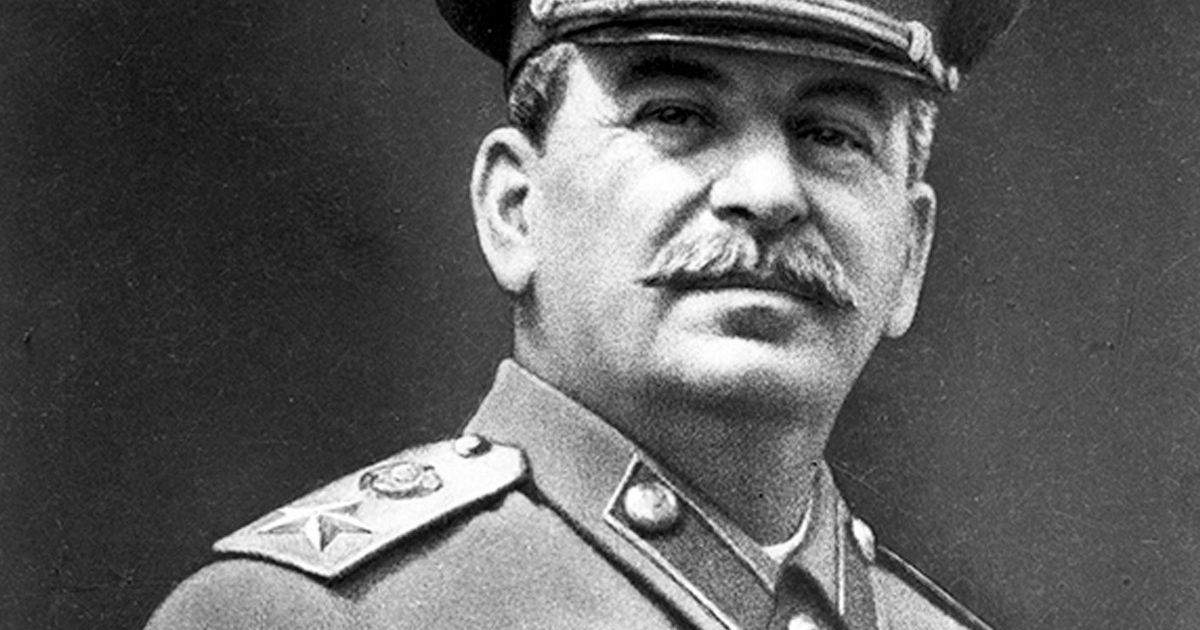
Stalin suffered from poor health in his final years. He was found on the floor of his Kuntsevo Dacha on March 1, 1953, semiconscious, suffering from a brain hemorrhage. His was “a difficult and terrible death” according to Stalin’s daughter Svetlana, lasting four days. Josef Stalin died on March 5, perhaps of natural causes, perhaps he was murdered. Few knew. Fewer cared. The beast was dead.

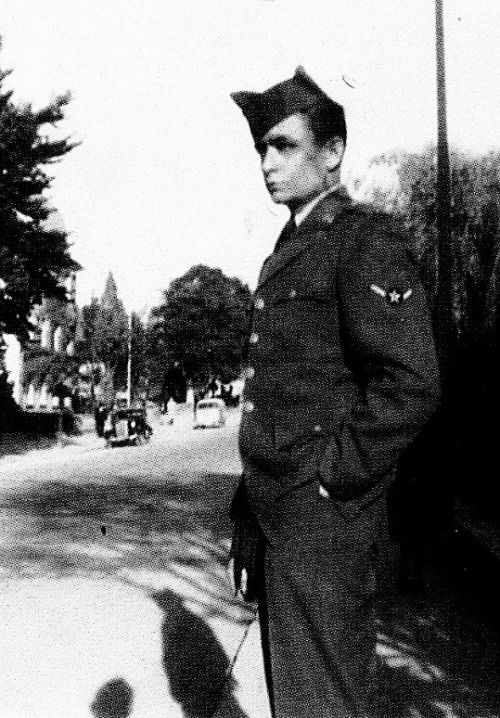
Fifteen hundred miles to the west in Landsberg Germany, a young staff sergeant was listening. Landsberg was a forward base at this time in the decades-long standoff we remember, as the “Cold war”.

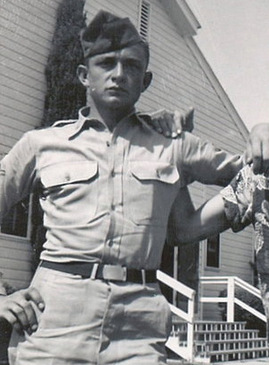
John enlisted in the Air force in 1950, reporting for duty at Lackland AFB, in Texas. He met the woman who would become his first wife there, Vivian, but that was all four years in the future. For now, the budding romance would have to wait. John had deployment papers, to Landsberg.

Today if we want to talk with someone we pick up the phone, but it wasn’t always that easy. In the early 19th century, Europeans experimented with various electrical signaling devices.

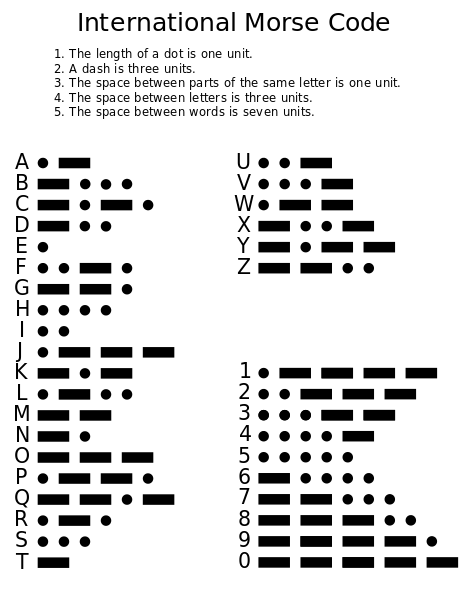
Samuel Morse developed a system of timed signals in the early 1840s. Two tones, one short and one long, combined to represent every letter in the alphabet, and every number.

Dots and dashes. Dits and Dahs

John had talent when it came to Morse code. Signals were anything but clear but he could almost anticipate the patterns, coming out of the ether.

Rising to the rank of Staff Sergeant, John was often placed at the forward position, straining to derive meaning through the static from the distant Dits and Dahs of Soviet communications.

The work was demanding and highly secretive. He wasn’t allowed to leave base and when he did, privileges were sharply limited. He couldn’t even share the work with his sweetheart, back in Texas. In hundreds of letters home he never could talk about what he did. He may as well have been in prison.

John saw an American film around this time, a film noir crime drama called Inside The Walls of Folsom Prison. He could relate.

At night, “Johnny” would seek a kind of lonely solace with his old guitar. He found a rhythm, a melody of sorts in the dots and dashes, of Morse code.

Dit-Dah-Dah-Dah-Dit-Dit-Dah-Dah, Dit-Dah-Dah-Dit-Dah-Dah

He even started a band, called the “Landsberg Barbarians”.

So it was the young Staff Sergeant was listening to Soviet chatter on March 5, 1953, straining to pull some order out of faint and distant signals confused and all but obliterated, by static. And then it came to him. The one word standing out from the sequence.

DDah-Dit-Dit
EDit
ADit-Dah
DDah-Dit-Dit

He listened to it again, and again. The news was momentous if true but he had to get this right. In all the free world he alone knew, what the rest would soon learn. The Soviet leader, the Great Beast Josef Stalin, was dead.

Sergeant Cash told his superiors of what he had learned, and the rest is history. Josef Stalin lay in state for three days at Moscow’s House of Unions where the crush of crowds killed 100 people. He was laid to rest in Lenin’s Mausoleum in Red Square on March 9.

Johnny went back to his job. At night he’d pick up his guitar. The Dits and Dahs. The words would come later but, for now, the melody. A song begun in Landsberg so many would come to believe had arrived later, following that famous visit to Folsom Prison.

For many years, Johnny Cash could tell no one about the Stalin intercept. 3 Hall of Fame inductions, 9 CMA awards and 17 Grammys would have to wait. For now he went back to his job save for nights spent alone. Nights when the talent which had found its voice in that rare ability to find patterns in Morse code found another voice, one we could all understand.

Dit-Dah-Dah-Dah-Dit-Dit-Dah-Dah, Dit-Dah-Dah-Dit-Dah-DahWhen I was just a baby, my mama told me “Son, always be a good boy, don’t ever play with guns…“”

March 11, 1958 The Day the US, Nuked Itself

This particular nuke was unarmed that day but three tons of conventional explosives can ruin your whole day.   The weapon scored a direct hit on a playhouse built for the Gregg children, the explosion leaving a crater 70-feet wide and 35-feet deep and destroying the Gregg home, the farmhouse, workshop and several outbuildings.  Buildings within a five-mile radius were damaged, including a local church.

If you’re ever in South Carolina, stop and enjoy the historical delights of the Pee Dee region. About a half-hour from Pedro’s “South of the Border”, there you will find the “All-American City” of Florence, according to the National Civic League of 1965. With a population of about 38,000, Florence describes itself as a regional center for business, medicine, culture and finance.

Oh.  And the Federal Government dropped a Nuke on the place. Sixty-two years ago, today.

maxresdefault (29)To anyone under the age of 40, the Cold War must seem a strange and incomprehensible time.  Those of us who lived through it, feel the same way.
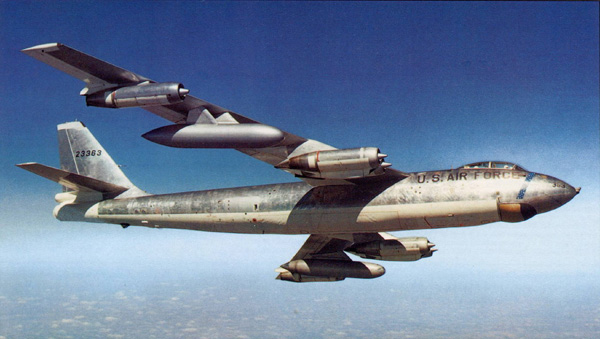
The Air Force Boeing Stratojet bomber left Hunter Air Force Base in Savannah, on a routine flight to Africa via the United Kingdom.  Just in case thermonuclear war was to break out with the Soviet Union, the B47 carried a 10-foot 8-inch, 7,600-pound, Mark 4, atomic bomb.

The Atlantic Coastline Railroad conductor, WWII veteran & former paratrooper Walter Gregg Sr. was in the workshop next to his home in the Mars Bluff neighborhood of Florence, South Carolina while his wife, Ethel Mae “Effie” Gregg, was inside, sewing. The Gregg sisters Helen and Frances, ages 6 and 9, were playing in the woods with their nine-year-old cousin Ella Davies as the B47 Stratojet bomber lumbered overhead.b47-7aAt 15,000-feet, a warning light came on in the cockpit, indicating the load wasn’t properly secured.   Not wanting a thing like that rattling around in the back, Captain Earl E. Koehler sent navigator Bruce M. Kulka, to investigate.  Kulka slipped and grabbed out for something, to steady himself.  That “something” just happened to be, the emergency release.

Bomb bay doors alone are woefully inadequate to hold back a 4-ton bomb. The thing came free and began a 15,000-foot descent, straight into the Gregg’s back yard.

PUEBBB3QPFAQPDWDVU5VCLXD2A
This hole 50 feet wide and 20 feet deep was made after an Air Force nuclear weapon accidentally fell from a B-47 and exploded in Florence, South Carolina, March 12, 1958. The home of Walter Gregg (background) was almost destroyed. Several members of his family were treated for injuries. (AP Photo) H/T Military Times

The Mark 4 atom bomb employs an IFI (in-flight insertion) safety, whereby composite uranium and plutonium fissile pits are inserted into the bomb core, thus arming the weapon. When deployed, a 6,000-pound. conventional explosion super-compresses the fissile core, beginning a nuclear chain reaction. In the first millisecond, (one millionth of a second), plasma expands to a size of several meters as temperatures rise into the tens of millions of degrees, Celsius. Thermal electromagnetic “Black-body” radiation in the X-Ray spectrum is absorbed into the surrounding air, producing a fireball. The kinetic energy imparted by the reaction produces an initial explosive force of about 7,500 miles, per second.

This particular nuke was unarmed that day but three tons of conventional explosives can ruin your whole day.   The weapon scored a direct hit on a playhouse built for the Gregg children, the explosion leaving a crater 70-feet wide and 35-feet deep and destroying the Gregg home, the farmhouse, workshop and several outbuildings.  Buildings within a five-mile radius were damaged, including a local church.  Effie gashed her head when the walls blew in but miraculously, no one was killed except for a couple chickens.  Not even the cat.

screen_shot_2016-05-11_at_60319_pmThree years later, a B-52 Stratofortress carrying two Mark 39 thermonuclear bombs broke up in the air over Goldsboro, North Carolina. Five crew members ejected from the aircraft at 9,000-feet and landed safely, another ejected but did not survive the landing. Two others died in the crash.
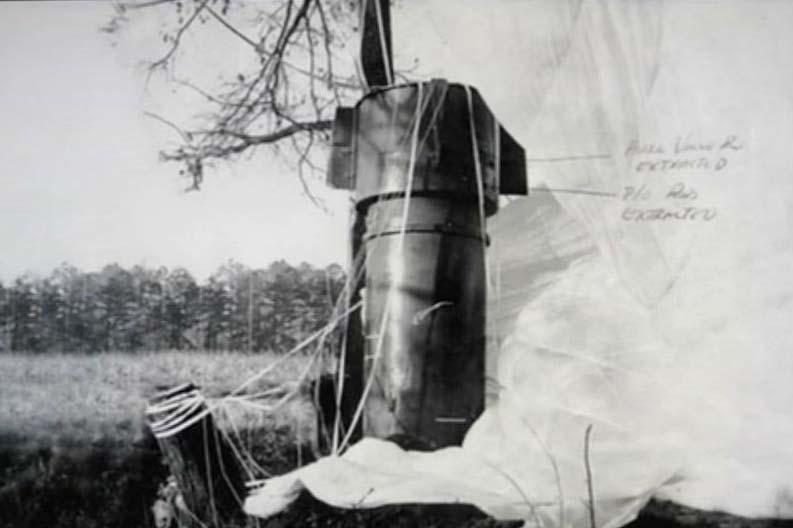

In this incident, both weapons were fully nuclear-enabled.  A single switch out of four, is all that prevented at least one of the things, from going off.

goldsboro_bomb_0
One Mk 39 nuclear weapon from the Goldsboro incident remained largely intact, with parachute still attached. The second plunged into a muddy field at about 700mph, and disintegrated.

Walter Gregg described the Mars Bluff incident in 2001, in director Peter Kuran’s documentary “Nuclear 911”. “It just came like a bolt of lightning”, he said. “Boom! And it was all over. The concussion …caved the roof in.” Left with little but the clothes on their backs, the Greggs eventually sued the Federal Government.

The family was awarded $36,000 by the United States Air force.  It wasn’t enough to rebuild the house let alone, replace their possessions.  Walter Gregg resented it, for the rest of his life.

download - 2020-03-11T083015.786Over the years, members of the flight crew stopped by to apologize for the episode.
The land remains in private hands but it’s federally protected, so it can’t be developed.   They even made a path back in 2008 and installed a few signs,  but those were mostly stolen by college kids.

You can check it out for yourself if you want to amuse the locals.  They’ll know what you’re doing as soon as you drive through the neighborhood, the second time.  Crater Rd/4776 Lucius Circle, Mars Bluff, SC (Hat tip roadsideamerica.com)

A month before the Mars Bluff incident, a hydrogen bomb was accidentally dropped in the ocean, off Tybee Island, Georgia.  Incidents involving the loss or accidental detonation of nuclear weapons are called “Broken Arrows“.  There have been 32 such incidents, since 1950.  As of this date, six atomic weapons remain unaccounted for, including that one off the Georgia coast.

Feature image top of page;  “C. B. Gregg looks at the bomb damaged home of his brother Walter Gregg who was injured after an Air Force bomb hit about 100 yards away on March 12, 1958, in Florence, S.C. (AP Photo) H/T Military Times

January 25, 1949 The Candy Bomber

By November, what had begun as a trickle had turned to a confectionery avalanche.  College student Mary Connors of Chicopee Massachusetts stepped up and offered to take charge of the flood.  By now, this was a national project. Volunteers were assembled in their hundreds to collect candy and tie them to little cloth parachutes.

World War II ended on May 8, 1945 in Europe, leaving the three major allied powers (United States, United Kingdom and the Soviet Union) in place, in and around the former Nazi capital of Berlin.  Representatives of the 3 met at Potsdam, capital of the German federal state of Brandenburg between July-August, hammering out a series of agreements known as the Potsdam agreement.

Built on earlier accords reached through conferences at Tehran, Casablanca and Yalta, the agreement addressed issues of German demilitarization, reparations, de-nazification and the prosecution of war criminals.

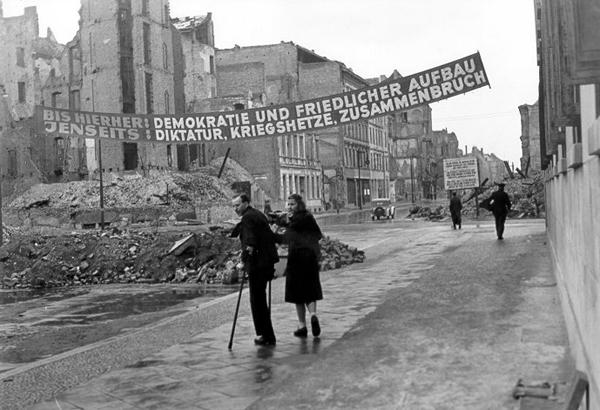
The Potsdam agreement called for the division of defeated Germany into four zones of occupation, roughly coinciding with then-current locations of the allied armies. The former capital city of Berlin was itself partitioned into four zones of occupation. A virtual island located 100 miles inside of Soviet-controlled eastern Germany.

berlin-1948During the war, ideological fault lines were suppressed in the drive to destroy the Nazi war machine.  Such differences were quick to reassert themselves in the wake of German defeat.  In Soviet-occupied east Germany, factories and equipment were disassembled and transported to the Soviet Union, along with technicians, managers and skilled personnel.

The former Nazi capital quickly became the focal point of diametrically opposite governing philosophies.  Leaders on both sides believed that Europe itself, was at stake. Soviet Foreign Minister Vyacheslav Molotov put it succinctly, “What happens to Berlin, happens to Germany; what happens to Germany, happens to Europe.”

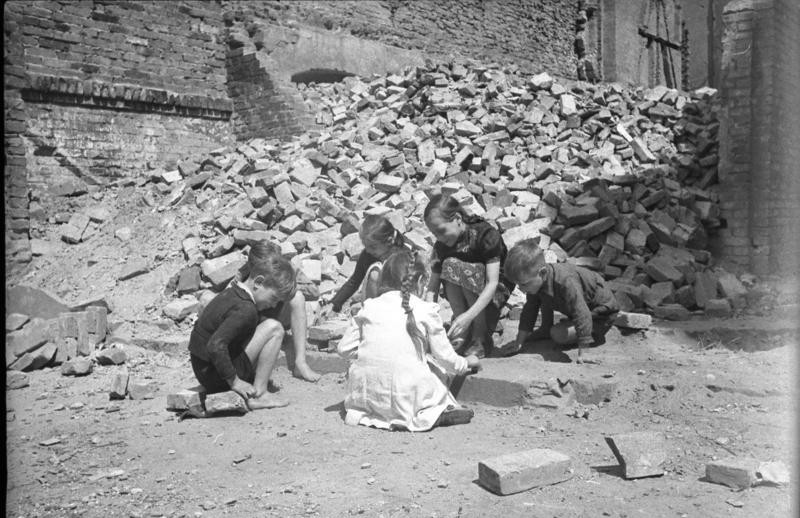
images (58)West Berlin, a city utterly destroyed by war, was home to some 2.3 million at that time, roughly three times the city of Boston.
Differences grew and sharpened between the former allies, coming to a crisis in 1948. On June 26, Soviets blocked access by road, rail and water, to western occupation zones.

This was no idle threat.  Of all the malignant governing ideologies of history, Josef Stalin’s Soviet Union has to be counted among the worst.  These people had no qualms about using genocide by starvation as a political tool.  They had proven as much during the Holodomor of 1932 – ’33, during which this evil empire had murdered millions of its own citizens, by deliberate starvation.  To Josef Stalin, two million dead civilians was nothing more than a means to an end.

At the time, West Berlin had only 36 days’ worth of food, and 45 days’ supply of coal.Bundesarchiv_Bild_183-19000-1661_Berlin_Kinder_spielen_in_Ruinen-e1445197409271With that many lives at stake, allied authorities calculated a daily ration of only 1,990 calories would require 646 tons of flour and wheat, 125 tons of cereal, 64 tons of fat, 109 tons of meat and fish, 180 tons of dehydrated potatoes, 180 tons of sugar, 11 tons of coffee, 19 tons of powdered milk, 5 tons of whole milk for the children, 3 tons of fresh yeast for baking, 144 tons of dehydrated vegetables, 38 tons of salt and 10 tons of cheese.
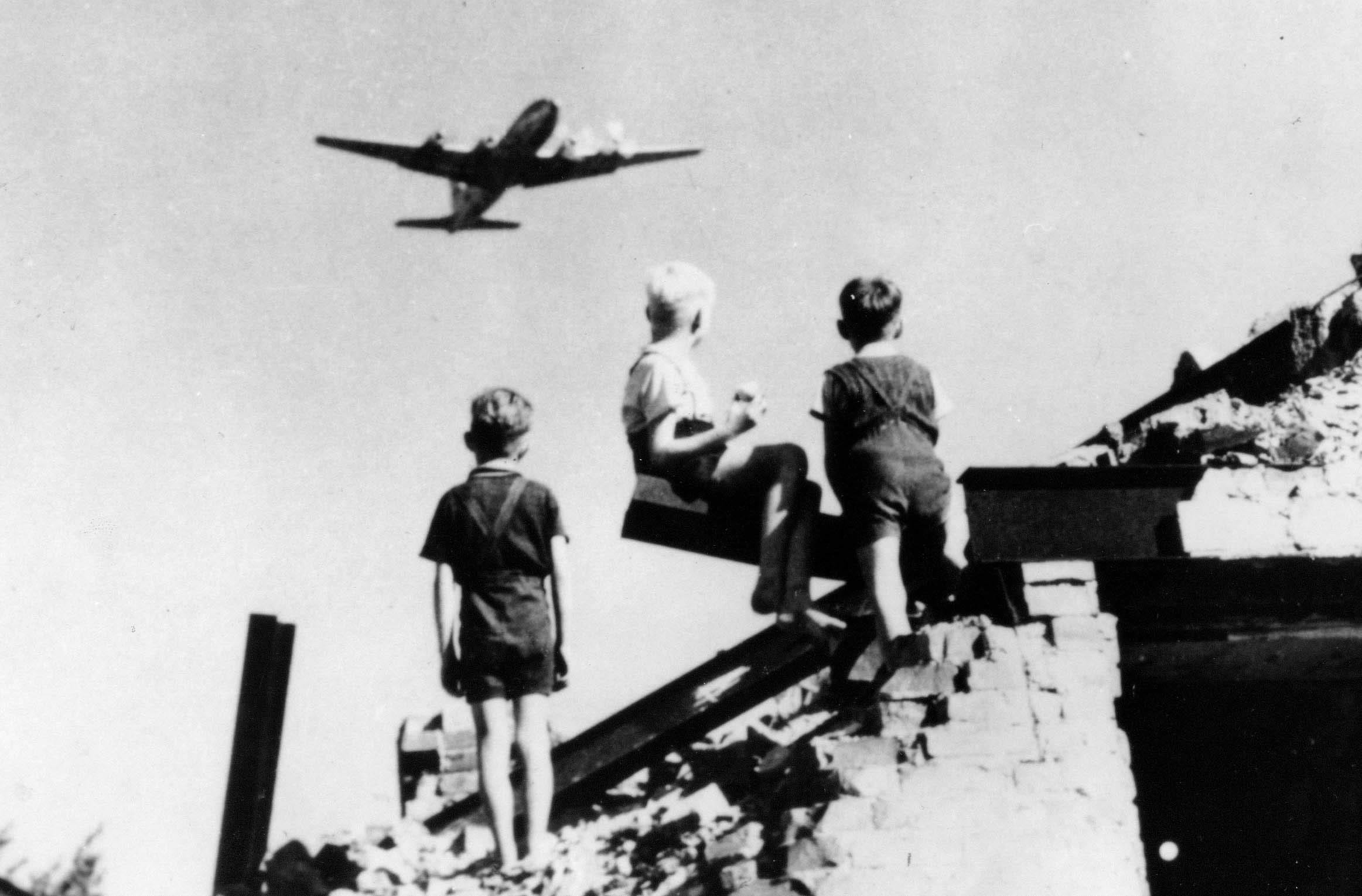
With electricity shut off by Soviet authorities, heat and power for such a population would require 3,475 tons of coal, diesel and gasoline.

All of this and more was going to be needed.  Every.  Single. Day.

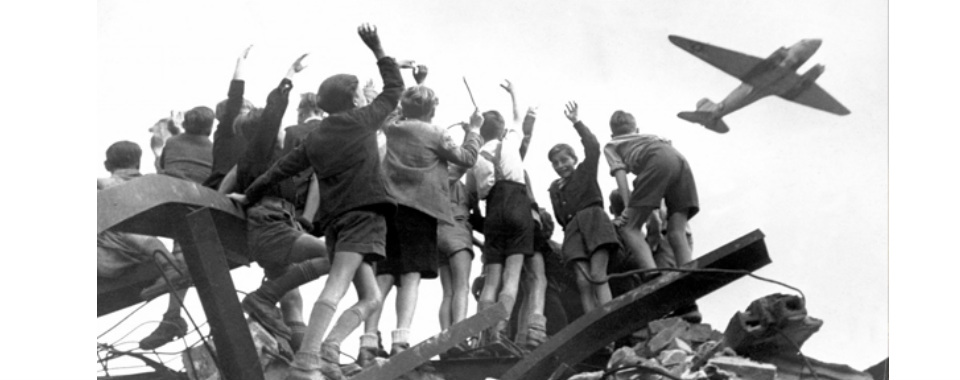
BA_Aircrews_LgWhat followed is known to history, as the Berlin Airlift.  At the height of the operation, a cargo aircraft landed every thirty seconds, in West Berlin. Altogether, the USAAF delivered 1,783,573 tons and the RAF 541,937 on a total of 278,228 sorties.  The Royal Australian Air Force delivered 7,968 tons of freight in over 2,000 flights.
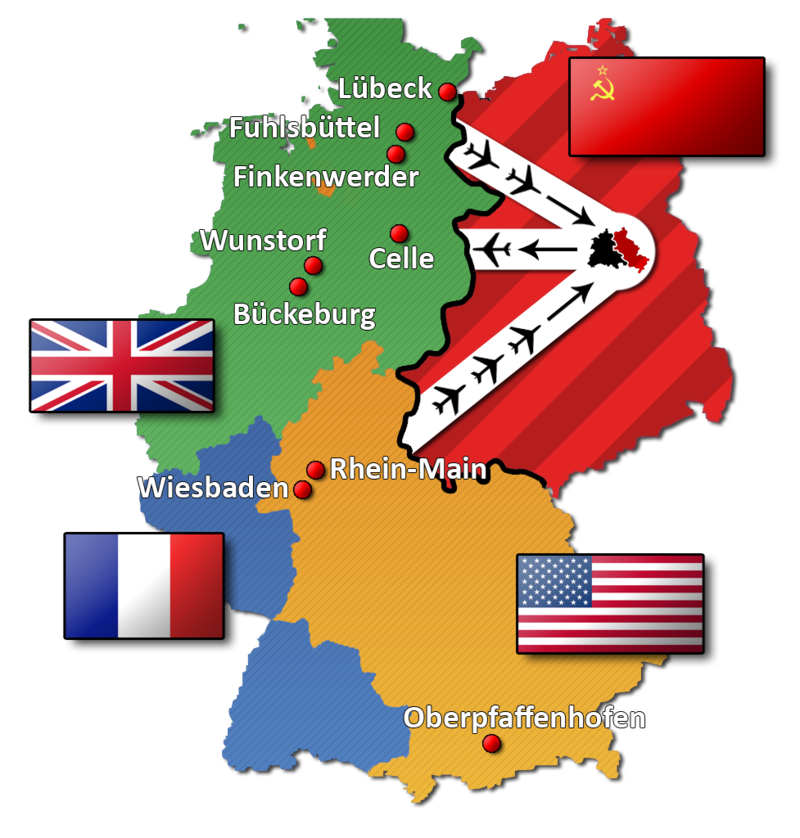
Added together, the Berlin Airlift covered nearly the distance from Earth to the Sun, at a cost of 39 British and 31 American lives.

800px-BerlinerBlockadeLuftwegeUS Army Air Force Colonel Gail “Hal” Halvorsen was one of those pilots, flying C-47s and C-54 aircraft deep inside of Soviet controlled territory.  On his days off, Halvorsen liked to go sightseeing, often bringing a small movie camera.
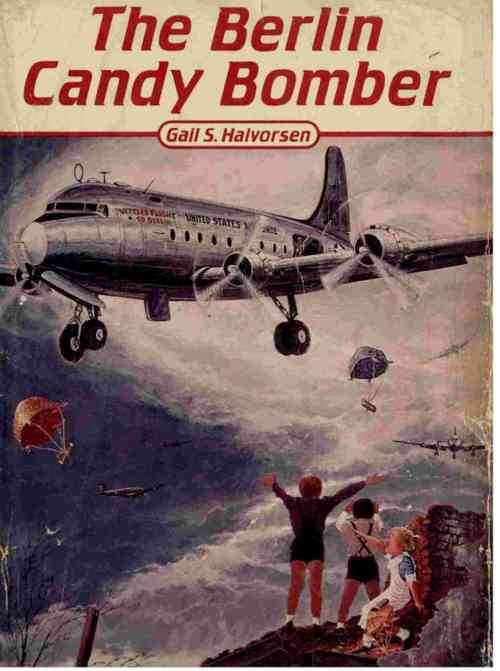
One day in July, Hal was filming take-offs and landings at the Templehof strip when he spotted some thirty children, on the other side of a barbed wire fence.  He went over to speak with them, and felt impressed.  It was normal for children to ask GIs  “Any gum, chum?” or “Any bon-bon?”  Not these kids.  Dirty, half starved and possessed of nothing whatsoever, these kids had spirit.  Halvorsen remembers:

“I met about thirty children at the barbed wire fence that protected Tempelhof’s huge area. They were excited and told me that ‘when the weather gets so bad that you can’t land, don’t worry about us. We can get by on a little food, but if we lose our freedom, we may never get it back.'”

Reaching in his pocket, Halvorsen found two sticks of gum.  Wrigley’s Doublemint gum. Breaking them each into four pieces he gave them to the nearest children, only to watch them break the gum into smaller pieces, to share with their friends.  Those who got none received tiny slivers of the wrappers themselves, small faces shining with joy at just a whiff of mint from the wrapper.

Halvorsen told the kids he’d be back tomorrow, on one of those planes.  He’d have enough for them all, he said.  You’ll know it’s my plane because I’ll wiggle my wings.

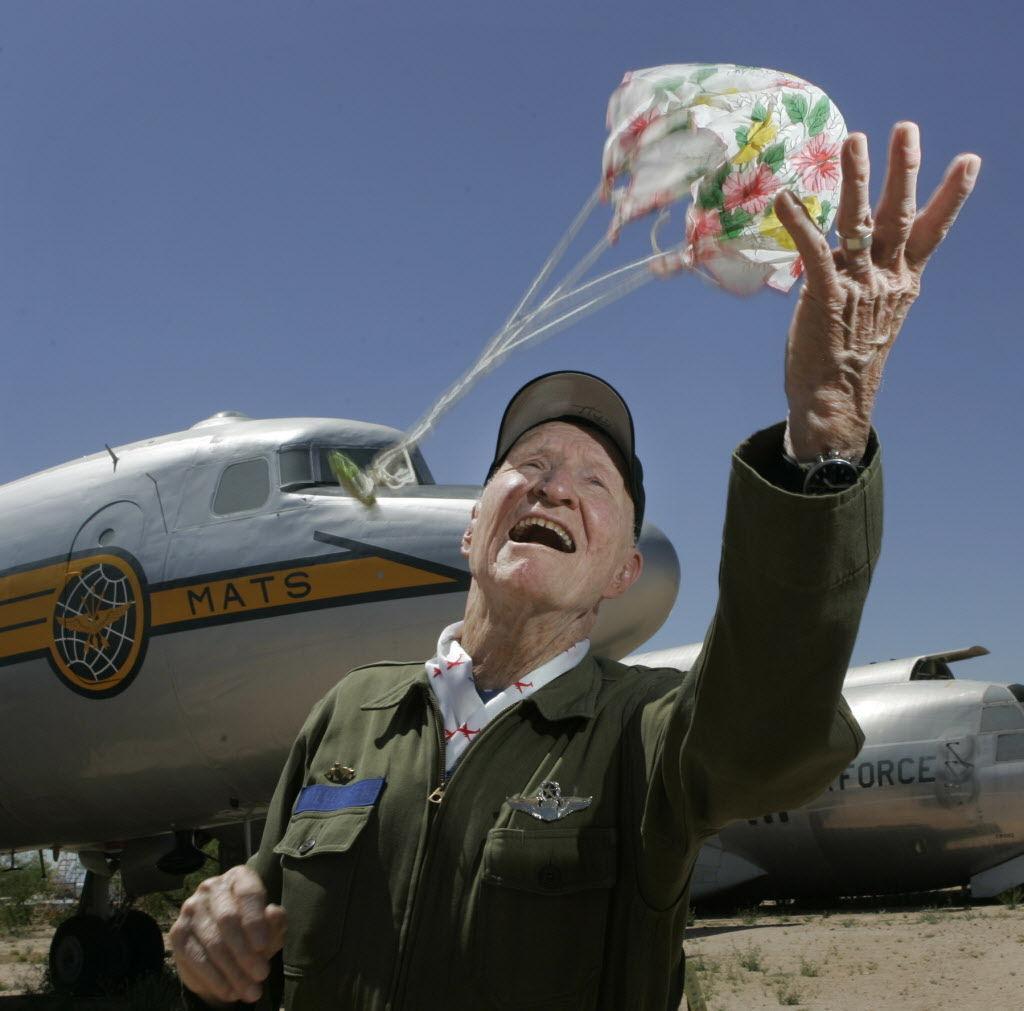
That night, Halvorsen, his co-pilot and engineer, pooled their candy rations.  Even small boxes can’t simply be tossed out of a moving aircraft, and so, the three rigged handkerchiefs.  Tiny little “parachutes”, for tiny little packages.

Halvorsen made such drops three times over the next three weeks and noticed each time, the group of children waiting by the wire, grew larger.

tumblr_mc0esdHpaP1rezpz7o1_500Newspapers got wind of what was going on.  Halvorsen thought he’d be in trouble, but no. Lieutenant General William Henry Tunner liked the idea. A lot. “Operation Little Vittles” became official, on September 22.
What had begun between Halvorsen and his friends spread to the whole squadron. Word quickly crossed the ocean and children all over the United States gave up their own, for kids who had less.  Soon, candy manufacturers themselves joined in.

By November, what had begun as a trickle had turned to a confectionery avalanche.  College student Mary Connors of Chicopee Massachusetts stepped up and offered to take charge of the flood.  By now, this was a national project. Volunteers were assembled in their hundreds to collect candy and tie them to little cloth parachutes.

“Christmas from Heaven: The Candy Bomber Story” with the Mormon Tabernacle Choir and Orchestra, Narrated by Tom Brokaw

Before long, pilots were dropping little packages, all over Berlin. They were the Rosinenbombers. Raisin Bombers. Halvorsen himself came to be known by many names, to the children of Berlin. “Uncle Wiggly Wings”. “The Chocolate Uncle”. “The Gum Drop Kid”. “The Chocolate Flier”.

Colonel Halvorsen’s work even earned him two letters, proposals of marriage, but he turned them both down.  He was carrying on a romance by letter at this time, with Miss Alta Jolley.  The couple would go on to marry in April of 1949, a marriage which would last, for fifty years. Alta Jolley Halvorsen passed away on this day in 1999 leaving her husband, 5 adult children and 24 grandchildren.

On this day in 1949, the Berlin Airlift had barely cleared the mid-point.  The largest humanitarian airlift in aviation history would last until the blockade was lifted on May 12, 1949, and then some.  Operation Little Vittles continued throughout the period, dropping an estimated 23 tons of candy from a quarter-million tiny little parachutes.

Over the years, many of those now-grown children have sought Halvorsen out, to say thank you and to tell stories.  Tales of hope, and fun, of fond anticipation.  All in a time and place when such things were very hard to find.

557b6348427ef.imageYou never know, he said. “The small things you do turn into great things.”