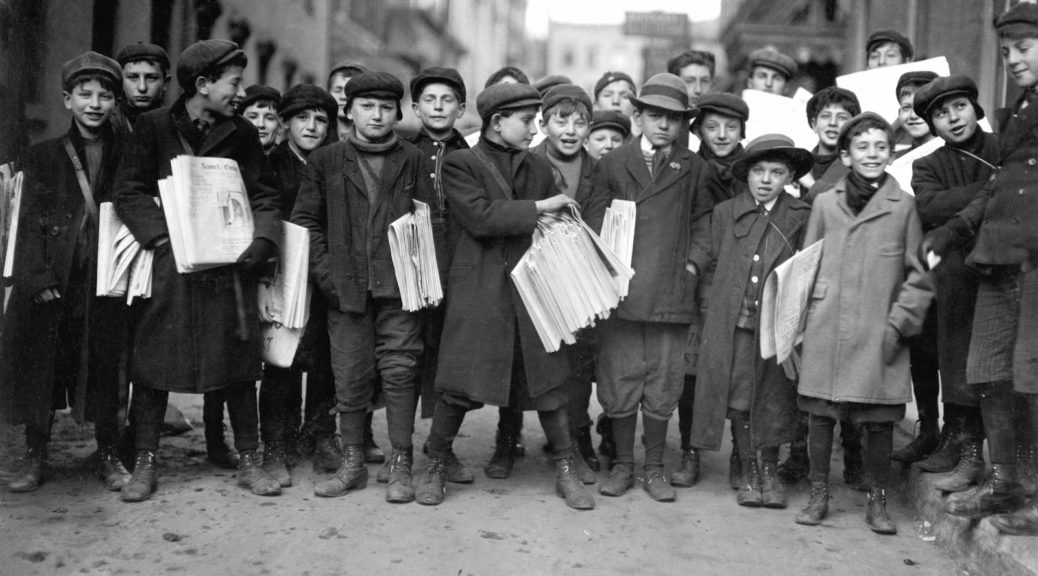
February 23, 1908 Newsies

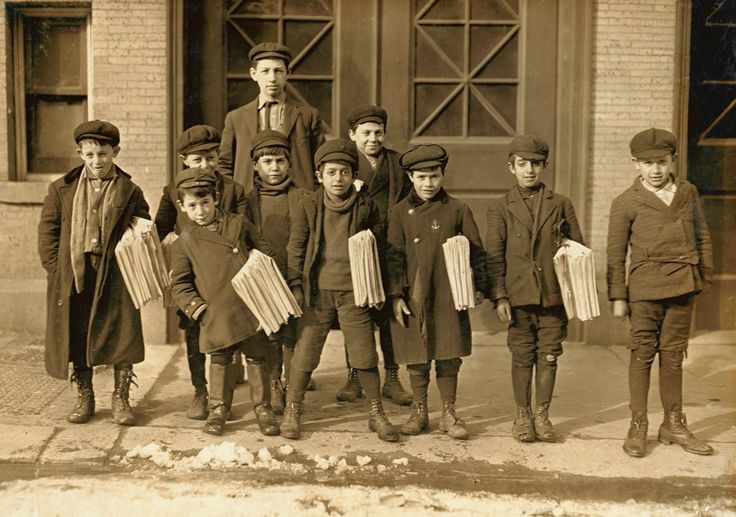
For thousands of homeless children, newspapers were all that stood in the way of an empty belly.

During the early colonial period, American newspapers were “wretched little” sheets in the words of America’s “1st newsboy”, Benjamin Franklin.  Scarcely more than sidelines to keep presses occupied.

Newspapers were distributed by mail in the early years, thanks to generous subsidies from the Postal Act of 1792. In 1800, the United States could boast somewhere between 150 – 200 newspapers.  Thirty-five years later, some 1,200 were competing for readership.
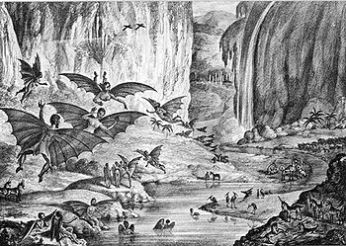
great-moon-hoax-1835-new-york-sun-lithograph-298px
Lithograph from the “Great Moon Hoax” of 1835

Today we hear a lot about “fake news”, but that’s nothing new.  In 1835, the New York Sun published a six-part series, about civilization on the moon.   The “Great Moon Hoax”, ostensibly reprinted from the Edinburgh Courant, was falsely attributed to the work of Sir John Herschel, one of the best known astronomers of the time.

Whatever it took, to sell newspapers.

Two years earlier, Sun publisher Benjamin Day ran a Help-Wanted advertisement, looking for adults to help expand circulation. “To the unemployed — A number of steady men can find employment by vending this paper. A liberal discount is allowed to those who buy and sell again“. To Day’s surprise, his ad didn’t produce adult applicants as expected.  Instead, the notice attracted children.

Today, kids make up a minimal part of the American workforce, but that wasn’t always so. Child labor played an integral part in the agricultural and handicraft economy, working on family farms or hiring out to other farmers.  Boys customarily apprenticed to the trades, at 10 – 14. As late as 1900, fully 18% of the American workforce was under the age of sixteen.
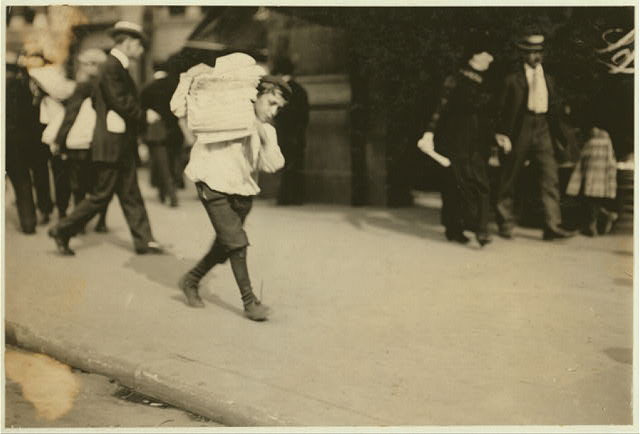
Newsies
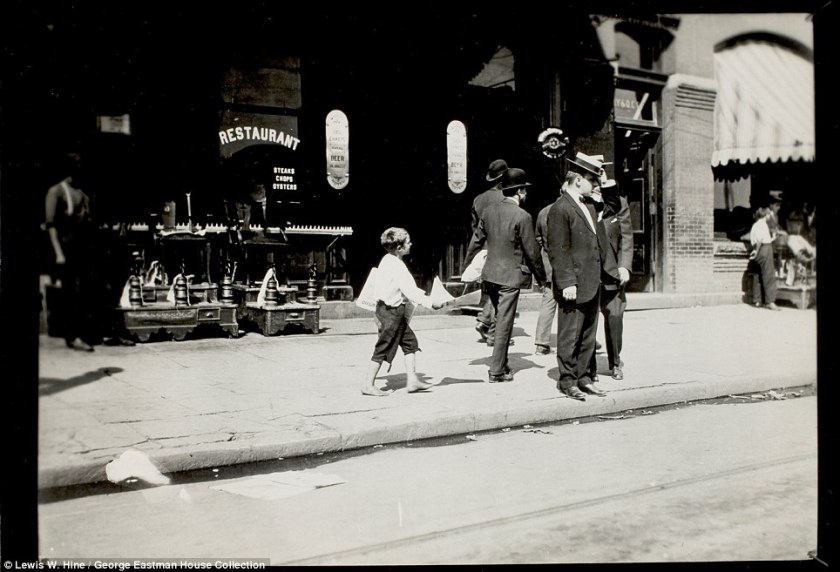
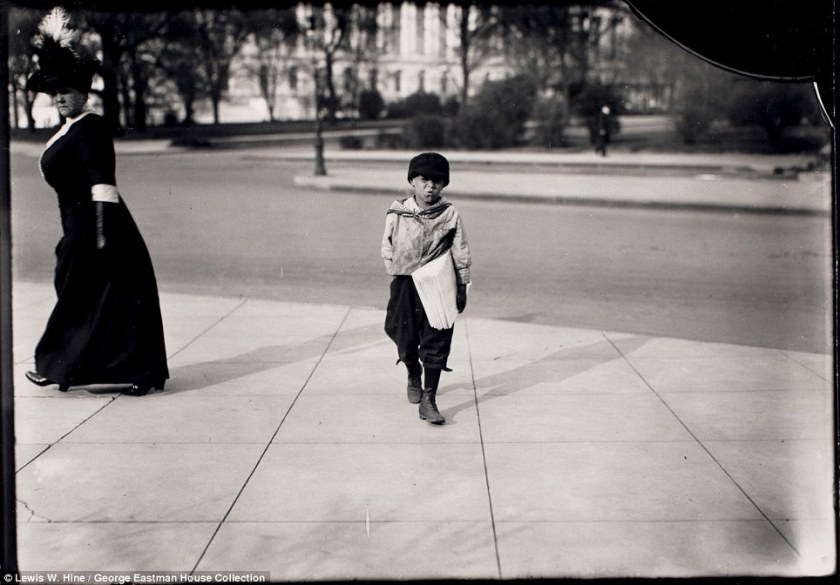
Brooklyn newsboy, ca. 1910 Photo by Lewis Hine (Library of Congress)

Benjamin Day’s first newspaper “hawker” was Bernard Flaherty, a ten-year-old Irish immigrant. The kid was good at it too, crying out lurid headlines, to passers-by: “Double Distilled Villainy!” “Cursed Effects of Drunkenness!” “Awful Occurrence!” “Infamous Affair!” “Extra! Extra! Read all about it!”
download-92

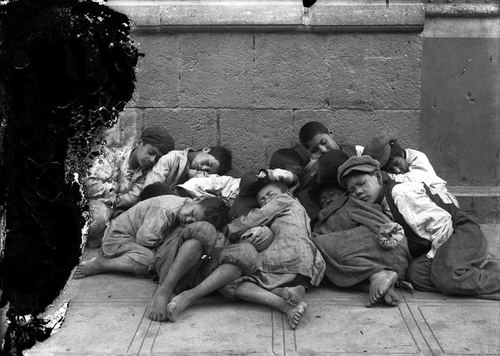
Hordes of street urchins swarmed the tenements and alleyways of American cities. During the 1870s, homeless children were estimated at 20,000 – 30,000 in New York alone, as much as 12% of school-age children in the city.
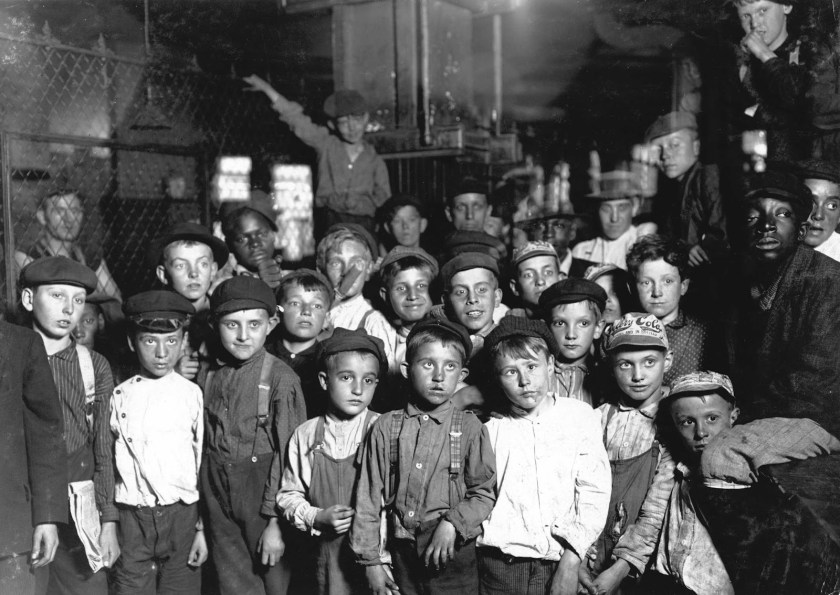
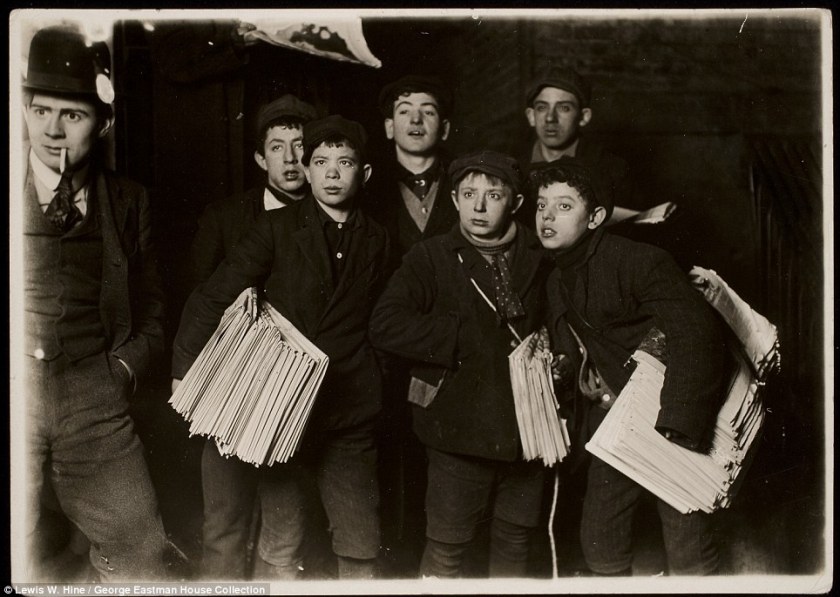
Lewis Hine - Indianapolis Newsboys waiting for the Base Ball edition, in a Newspaper office. Bad environment. Tough negroes etc., 1908
Indianapolis newsies, waiting for baseball edition

For thousands of them, newspapers were all that stood in the way of an empty belly.
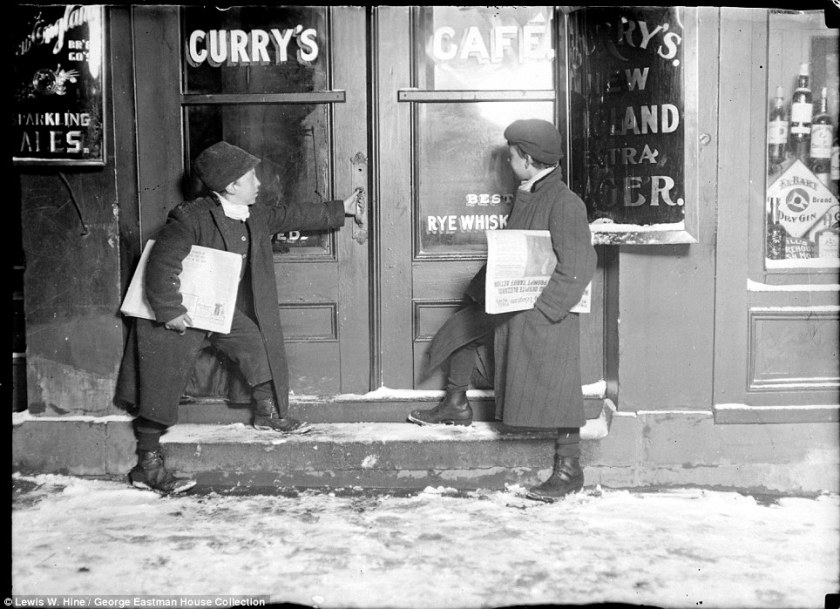
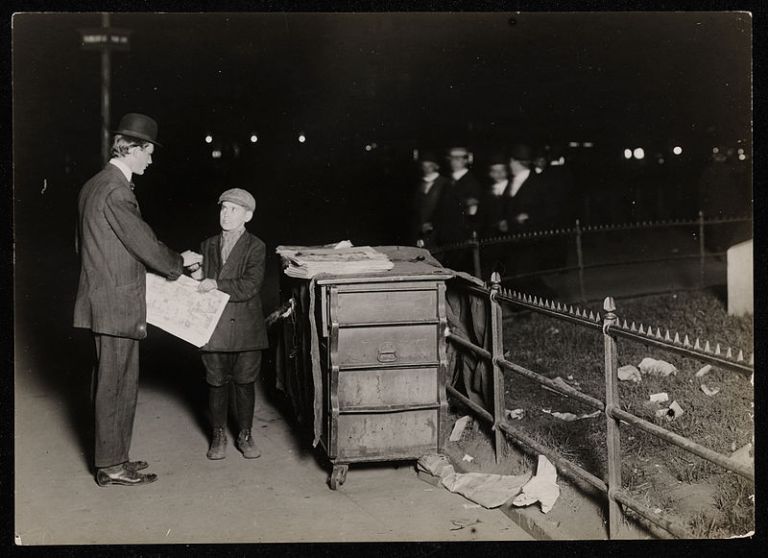
article-2467498-18D8276800000578-777_964x699Adults had no interest in the minuscule income, and left the newsboys (and girls) to their own devices.  “Newsies” bought papers at discounted prices and peddled them on the street.    Others worked saloons and houses of prostitution.  They weren’t allowed to return any left unsold, and worked well into the night to sell every paper.
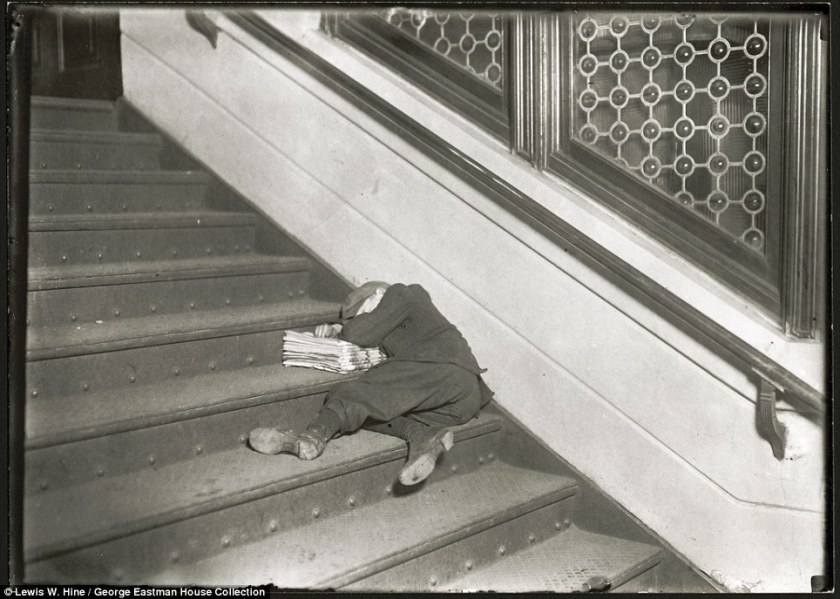
article-2467498-18D8273A00000578-282_964x688For all that, newsies earned about 30¢ a day.  Enough for a bite to eat, to afford enough papers to do it again the following day, and maybe a 5¢ bed in the newsboy’s home.
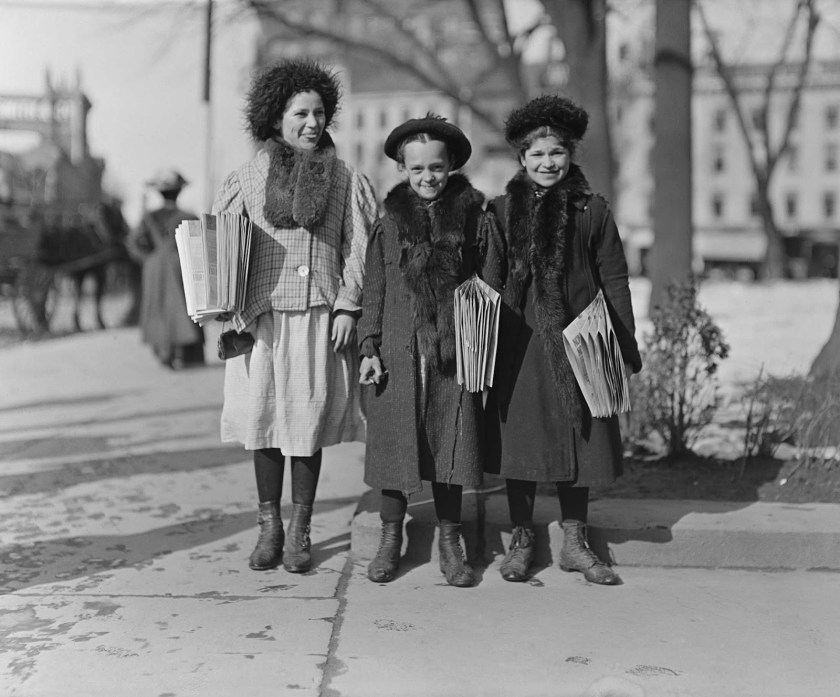
Lewis Hine - Have been selling 2 years. Youngest, Yedda Welled, is 11 years old. Next, Rebecca Cohen, is 12. Next, Rebecca Kirwin, is 14. Hartford, Connecticut, 1909
“Newsies” were not always, boys. These are Yedda Welled, 11 years old. Rebecca Cohen, 12. and, Rebecca Kirwin, 14. Hartford, Connecticut, 1909. H/T historyinphotos.blogspot.com

Competition was ferocious among hundreds of papers, and business practices were lamentable.  In 1886, the Brooklyn Times tried a new idea. The city was expanding rapidly, swallowing up previously independent townships along the Long Island shore. The Times charged Western District newsboys a penny a paper, while Eastern District kids paid 1 1/5¢.

The plan was expected to “push sales vigorously in new directions.” It took about a hot minute for newsies to get wise, when hundreds descended on the Times’ offices with sticks and rocks. On March 29, several police officers and a driver’s bullwhip were needed to get the wagons out of the South 8th Street distribution offices. One of the trucks was overturned, later that day.
article-2467498-18D8272400000578-972_964x686

That time, the newsboy strike lasted a couple of days, enforced by roving gangs of street kids and “backed by a number of roughs”. In the end, the Times agreed to lower its price to a penny apiece, in all districts. Other such strikes would not be ended so quickly, or so easily.
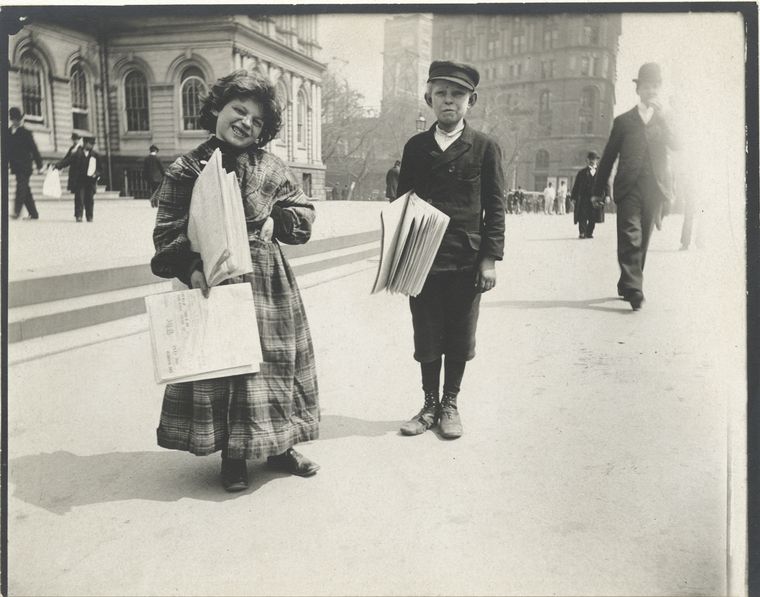
new-york-1896-alice-austen_newsboys
New York, 1896 Alice Austen newsboys

In those days, the Caribbean island of Cuba was ruled from Spain. After decades spent in the struggle for independence, many saw parallels between the “Cuba Libre” movement, and America’s own Revolution of the previous century.  In 1897-’98, few wanted war with Spain over Cuban interests more than Assistant Naval Secretary Theodore Roosevelt, and New York publishers Joseph Pulitzer & William Randolph Hearst.
maxresdefault (22)

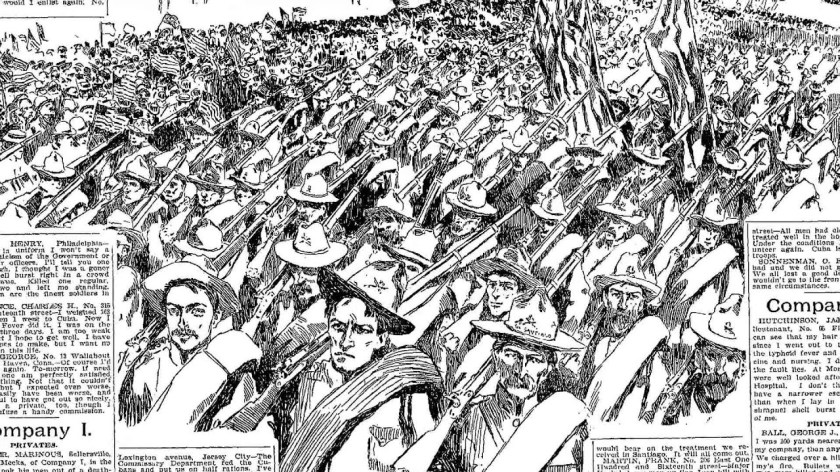
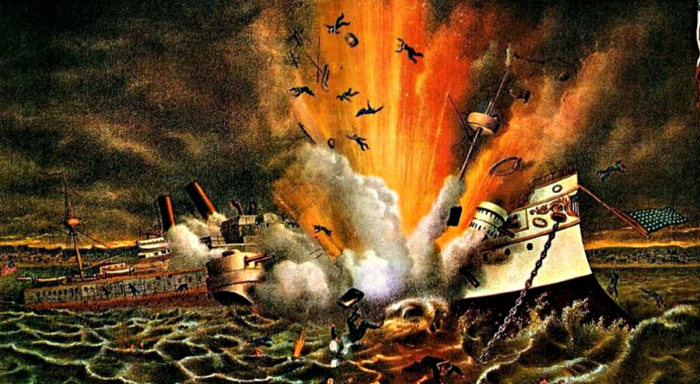
This was the height of the Yellow Journalism period, and newspapers clamored for war. Hearst illustrator Frederic Remington was sent to Cuba, to document “atrocities”.  On finding none, Remington wired: “There will be no war. I wish to return”.  Hearst wired back: “Please remain. You furnish the pictures, and I’ll furnish the war.” President McKinley urged calm, but agreed to send the armored cruiser USS Maine, to protect US “interests”.
uss-maine-explosion

The explosion that sank the Maine on February 15 killing 268 Americans was almost certainly accidental, but that wouldn’t be known for decades. Events quickly spun out of control and, on April 21, 1898, the US blockaded the Caribbean island. Spain gave notice two days later, that it would declare war if US forces invaded its territory. Congress declared on April 25 that a state of war had existed between Spain and the United States, since the 21st.  Soon, newsboys were shouting the headline:  “How do you like the Journal’s war?
article-2467498-18D8275900000578-427_964x657

The Spanish-American War was over in 3 months, 3 weeks and 2 days, but circulation was great while it lasted.  Publishers cashed in, raising the cost of newsboy bundles from 50¢ to 60¢ – the increase temporarily offset by higher sales. Publishers reverted to 50¢ per 100 after the war, with the notable exceptions of Joseph Pulitzer’s New York World, and William Randolph Hearst’s New York Journal.
4825071_orig

Now, newsboys of the era weren’t the ambitious kids of a later age, hustling to make a buck after school.  These were orphans and runaways, with little to count on but themselves.  The half-cent profit on each paper was all each had to get through the day, with some held back to buy more papers.

february_23rd_1908_boys_selling_newspapers_on_brooklyn_bridge (1)
Newsboys selling papers by the Brooklyn Bridge, February 23, 1908 H/T UK Guardian

50¢ to 60¢ for the same bundle was an insurmountable increase.   On July 18, 1899, a group of Long Island newsboys overturned a distribution wagon, refusing to sell Hearst of Pulitzer newspapers until prices were returned to 50¢.  Newsboys from Manhattan and Brooklyn joined the strike, the following day.

Blink4
Louis Balletti,”Kid Blink”

Boys and men who tried to break the strike were mobbed and beaten, their papers destroyed.

Competing publishers such as the New York Tribune couldn’t get enough of the likes of strike “President” Dave Simmons, the boy “prize-fighter”, Barney “Peanuts”, “Crutch” Morris, and others.

The charismatic, one-eyed strike leader “Kid Blink”, was a favorite:

“Friens and feller workers. This is a time which tries de hearts of men. Dis is de time when we’se got to stick together like glue…. We know wot we wants and we’ll git it even if we is blind”.

The newsboy strike of 1899 lasted two weeks, in which Pulitzer’s New York World plummeted from 360,000 papers a day, to 125,000.  Women and girls had more success as strike breakers than boys and men.  As Kid Blink put it, “A feller can’t soak a lady.”  In the end, it didn’t matter.  Most news readers took the side of the strikers.  Neither Hearst nor Pulitzer ever dropped their price, but both agreed to buy back unsold papers.
child_labor_in_united_states_1910_working_night_shift (1)
Some worked well after midnight, to sell every paper

The New York newsboys’ strike of 1899 inspired later strikes including Butte, Montana in 1914, and a 1920s strike in Louisville, Kentucky.  In time, changing notions of urban child-welfare led to improvements in the newsboys’ quality of life.  For now, street kids had precious few to look out for them, beyond themselves.
article-2467498-18D8274600000578-403_964x672

Brooklyn’s “Racetrack Newsie” “Dutch” Johnson caught cold, in 1905.  The illness soon turned more serious.  He was found unconscious on a pile of catalogs.  Brought to Bellevue Hospital by the East River,  the 16-year-old was informed it was pneumonia.  This was before the age of antibiotics.  There was no hope.

download-92

“It goes”, Dutch said, in a voice so soft as to be barely audible.  “Only I ain’t got no money and I’d like to be put away decent”.
tumblr_ne0yqmwDCl1u0ndouo1_500 (1)
H/T http://newsieshistory.tumblr.com

Bookmaker “Con” Shannon offered to take up a collection for the burial.  He could’ve easily produced hundreds from bookies and gamblers, but Dutch’s diminutive successor “Boston”, spoke up.  “Naw”, he said “we’re on de job and nobody else”.

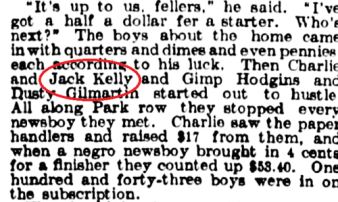
So it was that “Gimpy”, “Dusty”, and the other urchins of Sheepshead Bay pitched in with their pennies, their nickels and dimes.  $53.40 bought a plot in the Linden Hill Cemetery, with a little stone marker.  Dutch Johnson would be spared the plain black wagon and the nameless grave, in some anonymous Potter’s Field.

February 22, 1943 The Mighty Atom

With eighteen in the plaintiffs dock and one small defendant.  The judge asked Greenstein about the fight.  “It wasn’t a fight” he said, “It was a  pleasure”.  The case was dismissed.

Yosselle “Joseph” Greenstein was born on January 2, 1893, the son of the poorest family in Suvalk, Poland. A small, sickly child with chronic asthma, doctors believed he suffered from the same tuberculosis, which had killed his father.

“Joe” tried sneaking into the Issakoff Brother’s Circus at fourteen, receiving a savage beating for his trouble, left bleeding and barely conscious in a muddy alley.

The circus’ strongman “Champion Volanko” saw the poor, scrawny kid trying to crawl home, and took pity.  Volanko brought the boy into his trailer and, as the two talked, became impressed with his determination. This was an old-school strength athlete, capable of performing a military press with baskets full of women, in each hand. He offered to teach the boy his techniques.  So it was that Joe Greenstein ran away with a traveling circus.

Eighteen months later, he was a changed man.  Greenstein took up wrestling and married, while still a teenager.

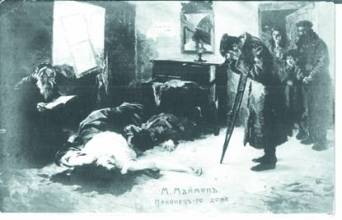
Maimon_Home
“Home at last by Moshe Maimon. The house’s occupants return when it is safe, to find the house thoroughly looted. A rabbi is saying Kaddish for a member of the household who was killed”. H/T Wikipedia

In those days, Poland was a nation in name only, a wholly owned subsidiary of the Russian Empire.  Tsarist Russia was engulfed in a paroxysm of anti-Jewish violence in the pre-war years, riots resulting in death and injury, by the tens of thousands.  The New York Times reported on one such “pogrom”, in 1903:

The anti-Jewish riots in Kishinev, Bessarabia [modern Moldova], are worse than the censor will permit to publish…The cry “Kill the Jews”, was taken up all over the city…Babies were literally torn to pieces by the frenzied and bloodthirsty mob. The local police made no attempt to check the reign of terror. At sunset the streets were piled with corpses and wounded. Those who could make their escape fled in terror, and the city is now practically deserted of Jews.

This place had nothing for a young Jewish family.  Joseph and Leah Greenstein emigrated to the United States and made a home in Galveston Texas.

jackjohnson
Jack Johnson

Joe worked on the docks and oil fields of Galveston, or  laying railroad tracks and pounding spikes, by hand.  He was wrestling professionally by this time under the name “Kid Greenstein”, and good at it, too.  He met Jack Johnson who taught him some fighting techniques, the first black athlete to break the color barrier to become the heavyweight champion of the world, in 1908.

A local Texas man became obsessed with Leah Greenstein in 1914 and shot her husband, between the eyes.  The bullet struck with enough force to flatten against his forehead, but did not penetrate.  Joe left the hospital that same day, convinced his physical conditioning and mental discipline, had saved his life.

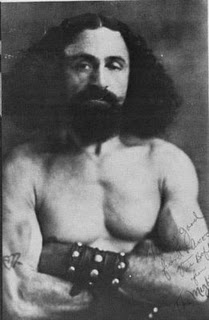
mightyatom2
Joseph Greenstein, the Mighty Atom

Thus began the career of one of the greatest strongmen, in history.  He was “The Mighty Atom”, able to break up to three chains, by expanding his chest.  Only 5’4″-inches tall, he could bend horseshoes and drive nails with his bare hands.  He could pull a fire truck with his hair, and change a tire with no tools. Not even a jack.

On September 29, 1928 the headlines read “The Mighty Atom – Super Strong Man Pits Brawn Against Plane, Wins!” He had held an aircraft on the ground with his hair – the feat was documented by Ripley’s “Believe it or Not”.

In 1936, a dispute with six dock workers, led to a brawl.  The story ran in all the New York papers – “Little Giant Knocks Out Six’

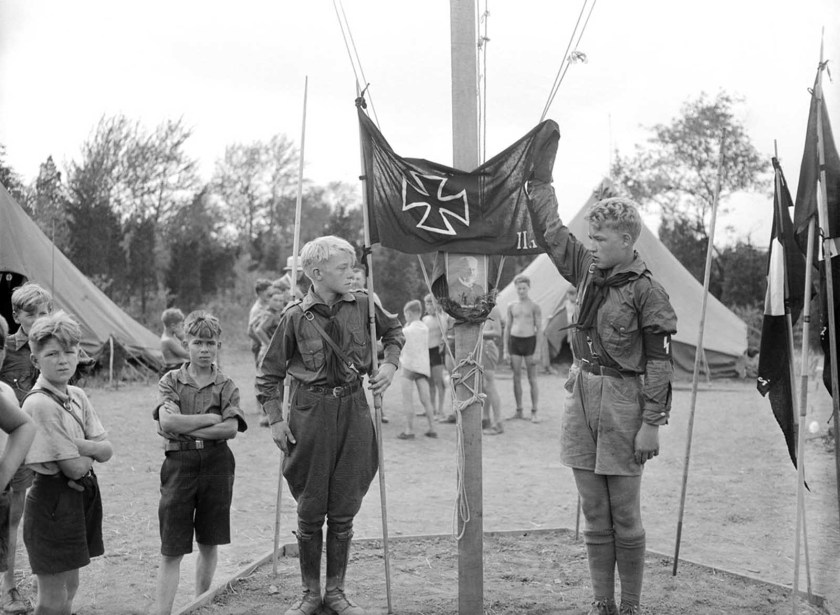
Following the rise of Adolf Hitler’s “National Socialist” party in 1933, some German Americans formed groups, patterned after the Nazi Party in Germany.  These people had few connections to the “Thousand-Year Reich” and received little support from the broader German American community, yet they wore uniforms and toted swastikas and preached the same hate for the Jews, as the “National Socialist German Workers’ Party”.  The most notorious of these, was the “German American Bund”.

American_Nazis (2)
“German American Bund Camp youth salute Hindenburg in Griggstown, New Jersey”. H/T rarehistoricphotos.com

Though the claim was believed to be exaggerated, Congressman Martin Dies, Jr. of the House Un-American Activities Committee (HUAC) estimated German-American Bund membership, at 430,000, in 1938.

The Mighty Atom was in New York that year when he passed a building, about to host a Nazi rally.  One sign high on the wall read “No Jews or Dogs Allowed”.  Yosselle Greenstein had left that garbage behind in the old country.  He wasn’t about to tolerate it here.

He bought a ladder, and climbed up and tore the thing down.  Twenty streamed out of the building, bent on beating the man into giblets.  When it was over, eighteen had been sent to the hospital.

the_mighty_atom_pulls_firetruck_with_hair
Pulling a fire truck, Mighty Atom style

A few weeks later, the combatants were in court.  Eighteen in the plaintiffs dock, and one small defendant.  The judge asked Greenstein about the fight.  “It wasn’t a fight” he said, “It was a  pleasure”.  The case was dismissed.

War descended over Europe and with it the systematic extermination of the infirm.  The Jew.  The Roma.  The “Untermenschen“.

The grotesque sham trials conducted by Judge-President Roland Feisler made short work of any who would oppose “Der Fuhrer”.  Today, the “People’s Court” of Nazi Germany is best remembered in the wake of the July 20, 1944 plot to assassinate Hitler.  In reality, this mockery of justice had been around for ten years, handing out death sentences, by the hundreds.

There were Germans throughout the war who objected to the murder of millions, but theirs was a forlorn hope.  Clergymen Dietrich Bonhoeffer would state “the ultimate question for a responsible man to ask is not how he is to extricate himself heroically from the affair, but how the coming generation shall continue to live.” For his opposition to the Reich, Bonhoeffer would pay with his life.

This video give a good idea about “justice” in Roland Feisler’s court.

Helmuth James Graf von Moltke, great grand-nephew of the famous Helmut von Moltke would lead 28 dissidents of the “Kreisau Circle”, against this “outrage of the Christian conscience.” These too would pay with their lives.

The most successful opposition came from the universities of Munich, with connections in Berlin, Hamburg, Stuttgart and Vienna. These were a surprise to Nazi leaders, as Universities had been stalwart supporters of Nazi ideology. The “White Rose” would rise in the wake of the disastrous Battle of Stalingrad, producing leaflets, handbills and anti-Nazi graffiti from the earliest days of 1943.

These too were found out, Hans Scholl, Sophie Scholl, and Christoph Probst made to stand trial before judge Feisler’s Court on February 22, 1943. All were sentenced to death and guillotined the same day. The last member to be executed was Hans Conrad Leipelt on January 29, 1945.

31SPOTLI-superJumbo

Back at home, Joseph Greenstein performed for war bond drives, always without compensation.  The Mighty Atom continued to perform feats of strength well into his eighties, and taught fighting techniques to the New York Police department, Israeli Defence Force and others.

The Mighty Atom portraitDuring his last public performance given before a sell-out crowd at Madison Square Garden on May 11, 1977, the Mighty Atom wore a leather vest, emblazoned with a golden star of David.
When he was through, Greenstein took a moment to wish his great-grandchild a happy first birthday.

The man could still bend horseshoes and drive nails with his hands.

The mighty Atom succumbed to cancer on October 8, 1977.

The apple didn’t fall far from the tree.  In 2014, Joe’s son Mike appeared on America’s Got Talent. pulling a 3500-pound car with his teeth and wearing a T-shirt promoting “Mighty Atom & Sons (1940).  He was 93.

If you enjoyed this “Today in History”, please feel free to re-blog, “like” & share on social media, so that others may find and enjoy it as well. Please click the “follow” button on the right, to receive email updates on new articles.  Thank you for your interest, in the history we all share.

February 21, 1431 Joan of Arc

History has a way of demonstrating the truth of Taylor Owen’s adage on the subject of leadership: “An army of donkeys led by a lion is better than an army of lions led by a donkey.”

The Hundred Years’ War began as a succession dispute over the French throne, pitting an alliance of Burgundians and English on one side, against a coalition of Royalists led by the Armagnacs, on the other.

Europe was not far removed from the latest outbreak of the Black Death at this time, as the scorched earth tactics employed by the English army laid waste to the countryside and devastated the French economy.

Charles, Dauphin and heir apparent to the French throne was up against a wall, when a teenage peasant girl approached him in 1429.

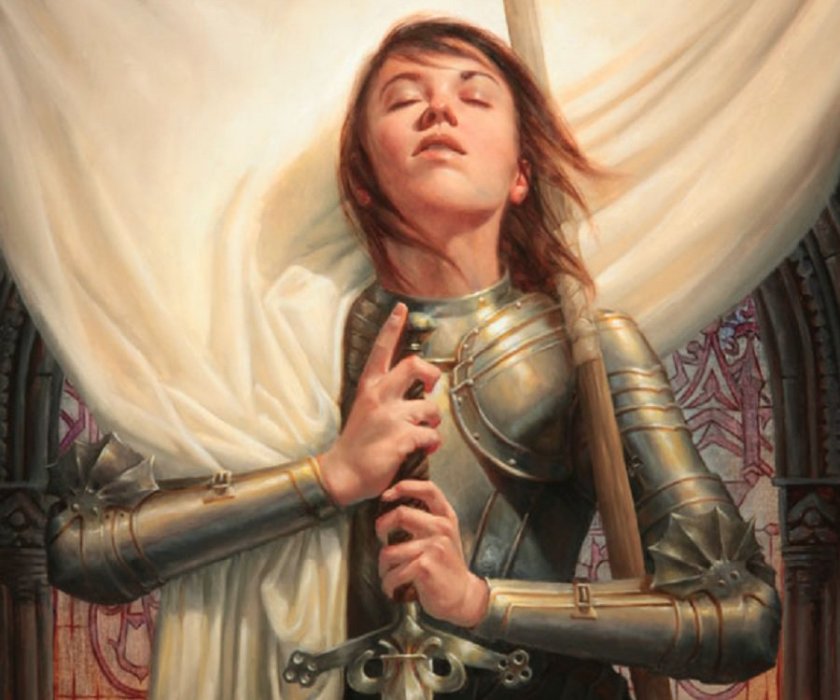
For the 14-year-old boy-king, even listening to her was an act of desperation, borne of years of humiliating defeats at the hands of the English army. Yet, this illiterate peasant girl had made some uncanny predictions concerning battlefield achievements. Now she claimed to have had visions from God and the Saints, commanding her to help Charles gain the throne. Her name was Jeanne d’Arc.

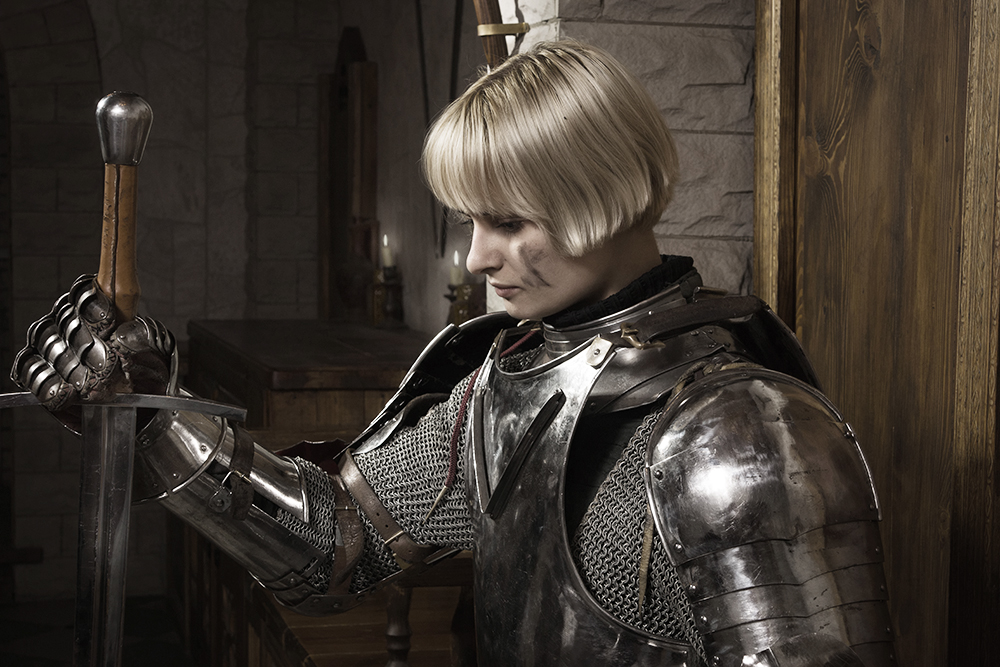
The siege of Orléans was six months old at this time, when the Dauphin decided it couldn’t hurt to let her take part. She dressed herself in borrowed armor and set out, arriving on the 29th of April, 1429.

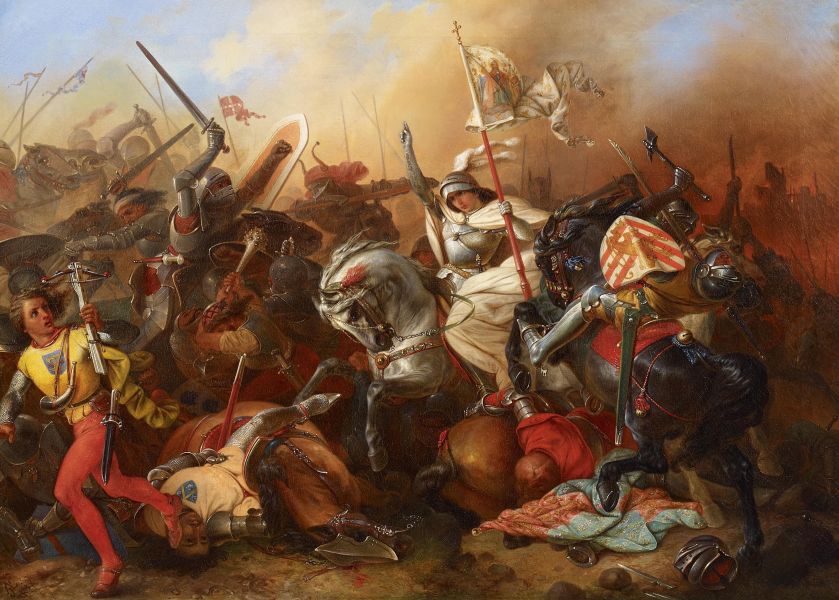
joan-of-arc-3

History has a way of demonstrating the truth of Taylor Owen’s adage on the subject of leadership: “An army of donkeys led by a lion is better than an army of lions led by a donkey.” So it was in the days after Jeanne’s arrival at Orléans.

Time after time, Jeanne found herself excluded from war councils.  Yet she managed to insert herself anyway, putting the French back on the offensive and achieving one victory after another.

Nine days after her arrival, Orléans turned into an unexpected victory for the French.  Jeanne herself was shot through the neck and left shoulder by an English longbow, while holding a ladder at the siege of Tourelles.  The Dauphin granted her co-command of the army with Duke John II of Alençon. The French army enjoyed a string of successes, recovering Jargeau on June 12, Meung-sur-Loire on the 15th and Beaugency two days later, leading to a humiliating English defeat at the battle at Patay on the 18th.

ccf011df7a8f59a31efc28e35ec0a655

Several more Armagnac victories followed. On July 17, 1429, Charles was consecrated King Charles VII of France, fifth King of the House of Valois, with Jeanne at his side.

Despite her loyalty, Charles’ support began to falter.  Court favorite Georges de La Trémoille convinced the King that Jeanne was becoming too powerful. An archer pulled her from her horse during the siege of Compiègne in May, 1430, and her allies failed to come to her aid.

The town gates closed, leaving Jeanne on the outside.  She was captured and taken to the castle of Bouvreuil.

download - 2019-02-21T063459.558

Some 70 charges were made against her by the pro-English Bishop of Beauvais, Pierre Cauchon, including witchcraft, heresy, and dressing like a man.

The judge’s representatives were dispatched to Jeanne’s home village of Domremy, to ascertain the prisoner’s virginity, character, habits and associations. Nicolas Bailly, the man responsible for collecting testimony, reported he “had found nothing concerning Joan that he would not have liked to find about his own sister”.

This Bishop Cauchon must have been some piece of work. The report so angered the man, he called Bailly “a traitor and a bad man” and refused to pay him for his work.

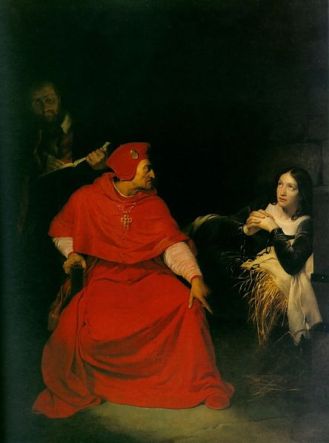
Joan_of_arc_interrogationJean Le Maistre, whose presence as Vice-Inquisitor for Rouen was required by canon law, objected to the proceedings and refused to appear, until the English threatened his life.
Interrogation of the prisoner began on February 21, 1431. The outcome was never in doubt. Transcripts were falsified and witnesses intimidated. Even then, trial records reveal this illiterate peasant girl to be brighter than all her inquisitors, combined.

Here’s an example from Jeanne’s third interrogation: “Do you know whether or not you are in God’s grace?”  The question was a trap. Church doctrine stated that no one could be certain of being in God’s grace, yet a “no” answer would have been held against her. “If I am not”, she said, “may God put me there; and if I am, may God so keep me. I should be the saddest creature in the world if I knew I were not in His grace.”

After fifteen such interrogations, Jeanne’s inquisitors still had nothing on her, save for the wearing of soldier’s garb, and her visions. Yet, the outcome of her “trial” was already determined. She was found guilty of heresy, and sentenced to be burned at the stake. On May 24, Jeanne was taken to a scaffold. Threatened that she would be immediately burned alive if she didn’t disavow her visions and abjure the wearing of soldier’s clothing, Jeanne agreed to sign such an abjuration, but recanted four days later.

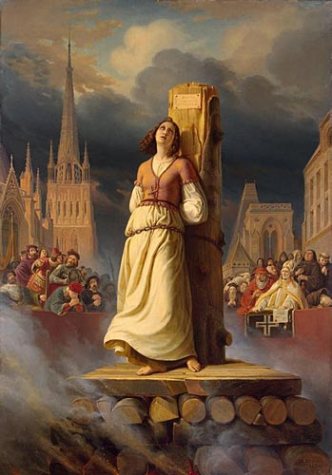
joanstilkestakeThe death sentence was carried out on May 30, 1431, in the old marketplace at Rouen. She was 19.
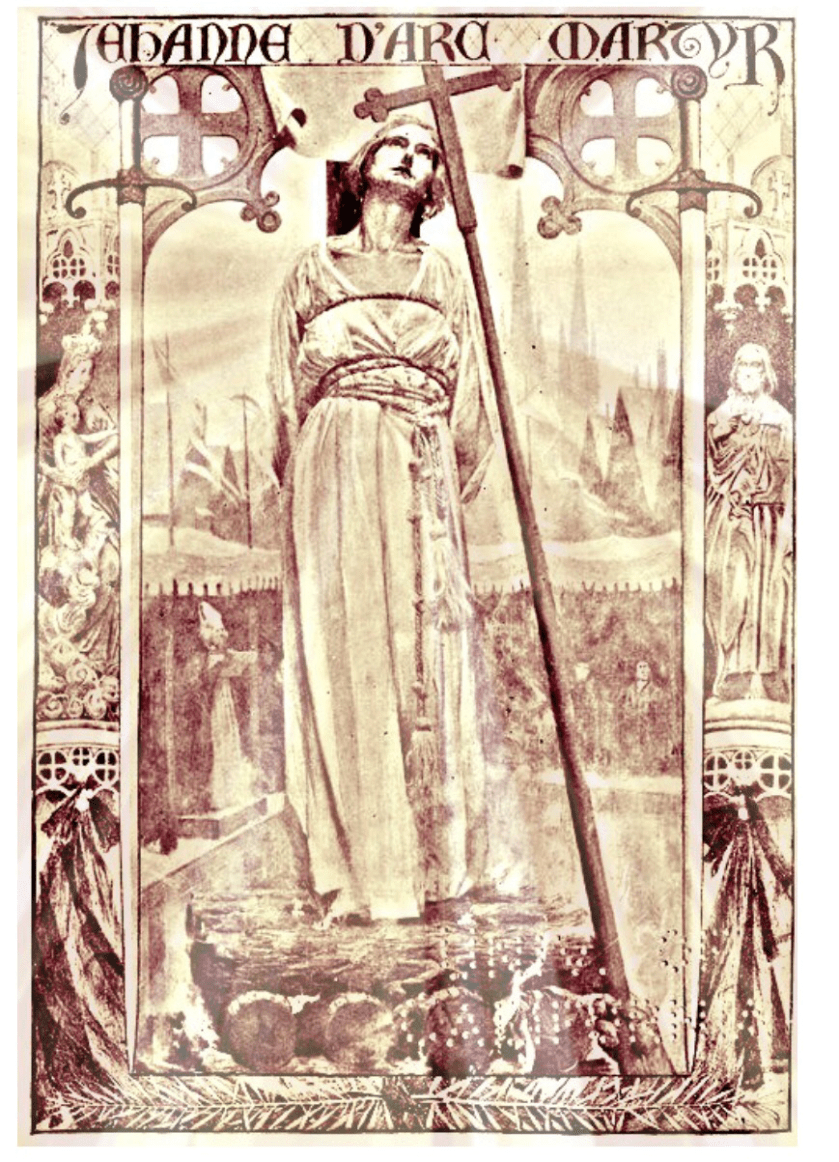
When the fire died, the coals were raked back to expose her charred body. No one would be able to claim she’d escaped alive. Her body was then burned twice more, so no one could collect the relics. Her ashes were then cast into a river.

Guillaume Manchon, one of the court scribes, later recalled: “And she was then dressed in male clothing, and was complaining that she could not give it up, fearing lest in the night her guards would inflict some act of [sexual] outrage upon her; and she had complained once or twice to the Bishop of Beauvais, the Vice-Inquisitor, and Master Nicholas Loiseleur that one of the aforesaid guards had tried to rape her.”

Her executioner, Geoffroy Therage, later said he “Greatly feared to be damned”.
An inquisitorial court authorized by Pope Calixtus III re-examined the evidence, 25 years later. The court exonerated her of all charges, pronouncing her innocent on July 7, 1456, later declaring her a Christian martyr.

Jean d'Arc execution

A National Heroine to the French, Joan of Arc was canonized a saint of the Roman Catholic Church, in 1920. It was small consolation for this child who had been set up for a fall by her enemies, and abandoned to be incinerated alive, by her friends.

If you enjoyed this “Today in History”, please feel free to re-blog, “like” & share on social media, so that others may find and enjoy it as well. Please click the “follow” button on the right, to receive email updates on new articles.  Thank you for your interest, in the history we all share.

February 20, 1945 Falling on Grenades: the Indestructible Jack Lucas

On one training jump, both parachutes failed.  Somehow, Lucas fell 3,500-feet and sustained only minor injuries. According to his team leader, “Jack was the last one out of the plane and the first one on the ground”.

In the days and weeks following the Japanese attack on Pearl Harbor, enlistment and recruiting offices across the nation were flooded with volunteers. Birmingham Alabama saw 600 men in the first few hours, alone. In Boston, lines snaked out the door as men waited for hours, to volunteer.

But for his age, Jack Lucas would have been right there with them.

6faf2f23e4e21cd5a8d6c926af674a60

At 5’8″ and a muscular 180-pounds, Jacklyn Harrell “Jack” Lucas was big for his age. On August 8, 1942, Lucas forged his mother’s signature on parental consent papers and claimed to be seventeen, enlisting in the United States Marine Corps. He was fourteen years old.

A year later, a letter to a girlfriend from V Amphibious Corps at Pearl Harbor, revealed his true age of fifteen. Military censors had Lucas removed from his combat unit and nearly sent him home, but Jack was vehement.  He was assigned to driving a truck, but this was a problem.  Being in the “rear with the gear” was not his idea of military service.  Lucas got into so many fights he was court-martialed, sentenced to five months of breaking rocks, given nothing but bread & water.

Iwo-Jima-Caves
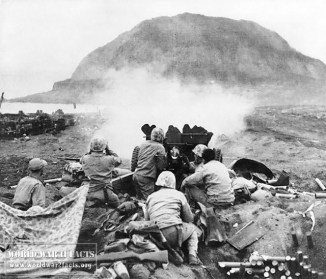
Iwo Jima

Lucas was released from the brig in January 1945, when he deserted his post, stowing away on the transport USS Deuel to get closer to the action.  He turned himself in on February 8, volunteering to fight.  Jack turned seventeen on February fourteen.  Six days later, he got his wish.

February 20 was day two of the five-week battle for Iwo Jima, some of the bloodiest fighting of the Pacific war, in WW2.   Advancing toward a Japanese airstrip under heavy fire, Lucas and three Marines took shelter in a trench, only to realize there were eleven Japanese soldiers, barely feet away. He managed to shoot two when his rifle jammed, looking down as that first grenade, came over the parapet.

Without a moment’s thought, Lucas dove over his fellow Marine and onto the grenade, as another fell by his side.  Let his Medal of Honor citation, pick up the story:

381“Quick to act when the lives of the small group were endangered by two grenades which landed directly in front of them, Private First Class Lucas unhesitatingly hurled himself over his comrades upon one grenade and pulled the other one under him, absorbing the whole blasting force of the explosions in his own body in order to shield his companions from the concussion and murderous flying fragments”.

Only when a second company moved through the area, did someone realize he was still alive.

Six days later, Jack Lucas’ deserter classification was removed from his record.  In time, all seventeen of his military convictions were overturned.  He’d endure twenty-one surgeries and even then, no fewer than two hundred pieces of metal remained in his body, some the size of .22-caliber bullets.

Jack Lucas was ruled unfit for duty and discharged on September 18, 1945.  He was awarded the Medal of Honor by President Harry S Truman, on October 5, at seventeen the youngest recipient of the nation’s highest award for military valor, since the Civil War.

The man had more than earned the name “indestructible”, but wait.  There’s more.

Lucas earned a business degree and returned to military service at age thirty-one, this time with the 82nd Airborne, of the United States Army.  On one training jump, both parachutes failed.  Somehow, Lucas fell 3,500-feet and sustained only minor injuries. According to his team leader, “Jack was the last one out of the plane and the first one on the ground“.

Two weeks later, he was back to jumping out of perfectly good aircraft.

Jacklyn Lucas, older

Lucas was married several times in civil life, including to one woman, who attempted to have him killed.  He later wrote his autobiography with help from writer D.K. Drum, appropriately entitled, “Indestructible”.


The USS Iwo Jima (LHD-7) is a Wasp-class amphibious assault vessel, commissioned in 2001. When her keel was laid, Jack Lucas placed his Medal of Honor citation inside her hull, where it remains, to this day.

On August 3, 2006, sixteen living Marine Corps Medal of Honor recipients including Jack Lucas were presented the Medal of Honor flag by Commandant of the Marine Corps General Michael Hagee, in front of over a thousand family, friends, and fellow Marines. Lucas commented, “To have these young men here in our presence — it just rejuvenates this old heart of mine. I love the Corps even more knowing that my country is defended by such fine young people.”

Jacklyn Lucas

The Indestructible Jacklyn Lucas died of Leukemia on June 5, 2008.  He was eighty years old.  On September 18, 2016, Secretary of the Navy Ray Mabus announced plans to build a new Arleigh Burke-class destroyer. DDG-125 is expected to be commissioned in 2023, to be named in his honor, the USS Jack H. Lucas.

800px-USS_Jack_H._Lucas
Artist’s depiction, USS Jack H Lucas
If you enjoyed this “Today in History”, please feel free to re-blog, “like” & share on social media, so that others may find and enjoy it as well. Please click the “follow” button on the right, to receive email updates on new articles.  Thank you for your interest, in the history we all share.


February 19, 1807 Burning Ambition

Behind the scenes, the vice president secretly corresponded with the British and Spanish Ministers to the United States, offering in the first case to detach Louisiana from the Union and in the second, to orchestrate an overthrow, of Mexico.  He himself would do nicely to found the new dynasty, thank you very much, for asking.

What would it be like to turn on CNN or Fox News, to learn that Former Secretary of the Treasury Jacob Lew had been party to a duel, and he was near death after being shot by Vice President Mike Pence.

The year was 1804.  President Thomas Jefferson’s Vice President Aaron Burr, had a long standing grudge against Alexander Hamilton, first Secretary of the Treasury under President George Washington.

GettyImages-515414860-E
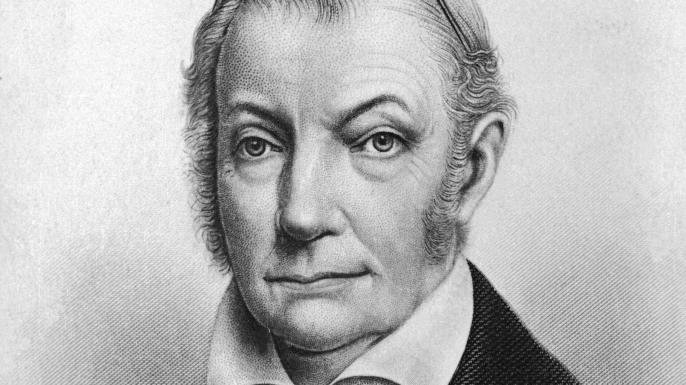
Aaron Burr

The animosity between the two went back to the Senate election of 1791, and escalated during one of the ugliest election seasons in American history.  It’s been called the “Revolution of 1800”, the election pitting Democratic-Republican candidate Thomas Jefferson, against one-term incumbent John Adams, of the Federalist party.

Both sides were convinced beyond doubt, that the other side would destroy the young nation. Federalists attacked Jefferson as an un-Christian deist, a populist whose sympathies with the French Revolution would bring about a similar cataclysm in the young American Republic. Democratic-Republicans criticized the alien and sedition acts, and the deficit spending the Adams administration employed to support Federal policy.

At the time, electors cast two votes, the first and second vote-getters becoming President and Vice President.

“The father of modern political campaigning”, Aaron Burr had long since enlisted help from New York’s Tammany Hall, transforming what was then a social club into a political machine.  The election was a decisive victory for the Democratic-Republicans.  Not so much for the candidates themselves.

The electoral vote tied at 73 between Jefferson and Burr, moving the selection to the House of Representatives. Hamilton exerted influence on behalf of Jefferson, who was elected on the 36th ballot.  Aaron Burr was relegated to the vice-Presidency.

John Nance Garner served as 32nd vice president between 1931 – ’41. With precisely zero influence over Presidential authority, Garner described the position as “not worth a bucket of warm piss”.  The sentiment is cleaned up and commonly retold as, “warm spit”.

A man with the towering ambition of Aaron Burr could certainly relate.  Behind the scenes, the vice president secretly corresponded with the British and Spanish Ministers to the United States, offering in the first case to detach Louisiana from the Union and in the second, to orchestrate an overthrow, of Mexico.  He himself would do nicely to found the new dynasty.  Thank you very much, for asking.

chase2
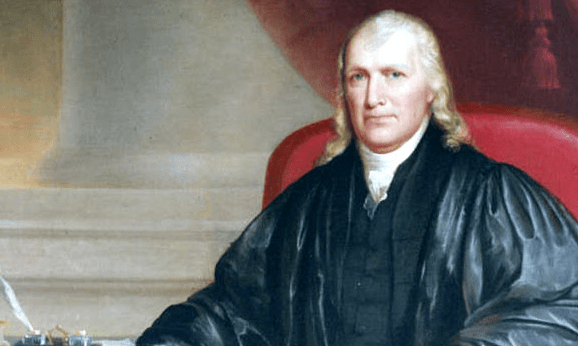
Justice Samuel Chase

We’re accustomed today to the idea of “Judicial Review”, the idea that Supreme Court decisions are final and inviolate, but that wasn’t always the case. The landmark Marbury v Madison decision established the principle in 1803, a usurpation of power so egregious to Democratic-Republicans, as to bring about the impeachment of Associate Justice Samuel Chase, a signer of the Declaration of Independence.

As VP, Burr presided over Chase’ impeachment.  It was the high point of the only term he would ever serve.

Relations were toxic between Jefferson and Burr.  The VP knew he wouldn’t be around for the 1804 re-election campaign, so he ran for Governor of New York, losing in a landslide to a virtual unknown, Morgan Lewis.

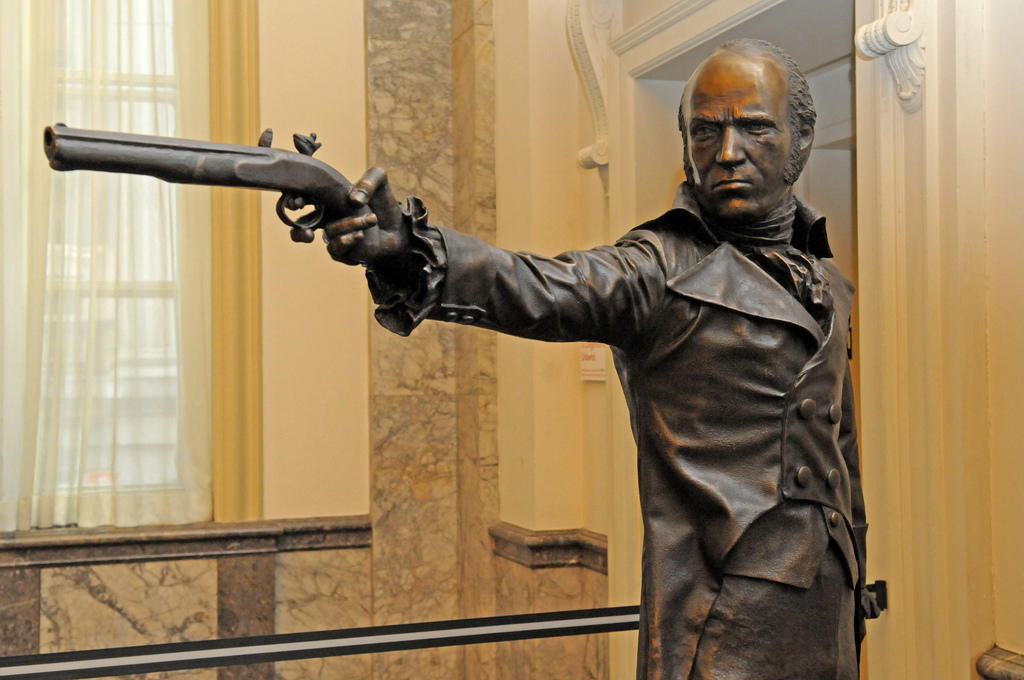
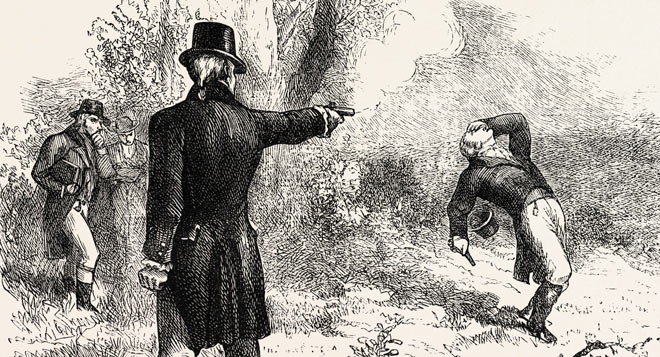
It was a humiliating defeat.  Burr blamed Alexander Hamilton over comments made during the election, and challenged him to a duel.  Dueling was illegal at this time but enforcement was lax in New Jersey. The pair rowed across the Hudson River with their “seconds”, meeting at the waterfront town of Weehawken. It was July 11, 1804. Hamilton “threw away” his shot, firing into the air. Aaron Burr shot to kill.

missedinhistory-podcasts-wp-content-uploads-sites-99-2015-07-hamilton-burr-660x357Murder charges were filed in both New York and New Jersey, but neither went to trial.

Aaron Burr went on to preside over Justice Chase’ impeachment, the high point of a career otherwise ended, the day he met Alexander Hamilton in Weehawken.

Burr headed for New Orleans where he got mixed up with one General James Wilkinson, one of the sleazier characters of the founding generation. At that time, Wilkinson was a paid agent for Spanish King Charles IV. 100 years later Theodore Roosevelt would say of Wilkinson, “In all our history, there is no more despicable character.”

Wilkinson took his payments in silver dollars, hidden in rum, sugar and coffee casks. All those clinking coins nearly undid him, when a messenger was caught and killed with 3,000 of them. The messenger’s five murderers were themselves Spaniards, who testified at trial the money belonged to the spy, James Wilkinson. Payment for services rendered to their King. Wilkinson’s luck held, as the killers spoke no English. Thomas Power, interpreter for the Magistrate, was another Spanish spy. He threw those guys so far under the bus, they’d never get out: ‘They just say they’re wicked murderers motivated by greed.’

The nature of Burr’s discussions with Wilkinson is unclear but, in 1806, Burr led a group of armed colonists toward New Orleans, with the apparent intention of snatching the territory and turning the place into an independent Republic. It’s probably safe to assume that Aaron Burr saw himself at the head of such a Republic.

Seeing no future in it and wanting to save his own skin, General Wilkinson turned on his former ally, sending dispatches to Washington accusing the former Vice President of treason. Burr was tracked down in Alabama on February 19, 1807, arrested for treason and sent to Richmond, Virginia, for trial.

Classics-Burr-conspiracy-p-cropped

The size and shape of the “Burr Conspiracy” remain unclear, to this day.  Historians claim the Vice President intended to take parts of Texas and the Louisiana Purchase, forming his own independent Republic. Others claim he intended to conquer Mexico,  That Aaron Burr had a following among prominent politicians and soldiers is beyond question, but estimates of their numbers range from forty, to over seven-thousand.

Burr himself claims only to have wanted the 40,000 acres in the Texas Territory, deeded him by the Spanish crown.  On this there is no uncertainty.  The lease still exists.

Burr was acquitted on September 1, on grounds he had not committed an “overt act” as specified in the Constitution. He was not guilty in the eyes of the law, but the court of public opinion would forever regard him as traitor. Aaron Burr spent the next several years in Europe before returning to New York, and resuming his law practice.

The Vice President who killed the man on our $10 bill, died in obscurity on September 14, 1836, at the age of 80.

150320191637-ten-dollar-bill-780x439

If you enjoyed this “Today in History”, please feel free to re-blog, “like” & share on social media, so that others may find and enjoy it as well. Please click the “follow” button on the right, to receive email updates on new articles.  Thank you for your interest, in the history we all share.

February 18, 1817 The Awful Tragedy, of Friends at War

Three years came and went before the old friends once again faced each other, this time across the field of battle.   Gettysburg.

Armistead is a prominent name in Virginia.  The family goes back to colonial days.  Five Armistead brothers fought in the war of 1812. Major George Armistead commanded Fort McHenry during the Battle of Baltimore, the inspiration for Francis Scott Key’s Star Spangled Banner.

Major Armistead became an uncle this day in 1817, to Lewis Addison Armistead, the first of eight children born to General Walker Keith and Elizabeth Stanley Armistead.

“Lothario” or “Lo” to his friends, Armistead followed the family footsteps, attending the Military Academy at West Point.  He never graduated.  Some say he had to resign after breaking a plate over the head of fellow cadet and future Confederate General, Jubal Early.  Others say it was due to academic difficulties, particularly French class.

armistead_image.0
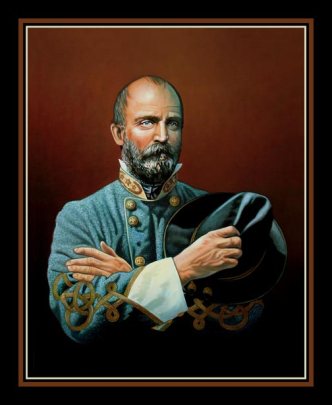
Lewis Addison Armistead

Be that as it may, Armistead’s influential father gained him a 2nd Lieutenant’s commission awarded in 1839, about the time his former classmates, received theirs.

Armistead’s field combat experience reads like a time-line of the age:  cited three times for heroism in the Mexican-American War, wounded at the Battle of Chapultepec, going on to serve in the Mohave War and the Battle of the Colorado River.

Stellar though his military career was, the man’s personal life was a series of disasters.  Armistead survived two wives and two daughters, only to lose the family farm in a fire.  All while fighting a severe case of Erysipelas, a painful and debilitating Streptococcal skin infection known in the Middle Ages as “St. Anthony’s Fire”.

The act of conjugating the “Be” verb changed after the Civil War.  Before, it was the United States “are”.  Afterward, it became the United States “is”, and not for no reason.  This was a time when Patriotic Americans felt every bit the attachment to states, as to the nation itself.

Though often plagued with doubt, fellow Americans took sides on the eve of the Civil War.  Even brothers.   Like fellow Virginian Robert E. Lee, Armistead wanted no part of secession, but followed his state when the break became inevitable.

Winfield Scott Hancock.gif
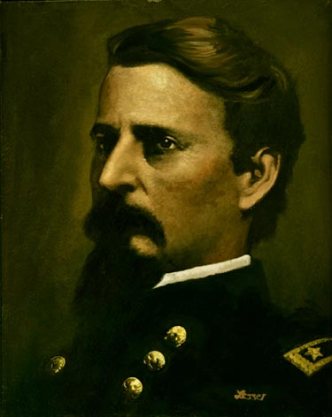
Winfield Scott Hancock

Pennsylvania native Winfield Scott Hancock went the other direction, staying with the Union.  Years later, “Hancock the Superb” would be the Democratic candidate for President of the United States, narrowly losing to Republican James A. Garfield.

At a time of rampant political corruption, Hancock was noted for personal integrity.  Though himself a Republican, President Rutherford B. Hayes spoke in terms of admiration:

“[I]f…we are to think first and chiefly of his manhood, his integrity, his purity, his singleness of purpose, and his unselfish devotion to duty, we can truthfully say of Hancock that he was through and through pure gold.”

Neither Armistead nor Hancock were politicians, nor the sort of hotheads responsible for starting the war.  These were professional soldiers, serving together and developing a close personal friendship, as early as 1844.  On final parting on the eve of Civil War, Armistead made Hancock the gift of a new Major’s uniform.

Three years came and went before the old friends once again faced each other, this time across the field of battle.   Gettysburg.

Robert E. Lee intended to break the Federal will to fight at Gettysburg, before moving on to threaten the Union capital, in Washington DC.  ‘Marse Robert” attacked his adversary’s right on that first day, looking for a soft spot in the line. On day two, he went after the left.  On the afternoon of July 3, 1863, Lee came straight up the middle.

640px-Pickett's_Charge_defence
A Union perspective, from Cemetery ridge

Armistead and Hancock looked out across the same field as gray and butternut soldiers formed up along seminary ridge.  The action began with the largest bombardment in the history of the western hemisphere, the mighty crash of 170 guns spread over a two-mile front.  The attack lasted for an hour, most shells flying harmlessly over the Union line and exploding, in the rear.  One shell disturbed the lunchtime mess of that “damn old goggle-eyed snapping turtle” George Gordon Meade, cutting one orderly in half and sending much of the senior staff, diving for cover.

DSC_0430.jpg

The eighty guns of the Union line responded at first, before going silent, one by one.  In the smoke and confusion, it was easy to believe they were put out of action, but no.  These would be held, until the final assault.

The action has gone into history as “Pickett’s Charge”, though that’s a misnomer.  Major General George Pickett commanded only one of  three Divisions taking part in the assault, under Corps Commander Lieutenant General James Longstreet.

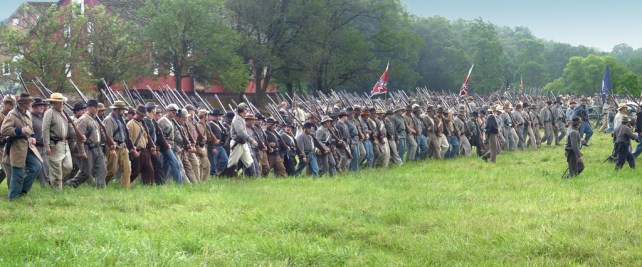
The pace was almost leisurely as Pickett’s, Trimble’s and Pettigrew’s gray and butternut soldiers stepped out of the forest, and over the stone wall.  Twelve to fifteen thousand men crossing abreast, bayonets glinting in the sun, banners rippling in the breeze.  One Yankee soldier described the scene as “an ocean of men sweeping upon us.”

longstreets-assault

You can’t escape the sense of history, if you’ve ever crossed that field. Stepping off Seminary Ridge with nearly a mile to go, you are awe struck by the mental image of thousands of blue clad soldiers, awaiting your advance.  First come the shells, exploding and tearing jagged holes, where men used to be.  Halfway across and just coming into small arms range, you can’t help a sense of relief as you step across a low spot and your objective, the “copse of trees”, drops out of sight.  If you can’t see them they can’t shoot at you.  Then you look to your right and realize that cannon would be firing down the length of your lines from Little Round Top, as would those on Cemetery Hill, to your left.

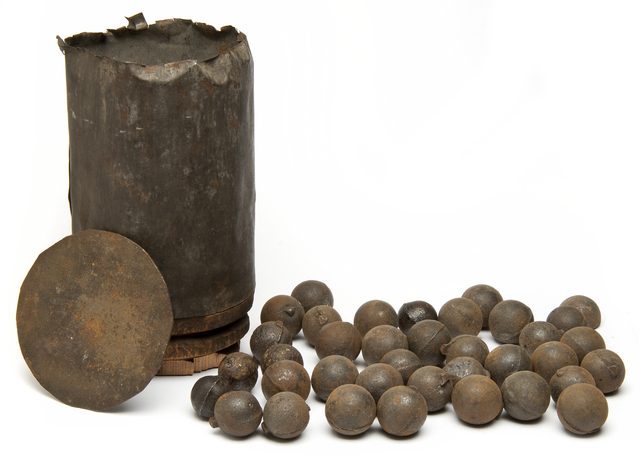
Rising out of the draw you are now in full sight of Union infantry.  You hear the tearing fabric sound of rifle fire, exploding across the stone wall ahead.  Cannon have converted to canister by now, thousands of projectiles transforming federal artillery into giant shotguns.  You quicken your pace as your lines are torn apart from the front and sides. Fences hold in some spots along the Emmitsburg Road.  Hundreds of your comrades are bunched up in the attempt to climb over, mowed down where they stand.

6543.3.1-12
Canister shot, Gettysburg

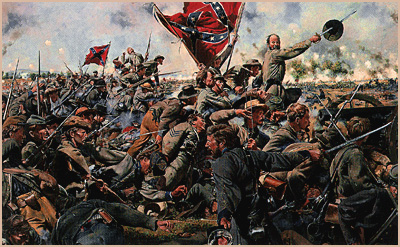
Finally you are over, closing at a dead run.  Seeing his colors cut down, Armistead put his hat atop his sword, holding it high and bellowing above the roar of the guns “Come on, boys, give them the cold steel! Who will follow me!”

Picketts-Charge

Eight months before, Federal troops were cut down like grass in that frozen December, attacking the Rebel-held stone wall at Fredericksburg.  So numerous were the multitudes of dying and maimed as to inspire the Angel of Marye’s Heights, one of the great acts of mercy, in the history of war.

Now on this hot July day, came the payback.  All along the Union line, the chant arose to a roar, resounding above the din of battle:  “Fredericksburg! Fredericksburg! Fredericksburg!”

Alonzo_Cushing
Alonzo Cushing

The savagery of that desperate struggle, can only be imagined.  With a shell fragment entering his shoulder and exiting his back and holding his own intestines with a free hand, Brevet Major Alonzo Cushing directed battery fire into the face of the oncoming adversary, until the bullet entered his mouth and exited the back of his skull.

150 years later, the 22-year-old received the Medal of Honor, posthumously awarded by President Barack Obama.

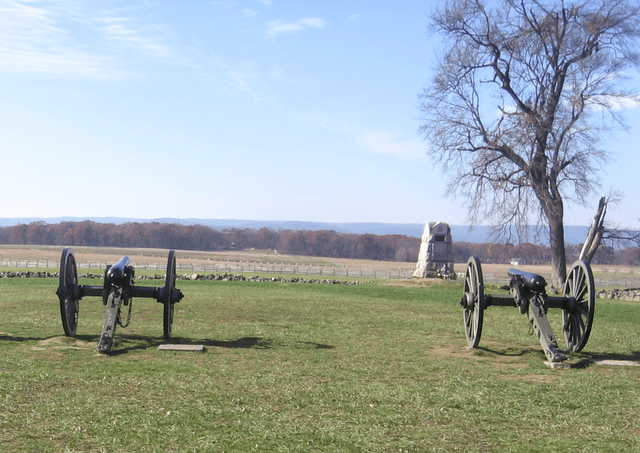
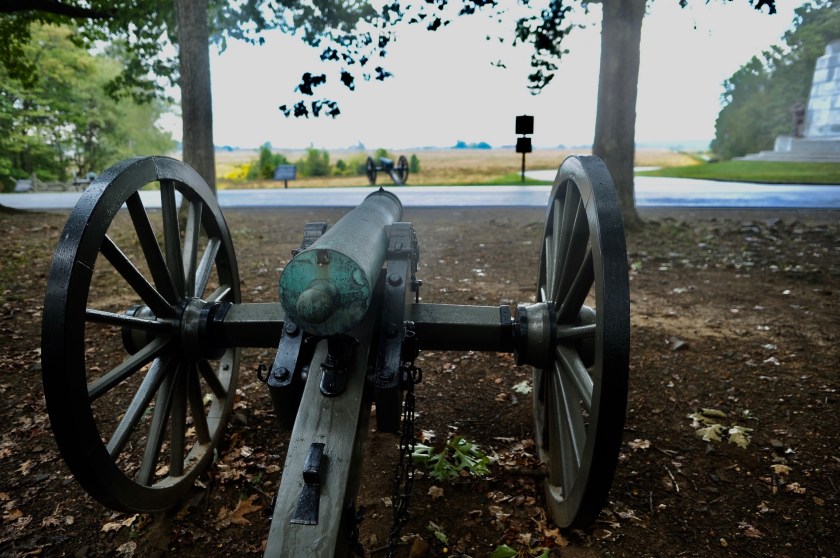
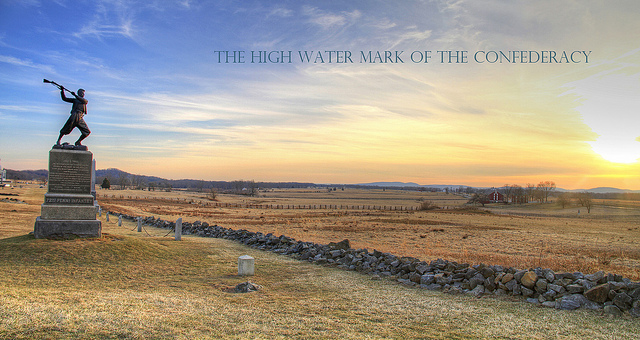
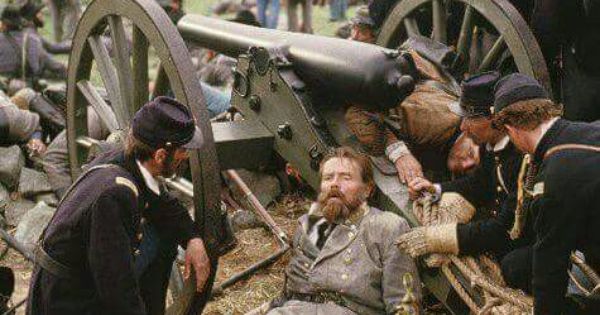
The “High Water Mark of the Confederacy” marks the point between the corner of a stone wall and that copse of trees, the farthest the shattered remnants of Longstreet’s assault would ever get.  Lewis Armistead made it over that wall before being shot down, falling beside the wheels of a Union cannon.

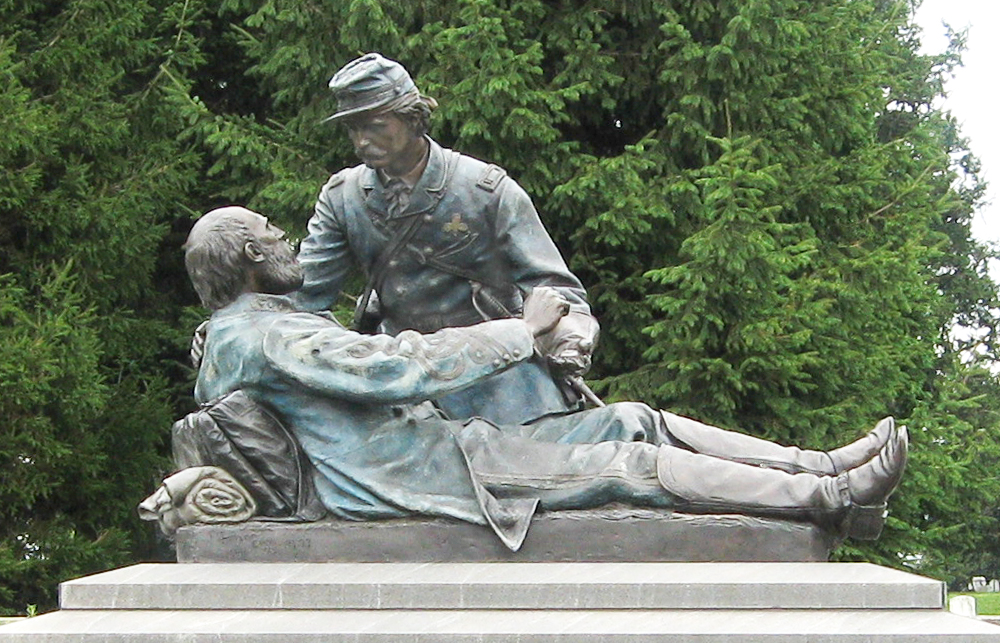
One day, the nation would reunite.  The two old friends, never did.  As Armistead sat bleeding in the grass, he was approached by Major Henry Bingham, of Hancock’s staff.  Hancock was himself wounded by this time, the bullet striking his saddle pommel and entering his thigh, along with shards of wood and a bent saddle nail.

8507324952_e123a4eeb2_z

Armistead was grieved at hearing the news.  Bingham received the General’s personal effects, with instructions they be brought to his old friend. To Almira (“Allie”) Hancock, the General’s wife, Armistead gave a wrapped bible and his personal prayer book, bearing the inscription ”Trust In God And Fear Nothing”.

There are those who debate the meaning of Lewis Armistead’s last message, though the words seem clear enough: “Tell General Hancock for me that I have done him and you all an injury which I shall regret the longest day I live.”

ef0189df7a86e869ce2ee2304ab9fc1d
From the film, Gettysburg’

Feature image, top of page:  “The Friend to Friend Masonic Memorial is on the south side of Gettysburg in the National Cemetery Annex off Taneytown Road at the intersection with Steinwehr Avenue. (39.8210° N, 77.23177° W)” H/T Gettysburg.stonesentinels.com

If you enjoyed this “Today in History”, please feel free to re-blog, “like” & share on social media, so that others may find and enjoy it as well. Please click the “follow” button on the right, to receive email updates on new articles.  Thank you for your interest, in the history we all share.

February 17, 1895 Yellow Journalism

Circulation wars were white hot in those days, competing papers using anything possible to get an edge. Real-life street urchins hawked lurid headlines, heavy on scandal-mongering and light on verifiable fact. Whatever it took, to increase circulation.

YellowKidMickey Dugan was “born” on February 17, 1895, a wise-cracking street urchin from the wrong side of the tracks.  “Generous to a fault” with a “sunny disposition” Mickey was the kind of street kid you’d find in New York’s turn-of-the-century slums, maybe hawking newspapers. “Extra, Extra, read all about it!”

With his head shaved as if recently ridden of lice, Mickey was one of thousands of homeless urchins roaming the back lots and tenements of the city, not so much an individual as an archetype. Mickey Dugan was a cartoon character, the child of artist and “Buster Brown” creator, Richard Outcault.

Outcault’s “Hogan’s Alley” strip, one of the first regular Sunday newspaper cartoons in the country, became colorized by May of 1895. For the first time Mickey Dugan’s oversize, hand-me-down nightshirt was depicted in yellow.  Readers soon forgot his name.  He was simply “the Yellow kid”.

000789.1LOutcault worked for Joseph Pulitzer in those days, owner of the New York World Newspaper. Arch rival William Randolph Hearst hired the cartoonist away to work for Pulitzer’s cross-town competitor Journal American, but the pair soon learned that there was no copyright protection on the Yellow Kid. Soon the character was simultaneously appearing in both competing newspaper strips, where he would remain for over a year.

Circulation wars were white hot in those days, competing papers using anything possible to get an edge.  Real-life street urchins hawked lurid headlines, heavy on scandal-mongering and light on verifiable fact. Whatever it took, to increase circulation.

The Yellow Kid ceased to be of interest by 1898, but he lived on in a way, in the style of newspaper reporting which came to be known as “yellow journalism”.

PulitzerHearstWarYellowKids.jpg

After two wars for independence from Spain, the Caribbean island of Cuba found its economy increasingly intertwined with that of the United States. From the Spanish perspective, Cuba was more of a province than a colony, they were not about to relinquish a foot of territory. When the Cuban Rebellion of 1895 broke out, don Valeriano Weyler’s brutal repressions killed hundreds of thousands in Cuban concentration camps.

In America, some saw parallels between the “Cuba Libre” movement, in their own revolution of a hundred-odd years earlier. Fearing the economic repercussions of a drawn out conflict, shipping and other business interests put pressure on President McKinley to intervene. Meanwhile, the yellow papers kept the issue front page, whipping up popular fury with tales of the noble Cuban revolutionary and the barbaric Spaniard. There were even tales of American women being publicly strip searched by Spanish authorities.

USS_Maine01
USS Maine

The armored cruiser USS Maine left Key West headed for Cuba in January 1898, to protect US interests and to emphasize the need for a quick resolution to the conflict. Anchored in Havana Harbor on February 15, a massive explosion of unknown origin rocked the Maine, sinking the cruiser within minutes and killing 266 of the 355 Americans on board.

The McKinley administration urged calm. Conditions in Cuba were bad enough, but front page headlines like “Spanish Murderers” and “Remember the Maine” accompanied sensationalized accounts of Spanish brutality. War became all but inevitable when US Navy findings were released that March, stating that an external explosion had doomed the Maine.

MaineThe Spanish-American War began the following month, directly resulting in the Philippine-American war.

There is a story, that illustrator Frederic Remington said there was no war brewing in Cuba. Hearst is supposed to have replied. “You furnish the pictures and I’ll furnish the war.” The story may be apocryphal. The media can’t tell us what to think, but they can certainly control what we think ABOUT. Hearst and Pulitzer had clamored for two years for war with Spain, and they were happy to take credit when it came. Besides, it was good for circulation. A week after the Spanish-American War began in April, Hearst’s American Journal ran the headline “How do you like the Journal’s war?” Front page, above the fold.

spanish-american
War Propaganda

It’s been said that you should never pick a fight with a guy who buys ink by the barrel. I disagree. I have broken that dictum myself and recommend the practice to anyone so inclined. For all the Wizard of Oz antics of the print and electronic media, there remains only the one man behind the curtain. President Reagan once said of the Soviet Union, “doveryai no proveryai” (trust, but verify). He might have said the same of an information industry whose business model it is, to rent an audience to a sponsor.

In 1976, a team of American naval investigators concluded that the Maine explosion was likely caused by a fire which ignited its ammunition stocks, not by Spanish mine or act of sabotage.

Small consolation it was to 3,289 Americans and an estimated 90,000 Spaniards, killed in “the Journal’s war”. Nor to the loved ones, they left behind.

If you enjoyed this “Today in History”, please feel free to re-blog, “like” & share on social media, so that others may find and enjoy it as well. Please click the “follow” button on the right, to receive email updates on new articles.  Thank you for your interest, in the history we all share.

February 16, 1973 Cherry

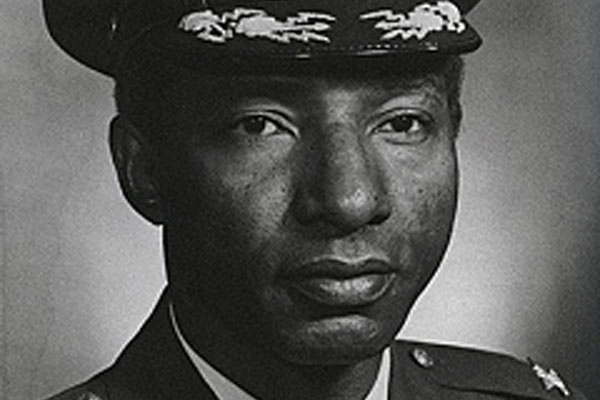
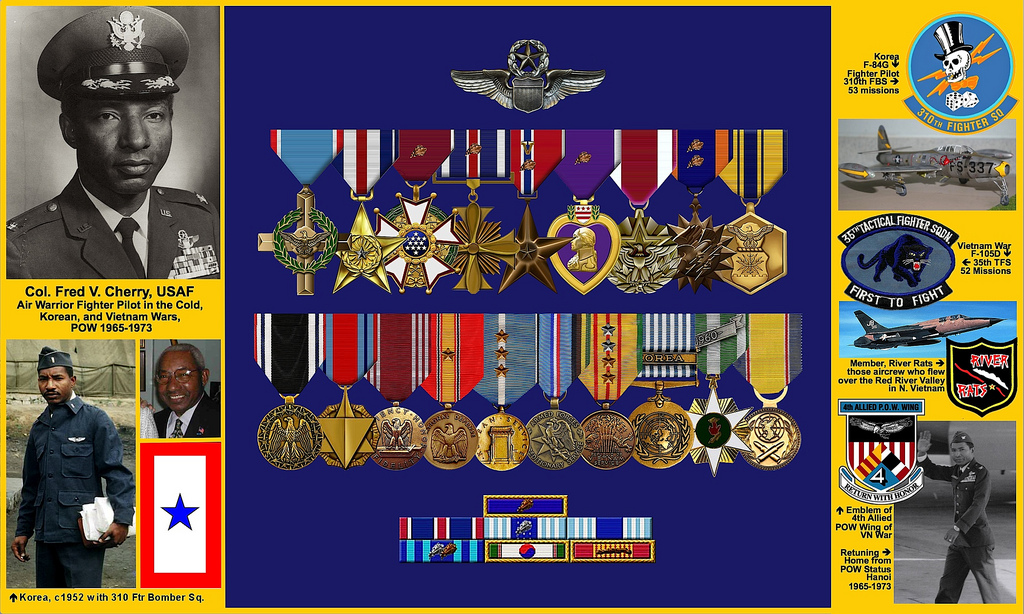
“I spent 702 days in solitary confinement…At one time I was either tortured or in punishment for 93 straight days.” Fred Vann Cherry, Sr.

Fred Vann Cherry was born March 24, 1928, the child of poor Virginia dirt farmers.  Cherry had all the disadvantages of a black child growing up in the Jim Crow-era, but he stuck to his studies.  As a boy, Cherry attended racially segregated public schools in Suffolk Virginia, later attending the historically all-black Virginia Union University, and the United States Air Force Aviation Cadet Training Program.

An Air Force fighter pilot, Cherry flew 52 combat missions over North Korea, before going on to serve during the Cold War period, and the American war in Vietnam.

fred-cherry-600
Fred Vann Cherry, Sr.

On October 22, 1965, then-Major Cherry’s F-105 Thunderchief fighter-bomber was hit by anti-aircraft fire, fifteen miles north of Hanoi.  “The plane exploded and I ejected at about 400 feet at over 600 miles an hourIn the process of ejection, I broke my left ankle, my left wrist, and crushed my left shoulder. I was captured immediately upon landing by Vietnamese militia and civilians.”

Any fool can judge a man by the color of his skin.  Most fools, do.  Fred Cherry’s North Vietnamese captors were no exception.  The first American of African ancestry to fall into the hands of these people, Cherry was told things could go easier.  If only he spoke out about racial discrimination, in the United States.

Porter Halyburton
Porter Halyburton

When that failed to produce the propaganda victory they wanted, jailers assigned Cherry a cellmate, the self-described “southern white boy”, Naval aviator Porter Halyburton.

I guess they thought if they had a Southern white boy taking care of a black man, it would be the worst place for both of us,” Halyburton told the Washington Post. “It turned out to be the best thing that ever happened to me.”

Halyburton looked after his injured cellmate, changing the dressings on his infected wounds, feeding him, bathing him and watching over him. “He said I saved his life, and he saved my life. . . . Taking care of my friend gave my life some meaning that it had not had before.

For eight months, the two men lived in a series of putrid, stinking cells, 10-by-10-foot compartments with nothing to sleep on but filthy straw mats, or the floor.

I was so inspired by Fred’s toughness,” Halyburton said. “He had grown up in the racial South [and] undergone a lot of discrimination and hardship. But he was such an ardent patriot. He loved this country. It inspired me, and it inspired a lot of others.”

The two cellmates were separated in 1966, in what Halyburton remembers as “one of the saddest days of my life.”   Cherry recalled “I spent 702 days in solitary confinementAt one time I was either tortured or in punishment for 93 straight days.”

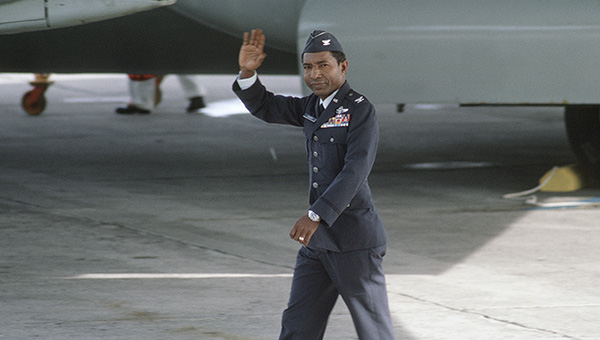
Fred Cherry February 16, 1973
Fred Cherry speaks to the press on February 16, 1973, following 2,671 days in captivity

The pair didn’t see each other again until 1973, when the two met at the military hospital at Clark Air Base in the Philippines following release from captivity.

Colonel Cherry and Commander Halyburton gave a number of joint talks at military institutions and colleges, and toured in 2004 to promote a book about their story, “Two Souls Indivisible: The Friendship That Saved Two POWs in Vietnam,” by James S. Hirsch.

Fred Cherry died on this day in 2016 at the age of 87, forty-three years to the day, from the news conference photographed above.  The Washington Post remembered in his obituary, what Colonel Cherry wrote in a 1999 collection of POW stories:

 “I was always taught to love and respect others and forgive those who mistreat, scorn or persecute me. . . . [This] allowed me overcome the damages of discrimination, Jim Crow, and the social and economic barriers associated with growing up a poor dirt farmer. . . . My standard for making decisions is based on doing what is right.”

It’s an inspiring message.  One worth remembering.

HOMECOMING
Former POW and U.S. Air Force Colonel Fred Vann Cherry waves to the public and press there to greet the plane load of former POWs flown in from Clark Air Base. Colonel Cherry was released by the North Vietnamese in Hanoi February 12, 1973.
If you enjoyed this “Today in History”, please feel free to re-blog, “like” & share on social media, so that others may find and enjoy it as well. Please click the “follow” button on the right, to receive email updates on new articles.  Thank you for your interest, in the history we all share.

February 15, 2005 Arlington Ladies

The organization was traditionally formed of current or former military wives. Today their number includes daughters and even one “Arlington Gentleman”. 46 years ago they came alone, or in pairs. Today, 145 or so volunteers from four military branches are a recognized part of all funeral ceremonies at Arlington National Cemetery, their motto:  “No Soldier will ever be buried alone.”

The first military burial at Arlington National Cemetery was that of Private William Henry Christman, 67th Pennsylvania Infantry, interred on May 13, 1864. Two more joined Christman that day, the trickle soon turning into a flood. By the end of the war between the states, that number was 17,000 and rising.

In modern times, an average week will see 80 to 100 burials in the 612 acres of Arlington.

acad074c5b1001f3d6ae88cdcc2bf4fc

Fourteen years ago, a news release from the Department of Defense reported “Private First Class Michael A. Arciola, 20, of Elmsford, New York, died February 15, 2005, in Al Ramadi, Iraq, from injuries sustained from enemy small arms fire. Arciola was assigned to the 1st Battalion, 503d Infantry Regiment, 2nd Infantry Division, Camp Casey, Korea”.

Private Arciola joined a quarter-million buried in our nation’s most hallowed ground on March 31. Two hundred or more mourners attended his funeral, a tribute befitting the tragedy of the loss of one so young.

Sixteen others were buried that same Friday.  Most were considerably older. Some brought only a dozen or so mourners.  Others had no friends or family members whatsoever, on-hand to say goodbye.

11097577_f520

In 1948, Air Force Chief of Staff General Hoyt Vandenberg and the general’s wife Gladys, regularly attended funeral services at Arlington National cemetery.

Sometimes, a military chaplain was the only one present at these services. Both felt that a member of the Air Force family should be present at these funerals, and Gladys began to invite other officer’s wives. Over time, a group of women from the Officer’s Wives Club were formed for the purpose.

In 1973, General Creighton Abram’s wife Julia did the same for the Army, forming a group calling themselves “Arlington Ladies”. Groups of Navy and Coast guard wives followed suit, in 1985 and 2006. Traditionally, the Marine Corps Commandant sends an official representative of the Corps to all Marine funerals.

The Marine Corps Arlington Ladies were formed in 2016.

image (5).jpg

Arlington Ladies’ Chairman Margaret Mensch explained “We’ve been accused of being professional mourners, but that isn’t true. I fight that perception all the time. What we’re doing is paying homage to Soldiers who have given their lives for our country.”

The casual visitor can’t help but be struck with the respect, of such an occasion.  Air Force Ladies’ Chairman Sue Ellen Lansell spoke of one service where the only other guest was “one elderly gentlemen who stood at the curb and would not come to the grave site. He was from the Soldier’s Home in Washington, D. C. One soldier walked up to invite him closer, but he said no, he was not family”.

The organization was traditionally formed of current or former military wives. Today their number includes daughters and even one “Arlington Gentleman”. 46 years ago they came alone, or in pairs. Today, 145 or so volunteers from four military branches are a recognized part of all funeral ceremonies at Arlington National Cemetery, their motto:  “No Soldier will ever be buried alone.”

The volunteer arrives with a military escort from the Navy or the United States Army 3rd Infantry Regiment, the “Old Guard”. The horse-drawn caisson arrives from the old post chapel, carrying the flag draped casket. Joining the procession, she will quietly walk to the burial site, her arm inside that of her escort. A few words are spoken over the deceased, followed by the three-volley salute. Somewhere, a solitary bugler sounds Taps.

Arlington-Ladies-2

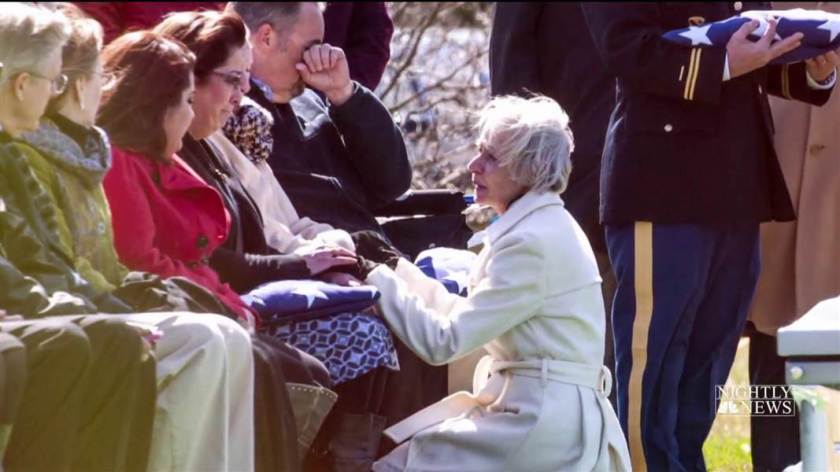
The folded flag is presented to the grieving widow, or next of kin. Only then will she break her silence, stepping forward with a word of condolence and two cards: one from the service branch Chief of Staff and his wife, and a second from herself.

Joyce Johnson buried her husband Lieutenant Colonel Dennis Johnson in 2001, a victim of the Islamist terrorist attack on the Pentagon. Johnson remembers the Arlington Ladies’ volunteer as “a touchingly, human presence in a sea of starched uniforms and salutes”. Three years later, Joyce Johnson paid it forward, and became one herself.

1000w_q95 (1)

Any given funeral may be that of a young military service member killed in the wars in Iraq or Afghanistan, or a veteran of Korea or WWII, who spent his last days in the old soldier’s home. It could be a four-star General or a Private. It doesn’t matter.

Individual volunteers attend about five funerals a day, sometimes as many as eight. As with the Tomb of the Unknown sentinels who keep their guard heedless of weather, funeral services disregard weather conditions. The funeral will proceed on the date and time scheduled regardless of rain, snow or heat. Regardless of weather, an Arlington Lady Will be in attendance.

nn_lho_arlington_ladies_180102_1920x1080.nbcnews-ux-1080-600

Their job is to honor, not to grieve, but it doesn’t always work out that way. Linda Willey of the Air Force ladies describes the difficulty of burying Pentagon friends after 9/11, while pieces of debris still littered the cemetery. Paula McKinley of the Navy Ladies still chokes up, over the hug of a ten-year old who had just lost both her parents. Margaret Mensch speaks of the heartbreak of burying one of her own young escorts, after he was killed in Afghanistan, in 2009.

Offering condolences
Army Arlington Lady Anne Lennox with letters of condolence for the widow of Brigadier General Henry G. Watson.

Barbara Benson was herself a soldier, an Army flight nurse during WWII. She is the longest serving Arlington Lady. “I always try to add something personal”, Benson said, “especially for a much older woman. I always ask how long they were married. They like to tell you they were married 50 or 60 years…I don’t know how to say it really, I guess because I identify with Soldiers. That was my life for 31 years, so it just seems like the natural thing to do.”

Elinore Riedel was chairman of the Air Force Ladies during the War in Vietnam, when none of the other military branches had women representatives. “Most of the funerals were for young men,” she said. “I saw little boys running little airplanes over their father’s coffins. It is a gripping thing, and it makes you realize the awful sacrifices people made. Not only those who died, but those left behind.”

Mrs. Reidel is a minister’s daughter, who grew up watching her father serve those in need. “It doesn’t matter whether you know a person or not”, she said, “whether you will ever see them again. It calls upon the best in all of us to respond to someone in deep despair. I call it grace…I honestly feel we all need more grace in our lives.”

34C94D9000000578-0-image-a-18_1464671785805
They are so few and so young, who pick up the tab on behalf of the rest of us.

Feature image, top of page: Sandra Griffin, Ladies of Arlington

If you enjoyed this “Today in History”, please feel free to re-blog, “like” & share on social media, so that others may find and enjoy it as well. Please click the “follow” button on the right, to receive email updates on new articles.  Thank you for your interest, in the history we all share.

February 14, 1945 Firestorm

Tens of thousands of fires enveloped the city, growing into a great, howling firestorm.  A shrieking, all-but living demon beast from the blackest pits of hell, devouring all in its path. 

The most destructive war in history entered its final, apocalyptic phase in January 1945, with another four months of hard fighting yet remaining before Allied forces could declare victory in Europe. In the west, the “Battle of the Bulge” was ended, the last great effort of German armed forces spent and driven back beyond original lines. In the east, the once mighty German military contracted in on itself, in the face of a massive Soviet advance.

Dozens of German divisions hurried east to meet the threat. Allied intelligence believed the war could be over in April, if the major cities to the east were destroyed. Dresden. Leipzig. Chemnitz. Letting these places stand to serve as bases for retreating German forces, could drag the war out until November.

destroyed-german-equipment-znoymo-czechoslovakia-1945-may
German military equipment lies broken in Czechoslovakia, 1945

Sir Charles Portal, British Chief of the Air Staff, put the problem succinctly: “We should use available effort in one big attack on Berlin and attacks on Dresden, Leipzig, and Chemnitz, or any other cities where a severe blitz will not only cause confusion in the evacuation from the East, but will also hamper the movement of troops from the West.”

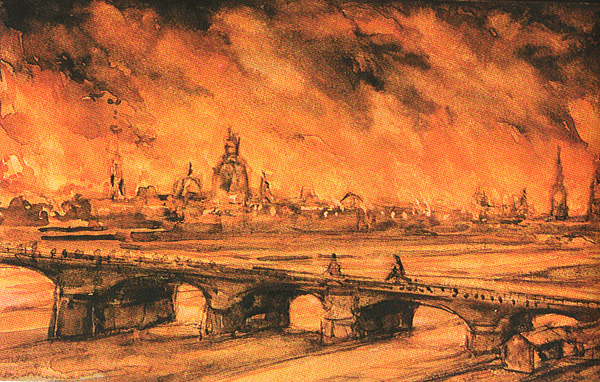
With its baroque and rococo city center, the capital city of Dresden was long described as the “Jewel Box” of the Free State of Saxony, family seat to the Polish monarchs and royal residence to the Electors and Kings of Saxony. Dresden was the seventh-largest city in Germany in 1945, home to 127 medium-to-large sized factories supplying the German war machine, and the largest built-up area in the “thousand-year Reich”, yet to be bombed.

Dresden_montage
Long described as “Florence on the Elbe” Dresden was considered one of the world’s most beautiful cities, a treasure of art and architecture.

For Victor Klemperer, the 13th of February, 1945, was the most terrifying and depressing experience, of a lifetime. Once home to well over 6,000 Jews, Dresden now contained but forty-one. Klemperer’s marriage to an “Aryan” wife had thus far protected him from the “final solution”, despite the yellow Juden star, he was forced to wear on his coat. It was now Victor’s task to hand out official letters, ordering those who remained to report for “deportation”. There wasn’t one among them, who didn’t understand what that meant.

Three hundred miles away, bad weather hampered operations for the United States Army Air Force (USAAF).  The first wave in the fire bombing of Dresden, would be a Royal Air Force (RAF) operation.

dresden-bombing (2)

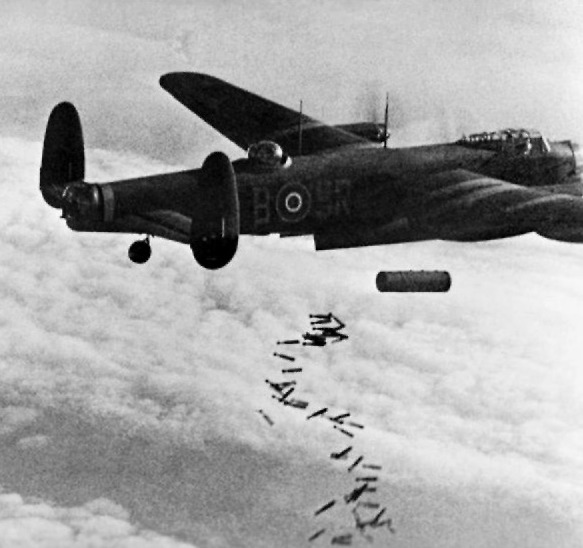
The first group of Lancaster bombers arrived in the skies over Dresden two hours before midnight, February 13. These were the pathfinders, their job to find the place and drop magnesium parachute flares, to light up the target. Then came the marker planes, Mosquito bombers whose job it was to drop 1,000-pound target indicators, their red glare providing something to aim at. Then came the first wave, 254 Lancaster bombers dropping 500 tons of high explosive ranging from 500-pounders to massive, 4,000-pound “blockbusters”. Next came 200,000 incendiary or “fire bombs”.

This thing was just getting started.

dresden

The second wave came in the small hours of February 14, just as rescue operations, were getting underway.  By now thousands of fires were burning, with smoke rising 15,000 feet into the air.  You could see it from the air, for five hundred miles.

That’s when another 529 Lancasters, dropped another 1,800 tons of bombs.

Lancaster_I_NG128_Dropping_Blockbuster_-_Duisburg_-_Oct_14,_1944
Lancaster bomber

The USAAF arrived over the target on the afternoon of February 14, the 317 B-17 “Flying Fortresses” of the “Mighty 8th” delivering another 771 tons, of bombs.

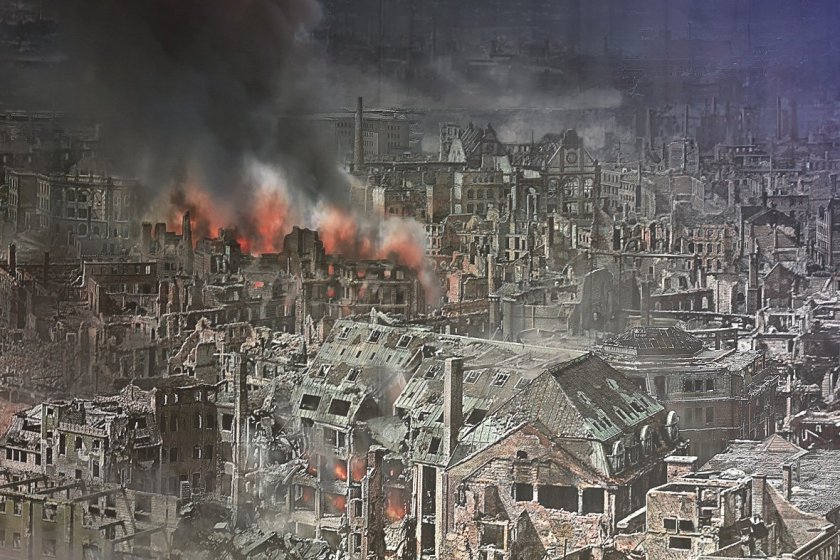
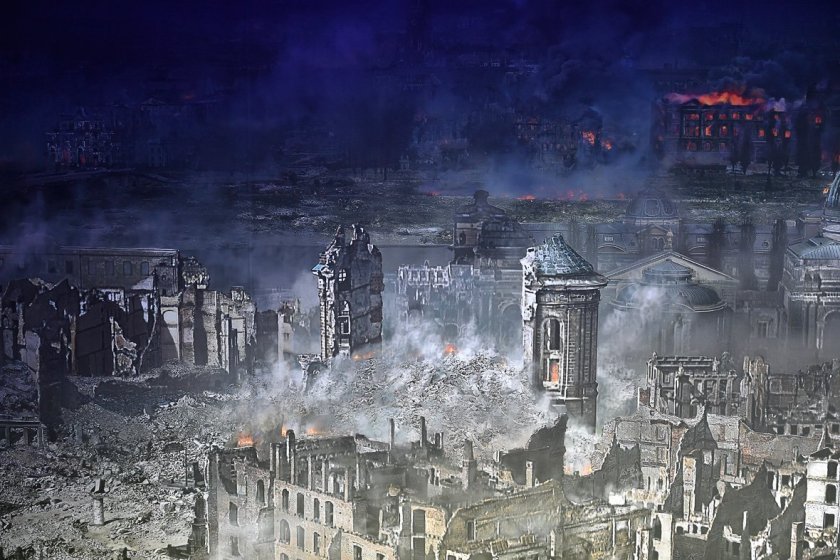
Tens of thousands of fires enveloped the city, growing into a great, howling firestorm.  A shrieking, all-but living demon beast from the blackest pits of hell, devouring all in its path.  A firestorm of this size develops its own weather, fire tornadoes reaching into the sky as pyrocumulonimbus clouds hurl lightning bolts back to earth, starting new fires.  Gale force winds scream into the vortex from all points of the compass, powerful enough to hurl grown adults opening doors in an effort to flee, off their feet and back into the flames.

Lothar Metzger was ten at the time.  He brings us one of the few eyewitness accounts of the fire bombing of Dresden, as seen from the ground:

“It is not possible to describe! Explosion after explosion. It was beyond belief, worse than the blackest nightmare. So many people were horribly burnt and injured. It became more and more difficult to breathe. It was dark and all of us tried to leave this cellar with inconceivable panic. Dead and dying people were trampled upon, luggage was left or snatched up out of our hands by rescuers. The basket with our twins covered with wet cloths was snatched up out of my mother’s hands and we were pushed upstairs by the people behind us. We saw the burning street, the falling ruins and the terrible firestorm. My mother covered us with wet blankets and coats she found in a water tub.

We saw terrible things: cremated adults shrunk to the size of small children, pieces of arms and legs, dead people, whole families burnt to death, burning people ran to and fro, burnt coaches filled with civilian refugees, dead rescuers and soldiers, many were calling and looking for their children and families, and fire everywhere, everywhere fire, and all the time the hot wind of the firestorm threw people back into the burning houses they were trying to escape from.

I cannot forget these terrible details. I can never forget them”.

dresden-bombing (3)

For Victor Klemperer, the fire bombing of Dresden was a last minute reprieve. He would survive the attack, and live to see the end of the war.

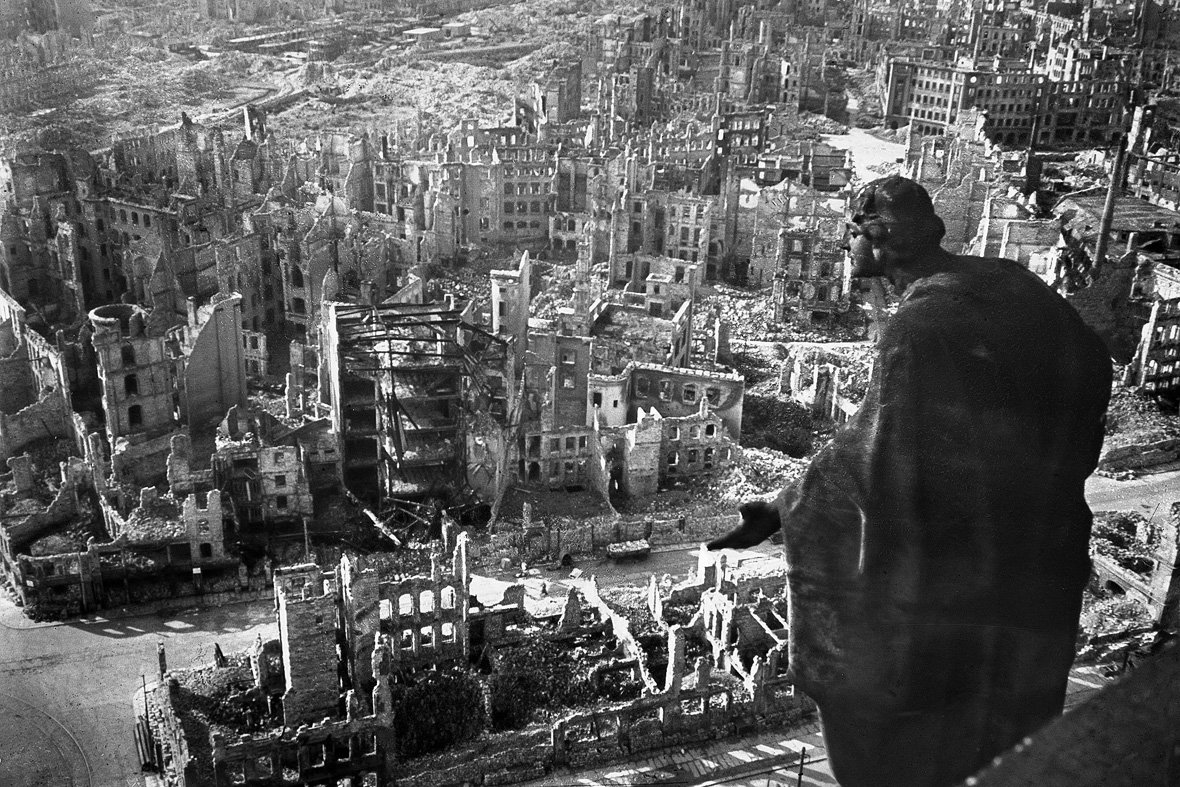
Official death tolls from the burned out city are estimated at 18,500 to 25,000. The real number will never be known.  Refugees and military forces in the tens of thousands were streaming through the area at this point in the war.  Estimates range as high as 200,000.  The number if true, is more than death tolls resulting from the atomic bombings of Hiroshima and Nagasaki, combined.

360-degree-panorama-display-depicting-city-dresden-aftermath-allied-firebombing
360° panoramic view of Dresden, following allied firebombing.  H/T International Business Times
If you enjoyed this “Today in History”, please feel free to re-blog, “like” & share on social media, so that others may find and enjoy it as well. Please click the “follow” button on the right, to receive email updates on new articles.  Thank you for your interest, in the history we all share.